Article

Wavefront Sensor for Laser Beams Based on Reweighted Amplitude Flow Algorithm

1
Hilase Centre, Institute of Physics, Czech Academy of Sciences, Za Radnicí 828, 252 41 Dolní Břežany, Czech Republic
2
Faculty of Nuclear Sciences and Physical Engineering, Czech Technical University in Prague, Břehová 7, 115 19 Prague, Czech Republic
*
Author to whom correspondence should be addressed.
Appl. Sci. 2026, 16(4), 1942; https://doi.org/10.3390/app16041942
Submission received: 19 January 2026 / Revised: 10 February 2026 / Accepted: 11 February 2026 / Published: 15 February 2026

Abstract

We present a reference-free computational wavefront sensor based on binary amplitude modulation and phase retrieval. The method employs a Digital Micromirror Device as a programmable amplitude modulator and reconstructs the complex optical field from multiple far-field intensity measurements using the Reweighted Amplitude Flow algorithm with Optimal Spectral Initialization. Unlike classical pupil-plane wavefront sensors, the proposed architecture contains no wavelength-specific optical elements, enabling straightforward adaptation across a broad spectral range. The achievable spatial resolution of the reconstructed wavefront scales directly with the modulator resolution. We experimentally demonstrate wavefront reconstruction at 650 nm and at 2116 nm, a wavelength regime where commercial wavefront sensors are scarce. At 650 nm, the reconstructed wavefront is validated against a commercial lateral shearing interferometer, and the sensor is further integrated into a closed-loop adaptive optics system using a deformable mirror. The proposed approach is particularly suited for applications requiring high spatial resolution and large dynamic range in slowly varying or quasi-static laser fields, where computational reconstruction speed is not a primary concern.

Graphical Abstract

1. Introduction

Laser beam quality control is essential in optical laboratories and high-power laser facilities, where complex optical chains introduce cumulative aberrations that degrade beam propagation, cause intensity inhomogeneities, and generate parasitic hot spots that may lead to optical damage [1,2,3,4,5]. Active wavefront control mitigates these effects and enables precise shaping of the beam intensity profile at the target.
An optical field is fully defined by its amplitude and phase; however, the phase information is typically lost during detection because conventional sensors measure only time-averaged intensity. This limitation motivates the development of wavefront sensing techniques capable of reconstructing phase from intensity-only measurements [6].
Wavefront sensing methods can be broadly categorized by their operating principle [7,8]. Widely used pupil-plane techniques, such as the Shack–Hartmann sensor [9,10,11], Pyramid sensor [12,13], and Shearing Interferometer [14,15], rely on refractive elements that modify the spatial phase profile. While effective, these approaches are limited in dynamic range and/or spatial resolution and often require various mitigation strategies [16,17]. In particular, shearing interferometry offers high spatial resolution but typically involves complex and vibration-sensitive optical layouts [18].
Computational wavefront sensing techniques provide an alternative by exploiting redundancy in intensity measurements acquired in one or more planes perpendicular to the optical axis. This class includes curvature sensing, phase diversity, and general phase retrieval methods [19,20,21,22,23,24,25]. Compared to pupil-plane sensors, computational approaches generally offer larger dynamic range, with spatial resolution primarily determined by the modulator or detector. Their applicability is often constrained by computational complexity and sensitivity to noise.
Phase retrieval algorithms date back to the Error Reduction method introduced by Gerchberg and Saxton [26], which reconstructs phase from intensity measurements in Fourier-related planes. More recently, binary amplitude modulation—commonly implemented using Digital Micromirror Devices (DMDs)—has emerged as an effective strategy for encoding phase information into multiple intensity measurements. Random and optimized binary masks, ptychography-inspired formulations, and systematic modulation strategies have demonstrated improved reconstruction fidelity and robustness [27,28,29,30,31], highlighting the critical role of mask design.
In this work, we report on the use of the Amplitude flow algorithm for Phase retrieval computations Utilizing Coded Aperture Masking (APUCAM) based on the Reweighted Amplitude Flow algorithm using Optimal Spectral Initialization (RAF-OSI). The approach enables high-resolution wavefront reconstruction with spatial sampling limited only by the modulator resolution. Further, the method is extended to the near-infrared wavelength of 2116 nm, where high-resolution wavefront sensors are scarce. The method relies exclusively on intensity-only detection without wavelength-specific phase-modulating elements, allowing straightforward reference-free adaptation across a wide spectral range.
The proposed sensor is validated by comparison with a commercial lateral shearing interferometer (SID4, Phasics S.A.) and integrated into a closed-loop adaptive optics system with a deformable mirror. Successful closed-loop operation is demonstrated, establishing the method as a robust, wavelength-versatile diagnostic and adaptive optics feedback tool for laboratory applications prioritizing high spatial resolution and large dynamic range over real-time performance.

2. Principles of Computational Reconstruction

For clarity and reproducibility, we explicitly define the forward model used to generate intensity measurements. Let
u x , y = A x , y exp i ϕ x , y
denote the complex optical amplitude in the DMD plane. The field is modulated by an elementwise multiplication of a binary amplitude mask M i x , y 0 , 1 , yielding
u i x , y = M i x , y     u x , y .
Using the paraxial and the scalar diffraction approximations, propagation to the focal plane of a lens with focal length f is given by the Fraunhofer diffraction integral, which is proportional to the Fourier transform of the modulated field:
U i ξ , η = F u i x , y ξ , η ,
The spatial frequencies are related to focal-plane coordinates X , Y by ξ = X / λ f and η = Y / λ f , where λ is the optical wavelength. The recorded intensity measurement is
y i p = U i X p , Y p 2 + n i p ,  
where n i represents measurement noise and p indexes camera pixels within the area of interest.
The phase retrieval problem consists of estimating the complex amplitude u x , y from a set of intensity-only measurements { y i } i = 1 m obtained with different binary masks M i . Similar inverse problems arise in X-ray crystallography [32,33], astronomy [34,35], and ptychography [36]. The reconstruction can be formulated as an empirical loss minimization problem.
u ^ = arg min u N 1 2 m i = 1 m F { M i u } y i 2 2 ,
where u ^ denotes the estimated solution. This optimization problem is non-convex and NP-hard, making direct solutions such as least-squares minimization impractical.
Early approaches to this problem include the Error Reduction (ER) algorithm, which iteratively propagates intensity distributions between pupil and focal planes while enforcing amplitude constraints [26]. Although conceptually simple, ER often suffers from stagnation and slow convergence. Numerous improved phase retrieval algorithms have since been proposed [37,38,39,40,41], offering enhanced robustness against local minima.
Related approaches such as phase diversity and curvature sensing rely on intensity measurements from multiple non-conjugate planes, which are not directly related by Fourier propagation as in Equation (3). These methods are often combined with gradient-based optimization over a predefined aberration expansion basis [42,43]. Other approaches employ pseudorandom intensity modulation to encode phase information into multiple measurements, enabling high-fidelity wavefront reconstruction from a limited number of recorded images [44,45,46]. Closely related methods developed for ptychography [47] follow similar principles and have also been applied to laser wavefront sensing [48].
In this work, we adopt a pseudorandom amplitude modulation strategy using a set of complementary binary masks implemented by a DMD. Reconstruction is performed using the Reweighted Amplitude Flow algorithm with Optimal Spectral Initialization (RAF-OSI) [49]. For a noiseless case, a minimum of 2 N 1 intensity measurements are required to reconstruct N phase points [46], while noisy data require a larger measurement set. These theoretical limits assume ideal randomness and incoherence conditions, which are not fully satisfied in the presented experimental implementation due to amplitude-only modulation and non-uniform illumination. Practical implementation shows that accurate wavefront reconstruction can be achieved with moderate number of measurements.

3. Methods

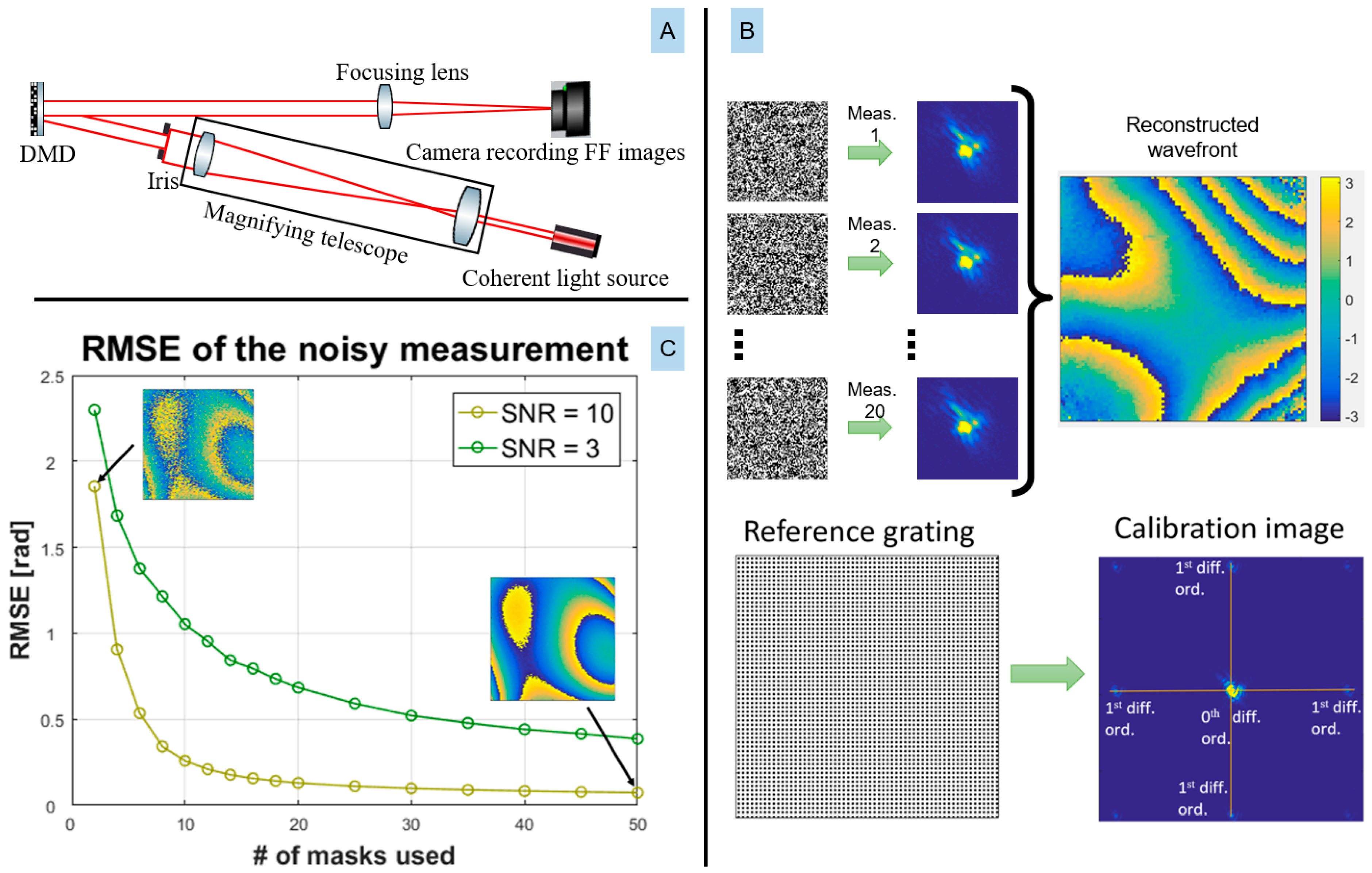
The experimental layout of the proposed wavefront sensor is shown in Figure 1A. A fraction of the laser beam is directed into a diagnostic branch and expanded to uniformly illuminate a Digital Micromirror Device (DMD, DLP® LightCrafter™ 6500 Evaluation Module, Texas Instruments, Dallas, TX, USA), which operates as a binary amplitude modulator. The DMD’s native resolution is 1080 × 1920 micromirrors, each addressable via GPU. To balance spatial resolution and computational complexity, the DMD was grouped into grid of 120 × 120 super-pixels, each comprising 9 × 9 micromirrors. This grouping defines the sampling of the reconstructed wavefront without limiting the method fundamentally. Two laser sources demonstrate the wavelength versatility. For the visible part of the experiment, a 650 nm laser diode was used, while for mid-IR we used a Ho-doped fiber oscillator emitting at 2116 nm.
After modulation by the DMD, the beam is focused by a lens (f = 250 mm) onto a camera in the focal plane, forming the Fraunhofer intensity distribution. A CMOS camera (Allied Vision Manta G-125, 1292 × 964, Allied Vision Technologies GmbH, Stadtroda, Germany) recorded 650 nm measurements, while a mid-infrared camera (Tachyon 16k, 128 × 128, Tachyon Technologies, Southlake, TX, USA) captured 2116 nm data. Cameras were operated via Ethernet, providing sufficient bandwidth for multi-frame acquisition. Because only amplitude is modulated, most optical power remains near the focal spot center, unlike phase-modulation approaches [50]. We define the acquisition noise as a ratio between the total power of the signal (including noise) and the total power of the noise across the whole area of interest.
Numerical simulations assessed the sensitivity of the reconstruction algorithm to detector noise. Synthetic wavefronts were propagated through the forward model with additive noise, and the root-mean-square error (RMSE) of the reconstructed phase was evaluated as a function of mask count and detector signal-to-noise ratio (SNR). Experimentally measured background noise was ~13–18 dB for visible and 5–8 dB for near-infrared cameras, with simulations conservatively exceeding these levels. Other noise sources—including laser power fluctuations, DMD temporal jitter, and thermal effects—were negligible over acquisition durations.
The area of interest (AOI) on the camera, corresponding to the spatial bandwidth of the modulated beam, was calibrated using a periodic reference mask. A 2D grid with spatial frequency equal to half the DMD super-pixel frequency produced first-order diffraction maxima in the focal plane, defining the AOI (see Figure 1B). The AOI was resampled to match the DMD modulation grid, ensuring each far-field image directly represents the power spectrum of the DMD-plane field. Accurate camera alignment and sufficient sampling prevent aliasing; residual geometric distortions can be corrected digitally.
The beam was sequentially modulated by complementary pseudorandom binary masks, with each super-pixel transmitting or blocking light with equal probability. Pseudorandom masks ensure uniform average illumination, provide sufficient diversity for phase retrieval, and suppress periodic correlations that amplify systematic errors. Structured mask designs, such as Hadamard patterns, can reduce noise amplification but may increase sensitivity to artifacts; random masks were selected for robustness and simplicity. For visible measurements, 20 masks were used; for near-infrared, 30 masks were used to compensate for lower SNR to improve stability.
Wavefront reconstruction was performed using RAF-OSI in MATLAB (R2025a). Convergence parameters were set according to the experimental noise level: visible experiments used a relative tolerance of 10−2, a maximum of 2000 iterations, and a 100 s execution limit. Typically, convergence occurred within 80–300 iterations. The reconstructed phase was initially modulo 2π and subsequently unwrapped using a Poisson solver with discrete cosine transform. Reconstruction of 20 masks required ~3–5 s on a standard workstation (~0.2 Hz effective sampling rate). Computation is dominated by Fourier transforms and element-wise operations; acceleration via compiled code, GPU parallelization, or FPGA implementation could reduce latency to <100 ms per reconstruction, enabling update rates up to ~10 Hz. In its current form, the method is best suited for quasi-static or slowly varying wavefronts, where high spatial resolution and wavelength flexibility are prioritized over acquisition speed.
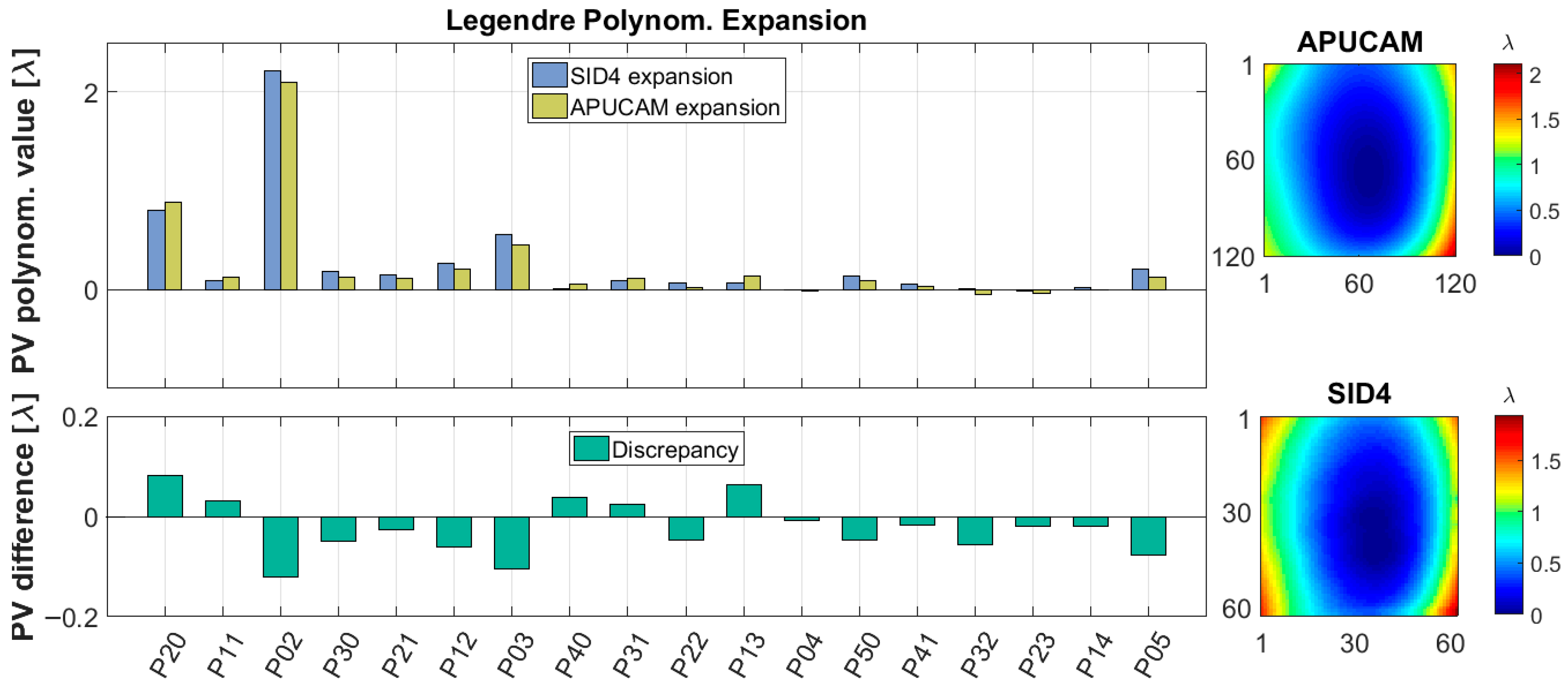
As a proof-of-principle, wavefronts reconstructed with APUCAM were compared to measurements from a commercial lateral shearing interferometer (SID4, Phasics S.A., Saint-Aubin, France) at 650 nm. The comparison emphasizes consistency in low- and mid-spatial-frequency aberrations rather than absolute metrological equivalence. Figure 2 (right) shows unwrapped wavefronts from APUCAM and SID4. For quantitative assessment, both wavefronts were expanded into Legendre polynomials up to fifth order, excluding piston and tilt, which depend on alignment and focal spot position.
Figure 2 (top) shows the Legendre coefficients, while Figure 2 (bottom) presents the coefficient-wise differences. Despite notable high-frequency noise in the APUCAM reconstruction, low-order aberrations agree well with SID4, indicating that the method accurately captures the dominant modes relevant for adaptive optics correction. This comparison confirms that the reconstructed wavefront is physically consistent and suitable for closed-loop feedback.
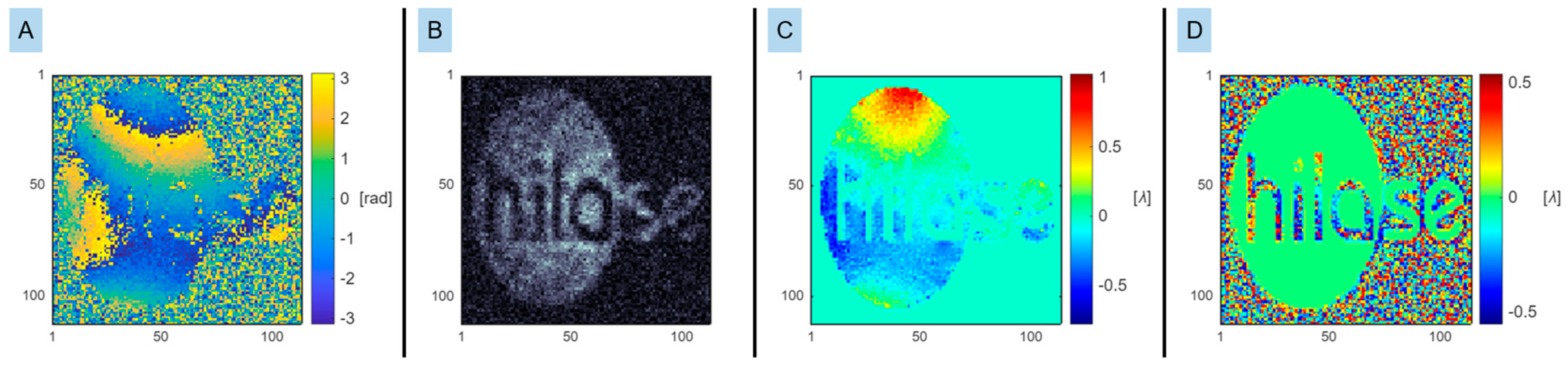
To demonstrate wavelength versatility, the system was reconfigured for 2116 nm measurements, where no commercial sensor was available. A binary aperture mask was superimposed on the DMD patterns to define the AOI. Following calibration and alignment, wavefronts were reconstructed at 112 × 112 pixels. Figure 3A,B show the reconstructed phase and intensity distributions, respectively; Figure 3C presents an unwrapped phase cut corresponding to the imposed aperture, and Figure 3D illustrates the phase outside illuminated regions. The latter exhibits noise-dominated behavior, as expected, while the continuity of phase within the aperture and absence of spurious structure outside indicate that the algorithm correctly identifies the spatial support. These results demonstrate the feasibility of the method at wavelengths where conventional wavefront sensors are not widely available. The main limitation in the near-infrared is reduced SNR of the mid-IR detector, which increases high-frequency noise in the recovered phase.
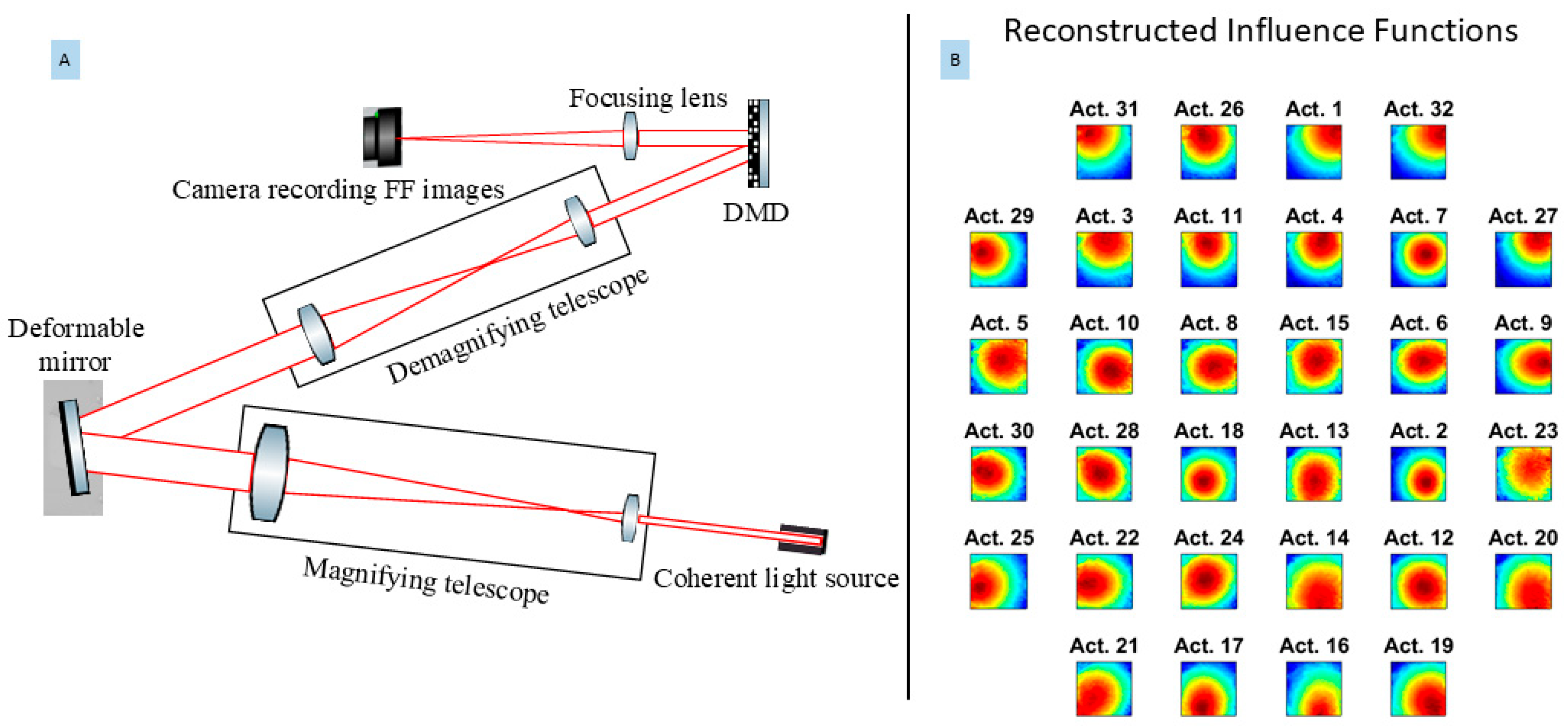
To evaluate the proposed wavefront sensor for closed-loop adaptive optics (AO), a bimorph deformable mirror (DM) was incorporated upstream of the DMD in the 650 nm setup. A Keplerian relay telescope demagnified and imaged the DM plane onto the DMD plane, ensuring conjugation between correction and sensing planes (Figure 4A). The influence functions (IFs) of the 32 actuators were measured using APUCAM: starting from zero bias voltage, each actuator was driven sequentially, and the resulting wavefront response was reconstructed. The response matrix was analyzed via singular value decomposition (SVD) to obtain the set of DM eigenmodes (Figure 4B). Based on actuator density, the mirror can reproduce aberrations approximately up to fifth-order Legendre modes.
Closed-loop correction decomposes the residual wavefront into the measured IFs and computes actuator voltage updates via least-squares:
V n + 1 i = V n i g   V L S i , i 1 , , n .
where V n i is the voltage of the i -th actuator at iteration n , V LS i is the least-squares correction from the pseudoinverse of the IF matrix and the reconstructed residual wavefront, and g is the loop gain.
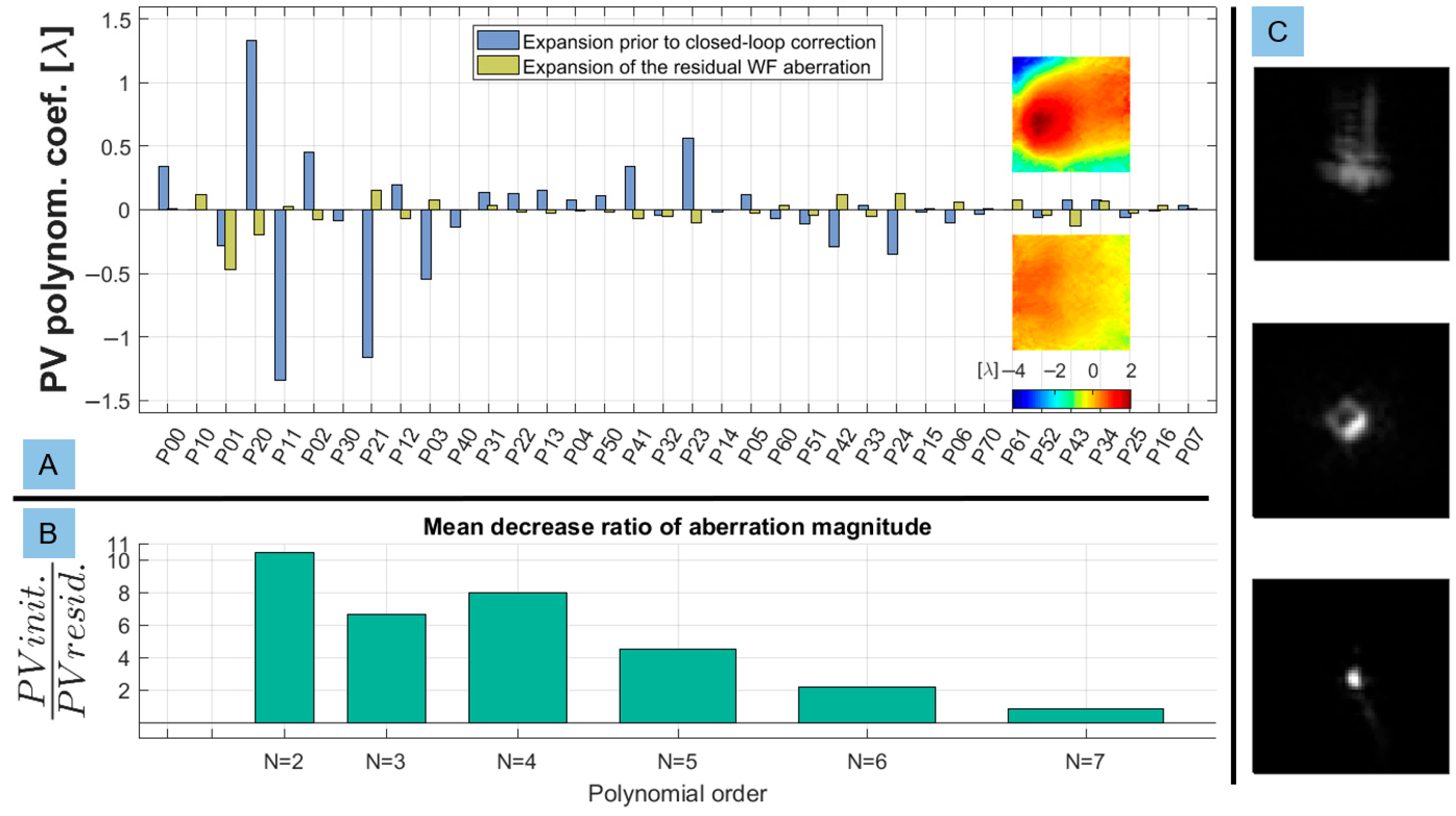
Closed-loop operation with appropriate gain corrected beam aberrations (Figure 5A, top inset), typically converging after 5–8 iterations as the standard deviation of the reconstructed wavefront stabilized. When targeting a planar wavefront, the focal intensity becomes strongly concentrated due to amplitude-only modulation. To maintain numerical stability, an intermediate defocus target (peak-to-valley ~1 λ) was introduced. When reached, it was analytically removed by projection onto the IF basis. This strategy ensures stable convergence under the constraints of amplitude-only modulation, where optical power redistribution cannot be directly controlled.
Figure 5 summarizes the closed-loop wavefront correction. A representative sequence is shown in Figure 5A: the initial wavefront exhibited an RMSE of 1.66 λ, which was reduced to 0.22 λ after five iterations following defocus removal. The reported RMSE is influenced by high-spatial-frequency noise from the detector and does not fully reflect the physical beam quality, which is dominated by low- and mid-order aberrations. By subsequent analysis of measured Strehl ratio the RMSE was estimated as 0.07 λ. As shown in Figure 5B, substantial correction was achieved for aberration orders up to N = 5, while higher-order modes remained largely uncorrected due to actuator spacing.
The evolution of the far-field focal spot is illustrated in Figure 5C. The initial distorted spot had a Strehl ratio of ~0.06, which improved to 0.82 after closed-loop optimization, satisfying the Maréchal criterion for diffraction-limited performance [51,52]. The ultimate performance is limited primarily by noise-induced high-frequency artifacts in the RAF-OSI reconstruction and the detector dynamic range, rather than the deformable mirror itself.

4. Conclusions

We have demonstrated a reference-free wavefront sensing method capable of high-resolution reconstruction of laser beam wavefronts, designed for feedback to deformable mirrors and related adaptive optics elements. The approach combines binary amplitude modulation using a DMD with computational phase retrieval, enabling reconstruction of arbitrary wavefront shapes without wavelength-specific refractive or interferometric components. Spatial resolution scales with the modulator resolution, and dynamic range is not intrinsically limited by the sensing principle.
The reconstruction algorithm was evaluated under varying noise levels, allowing estimation of the optimal dataset size for stable phase recovery. In proof-of-concept experiments at 650 nm, APUCAM measured static wavefronts at 120 × 120 pixels, showing good agreement with a commercial lateral shearing interferometer (62 × 62 pixels) for low- and mid-order aberrations relevant to adaptive optics. Wavelength versatility was demonstrated at 2116 nm, reconstructing a spatially bounded beam at 112 × 112 pixels, a regime where commercial sensors supply is limited.
The sensor was further applied in a closed-loop adaptive optics experiment. The DM’s influence functions were characterized using APUCAM, and an aberrated wavefront (RMSE = 1.66 λ) was corrected to near-planar (residual RMSE ≈ 0.07 λ). This confirms the method’s suitability for high-resolution closed-loop wavefront correction in laboratory environments.
Overall, the approach offers scalable spatial resolution, broad wavelength applicability, and straightforward implementation. While computational reconstruction limits real-time operation for rapidly varying wavefronts, the method’s flexibility, simplicity, and wavelength agnosticism make it a valuable diagnostic and adaptive optics tool where spatial resolution and dynamic range are prioritized over acquisition speed.

Author Contributions

Conceptualization, O.D., J.P. and M.D.; methodology, O.D. and J.P.; software, O.D.; validation, O.D. and J.P.; formal analysis, O.D., J.P., M.D. and M.Č.; investigation, O.D. and J.P.; resources, M.D. and T.M.; data curation, O.D. and J.P.; writing—original draft preparation, O.D.; writing—review and editing, J.P., M.D. and M.Č.; visualization, O.D.; supervision, J.P., M.D. and M.Č.; project administration, T.M.; funding acquisition, M.D. and T.M. All authors have read and agreed to the published version of the manuscript.

Funding

This article was co-financed by the European Union and the state budget of the Czech Republic under project LasApp (CZ.02.01.01/00/22_008/0004573) and by the European Union’s Horizon 2020 research and innovation program under grant agreement No. 739573; This work was also supported by the Ministry of Education, Youth and Sports of the Czech Republic (Programs NPU I Project No. LO1602, and Large Research Infrastructure Project No. LM2015086).

Institutional Review Board Statement

Not applicable.

Data Availability Statement

Dataset available on request from the authors.

Acknowledgments

During the preparation of this manuscript, the authors used ChatGPT (GPT-5.2) for the purposes of text proofreading. The authors have reviewed and edited the output and take full responsibility for the content of this publication.

Conflicts of Interest

The authors declare no conflicts of interest.

Abbreviations

The following abbreviations are used in this manuscript:
DMDDigital Micro-mirror Device
(N)IR(Near-)Infrared
ERError Reduction algorithm
APUCAMAmplitude flow algorithm for Phase retrieval computations Utilizing Coded Aperture Masking
RAF-OSIReweighted Amplitude Flow with Optimal Spectral Initialization
AOIArea of interest
RMSERoot-mean-square error
SNRSignal-to-noise ratio
DMDeformable mirror
IFInfluence function
SRStrehl ratio

References

  1. Pilar, J.; Slezak, O.; Sikocinski, P.; Divoky, M.; Sawicka, M.; Bonora, S.; Lucianetti, A.; Mocek, T.; Jelinkova, H. Design and optimization of an adaptive optics system for a high-average-power multi-slab laser (HiLASE). Appl. Opt. 2014, 53, 3255–3261. [Google Scholar] [CrossRef]
  2. Zacharias, R.A.; Beer, N.R.; Bliss, E.S.; Burkhart, S.C.; Cohen, S.J.; Sutton, S.B.; Atta, R.L.V.; Winters, S.E.; Salmon, J.T.; Latta, M.R.; et al. Alignment and wavefront control systems of the National Ignition Facility. Opt. Eng. 2004, 43, 2873–2884. [Google Scholar] [CrossRef]
  3. Mahajan, V.N. Optical Imaging and Aberrations: Ray Geometrical Optics; SPIE Press: Bellingham, WA, USA, 1998. [Google Scholar]
  4. Bercegol, H.; Bouchut, P.; Lamaignere, L.; Le Garrec, B.; Raze, G. The impact of laser damage on the lifetime of optical components in fusion lasers. Proc. SPIE 2004, 5273, 312–324. [Google Scholar]
  5. Mureșan, M.-G.; Novák, F.; Uvarova, L.; Vanda, J.; Brajer, J.; Mocek, T. Optical component reliability in high-energy laser systems: Challenges and insights. EPJ Web Conf. 2024, 309, 03017. [Google Scholar] [CrossRef]
  6. Allegre, O.J. Laser Beam Measurement and Characterization Techniques. In Handbook of Laser Micro- and Nano-Engineering; Sugioka, K., Ed.; Springer International Publishing: Cham, Switzerland, 2021; pp. 1–42. [Google Scholar]
  7. Rousset, G. Wavefront sensing. NATO ASI Ser. C Math. Phys. Sci.-Adv. Study Inst. 1994, 423, 115–138. [Google Scholar]
  8. Rousset, G. Wave-front sensors. Adapt. Opt. Astron. 1999, 1, 91. [Google Scholar]
  9. Jiang, W.; Li, H. Hartmann-Shack wavefront sensing and wavefront control algorithm. In Adaptive Optics and Optical Structures; International Society for Optics and Photonics; SPIE Press: Bellingham, WA, USA, 1990; Volume 1271, pp. 82–93. [Google Scholar]
  10. Roddier, F.J. Variations on a Hartmann theme. Opt. Eng. 1990, 29, 1239–1243. [Google Scholar] [CrossRef]
  11. Welsh, B.M.; Ellerbroek, B.L.; Roggemann, M.C.; Pennington, T.L. Fundamental performance comparison of a Hartmann and a shearing interferometer wavefront sensor. Appl. Opt. 1995, 34, 4186–4195. [Google Scholar] [CrossRef]
  12. Ragazzoni, R. Pupil plane wavefront sensing with an oscillating prism. J. Mod. Opt. 1996, 43, 289–293. [Google Scholar] [CrossRef]
  13. Esposito, S.; Riccardi, A. Pyramid wavefront sensor behavior in partial correction adaptive optic systems. Astron. Astrophys. 2001, 369, L9–L12. [Google Scholar] [CrossRef]
  14. Wyant, J.C. Use of an ac heterodyne lateral shear interferometer with real–time wavefront correction systems. Appl. Opt. 1975, 14, 2622–2626. [Google Scholar] [CrossRef]
  15. Chanteloup, J.-C. Multiple-wave lateral shearing interferometry for wavefront sensing. Appl. Opt. 2005, 44, 1559–1571. [Google Scholar] [CrossRef] [PubMed]
  16. Groening, S.; Sick, B.; Donner, K.; Pfund, J.; Lindlein, N.; Schwider, J. Wave-front reconstruction with a Shack-Hartmann sensor with an iterative spline fitting method. Appl. Opt. 2000, 39, 561–567. [Google Scholar] [CrossRef] [PubMed]
  17. Pfund, J.; Lindlein, N.; Schwider, J. Dynamic range expansion of a Shack–Hartmann sensor by use of a modified unwrapping algorithm. Opt. Lett. 1998, 23, 995–997. [Google Scholar] [CrossRef] [PubMed]
  18. Koch, J.; Presta, R.; Sacks, R.; Zacharias, R.; Bliss, E.; Dailey, M.; Feldman, M.; Grey, A.; Holdener, F.; Salmon, J.; et al. Experimental comparison of a Shack–Hartmann sensor and a phase-shifting interferometer for large-optics metrology applications. Appl. Opt. 2000, 39, 4540–4546. [Google Scholar] [CrossRef]
  19. Fiddy, M.A. The phase retrieval problem. In Inverse Optics I; International Society for Optics and Photonics: Bellingham, WA, USA; IOP Publishing Ltd.: Bristol, UK, 1983; Volume 413, pp. 176–181. [Google Scholar]
  20. Shechtman, Y.; Eldar, Y.C.; Cohen, O.; Chapman, H.N.; Miao, J.; Segev, M. Phase Retrieval with Application to Optical Imaging: A contemporary overview. IEEE Signal Process. Mag. 2015, 32, 87–109. [Google Scholar] [CrossRef]
  21. Duchi, J.C.; Ruan, F. Solving (most) of a set of quadratic equalities: Composite optimization for robust phase retrieval. Inf. Inference J. IMA 2019, 8, 471–529. [Google Scholar] [CrossRef]
  22. Hansen, A.K. Coherent laser phase retrieval in the presence of measurement imperfections and incoherent light. Appl. Opt. 2017, 56, 7341–7345. [Google Scholar] [CrossRef]
  23. Roddier, F.; Roddier, C.; Roddier, N. Curvature Sensing: A New Wavefront Sensing Method. In Statistical Optics; SPIE: Bellingham, WA, USA, 1988; Volume 0976, pp. 203–209. [Google Scholar]
  24. Kendrick, R.L.; Acton, D.S.; Duncan, A.L. Phase-diversity wavefront sensor for imaging systems. Appl. Opt. 1994, 33, 6533–6546. [Google Scholar] [CrossRef]
  25. Wang, J.; Ghazagh, A.; Ravi, S.S.; Baumbach, S.; Dannecker, B.; Scharun, M.; Bauer, D.; Nolte, S.; Flamm, D. Phase retrieval algorithm applied to high-energy ultrafast lasers. Appl. Opt. 2024, 63, 2518–2527. [Google Scholar] [CrossRef]
  26. Gerchberg, R.W. A practical algorithm for the determination of phase from image and diffraction plane pictures. Optik 1972, 35, 237–246. [Google Scholar]
  27. Peters, E.; Clemente, P.; Salvador-Balaguer, E.; Tajahuerce, E.; Andrés, P.; Pérez, D.G.; Lancis, J. Real-time acquisition of complex optical fields by binary amplitude modulation. Opt. Lett. 2017, 42, 2030–2033. [Google Scholar] [CrossRef]
  28. Xu, C.; Pang, H.; Cao, A.; Deng, Q.; Yang, H. Phase retrieval by random binary amplitude modulation and ptychography principle. Opt. Express 2022, 30, 14505–14517. [Google Scholar] [CrossRef] [PubMed]
  29. Abregana, T.; Almoro, P. Phase retrieval by amplitude modulation using digital micromirror device. Opt. Lasers Eng. 2022, 150, 106851. [Google Scholar] [CrossRef]
  30. Yang, C.; Xu, C.; Pang, H.; Lan, J.; Zhao, L.; Hu, S.; Yan, W.; Zhu, X. Efficient Phase Retrieval via Improved Binary Amplitude Modulation Masks. IEEE Photonics J. 2024, 16, 5200608. [Google Scholar] [CrossRef]
  31. Romero, B.; Scherz, P.; Díaz, N.; Tapia, J.; Cofré, A.; Peters, E.; Vera, E.; Pérez, D.G. Phase retrieval by designed Hadamard complementary coded apertures. Opt. Laser Technol. 2025, 191, 113311. [Google Scholar] [CrossRef]
  32. Rodenburg, J.; Hurst, A.; Cullis, A.; Dobson, B.; Pfeiffer, F.; Bunk, O.; David, C.; Jefimovs, K.; Johnson, I. Hard-X-Ray Lensless Imaging of Extended Objects. Phys. Rev. Lett. 2007, 98, 034801. [Google Scholar] [CrossRef]
  33. Miao, J.; Charalambous, P.; Kirz, J.; Sayre, D. Extending the methodology of X-ray crystallography to allow imaging of micrometre-sized non-crystalline specimens. Nature 1999, 400, 342–344. [Google Scholar] [CrossRef]
  34. Fienup, C.; Dainty, J. Phase retrieval and image reconstruction for astronomy. Image Recovery Theory Appl. 1987, 231, 275. [Google Scholar]
  35. Caroli, E.; Stephen, J.B.; Di Cocco, G.; Natalucci, L.; Spizzichino, A. Coded aperture imaging in X- and gamma-ray astronomy. Space Sci. Rev. 1987, 45, 349–403. [Google Scholar] [CrossRef]
  36. Rodenburg, J.M. Ptychography and related diffractive imaging methods. Adv. Imaging Electron. Phys. 2008, 150, 87–184. [Google Scholar]
  37. Gonsalves, R.A.; Chidlaw, R. Wavefront Sensing By Phase Retrieval. In Applications of Digital Image Processing III; SPIE: Bellingham, WA, USA, 1979; Volume 0207, pp. 32–39. [Google Scholar]
  38. Fienup, J.R.; Wackerman, C.C. Phase-retrieval stagnation problems and solutions. J. Opt. Soc. Am. A 1986, 3, 1897–1907. [Google Scholar] [CrossRef]
  39. Fienup, J.R. Iterative method applied to image reconstruction and to computer-generated holograms. In Applications of Digital Image Processing III; International Society for Optics and Photonics; SPIE: Bellingham, WA, USA, 1979; Volume 207, pp. 2–13. [Google Scholar]
  40. Fienup, J.R. Phase retrieval algorithms: A comparison. Appl. Opt. 1982, 21, 2758–2769. [Google Scholar] [CrossRef] [PubMed]
  41. Fienup, J.R. Phase retrieval with continuous version of hybrid input-output. In Frontiers in Optics (2003); Paper ThI3; Optical Society of America: Washington, DC, USA, 2003; p. ThI3. [Google Scholar]
  42. Li, H.; Li, S.; Xia, Y. Sampling complexity on phase retrieval from masked Fourier measurements via Wirtinger flow. Inverse Probl. 2022, 38, 105004. [Google Scholar] [CrossRef]
  43. Mugnier, L.M.; Blanc, A.; Idier, J. Phase Diversity: A Technique for Wave-Front Sensing and for Diffraction-Limited Imaging. Adv. Imaging Electron Phys. 2006, 141, 1–76. [Google Scholar]
  44. Zhang, H.; Liang, Y. Reshaped wirtinger flow for solving quadratic system of equations. In Advances in Neural Information Processing Systems; ACM: New York, NY, USA, 2016; pp. 2622–2630. [Google Scholar]
  45. Stern, A. Optical Compressive Imaging; CRC Press: Boca Raton, FL, USA, 2016. [Google Scholar]
  46. Wang, G.; Giannakis, G.; Saad, Y.; Chen, J. Solving most systems of random quadratic equations. In Advances in Neural Information Processing Systems; ACM: New York, NY, USA, 2017; pp. 1867–1877. [Google Scholar]
  47. Melnyk, O. On connections between Amplitude Flow and Error Reduction for phase retrieval and ptychography. Sampl. Theory Signal Process. Data Anal. 2022, 20, 16. [Google Scholar] [CrossRef]
  48. Daurer, B.; Sala, S.; Hantke, M.; Reddy, H.; Bielecki, J.; Shen, Z.; Nettleblad, C.; Svenda, M.; Ekeberg, T.; Carini, G.; et al. Ptychographic Wavefront Characterisation for Single-Particle Imaging at X-Ray Lasers. arXiv 2020, arXiv:2012.13783. [Google Scholar]
  49. Wang, G.; Giannakis, G.B.; Saad, Y.; Chen, J. Phase Retrieval via Reweighted Amplitude Flow. IEEE Trans. Signal Process. 2018, 66, 2818–2833. [Google Scholar] [CrossRef]
  50. Candès, E.J.; Li, X.; Soltanolkotabi, M. Phase retrieval from coded diffraction patterns. Appl. Comput. Harmon. Anal. 2015, 39, 277–299. [Google Scholar] [CrossRef]
  51. Christou, J.C.; Mighell, K.J.; Makidon, R.B. Strehl ratio and image sharpness for adaptive optics. SPIE Proc. 2006, 6272, 628–639. [Google Scholar]
  52. Maréchal, A. Étude des Effets Combinés de la Diffraction et des Aberrations Géométriques sur L’image d’un Point Lumineux. Doctoral Dissertation, University of Paris, Paris, France, 1948. [Google Scholar]
Figure 1. Wavefront sensing concept and calibration. (A) Schematic layout of the experimental setup. The laser beam is expanded and amplitude–modulated by a Digital Micromirror Device (DMD). The modulated beam is focused to form a far–field intensity distribution recorded by a camera. (B) (Top): Examples of pseudorandom binary amplitude masks displayed on the DMD and corresponding recorded far–field intensity patterns. (Bottom): Periodic calibration mask used to determine the area of interest (AOI) on the camera and a representative calibration image. (C) Numerically evaluated mean reconstruction root–mean–square error (RMSE) as a function of the number of modulation masks for two representative detector noise levels inset with reconstructions under different sampling redundancy. The study illustrates the trade–off between measurement redundancy and noise robustness.
Applsci 16 01942 g001
Figure 2. Comparison of visible-wavelength wavefront reconstruction at λ = 650 nm. (Top): Legendre polynomial expansion coefficients (up to 5th order) of the wavefront reconstructed using APUCAM (120 × 120 sampling) and measured using a commercial lateral shearing interferometer (SID4, 62 × 62 sampling). (Bottom): Coefficient-wise discrepancy between the two measurements. Piston and tilt terms are omitted due to their dependence on relative alignment. (Right): Unwrapped wavefront maps obtained by the two methods. The comparison focuses on consistency of low- and mid-order aberrations rather than absolute metrological accuracy.
Applsci 16 01942 g002
Figure 3. Near-infrared wavefront reconstruction at λ = 2116 nm. (A) Reconstructed phase distribution (resolution 112 × 112) within a spatially bounded aperture defined by a superimposed binary mask on the DMD. (B) Corresponding reconstructed intensity distribution. (C) unwrapped phase cut-out corresponding to the illuminated aperture region. (D) Reconstructed phase in regions without optical signal, demonstrating noise-dominated behavior outside the spatial support. The results illustrate internal consistency of the reconstruction in a wavelength regime where commercial wavefront sensors are limited.
Applsci 16 01942 g003
Figure 4. Closed-loop adaptive optics configuration and deformable mirror characterization. (A) Simplified schematics of the closed-loop setup. The deformable mirror (DM) is imaged onto the DMD plane via a Keplerian relay telescope, ensuring conjugation between correction and sensing planes. (B) Experimentally measured influence functions of individual DM actuators reconstructed using APUCAM (actuator responses are normalized to unity), illustrating the spatial sampling density and actuator layout.
Applsci 16 01942 g004
Figure 5. Closed-loop wavefront correction results at λ = 650 nm. (A) Evolution of the reconstructed wavefront during closed-loop optimization. The initial wavefront (RMSE = 1.66 λ, blue Leg. expansion) is progressively corrected over five iterations. A controlled defocus bias is introduced for stability and subsequently removed, yielding a residual wavefront with RMSE = 0.22 λ (yellow Leg. expansion). Insets show representative wavefront maps (resolution 120 × 120). (B) Mean improvement ratio of Legendre polynomial coefficients as a function of polynomial order. Aberrations up to 5th order are effectively compensated, while compensation of higher-order modes remains limited due to actuator density. (C) Corresponding evolution of the far-field focal spot, showing improvement from a distorted profile (top) to an intermediate defocus aberration (middle) to a corrected, high-Strehl configuration (bottom).
Applsci 16 01942 g005
Disclaimer/Publisher’s Note: The statements, opinions and data contained in all publications are solely those of the individual author(s) and contributor(s) and not of MDPI and/or the editor(s). MDPI and/or the editor(s) disclaim responsibility for any injury to people or property resulting from any ideas, methods, instructions or products referred to in the content.