Article

Reference Values for Physical Functional Performance Across Childhood, Adolescence, and Early Adulthood in Individuals with Intellectual Disabilities


by
Claudio Farías-Valenzuela
1,*,
David Suazo-Romero
1,
Matías Henríquez
2,
Emilio Jofré-Saldía
3,
Paloma Ferrero-Hernández
4,
Gerson Ferrari
1,5,
Jorge Orrego-Marambio
1,
Josivaldo de Souza-Lima
6,
Antonio Castillo-Paredes
7,
Exal Garcia-Carrillo
8,9,
Sebastián Espoz-Lazo
10 and
Pedro Valdivia-Moral
11,*
1
Escuela de Ciencias de la Actividad Física, el Deporte y la Salud, Universidad de Santiago de Chile (USACH), Santiago 9170022, Chile
2
Escuela de Kinesiología, Facultad de Salud, Universidad Santo Tomas, Santiago 9170022, Chile
3
Escuela de Ciencias de la Actividad Física, Facultad de Ciencias de la Rehabilitación y Calidad de Vida, Universidad San Sebastián, Santiago 8370040, Chile
4
Vicerrectoría de Investigación e Innovación, Universidad Arturo Prat, Iquique 1110939, Chile
5
Facultad de Ciencias de la Salud, Universidad Autónoma de Chile, Providencia, Santiago 7500912, Chile
6
Facultad de Educación y Ciencias Sociales, Instituto del Deporte y Bienestar, Universidad Andres Bello, Las Condes, Santiago 7550000, Chile
7
Grupo AFySE, Investigación en Actividad Física y Salud Escolar, Escuela de Pedagogía en Educación Física, Facultad de Educación, Universidad de Las Américas, Santiago 8370040, Chile
8
Department of Physical Activity Sciences, Faculty of Education Sciences, Universidad Católica del Maule, Talca 3480112, Chile
9
Department of Physical Activity Sciences, Universidad de Los Lagos, Osorno 5290000, Chile
10
Facultad de Educación, Pontificia Universidad Católica de Chile, Santiago 8520000, Chile
11
Facultad de Ciencias de la Educación, Universidad de Granada, 18071 Granada, Spain
*
Authors to whom correspondence should be addressed.
Appl. Sci. 2026, 16(4), 1912; https://doi.org/10.3390/app16041912
Submission received: 16 January 2026 / Revised: 7 February 2026 / Accepted: 9 February 2026 / Published: 14 February 2026
(This article belongs to the Special Issue Sports, Exercise and Healthcare)

Abstract

Individuals with Intellectual Disabilities (ID) often exhibit reduced physical fitness, leading to early declines in the ability to perform daily activities. This study aimed to characterize and establish reference values for physical functional performance by sex and age group in school-aged children with ID. A total of 321 participants (ages 5–26 years) from special education schools were assessed. Physical functional performance was measured using the 4 × 10 m shuttle run (4 × 10 m), Timed Up and Go (TUG), Five-Repetition Sit-to-Stand Test (5R-STS), and Countermovement Jump (CMJ). Two-way ANOVA, Kruskal–Wallis tests, and percentile values (5th–95th) were calculated by sex and age group. Males consistently demonstrated higher performance than females. Cross-sectional comparisons showed higher 4 × 10 m, TUG, and 5R-STS performance during adolescence in both sexes, while CMJ performance was higher in males during early adulthood. Adolescents outperformed children in 4 × 10 m, TUG, and CMJ tests (p < 0.05). Females exhibited lower 4 × 10 m and CMJ performance in early adulthood compared with adolescence (p < 0.05), whereas males showed no significant differences across these stages. Physical functional performance in individuals with ID varied according to sex and age, with males generally demonstrating better performance. Adolescence is associated with higher performance, while females experience reductions in lower-limb power in early adulthood. These findings highlight sex- and age-related differences and support the need for targeted monitoring and intervention strategies in this population.

1. Introduction

Individuals with Intellectual Disability (ID) present neurodevelopmental deficits characterized by limitations in intellectual functioning and adaptive behavior, with onset during the developmental period and typically identified in childhood or adolescence [1]. Beyond these core characteristics, individuals with ID often exhibit more complex health profiles and marked health disparities, including a higher prevalence of comorbid conditions such as metabolic and cardiovascular disorders, which can have lifelong consequences [2]. Additionally, people with ID tend to engage in lower levels of physical activity, display higher sedentary behavior, and reduced muscular strength compared with peers without disabilities, factors that contribute to an increased risk of chronic disease development [3,4,5,6]. Such inequalities and risk profiles have been consistently associated with reduced life expectancy relative to the general population, underscoring the importance of understanding how key health-related variables differ across distinct stages of life in this population [7].
Consequently, persistently low physical activity and high sedentary behaviors contribute to increased adiposity [8], musculoskeletal [9] and cardiovascular dysfunctions [10], all of which are strongly associated with declines in functional performance. Physical functional performance refers to the set of physical abilities required to independently perform activities of daily living, including endurance, muscular strength, and aerobic capacity [11]. Physical fitness, a key determinant of functional performance, declines with age, with sedentary behavior accelerating losses in aerobic capacity and muscular strength and contributing to the earlier onset of functional frailty [11,12]. In contrast, regular physical activity and higher levels of physical fitness are strongly associated with enhanced functional capacity and daily physical performance, underscoring the central role of physical fitness in preserving and improving functional abilities across diverse populations [13]. Within this context, sex-related differences in physical functional performance have been reported, with women consistently exhibiting lower levels of performance than men [14]. Despite these differences, overall both males and females with ID fail to reach the minimum handgrip strength thresholds associated with sarcopenia risk, presenting values even lower than those reported in older adults at risk of frailty [15]. Moreover, muscular strength in individuals with ID is markedly reduced compared with peers without ID [16]. Therefore, the assessment of muscular strength should be considered a priority screening measure, given its close association with functional capacity, fall risk, and the loss of coordinative abilities [17].
A range of field-based tests has been proposed to assess the physical functional performance in individuals with ID, several of which are suitable for use across different stages of development. Commonly used measures include the Five-Repetition Sit-to-Stand Test (5R-STS) for muscle power [18], handgrip strength for muscle strength [19,20], the Timed Up and Go test (TUG) for functional mobility [21], the countermovement jump (CMJ) for lower-limb power [22], and the 4 × 10 m shuttle run test (4 × 10 m) for speed and agility [20,23]. These tests capture complementary aspects of functional performance and are interrelated, with potential utility as indicators of overall functional capacity in individuals with ID [24]. However, despite their widespread use, evidence describing how performance in these tests varies according to sex and age remains limited, particularly across childhood, adolescence, and early adulthood. Existing reference data are scarce and are largely derived from adult populations with ID [15,25,26]. Therefore, the aim of this study was to characterize and establish reference values for physical functional performance by sex and age group in school-aged children with ID.

2. Materials and Methods

2.1. Study Design and Sample

This study formed part of the larger “Ludoinclusion®” project involving individuals with ID, conducted by the University of Santiago. A quantitative, descriptive, and cross-sectional design was employed to examine sex and age-related differences in functional capacity. Given that the primary aim of this study was to establish sex- and age-specific normative reference values for physical functional performance, sample adequacy was evaluated based on the precision and stability of the estimates rather than on traditional hypothesis-driven power calculations.
The final sample comprised 321 participants distributed across sex and age groups, with subgroup sizes ranging from 20 to 88 individuals, which supports the generation of stable percentile distributions (p5–p95) and reliable mean estimates for the physical functional performance tests. To contextualize the exploratory comparative analyses by sex and age group, prior evidence in individuals with ID reporting small-to-moderate differences in functional performance was considered, indicating that the available sample is adequate for detecting meaningful group differences without relying on extreme effect size assumptions.
The sample consisted of 321 participants, who were divided by sex (male–female) and age group (children [5–11 years], adolescents [12–17 years], and early adulthood [18–26 years]). Participants were selected by convenience sampling from eight special educational institutions in Santiago, Chile. Parents and/or legal guardians provided informed consent authorizing students’ participation in this study. The research followed the guidelines of the Declaration of Helsinki for research involving human subjects [27] and was approved by a University Ethics Committee (code 2052/CEIH/2021).
Inclusion criteria comprised students with a diagnosis of mild to moderate intellectual impairment defined by an intelligence quotient (IQ) of 50–70 (mild) or 35–49 (moderate) [28], as assessed using the Wechsler Intelligence Scale for Children, WISC-III [29], or the Wechsler Adult Intelligence Scale, WAIS-IV [30], provided by the psychologist of each educational institution. Additional criteria included enrollment in a special education center; regular participation in physical education classes (at least 90 min per week); age between 5 and 26 years; completion of at least one of the four defined physical functional tests, independent mobility; and a valid medical health certificate. Exclusion criteria were severe to profound ID (IQ < 35) [28], use of canes or crutches, wheelchair dependence, incomplete functional test data, and/or school disengagement. Overall, 45 students were excluded from the initial sample of 366 for not meeting the inclusion criteria.

2.2. Procedure

Data were collected between April 2022 and 2024 at the institutions affiliated with the project. After obtaining authorization from eight special education schools, meetings were held with tutors and school staff to explain the study objectives and assessment protocols. Written informed consent was obtained from parents or legal guardians prior to participation, ensuring voluntary and anonymous involvement, with the option of withdrawing at any time. Assessments were conducted during scheduled morning and afternoon sessions, with each student accompanied by a tutor if needed. Anthropometric measurements included body weight, height, body mass index (BMI), and waist circumference. Physical functional performance was assessed using the 4 × 10 m, TUG, 5R-STS, and CMJ tests.

2.2.1. Anthropometric Measures

Body weight (kg) and height (m) were measured using a digital scale integrated with a stadiometer (SECA Model 769®, Hamburg, Germany). BMI (kg/m2) was calculated from these measurements, and waist circumference (cm) was assessed using a non-elastic metal measuring tape (CESCORF®, Porto Alegre, Rio Grande do Sul, Brazil) [24].

2.2.2. Physical Functional Performance

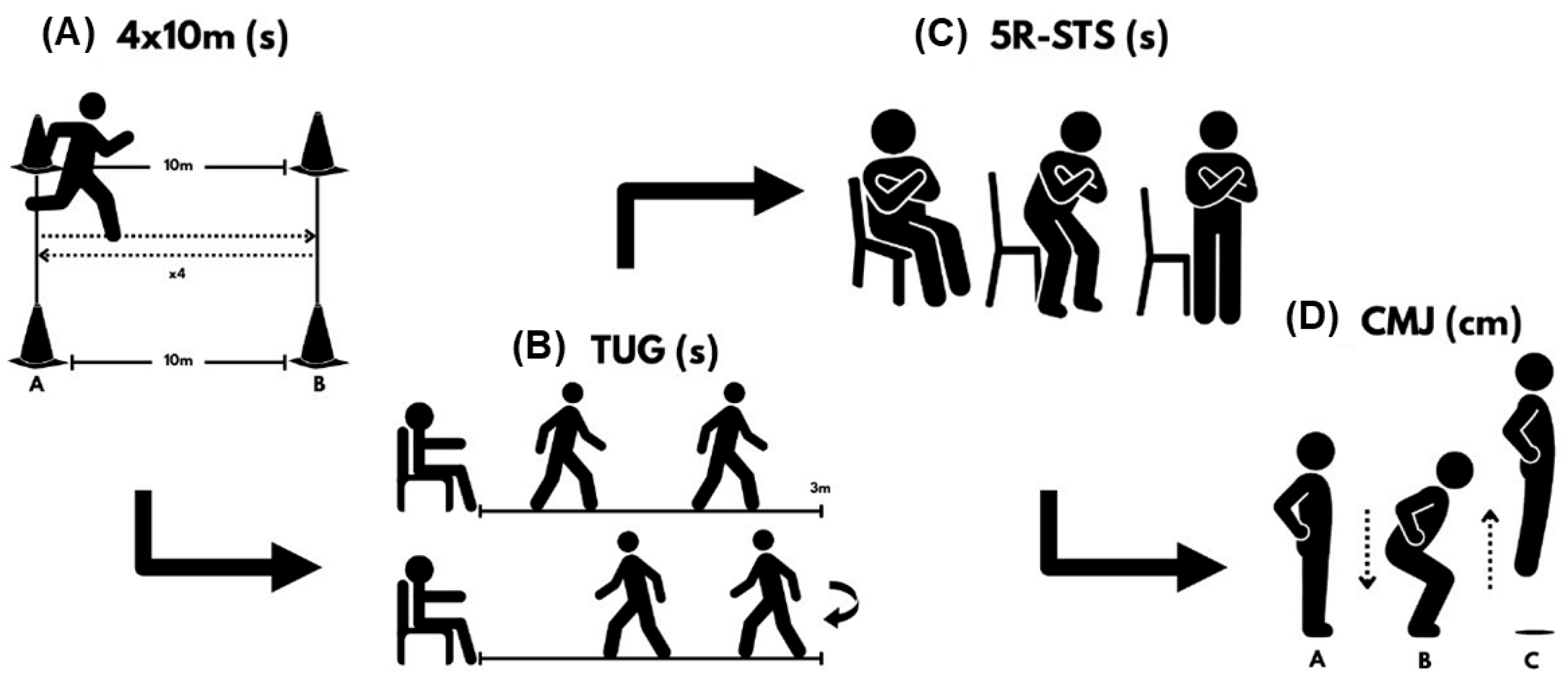
Physical functional performance was assessed through field-based tests evaluating muscle power, functional mobility, and agility (Figure 1). All participants were familiarized with the testing protocols during prior physical education sessions at their respective institutions. Before testing, a standardized 5 min warm-up consisting of joint mobility exercises, light jogging, and vertical jumps was performed.
4 × 10 m Shuttle Run Test (4 × 10 m)
The test required participants to cover a total distance of 40 m, divided into four 10 m shuttle segments between two parallel lines marked 10 m apart, in the shortest possible time. An evaluator (A) was positioned at the starting line and another evaluator (B) at the opposite line. Participants were instructed to touch the evaluator’s hand at each turn. Time was recorded by evaluator A using a stopwatch, with results noted in seconds to the nearest hundredth [23]. Two trials were performed, and the mean time was used for analysis.
Timed Up and Go (TUG)
The test began with the participant seated on a chair without armrests, with the back against the backrest and feet flat on the floor. On the evaluator’s signal, the participant stood up and walked as quickly as possible to a marker placed 3 m ahead, turned around it, and returned to the seated position. Participants were encouraged to complete the circuit at their maximum safe speed. Time to completion was recorded by the evaluator. Two trials were performed, and the mean time was used for analysis [31,32].
Five-Repetition Sit-to-Stand Test (5R-STS)
Participants started in a seated position on a chair with their feet flat on the floor and arms crossed over the chest. The test consisted of performing five consecutive sit-to-stand repetitions as quickly as possible. A familiarization trial was first conducted, during which participants practiced the movement sequence. Two timed trials were then performed, with completion time recorded for analysis [18].
Countermovement Jump (CMJ)
Participants performed a countermovement jump while standing on the platform, with hands placed on their hips, and were instructed to jump as high as possible following the evaluator’s demonstration [33]. Jump height (cm) was measured using a contact platform (Chronojump®, Barcelona, Spain). The mean jump height from the two remaining trials was used for analysis [24].

2.3. Statistical Analysis

Data distribution was assessed using the Kolmogorov–Smirnov test. Descriptive statistics are presented as mean, standard deviation (SD), and percent delta (Δ%) for anthropometric variables (body weight, height, BMI, and waist circumference), as well as for physical functional performance measures (4 × 10 m, TUG, 5R-STS, and CMJ), stratified by sex (male and female) and age group (children, adolescents, and early adulthood). Between-group comparisons according to sex and age group were performed using two-way analysis of variance (ANOVA) for normally distributed variables. When significant main effects or interactions were identified, Tukey’s post hoc test was applied to locate pairwise differences. For non-normally distributed variables, the Kruskal–Wallis test was used, followed by Bonferroni-adjusted post hoc comparisons. Physical functional performance outcomes assessed using the 4 × 10 m, TUG, 5R-STS, and CMJ tests are additionally presented as percentiles (p5, p10, p25, p50, p75, p90, and p95). One-factor analyses were conducted within each sex and age-group stratum. For each physical functional test, percentile values were calculated using only participants with valid test results, and interpretations were adjusted accordingly, following previously published methods [15]. All statistical analyses were conducted using SPSS software version 27 (SPSS Inc., IBM Corp., Armonk, NY, USA). The significance level was set at p < 0.05.

3. Results

The sample comprised 321 schoolchildren with ID, of whom 219 were males (68.2%). Among males, 25.1% were children, 43.3% adolescents, and 31.6% were in early adulthood. Among females, 25.5% were children, 44.1% adolescents, and 30.4% were in early adulthood. Anthropometric characteristics stratified by sex and age group are presented in Table 1. All anthropometric variables differed significantly according to sex and age group (p < 0.05).
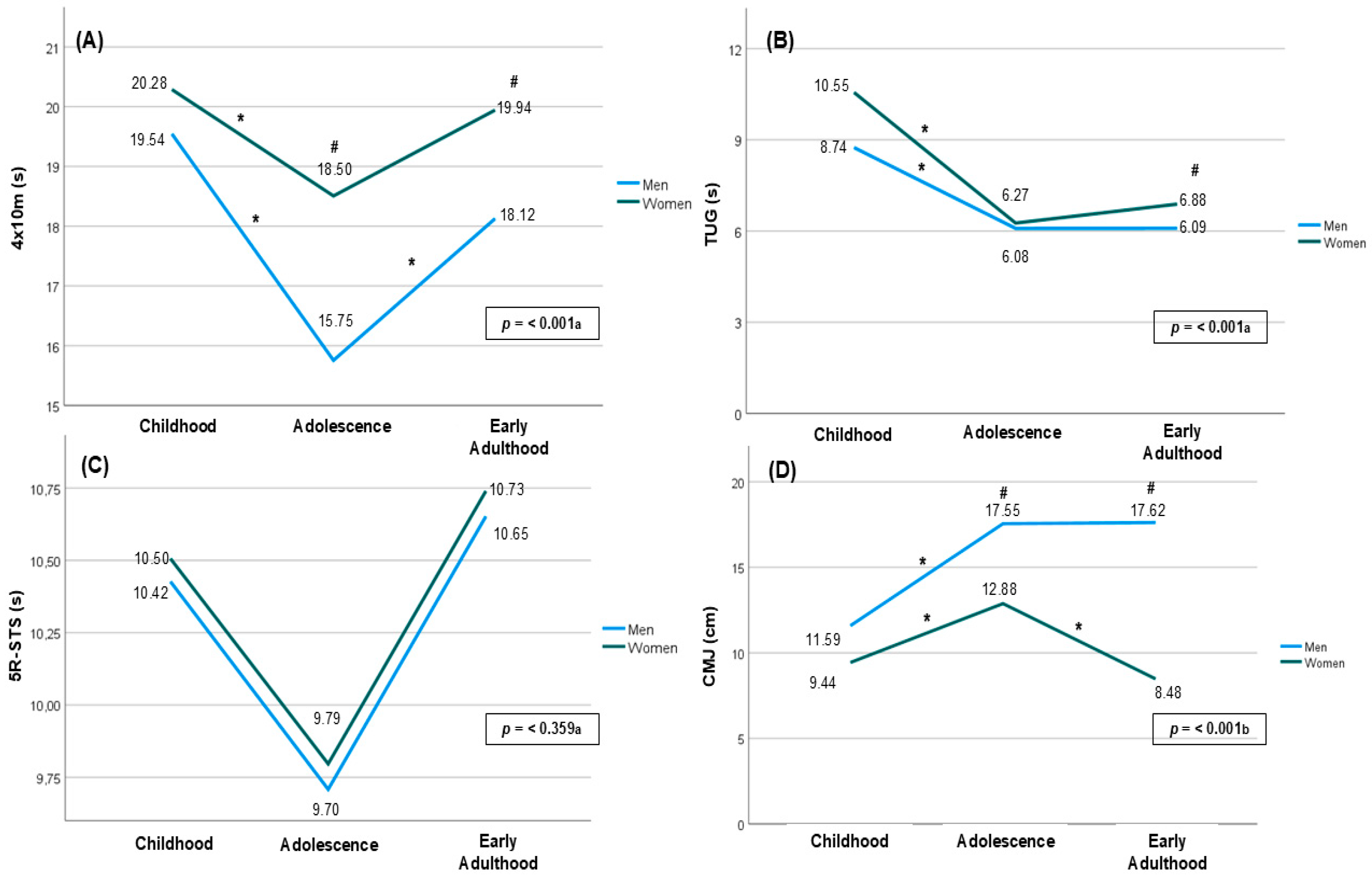
Figure 2 illustrates physical functional performance across four tests (A) 4 × 10 m, (B) TUG, (C) 5R-STS, and (D) CMJ, stratified by sex and age group. For the 4 × 10 m agility test, significant effects of sex and age group were observed (p < 0.001). In males, agility performance improved from childhood to adolescence [↓ 3.79 (s); ↓ 24.06 (Δ%); p = 0.02], followed by a decline from adolescence to early adulthood [↑ 2.37 (s); ↑ 15.05 (Δ%); p = 0.01]. Females also showed significant improvements from childhood to adolescence [↓ 1.78 (s); ↓ 9.62 (Δ%); p < 0.001], with no significant changes thereafter [↑ 1.44 (s); ↑ 7.78 (Δ%); p = 0.45]. Significant sex-related differences in the 4 × 10 m test were observed during adolescence [2.75 (s); 17.78 (Δ%); p < 0.001] and early adulthood [1.82 (s); 10.10 (Δ%); p = 0.01], favoring males.
For the TUG test, significant sex and age group effects were also observed (p < 0.001). In males, mobility performance improved from childhood to adolescence [↓ 2.66 (s); ↓ 43.75 (Δ%); p < 0.001], with no further changes into early adulthood [↑ 0.01 (s); ↑ 0.16 (Δ%); p = 0.79]. Similarly, females showed significant improvements from childhood to adolescence [↓ 4.28 (s); ↓ 40.57 (Δ%); p < 0.001], but no significant changes were found between adolescence and early adulthood [↑ 0.61 (s); ↑ 9.73 (Δ%); p = 0.57]. A significant sex difference was detected in early adulthood [0.79 (s); 12.97 (Δ%); p = 0.03], with better performance in males.
In the 5R-STS test, no significant main effects of sex or age group were found (p = 0.359). Nevertheless, both sexes exhibited comparable trajectories, with improvements from childhood to adolescence ([males: ↓ 0.54 s; ↓ 5.56 (Δ%); p = 0.54]; [females: ↓ 0.71 s; ↓ 7.25(Δ%); p = 0.67]) followed by a decline from adolescence to early adulthood ([males: ↑ 0.95 s; ↑ 9.79 (Δ%); p = 0.38]; [females: ↑ 0.94 s; ↑ 9.60 (Δ%); p = 0.44]). No significant sex-related differences were observed across age groups.
In the CMJ test, significant changes were observed as a function of sex and age group (p < 0.001). In males, jump height increased from childhood to adolescence [↑ 5.96 (cm); ↑ 51.30 (Δ%); p < 0.001], with no significant changes from adolescence to early adulthood [↑ 0.07 (cm); ↑ 0.39 (Δ%); p = 0.89]. In females, jump height also increased from childhood to adolescence [↑ 3.44 (cm); ↑ 36.40 (Δ%); p < 0.001], followed by a significant decline from adolescence to early adulthood [↓ 4.40 (cm); ↓ 51.90 (Δ%); p < 0.001]. Significant sex differences were observed during adolescence [4.67 (cm); 36.27 (Δ%); p < 0.001] and early adulthood [9.14 (cm); 107.70 (Δ%); p < 0.001], with higher values in males.
Table 2 presents percentile distributions (p5–p95) for physical functional performance tests, stratified by sex and age group, providing reference values for functional performance across childhood, adolescence, and early adulthood in individuals with ID. For the 4 × 10 m, TUG, and 5R-STS tests, lower times indicate better performance, whereas in the CMJ test, higher values reflect greater jump height.

4. Discussion

The present study aimed to characterize and establish reference values for physical functional performance in school-aged individuals with ID, considering sex and age group. Overall, males demonstrated higher functional performance than females across all assessed measurement tests. For both sexes, cross-sectional patterns suggest higher performance in the 4 × 10 m, TUG, and 5R-STS tests during adolescence, whereas higher CMJ performance is observed in early adulthood among males only. Physical functional performance improved markedly from childhood to adolescence in the 4 × 10 m, TUG, and CMJ tests for both sexes. However, a divergent pattern emerged thereafter, with females showing a significant decline in CMJ performance from adolescence to early adulthood, while male performance remained stable across these stages.
Functional capacity refers to the physical abilities required to perform activities of daily living, including endurance, muscular strength, and aerobic capacity, which tend to decline with age, particularly among sedentary individuals. It is understood as a multidimensional construct integrating physical, mental, and social components [34]. Within the physical domain, various tests have been used to assess physical functional performance including handgrip strength [35], the 4 × 10 m agility test [36], the 30 s chair sit-to-stand test [37], the TUG test [38], and the Senior Fitness Test battery [39]. In general, higher functional performance is associated with healthier body composition and a lower risk of cardiovascular disease and metabolic syndrome, whereas poor performance is linked to increased frailty and mortality risk in individuals with ID [40,41]. In the population with ID, multiple tests have been used and adapted to assess physical functional performance; however, many of these instruments were originally designed for populations with different characteristics, resulting in a limited availability of validated tests with population-specific reference values. Among the validated assessments are the handgrip strength test [24,42], the modified 6 min walk test [43], the Tinetti Balance Assessment [44], and the 10 m incremental walk test [5].
Regarding performance in the 4 × 10 m test, cross-sectional comparisons showed higher performance in both males and females during adolescence, with mean times of 15.75 and 18.50 s, respectively. Despite this common developmental pattern, males consistently outperformed females, indicating a clear sex-related difference in agility performance. These findings are consistent with previous evidence, as Mendoza-Puelma et al. [24] reported a comparable mean time of 16.79 s in adolescents with ID. Overall, these results suggest that adolescence may be a critical period characterized by higher agility performance, while also highlighting persistent sex-related disparities observed during this stage. Additionally, functional performance in the 4 × 10 m test has been positively associated with both absolute and relative handgrip strength across children, adolescents, and adults, as well as with absolute handgrip strength asymmetry during adolescence, highlighting the interdependence between agility and muscular strength throughout development.
The TUG test is widely used in older adults and has also been applied to assess physical functional performance in individuals with ID. The test has been validated in populations with disabilities [38] and is commonly included in fitness assessment batteries for adults with ID [3]. In line with previous evidence, reported reference values for adolescents with Down syndrome (5.61 s) [45] are comparable to the mean TUG times observed in the present study, both in adolescent males (6.08 s) and females (6.27 s), supporting the external validity of our findings across ID populations. In the present study, women in early adulthood exhibited higher TUG times (mean: 6.88 s) than their adolescent counterparts and males of the same age group, indicating an emerging sex-related difference in functional mobility. Although these values do not exceed the >10 s threshold commonly used to indicate mobility impairment in older adults, even modest increases in TUG performance time have been associated with a higher risk of falls [46,47,48]. Taken together, these results suggest that individuals with ID—particularly women—may exhibit lower levels of functional mobility, consistent with patterns reported in the literature on premature functional aging.
Lower-limb strength in individuals with ID has commonly been assessed using the 30 s chair sit-to-stand test [49]. However, because this test requires sustained attention over a fixed period, recent studies have suggested the use of the 5R-STS test as an alternative for individuals with ID [18], as it evaluates the same movement pattern within a shorter and more manageable time frame [50]. Reference values for adults without ID under 60 years of age indicate mean 5R-STS times of 5.60 s in men and 5.76 s in women [51]. In contrast, adults with ID exhibit substantially longer completion times (10.65 s in men and 10.73 s in women), reflecting a reduction in physical functional performance of more than 100% compared with the general population. In the present study, 5R-STS performance differed across age groups, with higher performance observed during adolescence and lower performance in early adulthood in both sexes, in line with the study aim of examining age-related differences in physical functional performance. Notably, no significant sex differences were observed in 5R-STS performance, suggesting that lower-limb strength limitations are similarly expressed in males and females with ID across developmental stages. Furthermore, the 5R-STS values observed in adults with ID are comparable to those reported in older adults at risk of falls [52]. This resemblance underscores the presence of early functional decline in individuals with ID and reinforces the relevance of monitoring age-related changes in lower-limb strength from childhood through early adulthood, as proposed in the present study.
The CMJ has been used to assess physical fitness [22] and has been validated in para-karate athletes with ID [53]. Available evidence indicates that children with ID achieve lower jump height and power in the CMJ compared with individuals without disabilities [54]. Previous studies have shown that children with ID achieve lower jump height and power than their peers without disabilities, likely due to reduced voluntary muscle activation [16] and altered vertical jump kinematics [54]. In the present study, distinct age-related patterns in CMJ performance were observed, with both sexes showing higher performance from childhood to adolescence. However, lower CMJ performance was evident in females from adolescence to early adulthood [↓ 4.40 cm; ↓ 51.90%], whereas male performance remained stable across these stages. This divergence highlights a clear age-by-sex interaction in lower-limb power, suggesting that early adulthood may represent a critical period for the onset of functional decline in females with ID. These findings are consistent with previous research [14], which has reported greater vulnerability to premature functional deterioration in females with ID compared with males. Evidence from previous studies indicates that higher BMI negatively affects motor coordination [55], particularly in females, in whom it is associated with less favorable body-related perceptions and lower engagement in physical activity from adolescence to early adulthood. Although this evidence is derived from the general population, these factors may also be relevant in individuals with ID and could partially explain the observed sex-related differences in physical fitness and functional capacity [56].
Among the main limitations of the present study are its cross-sectional design, convenience sampling, and the omission of relevant factors such as the different syndromes associated with ID, medication use, habitual physical activity levels, socioeconomic context, and family lifestyle patterns, factors that may potentially influence physical functional performance. In addition, no complementary clinical assessments or analyses of biological maturation were included, which would have allowed for a more comprehensive understanding of developmental physical performance in this population.
The strengths of the study are that it represents the first investigation in a country in the southern part of the world to comprehensively describe sex- and age-related patterns of physical functional performance in schoolchildren with ID. Furthermore, the study provides a local normative framework that may guide evaluation, monitoring, and exercise prescription processes in educational and healthcare settings. The findings are valuable for professionals in the fields of education, health, and physical activity, as they enable the quantification of changes in physical functional performance in response to physical exercise interventions, curricular adaptations, modifications to the school environment, and family dynamics.

5. Conclusions

In schoolchildren with ID, physical functional performance assessed through the 4 × 10 m, TUG, 5R-STS, and CMJ tests demonstrates a differentiated pattern according to sex and age group. Overall, males exhibit superior performance compared to females. The highest levels of physical functional performance in both sexes are generally observed during adolescence; however, while females show a decline in CMJ performance when transitioning into adulthood, males demonstrate an improvement in the 4 × 10 m test during the same period. The sex- and age-specific functional patterns identified in this study provide clinically and educationally relevant insight into developmental trajectories of physical functional performance in individuals with ID. These findings may inform monitoring strategies, support evidence-based decision-making, and guide the development of targeted physical activity and exercise interventions aimed at preserving physical functional performance across key stages of development in this population.

Author Contributions

Conceptualization, C.F.-V. and P.V.-M.; methodology, C.F.-V., E.J.-S., D.S.-R.; software, G.F. and P.F.-H.; validation, M.H., J.O.-M. and J.d.S.-L.; formal analysis, C.F.-V., M.H.; investigation; resources, C.F.-V.; data curation, C.F.-V. and G.F.; writing—original draft preparation, C.F.-V., S.E.-L., D.S.-R. and J.O.-M.; writing—review and editing, J.d.S.-L., A.C.-P., E.G.-C., E.J.-S., P.F.-H. and G.F.; visualization, A.C.-P.; supervision, C.F.-V. and D.S.-R.; project administration, E.G.-C. and S.E.-L.; funding acquisition, C.F.-V. All authors have read and agreed to the published version of the manuscript.

Funding

This research received no external funding.

Institutional Review Board Statement

The study was conducted in accordance with the Declaration of Helsinki, and approved by the Ethics Committee of University of Granada (approval code: 2052/CEIH/2021).

Informed Consent Statement

Informed consent was obtained from all subjects involved in the study.

Data Availability Statement

The datasets used and analyzed during the current study are available from the corresponding authors on reasonable request.

Acknowledgments

To the Vice-Rectory for Liaison with the Environment (VIME), University of Santiago de Chile, and Special Olympics, Chile.

Conflicts of Interest

The authors declare no conflicts of interest.

Abbreviations

IDIntellectual disability
4 × 10 m4 × 10 m shuttle run
TUG Timed up and go
5R-STSFive-repetition sit-to-stand
CMJCountermovement jump

References

  1. Schalock, R.L.; Luckasson, R.; Tassé, M.J. An Overview of Intellectual Disability: Definition, Diagnosis, Classification, and Systems of Supports (12th ed.). Am. J. Intellect. Dev. Disabil. 2021, 126, 439–442. [Google Scholar] [CrossRef]
  2. Liao, P.; Vajdic, C.; Trollor, J.; Reppermund, S. Prevalence and incidence of physical health conditions in people with intellectual disability—A systematic review. PLoS ONE 2021, 16, e0256294. [Google Scholar] [CrossRef] [PubMed]
  3. Alcántara-Cordero, F.J.; Gómez-Píriz, P.T.; Sánchez-López, A.M.; Cabeza-Ruiz, R. Feasibility and reliability of a physical fitness tests battery for adults with intellectual disabilities: The SAMU DIS-FIT battery. Disabil. Health J. 2020, 13, 100886. [Google Scholar] [CrossRef]
  4. Carey, I.M.; Shah, S.M.; Hosking, F.J.; DeWilde, S.; Harris, T.; Beighton, C.; Cook, D.G. Health characteristics and consultation patterns of people with intellectual disability: A cross-sectional database study in English general practice. Br. J. Gen. Pract. 2016, 66, e264–e270. [Google Scholar] [CrossRef]
  5. Hilgenkamp, T.I.; Reis, D.; van Wijck, R.; Evenhuis, H.M. Physical activity levels in older adults with intellectual disabilities are extremely low. Res. Dev. Disabil. 2012, 33, 477–483. [Google Scholar] [CrossRef]
  6. Wouters, M.; Evenhuis, H.M.; Hilgenkamp, T.I.M. Physical fitness of children and adolescents with moderate to severe intellectual disabilities. Disabil. Rehabil. 2020, 42, 2542–2552. [Google Scholar] [CrossRef]
  7. O’Leary, L.; Cooper, S.A.; Hughes-McCormack, L. Early death and causes of death of people with intellectual disabilities: A systematic review. J. Appl. Res. Intellect. Disabil. 2018, 31, 325–342. [Google Scholar] [CrossRef]
  8. Krause, S.; Ware, R.; McPherson, L.; Lennox, N.; O’Callaghan, M. Obesity in adolescents with intellectual disability: Prevalence and associated characteristics. Obes. Res. Clin. Pract. 2016, 10, 520–530. [Google Scholar] [CrossRef] [PubMed]
  9. Valentin, B.; Maes-Festen, D.; Schoufour, J.; Oppewal, A. Sarcopenia predicts 5-year mortality in older adults with intellectual disabilities. J. Intellect. Disabil. Res. 2023, 67, 1161–1173. [Google Scholar] [CrossRef] [PubMed]
  10. Wang, H.; Lee, P.M.Y.; Zhang, J.; Svendsen, K.; Li, F.; Li, J. Association of intellectual disability with overall and type-specific cardiovascular diseases: A population-based cohort study in Denmark. BMC Med. 2023, 21, 41. [Google Scholar] [CrossRef] [PubMed]
  11. Booth, F.W.; Zwetsloot, K.A. Basic concepts about genes, inactivity and aging. Scand. J. Med. Sci. Sports 2010, 20, 1–4. [Google Scholar] [CrossRef]
  12. Maïano, C.; Morin, A.J.S.; Hue, O.; Tracey, D.; Craven, R.G. Profiles of Physical Fitness Among Youth with Intellectual Disabilities: A Longitudinal Person-Centered Investigation. J. Autism Dev. Disord. 2025. [Google Scholar] [CrossRef] [PubMed]
  13. Niyazi, A.; Mir, E.; Ghasemi Kahrizsangi, N.; Mohammad Rahimi, N.; Fazolahzade Mousavi, R.; Setayesh, S.; Nejatian Hoseinpour, A.; Mohammad Rahimi, F.; Mohammad Rahimi, G.R. The effect of functional exercise program on physical functioning in older adults aged 60 years or more: A systematic review and meta-analysis of randomized controlled trials. Geriatr. Nurs. 2024, 60, 548–559. [Google Scholar] [CrossRef] [PubMed]
  14. Jacinto, M.; Monteiro, D.; Rodrigues, F.; Diz, S.; Matos, R.; Amaro, N.; Antunes, R. Gender differences in Anthropometric, Functional Capacity measures and Quality of Life in individuals with Intellectual and Developmental Disabilities. J. Funct. Morphol. Kinesiol. 2024, 9, 84. [Google Scholar] [CrossRef] [PubMed]
  15. Farías-Valenzuela, C.; Ferrero-Hernández, P.; Ferrari, G.; Espoz-Lazo, S.; Castillo-Paredes, A.; Álvarez-Arangua, S.; Valdivia-Moral, P. Reference Values of Absolute and Relative Handgrip Strength in Chilean Schoolchildren with Intellectual Disabilities. Children 2022, 9, 1912. [Google Scholar] [CrossRef] [PubMed]
  16. Borji, R.; Zghal, F.; Zarrouk, N.; Sahli, S.; Rebai, H. Individuals with intellectual disability have lower voluntary muscle activation level. Res. Dev. Disabil. 2014, 35, 3574–3581. [Google Scholar] [CrossRef] [PubMed]
  17. Pope, J.; Truesdale, M.; Brown, M. Risk factors for falls among adults with intellectual disabilities: A narrative review. J. Appl. Res. Intellect. Disabil. 2021, 34, 274–285. [Google Scholar] [CrossRef] [PubMed]
  18. Farías-Valenzuela, C.; Shepherd-Shepherd, C.; Ferrero-Hernández, P.; López-Sánchez, G.F.; Espoz-Lazo, S.; Cofre-Bolados, C.; Del Val-Martín, P.; de Victo, E.R.; Ferrari, G. Five-repetition sit-to-stand test validation in adolescents and adults with intellectual disabilities. Sci. Rep. 2024, 14, 30355. [Google Scholar] [CrossRef] [PubMed]
  19. Hartman, E.; Smith, J.; Westendorp, M.; Visscher, C. Development of physical fitness in children with intellectual disabilities. J. Intellect. Disabil. Res. 2015, 59, 439–449. [Google Scholar] [CrossRef] [PubMed]
  20. Cabeza-Ruiz, R.; Sánchez-López, A.M.; Trigo, M.E.; Gómez-Píriz, P.T. Feasibility and reliability of the Assessing Levels of Physical Activity health-related fitness test battery in adults with intellectual disabilities. J. Intellect. Disabil. Res. 2020, 64, 612–628. [Google Scholar] [CrossRef] [PubMed]
  21. Martín-Díaz, P.; Carratalá-Tejada, M.; Molina-Rueda, F.; Cuesta-Gómez, A. Reliability and agreement of the timed up and go test in children and teenagers with autism spectrum disorder. Eur. J. Pediatr. 2023, 182, 3577–3585. [Google Scholar] [CrossRef]
  22. Jouira, G.; Alexe, D.I.; Tohănean, D.I.; Alexe, C.I.; Tomozei, R.A.; Sahli, S. The Relationship between Dynamic Balance, Jumping Ability, and Agility with 100 m Sprinting Performance in Athletes with Intellectual Disabilities. Sports 2024, 12, 58. [Google Scholar] [CrossRef] [PubMed]
  23. Tejero-Gonzalez, C.M.; Martinez-Gomez, D.; Bayon-Serna, J.; Izquierdo-Gomez, R.; Castro-Piñero, J.; Veiga, O.L. Reliability of the ALPHA health-related fitness test battery in adolescents with Down syndrome. J. Strength Cond. Res. 2013, 27, 3221–3224. [Google Scholar] [CrossRef] [PubMed]
  24. Mendoza-Puelma, J.; Melo, J.B.; Ferrari, G.; Ferrero-Hernández, P.; Espinoza-Salinas, A.; Valdivia-Moral, P.; Castillo-Paredes, A.; Jofré-Saldía, E.; Farías-Valenzuela, C. Relationship of handgrip strength, asymmetries, and calf circumference with functional capacity in individuals with intellectual disabilities: An age group analysis. BMC Sports Sci. Med. Rehabil. 2025, 17, 161. [Google Scholar] [CrossRef]
  25. Cuesta-Vargas, A.; Hilgenkamp, T. Reference Values of Grip Strength Measured with a Jamar Dynamometer in 1526 Adults with Intellectual Disabilities and Compared to Adults without Intellectual Disability. PLoS ONE 2015, 10, e0129585. [Google Scholar] [CrossRef]
  26. Cabeza-Ruiz, R. Considerations for the Design of a Physical Fitness Battery to Assess Adults with Intellectual Disabilities: Preliminary Reference Values for the SAMU DIS-FIT Study. Int. J. Environ. Res. Public Health 2020, 17, 9280. [Google Scholar] [CrossRef] [PubMed]
  27. World Medical Association. World Medical Association Declaration of Helsinki: Ethical principles for medical research involving human subjects. JAMA 2013, 310, 2191–2194. [Google Scholar] [CrossRef]
  28. Koriakin, T.A.; McCurdy, M.D.; Papazoglou, A.; Pritchard, A.E.; Zabel, T.A.; Mahone, E.M.; Jacobson, L.A. Classification of intellectual disability using the Wechsler Intelligence Scale for Children: Full Scale IQ or General Abilities Index? Dev. Med. Child. Neurol. 2013, 55, 840–845. [Google Scholar] [CrossRef]
  29. Ramírez, V.; Rosas, R. Estandarización del WISC-III en Chile: Descripción del Test, Estructura Factorial y Consistencia Interna de las Escalas. Psykhe 2007, 16, 91–109. [Google Scholar] [CrossRef]
  30. Rosas, R.; Tenorio, M.; Pizarro, M.; Cumsille, P.; Bosch, A.; Arancibia, S.; Carmona-Halty, M.; Pérez-Salas, C.P.; Pino, E.; Vizcarra, B.; et al. Estandarización de la Escala Wechsler de Inteligencia Para Adultos: Cuarta Edición en Chile. Psykhe 2014, 23, 1–18. [Google Scholar] [CrossRef]
  31. Beerse, M.; Lelko, M.; Wu, J. Biomechanical analysis of the timed up-and-go (TUG) test in children with and without Down syndrome. Gait Posture 2019, 68, 409–414. [Google Scholar] [CrossRef]
  32. Kachouri, H.; Jouira, G.; Rebai, H.; Sahli, S. The effect of motor dual-task training on gait and mobility performances in children with intellectual disabilities. J. Intellect. Disabil. 2025, 29, 100–116. [Google Scholar] [CrossRef]
  33. Ferrero-Hernández, P.; Farías-Valenzuela, C.; Ferrari, G.; Espoz-Lazo, S.; Álvarez-Arangua, S.; Valdivia-Moral, P. Cut-off points for isometric handgrip and low limb explosive strength in relation to indicators of overweight/obesity in people with intellectual disabilities: Analysis by age groups. J. Intellect. Disabil. Res. 2023, 67, 1124–1135. [Google Scholar] [CrossRef]
  34. Schwab, L.; De Baets, S.; De Keyser, E.; Moreels, T.; Tambeur, J.; De Vriendt, P. Functional Capacity and Functional Ability in an Aging Population: A Scoping Review. Gerontologist 2025, 65, gnaf141. [Google Scholar] [CrossRef]
  35. Wang, Y.C.; Bohannon, R.W.; Li, X.; Sindhu, B.; Kapellusch, J. Hand-Grip Strength: Normative Reference Values and Equations for Individuals 18 to 85 Years of Age Residing in the United States. J. Orthop. Sports Phys. Ther. 2018, 48, 685–693. [Google Scholar] [CrossRef] [PubMed]
  36. Castro-Piñero, J.; Aragón-Aragón, P.; Cruz-León, C.; Jiménez-Iglesias, J.; Camiletti-Moirón, D.; Izquierdo-Gómez, R.; Cuenca-García, M. Time measurement validity and reliability of the 4 × 10-m shuttle run test in adult population: The ADULT-FIT project. J. Sci. Med. Sport 2023, 26, 553–560. [Google Scholar] [CrossRef]
  37. Ramnath, U.; Rauch, L.; Lambert, E.V.; Kolbe-Alexander, T.L. The relationship between functional status, physical fitness and cognitive performance in physically active older adults: A pilot study. PLoS ONE 2018, 13, e0194918. [Google Scholar] [CrossRef] [PubMed]
  38. Christopher, A.; Kraft, E.; Olenick, H.; Kiesling, R.; Doty, A. The reliability and validity of the Timed Up and Go as a clinical tool in individuals with and without disabilities across a lifespan: A systematic review. Disabil. Rehabil. 2021, 43, 1799–1813. [Google Scholar] [CrossRef]
  39. Collado-Mateo, D.; Madeira, P.; Dominguez-Muñoz, F.J.; Villafaina, S.; Tomas-Carus, P.; Parraca, J.A. The Automatic Assessment of Strength and Mobility in Older Adults: A Test-Retest Reliability Study. Medicina 2019, 55, 270. [Google Scholar] [CrossRef]
  40. Kim, J.Y.; Yi, E.S. Analysis of the relationship between physical activity and metabolic syndrome risk factors in adults with intellectual disabilities. J. Exerc. Rehabil. 2018, 14, 592–597. [Google Scholar] [CrossRef]
  41. Harb, S.C.; Bhat, P.; Cremer, P.C.; Wu, Y.; Cremer, L.J.; Berger, S.; Cho, L.; Menon, V.; Gulati, M.; Jaber, W.A. Prognostic Value of Functional Capacity in Different Exercise Protocols. J. Am. Heart Assoc. 2020, 9, e015986. [Google Scholar] [CrossRef] [PubMed]
  42. Karatrantou, K.; Xagorari, A.; Vasilopoulou, T.; Gerodimos, V. Does the number of trials affect the reliability of handgrip strength measurement in individuals with intellectual disabilities? Hand Surg. Rehabil. 2020, 39, 223–228. [Google Scholar] [CrossRef]
  43. Wouters, M.; van der Zanden, A.M.; Evenhuis, H.M.; Hilgenkamp, T.I.M. Feasibility and Reliability of Tests Measuring Health-Related Physical Fitness in Children With Moderate to Severe Levels of Intellectual Disability. Am. J. Intellect. Dev. Disabil. 2017, 122, 422–438. [Google Scholar] [CrossRef]
  44. Tena-Bernal, O.; Sánchez-Peña, M.; Gómez-Cabello, A.; Salavera, C.; Usán, P.; Calatayud, E. Cognitive and Functional Differences in Aging with and without Intellectual Disabilities: Observational Study. Sustainability 2021, 13, 10515. [Google Scholar] [CrossRef]
  45. Nicolini-Panisson, R.D.; Donadio, M.V. Normative values for the Timed ‘Up and Go’ test in children and adolescents and validation for individuals with Down syndrome. Dev. Med. Child. Neurol. 2014, 56, 490–497. [Google Scholar] [CrossRef]
  46. Lee, K.; Cascella, M.; Marwaha, R. Intellectual Disability; StatPearls Publishing: Treasure Island, FL, USA, 2025. [Google Scholar]
  47. Bohannon, R.W. Reference values for the timed up and go test: A descriptive meta-analysis. J. Geriatr. Phys. Ther. 2006, 29, 64–68. [Google Scholar] [CrossRef] [PubMed]
  48. Ugarte LL, J.; Vargas, R.F. Sensibilidad y especificidad de la prueba Timed Up and Go. Tiempos de corte y edad en adultos mayores. Rev. Méd. Chile 2021, 149, 1302–1310. [Google Scholar] [CrossRef]
  49. Weterings, S.; Oppewal, A.; Bierma-Zeinstra, S.M.A.; Hilgenkamp, T.I.M. The responsiveness of muscle strength tests in adults with intellectual disabilities. J. Intellect. Disabil. Res. 2022, 66, 988–999. [Google Scholar] [CrossRef] [PubMed]
  50. Oppewal, A.; Hilgenkamp, T.I.M. Adding meaning to physical fitness test results in individuals with intellectual disabilities. Disabil. Rehabil. 2020, 42, 1406–1413. [Google Scholar] [CrossRef] [PubMed]
  51. Klukowska, A.M.; Staartjes, V.E.; Vandertop, W.P.; Schröder, M.L. Five-Repetition Sit-to-Stand Test Performance in Healthy Individuals: Reference Values and Predictors from 2 Prospective Cohorts. Neurospine 2021, 18, 760–769. [Google Scholar] [CrossRef]
  52. Tiedemann, A.; Shimada, H.; Sherrington, C.; Murray, S.; Lord, S. The comparative ability of eight functional mobility tests for predicting falls in community-dwelling older people. Age Ageing 2008, 37, 430–435. [Google Scholar] [CrossRef]
  53. Hadza, R.; Augustovicova, D.; Paludo, A.C.; Van Biesen, D.; Hruby, M. Countermovement-Jump Test-Retest Reliability in Top-Level Para-Karate Athletes with Intellectual Impairment Using Kistler Force Plates. Adapt. Phys. Act. Q. 2025, 42, 663–677. [Google Scholar] [CrossRef] [PubMed]
  54. Hassani, A.; Kotzamanidou, M.C.; Tsimaras, V.; Lazaridis, S.; Kotzamanidis, C.; Patikas, D. Differences in counter-movement jump between boys with and without intellectual disability. Res. Dev. Disabil. 2014, 35, 1433–1438. [Google Scholar] [CrossRef] [PubMed]
  55. Villouta, P.F.L.; Castillo, C.M.; Rivera, M.A.; Hernández-Mosqueira, C.; Rivera, C.F.; Casanova, C.P.F.; Retamal, M.C.; Vitoria, C.R.V. Coordinación Motora, Calidad de vida percibida e Índice de Masa Corporal en escolares con y sin participación en deportes extraescolares. J. Sport Health Res. 2025, 17, 6. [Google Scholar]
  56. Badau, D.; Badau, A.; Teodor, D.F.; Dinciu, C.C.; Dulceata, V.; Mănescu, D.C.; Mănescu, C.O.; Litoi, M.F.; Stoica, A.M. Multidimensional Assessment of Athletic and Non-Athletic Female Students Through Analysis of BMI, Body Perception, Objectification, and Attitudes Towards the Ideal Body. Behav. Sci. 2025, 15, 1454. [Google Scholar] [CrossRef] [PubMed]
Figure 1. Graphical representation of the tests used to assess physical functional performance in schoolchildren with ID.
Applsci 16 01912 g001
Figure 2. Physical functional performance across four tests in school-aged children with ID. The figure presents the mean values for tests (A) 4 × 10 m (s), (B) 4 × 10 m (s), (C) 5R-STS (s) and (D) CMJ (cm) in children, adolescents, and early adulthood, stratified by sex. p < 0.05; a = Kruskal–Wallis test with Bonferroni post hoc analysis; b = two-way ANOVA with Tukey post hoc test; * = intragroup differences; # = intergroup differences.
Applsci 16 01912 g002
Table 1. Sex- and age-specific anthropometric characteristics in school-aged children with ID.
MalesFemales
Total (N = 219)Children (n = 55)Adolescents (n = 95)Early Adults (n = 69)Total
(N = 102)
Children
(n = 26)
Adolescents
(n = 45)
Early Adults (n = 31)p Value
Age
(years)
15.34
(5.46)
8.85
(1.91)
14.42
(1.51)
21.99
(3.10)
15.30
(5.35)
8.79
(1.85)
14.73
(1.52)
21.71
(3.07)
<0.001 a*
Body weight (kg)60.37
(22.70)
38.35
(14.61)
63.95
(18.93)
73.43
(20.18)
57.98
(22.59)
36.83
(15.00)
65.28
(19.37)
66.35
(20.72)
<0.001 b*
Height
(m)
1.57
(0.17)
1.35
(0.14)
1.63
(0.12)
1.65
(0.08)
1.51
(0.15)
1.34
(0.16)
1.59
(0.10)
1.54
(0.09)
<0.001 a*
BMI
(kg/m2)
23.60
(6.18)
20.32
(4.98)
23.34
(5.41)
26.63
(6.68)
24.82
(7.53)
19.74
(4.42)
25.58
(5.49)
28.05
(9.66)
<0.001 a*
Waist Circumference (cm)81.38
(15.61)
71.47
(12.94)
82.37
(15.46)
88.11
(13.80)
80.99
(16.06)
71.01
(12.30)
82.05
(13.46)
88.17
(18.21)
<0.001 a*
n = Sample size. BMI = Body mass index. Data are presented as mean and SD. * = Significance p < 0.05 by a = Kruskal–Wallis; ANOVA two-way b differences by sex between children, adolescents, and early adulthood.
Table 2. Sex- and age-specific percentile reference values for physical functional performance in school-aged children with ID.
Physical Functional Performance Tests
4 × 10 m (s) Males (N = 183)
np5p10p25p50p75p90p95
Children4636.3527.7722.8718.1714.9513.4610.38
Adolescents8028.6625.7918.5414.3711.728.107.20
Early Adulthood5745.4636.6818.5614.3413.0411.3810.95
4 × 10 m (s) Females (N = 88)
np5p10p25p50p75p90p95
Children2136.2931.6425.9719.8616.6610.445.61
Adolescents3938.7832.2020.9516.6014.397.666.60
Early Adulthood2836.0025.5223.4618.5115.4614.6013.51
TUG (s) Males (N = 203)
np5p10p25p50p75p90p95
Children4623.5520.399.816.604.814.043.39
Adolescents8814.789.326.664.874.073.453.20
Adults6911.328.467.115.504.423.903.47
TUG (s) Females (N = 92)
np5p10p25p50p75p90p95
Children2230.7717.7914.978.245.844.703.93
Adolescents4310.9310.477.305.214.183.733.59
Early Adulthood2710.9110.038.536.225.124,374.08
5R-STS (s) Males (N = 201)
np5p10p25p50p75p90p95
Children4624.2318.9312.168.366.354.574.02
Adolescents8815.9714.7911.548.916.585.895.49
Early Adulthood6724.7316.2811.579.537.375.935.13
5R-STS (s) Females (N = 93)
np5p10p25p50p75p90p95
Children2326.0917.2012.368.866.695.144.95
Adolescents4318.3914.5211.499.197.316.055.25
Early Adulthood2720.1217.1713.0710.178.126.175.14
CMJ (cm) Males (N = 163)
np5p10p25p50p75p90p95
Children342.663.377.3310.9516.8318.8821.97
Adolescents815.085.8111.0715.7024.1730.9132.18
Early Adulthood485.707.6012.7916.7721.7927.7529.77
CMJ (cm) Females (N = 80)
np5p10p25p50p75p90p95
Children202.543.024.329.7513.6416.4621.17
Adolescents382.695.087.7512.1016.4621.2222.89
Early Adulthood221.381.852.997.2811.8518.7122.86
n = Sample size; 4 × 10 m = 4 × 10 m agility test; TUG = Timed up and go; 5R-STS = Five-repetition sit-to-stand test; CMJ = Countermovement jump. p5 = Lowest functional performance; p95 = Highest functional performance.
Disclaimer/Publisher’s Note: The statements, opinions and data contained in all publications are solely those of the individual author(s) and contributor(s) and not of MDPI and/or the editor(s). MDPI and/or the editor(s) disclaim responsibility for any injury to people or property resulting from any ideas, methods, instructions or products referred to in the content.