Article

Oxidation Stability of SiO2 and TiO2 Nanofluids for High Voltage Insulation

1
Canada Research Chair Tier 1, in Aging of Oil-Filled Equipment on High Voltage Lines (ViAHT), University of Quebec at Chicoutimi, Chicoutimi, QC G7H 2B1, Canada
2
International Research Center on Atmospheric Icing and Power Engineering (CIIN), Department of Applied Sciences, University of Quebec at Chicoutimi (UQAC), 555 boul. de l′Université, Chicoutimi, QC G7H 2B1, Canada
*
Authors to whom correspondence should be addressed.
Appl. Sci. 2026, 16(4), 1856; https://doi.org/10.3390/app16041856
Submission received: 8 January 2026 / Revised: 2 February 2026 / Accepted: 10 February 2026 / Published: 12 February 2026
(This article belongs to the Special Issue Recent Advances and Innovations in Microfluidics)

Abstract

Mineral oils are increasingly being replaced by plant-based insulating liquids, known as natural esters, because of their biodegradability and high fire safety characteristic. However, their wider use in high-voltage and unsealed transformer applications is still limited due to concerns about thermo-oxidative stability and the relatively limited long-term performance data available compared to mineral oils. This study investigates improving the oxidation stability of natural esters through nanotechnology. A canola-based insulating liquid was used as the base fluid and modified with TiO2 and SiO2 nanoparticles of different sizes. Nanoparticle concentrations ranged from 0.05 to 0.25 wt.%, while Span 80 (sorbitan monooleate, non-ionic surfactant) served as a surfactant to ensure uniform dispersion and long-term colloidal stability. The nanofluids were subjected to accelerated aging to evaluate oxidation resistance, and key properties such as acidity, viscosity, and dissipation factor were monitored throughout the process. Dielectric performance was assessed using AC breakdown voltage testing, with results interpreted through two-parameter Weibull statistics. The TiO2-based nanofluids demonstrated superior thermo-oxidative stability compared to both the base oil and the SiO2-modified samples. Formulations containing smaller TiO2 nanoparticles (5 nm) exhibited the lowest increases in viscosity, acid value, and dissipation factor, indicating strong resistance to degradation under thermal stress. In dielectric performance, SiO2 nanofluids reached 65.8 kV, while TiO2 nanofluids achieved a higher value of 72.4 kV, confirming their greater effectiveness. Although the nanoparticles are not biodegradable, their use at low concentrations significantly enhances the oxidative and dielectric stability of natural esters, helping extend fluid life and reduce dependence on petroleum-based insulating liquids.

1. Introduction

The global demand for sustainable and carbon-neutral energy sources has steadily increased in response to growing environmental concerns, particularly those linked to the excessive use of fossil fuels, a major contributor to global warming. Among various sectors, electricity generation and transportation have been identified as the largest sources of carbon dioxide emissions, indicating that decarbonizing the power sector is essential for achieving net-zero emission targets [1]. In this context, the advancement of decarbonized energy systems and intelligent grid infrastructures has intensified concerns about the continued reliance on hydrocarbon-based materials, particularly mineral insulating oils, in power transformers [2]. The replacement or modification of these conventional insulating liquids is increasingly being explored to align transformer technology with modern sustainability objectives. Instead of mineral oils, plant-based insulating liquids represent the most promising alternatives [3]. Natural ester-insulating liquids have several advantages, including superior biodegradability, a much higher fire point, and better moisture tolerance, making them particularly suitable for use in environmentally sensitive or fire-prone areas [4]. Moreover, natural esters exhibit favorable dielectric performance and compatibility with cellulose-based solid insulation, enabling their use in both retrofilling of existing transformers and the design of new equipment [5]. However, despite their numerous advantages, the widespread adoption of natural esters has been hindered by several limitations, including relatively poor thermo-oxidative stability, higher cost, elevated viscosity, and a lack of comprehensive long-term performance data [6,7]. In recent years, various strategies have been explored to address these challenges. These include chemical modification techniques, such as transesterification, aimed at reducing viscosity [8], as well as the incorporation of functional additives like antioxidants to improve oxidation stability [9]. Additionally, the dispersion of nanoparticles into natural esters has been investigated to enhance their thermal conductivity [10] and dielectric strength [11], consequently improving their overall suitability for high-voltage insulation applications.
The concept of nanofluids was first introduced in 1995 by Stephen U.S. Choi and Jeffrey A. Eastman at Argonne National Laboratory (USA) [12]. Nanofluids are defined as a novel class of thermal liquids created by incorporating nanoparticles generally smaller than 100 nm into base liquids like ethylene glycol, water, or oils, with the primary objective of enhancing the thermal performance of the base liquids [13]. Particles smaller than 100 nm exhibit distinctive properties that differ significantly from those of their bulk counterparts. These unique characteristics arise primarily from their high proportion of atoms at the surface relative to the particle volume, as a substantial fraction of the constituent atoms are located at grain boundaries [14]. As a result, nanophase materials display enhanced thermal, mechanical, optical, magnetic, and electrical properties compared to conventional materials with coarser grain structures [15]. The unique physicochemical properties of nanoparticles have enabled their widespread application across various fields, including engineering and medical sciences [16]. In particular, their integration into dielectric materials, especially insulating liquids, has garnered significant attention for advancing the performance and lifespan of transformer insulation systems [17]. The nanoparticles can be classified into three categories: conductive, semiconductive, and insulating [18]. Over the years, various nanoparticles have been incorporated into different insulating liquids to improve their insulation. However, nanofluids formulated with mineral oil lack biodegradability due to the fossil-based origin of the base fluid. In contrast, natural ester-based nanofluids offer a more sustainable and environmentally friendly alternative. Consequently, the development of nanofluids derived from natural esters has gained significant research interest, owing to their potential to deliver enhanced dielectric performance while maintaining ecological compatibility for transformer insulation and cooling applications. In reference [19], the effect of TiO2 nanoparticles on the properties of natural ester was examined. The breakdown strength of the base liquid was enhanced by 33.2% after the addition of 0.5 kg/m3 of nanoparticles. The influence of Fe3O4, TiO2, and Al2O3 nanoparticles on the long-term thermal stability of natural ester was investigated in [20], through accelerated thermal aging at different temperature conditions. The report shows that insulating liquid with nanoparticles exhibited enhanced thermal stability and improved electrical stability, with Fe3O4 nanoparticles showing superior performance relative to TiO2 and Al2O3 nanoparticles. Koutras et al. studied the effect of TiO2 nanoparticles on natural ester insulating liquids at volume concentrations between 0.005% and 0.040%. They reported that nanoparticle addition improved the AC breakdown voltage of the base liquid, with the best performance observed at a 0.020% concentration. In addition, partial discharge inception was reduced by 40% at this concentration [21]. Maneerat et al. improved the dielectric strength and resistivity of ester based insulating liquid by incorporating BaTiO3 and TiO2 nanoparticles at loading concentrations of 0.01%, 0.03%, and 0.05%. The inclusion of either type of nanoparticle to the base liquid enhanced both the breakdown voltage and electrical resistivity of the natural ester [22]. Khelifa et al. also investigated the effect of fullerene and graphene nanoparticles on the dielectric properties of natural esters, using concentration loadings from 0.1 g/L to 0.5 g/L in increments of 0.1 g/L. The dielectric strength was measured, and the analysis was done using the Student t-test statistical method. The breakdown voltage of the base liquid increased with the addition of 0.4 g/L fullerene and 0.3 g/L graphene nanoparticles, respectively [23].
It is evident from previous studies that nanofluids prepared from natural esters are potential alternatives to mineral oil, and they also possess higher dielectric strength compared to the base natural esters. However, most of the literature has focused primarily on the effect of nanoparticles on the dielectric properties, while largely overlooking one of the most critical challenges of natural esters: their thermo-oxidative stability. The work reported in [24] revealed that adding fullerene nanoparticles at 250 mg/L and 500 mg/L significantly improved the resistance of natural ester to oxidation. The enhancement was assessed using acidity as an indicator, and it was revealed that the fullerene nanoparticles reduced acid formation compared to the unmodified natural ester. Nevertheless, it was noted that, following aging, the dielectric loss of the nanofluids increased and surpassed that of the base liquid. This behavior, which appears to correlate linearly with nanoparticle concentration, warrants further investigation to elucidate the underlying mechanisms. Given the limited studies on the thermo-oxidative stability of natural ester-based nanofluids in transformer applications, additional research is essential to better understand their long-term thermal behavior and reliability in electrical insulation systems.
In this contribution, a comprehensive investigation was conducted on the oxidation stability of nanofluids formulated with various types and sizes of nanoparticles. This was done to understand the influence of nanoparticles on the oxidation stability of natural ester and how particle size influences the physicochemical properties of the base oil. Canola-based insulating liquid was chosen as the base fluid because of its advantageous combination of low-temperature performance and oxidation resistance, resulting from its distinctive fatty acid profile [25]. TiO2 and SiO2 nanoparticles were selected to enable a systematic evaluation of how dielectric nature, surface activity, and particle size influence the thermo-oxidative stability and dielectric performance of natural ester fluids. TiO2, a semiconductive nanoparticle with a high dielectric constant, is well known for its electron-trapping capability and reported catalytic/free-radical scavenging behavior under thermo-oxidative conditions, which can effectively suppress oxidation propagation in ester-based insulating liquids. In contrast, SiO2 was chosen as a chemically stable, electrically insulating reference nanoparticle with low dielectric permittivity, allowing a comparative assessment of the role of dielectric contrast and interfacial effects on oxidation stability and dielectric response. Both nanoparticles exhibit excellent thermal and dielectric stability and were investigated across different particle sizes [26,27,28].

Oxidative Degradation in Natural Esters

Oxidation reactions in liquid insulating materials, especially natural esters, are often inevitable but can be minimized to ensure long-term performance in transformer applications. This reaction is a free radical chain process initiated by the interaction between oxygen and natural ester molecules, which primarily consist of unsaturated fatty acids. The oxidation mechanism in natural esters typically proceeds through three main stages, which are initiation, propagation, and termination. Throughout these stages, various oxidation by-products are formed, including moisture, acids, aldehydes, and ketones [29]. These by-products may negatively impact both the dielectric performance and the overall stability of the insulating liquid.
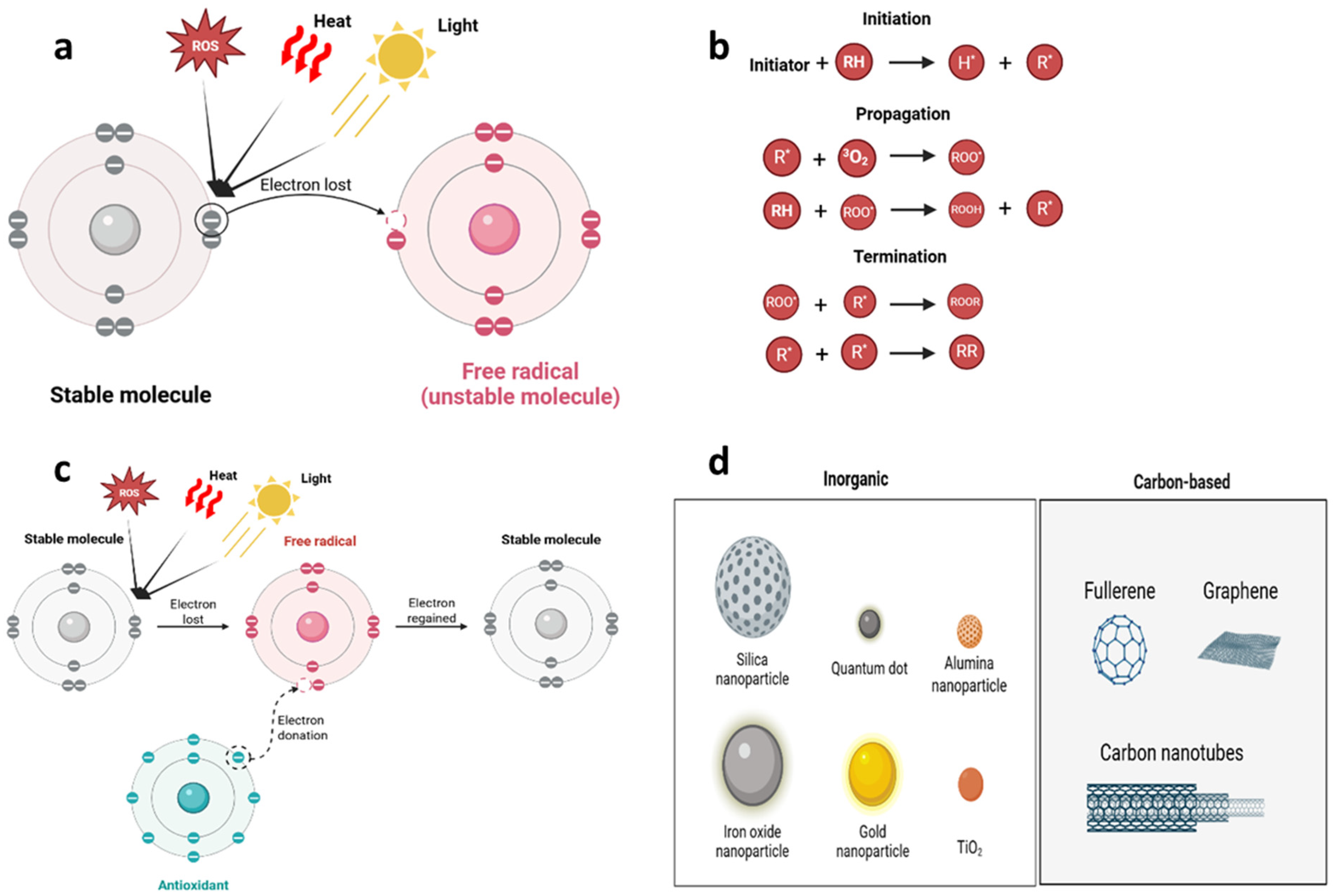
In the initiation stage, the bond between the carbon atom adjacent to the vinyl group (α-carbon) and its hydrogen atom is relatively weak and prone to cleavage. This bond instability leads to the abstraction of hydrogen atoms, resulting in the formation of highly reactive free radicals. The initiation reaction is typically triggered by the presence of initiators such as impurities within the oil, elevated temperature (heat), exposure to light (especially ultraviolet), singlet oxygen, or mechanical stress [29,30]. These factors provide the energy or the catalytic environment necessary to break the C-H bond, thereby generating the initial radical species that drive the oxidation chain reaction. Figure 1a depicts the free radical formation in the presence of initiators. Secondly, in the propagation stage, the free radicals generated in the initiation phase react rapidly with molecular oxygen to form peroxyl radicals (ROO*). These peroxyl radicals are highly reactive and abstract hydrogen atoms from adjacent natural ester molecules, particularly from other unsaturated fatty acids. This hydrogen abstraction produces hydroperoxides (ROOH) and new alkyl radicals (R*), which perpetuate the chain reaction. The continuous formation of radicals and hydroperoxides causes progressive degradation of the ester molecules. Hydroperoxides are inherently unstable and can break down into secondary oxidation products, including aldehydes, ketones, and acids, which further degrade the properties of the insulating liquid [31,32]. Finally, the termination stage occurs when two or more free radicals combine to form a stable, non-radical compound, effectively halting the chain reaction. This can happen through radical-radical recombination or disproportionation reactions. Although termination ends the radical chain process, it often results in the development of high molecular mass polymerized products, which can precipitate as sludge or sediment in the insulating liquid [33]. These by-products can adversely affect the fluid’s viscosity, cooling performance, and dielectric properties, ultimately impacting transformer reliability. Figure 1b illustrates the chemical reactions involved throughout the oxidation sequence. The oxidation reaction in natural esters can be effectively inhibited through the addition of antioxidants. These compounds function by interrupting the free radical chain reactions responsible for oxidative degradation. Antioxidants are broadly categorized into donor and acceptor types based on their mechanism of action. Donor antioxidants act by supplying a hydrogen atom to free radicals, effectively halting the radical chain reaction and inhibiting further propagation. In contrast, acceptor antioxidants interact with free radicals to form stable, non-reactive compounds that also halt the progression of oxidation. A simplified representation of the mechanism by which donor-type antioxidants inhibit oxidation is illustrated in Figure 1c. In addition, nanoparticles also have the potential of reducing the oxidation reaction process in natural esters through radical scavenging, decomposition of hydroperoxides, barrier effect, or physical adsorption and synergistic effects. There are different types of nanoparticles as presented in Figure 1d, and they may behave differently due to their inherent properties. There are few reports on the oxidation stability of ester-based nanofluids; therefore, it is of great importance to investigate this domain to fully understand how nanoparticles inhibit oxidation reactions in natural ester insulating liquids.
In addition to their well-documented electrical and thermal benefits, nanoparticles have shown promising potential in enhancing the thermo-oxidative stability of ester-based liquids. Their ability to inhibit oxidation arises from multiple mechanisms. Firstly, radical scavenging; certain nanoparticles, particularly metal oxides like TiO2, ZnO, and CeO2, can neutralize reactive oxygen species and free radicals, thereby interrupting the propagation phase of oxidation [34,35]. Secondly, catalytic decomposition of hydroperoxides: some nanoparticles can promote the safe breakdown of hydroperoxides into non-radical by-products, minimizing the formation of harmful secondary oxidation products [36]. Thirdly, nanoparticles can exert a barrier effect by physically adsorbing onto ester molecules or creating a dispersed layer that restricts oxygen diffusion and access to reactive sites [37]. Finally, nanoparticles may exhibit synergistic effects when combined with traditional antioxidants, either by enhancing their efficiency or by stabilizing them against thermal or oxidative degradation [38]. Different types of nanoparticles, as depicted in Figure 1d, possess unique physicochemical properties (e.g., size, surface energy, morphology, functionalization) that influence their performance as oxidation inhibitors. Despite these promising mechanisms, research on the thermo-oxidative stability of ester-based nanofluids is still in its early stages, with only a few systematic studies reported. Thus, it is crucial to conduct further investigations to fully elucidate how nanoparticles interact with oxidation intermediates and by-products in natural ester systems. Understanding these interactions will be vital for optimizing the formulation of nanofluids with improved long-term oxidative stability for transformer applications.

2. Materials and Methods

2.1. Materials

The insulating liquid used as the base fluid in this study is derived from canola oil. The chemicals used in this study include phenolphthalein, KOH pellets, isopropyl alcohol (99.8%), and Span 80 surfactant, all procured from Sigma-Aldrich. The nanoparticles, TiO2 and SiO2, were supplied by Sky Spring Nanomaterials Inc., Houston, TX, USA. The two different types of TiO2 nanoparticles used are anatase with a percentage purity of 99.5–99% and an average particle size of 5 nm and 10~30 nm. The SiO2 nanoparticles had purities of 99.5% and 99.8%, with average particle sizes of 10~20 nm and 5–15 nm, respectively. A summary of the nanoparticles used in this study is provided in Table 1.

2.2. Scanning Electron Microscopy of the Nanoparticles

The surface morphology and particle distribution of TiO2 and SiO2 nanoparticles were examined using a JEOL JSM-6480LV scanning electron microscope (JEOL USA, Inc., Peabody, MA, USA). The nanoparticles were dispersed onto clean aluminum foil using methanol as a suspending medium, following the procedure described in [39]. A thin layer of gold was deposited on the sample’s surface to improve surface conductivity and image resolution using a Bio-Rad SEM coating system (Bio-Rad Laboratories, Hercules, CA, USA.).

2.3. Sample Preparation and Oxidation Stability Setup

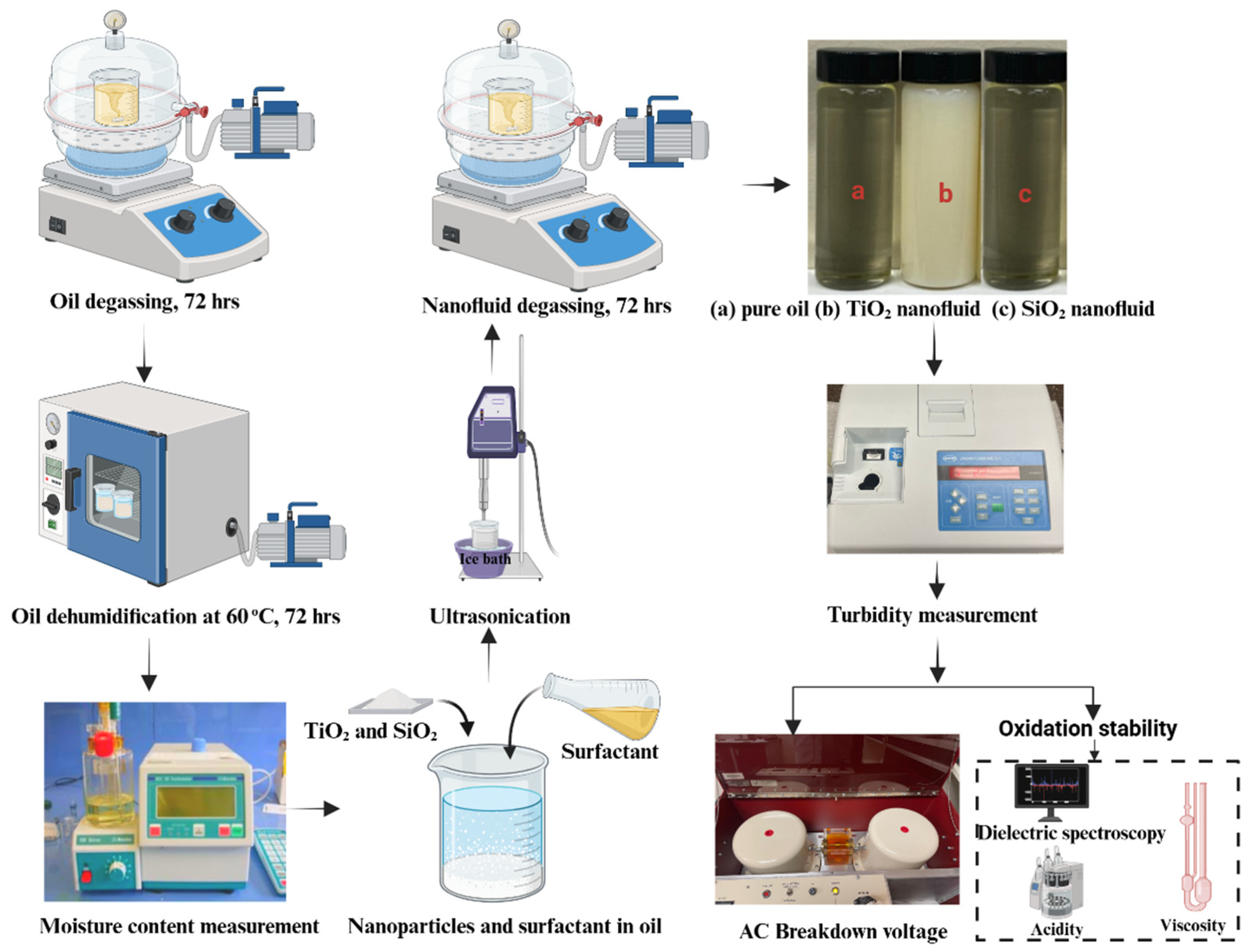
The oil sample was degassed in a desiccator to remove the gas bubbles in the oil. The sample was further dried at 60 °C in a vacuum oven, for 72 h. The percentage moisture level of the oil was confirmed to be less than 13 ppm after the dehumidification process. Nanofluids were synthesized by incorporating nanoparticles and a stabilizing surfactant into the pretreated base oil. The nanoparticle content was adjusted between 0.05 wt.% and 0.25 wt.%, while 2 g/L of Span 80 was included to maintain long-term stability and prevent nanoparticle agglomeration. The description of the nanofluids is presented in Table 2. The resulting mixture was ultrasonicated for 3 min using a Qsonica probe sonicator (model Q1375, power rating of 1375 W and an operating frequency of 20 kHz). This process was performed in an ice bath to prevent degradation of the oil sample due to the heat generated by the sonication probe. Following sonication, the nanofluids were further degassed to eliminate gas bubbles that may have formed during the process. The nanofluids stability was monitored over a period of 120 h using a turbidimeter (Hach 21100AN) and through visual inspection.
Oxidation stability was assessed according to ASTM D2440 [40]. A copper catalyst was placed in the oil receptacle, followed by the addition of 25 ± 0.01 g of the nanofluid sample. The receptacle was immersed in a thermostatically controlled oil bath at 110 °C followed by the introduction of extra-dry oxygen at a flow rate of 1 ± 0.1 L/h for 48 h. Upon completion, the receptacle was placed in a dark chamber and allowed to cool for 24 h before further analysis. Figure 2 illustrates the step-by-step method in the sample preparation process.

2.4. Viscosity

Viscosity is a key physical parameter that significantly affects the cooling performance of transformer insulating oils. It is well established that an increase in oil viscosity during transformer operation is primarily caused by oxidative degradation of the oil. In this study, the kinematic viscosity of both fresh and oxidized nanofluid samples was measured in accordance with ASTM D445-18 [41]. A KV3000 kinematic viscosity bath equipped with an Isotemp 3016D digital temperature controller was used to maintain a stable test environment. The nanofluid was introduced into a calibrated capillary viscometer, and the required time for the fluid to flow between the two designated marks was documented. The liquid’s viscosity was calculated using Equation (1), which relates flow time and viscometer constant to the kinematic viscosity of the sample.
ν 1,2 = C × t 1 ,   2
where ν 1,2 is the viscosity at time t 1,2 and C is the calibration constant of the viscometer (mm2/s2).

2.5. Total Acid Number (TAN)

Acids are among the prominent byproducts generated in the process of oxidative reaction in natural esters. The TAN of the oxidized nanofluids was measured following the ASTM D 974-03 [42]. 20 mL of isopropyl alcohol was used to dissolve 1 g of the oil sample, and 3 drops of phenolphthalein indicator were added. A freshly prepared 0.1 M KOH was then titrated against the solution, with a color change indicating the titration end point. The amount of potassium hydroxide that produced the endpoint was marked, and the TAN was calculated using Equation (2).
T A N = C b a s e × M K O H × V s a m p l e B b l a n k m o i l
C b a s e is the KOH titrant concentration, M K O H its molar mass, V s a m p l e the volume of base required for the sample, V b l a n k the blank titration volume, and m o i l the mass of oil.

2.6. Dielectric Dissipation Factor

The rise in dielectric loss observed in insulating liquids during degradation primarily originates from two mechanisms: polarization induced by the accumulation of polar degradation by-products, and increased conduction resulting from the presence of conductive or ionic contaminants formed during the aging process. The dissipation factor of the oxidized oil was determined in accordance with ASTM D924 using a Novocontrol Alpha-A High-Performance Frequency Analyzer [43]. The nanofluid was introduced into a cylindrical test cell, and its dielectric loss was measured at a frequency of 60 Hz.

2.7. AC Characteristic Breakdown Voltage

The effect of nanoparticles size and types was investigated on the dielectric strength of the base liquid. The breakdown voltage is a fundamental factor used to assess the insulating strength of a liquid under alternating electric stress. Due to the stochastic nature of breakdown phenomena, statistical treatment is essential to obtain reliable and reproducible estimates. In this study, the two-parameter Weibull distribution is employed to characterize the breakdown strength of the nanofluids. The cumulative distribution function (CDF) is given in Equation (3).
F V = 1 e V α β
where F(V) is the cumulative probability of breakdown at voltage V, α is the scale parameter, and β is the shape parameter.
The experimental AC breakdown voltages were fitted to the Weibull model using least-squares linear regression applied to the linearized Weibull equation as given in Equation (4).
ln l n 1 F V = β ln V β ln α
From the linear fit of the Weibull plot, the slope corresponds to the shape parameter β, while the intercept yields the scale parameter α. The Weibull probability plot was generated by ranking the breakdown voltages in ascending order and assigning cumulative failure probabilities using the median rank method provided in Equation (5) [44].
F V i = i 0.3 n + 0.4

3. Results and Discussion

3.1. Scanning Electron Microscopy

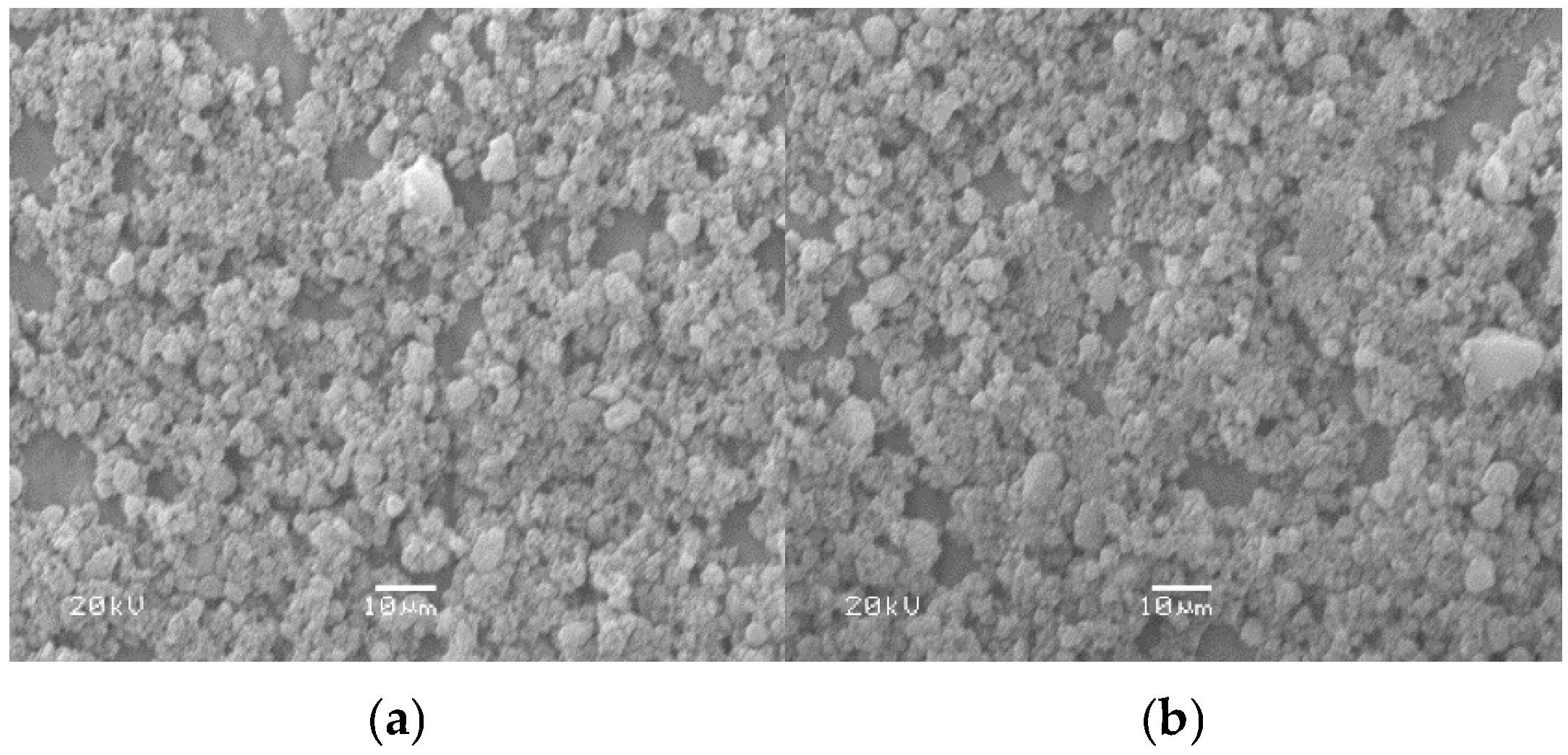
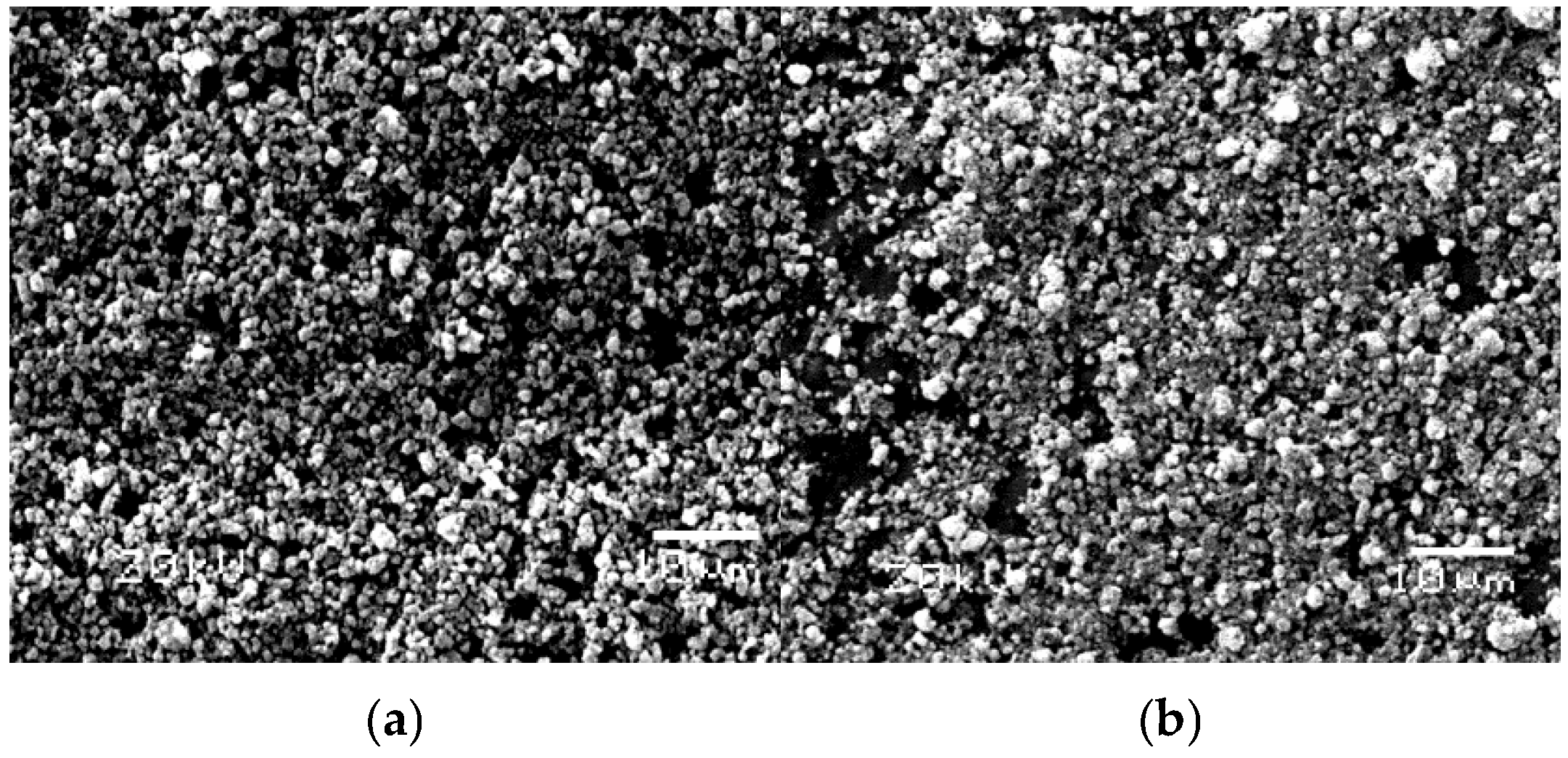
The micrographs presented in Figure 3 and Figure 4 show the surface morphology of TiO2 and SiO2 nanoparticles, respectively. Figure 3a,b correspond to TiO2 nanoparticles with sizes of approximately 5 nm and 10–30 nm, while Figure 4a,b depicts SiO2 nanoparticles with an average particle size of 5–15 nm and 10–20 nm, respectively. Both TiO2 and SiO2 nanoparticles exhibited noticeable variations in shape and size, with a tendency toward mild agglomeration but an overall uniform distribution and a narrow range of dispersion. Furthermore, all the nanoparticles show an abundance of quasi-spherical shapes, making them suitable for dielectric properties enhancement [45].

3.2. Nanofluid Stability

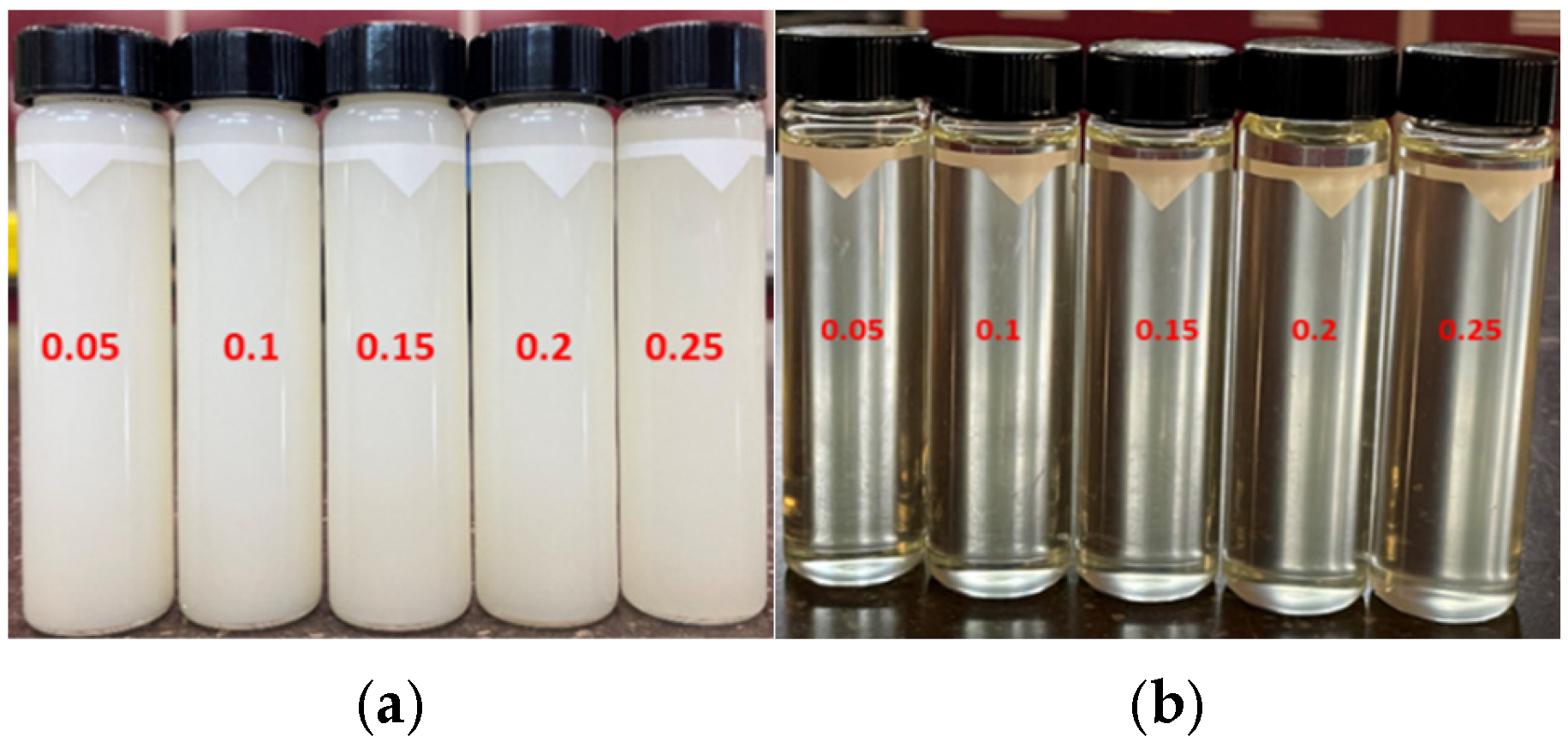
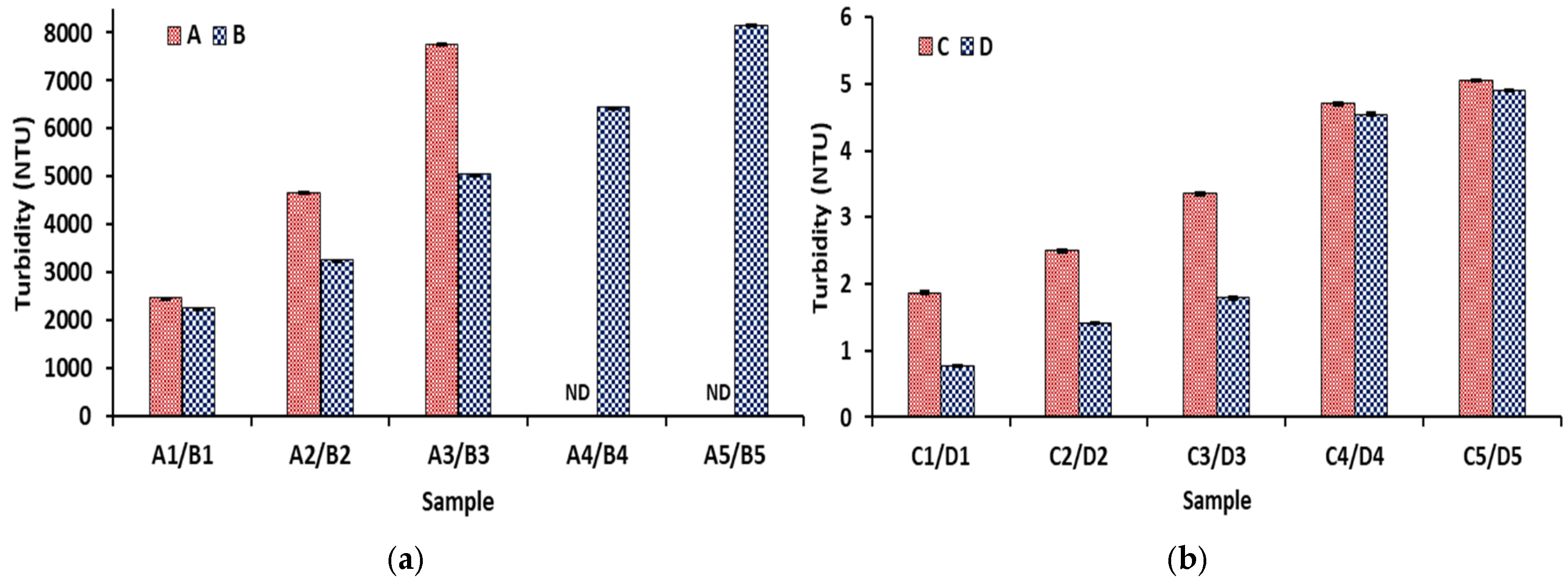
The prepared nanofluids using TiO2 and SiO2 nanoparticles are presented in Figure 5a,b, respectively. Although the two TiO2 and SiO2 nanoparticles appear white in their dry powdered form, their dispersion in oil-based nanofluids exhibits markedly different visual characteristics. As shown in the Figures, the TiO2-based nanofluids appeared milky at all concentrations, whereas the SiO2-based nanofluids remained relatively clear and visually similar to the base oil. This contrast can be attributed primarily to differences in optical properties, particle-oil interactions, and dispersion behavior. TiO2 nanoparticles possess a high refractive index (~2.5–2.7) [46,47], significantly greater than that of the base oil (~1.45) [48,49]. This large mismatch likely resulted in intense light scattering, causing the nanofluids to appear turbid or milky. In contrast, SiO2 nanoparticles have a refractive index (~1.45–1.46) [50,51], which closely matches that of the base oil, resulting in minimal light scattering and a transparent appearance. It is important to note that the base oil has an initial turbidity of 0.328 NTU. However, an increase in turbidity was observed with the addition of all types of nanoparticles, with a particularly pronounced increase in the case of TiO2. The significant increase in the turbidity of TiO2-nanofluids could be attributed to the higher refractive index and stronger light scattering behavior of TiO2 nanoparticles. In contrast, the SiO2 nanoparticles exhibit optical compatibility with the oil, resulting in minimal change in turbidity. In addition to nanoparticle type, particle size also played a significant role in influencing the turbidity of the prepared nanofluids. As presented in Figure 6a,b, at every loading of nanoparticles, nanofluids prepared using 5 nm TiO2 and 5~15 nm SiO2 nanoparticles exhibited significantly higher turbidity compared to those formulated with their 10 nm counterparts. This behavior can be mainly attributed to the greater number density of smaller particles, which enhances the total number of scattering centers within a given volume. Although each smaller particle individually contributes less to light scattering than a larger particle, the cumulative effect of the greater particle count leads to increased turbidity [52].
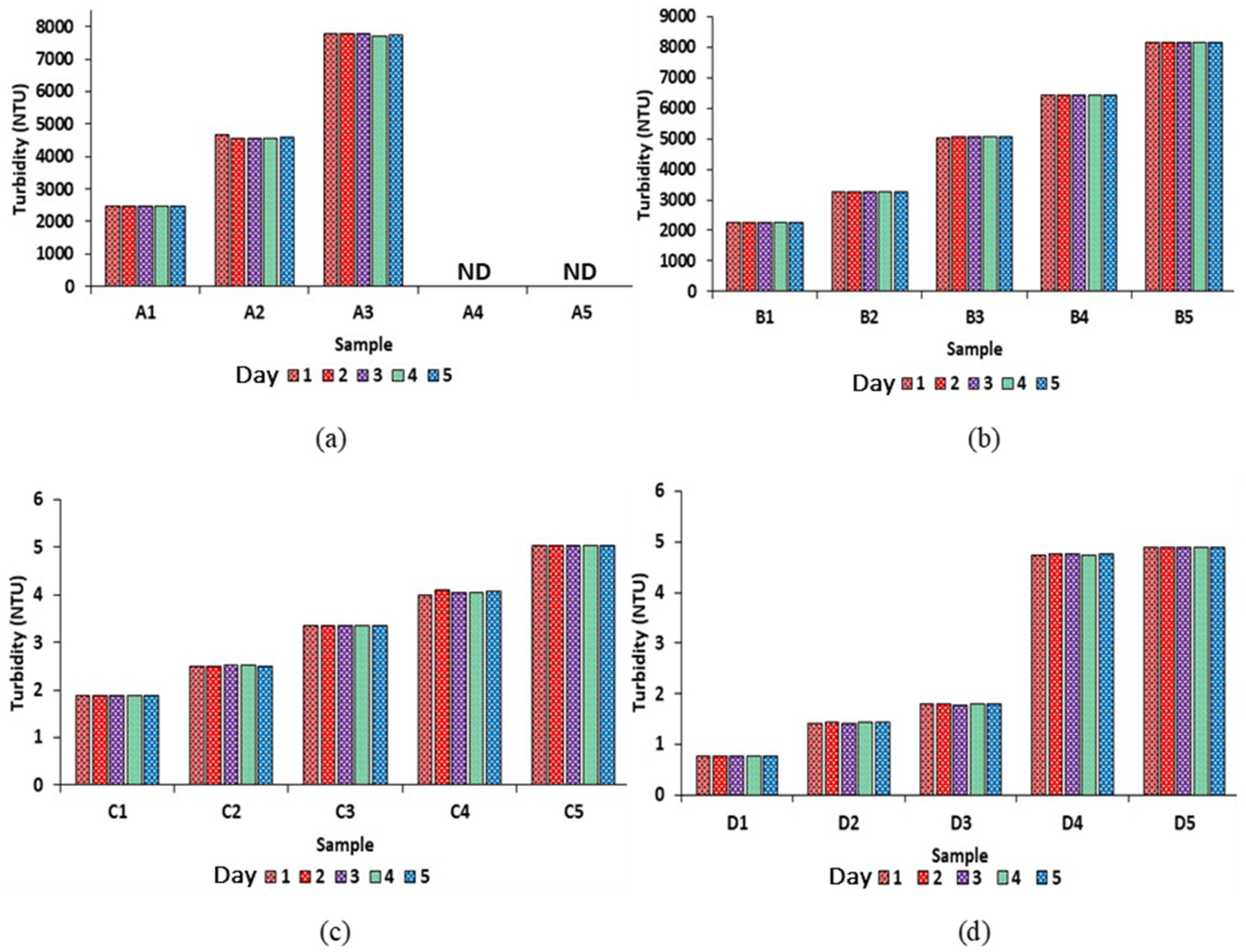
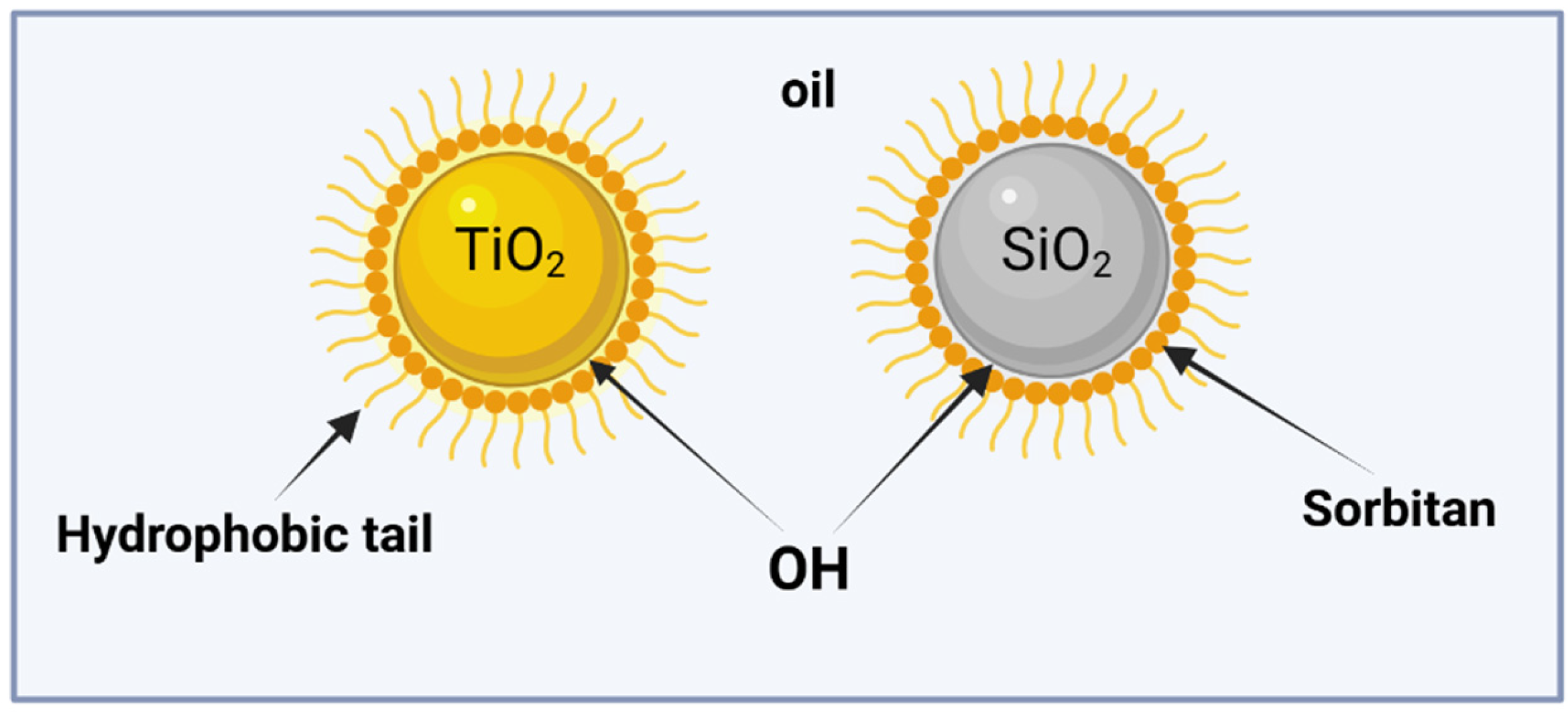
The turbidity of the prepared nanofluids over a 5-day period is shown in Figure 7a–d. No significant changes were observed, indicating that Span 80 effectively maintained the stability of the nanofluids. Span 80, a non-ionic surfactant, consists of a hydrophilic head and a hydrophobic tail. Its relatively low Hydrophilic-Lipophilic Balance (HLB ≈ 4.3) renders it well-suited for stabilizing nanoparticles in natural ester-based systems. As illustrated in Figure 8, both TiO2 and SiO2 nanoparticles possess surface hydroxyl groups (-OH) [53,54], which interact with the polar head of Span 80 through Van der Waals forces. This interaction promotes the adsorption of Span 80 molecules onto the nanoparticle surfaces, with their hydrophobic tails extending into the oil phase. This configuration creates a steric barrier that prevents particle agglomeration and improves the overall dispersion stability of the nanofluid.

3.3. Kinematic Viscosity

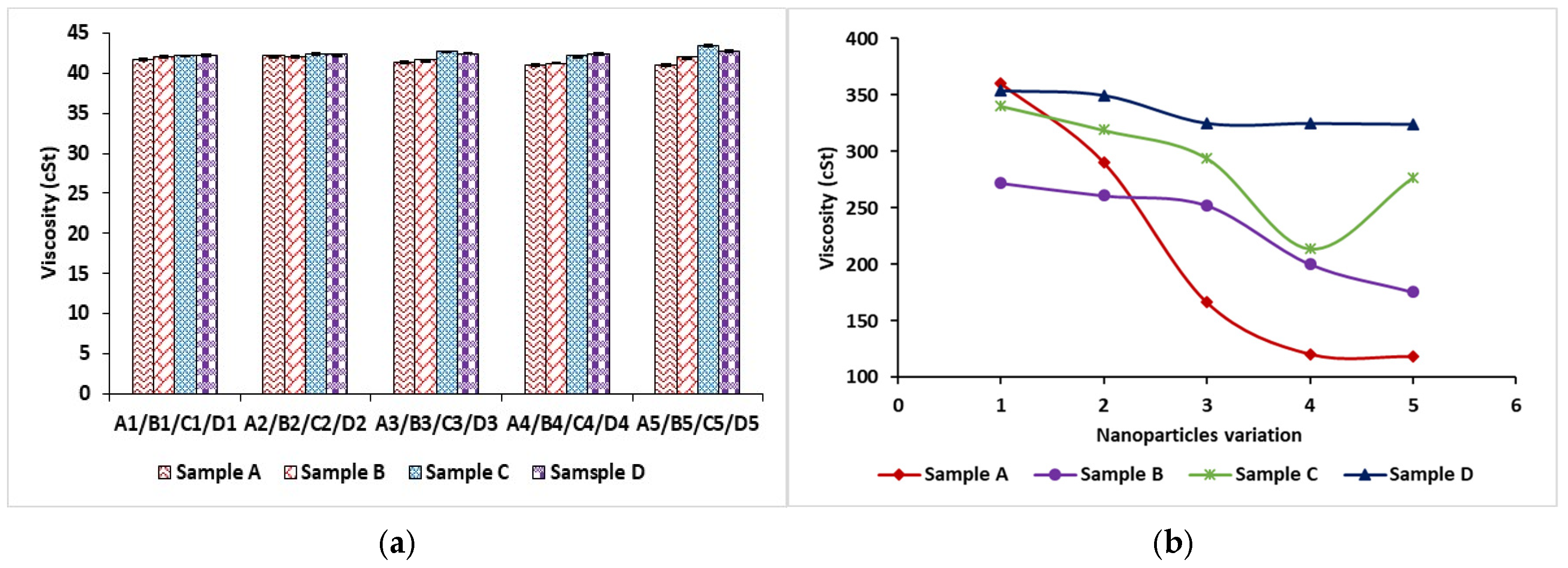
Viscosity is a critical property of insulating liquids, as it directly affects their ability to remove heat from an energized transformer. Figure 9a presents the viscosity values for samples A through D, corresponding to different nanoparticle types and sizes across varying concentrations (0.05 to 0.25 wt.%). The base oil exhibited an initial viscosity of 39.55 cSt. Upon the addition of nanoparticles, the viscosity increased slightly, ranging from 41.00 cSt with 5 nm TiO2 (Sample A) to 43.46 cSt with 5–15 nm SiO2 (Sample C). The maximum percentage increases in viscosity for Samples A, B, C, and D were 6.6%, 6.4%, 9.89%, and 8.1%, respectively, relative to the base oil and are all within the standard viscosity requirement for natural ester insulating liquids according to IEC 62770 [55]. A general trend is observed where smaller nanoparticles tend to induce higher viscosity increases, likely due to their enhanced interaction with the molecular structure of the oil, leading to greater internal friction. Furthermore, variations in nanoparticle concentration from 0.05 to 0.25 wt.% had a negligible effect on the overall viscosity within each sample group, indicating that particle type and size are more influential than concentration in this context.
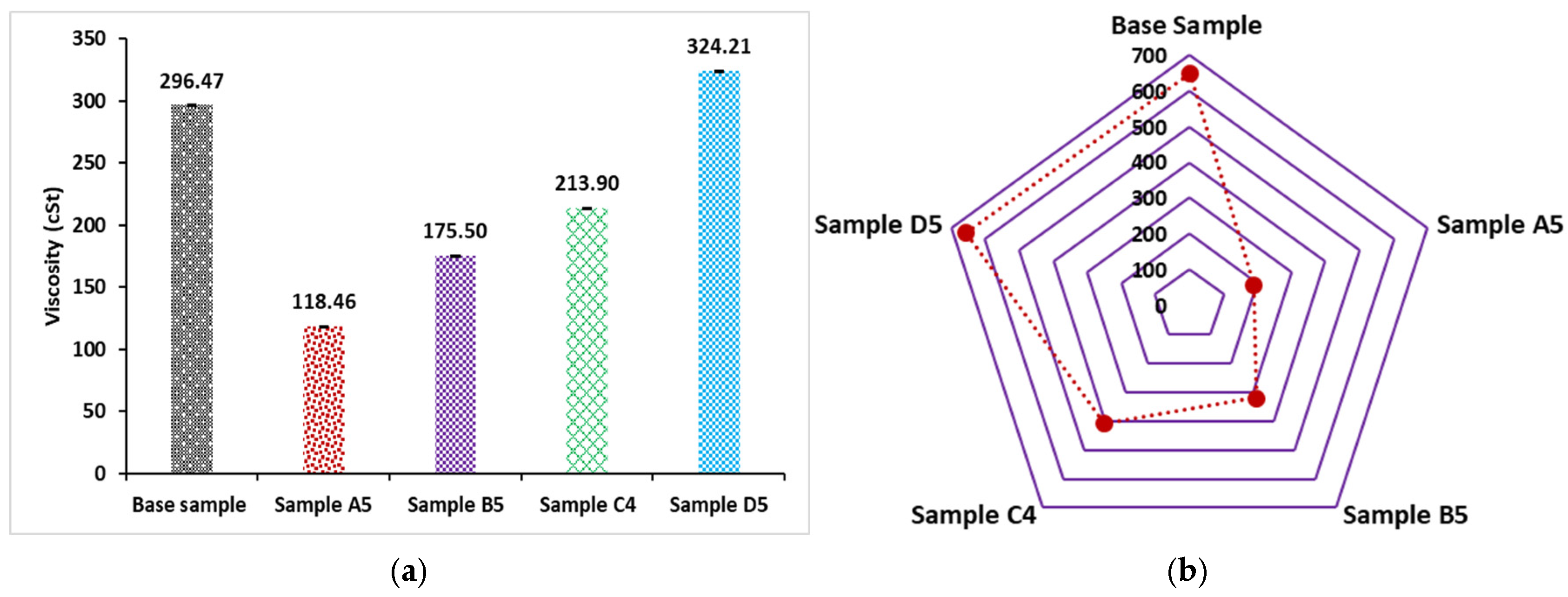
Figure 9b illustrates the post-oxidation viscosity of the nanofluids after 48 h of thermo-oxidative aging under a continuous oxygen flow rate of 1 L/h. The viscosity of the base liquid increases to 296.47 cSt, a characteristic sign of oxidative degradation due to the development of byproducts. However, the nanofluids showed a significant decrease in viscosity with increasing nanoparticle concentration, particularly in TiO2-based samples, indicating improved oxidation stability. The upward shift in viscosity observed after Sample C4 may be attributed to saturation effects. The optimum viscosity values of all nanofluids were compared with the base sample in Figure 10a, while the corresponding percentage increases are shown in Figure 10b. Notably, Samples A and B, both containing TiO2 nanoparticles, exhibited excellent performance. However, sample A, formulated with 5 nm TiO2 nanoparticles, showed the best result at 0.25 wt.% loading (A5) as presented in Figure 10a. Moreover, the sample with the lowest post-oxidation viscosity also exhibited the smallest percentage increase, as presented in Figure 10b, indicating the strong protective effect of smaller-sized nanoparticles. The enhanced performance experienced in samples prepared with TiO2 nanoparticles could be attributed to the synergistic attribute of TiO2 nanoparticles [56]. TiO2 nanoparticles are radical scavengers that are capable of adsorbing and neutralizing peroxyl and alkyl radicals that could propagate oxidation chain reactions in the base oil [57,58]. Due to the interruption of the oxidative chain reactions, TiO2 delays the formation of acidic compounds and polymeric degradation products, consequently, preserving the fluid’s viscosity. In addition, its surface redox activity and photocatalytic properties further enable TiO2 to participate in electron transfer processes that reduce oxidative stress within the oil [59]. It is to be noticed that SiO2-based nanofluids (C and D) exhibited higher viscosity values relative to TiO2-based nanofluids, indicating an inferior oxidation stability of SiO2 nanoparticles compared to TiO2 nanoparticles.
The limited oxidation protection offered by SiO2 nanoparticles can be attributed to their lack of inherent radical-scavenging and redox activity. Unlike TiO2, which is highly reactive, redox-active, and semiconducting, SiO2 is chemically inert and non-conductive. This intrinsic distinction explains the enhanced oxidation resistance exhibited by TiO2-based nanofluids relative to their SiO2-based counterparts. Furthermore, the influence of particle size on oxidation stability was evident, as demonstrated by the superior performance of Sample A over Sample B, and Sample C over Sample D. This can be attributed to the higher surface area-to-volume ratio of smaller nanoparticles, which provides more active sites for free radical neutralization.

3.4. Total Acid Number

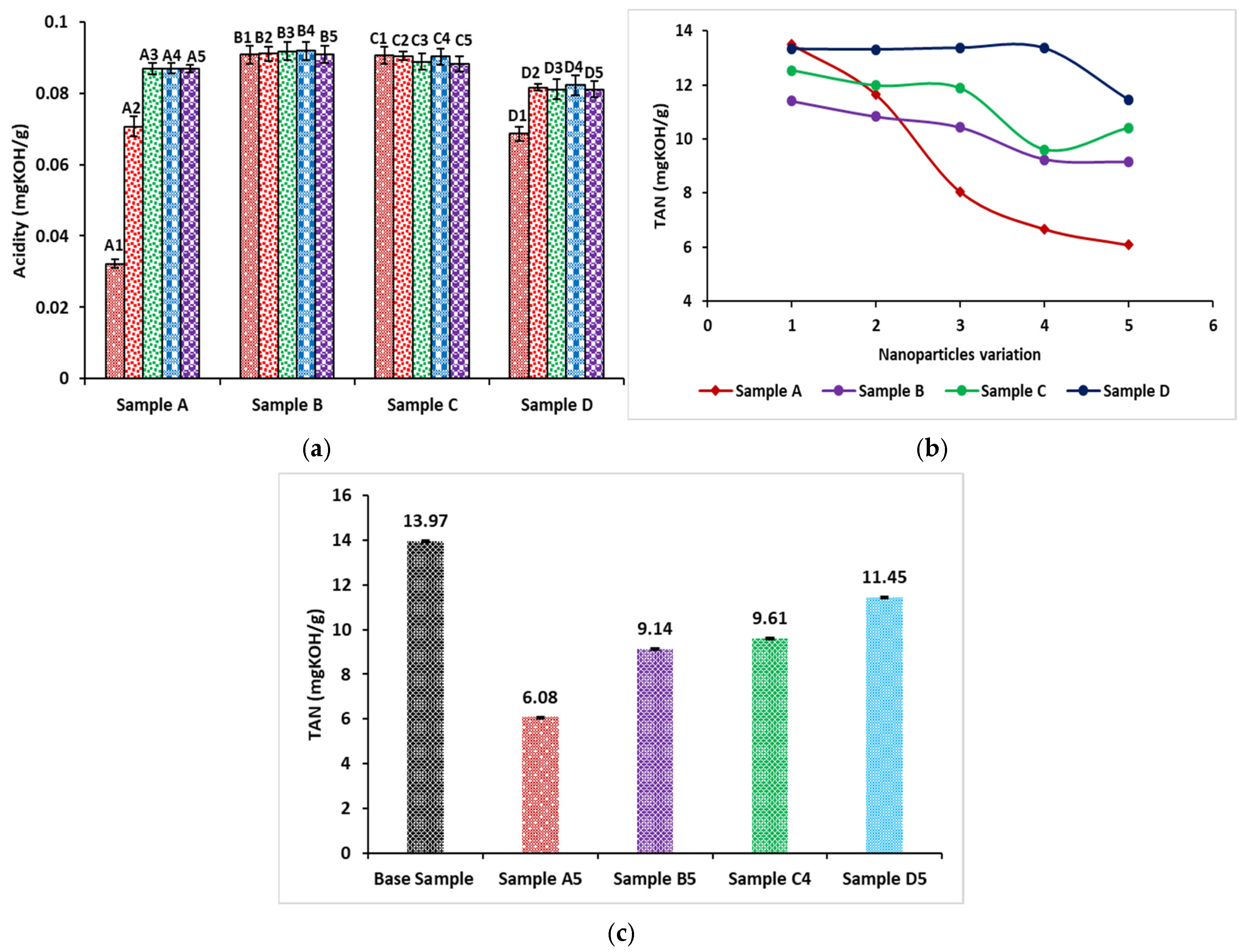
Figure 11 illustrates how the incorporation of nanoparticles affects the acidity level of the fresh base oil. The acidity of the unaged oil was 0.0103 mgKOH/g. Upon the addition of particles, a mild increase in acidity was observed, as shown in Figure 11a. For Sample A, the first two nanoparticle loadings, A1 and A2, caused a minor rise in acidity, while the remaining three concentrations resulted in nearly constant acid values. Similarly, although Samples B and C exhibited a slight initial increase in acidity, they showed no significant variation in acidity with further increases in nanoparticle loading. In the case of Sample D, the first loading induced a slight increase in acidity, but subsequent loadings did not produce notable changes. The overall insignificant variation in acidity with increasing nanoparticle concentration may be attributed to the chemically inert nature of both TiO2 and SiO2 nanoparticles at room temperature.
Throughout the oxidation of natural esters, acidic by-products including carboxylic acids and aldehydes are generated [60]. The presence of these compounds leads to an increase in the acid value of the fluid, reflecting ongoing degradation and the buildup of polar, corrosive species. The rise in acidity serves as a key indicator of oxidative aging in insulating liquids. Figure 11b illustrates the influence of nanoparticle loading (TiO2 and SiO2) on acid generation in the natural ester fluid. It was observed that increasing the concentration of nanoparticles led to enhanced oxidative stability, evidenced by a reduction in total acid number. This trend aligns with observations in Figure 9b, suggesting a strong correlation between the viscosity and acidity behavior of nanofluids. Among the samples, TiO2-based nanofluids, especially those formulated with 5 nm particles, demonstrated superior performance. This can be attributed to the radical-scavenging properties of TiO2, which adsorb and neutralize peroxyl and alkyl radicals, thereby slowing the oxidative degradation process and delaying the formation of acids, aldehydes, and ketones. Although SiO2-based nanofluids showed better performance than the base fluid, their effect was less pronounced compared to TiO2-based nanofluids. This difference is likely due to the lower reactivity of SiO2 nanoparticles toward free radicals. Notably, across all nanoparticle types, those with smaller particle sizes consistently resulted in lower acid formation, highlighting the significance of particle size when considering oxidative stability enhancement. Figure 11c compares the optimum-performing samples with the untreated base oil. Sample A with 0.25 wt.% TiO2 nanoparticles achieved the best result with an average acidity of 6.08 mgKOH/g compared to the base liquid’s 13.97 mgKOH/g.

3.5. Dissipation Factor

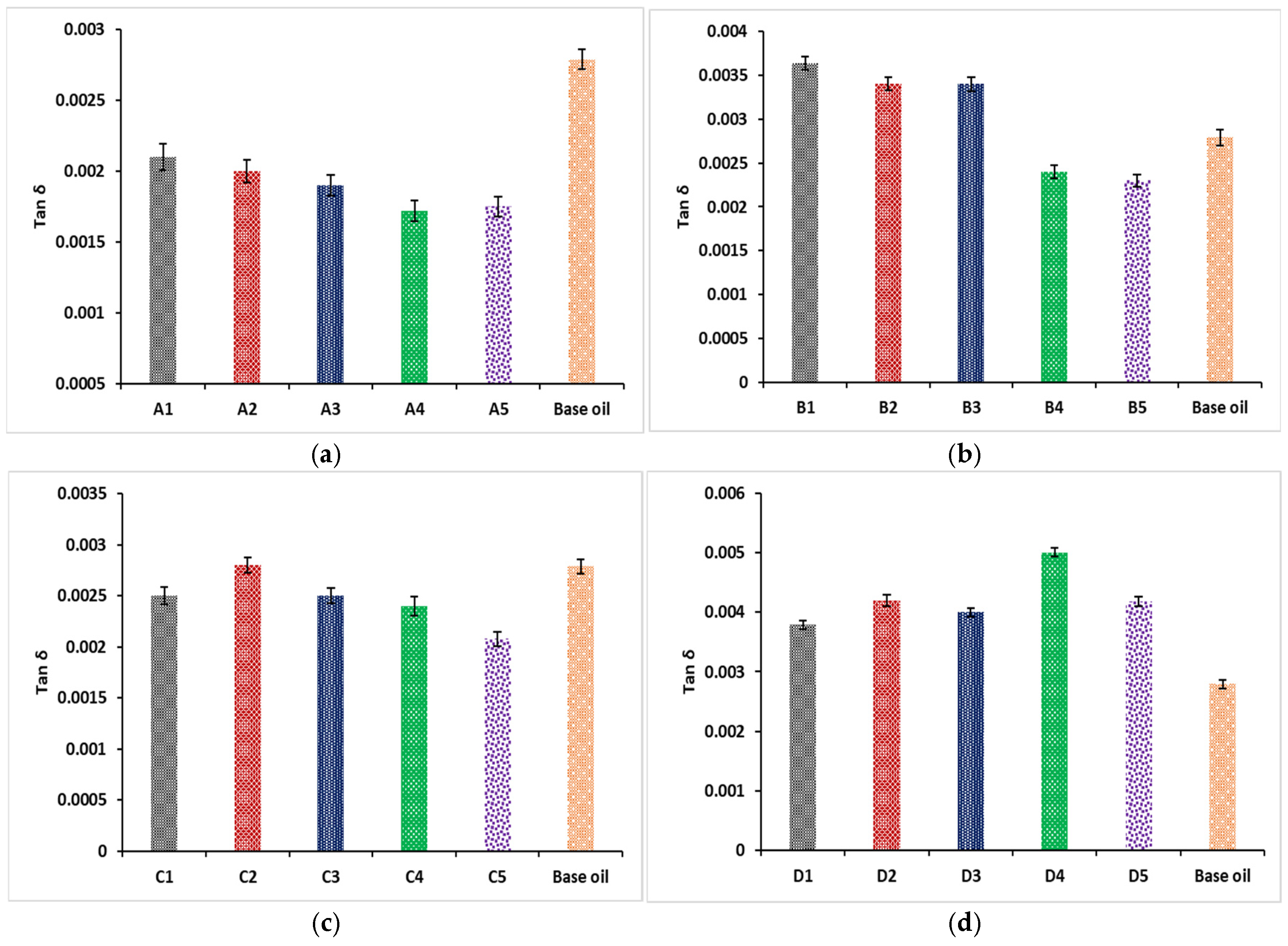
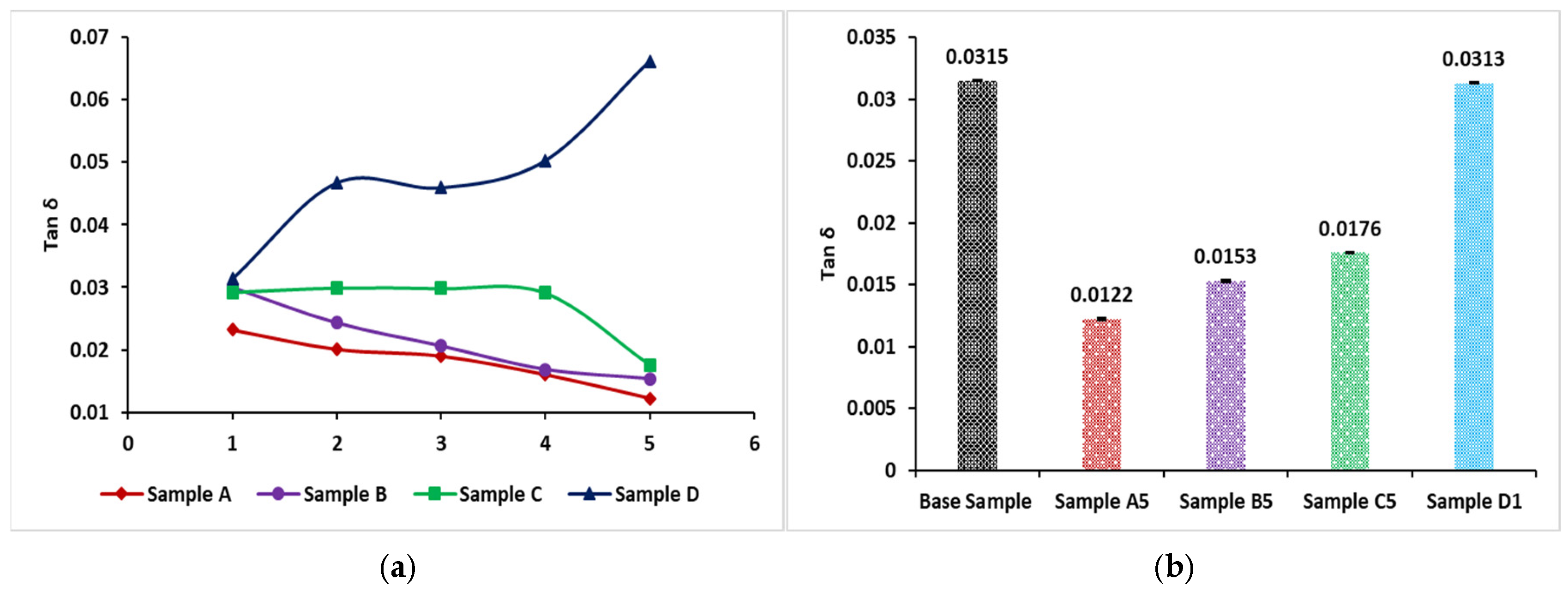
Figure 12a–d illustrates how the type and concentration of nanoparticles influence the tan δ of the natural ester base oil. In Figure 12a, incorporating 5 nm TiO2 nanoparticles, Sample A, led to a significant reduction in the dissipation factor compared to the base fluid, with an optimal reduction of 38.35% achieved at a 0.2 wt.% loading. This improvement can be attributed to the creation of both shallow and deep charge trap sites by the TiO2 nanoparticles, which effectively immobilize free charge carriers and reduce the conduction pathways within the fluid matrix [61,62]. In Figure 12b, Sample B, an initial rise in tan δ was observed at 0.05 wt.% loading. However, further increases in nanoparticle concentration led to a decline in the dissipation factor, reaching an optimal reduction of 17.56% at 0.25 wt.%. This behavior suggests a concentration-dependent charge trapping and scattering effect, where higher nanoparticle loading improves interfacial polarization stability and suppresses dielectric loss. Figure 12c displays the impact of 5–15 nm SiO2 nanoparticles, Sample C, where a general reduction in tan δ was noted, with optimum performance at 0.25 wt.%. This reduction, although less pronounced than TiO2, could be attributed to the relatively lower dielectric constant of SiO2, which limits polarization under an electric field but still contributes to charge trapping. Conversely, Figure 12d, Sample D, revealed an increase in tan δ across all concentrations of 10–20 nm SiO2 nanoparticles, indicating a detrimental effect on dielectric performance. The higher dissipation factors suggest that the larger particle size may have created conductive pathways, thereby promoting charge mobility instead of restricting it. Insufficient trap site density at this size scale may further explain the rise in dielectric loss.
The post-oxidation dielectric performance of the nanofluids is shown in Figure 13a,b, where the impact of nanoparticle loading on tan δ was evaluated after thermo-oxidative aging. For TiO2-based nanofluids, Samples A and B show an excellent oxidation stability through an enhanced dielectric performance with increasing nanoparticle concentration as shown in Figure 13a. In particular, Sample A5 exhibited an outstanding tan δ value of 0.0122, indicating strong resistance to oxidative degradation. Sample C (5 nm SiO2) also showed a modest reduction in tan δ after oxidation, particularly at higher loadings. However, Sample D (10–20 nm SiO2) deviated from this trend. Instead of mitigating the effect of oxidative aging, all concentrations led to an increase in dissipation factor. This suggests that the larger SiO2 nanoparticles may have failed to counteract the increase in polar degradation byproducts formed during oxidation. As shown in Figure 13b, the overall comparison among the nanofluids confirms that TiO2 nanoparticles at 5 nm and 0.25 wt.% concentration (Sample A5) yielded the most favorable results, both pre- and post-oxidation. Additionally, Samples C5 and D1 were the only SiO2-based nanofluids with post-oxidation performance better than the base oil. These observations confirm that both nanoparticle type and particle size significantly influence the dielectric loss characteristics of natural ester-based insulating fluids. Smaller nanoparticles (5 nm), particularly TiO2, demonstrate superior ability to maintain dielectric integrity during oxidation due to their high surface area, efficient trap site distribution, and stronger interaction with oxidation byproducts.

3.6. Characteristic Breakdown Voltage

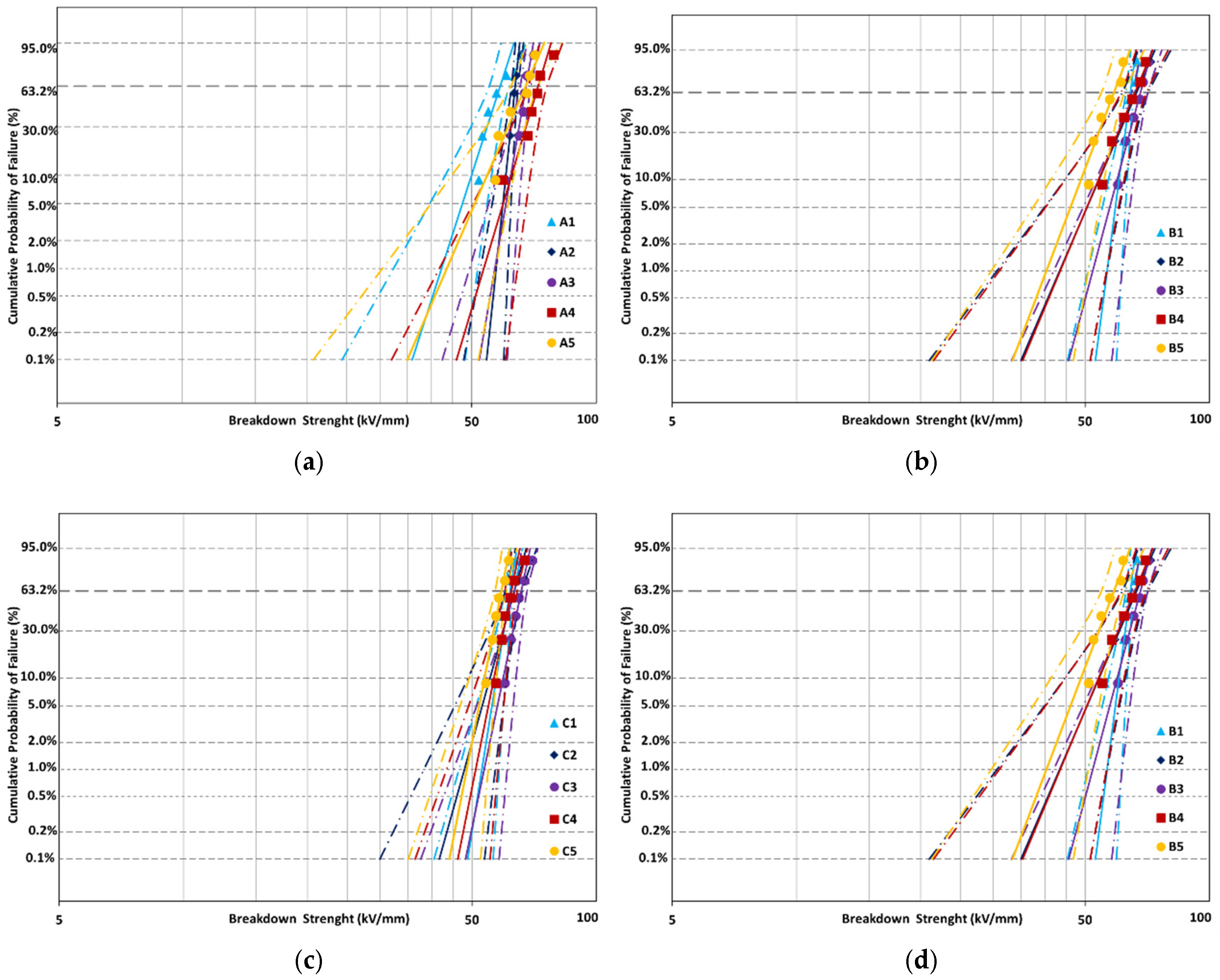
In the case of liquid dielectrics such as natural esters, the occurrence of breakdown is influenced by the stochastic distribution of inherent weak sites within the liquid. As a result, breakdown voltages tend to exhibit significant dispersion, necessitating the application of statistical methods for reliable analysis. Weibull distribution is widely adopted for this purpose due to its robustness in modeling failure probabilities and its effectiveness in handling limited experimental datasets [63]. Figure 14a–d displays the Weibull plots for Samples A, B, C, and D, each exhibiting comparable distribution trends, as indicated by the similarity in the slope of their fitted lines. The statistical parameters from the Weibull statistical analysis are presented in Table 3, Table 4, Table 5 and Table 6 for Samples A, B, C, and D, respectively. The high shape parameter (β) in all the samples from Table 3, Table 4, Table 5 and Table 6 indicates a tight clustering of breakdown data around the mean, which implies that the insulating liquids break down consistently and predictably. This verified the integrity of the measuring equipment and as well as the high dielectric uniformity, reliability, and safety of the prepared insulating nanofluids. Furthermore, the high correlation coefficient ρ in all the samples, which is higher than 0.918 as stated in [63,64], indicates a robust agreement between the experimental data and the Weibull model.
The characteristic breakdown voltage (α), as presented in Table 3, Table 4, Table 5 and Table 6, indicates that the addition of nanoparticles significantly improves the dielectric strength of the base natural ester oil through the electron trapping mechanism [14,65]. For Sample A (TiO2-based nanofluid with 5 nm particles), the breakdown voltage increases progressively with nanoparticle loading, achieving an optimum performance at 0.2 wt.% (A4). Similarly, optimum enhancements were observed in Samples B, C, and D at B3, C3, and D3, respectively, as presented in Table 4, Table 5 and Table 6. When comparing the nanoparticle types, Samples A and B, both based on TiO2, consistently exhibited higher breakdown voltages than their SiO2 counterparts (Samples C and D), indicating that TiO2 nanoparticles are more effective in enhancing the dielectric strength of the base oil. Moreover, the size of the particles significantly influences the outcome. For TiO2-based nanofluids, the 5 nm particles (Sample A) outperformed the larger 10–30 nm particles (Sample B). A similar trend was observed for SiO2 nanofluids, where the 5–15 nm particles (Sample C) yielded higher breakdown voltages than the 10–20 nm particles (Sample D). These observations suggest that both nanoparticle type and size significantly influence the performance of natural ester.
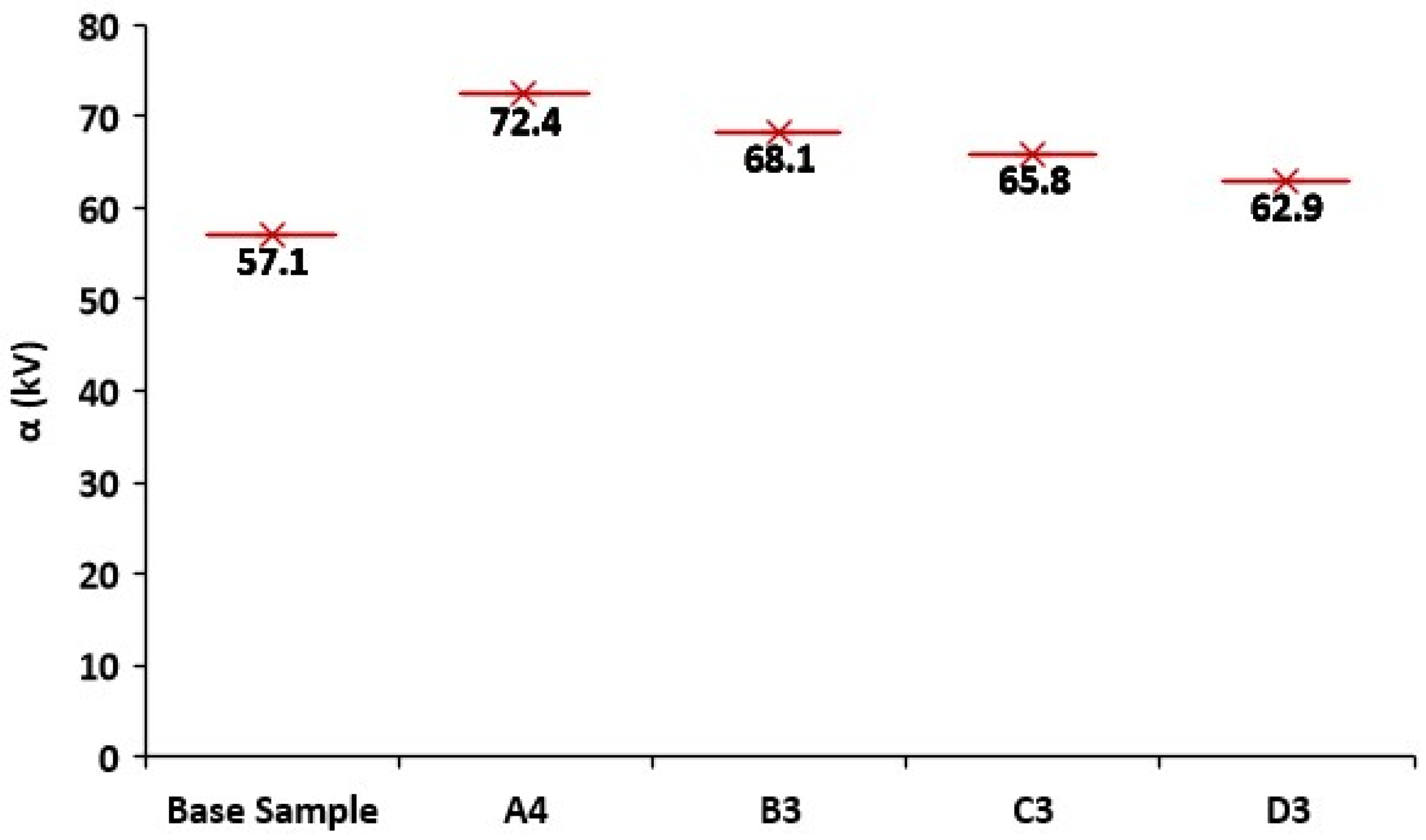
Figure 15 compares the characteristic breakdown strength of the base oil with the optimum performance from each sample. It was observed that the TiO2-based nanofluid has the highest breakdown voltages. The superior performance of TiO2 nanoparticles could be attributed to their high dielectric constant, close to 100, compared to SiO2, which typically has a dielectric constant of around 3.9 [45]. The high permittivity of TiO2 allows it to polarize more effectively under an electric field, thereby improving local electric field distribution and mitigating electric field stress concentrations that can trigger breakdown [66]. This enhanced polarization capability may have contributed to the overall enhancement in the AC breakdown voltage of the TiO2-based nanofluids.

4. Conclusions

This study demonstrated the significant influence of nanoparticle type and size on the thermo-oxidative stability and dielectric performance of natural ester-based insulating fluids. Stable nanofluids were successfully formulated using TiO2 and SiO2 nanoparticles, with Span 80 surfactant effectively maintaining colloidal stability over a 5-day observation period, surpassing typical stability concerns reported in earlier nanofluid studies. The key findings include:
Superior Oxidative Stability with TiO2: While the inclusion of TiO2 and SiO2 nanoparticles had minimal effect on the initial viscosity and acidity, oxidative aging revealed a marked enhancement in performance for TiO2-based nanofluids. Notably, formulations with smaller (5 nm) TiO2 particles significantly suppressed viscosity and acid value increase, outperforming both SiO2-based nanofluids and the aged base oil. This represents a meaningful advance over prior works that either lacked size-dependent insights or showed limited post-oxidative aging improvements.
Enhanced Dielectric Integrity Under Thermal Stress: After accelerated thermo-oxidative aging, the dissipation factor of the TiO2 nanofluid (0.0122) remained well below that of the aged base oil (0.0315), confirming the ability of TiO2 nanoparticles to mitigate dielectric degradation. This addresses a key limitation in natural esters, namely, their tendency to deteriorate under thermal-oxidative conditions, and builds upon existing literature by quantifying the dielectric benefit under controlled aging protocols.
Breakdown Strength Improvement and Optimal Doping: Comparing the dielectric strength of both nanoparticles and the influence of particle size, Weibull analysis revealed that doping natural ester with TiO2 outperformed SiO2 nanoparticles. It also revealed that smaller nanoparticles enhance dielectric strength more relative to bigger nanoparticles.
While this study reveals important information on the role of nanoparticle type and size on the thermo-oxidative and dielectric performance of natural ester-based insulating liquids, several avenues like long-term colloidal stability under thermal and electrical stress, scale-up studies and compatibility assessments with transformer solid insulation materials, combined influence of moisture, dissolved gases, and nanoparticles, and optimization of nanoparticle concentration remain open for further investigation. Although TiO2 and SiO2 nanoparticles are not biodegradable, the very low concentrations employed in transformer nanofluids significantly limit their potential environmental impact. In practical applications, insulating liquids are used in sealed systems and are typically recovered, regenerated, or disposed of under controlled conditions at the end of service life. Existing oil recycling and reclamation processes may therefore be adapted to manage nanoparticle-containing fluids, although the long-term fate of nanoparticles during oil regeneration remains an open research question. Future studies should focus on nanoparticle recovery, recyclability, and full lifecycle assessment to better quantify the environmental implications of nanofluid-based transformer insulation systems.

Author Contributions

S.O.O.: conceptualization, methodology, validation, formal analysis, investigation, visualization, writing—original draft. Y.B.: methodology, formal analysis. I.F.: validation, writing—review and editing, resources, funding acquisition, supervision. R.J.: validation, writing—review and editing. All authors have read and agreed to the published version of the manuscript.

Funding

This work was funded by Fonds de recherche du Québec—Nature et Technologies (FRQNT), grant number V1-334706, https://doi.org/10.69777/334706 and supported by the Natural Sciences and Engineering Research Council of Canada (NSERC), grant number RGPIN-2021-03232.

Data Availability Statement

The raw data supporting the conclusions of this article will be made available by the authors on request.

Conflicts of Interest

The authors declare no conflicts of interest.

References

  1. Li, C.; Yang, Y.; Xu, G.; Zhou, Y.; Jia, M.; Zhong, S.; Gao, Y.; Park, C.; Liu, Q.; Wang, Y. Insulating materials for realising carbon neutrality: Opportunities, remaining issues and challenges. High Volt. 2022, 7, 610–632. [Google Scholar] [CrossRef]
  2. Zhu, H.; Goh, H.H.; Zhang, D.; Ahmad, T.; Liu, H.; Wang, S.; Li, S.; Liu, T.; Dai, H.; Wu, T. Key technologies for smart energy systems: Recent developments, challenges, and research opportunities in the context of carbon neutrality. J. Clean. Prod. 2022, 331, 129809. [Google Scholar] [CrossRef]
  3. Rafiq, M.; Shafique, M.; Ateeq, M.; Zink, M.; Targitay, D. Natural esters as sustainable alternating dielectric liquids for transformer insulation system: Analyzing the state of the art. Clean Technol. Environ. Policy 2024, 26, 623–659. [Google Scholar] [CrossRef]
  4. Srivastava, M.; Goyal, S.K.; Saraswat, A. Ester oil as an alternative to mineral transformer insulating liquid. Mater. Today Proc. 2021, 43, 2850–2854. [Google Scholar] [CrossRef]
  5. Ghislain, M.M.; Gerard, O.B.; Emeric, T.N.; Adolphe, M.I. Improvement of environmental characteristics of natural monoesters for use as insulating liquid in power transformers. Environ. Technol. Innov. 2022, 27, 102784. [Google Scholar] [CrossRef]
  6. Raymon, A. Transesterification approaches to natural esters for transformer insulating fluids: A review. IEEE Trans. Dielectr. Electr. Insul. 2023, 31, 607–614. [Google Scholar] [CrossRef]
  7. Wu, Y.; Chen, R.; Zhang, J.; Tang, C. The influence of doping with different surface modified SiO2 nanoparticles on the dielectric properties of natural ester insulating oil. Renew. Energy 2024, 228, 120671. [Google Scholar] [CrossRef]
  8. Siddique, A.; Yaqoob, M.; Aslam, W.; Zaffar, F.; Atiq, S.; Shahid, M.U. A systematic review on promising development of cost-effective, biodegradable, and environment friendly vegetable based nanofluids as a future resource for green transformer insulation oil. J. Mol. Liq. 2024, 403, 124836. [Google Scholar] [CrossRef]
  9. Obebe, E.O.; Hadjadj, Y.; Oparanti, S.O.; Fofana, I. Enhancing the Performance of Natural Ester Insulating Liquids in Power Transformers: A Comprehensive Review on Antioxidant Additives for Improved Oxidation Stability. Energies 2025, 18, 1690. [Google Scholar] [CrossRef]
  10. Farade, R.A.; Wahab, N.I.A.; Mansour, D.-E.A.; Soudagar, M.E.M. The Effect of Nanoadditives in Natural Ester Dielectric Liquids: A Comprehensive Review on Stability and Thermal Properties. IEEE Trans. Dielectr. Electr. Insul. 2023, 30, 1478–1492. [Google Scholar] [CrossRef]
  11. Farade, R.A.; Wahab, N.I.A.; Mansour, D.-E.A. The effect of nano-additives in natural ester dielectric liquids: A comprehensive review on dielectric properties. IEEE Trans. Dielectr. Electr. Insul. 2023, 30, 1502–1516. [Google Scholar] [CrossRef]
  12. Choi, S.U.; Eastman, J.A. Enhancing Thermal Conductivity of Fluids with Nanoparticles; Argonne National Lab. (ANL): Argonne, IL, USA, 1995.
  13. Tawalbeh, M.; Shomope, I.; Al-Othman, A. Comprehensive review on non-Newtonian nanofluids, preparation, characterization, and applications. Int. J. Thermofluids 2024, 22, 100705. [Google Scholar] [CrossRef]
  14. Oparanti, S.O.; Fofana, I.; Jafari, R.; Zarrougui, R. A state-of-the-art review on green nanofluids for transformer insulation. J. Mol. Liq. 2024, 396, 124023. [Google Scholar] [CrossRef]
  15. Hadjipanayis, G.C.; Siegel, R.W. Nanophase Materials: Synthesis-Properties-Applications; Springer Science & Business Media: Berlin/Heidelberg, Germany, 2012. [Google Scholar]
  16. Haleem, A.; Javaid, M.; Singh, R.P.; Rab, S.; Suman, R. Applications of nanotechnology in medical field: A brief review. Glob. Health J. 2023, 7, 70–77. [Google Scholar] [CrossRef]
  17. Karatas, M.; Bicen, Y. Nanoparticles for next-generation transformer insulating fluids: A review. Renew. Sustain. Energy Rev. 2022, 167, 112645. [Google Scholar] [CrossRef]
  18. Hussain, M.; Mir, F.A.; Ansari, M. Nanofluid transformer oil for cooling and insulating applications: A brief review. Appl. Surf. Sci. Adv. 2022, 8, 100223. [Google Scholar] [CrossRef]
  19. Olmo, C.; Méndez, C.; Ortiz, F.; Delgado, F.; Ortiz, A. Titania nanofluids based on natural ester: Cooling and insulation properties assessment. Nanomaterials 2020, 10, 603. [Google Scholar] [CrossRef]
  20. Cong, H.; Shao, H.; Du, Y.; Hu, X.; Zhao, W.; Li, Q. Influence of Nanoparticles on Long-Term Thermal Stability of Vegetable Insulating Oil. IEEE Trans. Dielectr. Electr. Insul. 2022, 29, 1642–1650. [Google Scholar] [CrossRef]
  21. Koutras, K.N.; Naxakis, I.A.; Antonelou, A.E.; Charalampakos, V.P.; Pyrgioti, E.C.; Yannopoulos, S.N. Dielectric strength and stability of natural ester oil based TiO2 nanofluids. J. Mol. Liq. 2020, 316, 113901. [Google Scholar] [CrossRef]
  22. Maneerat, N.; Makmork, K.; Kittikhuntharadol, Y.; Suksai, N.; Chusang, T.; Pattanadech, N. AC breakdown and resistivity of natural ester based nanofluids. In 2020 8th International Conference on Condition Monitoring and Diagnosis (CMD); IEEE: Piscataway, NJ, USA, 2020; pp. 334–337. [Google Scholar]
  23. Khelifa, H.; Vagnon, E.; Beroual, A. Effect of fullerene and graphene nanoparticles on the AC dielectric strength of natural ester. Energies 2023, 16, 1995. [Google Scholar] [CrossRef]
  24. Szcześniak, D.; Przybylek, P. Oxidation stability of natural ester modified by means of fullerene nanoparticles. Energies 2021, 14, 490. [Google Scholar] [CrossRef]
  25. Oparanti, S.O.; Rao, U.M.; Fofana, I. Natural esters for green transformers: Challenges and keys for improved serviceability. Energies 2022, 16, 61. [Google Scholar] [CrossRef]
  26. Roy, J. The synthesis and applications of TiO2 nanoparticles derived from phytochemical sources. J. Ind. Eng. Chem. 2022, 106, 1–19. [Google Scholar] [CrossRef]
  27. Rahimzadeh, C.Y.; Barzinjy, A.A.; Mohammed, A.S.; Hamad, S.M. Green synthesis of SiO2 nanoparticles from Rhus coriaria L. extract: Comparison with chemically synthesized SiO2 nanoparticles. PLoS ONE 2022, 17, e0268184. [Google Scholar] [CrossRef]
  28. Karlina, A.I.; Karlina, Y.I.; Gladkikh, V.A. Investigation of Pozzolan Activity, Chemical and Granulometric Composition of Micro-and Nanosilicon of the Bratsk Ferroalloy Plant. Minerals 2024, 14, 1114. [Google Scholar] [CrossRef]
  29. Machado, M.; Rodriguez-Alcalá, L.M.; Gomes, A.M.; Pintado, M. Vegetable oils oxidation: Mechanisms, consequences and protective strategies. Food Rev. Int. 2023, 39, 4180–4197. [Google Scholar] [CrossRef]
  30. Echegaray, N.; Pateiro, M.; Nieto, G.; Rosmini, M.R.; Munekata, P.E.S.; Sosa-Morales, M.E.; Lorenzo, J.M. Lipid oxidation of vegetable oils. In Food Lipids; Elsevier: Amsterdam, The Netherlands, 2022; pp. 127–152. [Google Scholar]
  31. Helberg, J.; Pratt, D.A. Autoxidation vs. antioxidants—The fight for forever. Chem. Soc. Rev. 2021, 50, 7343–7358. [Google Scholar] [CrossRef]
  32. Di Meo, S.; Venditti, P. Evolution of the knowledge of free radicals and other oxidants. Oxidative Med. Cell. Longev. 2020, 2020, 9829176. [Google Scholar] [CrossRef]
  33. Da Silva, R.I.; Rancoleta, C. Natural ester liquid-immersed transformers: Preservation systems avoiding liquid insulation aging by oxidation. In 2022 IEEE 21st International Conference on Dielectric Liquids (ICDL); IEEE: Piscataway, NJ, USA, 2022; pp. 1–4. [Google Scholar]
  34. Cheng, X.; Jiang, X.; Yin, S.; Ji, L.; Yan, Y.; Li, G.; Huang, R.; Wang, C.; Liao, H.; Jiang, Y. Instantaneous free radical scavenging by CeO2 nanoparticles adjacent to the Fe− N4 active sites for durable fuel cells. Angew. Chem. 2023, 135, e202306166. [Google Scholar] [CrossRef]
  35. Xie, H.; Xie, X.; Hu, G.; Prabhakaran, V.; Saha, S.; Gonzalez-Lopez, L.; Phakatkar, A.H.; Hong, M.; Wu, M.; Shahbazian-Yassar, R. Ta–TiOx nanoparticles as radical scavengers to improve the durability of Fe–N–C oxygen reduction catalysts. Nat. Energy 2022, 7, 281–289. [Google Scholar] [CrossRef]
  36. Liu, K.; He, S.; Li, L.; Liu, Y.; Huang, Z.; Liu, T.; Wu, H.; Jiang, X.; Liu, K.; Tian, F. Spectroscopically clean au nanoparticles for catalytic decomposition of hydrogen peroxide. Sci. Rep. 2021, 11, 9709. [Google Scholar] [CrossRef] [PubMed]
  37. Dash, K.K.; Deka, P.; Bangar, S.P.; Chaudhary, V.; Trif, M.; Rusu, A. Applications of inorganic nanoparticles in food packaging: A comprehensive review. Polymers 2022, 14, 521. [Google Scholar] [CrossRef] [PubMed]
  38. Essawy, E.; Abdelfattah, M.S.; El-Matbouli, M.; Saleh, M. Synergistic effect of biosynthesized silver nanoparticles and natural phenolic compounds against drug-resistant fish pathogens and their cytotoxicity: An in vitro study. Mar. Drugs 2021, 19, 22. [Google Scholar] [CrossRef] [PubMed]
  39. Oparanti, S.O.; Fofana, I.; Jafari, R.; Brahami, Y.; Yapi, K.M.L. Enhanced stability nanofluids for sustainable high-voltage transformer applications. J. Mol. Liq. 2025, 438, 128692. [Google Scholar] [CrossRef]
  40. ASTM D2440; Standard Test Method for Oxidation Stability of Mineral Insulating Oil. ASTM International: West Conshohocken, PA, USA, 2019.
  41. ASTM D445-18; Standard Test Method for Kinematic Viscosity of Transparent and Opaque Liquids (and Calculation of Dynamic Viscosity). ASTM International: West Conshohocken, PA, USA, 2018.
  42. Mansour, M.; Missouni, H.; Makhlouf, Y.; Hadjarab, B.; Haine, N.; Saidi-Amroun, N. On the Effect of Copper on Characteristics of the Insulating Extra Virgin Olive Oil Under Thermal Aging. IEEE Trans. Dielectr. Electr. Insul. 2024, 31, 1471–1479. [Google Scholar] [CrossRef]
  43. Ahmed, M.R.; Islm, M.S.; Karmaker, A.K. Experimental investigation of electrical and thermal properties of vegetable oils for used in transformer. In 2021 International Conference on Automation, Control and Mechatronics for Industry 4.0 (ACMI); IEEE: Piscataway, NJ, USA, 2021; pp. 1–4. [Google Scholar]
  44. Mohamad, M.S.; Zainuddin, H.; Ghani, S.A.; Chairul, I.S. AC breakdown voltage and viscosity of palm fatty acid ester (PFAE) oil-based nanofluids. J. Electr. Eng. Technol. 2017, 12, 2333–2341. [Google Scholar]
  45. Rafiq, M.; Lv, Y.; Li, C. A review on properties, opportunities, and challenges of transformer oil-based nanofluids. J. Nanomater. 2016, 2016, 8371560. [Google Scholar] [CrossRef]
  46. Nakayama, N.; Hayashi, T. Preparation and characterization of TiO2 and polymer nanocomposite films with high refractive index. J. Appl. Polym. Sci. 2007, 105, 3662–3672. [Google Scholar] [CrossRef]
  47. Maeda, S.; Fujita, M.; Idota, N.; Matsukawa, K.; Sugahara, Y. Preparation of transparent bulk TiO2/PMMA hybrids with improved refractive indices via an in situ polymerization process using TiO2 nanoparticles bearing PMMA chains grown by surface-initiated atom transfer radical polymerization. ACS Appl. Mater. Interfaces 2016, 8, 34762–34769. [Google Scholar] [CrossRef]
  48. Liang, W.; Zhipeng, Q.; Ze, L.; Li, G. THz optical parameters of FR3 natural ester insulating oil after thermal aging. Optik 2021, 239, 166873. [Google Scholar] [CrossRef]
  49. Elele, U.; Nekahi, A.; Arshad, A.; Fofana, I.; McAulay, K. Refractometric Fibre Optic Sensing Framework for Aged Rapeseed Natural Ester Transformer Oil; Elsevier: Amsterdam, The Netherlands, 2024. [Google Scholar]
  50. Khlebtsov, B.N.; Khanadeev, V.A.; Khlebtsov, N.G. Determination of the size, concentration, and refractive index of silica nanoparticles from turbidity spectra. Langmuir 2008, 24, 8964–8970. [Google Scholar] [CrossRef] [PubMed]
  51. Ghanekar, A.; Lin, L.; Zheng, Y. Novel and efficient Mie-metamaterial thermal emitter for thermophotovoltaic systems. Opt. Express 2016, 24, A868–A877. [Google Scholar] [CrossRef] [PubMed]
  52. Yao, M.; Nan, J.; Chen, T. Effect of particle size distribution on turbidity under various water quality levels during flocculation processes. Desalination 2014, 354, 116–124. [Google Scholar] [CrossRef]
  53. Mino, L.; Morales-García, Á.; Bromley, S.T.; Illas, F. Understanding the nature and location of hydroxyl groups on hydrated titania nanoparticles. Nanoscale 2021, 13, 6577–6585. [Google Scholar] [CrossRef]
  54. Zhang, H.; Sun, S.; Ding, H.; Chen, Y. Quantum dots TiO2 loaded amorphous SiO2 composite photocatalysts: Significant performance enhancement and the effect of SiO2 surface hydroxyl groups. J. Alloys Compd. 2023, 960, 170700. [Google Scholar] [CrossRef]
  55. IEC 62770; Fluids for Electrotechnical Applications—Unused Natural Esters for Transformers and Similar Electrical Equipment. International Electrotechnical Commission (IEC): Geneva, Switzerland, 2013.
  56. Yue, Y.; Yue, X.; Tang, X.; Han, L.; Wang, J.; Wang, S.; Du, C. Synergistic adsorption and photocatalysis study of TiO2 and activated carbon composite. Heliyon 2024, 10, e30817. [Google Scholar] [CrossRef]
  57. Yefimova, S.; Kireev, V.; Bespalova, I.; Kavok, N.; Prokopiuk, V.; Tkachenko, A.; Demchenko, L.; Tomchuk, O. Effect of TiO2 Nanoparticles Defect Structure on their ROS Scavenging Ability. In 2024 IEEE 14th International Conference Nanomaterials: Applications & Properties (NAP); IEEE: Piscataway, NJ, USA, 2024; pp. 1–5. [Google Scholar]
  58. Seminko, V.; Bespalova, I.; Maksimchuk, P.; Hubenko, K.; Opolonin, O.; Yefimova, S. Effect of TiO2−x nanoparticle defect structure on hydroxyl radical scavenging activity under X-ray irradiation. Colloids Surf. A Physicochem. Eng. Asp. 2022, 651, 129734. [Google Scholar] [CrossRef]
  59. Navidpour, A.H.; Abbasi, S.; Li, D.; Mojiri, A.; Zhou, J.L. Investigation of advanced oxidation process in the presence of TiO2 semiconductor as photocatalyst: Property, principle, kinetic analysis, and photocatalytic activity. Catalysts 2023, 13, 232. [Google Scholar] [CrossRef]
  60. Oparanti, S.; Fofana, I.; Jafari, R.; Zarrougui, R.; Abdelmalik, A. Canola oil: A renewable and sustainable green dielectric liquid for transformer insulation. Ind. Crops Prod. 2024, 215, 118674. [Google Scholar] [CrossRef]
  61. Vanitha, K.; Sree Renga Raja, T. Review of liquid dielectrics in power transformers. In AIP Conference Proceedings; AIP Publishing LLC: Melville, NY, USA, 2025; volume 3137, no. 1, p. 050014. [Google Scholar]
  62. Farade, R.A.; Wahab, N.I.B.A.; Mansour, D.-E.A.; Azis, N.B.; Jasni, J.; Banapurmath, N.R.; Soudagar, M.E.M. Investigation of the dielectric and thermal properties of non-edible cottonseed oil by infusing h-BN nanoparticles. IEEE Access 2020, 8, 76204–76217. [Google Scholar] [CrossRef]
  63. Abdelmalik, A.A. The Feasibility of Using a Vegetable Oil-Based Fluid as Electrical Insulating Oil. Ph.D. Thesis, University of Leicester, Leicester, UK, 2012. [Google Scholar]
  64. Montanari, G. IEEE Guide for the Statistical Analysis of Electrical Insulation Breakdown Data; IEEE: Piscataway, NJ, USA, 2005. [Google Scholar]
  65. Sima, W.; Shi, J.; Yang, Q.; Huang, S.; Cao, X. Effects of conductivity and permittivity of nanoparticle on transformer oil insulation performance: Experiment and theory. IEEE Trans. Dielectr. Electr. Insul. 2015, 22, 380–390. [Google Scholar] [CrossRef]
  66. Peppas, G.D.; Charalampakos, V.P.; Pyrgioti, E.C.; Bakandritsos, A.; Polykrati, A.D.; Gonos, I.F. A study on the breakdown characteristics of natural ester based nanofluids with magnetic iron oxide and SiO2 nanoparticles. In 2018 IEEE International Conference on High Voltage Engineering and Application (ICHVE); IEEE: Piscataway, NJ, USA, 2019; pp. 1–4. [Google Scholar]
Figure 1. (a). Radical formation in the presence of initiators; (b). Stages of oxidation reaction in insulating liquids; (c). Antioxidant as a donor in inhibiting oxidation reaction; (d). Different types of promising nanoparticles for oxidation enhancement.
Applsci 16 01856 g001
Figure 2. Oil pretreatment, nanofluids preparation and analysis.
Applsci 16 01856 g002
Figure 3. SEM of (a) 5 nm-TiO2 nanoparticles; (b) 10–30 nm TiO2 nanoparticles.
Applsci 16 01856 g003
Figure 4. SEM of (a) 5–15 nm-SiO2 nanoparticles; (b) 10–20 nm SiO2 nanoparticles.
Applsci 16 01856 g004
Figure 5. (a) TiO2-nanofluids at 0.05 to 0.25 wt.%; (b) SiO2-nanofluids at 0.05 to 0.25 wt.%.
Applsci 16 01856 g005
Figure 6. Turbidity of nanofluid prepared with (a) 5 nm and 10~30 nm TiO2 nanoparticles, (b) 5~15 nm and 10~20 nm SiO2 nanoparticles. Note, ND in the graph represents “not detected”.
Applsci 16 01856 g006
Figure 7. Stability investigation of (a) 5 nm-TiO2-based nanofluid, (b) 10~30 nm-TiO2-based nanofluid, (c) 5~15 nm-SiO2-based nanofluid, and (d) 10~20 nm SiO2-based nanofluid for 5 days. Note, the ND in the graph represents “not detected”.
Applsci 16 01856 g007
Figure 8. Stability mechanism in natural ester-based nanofluid.
Applsci 16 01856 g008
Figure 9. Viscosity of natural ester based nanofluids: (a) before oxidation and (b) after oxidation.
Applsci 16 01856 g009
Figure 10. (a) Comparison between the viscosity of the oxidized pristine sample and the optimum viscosity of each nanofluid after oxidation, and (b) the percentage increase in viscosity after aging.
Applsci 16 01856 g010
Figure 11. Effect of nanoparticles on acid value of (a) freshly prepared, (b) oxidized, and (c) comparison between the optimum performance of nanofluids.
Applsci 16 01856 g011
Figure 12. Influence of (a) 5 nm TiO2, (b) 10~30 nm TiO2, (c) 5–15 nm SiO2, and (d) 10~20 nm SiO2 on the dissipation factor of the base liquid at power frequency.
Applsci 16 01856 g012
Figure 13. (a) Dissipation factor of oxidized nanofluids and (b) comparison between the oxidized base oil and the nanofluids at power frequency.
Applsci 16 01856 g013
Figure 14. Two-parameter Weibull plot of (a) 5 nm TiO2, (b) 10~30 nm TiO2, (c) 5–15 nm SiO2, and (d) 10~20 nm SiO2 nanofluids.
Applsci 16 01856 g014
Figure 15. Characteristic breakdown voltage of the base liquid and the optimal performance of the various nanofluids.
Applsci 16 01856 g015
Table 1. Physicochemical properties of TiO2 and SiO2 nanoparticles.
PropertyTiO2SiO2
Average particle size5 nm10~30 nm5–15 nm10~20 nm
Purity %99.999.599.899.5
Specific Surface Area m2/g>150>50100–140160
Boiling point (°C)2500–30002500–300022302230
Melting point (°C)1830–18501830–18501610–17281610–1728
Crystal structureAnataseAnatase--
OdorOdorlessOdorlessOdorlessOdorless
ColorWhiteWhiteWhiteWhite
FormPowderPowderPowderPowder
Density g/cm3 (20 °C)3.93.92.17–2.662.17–2.66
Table 2. Sample description and their codes.
NanoparticlesAverage Particle SizeCode RangeLoadings (wt.%)
TiO2 (5 nm)A1–A50.05, 0.10, 0.15, 0.20, 0.25
TiO2 (10~30 nm)B1–B50.05, 0.10, 0.15, 0.20, 0.25
SiO2 (5–15 nm)C1–C50.05, 0.10, 0.15, 0.20, 0.25
SiO2 (10~20 nm)D1–D50.05, 0.10, 0.15, 0.20, 0.25
Table 3. Scale and shape parameters from the two-parameter Weibull plot of 5 nm TiO2.
SampleNα (kV/mm)β95% Confidence Bound for α95% Confidence Bound for β Correlation   Coefficient   ρ
Base sample 657.120.9257.28–63.2211.38–48.010.979
A1658.614.7458.94–67.758.03–33.830.930
A2663.645.4663.76–66.7024.77–104.370.997
A3667.627.8667.81–73.015.18–63.950.964
A4672.415.8972.82–82.868.66–36.470.966
A5667.410.5268.0–81.975.99–25.230.928
Table 4. Scale and shape parameters from the two-parameter Weibull plot of 10~30 nm TiO2.
SampleNα (kV/mm)β95% Confidence Bound for α95% Confidence Bound for β Correlation   Coefficient   ρ
Base sample657.120.9257.28–63.2211.38–48.010.979
B1664.436.7864.56–68.2720.04–84.440.973
B2666.611.2167.12–80.626.11–25.720.987
B3668.118.0468.42–76.679.83–41.410.991
B4666.011.5266.57–79.556.28–26.460.984
B5658.712.7759.16–69.486.96–29.310.942
Table 5. Scale and shape parameters from the two-parameter Weibull plot of 5–15 nm SiO2.
SampleNα (kV/mm)β95% Confidence Bound for α95% Confidence Bound for β Correlation   Coefficient   ρ
Base sample 657.120.9257.28–63.2211.38–48.010.979
C1661.830.5662.0–66.3016.65–70.160.925
C2663.317.2763.68–71.729.41–39.650.946
C3665.823.1366.11–72.2412.60–53.090.987
C4662.324.1162.55–68.1113.14–55.340.986
C5658.924.9659.10–64.1713.60–57.300.982
Table 6. Scale and shape parameters from the two-parameter Weibull plot of 10~20 nm SiO2.
SampleNα (kV/mm)β95% Confidence Bound for α95% Confidence Bound for β Correlation   Coefficient   ρ
Base sample 657.120.9257.28–63.2211.38–48.010.979
D1660.558.1060.61–62.7931.66–133.390.969
D2661.126.6561.34–66.2514.52–61.190.940
D3662.963.3762.98–65.0634.53–145.470.917
D4659.435.3259.51–63.0719.24–81.070.980
D5658.237.6558.35–61.6220.52–86.440.986
Disclaimer/Publisher’s Note: The statements, opinions and data contained in all publications are solely those of the individual author(s) and contributor(s) and not of MDPI and/or the editor(s). MDPI and/or the editor(s) disclaim responsibility for any injury to people or property resulting from any ideas, methods, instructions or products referred to in the content.