Enhancing the MITRE ATT&CK® Framework for Cyber-Physical Systems Using Insights from Advanced Persistent Threats

Abstract
1. Introduction
1.1. Motivation and Contribution
- RQ1.
- What capabilities do Russian APTs have to carry out cyber-physical attacks on CPS?
- RQ2.
- What enhancements to the ATT&CK framework can be derived from an analysis of Russian APT capabilities?
- RQ3.
- What enhancements to cyber security frameworks do cyber professionals find needed for threat modelling of CPS?
1.2. Organisation and Limitations
2. Background
2.1. Cyber-Physical System
Cyber-physical systems integrate computation, communication, sensing, and actuation with physical systems to fulfil time-sensitive functions with varying degrees of interaction with the environment, including human interaction.[13] (p. 5)
General term that encompasses several types of control systems, including supervisory control and data acquisition (SCADA) systems, distributed control systems (DCSs), and other control system configurations such as Programmable Logical Controller (PLC), often found in industrial sectors and critical infrastructures.[14] (p. 183)
2.2. MITRE ATT&CK®
- Tactics—Why an adversary is performing an action.
- Techniques—How and what tactical goal is achieved by the action.
- Sub-techniques—Low-level techniques and behaviour of the adversary.
- Procedures—How techniques are implemented as a whole.
2.3. Russian Affiliated Advanced Persistent Threat (APT)

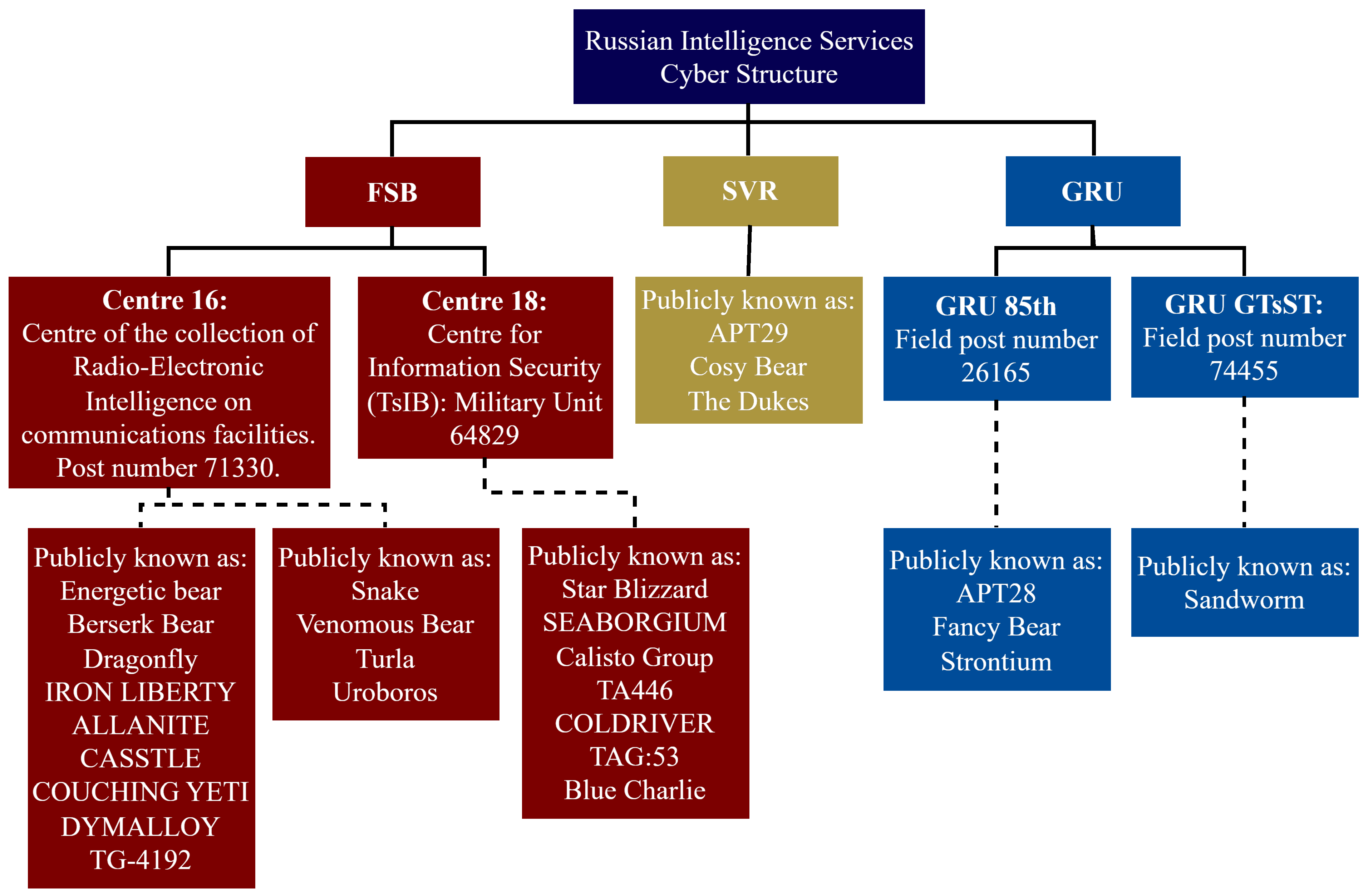
| Dragonfly | Sandworm | TEMP.VELES | ALLANITE | |
|---|---|---|---|---|
| Mandiant | TEMP.Isotope (UNC806/UNC2486) [17] | APT44 [18] | - | - |
| Dragos | DYMALLOY [19] | Electrum [20], KAMACITE [21] | XENOTIME [22] | ALLANITE [23] |
| ESET | Dragonfly [24] | Sandworm [25] | - | - |
| CISA | BERSERK BEAR [26] | GTsST/Unit 74455 [26] | TsNIIKhM [26] | - |
3. Related Work
3.1. The Gap in Frameworks for Threat Analyses of CPS
- Initial access [Cyber and Physical];
- Reconnaissance [Cyber and Physical];
- Data Exfiltration [Physical];
- Weaponisation [Cyber];
- Local Access [Physical];
- Delivery [Cyber and Physical];
- Exploitation [Cyber and Physical];
- Actions [Cyber and Physical];
- Sabotage [Cyber and Physical].
3.2. Cyber Attacks on Power Grids
3.3. Researching Advanced Persistent Threats (APTs)
3.4. Summary of Related Work
4. Materials and Methods
4.1. Research Design
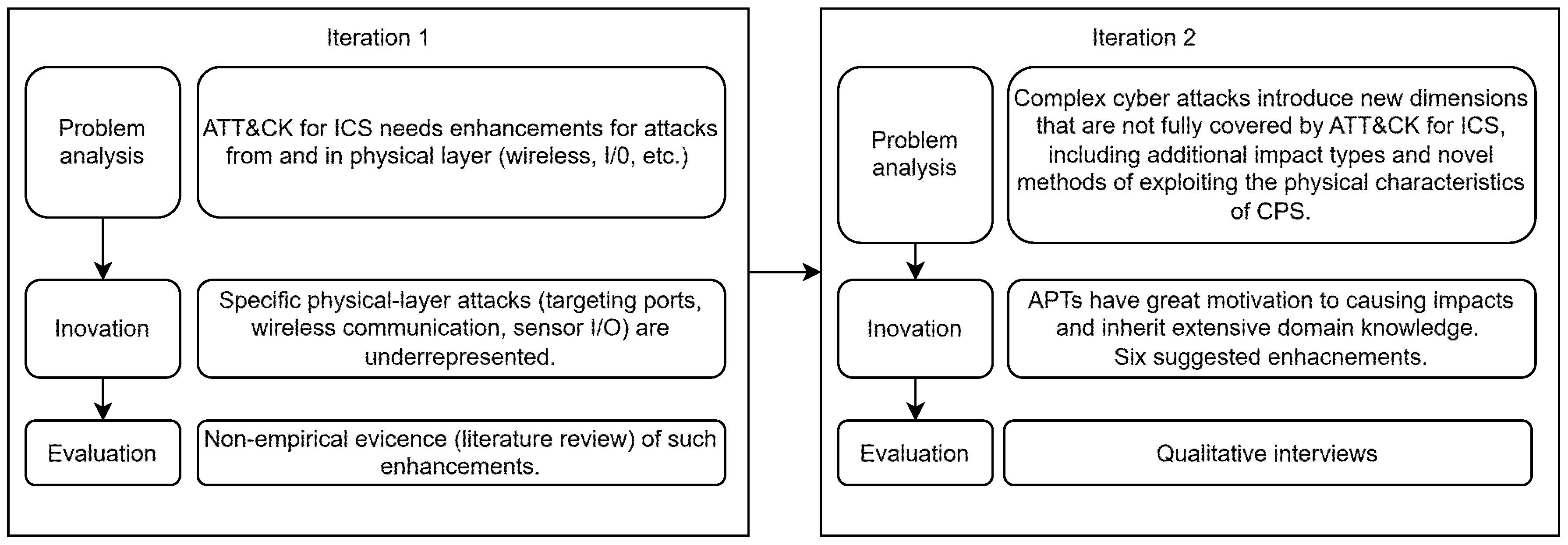
- A literature review was conducted to investigate potential enhancements focused on attacks using the physical layer of CPS. This involved analysing the capabilities of Russian APTs, as described in Section 4.2. The findings were subsequently analysed as discussed in Section 4.2.4.
- Insights gained from the literature review prompted a re-evaluation of the problem. Based on the identified gaps and opportunities, enhancements were formulated. These were then further evaluated through semi-structured interviews with cyber security professionals, as described in Section 4.3.

4.2. Multivocal Literature Review
- Collect and identify relevant keywords to search for research papers on APTs.
- Search research libraries for selected APTs, using keywords identified in step 1.
- Search the grey literature for selected Russian APTs.
4.2.1. Searching for Relevant Keywords
4.2.2. Searching Research Databases
4.2.3. Searching Grey Literature
4.2.4. Analysing Capabilities and ATT&CK Matrix
4.3. Semi-Structured Interview
4.3.1. Interview Design
- Part 1: Familiarise with the participants and their experience with CPS.
- Part 2: Investigate the usage of the ATT&CK or other frameworks.
- Part 3: Discuss the proposed enhancements from the analysis of APTs.
4.3.2. Interview Execution
5. Results
5.1. Russian APTs Capability to Perform Cyber Attacks on CPS
5.1.1. TEMP.VELES—Triton
5.1.2. Dragonfly—Havex
5.1.3. Sandworm (Ukraine, 2015)—BlackEnergy and KillDisk
5.1.4. Sandworm (Ukraine, 2016)—Industroyer
5.1.5. Sandworm (Ukraine, 2022)
5.1.6. VPNFilter
5.2. Capabilities Summary
5.3. Analysis of Capabilities
5.4. Semi-Structured Interviews
5.4.1. Part 1: Who Participated and What Is Their Knowledge About CPS?
5.4.2. Part 2: ATT&CK Usage and Limitations
5.4.3. Part 3: Opinions on Enhancements for ATT&CK ICS
6. Discussion
6.1. CPS Term in Research
6.2. Frameworks
6.3. Capability Mapping of APTs
6.4. Enhancements for MITRE ATT&CK
7. Conclusions
Author Contributions
Funding
Institutional Review Board Statement
Informed Consent Statement
Data Availability Statement
Acknowledgments
Conflicts of Interest
Abbreviations
| ACPPS | Advanced Cyber-Physical Power System |
| APT | Advanced Persistent Threat |
| CPPS | Cyber-Physical Power System |
| CPS | Cyber-Physical System |
| C&C | Command and Control |
| DoS | Denial of Service |
| EMB3D | EMB3D™ |
| FSB | Federal Security Service |
| GRU | Military Intelligence |
| HMI | Human Machine Interface |
| IACS | Industrial Automation and Control System |
| ICS | Industrial Control System |
| IEC | International Electrotechnical Commission |
| I/O | Input/Output |
| NIST | National Institute of Standards and Technology |
| OPC | Open Platform Communications |
| PLC | Programmable Logical Controller |
| RTU | Remote Terminal Unit |
| TTPs | Tactics, Techniques, and Procedures |
| VPN | Virtual Private Network |
References
- InfraCERT. Trusselvurdering 2024; Technical Report; InfraCERT: Oslo, Norway, 2024. [Google Scholar]
- Norwegian National Security Authority. Risiko 2024; Technical Report; Norwegian National Security Authority: Kolsås, Norway, 2024. [Google Scholar]
- Knapp, E.D.; Langill, J.T. Chapter 7—Hacking Industrial Control Systems. In Industrial Network Security, 2nd ed.; Knapp, E.D., Langill, J.T., Eds.; Syngress: Boston, MA, USA, 2015; pp. 171–207. [Google Scholar] [CrossRef]
- Przetacznik, J.; Tarpova, S. Russia’s War on Ukraine: Timeline of Cyber-Attacks; Technical Report; European Parliament: Strasbourg, France, 2022. [Google Scholar]
- 2015 Ukraine Electric Power Attack, Campaign C0028. Available online: https://attack.mitre.org/campaigns/C0028/ (accessed on 1 December 2024).
- 2016 Ukraine Electric Power Attack, Campaign C0025. Available online: https://attack.mitre.org/campaigns/C0025/ (accessed on 1 December 2024).
- 2022 Ukraine Electric Power Attack, Campaign C0034. Available online: https://attack.mitre.org/campaigns/C0034/ (accessed on 1 December 2024).
- Strom, B.E.; Applebaum, A.; Miller, D.P.; Nickels, K.C.; Pennington, A.G.; Thomas, C.B. MITRE ATT&CK®: Design and Philosophy; Technical Report; MITRE: McLean, VA, USA, 2020. [Google Scholar]
- Dragos Threat Intelligence. Dragonfly. Available online: https://attack.mitre.org/groups/G0035/ (accessed on 4 February 2025).
- Dragos Threat Intelligence; Karabacak, H. Sandworm Team. Available online: https://attack.mitre.org/groups/G0034/ (accessed on 2 February 2025).
- Dragos Threat Intelligence. TEMP.Veles. Available online: https://attack.mitre.org/groups/G0088/ (accessed on 4 February 2025).
- Dragos Threat Intelligence. ALLANITE. Available online: https://attack.mitre.org/groups/G1000/ (accessed on 4 February 2025).
- Griffor, E.R.; Greer, C.; Wollman, D.A.; Burns, M.J. Framework for Cyber-Physical Systems: Volume 1, Overview; Technical Report NIST SP 1500-201; National Institute of Standards and Technology: Gaithersburg, MD, USA, 2017. [Google Scholar] [CrossRef]
- Stouffer, K.; Pease, M.; Tang, C.; Zimmerman, T.; Pillitteri, V.; Lightman, S.; Hahn, A.; Saravia, S.; Sherule, A.; Thompson, M. Guide to Operational Technology (OT) Security; Technical Report NIST SP 800-82r3; National Institute of Standards and Technology (U.S.): Gaithersburg, MD, USA, 2023. [Google Scholar] [CrossRef]
- Russia’s FSB Malign Activity: Factsheet. Available online: https://www.gov.uk/government/publications/russias-fsb-malign-cyber-activity-factsheet/russias-fsb-malign-activity-factsheet (accessed on 29 December 2024).
- Federal Bureau of Investigation; Cybersecurity & Infrastructure Security Agency; National Security Agency; U.S. Department of the Treasury; U.S. Department of State; U.S. Cyber Command Cyber National Mission Force; Netherlands Defence Intelligence and Security Service; Czech Military Intelligence; Czech Republic Security Information Service; German Federal Office for the Protection of the Constitution; et al. Russian Military Cyber Actors Target U.S. and Global Critical Infrastructure; Technical Report; Cybersecurity and Infrastructure Security Agency: Washington, DC, USA, 2024. [Google Scholar]
- Hultquist, J. Anticipating Cyber Threats as the Ukraine Crisis Escalates. Available online: https://cloud.google.com/blog/topics/threat-intelligence/ukraine-crisis-cyber-threats (accessed on 8 February 2025).
- Roncone, G.; Black, D.; Wolfram, J.; McLellan, T.; Simonian, N.; Hall, R.; Prokopenkov, A.; Jenkins, L.; Perez, D.; Aytes, L.; et al. Unearthing APT44: Russia’s Notorious Cyber Sabotage Unit Sandworm. Available online: https://cloud.google.com/blog/topics/threat-intelligence/apt44-unearthing-sandworm (accessed on 8 February 2025).
- Dragos Inc. DYMALLOY. Available online: https://www.dragos.com/threat/dymalloy/ (accessed on 8 February 2025).
- Dragos Inc. ELECTRUM. Available online: https://www.dragos.com/threat/electrum/ (accessed on 8 February 2025).
- Dragos Inc. KAMACITE Threat Group. Available online: https://www.dragos.com/threat/kamacite/ (accessed on 13 May 2025).
- Dragos Inc. XENOTIME. Available online: https://www.dragos.com/threat/xenotime/ (accessed on 8 February 2025).
- Dragos Inc. ALLANITE. Available online: https://www.dragos.com/threat/allanite/ (accessed on 8 February 2025).
- Cluley, G. US Warns of Ongoing Attacks on Energy Firms and Critical Infrastructure. Available online: https://www.welivesecurity.com/2017/10/22/us-warns-ongoing-attacks-energy-firms-critical-infrastructure/ (accessed on 9 February 2025).
- Holt, R. Sandworm: A Tale of Disruption Told Anew. Available online: https://www.welivesecurity.com/2022/03/21/sandworm-tale-disruption-told-anew/ (accessed on 9 February 2025).
- Russian State-Sponsored and Criminal Cyber Threats to Critical Infrastructure. Available online: https://www.cisa.gov/news-events/cybersecurity-advisories/aa22-110a (accessed on 9 February 2025).
- Presekal, A.; Ştefanov, A.; Rajkumar, V.S.; Semertzis, I.; Palensky, P. Advanced Persistent Threat Kill Chain for Cyber-Physical Power Systems. IEEE Access 2024, 12, 177746–177771. [Google Scholar] [CrossRef]
- Hutchins, E.M.; Cloppert, M.J. The Industrial Control System Cyber Kill Chain; Technical Report; SANS Institute: North Bethesda, MD, USA, 2025. [Google Scholar]
- Cyber Kill Chain®. Available online: https://www.lockheedmartin.com/en-us/capabilities/cyber/cyber-kill-chain.html (accessed on 21 May 2025).
- Akbarzadeh, A.; Erdődi, L.; Houmb, S.; Soltvedt, T. Two-stage advanced persistent threat (APT) attack on an IEC 61850 power grid substation. Int. J. Inf. Secur. 2024, 23, 2739–2758. [Google Scholar] [CrossRef]
- IEC 61850 Series; Communication Networks and Systems for Power Utility Automation. IEC: Geneva, Switzerland, 2023.
- Rocchetto, M.; Tippenhauer, N.O. On Attacker Models and Profiles for Cyber-Physical Systems. In Proceedings of the Computer Security—ESORICS 2016; Askoxylakis, I., Ioannidis, S., Katsikas, S., Meadows, C., Eds.; Springer: Cham, Switzerland, 2016; pp. 427–449. [Google Scholar] [CrossRef]
- Akbarzadeh, A.; Erdodi, L.; Houmb, S.H.; Soltvedt, T.G.; Muggerud, H.K. Attacking IEC 61850 Substations by Targeting the PTP Protocol. Electronics 2023, 12, 2596. [Google Scholar] [CrossRef]
- Ahmad, S.; Ahn, B.; Alvee, S.R.B.; Trevino, D.; Kim, T.; Youn, Y.W.; Ryu, M.H. Advanced Persistent Threat (APT)-Style Attack Modeling and Testbed for Power Transformer Diagnosis System in a Substation. In Proceedings of the 2022 IEEE Power & Energy Society Innovative Smart Grid Technologies Conference (ISGT); IEEE: Piscataway, NJ, USA, 2022; pp. 1–5. [Google Scholar] [CrossRef]
- Zhang, M.; Zonouz, S. Control Corruption without Firmware Infection: Stealthy Supply Chain Attacks via PLC Hardware Implants (MalTag). In Proceedings of the 2024 ACM/IEEE 15th International Conference on Cyber-Physical Systems (ICCPS); IEEE: Piscataway, NJ, USA, 2024; pp. 247–258. [Google Scholar] [CrossRef]
- Chen, P.; Desmet, L.; Huygens, C. A Study on Advanced Persistent Threats. In Communications and Multimedia Security; De Decker, B., Zúquete, A., Eds.; Springer: Berlin/Heidelberg, Germany, 2014; pp. 63–72. [Google Scholar] [CrossRef]
- Lemay, A.; Calvet, J.; Menet, F.; Fernandez, J.M. Survey of publicly available reports on advanced persistent threat actors. Comput. Secur. 2018, 72, 26–59. [Google Scholar] [CrossRef]
- Solheim, I.; Stølen, K. Technology Research Explained; Technical Report; SINTEF ICT: Trondheim, Norway, 2007. [Google Scholar]
- Ormrod, J.E.; Leedy, P.D. Practical Research: Planning and Design, 12th ed.; Pearson Education: London, UK, 2021. [Google Scholar]
- Garousi, V.; Felderer, M.; Mäntylä, M.V. Guidelines for including grey literature and conducting multivocal literature reviews in software engineering. Inf. Softw. Technol. 2019, 106, 101–121. [Google Scholar] [CrossRef]
- Al-Rabiaah, S. The “Stuxnet” Virus of 2010 As an Example of A “APT” and Its “Recent” Variances. In Proceedings of the 2018 21st Saudi Computer Society National Computer Conference (NCC); IEEE: Piscataway, NJ, USA, 2018; pp. 1–5. [Google Scholar] [CrossRef]
- Vostoupal, J. Stuxnet vs. WannaCry and Albania: Cyber-attribution on trial. Comput. Law Secur. Rev. 2024, 54, 106008. [Google Scholar] [CrossRef]
- Cherepanov, A. A New Threat for Industrial Control Systems; Technical Report; ESET: Bratislava, Slovakia, 2017. [Google Scholar]
- Zhang, Y.; Wildemuth, B.M. Qualitative Analysis of Content. In Applications of Social Research Methods to Questions in Information and Library Science, 2nd ed.; Wildemuth, B.M., Ed.; Libraries Unlimited: Exeter, UK, 2017; pp. 318–329. [Google Scholar]
- Hopf, C. Qualitative Interviews: An Overview. In A Companion to Qualitative Research; SAGA Publications: Thousand Oaks, CA, USA, 2004. [Google Scholar]
- Cabe, M.M. Enhancing MITRE ATT&CK® Framework for Cyber-Physical Systems Using Insights from Advanced Persistent Threats. Master’s Thesis, Norwegian University of Science and Technology, Gjoevik, Norway, 2025. [Google Scholar]
- Alexander, O.; Belisle, M.; Steele, J. MITRE ATT&CK® for Industrial Control Systems: Design and Philosophy; Technical Report; MITRE: McLean, VA, USA, 2020. [Google Scholar]
- Makrakis, G.M.; Kolias, C.; Kambourakis, G.; Rieger, C.; Benjamin, J. Industrial and Critical Infrastructure Security: Technical Analysis of Real-Life Security Incidents. IEEE Access 2021, 9, 165295–165325. [Google Scholar] [CrossRef]
- Cybersecurity Advisory (CSA); Cybersecurity and Infrastructure Security Agency (CISA); Federal Bureau of Investigation (FBI); Department of Energy (DOE). Tactics, Techniques, and Procedures of Indicted State-Sponsored Russian Cyber Actors Targeting the Energy Sector; Technical Report AA22-083A; Cybersecurity and Infrastructure Security Agency: Washington, DC, USA, 2022. [Google Scholar]
- Firoozjaei, M.D.; Mahmoudyar, N.; Baseri, Y.; Ghorbani, A.A. An evaluation framework for industrial control system cyber incidents. Int. J. Crit. Infrastruct. Prot. 2022, 36, 100487. [Google Scholar] [CrossRef]
- Cybersecurity & Infrastructure Security Agency. Ongoing Sophisticated Malware Campaign Compromising ICS (Update E). Available online: https://www.cisa.gov/news-events/ics-alerts/ics-alert-14-281-01e (accessed on 16 March 2025).
- Dragos Inc. Crashoverride; Technical Report 2.20170613; Dragos: Hanover, MD, USA, 2017. [Google Scholar]
- IEC 60870-5-101; Telecontrol Equipment and Systems—Part 5-101: Telecontrol Equipment and Systems—Part 5-101: Transmissionprotocols—Companion Standard for Basic Telecontrol Tasks. IEC: Geneva, Switzerland, 2003.
- IEC 60870-5-104; Telecontrol Equipment and Systems—Part 5-104: Transmission Protocols—Network Access for IEC 60870-5-101 Using Standard Transport Profiles. IEC: Geneva, Switzerland, 2006.
- Cybersecurity and Infrastructure Security Agency (CISA). CrashOverride Malware. Available online: https://www.cisa.gov/news-events/alerts/2017/06/12/crashoverride-malware (accessed on 24 September 2024).
- Proska, K.; Wolfram, J.; Wilson, J.; Black, D.; Lunden, K.; Zafra, D.K.; Brubaker, N.; McLellan, T.; Sistrunk, C. Sandworm Disrupts Power in Ukraine Using a Novel Attack Against Operational Technology. Available online: https://cloud.google.com/blog/topics/threat-intelligence/sandworm-disrupts-power-ukraine-operational-technology (accessed on 17 March 2025).
- Dragos Inc. ELECTRUM Targeted Ukrainian Electric Entity Using Custom Tools and CaddyWiper Malware. October 2022. Available online: https://www.dragos.com/blog/new-details-electrum-ukraine-electric-sector-compromise-2022/ (accessed on 24 March 2025).
- IEC 62443 Series; Industrial Communication Networks—Network and System Security. IEC: Geneva, Switzerland, 2023.
- Hahn, A.; Cyprus, J.; Keppler, D.; Collins, M.; Harvey, C.; Pearson, N.L.T.; Ford, W.; Cui, A.; Locasto, M. The EMB3D™ Threat Model for Embedded Devices. Available online: https://emb3d.mitre.org/assets/EMB3D_Paper_09-23-24.pdf (accessed on 10 May 2025).
- Kayan, H.; Nunes, M.; Rana, O.; Burnap, P.; Perera, C. Cybersecurity of Industrial Cyber-Physical Systems: A Review In ACM Comput. Surv. 54, 11s; Association for Computing Machinery: New York, NY, USA, 2022; pp. 1–35. [Google Scholar] [CrossRef]
- Wohlin, C.; Runeson, P.; Höst, M.; Ohlsson, M.C.; Regnell, B.; Wesslén, A. Experimentation in Software Engineering, 2nd ed.; Springer: Berlin/Heidelberg, Germany, 2024. [Google Scholar]
- Cyber-Attack Against Ukrainian Critical Infrastructure. Available online: https://www.cisa.gov/news-events/ics-alerts/ir-alert-h-16-056-01 (accessed on 24 September 2024).
- Loss of Safety, Technique T0880. Available online: https://attack.mitre.org/techniques/T0880/ (accessed on 6 March 2025).
- Busby, J.W.; Baker, K.; Bazilian, M.D.; Gilbert, A.Q.; Grubert, E.; Rai, V.; Rhodes, J.D.; Shidore, S.; Smith, C.A.; Webber, M.E. Cascading risks: Understanding the 2021 winter blackout in Texas. Energy Res. Soc. Sci. 2021, 77, 102106. [Google Scholar] [CrossRef]
- Hedgecoe, G.; Lamche, A. At Least Three Deaths Linked to Massive Spain Power Cut; British Broadcasting Corporation: London, UK, 2025. [Google Scholar]
- Blackburn, G. ‘It Won’t Happen Again,’ Spain’s Grid Operator Says in Iberian Blackout Aftermath; Euronew: Lyon, France, 2025. [Google Scholar]
- Hasan, S.; Chhokra, A.; Dubey, A.; Mahadevan, N.; Karsai, G.; Jain, R.; Lukic, S. A simulation testbed for cascade analysis. In Proceedings of the 2017 IEEE Power & Energy Society Innovative Smart Grid Technologies Conference (ISGT); IEEE: Piscataway, NJ, USA, 2017; pp. 1–5. [Google Scholar] [CrossRef]
- Lockout/Tagout. Available online: https://www.osha.gov/sites/default/files/publications/OSHAFS3529.pdf (accessed on 30 May 2025).
- Salazar, L.; López-Morales, E.; Lozano, J.; Rubio-Medrano, C.; Cárdenas, A.A. ICSNet: A Hybrid-Interaction Honeynet for Industrial Control Systems. In CPSIoTSec’24: Proceedings of the Sixth Workshop on CPS&IoT Security and Privacy; Association for Computing Machinery: New York, NY, USA, 2024; pp. 68–79. [Google Scholar] [CrossRef]
- Team82. Unpacking the Blackjack Group’s Fuxnet Malware; Technical Report; Claroty: New York, NY, USA, 2024. [Google Scholar]


| Purpose | The purpose of this search is to identify keywords from titles and keywords tagged by authors in relevant articles |
| Dates | ≤25 January 2025 |
| Databases | IEEE Explore, JSTOR, ACM DL, ScienceDirect, Springerlink, ArXiv, Web of Science, Scopus |
| Search criteria | Language: English Criteria: names contained in title/publication title. If a multi-category database, select the following categories: engineering, information and computer sciences, cybersecurity, and privacy Document type: Research article OR Conference paper |
| Search keywords |
|
| Inclusion criteria | The research papers should analyse, elaborate on improvements or model the specific attack/group. |
| Exclusion criteria | Overlapping data from other databases |
| Search Query | Database | Result | Relevant |
|---|---|---|---|
| 1 | IEEE | 17 | 10 |
| 1 | JSTOR | 5 | 1 |
| 1 | ACM DL | 0 | 0 |
| 1 | SciensDirect | 3 | 3 |
| 1 | SpringerLink | 4 | 4 |
| 1 | ArXive | 0 | 0 |
| 1 | Web of science | 5 | 2 |
| 1 | Scopus | 56 | 14 |
| Words | Keyword Count | Title Count |
|---|---|---|
| Attack (cyber attack, stealthy attack) | 10 | 9 |
| Stuxnet (Stuxnet virus, Stuxnet analysis) | 18 | - |
| Attacks name (Duqu, Shamoon, Triton, Wannacry) | 9 | 5 |
| Physical/CPS (Cyber physical system) | 6 | 4 |
| Virus | 2 | 4 |
| Worm | 2 | 4 |
| Industrial/ICS (industrial systems) | 3 | 3 |
| Purpose | Identify relevant articles on selected Russian APT in order to analyse capabilities to attack CPS |
| Dates | ≤1 March 2025 |
| Databases | IEEE Explore, Web of science, Scopus |
| Search criteria | Language: English. Searching for APT names in all metadata. |
| Search keywords |
Author Keyword/title: (CPS OR cyber-physical OR “cyber physical” OR ics OR industrial OR malware OR virus OR worm OR attack) |
| Inclusion criteria | Focus on the papers’ contribution to describe the capabilities of APTs. Assess the relevance—first titles and abstract are assessed, and then conclusion. |
| Database | Query 1 | Query 2 | Query 4 | Query 4 |
|---|---|---|---|---|
| (Res./Rel.) | (Res./Rel.) | (Res./Rel.) | (Res./Rel.) | |
| IEEE | 11/0 | 8/1 | 0/0 | 0/0 |
| Web of science | 26/0 | 1/1 | 0/0 | 0/0 |
| Scopus | 263/2 | 234/3 | 10/0 | 1/0 |
| Purpose | Identify relevant articles on selected Russian APT in order to analyse capabilities to attack CPS |
| Dates | ≤13 March 2025 |
| Databases | Cyber security companies: ESET, Dragos. Governmental: CISA |
| Search criteria | Searching for analysis and threat reports of the selected actors |
| Search keywords |
|
| Inclusion criteria | Assessing search results by first assessing relevance from the title. Further skim the paper, and then perform a full read through. Paper types: Threat Intelligence or cyber attack reports. |
| Exclusion criteria | Duplicate results are ignored. |
| Database | Query 1 | Query 2 | Query 4 | Query 4 |
|---|---|---|---|---|
| (Res./Rel.) | (Res./Rel.) | (Res./Rel.) | (Res./Rel.) | |
| ESET | 5/0 | 120/1 | 0/0 | 0/0 |
| Dragos | 18/0 | 29/2 | 18/0 | 45/0 |
| CISA | 30/1 | 110/2 | 13/1 | 0/0 |
| Attack | APT | Targeting | Purdue Level |
|---|---|---|---|
| Triton | TEMP.VELES | Triconex Safety instrument systems | 5 to 1 |
| Havex | Dragonfly | Critical infrastructure | 5 to 3 [48] |
| Ukraine 2015 (BlackEnergy3 and Killdisk) | Sandworm | Power grid | 4 to 1 [48] |
| Ukraine 2016 (Industroyer) | Sandworm | Power grid | 4 to 0 [48] |
| Ukraine 2022 | Sandworm | Power grid | 4 to 0 |
| VPNFilter | Sandworm | Routers | 4 to 3 [48] |
| Database | Query 1 | Query 2 | Query 4 | Query 4 |
|---|---|---|---|---|
| (Res./Rel.) | (Res./Rel.) | (Res./Rel.) | (Res./Rel.) | |
| IEEE | 11/0 | 8/1 | 0/0 | 0/0 |
| Web of science | 26/0 | 1/1 | 0/0 | 0/0 |
| Scopus | 263/2 | 234/3 | 10/0 | 1/0 |
| ESET | 5/0 | 120/1 | 0/0 | 0/0 |
| Dragos | 18/0 | 29/2 | 18/0 | 45/0 |
| CISA | 30/1 | 110/2 | 13/1 | 0/0 |
| Name | Type | Definition | Contribution |
|---|---|---|---|
| Societal impact | New Sub-Technique (Parent: Loss of Availability (T0826)) | The adversary affecting societal services, specifically results in disruption/destruction of critical infrastructures. | Existing techniques emphasise impact in the ICS domain and its loss of services, but this encompasses the cascading societal consequences of impacts of attacks in the physical domain. |
| Cascading effect | New Technique (Parent: Impact (TA0105)) | A cyber attack on one part of an infrastructure triggers a chain reaction, leading to compounded failures across interconnected systems within a CPS. | Illustrating how an adversary exploits interdependencies in CPS, specifically processes and safety mechanisms. |
| Exploiting process control | New Tactic | Adversary exploits processes in a CPS that fundamentally needs to be stable for safety and continuous operations. | The tactic highlights why and how the adversary targets processes in the physical domain. |
| State manipulation | New Technique (Parent: Exploiting process control) | The adversary altering or falsifying the physical state of a system, either through binary changes (e.g., on/off substations) or by manipulating continuous state values (e.g., pressures or flow rates). | Manipulation of state describes how the adversary exploits states in CPSs and cyber-physical devices to cause operational failures. |
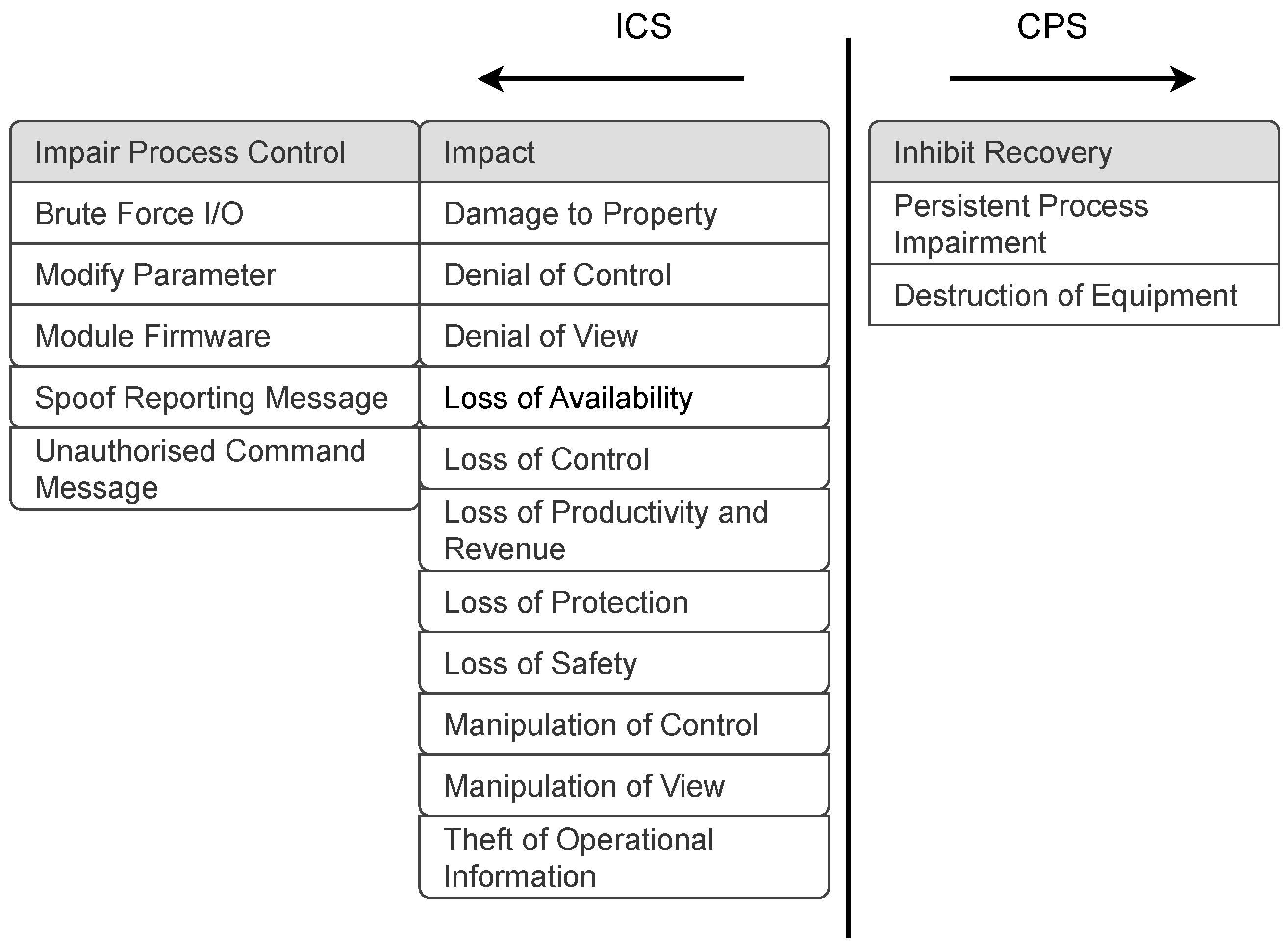
| Inhibit Recovery | New Tactic | The adversary deliberately obstruct or delays recovery actions following an attack. | Highlights the attacker’s ability to prolong disruptions, escalate costs, and exacerbate the impact of an attack when the physical domain is included. |
| Brute force I/O and such techniques (integration Purdue level 0) | - | - | Discusses the unique vulnerabilities of CPS, such as direct manipulation in the physical domain. |
| 1 | 2 | 3 | 4 | |
|---|---|---|---|---|
| Societal impact | Agree | Agree | Agree | Agree |
| Cascading effect | Agree | Agree | Agree | Neither or |
| Exploiting process control | Strongly agree | Agree | Neither or | Strongly agree |
| State manipulation | Agree | Neither or | Neither or | Neither or |
| Inhibit recovery | Agree | Agree | Agree | Agree |
| Brute force I/O (T0806) | No opinion | No opinion | No opinion | Neither or * |
| ATT&CK ICS Enhancement | Cyber Attack | Attack Behaviour | Impact/Outcome | Existing ATT&CK ICS Tactic(s)/Technique(s) |
|---|---|---|---|---|
| Societal impact | Ukraine 2015 | Attackers target substations, attempting to cause lasting power outages. In the context of the Ukraine-Russia war, we can assume it is conflict-oriented | Power outage for thousands of customers for hours | (T0826) Loss of Availability |
| Ukraine 2016 | Power outage in Kiev | |||
| Ukraine 2022 | Disconnected Substations from power grid | |||
| Cascading effect | Ukraine 2015 | Attackers creating fluctuation by connecting and disconnecting substations or generators to the power grid, can potentially cause blackouts | Rolling effect and process instabilities, trigger safety mechanisms shutting down substations | (T0826) Loss of Availability (T0813) Denial of Control |
| Exploiting process control | Ukraine 2016 | APT allegedly attempted to cause “islanding”-effects, create frequency fluctuation | Potentially induce to blackouts or physical destruction | (TA0107) Inhibit Response Function (TA0106) Impair Process Control |
| State manipulation | Ukraine 2015 | Open circuit breaker | System state changed | (T0881) Service Stop (T0816) Device Restart/shutdown |
| Ukraine 2016 | Open circuit breaker when attempting closure | |||
| Ukraine 2022 | Open circuit breakers | |||
| Inhibit Recovery | Ukraine 2015 Ukraine 2022 | Disabled backup power system, hindered remote closing of circuit breakers. Interruption of power flows for process impairment | Delayed recovery of substations | (T0809) Data Destruction (T0813) Denial of Control Impact (TA0105) |
Disclaimer/Publisher’s Note: The statements, opinions and data contained in all publications are solely those of the individual author(s) and contributor(s) and not of MDPI and/or the editor(s). MDPI and/or the editor(s) disclaim responsibility for any injury to people or property resulting from any ideas, methods, instructions or products referred to in the content. |
© 2026 by the authors. Licensee MDPI, Basel, Switzerland. This article is an open access article distributed under the terms and conditions of the Creative Commons Attribution (CC BY) license.
Share and Cite
Mc Cabe, M.; Houmb, S.H. Enhancing the MITRE ATT&CK® Framework for Cyber-Physical Systems Using Insights from Advanced Persistent Threats. Appl. Sci. 2026, 16, 1815. https://doi.org/10.3390/app16041815
Mc Cabe M, Houmb SH. Enhancing the MITRE ATT&CK® Framework for Cyber-Physical Systems Using Insights from Advanced Persistent Threats. Applied Sciences. 2026; 16(4):1815. https://doi.org/10.3390/app16041815
Chicago/Turabian StyleMc Cabe, Michael, and Siv Hilde Houmb. 2026. "Enhancing the MITRE ATT&CK® Framework for Cyber-Physical Systems Using Insights from Advanced Persistent Threats" Applied Sciences 16, no. 4: 1815. https://doi.org/10.3390/app16041815
APA StyleMc Cabe, M., & Houmb, S. H. (2026). Enhancing the MITRE ATT&CK® Framework for Cyber-Physical Systems Using Insights from Advanced Persistent Threats. Applied Sciences, 16(4), 1815. https://doi.org/10.3390/app16041815