Article

Research on Multi-State Estimation Strategy for Lithium-Ion Batteries Considering Temperature Bias

School of Electronics Information Engineering, Liaoning University of Technology, Jinzhou 121000, China
*
Author to whom correspondence should be addressed.
Appl. Sci. 2026, 16(4), 1754; https://doi.org/10.3390/app16041754
Submission received: 12 January 2026 / Revised: 30 January 2026 / Accepted: 6 February 2026 / Published: 10 February 2026

Abstract

Accurate state estimation is a key technology for improving battery utilization and ensuring operational safety in electric vehicles. The joint estimation of the state of charge (SOC) and the state of power (SOP) over a wide temperature range is therefore essential for intelligent battery management systems. To address modeling uncertainties and estimation accuracy degradation induced by ambient temperature variations, a dual-polarization equivalent circuit thermal model incorporating temperature bias is proposed, and online parameter updating is achieved using the forgetting factor recursive least squares (FFRLS) algorithm. Furthermore, an unscented particle filter (UPF) is constructed by employing the unscented Kalman filter (UKF) as the proposal density function of the particle filter, thereby improving the estimation accuracy and convergence speed of SOC under wide temperature conditions. Based on the coupling relationship between SOC and SOP, a stepwise progressive strategy is then developed to predict the peak power state under multiple constraints, enhancing the robustness of SOP estimation. Simulation and experimental results demonstrate that the proposed method can accurately estimate SOC and SOP under complex operating conditions over a wide temperature range from −5 °C to 45 °C, exhibiting favorable convergence performance and estimation accuracy, which contributes to the safe operation and performance optimization of electric vehicle battery systems.

1. Introduction

In recent years, national policies have continuously strengthened support for the new energy industry, and significant efforts have been made by enterprises to advance battery technology, leading to continuous improvements in battery performance. At present, the most widely developed secondary batteries on the market include lead–acid batteries, nickel–metal hydride batteries, and lithium-ion batteries. Lead–acid batteries are relatively low in cost; however, they suffer from low specific energy and power density and pose serious environmental pollution issues, and thus have gradually been phased out from mainstream applications. Compared with lead–acid batteries, nickel–metal hydride batteries exhibit improved performance, but their high self-discharge rate, low single-cell voltage, and inherent limitations in power performance restrict further development. In contrast, lithium-ion batteries, owing to their high operating voltage, high energy density, and high charge–discharge efficiency, are widely regarded as one of the most promising power battery technologies for electric vehicle applications [1].
In recent years, significant progress has been achieved in energy conservation and emission reduction, making substantial contributions to environmental protection. Against this background, electric vehicles (EVs) have experienced rapid development. Owing to their advantages of high power density, high energy density, long cycle life, low cost, and environmental friendliness, lithium-ion batteries have been widely adopted as the primary energy storage devices in EVs [2]. As a core component of EVs, the battery management system (BMS) plays a critical role in battery state estimation, among which the most important state variables include the state of charge (SOC) and the state of power (SOP). Accurate real-time estimation of SOC can effectively reflect the remaining battery capacity, thereby improving driving range and extending battery lifespan [3]. However, SOC cannot be directly measured. Due to the nonlinear and complex nature of lithium-ion battery charge–discharge processes, which involve multiple electrochemical and energy conversion reactions, achieving high-accuracy real-time SOC estimation in practical applications remains challenging [4,5,6].
In EV acceleration, regenerative braking, and uphill driving conditions, accurate SOP estimation is essential for optimizing vehicle powertrain matching while ensuring battery safety. SOP represents the peak power capability that a battery can deliver or absorb over a future time interval under operational constraints. Nevertheless, SOP is influenced by multiple factors, including temperature, SOC, aging state, and internal resistance, and cannot be quantified using a single parameter. This complexity significantly degrades estimation accuracy and necessitates more advanced estimation approaches [7,8,9].
Currently, SOC estimation strategies can be broadly categorized into ampere-hour integration methods, data-driven approaches, and model-based estimation methods. The ampere-hour integration method relies on real-time current measurements during charge and discharge processes and calculates accumulated charge over time to estimate SOC. However, this method typically assumes a constant battery capacity, whereas the actual capacity varies dynamically with environmental conditions, resulting in inevitable estimation errors [10]. Data-driven approaches treat the battery as a black box and estimate SOC by mapping key measurable variables, such as voltage, current, and impedance, to SOC values using machine learning techniques. Recent studies have reported the application of deep learning methods, including convolutional neural networks combined with long short-term memory networks, to enhance temporal feature extraction and improve estimation accuracy and generalization performance [11]. Moreover, hybrid approaches combining sparrow search algorithms with long short-term memory networks have also been investigated [12,13,14]. Despite their effectiveness in handling nonlinearities, data-driven methods are highly dependent on the quantity and quality of training datasets as well as training strategies, which limits their applicability in real-world scenarios.
Battery models are generally classified into electrochemical models and equivalent circuit models (ECMs) [15,16,17]. Electrochemical models require solving a large number of partial differential equations, rendering them unsuitable for online parameter identification. In contrast, ECMs feature simple structures and low computational complexity, making them widely adopted for online SOC estimation. In model-based battery state estimation studies, equivalent circuit models are widely adopted due to their intuitive structure and high computational efficiency. Commonly used models include the internal resistance (Rint) model, the first-order Thevenin model, the PNGV model, and multi-order RC network models [18,19,20]. Among them, the Rint model has the simplest structure, consisting only of an open-circuit voltage source and an ohmic resistance, which results in low computational cost but makes it incapable of accurately capturing polarization effects under dynamic operating conditions. The Thevenin model introduces a single RC branch to partially describe transient voltage responses; however, its ability to represent medium- and low-frequency polarization characteristics remains limited. The PNGV model further extends the Thevenin model by incorporating power-related characteristics and dynamic behaviors, and has been applied in hybrid electric vehicle applications, but its parameter identification process is relatively complex. Compared with the aforementioned models, the dual-polarization (DP) model introduces two polarization branches with fast and slow dynamics, enabling the simultaneous representation of battery dynamic responses across different time scales. This structure achieves a favorable balance between modeling accuracy and computational complexity. Consequently, the DP model demonstrates strong engineering applicability in highly dynamic operating conditions and online state estimation scenarios, and has been widely employed in SOC and related battery state estimation studies. Based on the above analysis, the dual-polarization model is selected in this work as the equivalent modeling framework for lithium-ion batteries. Model-based SOC estimation methods are typically combined with filtering algorithms. For instance, a dual Kalman filter approach has been proposed for online battery parameter identification and SOC estimation to improve accuracy [21,22,23]. However, the estimation performance of such methods is significantly affected by temperature variations.
In model-based SOC estimation approaches using equivalent circuit models, the accuracy of online parameter identification has a direct impact on the state estimation performance. To address the time-varying characteristics of battery parameters caused by temperature variations and changing operating conditions, various online parameter identification methods have been proposed. Among them, the Recursive Least Squares (RLS) method has been widely adopted due to its low computational complexity and suitability for real-time implementation. On this basis, improved schemes such as Variable Forgetting Factor RLS (VFF-RLS) and adaptive forgetting factor RLS have been developed, in which the forgetting factor is dynamically adjusted to enhance parameter tracking capability under non-stationary operating conditions.
In addition, state-space-model-based approaches, including the Extended Kalman Filter (EKF), Unscented Kalman Filter (UKF), and Particle Filter (PF), have also been applied to joint battery parameter and state estimation. These filtering-based methods exhibit certain advantages in handling nonlinear systems. However, under wide-temperature and highly dynamic operating conditions, the aforementioned methods still face several limitations in practical applications. VFF-RLS and adaptive RLS typically rely on complex forgetting factor tuning mechanisms or empirical parameters, making their stability sensitive to noise and abrupt operating condition changes. EKF and UKF require system linearization or the construction of high-dimensional sigma points, resulting in increased computational burden and potential estimation bias in the presence of model mismatch or rapidly varying parameters. Although PF offers strong nonlinear modeling capability, its computational cost increases significantly with the number of particles, which limits its feasibility for real-time applications [24,25,26].
In contrast, Fixed Forgetting Factor Recursive Least Squares (FFRLS) maintains a simple algorithmic structure and low computational complexity, while offering high numerical stability and strong robustness against measurement noise, making it well-suited for online implementation in onboard battery management systems. Moreover, FFRLS provides a stable and reliable parameter foundation for subsequent joint SOC and SOP estimation. Therefore, FFRLS is adopted in this study as the online parameter identification method for the equivalent circuit model, achieving a favorable balance among estimation accuracy, computational efficiency, and engineering practicality.
Traditional SOC estimation methods often fail to maintain satisfactory accuracy under conditions of severe measurement noise or highly dynamic vehicle operation. In recent years, filtering-based SOC estimation approaches have attracted increasing attention due to their high accuracy and strong robustness. Building upon accurate SOC estimation, several studies have further explored joint SOC–SOP estimation frameworks by considering the correlation between SOC and SOP [27].
According to the definition of SOP, it represents the maximum power that a battery can deliver or absorb over a specified future time horizon while maintaining safe operation. Common SOP estimation methods include interpolation-based approaches, data-driven methods, and model-based methods [11]. Interpolation-based methods require the establishment of offline characteristic maps. Although easy to implement, these methods demand extensive testing under multiple operating conditions, resulting in high resource consumption and poor adaptability to dynamic conditions [28]. Data-driven SOP estimation methods treat the battery as a black box, where SOP is set as the output and voltage, temperature, and SOC are used as inputs [29]. While such methods exhibit strong nonlinear approximation capability, their performance is highly dependent on training data quality and is difficult to guarantee under dynamic operating conditions, thereby limiting their practical applicability [30].
To achieve accurate joint estimation of SOC and SOP under wide temperature operating conditions, this paper proposes a dual-polarization dynamic thermal model incorporating temperature bias, and model parameters are identified online using a forgetting factor recursive least squares (RLS) algorithm based on measured data to validate model accuracy. To mitigate the particle impoverishment problem inherent in particle filters, an unscented Kalman filter (UKF) is employed to generate a Gaussian proposal distribution, and its filtering results are used as the proposal density function of the particle filter, leading to the development of an unscented particle filter (UPF) to improve SOC estimation accuracy under different temperature conditions. Furthermore, a stepwise progressive strategy is adopted, where online-identified parameters and SOC are used as inputs and SOP is obtained as the output. Within a joint SOC–SOP estimation framework, the coupling relationship between SOC and SOP is fully exploited, and a multi-parameter constrained approach is employed to estimate SOP over a specified time horizon. Finally, experimental data under WLTS, US06, and DST driving cycles at multiple temperatures are used to validate the effectiveness of the proposed SOC/SOP estimation method. Compared with existing joint SOC/SOP estimation studies, this work not only focuses on the coordinated estimation of SOC and SOP, but also explicitly considers the impact of temperature bias under wide-temperature operating conditions on model parameters and state estimation accuracy. By incorporating a temperature-bias-corrected dual-polarization electro-thermal model and combining genetic algorithm (GA)-based temperature bias correction with FFRLS-based online parameter identification, the proposed approach enhances the model’s adaptability across different ambient temperatures. Furthermore, the stepwise progressive SOP estimation strategy proposed in this study explicitly exploits the coupling relationship between SOC and SOP under multiple constraints, enabling peak power prediction that more accurately reflects the battery’s true dynamic behavior. Table 1 presents a systematic comparative analysis of the proposed method with recent joint SOC/SOP estimation approaches reported in the literature.
The structure of this paper is organized as follows. Section 2.1 introduces the dual-polarization equivalent circuit model of lithium-ion batteries and presents the online parameter identification method considering temperature bias. Section 2.2 elaborates on the SOC estimation approach based on the unscented particle filter, as well as the stepwise progressive SOP estimation strategy. Section 3.1 verifies the accuracy of the proposed circuit model. Section 3.2 and Section 3.3 validate and analyze the effectiveness and robustness of the proposed SOC/SOP cooperative estimation method using experimental data under different temperatures and various operating conditions. Finally, the main conclusions of this work are summarized.

2. Materials and Methods

2.1. Lithium-Ion Battery Modeling

2.1.1. Dual-Polarization Equivalent Circuit Model

Equivalent circuit models commonly used for lithium-ion batteries include the PNGV model, the Rint model, and the Thevenin model [31]. Among them, the first-order Thevenin model is insufficient to accurately describe the complex electrochemical reactions inside the battery, whereas the third-order Thevenin model exhibits a more complicated structure, which is unfavorable for model construction and real-time implementation. In addition, compared with the second-order model, the accuracy improvement provided by the third-order model is not significant. Therefore, considering the trade-off between model accuracy and computational complexity, a second-order RC equivalent circuit model is adopted in this study.
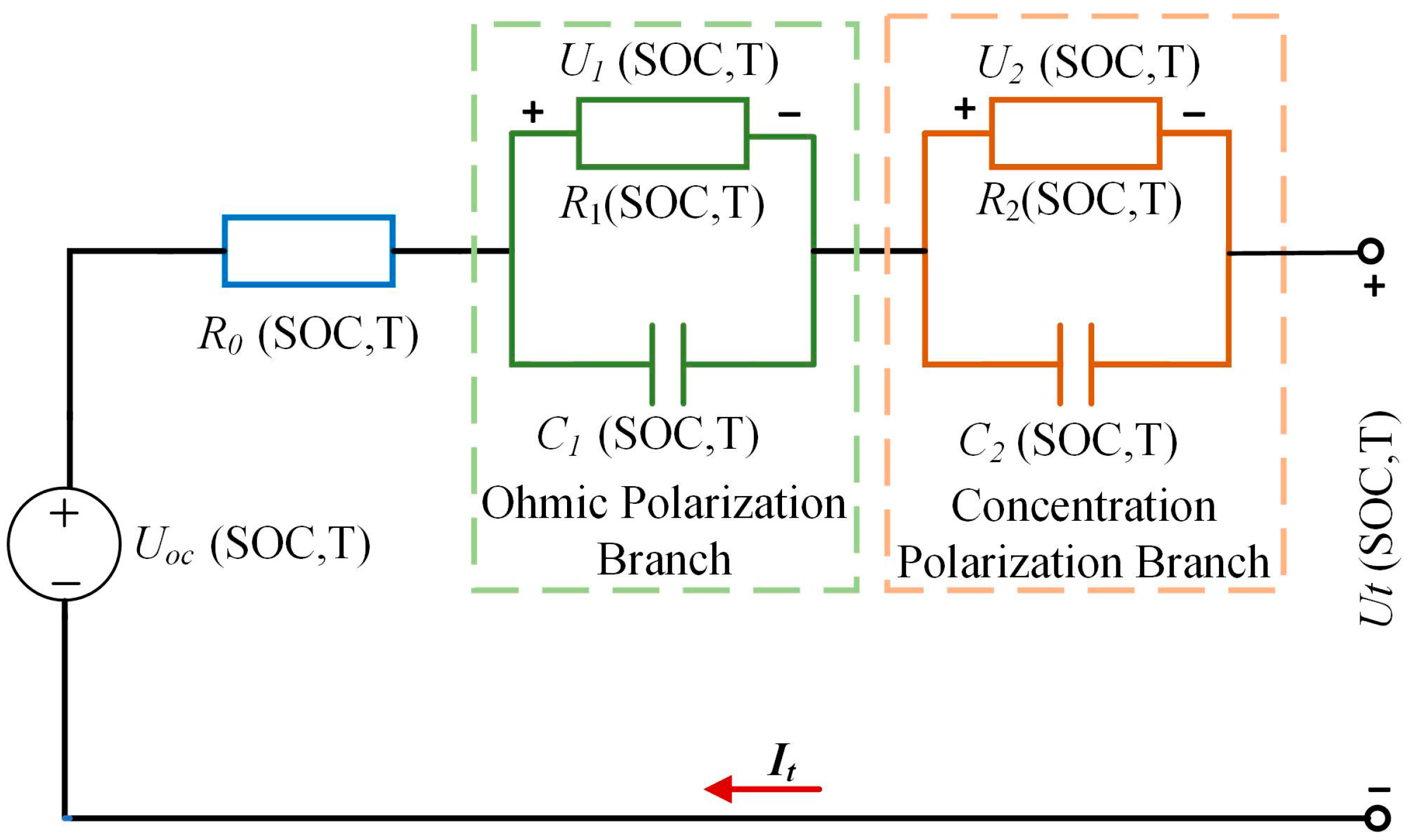
The dual-polarization dynamic thermal model is illustrated in Figure 1. In this model, U o c denotes the open-circuit voltage, U t represents the terminal voltage, and I t is the battery current. The battery temperature is denoted by T . The ohmic resistance is represented by R 0 , while R 1 and R 2 are the polarization resistances associated with electrochemical polarization and concentration polarization, respectively. Similarly, C 1 and C 2 denote the corresponding polarization capacitances. All circuit parameters are functions of SOC and temperature.
Based on Kirchhoff’s laws, the equivalent circuit model of the battery can be expressed as:
S O C = S O C 0 1 C n t 0 t 1 I   d t I 1 = C 1 d U 1 d t + U 1 R 1 I 2 = C 2 d U 2 d t + U 2 R 2 U b = U ocv U 1 U 2 I t R 0
where S O C 0 is the initial state of charge, C n is the battery capacity, I t is the battery current, and I 1 and I 2 are the currents in the R 1 C 1 and R 2 C 2 branches, respectively.

2.1.2. Online Parameter Identification Using FFRLS

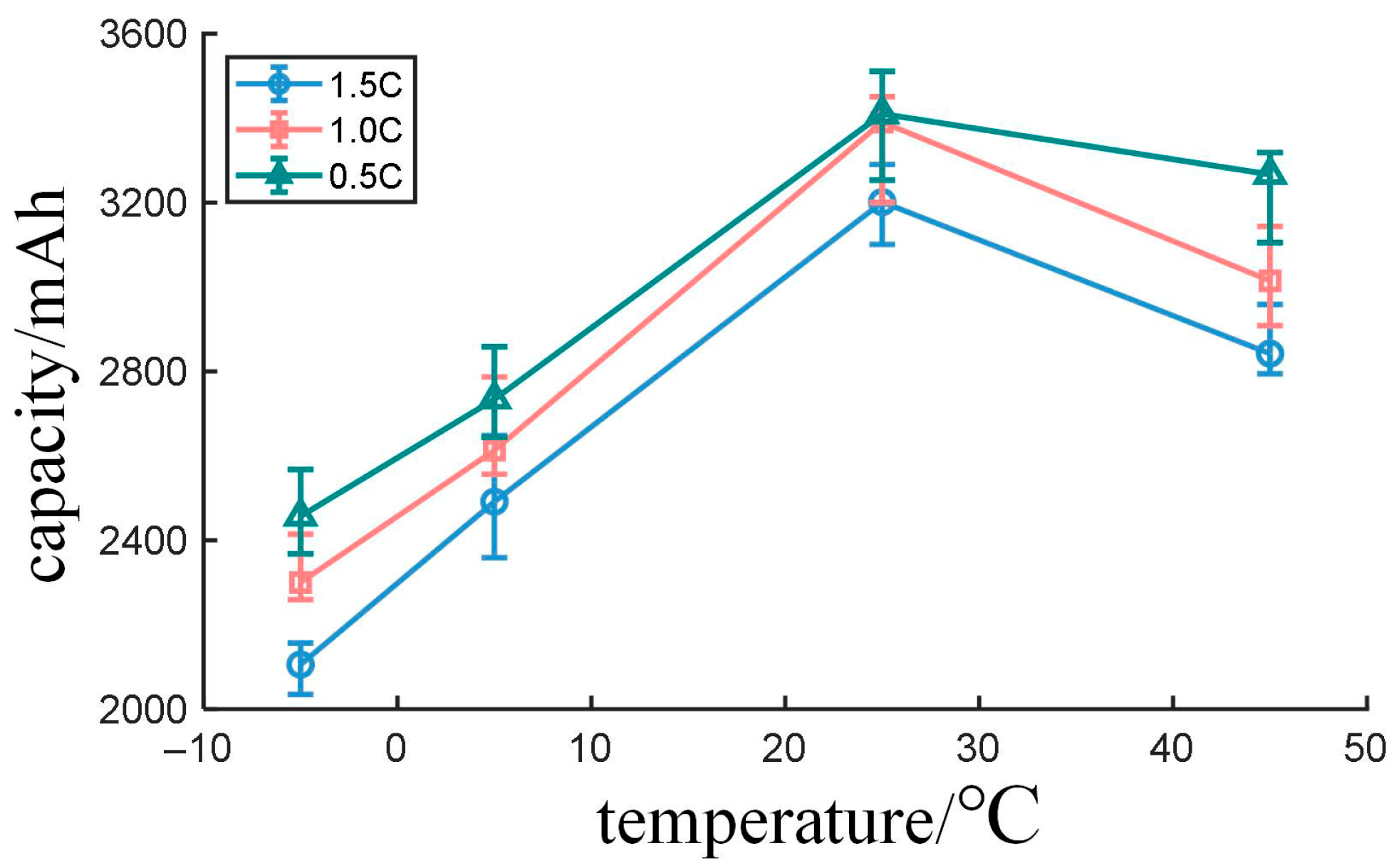
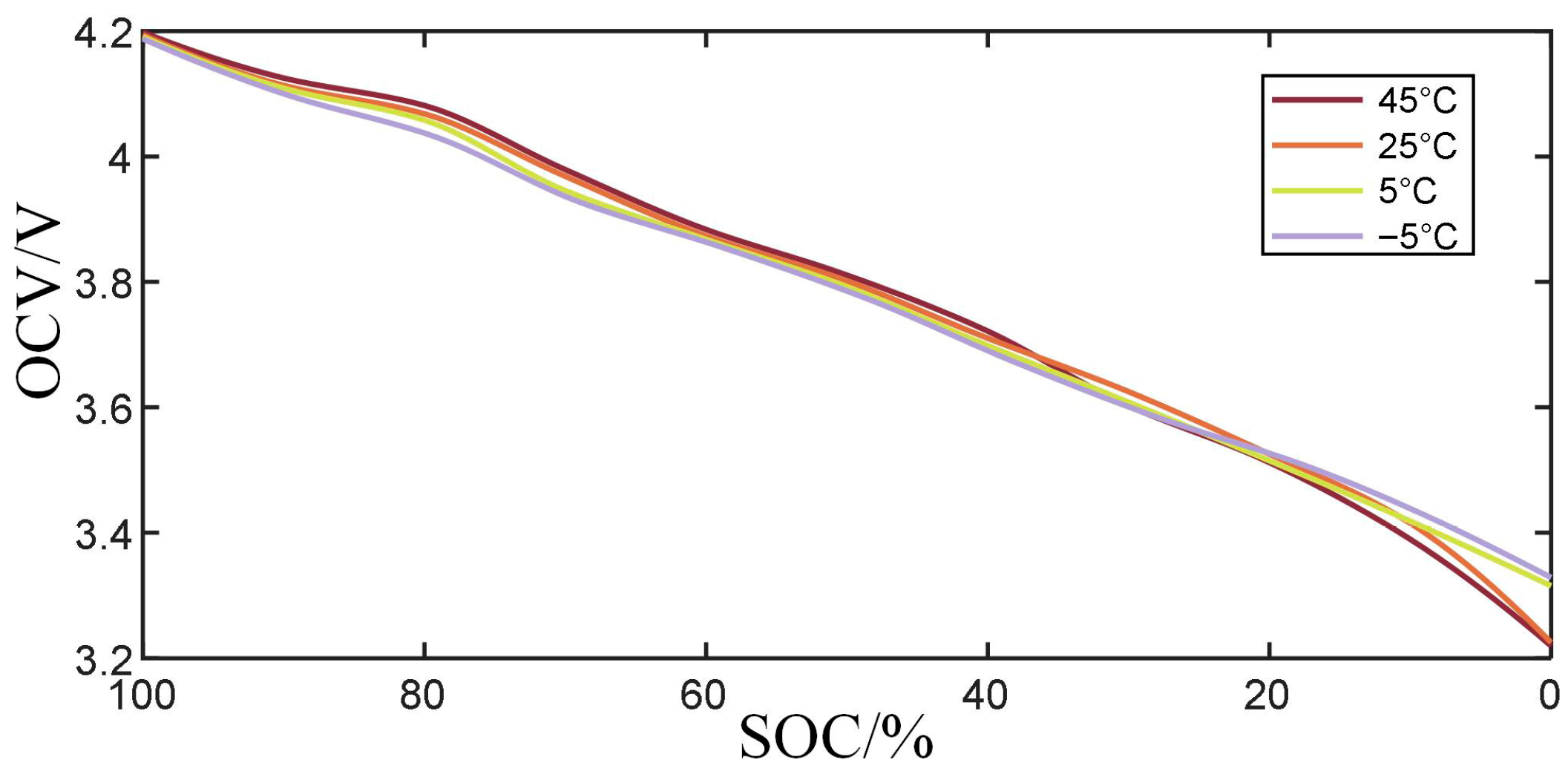
In this study, the performance of the lithium-ion battery was tested at ambient temperatures of 45 °C, 25 °C, 5 °C, and −5 °C. Hybrid pulse power characteristic (HPPC) tests at different temperatures were conducted [32], together with experiments under various operating conditions. Based on the experimental results, capacity calibration at different temperatures and C-rates was obtained, as shown in Figure 2, and the SOC–OCV curves at each temperature were derived, as illustrated in Figure 3.
Due to the discrepancy between ambient temperature and the actual operating temperature of the battery, temperature variations in the battery model have a significant influence on model parameters, such as resistances and capacitances, which are directly temperature-dependent. The temperature bias considered in this study does not arise from a single source, but rather from the combined effects of multiple physical factors. During practical testing and operation, the temperature used in battery models is typically obtained from ambient measurements or surface-mounted sensors. However, the actual internal battery temperature is influenced by factors such as sensor placement, thermal lag between the battery core and surface, ohmic and polarization heat generated during charge and discharge processes, as well as variations in external environmental conditions. As a result, a discrepancy often exists between the measured temperature and the true internal temperature of the battery. Since the parameters of equivalent circuit models are highly sensitive to temperature variations, such temperature mismatch can significantly degrade model accuracy.
To address this issue, a genetic algorithm (GA) [33] is employed in this work to perform an overall correction of the temperature bias, thereby compensating for the aggregated error induced by the aforementioned physical factors without explicitly constructing a complex internal heat transfer model. The genetic algorithm is an optimization method inspired by natural evolutionary processes and is used here to accurately calibrate the temperature input of the battery model.
First, an approximate temperature bias range is determined for each ambient temperature, and temperature bias values are randomly generated within this range to obtain the corresponding average terminal voltage error of the battery model. Subsequently, a series of temperature points within the bias range at each ambient temperature are selected, and the associated average terminal voltage errors are calculated. Finally, in the GA optimization process, a fitted function relating temperature bias to the average terminal voltage error is adopted as the objective function, through which the optimal temperature and the corresponding battery model parameters are obtained.
Based on the equivalent circuit model incorporating temperature bias, the battery model parameters at the identified temperature are obtained and subsequently used as initial values for further parameter identification using the forgetting factor recursive least squares (FFRLS) algorithm. The least squares formulation of the dual-polarization dynamic thermal model is given as follows:
y ( k ) = U ocv ( k ) U ( k ) = φ T ( k ) θ = U ( k 1 ) U ocv ( k 1 ) U ( k 2 ) U ocv ( k 2 ) I ( k ) I ( k 1 ) I ( k 2 ) T b T 2 a T 2 + b T + a a T 2 + b T + a c T 2 + d T + a R 0 T 2 + b T + a d T 2 a R 0 T 2 + b T + a a R 0 T 2 + b T + a
R 0 = θ 5 θ 2 R 1 = τ 1 c + τ 2 R 0 d τ 1 τ 2 R 2 = c R 0 R 1 C 1 = τ 1 R 1 C 2 = τ 2 R 2
Define θ = θ 1 θ 2 θ 3 θ 4 θ 5 T . The coefficients a , b , c , and d are derived from θ 1 θ 5 , with a = τ 1 τ 2 and b = τ 1 + τ 2 . The circuit resistance and capacitance parameters are then obtained from Equation (3).

2.2. Joint SOC and SOP Estimation Framework

2.2.1. SOC Estimation Based on Unscented Particle Filter

Compared with the extended Kalman filter (EKF), which is based on first-order Taylor series expansion, the unscented Kalman filter (UKF) can theoretically achieve third-order accuracy in terms of mean square error, thereby providing higher estimation accuracy [19]. Particle filtering (PF) implements recursive Bayesian filtering through a nonparametric Monte Carlo simulation framework and is well-suited for nonlinear systems described by state-space models. Owing to its nonparametric nature, PF eliminates the requirement that random variables follow Gaussian distributions when addressing nonlinear filtering problems. Compared with Gaussian-based approaches, particle filtering offers a broader range of applicability and stronger modeling capability. In this method, the posterior probability density of the system state is approximated using a finite number of random samples, and traditional integrals are replaced by weighted averaging, enabling state estimation that satisfies the minimum mean square error criterion.
In this study, an unscented particle filter (UPF) is implemented for lithium-ion battery state estimation. By incorporating the latest measurement information, the UKF is employed to generate an efficient proposal distribution for the particle filter, thereby enabling effective approximation of the posterior probability density function and improving estimation accuracy.
When establishing the discrete-time state-space model of the lithium-ion battery, the system is described by a recursive state equation and a corresponding observation equation. The state of charge (SOC) is defined as the state variable, while the terminal voltage is selected as the observation variable. By discretizing these equations, a combined discrete state-space model of the lithium-ion battery can be obtained as follows:
x k + 1 = f ( x k , i k , w k ) = x k η i k Δ t C ( T , κ , t ) + w k
y k + 1 = g ( x k , i k , v k ) = E 0 R i k K 0 x k K 1 x k + K 2 ln ( x k ) + K 3 ln ( 1 x k ) + v k
where x k is the SOC, y k is the terminal voltage, and i k denotes the battery current. w k N ( 0 , Q ) and v k N ( 0 , R ) represent the process and measurement noises, respectively, and Δ t is the system sampling interval.
Based on the state-space model of the lithium-ion battery, the unscented particle filter (UPF) is employed for dynamic SOC estimation. The overall procedure is summarized as follows:
(1)
Initialization: At the initial time instant k = 0 , according to the given initial distribution p ( x 0 ) , N particles representing the uncertainty of the system state are generated and denoted as x 0 , i + . The corresponding covariance matrices are initialized as P 0 , i + = P 0 + , where i = 1,2 , , N .
(2)
Time update: For k = 1,2 , , the unscented Kalman filter (UKF) is applied to each particle to perform the prediction step, yielding the predicted state x k , i + and the associated covariance matrix P k , i + .
(3)
Resampling: Based on the measurement y k , the posterior weight q i of each particle x k , i + is calculated. The particle weights are then normalized as q ¯ i = q i j = 1 N q j
(4)
State update: The SOC estimate at time step k is obtained as the weighted expectation of all particles, S O C k = E ( x k ) = i = 1 N x k , i + q ¯ i
In the implementation of the UPF algorithm, the number of particles directly affects the trade-off between estimation accuracy and computational complexity. In this study, the particle number is set to N = 100 . Based on extensive simulation tests, this configuration achieves a satisfactory SOC estimation accuracy while maintaining a relatively low computational burden. Compared with EKF and UKF, the UPF algorithm incurs higher computational complexity due to particle propagation and weight updating. However, by employing the UKF to generate the proposal distribution, the required number of particles can be significantly reduced, thereby alleviating particle degeneracy and improving overall computational efficiency. Under typical sampling rates of battery management systems, the computational cost of the proposed algorithm remains within an acceptable range for practical engineering applications.

2.2.2. SOP Estimation Using a Stepwise Progressive Strategy

(1)
SOC Constraint
In the stepwise progressive SOP estimation framework, the maximum sustainable charging and discharging currents are first determined within the current prediction horizon L based on the SOC state. During battery charging and discharging processes, the SOC may increase or decrease significantly, which can potentially lead to overcharge or overdischarge conditions. Therefore, SOC is introduced as a constraint to determine the battery peak current under SOC limitations.
Within the stepwise progressive strategy, the SOC-constrained result obtained at the current prediction horizon is further used to correct the prediction at the subsequent step. In this manner, a multi-step prediction process is established, which progressively approaches the true battery state by continuously updating the constraints and prediction results.
When the prediction horizon consists of L sampling intervals, the sustainable peak charging and discharging currents of the battery can be expressed as:
I max c h g , s o c = ( S O C max S O C k ) C N η L Δ t I min d c h g , s o c = ( S O C min S O C k ) C N η L Δ t
where I m a x and I m i n denote the maximum charging current and the minimum discharging current that the battery can sustain under the current SOC constraint, respectively (with the charging current defined as positive). S O C m a x and S O C m i n represent the upper and lower SOC limits during the charging and discharging processes, respectively, while S O C k denotes the estimated state of charge of the battery at time step k .
(2)
Terminal Voltage Constraint
Under battery aging conditions or high C-rate operation, the terminal voltage response exhibits a nonlinear coupling relationship with the SOC, and this effect becomes particularly pronounced near the charge and discharge cutoff voltage limits. Within the stepwise progressive strategy, the terminal voltage at each prediction step is updated based on the SOC and current obtained in the previous step, thereby ensuring that the prediction process remains consistent with the actual dynamic behavior of the battery.
Assuming that the model parameters remain constant and that the operating current is I k over L sampling intervals, the terminal voltage of the battery at time step k + L can be expressed as Equation (7):
U t , k + L = U o c , k + exp Δ t τ 1 L U 1 , k + exp Δ t τ 2 L U 2 , k + U o c z k η L Δ t C N + ξ 1 R 1 + ξ 2 R 2 + R 0 I k + L
Substituting U t , m a x and U t , m i n into Equation (8) yields the voltage-constrained maximum charging current and minimum discharging current, respectively:
I max c h g ,   v o l t = U t , max U o c v , k exp Δ t τ 1 L U 1 , k exp Δ t τ 2 L U 2 , k U o c v z k η L Δ t C N + ξ 1 R 1 + ξ 2 R 2 + R 0 I min d c h g ,   v o l t = U t , min U o c v , k exp Δ t τ 1 L U 1 , k exp Δ t τ 2 L U 2 , k U o c v z k η L Δ t C N + ξ 1 R 1 + ξ 2 R 2 + R 0
(3)
SOP Constraint
Considering the combined effects of SOC, terminal voltage, and battery safety limits, the peak charging and discharging currents under multiple constraints can be derived. The mathematical formulation is expressed as follows:
I max c h g = min I max , I max c h g , s o c , I max c h g , v o l t I min d c h g = max I min , I min d c h g , s o c , I min d c h g , v o l t
where I m a x and I m i n represent the design-specified maximum charging and minimum discharging currents, respectively. Using the predicted terminal voltage U t , k + L , the corresponding peak charging and discharging power of the battery can be calculated as follows:
S O P c h g = min P max , I min c h g U t , k + L ( I min c h g ) S O P d c h g = max P min , I max d c h g U t , k + L ( I max d c h g )
where P m a x and P m i n represent the design-specified maximum charging and minimum discharging power of the battery, respectively.

2.2.3. Coordinated SOC–SOP Estimation

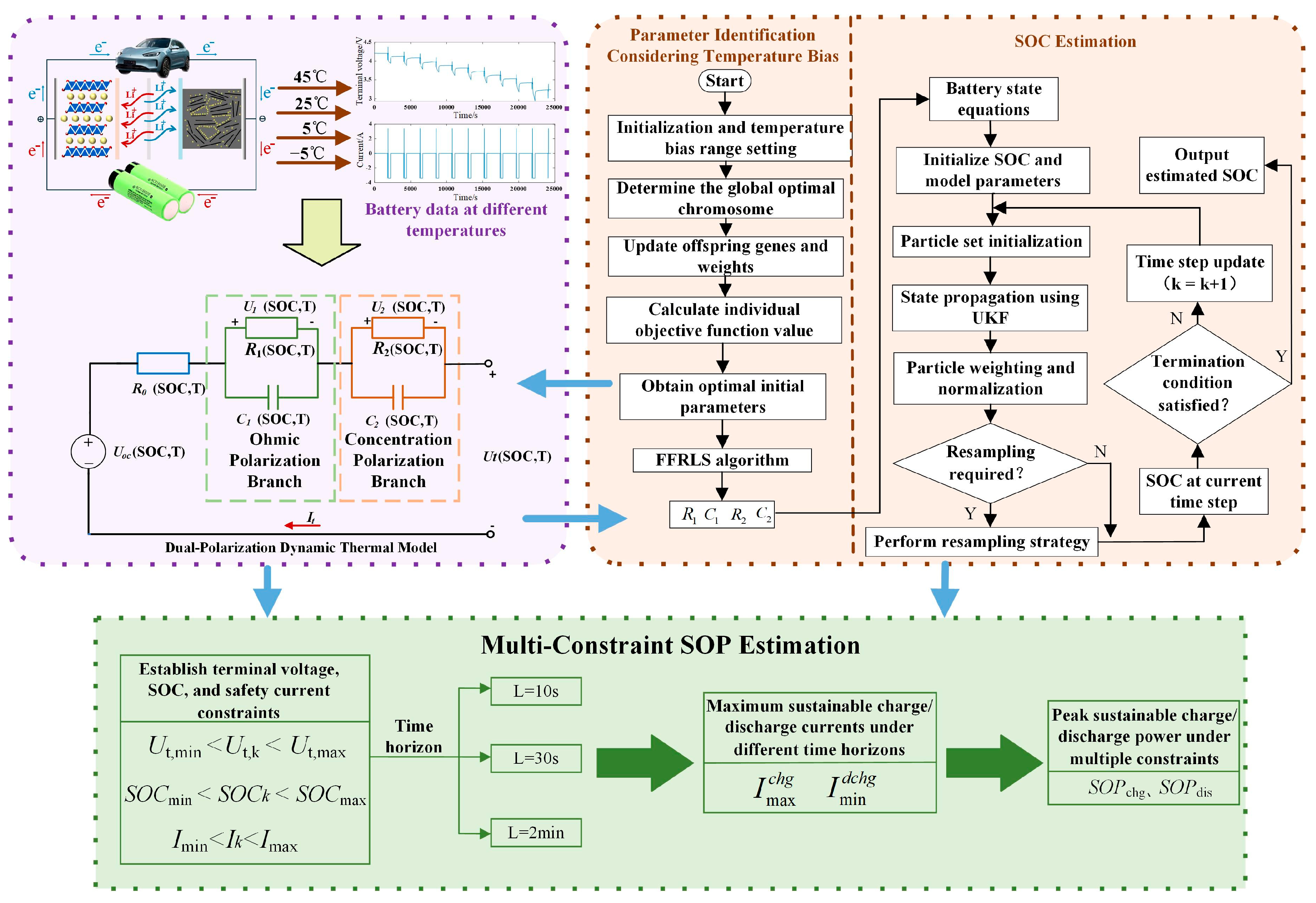
This paper proposes a stepwise progressive joint SOC/SOP estimation method, as illustrated in Figure 4, which enables continuous inference and mutual constraint modeling of multiple battery state variables. First, a temperature-bias-aware equivalent circuit model is established, and model parameters are identified using the forgetting factor recursive least squares (FFRLS) algorithm. The identified parameters are then provided as inputs to the state estimation algorithm, and the unscented particle filter (UPF) is employed to dynamically estimate the SOC.
Subsequently, at each progressive prediction step, the estimated SOC is introduced as a core state constraint into the SOP estimation model. Together with voltage, current, and SOC constraints, the SOC estimate participates in constraining the analytical determination of the power state boundary, thereby forming a multi-constraint SOP estimation framework under the stepwise progressive strategy.

3. Results

This study is based on wide-temperature-range charge and discharge experimental data (−5 °C to 45 °C) obtained from Panasonic NCR18650B cylindrical lithium-ion batteries tested at the laboratory of Universiti Malaya. The detailed specifications of the lithium-ion battery are summarized in Table 2. The experimental platform mainly consists of a battery charge–discharge testing system, a temperature-controlled chamber, and the battery under test, which is used to acquire battery operating data under different temperature conditions.
To quantitatively evaluate the estimation accuracy of the proposed model and algorithms, the root mean square error (RMSE), mean absolute error (MAE), and maximum absolute error (MAXE) are adopted as performance evaluation metrics. Let the true value be denoted as y k , the estimated value as y ^ k , and N represent the total number of samples. The corresponding definitions of the error metrics are given as follows:
R M S E = 1 N k = 1 N ( y k y ^ k ) 2
M A E = 1 N k = 1 N | y k y ^ k |
M A X E = max 1 k N | y k y ^ k |
Among these metrics, RMSE reflects the overall average error in a mean-square sense and is more sensitive to large deviations; MAE characterizes the average absolute deviation of the estimation error; and MAXE is used to quantify the maximum instantaneous error observed during the estimation process. Through a comprehensive analysis of these metrics, the estimation accuracy and stability of the proposed model and algorithms under different operating conditions and temperature environments can be systematically evaluated.

3.1. Validation of Equivalent Circuit Model Accuracy

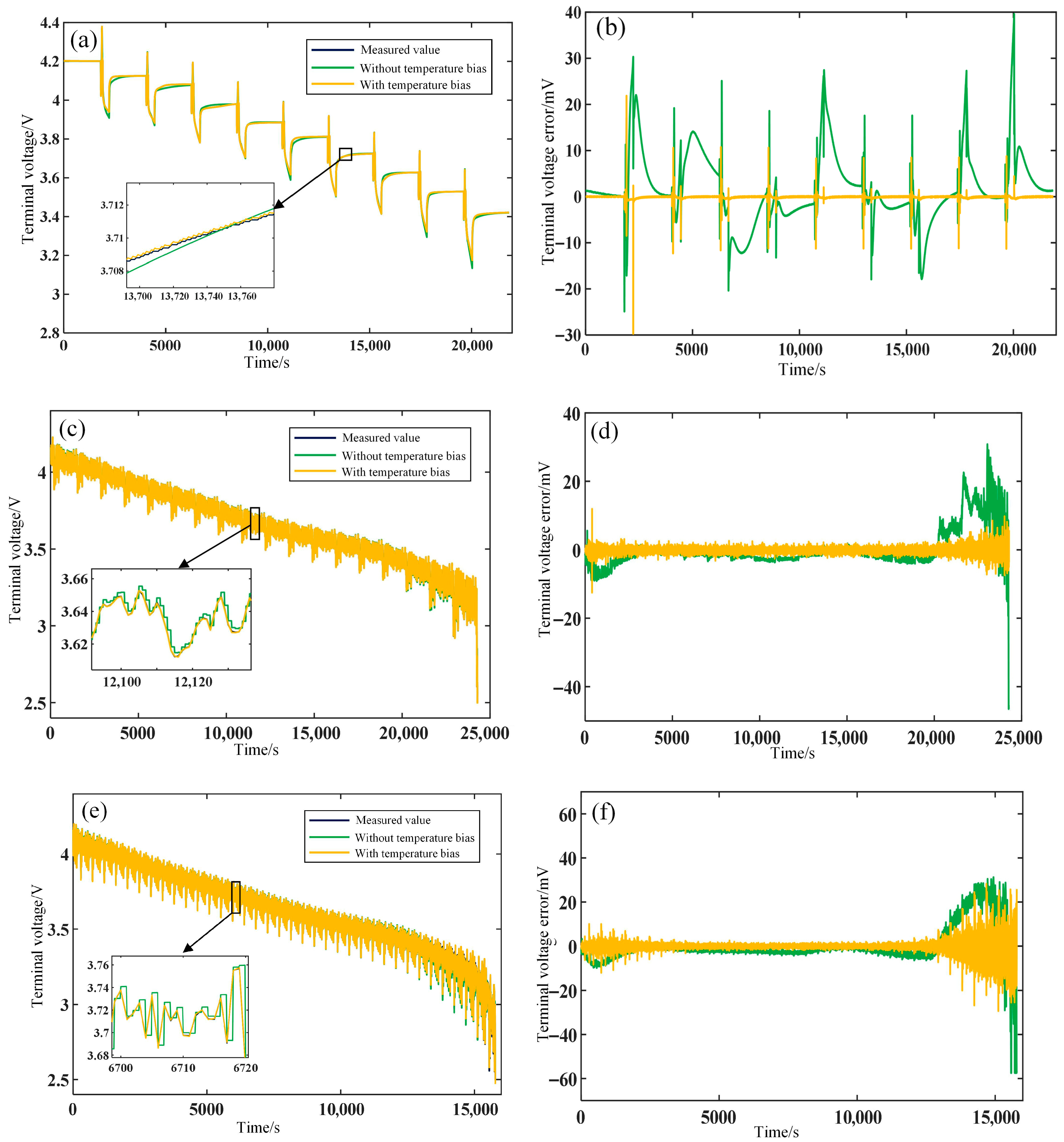
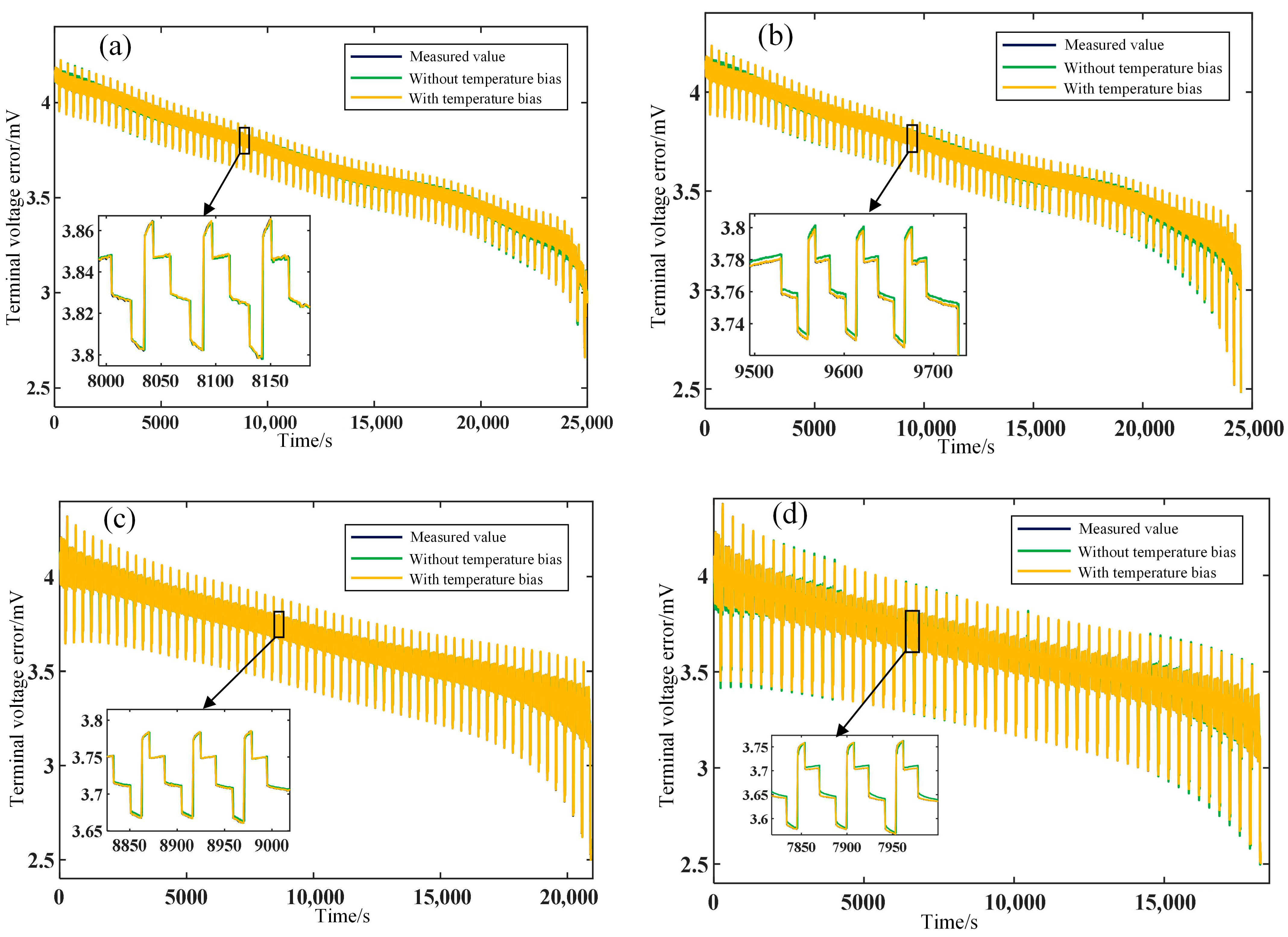
To validate the accuracy of the proposed model, the terminal voltage estimated by the temperature-bias-aware battery model combined with the forgetting factor recursive least squares (FFRLS) algorithm is compared with the measured terminal voltage obtained from constant-current discharge experiments under HPPC conditions at −5 °C, 5 °C, 25 °C, and 45 °C. In contrast to the HPPC profile, the WLTS, US06, and DST driving cycles exhibit more aggressive current variations, which better reflect the realistic operating characteristics of batteries in electric vehicles.
The comparison results are presented in Figure 5 and Figure 6. As shown in Figure 5, the maximum absolute error under the HPPC condition does not exceed 29.73 mV, while the maximum absolute errors under the WLTS and US06 conditions are limited to 12.5 mV and 29.35 mV, respectively.
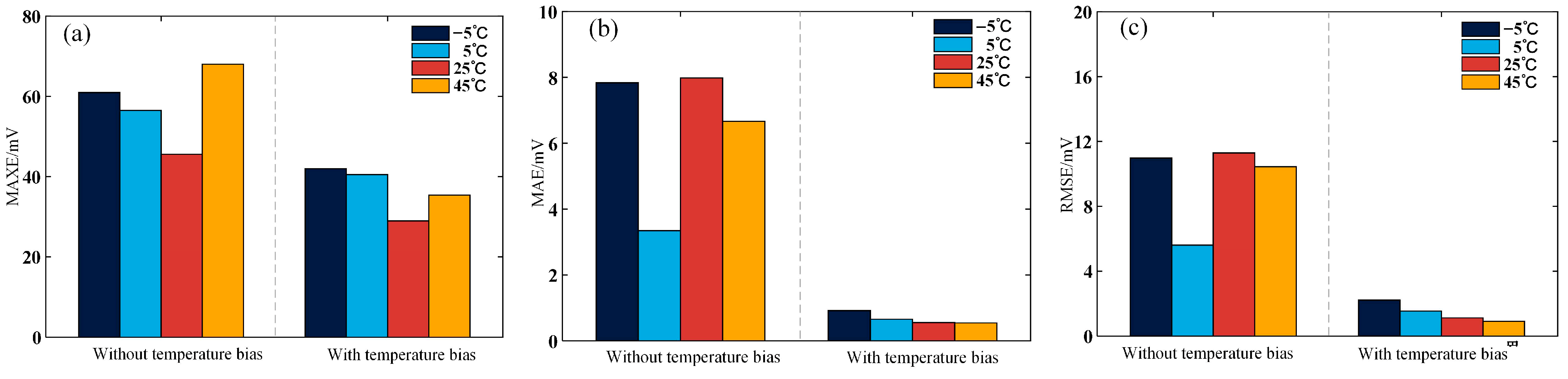
To quantitatively evaluate the accuracy of the proposed model, the root mean square error (RMSE), mean absolute error (MAE), and maximum absolute error (MAXE) are selected as performance metrics. The simulation errors of different battery models at various temperatures are illustrated in Figure 7. Among these metrics, RMSE reflects the overall average estimation performance, and under identical conditions, a smaller RMSE indicates better estimation accuracy.
Across the four temperature conditions, the RMSE values obtained by the proposed model are all below 2.2 mV, demonstrating consistently high estimation accuracy. These results confirm that the proposed model exhibits strong sensitivity and stability in tracking battery voltage variations over a wide temperature range, indicating good temperature robustness. Consequently, the model is well-suited for battery state prediction tasks in complex thermal environments.

3.2. SOC Estimation Simulation Analysis

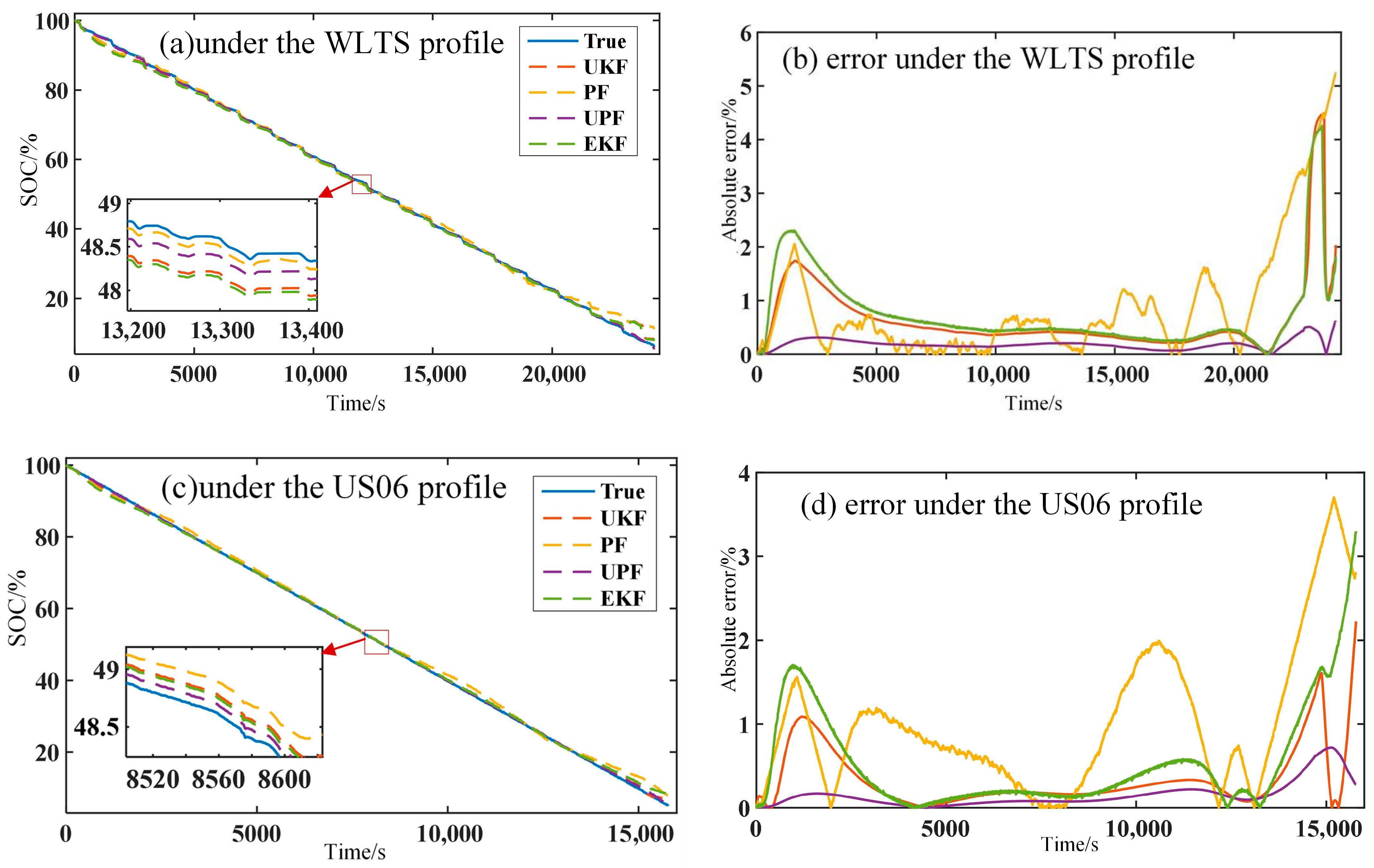
For SOC estimation, the voltage and current data under the WLTS, US06, and DST driving cycles at different temperatures are fed into the UPF algorithm to estimate the SOC, thereby validating the superiority of the proposed approach. As shown in Figure 8, at an ambient temperature of 25 °C, the performance of the proposed UPF-based method is compared with that of the extended Kalman filter (EKF), particle filter (PF), and unscented Kalman filter (UKF).
Figure 8 illustrates the SOC estimation results obtained using four different algorithms. It can be observed from the SOC estimation error curves that the particle filter (PF) exhibits relatively large error fluctuations, indicating poor stability in SOC estimation. In comparison, the unscented Kalman filter (UKF) shows smaller error fluctuations; however, its overall estimation accuracy is still inferior to that of the proposed unscented particle filter (UPF) method.
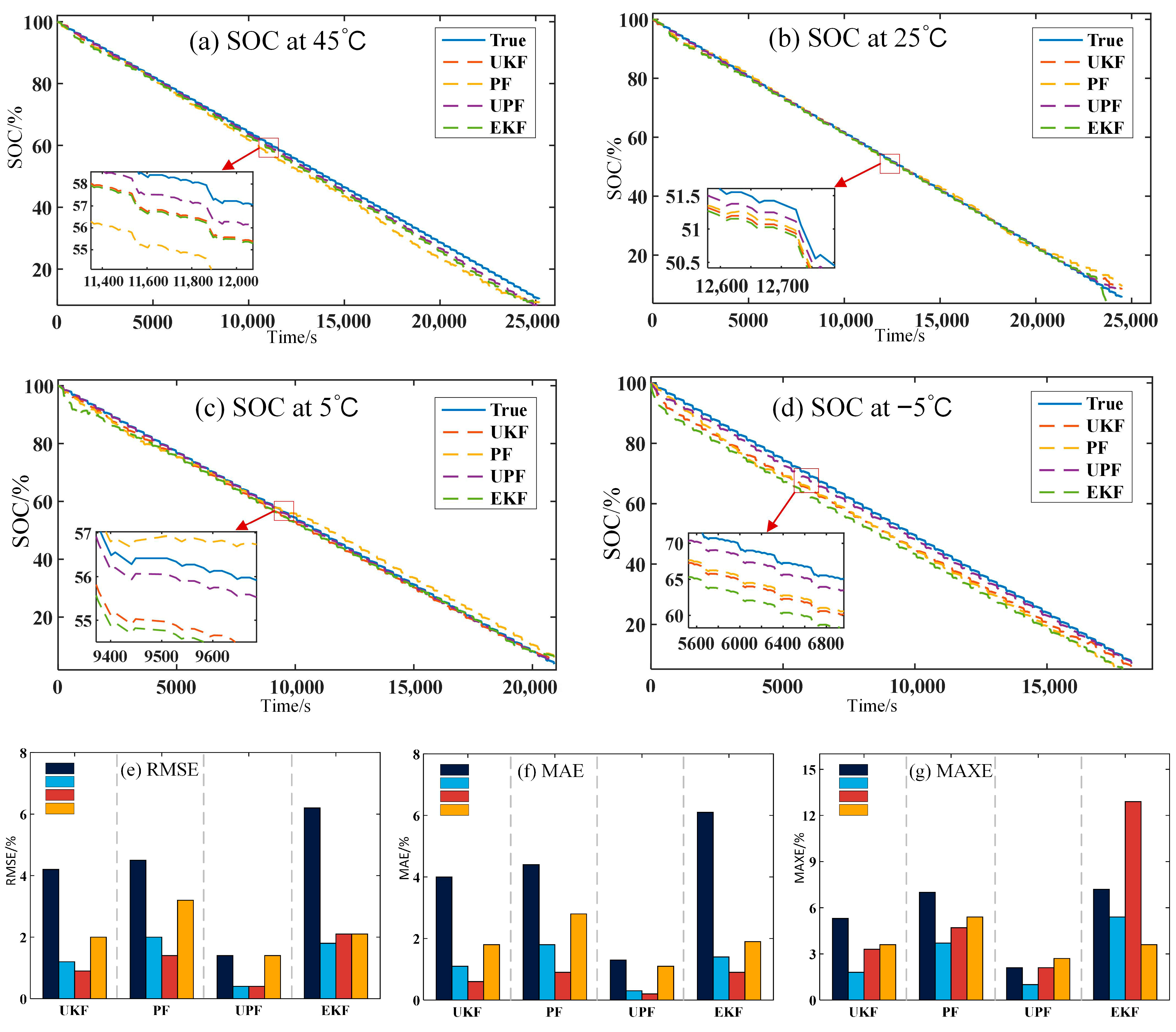
Figure 9 presents the SOC estimation results under the DST driving cycle at four different temperatures, together with a comparison of the corresponding error metrics. It can be observed that the proposed unscented particle filter (UPF) achieves the lowest values across all three error indices. In terms of both estimation accuracy and stability, the UPF consistently outperforms the extended Kalman filter (EKF), particle filter (PF), and unscented Kalman filter (UKF).
Specifically, the UPF exhibits superior performance with respect to the maximum error, mean absolute error, and root mean square error, indicating the highest overall estimation accuracy.
Further analysis reveals that although the differences in error metrics among the compared algorithms are not highly pronounced under certain operating conditions, their estimation stability and error evolution characteristics exhibit fundamental distinctions under highly dynamic conditions and in scenarios with significant temperature fluctuations. The unscented particle filter (UPF) employed in this study is able to more effectively capture the non-Gaussian characteristics of the SOC state distribution through its particle-based representation, while the incorporation of the unscented transform enhances the efficiency of importance sampling. As a result, the UPF maintains favorable convergence behavior and estimation stability even in the presence of increased model uncertainty, rapid current variations, and pronounced temperature bias effects.
In contrast, filtering methods based on Gaussian assumptions and covariance propagation, such as EKF and UKF, are more susceptible to linearization errors or statistical model mismatches under such complex operating conditions, leading to amplified estimation error fluctuations. Traditional particle filter approaches, on the other hand, often suffer from particle degeneracy and limited computational efficiency. These observations indicate that the UPF achieves a better balance between estimation accuracy and stability, making it more suitable for precise SOC estimation under wide-temperature ranges and highly dynamic operating conditions.

3.3. SOP Estimation Simulation

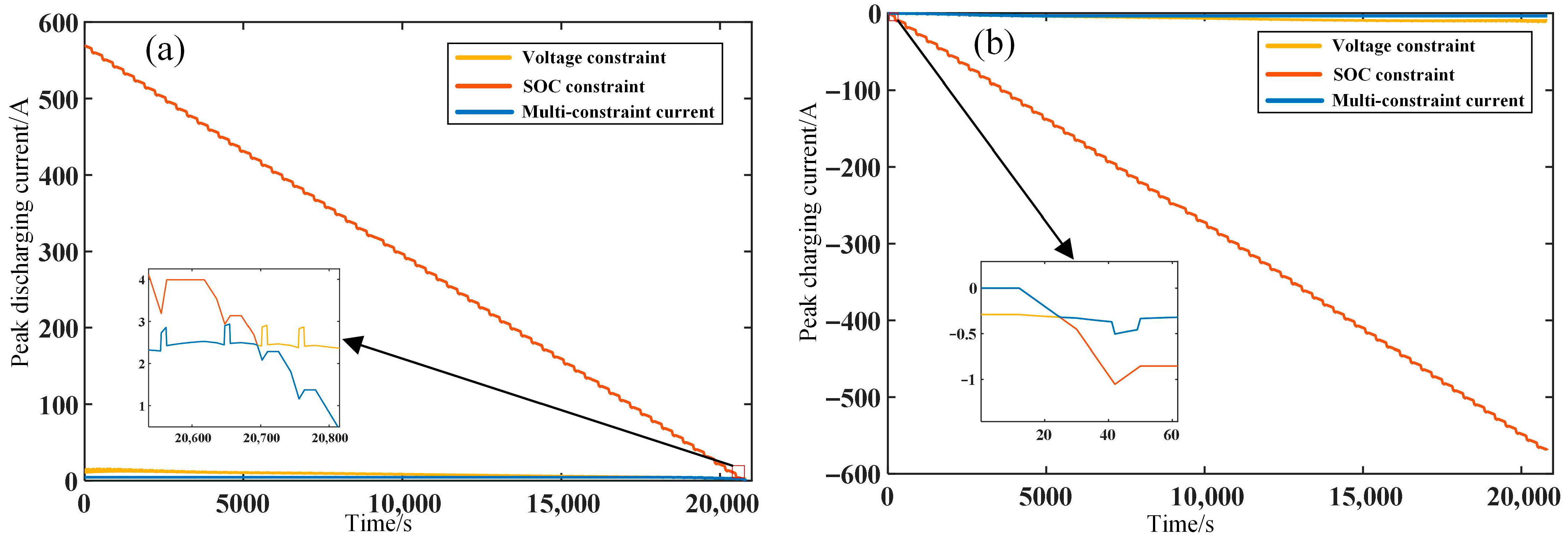
To verify the reliability of the proposed joint SOC/SOP estimation method, battery test data obtained under the DST driving cycle at −5 °C, 5 °C, 25 °C, and 45 °C are analyzed. By jointly considering the constraints of terminal voltage, SOC, and single-cell peak current, the estimated sustained peak charging and discharging currents of a single battery cell at 25 °C with a fixed prediction horizon of L = 15   s are presented in Figure 10.
As indicated by the estimation results in Figure 10b, different constraints dominate the charging process at different time stages. During the initial charging phase, the SOC constraint is the primary limiting factor. In the intermediate stage, the terminal voltage constraint becomes dominant. As the charging process approaches completion and the operating conditions near the design limits, the single-cell safety current constraint plays a governing role. In contrast, the peak discharging current estimation results shown in Figure 10a exhibit an opposite constraint-dominance pattern compared with the charging process.
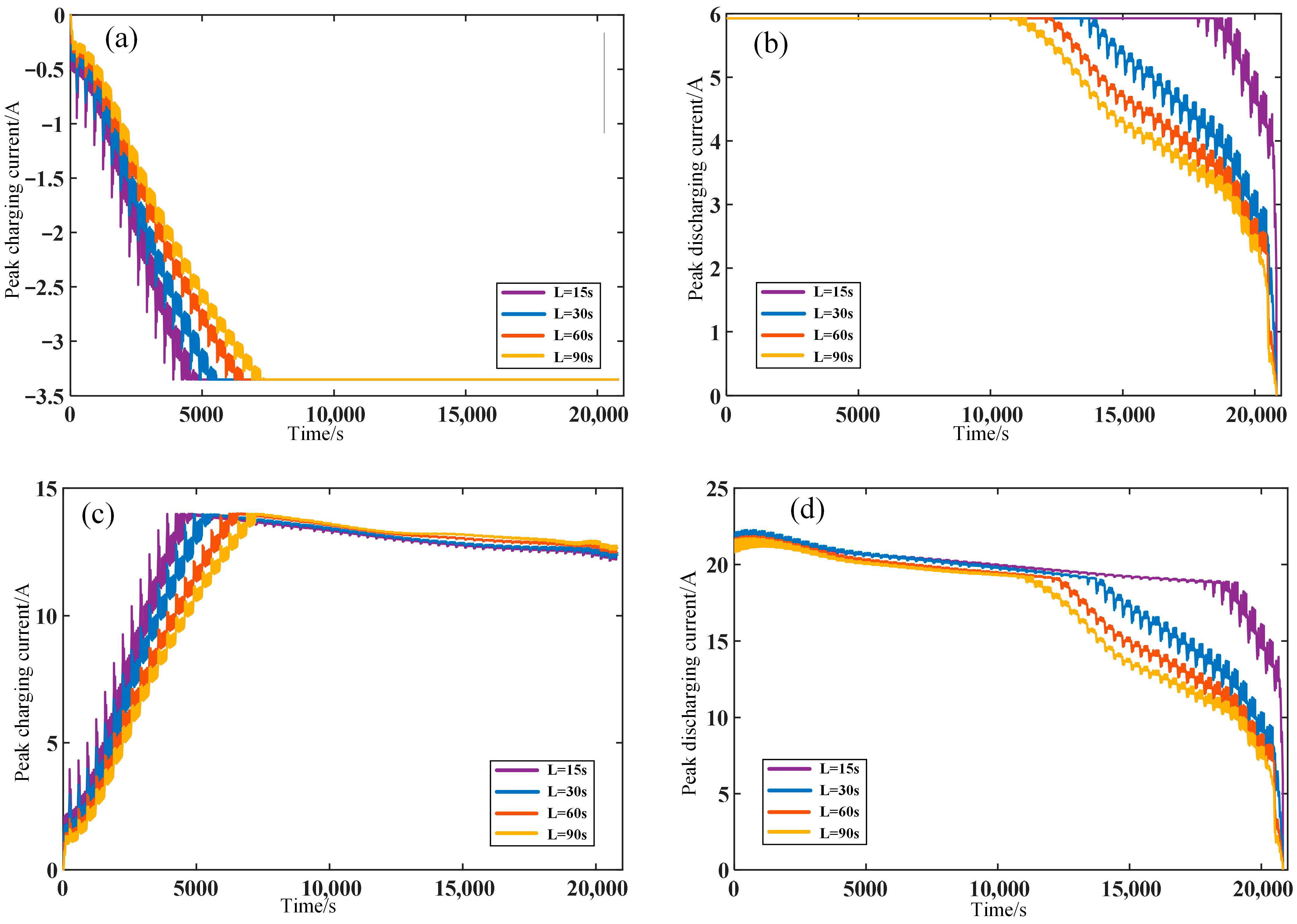
To further analyze the influence of sustained duration, estimation results under the DST driving cycle at an ambient temperature of 25 °C are obtained for different durations of 15 s, 30 s, 60 s, and 90 s. The corresponding sustained peak charging and discharging currents, as well as the peak power estimation results, are presented in Figure 11. As can be observed, both the peak current and peak power decrease monotonically with increasing duration. This indicates that the sustained duration has a significant impact on the charge and discharge capability of the battery. Therefore, in new energy vehicle design, it is necessary to impose appropriate limits on the sustained output duration of the power battery to ensure system reliability and safety.
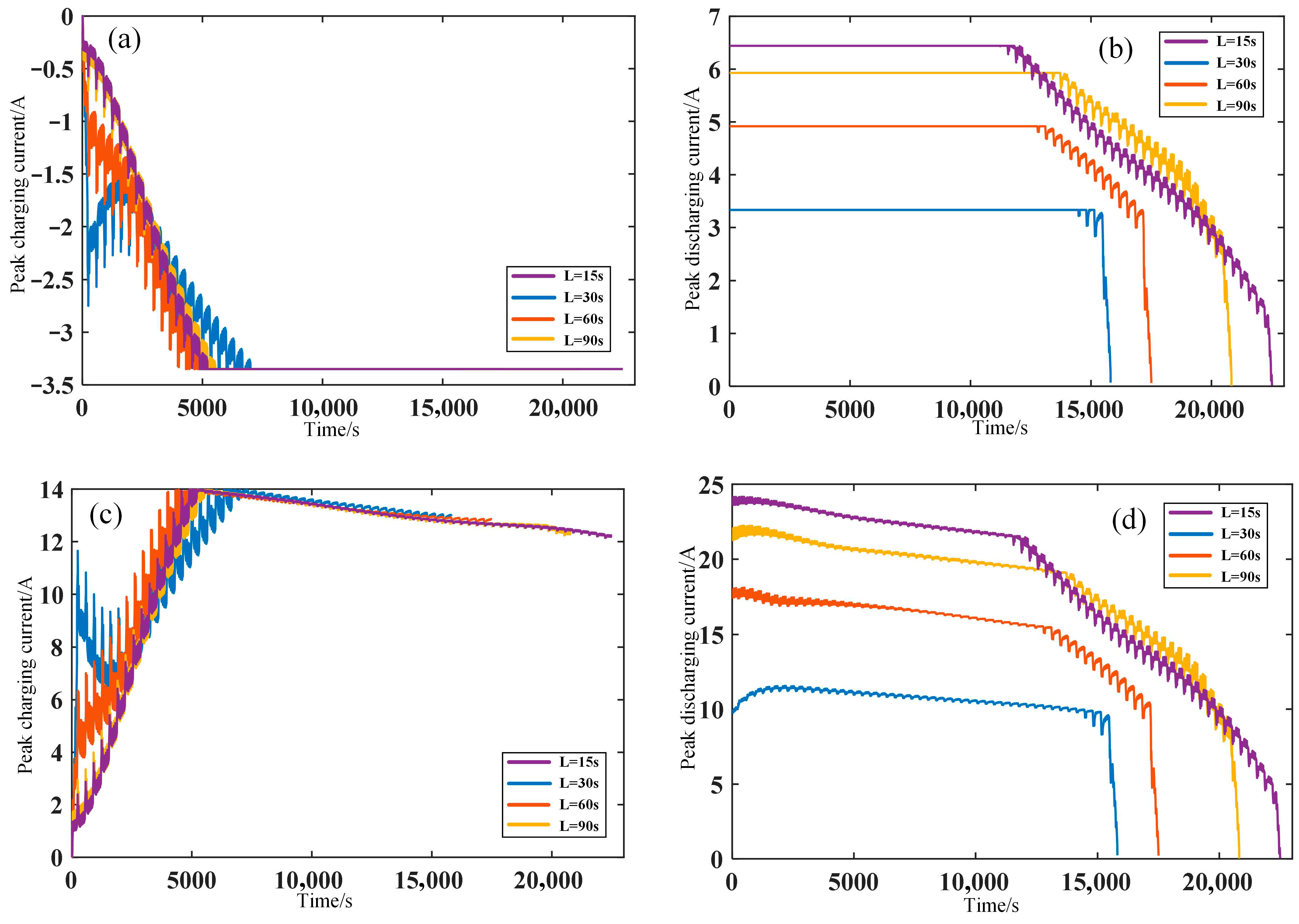
To analyze the influence of ambient temperature, Figure 12 presents the SOP estimation results over a wide temperature range with a sustained duration of 30 s. Overall, the battery exhibits superior peak charging and discharging capability under medium and high temperature conditions (25 °C and 45 °C), which is reflected in both increased peak current and expanded peak power.
In contrast, under low-temperature conditions (−5 °C), the battery performance is significantly constrained. Both the peak current and peak power remain at the lowest levels, and the termination time occurs earlier, indicating that the available capacity and power are severely limited.

4. Conclusions

This paper addresses the degradation of state estimation accuracy of lithium-ion batteries induced by temperature variations and proposes a temperature-bias-aware battery modeling and joint SOC/SOP estimation framework. By incorporating temperature bias into the equivalent circuit model and integrating a forgetting factor recursive least squares (FFRLS) algorithm for online parameter updating, the proposed approach significantly enhances SOC and SOP estimation performance over a wide temperature range. The main conclusions are summarized as follows:
(1)
A dual-polarization thermally coupled equivalent circuit model is developed, and an FFRLS-based parameter updating scheme is introduced to effectively mitigate model inaccuracies caused by temperature variations. Experimental results demonstrate that the proposed model achieves accurate terminal voltage tracking across a wide temperature range from −5 °C to 45 °C, with a maximum RMSE below 2.2 mV, indicating strong dynamic tracking capability.
(2)
By employing the unscented Kalman filter (UKF) as the proposal distribution of the particle filter, an unscented particle filter (UPF) is constructed for SOC estimation. Compared with the conventional UKF, the proposed UPF exhibits significantly improved convergence speed and estimation accuracy. Under different temperatures and various operating conditions, the maximum SOC estimation error is constrained within 2.1%, and the RMSE remains below 1.4%.
(3)
Based on the coupling relationship between SOC and SOP, a stepwise progressive SOP estimation strategy is proposed. By jointly considering multiple constraints, the proposed method accurately predicts peak charging and discharging power. The results indicate that this strategy effectively prevents peak current and peak power from exceeding battery design limits, thereby enhancing operational safety and contributing to extended battery lifespan.
(4)
Compared with existing joint SOC/SOP estimation methods, the innovation of this work lies not only in the improvement of estimation accuracy, but also in the overall coherence and engineering applicability of the proposed framework. By integrating a temperature-bias-aware model, online parameter identification, UPF-based state estimation, and a multi-constraint SOP inference mechanism within a unified modeling framework, this study establishes a multi-state cooperative estimation framework tailored for wide-temperature ranges and complex operating conditions. While maintaining high estimation accuracy, the proposed framework enhances adaptability to operating condition variations and model uncertainties, thereby providing a more practical and valuable technical pathway for traction battery energy management and safety control.
Overall, the proposed joint SOC/SOP estimation framework demonstrates strong robustness, accuracy, and practical applicability under wide-temperature and highly dynamic operating conditions, making it well-suited for advanced battery management systems in electric vehicles.
With regard to future work, the experiments in this study are conducted using non-aged lithium-ion batteries, and battery aging effects are not explicitly considered. Battery aging is typically accompanied by capacity degradation and internal resistance growth, which can lead to variations in equivalent circuit model parameters and consequently affect SOC estimation accuracy and SOP prediction results. As the degree of aging increases, the uncertainty of model parameters may become more pronounced, particularly under high-rate charge and discharge conditions, potentially impacting the conservativeness and accuracy of SOP prediction. Addressing these issues will be a primary focus of our future research.
The physical meanings and units of the main parameters used in this study are listed below in Table 3.

Author Contributions

Z.Z.: Investigation, Formal analysis, Writing—review and editing. Y.W.: Conceptualization, Project administration, Writing—review and editing, Supervision. S.W.: Investigation. All authors have read and agreed to the published version of the manuscript.

Funding

This research was funded by the Liaoning Provincial Applied Basic Research Program Project (2025JH2/101330118) and the National Natural Science Foundation of China (62473184).

Data Availability Statement

Shrivastava, Prashant; TEY, KOK SOON (2022), “Battery Test Data (LiFePO4 18650 Rechargeable Cell 3.3V 1100 mAh, Panasonic NCR18650B 3400mAh, Murata VTC6 18650 3000mAh 15A)”, Mendeley Data, V1, https://doi.org/10.17632/29kw38kzwj.1 accessed on 30 January 2026.

Conflicts of Interest

The authors declare no conflicts of interest.

References

  1. Etacheri, V.; Marom, R.; Elazari, R.; Salitra, G.; Aurbach, D. Challenges in the Development of Advanced Li-Ion Batteries: A Review. Energy Environ. Sci. 2011, 4, 3243–3262. [Google Scholar] [CrossRef]
  2. Zhao, X.; Li, M.; Yu, Q.; Ma, J.; Wang, S. State Estimation of Power Lithium Batteries for Electric Vehicles: A Review. China J. Highw. Transp. 2023, 36, 254–283. [Google Scholar]
  3. Shrivastava, P.; Soon, T.K.; Idris, M.Y.I.B.; Mekhilef, S.; Adnan, S.B.R.S. Model-Based State of X Estimation of Lithium-Ion Battery for Electric Vehicle Applications. Int. J. Energy Res. 2022, 46, 10704–10723. [Google Scholar] [CrossRef]
  4. Kumar, D.; Rizwan, M.; Panwar, A.K. Advanced Intelligent Approach for State of Charge Estimation of Lithium-Ion Battery. Energy Sources Part A 2023, 45, 10661–10681. [Google Scholar] [CrossRef]
  5. Wang, S.; Dang, Q.; Gao, Z.; Li, B.; Fernandez, C.; Blaabjerg, F. An Innovative Square Root-Untraced Kalman Filtering Strategy with Full-Parameter Online Identification for State of Power Evaluation of Lithium-Ion Batteries. J. Energy Storage 2024, 104, 114555. [Google Scholar] [CrossRef]
  6. Zhang, M.; Fan, X. Design of Battery Management System Based on Improved Ampere-Hour Integration Method. Int. J. Electr. Hybrid Veh. 2022, 14, 1–29. [Google Scholar] [CrossRef]
  7. Liu, Y.; He, Y.; Bian, H.; Guo, W.; Zhang, X. A Review of Lithium-Ion Battery State of Charge Estimation Based on Deep Learning: Directions for Improvement and Future Trends. J. Energy Storage 2022, 52, 104664. [Google Scholar] [CrossRef]
  8. Hong, J.; Pei, J.; Liang, F.; Li, M.; Qiu, Y.; Zhang, L. Research on Real Vehicle Power Battery SOC Estimation Based on Sparrow Search Optimized LSTM. J. Southwest Univ. (Nat. Sci. Ed.) 2024, 46, 41–50. [Google Scholar]
  9. Shrivastava, P.; Soon, T.K.; Idris, M.Y.I.B.; Mekhilef, S.; Adnan, S.B.R.S. Comprehensive Co-Estimation of Lithium-Ion Battery State of Charge, State of Energy, State of Power, Maximum Available Capacity, and Maximum Available Energy. J. Energy Storage 2022, 56, 106049. [Google Scholar] [CrossRef]
  10. Liu, Y.; Sun, B.; Zhao, X.; Zhang, J. Joint Estimation of SOC/SOP for Lithium-Ion Batteries across a Wide Temperature Range Using an Electro-Thermal Coupling Model. Energy Storage Sci. Technol. 2024, 13, 3030–3041. [Google Scholar]
  11. Qin, P.; Che, Y.; Li, H.; Cai, Y.; Jiang, M. Joint SOC–SOP Estimation Method for Lithium-Ion Batteries Based on Electro-Thermal Model and Multi-Parameter Constraints. J. Power Electron. 2022, 22, 490–502. [Google Scholar] [CrossRef]
  12. Peng, S.; Xu, L.; Zhang, W.; Yang, R.; Wang, Q.; Cai, X. Overview of State of Power Prediction Methods for Lithium-Ion Batteries. J. Mech. Eng. 2022, 58, 361–378. [Google Scholar]
  13. Zhang, X.; Zhang, Z.; Yu, Z. Joint Estimation of SOC and SOP of Lithium Battery. Control Eng. China 2022, 29, 1255–1263, 1309. [Google Scholar]
  14. Wang, Q.; Qi, W. New SOC Estimation Method under Multi-Temperature Conditions Based on Parametric-Estimation OCV. J. Power Electron. 2020, 20, 614–623. [Google Scholar] [CrossRef]
  15. Bu, C.; Jiang, K.; Ren, J. Estimation of SOC of Lithium-Ion Battery Based on Improved ASRCKF. Guangdong Electr. Power 2020, 33, 16–25. [Google Scholar]
  16. Yu, H.; Wang, X.; Wang, J.; Li, L. State of Charge Estimation for Lithium-Ion Battery Based on FFRLS-ARUKF Algorithm. Mach. Des. Manuf. 2023, 36, 27–38. [Google Scholar]
  17. Wang, J.; Zuo, Z.; Wei, Y.; Jia, Y.; Chen, B.; Li, Y.; Yang, N. State of Charge Estimation of Lithium-Ion Battery Based on GA-LSTM and Improved IAKF. Appl. Energy 2024, 368, 123508. [Google Scholar] [CrossRef]
  18. Plett, G.L. Extended Kalman Filtering for Battery Management Systems of LiPB-Based HEV Battery Packs—Part 1: Background. J. Power Sources 2004, 134, 252–261. [Google Scholar] [CrossRef]
  19. He, H.; Xiong, R.; Fan, J. Evaluation of Lithium-Ion Battery Equivalent Circuit Models for State of Charge Estimation by an Experimental Approach. Energies 2011, 4, 582–598. [Google Scholar] [CrossRef]
  20. Plett, G.L. Model-Based State of Charge and Peak Power Capability Estimation of Lithium-Ion Battery. J. Power Sources 2012, 207, 174–184. [Google Scholar]
  21. Zhang, X.; Duan, L.; Gong, Q.; Wang, Y.; Song, H. State of Charge Estimation for Lithium-Ion Battery Based on Adaptive Extended Kalman Filter with Improved Residual Covariance Matrix Estimator. J. Power Sources 2024, 589, 233758. [Google Scholar] [CrossRef]
  22. Wang, L.; Wang, F.; Xu, L.; Li, W.; Tang, J.; Wang, Y. SOC Estimation of Lead–Carbon Battery Based on GA-MIUKF Algorithm. Sci. Rep. 2024, 14, 3347. [Google Scholar] [CrossRef] [PubMed]
  23. Hui, Z.; Shi, Z.; Wang, R.; Yang, M.; Li, H.; Ren, J.; Cao, Y.; Sun, Y. Health Prediction of Lithium-Ion Batteries by Combining Empirical Mode Decomposition and PF-GPR Algorithm. Mater. Today Energy 2024, 42, 101562. [Google Scholar] [CrossRef]
  24. Xiong, R.; He, H.; Guo, H.; Ding, Y. Model-Based State of Charge and Capacity Estimation for Lithium-Ion Batteries. Appl. Energy 2013, 103, 110–117. [Google Scholar]
  25. Plett, G.L. Extended Kalman Filtering for Battery Management Systems of LiPB-Based HEV Battery Packs—Part 2: Modeling and Identification. J. Power Sources 2004, 134, 262–276. [Google Scholar] [CrossRef]
  26. He, H.; Xiong, R.; Guo, H.; Li, S. Comparison Study on the Battery Models Used for the Energy Management of Electric Vehicles. Energy Convers. Manag. 2012, 64, 113–121. [Google Scholar] [CrossRef]
  27. Xiong, R.; Cao, J.; Yu, Q.; He, H.; Sun, F. Critical Review on the Battery State of Charge Estimation Methods for Electric Vehicles. IEEE Access 2017, 6, 1832–1843. [Google Scholar] [CrossRef]
  28. Kumar, R.R.; Bharatiaraja, C.; Udhayakumar, K.; Devakirubakaran, S.; Sekar, K.S.; Mihet-Popa, L. Advances in Batteries, Battery Modeling, Battery Management System, Battery Thermal Management, SOC, SOH, and Charge/Discharge Characteristics in EV Applications. IEEE Access 2023, 11, 105761–105809. [Google Scholar] [CrossRef]
  29. Kurucan, M.; Özbalta, M.; Yetgin, Z.; Alkaya, A. Applications of Artificial Neural Network Based Battery Management Systems: A Literature Review. Renew. Sustain. Energy Rev. 2024, 192, 114262. [Google Scholar] [CrossRef]
  30. Tian, J.; Chen, C.; Shen, W.; Sun, F.; Xiong, R. Deep Learning Framework for Lithium-Ion Battery State of Charge Estimation: Recent Advances and Future Perspectives. Energy Storage Mater. 2023, 61, 102883. [Google Scholar] [CrossRef]
  31. Manoharan, A.; Begam, K.M.; Aparow, V.R.; Sooriamoorthy, D. Artificial Neural Networks, Gradient Boosting and Support Vector Machines for Electric Vehicle Battery State Estimation: A Review. J. Energy Storage 2022, 55, 105384. [Google Scholar] [CrossRef]
  32. How, D.N.; Hannan, M.A.; Lipu, M.H.; Ker, P.J. State of Charge Estimation for Lithium-Ion Batteries Using Model-Based and Data-Driven Methods: A Review. IEEE Access 2019, 7, 136116–136136. [Google Scholar] [CrossRef]
  33. Zhou, W.; Zheng, Y.; Pan, Z.; Lu, Q. Review on the Battery Model and SOC Estimation Method. Processes 2021, 9, 1685. [Google Scholar] [CrossRef]
Figure 1. Dual-polarization dynamic thermal model.
Applsci 16 01754 g001
Figure 2. Capacity calibration under different temperatures and C-rates.
Applsci 16 01754 g002
Figure 3. OCV-SOC curves at different temperatures.
Applsci 16 01754 g003
Figure 4. Flowchart of the joint estimation strategy.
Applsci 16 01754 g004
Figure 5. Terminal voltage curves under different operating conditions at 25 °C: (a) Terminal voltage under HPPC condition; (b) Terminal voltage error under HPPC condition; (c) Terminal voltage error under WLTS condition; (d) Terminal voltage error under WLTS condition; (e) Terminal voltage error under US06 condition; (f) Terminal voltage error under US06 condition.
Applsci 16 01754 g005
Figure 6. Simulation results under DST conditions at different temperatures: (a) Comparison of terminal voltage among different models at 45 °C; (b) Comparison of terminal voltage among different models at 25 °C; (c) Comparison of terminal voltage among different models at 5 °C; (d) Comparison of terminal voltage among different models at −5 °C.
Applsci 16 01754 g006
Figure 7. Error metrics under DST condition: (a) Maximum absolute error; (b) mean absolute error; (c) Root mean square error.
Applsci 16 01754 g007
Figure 8. SOC curves under different operating conditions at 25 °C: (a) SOC under the WLTS profile; (b) SOC estimation error under the WLTS profile; (c) SOC under the US06 profile; (d) SOC estimation error under the US06 profile.
Applsci 16 01754 g008
Figure 9. SOC curves and error metrics under DST: (a) SOC at 45 °C; (b) SOC at 25 °C; (c) SOC at 5 °C; (d) SOC at −5 °C; (e) RMSE; (f) MAE; (g) MAXE.
Applsci 16 01754 g009
Figure 10. Estimated sustained peak current under different constraints at 25 °C (L = 15 s): (a) Peak discharging current profile; (b) Peak charging current profile.
Applsci 16 01754 g010
Figure 11. Estimated sustained peak current and peak power at different durations at 25 °C: (a) Peak charging current for different sustained durations; (b) Peak discharging current for different sustained durations; (c) Peak charging power for different sustained durations; (d) Peak discharging power for different sustained durations.
Applsci 16 01754 g011
Figure 12. Estimated sustained peak current and peak power at different temperatures (L = 30 s): (a) Peak charging current; (b) Peak discharging current; (c) Peak charging power; (d) Peak discharging power.
Applsci 16 01754 g012
Table 1. Comparison of recent joint SOC/SOP estimation methods.
Ref.SOC Estimation Method/SOP Estimation StrategyTemperature Consideration
[10]EKF/Multi-constraint SOPPartial
[11]UKF/Fixed-horizon SOPNo
[13]ARUKF/Constraint-based SOPLimited
[16]DKF/Joint SOC/SOPYes
This workUPF/Stepwise progressive SOP underWide temperature range (−5–45 °C)
Table 2. Battery specifications.
ItemSpecification
Cell format18,650 cylindrical
Cathode materialNickel–cobalt–aluminum oxide (NCA)
Anode material3.4 Ah
Nominal voltage3.6 V
Charge/discharge cutoff voltage4.2 V/2.5 V
Operating temperature range−20 °C~60 °C
Table 3. Physical meanings and units of the main parameters.
SymbolDescriptionUnit
U t Battery terminal voltageV
U o c Open-circuit voltageV
I Battery current (positive for discharge)A
R 0 Ohmic resistanceΩ
( R 1 , R 2 )Polarization resistancesΩ
( C 1 , C 2 )Polarization capacitancesF
( V 1 , V 2 )Polarization voltagesV
T Battery temperature°C
Δ T Temperature bias°C
S O C State of charge
S O C 0 Initial SOC
C n Nominal capacityAh
Δ t Sampling periods
( a , b , c , d )Intermediate identification coefficients
k Time step index
x k State vector
y k Measurement vector
Q Process noise covariance
R Measurement noise covariance
N Number of particles
w k Weight of particle (i)
L Prediction horizons
( I m a x , I m i n )Maximum charging/discharging currentA
( U t , m a x , U t , m i n )Voltage constraintsV
( P m a x , P m i n )Power limitsW
U t , K + L Predicted terminal voltageV
R M S E Root mean square errormV
M A E Mean absolute errormV
M A X E Maximum absolute errormV
Disclaimer/Publisher’s Note: The statements, opinions and data contained in all publications are solely those of the individual author(s) and contributor(s) and not of MDPI and/or the editor(s). MDPI and/or the editor(s) disclaim responsibility for any injury to people or property resulting from any ideas, methods, instructions or products referred to in the content.