Review

Smart Charging and Vehicle-to-Grid Integration of Electric Vehicles: Technical Insights, Cybersecurity Risks, and Mobility-OrientedControl Strategies


1
Department of Electrical Engineering, Yeungnam University, Gyeongsan-si 38541, Republic of Korea
2
School of Computer Science and Engineering, Yeungnam University, Gyeongsan-si 38541, Republic of Korea
3
Department of Electrical Engineering, College of Engineering, King Khalid University, Abha 61421, Saudi Arabia
*
Authors to whom correspondence should be addressed.
These authors contributed equally to this work.
Appl. Sci. 2026, 16(4), 1748; https://doi.org/10.3390/app16041748
Submission received: 15 January 2026 / Revised: 4 February 2026 / Accepted: 7 February 2026 / Published: 10 February 2026

Abstract

Vehicle-to-Grid (V2G) technology enables controlled bidirectional energy exchange between electric vehicles (EVs) and the power grid, allowing EVs to operate as flexible storage resources that support renewable-energy integration, peak-load reduction, and ancillary services. As EV adoption grows, deploying V2G at scale requires a comprehensive understanding of the electrochemical, power-electronic, communication, and mobility foundations that determine system performance. This review presents an integrated assessment of the essential components of V2G and broader Vehicle Grid Integration (VGI). First, the technical foundations are examined, including traction batteries, battery management systems, bidirectional converter topologies, charger architectures, connector standards, and grid-code compliance. Battery degradation mechanisms under V2G cycling are analyzed, with emphasis on depth of discharge, cycling frequency, and thermal conditions. Second, charging-infrastructure architectures and grid-integration considerations are evaluated across AC, DC, on-board, and off-board charging systems. Third, communication and interoperability frameworks, including ISO 15118, OCPP, OCPI, and cybersecurity requirements, are reviewed to assess the security and scalability of V2G operations. Finally, grid-aware mobility applications are discussed, covering coordinated charging, energy-aware routing, shared and autonomous mobility services, and dynamic pricing within coupled power and transport networks. The review concludes by identifying key technical and operational insights that support the development of robust V2G and VGI ecosystems.

1. Introduction

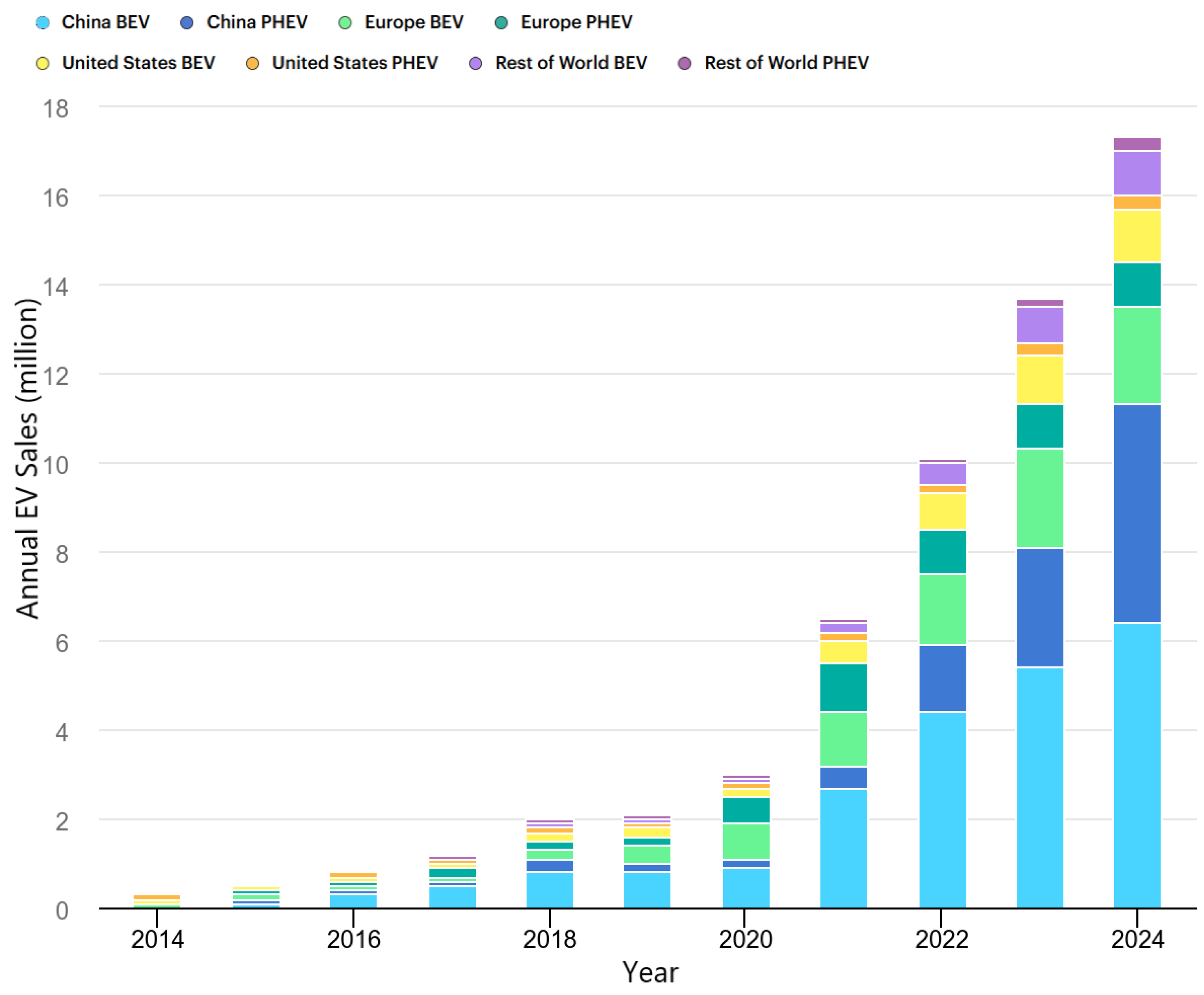
Electrification has become a central pillar of national development strategies due to its role in strengthening economic resilience, advancing technological progress, and improving environmental sustainability. A major component of this transition is the global shift toward electric mobility. Over the past decade, stricter carbon tax policies and climate mitigation measures have been implemented worldwide to curb greenhouse gas emissions and reduce reliance on fossil-fueled transportation. In parallel, the International Renewable Energy Agency (IRENA) reports rapid growth in renewable energy generation, especially solar PV and wind power, with global clean energy consumption expected to rise from 20% to 40% by 2050 and nearly two-thirds of electricity produced from renewable sources [1,2]. Wind and solar alone are projected to triple their contribution, from 20% to 60%. These developments underscore the need for electrified transport systems that interact effectively with renewable-rich grids. The rapid acceleration of electric vehicle adoption over the past decade is illustrated in Figure 1, which shows the sharp increase in annual global EV sales across major regions since 2014, based on data reported by the International Energy Agency (IEA) [3].
Electric vehicles (EVs) have emerged as a promising solution for reducing emissions in the automotive sector due to their high drivetrain efficiency, low operational cost, and zero tailpipe emissions [4]. While internal combustion engines (ICEs) typically convert less than 30% of fuel energy to mechanical output, EVs achieve electricity-to-mechanical efficiencies approaching 77%, resulting in overall efficiencies of 85–90% [5]. Hybrid and plug-in hybrid EVs further enhance energy savings. The global EV stock is expected to surpass 130 million units by 2030, compared to 1.2 million in earlier years [6]. The sustained growth trend evident in Figure 1 directly translates into increased electricity demand, greater use of charging infrastructure, and stronger coupling between transportation and power systems. Meeting this demand requires extensive charging infrastructure, high-capacity batteries, and fast-charging technologies [7,8]. Governments and industry organizations are actively deploying incentives, expanding nationwide charging coverage, and promoting innovation, yet large-scale EV integration introduces challenges such as voltage fluctuations, transformer overloading, and frequency deviations in distribution grids [9]. These issues have driven extensive research on coordinated charging, charger placement, and optimization-based control frameworks [10,11].
With increasing interest in bidirectional power exchange, Vehicle-to-Grid (V2G) technology is gaining prominence as a flexible resource for future energy systems. Through onboard batteries, power electronic converters, and bidirectional chargers, EVs can operate as controllable mobile storage units, providing peak shaving, frequency regulation, load balancing, and renewable support [12]. Enhanced battery cycling performance has strengthened the commercial viability of V2G, while aggregated EV fleets and distributed storage can reduce peak loads and support grid stability [13]. Achieving these capabilities requires robust control architectures, accurate metering, and secure communication. Centralized V2G control can maximize grid-level benefits, whereas decentralized strategies emphasize local stability and user autonomy [14,15]. Both must align with evolving standards and market-driven energy management structures.
V2G communication poses additional challenges due to user mobility, variable connection durations, dynamic charging modes, and short communication ranges. Dedicated short-range communication protocols, such as IEEE 802.11p and IEEE 1609 WAVE, support reliable, low-latency vehicle–infrastructure interactions essential for coordinated V2G operations [16,17]. Despite substantial research on charging systems, converter topologies, communication standards, and scheduling algorithms, a holistic understanding of V2G within broader Vehicle Grid Integration (VGI) frameworks remains limited. V2G deployment requires multilayer coordination across charging infrastructures, communication networks, bidirectional power converters, grid codes, cybersecurity systems, mobility patterns, and electricity market mechanisms. Despite extensive work on chargers, standards, and scheduling algorithms, the literature is often fragmented across power-electronic design, grid interconnection, and ICT security.

Review Methodology and Selection Framework

This paper adopts a structured narrative review methodology to address the fragmentation of existing research on Vehicle-to-Grid (V2G) and broader Vehicle–Grid Integration (VGI) across power electronics, charging infrastructure, communication systems, cybersecurity, and mobility-oriented control. The review synthesizes interdependent findings from a system-level perspective, linking hardware capabilities, communication and interoperability mechanisms, control strategies, and grid-level impacts.
The literature was identified through major indexed scientific databases, including IEEE Xplore, Scopus, Web of Science, ScienceDirect, and Google Scholar. The search covered publications from 2014 to 2025, capturing the progression from early V2G feasibility research to deployment-oriented studies under modern interoperability and bidirectional charging standards. This time window is consistent with the sharp growth in global EV adoption shown in Figure 1, which illustrates annual EV sales by region and powertrain from 2014 to 2024 and underscores the increasing relevance of grid-interactive charging and V2G-enabled services. Earlier studies were retained to establish foundational concepts and technical baselines, while the reviewed literature predominantly reflects recent developments in V2G and VGI research.
The initial search returned 728 records. The duplicate entries were removed using metadata for title, DOI, venue, and year, resulting in 552 unique studies. The title and abstract screening then excluded studies that were not technically relevant to grid-interactive operation, including works limited to unidirectional charging without grid-service interaction, studies focused on non-electric mobility without bidirectional energy exchange, and papers that did not address V2G or VGI operation, constraints, or enabling mechanisms. The screening stage yielded 280 candidate studies for full-text assessment.
The full-text screening prioritized studies that provided technical depth or actionable frameworks relevant to bidirectional charging and system operation, including battery aging and operating limits, power-electronic interfaces, infrastructure and interconnection constraints, communication and interoperability, cybersecurity exposure, and mobility-aware coordination. Studies were excluded if their scope did not support a system-level interpretation of V2G or VGI operations, or if key operational constraints were not sufficiently represented for the intended analysis. The multi-stage screening process identified 198 publications that constitute the core reference set for this review.
The coherence across domains was ensured by synthesizing the selected studies along tightly coupled dimensions, including battery and battery-management-system constraints; bidirectional converter and charger architectures; charging infrastructure and grid-integration requirements; communication and interoperability standards; cybersecurity threats and mitigation strategies; and mobility-aware coordination and market interaction. In contrast to existing V2G surveys that focus on individual technical layers, this review integrates power-electronic, communication, cybersecurity, control, and mobility dimensions within a unified VGI framework, enabling cross-layer analysis of scalability, resilience, and deployment constraints.
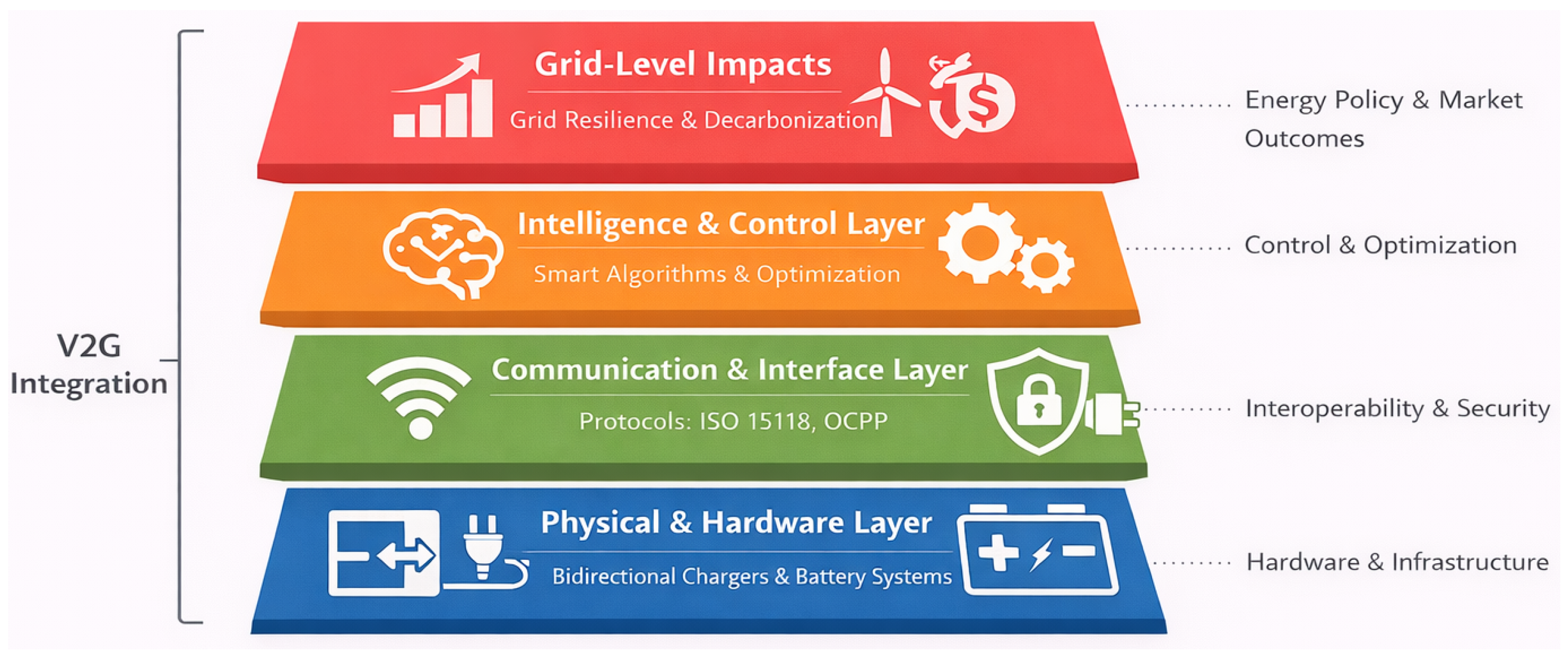
This review addresses the need for stronger integration across technical and system-level perspectives by adopting a system-oriented analytical framework that links hardware components, communication and interoperability mechanisms, control strategies, and grid-level implications. Electric vehicles, charging infrastructure, communication networks, and grid operations are examined as interdependent elements of a unified cyber-physical system, enabling coherent analysis of their interactions and constraints. Within this framework, VGI is treated as the overarching paradigm governing the interaction between electric mobility and power-system operation, while V2G is positioned as a specific bidirectional operational mode within VGI that enables electric vehicles to act as active, grid-interactive resources. Figure 2 illustrates the layered structure, clarifying the roles of hardware capabilities and battery constraints in defining feasible operating envelopes; the influence of communication and interoperability on coordination, scalability, and security; and the function of control strategies in translating these capabilities into grid-level services and broader energy-system impacts. This conceptual synthesis provides a unifying structure for the manuscript and guides the integration of the hardware, communication, control, mobility, and system-level discussions developed in the subsequent sections.

2. Technical Foundations of Vehicle-to-Grid Systems

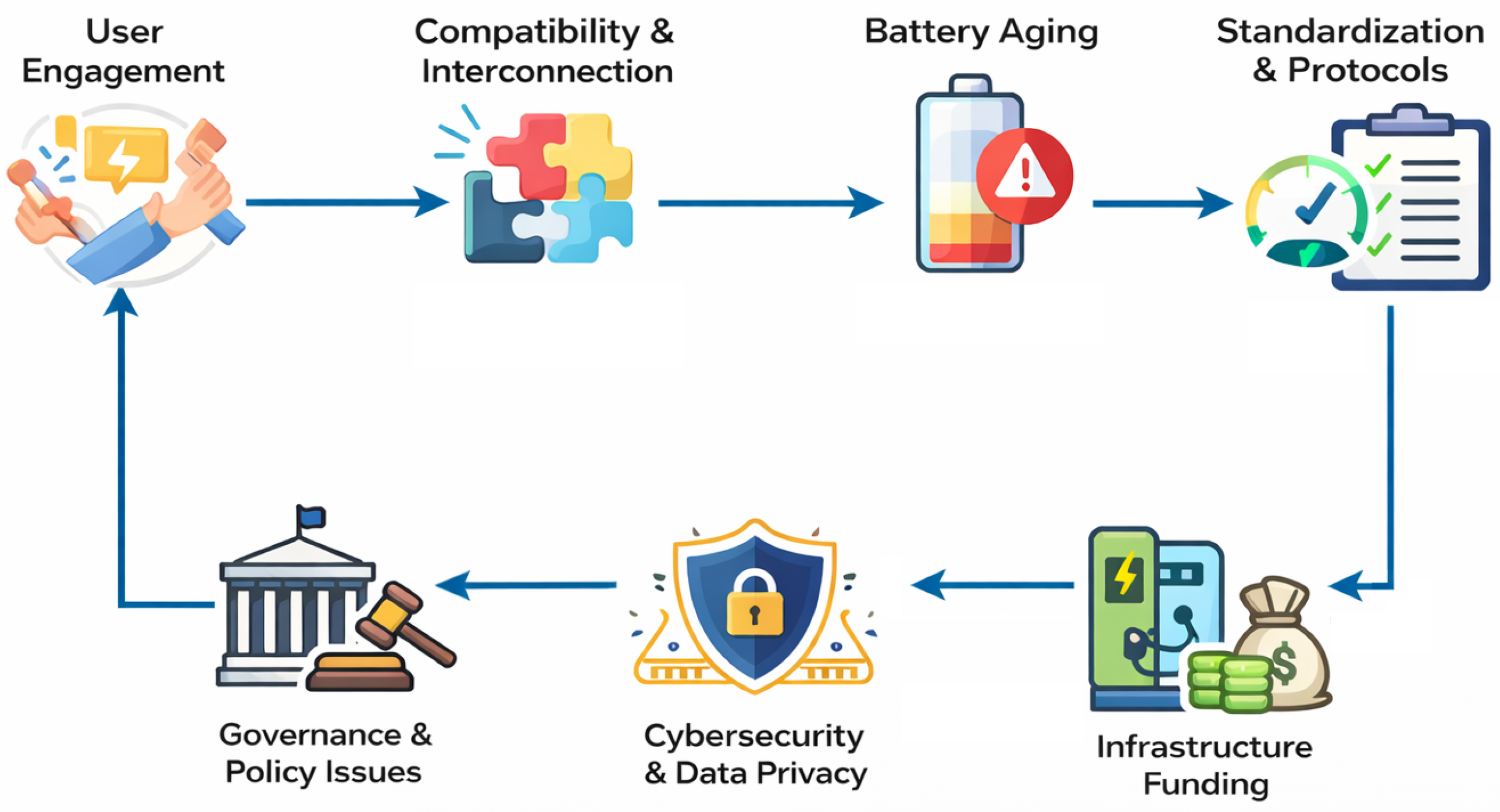
Vehicle-to-Grid (V2G) technology relies on a set of electrochemical, power-electronic, communication, and control foundations that enable controlled bidirectional exchange of energy between electric vehicles and the power grid. Modern EVs already incorporate the core hardware elements required for this functionality. A traction battery, monitored by a battery management system (BMS), interfaces with power-electronic converters that manage propulsion and energy transfer through onboard or off-board chargers [18,19,20,21]. Regenerative braking illustrates the capability for reverse power flow, establishing the physical basis for grid-interactive operation. Among EV architectures, battery electric vehicles remain the most suitable for V2G due to their higher-capacity storage and fully electric propulsion [22]. Plug-in hybrid vehicles can contribute to V2G services, though their reduced battery capacity and dual powertrain limit their impact [23,24]. Fuel cell and solar-assisted EVs provide alternative energy pathways but currently offer limited relevance for V2G owing to infrastructure, cost, and integration constraints [25,26,27]. Across all platforms, the BMS is essential for maintaining electrical, thermal, and operational safety under grid-connected conditions [28]. Recent advances in BMS architectures further highlight the role of intelligent state estimation, degradation-aware control, and thermal management in enabling safe bidirectional operation under V2G cycling conditions [18]. The defining capability of V2G systems is controlled bidirectional power exchange. During charging, EVs operate as flexible loads; during discharging, they can supply peak shaving, load leveling, and ancillary services such as frequency and voltage regulation [29,30]. V2G-enabled onboard chargers and DC fast chargers must comply with grid-code requirements and power-quality limits, while system-level coordination often relies on aggregators or supervisory controllers that schedule charging and discharging based on grid conditions, market signals, and user mobility constraints [31,32]. Effective aggregation remains central to unlocking grid-level value. Realizing V2G at scale requires a charging infrastructure capable of supporting two-way power flow and secure grid interconnection [33]. Conductive charging dominates current deployments, ranging from low-power Level 1 and Level 2 AC chargers suitable for residential and workplace contexts to high-power DC fast chargers for public environments [34]. Infrastructure interoperability is shaped by international standards. IEC 61851 and SAE specifications define general requirements for conductive charging, while connector systems such as CCS, CHAdeMO, and GB/T specify power levels, interface geometry, and communication mechanisms [33,34]. AC interfaces that rely solely on control-pilot signaling provide limited support for bidirectional operation, whereas DC fast-charging protocols that incorporate dedicated digital communication channels enable full V2G capability. CHAdeMO and next-generation systems, including ChaoJi, explicitly support bidirectional power transfer and continue to influence global adoption pathways. Figure 3 summarizes the key challenge domains that shape practical V2G deployment, spanning user participation, interoperability, battery aging, standardization, infrastructure investment, cybersecurity, and governance. These factors are tightly coupled, and addressing them in parallel is essential for reliable and scalable integration.
Communication and supervisory control are critical for ensuring secure and reliable V2G operation. Data exchanges involving state-of-charge, availability, and pricing signals must occur with low latency and appropriate cryptographic protection [35,36]. ISO 15118 defines communication between EVs and charging stations, including session management, Plug-and-Charge, and certificate-based authentication [37,38,39]. IEC 61850 supports integration with distribution-level automation, while OCPP and OCPI enable interoperability between charging stations and backend systems [40,41]. At a higher operational level, energy management systems coordinate EV fleets, distributed resources, and renewable generation using rule-based or optimization-based strategies to improve grid stability and operational efficiency [42]. The use of traction batteries for grid services modifies cycling patterns relative to driving-only operation [43]. Empirical and model-based analyses indicate that increased cycling depth and frequency may accelerate capacity fade and internal resistance growth if unmanaged [44,45]. The extent of degradation depends strongly on the service type. High-frequency shallow cycling used for frequency regulation generally results in minimal additional wear, whereas large-scale energy-shifting operations tend to accelerate aging more significantly [46]. These findings reinforce the need for degradation-aware control and appropriate compensation mechanisms. Moreover, the introduction of V2G connectivity across vehicles, charging equipment, cloud platforms, and the power grid significantly expands the cyber-attack surface. Threats include unauthorized access, manipulation of operational data, tampering with charging profiles, and disruption of grid-support functions [47,48,49,50]. Addressing these risks requires multilayer cybersecurity architectures incorporating strong authentication, encryption, intrusion detection, secure firmware updates, and continuous monitoring. Policy and regulatory frameworks play an equally important role in defining minimum security requirements, liability boundaries, data-privacy expectations, and stakeholder responsibilities [51,52,53,54]. Ensuring user confidence and institutional readiness is essential for the socially acceptable and secure deployment of V2G systems at scale.
The practical feasibility of Vehicle-to-Grid (V2G) operation is fundamentally constrained by battery aging and its economic implications. In electric vehicles, battery end-of-life is commonly defined at approximately 80% of initial capacity, beyond which traction performance and reliability are compromised [55,56]. This threshold is economically critical, as the battery pack typically accounts for 25–35% of total vehicle cost [57,58]. Aging manifests through capacity and power fade, reducing driving range, peak power capability, and operational flexibility [59]. These effects arise from coupled electrochemical and mechanical mechanisms, including SEI growth, lithium inventory loss, active material degradation, and increased internal resistance. Notably, battery degradation is nonlinear, with many lithium-ion chemistries exhibiting an accelerated aging “knee,” beyond which remaining useful life declines rapidly [60,61]. This behavior is particularly relevant for V2G, where grid services introduce additional cycling beyond conventional driving.
From a V2G perspective, degradation must be evaluated comparatively across grid-service categories. Power-oriented services such as frequency regulation and voltage support typically involve shallow cycling within narrow SOC windows, leading to gradual impedance growth and relatively limited incremental capacity loss [62]. In contrast, energy-oriented services such as peak shaving, energy arbitrage, and backup power require deeper DOD, wider SOC excursions, and higher cumulative energy throughput, which significantly accelerate capacity fade and reduce cycle life [63]. These differences highlight that distinct V2G services impose fundamentally different aging trajectories, even for identical battery chemistries.
Battery degradation under V2G operation is strongly influenced by control-imposed operating conditions. Elevated temperatures accelerate parasitic side reactions and SEI growth [64], while high current rates increase thermal and mechanical stress within electrodes [65]. Similarly, large DOD operations promote lithium and active material loss, whereas shallow cycling within constrained SOC windows can extend battery lifetime by an order of magnitude under comparable conditions [66]. These dependencies indicate that degradation is not solely time-dependent but is critically shaped by real-time charging and discharging control.
Battery degradation under V2G operation can be actively mitigated through degradation-aware control strategies. As summarized in Table 1, empirical, physics-based, data-driven, and hybrid models enable degradation metrics to be embedded directly into energy management and supervisory control frameworks [66,67]. Studies show that moderating current levels, constraining SOC windows, and reallocating power demand can substantially reduce long-term degradation, even if short-term grid-service revenue is marginally reduced [58].
From an economic standpoint, explicitly modeling degradation as a cost term is essential for a realistic V2G feasibility assessment. Degradation-aware scheduling balances grid-service revenue against battery aging and replacement costs over the vehicle lifetime [75,76]. Analyses that incorporate degradation consistently show improved total cost of ownership through lifetime extension, whereas studies neglecting degradation tend to overestimate the profitability of energy-intensive V2G services [77]. Overall, V2G feasibility depends on comparative degradation assessment across service types, explicit consideration of control-induced operating conditions, and systematic integration of degradation costs into techno-economic evaluations.
Across the literature, assessments of V2G feasibility remain fragmented due to heterogeneous assumptions regarding battery aging representation, charger and converter architectures, economic cost allocation, and control scope, leading to divergent conclusions on technical readiness and grid value. Studies grounded in electrochemical modeling and empirical aging experiments consistently demonstrate that V2G-induced degradation is strongly dependent on depth of discharge, temperature, current rate, and service type, with high-frequency shallow cycling for frequency regulation exhibiting substantially lower incremental aging than energy-intensive services such as peak shaving and energy arbitrage [44,45,46]. In contrast, many grid-level optimization and aggregation studies approximate aging using simplified throughput-based penalties or omit degradation entirely, which systematically biases results toward optimistic long-term profitability and underestimation of battery replacement costs under sustained cycling [29,30]. Converter- and charger-level investigations confirm the technical feasibility of bidirectional power transfer under grid-code and power-quality constraints, yet typically abstract away degradation dynamics, assume idealized communication latency, and neglect adversarial or failure-prone operating conditions. Cybersecurity-focused analyses, by comparison, expose vulnerabilities related to certificate management, backend coordination, and aggregator interfaces that are not captured in electrochemical, economic, or power-electronic models [35,36]. Collectively, these methodological disparities explain apparent contradictions across the literature and indicate that conclusions drawn from isolated electrochemical, economic, power-electronic, or communication-layer studies do not directly translate to practical V2G deployment. This synthesis highlights the need for integrated evaluation frameworks that account for battery aging dynamics, degradation-aware economic valuation, cyber-physical security, and operational control constraints to enable realistic and scalable assessments of V2G viability.

3. Charging Infrastructure and Grid-Integration Framework for V2G

The success of large-scale V2G deployment depends on the design, standardization, and grid integration of charging infrastructure (CI). CI can be viewed as a multi-layer system that includes physical charging hardware, bidirectional converters, connector standards, and grid-integration requirements. These components together determine whether EVs can reliably provide ancillary services and support the distribution network.

3.1. Charging Modes and Infrastructure Hierarchy

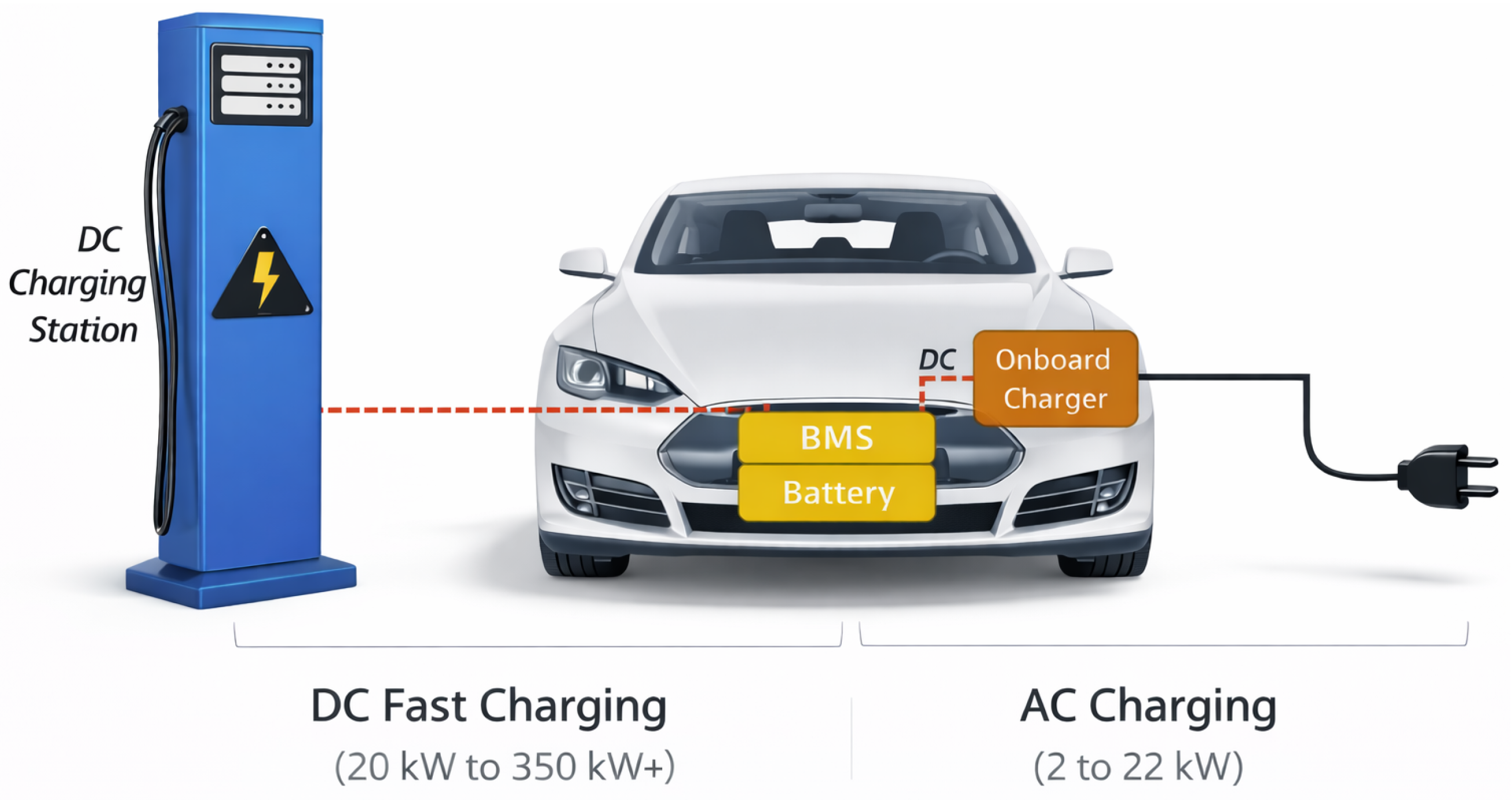
The conductive charging remains the dominant method for both conventional EV charging and V2G applications. It relies on galvanic coupling between the EV inlet and an electric vehicle charging equipment (EVSE) through standardized connectors [78]. Depending on the charging mode, the primary power-conversion stages may be located either within the vehicle or externally at the charging station, enabling on-board AC charging or off-board DC fast charging, respectively [79]. These two architectures, illustrated in Figure 4, form the structural basis of modern conductive charging systems and determine achievable power levels, control complexity, and suitability for V2G operation.
The charging infrastructure operates at multiple scales. Private residential and workplace chargers typically use Level-1 or Level-2 AC charging (2–22 kW), offering predictable dwell times that are well-suited for coordinated charging and grid-support services such as V2G [80]. Public and semi-public chargers such as curbside and highway fast-charging stations depend on high-power DC chargers (50–350 kW), shorter connection durations, and mobility-driven usage patterns limit their availability for sustained V2G participation [81,82]. Charging facilities may also operate within nanogrids, microgrids, or community-scale networks, where renewable generation, storage, and distribution-level constraints influence V2G scheduling and power-flow management [83].

3.2. On-Board and Off-Board Charger Architectures

Understanding the distinction between on-board and off-board charging architectures is essential when evaluating V2G readiness. On-board chargers (OBCs) are typically constrained by vehicle packaging, thermal management, and component size, which limit their continuous output to around 22 kW or less, and for this reason, many commercially deployed OBCs support only unidirectional AC charging [84]. Although bidirectional OBCs capable of grid-to-vehicle (G2V) and vehicle-to-grid (V2G) operation are technically feasible and have been demonstrated [85,86], their adoption remains limited by power density, cost, and complexity constraints. By contrast, off-board DC fast-charging stations relocate the AC/DC and DC/DC power conversion stages into external EVSE enclosures. This design enables much higher power density, enhanced cooling, and more effective integration with renewable energy sources or local DC buses [87,88]. Such externally housed converter topologies are more amenable to controlled bidirectional energy exchange, for example, using PWM-based rectifiers or multi-port DC/DC converters, which facilitate reliable V2G services under grid constraints [89,90]. Regardless of topology, the EVSE remains the critical interface bridging the distribution network, local resources, and the EV battery system. The choice between single-stage, two-stage, unidirectional, or bidirectional converter architectures determines both compliance with grid codes and suitability for grid-support functions [91,92,93].

3.3. Charging-Connector Families and V2G-Capable Standards

Global charging infrastructure remains dominated by connector families such as SAE J1772, CCS (Combo 1/2), CHAdeMO, and GB/T 20234. These define connector geometry, allowable power levels, and communication protocols. AC charging through SAE/IEC control-pilot signaling does not inherently support reverse power flow, limiting its suitability for V2G applications. By contrast, DC-charging systems use digital communication between EVs and EVSEs, enabling precise control of charging and discharging currents. While CCS DC and GB/T DC interfaces in principle can support bidirectional operation, widespread V2G deployment requires robust improvements in protection coordination and rapid set-point response [94]. The resulting classification of charger types, their associated standards, and corresponding V2G capabilities is summarized in Table 2.
CHAdeMO currently remains the only widely deployed standard with fully defined V2G functionality, enabling continuous bidirectional power modulation within EV and grid constraints [95,96]. Chargers compatible with CHAdeMO have supported many of the early V2G demonstration projects globally. A notable evolution of this standard is the ChaoJi standard (also known as CHAdeMO 3.0), developed jointly by the CHAdeMO Association and the China Electricity Council. ChaoJi supports DC-fast charging up to 900 kW (1500 V, 600 A) [97,98], while preserving backward compatibility with CHAdeMO and GB/T couplers, thus offering a unified platform for future high-power V2G applications [99].
In addition to passenger-vehicle standards, efforts are underway to support heavy-duty and high-capacity EVs through the Megawatt Charging System (MCS) [100]. MCS, promoted by the CharIN consortium, defines a high-power DC charging interface intended for buses, trucks, and other large battery-electric vehicles (BEVs). It aims to deliver power levels substantially above 1 MW, enabling rapid charging of large-capacity battery packs while supporting bidirectional (V2X) energy flow using communication protocols such as ISO 15118-20 [101,102]. This extension broadens the potential scope of V2G infrastructure beyond light passenger vehicles to heavy-duty transport and industrial mobility sectors.

3.4. Grid-Integration and Power Quality Standards

When EVs operate as loads, charging must comply with voltage, current, and harmonic limits defined by regional standards. Single-phase charging can cause phase unbalance, typically limited to 2–3 percent depending on standards such as IEEE, GB/T, and EN 50160 [103]. Uncoordinated charging can exacerbate peak loading and transformer stress, motivating the adoption of controlled charging strategies [104].
These grid-integration requirements are governed by a layered set of international standards covering power quality, safety, communication, and interconnection, as summarized in Table 3. Organizations such as SAE, IEEE, IEC, NEC, and UL define complementary aspects of EV charging, ranging from connector interfaces and communication protocols to harmonic limits, grounding practices, and protection requirements. In V2G mode, EVs behave as distributed energy resources and must comply with interconnection standards such as IEEE 1547, IEC 61727, and GB/T 33593. These specify voltage and frequency ride-through capabilities, anti-islanding protection, power-factor limits, and maximum DC-current injection [105]. Beyond interconnection compliance, standards addressing electromagnetic compatibility, installation safety, and equipment certification play a critical role in enabling large-scale V2G deployment. In particular, IEEE power-quality standards define acceptable harmonic distortion and monitoring practices; IEC standards regulate conductive and wireless charging interfaces; NEC codes ensure the safe installation of EV supply equipment; and UL standards certify protection devices and power-electronic components used in EVSE.
As power-electronic converters, EVSE can also provide reactive-power support and voltage regulation services. Reactive-power control strategies developed for isolated bidirectional converters can be adapted to grid-interactive charging systems to improve power-factor control and reduce current stress under bidirectional operation [106]. Modern EV chargers and aggregated EVSE/V2G systems, operating as actively controlled power-electronic devices, are capable of supplying or absorbing reactive power within standardized limits, thereby supporting voltage regulation, power-factor control, and power-quality services for the grid [107].

3.5. AC/DC Converter Topologies for V2G

Charger power-stage design plays a critical role in determining system efficiency, grid-code compliance, and overall V2G performance. Modern EVSE typically employs a two-stage architecture in which a front-end AC/DC converter provides power-factor correction and harmonic mitigation, followed by an isolated DC/DC converter that regulates battery charging and ensures galvanic isolation [108,109]. On-board implementations commonly utilize boost-type or semi-bridgeless PFC topologies because of their favorable balance of simplicity, cost, and acceptable performance within the size and thermal constraints of vehicle-integrated hardware [110,111,112]. Bidirectional PWM rectifiers and totem-pole PFC circuits offer four-quadrant operation and reduced conduction losses for V2G-ready OBCs. Recent reviews of bidirectional converter technologies for electric vehicles further emphasize the importance of soft-switching operation, reactive-power controllability, and converter-level coordination with regenerative braking systems for efficient V2G integration [113]. Isolated stages often employ PSFB or LLC resonant converters, while bidirectional designs use dual active bridge (DAB) or CLLC converters that enable soft-switching and efficient bidirectional operation [114,115,116,117,118]. High-power DC fast chargers increasingly use three-phase Vienna rectifiers, PWM rectifiers, or NPC rectifiers due to lower harmonic distortion, reduced device stress, and improved reactive-power control, making them suitable for V2G applications [119,120,121,122].
Prior studies assess V2G-capable charging infrastructure under varying assumptions on charging location, power level, and control scope, leading to divergent conclusions on scalability and grid value. Residential and workplace charging is often identified as more suitable for V2G due to predictable dwell times [80], whereas public fast-charging environments offer higher power but limited sustained V2G participation because of short connection durations [81,82]. Comparative analyses show that bidirectional on-board chargers remain constrained by packaging, thermal, and cost limits [84,85,86], while off-board DC systems provide greater flexibility for controlled bidirectional operation [87,88,89,90]. At the standards level, CHAdeMO offers mature V2G functionality [95,96], with ChaoJi and the Megawatt Charging System extending bidirectional operation to high-power and heavy-duty applications [97,98,99,100,101,102]. Grid-integration and converter-level studies further indicate that scalable V2G deployment requires compliance with stringent interconnection requirements and advanced AC/DC topologies capable of efficient bidirectional and reactive-power operation [103,104,105,108,109,113,118].

4. Communication Systems and Interoperability Standards

Reliable Vehicle-to-Grid (V2G) operation depends on a communication framework capable of enabling secure, low-latency, and interoperable data exchange among electric vehicles, charging stations, aggregators, and grid operators. Because V2G involves coordination of both energy and information flows, the communication architecture must integrate standardized protocol layers, robust authentication mechanisms, and scalable backend systems.

4.1. Communication Requirements for V2G Networks

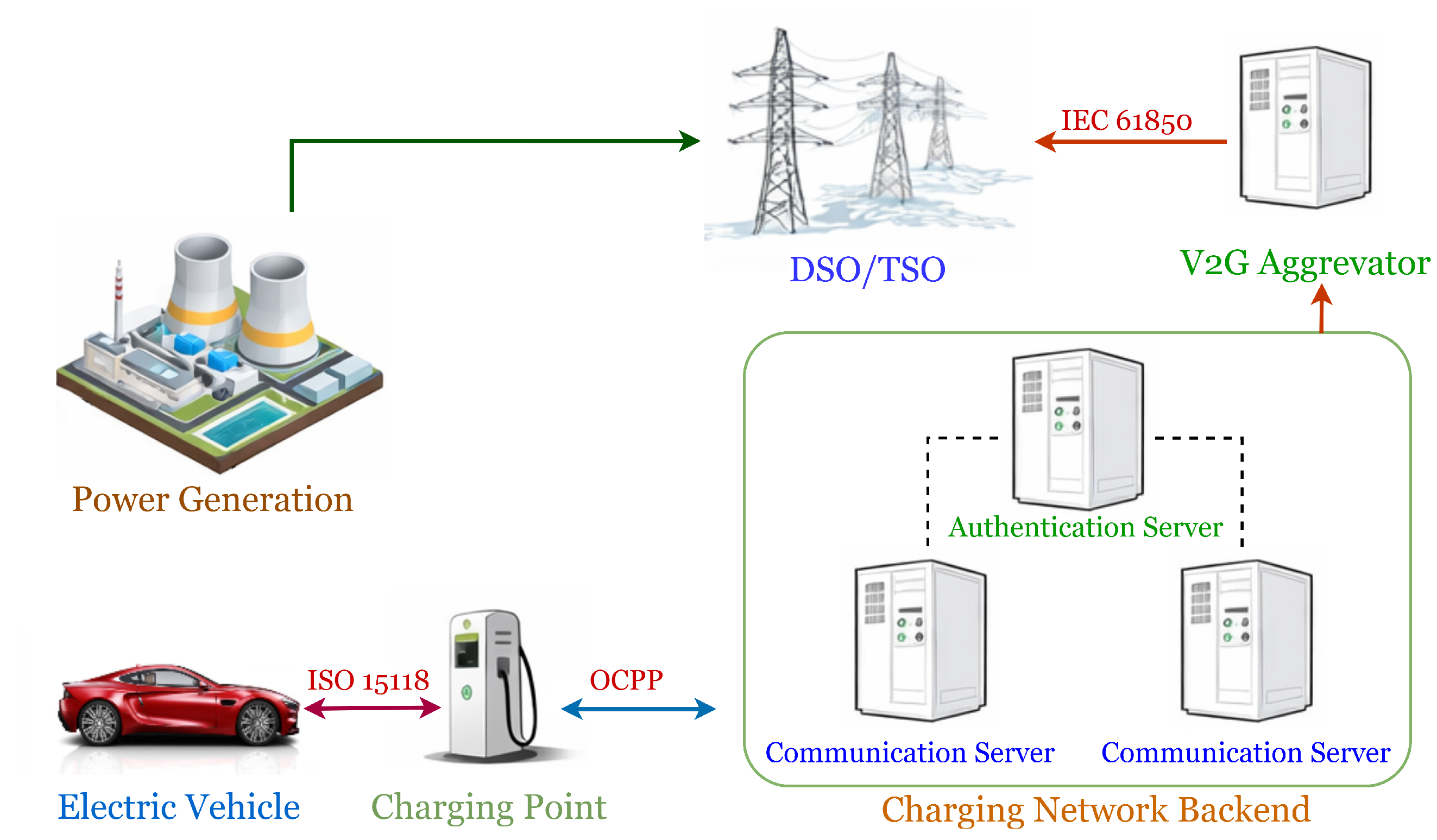
V2G environments exhibit unique characteristics that differ from conventional smart-grid communication systems. High vehicle mobility, intermittent connectivity, and short plug-in durations require rapid session establishment and reliable transmission of key information such as battery state-of-charge, EV availability, tariff signals, and dispatch instructions [123,124]. Sensitive data, including user identity, movement patterns, and charging behavior, require strong privacy safeguards and cryptographic protection [125]. As illustrated in Figure 5, the V2G communication framework integrates electric vehicles, charging points, charging-network backends, V2G aggregators, and distribution or transmission system operators (DSO/TSO), enabling hierarchical coordination between the transportation and power systems through standardized communication interfaces. Bidirectional EV–EVSE interactions are supported via ISO 15118; charger–backend communication is governed by OCPP; roaming and backend interoperability are facilitated through OCPI; and aggregator–grid coordination with DSO/TSO is enabled using utility-grade protocols such as IEC 61850 or OpenADR over secure, TLS-encrypted channels.
The traditional Wi-Fi technologies have demonstrated limitations for V2G, including variable latency, susceptibility to interference, and inadequate support for real-time grid services. Wireless power-transfer standards such as GB/T 38775.2, IEC 61980, and SAE J2954 define only the physical and link layers for inductive charging and do not address application-layer processes needed for secure bidirectional energy transactions [126]. Additional communication mechanisms are therefore necessary to support secure, real-time V2G interactions.

Scalability, Communication Latency, and Real-Time Control Stability

As V2G participation scales to very large electric-vehicle populations, potentially reaching hundreds of thousands to millions of units, communication latency and data volume impose fundamental constraints on control-system design [127]. A fully centralized architecture in which a single controller ingests high-frequency telemetry from all participating EVs and directly computes real-time control actions is not a realistic or stability-preserving assumption at such scales, as raw data streaming would lead to excessive bandwidth demand, congestion-induced latency variation, and queueing effects incompatible with closed-loop real-time control [128]. Therefore, large-scale V2G systems employ hierarchical and time-scale-separated control architectures [129]. Fast inner control loops responsible for current regulation, voltage control, protection, and grid-code compliance are implemented locally at the EV or EVSE power-electronic interface and are fully decoupled from wide-area communication networks. Intermediate controllers at the feeder or site level aggregate EVSE behavior, enforce distribution-network constraints, and exchange reduced-order flexibility representations rather than raw high-frequency measurements [130]. Upper-layer aggregators operate on slower time scales, performing scheduling, optimization, and market coordination using bounded power envelopes, availability windows, and event-triggered updates [131].
From a stability perspective, this separation of time scales is critical. Since real-time control loops are closed locally, communication latency and data-volume growth associated with large EV populations do not enter the critical control loop and therefore do not directly affect stability margins [132]. Communication delays primarily influence higher-level supervisory decisions, where slower update rates can be tolerated without destabilizing the physical system. An order-of-magnitude consideration further motivates this design. Even compact status messages transmitted by one million EVs at multi-second intervals would generate aggregate data rates on the order of hundreds of megabits per second before accounting for protocol overhead, encryption, and backend processing [133]. Centralized real-time feedback under such conditions would be highly vulnerable to congestion and jitter, reinforcing the need for aggregation, edge or fog processing, and event-driven communication [134]. Overall, scalable V2G deployment depends on control architectures that localize fast power-electronic regulation, aggregate system-level information, and limit the influence of communication latency on real-time control dynamics. This architectural separation enables stable operation under high EV penetration while supporting coordinated, communication-enabled V2G services at the system level.

4.2. Interoperability Protocols and Application-Layer Communication

Interoperability across heterogeneous charging networks relies on standardized communication protocols. ISO 15118 defines application-layer message structures for charging control, session management, tariff exchange, and Plug-and-Charge authentication [37,38]. It recommends Transport Layer Security (TLS) and X.509 certificates for ensuring confidentiality and authenticity [135]. However, unilateral authentication schemes remain susceptible to impersonation and man-in-the-middle attacks, underscoring the need for mutual authentication in secure V2G deployments [136].
The Open Charge Point Protocol (OCPP) governs communication between charging stations and backend management systems, enabling remote configuration, firmware updates, diagnostics, billing, and energy-management services [137,138]. Existing OCPP versions do not explicitly define bidirectional power-transfer commands, posing implementation challenges for fast V2G power-setpoint exchanges without protocol extensions. Roaming interoperability is provided by the OCPI, which standardizes the representation of charger locations, tariffs, connector configurations, and session metadata, allowing users to access charging resources across multiple service providers [139,140]. For full global interoperability, ISO 15118, OCPP, and OCPI must integrate with regional DC charging systems, including CHAdeMO, CCS (PLC-based), and GB/T (CAN-based), to support AC and DC bidirectional charging.

4.3. Cybersecurity Exposure in V2G and Cyber-Physical Ecosystems

The expansion of V2G increases the cyber-attack surface across transportation and power-system infrastructures. In bidirectional Vehicle-to-Grid (V2G) operation, electric vehicles evolve from passive electrical loads into active, networked cyber-physical assets, in which power exchange, digital communication, and control decisions are tightly coupled. Electric vehicles use multiple communication modules and electronic control units (ECUs) that may be exploited to gain unauthorized access, manipulate charging or discharging schedules, or disrupt grid-support functions [141]. This tight coupling fundamentally differentiates V2G cybersecurity from conventional information-technology security, as cyber intrusions can propagate directly into physical power-system behavior. While this integration enables advanced grid services and intelligent energy management, it simultaneously expands the attack surface across EVs, charging stations, backend platforms, aggregators, and grid-control interfaces [142,143]. Consequently, cybersecurity threats in V2G systems extend beyond isolated data breaches and can directly affect grid stability, service availability, and user trust.
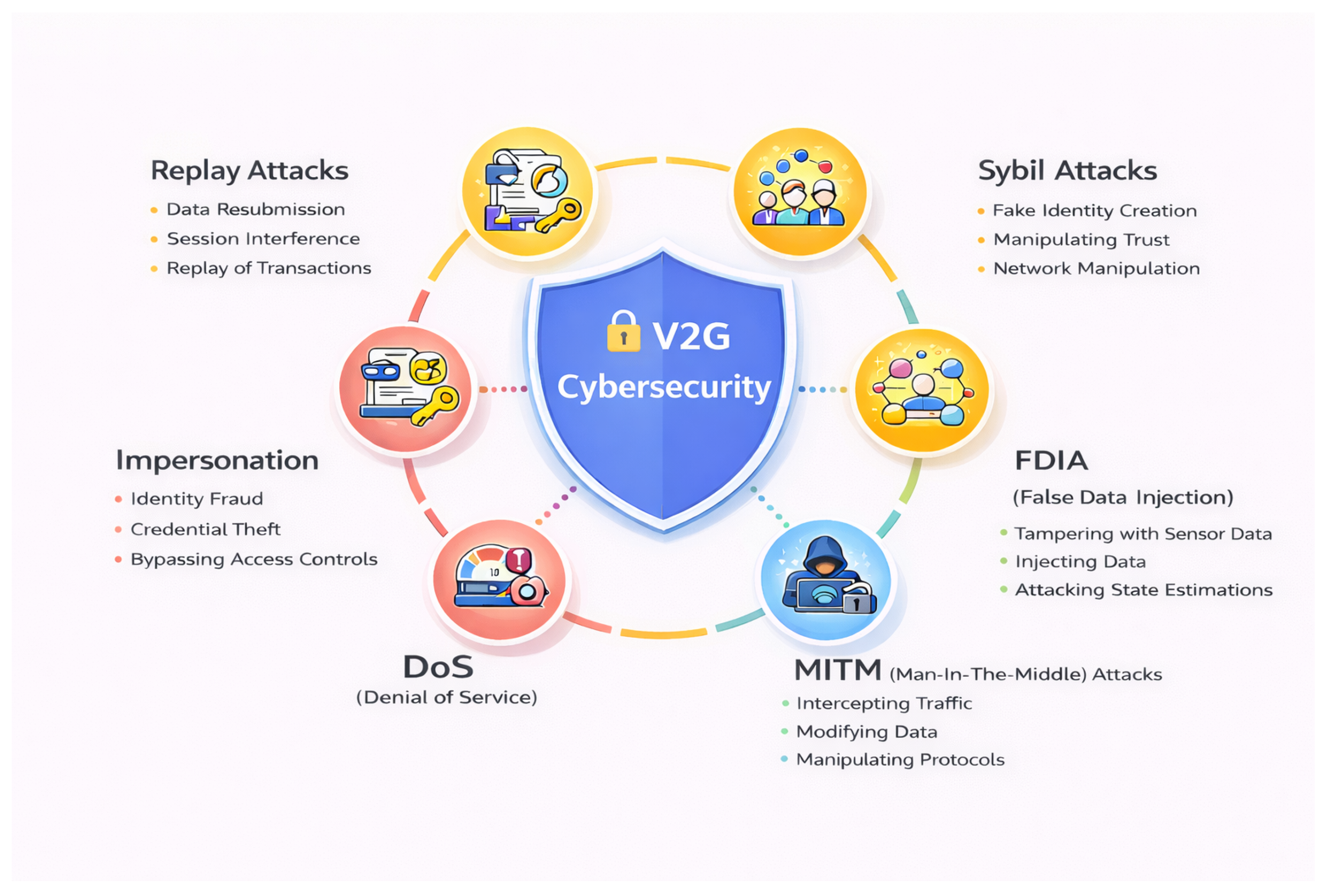
Vulnerabilities at the EV–charger interface can propagate into smart meters, distribution automation systems, protection relays, and phasor measurement units, potentially threatening broader grid stability [144,145,146]. This propagation risk highlights a critical systemic concern: attacks originating at the network edge (EVs or EVSEs) can escalate into feeder-level or system-level disturbances when vehicles participate in coordinated grid services. Key threat vectors arise at multiple layers of the EV–grid architecture. Communication links are vulnerable to interception, spoofing, replay, and man-in-the-middle attacks, which may enable unauthorized manipulation of charging commands or energy transactions [147,148]. From a control perspective, such attacks are particularly harmful because they target the integrity and timing of supervisory signals rather than merely user data. Firmware and software components at both the EV and EVSE levels present high-impact risks, as compromised updates or malicious code injection can override local control logic and propagate attacks into backend and aggregation systems [149]. Data-centric threats, including privacy leakage and false data injection, further undermine load forecasting, billing accuracy, and grid control functions [150,151]. Notably, false-data injection attacks are especially critical in V2G contexts, as they can distort state estimation and scheduling decisions without triggering immediate alarms. In addition, large-scale denial-of-service attacks targeting charging infrastructure or cloud-based energy management platforms pose significant risks to operational continuity and grid resilience [139].
V2G ecosystems are increasingly integrated with advanced digital technologies such as blockchain-based transaction systems, AI-driven forecasting, and dense IoT sensor networks [152,153,154]. Although these technologies enhance coordination, scalability, and automation, they also increase system complexity and introduce additional trust dependencies across the EV–EVSE–backend–grid chain. These systems rely on continuous real-time data exchange, making data integrity and privacy essential for operational resilience and user trust. Many existing V2G cybersecurity studies address individual attack vectors or protocol-level protections in isolation, without sufficiently accounting for their interaction with real-time control loops and grid-support functions. Figure 6 synthesizes representative cyberattack classes affecting V2G systems and illustrates their interaction with the underlying cyber-physical architecture. The figure emphasizes that identity-based attacks (e.g., impersonation and Sybil attacks), communication-layer exploits (e.g., replay and man-in-the-middle attacks), service-level disruptions (e.g., denial-of-service attacks), and control-oriented threats such as false-data injection do not operate independently. Instead, these threats can reinforce one another and propagate across communication, control, and power layers. In particular, replay and false-data injection attacks pose severe risks to grid-support services, as manipulated measurements or duplicated transactions can destabilize control loops and lead to incorrect dispatch decisions at the aggregator or grid level.
Collectively, these observations underscore that V2G cybersecurity is fundamentally a cyber-physical resilience problem rather than a purely communication or data-security challenge. Effective mitigation, therefore, requires defence-in-depth strategies that integrate secure communication protocols, strong authentication and access control, firmware integrity assurance, intrusion detection, and resilient control mechanisms aligned with confidentiality, integrity, and availability principles [139]. Rather than deploying isolated countermeasures, future V2G systems must adopt holistic, security-aware control architectures that explicitly account for how cyber incidents interact with power-electronic dynamics, aggregation logic, and grid constraints.

4.4. Security Mechanisms and Emerging Research Challenges

A comprehensive V2G security framework requires multilayered defense strategies that include cryptographic protection, identity management, secure communication channels, intrusion detection, and regular updates to EVSE and backend software. TLS-encrypted channels, certificate-based authentication, and fine-grained access control constitute the technical foundation of secure communication [155,156,157]. Strong cryptographic algorithms can impose computational burdens on embedded EVSE hardware, motivating research into lightweight or hardware-accelerated security solutions [158].
Identity-based cryptographic systems have been proposed to protect user privacy while supporting secure authentication, authorization, and billing, but these approaches require rigorous key-distribution and key-revocation mechanisms [159,160]. Hybrid architectures combining fog computing with blockchain can distribute computational workloads, create tamper-resistant transaction records, and enhance resilience of V2G energy exchanges [161]. Advanced simulation frameworks incorporating realistic mobility patterns, charging behavior, and network models are needed to study cyberattack propagation and quantify system-level impacts on grid stability [36,162]. As V2G continues to evolve, secure communication standards, interoperable protocol extensions, and cyber-physical resilience strategies will remain essential for safe and scalable deployment.
Existing V2G communication studies emphasize different system layers, leading to fragmented conclusions about deployment readiness. Networking-focused work highlights the need for low-latency, reliable communication under high mobility and short plug-in durations [123,124], while privacy-oriented analyses emphasize strong cryptographic protection for sensitive user and mobility data [125]. Protocol-level studies show that ISO 15118 enables secure EV–EVSE interaction and session management [37,38,135], yet remains vulnerable without mutual authentication [136]. Backend-focused research identifies OCPP and OCPI as essential for charger management and roaming [137,138,139,140], but notes limited native support for fast bidirectional power control. Cybersecurity analyses further demonstrate that vulnerabilities at the EV and EVSE layers can propagate into grid-control systems [141,144,145,146]. Although blockchain-based and lightweight security mechanisms improve trust and resilience [152,155,158,161], their computational and integration overhead remains a barrier to large-scale adoption.

5. Grid Aware Mobility Optimization and VGI Services

This section examines how grid-interactive vehicle integration (VGI) extends conventional V2G from stationary charging to transportation systems. Four domains are addressed: coordinated charging control, routing with integrated energy management, shared and autonomous mobility services, and pricing mechanisms for coupled power–transport networks.

5.1. Adaptive Charging Coordination in VGI Environments

Electric vehicle (EV) charging is becoming an increasingly significant load. The International Energy Agency(IEA) data indicate that EVs consumed around 180 TWh of electricity in 2024, which is about 0.7% of global final electricity use, with demand expected to increase to nearly 780 TWh by 2030 [163]. If left unmanaged, EV charging can amplify peak demand and create congestion. Coordinated charging and discharging strategies therefore aim to support grid stability, reduce operational costs, and enable services such as frequency regulation, load shifting, and improved utilization of renewable energy.
Research on VGI-aware charging typically adopts learning-based, optimization-based, or rule-based approaches.
Learning-based approaches: Reinforcement learning (RL) methods have demonstrated strong capability in addressing stochastic travel patterns and price uncertainty. Deep RL schemes in [164] minimize voltage fluctuations and charging cost under battery degradation. The framework in [165] co-optimizes charging and discharging for users and aggregators under heterogeneous mobility. Model-free deep RL in [166] minimizes cost while guaranteeing required departure SOC under uncertain arrival times and tariffs. The study in [167] incorporates price variability, degradation, and commuting patterns, confirming the suitability of RL for high-dimensional uncertainty.
Optimization-based approaches: When system constraints are well defined, mathematical programming is effective. Quadratic programming for reducing net-load variance and voltage deviations is demonstrated in [168]. A two-stage day-ahead and real-time workplace V2G optimization is developed in [169]. Multi-objective optimization in [170] reduces grid energy usage and improves BESS lifetime. The ILP model in [171] minimizes operating cost for charging-station operators under uncertain driving cycles.
Rule-based approaches: Decision-tree charging control using voltage, current, and SOC measurements is proposed in [48], supported by IoT and edge-computing for real-time V2G operation. Recent studies highlight that realistic user behavior remains insufficiently represented. Data-driven mobility models using NHTS and origin–destination datasets [172,173] better capture spatial and temporal charging variability. VGI strategies for extreme events such as heatwaves or cold spells remain limited. Commercial fleets, which possess structured routes and high utilization, are another promising but underexplored domain.

5.2. Integrated Routing and Energy Scheduling for VGI

The Electric Vehicle Routing Problem (EVRP) extends traditional routing by incorporating battery constraints, charging time, and infrastructure availability. With VGI, routing and energy scheduling become interdependent: routing choices influence V2G opportunities, while grid prices and congestion influence optimal routing.
RL-based routing with energy transactions is demonstrated in QuikRouteFinder [174], which outperforms genetic algorithms and MILP in computation time. An agent-based RL approach combining V2G and battery swapping is proposed in [175], showing approximately 5.65 times faster execution than genetic algorithms.
Classical optimization approaches include a genetic algorithm with Hidden Markov Models and trust-region optimization for V2G-aware routing [176]; a MILP formulation that jointly schedules routing and V2G exchange on an IEEE 37-bus feeder [177]; and a two-echelon GA–VNS method for routing electric trucks supported by Mobile Charging Trailers [178].
Scalable decentralized methods include a multi-agent RL framework based on a DEC-MDP for EVs equipped with PV and storage [179], and a hierarchical multi-agent RL routing–charging model for coupled transport and grid networks [180]. Economic formulations such as [181] and time-expanded V2G network models in [182] show that V2G can lower logistics costs and improve route feasibility. Overall, EVRP studies show that routing, charging, and V2G scheduling form a tightly coupled optimization problem.

5.3. Shared and Autonomous Mobility with VGI Integration

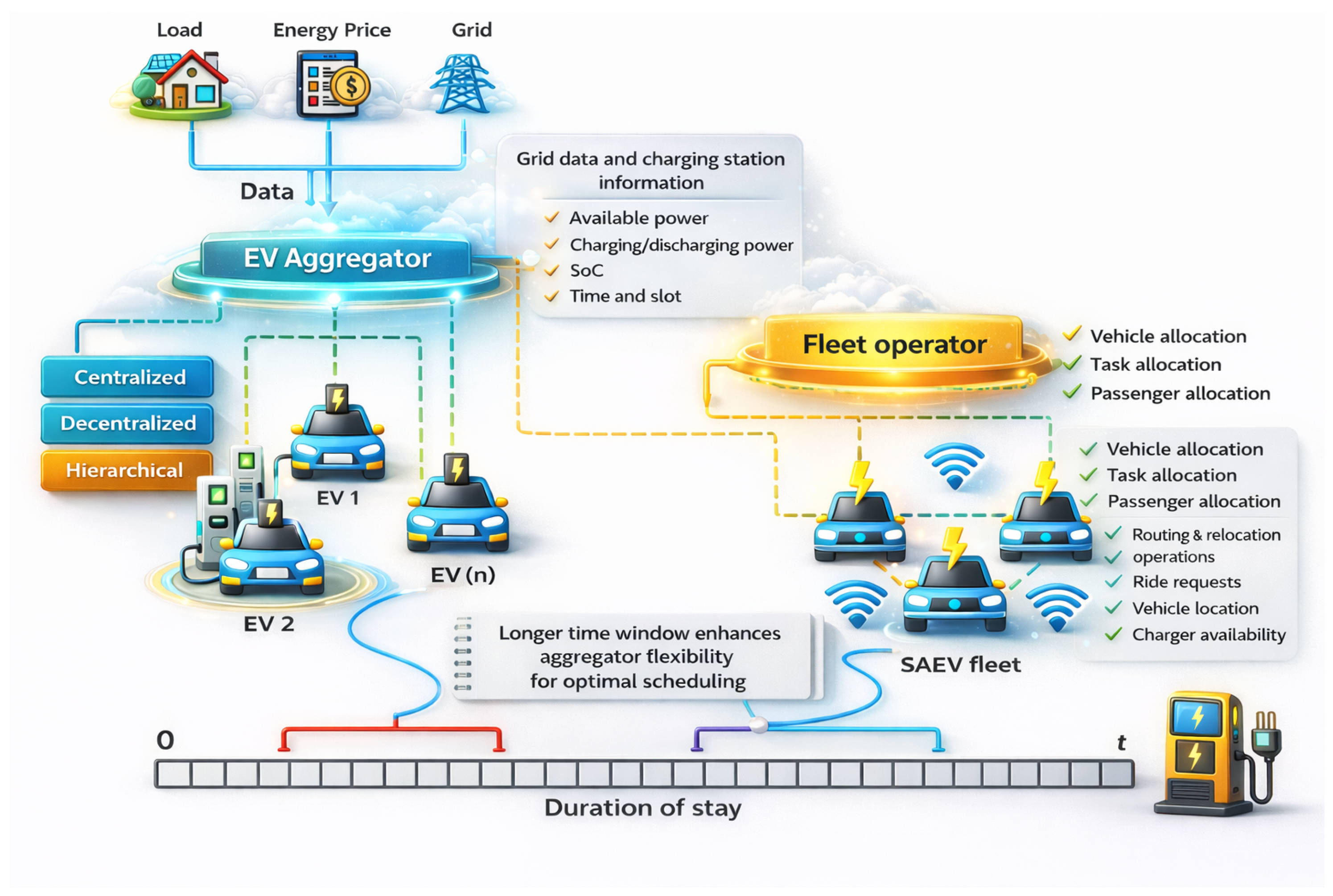
Shared mobility systems, including car sharing, ride-hailing, and on-demand delivery, exhibit high turnover and stochastic travel demand. Efficient charging policies must therefore consider relocation needs, state-of-charge (SOC) variation, and VGI opportunities. Figure 7 presents a representative VGI coordination architecture in which an EV aggregator and a fleet operator jointly manage energy and mobility decisions for shared and autonomous EV fleets. In this framework, the EV aggregator collects grid-side information such as load conditions, energy prices, and charging-station availability, and performs charging and discharging scheduling using centralized, decentralized, or hierarchical control strategies under constraints including available power, charging/discharging limits, SOC targets, and discrete time slots. In parallel, the fleet operator focuses on mobility-oriented decisions, including vehicle allocation, task and passenger assignment, routing and relocation operations, and real-time monitoring of vehicle location, ride requests, and charger availability. The interaction between these two entities enables coordinated energy–mobility optimization, in which longer, more predictable dwell-time windows for SAEVs enhance aggregator flexibility for optimal scheduling without degrading mobility service quality. Relocation challenges observed in bike-sharing systems [183] also arise in shared EV networks. A model-predictive control strategy for shared autonomous EVs that provide V2G is proposed in [184], demonstrating cost reductions and stable waiting times using Tokyo mobility data. Dynamic pricing for shared fleets is studied in [185], which forecasts station-level demand using a graph convolutional neural network and employs panel cointegration and particle filtering to optimize price signals for V2G profitability. Coupled power–transport network modelling in [186] demonstrates that integrated V2G participation and mobility dispatch can reduce energy-supply cost and increase driver revenue. Private EV owners often hesitate to participate in V2G due to concerns about degradation and convenience [187]. Centralized shared autonomous EV (SAEV) fleets are more amenable to V2G participation. Life-cycle assessment in [188] shows cost reductions of approximately 19.6%, annual V2G revenue of 2272 USD per vehicle, and significant reductions in greenhouse-gas emissions. Simulations in [184] indicate that each SAEV can replace 7–10 private vehicles and maintain a comparable level of service, with V2G revenue improving fleet economics.

5.4. Dynamic Pricing Strategies for VGI Systems

Pricing serves as a key coordination mechanism linking transport behavior and power-system objectives. Dynamic tariffs can shift charging to off-peak periods, align load with renewable availability, reduce congestion, and maintain economic feasibility. Nonlinear programming frameworks for integrated energy–traffic systems are presented in [189], which incorporate human behavior, real-time traffic data, and power-system states. A related dual-network model in [190] shows that optimized prices mitigate voltage deviations, reduce network losses, shorten queues, and redistribute charging. Game-theoretic pricing is explored in [191], where a Stackelberg formulation is used to compute V2G tariffs while accounting for battery cycling costs and user inconvenience. A more general coupled transportation–distribution pricing model in [192] demonstrates improved spatial load distribution and reduced congestion. Reinforcement learning for real-time pricing under uncertainty is studied in [193], where the SurCharge system achieves up to 24% higher revenue while respecting SOC limits and user price sensitivity. Decentralized RL strategies incorporating power-flow constraints appear in [194], and local–global pricing adaptation is shown in [195]. Future pricing research must integrate behavioral heterogeneity, detailed transport-network dynamics, and power-system constraints while ensuring computational scalability through machine learning and game-theoretic methods.
VGI studies employ diverse control paradigms, yielding differing conclusions about scalability and effectiveness. Learning-based methods adapt well to stochastic mobility and pricing uncertainty [164,165,166,167] but require extensive data and offer limited interpretability, whereas optimization-based approaches provide explicit constraint handling and performance guarantees [168,169,170,171] at the cost of higher computational complexity. Rule-based strategies are computationally efficient [48] but struggle to capture realistic user behavior and extreme events, motivating data-driven mobility models [172,173]. In routing and scheduling, reinforcement learning improves scalability compared to classical optimization [174,175], while MILP and metaheuristic methods achieve higher solution quality with increased computational burden [176,177,178]. Studies on shared and autonomous fleets show more consistent V2G participation than private ownership [184,186,188], whereas pricing-oriented analyses indicate that dynamic and learning-based tariffs can improve grid performance but require tight coupling between transport behavior and power-system constraints [189,190,191,192,193].

6. Challenges

6.1. Hardware, Infrastructure, and Grid-Integration Challenges

Despite significant progress, several hardware and infrastructure-level challenges continue to limit large-scale V2G deployment. Battery degradation under bidirectional operation remains insufficiently quantified under realistic mobility patterns, temperature variations, and heterogeneous user behavior, making it difficult to design control strategies that balance grid support with battery longevity [196]. Comprehensive reviews indicate that V2G operations can increase cyclic degradation relative to conventional usage, highlighting the importance of degradation-aware scheduling and battery management systems in practical V2G control frameworks [197]. In addition, bidirectional EVSE and on-board chargers must improve protection coordination and power-setpoint responsiveness to reliably support V2G services while complying with ride-through performance, anti-islanding protection, harmonic limits, and reactive-power requirements. Interoperability across charging ecosystems also remains fragmented, as harmonized bidirectional control, metering, and settlement semantics are still lacking across ISO 15118, OCPP, OCPI, and region-specific DC charger standards, thereby constraining cross-network and large-scale V2G deployment.

6.2. Communication, Cybersecurity, and Interoperability Challenges

Large-scale V2G participation substantially expands the cyber-physical attack surface across EVs, charging infrastructure, backend management systems, roaming interfaces, and grid-facing communication channels. Systematic reviews of V2G cybersecurity research show that while many studies address protection of EVs and charging stations, significant gaps remain in end-to-end cybersecurity frameworks that include user behavior, physical access vulnerabilities, and system recovery functions [125]. This highlights the need for defense-in-depth architectures that integrate authenticated communication, encryption, secure firmware updates, and anomaly detection with broader ecosystem resilience. Privacy protection is equally critical, as V2G relies on sensitive user information, including mobility patterns and charging behavior. Robust data governance that ensures regulatory compliance and user trust is still developing. Existing interoperability protocols were largely designed for unidirectional charging and billing and therefore require extensions to support low-latency bidirectional power commands, real-time metering, and reliable settlement across heterogeneous charging infrastructures and market platforms.

6.3. Mobility-Aware Control, Markets, and Scalability Challenges

At the system level, aggregation and coordination mechanisms must reconcile grid objectives with user convenience, uncertain plug-in durations, and highly dynamic mobility constraints. Economic assessments underscore that transparent market designs and incentive structures that fairly compensate energy delivery, grid services, and battery usage are essential to broad participation but remain underdeveloped [198]. Many existing optimization- and learning-based V2G and VGI control frameworks also lack scalability and rigorous validation under realistic distribution network constraints, protection limits, and high EV penetration scenarios, necessitating extensive simulation and field testing. Hierarchical control architectures that separate fast converter-level regulation from slower fleet-level scheduling and market decision-making are therefore essential. Finally, broader VGI applications, including shared and autonomous mobility services, require tighter coupling among transport network dynamics, routing decisions, and power system operations, underscoring the need for improved datasets and integrated models that capture real-world mobility diversity and infrastructure limitations.

7. Discussion: Deployment-Oriented Implications for V2G and VGI

The reviewed literature shows that the scalability and feasibility of V2G and broader VGI systems are determined primarily by the coherence of the overall cyber–physical architecture rather than by individual component performance. Many conflicting conclusions across prior studies stem from differing assumptions regarding control hierarchy, communication latency, battery-aging representation, and security trust models, rather than from intrinsic limitations of bidirectional power transfer [14,15,29,30].
From an architectural standpoint, fully centralized V2G control frameworks are increasingly impractical at scale. Studies on large EV populations and aggregator-based coordination demonstrate that centralized designs relying on high-frequency telemetry and real-time dispatch impose excessive communication overhead and are vulnerable to latency variation and congestion [127,128,131]. In contrast, hierarchical control architectures that localize fast current, voltage, and protection loops at the EV or EVSE level, aggregate flexibility at site or feeder controllers, and assign scheduling and market interaction to upper-layer aggregators operating on slower time scales exhibit superior scalability and stability [129,130,132]. This separation of time scales prevents communication latency from entering critical real-time control loops and preserves grid-code compliance.
Battery degradation represents a second key constraint on practical deployment. Empirical and model-based studies consistently show that V2G-induced aging depends strongly on depth of discharge, cycling frequency, current rate, and temperature, with power-oriented services such as frequency regulation causing substantially less degradation than energy-oriented services such as peak shaving and arbitrage [44,45,46]. In contrast, system-level optimization studies that rely on simplified throughput-based aging models or neglect degradation tend to overestimate long-term economic benefits [29,30]. This mismatch explains many inconsistencies in the V2G feasibility literature and reinforces the need for degradation-aware supervisory control [58,66].
Cybersecurity considerations further highlight the importance of architecture-aware design. V2G systems that tightly couple real-time control with wide-area communication are inherently more vulnerable to false-data injection, replay, and denial-of-service attacks [35,36,147]. Defense-in-depth strategies that decouple fast local control from external communication and employ authenticated, encrypted channels, secure firmware updates, and continuous monitoring significantly reduce the risk of cyber incidents propagating into physical grid behavior [139,141,149].
Overall, the reviewed evidence indicates that scalable and secure V2G deployment depends on coordinated design across power electronics, communication, control, cybersecurity, and market participation, rather than optimization within isolated technical layers. Future deployment-oriented studies should explicitly evaluate how architectural assumptions, degradation modeling fidelity, and security mechanisms interact under realistic grid and mobility conditions [36,131].

8. Conclusions

This review examined V2G and broader VGI from a system-level perspective, linking battery and BMS constraints, bidirectional power-electronic interfaces, charging infrastructure, interoperability protocols, cybersecurity exposure, and mobility-aware coordination. Scalable V2G operation is an end-to-end capability across EVs, EVSEs, backend platforms, and grid interfaces, governed by battery aging and thermal limits, BMS-enforced operating envelopes, and grid-facing converters capable of bidirectional power exchange under stringent power-quality and interconnection requirements.
At the infrastructure and standards level, conductive charging remains dominant, but practical bidirectional services depend on robust digital EV–EVSE communication and effective protection coordination. When exporting power, EVs function as inverter-based distributed energy resources and must satisfy ride-through, anti-islanding, harmonic, DC-injection, and reactive-power requirements. Large-scale V2G participation substantially expands the cyberattack surface across vehicles, charging equipment, backend systems, roaming interfaces, aggregators, and utility-facing channels, necessitating a defense-in-depth cybersecurity architecture.
At the VGI level, routing, charging, and V2G scheduling form a coupled optimization problem shaped by uncertain mobility patterns, variable plug-in durations, grid constraints, and user participation. While learning-, optimization-, and rule-based approaches offer different trade-offs, practical deployment consistently favors hierarchical coordination architectures that decouple fast converter-level regulation from slower fleet-level and market-oriented decision-making, while explicitly accounting for battery degradation.
A synthesis of the literature indicates that divergent conclusions on V2G feasibility largely arise from heterogeneous modeling assumptions and partial system representations. Although bidirectional power transfer is technically mature, scalability and economic assessments vary widely because degradation dynamics, distribution-network constraints, protection coordination, and cyber–physical interactions are often simplified or omitted. Treating cybersecurity and interoperability in isolation from control and grid-operation analysis further obscures deployment realism.
From a near-term deployment perspective, the reviewed evidence supports prioritizing edge-integrated, hierarchical, and distributed V2G architectures, where fast current, voltage, and protection control is executed locally at the EV or EVSE level, and aggregators operate on slower scheduling and market time scales using bounded flexibility representations that adapt to local grid conditions. Future deployments should increasingly align with Zero Trust Architecture (ZTA) principles, incorporating mutual authentication under ISO 15118-20, automated certificate and key lifecycle management via PKI, hardware-root-of-trust–based encrypted communication, and secure over-the-air firmware updates as baseline security requirements. From a standardization standpoint, priority should be given to operationalizing interoperability frameworks to support bidirectional V2X services, transparent State-of-Health exchange, and low-latency V2G dispatch, with harmonized alignment across ISO 15118, OCPP 2.0.1/2.1, and IEEE 1547-2018/2020 standards.
Looking ahead, future research should move beyond isolated feasibility demonstrations toward integrated, deployment-oriented evaluation frameworks that jointly consider battery degradation, grid constraints, cybersecurity, communication latency, and realistic mobility behavior. Such integrated assessments are essential for a credible evaluation of the technical and economic viability of large-scale V2G and VGI.

Author Contributions

Conceptualization, H.N., A.I., P.G. and H.H.; methodology, H.N., A.I. and K.C.; software, A.I. and P.G.; validation, H.N., A.I. and P.G.; formal analysis, H.N., P.G. and H.H.; investigation, H.N. and A.I.; resources, H.H.; data curation, A.I. and P.G.; writing—original draft preparation, H.N.; writing—review and editing, H.N., A.I., P.G. and H.H.; visualization, H.N., A.I. and P.G.; supervision, H.H.; project administration, H.N. and H.H.; funding acquisition, H.H. All authors have read and agreed to the published version of the manuscript.

Funding

The authors extend their appreciation to the Deanship of Research and Graduate Studies at King Khalid University for funding this work through the Large Research Project under grant number RGP2/343/46.

Data Availability Statement

No new data were created or analyzed in this study. Data sharing is not applicable to this article.

Conflicts of Interest

The authors declare no conflicts of interest.

References

  1. Hossain, S.; Rokonuzzaman, M.; Rahman, K.S.; Habib, A.A.; Tan, W.S.; Mahmud, M.; Chowdhury, S.; Channumsin, S. Grid-Vehicle–Grid (G2V2G) efficient power transmission: An overview of concept, operations, benefits, concerns, and future challenges. Sustainability 2023, 15, 5782. [Google Scholar] [CrossRef] [Scilit]
  2. Hannan, M.; Mollik, M.; Al-Shetwi, A.Q.; Rahman, S.; Mansor, M.; Begum, R.; Muttaqi, K.; Dong, Z. Vehicle to grid connected technologies and charging strategies: Operation, control, issues and recommendations. J. Clean. Prod. 2022, 339, 130587. [Google Scholar] [CrossRef] [Scilit]
  3. International Energy Agency. Global Electric Car Sales, 2014–2024. Licence: CC BY 4.0. 2025. Available online: https://www.iea.org/data-and-statistics/charts/global-electric-car-sales-2014-2024 (accessed on 10 January 2026).
  4. Lachvajderová, L.; Kádárová, J. Analysis of internal combustion engine vehicle, battery electric vehicle and emissions from transport. Transp. Logist. 2021, 21, 21–33. [Google Scholar]
  5. Wahid, M.R.; Budiman, B.A.; Joelianto, E.; Aziz, M. A review on drive train technologies for passenger electric vehicles. Energies 2021, 14, 6742. [Google Scholar] [CrossRef] [Scilit]
  6. Nogueira, T.; Sousa, E.; Alves, G.R. Electric vehicles growth until 2030: Impact on the distribution network power. Energy Rep. 2022, 8, 145–152. [Google Scholar] [CrossRef] [Scilit]
  7. Zhang, H.; Lei, N.; Wang, Z. Ammonia-hydrogen propulsion system for carbon-free heavy-duty vehicles. Appl. Energy 2024, 369, 123505. [Google Scholar] [CrossRef] [Scilit]
  8. Ternel, C.; Bouter, A.; Melgar, J. Life cycle assessment of mid-range passenger cars powered by liquid and gaseous biofuels: Comparison with greenhouse gas emissions of electric vehicles and forecast to 2030. Transp. Res. Part D Transp. Environ. 2021, 97, 102897. [Google Scholar] [CrossRef] [Scilit]
  9. Yu, Y.; Reihs, D.; Wagh, S.; Shekhar, A.; Stahleder, D.; Mouli, G.R.C.; Lehfuss, F.; Bauer, P. Data-driven study of low voltage distribution grid behavior with increasing electric vehicle penetration. IEEE Access 2022, 10, 6053–6070. [Google Scholar] [CrossRef] [Scilit]
  10. Rahman, I.; Mohamad-Saleh, J. Plug-in electric vehicle charging optimization using bio-inspired computational intelligence methods. In Sustainable Interdependent Networks: From Theory to Application; Springer: Berlin, Germany, 2018; pp. 135–147. [Google Scholar]
  11. Das, M.K.; Jain, S.K. Review on optimization techniques used for scheduling of electric vehicle charging. In Proceedings of the 2021 International Conference on Control, Automation, Power and Signal Processing (CAPS), Jabalpur, India, 10–12 December 2021; pp. 1–6. [Google Scholar]
  12. Thangavel, S.; Mohanraj, D.; Girijaprasanna, T.; Raju, S.; Dhanamjayulu, C.; Muyeen, S. A comprehensive review on electric vehicle: Battery management system, charging station, traction motors. IEEE Access 2023, 11, 20994–21019. [Google Scholar] [CrossRef] [Scilit]
  13. Micari, S.; Napoli, G. Electric Vehicles for a flexible energy system: Challenges and opportunities. Energies 2024, 17, 5614. [Google Scholar] [CrossRef] [Scilit]
  14. Safayatullah, M.; Elrais, M.T.; Ghosh, S.; Rezaii, R.; Batarseh, I. A comprehensive review of power converter topologies and control methods for electric vehicle fast charging applications. IEEE Access 2022, 10, 40753–40793. [Google Scholar] [CrossRef] [Scilit]
  15. Zhou, K.; Wu, Y.; Wu, X.; Sun, Y.; Teng, D.; Liu, Y. Research and development review of power converter topologies and control technology for electric vehicle fast-charging systems. Electronics 2023, 12, 1581. [Google Scholar] [CrossRef] [Scilit]
  16. Ramanathan, R. An Empirical study on MAC layer in IEEE 802.11 p/WAVE based Vehicular Ad hoc Networks. Procedia Comput. Sci. 2018, 143, 720–727. [Google Scholar]
  17. ElGhanam, E.; Hassan, M.; Osman, A.; Ahmed, I. Review of communication technologies for electric vehicle charging management and coordination. World Electr. Veh. J. 2021, 12, 92. [Google Scholar] [CrossRef] [Scilit]
  18. Naseem, H.; Hadi, A.; Kang, M.J.; Seok, J.K. Enhancing Energy Storage Efficiency: Advances in Battery Management Systems in Electric Vehicles. Energy Technol. 2025, 13, 2500100. [Google Scholar] [CrossRef] [Scilit]
  19. Joshi, A.; Sharma, R.; Baral, B. Comparative life cycle assessment of conventional combustion engine vehicle, battery electric vehicle and fuel cell electric vehicle in Nepal. J. Clean. Prod. 2022, 379, 134407. [Google Scholar] [CrossRef] [Scilit]
  20. Habib, A.A.; Hasan, M.K.; Issa, G.F.; Singh, D.; Islam, S.; Ghazal, T.M. Lithium-ion battery management system for electric vehicles: Constraints, challenges, and recommendations. Batteries 2023, 9, 152. [Google Scholar] [CrossRef] [Scilit]
  21. Wang, H.; Pourmousavi, S.A.; Soong, W.L.; Zhang, X.; Ertugrul, N. Battery and energy management system for vanadium redox flow battery: A critical review and recommendations. J. Energy Storage 2023, 58, 106384. [Google Scholar] [CrossRef] [Scilit]
  22. Fritscher, G.; Bhat, K.; Guo, Y. Enhancing Vehicle-to-Grid (V2G) technologies: Interoperability in electric vehicles within the framework of the Car2Flex project. In Proceedings of the IET Conference Proceedings CP890; IET: London, UK, 2024; Volume 2024, pp. 208–213. [Google Scholar]
  23. Xie, X.; Pan, Z.; Yin, B.; Yang, L.; Shi, R.; Tan, G. Design and assessment of V2G systems for hybrid vehicles based on fuel cells, power batteries and photovoltaic cells. Energy 2025, 334, 137764. [Google Scholar] [CrossRef] [Scilit]
  24. Venegas, F.G.; Petit, M.; Perez, Y. Plug-in behavior of electric vehicles users: Insights from a large-scale trial and impacts for grid integration studies. ETransportation 2021, 10, 100131. [Google Scholar] [CrossRef] [Scilit]
  25. Pramuanjaroenkij, A.; Kakaç, S. The fuel cell electric vehicles: The highlight review. Int. J. Hydrogen Energy 2023, 48, 9401–9425. [Google Scholar] [CrossRef] [Scilit]
  26. Mohammed, A.S.; Atnaw, S.M.; Salau, A.O.; Eneh, J.N. Review of optimal sizing and power management strategies for fuel cell/battery/super capacitor hybrid electric vehicles. Energy Rep. 2023, 9, 2213–2228. [Google Scholar] [CrossRef] [Scilit]
  27. Kashani, S.A.; Soleimani, A.; Khosravi, A.; Mirsalim, M. State-of-the-art research on wireless charging of electric vehicles using solar energy. Energies 2022, 16, 282. [Google Scholar] [CrossRef] [Scilit]
  28. Wei, H.; Wu, J.; Lv, C.; Yang, S.; Zhang, H.; Al-Haddad, K. Intelligent EV Charging Control and Management: From Microscale Battery Cell to Macroscale Grid Synergy. IEEE Trans. Intell. Veh. 2024, 10, 1693–1713. [Google Scholar] [CrossRef] [Scilit]
  29. Mojumder, M.R.H.; Ahmed Antara, F.; Hasanuzzaman, M.; Alamri, B.; Alsharef, M. Electric vehicle-to-grid (V2G) technologies: Impact on the power grid and battery. Sustainability 2022, 14, 13856. [Google Scholar] [CrossRef] [Scilit]
  30. Wang, J.; Zeng, P.; Jin, X.; Kong, F.; Wang, Z.; Li, D.; Wan, M. Software defined Wi-V2G: A V2G network architecture. IEEE Intell. Transp. Syst. Mag. 2018, 10, 167–179. [Google Scholar] [CrossRef] [Scilit]
  31. Manickam, V.K.; Dhayalini, K. Hybrid optimized control of bidirectional off-board electric vehicle battery charger integrated with vehicle-to-grid. J. Energy Storage 2024, 86, 111008. [Google Scholar] [CrossRef] [Scilit]
  32. Tirunagari, S.; Gu, M.; Meegahapola, L. Reaping the benefits of smart electric vehicle charging and vehicle-to-grid technologies: Regulatory, policy and technical aspects. IEEE Access 2022, 10, 114657–114672. [Google Scholar] [CrossRef] [Scilit]
  33. CHAdeMO Association. V2G/VGI: A Decade of In-Market Experience with Bidirectional Charging. CHAdeMO Technical Reports. December 2025. Available online: https://www.chademo.com/technology/v2g (accessed on 12 December 2025).
  34. Hecht, C.; Figgener, J.; Sauer, D.U. Protocols and interfaces for ev charging. In Next Generation Electrified Vehicles Optimised for the Infrastructure; Springer: Berlin, Germany, 2024; pp. 77–89. [Google Scholar]
  35. Bhusal, N.; Gautam, M.; Benidris, M. Cybersecurity of electric vehicle smart charging management systems. In Proceedings of the 2020 52nd North American Power Symposium (NAPS), Tempe, AZ, USA, 11–13 April 2021; pp. 1–6. [Google Scholar]
  36. Hijgenaar, S.; Ştefanov, A.; Van Voorden, A.M.; Palensky, P. Cyber Resilience of Electric Vehicle Charging in Smart Grids: The Dutch Case. IEEE Access 2025, 13, 111454–111483. [Google Scholar] [CrossRef] [Scilit]
  37. Santos, J.B.; Francisco, A.M.; Cabrita, C.; Monteiro, J.; Pacheco, A.; Cardoso, P.J. Development and implementation of a smart charging system for electric vehicles based on the ISO 15118 standard. Energies 2024, 17, 3045. [Google Scholar] [CrossRef] [Scilit]
  38. Porter, R.; Biglari-Abhari, M.; Tan, B.; Thrimawithana, D. Enhancing Security in the ISO 15118-20 EV Charging System. Green Energy Intell. Transp. 2025, 4, 100262. [Google Scholar] [CrossRef] [Scilit]
  39. Hettiarachchi, N.; Mandal, K.; Hakak, S. Enhancing Anonymity for Electric Vehicles in the ISO 15118 Plug-and-Charge. In Proceedings of the 22nd International Conference on Security and Cryptography (SECRYPT 2025), Bilbao, Spain, 11–13 June 2025; pp. 475–482. [Google Scholar] [CrossRef] [Scilit]
  40. Kumar, S.; Abu-Siada, A.; Das, N.; Islam, S. Review of the legacy and future of IEC 61850 protocols encompassing substation automation system. Electronics 2023, 12, 3345. [Google Scholar] [CrossRef] [Scilit]
  41. Sultana, Z.; Basha, C.H.; Irfan, M.M. Communication Protocols for Electric Vehicles: A Comprehensive Analysis. In Proceedings of the 2024 4th International Conference on Sustainable Expert Systems (ICSES), Kaski, Nepal, 15–17 October 2024; pp. 127–133. [Google Scholar]
  42. Cheikh-Mohamad, S.; Celik, B.; Sechilariu, M.; Locment, F. PV-powered charging station with energy cost optimization via V2G services. Appl. Sci. 2023, 13, 5627. [Google Scholar] [CrossRef] [Scilit]
  43. Ravi, S.S.; Aziz, M. Utilization of electric vehicles for vehicle-to-grid services: Progress and perspectives. Energies 2022, 15, 589. [Google Scholar] [CrossRef] [Scilit]
  44. Qiu, Y.L.; Wang, Y.D.; Iseki, H.; Shen, X.; Xing, B.; Zhang, H. Empirical grid impact of in-home electric vehicle charging differs from predictions. Resour. Energy Econ. 2022, 67, 101275. [Google Scholar] [CrossRef] [Scilit]
  45. Thingvad, A.; Calearo, L.; Andersen, P.B.; Marinelli, M. Empirical capacity measurements of electric vehicles subject to battery degradation from V2G services. IEEE Trans. Veh. Technol. 2021, 70, 7547–7557. [Google Scholar] [CrossRef] [Scilit]
  46. Benedetto, G.; Bompard, E.; Mazza, A.; Pons, E.; Jaboeuf, R.; Tosco, P.; Zampolli, M. Impact of bidirectional EV charging stations on a distribution network: A Power Hardware-In-the-Loop implementation. Sustain. Energy Grids Netw. 2023, 35, 101106. [Google Scholar] [CrossRef] [Scilit]
  47. Kapassa, E.; Themistocleous, M.; Christodoulou, K.; Iosif, E. Blockchain application in internet of vehicles: Challenges, contributions and current limitations. Future Internet 2021, 13, 313. [Google Scholar] [CrossRef] [Scilit]
  48. Chamola, V.; Sancheti, A.; Chakravarty, S.; Kumar, N.; Guizani, M. An IoT and edge computing based framework for charge scheduling and EV selection in V2G systems. IEEE Trans. Veh. Technol. 2020, 69, 10569–10580. [Google Scholar] [CrossRef] [Scilit]
  49. Sarkar, A.; Daripa, K.; Khan, M.Z.; Noorwali, A. Cloud enabled blockchain-based secured communication in mutual intelligent transportation using neural synchronization. Veh. Commun. 2022, 38, 100533. [Google Scholar] [CrossRef] [Scilit]
  50. Metere, R.; Neaimeh, M.; Morisset, C.; Maple, C.; Bellekens, X.; Czekster, R.M. Securing the electric vehicle charging infrastructure. arXiv 2021, arXiv:2105.02905. [Google Scholar]
  51. Chen, L.; Zhou, J.; Chen, Y.; Cao, Z.; Dong, X.; Choo, K.K.R. PADP: Efficient privacy-preserving data aggregation and dynamic pricing for vehicle-to-grid networks. IEEE Internet Things J. 2020, 8, 7863–7873. [Google Scholar] [CrossRef] [Scilit]
  52. Liang, Y.; Liu, Y.; Zhang, X.; Liu, G. Physically secure and privacy-preserving charging authentication framework with data aggregation in vehicle-to-grid networks. IEEE Trans. Intell. Transp. Syst. 2024, 25, 18831–18846. [Google Scholar] [CrossRef] [Scilit]
  53. Wu, T.; Li, G.; Wang, J.; Xiao, B.; Song, Y. PPCA: Privacy-Preserving Continuous Authentication Scheme with Consistency Proof for Zero-Trust Architecture Networks. IEEE Internet Things J. 2025, 12, 17596–17609. [Google Scholar] [CrossRef] [Scilit]
  54. Yu, S.; Park, K. PUF-based robust and anonymous authentication and key establishment scheme for V2G networks. IEEE Internet Things J. 2024, 11, 15450–15464. [Google Scholar]
  55. Lin, X.; Park, J.; Liu, L.; Lee, Y.; Sastry, A.; Lu, W. A comprehensive capacity fade model and analysis for Li-ion batteries. J. Electrochem. Soc. 2013, 160, A1701. [Google Scholar] [CrossRef] [Scilit]
  56. Dubarry, M.; Baure, G.; Anseán, D. Perspective on state-of-health determination in lithium-ion batteries. J. Electrochem. Energy Convers. Storage 2020, 17, 044701. [Google Scholar] [CrossRef] [Scilit]
  57. Fang, R.; Dong, P.; Ge, H.; Fu, J.; Li, Z.; Zhang, J. Capacity plunge of lithium-ion batteries induced by electrolyte drying-out: Experimental and Modeling Study. J. Energy Storage 2021, 42, 103013. [Google Scholar] [CrossRef] [Scilit]
  58. Edge, J.S.; O’Kane, S.; Prosser, R.; Kirkaldy, N.D.; Patel, A.N.; Hales, A.; Ghosh, A.; Ai, W.; Chen, J.; Yang, J.; et al. Lithium ion battery degradation: What you need to know. Phys. Chem. Chem. Phys. 2021, 23, 8200–8221. [Google Scholar] [CrossRef] [Scilit]
  59. Hu, X.; Xu, L.; Lin, X.; Pecht, M. Battery lifetime prognostics. Joule 2020, 4, 310–346. [Google Scholar] [CrossRef] [Scilit]
  60. Liu, Y.; Shi, H.; Wu, Z.S. Recent status, key strategies and challenging perspectives of fast-charging graphite anodes for lithium-ion batteries. Energy Environ. Sci. 2023, 16, 4834–4871. [Google Scholar] [CrossRef] [Scilit]
  61. Diao, W.; Kim, J.; Azarian, M.H.; Pecht, M. Degradation modes and mechanisms analysis of lithium-ion batteries with knee points. Electrochim. Acta 2022, 431, 141143. [Google Scholar] [CrossRef] [Scilit]
  62. Logan, E.; Dahn, J. Electrolyte design for fast-charging Li-ion batteries. Trends Chem. 2020, 2, 354–366. [Google Scholar] [CrossRef] [Scilit]
  63. Shan, Y.; Li, L.; Yang, X. Solid-state polymer electrolyte solves the transfer of lithium ions between the solid–solid interface of the electrode and the electrolyte in lithium–sulfur and lithium-ion batteries. ACS Appl. Energy Mater. 2021, 4, 5101–5112. [Google Scholar] [CrossRef] [Scilit]
  64. You, H.; Wang, X.; Zhu, J.; Jiang, B.; Han, G.; Wei, X.; Dai, H. Investigation of lithium-ion battery nonlinear degradation by experiments and model-based simulation. Energy Storage Mater. 2024, 65, 103083. [Google Scholar] [CrossRef] [Scilit]
  65. Tang, R.; Xu, Y.; Dong, J.; Shi, Q.; Yan, K.; Guan, Y.; Lu, Y.; Su, Y.; Liu, J.; Zhao, F.; et al. Thermal-overdischarge coupling induced aging mechanisms in LiFePO4 batteries: Insights from multi-scale electrochemical and material diagnostics. Appl. Energy 2025, 401, 126870. [Google Scholar] [CrossRef] [Scilit]
  66. Rehan, M. Modelling the Degradation of Li-Ion Batteries in Mobility and Stationary Applications Based on Operational Stress Factors. Master’s Thesis, Aalto University, Espoo, Finland, 2024. [Google Scholar]
  67. Elmahallawy, M.; Elfouly, T.; Alouani, A.; Massoud, A.M. A comprehensive review of lithium-ion batteries modeling, and state of health and remaining useful lifetime prediction. IEEE Access 2022, 10, 119040–119070. [Google Scholar] [CrossRef] [Scilit]
  68. Sivalertporn, K.; Poopanya, P.; Phophongviwat, T. Capacity Forecasting of Lithium-Ion Batteries Using Empirical Models: Toward Efficient SOH Estimation with Limited Cycle Data. Energies 2025, 18, 3828. [Google Scholar] [CrossRef] [Scilit]
  69. Ke, X. Semi-Empirical Calendar and Cycling Life Aging Modeling of Li-Ion Batteries: A Perspective. 2025. Available online: https://ssrn.com/abstract=5274496 (accessed on 11 January 2026).
  70. Sarkar, S.; Halim, S.Z.; El-Halwagi, M.M.; Khan, F.I. Electrochemical models: Methods and applications for safer lithium-ion battery operation. J. Electrochem. Soc. 2022, 169, 100501. [Google Scholar] [CrossRef] [Scilit]
  71. Akbar, K.; Zou, Y.; Awais, Q.; Baig, M.J.A.; Jamil, M. A machine learning-based robust state of health (SOH) prediction model for electric vehicle batteries. Electronics 2022, 11, 1216. [Google Scholar] [CrossRef] [Scilit]
  72. Cavus, M.; Dissanayake, D.; Bell, M. Next generation of electric vehicles: AI-driven approaches for predictive maintenance and battery management. Energies 2025, 18, 1041. [Google Scholar] [CrossRef] [Scilit]
  73. Pu, R.; Wang, S.; Chen, X.; Huang, J.; He, M.; Cao, W. A novel cuckoo search particle filtering strategy for the remaining useful life prediction of the lithium-ion batteries in hybrid electric vehicle. Int. J. Energy Res. 2022, 46, 21703–21715. [Google Scholar] [CrossRef] [Scilit]
  74. Li, J.; Zhang, M.; Zheng, H.; Jie, J. Battery remaining useful life prediction using improved mutated particle filter. Energy Storage 2021, 3, e218. [Google Scholar] [CrossRef] [Scilit]
  75. Curado Fernandes, N.A. Optimizing Electric Fleet Management with Vehicle-to-Grid Services for Profitability and Grid Stability: A Case Study of Ridehailing in Lisbon. Master’s Thesis, Instituto Superior Técnico, Universidade de Lisboa, Lisbon, Portugal, 2025. [Google Scholar]
  76. Nemati, F. Developing Business Models for Battery Participation in Electricity Markets: Integrating Ancillary Services, Technical Requirements, and Battery Degradation for Economic Optimization. Master’s Thesis, Malardalen University, Västerås, Sweden, 2025. [Google Scholar]
  77. Niazi, M.A.; Kumar, V.; Sajid, Q.; Koondhar, M.A.; Kim, Y.S.; Zainuri, M.A.A.M.; Touti, E. A Physics-Informed Reinforcement Learning Approach to Vehicle-to-Grid Control with Real-Time Battery Degradation. IEEE Access 2026, 14, 7879–7894. [Google Scholar] [CrossRef] [Scilit]
  78. Habib, S.; Khan, M.M.; Abbas, F.; Sang, L.; Shahid, M.U.; Tang, H. A comprehensive study of implemented international standards, technical challenges, impacts and prospects for electric vehicles. IEEE Access 2018, 6, 13866–13890. [Google Scholar] [CrossRef] [Scilit]
  79. Niu, S.; Xu, H.; Sun, Z.; Shao, Z.; Jian, L. The state-of-the-arts of wireless electric vehicle charging via magnetic resonance: Principles, standards and core technologies. Renew. Sustain. Energy Rev. 2019, 114, 109302. [Google Scholar] [CrossRef] [Scilit]
  80. Zahedmanesh, A. Optimal Management of Vehicle-to-Grid and Grid-to-Vehicle Services Considering Reliability and Power Quality Constraints. Ph.D. Thesis, University of Wollongong, Wollongong, Australia, 2021. [Google Scholar]
  81. Deb, N.; Singh, R.; Brooks, R.R.; Bai, K. A review of extremely fast charging stations for electric vehicles. Energies 2021, 14, 7566. [Google Scholar] [CrossRef] [Scilit]
  82. Sawant, V.; Zambare, P. DC fast charging stations for electric vehicles: A review. Energy Convers. Econ. 2024, 5, 54–71. [Google Scholar] [CrossRef] [Scilit]
  83. Boroyevich, D.; Cvetković, I.; Dong, D.; Burgos, R.; Wang, F.; Lee, F. Future electronic power distribution systems a contemplative view. In Proceedings of the 2010 12th International Conference on Optimization of Electrical and Electronic Equipment, Brasov, Romania, 20–22 May 2010; pp. 1369–1380. [Google Scholar]
  84. Kouadio, K.A. Performance Evaluation of on Board Charger (OBC) for Electric Vehicles. Master’s Thesis, The University of West Florida, Pensacola, FL, USA, 2025. [Google Scholar]
  85. Wouters, H.; Martinez, W. Bidirectional onboard chargers for electric vehicles: State-of-the-art and future trends. IEEE Trans. Power Electron. 2023, 39, 693–716. [Google Scholar] [CrossRef] [Scilit]
  86. Yuan, J.; Dorn-Gomba, L.; Callegaro, A.D.; Reimers, J.; Emadi, A. A review of bidirectional on-board chargers for electric vehicles. IEEE Access 2021, 9, 51501–51518. [Google Scholar] [CrossRef] [Scilit]
  87. Monteiro, V.; Afonso, J.; Sousa, T.; Afonso, J.L. The role of off-board EV battery chargers in smart homes and smart grids: Operation with renewables and energy storage systems. In Electric Vehicles in Energy Systems: Modelling, Integration, Analysis, and Optimization; Springer: Berlin, Germany, 2020; pp. 47–72. [Google Scholar]
  88. Lenka, R.K.; Panda, A.K.; Dash, A.R.; Senapati, L.; Tiwary, N. A unified control of grid-interactive off-board EV battery charger with improved power quality. IEEE Trans. Transp. Electrif. 2022, 9, 920–933. [Google Scholar] [CrossRef] [Scilit]
  89. Tasnim, M.N.; Riana, J.M.K.; Shams, T.; Shahjalal, M.; Subhani, N.; Ahmed, M.R.; Iqbal, A. A critical review on contemporary power electronics interface topologies to vehicle-to-grid technology: Prospects, challenges, and directions. IET Power Electron. 2024, 17, 157–181. [Google Scholar] [CrossRef] [Scilit]
  90. Rita, M.M.D. Multi-Port Electric Vehicle Charging Solution: Concept and Design. Master’s Thesis, Instituto Superior Técnico, Universidade de Lisboa, Lisbon, Portugal, 2024. [Google Scholar]
  91. Acharige, S.S.; Haque, M.E.; Arif, M.T.; Hosseinzadeh, N. Review of electric vehicle charging technologies, configurations, and architectures. arXiv 2022, arXiv:2209.15242. [Google Scholar] [CrossRef] [Scilit]
  92. Purushothaman, D.; Narayanamoorthi, R.; Elrashidi, A.; Kotb, H. A comprehensive review on single-stage WPT converter topologies and power factor correction methodologies in EV charging. IEEE Access 2023, 11, 135529–135555. [Google Scholar] [CrossRef] [Scilit]
  93. Zheng, P. Advanced Topologies and Control for High-Efficiency Bidirectional Power Converters for Use in Electric Vehicles with On-Board Solar Generation. Ph.D. Thesis, McMaster University, Hamilton, ON, Canada, 2023. [Google Scholar]
  94. Mouli, G.R.C.; Kaptein, J.; Bauer, P.; Zeman, M. Implementation of dynamic charging and V2G using Chademo and CCS/Combo DC charging standard. In Proceedings of the 2016 IEEE Transportation Electrification Conference and Expo (ITEC), Dearborn, MI, USA, 27–29 June 2016; pp. 1–6. [Google Scholar]
  95. Rumale, S.; Al Ashkar, H.; Kerner, T.; Koya, F.; Eitzenberger, M. Design and implementation of an on-board vehicle CHAdeMO interface for vehicle-to-grid applications. Proc. IEEE Int. Conf. Power Electron., Smart Grid Renew. Energy (PESGRE 2020), Kochi, India, 2–4 January 2020; pp. 1–6. [Google Scholar]
  96. Yoshida, M.; Maruta, O.; Yamabe, T.B.; Casanova, M.Z. Charging infrastructure-how to contribute to the power grid. In Proceedings of the 2022 International Power Electronics Conference (IPEC-Himeji 2022-ECCE Asia), Himeji, Japan, 15–19 May 2022; pp. 230–233. [Google Scholar]
  97. Zhang, X.; Ni, F.; Dai, M.; Li, X.; Sang, L.; Cheng, L. Research on the design and verification of the charging compatibility for electric vehicle ChaoJi charging. Energy Rep. 2022, 8, 116–125. [Google Scholar] [CrossRef] [Scilit]
  98. Zhang, Y.; Wang, Y.; Dong, C.; Gu, D.; Zhou, B.; Yin, H. Research on Priority Introduction Scenarios and Strategies of ChaoJi Charging Standards in EV Market. In Proceedings of the 2025 7th Asia Energy and Electrical Engineering Symposium (AEEES), Chengdu, China, 28–31 March 2025; pp. 1285–1289. [Google Scholar]
  99. NAIR, G.; Yadav, S.K.; Thote, A.M. Advancements in Electric Vehicle Charging Connectors: Towards a Universal Charging Connector. Available online: https://ssrn.com/abstract=4750830 (accessed on 11 January 2026).
  100. Mishra, P.; Miller, E.; Santhanagopalan, S.; Bennion, K.; Meintz, A. A framework to analyze the requirements of a multiport megawatt-level charging station for heavy-duty electric vehicles. Energies 2022, 15, 3788. [Google Scholar] [CrossRef] [Scilit]
  101. Willrett, U. Innovative Charging Functions using ISO. In Antriebe und Energiesysteme von Morgen 2023; Springer: Berlin, Germany, 2025; p. 241. [Google Scholar]
  102. Willrett, U. Innovative charging functions using iso 15118-20. In Proceedings of the International Stuttgart Symposium; Springer: Berlin, Germany, 2023; pp. 93–102. [Google Scholar]
  103. Ashfaq, M.; Butt, O.; Selvaraj, J.; Rahim, N. Assessment of electric vehicle charging infrastructure and its impact on the electric grid: A review. Int. J. Green Energy 2021, 18, 657–686. [Google Scholar] [CrossRef] [Scilit]
  104. Pradhan, P. Quantifying and Managing the Impact of Electric Vehicles on Power Distribution Assets. Ph.D. Thesis, Edith Cowan University, Perth, Australia, 2023. [Google Scholar] [CrossRef]
  105. Rathore, A.K.; Rajagopal, P.U. Power electronic applications, grid codes, power quality issues, and electricity markets for distributed generation. In Handbook of Distributed Generation: Electric Power Technologies, Economics and Environmental Impacts; Springer: Berlin, Germany, 2017; pp. 631–684. [Google Scholar]
  106. Naseem, H.; Seok, J.K. Reactive Power Controller for Single Phase Dual Active Bridge DC–DC Converters. IEEE Access 2023, 11, 141537–141546. [Google Scholar] [CrossRef] [Scilit]
  107. Saraswathi, V.; Ramachandran, V.P. A comprehensive review on charger technologies, types, and charging stations models for electric vehicles. Heliyon 2024, 10, e38945. [Google Scholar] [CrossRef] [Scilit]
  108. Zanatta, N.; Caldognetto, T.; Biadene, D.; Spiazzi, G.; Mattavelli, P. A two-stage dc-dc isolated converter for battery-charging applications. IEEE Open J. Power Electron. 2023, 4, 343–356. [Google Scholar] [CrossRef] [Scilit]
  109. Wang, Z.; Su, X.; Zeng, N.; Jiang, J. Overview of isolated bidirectional dc–dc converter topology and switching strategies for electric vehicle applications. Energies 2024, 17, 2434. [Google Scholar] [CrossRef] [Scilit]
  110. Quiroga, A.; Bayona, J.; Espitia, H. Review of Converter Circuits with Power Factor Correction. Technologies 2025, 13, 221. [Google Scholar] [CrossRef] [Scilit]
  111. Özlük, M.F.; Gökdağ, M.; Gülbudak, O. Improved dynamic response of bridgeless ac/dc power factor correction converter using digital pulse train control strategy. J. Power Electron. 2025, 25, 1785–1799. [Google Scholar] [CrossRef] [Scilit]
  112. Dadhaniya, P.; Maurya, M.; Vishwanath, G.M. A bridgeless modified boost converter to improve power factor in EV battery charging applications. IEEE J. Emerg. Sel. Top. Ind. Electron. 2024, 5, 553–564. [Google Scholar] [CrossRef] [Scilit]
  113. Naseem, H.; Seok, J.K. Recent advances in bidirectional converters and regenerative braking systems in electric vehicles. Actuators 2025, 14, 347. [Google Scholar] [CrossRef] [Scilit]
  114. Dewangan, S.K.; Sahu, L.K.; Tiwari, A.K. Single phase isolated onboard charger for electric vehicle. In Proceedings of the 2022 2nd Asian Conference on Innovation in Technology (ASIANCON), Ravet, India, 26–28 August 2022; pp. 1–6. [Google Scholar]
  115. Kim, I.; Park, J.W. Integration of DC–DC converters for OBC, LDC, and TC in electric vehicles. IEEE Trans. Transp. Electrif. 2023, 10, 5533–5543. [Google Scholar] [CrossRef] [Scilit]
  116. Jo, C.H.; Kim, D.H. A Novel Integrated OBC and LDC System with Improved Cross-Regulation Performance for Electric Vehicles. IEEE Trans. Ind. Electron. 2024, 72, 1452–1465. [Google Scholar] [CrossRef] [Scilit]
  117. Joy, A.V.; Kangappadan, E.T.; Prasad, A.; Nandakishore, K.; Ismail, T. On-Board Electric Vehicle Charger Using Phase Shifted Single Phase DC-DC Converter and Totem Pole Power Factor Correction Converter. In Proceedings of the 2024 International Conference on Advancement in Renewable Energy and Intelligent Systems (AREIS), Thrissur, India, 5–6 December 2024; pp. 1–5. [Google Scholar]
  118. Naseem, H.; Seok, J.K. Triple-phase shift power-level controller (TPSPC) for single-phase dual active bridge (DAB) DC/DC converter. In Proceedings of the 2022 IEEE Energy Conversion Congress and Exposition (ECCE), Detroit, MI, USA, 9–13 October 2022; pp. 1–5. [Google Scholar]
  119. Mollahasanoğlu, M.; Okumuş, H.İ. A Review of Three Phase AC–DC Power Factor Correction Converters for Electric Vehicle Fast Charging. Eur. J. Sci. Technol. 2021, 32, 663–669. [Google Scholar] [CrossRef] [Scilit]
  120. Mollahasanoğlu, M.; Mollahasanoğlu, H.; OKUMUŞ, H.İ. New modified carrier-based level-shifted PWM control for NPC rectifiers considered for implementation in EV fast chargers. Turk. J. Electr. Eng. Comput. Sci. 2023, 31, 1255–1275. [Google Scholar] [CrossRef] [Scilit]
  121. Song, T.; Wang, P.; Zhang, Y.; Gao, F.; Tang, Y.; Pholboon, S. Suppression method of current harmonic for three-phase PWM rectifier in EV charging system. IEEE Trans. Veh. Technol. 2020, 69, 9634–9642. [Google Scholar] [CrossRef] [Scilit]
  122. Fessler, A.; Schmidt, L.; Kallo, J. Principle for a Boost-Converter Derived Three-Phase-PFC-Rectifier for Charging Stations and Industrial Applications. In Proceedings of the PELSS 2024, Power Electronics Student Summit, Kassel, Germany, 21–23 August 2024; VDE: Berlin, Germany, 2024; pp. 47–52. [Google Scholar]
  123. Hasan, M.K.; Habib, A.A.; Islam, S.; Balfaqih, M.; Alfawaz, K.M.; Singh, D. Smart grid communication networks for electric vehicles empowering distributed energy generation: Constraints, challenges, and recommendations. Energies 2023, 16, 1140. [Google Scholar] [CrossRef] [Scilit]
  124. Kaur, K.; Garg, S.; Kaddoum, G.; Gagnon, F.; Ahmed, S.H.; Guizani, M. A secure, lightweight, and privacy-preserving authentication scheme for V2G connections in smart grid. In Proceedings of the IEEE INFOCOM 2019—IEEE Conference on Computer Communications Workshops (INFOCOM WKSHPS), Paris, France, 29 April–2 May 2019; pp. 541–546. [Google Scholar]
  125. Razzaque, M.A.; Khadem, S.K.; Patra, S.; Okwata, G.; Noor-A-Rahim, M. Cybersecurity in vehicle-to-grid (V2G) systems: A systematic review. Appl. Energy 2025, 398, 126364. [Google Scholar] [CrossRef] [Scilit]
  126. Guo, J.; He, J.; Zhang, Y. The development of wireless charging technology in the electric vehicle. Highlights Sci. Eng. Technol. 2023, 43, 1–10. [Google Scholar] [CrossRef] [Scilit]
  127. Minchala-Ávila, C.; Arévalo, P.; Ochoa-Correa, D. A systematic review of model predictive control for robust and efficient energy management in electric vehicle integration and V2G applications. Modelling 2025, 6, 20. [Google Scholar] [CrossRef] [Scilit]
  128. Dávila-Sacoto, M.; González, L.G.; Zorita-Lamadrid, Á.L.; Espinoza, J.L. Effect of latency and charge control of electric vehicles in power grids with high penetration of photovoltaic solar energy. Renew. Energies 2025, 3, 27533735251342114. [Google Scholar] [CrossRef] [Scilit]
  129. Yamashita, D.Y.; Vechiu, I.; Gaubert, J.P.; Jupin, S. Hierarchical model predictive control to coordinate a vehicle-to-grid system coupled to building microgrids. IEEE Trans. Ind. Appl. 2022, 59, 169–179. [Google Scholar] [CrossRef] [Scilit]
  130. González-Garrido, A.; González-Pérez, M.; Asensio, F.J.; Cortes-Borray, A.F.; Santos-Mugica, M.; Vicente-Figueirido, I. Hierarchical control for collaborative electric vehicle charging to alleviate network congestion and enhance EV hosting in constrained distribution networks. Renew. Energy 2024, 230, 120823. [Google Scholar] [CrossRef] [Scilit]
  131. Giordano, F.; Diaz-Londono, C.; Gruosso, G. Comprehensive aggregator methodology for evs in v2g operations and electricity markets. IEEE Open J. Veh. Technol. 2023, 4, 809–819. [Google Scholar] [CrossRef] [Scilit]
  132. Ahmad, B.; Ding, J.; Ali, T.; Sarwatt, D.S.; Arshad, R.; Philipo, A.G.; Ning, H. Vehicle-to-Grid Integration: Ensuring Grid Stability, Strengthening Cybersecurity, and Advancing Energy Market Dynamics. arXiv 2025, arXiv:2509.13393. [Google Scholar]
  133. Zeinali, M.; Erdogan, N.; Bayram, I.S.; Thompson, J.S. Impact of communication system characteristics on electric vehicle grid integration: A large-scale practical assessment of the UK’s cellular network for the internet of energy. Electricity 2023, 4, 309–319. [Google Scholar] [CrossRef] [Scilit]
  134. Zhdanova, M.; Urbansky, J.; Hagemeier, A.; Zelle, D.; Herrmann, I.; Höffner, D. Local power grids at risk–an experimental and simulation-based analysis of attacks on vehicle-to-grid communication. In Proceedings of the 38th Annual Computer Security Applications Conference, Austin, TX, USA, 5–9 December 2022; pp. 42–55. [Google Scholar]
  135. Vaidya, B.; Makrakis, D.; Mouftah, H. Effective public key infrastructure for vehicle-to-grid network. In Proceedings of the Fourth ACM International Symposium on Development and Analysis of Intelligent Vehicular Networks and Applications, Montreal, QC, Canada, 21–26 September 2014; pp. 95–101. [Google Scholar]
  136. Sahinler, G.B.; Poyrazoglu, G. V2G applicable electric vehicle chargers, power converters & their controllers: A review. In Proceedings of the 2020 2nd Global Power, Energy and Communication Conference (GPECOM), Izmir, Turkey, 20–23 October 2020; pp. 59–64. [Google Scholar]
  137. Garofalaki, Z.; Kosmanos, D.; Moschoyiannis, S.; Kallergis, D.; Douligeris, C. Electric vehicle charging: A survey on the security issues and challenges of the open charge point protocol (OCPP). IEEE Commun. Surv. Tutor. 2022, 24, 1504–1533. [Google Scholar] [CrossRef] [Scilit]
  138. Gandhi, K.; Morsi, W.G. Impact of the open charge point protocol between the electric vehicle and the fast charging station on the cybersecurity of the smart grid. In Proceedings of the 2022 IEEE Canadian Conference on Electrical and Computer Engineering (CCECE), Halifax, NS, Canada, 18–20 September 2022; pp. 235–240. [Google Scholar]
  139. Cao, Y.; Li, S.; Lv, C.; Wang, D.; Sun, H.; Jiang, J.; Meng, F.; Xu, L.; Cheng, X. Towards cyber security for low-carbon transportation: Overview, challenges and future directions. Renew. Sustain. Energy Rev. 2023, 183, 113401. [Google Scholar] [CrossRef] [Scilit]
  140. Agbaje, P.; Anjum, A.; Mitra, A.; Oseghale, E.; Bloom, G.; Olufowobi, H. Survey of interoperability challenges in the internet of vehicles. IEEE Trans. Intell. Transp. Syst. 2022, 23, 22838–22861. [Google Scholar] [CrossRef] [Scilit]
  141. Acharya, S.; Dvorkin, Y.; Pandžić, H.; Karri, R. Cybersecurity of smart electric vehicle charging: A power grid perspective. IEEE Access 2020, 8, 214434–214453. [Google Scholar] [CrossRef] [Scilit]
  142. Cavus, M.; Ayan, H.; Sari, M.; Akbulut, O.; Dissanayake, D.; Bell, M. Enhancing Smart Grid Reliability Through Data-Driven Optimisation and Cyber-Resilient EV Integration. Energies 2025, 18, 4510. [Google Scholar] [CrossRef] [Scilit]
  143. Kaur, K.; Kaddoum, G.; Zeadally, S. Blockchain-based cyber-physical security for electrical vehicle aided smart grid ecosystem. IEEE Trans. Intell. Transp. Syst. 2021, 22, 5178–5189. [Google Scholar] [CrossRef] [Scilit]
  144. Sayarshad, H.R. Designing vehicle-to-grid (V2G) aggregator fleet capacity for power grid reliability against cyberattacks. Electr. Power Syst. Res. 2025, 244, 111554. [Google Scholar] [CrossRef] [Scilit]
  145. Alnasser, A.; Sun, H.; Jiang, J. Cyber security challenges and solutions for V2X communications: A survey. Comput. Netw. 2019, 151, 52–67. [Google Scholar] [CrossRef] [Scilit]
  146. Thopate, K. Cybersecurity Challenges. In Modern Computing Technologies for EV Efficiency and Sustainable Energy Integration; IGI Global: Hershey, PA, USA, 2025; p. 77. [Google Scholar]
  147. Cavus, M.; Ayan, H.; Bell, M.; Oyebamiji, O.K.; Dissanayake, D. Deep charge-fusion model: Advanced hybrid modelling for predicting electric vehicle charging patterns with socio-demographic considerations. Int. J. Transp. Sci. Technol. 2025; in press. [CrossRef] [Scilit]
  148. Shekhawat, H.; Gupta, D.S. A survey on lattice-based security and authentication schemes for smart-grid networks in the post-quantum era. Concurr. Comput. Pract. Exp. 2024, 36, e8080. [Google Scholar] [CrossRef] [Scilit]
  149. Aljohani, T.; Almutairi, A. A comprehensive survey of cyberattacks on EVs: Research domains, attacks, defensive mechanisms, and verification methods. Def. Technol. 2024, 42, 31–58. [Google Scholar] [CrossRef] [Scilit]
  150. Nguyen, L.H.; Nguyen, V.L.; Hwang, R.H.; Kuo, J.J.; Chen, Y.W.; Huang, C.C.; Pan, P.I. Towards secured smart grid 2.0: Exploring security threats, protection models, and challenges. IEEE Commun. Surv. Tutor. 2024, 27, 2581–2620. [Google Scholar] [CrossRef] [Scilit]
  151. Qureshi, M.A.; Zafar, L.; Shaheen, R. Cybersecurity and Privacy Perspectives on the Green Internet of Vehicles. In Driving Innovation at the Intersection of Renewable Energy and the Internet of Vehicles; IGI Global Scientific Publishing: Hershey, PA, USA, 2025; pp. 383–416. [Google Scholar]
  152. Islam, M.M.; Shahjalal, M.; Hasan, M.K.; Jang, Y.M. Blockchain-based energy transaction model for electric vehicles in v2g network. In Proceedings of the 2020 International Conference on Artificial Intelligence in Information and Communication (ICAIIC), Fukuoka, Japan, 19–21 February 2020; pp. 628–630. [Google Scholar]
  153. Khan, M.A.; Gupta, N.; Kathuria, R.; Vanshika, S.; Sharma, V.; Vaghmare, A.K. Electric Vehicle Integration System for Power Management on a Blockchain-Based Smart Grid Platform with AI Capabilities. Preprint 2023. [Google Scholar] [CrossRef] [Scilit]
  154. Wang, Z.; Ogbodo, M.; Huang, H.; Qiu, C.; Hisada, M.; Abdallah, A.B. AEBIS: AI-enabled blockchain-based electric vehicle integration system for power management in smart grid platform. IEEE Access 2020, 8, 226409–226421. [Google Scholar] [CrossRef] [Scilit]
  155. Hamdare, S.; Kaiwartya, O.; Aljaidi, M.; Jugran, M.; Cao, Y.; Kumar, S.; Mahmud, M.; Brown, D.; Lloret, J. Cybersecurity risk analysis of electric vehicles charging stations. Sensors 2023, 23, 6716. [Google Scholar] [CrossRef] [Scilit] [PubMed]
  156. Pal, K. Cybersecurity of electric vehicle smart charging management systems. In Solving Fundamental Challenges of Electric Vehicles; IGI Global: Hershey, PA, USA, 2024; pp. 84–98. [Google Scholar]
  157. Johnson, J.; Anderson, B.; Wright, B.; Quiroz, J.; Berg, T.; Graves, R.; Daley, J.; Phan, K.; Kunz, M.; Pratt, R.; et al. Cybersecurity for Electric Vehicle Charging Infrastructure; Technical Report; Sandia National Laboratories (SNL-NM): Albuquerque, NM, USA, 2022.
  158. Kwon, D.; Son, S.; Park, K.; Das, A.K.; Park, Y. Design of blockchain-based multi-domain authentication protocol for secure ev charging services in v2g environments. IEEE Trans. Intell. Transp. Syst. 2024, 25, 21783–21795. [Google Scholar] [CrossRef] [Scilit]
  159. Aggarwal, S.; Kumar, N.; Gope, P. An efficient blockchain-based authentication scheme for energy-trading in V2G networks. IEEE Trans. Ind. Inform. 2020, 17, 6971–6980. [Google Scholar] [CrossRef] [Scilit]
  160. Ahmed, S.; Shamshad, S.; Ghaffar, Z.; Mahmood, K.; Kumar, N.; Parizi, R.M.; Choo, K.K.R. Signcryption based authenticated and key exchange protocol for EI-based V2G environment. IEEE Trans. Smart Grid 2021, 12, 5290–5298. [Google Scholar] [CrossRef] [Scilit]
  161. Li, H.; Han, D.; Tang, M. A privacy-preserving charging scheme for electric vehicles using blockchain and fog computing. IEEE Syst. J. 2020, 15, 3189–3200. [Google Scholar] [CrossRef] [Scilit]
  162. Qian, T.; Fang, M.; Hu, Q.; Shao, C.; Zheng, J. V2Sim: An Open-Source Microscopic V2G Simulation Platform in Urban Power and Transportation Network. IEEE Trans. Smart Grid 2025, 16, 3167–3178. [Google Scholar] [CrossRef] [Scilit]
  163. International Energy Agency (IEA). Global EV Outlook 2025—Outlook for Energy Demand; Online Report; International Energy Agency (IEA): Paris, France, 2025. [Google Scholar]
  164. Shibl, M.M.; Ismail, L.S.; Massoud, A.M. Electric vehicles charging management using deep reinforcement learning considering vehicle-to-grid operation and battery degradation. Energy Rep. 2023, 10, 494–509. [Google Scholar] [CrossRef] [Scilit]
  165. Hao, X.; Chen, Y.; Wang, H.; Wang, H.; Meng, Y.; Gu, Q. A V2G-oriented reinforcement learning framework and empirical study for heterogeneous electric vehicle charging management. Sustain. Cities Soc. 2023, 89, 104345. [Google Scholar] [CrossRef] [Scilit]
  166. Li, T.; Sun, B.; Chen, Y.; Ye, Z.; Low, S.H.; Wierman, A. Learning-based predictive control via real-time aggregate flexibility. IEEE Trans. Smart Grid 2021, 12, 4897–4913. [Google Scholar] [CrossRef] [Scilit]
  167. Maeng, J.; Min, D.; Kang, Y. Intelligent charging and discharging of electric vehicles in a vehicle-to-grid system using a reinforcement learning-based approach. Sustain. Energy Grids Netw. 2023, 36, 101224. [Google Scholar] [CrossRef] [Scilit]
  168. Secchi, M.; Barchi, G.; Macii, D.; Petri, D. Smart electric vehicles charging with centralised vehicle-to-grid capability for net-load variance minimisation under increasing EV and PV penetration levels. Sustain. Energy Grids Netw. 2023, 35, 101120. [Google Scholar] [CrossRef] [Scilit]
  169. Chai, Y.T.; Che, H.S.; Tan, C.; Tan, W.N.; Yip, S.C.; Gan, M.T. A two-stage optimization method for Vehicle to Grid coordination considering building and Electric Vehicle user expectations. Int. J. Electr. Power Energy Syst. 2023, 148, 108984. [Google Scholar] [CrossRef] [Scilit]
  170. Fouladi, E.; Baghaee, H.R.; Bagheri, M.; Gharehpetian, G.B. Smart V2G/G2V charging strategy for PHEVs in AC microgrids based on maximizing battery lifetime and RER/DER employment. IEEE Syst. J. 2020, 15, 4907–4917. [Google Scholar] [CrossRef] [Scilit]
  171. Das, S.; Acharjee, P.; Bhattacharya, A. Charging scheduling of electric vehicle incorporating grid-to-vehicle and vehicle-to-grid technology considering in smart grid. IEEE Trans. Ind. Appl. 2020, 57, 1688–1702. [Google Scholar] [CrossRef] [Scilit]
  172. Li, W.; Lin, Z.; Ou, S.S.; Wang, B. Deployment priority of public charging speeds for increasing battery electric vehicle usability. Transp. Res. Part D Transp. Environ. 2023, 124, 103943. [Google Scholar] [CrossRef] [Scilit]
  173. Pan, M.; Li, W.; Wang, C. Modeling Electric Vehicle Charging Load Using Origin-Destination Data. In Proceedings of the International Conference on Transportation and Development 2024, Atlanta, GA, USA, 15–18 June 2024; pp. 265–275. [Google Scholar]
  174. Narayanan, A.; Misra, P.; Ojha, A.; Bandhu, V.; Ghosh, S.; Vasan, A. A reinforcement learning approach for electric vehicle routing problem with vehicle-to-grid supply. arXiv 2022, arXiv:2204.05545. [Google Scholar]
  175. Narayanan, A.; Misra, P.; Ojha, A.; Gupta, A.; Ghosh, S.; Vasan, A. Agent-based Learning Approach to Electric Vehicle Routing Problem with Vehicle-to-Grid Supply and Battery Swapping. In Proceedings of the 6th Joint International Conference on Data Science & Management of Data (10th ACM IKDD CODS and 28th COMAD), Mumbai, India, 4–7 January 2023; pp. 185–193. [Google Scholar]
  176. Abdulaal, A.; Cintuglu, M.H.; Asfour, S.; Mohammed, O.A. Solving the multivariant EV routing problem incorporating V2G and G2V options. IEEE Trans. Transp. Electrif. 2016, 3, 238–248. [Google Scholar] [CrossRef] [Scilit]
  177. Triviño-Cabrera, A.; Aguado, J.A.; de la Torre, S. Joint routing and scheduling for electric vehicles in smart grids with V2G. Energy 2019, 175, 113–122. [Google Scholar] [CrossRef] [Scilit]
  178. Innis, C.; Chen, P. Location-routing problem for electric delivery vehicles with mobile charging trailers. In Proceedings of the 2024 American Control Conference (ACC), Toronto, ON, Canada, 10–12 July 2024; pp. 3007–3012. [Google Scholar]
  179. Alqahtani, M.; Scott, M.J.; Hu, M. Dynamic energy scheduling and routing of a large fleet of electric vehicles using multi-agent reinforcement learning. Comput. Ind. Eng. 2022, 169, 108180. [Google Scholar] [CrossRef] [Scilit]
  180. Wang, Y.; Qiu, D.; He, Y.; Zhou, Q.; Strbac, G. Multi-agent reinforcement learning for electric vehicle decarbonized routing and scheduling. Energy 2023, 284, 129335. [Google Scholar] [CrossRef] [Scilit]
  181. Shaheen, H.I.; Rashed, G.I.; Yang, B.; Yang, J. Optimal electric vehicle charging and discharging scheduling using metaheuristic algorithms: V2G approach for cost reduction and grid support. J. Energy Storage 2024, 90, 111816. [Google Scholar] [CrossRef] [Scilit]
  182. Liu, P.; Wang, C.; Hu, J.; Fu, T.; Cheng, N.; Zhang, N.; Shen, X. Joint route selection and charging discharging scheduling of EVs in V2G energy network. IEEE Trans. Veh. Technol. 2020, 69, 10630–10641. [Google Scholar] [CrossRef] [Scilit]
  183. Wallar, A.; Van Der Zee, M.; Alonso-Mora, J.; Rus, D. Vehicle rebalancing for mobility-on-demand systems with ride-sharing. In Proceedings of the 2018 IEEE/RSJ International Conference on Intelligent Robots and Systems (IROS), Madrid, Spain, 1–5 October 2018; pp. 4539–4546. [Google Scholar]
  184. Iacobucci, R.; McLellan, B.; Tezuka, T. Modeling shared autonomous electric vehicles: Potential for transport and power grid integration. Energy 2018, 158, 148–163. [Google Scholar] [CrossRef] [Scilit]
  185. Ren, S.; Luo, F.; Lin, L.; Hsu, S.C.; Li, X.I. A novel dynamic pricing scheme for a large-scale electric vehicle sharing network considering vehicle relocation and Vehicle–Grid-integration. Int. J. Prod. Econ. 2019, 218, 339–351. [Google Scholar] [CrossRef] [Scilit]
  186. Zeng, T.; Moura, S.; Zhou, Z. Joint mobility and vehicle-to-grid coordination in rebalancing shared mobility-on-demand systems. IFAC-PapersOnLine 2023, 56, 6642–6647. [Google Scholar] [CrossRef] [Scilit]
  187. Taiebat, M.; Xu, M. Synergies of four emerging technologies for accelerated adoption of electric vehicles: Shared mobility, wireless charging, vehicle-to-grid, and vehicle automation. J. Clean. Prod. 2019, 230, 794–797. [Google Scholar] [CrossRef] [Scilit]
  188. Liao, Z.; Taiebat, M.; Xu, M. Shared autonomous electric vehicle fleets with vehicle-to-grid capability: Economic viability and environmental co-benefits. Appl. Energy 2021, 302, 117500. [Google Scholar] [CrossRef] [Scilit]
  189. Yang, T.; Guo, Q.; Xu, L.; Sun, H. Dynamic pricing for integrated energy-traffic systems from a cyber-physical-human perspective. Renew. Sustain. Energy Rev. 2021, 136, 110419. [Google Scholar] [CrossRef] [Scilit]
  190. Tan, J.; Liu, F.; Xie, N.; Guo, W.; Wu, W. Dynamic pricing strategy of charging station based on traffic assignment simulation. Sustainability 2022, 14, 14476. [Google Scholar] [CrossRef] [Scilit]
  191. Chen, P.; Han, L.; Xin, G.; Zhang, A.; Ren, H.; Wang, F. Game theory based optimal pricing strategy for V2G participating in demand response. IEEE Trans. Ind. Appl. 2023, 59, 4673–4683. [Google Scholar] [CrossRef] [Scilit]
  192. Chen, Y.; Hu, S.; Xie, S.; Zheng, Y.; Hu, Q.; Yang, Q. Optimal dynamic pricing of fast charging stations considering bounded rationality of users and market regulation. IEEE Trans. Smart Grid 2024, 15, 3950–3965. [Google Scholar] [CrossRef] [Scilit]
  193. Narayan, A.; Krishna, A.; Misra, P.; Vasan, A.; Sarangan, V. A dynamic pricing system for electric vehicle charging management using reinforcement learning. IEEE Intell. Transp. Syst. Mag. 2022, 14, 122–134. [Google Scholar] [CrossRef] [Scilit]
  194. Choudhary, D.; Mahanty, R.N.; Kumar, N. Plug-in electric vehicle dynamic pricing strategies for bidirectional power flow in decentralized and centralized environment. Sustain. Energy Grids Netw. 2024, 38, 101317. [Google Scholar] [CrossRef] [Scilit]
  195. Lee, S.; Choi, D.H. Dynamic pricing and energy management for profit maximization in multiple smart electric vehicle charging stations: A privacy-preserving deep reinforcement learning approach. Appl. Energy 2021, 304, 117754. [Google Scholar] [CrossRef] [Scilit]
  196. Sagaria, S.; van der Kam, M.; Boström, T. Vehicle-to-grid impact on battery degradation and estimation of V2G economic compensation. Appl. Energy 2025, 377, 124546. [Google Scholar] [CrossRef] [Scilit]
  197. Lehtola, T. Vehicle-to-grid applications and battery cycle aging: A review. Renew. Sustain. Energy Rev. 2025, 208, 115013. [Google Scholar] [CrossRef] [Scilit]
  198. Chen, J.; Xu, Z. The Research on V2G Grid Optimization and Incentive Pricing Considering Battery Health. Energies 2025, 18, 6450. [Google Scholar] [CrossRef] [Scilit]
Figure 1. Annual electric vehicle sales by region and powertrain from 2014 to 2024.
Applsci 16 01748 g001
Figure 2. System-level view of V2G integration.
Applsci 16 01748 g002
Figure 3. Key challenges governing V2G operation and integration.
Applsci 16 01748 g003
Figure 4. On-board and off-board charging architectures for electric vehicles.
Applsci 16 01748 g004
Figure 5. System-level communication architecture for V2G operation.
Applsci 16 01748 g005
Figure 6. Cyber threats in V2G systems.
Applsci 16 01748 g006
Figure 7. Architecture of coordinated EV aggregation and SAEV fleet operations under grid and mobility constraints.
Applsci 16 01748 g007
Table 1. Representative battery degradation modeling approaches used in V2G studies and their implications for control and economic assessment.
Modeling TechniqueKey VariablesStrengths for V2G AnalysisLimitations and Practical
Challenges
Empirical Cycle-Life Models [68]DOD, cycle count, temperatureFast integration into scheduling and techno-economic studiesLimited extrapolation and transient accuracy
Semi-Empirical Aging Models [69]SOC window, current rate, temperatureCaptures dominant aging trends with moderate complexityChemistry-specific calibration required
Electrochemical-Based Models [70]Lithium inventory, SEI growth, impedanceHigh physical fidelity for detailed lifetime analysisComputationally intensive
Data-Driven Models (ML-Based) [71,72]Operational history, voltage, current, temperatureHandles nonlinear aging and fleet-level monitoringData-hungry and limited interpretability
Hybrid Degradation Models [73,74]Empirical + electrochemical indicatorsImproved accuracy with physical insightHigher implementation complexity
Table 2. EV charger types, associated standards, and V2G capability.
Charger TypePower RangeAssociated StandardsCommunication MethodV2G CapabilityTechnical Remarks
AC Charging2–22 kWSAE J1772, IEC 61851Analog control-pilot signalingNot supportedLacks digital communication and controlled reverse power flow, limiting suitability for practical V2G operation.
DC Fast Charging50–350 kWCCS (Combo 1/2), GB/T 20234 (DC)Digital EV–EVSE communicationPotentialBidirectional operation is technically feasible, but large-scale V2G deployment requires enhanced protection coordination and rapid set-point response.
High-Power DC ChargingUp to 900 kWCHAdeMO, ChaoJi (CHAdeMO 3.0)Digital communication with active power controlFully supportedCHAdeMO offers fully standardized V2G functionality, and ChaoJi enhances this framework by enabling ultra-high-power operation while preserving backward compatibility.
Megawatt-Class DC Charging>1 MWMegawatt Charging System (MCS)ISO 15118-20 based digital communicationSupported (V2X-ready)Designed for heavy-duty electric vehicles, enabling bidirectional energy exchange for buses, trucks, and industrial mobility applications.
Table 3. Major international standards governing EV charging systems, grid interconnection, and power-quality compliance.
Standards BodyStandardScope and Technical Focus
Society of Automotive Engineers (SAE)SAE J1772Defines connector interfaces, voltage and current ratings, and charging levels for AC and DC electric vehicle supply equipment.
SAE J2847Specifies communication message sets enabling coordinated interaction among EVs and grid-management systems.
SAE J2293Describes system architecture, power requirements, and functional communication aspects for conductive and inductive EV charging.
SAE J1773Establishes technical requirements for inductive (wireless) charging systems used in electric vehicles.
Institute of Electrical and Electronics Engineers (IEEE)IEEE 1547Specifies technical criteria for safe and reliable interconnection of distributed energy resources with electric power systems.
IEEE 519-1992Recommends harmonic distortion limits to maintain acceptable power quality in electrical networks.
IEEE 1366-2012Defines reliability indices and evaluation methods for electric power distribution systems.
IEEE 1159-1995Provides standardized techniques for monitoring, measuring, and classifying power-quality disturbances.
IEEE 1100-1999Offers guidance on grounding and power-conditioning practices for sensitive electronic equipment.
P1547/P2100.1Addresses interoperability, grid-connection practices, and emerging standardization needs for distributed energy and charging systems.
National Electric Code (NEC)NEC 625, NEC 626Establishes installation and safety requirements for conductive and inductive electric vehicle charging infrastructure.
International Electrotechnical Commission (IEC)IEC 62196Defines mechanical and electrical specifications for EV charging connectors, plugs, and socket outlets.
IEC 61851Specifies general operational, control, and protection requirements for conductive EV charging systems.
IEC 61000-2/3/4Sets electromagnetic compatibility limits covering harmonics, flicker, and conducted disturbances in power systems.
IEC 61980Addresses wireless power-transfer systems for electric vehicle charging applications.
Underwriters Laboratories (UL)UL 2594, UL 1741Specifies safety requirements for EV supply equipment, inverters, converters, and grid-connected power-electronic devices.
UL 2231, UL 2202, UL 2251Defines protection and safety criteria for EV charging circuits and associated equipment.
Disclaimer/Publisher’s Note: The statements, opinions and data contained in all publications are solely those of the individual author(s) and contributor(s) and not of MDPI and/or the editor(s). MDPI and/or the editor(s) disclaim responsibility for any injury to people or property resulting from any ideas, methods, instructions or products referred to in the content.