Article

Hydrological Response Characteristics and Deformation–Failure Processes of Loess–Mudstone Landslides Under Rainfall Infiltration: Insights from a Physical Model Test and Long-Term SBAS-InSAR Validation

1
Qinghai Provincial Environmental Geological Survey Bureau, Xining 810008, China
2
State Key Laboratory of Geohazard Prevention and Geoenvironment Protection, Chengdu University of Technology, Chengdu 610059, China
3
School of Architecture and Civil Engineering, Chengdu University, Chengdu 610106, China
*
Author to whom correspondence should be addressed.
Appl. Sci. 2026, 16(3), 1619; https://doi.org/10.3390/app16031619
Submission received: 31 December 2025 / Revised: 29 January 2026 / Accepted: 4 February 2026 / Published: 5 February 2026
(This article belongs to the Special Issue A Geotechnical Study on Landslides: Challenges and Progresses)

Abstract

Frequent extreme rainfall events in northwestern China have made loess–mudstone composite slopes highly susceptible to progressive failure, posing serious threats to infrastructure and public safety. This study investigates the deformation–failure mechanisms and evolutionary characteristics of such slopes under rainfall infiltration by integrating indoor physical model tests with long-term SBAS-InSAR time-series deformation monitoring. The physical model experiments reveal pronounced hydro-mechanical heterogeneity within the composite slope: surface fissures act as preferential flow paths, the mudstone interface exerts a significant water-blocking effect, and hydrological responses differ markedly between shallow and deep layers. The wetting front exhibits a distinct dual-layer migration pattern, characterized by rapid lateral expansion in the shallow layer and delayed advancement in the deep layer. Rainfall infiltration induces a progressive failure process, evolving from toe infiltration softening and mid-slope local erosion to differential crest erosion and ultimately overall sliding, forming a typical failure pattern of frontal creeping, central shearing, and rear tensile deformation. SBAS-InSAR results indicate that the natural landslide experienced a similar long-term progressive evolution, developing from shallow, localized deformation to deep-seated and slope-wide acceleration under multi-year rainfall. Despite differences in spatial deformation patterns influenced by natural microtopography, the failure stages and dominant deformation zones identified by both approaches show strong consistency. The combined results demonstrate that rainfall-induced suction decay, interface softening, pore water pressure accumulation, and stress redistribution jointly control the progressive instability of loess–mudstone slopes. This study highlights the effectiveness of integrating physical modeling and InSAR monitoring for elucidating rainfall-induced landslide mechanisms and provides scientific insights for hazard assessment and mitigation in composite-structure slopes.

1. Introduction

Loess is widely distributed across northwestern China and is characterized by a loose structure and high collapsibility when exposed to water, making it prone to landslides and other geological hazards under intense rainfall conditions [1,2]. In recent years, the increasing frequency of extreme rainfall events has posed severe threats to regional infrastructure and human safety due to rainfall-induced loess landslides. For example, on 15 March 2019, a small-scale loess landslide in Zaoling County, Shanxi Province, caused 20 fatalities [3]. On 14 September 2019, a large loess landslide occurred in Xiaozhuang Village, Changjiahe Town, Tongwei County, Gansu Province, where approximately 7.74 × 10⁴ m3 of displaced material blocked the river for nearly 1000 m and destroyed several roads and the Yangpo Bridge [4]. Compared with homogeneous loess slopes, loess–mudstone composite slopes exhibit greater instability complexity under rainfall conditions: the loess layer tends to disintegrate upon infiltration, while the mudstone layer rapidly loses strength due to water-induced softening. When superimposed, these two layers easily form a weak interfacial zone, triggering large-scale sliding [5,6]. Previous studies have shown that loess–mudstone landslides often involve large volumes and long runout distances, frequently resulting in road blockages, village destruction, and significant casualties [7,8]. Therefore, clarifying the formation mechanisms of loess–mudstone landslides under extreme rainfall is of great importance for disaster prevention and regional development.
Extensive studies on rainfall-induced landslides have been conducted from various perspectives. In terms of field monitoring, previous investigations have revealed rainfall duration and intensity thresholds, pore water pressure responses, and surface displacement evolution through field surveys and long-term monitoring, providing direct evidence for understanding the relationship between rainfall and landslide activity [9,10,11]. In numerical simulations, researchers, based on seepage–stress coupling theory and using finite element, finite difference, and discrete element methods, have simulated the evolution of seepage fields, stress redistribution, and failure patterns under rainfall infiltration [12,13,14], and analyzed the sensitivity of rainfall intensity and duration to slope stability [15,16,17]. Although field rainfall tests better reflect the real conditions of landslides, they are constrained by terrain, vegetation, and economic factors, whereas numerical simulations rely heavily on the physical and mechanical properties of geomaterials and still face challenges such as long computational times and difficulties in inversion for three-dimensional landslide scenarios.
Physical model tests, due to their convenience and reproducibility, have been widely used in landslide mechanism research and can simulate complex slope structures [18,19,20]. Cracks are among the key indicators of landslide development and evolution, and the presence or absence of cracks, as well as their depth and location, can influence the deformation–failure process and hydrological response of landslides [21,22,23,24]. Weak interlayers, serving as endogenous potential unstable structures, form soil–rock contact interfaces with the overlying materials that alter preferential flow pathways and subsequently affect rainfall infiltration [18,25]. Therefore, investigating rainfall-induced landslide failure mechanisms under the combined influence of cracks and weak interlayers is particularly important [26]. However, due to various constraints, the connection between existing physical model test results and actual landslide processes remains relatively weak. Time-series InSAR, which enables high-precision inversion of historical deformation prior to landslide occurrence based on satellite data, has been widely applied in geological hazard studies, especially in landslide identification and deformation monitoring [27,28,29,30]. Therefore, using remote sensing techniques for landslide inversion not only provides actual historical deformation but also compensates for the limited linkage inherent in physical model tests.
Accordingly, taking the Huzhu landslide in Qinghai as a prototype, this study constructs an indoor physical model of a loess slope incorporating both cracks and weak interlayers, and conducts systematic experiments under controllable rainfall conditions. Through comprehensive analyses of the slope deformation–failure process, volumetric water content evolution, wetting front migration behavior, and pore water pressure and earth pressure responses, combined with SBAS-InSAR inversion of historical deformation of the actual landslide, this study aims to elucidate the structure-controlled failure mechanisms of loess landslides under extreme rainfall, enhance the interpretability of physical model test results, and provide theoretical support for mechanism interpretation and disaster prevention of this type of landslide.

2. Study Area Overview

2.1. Basic Characteristics of the Huzhu Landslide

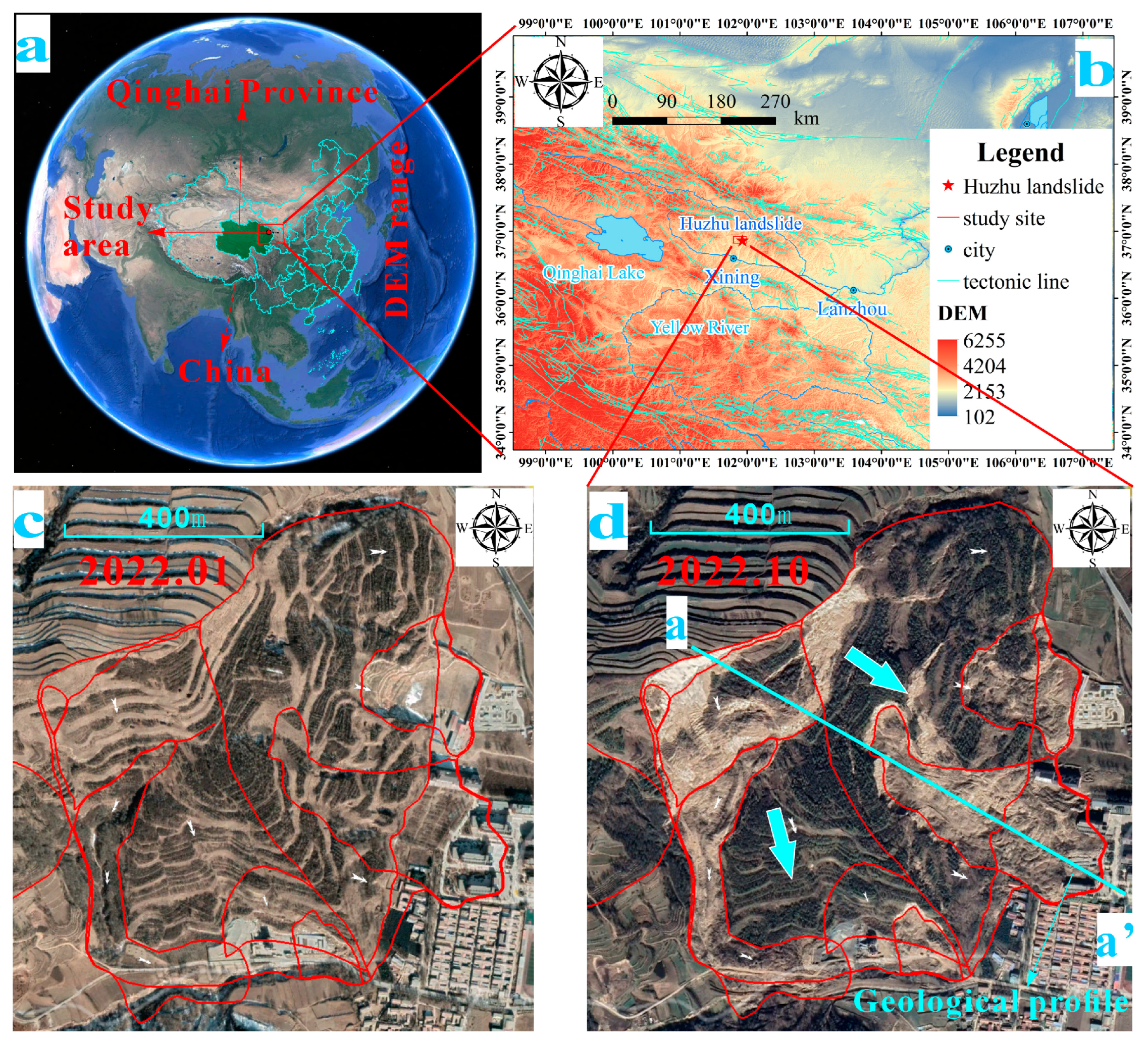
The Huzhu landslide is located in Huzhu Tu Autonomous County, northeastern Qinghai Province, China, situated in the transitional zone between the Qinghai–Tibet Plateau and the Loess Plateau (Figure 1a). The area is characterized by complex geomorphology, with strata mainly composed of Quaternary loess overlying mudstone, and relatively active tectonic deformation (Figure 1b). The Huzhu landslide occurred on 1 September 2022. Among the secondary landslides triggered by this event, the most destructive one was located behind Huzhu No. 3 Middle School. In plan view, it exhibits an elongated tongue-shaped geometry, with an average length of approximately 320 m, an overall elevation difference of about 120 m, and an average width of roughly 120 m. The main sliding direction is 108°, and the landslide volume is preliminarily estimated at 6.24 × 10⁵ m3. Owing to the large elevation difference and the relatively high position of the shear outlet, the sliding mass underwent rapid movement, with a runout distance of approximately 210 m. The landslide pushed and buried the school buildings, resulting in the destruction of three teaching buildings and causing seven fatalities.
Field investigations and remote sensing image comparisons indicate that the landslide exhibits a “broad-tongue” shape in plan view. The rear boundary is defined by the HB01 scarp and the northwestern watershed, while both flanks are controlled by ancient gullies. The toe of the landslide is located at the junction between the slope base and the terrace (Figure 1c,d). Tensile cracks and local scarps developed clearly along the rear margin; step-like displacements and longitudinal cracks appeared in the middle part; and artificial cut slopes at the toe formed steep scarps. The Huzhu landslide is a typical loess–mudstone composite landslide, with failure characteristics showing distinct stage-dependent behavior.
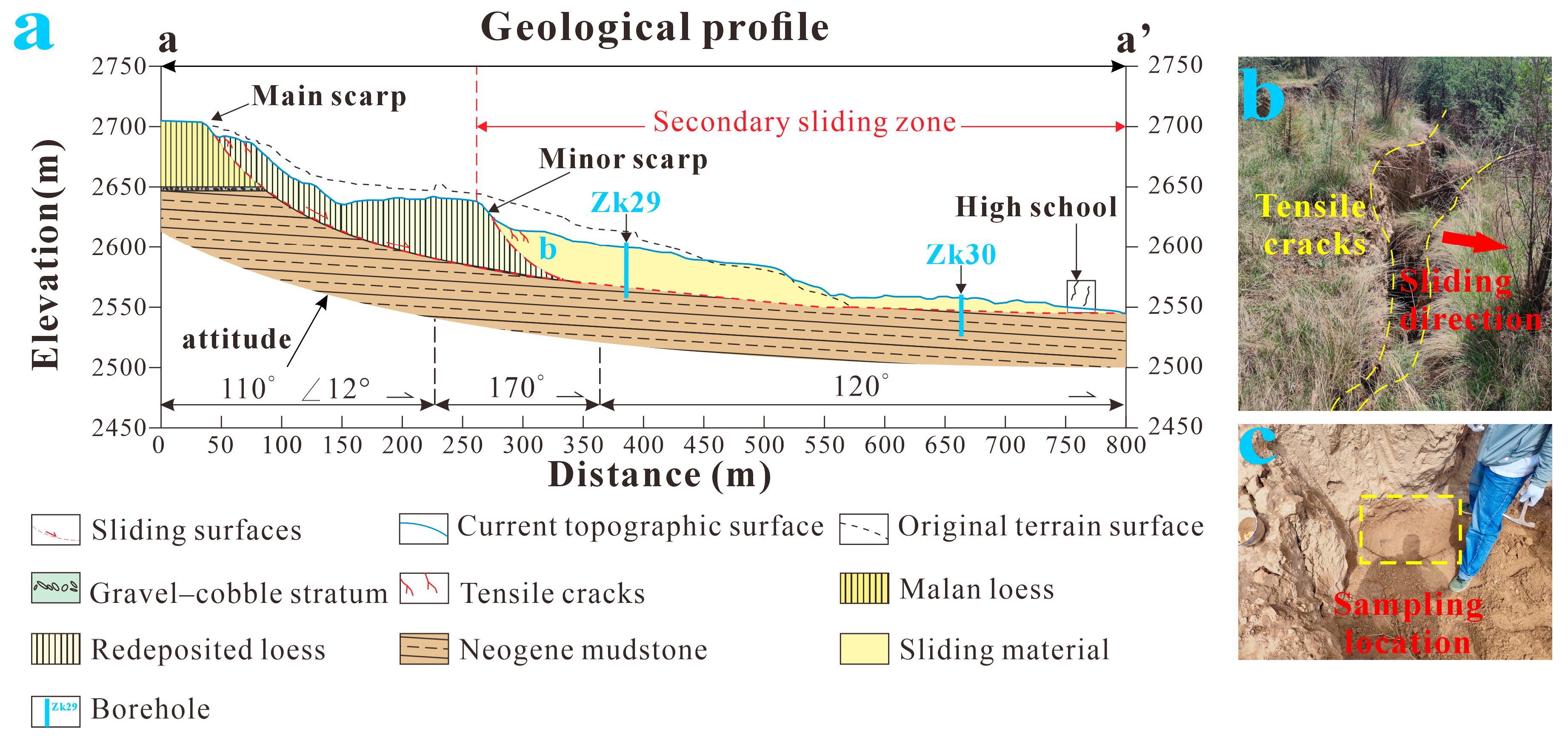
Structurally, the upper part of the slope consists of thick loess, underlain by weak mudstone. The average slope angle at the front portion is approximately 20°, while that at the rear can reach 45–60°. The underlying mudstone strata dip 12–15° toward 130°. This “loose-over-soft” lithological combination provides the material basis for slope instability. Therefore, this study focuses on the landslide that caused severe damage to Huzhu No. 3 Middle School, aiming to analyze its deformation and failure mechanisms under extreme rainfall conditions. The slope structure of the landslide is shown in Figure 2.

2.2. Analysis of the Major Triggering Factors of the Huzhu Landslide

The formation of the Huzhu landslide was governed by the combined effects of multiple factors, including groundwater distribution, human engineering activities, and intense rainfall events. A relatively stable perched groundwater table exists within the loess–gravel layer at the top of the rear slope. Long-term recharge led to the development of a saturated silt layer at the base of the loess, while the weathered and fractured mudstone zone beneath remained in a persistently high-moisture state [7]. These hydrogeological conditions weakened the strength of the loess–mudstone interface, making it prone to evolve into a potential sliding surface. Moreover, slope cracks and local reverse-slope terrain provided preferential pathways for rainfall infiltration and groundwater rise, further aggravating the softening and weakening of the slope (Figure 2b).
Human engineering activities played a significant amplifying role in this process. A residential area, Huzhu No. 3 Middle School, a brick factory, a driving school, and a concrete mixing station are distributed near the slope toe. During construction, extensive slope cutting formed artificial steep slopes with heights of 4–40 m and gradients of 50–80°, which substantially reduced the shear resistance at the slope toe. The combined influence of long-term hydrological action and unreasonable anthropogenic disturbances left the slope in a marginally stable condition, providing the predisposing background for subsequent failure.
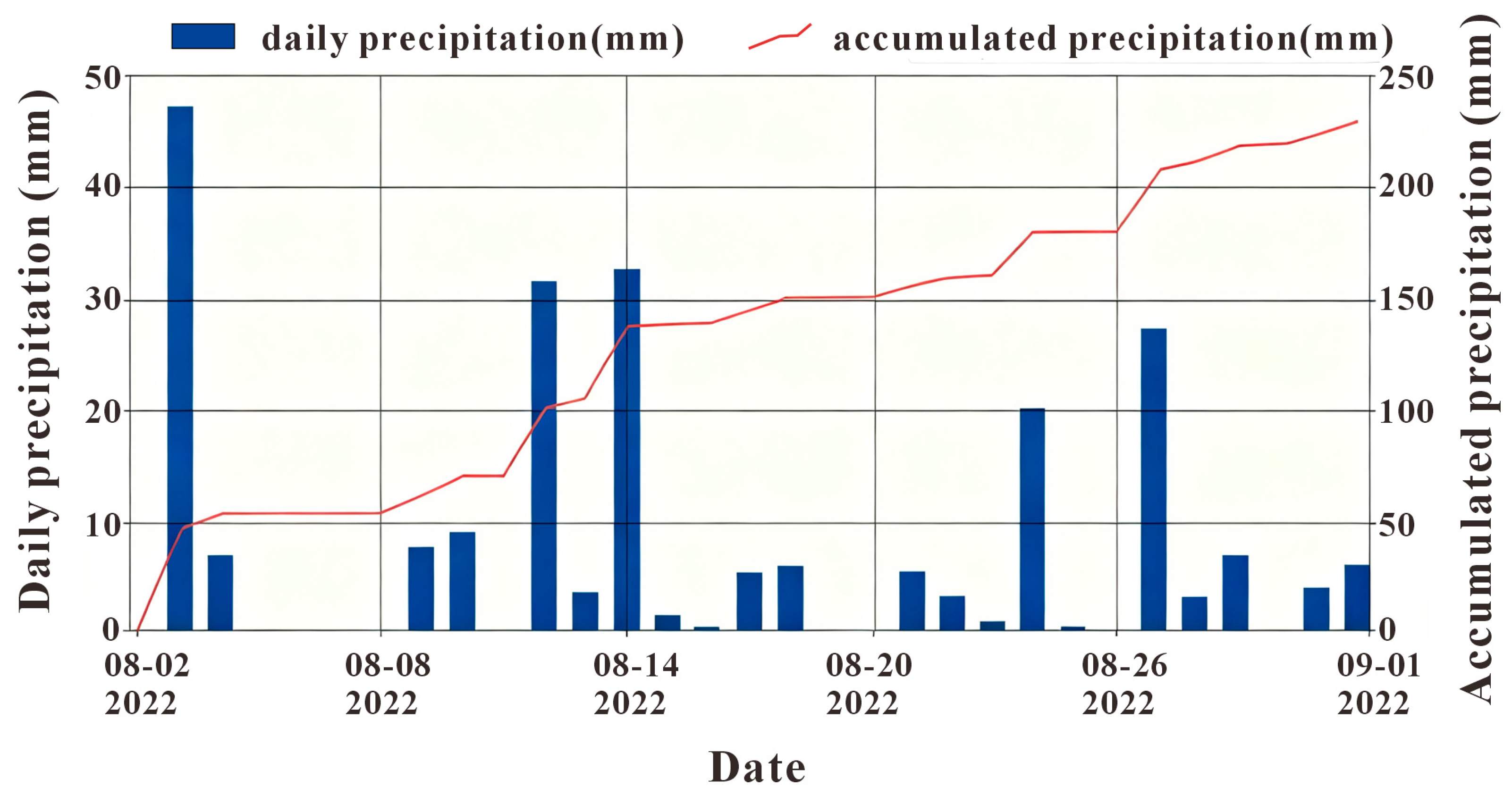
Meteorological data indicate that eight episodes of heavy rainfall occurred in August 2022, totaling 21 rainy days and a cumulative rainfall of 224.7 mm, accounting for 34.6–64.2% of the local annual precipitation. Among these, a single-day rainfall of 47.4 mm on August 3 represented 7.3–13.5% of the annual total. During the five days preceding the failure (27–31 August), cumulative rainfall reached 41.8 mm, or 18.6% of the monthly total (Figure 3). The continuous and intensive rainfall increased the slope’s volumetric water content and pore water pressure, while short-duration, high-intensity events rapidly enhanced the hydraulic gradient under already saturated conditions, leading to a sharp reduction in the shear strength of the potential slip surface.
In summary, long-term groundwater recharge and anthropogenic slope modification continuously undermined the slope stability, whereas the persistent and extreme rainfall in August 2022—occurring immediately prior to the landslide and far exceeding the multi-year average—ultimately triggered the large-scale failure of the Huzhu landslide.

3. Materials and Methods

3.1. Material Collection

The loess and mudstone used in this study were collected from the Huzhu landslide site in Qinghai Province, China (Figure 2c). Representative undisturbed samples were obtained from the rear part and the sliding zone of the landslide through shallow excavation and drilling. Immediately after sampling, the specimens were sealed with paraffin and plastic film to preserve their natural state and transported to the laboratory for material characterization and reference testing.
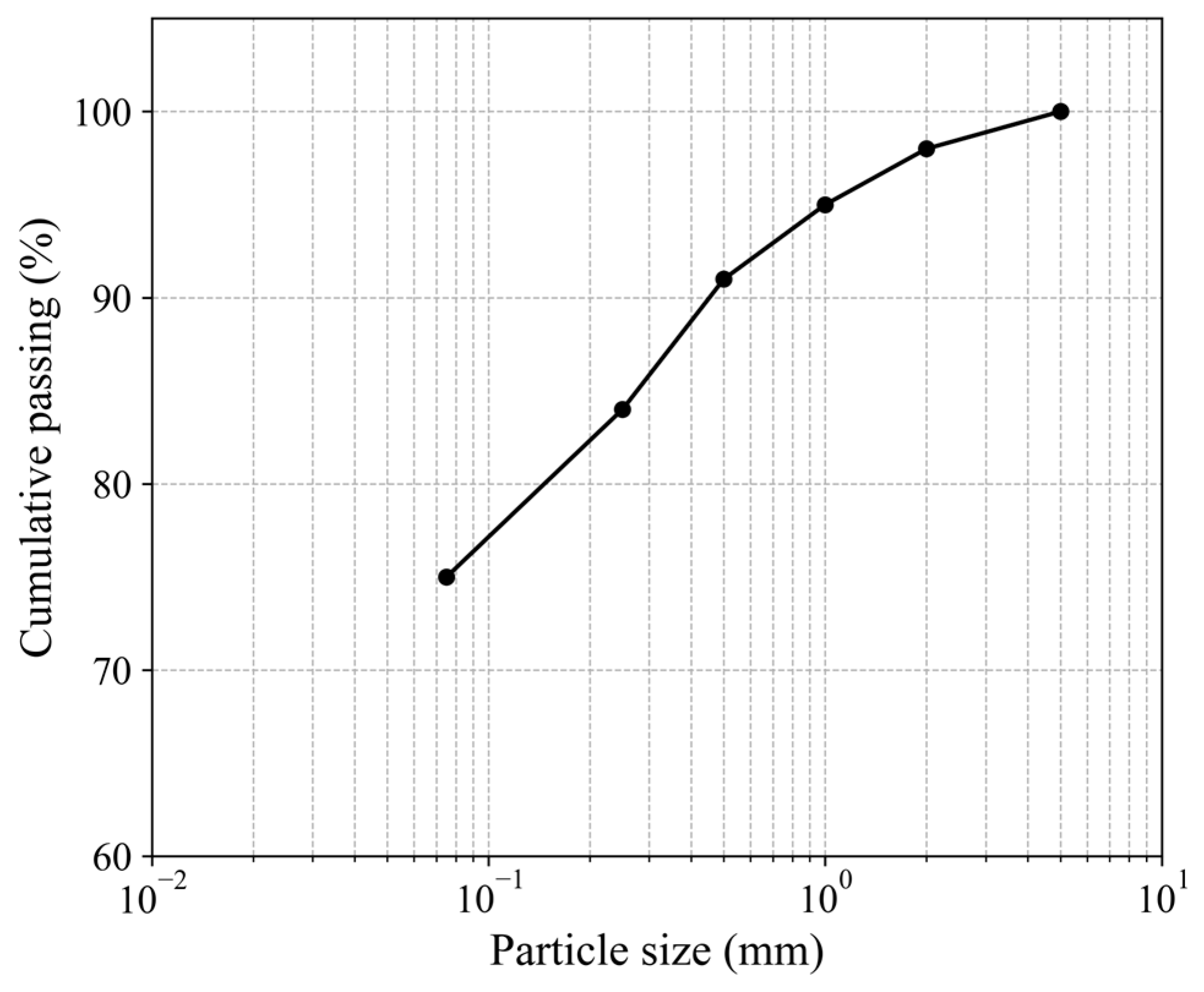
For construction of the physical model, the collected materials were processed into reconstituted soils following standard laboratory procedures. The loess was air-dried, gently disaggregated, and sieved through a 5 mm mesh to control the maximum particle size, and its grain size distribution is shown in Figure 4. The mudstone was dried at room temperature, lightly crushed, and sieved through the same mesh size to simulate the weathered condition of the field bedrock. This material treatment was adopted to ensure scale compatibility, internal homogeneity, and repeatability of the model, which is a common and accepted practice in rainfall-induced landslide modeling.
After preparation, the loess was adjusted to the target moisture content and compacted in layers together with the treated mudstone within the model tank according to the in situ stratigraphic configuration and designed bulk density, so as to reproduce the layered structure and stiffness contrast of the prototype slope. Although the reconstitution process may modify the original soil fabric and bonding to some extent, the adopted preparation and compaction scheme preserves the essential contrasts in permeability, strength level, and hydro-mechanical response between the loess and mudstone layers. These contrasts are critical for capturing infiltration-controlled deformation, pore pressure evolution, and progressive failure behavior in loess–mudstone composite slopes.
The basic physical and mechanical parameters of the loess and mudstone were obtained through standard laboratory tests and are summarized in Table 1. Considering that the mudstone functions primarily as a relatively low-permeability basal layer in the composite slope, laboratory measurements focused on the liquid limit, plastic limit, and permeability coefficient of the loess, which play a dominant role in controlling rainfall infiltration, suction evolution, and deformation initiation in the model test.

3.2. Physical Model Test

3.2.1. Experimental Apparatus

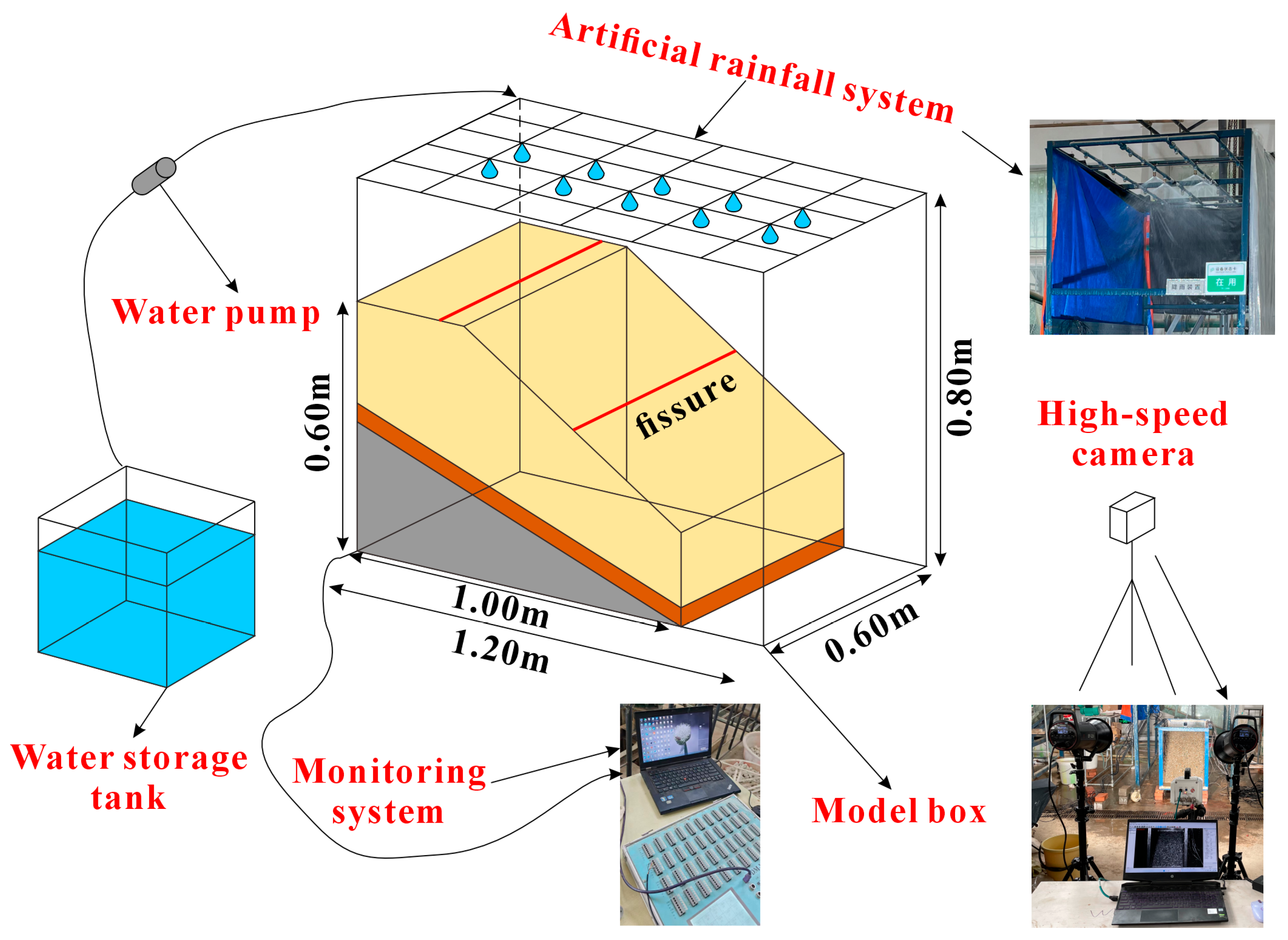
The indoor rainfall model test was conducted in the Physical Simulation Laboratory for Geological Hazards at Chengdu University of Technology. The experimental system consisted of four main components: the model tank, artificial rainfall system, internal monitoring system, and surface deformation observation system (Figure 5).
(1)
Model tank: The model tank was constructed using a rigid steel frame with dimensions of 1.2 m (length) × 0.6 m (width) × 0.8 m (height). The side and rear walls were lined with transparent acrylic plates to facilitate observation of internal deformation. The front acrylic plate was intentionally removed to allow direct observation and recording of surface deformation and failure processes. In addition, a 0.2 m-long open space was reserved at the front of the model to represent the free-face condition at the slope toe, corresponding to the near-vertical artificial scarp (approximately 50–80°) formed by human engineering activities at the prototype Huzhu landslide. Drainage holes were arranged at the bottom of the front opening of the model to allow controlled outflow of infiltrated water, thereby preventing unrealistic water accumulation within the tank and maintaining consistency between the overall model boundary conditions and the free-face drainage characteristics of the prototype slope.
(2)
Artificial rainfall system: The rainfall system consisted of a water tank, pump, flexible water hoses, and ten adjustable nozzles mounted on a crossbeam 2.8 m above the model surface. Rainfall intensity was precisely controlled by a flow regulator. Prior to testing, multi-point water collection was used to calibrate rainfall uniformity, ensuring a deviation within ±5%, which meets the experimental requirements.
(3)
Internal monitoring system: The internal monitoring setup included pore water pressure sensors (DMKY series, Nanjing Danmo Electronic Technology Co., Ltd., Nanjing, China), volumetric water content sensors (ZE-SN-3000-TR-I20, ZETO Co., Ltd., Nanjing, China), and soil pressure sensors (DMTY series, Nanjing Danmo Electronic Technology Co., Ltd., Nanjing, China) to synchronously record variations in pore pressure, moisture, and stress within the slope. All sensors were carefully calibrated and connected to a multi-channel data acquisition system for automatic and continuous monitoring (DM-YB1840, Nanjing Danmo Electronic Technology Co., Ltd., Nanjing, China).
(4)
Surface deformation observation: Surface deformation was monitored by a high-speed camera (GS3-U3-23S6M-C; FLIR Integrated Imaging Solutions Inc., Vancouver, BC, Canada) placed 3.0 m in front of the model, supplemented with auxiliary lighting. This setup allowed for the detailed capture of crack propagation, local collapse, and overall sliding processes. Through image analysis, quantitative displacement data were extracted and temporally correlated with the internal measurements, revealing the dynamic evolution of the slope from hydraulic infiltration to structural failure.

3.2.2. Experimental Setup and Rainfall Design

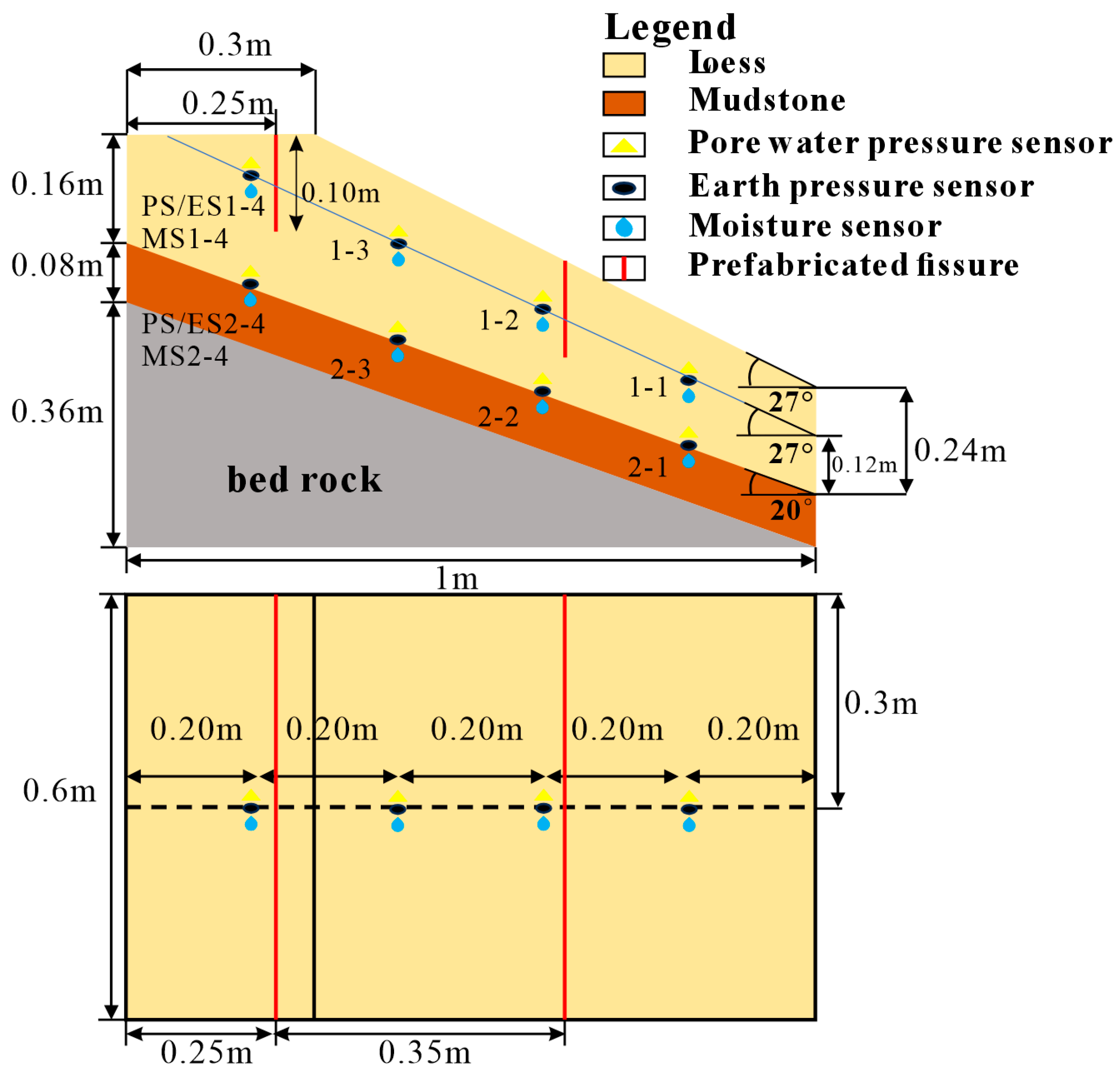
The indoor rainfall infiltration test was designed following similarity theory, with geometric similarity adopted as the primary basis for model scaling. A geometric similarity ratio (CLC_LCL) of 200 was determined from the ratio between the representative width of the prototype slope (∼120m; see Section 2.1) and the width of the laboratory model box (0.60 m). Accordingly, the model slope was constructed with dimensions of 1.0 m in length, 0.6 m in height, and 0.6 m in width. The model length was defined by scaling the representative movement distance of the prototype landslide (210 m/200). Under this geometric scaling framework, the model slope adopted a typical two-layer structure consisting of an upper loess layer and a lower mudstone layer, representing the soft–hard stratigraphic alternation of loess–mudstone composite slopes (Figure 6).
The model slope measured 1.0 m in length, 0.6 m in height, and 0.6 m in width. Based on geometric similarity, the loess layer slope was set to 27°, and the mudstone layer to 20°. Field observations revealed numerous fissures in the rear and middle parts of the landslide (Figure 2b). Accordingly, two pre-existing fissures were simulated at 0.25 m (rear) and 0.60 m (shoulder) along the slope, each filled with fine sand (0.20 m wide, 0.10 m deep), to represent preferential infiltration paths and their influence on pore pressure evolution.
The monitoring system was arranged along the model’s central section to capture representative internal responses. Pore water pressure, volumetric water content, and soil pressure sensors were arranged in two layers: the first located mid-depth within the loess layer (0.12 m above the slope base), and the second along the loess–mudstone interface. Sensors were vertically aligned, spaced at 0.2 m intervals along the slope length, and connected through the sidewall to the data acquisition system to ensure stable signal transmission.
Rainfall conditions were designed according to field meteorological data, simulating a cumulative rainfall exceeding 220 mm and a maximum daily rainfall of 47.4 mm, representing an extreme rainfall event. Based on the similarity ratio, the rainfall intensity was set to 0.2 mm/min to reproduce the infiltration and pore pressure response under continuous heavy rainfall. Calibration confirmed that rainfall uniformity deviation was less than ±5%. The experiment continued until significant slope failure occurred, during which the high-speed camera continuously recorded deformation and failure processes synchronized with internal monitoring data, forming a complete dataset linking seepage, stress, and deformation responses.

3.2.3. Model Construction Process

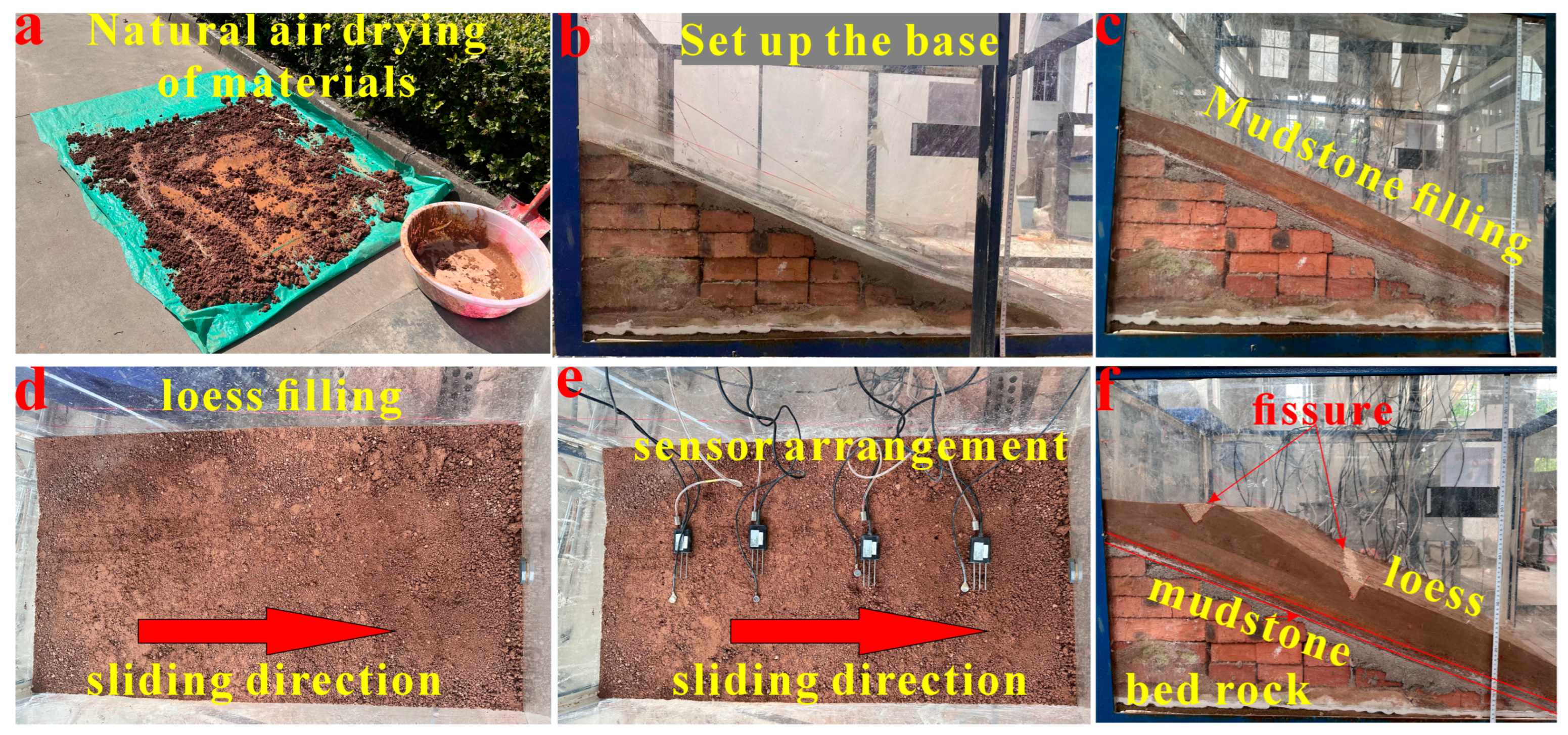
The model construction strictly followed the prototype geological conditions and similarity theory to ensure that the physical model realistically reproduced the structural and hydraulic behavior of the Huzhu slope under rainfall infiltration. The entire process included four steps: material preparation, layered filling and compaction, sensor installation, and fissure configuration (Figure 7).
First, all filling materials were air-dried, crushed, sieved through a 5 mm mesh, and adjusted to the designed moisture content. The prepared materials were then sealed for 24 h to ensure uniformity (Figure 7a). Next, a rigid triangular base with a 20° slope, representing unweathered bedrock, was built at the bottom of the 1.0 m × 0.6 m × 0.6 m model tank using bricks and a cement mortar surface (Figure 7b). Then, the stratified filling began from bottom to top according to field stratigraphy: an 8 cm thick mudstone layer (dry density ≈ 1.59 g/cm3) was placed first (Figure 7c), followed by three layers of loess with a maximum thickness of 24 cm at the toe (dry density ≈ 1.26 g/cm3), forming a slope surface of 27° (Figure 7d).
After each layer reached the designated elevation, sensors were embedded according to the design (Figure 7e). Pore water pressure (PS), soil pressure (ES), and volumetric water content (MS) sensors were installed in two layers along the slope, spaced at 0.2 m intervals: the first within the loess layer, the second at the loess–mudstone interface. A groove-embedding method was used to ensure full contact between sensors and the surrounding soil, with real-time signal testing performed during installation.
Finally, two artificial fissures were opened at the rear (0.25 m) and shoulder (0.60 m) of the slope, each 0.10 m deep and 0.02 m wide, and filled with fine sand to simulate preferential infiltration channels in natural slopes (Figure 7f). The model surface was then uniformly sprayed with water to prevent shrinkage cracking.
The entire construction process lasted three days, during which moisture content, dry density, and layer thickness were strictly controlled. The resulting model realistically reflected the seepage, stress transmission, and failure evolution characteristics of a loess–mudstone composite slope under continuous rainfall, providing a reliable physical basis for subsequent rainfall tests and failure mechanism analyses.

3.3. SBAS-InSAR Deformation Monitoring Technique

In this study, the Small Baseline Subset Interferometric Synthetic Aperture Radar (SBAS-InSAR) technique was employed to conduct time-series monitoring of surface deformation of the Huzhu landslide from January 2018 to August 2022. This technique forms multiple differential interferograms by combining SAR image pairs with short temporal and spatial baselines, and retrieves the time-series deformation through algorithms such as singular value decomposition (SVD). It can effectively mitigate temporal–spatial decorrelation and atmospheric delay effects, enabling millimeter-level deformation monitoring accuracy [31].
A total of 135 ascending Sentinel-1A Interferometric Wide-Swath (IW) Single-Look Complex (SLC) images with a revisit cycle of 12 days were acquired for this study. The Shuttle Radar Topography Mission (SRTM) 1-arc-second DEM was used to simulate and remove the topographic phase. The data processing workflow was completed using the SARSCAPE module: first, all SAR images were precisely co-registered, and interferometric pairs were generated based on a Delaunay triangulation and predefined temporal–spatial baseline thresholds (spatial baseline set to less than 10% of the critical baseline, temporal baseline set to 24 days), resulting in a total of 255 interferometric pairs forming the small baseline subset for this analysis. Subsequently, differential interferometric processing was performed for each pair to generate differential interferograms and remove the flat-earth phase. To improve the signal-to-noise ratio, Goldstein filtering was applied, and the minimum cost flow (MCF) algorithm was used for phase unwrapping. Orbital refinement and re-flattening were then performed to eliminate residual orbital errors. To separate and reduce atmospheric delay phases, GACOS data were used for atmospheric phase correction. Based on this, the SVD method was applied to invert the corrected phase series and obtain the average deformation rate and cumulative deformation relative to the first acquisition for each pixel. Finally, all deformation results were geocoded. The basic parameters of the SAR dataset used in this study are shown in Table 2.

4. Results

4.1. Surface Deformation and Failure Characteristics

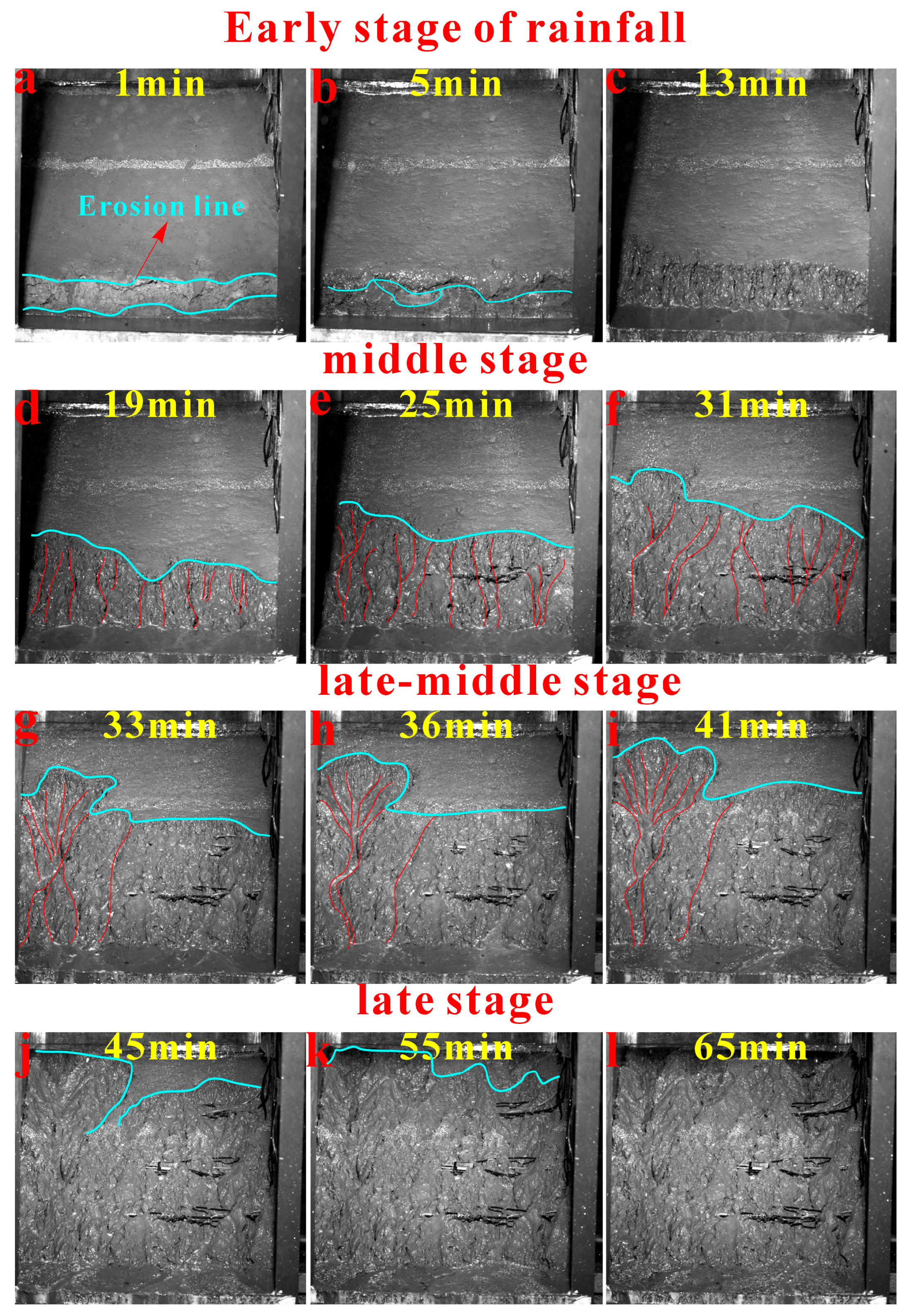
Figure 8 illustrates the evolution of the model slope surface morphology during the rainfall process, reflecting the entire progression from initial stability to ultimate failure under continuous rainfall infiltration. Overall, the slope failure exhibited a distinct bottom-up progressive pattern: the toe was first softened by rainfall infiltration, and the failure gradually propagated upward to the middle and upper parts of the slope, eventually forming an overall sliding failure.
(1)
Figure 8a–c show the slope surface morphology during the early stage of rainfall (0–13 min). The slope remained generally stable, with only slight wetting observed at the toe (Figure 8a). At this stage, continuous seepage channels had not yet formed within the slope body. The soil color at the toe darkened, and the surface structure became slightly loosened but without significant deformation (Figure 8b). As rainfall continued, the infiltration depth gradually increased, leading to localized subsidence and expansion of the wetting zone at the toe (Figure 8c), which provided the initial conditions for subsequent failure.
(2)
During the middle stage of rainfall (13–31 min) (Figure 8d–f), rainfall infiltrated along the pre-existing fissures of the slope, and the wetting front advanced upward from the toe, causing marked softening and stress concentration in the lower and middle parts of the slope. Signs of sliding between the toe and the middle slope became increasingly evident, and localized nonuniform erosion appeared in the central part of the slope, with the left side eroding faster than the right. In Figure 8d–f, the erosion line advanced upward with continued rainfall, and the cracks extended and deepened, indicating that the failure was evolving from shallow erosion to deep sliding.
(3)
In the middle-to-late rainfall stage (31–41 min) (Figure 8g–i), under sustained rainfall, the saturated zone within the slope further expanded, causing rapid surface erosion within a short time. The erosion line penetrated through the prefabricated fissure in the middle of the slope, significantly enlarging the failure area. Nonuniform erosion became more pronounced, with retrogressive creeping and traction failure on the right side and rapid debris-flow-like erosion on the left. This stage exhibited the most drastic slope surface changes, accompanied by obvious sliding and collapse at the rear edge.
(4)
During the late stage of rainfall (41–65 min), the prefabricated fissures at the slope crest acted as preferential seepage channels. With continued infiltration and deepening front-edge erosion, the erosion line eventually reached the crest, leading to complete surface failure (Figure 8j). During 55–65 min of rainfall, as the slope had already failed entirely, only small-scale and frequent local sliding occurred (Figure 8k). By the end of rainfall, both the front and rear edges of the slope exhibited significant subsidence and erosion, with the surface soil fluidized and transported downslope, and the overall failure pattern tended to stabilize (Figure 8l).
In summary, the model slope underwent a progressive evolution process during rainfall infiltration—from toe softening, mid-slope local erosion, and intensified crest erosion to complete sliding failure—showing a typical bottom-up progressive failure pattern [32]. It is noteworthy that the left side of the slope failed earlier than the right, indicating a certain degree of asymmetry in the model. This difference was mainly attributed to the uneven distribution of compaction: the lower left part had a lower compaction degree, leading to faster infiltration and earlier pore water pressure buildup, thereby triggering premature failure. Overall, this rainfall model test clearly revealed the evolutionary characteristics of loess slope deformation and failure under rainfall infiltration, providing a visual foundation for subsequent analysis of failure mechanisms.

4.2. Variation Characteristics of Volumetric Water Content

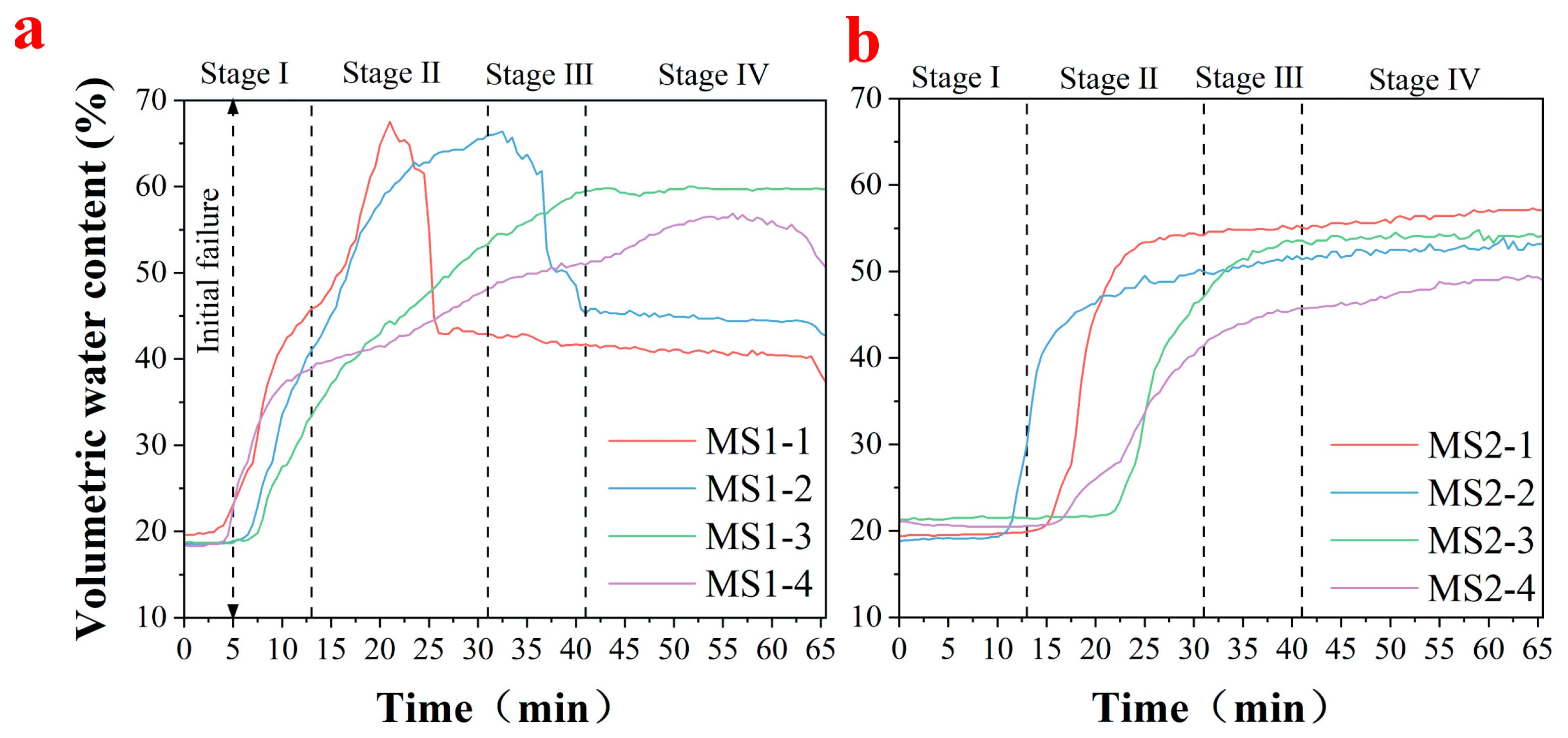
The time-series response of water content sensors during rainfall is shown in Figure 9. Overall, the volumetric water content exhibited a continuous increasing trend over time but showed marked spatial and vertical differentiation: the upper sensors responded faster and reached higher peaks, while the lower sensors showed delayed and smaller responses. This reflected the general process of infiltration progressing from the surface to deeper layers and from the slope toe toward the rear, while also suggesting the presence of localized differences in water conduction and storage.
The shallow-layer sensors (MS1) exhibited pronounced temporal differences in their responses (Figure 9a). The slope toe (MS1-1) and crest (MS1-4) first showed an increase in water content at 4–5 min of rainfall (initial values about 18–20%), indicating rapid near-surface migration of rainwater through shallow pathways, demonstrating the role of fissures in promoting infiltration. MS1-1 reached its first peak (about 67%) at 19 min, then significantly dropped to about 42% at 25 min, suggesting a clear process of hydraulic redistribution or drainage after rapid saturation [21]. The responses of MS1-2 and MS1-3 were delayed (starting to rise at about 6–7 min), but MS1-2 peaked at 31–32 min (about 66.5%) and then decreased around 40 min to a stable level (about 45%), whereas MS1-3 reached a stable peak (about 58%) later at approximately 44 min without notable decline during the observation period. It is noteworthy that MS1-1, MS1-2, and MS1-4 all showed a simultaneous decrease in water content around 63 min, indicating widespread moisture dissipation or the formation of drainage channels in the late rainfall stage, corresponding to the exposure of middle-front sensors due to deep erosion observed in the late rainfall phase.
The deep-layer (MS2) water content generally increased later and peaked at lower values than the shallow layer (Figure 9b). MS2-2, MS2-1, MS2-4, and MS2-3 began responding at approximately 10, 14, 16, and 22 min, respectively, and reached their peaks at about 16, 23, 37, and 38 min, with peak values ranging between 45% and 55%. Compared with the shallow layer, the deep-layer curves were smoother and did not exhibit a rapid decline after peaking, indicating that deep moisture accumulated gradually and tended toward long-term stability within the observation period. This behavior aligns with the delayed infiltration in deeper zones constrained by the permeability characteristics of the bedrock or fine-grained layers [33].
Combining temporal and spatial distribution reveals two key patterns. First is the nonmonotonic progression along the slope: although infiltration generally advanced from the front to the rear, the earliest responses occurred not only at the toe (MS1-1) but also at the crest (MS1-4), suggesting that surface fissures facilitated localized preferential flow, enabling earlier wetting in certain positions. This phenomenon was also observed in the MS2 layer, where MS2-2 and MS2-4 (located beneath fissures) responded earlier than MS2-1 and MS2-3 [34]. Second is the vertical delay: after rapid saturation, some shallow sensors exhibited a decline, whereas deeper sensors increased later and remained elevated, indicating transient saturation and redistribution in the shallow layer, while the deep layer experienced gradual water accumulation, providing a more persistent water load.
These temporal patterns of water content provide a time reference for subsequent analyses of pore water pressure and stress responses. The early peaks and subsequent declines in the shallow layer corresponded well with the observed early softening and local collapse near the slope toe, while the delayed accumulation in the deep layer created conditions for progressive pore pressure buildup at the interface. It should be noted that the localized variations in water content distribution (e.g., early responses at MS1-1 and MS1-4) may be associated with uneven compaction, fissure-induced preferential flow, or boundary effects. Quantitative verification of these mechanisms will be further discussed in conjunction with pore pressure and soil pressure data.

4.3. Variation Characteristics of Pore Water Pressure

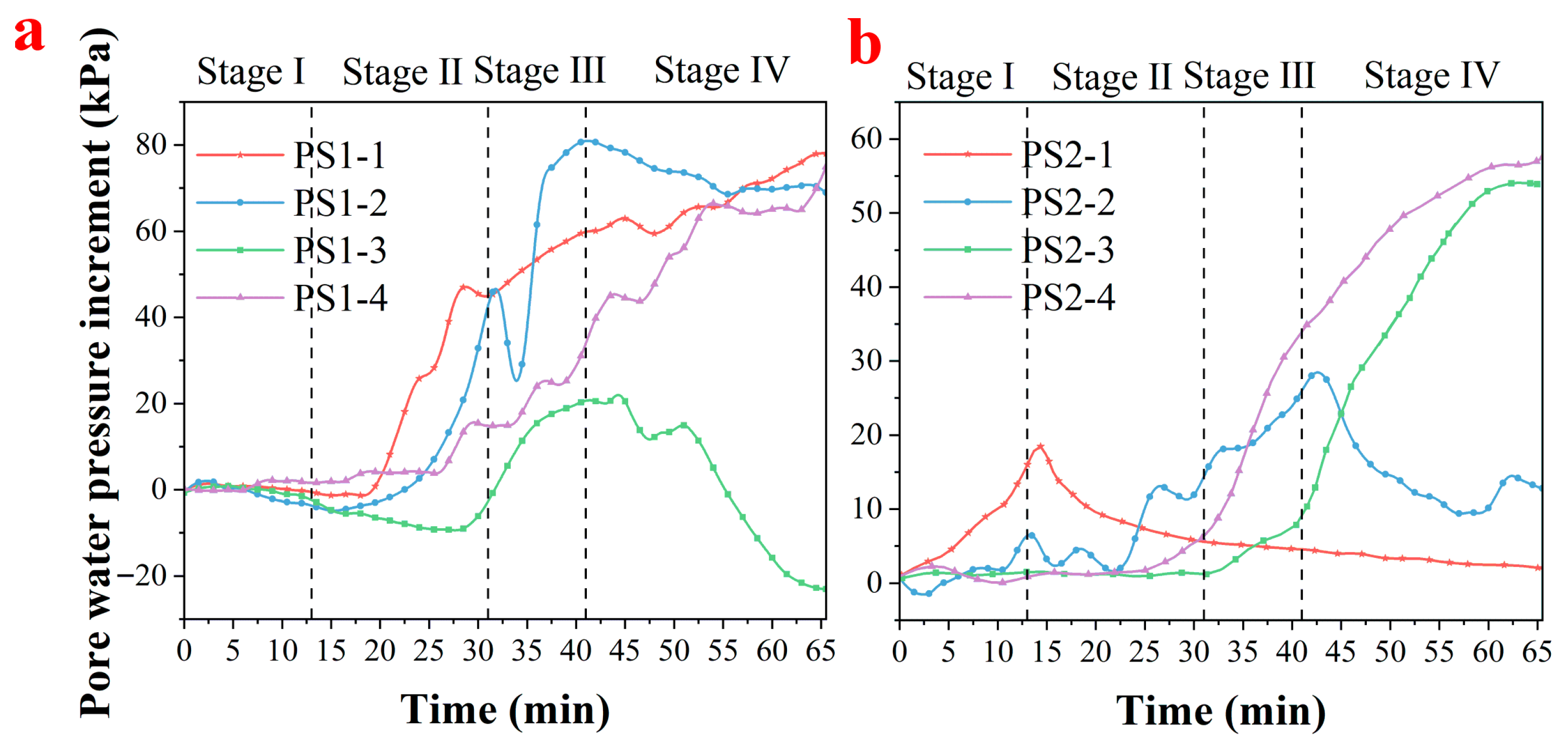
The variation characteristics of pore water pressure in the loess–mudstone slope during rainfall infiltration are shown in Figure 10. Although the overall trend of pore water pressure differs slightly from that of volumetric water content, it also exhibits distinct staged development: a minor response in the early rainfall stage, rapid accumulation in the shallow layer during the mid stage, and continuous pressure buildup with a significant lag in the deep layer during the late stage. The differences in peak amplitude and response delay among sensors at various depths reflect the coupled characteristics of the wetting front migration, interlayer permeability variation, and preferential flow along weak interlayers. The experimental results reveal the following key features of pore water pressure evolution in the loess–mudstone slope:
During the initial rainfall stage, the pore water pressure within the model slope generally exhibited near-zero increments but could be classified into two distinct response modes. The first mode showed slight positive pressure that gradually increased with ongoing rainfall (PS1-4, PS2-3, PS2-4), typically occurring at locations with higher initial water content or better pore connectivity, where rapid infiltration induced local saturation and slight positive pressure. The second mode experienced an initial negative pressure phase before transitioning to positive values (e.g., PS1-1–PS1-3) (Figure 10a), indicating that the soil initially remained unsaturated, and the observed negative pressure corresponded to matric suction. As the wetting front advanced, the soil gradually became saturated, and the pore water pressure shifted from negative to positive and continued to increase [25]. These two response modes suggest pronounced spatial heterogeneity in the soil during early rainfall, with the pore pressure evolution being strongly influenced by initial moisture conditions and local flow patterns.
The response of deep-layer pore water pressure lagged behind that of the shallow layer (PS2-3, PS2-4) (Figure 10b). Within 0–3 min after rainfall onset, sensors located within the loess layer exhibited rapid pressure increases, with an average response time of approximately 2 min, indicating fast wetting front propagation and pressure buildup in the shallow layer. In contrast, deep-layer sensors recorded smaller pressure variations and delayed responses, with an average peak pore pressure (Δumax) of 39.16 kPa—significantly lower than the shallow-layer average of 63.11 kPa—and the peak occurrence lagged by about 2 min. This phenomenon reflects a clear temporal delay in vertical water transfer: infiltration requires time to reach the deep sensor locations, leading to delayed pore pressure responses. Meanwhile, the low permeability of the mudstone and the capillary barrier effect caused water to accumulate above the interface rather than fully transmit downward, resulting in smaller pressure increments at depth [35].
Structural fissures within the slope facilitated preferential infiltration along dominant seepage paths [36]. Both shallow and deep sensors located at the rear of the slope (PS1-4, PS2-4) responded earlier than those at the mid-slope (PS1-3, PS2-3), showing a leading temporal response. Moreover, at the slope toe, the deep sensor PS2-1 responded earlier than its overlying shallow sensor PS1-1 during early rainfall. This indicates the existence of heterogeneous infiltration pathways and preferential flow channels within the slope. Based on the model structure, the pre-existing fissures at the slope crest and midsection provided rapid downward flow paths for rainwater, allowing the rear sensors (PS1-4, PS2-4) near these fissures to detect infiltration earlier. Simultaneously, the fissures in the mid-slope promoted downward percolation along the loess–mudstone interface, where the low permeability of the mudstone caused lateral flow toward the slope toe, leading to earlier response of the deep front sensor (PS2-1) compared with its overlying shallow counterpart (PS1-1).
In summary, the variation in pore water pressure indicates significant spatiotemporal differences in the slope’s response to rainfall infiltration. During the early stage, soils at different locations exhibited two typical response modes governed by initial moisture conditions and local seepage behavior. As the infiltration front advanced downward, deep-layer pressure responses lagged behind those of the shallow layer and showed smaller amplitudes, demonstrating vertical delay and interface impedance effects. Additionally, structural fissures intensified spatial heterogeneity in infiltration, resulting in a distinctly stratified and regionally differentiated evolution of pore water pressure within the slope.

4.4. Variation Characteristics of Earth Pressure

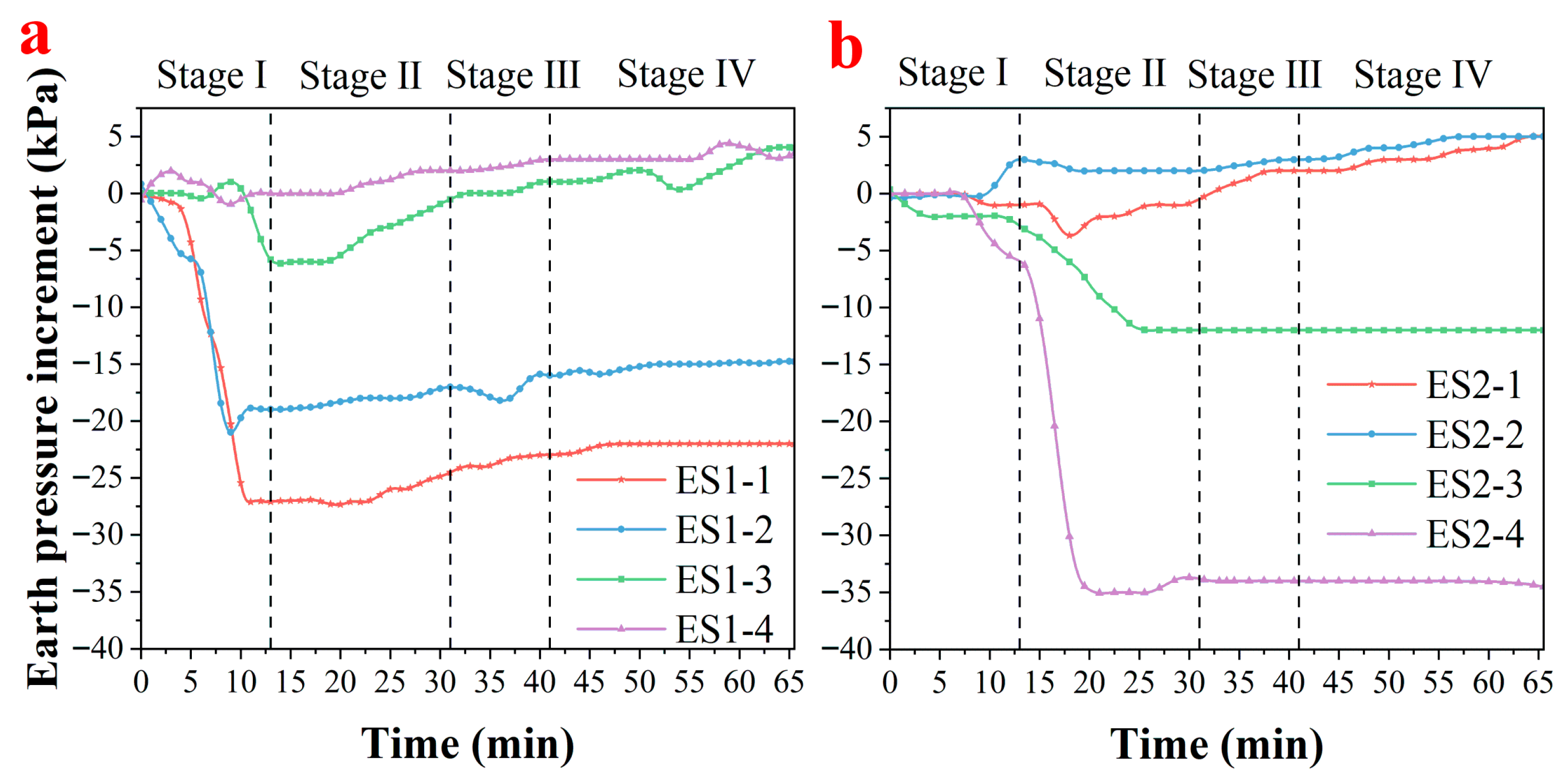
The variation characteristics of earth pressure in the loess–mudstone slope during rainfall infiltration are illustrated in Figure 11. Overall, the responses exhibit a distinct spatiotemporal differentiation. The shallow and deep sensors display significant differences in response timing, amplitude, and spatial distribution, revealing the dynamic adjustment of the internal stress field and the progressive evolution of the potential failure mechanism under rainfall conditions. The experimental results on earth pressure variation can be summarized as follows:
The shallow earth pressure generally exhibits a “sharp decrease–gradual recovery” trend, with the magnitude of decrease diminishing progressively from the slope toe to the rear (Figure 11a). At the onset of rainfall, the shallow sensors (ES1 series) embedded within the upper loess layer responded almost immediately. Among them, ES1-1 located at the slope toe recorded the most significant drop of −27.06 kPa, followed by ES1-2, ES1-3, and ES1-4, which decreased by −20.85 kPa, −6.13 kPa, and −0.91 kPa, respectively, showing a front-to-rear attenuation pattern. This phenomenon mainly results from the rapid loss of matric suction in the unsaturated loess during the early stage of rainfall, when water has not yet fully infiltrated but accumulates within the shallow layer. The reduction in effective stress leads to a sharp decrease in earth pressure. The most pronounced decline at the slope toe is attributed to the stress release caused by the free face effect. After the rapid drop, all shallow sensors began to slowly rebound by approximately 5–9 kPa between 10 and 13 min. This recovery may be associated with two factors: (a) the partial restoration of pore water pressure during water redistribution; and (b) new stress concentration caused by minor deformation or displacement after the initial stress release, resulting in a “compression” effect on the sensors.
The deep earth pressure shows a marked hysteresis, and its spatial pattern of reduction is completely opposite to that of the shallow sensors (Figure 11b). The deep sensors (ES2 series), located near the loess–mudstone interface, did not respond simultaneously during the first stage of rainfall but exhibited a notable decrease during the early part of the second stage (13–15 min). This delayed response indicates that infiltration to the deeper interface requires time, and the internal stress adjustment of the slope is transmitted downward in a layer-by-layer manner. Furthermore, the spatial order of reduction in deep earth pressure is opposite to that of the shallow layer: ES2-4 at the rear of the slope decreased by −35.07 kPa, ES2-3 by −12.01 kPa, while ES2-1 and ES2-2 in the middle and front parts decreased only by −3.68 kPa and even increased by +3.00 kPa. This “rear-dominated” reduction pattern contrasts sharply with the “front-dominated” shallow response. The fundamental cause lies in the two prefabricated cracks in the middle and rear parts of the model slope, which served as preferential pathways for infiltration. Water penetrated first through these cracks—particularly the rear one—softening the mudstone surface and significantly reducing the shear strength in that region, thereby triggering stress release [9]. Meanwhile, settlement and tensile deformation at the slope rear further intensified the reduction in deep earth pressure.
The deep sensor ES2-2 in the middle–front part of the slope exhibited an anomalous increase in pressure, reflecting the complex process of anti-sliding resistance and stress transfer near the slope toe. Throughout the monitoring period, the ES2-2 curve differed markedly from other sensors: around 10 min after rainfall initiation, its reading rose by approximately 2.92 kPa instead of decreasing, followed by slight short-term fluctuations, and ultimately accumulated an increase of about 4.9 kPa by the end of rainfall. This anomaly suggests that as stress relaxation and downward sliding occurred in the middle–rear part due to infiltration along cracks, the resulting downslope thrust was gradually transmitted toward the slope toe. The relatively intact and stronger mudstone layer (or slightly compacted loess layer) at the front acted as an “anti-sliding barrier”, bearing the transmitted thrust and forming a pronounced stress accumulation zone near the ES2-2 position. This corresponds to the observed small-scale collapses and sliding accumulations that occurred later on the slope surface and migrated toward the middle–front area.
In summary, the evolution of earth pressure during the experiment clearly delineates the mechanical process of rainfall-induced loess–mudstone landslides. Initially, the shallow loess experienced stress relaxation due to the rapid loss of matric suction, with a significant free face effect at the slope toe. As water infiltrated downward along cracks toward the deeper interface, the core region of stress release shifted to the middle–rear part, causing a delayed but pronounced drop in deep earth pressure. Meanwhile, the slope toe sustained increased compressive stress due to the transmission of sliding thrust from the rear. This response pattern—characterized by “shallow front relaxation, deep rear weakening, and toe stress locking”—comprehensively reveals the progressive failure mechanism of such slopes, from rainfall infiltration to the formation of potential slip surfaces and eventual forward development of failure.

4.5. Quantified Wetting Front Migration Based on Monitoring Data

As the model flume in this experiment was not visually recorded at the sidewalls, the wetting front migration during rainfall infiltration was identified using the first significant response time of volumetric water content sensors in each layer as the arrival criterion. When the sensor signal continuously increased and stabilized above the initial value (Δu ≥ 1 kPa), the wetting front was considered to have passed that location. Based on the distance between adjacent sensors (ΔL) and the corresponding arrival time difference (Δt), the propagation rate of the wetting front along the slope or in the vertical direction can be estimated using the equation v = ΔL/Δt (negative time differences were excluded from the calculation) [37].
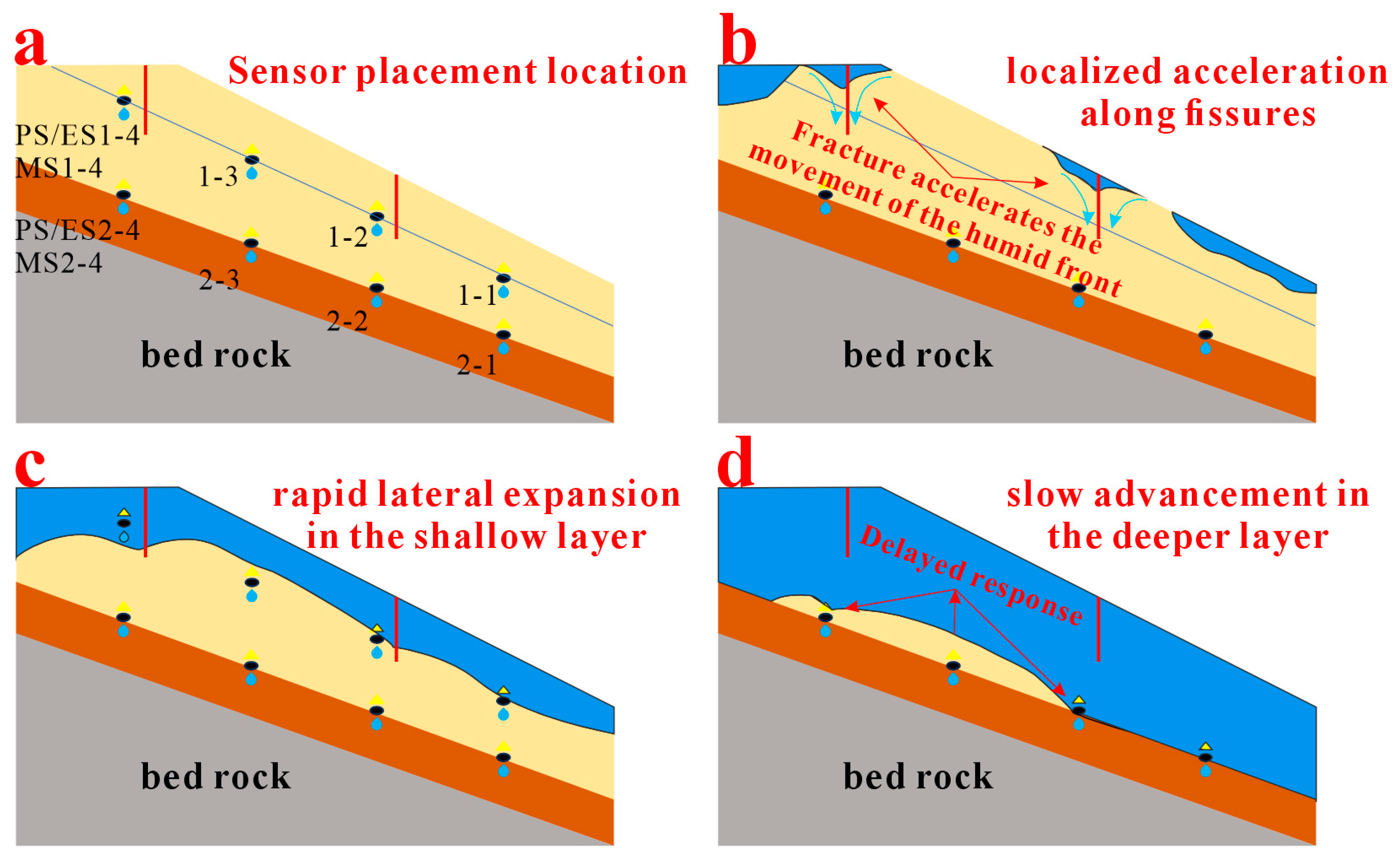
The response times of the sensors show that shallow sensors exhibited significant changes earlier than deep sensors (4–7.5 min for shallow layers, 11–22 min for deep layers), indicating rapid infiltration in the shallow loess and accelerated downslope progression of the wetting front (Table 3). Taking MS1-3 and MS2-3 as examples, at the same horizontal location but different depths, the horizontal wetting front velocity calculated from the shallow sensor MS1-3 was 0.2 m/min, whereas MS2-3 yielded only 0.018 m/min. This indicates a pronounced time lag in the deep mudstone interface response, reflecting the restricted vertical infiltration. Furthermore, sensors located at the crest and mid-slope cracks (MS2-2, MS2-4) responded earlier, suggesting that rainwater formed local preferential flow paths along cracks, accelerating local infiltration and resulting in spatial heterogeneity of the wetting front morphology (Figure 12b) [9]. Overall, the wetting front rapidly expanded along the slope in the shallow layer (Figure 12c), whereas a slower-propagating, locally convergent dual-layer structure developed at the deep interface (Figure 12d), consistent with typical layered infiltration and capillary barrier phenomena [38].
The calculated horizontal migration rates of the wetting front show occasional negative time differences, indicating that wetting front propagation within the slope does not strictly advance monotonically with geometric distance. This is mainly due to the slope’s internal spatial heterogeneity and local preferential flow paths: cracks at mid- and top-slope provide advantageous downward pathways, causing some deep soil located geometrically behind the front sensors to become wetted first. In addition, the low permeability of the mudstone interface and capillary forces between loess layers promote lateral convergence, producing local “surging”, which leads to certain rear sensors responding before adjacent front sensors. This phenomenon suggests that in heterogeneous slopes, wetting front propagation cannot be predicted solely by geometric distance, and its spatiotemporal distribution must be assessed in conjunction with crack layout and soil layering characteristics [39].
In summary, the experimental results quantitatively reveal a dual-layer wetting front migration pattern in loess–mudstone slopes under rainfall infiltration, characterized by rapid expansion in shallow layers, slow advancement in deep layers, and local acceleration at cracks, highlighting the crucial control of cracks and interface heterogeneity on wetting front propagation.

4.6. SBAS-InSAR Spatial Inversion Results

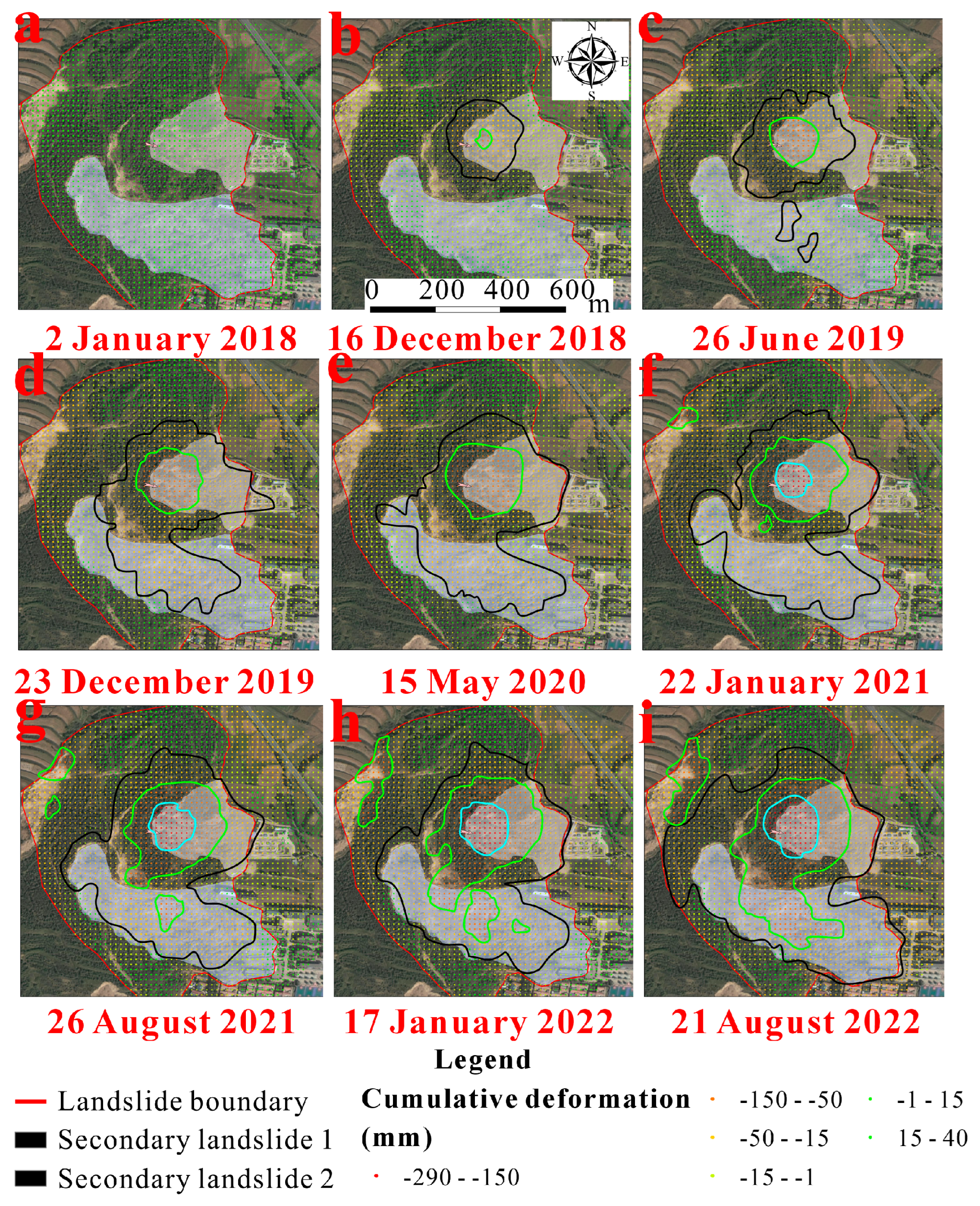
Figure 13 presents the time-series analysis of nine ascending Sentinel-1 acquisitions from January 2018 to August 2022, showing that the landslide experienced a progressive evolution from initial slow creeping, to localized differential expansion, and finally to overall accelerated downslope movement.
The results indicate that before December 2018 (Figure 13a,b), scattered yellow deformation zones (−50 to −15 mm) appeared only in the upper part of the landslide, suggesting small-magnitude and localized settlement during this period. By June 2019 (Figure 13c), the yellow zones had noticeably expanded, gradually propagating from Landslide No. 1 toward No. 2, with the frontal part of No. 2 showing yellow deformation zones for the first time. Simultaneously, medium-magnitude deformation zones (green, −150 to −50 mm) first appeared in the midsection of the landslide and gradually expanded, exhibiting a transition from point-like to patch-like patterns, indicating that the landslide had progressed from shallow surface relaxation to deeper, more extensive cumulative settlement. By May 2020 (Figure 13d,e), the continuity of the green zones was enhanced, forming the primary settlement region of the landslide, and localized differential expansion began to emerge. A transition zone between Landslide No. 1 and No. 2 displayed spatially heterogeneous propagation rates and developmental patterns. In January 2021 (Figure 13f), blue deformation zones (−290 to −150 mm) and green zones appeared in the central and rear parts of the landslide, respectively, reflecting further intensification of deformation and marking a key stage of significant landslide development.
In the later stage (August 2021–August 2022; Figure 13g–i), the accelerated deformation trend became more pronounced. The blue high-deformation zone rapidly expanded in the central part of the landslide, forming the main cumulative settlement area, reflecting continuous energy release along the deep sliding zone. The green zones formed a continuous envelope surrounding the blue zone, covering the central body of the landslide and indicating stable development of medium-intensity deformation. Yellow zones were widely distributed at the upper and lateral margins of the landslide, forming a complete shallow relaxation deformation envelope, revealing that the overall slope structure had fully loosened. During this stage, the landslide exhibited a three-segment spatial pattern: slow frontal creeping, intense central settlement and shear, and tensile crack development at the rear.
The four-year time-series evolution of the Huzhu landslide indicates that it follows a typical progressive failure pattern of “slow frontal creeping–central differential expansion–rear tensile–push”, in which deformation initiates at the shallow frontal and mid-frontal sections, gradually propagates to deeper and rear areas, and ultimately forms an overall failure pattern progressing from shallow to deep, from front to rear, and from local to global. This observation is consistent with the surface deformation and failure processes revealed by the physical model experiments, demonstrating the feasibility and reliability of interpreting real landslide temporal evolution based on model test results.

4.7. SBAS-InSAR Time-Series Deformation Analysis

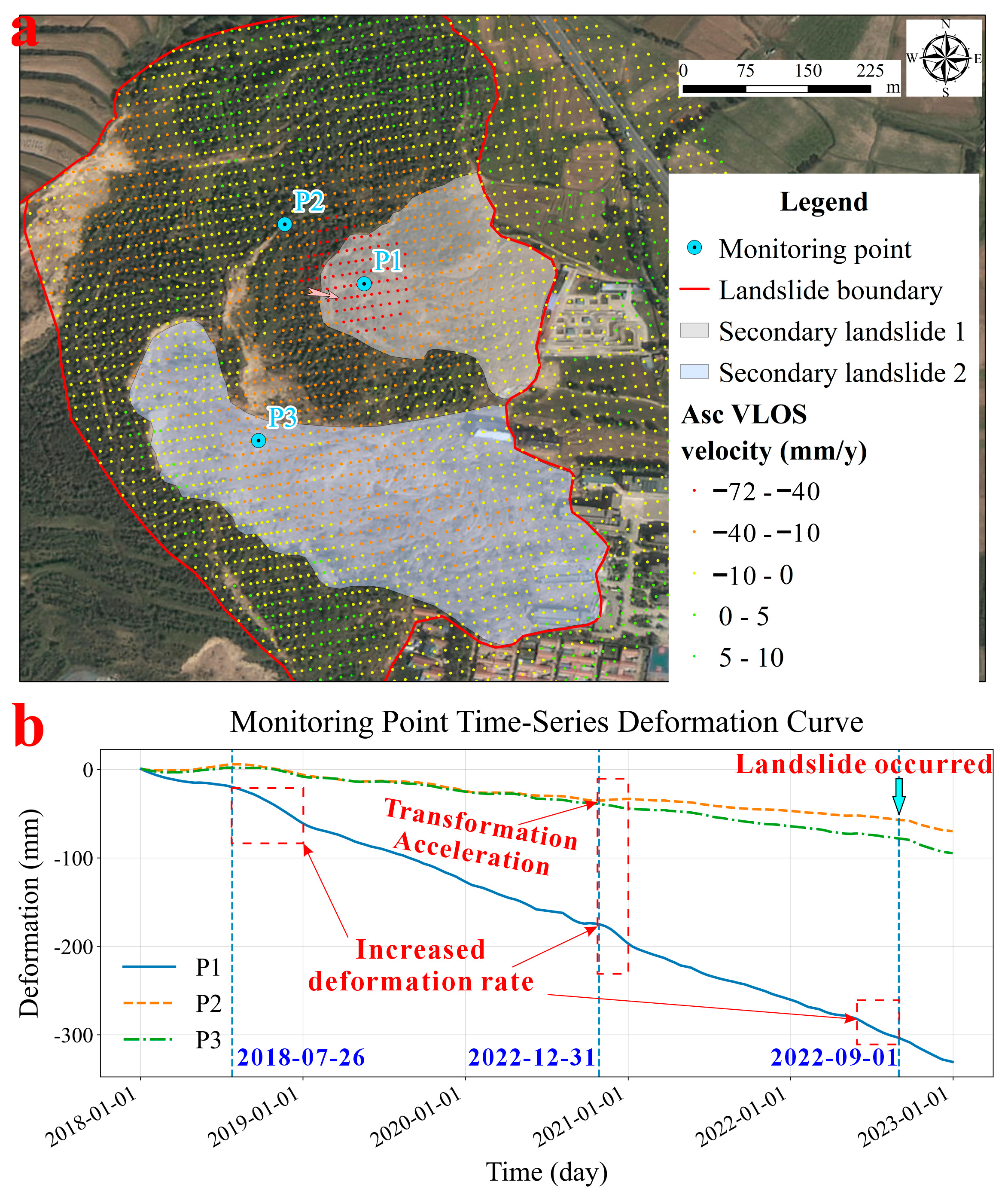
To further quantitatively characterize the spatially differentiated deformation behavior of the landslide, Figure 14a presents the mean LOS deformation velocity distribution. The results show that the central part of the landslide exhibits the highest deformation rates, mainly ranging from −40 to −72 mm/a, whereas the upper and lateral parts are dominated by lower deformation rates of −10 to −40 mm/a.
Three representative monitoring points (P1–P3) located in different deformation zones were selected for time-series analysis (Figure 14b). Among them, point P1, located in the central high-deformation zone, has exhibited continuous acceleration since July 2018, with rapidly increasing cumulative deformation. A distinct increase in deformation rate is observed prior to the landslide occurrence on 1 September 2022, followed by further acceleration after 31 December 2022. The final cumulative deformation at P1 reaches −330.71 mm, indicating that this area represents the core zone of deep-seated sliding and deformation energy release.
In contrast, points P2 and P3, located in the middle–rear part and lateral margin of the landslide, show highly consistent deformation evolution before 31 December 2022, characterized by stable slow creep, with final cumulative deformations of −69.89 mm and −94.78 mm, respectively. This synchronous deformation behavior indicates coordinated downslope creep of the middle–front part of the landslide prior to failure, which corresponds well with the development of surface cracks observed in remote sensing images and with the stage dominated by overall progressive deformation before 33 min in the physical model experiments.
After 31 December 2022, the deformation evolution of P2 and P3 begins to diverge, with P3 exhibiting a significant increase in deformation rate and localized acceleration, while P2 maintains a relatively stable deformation rate. This temporally differentiated expansion behavior is highly consistent with the development of differential erosion and localized instability observed in the physical model experiments after 33 min, further indicating that the middle–front part of the landslide gradually transitions from overall creeping to differential deformation and localized failure during the later stage.

5. Discussion

5.1. Landslide Failure Patterns Revealed by the Physical Model Test

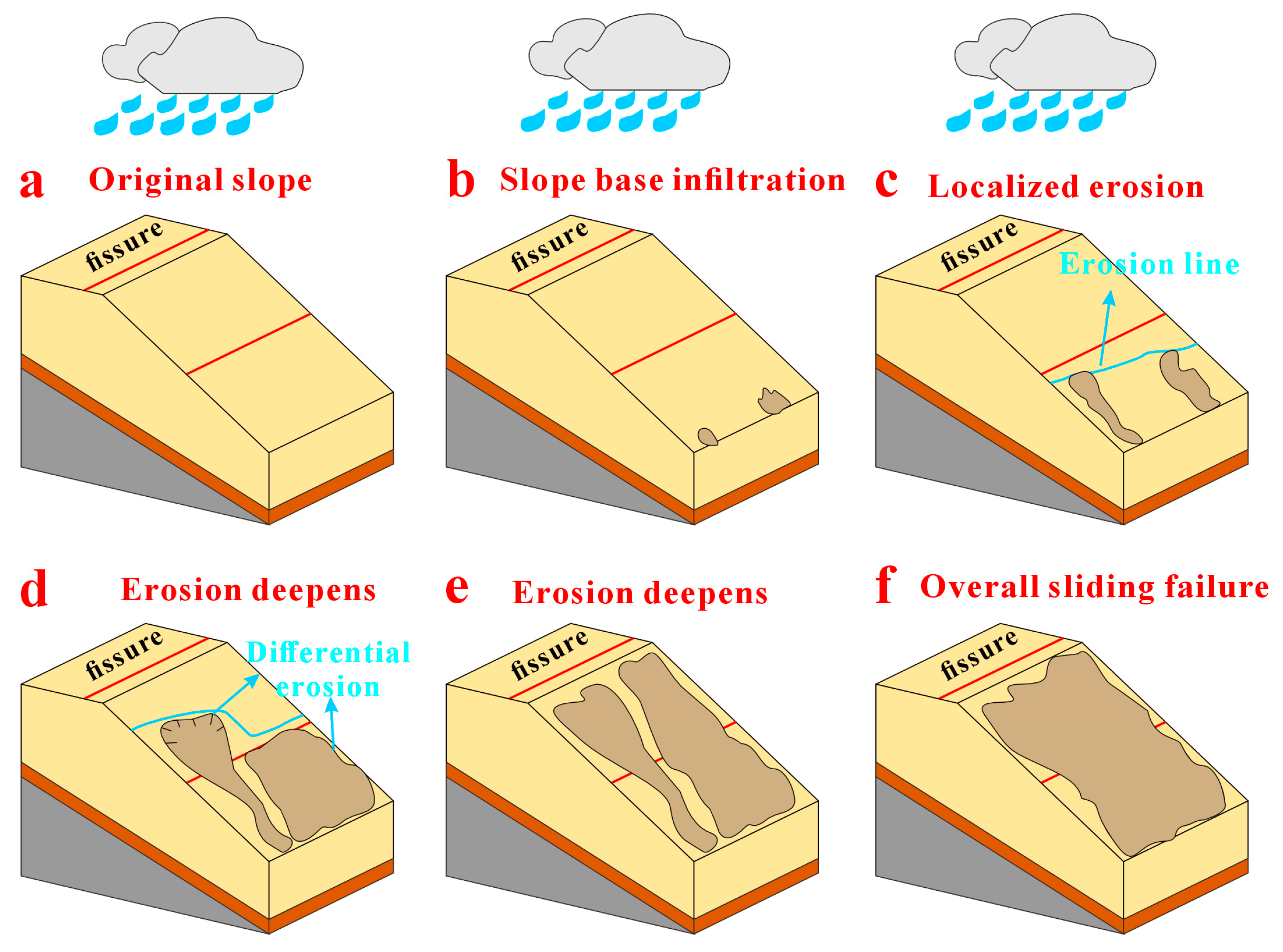
The failure pattern of rainfall-induced loess–mudstone slopes exhibits distinct transitional characteristics, as shown in Figure 15. During the failure process, the slope’s failure mode gradually evolves from toe infiltration softening and local mid-slope erosion to differential crest erosion and complete destabilization and sliding [40,41]. Accordingly, the slope failure pattern can be divided into four stages:
(1)
Toe infiltration and softening stage (Figure 15a,b):
This stage marks the initial incubation phase of failure, during which rainfall primarily affects the surface layer of the slope, and continuous seepage channels have not yet formed. Under the combined influence of gravity and capillary action, the slope toe is first subjected to rainfall infiltration, causing a rapid increase in the shallow loess water content. The volumetric water content curve exhibits a pronounced peak within approximately 5–10 min. Meanwhile, shallow earth pressure (ES1 series) drops sharply, with the ES1-1 sensor at the slope toe showing the largest decrease (−27.06 kPa), indicating significant stress release due to the loss of matric suction in the shallow loess. The surface soil at the toe darkens in color, with localized minor collapses and the expansion of wetting zones. The pore water pressure remains low and fluctuating during this stage, with only a few sensors near cracks (e.g., PS1-4, PS2-4) exhibiting slight positive pressure, indicating the initiation of localized seepage. Overall, the controlling mechanism of this stage is the rapid loss of matric suction and local softening in the shallow loess caused by rainfall infiltration, leading to a decrease in the bearing capacity of the slope toe and providing initial conditions for subsequent failure.
(2)
Local erosion in the middle slope (Figure 15c):
During the mid-rainfall period, the infiltration depth increases, and the wetting front advances upward along the slope surface. The preferential flow effect of the pre-existing cracks becomes evident, allowing rainfall to infiltrate rapidly along the cracks to the loess–mudstone interface. Consequently, deep pore water pressure (PS2 series) begins to increase significantly, with PS2-3 and PS2-4—located near the cracks—reaching distinct peaks within approximately 15–20 min, indicating water accumulation near the interface. Simultaneously, deep earth pressure responds with a delayed decrease (ES2-3 and ES2-4 decrease by −12.01 and −35.07 kPa, respectively), signifying softening and stress relaxation at the top of the mudstone layer. Erosion lines in the middle slope begin to migrate upward, with intensified localized erosion on the left side and shallow collapses developing. Physically, this stage represents preferential infiltration along cracks and the formation of a perched water layer atop the low-permeability mudstone, causing a redistribution of stresses between shallow and deep layers. The shallow loess is already in a relaxed state, and an interfacial stress concentration zone forms between the slope toe and mid-slope, creating conditions for slip surface initiation.
(3)
Differential Crest Erosion Stage (Figure 15d,e):
Under continuous rainfall, the slope surface layer approached saturation, and the infiltration zone further expanded upward, with noticeable differential erosion occurring in gullies at the crest. After the volumetric water content in the shallow layer stabilized, deep-layer sensors showed a continuous upward trend, indicating ongoing moisture accumulation in the lower part. A prominent feature of this stage is the dramatic change in slope morphology: gully-type erosion in the mid-slope developed significantly, with rapid scouring and collapse on the left side, while gradual creeping deformation occurred on the right side. Corresponding stress responses indicate that shallow soil pressures stabilized during the recovery phase, whereas deep stress release zones concentrated toward the rear, with ES2-4 showing the maximum decrease, reflecting severe softening of the mudstone interface at the rear slope. Pore water pressure curves during this period exhibited opposite trends, with continuous increases in the deep layer and decreases in the shallow layer, indicating a stratified effect of “upper drainage and lower water accumulation” within the slope. The central and rear slope structures relaxed and strength sharply decreased, while the frontal zone, subjected to thrust, formed localized stress concentration areas, highlighting this stage as a critical transition from localized erosion to overall slope erosion.
(4)
Overall sliding failure stage (Figure 15f):
In the late rainfall period, cracks at the slope crest become the main infiltration pathways, allowing continuous water input to the deep interface and significantly reducing the overall shear strength of the slope. Pore water pressure in the middle and rear parts of the slope continues to increase and stabilizes at a high level, reflecting deep saturation and pore pressure buildup. Meanwhile, stress at the deep rear further decreases, whereas the deep front sensor (ES2-2) records an anomalous increase (+4.9 kPa) due to the transmission of sliding thrust, indicating that the thrust has been concentrated in the “anti-sliding zone” at the slope toe. Eventually, the erosion line penetrates the slope body, a continuous slip zone forms rapidly, and the slope undergoes overall sliding failure. Experimental observations show that between 55 and 65 min, the slope entered a global instability state. The sliding mass slipped along the loess–mudstone interface, with partial soil fluidization and accumulation at the slope toe. Tensile cracks and subsidence developed at the crest, while the toe exhibited bulging, forming a typical morphology characterized by “compression at the toe and tension at the rear”. The dominant mechanism of this stage is the coupled effect of deep mudstone softening, pore pressure accumulation, and stress concentration induced by continuous rainfall infiltration, ultimately triggering overall sliding failure.

5.2. Comparison of Failure Processes Revealed by InSAR Deformation Monitoring and Physical Model Tests and Analysis of Mechanistic Differences

Both InSAR time-series monitoring and indoor rainfall physical model tests reveal that the Huzhu landslide exhibits a typical progressive evolution, with high consistency in the division of failure stages and spatial structural responses. The four-year InSAR deformation evolution shows that the landslide developed from shallow to deep and from front to rear in a creeping–expansion–acceleration sequence: in the early stage, scattered shallow settlements (yellow) appeared only in the upper part of the slope; subsequently, a stable, laterally expanding medium settlement zone (green) formed in the midsection; and finally, a large-magnitude settlement area (blue) appeared in the central to rear part of the slope, forming a three-segment structural evolution pattern of “rear tensile–push, central differential expansion, and frontal slow creeping.” Similarly, the physical model test indicates that slope failure progressed continuously from toe infiltration softening, mid-slope local erosion, and differential crest erosion to overall sliding. Notably, significant differential erosion and concentrated settlement were observed in the mid- to crest-slope regions, indicating that both approaches identify highly consistent primary deformation zones and failure sequences. Both methods emphasize that shallow suction decay, interface softening with water retention, and the formation of deep shear planes are key mechanisms controlling the transition from local to overall slope instability, demonstrating the reliability and verifiability of the physical model tests in interpreting real landslide temporal evolution.
Although the overall failure patterns are consistent, the two monitoring approaches show certain differences in deformation propagation paths, local deformation extent, and development rate. First, in the InSAR inversion results, the mid-slope settlement zone transitions in a patch-like manner from Landslide No. 1 to No. 2, whereas in the physical model, mid-slope erosion bands expand more directionally, forming concentrated gullies or weakened zones. This difference is mainly attributed to the microtopography of the natural slope surface [42]. Micro-gullies, small catchment depressions, miniature steps, and loose accumulations on the natural slope strongly regulate runoff and infiltration paths, leading to higher spatial discreteness in flow channels and stress release zones [43]. In contrast, the indoor physical model slope is relatively smooth, and the microtopography is not fully reproduced, resulting in more concentrated erosion paths and clearer local failure zones [26].
Second, differences in spatial response during the acceleration stage are also closely related to scale effects. The natural landslide has a much larger volume, causing stress redistribution and pore pressure accumulation to exhibit more pronounced lag, and the expansion of the blue high-deformation zone detected by InSAR is relatively slow [44]. In the physical model, rainfall intensity, infiltration, and stress release are rapidly coupled within a limited scale, so the fully unstable stage occurs more quickly. Moreover, InSAR captures long-term cumulative deformation and is affected by atmospheric delays, vegetation cover, and surface roughness [45], whereas the model test records high-temporal-resolution transient mechanical responses [25], leading to differences in stage duration between the two approaches.
Overall, both methods jointly reveal that landslide failure progresses from shallow to deep and from local to overall. However, due to factors such as natural topography complexity, crack distribution heterogeneity, discrete flow paths, and scale effects, differences exist in local deformation propagation patterns. Nevertheless, the high degree of consistency between the two approaches in terms of failure stage division and identification of dominant deformation zones enables effective complementarity in mechanistic interpretation and scale representation, and provides more practical insights for real-slope monitoring and risk identification. The indoor physical model tests reveal key hydrological–mechanical processes, including wetting front migration, stage-dependent pore water pressure accumulation, and deformation differentiation between shallow and deep layers, which offer a physical reference for interpreting the coupled evolution of in situ monitoring indicators such as volumetric water content, pore water pressure, and displacement. In contrast, SBAS-InSAR time-series monitoring characterizes deformation acceleration and spatial expansion at the slope scale over long time periods. The integration of these two approaches facilitates the linkage between abnormal responses in field monitoring data and potential instability stages, thereby enhancing the identification and interpretation of progressive landslide evolution.

5.3. Discussion on Method Applicability and Limitations

This study combines indoor rainfall infiltration physical model tests with SBAS-InSAR time-series monitoring to systematically reveal the progressive failure mechanism of loess–mudstone composite slopes from a multi-scale, multi-field coupling perspective. Overall, the methodology exhibits strong complementarity: InSAR provides long-term, slope-wide surface deformation evolution, enabling identification of the overall failure patterns of natural slopes [46]; the physical model tests capture internal response mechanisms such as wetting front propagation, pore water pressure accumulation, and stress redistribution during rainfall infiltration [47]. The combination of these approaches establishes a consistent understanding of the landslide failure process at both the “surface deformation–internal mechanism” levels, providing reliable evidence for revealing the progressive instability of composite slopes.
In terms of applicability, physical model tests can realistically reproduce rainfall-induced hydro-mechanical coupling processes, with strict similarity ratios ensuring reasonable restoration of layered structures, slope geometry, and initial stress fields. Multi-sensor deployment allows quantitative observation of wetting front migration, staged pore pressure responses, and deep- versus shallow-layer stress relaxation, which correspond well with InSAR-derived accelerated deformation stages and the morphology of rear tensile zones. Both methods consistently identify the key phenomenon of “differential erosion”, where local erosion deepening and preferential flow paths control the evolution of failure, indicating that mechanisms revealed by the model tests have certain extrapolative significance. However, it should be noted that the progressive failure mechanisms revealed in this study are primarily applicable to loess–mudstone composite slopes characterized by a distinct loess cover, an underlying low-permeability mudstone interface, and deformation controlled by sustained or extreme rainfall conditions. In such slopes, preferential infiltration along fissures, interface water retention, and differentiated deformation between shallow and deep layers jointly govern the progressive instability process [48]. For slopes with markedly different stratigraphic structures, geometries, or rainfall regimes, the failure pathways and stage characteristics may vary and should be evaluated in the context of site-specific geological conditions.
However, as highlighted in the previous comparative analysis, differences remain in failure propagation paths and stage transition rates, pointing to inherent methodological limitations. First, the physical model employs idealized slopes and simplified gullies, whereas the prototype landslide exhibits significant microtopographic variations, such as natural rills, fine gullies, undulating old slip surfaces, which strongly influence rainfall runoff, infiltration rates, and erosion band expansion patterns [49]. Thus, while both model tests and InSAR observe “local-to-overall” differential erosion, prototype erosion bands show more pronounced asymmetry and directionality, indicating that natural microtopography plays an important modulating role in failure evolution [50,51].
Second, the limited size of the model box means that sidewall boundaries can alter water distribution and drainage patterns, potentially shifting pore pressure accumulation and water retention zones toward the model center compared with natural slopes [52]. Moreover, the boundary conditions inherent to the physical model setup, including sidewall confinement and the finite spatial extent of the model box, may affect water migration pathways, pore pressure dissipation, and the spatial development of deformation [53]. Rainfall duration, wetting front velocity, and stress responses in the model are subject to scaling effects and cannot fully replicate the prototype process, requiring careful interpretation with numerical simulations and field data [54]. In addition, the physical modeling component of this study is based on a single experimental realization, and experimental repeatability was not evaluated through repeated tests. Although the main deformation sequence and response patterns are considered robust, uncertainties related to material heterogeneity, sensor accuracy, and installation disturbance may still exist and should be further reduced through repeated experiments and systematic uncertainty analyses in future studies. Furthermore, the physical model tests in this study primarily aim to reveal the dominant hydro-mechanical response patterns and progressive failure mechanisms of loess–mudstone composite slopes under rainfall infiltration, rather than to establish a complete hydro-mechanical constitutive parameter system. Therefore, soil water retention curves and hydraulic conductivity functions were not systematically measured. Future studies will integrate laboratory testing, in situ monitoring, and numerical modeling to supplement key hydraulic parameters, thereby further improving the quantitative applicability and engineering relevance of the model results [55].
The InSAR method also has intrinsic limitations. It can only invert vertical and line-of-sight surface deformation, making it difficult to directly capture shallow rapid erosion, short-term hydrological fluctuations, and preferential flow along cracks [56]. Moreover, vegetation cover, snow accumulation, and soil moisture variations in natural slopes can introduce phase errors, affecting the accuracy of small-magnitude deformation detection [57]. Therefore, interpretation of InSAR-derived stage-wise deformation still requires constraint by physical model tests and field investigations.
Overall, the combined approach of indoor physical modeling and InSAR monitoring effectively compensates for the limitations of individual methods and is suitable for revealing the progressive failure mechanism and overall evolution pattern of rainfall-induced landslides. It is particularly advantageous in identifying key deformation zones, stage-transition nodes, and deep sliding trends. Nevertheless, this methodology is mainly applicable for qualitative mechanistic studies and is not recommended for direct quantitative extrapolation. Future research could enhance the scientific rigor and prototype applicability by (1) introducing visual imaging techniques to improve capture of infiltration processes, (2) constructing microtopography in physical models closer to the prototype, (3) integrating high-resolution InSAR, multi-source sensors, and 3D numerical inversion for cross-validation of multi-scale failure processes [58].

6. Conclusions

By conducting physical rainfall model experiments in combination with SBAS-InSAR time-series deformation monitoring, this study systematically revealed the progressive failure evolution, multi-field response patterns, and controlling mechanisms of layered loess–mudstone composite slopes under extreme rainfall. The results indicate that rainfall infiltration drives a typical shallow-to-deep, local-to-overall slope instability process. In the physical experiments, the slope toe first experiences shallow relaxation due to infiltration-induced softening. Subsequently, the wetting front accelerates downward along preferential flow paths in cracks, causing water retention and softening at the top of the mudstone interface, triggering staged pore water pressure accumulation, and redistributing stresses in both shallow and deep layers. Ultimately, during the late rainfall stage, a through-going slip surface develops along the loess–mudstone interface, exhibiting a characteristic failure pattern of “toe creep and rear tension”.
Multi-field monitoring clearly captured the hydro-mechanical coupling responses of the slope during rainfall. Volumetric water content exhibited pronounced spatial heterogeneity: the wetting front in shallow layers propagated rapidly with prominent peaks, whereas deep layers showed a delayed response. Crack locations responded earliest, highlighting the control of preferential flow on wetting front pathways. Pore water pressure displayed staged behavior, with initial matric suction decay, rapid shallow-layer pressurization during the intermediate stage, and significant deep-layer accumulation in the late stage, revealing the barrier effect of interfaces and the formation of perched water layers. Stress variations manifested as shallow-layer relaxation, deep-layer softening, and stress concentration at the slope toe, reflecting the physical processes through which rainfall infiltration drives stress transfer and strength reduction, ultimately facilitating slip surface formation. Quantitative analysis of the wetting front further revealed clear stratification: horizontal propagation rates in shallow layers were approximately 6–10 times those in deep layers, corresponding to a “rapid shallow spread + slow deep advance” dual-layer infiltration pattern.
Time-series InSAR monitoring at the watershed scale revealed the actual landslide evolution, showing high consistency with the failure patterns observed in the physical experiments. The natural landslide similarly underwent a typical progressive evolution from shallow relaxation, to differential expansion in the central zone, and finally to deep through-going slip and overall acceleration, corresponding respectively to the infiltration-softening, local erosion, differential erosion, and overall sliding stages in the physical model. Both approaches identified differential settlement and expansion in the central slope region. However, discrepancies in propagation paths and spatial patterns were observed, mainly due to the complex microtopography and undulating surface of the natural slope, which control infiltration paths, local runoff convergence, and water diversion effects. In contrast, the physical model is constrained by boundary conditions and scale effects, limiting its ability to fully replicate the topographic control on erosion and deformation propagation. This comparison validates the reliability of physical model tests for revealing failure mechanisms while emphasizing the critical role of natural topography in governing propagation direction, erosion patterns, and final failure morphology.
Overall, this study demonstrates at both experimental and field scales that rainfall-induced matric suction decay, mudstone interface softening, pore water pressure accumulation, and stress redistribution between shallow and deep layers collectively control the progressive failure evolution of loess–mudstone composite slopes. The progressive process exhibits distinct stages, transmissivity, and spatial directionality. This work not only deepens the understanding of rainfall-induced instability mechanisms in structured slopes but also highlights the effectiveness and complementarity of the “physical model + InSAR time-series monitoring” multi-scale approach for elucidating slope progressive failure mechanisms. Future research integrating high-resolution visual monitoring, 3D numerical inversion, and field observations under more complex topographic conditions could further enhance understanding of crack-controlled infiltration, interface stress evolution, and their three-dimensional coupling, providing a solid scientific basis for predicting and mitigating rainfall-induced landslides under natural conditions.

Author Contributions

Z.W. and J.Z. were responsible for the overall progress and coordination of the research work. Y.L. (Yi Liang) designed the experimental scheme and prepared the manuscript. Z.Z. carried out and implemented the physical model tests. X.Z., Y.L. (Yun Li) and J.D. reviewed and revised the manuscript after completion. All authors have read and agreed to the published version of the manuscript.

Funding

This work was supported by the 2023 Qinghai “Kunlun Talents High-end Innovation and Entrepreneurship Talent” Program and the National Key R&D Program of China (grant no. 2024YFC3012605).

Institutional Review Board Statement

Not applicable.

Informed Consent Statement

Not applicable.

Data Availability Statement

The data presented in this study are available on request from the corresponding author.

Acknowledgments

This study was strongly supported by the Qinghai Environmental Geological Exploration Bureau in field investigations and sample collection, to which the authors express their sincere gratitude. The authors also thank the State Key Laboratory of Geohazard Prevention and Geoenvironment Protection, Chengdu University of Technology, for providing experimental facilities and technical assistance. Sincere appreciation is extended to all colleagues and graduate students who contributed to the model testing, monitoring, and data processing.

Conflicts of Interest

The authors declare no conflicts of interest.

Abbreviations

The following abbreviations are used in this manuscript:
DEMDigital Elevation Model
MSVolumetric Moisture Sensor
PSPore Water Pressure Sensor
ESEarth Pressure Sensor

References

  1. Zhou, J.; Zhu, C.; Zheng, J.; Wang, X.; Liu, Z. Landslide Disaster in the Loess Area of China. J. For. Res. 2002, 13, 157–161. [Google Scholar] [CrossRef]
  2. Peng, J.; Wang, S.; Wang, Q.; Zhuang, J.; Huang, W.; Zhu, X.; Leng, Y.; Ma, P. Distribution and Genetic Types of Loess Landslides in China. J. Asian Earth Sci. 2019, 170, 329–350. [Google Scholar] [CrossRef]
  3. Cui, Y.; Xu, C.; Xu, S.; Chai, S.; Fu, G.; Bao, P. Small-Scale Catastrophic Landslides in Loess Areas of China: An Example of the March 15, 2019, Zaoling Landslide in Shanxi Province. Landslides 2020, 17, 669–676. [Google Scholar] [CrossRef]
  4. Wang, H.; Sun, P.; Zhang, S.; Han, S.; Li, X.; Wang, T.; Guo, Q.; Xin, P. Rainfall-Induced Landslide in Loess Area, Northwest China: A Case Study of the Changhe Landslide on September 14, 2019, in Gansu Province. Landslides 2020, 17, 2145–2160. [Google Scholar] [CrossRef]
  5. Zhuang, J.; Peng, J.; Wang, G.; Javed, I.; Wang, Y.; Li, W. Distribution and Characteristics of Landslide in Loess Plateau: A Case Study in Shaanxi Province. Eng. Geol. 2018, 236, 89–96. [Google Scholar] [CrossRef]
  6. Peng, D.; Xu, Q.; Liu, F.; He, Y.; Zhang, S.; Qi, X.; Zhao, K.; Zhang, X. Distribution and Failure Modes of the Landslides in Heitai Terrace, China. Eng. Geol. 2018, 236, 97–110. [Google Scholar] [CrossRef]
  7. Liang, Y.; Zhao, J.; Wei, Z.; Lai, Q.; Zhang, Z.; Chen, H.; Dong, J. Deformation Characteristics and Triggering Mechanisms of the Huzhu Landslide in Qinghai: An “Air-Space-Ground-Subsurface” Perspective. Landslides 2025, 22, 3705–3723. [Google Scholar] [CrossRef]
  8. Peng, J.; Fan, Z.; Wu, D.; Zhuang, J.; Dai, F.; Chen, W.; Zhao, C. Heavy Rainfall Triggered Loess–Mudstone Landslide and Subsequent Debris Flow in Tianshui, China. Eng. Geol. 2015, 186, 79–90. [Google Scholar] [CrossRef]
  9. Ma, J.; Zeng, R.; Meng, X.; Zhang, Z.; Zhao, S.; Wei, Z. Field Research on Preferential Infiltration in Rainfall-Induced Loess Landslides. Eng. Geol. 2025, 354, 108184. [Google Scholar] [CrossRef]
  10. Li, Z.; Zhao, J.; Lv, S.; Liu, L.; Zhang, C. Investigations of the Effect of Artificial Rainfall on the Pore Water Pressure and Slope Surface Displacement of Loess Slopes. Int. J. Geomech. 2024, 24, 04024064. [Google Scholar] [CrossRef]
  11. Chen, G.; Meng, X.; Qiao, L.; Zhang, Y.; Wang, S. Response of a Loess Landslide to Rainfall: Observations from a Field Artificial Rainfall Experiment in Bailong River Basin, China. Landslides 2018, 15, 895–911. [Google Scholar] [CrossRef]
  12. Wang, H.; Sun, P.; Zhang, S.; Ren, J.; Wang, T.; Xin, P. Evolutionary and Dynamic Processes of the Zhongzhai Landslide Reactivated on October 5, 2021, in Niangniangba, Gansu Province, China. Landslides 2022, 19, 2983–2996. [Google Scholar] [CrossRef]
  13. Hou, X.; Li, T.; Qi, S.; Guo, S.; Li, P.; Xi, Y.; Xing, X. Investigation of the Cumulative Influence of Infiltration on the Slope Stability with a Thick Unsaturated Zone. Bull. Eng. Geol. Environ. 2021, 80, 5467–5480. [Google Scholar] [CrossRef]
  14. Shen, W.; Peng, J.; Qiao, Z.; Li, T.; Li, P.; Sun, X.; Chen, Y.; Li, J. Plowing Mechanism of Rapid Flow-like Loess Landslides: Insights from MPM Modeling. Eng. Geol. 2024, 335, 107532. [Google Scholar] [CrossRef]
  15. Sun, P.; Wang, H.; Wang, G.; Li, R.; Zhang, Z.; Huo, X. Field Model Experiments and Numerical Analysis of Rainfall-Induced Shallow Loess Landslides. Eng. Geol. 2021, 295, 106411. [Google Scholar] [CrossRef]
  16. Wei, G.; Yan, J.; Xia, Z.; Li, B.; Qi, H. Research on the Instability Mechanism of Loess Landslides Based on Preferential Infiltration of Rainfall. Front. Earth Sci. 2025, 13, 1586275. [Google Scholar] [CrossRef]
  17. Duan, G.; Song, F.; Wang, H.; Rodriguez-Dono, A.; Wang, L.; Chen, J. Stability Analysis of Unsaturated Loess Slopes Subjected to Extreme Rainfall Incorporating Creep Effects. Comput. Geotech. 2024, 169, 106231. [Google Scholar] [CrossRef]
  18. Tan, W.; Huang, Q.; Chen, X.; Tan, W.; Huang, Q.; Chen, X. Physical Model Test on the Interface of Loess Fill Slope. Land 2022, 11, 1372. [Google Scholar] [CrossRef]
  19. Sun, Y.; Yang, K.; Hu, R.; Wang, G.; Lv, J. Model Test and Numerical Simulation of Slope Instability Process Induced by Rainfall. Water 2022, 14, 3997. [Google Scholar] [CrossRef]
  20. Li, P.; Wu, C.; Jiang, H.; Chen, Q.; Chen, H.; Sun, W.; Luo, H.; Li, P.; Wu, C.; Jiang, H.; et al. Physical Model Experiments and Numerical Simulation Study on the Formation Mechanisms of Landslides on Gently Inclined Loess–Bedrock Contact Surfaces—A Case Study of the Libi Landslide in Shanxi Province. Water 2024, 16, 3267. [Google Scholar] [CrossRef]
  21. Sun, P.; Wang, G.; Wu, L.Z.; Igwe, O.; Zhu, E. Physical Model Experiments for Shallow Failure in Rainfall-Triggered Loess Slope, Northwest China. Bull. Eng. Geol. Environ. 2019, 78, 4363–4382. [Google Scholar] [CrossRef]
  22. Yin, Y.; Deng, Q.; Li, W.; He, K.; Wang, Z.; Li, H.; An, P.; Fang, K. Insight into the Crack Characteristics and Mechanisms of Retrogressive Slope Failures: A Large-Scale Model Test. Eng. Geol. 2023, 327, 107360. [Google Scholar] [CrossRef]
  23. Zhu, Y.; Zhang, Y.; Lan, H.; Peng, J.; Zheng, H.; Zhao, D.; Yin, Y. Effect of Crack Depth on the Initiation and Propagation of Crack-Induced Sliding in a Paleosol Area on a Loess Slope: Three-Dimensional Investigation Based on Model Testing and Laser Scanning. Eng. Geol. 2024, 342, 107745. [Google Scholar] [CrossRef]
  24. Zhang, C.; Wang, S.; Wang, L.; Chen, Y.; He, Y.; Li, X.; Fang, K. Hydrological Response and Stability of Landslide with Cracks under Intermittent Rainfall: Integrating Physical Modeling, Numerical Simulation, and Field Investigations. J. Hydrol. 2025, 663, 134316. [Google Scholar] [CrossRef]
  25. Guo, Z.; Huang, Q.; Liu, Y.; Wang, Q.; Chen, Y. Model Experimental Study on the Failure Mechanisms of a Loess-Bedrock Fill Slope Induced by Rainfall. Eng. Geol. 2023, 313, 106979. [Google Scholar] [CrossRef]
  26. Li, K.; Sun, P.; Wang, H.; Ren, J. Insight into Failure Mechanisms of Rainfall Induced Mudstone Landslide Controlled by Structural Planes: From Laboratory Experiments. Eng. Geol. 2024, 343, 107774. [Google Scholar] [CrossRef]
  27. Liu, M.; Yang, W.; Yang, Y.; Guo, L.; Shi, P. Identify Landslide Precursors from Time Series InSAR Results. Int. J. Disaster Risk Sci. 2023, 14, 963–978. [Google Scholar] [CrossRef]
  28. Tian, H.; Kou, P.; Xu, Q.; Tao, Y.; Jin, Z.; Xia, Y.; Feng, J.; Liu, R.; Gou, Y. Analysis of Landslide Deformation in Eastern Qinghai Province, Northwest China, Using SBAS-InSAR. Nat. Hazards 2024, 120, 5763–5784. [Google Scholar] [CrossRef]
  29. Wei, Z.; Li, Y.; Dong, J.; Cao, S.; Ma, W.; Wang, X.; Wang, H.; Tang, R.; Zhao, J.; Liu, X.; et al. The Identification and Influence Factor Analysis of Landslides Using SBAS-InSAR Technique: A Case Study of Hongya Village, China. Appl. Sci. 2024, 14, 8413. [Google Scholar] [CrossRef]
  30. Zhang, J.; Zuo, X.; Zhu, D.; Li, Y.; Liu, X. Long-Term Monitoring of Landslide Activity in a Debris Flow Gully Using SBAS-InSAR: A Case Study of Shawan Gully, China. Remote Sens. 2025, 17, 1580. [Google Scholar] [CrossRef]
  31. Yang, S.; Li, D.; Liu, Y.; Xu, Z.; Sun, Y.; She, X. Landslide Identification in Human-Modified Alpine and Canyon Area of the Niulan River Basin Based on SBAS-InSAR and Optical Images. Remote Sens. 2023, 15, 1998. [Google Scholar] [CrossRef]
  32. Chang, Z.; Huang, F.; Huang, J.; Jiang, S.-H.; Zhou, C.; Zhu, L. Experimental Study of the Failure Mode and Mechanism of Loess Fill Slopes Induced by Rainfall. Eng. Geol. 2021, 280, 105941. [Google Scholar] [CrossRef]
  33. Ma, P.; Jiao, Q.; Nan, Y.; Zhang, C.; Li, Z.; Zhao, L.; Chen, L.; Han, N.; Peng, J. Formation Mechanism and Evolution Characteristics of the Loess-Mudstone Interface Landslide in Yan’an, China. Bull. Eng. Geol. Environ. 2025, 84, 464. [Google Scholar] [CrossRef]
  34. Meng, Z.; Zhang, F.; Peng, J.; Xu, C.; Kang, C.; Ma, P.; Fan, Z.; Leng, Y.; Li, C.; Cao, Y. A Rainfall Model Test for Investigating the Initiation Mechanism of the Catastrophic Loess Landslide in Baqiao, Xi’an, China. Bull. Eng. Geol. Environ. 2025, 84, 201. [Google Scholar] [CrossRef]
  35. Li, S.; Li, C.; Yao, D.; Liu, C.; Zhang, Y. Multiscale Nonlinear Analysis of Failure Mechanism of Loess-Mudstone Landslide. Catena 2022, 213, 106188. [Google Scholar] [CrossRef]
  36. Leng, X.; Dong, Y.; Cui, L.; Zhou, L.; Luo, S. An Integrated Investigation of the Failure Mechanism of Loess Landslide Induced by Raining: From Field to Laboratory. Bull. Eng. Geol. Environ. 2024, 83, 442. [Google Scholar] [CrossRef]
  37. Rubio, E.; Rubio-Alfaro, M.d.S.; Hernández-Marín, M. Wetting Front Velocity Determination in Soil Infiltration Processes: An Experimental Sensitivity Analysis. Agronomy 2022, 12, 1155. [Google Scholar] [CrossRef]
  38. Cui, B.; Gu, T.; Wang, J.; Li, J.; Fan, N.; Li, X.; Song, Z.; Hao, M. Analysis of Seepage and Hysteresis Effect Mechanism of Unsaturated Loess Based on Resistivity Test. J. Hydrol. 2025, 653, 132749. [Google Scholar] [CrossRef]
  39. Ma, J.; Zeng, R.; Yao, Y.; Meng, X.; Meng, X.; Zhang, Z.; Wang, H.; Zhao, S. Characterization and Quantitative Evaluation of Preferential Infiltration in Loess, Based on a Soil Column Field Test. CATENA 2022, 213, 106164. [Google Scholar] [CrossRef]
  40. Liu, X.; Dong, J.; Tang, C.; Pan, Y.; Zhao, J.; Wei, Z. Instability Mechanism of Loess-Mudstone Landslides under Rainfall Infiltration Conditions. Sci. Rep. 2025, 15, 17591. [Google Scholar] [CrossRef]
  41. Wu, L.Z.; Zhou, Y.; Sun, P.; Shi, J.S.; Liu, G.G.; Bai, L.Y. Laboratory Characterization of Rainfall-Induced Loess Slope Failure. Catena 2017, 150, 1–8. [Google Scholar] [CrossRef]
  42. Liu, K.; Wang, L.; Sun, J.; Xu, S.; Lu, Y.; Tian, W.; Lu, F. Two Loess Landslide at the Same Hillslope Triggered by the Mw 5.9 Minxian-Zhangxian Earthquake in China (July 22, 2013): A Comparative Analysis of Landslide Mechanisms. Front. Earth Sci. 2025, 13, 1526229. [Google Scholar] [CrossRef]
  43. Hua, X.; Xi, Y.; Li, G.; Kou, H. Study on Lateral Water Migration Trend in Compacted Loess Subgrade Due to Extreme Rainfall Condition: Experiments and Theoretical Model. Sustainability 2025, 17, 6761. [Google Scholar] [CrossRef]
  44. He, L.; Pei, P.; Zhang, X.; Qi, J.; Cai, J.; Cao, W.; Ding, R.; Mao, Y. Sensitivity Evaluation of Time Series InSAR Monitoring Results for Landslide Detection. Remote Sens. 2023, 15, 3906. [Google Scholar] [CrossRef]
  45. Zhou, H.; Dai, K.; Tang, X.; Xiang, J.; Li, R.; Wu, M.; Peng, Y.; Li, Z. Time-Series InSAR with Deep-Learning-Based Topography-Dependent Atmospheric Delay Correction for Potential Landslide Detection. Remote Sens. 2023, 15, 5287. [Google Scholar] [CrossRef]
  46. Solari, L.; Del Soldato, M.; Raspini, F.; Barra, A.; Bianchini, S.; Confuorto, P.; Casagli, N.; Crosetto, M. Review of Satellite Interferometry for Landslide Detection in Italy. Remote Sens. 2020, 12, 1351. [Google Scholar] [CrossRef]
  47. Liu, W.; Lin, G.; Liu, Q.; Su, X. Hydraulic Property Variations with Depth in a Loess Mudstone Landslide. Sci. Rep. 2024, 14, 10965. [Google Scholar] [CrossRef] [PubMed]
  48. Gago, F.; Valletta, A.; Mužík, J. Formulation of a Basic Constitutive Model for Fine—Grained Soils Using the Hypoplastic Framework. Civ. Environ. Eng. 2021, 17, 450–455. [Google Scholar] [CrossRef]
  49. Thornes, J.B.; Alcantara-Ayala, I. Modelling Mass Failure in a Mediterranean Mountain Environment: Climatic, Geological, Topographical and Erosional Controls. Geomorphology 1998, 24, 87–100. [Google Scholar] [CrossRef]
  50. Bourenane, H.; Mezouar, N. Geomorphological, Hydrogeological and Geotechnical Characteristics of the El Kherba Large, Deep-Seated Landslide Induced by the August 7th, 2020 (Mw 4.9) Earthquake in the City of Mila, Northeast Algeria. Bull. Eng. Geol. Environ. 2024, 83, 288. [Google Scholar] [CrossRef]
  51. Zumr, D.; Mützenberg, D.V.; Neumann, M.; Jeřábek, J.; Laburda, T.; Kavka, P.; Johannsen, L.L.; Zambon, N.; Klik, A.; Strauss, P.; et al. Experimental Setup for Splash Erosion Monitoring—Study of Silty Loam Splash Characteristics. Sustainability 2019, 12, 157. [Google Scholar] [CrossRef]
  52. Vedie, E.; Lagarde, J.-L.; Font, M. Physical Modelling of Rainfall- and Snowmelt-Induced Erosion of Stony Slope Underlain by Permafrost. Earth Surf. Process. Landf. 2011, 36, 395–407. [Google Scholar] [CrossRef]
  53. Ali, A.; Huang, J.; Lyamin, A.V.; Sloan, S.W.; Cassidy, M.J. Boundary Effects of Rainfall-Induced Landslides. Comput. Geotech. 2014, 61, 341–354. [Google Scholar] [CrossRef]
  54. Liu, J.; Shen, Z.; Hu, B.; Zhang, Y.; Ou, X.; Cong, K.; Bi, Y.; Li, Y.; Dai, B.; Liu, P. Experimental Analysis of Rainfall-Induced Shallow Landslides: A Case Study of a Loess Slope in Gaolan County, China. Front. Earth Sci. 2025, 13, 1613118. [Google Scholar] [CrossRef]
  55. Kubínová, R.; Neumann, M.; Kavka, P. Aggregate and Particle Size Distribution of the Soil Sediment Eroded on Steep Artificial Slopes. Appl. Sci. 2021, 11, 4427. [Google Scholar] [CrossRef]
  56. Zhang, L.; Dai, K.; Deng, J.; Ge, D.; Liang, R.; Li, W.; Xu, Q. Identifying Potential Landslides by Stacking-InSAR in Southwestern China and Its Performance Comparison with SBAS-InSAR. Remote Sens. 2021, 13, 3662. [Google Scholar] [CrossRef]
  57. Moretto, S.; Bozzano, F.; Mazzanti, P. The Role of Satellite InSAR for Landslide Forecasting: Limitations and Openings. Remote Sens. 2021, 13, 3735. [Google Scholar] [CrossRef]
  58. Kovářík, K.; Mužík, J.; Masarovičová, S.; Bulko, R.; Gago, F. The Local Meshless Numerical Model for Granular Debris Flow. Eng. Anal. Bound. Elem. 2021, 130, 20–28. [Google Scholar] [CrossRef]
Figure 1. Geographical location of the study area and pre- and post-landslide images. (a) Location map of the study area, where the red rectangular box indicates the extent of the DEM shown in subfigure (b); (b) Environmental geological map of the study area, where the red rectangular box indicates the view range of subfigures (c,d); (c) Google Earth image of the Huzhu landslide before failure; (d) Google Earth image (The software used is Google Earth Pro, https://earth.google.com/) of the Huzhu landslide after failure, where the red lines indicate the landslide boundary, the cyan arrows denote the main sliding direction, and a–a′ represents the spatial location of the geological profile shown in Figure 2a.
Applsci 16 01619 g001
Figure 2. Generalized engineering geological section along line a–a’. (a) Geological profile, with its spatial location shown in Figure 1d; (b) Tensional cracks in the middle–rear part of the landslide, where the yellow lines indicate the locations of the cracks; (c) Loess sampling sites, where the yellow boxes denote the specific sampling locations.
Applsci 16 01619 g002
Figure 3. Monthly rainfall in Huzhu County during August 2022. The software used is Excel 2016.
Applsci 16 01619 g003
Figure 4. Cumulative grain size distribution curve of the loess.
Applsci 16 01619 g004
Figure 5. Schematic diagram of the experimental setup.
Applsci 16 01619 g005
Figure 6. Layout of the physical model test.
Applsci 16 01619 g006
Figure 7. Construction process of the model slope. (a) Natural air drying of materials; (b) Setup of the base; (c) Mudstone filling; (d) Loess filling; (e) Installation of sensors; (f) Side view of the completed slope model.
Applsci 16 01619 g007
Figure 8. Evolution process of slope surface deformation during rainfall. (ac) represent the early stage of rainfall, showing surface deformation of the slope at 1, 5, and 13 min, respectively; (df) represent the middle stage of rainfall, showing surface deformation at 19, 25, and 31 min, respectively; (gi) represent the late-middle stage of rainfall, showing surface deformation at 33, 36, and 41 min, respectively; (jl) represent the late stage of rainfall, showing surface deformation at 45, 55, and 65 min, respectively.
Applsci 16 01619 g008
Figure 9. Time-series characteristics of water content in the slope model (Origin 2024). (a) Response characteristics of the shallow soil moisture sensor (MS1); (b) Response characteristics of the deep soil moisture sensor (MS2). The dotted line indicates the division of rainfall stages, corresponding to the four stages shown in Figure 8.
Applsci 16 01619 g009
Figure 10. Time-series characteristics of pore water pressure in the slope model. (a) Response characteristics of the shallow pore water pressure sensor (PS1); (b) Response characteristics of the deep pore water pressure sensor (PS2). The dotted line indicates the division of rainfall stages, corresponding to the four stages shown in Figure 8.
Applsci 16 01619 g010
Figure 11. Time-series characteristics of earth pressure in the slope model. (a) Response characteristics of the shallow earth pressure sensor (ES1); (b) Response characteristics of the deep earth pressure sensor (ES2). The dotted line indicates the division of rainfall stages, corresponding to the four stages shown in Figure 8.
Applsci 16 01619 g011
Figure 12. Wetting Front Migration Process. (a) Sensor placement locations; (b) Localized acceleration along fissures; (c) Rapid lateral expansion in the shallow layer; (d) Slow advancement in the deeper layer.
Applsci 16 01619 g012
Figure 13. SBAS-InSAR time-series analysis map (ENVI/SARscape5.6.2). (ai) show the cumulative deformation of the Huzhu landslide on different dates. The date displayed below each sub-figure corresponds to the deformation at that specific date. For example, 2 January 2018 in subfigure (a) indicates the cumulative deformation of the Huzhu landslide on that date. In the figure, yellow lines indicate areas with cumulative deformation of −50 to −15 mm; green lines represent areas with cumulative deformation of −150 to −50 mm; and blue lines denote areas with cumulative deformation of −290 to −150 mm.
Applsci 16 01619 g013
Figure 14. (a) Mean annual SBAS-InSAR deformation velocity map, (b) deformation time-series curves of the monitoring points.
Applsci 16 01619 g014
Figure 15. Evolutional stages of slope failure. (a) Original slope; (b) Toe infiltration and softening stage; (c) Local erosion in the middle slope; (d,e) Deepening erosion stage; (f) Complete slope instability and failure.
Applsci 16 01619 g015
Table 1. Basic physical and mechanical parameters of model materials.
MaterialSpecific GravityNatural Moisture Content (%) Dry Density (g·cm−3)Liquid Limit (%)Plastic Limit (%)Coefficient
of
Permeability (cm/s)
Cohesion (kPa)Internal
Friction
Angle (°)
loess2.7010.501.2619.726.13.1 × 10−415.3622.28
mudstone2.7211.701.59---26.519.21
Table 2. Basic Parameters of SAR Datasets.
ParametersSentinel-1A
PurposeTemporal displacement analysis
Wave bandC-band
Radar wavelength/cm5.6
Polarization ModeVH
Beam ModeIW
LOS Incidence Angle (°)38.540
LOS Azimuth Angle (°)79.814
Flight DirectionAscending Orbit (128)
Resolution (m)~20 × 5 (Azimuth and Range)
Time interval for image acquisition(day)12
Number of Data Acquisitions135
Time Range (YYYY.MM.DD)2018.01.02–2022.08.21
Multi-View (Range × Azimuth)1 × 3
Table 3. Arrival time and horizontal movement rate of moist fronts at different layers.
StratumSensor NumberHorizontal Distance from the Foot of the Slope (m)Time to First Significant Response (min)Δt (min)Horizontal Propagation Speed v (m/min)
ShallowMS1-10.24.0\\
MS1-20.46.51.50.133
MS1-30.67.51.00.2
MS1-40.8−4.5−3.0\
DeepMS2-10.215.5\\
MS2-20.411.0−4.5\
MS2-30.622.011.00.018
MS2-40.817.5−4.5\
Disclaimer/Publisher’s Note: The statements, opinions and data contained in all publications are solely those of the individual author(s) and contributor(s) and not of MDPI and/or the editor(s). MDPI and/or the editor(s) disclaim responsibility for any injury to people or property resulting from any ideas, methods, instructions or products referred to in the content.