Article

Microbiome as a Sensitive Indicator of River Environmental Health—A Catchment-Scale Approach (Poland)


by
Kornelia Stefaniak
1,
Ewa Korzeniewska
1,
Magdalena Męcik
1,
Edyta Kiedrzyńska
2,3,
Marcin Kiedrzyński
4,
Dominika Matuszewska
2,3,5,
Katarzyna Jaszczyszyn
2,6,
Natalia Matwiej
2,
Damian Rolbiecki
2 and
Monika Harnisz
1,*
1
Department of Water Protection Engineering and Environmental Microbiology, Faculty of Geoengineering, University of Warmia and Mazury in Olsztyn, Prawocheńskiego 1, 10-720 Olsztyn, Poland
2
European Regional Center for Ecohydrology of the Polish Academy of Sciences, Tylna 3, 90-364 Lodz, Poland
3
UNESCO Chair on Ecohydrology and Applied Ecology, Faculty of Biology and Environmental Protection, University of Lodz, Banacha 12/16, 90-237 Lodz, Poland
4
Department of Biogeography, Paleoecology and Nature Conservation, Faculty of Biology and Environmental Protection, University of Lodz, Banacha 1/3, 90-237 Lodz, Poland
5
Doctoral School of Exact and Natural Sciences, University of Lodz, Matejki 21/23, 90-237 Lodz, Poland
6
Institute of Environmental Engineering and Building Installations, Faculty of Environmental Engineering and Energy, Poznan University of Technology, Berdychowo 4, 60-965 Poznan, Poland
*
Author to whom correspondence should be addressed.
Appl. Sci. 2026, 16(3), 1540; https://doi.org/10.3390/app16031540
Submission received: 13 December 2025 / Revised: 23 January 2026 / Accepted: 26 January 2026 / Published: 3 February 2026
(This article belongs to the Section Applied Microbiology)

Abstract

Municipal wastewater treatment plants (WWTPs) are crucial for protecting the environment and public health, yet the discharge of treated wastewater can influence the biodiversity of aquatic microbial communities. Enterobacterales are reliable indicators of sanitary risk. Contamination with Enterobacterales often reflects wastewater treatment inefficiency, and pathogenic strains such as E. coli, Klebsiella pneumoniae, and Enterobacter pose significant public health threats. This study assessed bacterial diversity in the wastewater treatment process and evaluated how treated wastewater affects the microbiome of the Pilica River. Its added value lies in the use of an integrated catchment-scale approach, involving an analysis of the Pilica River from its source to its mouth (including eight sampling sites), all seasons, and inflows from 17 WWTPs. The abundance of Enterobacterales was strongly correlated with environmental factors, but not with pH. WWTP size influenced the relative abundance of ASVs of Yersinia, Escherichia-Shigella, and total Enterobacterales, while influent composition had no significant effect on microbial communities. Seasonal variations had the greatest impact on river microbiota, particularly Yersinia, Rahnella, and Providencia. Escherichia-Shigella dominated across wastewater and river samples, confirming its role as an indicator of water quality. The study demonstrated that treated wastewater can modify river microbiomes, thereby increasing sanitary and epidemiological risks.

1. Introduction

Influent water entering wastewater treatment plants (WWTPs) is composed of wastewater from households, industrial plants, and healthcare facilities. Wastewater treatment plants reduce pollutant concentrations in raw wastewater to the safe limits set in the European Union’s Wastewater Directive [1] to eliminate potential threats to human and animal health and ecosystems. Wastewater treatment plants remove organic and mineral matter as well as biogenic compounds such as nitrogen and phosphorus, which contribute to the eutrophication of surface waters, seas and oceans and cause toxic algal blooms [2,3,4]. Mechanical biological treatment (MBT) and MBT combined with the advanced removal of biogenic substances (MBT+) are the most effective and widely used wastewater treatment technologies [5].
The provisions of Council Directive 91/271/EEC of 21 May 1991 concerning urban wastewater treatment have been incorporated into the Polish legal system, and WWTPs have been divided into five size classes based on the population equivalent (PE) they serve: I—below 2000 PE, II—2000–9999 PE, III—10,000–14,999 PE, IV—15,000–99,999 PE, and V—above 100,000 PE [6]. In each size class, treated wastewater has to meet specific quality parameters, including biological oxygen demand (BOD), chemical oxygen demand (COD), total suspended solids (TSS), total phosphorus (TP), and total nitrogen (TN) [7]. The least stringent requirements apply to class I WWTPs (<2000 PE), whereas the most string requirements apply to class V WWTPs.
Wastewater that is treated by the highly effective MBT technology and meets the qualitative standards of Directive 091/271/EEC [6] is still a source of various pollutants that are transported to aquatic ecosystems. These include biogenic elements [8], heavy metals, pesticides [9], dioxins [10], pharmaceuticals [11], antibiotics [12,13], as well as pathogenic and potentially pathogenic bacteria.
The order Enterobacterales plays a pivotal role in public and environmental health, particularly in relation to water quality [14]. Escherichia coli are sensitive indicators of fecal contamination in water. These bacteria are found in the lower gastrointestinal tract of humans and warm-blooded animals, and are transmitted via the fecal-oral route [14,15,16]. The presence of E. coli in water indicates recent fecal contamination and a microbiological risk [14,16]. Contamination of aquatic environments with Enterobacterales often stems from inadequacies in wastewater treatment processes. Enterobacterales strains pose a significant epidemiological threat due to their pathogenic potential. Escherichia coli, Klebsiella pneumoniae, and Enterobacter are known to cause significant health complications in humans [17,18,19,20,21]. In addition, members of the family Enterobacteriaceae are often characterized by high levels of antibiotic resistance. Bacteria of the order Enterobacterales are often resistant to carbapenem antibiotics and are capable of producing extended-spectrum β-lactamases (ESBLs), which is why they have been classified as critical priority pathogens by the World Health Organization [22]. Research has shown that ESBL-producing (ESBL+) Enterobacterales spread more rapidly within households than in the hospital setting [23].
The Pilica River, one of the major tributaries of the Vistula, plays a very important role in aquatic ecosystems in Poland. The Pilica is subjected to considerable anthropogenic pressure because its drainage basin is occupied by numerous towns and agricultural areas, which act as sources of pollution [3,4,8,24]. Treated wastewater is discharged into rivers, which play a key role in the transformation and retention of pollutants; however, effluents can significantly affect river ecosystems, resulting in physicochemical and biological alterations. Treated wastewater can be a local source of biogenic substances, but it can also modify the structure of microbial communities in rivers, thus decreasing their biodiversity and, consequently, the self-purification capacity of these water bodies. Little is known about the long-term effects of wastewater discharge into river catchments, and this issue has been investigated by very few large-scale studies.
The present study was undertaken to address the gaps in knowledge on the impact of anthropogenic factors on river water quality at the catchment level in Central Europe. Microbial diversity was used as an indicator of environmental health, with particular emphasis on Enterobacterales. The aim of this study was to determine the impact of treated wastewater discharge on microbial biodiversity in water samples collected across the catchment area of the Pilica River. The influence of different factors on the microbial quality of effluents was also evaluated, including, environmental factors, WWTP size, influent composition, and sampling season. The novelty and added value of this study lie in its comprehensive, integrated catchment-scale approach, which provides valuable insights. It combines spatial continuity (from the source of the Pilica River to its mouth in central Poland, including eight sampling sites), and encompasses the complete seasonal cycle (spring, summer, autumn, and winter), as well as inflows from 17 WWTPs. The study covered the entire drainage basin to assess the influence of anthropogenic factors on aquatic ecosystems in the catchment. The long-term effects of treated wastewater discharge on the microbiome of a recipient water body were investigated, as a matter of significant concern in many rivers around the world. The present findings can contribute to more effective management of water resources and broaden our understanding of the role played by rivers in pathogen transmission and of its environmental and public health implications.

2. Results and Discussion

2.1. Taxonomic Composition

Overall Taxonomic Composition

The diversity and structure of microbial communities in samples of wastewater and river water were determined by the Illumina sequencing method. The sequencing analysis supported the creation of high-quality data libraries for all 168 samples. Low-quality sequences and chimeras were trimmed to produce 7,811,041 reads (ASVs—45,744).
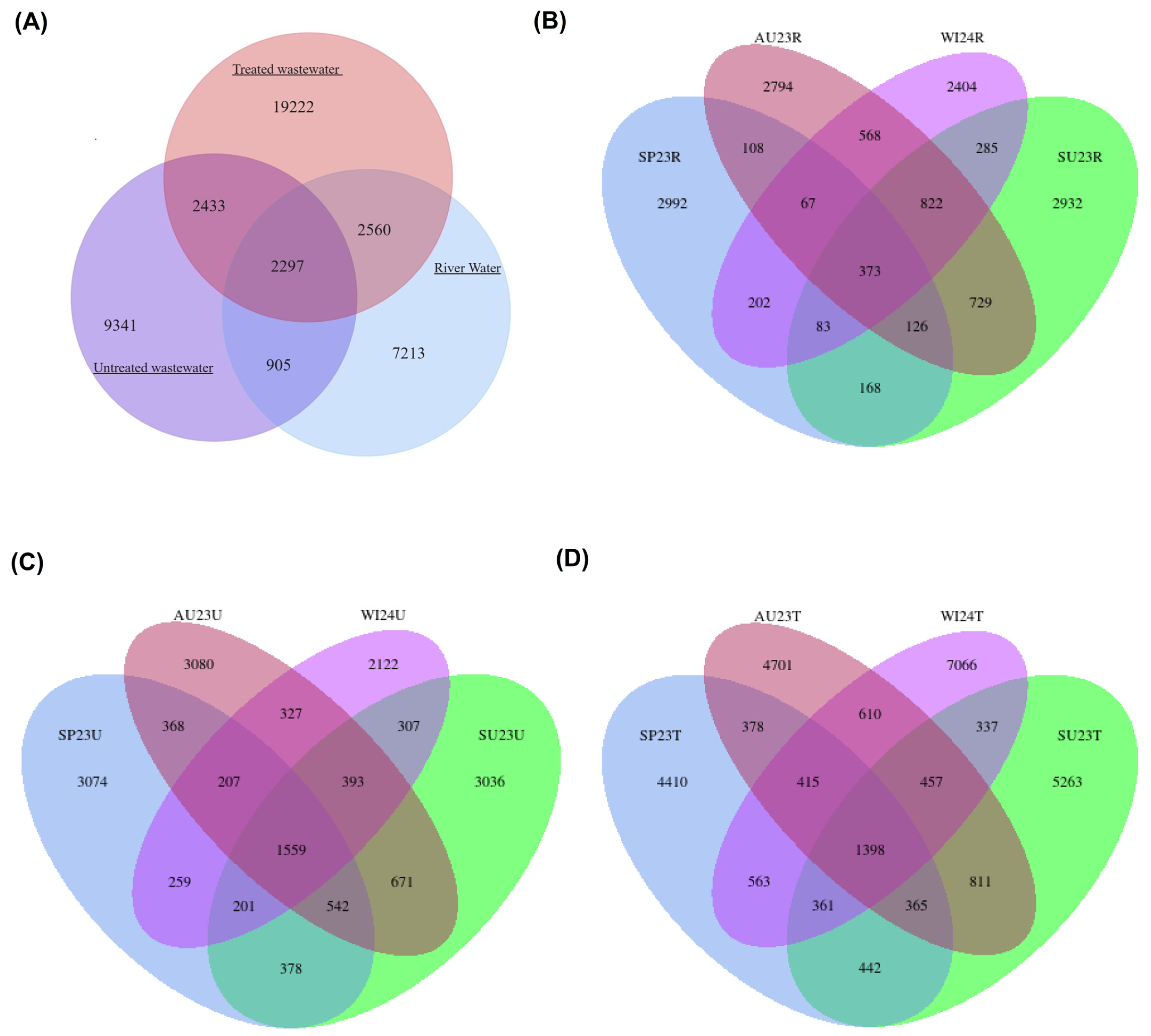
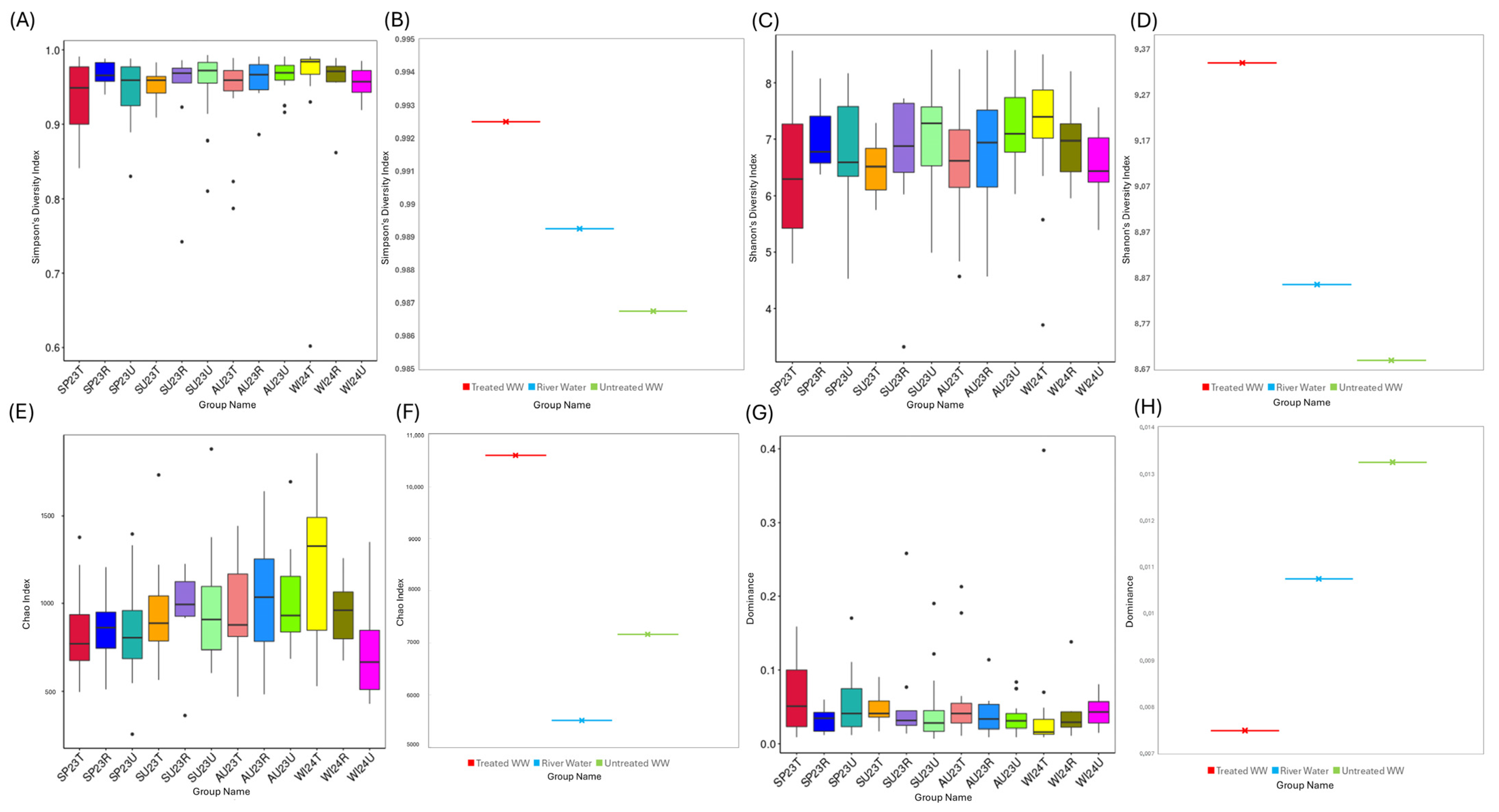
The analysis revealed clear differences between the types of the analyzed samples. Samples of river water were least diverse in terms of bacterial species composition, whereas the biodiversity of treated wastewater differed across seasons (Figure 1).
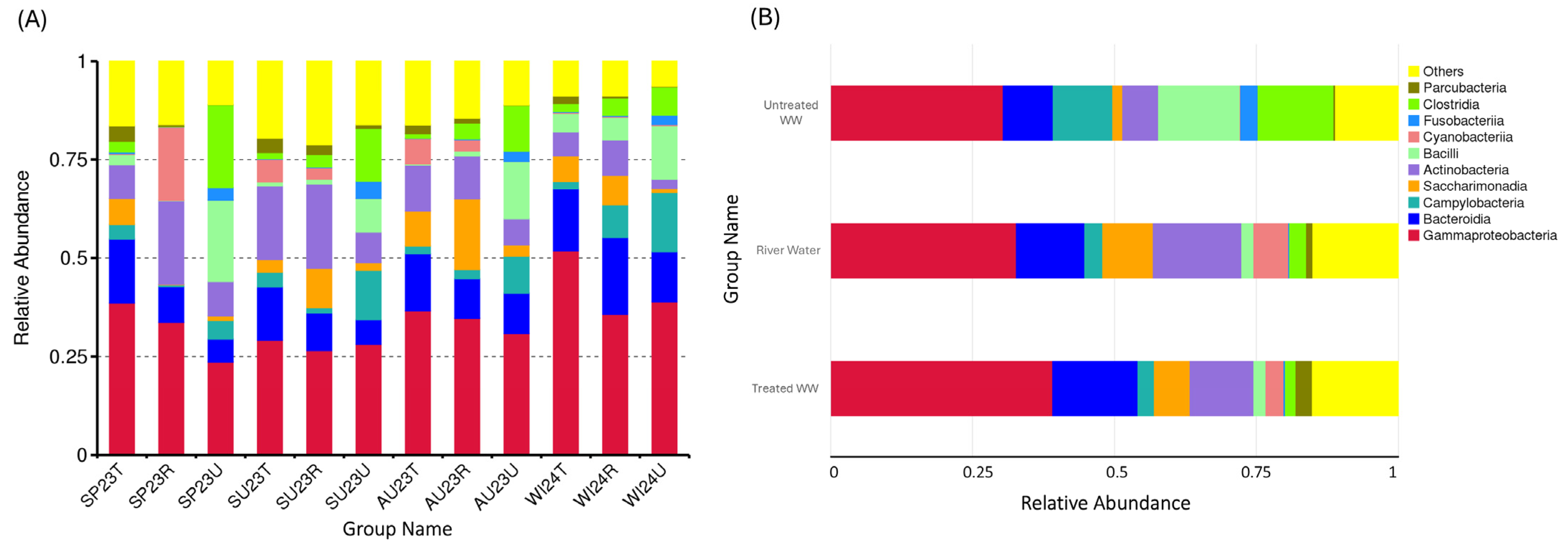
The groups were compared based on the identified taxa and clear differences in microbial composition were found. The percentage share of all identified microbial taxa is given in Table S2. The structure of bacterial communities differed across seasons and sample types. Gammaproteobacteria (34.30%) and Bacteroidia (approx. 11.90%) were the dominant classes in all samples, whereas the proportions of other bacterial classes differed between seasons and between river water and wastewater samples. Cyanobacteria were more abundant in river water samples, whereas wastewater samples were characterized by higher proportions of Clostridia (5–12%) and Campylobacteria (3–10%). Wastewater treatment decreases the abundance of some bacterial groups, but increases the percentage of bacterial classes that survived the treatment, including Gammaproteobacteria and Bacteroidia (Figure 2A,B). The observed proportions of microorganisms differ from those reported in the literature. In numerous research studies, the analyzed wastewater microbiota was composed mainly of Actinobacteria, Betaproteobacteria, and Alphaproteobacteria [25,26,27]. In contrast, the diversity of the bacterial communities investigated by Lira et al. [28] was similar to that noted in the current study. According to Begmatov et al. and other authors [25,27,28,29,30], Proteobacteria (Pseudomonadota according to the current taxonomic nomenclature) and Bacteroidetes are among the most prevalent microbial phyla in surface waters and wastewater. Gammaproteobacteria are often detected in water bodies polluted with organic matter and in WWTPs [31]. In addition, wastewater often contains intestinal bacteria [30], which are largely eliminated during treatment. In turn, surface waters were characterized by a higher share of environmental bacteria. Cyanobacteria are typically encountered in fresh water ecosystems, and their abundance can increase in response to higher temperature and higher nutrient availability [29,32].
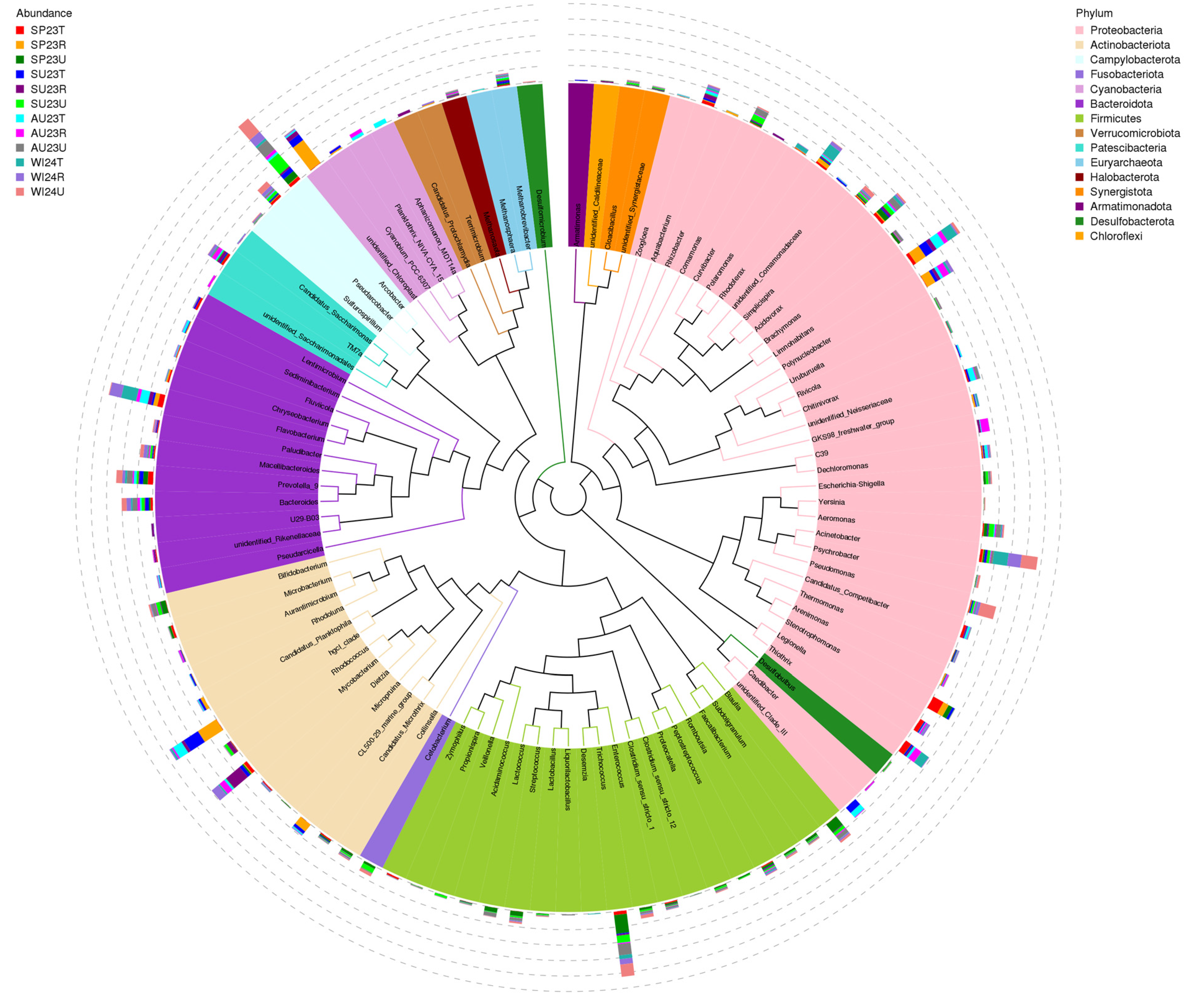
The species composition of microbial communities clearly differed across seasons (Figure 3). According to the literature, Proteobacteria (Pseudomonadota) proliferate more rapidly in warm seasons, whereas Bacteroidetes and Firmicutes are more tolerant to low temperatures and can grow and develop in colder months of the year [33,34]. The prevalence of Enterobacterales (Escherichia-Shigella and Yersinia) fluctuated across seasons. Their abundance was higher in warmer months, especially in summer and autumn, but their percentage share remained fairly stable, compared with the number of other reads. Enterobacterales were dominant in untreated wastewater samples, but their abundance was much lower in treated wastewater samples. These results indicate that Enterobacterales have a preference for nutrient-rich environments and higher temperatures, which corroborates the findings of other authors [35,36]. The relative abundance of ASVs of bacteria characteristic of the gut microbiome clearly decreased after treatment, which confirms previous observations that pathogens are effectively removed during wastewater treatment [37,38].
An analysis of the relative abundance of ASVs (Figure S2) revealed that Pseudomonadales, Corynebacteriales, and Campylobacterales were the dominant bacterial orders, and similar observations were made in other studies on wastewater microbiota [27,30]. The relative abundance of Enterobacterales ASVs was particularly high in untreated wastewater samples collected in summer and autumn (Figure S2). The presence and high abundance of Bacteroidales and Enterobacterales can probably be associated with household wastewater [28,30]. In other studies of the wastewater microbiome, the counts of these bacteria also fluctuated across seasons [33]. Fecal coliforms thrive in warm months of the year when temperature is high and organic matter is widely available [39]. Wastewater treatment significantly affects the composition of microbial communities by reducing the counts of fecal coliforms such as Enterobacterales and promoting the growth of bacterial species with a preference for cleaner environments, such as Pseudomonadales [40,41]. Pseudomonadales counts increased after wastewater treatment, and similar observations were made in other studies, which demonstrated that these bacteria often dominate under variable environmental conditions and participate in the biodegradation of organic matter [42]. Treated wastewater and river water are commonly colonized by bacteria of the orders Clostridiales, Lachnospirales, Peptostreptococcales, Eubacterales, Fusobacteriales, and Syneristales. The presence of Clostridiales was not surprising as these bacteria are typically encountered in anthropogenic samples (wastewater) and in water bodies subjected to constant anthropogenic pressure (river water) [43]. In turn, the presence of Lachnospirales and Peptostreptococcales is indicative of contamination with livestock feces [44,45], which is consistent with the land-use structure of Pilica’s catchment basin (predominance of farmland).
The relative abundance of bacterial orders is presented in Table S3.

2.2. Alpha Diversity

The diversity of microbial communities colonizing untreated wastewater, treated wastewater, and river water samples was determined by the alpha diversity analysis using the Shannon index, Simpson index, and Chao index. The results are presented in the Supplementary Materials (Table S4).
The values of the Simpson index (D) were indicative of uneven proportions of bacterial taxa (Figure 4A,B). Bacterial diversity was highest in samples of untreated (U) and treated (T) wastewater collected in autumn (AU) and winter (WI). The analyzed parameter was lower in river water (R) and treated wastewater sampled in station T9 (WI24.T9: 0.602; AU23.T9: 0.787) (Figure S3A). The analysis of groups of samples collected in different seasons and from different sources (Figure 4A) revealed very high bacterial biodiversity in treated wastewater sampled in winter (WI23T: 0.995) and in river water sampled in winter (WI24R). The Simpson index was determined at 0.993 in autumn samples of river water (AU24R) and treated wastewater (AU23T), which could point to a higher number of species or the absence of a dominant taxon in these groups. In spring samples (SP23), the Simpson index reached 0.980 in river water (SP23R) and 0.982 in untreated wastewater (SP23U). These analyses demonstrated that treated wastewater sampled in spring (SP23T) differed significantly from the remaining groups (Kruskal–Wallis test). When the studied samples were divided into groups based on their type only (U, T, and R) (Figure 4B), taxonomic diversity was highest (0.993) in treated wastewater, lower (0.989) in river water, and lowest (0.987) in untreated wastewater.
The Shannon index (H) revealed greater differences between groups and more dynamic changes in the number and evenness of taxa (Figure 4C,D). When the studied samples were grouped based on season and type, the highest values of the Shannon index were observed in winter (WI23T: 9.703), followed by autumn (AU23T: 9.271) and spring (SP23T: 9.247). Lower values of the analyzed parameter were noted in the remaining spring samples (SP23R: 7.958; SP23U: 8.477) and in untreated wastewater sampled in winter (WI24U: 8.422). These results corroborate the observations made in the analysis of samples grouped based on their type (Figure 4C), which revealed the highest species diversity in treated wastewater (9.339) and river water (8.855). The value of H was lowest in untreated wastewater (8.690), but the observed difference was not statistically significant.
Based on the values of the Chao index (Chao1), an analysis of river water samples revealed that species richness was lower in cold seasons (WI—5365.449; SP—4383.480) and higher in warmer months of the year (SU—6067.176; AU—6221.456) (Table S4). The highest values of Chao1 (highest species richness) were noted in treated wastewater in all seasons (SP—8716.8440; SU—10,278.002; AU—10,272.818; WI—13,139.345) (Figure 4E). When the examined samples were divided into groups based on their type only (Figure 4F), the Chao index was highest in treated wastewater (10,601.752) and lowest in river water (5509.390). Seasonal variations in biodiversity could be attributed to changes in the river environment in different months of the year (Figure 4E). These results suggest that species richness in river ecosystems is limited by environmental factors or specific interactions between microorganisms. Similar observations were made in analyses of river sediments, where the abundance of biogenic substances and low competition led to the emergence of dominant species [46,47]. Wang [48] and Xu [49] found that the taxonomic diversity of bacterial communities was influenced by changes in environmental conditions across seasons. A studFy examining bacterial diversity along the river continuum [50] revealed that bacterial richness gradually decreased downstream, which was not observed in the present study.
The examined parameter was generally low when the studied samples were grouped based on their type and sampling season (Figure 4G), and the differences between the highest (SP23R—0.020) and lowest values (WI24T—0.005) of the dominance index were small. However, the Kruskal–Wallis test revealed considerable differences in species diversity between these groups of samples. Similar observations were made when the studied samples were grouped based on their type only (Figure 4H). The analysis demonstrated that the qualitative composition was not dominated by a few species only and was highly diverse (R—0.011; T—0.008; U—0.013).

2.3. Beta Diversity

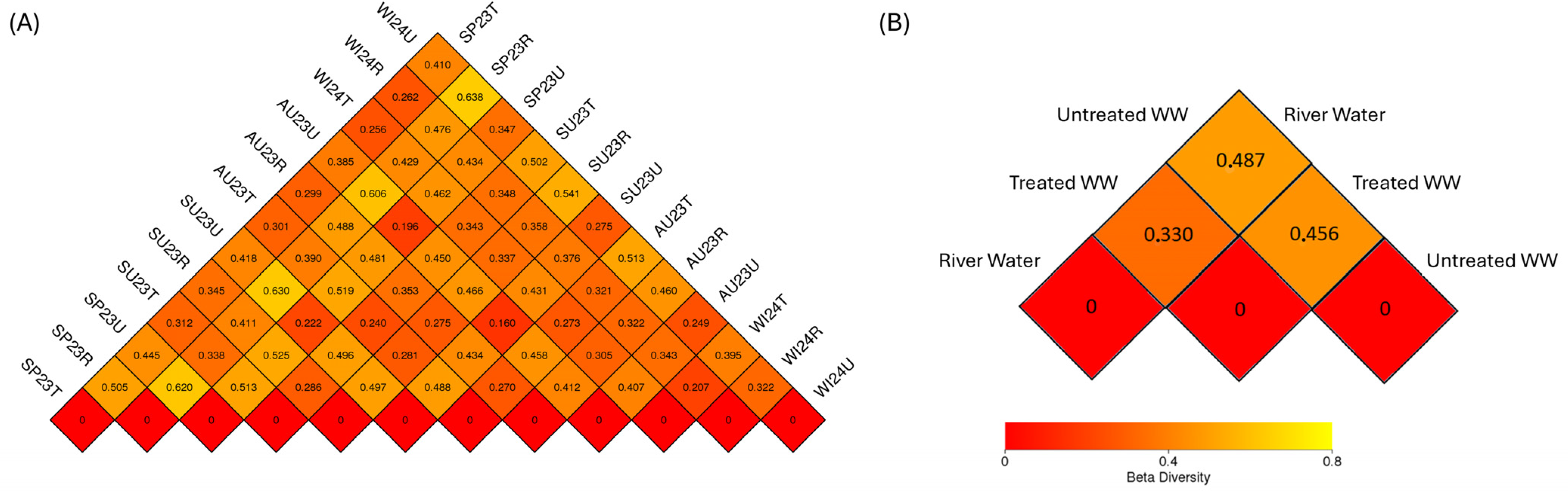
Weighted UniFrac analysis of individual samples (Figure S4) revealed the highest dissimilarity between SP23.T23–SP23.T2 (1.054), SP23.T2–SU23.R24 (1.037), and SP23.T23–SU23.T8 (1.023), while the lowest differences were observed for SU23.U9–AU23.U9 (0.073), AU23.R24–AU23.T10 (0.104), and AU23.T10–AU23.T6 (0.113). The beta diversity analysis of samples divided into groups based on their type and sampling season demonstrated that spring samples of river water (SP23R) differed significantly from all samples of untreated wastewater collected in all seasons (SP23U—0.620; SU23U—0.630; AU23U—0.606; WI24U—0.638) (Figure 5A). These results align with previous research findings indicating that environmental bacteria in river water decrease the microbial biodiversity of untreated v wastewater samples: SU23U–AU23U (0.160), SP23U–AU23U (0.196), and SP23U–SU23U (0.222). When the evaluated samples were grouped based on their type only (Figure 5B), the greatest differences were noted between untreated wastewater and river water (0.487), and the smallest differences were observed between treated wastewater and river water (0.330).
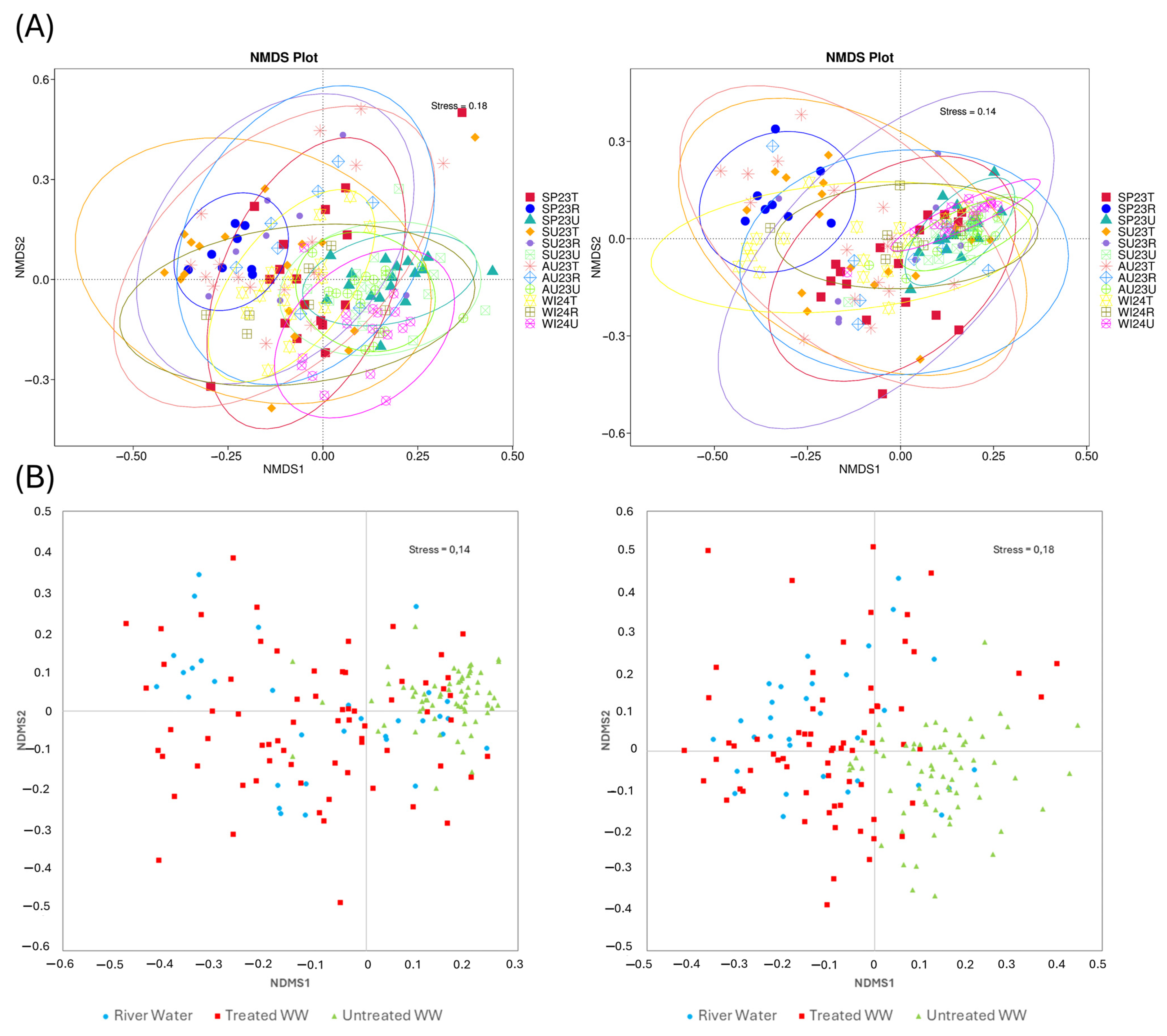
Clear differences in the distribution of points in the NMDS plot suggest that data follow structural patterns. A stress factor of less than 0.2 indicates that NMDS is reliable to some extent (Figure 6). Samples of untreated wastewater formed clusters in analyses of individual samples (Figure S5), in analyses of samples grouped based on their type (sampling site) and sampling season (Figure 6A), and in analyses of samples grouped based on their type only (Figure 6B). In turn, samples of treated wastewater and river water were separated by a certain distance from the above cluster (Figure 6B). These observations point to differences in the species composition of untreated wastewater and the two remaining groups. These results confirm that treatment processes eliminate micropollutants that pose a threat for public health and the environment [51,52,53] and that treated wastewater significantly affects the river microbiome [54,55]. Detailed results of the beta diversity analysis are presented in the Supplementary Materials (Table S5).
Eleven clusters were identified in the dendrogram of individual samples (Figure S6) The first cluster consists mainly of samples of treated wastewater collected in summer and autumn as well as samples of river water collected in spring, which contained bacteria of the phyla Actinobacteriota, Cyanobacteriota, and Bacteroidota. The second cluster comprises samples of untreated wastewater collected in spring summer and autumn and it is the only cluster to feature bacteria of the phylum Firmicutes. The third cluster also consists of untreated wastewater samples, but those collected in winter, and it is characterized by a high share of bacteria of the phylum Campylobacterota.
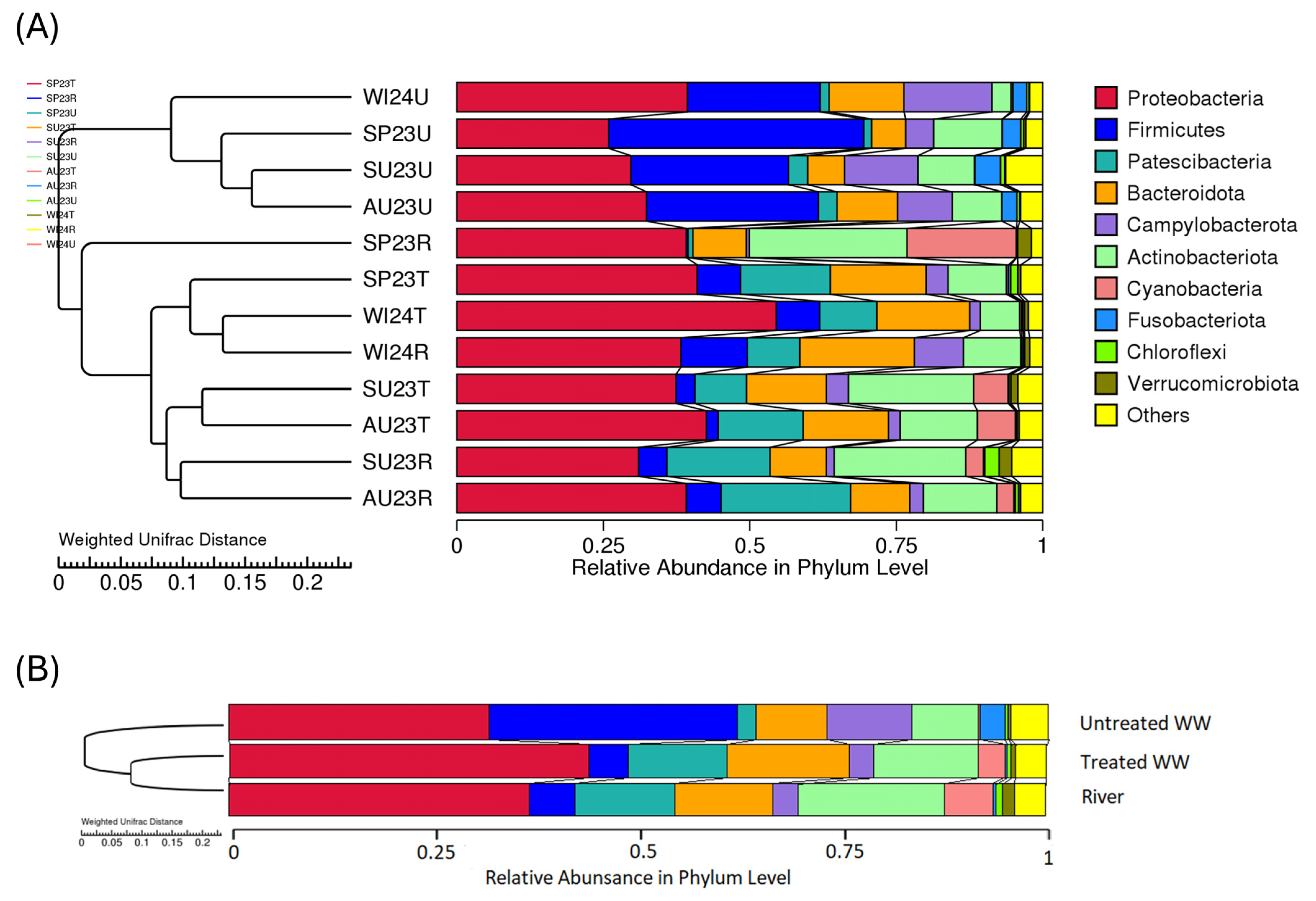
The dendrogram developed using the UPGMA algorithm for samples grouped based on sampling season and type (sampling site) features three distinct clusters (Figure 7A). The first cluster consists of samples of untreated wastewater (WI24U, SP23U, SU23U, and AU23U) with high proportions of Proteobacteria (Pseudomonadota), Firmicutes, and Campylobacteriota. Groups SU23U and AU23U are most highly related (0.080), whereas WI24U is the most distant group (0.145) in this cluster. The second cluster is composed of spring samples of river water (SP23R), and it is characterized by the highest proportions of Actinobacteriota and Cyanobacteriota. The remaining samples of river water and groups of treated wastewater samples collected in all seasons of the year form the third cluster. However, the third cluster also features three sub-clusters. The first sub-cluster includes summer and autumn samples of treated wastewater (SU23T; AU23U: 0.120). The second sub-cluster is composed of samples of river water (SU23R and AU23R: 0.137) with a higher share of Petescibacteria and Actinobacteria than samples of treated wastewater (SU23T and AU23T). The third sub-cluster contains groups of samples SP23T, WI24T, and WI24R with a higher share of Bacteroidota.
An analysis of the dendrogram of samples grouped based on their type (Figure 7B) revealed greater similarities within samples of treated wastewater (T) and samples of river water (R). These samples were characterized by a predominance of Cyanobacteria and higher proportions of Petescibacteria and Actinobacteriota than samples of untreated wastewater. In turn, untreated wastewater (U) was colonized mainly by the bacterial phyla Firmicutes, Campylobacteriota, and Fusobacterales. These observations corroborate the results of other studies examining the abundance of Proteobacteria (Pseudomonadota) and Bacteroidota in fresh water and wastewater [25,27,28,29,30]. In addition, the location of environmental samples on the short branches of the dendrogram (induced by the presence of Cyanobacteria) is also consistent with the trends reported in the literature [29,32].

2.4. Order Enterobacterales

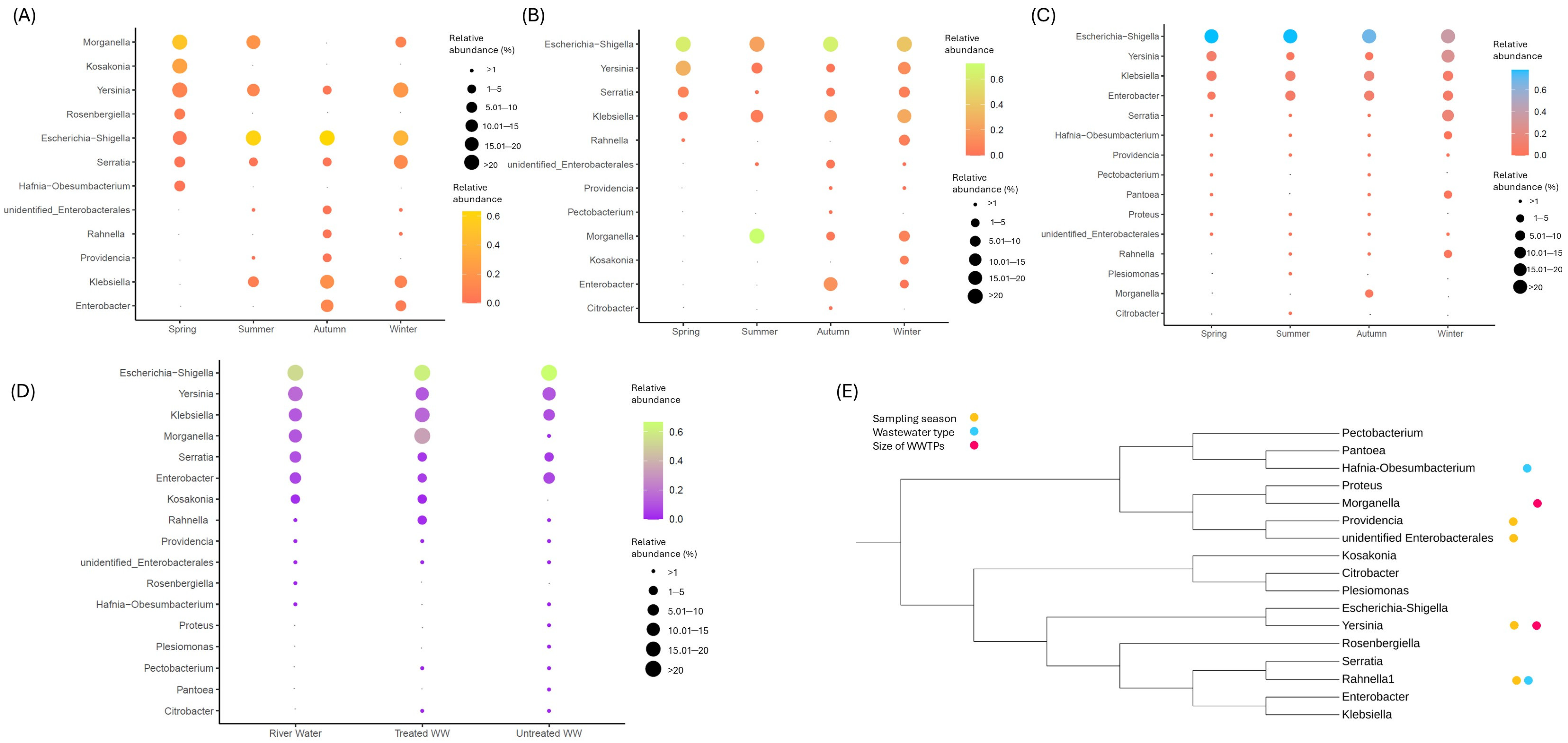
According to the literature, Enterobacterales are ubiquitous in the aquatic environment [56,57,58,59]. In the current study, the prevalence of Enterobacterales was not high, compared with the other identified taxa, which could be attributed to the high effectiveness of wastewater treatment [60] and the river’s self-purification capacity [61]. Enterobacterales accounted for 0.82% of all reads, including Escherichia-Shigella (65.97%), Yersinia (10.63%), Klebsiella (9.69%), Enterobacter (7.17%), Serratia (4.21%), Rahnella (0.61%), Pantoea (0.36%), Hafnia-Obesumbacterium (0.34%), Morganella (0.32%), Providencia (0.26%), Pectobacterium (0.08%), Citrobacter (0.05%), Proteus (0.03%), Kosakonia (0.02%), Rosenbergiella (0.01%), Plesiomonas (0.01%), and unidentified Enterobacterales (0.20%). However, samples collected at some sampling sites harbored only one bacterial genus. Serratia was the only bacterial genus in spring (SP23) and summer (SU23) samples of treated wastewater discharged by WWTP T20 (Figure 8A–C). An analysis of Enterobacterales in samples grouped based on season and type (sampling site) revealed much lower Klebsiella counts in spring (6.10%) than in autumn (nearly 14%). In turn, the abundance of Yersinia was relatively high in spring samples of treated wastewater (SP23T) and river water (SP23R) at 1.03% and 0.20%, respectively. Samples collected in autumn (AU23T, AU23R, AU23U) were characterized by high proportions of the genera Providencia (45% of ASVs in AU) and Kosakania (100% of ASVs in AU). In winter samples, the most abundant bacterial genera were Rahnella (87% of ASVs in WI) and Hafnia-Obesumbacterium (72% of ASVs in WI).
Members of the Escherichia-Shigella group were dominant in samples grouped based on their type only (Figure 8D). However, the highest number of reads and the greatest diversity of bacterial genera were noted in untreated wastewater samples.

2.4.1. Effect of Environmental Factors on Enterobacterales

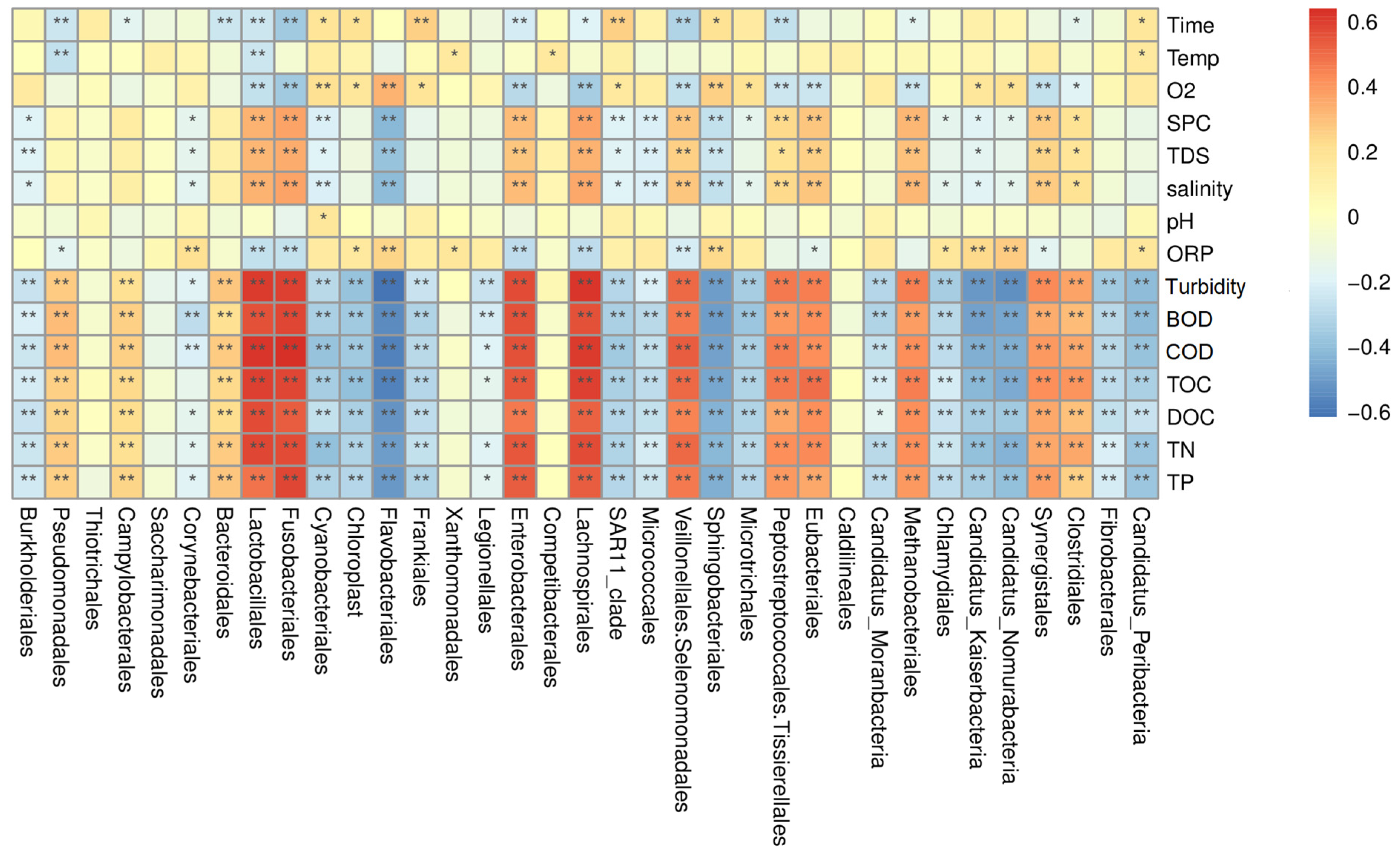
Environmental factors exert a considerable influence on Enterobacterales. Enterobacterales counts were significantly (p < 0.001) correlated with turbidity (0.571), BOD (0.561), COD (0.563), TOC (0.548), DOC (0.471), TP (0.531), and TN (0.542), which corroborates the results reported by Bugajski et al. [62]. Contrary to expectations and the findings of Chen et al. [34], no significant correlations were observed between Enterobacterales counts and temperature or pH. Seasonal variations in microbial diversity highlight the significant impact of environmental factors on microbial communities in aquatic ecosystems (Figure 9) [34,63].

2.4.2. Effect of the Size of WWTPs on Bacterial Diversity

The WWTPs selected for the study belonged to four size categories (very small, small, large, and very large) based on the population equivalent (PE) they serve (Table 1). None of the examined WWTPs belonged to the medium-sized category (class III).
The Kruskal–Wallis test revealed significant differences (0.05) in the total number of ASVs associated with the genera Yersinia (H = 10.368; p = 0.016) and Escherichia-Shigella (H = 9.410; p = 0.024), and total Enterobacterales (H = 8.911; p = 0.030) between the compared groups of WWTPs. This indicates that the abundance of these bacteria differs significantly in variously sized WWTPs. Morganella (H = 7.292; p = 0.063) and Serratia (H = 6.899; p = 0.075) were on the significance threshold, which suggests that the size of WWTPs could affect the prevalence of these bacterial genera, although the results were not statistically confirmed (Figure S6, Table S6).
The Mann–Whitney U test with a Bonferroni correction was used for pairwise comparisons to control Type I errors at a significance level of 0.05. The test demonstrated significant differences in the number of Yersinia ASVs between large and very large WWTPs (H = −2.760; p = 0.035) (Figure 8E). In turn, the abundance of Escherichia-Shigella differed significantly between large and very small WWTPs (H = 2.850; p = 0.026). Similar differences were observed in the order Enterobacterales (H = 2.676; p = 0.045). The abundance of Morganella differed significantly between large and small WWTPs (H = 2.648; p = 0.049). No significant differences in the abundance of the remaining taxa were noted between the studied categories of WWTPs (Table S7). According to the literature, microbial pollutants are less effectively eliminated by small WWTPs [64]. Similar observations were made by Al. et al. [65] and Jäger et al. [66] who found that the size of WWTPs considerably affects the structure of microbial communities. However, high removal rates can also be achieved in small WWTPs equipped with advanced treatment systems. A study of small WWTPs (<50,000 PE) in Austria revealed that these technologies are characterized by high treatment efficiency that does not deteriorate over time [67]. Austria has more stringent wastewater treatment requirements than other EU countries, and all Austrian WWTPs are equipped with the MBT+ technology. In the early 1990s, nitrification became mandatory in Austrian WWTPs, which led to the development of vertical flow wetlands [68] as the only technology that meets all legal requirements [67].

2.4.3. Effect of Wastewater Type on Bacterial Diversity

Depending on the type of plant, the examined WWTPs treated municipal wastewater or a mixture of municipal and industrial/hospital wastewater (Table 1).
The Kruskal–Wallis test revealed that the type of treated wastewater affected the relative abundance of ASVs associated with several bacterial genera of the order Enterobacterales, including Serratia (H = 12.203, p = 0.007), Rahnella (H = 12.106, p = 0.007), and Hafnia-Obesumbacterium (H = 8.448, p = 0.038). The relative abundance of ASVs linked to the remaining bacterial genera did not differ significantly between wastewater types (p > 0.05) (Table S6).
The Mann–Whitney U test with a Bonferroni correction demonstrated significant differences between the examined groups. The relative abundance of ASVs related to the genus Rahnella differed significantly between WWTPs treating municipal and industrial wastewater than those processing municipal and hospital wastewater (H= −2.749; p = 0.036). The relative abundance of ASVs associated with Hafnia-Obesumbacterium differed significantly between WWTPs processing a mixture of municipal, industrial, and hospital wastewater and plants treating municipal and hospital wastewater (H = 2.879; p = 0.024). Bacteria of the genus Rahnella are ubiquitous in the rhizosphere, phyllosphere, seeds, fruit, water, and the gastrointestinal tract of herbivores, which is why they are frequently identified in industrial wastewater from plants that process plant material, including breweries [69]. The genera Hafnia and Obesumbacterium are also often detected in beer microbiota [69]. One of the examined WWTPs processes wastewater from a local brewery, which contributed to the abundance of Rahnella sp. and Hafnia-Obesumbacterium in the analyzed wastewater. The remaining analyses did not reveal significant differences between the studied groups of WWTPs (Table S8). No significant correlations were noted between wastewater types, which suggests that these variables do not directly affect the counts of the examined bacteria (Figure 8E).

2.4.4. Effect of Sampling Season on the Diversity of Enterobacterales

Significant season-dependent differences were observed in the relative abundance of ASVs associated with the genera Yersinia (H = 22.945, p < 0.001), Rahnella (H = 30.966, p < 0.001), and Providencia (H = 9.868, p = 0.020), unidentified Enterobacterales (H = 11.791, p = 0.008), and total Enterobacterales (H = 25.225, p < 0.001). These results point to seasonal variations in the prevalence of the above bacteria (Figure 8E, Table S6).
Pairwise comparisons revealed that the number of Yersinia ASVs differed significantly between autumn and spring samples (p = 0.013), between autumn and winter samples (p < 0.001), and between summer and winter samples (p = 0.014), which points to clear seasonal variations in the prevalence of this bacterial genus. Researchers examining the impact of wastewater on the river microbiome in other countries also found that season was the factor determining the growth rates of fecal coliforms [70,71,72]. Similar results were reported by Stobnicka [41], which confirms seasonal fluctuations in the abundance of Yersinia.
Significant differences in the number of Rahnella ASVs were observed between winter samples and samples collected in autumn (p < 0.001), summer (p < 0.001), and spring (p < 0.001). These results indicate that the abundance of Rahnella undergoes considerable seasonal fluctuations (Figure 8E). and that bacteria of this genus have specific environmental requirements [73]. Detailed data are presented in Table S9.
A significant positive regression was found between season and the abundance of Rahnella (r = 0.218, p = 0.011) and Hafnia-Obesumbacterium (r = 0.199, p = 0.020), which indicates that these bacteria could proliferate more rapidly in selected seasons of the year (Table S10).

2.4.5. Effect of Sampling Site on Bacterial Diversity

Highly significant differences were observed between sampling sites and the relative abundance of ASVs associated with Yersinia (H = 80.069, p < 0.001), Escherichia-Shigella (H = 123.615, p < 0.001), Enterobacter (H = 99.780, p < 0.001), Klebsiella (H = 99.152, p < 0.001), and total Enterobacterales (H = 125.122, p < 0.001). The abundance of Morganella (H = 64.504, p = 0.011) and Hafnia-Obesumbacterium (H = 57.604, p = 0.044) also varied significantly across sampling sites. These findings could point to local variations in hydrological characteristics and pollution levels at the analyzed sampling sites. No significant (p > 0.05) differences were found for the remaining bacterial groups. The post hoc test revealed significant differences in the abundance of Rosenbergiella sampled at site U6 (H = 4.583; p = 0.004) and Plesiomonas sampled at site U1 (H = 4.583; p = 0.004) (Figure 8, Table S11), which could be attributed to the type of influent water [74] and the geographic latitude of the WWTP [75,76].
Highly significant bilateral correlations at 0.01 were observed between sampling sites and the abundance of Hafnia-Obesumbacterium, Providencia, Escherichia-Shigella, Enterobacter, Klebsiella, and total Enterobacterales. For example, the counts of Enterobacter (r = −0.459, p < 0.001) and Escherichia-Shigella (r = −0.453, p < 0.001) were bound by strong negative correlations with sampling sites, which indicates that the reduction in their abundance was significantly affected by the location of sampling sites (Table S10).

2.4.6. Effect of Treated Wastewater Discharge on the Biodiversity of Enterobacterales in Water Samples Collected from the Pilica River

The influence of treated wastewater on the biodiversity of all microorganisms in river water is presented previously in Figure 8C. The proportions of bacterial phyla Petescibacteria (R: 12.40%; T: 12.10%), Actinobacteriota (R: 17.90%; T: 12.80%), Bacteroidota (R: 12.10%; T: 15.10%), and Cyanobacteriota (R: 6.20%; T: 3.20%) were similar in samples of river water (R) and treated wastewater (T). Both types of samples were clearly dominated by Proteobacteria (Pseudomonadota) (R: 36.90%; T: 43.90%), including bacteria classified as Enterobacterales. Other authors also found that treated wastewater strongly affected the microbial biodiversity of aquatic ecosystems, including the river microbiome [77,78,79].
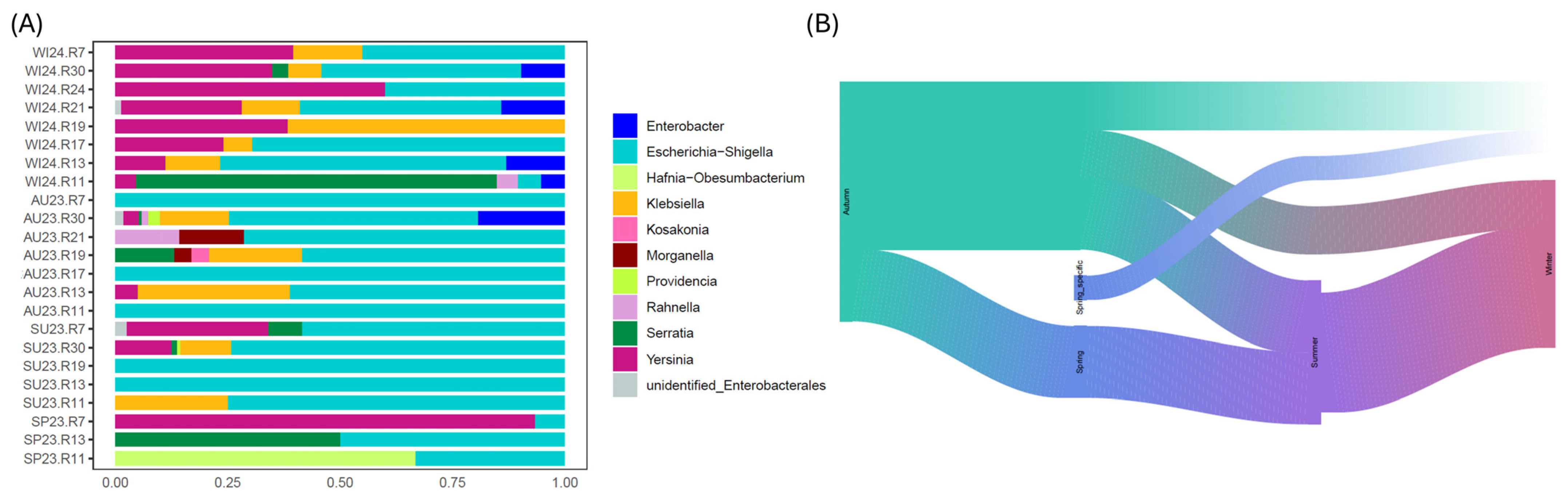
The prevalence of bacterial genera of the order Enterobacterales in river water in each season of the year is shown in Figure 10. In spring, Enterobacterales were identified only in three sampling sites (SP23.R7, SP23.R11, SP23.R13) and Yersinia was the dominant genus (65.90%). Escherichia-Shigella (SU: 75.60%; AU: 62.40%) was the dominant bacterial group in summer (SU23R) and autumn (AU23R). The greatest diversity of bacterial genera classified as Enterobacterales was noted in winter, and the number of ASVs was also highest in this season. In WI24R samples, the dominant genera were Escherichia-Shigella (44.90%) and Yersinia (22.40%).
The prevalence of bacterial genera of the order Enterobacterales was similar in samples of river water and treated wastewater (Figure 8C). These groups of samples were characterized by minor differences, which were observed only in the ASVs of Hafania-Obesumbacterium (0.07% Enterobacterales) and Kosakonia (0.14% Enterobacterales), which were identified only in river water. In turn, samples of treated wastewater harbored bacteria of the genera Citrobacter (0.34% Enterobacterales) and Pectobacterium (0.11% Enterobacterales). These differences are not surprising in view of the origin and environmental preferences of these microorganisms [69,80,81].
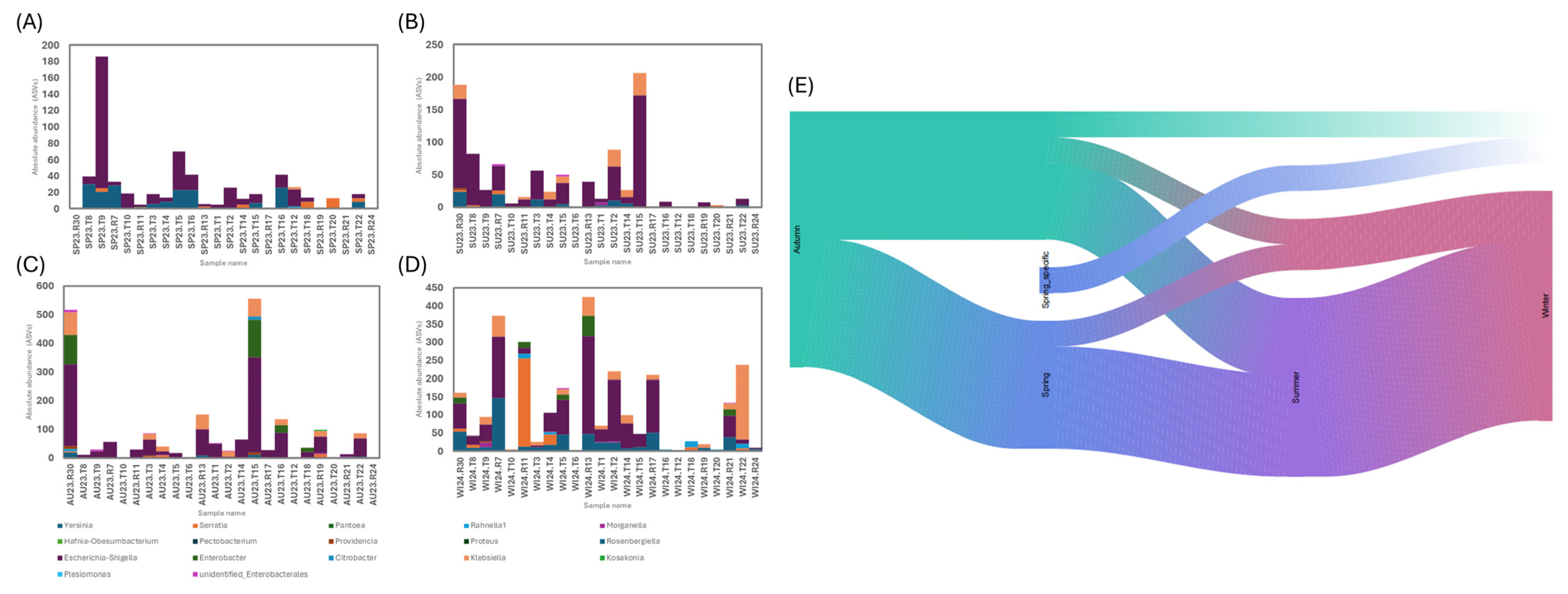
Quantitative and qualitative changes in the number of Enterobacterales ASVs in samples of treated wastewater (only wastewater discharged directly into the river) and river water are presented in Figure 11. The anticipated impact of treated wastewater on the structure of microbial communities in the Pilica River was modeled only for winter samples (Figure 11D). The number of ASVs was very high in winter, which could be indicative of ecosystem disturbances during sample collection in that season. In summer (Figure 11B) and autumn (Figure 11C), bacterial counts decreased downstream, which could suggest that the Pilica has a high self-purifying capacity along the entire river continuum. A decrease in bacterial abundance, but not diversity, was noted in spring samples (Figure 11A). However, the direct impact of discharged wastewater on the diversity of river microbiota is difficult to estimate due to hydrological conditions. All samples of river water were collected upstream from the wastewater discharge point. Successive sampling sites were located further away from the discharge point; therefore, self-purification mechanisms [61,82] and the physicochemical properties of water could have induced changes in the diversity and abundance of bacterial species in the river [83].
In the linear discrimination analysis (LDA), the family Enterobacteriaceae received a score of 4.200 in untreated wastewater. This observation is consistent with the global trends reported in the literature [25,27,28,29,30,60].

3. Materials and Methods

3.1. The Characteristics of the Analyzed Catchment

The Pilica River has a length of 342 km, and it is the largest left-bank tributary of the Vistula (Middle Vistula River Valley, Mazovian Voivodeship). Its catchment area is situated in central Poland and covers 9258 km2. The catchment is occupied mainly by farmland (60%) and forests (31%), and it also features urban areas, industrial facilities, and other land-use types (9%). The Pilica is fed by surface and subsurface runoffs, including nutrient-rich water from agricultural areas and urban wastewater, which is treated in municipal WWTPs and acts as a source of biogenic compounds and other pollutants, including microbial. Inadequately treated effluents contribute to the eutrophication of the Pilica [3,4,8,24] and cause toxic algal blooms in Sulejów Reservoir [84,85,86] in the middle course of the river. Lower Pilica, in particular the floodplain, features natural wetlands, where mineral and organic matter is sedimented during high water periods and biogenic compounds undergo effective retention as well as phytoaccumulation and phytoremediation by reed beds and willows growing along the watercourse [3,4,87].

3.2. Sampling of River Water and Wastewater from WWTPs

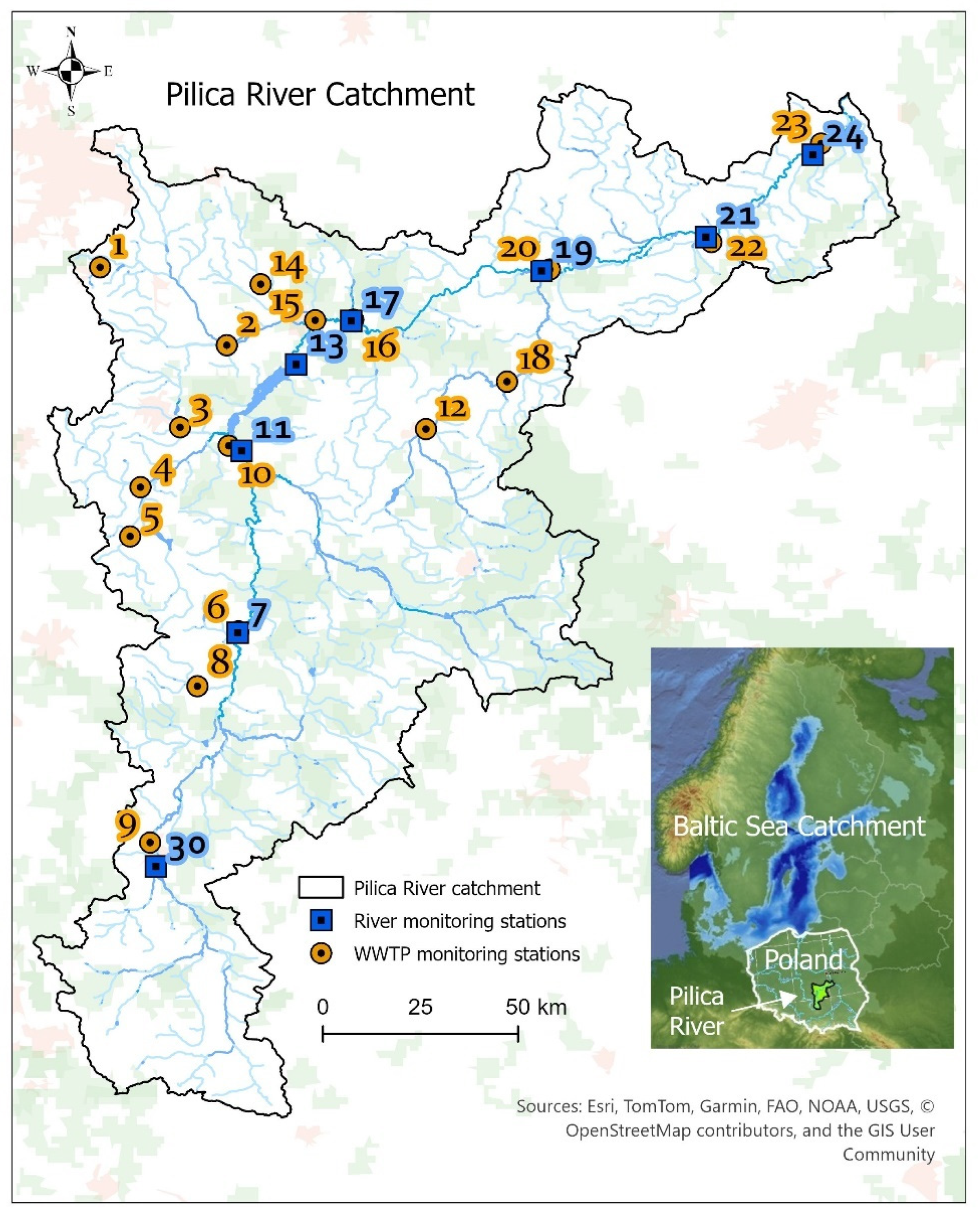
River water was sampled at eight sites along the river continuum, between upper Pilica and the confluence where Pilica flows into the Vistula. Samples of treated and untreated wastewater were collected in 17 municipal WWTPs distributed throughout the catchment area (Figure 12). Samples were collected four times between 8 May 2023 and 30 January 2024, including in spring (8–9 May 2023), summer (10–11 July 2023), autumn (16–18 October 2023), and winter (29–30 January 2024). River water was sampled (at eight sites) by the bridge using a bucket suspended on a rope. Both treated wastewater and untreated wastewater samples were collected (in 17 WWTPs) with a grab sampler. The location of each river water sampling site is described in Table 2.
The WWTPs selected for the study were divided into four categories based on size according to the Regulation of the Minister of Maritime Economy and Inland Navigation of 12 July 2019 (Journal of Laws, 2019, item 1311) implementing the provisions of Council Directive 91/271/EEG [6]. Samples of untreated wastewater and treated wastewater discharged by the WWTPs in Pilica’s catchment area were collected for analysis.
Table 1. Characteristics of the analyzed municipal WWTPs in the Pilica River catchment.
Size Class *Station **LocationPopulation Equivalent (PE)Average Annual Influent Flow [m3/d]Treatment Technology ****Wastewater Type ***
I
<2000 PE
U9/T9Koniecpol600492.25MBTMWW, IWW, other wastewater
U16/T16Spała1183103.75MBTMWW
U8/T8Wielgomłyny133374.5MBTMWW, septic tanks, car washes
U14/T14Ujazd1500567.75MBT+MWW, IWW, septic tanks
II
2000

9999 PE
U4/T4Rozprza3050102.25MBTMWW, septic tanks, poultry wastewater
U20/T20Nowe Miasto nad Pilicą3410298.5MBTMWW, HWW, septic tanks
U5/T5Gorzkowice3610435.5MBTMWW
U1/T1Tuszyn4000888MBT+MWW, catering WW
U2/T2Wolbórz5455514.25MBTMWW, IWW
U6/T6Przedbórz8200664.25MBT+MWW, IWW, other wastewater
U18/T18Drzewica10,6911039.25MBT+MWW, septic tanks
IV
15,000–99,999 PE
U10/T10Sulejów18,0001680MBT+MWW
U22/T22Białobrzegi28,7241646.15MBT+MWW, IWW
U12/T12Opoczno75,0003810.5MBT+MWW, IWW (textile, ceramics, meat processing plants), septic tanks
U23/T23Warka81,0003977.75MBT+MWW, IWW (brewery)
V
>100,000 PE
U15/T15Tomaszów Mazowiecki126,94010,080MBT+MWW, IWW, HWW
U3/T3Piotrków Trybunalski400,00011,477MBT+MWW, IWW, HWW, stormwater
* Very small WWTPs (class I: 0–1999 PE); Small WWTPs (class II: 2000–9999 PE); Large WWTPs (class IV: 15,000–99,999 PE); Very large WWTPs (class V: >100,000 PE); ** U—untreated wastewater, T—treated wastewater; *** IWW—industrial wastewater; HWW—hospital wastewater; MWW—municipal wastewater; **** MBT—mechanical biological treatment; MBT+—mechanical biological treatment with advanced nutrient removal.
Table 2. Characteristics of river monitoring stations [24]—changed.
StationTownRiver Length (from the Estuary) [km]Station TypeGeographic Location
NE
R30Wąsosz266.8River50.738429119.6885605
R7Przedbórz201.2River51.08832119.873345
R11Sulejów161.3River (inflow into Sulejów Reservoir)51.34356819.885790
R13Smardzewice136.3Sulejów Reservoir (outflow)51.47413920.005846
R17Spała119.4River51.53734020.134163
R19Nowe Miasto nad Pilicą78.8River51.60921820.573166
R21Białobrzegi45.3River51.65766920.950391
R24Warka15.0River51.77489921.197526
To obtain composite samples, samples of river water and wastewater were collected several times per day on sampling days and were pooled. At each site, a composite sample of 1000 mL was placed in a sterile Simax bottle. The samples were transported to the laboratory at a temperature of 4 °C within up to six hours. The sampling process was consistent with the ISO 19458 [88] Standard developed by the International Organization for Standardization.
Composite samples were labeled to denote the sampling season, sampling year, and sample type. Samples collected in spring, summer, autumn, and winter were marked as SP, SU, AU, and WI, respectively; samples collected in 2023 and 2024 were marked with the digits 23 and 24, respectively; and samples of untreated wastewater, treated wastewater, and river water were marked with the letters U, T, and R, respectively. For example, SU23U denotes a sample of untreated wastewater collected in the summer of 2023 (Table S12). All samples were isolated and analyzed in three replicates.

3.3. Analyses of Physical and Chemical Parameters and Nutrient Concentrations in Wastewater and River Water

The physical parameters of river water, treated wastewater, and untreated wastewater were determined with a YSI Professional Plus multiparameter instrument that measures temperature (T), oxygen concentration (O2), pH, conductivity (SPC), total dissolved solids (TDS), salinity, and oxidation–reduction potential (ORP). Turbidity was measured using a HACH 2100Qis turbidimeter.
Biochemical oxygen demand (BOD) was determined by respirometry using the Lovibond BD 600 system (Tintometer Group). The samples were sealed in airtight bottles equipped with sensor heads to monitor changes in pressure, and the results were converted to BOD values. The samples were incubated in darkness for five days at 20 °C in a Pol-ST3 Basic thermostatic cabinet (POL-EKO).
Chemical oxygen demand (COD) was determined with the AQUALYTIC® COD VARIO photometer, which allows highly sensitive and precise testing. The samples were placed in AQUALYTIC® COD VARIO test tubes (LR, MR, ISO 15705:2002), subjected to thermal digestion in an AL125 Thermoreactor, and analyzed with an AL250 photometer (AQUALYTIC) according to the manufacturer’s instructions.
Total organic carbon (TOC) and dissolved organic carbon (DOC) were analyzed with the Multi N/C 3100 instrument (Analytic Jena) by the high-temperature combustion-infrared method according to Standard Method 5310B [89]. DOC samples were passed through a 0.45 μm polyethersulfone (PES) membrane filter prior to analysis. Vertical oven temperature was 750 °C, and sample injection volume was 500 μL, with 3–5 repetitions per sample.
Samples of unfiltered river water and wastewater were examined for total phosphorus (TP) and total nitrogen (TN) content. Total protein was quantified with the ascorbic acid method after the addition of the Oxisolv (Merck) oxidizing decomposition agent in a Merck MV500 Microwave Digestion System [90]. Total nitrogen was determined by persulfate digestion [91] with the use of Hach cuvette tests.

3.4. Total DNA Extraction

Each sample was passed through Whatman Nucleopore membrane filter disks with a diameter of 47 mm and 0.2 µm pore size. The volume of the filtered samples was 600 mL for river water, 400 mL for treated wastewater, and 50 mL for untreated wastewater. The filters were placed in 15 mL Falcon tubes and stored at −20 °C until analysis.
DNA was isolated from the material deposited on membrane filters using the DNeasy PowerWAter Kit (Qiagen, Poland). The DNA isolation protocol was modified by adding 50 µL of the elution buffer to obtain eluents with a higher concentration of DNA. The remaining stages of the isolation procedure were consistent with the manufacturer’s instructions. DNA was isolated from all filters. The eluates from each isolate were combined in a single Eppendorf tube. The quality and quantity of DNA were determined with the NanoDrop® ND-1000 spectrophotometer (NanoDrop Technologies, Wilmington, DE, USA). The quality of the isolated DNA was regarded as adequate when the ratio of absorbance at 260 nm and 280 nm ranged from 1.8 to 2.0, and the ratio of absorbance at 260 nm and 230 nm ranged from 2.0 to 2.2. The samples were stored at a temperature of −20 °C until further analysis. Detailed information about the quality of the isolated DNA is presented in Table S1.

3.5. Total DNA Sequencing

Before sequencing, the presence of bacterial DNA was determined in all samples by amplifying the 16S rRNA gene in a standard PCR assay (32 samples of river water, 68 samples of untreated wastewater, and 68 samples of treated wastewater). Every reaction involved 15 µL of the Phusion High-Fidelity PCR Master Mix, 0.2 µM of forward and reverse primers, and around 10 ng of template DNA. The V4 region of the 16S rRNA gene was amplified with primers 515f (5′-GTGCCAGCMGCCGCGGTAA-3′) and 806r (5′-GGACTACHVGGGTWTCTAAT-3′) [86]. Thermal cycling consisted of initial denaturation at 98 °C for 1 min, followed by 30 cycles of denaturation at 98 °C for 10 s, annealing at 50 °C for 30 s, and elongation at 72 °C for 30 s and 72 °C for 5 min. Samples that tested positive for the 16S rRNA gene were subjected to Illumina sequencing. Both positive and negative controls were used in the sequencing analysis of 16S rRNA amplicons. Single-read Illumina sequencing was performed by Novogene Biotechnologies Inc. (Beijing, China) using the Illumina MiSeq platform. Amplicon libraries spanning the V4 domain of microbial 16S rRNA genes were prepared with the use of primers 515f and 806r and the corresponding adapters, according to the manufacturer’s protocol. Sequencing runs yielded 2 × 250 bp paired-end reads with the use of the MiSeq v2 reagent kit, based on the manufacturer’s instructions (Illumina MiSeq, USA). Base calling was performed with Illumina Real Time Analysis (RTA) v 1.18.54 software, and base-called reads were demultiplexed and converted to FastQ format with the Illumina Bcl2fastq v2.19.1 tool.
Data concerning the sequencing process were disseminated by the National Center for Biotechnology Information (NCBI). The data will be available in the project entitled ‘Microbial Diversity of Municipal Wastewater and River Water in Central Poland’ (PRJNA1345224, PRJNA13452280) from the 1 October 2026.

3.6. Bioinformatics and Statistical Analyses

16S rRNA genes were amplified using specific barcoded primers. Sequencing libraries were generated and indices were added. The libraries were quantified using Qubit and real-time PCR and subjected to Bioanalyzer analysis of the size distribution. The quantified libraries were pooled and sequenced on Illumina platforms, according to the effective library concentration and the required amount of data.
Paired- end reads were assigned to samples based on their unique barcodes and they were truncated by cutting off the barcode and primer sequence. Subsequently, paired-end reads were merged using FLASH (V1.2. 1 1, http://ccb.jhu.edu/software/FLASH/, acceced: 1 May 2025) [92], a very fast and accurate analytical tool designed to merge paired-end reads when at least some of the reads overlap the read generated from the opposite end of the same DNA fragment, and the splicing sequences were referred to as raw tags. Quality filtering on the raw tags was performed using fastp (Version 0.23.1) software to obtain high-quality clean tags [93]. The tags were compared with the reference database (Silva database) to detect chimera sequences. The effective tags were obtained by removing chimera sequences using the vsearch package (V2.16.0, https://github.com/torognes/vsearch acceced: 1 May 2025) [94,95].
For the effective tags obtained previously, denoising was performed with DADA2 in QIIME2 software to obtain initial amplicon sequence variants (ASVs). The species were annotated using QIIME2 software and the Silva database.
The absolute abundance of ASVs was normalized using a standard sequence number corresponding to the sample with the fewest sequences. Subsequent analyses of alpha diversity and beta diversity were performed based on normalized output data.
The top 10 taxa for each sample were selected at each taxonomic level (phylum, class, order, family, genus, species) to plot distribution histograms of relative abundance in Perl using the SVG function.
Heatmaps, Venn diagram, and phylogenetic trees were developed in R and Perl using the SVG function. Alpha diversity, including Chao1, Shannon, Simpson, and dominance indices, was calculated in QIIME2. Beta diversity, including a beta diversity heatmap, unweighted pair group method with arithmetic mean (UPGMA), cluster analysis, and NMDS analysis, was calculated based on Weighted and Unweighted UniFrac distances using QIIME2, Perl, the ade4 package, and the ggplot2 package in R software (version 4.0.3).
Statistical analyses, including LEfSe, were performed to determine differences in the structure of microbial communities.
Statistical methods were applied to compare (i) all total DNA to determine differences between samples regardless of their type or sampling season; (ii) total DNA divided into groups based on sample type and sampling season (SP23U, SP23T, SP23R, SU23U, SU23T, SU23R, AU23U, AU23T, AU23R, WI23U, WI23T, and WI23R); (iii) total DNA divided into groups based only on sample type (U, T, and R).

4. Conclusions

The present study, which employed a holistic catchment-scale approach integrating longitudinal spatial coverage from the river’s source to its mouth (including eight sites along the river), encompassing the complete seasonal cycle, and incorporating inputs from 17 WWTPs, demonstrated that wastewater discharge, particularly from WWTPs of various sizes, affects the structure and diversity of aquatic microorganisms, including members of the order Enterobacterales.
The impact of environmental factors on Enterobacterales dynamics is significant, as evidenced by strong correlations with turbidity, organic matter indicators, and nutrient levels. However, pH had no significant effect. Microbiome analyses confirmed the influence of WWTP size on the microbial composition of wastewater and revealed that this factor particularly affected the number of ASVs of bacteria such as Yersinia, Escherichia-Shigella, and the order Enterobacterales. In turn, the microbiological composition of wastewater is not determined by its type. It was also found that the sampling season had a significant impact on microbiome composition, particularly with regard to bacteria of the genera Yersinia, Rahnella, and Providencia, as well as unidentified Enterobacterales. The study demonstrated that the river’s microbiome is influenced by the sampling season and other environmental factors.
The observed changes in the microbiome composition, particularly within the Enterobacterales group, suggest that even treated wastewater can modify the structure of river microflora and affect microbiological indicator levels, such as those of E. coli and coliforms. The increased prevalence of these bacteria in samples collected below wastewater discharge points confirms the impact of human activity on surface water quality and suggests a potential periodic increase in sanitary and epidemiological risks related to the presence of the Escherichia-Shigella group and Yersinia, respectively.
The present findings significantly expand our knowledge of changes in microbial diversity and the qualitative and quantitative structure of Enterobacterales in river basins under anthropogenic pressure and confirm the potential of using the microbiome as an indicator of river environmental health. Future analyses should include an assessment of the presence of antibiotic-resistant Enterobacterales and the antibiotic resistance genes commonly found within their cells. This will allow for a more comprehensive evaluation of the ecological and health risks associated with discharging wastewater into aquatic environments.

Supplementary Materials

The following supporting information can be downloaded at: https://www.mdpi.com/article/10.3390/app16031540/s1, Methods—3.3. Analyses of Physical and Chemical Parameters and Nutrient Concentrations in Wastewater and River Water, mDNA Extraction and sequencing, Figure S1: Relative abundance of ASVs associated with bacterial classes. The stacked bar plot presents the percentage share of ten most abundant bacterial classes in all samples; Figure S2: Taxonomic abundance cluster heatmap of 35 most abundant bacterial genera in: (A) all samples; (B) samples divided into groups based on their type and sampling season; (C) samples divided into groups based on their type; Figure S3: Alpha diversity: (A) Simpson index for all samples; (B) Shannon index for all samples; (C) Chao1 index for all samples; (D) Dominance index for all samples; Figure S4: Beta diversity heatmap. The numbers in grids are pairwise dissimilarity coefficients denoting differences between two samples. The Weighted UniFrac distance was calculated for all samples; Figure S5: Non-metric multidimensional scaling (NMDS) plots for beta diversity patterns of bacteria based on the Weighted UniFrac distance (left) and the Unweighted UniFrac distance (right) for all samples; Figure S6: Dendrogram developed using the UPGMA algorithm for beta diversity patterns of bacteria based on the Weighted UniFrac distance for all samples; Figure S7: Significance of dependent variables in the Kruskal–Wallis test: (A)size of WWTP; (B) sampling site; (C) type of wastewater; (D) sampling season; Figure S8: Significant differences in bacterial removal rates between WWTPs belonging to different size classes; Figure S9: Significant differences in bacterial removal rates between WWTPs processing different types of wastewater: (A) Rahnella and (B) Hafnia-Obesumbacterium (MWW—municipal wastewater, IWW—industrial wastewater, HWW—hospital wastewater); Figure S10: Significant differences in the abundance of bacterial genera across sampling seasons (Mann–Whitney U test with a Bonferroni correction): (A) Yersinia, (B) Rahnella, (C) Providencia, (D) unidentified Enterobacterales; Figure S11: The cladogram of LDA circles radiating from the inside to the outside represents taxonomic ranks, from phylum to genus (species). Each circle denotes a distinct taxon and the corresponding taxonomic rank. The diameter of each circle is proportional to the relative abundance of each taxon. Taxa with non-significant differences are marked in yellow. Taxa (biomarkers) with significant differences are marked in colors corresponding to group color. Red and green nodes denote taxa that make a significant contribution to the groups marked in red and green, respectively. The letters above the circles and the corresponding species are annotated on the right side; Table S1: Characteristic of samples; Table S2: Relative Abundance for classis; Table S3: Relative abundance in ordo for groups with seasons; Table S4: Alfa-diversity; Table S5: Beta-diversity; Table S6: Summary of Kruskal–Wallis test results; Table S7: Results of Post hoc tests for the Kruskal–Wallis test—wastewater treatment plant size; Table S8: Results of Post hoc tests for the Kruskal–Wallis test—type of wastewater; Table S9: Results of Post hoc tests for the Kruskal–Wallis test—season of sampling; Table S10: Linear regression; Table S11: Pearson correlation results between treated and untreated wastewater; Table S12: Samples nomenclature; Table S13: Summary of Kruskal–Wallis test for independent samples; Table S14: Pairwise comparisons season Table S15: Relative abundance in ordo for samples with seasons; Table S16: Descriptives statistics; Table S17: Kruskal–Wallis test summary for river sampling station; Table S18: Pairwise comparisons for the variable sampling station; Table S19: Shannon-Wiener Index for Enterobacterales.

Author Contributions

Conceptu-alization, K.S.; methodology, K.S.; software, K.S.; validation, K.S.; formal analysis, K.S.; investigation, K.S.; resources; data curation, K.S., M.M., D.M., K.J., N.M. and D.R.; writing—original draft preparation, K.S.; writing—review and editing, E.K. (Edyta Kiedrzyńska), E.K. (Ewa Korzeniewska) and M.H.; visualization, K.S. and M.K.; supervision, E.K. (Ewa Korzeniewska) and M.H.; project administration, E.K. (Edyta Kiedrzyńska) and M.H.; funding acquisition, E.K. (Edyta Kiedrzyńska) and M.H. All authors have read and agreed to the published version of the manuscript.

Funding

This research was funded by the National Science Centre, Poland, Opus 22 (Project No. 2021/43/B/ST10/01076).

Data Availability Statement

Data concerning the sequencing process were disseminated by the National Center for Biotechnology Information (NCBI). The data will be available in the project entitled ‘Microbial Diversity of Municipal Wastewater and River Water in Central Poland’ (PRJNA1345224, PRJNA1345228) from 10 January 2026.

Acknowledgments

The authors acknowledge Joanna Chwiałkowska, Alina Pruss and Małgorzata Komorowska-Kaufman from Institute of Environmental Engineering and Building Installations, Faculty of Environmental Engineering and Energy, Poznan University of Technology, for providing TOC and DOC analysis and the technical support. The research was conducted as part of the Farmikro Project, funded by the National Science Centre, Poland, Opus 22 (Project No. 2021/43/B/ST10/01076). For the purpose of Open Access, the Authors have applied a CC-BY public copyright licence to any Author Accepted Manuscript (AAM) version arising from this submission.

Conflicts of Interest

The authors declare no conflicts of interest.

Abbreviations

The following abbreviations are used in the manuscript:
ARBantibiotic-resistant bacteria
ARGantibiotic resistance gene
ASVAmplicon Sequence Variant
AUsamples collected in autumn
BODbiochemical oxygen demand
CODchemical oxygen demand
HWWhospital wastewater
IWWindustrial wastewater
MBTmechanical biological treatment
MBT+mechanical biological treatment with advanced nutrient removal
MWWmunicipal wastewater
Rsamples of river water
SPsamples collected in spring
SUsamples collected in summer
Tsamples of treated wastewater
TNtotal nitrogen
TPtotal phosphorus
TSStotal suspended solids
TWWtreated wastewater
Usamples of untreated wastewater
UWWuntreated wastewater
WHOWorld Health Organization
WIsamples collected in winter
WWTPwastewater treatment plant

References

  1. EU. Directive (EU) 2024/3019 of the European Parlament and of the Council of 27 November 2024 concerning urban wastewater treatment. Eur. Union Law 2024, 3019, 1–59. [Google Scholar]
  2. Flores-Alsina, X.; Gallego, A.; Feijoo, G.; Rodriguez-Roda, I. Multiple-objective evaluation of wastewater treatment plant control alternatives. J. Environ. Manag. 2010, 91, 1193–1201. [Google Scholar] [CrossRef]
  3. Kiedrzyńska, E.; Jóźwik, A.; Kiedrzyński, M.; Zalewski, M. Hierarchy of factors exerting an impact on nutrient load of the Baltic Sea and sustainable management of its drainage basin. Mar. Pollut. Bull. 2014, 88, 162–173. [Google Scholar] [CrossRef] [PubMed]
  4. Kiedrzyńska, E.; Kiedrzyński, M.; Urbaniak, M.; Magnuszewski, A.; Skłodowski, M.; Wyrwicka, A.; Zalewski, M. Point sources of nutrient pollution in the lowland river catchment in the context of the baltic Sea eutrophication. Ecol. Eng. 2014, 70, 337–348. [Google Scholar] [CrossRef]
  5. Rout, P.R.; Shahid, M.K.; Dash, R.R.; Bhunia, P.; Liu, D.; Varjani, S.; Zhang, T.C.; Surampalli, R.Y. Nutrient removal from domestic wastewater: A comprehensive review on conventional and advanced technologies. J. Environ. Manag. 2021, 296, 113246. [Google Scholar] [CrossRef]
  6. Council Directive 91/271/EEC of May 21, 1991 Concerning Urban Waste Water Treatment (Official Journal of the European Communities L 135 of May 30, 1991). Available online: https://eur-lex.europa.eu/legal-content/en/ALL/?uri=CELEX%3A31991L0271 (accessed on 12 December 2025).
  7. Młyńska, A.; Halecki, W.; Chmielowski, K. Efficient biological treatment_ Achieving exceptional reductions in pollutants and ensuring environmental compliance. Desalin. Water Treat. 2024, 319, 100552. [Google Scholar] [CrossRef]
  8. Kiedrzyńska, E.; Urb, M.; Kiedrzyński, M.; Jóźwik, A. The use of a hybrid Sequential Biofiltration System for the improvement of nutrient removal and PCB control in municipal wastewater. Sci. Rep. 2017, 7, 5477. [Google Scholar] [CrossRef]
  9. Ahmed, S.F.; Mofijur, M.; Parisa, T.A.; Islam, N.; Kusumo, F.; Inayat, A.; Le, V.G.; Badruddin, I.A.; Khan, T.Y.; Ong, H.C. Progress and challenges of contaminate removal from wastewater using microalgae biomass. Chemosphere 2022, 286, 131656. [Google Scholar] [CrossRef]
  10. Urbaniak, M.; Kiedrzyńska, E.; Wyrwicka, A.; Zieliński, M.; Mierzejewska, E.; Kiedrzyński, M.; Kannan, K.; Zalewski, M. An ecohydrological approach to the river contamination by PCDDs, PCDFs and dl-PCBs—Concentrations, distribution and removal using phytoremediation techniques. Sci. Rep. 2019, 9, 19310. [Google Scholar] [CrossRef]
  11. Paíga, P.; Correia, M.; Fernandes, M.J.; Silva, A.; Carvalho, M.; Vieira, J.; Jorge, S.; Silva, J.G.; Freire, C.; Delerue-Matos, C. Science of the Total Environment Assessment of 83 pharmaceuticals in WWTP in fl uent and ef fl uent samples by UHPLC-MS/MS: Hourly variation. Sci. Total. Environ. 2019, 648, 582–600. [Google Scholar] [CrossRef]
  12. Wang, J.; Wang, S. Removal of pharmaceuticals and personal care products (PPCPs) from wastewater: A review. J. Environ. Manag. 2016, 182, 620–640. [Google Scholar] [CrossRef]
  13. Felis, E.; Kalka, J.; Sochacki, A.; Kowalska, K.; Bajkacz, S.; Harnisz, M.; Korzeniewska, E. Antimicrobial pharmaceuticals in the aquatic environment—Occurrence and environmental implications. Eur. J. Pharmacol. 2020, 866, 172813. [Google Scholar] [CrossRef]
  14. Price, R.G.; Wildeboer, D.E. coli as an Indicator of Contamination and Health Risk in Environmental Waters. In Escherichia Coli-Recent Advances on Physiology, Pathogenesis and Biotechnological Applications; IntechOpen: London, UK, 2017. [Google Scholar] [CrossRef]
  15. Jang, J.; Hur, H.G.; Sadowsky, M.J.; Byappanahalli, M.N.; Yan, T.; Ishii, S. Environmental Escherichia coli: Ecology and public health implications—A review. J. Appl. Microbiol. 2017, 123, 570–581. [Google Scholar] [CrossRef]
  16. Khan, F.M. Escherichia Coli (E. coli) as an Indicator of Fecal Contamination in Water: A Review; Springer: Cham, Switzerland, 2020; pp. 225–235. [Google Scholar]
  17. Rolbiecki, D.; Kiedrzyńska, E.; Czatzkowska, M.; Kiedrzyński, M.; Korzeniewska, E.; Harnisz, M. Global dissemination of Klebsiella pneumoniae in surface waters: Genomic insights into drug resistance, virulence, and clinical relevance. Drug Resist. Updat. 2025, 79, 101204. [Google Scholar] [CrossRef] [PubMed]
  18. Yin, Q.; da Silva, A.C.; Zorrilla, F.; Almeida, A.S.; Patil, K.R.; Almeida, A. Ecological dynamics of Enterobacteriaceae in the human gut microbiome across global populations. Nat. Microbiol. 2025, 10, 541–553. [Google Scholar] [CrossRef] [PubMed]
  19. Zalewski, M.; Kiedrzyńska, E.; Wagner, I.; Izydorczyk, K.; Boczek, J.M.; Jurczak, T.; Krauze, K.; Frankiewicz, P.; Godlewska, M.; Wojtal-Frankiewicz, A.; et al. Ecohydrology and adaptation to global change. Ecohydrol. Hydrobiol. 2021, 21, 393–410. [Google Scholar] [CrossRef]
  20. Zalewski, M.; Kiedrzyńska, E.; Wagner, I.; Izydorczyk, K.; Boczek, J.M.; Jurczak, T.; Krauze, K.; Frankiewicz, P.; Godlewska, M.; Wojtal-Frankiewicz, A.; et al. Intestinal Dysbiosis in Carriers of Carbapenem-Resistant Enterobacteriaceae. mSphere 2020, 5, 10-1128. [Google Scholar] [CrossRef] [PubMed]
  21. De Gouveia, M.I.M.; Bernalier-donadille, A.; Jubelin, G. Enterobacteriaceae in the Human Gut: Dynamics and Ecological Roles in Health and Disease. Biology 2024, 13, 142. [Google Scholar] [CrossRef]
  22. WHO. WHO Bacterial Priority Pathogens List, 2024; WHO: Geneva, Switzerland, 2024. [Google Scholar]
  23. Hilty, M.; Betsch, B.Y.; Bögli-Stuber, K.; Heiniger, N.; Stadler, M.; Küffer, M.; Kronenberg, A.; Rohrer, C.; Aebi, S.; Endimiani, A.; et al. Transmission dynamics of extended-spectrum -lactamase-producing enterobacteriaceae in the tertiary care hospital and the household setting. Clin. Infect. Dis. 2012, 55, 967–975. [Google Scholar] [CrossRef]
  24. Harnisz, M.; Kiedrzyńska, E.; Kiedrzyński, M.; Korzeniewska, E.; Czatzkowska, M.; Koniuszewska, I.; Jóźwik, A.; Szklarek, S.; Niestępski, S.; Zalewski, M. The impact of WWTP size and sampling season on the prevalence of antibiotic resistance genes in wastewater and the river system. Sci. Total Environ. 2020, 741, 140466. [Google Scholar] [CrossRef]
  25. Muszyński, A.; Tabernacka, A.; Miłobedzka, A. Long-term dynamics of the microbial community in a full-scale wastewater treatment plant. Int. Biodeterior. Biodegrad. 2015, 100, 44–51. [Google Scholar] [CrossRef]
  26. Osunmakinde, C.O.; Selvarajan, R.; Mamba, B.B.; Msagati, T.A.M. Profiling Bacterial Diversity and Potential Pathogens in Wastewater Treatment Plants Using High-Throughput Sequencing Analysis. Microorganisms 2019, 7, 506. [Google Scholar] [CrossRef]
  27. Jankowski, P.; Gan, J.; Le, T.; McKennitt, M.; Garcia, A.; Yanaç, K.; Yuan, Q.; Uyaguari-Diaz, M. Metagenomic community composition and resistome analysis in a full-scale cold climate wastewater treatment plant. Environ. Microbiomes 2022, 17, 3. [Google Scholar] [CrossRef]
  28. Lira, F.; Vaz-moreira, I.; Tamames, J.; Manaia, C.M.; Martínez, J.L. Metagenomic analysis of an urban resistome before and after wastewater treatment. Sci. Rep. 2020, 10, 8174. [Google Scholar] [CrossRef]
  29. Begmatov, S.; Beletsky, A.V.; Dorofeev, A.G.; Pimenov, N.V.; Mardanov, A.V.; Ravin, N.V. Metagenomic insights into the wastewater resistome before and after purification at large-scale wastewater treatment plants in the Moscow city. Sci. Rep. 2024, 14, 6349. [Google Scholar] [CrossRef]
  30. Velazquez-Meza, M.E.; Galarde-López, M.; Cornejo-Juárez, P.; Bobadilla-Del-Valle, M.; Godoy-Lozano, E.; Aguilar-Vera, E.; Carrillo-Quiroz, B.A.; de León-Garduño, A.P.; Acosta, C.V.; Alpuche-Aranda, C.M. Bacterial Communities and Resistance and Virulence Genes in Hospital and Community Wastewater: Metagenomic Analysis. Int. J. Mol. Sci. 2025, 26, 2051. [Google Scholar] [CrossRef]
  31. Majeed, H.J.; Riquelme, M.V.; Davis, B.C.; Gupta, S. Evaluation of Metagenomic-Enabled Antibiotic Resistance Surveillance at a Conventional Wastewater Treatment Plant. Front. Microbiol. 2021, 12, 657954. [Google Scholar] [CrossRef] [PubMed]
  32. Zhang, L.; Zhou, Y.; Cheng, Y.; Lu, W.; Liang, Y. Effect of different types of industrial wastewater on the bacterial community of urban rivers. J. Freshw. Ecol. 2021, 36, 31–48. [Google Scholar] [CrossRef]
  33. Szyłak-Szydłowski, M.; Kulig, A.; Miaśkiewicz-Pęska, E. Seasonal changes in the concentrations of airborne bacteria emitted from a large wastewater treatment plant. Int. Biodeterior. Biodegrad. 2016, 115, 11–16. [Google Scholar] [CrossRef]
  34. Chen, X.; Lang, X.L.; Xu, A.L.; Song, Z.W.; Yang, J.; Guo, M.Y. Seasonal variability in the microbial community and pathogens in wastewater final Effluents. Water 2019, 11, 2586. [Google Scholar] [CrossRef]
  35. Azam, M.W.; Zarrilli, R.; Khan, A.U. Updates on the Virulence Factors Produced by Multidrug-Resistant Enterobacterales and Strategies to Control Their Infections. Microorganisms 2023, 11, 1901. [Google Scholar] [CrossRef] [PubMed]
  36. Puljko, A. Wastewater as a Source for the Spread of Resistance to Third-Generation Cephalosporins and Carbapenems to the Aquatic Environment. Ph.D. Dissertation, Sveučilište u Zagrebu, Zagreb, Croatia, 2025. [Google Scholar]
  37. Umar, M.K.; Mohammed, Y.; Dabo, N.T. Prevalence of Carbapenem Resistance in Clinical Bacterial Species Isolated from Kano, North West Nigeria. Bayero J. Pure Appl. Sci. 2022, 13, 485–490. [Google Scholar] [CrossRef]
  38. Urase, T.; Goto, S.; Sato, M. Monitoring Carbapenem-Resistant Enterobacterales in the Environment to Assess the Spread in the Community. Antibiotics 2022, 11, 917. [Google Scholar] [CrossRef] [PubMed]
  39. Michalska-szymaszek, M. Wpływ Temperatury na Przeżywalność, Właściwości Fenotypowe I Antygenowe Szczepów Escherichia Coli O157 Wyizolowanych z Wody I Materiału Klinicznego the influence of temperature on survival, phenotype and antygen properties of escherichia coli O157 wyizolowanych z wody i materiału klinicznego. Rocz. Państwowego Zakładu Hig. 2010, 61, 213–219. [Google Scholar]
  40. Papajová, I.; Šmigová, J.; Gregová, G.; Šoltys, J.; Venglovský, J.; Papaj, J.; Szabóová, T.; Dančová, N.; Ihnacik, L.; Schusterová, I.; et al. Effect of Wastewater Treatment on Bacterial Community, Antibiotic-Resistant Bacteria and Endoparasites. Int. J. Environ. Res. Public Health 2022, 19, 2750. [Google Scholar] [CrossRef]
  41. Stobnicka, A.; Małgorzata, K.; Szymczak, G.; Cyprowski, M.; Górny, R.L. Monitoring of enteropathogenic Gram—Negative bacteria in wastewater treatment plants: A multimethod approach. Environ. Sci. Pollut. Res. 2024, 31, 37229–37244. [Google Scholar] [CrossRef]
  42. Shi, L.; Liu, N.; Liu, G. Bacterial Community Structure and Dynamic Changes in Different Functional Areas of a Piggery Wastewater Treatment System. Microorganisms 2021, 9, 2134. [Google Scholar] [CrossRef] [PubMed]
  43. Lenart-Boroń, A.; Boroń, P.; Kulik, K.; Prajsnar, J.; Żelazny, M.; Chmiel, M.J. Anthropogenic pollution gradient along a mountain river affects bacterial community composition and genera with potential pathogenic species. Sci. Rep. 2022, 12, 18140. [Google Scholar] [CrossRef]
  44. Zhao, J.; Feng, T.; An, X.; Chen, X.; Han, N.; Wang, J.; Chang, G.; Hou, X. Livestock grazing is associated with the gut microbiota and antibiotic resistance genes in sympatric plateau pika (Ochotona curzoniae). Integr. Zool. 2024, 19, 646–661. [Google Scholar] [CrossRef]
  45. Devane, M.L.; Taylor, W.; Dupont, P.Y.; Armstrong, B.; Weaver, L.; Gilpin, B.J. Exploring the Bacterial Community in Aged Fecal Sources from Dairy Cows: Impacts on Fecal Source Tracking. Microorganisms 2023, 11, 1161. [Google Scholar] [CrossRef]
  46. Jones, J.I.; Collins, A.L.; Naden, P.S.; Sear, D.A. The relationship between fine sediment and macrophytes in rivers. River Res. Appl. 2011, 1018, 1006–1018. [Google Scholar] [CrossRef]
  47. Schmidt, H.; Thom, M.; Wieprecht, S.; Manz, W.; Ulrike, S. The effect of light intensity and shear stress on microbial biostabilization and the community composition of natural biofilms. Res. Rep. Biol. 2018, 9, 1–16. [Google Scholar] [CrossRef]
  48. Wang, L.; Li, J.; Tan, L.; Han, B. Seasonal patterns of functional alpha and beta redundancies of macroinvertebrates in a disturbed (sub) tropical river. Ecol. Indic. 2023, 146, 109777. [Google Scholar] [CrossRef]
  49. Xu, G.; Li, P.; Lu, K.; Tantai, Z.; Zhang, J.; Ren, Z.; Wang, X.; Yu, K.; Shi, P.; Cheng, Y. Catena Seasonal changes in water quality and its main influencing factors in the Dan River basin. Catena 2019, 173, 131–140. [Google Scholar] [CrossRef]
  50. Savio, D.; Sinclair, L.; Ijaz, U.Z.; Parajka, J.; Reischer, G.H.; Stadler, P.; Blaschke, A.P.; Blöschl, G.; Mach, R.L.; Kirschner, A.K.T.; et al. Bacterial diversity along a 2600 km river continuum. Environ. Microbiol. 2015, 17, 4994–5007. [Google Scholar] [CrossRef] [PubMed]
  51. Aghalari, Z.; Dahms, H.U.; Sillanpää, M.; Sosa-Hernandez, J.E.; Parra-Saldívar, R. Effectiveness of wastewater treatment systems in removing microbial agents: A systematic review. Global Health 2020, 16, 13. [Google Scholar] [CrossRef] [PubMed]
  52. Schwermer, C.U.; Uhl, W. Calculating expected effects of treatment effectivity and river flow rates on the contribution of WWTP effluent to the ARG load of a receiving river. J. Environ. Manag. 2021, 288, 112445. [Google Scholar] [CrossRef]
  53. Brion, N.; Verbanck, M.A.; Bauwens, W.; Elskens, M.; Chen, M.; Servais, P. Assessing the impacts of wastewater treatment implementation on the water quality of a small urban river over the past 40 years. Environ. Sci. Pollut. Res. 2015, 22, 12720–12736. [Google Scholar] [CrossRef] [PubMed]
  54. Lu, Q.; Mao, J.; Xia, H.; Song, S.; Chen, W.; Zhao, D. Effect of wastewater treatment plant discharge on the bacterial community in a receiving river. Ecotoxicol. Environ. Saf. 2022, 239, 113641. [Google Scholar] [CrossRef]
  55. Xie, Y.; Liu, X.; Wei, H.; Chen, X.; Gong, N.; Ahmad, S.; Lee, T.; Ismail, S.; Ni, S.-Q. Insight into impact of sewage discharge on microbial dynamics and pathogenicity in river ecosystem. Sci. Rep. 2022, 12, 6894. [Google Scholar] [CrossRef]
  56. Zakrzewski, A.; Zarzecka, U.; Chajęcka-Wierzchowska, W.; Zadernowska, A. A Comparison of Methods for Identifying Enterobacterales Isolates from Fish and Prawns. Pathogens 2022, 11, 410. [Google Scholar] [CrossRef]
  57. Palmeira, J.D.; Arte, I.D.; Mersal, M.M.R.; da Mota, C.C.; Ferreira, H.M.N. KPC-Producing Enterobacterales from Douro River, Portugal—Persistent Environmental Contamination by Putative Healthcare Settings. Antibiotics 2022, 12, 62. [Google Scholar] [CrossRef] [PubMed]
  58. Cho, S.; Jackson, C.R.; Frye, J.G. Freshwater environment as a reservoir of extended-spectrum β-lactamase-producing Enterobacteriaceae. J. Appl. Microbiol. 2023, 134, lxad034. [Google Scholar] [CrossRef]
  59. Rolbiecki, D.; Harnisz, M.; Korzeniewska, E.; Buta, M.; Hubeny, J. Detection of carbapenemase-producing, hypervirulent Klebsiella spp. in wastewater and their potential transmission to river water and WWTP employees. Int. J. Hyg. Environ. Health 2021, 237, 113831. [Google Scholar] [CrossRef] [PubMed]
  60. Karczmarczyk, A.; Bus, A.; Baryła, A. Assessment of the Efficiency, Environmental and Economic Effects of Compact Type On-Site Wastewater Treatment Plants—Results from Random Testing. Sustainability 2021, 13, 982. [Google Scholar] [CrossRef]
  61. González, S.O.; Almeida, C.A.; Calderón, M. Assessment of the water self-purification capacity on a river affected by organic pollution: Application of chemometrics in spatial and temporal variations. Environ. Sci. Pollut. Res. 2014, 21, 10583–10593. [Google Scholar] [CrossRef]
  62. Bugajski, P.; Chmielowski, K.; Cupak, A.; Wąsik, E. Influence of sewage from septic tank on the variability concentration of pollutants in sewage undergoing purification processes. PAN 2016, 2, 517–526. [Google Scholar] [CrossRef]
  63. Zhang, M.; Wu, Z.; Sun, Q.; Ding, Y.; Ding, Z. The spatial and seasonal variations of bacterial community structure and in fl uencing factors in river sediments. J. Environ. Manag. 2019, 248, 109293. [Google Scholar] [CrossRef]
  64. Bunce, J.T.; Graham, D.W. A Simple Approach to Predicting the Reliability of Small Wastewater Treatment Plants. Water 2019, 11, 2397. [Google Scholar] [CrossRef]
  65. Al, A.A.; Naddeo, V.; Hasan, S.W.; Yousef, A.F. Journal of Water Process Engineering Correlation between bacterial community structure and performance efficiency of a full-scale wastewater treatment plant. J. Water Process Eng. 2020, 37, 101472. [Google Scholar] [CrossRef]
  66. Jäger, T.; Hembach, N.; Elpers, C.; Wieland, A.; Alexander, J.; Hiller, C.; Krauter, G.; Schwartz, T. Reduction of Antibiotic Resistant Bacteria During Conventional and Advanced Wastewater Treatment, and the Disseminated Loads Released to the Environment. Front. Microbiol. 2018, 9, 2599. [Google Scholar] [CrossRef]
  67. Engstler, E.; Kerschbaumer, D.J.; Langergraber, G. Evaluating the Performance of Small Wastewater Treatment Plants. Front. Environ. Sci. 2022, 10, 1–10. [Google Scholar] [CrossRef]
  68. Langergraber, G.; Weissenbacher, N. Survey on number and size distribution of treatment wetlands in Austria. Water Sci. Technol. 2017, 75, 2309–2315. [Google Scholar] [CrossRef]
  69. Paradh, A.D. Gram-Negative Spoilage Bacteria in Brewing; Elsevier Ltd.: Amsterdam, The Netherlands, 2015; Volume 5. [Google Scholar] [CrossRef]
  70. Kodera, S.M.; Sharma, A.; Martino, C.; Dsouza, M.; Grippo, M.; Lutz, H.L. Microbiome response in an urban river system is dominated by seasonality over wastewater treatment upgrades. Environ. Microbiome 2023, 18, 10. [Google Scholar] [CrossRef]
  71. Lee, J.; Beck, K.; Bürgmann, H. Differential effects of wastewater treatment plant ef fl uents on the antibiotic resistomes of diverse river habitats. ISME J. 2023, 17, 1993–2002. [Google Scholar] [CrossRef]
  72. Butte, G.; Tamiru, A.; Walsh, C.; Werner, D. Science of the Total Environment Spatiotemporal variation in urban wastewater pollution impacts on river microbiomes and associated hazards in the Akaki catchment, Addis. Sci. Total Environ. 2022, 826, 153912. [Google Scholar] [CrossRef]
  73. Zhang, S.; Yang, G.; Zhang, Y.; Yang, C. High—Throughput profiling of antibiotic resistance genes in the Yellow River of Henan. Sci. Rep. 2024, 14, 17490. [Google Scholar] [CrossRef] [PubMed]
  74. Li, F.; Chen, J.; Chen, J.; Gou, F.; Cheng, F.; Wang, B.; Zhang, Y. Study of Microbial Diversity in Fresh Ingredients and Their Wastes. Pol. J. Environ. Stud. 2025. online first. [Google Scholar] [CrossRef]
  75. Liu, J.; Tu, T.; Gao, G.; Bartlam, M.; Wang, Y. Biogeography and Diversity of Freshwater Bacteria on a River Catchment Scale. Microb. Ecol. 2019, 78, 324–335. [Google Scholar] [CrossRef]
  76. Paudel, N.; Liu, Y.; Liu, K.; Zhang, F. Bacterial community composition and diversity in Koshi River, the largest river of Nepal. Ecol. Indic. 2019, 104, 501–511. [Google Scholar] [CrossRef]
  77. Zhu, H.; Li, B.; Ding, N.; Hua, Z.; Jiang, X. A Case Study on Microbial Diversity Impacts of a Wastewater Treatment Plant to the Receiving River. J. Geosci. Environ. Prot. 2021, 9, 206–220. [Google Scholar] [CrossRef]
  78. Xie, G.; Tang, X.; Shao, K.; Zhu, G.; Gao, G. Ecotoxicology and Environmental Safety Bacterial diversity, community composition and metabolic function in Lake Tianmuhu and its dammed river: Effects of domestic wastewater and damming. Ecotoxicol. Environ. Saf. 2021, 213, 112069. [Google Scholar] [CrossRef]
  79. Wang, J.; Chen, Y.; Cai, P.; Gao, Q.; Zhong, H.; Sun, W.; Chen, Q. Impacts of municipal wastewater treatment plant discharge on microbial community structure and function of the receiving river in Northwest Tibetan Plateau. J. Hazard. Mater. 2022, 423, 127170. [Google Scholar] [CrossRef] [PubMed]
  80. Han, Y.; Gao, X.; Huang, G.; Chang, Y.; Han, H.; Zhu, J. Microbial Pathogenesis Kosakonia cowanii, a new bacterial pathogen affecting foxtail millet (Setaria italica [L.] P. Beauv.) in China. Microb. Pathog. 2023, 181, 106201. [Google Scholar] [CrossRef]
  81. Regad, M.; Lizon, J.; Alauzet, C.; Roth-guepin, G.; Bonmati, C.; Pagliuca, S. Outbreak of carbapenemase-producing Citrobacter farmeri in an intensive care haematology department linked to a persistent wastewater reservoir in one hospital room, France, 2019 to 2022. Eurosurveillance 2024, 29, 2300386. [Google Scholar] [CrossRef] [PubMed]
  82. Xiao, C.; Chen, J.; Chen, D.; Chen, R.; Song, X. Mechanism of sinuosity effect on self—Purification capacity of rivers. Environ. Sci. Pollut. Res. 2023, 30, 112184–112193. [Google Scholar] [CrossRef]
  83. Bisht, S.; Sharma, R.C.; Rawat, S.; Kumar, R. Physico—Chemical attributes and bacterial diversity of river water at Rudraprayag, Garhwal Himalaya. Antioxid. Act. Phytochem. Screen. Differ. Solvent Extr. Cluasena Excav. Burm F. 2018, 3, 1. [Google Scholar] [CrossRef]
  84. Godlewska, M.; Balk, H.; Kaczkowski, Z.; Jurczak, T.; Izydorczyk, K.; Długoszewski, B.; Jaskulska, A.; Gągała-Borowska, I.; Mankiewicz-Boczek, J. Night fish avoidance of Microcystis bloom revealed by simultaneous hydroacoustic measurements of both organisms. Fish. Res. 2018, 207, 74–84. [Google Scholar] [CrossRef]
  85. Mankiewicz-Boczek, J.; Jaskulska, A.; Pawełczyk, J.; Gągała, I.; Serwecińska, L.; Dziadek, J. Cyanophages Infection of Microcystis Bloom in Lowland Dam Reservoir of Sulejów, Poland. Microb. Ecol. 2016, 71, 315–325. [Google Scholar] [CrossRef] [PubMed]
  86. Caporaso, J.G.; Lauber, C.L.; Walters, W.A.; Berg-Lyons, D.; Lozupone, C.A.; Turnbaugh, P.J.; Fierer, N.; Knight, R. Global patterns of 16S rRNA diversity at a depth of millions of sequences per sample. Proc. Natl. Acad. Sci. USA 2011, 108, 4516–4522. [Google Scholar] [CrossRef]
  87. Skłodowski, M.; Kiedrzyńska, E.; Kiedrzyński, M.; Urbaniak, M.; Zielińska, K.M.; Kurowski, J.K.; Zalewski, M. The role of riparian willows in phosphorus accumulation and PCB control for lotic water quality improvement. Ecol. Eng. 2014, 70, 1–10. [Google Scholar] [CrossRef]
  88. ISO 19458; Water Quality—Sampling for Microbiological Analysis. Global Standards for Trusted Goods and Services: Geneva, Switzerland, 2006.
  89. Standard Methods. Total Organic Carbon (TOC). Standard Methods for the Examination of Water and Wastewater, 22nd ed.; American Public Health Association/American Water Works Association/Water Environment Federation: Washington, DC, USA, 2012.
  90. Greenberg, A.E.; Clesceri, L.S.; Eaton, A.D. Standard Methods for Examination of Water and Wastewater; 1055 American Public Health Association: Washington, DC, USA, 1992. [Google Scholar]
  91. Hach, C.C.; Klein, R.L., Jr.; Gibbs, C.R. Biochemical oxygen demand. Tech. Monogr. 1997, 7, 1–22. [Google Scholar]
  92. Callahan, B.J.; McMurdie, P.J.; Rosen, M.J.; Han, A.W.; Johnson, A.J.; Holmes, S.P. DADA2: High-resolution sample inference from 1059Illumina amplicon data. Nat. Methods 2016, 13, 581–583. [Google Scholar] [CrossRef]
  93. Salzberg, S.L. FLASH: Fast length adjustment of short reads to improve genome assemblies. Bioinformatics 2011, 27, 2957–2963. [Google Scholar] [CrossRef] [PubMed]
  94. Bokulich, N.A.; Subramanian, S.; Faith, J.J.; Gevers, D.; Gordon, J.I.; Knight, R.; Mills, D.A.; Caporaso, J.G. Quality-filtering vastly improves diversity estimates from Illumina amplicon sequencing. Nat. Methods 2013, 10, 57–59. [Google Scholar] [CrossRef] [PubMed]
  95. Edgar, R.C.; Haas, B.J.; Clemente, J.C.; Quince, C.; Knight, R. UCHIME improves sensitivity and speed of chimera detection. Bioinformatics 2011, 27, 2194–2200. [Google Scholar] [CrossRef] [PubMed]
Figure 1. Venn diagram presenting similarities in the qualitative composition of: (A) different types of samples; (B) samples of river water collected in different seasons; (C) samples of untreated wastewater collected in different seasons; (D) samples of treated wastewater collected in different seasons.
Applsci 16 01540 g001
Figure 2. Relative abundance of ASVs associated with bacterial classes. The stacked bar plot presents the percentage share of ten most abundant bacterial classes in: (A) samples divided into groups based on their type and sampling season; (B) samples divided into groups based on their type.
Applsci 16 01540 g002
Figure 3. The evolutionary tree at the genus level. The tree was developed based on the aligned representative sequences of the top 100 genera. Bacterial phyla are marked in different colors. The relative abundance of each genus in each group of samples is represented by the bars outside the circle, where each group of samples is marked with a different color.
Applsci 16 01540 g003
Figure 4. Alpha diversity: S Simpson index for samples divided into groups based on: (A) their type and sampling season; (B) their type. Shannon index for samples divided into groups based on: (C) their type and sampling season; (D) their type. Chao1 index for samples divided into groups based on: (E) their type and sampling season; (F) their type. Dominance index for samples divided into groups based on: (G) their type and sampling season; (H) their type.
Applsci 16 01540 g004
Figure 5. Beta diversity heatmap. The numbers in grids are pairwise dissimilarity coefficients denoting differences between two samples. The Weighted UniFrac distance was calculated for: (A) samples divided into groups based on their type and sampling season; (B) samples divided into groups based on their type.
Applsci 16 01540 g005
Figure 6. Non-metric multidimensional scaling (NMDS) plots for beta diversity patterns of bacteria based on the Weighted UniFrac distance (left) and the Unweighted UniFrac distance (right) for: (A) samples divided into groups based on their type and sampling season; (B) samples divided into groups based on their type.
Applsci 16 01540 g006
Figure 7. Dendrogram developed using the UPGMA algorithm for beta diversity patterns of bacteria based on the Weighted UniFrac distance for: (A) samples divided into groups based on their type and sampling season; (B) samples divided into groups based on their type.
Applsci 16 01540 g007
Figure 8. Relative abundance of ASVs associated with the order Enterobacterales. The enrichment plot presents the percentage share of the 17 most abundant genera/groups of genera of the order Enterobacterales in: (A) river water samples divided into groups based on sampling season; (B) treated wastewater samples divided into groups based on sampling season; (C) untreated wastewater samples divided into groups based on sampling season; (D) samples divided into groups based on their type; (E) dendrogram developed using the UPGMA algorithm for Enterobacterales based on the Weighted UniFrac distance taking into account significant differences in bacterial removal rates between: WWTPs belonging to different size classes; WWTPs processing different types of wastewater; and significant differences in the abundance of bacterial genera across sampling seasons.
Applsci 16 01540 g008
Figure 9. Correlation matrix presenting the strength of the correlations between the number of Enterobacterales ASVs and environmental factors *—p < 0.05, **—p < 0.001.
Applsci 16 01540 g009
Figure 10. (A) Relative abundance of Enterobacterales in samples of river water collected in all seasons, (B) visualization of bacterial distribution in river samples collected in different seasons.
Applsci 16 01540 g010
Figure 11. Absolute abundance of Enterobacterales in samples of treated wastewater and river water collected in: (A) spring, (B) summer, (C) autumn, (D) winter. (E) Visualization of bacterial distribution in river and treated wastewater samples collected in different seasons.
Applsci 16 01540 g011
Figure 12. Location of the Pilica River on a map of Europe; location of wastewater and river water sampling sites (Source: QGIS.org).
Applsci 16 01540 g012
Disclaimer/Publisher’s Note: The statements, opinions and data contained in all publications are solely those of the individual author(s) and contributor(s) and not of MDPI and/or the editor(s). MDPI and/or the editor(s) disclaim responsibility for any injury to people or property resulting from any ideas, methods, instructions or products referred to in the content.