The Effects of Secondary Motor and Cognitive Tasks on Gait Depend on Functional Walking Ability in Non-Traumatic Neurological Patients: A Feasibility Pilot Study

 ,
,  , , and
Abstract
1. Introduction
2. Materials and Methods
2.1. Participants
- -
- Clinical diagnosis of stroke, PD, or MS. Regarding PD, only individuals with the idiopathic form of the disease were included. Concerning MS, the McDonald diagnostic criteria, revised in 2017 [32], must be met; the age must be between 25 and 65 years.
- -
- For patients with LC, prolonged morbidity and documented neuromotor and/or respiratory complications attributable to prior diagnosed SARS-CoV-2 infection were required, implying the need for rehabilitation [29].
- -
- Regardless of the neurological condition, patients must be able to walk independently and without rest for at least 6 min.
2.2. Procedure
Experimental Dual Task
2.3. Gait Analysis
2.4. Clinical Assessment
2.5. Acceptability and Feasibility Assessment
2.6. Statistical Analysis
3. Results
3.1. Gait Results
3.2. Bootstrap-Based Robustness Analysis
3.3. Usability Assessment
4. Discussion
5. Conclusions
Author Contributions
Funding
Institutional Review Board Statement
Informed Consent Statement
Data Availability Statement
Conflicts of Interest
Appendix A

| ID | Age (Years) | Sex | MoCA | Bartel Index | Height (cm) | Weight (kg) |
|---|---|---|---|---|---|---|
| HeY1 | 20 | M | 29 | 100 | 180 | 85 |
| HeY2 | 19 | F | 30 | 100 | 160 | 58 |
| HeY3 | 21 | F | 30 | 100 | 179 | 85 |
| HeY4 | 19 | M | 30 | 100 | 187 | 75 |
| HeY5 | 21 | F | 28 | 100 | 173 | 70 |
| HeC1 | 62 | M | 30 | 100 | 171 | 64 |
| HeC2 | 41 | F | 30 | 100 | 174 | 65 |
| HeC3 | 60 | M | 29 | 100 | 179 | 87 |
| HeC4 | 78 | M | 29 | 100 | 156 | 68 |
| HeC5 | 36 | M | 28 | 100 | 169 | 62 |
| LC1 | 84 | F | 28 | 100 | 156 | 55 |
| LC2 | 66 | F | 30 | 100 | 167 | 63 |
| LC3 | 81 | F | 30 | 96 | 156 | 44 |
| LC4 | 28 | M | 23 | 100 | 175 | 95 |
| LC5 | 69 | F | 30 | 100 | 172 | 98 |
| MS1 | 56 | F | 28 | 100 | 189 | 87 |
| MS2 | 31 | F | 28 | 100 | 170 | 87 |
| MS3 | 78 | F | 30 | 97 | 181 | 100 |
| MS4 | 49 | F | 30 | 96 | 160 | 78 |
| MS5 | 50 | M | 23 | 100 | 165 | 55 |
| PD1 | 76 | M | 30 | 100 | 164 | 82 |
| PD2 | 65 | M | 25 | 100 | 160 | 54 |
| PD3 | 71 | M | 28 | 97 | 160 | 52 |
| PD4 | 63 | F | 29 | 98 | 170 | 61 |
| PD5 | 62 | F | 28 | 91 | 175 | 74 |
| IC1 | 40 | F | 21 | 20 | 180 | 80 |
| IC2 | 26 | M | 25 | 39 | 165 | 56 |
| IC3 | 51 | M | 29 | 24 | 160 | 51 |
| IC4 | 43 | F | 25 | 32 | 185 | 82 |
| IC5 | 70 | M | 25 | 98 | 158 | 53 |
| Task | Group Comparison | Gait Variable | p-Value (Corrected) |
|---|---|---|---|
| Baseline | IC vs. HeY | SD | 0.026 |
| WS | 0.024 | ||
| Dual-M | IC vs. HeY | SD | 0.003 |
| SL | 0.034 | ||
| Steps | 0.017 | ||
| WS | 0.009 | ||
| Propulsion index (left) | 0.006 | ||
| PD vs. HeY | Propulsion index (left) | 0.034 | |
| CM | IC vs. HeY | SD | 0.019 |
| CD (right) | 0.012 | ||
| CD (left) | 0.019 | ||
| IC vs. LC | CD (right) | 0.035 | |
| CD (left) | 0.045 | ||
| IM | IC vs. CTR | SD | 0.027 |
| IC vs. LC | SD | 0.025 | |
| CD (right) | 0.029 | ||
| CD (left) | 0.020 | ||
| IC vs. PD | CD (right) | 0.037 | |
| CD (left) | 0.039 | ||
| IC vs. SM | SD | 0.028 | |
| CD (right) | 0.039 | ||
| CD (left) | 0.035 | ||
| IC vs. HeY | Cad | 0.036 | |
| SD | 0.002 | ||
| SL | 0.015 | ||
| WS | 0.002 | ||
| CD (right) | 0.010 | ||
| CD (left) | 0.011 | ||
| Propulsion index (left) | 0.004 |
Appendix B
| ID | Perceived Fatigue | Respiratory Difficulties | Chest Pain | Cognitive Complaints | Muscle and Joint Pain | Gastrointestinal Symptoms | Anxiety/ Depressive Symptoms | Sleep Disturbances | Total Score |
|---|---|---|---|---|---|---|---|---|---|
| LC1 | 9.7 | 4.7 | 0.3 | 2.0 | 4.3 | 0.3 | 4.6 | 4.1 | 29.9 |
| LC2 | 4.5 | 9.7 | 1.7 | 0.1 | 7.4 | 2.2 | 8.9 | 0.5 | 35.1 |
| LC3 | 6.7 | 5.8 | 0.5 | 4.1 | 0.7 | 9.2 | 4.9 | 0.8 | 32.6 |
| LC4 | 7.0 | 4.8 | 6.8 | 1.3 | 9.8 | 0.0 | 1.9 | 6.9 | 38.5 |
| LC5 | 3.5 | 3.6 | 5.3 | 0.0 | 3.4 | 1.4 | 1.9 | 0.5 | 19.7 |
References
- Sakurai, R.; Kodama, K.; Ozawa, Y. Adaptive locomotion during subtle environmental changes in younger and older adults. Sci. Rep. 2022, 12, 12438. [Google Scholar] [CrossRef] [Scilit]
- Kim, K.; Vinent, M.; Deller, L.; Zijlstra, W. A scoping review of voluntary gait adaptability tasks requiring cognitive demands in older adults. Phys. Act. Nutr. 2023, 27, 30. [Google Scholar] [CrossRef] [Scilit]
- Böhm, P.; Maréchal, C.; Christiansen, C.L.; Zedka, M. Predictive and reactive locomotor adaptability in healthy elderly: A meta-analysis. Sports Med. 2015, 45, 1609–1623. [Google Scholar] [CrossRef] [Scilit] [PubMed]
- Vervoort, D.; Vuillerme, N.; Gallice, M.; Tard, C. Effects of aging and task prioritization on split-belt gait adaptation. Front. Aging Neurosci. 2019, 11, 10. [Google Scholar] [CrossRef] [Scilit]
- Yogev-Seligmann, G.; Hausdorff, J.M.; Giladi, N. The role of executive function and attention in gait. Mov. Disord. 2008, 23, 329–342. [Google Scholar] [CrossRef] [Scilit]
- Al-Yahya, E.; Dawes, H.; Smith, L.; Dennis, A.; Howells, K.; Cockburn, J. Cognitive motor interference while walking: A systematic review and meta-analysis. Neurosci. Biobehav. Rev. 2011, 35, 715–728. [Google Scholar] [CrossRef] [Scilit] [PubMed]
- Sajewicz, J.; Dziuba-Słonina, A. Texting on a smartphone while walking affects gait parameters. Int. J. Environ. Res. Public Health 2023, 20, 4590. [Google Scholar] [CrossRef] [Scilit] [PubMed]
- De Bartolo, D.; De Giorgi, C.; Compagnucci, L.; Betti, V.; Antonucci, G.; Morone, G.; Paolucci, S.; Iosa, M. Effects of cognitive workload on heart and locomotor rhythms coupling. Neurosci. Lett. 2021, 762, 136140. [Google Scholar] [CrossRef] [Scilit]
- Mou, C.; Jiang, Y. Effect of dual task-based training on motor and cognitive function in stroke patients: A systematic review and meta-analysis of randomized controlled trails. BMC Neurol. 2025, 25, 290. [Google Scholar] [CrossRef] [Scilit]
- Kelly, V.E.; Eusterbrock, A.J.; Shumway-Cook, A. A review of dual-task walking deficits in people with Parkinson’s disease: Motor and cognitive contributions, mechanisms, and clinical implications. Park. Dis. 2012, 2012, 918719. [Google Scholar] [CrossRef] [Scilit]
- Leone, C.; Feys, P.; Moumdjian, L.; D’Amico, E.; Zappia, M.; Patti, F. Cognitive-motor dual-task interference: A systematic review of neural correlates. Neurosci. Biobehav. Rev. 2017, 75, 348–360. [Google Scholar] [CrossRef] [Scilit]
- Plummer, P.; Eskes, G. Measuring treatment effects on dual-task performance: A framework for rehabilitation research and practice. Front. Hum. Neurosci. 2015, 9, 225. [Google Scholar] [CrossRef] [Scilit]
- Downer, M.B.; Kirkland, M.C.; Wallack, E.M.; Ploughman, M. Walking impairs cognitive performance among people with multiple sclerosis but not controls. Hum. Mov. Sci. 2016, 49, 124–131. [Google Scholar] [CrossRef] [Scilit] [PubMed]
- Barboza, N.M.; Mancini, M.; Smaili, S.M.; Horak, F.B.; Carlson-Kuhta, P.; Morris, R.; King, L.A. Exploring mobility dysfunction in people with and without impaired cognition in Parkinson disease. Park. Relat. Disord. 2023, 115, 105836. [Google Scholar] [CrossRef] [Scilit] [PubMed]
- Castelli, L.; De Luca, F.; Marchetti, M.R.; Sellitto, G.; Fanelli, F.; Prosperini, L. The dual task-cost of standing balance affects quality of life in mildly disabled MS people. Neurol. Sci. 2016, 37, 673–679. [Google Scholar] [CrossRef] [Scilit] [PubMed]
- Haggard, P.; Cockburn, J.; Cock, J.; Fordham, C.; Wade, D. Interference between gait and cognitive tasks in a rehabilitating neurological population. J. Neurol. Neurosurg. Psychiatry 2000, 69, 479–486. [Google Scholar] [CrossRef] [Scilit]
- Bianchini, E.; Warmerdam, E.; Romijnders, R.; Stürner, K.H.; Baron, R.; Heinzel, S.; Pontieri, F.E.; Hansen, C.; Maetzler, W. Turning when using smartphone in persons with and those without neurologic conditions: Observational study. J. Med. Internet Res. 2023, 25, e41082. [Google Scholar] [CrossRef] [Scilit]
- Mulas, I.; Putzu, V.; Asoni, G.; Viale, D.; Mameli, I.; Pau, M. Clinical assessment of gait and functional mobility in Italian healthy and cognitively impaired older persons using wearable inertial sensors. Aging Clin. Exp. Res 2021, 33, 1853–1864. [Google Scholar] [CrossRef] [Scilit]
- Sui, S.X.; Hendy, A.M.; Teo, W.P.; Moran, J.T.; Nuzum, N.D.; Pasco, J.A. A review of the measurement of the neurology of gait in cognitive dysfunction or dementia, focusing on the application of fNIRS during dual-task gait assessment. Brain Sci. 2022, 12, 968. [Google Scholar] [CrossRef] [Scilit]
- Bürki, C.N.; Bridenbaugh, S.A.; Reinhardt, J.; Stippich, C.; Kressig, R.W.; Blatow, M. Imaging gait analysis: An fMRI dual task study. Brain Behav. 2017, 7, e00724. [Google Scholar] [CrossRef] [Scilit]
- Herold, F.; Wiegel, P.; Scholkmann, F.; Müller, N.G. Applications of functional near-infrared spectroscopy (fNIRS) in the assessment of cognitive-motor dual-task performance: A systematic review. NeuroImage 2018, 7, 466. [Google Scholar] [CrossRef] [Scilit]
- Hermand, E.; Compagnat, M.; Dupuy, O.; Salle, J.Y.; Daviet, J.C.; Perrochon, A. Functional status is associated with prefrontal cortex activation in gait in subacute stroke patients: A functional near-infrared spectroscopy study. Front. Neurol. 2020, 11, 559227. [Google Scholar] [CrossRef] [Scilit]
- Tasseel-Ponche, S.; Roussel, M.; Toba, M.N.; Sader, T.; Barbier, V.; Delafontaine, A.; Meynier, J.; Picard, C.; Constans, J.-M.; Schnitzler, A.; et al. Dual-task versus single-task gait rehabilitation after stroke: The protocol of the cognitive-motor synergy multicenter, randomized, controlled superiority trial (SYNCOMOT). Trials 2023, 24, 172. [Google Scholar] [CrossRef] [Scilit] [PubMed]
- Kahraman, T.; Temiz, H.; Abasiyanik, Z.; Baba, C.; Ozakbas, S. Dual-task difficulties as a risk factor for unemployment in people with multiple sclerosis. Brain Behav. 2023, 13, e3299. [Google Scholar] [CrossRef] [Scilit]
- Abasıyanık, Z.; Kahraman, T. Effect of dual-task training on cognitive functions in persons with multiple sclerosis: A systematic review and meta-analysis. Mult. Scler. Relat. Disord. 2022, 62, 103801. [Google Scholar] [CrossRef] [Scilit]
- Tramontano, M.; Argento, O.; Bustos, A.S.O.; De Angelis, S.; Montemurro, R.; Bossa, M.; Belluscio, V.; Bergamini, E.; Vannozzi, G.; Nocentini, U. Cognitive-motor dual-task training improves dynamic stability during straight and curved gait in patients with multiple sclerosis: A randomized controlled trial. Eur. J. Phys. Rehabil. Med. 2023, 60, 27. [Google Scholar] [CrossRef] [Scilit]
- Johansson, H.; Folkerts, A.K.; Hammarström, I.; Kalbe, E.; Leavy, B. Effects of motor–cognitive training on dual-task performance in people with Parkinson’s disease: A systematic review and meta-analysis. J. Neurol. 2023, 270, 2890–2907. [Google Scholar] [CrossRef] [Scilit] [PubMed]
- Ekici, P.E.; Özkeskin, P.M.; YÜCEYAR, A.N. Effects of dual-task training on balance, gait, dual-task performance, cognitive function, fatigue in individuals with multiple sclerosis: A randomized controlled trial: Dual-Task Training in MS. Mult. Scler. Relat. Disord. 2025, 102, 106645. [Google Scholar] [CrossRef] [Scilit] [PubMed]
- Taquet, M.; Geddes, J.R.; Husain, M.; Luciano, S.; Harrison, P.J. 6-month neurological and psychiatric outcomes in 236 379 survivors of COVID-19: A retrospective cohort study using electronic health records. Lancet Psychiatry 2021, 8, 416–427. [Google Scholar] [CrossRef] [Scilit]
- Fritz, N.E.; Cheek, F.M.; Nichols-Larsen, D.S. Motor-cognitive dual-task training in persons with neurologic disorders: A systematic review. J. Neurol. Phys. Ther. 2015, 39, 142–153. [Google Scholar] [CrossRef] [Scilit]
- Yang, L.; Lam, F.M.H.; Liao, L.R.; Huang, M.Z.; He, C.Q.; Pang, M.Y.C. Psychometric properties of dual-task balance and walking assessments for individuals with neurological conditions: A systematic review. Gait Posture 2017, 52, 110–123. [Google Scholar] [CrossRef] [Scilit]
- McNicholas, N.; Hutchinson, M.; McGuigan, C.; Chataway, J. 2017 McDonald diagnostic criteria: A review of the evidence. Mult. Scler. Relat. Disord. 2018, 24, 48–54. [Google Scholar] [CrossRef] [Scilit]
- Conti, S.; Bonazzi, S.; Laiacona, M.; Masina, M.; Coralli, M.V. Montreal Cognitive Assessment (MoCA)-Italian version: Regression based norms and equivalent scores. Neurol. Sci. 2015, 36, 209–214. [Google Scholar] [CrossRef] [Scilit] [PubMed]
- Green, E.J.; Barber, P.J. An auditory Stroop effect with judgments of speaker gender. Percept. Psychophys 1981, 30, 459–466. [Google Scholar] [CrossRef] [Scilit]
- De Bartolo, D.; Morone, G.; Giordani, G.; Antonucci, G.; Russo, V.; Fusco, A.; Marinozzi, F.; Bini, F.; Spitoni, G.F.; Paolucci, S.; et al. Effect of different music genres on gait patterns in Parkinson’s disease. Neurol. Sci. 2020, 41, 575–582. [Google Scholar] [CrossRef] [Scilit]
- Gianzina, E.; Yiannakopoulos, C.K.; Armenis, E.; Chronopoulos, E. Wearable Sensor Assessment of Gait Characteristics in Individuals Awaiting Total Knee Arthroplasty: A Cross-Sectional, Observational Study. J. Funct. Morphol. Kinesiol. 2025, 10, 288. [Google Scholar] [CrossRef] [Scilit] [PubMed]
- Spilker, J.; Kongable, G.; Barch, C.; Braimah, J.; Brattina, P.; Daley, S.; Donnarumma, R.; Rapp, K.; Sailor, S. Using the NIH Stroke Scale to assess stroke patients. J. Neurosci. Nurs. 1997, 29, 384–393. [Google Scholar] [CrossRef] [Scilit] [PubMed]
- Antonini, A.; Abbruzzese, G.; Strambi, L.F.; Tilley, B.; Huang, J.; Stebbins, G.T.; Goetz, C.G.; Barone, P.; MDS-UPDRS Italian Validation Study Group; Bandettini di Poggio, M.; et al. Validation of the Italian version of the movement disorder society—Unified Parkinson’s disease rating scale. Neurol. Sci. 2013, 34, 683–687. [Google Scholar] [CrossRef] [Scilit]
- Lepore, V.; Bosetti, C.; Santucci, C.; Iaffaldano, P.; Trojano, M.; Mosconi, P.; Italian Multiple Sclerosis Register Centers Group, the Scientific Committee of Italian SM Register. Detection of disability worsening in relapsing-remitting multiple sclerosis patients: A real-world roving Expanded Disability Status Scale reference analysis from the Italian Multiple Sclerosis Register. Eur. J. Neurol. 2021, 28, 567–578. [Google Scholar]
- Carod-Artal, F.J.; García-Moncó, J.C. Epidemiology, pathophysiology, and classification of the neurological symptoms of post-COVID-19 syndrome. Neurol. Perspect. 2021, 1, S5–S15. [Google Scholar] [CrossRef] [Scilit]
- Hart, S.G.; Staveland, L.E. Development of NASA-TLX (Task Load Index): Results of empirical and theoretical research. In Advances in Psychology; North-Holland: Amsterdam, The Netherlands, 1988; Volume 52, pp. 139–183. [Google Scholar]
- Iosa, M.; Cereatti, A.; Merlo, A.; Campanini, I.; Paolucci, S.; Cappozzo, A. Assessment of waveform similarity in clinical gait data: The linear fit method. Biomed. Res. Int. 2014, 2014, 214156. [Google Scholar] [CrossRef] [Scilit]
- Cohen, J. Statistical Power Analysis for the Behavioral Sciences; Lawrence Erlbaum: Hillsdale, NJ, USA, 1988. [Google Scholar]
- Haans, A. Contrast analysis: A tutorial. Pract. Assess. Res. Eval. 2018, 23, 9. [Google Scholar]
- Bland, J.M.; Altman, D.G. Multiple significance tests: The Bonferroni method. BMJ 1995, 310, 170. [Google Scholar] [CrossRef] [Scilit]
- Carpenter, J.; Goldstein, H.; Rasbash, J. A novel bootstrap procedure for assessing uncertainty of parameters in multilevel models. JRSS A 2003, 166, 159–173. [Google Scholar]
- Field, C.A.; Welsh, A.H. Bootstrapping clustered data. JRSS B 2007, 69, 369–390. [Google Scholar] [CrossRef] [Scilit]
- McNeish, D. On using Bayesian methods to address small sample problems. Struct. Equ. Model. 2016, 23, 750–773. [Google Scholar] [CrossRef] [Scilit]
- McNeish, D.; Stapleton, L.M. Modeling clustered data with very few clusters. Multivar. Behav. Res. 2016, 51, 495–518. [Google Scholar] [CrossRef] [Scilit] [PubMed]
- Plotnik, M.; Hausdorff, J.M. The role of gait rhythmicity and bilateral coordination in walking stability in Parkinson’s disease: Implications for fall risk assessment and rehabilitation. Mov. Disord. 2009, 24, S91–S100. [Google Scholar] [CrossRef] [Scilit]
- Winter, D.A. The Biomechanics and Motor Control of Human Gait: Normal, Elderly and Pathological; University of Waterloo Press: Waterloo, ON, Canada, 1991. [Google Scholar]
- Bruijn, S.M.; Meijer, O.G.; Beek, P.J.; van Dieen, J.H. Assessing the stability of human locomotion: A review of current measures. J. R. Soc. Interface 2013, 10, 20120999. [Google Scholar] [CrossRef] [Scilit]
- Beauchet, O.; Dubost, V.; Aminian, K.; Gonthier, R.; Kressig, R.W. Dual-task-related gait changes in the elderly: Does the type of cognitive task matter? J. Mot. Behav. 2005, 37, 259–264. [Google Scholar] [PubMed]
- Clark, D.J. Automaticity of walking: Functional significance, mechanisms, measurement and rehabilitation strategies. Front. Hum. Neurosci. 2015, 9, 246. [Google Scholar] [CrossRef] [Scilit]
- Springer, S.; Giladi, N.; Peretz, C.; Yogev, G.; Simon, E.S.; Hausdorff, J.M. Dual-tasking effects on gait variability: The role of aging, falls, and executive function. Mov. Dis. 2006, 21, 950–957. [Google Scholar] [CrossRef] [Scilit]
- Studenski, S.; Perera, S.; Patel, K.; Rosano, C.; Faulkner, K.; Inzitari, M.; Brach, J.; Chandler, J.; Cawthon, P.; Connor, E.B.; et al. Gait speed and survival in older adults. JAMA 2011, 305, 50–58. [Google Scholar] [CrossRef] [Scilit]
- Iosa, M.; De Bartolo, D.; Morone, G.; Boffi, T.; Mammucari, E.; Vannozzi, G.; Bini, F.; Marinozzi, F.; Antonucci, G.; Paolucci, S. Gait phase proportions in different locomotion tasks: The pivot role of golden ratio. Neurosci. Lett. 2019, 699, 127–133. [Google Scholar] [CrossRef] [Scilit] [PubMed]
- Moumdjian, L.; Buhmann, J.; Willems, I.; Feys, P.; Leman, M. Entrainment and synchronization to auditory stimuli during walking in healthy and neurological populations: A methodological systematic review. Front. Hum. Neurosci. 2018, 12, 263. [Google Scholar] [CrossRef] [Scilit] [PubMed]
- Tierney, A.; Kraus, N. Auditory-motor entrainment and phonological skills: Precise auditory timing hypothesis (PATH). Front. Hum. Neurosci. 2014, 8, 949. [Google Scholar] [CrossRef] [Scilit]
- Iosa, M.; Bini, F.; Marinozzi, F.; Fusco, A.; Morone, G.; Koch, G.; Cinnera, A.M.; Bonnì, S.; Paolucci, S. Stability and harmony of gait in patients with subacute stroke. J. Med. Biol. Eng. 2016, 36, 635–643. [Google Scholar] [CrossRef] [Scilit] [PubMed]
- Balaban, B.; Tok, F. Gait disturbances in patients with stroke. Pm&r 2014, 6, 635–642. [Google Scholar]
- Rochester, L.; Nieuwboer, A.; Baker, K.; Hetherington, V.; Willems, A.; Kwakkel, G.; Van Wegen, E.; Lim, I.; Jones, D. Walking speed during single and dual tasks in Parkinson’s disease: Which characteristics are important? Mov. Dis. 2008, 23, 2312–2318. [Google Scholar] [CrossRef] [Scilit]
- Rochester, L.; Galna, B.; Lord, S.; Burn, D. The nature of dual-task interference during gait in incident Parkinson’s disease. Neuroscience 2014, 265, 83–94. [Google Scholar] [CrossRef] [Scilit]
- Wajda, D.A.; Sosnoff, J.J. Cognitive-motor interference in multiple sclerosis: A systematic review of evidence, correlates, and consequences. BioMed. Res. Int. 2015, 2015, 720856. [Google Scholar] [CrossRef] [Scilit]
- Kelly, K.M.; Anghinah, R.; Kullmann, A.; Ashmore, R.C.; Synowiec, A.S.; Gibson, L.C.; Manfrinati, L.; de Araújo, A.; Spera, R.R.; Brucki, S.M.D.; et al. Oculomotor, vestibular, reaction time, and cognitive tests as objective measures of neural deficits in patients post COVID-19 infection. Front. Neurol. 2022, 13, 919596. [Google Scholar] [CrossRef] [Scilit] [PubMed]
- Sanal-Hayes, N.E.; Hayes, L.D.; Mclaughlin, M.; Berry, E.C.; Sculthorpe, N.F. People with long COVID and ME/CFS exhibit similarly impaired dexterity and bimanual coordination: A case-case-control study. Am. J. Med. 2025, 138, 893–900. [Google Scholar] [CrossRef] [Scilit]
- Hockey, G.R.J. Compensatory control in the regulation of human performance under stress and high workload: A cognitive–energetical framework. Biol. Psychol. 1997, 45, 73–93. [Google Scholar] [CrossRef] [Scilit]
- Matthews, G.; Reinerman-Jones, L.E.; Barber, D.J.; Abich, J. The psychometrics of mental workload: Multiple measures are sensitive but divergent. Hum. Factors 2015, 57, 125–143. [Google Scholar] [CrossRef] [Scilit]
- Bayot, M.; Dujardin, K.; Tard, C.; Defebvre, L.; Bonnet, C.T.; Allart, E.; Delval, A. The interaction between cognition and motor control: A theoretical framework for dual-task interference effects on posture, gait initiation, gait and turning. Neurophysiol. Clin. 2018, 48, 361–375. [Google Scholar] [CrossRef] [Scilit]
- Li, K.; Chen, Y.; Wang, C. Cognitive–motor interference in Parkinson’s disease: A systematic review and meta-analysis. Front. Aging Neurosci. 2020, 12, 157. [Google Scholar] [CrossRef] [Scilit]
- Hamaker, E.L.; Muthén, B. The fixed versus random effects debate and how it relates to centering in multilevel modeling. Psychol. Methods 2020, 25, 365. [Google Scholar] [CrossRef] [Scilit] [PubMed]
- Beauchet, O.; Freiberger, E.; Annweiler, C.; Kressig, R.W.; Herrmann, F.R.; Allali, G. Test-retest reliability of stride time variability while dual tasking in healthy and demented adults with frontotemporal degeneration. J. Neuroeng. Rehabil. 2011, 8, 37. [Google Scholar] [CrossRef] [Scilit]
- Falbo, S.; Condello, G.; Capranica, L.; Forte, R.; Pesce, C. Effects of physical-cognitive dual task training on executive function and gait performance in older adults: A randomized controlled trial. Biomed. Res. Int. 2016, 2016, 5812092. [Google Scholar] [CrossRef] [Scilit] [PubMed]
- Baker, K.; Rochester, L.; Nieuwboer, A. The immediate effect of attentional, auditory, and a combined cue strategy on gait during single and dual tasks in Parkinson’s disease. Arch. Phys. Med. Rehabil. 2007, 88, 1593–1600. [Google Scholar] [CrossRef] [Scilit] [PubMed]


| Group | N | Age (Years) | Height (cm) | Weight (kg) | Sex (F) | MoCa | Chronicity (Years) | Bartel Index | Baseline WS (m/s) |
|---|---|---|---|---|---|---|---|---|---|
| HeY | 5 | 20 ± 1 | 169.6 ± 12.2 | 64.4 ± 15.3 | 60% | 29 ± 1 | 0 ± 0 | 100 ± 0 | 1.2 ± 0.1 |
| HeC | 5 | 55 ± 17 | 175.8 ± 10.1 | 74.6 ± 11.3 | 20% | 29 ± 1 | 0 ± 0 | 100 ± 0 | 1.0 ± 0.1 |
| LC | 5 | 65 ± 22 (p = 0.53) | 165.2 ± 8.9 (p = 0.16) | 71.0 ± 24.3 (p = 0.80) | 80% | 28 ± 3 | 3 ± 2 | 99 ± 3 | 1.0 ± 0.1 |
| MS | 5 | 53 ± 17 (p = 0.77) | 165.8 ± 6.6 (p = 0.09) | 64.6 ± 13.0 (p = 0.19) | 80% | 28 ± 3 | 9 ± 6 | 99 ± 2 | 1.0 ± 0.3 |
| PD | 5 | 67 ± 6 (p = 0.17) | 173.0 ± 11.9 (p = 0.70) | 81.4 ± 16.7 (p = 0.40) | 40% | 28 ± 2 | 6 ± 5 | 97 ± 4 | 0.9 ± 0.3 |
| IC | 5 | 46 ± 16 (p = 0.47) | 169.8 ± 8.6 (p = 0.46) | 69.2 ± 10.2 (p = 0.32) | 40% | 25 ± 3 | 2 ± 3 | 89 ± 5 | 0.6 ± 0.2 |
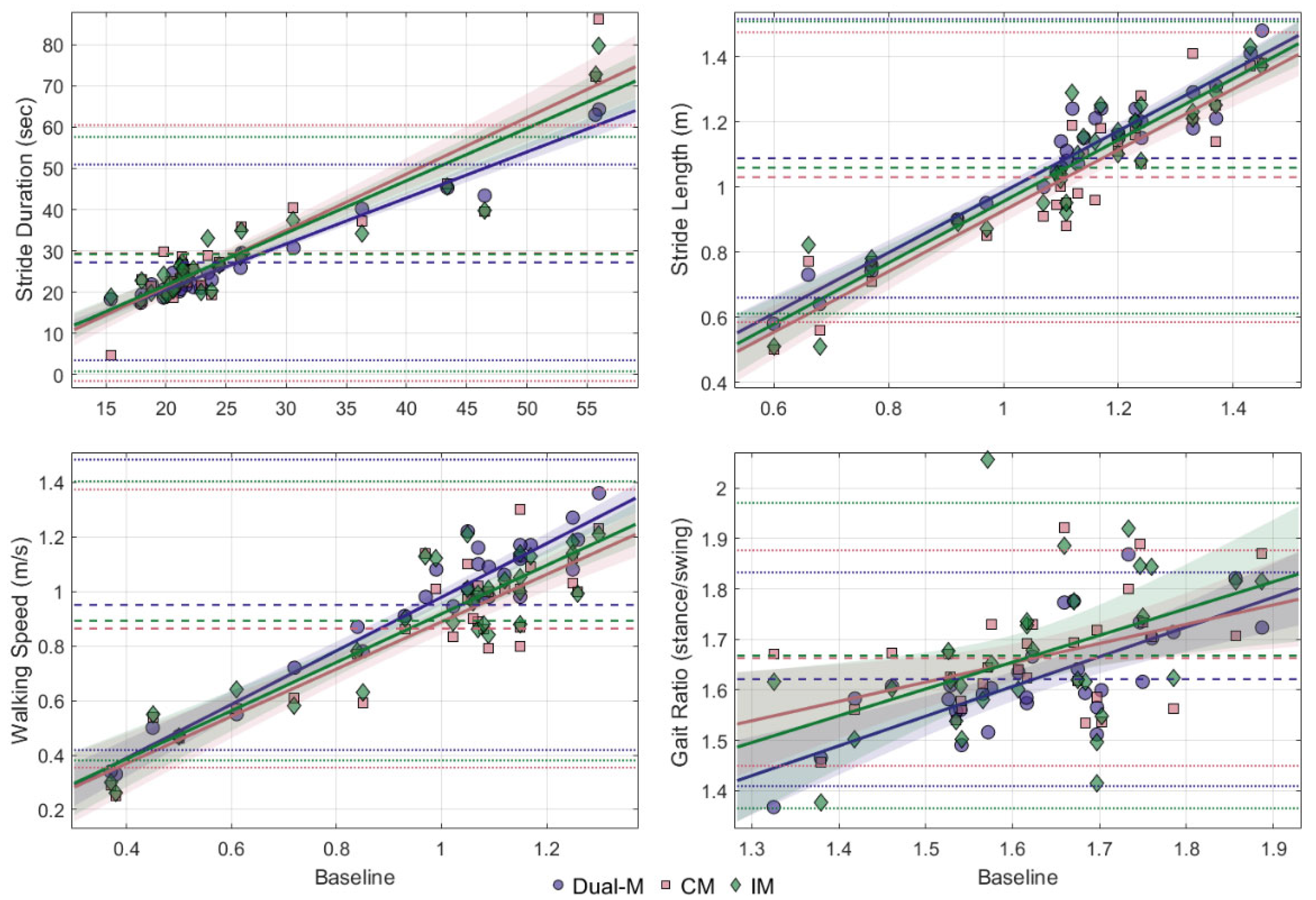
| Condition | Gait Parameter | Slope a | Intercept b | p | R2 |
|---|---|---|---|---|---|
| Dual_M | SD | 1.114 | −1.717 | <0.001 | 0.97 |
| SL | 0.935 | 0.050 | <0.001 | 0.93 | |
| WS | 0.982 | −0.004 | <0.001 | 0.93 | |
| GR | 0.589 | 0.665 | <0.001 | 0.52 | |
| CM | SD | 1.366 | −6.001 | <0.001 | 0.85 |
| SL | 0.934 | −0.007 | <0.001 | 0.86 | |
| WS | 0.866 | 0.022 | <0.001 | 0.78 | |
| GR | 0.382 | 1.042 | 0.010 | 0.22 | |
| IM | SD | 1.269 | −3.732 | <0.001 | 0.88 |
| SL | 0.943 | 0.012 | <0.001 | 0.86 | |
| WS | 0.888 | 0.030 | <0.001 | 0.82 | |
| GR | 0.531 | 0.806 | 0.012 | 0.21 |
| Parameter | Side | HeY | HeC | LC | MS | PD | IC | Group Difference |
|---|---|---|---|---|---|---|---|---|
| WS (m/s) | Global | 1.2 ± 0.1 | 1.0 ± 0.1 | 1.0 ± 0.1 | 1.0 ± 0.3 | 0.9 ± 0.3 | 0.6 ± 0.2 | p < 0.001 |
| SL (m) | 1.3 ± 0.1 | 1.2 ± 0.1 | 1.1 ± 0.1 | 1.1 ± 0.3 | 1.1 ± 0.2 | 0.8 ± 0.2 | p = 0.001 | |
| Cad (steps/min) | 111.6 ± 4.9 | 105.4 ± 13.7 | 112.5 ± 5.3 | 104.1 ± 13.6 | 105.7 ± 18.9 | 85.4 ± 10.9 | p < 0.001 | |
| Steps (n) | 26.2 ± 3.7 | 32.2 ± 3.0 | 33.2 ± 4.7 | 35.8 ± 12.5 | 33.2 ± 10.0 | 49.0 ± 12.8 | p = 0.003 | |
| SD (s) | 18.2 ± 1.9 | 22.8 ± 2.1 | 22.2 ± 2.3 | 26.3 ± 11.4 | 25.3 ± 7.2 | 41.8 ± 14.6 | p < 0.001 | |
| Symmetry Index (%) | 97.7 ± 1.0 | 93.1 ± 4.7 | 92.6 ± 4.0 | 92.0 ± 7.3 | 87.5 ± 7.4 | 72.5 ± 19.1 | p < 0.001 | |
| CD (s) | right | 1.1 ± 0.0 | 1.2 ± 0.1 | 1.1 ± 0.1 | 1.2 ± 0.2 | 1.2 ± 0.3 | 1.5 ± 0.2 | p < 0.001 |
| left | 1.1 ± 0.0 | 1.2 ± 0.1 | 1.1 ± 0.0 | 1.2 ± 0.2 | 1.2 ± 0.3 | 1.5 ± 0.2 | p < 0.001 | |
| DS (% cycle) | right | 12.5 ± 1.1 | 12.6 ± 2.5 | 9.9 ± 3.2 | 11.7 ± 2.5 | 12.0 ± 4.2 | 10.6 ± 1.1 | p = 0.332 |
| left | 11.5 ± 1.0 | 11.8 ± 1.0 | 10.4 ± 2.5 | 12.8 ± 1.9 | 11.5 ± 2.6 | 10.1 ± 1.8 | p = 0.067 | |
| Stance (% cycle) | right | 61.2 ± 2.1 | 63.1 ± 2.4 | 58.7 ± 4.3 | 60.0 ± 5.1 | 60.0 ± 5.1 | 60.5 ± 8.6 | p = 0.748 |
| left | 62.4 ± 1.0 | 61.2 ± 1.3 | 61.9 ± 1.9 | 62.8 ± 3.3 | 62.8 ± 3.3 | 60.2 ± 10.7 | p = 0.721 | |
| Swing (% cycle) | right | 38.8 ± 2.1 | 36.9 ± 2.4 | 41.3 ± 4.3 | 40.0 ± 5.1 | 40.0 ± 5.1 | 39.5 ± 8.6 | p = 0.748 |
| left | 37.6 ± 1.0 | 38.8 ± 1.3 | 38.1 ± 1.9 | 37.2 ± 3.3 | 37.2 ± 3.3 | 39.8 ± 10.7 | p = 0.721 | |
| Walking Quality Index (%) | right | 96.9 ± 3.6 | 93.8 ± 4.7 | 93.3 ± 5.2 | 93.6 ± 4.7 | 91.6 ± 3.9 | 86.4 ± 8.0 | p = 0.001 |
| left | 95.2 ± 2.1 | 97.5 ± 2.5 | 96.2 ± 3.9 | 92.3 ± 5.2 | 91.5 ± 2.9 | 84.2 ± 11.9 | p = 0.001 | |
| Propulsion Index (%) | right | 8.3 ± 1.2 | 5.3 ± 1.0 | 5.3 ± 1.7 | 6.8 ± 1.5 | 5.2 ± 1.7 | 4.5 ± 1.9 | p < 0.001 |
| left | 8.2 ± 1.1 | 6.0 ± 1.1 | 4.8 ± 1.6 | 6.2 ± 2.1 | 5.2 ± 1.7 | 4.2 ± 1.7 | p < 0.001 |
Disclaimer/Publisher’s Note: The statements, opinions and data contained in all publications are solely those of the individual author(s) and contributor(s) and not of MDPI and/or the editor(s). MDPI and/or the editor(s) disclaim responsibility for any injury to people or property resulting from any ideas, methods, instructions or products referred to in the content. |
© 2026 by the authors. Licensee MDPI, Basel, Switzerland. This article is an open access article distributed under the terms and conditions of the Creative Commons Attribution (CC BY) license.
Share and Cite
De Bartolo, D.; Baleca, L.; De Angelis, D.; Nocentini, U.; Iosa, M. The Effects of Secondary Motor and Cognitive Tasks on Gait Depend on Functional Walking Ability in Non-Traumatic Neurological Patients: A Feasibility Pilot Study. Appl. Sci. 2026, 16, 1484. https://doi.org/10.3390/app16031484
De Bartolo D, Baleca L, De Angelis D, Nocentini U, Iosa M. The Effects of Secondary Motor and Cognitive Tasks on Gait Depend on Functional Walking Ability in Non-Traumatic Neurological Patients: A Feasibility Pilot Study. Applied Sciences. 2026; 16(3):1484. https://doi.org/10.3390/app16031484
Chicago/Turabian StyleDe Bartolo, Daniela, Liliana Baleca, Domenico De Angelis, Ugo Nocentini, and Marco Iosa. 2026. "The Effects of Secondary Motor and Cognitive Tasks on Gait Depend on Functional Walking Ability in Non-Traumatic Neurological Patients: A Feasibility Pilot Study" Applied Sciences 16, no. 3: 1484. https://doi.org/10.3390/app16031484
APA StyleDe Bartolo, D., Baleca, L., De Angelis, D., Nocentini, U., & Iosa, M. (2026). The Effects of Secondary Motor and Cognitive Tasks on Gait Depend on Functional Walking Ability in Non-Traumatic Neurological Patients: A Feasibility Pilot Study. Applied Sciences, 16(3), 1484. https://doi.org/10.3390/app16031484