Investigation into the Influencing Factors and Energy Dissipation Mechanisms of Spring-Adaptive Cavity Particle Dampers

Abstract
1. Introduction
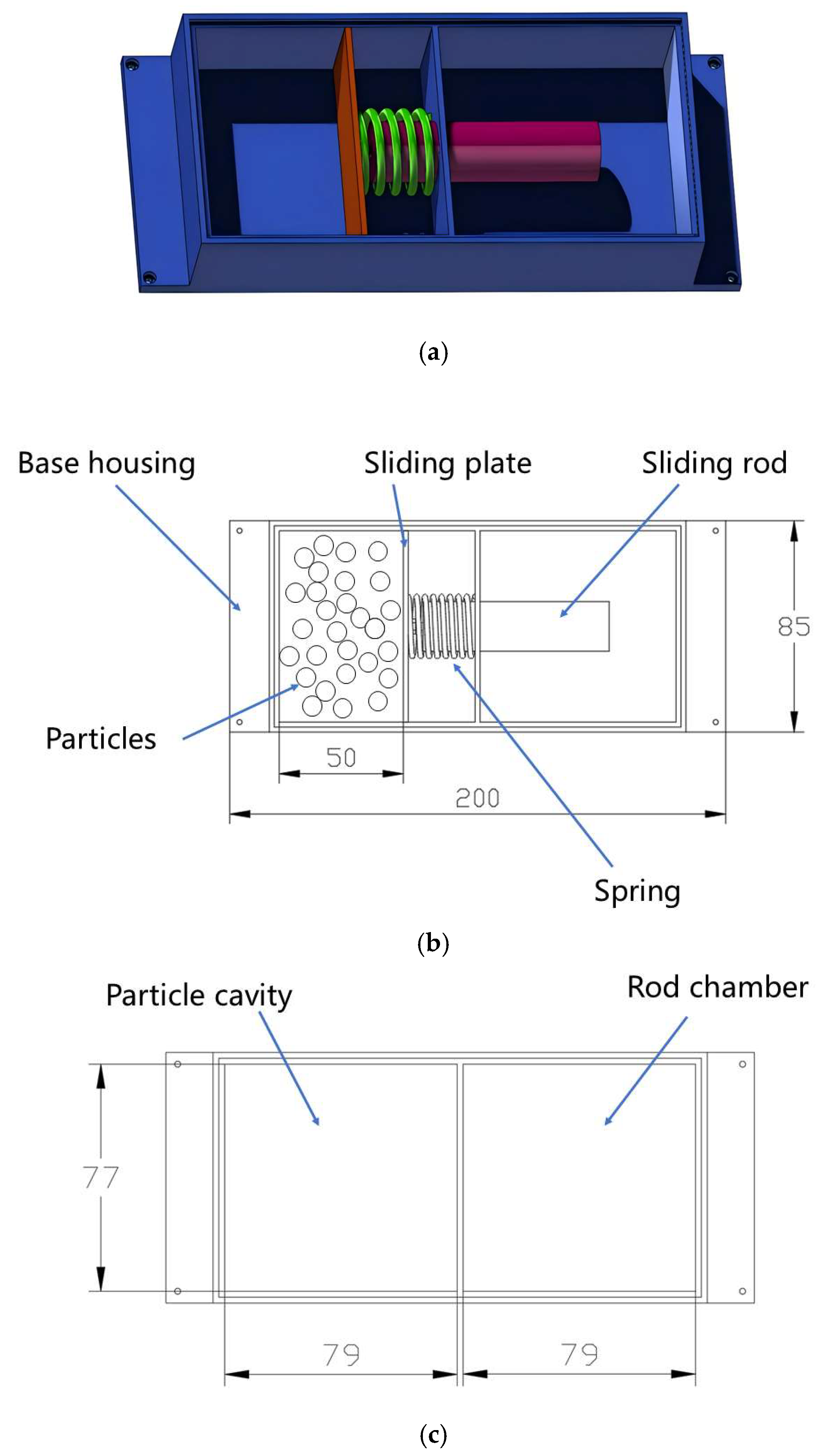
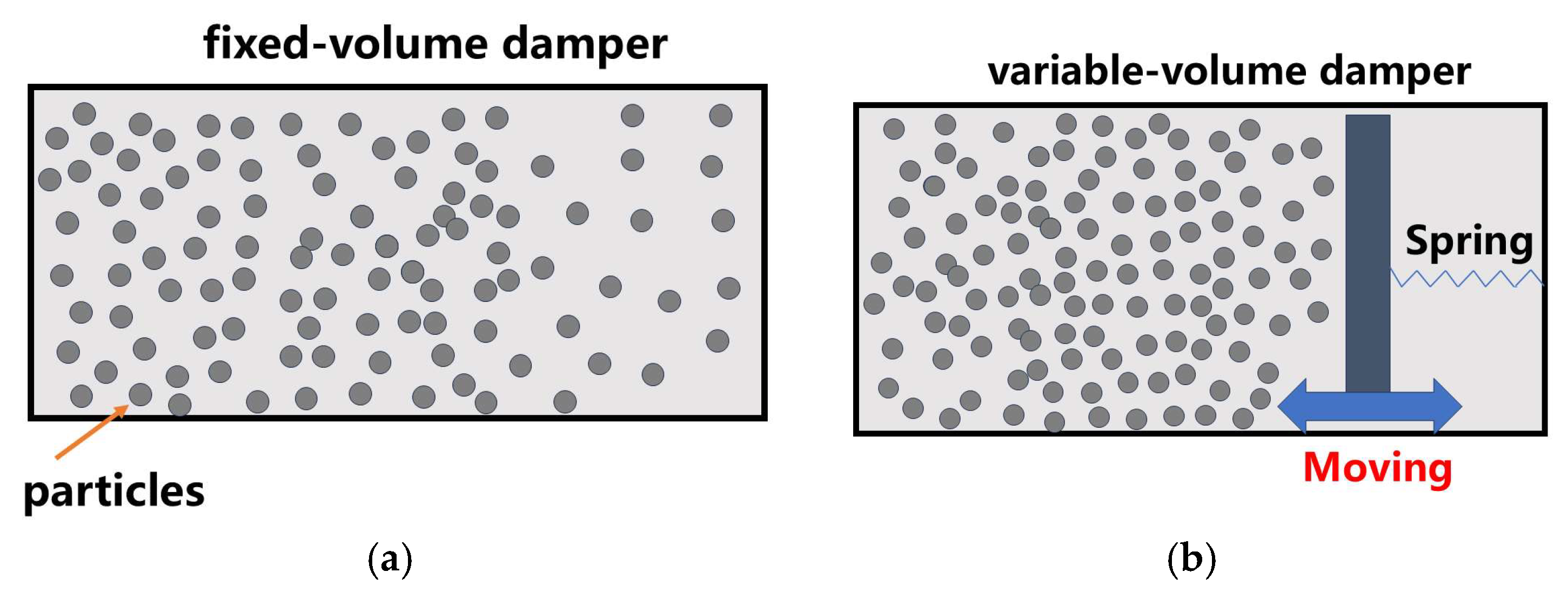
2. Geometric Design of the Particle Damper
3. Fundamental Principles of the Discrete Element Method and Particle Energy Dissipation Mechanism
3.1. Fundamental Principles of the Discrete Element Method
3.2. The Particle Energy Dissipation Mechanism
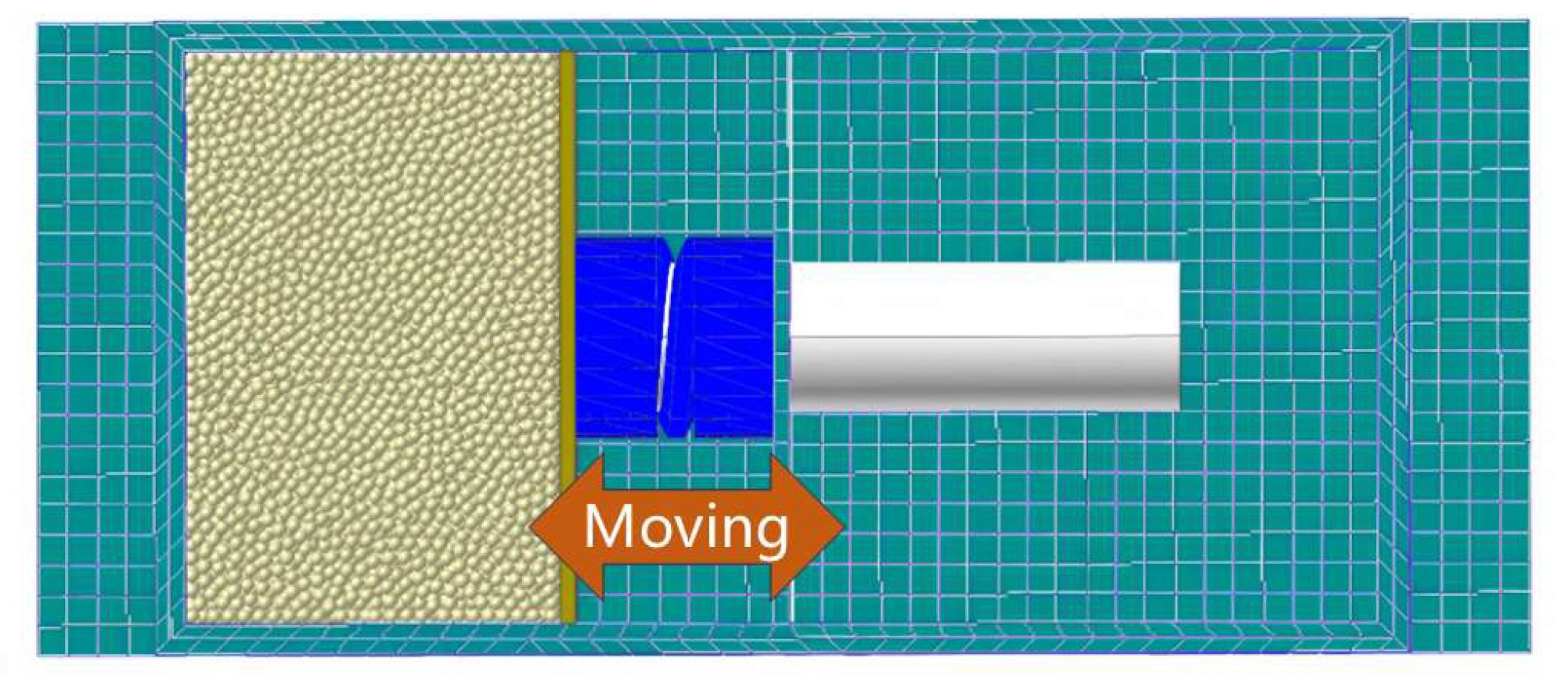
4. Numerical Simulation Setup
5. Simulation Results and Analysis
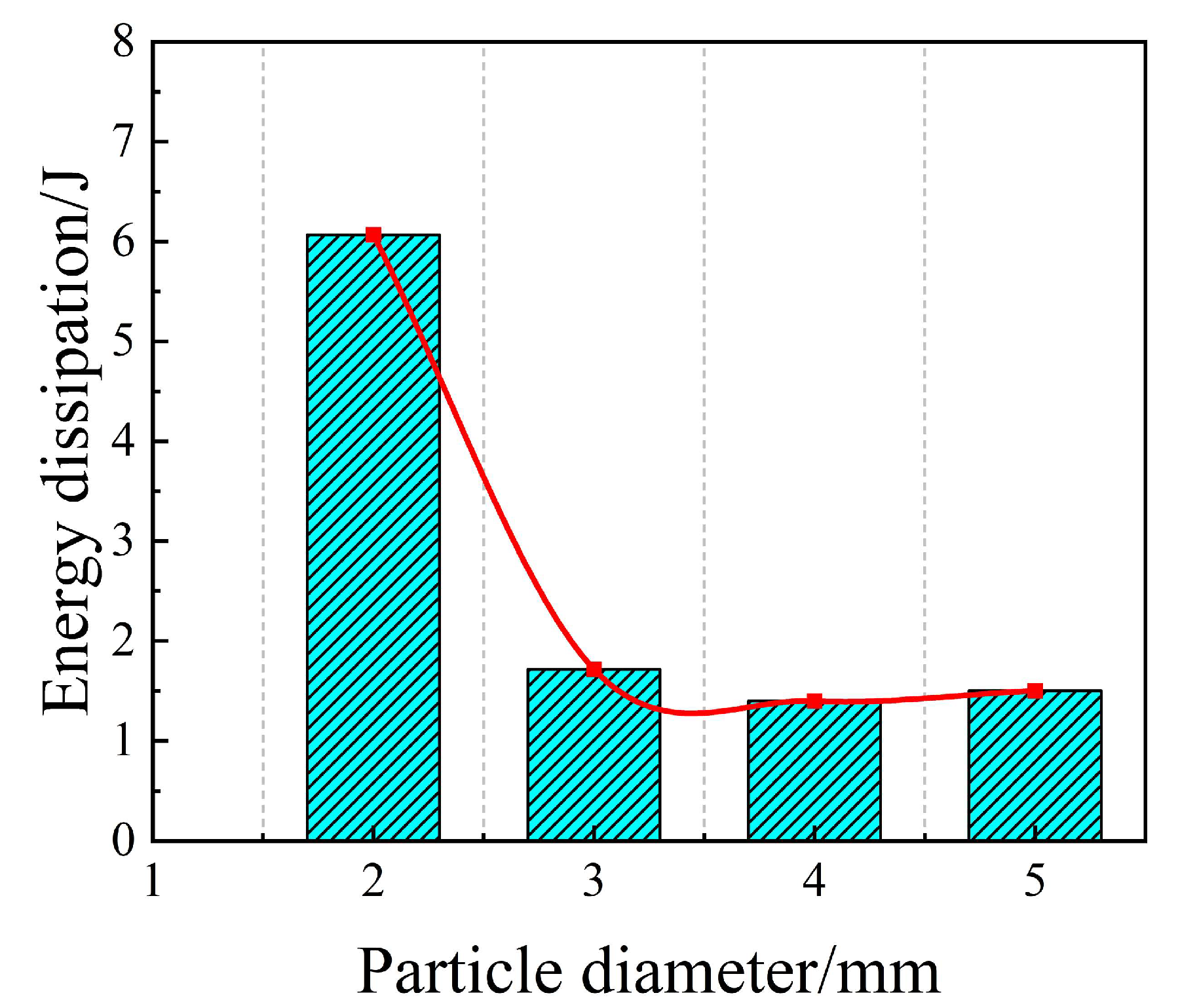
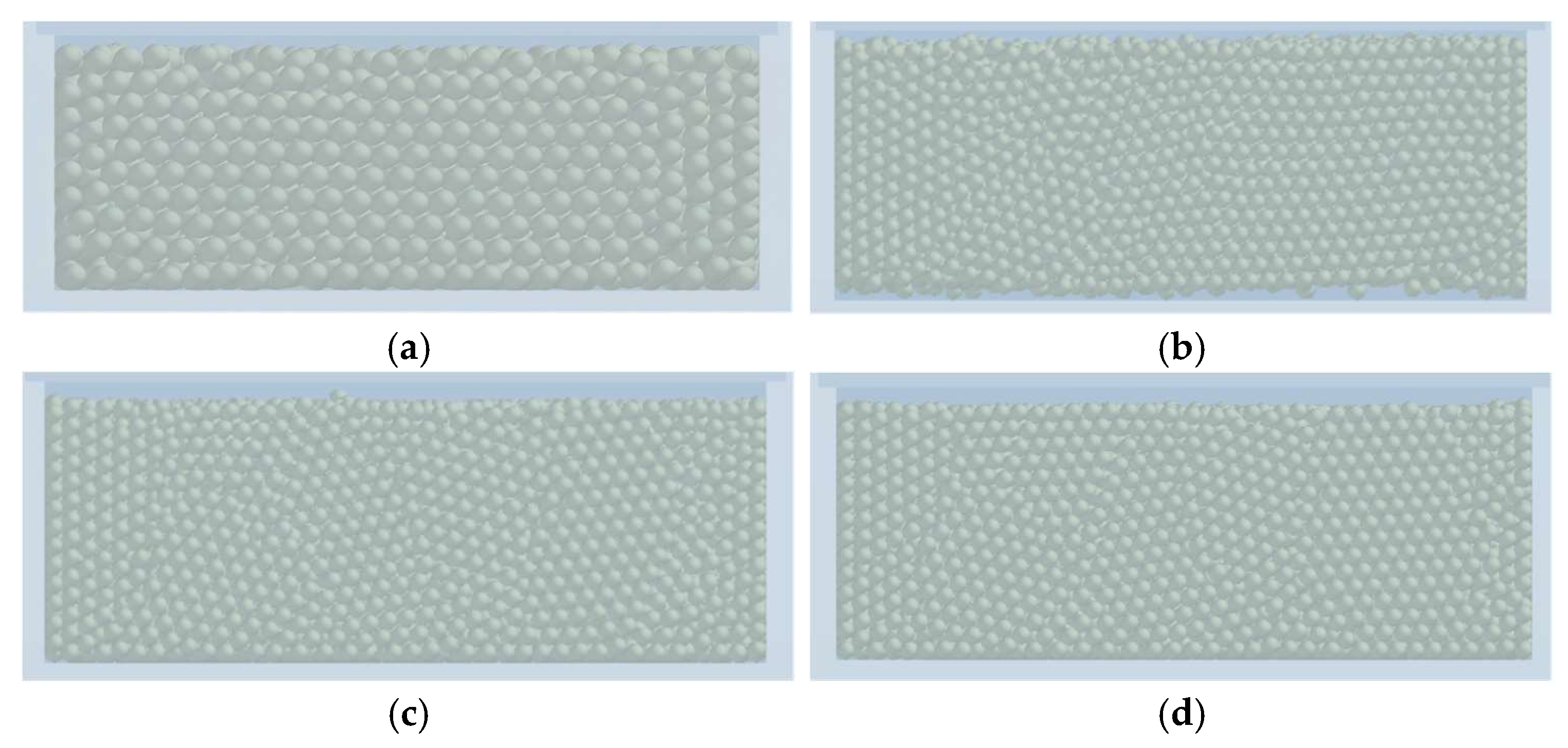
5.1. Particle Diameter Selection for Particle Dampers
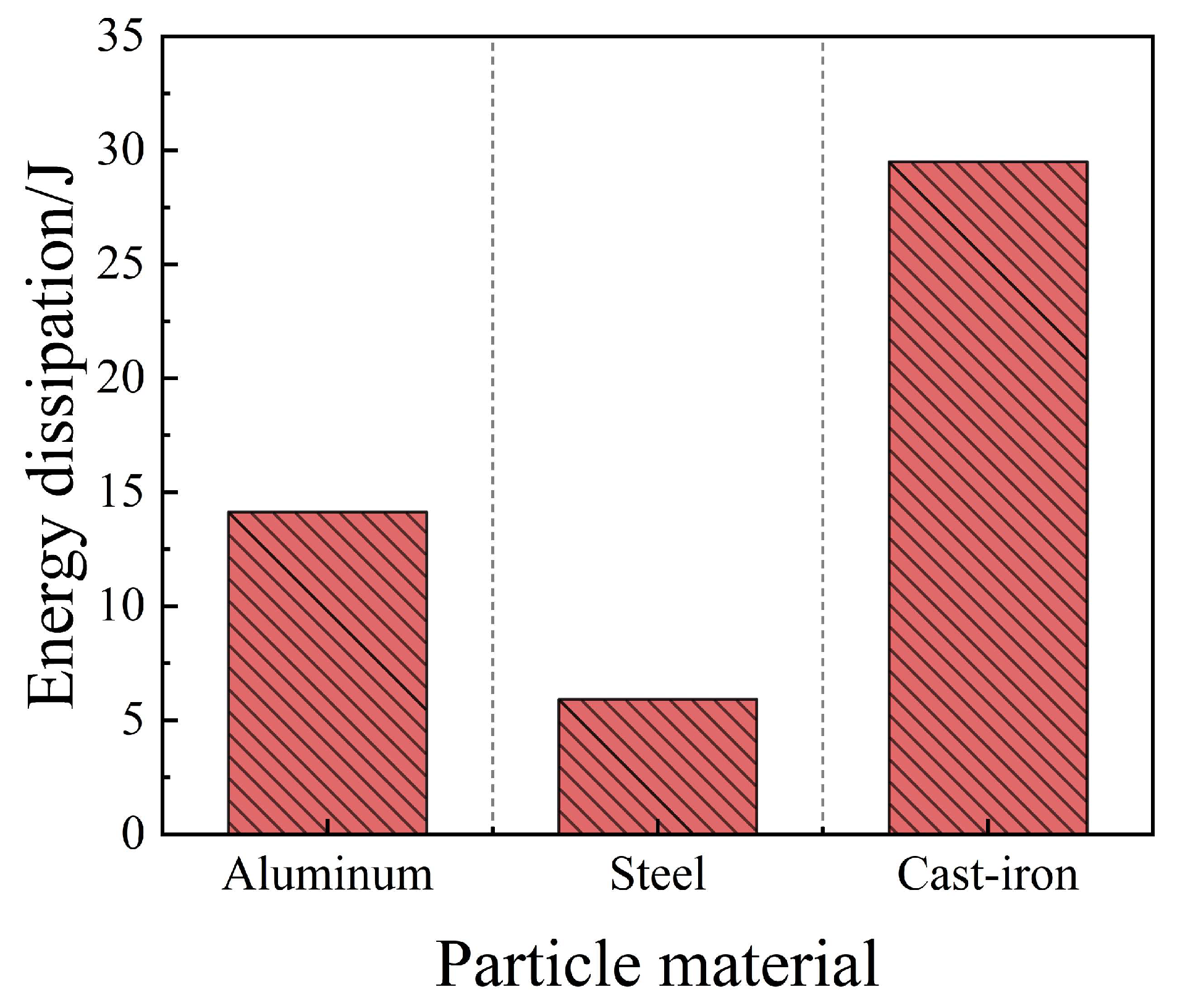
5.2. Selection of Particle Material for Particle Dampers
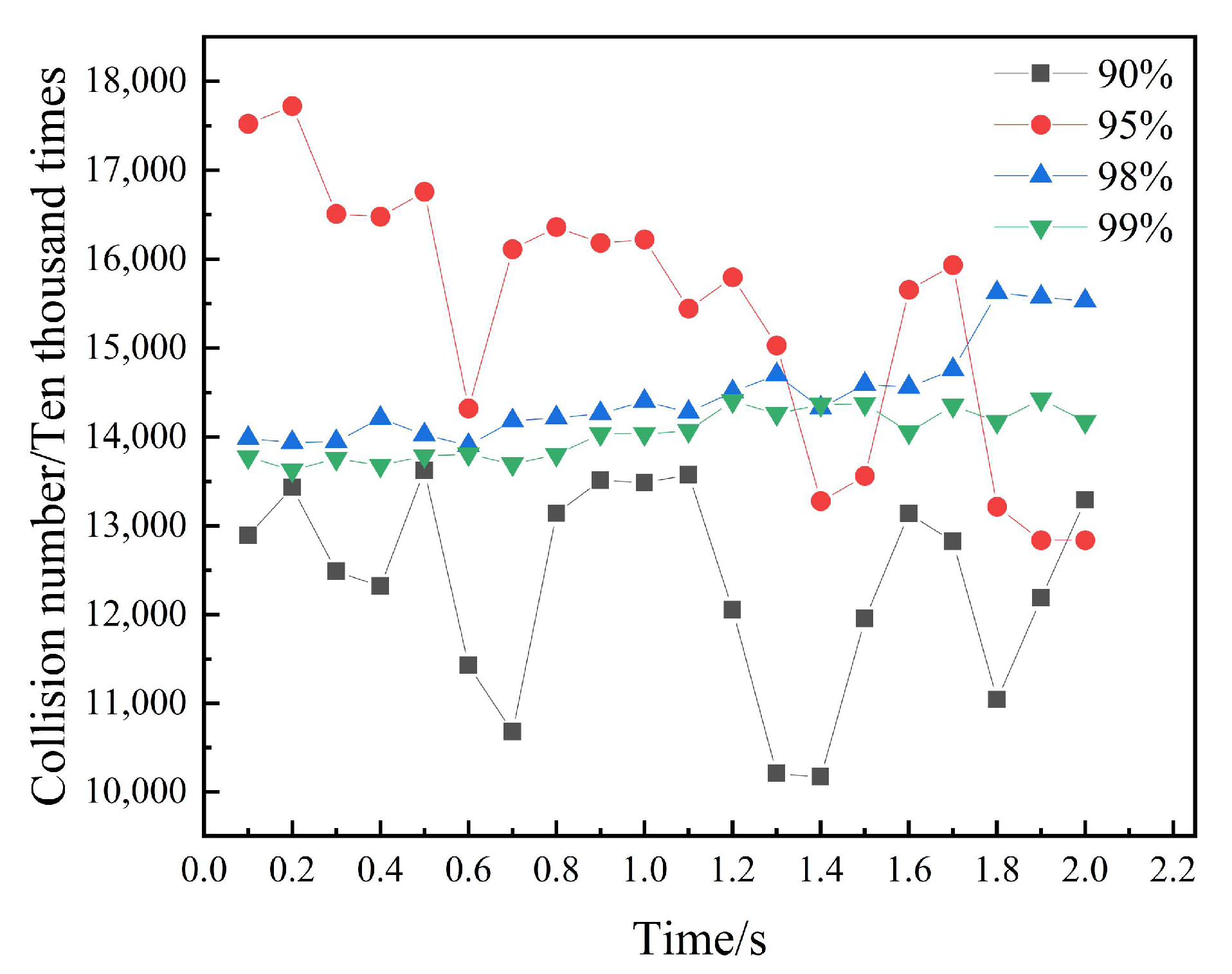
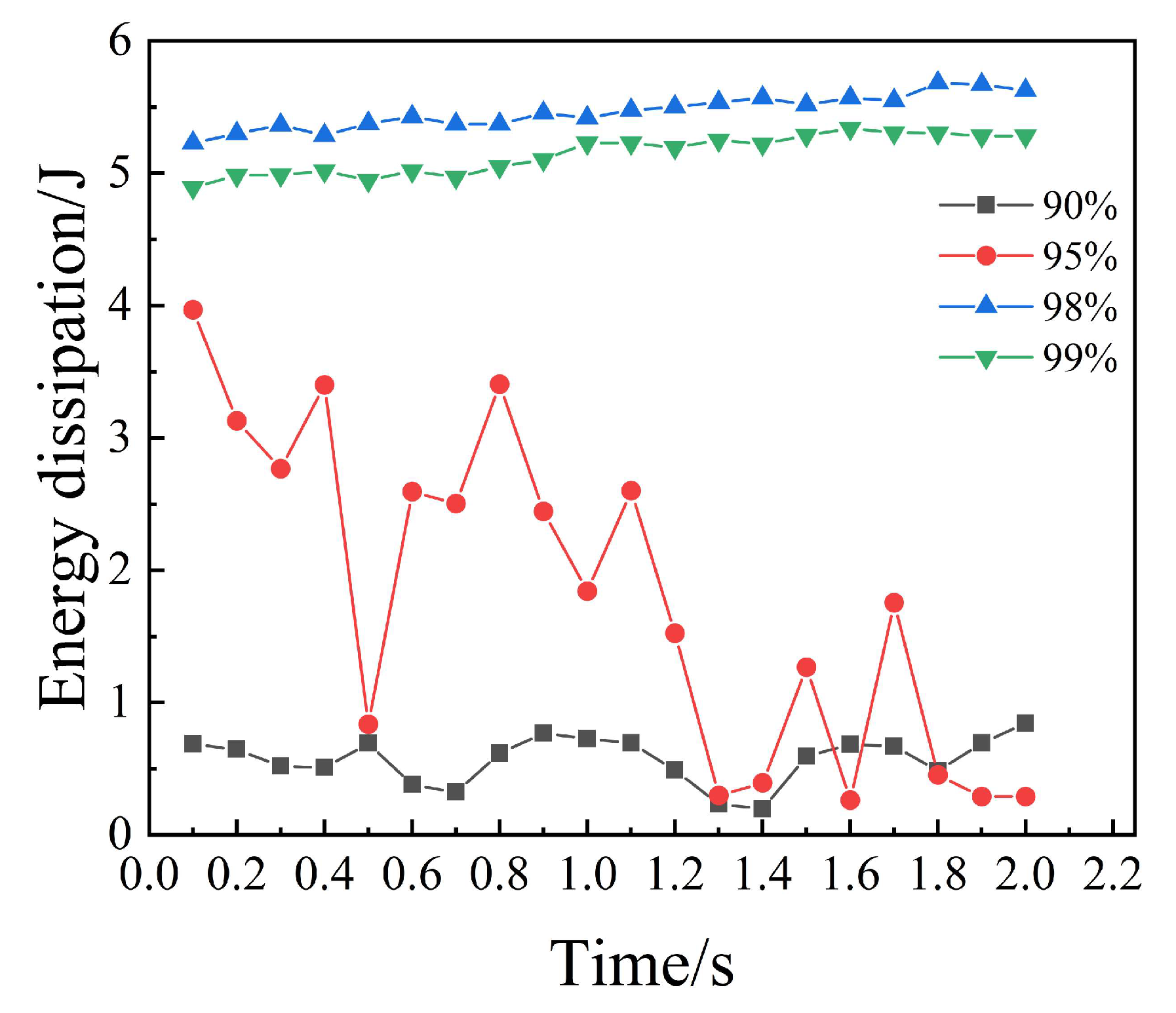
5.3. Selection of Particle Filling Rate for Particle Dampers
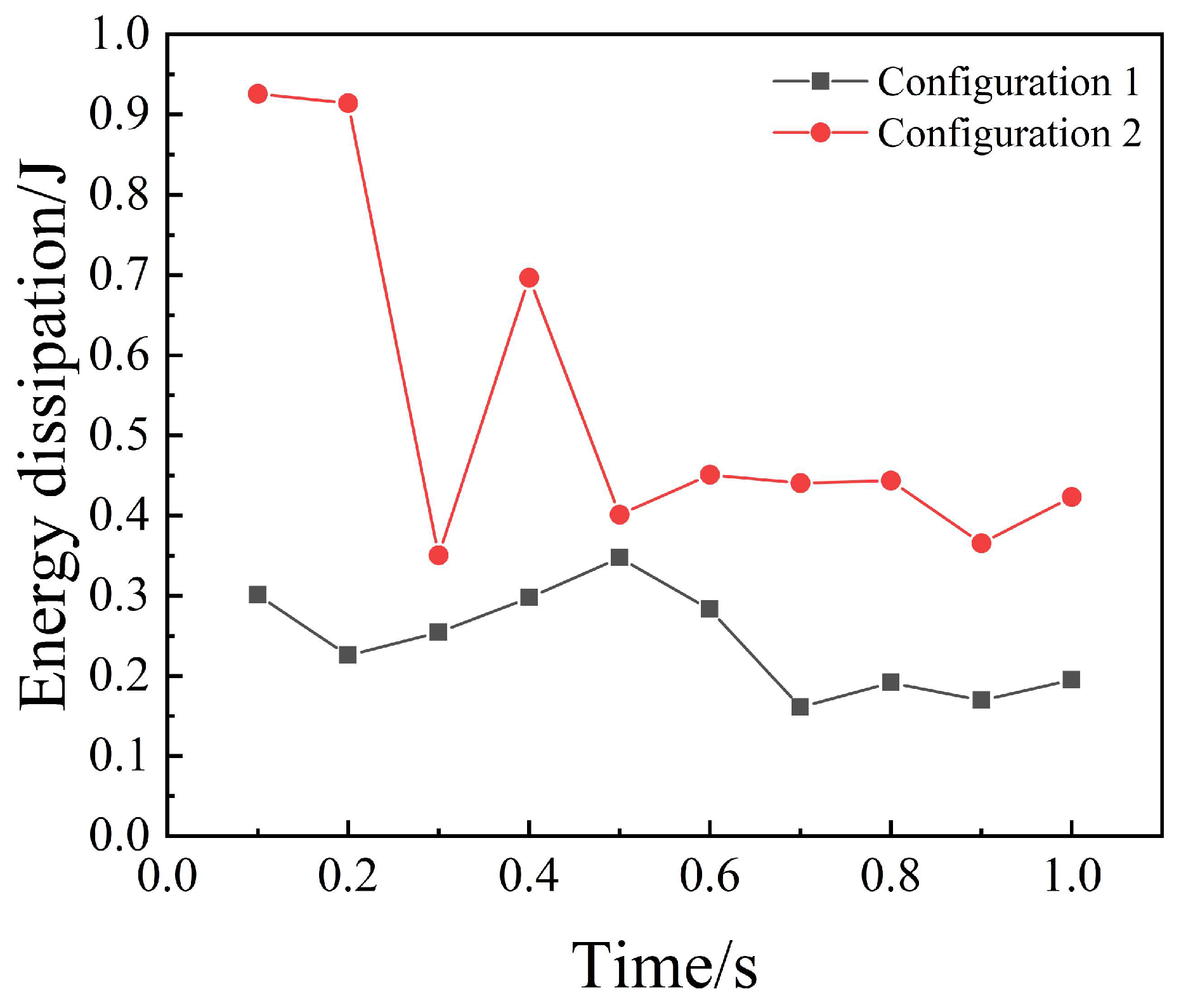
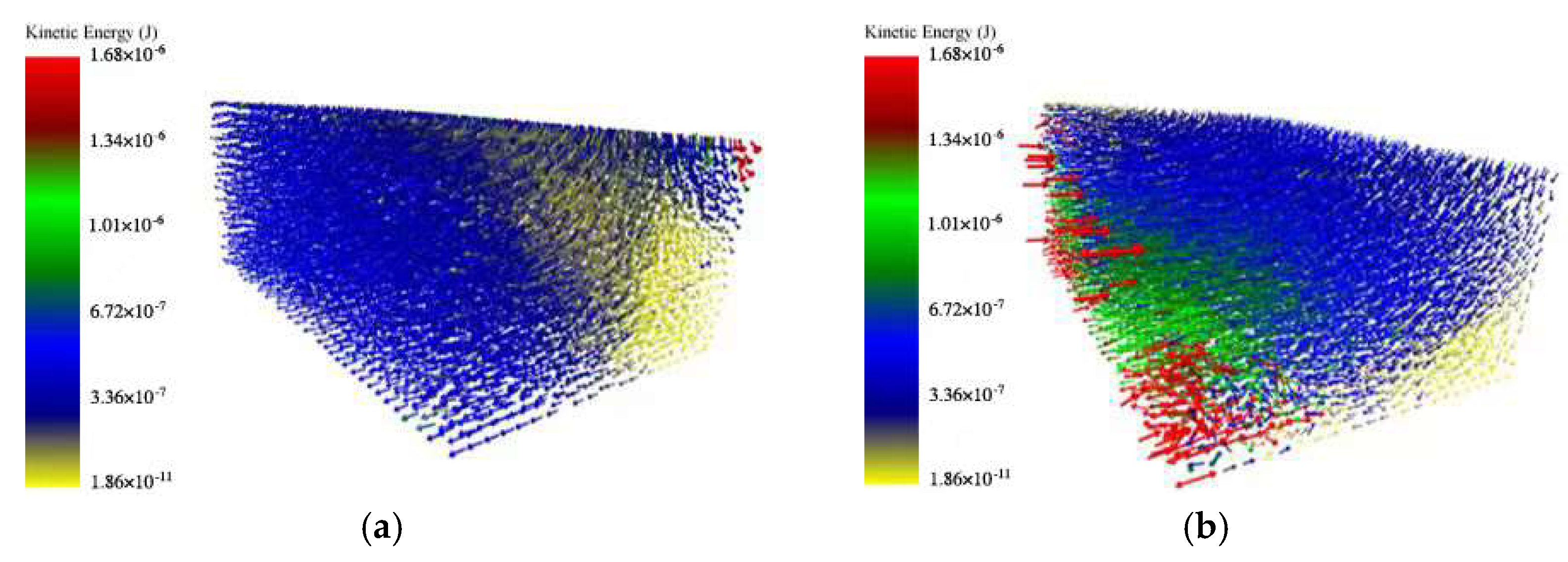
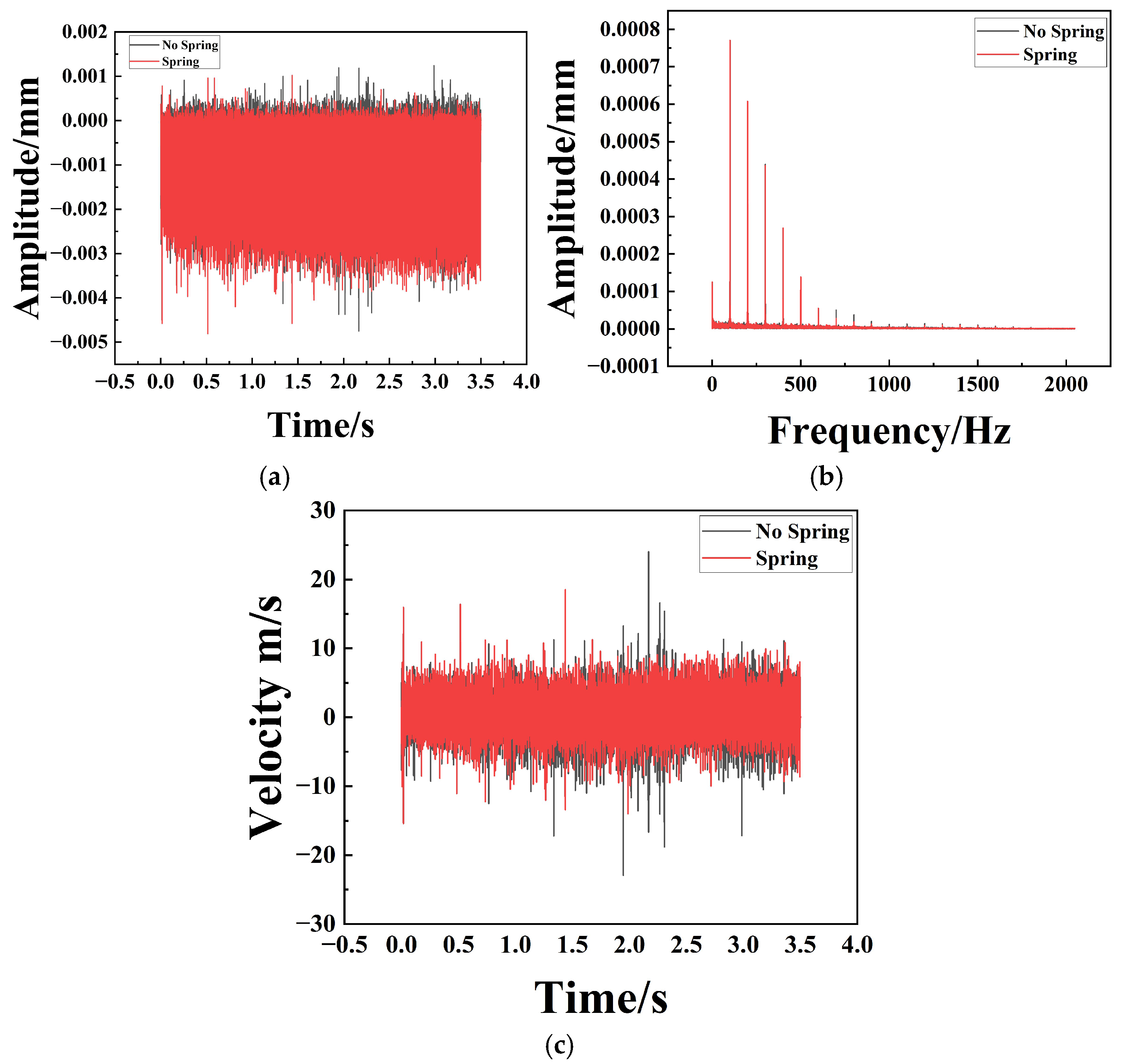
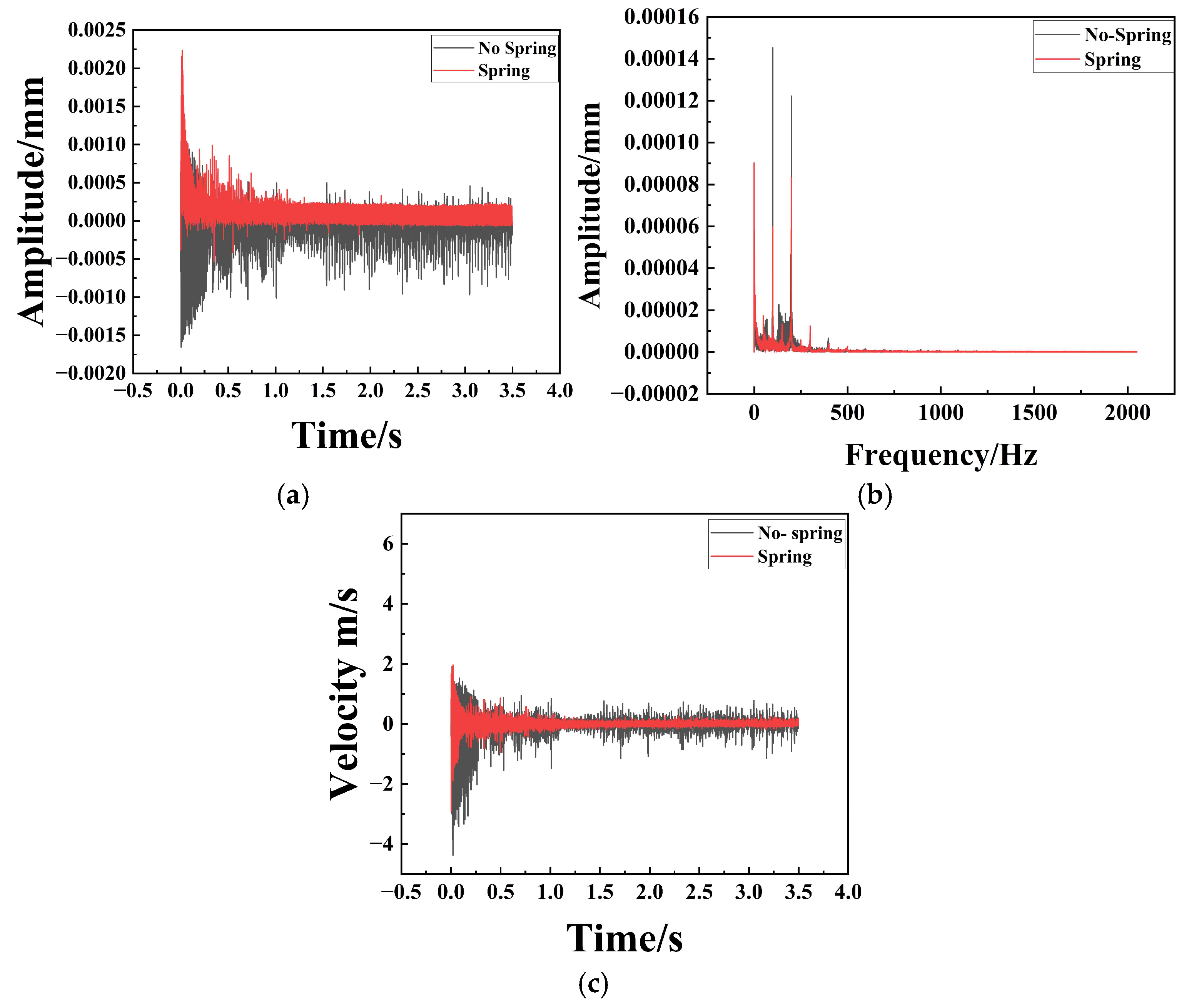
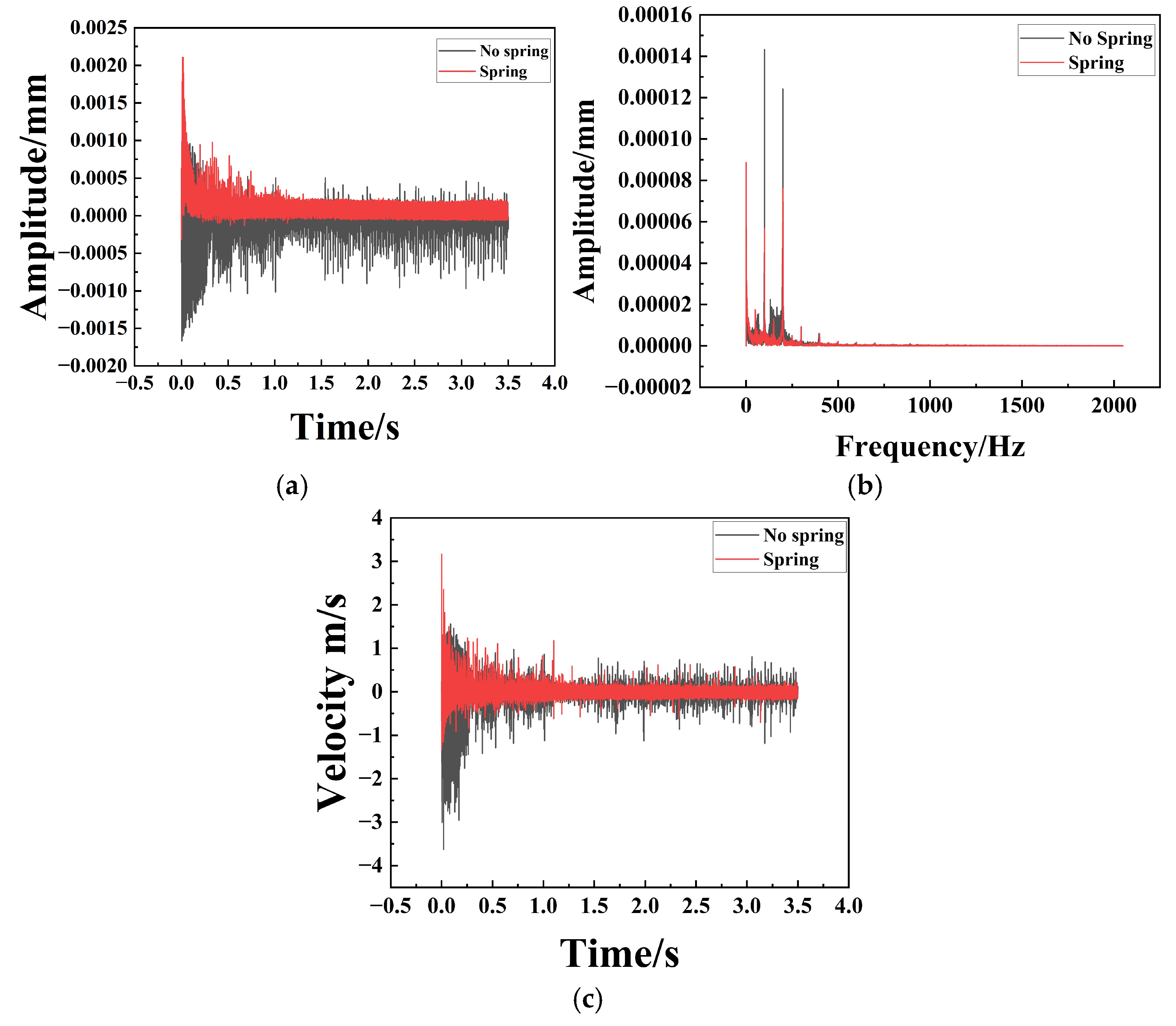
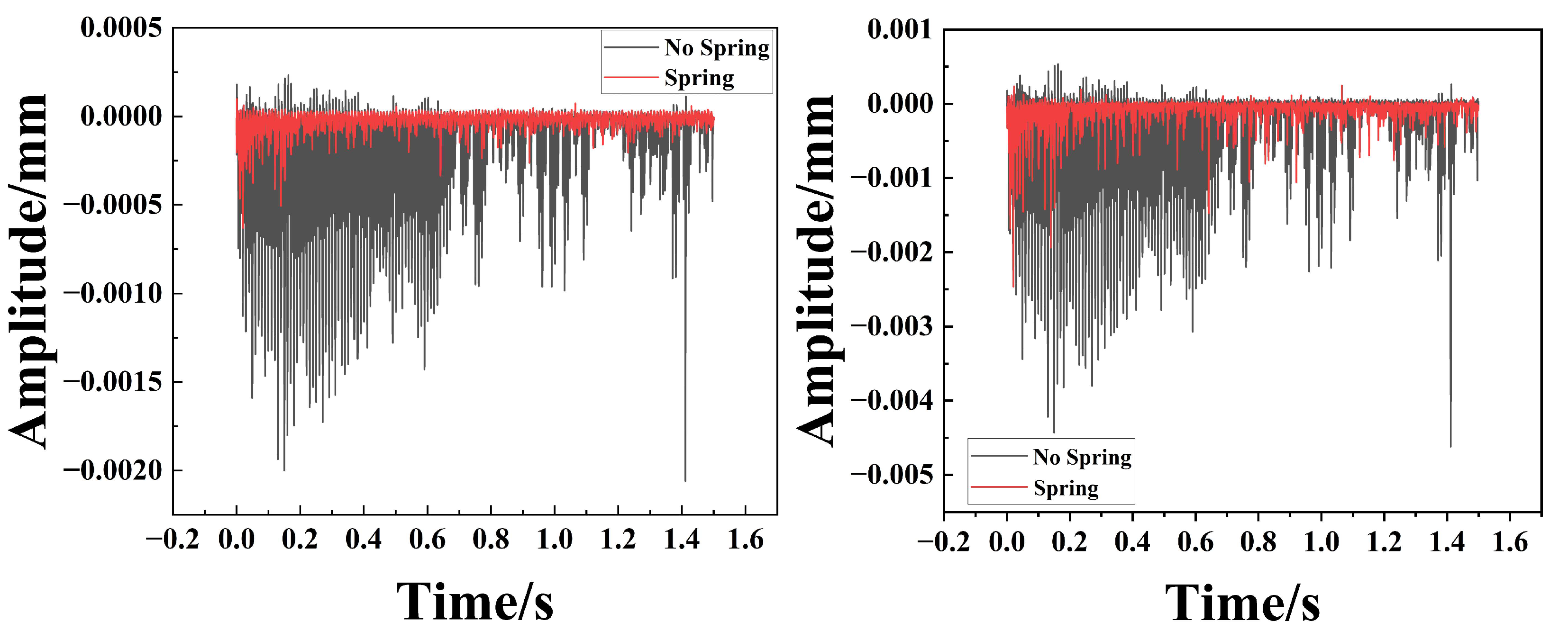
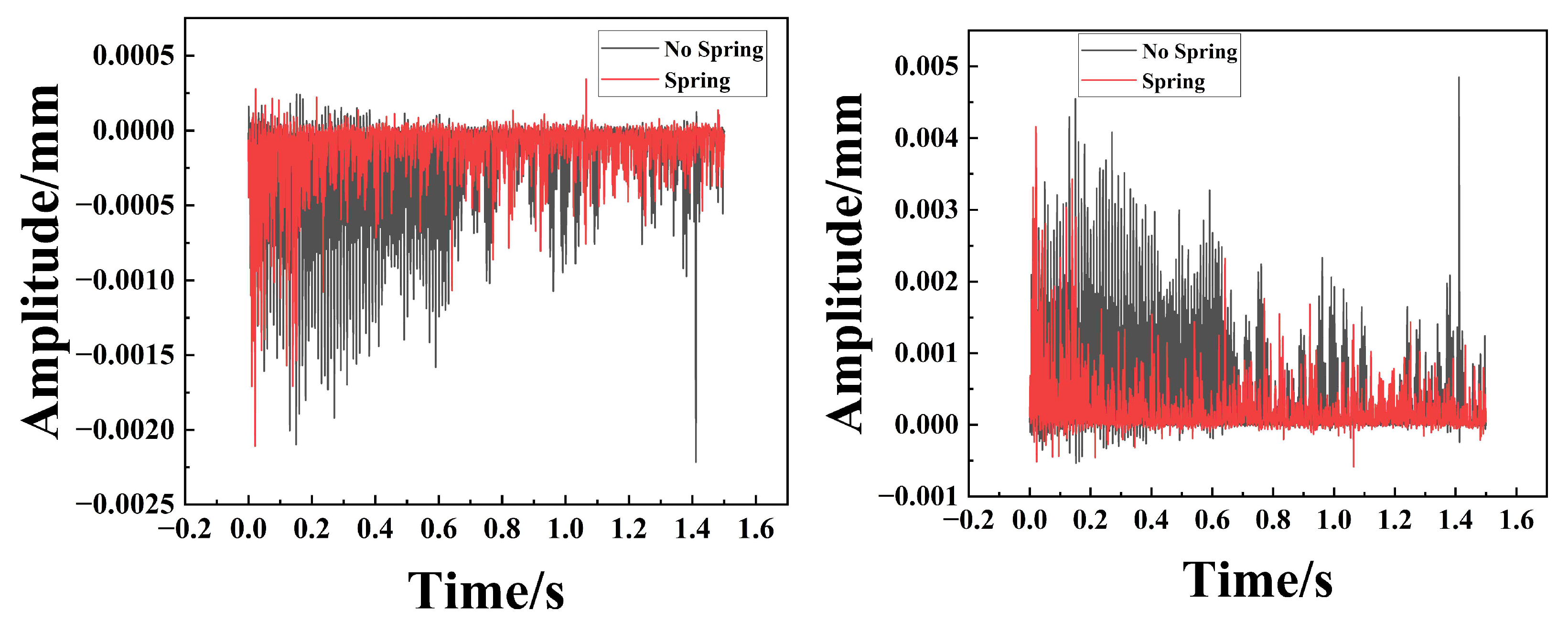
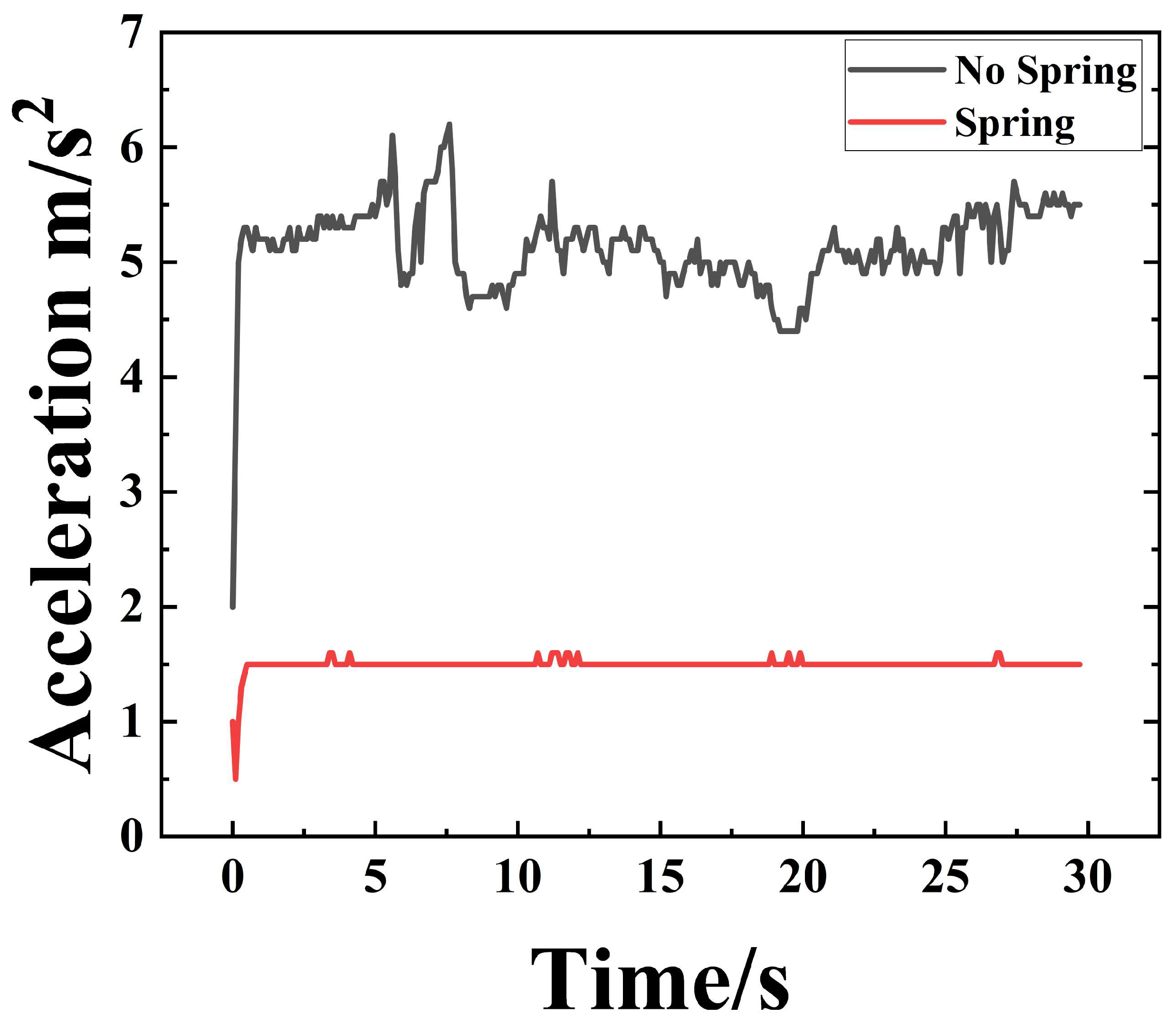
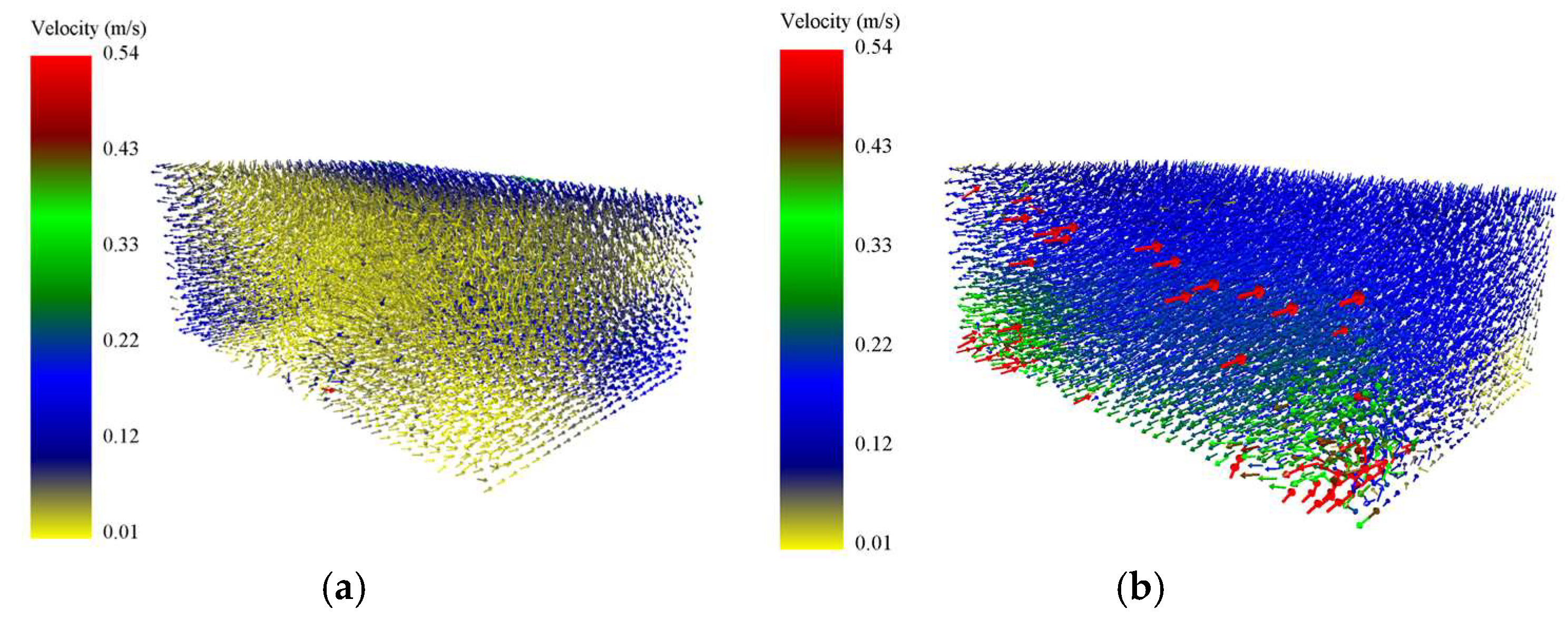
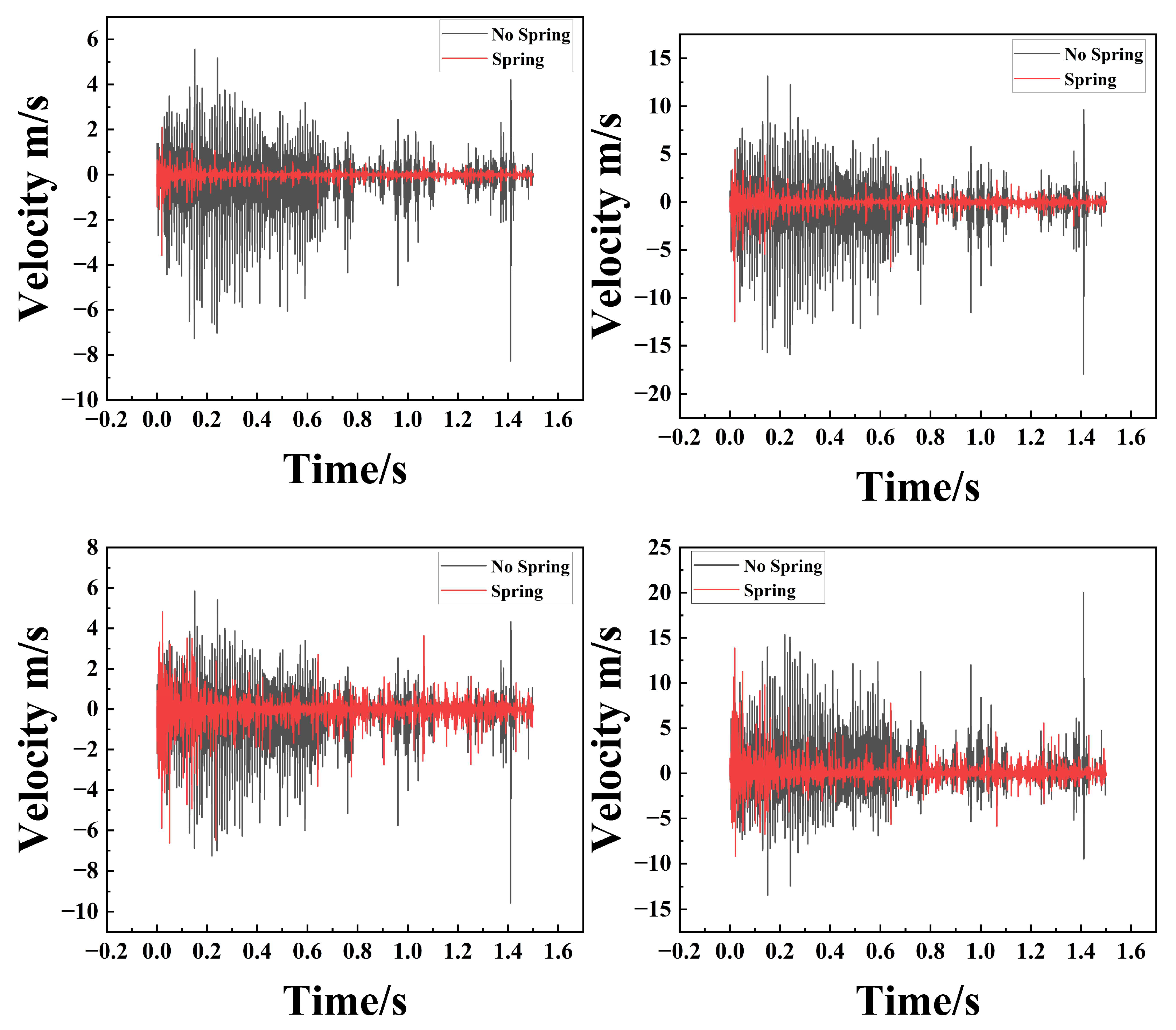
5.4. Effect of Variable Cavities on Particle Damper Performance
6. Discussion
7. Conclusions
Author Contributions
Funding
Data Availability Statement
Conflicts of Interest
References
- Sun, L.X.; Hu, X.Y.; Zhu, L.; Zhou, J.S.; Gong, D.; Wu, N. Research Status and Prospect on Service Safety of 400 km/h High-speed Train. China Railw. 2025, 6, 15–25. [Google Scholar]
- Wang, Q.; Zeng, J.; Shi, H.; Jiang, X. Parameter optimization of multi-suspended equipment to suppress carbody vibration of high-speed railway vehicles: A comparative study. Int. J. Rail Transp. 2024, 12, 1000–1019. [Google Scholar] [CrossRef]
- Fu, S.Q.; Du, J.T. DSS Research on Aerodynamic Drag Reduction of Surface Microstructure of High-speed Maglev Train. Railw. Tech. Stand. (Chin. Engl.) 2023, 5, 1–8. [Google Scholar]
- Yuan, M.M.; Anne, S.; Lu, F. An analysis of relation between China railways high-speed noises and velocities. J. Appl. Acoust. 2014, 33, 184–188. [Google Scholar]
- Mao, R.; Zeng, J.; Wang, Q.; Wen, J. Hunting stability control of high-speed bogie based on active yaw damper. J. Low Freq. Noise Vib. Act. Control. 2024, 43, 1827–1841. [Google Scholar] [CrossRef]
- Li, J.C.; Huang, X.; Zeng, J.; Wang, Q.S. Study on adaptive control strategy of hunting stability for high-speed trains. Mod. Manuf. Eng. 2025, 2, 61–68. [Google Scholar]
- Lu, Z.; Lu, X.L.; Yan, W.M. A survey of particle damping technology. J. Vib. Shock 2013, 32, 1–7. [Google Scholar]
- Xia, Z.; Mao, K.; Wei, S.; Wang, X.; Fang, Y.; Yang, S. Application of genetic algorithm-support vector regression model to predict damping of cantilever beam with particle damper. J. Low Freq. Noise Vib. Act. Control. 2017, 36, 138–147. [Google Scholar] [CrossRef]
- Lei, X.; Wu, C.; Wu, H. A novel composite vibration control method using double-decked floating raft isolation system and particle damper. J. Vib. Control 2018, 24, 4407–4418. [Google Scholar] [CrossRef]
- Lei, X.; Wu, C. Investigating the optimal damping performance of a composite dynamic vibration absorber with particle damping. J. Vib. Eng. Technol. 2018, 6, 503–511. [Google Scholar] [CrossRef]
- Xiao, W.Q.; Ye, S.Z.; Wang, X.M.; Jia, S.S.; Pan, D.K.; Lu, D.J. Numerical Analysis and Experimental Study of Particle Dampers for Vibration Reduction of EMU End Wall Structures. China Mech. Eng. 2021, 32, 481–489. [Google Scholar]
- Xiao, W.Q.; Chen, H.; Xu, Z.H.; Wang, X.M.; Jia, S.S.; Pan, D.K. Study on the Vibration Reduction of Internal Combustion EMU Powerpack Frame under Multiple Loading Conditions Based on Particle Damping. J. Mech. Eng. 2022, 58, 250–257. [Google Scholar]
- Wang, J.C.; Zhang, Y.B.; Fan, Y.X. Research on Vibration and Noise Reduction Effect of Particle Damping Absorbers for Track Systems. Noise Vib. Control 2022, 42, 220–224. [Google Scholar]
- Zheng, Z.; Wu, C.; Wu, H.; Wang, J.; Lei, X. Vibration isolation performance of nonobstructive particle damping in a machine rack. J. Vib. Control 2019, 25, 1122–1130. [Google Scholar] [CrossRef]
- Paget, A.L. Vibration in steam turbine buckets and damping by impacts. Engineering 1937, 143, 305–307. [Google Scholar]
- Lieber, P.; Jensen, D.P. An acceleration damper: Development, design, and some applications. Trans. Am. Soc. Mech. Eng. 1945, 67, 523–530. [Google Scholar] [CrossRef]
- Masri, S.F. Analytical and experimental studies of multiple-unit impact dampers. J. Acoust. Soc. Am. 1969, 45, 1111–1117. [Google Scholar] [CrossRef]
- Papalou, A.; Masri, S.F. Performance of particle dampers under random excitation. J. Vib. Acoust. 1996, 118, 614–621. [Google Scholar] [CrossRef]
- Saeki, M. Analytical study of multi-particle damping. J. Sound Vib. 2005, 281, 1133–1144. [Google Scholar] [CrossRef]
- Chen, L.A.; Semercigil, S.E. A beam like damper for attenuating transient vibrations of light strucvtures. J. Sound Vib. 1993, 164, 53–65. [Google Scholar] [CrossRef]
- Shi, H.; Zeng, J.; Qu, S. Linear stability analysis of a high-speed rail vehicle concerning suspension parameters variation and active control. Veh. Syst. Dyn. 2023, 61, 2976–2998. [Google Scholar] [CrossRef]
- Zhang, L.; Wang, Y.X. Research of Vehicle Semi-Active Control Based on Improved ADD Control STRATEGY. Mech. Eng. Autom. 2023, 12–15. [Google Scholar]
- Zhang, J.; Yao, D.; Peng, W.; Wang, R.; Li, J.; Guo, S. Optimal design of lightweight acoustic metamaterials for low-frequency noise and vibration control of high-speed train composite floor. Appl. Acoust. 2022, 199, 109041. [Google Scholar] [CrossRef]
- Xu, F.X.; Dong, Z.; Su, J.J. Influence of thickness distribution on the vibration characteristics of thin plates with variable thickness. J. Vib. Shock. 2022, 41, 289–297. [Google Scholar]
- Xiao, W.Q.; Shao, B. Vibration reduction of side wall skin of high-speed EMU based on particle damping. J. Railw. Sci. Eng. 2023, 20, 3251–3261. [Google Scholar]
- Bai, X.M.; Shah, B.; Keer, L.M.; Wang, Q.J.; Snurr, R.Q. Particle dynamics simulations of a piston-based particle damper. Powder Technol. 2009, 189, 115–125. [Google Scholar] [CrossRef]
- Zhang, K.; Xi, Y.; Chen, T.; Ma, Z. Experimental studies of tuned particle damper: Design and characterization. Mech. Syst. Signal Process. 2018, 99, 219–228. [Google Scholar] [CrossRef]
- Shen, Y.; Liu, C.; Zhou, D.; Wang, Z.; Zhou, L.; Ma, H.; Zhao, Y. A parallel coupling framework for DEM-MBD: Model verification and application. Powder Technol. 2024, 448, 120257. [Google Scholar] [CrossRef]
- Jin-Xiao, Y.E.; Zheng-Qi, Y.; Min, J.I.; Ying, J.M.; Lin-Chang, Y.E.; Zhao-Wang, X.I.A. Energy Dissipation Characteristics Analysis of Spring-particle Damper Vibration Control Systems. Noise Vib. Control 2025, 45, 74. [Google Scholar]
- Tsuji, Y.; Tanaka, T.; Ishida, T. Lagrangian numerical simulation of plug flow of cohesionless particles in a horizontal pipe. Powder Technol. 1992, 71, 239–250. [Google Scholar] [CrossRef]
- Mindlin, R.D. Compliance of elastic bodies in contact. J. Appl. Mech. 1949, 16, 259–268. [Google Scholar] [CrossRef]
- Warburton, G.B. Dynamics of structures. In Earthquake Engineering & Structural Dynamics; McGraw-Hill: New York, NY, USA, 1995; Volume 24, pp. 457–462. ISBN 0-07-011394-7. [Google Scholar]
- Tang, Y.N.; Dai, Y.; Xiao, W.Q.; Shao, K. Vibration and Noise Reduction Design for High-Speed Rail Interior Wood Flooring Based on Particle Damping. Electr. Transm. Locomot. 2024, 1, 85–92. [Google Scholar]






| Particle Radius | 5 mm | 4 mm | 3 mm | 2 mm |
|---|---|---|---|---|
| Theoretical number of particles | 1764 | 3446 | 8174 | 27,565 |
| Actual number of particles | 970 | 1881 | 4610 | 16,340 |
| Particle Diameter (mm) | 5 | 4 | 3 | 2 |
|---|---|---|---|---|
| Energy dissipation (J) | 1.501 | 1.398 | 1.714 | 6.069 |
| Fill Factor (%) | 90 | 95 | 98 | 99 |
|---|---|---|---|---|
| Energy dissipation (J) | 6.128 | 20.304 | 57.251 | 53.839 |
| Average number of hits (Ten thousand times) | 1248 | 1547 | 1443 | 1400 |
Disclaimer/Publisher’s Note: The statements, opinions and data contained in all publications are solely those of the individual author(s) and contributor(s) and not of MDPI and/or the editor(s). MDPI and/or the editor(s) disclaim responsibility for any injury to people or property resulting from any ideas, methods, instructions or products referred to in the content. |
© 2026 by the authors. Licensee MDPI, Basel, Switzerland. This article is an open access article distributed under the terms and conditions of the Creative Commons Attribution (CC BY) license.
Share and Cite
Chen, X.; Wang, R.; Hu, Z. Investigation into the Influencing Factors and Energy Dissipation Mechanisms of Spring-Adaptive Cavity Particle Dampers. Appl. Sci. 2026, 16, 1468. https://doi.org/10.3390/app16031468
Chen X, Wang R, Hu Z. Investigation into the Influencing Factors and Energy Dissipation Mechanisms of Spring-Adaptive Cavity Particle Dampers. Applied Sciences. 2026; 16(3):1468. https://doi.org/10.3390/app16031468
Chicago/Turabian StyleChen, Xue, Renwei Wang, and Zhiqing Hu. 2026. "Investigation into the Influencing Factors and Energy Dissipation Mechanisms of Spring-Adaptive Cavity Particle Dampers" Applied Sciences 16, no. 3: 1468. https://doi.org/10.3390/app16031468
APA StyleChen, X., Wang, R., & Hu, Z. (2026). Investigation into the Influencing Factors and Energy Dissipation Mechanisms of Spring-Adaptive Cavity Particle Dampers. Applied Sciences, 16(3), 1468. https://doi.org/10.3390/app16031468