Autoencoder-Based Self-Supervised Anomaly Detection in Wireless Sensor Networks: A Taxonomy-Driven Meta-Synthesis


Abstract
1. Introduction
Contributions
2. Background
2.1. Overview of Anomaly Detection in Wireless Sensor Networks
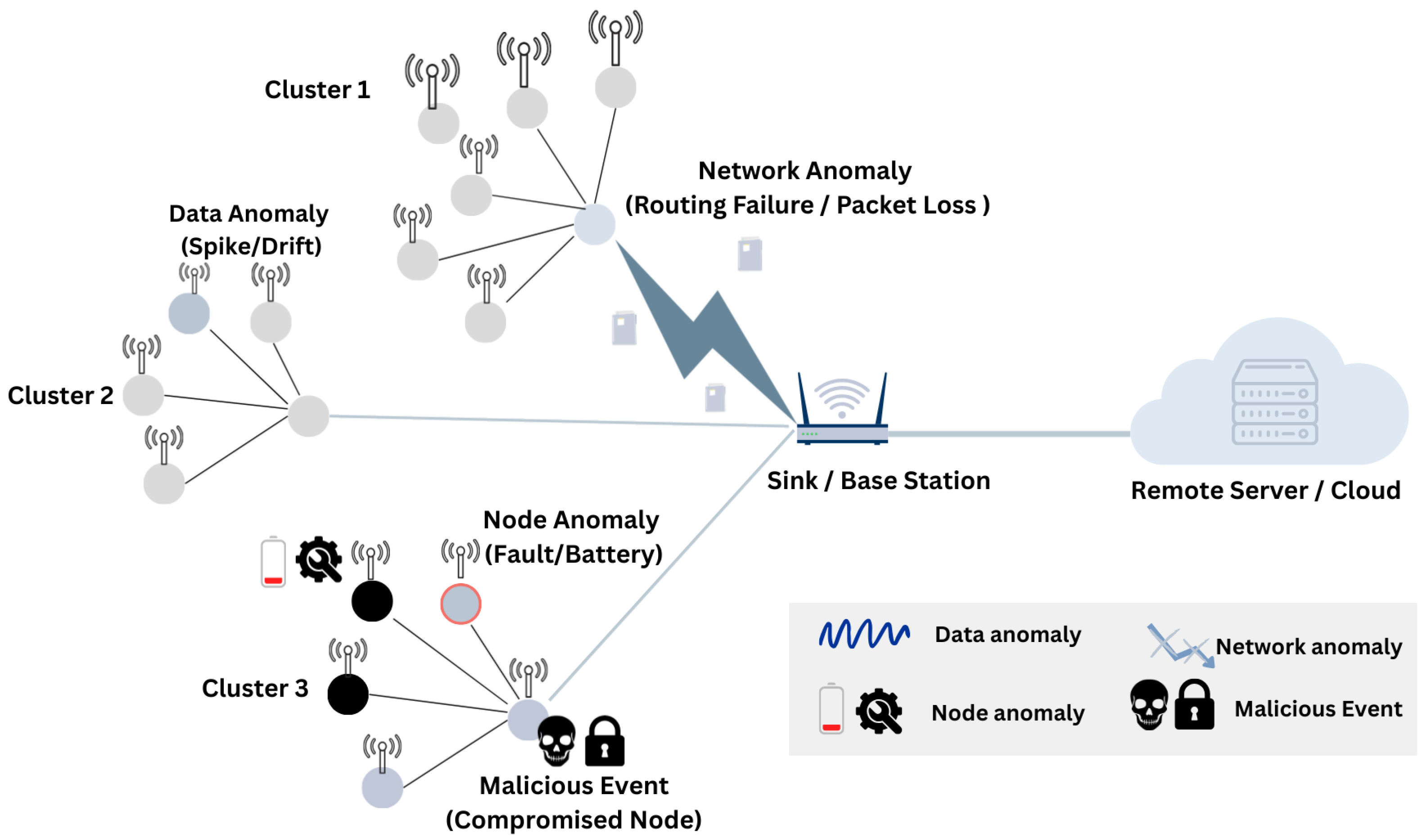
2.2. Types of Anomalies in Sensor Networks
2.3. Traditional Approaches and Their Limitations
2.4. Autoencoders for WSNs Anomaly Detection
2.5. Self-Supervised Learning in Resource-Constrained WSNs
2.6. Design Guide: Selecting AE Variants and SSL Objectives Under WSN Constraints
2.7. Integrating Autoencoders and SSL: Emerging Paradigms
2.8. Summary and Transition to Taxonomy
3. Methods
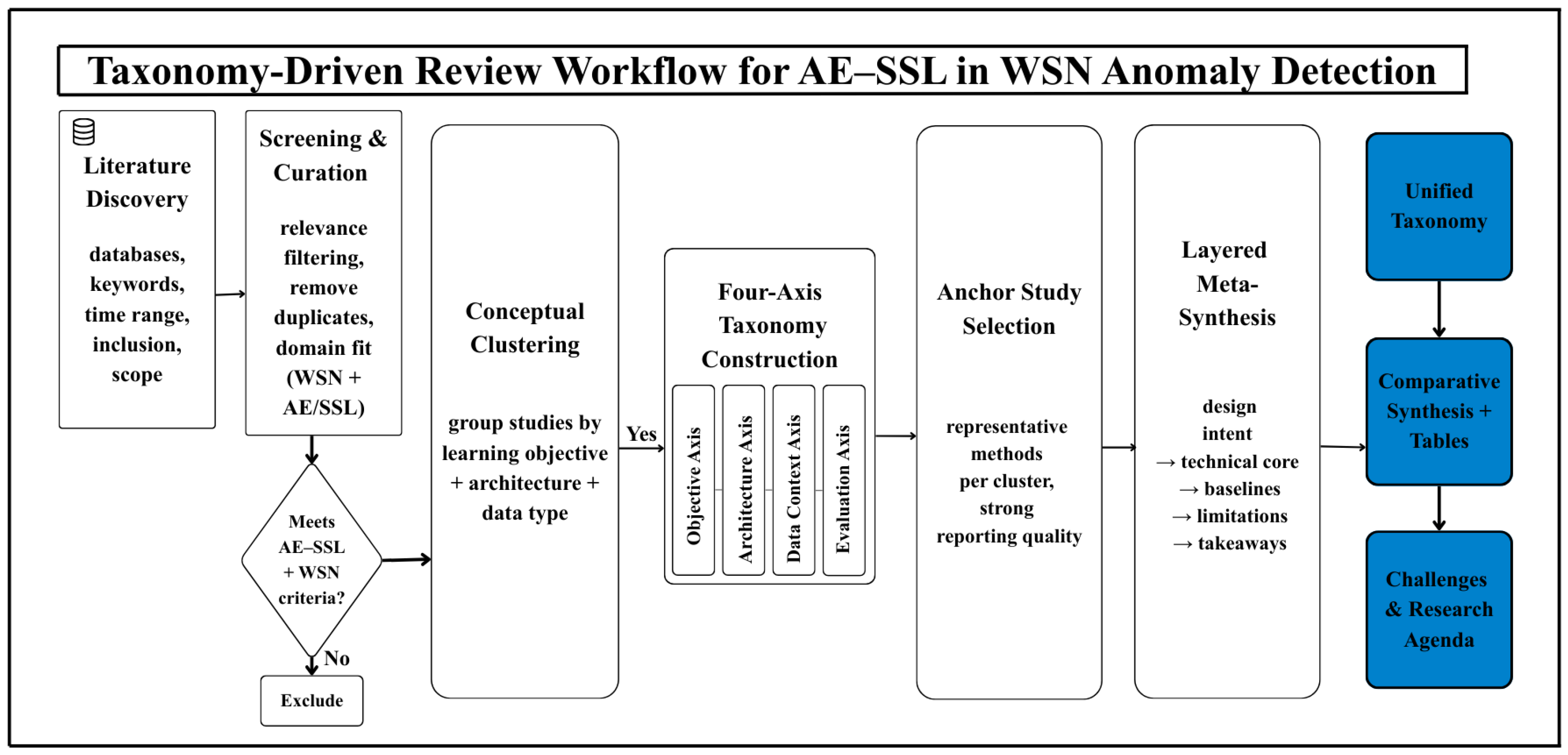
3.1. Methodological Scope and Review Framework
3.2. Data Handling and Study Selection Logic
3.3. Conceptual Clustering of Methods
3.4. Anchor Paper Identification Process
- Direct relevance to AE-SSL anomaly detection in WSN/IoT sensing contexts: the work targets anomaly detection on WSN/IoT telemetry and uses an AE and/or an explicit SSL objective as a core methodological component.
- Methodological distinctiveness within the cluster: the study reflects a clearly differentiable design aligned with the taxonomy (e.g., AE backbone/variant, temporal or topology module, SSL objective family or scoring pipeline), rather than a minor variant without clear conceptual separation.
- Reporting adequacy for reproducible interpretation: the paper discloses sufficient detail on data preparation (e.g., preprocessing and windowing), model specification, training workflow, and evaluation protocol to support consistent comparison.
- Evaluation rigor and attribution of gains: the study includes controlled comparisons (baselines and/or ablations) and a well-defined scoring and decision procedure (e.g., reconstruction-error scoring and thresholding/calibration), enabling attribution of gains to specific components.
- Coverage contribution across taxonomy axes (set-level complementarity): when candidates are comparable, preference is given to those that improve coverage of underrepresented objective families, architectures, data regimes or evaluation settings within the cluster.
3.5. Layered Meta-Synthesis Strategy
3.6. Integrative Methodological Insight and Transition
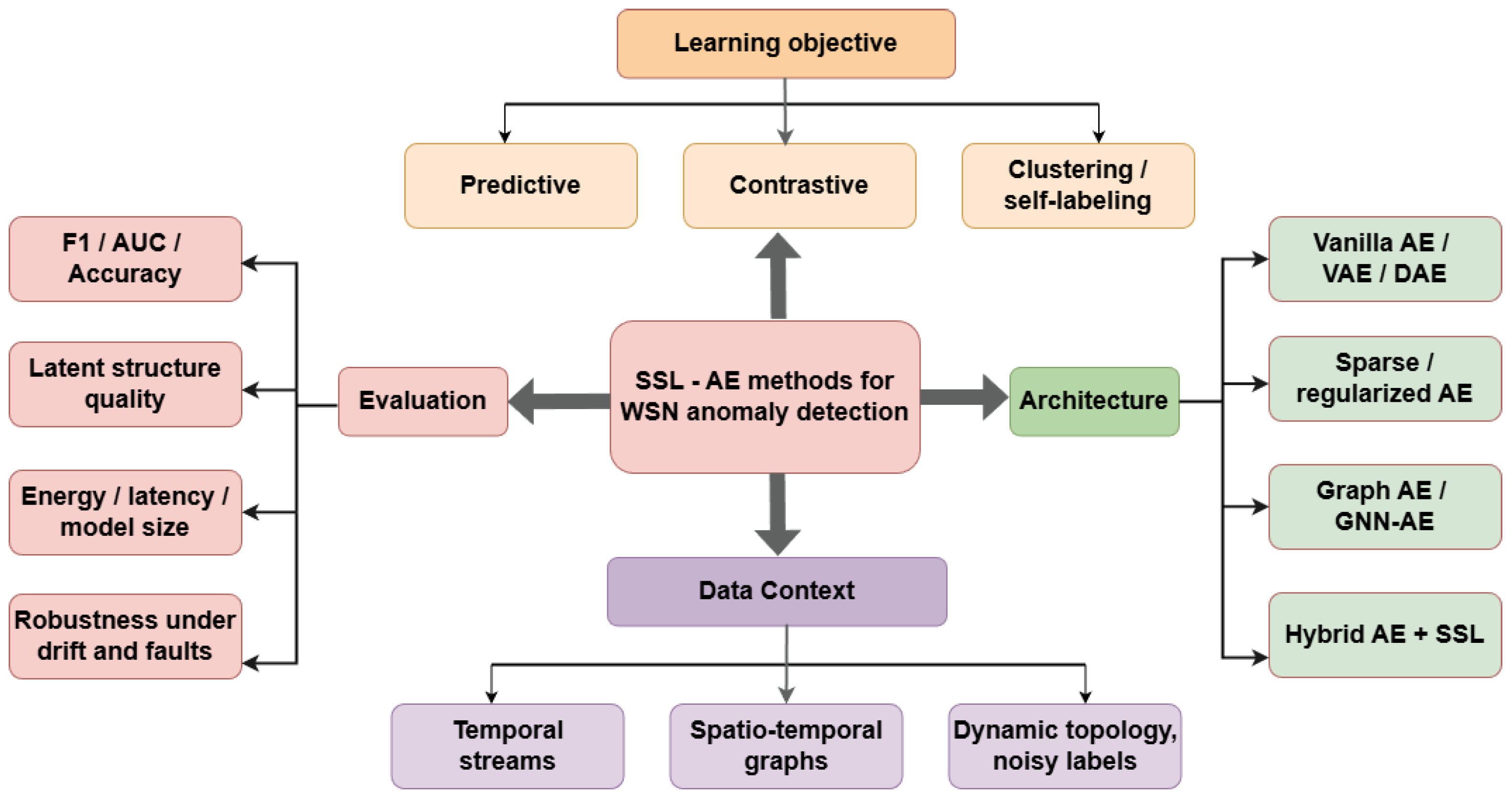
4. Taxonomy of Self-Supervised Autoencoder Methods for Wireless Sensor Networks
4.1. Purpose and Scope of the Taxonomy
4.2. Learning-Objective Axis
4.3. Architectural Axis
4.4. Data-Context Axis
4.5. Evaluation and Performance Axis
4.6. Cross-Axis Synthesis and Integrative Insight
5. Comparative Methodological Synthesis
5.1. Purpose of the Comparative Synthesis
5.2. Comparative Analysis by Methodological Cluster
5.2.1. Hybrid AE + SSL Frameworks
5.2.2. Benchmark and Evaluation-Focused Studies
5.3. Anchor Study Comparisons
5.4. Cross-Cluster Synthesis
5.5. Consolidated Comparative Takeaways
6. Datasets, Metrics, and Evaluation Protocols
6.1. Overview of the Evaluation Landscape
6.2. Datasets for WSN Anomaly Detection
6.3. Evaluation Metrics
6.4. Evaluation Protocols
6.5. Integrated Commentary on Current Limitations
7. Challenges and Future Research Agenda
7.1. Technical Challenges
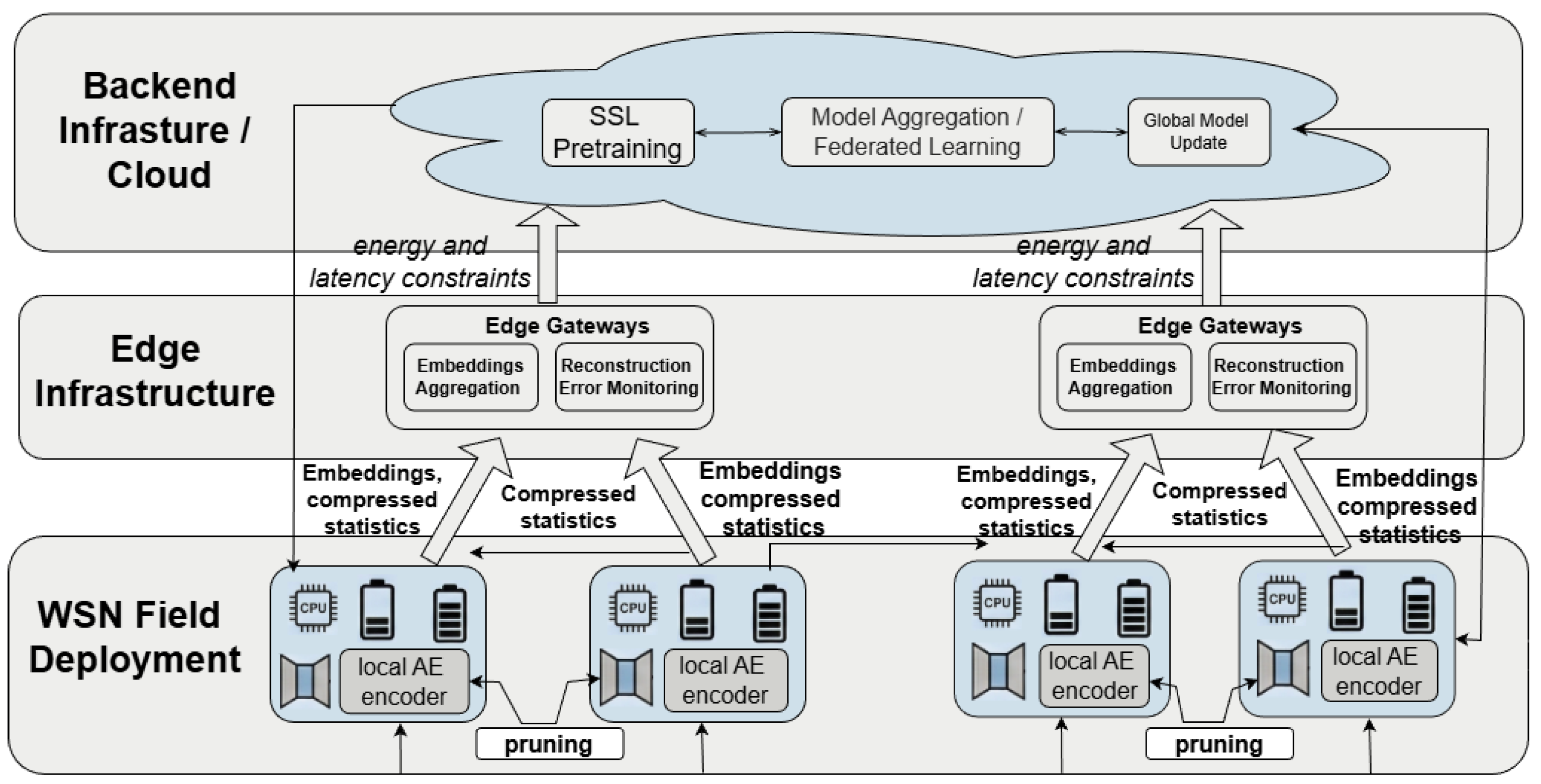
7.2. Deployment and Resource Constraints
7.3. Real-World Readiness and Deployment Constraints
7.4. Robustness, Security, and Reliability Challenges
7.5. Reproducibility and Benchmarking Limitations
7.6. Future Research Agenda
8. Conclusions
Author Contributions
Funding
Institutional Review Board Statement
Informed Consent Statement
Data Availability Statement
Conflicts of Interest
References
- Taj, I.; Zaman, N. Towards industrial revolution 5.0 and explainable artificial intelligence: Challenges and opportunities. Int. J. Comput. Digit. Syst. 2022, 12, 295–320. [Google Scholar] [CrossRef]
- Trigka, M.; Dritsas, E. Wireless Sensor Networks: From Fundamentals and Applications to Innovations and Future Trends. IEEE Access 2025, 13, 96365–96399. [Google Scholar] [CrossRef]
- Berahmand, K.; Daneshfar, F.; Salehi, E.S.; Li, Y.; Xu, Y. Autoencoders and their applications in machine learning: A survey. Artif. Intell. Rev. 2024, 57, 28. [Google Scholar] [CrossRef]
- Kakati, A.; Bhattacharjya, U.; Medhi, J.P.; Sarma, K.K. AACNet: Attention aided CNN-autoencoder network for precise categorization of respiratory conditions from HRCT scans. Netw. Model. Anal. Health Inform. Bioinform. 2025, 14, 92. [Google Scholar] [CrossRef]
- Neupane, D.; Bouadjenek, M.R.; Dazeley, R.; Aryal, S. Data-driven machinery fault detection: A comprehensive review. Neurocomputing 2024, 627, 129588. [Google Scholar] [CrossRef]
- Kumar, P.; Rawat, P.; Chauhan, S. Contrastive self-supervised learning: Review, progress, challenges and future research directions. Int. J. Multimed. Inf. Retr. 2022, 11, 461–488. [Google Scholar] [CrossRef]
- Ericsson, L.; Gouk, H.; Loy, C.C.; Hospedales, T.M. Self-supervised representation learning: Introduction, advances, and challenges. IEEE Signal Process. Mag. 2022, 39, 42–62. [Google Scholar] [CrossRef]
- Yu, J.; Yin, H.; Xia, X.; Chen, T.; Li, J.; Huang, Z. Self-supervised learning for recommender systems: A survey. IEEE Trans. Knowl. Data Eng. 2023, 36, 335–355. [Google Scholar] [CrossRef]
- Liu, Y.; Jin, M.; Pan, S.; Zhou, C.; Zheng, Y.; Xia, F.; Yu, P.S. Graph self-supervised learning: A survey. IEEE Trans. Knowl. Data Eng. 2022, 35, 5879–5900. [Google Scholar] [CrossRef]
- Ward, I.R.; Joyner, J.; Lickfold, C.; Guo, Y.; Bennamoun, M. A practical tutorial on graph neural networks. ACM Comput. Surv. (CSUR) 2022, 54, 1–35. [Google Scholar] [CrossRef]
- Yahya, M.A.; Moya, A.R.; Ventura, S. Deep learning for multivariate time series anomaly detection: An evaluation of reconstruction-based methods. Artif. Intell. Rev. 2025, 58, 400. [Google Scholar] [CrossRef]
- Sayyaf, M.I.; Pascacio, P.; Zhu, N.; Renaudin, V. Time Series Anomaly Detection for Sensor Data: Models, Metrics and Methodologies—A Review. IEEE Sens. J. 2025, 25, 43603–43619. [Google Scholar] [CrossRef]
- Ying, W.; Bai, H.; Liu, K.; Fu, Y. Topology-aware reinforcement feature space reconstruction for graph data. ACM Trans. Knowl. Discov. Data 2024, 20, 10. [Google Scholar] [CrossRef]
- Song, Z.; Yang, X.; Xu, Z.; King, I. Graph-based semi-supervised learning: A comprehensive review. IEEE Trans. Neural Netw. Learn. Syst. 2022, 34, 8174–8194. [Google Scholar] [CrossRef]
- Gui, J.; Chen, T.; Zhang, J.; Cao, Q.; Sun, Z.; Luo, H.; Tao, D. A survey on self-supervised learning: Algorithms, applications, and future trends. IEEE Trans. Pattern Anal. Mach. Intell. 2024, 46, 9052–9071. [Google Scholar] [CrossRef]
- Mutalib, N.H.A.; Sabri, A.Q.M.; Wahab, A.W.A.; Abdullah, E.R.M.F.; AlDahoul, N. Explainable deep learning approach for advanced persistent threats (APTs) detection in cybersecurity: A review. Artif. Intell. Rev. 2024, 57, 297. [Google Scholar] [CrossRef]
- Salem, M.; Kambale, W.V.; Deeb, A.; Tkachov, S.; Karaj, A.; Pichler, J.; Lexer, M.; Kyamakya, K. Autoencoder-Augmented Graph Neural Networks for Accurate and Scalable Structure Recognition in Analog/Mixed-Signal Schematics. IEEE Access 2025, 13, 129721–129740. [Google Scholar] [CrossRef]
- Ghadermazi, J.; Hore, S.; Shah, A.; Bastian, N.D. GTAE-IDS: Graph Transformer-Based Autoencoder Framework for Real-Time Network Intrusion Detection. IEEE Trans. Inf. Forensics Secur. 2025, 20, 4026–4041. [Google Scholar] [CrossRef]
- Mowla, M.N.; Mowla, N.; Shah, A.S.; Rabie, K.M.; Shongwe, T. Internet of Things and wireless sensor networks for smart agriculture applications: A survey. IEEE Access 2023, 11, 145813–145852. [Google Scholar] [CrossRef]
- Chukwunweike, J.N.; Adewale, A.; Osamuyi, O. Advanced modelling and recurrent analysis in network security: Scrutiny of data and fault resolution. World J. Adv. Res. Rev. 2024, 23, 2373–2390. [Google Scholar] [CrossRef]
- Pathak, V.; Singh, K.; Khan, T.; Shariq, M.; Chaudhry, S.A.; Das, A.K. A secure and lightweight trust evaluation model for enhancing decision-making in resource-constrained industrial WSNs. Sci. Rep. 2024, 14, 28162. [Google Scholar] [CrossRef]
- Kufakunesu, R.; Myburgh, H.; De Freitas, A. The internet of battle things: A survey on communication challenges and recent solutions. Discov. Internet Things 2025, 5, 3. [Google Scholar] [CrossRef]
- Sefati, S.S.; Haq, A.U.; Craciunescu, R.; Halunga, S.; Mihovska, A.; Fratu, O. A Comprehensive Survey on Resource management in 6G network based on internet of things. IEEE Access 2024, 12, 113741–113784. [Google Scholar] [CrossRef]
- Ijaz, N.; Hasan, M.N.; Koo, I. Few-shot Transfer Learning Based Fault Classification in Wireless Sensor Networks. IEEE Access 2025, 13, 55017–55033. [Google Scholar] [CrossRef]
- Ijaz, N.; Jan, S.U.; Hasan, M.N.; Koo, I. A Hybrid LATAM and Few-Shot Learning Framework for Fault Diagnosis in Wireless Sensor Networks. IEEE Sens. J. 2025, 25, 43102–43116. [Google Scholar] [CrossRef]
- Dwivedi, R.K.; Rai, A.K.; Kumar, R. A Study on Machine Learning Based Anomaly Detection Approaches in Wireless Sensor Network. In Proceedings of the 2020 10th International Conference on Cloud Computing, Data Science & Engineering (Confluence), Noida, India, 29–31 January 2020. [Google Scholar]
- Vadillo-Mejía, A.; Moo-Mena, F.; Gómez-Montalvo, J. Detección de anomalías en redes de sensores inalámbricos. Rev. Desarro. Tecnol. 2019, 3, 22–37. [Google Scholar] [CrossRef]
- Katragadda, S.; Odubade, K.; Isabirye, E. Anomaly Detection Detecting Unusual Behavior Using Machine Learning Algorithms to Identify Potential Security Threats or System Failures. Int. Res. J. Mod. Eng. Technol. Sci. 2020, 2, 2582–5208. [Google Scholar] [CrossRef]
- Ijaz, N.; Banoori, F.; Koo, I. Reshaping bioacoustics event detection: Leveraging few-shot learning (FSL) with transductive inference and data augmentation. Bioengineering 2024, 11, 685. [Google Scholar] [CrossRef] [PubMed]
- Bhatia, S. Streaming Anomaly Detection. arXiv 2023, arXiv:2301.13199. [Google Scholar] [CrossRef]
- Neloy, A.A.; Turgeon, M. A Comprehensive Study of Auto-Encoders for Anomaly Detection: Efficiency and Trade-offs. Mach. Learn. Appl. 2024, 17, 100572. [Google Scholar] [CrossRef]
- Sadia, H.; Farhan, S.; Haq, Y.U.; Sana, R.; Mahmood, T.; Bahaj, S.A.O.; Khan, A.R. Intrusion detection system for wireless sensor networks: A machine learning based approach. IEEE Access 2024, 12, 52565–52582. [Google Scholar] [CrossRef]
- Sadasivan, A.; Gananathan, K.; Pal Nesamony Rose Mary, J.D.; Balasubramanian, S. A Systematic Survey of Graph Convolutional Networks for Artificial Intelligence Applications. Wiley Interdiscip. Rev. Data Min. Knowl. Discov. 2025, 15, e70012. [Google Scholar] [CrossRef]
- Veesam, S.B.; Satish, A.R.; Tupakula, S.; Chinnam, Y.; Prakash, K.; Bansal, S.; Faruque, M.R.I. Design of an integrated model with temporal graph attention and transformer-augmented RNNs for enhanced anomaly detection. Sci. Rep. 2025, 15, 2692. [Google Scholar] [CrossRef]
- Chen, Z.; Chen, D.; Zhang, X.; Yuan, Z.; Cheng, X. Learning graph structures with transformer for multivariate time-series anomaly detection in IoT. IEEE Internet Things J. 2021, 9, 9179–9189. [Google Scholar] [CrossRef]
- Ponzi, V.; Napoli, C. Graph Neural Networks: Architectures, Applications, and Future Directions. IEEE Access 2025, 13, 62870–62891. [Google Scholar] [CrossRef]
- Zhu, L.; Wang, Y.; Shang, C.; Zheng, Z. Transient voltage stability assessment based on focal loss convolution autoencoder. In Proceedings of the IET Conference Proceedings CP853, Shenzhen, China, 10–12 November 2023; IET: London, UK, 2023; Volume 2023, pp. 301–308. [Google Scholar]
- Li, C.; Wang, Y.; Zheng, Z. A broadband oscillation source location method based on LSTM variational autoencoder and graph convolutional neural network. In Proceedings of the Annual Meeting of CSEE Study Committee of HVDC and Power Electronics (HVDC 2023), Nanjing, China, 22–25 October 2023; Volume 2023, pp. 87–93. [Google Scholar] [CrossRef]
- Chen, S.; Sun, Y.; Wang, J.; Wan, M.; Liu, M.; Li, X. A multi-scale dual-decoder autoencoder model for domain-shift machine sound anomaly detection. Digit. Signal Process. 2025, 156, 104813. [Google Scholar] [CrossRef]
- Jing, M.; Zhu, Y.; Zang, T.; Wang, K. Contrastive self-supervised learning in recommender systems: A survey. ACM Trans. Inf. Syst. 2023, 42, 1–39. [Google Scholar] [CrossRef]
- Chen, Y.; Mancini, M.; Zhu, X.; Akata, Z. Semi-supervised and unsupervised deep visual learning: A survey. IEEE Trans. Pattern Anal. Mach. Intell. 2022, 46, 1327–1347. [Google Scholar] [CrossRef]
- Azam, Z.; Islam, M.M.; Huda, M.N. Comparative analysis of intrusion detection systems and machine learning-based model analysis through decision tree. IEEE Access 2023, 11, 80348–80391. [Google Scholar] [CrossRef]
- Tong, J.; Zhang, Y. A real-time label-free self-supervised deep learning intrusion detection for handling new type and few-shot attacks in iot networks. IEEE Internet Things J. 2024, 11, 30769–30786. [Google Scholar] [CrossRef]
- Krishna, A. A Unified Framework for High-Resolution CT Image Synthesis via Conditioned Modeling of Anatomy, Pathology, and Texture. Ph.D. Thesis, State University of New York, Stony Brook, NY, USA, 2025. [Google Scholar]
- Radwan, A.Y.; Yildirim, M.; Hasanzadeh, N.; Tabassum, H.; Valaee, S. A Tutorial-cum-Survey on Self-Supervised Learning for Wi-Fi Sensing: Trends, Challenges, and Outlook. IEEE Commun. Surv. Tutor. 2025, 28, 2345–2376. [Google Scholar] [CrossRef]
- Anis, F.M.; AlAbdullatif, M.; Aljbli, S.; Hammoudeh, M. A Survey on the Applications of Deep Learning in Network Intrusion Detection Systems to Enhance Network Security. IEEE Access 2025, 13, 185357–185373. [Google Scholar] [CrossRef]
- Xing, J.; Wei, D.; Zhou, S.; Wang, T.; Huang, Y.; Chen, H. A comprehensive study on self-learning methods and implications to autonomous driving. IEEE Trans. Neural Netw. Learn. Syst. 2024, 36, 7786–7805. [Google Scholar] [CrossRef]
- Li, W.; Hacid, H.; Almazrouei, E.; Debbah, M. A comprehensive review and a taxonomy of edge machine learning: Requirements, paradigms, and techniques. AI 2023, 4, 729–786. [Google Scholar] [CrossRef]
- Peng, Y.; Xia, J.; Liu, D.; Liu, M.; Xiao, L.; Shi, B. Unifying topological structure and self-attention mechanism for node classification in directed networks. Sci. Rep. 2025, 15, 805. [Google Scholar] [CrossRef] [PubMed]
- Du, J.; Lin, T.; Jiang, C.; Yang, Q.; Bader, C.F.; Han, Z. Distributed foundation models for multi-modal learning in 6G wireless networks. IEEE Wirel. Commun. 2024, 31, 20–30. [Google Scholar] [CrossRef]
- Khraisat, A.; Gondal, I.; Vamplew, P.; Kamruzzaman, J. Survey of intrusion detection systems: Techniques, datasets and challenges. Cybersecurity 2019, 2, 20. [Google Scholar] [CrossRef]
- Fährmann, D.; Martín, L.; Sánchez, L.; Damer, N. Anomaly detection in smart environments: A comprehensive survey. IEEE Access 2024, 12, 64006–64049. [Google Scholar] [CrossRef]
- Zhang, L. Efficient Deep Learning Based Assisted Annotation for Medical Image Segmentation. Ph.D. Thesis, The University of Iowa, Iowa City, IA, USA, 2023. [Google Scholar]
- Zakrzewski, R. Matrix-Based Graph Comparison Method for Behavioural Patterns Analysis with Application to Anomaly Detection Using Machine Learning in Wireless Multi-Hop IoT Networks. Ph.D. Thesis, University of Bristol, Bristol, UK, 2024. [Google Scholar]
- Pordelkhaki, M. A Process-Informed Approach to Network Intrusion Detection for Industrial Control System. Ph.D. Thesis, Birmingham City University, Birmingham, UK, 2025. [Google Scholar]
- Ayub, M.S.; Saadi, M.; Koo, I. Optimization of RIS-Assisted 6G NTN Architectures for High-Mobility UAV Communication Scenarios. Drones 2025, 9, 486. [Google Scholar] [CrossRef]
- Ye, M.; Zhang, Q.; Xue, X.; Qiu, H. A Novel Anomaly Detection Method for Multimodal WSN Data Flow via a Dynamic Graph Neural Network. IEEE Syst. J. 2024, 34, 1609–1637. [Google Scholar]
- Haque, A.; Soliman, H. A Transformer-Based Autoencoder with Isolation Forest and XGBoost for Malfunction and Intrusion Detection in Wireless Sensor Networks for Forest Fire Prediction. Future Internet 2025, 17, 164. [Google Scholar] [CrossRef]
- Sánchez-Ferrera, A.; Calvo, B.; Lozano, J.A. A Review on Self-Supervised Learning in Time Series Anomaly Detection: Recent Advances and Open Challenges. ACM Comput. Surv. 2025, 58, 119. [Google Scholar] [CrossRef]
- Wang, Z.; Hou, D.; Yin, S.; Gao, C.; Li, X. SemanticMask: A Contrastive View Design for Anomaly Detection in Tabular Data. In Proceedings of the Thirty-Third International Joint Conference on Artificial Intelligence (IJCAI), Jeju, Republic of Korea, 3–9 August 2024; pp. 2370–2378. [Google Scholar] [CrossRef]
- Gao, Y.; Qi, J.; Ye, H.; Sun, Y.; Hu, X.; Dong, Z.; Sun, Y. Variational graph attention networks with self-supervised learning for multivariate time series anomaly detection. IEEE Trans. Instrum. Meas. 2024, 74, 3503113. [Google Scholar] [CrossRef]
- Belenguer, V.; Calafate, C.T.; Cano, J.C.; Manzoni, P. A review of federated learning applications in intrusion detection systems. Comput. Netw. 2025, 258, 111023. [Google Scholar] [CrossRef]
- Cheng, J.; Mei, X.; Liu, M. Forecast-mae: Self-supervised pre-training for motion forecasting with masked autoencoders. In Proceedings of the IEEE/CVF International Conference on Computer Vision, Paris, France, 2–3 October 2023; pp. 8679–8689. [Google Scholar]
- Rzym, G.; Masny, A.; Chołda, P. Dynamic telemetry and deep neural networks for anomaly detection in 6g software-defined networks. Electronics 2024, 13, 382. [Google Scholar] [CrossRef]
- Chen, H.; Gouin-Vallerand, C.; Bouchard, K.; Gaboury, S.; Couture, M.; Bier, N.; Giroux, S. Contrastive Self-Supervised Learning for Sensor-Based Human Activity Recognition: A Review. IEEE Access 2024, 12, 152511–152531. [Google Scholar] [CrossRef]
- Fekih, M.A. Low-Cost Wireless Sensor Networks in Participatory Air Quality Monitoring. Ph.D. Thesis, Université de Lyon, Lyon, France, 2022. [Google Scholar]
- Mienye, I.D.; Swart, T.G. Deep autoencoder neural networks: A comprehensive review and new perspectives. Arch. Comput. Methods Eng. 2025, 32, 3981–4000. [Google Scholar] [CrossRef]
- Tung, N.X.; Son, B.D.; Geun-Jeong, S.; Van Chien, T.; Hanzo, L.; Hwang, W.J. Graph neural networks for next-generation-iot: Recent advances and open challenges. IEEE Commun. Surv. Tutor. 2025, 28, 2226–2262. [Google Scholar] [CrossRef]
- Huang, C.; Gao, C.; Li, M.; Li, Y.; Wang, X.; Jiang, Y.; Huang, X. Correlation information enhanced graph anomaly detection via hypergraph transformation. IEEE Trans. Cybern. 2025, 55, 2865–2878. [Google Scholar] [CrossRef] [PubMed]
- Mienye, I.D.; Swart, T.G.; Obaido, G. Recurrent neural networks: A comprehensive review of architectures, variants, and applications. Information 2024, 15, 517. [Google Scholar] [CrossRef]
- Weng, W.; Gu, Y.; Guo, S.; Ma, Y.; Yang, Z.; Liu, Y.; Chen, Y. Self-supervised learning for electroencephalogram: A systematic survey. ACM Comput. Surv. 2025, 57, 317. [Google Scholar] [CrossRef]
- Gu, W.; Zhong, R.; Yu, G.; Sun, X.; Liu, J.; Huo, Y.; Chen, Z.; Zhang, J.; Gu, J.; Yang, Y.; et al. KPIRoot+: An efficient integrated framework for anomaly detection and root cause analysis in large-scale cloud systems. Empir. Softw. Eng. 2026, 31, 28. [Google Scholar] [CrossRef]
- Tan, C.; Gao, Z.; Wu, L.; Xu, Y.; Xia, J.; Li, S.; Li, S.Z. Temporal attention unit: Towards efficient spatiotemporal predictive learning. In Proceedings of the IEEE/CVF Conference on Computer Vision and Pattern Recognition, Vancouver, BC, Canada, 18–22 June 2023; pp. 18770–18782. [Google Scholar]
- Gao, N.; Xue, H.; Shao, W.; Zhao, S.; Qin, K.K.; Prabowo, A.; Rahaman, M.S.; Salim, F.D. Generative adversarial networks for spatio-temporal data: A survey. ACM Trans. Intell. Syst. Technol. (TIST) 2022, 13, 22. [Google Scholar] [CrossRef]
- Wei, P.; Li, H.X.; Xie, S. Spatial-construction-based abnormality detection and localization for distributed parameter systems. IEEE Trans. Ind. Inform. 2021, 18, 4707–4714. [Google Scholar] [CrossRef]
- Birahim, S.A.; Paul, A.; Rahman, F.; Islam, Y.; Roy, T.; Hasan, M.A.; Haque, F.; Chowdhury, M.E. Intrusion detection for wireless sensor network using particle swarm optimization based explainable ensemble machine learning approach. IEEE Access 2025, 13, 13711–13730. [Google Scholar] [CrossRef]
- Giuliano, A.; McCafferty-Leroux, A.; Yawney, J.; Gadsden, S.A. Cognitive Internet of Things: A review of theory, applications, and recent advances. IEEE Commun. Surv. Tutor. 2025, 28, 446–484. [Google Scholar] [CrossRef]
- Rajput, M.; Yadav, R.N. Machine and Deep Learning Driven Energy Efficient Clustering in IOT-WSNs: A Review. IEEE Sens. J. 2025, 25, 39371–39385. [Google Scholar] [CrossRef]
- Hasan, Z. IoT-Driven Implementation of AI Predictive Models For Real-Time Performance Enhancement of Perovskite And Tandem Photovoltaic Systems. ASRC Procedia Glob. Perspect. Sci. Scholarsh. 2025, 1, 1031–1065. [Google Scholar] [CrossRef]
- Singamaneni, K.K.; Yadav, K.; Aledaily, A.N.; Viriyasitavat, W.; Dhiman, G.; Kaur, A. Decoding the future: Exploring and comparing ABE standards for cloud, IoT, blockchain security applications. Multimed. Tools Appl. 2025, 84, 12299–12327. [Google Scholar] [CrossRef]
- Mamun, M.N.H. Advancements in machine learning for customer retention: A systematic literature review of predictive models and churn analysis. J. Sustain. Dev. Policy 2025, 1, 250–284. [Google Scholar]
- Albertyn, C. A Comparative Study of Gradient Boosting Algorithms and Transformer Neural Networks for Classification Problems in the Tabular Data Domain. Ph.D. Thesis, Stellenbosch University, Stellenbosch, South Africa, 2025. [Google Scholar]
- Ahmadi, H.; Mahdimahalleh, S.E.; Farahat, A.; Saffari, B. Unsupervised time-series signal analysis with autoencoders and vision transformers: A review of architectures and applications. arXiv 2025, arXiv:2504.16972. [Google Scholar] [CrossRef]
- Jin, Y.; Yan, X.; Liu, S.; Wang, X. A unified framework for combinatorial optimization based on graph neural networks. arXiv 2024, arXiv:2406.13125. [Google Scholar] [CrossRef]
- Stoimchev, M.; Levatić, J.; Kocev, D.; Džeroski, S. SSL-MAE: Adaptive Semi-Supervised Learning Framework for Multi-Label Classification of Remote Sensing Images Using Masked Autoencoders. IEEE J. Sel. Top. Appl. Earth Obs. Remote Sens. 2025, 18, 14882–14896. [Google Scholar] [CrossRef]
- Wang, X.; Wang, B.; Wu, Y.; Ning, Z.; Guo, S.; Yu, F.R. A survey on trustworthy edge intelligence: From security and reliability to transparency and sustainability. IEEE Commun. Surv. Tutor. 2024, 27, 1729–1757. [Google Scholar] [CrossRef]
- Nguyen, L.X.; Raha, A.D.; Aung, P.S.; Niyato, D.; Han, Z.; Hong, C.S. A contemporary survey on semantic communications: Theory of mind, generative ai, and deep joint source-channel coding. IEEE Commun. Surv. Tutor. 2025, 28, 2377–2417. [Google Scholar] [CrossRef]
- Zhang, X.; Han, L. A generic self-supervised learning (SSL) framework for representation learning from spectral–spatial features of unlabeled remote sensing imagery. Remote Sens. 2023, 15, 5238. [Google Scholar] [CrossRef]
- Hossain, S.; Senouci, S.M.; Brik, B.; Boualouache, A. A privacy-preserving Self-Supervised Learning-based intrusion detection system for 5G-V2X networks. Ad Hoc Netw. 2025, 166, 103674. [Google Scholar] [CrossRef]
- Song, B.; Zhao, S.; Dang, L.; Wang, H.; Xu, L. A survey on learning from data with label noise via deep neural networks. Syst. Sci. Control Eng. 2025, 13, 2488120. [Google Scholar] [CrossRef]
- Wang, Y.; Zhang, B.; Ma, J.; Jin, Q. Artificial intelligence of things (AIoT) data acquisition based on graph neural networks: A systematical review. Concurr. Comput. Pract. Exp. 2023, 35, e7827. [Google Scholar] [CrossRef]
- Wang, Z.; Liu, Z.; Ma, T.; Li, J.; Zhang, Z.; Fu, X.; Li, Y.; Yuan, Z.; Song, W.; Ma, Y.; et al. Graph Foundation Models: A Comprehensive Survey. arXiv 2025, arXiv:2505.15116. [Google Scholar] [CrossRef]
- Sharma, T.; Balyan, A.; Singh, A.K. Machine learning-based energy optimization and anomaly detection for heterogeneous wireless sensor network. SN Comput. Sci. 2024, 5, 751. [Google Scholar] [CrossRef]
- Hudda, S.; Haribabu, K. A review on WSN based resource constrained smart IoT systems. Discov. Internet Things 2025, 5, 56. [Google Scholar] [CrossRef]
- Darvishi, A.; Khosravi, H.; Sadiq, S.; Gašević, D. Incorporating AI and learning analytics to build trustworthy peer assessment systems. Br. J. Educ. Technol. 2022, 53, 844–875. [Google Scholar] [CrossRef]
- Masum, M.H.; Raj, B.; Showmik, S.S. Toward Efficient and Accurate Anomaly Detection in Wireless Sensor Networks: A Review. IEEE Sens. J. 2025, 25, 43585–43602. [Google Scholar]
- Khachatrian, H.; Dovlatyan, A.; Grigoryan, G.; Raptis, T.P. Scalable Generation of Synthetic IoT Network Datasets: A Case Study with Cooja. Future Internet 2025, 17, 518. [Google Scholar] [CrossRef]
- Almomani, I.; Al-Kasasbeh, B.; Al-Akhras, M. WSN-DS: A dataset for intrusion detection systems in wireless sensor networks. J. Sens. 2016, 2016, 4731953. [Google Scholar]
- García, S.; Parmisano, A.; Erquiaga, M.J. IoT-23: A Labeled Dataset with Malicious and Benign IoT Network Traffic, Version 1.0.0; Dataset; Zenodo: Geneva, Switzerland, 2020. [CrossRef]
- Moustafa, N.; Keshky, M.; Debiez, E.; Janicke, H. Federated TON_IoT Windows datasets for evaluating AI-based security applications. In Proceedings of the 2020 IEEE 19th International Conference on Trust, Security and Privacy in Computing and Communications (TrustCom), Guangzhou, China, 29 December–1 January 2020; IEEE: New York, NY, USA, 2020; pp. 848–855. [Google Scholar]
- Barrenetxea, G. Sensorscope Data, Version 1; Dataset; Zenodo: Geneva, Switzerland, 2019. [CrossRef]
- Sheharyar, K. Smart Home Dataset, Version 2; Dataset; Zenodo: Geneva, Switzerland, 2023. [CrossRef]
- Han, Q.; Liu, P.; Zhang, H.; Cai, Z. A wireless sensor network for monitoring environmental quality in the manufacturing industry. IEEE Access 2019, 7, 78108–78119. [Google Scholar] [CrossRef]
- Raza, M.; Aslam, N.; Le-Minh, H.; Hussain, S.; Cao, Y.; Khan, N.M. A critical analysis of research potential, challenges, and future directives in industrial wireless sensor networks. IEEE Commun. Surv. Tutor. 2017, 20, 39–95. [Google Scholar]
- Khan, I.; Zedadra, O.; Guerrieri, A.; Spezzano, G. Occupancy prediction in iot-enabled smart buildings: Technologies, methods, and future directions. Sensors 2024, 24, 3276. [Google Scholar]
- Jin, H.; Raghavan, K.; Papadimitriou, G.; Wang, C.; Mandal, A.; Deelman, E.; Balaprakash, P. Self-supervised learning for anomaly detection in computational workflows. arXiv 2023, arXiv:2310.01247. [Google Scholar] [CrossRef]
- Acquaah, Y.T.; Kaushik, R. Normal-only Anomaly detection in environmental sensors in CPS: A comprehensive review. IEEE Access 2024, 12, 191086–191107. [Google Scholar] [CrossRef]
- Yang, Y.; Jin, M.; Wen, H.; Zhang, C.; Liang, Y.; Ma, L.; Wang, Y.; Liu, C.; Yang, B.; Xu, Z.; et al. A Survey on Diffusion Models for Time Series and Spatio-Temporal Data. ACM Comput. Surv. 2025. [Google Scholar] [CrossRef]
- Kamal, H.; Mashaly, M. Enhanced Hybrid Deep Learning Models-Based Anomaly Detection Method for Two-Stage Binary and Multi-Class Classification of Attacks in Intrusion Detection Systems. Algorithms 2025, 18, 69. [Google Scholar] [CrossRef]
- Li, B.; Liu, H.; Wang, R. Efficient sensor placement for signal reconstruction based on recursive methods. IEEE Trans. Signal Process. 2021, 69, 1885–1898. [Google Scholar] [CrossRef]
- Kaur, S.; Kour, S.; Singh, M. Energy efficiency in wireless sensor networks: Comparing traditional and advanced clustering protocols. Eng. Res. Express 2025, 7, 015258. [Google Scholar] [CrossRef]
- Rippel, O.; Mertens, P.; Merhof, D. Modeling the distribution of normal data in pre-trained deep features for anomaly detection. In Proceedings of the 2020 25th International Conference on Pattern Recognition (ICPR), Milan, Italy, 10–15 January 2021; IEEE: New York, NY, USA, 2021; pp. 6726–6733. [Google Scholar]
- Lin, L.; Su, J. Anomaly detection method for sensor network data streams based on sliding window sampling and optimized clustering. Saf. Sci. 2019, 118, 70–75. [Google Scholar] [CrossRef]
- Torabi, H.; Mirtaheri, S.L.; Greco, S. Practical autoencoder based anomaly detection by using vector reconstruction error. Cybersecurity 2023, 6, 1. [Google Scholar] [CrossRef]
- Ahmed, M.S. Automatic Relevance Detection (ARD) and Hyperparameter Tuning in the Training of Gaussian Process Regression-Based Surrogate Models: A Machine Learning Approach. Master’s Thesis, Åbo Akademi University, Turku, Finland, 2025. [Google Scholar]
- Morshedi, R.; Matinkhah, S.M. A comprehensive review of deep learning techniques for anomaly detection in iot networks: Methods, challenges, and datasets. Eng. Rep. 2025, 7, e70415. [Google Scholar] [CrossRef]
- Aslanpour, M.S.; Gill, S.S.; Toosi, A.N. Performance evaluation metrics for cloud, fog and edge computing: A review, taxonomy, benchmarks and standards for future research. Internet Things 2020, 12, 100273. [Google Scholar] [CrossRef]
- Ray, P.P. A Survey on Model Context Protocol: Architecture, State-of-the-art, Challenges and Future Directions. TechRxiv 2025. [Google Scholar] [CrossRef]
- Wang, Y.; Albrecht, C.M.; Braham, N.A.A.; Mou, L.; Zhu, X.X. Self-supervised learning in remote sensing: A review. IEEE Geosci. Remote Sens. Mag. 2022, 10, 213–247. [Google Scholar] [CrossRef]
- Li, M. Scaling Distributed Machine Learning with System and Algorithm Co-Design; Intel: Santa Clara, CA, USA, 2017. [Google Scholar]
- Chai, X.; Gu, H.; Li, F.; Duan, H.; Hu, X.; Lin, K. Deep learning for irregularly and regularly missing data reconstruction. Sci. Rep. 2020, 10, 3302. [Google Scholar] [CrossRef] [PubMed]
- Oztoprak, A.; Hassanpour, R.; Ozkan, A.; Oztoprak, K. Security challenges, mitigation strategies, and future trends in wireless sensor networks: A review. ACM Comput. Surv. 2024, 57, 104. [Google Scholar] [CrossRef]
- Reis, M.J. Scalable Intrusion Detection in IoT Networks via Property Testing and Federated Edge AI. IEEE Access 2025, 13, 153244–153262. [Google Scholar] [CrossRef]
- Rakka, M.; Fouda, M.E.; Khargonekar, P.; Kurdahi, F. A review of state-of-the-art mixed-precision neural network frameworks. IEEE Trans. Pattern Anal. Mach. Intell. 2024, 46, 7793–7812. [Google Scholar] [CrossRef] [PubMed]
- Alamouti, S.M.; Arjomandi, F.; Burger, M. Hybrid edge cloud: A pragmatic approach for decentralized cloud computing. IEEE Commun. Mag. 2022, 60, 16–29. [Google Scholar] [CrossRef]
- Song, H.; Dautov, R.; Ferry, N.; Solberg, A.; Fleurey, F. Model-based fleet deployment in the IoT–edge–cloud continuum. Softw. Syst. Model. 2022, 21, 1931–1956. [Google Scholar] [CrossRef]
- Rajapaksha, S.; Kalutarage, H.; Al-Kadri, M.O.; Petrovski, A.; Madzudzo, G. Beyond Vanilla: Improved Autoencoder-Based Ensemble In-Vehicle Intrusion Detection System. J. Inf. Secur. Appl. 2023, 77, 103570. [Google Scholar] [CrossRef]
- Jo, M.Y.; Kim, H.J. A Comparative Study of Lightweight, Sparse Autoencoder-Based Classifiers for Edge Network Devices: An Efficiency Analysis of Feed-Forward and Deep Neural Networks. Sensors 2025, 25, 6439. [Google Scholar] [CrossRef]
- Jamshidi, S.; Erfan, F.; Abdul-Wahab, O.; Bellaiche, M.; Khomh, F. Lightweight Autoencoder–Isolation Forest Anomaly Detection for Green IoT Edge Gateways. arXiv 2025, arXiv:2511.18235. [Google Scholar] [CrossRef]
- Reis, M.J.C.S.; Serôdio, C. Edge AI for Real-Time Anomaly Detection in Smart Homes. Future Internet 2025, 17, 179. [Google Scholar] [CrossRef]
- Sharmila, B.S.; Nagapadma, R. Quantized Autoencoder (QAE) Intrusion Detection System for Anomaly Detection in Resource-Constrained IoT Devices Using RT-IoT2022 Dataset. Cybersecurity 2023, 6, 41. [Google Scholar] [CrossRef]
- Alam, M.S.; Misba, W.A.; Atulasimha, J. Quantized Non-Volatile Nanomagnetic Synapse-Based Autoencoder for Efficient Unsupervised Network Anomaly Detection. arXiv 2023, arXiv:2309.06449. [Google Scholar] [CrossRef]
- Zhang, R.; Zhao, X.; Li, Y.; Zheng, S.; Ma, R.; Tian, M.; Xue, Y.; Wang, Y.; Guan, H. Privacy-Aware Offloading Strategy via Self-Supervised Feature Mapping in the End-Edge-Cloud System. ACM Trans. Sens. Netw. 2024. [Google Scholar] [CrossRef]
- Gittens, A.; Yener, B.; Yung, M. An adversarial perspective on accuracy, robustness, fairness, and privacy: Multilateral-tradeoffs in trustworthy ML. IEEE Access 2022, 10, 120850–120865. [Google Scholar] [CrossRef]
- Nurlan, Z.; Zhukabayeva, T.; Othman, M.; Adamova, A.; Zhakiyev, N. Wireless sensor network as a mesh: Vision and challenges. IEEE Access 2021, 10, 46–67. [Google Scholar] [CrossRef]
- Radovici, A.; Culic, I.; Rosner, D.; Oprea, F. A model for the remote deployment, update, and safe recovery for commercial sensor-based iot systems. Sensors 2020, 20, 4393. [Google Scholar] [CrossRef] [PubMed]
- Latif, N.; Ma, W.; Ahmad, H.B. Advancements in securing federated learning with IDS: A comprehensive review of neural networks and feature engineering techniques for malicious client detection. Artif. Intell. Rev. 2025, 58, 91. [Google Scholar] [CrossRef]
- Tariq, A.; Serhani, M.A.; Sallabi, F.M.; Barka, E.S.; Qayyum, T.; Khater, H.M.; Shuaib, K.A. Trustworthy federated learning: A comprehensive review, architecture, key challenges, and future research prospects. IEEE Open J. Commun. Soc. 2024, 5, 4920–4998. [Google Scholar] [CrossRef]
- İBRAHİMOĞU, N.; Yıldız, F.; Kahraman, M. Through the Eyes: A Survey on Gaze-Based Biometric Authentication Systems. AIPA’s Int. J. Artif. Intell. Bridg. Technol. Soc. Policy 2025, 1, 16–60. [Google Scholar]
- Guo, R.; Li, A.; Liu, H. An Adversarial Attack Detection Method Based on Bidirectional Consistency Discrimination for Deep Learning-Based Soft Sensors. In Proceedings of the 2025 CAA Symposium on Fault Detection, Supervision, and Safety for Technical Processes (SAFEPROCESS), Yibin, China, 22–24 September 2025; IEEE: New York, NY, USA, 2025; pp. 1–6. [Google Scholar]
- Shahin, M.; Hosseinzadeh, A.; Chen, F.F. A Two-Stage Hybrid Federated Learning Framework for Privacy-Preserving IoT Anomaly Detection and Classification. IoT 2025, 6, 48. [Google Scholar] [CrossRef]
- Nayyar, A.; Singh, R. A comprehensive review of simulation tools for wireless sensor networks (WSNs). J. Wirel. Netw. Commun. 2015, 5, 19–47. [Google Scholar]
- Ali, I.; Ahmedy, I.; Gani, A.; Munir, M.U.; Anisi, M.H. Data collection in studies on Internet of things (IoT), wireless sensor networks (WSNs), and sensor cloud (SC): Similarities and differences. IEEE Access 2022, 10, 33909–33931. [Google Scholar] [CrossRef]
- Abdulrazzaq, M.M.; Ramaha, N.T.; Hameed, A.A.; Salman, M.; Yon, D.K.; Fitriyani, N.L.; Syafrudin, M.; Lee, S.W. Consequential advancements of self-supervised learning (SSL) in deep learning contexts. Mathematics 2024, 12, 758. [Google Scholar] [CrossRef]
- Albelwi, S. Survey on Self-Supervised Learning: Auxiliary Pretext Tasks and Contrastive Learning Methods in Imaging. Entropy 2022, 24, 551. [Google Scholar] [CrossRef] [PubMed]



| WSN Constraint/ Symptom | AE Backbone Choice | SSL Objective Choice | Robustness Rationale (Design Intent) |
|---|---|---|---|
| Tight energy/memory budget; on-node inference only | Lightweight vanilla AE (shallow encoder– decoder; small latent) | Masked reconstruction or short-horizon forecasting | Adds a low-overhead regularizer that stabilizes embeddings without heavy modules or expensive sampling. |
| Noisy sensing and links; quantization; missing values | Denoising AE; sparse/regularized AE | Masked completion; consistency across corrupted views | Trains invariance to realistic corruption and reduces false alarms driven by benign noise and intermittent missingness. |
| Gradual drift (seasonality, aging); evolving nominal baseline | Regularized temporal AE (GRU/LSTM/attention) or VAE-style regularization | Temporal prediction; time-adjacent contrastive consistency | Allows embeddings to track slow baseline change while penalizing temporal incoherence that often accompanies faults and attacks. |
| Strong spatial coupling; anomalies propagate across neighbors | Graph AE/GNN-AE (topology-aware encoder) | Graph-contrastive (node–context agreement) or neighborhood prediction | Preserves relational structure so anomalies appear as breaks in node–neighbor consistency rather than isolated reconstruction spikes. |
| Dynamic topology; node dropout; intermittent connectivity | Spatio-temporal graph AE with aggregation resilient to missing nodes | Dropout-consistency; masked node/signal recovery | Promotes graceful degradation under partial observability and lowers sensitivity to transient topology change. |
| Need simple deployment-time scoring and operator-facing diagnostics | AE as an embedding model; lightweight downstream scorer if needed (distance/density or compact classifier) | Latent clustering/self-labeling or prototype-contrastive objectives | Encourages a more structured latent space than reconstruction alone, supporting stable scoring and clearer post hoc interpretation. |
| Cluster/Method | AE Variant & SSL Paradigm | Dataset/Domain and Key Insight |
|---|---|---|
| C1—GLSL (GNN–AE + GRU, 2024) [57] | Graph autoencoder with GRU-based temporal encoding; two-stage pipeline (reconstruction pretraining → self-supervised classification). | WSN-DS and IoT-23; combines local temporal dynamics with topology-aware spatial embeddings via adaptive aggregation, reporting improved detection in label-scarce settings. |
| C1—Transformer-AE + IF/XGBoost (2025) [58] | Transformer-based autoencoder with predictive reconstruction; anomaly scoring via downstream detectors (Isolation Forest and XGBoost). | Multi-sensor WSN telemetry (air-quality and energy); decouples representation learning from decision logic, facilitating threshold calibration and supporting post hoc interpretability. |
| C2—SSL Time-Series Survey (2025) [59] | AE/VAE backbones with contrastive and predictive pretexts (masking and forecasting) across multiple configurations. | UCR Time Series Archive, SensorScope, and energy/IoT datasets; proposes a pretext-task taxonomy and training guidelines, emphasizing robustness under label scarcity. |
| C2—Semantic-Aware Masking SSL-AE (2024) [60] | Autoencoder with projection head; semantic-aware masking combined with contrastive regularization in the latent space. | Industrial flow and sensor tabular datasets; uses domain-informed masking and extensive ablations to stabilize SSL behavior and identify salient channels. |
| C3—Graph-Contrastive GNN-AE (SSL Fusion) (2024) [61] | Graph autoencoder with contrastive graph SSL (DGI-style) plus temporal predictive loss for node signals. | Simulated WSN graphs (100–500 nodes); models spatio-temporal dependence and studies accuracy–energy trade-offs using cluster-based scaling strategies. |
| C4—Federated Learning IDS Survey (2025) [62] | Survey of supervised and self-supervised intrusion detection under federated optimization and privacy constraints. | KDDCup99, NSL-KDD, CIC-IDS (non-WSN IDS benchmarks used as proxy evaluation settings); highlights non-IID effects, privacy/communication constraints, and frequent gaps in protocol and hyperparameter disclosure. |
| C4—IoT/WSN Anomaly Review (2024) [52] | Review of hybrid pipelines combining AE representations with classical ML in unsupervised and weakly supervised regimes. | Real WSN deployments and open IoT benchmarks; situates AE and SSL within broader anomaly taxonomies and emphasizes energy, latency, and deployment feasibility. |
| Dataset | Real vs. Synthetic | No. Nodes | Modalities | Attack/Anomaly Types | Suitability for AE–SSL |
|---|---|---|---|---|---|
| WSN-DS [98] | Synthetic | 60–100 | Traffic and routing logs | Blackhole, flooding, replay, sinkhole | Well-instrumented attack labels; strong baseline for benchmarking detection accuracy and validating SSL pretext designs. |
| IoT-23 [99] | Synthetic/emulated | Tens of endpoints | Network-flow features | Malware activity, botnets, scanning | Useful for flow-centric AE–SSL pretraining; limited topology realism relative to true multi-hop WSN settings. |
| ToN-IoT [100] | Real/hybrid | Hundreds of devices | Telemetry, network traces, system logs | Multiple cyber attacks and operational faults | Supports multi-modal AE–SSL evaluation under realistic noise and drift; higher protocol complexity and preprocessing sensitivity. |
| SensorScope [101] | Real | 20–30 | Environmental sensing (e.g., temperature, humidity) | Sensor faults and missingness | Valuable for studying robustness, drift, and reconstruction-based scoring under natural environmental variation. |
| Smart Home [102] | Real | <20 | Energy, occupancy, motion | Behavioral and contextual anomalies | Well suited for context-aware AE–SSL with pronounced temporal structure, but limited scale and topology diversity. |
| Study (Ref) | Deploy. Locus | Model Size/Params | Latency/Proxy | Memory | Comm. | Energy |
|---|---|---|---|---|---|---|
| Rajapaksha et al. (2023) [127] | ECU/vehicle | NR | 25 ms | NR | NR | NR |
| Jo & Kim (2025) [128] | Edge devices | 0.0001 MB 0.0186 MB | 0.537 ms 10.590 ms | ∼101 MB | NR | 0.0032 W 0.0635 W |
| Jamshidi et al. (2025) [129] | Edge gateway | NR | 27 ms (CPU 22%) | NR | NR | ∼30% lower (rel.) |
| Reis et al. (2025) [130] | RPi4 gateway | NR | 35 ms | 50 MB | NR | 4.2 W |
| Sharmila et al. (2023) [131] | IoT/edge | 1426 B | 3.263 × 10⁻⁶ s | 1.6 MiB | NR | NR |
| Alam et al. (2023) [132] | Edge concept | NR | NR | NR | NR | Energy proxy |
| Identified Challenge | Future Research Direction | Expected Impact |
|---|---|---|
| Resource constraints in WSN sensor nodes (compute, energy, memory) | Lightweight, edge-oriented AE–SSL architectures; pruning and quantization with hardware-aware training; event-triggered inference and adaptive update schedules | Improved deployability on constrained platforms; lower latency; extended node lifetime and duty-cycle compliance |
| Limited labeled data for anomaly typing and classification | Self-supervised pretext tasks and contrastive objectives tailored to sensing dynamics; cross-domain transfer and semi-supervised refinement; physically plausible synthetic augmentation | Higher detection and classification performance under scarce labels; improved transfer across deployments and modalities |
| Robustness against nonstationary drift and environmental noise | Drift-aware objectives and calibration; online/continual learning with stability constraints; domain adaptation and uncertainty-aware scoring | More stable performance under evolving conditions; resilience to topology variation, missingness, and temporally correlated noise |
| Lack of standardized WSN benchmarks and reproducibility issues | Benchmark suites with documented topology dynamics and event semantics; unified preprocessing and split conventions; multi-seed reporting, ablations, and open-source reference pipelines | Fairer comparison across studies; stronger scientific transparency; improved reproducibility and cumulative progress |
| Scalability to large, heterogeneous IoT deployments | Topology-aware AE–SSL via graph representations; hierarchical partitioning and distributed inference; federated learning with communication-efficient updates | Support for dense multi-hop networks; scalable training and inference; improved robustness under heterogeneity and partial connectivity |
| ID | Taxonomy Linkage | Research Question | What Counts as Evidence |
|---|---|---|---|
| RQ1 | Objective | Which SSL objective families and loss combinations remain stable and informative under missingness, irregular sampling, and drift in WSN telemetry? | Cross-objective ablations; stress tests (missingness/drift/noise); multi-seed stability and calibration reporting. |
| RQ2 | Architecture | What is the minimum AE–SSL architecture that satisfies WSN memory/latency/energy budgets while preserving anomaly sensitivity? | Resource profiling (memory/latency/energy proxy) plus performance/robustness retention; operating-point stability. |
| RQ3 | Data context | How can AE–SSL models distinguish benign topology/traffic variation from true anomalies under time-varying graphs and partial observability? | Protocols that vary topology, dropout, and load independently; false-alarm stability under benign change. |
| RQ4 | Output granularity | How can window-level detection be coupled with node/network-level localization so that alarms become operationally actionable? | Localization metrics (attribution/ranking), detection delay, and validated injection studies or partial labels where available. |
| RQ5 | Deployment | Which continual or federated AE–SSL update strategies remain stable under non-IID nodes, intermittent connectivity, and strict communication budgets? | Online/federated protocols with explicit budgets; convergence and forgetting diagnostics; longitudinal drift evaluation. |
| RQ6 | Evaluation | How should AE–SSL scores be calibrated and made uncertainty-aware to maintain stable false-alarm rates over long horizons? | Threshold/calibration stability over time; uncertainty metrics; long-horizon replay under drift and operating changes. |
| RQ7 | Security | How vulnerable are AE–SSL systems to evasion, poisoning or backdoors (including under federated updates), and which defenses are cost-effective? | Standardized threat models; robustness metrics alongside clean performance; overhead measured under WSN constraints. |
| RQ8 | Benchmarking | What taxonomy-aligned benchmarks and reporting checklists are needed for comparable and reproducible AE–SSL evaluation (including system costs)? | Public reference pipelines; fixed splits/windowing/scoring; multi-seed + ablations; cost and robustness as first-class results. |
Disclaimer/Publisher’s Note: The statements, opinions and data contained in all publications are solely those of the individual author(s) and contributor(s) and not of MDPI and/or the editor(s). MDPI and/or the editor(s) disclaim responsibility for any injury to people or property resulting from any ideas, methods, instructions or products referred to in the content. |
© 2026 by the authors. Licensee MDPI, Basel, Switzerland. This article is an open access article distributed under the terms and conditions of the Creative Commons Attribution (CC BY) license.
Share and Cite
Subhan, R.M.; Lee, Y.-D.; Koo, I. Autoencoder-Based Self-Supervised Anomaly Detection in Wireless Sensor Networks: A Taxonomy-Driven Meta-Synthesis. Appl. Sci. 2026, 16, 1448. https://doi.org/10.3390/app16031448
Subhan RM, Lee Y-D, Koo I. Autoencoder-Based Self-Supervised Anomaly Detection in Wireless Sensor Networks: A Taxonomy-Driven Meta-Synthesis. Applied Sciences. 2026; 16(3):1448. https://doi.org/10.3390/app16031448
Chicago/Turabian StyleSubhan, Rana Muhammad, Young-Doo Lee, and Insoo Koo. 2026. "Autoencoder-Based Self-Supervised Anomaly Detection in Wireless Sensor Networks: A Taxonomy-Driven Meta-Synthesis" Applied Sciences 16, no. 3: 1448. https://doi.org/10.3390/app16031448
APA StyleSubhan, R. M., Lee, Y.-D., & Koo, I. (2026). Autoencoder-Based Self-Supervised Anomaly Detection in Wireless Sensor Networks: A Taxonomy-Driven Meta-Synthesis. Applied Sciences, 16(3), 1448. https://doi.org/10.3390/app16031448