1. Introduction
Prolonged fluoroscopy and repeated X-radiography may lead to substantial occupational exposure, and the exposure of medical staff engaged in cardiac angiography is of particular concern [
1,
2,
3]. Physicians, who are generally positioned closest to the patient and are therefore exposed to higher scattered radiation, may experience considerable eye lens exposure, which is a critical issue in occupational radiation [
4,
5,
6].
Following the recommendations of the International Commission on Radiological Protection (ICRP) in Publication 103 [
7], the “ICRP Statement on Tissue Reactions” (Publication 118), published in April 2011 [
8], revised the threshold dose for the lens of the eye to 0.5 Gy [
9].
The equivalent dose limit for the lens was also reduced from 150 mSv/year to 50 mSv/year and 100 mSv/5 years. With this reduction in dose limits, physicians with high radiation exposure during cardiac angiography may exceed the updated equivalent dose limit for the lens, necessitating more appropriate radiation protection strategies [
10].
Physicians are primarily exposed to scattered radiation originating from the patient. Therefore, implementing appropriate radiation protection measures against scattered radiation is essential for reducing occupational radiation exposure [
11,
12,
13]. However, because scattered radiation is invisible and its spatial distribution is difficult to estimate, visualizing scattered radiation sources could facilitate the identification of high-dose regions and support the optimization of radiation protection strategies.
One approach for visualizing scattered radiation sources employs the pinhole-camera principle. Chida et al. visualized scattered radiation sources in interventional radiology using an imaging plate (IP) combined with a pinhole collimator [
14]. Although the scattered radiation sources were visualized, an exposure time of 20 s and a total capture time of 1 min were required, indicating its limited ability to detect scattered radiation sources within a short time. Similarly, Noro et al. visualized scattered radiation sources under conditions simulating actual fluoroscopic or interventional procedures using an IP and a pinhole collimator [
15]. Although the scattered radiation sources were identifiable, fewer scattered X-rays passed through the pinhole, necessitating 15 repeated 1-s exposures, and sufficient image density could not be achieved within a short time. An IP also requires post-processing using a reading device, making it unsuitable for the real-time capture of scattered radiation source images. Lee et al. combined a high-sensitivity complementary metal-oxide-semiconductor (CMOS) camera with a pinhole collimator during X-ray exposure using a general radiographic system and successfully visualized scattered radiation sources with an exposure time of 50 ms [
16]. However, visualization under pulsed X-ray conditions typical of angiography, in which occupational exposure is substantial, has not been evaluated, and the feasibility of short-exposure scattered radiation source imaging in such environments remains unclear.
The studies described above proposed methods that overlay visible light images and scattered radiation source images; however, the resulting distributions were two-dimensional (2D). Because scattered radiation spreads in 3D, 2D representations have inherent limitations in conveying the spread and behavior of scattered radiation. Sato et al. visualized the 3D position of a Cs-137 source using an integrated radiation imaging system that combined a Compton camera, 3D-iDAR-based SLAM device, and survey meter [
17]. However, few studies have addressed the 3D visualization of scattered radiation sources, specifically in the X-ray energy range.
Furthermore, to reduce occupational dose, it is necessary to evaluate the shielding performance of radiation protection equipment used during X-ray irradiation. The distribution of scattered radiation varies depending on both the imaging conditions and the radiation protection equipment. Although the use of ceiling-mounted radiation shielding in cardiac angiography has been shown to effectively reduce physician exposure, few studies have visually evaluated the differences in shielding performance based on its positional configuration [
18,
19,
20].
Therefore, this study aimed to visualize scattered radiation sources in 3D to enable medical staff in cardiac angiography suites to intuitively understand the spatial distribution of scattered radiation and to evaluate the effectiveness of radiation protection strategies based on different configurations of radiation-protection equipment.
2. Materials and Methods
2.1. Scattered Radiation Source Visualization System
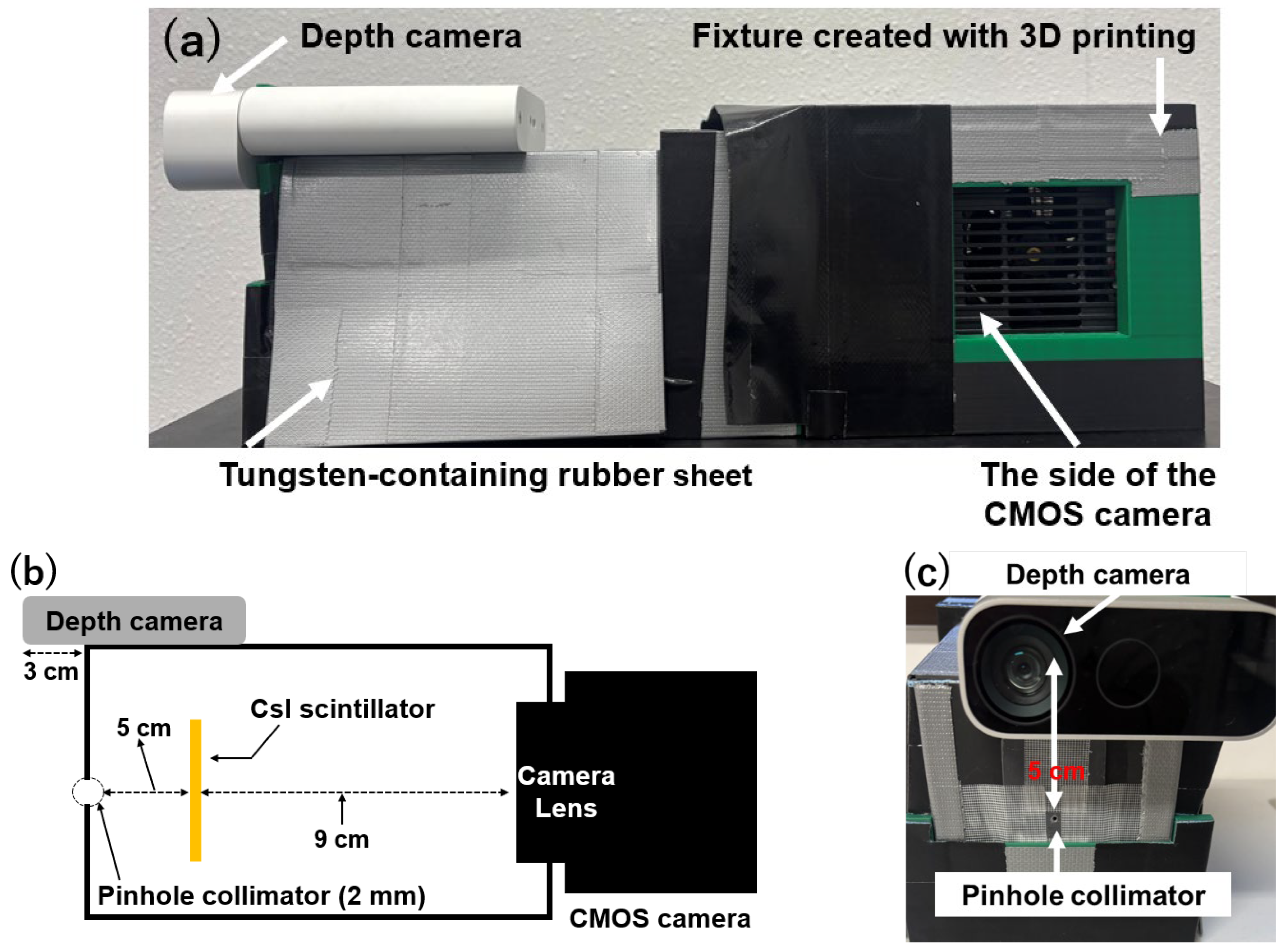
In this study, a scattered radiation source visualization system was developed based on the approach described by Lee et al. The system consists of a CMOS camera (ORCA-Quest, Hamamatsu Photonics Corporation, Hamamatsu, Japan), a cesium iodide (CsI) scintillator (J13113, Hamamatsu Photonics Corporation, Hamamatsu, Japan), and a pinhole collimator [
16]. In this study, a depth camera (Azure Kinect; Microsoft, Redmond, WA, USA) was also integrated into the system. These components along with the supporting fixtures comprised the scattered radiation source visualization system, which is illustrated in
Figure 1.
A CMOS camera detects weak light signals with a high signal-to-noise ratio because of its excellent low-noise characteristics and high-speed readout capabilities. High-frame-rate imaging can also be achieved while maintaining a high signal-to-noise ratio. Image data were processed using High-Speed Recording Software version 2.5.5J (Hamamatsu Photonics Corporation, Hamamatsu, Japan; HSR), a dedicated application designed for CMOS cameras. A lens with an f-number of 2.4 (SMC Pentax DA 35 mm, Ricoh Imaging Corporation, Yokohama, Japan) was attached to the camera to optimize light collection. The gain was set to High gain.
The CsI scintillator is a high-performance X-ray scintillator composed of thallium-activated cesium iodide, CsI, with a columnar crystal structure. This structure suppresses lateral light spread and enables high spatial resolution. The external dimensions of the CsI scintillator are 50 mm × 50 mm, with an effective detection area of 45 mm × 45 mm. The scintillation layer has a thickness of 400 μm, and the substrate thickness is 0.5 mm.
The background images, including those of the X-ray system and the patient phantom, were captured using a depth camera. The depth camera was positioned 5 cm above and 3 cm in front of the pinhole collimator. This placement was selected to position the camera as close to the pinhole collimator as possible while ensuring mechanical stability.
The pinhole collimator incorporated a pinhole with a diameter of 2 mm. It was fabricated from a lead plate measuring 4.0 cm × 7.0 cm with a thickness of 0.3 cm and was designed to restrict scattered radiation to a specific direction, thereby improving imaging accuracy. A previous study by Lee et al. demonstrated that the radiation passing through the pinhole is indeed scattered radiation using Particle and Heavy Ion Transport code System (Japan Atomic Energy, Agency, Tokai, Japan; PHITS) version 3.34 simulations [
16].
The pinhole collimator, CsI scintillator, and camera lens were housed in a custom holder fabricated using a 3D printer (Prusa XL; Prusa Research, Prague, Czech Republic). A tungsten rubber sheet with a lead equivalence of 1 mm Pb was placed over the holder to prevent the intrusion of scattered radiation and stray light from directions other than those of the pinhole collimator. An additional tungsten drape with a lead equivalence of 0.125 mm Pb was placed on top, and a black light-shielding sheet was attached to the rear side of the CMOS camera to eliminate visible light penetration.
The distance between the scintillator and the CMOS camera lens was set to 9 cm to capture the entire horizontal area of the scintillator and maximize the effective detection area. This distance is also the minimum focal distance required by the optical characteristics of the CMOS camera to capture clear, blur-free images of the CsI scintillator.
The distance between the pinhole collimator and the CsI scintillator was set to 5 cm. This distance was selected based on the camera’s field of view (FOV), which was 2.7 cm when the CsI scintillator was positioned 9 cm from the CMOS camera. Setting the distance between the pinhole collimator and scintillator to 5 cm increased the horizontal and vertical fields of view of the CMOS camera lens to 53° and 32°, respectively, ensuring that the scattered radiation passing through the pinhole collimator was projected across the entire CsI scintillator.
2.2. X-Ray Exposure Conditions and Experimental Setup
X-ray exposures were performed using a biplane angiography system (Alphenix INFX-8000; Canon Medical Systems Corporation, Otahara, Japan). This system determines the irradiation direction based on a combination of C-arm and L-arm angles. During cardiac angiography procedures, the selection of an appropriate imaging angle and FOV is crucial and depends on the clinical indications and specific interventional procedures. The combinations of C-arm and L-arm angles used in this study were selected based on the typical imaging conditions employed in representative clinical procedures. However, as the main goal of this study was to establish the 3D visualization methodology and verify shielding effects, extreme angulations such as steep Cranial/Caudal or oblique views were not selected.
Cardiac angiography involves both fluoroscopy and radiography. With the system used this time, selecting either fluoroscopy or radiography mode changes the imaging conditions. Therefore, irradiation conditions were configured for radiography to produce a relatively high radiation output to visualize the scattered radiation sources. As the system was operated in a mode in which the irradiation conditions varied automatically with each irradiation, the tube voltage, tube current, pulse width, and cine rate differed across irradiations. The average tube voltage, tube current, pulse width, and cine rate were calculated for each irradiation direction, and these exposure conditions are listed in
Table 1. FOV was 20 × 20 cm. Source-to-Image Receptor Distance of C-arm was 105 cm and L-arm was 110 cm. Isocenter-to-Image Receptor Distance was 30 cm.
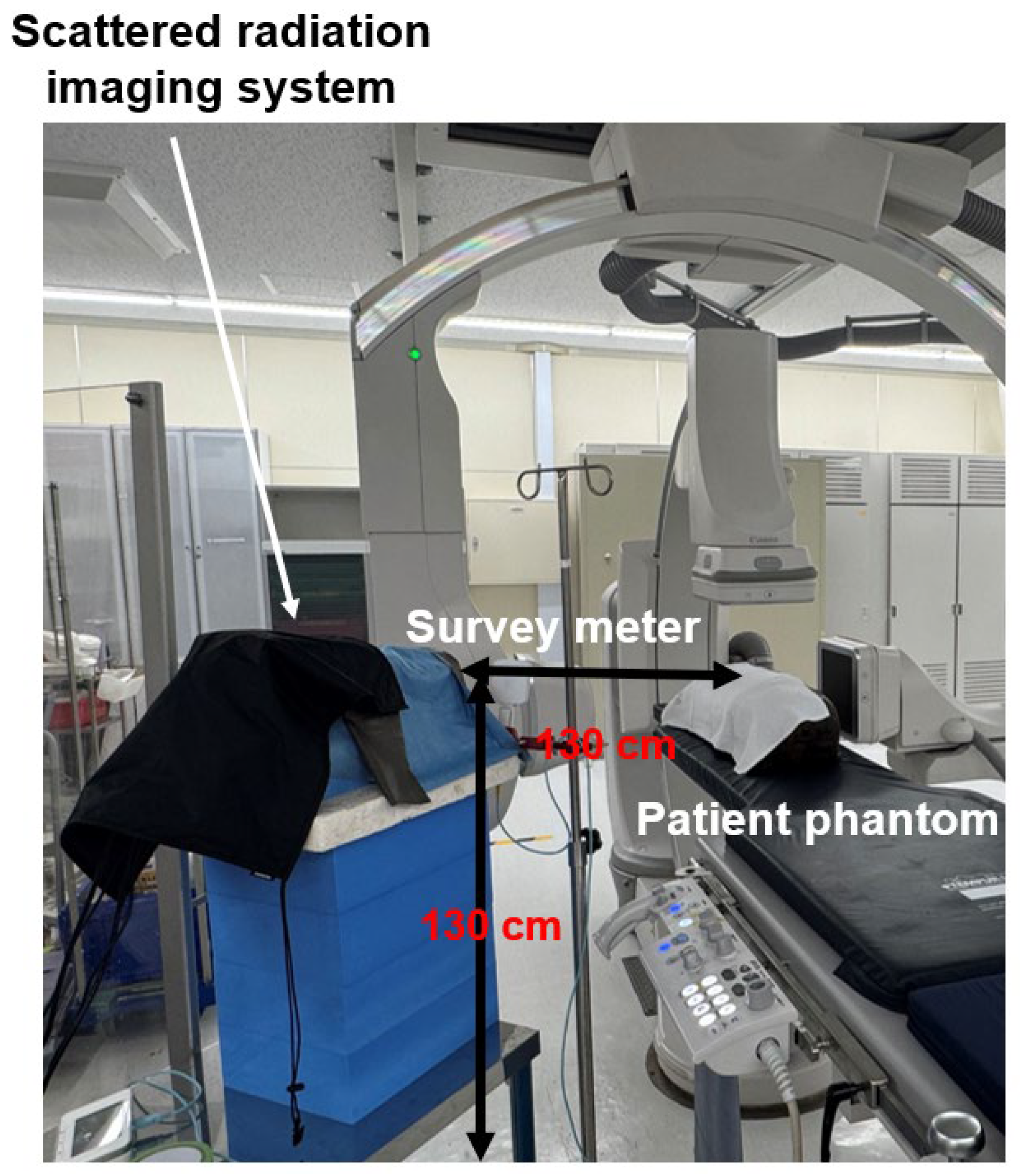
The experimental setup of the scattered radiation source visualization system is shown in
Figure 2. A patient phantom (Alderson Research Laboratories, New York, NY, USA) was placed on the examination table, and the patient phantom was fixed in this position. The distance from the floor to the examination table was 100 cm. The visualization system was positioned such that the distance between the pinhole collimator and the isocenter was 130 cm, such that both the patient phantom and X-ray tube were included within the camera’s FOV. In this configuration, the distance from the floor to the pinhole was 130 cm. The system position was fixed. prioritizing the reproducibility of the experimental design
A semiconductor survey meter (Raysafe X2; Unfors Raysafe, Billdal, Sweden) was positioned as close to the pinhole collimator as possible to measure the dose rate incident on the system. The primary objective of measuring the dose rate near the pinhole collimator was to verify the dose rate required to reproduce the scattered radiation sources and to confirm a correlation, specifically that the dose rate decreased in tandem with the reduction in scattered radiation source intensity in the images.
For image capture using the CMOS camera, the resolution was set to 1024 × 576 pixels with 4 × 4 binning and a bit depth of 16 bits. During the experiments, the pixel values of the CMOS camera images were fixed at a minimum of 3200 and a maximum of 3583. A minimum value of 3200 was selected because the background pixel values reached approximately this level when 4 × 4 binning was applied. The maximum value was manually adjusted to a level at which the scattered radiation sources appeared clearly in the images. Manually fixed pixel range of the CMOS camera was saved within the HSR system, ensuring that once configured, they do not deviate. The exposure time of the CMOS camera was set to 5 s to ensure sufficient light collection under low-dose conditions. Accordingly, each X-ray irradiation was performed for more than 5 s to capture the scattered radiation source images using a single long exposure. The experiment was conducted while continuously monitoring the pixel values to ensure they remained within the linear range and did not reach saturation. The capture settings for the depth camera are listed in
Table 2.
2.3. Visualization Method for Scattered Radiation Sources
Cardiac angiography physicians need scattered radiation sources to be identified during X-ray irradiation. This requirement was addressed by overlaying the background images with the scattered radiation source images. The image overlay was performed using a custom 3D image composition software (rad-point-cloud-mix version 0.1.0, Fume, Iizuka, Japan).
A simple overlay of the images captured by the CMOS camera and those captured by the depth camera results in a misalignment arising from the differences in the FOVs and installation positions of the two cameras. The misalignments were corrected within the image-composition software by manually shifting the center position of the CMOS camera’s field of view, thereby translating the scattered radiation source images and overlaying them onto the background images. Since both the CMOS camera and depth camera are installed parallel to each other, rotation is unnecessary for this calibration; only translation is required.
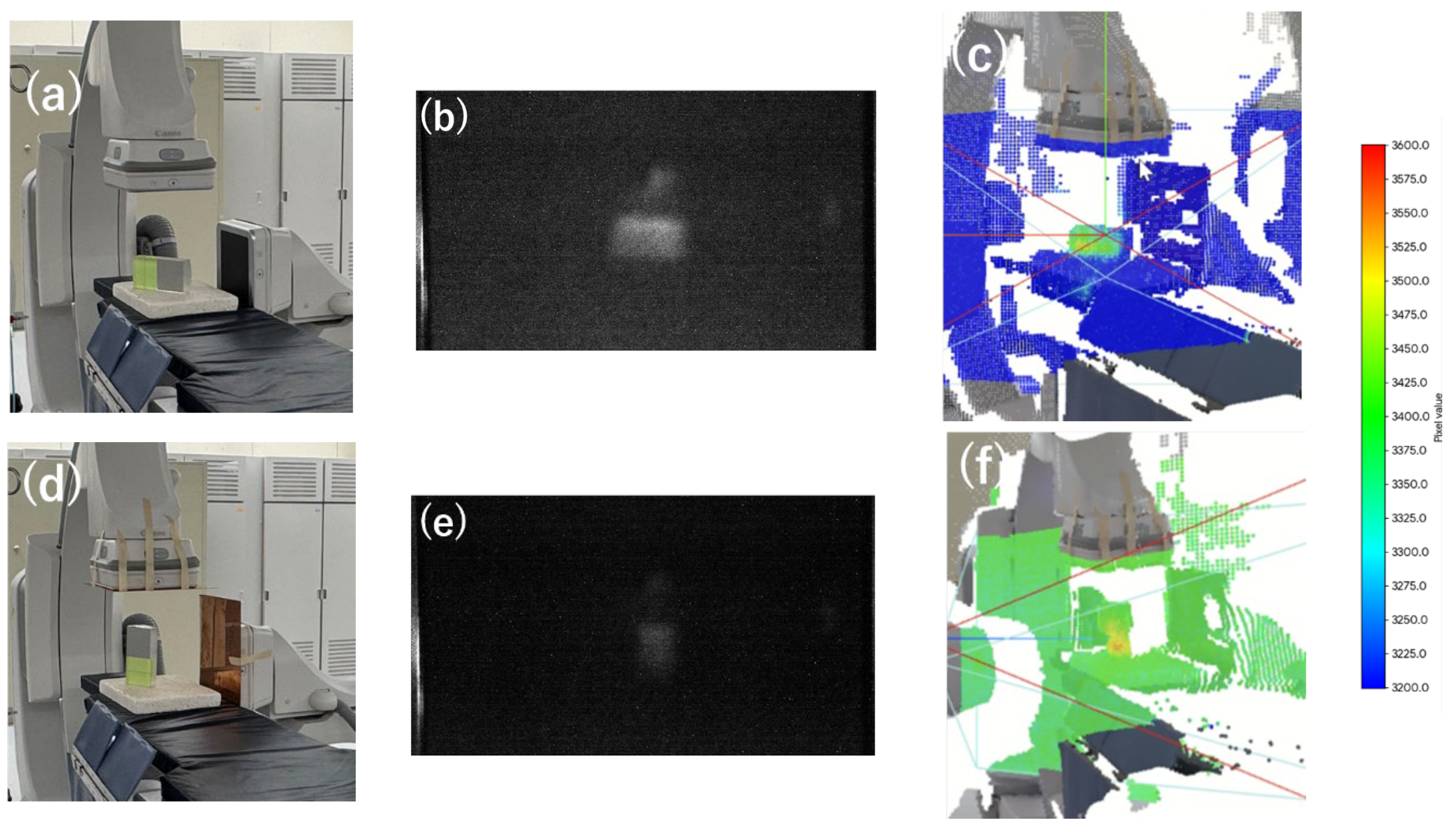
The procedure for generating the scattered radiation source visualization images is shown in
Figure 3. For the correction process, an acrylic phantom measuring 11.0 cm × 20.0 cm with a thickness of 4.0 cm was used, with one half covered by aluminum to create a difference in the scattered radiation dose generated from the phantom. Because the depth camera cannot capture transparent materials, green tape was applied to the acrylic surface.
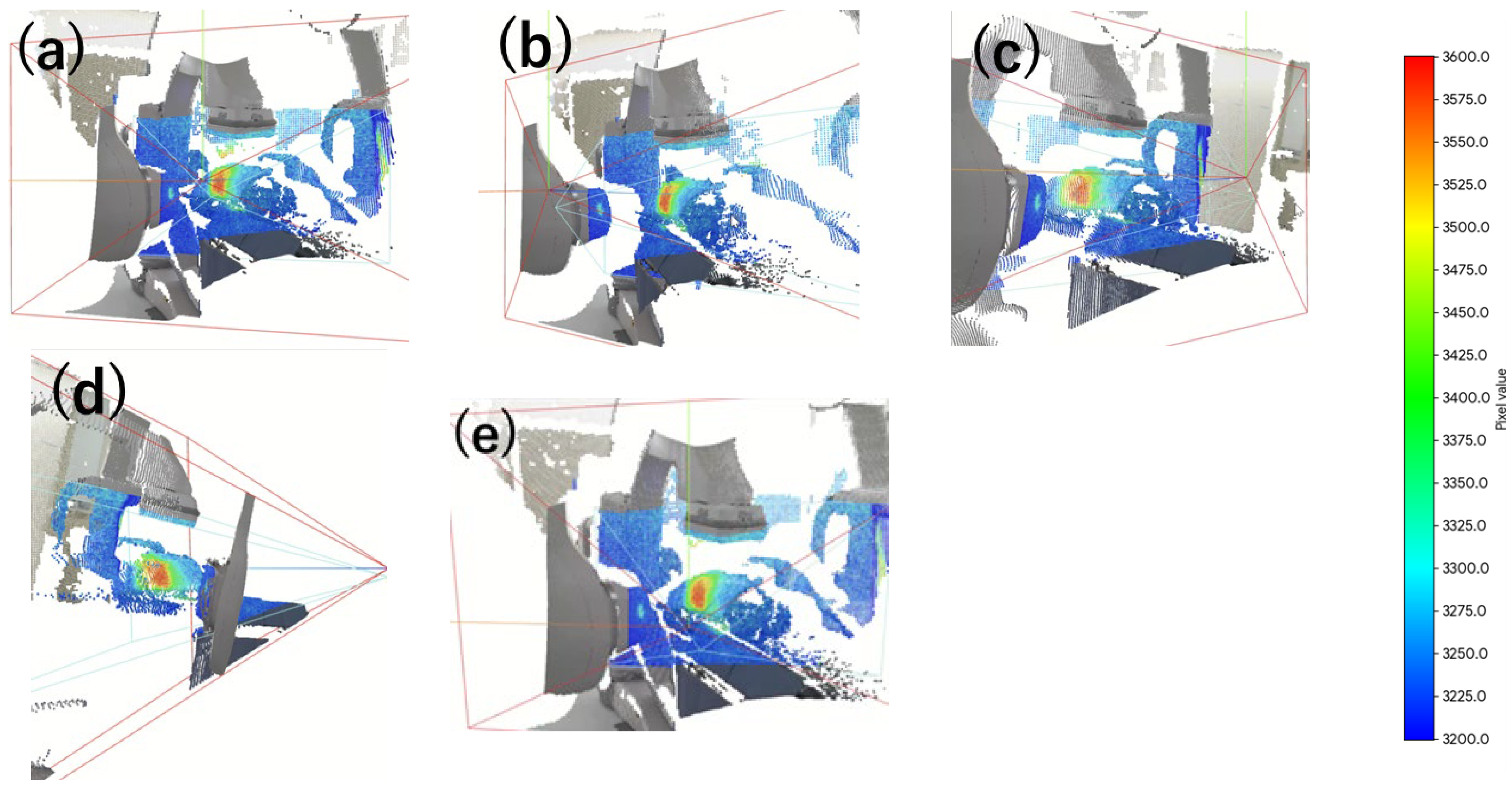
The acrylic phantom was positioned within the irradiation field with its long axis oriented horizontally to the floor. A 3D image of the background 2D image (
Figure 3a) was generated using rad-point-cloud-mix version 0.1.0. X-ray irradiation was performed to capture an image of the scattered radiation source from the acrylic portion (
Figure 3b). This scattered radiation source image was translated using the image-composition software to align it with the position of the acrylic phantom, producing the corrected image shown in
Figure 3c, in which the center of the CMOS camera’s field of view angle (light blue line in
Figure 3c) was manually shifted using the depth camera’s field of view angle (red line in
Figure 3c) as a reference. This resulted in a corrected image combining the scattered radiation sources’ positions captured by the depth camera with those captured by the CMOS camera.
The acrylic phantom was then rotated by 90° at the same location such that its long axis was oriented vertically to the floor, and a 3D image of the background 2D image (
Figure 3d) was generated. To increase the X-ray output, copper plates were placed on both flat-panel detectors before irradiation and the scattered radiation source image originating from the acrylic portion (
Figure 3e) was captured. The same correction procedure was used to generate the corrected image, as shown in
Figure 3f.
The range of pixel values of the scattered radiation source images shown in
Figure 3b,e was fixed to the experimental pixel range, with a minimum of 3200 and a maximum of 3583. In the corrected images presented in
Figure 3c,f, the red lines indicate the FOV angle of the depth camera, the light blue lines indicate the FOV angle of the CMOS camera, and the remaining lines represent the axes of the 3D coordinate system. This procedure enhanced the accuracy of the alignment of the scattered radiation sources’ positions captured by the depth camera with the scattered radiation sources captured by the CMOS camera.
Furthermore, a frame matching the size of the irradiation field was created using a metal clip to determine whether the CMOS camera and depth camera images were correctly aligned. This frame was attached to the phantom at the same position as the irradiation field and irradiated. Subsequently, scattered radiation sources were visualized within the clip’s frame, and this was confirmed in the image-composition software.
2.4. Sequence of Scattered Radiation Source Image Capture and Use of Radiation Protection Equipment
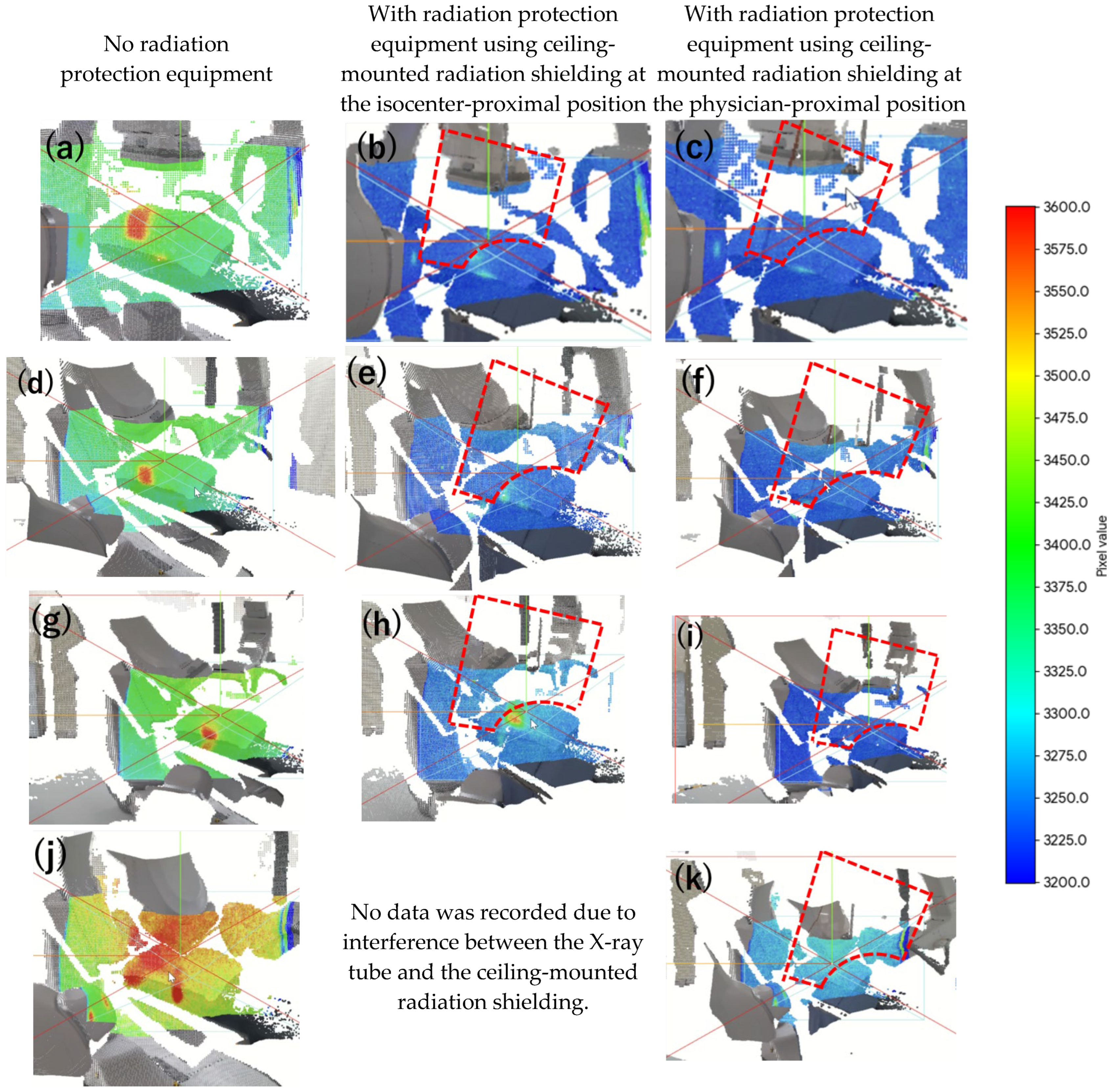
The experimental procedure was as follows. Scattered radiation sources were visualized on 3D images under the posterior-anterior (PA)–lateral (LAT) view using the setup shown in
Figure 2. X-ray irradiation was then performed in the four directions listed in
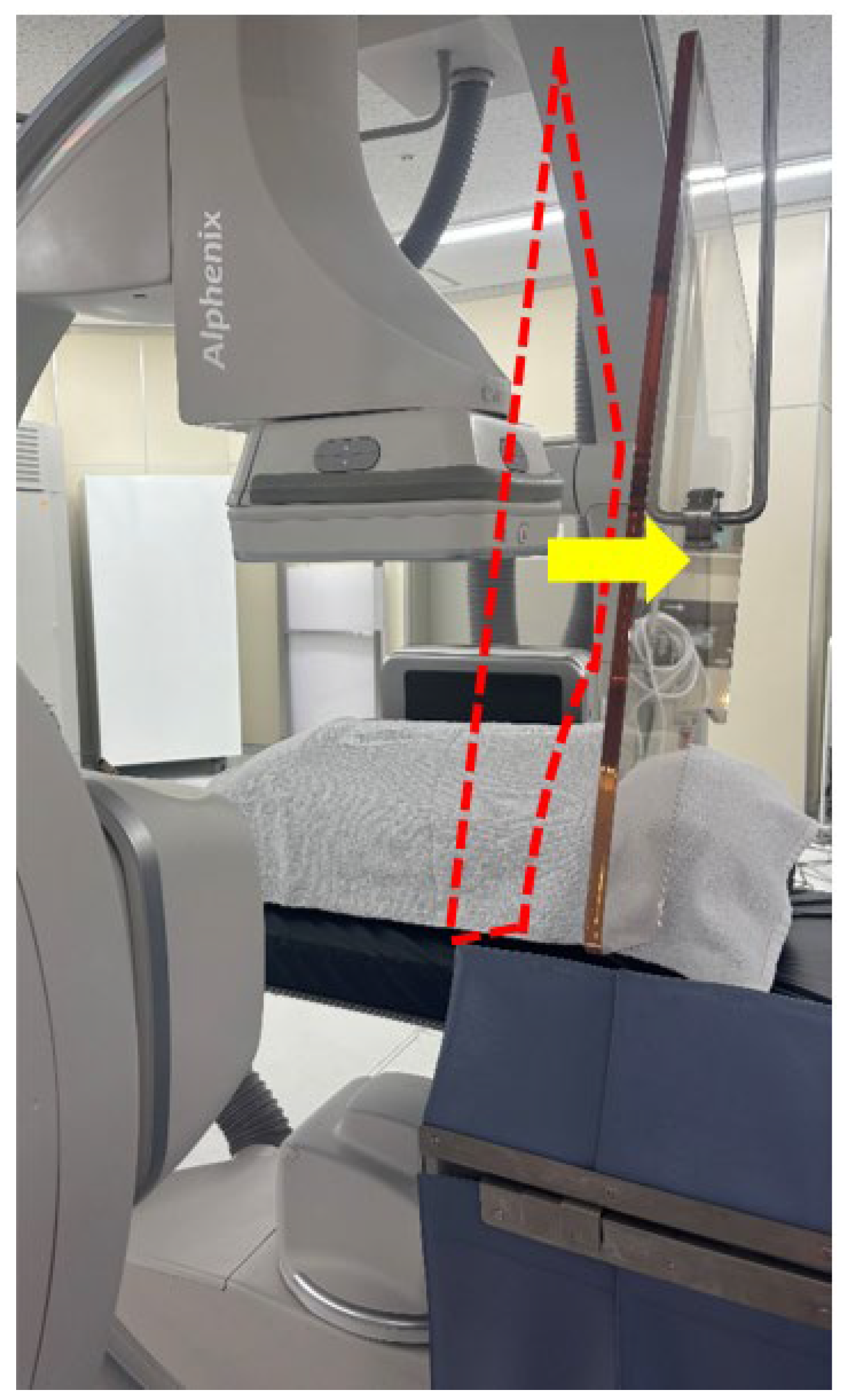
Table 1 under three conditions: without radiation protection equipment, with radiation protection equipment (
Figure 4), and with only the ceiling-mounted radiation shielding, repositioned as also shown in
Figure 4. The position of the ceiling-mounted radiation shielding before repositioning is indicated by the dashed red line. In the experimental facility used for this study, the use of a radiation protection curtain is the standard procedure. Therefore, the verification by fixing the curtain as a constant and varying only the position of the shielding.
The distances from the isocenter to the center of the ceiling-mounted radiation shielding were 35 cm and 40 cm. In the following descriptions, the configuration with a distance of 35 cm is referred to as the isocenter-proximal position, whereas that with a distance of 40 cm is referred to as the physician-proximal position.
The radiation protection equipment consisted of a radiation protection curtain (Model SA-L-50; Kuraray Trading Co., Ltd., Osaka, Japan) and ceiling-mounted radiation shielding (KYOWAGLAS-XA Protection Shield; Kuraray Trading Co., Ltd., Osaka, Japan), both of which provided a lead equivalence of 0.5 mm Pb. Comparisons were performed between the scattered radiation source images captured when the ceiling-mounted radiation shielding was used at the isocenter-proximal position and those captured when the shielding was used at the physician-proximal position. Irradiation for each view and shielding configuration was performed only once. The irradiation conditions remained stable, and there were no fluctuations affecting the generation of the scattered radiation source.
4. Discussion
In this study, scattered radiation sources were visualized by simulating clinical cardiac angiography using a system that combined a high-sensitivity CMOS camera with a pinhole collimator, enabling the capture of scattered radiation source images with a 5-s exposure time. In contrast to previous studies using IP, scattered radiation source images were captured with shorter exposure times and fewer irradiations, and no readout process was required. On the other hand, when applying this system in clinical settings, the 5-s exposure time must be significantly shortened. This is one limitation of this research, and improving the system’s specifications and sensitivity in the future may resolve it. Accordingly, the system specifications will need to be reviewed.
The use of a 3D image captured by a depth camera as the background image enabled the visualization of scattered radiation sources on a 3D display, which has rarely been reported in the X-ray energy range. The results demonstrate that the system enabled the identification of scattered radiation sources from multiple directions, facilitating the accurate and detailed detection of the locations of the scattered radiation sources by physicians. This ability could contribute to the optimization of radiation protection strategies.
Furthermore, the use of radiation protection equipment and the modification of the position of the ceiling-mounted radiation shielding enabled visual confirmation of the effectiveness of the radiation protection equipment and the simultaneous assessment of changes in dose rate. The dose rate fluctuated in a correlated manner with the increase or decrease in the scattered radiation source intensity, suggesting that the pixel values in the scattered radiation source image correspond to the dose rate. However, due to the different directional dependencies of the pinhole collimator and the survey meter, the survey meter does not exclusively measure the scattered radiation that passes through the pinhole collimator. Consequently, the pixel values do not perfectly correspond to the dose rates, and their relationship remains a correlation rather than a direct equivalence. Moreover, the scattered radiation sources were visualized using a specific human phantom fixed in place. However, when the size or shape of the patient changes, the irradiation conditions change, and the intensity and dose rate of the scattered radiation sources will fluctuate. Therefore, conducting a specific numerical comparison between the pixel values of scattered radiation source images and the dose rate is difficult. This point represents one of the limitations of the present study.
The intensity of the scattered radiation sources and dose rate decreased when radiation protection equipment was used, with the lowest intensities observed when the ceiling-mounted radiation shielding was positioned at the physician-proximal location in all irradiation directions. A previous study by Fujibuchi et al. [
21] evaluated the effectiveness of ceiling-mounted radiation shielding using PHITS simulations at the lens position of a physician (160 cm) under PA conditions. The dose reduction reached approximately 95% when the shielding was positioned near the physician, whereas the reduction was approximately 17% when the shielding was positioned near the isocenter. A similarly high reduction of approximately 97% was observed under the LAO 60° condition.
The findings of the present study are consistent with these previous results. In addition, they provide visual confirmation that the use of ceiling-mounted radiation shielding at the physician-proximal position offers greater potential for reducing physician exposure than that at the isocenter-proximal position. These observations suggest the feasibility of using the proposed system to evaluate radiation protection strategies for medical staff. The system should be positioned not only at the physician’s location but also at the positions of other medical staff involved in cardiac angiography, such as nurses. By performing similar measurements at these various locations, the system could be applicable to all staff members in the room.
The RAO 30°/CAU 30–LAO 60°/CAU 25° view, which includes a caudal direction, demonstrated a pronounced increase in both the intensity of the scattered radiation sources and the dose rate compared with the other views. The locations of the visualized scattered radiation sources also differed from those observed in the other views, and the scattered radiation sources originating from the X-ray tube and collimator of the L-arm were identified. These observations suggest that scattering from the X-ray tube and collimator contributed to the increased intensity and dose rate.
In the RAO 30°/CAU 30–LAO 60°/CAU 25° view, the X-ray tube was inclined toward the cranial direction, resulting in the shortest distance between the pinhole collimator, which was positioned at a height similar to the height of a physician’s eye, and the X-ray tube. This geometry allowed radiation leakage from the X-ray tube and collimator to reach the system more readily. Consequently, this radiation leakage was visualized as a scattered radiation source that contributed to the elevated dose rate.
Panetta et al. [
2] reported that the operator’s dose equivalent and air kerma were highest under LAO–caudal conditions. Furthermore, multiple studies have reported that during cardiovascular angiography, steep LAO–caudal directional irradiation must be avoided to reduce operator exposure [
22,
23,
24]. In addition, the simulations performed by Fujibuchi et al. demonstrated that radiation leakage from the X-ray tube tends to be directed toward the physician [
21]. Moreover, they found that dose levels at the height of the head and eyes are markedly elevated. The findings observed in this study are consistent with these reports, providing visual confirmation that irradiation conditions, including in the caudal direction, markedly increase physician exposure.
These findings emphasize the importance of radiation protection strategies under caudal irradiation directions and indicate that the proposed system may serve as a useful tool for evaluating appropriate radiation protection measures according to specific imaging conditions.
5. Conclusions
In this study, scattered radiation sources were successfully visualized using short capture times during simulated clinical cardiac angiography using a visualization system that combines a high-sensitivity CMOS camera with a pinhole collimator. The use of 3D images captured from a depth camera for the 3D visualization of scattered radiation sources, which has rarely been reported in the X-ray energy range, demonstrated that physicians can accurately and comprehensively recognize the location of scattered radiation sources from multiple directions. This capability provides useful information for planning radiation-protection strategies.
Furthermore, the effects of using radiation protection equipment and altering the position of the ceiling-mounted radiation shielding on both the intensity of the scattered radiation sources and the dose rate were confirmed visually and quantitatively. The results clearly demonstrated that positioning the ceiling-mounted radiation shielding at the physician-proximal location provided the greatest reduction in scattered radiation sources, thereby indicating an appropriate method for the use of radiation protection equipment by physicians.
In addition, irradiation conditions that included a caudal direction resulted in a marked increase in the intensity of the scattered radiation sources and dose rate, emphasizing the importance of radiation protection strategies under such conditions.
The proposed system offers valuable information that enables medical staff engaged in cardiac angiography to intuitively understand the spatial distribution of scattered radiation, and the results of this study suggest the potential of this visualization technique for optimizing radiation protection strategies. The findings also indicate possible applications of the system in educational settings.