Article

Analysis of Vertical Shafts Excavation and Support Based on Cavity Contraction–Expansion Method

1
China Coal No.5 Construction Co., Ltd. the No.3 Engineering Division, Xuzhou 221140, China
2
China Coal Mine Construction Group Co., Ltd., Beijing 102218, China
*
Author to whom correspondence should be addressed.
Appl. Sci. 2026, 16(3), 1390; https://doi.org/10.3390/app16031390
Submission received: 7 January 2026 / Revised: 22 January 2026 / Accepted: 27 January 2026 / Published: 29 January 2026
(This article belongs to the Special Issue Advances in Smart Underground Construction and Tunneling Design)

Abstract

Vertical shafts are key channels for underground energy storage, mineral exploitation, and related engineering fields. Yet in deeply buried complex strata and high ground stress environments, traditional passive supports are prone to lining failure, while linear yield criteria cannot accurately characterize rock masses’ nonlinear mechanical behavior, limiting their use in shaft analysis. The core mechanical process of shaft construction aligns with the cavity contraction–expansion mechanism: excavation induces cavity unloading and contraction, causing shaft deformation and plastic zone expansion in surrounding rock; support enables cavity reverse expansion via preset shaft wall counter loads to actively control surrounding rock deformation. Based on this, this study integrates the Hoek–Brown nonlinear yield criterion, large-strain theory, and non-associated flow rules; couples cavity contraction–expansion semi-analytical solutions with the composite shaft wall mechanical model; and establishes a composite shaft wall–surrounding rock interaction analysis method. This research clarifies excavation-induced surrounding rock mechanical responses, reveals shaft wall counter loads’ regulatory effect on surrounding rock, and develops a systematic excavation support calculation workflow. Parameter analysis shows that increasing lining thickness is the most direct way to reduce inner wall tensile stress and improve safety; composite linings optimize stress distribution and enhance structural collaborative performance; and safety assessment confirms the lining inner wall as a structural weak zone. The proposed method and findings fill the gap in applying cavity contraction–expansion theory to shaft construction, providing reliable theoretical and practical guidance for deep shaft design, construction, and safety evaluation.

1. Introduction

As a critical passageway connecting the surface and underground spaces, vertical shafts play an indispensable role in underground energy storage [1,2,3], mineral resource extraction [4,5,6], underground transportation [7], water conservancy projects, and national defense construction [8,9]. Unlike horizontal underground works such as tunnels, shafts traverse deep, complex geological formations, posing substantial construction challenges—including high in situ stresses, significant groundwater pressure, and time-dependent creep of weak sedimentary rocks [10,11,12]. Although circular shafts are favored for their inherent self-stabilizing capacity [13,14], the growing demand for large-diameter, deep shafts (particularly for energy storage) necessitates more advanced design and control methodologies to ensure long-term stability [15].
Despite the significance of understanding deep shaft behavior, current research has notable limitations. Field monitoring and experimental studies offer valuable insights into deformation and failure mechanisms [8,16,17,18,19,20], but are often constrained by high costs, operational difficulties, and limited spatial data coverage. Numerical simulations, while capable of modeling complex interactions [21,22,23,24], tend to be computationally intensive, making them less suitable for preliminary design stages. Compounding these issues, the conventional “excavation-lining” passive support system often succumbs to cracking, damage, or even total failure in deeply buried or geologically complex formations—risking shaft wall collapse and severe threats to construction safety.
To mitigate such risks, active support measures (e.g., adjustable steel frame supports) are increasingly adopted on inner lining walls to apply preset radial pressure to the lining–surrounding rock system. Mechanically, this process equates to applying additional reverse loading pressure atop excavation-induced unloading, rendering the entire vertical shaft construction a continuous “contraction-then-expansion” process of the excavated cavity. Notably, the shaft excavation process—essentially an in situ stress unloading procedure—can be analyzed using cavity expansion theory, a tool initially proposed by Bishop [25] for metal indentation problems and later extended to geotechnical applications by Hill [26], Gibson [27], and Chadwick [28].
Over recent decades, cavity expansion solutions have been developed for various material models, including Tresca [29], Mohr–Coulomb [30,31], Drucker–Prager [32], the spatially mobilized plane [33], modified Cam-Clay [34,35], unified strength theory [20], and the CASM model [36,37,38]. Nevertheless, conventional linear yield criteria (e.g., Tresca, Mohr–Coulomb) poorly capture the nonlinear mechanical behavior of rock masses, a critical shortcoming in deep shaft analysis.
To address this gap, Hoek [39] proposed the Hoek–Brown strength criterion, which reflects the nonlinear empirical relationship between ultimate principal stresses during rock failure; its 2002 updated version [40] is now widely adopted. Subsequent studies have applied the Hoek–Brown criterion to investigate tunnel elastoplastic problems [41,42] and cavity expansion issues [43].
This study aims to fill this gap by integrating the semi-analytical solution for cavity contraction–expansion (rooted in the Hoek–Brown nonlinear yield criterion, large-strain theory, and non-associated flow rule) with a composite shaft wall mechanical model. It further establishes an analytical method for the interaction between the composite shaft wall and surrounding rock, clarifying the coupling mechanism between the shaft wall and surrounding rock as well as the evolution of the reverse plastic zone. Through parameter investigation, the influence of rock mass type, excavation depth, and lining configuration on the structural response is examined, providing practical guidance for the design and construction of vertical shafts.

2. Materials and Methods

2.1. Problem Description and Computational Model

The problem of deep well excavation can be simplified as the contraction of a cylindrical cavity embedded in the surrounding rock. During contraction or expansion of the cavity, the material around the cavity, whether in the elastic or plastic zone, shall meet the stress balance equation, which can be expressed as
d σ r d r = 1 r σ r σ θ
where σ r and σ θ represent radial stress and tangential stress, respectively, and r represents the distance from any point to the center of cavity.
This study employs small-strain theory for the elastic zone. Given the finite strain property of geotechnical materials, the structure must maintain equilibrium at all deformation states. Thus, large-strain theory is adopted for the plastic zone [44].
The determination of the plastic zone displacement field requires a plastic flow rule. Accordingly, this paper adopts the non-associated flow rule with a constant dilatancy angle.
Vertical shafts are built in rock, which has nonlinear strength properties distinct from soil. The widely used Mohr–Coulomb failure criterion in geotechnical engineering is insufficient to accurately characterize rock mass behavior. Thus, this study adopts the Hoek–Brown nonlinear failure criterion [40] to analyze vertical shaft excavation. For the cylindrical cavity unloading problem (tensile stress defined as positive), the initial failure condition is
σ 1 = σ 3 σ c i s m b σ 3 σ c i A
where
m b = m i exp G S I 100 28 14 D
s = exp G S I 100 9 3 D
A = 1 2 + 1 6 ( e G S I 15 e 20 3 )
where σ 1 and σ 3 represent the absolute maximum and minimum principal stresses, respectively; σ c i denotes the uniaxial compressive strength of the intact rock material; G S I is the Geological Strength Index; m b , m i , and s are empirical parameters characterizing the rock mass properties; and D is a disturbance parameter ranging between 0 and 1 .
Note that parameter A in Equation (2) is G S I -dependent, whose variation enhances equation nonlinearity and complicates its application to vertical shaft excavation analysis. However, Sharan [45] indicated that A is assumed constant at 0.5 for non-dilating rock, and displacement calculations at the opening surface and elastoplastic interface are error-free, with errors at other positions negligible. As the dilation parameter increases, the error rises accordingly. For dilating rock, the error peaks at the opening surface and diminishes gradually to zero at the elastoplastic interface. Across all analyzed cases, errors are insignificant and tend to be conservative. Thus, the simplification of parameter A can be safely adopted in designing circular underground openings. Therefore, A is assumed constant at 0.5 (independent of G S I ) with unchanged m b and A expressions.

2.2. Solution for Excavation of Vertical Shaft

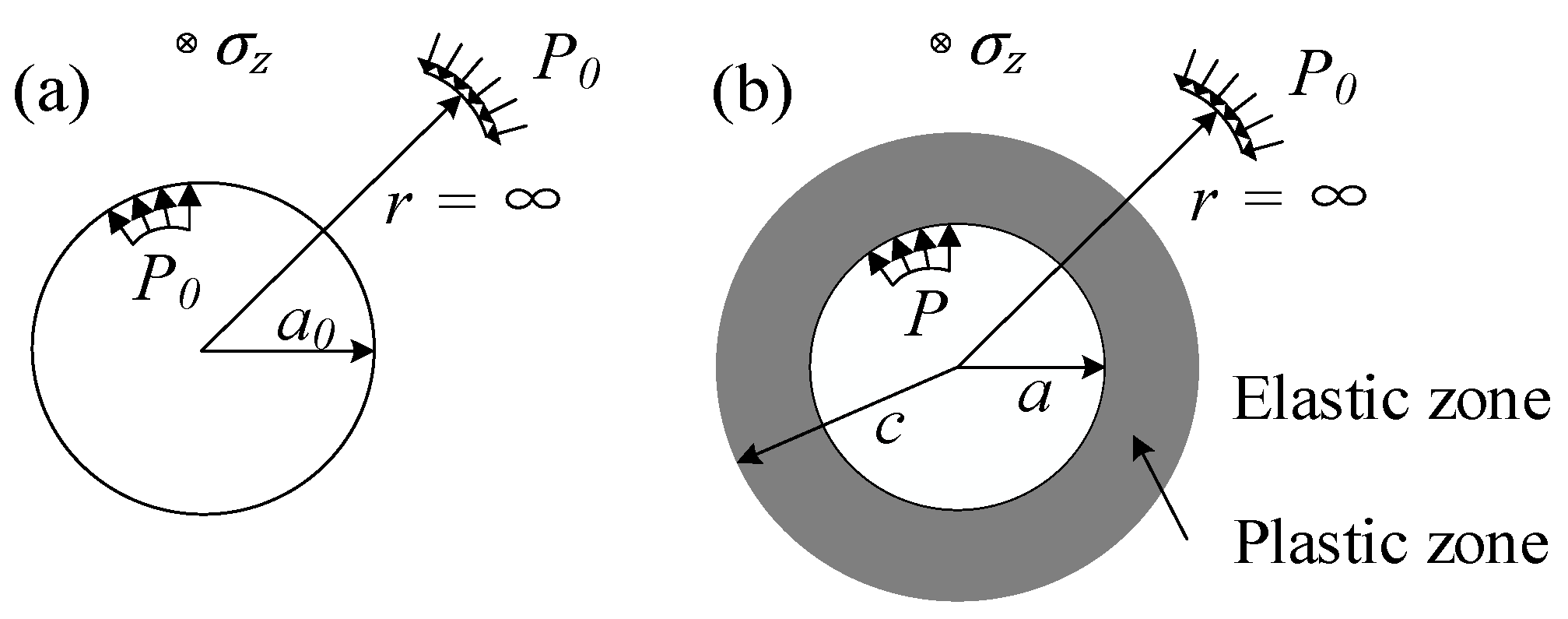
Vertical shaft excavation can be mechanically idealized as the contraction of a cylindrical cavity. As shown in Figure 1, for a shaft at a specific depth, the initial in situ stress P 0 (equal to vertical stress σ z ) acts uniformly on the cavity boundary pre-excavation. The initial cavity radius a 0 is the excavation radius. Post-excavation, the internal pressure on the cavity wall decreases to P , reducing the radius to a . Depending on stress conditions, a plastic zone of radius c may form around the cavity (surrounded by an unbounded elastic region), or the surrounding rock may remain fully elastic. Notably, during shaft excavation, radial stress is generally the minimum principal stress, while tangential stress is the maximum principal stress.

2.2.1. Elastic Solution

After shaft excavation, if the surrounding rock quality is good or excavation disturbance is minimal, no plastic zone may form, and the surrounding rock remains fully elastic. The elastic zone solution proposed by Yu [31] is as follows:
σ r e x = P 0 + P 0 P a r 2
σ θ e x = P 0 P 0 P a r 2
u e x = P + P 0 2 G a r 2 r
where G is the shear modulus of the surrounding rock; σ r e x and σ θ e x are the radial stress and tangential stress after vertical shaft excavation, respectively; and u e x is the displacement after vertical shaft excavation. The definitions of other symbols are the same as above.

2.2.2. Plastic Solution

As shown in Figure 1, a plastic zone of radius c may also form post-excavation, typically due to high in situ stress, poor surrounding rock quality, or significant excavation disturbance. The corresponding stress and displacement solutions are adopted from Mo [44].
For the plastic zone after shaft excavation (i.e., a r c ), Mo [44] derives the following solution based on the large-strain theory and non-associated flow rule:
σ r e x = σ y e x + D 1 l n c r D 2 ln 2 c r
σ θ e x = σ y e x D 1 + D 1 + 2 D 2 ln c r D 2 ln 2 c r
where σ y e x is the radial stress at the elastic–plastic boundary after vertical shaft excavation; D 1 = k s σ c i m b σ c i σ y e x ; a n d   D 2 = m b σ c i 4 .
At r = c , the radial and tangential stresses satisfy Equation (2). By combining Equations (6) and (7), the following expression can be derived:
σ y e x = 1 2 m b 4 2 + m b P 0 σ c i + s 2 σ c i m b σ c i 8 P 0
Note that with tensile stress defined as positive, σ y e x < 0 and P > 0 ; thus, plastic deformation occurs in the surrounding rock post-excavation if P < σ y e x , otherwise not. The relationship between c and a is expressed as
c a = e x p D 1 2 D 2 D 1 2 D 2 2 P σ y e x D 2
The displacement equation is given by
c β + 1 r 0 β + 1 k β + 1 = c β + 1 D 3 r / c 1 x D 4 + D 5 l n x d x
where v is Poisson’s ratio,
D 3 = exp D 1 D 7 D 6 + D 7 σ y e x P 0
D 4 = β + D 1 D 6 + D 1 D 7 + 2 D 2 D 7
D 5 = D 2 D 6 + D 2 D 7
D 6 = 1 v 2 E 1 β v 1 v
D 7 = 1 v 2 E β v 1 v
Substituting ( P 0 P ) for ( σ y e x + P 0 ) and c for a in Equations (3) and (4) yields the stress and displacement solutions for the elastic region ( r c ) . Thus, post-excavation, the stress and displacement of the surrounding rock can be computed regardless of its state.

2.3. Analysis of Interaction Between Shaft Wall and Surrounding Rock

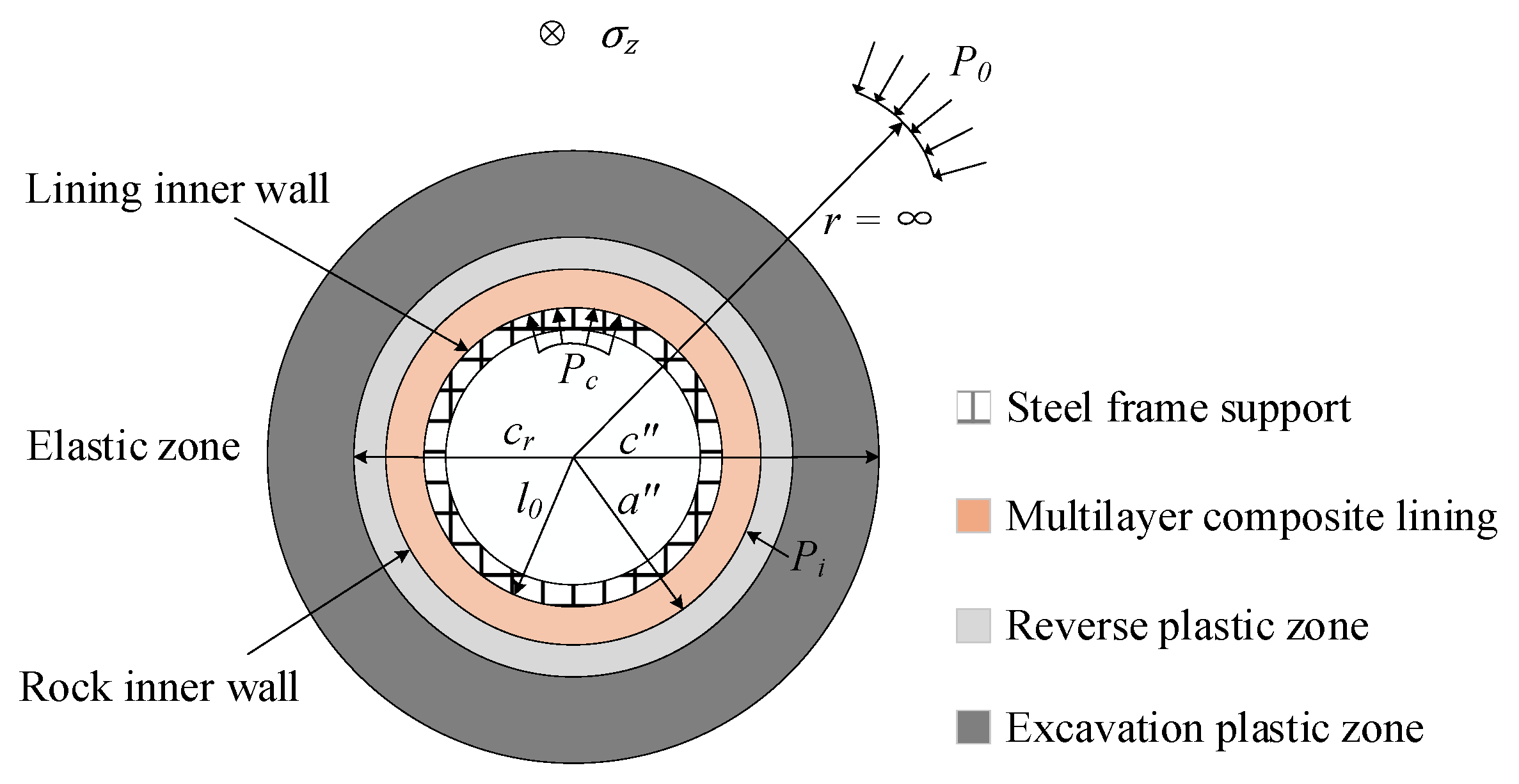
After vertical shaft excavation, lining support is first implemented, followed by supplementary support via steel frames exerting pressure, with the final structural configuration illustrated in Figure 2. Upon the completion of support, the lining and surrounding rock can be divided into up to four distinct zones: the lining layer (i.e., shaft lining), which may be a single-layer lining or a composite lining with a polyvinyl chloride (PVC) interlayer, the distance from the lining inner wall to the shaft center is l 0 , and P c denotes the pressure exerted on the lining by steel frames; the reverse plastic zone induced by the reaction force P i of the lining’s outer wall on the surrounding rock (radius c r ), with the surrounding rock’s inner wall-to-center distance becoming a , which is not a mandatory zone and fails to form if P i is small; the excavated plastic zone (radius c ) that, despite its name, has been confirmed by Xu [46] to be essentially an elastic zone; and the elastic zone that maintains elastic behavior throughout the entire shaft excavation and support process.
It should be noted that, under the action of internal wall pressure on the lining, no radial tensile stress exists within the lining, and the radial stress and displacement are continuous across all interfaces. Accordingly, the potential for relative slip or interfacial separation induced by high tensile stress is not considered in this analysis.

2.3.1. Solution of Composite Shaft Wall

Owing to the inconsistent material properties of each layer in the composite shaft wall, this study divides it into n layers from outer to inner (outermost = 1 s t layer; innermost = n t h layer). Here, r i i n and r i o u t denote the inner and outer boundary radii of the i t h layer, respectively. Chen [15] proposed the analytical solution for mechanical analysis under this model, as follows:
For the 2 n d to n t h layers, the outer wall boundary conditions can be constructed as the following 2 n 1 × 1 matrix. Additionally, based on the outer wall boundary condition of the 1 s t shaft wall layer and the inner wall boundary condition of the n t h layer, the following 2 × 1 matrix is constructed.
Thus, the stress and displacement increments for the i t h shaft wall layer are derived as follows:
D σ r = C i + D i r 2                                                                             D σ θ = C i D i r 2                                                                             D u = 1 + ν c i E c i 1 2 ν i C i D i r 2 r ( r i i n r r i o u t )
where E c i is the elastic modulus of the i t h layer material; ν c i is Poisson’s ratio of the material in the i t h layer; and C i and D i are constants calculated based on the stiffness matrix.

2.3.2. Reload of Shaft Wall on Surrounding Rock—Elastic Stage of Reloading

When the surrounding rock is under reverse loading, it can originate from either an elastic or plastic state. Typically, reverse loading from a plastic state is more complex; thus, this study derives reverse loading starting from the post-excavation plastic state of the surrounding rock, with the elastic-state case derivable via the same method.
After shaft wall support completion, the surrounding rock’s inner wall bears a force of P i P . Per Xu [46], the surrounding rock’s initial mechanical response follows the stress path and is elastic; only when P i exceeds a threshold does a plastic zone emerge from its inner wall and gradually expand. The surrounding rock’s stress field after loading with P i P can be regarded as the post-excavation stress field plus the additional stress field induced solely by P i P .
The additional stress field under the individual action of P i P can be expressed as follows by Xu [46]:
σ r = P i P a r 2
σ θ = P i P a r 2
where σ r and σ θ are the additional stress fields under the action of P i ; r is the radius of the surrounding rock after loading.
Substituting the additional stress field into the small-strain equation yields the displacement solution under additional stress, and the radius of the loaded surrounding rock is as follows:
a = a 1 P i P 2 G
By combining Equations (3), (4), (6), (7), (12) and (13), the stress and displacement fields of the surrounding rock after loading can be obtained.

2.3.3. Reload of Shaft Wall on Surrounding Rock—Plastic Stage of Reloading

After vertical shaft excavation, regardless of whether the surrounding rock has experienced plastic deformation, if P i exceeds a threshold, the surrounding rock’s inner wall will first yield and expand outward to form a reverse plastic zone. Notably, a sufficiently large P i may lead to c r > c . This study uses the post-excavation plastic state of the surrounding rock as the basis for solving loading conditions; other cases (with c r c ) can be derived based on this.
First, the critical value of P i for reverse loading-induced plastic zone initiation is derived. As P i increases gradually, the plastic zone first forms at the cavity wall, satisfying σ 1 = σ r and σ 3 = σ θ . At this point, the radial stress at the cavity wall equals the sum of Equations (6) and (12), while the tangential stress equals the sum of Equations (7) and (13). Incorporating Equation (2), the critical pressure for plastic zone onset (denoted P y s ) is determined; when P i > P y s , the surrounding rock enters a reverse plastic state.
In this phase, the additional stress field induced solely by P i P is derivable from the small-strain equation, as follows:
σ r = A r 2 + B
σ θ = A r 2 + B
where A and B are unknowns, and B = 0 can be obtained by r = ,     σ r = 0 ; and parameter A needs to be solved based on the stress continuity at r = c r .
Regarding the stress field in the reverse plastic zone, Gharsallaoui [43] derived a solution for cylindrical cavity expansion in infinite ideal elastoplastic Hoek–Brown materials, based on the proportional Hoek–Brown yield criterion. Per Gharsallaoui [43], the stress expressions for the range a r c r are given below:
σ r = m b σ c i s m b 2 0.5 W 0 C r k 2 0.5 W 0 C r k
σ θ = m b σ c i s m b 2 0.5 W 0 C r k
where σ r and σ θ are the radial and tangential stresses of the surrounding rock after loading, respectively; C is an unknown variable; and W 0 x is the 0 t h branch of the Lambert function.
The magnitude of unknowns A and C can be determined by the radial and tangential stress continuity conditions at r = c r .
By substituting r = a and σ r = P i into Equation (17), the calculation expression for a can be obtained:
a = C R e R
where
R = 1 + 4 P i m b σ c i + s m b 2 1
For r > c r , no plastic zone has developed, and the surrounding rock remains in elastic deformation. Thus, the stress field here is obtained by superimposing the additional stress fields (Equations (15) and (16)) at the corresponding radius. Substituting Equations (15) and (16) into the small-strain equation yields the displacement field induced by the additional stress; the displacement field of this zone is then obtained by superimposing this displacement at the corresponding radius.
For the reverse plastic zone ( a r c r ), per the stress equation and large strain equation, the displacement equation of this zone is derived as follows:
a d r β e ( B 3 + B 4 ) d r = a c c r 0 c c β + 1 r c β + D 1 B 1 + B 2 D 1 + 2 D 2 + D 2 ( B 1 + B 2 ) l n r c d r c
where c r 0 is the position of the vertical shaft corresponding to c r after excavation.
B 1 = 1 v 2 E 1 β v 1 v
B 2 = 1 v 2 E β v 1 v
Q = 1 4 4 m b σ c i ( σ y e x s σ c i m b + D 1 l n c c r 0 D 2 ln 2 c c r 0 + D 2 ln c c r 0 D 1 ) 1 2
M = 0.5 W 0 c r Q e Q r
B 3 = B 1 m b σ c i s m b 2 M 2 M σ y e x
B 4 = B 2 m b σ c i s m b 2 M 2 σ y e x + D 1
A systematic solution for vertical shaft excavation and support has been established. By inputting the relevant parameters of surrounding rock and shaft lining, the stress and displacement fields corresponding to both the intermediate excavation stage and the final shaft lining completion stage can be accurately obtained.

2.4. Calculation Procedure

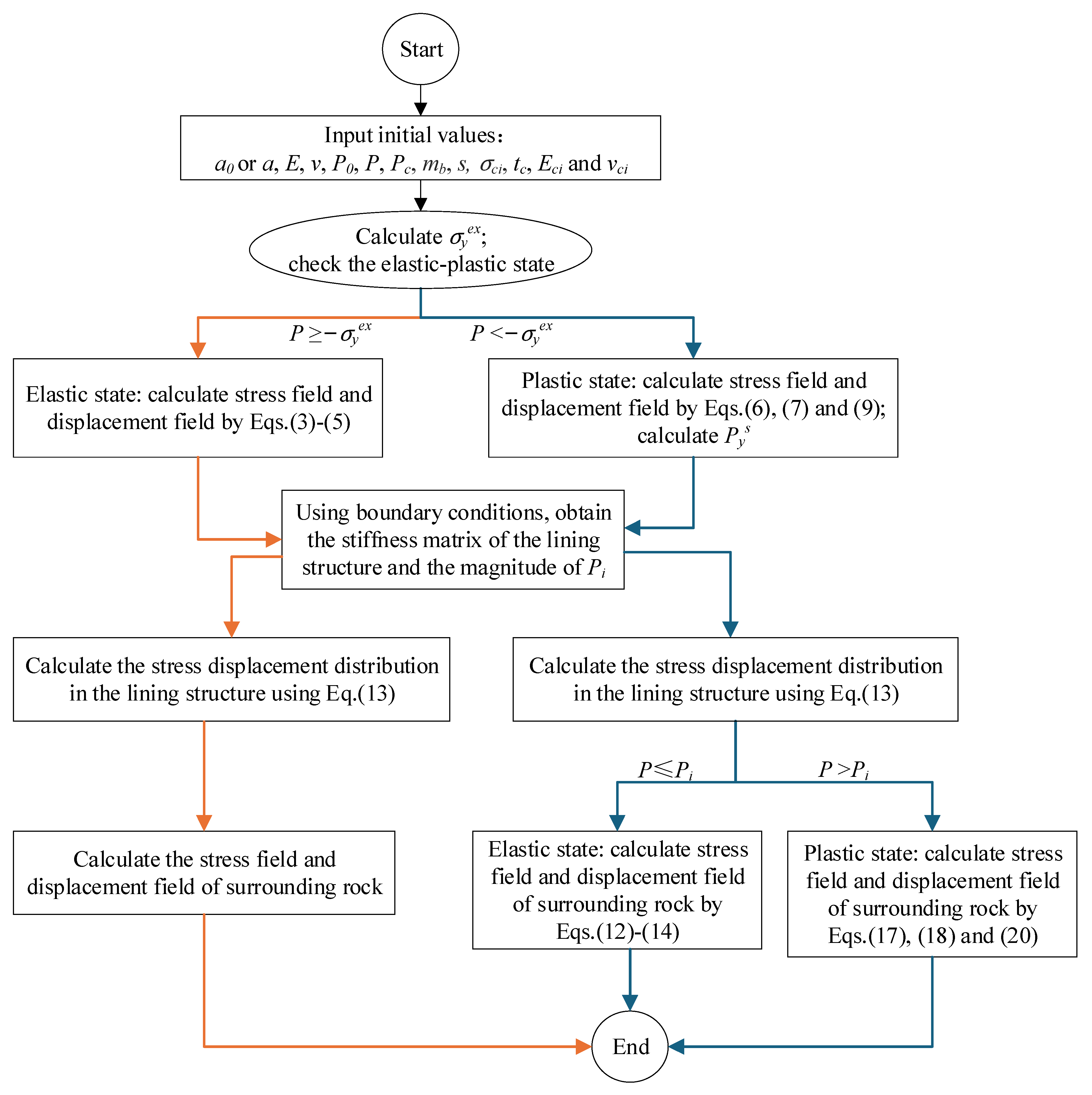
A systematic solution workflow for vertical shaft excavation and construction is illustrated in Figure 3, with different colored connecting lines denoting distinct calculation processes.
  • Input the parameters of the surrounding rock ( m b , s , a ,   E ,   v ,   P 0 , and P ) and the material parameters of each lining layer ( t c , E c i , and v c i ).
  • Compute σ y e x via Equation (8) and determine the elastoplastic state of surrounding rock post-vertical shaft excavation, based on the magnitude comparison between P and σ y e x . Subsequently calculate the post-excavation stress and displacement fields: adopt Equations (3)–(5) for the elastic state and Equations (6), (7) and (9) for the plastic state.
  • Via the lining–surrounding rock interface displacement coordination condition, solve relevant unknowns to obtain the lining stiffness matrix and P i value; compute the stress and displacement distribution in the lining via Equation (13).
  • Determine P y s and evaluate the surrounding rock’s elastoplastic state: for the elastic state, adopt Equations (12)–(14) to calculate the stress and displacement fields; for the plastic state, use Equations (17), (18) and (20) for the same purpose.

3. Results

This study adopts the Hoek–Brown failure criterion for theoretical derivation, as it better matches rock material failure behavior. The core of Hoek–Brown-based calculations is determining its strength parameters (e.g., G S I , m i , and D ); while Hoek [47] proposed a determination method, field measurement of these parameters is difficult and highly empirical. By contrast, Mohr–Coulomb parameters ( φ , c) can be reliably obtained via laboratory tests. Thus, the study uses Hoek’s [40] method to equate Mohr–Coulomb parameters to Hoek–Brown’s m b and s .

3.1. Stress and Displacement Distribution After Excavation

Vertical shaft excavation disrupts the surrounding rock’s in situ stress balance, triggering stress redistribution and displacement field evolution. Such changes are critical to shaft structural stability, construction safety, and long-term operational reliability, with significant engineering value. To this end, a benchmark example is established to analyze the surrounding rock’s stress, displacement, and ground curve response (GCR). Relevant parameters (detailed in Table 1) are used to verify the proposed solution’s applicability. The relatively low elastic modulus used in this example is intentionally selected to represent vertical shaft excavation in poor-quality geological materials—a realistic scenario that also amplifies the surrounding rock deformation for clearer analytical observation.
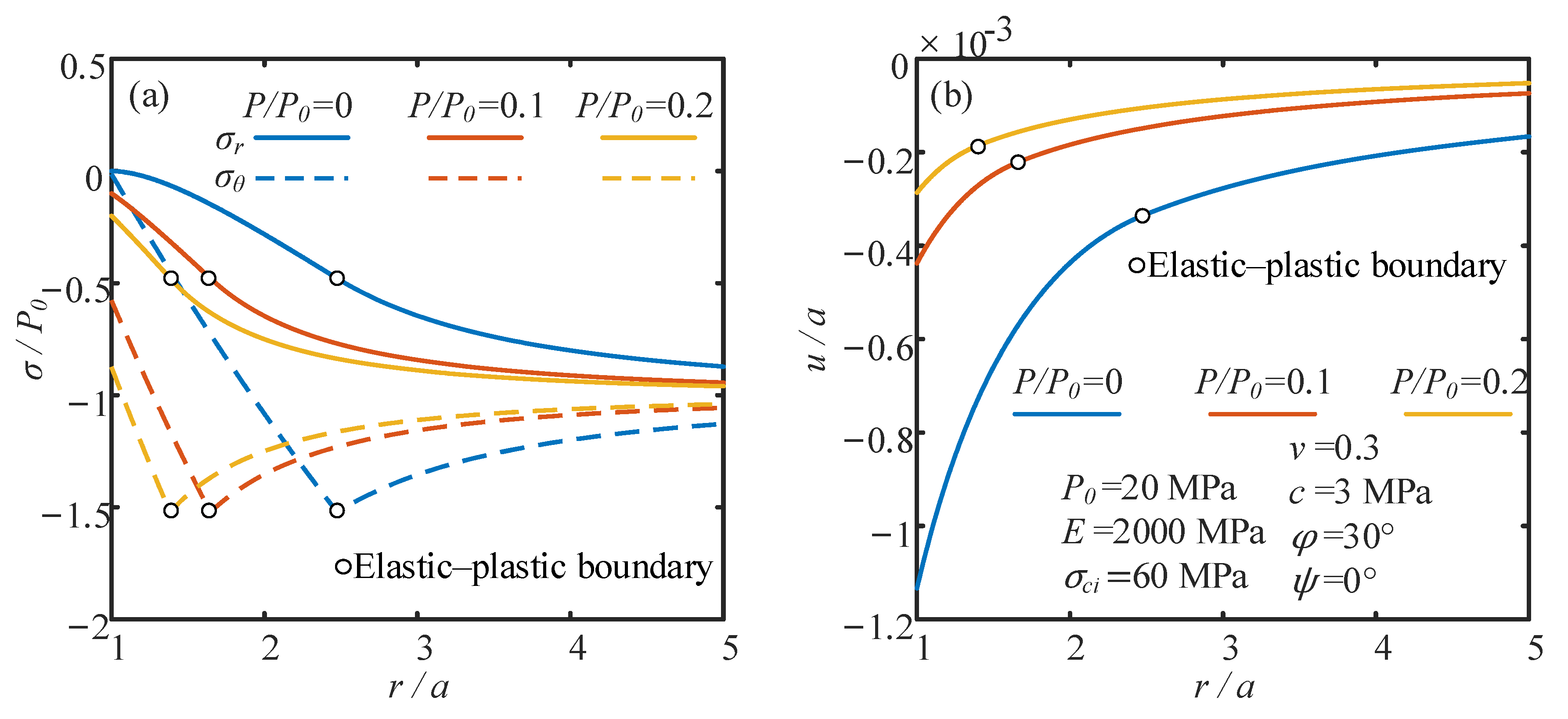
Based on the benchmark example in Table 1, we calculated the stress and displacement of the surrounding rock under different excavation degrees, with results presented in the figure. Notably, the horizontal and vertical coordinates are normalized; the negative σ / P 0 in the stress diagram arises from the adoption of positive tensile stress herein. P / P 0 is negatively correlated with the excavation degree—when P / P 0 = 0 , the surrounding rock’s inner wall is pressure-free (complete excavation).
Figure 4a reveals that excavation triggers the surrounding rock stress redistribution: with increasing radial distance, radial and tangential stresses gradually revert to the initial stress state. All three cases in the example enter the plastic state post-excavation, with the plastic initiation pressure at approximately 0.5 P 0 . As the excavation degree increases, the plastic zone radius expands gradually, and the expansion rate continues to accelerate—this is attributed to the exponential relationship between c and P in Equation (9). Notably, after complete excavation, radial stress varies with the radius in a “slow-fast-slow” trend, which is more prominent near the surrounding rock’s inner wall than in the other two cases, likely due to differences in plastic zone development. The tangential stress peaks at the plastic zone boundary; within the plastic zone, it has a linear relationship with the radius, and the slope of this linear relationship decreases gradually with the increasing excavation degree.
Figure 4b presents the surrounding rock displacement distribution with the radius post-excavation. Evidently, a greater excavation degree induces larger displacement—an intuitive result, as the reduced surrounding rock pressure weakens its displacement constraint capacity. Meanwhile, at the same normalized radius, displacement variation becomes more significant. Generally, displacement change with the radius slows gradually; notably, within the same radius range, the displacement deceleration rate in the plastic zone is higher than that in the elastic zone, because plastic yielding makes the surrounding rock more prone to deformation, leading to a higher displacement change rate.
In summary, an increasing excavation degree causes the nonlinear accelerated expansion of the surrounding rock’s plastic zone, with tangential stress peaking at the plastic zone boundary. Excavation strongly affects stress redistribution: the farther from the shaft wall, the closer the stress is to the in situ state. Furthermore, a greater excavation degree results in larger surrounding rock displacement and a higher displacement attenuation rate with the radius. Notably, the displacement variation rate in the plastic zone is much higher than that in the elastic zone, highlighting plastic deformation’s dominant role in displacement distribution.

3.2. Stress and Displacement Analysis of Shaft Wall and Surrounding Rock

To analyze stress and displacement distribution changes in the lining and surrounding rock after applying pressure to the lining’s inner wall, a calculation example (Table 2) was established, adopting a single-layer C40 concrete lining with thickness t c = 0.5   m ; relevant mechanical parameters are listed in Table 3 [48]; and calculation results are presented in Figure 5.
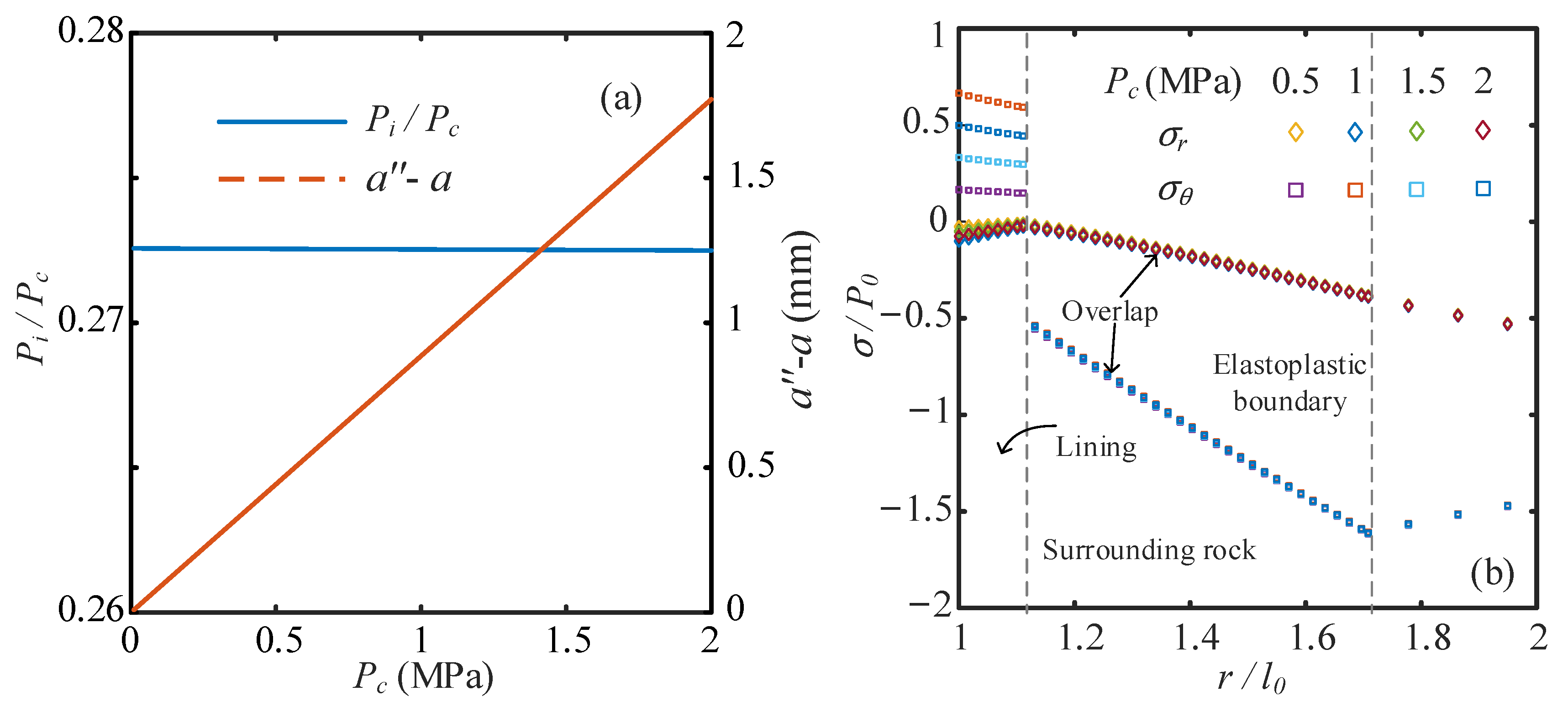
Figure 5a shows the relationship between P i and P c after inner wall lining pressurization, as well as the radial displacement ( a a ) at the lining–surrounding rock interface. As P c increases, the pressure transmission rate ( P i / P c ) shows only a slight decrease with no notable fluctuations, indicating that lining pressure transmission efficiency is an inherent material property and independent of P c magnitude. Meanwhile, the interface displacement ( a a ) rises linearly with P c , proving that both the lining and surrounding rock remain in the elastic deformation stage within this pressure range and undergo coordinated deformation.
Figure 5b depicts stress distribution changes in the lining and surrounding rock after inner wall lining pressurization. Radial stress is continuously distributed across the lining and surrounding rock, stemming from the mechanical constraints of coordinated radial displacement; tangential stress shows a significant jump at their interface, reflecting distinct stress responses caused by differences in material stiffness and stress history. The elastic–plastic boundary in the figure corresponds to that formed post-surrounding rock excavation; after lining support and pressurization, the entire surrounding rock remains elastic, as reverse loading prevents plastic deformation within this pressure range. Additionally, surrounding rock stress changes little with the increasing P c due to the small amount of actual pressure transmitted via the lining. Inside the lining, radial stress is consistently compressive, while tangential stress is tensile—mainly caused by the expansion effect of P c on the lining. Notably, decreasing P c flattens the radial gradient of tangential stress, indicating more uniform stress distribution in the lining.
Results show that the pressure transmission rate varies little with external P c , while lining–surrounding rock interface displacement increases linearly with P c ; radial stress is continuous, but tangential stress jumps sharply at their interface (with tangential tensile stress in the lining); and reducing P c helps flatten the lining’s internal stress gradient and achieve more uniform stress distribution.

4. Discussion

In this section, the research focuses on discussing the impact of parameter variations on the excavation and subsequent support of vertical shafts. In the analysis of this study, the lining is treated as a linear elastic material whose primary function is to exert compressive pressure on the surrounding rock mass. The research focuses on the interaction between the lining and rock mass; the use of standard laboratory-scale concrete constitutes a common and accepted practice for preliminary design and parametric studies. Scale effects pertaining to detailed final structural design fall beyond the theoretical scope of this paper and are therefore not discussed herein.

4.1. Analysis of Vertical Shafts Excavation

4.1.1. Influence of Surrounding Rock Grade on Excavation

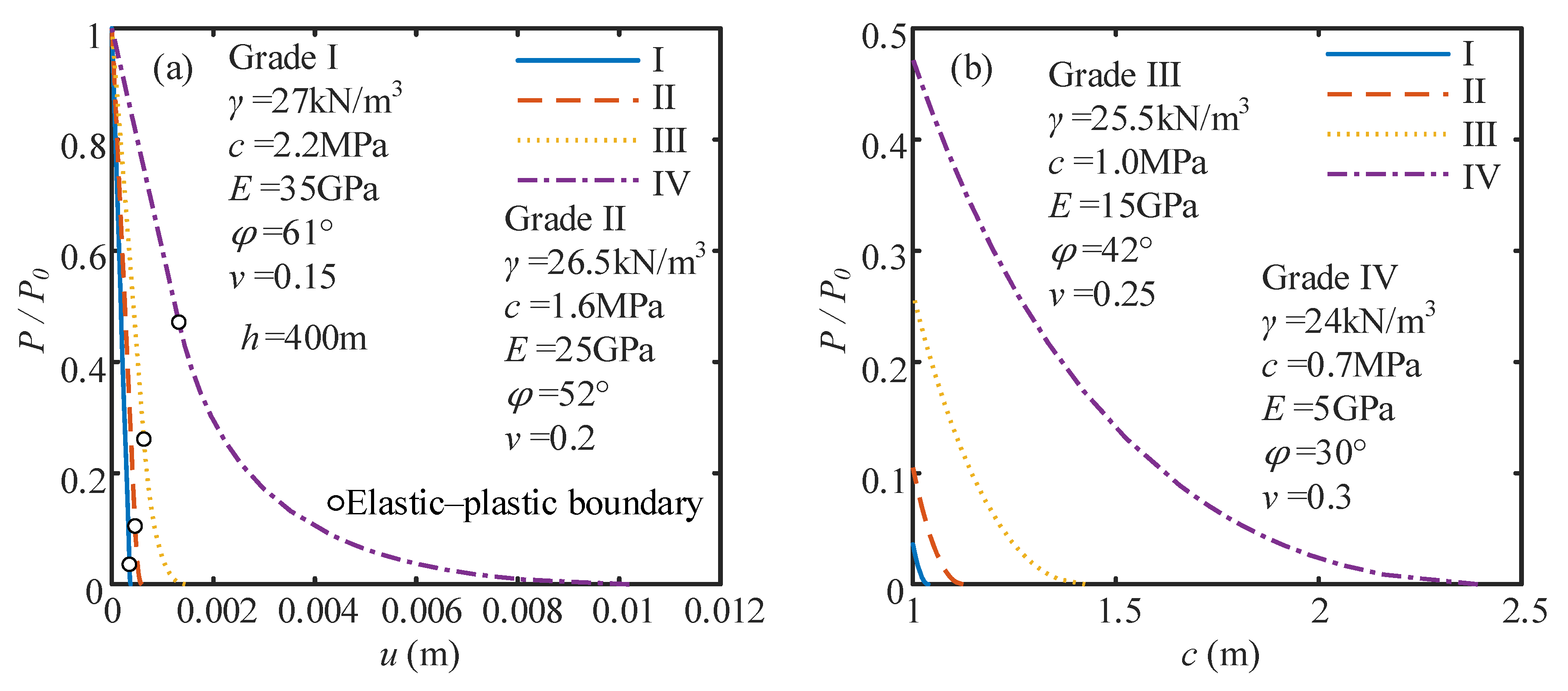
Construction in rock environments involves a complex array of influencing factors. In practical engineering, rock masses are typically classified into Grades I–V (with Grade I being the highest quality), per the standards outlined in [49]. This study focuses on Grades I–IV rock masses to investigate their impacts on vertical shaft excavation; specific rock mass parameters are listed in Table 4, while other parameters remain consistent with those in Table 1.
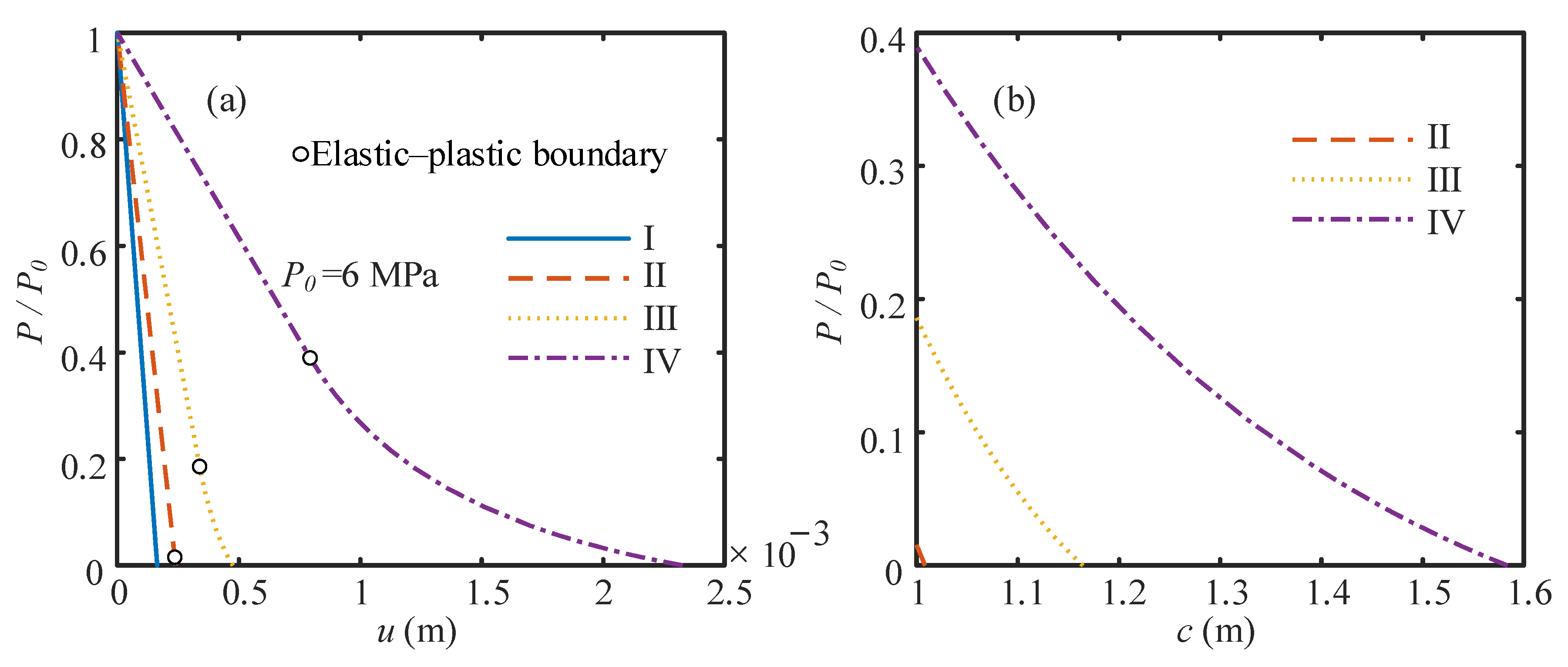
Under the same burial depth, mechanical responses of Grades I–IV surrounding rocks post-vertical shaft excavation were analyzed (results in Figure 6). Better rock quality (higher grade) corresponds to a larger critical plastic displacement and delayed plastic stress onset: Grade I remains nearly elastic, with a minimal plastic zone (if any); Grade II enters the plastic state, but with low stress and a limited zone; and Grade IV yields rapidly at small displacements, showing a sharp stress drop and drastically reduced bearing capacity. In displacement, Grade IV’s final post-excavation displacement is an order of magnitude higher (centimeter-scale) than Grades I–III, which stay at low levels. Its plastic zone radius (approximately 2.4 times the excavation radius) is also the largest, threatening shaft stability, while high-grade rocks have constrained plastic zones. These discrepancies derive from mechanical parameters: high-grade rocks have a higher cohesion, internal friction angle, and elastic modulus, yielding greater strength and deformation resistance, thus inhibiting yielding and plastic zone expansion for stable displacement.
Under the same in situ stress ( 6   M P a ), post-excavation mechanical responses of Grades I–IV surrounding rocks were analyzed (results in Figure 7). Grade I remains nearly elastic without an obvious plastic zone; Grade II forms a plastic zone, but with low pressure and a small radius, barely entering significant plastic deformation. This is mainly because high-quality rock has good integrity and strength, while the low in situ stress does not exceed its elastic limit, thus inhibiting extensive plastic zone development. In displacement, Grade IV’s final post-excavation displacement is about an order of magnitude larger than the other three grades. Curve IV in Figure 7 shows the most prominent pressure drop with increasing displacement, indicating severe bearing capacity attenuation and a fully developed plastic zone. By contrast, Grades I and II have similar, gently declining displacement curves, reflecting good deformation stability. Meanwhile, Grade IV develops a large plastic zone even under low pressure, further confirming its poor mechanical properties.
High-grade surrounding rock (Grades I and II) features high strength and minimal deformation, remaining elastic or developing only minor plastic zones after excavation. In contrast, low-grade, Grade IV surrounding rock rapidly forms an extensive plastic zone (with a radius up to several times the excavation radius), exhibits displacement an order of magnitude larger than Grades I–III, suffers drastic bearing capacity loss, and severely endangers shaft wall stability. Thus, direct full-face excavation is not advisable in a Grade IV rock mass.

4.1.2. Influence of Excavation Depth on Excavation

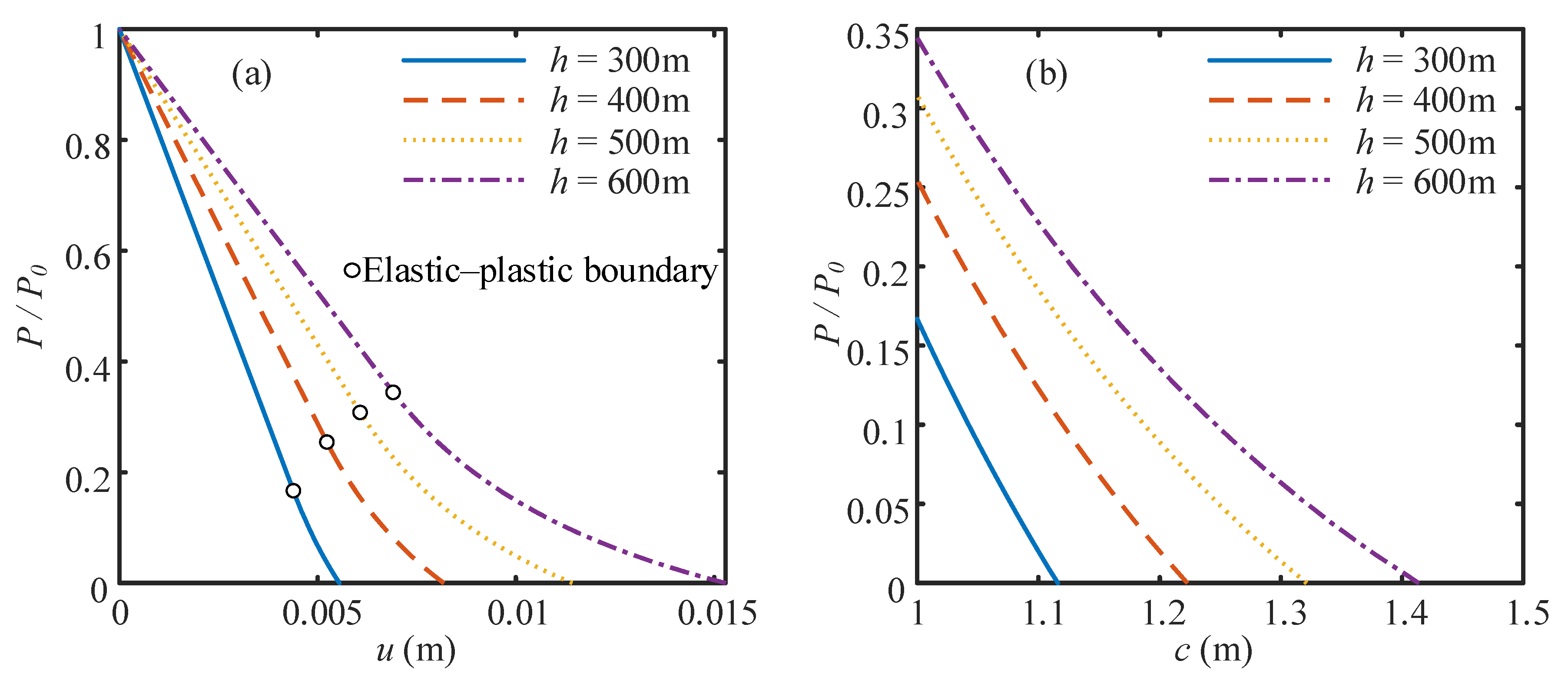
Based on the benchmark example, excavation depth ( h ) was varied in order to investigate variation characteristics of the surrounding rock’s GCR curve. With rock bulk density set to γ = 27   k N / m 3 ), h was assigned values of 300 , 400 , 500 , and 600   m , and calculation results are presented in Figure 8.
Figure 8a depicts the surrounding rock GCR during excavation at different depths. Under all four burial depths, the surrounding rock enters the plastic state post-excavation: prior to plastic yielding, displacement and pressure show a linear correlation (dominated by elastic deformation), while the relationship turns nonlinear after plasticity, with displacement rising sharply as the pressure drops. Notably, greater excavation depth advances the onset of plasticity, yet the rate of this advance slows. This is because deeper burial increases initial in situ stress, requiring a larger reaction force to resist post-excavation displacement; once plasticity initiates, deformation accelerates drastically. Additionally, the final surrounding rock displacement across different depths shows no significant difference after complete excavation, though shallow-depth influences cannot be fully ruled out.
Figure 8b presents the plastic zone radius variation during excavation at varying depths. Greater burial depth triggers earlier plastic initiation and corresponding earlier emergence of the plastic zone radius; meanwhile, the plastic pressure difference between adjacent depths narrows, confirming the aforementioned slowing trend in plastic pressure growth. As the pressure decreases, the plastic zone radius expands at an accelerating rate, and the radius gap between adjacent depths widens gradually. This stems from higher initial in situ stress and larger stress release during the plastic stage for deeper surrounding rock, which amplifies the radius difference between adjacent burial depths as excavation proceeds.
In summary, greater burial depth advances plastic initiation and accelerates plastic zone expansion, resulting in more distinct differences in the plastic zone extent between adjacent depths. This indicates that the surrounding rock is more susceptible to plastic deformation in high-stress environments—deeper excavation causes more significant deformation and larger plastic zones, severely threatening shaft wall stability and increasing support design difficulty and requirements.

4.1.3. Influence of After-Excavation Radius on Excavation

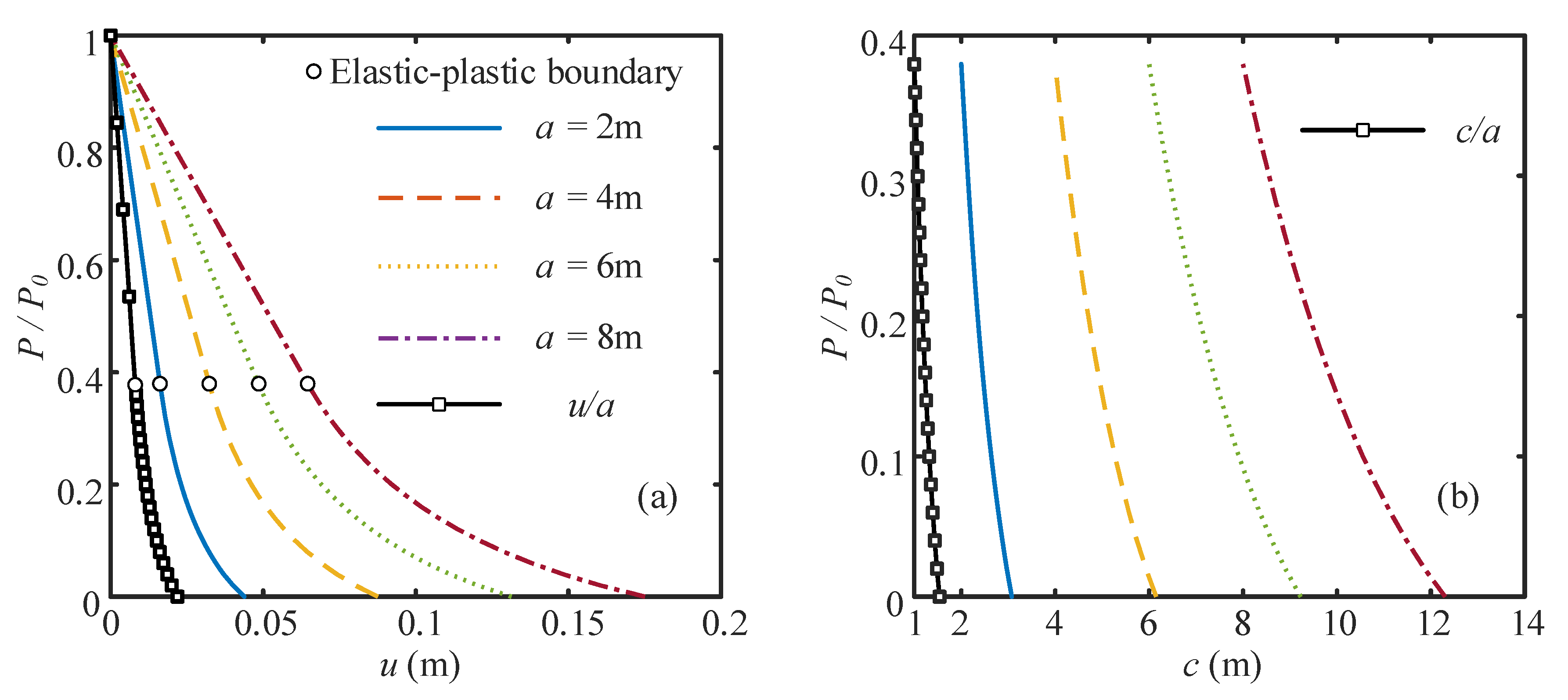
The vertical shaft radius varies with design, requiring the analysis of surrounding rock mechanical responses under different excavation radii. Based on the benchmark example, with excavation radii of 2 , 4 , 6 , and 8   m , results are in Figure 9.
Notably, the surrounding rock plastic pressure remains consistent regardless of the post-excavation radius a —this is because the plastic pressure calculation in Equation (8) is independent of a . Meanwhile, larger a induces a greater final post-excavation displacement, as it corresponds to a wider unloading zone and more radial deformation release; displacement differences between adjacent curves gradually diminish, with consistent variation trends. As a increases, the plastic zone radius variation curve becomes gentler, but its growth rate accelerates, while no significant radius difference exists between adjacent curves at the same pressure. Importantly, normalized displacement and plastic zone radius curves overlap completely, confirming that a is merely a geometric scale factor that does not alter their relative distribution laws. The two exhibit “self-similarity”: relative deformation ( u / a ) and relative plastic zone range ( c / a ) depend solely on rock mass mechanical properties and the stress state, independent of the absolute size of the excavation space.
Surrounding rock plastic pressure remains consistent across different excavation radii a ; a merely acts as a geometric scale factor and does not alter the relative distribution pattern of the rock mass mechanical field.

4.2. Reload Analysis of Shaft Wall on Surrounding Rock

4.2.1. Influence of Different Rock Mass Grades

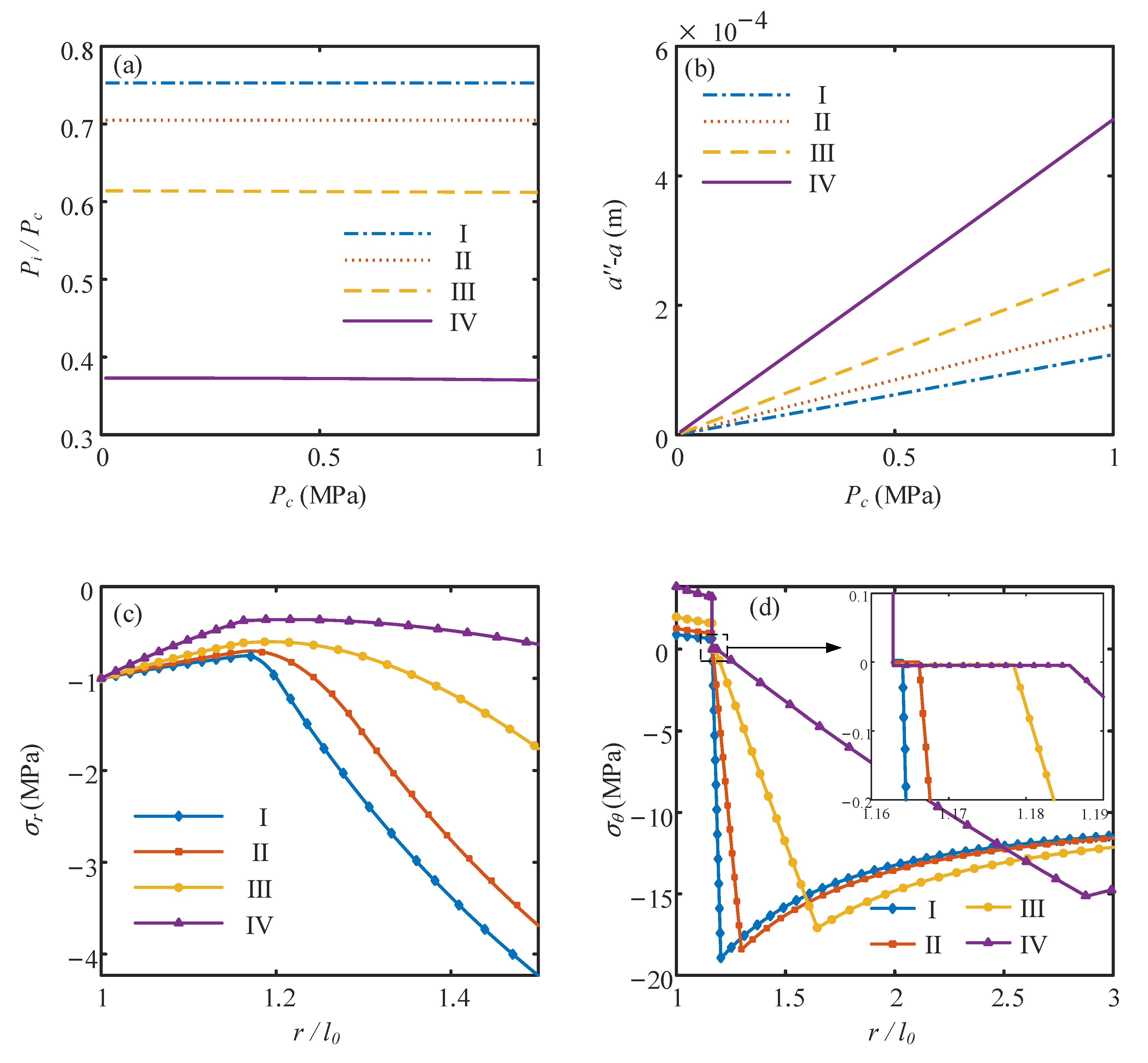
To analyze the effect of different rock grades on the structure, P 0 was adjusted to 10   M P a based on Table 2 parameters, and four rock grades from Table 4 were adopted for analysis; the P c range was also modified to 0 1   M P a (subsequent analyses are based on this range), with results presented in Figure 10.
As the rock mass grade increases, the pressure transmission rate rises gradually with a diminishing growth rate; higher grades are more conducive to pressure transmission. This is because high-grade surrounding rock has a superior quality, enabling better pressure-bearing synergy with the lining, and notable differences exist between rock grades. Despite having the lowest pressure transmission rate, Grade IV surrounding rock exhibits the largest lining–surrounding rock interface displacement, likely due to excessive deformation caused by its poor quality.
Figure 10c,d depict stress distribution variations. The lining radial stress remains free of tensile stress, and lower-grade surrounding rock exhibits more uniform stress distribution. By contrast, tangential stress is tensile, decreasing with the rising rock mass grade but with a diminishing reduction rate: the maximum tangential tensile stress at the lining’s inner wall is approximately 3.8   M P a for Grade IV surrounding rock and approximately 0.8   M P a for Grade I rock, which is a 78.9% reduction. Improved rock mass grade effectively lowers tensile stress and prevents excessive crack formation. Notably, plastic zones form in the surrounding rock after excavation and lining support, with smaller plastic zone extents corresponding to higher rock grades (better surrounding rock quality). Additionally, the shear stress in plastic zones is near zero, which undermines surrounding rock stability.
In conclusion, the rock mass grade exerts a significant influence on vertical shaft excavation and subsequent support. Higher rock mass grades notably improve pressure transmission efficiency between the lining and surrounding rock, reduce tangential tensile stress in the lining, and drastically decrease displacement at their interface. High-quality surrounding rock also helps control the plastic zone extent, though tangential stress may still induce tensile stress in the lining.

4.2.2. Influence of Different Shaft Wall Thicknesses

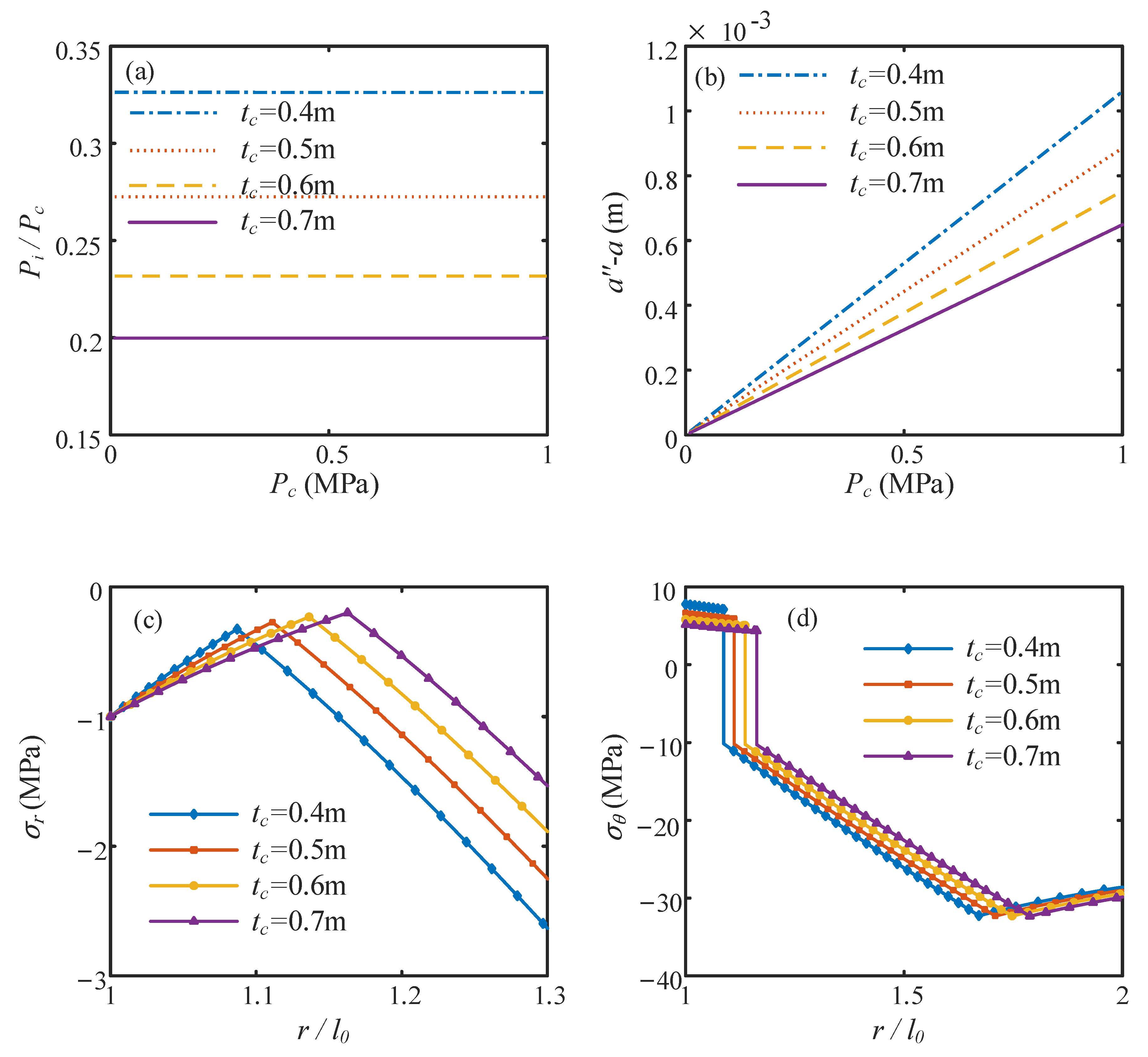
To analyze the effect of varying concrete lining thicknesses on the structure, four thicknesses ( t c = 0.4 , 0.5 , 0.6 , and 0.7   m ) were adopted for analysis based on Table 2 parameters, with results presented in Figure 11.
As lining thickness t c increases, the pressure transmission rate rises gradually; thinner linings are more conducive to pressure transmission, though differences across thicknesses are insignificant. This is because thicker linings bear a larger pressure proportion, reducing the pressure transmitted to the surrounding rock—consistent with Figure 11b, which shows that the lining–surrounding rock interface displacement decreases with increasing t c .
Figure 11c,d depict stress distribution variations. The concrete lining exhibits no radial tensile stress, while its tangential stress is tensile and decreases with increasing lining thickness t c (with a diminishing reduction rate). At the lining’s inner wall, maximum tensile stress drops from approximately 7.78   M P a (for t c = 0.4   m ) to 5.14   M P a (for t c = 0.7   m ), a 33.9 % reduction, demonstrating that thicker linings effectively mitigate tensile stress and suppress excessive crack formation. The surrounding rock stress distribution trend is essentially consistent with that post-excavation.
Increasing lining thickness reduces the pressure transmission rate and interface displacement, with its influence gradually diminishing; meanwhile, it significantly lowers the maximum tensile stress on the lining’s inner wall, effectively enhancing the structure’s crack resistance.

4.2.3. Influence of Composite Shaft Wall

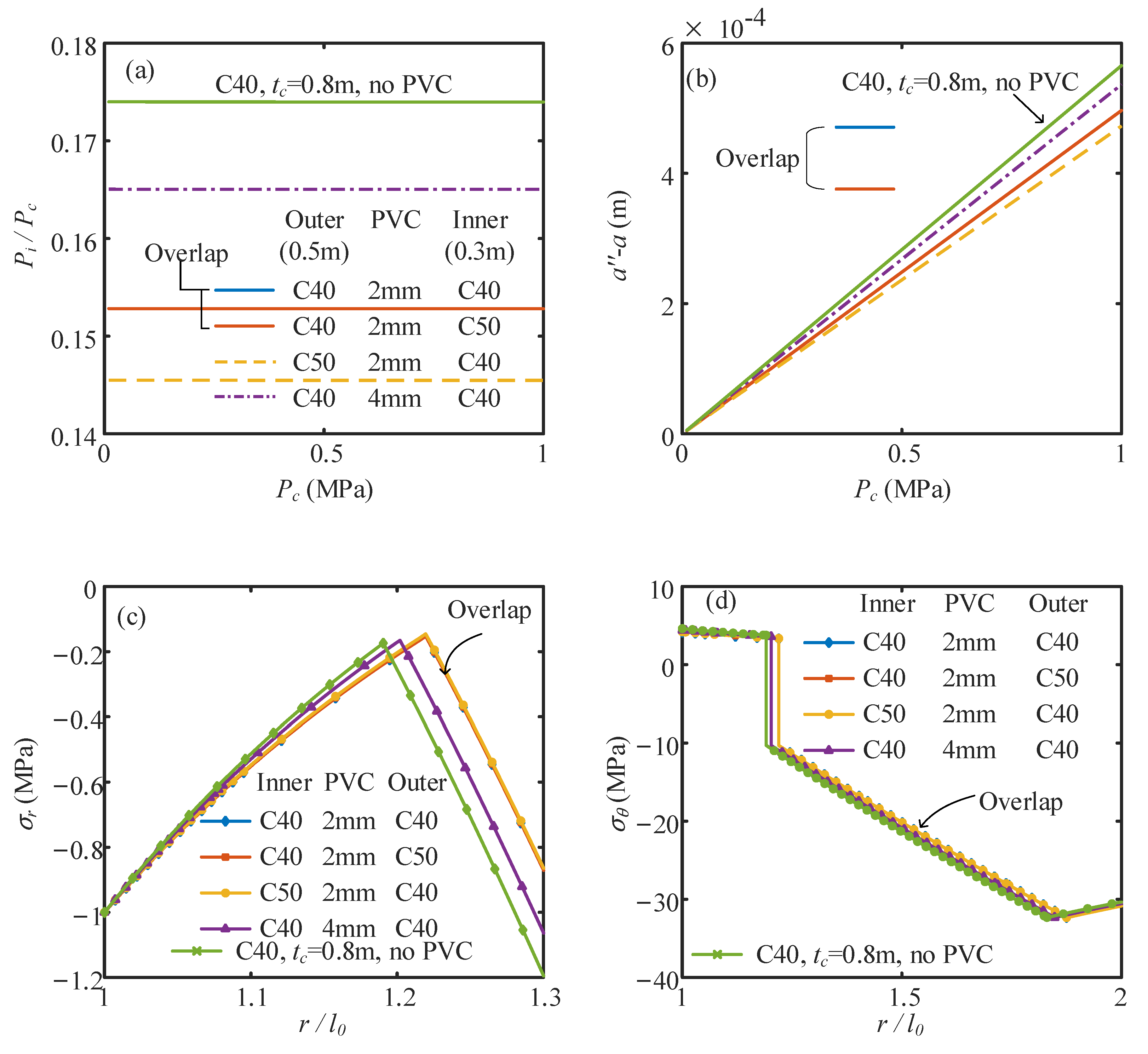
After vertical shaft excavation, lining support can employ either single-layer concrete or composite lining (e.g., a PVC layer between two concrete layers). The PVC layer has a uniaxial compressive strength of 30   M P a , elastic modulus E = 300   M P a , and Poisson’s ratio v = 0.3 . To study the impacts of the PVC layer and inner/outer concrete grades on the structure, five scenarios were analyzed, with results shown in Figure 12.
Under otherwise identical conditions, a PVC interlayer reduces the pressure transmission rate and corresponding interface displacement; a thinner PVC layer further lowers both parameters (owing to a stronger pressure absorption capacity). Increasing only the inner concrete grade has negligible effects on the transmission rate and interface displacement, while raising only the outer concrete grade reduces both—an effect equivalent to swapping inner and outer concrete grades. No notable differences in structural stress distribution are observed across the five design scenarios; the PVC layer slightly mitigates the lining stress gradient but has limited impact on the lining’s tensile stress.
Analysis confirms that a PVC interlayer in composite linings effectively reduces the pressure transmission rate and interface displacement, with effects strengthening with the decreased PVC thickness. In contrast, the inner concrete grade has little influence, while the outer concrete grade is key to optimizing transmission and deformation performance. Overall, lining configurations (PVC layer, thickness, and concrete grade) exert limited impacts on stress distribution; the PVC layer moderately eases internal stress gradients but does not notably improve the lining’s tensile stress state.

4.2.4. Influence of Different Concrete Grades

To analyze the effect of concrete grades on the structure, four concrete grades from Table 3 were adopted for analysis based on Table 2 parameters. Analysis findings indicate that concrete grade variation exerts no influence on structural stress changes, with its effect on pressure and displacement at the lining–surrounding rock interface being negligible.

4.3. Structural Safety Factor Analysis

To ensure the overall safety and stability of the shaft wall structure, the third strength theory is adopted to judge whether the concrete strength has failed.
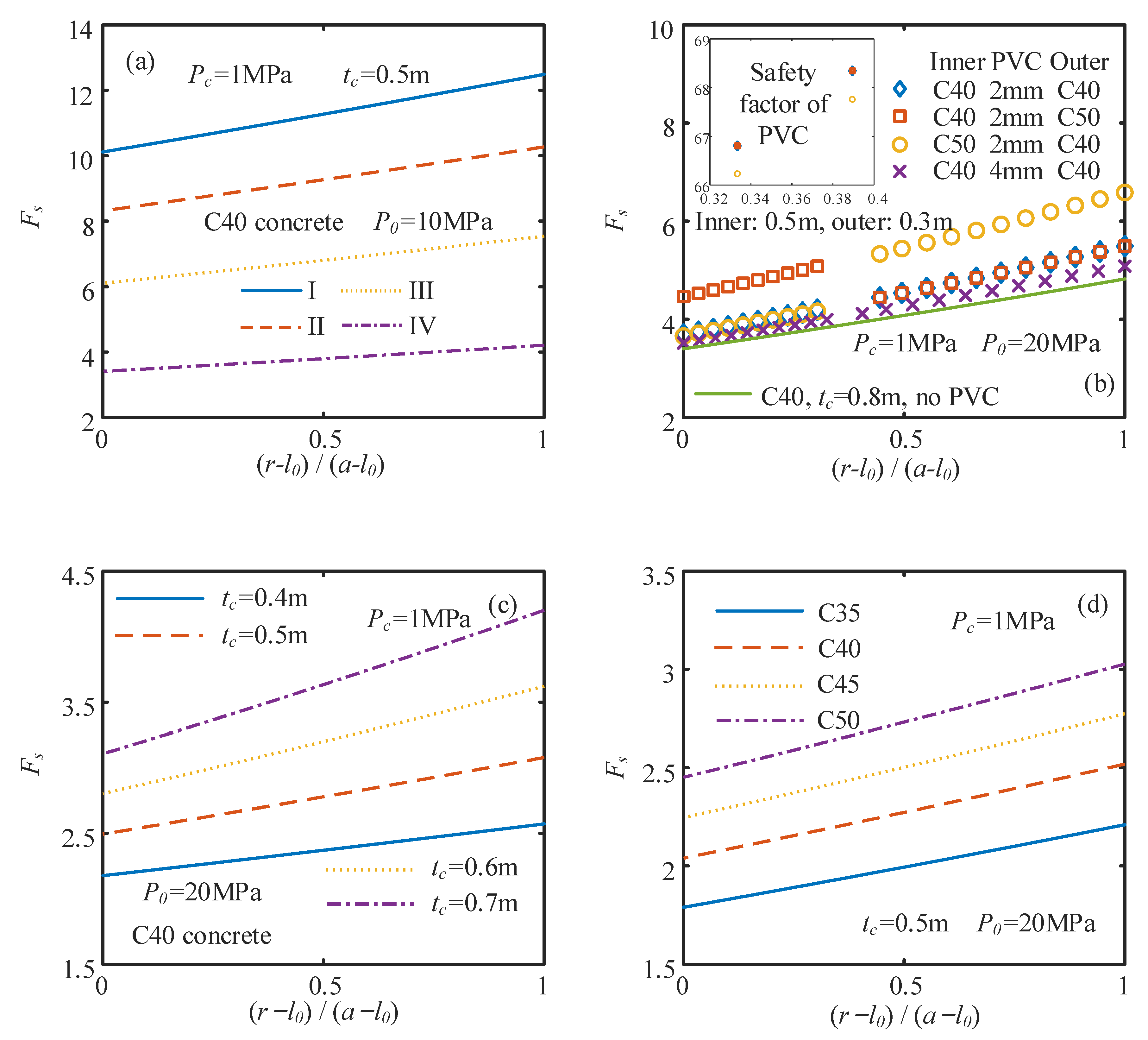
Safety factor analysis was performed based on Figure 13’s calculation conditions and results. The horizontal axis was normalized to clarify the safety factor distribution in the lining. Key findings: Safety factors exceeded one under all conditions (meeting safety requirements) and increased steadily from the lining’s inner to outer wall, identifying the inner wall as the structural weak link and a key control section for strength design and safety assessment.
Figure 13a shows the safety factor distribution across rock mass grades: the lining’s safety factors rose with surrounding rock quality but with diminishing improvement. High-quality rock bears more load, reducing stress on the lining. Notably, higher rock grades led to a more significant relative increase in the outer wall’s safety factor compared to the inner wall, linked to pressure transmission changes in the rock–lining system.
Figure 13b demonstrates that composite linings with a PVC interlayer had higher safety factors than same-thickness, single-layer linings, as the PVC layer effectively shared the pressure. The PVC layer itself maintained a much higher and stable safety factor than concrete. When inner and outer concrete strengths differed, the lower-strength layer showed higher safety, supporting a “low inner, high outer” concrete configuration for optimized stress performance.
Figure 13c,d illustrate the effects of concrete thickness and grade. Increasing thickness significantly improved safety factors: inner wall from approximately 2.18 to 3.12   ( 43.1 % increase), outer wall from approximately 2.57   t o   4.19   ( 63.0 % increase); outer wall improvements were more notable, with proportional increases for both walls when thickness was uniformly raised. Higher concrete grades also enhanced the safety (due to greater shear strength) without altering the stress distribution. Economically, high-grade concrete is more cost-effective than simply thickening the lining, balancing safety and cost.
In summary, the lining’s inner wall is the shaft’s weak point, influenced by the rock grade, lining type (single or composite), concrete thickness, and strength. To improve safety, high-grade rock support, composite linings, “low inner, high outer” concrete, and high-strength concrete should be prioritized—achieving a balance of economics and safety.

5. Conclusions

To address the limitations of traditional support systems and linear yield criteria in deep vertical shaft stability analysis, this study takes the cavity contraction–expansion mechanism as the core clue, integrates the Hoek–Brown nonlinear yield criterion, large-strain theory, and non-associated flow rule, and establishes a systematic analytical framework for shaft excavation–support and a coupling analysis method for composite shaft wall–surrounding rock interaction. Key conclusions are as follows:
  • The proposed analytical framework accurately characterizes rock mass nonlinearity during shaft excavation. Excavation triggers stress redistribution in surrounding rock (tangential stress peaks at the elastoplastic boundary), and the plastic zone radius expands in a nonlinear, accelerated manner with the excavation degree, with plastic deformation dominating the displacement distribution. Rock mass grade and excavation depth are core stability-controlling factors: high-grade rock masses (Grades I–II) maintain good stability with minor deformation, while Grade IV rock forms extensive plastic zones and large displacements; deeper excavation advances plastic initiation and enlarges the plastic zone extent. Additionally, surrounding rock displacement and plastic zone range show self-similarity with the excavation radius, unrelated to the absolute excavation size.
  • The lining inner wall is the structural weak link. Increasing lining thickness is the most direct measure to reduce inner wall tensile stress and improve safety; high-grade surrounding rock can also effectively lower lining tensile stress and interface displacement. The concrete grade has negligible impacts on structural stress distribution, but higher-grade concrete enhances material safety margins in an economical way.
  • Composite linings with PVC interlayers optimize the support performance by reducing the pressure transmission rate and interface displacement and mitigating internal stress gradients; the “low inner, high outer” concrete configuration further improves the stress state of composite linings.
  • Shaft support should follow the “surrounding rock-support integration” principle. For high-stress or weak rock conditions, a combined strategy of high-strength concrete, optimized composite lining, and appropriate thickness increase is recommended, and full-face excavation in Grade IV rock masses should be avoided to ensure construction safety and long-term stability.
In summary, this study realizes the organic integration of cavity contraction–expansion theory and deep shaft engineering, and the proposed analysis method and research conclusions enrich the theoretical system of shaft engineering and provide a reliable basis for the design and construction of deep vertical shafts in underground energy storage, mineral exploitation, and other fields. Future research can further consider the time-dependent creep effect of weak rock masses, stress anisotropy effect of the dilatancy coefficient, and the dynamic response of shafts under construction disturbance to improve the applicability of the framework in complex engineering scenarios.

Author Contributions

Conceptualization: X.-S.D. and F.-S.Y.; Methodology: F.-S.Y. and P.-Q.M.; Software: J.J.; Validation: X.-S.D.; Formal Analysis: J.J., P.-H.X. and Y.W.; Investigation: P.-Q.M.; Data Curation: Y.W. and P.-H.X.; Writing—Original Draft: J.J. and P.-H.X.; Writing—Review and Editing: X.-S.D., Y.W., F.-S.Y., H.-Y.H. and P.-Q.M.; Visualization: H.-Y.H. and Y.W.; Resources: X.-S.D.; Supervision: F.-S.Y.; Project Administration: X.-S.D., H.-Y.H. and Y.W. All authors have read and agreed to the published version of the manuscript.

Funding

This research was funded by special support for major science and technology of China coal grant number 20231by001.

Institutional Review Board Statement

Not applicable.

Informed Consent Statement

Not applicable.

Data Availability Statement

The original contributions presented in this study are included in the article. Further inquiries can be directed to the corresponding author.

Conflicts of Interest

All authors were employed by the company China Coal No.5 Construction Co., Ltd. the No.3 Engineering Division and China Coal Mine Construction Group Co., Ltd. Authors declare that the research was conducted in the absence of any commercial or financial relationships that could be construed as a potential conflict of interest.

Abbreviations

PVCPolyvinyl chloride
GCRGround curve response

References

  1. Bartela, Ł.; Ochmann, J.; Waniczek, S.; Lutyński, M.; Smolnik, G.; Rulik, S. Evaluation of the Energy Potential of an Adiabatic Compressed Air Energy Storage System Based on a Novel Thermal Energy Storage System in a Post Mining Shaft. J. Energy Storage 2022, 54, 105282. [Google Scholar] [CrossRef]
  2. Kołodziej, K. Design of a Shaft Foot as a Supporting Element of the Thermal Energy Storage in Adiabatic CAES Concept in Post-Mining Shaft. IOP Conf. Ser. Earth Environ. Sci. 2023, 1132, 012010. [Google Scholar] [CrossRef]
  3. Kulpa, J.; Kamiński, P.; Stecuła, K.; Prostański, D.; Matusiak, P.; Kowol, D.; Kopacz, M.; Olczak, P. Technical and Economic Aspects of Electric Energy Storage in a Mine Shaft—Budryk Case Study. Energies 2021, 14, 7337. [Google Scholar] [CrossRef]
  4. Ma, F.; Deng, Q.; Cunningham, D.; Yuan, R.; Zhao, H. Vertical Shaft Collapse at the Jinchuan Nickel Mine, Gansu Province, China: Analysis of Contributing Factors and Causal Mechanisms. Environ. Earth Sci. 2013, 69, 21–28. [Google Scholar] [CrossRef]
  5. Shang, X.; Zhu, S.; Jiang, F.; Liu, J.; Li, J.; Hitch, M.; Liu, H.; Tang, S.; Zhu, C. Study on Dynamic Disaster Mechanisms of Thick Hard Roof Induced by Hydraulic Fracturing in Surface Vertical Well. Minerals 2022, 12, 1537. [Google Scholar] [CrossRef]
  6. Sun, Z.; Zhao, C.; Xing, J.; Huang, R.; Luo, Q.; Chen, H.; Niu, J. Elastic and Elastoplastic Analysis of Surrounding Rock in CAES Chambers Considering Excavation-Induced Centripetal Exponential Reduction in Mechanical Properties. Deep Undergr. Sci. Eng. 2025, 4, 582–596. [Google Scholar] [CrossRef]
  7. Yang, D.; Dong, S.; He, M.; Zhang, Z.; Du, T.; Ji, W. Experimental Study on the Performance of Hybrid Ventilation System Combining Forced Longitudinal Flow and Shaft Natural Ventilation in Tunnels. Tunn. Undergr. Space Technol. 2020, 103, 103491. [Google Scholar] [CrossRef]
  8. Xie, H.; Lv, H. Simulation of Slightly Degraded Reinforced Concrete Shaft Lining in Thick Topsoil. Teh. Vjesn.-Tech. Gaz. 2020, 27, 611–617. [Google Scholar] [CrossRef]
  9. Yu, P.; Liu, H.; Wang, Z.; Fu, J.; Zhang, H.; Wang, J.; Yang, Q. Development of Urban Underground Space in Coastal Cities in China: A Review. Deep Undergr. Sci. Eng. 2023, 2, 148–172. [Google Scholar] [CrossRef]
  10. Judeel, G.; Keyter, G.; Harte, N. Shaft Sinking and Lining Design for a Deep Potash Shaft in Squeezing Ground. In Proceedings of the 12th ISRM Congress, Beijing, China, 16–21 October 2011. [Google Scholar] [CrossRef]
  11. Ma, Z.; Sun, J.; Gong, P.; Yan, P.; Cui, N.; Zhang, R. Study on Creep Deformation and Energy Development of Underground Surrounding Rock under Four-Dimensional Support. Deep Undergr. Sci. Eng. 2024, 3, 25–38. [Google Scholar] [CrossRef]
  12. Wang, P.; Zhou, G. Frost-Heaving Pressure in Geotechnical Engineering Materials during Freezing Process. Int. J. Min. Sci. Technol. 2018, 28, 287–296. [Google Scholar] [CrossRef]
  13. Dias, T.G.S.; Farias, M.M.; Assis, A.P. Large Diameter Shafts for Underground Infrastructure. Tunn. Undergr. Space Technol. 2015, 45, 181–189. [Google Scholar] [CrossRef]
  14. Ozturk, H.; Guler, E. A Methodology for Lining Design of Circular Mine Shafts in Different Rock Masses. Int. J. Min. Sci. Technol. 2016, 26, 761–768. [Google Scholar] [CrossRef]
  15. Chen, B.; Mo, P.; Lu, Z.; Kuang, L.; Zhang, Q.; Eslami, A. Semi-Analytical Solution for the Stability of Deep Vertical Shaft Considering Time-Dependent Rock-Structure Interaction. Deep Undergr. Sci. Eng. 2025, 1–20. [Google Scholar] [CrossRef]
  16. Cho, J.; Lim, H.; Jeong, S.; Kim, K. Analysis of Lateral Earth Pressure on a Vertical Circular Shaft Considering the 3D Arching Effect. Tunn. Undergr. Space Technol. 2015, 48, 11–19. [Google Scholar] [CrossRef]
  17. Li, W.P.; Li, X.Q. Mechanism of Rupture of Shaft Linings in Coal Mine Areas Buried by Thick Over-Soils in East China. Géotechnique 2005, 55, 237–244. [Google Scholar] [CrossRef]
  18. Wang, Y.S.; Yang, R. Monitoring and Analysis of the Stress and Deformation of Shaft Lining and the Influence of Freezing Tube Fracture in Deep Topsoil. Cold Reg. Sci. Technol. 2022, 193, 103420. [Google Scholar] [CrossRef]
  19. Wu, Y.; Zhu, S.; Li, X.; Zhang, H.; Huang, Z. Distribution Characteristics of the Additional Vertical Stress on a Shaft Wall in Thick and Deep Alluvium: A Simulation Analysis. Nat. Hazards 2019, 96, 353–368. [Google Scholar] [CrossRef]
  20. Zhao, C.; Wang, Y.-B.; Zhao, C.; Wu, Y.; Fei, Y. Analysis of Drained Cavity Unloading–Contraction Considering Different Degrees of Intermediate Principal Stress with Unified Strength Theory. Int. J. Geomech. 2020, 20, 04020086. [Google Scholar] [CrossRef]
  21. Celestino, T.B.; Rocha, H.C.; Gonçalves, F.L. Geotechnical Aspects of Shaft Design and Construction in São Paulo City. In World Tunnel Congress; Hungarian Tunnelling Association: Budapest, Hungary, 2009. [Google Scholar]
  22. Hao, Y.; Liu, C.; Wu, Y.; Pu, H.; Chen, Y.; Shen, L.; Li, G. Numerical Modeling on Strain Energy Evolution in Rock System Interaction with Energy-Absorbing Prop and Rock Bolt. Int. J. Min. Sci. Technol. 2023, 33, 1273–1288. [Google Scholar] [CrossRef]
  23. Sun, Q.; Ma, F.; Guo, J.; Li, G.; Feng, X. Deformation Failure Mechanism of Deep Vertical Shaft in Jinchuan Mining Area. Sustainability 2020, 12, 2226. [Google Scholar] [CrossRef]
  24. Walton, G.; Kim, E.; Sinha, S.; Sturgis, G.; Berberick, D. Investigation of Shaft Stability and Anisotropic Deformation in a Deep Shaft in Idaho, United States. Int. J. Rock Mech. Min. Sci. 2018, 105, 160–171. [Google Scholar] [CrossRef]
  25. Bishop, R.F.; Hill, R.; Mott, N.F. The Theory of Indentation and Hardness Tests. Proc. Phys. Soc. 1945, 57, 147. [Google Scholar] [CrossRef]
  26. Hill, R. Mathematical Theory of Plasticity; Oxford University Press: Oxford, UK, 1950. [Google Scholar]
  27. Gibson, R.E.; Anderson, W.F. In Situ Measurement of Soil Properties with the Pressuremeter. Civ. Engrg. Pub. Wks. Rev. 1961, 56, 615–618. [Google Scholar]
  28. Chadwick, P. The Quasi-Static Expansion of a Spherical Cavity in Metals and Ideal Soils. Q. J. Mech. Appl. Math. 1959, 12, 52–71. [Google Scholar] [CrossRef]
  29. Shuttle, D. Cylindrical Cavity Expansion and Contraction in Tresca Soil. Géotechnique 2007, 57, 305–308. [Google Scholar] [CrossRef]
  30. Detournay, E. Elastoplastic Model of a Deep Tunnel for a Rock with Variable Dilatancy. Rock Mech. Rock Eng. 1986, 19, 99–108. [Google Scholar] [CrossRef]
  31. Yu, H.S.; Houlsby, G.T. Finite Cavity Expansion in Dilatant Soils: Loading Analysis. Géotechnique 1991, 41, 173–183. [Google Scholar] [CrossRef]
  32. Durban, D.; Fleck, N.A. Spherical Cavity Expansion in a Drucker-Prager Solid. J. Appl. Mech. 1997, 64, 743–750. [Google Scholar] [CrossRef]
  33. Matsuoka, H.; Sun, D. Extension of Spatially Mobilized Plane (SMP) to Frictional and Cohesive Materials and Its Application to Cemented Sands. Soils Found. 1995, 35, 63–72. [Google Scholar] [CrossRef]
  34. Chen, S.L.; Abousleiman, Y.N. Exact Undrained Elasto-Plastic Solution for Cylindrical Cavity Expansion in Modified Cam Clay Soil. Géotechnique 2012, 62, 447–456. [Google Scholar] [CrossRef]
  35. Silvestri, V.; Abou-Samra, G. Analytical Solution for Undrained Plane Strain Expansion of a Cylindrical Cavity in Modified Cam Clay. Geomech. Eng. 2012, 4, 19–37. [Google Scholar] [CrossRef]
  36. Li, G.-Y.; Mo, P.-Q.; Yang, H.; Yu, H.-S.; Qin, Y.-J. Undrained Cavity Expansion–Contraction Analysis in CASM and Its Application for Pressuremeter Tests. Can. Geotech. J. 2025, 62, 1–19. [Google Scholar] [CrossRef]
  37. Li, G.-Y.; Mo, P.-Q.; Lu, Z.; Yuan, R.; Yang, H.; Yu, H.-S. Drained Cavity Expansion-Contraction in CASM and Its Application for Pressuremeter Tests in Sands. J. Geotech. Geoenviron. Eng. 2024, 150, 04024073. [Google Scholar] [CrossRef]
  38. Mo, P.-Q.; Yu, H.-S. Drained Cavity Expansion Analysis with a Unified State Parameter Model for Clay and Sand. Can. Geotech. J. 2018, 55, 1029–1040. [Google Scholar] [CrossRef]
  39. Hoek, E.; Brown, E.T. Empirical Strength Criterion for Rock Masses. J. Geotech. Eng. Div. 1980, 106, 1013–1035. [Google Scholar] [CrossRef]
  40. Hoek, E.; Carranza-Torres, C.; Corkum, B.; Corkum, B. Hoek-Brown Failure Criterion—2002 Edition; Proc. NARMS-TAC Conference: Toronto, Canada, 2002; Volume 1, pp. 267–273. [Google Scholar]
  41. Carranza-Torres, C. Elasto-Plastic Solution of Tunnel Problems Using the Generalized Form of the Hoek-Brown Failure Criterion. Int. J. Rock Mech. Min. Sci. 2004, 41, 629–639. [Google Scholar] [CrossRef]
  42. Sharan, S.K. Elastic–Brittle–Plastic Analysis of Circular Openings in Hoek–Brown Media. Int. J. Rock Mech. Min. Sci. 2003, 40, 817–824. [Google Scholar] [CrossRef]
  43. Gharsallaoui, H.; Jafari, M.; Holeyman, A. Cavity Expansion in Rock Masses Obeying the “Hoek–Brown” Failure Criterion. Rock Mech. Rock Eng. 2020, 53, 927–941. [Google Scholar] [CrossRef]
  44. Mo, P.-Q.; Fang, Y.; Yu, H.-S. Benchmark Solutions of Large-Strain Cavity Contraction for Deep Tunnel Convergence in Geomaterials. J. Rock Mech. Geotech. Eng. 2020, 12, 596–607. [Google Scholar] [CrossRef]
  45. Sharan, S.K. Exact and Approximate Solutions for Displacements around Circular Openings in Elastic–Brittle–Plastic Hoek–Brown Rock. Int. J. Rock Mech. Min. Sci. 2005, 42, 542–549. [Google Scholar] [CrossRef]
  46. Xu, C.; Xia, C.; Du, S. Simplified Solution for Viscoelastic-Plastic Interaction between Tunnel Support and Surrounding Rock Based on MC and GZZ Strength Criteria. Comput. Geotech. 2021, 139, 104393. [Google Scholar] [CrossRef]
  47. Hoek, E.; Brown, E.T. The Hoek–Brown Failure Criterion and GSI—2018 Edition. J. Rock Mech. Geotech. Eng. 2019, 11, 445–463. [Google Scholar] [CrossRef]
  48. GB/T50010-2010; Code for Seismic Design of Buildings. China Architecture & Building Press: Beijing, China, 2024.
  49. GB/T 50218-2014; Standard for Engineering Classification of Rock Masses. China Planning Press: Beijing, China, 2014.
Figure 1. Schematic diagram of excavation cross section of vertical shafts at a certain depth: (a) the state before excavation; (b) the state after excavation.
Applsci 16 01390 g001
Figure 2. Schematic diagram of the effect of steel frame support on lining and reloading on surrounding rock.
Applsci 16 01390 g002
Figure 3. Schematic diagram of the calculation procedure.
Applsci 16 01390 g003
Figure 4. Schematic diagram of stress and displacement distribution of surrounding rock after vertical shaft excavation: (a) stress; (b) displacement.
Applsci 16 01390 g004
Figure 5. Schematic diagram of stress displacement distribution of lining and surrounding rock: (a) stress transmission and displacement changes; (b) distribution of lining and surrounding rock stress changes.
Applsci 16 01390 g005
Figure 6. Schematic diagram of GCR curve and plastic zone radius variation curve at the same depth for different rock grades: (a) GCR curve; (b) plastic zone radius variation curve.
Applsci 16 01390 g006
Figure 7. Schematic diagram of GCR curve and plastic zone radius variation curve at the same in situ stress for different rock grades: (a) GCR curve; (b) plastic zone radius variation curve.
Applsci 16 01390 g007
Figure 8. Schematic diagram of GCR curve and plastic zone radius variation curve at different depths: (a) GCR curve; (b) plastic zone radius variation curve.
Applsci 16 01390 g008
Figure 9. Schematic diagram of GCR curve and plastic zone radius variation curve at different radii after excavation: (a) GCR curve; (b) plastic zone radius variation curve.
Applsci 16 01390 g009
Figure 10. Schematic diagram of stress displacement analysis of lining surrounding rock under different surrounding rock grade: (a) the relationship curve between P i and P c ; (b) displacement variation curve; (c) radial stress variation curves; and (d) tangential stress variation curves.
Applsci 16 01390 g010
Figure 11. Schematic diagram of stress displacement analysis of lining surrounding rock under different lining thicknesses: (a) the relationship curve between P i and P c ; (b) displacement variation curve; (c) radial stress variation curves; and (d) tangential stress variation curves.
Applsci 16 01390 g011
Figure 12. Schematic diagram of stress displacement analysis of lining and surrounding rock under the composite lining: (a) the relationship curve between P i and P c ; (b) displacement variation curve; (c) radial stress variation curves; and (d) tangential stress variation curves.
Applsci 16 01390 g012
Figure 13. Schematic diagram of safety factor analysis: (a) different rock mass grades; (b) composite lining results; (c) different concrete thicknesses; and (d) different concrete grades.
Applsci 16 01390 g013
Table 1. Surrounding rock parameters of benchmark examples.
Parameters a
( m )
P 0
( M P a )
P
( M P a )
σ c i
( M P a )
E
( M P a )
ν
(-)
c
( M P a )
φ
( ° )
ψ
( ° )
Value12006020000.33300
Table 2. Parameters of lining and surrounding rock.
Parameters t c
( m )
P c
(MPa)
Concrete
Grade
a
( m )
P 0
( M P a )
P
( M P a )
σ c i
( M P a )
E
( M P a )
ν
(-)
c
( M P a )
φ
( ° )
ψ
( ° )
value0.50.01–2C4052006020000.33300
Table 3. Mechanical parameters of different grades of concrete.
Concrete GradeC35C40C45C50
E   ( G P a ) 31.532.533.534.5
v 0.2
f c   ( M P a ) 16.719.127.123.1
Table 4. Mechanical parameters of surrounding rocks of different grades.
Surrounding Rock Grade γ
( k N / m 3 )
φ
( ° )
c
( M P a )
v
E
( G P a )
σ c i
( M P a )
I27612.20.153560
II26.5521.60.225
III25.54210.2515
IV24300.70.35
Disclaimer/Publisher’s Note: The statements, opinions and data contained in all publications are solely those of the individual author(s) and contributor(s) and not of MDPI and/or the editor(s). MDPI and/or the editor(s) disclaim responsibility for any injury to people or property resulting from any ideas, methods, instructions or products referred to in the content.