


Abstract
Single-walled carbon nanotube (SWCNT) films are promising materials for thermoelectric power generation; however, the dependence of their transport properties on their thickness remains insufficiently understood. This study examined the relationship between the transport properties and the internal structure of SWCNT films with thicknesses ranging from 28 to 193 µm. The structural, mechanical, thermoelectric, and phonon transport properties exhibited a discontinuous dependence on the film thickness. Films up to 72 µm in thickness formed a uniform, dense network that maximized electrical conductivity, whereas films exceeding 97 µm exhibited a coarse and densely layered morphology. This coarse-dense structure increased the contact resistance between SWCNT bundle layers, leading to a reduction in electrical conductivity. Additionally, the increased number of layered interfaces increased phonon scattering, which decreased thermal conductivity and phonon mean free path. These findings provide insights into phonon transport in SWCNT films and have implications for SWCNT-based thermoelectric generator design and optimization.
1. Introduction
Single-walled carbon nanotubes (SWCNTs) are one-dimensional nanocarbon materials formed by rolling graphene sheets into cylinders [1]. They exhibit high aspect ratios, excellent electrical and mechanical properties, high thermal conductivities, and chemical stability [2,3,4,5,6,7,8]. Self-supporting films fabricated using SWCNTs are lightweight and flexible with a porous structure [9,10]. Furthermore, the electronic structure of SWCNTs strongly depends on their chirality, represented by (n, m), and SWCNTs are known to exhibit either metallic or semiconducting behaviors [11,12,13,14]. Semiconducting SWCNTs have seen extensive applications in transistors [15,16,17,18,19], wearable sensors [20,21,22,23,24], and thermoelectric power generation devices [25,26,27,28,29]. Currently, inorganic semiconductors such as Bi2Te3 remain the mainstream thermoelectric materials exhibiting the highest ZT values near room temperature [30,31,32]. However, their practical deployment is accompanied by several intrinsic limitations, including the toxicity and limited availability of tellurium, as well as the mechanical brittleness of conventional bulk materials. In contrast, single-walled carbon nanotubes (SWCNTs) are composed of non-toxic and earth-abundant elements and can be processed into lightweight, flexible, and self-supporting films. These unique characteristics make SWCNTs promising candidates for next-generation thermoelectric conversion elements, particularly for wearable and mechanically deformable energy-harvesting applications.
Although individual SWCNTs exhibit extremely high thermal conductivities [33,34,35], this intrinsic property can hinder improvements in thermoelectric power generation. The dimensionless figure of merit (ZT) increases with increasing electrical conductivity and Seebeck coefficient but decreases with increasing thermal conductivity; thus, materials possessing inherently high thermal conductivity face challenges in achieving a high ZT. When SWCNTs are bundled and assembled into macroscopic films, their thermal conductivity decreases markedly compared to that of isolated nanotubes [36,37,38], primarily because of the thermal resistance at the interfaces between CNTs. Nevertheless, even after this reduction, the thermal conductivity of SWCNT films remains higher than that of typical inorganic thermoelectric materials [39,40,41,42].
Given these considerations, it is essential to understand the mechanisms governing heat transport in SWCNT assemblies. Both component properties and the structure of the CNT network influence the thermal transport properties of SWCNTs. Furthermore, in SWCNT films, thermal and electronic transport are governed by multiple parameters, including the inter-CNT contact resistance, network structure, density, film thickness, and orientation [43,44,45,46]. Accordingly, evaluating the mechanical and structural characteristics of CNT networks is crucial for elucidating the mechanisms underlying these transport behaviors.
Building on methods used in previous studies, calculating Young’s modulus via tensile testing enables estimation of sound velocity and the phonon mean free path (MFP), reflecting the overall structural characteristics of the SWCNT network [47,48]. This approach differs from methods that use nanoindentation tests [49,50] and resolves the measurement challenges posed by the porous structure of SWCNTs. Although individual SWCNTs possess intrinsically high thermal conductivity—which may initially appear disadvantageous for thermoelectric conversion—there are several compelling reasons to investigate the thermoelectric performance of SWCNT films. First, SWCNT networks can exhibit high electrical conductivity and competitive power factors comparable to those of organic and polymer-based thermoelectrics. Second, when assembled into macroscopic films, their effective thermal conductivity can be substantially reduced through interfacial phonon scattering, controlled structural inhomogeneity, and junction- or doping-based engineering, without severely degrading electrical transport. Third, SWCNT films offer practical advantages that conventional inorganic thermoelectric materials often lack, including low weight, mechanical flexibility, and environmental compatibility—features that are essential for wearable and IoT-oriented power sources.
These considerations motivate a thickness-dependent investigation aimed at optimizing the balance between power factor and thermal conductivity in SWCNT films. In this study, we systematically examined the thermoelectric and electronic transport properties of SWCNT films with varying thicknesses and analyzed their dependence on phonon mean free path. By correlating transport behavior with thickness-induced structural transitions—from uniform, densely packed networks in thin films to coarse, layered architectures in thicker films—we clarify how film thickness and network morphology jointly govern electrical and phonon transport. This understanding provides fundamental insights for the rational design and optimization of SWCNT-based thermoelectric generators.
2. Materials and Methods
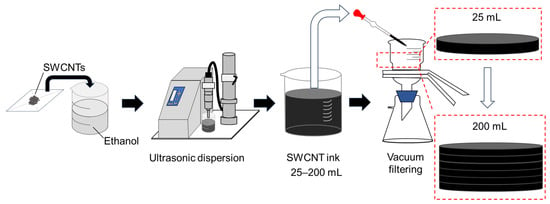
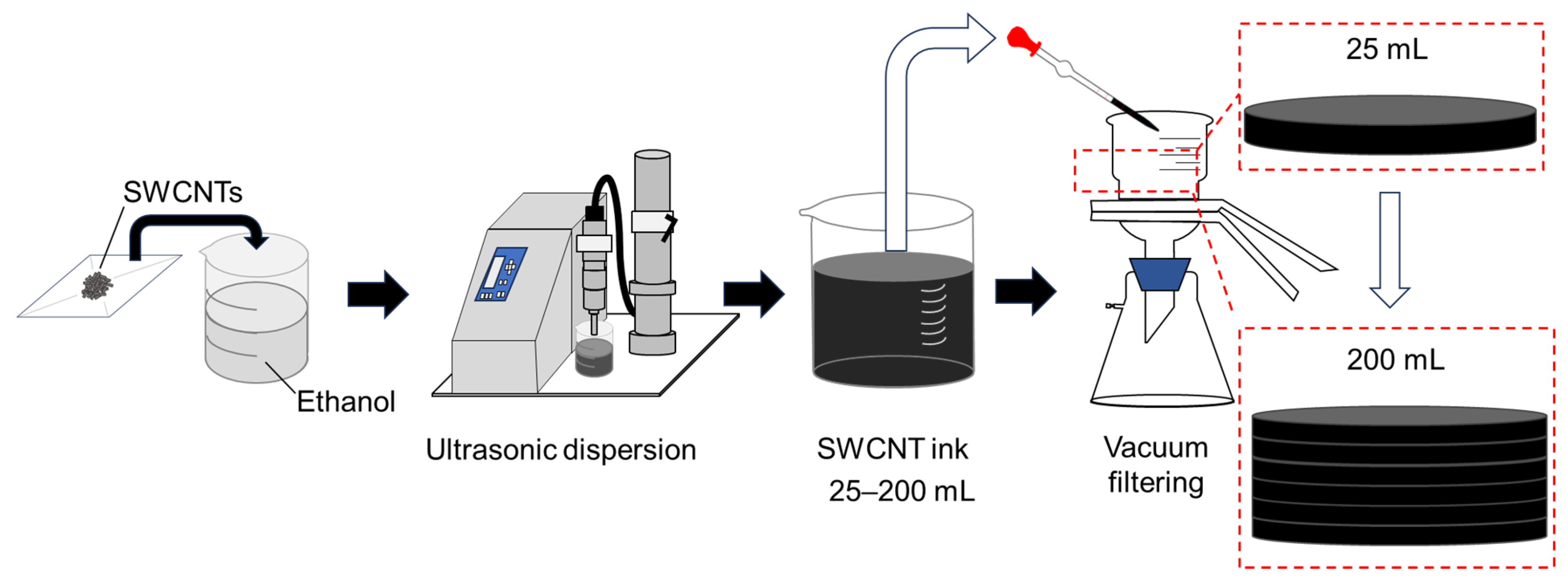
Figure 1 shows the fabrication process of the analyzed SWCNT films. The materials used in this study were prepared by mixing SWCNTs (ZEONANO SG101, ZEON, Tokyo, Japan) and ethanol (Fujifilm Wako Pure Chemical, Tokyo, Japan). The SWCNTs and ethanol were prepared at 0.1 g and 50 mL, respectively. The solutions were stirred for 30 min at 60% output using an ultrasonic homogenizer (Branson Sonifier SFX 250, Emerson, St. Louis, MO, USA) while cooling in an ice bath. The ultrasonic amplitude and frequency were 90 µm and 20 kHz, respectively, with a horn tip diameter of 12.7 mm. The rheological and rheo-impedance properties of the SWCNT ink were characterized using a rheometer and rheo-impedance spectroscopy (MCR102e, Anton Paar, Graz, Austria). The corresponding results are provided in the Supplementary Materials (Figure S1). Subsequently, vacuum filtration was employed to fabricate SWCNT films from the SWCNT ink. The films were uniformly formed by pipetting and dispensing the ink onto a membrane filter (PETE, 90 mm diameter; ADVANTEC, Tokyo, Japan) positioned within a suction flask.
Figure 1.
Schematic of the SWCNT film fabrication process.
To obtain SWCNT films with different thicknesses, the volume of the SWCNT ink was systematically varied, yielding films prepared with five ink volumes: 25, 50, 75, 100, 150, and 200 mL. The microstructure of the SWCNT films was characterized using field-emission scanning electron microscopy (FE-SEM; S-4800, Hitachi, Tokyo, Japan). Both the surface morphology and cross-sectional structures were examined, with cross-sectional analysis conducted on the central and near-surface regions of the films. The film thicknesses were measured using a digital micrometer (DM025, AsOne, Osaka, Japan) to calculate the mass densities of the SWCNT films. The mass densities of the SWCNT films were calculated using their measured masses and geometric volumes. Tensile tests were conducted on the SWCNT films using a tensile testing machine (MX-1000N-FA, IMADA, Toyohashi, Japan) at approximately 300 K and a crosshead speed of 10 mm/min. Specimens were prepared by cutting fragments from the SWCNT films, each measuring 22 mm in length, 2.5 mm in width, and 28–193 µm in thickness. The tensile strength, stress–strain behavior, and Young’s modulus were determined from the resulting mechanical data. Five specimens were tested to ensure measurement accuracy and reproducibility.
The in-plane thermoelectric properties of the SWCNT films were measured at approximately 300 K, and the in-plane thermal conductivity was determined from the thermal diffusivity, specific heat, and mass density. Thermal diffusivity was measured with an accuracy of ±5% using a non-contact laser spot periodic heating radiative heat measurement system (TA33 Wave Analyzer, Bethel, Ishioka, Japan). The specific heat was determined by differential scanning calorimetry (DSC-60PLUS, Shimadzu, Kyoto, Japan). Electrical conductivity was evaluated using a four-probe resistance tester (RT-70V, Napson, Tokyo, Japan). The Seebeck coefficient was measured at approximately 300 K with an accuracy of ±5% using a custom-built measurement system. One end of the film was attached to a heat sink, while the opposite end was connected to a Peltier module (FPH1-12704AC, Z-MAX, Tokyo, Japan). Two K-type thermocouples (0.1 mm in diameter) were pressed against the central region of the film to monitor the temperature difference. The temperature gradient between the thermocouples was controlled to 0–4 K by adjusting the current supplied to the Peltier module using a DC power source (PAB32-2, Kikusui, Yokohama, Japan). The resulting thermoelectric voltage was recorded at 1 K intervals, and the Seebeck coefficient was determined from the measured voltage–temperature relationship. The power factor (PF), a key indicator of thermoelectric performance, was evaluated using PF = σS2. The dimensionless figure of merit, ZT, was calculated according to ZT = σS2T/κ, where σ, S, T, and κ denote the electrical conductivity, Seebeck coefficient, absolute temperature, and thermal conductivity [51,52].
3. Results and Discussion
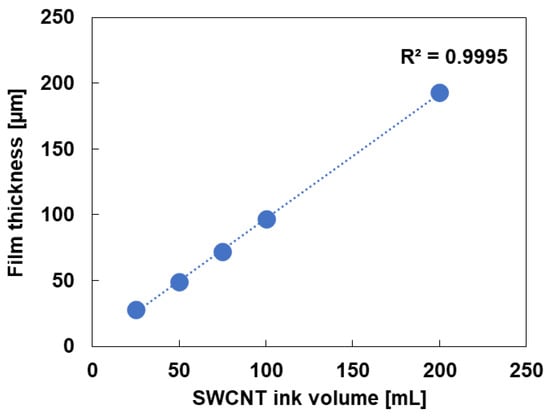
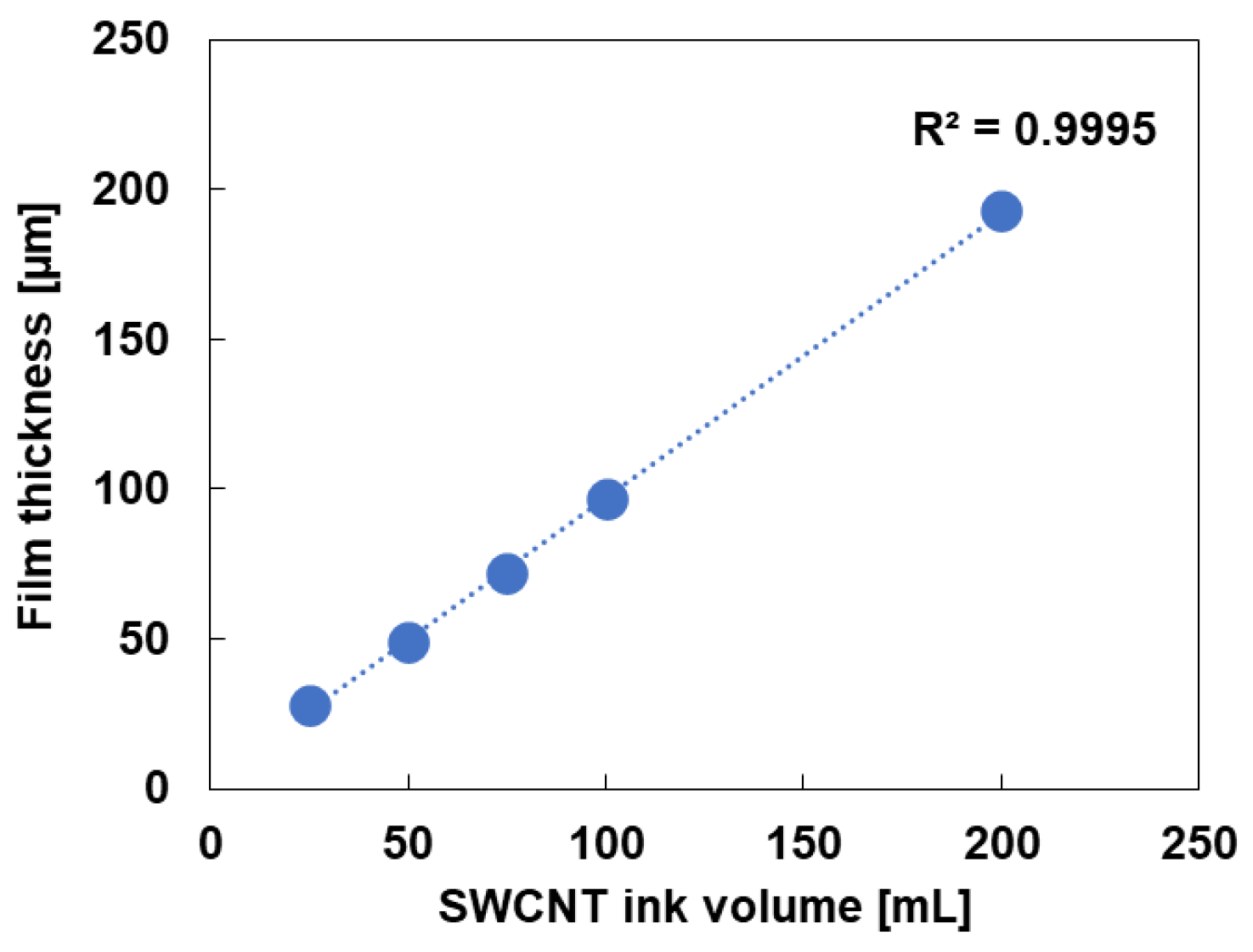
Figure 2 shows the relationship between the SWCNT film thickness and ink volume. The film thickness increased linearly with SWCNT ink volume. The thinnest film, 28 µm, was formed with a 25 mL drop, and the maximum thickness, 193 µm, was observed for a film deposited with 200 mL. The R-squared value (R2) was 0.9995, confirming that the vacuum filtration process follows a volume-dependent deposition mechanism, in which larger ink volumes lead to a proportionally greater accumulation of SWCNTs on the membrane.
Figure 2.
Variation in the SWCNT film thickness with droplet volume.
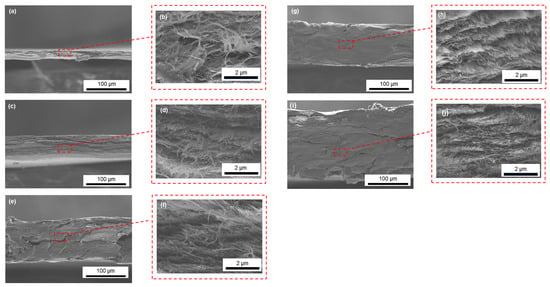
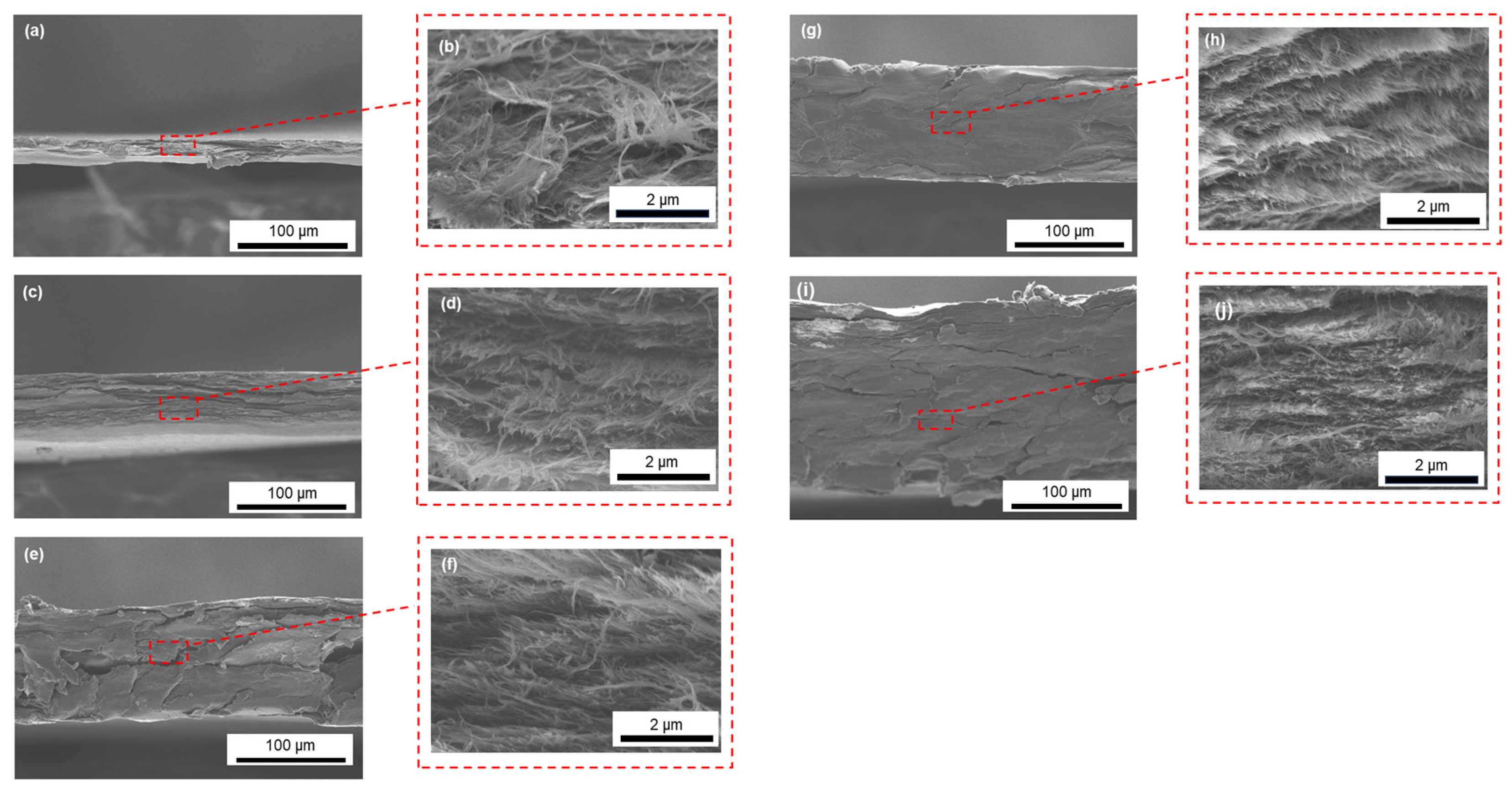
Figure 3 presents cross-sectional scanning electron microscopy (SEM) images of the SWCNT films. Figure 3a–j show both the full cross-sections of films with thicknesses ranging from 28 to 193 µm and magnified views of their central regions. The 28 µm film exhibited a thin structure characterized by entangled bundles and noticeable voids. As the thickness increased to 49 and 72 µm, the films developed a progressively denser microstructure. At the maximum thickness of 193 µm, distinct regions of high CNT packing density coexisted with coarser, less-compact areas, indicating the emergence of a heterogeneous coarse–dense morphology. These structural transitions are attributed to the increased stacking and near-layered deposition of the CNTs as the number of ink droplets increased. This behavior is likely caused by the reduced suction efficiency and pressure fluctuations during vacuum filtration at higher droplet volumes, ultimately producing films with mixed dense and coarse domains. The surface SEM images are provided in the Supplementary Materials (Figure S2). Notably, the bundle thickness and interbundle spacing remained essentially unchanged for all film thicknesses.
Figure 3.
Cross-sectional SEM images of SWCNT films with varying thicknesses, obtained using different volumes of SWCNT ink: (a,b) 25 mL, (c,d) 50 mL, (e,f) 75 mL, (g,h) 100 mL, and (i,j) 200 mL, where the first image in each pair shows the whole cross-section and the second shows an enlarged view.
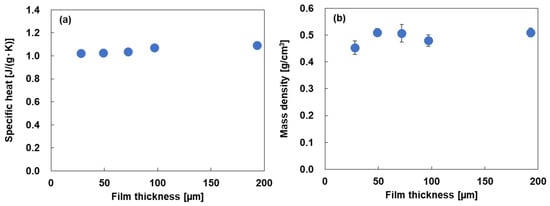
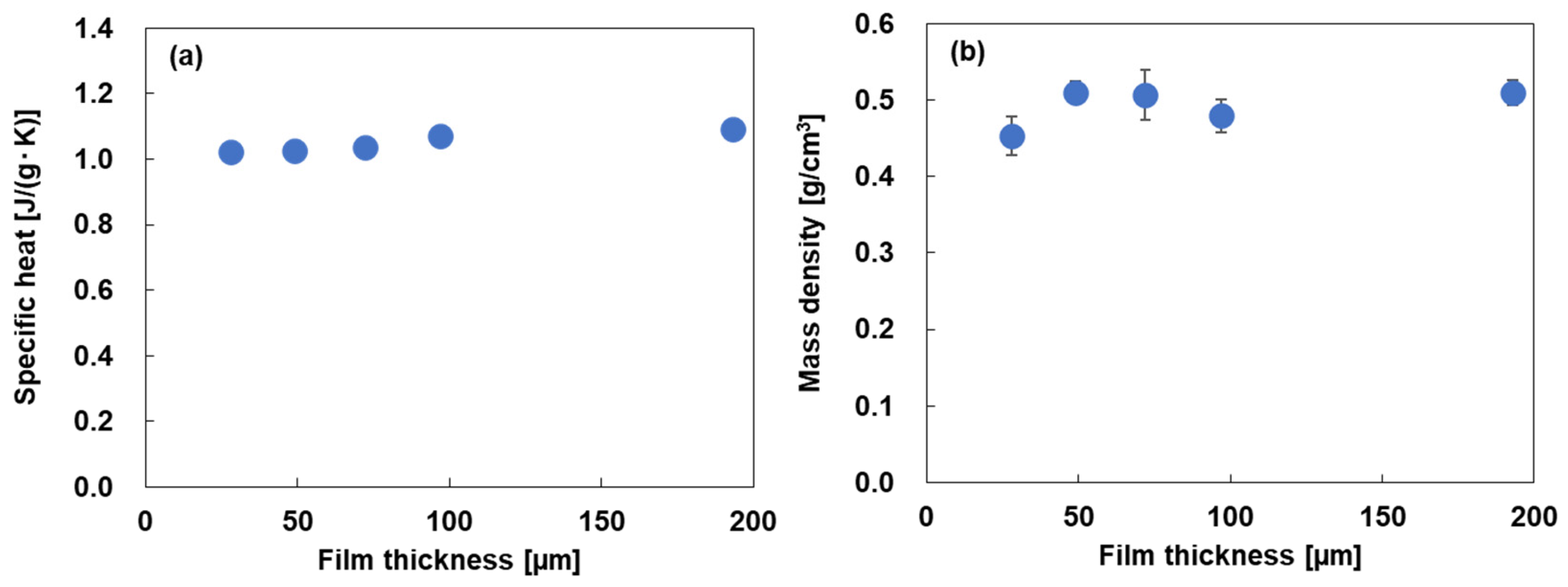
Figure 4 shows the specific heat and mass densities of the SWCNT films. The specific heat remained essentially constant at approximately 1.0 J/(g·K) across all film thicknesses (Figure 4a), indicating that variations in the amount of SWCNT material have a negligible influence on this property. Likewise, the density exhibited no significant dependence on the film thickness (Figure 4b), demonstrating that changes in thickness do not alter the bulk density. However, although the overall density remained constant, thicker films displayed a heterogeneous microstructure consisting of intermixed coarse and dense regions, suggesting the presence of localized density variations. Within experimental uncertainty, Cp[~1.0 J/(g‧K)] and bulk-average density show no thickness dependence, indicating no detectable compositional change at the film scale. Cross-sectional FE-SEM, however, reveals a thickness-driven transition to a coarse–dense layered morphology, implying localized (mesoscale) density variations. Thus, Cp and density serve as bulk averages, whereas the SEM-resolved mesoscale heterogeneity introduces internal interfaces that enhance phonon scattering, consistent with the observed decrease in κ and the shortened phonon MFP with thickness.
Figure 4.
Specific heat and density of SWCNT films as a function of film thickness: (a) specific heat and (b) mass density.
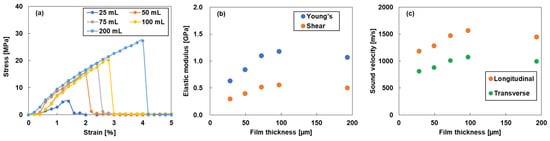
Figure 5 presents the stress–strain curves of the SWCNT films obtained from the tensile tests, together with the corresponding values of Young’s modulus, shear modulus, and sound velocity derived from these measurements. Both stress and strain increased with film thickness (Figure 5a), indicating enhanced mechanical strength and ductility in the SWCNT films. This improvement is attributed to the larger quantity of SWCNTs and the resulting increase in bundle entanglement within the thicker films.
Figure 5.
Mechanical properties and sound velocities of SWCNT films as a function of film thickness, obtained from tensile testing: (a) stress–strain curves, (b) Young’s and shear moduli, and (c) longitudinal and transverse sound velocities.
Figure 5b presents the results for Young’s and shear moduli. The Young’s modulus was first determined from the initial stress–strain gradient in the microstrain region shown in Figure 5a. Subsequently, assuming the isotropic behavior of the SWCNT film, the shear modulus (G) was calculated using Equation (1) [53]:
Here, E and ν represent the Young’s modulus and Poisson’s ratio, respectively. A Poisson’s ratio of ν = 0.06, previously reported for SWCNT sheets, was used in this study [54]. For the 97 µm film, the Young’s modulus reached a maximum of approximately 1.5 GPa, while the shear modulus peaked at around 0.7 GPa. Both moduli increased steadily as the film thickness increased from 28 to 97 µm, but decreased at 193 µm. At a thickness of 28 µm, the weak bundle entanglement and limited film thickness resulted in a mechanically fragile structure, leading to a low shear modulus. Increasing the thickness to 49–97 µm enhanced the amount of SWCNT material and promoted stronger bundle entanglement, thereby forming a more robust network capable of resisting external loads. By contrast, further increasing the thickness to 193 µm reduced both the Young’s modulus and overall stiffness. This degradation is attributed to the emergence of heterogeneous microstructures consisting of alternating dense and coarse regions, which become more pronounced with increasing thickness. Such coarse–dense layering likely arises from variations in the vacuum suction pressure during filtration as the droplet volume increases, leading to structural inhomogeneity during film formation. The increase in stiffness from 49 to 97 μm is attributed to improved load percolation across the network as bundle entanglement and the number of interbundle contacts increase, thereby strengthening effective load-bearing pathways at the film scale. By contrast, at 193 μm, the emergence of a coarse–dense layered microstructure (Figure 3) limits load-transfer efficiency despite the larger material amount. The coarse layers exhibit higher local porosity and lower interbundle contact density than the dense layers, and the interfaces between layers act as shear-lag barriers and sites of stress concentration. Under tensile loading, stress is preferentially carried by the dense layers, whereas the coarse regions and interlayer gaps undergo early local deformation; consequently, through-thickness stress is not uniformly transmitted, and the effective Young’s and shear moduli decrease (Figure 5b). The decrease in Young’s and shear moduli at 193 μm is governed primarily by the formation of weak coarse layers. Cross-sectional SEM (Figure 3j) shows loosely packed bundles in these coarse layers, whereas bulk-average density remains nearly constant (Figure 4b), excluding a dominant role of global porosity. These weak layers, together with interlayer interfaces acting as shear-lag barriers, concentrate stress and limit through-thickness load transfer, resulting in reduced stiffness (Figure 5b). The sound velocities of the SWCNT films are shown in Figure 5c. The longitudinal and transverse sound velocities, νL and νT, were calculated using Equations (2) and (3), respectively:
where ρ represents the mass density. For longitudinal waves, the velocity reached a maximum of 1568 m/s at a film thickness of 97 µm and a minimum of 1184 m/s at 28 µm. A similar trend was observed for shear waves, with velocities ranging from 1077 m/s at 97 µm to 813 m/s at 28 µm. These variations parallel the thickness-dependent changes in the Young’s modulus and stiffness, indicating that the acoustic properties are governed by corresponding modifications in the structural rigidity of the film.
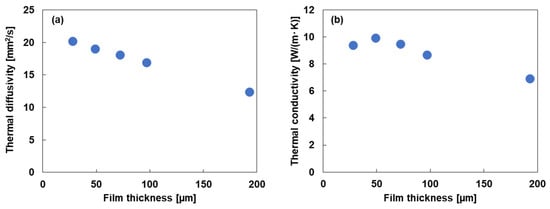
Figure 6 shows the in-plane thermal diffusivity and thermal conductivity of the SWCNT films. Figure 6a presents the thermal diffusivity data, which clearly show a decrease in the in-plane thermal diffusivity with increasing film thickness. Figure 6b shows the corresponding in-plane thermal conductivities calculated using Equation (4):
where α and Cp are the thermal diffusivity and specific heat, respectively. The thermal conductivity reached its minimum at a film thickness of 193 µm, where it was 6.9 W/(m·K), markedly lower than the maximum value of 9.9 W/(m·K) observed for the 49 µm film. Overall, the thermal conductivity decreased with increasing film thickness. This trend is attributed to the development of a coarse–dense layered microstructure in thicker films, which introduces additional interfaces and enhances phonon scattering, thereby suppressing heat transport. By contrast, the 28 µm film exhibited relatively high thermal diffusivity and thermal conductivity, likely due to its reduced thickness and limited number of layers, which minimize phonon scattering and facilitate efficient thermal conduction.
Figure 6.
Thermal properties of SWCNT films with varying thicknesses: (a) thermal diffusivity and (b) thermal conductivity.
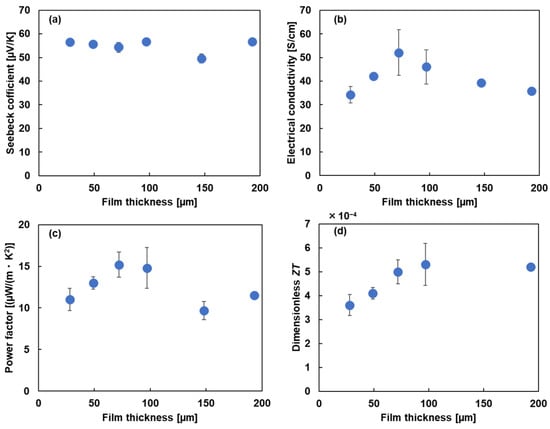
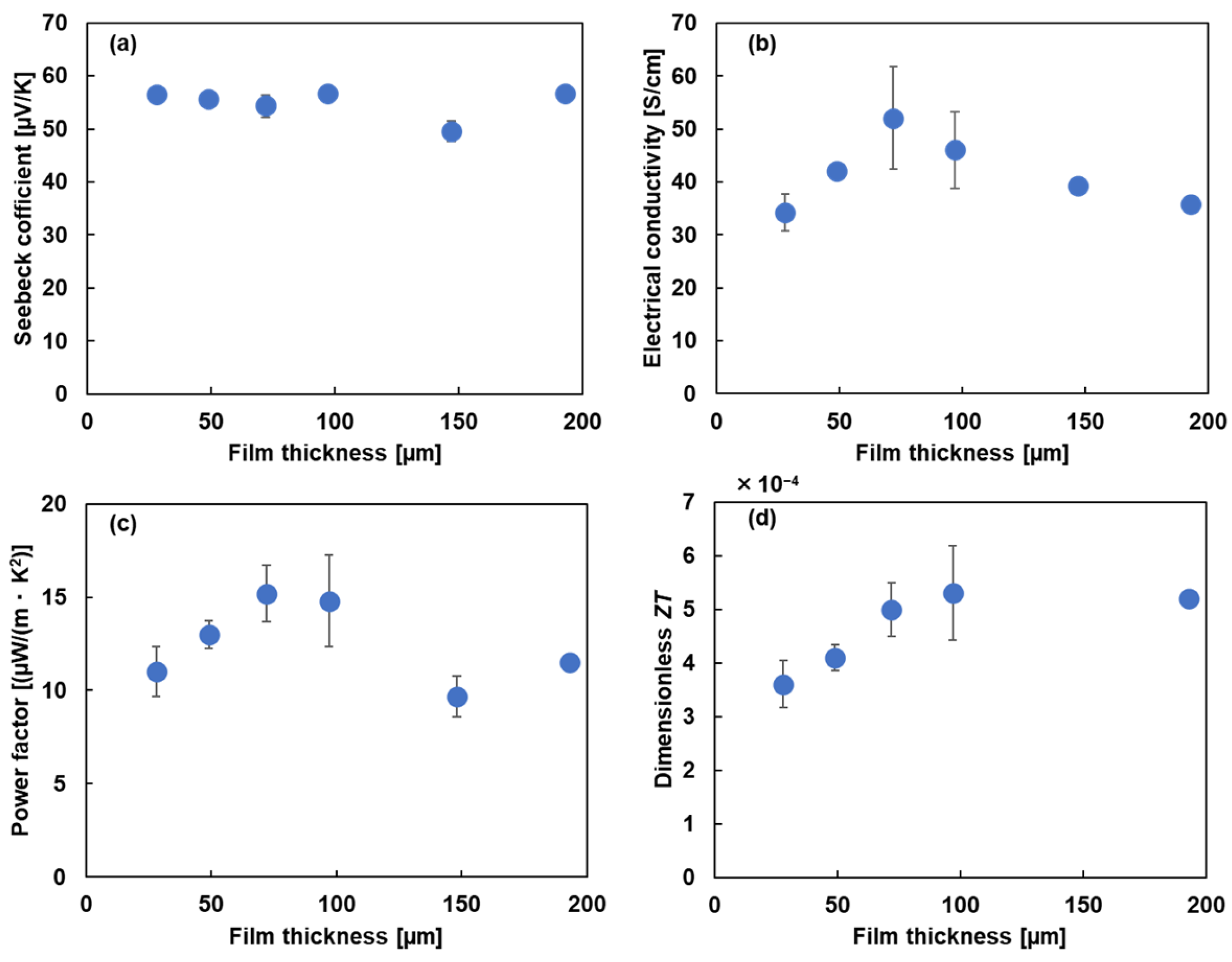
Figure 7 shows the Seebeck coefficient, electrical conductivity, PF, and ZT values of the SWCNT films. The Seebeck coefficient remained essentially constant across all film thicknesses (Figure 7a), suggesting that the thickness had a negligible influence on this parameter. This behavior is attributed to the nearly constant carrier concentration, which renders the Seebeck coefficient insensitive to variations in film thickness. The measured values fall within a narrow range of 54–57 µV/K for all samples.
Figure 7.
In-plane thermoelectric properties of SWCNT films with varying thicknesses: (a) Seebeck coefficient, (b) electrical conductivity, (c) power factor, and (d) dimensionless figure of merit.
Figure 7b shows the electrical conductivities of the SWCNT films. The 72 µm film exhibited the highest conductivity, reaching 52 S/cm. Increasing the film thickness from 28 to 49 µm enhanced conductivity by increasing the number of available SWCNT conduction pathways, resulting in a more optimized transport network. This improvement is attributed to the higher SWCNT density, which promotes a more compact packing structure and enhances carrier mobility [55]. By contrast, further increasing the thickness to 97 or 193 µm compromised film uniformity due to prolonged vacuum-filtration times and fluctuations in suction pressure during fabrication. Consequently, heterogeneous microstructures comprising coarse, dense, and partially layered regions developed, producing areas with insufficient intertube contact. These structural inhomogeneities likely impede electron transport, increasing the contact resistance and thereby reducing electrical conductivity.
The power factor (PF), which reflects the behavior of electrical conductivity, exhibited a similar thickness-dependent trend (Figure 7c). The maximum PF of 15.2 µW/(m·K2) was obtained for the 72 µm film. This enhancement is attributed to the substantial increase in electrical conductivity, whereas the Seebeck coefficient remained nearly constant across all thicknesses. As shown in Figure 7d, the 97 µm SWCNT film exhibited the highest ZT value of 5.3 × 10⁻⁴, resulting from the combined effects of reduced thermal conductivity and a relatively high power factor. By contrast, the 193 µm film did not achieve the highest ZT despite possessing the lowest thermal conductivity, likely because the reduction in power factor had a more dominant influence. The maximum ZT at 97 μm arises from competing thickness-dependent effects on electronic and thermal transport. Up to ~97 μm, increasing thickness enhances interbundle contacts and bundle entanglement, improving carrier percolation and yielding a relatively high power factor (Figure 7b,c). Beyond this thickness, prolonged vacuum filtration and suction-pressure fluctuations promote a coarse–dense layered microstructure (Figure 3), which elevates intertube contact resistance and suppresses electrical conductivity. In contrast, the same structural evolution strengthens phonon scattering with thickness, shortening the phonon mean free path (Figure 8c) and reducing the lattice thermal conductivity (Figure 6b). Consequently, the 97 μm film provides an optimal balance—maintaining a relatively high-power factor while sufficiently lowering thermal conductivity—leading to the highest ZT among the investigated samples (Figure 7d).
Figure 8.
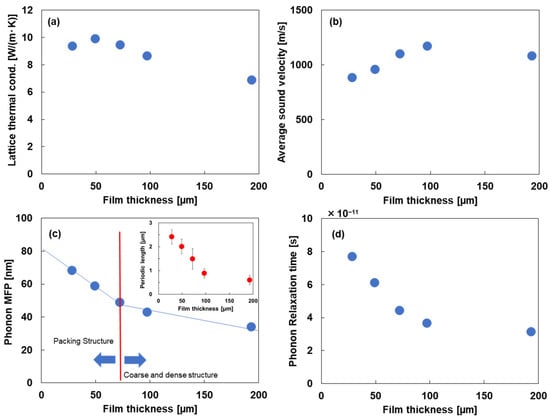
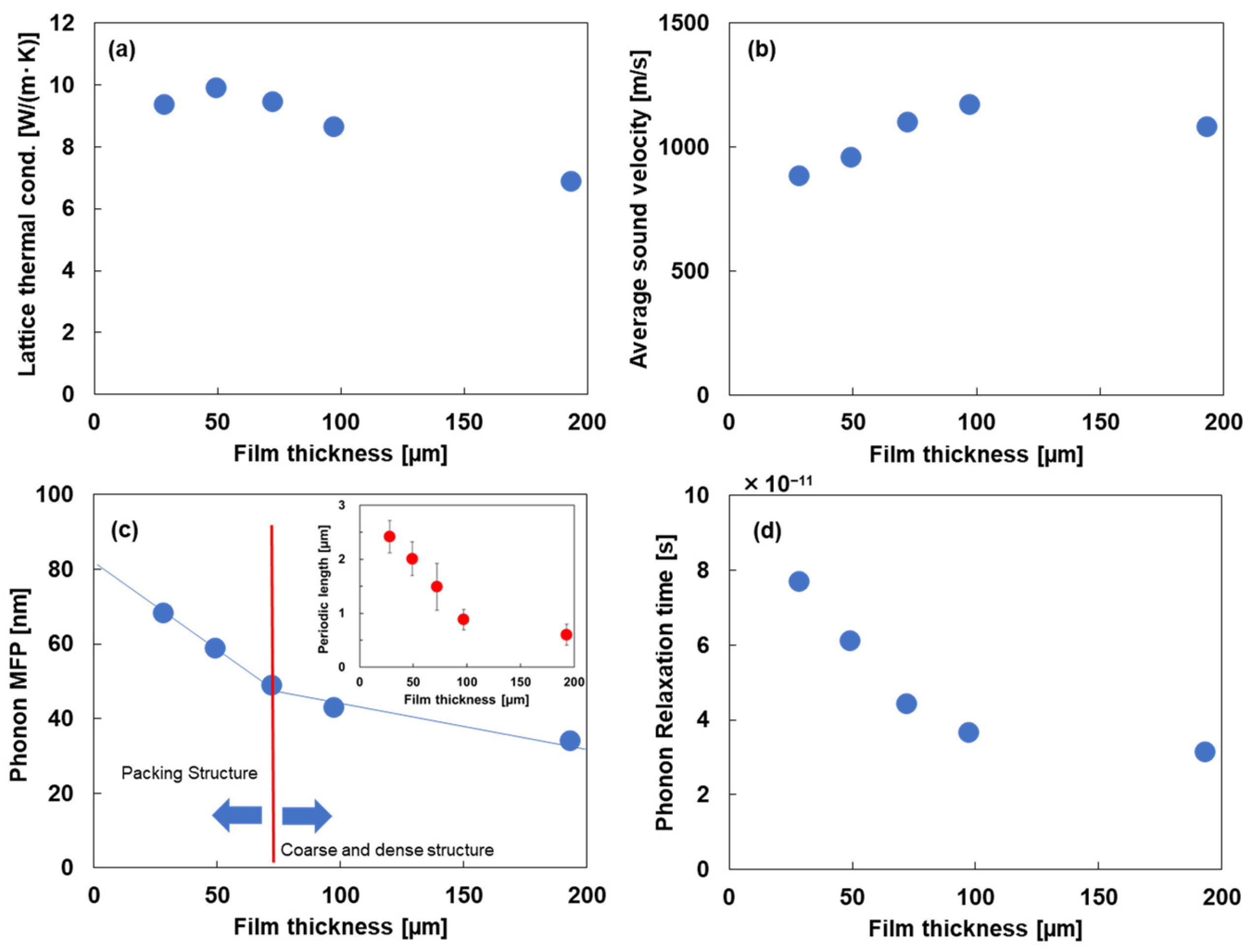
Thermal transport properties of SWCNT films and their dependence on packing density: (a) lattice thermal conductivity, (b) average sound velocity, (c) phonon MFP, and (d) phonon relaxation time.
Figure 8 shows the phonon transport properties of the SWCNT films with different thicknesses. As illustrated in Figure 8a, the lattice thermal conductivity (κl) was determined by subtracting the electronic thermal conductivity (κe) from the experimentally measured total thermal conductivity (κt). The electronic thermal conductivity κe was evaluated using the Wiedemann–Franz law in conjunction with Equation (5) [56,57]:
where L is the Lorenz number, which was calculated using the measured Seebeck coefficient using Equation (6) [58]:
The dependence of the lattice thermal conductivity on the film thickness was nearly identical to that of the total thermal conductivity, as shown in Figure 6b. This similarity is ascribable to the fact that the electronic contribution to thermal conductivity was substantially smaller than the total thermal conductivity. Even at the maximum value observed (0.02 W/(m∙K) for a film thickness of 72 μm), the electronic thermal conductivity remained negligible in comparison.
Figure 8b shows the average sound velocity of the SWCNT films with different thicknesses. The average sound velocity (νave) was calculated using Equation (7):
The average sound velocity exhibited a maximum value of 1304 m/s at a film thickness of 97 µm and a minimum of 987 m/s at 28 µm. This pronounced thickness dependence suggests that variations in microstructural features, specifically the coexistence of coarse and dense regions within the film, also play a significant role in governing sound velocity.
Figure 8c shows the phonon MFP of the SWCNT films with different thicknesses. The phonon MFP, Λ, was calculated via Equation (8):
Overall, the phonon MFP exhibited a systematic decline with increasing film thickness, with a clear transition in the reduction behavior occurring at a threshold of approximately 70 μm. In the region below 70 μm, characterized by the Packing structure, the MFP decreased sharply from 68 nm at a thickness of 28 μm to 49 nm as it approached the boundary. This rapid decline is consistent with the steep reduction in periodic length shown in the inset, indicating that the development of the packing structure effectively enhances phonon scattering. Beyond the 70 μm boundary, the film enters the Coarse and dense structure region, where the rate of MFP reduction becomes notably more gradual, reaching 34 nm at a thickness of 193 μm. This change in slope corresponds to the stabilization of the periodic length, which shows a slower transition in the thicker film regime. These results indicate that the structural evolution from a packing structure to a coarse–dense morphology progresses with increasing thickness; this transition effectively increases mesoscale interface density and enhances phonon scattering, thereby reducing the effective MFP [59,60].
Figure 8d shows the phonon relaxation times of the SWCNT films with different thicknesses. The phonon relaxation time (t) was calculated from the phonon MFP (L) and the average sound velocity (vave) using Equation (9):
The dependence of the phonon relaxation time on film thickness closely mirrored that of the phonon MFP; however, the magnitude of the change was more pronounced. The relaxation time decreased from 7.7 × 10⁻¹¹ s at 28 μm to 3.7 × 10⁻¹¹ s at 97 μm, corresponding to a 52% reduction, significantly larger than the relative decrease in MFP over the same range. When the thickness increased to 193 μm, relaxation time further declined to 3.2 × 10⁻¹¹ s, again showing a reduced rate of change beyond 97 μm. This stronger sensitivity of the relaxation time reflects the combined effects of the reduced MFP and increased phonon scattering frequency arising from the densified coarse–dense morphology. As the structural periodicity decreased, the phonons encountered a greater number of scattering interfaces per unit distance, leading to a substantial reduction in their relaxation times. Thus, both the phonon MFP and relaxation time consistently demonstrate that mesoscale structural evolution plays a dominant role in governing phonon dynamics in thick SWCNT films.
In this study, we provide a substantive demonstration of how film thickness serves as a decisive governor of phonon transport by triggering a fundamental structural transition at a critical threshold of approximately 70 μm. Below this boundary, within the Packing structure regime, both the phononMFP and the phonon relaxation time exhibit a sharp, synchronized decline. The significance of this observation is reinforced by the inset data, which shows a corresponding steep reduction in the periodic length of the structural domains. This tripartite correlation between spatial transport, temporal dynamics, and mesoscale geometry reveals a regime where phonon kinetics are intrinsically governed by the rapid evolution of the initial packing organization. The novelty and robustness of our findings are further validated by the transition into the Coarse and dense structure region beyond 70 μm. In this regime, the rates of decrease for MFP, relaxation time, and periodic length all simultaneously decelerate toward a plateau. This stabilization indicates the emergence of a “scattering saturation” state, where internal density fluctuations create a consistent scattering environment regardless of further thickening. By establishing this clear bifurcation across both physical and structural parameters, our results prove that film thickness acts as a macroscopic switch for the intentional manipulation of phonon transport. This provides a transformative design principle for high-performance thermoelectric materials that transcends conventional, simple thickness-dependent interpretations [61,62].
4. Conclusions
This study demonstrates that film thickness is a key parameter that governs both the internal morphology and the resulting transport properties of SWCNT films. Films thinner than approximately 70 μm form uniformly dense networks that support high electrical conductivity, whereas films with thicknesses of 97 μm and above undergo a clear transition to a coarse–dense layered morphology. This structural transition simultaneously degrades electron and phonon transport: increased interbundle contact resistance suppresses electrical conductivity, while enhanced phonon scattering at coarse–dense interfaces shortens the phonon mean free path and reduces thermal conductivity. The progressive decrease in the spacing between coarse and dense regions further limits heat transport in thicker films. Overall, these results highlight that precise control of film thickness—and the accompanying evolution of network morphology—is essential for optimizing the thermoelectric performance of SWCNT-based generators.
Supplementary Materials
The following supporting information can be downloaded at: https://www.mdpi.com/article/10.3390/app16031377/s1, Figure S1: Properties of SWCNT ink: (a) viscosity; (b) Nyquist plot. Figure S2: Surface SEM images of SWCNT films with varying thicknesses prepared using different volumes of SWCNT ink: (a) 25 mL, (b) 50 mL, (c) 75 mL, (d) 100 mL, and (e) 200 mL.
Author Contributions
Conceptualization, M.T.; methodology, Y.N., Y.S., K.U. and S.M.; investigation, Y.N., Y.S., K.U. and S.O.; writing—original draft, Y.N. and M.T.; supervision, S.M. and M.T.; project administration, M.T. All authors have read and agreed to the published version of the manuscript.
Funding
This study received no funding.
Institutional Review Board Statement
Not applicable.
Informed Consent Statement
Not applicable.
Data Availability Statement
The data presented in this study is available on request from the corresponding author.
Acknowledgments
All authors thank K. Miyamoto at Anton Paar Japan and M. Morikawa and Y. Oda at Tokai University for their experimental support.
Conflicts of Interest
The authors declare no conflicts of interest.
References
- Iijima, S.; Ichihashi, T. Single-shell carbon nanotubes of 1-nm diameter. Nature 1993, 363, 603–605. [Google Scholar] [CrossRef] [Scilit]
- Dolafi Rezaee, M.; Dahal, B.; Watt, J.; Abrar, M.; Hodges, D.R.; Li, W. Structural, electrical, and optical properties of single-walled carbon nanotubes synthesized through floating catalyst chemical vapor deposition. Nanomaterials 2024, 14, 965. [Google Scholar] [CrossRef] [Scilit] [PubMed]
- Wu, K.; Niu, Y.; Zhang, Y.; Yong, Z.; Li, Q. Continuous growth of carbon nanotube films: From controllable synthesis to real applications. Compos. Part A 2021, 144, 106359. [Google Scholar] [CrossRef] [Scilit]
- Chen, H.; Zeng, S.; Chen, M.; Zhang, Y.; Li, Q. Fabrication and functionalization of carbon nanotube films for high-performance flexible supercapacitors. Carbon 2015, 92, 271–296. [Google Scholar] [CrossRef] [Scilit]
- Zhu, L.; Xu, J.; Xiu, Y.; Sun, Y.; Hess, D.W.; Wong, C.P. Growth and electrical characterization of high-aspect-ratio carbon nanotube arrays. Carbon 2006, 44, 253–258. [Google Scholar] [CrossRef] [Scilit]
- Arash, B.; Wang, Q.; Varadan, V.K. Mechanical properties of carbon nanotube/polymer composites. Sci. Rep. 2014, 4, 6479. [Google Scholar] [CrossRef] [Scilit]
- Choi, Y.; Lee, D.; Heo, S.J.; Jang, D.; Kang, B.-C.; Kim, S.G.; Chae, H.G.; Kim, J.Y.; Ku, B.-C.; Kim, H. Thermal coalescence-driven structural transformation of carbon nanotube fibers for flexible thermoelectrics. Chem. Eng. J. 2026, 527, 171739. [Google Scholar] [CrossRef] [Scilit]
- Sarkar, S.; Pal, P.; Ghosh, N.K. Enhancing the thermal conductivity and viscosity of ethylene glycol-based single-walled carbon nanotube (SWCNT) nanofluid: An investigation utilizing equilibrium molecular dynamics simulation. Chem. Thermodyn. Therm. Anal. 2024, 16, 100142. [Google Scholar] [CrossRef] [Scilit]
- Kato, Y.; Sekiguchi, A.; Kobashi, K.; Sundaram, R.; Yamada, T.; Hata, K. Mechanically robust free-standing single-walled carbon nanotube thin films with uniform mesh-structure by blade coating. Front. Mater. 2020, 7, 562455. [Google Scholar] [CrossRef] [Scilit]
- Nasibulin, A.G.; Kaskela, A.; Mustonen, K.; Anisimov, S.A.; Ruiz, V.; Kivistö, S.; Rackauskas, S.; Timmermans, M.Y.; Pudas, M.; Aitchison, B.; et al. Multifunctional free-standing single-walled carbon nanotube films. ACS Nano 2011, 5, 3214–3221. [Google Scholar] [CrossRef] [Scilit]
- Odom, T.W.; Huang, J.L.; Kim, P.; Lieber, C.M. Structure and electronic properties of carbon nanotubes. J. Phys. Chem. B 2000, 104, 2794–2809. [Google Scholar] [CrossRef] [Scilit]
- Rao, C.N.R.; Voggu, R.; Govindaraj, A. Selective generation of single-walled carbon nanotubes with metallic, semiconducting and other unique electronic properties. Nanoscale 2009, 1, 96–105. [Google Scholar] [CrossRef] [Scilit]
- Battie, Y.; Ducloux, O.; Thobois, P.; Dorval, N.; Lauret, J.S.; Attal-Trétout, B.; Loiseau, A. Gas sensors based on thick films of semi-conducting single-walled carbon nanotubes. Carbon 2011, 49, 3544–3552. [Google Scholar] [CrossRef] [Scilit]
- Huang, Y.; Li, N.; Ma, Y.; Du, F.; Li, F.; He, X.; Lin, X.; Gao, H.; Chen, Y. The influence of single-walled carbon nanotube structure on the electromagnetic interference shielding efficiency of its epoxy composites. Carbon 2007, 45, 1614–1621. [Google Scholar] [CrossRef] [Scilit]
- Wu, Y.; Lin, X.; Zhang, M. Carbon nanotubes for thin film transistor: Fabrication, properties, and applications. J. Nanomater. 2013, 2013, 627215. [Google Scholar] [CrossRef] [Scilit]
- Cheng, M.; Wang, B.W.; Hou, P.X.; Li, J.C.; Zhang, F.; Luan, J.; Cong, H.T.; Liu, C.; Cheng, H.M. Selective growth of semiconducting single-wall carbon nanotubes using SiC as a catalyst. Carbon 2018, 135, 195–201. [Google Scholar] [CrossRef] [Scilit]
- Yao, J.; Li, Y.; Li, Y.; Sui, Q.; Wen, H.; Cao, L.; Cao, P.; Kang, L.; Tang, J.; Jin, H.; et al. Rapid annealing and cooling induced surface cleaning of semiconducting carbon nanotubes for high-performance thin-film transistors. Carbon 2021, 184, 764–771. [Google Scholar] [CrossRef] [Scilit]
- Nguyen, D.C.T.; Murugan, B.; Siah, C.F.; Lim, Y.K. Beyond silicon frontiers in neuromorphic computing and logic circuits: Single-walled carbon nanotube thin-film transistors. ACS Appl. Mater. Interfaces 2025, 17, 70404–70428. [Google Scholar] [CrossRef] [Scilit]
- Gracia-Espino, E.; Sala, G.; Pino, F.; Halonen, N.; Luomahaara, J.; Mäklin, J.; Tóth, G.; Kordás, K.; Jantunen, H.; Terrones, M.; et al. Electrical transport and field-effect transistors using inkjet-printed SWCNT films having different functional side groups. ACS Nano 2010, 4, 3318–3324. [Google Scholar] [CrossRef] [Scilit]
- Guo, S.Y.; Hou, P.X.; Zhang, F.; Liu, C.; Cheng, H.M. Gas sensors based on single-wall carbon nanotubes. Molecules 2022, 27, 5381. [Google Scholar] [CrossRef] [Scilit]
- Alqaderi, A.I.J.; Ramakrishnan, N. Carbon-based flexible strain sensors: Recent advances and performance insights in human motion detection. Chem. Eng. J. 2025, 513, 162609. [Google Scholar] [CrossRef] [Scilit]
- Yulianti, R.T.; Irmawati, Y.; Destyorini, F.; Ghozali, M.; Suhandi, A.; Kartolo, S.; Hardiansyah, A.; Byun, J.H.; Fauzi, M.H.; Yudianti, R. Highly stretchable and sensitive single-walled carbon nanotube-based sensor decorated on a polyether ester urethane substrate by a low hydrothermal process. ACS Omega 2021, 6, 34866–34875. [Google Scholar] [CrossRef] [Scilit] [PubMed]
- Choi, Y.; Kim, M.; So, H. Negative temperature coefficient effect of TPU/SWCNT/PEDOT:PSS polymer matrices for wearable temperature sensors. Polym. Test. 2024, 141, 108652. [Google Scholar] [CrossRef] [Scilit]
- Okada, K.; Horii, T.; Yamaguchi, Y.; Son, K.; Hosoya, N.; Maeda, S.; Fujie, T. Ultraconformable capacitive strain sensor utilizing network structure of single-walled carbon nanotubes for wireless body sensing. ACS Appl. Mater. Interfaces 2024, 16, 10420–10438. [Google Scholar] [CrossRef] [Scilit] [PubMed]
- Jeong, M.H.; Bae, E.J.; Park, B.; Ha, J.W.; Han, M.; Kang, Y.H. High-performance and flexible thermoelectric generator based on a robust carbon nanotube/BiSbTe foam. Carbon Energy 2024, 7, e650. [Google Scholar] [CrossRef] [Scilit]
- Erden, F.; Danaci, I.; Ozbay, S. Flexible thermoelectric generators based on single-walled carbon Nanotube/Poly(aniline-co-acrylonitrile) composites. Adv. Electron. Mater. 2025, 11, 2500026. [Google Scholar] [CrossRef] [Scilit]
- Konagaya, R.; Takashiri, M. Dual-Type Flexible-film thermoelectric generators using all-carbon nanotube films. Coatings 2023, 13, 209. [Google Scholar] [CrossRef] [Scilit]
- Chiba, T.; Amma, Y.; Takashiri, M. Heat source free water floating carbon nanotube thermoelectric generators. Sci. Rep. 2021, 11, 14707. [Google Scholar] [CrossRef] [Scilit]
- Zhang, L.; Shang, H.; Zou, Q.; Feng, C.; Gu, H.; Ding, F. n-type PVP/SWCNT composite films with improved stability for thermoelectric power generation. ACS Appl. Mater. Interfaces 2024, 16, 6025–6032. [Google Scholar] [CrossRef] [Scilit]
- Liu, S.; Liu, W.-D.; Lyu, W.; Yin, L.-C.; Yue, Y.; Gao, H.; Li, M.; Shi, X.-L.; Liu, Q.; Wang, N.; et al. Alignment of edge dislocations—The reason lying behind composition inhomogeneity induced low thermal conductivity. Nat. Commun. 2025, 16, 9775. [Google Scholar] [CrossRef] [Scilit]
- Mori, R.; Mayuzumi, Y.; Yamaguchi, M.; Kobayashi, A.; Seki, Y.; Takashiri, M. Improved thermoelectric properties of solvothermally synthesized Bi2Te3 nanoplate films with homogeneous interconnections using Bi2Te3 electrodeposited layers. J. Alloys Compd. 2020, 818, 152901. [Google Scholar] [CrossRef] [Scilit]
- Kato, K.; Hatasako, Y.; Uchino, M.; Nakata, Y.; Suzuki, Y.; Hayakawa, T.; Adachi, C.; Miyazaki, K. Flexible porous bismuth telluride thin films with enhanced figure of merit using micro-phase separation of block copolymer. Adv. Mater. Interfaces 2014, 1, 1300015. [Google Scholar] [CrossRef] [Scilit]
- Yu, C.; Shi, L.; Yao, Z.; Li, D.; Majumdar, A. Thermal conductance and thermopower of an individual single-wall carbon nanotube. Nano Lett. 2005, 5, 1842–1846. [Google Scholar] [CrossRef] [Scilit] [PubMed]
- Zeng, Z.; Wang, G.; Wolan, B.F.; Wu, N.; Wang, C.; Zhao, S.; Yue, B.; Li, B.; He, W.; Liu, J.; et al. Printable aligned single-walled carbon nanotube film with outstanding thermal conductivity and electromagnetic interference shielding performance. Nano-Micro Lett. 2022, 14, 179. [Google Scholar] [CrossRef] [Scilit]
- Hong, W.-T.; Tai, N.-H. Investigations on the thermal conductivity of composites reinforced with carbon nanotubes. Diam. Relat. Mater. 2008, 17, 1577–1581. [Google Scholar] [CrossRef] [Scilit]
- Shiga, T.; Terada, Y.; Chiashi, S.; Kodama, T. Effect of bundling on phonon transport in single-walled carbon nanotubes. Carbon 2024, 223, 119048. [Google Scholar] [CrossRef] [Scilit]
- Zhan, H.; Chen, Y.W.; Shi, Q.Q.; Zhang, Y.; Mo, R.W.; Wang, J.N. Highly aligned and densified carbon nanotube films with superior thermal conductivity and mechanical strength. Carbon 2022, 186, 205–214. [Google Scholar] [CrossRef] [Scilit]
- Hamasaki, H.; Takimoto, S.; Hirahara, K. Visualization of thermal transport within and between carbon nanotubes. Nano Lett. 2021, 21, 3134–3138. [Google Scholar] [CrossRef] [Scilit]
- Ghosh, T.; Dutta, M.; Sarkar, D.; Biswas, K. Insights into low thermal conductivity in inorganic materials for thermoelectrics. J. Am. Chem. Soc. 2022, 144, 10099–10118. [Google Scholar] [CrossRef] [Scilit]
- Rundle, J.; Leoni, S. Layered tin chalcogenides SnS and SnSe: Lattice thermal conductivity benchmarks and thermoelectric figure of merit. J. Phys. Chem. C 2022, 126, 14036–14046. [Google Scholar] [CrossRef] [Scilit]
- Zheng, Y.; Tan, G.; Luo, Y.; Su, X.; Yan, Y.; Tang, X. Thermal stability of p-type BiSbTe alloys prepared by melt spinning and rapid sintering. Materials 2017, 10, 617. [Google Scholar] [CrossRef] [Scilit]
- Kim, M.; Park, D.; Kim, J. A review on recent selenium- and tellurium-based thermoelectric materials and chalcogenide/organic flexible thermoelectric applications. Mater. Diamond Relat. Mater. 2008, 17, 1577–1581. [Google Scholar] [CrossRef] [Scilit]
- Conley, K.; Karttunen, A.J. Bridging the junction: Electrical conductivity of carbon nanotube networks. J. Phys. Chem. C 2022, 126, 17266–17274. [Google Scholar] [CrossRef] [Scilit]
- Ilatovskii, D.A.; Gilshtein, E.P.; Glukhova, O.E.; Nasibulin, A.G. Transparent conducting films based on carbon nanotubes: Rational design toward the theoretical limit. Adv. Sci. 2022, 9, 2201673. [Google Scholar] [CrossRef] [Scilit] [PubMed]
- Yu, L.; Shearer, C.; Shapter, J. Recent development of carbon nanotube transparent conductive films. Chem. Rev. 2016, 116, 13413–13453. [Google Scholar] [CrossRef] [Scilit] [PubMed]
- Volkov, A.N.; Zhigilei, L.V. Effects of material density and structural anisotropy on thermal transport in carbon nanotube materials. Carbon 2025, 243, 120393. [Google Scholar] [CrossRef] [Scilit]
- Yamamoto, H.; Okano, Y.; Uchida, K.; Kageshima, M.; Kuzumaki, T.; Miyake, S.; Takashiri, M. Phonon transports in single-walled carbon nanotube films with different structures determined by tensile tests and thermal conductivity measurements. Carbon Trends 2024, 17, 100435. [Google Scholar] [CrossRef] [Scilit]
- Ochiai, S.; Shinozaki, Y.; Eguchi, A.; Nagai, K.; Miyake, S.; Takashiri, M. Evaluation of thermal transport in composite SWCNT films with pseudo-heterogeneous interfaces obtained by blending different SWCNTs. Diamond Relat. Mater. 2025, 159, 112925. [Google Scholar] [CrossRef] [Scilit]
- Tanisawa, D.; Shionozaki, Y.; Takizawa, T.; Yamaguchi, A.; Murotani, H.; Takashiri, M. Ultralow thermal conductivity of amorphous silicon–germanium thin films for alloy and disorder scattering determined by 3ω method and nanoindentation. Appl. Phys. Express 2024, 17, 011005. [Google Scholar] [CrossRef] [Scilit]
- Norimasa, O.; Hase, M.; Hayamizu, M.; Nagata, S.; Tanaka, S.; Miyake, S.; Nishi, T.; Murotani, H.; Takashiri, M. Phonon transport properties depending on crystal orientation analyzed by nanoindentation using single-crystal silicon wafers. Appl. Phys. Express 2021, 14, 126502. [Google Scholar] [CrossRef] [Scilit]
- Norimasa, O.; Chiba, T.; Hase, M.; Komori, T.; Takashiri, M. Improvement of thermoelectric properties of flexible Bi2Te3 thin films in bent states during sputtering deposition and post-thermal annealing. J. Alloys Compd. 2022, 898, 162889. [Google Scholar] [CrossRef] [Scilit]
- Grace, T.S.L.; Gibson, C.T.; Gascooke, J.R.; Shapter, J.G. The use of gravity filtration of carbon nanotubes from suspension to produce films with low roughness for carbon nanotube/silicon heterojunction solar device application. Appl. Sci. 2020, 10, 6415. [Google Scholar] [CrossRef] [Scilit]
- Rafii-Tabar, H. Computational Physics of Carbon Nanotubes; Cambridge University Press: Cambridge, UK, 2008; pp. 135–185. [Google Scholar]
- Hall, L.J.; Coluci, V.R.; Galvão, D.S.; Kozlov, M.E.; Zhang, M.; Dantas, S.O.; Baughman, R.H. Sign change of Poisson’s ratio for carbon nanotube sheets. Science 2008, 320, 504–507. [Google Scholar] [CrossRef] [Scilit] [PubMed]
- Hu, N.; Yang, J.; Li, H.; Zhang, H.; Wang, W.; Zhu, J.; Zhang, Y.; Li, P. Synergistically enhancing dispersibility and thermoelectric performance of carbon nanotubes by biomass carboxymethyl cellulose. Ind. Eng. Chem. Res. 2025, 64, 17759–17768. [Google Scholar] [CrossRef] [Scilit]
- Putatunda, A.; Singh, D.J. Lorenz number in relation to estimates based on the Seebeck coefficient. Mater. Today Phys. 2019, 8, 49–55. [Google Scholar] [CrossRef] [Scilit]
- Kim, H.-S.; Gibbs, Z.M.; Tang, Y.; Wang, H.; Snyder, G.J. Characterization of Lorenz number with Seebeck coefficient measurement. APL Mater. 2015, 3, 041506. [Google Scholar] [CrossRef] [Scilit]
- Kurokawa, T.; Mori, R.; Norimasa, O.; Chiba, T.; Eguchi, R.; Takashiri, M. Influences of substrate types and heat treatment conditions on structural and thermoelectric properties of nanocrystalline Bi2Te3 thin films formed by DC magnetron sputtering. Vacuum 2020, 179, 109535. [Google Scholar] [CrossRef] [Scilit]
- Prasher, R.S.; Hu, X.J.; Chalopin, Y.; Mingo, N.; Lofgreen, K.; Volz, S.; Cleri, F.; Keblinski, P. Turning carbon nanotubes from exceptional heat conductors into insulators. Phys. Rev. Lett. 2009, 102, 105901. [Google Scholar] [CrossRef] [Scilit]
- Reihani, A.; Soleimani, A.; Kargar, S.; Sundararaghavan, V.; Ramazani, A. Graphyne nanotubes: Materials with ultralow phonon mean free path and strong optical phonon scattering for thermoelectric applications. J. Phys. Chem. C 2018, 122, 7277–7288. [Google Scholar] [CrossRef] [Scilit]
- Negi, A.; Rodriguez, A.; Zhang, X.; Comstock, A.H.; Yang, C.; Sun, D.; Jiang, X.; Kumah, D.; Hu, M.; Liu, J. Thickness-dependent thermal conductivity and phonon mean free path distribution in single-crystalline barium titanate. Adv. Sci. 2023, 10, 2301273. [Google Scholar] [CrossRef] [Scilit]
- Lee, K.-M.; Shrestha, R.; Dangol, A.; Chang, W.S. Dependence of thermal conductivity on thickness in single-walled carbon nanotube films. J. Nanosci. Nanotechnol. 2016, 16, 1028–1032. [Google Scholar] [CrossRef] [Scilit]
Disclaimer/Publisher’s Note: The statements, opinions and data contained in all publications are solely those of the individual author(s) and contributor(s) and not of MDPI and/or the editor(s). MDPI and/or the editor(s) disclaim responsibility for any injury to people or property resulting from any ideas, methods, instructions or products referred to in the content. |
© 2026 by the authors. Licensee MDPI, Basel, Switzerland. This article is an open access article distributed under the terms and conditions of the Creative Commons Attribution (CC BY) license.