
Article

Simulation-Driven Build Strategies and Sustainability Analysis of CNC Machining and Laser Powder Bed Fusion for Aerospace Brackets

by
Nikoletta Sargioti
1,
Evangelia K. Karaxi
1,*,
Amin S. Azar
2 and
Elias P. Koumoulos
3,*
1
Conify P.C., P. Nikolaidi 23A, Agios Ioannis Rentis, 182 33 Athens, Greece
2
3D-Components AS, Silurveien 8B, 0380 Oslo, Norway
3
IRES—Innovation in Research & Engineering Solutions, Silversquare Europe Square de Meeûs 35, 1000 Brussels, Belgium
*
Authors to whom correspondence should be addressed.
Appl. Sci. 2026, 16(3), 1360; https://doi.org/10.3390/app16031360
Submission received: 15 December 2025 / Revised: 12 January 2026 / Accepted: 23 January 2026 / Published: 29 January 2026
(This article belongs to the Special Issue Emerging and Exponential Technologies in Industry 4.0)

Abstract

This study provides a detailed technical and sustainability comparison of the conventional CNC machining and additive manufacturing routes for an aerospace bearing bracket. The work integrates material selection, process parameterization, build simulation, and environmental–economic assessment within a single framework. For the CNC route, machining of Al 7175-T7351 is characterized through process sequencing, tooling requirements, and waste generation. For the Laser Powder Bed Fusion (LPBF) route, two build strategies, single-part distortion-minimized and multi-part volume-optimized, are developed using Siemens NX for orientation optimization and Atlas3D for thermal and recoater collision simulations. The mechanical properties of Al 7175-T7351 and Scalmalloy® are compared to justify material selection for aerospace applications. Both the experimental and simulation-derived process metrics are reported, including the build time, support mass, energy consumption, distortion tolerances, and buy-to-fly (B2F) ratio. CNC machining exhibited a B2F ratio of 1:7, with cradle-to-gate CO2 emissions of ~11,000 g and an energy consumption exceeding 100 kWh per component. In contrast, both LPBF strategies achieved a B2F ratio of 1:1.2, reducing CO2 emissions by over 90% and energy consumption by up to 63%. Build volume optimization further reduced the LPBF unit cost by over 50% relative to the CNC machining. Use-phase analysis in an aviation context indicated estimated lifetime fuel savings of 776,640 L and the avoidance of 2328 tons of CO2 emissions. The study demonstrates how simulation-guided build preparation enables informed sustainability-driven decision-making for manufacturing route selection in aerospace applications.

1. Introduction

In engineering-intensive industries, there is an increasing emphasis on adopting manufacturing practices that are more sustainable and resource-efficient. This shift is influenced by environmental regulations, material and energy costs, and efforts to lower greenhouse gas emissions. In aerospace manufacturing, high energy usage, strict quality standards, and the need for lightweight parts increase sustainability challenges. This has led to interest in alternative methods like additive manufacturing (AM), which can lower environmental impact by reducing material and energy use while supporting economic feasibility throughout a product’s lifecycle. Studies show AM can make manufacturing more sustainable by decreasing resource consumption and enabling greener practices [1].
Traditionally, high-precision aerospace components have been produced via subtractive manufacturing, especially Computer Numerical Control (CNC) machining and milling. This approach is well-established, with proven dimensional accuracy and extensive qualification data. However, its environmental and material inefficiencies are becoming more evident. CNC machining typically involves extensive material removal, resulting in significant raw material waste and elevated embodied energy, particularly when starting from forged billets or rolled plates. For complex geometries, the buy-to-fly (BTF) ratio, the mass of starting stock relative to the final component mass, can range from 12:1 to over 25:1 in aerospace applications, leading to low material efficiency and increased energy demand throughout the supply chain [2]. Moreover, CNC requires multiple downstream operations such as finishing, fixturing, and in some cases, part assembly, further increasing energy use and labour costs.
Additive manufacturing, and specifically Laser Powder Bed Fusion (LPBF), offers an alternative pathway with the potential to improve material efficiency by enabling near-net-shape production directly from digital designs. LPBF enables the layer-by-layer fabrication of metallic components from powder feedstock, eliminating the need for part-specific tooling and enabling the realization of complex or lattice-based designs. These capabilities have opened opportunities to integrate design and manufacturing more closely, particularly through topology optimization and part consolidation. These strategies enable material-efficient designs that decrease overall weight and eliminate the need for joins, fasteners, or unnecessary subassemblies. Such characteristics are particularly valued in aerospace engineering, where minimizing weight contributes directly to operational fuel efficiency and a reduction in emissions throughout the aircraft’s service life [2,3]. Moreover, LPBF facilitates the use of advanced aluminum alloys like Scalmalloy®, which combine high strength and corrosion resistance with low density and are well-adapted to the rapid thermal cycling of AM processes. When paired with design optimization, Scalmalloy® components can outperform conventionally machined parts in both mechanical performance and environmental efficiency due to their lightweight and mechanical properties [4]. The mechanical advantage of Scalmalloy® is primarily attributed to its alloy composition and fine microstructure typically achieved through LPBF processing. Specifically, the addition of scandium promotes the formation of Al3Sc precipitates, which contribute to grain refinement, precipitation strengthening, and enhanced yield strength and fatigue resistance [5]. These microstructural features, combined with the ability of additive manufacturing to enable lightweight, optimized geometries, result in superior mechanical performance compared to conventionally machined aluminum alloys.
Several comparative studies between AM and CNC reinforce these observations while also highlighting the conditional nature of AM’s benefits. For example, Sathish et al. compared additive and subtractive manufacturing techniques across multiple criteria and concluded that while subtractive methods generally deliver better surface finish and accuracy, additive methods can significantly reduce material consumption and enable faster iteration during product development [6]. Similarly, Krishna et al. examined the environmental impacts of CNC and FDM processes, concluding that AM methods generally perform better when evaluated from a material efficiency and waste generation perspective, especially in low-volume or geometrically complex use cases [7]. Recent systematic reviews confirm that part consolidation is one of the most consistently beneficial AM strategies, delivering simultaneous material, energy, and assembly savings across multiple case studies, particularly in aerospace [8].
Sector-specific insights have also emerged from automotive and energy applications. Barbosa et al. [9] studied spare part manufacturing in the automotive sector and noted that AM allows for distributed production and inventory reduction. However, the authors also reported that extended build times and post-processing demands can limit economic competitiveness unless processes are tightly optimized. Watson and Taminger developed a decision-support framework for selecting between AM and subtractive methods based on energy intensity [10]. Their analysis showed that part geometry and material usage ratios play a decisive role: when material removal in CNC exceeds 70%, LPBF may become more efficient from both an energy and environmental perspective. These findings support the premise that AM technologies like LPBF are most competitive when applied to parts with high complexity, low production volumes, and stringent weight constraints, conditions commonly found in aerospace applications.
Nonetheless, LPBF is not inherently superior from an environmental or economic perspective. The process is energy intensive, with significant consumption arising from laser operation, powder bed heating, and inert gas circulation throughout the build cycle. Faludi et al. showed that depending on the machine and setup, laser activity and the energy required to maintain chamber conditions can account for the majority of the total energy input [11]. Moreover, the production of metal powders via gas atomization is itself an energy- and resource-intensive step. Wang et al. estimated the embodied energy of alloyed aluminum powders to range between 100 and 150 MJ/kg, depending on the alloy and atomization parameters [12]. Therefore, while LPBF reduces material waste, the environmental benefits can be negated unless builds are optimized for energy and powder use efficiency.
From an economic standpoint, the cost profiles of LPBF and CNC are governed by fundamentally different drivers. CNC machining is capital-efficient and offers low per-part cost for simple geometries, particularly when batch sizes are large. However, it becomes increasingly expensive for parts with complex geometries, internal channels, or features that require multiple tool paths and fixturing. In contrast, LPBF has high fixed costs per build due to slow build rates and the need for extensive post-processing, including support removal, surface finishing, and heat treatment. According to Rahmani et al., machine operation and post-processing collectively account for over 60% of LPBF part cost, while feedstock often contributes less than 5%, especially when efficient powder reuse is practiced [13]. Furthermore, most AM cost models adopt a process-oriented framework, dividing the workflow into pre-processing, production, and post-processing stages, with production time and machine utilization strongly influencing indirect costs such as labour and overhead [14]. These dynamics make LPBF economically attractive in low-volume, high-complexity production scenarios, such as prototyping, part customization, or the manufacturing of structurally optimized components [13,15]. In such contexts, integrating cost modelling with multi-criteria decision-making methods—which combine quantitative cost data with qualitative factors like part complexity, quality requirements, and production risk—has been proposed as a robust framework for selecting the most appropriate manufacturing route [14].
Build preparation strategy is a key but often overlooked driver of LPBF sustainability and cost efficiency. Key choices in part orientation, support design, nesting, and scanning settings impact build time, powder use, thermal gradients, and risks like recoater collisions or distortions. Poor build planning can lead to failed prints, excess support structures, or increased post-processing requirements, all of which inflate cost and environmental impact [3,13,16]. Conversely, optimized build strategies enable better thermal stability, higher packing density, and shorter build durations—improving both throughput and energy efficiency.
Despite growing interest in comparative sustainability assessments, many published studies rely on simplified geometries, assumed process parameters, or simulation data rather than real-world production scenarios [17,18]. There remains a lack of robust, application-specific studies that quantify both environmental and economic trade-offs using actual build data, validated cost inputs, and parts relevant to industrial applications.
This study addresses this gap by comparing CNC machining and LPBF processes in production of a topology-optimized aerospace bearing bracket. The conventionally manufactured bracket is produced via a fully subtractive route, in which the entire component is machined from Al 7175-T7351 billet stock using 3-axis CNC machining. The LPBF variant is fabricated in Scalmalloy®. Two LPBF build preparation strategies are analyzed: a conservative single-part build prioritizing thermal control and dimensional accuracy, and a multi-part batch build optimized for throughput and build efficiency. The comparison is based on cradle-to-gate lifecycle assessment (LCA) and cost analysis using real process data and validated parameters. The objective of this study is to develop and apply a simulation-driven methodological framework to evaluate how manufacturing route and build strategy influence the sustainability and cost competitiveness of aerospace components in high-performance, low-volume production environments.

2. Materials and Methods

2.1. Component and Material Description

The study focuses on a bearing bracket used as a structural connector in aerospace assemblies. Two versions of the component were analyzed:
  • A conventionally manufactured bearing bracket using CNC machining from Al 7175-T7351, a high-strength aluminum alloy frequently used in the aerospace sector.
  • A topology-optimized bearing bracket designed for LPBF using Scalmalloy® (APWORKS GmbH, Taufkirchen, Germany), a high-performance Al-Mg-Sc alloy developed for additive manufacturing.
Table 1 compares the key mechanical properties of the two materials. Scalmalloy offers higher yield strength (480–500 MPa) and comparable elongation (13–16%) to Al 7175-T7351, supporting its selection for weight-efficient aerospace structures.
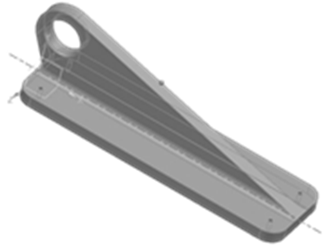
Table 2 summarizes the component considerations for conventional and additive manufacturing, highlighting significant differences in material efficiency and cost implications. Beyond mechanical properties and sustainability assessments, material efficiency is another critical factor influencing the choice between CNC machining and additive manufacturing. A key metric for evaluating material efficiency is the B2F ratio, which quantifies the amount of raw material required to produce a final usable part.
The CNC-machined original bracket was modelled using Al 7175-T7351, starting from a rectangular billet. The process data (material removal rate, machining time, and energy use) were sourced from manufacturer benchmarks [3]. The reference process was defined by a B2F ratio of 1:7, calculated directly from the billet mass and the final component mass based on the CAD geometry. This indicates high material waste (~86%) and energy- and labour-intensive finishing operations, typical of aerospace-grade components. In contrast, the LPBF topology-optimized bracket achieves a B2F ratio of 1:1.2, with negligible material waste beyond support structures. The LPBF process metrics, including material consumption, build time, and support structure usage, were derived from actual production data during the AM processing of the topology-optimized bracket, while detailed procedures are withheld due to proprietary considerations.

2.2. Build Preparation and LPBF Strategies

To evaluate the influence of additive manufacturing build strategies on sustainability and cost, two distinct LPBF build preparation approaches were developed and analyzed:
Strategy 1: Thermal Distortion Minimization (Single-Part Build)
The first strategy prioritized dimensional accuracy and thermal stability, focusing on the reduction of residual stresses and potential warping, common risks in LPBF of large or complex parts. Residual stresses were not directly predicted in Siemens NX or Atlas3D, instead, build orientation was optimized by minimizing overheating potential, which is widely reported as a contributing factor to residual stress formation in LPBF [16]. The strategy is described as follows:
  • A single bracket was printed per build cycle;
  • The orientation was optimized using Siemens NX (version 2412, Siemens Digital Industries Software, USA) to minimize unsupported overhangs and thermal gradients;
  • Atlas3D (Atlas 3D, Inc., Plymouth, Indiana) thermal simulations validated the build orientation, ensuring acceptable distortion levels and no risk of recoater collisions;
  • This strategy was designed to mimic common industrial practices in aerospace, where dimensional tolerances and certification requirements take precedence over throughput.
Strategy 2: Build Volume Efficiency (Three-Part Batch Build)
The second strategy was developed to maximize machine utilization and build volume efficiency, representing a higher productivity scenario. The key features were as follows:
  • Nesting of three brackets within the available build volume;
  • Optimization of the layout in Siemens NX to ensure minimal inter-part thermal interference;
  • Atlas3D simulations were again used to assess distortion risks and thermal behaviour under multi-part conditions;
  • This setup reflects a production-oriented strategy where economies of scale are sought without compromising part integrity.

2.3. Sustainability Assesment

A cradle-to-gate sustainability analysis was performed to compare the environmental performance of subtractive (CNC) and additive (LPBF) manufacturing routes for the aerospace bearing bracket. The functional unit is one aerospace bearing bracket meeting identical functional and mechanical requirements. Use-phase impacts are modelled separately. End-of-life recycling was modelled using the avoided burden (substitution) approach, crediting the system for secondary material displacing primary production. No sensitivity analysis with the cut-off approach was performed in this study; this is identified as an area for future work.
The system boundaries included raw material extraction, feedstock preparation, manufacturing operations, and recycling of production waste. Three key indicators were quantified: energy demand, greenhouse gas (GHG) emissions, and material efficiency, expressed through the B2F ratio (Table 2). The assessment followed the principles of ISO 14040/14044 for lifecycle assessment and ISO 14067 for carbon footprint quantification [20,21,22].
The system boundaries included the following:
  • Cradle-to-Gate: For CNC machining, this covered the casting and rolling of the Al 7175-T7351 billet, followed by the machining operations. For LPBF, this included ingot production, intermediate forming (e.g., rolling or wire drawing), and gas atomisation to produce the Scalmalloy® powder;
  • Gate-to-Gate: For CNC, this encompassed machine operation (cutting, tool changes, idle phases), tooling usage, and chip handling. For LPBF, this included machine energy consumption during build and idle phases, shielding gas consumption, unpacking, sieving and reuse of unprocessed powder, as well as removal of support structures;
  • Post-Processing: For both routes, relevant thermal and surface finishing operations were included. For CNC, this comprised deburring and surface finishing. For LPBF, post-processing included heat treatment, stress relief, and optional machining of critical interfaces;
  • End-of-Life Recycling: For CNC, this reflected recovery of the aluminum chips that substitute primary aluminum production. For LPBF, this accounted for reuse of unprocessed powder as well as recycling of failed builds and supports.
The greenhouse gas emissions were calculated using a process-based LCA approach in accordance with ISO 14040/14044 and the product carbon footprint requirements of ISO 14067. The calculation of CO2-equivalent emissions follows the activity data–emission factor approach, consistent with the general principles for greenhouse gas quantification in ISO 14064-1 [23]. The total carbon footprint was determined using:
C O 2 e t o t a l = j A j × E F j
where Aj denotes activity data (e.g., kWh of electricity, m3 of shielding gas, kg of virgin alloy), and EFj the corresponding emission factor. Emission factors were obtained from recognized lifecycle inventory sources, including the Ecoinvent database v3.10 implemented in SimaPro v9.6.0.1, U.S. Geological Survey (USGS) data [24], and industry reports [25].
Electricity-related emissions were calculated using the Norwegian electricity grid mix, reflecting the actual manufacturing location of the industrial partner. Norway’s energy system is predominantly based on renewable energy sources, resulting in a very low carbon intensity of approximately 11 g CO2e/kWh (electric), equivalent to 23 g CO2e/kWh (primary energy, “oe”). Here, “el” refers to the direct electricity supplied to the end user, whereas “oe” denotes the corresponding primary energy equivalent, which accounts for upstream energy inputs such as generation and distribution losses. For consistency with EU guidelines, a Primary Energy Factor (PEF) of 2.1 was applied when converting final electricity consumption into primary energy demand [26]. It should be noted that this low emission factor differs significantly from European averages (typically 207 g CO2e/kWh(el)), underscoring the strong influence of regional energy mixes on sustainability outcomes [27,28].
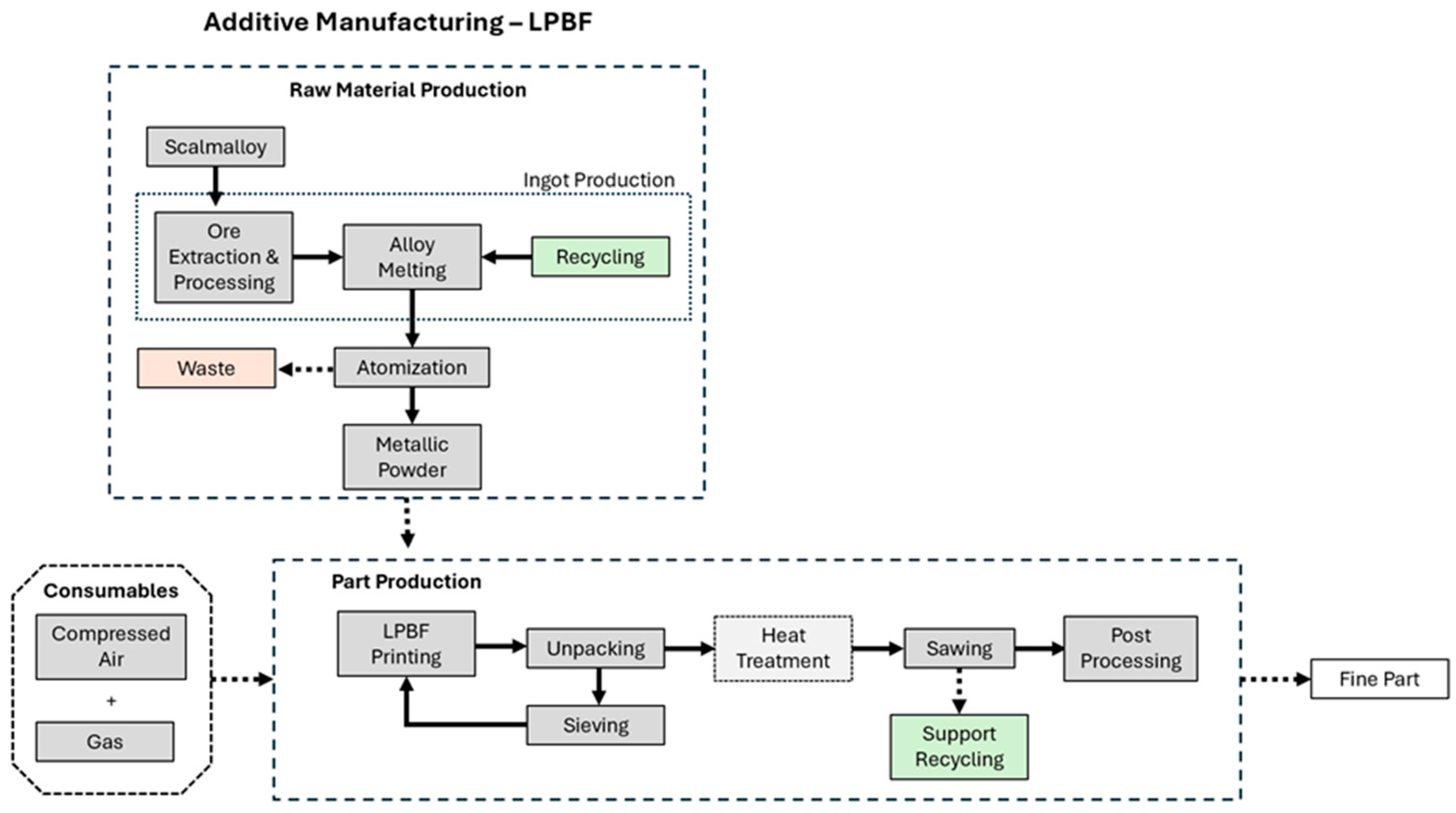
Material-related impacts were modelled according to the specific feedstock and manufacturing route. For CNC machining, upstream processes included the Al 7175-T7351 billet casting and rolling, followed by machining operations. Recycling credits were assigned to the recovery of aluminum chips, reflecting standard industrial practices in aerospace machining. For LPBF, the upstream stages included ingot production, gas atomization of the Scalmalloy® powder, and layer-wise powder bed fusion. A yield of 47% for gas atomization was applied in the analysis, consistent with the values reported in the literature [29]. The recycling and reuse of unprocessed powder, as well as the recycling of support structures and failed builds, were incorporated into the analysis. These considerations ensured that the study captured realistic closed-loop material flows. Figure 1 and Figure 2 illustrate the process flows for CNC machining and LPBF, respectively, outlining material inputs, energy consumption, and recycling pathways.
Process-specific parameters such as build time, energy consumption, and support structure volumes were derived from actual production data of the topology-optimized bracket (for LPBF) and benchmarked industrial machining data (for CNC). These values were combined with established sustainability databases (e.g., Ecoinvent, USGS, and industry reports) to calculate energy demand and CO2 emissions per part.

2.4. Cost Analysis

A comparative cost analysis was performed to evaluate the economic viability of LPBF versus conventional CNC machining for the aerospace component. The assessment included material costs, energy use, machine operation, labour, and post-processing.
The cost assessment of the original aerospace bearing bracket manufactured through CNC machining from Al 7175-T7351 was conducted using a structured methodology that incorporates all significant cost drivers [3,30]. These include material procurement, tooling, machine operation, labour, overhead, and energy consumption. In this study, both proprietary customer datasets and values obtained from the literature were used to ensure a comprehensive and accurate cost estimation [30,31,32,33]. The total cost per part was estimated using the following formula:
Total machining cost = CM + CT + (Cmach × CL) + CLt + COHt + ECt
where CM = material cost, CT = tooling cost, CMach = machining cost, CL = labour cost, CLt = labour cost total, LR = labour rate, COHt = overhead cost total, ECt = electricity cost total.
For the LPBF route, the cost assessment was conducted using a process-based costing methodology that accounts for all relevant contributors to total part cost, including material consumption, data preparation, machine operation, labour, energy use, and post-processing. The total manufacturing cost was calculated as the sum of individual cost elements according to Equation (3):
Total Cost = CM + CDP + CIS + CBS + CD + CR + CC + CU + CS + CP
where
  • Material cost (CM) = material cost per kg × mass of the part;
  • Data preparation cost (CDP) = data preparation time × engineer hourly rate;
  • Machine setup cost (MSC) = time × (machine hourly rate + labour rate);
  • Laser melting cost (LMC) (deposition cost (CD)) = deposition time × machine hourly rate;
  • Recoating cost (CR) = recoating time × machine hourly rate;
  • Cooldown cost (CC) = cooldown time × machine hourly rate;
  • Unloading cost (CU) = unloading time × (machine hourly rate + labour rate);
  • Separation and post-processing cost (CS) = separation time × (labour rate + system cost);
  • Other process costs (CP) = total process time × energy cost per hour + consumables cost;
  • Support removal (SR) = time × staff salary per hour.
This structured framework ensures that all direct and indirect cost drivers are captured, from digital pre-processing through layer-wise manufacturing to final post-processing. Input values for times, labour rates, and machine costs were derived from actual build data of the topology-optimized bracket.

3. Results

3.1. LPBF Build Preparation and Simulation

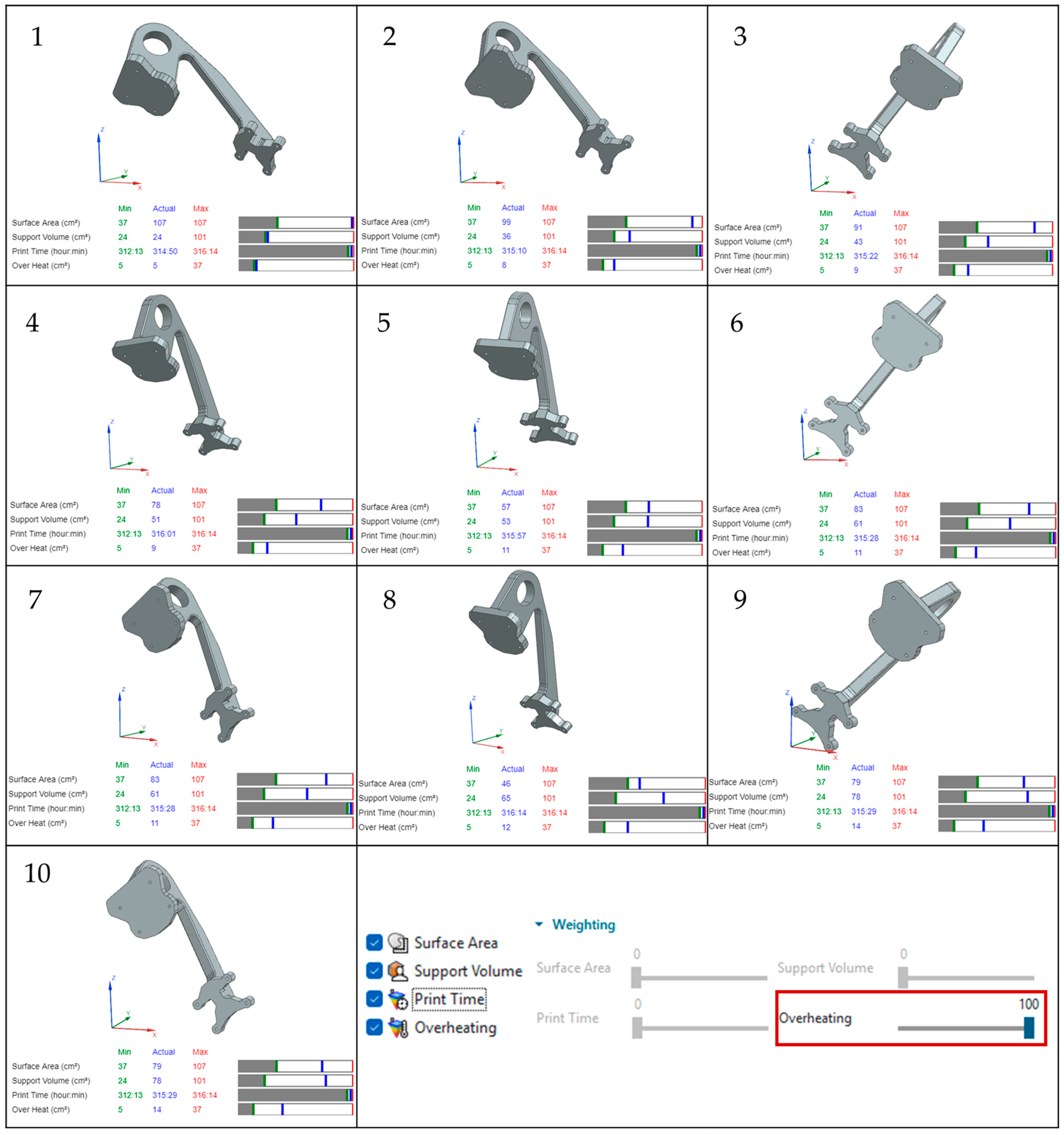
The AM preparation phase involved optimizing the LPBF build setup to ensure geometric stability, process reliability, and efficient production. Siemens NX was used to conduct a comprehensive part orientation analysis based on four weighted factors: support volume, print time, surface area, and overheating potential. For this study, overheating was prioritized as the primary criterion for orientation selection, due to its direct correlation with residual stresses and distortion in LPBF processes. As shown in Figure 3, ten orientation candidates were evaluated, each with a corresponding analysis of support requirements, thermal loads, and build time.
Among the evaluated options, orientation 1 was selected as the optimal configuration. This setup exhibited the lowest overheating footprint (5 cm2), a minimal print time deviation, and a support volume within acceptable bounds. Importantly, the orientation minimized unsupported overhangs and high-angle surfaces that would otherwise experience thermal accumulation. This selection aimed to reduce the likelihood of warping and promote dimensional consistency during layer-wise melting and solidification.
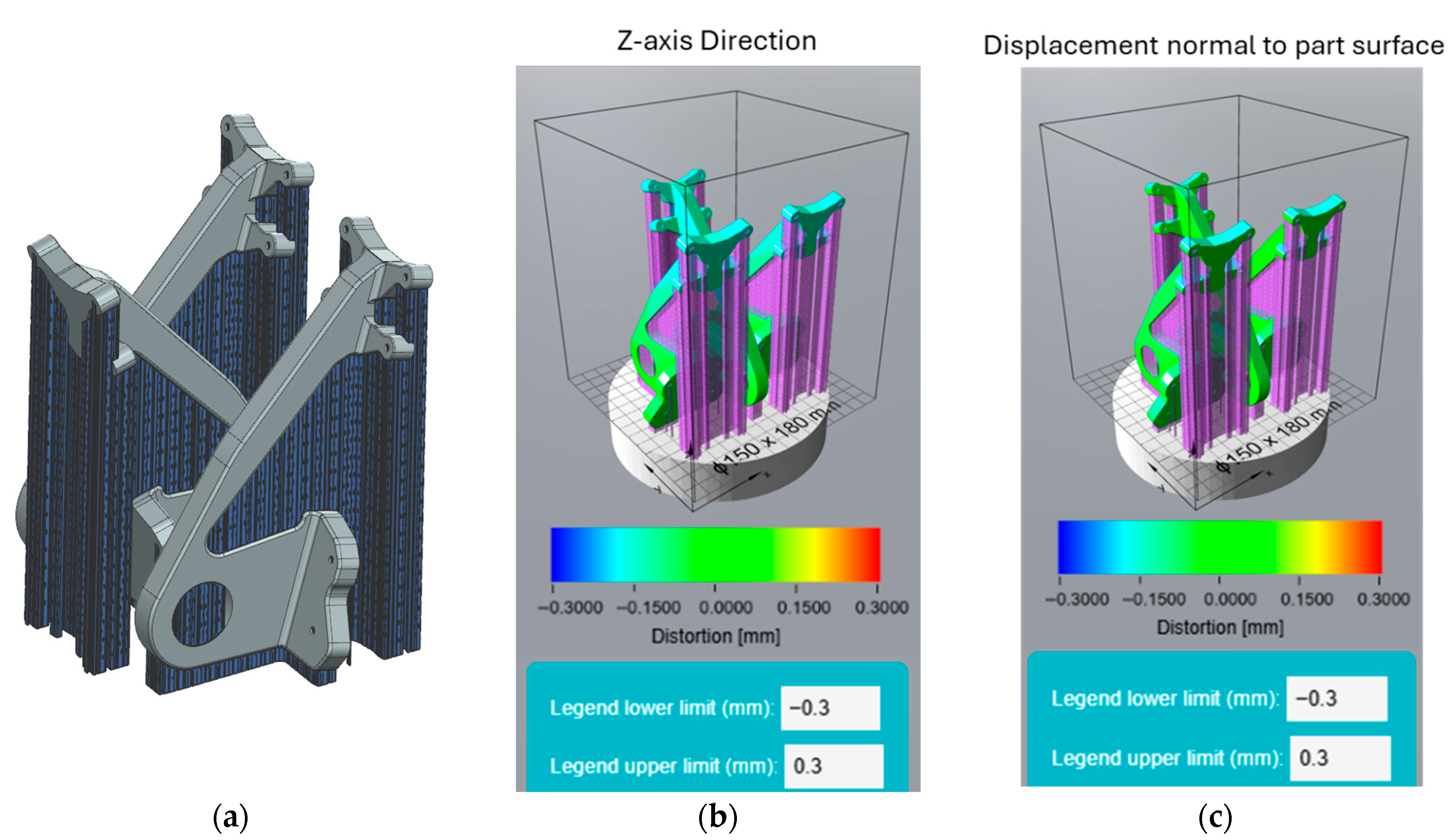
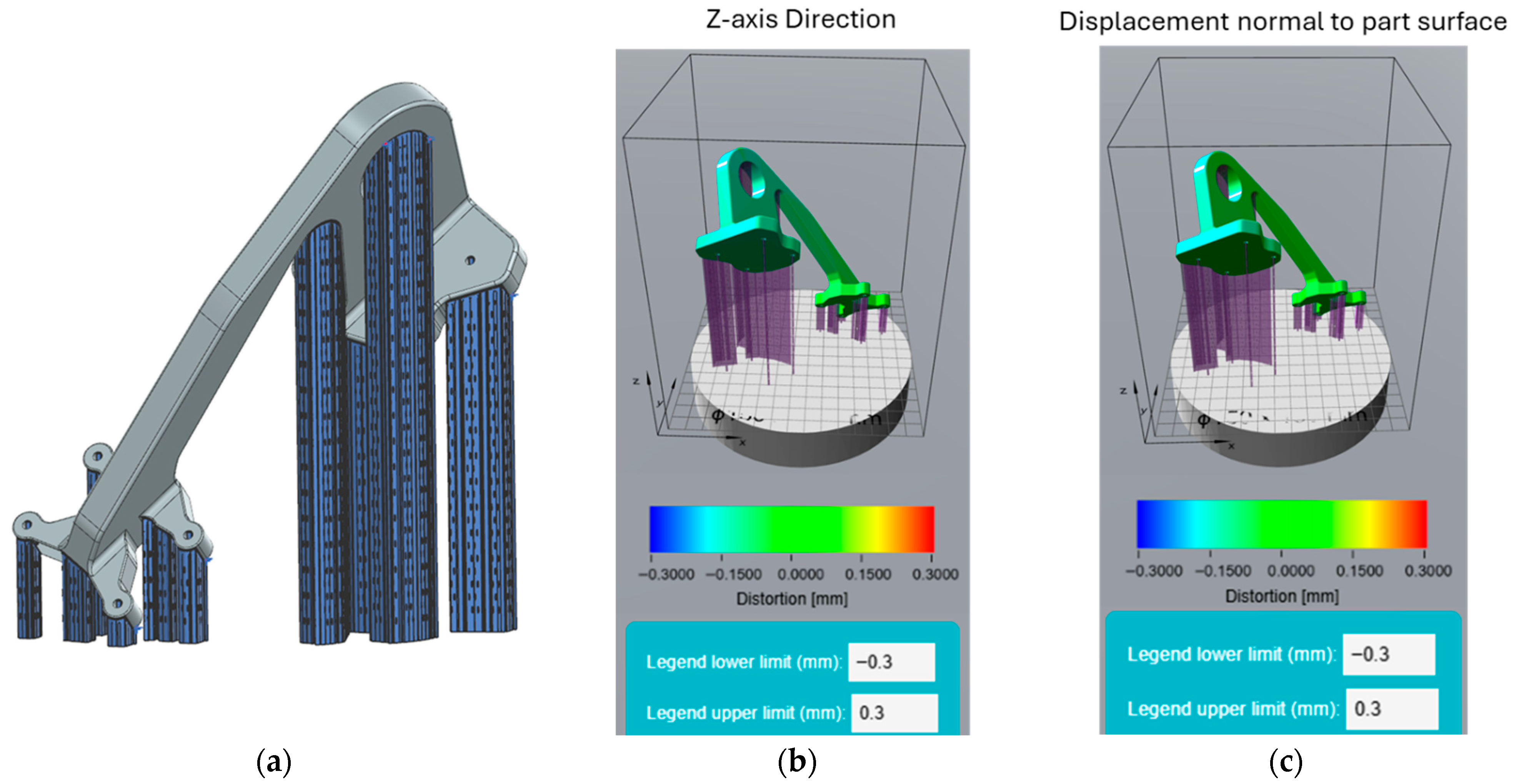
In strategy 1, the part was printed individually in the optimal orientation selected from the Siemens NX evaluation. The orientation minimized overheating, thermal gradients, and unsupported overhangs, helping to reduce thermally induced distortion and enhance dimensional accuracy. Perforated block and line support structures (Figure 4a) were generated in Siemens NX to stabilize the part during printing while minimizing material consumption and build time, as well as to reduce thermal accumulation and simplify post-processing, thereby contributing to both sustainability and economic efficiency.
The geometry and supports were exported in .cli and .stl file formats and sliced using Siemens NX with a 40 μm layer thickness, generating 3551 layers for the single-part build. Atlas3D simulations of thermal behaviour confirmed the suitability of the configuration. As shown in Figure 4, both the predicted displacement in the Z-axis direction (Figure 4b) and displacement normal to the part surface (Figure 4c) remained within the predefined acceptable tolerance of ±0.3 mm. Since geometric tolerances in LPBF processes are highly process-dependent and often require post-processing to meet functional specifications (ISO/ASTM 52911-3:2023) [34], and because no direct guidelines or specifications for distortion tolerances currently exist, this study adopted a value of ±0.3 mm as an application-specific criterion. This approach is consistent with the literature, where the achievable tolerance ranges for LPBF have been evaluated through artefacts and dimensional inspections using 3D scanning [35]. No recoater interference was predicted, confirming the geometric stability of the chosen orientation.
In strategy 2, the build approach focused on maximizing platform utilization by printing three brackets per build cycle. The total build time of 41.83 h corresponds to an average build time of approximately 14 h per part, with a support material mass of 9.57 g per part. While the same overall part orientation used in strategy 1 was retained, the orientation and placement of the three parts were manually adjusted to allow optimal nesting within the available build volume. This layout was developed using Siemens NX on an INTECH SF1 iFusion150 system (Intech Additive Solutions Ltd., Bangalore, India), which features a circular build platform 150 mm in diameter and 180 mm in height, ensuring minimal thermal interference between parts and allowing efficient recoater movement. Perforated support structures (Figure 5a) were again applied, balancing print stability and ease of removal.
Atlas3D simulations confirmed the thermal performance of the three-part configuration. Displacement along the Z-axis (Figure 5b) and normal to the surface (Figure 5c) stayed within the predefined distortion threshold of ±0.3 mm, which served as a generic acceptability range for LPBF builds. This validated the feasibility of the batch build approach, showing that increased throughput could be achieved without compromising part integrity or recoater clearance. Due to the increased number of components in a single build, the total build time increased to 41.83 h, and support material per part rose to 9.57 g. The sliced file contained 3545 layers at a 40 μm layer thickness.

3.2. Sustainability Analysis

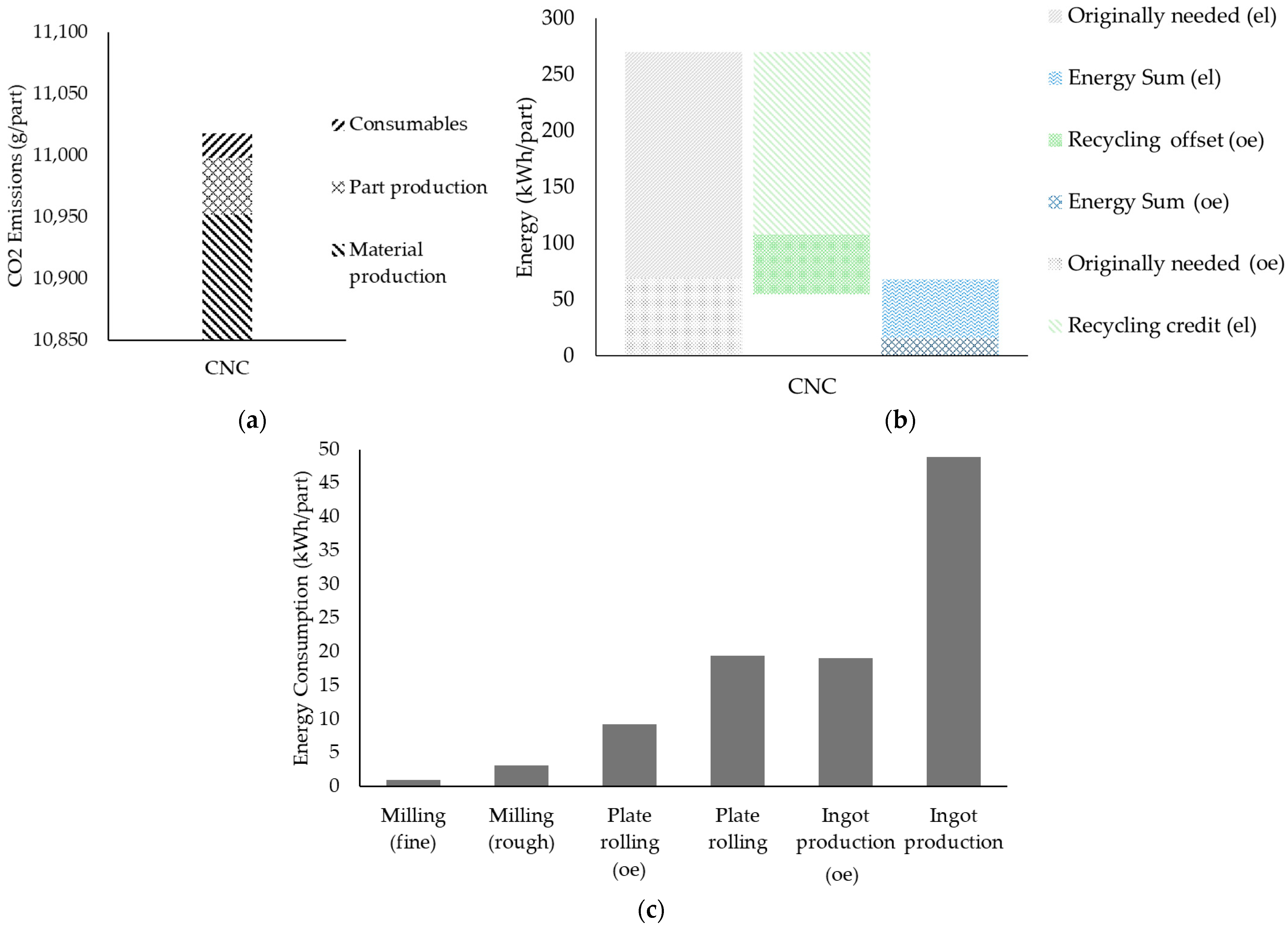
The cradle-to-gate sustainability performance of the conventionally machined aerospace bracket manufactured from Al 7175-T7351 was assessed. As shown in Figure 6a, the total CO2 emissions per part were approximately 11,000 g CO2-eq, with the largest contributors being material production and part production, followed by a smaller share from consumables. The low material efficiency, driven by a B2F ratio of 1:7, means that roughly 86% of the starting billet becomes scrap, even if partially recycled. This significantly inflates the environmental burden of raw material stages. Figure 6b presents the embedded energy analysis of the CNC process. The total energy footprint exceeded 100 kWh per part, with primary energy consumption attributed to ingot production and plate rolling. While some energy recovery is accounted for via aluminum chip recycling credits, the net impact remains high due to the dominance of primary aluminum in the supply chain. As detailed in Figure 6c, ingot production alone consumed more than 40 kWh, far surpassing other stages. Rolling and machining steps (both rough and fine) contributed additional energy demand, though to a lesser extent. These results reflect the energy-intensive nature of subtractive manufacturing, particularly when starting from rolled plates of aerospace-grade alloys.
The 1st additive manufacturing strategy evaluated the sustainability of producing a single topology-optimized bearing bracket per build cycle. The build orientation was thermally optimized to minimize warping and ensure dimensional precision. Sustainability analysis was performed, with actual process data used as inputs, including real energy consumption, powder use, and support volume.
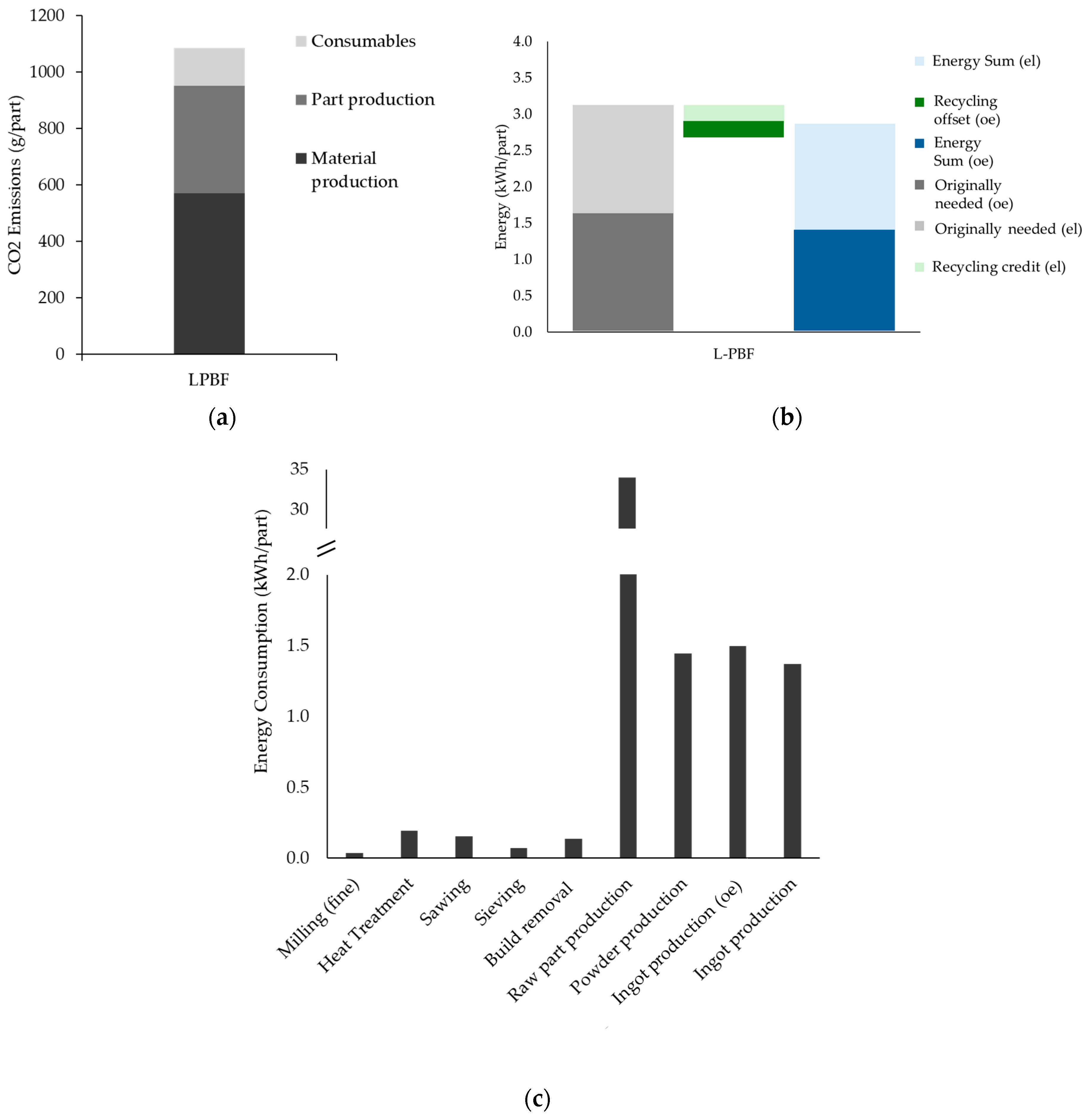
As shown in Figure 7a, the energy consumption per part reached approximately 40 kWh, with the largest contributions coming from ingot production, powder production, and raw part production. Post-processing steps such as sieving, sawing, and unpacking consumed relatively little energy by comparison. This distribution reflects the high upstream energy intensity of aluminum alloys and the complexity of the powder production chain. CO2 emissions for the process achieved approximately 1122 g CO2-eq per part, as seen in Figure 7b. The dominant contributors were again material production and part production, with a minor share attributed to consumables. Figure 7c illustrates the energy balance for strategy 1, showing how recycling credits for both electrical and primary energy streams significantly offset the total impact. These credits stem from powder reuse, partial recycling of support structures, and reduced energy requirements for remanufacturing. The B2F ratio for this strategy was approximately 1:1.2, meaning nearly all input material contributes to the final part.
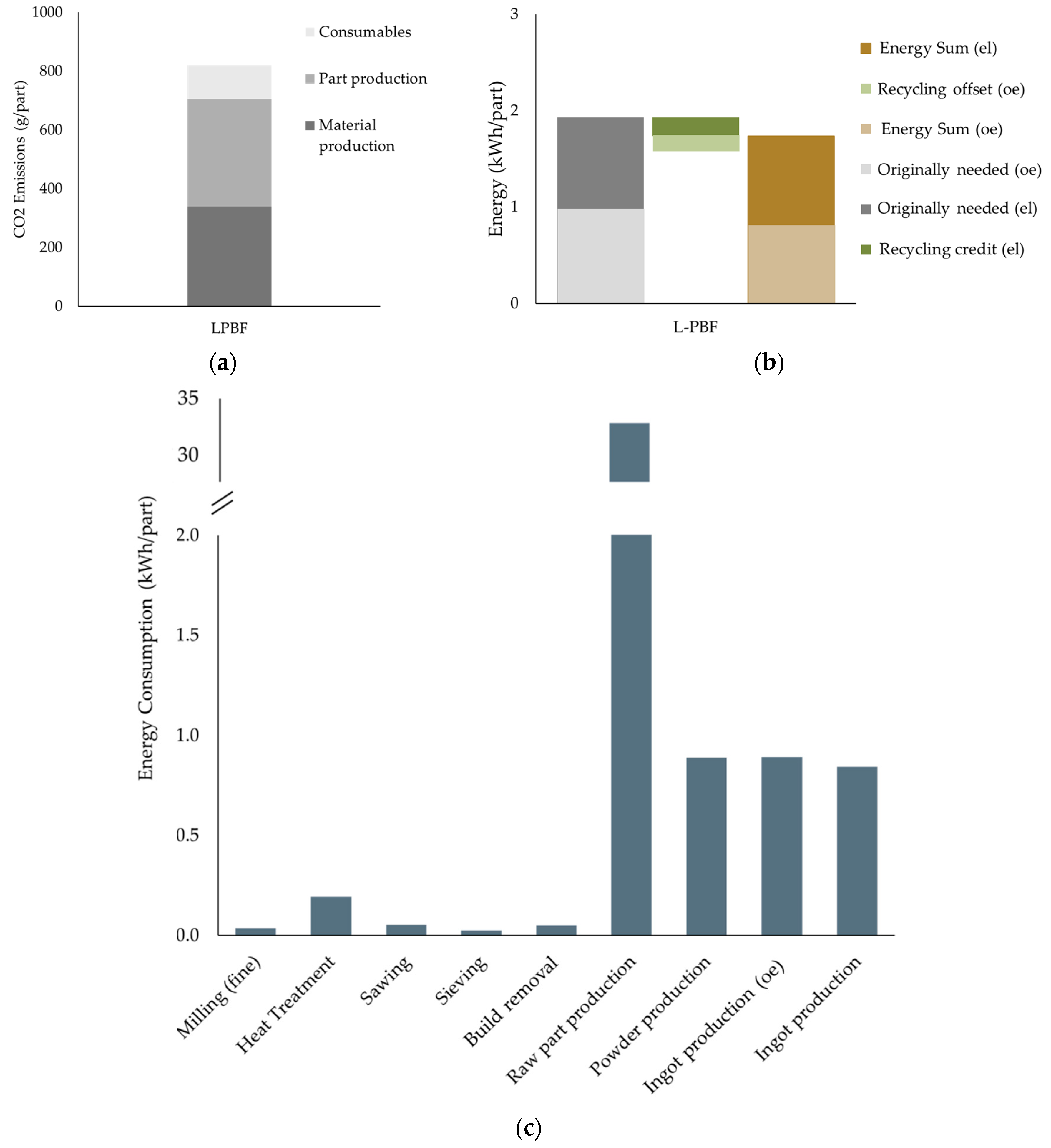
The 2nd additive manufacturing strategy aimed to maximize production efficiency by printing three topology-optimized brackets in a single build cycle. Sustainability performance was again evaluated, using actual build data and simulation outputs as inputs. As illustrated in Figure 8a, the energy consumption per part in this strategy was reduced to approximately 37 kWh, slightly lower than in strategy 1. The major contributors to energy demand remained powder production, ingot production, and raw part production, reflecting the upstream nature of most energy intensity in LPBF. Minor contributions came from secondary steps such as sieving, sawing, and unpacking. The CO2 emissions per part were estimated at approximately 820 g CO2-eq, as shown in Figure 8b. As before, emissions were dominated by material and part production, while consumables accounted for a minimal share. The energy balance in Figure 8c highlights the influence of recycling credits on the final sustainability outcome. Credits for electrical and primary energy use, primarily due to powder reuse and process optimization, reduced the net energy footprint substantially. The buy-to-fly ratio remained approximately 1:1.2, consistent with strategy 1, confirming high material efficiency.
A comparative summary of the two LPBF build strategies is presented in Table 3, highlighting differences in energy use, emissions, and dimensional reliability.

3.3. Cost Assesment

For the 3-axis CNC machining process, the total machining cost for the bearing bracket was EUR 1019.41 per part. The material cost was calculated based on the mass of the initial billet and the cost per kilogram of Al 7175-T7351, considering a B2F ratio of 1:7. This implies that approximately 86% of the raw material was lost as waste, significantly impacting material costs. Tooling cost considered the tool price and tool life relative to the part’s cycle time. Labour cost included setup and machining time, multiplied by the operator hourly rate. Overhead and energy costs were estimated using standard multipliers for machine utilization and electricity tariffs. This relatively high value for the bracket reflects the energy- and material-intensive nature of subtractive machining, particularly when tight tolerances and aerospace-grade finishes are required.
The total cost for producing one topology-optimized bearing bracket through strategy 1 via LPBF was EUR 930.2. This result, combined with significantly improved material efficiency (B2F~1:1.2) and sustainability benefits, demonstrates the viability of LPBF as a competitive alternative to traditional subtractive manufacturing for aerospace-grade components. The highest cost contributions were observed in the recoating stage (EUR 295.99) and laser melting (EUR 177.32), reflecting the time-intensive nature of powder layer handling and laser exposure in LPBF.
In addition to the cost assessment for the first approach (single part per build cycle), the second strategy aiming to maximize build volume efficiency by producing three brackets within a single LPBF build was also evaluated. By producing three parts in a single build cycle, the overall manufacturing cost per part was significantly reduced compared to the single-part strategy. The total cost per part when printing three parts within a single build was EUR 496.76, demonstrating a substantial cost reduction compared to the single-part strategy (EUR 930.2 per part).

4. Discussion

This study provides a comparative assessment of the environmental and economic performance of subtractive and additive manufacturing routes for an aerospace bearing bracket, offering insights into how process selection and build strategy influence key sustainability and cost metrics. The results clearly demonstrate that additive manufacturing, when implemented with appropriate build preparation strategies, can significantly overcome conventional CNC machining in both sustainability and cost efficiency, particularly for topology-optimized components. Through the application of cradle-to-gate lifecycle and cost assessments, the results not only confirm the hypothesized advantages of LPBF but also provide quantifiable evidence of performance improvements under different operational strategies.
The CNC machining process, long established as the default method for high-performance metal component manufacturing, was found to be environmentally and economically suboptimal for this use case. With a B2F ratio of 1:7, CNC machining consumed seven times more material than was retained in the final part, resulting in substantial material waste and high upstream energy demand due to billet production. This inefficiency had a compounding effect on both emissions and energy use: the total energy demand per part exceeded 100 kWh and the associated CO2 emissions reached approximately 11,000 g per bracket. These values reflect the embodied energy of aluminum, the energy required for plate rolling and machining, and the lack of material circularity despite partial chip recycling. The subtractive nature of the process, combined with the need for multiple operations, setup stages, and post-processing, led to high total production costs of EUR 1019.41 per part, with machining operations alone accounting for nearly 43% of the overall cost.
In comparison, both LPBF strategies delivered significant improvements in environmental indicators, validating the potential of AM for low-waste and energy-efficient production of optimized aerospace parts. The use of Scalmalloy®, an alloy specifically engineered for additive manufacturing, enabled high mechanical performance while supporting design freedom for topological optimization. By generating parts layer-by-layer and only where needed, LPBF drastically reduced raw material consumption. Both strategies achieved a B2F ratio of approximately 1:1.2, representing a 65% improvement in material efficiency compared to CNC. Additionally, the cradle-to-gate CO2 emissions were reduced by over 90% in both strategies, dropping to 1122 g per part for the first strategy and to 820 g for the second. Energy consumption also decreased significantly, to 40 kWh and 37 kWh per part, respectively, corresponding to a 60–63% reduction relative to the CNC. While the CO2 and energy savings reported here are notable, it is worth noting that the relative advantage of LPBF is sensitive to the electricity mix used for powder production and machine operation. Regions with high renewable penetration in the grid could further widen this environmental gap, whereas carbon-intensive energy grids may reduce the overall benefit. This underlines the need for location-specific sustainability assessments when planning AM adoption. Table 4 highlights the relative improvements in CO2 emissions, energy consumption, and material efficiency of both LPBF strategies compared to conventional CNC machining. The results show that the LPBF process achieves substantial reductions in material usage, scrap generation, and component weight, contributing directly to a lower Global Warming Potential (GWP) and abiotic depletion potential in comparison to subtractive CNC machining. These findings mirror the outcomes reported by Heikinmaa, who found that a stainless-steel module produced via LPBF led to a 58% lower GWP and a 76% lower depletion of non-fossil resources compared to conventional manufacturing [36]. Similarly, Rahmani et al. showed that LPBF aligns with Industry 5.0 principles by minimizing material waste and enabling lighter, high-performance parts with reduced embedded energy across their lifecycle [13]. However, as also observed by Paris et al., the LPBF process involves higher energy input during the powder atomization and laser melting stages [37]. Despite this, the significantly improved material efficiency and the ability to fabricate near-net-shape parts with minimal post-processing largely offset the higher process energy. This balance is highly geometry-dependent, emphasizing the importance of Design for Additive Manufacturing (DfAM) practices [15,36].
The sustainability assessment results also reveal a potential impact shift in LPBF, from downstream waste (e.g., machining swarf) in CNC to upstream powder production and electricity use in LPBF. Rahmani et al. showed that novel technologies can reduce impacts in one lifecycle stage but exacerbate them elsewhere, necessitating a cradle-to-gate perspective [13]. This aligns with the analysis conducted in the current study, which showed that electricity source and powder reusability rates are key determinants of the final environmental footprint.
The differences between the two LPBF strategies underscore the importance of build volume utilization and process planning. Strategy 1 prioritized minimal thermal distortion and higher dimensional accuracy by printing a single bracket per build. While this approach resulted in stable builds and minimal recoater interference, it also incurred high recoating and laser melting costs per part due to underutilized machine time. Despite these limitations, the total production cost per part still came in slightly lower than CNC, at EUR 930.20, demonstrating the economic viability of LPBF even in conservative build setups. Strategy 2, which involved the production of three parts per build cycle, leveraged the full build volume of the machine, distributing recoating, preheating, and overhead costs across multiple units. This strategy achieved a dramatic reduction in cost to EUR 496.76 per part, more than 50% lower than the CNC route and 46.6% lower than strategy 1, while maintaining acceptable thermal performance based on Atlas3D simulations. The improved sustainability metrics in strategy 2 were primarily driven by shared thermal cycles, lower support mass per part, and more efficient use of recoating and build plate area.
The findings also validate the use of simulation and build preparation tools as enablers of high-performance AM. Siemens NX and Atlas3D played an important role in evaluating build orientations, predicting distortion risk, and identifying recoater collision scenarios. Their use allowed for data-driven optimization of build strategies, ensuring that both dimensional tolerances and process stability were maintained without trial-and-error experimentation. Particularly in strategy 1, simulation outputs confirmed that thermal distortion remained within ±0.3 mm in both the z-direction and on surface-normal displacement, thereby supporting geometric accuracy requirements typical in aerospace applications. Strategy 2 achieved similar distortion performance despite the increased thermal load from multiple parts, demonstrating that high build efficiency need not compromise part quality when simulation-guided design is applied.
Beyond the technical performance metrics, the economic findings of this study reinforce the growing competitiveness of LPBF in small-batch or customized production environments. While CNC remains favourable for large production volumes of simple geometries, it becomes less attractive when faced with complex or optimized designs that increase tool path complexity, machining time, and material waste. LPBF, conversely, gains competitiveness when design complexity increases or material efficiency is critical. Moreover, the ability to reduce per-part cost through build nesting and support minimization, as shown in strategy 2, positions AM as a scalable and cost-attractive solution for lightweight, structurally demanding components in regulated industries. These findings are supported by Sathish et al. and Watson and Taminger, who noted that LPBF becomes economically preferable at high B2F ratios and complex geometries. In this study, the weight savings (65% lighter bracket) and reduction in support volume contributed to shorter print times and less post-processing, improving overall cost-effectiveness [6,10].
In addition to the cradle-to-gate sustainability advantages of LPBF observed in this study, the potential use-phase benefits were evaluated through a realistic aviation scenario. Specifically, in this study, we assessed the long-term environmental and economic impact of replacing 500 conventionally machined aluminum aerospace brackets with topology-optimized, additively manufactured brackets made from Scalmalloy on a typical Airbus A320 aircraft [38]. Aircraft weight has a direct and well-established relationship with fuel consumption and operational emissions. The literature in the industry suggests that a 100 kg reduction in aircraft weight results in approximately 19,000 L of fuel savings per year, which translates to about 59,000 kg of CO2-equivalent (CO2e) avoided annually when considering a well-to-wake emissions basis using a 3.12 kg CO2e/litre jet fuel conversion factor [39,40]. In our case, the substitution of conventional brackets (weighing 414.51 g each) with AM topology-optimized brackets (141.51 g each) led to a 273 g weight reduction per part. When scaled across 500 parts, the total aircraft weight reduction reached 136.25 kg. This alone generated estimated annual fuel savings of 25,888 L and CO2 savings of 77.6 tons. Over a projected 30-year aircraft lifespan [39], the cumulative benefits include 776,640 L of fuel saved, 2328 tons of CO2 emissions avoided, and EUR 559,181 in total operating cost savings, assuming a jet fuel price of EUR 0.72 per litre [41]. These findings highlight the extended lifecycle and in-service sustainability impact of additive manufacturing when combined with design optimization. They also demonstrate how material and design decisions made during the manufacturing phase can lead to substantial downstream environmental and financial benefits throughout a product’s use phase—particularly in high-impact sectors like aerospace. A summary of these results is provided in Table 5.
It is important to emphasize that the substantial performance gap observed between CNC and LPBF in this study is closely linked to the application of topology optimization. By redesigning the bracket for minimum weight while maintaining structural performance, TO enabled a 65% mass reduction that directly amplified the material efficiency, cost savings, and in-service fuel benefits of LPBF. If the original, non-optimized geometry had been manufactured using AM, the relative advantages over CNC would have been notably smaller, as both routes would have required similar volumes of material and the potential for weight-driven use-phase savings would have been limited. Thus, the combined use of topology optimization and AM, not AM alone, was central to unlocking the sustainability and economic benefits reported. This finding underscores the necessity of integrating design optimization practices such as TO into DfAM workflows when aiming to maximize the environmental and financial value of AM adoption.
Taken together, the results confirm that AM, especially when integrated with topology optimization, intelligent build planning, and simulation tools, can exceed traditional subtractive methods not only in sustainability but also in cost. LPBF, while often perceived as a high-cost solution, becomes an economically better solution when build volume is efficiently utilized and operational strategies are tailored to the design and production context. These conclusions support a strategic shift toward AM in aerospace and similar sectors, particularly for parts that benefit from weight savings, geometrical freedom, and low waste production. The evidence presented here also emphasizes the importance of early-stage build simulation and cost-performance evaluation as part of design for AM workflows.

5. Conclusions

This study provided a comparative assessment of the environmental and economic performance of additive manufacturing (LPBF) and subtractive manufacturing (CNC machining) for an aerospace bearing bracket using a simulation-driven sustainability and cost modelling framework. Using cradle-to-gate sustainability assessment and cost modelling, the results showed that LPBF, particularly when combined with topology optimization and efficient build strategies, can offer advantages over CNC in terms of sustainability and cost-effectiveness for low-volume, high-complexity components. From an environmental perspective, LPBF reduced cradle-to-gate CO2 emissions by more than 90% and energy consumption by over 60% compared to CNC within the defined system boundaries of this study, primarily due to its near-net-shape material efficiency and the elimination of extensive machining. The B2F ratio improved from 1:7 in CNC to approximately 1:1.2 in LPBF, resulting in substantial scrap reduction and lower upstream material demand. While powder atomization and laser melting require high energy input, the reduced raw material usage and minimal downstream waste offset these impacts. Economically, the study showed that LPBF can be cost-competitive with CNC, even under conservative build conditions. Strategy 1 (single part per build) achieved slightly lower costs than CNC, while strategy 2 (three parts per build) reduced unit cost by over 50% relative to CNC through improved build volume utilization, lower support mass per part, and shared processing time. These results highlight the critical influence of build nesting and process planning on AM’s economic performance. A use-phase analysis further revealed that replacing 500 conventional brackets with LPBF topology-optimized parts could save more than 25,800 L of fuel and 77.6 tons of CO2 annually in an Airbus A320 application, leading to significant lifetime environmental and operational cost benefits. This demonstrates the broader lifecycle advantages of AM when weight reduction is leveraged in service. Overall, the findings support the informed consideration of LPBF for applications where weight savings, geometric complexity, and material efficiency are key drivers. For aerospace and similarly demanding sectors, early integration of DfAM, build simulation, and cost-performance evaluation can unlock the both environmental and economic gains.

Author Contributions

Conceptualization, N.S. and E.K.K.; methodology, N.S.; software, N.S.; validation, N.S.; formal analysis, N.S.; investigation, N.S.; resources, A.S.A., E.P.K. and E.K.K.; data curation, N.S.; writing—original draft preparation, N.S.; writing—review and editing, N.S., A.S.A., E.P.K. and E.K.K.; visualization, N.S.; supervision, E.K.K.; project administration, N.S. and E.K.K.; funding acquisition, E.P.K. and E.K.K. All authors have read and agreed to the published version of the manuscript.

Funding

This research received no external funding.

Data Availability Statement

The data are included in the article and are available on request from the corresponding author.

Conflicts of Interest

Evangelia K. Karaxi is the owner of Conify P.C., Nikoletta Sargioti is employed by Conify P.C., Amin S. Azar is the Founder and CEO of 3D-Components AS, while Elias P. Koumoulos is the owner of IRES SNC. The authors declare no conflicts of interest.

Abbreviations

The following abbreviations are used in this manuscript:
CNCComputer Numerical Control
LPBFLaser Powder Bed Fusion
B2F/BTFBuy-to-Fly Ratio
CO2Carbon Dioxide
LCALifecycle Assessment
AMAdditive Manufacturing
DfAMDesign for Additive Manufacturing
A320Airbus A320 Aircraft
GWPGlobal Warming Potential
CMMaterial Cost
CTTooling Cost
CmachMachining Cost
CLLabour Cost
CLtTotal Labour Cost
COHtTotal Overhead Cost
ECtElectricity Cost Total
CDPData Preparation Cost
MSCMachine Setup Cost
CBSBuild Setup Cost
CDDeposition
LMCLaser Melting Cost
CRRecoating Cost
CCCooldown Cost
CUUnloading Cost
CSSeparation And Post-Processing Cost
CPOther Process Costs
SRSupport Removal
STL/.stlStereolithography File Format
CLI/.cliCommon Layer Interface File Format
PEFPrimary Energy Factor
elElectricity (Final Energy)
oePrimary Energy Equivalent
AjActivity Data
EFjEmission Factor
Rp0.2Yield Strength at 0.2% Offset
UTSUltimate Tensile Strength
TOTopology Optimization
PBF-LBPowder Bed Fusion—Laser Beam

References

  1. Ferreira, B.T.; de Campos, A.A.; Casati, R.; Gonçalves, A.; Leite, M.; Ribeiro, I. Technological capabilities and sustainability aspects of metal additive manufacturing. Prog. Addit. Manuf. 2023, 9, 1737–1773. [Google Scholar] [CrossRef]
  2. Gisario, A.; Kazarian, M.; Martina, F.; Mehrpouya, M. Metal additive manufacturing in the commercial aviation industry: A review. J. Manuf. Syst. 2019, 53, 124–149. [Google Scholar] [CrossRef]
  3. Mecheter, A.; Tarlochan, F.; Kucukvar, M. A Review of Conventional versus Additive Manufacturing for Metals: Life-Cycle Environmental and Economic Analysis. Sustainability 2023, 15, 12299. [Google Scholar] [CrossRef]
  4. Sargioti, N.; Karavias, L.; Gargalis, L.; Karatza, A.; Koumoulos, E.P.; Karaxi, E.K. Physicochemical and Toxicological Properties of Particles Emitted from Scalmalloy During the LPBF Process. Toxics 2025, 13, 398. [Google Scholar] [CrossRef] [PubMed]
  5. Spierings, A.B.; Dawson, K.; Voegtlin, M.; Palm, F.; Uggowitzer, P.J. Microstructure and mechanical properties of as-processed scandium-modified aluminium using selective laser melting. CIRP Ann. Manuf. Technol. 2016, 65, 213–216. [Google Scholar] [CrossRef]
  6. Sathish, K.; Kumar, S.S.; Magal, R.T.; Selvaraj, V.; Narasimharaj, V.; Karthikeyan, R.; Sabarinathan, G.; Tiwari, M.; Kassa, A.E. A Comparative Study on Subtractive Manufacturing and Additive Manufacturing. Adv. Mater. Sci. Eng. 2022, 2022, 6892641. [Google Scholar] [CrossRef]
  7. Krishna, L.S.R.; Srikanth, P.J. Evaluation of environmental impact of additive and subtractive manufacturing processes for sustainable manufacturing. Mater. Today Proc. 2021, 45, 3054–3060. [Google Scholar] [CrossRef]
  8. Pusateri, V.; Hauschild, M.Z.; Kara, S.; Goulas, C.; Olsen, S.I. Quantitative sustainability assessment of metal additive manufacturing: A systematic review. CIRP J. Manuf. Sci. Technol. 2024, 49, 95–110. [Google Scholar] [CrossRef]
  9. Barbosa, W.S.; Wanderley, R.F.F.; Gioia, M.M.; Gouvea, F.C.; Gonçalves, F.M. Additive or subtractive manufacturing: Analysis and comparison of automotive spare-parts. J. Remanuf. 2022, 12, 153–166. [Google Scholar] [CrossRef]
  10. Watson, J.K.; Taminger, K.M.B. A decision-support model for selecting additive manufacturing versus subtractive manufacturing based on energy consumption. J. Clean. Prod. 2018, 176, 1316–1322. [Google Scholar] [CrossRef]
  11. Faludi, J.; Baumers, M.; Maskery, I.; Hague, R. Environmental Impacts of Selective Laser Melting: Do Printer, Powder, Or Power Dominate? J. Ind. Ecol. 2017, 21, S144–S156. [Google Scholar] [CrossRef]
  12. Wang, Q.; Gao, M.; Li, L.; Ma, Z.; Liu, C. Emergy-based environmental impact evaluation and modeling of selective laser melting. Int. J. Adv. Manuf. Technol. 2021, 115, 1155–1169. [Google Scholar] [CrossRef]
  13. Rahmani, R.; Bashiri, B.; Lopes, S.I.; Hussain, A.; Maurya, H.S.; Vilu, R. Sustainable Additive Manufacturing: An Overview on Life Cycle Impacts and Cost Efficiency of Laser Powder Bed Fusion. J. Manuf. Mater. Process. 2025, 9, 18. [Google Scholar] [CrossRef]
  14. Parenti, P.; Puccio, D.; Semeraro, Q.; Colosimo, B.M. A techno-economic approach for decision-making in metal additive manufacturing: Metal extrusion versus single and multiple laser powder bed fusion. Prog. Addit. Manuf. 2024, 9, 185–210. [Google Scholar] [CrossRef]
  15. Silva, J. Comparative Life Cycle Inventory of CNC Machining and Powder Bed Fusion Additive Manufacturing. Master’s Thesis, Aalto University, Otaniemi, Espoo, 2022. [Google Scholar]
  16. Sargioti, N.; Koumoulos, E.P.; Karaxi, E.K. Integrating Orientation Optimization and Thermal Distortion Prediction in LPBF: A Validated Framework for Sustainable Additive Manufacturing. Micromachines 2025, 16, 1230. [Google Scholar] [CrossRef]
  17. Puukko, P.; Hepo-oja, L.; Vatanen, S.; Kaipainen, J.; Mäkinen, M.L.; Lindqvist, M. Case study of the environmental impacts and benefits of a PBF-LB additively manufactured optimized filtrate nozzle. Sci. Rep. 2024, 14, 22183. [Google Scholar] [CrossRef] [PubMed]
  18. Pusateri, V.; Olsen, S.I.; Kara, S.; Hauschild, M.Z. Life Cycle Assessment of metal additive manufacturing: A systematic literature review. In Proceedings of the Sustainability in Energy and Buildings: Research Advances; Springer: Berlin/Heidelberg, Germany, 2021; Volume 8, pp. 1–9. Available online: http://nimbusvault.net/publications/koala/SEBRA/606.html (accessed on 18 February 2025).
  19. Diniz, S.B.; Paula, A.D.S.; Brandão, L.P. Temperature and annealing time influences on cross-rolled 7475-T7351 aluminum alloy. Rev. Mater. 2022, 27, e20220167. [Google Scholar] [CrossRef]
  20. ISO 14040:2006; Environmental Management—Life Cycle Assessment—Principles and Framework. International Organization for Standardization: Geneva, Switzerland, 2006; p. 20.
  21. ISO_14044-2006; Environmental Management—Life Cycle Assessment—Requirements and Guidelines. International Organization for Standardization: Geneva, Switzerland, 2006; pp. 1–55.
  22. ISO 14067:2018; Greenhouse Gases—Carbon Footprint of Products—Requirements and Guidelines for Quantification. International Organization for Standardization: Geneva, Switzerland, 2018; p. 46.
  23. ISO 14064-1:2018; Greenhouse Gases—Part 1: Specification with Guidance at the Organization Level for Quantification and Reporting of Greenhouse Gas Emissions and Removals. International Organization for Standardization: Geneva, Switzerland, 2018.
  24. Report, O. Estimates of Electricity Requirements for the Recovery of Mineral Commodities, with Examples Applied to Sub-Saharan Africa; U.S. Geological Survey: Reston, VA, USA, 2011.
  25. Ashby, M.F. Materials and the Environment: Eco-Informed Material Choice; Butterworth-Heinemann: Oxford, UK, 2021. [Google Scholar] [CrossRef]
  26. Balaras, C.A.; Dascalaki, E.G.; Psarra, I.; Cholewa, T. Primary Energy Factors for Electricity Production in Europe. Energies 2023, 16, 93. [Google Scholar] [CrossRef]
  27. European Environment Agency (EEA). National Emissions Reported to the UNFCCC and to the EU Greenhouse Gas Monitoring Mechanism; European Environment Agency: Copenhagen, Denmark, 2024; Available online: https://www.eea.europa.eu/data-and-maps/data/external/national-emissions-reported-to-the-6 (accessed on 18 February 2025).
  28. European Environment Agency. (27 June 2025; Modified 6 November 2025). Greenhouse Gas Emission Intensity of Electricity Generation, Country Level. EEA. Available online: https://www.eea.europa.eu/en/analysis/indicators/greenhouse-gas-emission-intensity-of-1-1762418255/greenhouse-gas-emission-intensity-of (accessed on 29 June 2025).
  29. Ehmsen, S.; Conrads, J.; Klar, M.; Aurich, J.C. Environmental impact of powder production for additive manufacturing: Carbon footprint and cumulative energy demand of gas atomization. J. Manuf. Syst. 2025, 82, 13–25. [Google Scholar] [CrossRef]
  30. Atia, M.; Khalil, J.; Mokhtar, M. A Cost Estimation Model for Machining Operations; an Ann Parametric Approach. J. Al-Azhar Univ. Eng. Sect. 2017, 12, 878–885. [Google Scholar] [CrossRef]
  31. Kaiser Aluminum. Contained Metal Value by Alloy. Available online: https://www.kaiseraluminum.com/contupload/uploads/Kaiser_Contained_Metal_Value_By_Alloy.pdf (accessed on 3 March 2025).
  32. Nicolaou, P.; Thurston, D.L.; Carnahan, J.V. Machining quality and cost: Estimation and tradeoffs. J. Manuf. Sci. Eng. 2002, 124, 840–851. [Google Scholar] [CrossRef]
  33. Li, F. Automated Cost Estimation for 3-Axis CNC Milling and Stereolithography Rapid Prototyping. Master’s Thesis, The University of Manitoba, Winnipeg, MB, Canada, 2005. Available online: https://mspace.lib.umanitoba.ca/items/95f33eda-f12a-4f92-9d39-d9fcf2baa4f9 (accessed on 5 March 2025).
  34. ISO/ASTM 52911-3-2023; Additive Manufacturing—Design Part 3: PBF-EB of Metallic Materials. International Organization for Standardization: Geneva, Switzerland, 2023.
  35. Gruber, S.; Grunert, C.; Riede, M.; López, E.; Marquardt, A.; Brueckner, F.; Leyens, C. Comparison of dimensional accuracy and tolerances of powder bed based and nozzle based additive manufacturing processes. J. Laser Appl. 2020, 32, 032016. [Google Scholar] [CrossRef]
  36. Heikinmaa, L. Comparative Life Cycle Assessment of Conventional and Additive Manufacturing: Case Paper Machine Part Module. Master’s Thesis, LUT University, Lappeenranta, Finland, 2024; pp. 1–23. [Google Scholar]
  37. Paris, H.; Mokhtarian, H.; Coatanéa, E.; Museau, M.; Ituarte, I.F. Comparative environmental impacts of additive and subtractive manufacturing technologies. CIRP Ann. Manuf. Technol. 2016, 65, 29–32. [Google Scholar] [CrossRef]
  38. Reese, R. Aircraft Structural Brackets Using Additive Manufacturing. In Proceedings of the Thermoplastic Composites Conference, San Diego, CA, USA, 22–24 March 2022. [Google Scholar]
  39. Huang, R.; Riddle, M.; Graziano, D.; Warren, J.; Das, S.; Nimbalkar, S.; Cresko, J.; Masanet, E. Energy and emissions saving potential of additive manufacturing: The case of lightweight aircraft components. J. Clean. Prod. 2016, 135, 1559–1570. [Google Scholar] [CrossRef]
  40. Sotiris, K. Auto—Aero: Technology Transfer Assessment for Light Weighting; ThermoPlastic Composites Application Center: Enschede, The Netherlands, 2021. [Google Scholar]
  41. Gonçalves, A.; Ferreira, B.; Leite, M.; Ribeiro, I. Environmental and Economic Sustainability Impacts of Metal Additive Manufacturing: A Study in the Industrial Machinery and Aeronautical Sectors. Sustain. Prod. Consum. 2023, 42, 292–308. [Google Scholar] [CrossRef]
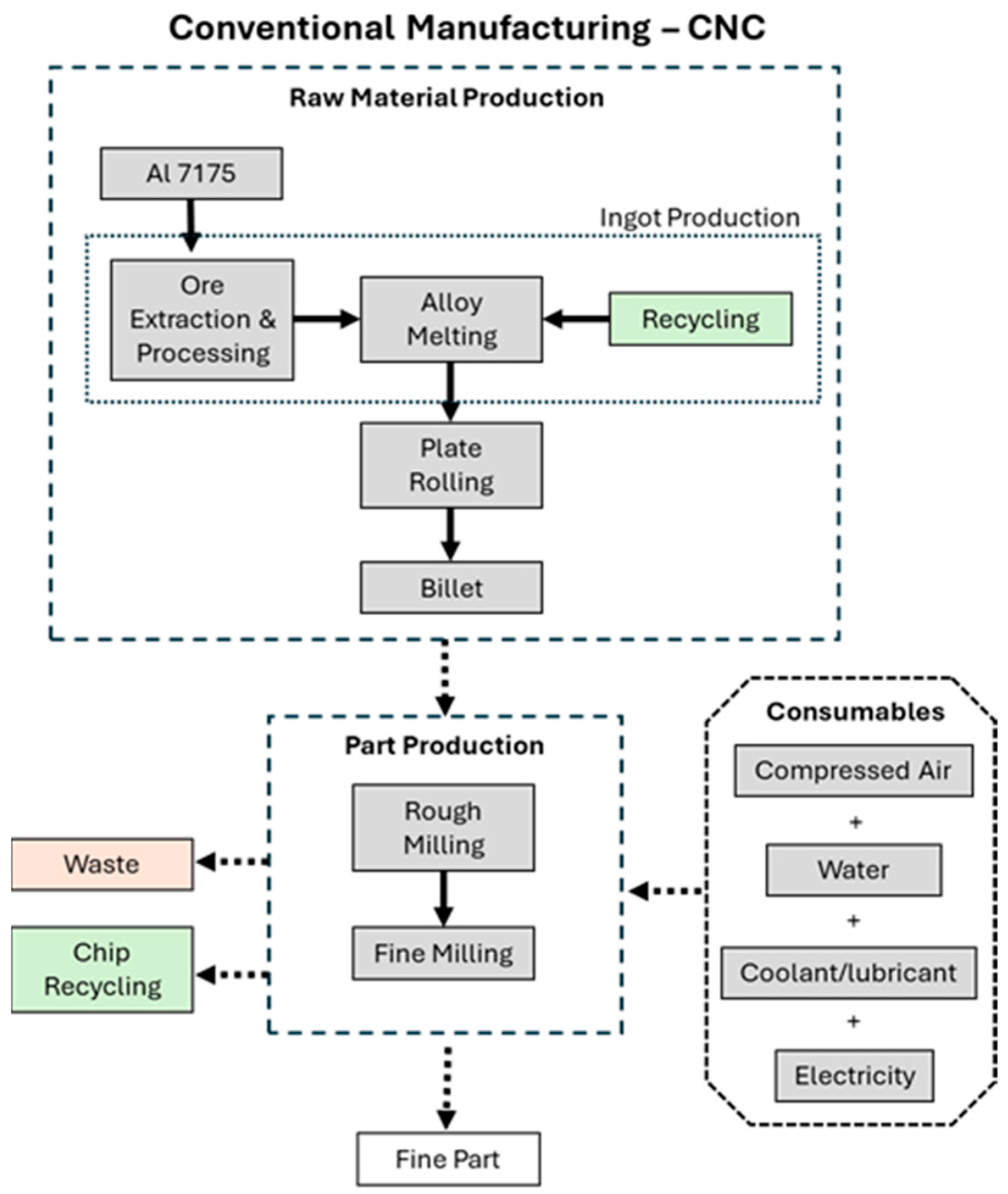
Figure 1. Conventional CNC machining process for Al 7175-T7351—this diagram illustrates the lifecycle of CNC manufacturing, from raw material extraction and ingot production to the billet formation, milling operations, and final part production. It also highlights key resource inputs such as compressed air and water, along with chip recycling efforts to mitigate material waste.
Applsci 16 01360 g001
Figure 2. LPBF process for Scalmalloy—this schematic presents the production flow of LPBF, covering the raw material extraction, alloy melting, powder atomization, and layer-by-layer printing. Post-processing steps such as sieving, heat treatment, and support recycling are also included, emphasizing sustainability and waste reduction in AM production.
Applsci 16 01360 g002
Figure 3. Part orientation optimization based on overheating to avoid thermally induced distortions during the LPBF build process. Subfigures (1–10) show candidate build orientations generated in Siemens NX. Bar indicators represent the minimum (green), actual (blue), and maximum (red) values of the selected criteria, white and gray regions indicate feasible and nonfeasible ranges, respectively.
Applsci 16 01360 g003
Figure 4. AM processing preparation and distortion analysis for the 1st strategy. (a) CAD model of the topology-optimized bearing bracket with generated perforated support structures for LPBF in the optimal orientation. (b) Simulation of displacement in the Z-axis direction, used to check for potential re-coater arm crash. (c) Simulation of displacement normal to the part surface.
Applsci 16 01360 g004
Figure 5. AM processing preparation and distortion analysis for the 2nd strategy. (a) CAD model of the topology-optimized bearing bracket with generated perforated support structures for LPBF in the optimized build setup, allowing for three parts per build cycle. (b) Simulation of displacement in the Z-axis direction, used to check for potential re-coater arm crash. (c) Simulation of displacement normal to the part surface.
Applsci 16 01360 g005
Figure 6. Environmental and energy impact assessment of CNC machining. (a) CO2 emissions breakdown, (b) embedded energy analysis, (c) energy consumption per process stage.
Applsci 16 01360 g006
Figure 7. First strategy—minimal thermal distortions. (a) energy consumption for each stage of the LPBF process, (b) breakdown of CO2 emissions, divided into material production, part production, and consumables, and (c) energy balance for LPBF illustrating the effect of recycling credits on both primary and electrical energy demand.
Applsci 16 01360 g007
Figure 8. Second strategy—maximize build volume efficiency. (a) Energy consumption for each stage of the LPBF process, (b) breakdown of CO2 emissions, divided into material production, part production, and consumables, and (c) energy balance for LPBF illustrating the effect of recycling credits on both primary and electrical energy demand.
Applsci 16 01360 g008
Table 1. Key mechanical properties of Scalmalloy and Al7175.
Alloy SeriesHeat TreatmentRp0.2 (Mpa)UTS (Mpa)Elongation (%)
Al7175T7351 * [19]43550513
Scalmalloy325 °C for 4 h480–500510–53013–16
* The T7351 temper consists of a solution heat treatment conducted at a temperature of 510 °C, a strain relief, an ageing heat treatment at 107 °C for 6 to 8 h, and finally an ageing heat treatment, which is performed at 163 °C for 24 to 30 h.
Table 2. Component considerations for conventional manufacturing and additive manufacturing.
VariableConventional Manufacturing (CNC)Metal Additive Manufacturing (LPBF)Unit
Applsci 16 01360 i001Applsci 16 01360 i002
Dimensions (l, w, h)210, 60, 65150, 60, 65mm
Volume (final part)~155~55cm3
Mass (final part)~430~140g
Volume (billet)1114.5-cm3
Mass (billet)3120.6-g
Supports mass (1st strategy)-3.18g
Supports mass (2nd strategy)-9.57g
MaterialAl 7175Scalmalloy-
Density2.82.67g/cm3
Material cost3250€/kg
Buy-to-fly ratio1:7.331:1.2-
Table 3. Comparative analysis of the two LPBF build strategies for the topology-optimized bearing bracket.
Parameter1st Strategy: Minimal Thermal Distortions—1 Part per Build2nd Strategy: Maximize Build Volume Efficiency—3 Parts per Build
Energy Consumption per Part40 kWh37 kWh
CO2 Emissions per Part1122 g CO2820 g CO2
Material Efficiency (Buy-to-Fly Ratio)1:1.21:1.2
Build Time15 h42 h
Dimensional Accuracy and Distortion RiskMinimized (validated with simulations)Acceptable (validated with simulations)
Table 4. Sustainability comparison between CNC machining and LPBF manufacturing strategies.
MetricCNC MachiningLPBF—Strategy 1 (1 Part/Build)LPBF—Strategy 2 (3 Parts/Build)
CO2 Emissions per Part~11,000 g1122 g (90% reduction)820 g (92.5% reduction)
Energy Consumption per Part>100 kWh40 kWh (60% reduction)37 kWh (63% reduction)
Material Efficiency (Buy-To-Fly)1:71:1.2 (65% improvement)1:1.2 (65% improvement)
Table 5. Summary of use-phase benefits for an Airbus A320 with 500 AM topology-optimized brackets.
MetricApproximate Value
Weight Reduction136.25 kg
Fuel Savings/Year25,888 L
CO2 Savings/Year77.6 tons
Lifetime Fuel Savings776,640 L
Lifetime CO2 Savings2328 tons
Total Cost SavingsEUR 559,181
Disclaimer/Publisher’s Note: The statements, opinions and data contained in all publications are solely those of the individual author(s) and contributor(s) and not of MDPI and/or the editor(s). MDPI and/or the editor(s) disclaim responsibility for any injury to people or property resulting from any ideas, methods, instructions or products referred to in the content.