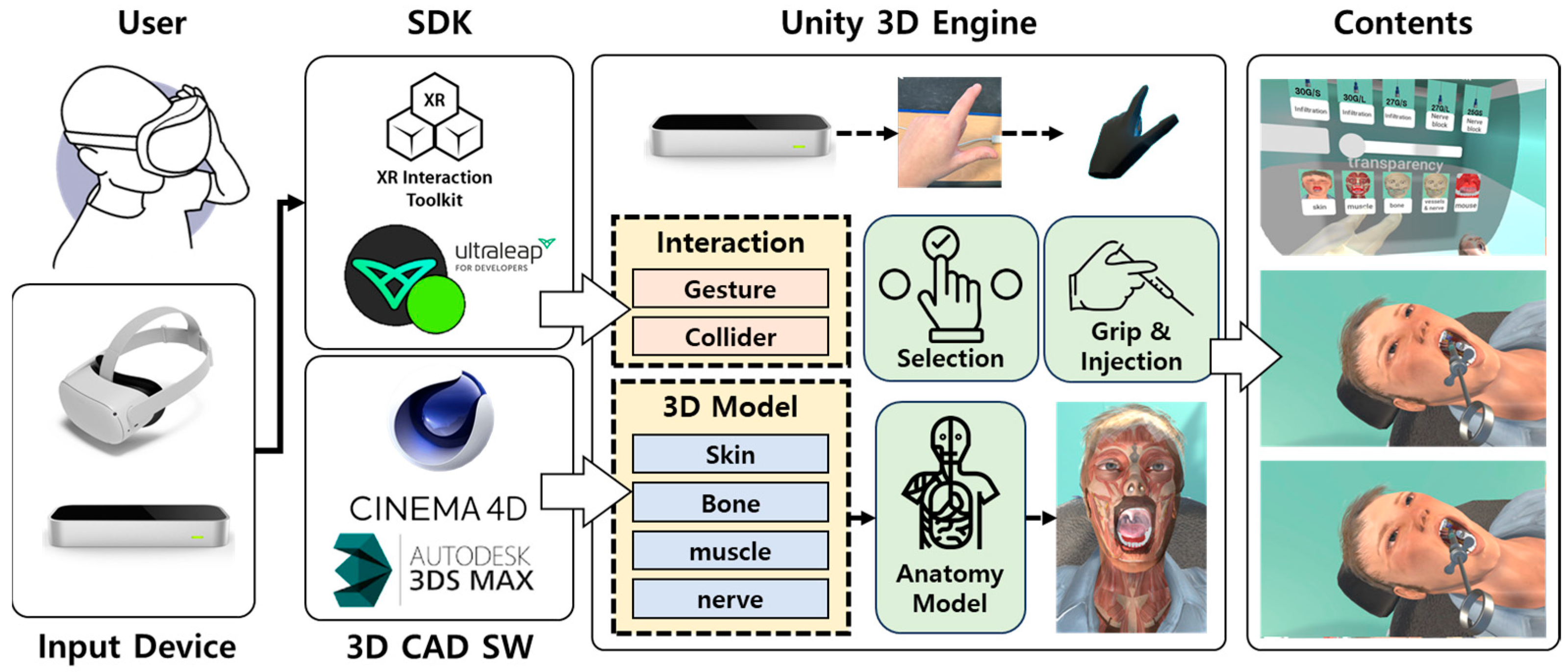
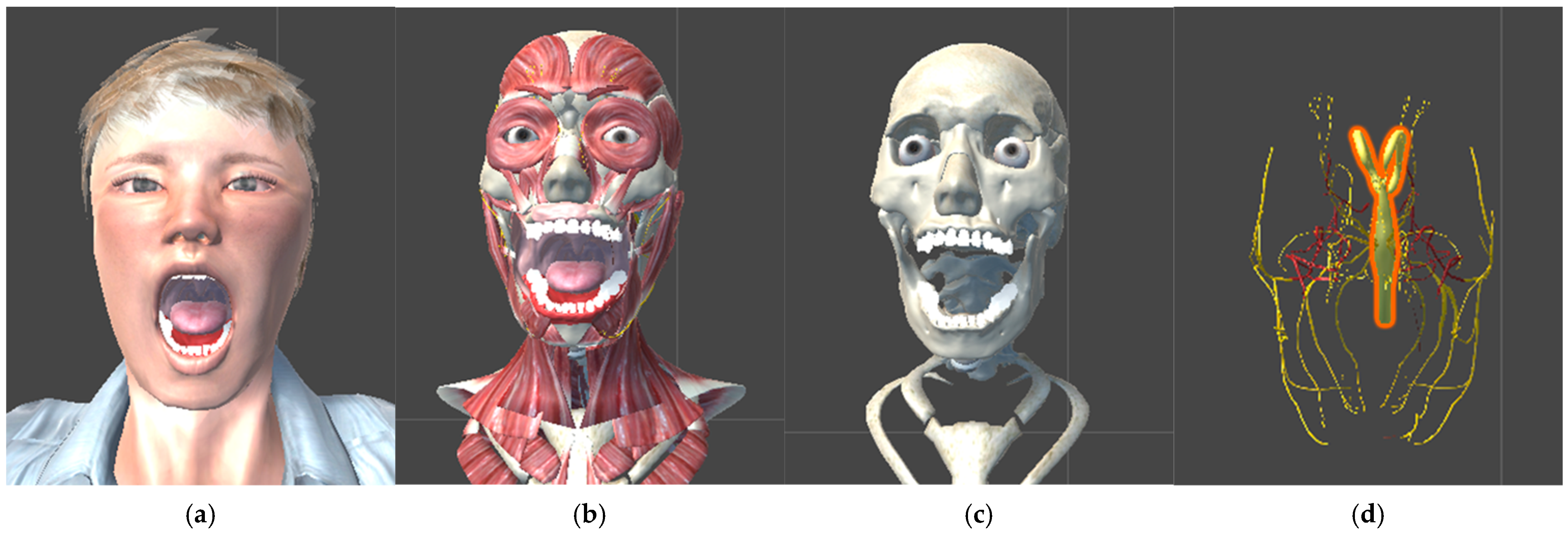
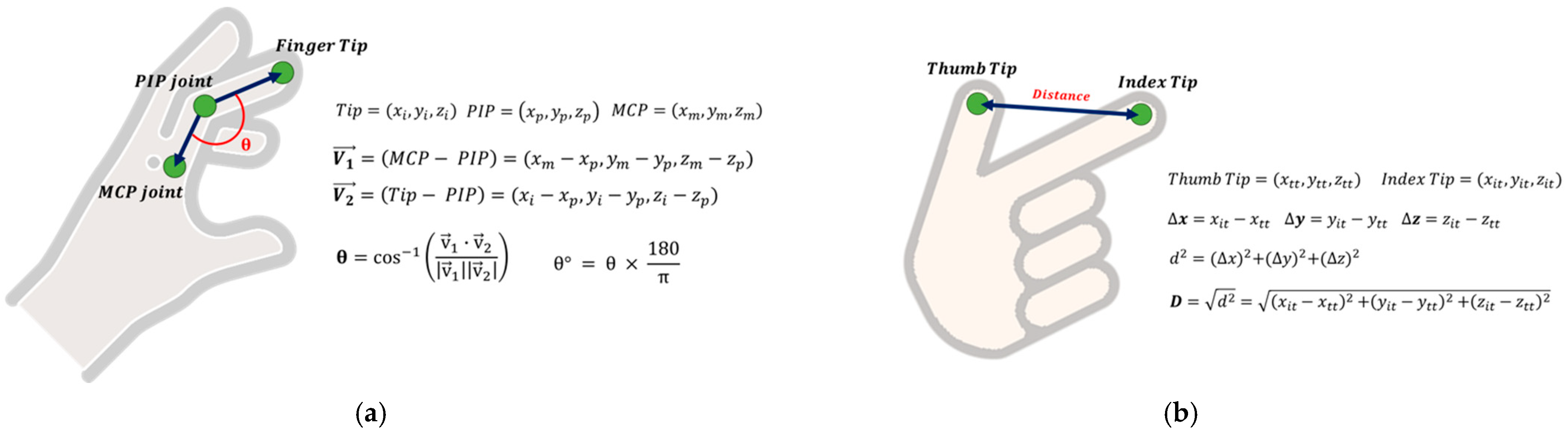
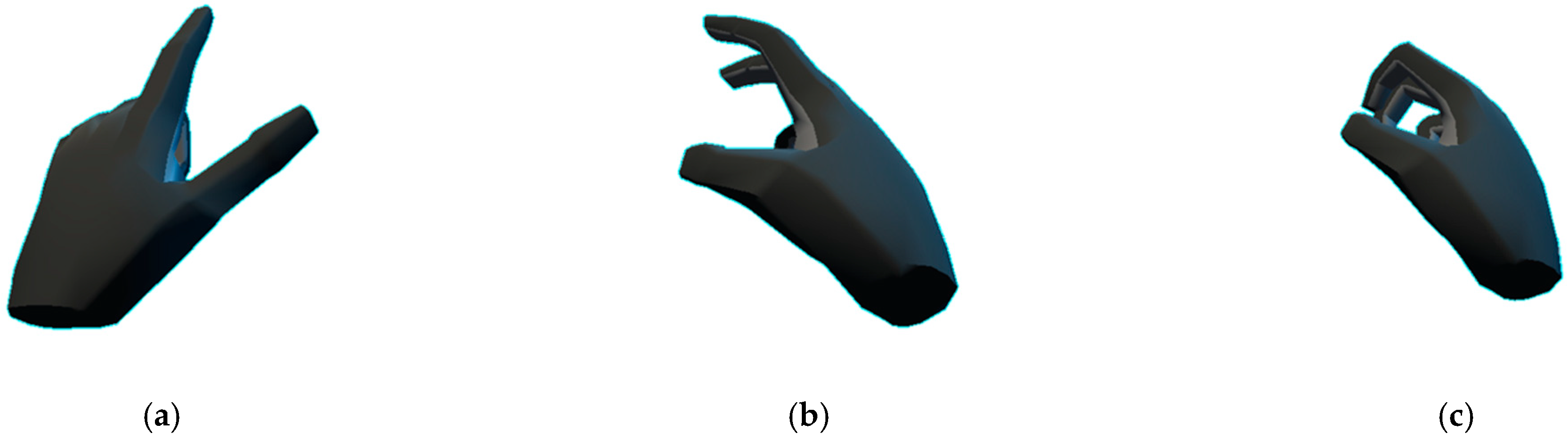
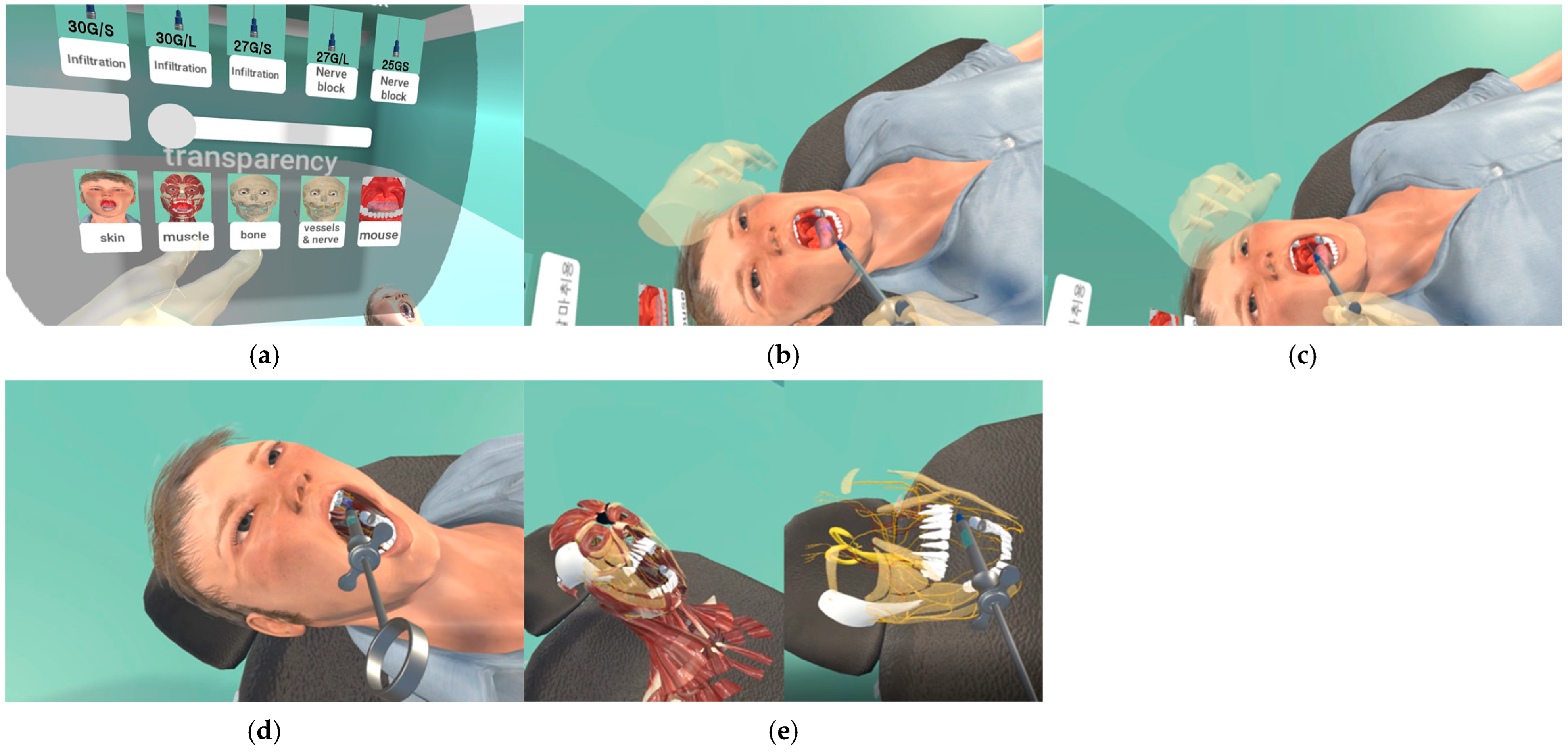
Development and Usability Evaluation of a Leap Motion-Based Controller-Free VR Training System for Inferior Alveolar Nerve Block



Abstract
1. Introduction
1.1. Background of the Study
1.2. Related Work on VR-Based Medical Education
2. Materials and Methods
2.1. Construction of the 3D Anatomical Model
2.2. Design of a Leap Motion-Based Interaction Method
2.3. Performance and Usability Evaluation Methods
3. Results
3.1. Performance Evaluation Results
3.1.1. Interaction Performance Evaluation Results
3.1.2. Task-Level Performance Evaluation Results
3.1.3. Statistical Validation of Interaction and Task Performance
3.2. Usability Evaluation Results
4. Discussion
5. Conclusions
Author Contributions
Funding
Institutional Review Board Statement
Informed Consent Statement
Data Availability Statement
Conflicts of Interest
References
- Khalil, H. A basic review on the inferior alveolar nerve block techniques. Anesth. Essays Res. 2014, 8, 3–8. [Google Scholar] [CrossRef]
- Milani, A.S.; Froughreyhani, M.; Rahimi, S.; Zand, V.; Jafarabadi, M.A. Volume of anesthetic agents and IANB success: A systematic review. Anesth. Prog. 2018, 65, 16–23. [Google Scholar] [CrossRef]
- Marei, H.F.; Al-Jandan, B.A. Simulation-based local anaesthesia teaching enhances learning outcomes. Eur. J. Dent. Educ. 2013, 17, e44–e48. [Google Scholar] [CrossRef]
- Lee, J.S.; Graham, R.; Bassiur, J.P.; Lichtenthal, R.M. Evaluation of a local anesthesia simulation model with dental students as novice clinicians. J. Dent. Educ. 2015, 79, 1411–1417. [Google Scholar] [CrossRef] [PubMed]
- Moussa, R.; Alghazaly, A.; Althagafi, N.; Eshky, R.; Borzangy, S. Effectiveness of virtual reality and interactive simulators on dental education outcomes: Systematic review. Eur. J. Dent. 2022, 16, 14–31. [Google Scholar] [CrossRef]
- Patil, S.; Bhandi, S.; Awan, K.H.; Licardi, F.W.; Di Blasio, M.; Ronsivalle, V.; Cicciù, M.; Minervini, G. Effectiveness of haptic feedback devices in preclinical training of dental students—A systematic review. BMC Oral Health 2023, 23, 739. [Google Scholar] [CrossRef] [PubMed]
- Rosenberg, M.; Orr, D.L.; Starley, E.D.; Jensen, D.R. Student-to-student local anesthesia injections in dental education: Moral, ethical, and legal issues. J. Dent. Educ. 2009, 73, 127–132. [Google Scholar] [CrossRef]
- Reinschluessel, A.V.; Muender, T.; Salzmann, D.; Doering, T.; Malaka, R.; Weyhe, D. Virtual reality for surgical planning–evaluation based on two liver tumor resections. Front. Surg. 2022, 9, 821060. [Google Scholar] [CrossRef] [PubMed]
- Rad, A.A.; Vardanyan, R.; Lopuszko, A.; Alt, C.; Stoffels, I.; Schmack, B.; Ruhparwar, A.; Zhigalov, K.; Zubarevich, A.; Weymann, A. Virtual and augmented reality in cardiac surgery. Braz. J. Cardiovasc. Surg. 2022, 37, 123–127. [Google Scholar] [CrossRef]
- Bakhuis, W.; Sadeghi, A.H.; Moes, I.; Maat, A.P.W.M.; Siregar, S.; Bogers, A.J.J.C.; Mahtab, E.A.F. Essential surgical plan modifications after virtual reality planning in 50 consecutive segmentectomies. Ann. Thorac. Surg. 2023, 115, 1247–1255. [Google Scholar] [CrossRef]
- Oyekunle, D.; Matthew, U.O.; Waliu, A.O.; Fatai, L.O. Healthcare applications of Augmented Reality (AR) and Virtual Reality (VR) simulation in clinical ceducation. J. Clin. Images Med. Case Rep. 2024, 5, 3141. [Google Scholar] [CrossRef]
- Queisner, M.; Eisenträger, K. Surgical planning in virtual reality: A systematic review. J. Med. Imaging 2024, 11, 062603. [Google Scholar] [CrossRef]
- Ujiie, H.; Chiba, R.; Yamaguchi, A.; Nomura, S.; Shiiya, H.; Fujiwara-Kuroda, A.; Kaga, K.; Eitel, C.; Clapp, T.R.; Kato, T. Developing a Virtual Reality Simulation System for Preoperative Planning of Robotic-Assisted Thoracic Surgery. J. Clin. Med. 2024, 13, 611. [Google Scholar] [CrossRef] [PubMed]
- Pottle, J. Virtual reality and the transformation of medical education. Future Healthc. J. 2019, 6, 181–185. [Google Scholar] [CrossRef]
- Oxford Medical Simulation. Available online: https://oxfordmedicalsimulation.com (accessed on 1 November 2024).
- Yoon, H.; Lee, E.; Kim, C.J.; Shin, Y. Virtual Reality Simulation-Based Clinical Procedure Skills Training for Nursing College Students: A Quasi-Experimental Study. Healthcare 2024, 12, 1109. [Google Scholar] [CrossRef]
- Jallad, S.T.; Işık, B. The Effectiveness of Immersive Virtual Reality Simulation as an Innovative Learning Strategy for Acquisition of Clinical Skills in Nursing Education: Experimental Design. Games Health J. 2025, 14, 110–118. [Google Scholar] [CrossRef] [PubMed]
- Birrenbach, T.; Stuber, R.; Müller, C.E.; Sutter, P.-M.; Hautz, W.E.; Exadaktylos, A.K.; Müller, M.; Wespi, R.; Sauter, T.C. Virtual Reality Simulation to Enhance Advanced Trauma Life Support Trainings—A Randomized Controlled Trial. BMC Med. Educ. 2024, 24, 666. [Google Scholar] [CrossRef]
- Falah, J.; Khan, S.; Alfalah, T.; Alfalah, S.F.M.; Chan, W.; Harrison, D.K.; Charissis, V. Virtual Reality medical training system for anatomy education. In Proceedings of the 2014 Science and Information Conference, London, UK, 27–29 August 2014; pp. 752–758. [Google Scholar] [CrossRef]
- Arango, S.; Gorbaty, B.; Tomhave, N.; Shervheim, D.; Buyck, D.; Porter, S.T.; Laizzo, P.A.; Perry, T.E. A high-resolution virtual reality-based simulator to enhance perioperative echocardiography training. J. Cardiothorac. Vasc. Anesth. 2023, 37, 299–305. [Google Scholar] [CrossRef]
- Kim, J.S.; Kim, K.W.; Kim, S.R.; Woo, T.G.; Chung, J.W.; Yang, S.W.; Moon, S.Y. An Immersive Virtual Reality Simulator for Echocardiography Examination. Appl. Sci. 2024, 14, 1272. [Google Scholar] [CrossRef]
- Schild, J.; Misztal, S.; Roth, B.; Flock, L.; Luiz, T.; Lerner, D.; Herkersdorf, M.; Weaner, K.; Neuberaer, M.; Franke, A.; et al. Applying multi-user virtual reality to collaborative medical training. In Proceedings of the 2018 IEEE Conference on Virtual Reality and 3D User Interfaces (VR), Tuebingen/Reutlingen, Germany, 18–22 March 2018; pp. 775–776. [Google Scholar] [CrossRef]
- Zackoff, M.W.; Cruse, B.; Sahay, R.D.; Zhang, B.; Sosa, T.; Schwartz, J.; Depinet, H.; Schumacher, D.; Geis, G.L. Multiuser Immersive Virtual Reality Simulation for Interprofessional Sepsis Recognition and Management. J. Hosp. Med. 2024, 19, 185–192. [Google Scholar] [CrossRef]
- Gohman, T.; Nisar, H.; Gupta, A.; Javed, M.J.; Rau, N. Development and Usability of a Virtual Reality Umbilical Venous Catheter Placement Simulator. Int. J. Comput. Assist. Radiol. Surg. 2024, 19, 881–889. [Google Scholar] [CrossRef]
- Siddique, H.; Abbas, A.; Abdul-Hamid, A. Effectiveness of Virtual Reality Simulation for Tracheostomy Education Among Healthcare Professionals. Cureus 2025, 17, e97083. [Google Scholar] [CrossRef]
- Jain, S.; Barua Chowdhury, B.D.; Mosier, J.M.; Subbian, V.; Hughes, K.; Son, Y.-J. Design and Development of an Integrated Virtual Reality (VR)-Based Training System for Difficult Airway Management. IEEE J. Transl. Eng. Health Med. 2025, 13, 49. [Google Scholar] [CrossRef] [PubMed]
- Zhang, N.; Ye, G.; Yang, C.; Zeng, P.; Gong, T.; Tao, L.; Zheng, Y.; Liu, Y. Benefits of Virtual Reality Training for Cardiopulmonary Resuscitation Skill Acquisition and Maintenance. Prehosp. Emerg. Care 2025, 29, 843–849. [Google Scholar] [CrossRef]
- Pagani, W.; Buysse, T.; Dua, K.S. Digital Platforms, Virtual Reality, and Augmented Reality in Gastrointestinal Endoscopy Training. Clin. Endosc. 2025, 58, 653–661. [Google Scholar] [CrossRef]
- Henniger, D.; Engelke, M.; Kreiser, J.; Riemer, V.; Wierzba, E.; Dimitriadis, S.; Meining, A.; Seufert, T.; Ropinski, T.; Hann, A. Validation of the ViGaTu Immersive Virtual Reality Endoscopy Training System for Physicians and Nurses. J. Gastrointestin. Liver Dis. 2024, 33, 226–233. [Google Scholar] [CrossRef] [PubMed]
- Wang, N.; Yang, S.; Gao, Q.; Jin, X. Immersive Teaching Using Virtual Reality Technology to Improve Ophthalmic Surgical Skills for Medical Postgraduate Students. Postgrad. Med. 2024, 136, 487–495. [Google Scholar] [CrossRef]
- Antaki, F.; Doucet, C.; Milad, D.; Giguère, C.-É.; Ozell, B.; Hammamji, K. Democratizing Vitreoretinal Surgery Training with a Portable and Affordable Virtual Reality Simulator in the Metaverse. Transl. Vis. Sci. Technol. 2024, 13, 5. [Google Scholar] [CrossRef]
- McCloskey, K.; Turlip, R.; Ahmad, H.S.; Ghenbot, Y.G.; Chauhan, D.; Yoon, J.W. Virtual and augmented reality in spine surgery: A systematic review. World Neurosurg. 2023, 173, 96–107. [Google Scholar] [CrossRef]
- He, Q.; Li, J.; Xiao, Y.; Tian, J.; Mao, N.; Lu, S.; Zhao, Y. An Immersive Mixed Reality Surgical Self-Training System for Precise Pedicle Screw Placement: A Randomized Controlled Trial. BMC Med. Educ. 2025, 25, 1360. [Google Scholar] [CrossRef]
- Konovalov, A.; Okishev, D.; Pilipenko, Y.; Grebenev, F.; Artemyev, A.; Mamedbekova, G.; Abzalov, T.; Erokhin, I.; Sergeeva, S.; Eliava, S. Application of Virtual Reality for Developing a Ventriculostomy Simulator: Concept and Initial Results. Surg. Neurol. Int. 2025, 16, 525. [Google Scholar] [CrossRef]
- Liang, Y.; Huang, H.; Tan, Y.-B.; Li, T.; Huang, W.; Zhang, Q.-L.; Liu, Z.-W.; Kuang, M. Construction and Implementation of a Laparoscopic Skill Training Course Based on a Smartphone Application and Virtual Reality. BMC Med. Educ. 2024, 24, 1111. [Google Scholar] [CrossRef]
- Chen, X.; Liao, P.; Liu, S.; Wang, L.; Zhao, Y.; Hu, J.; Zhang, Z. Effect of Virtual Reality Training to Enhance Laparoscopic Assistance Skills. BMC Med. Educ. 2024, 24, 29. [Google Scholar] [CrossRef]
- Knobovitch, R.M.; Tokuno, J.; Botelho, F.; Fried, H.B.; Carver, T.E.; Fried, G.M. Virtual Reality Training Improves Procedural Skills in Mannequin-Based Simulation in Medical Students: A Pilot Randomized Controlled Trial. Surg. Innov. 2025, 32, 364–373. [Google Scholar] [CrossRef]
- Li, P.; Xu, B.; Zhang, X.; Fang, D.; Zhang, J. Design and development of a personalized virtual reality-based training system for vascular intervention surgery. Comput. Methods Programs Biomed. 2024, 249, 108142. [Google Scholar] [CrossRef] [PubMed]
- Rahman, O.F.; Kunze, K.N.; Yao, K.; Kwiecien, S.Y.; Ranawat, A.S.; Banffy, M.B.; Kelly, B.T.; Galano, G.J. Hip Arthroscopy Simulator Training with Immersive Virtual Reality Has Similar Effectiveness to Nonimmersive Virtual Reality. Arthroscopy 2024, 40, 2840–2849.e3. [Google Scholar] [CrossRef]
- McKinney, B.; Dbeis, A.; Lamb, A.; Frousiakis, P.; Sweet, S. Virtual Reality Training in Unicompartmental Knee Arthroplasty: A Randomized, Blinded Trial. J. Surg. Educ. 2022, 79, 1526–1535. [Google Scholar] [CrossRef]
- Andersen, N.L.; Jensen, R.O.; Konge, L.; Laursen, C.B.; Falster, C.; Jacobsen, N.; Elhakim, M.T.; Bojsen, J.A.; Riishede, M.; Franse, M.L.; et al. Immersive Virtual Reality in Basic Point-of-Care Ultrasound Training: A Randomized Controlled Trial. Ultrasound Med. Biol. 2023, 49, 178–185. [Google Scholar] [CrossRef] [PubMed]
- Kennedy, G.A.; Pedram, S.; Sanzone, S. Improving safety outcomes through medical error reduction via virtual reality-based clinical skills training. Saf. Sci. 2023, 165, 106200. [Google Scholar] [CrossRef]
- O’Connor, M.; Rainford, L. The impact of 3D virtual reality radiography practice on student performance in clinical practice. Radiography 2023, 29, 159–164. [Google Scholar] [CrossRef]
- Gan, W.; Mok, T.-N.; Chen, J.; She, G.; Zha, Z.; Wang, H.; Li, H.; Li, J.; Zheng, X. Researching the application of virtual reality in medical education: One-year follow-up of a randomized trial. BMC Med. Educ. 2023, 23, 3. [Google Scholar] [CrossRef]
- Stevanie, C.; Ariestiana, Y.Y.; Anshar, M.; Sukotjo, C.; Boffano, P.; Forouzanfar, T.; Kurniawan, S.H.; Ruslin, M. Immersive Reality Surgical Training for Le Fort I Orthognathic Surgery: Initial Results of a Randomized Feasibility Study. J. Cranio-Maxillofac. Surg. 2025, 53, 1009–1017. [Google Scholar] [CrossRef]
- Hsu, M.; Chang, Y.-C. Prediction of Dental Students’ Pre-Clinical Crown Preparation Performances by a Virtual Reality Haptic-Based Dental Simulator. J. Dent. Sci. 2025, 20, 2301–2306. [Google Scholar] [CrossRef] [PubMed]
- Chuan, A.; Bogdanovych, A.; Moran, B.; Chowdhury, S.; Lim, Y.C.; Tran, M.T.; Lee, T.Y.; Duong, J.; Qian, J.; Bui, T.; et al. Using Virtual Reality to Teach Ultrasound-Guided Needling Skills for Regional Anaesthesia: A Randomized Controlled Trial. J. Clin. Anesth. 2024, 97, 111535. [Google Scholar] [CrossRef] [PubMed]
- Ayoub, A.; Pulijala, Y. The application of virtual reality and augmented reality in Oral & Maxillofacial Surgery. BMC Oral Health 2019, 19, 238. [Google Scholar] [CrossRef]
- Ultraleap. Available online: https://www.ultraleap.com (accessed on 1 November 2024).
- Kim, K.-W.; Kim, J.-S.; Kim, H.-J.; Moon, S.-Y. Development and Evaluation of a Virtual Reality and Haptic-Integrated Clinical Simulation System for OSCE-Based Blood-Related Procedures. IEEE Access 2025, 13, 192947–192957. [Google Scholar] [CrossRef]
- Tashiro, Y.; Miyafuji, S.; Kojima, Y.; Kiyofuji, S.; Kin, T.; Igarashi, T.; Koike, H. MR Microsurgical Suture Training System with Level-Appropriate Support. In Proceedings of the 2024 CHI Conference on Human Factors in Computing Systems (CHI ’24), Honolulu, HI, USA, 11–16 May 2024; Association for Computing Machinery: New York, NY, USA, 2024; pp. 1–19. [Google Scholar] [CrossRef]
- Khoury, J.; Townsend, G. Neural Blockade Anaesthesia of the Mandibular Nerve and Its Terminal Branches: Rationale for Different Anaesthetic Techniques Including Their Advantages and Disadvantages. Anesthesiol. Res. Pract. 2011, 1, 307423. [Google Scholar] [CrossRef]
- Lee, C.R.; Yang, H.J. Alternative techniques for failure of conventional inferior alveolar nerve block. J. Dent. Anesth. Pain Med. 2019, 19, 125. [Google Scholar] [CrossRef]
- Roi, C.I.; Roi, A.; Nicoară, A.; Motofelea, A.C.; Riviș, M. Retromolar Triangle Anesthesia Technique: A Feasible Alternative to Classic? J. Clin. Med. 2023, 12, 5829. [Google Scholar] [CrossRef]
- Miller, R.B. Response time in man-computer conversational transactions. In AFIPS ‘68 (Fall, Part I), Proceedings of the Fall Joint Computer Conference, Part I, San Francisco, CA, USA, December 9–11, 1968; Thomson Book Company: Washington, DC, USA, 1968; pp. 267–277. [Google Scholar] [CrossRef]
- Samuel, S.; Elvezio, C.; Khan, S.; Bitzer, L.Z.; Moss-Salentijn, L.; Feiner, S. Visuo-haptic vr and ar guidance for dental nerve block education. IEEE Trans. Vis. Comput. Graph. 2024, 30, 2839–2848. [Google Scholar] [CrossRef]
- Rangarajan, K.; Davis, H.; Pucher, P.H. Systematic review of virtual haptics in surgical simulation: A valid educational tool? J. Surg. Educ. 2020, 77, 337–347. [Google Scholar] [CrossRef]
- Fahmi, F.; Tanjung, K.; Nainggolan, F.; Siregar, B.; Mubarakah, N.; Zarlis, M. Comparison study of user experience between virtual reality controllers, leap motion controllers, and senso glove for anatomy learning systems in a virtual reality environment. IOP Conf. Ser. Mater. Sci. Eng. 2020, 851, 012024. [Google Scholar] [CrossRef]
- Cox, C.M.J.; Hicks, B.; Gopsill, J.; Snider, C. From haptic interaction to design insight: An empirical comparison of commercial hand-tracking technology. Proc. Des. Soc. 2023, 3, 1965–1974. [Google Scholar] [CrossRef]
- Kim, K.-W.; Kim, J.-S.; Prak, H.-J. Hand Gesture-based Interface for Navigating a Virtual Space using Leap Motion and Machine Learning. Korean J. Comput. Des. Eng. 2021, 26, 239–248. [Google Scholar] [CrossRef]
- Aziz, O.; Musngi, M.; Park, E.J.; Mori, G.; Robinovitch, S.N. A comparison of accuracy of fall detection algorithms (threshold-based vs. machine learning) using waist-mounted tri-axial accelerometer signals from a comprehensive set of falls and non-fall trials. Med. Biol. Eng. Comput. 2017, 55, 45–55. [Google Scholar] [CrossRef] [PubMed]
- Björkelund, A.; Ohlsson, M.; Forberg, J.L.; Mokhtari, A.; de Capretz, P.O.; Ekelund, U.; Björk, J. Machine learning compared with rule-in/rule-out algorithms and logistic regression to predict acute myocardial infarction based on troponin T concentrations. JACEP Open 2021, 2, e12363. [Google Scholar] [CrossRef]
- Morgan, D.J.; Bame, B.; Zimand, P.; Dooley, P.; Thom, K.A.; Harris, A.D.; Bentzen, S.; Ettinger, W.; Garrett-Ray, S.D.; Tracy, J.K.; et al. Assessment of machine learning vs standard prediction rules for predicting hospital readmissions. JAMA Netw. Open 2019, 2, e190348. [Google Scholar] [CrossRef]


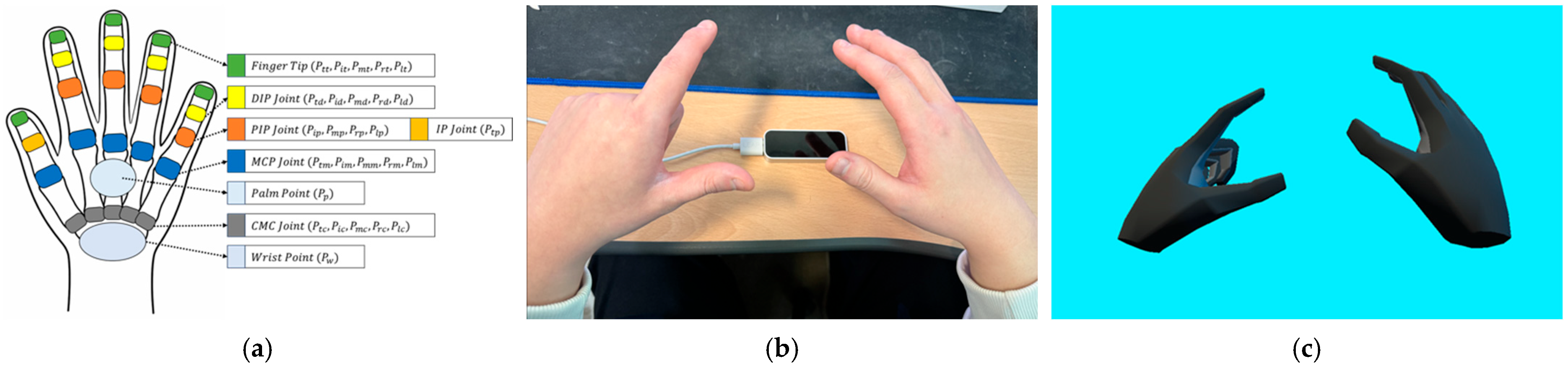



| Gesture Type | Feature Points | Ranges |
|---|---|---|
| GUI selection | , , | |
| , , | ||
| , , | ||
| , | ||
| , | ||
| Grip | , , | |
| , , | ||
| , , | ||
| , , | ||
| , | ||
| Injection | , , | |
| , , | ||
| , , | ||
| , , | ||
| , |
| Item No. | Questionnaire Item |
|---|---|
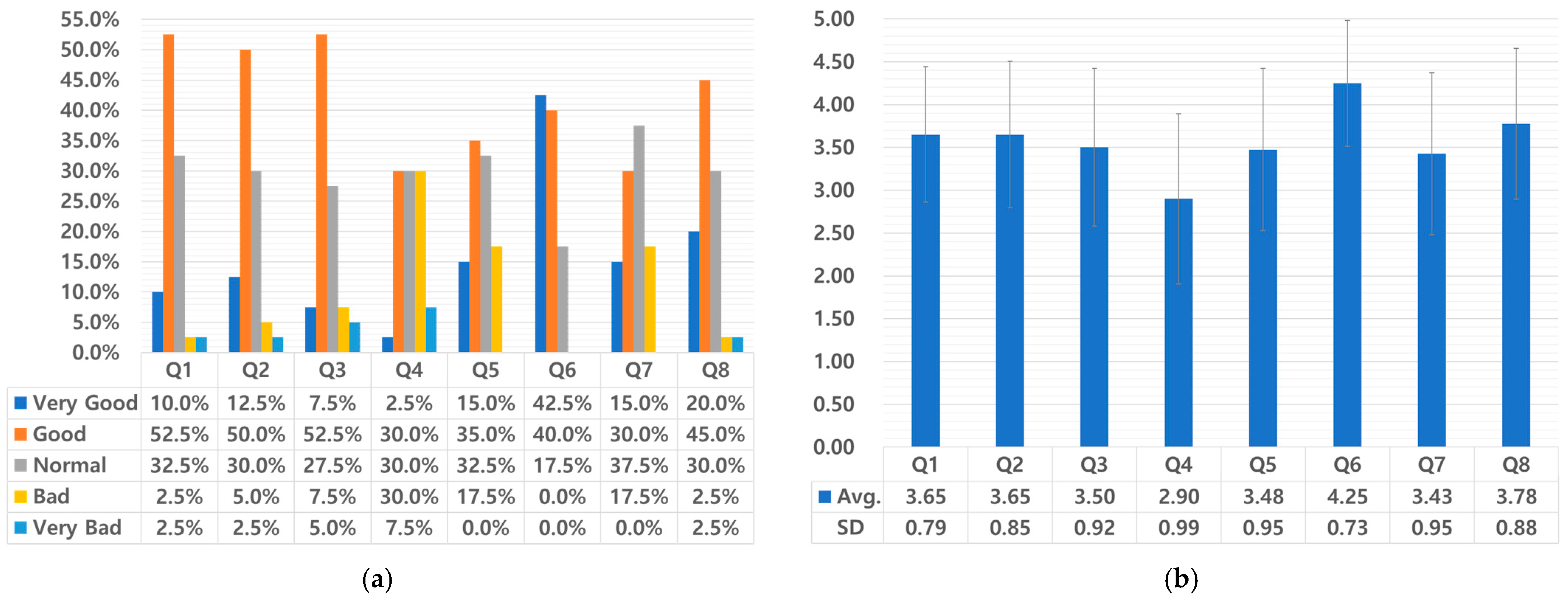
| Q1 | Practicing local anesthesia using the VR simulator helps me understand the local anesthesia technique. |
| Q2 | The simulator’s virtual anatomical model helps me understand intraoral anatomy. |
| Q3 | Viewpoint changes using the HMD are similar to real-life viewing. |
| Q4 | Practice using the Leap Motion device feels realistic, similar to real hands-on practice. |
| Q5 | The practice session using the VR simulator is interesting. |
| Q6 | I believe that practicing with the VR simulator can improve my procedural skills. |
| Q7 | I did not experience nausea, dizziness, or headache while using the simulator. |
| Q8 | I would like to learn other dental procedures using a VR simulator. |
| Gesture Type | Item | #1 | #2 | #3 | #4 | #5 | #6 | #7 | #8 | #9 | #10 | #11 | #12 | #13 | #14 | #15 | #16 | #17 | #18 | #19 | #20 | Avg. SD | CI [L–U] |
|---|---|---|---|---|---|---|---|---|---|---|---|---|---|---|---|---|---|---|---|---|---|---|---|
| GUI selection | Success Count | 15 | 18 | 19 | 18 | 20 | 19 | 17 | 20 | 19 | 16 | 18 | 19 | 20 | 18 | 17 | 19 | 15 | 16 | 16 | 18 | 17.85 ± 1.56 | 17.10–18.60 |
| Recognition Rate (%) | 75 | 90 | 95 | 90 | 100 | 95 | 85 | 100 | 95 | 80 | 90 | 95 | 100 | 90 | 85 | 95 | 75 | 80 | 80 | 90 | 89.25 ± 7.79 | 85.51–92.99 | |
| Response Time (ms) | 86 | 65 | 67 | 72 | 60 | 59 | 70 | 48 | 55 | 78 | 63 | 59 | 60 | 65 | 69 | 62 | 73 | 67 | 70 | 61 | 65.45 ± 8.16 | 61.53–69.37 | |
| Grip | Success Count | 16 | 18 | 19 | 20 | 19 | 18 | 19 | 17 | 19 | 15 | 18 | 18 | 18 | 19 | 16 | 18 | 17 | 15 | 16 | 20 | 17.75 ± 1.48 | 17.04–18.46 |
| Recognition Rate (%) | 80 | 90 | 95 | 100 | 95 | 90 | 95 | 85 | 95 | 75 | 90 | 90 | 90 | 95 | 80 | 90 | 85 | 75 | 80 | 100 | 88.75 ± 7.40 | 85.20–92.30 | |
| Response Time (ms) | 76 | 63 | 65 | 50 | 57 | 61 | 63 | 69 | 58 | 75 | 68 | 68 | 63 | 65 | 71 | 64 | 68 | 75 | 71 | 55 | 65.25 ± 6.71 | 62.03–68.47 | |
| Injection | Success Count | 16 | 19 | 20 | 17 | 18 | 20 | 19 | 20 | 18 | 15 | 19 | 20 | 20 | 19 | 17 | 18 | 15 | 16 | 17 | 19 | 18.10 ± 1.64 | 17.31–18.89 |
| Recognition Rate (%) | 80 | 95 | 100 | 85 | 90 | 100 | 95 | 100 | 90 | 75 | 95 | 100 | 100 | 95 | 85 | 90 | 75 | 80 | 85 | 95 | 90.50 ± 8.20 | 86.56–94.44 | |
| Response Time (ms) | 73 | 60 | 53 | 67 | 63 | 50 | 59 | 55 | 68 | 77 | 61 | 53 | 59 | 63 | 70 | 68 | 73 | 72 | 68 | 63 | 63.75 ± 7.36 | 60.22–67.28 | |
| Total | Success Count | 47 | 55 | 58 | 55 | 57 | 57 | 55 | 57 | 56 | 46 | 55 | 57 | 58 | 56 | 50 | 55 | 47 | 47 | 49 | 57 | 53.70 ± 4.12 | 51.75–55.68 |
| Recognition Rate (%) | 78 | 92 | 97 | 92 | 95 | 95 | 92 | 95 | 93 | 77 | 92 | 95 | 97 | 93 | 83 | 92 | 78 | 78 | 82 | 95 | 89.50 ± 6.87 | 86.20–92.80 | |
| Response Time (ms) | 235 | 188 | 185 | 189 | 180 | 170 | 192 | 172 | 181 | 230 | 192 | 180 | 182 | 193 | 210 | 194 | 214 | 214 | 209 | 179 | 194.45 ± 17.88 | 185.86–203.04 |
| Item | #1 | #2 | #3 | #4 | #5 | #6 | #7 | #8 | #9 | #10 | #11 | #12 | #13 | #14 | #15 | #16 | #17 | #18 | #19 | #20 | Avg. SD | CI [L–U] |
|---|---|---|---|---|---|---|---|---|---|---|---|---|---|---|---|---|---|---|---|---|---|---|
| Task completion time (s) | 337 | 275 | 261 | 282 | 267 | 268 | 299 | 257 | 259 | 324 | 273 | 259 | 257 | 263 | 289 | 270 | 301 | 312 | 291 | 260 | 280.20 ± 23.12 | 269.10–291.30 |
| ROI hit | 18 | 19 | 20 | 18 | 20 | 19 | 18 | 20 | 19 | 18 | 18 | 19 | 20 | 19 | 20 | 19 | 18 | 19 | 19 | 20 | 19.00 ± 0.77 | 18.63–19.37 |
| ROI hit rate (%) | 90 | 95 | 100 | 90 | 100 | 95 | 90 | 100 | 95 | 90 | 90 | 95 | 100 | 95 | 100 | 95 | 90 | 95 | 95 | 100 | 95.00 ± 3.87 | 93.14–96.86 |
| Variable | Spearman’s ρ | p-Value | N |
|---|---|---|---|
| Total recognition rate and Task completion time | −0.911 | <0.001 | 20 |
| Total response time and Task completion time | 0.837 | <0.001 | 20 |
| Mann–Whitney U | Z | p-Value | Effect Size r |
|---|---|---|---|
| 0 | −3.764 | <0.001 | 0.842 |
| Variable | Shapiro–Wilk W | N | p-Value |
|---|---|---|---|
| Total (sum score) | 0.956 | 40 | 0.122 |
| Avg (mean score) | 0.956 | 40 | 0.122 |
Disclaimer/Publisher’s Note: The statements, opinions and data contained in all publications are solely those of the individual author(s) and contributor(s) and not of MDPI and/or the editor(s). MDPI and/or the editor(s) disclaim responsibility for any injury to people or property resulting from any ideas, methods, instructions or products referred to in the content. |
© 2026 by the authors. Licensee MDPI, Basel, Switzerland. This article is an open access article distributed under the terms and conditions of the Creative Commons Attribution (CC BY) license.
Share and Cite
Kim, J.-S.; Kim, K.-W.; Kim, H.-J.; Moon, S.-Y. Development and Usability Evaluation of a Leap Motion-Based Controller-Free VR Training System for Inferior Alveolar Nerve Block. Appl. Sci. 2026, 16, 1325. https://doi.org/10.3390/app16031325
Kim J-S, Kim K-W, Kim H-J, Moon S-Y. Development and Usability Evaluation of a Leap Motion-Based Controller-Free VR Training System for Inferior Alveolar Nerve Block. Applied Sciences. 2026; 16(3):1325. https://doi.org/10.3390/app16031325
Chicago/Turabian StyleKim, Jun-Seong, Kun-Woo Kim, Hyo-Joon Kim, and Seong-Yong Moon. 2026. "Development and Usability Evaluation of a Leap Motion-Based Controller-Free VR Training System for Inferior Alveolar Nerve Block" Applied Sciences 16, no. 3: 1325. https://doi.org/10.3390/app16031325
APA StyleKim, J.-S., Kim, K.-W., Kim, H.-J., & Moon, S.-Y. (2026). Development and Usability Evaluation of a Leap Motion-Based Controller-Free VR Training System for Inferior Alveolar Nerve Block. Applied Sciences, 16(3), 1325. https://doi.org/10.3390/app16031325