Analysis of MOA Damage Mechanism Under Multiple Strokes

Abstract
1. Introduction
2. Withstand Test of MOA Varistors Under Multiple Strokes
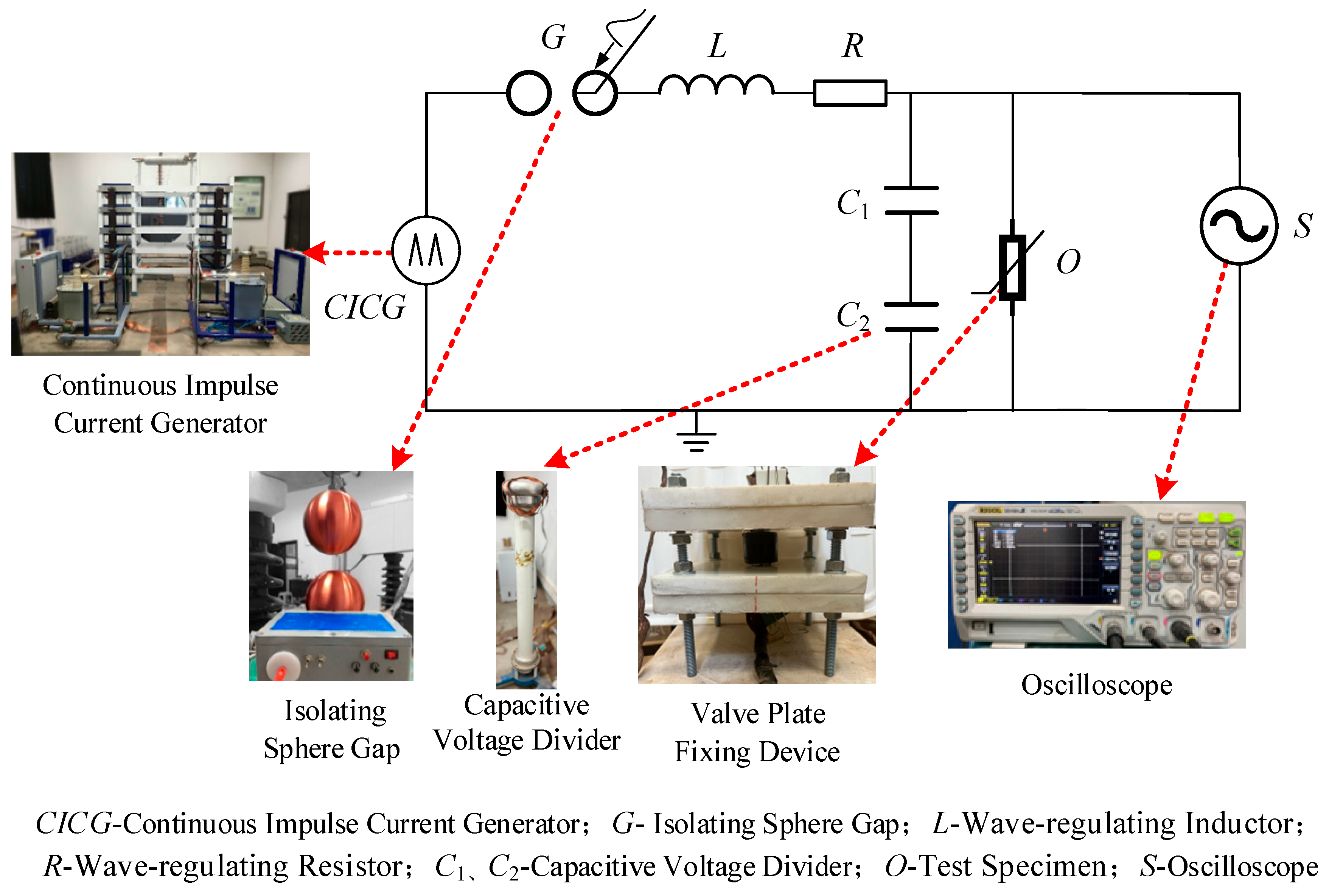
2.1. Withstand Test Platform
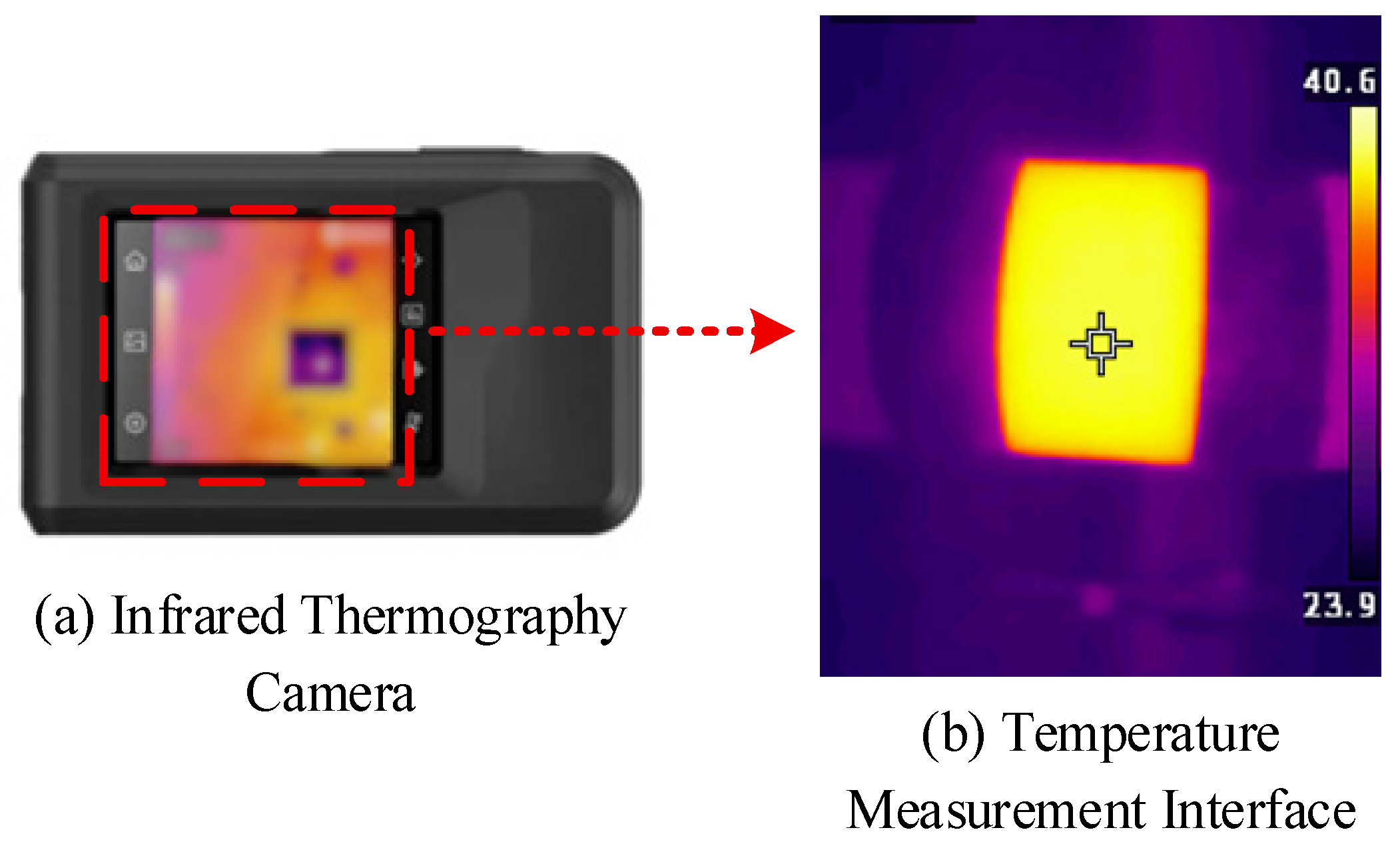
2.2. Withstand Test Scheme
- (1)
- Measure and record the initial temperature and key electrical parameters of the test sample’s varistor, and take appearance photos.
- (2)
- Apply a continuous impulse current to the varistor and record its residual voltage waveform. After the impulse, if the residual voltage waveform is normal and there is no visible damage to the varistor’s appearance, conduct the next continuous impulse discharge after 30 min. Repeat this process until three times are completed.
- (3)
- If after any impulse, the residual voltage waveform of the varistor is abnormal, or the varistor suffers appearance damage such as cracking or flashover, terminate the test and determine the varistor as damaged.
- (4)
- After completing all three consecutive impulse discharges, measure the DC parameters of the test sample again and take photos of the varistor’s appearance. Synthesize all data to finally judge whether the varistor is damaged.
3. Finite Element Model of MOA Varistors
3.1. Numerical Modeling of MOA Varistors Under Multiple Strokes
- Simplification of the Heat Dissipation Process: Adoption of Equivalent Heat Flux Boundary Conditions. In the analysis of lightning strike processes ranging from microseconds to milliseconds, transient heat conduction inside the varistor dominates heat transfer, while convective and radiative heat dissipation between the disk surface and air are relatively secondary. The use of equivalent heat flux boundary conditions to simulate surface heat dissipation can greatly simplify the model and avoid complex fluid–solid conjugate heat transfer calculations, which constitutes one of the standard practices in engineering simulation.
- Simplification of External Mechanical Loads: Exclusion of Wind Load and Self-Weight. The multiple strokes on the MOA varistor is a typical dynamic impact process. The primary driving force causing varistor damage is the thermal stress induced by rapid uneven heating, which typically reaches the order of hundreds of megapascals. This magnitude is generally much higher than that of static mechanical stresses generated by manufacturing residual stress, self-weight, or steady-state wind pressure. In contrast, the stress level caused by the self-weight of a single varistor is usually on the kilopascal scale, differing by several orders of magnitude from thermal stress. Therefore, neglecting these static or quasi-static loads can significantly reduce modeling complexity without compromising the simulation accuracy of thermal stress evolution in the model.
- Electrical Boundary Conditions
- 2.
- Thermal Boundary Conditions
- 3.
- Mechanical Boundary Conditions
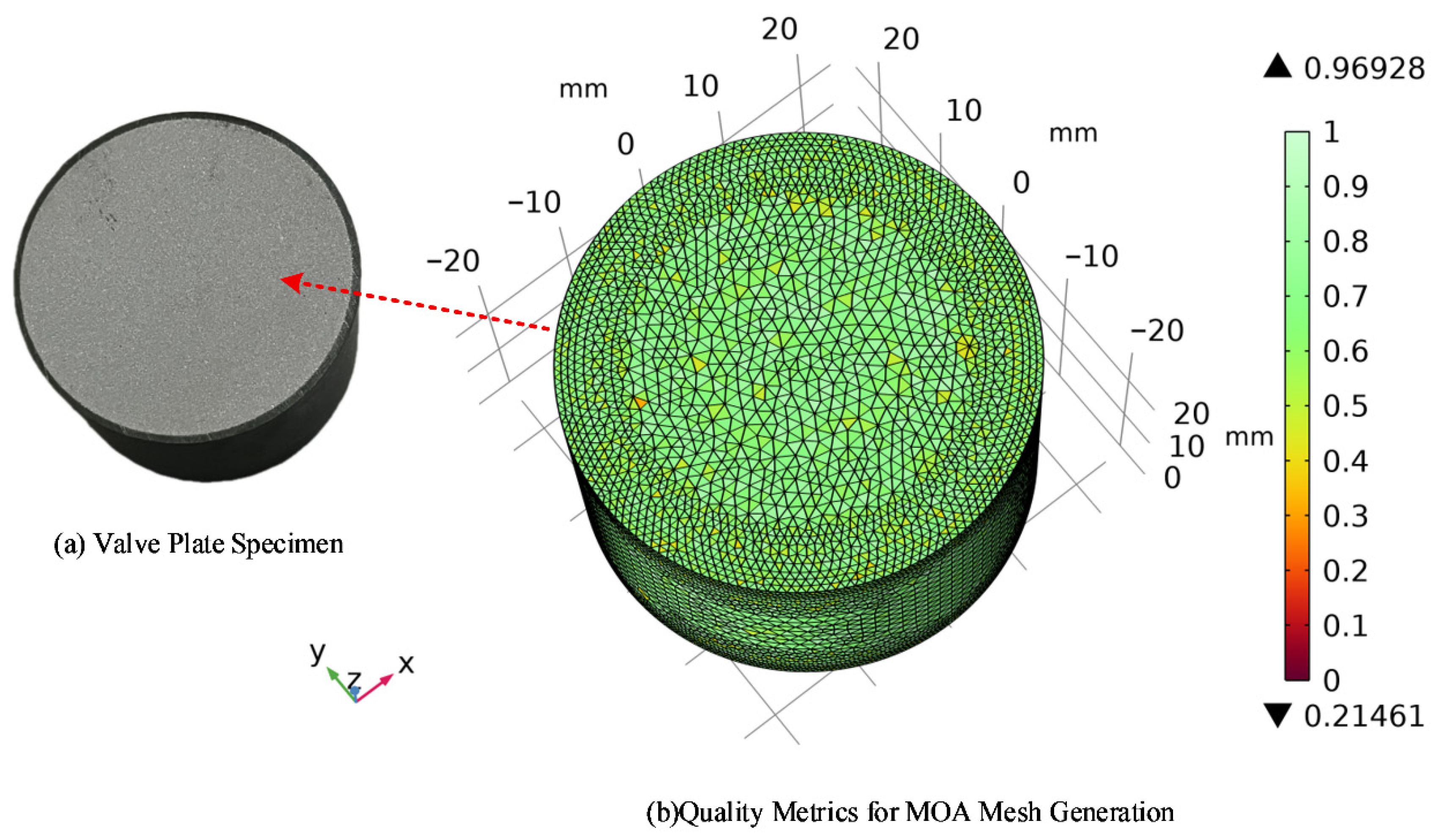
3.2. Finite Element Model and Parameter Settings
4. Damage Condition and Cause Analysis of Varistors Under Multiple Strokes
4.1. Analysis of Withstand Test Results
4.1.1. Comparative Analysis of Single-Impulse and Continuous Impulse Discharge Results
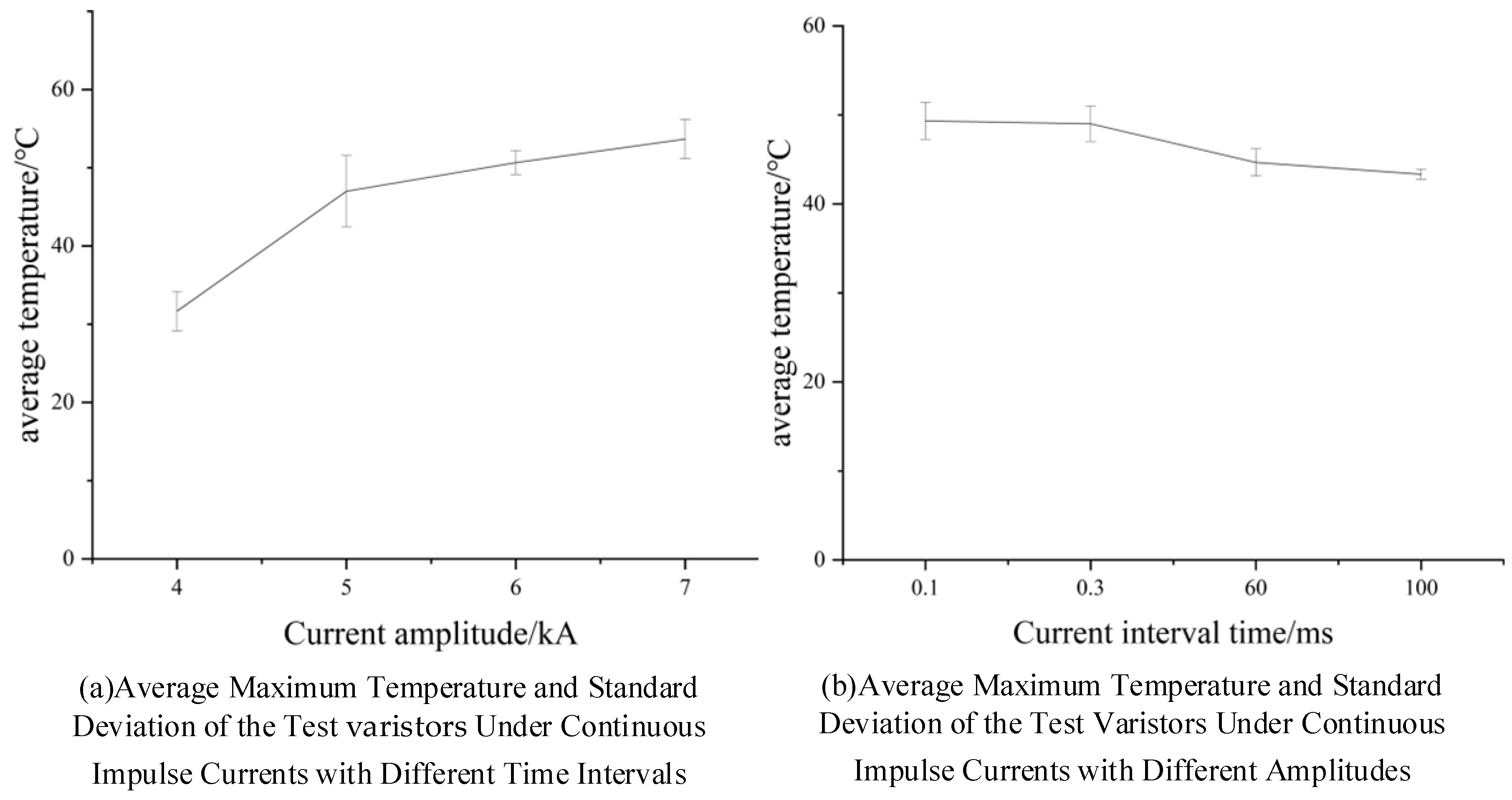
4.1.2. The Effect of Multiple Strokes Current Amplitude on Varistors
4.1.3. The Effect of Impulse Interval Time on Varistors
4.2. Stress Variation of Varistors Under Multiple Strokes
5. Conclusions
- (1)
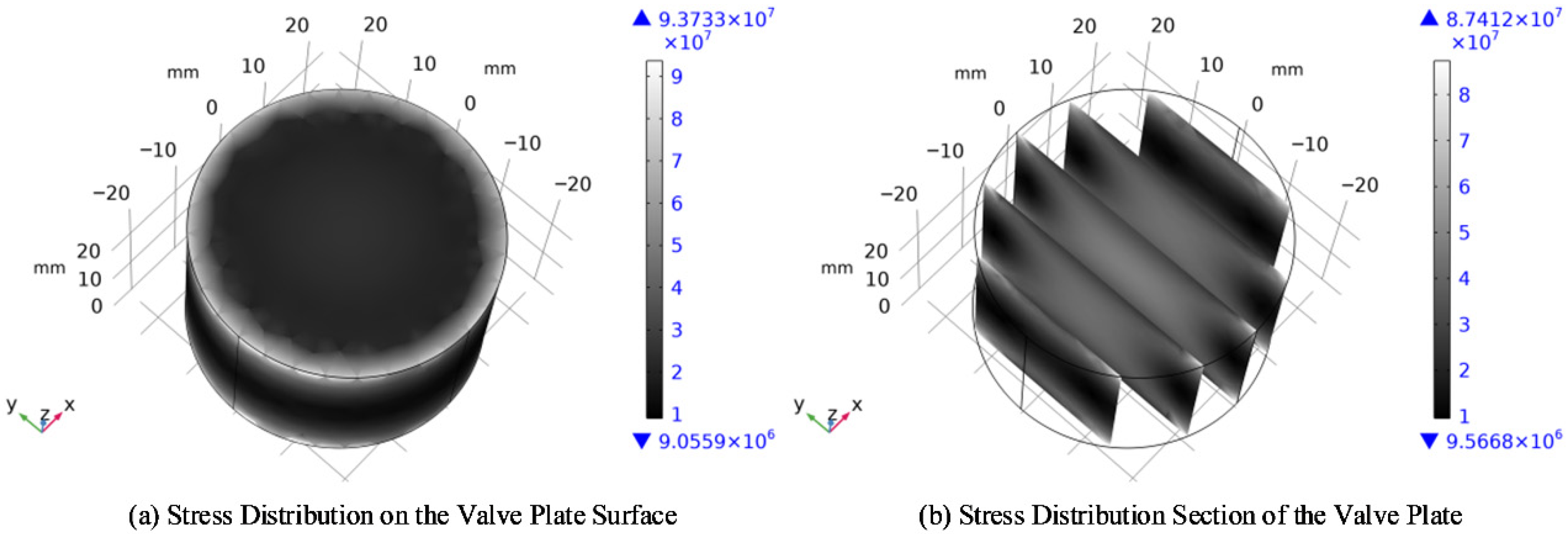
- Under the action of continuous impulse current, the MOA varistor exhibits an obvious heat superposition effect. Heat superposition causes the varistor to heat up rapidly, which in turn induces thermal expansion of the varistor material. Short-term thermal expansion generates inhomogeneous thermal stress inside the varistor, with stress concentrating at the circumferential edges of the varistor. Under the action of continuous impulse current with the amplitude of the nominal discharge current, the maximum thermal stress of the varistor can reach 9.373 × 10⁷ Pa. When the thermal stress exceeds the fracture toughness limit of the varistor, it will eventually lead to varistor cracking.
- (2)
- Under the condition of consistent total impulse energy, continuous impulse current is more likely to cause thermal damage to MOA varistors than two single-impulse currents. When the amplitude is equal to the nominal discharge current, the average maximum temperature of the varistor after the action of two single-impulse currents is 30 °C, and the residual voltage change rate is less than 3%. In contrast, the average maximum temperature of the varistor after the action of continuous impulse current is 47 °C, and the residual voltage change rate exceeds 10%. Under the action of continuous impulse current, the heat generated by the previous impulse in the varistor has not dissipated, and the heat brought by subsequent impulses continues to superimpose, resulting in the failure of effective heat release inside the varistor in an extremely short time. This forms a superposition effect, which is more likely to increase the risk of varistor damage.
- (3)
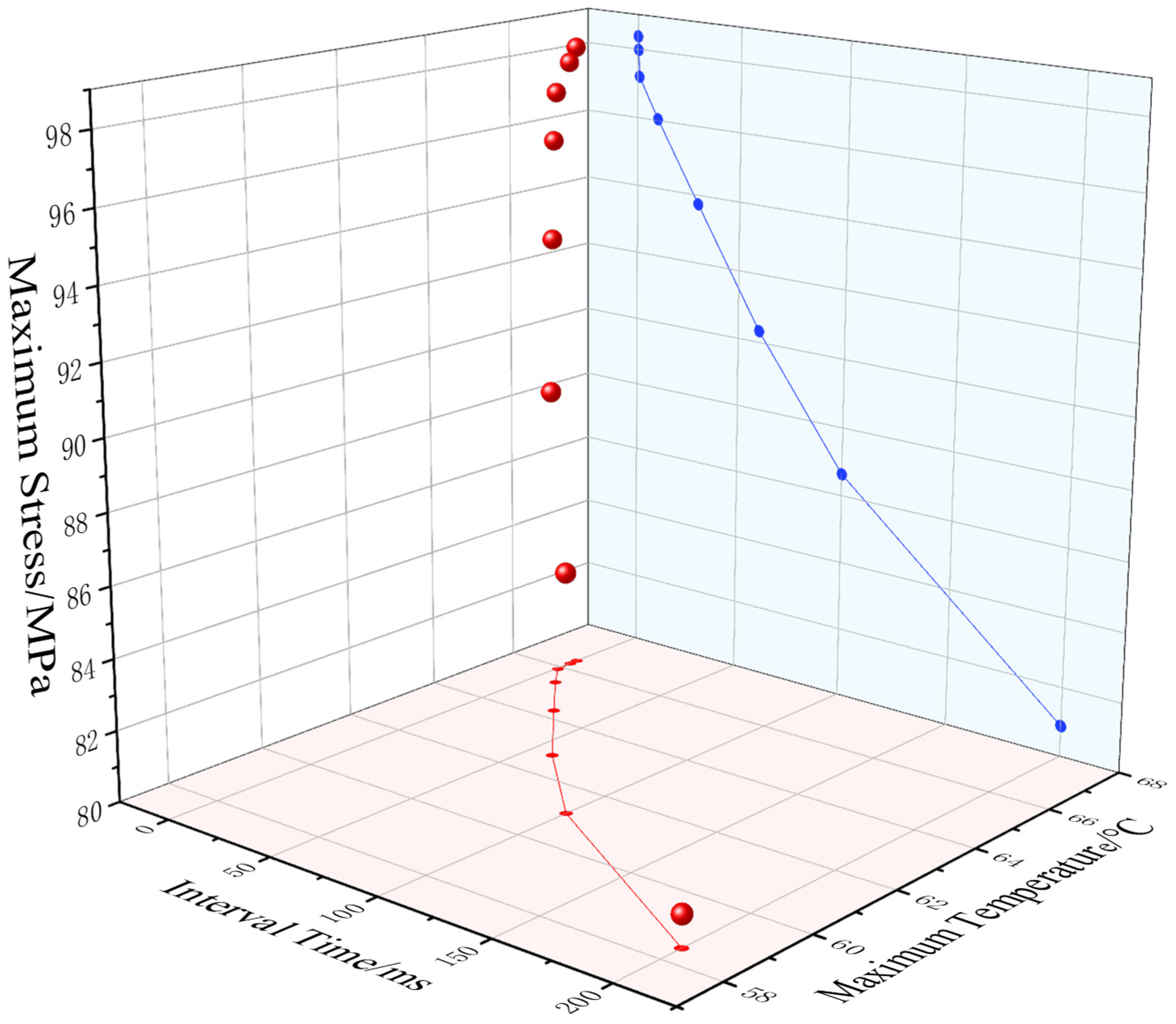
- The damage of MOA varistors caused by continuous impulse current is affected by the amplitude of the continuous impulse current and the impulse interval time: the higher the amplitude of the impulse current, the greater the energy density, and the more likely the varistor is to suffer more severe thermal damage; the shorter the interval time, the more residual heat from the previous lightning strike, the more significant the superposition effect with the heat from subsequent lightning strikes, and the more likely the varistor is to be damaged. The interval time of continuous impulse current affects the superposition effect. By analyzing the maximum stress change rate of the varistor, the intervals where the superposition effect is significant under different interval times can be obtained: When the interval time is 100~800 μs, the absolute value of the maximum stress change rate of the varistor is greater than 1500 MPa/s, and the varistor stress is affected by the combined action of the cumulative effect and the superposition effect; when the interval time is more than 800 μs, the absolute value of the maximum stress change rate of the varistor is less than 130 MPa/s, and the varistor stress is mainly dominated by the cumulative effect. It can be seen from this that an interval time of 1 ms (close to 0.8 ms) can be used as the critical interval time for the change in MOA damage mechanism.
Author Contributions
Funding
Data Availability Statement
Acknowledgments
Conflicts of Interest
References
- GB/T 11032-2020; AC Metal-Oxide Surge Arresters Without Gaps. State Administration for Market Regulation: Beijing, China, 2020.
- DL/T 815-2021; Composite-Housed Metal-Oxide Surge Arresters for AC Transmission Lines. Electric Power Industry of China: Beijing, China, 2021.
- Li, P.; Xiao, P.; Qu, Y.Y.; Wang, Y.; Pu, Z.; Wu, T. Temperature Rise Characteristic Analysis of 500 kV Surge Arresters Under the Action of Multiple Return Strokes with Long Continuous Current. Trans. China Electrotech. Soc. 2020, 35, 603–611. [Google Scholar] [CrossRef]
- Kang, C.; Wang, Z.Y.; Zhang, Z.Y.; Guo, J. Analysis on Damage Causes of 500 kV UHV Substation MOAs Under Multiple Lightning Strikes. Insul. Surge Arresters 2024, 3, 63–69. [Google Scholar] [CrossRef]
- Zhou, X.; Tian, T.; Bai, J.; Luo, Y.; Si, W. Protection Characteristics of 10 kV Overhead Line ZnO Surge Arresters Under Multiple Lightning Strikes. Insul. Surge Arresters 2024, 4, 71–81. [Google Scholar] [CrossRef]
- Jiao, L.X.; Wang, S.; Sun, Y.Q.; Liu, H.; Liu, J.; Lie, J.; Zhu, D. Fault Analysis of 500 kV Metal-Oxide Surge Arresters in Substations. Insul. Surge Arresters 2018, 4, 98–101. [Google Scholar] [CrossRef]
- Wu, D.G.; Zhou, Y.; Yu, Z.T.; Pan, K.; Li, H. Fault Analysis of a 500 kV Metal-Oxide Surge Arrester. Insul. Surge Arresters 2013, 3, 58–60+65. [Google Scholar] [CrossRef]
- GB/T 21714.1-2015; Lightning Protection—Part 1: General Principles. General Administration of Quality Supervision, Inspection and Quarantine of the People’s Republic of China: Beijing, China, 2015.
- Zhou, L.Y.; Li, T.; Wang, S.H.; Liu, L.; Hu, W.; Zhou, X. Characteristic Analysis of Positive and Negative Cloud-to-Ground Lightning Multiple Return Strokes in Zhejiang Section of ±800 kV Binjin Power Transmission Line. Electr. Power 2019, 52, 113–118. [Google Scholar] [CrossRef]
- Liao, M.C.; Cai, H.S.; Wu, X.K.; Jia, L.; Hu, S. Study on the Impact of Multiple Lightning Strikes on Line Surge Arresters. Insul. Surge Arresters 2019, 3, 153–158. [Google Scholar]
- Lin, C.B.; Liao, Y.L.; Li, R.H.; Li, S.; Wang, H.; Gao, C.; He, J. Study on Lightning Impulse Aging Characteristics of 110 kV Integral ZnO Surge Arresters. South. Power Syst. Technol. 2015, 9, 40–45. [Google Scholar]
- Cai, H.S.; Jia, L.; Liao, M.C.; Xv, D.; Guo, J. Study on Lightning Impulse Deterioration Characteristics of Surge Arresters. Insul. Surge Arresters 2018, 4, 133–137. [Google Scholar]
- Darveniza, M.D.; Roby, D.; Tumma, L.R. Laboratory and analytical studies of the effects of multi-pulse lightning current on metal oxide arresters. IEEE Trans. Power Deliv. 1994, 9, 764–771. [Google Scholar] [CrossRef]
- Lee, B.-H.; Kang, S.-M. Properties of ZnO varistor blocks under multiple lightning impulse voltages. Curr. Appl. Phys. 2006, 6, 844–851. [Google Scholar] [CrossRef]
- Zhang, C.L.; Zhang, S.C. Aging Damage Test of ZnO Under Double Impulse Current. High Volt. Eng. 2001, 27, 71–73. [Google Scholar] [CrossRef]
- Bi, J.T. Study on Thermal Breakdown Mechanism of ZnO Surge Arresters Under Multiple Lightning Strikes. Insul. Surge Arresters 2022, 4, 162–168. [Google Scholar]
- Zhang, C.; Xing, H.; Li, P.; Li, C.; Lv, D.; Yang, S. An Experimental Study of the Failure Mode of ZnO Varistors Under Multiple Lightning Strokes. Electronics 2019, 8, 172. [Google Scholar] [CrossRef]
- Andrade, A.F.; Costa, E.G.; Fernandes, J.M.B.; Alves, H.M.M.; Amorim Filho, C.R.C. Thermal behaviour analysis in a porcelain-housed ZnO surge arrester by computer simulations and thermography. In Proceedings of the IEEE International Conference on High Voltage Engineering and Application (ICHVE), Athens, Greece, 10–13 September 2018; pp. 173–177. [Google Scholar]
- Huang, L.; Zhou, L.; Chen, W.; Wei, R.; Zhang, D.; Wang, D.; Zhao, H.; Ma, Y. Analysis of Thermal Effects for Polymer-Housed Metal-Oxide Surge Arrester Under Multiple Strokes. IEEE Trans. Power Deliv. 2022, 37, 3917–3927. [Google Scholar] [CrossRef]
- Li, P.F.; Zhang, C.L.; Lü, D.B.; Yang, Z. Failure Modes of Metal Oxides Under Multi-Pulse Lightning Impulses. High Volt. Eng. 2017, 43, 3792–3799. [Google Scholar]
- Xu, W.; Sheng, F.; Zhang, C.L.; Wang, B.; Xing, H. Degradation Performance of ZnO Varistors Under Multi-Pulse Lightning Impulses. High Volt. Eng. 2019, 45, 3785–3793. [Google Scholar]
- Yuan, X.H.; Wang, B.W. Study on characteristics of zinc oxide varistors under multiple lightning strokes[J/OL]. Insul. Surge Arresters 2025, 1–7. [Google Scholar]
- Zhang, X.; Liu, Z. Seismic Finite Element Analysis of Lightning Arrester Combination by Casing and Pillar Insulator. In Proceedings of the 2021 2nd International Conference on Physics and Engineering Mathematics (ICPEM 2021), Wuhan, China, 13–14 November 2021. [Google Scholar]
- Wang, J.B. Research on On-Line Monitoring Technology for ZnO Surge Arresters in EMUs. Master’s Thesis, Beijing Jiaotong University, Beijing, China, 2022. [Google Scholar] [CrossRef]
- Yin, Z.Q.; Xie, P.K.; Wang, B.W.; Fu, Z.; Ning, K. Finite Element Analysis of Multi-Physical Fields of ZnO Surge Arresters Under Impulse Current. Insul. Surge Arresters 2023, 1, 216–222. [Google Scholar] [CrossRef]
- Baharudin, Z.; Ahmad, N.A.; Fernando, M.; Cooray, V.; Mäkelä, J. Comparative study on preliminary breakdown pulse trains observed in Johor, Malaysia and Florida, USA. Atmos. Res. 2012, 117, 111–121. [Google Scholar] [CrossRef]
- Ballarotti, M.G.; Saba, M.M.F.; Pinto, J.R.O. High-speed camera observations of negative ground flashes on a millisecond-scale. Geophys. Res. Lett. 2005, 32, L23802. [Google Scholar]



| MOA Varistor Specification/Unit | Parameter |
|---|---|
| Density (kg·m−3) | Built-in |
| Thermal Conductivity (W/m·K) | Built-in |
| Constant Pressure Heat Capacity (J/kg·K) | Built-in |
| Thermal Strain | Built-in |
| Thermal Expansion Coefficient (K−1) | Built-in |
| Electrical Conductivity (S·m−1) | Interp |
| Relative Permittivity | 600 |
| Poisson’s Ratio | 0.33 |
| Young’s Modulus (Pa) | 1.0 × 10¹¹ |
| Electric Field Intensity E/(V·m−1) | Electrical Conductivity σ/(S·m−1) |
|---|---|
| 1.0 × 10⁴ | 1.0 × 10⁻⁸ |
| 2.0 × 10⁴ | 5.0 × 10⁻⁷ |
| 3.0 × 10⁴ | 3.3 × 10⁻⁵ |
| 3.5 × 10⁴ | 2.9 × 10⁻³ |
| 4.0 × 10⁴ | 0.25 |
| 4.2 × 10⁴ | 65.7 |
| 4.5 × 10⁴ | 221.2 |
| 5.0 × 10⁴ | 2.0 × 10³ |
| MOA Varistor Specification/Unit | Parameter |
|---|---|
| Radius/(mm) | 24 |
| Height/(mm) | 28 |
| Nominal Discharge Current/(kA) | 5 |
| Rated Voltage/(kV) | 4.5 |
| Maximum Voltage Ratio Under 8/20 μs Wave | 1.76 |
| DC Reference Voltage/(kV) | 6.2~7.2 |
| 0.75 U1mA Leak-age Current/(μA) | <15 |
| Varistor | Current Amplitude/kA | Temperature/°C | Residual Voltage Change Rate | U1mA/kV | I0.75U/μA | Appearance Change | Damaged or Not |
|---|---|---|---|---|---|---|---|
| D1 | 5 | 30 | 2.6% | 6.32 | 9.8 | None | NO |
| D2 | 5 | 28 | −1.3% | 6.51 | 10.1 | None | NO |
| D3 | 5 | 31 | 0.6% | 7.11 | 8.6 | None | NO |
| D4 | 6 | 37 | 8.9% | 7.74 | 17.6 | None | YES |
| D5 | 6 | 42 | 9.5% | 8.13 | 18.2 | None | YES |
| D6 | 6 | 34 | 4.5% | 7.46 | 13.9 | None | NO |
| D7 | 7 | 49 | - | - | - | Cracking | YES |
| D8 | 7 | 47 | - | - | - | Cracking | YES |
| D9 | 7 | 47 | - | - | - | Cracking | YES |
| Varistor | Current Amplitude/kA | Temperature/°C | Residual Voltage Change Rate | U1mA/kV | I0.75U/μA | Appearance Change | Damaged or Not |
|---|---|---|---|---|---|---|---|
| F1 | 4 | 29 | −1.3% | 6.61 | 9.8 | None | NO |
| F2 | 4 | 34 | 2.5% | 6.42 | 10.1 | None | NO |
| F3 | 4 | 32 | 1.7% | 6.58 | 8.6 | None | NO |
| F4 | 5 | 52 | - | - | - | Cracking | YES |
| F5 | 5 | 43 | 7.6% | 7.69 | 14.6 | None | YES |
| F6 | 5 | 46 | 10.3% | 8.27 | 18.9 | None | YES |
| F7 | 6 | 49 | - | - | - | Cracking | YES |
| F8 | 6 | 51 | 11.6% | - | - | None | YES |
| F9 | 6 | 52 | 12.6% | 8.92 | 20.4 | None | YES |
| F10 | 7 | 51 | - | - | - | Cracking | YES |
| F11 | 7 | 54 | - | - | - | Cracking | YES |
| F12 | 7 | 56 | - | - | - | Cracking | YES |
| D2 |  | D5 |  | F4 |  |
| F7 |  | F10 |  | F12 |  |
| Varistor | Current Amplitude/kA | Temperature/°C | Residual Voltage Change Rate | U1mA/kV | I0.75U/μA | Appearance Change | Damaged or Not |
|---|---|---|---|---|---|---|---|
| G1 | 0.1 | 51 | 11.6% | 13.46 | 19.6 | None | YES |
| G2 | 0.1 | 50 | - | - | - | Cracking | YES |
| G3 | 0.1 | 47 | 14.3% | - | - | None | YES |
| G4 | 0.3 | 47 | 7.9% | 10.71 | 17.9 | None | YES |
| G5 | 0.3 | 51 | - | - | - | Cracking | YES |
| G6 | 0.3 | 49 | - | - | - | Cracking | YES |
| G7 | 60 | 43 | 13.6% | - | - | None | YES |
| G8 | 60 | 45 | 12.4% | 9.22 | 18.4 | None | YES |
| G9 | 60 | 46 | - | - | - | Cracking | YES |
| G10 | 100 | 43 | 4.8% | 7.47 | 13.8 | None | NO |
| G11 | 100 | 44 | 9.3% | 7.95 | 15.8 | None | YES |
| G12 | 100 | 43 | 6.8% | 8.02 | 16.9 | None | YES |
| Double Lightning Strike Current Amplitude with an Interval of 30 ms | Maximum Temperature/°C | Maximum Stress/Pa |
|---|---|---|
| 0.8Ib | 48.642 | 5.9618 × 10⁷ |
| Ib | 64.314 | 9.3733 × 10⁷ |
| 1.2Ib | 83.126 | 1.3602 × 10⁸ |
| 1.4Ib | 104.95 | 1.8684 × 10⁸ |
| Interval Time | Maximum Temperature/°C | Maximum Stress/Pa | Absolute Value of Maximum Stress Change Rate/(Pa·s−1) |
|---|---|---|---|
| 100 μs | 66.409 | 9.8370 × 10⁷ | - |
| 300 μs | 66.232 | 9.7979 × 10⁷ | 1.955 × 10⁹ |
| 800 μs | 65.881 | 9.7200 × 10⁷ | 1.558 × 10⁹ |
| 10 ms | 65.356 | 9.6037 × 10⁷ | 1.264 × 10⁸ |
| 30 ms | 64.314 | 9.3733 × 10⁷ | 1.152 × 10⁸ |
| 60 ms | 62.773 | 9.0333 × 10⁷ | 1.133 × 10⁸ |
| 100 ms | 61.091 | 8.6633 × 10⁷ | 9.25 × 10⁷ |
| 200 ms | 58.465 | 8.0880 × 10⁷ | 4.25 × 10⁷ |
Disclaimer/Publisher’s Note: The statements, opinions and data contained in all publications are solely those of the individual author(s) and contributor(s) and not of MDPI and/or the editor(s). MDPI and/or the editor(s) disclaim responsibility for any injury to people or property resulting from any ideas, methods, instructions or products referred to in the content. |
© 2026 by the authors. Licensee MDPI, Basel, Switzerland. This article is an open access article distributed under the terms and conditions of the Creative Commons Attribution (CC BY) license.
Share and Cite
Yuan, T.; Gao, D.; Chen, S.; Zheng, Z. Analysis of MOA Damage Mechanism Under Multiple Strokes. Appl. Sci. 2026, 16, 1272. https://doi.org/10.3390/app16031272
Yuan T, Gao D, Chen S, Zheng Z. Analysis of MOA Damage Mechanism Under Multiple Strokes. Applied Sciences. 2026; 16(3):1272. https://doi.org/10.3390/app16031272
Chicago/Turabian StyleYuan, Tao, Dengke Gao, Siyu Chen, and Zhenjie Zheng. 2026. "Analysis of MOA Damage Mechanism Under Multiple Strokes" Applied Sciences 16, no. 3: 1272. https://doi.org/10.3390/app16031272
APA StyleYuan, T., Gao, D., Chen, S., & Zheng, Z. (2026). Analysis of MOA Damage Mechanism Under Multiple Strokes. Applied Sciences, 16(3), 1272. https://doi.org/10.3390/app16031272