Article

Predictive Hybrid Model for Process Optimization and Chatter Control in Tandem Cold-Rolling

by
Anastasia Mikhaylyuk
1,
Gianluca Bazzaro
2 and
Alessandro Gasparetto
1,*
1
Polytechnic Department of Engineering and Architecture (DPIA), University of Udine, 33100 Udine, Italy
2
Danieli & C. Officine Meccaniche S.p.A., 33042 Buttrio, Italy
*
Author to whom correspondence should be addressed.
Appl. Sci. 2026, 16(3), 1262; https://doi.org/10.3390/app16031262
Submission received: 18 December 2025 / Revised: 16 January 2026 / Accepted: 21 January 2026 / Published: 26 January 2026
(This article belongs to the Special Issue Mechatronic Systems Design and Optimization)

Featured Application

The proposed hybrid model provides a predictive tool for chatter prevision and process optimization in multi-stand cold rolling mills. It enables the identification of stability margins and supports adaptive control strategies for high-speed rolling operations.

Abstract

Chatter is a self-excited vibration that limits productivity, accelerates roll wear and compromises strip surface quality in high-speed tandem cold-rolling. This work presents a predictive hybrid model that couples the strip-deformation physics to the structural dynamics of a five-stand, 4-high mill, providing a fast decision tool for process optimization and real-time control. The model represents each stand as a four-degree-of-freedom mass–spring–damper system whose parameters are extracted from manufacturing automation datasheets and roll-gap sensing. Linearization about the nominal point yields analytical sensitivity matrices that close the electromechanical loop; the delay between stands is also included in the model. Implemented in MATLAB/Simulink, the computational model, based on data provided by Danieli & C. Officine Meccaniche S.p.A., reproduces the onset of chatter for two types of steel. The framework therefore supports automation-ready scheduling, active vibration mitigation and design-space exploration for next-generation mechatronic cold-rolling systems.

1. Introduction

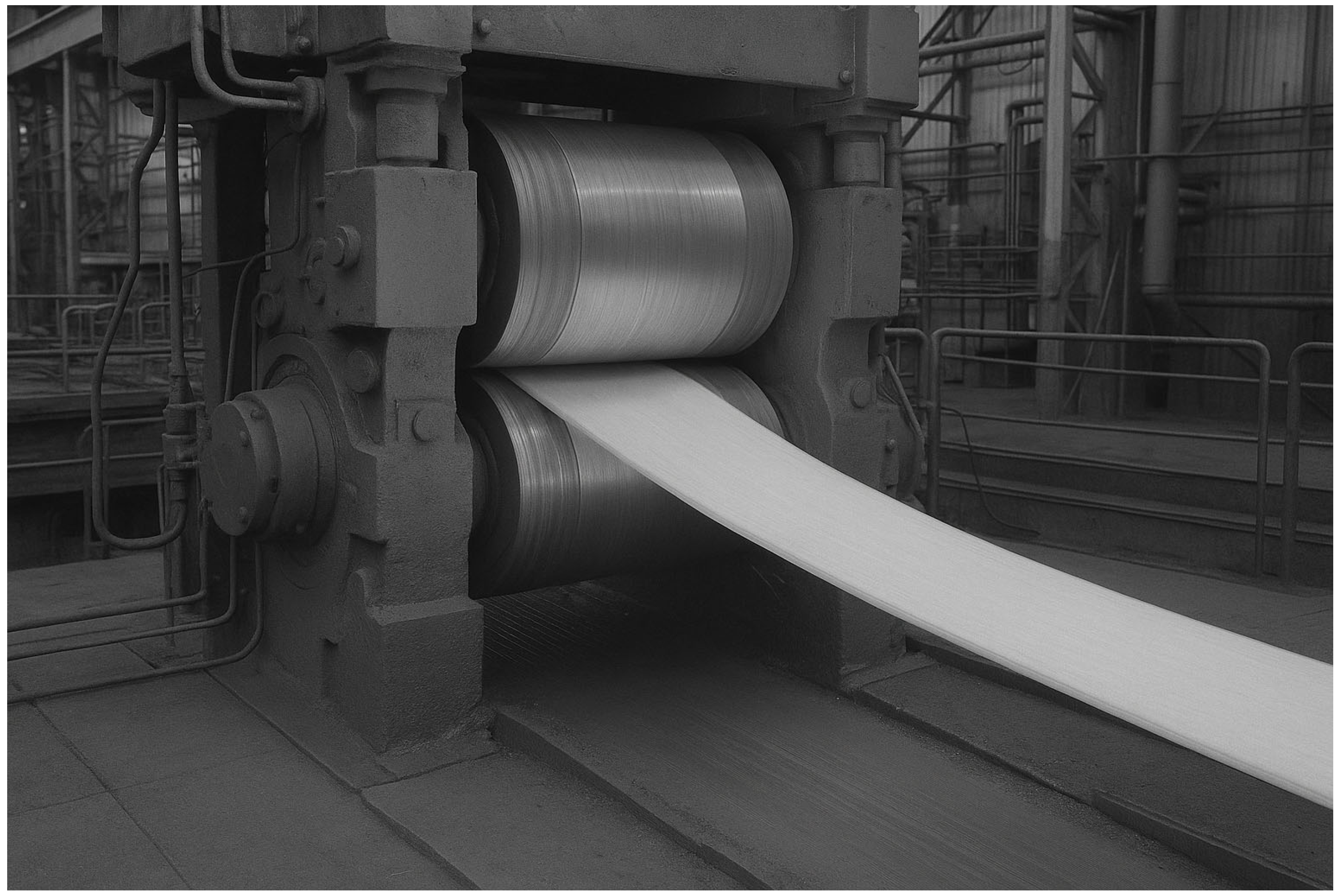
Cold rolling (Figure 1) is a cornerstone of modern manufacturing automation, converting hot strip into high-precision sheet for automotive, appliance, and energy markets. It is a metal forming process in which a metallic strip is passed between rotating rolls to reduce its thickness and improve its mechanical properties. The process, carried out below the recrystallization temperature, provides excellent dimensional accuracy and surface quality.
When the line speed exceeds approximately 800 m/min, the process may enter a regenerative, self-excited regime known as “third-octave chatter” (80–160 Hz), which degrades surface finish, accelerates roll wear, and forces conservative scheduling. Because this phenomenon results from the tight interaction between process forces, roll-stack flexibility, hydraulic actuators, and drive control systems, it must be addressed from an integrated mechatronic perspective that combines mechanics, sensing, and computational technologies.
The analytical foundations of rolling were laid by von Kármán [1] and Orowan [2]; Bland and Ford [3,4] later introduced the influence of strip tension and elastic compression, producing force predictions suitable for online optimization. The theory of rolling was further developed in [5,6,7,8,9,10,11]. Subsequent research shifted attention to vibration: Tlusty [12], Yun [13], Yun et al. [14,15,16,17] and Tamiya et al. [18] linked operating parameters to chatter onset, while Hu and Ehmann [19] formalized linear stability analysis. Experimental studies by Kimura and Sodani [20] highlighted the role of negative strip damping and mode coupling between adjacent stands. More recent contributions to chatter analysis can be found in [21,22,23,24,25,26,27,28,29].
Despite these advances, most industrial mills still rely on trial-and-error to avoid chatter, leaving substantial room for systematic optimization. This paper develops a predictive process–structure model that (i) retains the essential physics of strip deformation and roll flattening, (ii) captures the dominant structural modes with minimal state order, and (iii) is sufficiently lightweight for frequency-domain design and closed-loop implementation.
The paper is organized as follows: Section 2 introduces the process model; Section 3 develops the chatter model and the associated stability analysis; Section 4 presents the industrial case study, based on data provided by Danieli & C. Officine Meccaniche S.p.A., and numerical results; finally, Section 5 provides conclusions.
The methodology proposed in this work can be extended to any type of cold rolling mill plants, provided that an experimental campaign aimed at identifying the parameters is carried out.

2. Model of the Process

In this section, a homogeneous model [19] of flat cold rolling is formulated. By homogeneous, we mean that the strip and the work rolls are treated as continuous media with spatially uniform, effective properties over the contact arc. Microstructural heterogeneities are not resolved explicitly; the strip is assumed isotropic under plane–strain conditions, and the roll-stack elasticity is represented by equivalent compliances. This abstraction yields compact relations for pressures, tractions and kinematics, which are later linearized around a nominal operating point for stability analysis.
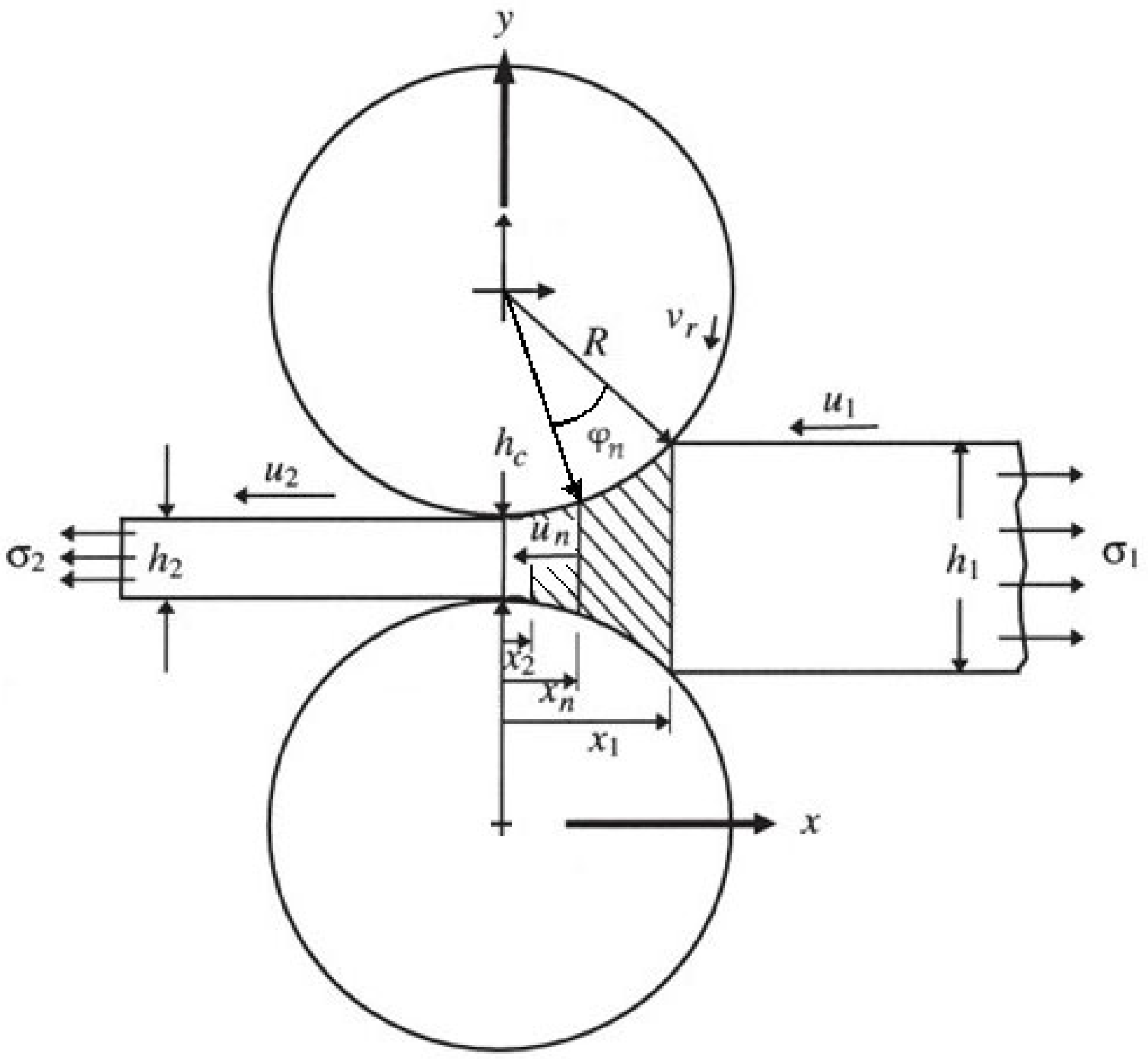
The model of the coupled strip–roll mechanics that governs force transmission in cold rolling is presented here. We first introduce the notation used throughout the model; variables and units are summarized in Table 1. The geometry of the process is shown in Figure 2.
The entry coordinate of the contact is computed on the basis of the roll-bite centerline position, of the strip thickness at the entry and exit points, and of the nominal work roll radius, as follows [30]:
x 1 = x c + R h 1 h 2 0.25 ( h 1 h 2 ) 2
Equation (2) gives the empirical friction factor, whose inverse power dependence on the roll peripheral speed captures the transition from boundary to mixed lubrication in the range 0.4 m s−1vr ≤ 2.5 m s−1:
μ = 1.9526 · ( 60 · v r ) 0.653
A general outlook on friction behavior in cold rolling can be found in [31]; the fitting formula used in this paper Equation (2) has been derived from a data set similar to the one in [32], that Danieli & C. Officine Meccaniche S.p.A acquired through many years in experimental campaigns carried out in several steel cold rolling plants worldwide. These data are part of the industrial know-how of the company and are covered by non-disclosure constraints.
The methodology proposed in this work is still valid if the friction coefficient changes, caused, for example, by the addition of additional lubricating oils or coolants to the rollers and the processed object, as long as the value of the friction coefficient remains within a certain range, as analyzed in [29]. In the case of a change in the friction coefficient, experimental tests should be carried out in order to adjust the curve of the friction coefficient to the new conditions.
The neutral point coordinate is given by:
x n = R h 2 tan log k f 1 σ 1 k f 2 σ 2 e 2 μ R h 2 tan 1 l a r c R h 2 4 μ R h 2
The velocities u 1 and u 2 at the entry and exit points are given by:
u 1 = w w r R 1 h n h c 2 R h n h 1
u 2 = w w r R 1 h n h c 2 R h n h 2
The strip thickness at the neutral point can be computed as:
h n = h 2 + x n 2 R
Equation (7) yields the neutral angle in the roll angular domain
φ n = x n 360 2 π R
While the velocity at the neutral point is given by:
u n = w w r cos φ n
Equations (3)–(8) define the dynamic model of the cold-rolling process (see Figure 2). In particular, xn marks the location where the relative tangential velocity vanishes, and φn maps that coordinate to the roll angular domain used in the subsequent linearization.
The normal traction p(x) along the roll–strip arc of contact is governed by the equilibrium of the strip elements and by the local strip flow stress. Introducing the entry and exit coordinates x1 and x2, the pressure distribution can be written as:
p ( x ) = k f 1 σ 1 e 2 μ R h 2 tan 1 l a r c R h 2 e 2 μ R h 2 tan 1 x R h 2                 x 1 x x n           k f 2 σ 2 e 2 μ R h 2 tan 1 x R h 2                                                                                         x n x x 2  

3. Chatter Model and Stability Analysis

Chatter refers to self-excited vibrations arising from the dynamic coupling between the rolling process and the mill structure, typically observed as regenerative oscillations in the roll gap. In this section, the previously derived process model is coupled with a reduced mechanical representation of the mill stands to build a closed-loop chatter framework. This enables frequency-domain evaluation of the conditions under which self-excited vibrations emerge.

3.1. Lumped Mass Models of the Stands

Each mill stand is modeled as a lumped four-degree-of-freedom system comprising work roll, back up roll and housing masses. This abstraction retains the dominant vertical modes while remaining simple enough for frequency domain stability studies.
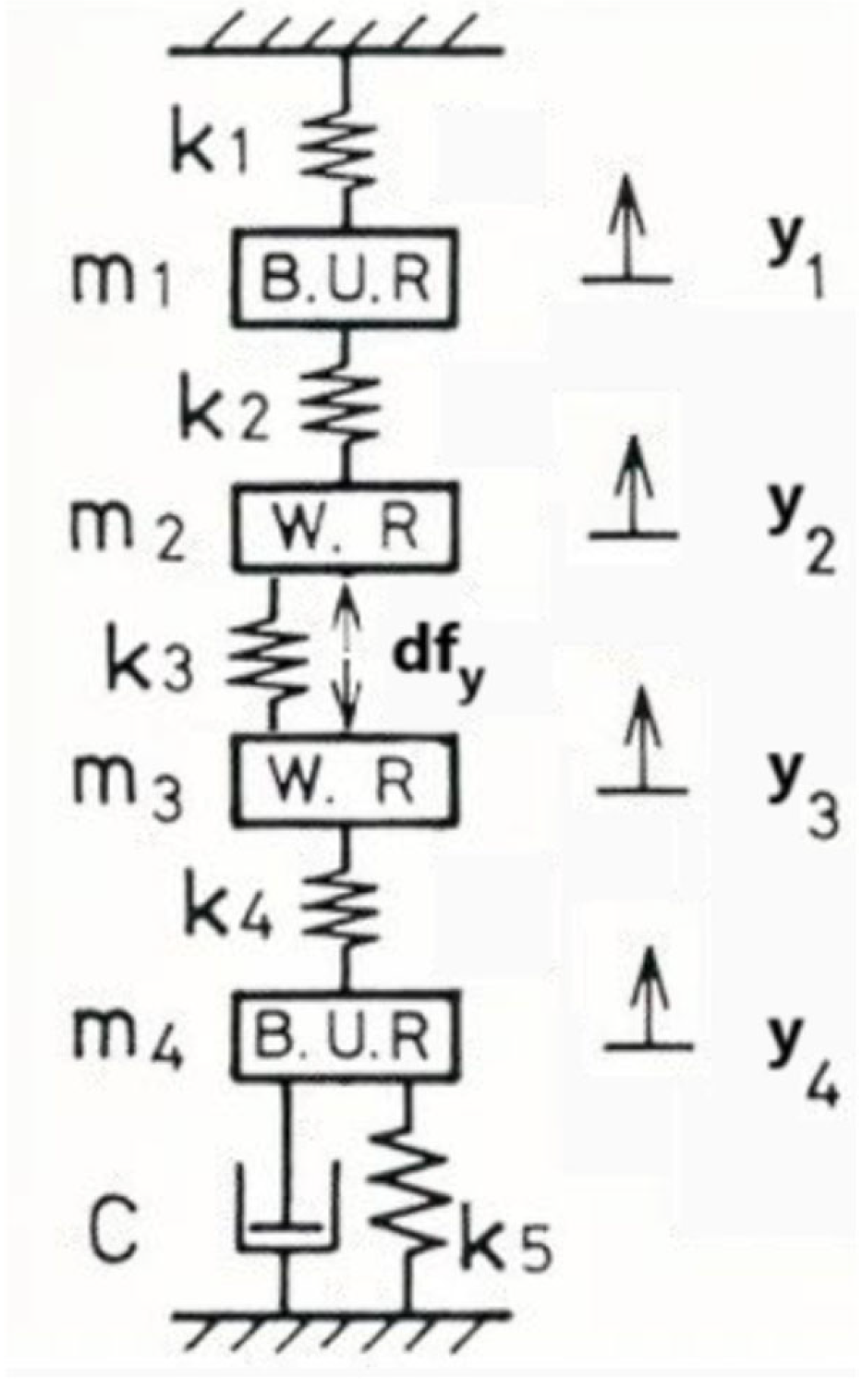
The stand is modeled as a four-degree-of-freedom lumped mass–spring–damper system (Figure 3).
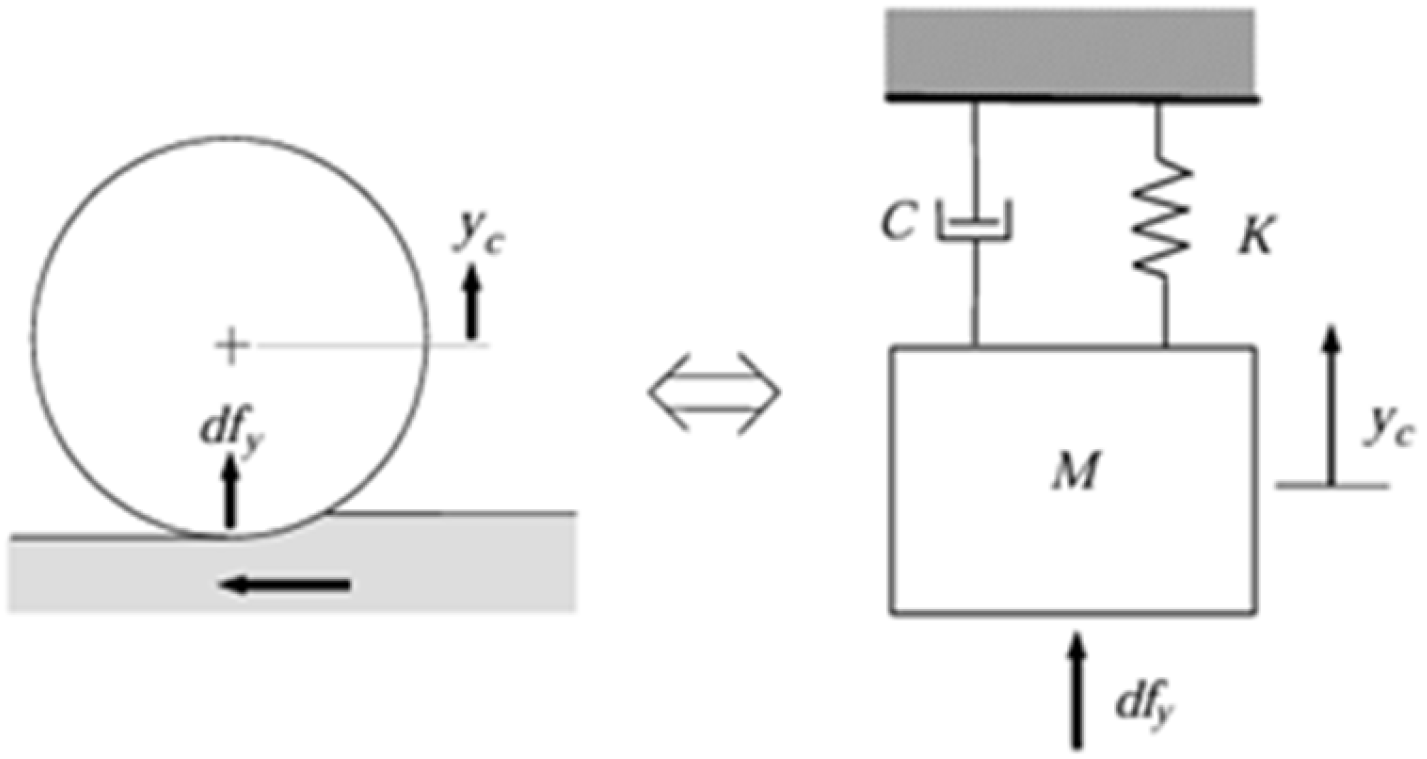
To further simplify the structural complexity of rolling mill cages, the system is assumed to be symmetric with respect to the central plane of the rolled strip. This assumption allows for a reduction in the number of degrees of freedom in the model, leading to the formulation of the simplest and most commonly adopted configuration: a single-degree-of-freedom model. Figure 4 shows the equivalent single-degree-of-freedom (1-DOF) representation used for analytical derivations.
M y ¨ + C y ˙ + K y = F y ( t )
Equation (10) represents the dynamics of the stand, modeled as a four-degree-of-freedom mass–spring–damper system, a configuration introduced by Tlusty [12] for spindle chatter and later adapted to rolling mills. In Equation (10), y is the vector of the vertical displacements of the rolls, M, C and K are the mass, damping and stiffness matrices, respectively. The external force Fy can be defined as the force per unit of length fy multiplied by the width of the strip W s t r i p :
F y = W s t r i p   f y
Figure 4 shows the equivalent system with one degree of freedom. The equivalent parameters of the system have been computed according to [33], so as to reduce the number of parameters needed. The assumptions for simplifications can apply to all racks.

3.2. Stiffness and Damping Calculation

Referring to Figure 3, due to the system’s symmetry with respect to the central plane, the analysis can be simplified: k 1 and k 5   are equal and represent the stiffness associated with the elastic deformation of the cage, screw blocks, and support cylinder bearings; k 2 and k 4 are also equal and correspond to the elastic contact between the support and work rolls; finally, k 3 denotes the elastic constant of the contact between the work rolls and the material to be rolled.
The elastic constants, as well as the viscous damping coefficients introduced later, were calculated following the method proposed by Yarita and Furukawa et al. [34].
k 1 = k 5 = K 0.15
1 k 2 = 1 k 4 = D F y
1 k 3 = S F y = h 2 F y + E p F y = 1 M p + 1 K 3 *
C = 6 η l p A p 2 π R p ε 0 3
Here, K is the tandem mill stand, D denotes the reduction in the distance between the centers of the cylinders due to surface flattening, F y is the vertical force, S is the reduction in thickness and elastic compression of work rolls, h2 is the exit thickness, Ep is the elastic compression of work rolls, Mp is the equivalent spring constant of strip being rolled, and K 3 * corresponds to the elastic compression constant of the work rolls.
The terms included in the above equations, together with other property of the system, are reported in Table 2 and Table 3.

3.3. Development of the Chatter Model

Chatter refers to self-excited vibrations generated by the regenerative coupling between the rolling process and the elastic structure of the mill. During operation, surface modulations produced at one revolution re-enter the deformation zone at the next, modulating the contact pressure and the rolling force. When the energy input from the process (due to negative damping) exceeds the mechanical dissipation of the stand, oscillations grow exponentially, leading to third-octave chatter [12,31,32].
The dynamic formulation is developed in the Laplace domain. This approach allows the coupling between process and structure to be expressed compactly in the frequency domain, facilitating stability analysis through the Nyquist criteria.
The generalized single-stand chatter model is expressed as follows:
y = G   r
Here, G denotes the transfer function matrix of the chatter model. The explicit representation of its components relies on both the process model (matrix Gp) and the structural dynamics model (matrix Gs). Likewise, we consider the input and output vectors (respectively, r and y) depending both on the process (vectors rp and yp, respectively) and on the structure (vectors rs and ys, respectively).
The process-related input and output vectors and the corresponding transfer function matrix are as follows:
r p = d σ 1   d σ 2   d h 1   0   0     d x c   d h c   d v r T
y p = d f x   d f y   d T   d u 1   d u 2   0   0   0 T
The elements in Equations (17) and (18) are the variations in the entities defined in Table 1.
The transfer matrix of the process is given by:
G p = a f x , 1 a f x , 2 a f x , 3 0 0 a f x , 4 a f x , 5 + a f x , 6 s 0 a f y , 1 a f y , 2 a f y , 3 0 0 a f y , 4 a f y , 5 + a f y , 6 s 0 a T , 1 a T , 2 a T , 3 0 0 a T , 4 a T , 5 + a T , 6 s 0 a u 1 , 1 a u 1 , 2 a u 1 , 3 0 0 a u 1 , 4 + a u 1 , 5 s a u 1 , 6 + a u 1 , 7 s a u 1 , 8 a u 2 , 1 a u 2 , 2 a u 2 , 3 0 0 a u 2 , 4 + a u 2 , 5 s a u 2 , 6 + a u 2 , 7 s a u 2 , 8 0 0 0 0 0 0 0 0 0 0 0 0 0 0 0 0 0 0 0 0 0 0 0 0
Regarding the structure, the input and output vectors and the corresponding transfer function matrix will be as follows:
r s = y p = d f x d f y d T d u 1 d u 2 0 0 0 T
y s = 0 0 0 0 0 d x c d h c d v r T
G s = 0 0 0 0 0 0 0 0 0 0 0 0 0 0 0 0 0 0 0 0 0 0 0 0 0 0 0 0 0 0 0 0 0 0 0 0 0 0 0 0 N s , 11 ( s ) D s ( s ) N s , 12 ( s ) D s ( s ) 0 0 0 0 0 0 2 N s , 21 ( s ) D s ( s ) 2 N s , 22 ( s ) D s ( s ) 0 0 0 0 0 0 0 0 W s t r i p R s I s 2 + B s + K r 0 0 0 0 0
All elements of G p are obtained during the linearization process (Appendix A) by approximating the non-linear model, at a nominal operating point, by means of a Taylor series truncated to the first-order terms, so that the coefficients appearing in (A1) through (A5) are the first-order partial derivatives of the function with respect to the variables on which the function depends, computed at the nominal operating point. The derivation of the terms of the structure’s transfer function matrix G s is presented in Hu et al. [35,36,37].

3.4. Single-Stand Chatter Model and Stability Analysis

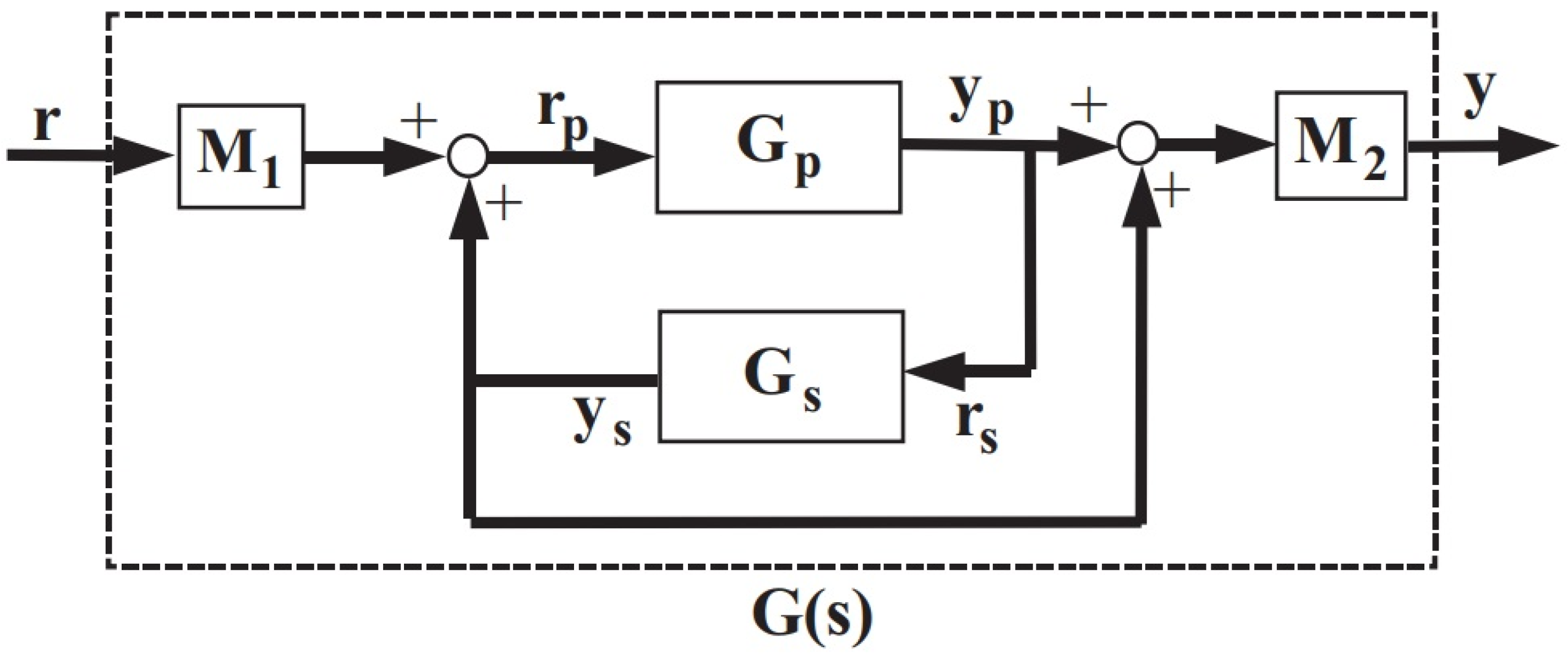
As illustrated in Figure 5, the formulation for determining the single-stand open-loop transfer function matrix is expressed as follows:
G s = M 2 ( I + G s ) ( I G p G s ) 1 G p M 1
where I denotes the identity matrix and M 1 and M 2 represent the connection matrices [35].
Based on the derived linear model, two physical mechanisms leading to undesired vibrations are examined: the matching effect and mode coupling. The matching effect arises from a simple process–structure interaction, offering a relatively high stability margin, and was first introduced by Hu, Zhao, and Ehmann [36]. Conversely, mode coupling results from multiple vibration modes and was initially established in a limited form by Yun et al. [14,15,16].
The transfer function matrix model allows system analysis via its characteristic equation, where stability requires all roots to have negative real parts; the characteristic equation for (23) is:
D s = M 2 δ s I s 2 + B s + K r M s 2 + C x s + K x M s 2 + C y s + K y
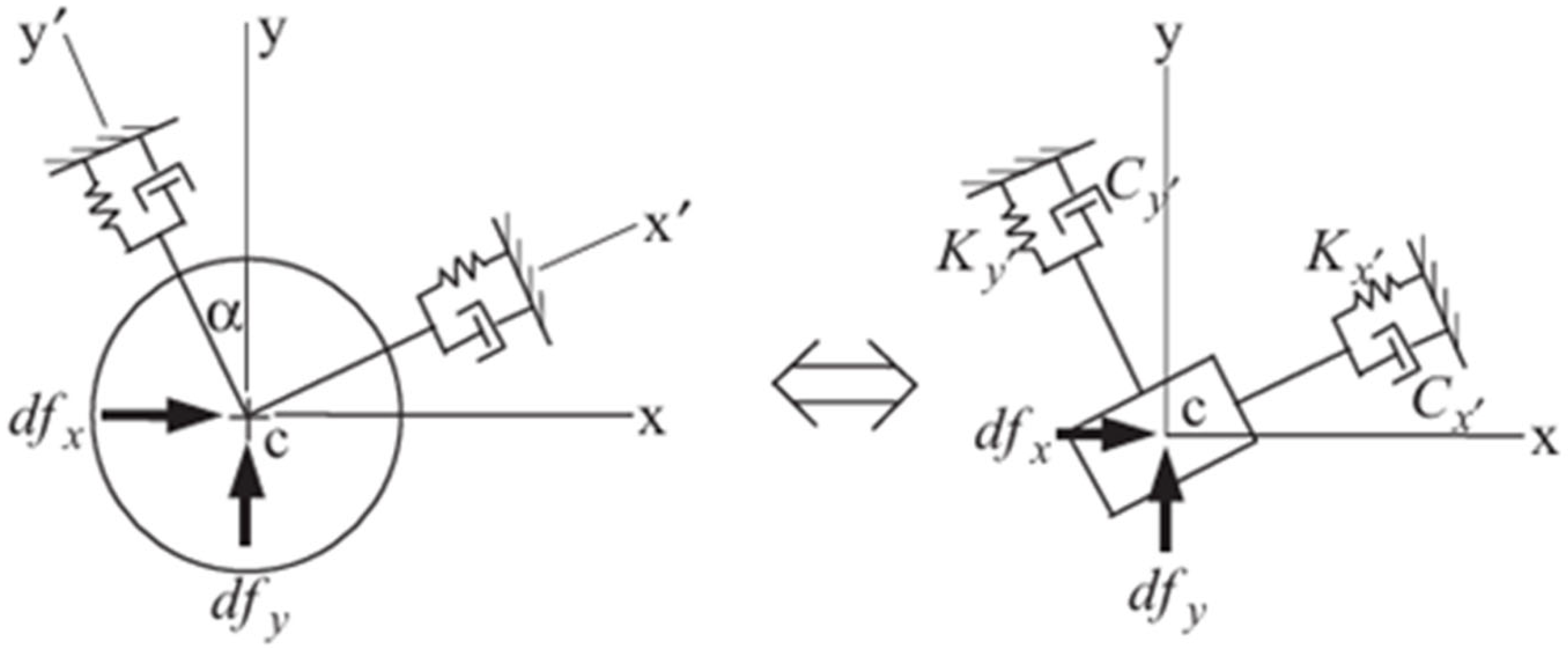
Here, M   denotes the equivalent mass, calculated as the sum of the work roll mass and the backup roll mass; C x ,   C y   are the structural damping coefficients along the X and Y axes; K x ,   K y are the spring constants along the X and Y axes (see Figure 6).
δ(s) is a fourth-degree polynomial:
δ s = s 4 + a 1 s 3 + a 2 s 2 + a 3 s + a 4
where the coefficients appearing in Equation (25) are defined in Zhao and Ehmann [33].
Equation (24) includes two types of roots: six from the structural dynamic model and four from the combined process–structure model. According to Hu, Zhao, and Ehmann [36], the six roots related to structural dynamics are stable and can be neglected; thus, system stability requires the remaining four roots to have negative real parts.
From the general form of Equation (24), the model matching effect is not immediately evident; referring to Figure 6, considering the case where α = 0 , the main structural dynamic modes align with the vertical and horizontal directions and become decoupled into two independent modes. Thus, the stability analysis for the model matching effect reduces to a simple verification.
C = C y 2 W s t r i p a f y , 6 > 0
K = K y 2 W s t r i p a f y , 5 > 0
Here, C denotes the equivalent damping coefficient, and K represents the equivalent spring constant of the system.
In processes where the tool can oscillate in multiple directions, instability may arise from modal coupling even if each individual direction is stable. Although horizontal oscillations in rolling are minimal, they can still destabilize the system. To analyze this effect, a multidirectional, multimodal structural model is required, and stability is typically assessed using the Routh criterion:
s 4 s 3 s 2 s 1 1 a 1 b 1 c 1 d 1 a 2 a 3 b 2     a 4
a 1 > 0 ,     b 1 > 0 ,     c 1 > 0 ,     d 1 > 0
In this case, system stability depends on factors influenced by both the process and structural dynamics, but primarily on the angle α and the structural properties along the x and y directions (Figure 6).

3.5. Multi-Stand Chatter Model and Stability Analysis

In industrial rolling processes, most mills operate in a tandem configuration, where multiple rolling stands are arranged sequentially to enable continuous thickness reduction. While this setup ensures high efficiency, it also introduces dynamic instabilities, primarily linked to negative damping effects. To analyze these phenomena, the multi-stand chatter model plays a crucial role, as it captures the interaction mechanisms between stands and explains the occurrence of third-octave vibrations during rolling operations.
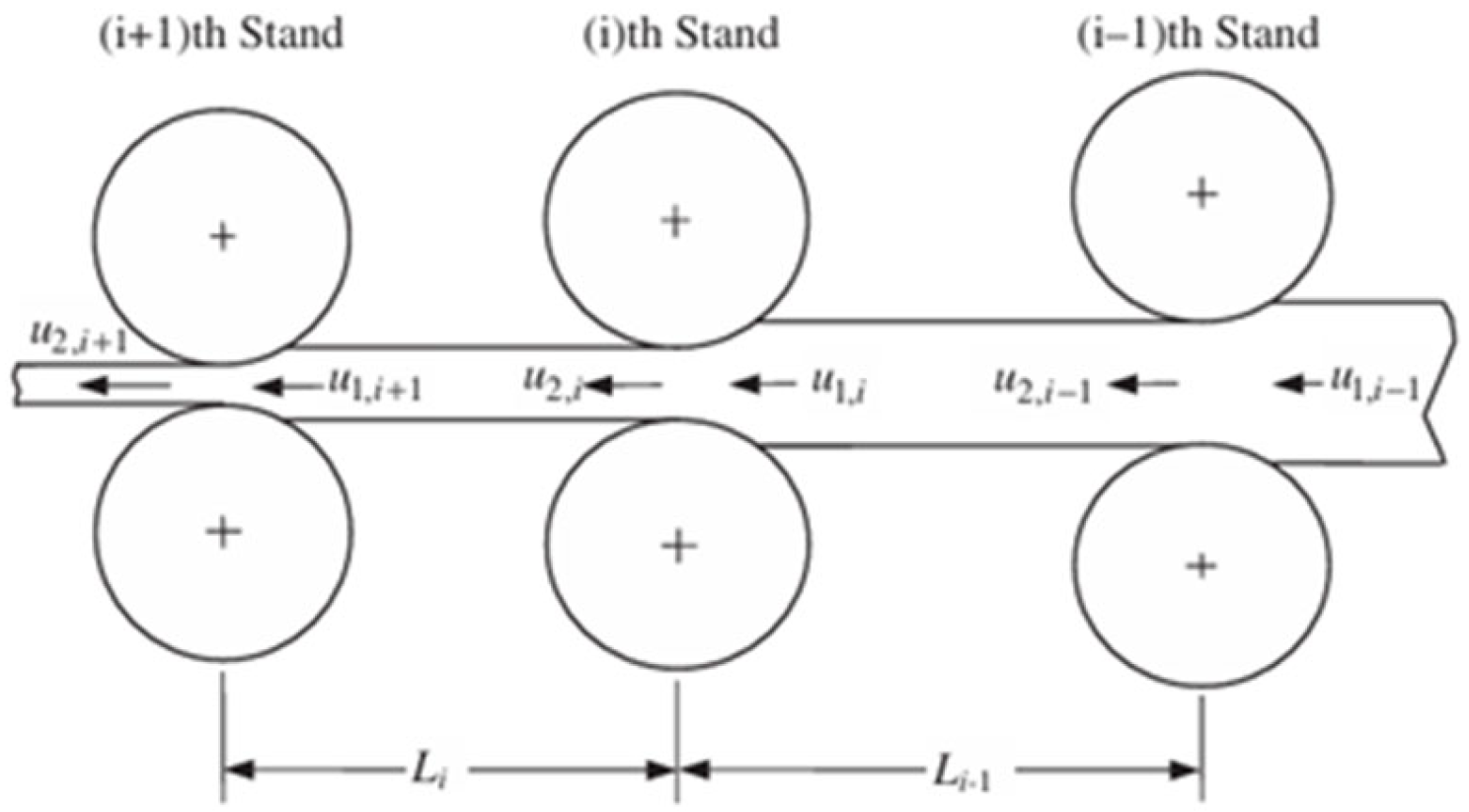
Considering the strip between stands (i) and (i − 1) (Figure 7), according to Hooke’s law, the variation in stress at the entry of stand (i) is proportional to the integral of the difference between the exit speed of stand (i − 1) and the entry speed of stand (i):
d σ 1 = E L i 1 ( d u 1 d u 2 , i 1 ) d t
d σ 2 = E L i ( d u 1 , i + 1 d u 2 ) d t
Here, E represents the Young’s modulus of the strip, and L i denotes the distance between stands i and i + 1 .
For notational convenience, the subscript i has been suppressed for variables pertaining to stand (i).
Another key relation between two consecutive stands concerns how the thickness variation in one stand affects the next. The strip exiting stand (i − 1) reaches the rolling zone of stand (i) after a time delay, defined as follows:
Δ i = L i 1 u 2 , i 1
Thus, the transfer function that describes the relationship between strip thickness variations at the entry and exit can be expressed as follows:
d h 1 , i = e s Δ i d h c , i 1
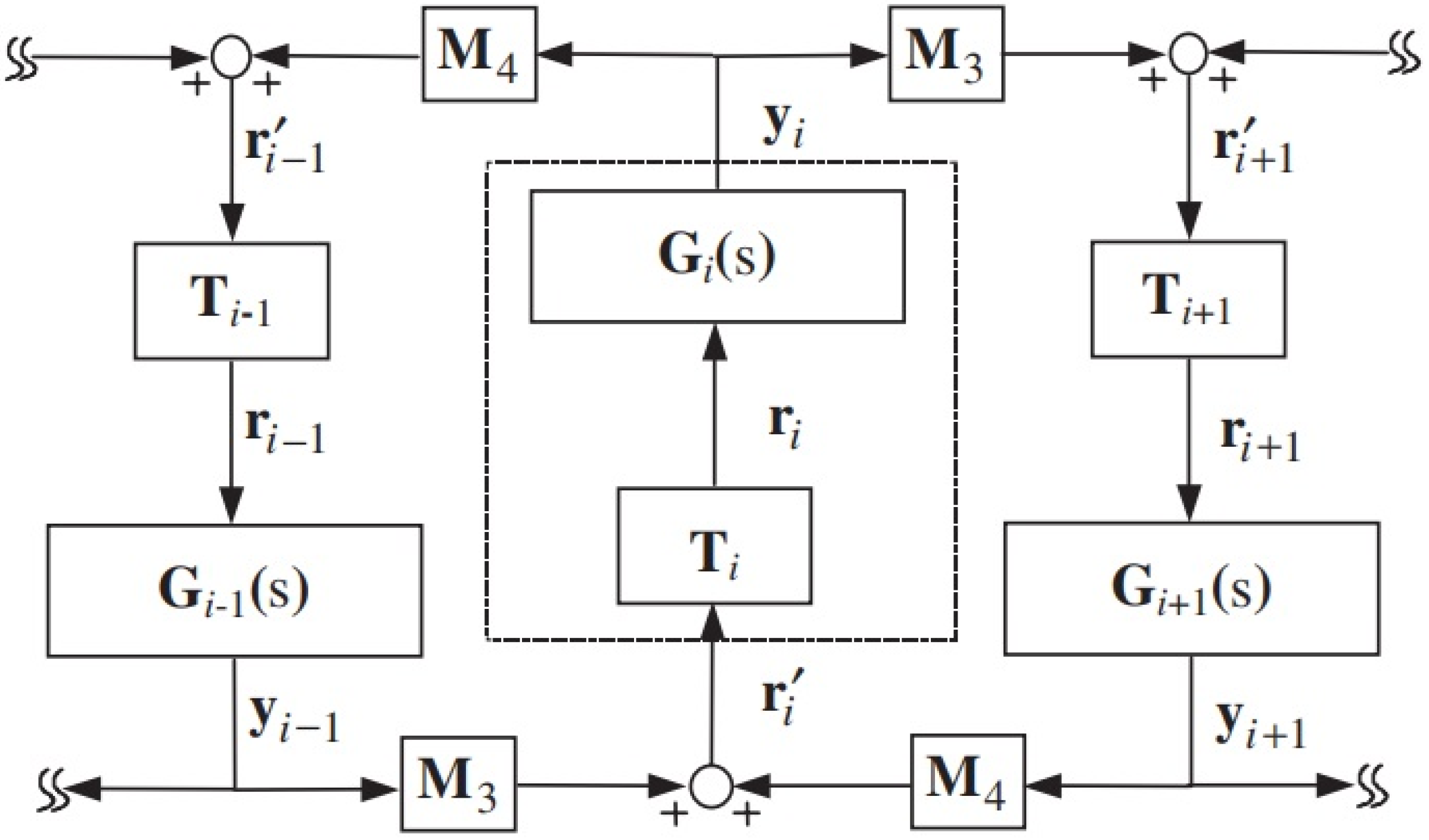
In Figure 8, the single-stand model of Equation (23) is represented by Gi(s). Upstream and downstream influences are transmitted to Gi(s) through the transport matrix Ti, which defines inter-stand relations. Outputs of the current stand depend on its inputs, and this effect is included in Ti; the input vector for a multi-stand model is defined as follows:
r i = d u 2 , i 1 d u 1 , i + 1 d h c , i 1 T
The transport matrix Ti can be expressed as:
T i = I + H i G i 1 H i + D i
where
H i = E L i 1 s 0 0 0 E L i s 0 0 0 0
D i = 0 0 0 0 0 0 0 0 e s Δ i
The multi-stand chatter model in Figure 8 can be expressed as:
G i = G i T i = G i I + H i G i 1 H i + D i
To analyze inter-stand tension effects due to strip speed differences, the multi-stand model is applied, where horizontal roll motion has been assumed negligible compared to vertical motion. The Routh criterion is then applied [37].
The resulting characteristic equation for the i-th stand can be expressed as follows:
D i s = a 0 s 6 + a 1 s 5 + a 2 s 4 + a 3 s 3 + a 4 s 2 + a 5 s + a 6
s 6 s 5 s 4 s 3 s 2 s 1 a 0 a 1 b 1 c 1 d 1 e 1 f 1     a 2 a 3 b 2 c 2 d 2     a 4 a 5 b 3     a 6
a 1 > 0 ,     b 1 > 0 ,     c 1 > 0 ,     d 1 > 0 ,     e 1 > 0 ,     f 1 > 0

4. Results

This section compares the calculated stability boundaries with experimental mill data for two steel grades. Natural frequencies, equivalent stiffnesses, and critical speeds are extracted and tabulated to assess the predictive accuracy of the proposed model.
The hybrid chatter model is applied to the industrial scenario that motivated the research. The study focuses on a five–stand, 4–high tandem cold–rolling mill built by Danieli Group, selected because persistent third–octave chatter has been observed during production runs. Incoming low-carbon strip of 2.5 mm thickness is progressively reduced to final gauges between 0.30 mm and 0.55 mm over five passes, following the reduction schedules listed in Table 4, Table 5, Table 6 and Table 7 of this paper. All geometric, inertial and compliance data—roll diameters, stand modulus, HAGC cylinder characteristics and inter-stand spacing—are taken unaltered from the plant datasheet and summarized here in Table 2 and Table 3. These measured inputs serve as boundary conditions for the linearized process–structure model, allowing the predicted stability index to be compared directly with the mill’s recorded chatter limits.
Table 6 summarizes the natural frequencies, process variables and equivalent stiffnesses for Steel I. The rapid strain hardening of the material at higher rolling speeds increases the strip stiffness, which alters the system’s natural frequencies and brings them closer to those of the induced vibrations. This phenomenon can be observed through the progressive increase in the mean flow stress value k f m from stand 1 to stand 5.
Analogous data for Steel II are given in Table 7. Owing to its higher work-hardening coefficient of Steel II, the effective flow stress increases more between the first two stands, leading to a steeper stiffness gradient.
In the multi-cage rolling model, the second, third, and fourth cages were selected for detailed analysis. This selection is justified because the first cage does not experience stresses induced by a preceding cage, thereby minimizing instability risks. Conversely, in the fifth and final cage, the material reductions are minimal; thus, despite work hardening, the likelihood of vibration remains low. Literature [20] and experimental evidence indicate that vibrations predominantly occur in intermediate cages and tend to intensify in subsequent stages, amplifying instability effects.
Experimental investigations were conducted to assess system behavior as a function of the working roll’s peripheral speed and the friction coefficient. For each material, a speed range was established from 110% down to 50% of the nominal speed, with decrements of 10%. At each speed level, tests were performed considering the friction coefficient, which varied proportionally with speed, as calculated using Equation (2). The coefficient was progressively reduced to the minimum realistic value, avoiding negative values due to their lack of physical significance.
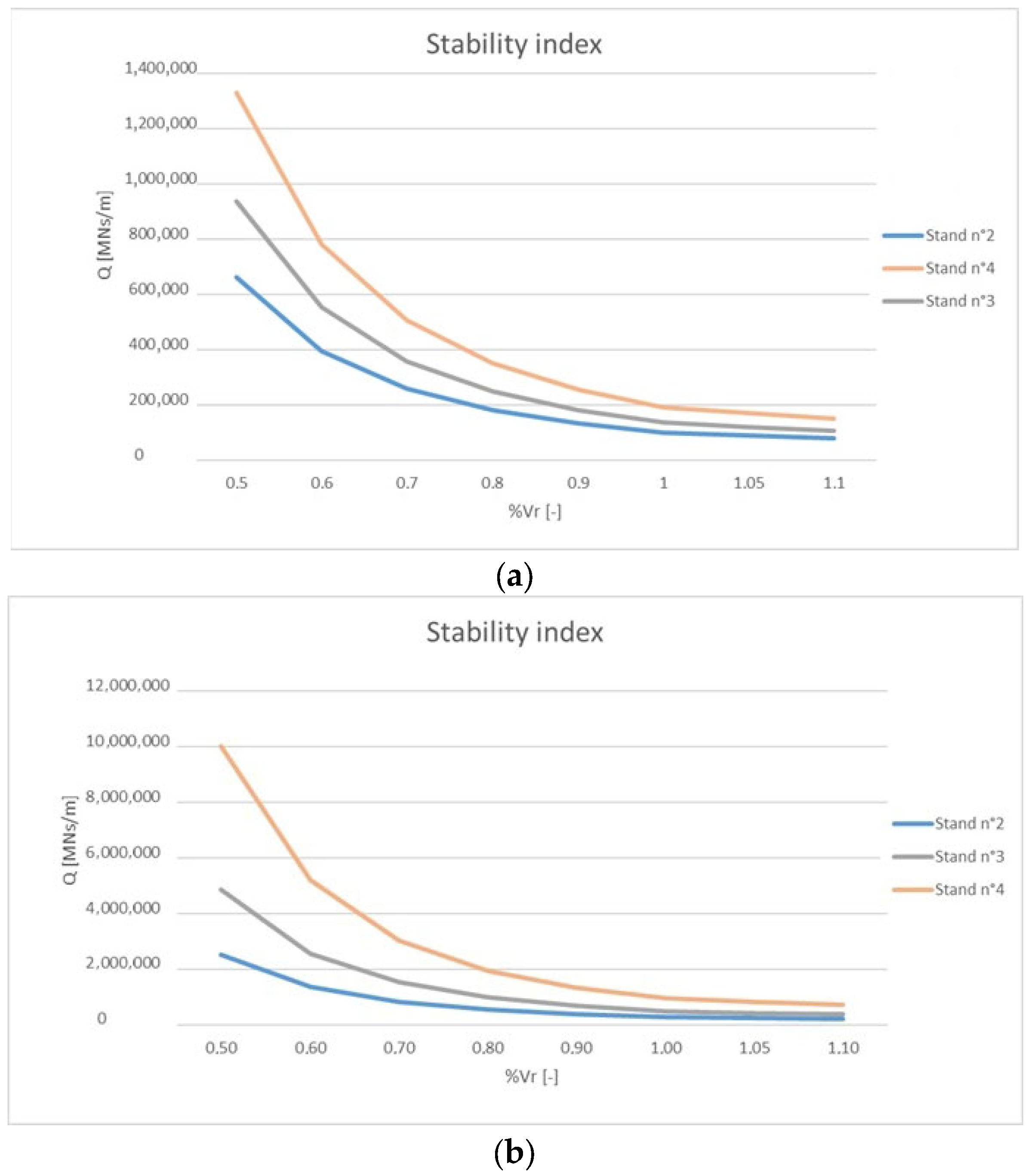
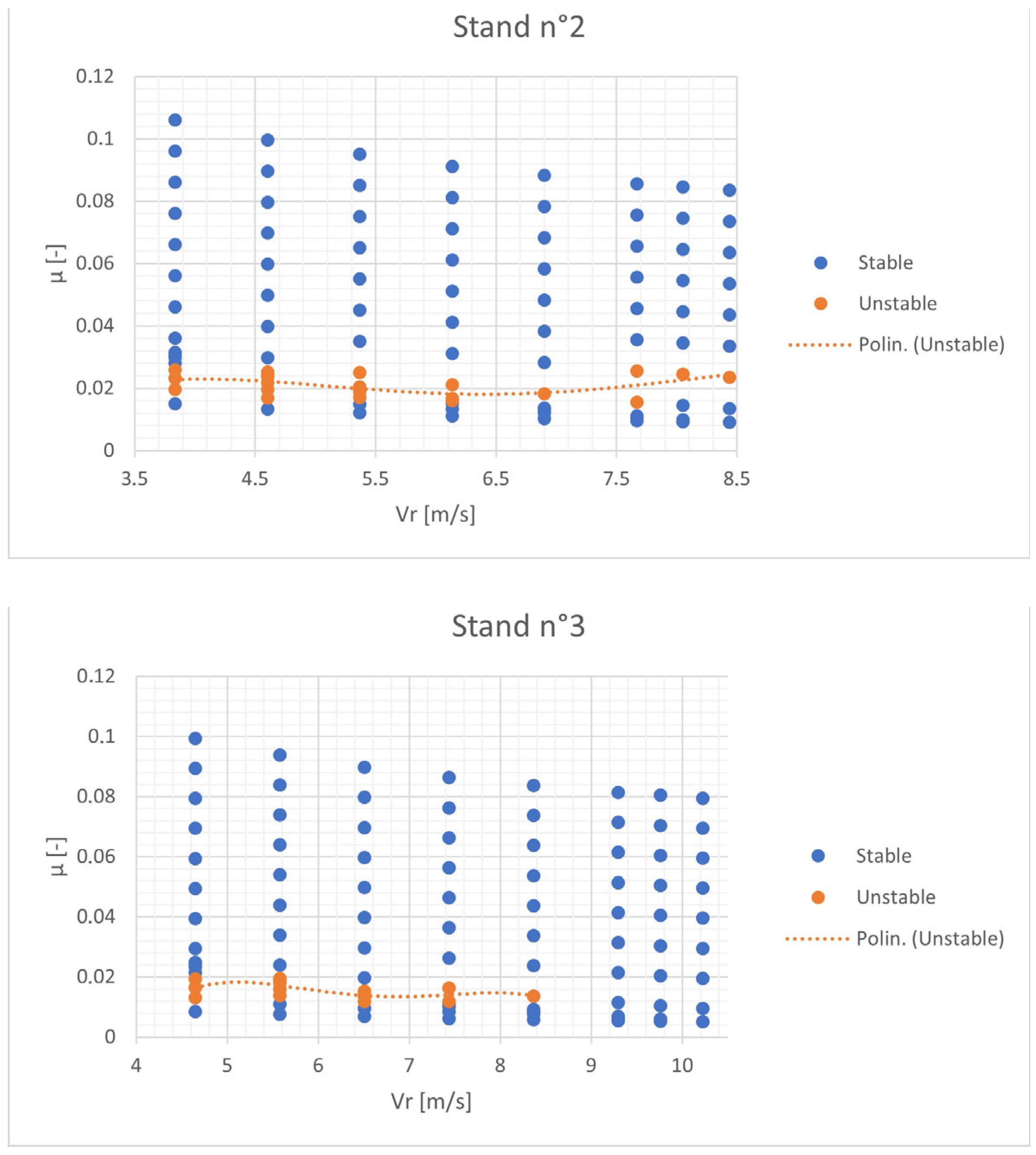
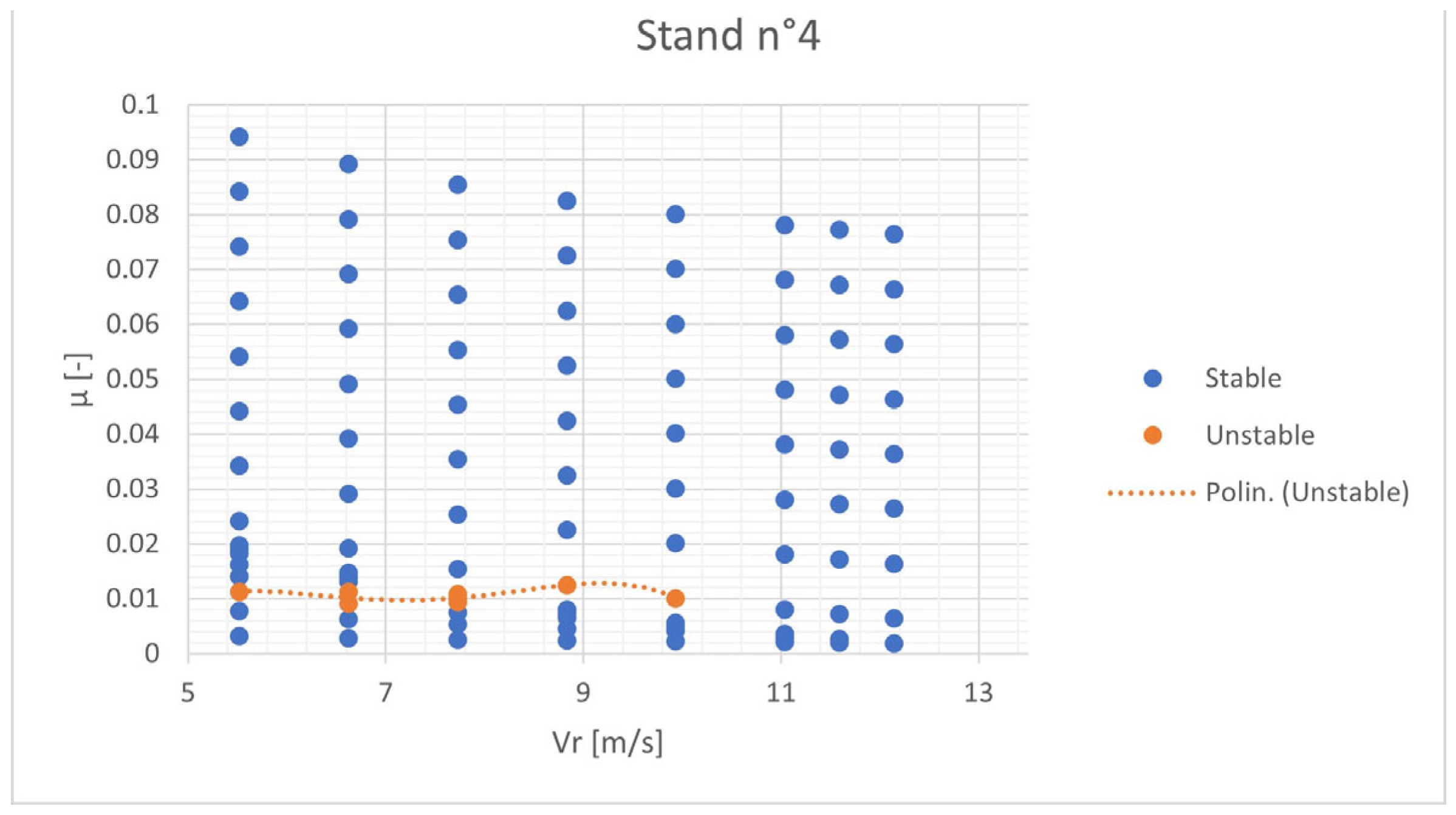
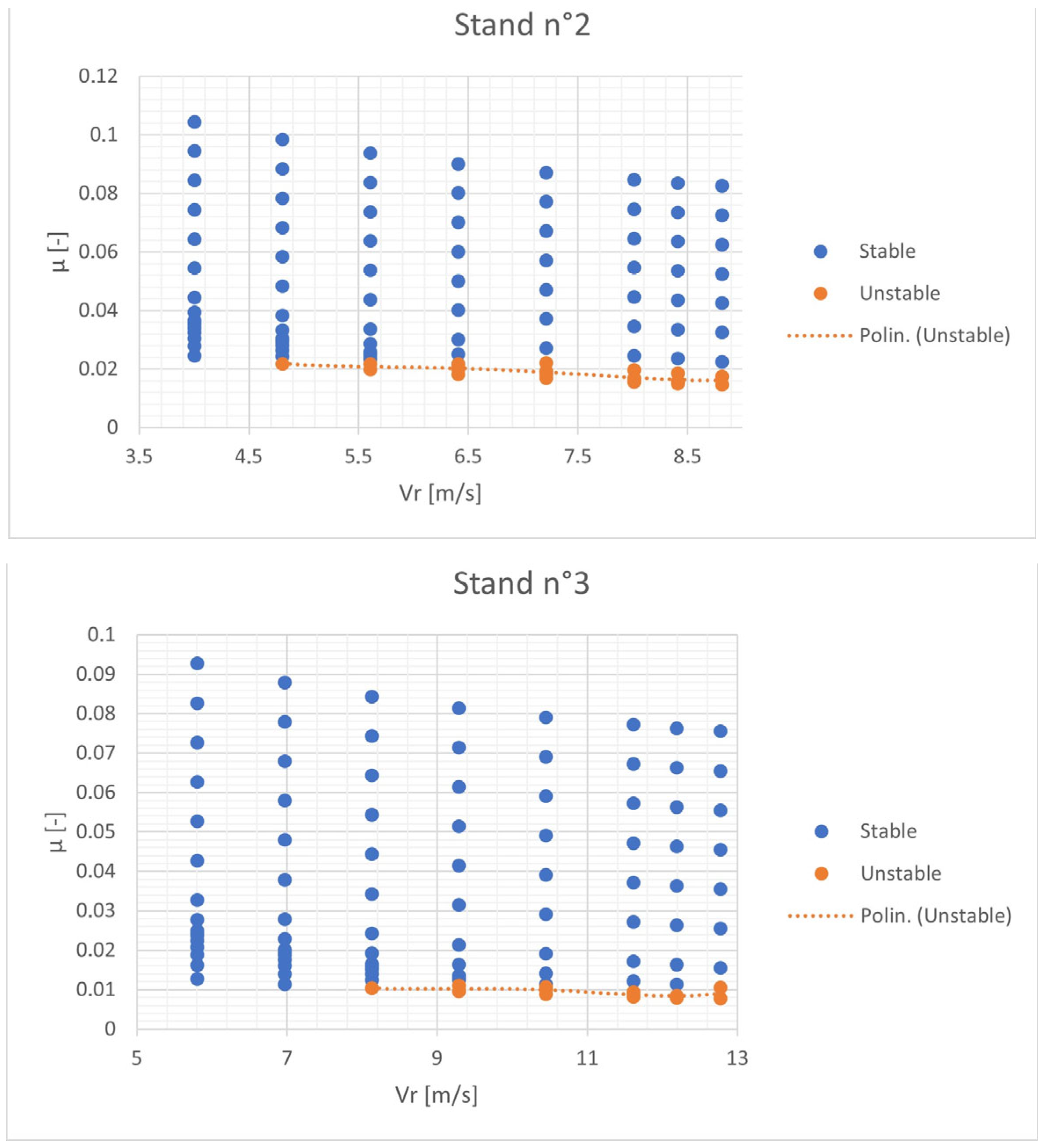
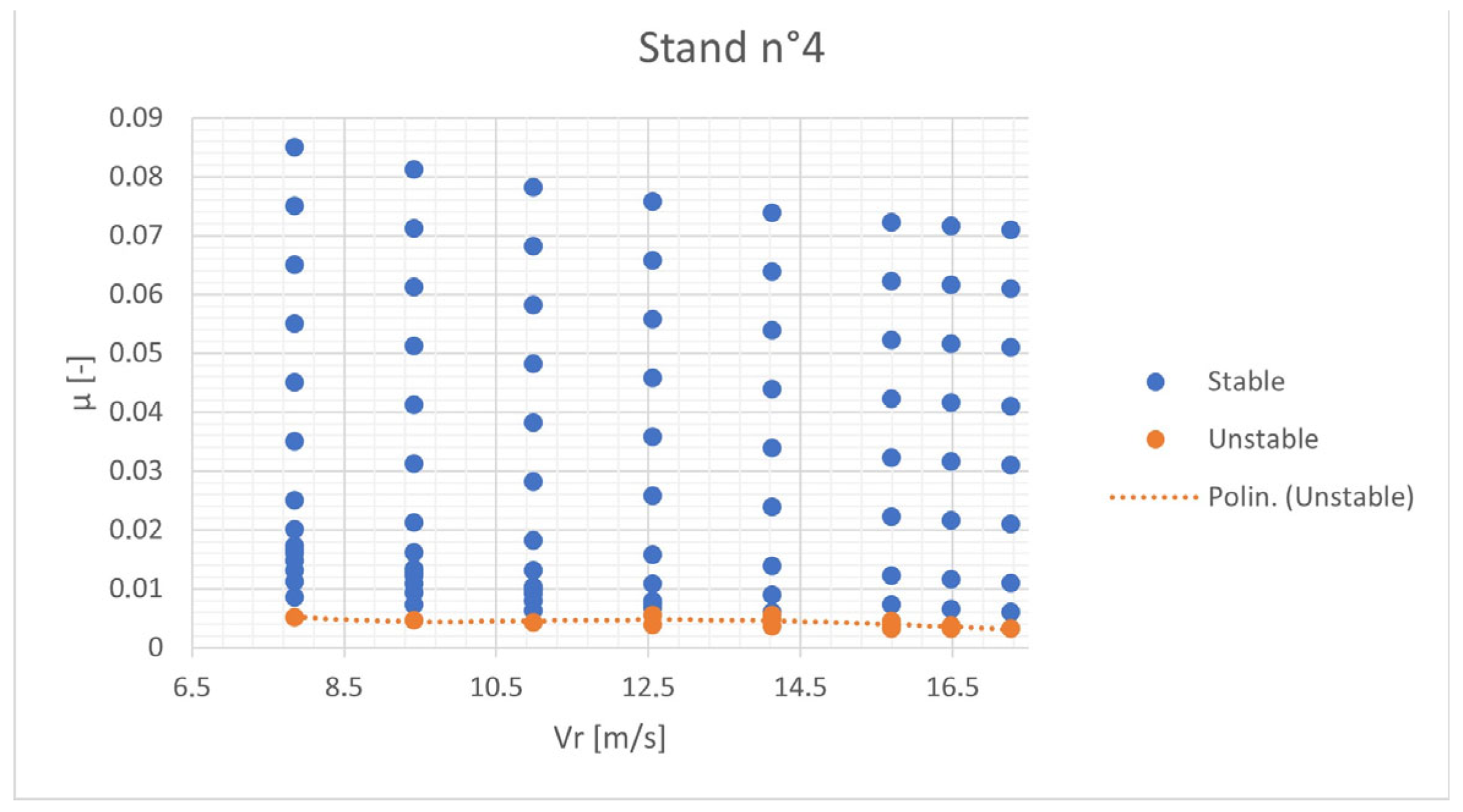
In order to assess the stability of the system, stability diagrams correlating peripheral speed (vr) and friction coefficient (μ) have been obtained. Moreover, additional plots were developed to illustrate the trend of the stability index Q relative to roll speed.
Q = R h Δ i = M p Δ i
This index, originally proposed by Kimura, Sodani et al. [20], provides a measure of the system’s stability against vibrations. It depends solely on the rolling conditions and is independent of the physical configuration of the mill. An increasing value of the stability index Q indicates a higher tendency of the system to become unstable.
The results presented focus on cages 2–4, which represent critical stages in the rolling process where variations in material properties and system dynamics are most pronounced.
Figure 9 clearly shows that the stability index decreases with the peripheral speed of the working roll.
A reduction in rolling speed by approximately 50% from the nominal condition produced an unexpected outcome: rather than improving process stability, the system exhibited signs of increased instability. This behavior can be explained by several mechanisms associated with excessively low rolling speeds in cold rolling operations. At reduced speeds, the friction coefficient between the strip and the rolls tends to increase, leading to irregular force distribution and unpredictable fluctuations. Additionally, the effectiveness of dynamic damping decreases, making the system more sensitive to self-excited vibrations. Low speeds may also alter the natural frequencies of the strip-roll assembly, potentially bringing them closer to excitation frequencies and thereby promoting resonance phenomena.
Conversely, the ability to maintain stability even with a 10% increase in rolling speed above the nominal value confirms that the selected process parameters are well optimized and provide a safety margin against moderate speed variations.
Figure 10 and Figure 11 show a stability analysis for stands 2–4, as a function of two parameters—the peripheral speed and the friction coefficient. The points defined as “unstable” in Figure 10 and Figure 11 are the combination of values of roll peripheral speed and of friction coefficient for which the simulations yield an unstable system (poles with positive real part, or negative stiffness, or negative damping). The stability analysis was performed according to the methodology described by Kimura, Sodani et al. [20]. It can be noticed that instability occurs for low values of the friction coefficient μ.

5. Materials and Methods

During the preparation of this manuscript, the authors used ChatGPT (version 5.2) for the purpose of generating Figure 1. The authors have reviewed and edited the output and take full responsibility for the content of this publication.

6. Conclusions

This work has presented a hybrid process–structure model that links strip-deformation mechanics to stand dynamics, offering a predictive tool for process optimization and vibration control in tandem cold-rolling. By combining von Kármán–Orowan pressure equations [1,2], iterative Hitchcock roll-flattening [17] and a four-degree-of-freedom lumped stand model, the approach reproduces the experimentally observed onset of third-octave chatter for three low-carbon steels.
The results highlight how friction coefficient, stand stiffness and hydraulic clearances shift the stability boundary, providing quantitative guidelines for roll-speed scheduling and adaptive damping. Because the state-space is compact and implemented in MATLAB/Simulink version R2020a, the model runs fast enough for real-time what-if studies and can be embedded into existing manufacturing-automation and sensing architectures. These features align with the objectives of modern mechatronic system design, where computational technologies are leveraged to maximize throughput while safeguarding product quality.

Author Contributions

Conceptualization, A.M., G.B. and A.G.; methodology, A.M., G.B. and A.G.; software, A.M. and G.B.; validation, A.M. and G.B.; formal analysis, A.M., G.B. and A.G.; investigation, A.M. and G.B.; resources, G.B.; data curation, A.M.; writing—original draft preparation, A.M.; writing—review and editing, A.M. and A.G.; supervision, G.B. and A.G. All authors have read and agreed to the published version of the manuscript.

Funding

This research received no external funding.

Institutional Review Board Statement

Not applicable.

Informed Consent Statement

Not applicable.

Data Availability Statement

Restrictions apply to the availability of these data. Data were obtained from Danieli & C. Officine Meccaniche S.p.A. and are available with the permission of Danieli & C. Officine Meccaniche S.p.A.

Acknowledgments

During the preparation of this manuscript, the authors used ChatGPT (version 5.2) for the purpose of generating Figure 1. The authors have reviewed and edited the output and take full responsibility for the content of this publication.

Conflicts of Interest

Author Gianluca Bazzaro is employed by the Danieli & C. Officine Meccaniche S.p.A. The remaining authors declare that the research was conducted in the absence of any commercial or financial relationships that could be construed as a potential conflict of interest.

Appendix A. Linearization of the Process Model

The nonlinear equations of Section 2 are expanded by a first-order Taylor series around the nominal steady state. The incremental form for a generic output yi is:
d y i = y i σ 1 s s d σ 1 + y i d σ 2 s s d σ 2 + y i h 1 s s d h 1 + y i h c s s d h c + y i h c ˙ s s d h c ˙ + y i x c s s d x c + y i x c ˙ s s d x c ˙ +   y i v r s s d v r
These relations define the state–space model used in Section 3 for the chatter stability analysis.
d f y = a f y , 1 d σ 1 + a f y , 2 d σ 2 + a f y , 3 d h 1 + a f y , 4 d x c + a f y , 5 d h c + a f y , 6 d v r
  d u 1 = a u 1 , 1 d σ 1 + a u 1 , 2 d σ 2 + a u 1 , 3 d h 1 + ( a u 1 , 4 + a u 1 , 5 ) d x c + ( a u 1 , 6 + a u 1 , 7 ) d h c + a u 1 , 8 d v r
d u 2 = a u 2 , 1 d σ 1 + a u 2 , 2 d σ 2 + a u 2 , 3 d h 1 + ( a u 2 , 4 + a u 2 , 5 ) d x c + ( a u 2 , 6 + a u 2 , 7 ) d h c + a u 2 , 8 d v r
d T = a T , 1 d σ 1 + a T , 2 d σ 2 + a T , 3 d h 1 + a T , 4 d x c + a T , 5 d h c + a T , 6 d v r

References

  1. Von Karmàn, T. Beitrag zur Theorie des Walzvorganges. Z. Angew. Math. Mech. 1925, 5, 139–141. [Google Scholar] [CrossRef]
  2. Orowan, E. The calculation of roll pressure in hot and cold flat rolling. Proc. Inst. Mech. Eng. 1943, 150, 140–167. [Google Scholar] [CrossRef]
  3. Bland, D.R.; Ford, H. The calculation of roll force and torque in cold strip rolling with tensions. Proc. Inst. Mech. Eng. 1948, 159, 144–163. [Google Scholar] [CrossRef]
  4. Bland, D.R.; Ford, H. Cold rolling with strip tension—Part III: An approximate treatment of the elastic com pression of the strip in cold rolling. J. Iron Steel Inst. 1952, 171, 245–249. [Google Scholar]
  5. Sims, R.B. Calculation of roll force and torque in cold rolling by graphical and experimental methods. J. Iron Steel Inst. 1954, 178, 19–34. [Google Scholar]
  6. Sims, R.B. Calculation of roll force and torque in hot rolling mills. Proc. Inst. Mech. Eng. 1954, 168, 191–200. [Google Scholar] [CrossRef]
  7. Ford, H.; Ellis, F.; Bland, D.R. Cold rolling with strip tension—Part I: A new approximate method of calculation and a comparison with other methods. J. Iron Steel Inst. 1951, 168, 57–72. [Google Scholar]
  8. Bland, D.R.; Sims, R.B. A note on the theory of rolling with tensions. Proc. Inst. Mech. Eng. 1953, 167, 371–372. [Google Scholar] [CrossRef]
  9. Venter, R.; Abd-Rabbo, A. Modeling of the rolling process—I. Int. J. Mech. Sci. 1980, 22, 83–92. [Google Scholar] [CrossRef]
  10. Freshwater, I.J. Simplified theories of at rolling—I: The calculation of roll pressure, roll force and roll torque. Int. J. Mech. Sci. 1996, 38, 633–648. [Google Scholar]
  11. Alexander, J.M. On the theory of rolling. Proc. R. Soc. Lond. A 1972, 326, 535–555. [Google Scholar] [CrossRef]
  12. Tlusty, J.; Critchley, S.; Paton, D. Chatter in cold rolling. Ann. CIRP 1982, 31, 195–199. [Google Scholar] [CrossRef]
  13. Yun, I.S. Chatter in Rolling. Ph.D. Thesis, Northwestern University, Evanston, IL, USA, 1995. [Google Scholar]
  14. Yun, I.S.; Wilson, W.R.D.; Ehmann, K.F. Chatter in the strip rolling process, Part I: Dynamic model of rolling. Trans. ASME J. Manuf. Sci. Eng. 1998, 120, 330–336. [Google Scholar] [CrossRef]
  15. Yun, I.S.; Wilson, W.R.D.; Ehmann, K.F.; Wilson, W.R.D. Chatter in the strip rolling process, Part II: Dynamic rolling experiments. Trans. ASME J. Manuf. Sci. Eng. 1998, 120, 337–342. [Google Scholar] [CrossRef]
  16. Yun, I.S.; Wilson, W.R.D.; Ehmann, K.F.; Wilson, W.R.D. Chatter in the strip rolling process, Part III: Chatter model. Trans. ASME J. Manuf. Sci. Eng. 1998, 120, 343–348. [Google Scholar] [CrossRef]
  17. Yun, I.S.; Wilson, W.R.D.; Ehmann, K.F. Review of chatter studies in cold rolling. Int. J. Mach. Tools Manuf. 1998, 38, 1499–1530. [Google Scholar] [CrossRef]
  18. Tamiya, T.; Furui, K.; Iida, H. Analysis of chattering phenomenon in cold rolling. In Proceedings of the International Conference on Steel Rolling, Tokyo, Japan, 29 September–4 October 1980; Iron and Steel Institute of Japan: Tokyo, Japan, 1980; pp. 1191–1202. [Google Scholar]
  19. Hu, P.-H.; Ehmann, K.F. A dynamic model of the rolling process. Part I: Homogeneous model. Int. J. Mach. Tools Manuf. 2000, 40, 21–31. [Google Scholar] [CrossRef]
  20. Kimura, Y.; Sondani, Y.; Nishiura, N.; Ikeuchi, N.; Mihara, Y. Analysis of Chatter in Tandem Cold Rolling Mills. ISIJ Int. 2003, 43, 77–84. [Google Scholar] [CrossRef]
  21. Choudhary, A.K.; Gujre, V.S.; Verma, R.K. A Review on Chatter Analysis in Cold Rolling process. Juniper Online J. Mater. Sci. 2017, 2, 1–6. [Google Scholar]
  22. Usmani, N.I.; Kumar, S.; Velisatti, S.; Tiwari, P.K.; Mishra, S.K.; Patnaik, U.S. Chatter detection using principal component analysis in cold rolling mill. Diagnostyka 2018, 19, 73–81. [Google Scholar] [CrossRef]
  23. Wang, L.; Zhao, Y.; Zhu, Q.; Liu, Y.; Han, Q. Nonlinear Vibration Characteristic Analysis of Roller-Plate System Based on Asymptotic Methods. ISIJ Int. 2020, 60, 1237–1244. [Google Scholar] [CrossRef]
  24. Cao, L.; Li, X.; Wang, Q.; Zhang, D. Vibration analysis and numerical simulation of rolling interface during cold rolling with unsteady lubrication. Tribol. Int. 2021, 153, 106604. [Google Scholar] [CrossRef]
  25. Lu, X.; Sun, J.; Li, G.; Wang, Q.; Zhang, D. Dynamic analysis of vibration stability in tandem cold rolling mill. J. Mech. Work. Technol. 2019, 272, 47–57. [Google Scholar] [CrossRef]
  26. Lu, X.; Sun, J.; Li, G.; Wang, Z.; Zhang, D. Stability Analysis of a Nonlinear Coupled Vibration Model in a Tandem Cold Rolling Mill. Shock Vib. 2019, 2019, 4358631. [Google Scholar] [CrossRef]
  27. Liu, X.; Zang, Y.; Gao, Z.; Zeng, L. Time Delay Effect on Regenerative Chatter in Tandem Rolling Mills. Shock Vib. 2016, 2016, 4025650. [Google Scholar] [CrossRef]
  28. Gao, Z.; Tian, B.; Liu, Y.; Zhang, L.-Y.; Liao, M. Dynamics-based optimization of rolling schedule aiming at dual goals of chatter suppression and speed increase for a 5-stand cold tandem rolling mill. J. Iron Steel Res. Int. 2021, 28, 168–180. [Google Scholar] [CrossRef]
  29. Lu, X.; Sun, J.; Wei, Z.; Li, G.; Zhang, D. Effect of minimum friction coefficient on vibration stability in cold rolling mill. Tribol. Int. 2021, 159, 106958. [Google Scholar] [CrossRef]
  30. Kopp, R.; Wiegels, H. Einführung in die Umformtechnik; Verlag der Augustinus Buchhandlung: Aachen, Germany, 1998. [Google Scholar]
  31. McConnell, C.; Lenard, J.G. Friction in cold rolling of a low carbon steel with lubricants. J. Mater. Process. Technol. 2000, 99, 86–93. [Google Scholar] [CrossRef]
  32. Tieu, A.K.; You, C.; Zhu, H.T.; Lu, C.; Jiang, Z.Y.; D’Alessio, G. Material Resistance and Friction in Cold Rolling. In Proceedings of the 6th World Congresses of Structural and Multidisciplinary Optimization, Rio de Janeiro, Brazil, 30 May–3 June 2005. [Google Scholar]
  33. Zhao, H. Regenerative Chatter in Cold Rolling. Ph.D. Dissertation, Northwestern University, Evanston, IL, USA, 2008. [Google Scholar]
  34. Yarita, I.; Furukawa, K.; Seino, Y.; Takimoto, T.; Nakzato, Y.; Nakagawa, K. An analysis of chattering in cold rolling of ultrathin gauge steel strip. Trans. Iron Steel Inst. Jpn. 1978, 18, 1–10. [Google Scholar] [CrossRef]
  35. Hu, P.-H.; Zhao, H.; Ehmann, K.F. Third-octave-mode chatter in rolling. Part 1: Chatter model. Proc. Inst. Mech. Eng. Part B J. Eng. Manuf. 2006, 220, 1267–1277. [Google Scholar] [CrossRef]
  36. Hu, P.-H.; Zhao, H.; Ehmann, K.F. Third-octave-mode chatter in rolling. Part 2: Stability of a single-stand mill. Proc. Inst. Mech. Eng. Part B J. Eng. Manuf. 2006, 220, 1279–1292. [Google Scholar] [CrossRef]
  37. Hu, P.-H.; Zhao, H.; Ehmann, K.F. Third-octave-mode chatter in rolling. Part 3: Stability of a multi-stand mill. Proc. Inst. Mech. Eng. Part B J. Eng. Manuf. 2006, 220, 1293–1303. [Google Scholar] [CrossRef]
Figure 1. Cold-rolling process (homogeneous view). A strip of entry thickness h1 is reduced to h2 while passing through the workroll gap; upstream and downstream tensions act on the strip, and a neutral section develops along the contact arc.
Applsci 16 01262 g001
Figure 2. Dynamic model of the cold-rolling process. The neutral point xn is the position along the contact arc where the strip surface speed equals the roll peripheral speed; φn maps that coordinate to the roll angular domain.
Applsci 16 01262 g002
Figure 3. Mechanical model for the vibration analysis of a cage with four degrees of freedom.
Applsci 16 01262 g003
Figure 4. Structural model of the stand with one degree of freedom.
Applsci 16 01262 g004
Figure 5. Block diagram of the single-stand chatter model.
Applsci 16 01262 g005
Figure 6. Structural Dynamics Model.
Applsci 16 01262 g006
Figure 7. Interrelation of the rolling mill stands.
Applsci 16 01262 g007
Figure 8. Block diagram of the multi-stand chatter model.
Applsci 16 01262 g008
Figure 9. Stability index Q as a function of the work-roll peripheral speed vr for Steel I (a) and Steel II (b).
Applsci 16 01262 g009
Figure 10. Analysis of stability as a function of the working cylinder peripheral speed and friction coefficient for the second, third, and fourth stands for Steel I.
Applsci 16 01262 g010aApplsci 16 01262 g010b
Figure 11. Analysis of stability as a function of the working cylinder peripheral speed and friction coefficient for the second, third, and fourth stands for Steel II.
Applsci 16 01262 g011aApplsci 16 01262 g011b
Table 1. Symbols and definitions used in the homogeneous process model.
SymbolDescriptionUnit
h1, h2Strip thickness at the entry/exit of the roll gapm
hnStrip thickness at the neutral pointm
hcStrip thickness measured along the roll-bite centerlinem
RNominal work-roll radiusm
R’Deformed (Hitchcock) roll radiusm
larcContact-arc lengthm
x1, x2Entry/exit coordinates of the contactm
xnNeutral-point coordinate along the arcm
xcCoordinate of the roll-bite centerline positionm
φnNeutral angle in the roll angular domainrad
u1, u2, unStrip surface speeds at entry/exit and at the neutral pointm s−1
vrRoll peripheral speedm s−1
μFriction coefficient (empirical)-
σ1, σ2Upstream/downstream strip stress (true tension)MPa
kf, kf,I, kf,mFlow stress (sectional and mean values)MPa
εTrue thickness strain-
wwrWork-roll angular speedrad s−1
WstripStrip widthm
FyVertical component of roll forceN
FxHorizontal component of roll forceN
fyVertical component of force per unit widthN m−1
fxHorizontal component of force per unit widthN m−1
ChHitchcock compliance term-
TRolling torqueN m
Table 2. Geometrical and material characteristics of the process.
SymbolDescriptionValueUnit
KTandem mill stand4,903,325N/mm
RwrWork-roll radius227.5mm
RbrBackup-roll radius700mm
MwrWork-roll mass7700kg
MbrBackup-roll mass53,000kg
ErollRoll material Poisson’s ratio0.3-
υrollRoll material Yield strength206,000MPa
WrollsMaterial length2100mm
LiJHousing span5200mm
Table 3. HAGC hydraulic piston characteristics.
SymbolDescriptionValueUnit
ε0Clearance between piston and cylinder0.2mm
RpPiston radius425mm
ApEffective piston area526,424mm2
lpPiston length111.5mm
ηdinDynamic viscosity of oil880 × 10−9kg/mm3
Table 4. Mechanical properties and parameters for Steel I.
SymbolPropertyValueUnit
Y0Yield strength780MPa
BmaterialWork hardening coefficient50MPa
nStrain hardening exponent0.1-
EYoung’s modulus198–210 × 103MN/m2
WstripStrip width1450mm
StandEntry Thickness
h1 [mm]
Entry Thickness
h2 [mm]
Stress
σ1 [MPa]
Stress
σ1 [MPa]
Angular Speed
wwr [rad/s]
12.51.9998.07127.4927.24
21.991.61127.49158.8733.71
31.611.32158.87171.6240.86
41.321.12171.62158.8748.53
51.121158.8737.2754.13
Table 5. Mechanical properties and parameters for Steel II.
SymbolPropertyValueUnit
Y0Yield strength280MPa
BmaterialWork hardening coefficient160MPa
nStrain hardening exponent0.18-
EYoung’s modulus190–210 × 103MN/m2
WstripStrip width1450mm
StandEntry Thickness
h1 [mm]
Entry Thickness
h2 [mm]
Stress
σ1 [MPa]
Stress
σ1 [MPa]
Angular Speed
wwr [rad/s]
11.81.1598.07123.5622.89
21.150.75123.56158.8735.22
30.750.52158.87176.5251.04
40.520.38176.52176.5268.98
50.380.3176.5257.8687.91
Table 6. Results obtained for Steel I.
VariableStand n°1Stand n°2Stand n°3Stand n°4Stand n°5Unit
wn,br11381135112811191108Hz
wn,wr45694549450744424366Hz
vr0.64890.80310.97351.15611.2896m/s
μ0.17870.15550.13710.12260.1141-
kfm11151166119912201233MPa
x10.01080.00930.00810.00670.0052m
xn0.00430.00430.00380.00310.0023m
u10.53760.68220.83611.01891.1778m/s
u20.67530.84331.01971.20091.3191m/s
k1 = k532,68932,68932,68932,68932,689MN/mm
k2 = k478,10378,03976,99775,30273,298MN/mm
k376,54075,13473,24370,59767,545MN/mm
C549.86549.86549.86549.86549.86MNs/m
Fy22.7622.3919.7516.1312.55MN
Table 7. Results obtained for Steel II.
VariableStand n°1Stand n°2Stand n°3Stand n°4Stand n°5Unit
wn,br11781179116211481135Hz
wn,wr48334839471546164519Hz
vr0.54540.8391.2161.64332.0944m/s
μ0.20020.15110.11860.09740.0831-
kfm630.26649.5732.19758.03774.89MPa
x10.01220.00950.00720.00560.0043m
xn0.00390.00410.00320.00250.0018m
u10.39870.6020.91711.2911.7351m/s
u20.57720.9231.32271.76662.1978m/s
k1 = k532,68932,68932,68932,68932,689MN/mm
k2 = k477,33479,35176,20473,67771,230MN/mm
k397,20595,38289,53985,04480,798MN/mm
C549.86549.86549.86549.86549.86MNs/m
Fy21.727.5219.8414.8711.12MN
Disclaimer/Publisher’s Note: The statements, opinions and data contained in all publications are solely those of the individual author(s) and contributor(s) and not of MDPI and/or the editor(s). MDPI and/or the editor(s) disclaim responsibility for any injury to people or property resulting from any ideas, methods, instructions or products referred to in the content.