Yeast Flakes as a Technological Ingredient for Salt Reduction and Flavor Enhancement in Bread


Abstract
1. Introduction
2. Materials and Methods
2.1. Materials
2.2. Methods
2.2.1. Bread Preparation
2.2.2. Physicochemical Analysis
Dry Mass Determination
Water Activity
Crumb Porosity
- a—volume of the cube with pores—27 [mL]
- b—volume of the crumb without pores [mL].
Crumb Acidity
2.2.3. Colorimetric Measurements
- ΔL*—the difference of L* between analysed samples,
- Δa*—the difference of a* between analysed samples,
- Δb*—the difference of b* between analysed samples.
2.2.4. Texture Analysis
2.2.5. Organoleptic Tests
2.2.6. Statistical Analysis
3. Results and Discussion
3.1. Physicochemical Properties
3.2. Colourimetric Measurement
3.3. Texture Analysis
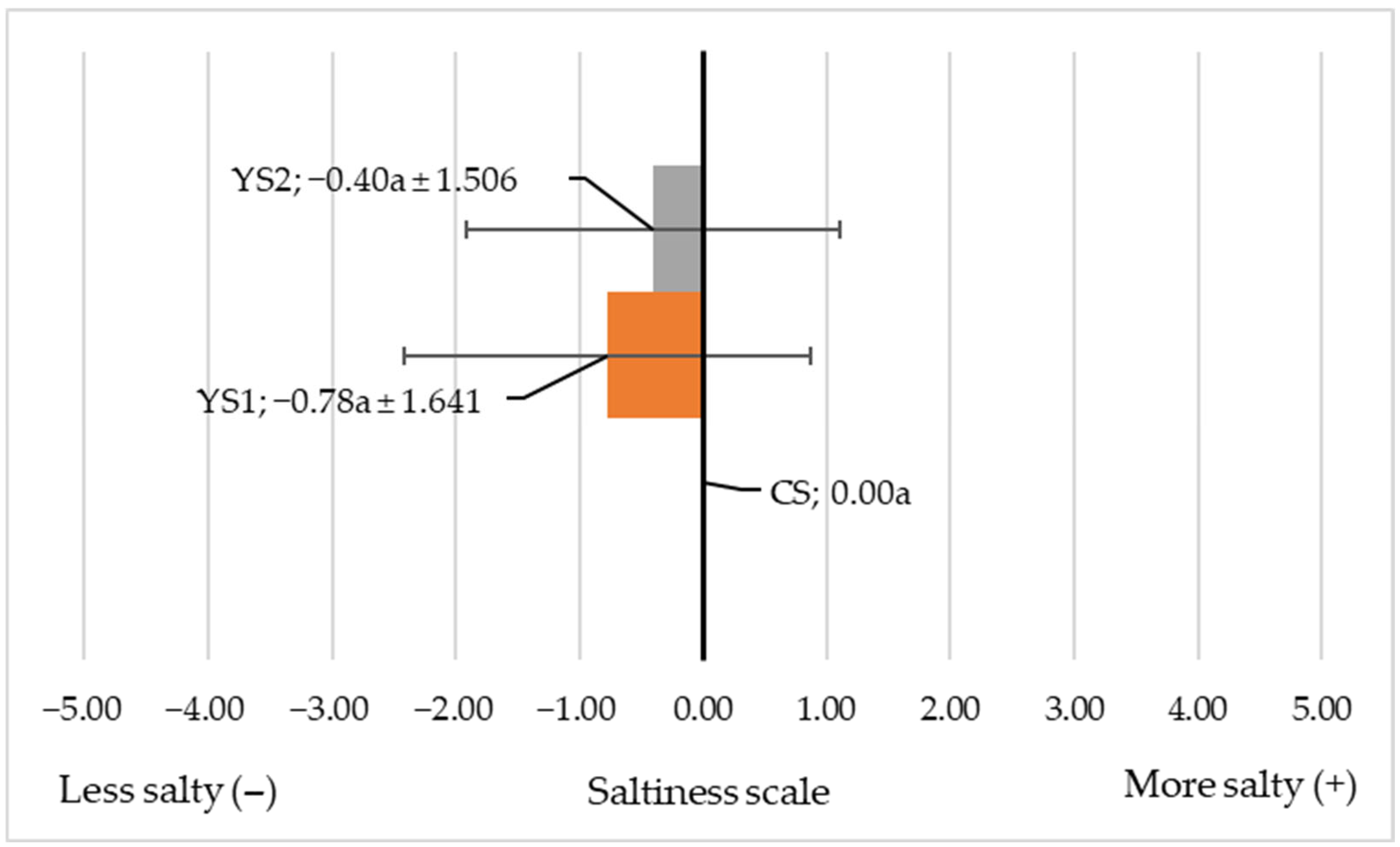
3.4. Organoleptic Tests
3.5. Result Correlations
4. Conclusions
Author Contributions
Funding
Institutional Review Board Statement
Informed Consent Statement
Data Availability Statement
Conflicts of Interest
Abbreviations
| CS | Control sample; NaCl concentration 1.40% |
| YS1 | Yeast flakes concentration 4.39%, NaCl concentration 1.05% |
| YS2 | Yeast flakes concentration 6.58%, NaCl concentration 0.70% |
References
- Pohl, H.R.; Wheeler, J.S.; Murray, H.E. Sodium and Potassium in Health and Disease. In Interrelations Between Essential Metal Ions and Human Diseases; Metal Ions in Life Sciences; Springer: Dordrecht, The Netherlands, 2013; Volume 13, pp. 29–47. [Google Scholar] [CrossRef]
- Codină, G.G.; Voinea, A.; Dabija, A. Strategies for Reducing Sodium Intake in Bakery Products, a Review. Appl. Sci. 2021, 11, 3093. [Google Scholar] [CrossRef]
- Pashaei, M.; Zare, L.; Khalili Sadrabad, E.; Hosseini Sharif Abad, A.; Mollakhalili-Meybodi, N.; Abedi, A.-S. The Impacts of Salt Reduction Strategies on Technological Characteristics of Wheat Bread: A Review. J. Food Sci. Technol. 2022, 59, 4141–4151. [Google Scholar] [CrossRef]
- Dunteman, A.; Yang, Y.; McKenzie, E.; Lee, Y.; Lee, S.-Y. Sodium Reduction Technologies Applied to Bread Products and Their Impact on Sensory Properties: A Review. Int. J. Food Sci. Technol. 2021, 56, 4396–4407. [Google Scholar] [CrossRef]
- World Health Organization. WHO Global Report on Sodium Intake Reduction, 1st ed.; World Health Organization: Geneva, Switzerland, 2023. [Google Scholar]
- World Health Organization. Guideline: Sodium Intake for Adults and Children; World Health Organization: Geneva, Switzerland, 2012; ISBN 978-92-4-150483-6. [Google Scholar]
- EFSA Panel on Nutrition, Novel Foods and Food Allergens (NDA); Turck, D.; Castenmiller, J.; de Henauw, S.; Hirsch-Ernst, K.-I.; Kearney, J.; Knutsen, H.K.; Maciuk, A.; Mangelsdorf, I.; McArdle, H.J.; et al. Dietary Reference Values for Sodium. EFSA J. 2019, 17, e05778. [Google Scholar] [CrossRef] [PubMed]
- Committee to Review the Dietary Reference Intakes for Sodium and Potassium; Food and Nutrition Board; Health and Medicine Division; National Academies of Sciences, Engineering, and Medicine. Dietary Reference Intakes for Sodium and Potassium; Stallings, V.A., Harrison, M., Oria, M., Eds.; National Academies Press: Washington, DC, USA, 2019; p. 25353. [Google Scholar]
- Heller, B.; Reiter, F.P.; Leicht, H.B.; Fiessler, C.; Bergheim, I.; Heuschmann, P.U.; Geier, A.; Rau, M. Salt-Intake-Related Behavior Varies between Sexes and Is Strongly Associated with Daily Salt Consumption in Obese Patients at High Risk for MASLD. Nutrients 2023, 15, 3942. [Google Scholar] [CrossRef] [PubMed]
- Silow, C.; Axel, C.; Zannini, E.; Arendt, E.K. Current Status of Salt Reduction in Bread and Bakery Products—A Review. J. Cereal Sci. 2016, 72, 135–145. [Google Scholar] [CrossRef]
- Tonin Ferrari, G.; Proserpio, C.; Kahler Stragliotto, L.; Menti Boff, J.; Pagliarini, E.; Ruffo de Oliveira, V. Salt Reduction in Bakery Products: A Critical Review on the Worldwide Scenario, Its Impacts and Different Strategies. Trends Food Sci. Technol. 2022, 129, 440–448. [Google Scholar] [CrossRef]
- Antúnez, L.; Giménez, A.; Ares, G. A Consumer-Based Approach to Salt Reduction: Case Study with Bread. Food Res. Int. 2016, 90, 66–72. [Google Scholar] [CrossRef]
- Sinesio, F.; Raffo, A.; Peparaio, M.; Moneta, E.; Saggia Civitelli, E.; Narducci, V.; Turfani, V.; Ferrari Nicoli, S.; Carcea, M. Impact of Sodium Reduction Strategies on Volatile Compounds, Sensory Properties and Consumer Perception in Commercial Wheat Bread. Food Chem. 2019, 301, 125252. [Google Scholar] [CrossRef]
- Nahar, N.; Madzuki, I.; Izzah, N.; Ab Karim, M.; Mohd Ghazali, H.; Karim, R. Bakery Science of Bread and the Effect of Salt Reduction on Quality: A Review. Borneo J. Sci. Technol. 2019, 1, 9–14. [Google Scholar] [CrossRef]
- Zarzycki, P.; Wirkijowska, A.; Teterycz, D.; Łysakowska, P. Innovations in Wheat Bread: Using Food Industry By-Products for Better Quality and Nutrition. Appl. Sci. 2024, 14, 3976. [Google Scholar] [CrossRef]
- Bredariol, P.; Vanin, F.M. Bread Baking Review: Insight into Technological Aspects in Order to Preserve Nutrition. Food Rev. Int. 2022, 38, 651–668. [Google Scholar] [CrossRef]
- Ribet, L.; Kassis, A.; Jacquier, E.; Monnet, C.; Durand-Dubief, M.; Bosco, N. The Nutritional Contribution and Relationship with Health of Bread Consumption: A Narrative Review. Crit. Rev. Food Sci. Nutr. 2025, 65, 5698–5725. [Google Scholar] [CrossRef] [PubMed]
- Barroca, M.J.; Flores, C.; Ressurreição, S.; Guiné, R.; Osório, N.; Moreira da Silva, A. Re-Thinking Table Salt Reduction in Bread with Halophyte Plant Solutions. Appl. Sci. 2023, 13, 5342. [Google Scholar] [CrossRef]
- Santiesteban-López, N.A.; Gómez-Salazar, J.A.; Santos, E.M.; Campagnol, P.C.B.; Teixeira, A.; Lorenzo, J.M.; Sosa-Morales, M.E.; Domínguez, R. Natural Antimicrobials: A Clean Label Strategy to Improve the Shelf Life and Safety of Reformulated Meat Products. Foods 2022, 11, 2613. [Google Scholar] [CrossRef]
- Pérez-Torrado, R.; Gamero, E.; Gómez-Pastor, R.; Garre, E.; Aranda, A.; Matallana, E. Yeast Biomass, an Optimised Product with Myriad Applications in the Food Industry. Trends Food Sci. Technol. 2015, 46, 167–175. [Google Scholar] [CrossRef]
- Martin, G.J.O.; Chan, S. Future Production of Yeast Biomass for Sustainable Proteins: A Critical Review. Sustain. Food Technol. 2024, 2, 1592–1609. [Google Scholar] [CrossRef]
- Sultana, S.; Biró, J.; Kucska, B.; Hancz, C. Factors Affecting Yeast Digestibility and Immunostimulation in Aquatic Animals. Animals 2024, 14, 2851. [Google Scholar] [CrossRef]
- Prasad, S.; Patel, B.; Kumar, P.; Lall, R. Postbiotics: Multifunctional Microbial Products Transforming Animal Health and Performance. Vet. Sci. 2025, 12, 1191. [Google Scholar] [CrossRef]
- Inactive Dry Yeast Market Size, Share, Growth, Trends, and Global Industry Analysis: By Grade (Feed Grade, Food Grade, Pharma Grade), by Form (Powder, Flakes, Tablet, Capsule), by Application (Food and Beverages (Bakery, Beverages, Other Food Products), Dietary Supplements, Feed, and Others) and Region Forecast 2020–2031. Available online: https://www.precisionbusinessinsights.com/market-reports/inactive-dry-yeast-market (accessed on 13 January 2026).
- Jach, M.E.; Serefko, A.; Ziaja, M.; Kieliszek, M. Yeast Protein as an Easily Accessible Food Source. Metabolites 2022, 12, 63. [Google Scholar] [CrossRef]
- Gomes, L.C.; Alcalde, C.R.; de Lima, L.S.; de Souza, R.; Possamai, A.P.S. Nutritive Value of Diets Containing Inactive Dry Yeast for Lactating Saanen Goats. Rev. Bras. Zootec. 2014, 43, 36–43. [Google Scholar] [CrossRef]
- Ileleji, K.E.; Garcia, A.A.; Kingsly, A.R.P.; Clementson, C.L. Comparison of Standard Moisture Loss-on-Drying Methods for the Determination of Moisture Content of Corn Distillers Dried Grains with Solubles. J. AOAC Int. 2010, 93, 825–832. [Google Scholar] [CrossRef] [PubMed]
- PN-C-04541:1978; Water and Waste Water—Determination of Dry Residue, Residue on Ignition, Loss on Ignition and Dissolved Solids, Dissolved Mineral Substances and Dissolved Volatile Substances. The Polish Committee for Standardization: Warsaw, Poland, 1978.
- Korus, J.; Juszczak, L.; Ziobro, R.; Witczak, M.; Grzelak, K.; Sójka, M. Defatted Strawberry and Blackcurrant Seeds as Functional Ingredients of Gluten-Free Bread. J. Texture Stud. 2012, 43, 29–39. [Google Scholar] [CrossRef]
- Cytarska, J.; Szulc, J.; Kołodziej-Sobczak, D.; Nunes, J.A.; da Silva-Júnior, E.F.; Łączkowski, K.Z. CyreneTM as a Tyrosinase Inhibitor and Anti-Browning Agent. Food Chem. 2024, 442, 138430. [Google Scholar] [CrossRef] [PubMed]
- PN-EN ISO 8586:2014-03; Sensory Analysis—General Guidelines for the Selection, Training and Monitoring of Selected Assessors and Sensory Evaluation Expert. The Polish Committee for Standardization: Warsaw, Poland, 2014.
- PN-ISO 4121:1998; Sensory Analysis—Methodology—Evaluation of Food Products Using Scaling Methods. The Polish Committee for Standardization: Warsaw, Poland, 1998.
- Błaszak, B.; Demir, İ.E.; Długosz, A.; Kołaczyk, P.; Bąk, M.; Gozdecka, G.; Kaniewski, W.; Szulc, J. Sustainable Processing of Brewers’ Spent Grain for Plant-Based Yogurt Alternatives. Sustainability 2025, 17, 4087. [Google Scholar] [CrossRef]
- Belz, M.C.E.; Ryan, L.A.M.; Arendt, E.K. The Impact of Salt Reduction in Bread: A Review. Crit. Rev. Food Sci. Nutr. 2012, 52, 514–524. [Google Scholar] [CrossRef]
- Samapundo, S.; Deschuyffeleer, N.; Van Laere, D.; De Leyn, I.; Devlieghere, F. Effect of NaCl Reduction and Replacement on the Growth of Fungi Important to the Spoilage of Bread. Food Microbiol. 2010, 27, 749–756. [Google Scholar] [CrossRef]
- Rysová, J.; Šmídová, Z. Effect of Salt Content Reduction on Food Processing Technology. Foods 2021, 10, 2237. [Google Scholar] [CrossRef]
- Crucean, D.; Pontoire, B.; Debucquet, G.; Le-Bail, A.; Le-Bail, P. The Use of Choline Chloride for Salt Reduction and Texture Enhancement in Bread. Appl. Food Res. 2023, 3, 100371. [Google Scholar] [CrossRef]
- Fadda, C.; Sanguinetti, A.M.; Del Caro, A.; Collar, C.; Piga, A. Bread Staling: Updating the View. Compr. Rev. Food Sci. Food Saf. 2014, 13, 473–492. [Google Scholar] [CrossRef]
- Su, X.; Wu, F.; Zhang, Y.; Yang, N.; Chen, F.; Jin, Z.; Xu, X. Effect of Organic Acids on Bread Quality Improvement. Food Chem. 2019, 278, 267–275. [Google Scholar] [CrossRef] [PubMed]
- Sandvik, P.; Marklinder, I.; Nydahl, M.; NÆs, T.; Kihlberg, I. Characterization of Commercial Rye Bread Based on Sensory Properties, Fluidity Index and Chemical Acidity. J. Sens. Stud. 2016, 31, 283–295. [Google Scholar] [CrossRef]
- Torrieri, E.; Pepe, O.; Ventorino, V.; Masi, P.; Cavella, S. Effect of Sourdough at Different Concentrations on Quality and Shelf Life of Bread. LWT 2014, 56, 508–516. [Google Scholar] [CrossRef]
- Jimenez-Maroto, L.A.; Sato, T.; Rankin, S.A. Saltiness Potentiation in White Bread by Substituting Sodium Chloride with a Fermented Soy Ingredient. J. Cereal Sci. 2013, 58, 313–317. [Google Scholar] [CrossRef]
- Rakowska, R.; Sadowska, A.; Dybkowska, E.; Świderski, F. Spent Yeast as Natural Source of Functional Food Additives. Rocz. Panstw. Zakl. Hig. 2017, 68, 115–121. [Google Scholar]
- Grasso, S.; Smith, G.; Bowers, S.; Ajayi, O.M.; Swainson, M. Effect of Texturised Soy Protein and Yeast on the Instrumental and Sensory Quality of Hybrid Beef Meatballs. J. Food Sci. Technol. 2019, 56, 3126–3135. [Google Scholar] [CrossRef]
- Öztürk, S.; Cerit, İ.; Mutlu, S.; Demirkol, O. Enrichment of Cookies with Glutathione by Inactive Yeast Cells (Saccharomyces cerevisiae): Physicochemical and Functional Properties. J. Cereal Sci. 2017, 78, 19–24. [Google Scholar] [CrossRef]
- Bassett, M.N.; Pérez-Palacios, T.; Cipriano, I.; Cardoso, P.; Ferreira, I.M.P.L.V.O.; Samman, N.; Pinho, O. Development of Bread with NaCl Reduction and Calcium Fortification: Study of Its Quality Characteristics. J. Food Qual. 2014, 37, 107–116. [Google Scholar] [CrossRef]
- Monteiro, A.R.G.; Nakagawa, A.; Pimentel, T.C.; Sousa, I. Increasing Saltiness Perception and Keeping Quality Properties of Low Salt Bread Using Inhomogeneous Salt Distribution Achieved with Salt Agglomerated by Waxy Starch. LWT 2021, 146, 111451. [Google Scholar] [CrossRef]
- Tomé, D. Yeast Extracts: Nutritional and Flavoring Food Ingredients. ACS Food Sci. Technol. 2021, 1, 487–494. [Google Scholar] [CrossRef]
- Pawlicki, T. (Ed.) Colour and Quality Guide (Poradnik Barwa i Jakość); Świat Poligrafii Professional: Warsaw, Poland, 2022. [Google Scholar]
- Lynch, E.J.; Dal Bello, F.; Sheehan, E.M.; Cashman, K.D.; Arendt, E.K. Fundamental Studies on the Reduction of Salt on Dough and Bread Characteristics. Food Res. Int. 2009, 42, 885–891. [Google Scholar] [CrossRef]
- Arena, E.; Muccilli, S.; Mazzaglia, A.; Giannone, V.; Brighina, S.; Rapisarda, P.; Fallico, B.; Allegra, M.; Spina, A. Development of Durum Wheat Breads Low in Sodium Using a Natural Low-Sodium Sea Salt. Foods 2020, 9, 752. [Google Scholar] [CrossRef] [PubMed]
- Avramenko, N.A.; Tyler, R.T.; Scanlon, M.G.; Hucl, P.; Nickerson, M.T. The Chemistry of Bread Making: The Role of Salt to Ensure Optimal Functionality of Its Constituents. Food Rev. Int. 2018, 34, 204–225. [Google Scholar] [CrossRef]
- Esfanjani, A.F.; Mohebbi, M. The Strategy of Odor−taste−texture Interactions to Produce Low Salt Bread: Oral Processing and Sensory Properties. Cereal Chem. 2023, 100, 384–392. [Google Scholar] [CrossRef]
- Raffo, A.; Carcea, M.; Moneta, E.; Narducci, V.; Nicoli, S.; Peparaio, M.; Sinesio, F.; Turfani, V. Influence of Different Levels of Sodium Chloride and of a Reduced-Sodium Salt Substitute on Volatiles Formation and Sensory Quality of Wheat Bread. J. Cereal Sci. 2018, 79, 518–526. [Google Scholar] [CrossRef]
- Pasqualone, A.; Caponio, F.; Pagani, M.A.; Summo, C.; Paradiso, V.M. Effect of Salt Reduction on Quality and Acceptability of Durum Wheat Bread. Food Chem. 2019, 289, 575–581. [Google Scholar] [CrossRef]
- Spina, A.; Brighina, S.; Muccilli, S.; Mazzaglia, A.; Rapisarda, P.; Fallico, B.; Arena, E. Partial Replacement of NaCl in Bread from Durum Wheat (Triticum turgidum L. subsp. durum Desf.) with KCl and Yeast Extract: Evaluation of Quality Parameters During Long Storage. Food Bioprocess Technol. 2015, 8, 1089–1101. [Google Scholar] [CrossRef]
- Filipović, V.S.; Filipović, J.S.; Vučurović, V.M.; Radovanović, V.B.; Košutić, M.B.; Novković, N.Đ.; Vukelić, N.B. The Effect of Yeast Extract Addition on Bread Quality Parameters. J. Serb. Chem. Soc. 2020, 85, 737–750. [Google Scholar] [CrossRef]


| Raw Material | Sample Name | ||
|---|---|---|---|
| CS (Control Sample) | YS1 (25% NaCl Reduction) | YS2 (50% NaCl Reduction) | |
| Flour | 100.00 | 100.00 | 100.00 |
| Water | 48.00 | 48.00 | 48.00 |
| Baker’s yeast | 1.78 | 1.78 | 1.78 |
| Sodium chloride | 1.40 | 1.05 | 0.70 |
| Inactive yeast flakes | 0.00 | 4.39 | 6.58 |
| Parameter | Description of Point 1 on Scale | Description of Point 10 on Scale |
|---|---|---|
| Springiness | permanently deformable | perfectly elastic |
| Softness | very hard | very soft |
| Taste | very undesirable | very desirable |
| Flavour | very undesirable | very desirable |
| Colour | very undesirable | very desirable |
| Cross-sectional appearance | very undesirable | very desirable |
| Sample Name | Dry Mass [%] | Aw | Crumb Porosity [%] | Crumb Acidity [°A] |
|---|---|---|---|---|
| CS | 60.85 ± 0.625 b | 0.93 ± 0.018 a | 60.49 ± 2.176 a | 1.27 ± 0.115 a |
| YS1 | 59.93 ± 0.070 b | 0.91 ± 0.001 a | 58.03 ± 2.211 a | 1.80 ± 0.001 b |
| YS2 | 59.70 ± 0.010 a | 0.91 ± 0.001 a | 56.79 ± 2.136 a | 2.40 ± 0.001 c |
| Sample Name | L* | a* | b* | C* |
|---|---|---|---|---|
| CS | 75.37 ± 0.685 b | 0.25 ± 0.082 a | 18.29 ± 0.143 a | 18.29 ± 0.142 a |
| YS1 | 71.21 ± 0.101 a | 1.42 ± 0.082 b | 20.08 ± 0.095 b | 20.13 ± 0.092 b |
| YS2 | 70.37 ± 0.791 a | 1.70 ± 0.125 c | 20.40 ± 0.393 b | 20.47 ± 0.398 b |
| Sample Name | CS | YS1 | YS2 |
|---|---|---|---|
| CS | 0.00 + | ||
| YS1 | 4.68 ++ | 0.00 + | |
| YS2 | 5.62 +++ | 0.94 + | 0.00 + |
| Sample Name | Hardness I [N] | Hardness II [N] | Springiness [mm] |
|---|---|---|---|
| CS | 21.10 ± 0.500 a | 18.00 ± 0.700 a | 0.96 ± 0.003 b |
| YS1 | 38.90 ± 0.900 b | 31.45 ± 0.850 b | 0.95 ± 0.010 ab |
| YS2 | 41.15 ± 0.950 c | 33.35 ± 1.050 b | 0.94 ± 0.008 a |
| Parameter | CS | YS1 | YS2 |
|---|---|---|---|
| Springiness | 8.50 ± 1.309 c | 6.38 ± 1.685 b | 3.78 ± 1.394 a |
| Softness | 6.75 ± 1.389 c | 5.40 ± 1.075 b | 3.88 ± 1.126 a |
| Taste | 7.50 ± 2.068 b | 5.88 ± 1.246 b | 4.40 ± 1.350 a |
| Flavour | 7.13 ± 1.885 b | 6.11 ± 1.616 ab | 5.56 ± 0.882 a |
| Colour | 8.44 ± 1.236 b | 7.67 ± 1.225 ab | 6.56 ± 1.509 a |
| Cross-sectional appearance | 7.00 ± 1.195 a | 6.06 ± 1.130 a | 6.50 ± 1.604 a |
| Parameter | a*; n = 3 | b*; n = 3 | Springiness TPA; n = 3 | Hardness I (TPA); n = 3 | Softness (Organoleptic Test); n = 20 |
|---|---|---|---|---|---|
| Colour (organoleptic test); n = 20 | −0.90 | −0.88 | - | - | - |
| Springiness (organoleptic test); n = 20 | - | - | 0.99 | - | - |
| Softness (organoleptic test); n = 20 | - | - | - | −0.90 | - |
| Crumb porosity; n = 3 | - | - | - | −0.97 | 0.97 |
Disclaimer/Publisher’s Note: The statements, opinions and data contained in all publications are solely those of the individual author(s) and contributor(s) and not of MDPI and/or the editor(s). MDPI and/or the editor(s) disclaim responsibility for any injury to people or property resulting from any ideas, methods, instructions or products referred to in the content. |
© 2026 by the authors. Licensee MDPI, Basel, Switzerland. This article is an open access article distributed under the terms and conditions of the Creative Commons Attribution (CC BY) license.
Share and Cite
Błaszak, B.; Długosz, A.; Gozdecka, G.; Szulc, J.; Spychała, M. Yeast Flakes as a Technological Ingredient for Salt Reduction and Flavor Enhancement in Bread. Appl. Sci. 2026, 16, 1198. https://doi.org/10.3390/app16031198
Błaszak B, Długosz A, Gozdecka G, Szulc J, Spychała M. Yeast Flakes as a Technological Ingredient for Salt Reduction and Flavor Enhancement in Bread. Applied Sciences. 2026; 16(3):1198. https://doi.org/10.3390/app16031198
Chicago/Turabian StyleBłaszak, Błażej, Anna Długosz, Grażyna Gozdecka, Joanna Szulc, and Marcelina Spychała. 2026. "Yeast Flakes as a Technological Ingredient for Salt Reduction and Flavor Enhancement in Bread" Applied Sciences 16, no. 3: 1198. https://doi.org/10.3390/app16031198
APA StyleBłaszak, B., Długosz, A., Gozdecka, G., Szulc, J., & Spychała, M. (2026). Yeast Flakes as a Technological Ingredient for Salt Reduction and Flavor Enhancement in Bread. Applied Sciences, 16(3), 1198. https://doi.org/10.3390/app16031198