Article

Repetitive Learning Control for Nonlinear Systems Subject to Time Delays and Dead-Zone Input

1
School of Information Science and Engineering, Zhejiang Sci-Tech University, Hangzhou 310018, China
2
Zhejiang Henuo Machinery Co., Ltd., Lishui 323000, China
*
Author to whom correspondence should be addressed.
Appl. Sci. 2026, 16(3), 1169; https://doi.org/10.3390/app16031169
Submission received: 20 November 2025 / Revised: 29 December 2025 / Accepted: 7 January 2026 / Published: 23 January 2026

Abstract

This paper presents a repetitive learning control scheme to handle systems subject to both time-delay and dead-zone nonlinearities and the state-dependent input gain simultaneously. The adaptive bounding techniques are utilized to deal with the nonparametric uncertainties originated from the time-delay and the state-dependent input gain, in which the indirect learning manner is employed to avoid the appearance of the sign function, alleviating the requirement for the system information. The only prior knowledge of the proposed scheme is the lower bound of the input gain and the dead-zone slope. The desired control signal is recognized as the parametric uncertainties with a constant regressor. The derivation of the convergence analysis is provided in detail, and the boundedness of variables in the closed-loop system is guaranteed. The numerical simulation is conducted to testify the effectiveness of the presented control approach.

1. Introduction

Iterative learning control (ILC) plays the important role of being a learning scheme, where the ability to tackle the issue of systems carrying out repetitive tasks, such as servo motor, industrial manipulators, power electronic circuits, etc, is a great advantage [1,2,3,4]. As a key branch of iterative learning control, repetitive learning control (RLC) focuses on the utilizing the system information in the preceding trials, and the resetting of the initial condition is not need actually needed, which is theoretically superior to ILC. In recent years, much effort has been made to study the RLC algorithm using Lyapunov synthesis, in which various industrial equipment can be used to adopt this method; additionally, the tracking performance of periodic reference trajectories is quite good [5,6,7,8].
Time-delay nonlinearity is often encountered in practical systems, which may impact system performance and even make it unstable. Therefore, it is important to investigate control problems with time delays. Sliding mode control is a method to tackle time-delay nonlinearities, by which linear/nonlinear systems with time-varying/time-invariant time delays can be accommodated effectively [9,10,11,12], and linear matrix inequality (LMI) is usually adopted to characterize the sufficient condition for stabilization of the sliding mode controller, including a combination other kinds of control schemes, such as fuzzy control, robust control, and adaptive control, etc, restraining time-delay nonlinearities [13]. In addition, robust adaptive control is another alternative for time delays, where the integration of the LMI method and Lyapunov–Krasovskii approach were widely used in the past [14,15,16,17]. The learning ability of linearly/nonlinearly parameterized systems with unknown periodic time-varying delays can be found in [18,19,20], in which iterative learning control is utilized to effectively handle parametric uncertainties. It should be noted that prior knowledge is required for these results, and approximation tools are adopted to estimate some parameters to reduce dependence on system information. This work aims to find a way to alleviate dependence on system information solely through the iterative learning control scheme.
Systems suffering from a dead-zone nonlinearity may give rise to instability and result in poor performance, which pose great challenges to the controller designer. Methods to address systems with dead-zone issues are usually categorized into two types: direct types and indirect types. The essence of the direct approach lies in construting the inverse of the dead-zone nonlinearity, with pioneering research conducted in [21,22,23]. On this basis, the continuous-time and discrete-time inverse are established afterwards. To avoid the process of the inverse operation, linear systems are reconstructed in terms of the time-varying gain and bounded disturbances to characterize the dead-zone feature [24,25,26], representing the indirect way. Some studies employing the indirect method may assume that the dead-zone slopes in the positive and negative regions are the same and bounded, and others may combine approximation tools or adaptive/robust techniques to compensate the parameters of dead-zone nonlinearities [27,28,29]. In the presence of time-delay and dead-zone nonlinearities, iterative learning control is employed to separately address the nonlinearities referred to in [20,30,31].
Few works have attempted to solve this issue using repetitive learning control, which motives us to simultaneously investigate the RLC controller design for systems with these two nonlinearities.
In this paper, we present a repetitive learning control scheme to deal with both time-delay and dead-zone nonlinearities involved in systems with state-dependent input gain. The time-delay nonlinearity and the state-dependent input gain are treated as the nonparametric uncertainties, and the dead-zone one is tackled in terms of the reconstructed form with the time-varying gain and the disturbances, where the adaptive bounding technique is employed to estimate the bound alleviating the requirement for system information. The uncertainty estimates are updated using indirect learning, which prevents the appearance of the sign function. The lower bound of the input gain and the dead-zone slope is the only prior knowledge needed for the proposed method. The main contributions of this article are as follows: (i) the presented RLC scheme can effectively handle nonlinear systems with time delays, dead zones, and state-dependent input gain together; (ii) uncertainty estimates including parametric and nonparametric types are dealt with using the adaptive bounding technique, where indirect learning is employed, significantly reducing the requirement for system information; (iii) the modified Lipschitz condition is adopted to separate the time-delay and time-varying variables, supporting the application of the learning mechanism.
The remainder of the paper is structured as follows: The problem formulation and preliminaries are shown in Section 2. The RLC design is described in Section 3. In Section 4, the derivation of the analysis of the presented scheme’s tracking performance is elaborated in detail. The numerical simulation is carried out in Section 5 to testify the validity of the presented control method. Finally, the conclusions are presented in Section 6.

2. Problem Statement and Preliminaries

Considering the following nonlinear system with time delays and dead zones:
x ˙ i ( t ) = x i + 1 ( t ) , i = 1 , 2 , , n 1 x ˙ n ( t ) = f ( x ( t τ ( t ) ) , t ) + g ( x , t ) u ( t ) u ( t ) = D ( v ( t ) ) x ( t ) = χ ( t ) , t [ τ max , 0 ]
where t [ 0 , T ] , x = [ x 1 , , x n ] T R n is the state vector, f ( · ) and g ( · ) are continuous nonlinear functions, τ ( t ) is the unknown time delay that satisfies τ ( t ) τ max , χ ( t ) stands for the initial condition of the system, and u ( t ) = D ( v ( t ) ) R represents the control part, where v ( t ) , u ( t ) are the input and output of the dead-zone nonlinearity, respectively, which are defined as
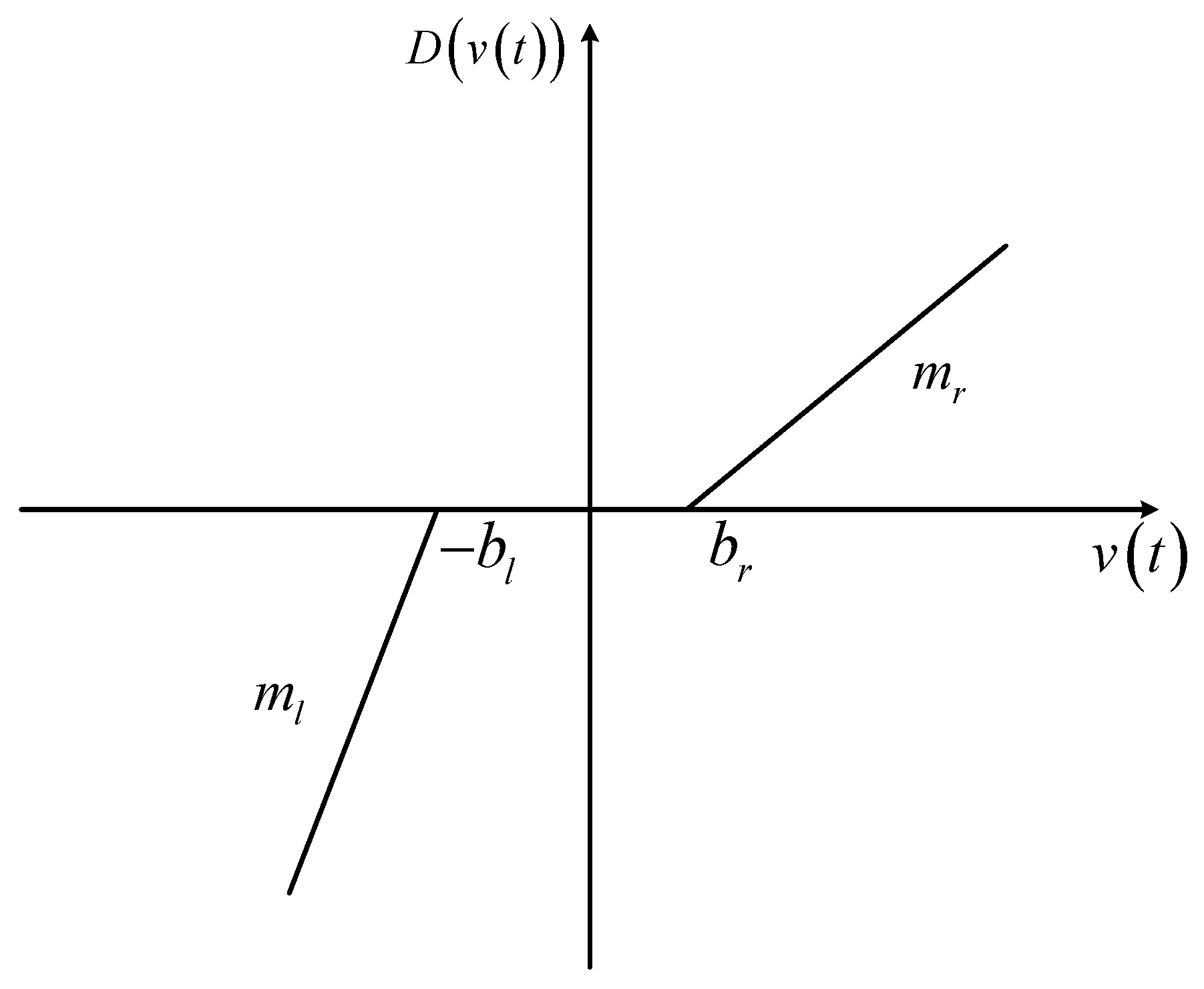
u ( t ) = D ( v ( t ) ) = m v ( t ) ( v ( t ) b r ) , v ( t ) b r 0 , b l < v ( t ) < b r m v ( t ) ( v ( t ) + b l ) , v ( t ) b l
where m v ( t ) is the unknown time-varying slope of the dead zone, and b r 0 and b l 0 indicate the breakpoints of the input nonlinearity, which are unknown constants. A graphical representation of the dead-zone nonlinearity involved in the study is depicted in Figure 1.
For system (1), we impose the following assumptions:
Assumption 1.
The dead-zone parameters b r , b l , and m v ( t ) are unknown and bounded, satisfying b ̲ r b r b ¯ r , b ̲ l b l b ¯ l and m ̲ m v ( t ) m ¯ .
Remark 1.
The exact value of these parameters is not needed in the controller design, and lower bound m ̲ is the only requirement for the dead-zone one.
Assumption 2.
The unknown time-varying delay τ ( t ) satisfies τ ˙ ( t ) η < 1 such that ( ( 1 τ ˙ ) / ( 1 η ) ) < 1 , where η is not required to be known.
Remark 2.
Assumption 2 commonly appears in the existing literature on time-delay systems, facilitating the performance analysis of the closed-loop system.
Assumption 3.
The sign of g ( x , t ) is known. Without losing generality, it is assumed that there exists a positive constant g min > 0 such that g ( x , t ) g min > 0 for all x R n and t [ 0 , T ] .
Remark 3.
Assumption 3 indicates that there exists a bound of the control input gain, ensuring the controllability of the system being considered, which is rational in the view of the practical situation.
Assumption 4.
The nonlinear functions f ( · ) and g ( · ) satisfy
| h ( x 1 , t ) h ( x 2 , t ) | l h ( t ) | x 1 ( t ) x 2 ( t ) |
where h { f , g } and time-varying functions l f ( t ) > 0 and l g ( t ) > 0 are not required to be known.
Remark 4.
Assumption 4 presents a condition to ensure the existence and uniqueness of the system solution. For each t * [ 0 , T ] , Assumption 4 indicates that | h ( x 1 , t * ) h ( x 2 , t * ) | l h ( t * ) | x 1 ( t * ) x 2 ( t * ) | . In comparison with the constant situation (i.e. global Lipschitz condition), Assumption 4 offers precise estimates of the bounds. It gives us an opportunity to adopt adaptive bounding technique by estimating l h ( t ) .
For controller design convenience, the dead-zone nonlinearity is redefined as follows:
u ( t ) = D ( v ( t ) ) = m v ( t ) v ( t ) + d ( t )
where
d ( t ) = m v b r , v ( t ) b r m v ( t ) v ( t ) , b l < v ( t ) < b r m v b l , v ( t ) b l
It is clear that d ( t ) is bounded according to (4).
This study employs the repetitive learning control framework, which does not need the initial resetting operation. It needs the system run over a finite time interval [ 0 , T ] , and the initial condition of the current cycle is identical to the final position of the previous cycle, which implies that x k ( 0 ) = x k 1 ( T ) , with x k ( t ) , t [ 0 , T ] being practical in the kth cycle. The desired trajectory x d ( t ) satisfies x d ( T ) = x d ( 0 ) . In addition, the system dynamics are invariant throughout all the cycles, and the variables to be learned are assumed to be iteration-independent. It is worth noting that the system can operate over an infinite interval, since it can complete the task at the end of each cycle and run continuously.
The objective of our work is to design a repetitive control input v k ( t ) for each cycle such that the actual system state x k ( t ) can converge to the desired state x d ( t ) on [ 0 , T ] , as k increases. The desired trajectory x d is continuously differentiable such that the derivative x ˙ d , n exists. In this study, the system state is assumed to be available for measurement.

3. RLC Design

We present repetitive learning control designs for the nonlinear system described in (1), which is subject to the time-delay and dead-zone input simultaneously. Utilizing the developed control approach, the nonlinearities, including the time-delay and dead-zone input, can be effectively handled with less knowledge about system dynamics.
Let us define the tracking error e k = [ e k , 1 , e k , 2 , , e k , n ] T = x k x d . The error dynamics of the system at the kth iteration is written as
e ˙ k , i = e k , i + 1 , i = 1 , 2 , , n 1 e ˙ k , n = f ( x k ( t τ ( t ) ) , t ) f ( x d ( t τ ( t ) ) , t ) + f ( x d ( t τ ( t ) ) , t ) + g ( x k , t ) u k x ˙ d , n
For the given x d , there exists the desired control input u d , satisfying
u d ( t ) = 1 g ( x d , t ) ( x ˙ d , n f ( x d ( t τ ( t ) ) , t ) )
which is the function to be learned. The system error dynamics can be written as
e ˙ k = A e k + b ( f ( x k ( t τ ( t ) ) , t ) f ( x d ( t τ ( t ) ) , t ) + g ( x k , t ) u k g ( x d , t ) u d + a T e k ) )
with
A = 0 1 0 0 0 0 0 1 0 0 0 0 0 0 1 a 1 a 2 a 3 a n 1 a n
b = [ 0 , 0 , , 0 , 1 ] T .
The vector a = [ a 1 , a 2 , , a n ] T is chosen such that the polynomial p a ( s ) = s n + a n s n 1 + a n 1 s n 2 + + a 1 is Hurwitz, meaning matrix A is stable. This implies that for a given definite symmetric positive definite matrix Q R n × n , there exists a unique symmetric positive definite matrix P R n × n satisfying the Lyapunov equation A T P + P A = Q .
Considering the dead-zone nonlinearity, (7) can be expressed as
e ˙ k = A e k + b ( f ( x k ( t τ ( t ) ) , t ) f ( x d ( t τ ( t ) ) , t ) + g ( x k , t ) ( m v ( t ) v k + d ( t ) ) g ( x d , t ) ( m v ( t ) v d + d ( t ) ) + a T e k ) )
To estimate the desired control input v d , v ^ d , k is designed particularly and (7) is expressed as
e ˙ k = A e k + b ( f ( x k ( t τ ( t ) ) , t ) f ( x d ( t τ ( t ) ) , t ) + m v g k ( v k v ^ d , k ) + m v ( g k g d ) v ^ d , k m v g d ( v d v ^ d , k ) + ( g k g d ) d ( t ) + a T e k )
where g k = g ( x k , t ) , g d = g ( x d , t ) are for notational convenience.
For the controller design, we choose the positive-definite function V k = ( 1 / 2 ) e k 2 . In light of Young’s inequality, we have the following relationship:
b T P e k θ f ( t ) | e k ( t τ ( t ) ) | 1 2 ϵ ( b T P e k ) 2 l f 2 ( t ) + ϵ 2 e k T ( t τ ( t ) ) e k ( t τ ( t ) )
where ϵ > 0 is a design parameter. It is obvious that the time-varying variable θ f and the time-delay term e k ( t τ ( t ) ) have been separated in (12), allowing us to conduct the estimation for θ f and handle e k ( t τ ( t ) ) separately.
Based on (12) and Assumption 4, the derivatives of definite function V k are written as
V ˙ k 1 2 e k T Q e k + b T P e k ( f ( x k ( t τ ( t ) ) ) f ( x d ( t τ ( t ) ) ) + m v g k ( v k v ^ d , k ) + m v ( g k g d ) v ^ d , k m v g d ( v d v ^ d , k ) + ( g k g d ) d ( t ) + a T e k ) 1 2 e k T Q e k + b T P e k m v g k ( v k v ^ d , k ) + l g ( m v v ^ d , k + d ¯ ) | b T P e k | | e k | b T P e k m v g d ( v d v ^ d , k ) + | b T P e k | | e k | | a T | + 1 2 ϵ ( b T P e k ) 2 l f 2 + ϵ 2 e k T ( t τ ( t ) ) e k ( t τ ( t ) )
Remark 5.
It is seen that several nonlinear uncertainties are involved in (13): the uncertainty stemmed from the time delay, the unknown time-varying function l f ( t ) and l g ( t ) originated from the nonparametric uncertainty f ( x k ) f ( x d ) and g ( x k ) g ( x d ) , and the parametric uncertainty v d and the uncertainties m v ( t ) and d ( t ) came from the dead-zone nonlinearity. In the context of learning control, many works have been reported that can handle either the parametric or nonparametric uncertainties separately. However, there are very few works that simultaneously provide a solution to the aforementioned uncertainties, wihch are subject to both the time-delay and dead-zone input nonlinearity.
Based on (13), we propose the following RLC controller:
v k = v ^ d , k 1 2 g ̲ * θ ^ f , k b T P e k 4 g ̲ * λ m | a T | 2 b T P e k 4 g ̲ * λ m θ ^ g 1 , k | v ^ d , k | 2 b T P e k 4 g ̲ * λ m θ ^ g 2 , k b T P e k
with the learning laws to estimate the uncertainties
v ^ d , k ( t ) = v ^ d , k 1 ( t ) γ 1 b T P e k
θ ^ f , k ( t ) = θ ^ f , k 1 ( t ) + γ 2 2 | b T P e k | 2
θ ^ g 1 , k ( t ) = θ ^ g 1 , k 1 ( t ) + 4 λ m γ 3 ( b T P e k ) 2 v ^ d , k 2
θ ^ g 2 , k ( t ) = θ ^ g 2 , k 1 ( t ) + γ 4 2 | b T P e k | 2
where v ^ d , 1 = 0 , θ ^ f , 1 = 0 , θ ^ g 1 , 1 = 0 , θ ^ g 2 , 1 = 0 , and g ̲ * m ̲ g min , and γ 1 , γ 2 , γ 3 , γ 4 > 0 are the learning gains to be settled by designers; v ^ d , k , θ ^ f , k , θ ^ g 1 , k , θ ^ g 2 , k are the estimates for v d , θ f = ( l f / ϵ ) , θ g 1 = l g m v , and θ g 2 = l g d ¯ , respectively; and λ m = λ Q ϵ 1 η , with λ Q being the minimum eigenvalue of the matrix Q. An appropriate λ Q is chosen to assure λ m > 0 , and ϵ is designed to counteract the effect of 1 η , which is only for the prupose of analysis and does not need to be known.
Remark 6.
In the presence of the time-delay and dead-zone input nonlinearities, the presented control scheme (14) can effectively handle the aforementioned uncertainties, where the estimation of nonlinearities l f , l g and d ¯ are conducted, instead of assuming them to be known simply. Actually, it may not be easy to acquire l f , l g and d ¯ in practical situations. Therefore, adopting the adaptive bounding technique is one of the solutions. In addition, the bound g ̲ * is the only requirement for the system dynamics under consideration.
In the presence of the time-delay and input dead-zone nonlinearities involved in (13), we choose the non-negative function V 1 , k = V k + ϵ 2 ( 1 η ) t τ t e k T ( σ ) e k T ( σ ) d σ . In light of inequality (13), the derivative of V 1 , k is expressed as
V ˙ 1 , k 1 2 e k T Q e k + b T P e k m v g k ( v k v ^ d , k ) + l g ( m v v ^ d , k + d ¯ ) | b T P e k | | e k | b T P e k m v g d ( v d v ^ d , k ) + | b T P e k | | e k | | Λ T | + 1 2 ϵ ( b T P e k ) 2 l f 2 + 1 2 ϵ e k T ( t τ ) e k ( t τ ) + ϵ 2 ( 1 η ) e k T ( t ) e k ( t ) 1 τ ˙ ( t ) 2 ( 1 η ) ϵ e k T ( t τ ) e k ( t τ )
Based on Assumption 2, and substituting controller (14) into (19), V ˙ 1 , k can be written as
V ˙ 1 , k λ m 2 e k T e k + | b T P e k | | e k | | Λ T | + 1 2 ( b T P e k ) 2 θ f 2 + b T P e k m v g k ( v ^ d , k 4 g ̲ min λ m | Λ T | 2 b T P e k 1 2 g ̲ min θ ^ f , k b T P e k 4 g ̲ min λ m θ ^ g 1 , k | v ^ d , k | 2 b T P e k 4 g ̲ min λ m θ ^ g 2 , k b T P e k v ^ d , k ) + l g ( m v v ^ d , k + d ¯ ) | b T P e k | | e k | b T P e k m v g d ( v d v ^ d , k )
According to the following relationship,
1 16 λ m | e k | 2 4 λ m | Λ T | 2 ( b T P e k ) 2 + | Λ T | | b T P e k | | e k |
= ( λ m 4 | e k | 2 λ m | Λ T | | b T P e k | ) 2 1 16 λ m | e k | 2 + l g 1 | e k | | v ^ d , k | | b T P e k | = ( λ m 4 | e k | 2 λ m θ g 1 | v ^ d , k | b T P e k | ) 2
+ 4 λ m θ g 1 2 | v ^ d , k | 2 ( b T P e k ) 2 1 16 λ m | e k | 2 + θ g 2 | e k | | b T P e k | = ( λ m 4 | e k | 2 λ m l g 2 b T P e k | ) 2
+ 4 λ m θ g 2 2 ( b T P e k ) 2
V ˙ 1 , k is derived as
V ˙ 1 , k 5 16 λ m | e k | 2 + 1 2 ( b T P e k ) 2 θ ˜ f , k + 4 λ m θ ˜ g 1 , k | v ^ d , k | 2 ( b T P e k ) 2 + 4 λ m θ ˜ g 1 , k ( b T P e k ) 2 b T P e k m v g d v ˜ d , k
where v ˜ d , k = v d v ^ d , k , θ ˜ f , k = θ f 2 θ ^ f , k , and θ ˜ g 1 , k = θ g 1 2 θ ^ g 1 , k , and θ ˜ g 2 , k = θ g 2 2 θ ^ g 2 , k .

4. Performance Analysis

With the presented learning control scheme, the convergence performance of the close-loop system under consideration is characterized through the Lyapunov synthesis in this section.
Theorem 1.
For system (1) satisfying the Assumptions 1–4, the repetitive learning controller (14) with the learning laws (15)–(18) can guarantee the asymptotical convergence with the following conditions:
(i) The closed-loop variables are bounded, including that e k ( t ) is bounded on [ 0 , T ] for all k, 0 T v ^ d , k 2 d s , 0 T θ ^ f , k 2 d s and 0 T θ ^ g 1 , k 2 d s and 0 T θ ^ g 2 , k 2 d s are bounded for all k, and 0 T | u k | d s is bounded for all k.
(ii) lim t 0 T e k 2 d s = 0 .
Proof. 
Let us choose a non-negative function L k ( t ) = V 1 , k + 1 2 γ 1 m v 0 t g d v ˜ d , k 2 d s + 1 2 γ 2 0 t θ ˜ f , k 2 d s + 1 2 γ 3 0 t θ ˜ g 1 , k 2 d s + 1 2 γ 4 0 t θ ˜ g 2 , k 2 d s . The proof is divided into four parts, which follows the Lyapunov synthesis procedures.
Part i. Boundedness of L k ( T ) .
The difference between the consecutive iterations of L k ( t ) can be written as
L k ( t ) L k 1 ( t ) = V 1 , k ( t ) V 1 , k 1 ( t ) + 1 2 γ 1 m v 0 t ( g d v ˜ d , k 2 g d v ˜ d , k 1 2 ) d s + 1 2 γ 2 0 t θ ˜ f , k 2 θ ˜ f , k 1 2 d σ + 1 2 γ 3 0 t θ ˜ g 1 , k 2 d σ θ ˜ g 1 , k 1 2 d s + 1 2 γ 4 0 t θ ˜ g 2 , k 2 θ ˜ g 2 , k 1 2 d s
with the help of the following equality:
( a b ) 2 ( a c ) 2 = ( b c ) 2 2 ( b c ) ( a b )
The difference between L k ( t ) and L k 1 ( t ) can be expressed as
L k ( t ) L k 1 ( t ) V 1 , k ( t ) V 1 , k 1 ( t ) m v 2 γ 1 0 t g d ( ( v ^ d , k v ^ d , k 1 ) 2 + 2 ( v ^ d , k v ^ d , k 1 ) v ˜ d , k ) d s 1 2 γ 2 0 t ( θ ^ f , k θ ^ f , k 1 ) 2 + 2 ( θ ^ f , k θ ^ f , k 1 ) θ ˜ f , k d s 1 2 γ 3 0 t ( θ ^ g 1 , k θ ^ g 1 , k 1 ) 2 + 2 ( θ ^ g 1 , k θ ^ g 1 , k 1 ) θ ˜ g 1 , k d s 1 2 γ 4 0 t ( θ ^ g 2 , k θ ^ g 2 , k 1 ) 2 + 2 ( θ ^ g 2 , k θ ^ g 2 , k 1 ) θ ˜ g 2 , k d s
Along with the results in (24), Equation (27) is derived as
L k ( t ) L k 1 ( t ) V 1 , k ( 0 ) V 1 , k 1 ( t ) 0 t ( 5 16 λ m | e k | 2 1 2 ( b T P e k ) 2 θ ˜ f , k 4 λ m θ ˜ g 1 , k | v ^ d , k | 2 ( b T P e k ) 2 4 λ m θ ˜ g 1 , k ( b T P e k ) 2 + b T P e k m v g d v ˜ d , k ) d s m v 2 γ 1 0 t g d ( ( v ^ d , k v ^ d , k 1 ) 2 + 2 ( v ^ d , k v ^ d , k 1 ) v ˜ d , k ) d s 1 2 γ 2 0 t ( θ ^ f , k θ ^ f , k 1 ) 2 + 2 ( θ ^ f , k θ ^ f , k 1 ) θ ˜ f , k d s 1 2 γ 3 0 t ( θ ^ g 1 , k θ ^ g 1 , k 1 ) 2 + 2 ( θ ^ g 1 , k θ ^ g 1 , k 1 ) θ ˜ g 1 , k d s 1 2 γ 4 0 t ( θ ^ g 2 , k θ ^ g 2 , k 1 ) 2 + 2 ( θ ^ g 2 , k θ ^ g 2 , k 1 ) θ ˜ g 2 , k d s
In light of Equations (15)–(18), L k ( t ) L k 1 ( t ) is rewritten as
L k ( t ) L k 1 ( t ) V 1 , k ( 0 ) V 1 , k 1 ( t ) 5 λ m 16 0 T e k 2 d s
and then setting t = T yields
L k ( T ) L k 1 ( T ) 5 λ m 16 0 T e k 2 d s
where V 1 , k ( 0 ) V 1 , k 1 ( T ) .
It is seen that L k ( T ) is monotonously decreasing, and if the boundedness of L 0 ( T ) is guaranteed, the boundedness of variables in the closed loop and the convergence of the tracking error can be easily obtained.
Part ii. Boundedness of L 0 ( T ) .
We obtain the boundedness of L 0 ( t ) ; then, setting t = T yields the boundedness of L 0 ( T ) .
Based on the definition of L 0 ( t ) , the derivative of L 0 ( t ) is obtained as
L ˙ 0 ( t ) = V ˙ 0 + 1 2 γ 1 m v g d ( t ) v ˜ d , 0 2 ( t ) + 1 2 γ 2 ϑ ˜ f , 1 2 ( t ) + 1 2 γ 3 ϑ ˜ g 1 , 0 2 ( t ) + 1 2 γ 4 ϑ ˜ g 2 , 0 2 ( t )
Substituting Equation (24) and learning laws (15)–(18) into (31) yields
L ˙ 0 ( t ) 1 2 γ 1 m v g d v ˜ d , 0 2 ( t ) b T P e 1 m v g d v ˜ d , 0 + 1 2 ( b T P e 0 ) 2 ϑ ˜ f , 0 + 1 2 γ 2 ϑ ˜ f , 0 2 + 4 λ m ϑ ˜ g 1 , 0 | v ^ d , 0 | 2 ( b T P e 0 ) 2 + 1 2 γ 3 ϑ ˜ g 1 , 0 2 ( t ) + 4 λ m ϑ ˜ g 2 , 0 ( b T P e 0 ) 2 + 1 2 γ 4 ϑ ˜ g 2 , 0 2 ( t )
By transferring and merging similar items, (32) is rewritten as
L ˙ 0 ( t ) 1 2 γ 1 m v g d v d 2 + 1 γ 2 ϑ f 4 + 1 2 γ 3 v g 1 4 + 1 2 γ 4 v g 2 4
and then L 0 ( t ) is derived as
L 0 ( t ) L 0 ( 0 ) + 0 t 1 2 γ 1 m v g d v d 2 + 1 γ 2 ϑ f 4 + 1 2 γ 3 v g 1 4 + 1 2 γ 4 v g 2 4 d s
As is seen, L 0 ( t ) is bounded on [ 0 , T ] ; then, the boundedness of L 0 ( T ) is gained accordingly.
Part iii. Boundedness of variables in the closed loop.
The boundedness of V k ( T ) is attained due to the boundedness result of L k ( T ) in part i. In the sequel, 0 t v ^ d , k d s , 0 t θ ^ f , k d s , 0 t θ ^ g 1 , k d s , 0 t θ ^ g 2 , k d s are apparently bounded for all k.
The following inequality is held in the presence of (30) and the definition of L k ( t ) ,
L k ( t ) V 1 , k 1 ( T ) + 1 2 γ 1 m v 0 t g d v ˜ d , k 2 d s + 1 2 γ 2 0 t θ ˜ f , k 2 d s + 1 2 γ 3 0 t θ ˜ g 1 , k 2 d s + 1 2 γ 4 0 t θ ˜ g 2 , k 2 d s
and therefore L k ( t ) is bounded on [ 0 , T ] for all k, and the boundedness of V k ( t ) and e k ( t ) is also guaranteed in turn.
Let us define a constant c 4 g ̲ * λ m max t [ 0 , T ] b T P e k , and the absolute value of v k is derived as
| v k | | v ^ d , k | + c λ m 8 | θ ^ f , k | + c | a T | 2 + c θ ^ g 1 , k | v ^ d , k | 2 + c | θ ^ g 2 , k |
and the square root value of | v k | is written as
| v k | | v ^ d , k | + c λ m 8 | θ ^ f , k | + c | a T | 2 + c θ ^ g 2 , k + c 1 2 ( θ ^ g 1 , k + v ^ d , k 2 )
Hence, the boundedness of 0 T | v k | d s can be obtained for all iterations owing to the following inequalities: 0 T θ ^ g 1 , k d σ T 0 T θ ^ g 1 , k 2 d σ , 0 T v ^ d , k d σ T T 0 T v ^ d , k 2 d σ and 0 T θ ^ g 2 , k d σ T T 0 T θ ^ g 2 , k 2 d σ .
It is observed that the boundedness of v k cannot be obtained, since the boundedness of 0 T v ^ d , k 2 d s , 0 T θ ^ g 1 , k 2 d s , 0 T θ ^ g 2 , k 2 d s is obtained, and the properties of v ^ d , k , θ ^ g 1 , k , θ ^ g 2 , k are not ensured.
Part iv. Convergence of the tracking error e k
Depending on the inequality (30), for Ξ > 1 ,
L k ( T ) L 0 ( T ) 5 λ m 16 j = 1 Ξ 0 T e j 2 d s
Applying the criterion of the convergence sequence and the boundedness of L k ( t ) , lim k 0 T e k 2 d s = 0 can be ensured. □
Remark 7.
The presented RLC control algorithm (14) can effectively tackle the uncertainties, including both the time-delay and dead-zone nonlinearities, where the key to solve the time-delay uncertainty lies in its separation from the dead-zone nonlinearity.
It is worth mentioning that the desired control v d is treated as the parametric uncertainty, gradually updated by the learning law, and the nonparametric uncertainties l f , l g , d ¯ are addressed by the adaptive bounding technique using indirect learning.

5. Numerical Results

The effectiveness of the proposed control scheme is verified by the numerical simulation.
Consider a nonlinear system with time-delay and dead-zone nonlinearities given by
x ˙ 1 = x 2 , x ˙ 2 = f ( x ( t τ ( t ) ) , t ) + g ( x ( t ) , t ) u ( t ) x = 0 , t [ 0.6 , 0 ]
where f ( x ( t τ ( t ) ) ) = sin ( x 1 ( t τ ( t ) ) ) cos ( t ) , g ( x ( t ) , t ) = 2 + sin ( π t ) , and the time delay τ ( t ) = 1 0.5 sin ( t ) with τ ˙ 0.5 . The desired reference trajectory is described by x d ( t ) = 2 sin ( π t ) , and its derivatives x ˙ d ( t ) = 2 π cos ( π t ) and x ¨ d ( t ) = 2 π 2 sin ( π t ) .
Applying the controller (14) and learning laws (15)–(18), we give the parameters as g ̲ * = 1.2 , and setting a = [ 10 , 1 ] T , matrix A, vector b, and matrices P , Q are obtained with λ Q = 6 .
A = 0 1 10 1 , b = [ 0 1 ] T P = 13.2 3 3 1.2 , Q = 6 0 0 6
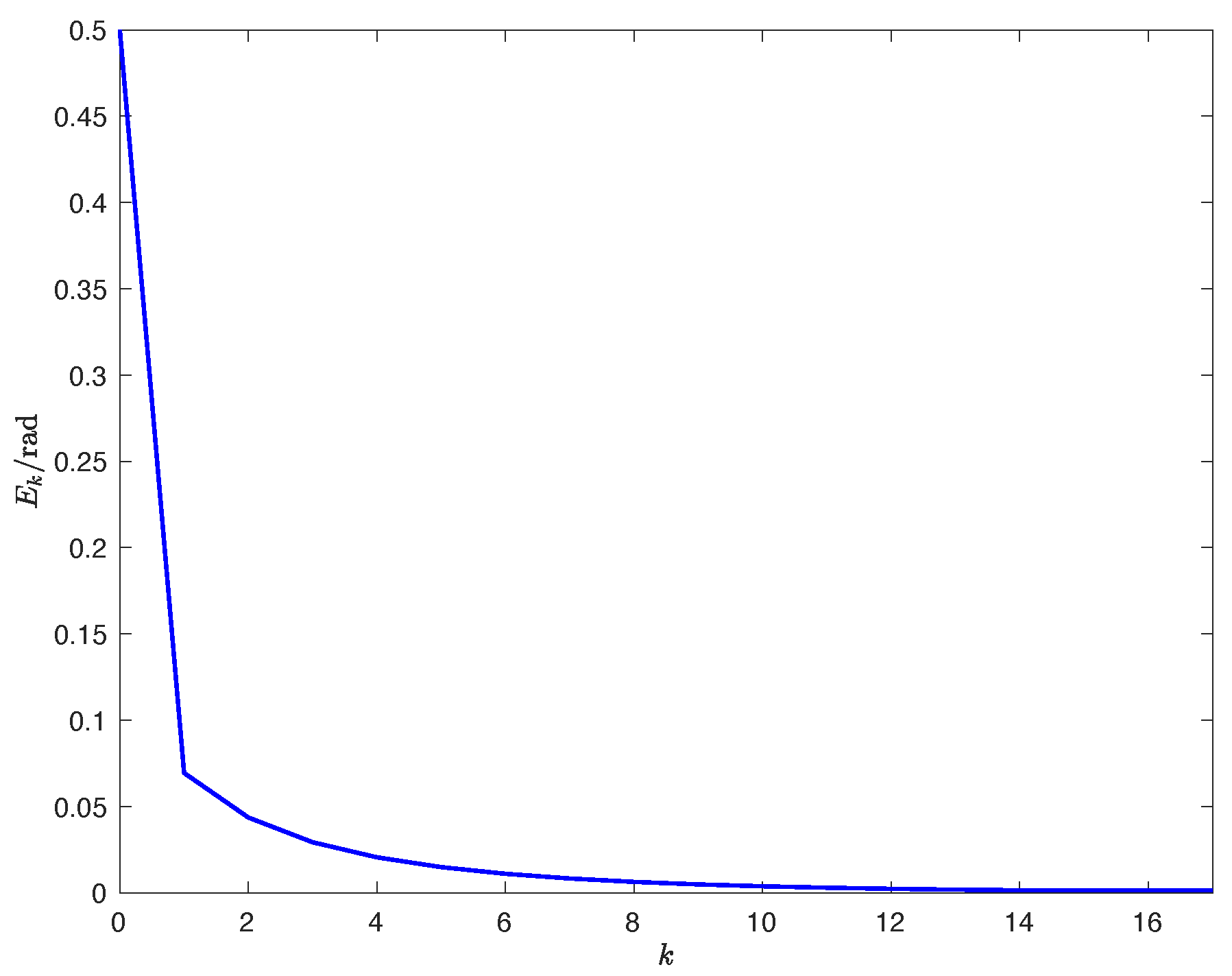
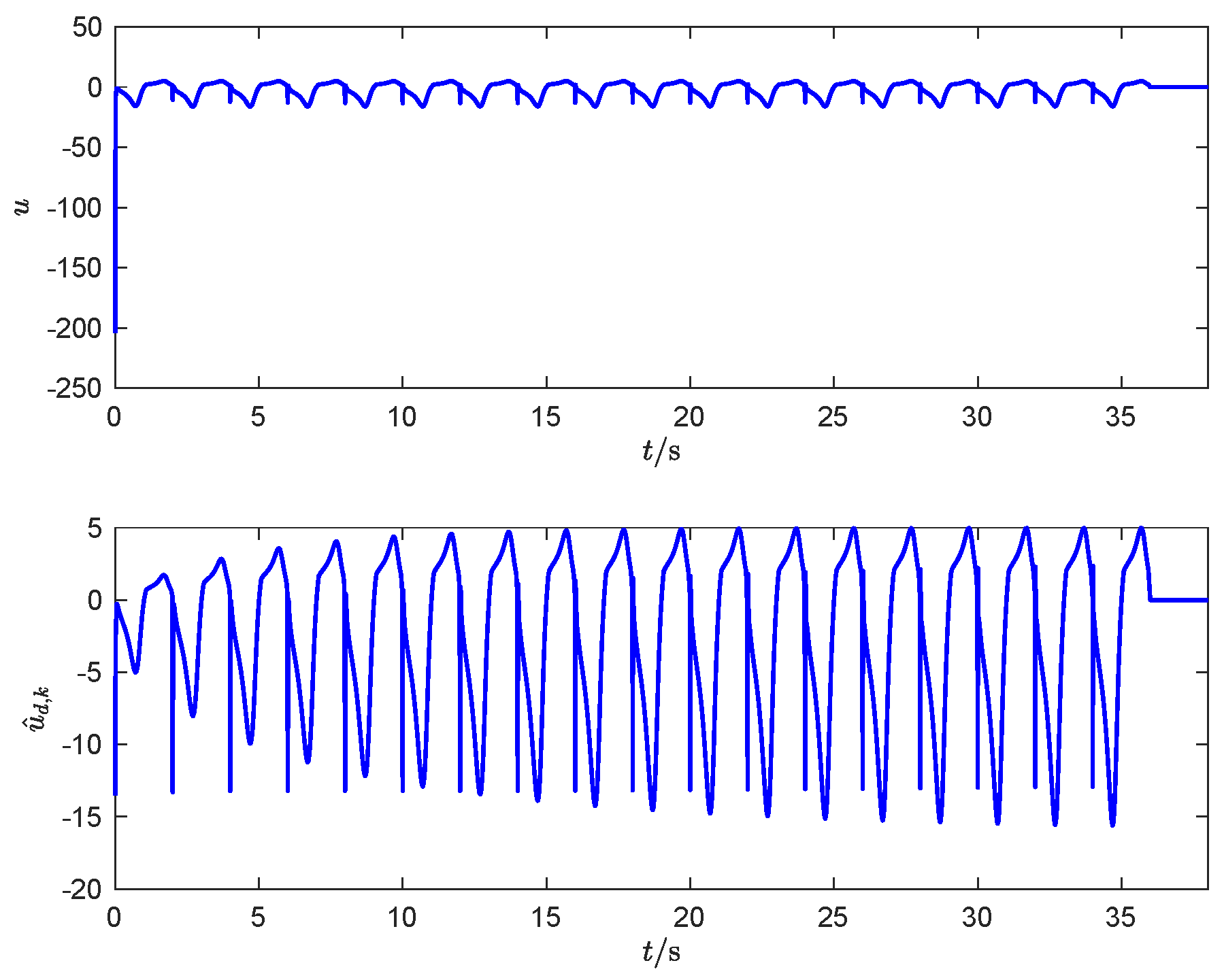
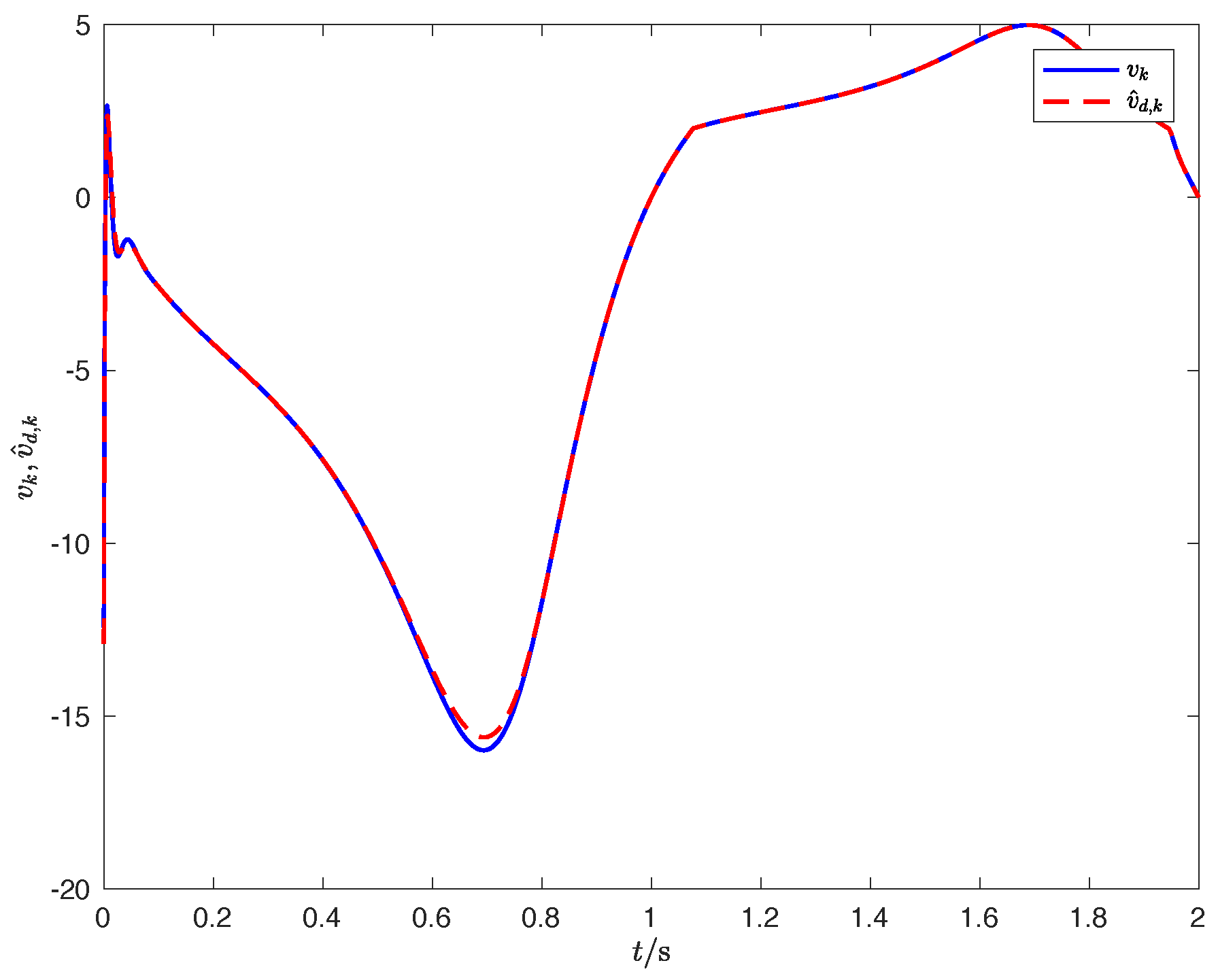
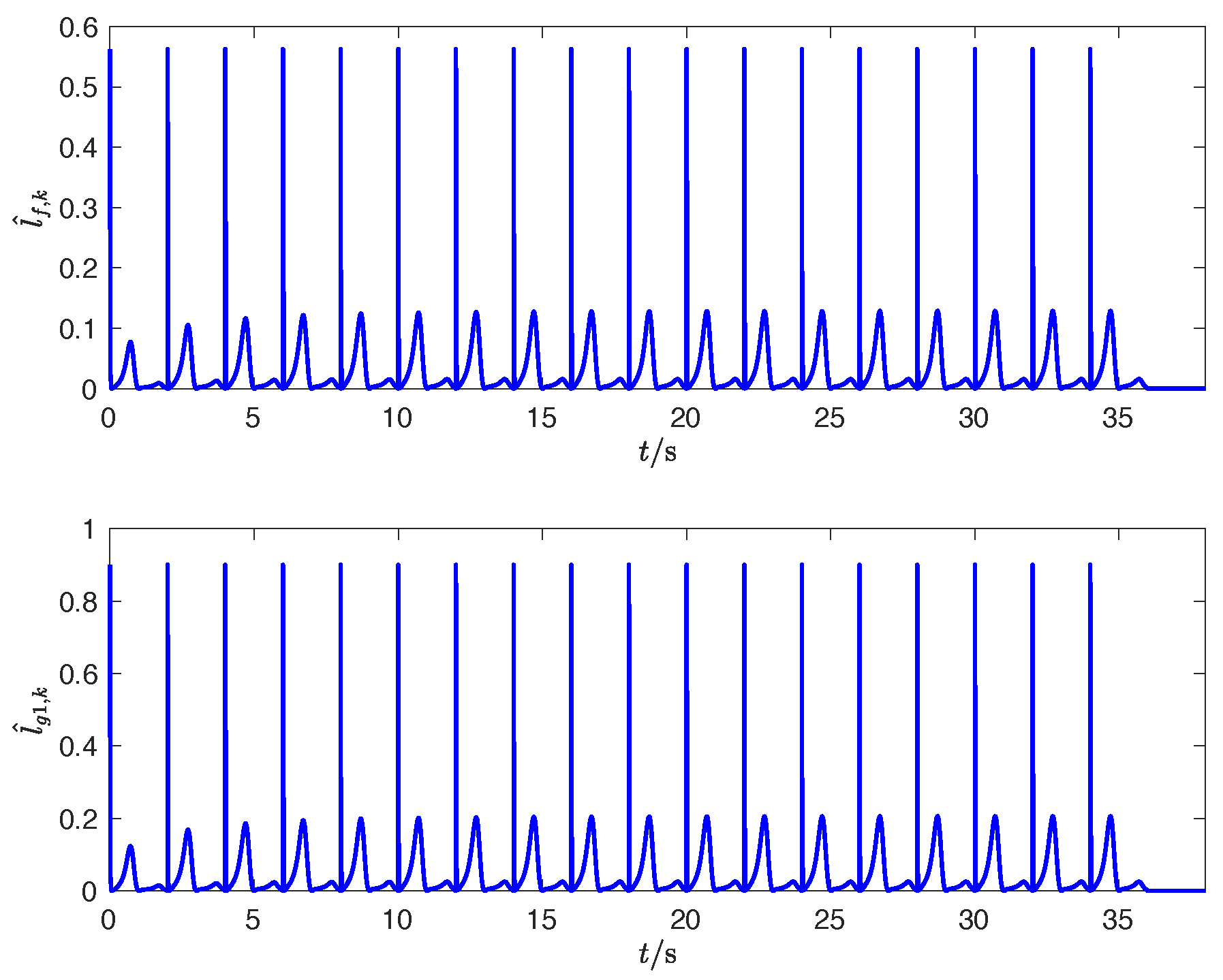
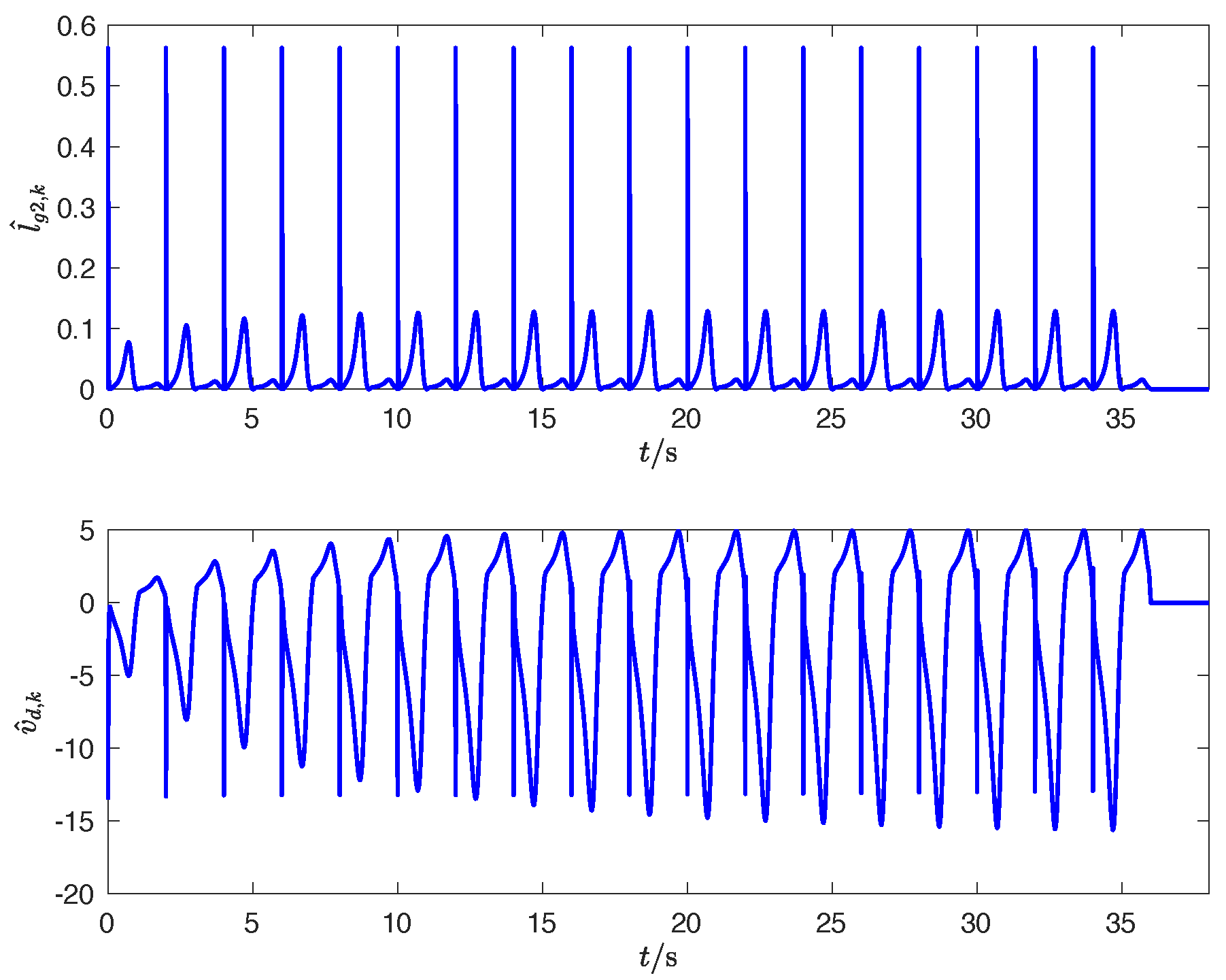
Furthermore, setting λ m = 5 > 0 , the learning gains are chosen as γ 1 = 9 , γ 2 = 1 , γ 3 = 1 , γ 4 = 1 . The initial condition is suggested as x ( 0 ) = [ 0.6 , 0 ] T , and for the convenience of the analysis of the system performance, a performance index is defined, i.e, E k = max t [ 0 , T ] | e k , 1 ( t ) | . The simulation results are shown in Figure 2, Figure 3, Figure 4, Figure 5 and Figure 6. The performance index E k is depicted in Figure 2, where the effectiveness of the proposed controller is verified. The control signal v k and the estimate v ^ d , k are given in Figure 3 and Figure 4, where Figure 3 depicts the learning process and Figure 4 presents the final learning results. The whole learning process is characterized by the estimates v ^ d , k , θ ^ f , k , θ ^ g 1 , k and θ ^ g 2 , k depicted in Figure 5 and Figure 6. It is seen that the boundedness of the closed-loop variables is ensured, and the asymptotic convergence goal is achieved.

6. Conclusions

A repetitive learning control scheme is proposed in this paper, by which systems with time-delay and dead-zone nonlinearities and the state-dependent input gain are effectively and simultaneously accommodated. The nonparametric uncertainties stemmed from time-delay nonlinearities, the state-dependent input gain are handled by the adaptive bounding techniques, and the desired control signal is regarded as the parametric uncertainty with a constant regressor that is updated by the learning laws accordingly. This greatly alleviates the requirement for knowledge about the system information. The boundedness of variables in the closed-loop system is ensured and the tracking convergence of the tracking error is elaborated in detail. The effectiveness of the proposed control method is verified through numerical simulation.

Author Contributions

Conceptualization, H.L.; methodology, H.L.; software, H.L.; validation, H.L., T.Y. and X.L.; formal analysis, H.L.; investigation, H.L.; resources, H.L.; data curation, H.L.; writing—original draft preparation, H.L.; writing—review and editing, H.L.; visualization, H.L.; supervision, H.L.; project administration, H.L.; funding acquisition, H.L. All authors have read and agreed to the published version of the manuscript.

Funding

This work was supported by the Zhejiang Provincial Natural Science Foundation of China under Grant LQ24F030006.

Institutional Review Board Statement

Not applicable.

Informed Consent Statement

Not applicable.

Data Availability Statement

The data presented in this study are available on request from the corresponding author. The data are not publicly available as it is part of ongoing research.

Conflicts of Interest

Author Xiaoming Lu was employed by the company Zhejiang Henuo Machinery Co., Ltd. The remaining authors declare that the research was conducted in the absence of any commercial or financial relationships that could be construed as a potential conflict of interest.

References

  1. Arimoto, S. Learning control theory for robotic motion. Int. J. Adapt. Control Signal Process. 1990, 4, 930–954. [Google Scholar] [CrossRef]
  2. Tayebi, A.; Chien, C.J. Unified adaptive iterative learning control framework for uncertain nonlinear systems. IEEE Trans. Autom. Control 2007, 52, 1907–1913. [Google Scholar] [CrossRef]
  3. Bu, X.; Hou, Z. Adaptive iterative learning control for linear systems with binary-valued observations. IEEE Trans. Neural Netw. Learn. Syst. 2018, 29, 232–237. [Google Scholar] [CrossRef]
  4. Sun, M.; Wu, T.; Chen, L.; Zhang, G. Neural AILC for Error Tracking Against Arbitrary Initial Shifts. IEEE Trans. Neural Netw. Learn. Syst. 2018, 28, 2705–2716. [Google Scholar] [CrossRef]
  5. Sun, M.; Ge, S.S. Adaptive Repetitive Control for a Class of Nonlinearly Parametrized Systems. IEEE Trans. Autom. Control 2006, 51, 1684–1688. [Google Scholar] [CrossRef]
  6. Shi, P.; Zhao, Y.; Qin, J.; Yu, X.; Sun, W. Integrated Adaptive Repetitive Learning Control of Linear Motor Servo Systems with Periodic Tasks. IEEE Trans. Autom. Sci. Eng. 2025, 22, 21010–21019. [Google Scholar] [CrossRef]
  7. Sun, M.X.; Li, H.; Li, Y.W. A Unified Design Approach to Repetitive Learning Control for Systems Subject to Fractional Uncertainties. J. Dyn. Syst. Meas. Control 2018, 140, 061003. [Google Scholar] [CrossRef]
  8. Chen, Q.; Li, Y.; Hong, Y.; Shi, H. Prescribed-Time Robust Repetitive Learning Control for PMSM Servo Systems. IEEE Trans. Ind. Electron. 2024, 71, 14753–14763. [Google Scholar] [CrossRef]
  9. Zhan, T.; Xia, Y.; Li, W.; Pedrycz, W.; Ma, S. Adaptive Sliding Mode Control for Nonlinear Impulsive Time-Delay Hybrid Systems. IEEE Trans. Syst. Man Cybern. Syst. 2024, 54, 4688–4700. [Google Scholar] [CrossRef]
  10. Bi, Y.; Peng, F.; Sun, K.; Wang, T.; Qiu, J. Fixed-Time Adaptive Sliding-Mode Resilient Control for Strict-Feedback Nonlinear CPSs Against Deception Attacks. IEEE Trans. Syst. Man Cybern. Syst. 2025, 55, 843–851. [Google Scholar] [CrossRef]
  11. Yang, J.; Wang, Y.; Wang, T.; Hu, Z.; Yang, X.; Rodriguez-Andina, J.J. Time-Delay Sliding Mode Control for Trajectory Tracking of Robot Manipulators. IEEE Trans. Ind. Electron. 2024, 71, 13083–13091. [Google Scholar] [CrossRef]
  12. Zhao, S.; Meng, Q.; Lai, X.; Xiao, H.; Yan, Z.; Wu, M. An Adaptive Nonsingular Fast Terminal Sliding Mode Control Method with Time-Delay Estimation for Pneumatic Soft Actuator Without Specific Model. IEEE Trans. Ind. Inform. 2025, 21, 4061–4071. [Google Scholar] [CrossRef]
  13. Choi, H. Robust Stabilization of Uncertain Fuzzy-Time-Delay Systems Using Sliding-Mode-Control Approach. IEEE Trans. Fuzzy Syst. 2010, 18, 979–984. [Google Scholar] [CrossRef]
  14. Ren, F.; Wang, X.; Zeng, Z. Improved Fixed-Time Stabilization of Fuzzy Neural Networks with Distributed Delay via Adaptive Sliding Mode Control. IEEE Trans. Fuzzy Syst. 2023, 31, 2029–2043. [Google Scholar] [CrossRef]
  15. Min, H.F.; Xu, S.; Zhang, B.; Ma, Q. Globally adaptive control for stochastic nonlinear time-delay systems with perturbations and its application. Automatica 2019, 102, 105–110. [Google Scholar] [CrossRef]
  16. Li, D.; Li, D. Adaptive tracking control for nonlinear time-varying delay systems with full state constraints and unknown control coefficients. Automatica 2018, 93, 444–453. [Google Scholar] [CrossRef]
  17. Moghadam, R.; Jagannathan, S. Optimal adaptive control of uncertain nonlinear continuous-time systems with input and state delays. IEEE Trans. Neural Netw. Learn. Syst. 2023, 34, 3195–3204. [Google Scholar] [CrossRef] [PubMed]
  18. Li, Z.; Jin, S.; Wei, Y.; Ji, H.; Hou, Z. A Data-Driven Control Algorithm with Time Delay Compensation Based on Optimized Recursive Adaptive Identification for Magnetic Levitation Systems. IEEE Trans. Autom. Sci. Eng. 2025, 22, 12922–12936. [Google Scholar] [CrossRef]
  19. Mai, V.T.; Jani, F.; Alattas, K.A.; Ghaderpour, E.; Mohammadzadeh, A. A Robust Finite-Time Fault-Tolerant Tracking Control for Quadrotor Attitude System with Stochastic Actuator Faults and Input Delays. IEEE Access 2025, 13, 64629–64637. [Google Scholar] [CrossRef]
  20. Chen, Y.; Huang, D.; Qin, N.; Zhang, Y. Adaptive Iterative Learning Control for a Class of Nonlinear Strict-Feedback Systems with Unknown State Delays. IEEE Trans. Neural Netw. Learn. Syst. 2023, 34, 6416–6427. [Google Scholar] [CrossRef]
  21. Tang, X.D.; Tao, G.; Suresh, M.J. Adaptive actuator failure compensation for parametric strict feedback systems and an aircraft application. Automatica 2003, 39, 1975–1982. [Google Scholar] [CrossRef]
  22. Zhou, J.; Wen, C.; Zhang, Y. Adaptive output control of nonlinear systems with uncertain dead-zone nonlinearity. IEEE Trans. Autom. Control 2006, 51, 504–511. [Google Scholar] [CrossRef]
  23. Hua, C.; Wang, Q.; Guan, X. Adaptive Tracking Controller Design of Nonlinear Systems with Time Delays and Unknown Dead-Zone Input. IEEE Trans. Autom. Control 2008, 53, 1753–1759. [Google Scholar] [CrossRef]
  24. Zhang, T.P.; Ge, S.S. Adaptive dynamic surface control of nonlinear systems with unknown dead zone in pure feedback form. Automatica 2008, 4, 1895–1903. [Google Scholar] [CrossRef]
  25. Zhu, Y.; Zhu, W.; Liu, J.; Wang, Q.; Yu, J. Command-filtered finite-Time fuzzy adaptive fault-tolerant control of output-constrainted robotic manipulators with unknown dead-Zones. IEEE Trans. Circuits Syst. II Express Briefs 2023, 70, 2939–2943. [Google Scholar] [CrossRef]
  26. Liu, Z.; Wang, F.; Zhang, Y.; Chen, X.; Chen, C.P. Adaptive Tracking Control for a Class of Nonlinear Systems with a Fuzzy Dead-Zone Input. IEEE Trans. Fuzzy Syst. 2015, 23, 193–204. [Google Scholar] [CrossRef]
  27. Wang, H.; Karimi, H.R.; Liu, P.X.; Yang, H. Adaptive Neural Control of Nonlinear Systems with Unknown Control Directions and Input Dead-Zone. IEEE Trans. Syst. Man Cybern. Syst. 2018, 48, 1897–1907. [Google Scholar] [CrossRef]
  28. Ma, Z.; Ma, H. Improved Adaptive Fuzzy Output-Feedback Dynamic Surface Control of Nonlinear Systems with Unknown Dead-Zone Output. IEEE Trans. Fuzzy Syst. 2021, 29, 2122–2131. [Google Scholar] [CrossRef]
  29. Bao, J.; Wang, H.; Liu, P.X.; Cheng, C. Fuzzy finite-time tracking control for a class of nonaffine nonlinear systems with unknown dead zones. IEEE Trans. Syst. Man Cybern. Syst. 2021, 51, 452–463. [Google Scholar] [CrossRef]
  30. Fan, L.; Yan, Q.; Chen, Q. Error Tracking Learning Control for Nonlinearly Parameterized Systems with Input Deadzone. In Proceedings of the 2023 IEEE 12th Data Driven Control and Learning Systems Conference (DDCLS), Xiangtan, China, 12–14 May 2023. [Google Scholar] [CrossRef]
  31. Li, H.; Wang, S.; Shi, H.; Su, C.; Li, P. Two-Dimensional Iterative Learning Robust Asynchronous Switching Predictive Control for Multiphase Batch Processes with Time-Varying Delays. IEEE Trans. Syst. Man Cybern. Syst. 2023, 53, 6488–6502. [Google Scholar] [CrossRef]
Figure 1. The dead-zone D ( · ) .
Applsci 16 01169 g001
Figure 2. Performance index E k .
Applsci 16 01169 g002
Figure 3. Control input v k and estimates v ^ d , k .
Applsci 16 01169 g003
Figure 4. Control input v k and estimates v ^ d , k at the 18th iteration.
Applsci 16 01169 g004
Figure 5. Estimates l ^ f , k and l ^ g 1 , k .
Applsci 16 01169 g005
Figure 6. Estimates l ^ g 2 , k and v ^ d , k .
Applsci 16 01169 g006
Disclaimer/Publisher’s Note: The statements, opinions and data contained in all publications are solely those of the individual author(s) and contributor(s) and not of MDPI and/or the editor(s). MDPI and/or the editor(s) disclaim responsibility for any injury to people or property resulting from any ideas, methods, instructions or products referred to in the content.