Article

Semi-Analytical Solutions for Consolidation in Multi-Layered Unsaturated Silt with Depth-Dependent Initial Condition


1
Huadong Engineering Corporation Limited, Power China, Hangzhou 311122, China
2
Department of Civil Engineering and Transportation, Hohai University, Nanjing 210024, China
3
Key Laboratory of Ministry of Education for Geomechanics and Embankment Engineering, Hohai University, Nanjing 210024, China
4
Wujin District Water Conservancy Bureau, Changzhou 213100, China
*
Author to whom correspondence should be addressed.
Appl. Sci. 2026, 16(3), 1168; https://doi.org/10.3390/app16031168
Submission received: 26 December 2025 / Revised: 18 January 2026 / Accepted: 22 January 2026 / Published: 23 January 2026
(This article belongs to the Section Civil Engineering)

Abstract

This paper presents an analytical model for one-dimensional consolidation analysis of multi-layered unsaturated soils under depth-dependent initial conditions. The general solutions are derived explicitly using the Laplace transform. By combining these general solutions with interfacial continuity conditions between layers and the boundary conditions, the reduced-order system is solved via the Euler method to obtain analytical solutions in the Laplace domain. Numerical inversion of the Laplace transform is then performed using Crump’s method to yield the final analytical solutions in the time domain. The model incorporates initial conditions that account for both uniform and linear distributions of initial excess pore pressure within the soil stratum. The proposed solution is verified by reducing it to degenerated cases (e.g., uniform initial pressure) and comparing it with existing analytical solutions, showing excellent agreement. This confirms the model’s correctness and demonstrates its generalization to multi-layered systems with depth-dependent initial conditions. Focusing on a double-layered unsaturated soil system, the one-dimensional consolidation characteristics under depth-dependent initial conditions are investigated by varying the physical parameters of individual layers. The proposed solution can serve as a theoretical reference for the consolidation analysis of multi-layered unsaturated soils with depth-dependent initial conditions.

1. Introduction

The evaluation of one-dimensional (1D) consolidation is a common process in geotechnical engineering, especially in the design of foundations and structures on soft and highly compressible soils. However, this process becomes considerably more complex in unsaturated soils such as silt, where the simultaneous presence of air and water phases creates a coupled hydro-mechanical system. Over the past decades, considerable progress has been made in developing consolidation theories to describe the compression and consolidation characteristics of unsaturated soils [1,2,3]. Fredlund and Rahardjo [4] introduced a simplified version of this consolidation system by assuming constant soil parameters throughout the consolidation process. This simplified model has, in turn, stimulated extensive research into the consolidation behavior of unsaturated soils [5,6,7,8,9,10,11].
In nature, complex sedimentation typically results in multi-layered soil strata [12,13,14], for which the homogeneous assumption is an oversimplification. This highlights the need to address consolidation in multi-layered unsaturated soils. Shan et al. [15] developed a one-dimensional (1D) consolidation analytical model for multi-layered unsaturated soils. However, it was based on the restrictive assumption that the coefficients of air and water volume change are identical across all layers. Fazeli et al. [16] and Moradi et al. [17] proposed a numerical method based on the incremental differential quadrature method to analyze the 1D consolidation behavior of multilayered unsaturated soil. Li et al. [18,19] proposed a semi-analytical solution addressing the 1D consolidation of multi-layered unsaturated soils, including the cases of instantaneous loading and partially permeable boundaries. Huang et al. [20] developed a general semi-analytical solution for 1D consolidation in multi-layered unsaturated soils, incorporating both time-dependent loading and generalized impeded drainage boundaries. In a related development, Chen et al. [21] employed a semi-analytical approach to investigate 1D consolidation in multi-layered unsaturated soils, with a specific focus on the effects of depth-dependent stress. Zhou et al. [22] also used semi-analytical solutions to investigate the consolidation of double-layered unsaturated ground containing a horizontal drainage layer. It is noteworthy that these studies consistently adopt a uniform distribution of the initial excess pore pressure as the initial condition.
Ho et al. [23], Zhou et al. [24], and Wang et al. [25] have shown that the distribution of initial conditions significantly influences the isochrones of excess pore pressure along depth. While the majority of existing consolidation theories for unsaturated soils—whether for single or multiple layers—are predicated on the assumption of uniform initial pore pressure distributions, this study advances the theoretical framework by investigating the one-dimensional consolidation of multi-layered systems under the more realistic condition of depth-dependent initial pore pressure.
This study thereby proposes a novel semi-analytical solution for evaluating one-dimensional consolidation behavior of multi-layered unsaturated soils under depth-dependent initial conditions. The well-known governing equations developed by Fredlund and Hasan [26] are adopted to simulate the consolidation process in each soil layer and formulate the consolidation system of the multi-layered unsaturated soil stratum. The formulated consolidation system is decoupled and solved in the Laplace domain by reduced order and the Euler method. The Crump method is employed to invert these solutions into the time domain [27]. The accuracy of the derived solutions is verified against existing analytical results from the literature. Additionally, a worked example is presented to illustrate the 1D consolidation behavior of double-layered unsaturated soils, and to elucidate the influence of depth-dependent initial conditions in different layers as discussed. This represents a generalization of earlier models limited to uniform initial pore pressure distributions.
Consequently, the semi-analytical solutions developed in this study provide a rigorous and efficient theoretical tool for predicting the one-dimensional consolidation behavior of layered unsaturated soil systems. The findings and the proposed model are directly applicable to geotechnical engineers and consultants involved in the design and analysis of foundations, embankments, and pavements constructed on layered unsaturated soils. Furthermore, the model serves as a valuable benchmark for verifying numerical simulations commonly used in complex commercial geotechnical software. Researchers and educators in geomechanics can also employ the presented solutions for parametric studies to understand the influence of layer properties and initial conditions on system response, thereby guiding design decisions.

2. Mathematical Model

2.1. Governing Equations

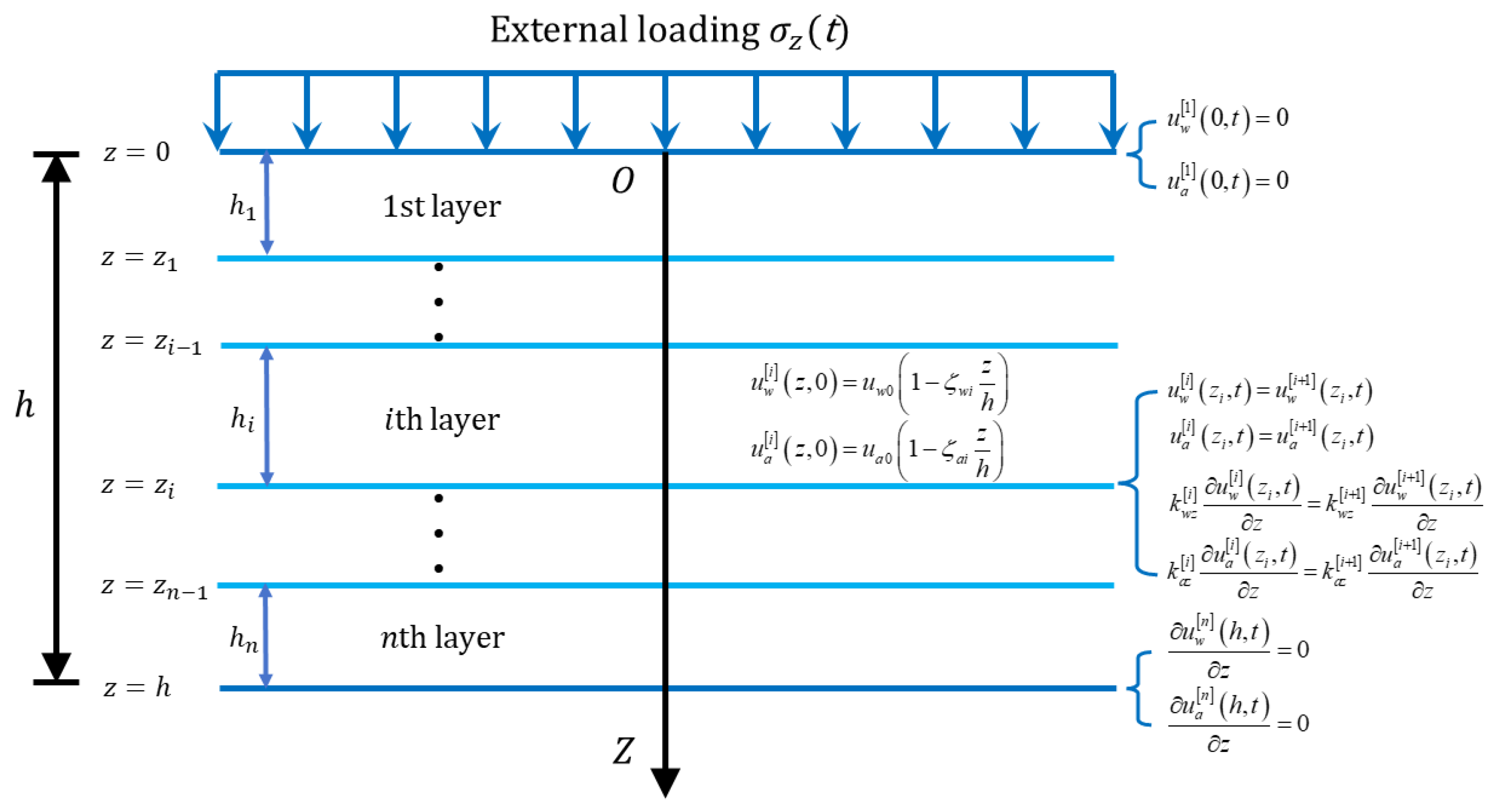
Based on the 1D consolidation theory established by Fredlund and Hasan, a conceptual framework for the 1D consolidation of multi-layered unsaturated soil is developed, as illustrated in Figure 1. The soil system is idealized as a horizontally extensive stratum with total thickness h, where the depth coordinate z is taken positive downward. In the i-th soil layer, the air and water permeability coefficients are denoted by k w z i and k a z i , respectively.
The analysis relies on the following set of assumptions:
(1)
Each soil layer is homogeneous.
(2)
Soil particles and pore water are incompressible.
(3)
Air and water flows occur independently and are continuous across the medium.
(4)
All deformations are restricted to the vertical (z) direction. This premise is consistent with the one-dimensional consolidation framework, where horizontal drainage and strain are neglected, focusing on the vertical dissipation of excess pressures and compression of the soil column.
(5)
The influences of air dissolution, air diffusion, and temperature variations are disregarded.
(6)
Under a small stress increment, the coefficients of volume change, along with the air and water permeability coefficients, remain constant. This assumption is common in classical consolidation theory and is valid for a wide range of practical engineering problems where deformations are not excessively large [4,5,6,7].
Following the application of a surcharge load σ z , the governing equations for the water and air phases can be expressed as follows [28,29]:
u w i t + C w i u a i t + C w z i 2 u w i z 2 = C w σ i σ z t
u a i t + C a i u w i t + C a z i 2 u a i z 2 = C a σ i σ z t
where the superscript [i] stands for the i-th soil layer; u w i and u a i are the pore-water and pore-air pressures; C w i and C a i are interactive constants with respect to the water and air phases, respectively; C w σ i and C a σ i are the consolidation coefficients for the water and air phases, respectively; C w z i and C a z i are coefficients of volume change with respect to the air and water phases, respectively. The consolidation parameters can be expressed as follows:
C w i = m 1 w i m 2 w i m 2 w i
C w z i = k w z i γ w m 2 w i
C w σ i = m 1 w i m 2 w i
C a i = m 2 a i u a 0 i + u a t m m 1 a i m 2 a i n 0 i 1 S r 0 i
C a z i = k a z i R T i g M 1 m 1 a i m 2 a i u a 0 i + u a t m n 0 i 1 S r 0 i
C a σ i = m 1 a i u a 0 i + u a t m m 1 a i m 2 a i u a 0 i + u a t m n 0 i 1 S r 0 i
where m 1 a i and m 1 w i are the coefficients of air and water volume changing with an increase in the net stress, respectively; m 2 a i and m 2 w i are the coefficients of air and water volume changing with an increase in the matrix suction, respectively; S r 0 i is the degree of saturation of the i-th soil layer; n 0 i is the porosity of the i-th soil layer; uatm is the atmospheric pressure; u a 0 i is the absolute pore-air pressure of the i-th soil layer; R is the universal gas constant; T is the absolute temperature; M is the molecular mass of air; g is the acceleration of gravity; γw is the unit weight of water.

2.2. Solution Conditions

At the top surface, the boundary is considered permeable to the air and water phases, respectively. The bottom boundary is considered the impermeable drainage boundary for both the air and the water phases.
Boundary conditions at the top and bottom surfaces can be described as follows:
z = 0 :   u w 1 0 , t = 0
z = 0 :   u a 1 0 , t = 0
z = z n :   u w n h , t z = 0
z = z n :   u a n h , t z = 0
Furthermore, the principles of mechanical equilibrium and mass conservation dictate the continuity of excess pore pressure and flow rate across all interfaces (i = 1, 2, …, n − 1) for both air and water phases, i.e.,
z = z i :   u w i z i , t = u w i + 1 z i , t and   u a i z i , t = u a i + 1 z i , t
z = z i :   k w z i u w i z i , t z = k w z i + 1 u w i + 1 z i , t z and   k a z i u a i z i , t z = k a z i + 1 u a i + 1 z i , t z
The analysis of consolidation in most existing studies is premised on the assumption of a constant initial excess pore pressure. This condition, however, is not strictly valid for cases such as consolidation beneath small footings or within deep soil layers. To address this limitation, the initial conditions for the soil layer in this work are formulated to represent linear distributions of the initial excess pore pressure. Accordingly, the initial pore-water and pore-air pressures in the i-th layer are described by a linear function of depth as follows:
u w i z , 0 = u w 0 1 ζ w i z h
u a i z , 0 = u a 0 1 ζ a i z h
where u w 0 and u a 0 are the initial excess pore-water and pore-air pressures at the top surface of the stratum ( z = 0 ); ζ w i and ζ a i are dimensionless gradient parameters controlling the linear variation in the initial pressures in the i-th layer; h is the total thickness of the stratum. A value of ζ [ i ] = 0 corresponds to a uniform initial distribution, while ζ [ i ] > 0 indicates a decrease in pressure with depth.

3. Solution Derivation

The Laplace transform technique is applied to solve the system of coupled partial differential equations governing one-dimensional consolidation in multi-layered unsaturated soil. This technique transforms the time-dependent partial differential equations into a set of ordinary differential equations in the Laplace domain with respect to the spatial coordinate, thereby greatly simplifying their mathematical treatment.
Applying the Laplace transform to Equations (1) and (2) yields Equations (17) and (18)
s u ˜ w i u w 0 1 ζ w i z h = C w i s u ˜ a i u a 0 1 ζ a i z h C w z i 2 u ˜ w i z 2 + C a σ i s σ ˜ σ 0
s u ˜ a i u a 0 1 ζ a i z h = C a i s u ˜ w m i u w 0 1 ζ w i z h C a z i 2 u ˜ a i z 2 + C a σ i s σ ˜ σ 0
These equations can be written as a system of partial differential equations in matrix form as follows:
2 u ˜ i z 2 = A i u ˜ i + B i
where
u ˜ i z , s = u ˜ w i z , s u ˜ a i z , s T
A i = s C w z i C w i s C w z i C a i s C a z i s C a z i
B i = u w 0 1 ζ w i z h + C w σ i s σ ˜ σ 0 C w i u a 0 1 ζ a i z h C w z i u a 0 1 ζ a i z h + C a σ i s σ ˜ σ 0 C a i u w 0 1 ζ w i z h C a z i
The general solutions of the non-homogeneous equations Equation (19) is the sum of particular solutions and the general solutions of the corresponding homogeneous equations as follows:
2 U h i z 2 = A i U h i
U h i = u ˜ w i u ˜ a i T
Suppose the following substitution:
u ˜ w i z , s z = f w z , s , u ˜ a i z , s z = f a z , s
From Equations (23) and (25), we can obtain the following equations:
Γ i z = D i Γ i
where
Γ i = u ˜ w i u ˜ a i f w f a T
D i = 0 0 1 0 0 0 0 1 s C w z i C w i s C w z i 0 0 C a i s C a z i s C a z i 0 0 = 0 0 1 0 0 0 0 1 a 1 i a 2 i 0 0 a 3 i a 4 i 0 0
The characteristic equation associated with the system of second-order linear ordinary differential equations, Equation (26), can be obtained as follows:
D i η i I 4 = A i η i 2 I 2 = η i 4 a 1 i + a 4 i η i 2 + a 1 i a 4 i a 2 i a 3 i = 0
where
a 1 i = s C w z i , a 2 i = C w i s C w z i , a 3 i = C a i s C a z i , a 4 i = s C a z i
The roots of the characteristic Equation (29) are as follows:
η 1 i = ξ 1 i , η 2 i = ξ 1 i , η 3 i = ξ 2 i , η 4 i = ξ 2 i
where
ξ 1 i = 1 2 a 1 i + a 4 i + a 1 i a 4 i 2 + 4 a 2 i a 3 i
ξ 2 i = 1 2 a 1 i + a 4 i a 1 i a 4 i 2 + 4 a 2 i a 3 i
The eigenvector corresponding to eigenvalue η 1 i is expressed as
E 1 [ i ] = e 11 [ i ] e 12 [ i ] e 13 [ i ] e 14 [ i ] T
The eigenvector can be obtained as follows:
η 1 i 0 1 0 0 η 1 i 0 1 a 1 i a 2 i η 1 i 0 a 3 i a 4 i 0 η 1 i e 11 i e 12 i e 13 i e 14 i = 0 0 0 0
Applying an elementary transformation to Equation (35) yields:
e 13 i = η 1 i e 11 i e 14 i = η 1 i e 12 i
The eigenvector corresponding to eigenvalue η 1 i can be expressed as follows:
E 1 [ i ] = e 11 [ i ] e 12 [ i ] η 1 i e 11 [ i ] η 1 i e 12 [ i ] T
where e11 and e12 can be derived from the following equation:
a 1 i η 1 i 2 a 2 i a 3 i a 4 i η 1 i 2 e 11 i e 12 i = 0 0
Following the same procedure, the eigenvectors E2, E3, and E4 corresponding to η 2 i , η 3 i , and η 4 i can be derived as follows:
E 2 [ i ] = e 11 [ i ] e 12 [ i ] η 2 i e 11 [ i ] η 2 i e 12 [ i ] T
E 3 [ i ] = e 11 [ i ] e 12 [ i ] η 3 i e 11 [ i ] η 3 i e 12 [ i ] T
E 4 [ i ] = e 11 [ i ] e 12 [ i ] η 4 i e 11 [ i ] η 4 i e 12 [ i ] T
The solution to Equation (23) can be expressed as follows:
Γ i = α 1 i e 11 i e 12 i ξ 1 i e 11 i ξ 1 i e 12 i e z ξ 1 i + α 2 i e 11 i e 12 i ξ 1 i e 11 i ξ 1 i e 12 i e z ξ 1 i + α 3 i e 31 i e 32 i ξ 2 i e 31 i ξ 2 i e 32 i e z ξ 2 i + α 4 i e 31 i e 32 i ξ 2 i e 31 i ξ 2 i e 32 i e z ξ 2 i
Accordingly, the solution to Equation (26) in matrix form can be expressed as follows:
U h i = F i exp β i z α 1 i + exp β i z α 2 i
where
α i = diag ξ 1 i ξ 2 i
F i = e 11 i e 12 i e 31 i e 32 i = 1 ξ 2 i a 4 i a 3 i ξ 1 i a 1 i a 2 i 1
α 1 i = α 1 i α 3 i T , α 2 i = α 2 i α 4 i T
The particular solutions of Equation (19) can be expressed as follows:
U s i = G i + z H i
Substituting Equation (47) into Equation (19) gives
G i = A i 1 u w 0 + C w σ i s σ ˜ σ 0 C w i u a 0 C w z i u a 0 + C a σ i s σ ˜ σ 0 C a i u w 0 C a z i
H i = A i 1 u a 0 ζ a i C w [ i ] u w 0 ζ w i C w z i h u w 0 ζ w i C a i u a 0 ζ a i C a z i h
According to Equations (43) and (47), the solution to Equation (19) can be expressed as follows:
u ˜ i = F i exp β i z α 1 i + exp β i z α 2 i + G i + z H i
α 1 i = α 1 i α 3 i T , α 2 i = α 2 i α 4 i T
where α 1 i , α 2 i , α 3 i and α 4 i are the undetermined coefficients, which need to be solved by boundary conditions and continuity conditions.
Applying the Laplace transform to Equations (9)–(14) yields Equations (52)–(57) as follows:
z = 0 :   u ˜ w 1 0 , t = 0
z = 0 :   u ˜ a 1 0 , t = 0
z = z n :   u ˜ w n h , t z = 0
z = z n :   u ˜ a n h , t z = 0
z = z i :   u ˜ w i z i , s = u ˜ w i + 1 z i , s and   u ˜ a i z i , s = u ˜ a i + 1 z i , s
z = z i :   k w z i u ˜ w i z i , s z = k w z i + 1 u ˜ w i + 1 z i , s z   and   k a z i u ˜ a i z i , s z = k a z i + 1 u ˜ a i + 1 z i , s z
Substituting Equation (50) into Equations (52)–(57) gives
F 1 α 1 1 + α 2 1 + H 1 = 0
F i exp β i z i α 1 i + exp β i z i α 2 i + G i + z i H i = F i + 1 exp β i + 1 z i α 1 i + 1 + exp β i + 1 z α 2 i + 1 G i + 1 + z i H i + 1
k i F i β i exp β i z i α 1 i exp β i z i α 2 i + k i H i = k i + 1 F i + 1 β i + 1 exp β i + 1 z i α 1 i + 1 exp β i + 1 z α 2 i + 1 + k i + 1 H i + 1
where
k i = diag k w z i k a z i
F n β n exp β n h α 1 n exp β n h α 2 n + z n H n = 0
Through solving Equations (58)–(62), the coefficient vectors α 1 i and α 2 i can be directly determined. Once they are known, the pore pressure vector can be further obtained in the Laplace domain as Equation (50).
Then, by performing the inversion of the solution above, the pore pressure vector can be derived in the temporal domain as follows:
u i z , t = 1 2 π j ϑ j ϑ + j u ˜ i z , s e s t d s
where
u i z , t = u w i z , t u a i z , t T
In general, Equation (50) is difficult, if not impossible, to work out analytically for layered unsaturated soil. Herein, the widely used Crump’s method is employed to perform the inversion of the Laplace transform. On the basis of this method, the result of the pore pressure vector in the temporal domain can be computed using the following series:
u i z , t = e ϑ t T 1 2 u ˜ i z , ϑ + k = 1 Re u ˜ i z , ϑ + j k π T e j k π T t

4. Verification

In this section, two consolidation cases involving unsaturated soil strata are examined to verify the accuracy of the derived semi-analytical solution against existing analytical solutions. The first case is drawn from the work of Shan et al. [15] involving a three-layered unsaturated soil. Their work derives an analytical solution by employing the same coefficients of air and water volume change for all soil layers. The second case is based on the study by Ho et al. [23], which accounts for a depth-dependent initial condition. In their work, Ho et al. [23] treated the soil stratum as homogeneous for the purpose of deriving analytical solutions. The soil profiles and material parameters for both cases are provided in Table 1 [25,26]. The top surface is fully drained, whereas the bottom base remains undrained for both pore air and pore water.
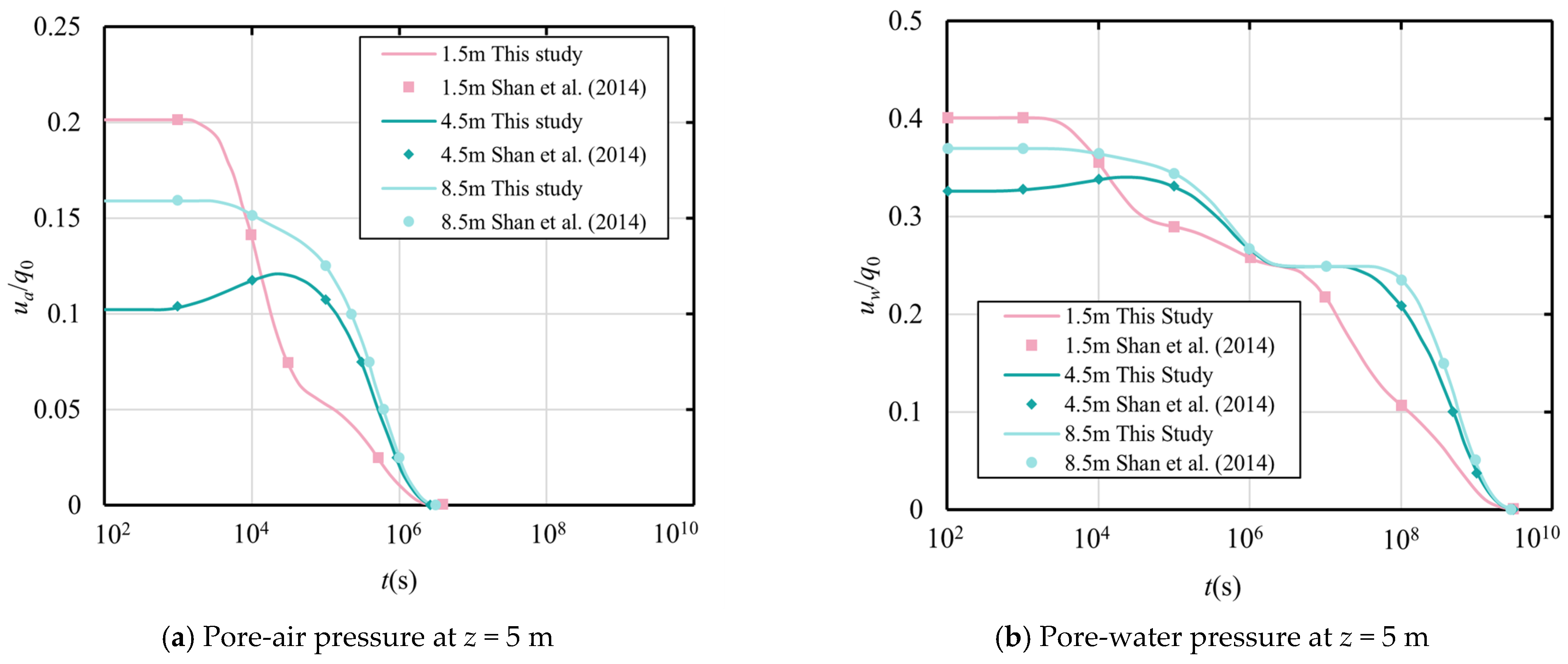
In the first case, a step load (q(t) = q0H(t), q0 = 100 kPa) is applied, and at the initial time, both the excess pore-air pressure and excess pore-water pressure are zero. Figure 2 presents the evolution of excess pore pressures obtained from Equation (23). For comparison, the corresponding results from the analytical solution of Shan et al. [15] are also plotted in these figures. As observed in Figure 2, excellent agreement is achieved in these comparisons, confirming the correctness and reliability of the derived semi-analytical solution. The precise match across all layers validates the core solution procedure, especially in satisfying the interfacial continuity conditions for both air and water phases. Thus, the proposed solution is feasible for predicting the 1D consolidation behavior of multi-layered unsaturated soil strata.
For the second case, the initial pore-air and pore-water pressures are, respectively, expressed as follows:
u w z , 0 = u w 0 1 λ w z h
u a z , 0 = u a 0 1 λ a z h
where λa and λw are dimensionless parameters controlling the gradient of distributions of initial excess pore-air and pore-water pressures with depth, respectively.
Three combinations of λa and λw are examined:
Case 1: λa = 0.25, λw = 0.25
Case 2: λa = 0.25, λw = 0.75
Case 3: λa = 0.75, λw = 0.25
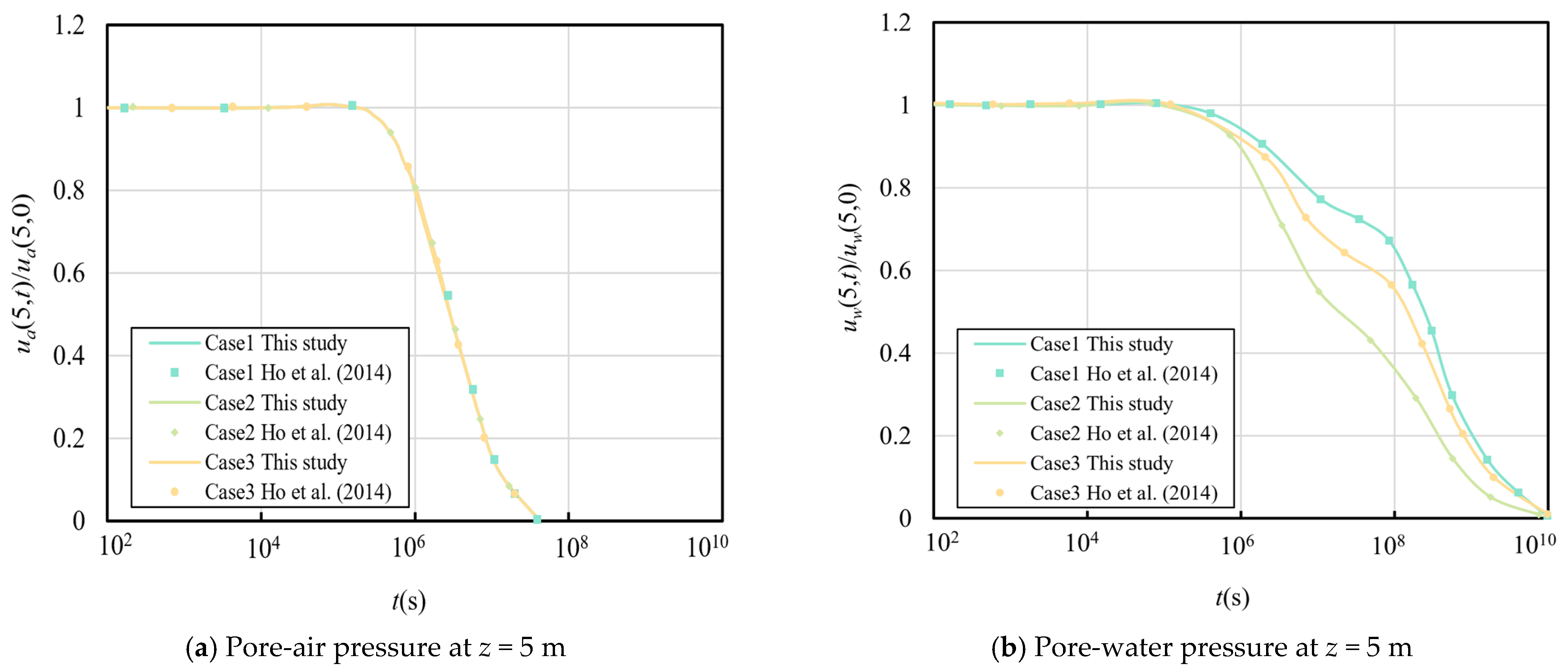
Figure 3 illustrates the evolution of excess pore-air and pore-water pressures over time. For comparison, results from the analytical solution of Ho et al. [23] are also provided. As shown in Figure 2 and Figure 3, the comparisons show excellent agreement, confirming the correctness and reliability of the derived semi-analytical solution. This successful verification under various depth-dependent initial gradients (λa and λw) confirms the model’s capability to handle non-uniform initial conditions, a prerequisite for the subsequent layered analysis. Thus, the proposed solution is suitable for predicting the one-dimensional consolidation behavior of multi-layered unsaturated soil strata under depth-dependent initial conditions.

5. Calculation and Discussion

This section investigates a worked example of two-layered unsaturated soil strata, examining the influences of the initial air and water phase conditions. The soil profile and material parameters used in the calculations are summarized in Table 2. A constant surcharge load is applied instantaneously. The initial pore-water and pore-air pressures follow the depth-dependent linear distribution defined by Equations (15) and (16) in Section 2. For this specific example, the parameters in Equations (15) and (16) are assigned as follows: the top pressures are u a 0 = 101 kPa and u w 0 = 101 kPa, the total stratum thickness is h = 10 m, and the layer-specific gradient parameters ζ w [ i ] and ζ a [ i ] are varied to study their effects.
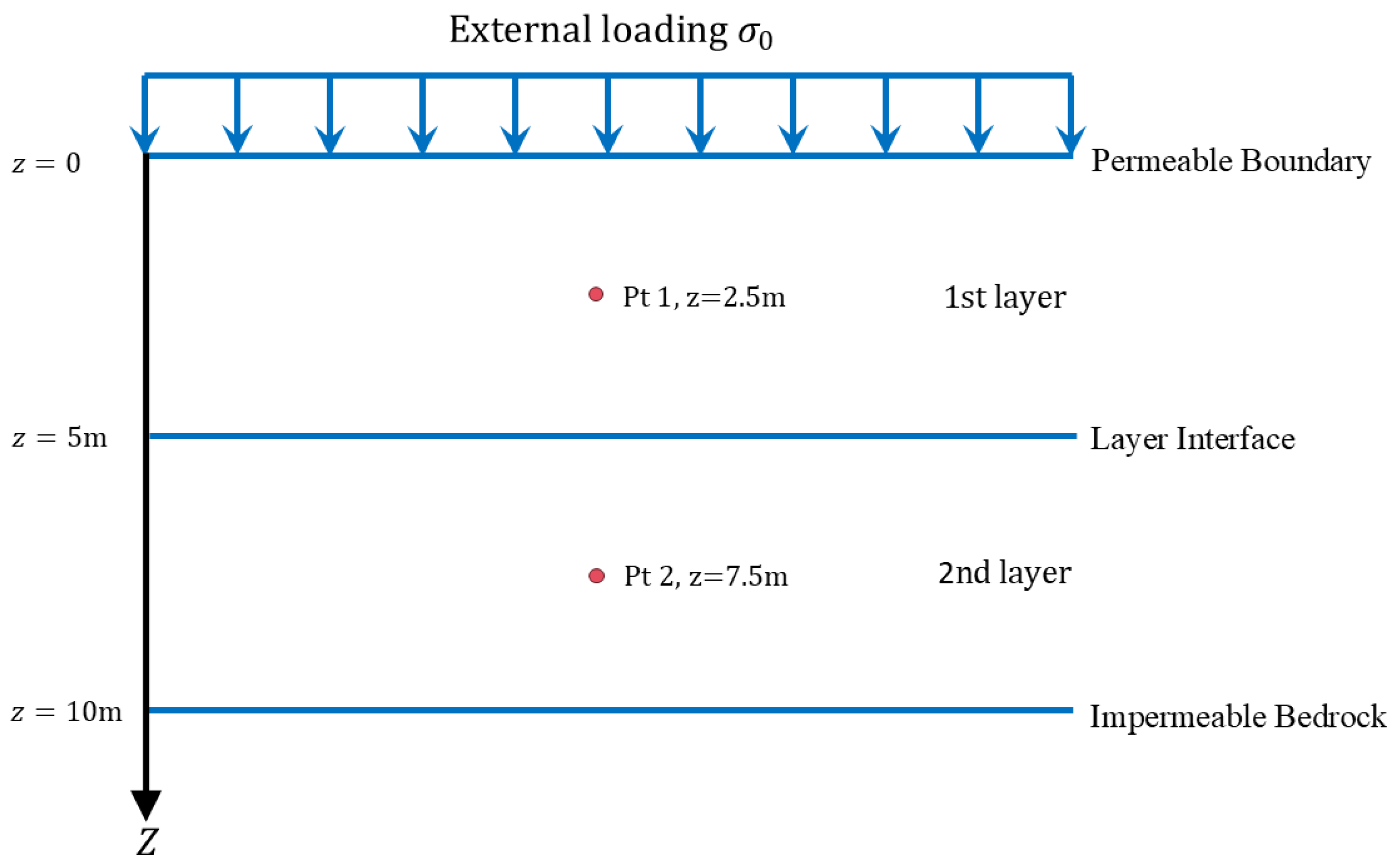
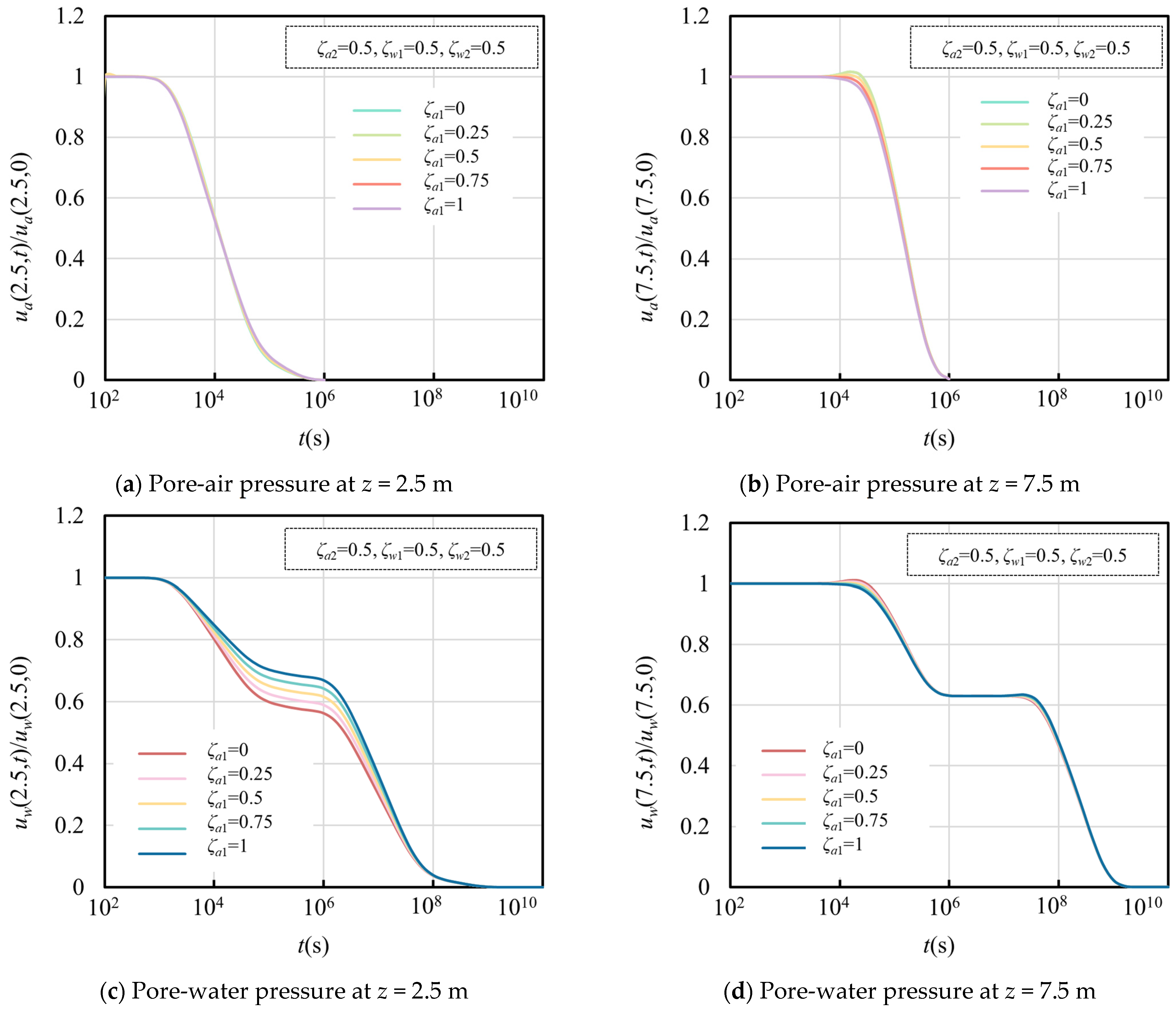
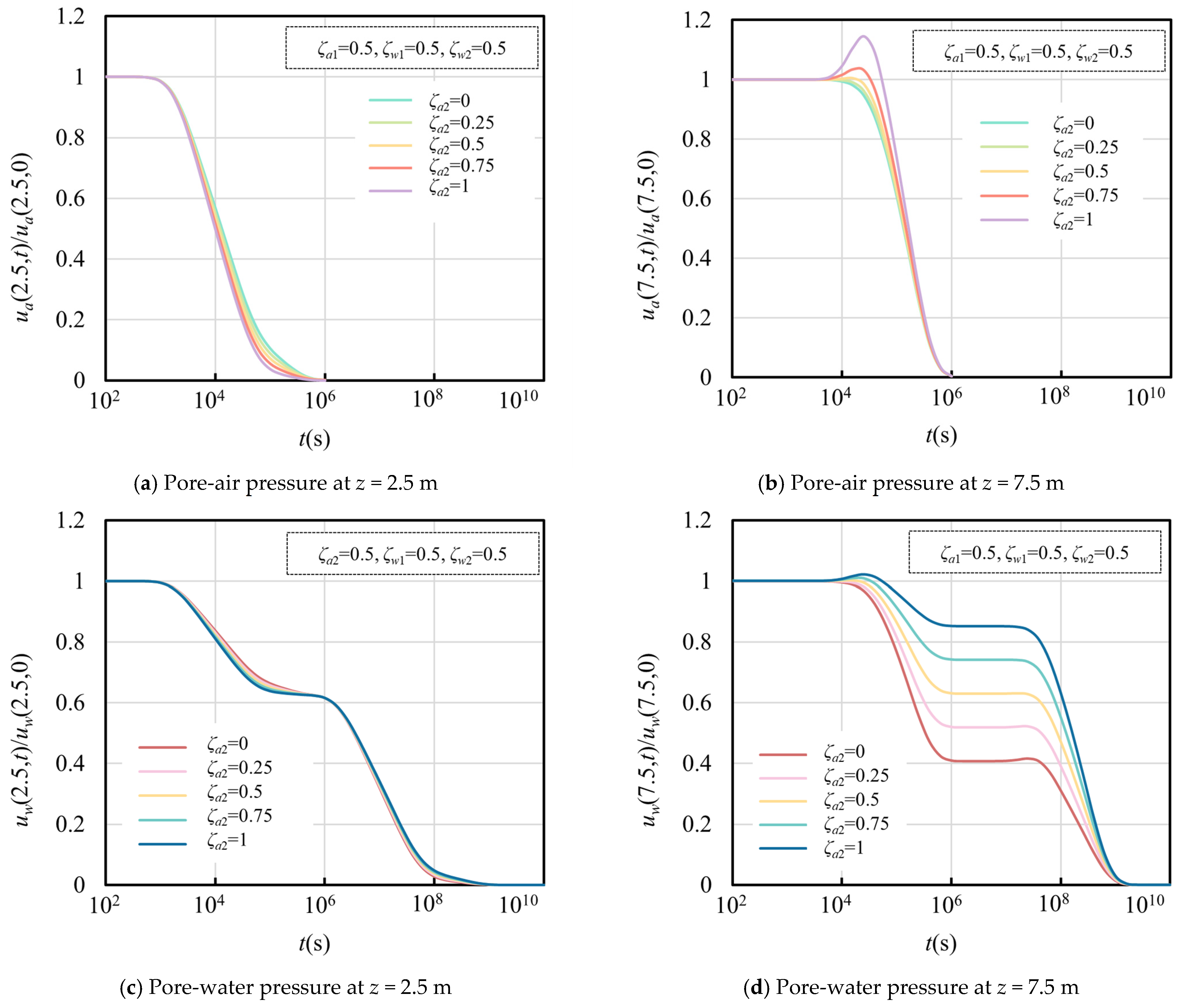
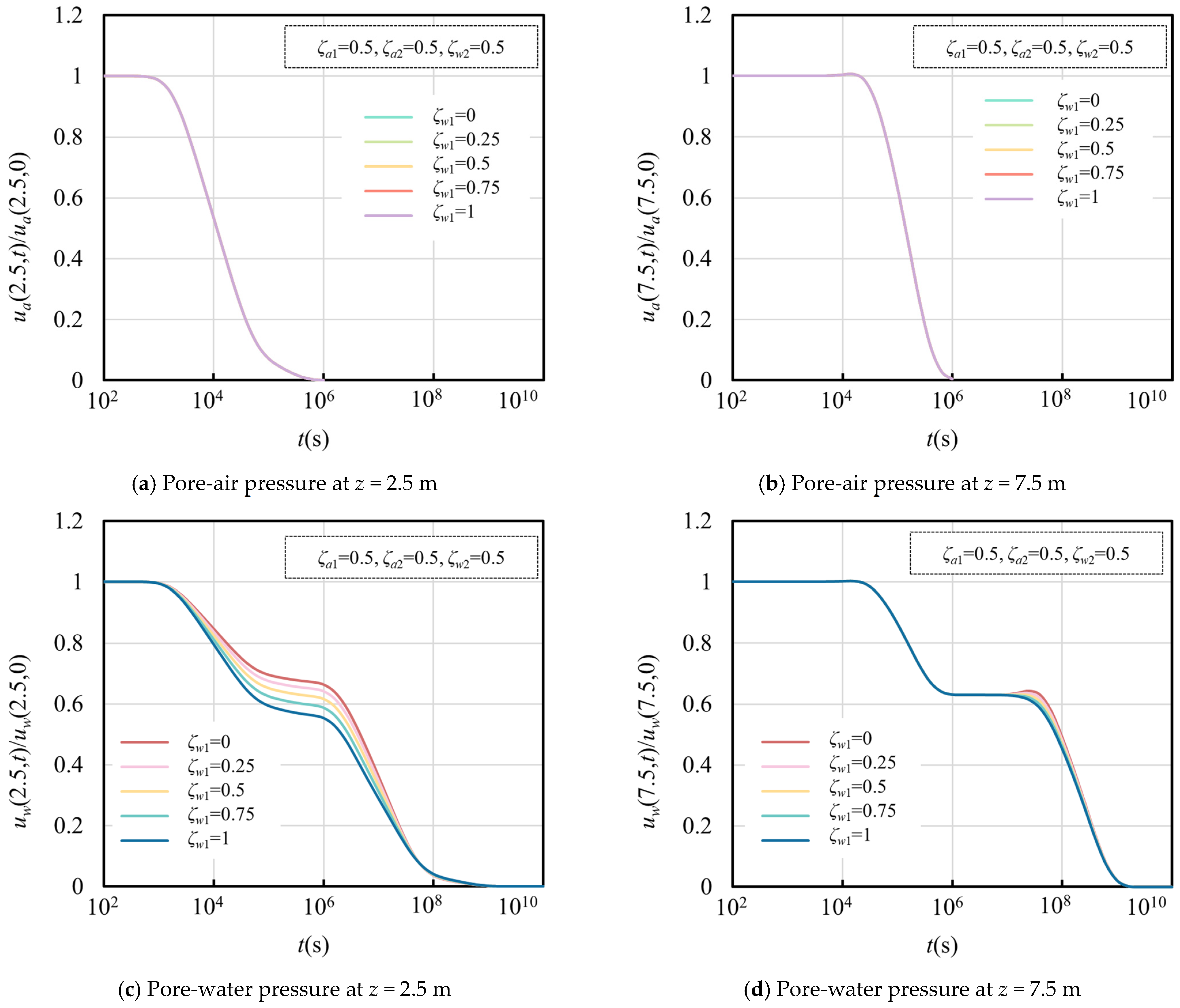
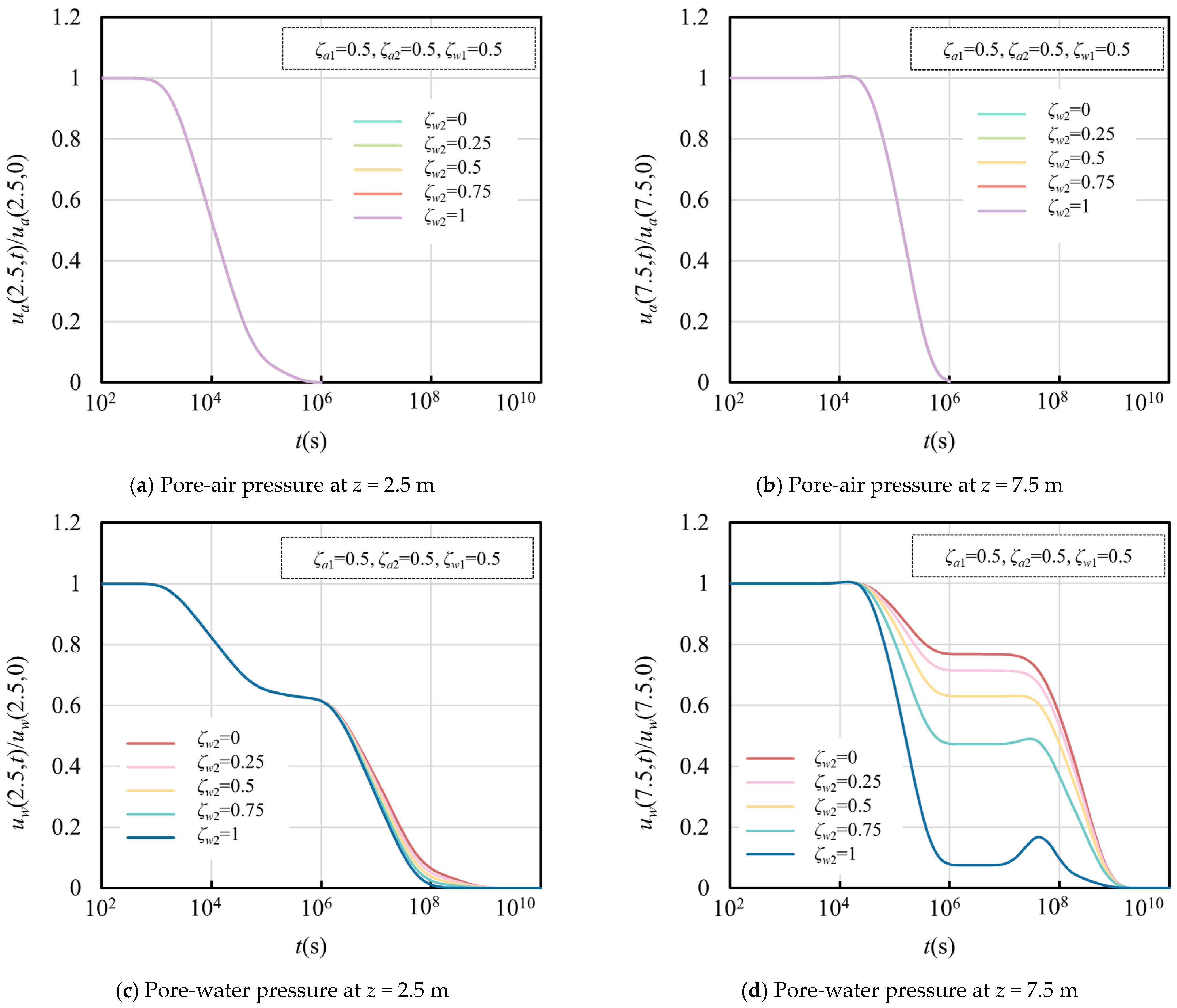
The changes in excess pore-air and pore-water pressures due to variations in ζ w [ i ] and ζ a [ i ] are discussed below. The consolidation process is investigated, as shown in Figure 4, at z = 2.5 m in the first layer and z = 7.5 m in the second layer.
Figure 5 is used to demonstrate the dissipation rates of excess pore pressures with increasing ζa1 and constant ζa2, ζw1, and ζw2. Figure 5a illustrates that varying ζa1, while keeping ζa2, ζw1, and ζw2 constant, exerts a negligible influence on the dissipation rate of pore-air pressure within the first layer. The variation in ζa1 has minor effects on the pore-air pressure dissipation rate within the second layer between approximately 104 and 105 s. The dissipation rate of pore-water pressures can be divided into two stages. This two-stage pattern is directly linked to the phase interaction: the first stage is governed by air dissipation, and the second stage commences only after pore-air pressure is fully dissipated. The variation in ζa1 has major effects on the pore-water pressure dissipation rate within the first layer in the two stages. As shown in Figure 5c, a higher ζa1 corresponds to a slower change in pore-water pressure during the first stage. The second stage commences upon the complete dissipation of pore-air pressure. Notably, under varying ζa1, pore-water pressures continue to dissipate throughout this second stage until approximately 1010 s. Conversely, the variation in ζa1 has only minor effects on the pore-water pressure dissipation rate within the second layer.
Figure 6 demonstrates the dissipation rates under varying ζa2 while keeping other parameters constant. Regarding pore-air pressure, ζa2 variation has a minor effect on the dissipation rate in the first layer between approximately 104 and 106 s. The variation in ζa2 modifies the time-dependent dissipation pattern of pore-air pressure in the second layer. Specifically, when ζa2 equals 0.5, 0.75, and 1.0, pore-air pressure shows an initial rise to a peak followed by a decline. Furthermore, the magnitude of the peak pore-air radio increases with larger ζa2 values. For pore-water pressure, ζa2 has a negligible influence in the first layer but a major influence in the second layer during both stages. The variation in ζa2 modifies the time-dependent dissipation pattern of pore-air pressure within the second layer in the first stage. When ζa2 equals 0.5, 0.75, and 1.0, pore-water pressure shows an initial rise to a peak followed by a decline. This ‘hump’ phenomenon in Layer 2 is likely induced by the combined effect of the initial air gradient and the impeded drainage at the base, which temporarily retards airflow before dissipation prevails. Furthermore, the magnitude of the peak increases with larger ζa2 values.
Figure 7 demonstrates the dissipation rates of excess pore pressures with increasing ζw1 and constant ζa1, ζa2, and ζw2. Figure 7a,b illustrates that varying ζw1, while keeping ζa2, ζw1, and ζw2 constant, exerts a negligible influence on the dissipation rate of pore-air pressure in both layers. The variation in ζw1 has major effects on the pore-water pressure dissipation rate within the first layer in the two stages. As shown in Figure 7c, a lower ζw1 corresponds to a slower change in pore-water pressure during the first stage. Under varying ζw1, pore-water pressures continue to dissipate throughout this second stage until approximately 1010 s. Conversely, the variation in ζw1 has only minor effects on the pore-water pressure dissipation rate within the second layer. This confirms that the initial water-phase condition predominantly controls the hydraulic response within its own layer, with minimal cross-layer effect on the air phase.
Figure 8 demonstrates the dissipation rates of excess pore pressures with increasing ζw2 and constant ζa1, ζa2, and ζw1. Figure 8a,b illustrates that ζw2 shows a negligible influence on the dissipation rate of pore-air pressure in both layers. The variation in ζw2 has a minor effect on the dissipation rate in the first layer between approximately 106 and 1010 s. A lower ζw2 corresponds to a slower change in pore-water pressure. The variation in ζw2 has major effects on the pore-water pressure dissipation rate within the second layer in the two stages. As shown in Figure 8d, a lower ζw1 corresponds to a slower change in pore-water pressure during the first stage. The variation in ζw2 modifies the time-dependent dissipation pattern of pore-air pressure in the second layer during the second stage. Specifically, when ζw2 equals 0.75 and 1.0, pore-water pressure shows a rise followed by a decline. The subtle rise in the second stage suggests a complex interaction, where the dissipation of pore-air pressure from the lower layer temporarily affects the local water pressure gradient. This non-monotonic behavior is a physical feature of coupled air-water flow: the rapid early dissipation of pore-air pressure reduces the matric suction, causing a transient release and redistribution of pore water that temporarily elevates the local water pressure before the overall drainage flow resumes dominance.
The dissipation of excess pore pressure in each soil layer is predominantly governed by its own depth-dependent initial condition, exhibiting limited cross-layer influence, which underscores the necessity of layer-specific characterization for accurate consolidation prediction in multi-layered unsaturated strata.
More broadly, the work represents a small but important advance in incorporating such temporal and spatial variability considerations—exemplified here by initial pore pressure fields—into the design analysis for related phenomena, such as gas generation in geotechnical systems.

6. Conclusions

This study proposes a semi-analytical solution for evaluating one-dimensional consolidation behavior of multi-layered unsaturated soils subjected to depth-dependent initial conditions. The governing equations are decoupled and solved in the Laplace domain by reduced order combined with the Euler method. The Crump method is employed to invert these solutions into the time domain. The accuracy of the derived solutions is verified against existing analytical solutions from the literature. For a double-layered system with a permeable top surface and an impervious bedrock base, the evolution of excess pore-air and pore-water pressures is explicitly predicted. The results indicate that the initial condition of the air phase in the upper layer has a negligible effect on pore-air pressure changes in either layer. In contrast, variations in the initial air-phase condition of the lower layer exert only minor influence on pore-air pressure in the upper layer but lead to significant changes within the lower layer itself. Notably, initial air pressure changes in either layer substantially affect pore-water pressure dissipation confined to the corresponding layer. The initial condition of the water phase shows a negligible impact on pore-air pressure variations in both layers. Conversely, changes in the initial water-phase condition within a given layer predominantly influence pore-water pressure dissipation in that layer.

7. Limitations and Future Research Directions

While this study provides a valuable theoretical framework, its scope suggests several meaningful avenues for further investigation as follows:
(1)
Experimental Validation: The proposed model offers clear, testable predictions for pore pressure dissipation in layered unsaturated soils. A direct and valuable next step would be the design and execution of controlled laboratory experiments using instrumented, multi-layered soil columns. Comparing measured pore-air and pore-water pressure responses with the model’s predictions under various depth-dependent initial conditions would provide essential empirical validation and refine parameter selection.
(2)
Model Formulation and Dimensionality: The presented 1D solution, based on linear consolidation theory, offers a foundation for future extensions. Research can progress towards multi-dimensional analyses and the integration of more sophisticated nonlinear and elastoplastic constitutive models to capture stress-dependent soil behavior under large deformations.

Author Contributions

Conceptualization, S.S. and X.W.; methodology, B.L. and J.C.; software, B.L.; validation, J.C. and J.Q.; formal analysis, B.L.; investigation, J.Q.; resources, X.W.; data curation, J.C.; writing—original draft preparation, J.C.; writing—review and editing, X.W. and S.S.; visualization, B.L.; supervision, X.W.; project administration, X.W.; funding acquisition, S.S. All authors have read and agreed to the published version of the manuscript.

Funding

This study is supported by the National Key R&D Program of China (No. 2022YFC3202700), the Water Conservancy Science and Technology Project of Jiangsu Province (No. 2024046), and the Fundamental Research Funds for the Central Universities (No. B240201024).

Institutional Review Board Statement

Not applicable.

Informed Consent Statement

Not applicable.

Data Availability Statement

The data presented in this study are available on request from the corresponding author.

Conflicts of Interest

Author Junhao Chen was employed by Huadong Engineering Corporation Limited, Power China, the remaining authors declare that the research was conducted in the absence of any commercial or financial relationships that could be construed as a potential conflict of interest.

References

  1. Barden, L. Consolidation of Compacted and Unsaturated Clays. Géotechnique 1965, 15, 267–286. [Google Scholar] [CrossRef]
  2. Conte, E. Consolidation analysis for unsaturated soils. Can. Geotech. J. 2004, 41, 599–612. [Google Scholar] [CrossRef]
  3. Lo, W.-C.; Sposito, G.; Lee, J.-W.; Chu, H. One-dimensional consolidation in unsaturated soils under cyclic loading. Adv. Water Resour. 2016, 91, 122–137. [Google Scholar] [CrossRef]
  4. Fredlund, D.G.; Rahardjo, H. Soil Mechanics for Unsaturated Soils; John Wiley & Sons: Hoboken, NJ, USA, 1993. [Google Scholar] [CrossRef]
  5. Qin, A.; Chen, G.; Tan, Y.; Sun, D. Analytical solution to one-dimensional consolidation in unsaturated soils. Appl. Math. Mech. 2008, 29, 1329–1340. [Google Scholar] [CrossRef]
  6. Shan, Z.; Ling, D.; Ding, H. Analytical solution for 1D consolidation of unsaturated soil with mixed boundary condition. J. Zhejiang Univ. Sci. A 2013, 14, 61–70. [Google Scholar] [CrossRef]
  7. Zhou, W.H.; Zhao, L.S.; Li, X.B. A simple analytical solution to one-dimensional consolidation for unsaturated soils. Int. J. Numer. Anal. Methods Geomech. 2014, 38, 794–810. [Google Scholar] [CrossRef]
  8. Wang, L.; Sun, D.a.; Li, L.; Li, P.; Xu, Y. Semi-analytical solutions to one-dimensional consolidation for unsaturated soils with symmetric semi-permeable drainage boundary. Comput. Geotech. 2017, 89, 71–80. [Google Scholar] [CrossRef]
  9. Zhao, X.; Ng, C.W.; Zhang, S.; Ni, J.; Zhou, C. An explicit one-dimensional consolidation solution with semi-permeable drainage boundary for unsaturated soil. Int. J. Numer. Anal. Methods Geomech. 2020, 44, 2241–2253. [Google Scholar] [CrossRef]
  10. Liu, Y.; Zheng, J.J.; Lu, J.T. An analytical model for 2D consolidation of unsaturated soil with semi-permeable boundaries considering self-weight stress and time-dependent loading. Int. J. Numer. Anal. Methods Geomech. 2023, 47, 903–935. [Google Scholar] [CrossRef]
  11. Jiang, L.; Qin, A.; Zheng, Q. A Unified Treatment to 1D Consolidation of Unsaturated Soils. Int. J. Numer. Anal. Methods Geomech. 2025, 49, 3970–3982. [Google Scholar] [CrossRef]
  12. Xie, K.-H.; Xie, X.-Y.; Jiang, W. A study on one-dimensional nonlinear consolidation of double-layered soil. Comput. Geotech. 2002, 29, 151–168. [Google Scholar] [CrossRef]
  13. Cai, Y.; Liang, X.; Wu, S. One-dimensional consolidation of layered soils with impeded boundaries under time-dependent loadings. Appl. Math. Mech. 2004, 25, 937–944. [Google Scholar] [CrossRef]
  14. Hu, A.; Wang, Z.; Wei, X.; Xie, S.; Zong, M.; Xiao, Z. One-Dimensional Nonlinear Consolidation Behavior of Layered Soils With Heterogeneous Foundations and Continuous Drainage Boundaries. Int. J. Numer. Anal. Methods Geomech. 2026, 50, 613–627. [Google Scholar] [CrossRef]
  15. Shan, Z.; Ling, D.; Ding, H. Analytical solution for the 1D consolidation of unsaturated multi-layered soil. Comput. Geotech. 2014, 57, 17–23. [Google Scholar] [CrossRef]
  16. Fazeli, A.; Keshavarz, A.; Moradi, M. Coupled consolidation of layered unsaturated soil under general time-dependent loading. Int. J. Geomech. 2018, 18, 04018088. [Google Scholar] [CrossRef]
  17. Moradi, M.; Keshavarz, A.; Fazeli, A. One dimensional consolidation of multi-layered unsaturated soil under partially permeable boundary conditions and time-dependent loading. Comput. Geotech. 2019, 107, 45–54. [Google Scholar] [CrossRef]
  18. Li, L.; Qin, A.; Jiang, L.; Mei, G. Semianalytical solution for one-dimensional consolidation in a multilayered unsaturated soil system with exponentially time-growing permeable boundary. J. Eng. Mech. 2021, 147, 04021025. [Google Scholar] [CrossRef]
  19. Li, L.; Qin, A.; Jiang, L. Semianalytical solution of one-dimensional consolidation of multilayered unsaturated soils. Int. J. Geomech. 2021, 21, 06021017. [Google Scholar] [CrossRef]
  20. Zhou, S.; Kang, J.; Lv, C.; Huang, M. One-dimensional consolidation of multi-layered unsaturated soil with impeded drainage boundaries. Appl. Sci. 2020, 11, 133. [Google Scholar] [CrossRef]
  21. Chen, Y.; Wang, L.; Shen, S.; Li, T.; Xu, Y. One-dimensional consolidation for multilayered unsaturated ground under multistage depth-dependent stress. Int. J. Numer. Anal. Methods Geomech. 2022, 46, 2849–2867. [Google Scholar] [CrossRef]
  22. Zhou, T.; Wang, L.; Li, T.; Wen, M.; Zhou, A. Semi-analytical solutions to the one-dimensional consolidation for double-layered unsaturated ground with a horizontal drainage layer. Transp. Geotech. 2023, 38, 100909. [Google Scholar] [CrossRef]
  23. Ho, L.; Fatahi, B.; Khabbaz, H. Analytical solution for one-dimensional consolidation of unsaturated soils using eigenfunction expansion method. Int. J. Numer. Anal. Methods Geomech. 2014, 38, 1058–1077. [Google Scholar] [CrossRef]
  24. Zhou, W.-H.; Zhao, L.-S. One-dimensional consolidation of unsaturated soil subjected to time-dependent loading with various initial and boundary conditions. Int. J. Geomech. 2014, 14, 291–301. [Google Scholar] [CrossRef]
  25. Wang, L.; Sun, D.; Qin, A. General semi-analytical solutions to one-dimensional consolidation for unsaturated soils. Appl. Math. Mech. 2017, 38, 831–850. [Google Scholar] [CrossRef]
  26. Fredlund, D.G.; Hasan, J.U. One-dimensional consolidation theory: Unsaturated soils. Can. Geotech. J. 1979, 16, 521–531. [Google Scholar] [CrossRef]
  27. Crump, K.S. Numerical inversion of Laplace transforms using a Fourier series approximation. J. ACM 1976, 23, 89–96. [Google Scholar] [CrossRef]
  28. Huang, M.; Zhao, M. A general analytical solution for one dimensional consolidation of unsaturated soil incorporating impeded drainage boundaries. Comput. Geotech. 2020, 128, 103801. [Google Scholar] [CrossRef]
  29. Zhou, W.-H.; Zhao, L.-S.; Garg, A.; Yuen, K.-V. Generalized analytical solution for the consolidation of unsaturated soil under partially permeable boundary conditions. Int. J. Geomech. 2017, 17, 04017048. [Google Scholar] [CrossRef]
Figure 1. Schematic diagram of the one-dimensional consolidation model for a multi-layered unsaturated soil stratum.
Applsci 16 01168 g001
Figure 2. Pore pressure evolution: comparison with the model of Shan et al. [15].
Applsci 16 01168 g002
Figure 3. Pore pressure evolution: comparison with the model of Ho et al. [23].
Applsci 16 01168 g003
Figure 4. Double-layered soil consolidation monitoring schematic.
Applsci 16 01168 g004
Figure 5. Pore pressure response to different ζa1 values.
Applsci 16 01168 g005
Figure 6. Pore pressure response to different ζa2 values.
Applsci 16 01168 g006
Figure 7. Pore pressure response to different ζw1 values. Note: In subfigures (a,b), the five data lines are nearly identical and thus overlap completely, with only the top purple line being visible.
Applsci 16 01168 g007
Figure 8. Pore pressure response to different ζw2 values. Note: In subfigures (a,b), the five data lines are nearly identical and thus overlap completely, with only the top purple line being visible.
Applsci 16 01168 g008
Table 1. Parameters of the two cases of soil strata adopted from the literature [15,23].
The LiteratureLayer No.himw1mw2ma1ma2kwkaSr0n0
(m)(×10−4 kPa−1)(×10−9 m/s)--
Shan et al. (2014) [15]13−0.5−2−210.110.80.45
24−0.5−2−211100.60.5
33−0.5−2−210.110.70.4
Ho et al. (2014) [23]110−0.5−2−210.10.10.80.5
Other parameters: γw = 10 kN/m3, uatm = 101 kPa, T = 293.16 K, R = 8.31432 J/mol/K, and M = 0.029 g/mol.
Table 2. Parameters of a two-layered soil strata.
Layer No.himw1mw2ma1ma2kwkaSr0n0
(m)(×10−4 kPa−1)(×10−9 m/s)--
15−0.5−2−211100.70.5
25−0.65−2.5−2.851.50.110.80.4
Other parameters: γw = 10 kN/m3, uatm = 101 kPa, T = 293.16 K, R = 8.31432 J/mol/K, and M = 0.029 g/mol.
Disclaimer/Publisher’s Note: The statements, opinions and data contained in all publications are solely those of the individual author(s) and contributor(s) and not of MDPI and/or the editor(s). MDPI and/or the editor(s) disclaim responsibility for any injury to people or property resulting from any ideas, methods, instructions or products referred to in the content.