Article

A Fuzzy-Based Multi-Stage Scheduling Strategy for Electric Vehicle Charging and Discharging Considering V2G and Renewable Energy Integration

School of Economics and Management, Chongqing Jiaotong University, Chongqing 400074, China
*
Author to whom correspondence should be addressed.
Appl. Sci. 2026, 16(3), 1166; https://doi.org/10.3390/app16031166
Submission received: 6 January 2026 / Revised: 18 January 2026 / Accepted: 21 January 2026 / Published: 23 January 2026

Abstract

The large-scale integration of electric vehicles (EVs) presents both challenges and opportunities for power grid stability and renewable energy utilization. Vehicle-to-Grid (V2G) technology enables EVs to serve as mobile energy storage units, facilitating peak shaving and valley filling while promoting the local consumption of photovoltaic and wind power. However, uncertainties in renewable energy generation and EV arrivals complicate the scheduling of bidirectional charging in stations equipped with hybrid energy storage systems. To address this, this paper proposes a multi-stage rolling optimization framework combined with a fuzzy logic-based decision-making method. First, a bidirectional charging scheduling model is established with the objectives of maximizing station revenue and minimizing load fluctuation. Then, an EV charging potential assessment system is designed, evaluating both maximum discharge capacity and charging flexibility. A fuzzy controller is developed to allocate EVs to unidirectional or bidirectional chargers by considering real-time predictions of vehicle arrivals and renewable energy generation. Simulation experiments demonstrate that the proposed method consistently outperforms a greedy scheduling baseline. In large-scale scenarios, it achieves an increase in station revenue, elevates the regional renewable energy consumption rate, and provides an additional equivalent peak-shaving capacity. The proposed approach can effectively coordinate heterogeneous resources under uncertainty, providing a viable scheduling solution for EV-aggregated participation in grid services and enhanced renewable energy integration.

1. Introduction

1.1. Background

The global energy system is undergoing a pivotal transition towards decarbonization and intelligence. Driven by climate change mitigation efforts and energy security concerns, the share of intermittent renewable energy generation, represented by wind and photovoltaic (PV) power, continues to rise rapidly. Concurrently, electrification in the transportation sector is advancing swiftly, with the large-scale adoption of Electric Vehicles (EVs) becoming a definitive trend. However, extensive uncoordinated EV charging loads can exacerbate peak-to-valley differences in grid demand, posing significant challenges to the stable operation of distribution networks. Notably, EVs are not merely power consumers; their onboard batteries are inherently distributed mobile energy storage units with the potential for bidirectional energy flow. This Vehicle-to-Grid (V2G) capability enables EVs to charge during off-peak periods and discharge to the grid during peak demand, thereby providing “peak shaving and valley filling” services to smooth load fluctuations [1]. The coordinated integration of EV fleets with renewable energy generation systems and stationary energy storage systems (ESS) to construct intelligent and flexible charging infrastructure is of great practical significance for enhancing grid resilience, promoting the local consumption of renewable energy, and reducing system operational costs [2].
Nevertheless, achieving a dynamic match between EV bidirectional charging behavior and grid demand amidst renewable energy volatility faces several core challenges in real-world operation. First, the system is subject to significant uncertainties: renewable energy output exhibits strong volatility and randomness due to weather dependency [3], while EV user behavior parameters such as arrival time, dwell duration, and initial state of charge (SOC) are also difficult to predict precisely [4]. Second, resources within a charging station are limited and heterogeneous. Operational objectives are multifaceted, encompassing economic revenue maximization, renewable energy consumption rate improvement, and grid ancillary services. These objectives may conflict intrinsically. Third, scheduling is a typical multi-stage sequential decision-making process. A station cannot obtain complete information for the entire day in advance and must possess “rolling optimization” capability to make forward-looking decisions based on limited, real-time information [5]. Therefore, there is an urgent need for an EV bidirectional charging scheduling methodology that can coordinate heterogeneous resources under multiple uncertainties, effectively balance multi-objectives, and support rolling decision-making.
The realization of V2G services can indeed be envisioned through various energy storage and conversion technologies, each with distinct characteristics: batteries offer high energy density for sustained energy transfer, hybrid super-capacitors provide exceptional power density for rapid response, and hydrogen-based systems promise long-duration storage. This study focuses on battery electric vehicles (BEVs) for several pragmatic reasons: (1) BEVs currently represent the dominant and most rapidly scalable pathway for road transport electrification, constituting the immediate and massive fleet resource for grid interaction. (2) While their power density may be lower than some alternatives, their aggregated capacity from millions of units presents a formidable, distributed grid resource primarily suited for energy-intensive peak shaving and renewable integration over minutes to hours, rather than sub-second frequency regulation. (3) The core methodological contribution of this paper—a scheduling framework for coordinating a heterogeneous fleet under uncertainty—is largely agnostic to the underlying storage chemistry. The proposed fuzzy logic and rolling-horizon architecture could, in principle, be adapted to coordinate fleets of vehicles or stationary systems employing other storage technologies, once their specific operational constraints are parameterized within the model.

1.2. Literature Review

The rapid increase in the number of electric vehicles (EVs) has imposed significant impacts on the stable operation of the power grid due to concentrated charging demands. Bidirectional charging of EVs can not only alleviate grid load fluctuations but also promote the effective utilization of green energy sources such as wind and solar power. This section provides an analysis and summary of research on EV bidirectional charging scheduling and EV charging scheduling considering green energy integration.
First, EV battery technology brings significant innovation to the energy market. Vehicles can serve not only as transportation tools but also as dynamic energy transfer interfaces with the grid, buildings, and other systems. EVs can mitigate grid load fluctuations and generate revenue through flexible bidirectional charging. Several scholars have studied EV bidirectional charging issues. Prakash et al. [6] considered uncertainties from both EVs and the distribution network to determine EV charging locations and bidirectional charging schedules, aiming to reduce peak loads in the distribution network. Nimalsiri et al. [7] proposed using EV bidirectional charging to achieve grid peak shaving and valley filling, modeling and solving the EV bidirectional charging scheduling problem. Pan et al. [8] developed a charging scheduling optimization model minimizing grid load fluctuation and user cost, proposing an improved algorithm for optimal EV bidirectional charging power allocation. Experiments showed that implementing an ordered bidirectional charging strategy can significantly reduce user charging costs, effectively mitigate grid load variations, and improve both user economic benefits and grid operational stability. Guo et al. [9] proposed a hybrid scheduling framework for EV charging stations integrated with photovoltaic generation and energy storage systems. This framework optimally schedules real-time energy and charging for EVs within a unified decision-making framework to achieve intelligent coordination among renewable energy, storage dynamics, and dynamic grid pricing.
Considering the spatial mobility of EVs, some researchers have integrated EV charging scheduling with travel patterns. Das and Kayal [10] combined bidirectional charging scheduling with EV travel routes, proposing a two-stage bidirectional charging scheduling method to determine EV charging and discharging schemes across different time periods. Xiong et al. [11] analyzed the “source-load” characteristics of EVs, discussed the feasibility of V2G technology participating in microgrid load regulation, and established a dynamic mathematical model for microgrid load control based on V2G technology. Yin and Ming [12] proposed a particle swarm optimization algorithm based on local search, employing competitive and opposite learning mechanisms to solve the V2G scheduling problem. Yin et al. [13] developed an optimal scheduling model based on grid losses, considering grid security and EV charging requirements, utilizing LSTM-XGBoost dynamic combined forecasting. The model was solved using second-order cone relaxation techniques. Niu et al. [14] considered uncertainties in photovoltaic output, EV charging demand, and basic household loads to determine the optimal layout of V2G chargers and bidirectional charging strategies. Chen et al. [15] considered the state of charge of EVs, constructed a bidirectional charging model, and quantitatively calculated the impact of EV participation in V2G on distribution network voltage quality. Zhang et al. [16] focused on bus battery swapping stations, implementing orderly battery charging and discharging through an internal bus battery swapping control system, and connecting externally to the regional grid to consume renewable energy and promote its integration.
Beyond being spatiotemporal loads, EVs also serve as mobile energy storage units. Esmaili et al. [17] treated EVs as distributed energy storage systems, proposing an energy scheduling method aimed at minimizing operational costs and energy losses to increase the use of renewable energy. Liu et al. [18] considered constraints such as battery capacity, the number of charging station piles, and the accessibility of traffic routes, proposing a decision-making algorithm for EV bidirectional charging. Dean et al. [19] addressed multi-stage bidirectional charging problems by transforming low-cost energy transactions into vehicle scheduling decisions, minimizing electricity purchase prices and marginal emission damage through solving bidirectional charging optimization problems. Rafique et al. [20] proposed a coordination mechanism for EV bidirectional charging scheduling, minimizing energy costs while managing peak demand and adhering to grid constraints. Fachrizal et al. [21] considered smart charging and V2G schemes under different charging scenarios to minimize the mismatch between generation and load. Zheng and Yao [22] compared the impact of disordered versus ordered bidirectional charging on the capacity of photovoltaic charging stations, providing decision-making suggestions from perspectives including maximizing energy efficiency, minimizing investment, and minimizing charging system operational costs.
Coordinating EV charging within distribution networks and addressing wind power uncertainty are among the most challenging problems in power system control and operation, aiming to reduce generation costs and emissions. For instance, Hong et al. [23] analyzed EV charging behavior in urban scenarios based on green energy power forecasting, establishing a multi-objective optimization model for the joint scheduling of green energy and EVs, and designed an online charging scheduling algorithm. Khonji et al. [24] proposed an EV charging scheduling optimization model and designed approximation algorithms to solve the problem, aiming to alleviate peak electricity demand pressure and maximize the use of intermittent renewable energy. Yang et al. [25] proposed a robust model predictive control-based scheduling approach for EV charging at photovoltaic power stations, maximizing operational revenue while considering intermittent solar supply and charging demand uncertainty. Ali et al. [26] considered uncertainties in photovoltaic and wind power generation systems along with vehicle charging constraints, establishing a bi-level bidirectional charging scheduling model. The upper level optimizes the bidirectional charging of renewable energy and storage devices, while the lower level optimizes the EV charging scheme. Nourianfar and Abdi [27] designed an enhanced multi-objective coordinated charging algorithm to solve the bidirectional charging scheduling problem considering stochastic EV behavior and wind power uncertainty, proposing intelligent EV bidirectional charging strategies to smooth the load curve. Meng et al. [28] considered the uncertainty of photovoltaic generation and charging demand, dynamically updating forecasts based on real-time data, and proposed a multi-timescale stochastic scheduling strategy to minimize operational costs.
With the rise in attention to building microgrid technology, Welzel et al. [29] studied a local energy system comprising buildings, photovoltaic systems, and EVs. Aiming to minimize charging station operational costs, they established a non-linear optimization model for coordinated EV charging and incorporated customer satisfaction into the objective function via penalty costs. Eghbali et al. [30] addressed the optimal operational scheduling problem for microgrids, considering uncertainties in renewable energy, electricity prices, power loads, and EVs, proposing a scenario-based stochastic modeling method for uncertain parameters. Wang et al. [31], while studying distributed building energy systems incorporating EVs, considered the uncertainty of EV charging behavior and time-of-use electricity pricing. With objectives of minimizing electricity cost, maximizing renewable energy utilization, and minimizing net grid purchase, they analyzed the impact of EV fast-charging power and carbon taxes on scheduling results. Mathew et al. [32] proposed an EV bidirectional charging scheduling model based on load distribution, power flow analysis, and renewable energy generation forecasting to maximize renewable energy utilization. Liu et al. [33] analyzed the intermittent output of distributed generators, conventional load demand, and the temporal characteristics of charging loads, establishing a bi-level joint planning model under peak-valley pricing mechanisms to achieve comprehensive profitability and suppress grid load fluctuations. Saber et al. [34] studied the energy scheduling problem of an office building microgrid including EV charging piles, batteries, and rooftop photovoltaic systems, determining optimal EV charging decisions by leveraging the flexibility of batteries and EV charging.
As large-scale EVs are integrated into the grid, their intermittent and fluctuating nature poses severe challenges to power quality and scheduling, exacerbating the phenomena of “wind and solar curtailment.” Battery energy storage systems (BESS) can store power from renewable generation and release it during grid peak hours, alleviating grid load pressure and reducing green energy waste. Consequently, some scholars have begun to incorporate BESS into grid operation considerations. For example, Zhang et al. [35] considered the V2G characteristics of EVs, grid load fluctuations, EV charging costs, and grid losses, conducting spatial scheduling optimization for EVs and wind power. They established a multi-objective optimization scheduling model aiming to minimize distribution network system losses. Guo et al. [36] proposed a multi-power source joint optimal scheduling model considering nuclear power peak shaving, based on the characteristics of nuclear power peak regulation operation. The model studies the coordinated operation of nuclear power with photovoltaics and other power sources. Liao et al. [37] proposed a bidirectional charging scheduling optimization strategy for EV charging stations and BESS, employing a distributed computing architecture to simplify problem complexity. Based on relevant electricity prices and demand-response schemes, the strategy maximizes the operational profit of EVs and BESS. Zhang et al. [38] proposed a distributionally robust chance-constrained model incorporating spatiotemporal correlations into a renewable-dominated integrated wind-PV-pumped hydro storage system. The model optimizes day-ahead energy dispatch and real-time regulation operation for renewable-dominated power systems by minimizing expected total cost. Yang et al. [39] guided consumer and vehicle owner electricity behavior via real-time pricing to adapt to renewable energy output uncertainty, ensuring sufficient flexible capacity within the scheduling cycle. They proposed an orderly EV bidirectional charging strategy to reduce operational costs and peak-valley load differences. Dong et al. [40] proposed a capacity configuration and scheduling optimization model for EV charging stations with photovoltaic and energy storage systems, combining hybrid modeling of photovoltaic power forecasting with charging pile optimal scheduling methods. Li et al. [41] considered the uncertainty of wind and photovoltaic power output, constructing a source-load-storage joint peak-shaving optimal dispatch model based on Copula theory scenario analysis, and designed incentive-based demand-response pricing strategies.
To succinctly summarize the landscape and position our contribution, Table 1 compares key features, assumptions, and limitations of selected representative studies alongside the proposed framework.
The aforementioned studies have significantly advanced the field of EV smart charging and V2G integration, establishing critical models, algorithms, and applications. However, a synthesis of this body of work reveals several persistent, intertwined challenges when considering the real-time operation of a charging station under high uncertainty.
While many studies address either renewable uncertainty or EV stochasticity separately, fewer offer a unified, computationally efficient framework that dynamically coordinates charging/discharging decisions under both sources of uncertainty in a rolling-horizon manner.
Existing optimization models often treat the EV-to-charger assignment and the detailed energy scheduling as a single, monolithic problem. This approach can become intractable for real-time decision-making and obscures a critical, high-level operational decision: how to intelligently allocate heterogeneous EVs to limited, specialized charger resources based on their grid service potential.
Sophisticated methods like stochastic programming may require precise probability distributions and incur high computational costs, while data-driven learning approaches demand extensive training data and yield less interpretable policies. There remains a need for a transparent, rule-based yet optimization-guided strategy that can be deployed with limited data and operates within the strict time constraints of sub-hourly grid service markets.


1.3. Contributions and Organization

To address the identified research gap, this paper proposes a fuzzy logic-based multi-stage rolling optimization strategy for EV bidirectional charging scheduling, deeply integrating V2G technology with renewable energy integration needs. The main contributions of this paper are as follows:
  • Development of a Multi-stage Rolling Scheduling Model Considering Dual Uncertainties: A stochastic optimization model is formulated with the objectives of maximizing charging station revenue and minimizing load fluctuation. This model operates in a rolling-horizon manner, where at each decision stage, it utilizes newly revealed deterministic information to update forecasts of future uncertainties and re-optimize the subsequent schedule.
  • Proposal of a Quantitative EV Bidirectional Charging Potential Assessment System: Two key evaluation metrics—Maximum Discharge Capacity and Bidirectional Charging Flexibility—are defined and quantified, providing a basis for accurately identifying high-value dispatchable EV resources.
  • Design of a Fuzzy Logic-based Dynamic Charging Pile Allocation Mechanism: A four-input single-output fuzzy controller is developed. Its inputs include vehicle discharge potential, flexibility, forecasted vehicle arrival rate, and renewable energy volatility. The output is the optimal charging pile allocation decision (reject, unidirectional charger, random allocation, or bidirectional charger), thereby systematizing and automating the complex multi-factor decision process.
  • Validation of the Method’s Superiority and Scalability through Simulation Experiments: Simulations based on real-world data scenarios demonstrate that the proposed method significantly outperforms traditional greedy scheduling in terms of station revenue, renewable energy consumption rate, and contribution to grid peak shaving. It also maintains good performance in large-scale regional scheduling scenarios.
The remainder of this paper is organized as follows: Section 2 formally describes the scheduling problem and establishes the mathematical model. Section 3 details the proposed EV potential assessment method and the fuzzy logic-based multi-stage scheduling solution framework. Section 4 presents the simulation setup and results analysis. Section 5 concludes the paper and outlines future research directions.

2. Problem Description and Mathematical Modeling

2.1. Problem Description

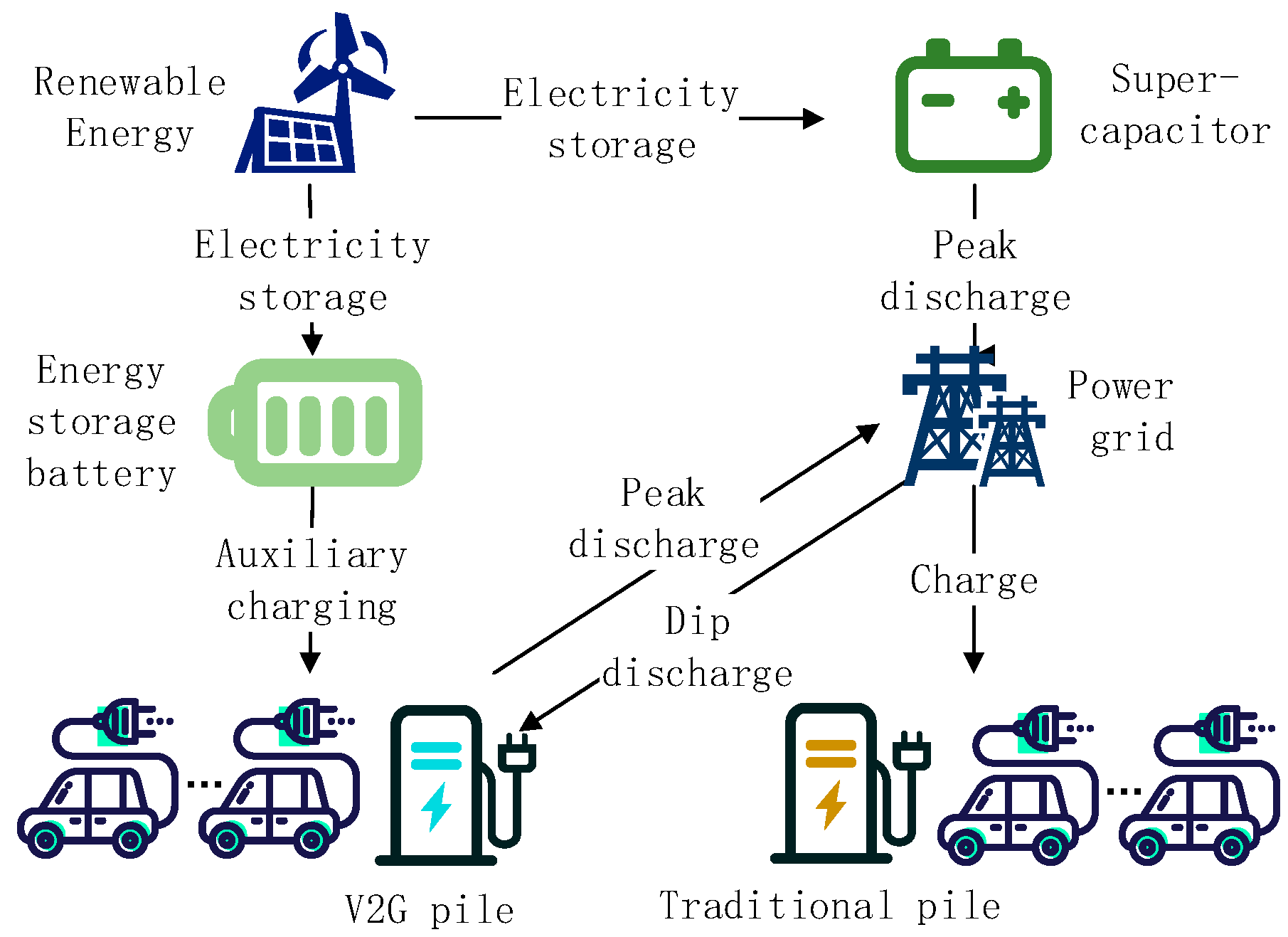
The problem is set in a charging station equipped with renewable energy generation facilities (e.g., PV, wind) and a hybrid energy storage system (ESS) [40]. The station contains a certain number of bidirectional charging piles and unidirectional charging piles. Renewable energy generated daily is primarily stored in super-capacitors and energy storage batteries. During grid peak load periods, super-capacitors discharge to the grid to alleviate power pressure and obtain corresponding discharge subsidies, while the energy storage batteries are responsible for assisting the grid in providing charging services to EVs. Furthermore, the station’s bidirectional charging piles enable bidirectional energy flow between EVs and the grid. EVs can charge via the piles during grid off-peak periods and discharge to the grid through bidirectional piles during peak periods, thereby alleviating grid stress and earning discharge subsidies.
The depicted flow, where renewable energy is primarily channeled through the hybrid Energy Storage System (ESS), is a deliberate design choice for stability and quality of service. Direct, unmediated charging of EVs from intermittent renewables could lead to power fluctuations and unreliable charging rates, negatively impacting user experience and grid power quality. The super-capacitor, with its high power density and rapid response, is employed to buffer short-term renewable fluctuations and provide fast transient power support, complementing the energy-dense but slower-responding battery. This hybrid ESS architecture—utilizing the battery for bulk energy time-shifting and the super-capacitor for high-power smoothing—is a well-established approach for integrating volatile renewables into power systems and is applied here to ensure stable and efficient EV charging operations [39,40,41].
To maximize bidirectional charging revenue, the charging station must reasonably assign arriving EVs to different types of charging piles and coordinate the bidirectional charging schedules for both EVs and the ESS. The overall system architecture primarily consists of four parts: the power grid, renewable energy generation facilities, the ESS, and EV users. The power flow interactions among these components are illustrated in Figure 1.
The EV bidirectional charging scheduling problem for a charging station with ESS can be defined as follows: A set of EV charging requests J = 1 , , m needs to be scheduled on a set of charging piles. Charging piles within the station are of two types: bidirectional piles capable of both charging and discharging EVs, and unidirectional piles that can only charge EVs. A unidirectional/bidirectional pile can be connected to only one EV at a time, and an EV can be connected to at most one pile. Each pile provides a constant bidirectional charging/discharging power P . Each EV’s charging request is characterized by its arrival time t j a , departure time t j d , battery state of charge (SOC) upon arrival e j a , and the desired minimum SOC upon departure e j a . If an EV is assigned to a pile, its SOC upon departure must be no less than e j a . An EV occupies the assigned pile from its arrival time t j a until its departure time t j d , even if charging/discharging is completed earlier. The scheduling horizon is divided into multiple time slots of equal length T . The station’s objectives are to (1) select suitable EVs to assign to available piles and (2) plan the coordinated bidirectional charging schedules for EVs and the ESS, in order to maximize the station’s overall revenue. Secondary objectives, pursued without compromising primary revenue, include maximizing the local consumption of renewable energy and providing peak-shaving and valley-filling services to the grid.

2.2. Mathematical Modeling

In reality, renewable energy generation is significantly influenced by weather conditions, leading to high uncertainty in its prediction. Simultaneously, the travel patterns of urban EV users also exhibit a degree of randomness. These uncertain factors substantially impact the solution accuracy and practical applicability of scheduling models. This section considers two primary sources of uncertainty—renewable energy generation and stochastic EV arrivals—and establishes a dynamic scheduling model for EV bidirectional charging based on stochastic generation and vehicle arrivals [41]. The model dynamically allocates charging piles to EVs arriving within each time slot and coordinates the charging/discharging schedules for both vehicles and the energy storage system.
The mathematical model presented in this section integrates and extends established paradigms from power systems optimization and operations research to address our specific problem. The rolling-horizon framework is a well-known approach for handling sequential decision-making under uncertainty [28]. The use of integer linear programming (ILP) to model discrete charging events and resource constraints is standard in scheduling problems. The bi-objective formulation is also a common way to capture competing interests. The novelty and contribution of this model lie in: (1) the specific integration of these components for a V2G station with hybrid ESS under dual uncertainty; (2) the definition of the EV potential assessment metrics as pre-processors; and (3) the way the model is designed to interface with the fuzzy logic allocation layer described in Section 3, creating a unique hybrid architecture.

2.2.1. Problem Assumptions and Notation

As it is impossible to accurately know the exact arrival times, dwell durations of EVs, and the renewable energy generation for each future time slot in advance, a dynamic bidirectional charging scheduling method based on rolling-horizon optimization is required [28]. To maintain model focus and exclude non-essential details without losing generality, the following assumptions are made:
Assumption 1:
At the beginning of each time slot, the renewable energy generation of the previous slot becomes available and is considered certain. The capacity of the station’s energy storage system and the bidirectional charging/discharging power of the piles are fixed.
Assumption 2:
The bidirectional charging/discharging power at the station is constant, and the EV’s state of charge (SOC) changes linearly during these operations.
Assumption 3:
The unit revenue for selling electricity to the grid during peak hours is lower than the unit cost of purchasing electricity during off-peak hours (implying a time-of-use price differential that incentivizes valley charging and peak discharging).
Assumption 1 converts stochastic information into deterministic information by using the realized generation from the last slot, avoiding solution inaccuracies due to the randomness of renewable generation and simplifying the modeling of the station’s ESS parameters. Assumption 2 facilitates the modeling of energy transfer per time slot. Assumption 3 ensures the station’s economic incentive to participate in grid load shifting through a time-of-use pricing policy.
The notations used in the model are listed in Table 2.

2.2.2. Electric Vehicle Charging Scheduling Optimization Model

Considering the uncertainties in EV arrivals, dwell times, and renewable energy generation, the scheduling of bidirectional charging for both vehicles and the storage system can be dynamically optimized in a rolling-horizon manner. At the end of a time slot, information about the EVs that arrived during that slot and the realized renewable energy generation becomes available and certain. Subsequently, charging piles can be allocated to those EVs, and their coordinated charging/discharging schedules can be planned. It is important to note that, to protect the interests of both the station and EV users, once a vehicle’s bidirectional charging plan is determined, adjustments to this plan can only be made if they do not affect the total financial outcome of its bidirectional charging operations. This means that within a scheduling cycle, the total number of bidirectional charging/discharging actions for a vehicle should remain unchanged, ensuring that the plan for the elapsed time is optimal while maintaining model stability.
At the end of the k time slot, the set of EVs that arrived during that slot, J k , becomes known, along with their departure times t j d , arrival state of charge e j a , desired departure state of charge e j d , and the actual renewable generation h k for that slot. The objective function for the bidirectional charging scheduling optimization at the beginning of the k + 1 slot is formulated as shown in Equation (1):
M a x F 1 k + 1 = F vc k + 1 + F vd k + 1 + F bc k + 1 + F sc k + 1
where
F vc k + 1 = i I j J k k K k + 1 ( α y i j k c ( s k c g k c ) ) P T / 60
F vd k + 1 = i I v j J k k K f K k + 1 ( β y i j k d ( g k d s k d ) ) P T / 60
F bc k + 1 = k K k z k b ( g k c l b ) P b T / 60
F sc k + 1 = k K f K k + 1 z k s ( g k d l s ) P s T / 60
where s k c and s k d represent the prices offered by the station to the EV user for charging and discharging, respectively. The difference between the grid price and the user price constitutes the station’s margin. Critically, the price offered to the user for discharging ( s k d ) is set to be greater than the price for charging ( s k c ), ensuring a direct financial benefit for the user who provides V2G service. This price spread ( s k d s k c ) is the explicit, immediate financial compensation that offsets the user’s perceived opportunity cost and incentivizes participation. K k + 1 denotes the set of time slots from slot K k + 1 onwards. F vc k + 1 and F vd k + 1 represent the revenue from charging and discharging EVs, respectively, considering the station’s price spread with the grid. F bc k + 1 is the revenue from using the energy storage battery to charge EVs. F sc k + 1 is the revenue from discharging the super-capacitor to the grid during peak hours.
It is important to note that the station’s revenue from discharge operations, represented by F vd k + 1 , F bc k + 1 and F sc k + 1 , is the net revenue after accounting for battery degradation costs. This is implemented by using the effective net discharge price per kWh, calculated as the grid discharge price minus the respective degradation cost per kWh ( l b for the storage battery and l s for the super-capacitor), as shown in Equations (3)–(5). Thus, the degradation cost directly reduces the marginal revenue of each discharge action, ensuring that the optimization naturally trades off discharge revenue against battery wear.
Since multiple optimal solutions may exist that maximize the station’s primary revenue objective F 1 k + 1 , a secondary objective is introduced to optimize the scheduling of charging/discharging for both EVs and the ESS in subsequent time slots, without compromising the primary revenue. This secondary objective is to minimize the fluctuation of the station’s net load, formulated as in Equation (6):
M i n F 2 k + 1 = k K k + 1 ( f k i I j J 1 J 2 J k ( y i j k c y i j k d ) P + z k s P s ) 2
where F 2 k + 1 represents a target net load profile for slot k , promoting grid-friendly operation.
Constraints:
The mathematical model for the k + 1 slot optimization is subject to the following constraints:
j J k x i j 1 , i I
y i j k c + y i j k d x i j , i I , i I , j J k , k K k + 1
j J 1 J 2 J k j ( J 1 J 2 J k / j ) c j j w j j = 0
w i j j x i j , i I , j J 1 J 2 J k , j J 1 J 2 J k / j
w i j j x i j ( 1 x i j j ) , i I , j J 1 J 2 J k , j J 1 J 2 J k / j
y i j k c + y i j k d u i j k , i I , j J k , k K k + 1
i I j J 1 J 2 J k y i j k c P z k b P b , k K k + 1
y i j k c + y i j k d x i j , i I , j J k , k K k + 1
y i j k c + y i j k d = 0 , i I , j J k , k ( t j a , t j d )
i I c j J 1 J 2 J k u i j k n c , k K k + 1
i I v j J 1 J 2 J k u i j k n v , k K k + 1
e j a + i I v k ( t j a , t j d ) ( α y i j k c β y i j k d ) P T / 60 e j d , j J 1 J 2 J k
e j a + i I c k ( t j a , t j d ) α y i j k c P T / 60 e j d , j J k
0.2 E j e j a + i I v k ( t j a , k ) ( α y i j k c β y i j k d ) P T / 60 E j , j J k , k ( t j a , t j d )
y i j k d = 0 , i I v , j J 1 J 2 J k , k K g K p K k + 1
y i j k c = 0 , i I , j J k , k K f K k + 1
y i j k c + y i j k d 1 , i I , j J k , k ( t j a , t j d )
0.1 H b h 0 b + k K k + 1 , k < k h k q k b k K k + 1 , k < k z k b P b T / 60 H b , k K k + 1
0.1 H s h 0 s + k K + 1 , k < k h k q k s k K f K k + 1 , k < k z k s P s T / 60 H s , k K k + 1
q k s + q k b 1 , k K k + 1
k ( t j a , t j d ) y i j k c = k ( t j a , t j d ) { y i j k c y i j k c Y k * } , i I , j J 1 J 2 J k 1
k ( t j a , t j d ) y i j k d = k ( t j a , t j d ) { y i j k d y i j k d Y k * } , i I v , j J 1 J 2 J k 1
Constraint Descriptions:
Equation (7): Each newly arrived EV is assigned to at most one charging pile.
Equation (8): An EV can only charge/discharge at a pile it is assigned to.
Equations (9)–(11): No scheduling time conflicts can occur for EVs assigned to the same pile.
Equation (12): Charging/discharging can only occur if the EV occupies the pile.
Equation (13): The energy storage battery can only discharge to assist EV charging if the total EV charging power demand is sufficient.
Equations (14) and (15): These logical constraints link assignment and activity; no activity can occur outside an EV’s parking period.
Equations (16) and (17): These constraints limit the number of EVs charging simultaneously, respecting pile type capacities. Note on Grid Connection Capacity: Constraints (16) and (17) limit the number of EVs charging ( n c ) and discharging ( n d ) simultaneously at the station. These constraints implicitly act as proxies for the maximum power draw/injection at the grid connection point. By setting n c and n d appropriately, the station operator can ensure that the aggregate power remains within the safe operating limits of the local transformer.
Equations (18) and (19): Each EV must meet its minimum departure state-of-charge requirement.
Equation (20): The EV’s battery state of charge must be kept within safe bounds (20% to 100%) at all times.
Equations (21) and (22): Time-of-use policy is enforced: discharging only during grid peak periods, charging only during off-peak or flat periods.
Equation (23): An EV cannot charge and discharge in the same time slot.
Equations (24) and (25): The energy storage battery and super-capacitor are subject to capacity limits, maintaining a minimum safe level.
Equation (26): Renewable energy in a slot can be stored in at most one type of storage device.
Equations (27) and (28): For EVs that arrived in previous slots, the total number of planned charging and discharging actions remain fixed to preserve their expected economic outcome and model stability.

2.2.3. Solving Approach and Scheduling Process Analysis

In the established mathematical model, all decision variables are binary, making it a 0-1 integer programming problem. A common approach is to convert the bi-objective optimization into a single objective using a weighting coefficient ω [35], as shown in Equation (29), and then solve it directly using solvers like CPLEX or Gurobi:
M a x F = ω 1 F 1 ω 2 F 2
Since the station revenue F 1 and the load fluctuation penalty F 2 have different units and scales, the weighting coefficients ω 1 and ω 2 are introduced to prevent the secondary objective from disproportionately affecting the solution process of the primary objective. However, converting a bi-objective problem into a single objective for a one-shot solution significantly increases computational burden, potentially leading to unacceptable solving times.
However, calibrating ω 1 and ω 2 to achieve a specific balance is non-trivial and can inadvertently lead to one objective dominating the others. To fundamentally avoid this weighting dilemma and ensure the primary objective is strictly prioritized, we employ a sequential optimization approach rather than solving the weighted single objective directly.
We first solve the model to optimize only the primary revenue objective F 1 , obtaining a set of optimal solutions that achieve the maximum possible revenue. From this optimal set, we then identify the solution that simultaneously minimizes the load fluctuation F 2 . This is achieved by adding constraints (Equations (30)–(33)) that fix the total number of charging/discharging actions for each EV and the ESS to the values found, thereby preserving the maximum revenue. We then re-optimize with M i n F 2 as the objective, which now only adjusts the timing of these fixed actions to smooth the net load.
This method ensures lexicographic priority: grid load smoothing is pursued only if it does not compromise the station’s economic revenue. It eliminates the need for subjective weight calibration and guarantees that F 1 is never dominated by F 2 . The secondary objective F 2 influences the solution only when multiple schedules yield identical maximum revenue.
Equation (29) is presented as a common methodological reference. In our implementation, the sequential approach is used. If one wished to use the weighted form, a systematic calibration would be necessary, but this is not required by our chosen method.
To accelerate the solving process, the two objectives F 1 and F 2 can be optimized sequentially according to their priority. The primary objective F 1 is optimized first. If the resulting solution is unique, it is considered the optimal solution to the bidirectional scheduling problem. If multiple optimal solutions yielding the same primary objective value exist, new constraints are added to the solution set obtained from the primary optimization to guide the selection towards the secondary objective F 2 . For instance, EVs might have different charging/discharging timing options that yield identical revenue but affect net load differently.
The primary objective optimization model involves a large number of decision variables, dimensions, and constraints, resulting in high computational complexity for direct solving, which is only feasible for small-scale verification. To speed up the primary objective optimization, it can be transformed into a bi-level model. The upper-level model determines the EV-to-charger assignment scheme X . The lower-level model, based on this specific assignment X and the renewable energy generation profile, plans the detailed bidirectional charging/discharging schedules Y and Z for the vehicles and ESS. The resulting station revenue F 1 is calculated based on these schedules and fed back to the upper-level model, which then adjusts the assignment scheme X accordingly. This bi-level decomposition effectively reduces the decision variable space dimension and minimizes logical coupling between variables in the original monolithic model.
After obtaining the optimal solution [ X * , Y * , Z * ] for the primary objective F 2 , the following constraints are added to the model when optimizing the secondary objective F 2 :
k ( t j a , t j d ) y i j k c = k ( t j a , t j d ) { y i j k c y i j k c Y * } , i I , j J
k ( t j a , t j d ) y i j k d = k ( t j a , t j d ) { y i j k d y i j k d Y * } , i I v , j J
k K z k s = k K { z k s z k s Z * }
k K f z k b = k K f { z k b z k b Z * }
Constraints (30)–(33) fix the total number of charging and discharging actions for each EV and for the ESS to their values from the primary optimal solution [ X * , Y * , Z * ] . This ensures the primary revenue remains unchanged while allowing flexibility in timing to minimize load fluctuation under these and the existing battery SOC constraints.
The overall model is solved within a multi-stage rolling-horizon framework. Each time the horizon rolls forward by one time slot, newly arrived vehicles from that slot must be assigned to chargers and the charging/discharging plans for all active and future EVs/ESS must be updated. As time progresses, previously unknown information is gradually revealed and becomes certain, enabling the continuous update of the coordinated schedule to improve renewable energy consumption and mitigate load fluctuations.
As previously noted, the model can be solved either by converting it into a single objective (Equation (29)) or by the sequential approach. Solving speed primarily depends on the dimensionality of the variable space. By decomposing the entire planning horizon into T time slots and adopting a multi-stage dynamic programming approach, each stage only involves planning for vehicles arriving in the current slot and updating schedules for future slots. This drastically reduces the dimension index j in decision variables compared to a global optimization. Furthermore, as time progresses and fewer future slots remain, the dimension index k also gradually decreases. Consequently, whether solved exactly or using heuristic algorithms, this multi-stage model is significantly faster than the deterministic full-information model, which requires solving the entire horizon at once. The pseudo-code for solving the scheduling problem is presented in Algorithm 1.
Algorithm 1. Bi-level Iterative Optimization for the Primary Objective.
InputSet of newly arrived EVs J k , system state, realized renewable generation h k .
OutputOptimal assignment X * , scheduling plan Y * ,   Z * , and revenue F 1 * .
1Generate an initial EV-to-pile assignment scheme X ( 0 ) .
2Set iteration counter t = 0, convergence flag = False.
3While (convergence flag == False) do:
4Lower-Level Solution (Scheduling): Given the fixed assignment X ( t ) and all system parameters, solve the lower-level optimization problem.
5This yields the optimal charging/discharging schedule Y ( t ) ,   Z ( t ) for the assigned vehicles and ESS, and calculates the corresponding station revenue F 1 ( t ) .
6Upper-Level Evaluation and Update: The revenue F 1 ( t ) is fed back as the objective value for assignment X ( t ) .
7Convergence Check: If the improvement in F 1 over the last P iterations is less than a threshold ε or a maximum iteration count is reached, set convergence flag = True. Set the best-found solution as ( X * ,   Y * ,   Z * ).
8End While
9 Return   ( X * ,   Y * ,   Z * ,   F 1 * ).
The coordination is sequential and guided by the upper-level meta-heuristic. The upper level (pile assignment) acts as the master, exploring the combinatorial space of X. For each candidate X, it invokes the lower level (scheduling) as a subroutine to evaluate the quality (F1) of that specific assignment. The lower-level problem, with X fixed, becomes a more tractable linear/integer program with fewer binary variables, as the X coupling constraints are resolved. This decomposition decouples the combinatorial assignment problem from the complex temporal scheduling problem, allowing efficient exploration of the solution space. The process repeats until a high-quality assignment, validated by its achievable schedule and revenue, is found.

3. Solution Methodology

In real-world operation, due to the uncertainties in renewable energy generation and stochastic EV arrivals, multi-stage dynamic scheduling optimization is required. Therefore, the plan for each time slot is optimized with the current stage as the target, making it impossible to conduct bidirectional charging optimization from a global perspective. Hence, a scheduling method is needed that not only considers the uncertainties in renewable energy generation and vehicle arrivals but also accounts for future uncertain trends. During the problem description and modeling process, two key aspects of vehicle bidirectional charging optimization have been identified: firstly, assigning arriving vehicles to charging piles, determining the vehicle-to-pile allocation scheme; secondly, scheduling the bidirectional charging plan based on power load variations, time-of-use grid electricity prices, and renewable energy generation. Assigning different vehicles to either bidirectional or unidirectional charging piles significantly impacts the station’s overall bidirectional charging revenue. The station needs to analyze the EVs arriving at the current stage, assess their bidirectional charging potential—including maximum discharge capacity and charging flexibility—based on their dwell time and battery capacity. Combined with expectations of future vehicle arrivals and renewable energy generation, the station decides the charging pile allocation for the currently arriving vehicles.

3.1. EV Bidirectional Charging Potential Assessment

The assessment of an EV’s bidirectional charging potential consists of two metrics: Maximum Discharge Capacity and Bidirectional Charging Flexibility. The maximum discharge capacity measures the maximum amount of energy an EV can contribute to the grid during its dwell time at the station. A higher value indicates a greater potential role in peak shaving for the grid and higher corresponding revenue for both the station and the user from bidirectional charging. Bidirectional charging flexibility is reflected by the ratio of the time periods the EV is actually engaged in bidirectional charging to its total dwell time at the station. A lower ratio indicates higher flexibility, meaning the EV can more effectively respond to fluctuations in renewable energy generation, thereby improving the consumption rate of renewable power. It is important to note that this flexibility assessment is calculated based on the EV’s optimal bidirectional charging schedule.

3.1.1. Modeling and Solving the EV Bidirectional Charging Schedule

When an EV user arrives at the charging station, they provide charging information, including vehicle arrival and departure times, and the battery state of charge (SOC) upon arrival and desired upon departure. The charging station arranges the vehicle’s bidirectional charging schedule based on this information. Once a specific schedule is determined, the EV’s bidirectional charging potential can be calculated. The specific planning of the bidirectional charging schedule can be modeled as an integer programming model. The relevant symbols and their meanings are shown in Table 3 below.
The EV’s bidirectional charging schedule is formulated by the charging station. Therefore, from the perspective of maximizing station revenue, the objective function of the EV bidirectional charging optimization model is constructed as shown in Equation (34).
M a x B s = ( k K α y k c ( s k c g k c ) + β y k d ( g k d s k d ) ) P T / 60
subject to the following constraints:
e a + k ( t a , t d ) ( α y k c β y k d ) * P * T / 60 e d
0.2 E e a + k ( t a , k ) ( α y k c β y k d ) * P * T / 60 E , j J , k ( t a , t d )
y c + y d = 0 , k ( t a , t d )
y k d = 0 , k K g K p
y k c = 0 , k K f
y k c + y k d 1 , k ( t a , t d )
y k c , y k d { 0 , 1 } , k K
Equation (35) ensures the EV meets its required departure SOC e d .
Equation (36) keeps the EV’s battery SOC within a safe range (20% to 100%) at any point during its stay.
Equation (37) ensures no charging/discharging activity occurs outside the EV’s parking period.
Equations (38) and (39) enforce the time-of-use policy: discharging only during grid peak periods and charging only during off-peak or flat periods.
Equation (40) prevents simultaneous charging and discharging in the same time slot.
Equation (41) defines the binary nature of the decision variables.
This model is a 0-1 integer linear programming model and can be solved directly using solvers like CPLEX or Gurobi. Since all decision variables are binary, the solution space depends only on the number of time slots the EV stays, i.e., the size of sign ( ( t d t a ) / T ) . The time complexity for solving this model is low, allowing for rapid computation.

3.1.2. Calculation of Maximum Discharge Capacity

In the previous section, the bidirectional charging schedule for a single EV was modeled from the perspective of maximizing station revenue. Analysis of the model parameters and characteristics reveals that an EV’s maximum discharge capacity is related to its dwell time at the station ( t a , t d ) , its arrival and departure SOC, and its maximum battery capacity E .
By solving the EV bidirectional charging model, the maximum discharge amount during the EV’s stay can be calculated. Since the model is a 0-1 integer program, an optimal solution exists. For a specific EV, its maximum discharge capacity E max can be obtained using Equation (42):
E max = k ( t a , t d ) β y k d * P T / 60

3.1.3. Measurement of Bidirectional Charging Flexibility

In the EV bidirectional charging model, the decision variables y k c and y k d are both binary. Due to potentially long dwell times, the model may have an optimal solution that is not unique, meaning multiple combinations of ( y k c , y k d ) can achieve the same maximum objective value. The greater the number of optimal solutions (i.e., the more flexibility an EV has in choosing when to charge/discharge), the stronger its ability to accommodate renewable energy fluctuations and mitigate station load fluctuations. Therefore, the flexibility of an EV within a charging cycle can be measured by the ratio of the number of time slots it is actually engaged in bidirectional charging to its total dwell time slots, as shown in Equation (43):
E fex = 1 k ( t a , t d ) ( y k d + y k c ) ( t d t a ) / T
The value of E fex ranges between 0 and 1. A higher E fex value indicates that bidirectional charging activities occupy a smaller proportion of the total dwell time, representing greater scheduling flexibility. Conversely, a lower E fex value indicates less flexibility.

3.2. Bidirectional Charging Pile Allocation Decision Based on Fuzzy Logic

The controller developed in this study is a Type-I fuzzy logic system. We selected a Type-I FLC for the following reasons: (1) The primary sources of uncertainty in our problem—stochastic EV arrivals and renewable generation—are explicitly addressed at the system modeling level through the rolling-horizon framework and the forecast inputs to the controller. The controller itself operates on these processed, uncertainty-informed inputs. (2) A Type-I FLC provides a favorable balance between modeling capability and computational simplicity, which is crucial for the real-time, multi-stage decision-making required in our application.
The decision to assign an EV to a bidirectional or unidirectional charging pile is influenced by factors such as the EV’s maximum discharge capacity E max , bidirectional charging flexibility E fex , the expected vehicle arrival rate E a ( t ) , and the expected renewable energy generation E h ( t ) . This section employs fuzzy logic theory to formalize the EV charging pile allocation decision.
(1)
Fuzzification
Fuzzy sets are defined for the inputs and output:
Inputs:
E max : Universe of discourse [0, 100] (kWh).
E fex : Universe of discourse [0, 1].
E a ( t ) : Universe of discourse [0, 50] (vehicles per time slot).
E h ( t ) : Universe of discourse [0, 100] (kW or normalized value).
Output ( x )—Allocation Decision: Universe of discourse [0, 3]. The crisp output is interpreted as:
0: Reject the EV’s charging request.
1: Assign EV to a unidirectional (charging-only) pile.
2: Randomly assign EV to either a unidirectional or bidirectional pile.
3: Assign EV to a bidirectional (V2G-capable) pile.
A fuzzy controller is designed with these four inputs and one output.
(2)
Membership Function Design
Membership functions are typically chosen based on statistics or expertise. This section employs Gaussian membership functions for the fuzzy controller.
① For input E max , the fuzzy subsets Low (LE), Medium (ME), and High (HE) Discharge are chosen. Their membership functions are:
L E E max , σ L E , c L E = exp E max c L E 2 / 2 σ L E 2 M E E max , σ M E , c M E = exp E max c M E 2 / 2 σ M E 2 H E E max , σ H E , c H E = exp E max c H E 2 / 2 σ H E 2
where σ L E = 4, c L E = 10; σ M E = 7, c M E = 40; σ H E = 10, c H E = 80.
② For input E fex , the fuzzy subsets Low (L) and High (H) are chosen:
L E fex , σ L , c L = exp E fex c L 2 / 2 σ L 2 H E fex , σ H , c H = exp E fex c H 2 / 2 σ H 2
where σ L = 0.05, c L = 0.1; σ H = 0.1, c H = 0.7.
③ For input E a ( t ) , the fuzzy subsets Low Arrival (LA) and High Arrival (HA) are chosen:
L A E a ( t ) , σ L A , c L A = exp E a ( t ) c L A 2 / 2 σ L A 2 H A E a ( t ) , σ H A , c H A = exp E a ( t ) c H A 2 / 2 σ H A 2
where σ L A = 1, c L A = 5; σ H A = 4, c H A = 15.
④ For input E h ( t ) , the fuzzy subsets Low (LN), Medium (MN), and High (HN) Fluctuation are chosen:
L N E h ( t ) , σ L N , c L N = exp E h ( t ) c L N 2 / 2 σ L N 2 M N E h ( t ) , σ M N , c M N = exp E h ( t ) c M N 2 / 2 σ M N 2 H N E h ( t ) , σ H N , c H N = exp E h ( t ) c H N 2 / 2 σ H N 2
where σ L N = 3, c L N = 10; σ M N = 6, c M N = 40; σ H N = 10, c H N = 70.
⑤ For the output x , the fuzzy subsets are: Charging Rejection (CR), Unidirectional Charger Assignment (CC), Random Assignment (CV), and Bidirectional Charger Assignment (VV). Their membership functions are:
C R X , σ C R , c C R = exp X c C R 2 / 2 σ C R 2 C C X , σ C C , c C C = exp X c C C 2 / 2 σ C C 2 C V X , σ C V , c C V = exp X c C V 2 / 2 σ C V 2 V V X , σ V V , c V V = exp X c V V 2 / 2 σ V V 2
where σ C R = 0.01, c C R = 0.05; σ C C = 0.1, c C C = 0.25; σ C V = 0.1, c C V = 0.5; σ V V = 0.2, c V V = 0.8.
(3)
Fuzzy Rule Base
Fuzzy rules are formulated based on the membership functions and operational experience. The rule base is presented in Table 4. Each rule follows the structure:
The overall fuzzy relation R ˜ of the controller is the union of these 36 individual fuzzy relations R i :
R ˜ = R 1 R 2 R 36 = i = 1 36 R i
(4)
Fuzzy Inference
Let the sampling step be k , k =   0 , 1 ,   n . Using the Mamdani max-min composition method, the fuzzified inputs at step k are denoted as X 1 k (for E max ), X 2 k (for E fex ), X 3 k (for E a ( t ) ), and X 4 k (for E h ( t ) ). The output fuzzy set is denoted as x j k (j = 1,2,…27). The membership degree for the relation R is given by:
μ R ~ X 1 k , X 2 k , X 3 k , X 4 k = μ R X 1 k μ R X 2 k μ R X 3 k μ R X 4 k
for each rule i , where μ R ˜ (⋅) is the membership degree of the input to the corresponding antecedent fuzzy set defined in the rule.
(5)
Defuzzification
The centroid method is used to convert the aggregated fuzzy output set into a crisp value. The precise output x k + 1 is calculated as:
x k + 1 = f X k = j = 1 36 x j ¯ i = 1 4 μ R X i k j = 1 36 i = 1 4 μ R X i k
where μ R X i k is the membership degree of the i -th input to the fuzzy set specified in the j -th rule’s antecedent, and x j is the centroid of the consequent fuzzy set for the j -th rule.
(6)
EV Charging Pile Allocation Decision
When an EV arrives at the station, its parameters ( E max , E flex ) and the current system forecasts ( E a ( t ) , E h ( t ) ) are fed into the fuzzy controller. The controller executes the process of fuzzification, inference, and defuzzification to yield a crisp output x in [0, 3]. This value is then mapped to the final allocation decision:
If x 0 : Reject the EV’s charging request.
If x 1 : Assign the EV to a unidirectional (charging-only) pile.
If x 2 : The EV has moderate economic potential; randomly assign it to either a unidirectional or bidirectional pile.
If x 3 : Assign the EV to a bidirectional (V2G-capable) pile for optimal grid interaction and revenue.
The fuzzy rule base is not an arbitrary set of conditions but is systematically derived from the operational economics and physical constraints of a V2G-capable charging station. The rules embody the following high-level control strategies:
Bidirectional chargers are a constrained, high-value resource. Rules that output “VV” are triggered only when an EV exhibits both high discharge capacity and high scheduling flexibility, ensuring these chargers are allocated to vehicles that can maximize grid service revenue.
The rules explicitly use the forecasted arrival rate as a congestion indicator. Under high anticipated congestion (HA), the controller becomes more selective, rejecting low-potential requests (CR) or assigning them to unidirectional chargers (CC), to preserve capacity for potentially higher-value future arrivals.
The renewable volatility input modulates the aggressiveness of V2G allocation. During periods of high volatility (HN), rules may favor more cautious allocation or holding capacity, reflecting the increased system uncertainty.
These principles translate directly into the linguistic rules of Table 3. The 36 specific rules are the exhaustive implementation of these strategies across all combinations of the four input fuzzy sets.

3.3. Rule Base Design

The 36 fuzzy rules in Table 4 form the core decision logic of the controller. Their design follows a principled, two-layer methodology that combines domain knowledge of EV-grid integration economics with systematic analysis of EV behavior:
The fundamental structure of the rule base is derived from the economic and operational logic of V2G. For instance:
Rules favoring bidirectional (VV) assignment: These are triggered when an EV has both high discharge capacity ( E max = H / H E ) and high flexibility ( E flex = H ). This directly encodes the strategy of reserving the valuable bidirectional charger resource for vehicles that can provide substantial and schedulable grid services.
Rules leading to rejection (CR): These are typically triggered by low discharge potential combined with high arrival rate forecasts. This embodies the operational principle of rejecting low-value charging requests during anticipated congestion to preserve capacity for potentially higher-value arrivals.
The logical interplay between E a ( t ) (forecasted arrival rate) and E h ( t ) (renewable volatility) in the rules encodes the station’s need to balance immediate resource utilization against anticipated future conditions.
Analysis and Simulation: The initial rule set, based on the above principles, was refined through an analysis of typical EV charging behavior patterns (e.g., from datasets like [42]) and extensive closed-loop simulation. We simulated the entire scheduling system under various scenarios and observed the aggregate outcomes of different rule combinations. For example, thresholds for distinguishing “Low”/“Medium”/“High” membership functions for E max were informed by the statistical distribution of feasible discharge energy observed in the dataset. The final rule table represents a set that consistently produced superior performance across our multi-objective metrics (revenue, consumption rate) during this simulation-based tuning phase, compared to alternative rule sets.

3.4. Multi-Stage Fuzzy Scheduling Procedure

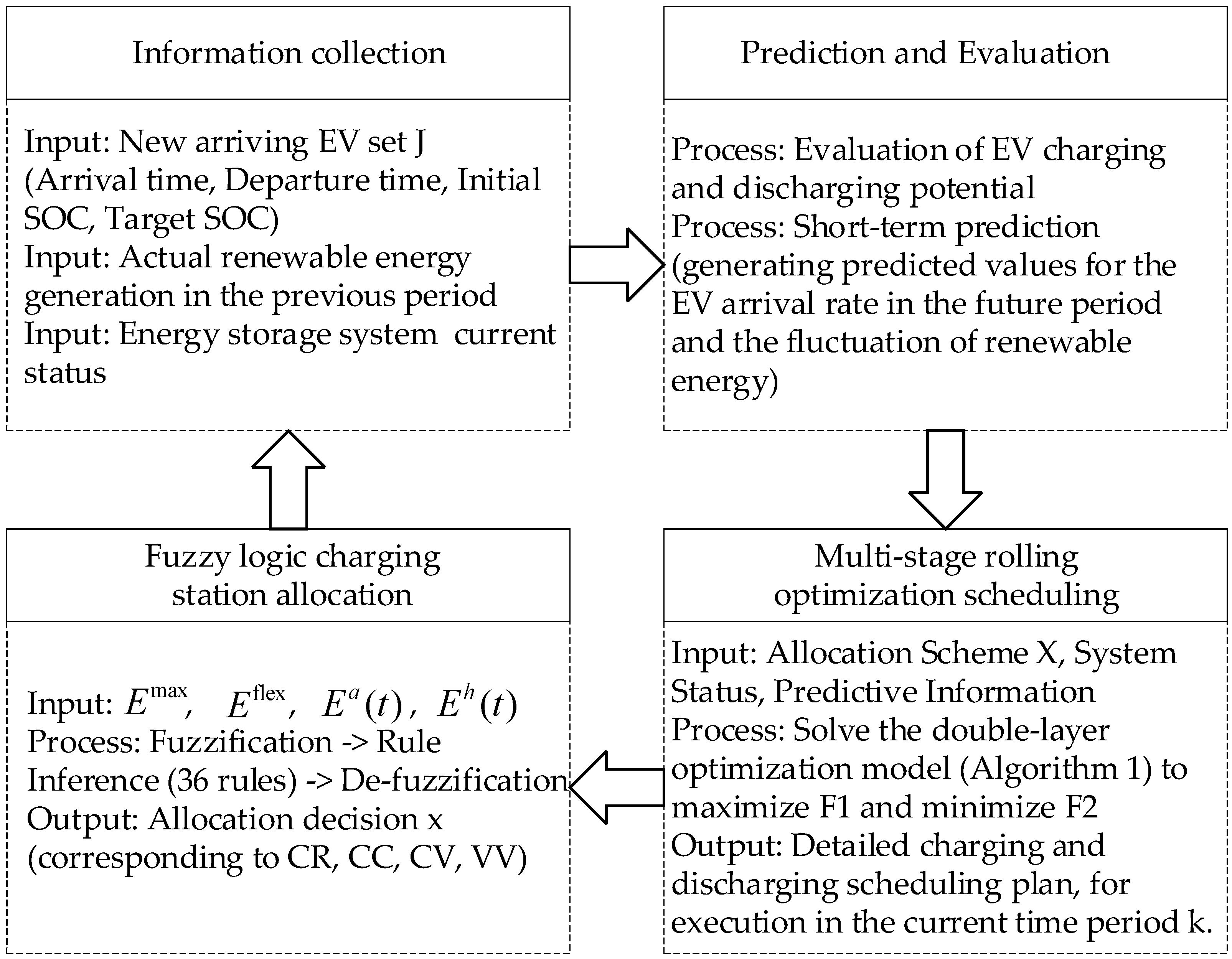
Based on the analysis in Section 3.2 regarding the fuzzy scheduling method that incorporates EV bidirectional charging potential assessment and uncertainty, this section details the specific procedural steps for a single-stage of bidirectional charging scheduling within the multi-stage fuzzy framework.
Step 1: Information Collection and EV Potential Assessment.
Collect and aggregate information from vehicles that arrived in the previous time slot. This includes their dwell time, state of charge (SOC) status, and charging requirements. Perform a bidirectional charging potential assessment for these vehicles to obtain their maximum discharge capacity and bidirectional charging flexibility.
Step 2: Renewable Energy and System State Update with Forecasting.
Collect data on the renewable energy generated in the previous time slot and the operational status of the energy storage system. Furthermore, generate forecasts for the uncertainty in renewable energy generation and vehicle arrivals for subsequent time slots. This yields the expected vehicle arrival rate and the expected renewable energy generation.
Step 3: Fuzzy Logic-based Charging Pile Allocation.
Based on the individual vehicle’s potential assessment (from Step 1), the forecasts of renewable energy fluctuations and vehicle arrival uncertainty (from Step 2), and considering the current number of available charging piles at the station, employ the Fuzzy Charging Pile Allocation Method for EVs to assign each newly arrived vehicle to an appropriate charging pile.
Step 4: Schedule Update and Rolling Optimization.
Based on the determined charging pile allocation scheme (from Step 3) and incorporating the actual renewable energy generation from the previous time slot, update the coordinated bidirectional charging/discharging schedule for all EVs currently at the station and for the site’s energy storage system. This completes the optimization for the current decision stage.
This four-step process is repeated each time the scheduling horizon rolls forward to the next time slot, enabling continuous, adaptive, and optimized scheduling under uncertainty. The schematic diagram of multi-stage fuzzy scheduling process is shown in Figure 2.

3.5. Rationale for Choosing a Fuzzy Logic-Based Approach

The selection of a fuzzy logic-based decision layer over alternative uncertainty-aware methodologies (e.g., stochastic optimization, reinforcement learning) is driven by the specific operational requirements and constraints of the real-time EV charging station scheduling problem.
Two-stage stochastic programming, while theoretically sound, requires solving a large-scale MILP over numerous scenarios, leading to prohibitive computational cost for the frequent (every 15 min), real-time decisions required in our rolling-horizon framework [28,41]. Robust optimization can be overly conservative. Our hybrid approach decouples the complex uncertainty-aware resource allocation from the deterministic energy scheduling, achieving effective uncertainty management with guaranteed online computation speed.
Reinforcement Learning (RL) and other data-driven learning methods require extensive interaction with the environment to converge to an effective policy. This process is data-hungry and time-consuming, and the resulting “black-box” policy may be unsafe or unexplainable for critical grid operations. In contrast, the fuzzy rule base is transparent and directly encodes expert operational principles. It requires no offline training and can be deployed immediately, then calibrated with minimal adjustments—a significant advantage for practical, safety-critical systems where historical data for all novel scenarios may be limited.
The fuzzy controller acts as a dynamic, intelligent pre-processor for the optimizer. It reduces the combinatorial complexity of the subsequent scheduling problem by pre-classifying EVs, allowing the rolling-horizon MILP to focus on a more tractable energy dispatch problem. This synergistic division of labor is more efficient than using either a purely heuristic rule-based system or a monolithic optimization model attempting to handle all aspects simultaneously.

4. Experimental Analysis

To validate the effectiveness of the proposed models and algorithms, this section takes a charging station in Chongqing as a case study. It employs the Monte Carlo method to simulate EV arrivals and renewable energy generation. The deterministic scheduling model and the proposed uncertainty-aware scheduling model are then solved and compared. The solving algorithms are implemented using Matlab R2021a and Gurobi 10.0.

4.1. Simulation Setup

(1)
EV-Related Modeling Parameters
Since fewer EVs visit charging stations in the early morning hours, the scheduling period is set to one day, comprising 24 h divided into 96 time slots of 15 min each. The charging station is equipped with 10 unidirectional and 10 bidirectional charging piles.
The probability function for EV arrivals is modeled and generated via Monte Carlo simulation based on EV travel and charging datasets. This section utilizes publicly available EV charging data from Kaggle [42], which records real charging behaviors at different locations, including vehicle ID, arrival SOC, and charging duration, providing a comprehensive basis for simulating EV charging demand. Additionally, the bidirectional charging/discharging power for EVs is set to 60 kW, and battery capacities are randomly generated within the range of 60–130 kWh.
(2)
Charging Station-Related Modeling Parameters
In the bidirectional charging scheduling optimization model, the parameter values related to the charging station and the station’s charging/discharging prices for different periods are shown in Table 5 and Table 6, respectively.
(3)
Grid Load and Renewable Energy Generation Data
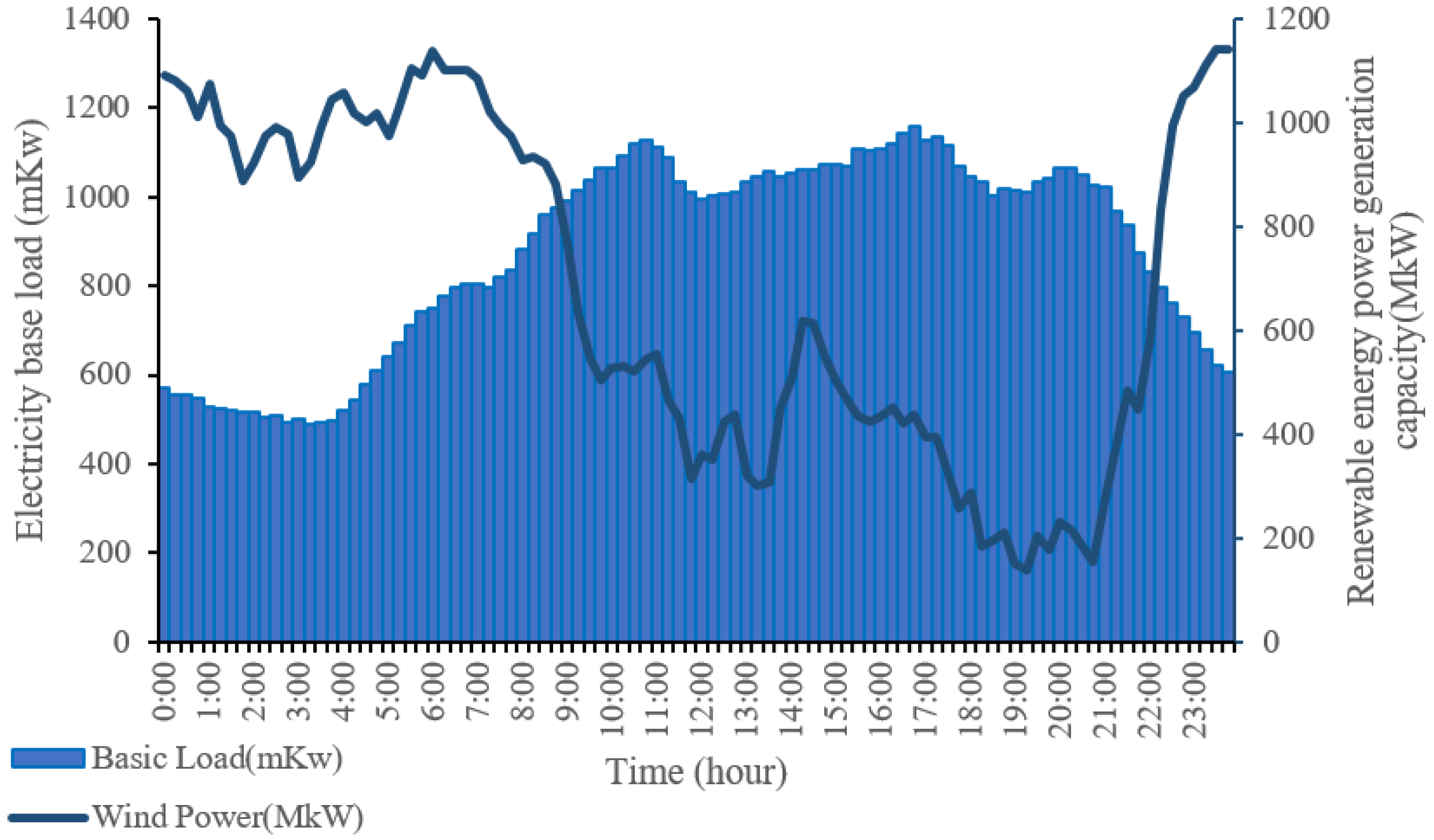
Renewable energy generation methods such as wind and PV are highly weather-dependent, but their output can be predicted based on historical periodic data. The probability density function of generation can be represented by a forecast curve, with forecast errors calculated as a percentage fluctuation of the predicted value. This study draws on the 2020 baseline grid load and renewable energy generation data from a certain city as the foundational data for the case study, as shown in Figure 3.

4.2. Comparison of Bidirectional Charging Scheduling Results Under Different EV Arrival Scales

To test the effectiveness of the proposed models and algorithms, the EV and renewable energy data generated in Section 4.1 are used to set up three scheduling scenarios for comparing results under different models and solving methods. Additionally, different EV arrival rates are set to analyze the impact of arrival uncertainty on scheduling.
Scenario 1 (Baseline): Based on complete information, the benchmark deterministic model is solved directly using the Gurobi solver to find the optimal bidirectional charging schedule. This serves as a benchmark to assess the impact of information uncertainty.
Scenario 2 (Greedy): The multi-stage uncertainty-aware scheduling model is solved using a greedy algorithm, where the optimization goal for each stage is the current optimum.
Scenario 3 (Proposed): Based on the multi-stage uncertainty-aware scheduling model, the fuzzy scheduling method proposed in Section 3.4 is used to determine the EV charging pile allocation, followed by stage-wise bidirectional charging optimization.
The greedy algorithm (Scenario 2) serves as a practical and intuitive baseline that mimics a naive, real-time operational policy without look-ahead capability. It is included to quantify the value of the proposed anticipatory and coordinated scheduling. The deterministic model under perfect information (Scenario 1) provides the theoretical upper bound for performance, against which the operational efficiency loss due to uncertainty can be measured. While more sophisticated stochastic or learning-based methods exist, they are often not directly comparable due to differing architectural assumptions (e.g., reliance on full probability models, need for extensive offline training). The primary goal of this comparison is to demonstrate that the proposed rule-based, rolling-horizon hybrid framework fundamentally outperforms a common-sense operational heuristic and approaches the ideal performance in a computationally tractable manner.
All case studies for different scenarios are run on a Windows 11 64-bit personal laptop using Matlab 2021a. The solving results are shown in Table 7.
Since Scenario 1 represents the optimal result under complete information, it serves as the benchmark for comparing Scenarios 2 and 3. Comparing results for the same number of EVs across scenarios shows that Scenario 1 yields the highest station revenue, as expected. The revenue in Scenario 3 is consistently higher than in Scenario 2. The calculated “Gap” (revenue difference from Scenario 1) grows with the number of EVs in both Scenarios 2 and 3, but its growth rate is lower in Scenario 3. This is because, in multi-stage scheduling under uncertainty, the greedy algorithm in Scenario 2 performs worse than the proposed fuzzy scheduling in Scenario 3. Unlike the myopic greedy approach, the fuzzy method considers the probability of future vehicle arrivals; the more accurate these predictions, the closer the results are to the full-information optimum of Scenario 1.
Comparing the solving times of the three scenarios, both Scenarios 2 and 3 involve multi-stage solving. For each stage, the variable dimensions are much smaller than those in the global optimization of Scenario 1. Consequently, the sum of solving times for all 96 slots is far less than the global solving time of Scenario 1. Comparing Scenarios 2 and 3, Scenario 3 requires additional computation for EV potential assessment and fuzzy pile allocation at each stage, resulting in slightly higher solving times than Scenario 2.

4.3. Comparison of Bidirectional Charging Scheduling Results Under Different Renewable Energy Generation Fluctuations

The previous section compared the differences between various models and solution methods. This section analyzes the model’s optimization objectives. Since EVs can discharge power back to the grid via bidirectional chargers to alleviate grid load pressure during peak hours, and their orderly charging/discharging schedules can be rationally planned based on dwell times to mitigate grid load fluctuations and balance electricity demand. The bi-objective scheduling optimization model considers EV and super-capacitor discharging scenarios, aiming to assist in grid peak shaving and valley filling while enhancing renewable energy consumption through proper planning of EV bidirectional charging schedules. Given the uncertainty of renewable energy generation and combined with the EV bidirectional charging potential assessment from Section 3.4, this section analyzes the impact of different fluctuation levels in renewable energy generation on scheduling optimization results.
Since Scenario 1 is solved under complete information with no renewable energy fluctuation, the impact of such fluctuations on scheduling results is primarily compared between Scenarios 2 and 3. In addition to station revenue, it is necessary to observe the renewable energy consumption rate and the contribution of bidirectional charging to grid peak shaving and valley filling.
The renewable energy consumption rate can be represented by the ratio of the total energy discharged by the storage battery and super-capacitor during the scheduling period to the total renewable energy generation, as shown in Equation (52):
R c = k K z k s P s + z k b P b k K h k × 100 %
The contribution of EV bidirectional charging to grid peak shaving and valley filling can be represented by the total EV charging energy during grid off-peak (valley) periods plus the total EV and super-capacitor discharging energy during grid peak periods, as shown in Equation (53):
R p = k K g i I j J y i j k c α P + k K f i I v j J y i j k d β P + k K f z k s P s
Since the number of arriving EVs significantly impacts renewable energy consumption and grid load regulation effectiveness, it is necessary to evaluate how the volatility of renewable energy generation affects bidirectional scheduling performance under different EV fleet sizes. Considering the current average EV-to-charger ratio in China is approximately 2.4:1, two typical case scales—2 times and 4 times the number of chargers—are selected as the number of EVs. The specific results are shown in Table 8.
As shown in Table 8, for the two case scales with 40 and 80 EVs, as the renewable energy generation increases, the station’s storage battery and super-capacitor store more renewable energy and release it to the grid and EVs. Furthermore, as the number of EVs increases, the power fed back to the grid through bidirectional charging also increases, leading to rising station revenue from bidirectional operations. However, the renewable energy consumption rate decreases as generation increases. This is because the capacities of the storage battery and super-capacitor are limited. When generation exceeds their maximum storage capacity, the proportion of renewable energy that can be consumed locally diminishes with further increases in generation. Simultaneously, the contribution of bidirectional charging to grid peak shaving and valley filling increases with both higher renewable energy generation and a larger number of EVs. More EVs lead to greater charging during off-peak periods and greater discharging during peak periods. Higher renewable energy generation results in more energy being stored by the super-capacitor and released during peak hours.
Moreover, compared to Scenario 2, Scenario 3 demonstrates superior performance in terms of station revenue, renewable energy consumption rate, and contribution to peak shaving and valley filling. This indicates that the fuzzy scheduling method offers significant advantages in handling the uncertainty of renewable energy generation.
The scalability of the proposed framework is determined by the computational cost of its two core components within each rolling time slot: (1) the Fuzzy Logic Controller (FLC) for EV-to-pile allocation, and (2) the Bi-level Rolling-Horizon Optimizer (RHO) for scheduling.
(1)
Theoretical Computational Complexity
FLC Complexity: For each newly arrived EV, the FLC executes a constant number of operations (fuzzification, rule evaluation for 36 rules, defuzzification). Its time complexity is O(n), where n is the number of EVs arriving in that slot, and is negligible in practice.
(2)
RHO Complexity
The complexity is dominated by the lower-level MILP scheduler, which scales with the number of active decision variables. For a station with i piles, j EVs currently present (including newly arrived ones), and a rolling horizon of k time slots, the number of binary scheduling variables y i j k c and y i j k d is roughly O( i × j × k ). The bi-level decomposition (Algorithm 1) avoids solving this full model directly. For each candidate assignment, the lower-level solves a simpler MILP with O( j × k ) variables, as the x i j couplings are resolved.
Our simulations show that for a single station configuration (20 piles, ~10–50 active EVs), the average solve time remains below 2 s, well within the 15 min slot.
The complexity increases linearly with k . However, in rolling-horizon control, k is a fixed design parameter. Choosing a practical k balances forecast accuracy with computational load.
Assuming each station has modest computing power, the framework is real-time feasible for stations with up to ~50–100 simultaneous active EVs and 30–50 chargers. Beyond this, the lower-level MILP solve time may grow, but this can be mitigated by: (a) shortening the effective scheduling horizon k for very large j , or (b) employing more powerful embedded solvers. The architecture’s modularity allows such adjustments.

4.4. Sensitivity Analysis of Forecasting Errors

The proposed scheduling framework relies on short-term forecasts of renewable energy generation. To assess its robustness against forecast inaccuracies, we conduct a sensitivity analysis by introducing systematic errors into the forecasted profiles used for planning.
We use the baseline 80-EV scenario (Section 4.2) and the proposed fuzzy scheduling method (Scenario 3). The actual renewable generation profile (denoted H actual ) is kept unchanged. We then generate forecasted profiles H forecast by applying a multiplicative error term:
H k forecast = H k actual × ( 1 + δ k )
where δ k is a random variable sampled from a truncated normal distribution with mean μ and standard deviation σ . We test four levels of combined systematic and random error: ±5%, ±10%, ±15%, and ±20%. The scheduler uses H forecast for its rolling-horizon optimization, while the simulated system’s energy balance and revenue calculation are based on H actual . For each error level, we run 100 Monte Carlo simulations with different random seeds and report the average performance metrics. The scheduling experiment results considering prediction errors are shown in Table 9.
The proposed method demonstrates moderate robustness to forecast errors. As expected, revenue decreases as forecast error increases. Negative errors (under-forecasting) cause a larger revenue loss than positive errors of the same magnitude, because the scheduler under-commits dischargeable energy, missing potential revenue opportunities during peak hours. Positive errors (over-forecasting) lead to less efficient storage allocation and occasional renewable curtailment when actual generation is lower than planned. However, even with a substantial ±20% error, the revenue decline is contained within ~13%, and the method still maintains a significant advantage over the greedy scheduling baseline. The rolling-horizon mechanism, which re-optimizes every 15 min with updated forecasts, helps mitigate the impact of past errors. The secondary objectives show similar patterns of graceful degradation.

4.5. Scheduling Potential Analysis in Large-Scale Scenarios

The preceding sections validated the effectiveness of the models and algorithms using small-to-medium-scale cases. To explore the performance and potential of the proposed bidirectional charging scheduling optimization model and solution method in real-world, large-scale future application scenarios, this section conducts a large-scale scheduling simulation experiment based on EV market and charging infrastructure data from Chongqing.
(1)
Large-Scale Simulation Scenario Setup
The simulation is based on a regional grid scenario in Chongqing. According to forecasts by the International Energy Agency (IEA) and relevant national plans, China’s EV stock is expected to reach 100 million by 2030. Against this backdrop, the regional EV stock for this simulation is set at 500,000 vehicles. Considering user willingness to participate and travel patterns, it is assumed that 10% of EV users are willing to participate in V2G bidirectional charging activities on the simulation day. Among these, about 50% (i.e., 25,000 vehicles) are assumed to be traveling and participating in V2G daily. Parameters like vehicle battery capacity and charging power remain consistent with the settings in Section 4.1. These vehicles are distributed across multiple public charging stations in the city.
Regarding charging infrastructure, it is assumed the experimental region in Chongqing has 500 public charging stations, each equipped with an average of 20 bidirectional chargers, resulting in a total of 10,000 bidirectional chargers in the region. This configuration yields a vehicle-to-charger ratio of 1:2.5, aligning with the current development status of EV stock and charger deployment in China and ensuring sufficient resources for the scheduling model to operate. EV arrival/departure times and initial SOC are generated via Monte Carlo simulation based on real-world travel datasets publicly available on platforms like Kaggle. Battery capacities are randomly distributed between 60 and 100 kWh, and the bidirectional charging/discharging power is set to 60 kW.
The regional grid underpinning the simulation has a typical “double-peak” baseline load curve (morning peak: 10:00–12:00; evening peak: 19:00–21:00), with a total load approaching 5000 MW. The renewable energy generation forecast curve is as shown in Figure 2.
A total of 25,000 EVs participate in bidirectional charging activities. Assuming an average battery capacity of 70 kWh, their theoretical total energy storage capacity reaches a substantial 1750 MWh, equivalent to the scale of a medium-sized pumped-hydro storage plant. Calculated at a charging/discharging power of 60 kW per vehicle, this fleet could provide up to 1500 MW of instantaneous bidirectional power regulation capability, accounting for approximately 30% of the regional peak load.
(2)
Performance Comparison in Large-Scale Scenario
The performance differences between Scenario 2 (Greedy Scheduling) and Scenario 3 (the proposed Fuzzy Scheduling) are compared under this large-scale setting. Scenario 1 (Complete Information) serves only as a theoretical reference due to its prohibitive computational complexity. The results are summarized in Table 10.
In the large-scale scenario, the advantages of the proposed fuzzy scheduling method (Scenario 3) are further amplified. The regional total revenue reaches 1.618 million CNY, a 13.5% increase over the greedy scheduling approach. This demonstrates that as the vehicle fleet scales up, precision scheduling based on potential assessment can more effectively identify and utilize high-value dispatchable resources from the massive fleet, avoiding the myopic behavior of greedy strategies and thereby generating significant economies of scale.
The experiment proves that in a scenario coordinating 25,000 EVs, the optimized fleet can form a Virtual Power Plant (VPP) with an equivalent power exceeding 1500 MW. Scenario 3’s contribution to peak shaving and valley filling is 300 MWh higher than Scenario 2’s, equivalent to providing approximately 35 MW of additional regulation capacity to the grid during the evening peak period. For a regional grid with a peak load of 5000 MW, this means a stable reduction of about 0.7% in peak load. Furthermore, Scenario 3 achieves a renewable energy consumption rate of 83.5%, significantly higher than the 76.8% in Scenario 2. This indicates that the fuzzy scheduling method can better coordinate the charging behavior of a massive EV fleet to match the regional PV generation profile, effectively enhancing the local consumption level of green electricity.
Comparing Table 6 and Table 10 reveals that as the vehicle scale jumps from hundreds to tens of thousands, the performance improvement ratio of Scenario 3 over Scenario 2 remains stable or even slightly increases. This demonstrates the good scalability of the proposed method; its performance advantages are not diluted by the increase in problem scale. Moreover, when the number of EVs reaches a regional scale, the constructed multi-stage fuzzy scheduling optimization method remains effective. The economic benefits generated by bidirectional charging/discharging, along with its value for grid peak shaving and promoting renewable energy consumption, are substantial, indicating high practical application value and promising prospects.
(3)
Computational Scalability Analysis
A critical consideration for practical deployment is how the computational time per time slot scales with the number of EVs. In our framework, EV potential assessment and fuzzy allocation requires solving a small integer program for each arriving EV (Section 3.1.1) and executing the fuzzy inference system. The complexity is O(n), where n is the number of newly arrived EVs per time slot.
The bi-level optimization (Algorithm 1) complexity depends on the number of active EVs currently at the station and the scheduling horizon length. In the worst case, if all scheduling were centralized, the complexity would grow polynomially with the total number of EVs. However, our proposed architecture is inherently distributable across charging stations. Each station operates its own local scheduler using the same fuzzy logic and rolling-horizon method. Therefore, the per-slot computation time at each station does not scale with the total regional EV count (25,000) but with the number of EVs concurrently present at that station—a much smaller number.
To quantify this, we analyze the average computation time per 15 min time slot in our large-scale simulation (25,000 EVs, 500 stations) under the proposed fuzzy method (Scenario 3). The centralized simulation required ~45 s per time slot on average. In contrast, the greedy method (Scenario 2) required ~35 s. The additional ~10 s is due to the fuzzy assessment and bi-level optimization.
For a single isolated station with 20 chargers and a typical arrival rate (scaled proportionally from the large-scale scenario), the average computation time was ~0.5 s per time slot. When scaled to 500 stations in parallel, the aggregate computational effort would be equivalent, but wall-clock time would remain near ~0.5 s per station if processed in parallel. This demonstrates the excellent real-time feasibility of the proposed method.
The sub-linear growth in per-slot computation time is achieved because the fuzzy logic allocation operates on per-vehicle metrics and local forecasts, avoiding a global combinatorial explosion. The rolling-horizon optimization at each station considers only its local active and forecasted EVs. The bi-level decomposition (Algorithm 1) keeps the scheduling sub-problem tractable for the typical number of EVs at a single station.
The collective experimental results across Section 4.2, Section 4.3, Section 4.4 and Section 4.5 provide comprehensive validation of the proposed framework’s effectiveness. They consistently demonstrate that the fuzzy logic-based rolling-horizon strategy: (1) significantly enhances economic performance, achieving station revenue much closer to the perfect-information benchmark than a greedy policy, especially as scale increases; (2) robustly improves the utilization of renewable energy, maintaining high consumption rates even under generation fluctuations; and (3) substantially contributes to grid stability, by actively shaping the net load profile to provide peak-shaving and valley-filling services. These outcomes confirm the framework’s core capability to make coordinated, forward-looking decisions under uncertainty.

5. Discussion

This study proposes a multi-stage fuzzy scheduling strategy to optimize the coordinated bidirectional charging of electric vehicles with renewable energy and hybrid energy storage systems under uncertainty. The discussion that follows interprets the key results, elucidates their practical significance for various stakeholders, and acknowledges the study’s limitations to chart a course for future research.
The experimental analysis confirms that the proposed multi-stage fuzzy scheduling framework effectively addresses the challenges outlined in the introduction. The results substantiate that its hybrid architecture—combining a rule-based, uncertainty-aware allocator with a deterministic rolling-horizon optimizer—successfully translates into the targeted practical benefits: increased revenue, enhanced green energy integration, and improved grid support.

5.1. Interpretation of Principal Findings

The proposed framework fundamentally differs from classical stochastic or robust optimization approaches in its hierarchical and hybrid decision-making philosophy. From “Modeling All Uncertainties” to “Managing Uncertainty with Adaptive Rules”: Traditional stochastic optimization attempts to model uncertainty distributions explicitly, while robust optimization immunizes against a pre-defined uncertainty set. In contrast, our method does not explicitly model the full probability distribution of future events. Instead, it employs fuzzy logic as a meta-decision layer that uses high-level, interpretable rules to dynamically adjust its operational strategy based on real-time assessments of uncertainty severity. This shifts the focus from precise probabilistic prediction to robust, rule-based adaptation.
The fuzzy controller first makes a strategic classification for each EV, a discrete decision that is difficult to encode efficiently in a monolithic stochastic MILP. The rolling-horizon optimizer then performs tactical scheduling of energy flows given this classification. This decomposition separates the high-combinatorial “which vehicle gets which resource” problem from the “how much and when” energy dispatch problem, a separation not typically found in traditional integrated stochastic models.
The experimental results demonstrate the clear superiority of the proposed fuzzy logic-based scheduling method (Scenario 3) over a myopic greedy approach (Scenario 2) and establish a benchmark against perfect-information scheduling (Scenario 1). The principal findings can be interpreted as follows:
First, the significant revenue improvement achieved by the fuzzy method in large-scale simulations underscores the economic cost of decision myopia in uncertain environments. The greedy algorithm, by optimizing only for the immediate stage, fails to reserve flexible, high-potential charging pile resources for more valuable EVs that may arrive later or for more favorable grid-price periods. In contrast, the fuzzy scheduler, through its integrated assessment of an EV’s inherent and its consideration of forecasted arrival and generation trends, makes allocation decisions that are suboptimal in the immediate term but superior for global, multi-stage revenue maximization.
Second, the concurrent enhancement in renewable energy consumption rate and grid peak-shaving contribution reveals the critical role of flexibility coordination. The metric effectively identifies EVs whose charging schedules can be shifted or interrupted with minimal impact on user satisfaction, thereby creating temporal “buffers” to absorb renewable energy surpluses. By preferentially assigning such flexible EVs to bidirectional chargers, the scheduler unlocks their dual function: acting as a delayable load during valley periods to store excess green power, and acting as a dispatchable generator during peak periods to release it. This transforms the EV fleet from a passive, aggregated load into an active, grid-responsive resource that simultaneously pursues economic and green objectives.
Finally, the scalability and stable performance improvement observed as the problem size grew from tens to tens of thousands of EVs is a crucial finding. It validates that the proposed framework—combining a computationally efficient rolling-horizon structure with a low-complexity fuzzy inference system—does not suffer from the “curse of dimensionality” that plagues many centralized optimization schemes. The decomposition into sequential, smaller-scale problems and the rule-based allocation make it feasible for real-world, region-level implementation.

5.2. Managerial Insights

The findings offer actionable insights for key stakeholders in the e-mobility and energy ecosystem.
For Charging Station Operators: The results argue for a strategic mix of unidirectional and bidirectional chargers, complemented by fast-responding storage. Investment decisions should be guided by analyses of local EV user dwell-time patterns and grid peak/off-peak tariffs, rather than merely maximizing charger count.
Moving beyond first-come, first-served rules is essential. Operators should implement scheduling platforms capable of rolling-horizon optimization and integrating short-term forecasts. The proposed EV potential assessment can serve as a core tool for identifying high-value customers and enabling premium V2G services.
Sustainable V2G participation requires user buy-in. Operators can design dynamic revenue-sharing models that pass a portion of grid service revenues back to participating users. Offering priority scheduling or discounted charging rates to high-potential EVs can further encourage battery capacity sharing.
Furthermore, the proposed framework is designed with modularity and parameterization in mind, enabling its application to a wide range of real-world settings. The core model (Section 2.2) is agnostic to the specific numbers of unidirectional and bidirectional piles, as well as the power ratings of the storage battery and super-capacitor. These are input parameters (Table 4). The fuzzy controller does not rely on these absolute values but on relative metrics. Therefore, the framework can be directly deployed to stations with different charger mixes and ESS capacities by updating the parameter file. The scheduling logic automatically adapts to the available resources.
The framework’s performance is inherently linked to renewable availability, but its operational logic is robust across different penetration levels. With high penetration, the optimizer and ESS will prioritize storing and utilizing more green energy. With low penetration, the system will naturally rely more on grid electricity, but the fuzzy controller’s rules will adjust the aggressiveness of V2G dispatch accordingly. The key input quantifies volatility, not absolute generation, making the rule base applicable whether volatility comes from a large but intermittent solar farm or a small wind turbine.
The “renewable generation” input can represent any local stochastic generation (e.g., small hydro, fuel cells). Similarly, additional or different types of storage can be incorporated by adding corresponding decision variables and constraints to the model. The fuzzy rule base would remain valid as it operates on higher-level, aggregated metrics.
For Grid Operators and Policymakers: The study shows that optimally dispatched EV fleets can function as large-scale virtual power plants. Regulators and grid operators should develop standardized market rules, metering protocols, and settlement mechanisms for EV aggregators, allowing them to participate in ancillary service markets fairly and efficiently.
The economic viability of V2G hinges on strong price signals. Time-of-use (TOU) tariffs, critical peak pricing, and real-time pricing must be sufficiently differentiated to motivate valley charging and peak discharging. Additional green certificates or carbon credits for V2G discharge could enhance attractiveness. Policies addressing battery degradation cost compensation are also needed to alleviate user concerns. It is worth noting that the choice of degradation model (simplified linear vs. detailed non-linear) significantly influences the calculated compensation and, consequently, the long-term economic sustainability of V2G operations for all stakeholders. Therefore, developing standardized methodologies for quantifying and compensating battery wear is essential.
Advancing standardized communication protocols for secure, bidirectional grid-vehicle interaction is fundamental. Encouraging the creation of anonymized regional data hubs for EV mobility and charging patterns can significantly improve the prediction accuracy of all scheduling entities.
For EV Users: The model’s foundation is an incentive-compatible pricing scheme. The user’s financial compensation is embedded in the price difference, which is calibrated to be positive during peak periods. This ensures that providing V2G service is economically rational for a user whose primary constraint is meeting a minimum departure SOC. The “opportunity cost” of having the vehicle’s battery used for grid services is thus directly priced and compensated within the model’s transactional framework. However, this simplified model assumes users are price-takers. In reality, individual perceptions of battery degradation and inconvenience vary. Future implementations could incorporate user-specific reservation prices or dynamic revenue-sharing contracts to more precisely match compensation with individual opportunity costs and increase participation rates.

5.3. Limitations and Future Research

This study employs several simplifying assumptions to maintain model tractability and focus on the high-level scheduling strategy. A key assumption is the constant charging/discharging power for EVs (Assumption 2), which implies a linear State of Charge (SOC) change. In reality, lithium-ion battery charging follows a multi-stage profile, typically consisting of a constant-current (CC) phase followed by a constant-voltage (CV) phase as the battery approaches full capacity, resulting in decreasing charging power during the CV phase.
Impact on the Current Model: This simplification primarily affects the temporal precision of energy transfer near the battery’s upper SOC limit. In our scheduling context, where the objective is to coordinate numerous EVs over discrete time slots for grid services, the core decision variables are the aggregate energy amounts to be charged or discharged within each slot, and the assignment of EVs to chargers. The constant-power assumption provides a good approximation for the bulk energy transfer (CC phase), which constitutes the majority of the charging event. The potential overestimation of power during the final CV phase in our model would have a limited effect on the station’s aggregate load profile and revenue optimization, as the affected energy quantity per vehicle is relatively small. Furthermore, the model’s constraints on maximum battery capacity and safe SOC limits inherently prevent physically infeasible energy allocation.
Future Refinement: A valuable direction for future work is to integrate a more realistic, non-linear battery charging model into the scheduling framework. This could involve representing the charging power as a piecewise-linear or SOC-dependent function. The core fuzzy logic-based allocation mechanism and rolling-horizon architecture proposed in this paper would remain applicable. The charging potential assessment metrics would need to be recalculated based on the new power profile, and the optimization model’s energy balance constraints would require adjustment. Such an enhancement would improve the fine-grained temporal accuracy of the schedule, potentially yielding marginal improvements in operational efficiency and battery health considerations, especially for scheduling fast-charging events to a very high SOC.
Linear SOC Evolution Assumption: Closely related is the assumption of linear State of Charge (SOC) evolution (Assumption 2). Real lithium-ion batteries exhibit non-linear open-circuit voltage (OCV) characteristics and charging profiles (CC-CV phases). Our linear model approximates the dominant constant-current (CC) phase but does not capture the reduced charging efficiency and power tapering in the high-SOC constant-voltage (CV) phase, or the non-linear discharge voltage curve. The error introduced is primarily temporal and bounded:
For a charging event from, e.g., 20% to 95% SOC, the linear model may overestimate the average power during the final 15–20% SOC range. The relative energy transfer error for this single event is typically less than 5–10% of the total charging energy, depending on the battery chemistry and the specific SOC operating window.
In our aggregate scheduling context, this error is diluted. The scheduler operates on 15 min slots and coordinates dozens of EVs at different SOC levels. The overestimation for one EV ending its charge is often offset by the linear and accurate estimation for others in their mid-SOC range.
The model’s hard constraints on battery capacity and safe SOC limits prevent the allocation of physically impossible energy amounts. The economic objective naturally discourages schedules that would push many EVs into the inefficient high-SOC region simply because the energy delivered per time slot would be low, even in our linear model.
Therefore, while the linear SOC assumption introduces a small, quantifiable positive bias in estimating the instantaneous power at high SOC, it does not invalidate the core comparative findings of this study. The performance superiority of the proposed fuzzy scheduling over the greedy benchmark, and its ability to enhance renewable consumption and peak shaving, stems from its strategic decision logic, which is robust to these second-order physical approximations.
As noted, a valuable future direction is to integrate a non-linear battery model with piecewise-linear or OCV-SOC-relationship-based efficiency curves. This would allow the scheduler to make more precise timing decisions, especially for fast-charging applications and battery health-conscious scheduling.

6. Conclusions

This study addresses the EV bidirectional charging scheduling problem for charging stations, integrating renewable energy generation and on-site energy storage systems. Initially, a bidirectional charging scheduling optimization model was constructed based on complete deterministic information. Building upon this foundation, a multi-stage bidirectional charging scheduling optimization model was developed to account for the uncertainties in EV arrivals and renewable energy generation.
To overcome the limitation of traditional multi-stage methods that often pursue locally optimal solutions at each stage, this paper proposes a fuzzy scheduling method based on EV bidirectional charging potential assessment. This method comprehensively considers vehicle maximum discharge capacity, charging flexibility, expected arrival rates, and renewable energy generation volatility to assign EVs to appropriate charging piles.
In the case study analysis, comparisons were made among the deterministic bidirectional charging scheduling model, the multi-stage scheduling model under uncertainty, and different solution methods. The results demonstrate that the proposed fuzzy scheduling method that considers uncertainty exhibits clear advantages in both solution quality and computational speed.

Author Contributions

Conceptualization, B.W.; methodology, B.W.; software, M.X.; validation, B.W.; data curation, M.X.; writing—original draft preparation, B.W.; writing—review and editing, M.X. All authors have read and agreed to the published version of the manuscript.

Funding

Chongqing Postgraduate Research and Innovation Project, grant number (2025B0027).

Institutional Review Board Statement

Not applicable.

Informed Consent Statement

Not applicable.

Data Availability Statement

The original contributions presented in this study are included in the article. Further inquiries can be directed to the corresponding author.

Conflicts of Interest

The authors declare no conflicts of interest.

References

  1. Liu, C.; Guo, Y.T.; Qian, X.W.; Li, X.; Liu, H.; Zhong, M. Understanding spatiotemporal dynamics of V2G participation in megacities: A data-driven study. Appl. Energy 2025, 401, 126866. [Google Scholar] [CrossRef]
  2. Soliman, I.A.; Tulsky, V.; Abd El-Ghany, H.A.; Azmy, A.M. Optimizing hosting capacity and spatial deployment of EV charging stations for V2G integration in zonal distribution networks. Appl. Energy 2025, 401, 126671. [Google Scholar] [CrossRef]
  3. Zhang, Z.W.; Teh, J.S. Enhancing grid flexibility and renewable integration: A review of V2G and dynamic line rating synergies. Renew. Sustain. Energy Rev. 2026, 226, 116341. [Google Scholar] [CrossRef]
  4. Diaz-Londono, C.; Orfanoudakis, S.; Vergara, P.P.; Palensky, P.; Ruiz, F.; Gruosso, G. Open source algorithms for maximizing V2G flexibility based on model predictive control. Electr. Power Syst. Res. 2026, 250, 112082. [Google Scholar] [CrossRef]
  5. Zhan, S.H.; Zhou, Y.; Feng, D.H.; Fang, C.; Wang, H.; Dou, S.; Chen, L. V2G-enhanced operation optimization strategy for EV charging station with photovoltaic and energy storage integration. Int. J. Electr. Power Energy Syst. 2025, 171, 111002. [Google Scholar] [CrossRef]
  6. Prakash, K.; Ali, M.; Siddique, M.N.I.; Karmaker, A.K.; Macana, C.A.; Dong, D.; Pota, H.R. Bi-level planning and scheduling of electric vehicle charging stations for peak shaving and congestion management in low voltage distribution networks. Comput. Electr. Eng. 2022, 102, 108235. [Google Scholar] [CrossRef]
  7. Nimalsiri, N.I.; Ratnam, E.L.; Smith, D.B.; Mediwaththe, C.P.; Halgamuge, S.K. Coordinated charge and discharge scheduling of electric vehicles for load curve shaping. IEEE Trans. Intell. Transp. Syst. 2022, 23, 7653–7665. [Google Scholar] [CrossRef]
  8. Pan, K.; Liang, C.D.; Lu, M. Optimal scheduling of electric vehicle ordered charging and discharging based on improved gravitational search and particle swarm optimization algorithm. Int. J. Electr. Power Energy Syst. 2024, 157, 109766. [Google Scholar] [CrossRef]
  9. Guo, H.; Qiu, P.F.; Zhang, J.H.; Xiang, B.; Laiqing, Y.; Ullah, Z. A novel hybrid adaptive strategy for real-time dispatch and scheduling in renewable-integrated EV charging stations. Results Eng. 2025, 27, 106736. [Google Scholar] [CrossRef]
  10. Das, P.; Kayal, P. An advantageous charging/discharging scheduling of electric vehicles in a PV energy enhanced power distribution grid. Green Energy Intell. Transp. 2024, 3, 100170. [Google Scholar] [CrossRef]
  11. Xiong, Z.H.; Liu, S.B.; Fang, Y.; Li, Y.; Yang, J. Research on modeling of microgrid load frequency control based on v2g technology. In Proceedings of the 2020 5th International Conference on Mechanical, Control and Computer Engineering (ICMCCE), Harbin, China, 25–27 December 2020; pp. 617–622. [Google Scholar] [CrossRef]
  12. Yin, W.J.; Ming, Z.F. Electric vehicle charging and discharging scheduling strategy based on local search and competitive learning particle swarm optimization algorithm. J. Energy Storage 2021, 42, 102966. [Google Scholar] [CrossRef]
  13. Yin, W.; Ji, J.; Wen, T.; Zhang, C. Study on orderly charging strategy of EV with load forecasting. Energy 2023, 278, 127818. [Google Scholar] [CrossRef]
  14. Niu, Z.N.; An, K.; Ma, W.J. Vehicle-to-grid enabled charging infrastructure planning and operations considering demand uncertainties. Transp. Res. Part D Transp. Environ. 2024, 127, 103918. [Google Scholar] [CrossRef]
  15. Chen, W.; Zheng, L.; Li, H.J.; Pei, X. An assessment method for the impact of electric vehicle participation in v2g on the voltage quality of the distribution network. Energies 2022, 15, 4170. [Google Scholar] [CrossRef]
  16. Zhang, S.; Pang, L.M.; Li, Y.Z.; Feng, Q.; Zhang, M. Battery charging-discharging dispatching model of urban swapping station cluster for electric bus considering co-optimizing cost and compatible green-electricity utilization. J. Energy Storage 2026, 141, 119324. [Google Scholar] [CrossRef]
  17. Esmaili, M.; Shafiee, H.; Aghaei, J. Range anxiety of electric vehicles in energy management of microgrids with controllable loads. J. Energy Storage 2018, 20, 57–66. [Google Scholar] [CrossRef]
  18. Liu, P.; Liu, Z.; Zhang, N.; Lin, F. Cooperative game-based charging-discharging efficiency optimization of electric vehicles in 6G-enabled V2G. IEEE Trans. Green Commun. Netw. 2023, 7, 1078–1089. [Google Scholar] [CrossRef]
  19. Dean, M.D.; de Souza, F.; Gurumurthy, K.M.; Kockelman, K.M. Multi-stage charging and discharging of electric vehicle fleets. Transp. Res. Part D Transp. Environ. 2023, 118, 103691. [Google Scholar] [CrossRef]
  20. Rafique, S.; Nizami, M.S.H.; Irshad, U.B.; Hossain, M.J.; Mukhopadhyay, S.C. EV Scheduling framework for peak demand management in lv residential networks. IEEE Syst. J. 2022, 16, 1520–1528. [Google Scholar] [CrossRef]
  21. Fachrizal, R.; Qian, K.; Lindberg, O.; Shepero, M.; Adam, R.; Widén, J.; Munkhammar, J. Urban-scale energy matching optimization with smart EV charging and V2G in a net-zero energy city powered by wind and solar energy. Etransportation 2024, 20, 100314. [Google Scholar] [CrossRef]
  22. Zheng, X.Q.; Yao, Y.P. Multi-objective capacity allocation optimization method of photovoltaic EV charging station considering V2G. J. Cent. South Univ. 2021, 28, 481–493. [Google Scholar] [CrossRef]
  23. Hong, T.; Cao, J.H.; Zhao, W.T.; Lu, M. Electric vehicle charging scheduling algorithm based on online multi-objective optimization. In Proceedings of the 2021 International Wireless Communications and Mobile Computing (IWCMC), Harbin, China, 28 June–2 July 2021; pp. 1141–1146. [Google Scholar] [CrossRef]
  24. Khonji, M.; Chau, S.C.K.; Elbassioni, K. Approximation scheduling algorithms for electric vehicle charging with discrete charging options. In Proceedings of the e-Energy ’18: The Ninth International Conference on Future Energy Systems, Karlsruhe, Germany, 12–15 June 2018; pp. 579–585. [Google Scholar] [CrossRef]
  25. Yang, Y.; Yeh, H.G.; Nguyen, R. A robust model predictive control-based scheduling approach for electric vehicle charging with photovoltaic systems. IEEE Syst. J. 2023, 17, 111–121. [Google Scholar] [CrossRef]
  26. Ali, A.; Mahmoud, K.; Lehtonen, M. Optimization of photovoltaic and wind generation systems for autonomous microgrids with pev-parking lots. IEEE Syst. J. 2022, 16, 3260–3271. [Google Scholar] [CrossRef]
  27. Nourianfar, H.; Abdi, H. Economic emission dispatch considering electric vehicles and wind power using enhanced multi-objective exchange market algorithm. J. Clean. Prod. 2023, 415, 137805. [Google Scholar] [CrossRef]
  28. Meng, Q.L.; Hussain, S.; He, Y.; Lu, J.; Guerrero, J.M. Multi-timescale stochastic optimization for enhanced dispatching and operational efficiency of electric vehicle photovoltaic charging stations. Int. J. Electr. Power Energy Syst. 2025, 172, 111096. [Google Scholar] [CrossRef]
  29. Welzel, F.; Klinck, C.F.; Pohlmann, Y.; Bednarczyk, M. Grid and user-optimized planning of charging processes of an electric vehicle fleet using a quantitative optimization model. Appl. Energy 2021, 290, 116717. [Google Scholar] [CrossRef]
  30. Eghbali, N.; Hakimi, S.M.; Hasankhani, A.; Derakhshan, G.; Abdi, B. A scenario-based stochastic model for day-ahead energy management of a multi-carrier microgrid considering uncertainty of electric vehicles. J. Energy Storage 2022, 52, 104843. [Google Scholar] [CrossRef]
  31. Wang, B.Z.; Yu, X.L.; Wu, Q.; Li, Z.; Jiang, R.; Qian, G.; Huang, R. Case studies of a distributed building energy system incorporating with EVs considering effects of random charging behaviors and time-of-use pricing in electricity. Case Stud. Therm. Eng. 2022, 38, 102297. [Google Scholar] [CrossRef]
  32. Mathew, M.S.; Kolhe, M.L.; Kandukuri, S.T.; Omlin, C.W. Data driven approach for the management of wind and solar energy integrated electrical distribution network with high penetration of electric vehicles. J. Clean. Prod. 2023, 421, 138467. [Google Scholar] [CrossRef]
  33. Liu, L.J.; Xie, F.; Huang, Z.L.; Wang, M. Multi-objective coordinated optimal allocation of DG and EVCSs based on the V2G mode. Processes 2021, 9, 18. [Google Scholar] [CrossRef]
  34. Saber, H.; Ranjbar, H.; Ehsan, M.; Anvari-Moghaddam, A. Transactive charging management of electric vehicles in office buildings: A distributionally robust chance-constrained approach. Sustain. Cities Soc. 2022, 87, 104171. [Google Scholar] [CrossRef]
  35. Zhang, C.; Yin, W.J.; Wen, T. An advanced multi-objective collaborative scheduling strategy for large scale EV charging and discharging connected to the predictable wind power grid. Energy 2024, 287, 129495. [Google Scholar] [CrossRef]
  36. Guo, Q.S.; Wu, X.; Cai, H.; Cheng, L.; Huang, J.; Liu, Y.; Chen, K. Multi-power sources joint optimal scheduling model considering nuclear power peak regulation. Energy 2024, 293, 130678. [Google Scholar] [CrossRef]
  37. Liao, J.T.; Huang, H.W.; Yang, H.T.; Li, D. Decentralized V2G/G2V scheduling of EV charging stations by considering the conversion efficiency of bidirectional chargers. Energies 2021, 14, 962. [Google Scholar] [CrossRef]
  38. Zhang, M.L.; Jiao, Z.H.; Ran, L.; Zhang, Y. Optimal energy and reserve scheduling in a renewable-dominant power system. Omega-Int. J. Manag. Sci. 2023, 118, 102848. [Google Scholar] [CrossRef]
  39. Yang, A.; Wang, H.L.; Li, B.; Tan, Z. Capacity optimization of hybrid energy storage system for microgrid based on electric vehicles’ orderly charging/discharging strategy. J. Clean. Prod. 2023, 411, 137346. [Google Scholar] [CrossRef]
  40. Dong, X.J.; Shen, J.N.; Liu, C.W.; Ma, Z.F.; He, Y.J. Simultaneous capacity configuration and scheduling optimization of an integrated electrical vehicle charging station with photovoltaic and battery energy storage system. Energy 2024, 289, 129991. [Google Scholar] [CrossRef]
  41. Li, X.G.; Du, Y.D.; Tan, Z.F.; Xing, D.; Tan, C. Optimal dispatch and cost allocation model for combined peak shaving of source-load-storage under high percentage penetration of renewable energy. Renew. Energy 2025, 255, 123845. [Google Scholar] [CrossRef]
  42. Gholizadeh, N. Electric Vehicle Charging Dataset. 2024. Available online: https://www.kaggle.com/datasets/mexwell/electric-vehicle-charging-dataset (accessed on 13 August 2025).
Figure 1. Schematic diagram of the charging station with ESS for bidirectional charging.
Applsci 16 01166 g001
Figure 2. Schematic diagram of the proposed multi-stage fuzzy scheduling framework.
Applsci 16 01166 g002
Figure 3. Forecast of Power Load and Renewable Energy Generation.
Applsci 16 01166 g003
Table 1. Comparison of this work with existing studies.
ReferenceMain FocusKey AssumptionsLimitations
Prakash et al. [6]Bi-level planning for peak shaving and congestion management.Considers EV and grid uncertainties.Focuses on planning; less on real-time rolling operation with RES.
Nimalsiri et al. [7]Coordinated charge/discharge for load curve shaping.Determines optimal schedules for a known EV fleet.Assumes deterministic information; does not consider RES integration explicitly.
Pan et al. [8]Optimal ordered charging/discharging to minimize costUses improved heuristic algorithms.Lacks a systematic framework for real-time decision under dual uncertainty.
Guo et al. [9]Hybrid real-time dispatch for PV-ESS-EV stations.Unified decision-making under dynamic pricing.Does not quantitatively assess EV discharge potential or use fuzzy logic for allocation.
Das & Kayal [10]Two-stage scheduling combined with EV travel routes.Integrates spatial mobility of EVs.Focuses on routing-coupled scheduling; less on station-level resource coordination under uncertainty.
Yang et al. [25]Robust MPC-based scheduling for PV stations.Considers solar and demand uncertainty.Uses robust optimization; does not employ a soft-computing approach for classification.
This PaperFuzzy-based multi-stage rolling scheduling for V2G and RES integration.Rolling-horizon w/dual uncertainty; EV potential assessment; fuzzy pile allocation.(1) Multi-stage decisions under RE and arrival uncertainty, (2) Quantitative EV potential metrics, (3) Fuzzy logic for real-time allocation, (4) Coordination with hybrid ESS.
Table 2. Notation and descriptions.
NotationDefinition
Set
I Set of all charging piles in the station, I = I v + I c
I v Set of bidirectional (V2G-capable) charging piles
I c Set of unidirectional (charging-only) piles
J k Set of EV users arriving during time slot J k
K Set of all time slots
K f Set of grid peak load time slots
K g Set of grid off-peak (valley) load time slots
K p Set of grid normal (flat) load time slots
K k Set of time slots from slot k onwards
X The matching decision set for electric vehicles and charging piles
Y The optimal charging and discharging plan set obtained in the first stage of optimization
Z The optimal scheduling set of the energy storage system
Index
i Index for charging pile
j , j Index for EV user, j and j represents another electric vehicle. j j
k , k Index for time slot
Parameter
h k Renewable energy generation in time slot k (kWh)
H b Maximum capacity of the energy storage battery (kWh)
h 0 b Initial state of charge of the energy storage battery (kWh)
H s Maximum capacity of the super-capacitor (kWh)
h 0 s Initial state of charge of the super-capacitor (kWh)
g k d Price for discharging electricity to the grid in slot k (CNY/kWh)
g k c Price for charging electricity from the grid in slot k (CNY/kWh)
s k d Price offered by the station to EV users for discharging in slot k (CNY/kWh)
s k c Price offered by the station to EV users for charging in slot k (CNY/kWh)
e j a State of charge (SOC) of EV j upon arrival (kWh)
e j d Minimum required SOC of EV j upon departure (kWh)
P Charging/Discharging power rate of a pile (kW)
α Charging efficiency
β Discharging efficiency
T Duration of each time slot (hour)
E j Maximum battery capacity of EV j (kWh)
t j a Arrival time of EV j
t j d Departure time of EV j
P b Rated discharging power of the energy storage battery (kW)
P s Rated discharging power of the super-capacitor (kW)
l b Battery degradation cost for the energy storage battery, per kWh discharged (CNY/kWh)
l s Equipment degradation cost for the super-capacitor, per kWh discharged (CNY/kWh)
n c Number of unidirectional charging piles in the station
n v Number of bidirectional charging piles in the station
m Total number of EVs
Decision Variables
x i j Binary variable, equals 1 if EV j is assigned to pile i , 0 otherwise
y i j k c Binary variable, equals 1 if pile i charges EV j in slot k , 0 otherwise
y i j k d Binary variable, equals 1 if pile i discharges EV j in slot k , 0 otherwise
z k s Amount of energy discharged from the super-capacitor to the grid in slot k (kWh)
z k b Amount of energy discharged from the storage battery to EVs in slot k (kWh)
Auxiliary variable
c j j i Binary parameter, equals 1 if charging periods of EVs j and j ′ conflict, 0 otherwise
w i j j i Binary variable, equals 1 if EVs j and j are both assigned to pile i , 0 otherwise
u i j k Binary variable, equals 1 if EV j occupies pile i in slot k , 0 otherwise
q k s Binary variable, equals 1 if renewable generation in slot k is stored in the super-capacitor, 0 otherwise
q k v Binary variable, equals 1 if renewable generation in slot k is stored in the storage battery, 0 otherwise
Table 3. Model Symbols and Meanings for EV Bidirectional Charging Planning.
NotationDefinition
Set
K Set of time slots, K K f K g K p
K f Set of grid peak load time slots
K g Set of grid off-peak (valley) load time slots
K p Set of grid normal (flat) load time slots
Parameter
g k d Price for discharging electricity to the grid in slot k
g k c Price for charging electricity from the grid in slot k
s k d Price offered by the station to the EV user for discharging in slot k
s k c Price offered by the station to the EV user for charging in slot k
e a EV’s state of charge (SOC) upon arrival at the station
e d Minimum required SOC for the EV upon departure from the station
P Station’s bidirectional charging/discharging power (constant)
α Charging efficiency
β Discharging efficiency
T Duration of each time slot
E Maximum battery capacity of the EV
t a EV’s arrival time at the station
t d EV’s departure time from the station
Decision Variables
y k c Binary variable, equals 1 if the EV charges in slot k , 0 otherwise
y k d Binary variable, equals 1 if the EV discharges in slot k , 0 otherwise
Table 4. Fuzzy Rules for EV Charging Pile Allocation Decision.
RuleInputOutputRuleInputOutput
E max
E fex
E a ( t )
E h ( t )
x
E max
E fex
E a ( t )
E h ( t )
x
1LELLALNCC19MEHLALNCV
2LELLAMNCC20MEHLAMNVV
3LELLAHNCV21MEHLAHNVV
4LELHALNCR22MEHHALNCV
5LELHAMNCR23MEHHAMNVV
6LELHAHNCR24MEHHAHNVV
7LEHLALNCC25HELLALNCV
8LEHLAMNCV26HELLAMNVV
9LEHLAHNVV27HELLAHNVV
10LEHHALNCR28HELHALNCC
11LEHHAMNCR29HELHAMNCV
12LEHHAHNCC30HELHAHNVV
13MELLALNCC31HEHLALNCV
14MELLAMNCV32HEHLAMNVV
15MELLAHNVV33HEHLAHNVV
16MELHALNCC34HEHHALNCV
17MELHAMNCC35HEHHAMNVV
18MELHAHNCV36HEHHAHNVV
Table 5. Parameters of Station Bidirectional Charging Facilities.
NotationDefinitionValue
P Bidirectional charging/discharging power of a pile60 kW
α Charging efficiency0.95
β Discharging efficiency0.85
T Duration of a time slot15 min
H b Maximum capacity of the energy storage battery2.5 MW
H s Maximum capacity of the super-capacitor5000 F
P b Rated discharging power of the energy storage battery180 kW
P s Average discharging power of the super-capacitor1500 kW
l b Battery degradation cost per kWh discharged (storage battery)0.3 CNY/kWh
l s Equipment degradation cost per kWh discharged (super-capacitor)0.2 CNY/kWh
Table 6. Station Bidirectional Charging Prices (Unit: CNY/kWh).
PeriodGrid Discharge PriceGrid Charge PriceStation Discharge PriceStation Charge Price
Peak1.51.31.21.8
Normal0.60.60.90.9
Off-Peak0.40.6
Table 7. EV Bidirectional Charging Scheduling Results Under Different Scenarios.
Number of EVsScenario 1 (Baseline)Scenario 2 (Greedy)Scenario 3 (Proposed Fuzzy Scheduling)
Station Revenue (CNY)Charging RateSolving Time (s)Station Revenue (CNY)GapCharging RateSolving Time (s)Station Revenue (CNY)GapCharging RateSolving Time (s)
20830.401.0073.09830.400.001.00173.81830.400.001.00195.41
251074.501.0091.23860.21214.290.96178.441074.500.001.00210.08
301219.501.00118.92975.84243.660.97189.921219.500.001.00227.24
351433.920.97153.161105.73328.190.86183.091358.2675.660.91247.13
401416.100.93263.831212.40203.700.83189.271367.1049.000.88271.19
451577.160.91310.541261.73315.430.80191.151510.1067.060.87293.24
501755.690.86473.001479.89275.800.78207.141599.76155.930.86314.42
551763.960.87550.081548.45215.510.75227.871618.42145.540.80338.05
601854.160.83690.451413.98440.180.68259.581721.32132.840.73358.91
651935.460.78841.111470.54464.920.65278.551837.9197.550.72382.95
702270.000.741001.91655.20614.800.61303.151933.31336.700.71405.5
752294.080.711450.011680.96613.120.60356.861980.31313.770.68439.49
802185.380.661897.401692.79492.580.56377.631881.46303.910.64477.34
852460.820.622495.261761.34699.480.53401.362020.56440.260.61521.91
902478.840.592991.821662.34816.500.51427.522066.46412.380.58557.37
Table 8. Bidirectional Charging Scheduling Results for Scenarios 2 and 3.
Number of EVsFluctuation CaseScenario 2 (Greedy)Scenario 3 (Proposed)
Station Revenue (CNY)Consumption RateContributionStation Revenue (CNY)Consumption RateContribution
40−70921.4296.822111.781080.0198.772330.66
−401030.5484.622370.611216.7287.192588.48
−101127.5372.332550.741339.7678.292828.04
01212.4067.412616.711367.1069.102715.45
101260.9069.822605.731462.8071.582848.89
401382.1449.782847.601585.8452.693100.67
701491.2538.273051.531804.5743.553513.32
80−701337.30100.002322.321373.47100.002560.53
−401472.7393.612784.851561.61100.002996.62
−101574.2987.203258.311712.1391.653349.26
01692.7981.743350.271881.4683.683638.21
101828.2183.253455.852088.4283.514158.94
402132.9276.923817.862521.1679.954443.12
702386.8363.274395.182935.0865.214869.51
Fluctuation Case: Percentage deviation from the base forecast generation profile.
Table 9. The impact of prediction errors on the scheduling results.
Forecast Error LevelStation Revenue (CNY)Δ Revenue Renewable Consumption RateContribution to Peak Shaving (kWh)
20%1625.4 ± 18.2−13.2%0.71 ± 0.032630 ± 45
−10%1755.8 ± 12.7−6.3%0.79 ± 0.022815 ± 32
0% (Baseline)1873.50%0.832980
+10%1812.1 ± 14.5−3.3%0.85 ± 0.022910 ± 38
+20%1768.6 ± 16.8−5.6%0.86 ± 0.032855 ± 41
Table 10. Large-Scale Scheduling Performance Comparison.
Performance MetricScenario 2
(Greedy Scheduling)
Scenario 3
(Fuzzy Scheduling)
Performance Improvement
Regional Total Station Revenue142.5 million CNY161.8 million CNY13.50%
Regional Renewable Energy Consumption Rate76.80%83.50%6.70%
Contribution to Grid Peak Shaving and Valley Filling2150 MWh2450 MWh14.00%
Equivalent Peak-Shaving Power~270 MW~305 MW+35 MW
Disclaimer/Publisher’s Note: The statements, opinions and data contained in all publications are solely those of the individual author(s) and contributor(s) and not of MDPI and/or the editor(s). MDPI and/or the editor(s) disclaim responsibility for any injury to people or property resulting from any ideas, methods, instructions or products referred to in the content.