A Study on the Effect of Transverse Flow Intensity on the Cavitation Characteristics of a Vehicle Launched Underwater




Abstract
1. Introduction
2. Numerical Method
3. Numerical Set-Ups
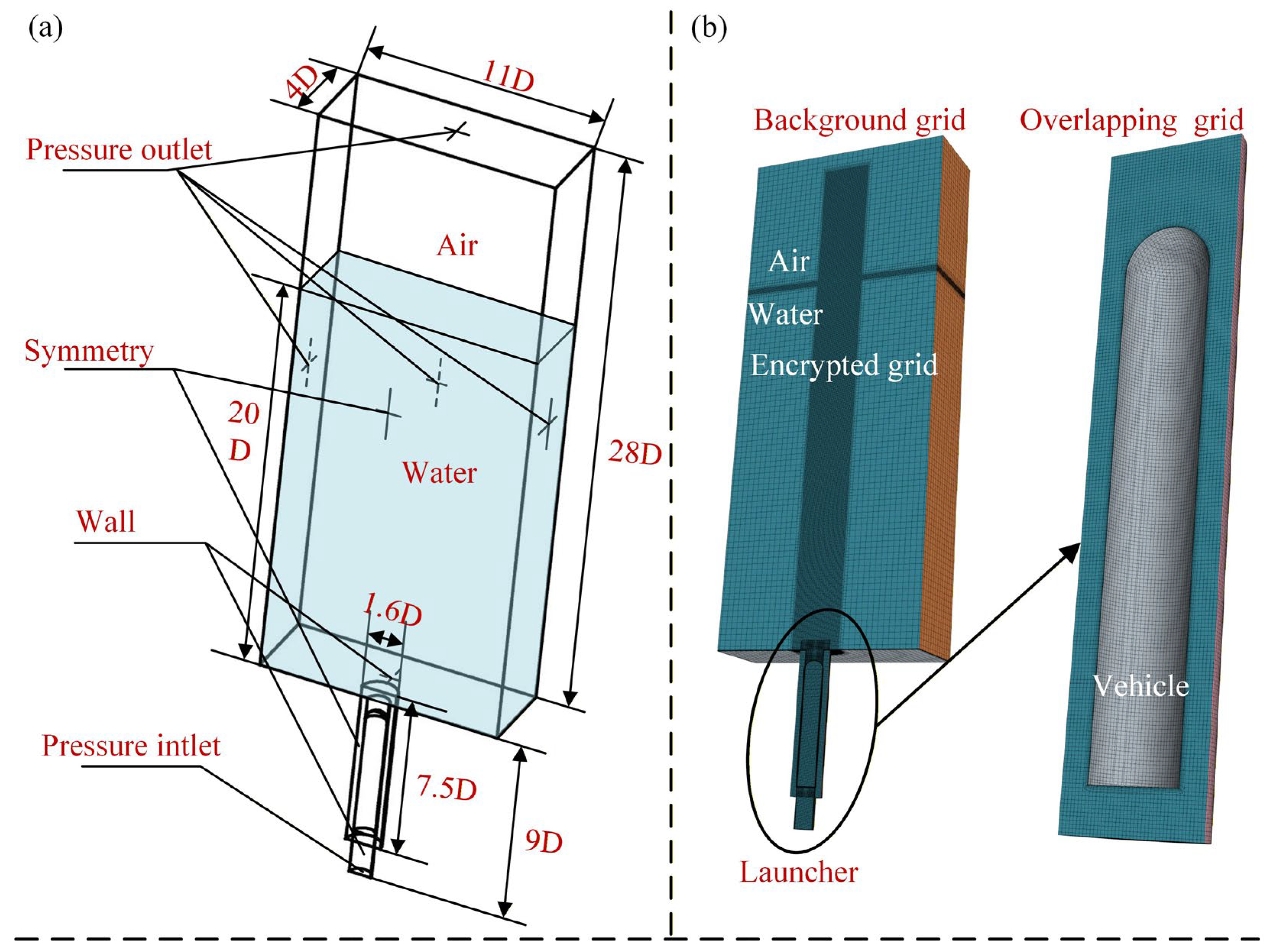
3.1. Geometric Model and Boundary Conditions
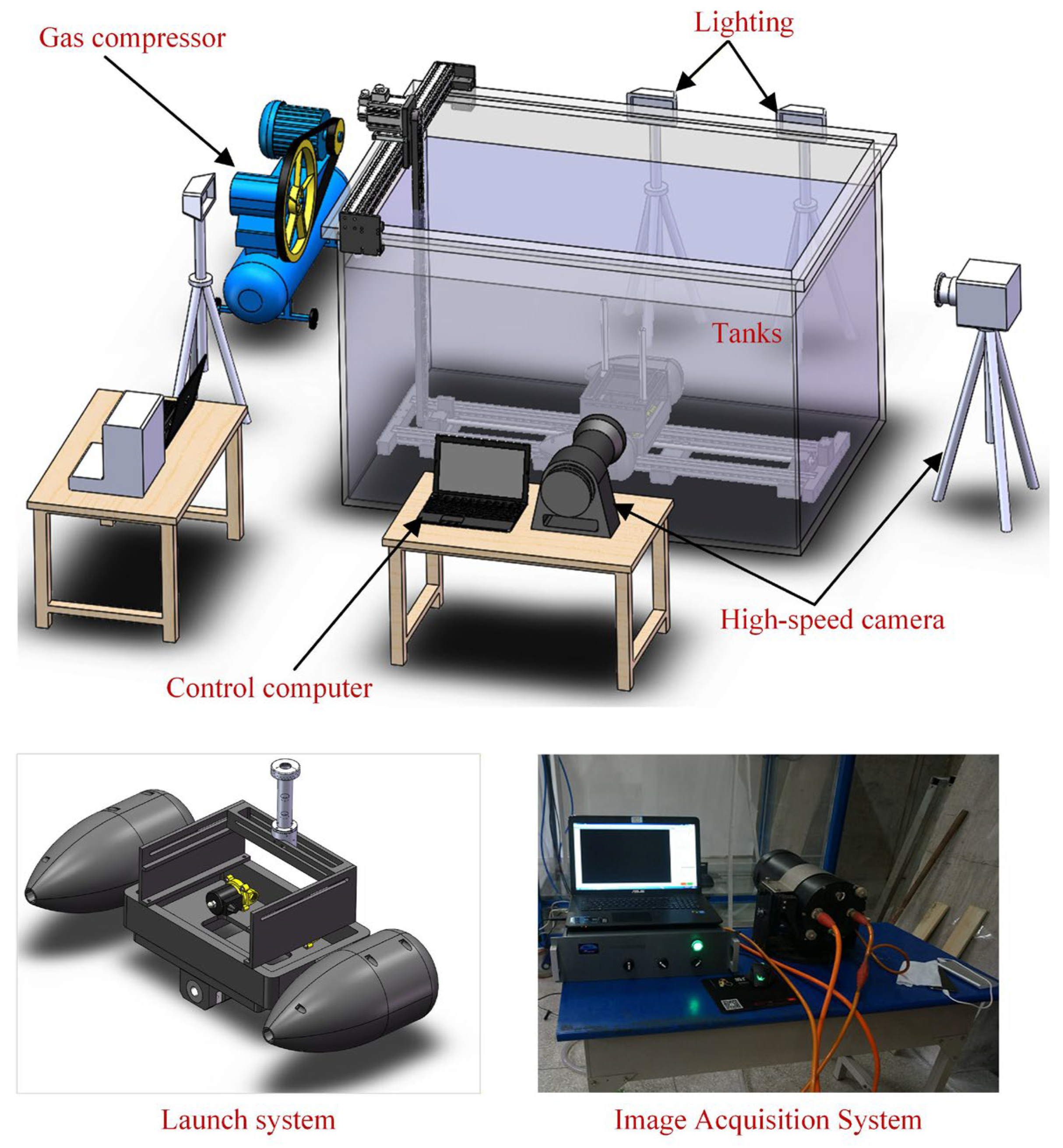
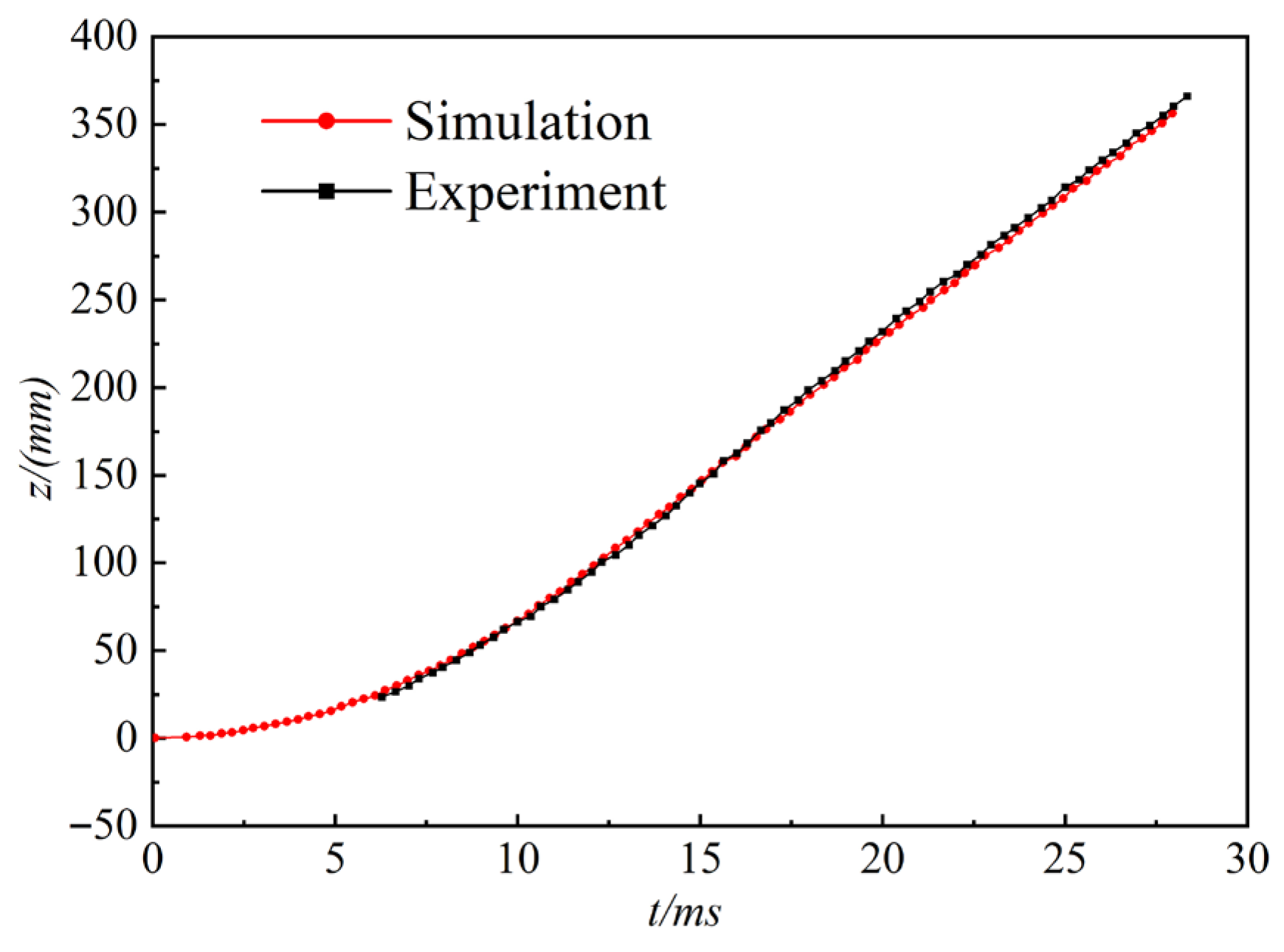
3.2. Validations of Numerical Approach
4. Results and Discussion
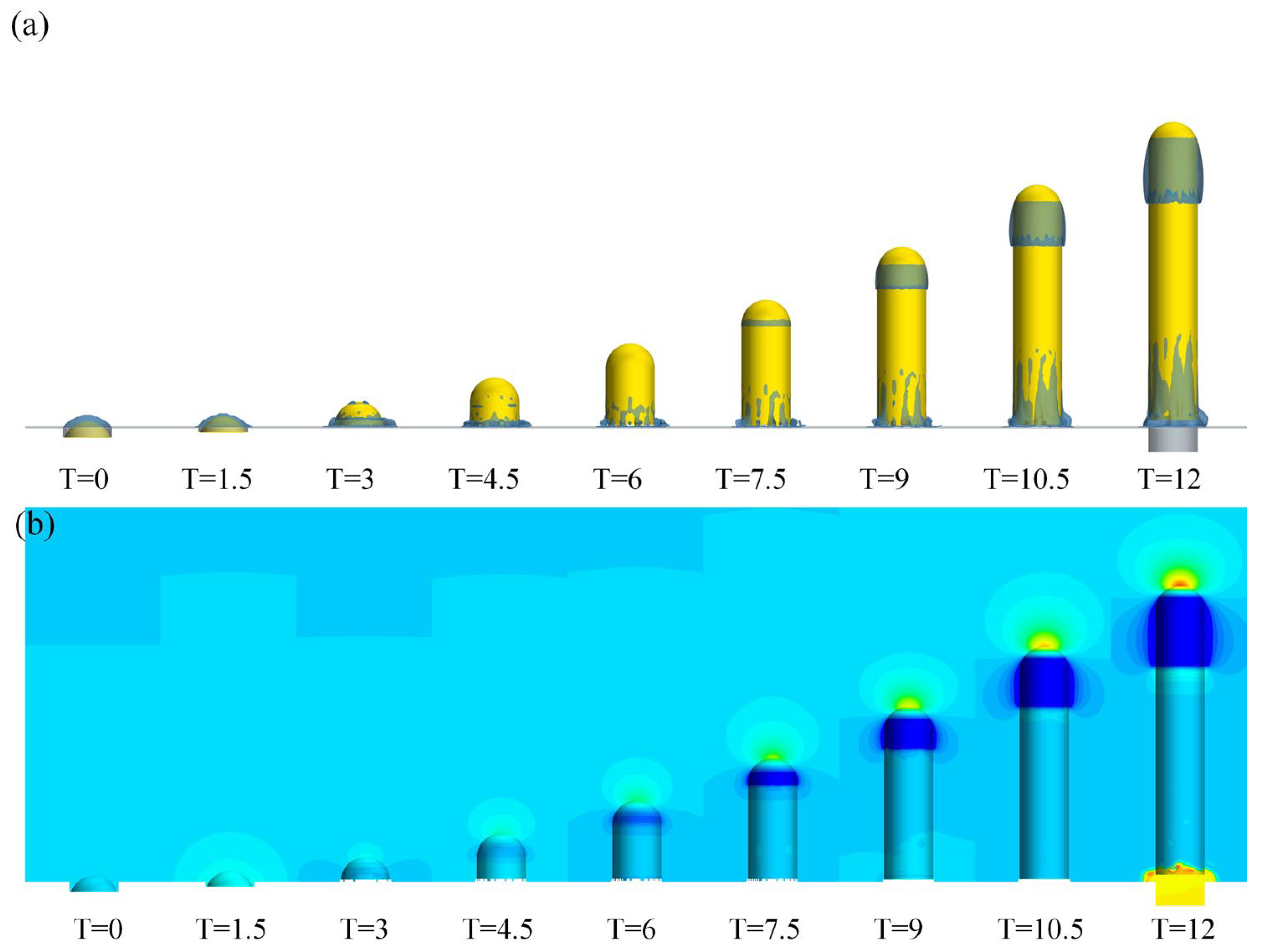
4.1. Analysis of the Structure of the Typical Multiphase Flow
4.2. Evolution of the Structure of the Multiphase Flow and Load Characteristics
4.3. Evolution of Motion Characteristics
5. Conclusions
- (1)
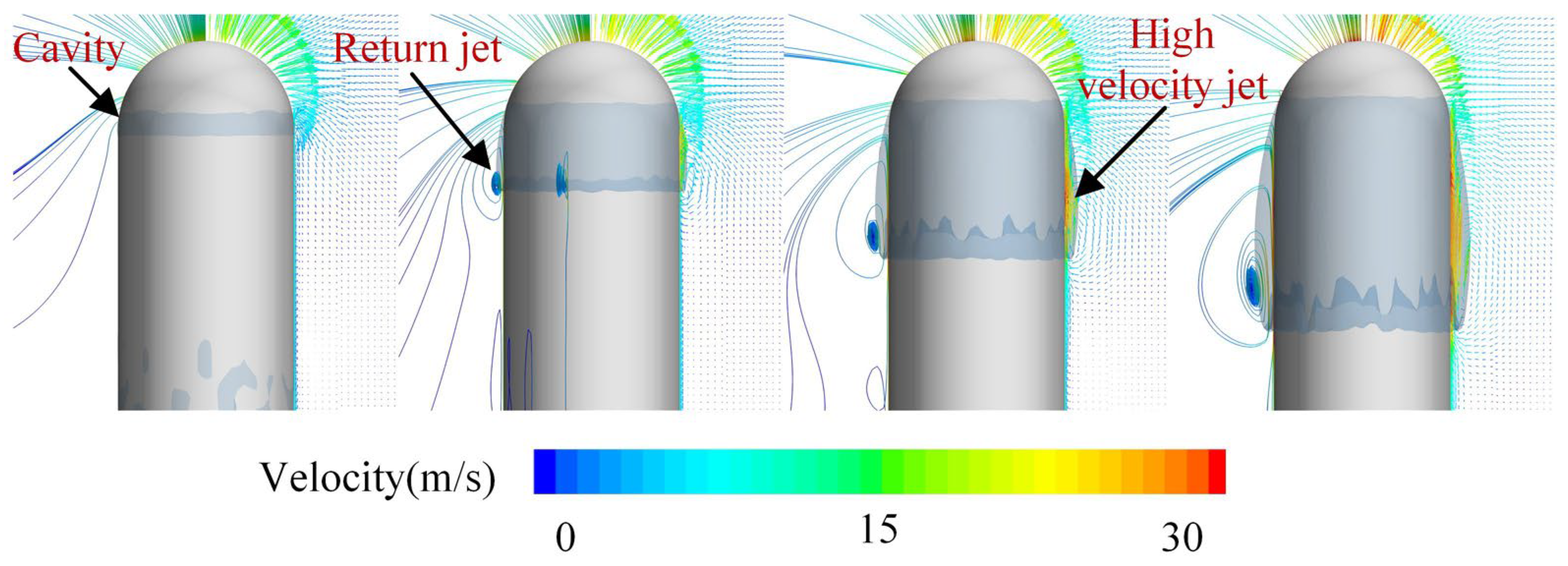
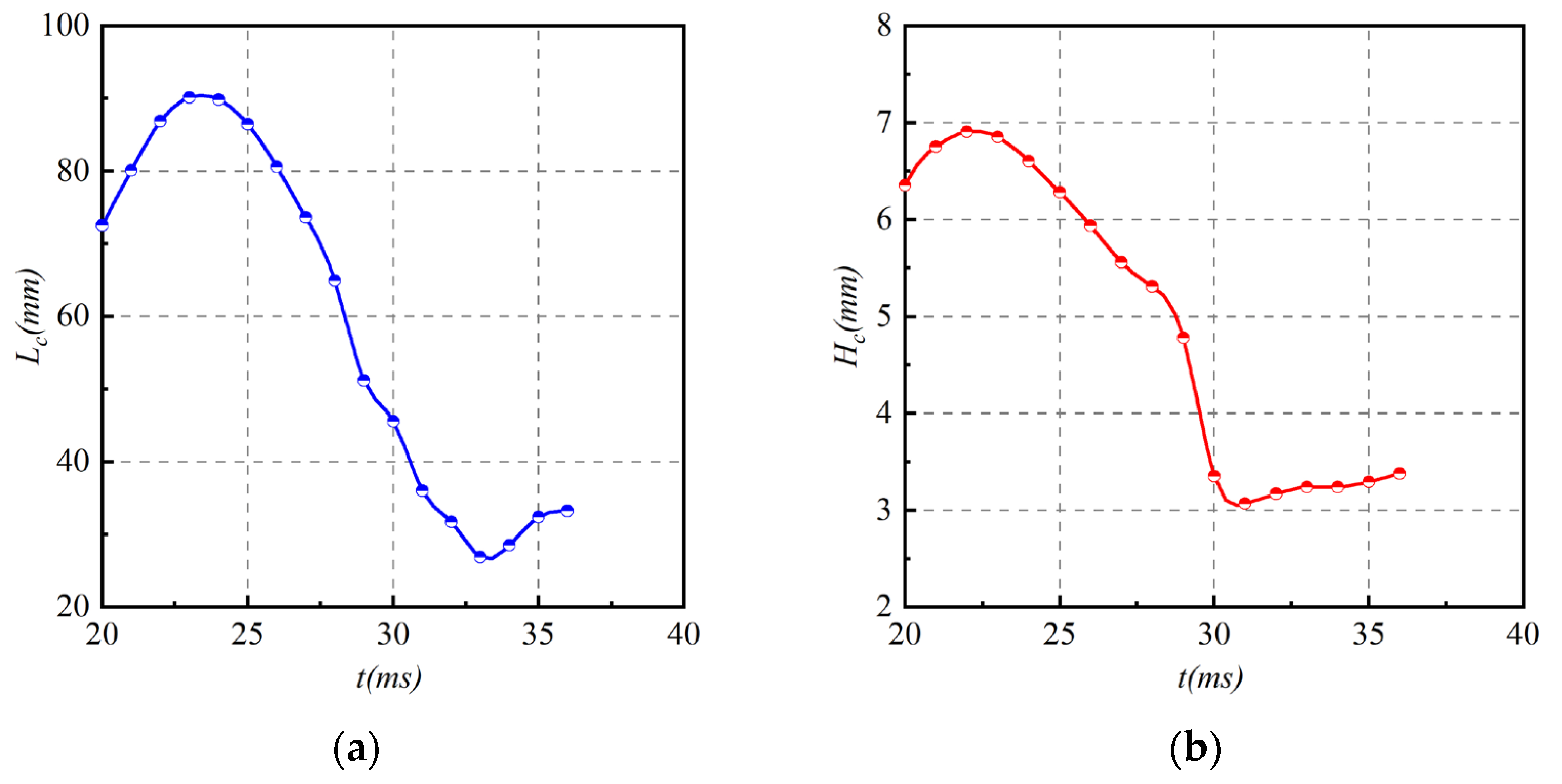
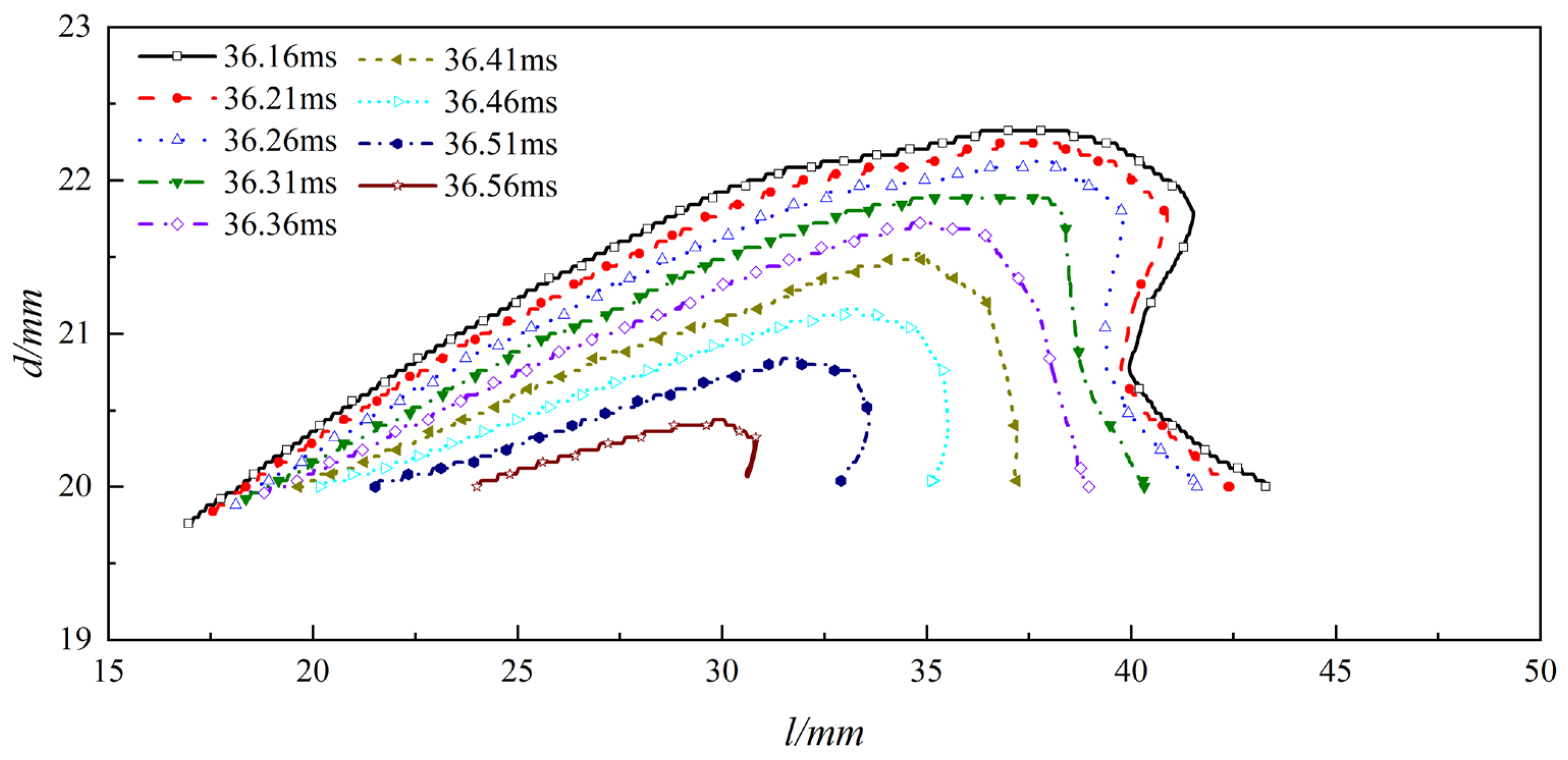
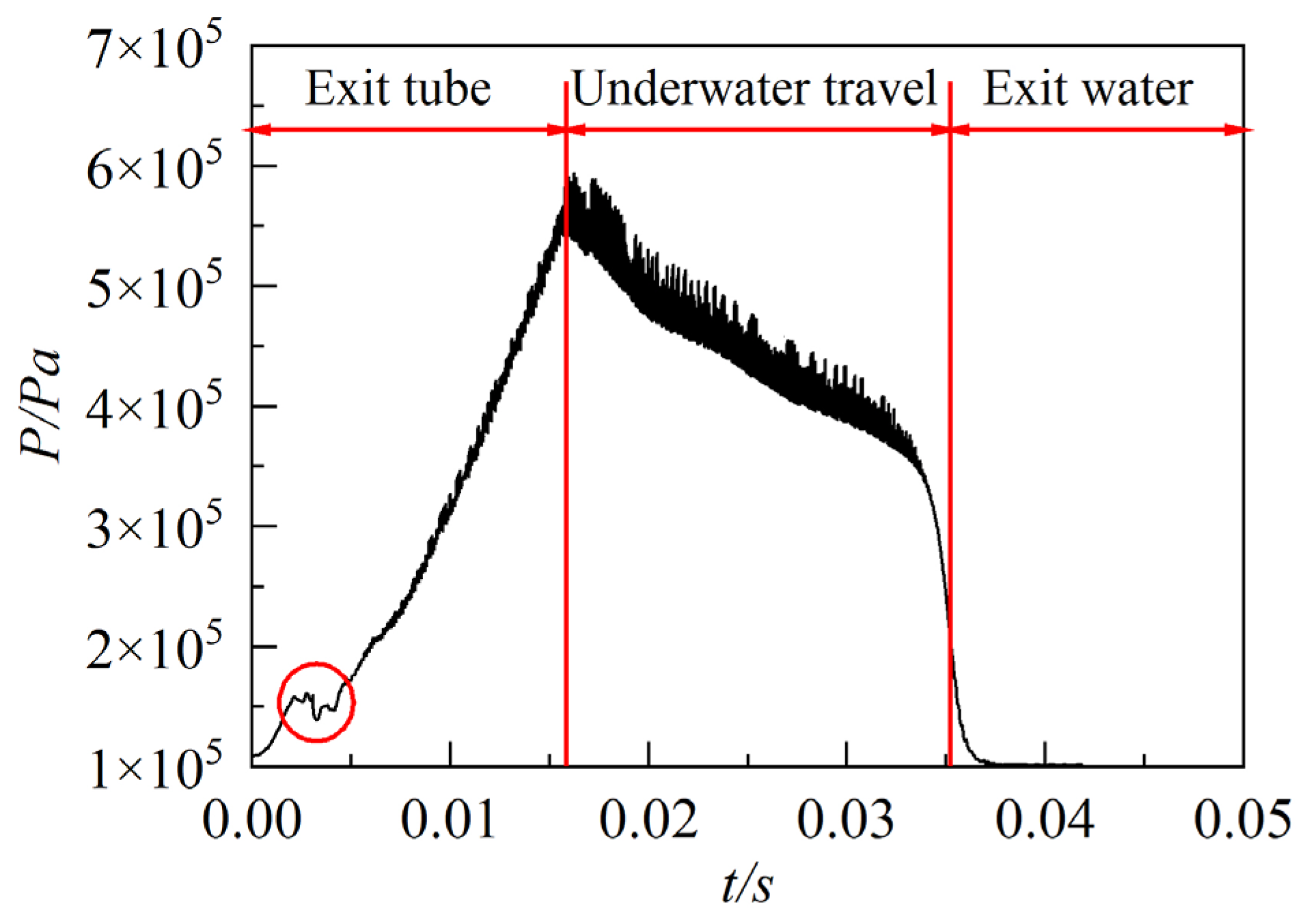
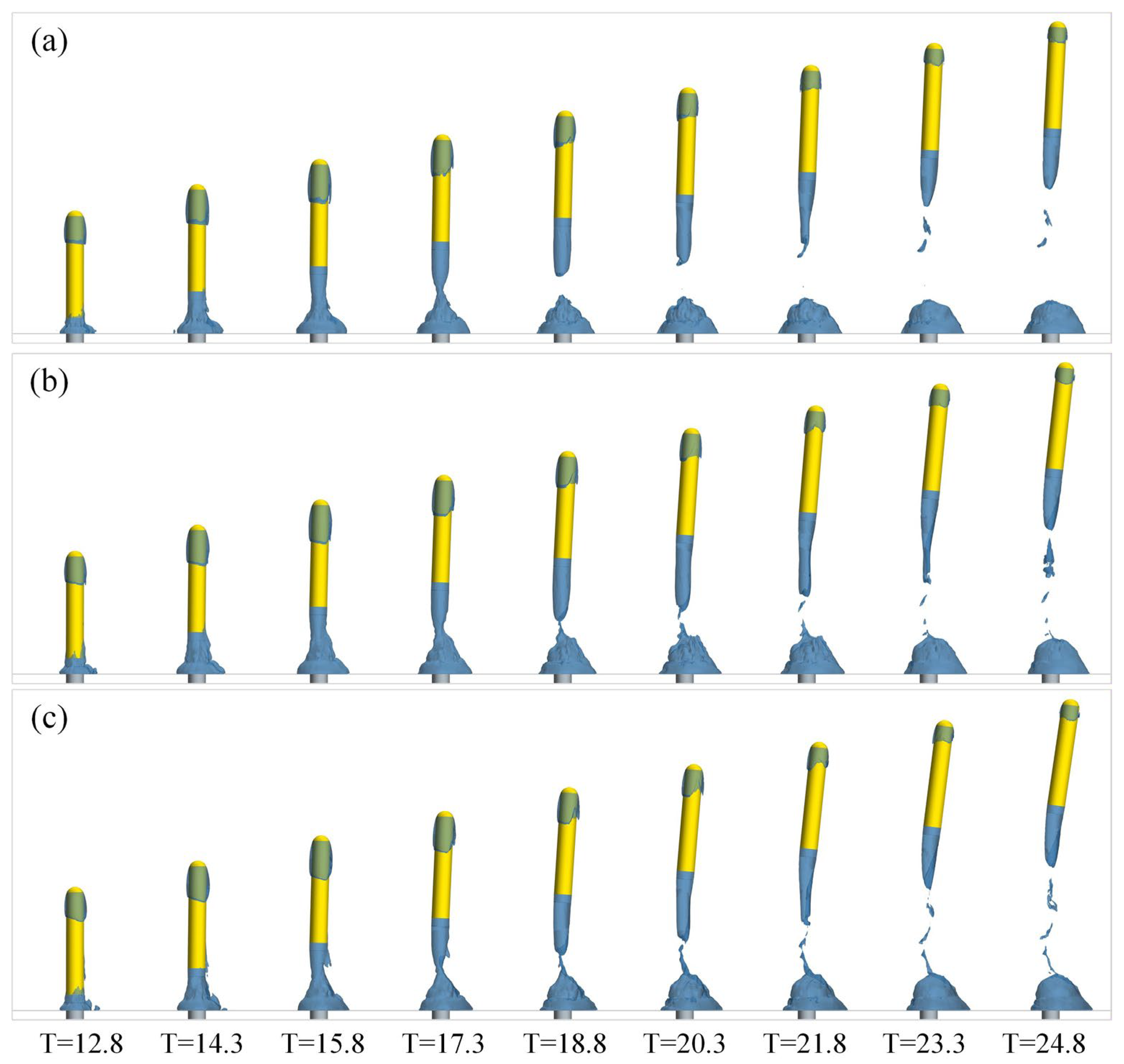
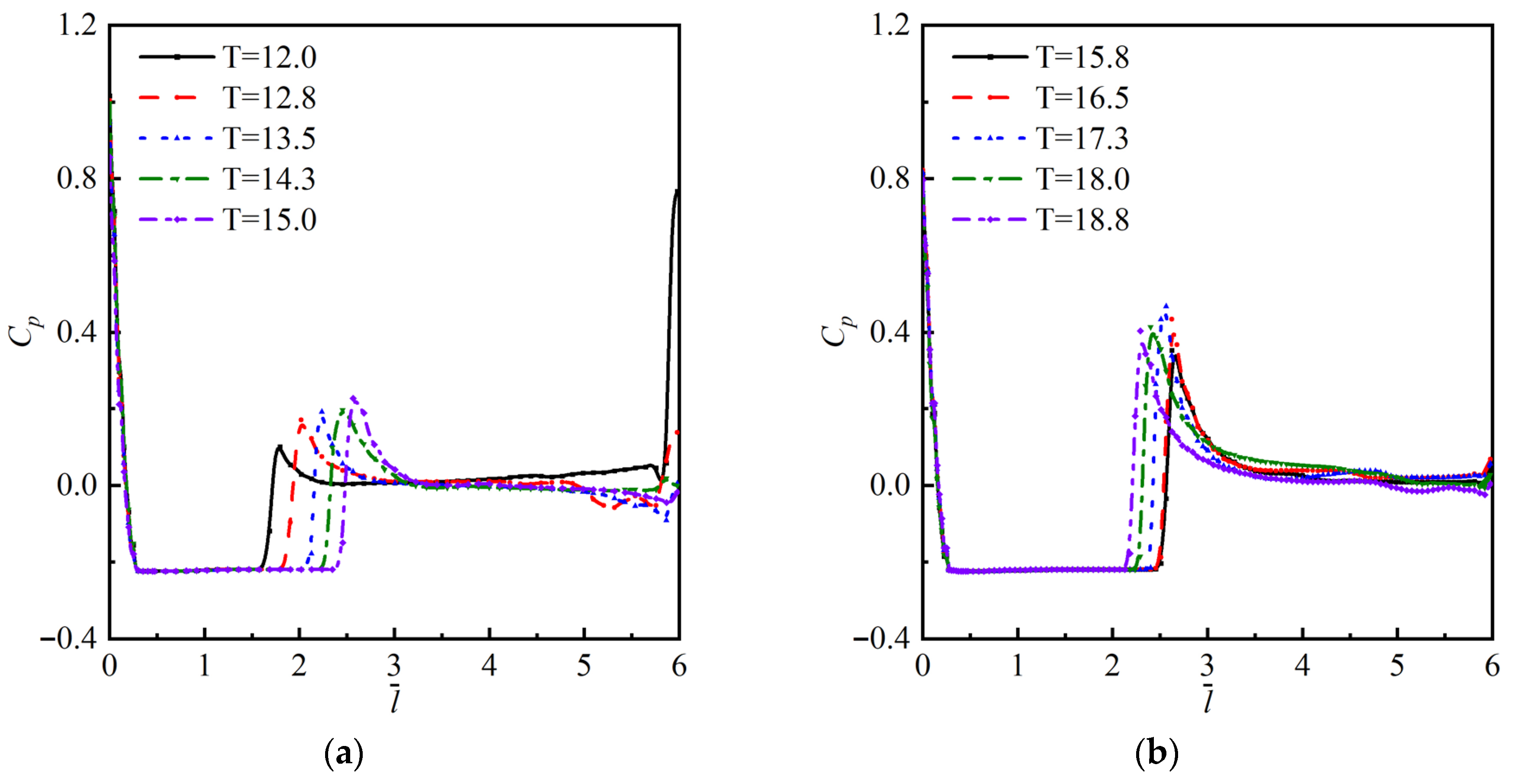
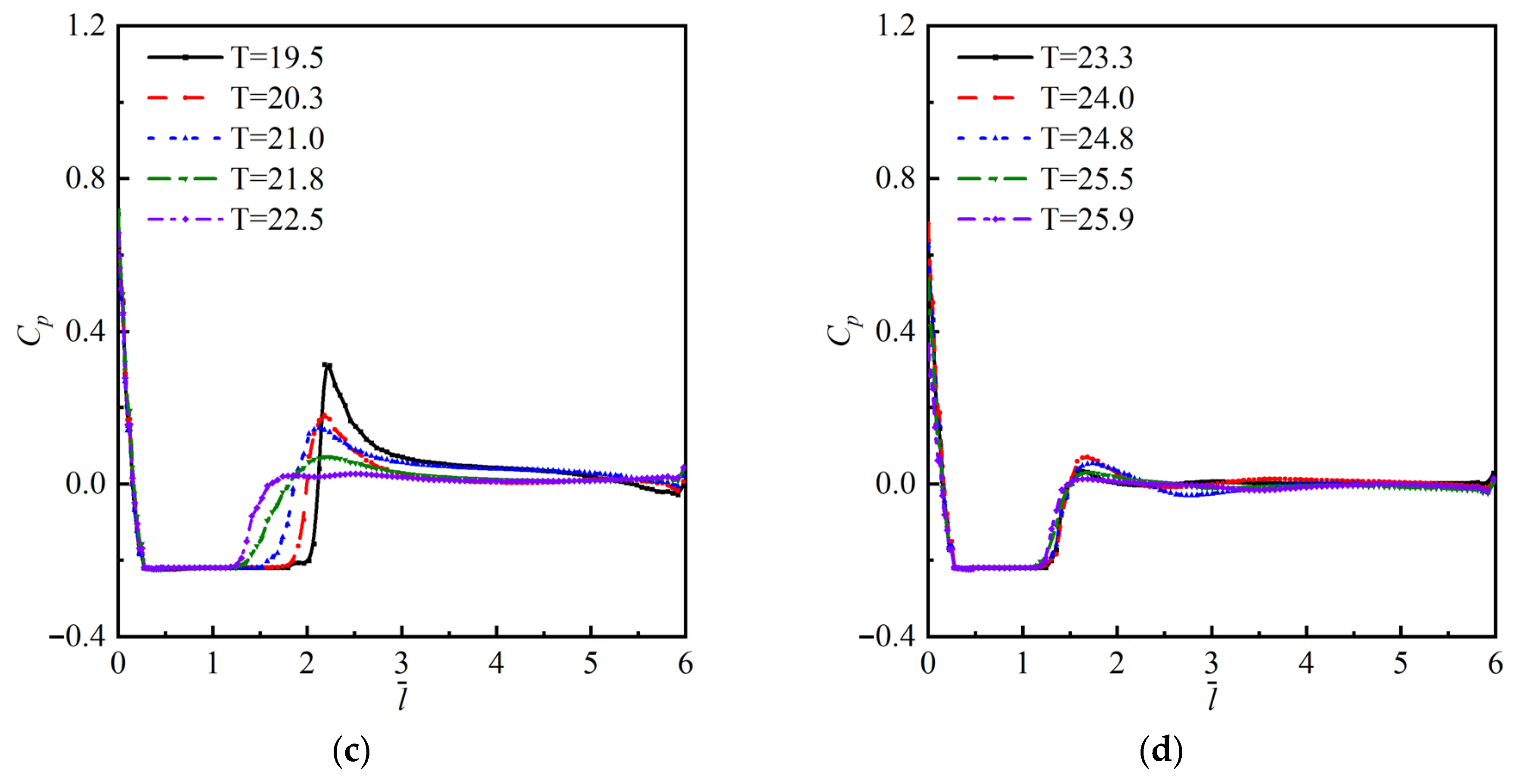
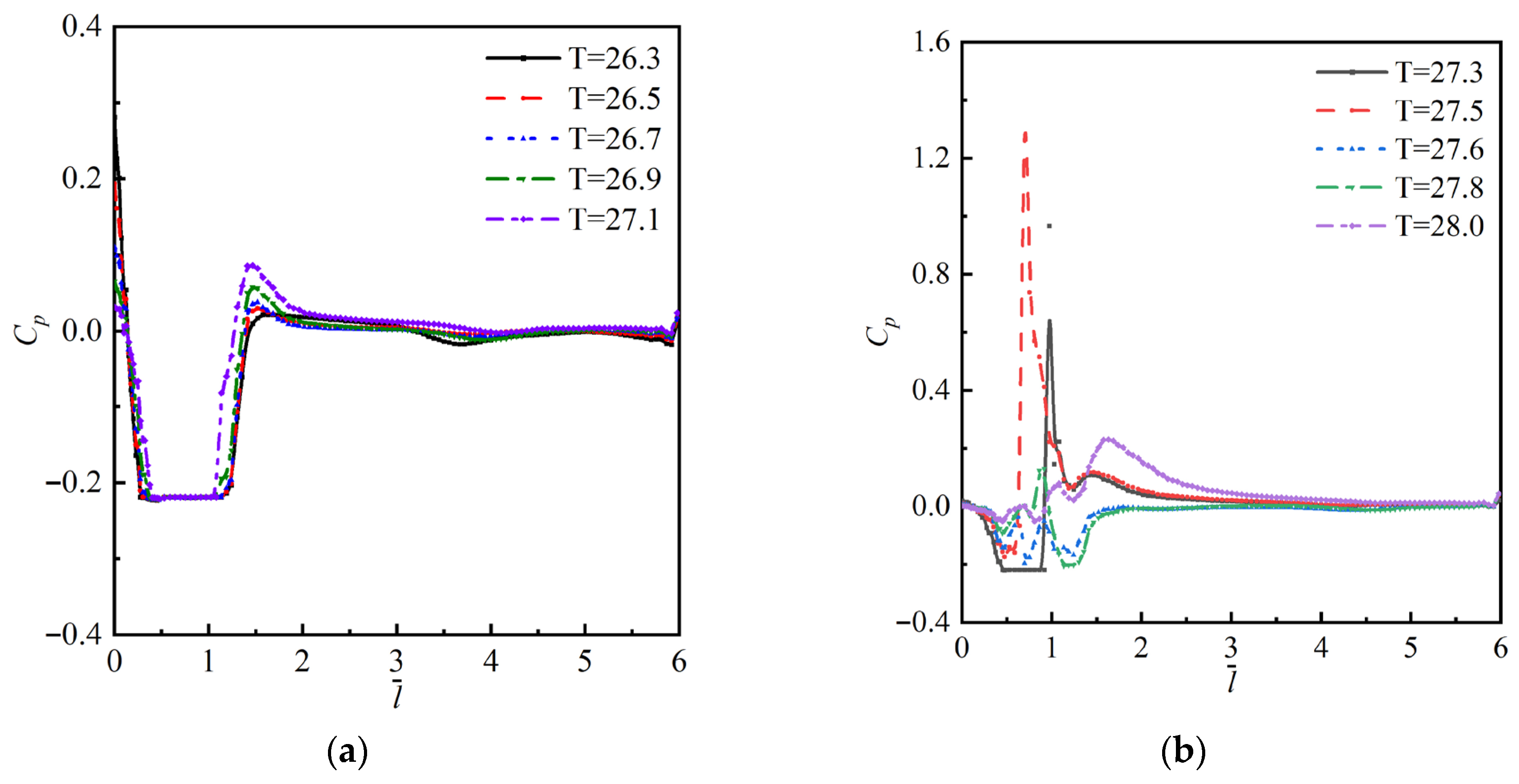
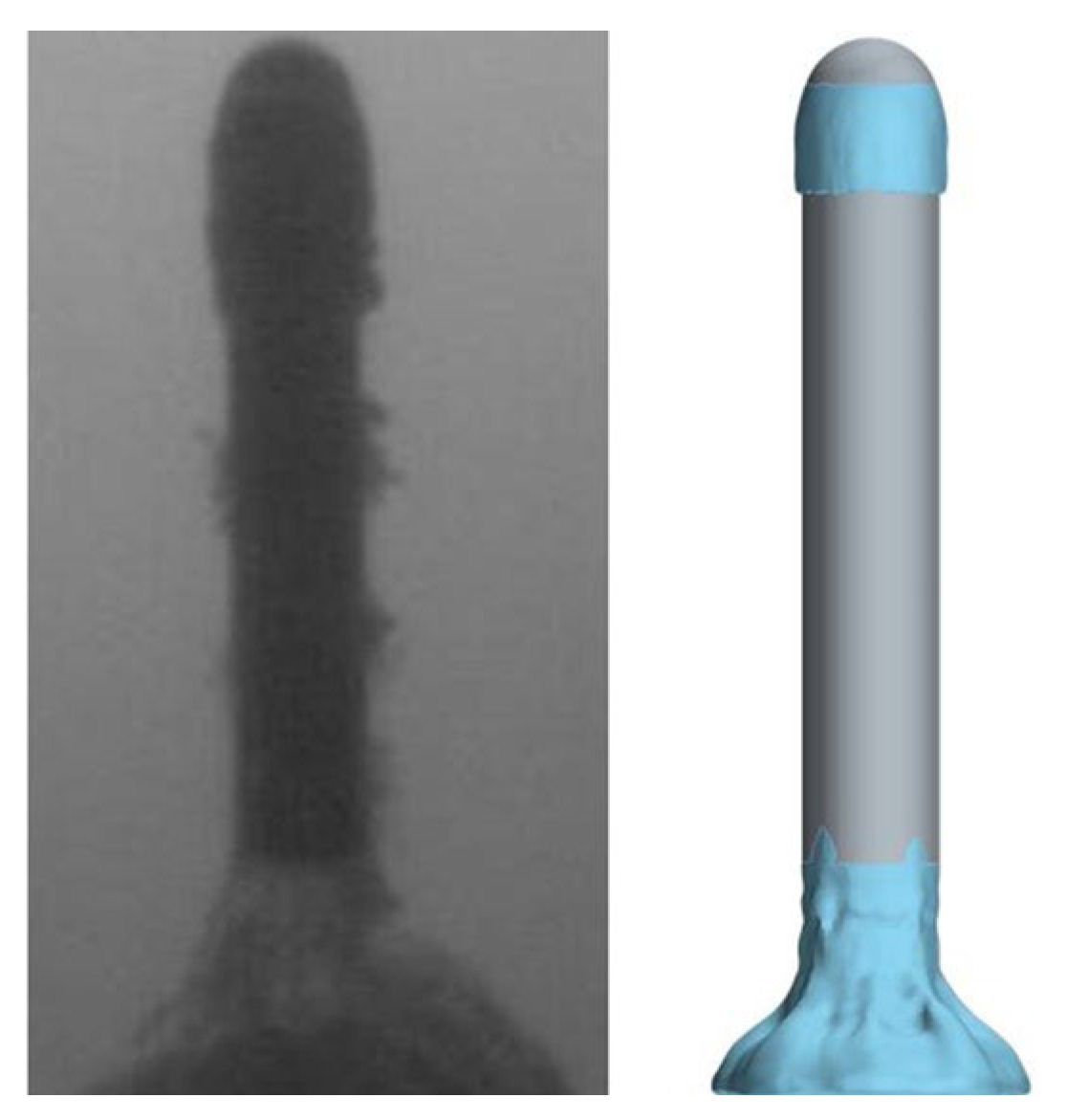
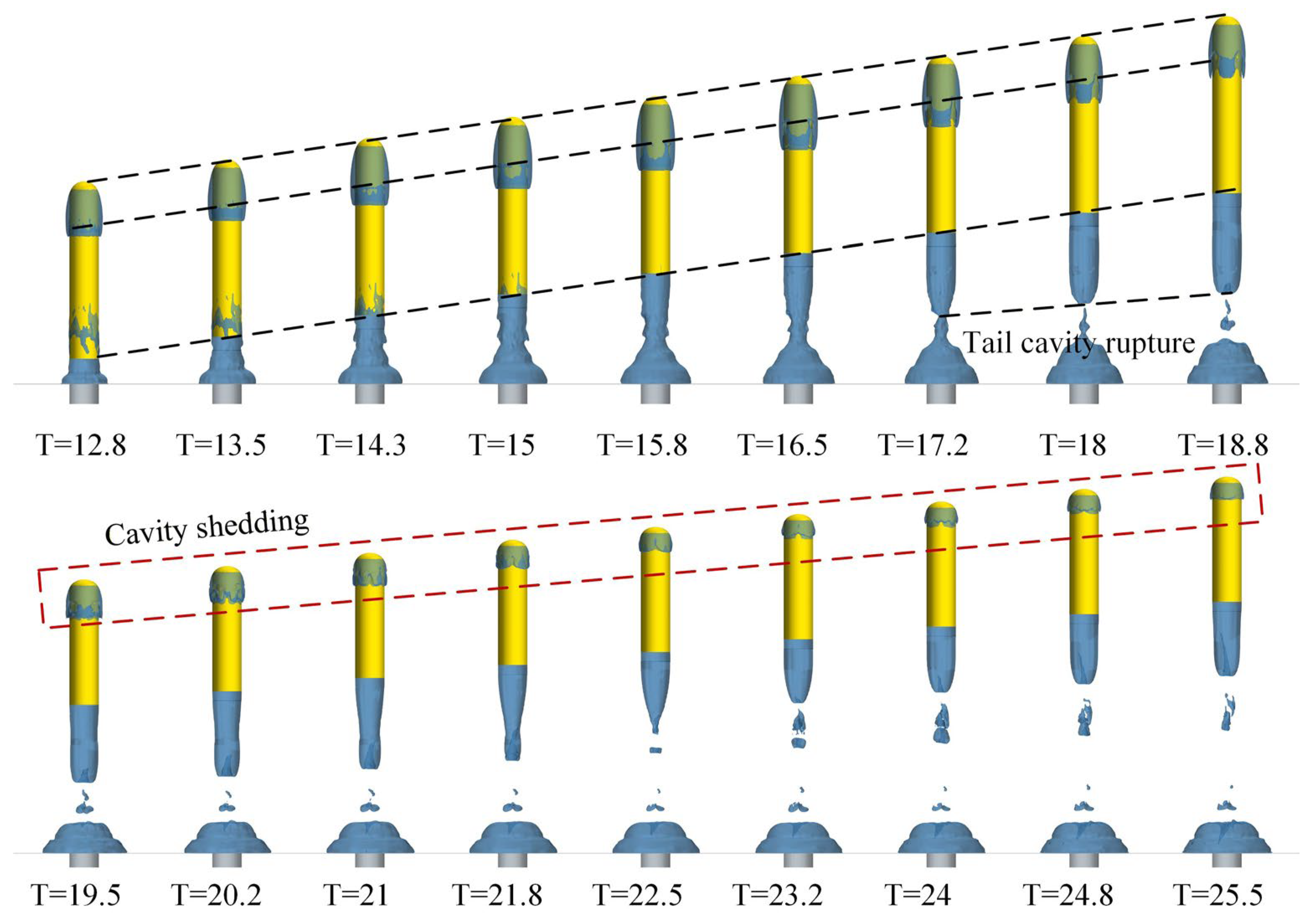
- In the exit tube phase, the vehicle accelerates to 30 m/s, and the shoulder pressure drops below the saturated vapor pressure, initiating cavitation. The length and thickness of the cavity rise and a high-pressure return jet is formed, resulting in a return jet flow being directed into the cavity. A center-type vortex structure is formed at the end of the cavity and the position of the singularity of the vortex is aligned with the position of the front end of the return jet flow in the direction of the vehicle axis.
- (2)
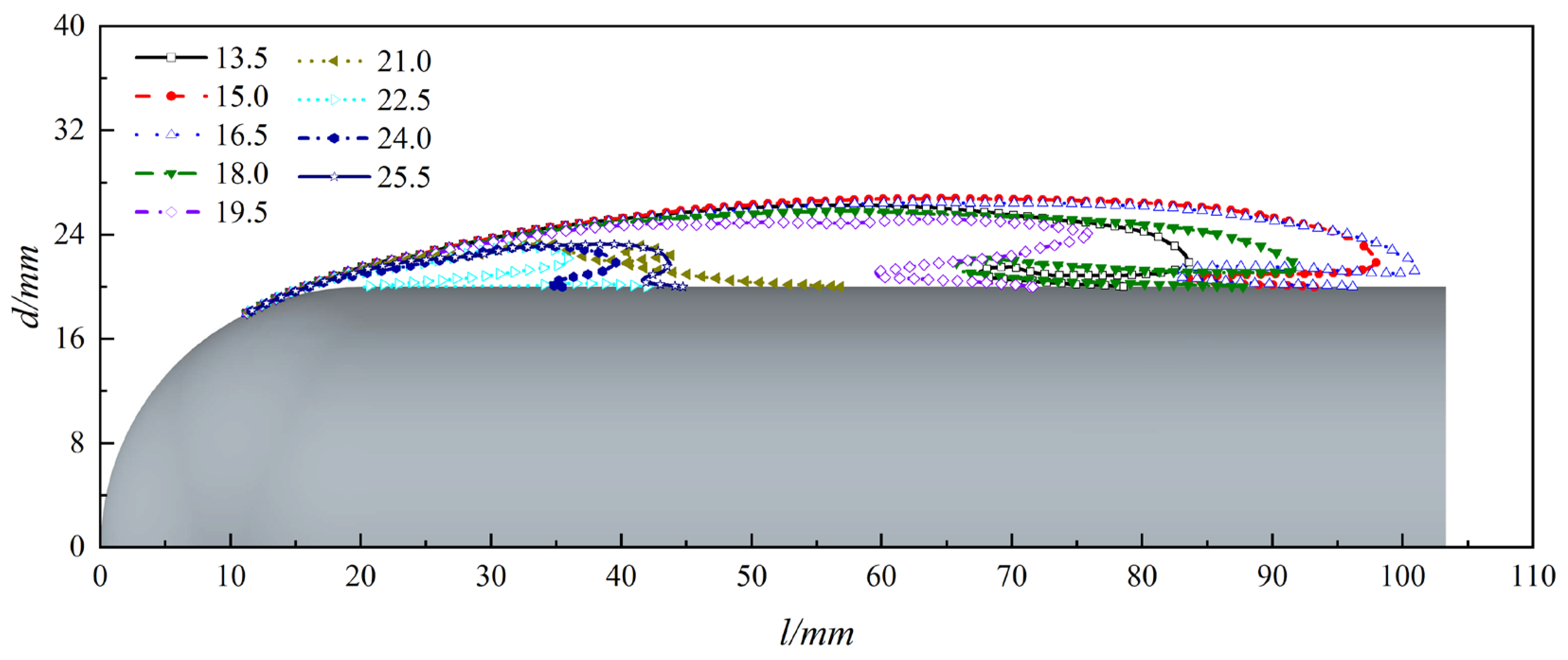
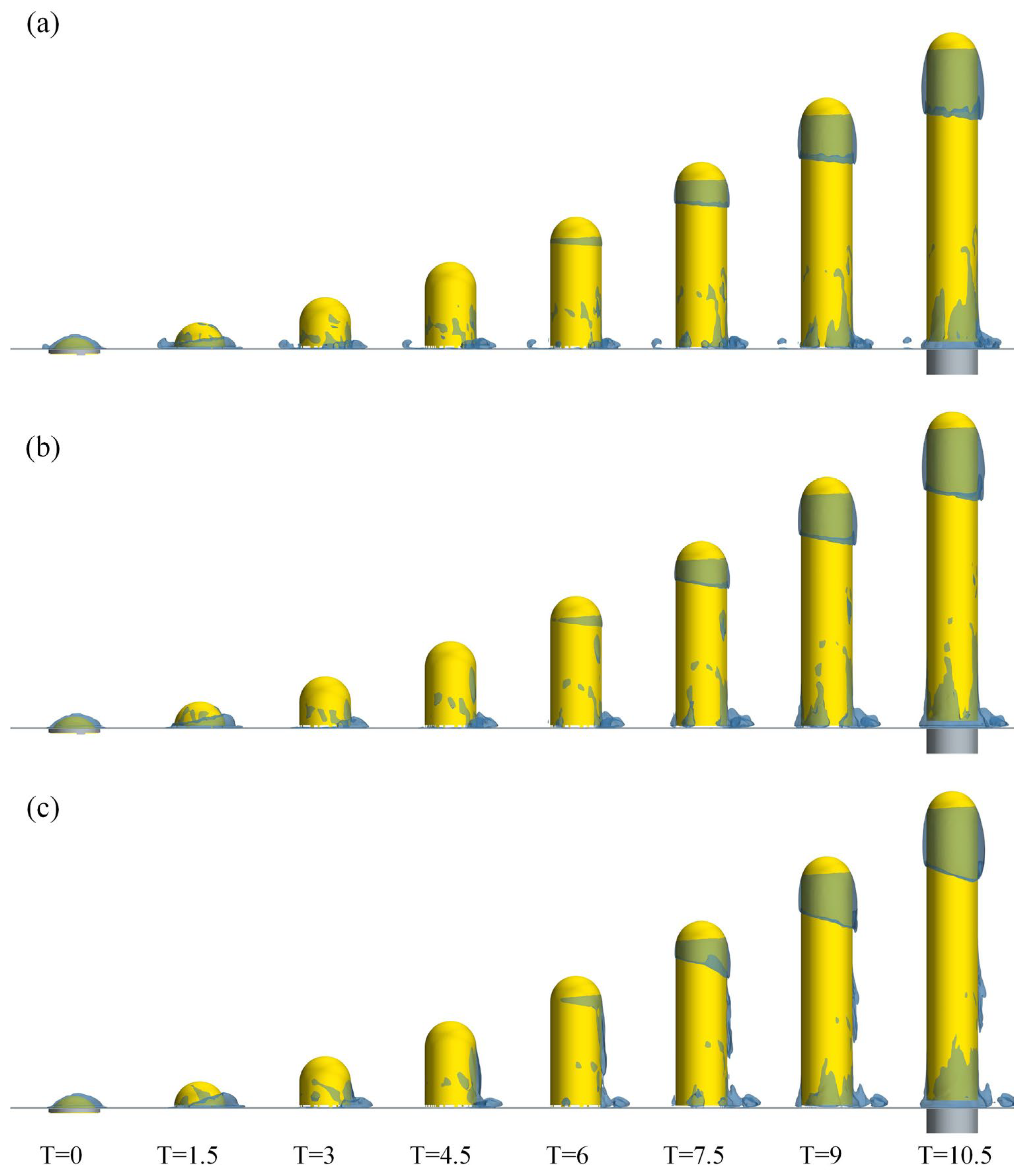
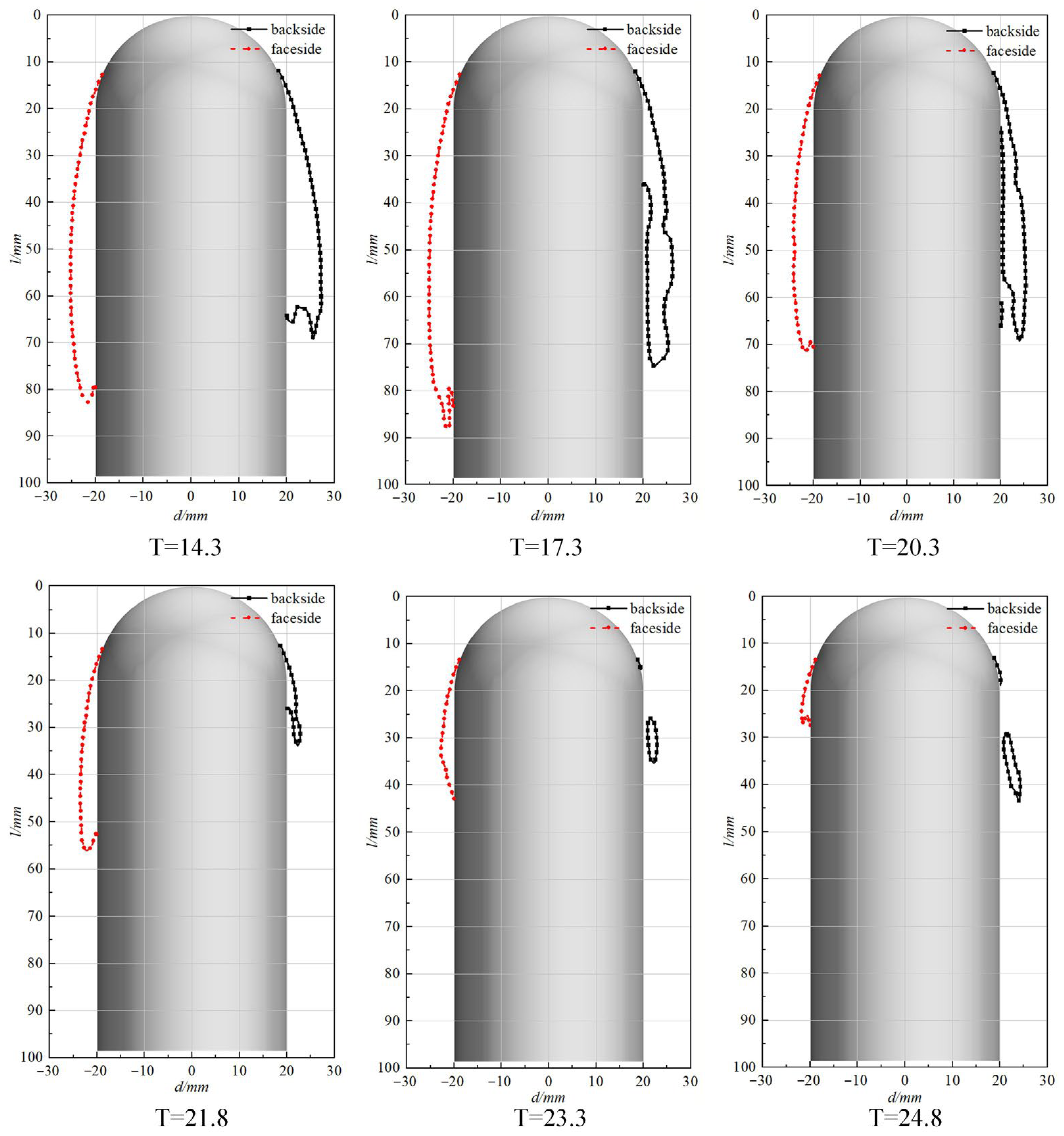
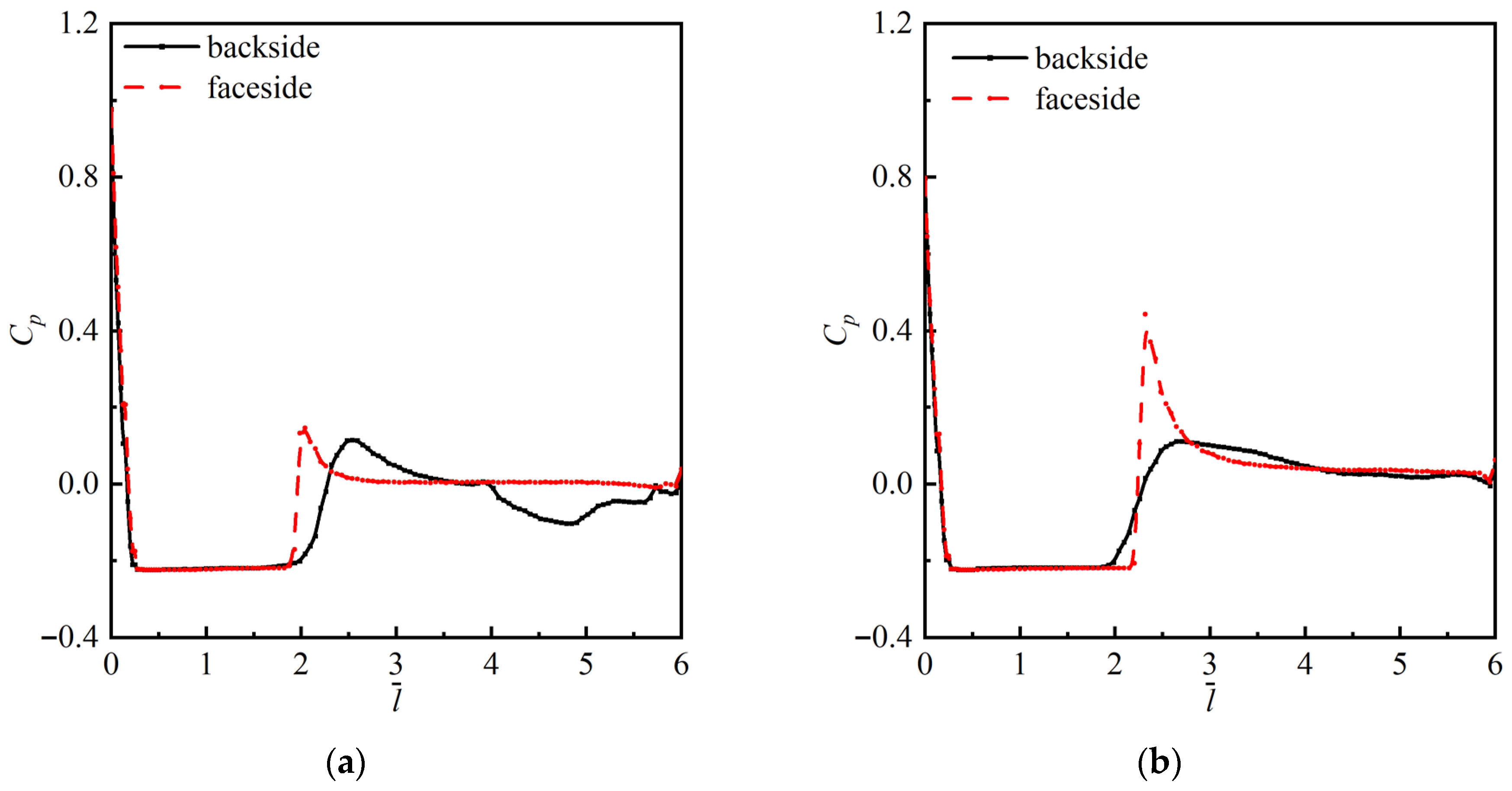
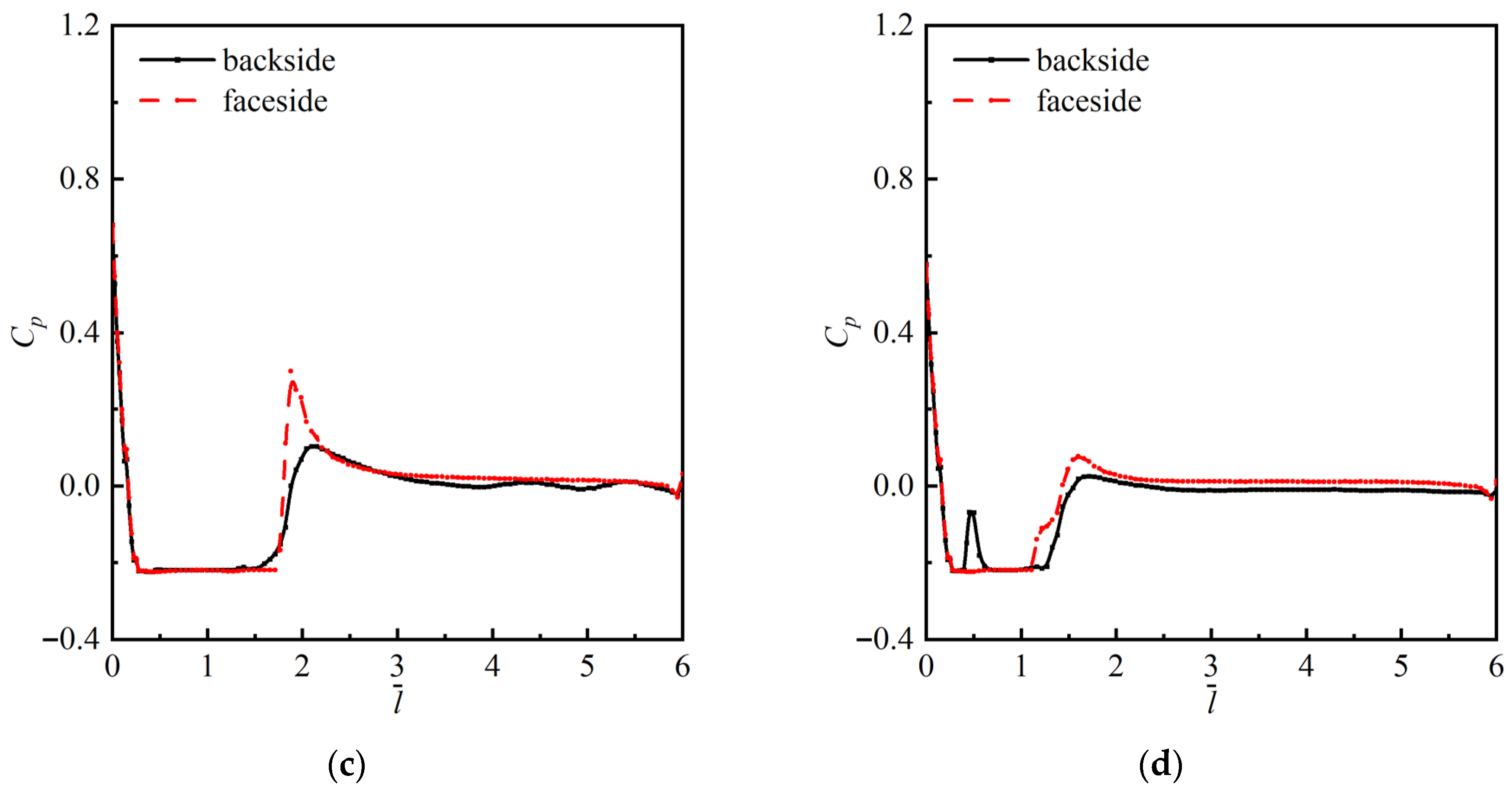
- With the effect of transverse flow (U = 0.016–0.05), the cavity exhibits asymmetric characteristics. The axial length and radial thickness of the cavity on the back side are significantly higher than those on the face side, and the degree of asymmetry increases when U increases from 0.016 to 0.05. The stability of the cavity on the back side is lower than that on the face side, and it is more likely to be sheared off by the return jet flow and undergo large-scale detachment phenomenon. Cavity stability deteriorates with increasing transverse flow intensity.
- (3)
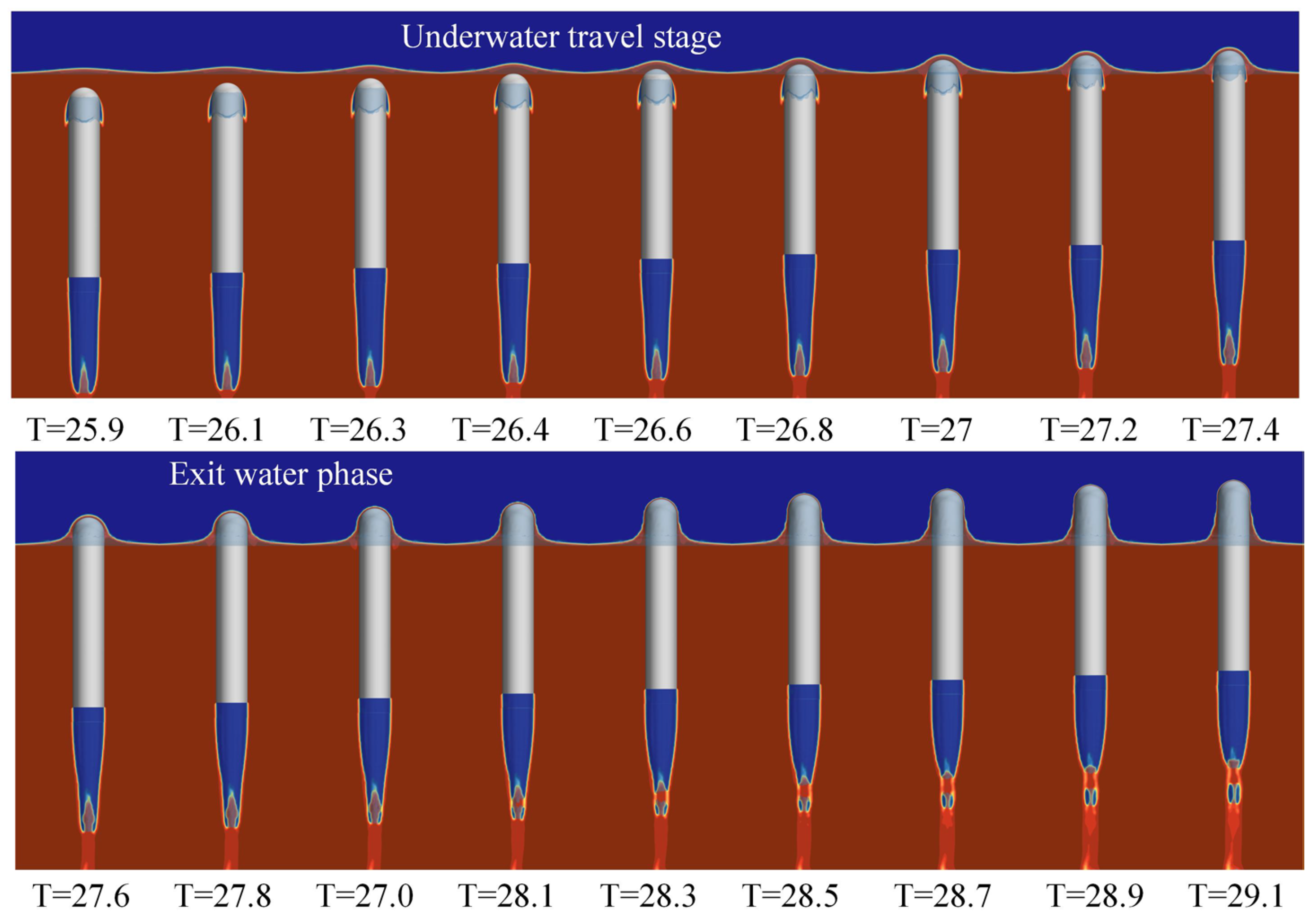
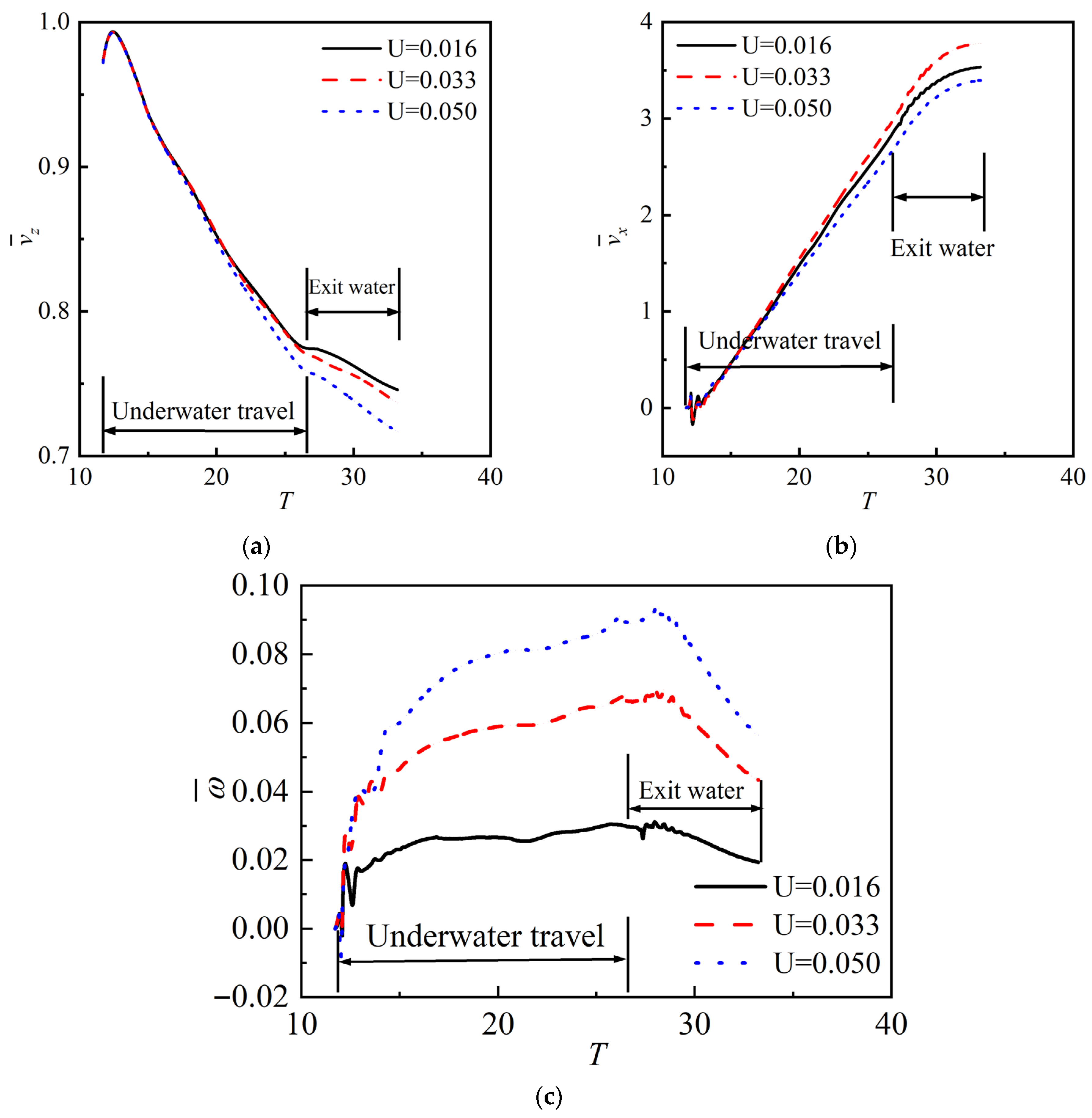
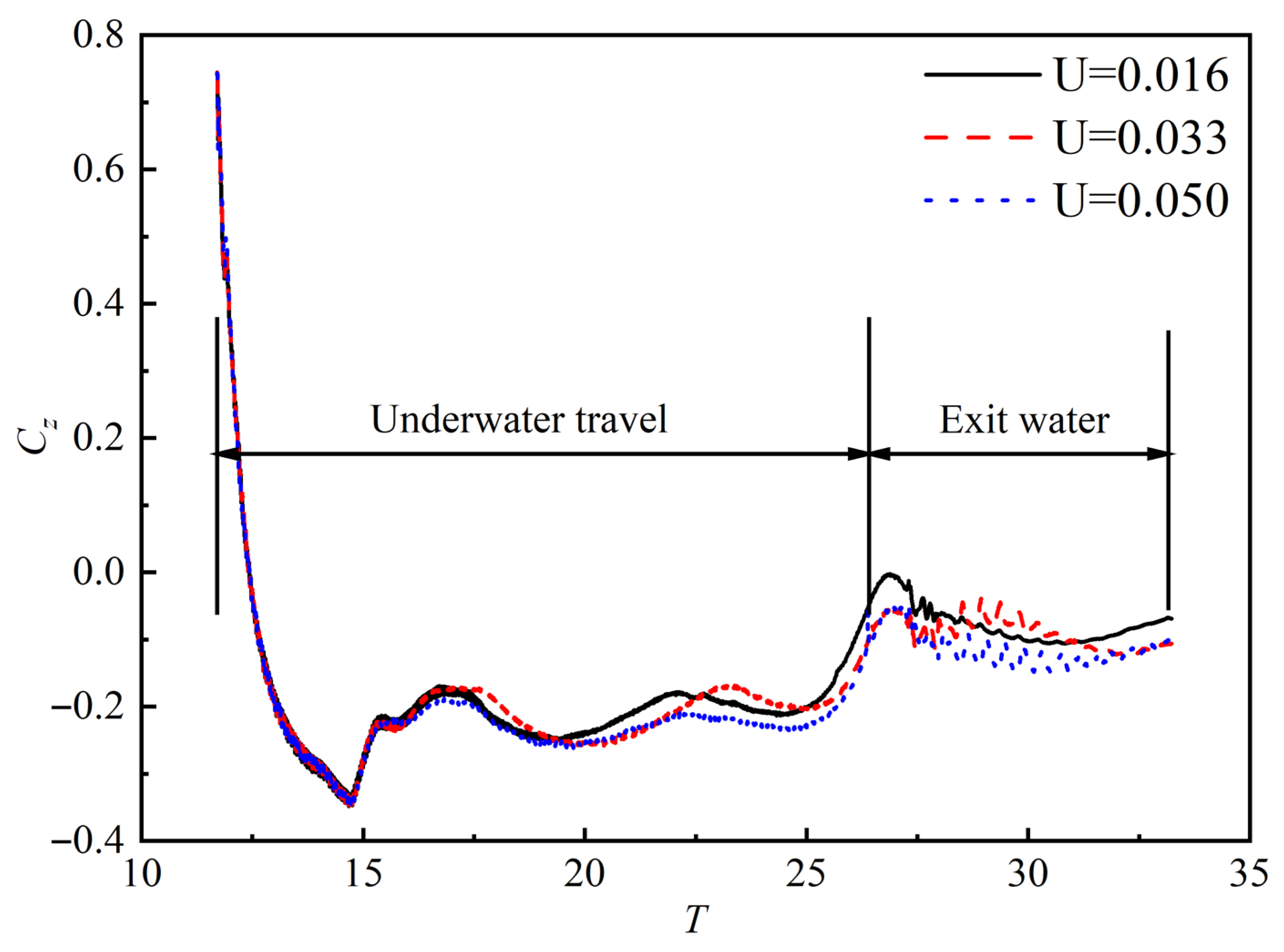
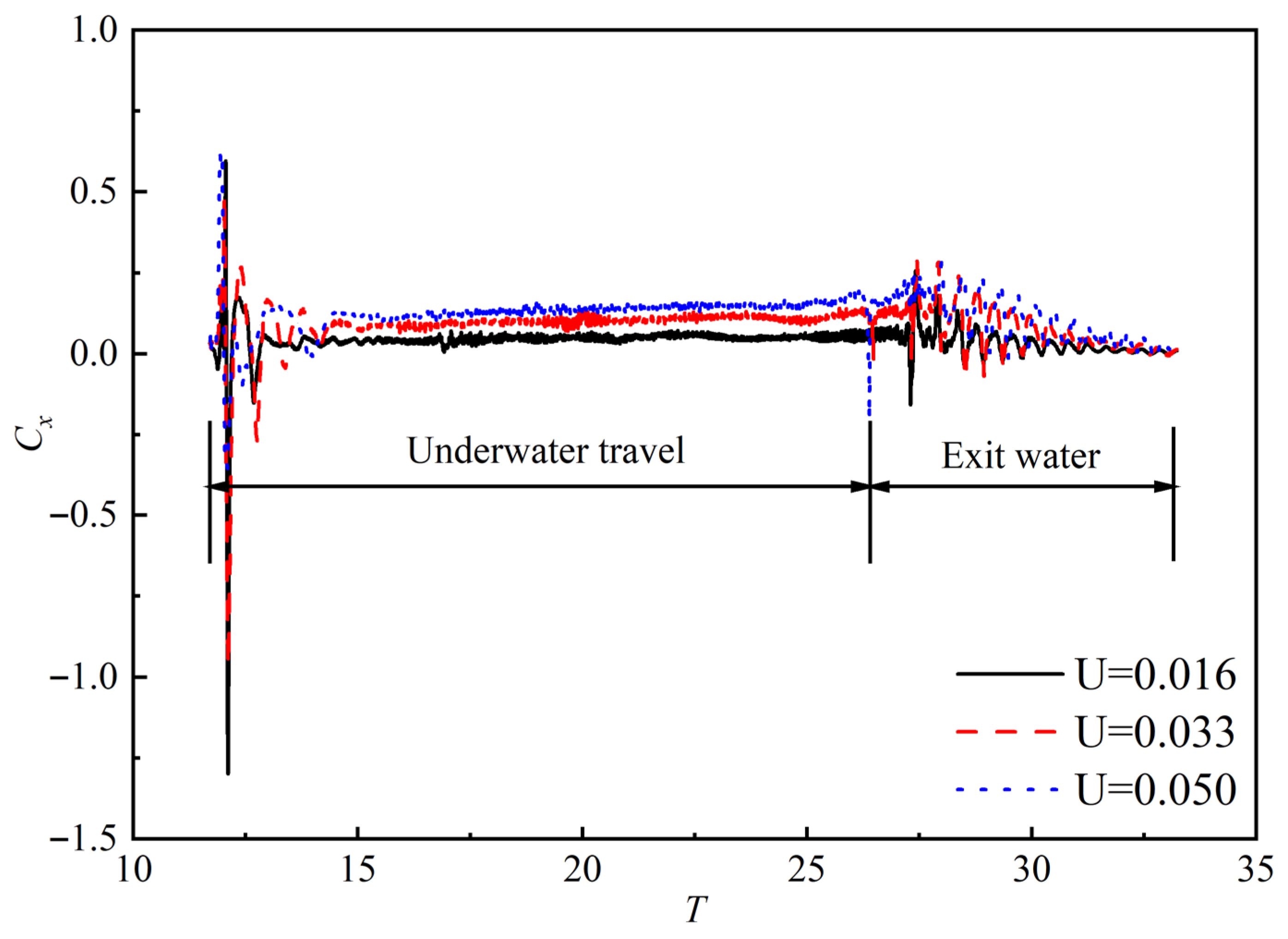
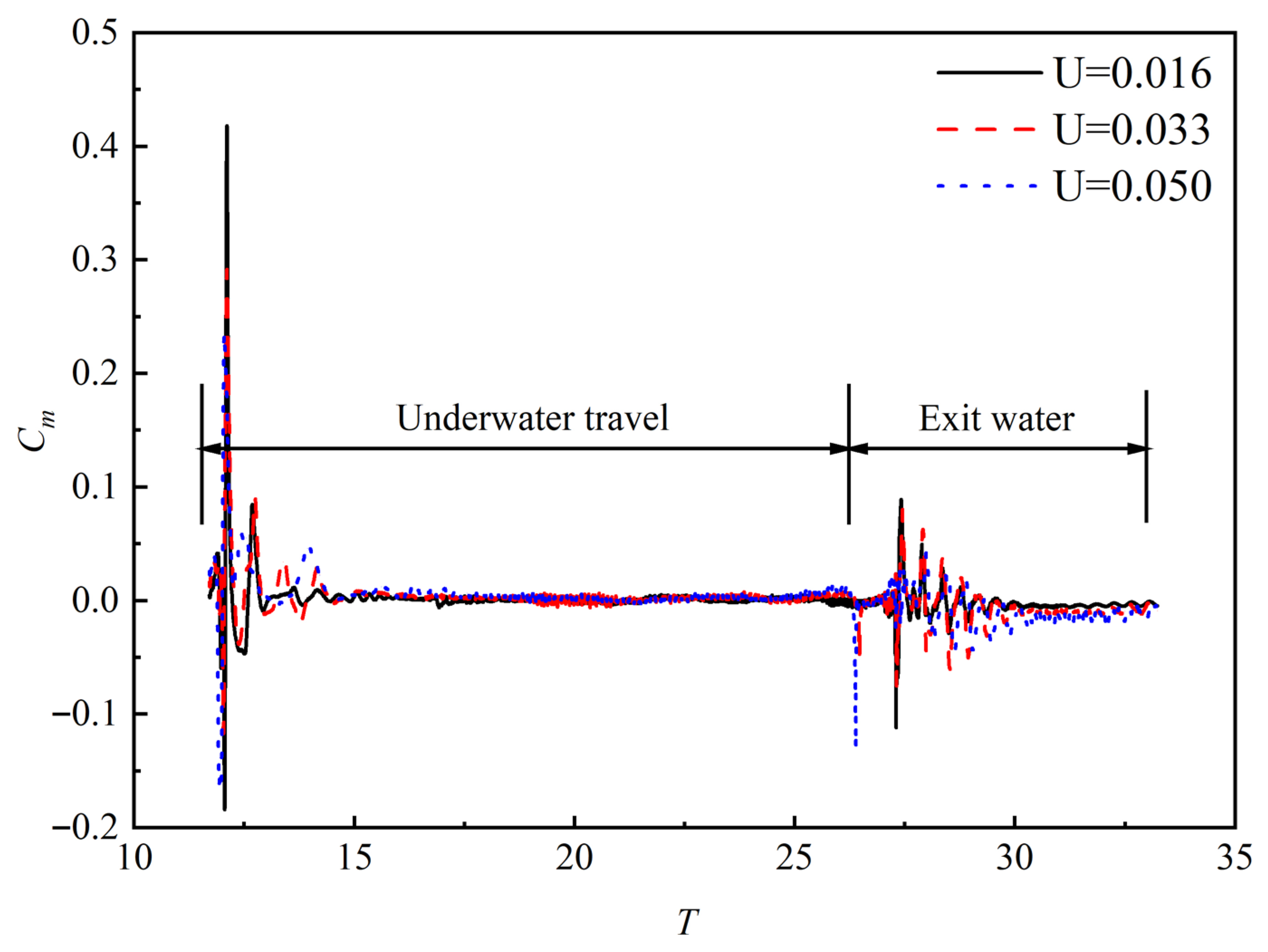
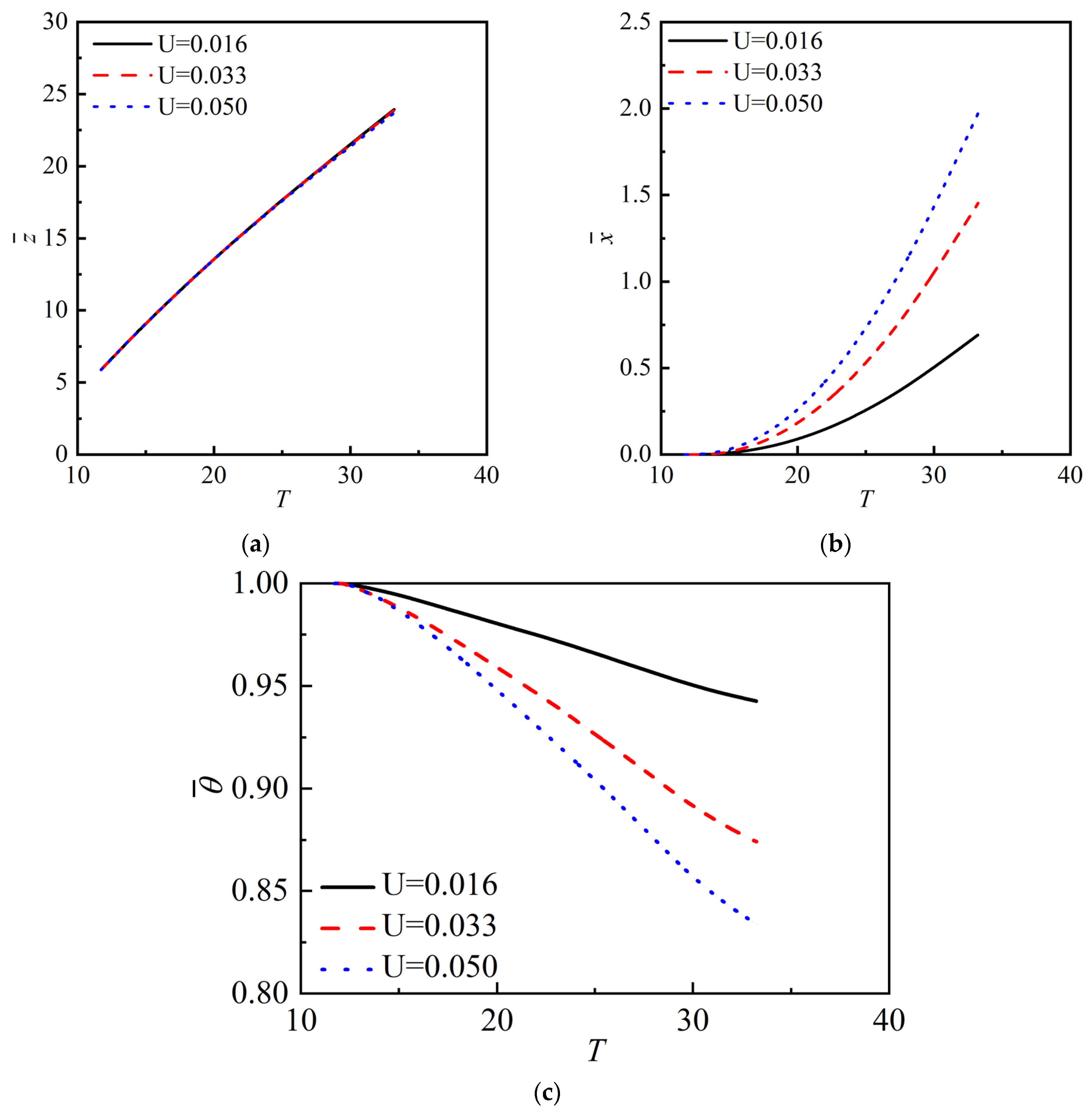
- With the effect of transverse flow, the trajectory and attitude of the vehicle are deflected to the back side after leaving the launcher, horizontal displacement increases from 0.7 mm (U = 0.016) to 2.1 mm (U = 0.05), and attitude angle reduces by 7.4%, with deflection amplitude increasing with transverse flow intensity. Sustained lateral forces result in an exit-water horizontal velocity 3–4 times the transverse flow velocity. Potential active flow control strategies (e.g., ventilated cavitation) or passive devices (e.g., surface microstructures) could be explored to mitigate backside cavity instability and large-scale detachment in future studies.
Author Contributions
Funding
Institutional Review Board Statement
Informed Consent Statement
Data Availability Statement
Conflicts of Interest
References
- Faltinsen, O.M. Hydrodynamics of marine and offshore structures. J. Hydrodyn. 2015, 26, 835–847. [Google Scholar]
- Gao, S.; Shi, Y.; Pan, G.; Quan, X.B. Research on the effect of asymmetric bubbles on the load characteristics of projectiles during an underwater salvo. Appl. Ocean Res. 2022, 124, 103212. [Google Scholar] [CrossRef]
- Du, T.Z.; Wang, Y.W.; Huang, C.G.; Liao, L.J. A numerical model for cloud cavitation based on bubble cluster. Theor. Appl. Mech. Lett. 2017, 7, 231–234. [Google Scholar] [CrossRef]
- Ji, B.; Wang, Z.Y.; Cheng, H.Y.; Bensow, R.E. Cavitation research with computational fluid dynamics: From Euler-Euler to Euler-Lagrange approach. J. Hydrodyn. 2024, 36, 1–23. [Google Scholar] [CrossRef]
- Liu, C.B.; Bu, W.Y.; Xu, D.; Lei, Y.L.; Li, X.S. Application of hybrid RANS/LES turbulence models in rotor-stator fluid machinery: A comparative study. Int. J. Numer. Methods Heat Fluid Flow 2017, 27, 2717–2743. [Google Scholar] [CrossRef]
- Sun, T.Z.; Xie, Q.M.; Huang, H.K.; Zhang, G.Y. Numerical investigation of ventilated cavity dynamics over a submerged body in the wake of a propeller. Ocean Eng. 2022, 257, 111580. [Google Scholar] [CrossRef]
- Kim, S.; Kinnas, S.A. A panel method for the hydrodynamic analysis of a cavitating propeller with sheet and developed tip vortex cavitation. Phys. Fluids 2023, 35, 127118. [Google Scholar] [CrossRef]
- Sun, T.Z.; Li, X.M.; Jiang, Q.; Zhang, D. Evaluation of effect of micro-vortex generator on dynamic characteristics of unsteady partial cavitating flow over hydrofoil. Ocean Eng. 2022, 257, 111601. [Google Scholar] [CrossRef]
- Wang, Z.Y.; Cheng, H.Y.; Luo, X.W.; Peng, X.X.; Ji, B. An improved Eulerian-Lagrangian method combined with ductile material model for cavitation erosion assessment. J. Fluids Eng. 2025, 147, 051502. [Google Scholar] [CrossRef]
- Zhu, W.C.; Li, Z.R.; Ding, R.Q. Effect of pitch ratio on the cavitation of controllable pitch propeller. Ocean Eng. 2024, 293, 116692. [Google Scholar] [CrossRef]
- Xu, C.; Wang, Y.W.; Huang, C.G.; Yu, C.; Huang, J. Cloud cavitating flow that surrounds a vertical hydrofoil near the free surface. J. Fluids Eng. 2017, 139, 101302. [Google Scholar] [CrossRef]
- Rayleigh, J.W. On the pressure developed in a liquid during the collapse of a spherical cavity. Philos. Mag. 1917, 34, 94–98. [Google Scholar] [CrossRef]
- Blake, J.R.; Robinson, P.B.; Shima, A.; Tomita, Y. Interaction of two cavitation bubbles with a rigid boundary. J. Fluid Mech. 1933, 255, 707–721. [Google Scholar] [CrossRef]
- Plesset, M.S. The Dynamics of Cavitation Bubbles. J. Appl. Mech. 1949, 16, 277–282. [Google Scholar] [CrossRef]
- Lauterborn, W.; Bolle, H. Experimental investigations of cavitation-bubble collapse in the neighborhood of a solid boundary. J. Fluid Mech. 1975, 72, 391–399. [Google Scholar] [CrossRef]
- Nair, V.V.; Bhattacharyya, S.K. Water entry and exit of axisymmetric bodies by CFD approach. J. Ocean Eng. Sci. 2018, 3, 156–174. [Google Scholar] [CrossRef]
- Wang, Z.Y.; Cheng, H.Y.; Ji, B.; Peng, X.X. Numerical investigation of inner structure and its formation mechanism of cloud cavitating flow. Int. J. Multiph. Flow 2023, 165, 104484. [Google Scholar] [CrossRef]
- Ma, G.H.; Chen, F.; Yu, J.Y.; Wang, K. Numerical investigation of trajectory and attitude robustness of an underwater vehicle considering the uncertainty of platform velocity and yaw angle. J. Fluids Eng. 2019, 141, 021106. [Google Scholar] [CrossRef]
- Wang, Z.Y.; Cheng, H.Y.; Bensow, R.E.; Peng, X.X.; Ji, B. Numerical assessment of cavitation erosion risk on the Delft twisted hydrofoil using a hybrid Eulerian-Lagrangian strategy. Int. J. Mech. Sci. 2023, 259, 108618. [Google Scholar] [CrossRef]
- Zhang, L.X.; Wen, Z.Q.; Shao, X.M. Investigation of bubble-bubble interaction effect during the collapse of multi-bubble system. Chin. J. Theor. Appl. Mech. 2013, 45, 861–867. [Google Scholar]
- Du, T.Z.; Wang, J.Z.; Wang, Y.W.; Huang, C.G. A study of the collapse speed of bubble clusters. Int. J. Multiph. Flow 2020, 129, 103322. [Google Scholar] [CrossRef]
- Zhang, A.M.; Li, S.M.; Xu, R.Z.; Pei, S.C.; Li, S.; Liu, Y.L. A theoretical model for compressible bubble dynamics considering phase transition and migration. J. Fluid Mech. 2024, 999, A58. [Google Scholar] [CrossRef]
- Passandideh-Fard, M.; Roohi, E. Transient simulations of cavitating flows using a modified volume-of-fluid (VOF) technique. Int. J. Comput. Fluid Dyn. 2008, 22, 97–114. [Google Scholar]
- Pendar, M.R.; Roohi, E. Investigation of cavitation around 3D hemispherical head-form body and conical cavitators using different turbulence and cavitation models. Ocean Eng. 2016, 112, 287–306. [Google Scholar] [CrossRef]
- Nguyen, V.T.; Phan, T.H.; Duy, T.N.; Park, W.G. Unsteady cavitation around submerged and water-exit vehicles under the effect of the free surface: A numerical study. Ocean Eng. 2022, 263, 112368. [Google Scholar] [CrossRef]
- Wang, Y.W.; Liao, L.J.; Du, T.Z.; Huang, C.G.; Liu, Y.B.; Fang, X.; Ling, N.G. A study on the collapse of cavitation bubbles surrounding the underwater-launched rotary model and its fluid-structure coupling effects. Ocean Eng. 2014, 84, 228–236. [Google Scholar]
- Wang, Y.W.; Huang, C.G.; Fang, X.; Wu, X.C.; Du, T.Z. On the internal collapse phenomenon at the closure of cavitation bubbles in a deceleration process of underwater vertical launching. Appl. Ocean Res. 2016, 56, 157–165. [Google Scholar] [CrossRef]
- Chen, Y.; Gong, Z.X.; Li, J.; Chen, X.; Lu, C.J. Numerical investigation on the regime of cavitation shedding and collapse during the water-exit of submerged vehicle. J. Fluids Eng. 2019, 142, 011403. [Google Scholar]
- Chen, Y.; Li, J.; Gong, Z.X.; Chen, X.; Lu, C.J. LES investigation on cavitating flow structures and loads of water-exiting submerged vehicles using a uniform filter of octree-based grids. Ocean Eng. 2021, 225, 108811. [Google Scholar] [CrossRef]
- Zhao, B.; Yao, X.L.; Ma, G.H.; Qu, Z.Y.; Fan, S.Q.; Zhao, Y.Y. The interaction characteristics of shoulder-tail cavities under different pressure ratios and hole ratios. Phys. Fluids 2025, 37, 023349. [Google Scholar] [CrossRef]
- Lu, J.X.; Wang, C.; Wei, Y.J.; Sun, T.Z.; Liu, F.; Xu, H. Experimental and theoretical investigation of the cavity dynamics of underwater launched rotary models. Ocean Eng. 2022, 254, 111291. [Google Scholar] [CrossRef]
- Shi, Y.; Gao, S.; Pan, G.; Quan, X.B. Simulation of the wake vortex and trajectory characteristics of successively launched multiple projectiles. Ocean Eng. 2022, 249, 110962. [Google Scholar] [CrossRef]
- Lu, J.X.; Wang, C.; Song, W.C.; Wei, Y.J.; Yu, D.L.; Li, Y.G. Experimental investigation on interference characteristics of projectiles launched successively underwater. Ocean Eng. 2022, 250, 110824. [Google Scholar] [CrossRef]
- Xu, H.; Wei, Y.J.; Wang, C.; Lu, J.X. On wake vortex encounter of axial-symmetric rotary models launched successively underwater. Ocean Eng. 2019, 189, 106382. [Google Scholar] [CrossRef]
- Gao, S.; Shi, Y.; Zhang, G.Y.; Pan, G.; Guo, Y.H. Analysis of the transient multiphase structure and motion characteristics of rotary models launched successively. Phys. Fluids 2025, 37, 015209. [Google Scholar] [CrossRef]
- Hao, L.; Kong, D.C.; Wu, Y.; Liu, T.T.; Wang, G.Y. Transition and gas leakage mechanisms of ventilated cavities around a conical axisymmetric body. Phys. Rev. Fluids 2022, 7, 123901. [Google Scholar] [CrossRef]
- Wang, Y.J.; Du, T.Z.; Huang, J.; Qiu, R.D.; Wang, Y.W.; Zhou, J.F. Experimental and numerical study on ventilated cavitation of high-speed vehicle. Phys. Fluids 2024, 36, 033317. [Google Scholar] [CrossRef]
- Yu, A.; Li, L.T.; Zhou, D.Q. Large eddy simulation of the cavity shedding characteristics of ventilated cavitation around the underwater vehicle. Ocean Eng. 2024, 301, 117546. [Google Scholar] [CrossRef]
- Shi, Z.Q.; Zou, Y.C.; You, C.X.; Xiang, Y.L.; Chen, M.; Lv, K.; Lv, P.Y.; Li, H.Y. Seakeeping investigations of a cross-domain vehicle with the capability of high-speed cruising in waves. Ocean Eng. 2024, 308, 118282. [Google Scholar] [CrossRef]
- Zhang, G.Y.; You, C.; Wei, H.P.; Sun, T.Z.; Yang, B.Y. Experimental study on the effects of brash ice on the water-exit dynamics of an underwater vehicle. Appl. Ocean Res. 2021, 117, 102948. [Google Scholar] [CrossRef]
- Liu, L.X.; Chen, Y.; Li, J. Investigation on cylinder water entry in regular wave field using large eddy simulation. Int. J. Multiph. Flow 2024, 173, 104759. [Google Scholar] [CrossRef]
- Tian, Y.; Shi, F.L.; Li, R.B.; Zhang, J.L.; Chang, X. Effects of wave conditions on the impact loads and stability of a high-speed projectile during oblique water entry. Phys. Fluids 2025, 37, 093612. [Google Scholar] [CrossRef]








Disclaimer/Publisher’s Note: The statements, opinions and data contained in all publications are solely those of the individual author(s) and contributor(s) and not of MDPI and/or the editor(s). MDPI and/or the editor(s) disclaim responsibility for any injury to people or property resulting from any ideas, methods, instructions or products referred to in the content. |
© 2026 by the authors. Licensee MDPI, Basel, Switzerland. This article is an open access article distributed under the terms and conditions of the Creative Commons Attribution (CC BY) license.
Share and Cite
Shi, Y.; Ren, J.; Gao, S.; Zhang, G.; Pan, G. A Study on the Effect of Transverse Flow Intensity on the Cavitation Characteristics of a Vehicle Launched Underwater. Appl. Sci. 2026, 16, 1152. https://doi.org/10.3390/app16031152
Shi Y, Ren J, Gao S, Zhang G, Pan G. A Study on the Effect of Transverse Flow Intensity on the Cavitation Characteristics of a Vehicle Launched Underwater. Applied Sciences. 2026; 16(3):1152. https://doi.org/10.3390/app16031152
Chicago/Turabian StyleShi, Yao, Jinyi Ren, Shan Gao, Guiyong Zhang, and Guang Pan. 2026. "A Study on the Effect of Transverse Flow Intensity on the Cavitation Characteristics of a Vehicle Launched Underwater" Applied Sciences 16, no. 3: 1152. https://doi.org/10.3390/app16031152
APA StyleShi, Y., Ren, J., Gao, S., Zhang, G., & Pan, G. (2026). A Study on the Effect of Transverse Flow Intensity on the Cavitation Characteristics of a Vehicle Launched Underwater. Applied Sciences, 16(3), 1152. https://doi.org/10.3390/app16031152