Article

Geometric Innovation in Acoustic Emission: The Icosidodecahedron as a Novel Omnidirectional Source

by
Jimmy Llontop Incio
1,
Marcelo Herrera Martínez
2,* and
Jonnathan Odraude Montenegro Niño
2
1
Faculty of Engineering and Architecture, Universidad Autónoma de Perú, Lima 15842, Peru
2
Faculty of Engineering, Universidad de San Buenaventura, Bogotá D.C. 110141, Colombia
*
Author to whom correspondence should be addressed.
Appl. Sci. 2026, 16(2), 1149; https://doi.org/10.3390/app16021149
Submission received: 16 December 2025 / Revised: 16 January 2026 / Accepted: 20 January 2026 / Published: 22 January 2026
(This article belongs to the Special Issue Musical Acoustics and Sound Perception)

Abstract

Omnidirectional acoustic sources play a critical role in accurate acoustic measurements, particularly in assessing parameters such as reverberation time and sound insulation. Traditionally, dodecahedral loudspeakers have been the standard for these purposes due to their geometric symmetry and uniform radiation patterns. However, recent developments have explored alternative geometries to enhance performance and expand application potential. This study presents the design and implementation of an omnidirectional source based on an icosidodecahedron geometry, which introduces a more complex mathematical formulation but offers promising acoustic characteristics. The proposed source is not only evaluated in terms of its theoretical and practical advantages, but it is also a self-fabrication initiative to strengthen the laboratory infrastructure of the Sound Engineering program in Bogotá, Colombia. Finally, a series of objective measurements is conducted to validate the performance of the source in realistic listening scenarios.

1. Introduction

The development of omnidirectional acoustic sources has gained significance in recent decades due to their widespread use in acoustic and electroacoustic measurements. This type of source is used in tests of acoustic properties in rooms and in the calibration of measuring equipment, both of which are essential in disciplines such as Sound Engineering. The design of an omnidirectional source allows for the creation of a homogeneous sound field in all directions, thereby ensuring the accuracy of acoustic parameter measurements, such as reverberation time and impulse response, among others [1,2]. The most commonly used omnidirectional source is the dodecahedral shape, which consists of a solid body with twelve flat faces, each equipped with a speaker [3]. This design facilitates uniform sound dispersion in all directions, a key characteristic for measuring the impulse response, which in turn is used to determine the acoustic properties of a room [4,5]. Houterman [6] discusses in his thesis the detailed design of an omnidirectional source based on the dodecahedron and how this geometry contributes to the uniformity of sound radiation.
In the Colombian context, the use of omnidirectional sources has expanded, driven by the growth of companies specializing in acoustic diagnosis and design. Companies such as L.E.Q. Ingeniería Acústica have significantly contributed to solving acoustic design and conditioning problems, offering consulting services that range from home studies to large-scale projects [7]. However, the lack of an omnidirectional source in educational and research institutions, such as the Universidad de San Buenaventura Bogotá Campus (USBBOG), limits the ability to conduct advanced research and obtain reliable results in acoustic analysis.
The project to design and build an omnidirectional acoustic source arises in response to this need, proposing the creation of a device that not only complies with current international standards (ISO 140-14) [8], but also enables USBBOG to strengthen its research infrastructure and establish itself as a benchmark in the evaluation and design of acoustic systems in Colombia [9]. The proposal not only focuses on the design and construction of the source but also considers the evaluation of its performance based on ISO and ASTM standards, thus ensuring its applicability across multiple contexts.
Previous studies have shown various approaches to the design of omnidirectional sources [10,11], from the use of specific materials to the exploration of different geometries that enhance sound dispersion. Sayin et al. [12] proposed a system based on parametric speakers to achieve more precise omnidirectional radiation at high frequencies, while Verheij et al. [13,14] investigated reciprocal methods for noise-source characterization and sound-path quantification. These works have been fundamental in understanding sound distribution in enclosed spaces and serve as references for the conceptual design of the device.
In conclusion, the implementation of an omnidirectional source at the San Buenaventura University will not only contribute to improving the research capabilities of the Sound Engineering program but also enable the development of acoustic consulting services and the execution of advanced studies, benefiting both the academic community and the local industry.

2. Traditional vs. Alternative Omnidirectional Sources for Measuring Reverberation Time (RT)

A wide range of acoustic omnidirectional sources exist and their parameters and characteristics can be found in Appendix A.

2.1. Mathematical Model

2.1.1. Equation for Sound Intensity at a Point

The sound intensity at a given point in space is related to the energy transmitted by the sound wave, which depends on the sound pressure and the speed of sound. For a simple spherical sound wave, the intensity at a point can be expressed as follows:
I = p 2 ρ c
where “I”, representing the acoustic intensity (W/m2), is the amount of acoustic energy transmitted per unit area per second (i.e., the power per unit area), p, acoustic pressure (Pa), is the variation in air pressure caused by the propagation of a sound wave (difference between atmospheric pressure and the pressure at the point where the sound wave is measured). The symbol ρ , air density (kg/m3), represents the mass of air per unit volume in the medium where the sound propagates, and c, represents the speed of sound (m/s), is the speed at which sound waves propagate through a medium. In the air, this speed depends on factors such as temperature.
For an omnidirectional acoustic source with a complex geometry, such as the icosidodecahedron, the acoustic pressure at a measurement point can be modeled considering the spherical distribution of sound waves generated by the transducers arranged in a periodic configuration. This can be expressed by the following equation:
p ( r , θ , ϕ ) = n = 1 N A n i k r r ( 1 r ) α ( P n cos θ ) i n ϕ
where p ( r , θ , ϕ ) is the acoustic pressure in the spherical coordinates r , θ , ϕ . A n is the amplitude of the n-th radiation mode of each transducer; k is the wave number (k = 2π/λ); P n cos θ are the Legendre polynomials associated with the radiation mode; and α is an attenuation factor that depends on the geometry of the source, representing how the geometric effects alter the wave propagation.

2.1.2. Directive Radiation Pattern

To describe the radiation pattern of a source, the radiation pattern is used, which depends on the geometry of the arrangement of the transducers. For a periodic distribution of sources in a structure like the icosidodecahedron, the radiation pattern can be expressed by the following equation:
P ( θ ) = n = 1 N | f n i n θ |
where P(θ) represents the intensity of the radiation at the angle θ; the summatory symbol represents the contributions from all the modes or transducers; fn amplitude (strength) of the sound emitted by the n-th transducer; i n θ : the phase factor for the n-th mode, determining how the phase of the sound wave varies with angle. The square | |2 represents the magnitude, in this case, the intensity (power) of the sound.
For a source with a complex geometry like the icosidodecahedron, the radiation pattern depends not only on the transducer placement but also on the interference effects between the waves. To account for this, the radiation pattern can be expressed as follows:
P ( θ ) = n = 1 N | A n i ( n θ + δ n ) | 2
where P(θ) represents the intensity of the radiation at the angle θ; the summatory symbol represents the contributions from all the modes or transducers; An is the amplitude of the n-th mode of radiation; δ n is the phase shift associated with the n-th mode due to geometric configuration and transducer placement; i ( n θ + δ n ) : the complex phase of the radiated sound from each transducer.
This formula takes into account amplitude and phase changes induced by position and interference between transducers, thus providing a better description of the radiation pattern for diverse geometries, such as the icosidodecahedron.

2.2. Selection of Acoustic Sources for Impulsive Signal Generation

To generate acoustic test signals from impulsive sources, the most common device is the dodecahedron, often referred to as the spherical source. They are known because of their homogeneous sound (radiating in all directions), especially at low and medium frequencies, making them ideal for acoustic measurements [15,16,17,18]. Alternative acoustic sources offer more economical and practical solutions, even though their effectiveness may depend on surrounding conditions. Globes are easy to manage, and they do not require electricity, but their sound intensity and lack of directionality may affect measurement precision [5,15,19]. Shots and firecrackers are limited in their directionality when used in situations requiring uniform sound dispersion; handclaps also generate impulsive sounds, but their control and repeatability are limited, especially at low frequencies [20,21]. Other acoustic sources include the reversed horn, the ring radiator and the compressor nuzzle whistle that emit omnidirectional sound with less power than the traditional loudspeaker, and the electric spark generator, that produces acoustic sources concentrated at limited frequencies, used in acoustic testing but having variable intensity, frequency and directivity, affecting the precision of the measurements in comparison to traditional sources [22,23,24,25,26,27].

3. Materials and Methods

Acoustic source simulations were carried out in EASE LoudspeakerLab 5 Third edition (from AFMG, Berlin, Germany), a specialized software environment designed for modeling loudspeaker arrays based on the spatial distribution of transducers and their electroacoustic properties.
A comparative analysis between the dodecahedron source, whose configuration is composed of twelve loudspeakers mounted on pentagonal faces, and the icosidodecahedron source, which integrates twenty triangular and twelve pentagonal faces, was performed; in each case, the software enabled the definition of the array geometry in the 3D coordinate system of each speaker.
A comparative analysis between the dodecahedron and the icosidodecahedron sources was conducted. For each geometry, the software enabled precise definition of driver positions and the array configuration within a three-dimensional coordinate system. With the established parameters, simulations and analysis were executed for each acoustic source, where the main analyzed variable is the Sphere of Attenuation, which is a spherical map that improves the variation in the SPL level around the source with respect to the distance and direction, enabling the visualization of the homogeneity in the 3D sound field. This is equivalent to a polar representation in the horizontal and vertical planes showing the array directivity at the chosen frequency.

4. Results and Analysis from Simulations

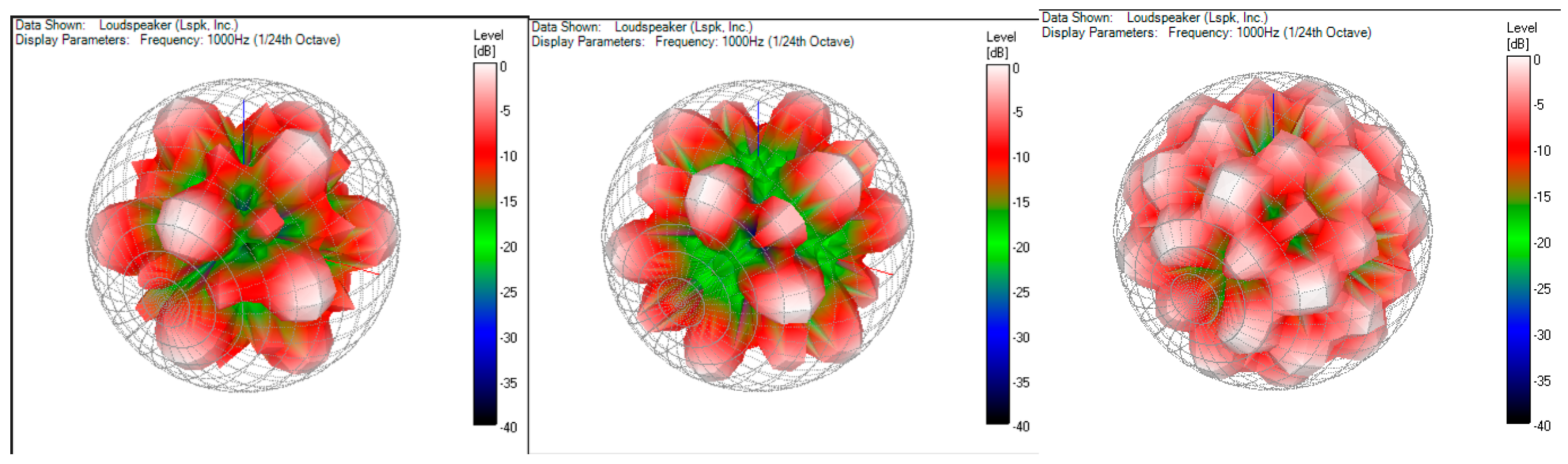
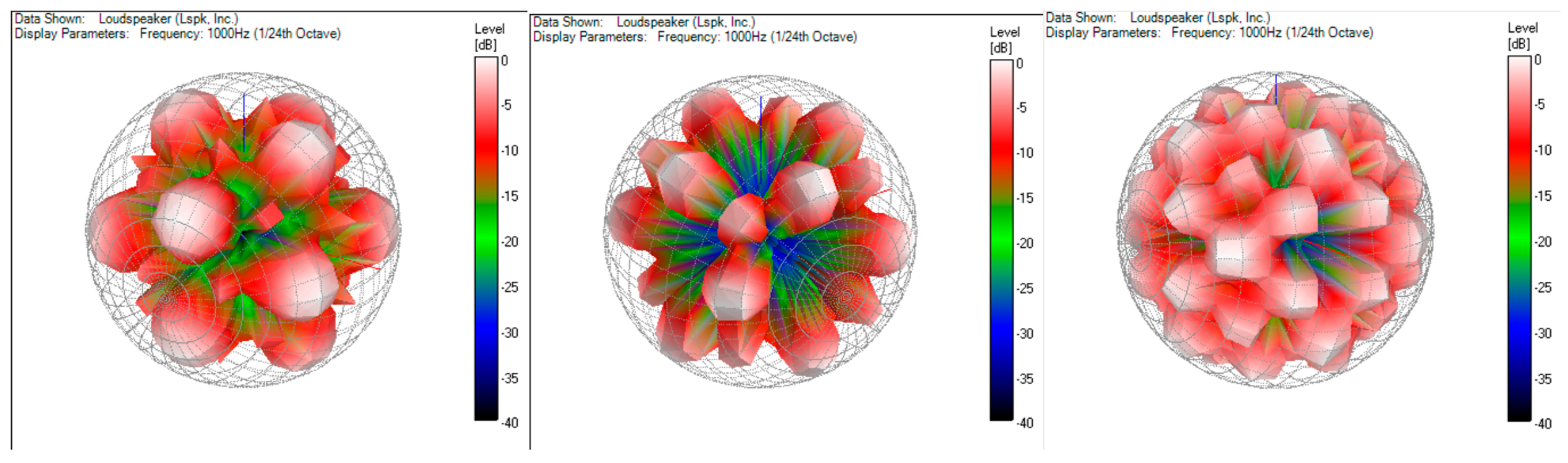
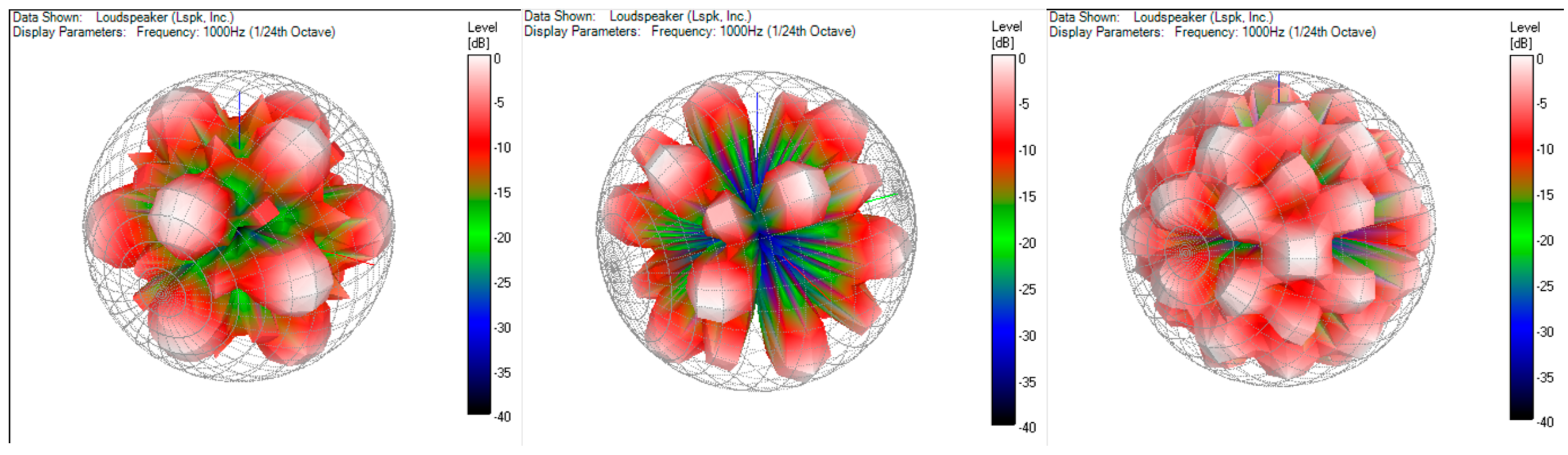
For the analysis, the following graphs show the results taking into account three independent variables: (a) source radius, (b) measurement distance, and (c) three selected frequencies (100 Hz, 1 kHz, and 10 kHz).
This analysis is complemented by Appendix C with more solid polyhedral omnidirectional sources.
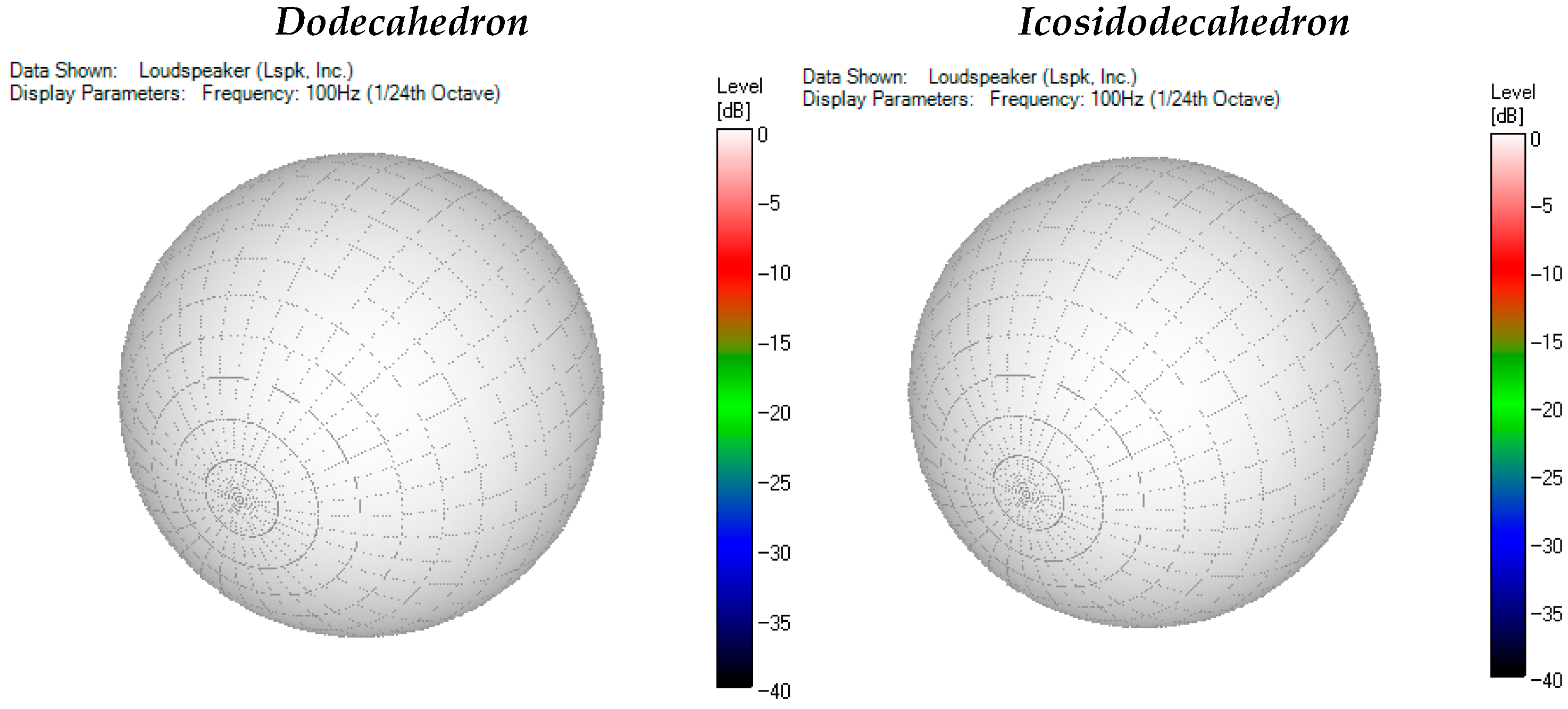
Figure 1 presents the radiation spheres for both geometries under low-frequency excitation. At 100 Hz, the wavelength is significantly larger than the physical dimensions of either source, resulting in a nearly omnidirectional radiation pattern for both the dodecahedron and the icosidodecahedron.
As can be seen in the five (5) cases, there is complete omnidirectional behavior due to the relationship between the physical size of the source and the wavelength of the sound. In these cases, there is neither destructive interference nor determined directionality. Due to optimization reasons, in the sense of improving the simulation time and computation load, not all the possible combinations of the parameters were performed, such that they would include simulations at low frequencies, because, as was indicated previously, sources behave as point sources when the frequency is low.
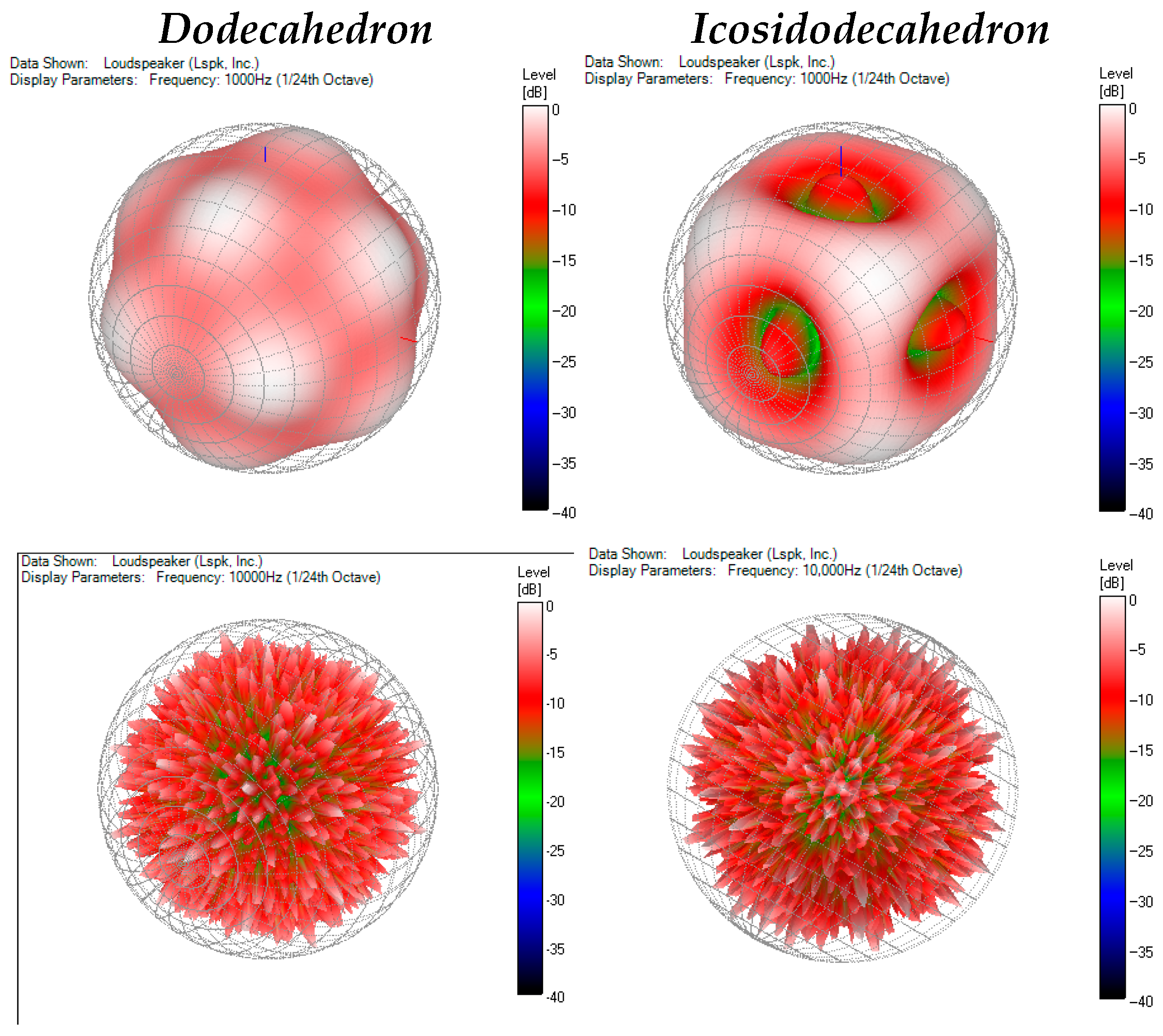
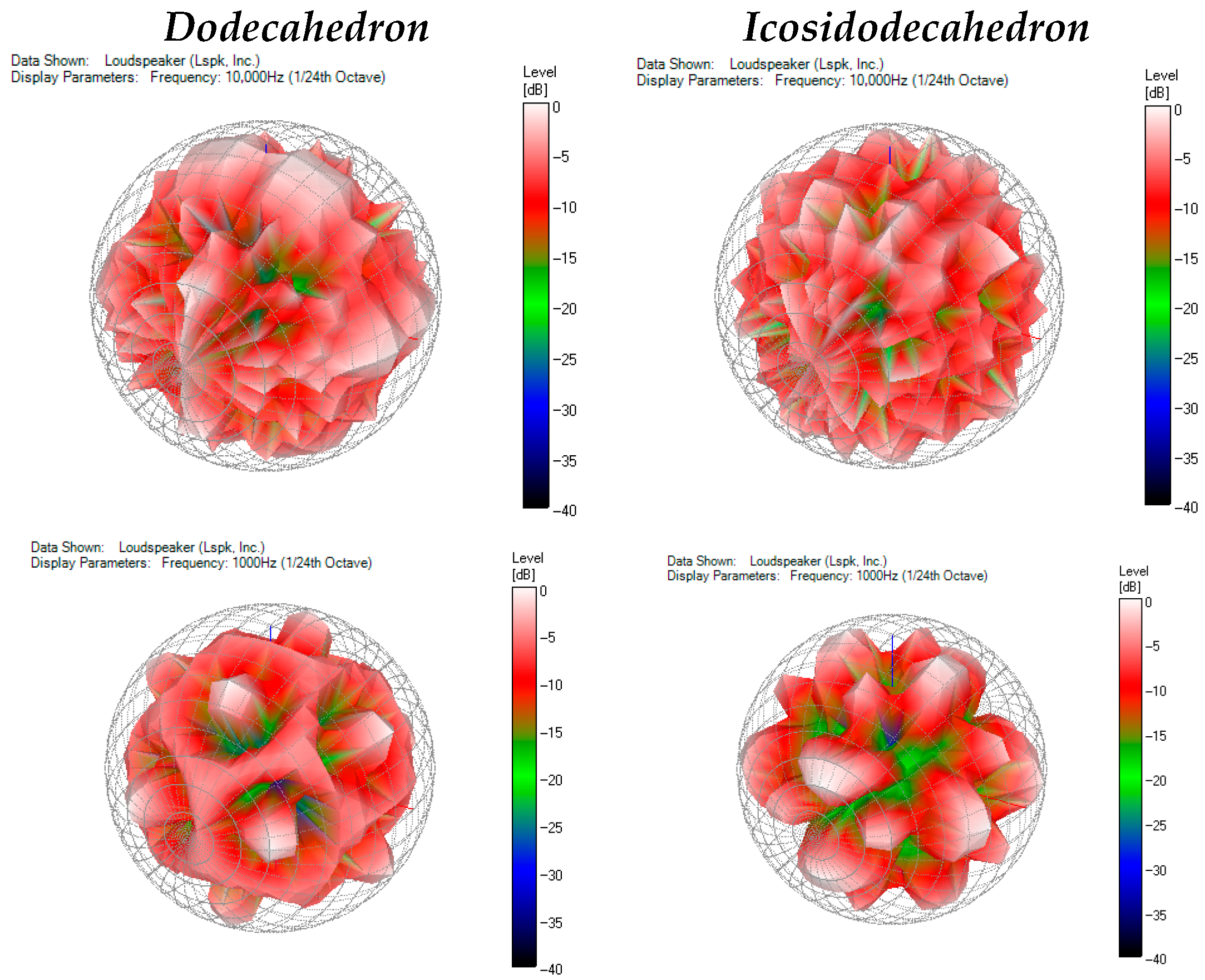
Figure 2 provides a comparative analysis of two omnidirectional acoustic sources—a dodecahedron and an icosidodecahedron—evaluated under two frequency conditions. In the upper part of the figure, the radiation spheres illustrate the behavior of both sources when emitting a 1 kHz test signal at a 2 m measurement radius with a 20 cm spacing between sources. The dodecahedron configuration, composed of twelve loudspeakers mounted on pentagonal faces, represents a classic standard for omnidirectional sound emission. It provides relatively uniform radiation in the horizontal plane, though small directional lobes occur at certain frequencies due to the geometry and mutual coupling of drivers. The icosidodecahedron, on the other hand, integrates twenty triangular and twelve pentagonal faces, offering a denser and more symmetric distribution of transducers. This results in improved spatial homogeneity of the acoustic field and reduced interspeaker interference, especially at higher frequencies. In general, while the dodecahedron remains simpler to construct and calibrate, the icosidodecahedron exhibits superior isotropy and smoother directivity patterns, making it better suited for precision acoustic measurements, such as room-impulse-response characterization or sound-power testing.
In the lower part of the figure, corresponding to the 10 kHz excitation, the comparative behavior between the dodecahedron and the icosidodecahedron omnidirectional sources becomes more distinct due to wavelength-to-geometry interactions. The dodecahedron exhibits increasingly pronounced directivity lobes and interference effects as frequency increases, resulting in a less uniform sound-pressure distribution around the sphere. In contrast, the icosidodecahedron maintains superior isotropy and smoother radiation characteristics at this frequency. Its higher number of transducer mounting positions minimizes phase cancellation and spatial irregularities, ensuring a more consistent acoustic field at the 2 m measurement radius. Therefore, while both geometries function effectively at low and mid frequencies, the icosidodecahedron demonstrates a clear performance advantage at 10 kHz, offering greater angular uniformity and more accurate omnidirectional emission for high-frequency acoustic measurements.
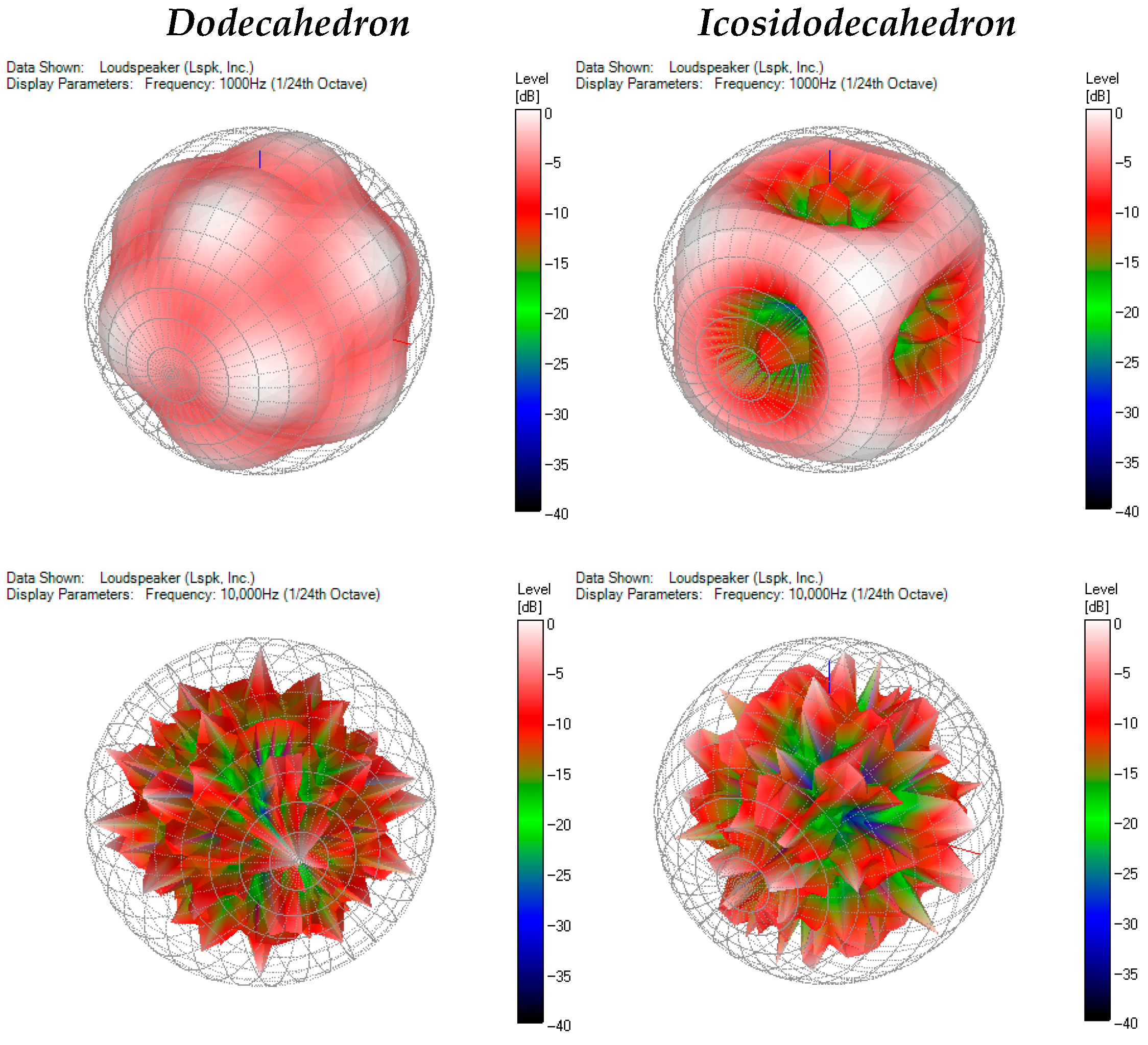
In the upper part of Figure 3, the radiation spheres illustrate the behavior of both sources when emitting a 1 kHz signal measured at a 10 m measurement distance. Both the dodecahedron and icosidodecahedron omnidirectional sources exhibit clearly distinguishable propagation behaviors due to geometric and spatial dispersion effects. The dodecahedron, with its twelve pentagonal faces, delivers a robust yet moderately anisotropic sound field over long distances; slight variations in amplitude occur because of the limited number of radiating elements and phase interactions among them. Conversely, the icosidodecahedron, composed of a denser configuration of twenty triangular and twelve pentagonal faces, preserves a more uniform acoustic distribution and reduced directional bias at the same range. This geometry allows the radiated wavefronts to merge more coherently, minimizing interference and maintaining consistency in sound pressure levels around the measurement sphere. Overall, at 10 m, the icosidodecahedron maintains higher omnidirectionality and stability across angles, while the dodecahedron begins to exhibit subtle spatial irregularities due to its simpler structure.
In the lower part of the figure, corresponding to the 10 kHz excitation frequency measured at a 20 m distance, the contrast between the dodecahedron and icosidodecahedron omnidirectional sources becomes even more evident due to the short wavelength and increased spatial separation effects. The dodecahedron, characterized by twelve radiating elements positioned on pentagonal faces, exhibits noticeable deviations from perfect omnidirectionality, with stronger directional lobes and greater interference patterns as sound waves interact over the longer propagation path. These irregularities manifest as angular amplitude variations that reduce the uniformity of the radiated field at large distances. In contrast, the icosidodecahedron, featuring thirty-two radiating faces (twelve pentagonal and twenty triangular), achieves superior angular consistency and smoother spatial response under the same conditions. The increased number of transducers and more isotropic geometry allow for better phase alignment and lower distortion across the measurement sphere, maintaining energy distribution closer to ideal omnidirectionality even at 20 m. Therefore, at this high-frequency, long-distance configuration, the icosidodecahedron clearly outperforms the dodecahedron in terms of acoustic isotropy and measurement reliability.
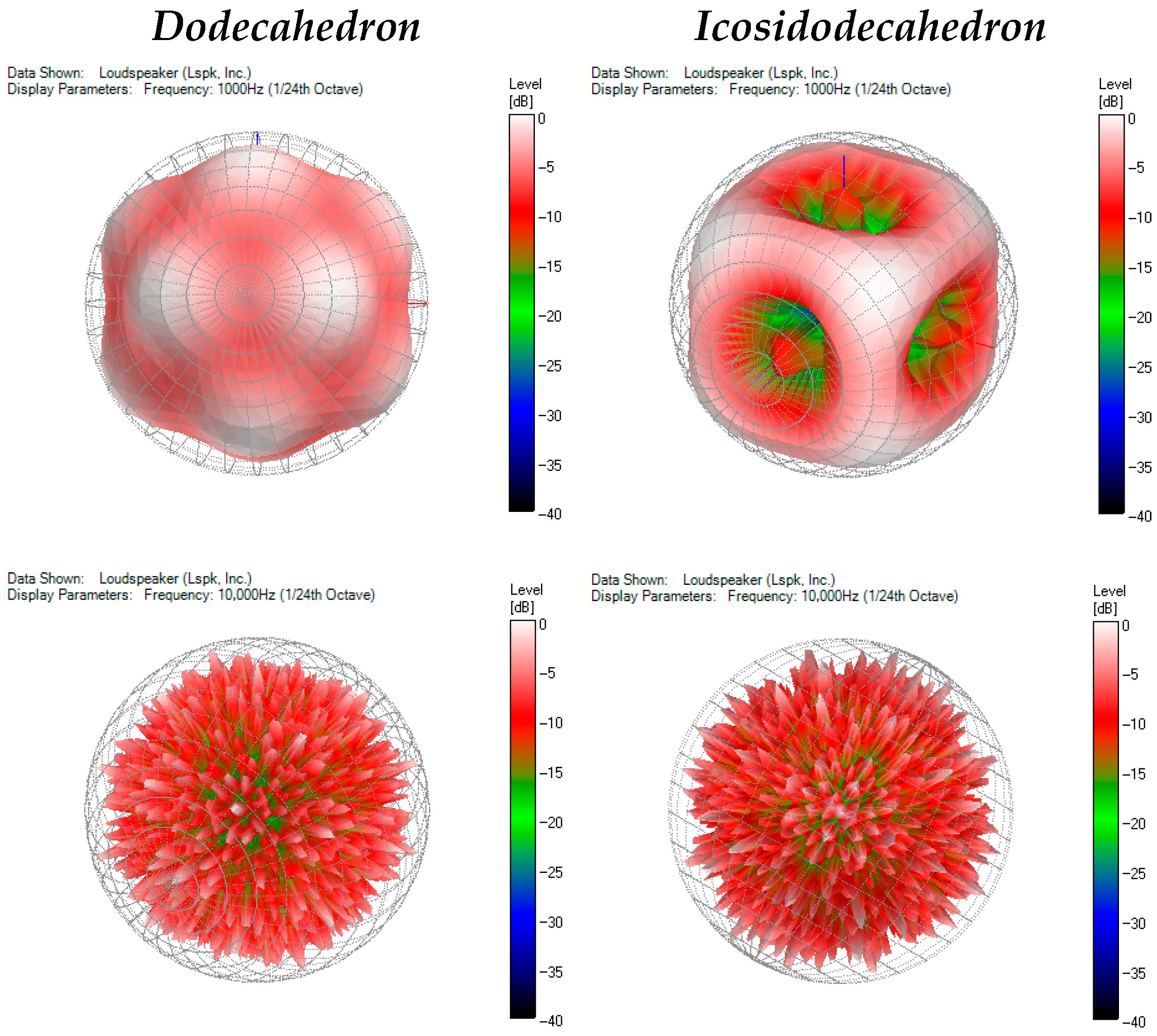
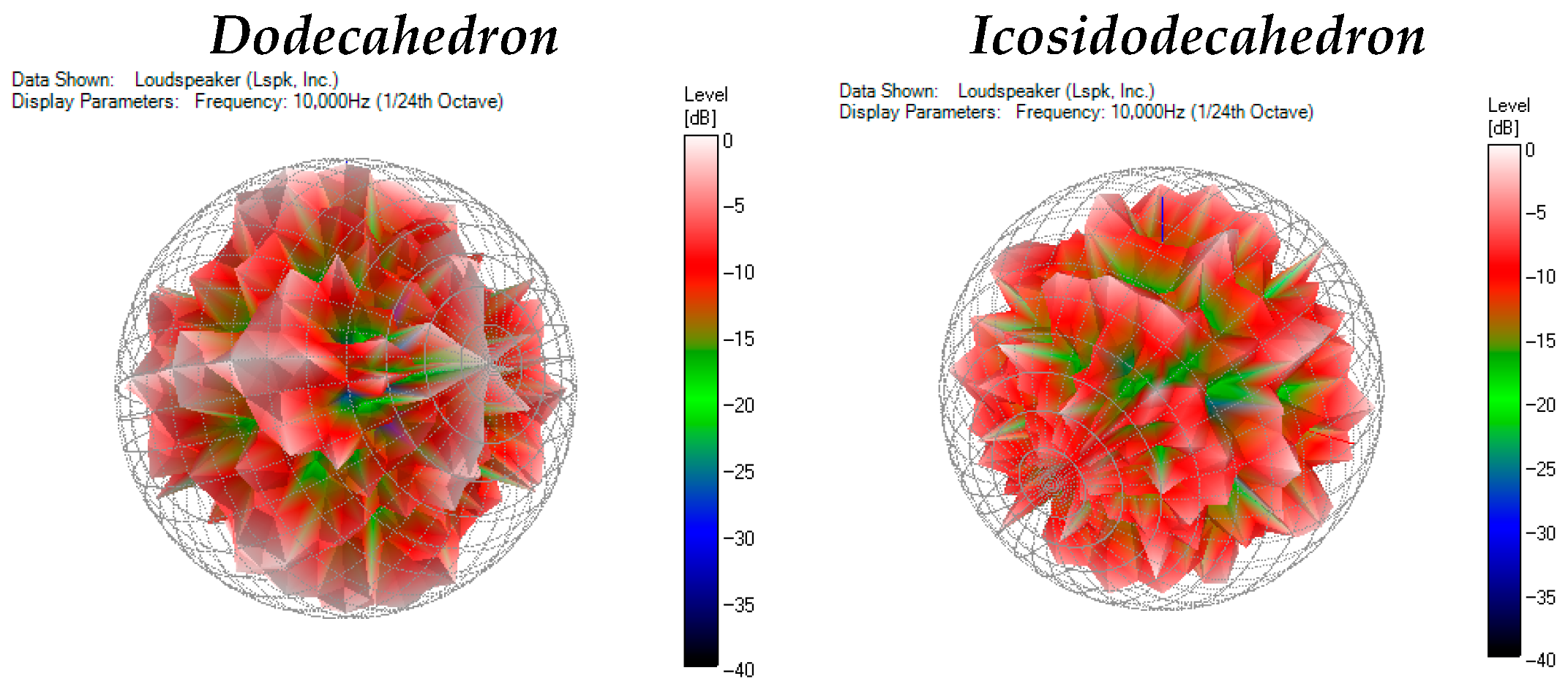
In the upper part of Figure 4, the radiation spheres illustrate the behavior of both sources when emitting a 1 kHz signal, measured at a radius of 20 m. Both the dodecahedron and icosidodecahedron omnidirectional sources display different performance characteristics in terms of uniformity and energy dispersion. The dodecahedron, composed of twelve loudspeakers distributed on pentagonal faces, continues to emit a generally omnidirectional sound field; however, at this extended distance, slight irregularities become more perceptible due to phase differences and partial interference among the individual radiators. The icosidodecahedron, with its combination of twenty triangular and twelve pentagonal faces, demonstrates a higher degree of isotropy, maintaining more consistent sound pressure levels across measurement angles. Its denser transducer distribution results in smoother spherical wavefronts and reduced amplitude fluctuations, even when the measurement point is far from the source. Consequently, while both geometries preserve overall omnidirectionality at 1 kHz, the icosidodecahedron achieves superior spatial uniformity and lower directional bias, making it better suited for precise acoustic measurements over long distances.
In the lower part of the figure, corresponding to 10 kHz emission frequency, with a 2 m measurement radius and 20 cm spacing between sources, the acoustic behavior of the dodecahedron and icosidodecahedron omnidirectional sources shows clear differences in spatial uniformity and directivity. The dodecahedron, built with twelve transducers arranged on pentagonal faces, begins to exhibit more pronounced directional lobes and phase interference at this high frequency, leading to a less uniform sound pressure field around the sphere. This occurs because the wavelength becomes comparable to the interspeaker spacing, amplifying constructive and destructive interference effects. In contrast, the icosidodecahedron, which incorporates thirty-two radiating faces (twelve pentagonal and twenty triangular), produces a more isotropic acoustic field, minimizing angular variations and preserving amplitude stability. Its geometry promotes more even phase summation across angles, maintaining near-ideal omnidirectionality. Consequently, at 10 kHz and close measurement distances, the icosidodecahedron outperforms the dodecahedron in maintaining spatial coherence and uniform energy distribution.
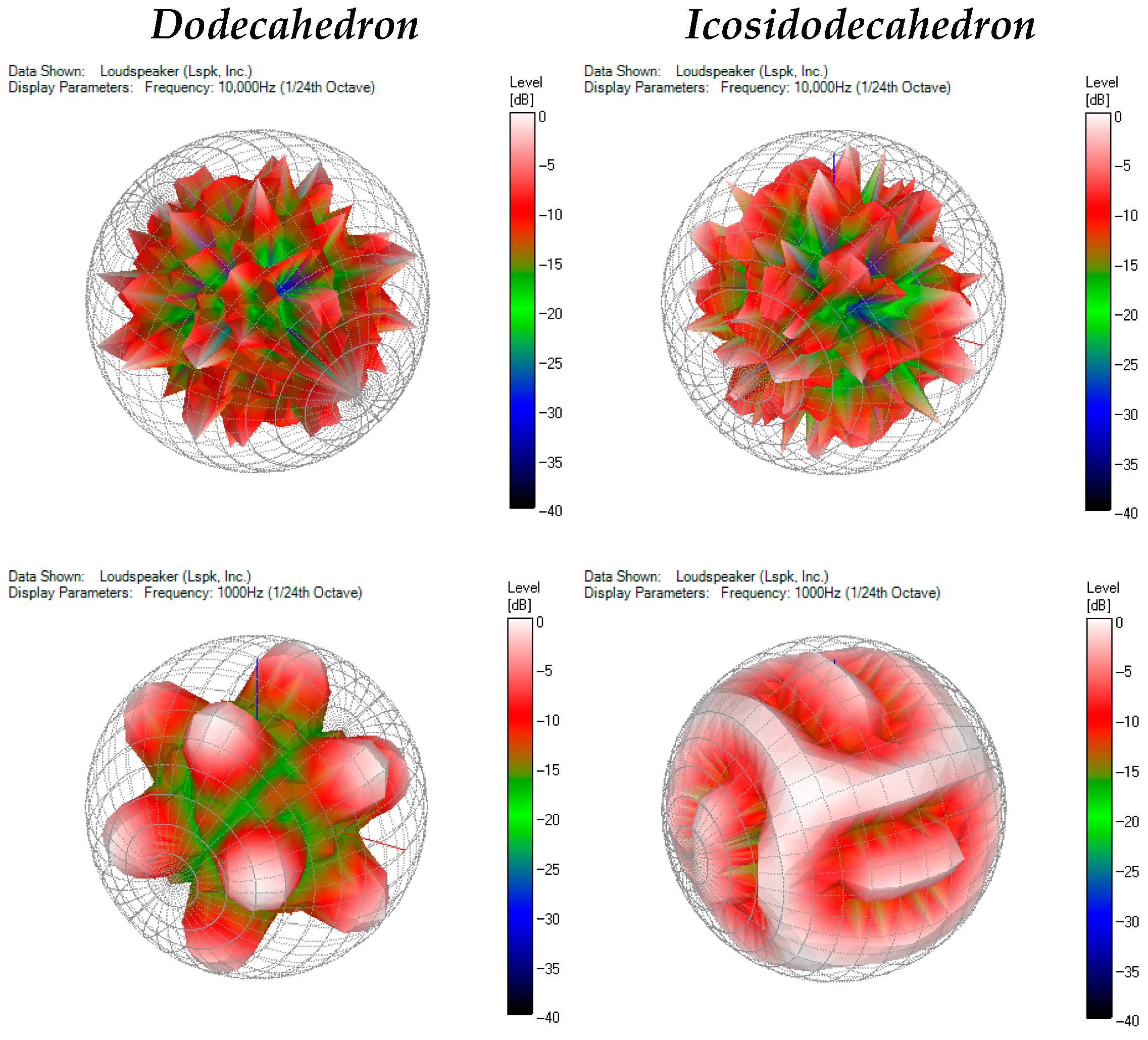
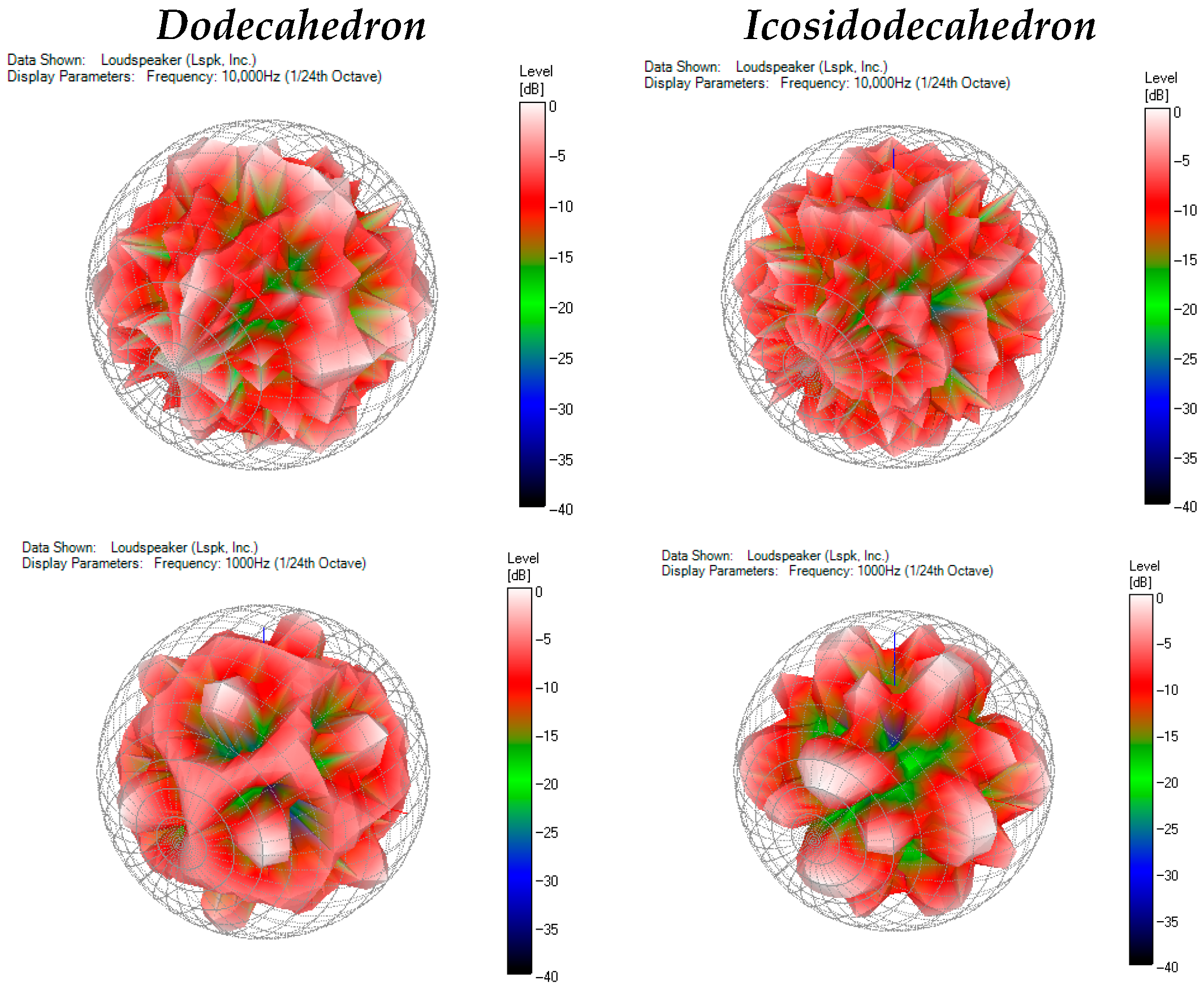
In the upper part of Figure 5, the radiation spheres illustrate the behavior of both sources when emitting a 10 kHz signal, with 20 cm spacing between sources and a 10 m measurement radius. At this high frequency, the dodecahedron (12 drivers on pentagonal faces) tends to show stronger high-frequency lobing and angle-dependent SPL fluctuations as the short wavelength accentuates inter-driver interference over distance, as shown in Figure 5. The icosidodecahedron, distributing drivers over 32 positions (12 pentagons + 20 triangles), achieves a denser, more symmetric radiator layout that improves phase summation and preserves omnidirectional uniformity across azimuths, yielding smoother amplitude vs. angle behavior and more reliable far-field measurements under these conditions.
In the lower part of the figure, corresponding to the 1 kHz excitation measured (λ ≈ 34 cm), increasing the inter-source spacing to 30 cm (≈0.9 λ) at a 2 m measurement radius accentuates spacing-related interference effects. The dodecahedron (12 drivers on pentagonal faces) typically shows more noticeable angular modulation and lobe formation because its fewer radiators provide less spatial averaging when sources are nearly one wavelength apart. The icosidodecahedron, with its denser and more symmetric layout (pentagonal + triangular faces), better distributes radiators in space, smoothing phase summation and yielding a more uniform, isotropic SPL around the measurement circle. In practice, this makes the icosidodecahedron more reliable for precision measurements at this frequency and spacing, whereas the dodecahedron becomes more orientation-sensitive.
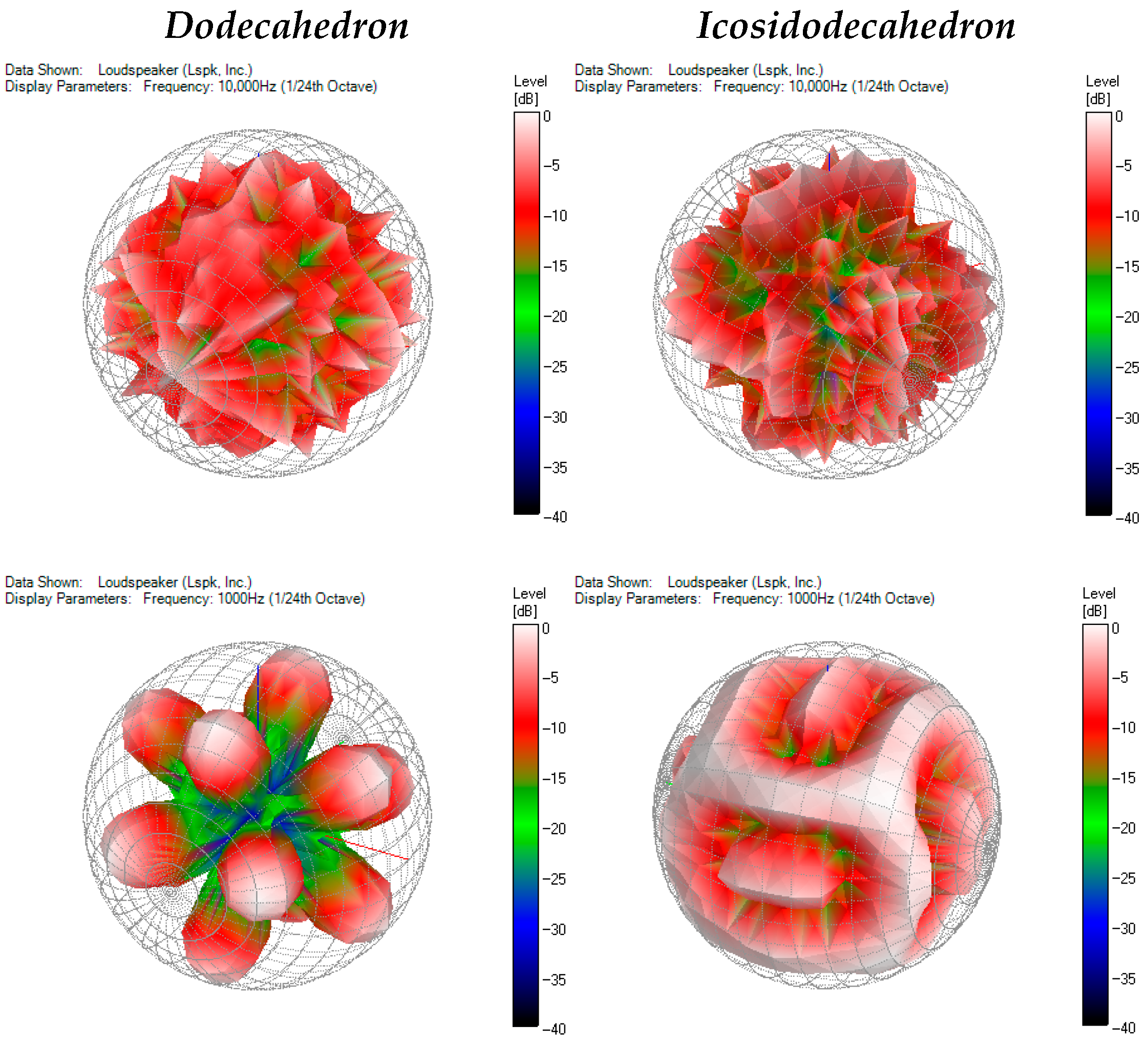
In the upper part of Figure 6, the radiation spheres illustrate the behavior of both sources when emitting a 10 kHz signal with a 30 cm spacing between sources at a 2 m measurement distance. At this high frequency (λ ≈ 3.4 cm), the short wavelength makes inter-driver interference and lobing prominent. The dodecahedron (12 drivers on pentagonal faces) typically shows stronger angle-dependent SPL fluctuations because fewer radiators provide less spatial averaging when spacing is ≫ λ. The icosidodecahedron, distributing drivers over 32 positions (12 pentagonal + 20 triangular faces), yields a denser, more symmetric layout that improves phase summation and preserves closer-to-omnidirectional behavior—though some high-frequency lobing remains inevitable at this spacing. In practice, under these conditions, the icosidodecahedron maintains smoother angular uniformity and is less sensitive to orientation than the dodecahedron, supporting more reliable high-frequency measurements at 2 m.
In the lower part of the figure, corresponding to the 1 kHz with 30 cm spacing between sources and a 10 m measurement radius, the larger inter-source distance (≈0.9 λ) makes spacing-related interference more apparent, so geometry matters. The dodecahedron (12 drivers on pentagonal faces) tends to exhibit more angular SPL modulation and mild lobing because fewer radiators provide less spatial averaging at this spacing and range. The icosidodecahedron, distributing drivers over 32 positions (12 pentagonal + 20 triangular faces), yields denser, more symmetric coverage that improves phase summation and preserves closer-to-omnidirectional behavior in the far field, with smoother amplitude vs. angle and reduced orientation sensitivity under these conditions.
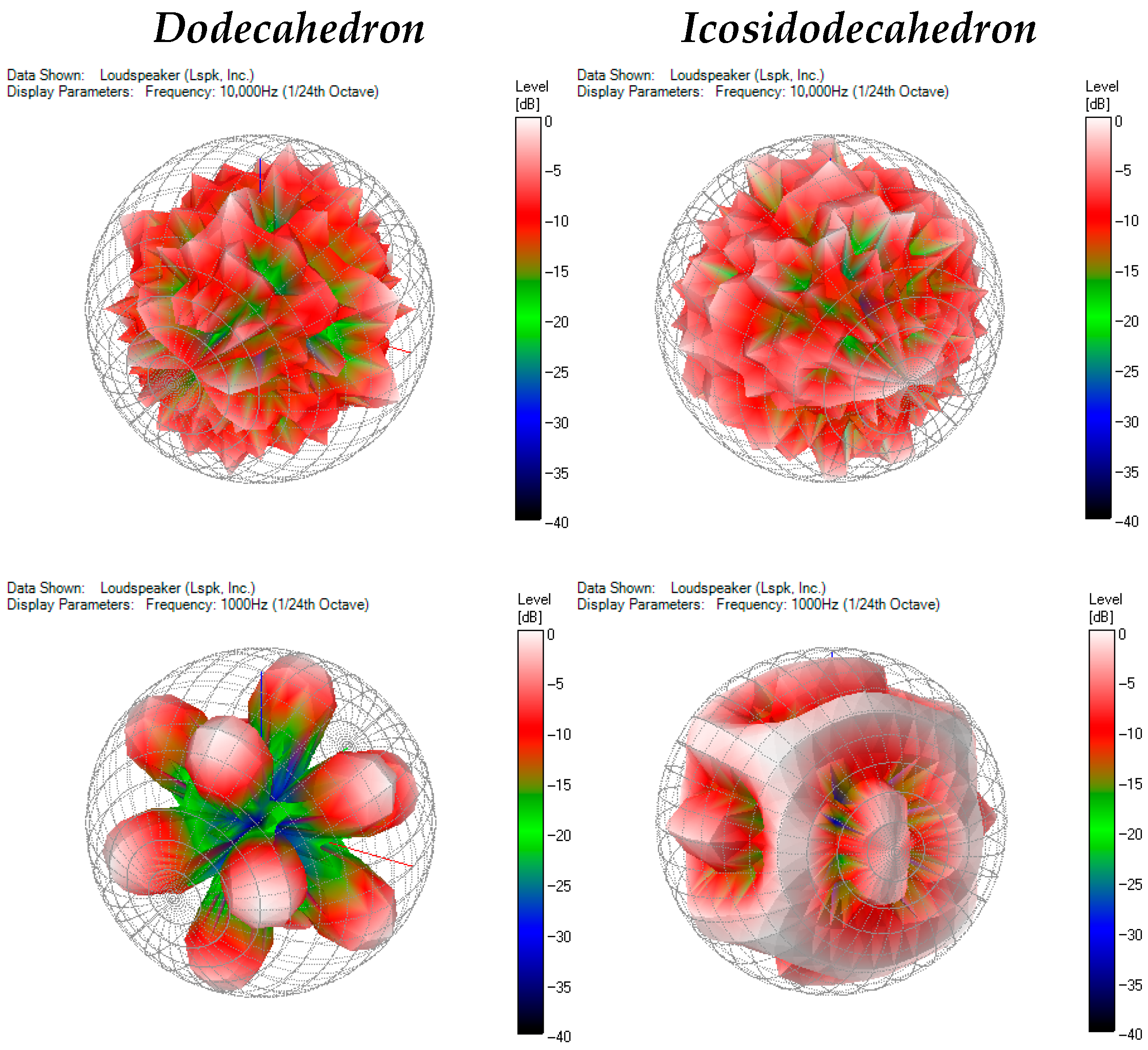
In the upper part of Figure 7, the radiation spheres illustrate the behavior of both sources when emitting a 10 kHz signal with a 30 cm spacing between sources (≈8.8 λ) at a 10 m measurement distance. Under these conditions, Figure 8 shows that at 10 kHz (λ ≈ 3.4 cm) with 30 cm spacing between sources (≈8.8 λ) and a 10 m measurement radius, spacing-induced interference dominates the radiation patterns, making geometry decisive for angular uniformity. The dodecahedron (12 radiators on pentagonal faces) typically exhibits stronger high-frequency lobing and larger SPL ripples versus angle, as its sparser layout offers less spatial averaging when inter-driver spacing is many wavelengths. The icosidodecahedron, distributing drivers over 32 positions (12 pentagons + 20 triangles), provides a denser, more symmetric aperture that improves phase summation, yielding smoother, more isotropic far-field levels and reduced orientation sensitivity under these conditions.
In the lower part of the figure, corresponding to 1 kHz (λ ≈ 34 cm) with a 30 cm inter-source spacing (≈0.9 λ) and a 20 m measurement radius, spacing-driven interference becomes noticeable, indicating that geometry strongly affects angular uniformity. The dodecahedron (12 drivers on pentagonal faces) tends to show more pronounced SPL ripples with angle than the pentagonal dodecahedron because its sparser radiator count offers less spatial averaging when sources are separated by about one wavelength. The icosidodecahedron, distributing transducers over 32 positions (12 pentagons + 20 triangles), yields a denser and more symmetric aperture that improves phase summation, producing a smoother, more isotropic far-field level around the measurement sphere and reduced sensitivity to orientation under these conditions.
In the upper part of Figure 8, the radiation spheres illustrate the behavior of both sources when emitting a 10 kHz (λ ≈ 3.4 cm) signal with 30 cm spacing between sources (≈8.8 λ) and a 20 m measurement radius; spacing-induced interference dominates, so geometry strongly shapes angular uniformity. The dodecahedron (12 drivers on pentagonal faces) typically shows more pronounced high-frequency lobing and larger SPL ripples vs. angle because its sparser radiator layout provides less spatial averaging when inter-driver spacing spans many wavelengths. The icosidodecahedron, distributing transducers over 32 positions (12 pentagons + 20 triangles), forms a denser, more symmetric aperture that improves phase summation, yielding a smoother, more isotropic far-field and lower orientation sensitivity under these conditions.
In the lower part of the figure, corresponding to the 1 kHz (λ ≈ 34 cm) with 45 cm spacing between sources (~1.3 λ) at a 2 m measurement radius, spacing-driven interference becomes significant, so the source geometry strongly affects angular uniformity. The dodecahedron (12 drivers on pentagonal faces) tends to show more pronounced SPL ripples and lobing because its sparser layout provides less spatial averaging when elements are separated by more than a wavelength. The icosidodecahedron, distributing transducers over 32 positions (12 pentagons + 20 triangles), yields a denser, more symmetric aperture that improves phase summation, producing a smoother, more isotropic field and reduced orientation sensitivity under these conditions.
In the upper part of Figure 9, the radiation spheres illustrate the behavior of both sources when emitting a 10 kHz (λ ≈ 3.4 cm) signal with 45 cm inter-source spacing (≈13 λ) and a 2 m measurement radius; spacing-driven interference dominates, so geometry is decisive. The dodecahedron (12 drivers on pentagonal faces) typically shows stronger high-frequency lobing and larger angle-to-angle SPL ripples because its sparser layout offers less spatial averaging when elements are many wavelengths apart. The icosidodecahedron, distributing transducers over 32 positions (12 pentagons + 20 triangles), forms a denser, more symmetric aperture that improves phase summation, yielding a smoother, more isotropic field with lower orientation sensitivity under these conditions.
In the lower part of the figure, corresponding to the 1 kHz (λ ≈ 34 cm) with 45 cm spacing between sources (~1.3 λ) and a 10 m measurement radius, spacing-driven interference becomes evident, making geometry key to angular uniformity. The dodecahedron (12 drivers on pentagonal faces) typically exhibits more pronounced lobing and SPL ripple versus angle because its sparser layout provides less spatial averaging when elements are separated by more than a wavelength. The icosidodecahedron, distributing transducers over 32 positions (12 pentagons + 20 triangles), forms a denser, more symmetric aperture that improves phase summation, yielding a smoother, more isotropic far-field and lower orientation sensitivity under these conditions.
In the upper part of Figure 10, the radiation spheres illustrate the behavior of both sources when emitting a 10 kHz (λ ≈ 3.4 cm) signal with 45 cm spacing between sources (≈13 λ) and a 10 m measurement radius; spacing-driven interference dominates the radiation pattern. The dodecahedron (12 drivers on pentagonal faces) typically shows stronger high-frequency lobing and larger SPL ripples versus angle because its sparser layout provides less spatial averaging when elements are many wavelengths apart. The icosidodecahedron, distributing transducers over 32 positions (12 pentagons + 20 triangles), forms a denser, more symmetric aperture that improves phase summation, yielding a smoother, more isotropic far-field and lower orientation sensitivity under these conditions.
In the lower part of the figure, corresponding to a 1 kHz (λ ≈ 34 cm) signal with 45 cm spacing between sources (~1.3 λ) and a 20 m measurement radius, spacing-driven interference is appreciable, so geometry strongly shapes angular uniformity. The dodecahedron (12 drivers on pentagonal faces) tends to exhibit more pronounced lobing and SPL ripple vs. angle because its sparser radiator layout provides less spatial averaging when element spacing exceeds one wavelength. The icosidodecahedron, distributing transducers over 32 positions (12 pentagons + 20 triangles), yields a denser, more symmetric aperture that improves phase summation, producing a smoother, more isotropic far-field and lower orientation sensitivity under these conditions.
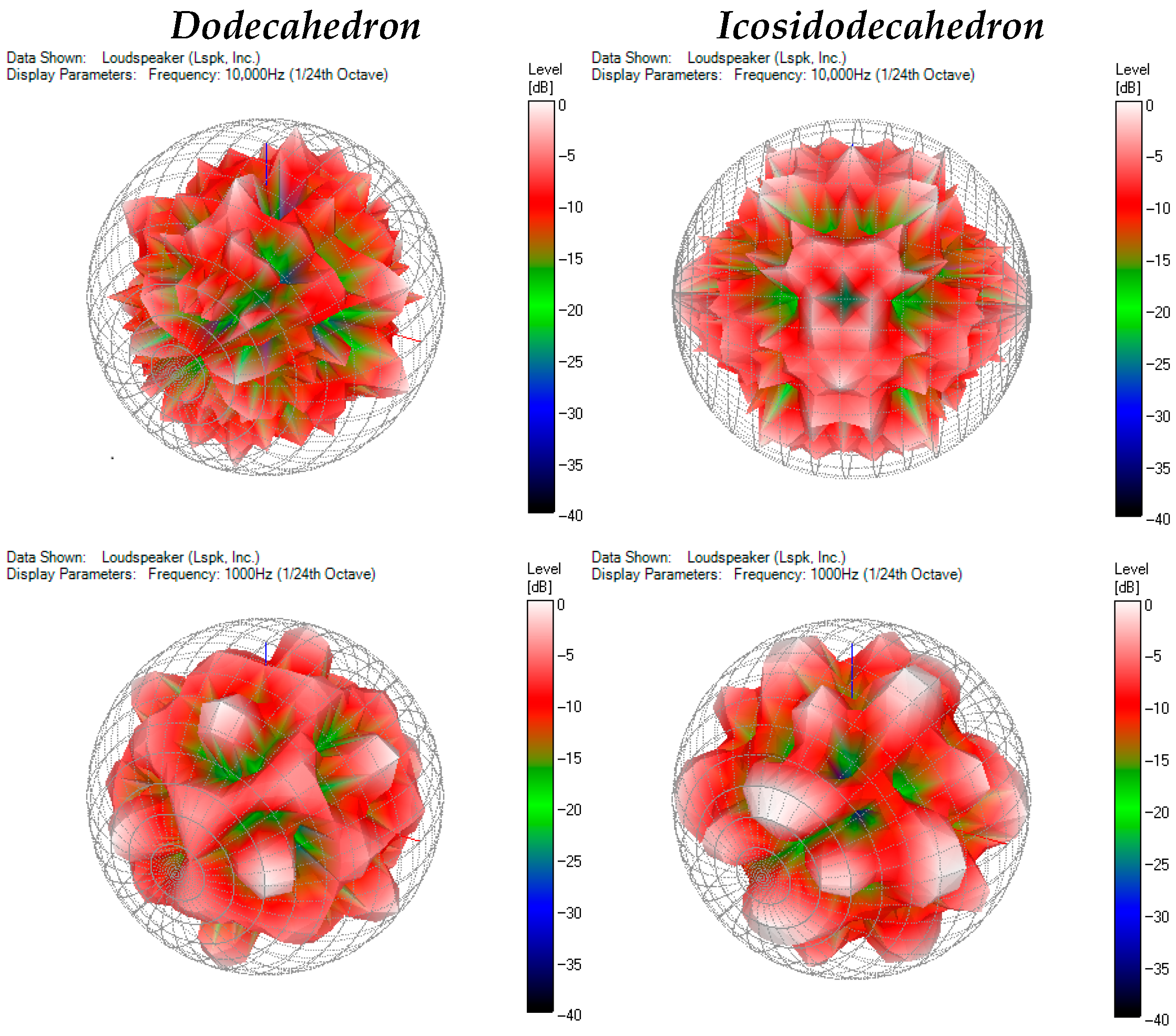
Figure 11 shows that at 10 kHz (λ ≈ 3.4 cm) with 45 cm spacing between sources (≈13 λ) and a 20 m measurement radius, the influence of spacing-induced interference becomes dominant. The dodecahedron, with twelve drivers mounted on pentagonal faces, produces strong high-frequency lobing and pronounced SPL fluctuations with angle, as the large spacing prevents effective spatial averaging. The icosidodecahedron, on the other hand, distributes transducers over 32 radiating positions (12 pentagonal + 20 triangular faces), resulting in a denser and more symmetric geometry. This configuration improves phase summation and coherence, leading to a smoother, more isotropic far-field pattern and reduced angular dependence. Under these conditions, the icosidodecahedron demonstrates superior omnidirectional performance and better stability in high-frequency long-range measurements compared to the dodecahedron.

5. Design and Implementation

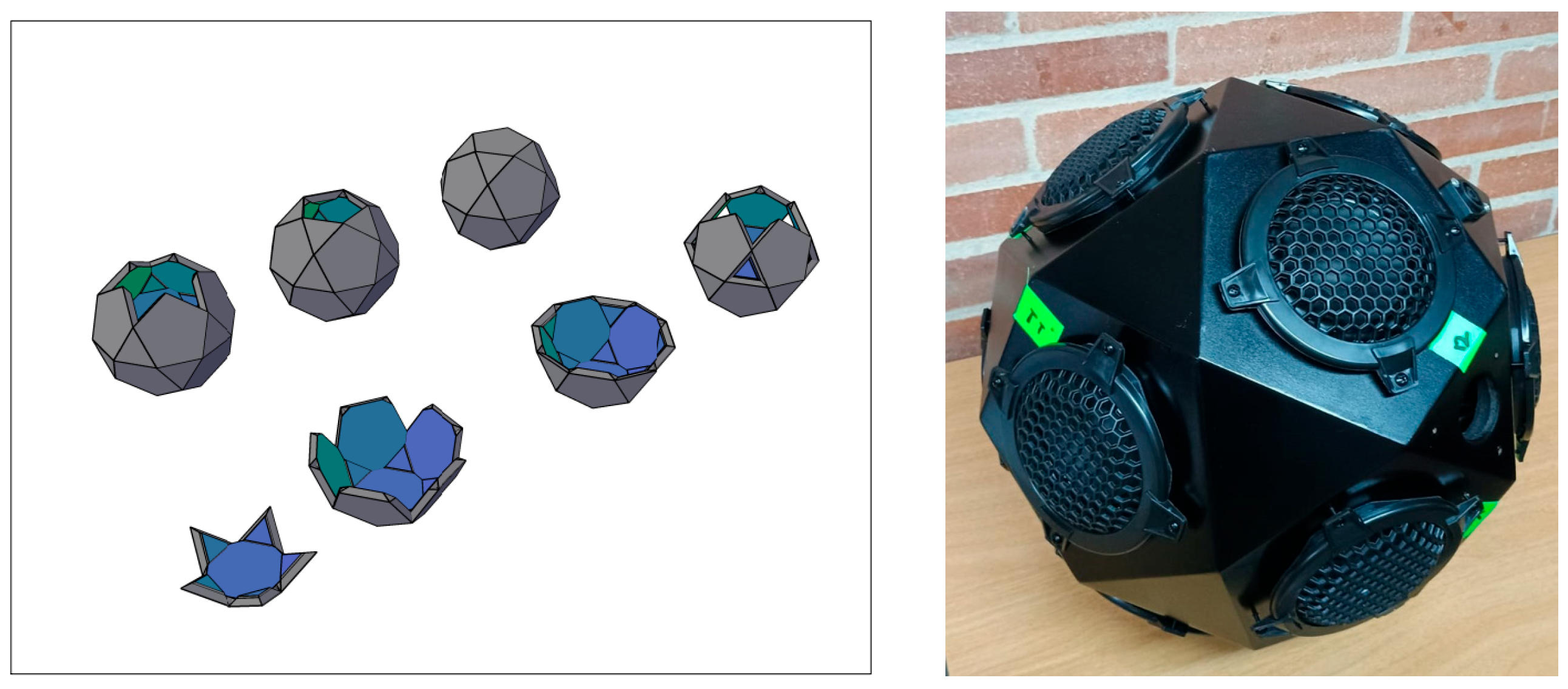
Based on the previous results, the icosidodecahedron was designed and constructed as the optimal omnidirectional source. Its development was guided by both theoretical comparisons with other geometries and the outcomes of the simulation analysis, in which the fulfillment of the polar radiation pattern was considered. The final geometry and its corresponding physical prototype are shown in Figure 12.

5.1. Loudspeaker Selection

Selection of the loudspeakers was perfomed, satisfying requirements such as size, impedance, RMS Power, VAS (equivalent suspension volume), Frequency Response, and Sensitivity.
Taking all this into account, LaVoce WSF041.00, manufactured by LaVoce Italiana (Potenza Picena, Italy) was the selected loudspeaker, with the characteristics described in Table 1.

5.2. Omnidirectional Source Construction

The construction process of the omnidirectional acoustic source follows a series of steps to achieve a uniform radiation pattern at different distances and frequencies. Each stage ensures proper assembly for optimal performance.
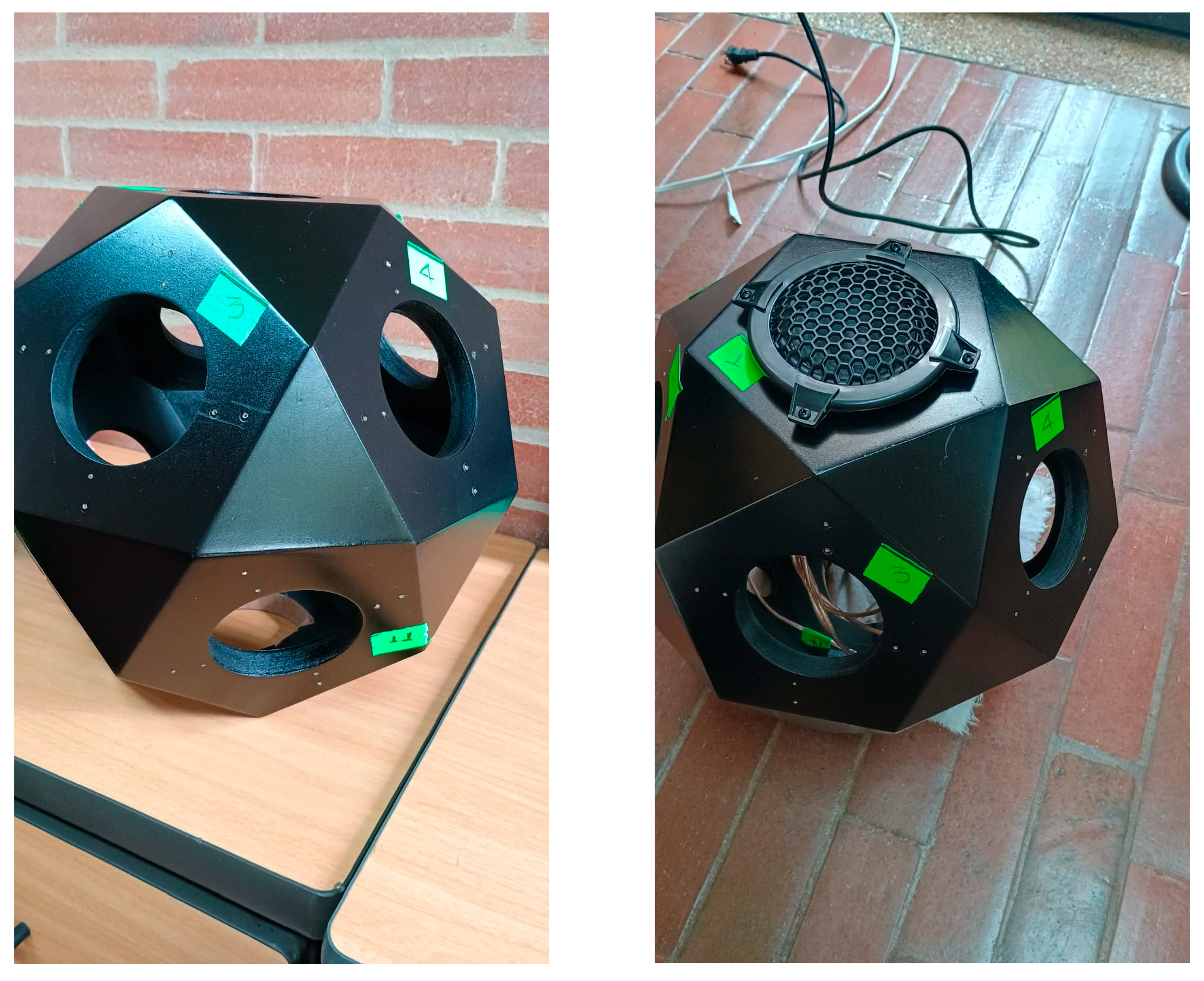
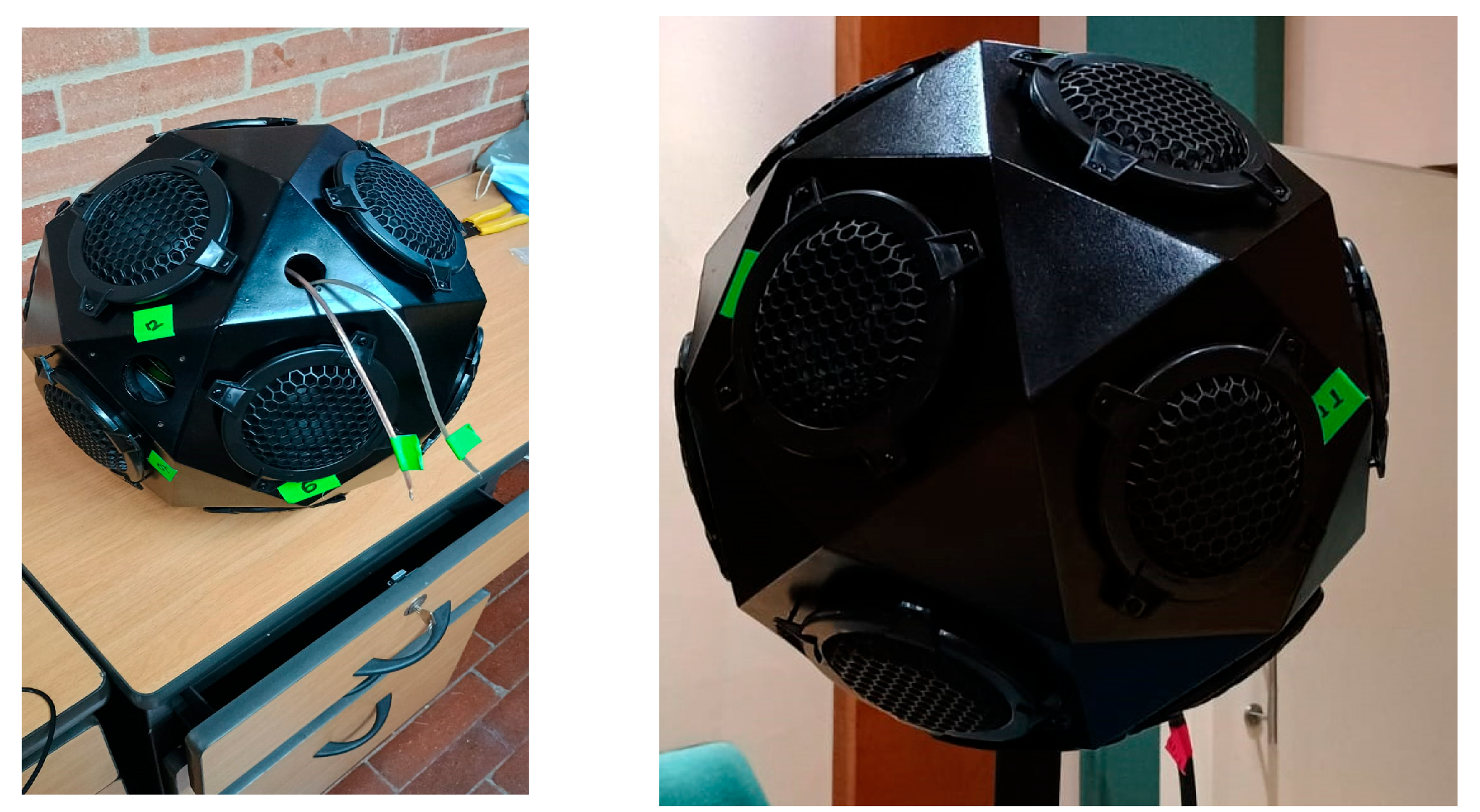
For this purpose, in brief, the base components, including the triangular faces, were assembled. These form the initial structure of the prototype. Then, the pentagons were joined to each triangle, transforming the initial shape into a relatively spherical structure. The sections are then connected internally using cables and connectors, ensuring proper integration of the transducers. The amount of internal wiring and the balanced distribution of the loudspeakers are optimized.
After assembly, the mechanical stability and acoustic properties of the prototype were considered. The transducers are calibrated to ensure they emit sound uniformly in all directions, thus ensuring the desired omnidirectional acoustic behavior.
Figure 13 shows the most relevant stages of the construction, highlighting the details of the assembly and integration of the transducers for performance testing and calibration. This process is key to ensuring that the source meets the requirements for generating high-quality acoustic signals and accurate measurements.

5.3. Frequency Response Measurement

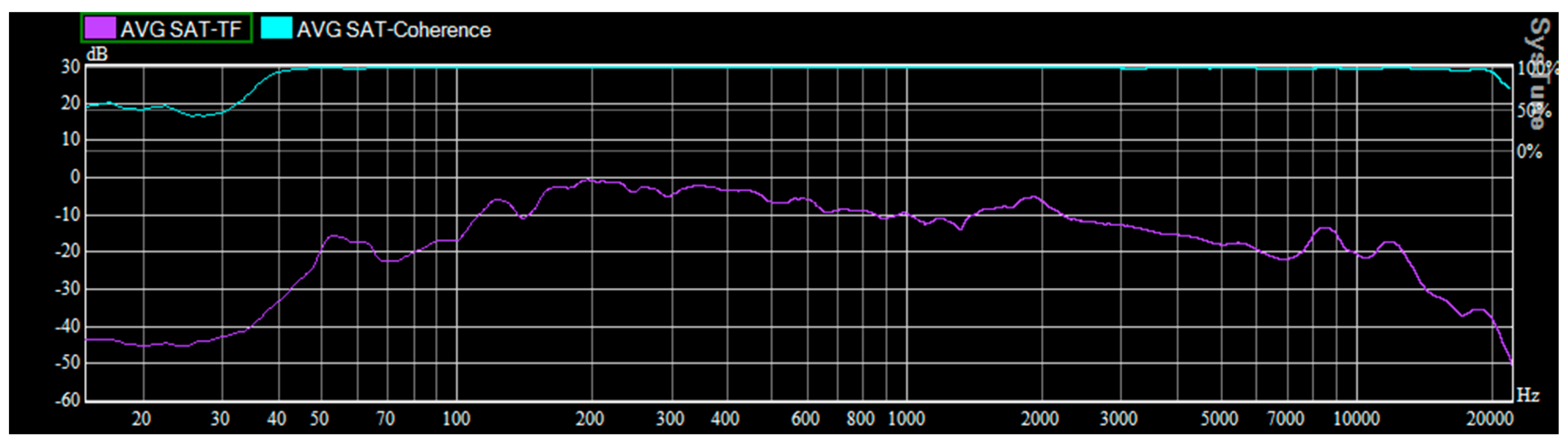
In open-field tests, the following results were obtained for the omnidirectional source Frequency Response measurement. Systune 1.3.7 software was used to enable the Transfer Function of an electroacoustic system, through the use of a measurement microphone, in this case, ECM 8000 manufactured by Behringer (Willich, Germany), in combination with the Presonus Studio 24C audio interface, manufactured by PreSonus Audio Electronics (Baton Rouge, LO, USA).
In Figure 14, the Frequency Response is shown.
It is worthwhile to clarify that a significant limitation for all measurements, whether for Frequency Response or Polar Pattern determination, is the lack of acoustic anechoic chambers in the region (Colombia, Peru). Therefore, all measurements had to be carried out under free-field conditions, specifically on a large football pitch, where at least ground reflections could slightly modify the overall results.

5.4. Spatial Aliasing in Polar Pattern Measurement

In polar pattern measurements, spatial aliasing occurs when the angular sampling step is too coarse to capture the true spatial variation in the sound field at a given frequency.
If the angular step ( θ ) is too large, high-order directivity features fold into lower orders, giving the illusion of smoother or incorrect radiation. For example, the source is measured with 10 degrees step, with N = 36 points over 360 degrees. For the angular Nyquist limit, the maximum resolvable spatial order is m_max = N/2 = 18. This means that any directivity components above order 18 will be aliased.
At high frequencies, real sources often exceed this order of magnitude. Spatial aliasing increases with frequency because:
k a = 2 π f a c ,
where a = effective radius of the source, f = frequency, c = speed of sound. As ka increases, more lobes appear, narrower angular features emerge, and higher spatial orders are excited.
For a source of radius a, angular sampling must satisfy the following:
θ λ 2 a
Above this frequency, spatial aliasing is unavoidable. With all this set, for the constructed icosidodecahedron, at low frequencies, radiation is dominated by monopole and dipole components. Also, angular variation is smooth, and 10 degrees is generally sufficient.
This is why standards (ISO 3382 [1], ISO 16283 [28]) accept coarse angular sampling below 1 or 2 kHz, depending on source size.
At higher frequencies, small geometric asymmetries, driver-to-driver phase differences, and enclosure diffraction also appear. This could lead to underestimation of lobing and misinterpretation of high-frequency uniformity.
Typical artifacts caused by spatial aliasing are (1) false symmetry, (2) lobe suppression, and (3) angular peak displacement. Therefore, the angular resolution limits the reconstruction of higher-order spatial modes, which become increasingly relevant as frequency increases.
A 10-degree angular resolution represents a compromise between measurement time and spatial accuracy. While sufficient to characterize low- and mid- frequency radiation where the source behaves quasi-omnidirectionally, it may introduce spatial aliasing at higher frequencies.
With Equations (5) and (6), fmax is 4910 Hz, meaning that with 10 degrees step, polar sampling is reasonably alias-safe up to 4.9 kHz. In this sense, from 0 to 5 kHz, there is a solid quantitative interpretation, with the usual caveats. From 5 to 10 kHz, there is an increasing risk of spatial aliasing. With these 10° angular resolutions and an effective source radius of 0.2 m, the spatial sampling supports reliable polar characterization

6. Conclusions

A thorough analysis was performed, based on careful simulations, which enabled us to spot that the best design of an omnidirectional acoustic source would be the designed Icosidodecahedron presented in this work. Also, a rigorous comparison was detailed in the theoretical discussion, which included other omnidirectional topologies.
It may be seen that after a rigorous analysis of the possible shapes and geometries on de-signing an omnidirectional source, the icosidodecahedron represents a good selection for this purpose.
This study on the design and implementation of an omnidirectional acoustic source based on the icosidodecahedron geometry proves to be a promising alternative to traditional sources that use the dodecahedron as a reference. Through computational simulation and the construction of a physical prototype, it was observed that the greater density and symmetry in the distribution of transducers in the icosidodecahedron significantly improve the spatial homogeneity of acoustic radiation, especially at high frequencies. This is particularly important for high-precision acoustic measurements, such as impulse-response assessment or acoustic-power measurement.
It can be seen that the icosidodecahedron offers notable improvements in radiation uniformity, particularly in high-frequency configurations, such as 10 kHz, where the geometry of traditional sources begins to show directional irregularities. At low frequencies, both geometries exhibit almost omnidirectional behavior; however, the differences in transducer arrangement become more evident as frequency increases, making the icosidodecahedron more suitable for radiation efficiency and the delivery of homogeneous energy into the space.
This work also highlights the feasibility of creating self-built omnidirectional sources within a university environment, which not only encourages research activities in the corresponding academic departments but also creates opportunities to implement this type of technology in other institutions through collaborative efforts. Furthermore, the acoustic analysis conducted under various experimental conditions validated the prototype’s performance, confirming that, in realistic measurement scenarios, the icosidodecahedron can maintain high angular stability, making it a valuable tool for improving precision in acoustic measurements within sound research environments.

Author Contributions

Conceptualization, M.H.M.; Methodology, J.L.I., M.H.M. and J.O.M.N.; Software, M.H.M.; Validation, J.L.I. and J.O.M.N.; Formal analysis, J.L.I. and M.H.M.; Investigation, M.H.M.; Resources, M.H.M. and J.O.M.N.; Data curation, J.L.I.; Writing—original draft, M.H.M.; Writing—review and editing, J.L.I.; Visualization, J.L.I. and M.H.M.; Supervision, J.L.I.; Project administration, M.H.M.; Funding acquisition, J.L.I. and M.H.M. All authors have read and agreed to the published version of the manuscript.

Funding

This research was funded by Universidad de San Buenaventura, grant number FI-019-003.

Institutional Review Board Statement

Not applicable.

Informed Consent Statement

Not applicable.

Data Availability Statement

The original contributions presented in this study are included in the article. Further inquiries can be directed to the corresponding author.

Acknowledgments

The authors express their gratitude to the academic and technical teams who supported the development of this project. Special thanks are extended to the staff of the Acoustic Engineering Laboratory at USBBOG for providing access to measurement facilities, computational tools, and technical assistance. The authors also acknowledge the contributions of laboratory colleagues and students whose feedback was valuable during the design and evaluation stages. Last but not least, assistance from ChatGPT 5.1 (OpenAI, 2025), a large language model, was used for language polishing, and subsequently reviewed and edited by the authors.

Conflicts of Interest

The authors declare no conflicts of interest. The funders had no role in the design of the study; in the collection, analyses, or interpretation of data; in the writing of the manuscript; or in the decision to publish the results.

Appendix A. Supplementary Acoustic Characterization Tables

Table A1. Comparative analysis of acoustic characteristics in traditional and alternative sound sources. Note: adapted from [8,9,10,11,12,13,14,15,16].
TraditionalAlternative
CharacteristicsDodecahedrical LoudspeakersBalloonsShotsFirecrackersSlapsInverted HornsRing RadiatorsMouthpiece WhistleElectric Spark Generator
Frequency (Hz)100–10,000 Hz (less effective < 100 Hz without subwoofer)100–1000 Hz; in huge balloonsEnergy peak: 1–2 kHz, fast drop below 1 kHz (~14 dB/octave)500 Hz–2 kHz, drop below 1 kHz50 Hz–500 Hz100 Hz–5 kHz (peaks in 300 Hz, 1 kHz, 3 kHz)250 to 12,000 Hz (directivity measurements)Until 40 kHzUntil 50 kHz (with spark frequencies between 20−30 kHz)
Sound PressureUntil 120 dB SPL (depends on the model)121–138 dB (according to the size)Between 148 and 168 dB156–166 dBApprox. 75.8 dBApprox. 85 dB SPL107 dB at 1 m92 dB at 1 m120 to 140 dB at 1 m (according to setting)
Harmonic distortion<5% at moderated levels; it becomes higher with higher excitationHigh, with zeros in the wave spectrumHigh; not ideal for low bandsHigh dispersion at high and medium frequencies5–8% at low frequencies, until 15% in complex ones5–7% with equalization, until 20% without it10–15% (high frequencies)5–10% (high frequencies)5–10% (according to the spark quality)
DirectivityOmnidirectional < 1 kHz; deviation > 1 kHzNot omnidirectionalHigh directivity, up to 20 dB higher in front than behindOmnidirectional (index < 1 dB, 125 Hz–8 kHz).Not omnidirectional, variation until 15 dBOmnidirectional at +/− 3 dB (according to ISO 3382-1 [1])Moderated variation at high frequenciesApprox. omnidirectional, with variationModerated with higher dispersion, at higher frequencies
Duration of the sound impulse5000–10,000 ms with signals MLS/ESS~100–300 ms1–3 ms per shot~100–500 ms100–300 ms200–500 ms10–30 ms5–15 ms<1 ms
Wavelength0.03 m–3 m (according to frequency)0.3 m to 3 m (depends on the size and frequency)0.17 m–0.34 m (in 1 kHz to 2 kHz)0.2 m–0.4 m (500 Hz–2 kHz)1.9 m to 20 m (depending on the frequency)0.17 m–0.5 m (300 Hz to 3 kHz)0.25 m to 1.2 m (250 Hz to 12,000 Hz)0.01 m to 0.5 m (20 kHz–40 kHz)0.01 m to 0.05 m (20 kHz–50 kHz)
SNR35–45 dB25–30 dB50–60 dB45–55 dB40–50 dB55–65 dB30–40 dB40–50 dB20–25 dB
Spectral composition1–10 kHz, peaks according to frequencyLow peaks (<200 Hz) and <1 kHzEnergy at high frequencies, fast dropConcentration in 500 Hz–2 kHzDrops of −10 dB below 100 HzPeaks until 12 dB in 300 Hz, 1 kHz, 3 kHz1–4 kHz, peaks in 8–10 kHzDominant in 125–160 Hz, peaks at 40 kHzPeaks at 20–30 kHz, drop below 10 kHz
Range10–30 m1–5 m (depends on the balloon size)200–400 m (according to size)50–100 m1–5 m10–30 m1–10 m (depending on the frequency)1–3 m, depending on the air compressor flux0.5–2 m, according to the spark type and setting
RepeatibilityHigh, >90% with signals MLS/ESSLow; variable due to size and inflation (10–50% variability)Variable according to caliberLow (variation until 10 dB)Low, ±5 dB between slaps (applauses)High, variation of ±2 dBHigh, >90% in controlled conditionsVariable, depending on air pressureHigh if well controlled
Frequency Response±3 dB at 100–10,000 HzLow in the lower bandsEnergy at high frequencies; fast at low frequenciesConcentration in 500 Hz–2 kHz, lower at low frequenciesDrop of −10 dB below 100 HzPeaks until 12 dB at 300 Hz, 1 kHz, 3 kHz20 Hz–20 kHz2 kHz–8 kHzWider, from Hz until MHz
Performance Temperature (°C)0–40 °C0–50 °C0–50 °C0–50 °C0–40 °C0–40 °C20–80 °C5–45 °C0–50 °C
Modulation frequency20 Hz–20 kHz500 Hz–4 kHz200 Hz–3 kHz1 kHz–10 kHz500 Hz–2 kHz100 Hz–2 kHz10–100 Hz50–100 Hz1–20 Hz
Required source110–240 V AC; in some cases portable batteryNot required.Not required.Not required.No required110 V–220 V AC, according to the amplifier0.5 W–2 W1 W–5 W10 W–100 W
PortabilityLow, >20 kg; difficult to transportHigh, light, without extra equipmentHigh, light, and easy to transportHigh, small, and lightHigh, only hands are neededLow, requires loudspeakers and amplificationModerated, requires fixed installationHigh, portable compressorHigh, easy to transport, and to configure in place
Intensity controlLimited, adjustable until 120 dB SPLNot adjustableNot adjustableLimited, according to size±5 dB between soft/heavy applauses80–100 dB, adjustable with gainAdjustable by currentControlled by air pressureDifficult due to the chaotic nature
ApplicabilityAnechoic chambers, auditoria, theaters, recording studios, and scientific researchEducative acoustic rooms, closed rooms (research on resonances)Impact simulation chambers, tests in industrial environmentsUrban noise studies, Acoustic impact tests in buildingsResearch in offices, reverberation analysis in small roomsAuditoria and concert rooms, professional acoustic studiosAnechoic chambers, research in auditoria, and large spacesAir quality tests, studies about resonances in aerodynamicsElectromagnetic Test Laboratories, electric noise studies
CostsHighVery LowModerated (variable)LowLowModerated to highHighModeratedHigh
Table A2. Parameters for acoustic sources. Note: adapted from [5,14,19].
CategoryParameterDescription
Environmental conditionsSpace size- Large (>500 m2): Concert rooms, auditoria.
- Median (100–500 m2): Conference rooms, offices.
- Small (<100 m2): Rooms, studios.
Temperature and Place HumidityIdeal: 18–25°C, 40–60% humidity for acoustic propagation.
Lightning Level- Low (<100 lux)
- Medium (100–300 lux)
- High (>300 lux).
Surface type- Absorbents: Carpets, upholstered.
- Reflexives: Hard walls, glass.
- Mixtures: Material combination.
Measurement distance- Short (<1 m)
- Medium (1–5 m)
- Large (>5 m).
Wave propagation in the mediumNormal atmospheric pressure (1013 hPa), dry air, or moderate humidity.
Other conditionsAcoustic environment for the Test- Controlled (lab) for greater precision.
- Real (with audience, noise) for practical results.
Measurement frequency- Low: 20–100 Hz
- High: 1000–8000 Hz
Precision- High (<1% error margin).
- Standard (1–5% error margin).
Background noise level- Low (<30 dB): Controlled environment.
- High (>40 dB): Environment with significant environmental noise.
Measurement duration- Fast (1–2 s): Instantaneous generation of signal.
- Large (>2 s): Sustained signal.
Space geometry- Irregular: Spaces with a lot of corners, non-conventional forms.
- Regular: Rectangular or circular spaces.
Technical conditionsElectric conditionsRequires electric energy for electronic sources; no-electricity options (balloons, claps) available.
Accessibility for EquipmentSpace for installing and handling measurement equipment without obstructions, especially in large or complex areas.
Compatibility with DevicesCompatibility with microphones, amplifiers, and recording systems; previous revision of technical requirements.
Equipment qualityCalibrated equipment and in good condition in order to minimize errors during data capture, preferably certificated.

Appendix B. Individual Pieces for the Construction

Appendix B.1. Cutting Angles for Piece No. 1 and Piece No. 2

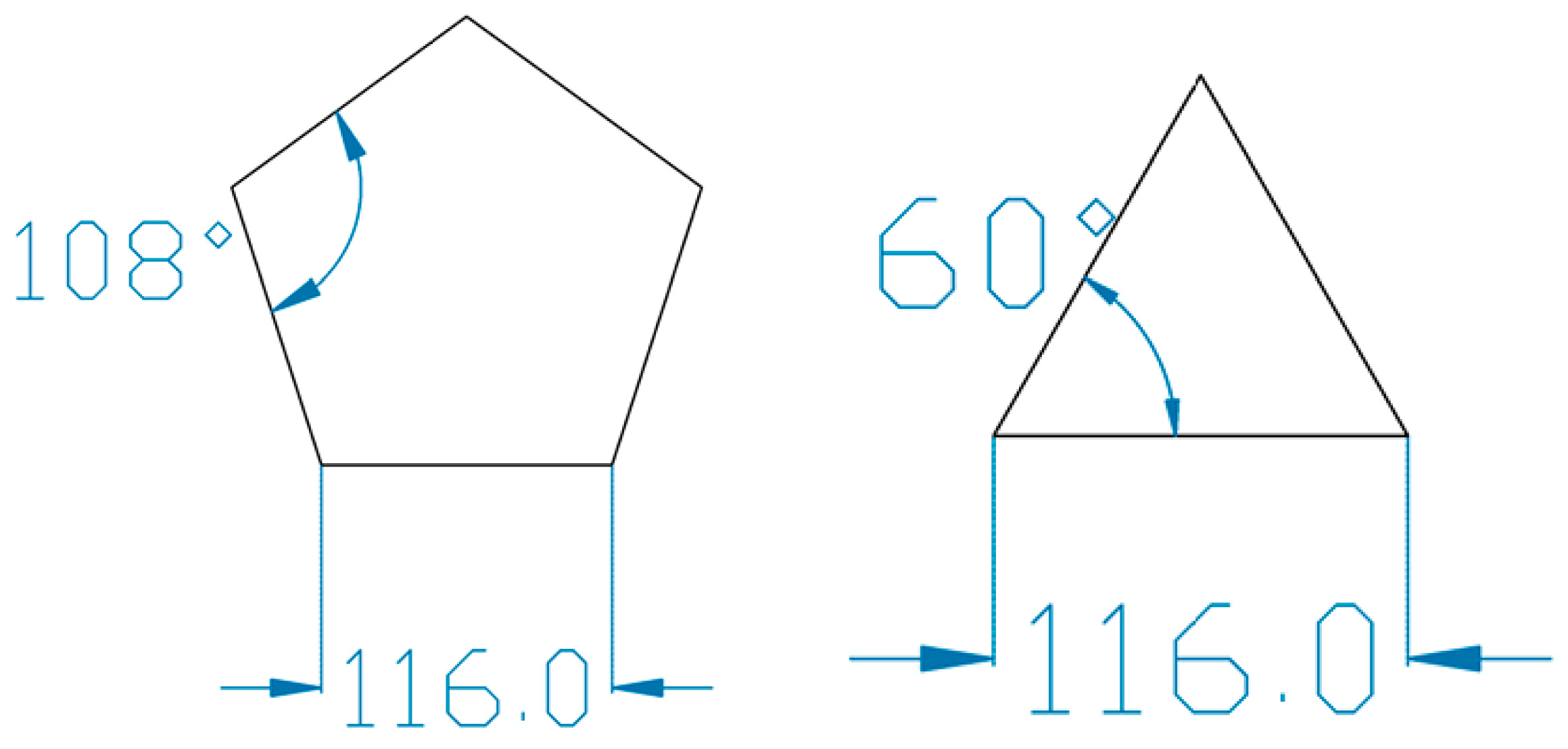
Figure A1. Cutting angle for Piece No. 1: 108° (left, 12 pieces) and cutting angle for Piece No. 2: 60° (right, 20 pieces). Both pieces belong to the icosidodecahedron geometry.
Applsci 16 01149 g0a1

Appendix B.2. Cutting Angles for the Icosidodecahedron Geometries

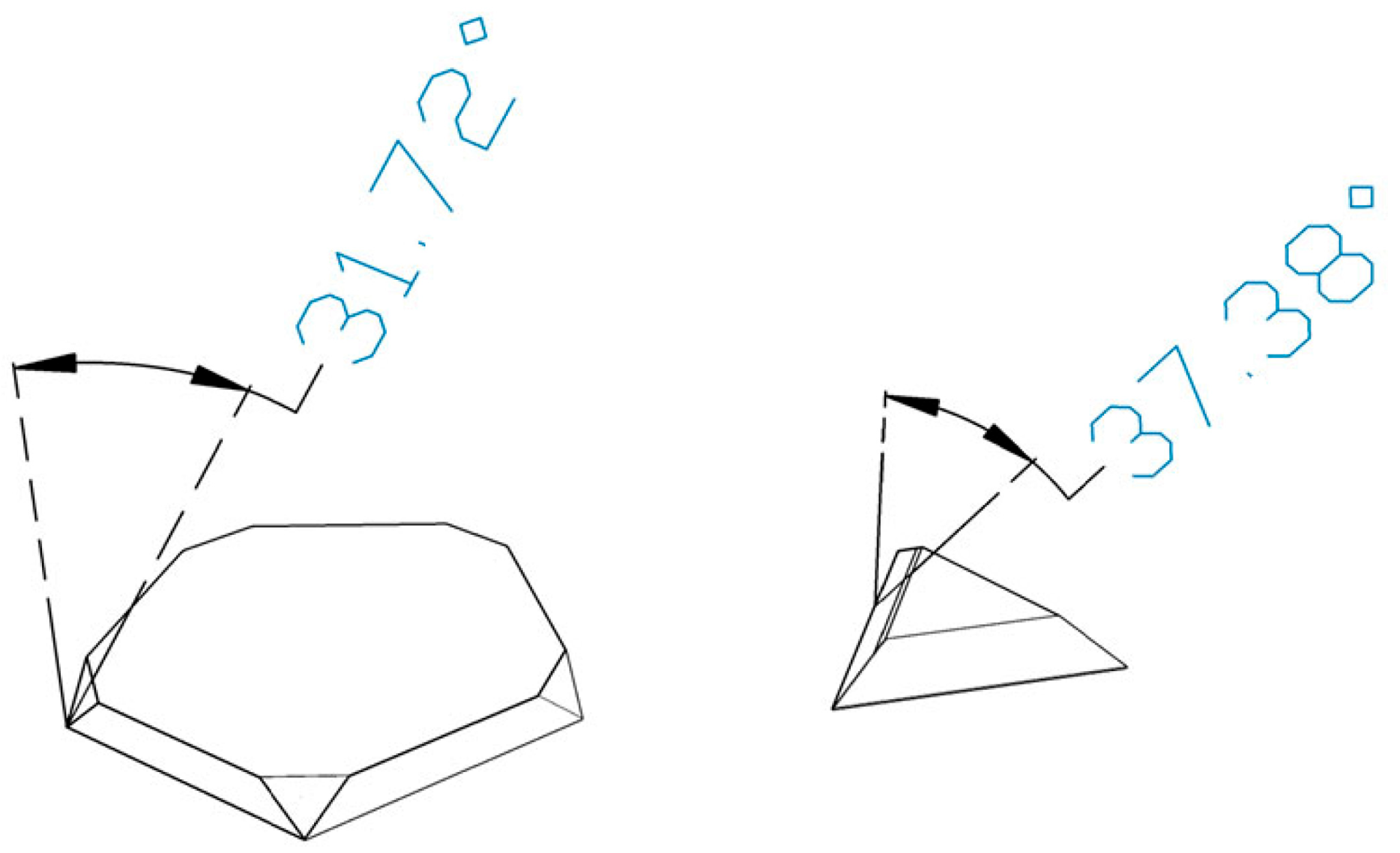
Figure A2. Cutting angle for Piece No. 1: 31.72 degrees (left) and cutting angle for Piece No. 2: 37.38 degrees (right).
Applsci 16 01149 g0a2

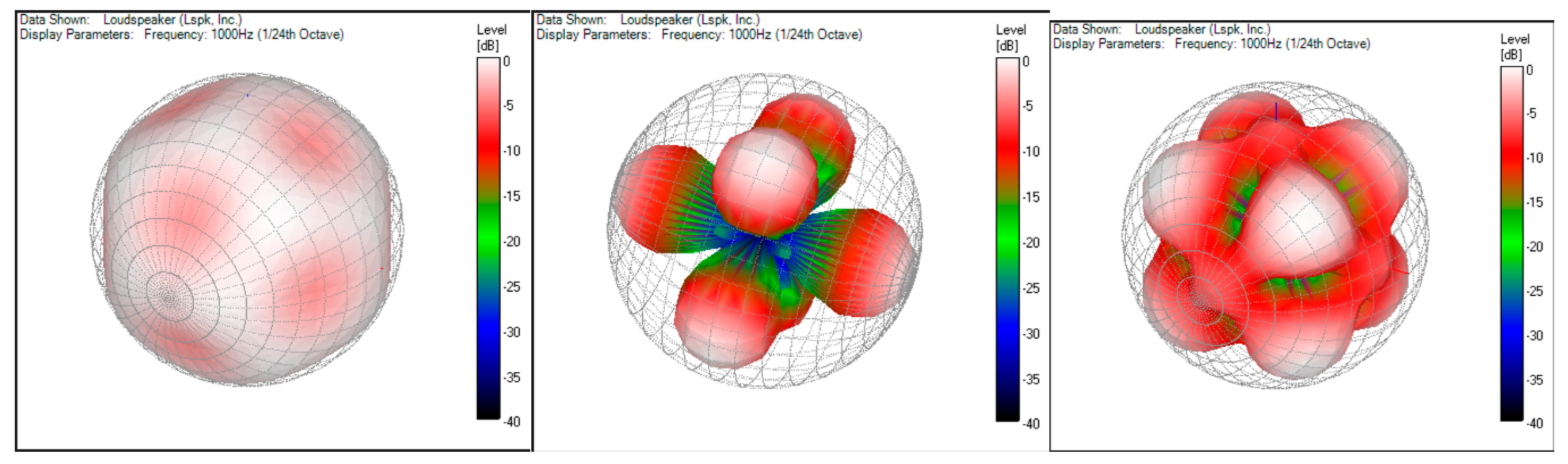
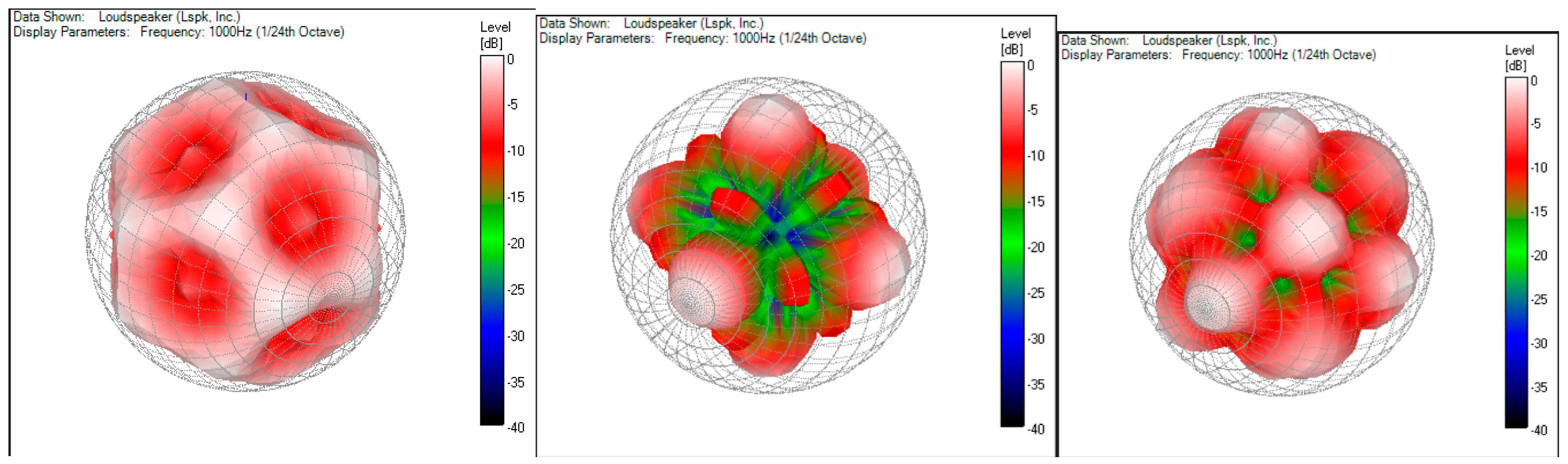
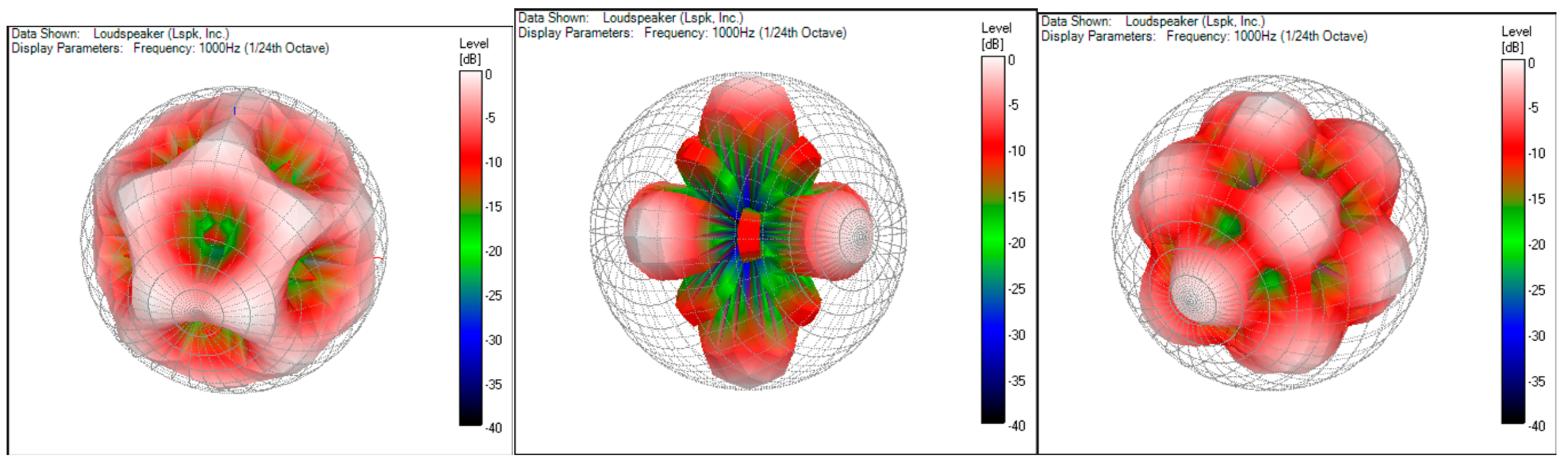
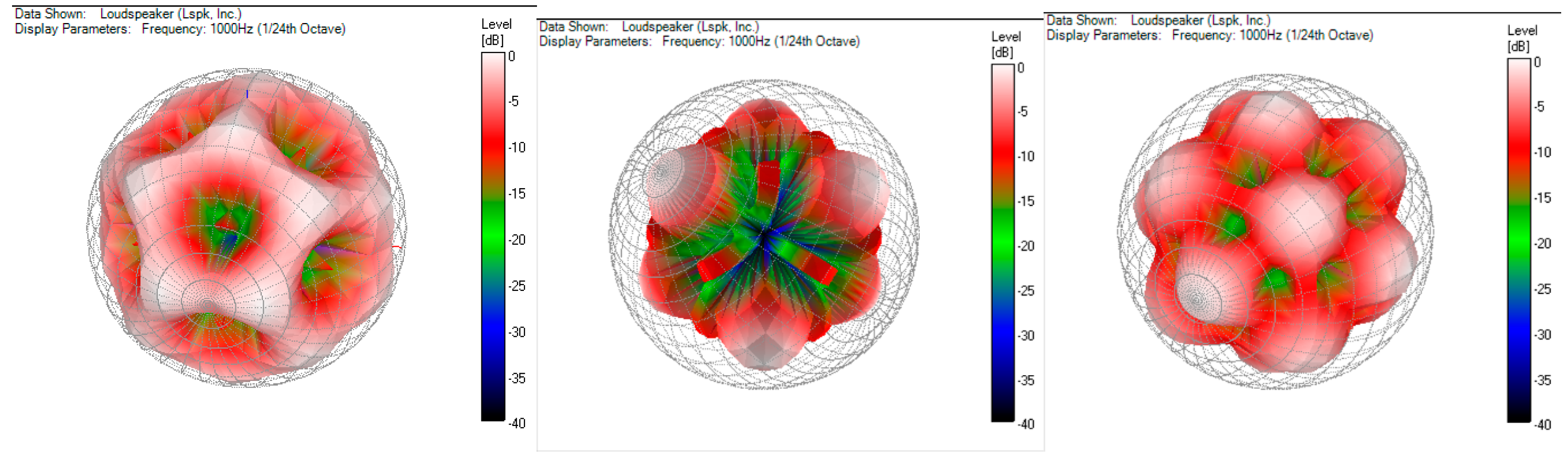
Appendix C. Comparison of Radiation Spheres for Different Polyhedrons

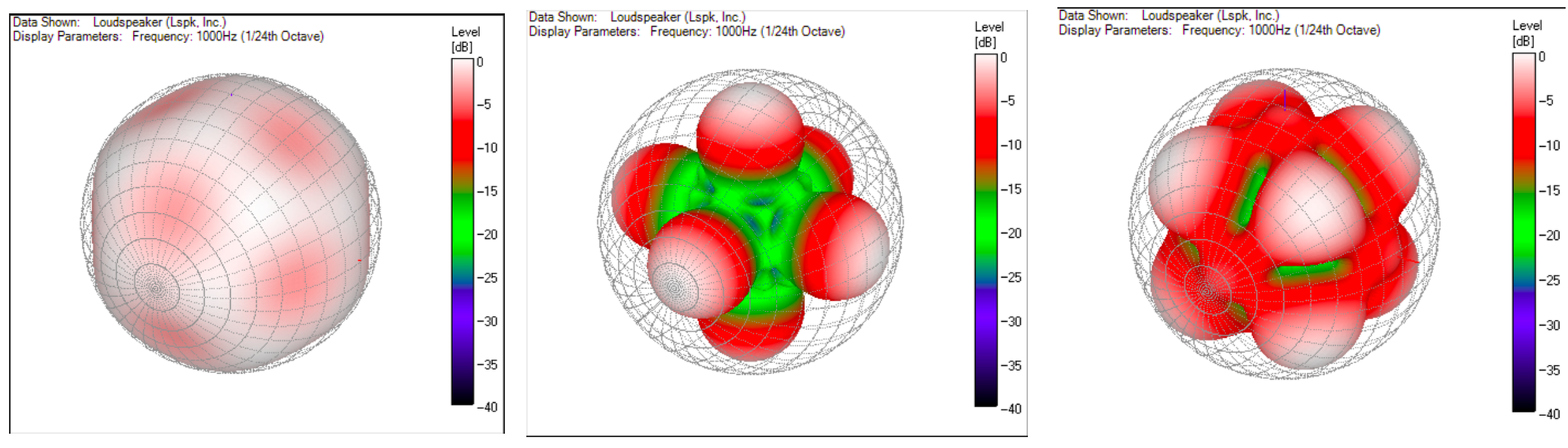
Figure A3. Radiation spheres for the icosahedron (left), octahedron (center), and tetrahedron (right) with a separation of 45 cm between the sources. The figure illustrates the variation in radiation patterns across different polyhedra, showing how their geometries affect the sound distribution at 1 kHz.
Applsci 16 01149 g0a3
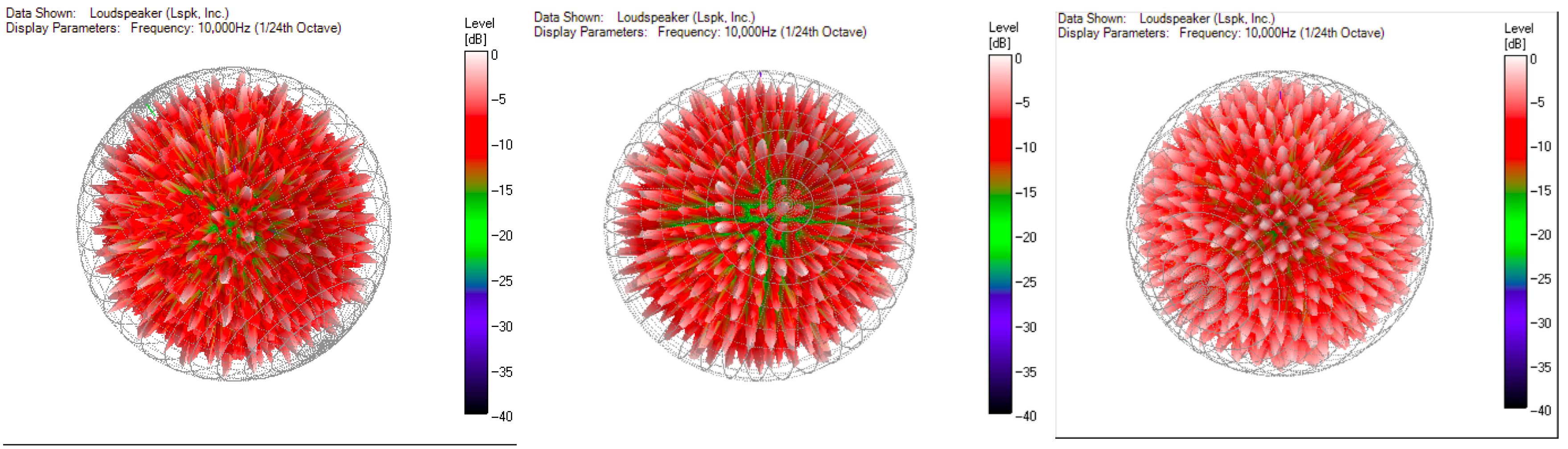
Figure A4. Radiation patterns for the icosahedron (left), octahedron (center), and tetrahedron (right) with a 20 cm spacing between sources and a 2 m measurement distance. The figure shows the 10 kHz emission signal and illustrates how the geometries of these polyhedra affect the sound distribution.
Applsci 16 01149 g0a4
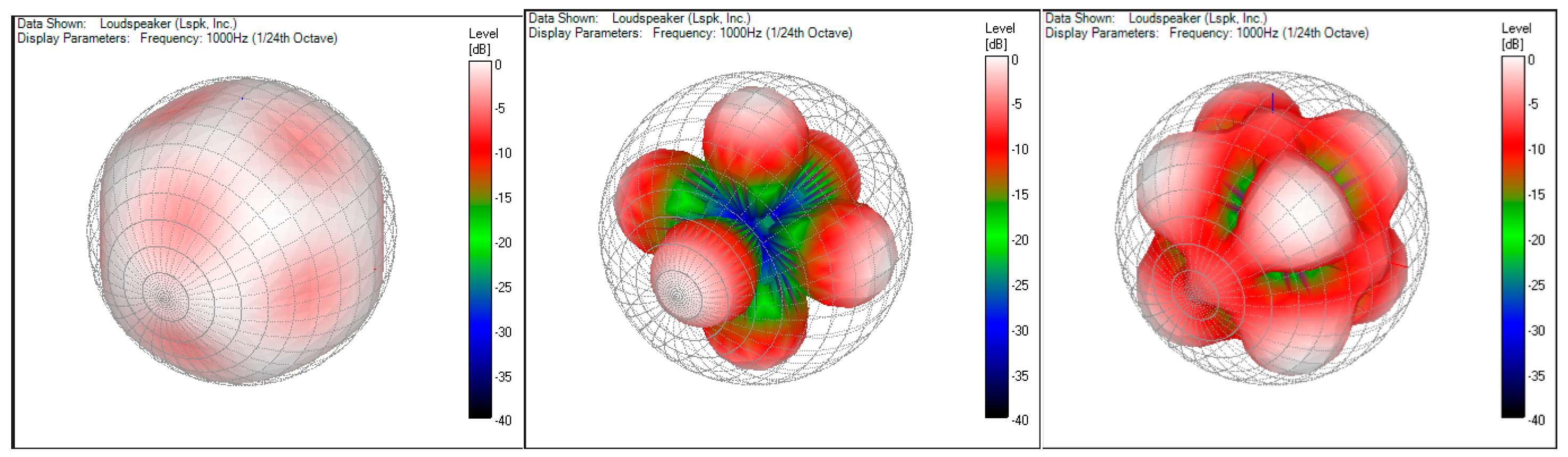
Figure A5. Radiation patterns for the icosahedron (left), octahedron (center), and tetrahedron (right) with a 20 cm spacing between sources and a 10 m measurement distance. The figure shows the 1 kHz emission signal and illustrates the differences in radiation behavior across various polyhedra geometries, particularly at lower frequencies.
Applsci 16 01149 g0a5
Figure A6. Radiation patterns for the icosahedron (left), octahedron (center), and tetrahedron (right) with a 20 cm spacing between sources and a 20 m measurement distance. The figure shows the 1 kHz emission signal and illustrates how the geometry of each polyhedron affects the sound distribution.
Applsci 16 01149 g0a6
Figure A7. Radiation patterns for the icosahedron (left), octahedron (center), and tetrahedron (right) with a 30 cm spacing between sources and a 2 m measurement distance. The figure shows the 1 kHz emission signal and illustrates the influence of different polyhedral geometries on the distribution of sound.
Applsci 16 01149 g0a7
Figure A8. Radiation patterns for the icosahedron (left), octahedron (center), and tetrahedron (right) with a 30 cm spacing between sources and a 10 m measurement distance. The figure shows the 1 kHz emission signal and highlights how increasing the distance between sources affects the radiation patterns of different polyhedra.
Applsci 16 01149 g0a8
Figure A9. Radiation patterns for the icosahedron (left), octahedron (center), and tetrahedron (right) with a 30 cm spacing between sources and a 20 m measurement distance. The figure shows the 1 kHz emission signal and highlights the impact of increased source separation and distance on the radiation patterns, with distinct lobe formation and more complex interference.
Applsci 16 01149 g0a9
Figure A10. Radiation patterns for the icosahedron (left), octahedron (center), and tetrahedron (right) with a 45 cm spacing between sources and a 2 m measurement distance. The figure shows the 1 kHz emission signal and the variation in the radiation patterns with increased spacing between sources, highlighting the differences in acoustic behavior across polyhedra geometries.
Applsci 16 01149 g0a10
Figure A11. Radiation patterns for the icosahedron (left), octahedron (center), and tetrahedron (right) with a 45 cm spacing between sources and a 10 m measurement distance. The figure shows the 1 kHz emission signal and illustrates how the increased distance between sources results in more complex interference patterns, highlighting the effect of geometric configuration.
Applsci 16 01149 g0a11
Figure A12. Radiation patterns for the icosahedron (left), octahedron (center), and tetrahedron (right) with a 45 cm spacing between sources and a 20 m measurement distance. The figure shows the 1 kHz emission signal and demonstrates how increasing the distance between sources leads to more distinct and complex interference patterns, with the geometry of each polyhedron.
Applsci 16 01149 g0a12

References

  1. ISO 3382-1; Acoustics—Measurement of Room Acoustic Parameters—Part 1: Performance Spaces. International Organization for Standardization: Geneva, Switzerland, 2009.
  2. ASTM E2235-04; Standard Test Method for Determination of Decay Rates for Use in Sound Insulation Test Methods. ASTM International: West Conshohocken, PA, USA, 2004.
  3. Bouillot, N.; Piquet, T.; Gilbert, P. Audiodice: An open hardware design of a distributed dodecahedron loudspeaker orchestra. In Proceedings of the ACM International Conference Proceeding Series 2023, Edinburgh, UK, 30 August–1 September 2023; pp. 154–160. [Google Scholar]
  4. Hak, C. The Source Directivity of a Dodecahedron Sound Source. Master’s Thesis, Eindhoven University of Technology, Department of the Built Environment, Eindhoven, The Netherlands, 2011. [Google Scholar]
  5. Chojnacki, B.; Brzóska, M.; Fijałkowska, J.A. Comparison of different omnidirectional sound sources with the validation of coupled speakers as a measurement source for room acoustics. Appl. Sci. 2023, 13, 13058. [Google Scholar] [CrossRef]
  6. Houterman, T.H.M. A Design of an Omnidirectional Sound Source Used for Impulse Response Measurements. Master’s Thesis, Eindhoven University of Technology, Eindhoven, The Netherlands, 2020. [Google Scholar]
  7. L.E.Q. Ingeniería Acústica & Control de Ruido. “Diseño, Control de Ruido y Ejecución de Proyectos Acústicos Para Múltiples Aplicaciones en Colombia”. Bogotá, Colombia. 2025. Available online: https://leqingenieria.co/ (accessed on 10 December 2025).
  8. ISO 140-14; Acoustics—Measurement of Sound Insulation in Buildings and of Building Elements. ISO: Geneva, Switzerland, 2004.
  9. Rodríguez, E.; Perdomo, S.; Gómez, S.; Jara, J.D.; Páez, D.; Herrera, M. Omnidirectional acoustic source: Design methodology and physical realization. Vis. Electrón. 2025, 19, 72–102. [Google Scholar]
  10. Arnela, M.; Guasch, O.; Sánchez-Martín, P.; Camps, J.; Alsina-Pagès, R.; Martínez-Suquía, C. Construction of an Omnidirectional Parametric Loudspeaker Consisting in a Spherical Distribution of Ultrasound Transducers. Sensors 2018, 18, 4317. [Google Scholar] [CrossRef] [PubMed]
  11. Papadakis, N.M.; Stavroulakis, G.E. Low Cost Omnidirectional Sound Source Utilizing a Common Directional Loudspeaker for Impulse Response Measurements. Appl. Sci. 2018, 8, 1703. [Google Scholar] [CrossRef]
  12. Sayin, U.; Arıfs, P.; Guasch, O. Realization of an omnidirectional source of sound using parametric loudspeakers. J. Acoust. Soc. Am. 2013, 134, 1899–1907. [Google Scholar] [CrossRef] [PubMed]
  13. Verheij, J.W. Inverse and reciprocity methods for machinery noise source characterization and sound path quantification, Part 1: Sources. Int. J. Acoust. Vib. 1997, 2, 11–20. [Google Scholar] [CrossRef]
  14. Verheij, J.W. Inverse and reciprocity methods for machinery noise source characterization and sound path quantification, Part 2: Transmission Paths. Int. J. Acoust. Vib. 1997, 2, 103–112. [Google Scholar] [CrossRef]
  15. Papadakis, N.M.; Stavroulakis, G.E. Review of acoustic sources alternatives to a dodecahedron speaker. Appl. Sci. 2019, 9, 3705. [Google Scholar] [CrossRef]
  16. Gade, A.; Rindel, J. Impulse source versus dodecahedral loudspeaker for measuring parameters derived from the impulse response in room acoustics. J. Acoust. Soc. Am. 2013, 134, 275–284. [Google Scholar] [CrossRef] [PubMed]
  17. Ibarra, D.; Ledesma, R.; Lopez, E. Design and construction of an omnidirectional sound source with inverse filtering approach for optimization. HardwareX 2018, 4, e00033. [Google Scholar] [CrossRef]
  18. Arnela, M.; Burbano-Escolà, R.; Scoczynski Ribeiro, R.; Guasch, O. Reverberation time and random-incidence sound absorption measured in the audible and ultrasonic ranges with an omnidirectional parametric loudspeaker. Appl. Acoust. 2025, 229, 110414. [Google Scholar] [CrossRef]
  19. Pätynen, J. Investigations on the balloon as an impulse source. J. Acoust. Soc. Am. 2011, 129, 27–33. [Google Scholar] [CrossRef] [PubMed]
  20. Seetharaman, P.; Tarzia, S.P. The hand clap as an impulse source for measuring room acoustics. In Proceedings of the 132nd Audio Engineering Society Convention, Budapest, Hungary, 26–29 April 2012. [Google Scholar]
  21. Défrance, G.; Daudet, L.; Polack, J.-D. Characterizing sound sources for room-acoustical measurements. In Proceedings of the Institute of Acoustics, Reading, UK, 10–11 April 2008; Volume 30. [Google Scholar]
  22. Ortiz, S.; Kolbrek, B.; Cobo, P.; González, L.M.; de la Colina, C. Point source loudspeaker design: Advances on the inverse horn approach. J. Audio Eng. Soc. 2014, 62, 345–354. [Google Scholar] [CrossRef]
  23. Kruse, R.; Häußler, A.; van de Par, S. An omnidirectional loudspeaker based on a ring-radiator. Appl. Acoust. 2013, 74, 1374–1377. [Google Scholar] [CrossRef]
  24. Kruse, R.; Häußler, A.; van de Par, S. A new omni-directional source based on a ring radiator. In Proceedings of DAGA 2012, Darmstadt, Germany, 19–22 March 2012; pp. 715–716. [Google Scholar]
  25. Ayrault, C.; Béquin, P.; Baudin, S. Characteristics of a spark discharge as an adjustable acoustic source for scale model measurements. In Proceedings of Acoustics 2012 Nantes Conference, Nantes, France, 23–27 April 2012. [Google Scholar]
  26. Wyber, R. The design of a spark discharge acoustic impulse generator. IEEE Trans. Acoust. Speech Signal Process. 1975, 23, 157–162. [Google Scholar] [CrossRef]
  27. Šumarac-Pavlović, D.; Mijić, M.; Kurtović, H. A simple impulse sound source for measurements in room acoustics. Appl. Acoust. 2008, 69, 378–383. [Google Scholar] [CrossRef]
  28. ISO 16283; Acoustics—Field Measurement of Sound Insulation in Buildings and of Building Elements. ISO: Geneva, Switzerland, 2014.
Figure 1. Radiation spheres for the Dodecahedron and the Icosidodecahedron at 100 Hz emission signal, 20 cm spacing between sources, and 2 m measurement distance.
Applsci 16 01149 g001
Figure 2. Radiation spheres for the dodecahedron (left) and the icosidodecahedron (right) at a 20 cm spacing between sources and a 2 m measurement distance. The top row corresponds to the 1 kHz emission signal, while the bottom row corresponds to the 10 kHz emission signal.
Applsci 16 01149 g002
Figure 3. Radiation spheres for the dodecahedron (left) and the icosidodecahedron (right) at a 20 cm spacing between sources. The top row corresponds to a 1 kHz emission signal measured at 10 m, while the bottom row corresponds to a 10 kHz emission signal measured at 20 m.
Applsci 16 01149 g003
Figure 4. Radiation spheres for the dodecahedron (left) and the icosidodecahedron (right) at a 20 cm spacing between sources. The top row corresponds to a 1 kHz emission signal measured at 20 m, while the bottom row corresponds to a 10 kHz emission signal measured at 2 m.
Applsci 16 01149 g004
Figure 5. Radiation spheres for the dodecahedron (left) and the icosidodecahedron (right). The top row corresponds to a 10 kHz emission signal with a 20 cm spacing between sources and a 10 m measurement distance, while the bottom row corresponds to a 1 kHz emission signal with a 30 cm spacing between sources and a 2 m measurement distance.
Applsci 16 01149 g005
Figure 6. Radiation spheres for the dodecahedron (left) and the icosidodecahedron (right) with a 30 cm spacing between sources. The top row corresponds to a 10 kHz emission signal measured at 2 m, while the bottom row corresponds to a 1 kHz emission signal measured at 10 m.
Applsci 16 01149 g006
Figure 7. Radiation spheres for the dodecahedron (left) and the icosidodecahedron (right) with a 30 cm spacing between sources. The top row corresponds to a 10 kHz emission signal measured at 10 m, while the bottom row corresponds to a 1 kHz emission signal measured at 20 m.
Applsci 16 01149 g007
Figure 8. Radiation spheres for the dodecahedron (left) and the icosidodecahedron (right). The top row corresponds to a 10 kHz emission signal with a 30 cm spacing between sources and a 20 m measurement distance, while the bottom row corresponds to a 1 kHz emission signal with a 45 cm spacing between sources and a 2 m measurement distance.
Applsci 16 01149 g008
Figure 9. Radiation spheres for the dodecahedron (left) and the icosidodecahedron (right) with a 45 cm spacing between sources. The top row corresponds to a 10 kHz emission signal measured at 2 m, while the bottom row corresponds to a 1 kHz emission signal measured at 10 m.
Applsci 16 01149 g009
Figure 10. Radiation spheres for the dodecahedron (left) and the icosidodecahedron (right) with a 45 cm spacing between sources. The top row corresponds to a 10 kHz emission signal measured at 10 m, while the bottom row corresponds to a 1 kHz emission signal measured at 20 m.
Applsci 16 01149 g010
Figure 11. Radiation spheres for the dodecahedron (left) and the icosidodecahedron (right) with a 45 cm spacing between sources, for a 10 kHz emission signal measured at 20 m.
Applsci 16 01149 g011
Figure 12. Final design of the icosidodecahedron, showing the modeled geometry and the constructed physical prototype. Appendix B shows the individual characteristics of the pieces.
Applsci 16 01149 g012
Figure 13. Omnidirectional acoustic source prototype showing its construction and integration of transducers.
Applsci 16 01149 g013aApplsci 16 01149 g013b
Figure 14. Magnitude of the frequency response of the average of all measurements (at all measurement angles) for the omnidirectional acoustic source.
Applsci 16 01149 g014
Table 1. Technical specifications of the selected loudspeaker (LaVoice WSF041.00).
DriverLaVoice WSF041.00 Ferrite Woofer
Diameter4″
RMS Power [W]40
MAX Power [W]80
S [dBSPL]90.4
SPL@1m106
Impedance [Ohm]8
VAS [L]1.41/1.5
RFreq [Hz]200–400
Disclaimer/Publisher’s Note: The statements, opinions and data contained in all publications are solely those of the individual author(s) and contributor(s) and not of MDPI and/or the editor(s). MDPI and/or the editor(s) disclaim responsibility for any injury to people or property resulting from any ideas, methods, instructions or products referred to in the content.