Article

A Study on the Effect of Transverse Flow Intensity on the Cavitation Characteristics of a Vehicle Launched Underwater


1
School of Marine Science and Technology, Northwestern Polytechnical University, Xi’an 710072, China
2
School of Naval Architecture, State Key Laboratory of Structural Analysis, Optimization and CAE Software for Industrial Equipment, Dalian University of Technology, Dalian 116024, China
*
Author to whom correspondence should be addressed.
Appl. Sci. 2026, 16(3), 1152; https://doi.org/10.3390/app16031152
Submission received: 24 December 2025 / Revised: 12 January 2026 / Accepted: 15 January 2026 / Published: 23 January 2026
(This article belongs to the Special Issue Research on the Movement Dynamics of Ships and Underwater Vehicles)

Abstract

The high-speed motion of a vehicle underwater induces cavitation, and the resulting cavity alters the surface pressure distribution and flow field characteristics. This study employs a numerical approach combining the k ω SST (Shear Stress Transport) turbulence model, the VOF (Volume of Fluid) multiphase flow model, the Schnerr–Sauer cavitation model, and the overlapping mesh technique. The numerical method is validated through the good agreement between simulation results and experimental data for both cavity shape and vehicle trajectory, with a maximum relative error of 6.1% in vertical displacement. The results indicate that during the launch-tube exit phase, with σ = 0.235 and Fr = 47.9 , the vehicle acceleration causes the pressure at its shoulder to drop below the saturated vapor pressure, initiating cavitation. Under transverse flow (intensity U = 0.016–0.05), the cavity becomes asymmetric. Specifically, the axial length and radial thickness on the back side are significantly larger than those on the face side, and this asymmetry intensifies with increasing transverse flow intensity. Furthermore, after exiting the launcher, the vehicle’s trajectory and attitude deflect towards the back side and the deflection amplitude increases, with horizontal displacement and attitude angle variation positively correlated with transverse flow intensity.

1. Introduction

Underwater vehicles play a critical role in civilian and scientific fields such as marine resource exploration, submarine pipeline inspection, and ocean data acquisition. Their hydrodynamic performance during underwater motion is directly related to the reliability, economy, and safety of operational missions [1]. When an object moves at high speed underwater, the flow velocity around its surface increases sharply according to Bernoulli’s principle, causing the local static pressure to drop below the saturated vapor pressure at the ambient water temperature. This triggers a phase change in the liquid, forming vapor-filled cavities, a phenomenon known as cavitation [2,3]. As a complex multiphase flow, cavitation has been widely documented for its adverse effects [4]. For instance, in the field of underwater propulsion, cavitation is a core issue constraining propeller performance and reliability [5,6]. It not only alters the overall flow structure but also induces a range of detrimental consequences [7,8]. First, the collapse of cavitation bubbles generates extremely high impulsive pressures, up to hundreds of megapascals, within microseconds. Long-term exposure to such conditions leads to material fatigue and erosion, severely damaging equipment service life and structural integrity [9]. Second, the unsteady shedding and evolution of cavitation bubbles excite strong pressure fluctuations and vibrational loads on the vehicle surface, which not only interfere with precision instrumentation but also threaten long-term structural fatigue resistance [10]. Moreover, the formation of large-scale cavitation alters the effective hydrodynamic shape of the vehicle, posing serious challenges to its motion stability and trajectory control [11].
Scientific investigation into cavitation has spanned over a century. Foundational contributions include Rayleigh’s theoretical analysis of spherical bubble collapse [12], Blake’s study on the motion of dual cavitation bubbles near rigid boundaries [13], Plesset’s famous equation describing bubble dynamics [14], and Lauterborn et al.’s exploration of cavitation bubble behavior near solid boundaries [15]. In recent years, advances in high-fidelity turbulence models such as LES (Large Eddy Simulation) and high-speed imaging have enabled deeper insights into the unsteady behavior of single and interacting bubbles at microscopic scales [16,17,18,19]. Zhang et al. [20] employed the VOF method to simulate the collapse of three-dimensional bubbles under high ambient pressure, revealing that the collapse of a central bubble in a multi-bubble system differs significantly from that of a single bubble, with neighboring bubbles affecting both collapse time and peak pressure. Their theoretical analysis identified a dual pressure-driven mechanism governing radial bubble motion. Du et al. [21] investigated the collapse mechanisms of bubble clusters through dimensional analysis and numerical simulation, systematically examining the influence of bubble number, spatial distribution, and other factors on collective collapse behavior. Zhang et al. proposed a groundbreaking unified model for bubble dynamics, which, for the first time, incorporated key physical effects, including liquid compressibility, phase change, bubble translation, and external flow fields, within a single mathematical framework. This model accurately predicts bubble behavior across diverse complex scenarios and reveals the essential influence of internal bubble composition on energy conversion mechanisms [22].
In addition, underwater vehicles moving at high speeds often generate attached cavitation, and research in this specific area also demonstrates significant scientific and practical value [23,24,25]. Numerous scholars have dedicated efforts to uncovering the multiphase flow physics throughout the vehicle’s motion. Wang et al. [26] combined numerical simulation and experiment to systematically analyze the unsteady cavitating flow around a projectile during underwater launch. Their work revealed cavitation collapse mechanisms and their coupling with structural vibration, established a physical model of bubble collapse, and identified structural natural frequency as a key factor influencing fluid–structure interaction. Further, Wang et al. [27] discovered a novel “inward collapse” phenomenon during underwater launch, where the cavity rapidly contracts from the tail toward the head, generating high-impact pressures and forming re-entrant jets. They demonstrated that this phenomenon is triggered by the combined effects of vehicle acceleration/deceleration and drastic changes in cavitation number: thin cavities generated during acceleration undergo rapid condensation during deceleration, introducing extra volumetric forces that drive high-speed impact on the wall. Numerical results confirmed that deceleration nonlinearly accelerates cavity shortening, and greater deceleration magnitudes significantly hasten the collapse process. Chen et al. [28] used high-fidelity LES to reveal cavitation evolution and collapse mechanisms during the water-exit process of an axisymmetric projectile. Their work successfully resolved transient high-pressure characteristics induced by cavity collapse and captured, for the first time, the detailed process of cavity breakup due to the combined action of re-entrant jets and the free surface. They also found that angle of attack causes the contact lines at the cavity’s leading and trailing edges to tilt in opposite directions, eventually meeting on the pressure side, leading to breakup and high-pressure pulses. Later, Chen et al. [29] investigated the effect of water-exit angle on the flow structure around the vehicle, showing that as the angle increases, pressure distribution becomes more regular on the windward side, while disturbance propagation and transition occur on the lateral surface. This study was the first to capture cavity shedding induced by the contraction of the liquid–gas contact line and found that the presence of the cavity suppresses the generation of hairpin vortices, with its surface covered by T-S (Tollmien–Schlichting) wave-like vortex structures due to shear. Zhao et al. [30] experimentally investigated the evolution of shoulder cavities and the mechanism of gas entrapment using pressure sensors and high-speed imaging. They found that the negative pressure impulse occurring when the tail exits the tube is the key factor causing gas entrapment in the shoulder cavity, and increasing the cavity pressure ratio significantly promotes cavity growth. Lu et al. [31] combined experiments and theoretical analysis to study the influence of a leading bubble on shoulder cavity evolution during a low-speed underwater launch, noting that cavity pressure oscillations cause surface wrinkling. They established a coupled model that successfully predicted cavity morphology changes.
The simultaneous launch and water exit of twin vehicles is more complex than the single-body case, due not only to the unsteady cavitating flow but also to the strong hydrodynamic interaction between the two bodies. Several studies have addressed this complex process [32,33]. Xu et al. [34] identified two primary wake vortex structures behind an underwater vehicle: vortex rings and reversed vortex pairs. With increasing angle of attack, the wake transitions sequentially from vortex rings to hairpin vortices and finally to reversed vortex pairs. Their research confirmed that reversed vortex pairs cause significant disturbance to the following vehicle’s attitude, whereas vortex rings have a relatively minor effect. Simulations also indicated that a higher launch-platform speed intensifies the reversed vortex pairs, thereby amplifying wake interference. Gao et al. [35] designed an experimental system to study cavitation flow during the water exit of twin vehicles. Notably, they observed that the inner cavity of the trailing vehicle undergoes large-scale breakup and shedding due to disturbance from the leader’s wake, though its motion stability remains largely unaffected. To mitigate the adverse effects of the complex flow field on motion stability during underwater launch, some researchers have proposed active ventilation techniques to form a film-like air layer on the vehicle surface for drag reduction and stabilization. Hao et al. [36] experimentally identified three flow regimes of ventilated cavities around an axisymmetric cone and revealed the associated gas entrainment and leakage mechanisms. With increasing ventilation rate, the cavity transitions from frothy, through intermittent, to continuous and transparent, with larger shedding structures and lower frequency in the intermittent regime. A gas leakage model based on the vortex-shedding hypothesis successfully predicted the ventilation rate threshold for the transition from an intermittent to a continuous regime. Wang et al. [37] showed that a hemispherical head forms a thinner, more shedding-prone cavity, while a conical head generates a larger cavity volume and higher drag. Pressure drag dominates total resistance, and its fluctuations correlate with tail cavity evolution and vortex structures, providing a theoretical basis for the design and flow control of cavitating vehicles. Yu et al. [38] applied LES to show that the periodic shedding of partial cavities is governed by the combined effects of high-pressure zones, re-entrant jets, and vortex structures. Gas leakage in a supercavity is controlled by re-entrant jets driven by strong adverse pressure gradients. Their study also confirmed that the supercavity significantly reduces flow fluctuations around the vehicle, improving its hydrodynamic environment.
A survey of the existing literature reveals that most studies are based on a key assumption: the vehicle operates in a quiescent, symmetric, pure-water environment. While this assumption greatly simplifies the problem, it deviates significantly from real ocean conditions. In actual sea states, underwater vehicles are continuously subjected to environmental loads, among which steady or slowly varying background currents are typical. Although some pioneering work has addressed the cross-media motion of bodies in wave and ice fields [39,40,41,42], the influence of transverse flow, as an idealized and typical model of ocean currents, on the entire underwater motion process, particularly on the coupled dynamics of cavitation characteristics and trajectory, remains insufficiently studied. A systematic investigation into the cross-media process of underwater vehicles under transverse flow is essential for developing high-precision predictive models and enhancing the adaptability, safety, and operational performance of underwater equipment in complex marine environments. This paper is devoted to the study of cavitation characteristics and motion response of an underwater vehicle under transverse flow. The structure is organized as follows: Section 2 details the governing equations and numerical methods; Section 3 presents the setup of the numerical model and the validation of the method; Section 4 presents the results and discussion in three parts: (A) analysis of typical multiphase flow structures, (B) cavity evolution and unsteady load characteristics, and (C) evolution of the vehicle’s motion characteristics; and finally, Section 5 summarizes the main findings and conclusions.

2. Numerical Method

In the underwater launching process, the vehicle moves at high speed and interacts strongly with the surrounding fluid, accompanied by complex phenomena such as cavitation, free-surface deformation, and transient pressure fluctuation. The unsteady three-dimensional cavitating flow around the underwater vehicle is solved based on RANS (Reynolds Averaged Navier–Stokes) equations coupled with continuity, momentum and energy conservation equations, providing a comprehensive framework to simulate the high-speed motion and cavitation evolution from launch to water exit. The mass conservation equation is expressed as follows:
ρ t + ( ρ u ) = 0 ,
where ρ is the mixture density, t is time, and u = ( u , v , w ) is the velocity vector. This equation maintains mass balance in the flow field, which is crucial for capturing the density variations induced by cavitation bubbles during the vehicle’s acceleration in the underwater phase. The momentum equation is as follows:
( ρ u ) t + ( ρ u u ) = p + ( μ + μ t ) ( u + u T ) + ρ g + F ,
where ρ u is momentum per unit volume, p is static pressure, μ is molecular viscosity, u + u T is the symmetric part of rate-of-strain tensor, g is gravitational acceleration vector, and F represents additional body forces from turbulence or cavitation. The equation governs the momentum transfer, which is essential for modeling the pressure drop at the vehicle shoulder and the asymmetric flow distortions caused by transverse currents, which lead to cavity asymmetry and trajectory deflection. The energy equation, assuming incompressible flow with heat transfer considerations for cavitation-induced phase changes, is expressed as follows:
( ρ h ) t + ( ρ u h ) = D p D t + λ + λ t T ,
where h is specific enthalpy, D p / D t = p / t + u p is material derivative of pressure, T is temperature, λ and λ t are molecular and turbulent thermal conductivities, respectively.
To accurately capture the complex flow structures, including boundary layer effects and shear stresses that influence cavity formation and asymmetry. The SST k ω turbulence model, a two-equation eddy-viscosity model, is employed for its robustness in handling adverse pressure gradients and flow separation, which are prevalent in high-speed underwater vehicle scenarios. It combines the advantages of the k ω model near the walls and the k ε model in the free shear flow regions. The transport equation for turbulent kinetic energy k is
( ρ k ) t + ( ρ k u ) = P k β ρ k ω + ( μ + σ k μ t ) k ,
where P k = min ( μ t S 2 , 10 β ρ k ω ) is the production term of turbulent kinetic energy, with S being the strain rate magnitude, β = 0.09 is a model constant, and ω is the specific dissipation rate. σ k is the turbulent Prandtl number for k . μ t = ρ k / ω / max ( 1 , Ω F 2 / a 1 ω ) is the turbulent viscosity, where Ω is the vorticity magnitude, F 2 is a blending function, and a 1 = 0.31 . and denote divergence and gradient operators, respectively. The transport equation for specific dissipation rate is
( ρ ω ) t + ( ρ ω u ) = γ ρ S 2 β ρ ω 2 + ( μ + σ ω μ t ) ω + C D ,
where γ is the intermittency factor, β is a model constant, σ ω is turbulent Prandtl numbers for ω , and F 1 is the first blending function. The cross-diffusion term C D facilitates the transition from k ω near the wall to k ε in the far field.
In the context of the vehicle’s water exit, where multiple phases interact, the VOF model is adopted to track the interface between phases. The VOF method solves for the volume fraction α of each phase, with the following transport equation:
α q t + ( α q u q ) = S α q + p = 1 n ( m ˙ p q m ˙ q p ) ,
where α q is the volume fraction of phase q, u q is its velocity, S α q is a source term, and m ˙ p q represents mass transfer from phase p to q, and vice versa. The sum of volume fractions across all phases equals 1. The model effectively captures the free surface and cavity boundaries, integrating seamlessly with the background of cavitation initiation at the vehicle shoulder due to velocity-induced pressure drops.
To simulate the cavitation process inherent to high-speed underwater vehicles, the Schnerr–Sauer model is employed, which is based on the Rayleigh–Plesset equation for bubble dynamics. This model accurately captures cavitation nucleation, vaporization, and condensation, and is widely validated in high-speed underwater vehicle cavitation simulations, making it suitable for the study’s focus on macroscopic cavitation evolution. The model treats cavitation as a multiphase mixture and incorporates mass transfer rates for vaporization and condensation. The vapor volume fraction transport equation is
( ρ v α v ) t + ( ρ v α v u ) = m ˙ + m ˙ ,
where ρ v is vapor density, α v is vapor volume fraction, m ˙ + , and m ˙ is the condensation rate. These rates are defined as follows:
m ˙ + = ρ v ρ l ρ α v ( 1 α v ) 3 R b 2 3 max ( p v p , 0 ) ρ l ,
m ˙ + = ρ v ρ l ρ α v ( 1 α v ) 3 R b 2 3 max ( p p v , 0 ) ρ l ,
where ρ l is liquid density, ρ is mixture density, R b is the bubble radius, p v is saturated vapor pressure, and p is local pressure. The model assumes a predefined nucleation site density. In this study, it accurately predicts cavitation onset in the exit tube phase, where shoulder pressure falls below p v , and captures the asymmetric cavity growth under transverse flow effects.
To handle the large displacements and rotations of the vehicle during its underwater launch and water exit, the overset mesh technique is utilized. This method involves a background mesh for the far-field domain and a body-fitted overset mesh that moves with the vehicle, allowing for efficient simulation of dynamic motions without excessive remeshing. Data interpolation occurs at the overlapping interfaces using a linear technique to ensure the continuity of flow variables. In STAR-CCM+, this is implemented with automatic hole-cutting and donor cell identification, minimizing computational overhead. This approach is particularly suited to the study’s background, where the vehicle’s deflection under transverse flow requires the precise tracking of asymmetric cavity evolution and attitude changes. By enabling 6DOF (six-degrees-of-freedom) motion coupling, the overset mesh reveals how increasing transverse flow intensity amplifies cavity asymmetry and trajectory deviation. All numerical procedures are performed on the STAR-CCM+ platform, leveraging the finite volume method for spatial discretization. The method integrates fluxes over cell faces, ensuring local and global conservation, and employs the iterative solver SIMPLE for pressure–velocity coupling. Temporal discretization uses second-order implicit schemes for transient accuracy, aligning with the high-speed, cavitating flow characteristics from underwater emission to surface breach.

3. Numerical Set-Ups

3.1. Geometric Model and Boundary Conditions

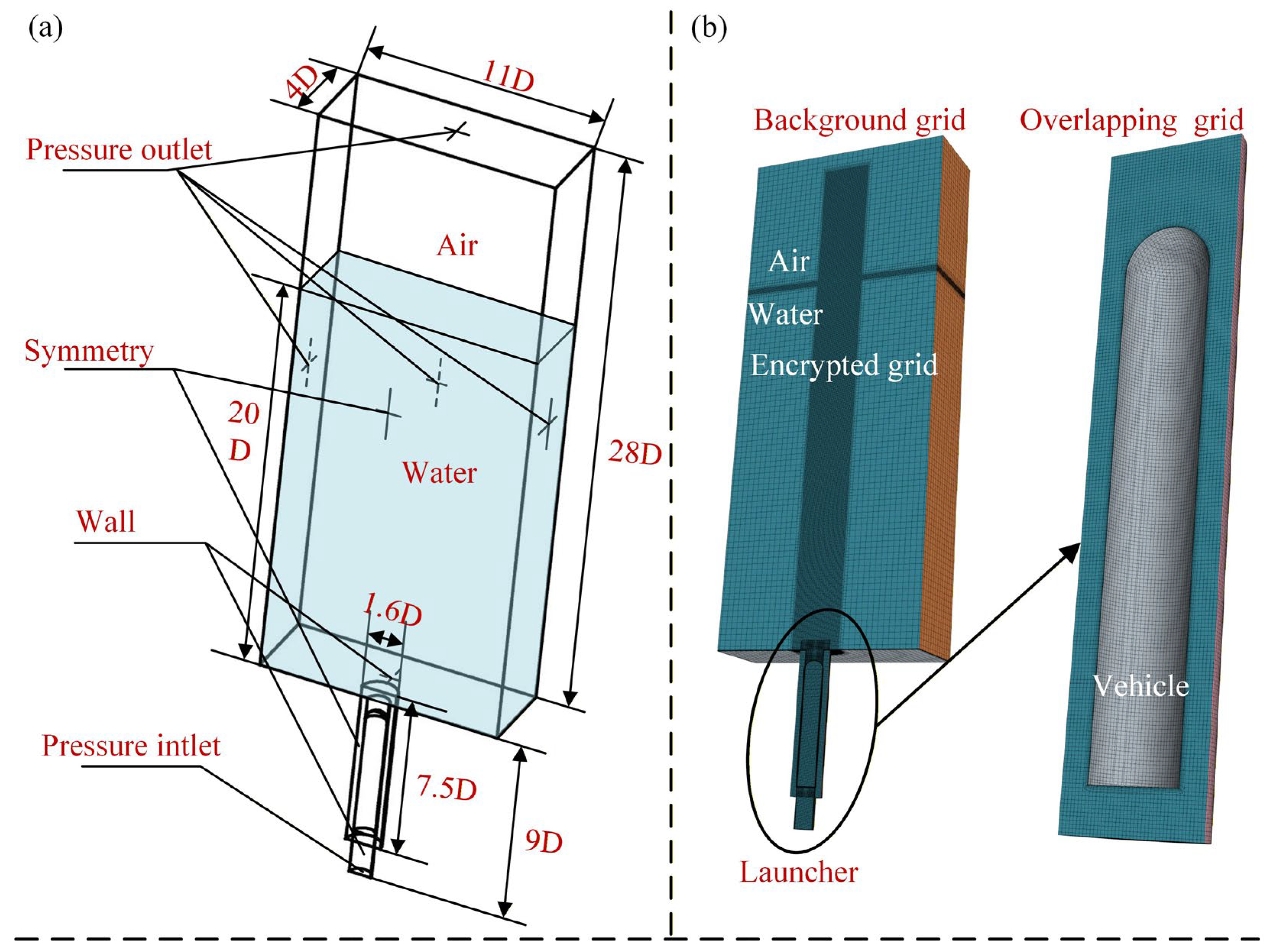
In this paper, the numerical computation model is a whole-domain model, in which the background computation domain consists of the launch tube and the water domain, and the adopted vehicle model is of the hemispherical head type, with a diameter of D = 40 mm, a length of L = 240 mm, and a mass of 0.26 kg. The hemispherical head was selected to minimize geometric complexity, align with our previous experimental model for direct validation, and ensure consistency with common underwater vehicle configurations. The division of the computational domain and the setting of boundary conditions are shown in Figure 1a, in which the dimensions of the background domain are 27D × 11D × 8D, the water depth is 19D, the length of the launcher tube is 9D, the diameter of the launcher tube is 1D, and the wall of the tube and the wall of the vehicle are completely adhered to the wall without any gap. The overlapping domain has a diameter of 1.6D and a length of 7.5D. In the no-transverse-flow underwater launch condition, the left, right, front, back, and top sides of the background domain are set as the pressure outlet boundary conditions, with the pressure gradient distribution of the boundary flow field defined by a user-defined function, the bottom side of the background domain and the side wall of the launch tube are used as the no-slip wall boundary conditions, with the bottom of the launch tube used as the stagnant inlet boundary condition, and the relationship between the inlet pressure and the change in the inlet pressure over time is specified by a user-defined function. The inlet pressure versus time is specified by a user-defined function. In the underwater launch condition with cross-current, the left side of the background domain is set as the velocity inlet boundary condition. In the overlapping domain, the walls of the vehicle are set as no-slip wall boundary conditions, and the outer interfaces are set as zero-gap boundary conditions in the overlapping mesh.
As a result of the geometric constraints of the launch tube, the vehicle is set as a single-degree-of-freedom motion state in the exit stage; and when the vehicle tail leaves the tube outlet plane, the vehicle is set as a six-degrees-of-freedom motion state in the underwater navigation stage and the exit stage. The mesh of the computational domain is generated by the cutting body mesh cell generator, the mesh is locally encrypted in the vehicle motion region and at the water surface, and the mesh size of the encrypted region is 0.04 D. To save computational resources, the mesh size at the far field is set to 0.2 D. To capture the boundary-layer flow near the wall, there are a certain number of layers of boundary-layer meshes at the wall surface of the vehicle, at the wall surface of the launching tube, and at the bottom of the background domain, and the value of Y+ is 30. The Y+ value is 30. The mesh is divided and assembled as shown in Figure 1b.

3.2. Validations of Numerical Approach

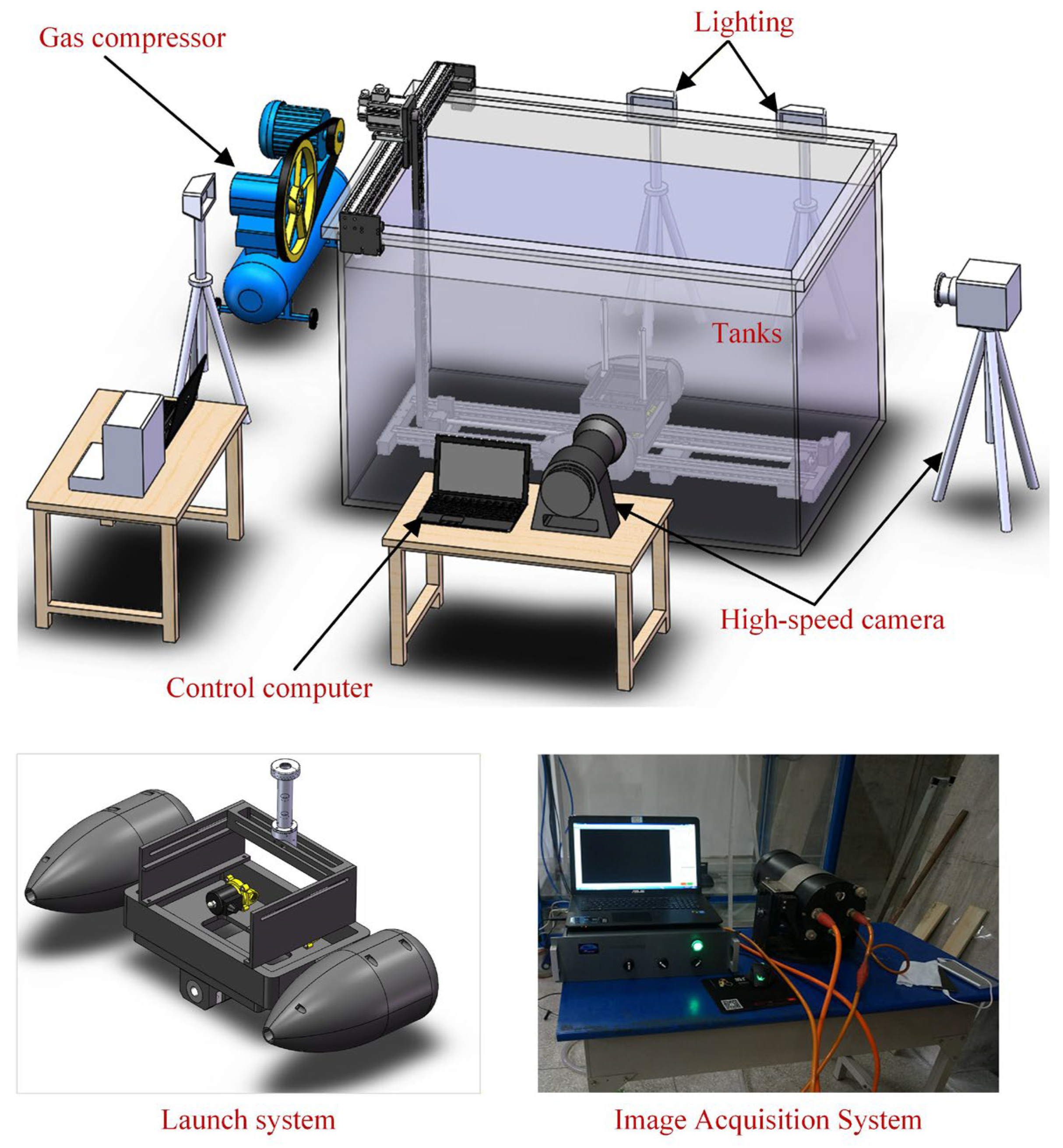
As shown in Figure 2, the experimental device used in the underwater launched experimental research in this paper mainly consists of the vehicle launching device, boat speed control device, small transparent water tank, lighting system, and data acquisition system. The vertical vehicle launching device mainly uses the high-pressure gas to allow the vehicle to reach a certain speed when launched vertically upward from the tube to complete the process of underwater launching; the speed of the platform motion device aims to simulate the actual launch process in terms of the vehicle speed and cross-current effects.
The effective distance of the platform movement is 0.8 m and the maximum horizontal speed of 3 m/s; starting acceleration reaches up to 2 g; water tank size is 1840 mm × 1200 mm × 1240 mm; the main devices of the Plexiglas are bonded together; and the surrounding walls are transparent to facilitate the use of a high-speed camera to shoot the experimental process. Due to the high velocity of the vehicle launch, taking into account the safety of the experiment, the water tank is used, and due to the high launching speed of the vehicle, an interception protection mat was arranged above the tank in consideration of the safety of the experiment. The data acquisition system mainly comprised a Phantom high-speed camera (Vision Research Inc., Wayne, NJ, USA), a control box, an acquisition computer, and an illumination system, and the shooting parameters used were a frame rate of 4000 fps, an exposure time of 230 μs, and a resolution of 512 × 1200, which were able to effectively capture the ejector propulsion and collapsing process of the shoulder-attached cavity.
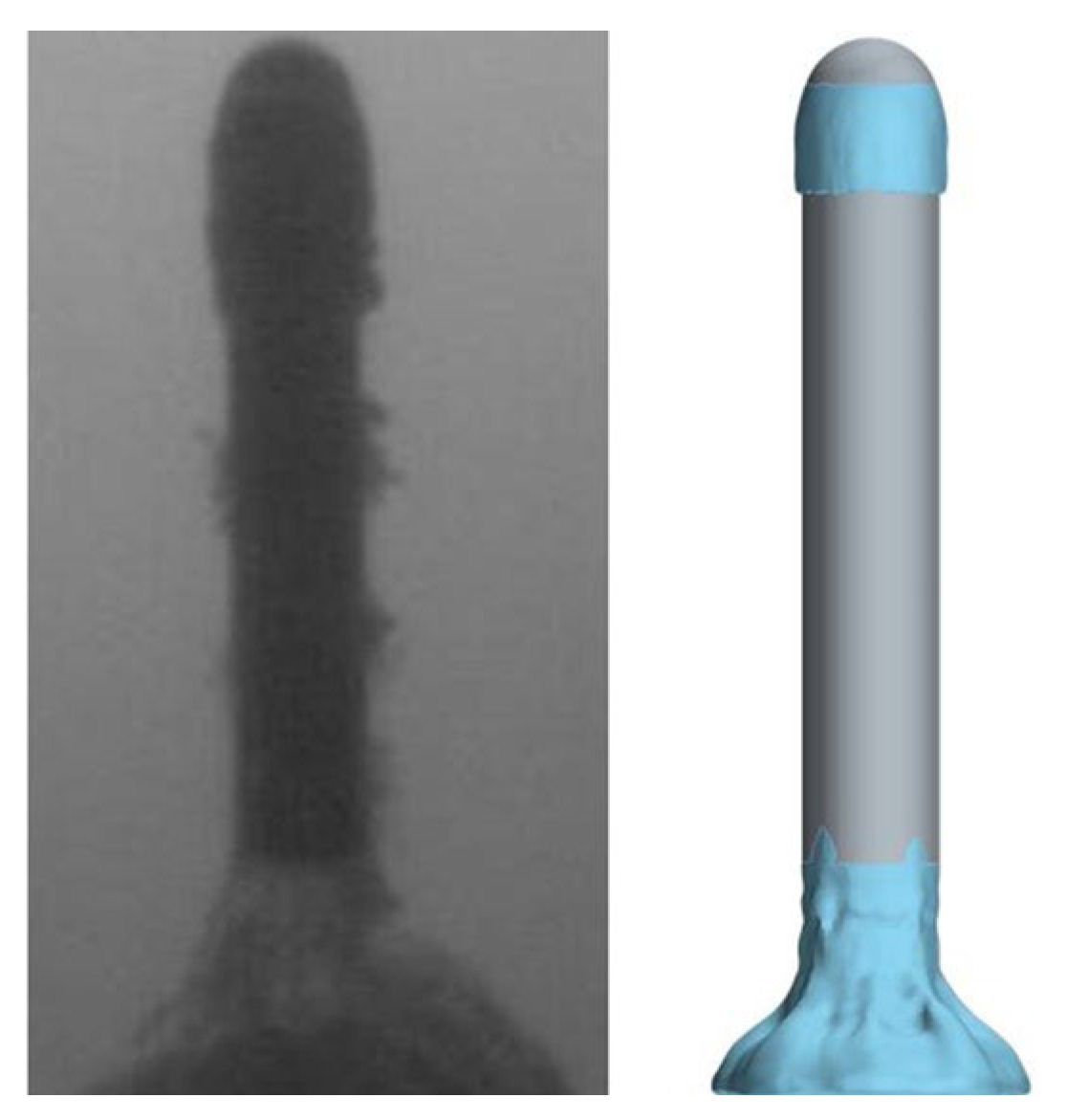
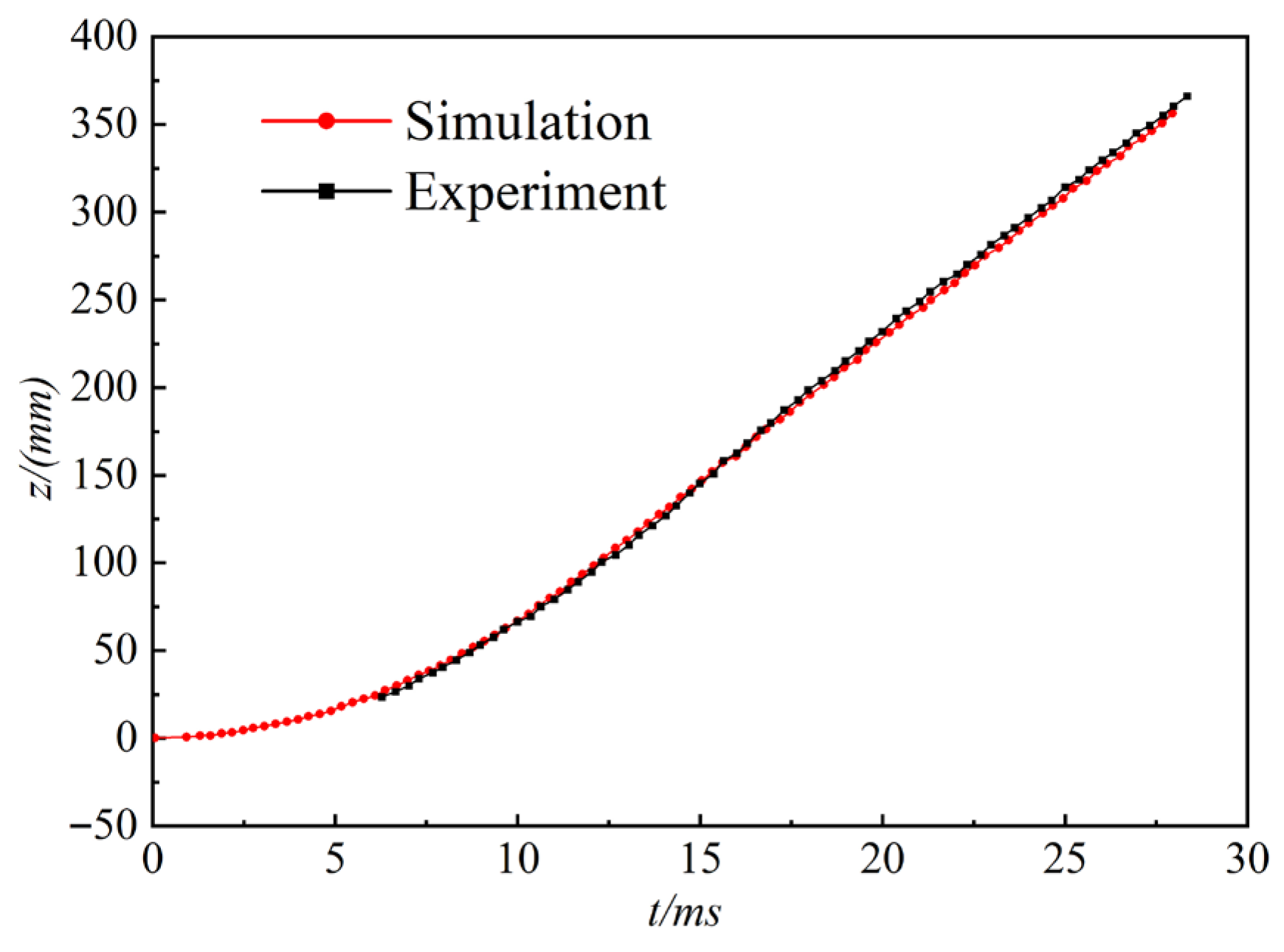
Based on the underwater launch experiment device and numerical simulation model introduced above, this paper performed an underwater launch experiment and numerical simulation calculation of a hemispherical head-type vehicle with a diameter of 20 mm and a length of 120 mm under a discharge velocity of 23 m/s. In Figure 3, it can be seen that the test results and simulation results closely match for the expansion and necking process of the tail cavity, but there are some differences in the size of the shoulder cavity and the shedding of the wandering air mass, which are primarily attributed to the inflow of pre-positioned gas into the shoulder low-pressure region of the cylinder mouth during the test, which led to the formation of a ventilated cavity in the shoulder of the vehicle, whereas the simulation results of the natural cavity were generated by the liquid cavitation of the cavity. The trajectory displacement of the vehicle was extracted by digital processing of the images captured by the high-speed camera, but the displacement information in the pre-movement period of the vehicle was not extracted due to the interference effect of the air mass at the early stage of the tube discharge. As shown in Figure 4, the simulation results agree well with the vertical displacement curve of the test results, and the maximum relative error is 6.1%, verifying the effectiveness of the numerical algorithm adopted in this paper. Although the model is small-scale, it strictly adheres to geometric and dynamic similarity principles. The key parameters align with practical underwater vehicle design logic and the dimensional consistency with the prior literature [29,34,35] ensures the validity of extending the derived laws to broader underwater launch scenarios.

4. Results and Discussion

4.1. Analysis of the Structure of the Typical Multiphase Flow

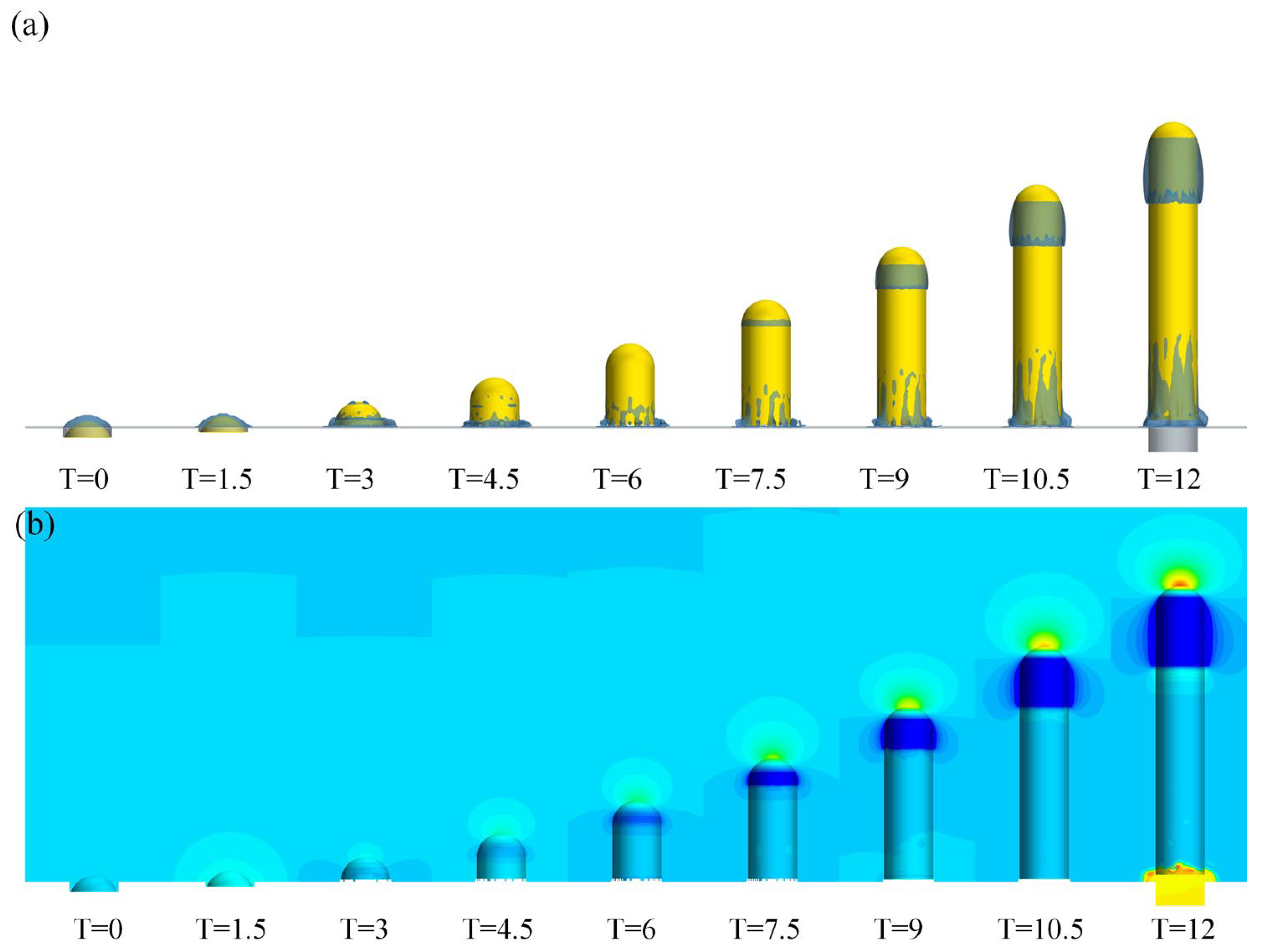
The simulation of the whole process of the underwater launch condition of the vehicle was carried out with a bottom pressure of 0.33 MPa, an exit tube velocity of 30 m/s, a launching depth of 0.75 m, and no-transverse-flow conditions, in which σ = 0.235 , F r = 47.9 . As the exit tube stage mainly involves the expansion and slipping process of the tube air mass and the growth process of natural cavitation, the evolution characteristics of the multiphase flow field and the surface pressure distribution characteristics in the exit tube stage were investigated to reveal the evolution mechanism of the tube air mass and the natural cavitation.
Figure 5a presents an image of the evolution of the cylinder air mass and cavity during the vehicle exiting process, from which it can be observed that the tube air mass is squeezed by the head of the vehicle and expands radially outward at the initial moment (T = 1.5). When the head of the vehicle traverses the water–air interface near the mouth of the tube, the tube air mass expands radially to the maximum size near the mouth of the tube (T = 3), and then shrinks inward (T = 4.5). At this point, a small number of isolated attached bubbles also remain on the surface of the vehicle, which then gradually slip away under the scouring of the nearby fluid. Due to the driving effect of the high-pressure gas in the tail, the pressure at the shoulder of the vehicle is lower than the saturated vapor pressure, resulting in cavitation (T = 7.5). As the vehicle velocity increases, the length and thickness of the shoulder cavity also significantly increase (T = 10.5), and the separation point of the cavity also advances, revealing that the separation point of the vehicle head flow moves forwards with the increase in velocity. At the same time, the phenomenon of distinct return jet flow, accompanied by a high counterpressure gradient parallel to the vehicle axis at the end of the cavity, was also observed, but since the cavitation vacuole was still in the growth stage at this time, and the thickness and velocity of the return jet flow were relatively low, it was not yet able to have a large impact on the shoulder vacuole morphology. Staying in the vicinity of the barrel mouth of the barrel air mass, the vehicle wall viscosity formed a very thin layer of cavity that was attached to the tail of the vehicle and constantly elongated (T = 12). At this point, the vehicle tail has just left the tube mouth, and since the gas inside the tube still has high pressure, there is also an obvious radial expansion phenomenon in the tube air mass.
Figure 5b presents a cloud diagram of the pressure distribution on the surface of the vehicle launch tube; it can be seen that when the head of the vehicle has not yet passed through the tube’s air mass, because, at this time, the tube air mass is compressed, the internal pressure rises, so the area near the mouth of the cylinder presents a radial outward decrease in the distribution of high pressure (T = 1.5). After the vehicle head touches the gas–liquid interface and passes through the tube air mass, the flow separation is formed at the shoulder, which results in the formation of a low-pressure region near the shoulder and a high-pressure region near the head due to the flow hysteresis, thus prompting the radial outward expansion of the tube air mass (T = 3). The vehicle carries the shoulder low-pressure region to continue the upward movement process, and pressure near the mouth of the tube gradually increases, resulting in the tube air mass beginning to contract inwards (T = 4.5). As the vehicle speed continues to rise, the shoulder flow separation phenomenon also grows stronger, and the low-pressure shoulder region of the pressure continues to falling, until it reaches the saturated vapor pressure, thus generating the cavitation phenomenon (T = 7.5). As the velocity of the vehicle increases and the depth decreases, the length of the low-pressure region at the shoulder increases and gradually expands below the shoulder; at the same time, a ring-shaped high-pressure region appears at the end of the low-pressure region (T = 10.5). This high-pressure region and the shoulder low-pressure region together form a high counterpressure gradient parallel to the vehicle axis, which prompts the liquid at the end of the shoulder cavity to shoot into the interior of the cavity to form a return jet flow phenomenon. As the velocity of the vehicle further increases, this high-pressure region also expands and the pressure increases, resulting in a higher counterpressure gradient (T = 12).
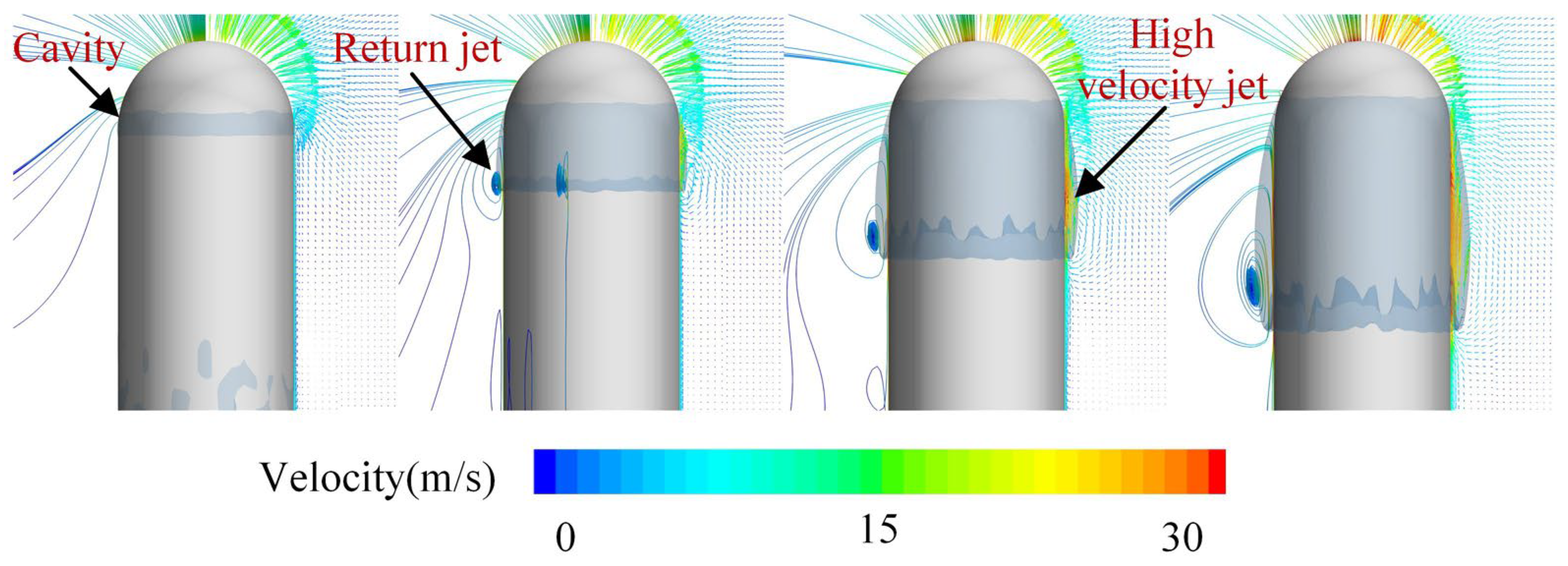
To investigate the flow characteristics of the surrounding flow field in the exit tube stage, the velocity vector distribution and time-averaged velocity streamlines of the cavitation flow field around the shoulder of the vehicle are presented in Figure 6. It can be observed that with the increasing length of the cavitation cavity, a central vortex is formed in the flow line near the end of the cavity; the main factor in the formation of this vortex is that flow separation occurs at the shoulder of the vehicle and the fluid mass points move backwards under the action of the counter-pressure gradient, thus causing the flow line to bend towards the inner part of the cavity (T = 9). The central vortex enhances the unsteady fluctuations in the local flow field, while the return jet forms a high-pressure gradient at the cavity end; the coupling of the two induces periodic pressure pulsations on the vehicle surface, which are mainly concentrated in the shoulder and tail regions and contribute to the non-steady pressure load during the tube exit phase.
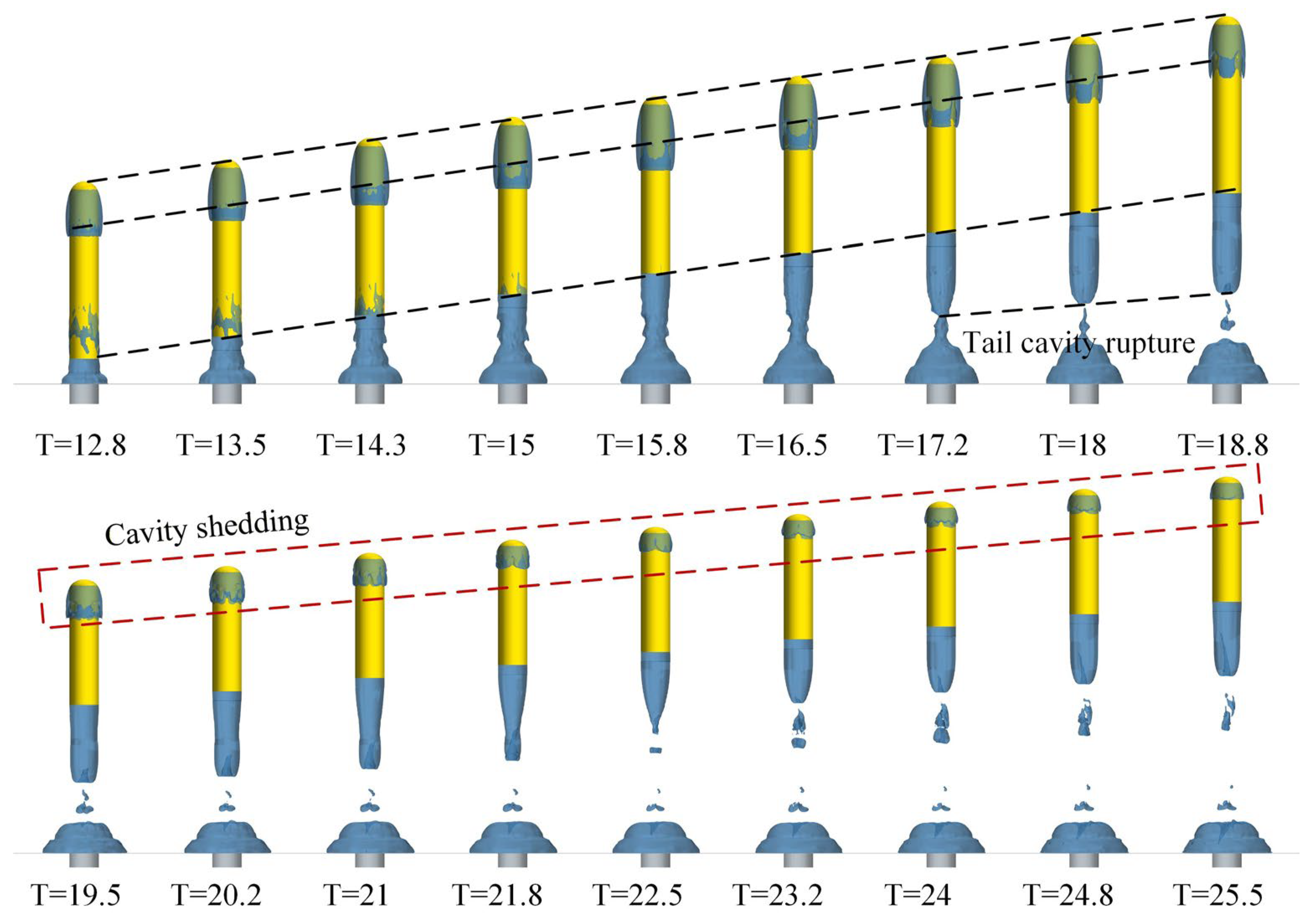
Figure 7 presents the three-dimensional cavity morphology evolution during the underwater travel stage of the vehicle. When the vehicle has just left the mouth of the tube, some of the residual cavities due to the attachment of the tube air mass are still attached to the surface of its tail, and then the cavities also gradually detach from the surface of the vehicle wall (T = 13.5). As the high-pressure gas in the tube expands outward, the tail of the vehicle also carries a long tail cavity, which radially expands on the side near the outlet of the tube, with the rate of expansion decreasing as time advances. It is observed that the tail cavity mainly follows the axial elongation of the vehicle, and because the gas inside the cavity is in a constant oscillatory process of expansion and contraction, the morphological profile of the tail cavity near the tube outlet is characterized by fluctuations (T = 14.3). As the tail cavity keeps elongating, its volume keeps increasing, resulting in a decrease in pressure inside the cavity, and when the pressure inside the cavity is lower than the pressure in the external flow field, the tail cavity starts to undergo necking (T = 15.8). When the diameter of the cavity at the neck contraction of the tail cavity is 0, the tail cavity is pulled off and divided into two parts—the tail cavity of the follower and the tube outlet cavity—and the phenomenon of a near-flow stationary point is formed at the fracture point of the tail cavity, which leads to the formation of a high-pressure region, thus causing the end of the tail cavity to produce a jet directed toward the rear of the vehicle (T = 18.8). Subsequently, the vehicle tail cavity is continuously elongated, the pressure inside the cavity continuously decreases, and the tail cavity begins to produce the necking phenomenon again (T = 21.0). When the inward contraction of the cavity boundary meets the jet, the tail part of the caudal cavity is sheared off under the action of both the necking and the jet, thus generating higher pressure at the shearing point than at the point of the first break due only to the necking (T = 22.5). Driven by this high pressure, a stronger jet phenomenon is generated at the end of the tail cavity, and the length of the formed jet is much higher than that of the first tail jet (T = 25.5).
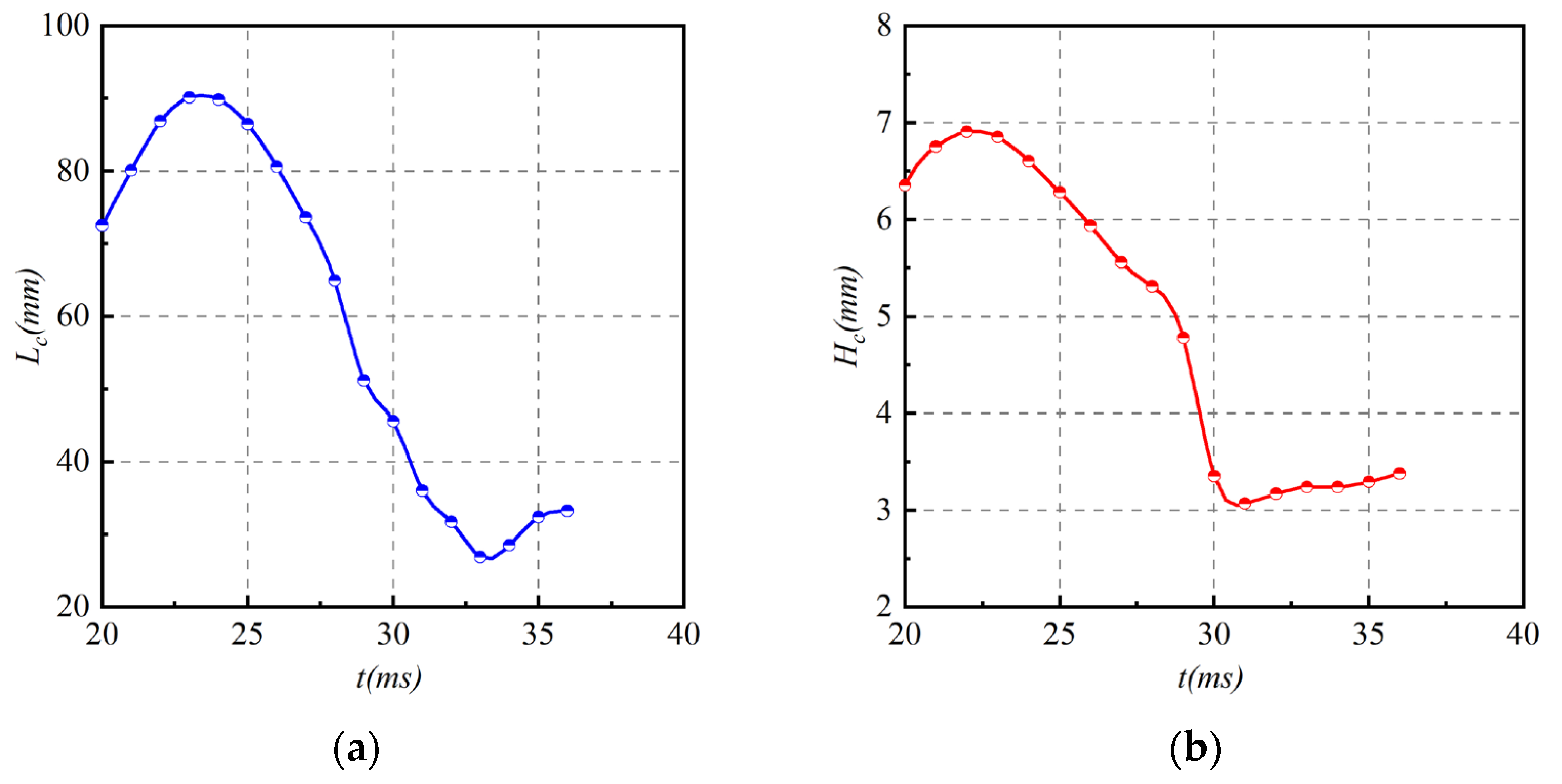
To visualize the developmental characteristics of the vehicle shoulder cavity scale, the variation curves of the length and thickness of the vehicle shoulder cavity over time are presented in Figure 8a,b. It is found that, in the early stage after the vehicle is discharged from the tube, although the velocity of the vehicle has begun to gradually decay, the length and thickness of the cavity are still increasing, because under the effect of fluid inertia around the vehicle, the low-pressure region near the shoulder is still growing, which leads to the expansion of the shoulder cavity as well. Then, the fluid mass velocity near the head of the vehicle decreases, which makes it difficult to maintain the current scale of the low-pressure region at the shoulder of the vehicle, and the return jet flow keeps advancing forward, which causes the scale of the low-pressure region to decrease so that the length and thickness of the cavity begin to decrease again after reaching the maximum level, in which the thickness of the cavity reaches the highest value slightly earlier than the time at which the length of the cavity reaches the maximum level. The shoulder cavity in the return jet flow, under the action of its tail, experiences the collapse phenomenon, so the length and thickness of the cavity constantly decrease, the return jet flow in the gravity and wall shear, under the action of its momentum, gradually decrease, and the cavity at the closure of the counterpressure gradient also declines, causing the length and thickness of the bubble to reduce to the lowest cavity value before gradually increasing. However, at this point the increase is due to the lower velocity of the vehicle and the proximity of the water surface; therefore, the growth rate of the shoulder cavity is significantly lower than that in the vehicle in the initial stage after the tube.
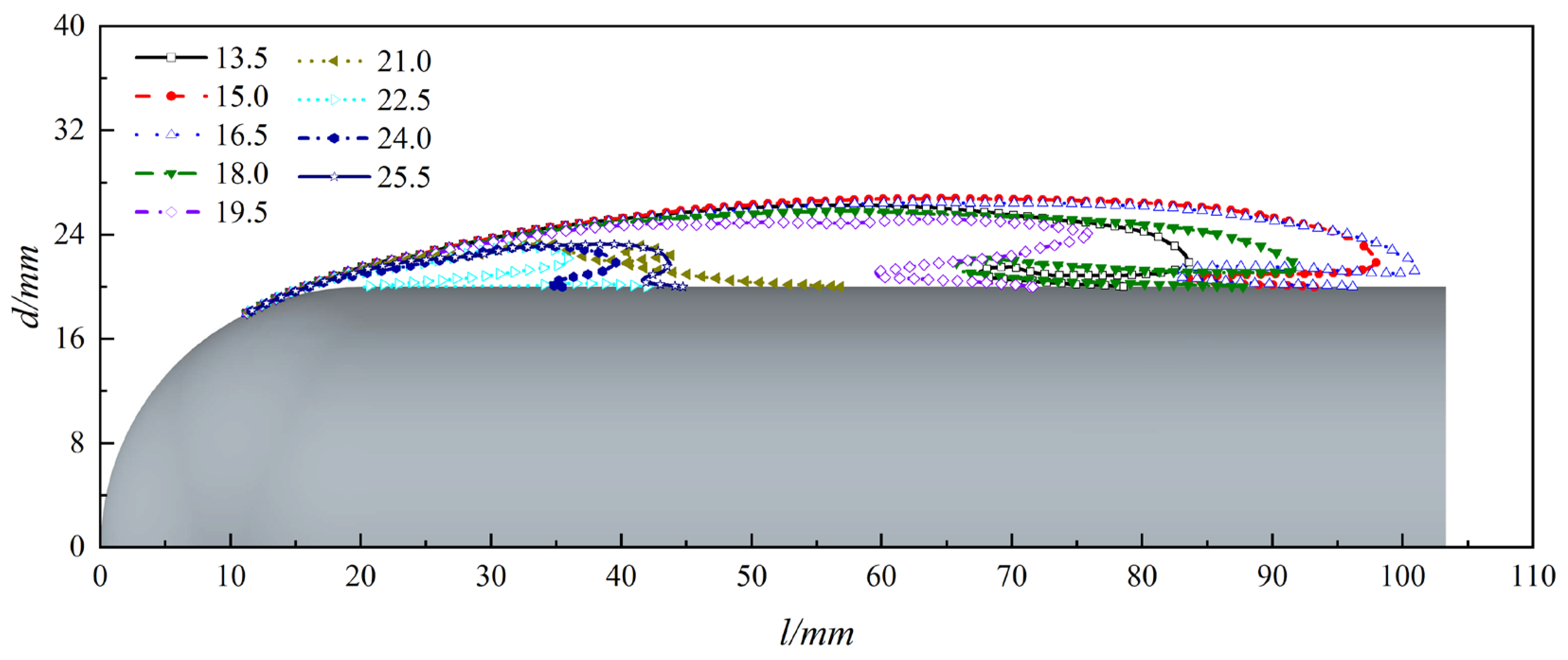
To study the change law of shoulder cavity morphology over time in a more detailed manner, Figure 9 provides a comparative image of the contour of the vehicle shoulder cavity at different moments, where the horizontal axis is the direction of the vehicle axis and the vertical axis is the radial vehicle direction. The return jet flow inside the cavity does not move completely upward against the vehicle wall through propulsion, but the front end of the return jet flow is lifted outward on the vehicle wall, thus making it easier for the return jet flow to interact with the cavity interface and shear off the end of the cavity. Time T = 13.5~18 shows the stage of cavity growth, where the front end of the return jet flow moves backward, and the cavity morphology maintains good stability; during time T = 18~22.5, the phenomenon of a longer return jet flow is found at the tail of the cavity (T = 18.0), and then the return jet flow moves rapidly toward the shoulder of the vehicle, causing the length of the cavity to also shorten rapidly, and the cavity morphology becomes more unstable (T = 21.0); at time T = 22.5~25.5, during the stage of cavity regrowth, the return jet flow length is rapidly shortened, and the end of the vacuole also moves toward the vehicle tail, which causes the length of the cavity to begin to grow slowly (T = 25.5).
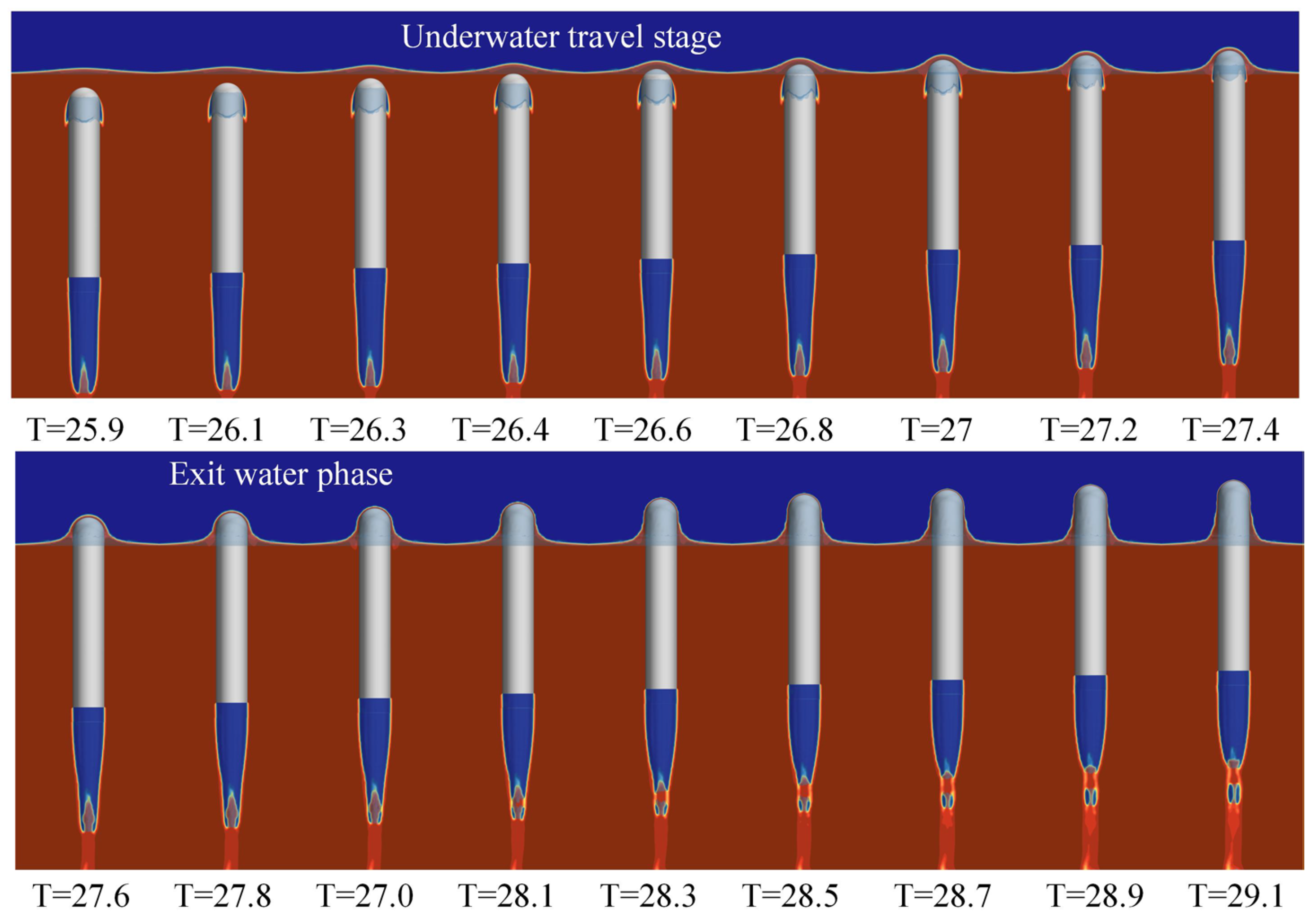
Figure 10 presents an image of the cavity in the exit water phase, where the free liquid surface of the vehicle head bulges upward as it approaches the water surface due to squeezing, and the degree of the bulge increases. As the thickness of the water layer at the head of the vehicle continues to become smaller, the size of the cavity decreases until it completely collapses (T = 27.6). The collapse time of the cavity is very short; the cavity has completely collapsed within T = 27.2~27.6. In addition, the tail cavity of the vehicle also shows obvious necking phenomenon, and when the boundary of the tail cavity is in contact with the return jet flow, the return jet flow is about to shear off the tail cavity (T = 28.1). The sheared and dislodged cavity appears in the form of a double cavity in the current cross-section, and its three-dimensional morphology is a ring-like dislodged cavity. High pressure is also generated at the tail cavity closure shear at the standing point and drives the movement of the next return jet flow. Subsequently, the free liquid surface curvature increases and the thickness of the water layer in the head decreases until the water layer ruptures at the head of the vehicle and is subsequently shed downward along the vehicle wall.
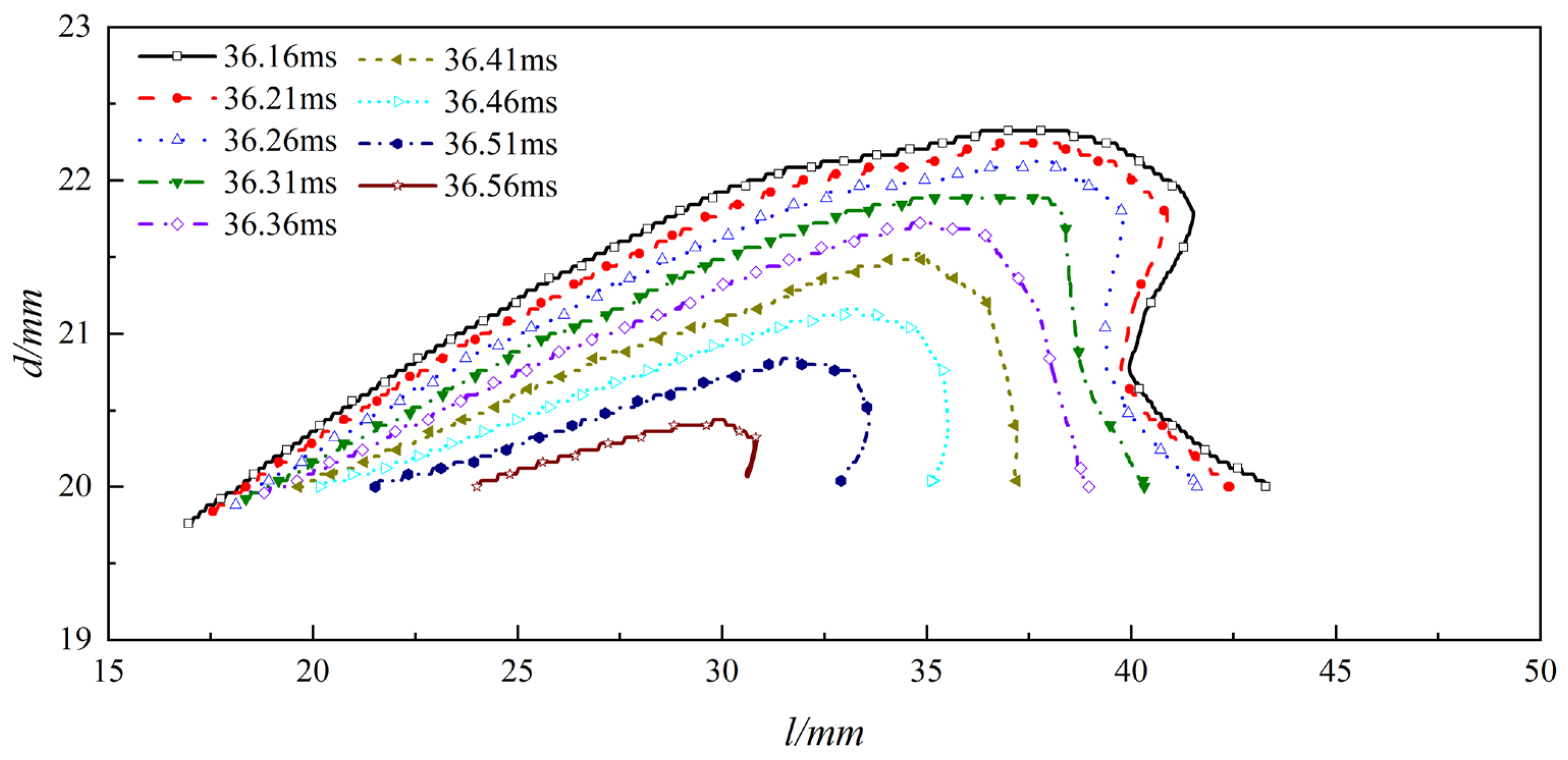
To visually show the variation in the collapse shrinkage process of the shoulder cavity, Figure 11 presents comparative images of the outer contour of the shoulder cavity at different points of the exit water collapse stage, where the horizontal axis is the axial direction and the vertical axis is the radial direction. The volume of the cavity contracted rapidly during the collapse process, and the rate of contraction gradually accelerated over time. The attachment points on both sides of the cavity also moved inward over time, which shows that the collapse process of the shoulder cavity was synchronized at both ends. From the change in the distance moved by both sides of the cavity attachment points at the same point, it can be found that both cavity attachment points accelerate to move inward, but the speed of the end of the cavity is significantly higher than that of the front end of the cavity, so the collapse speed of the tail of the cavity is higher than that of the front end.
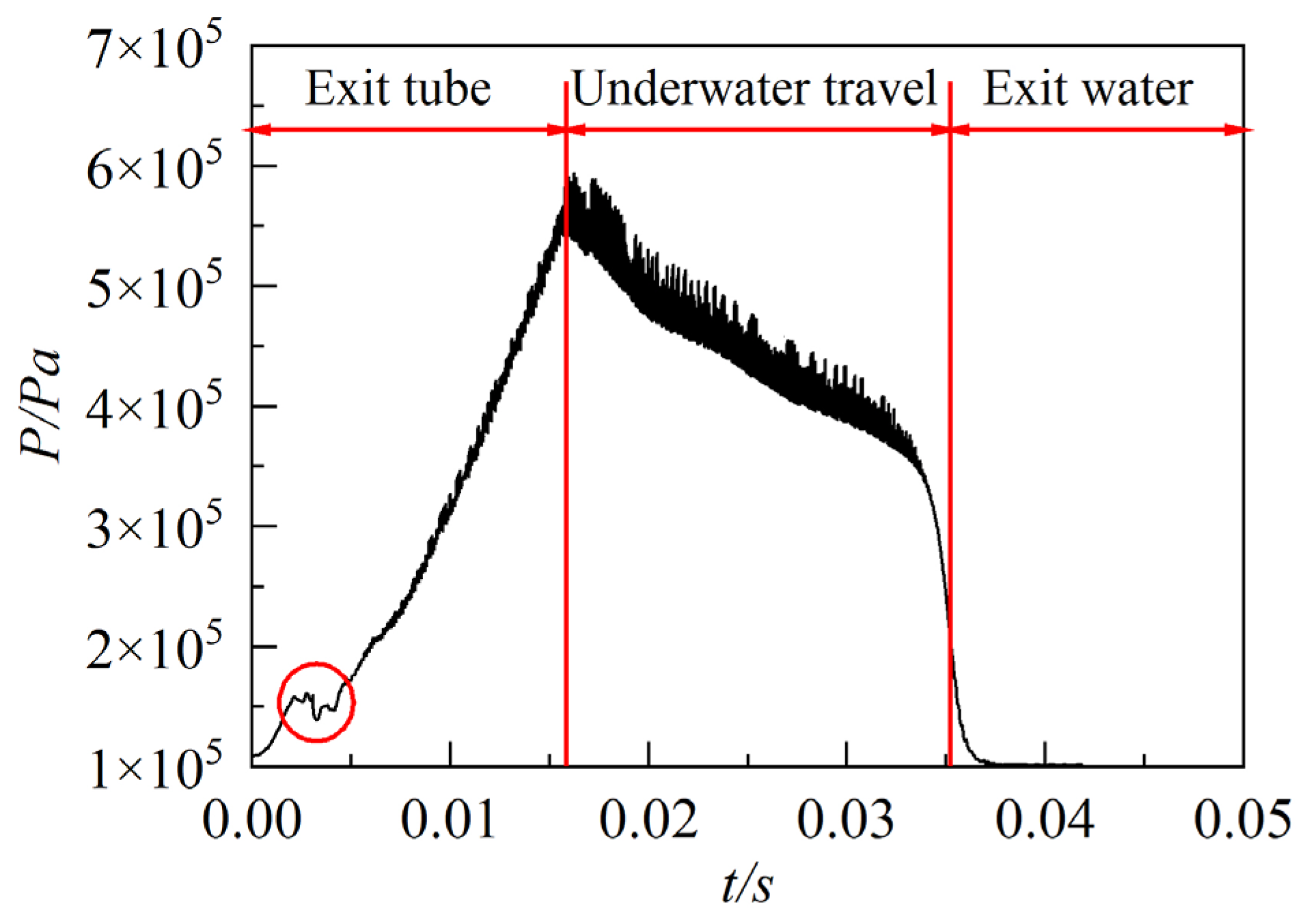
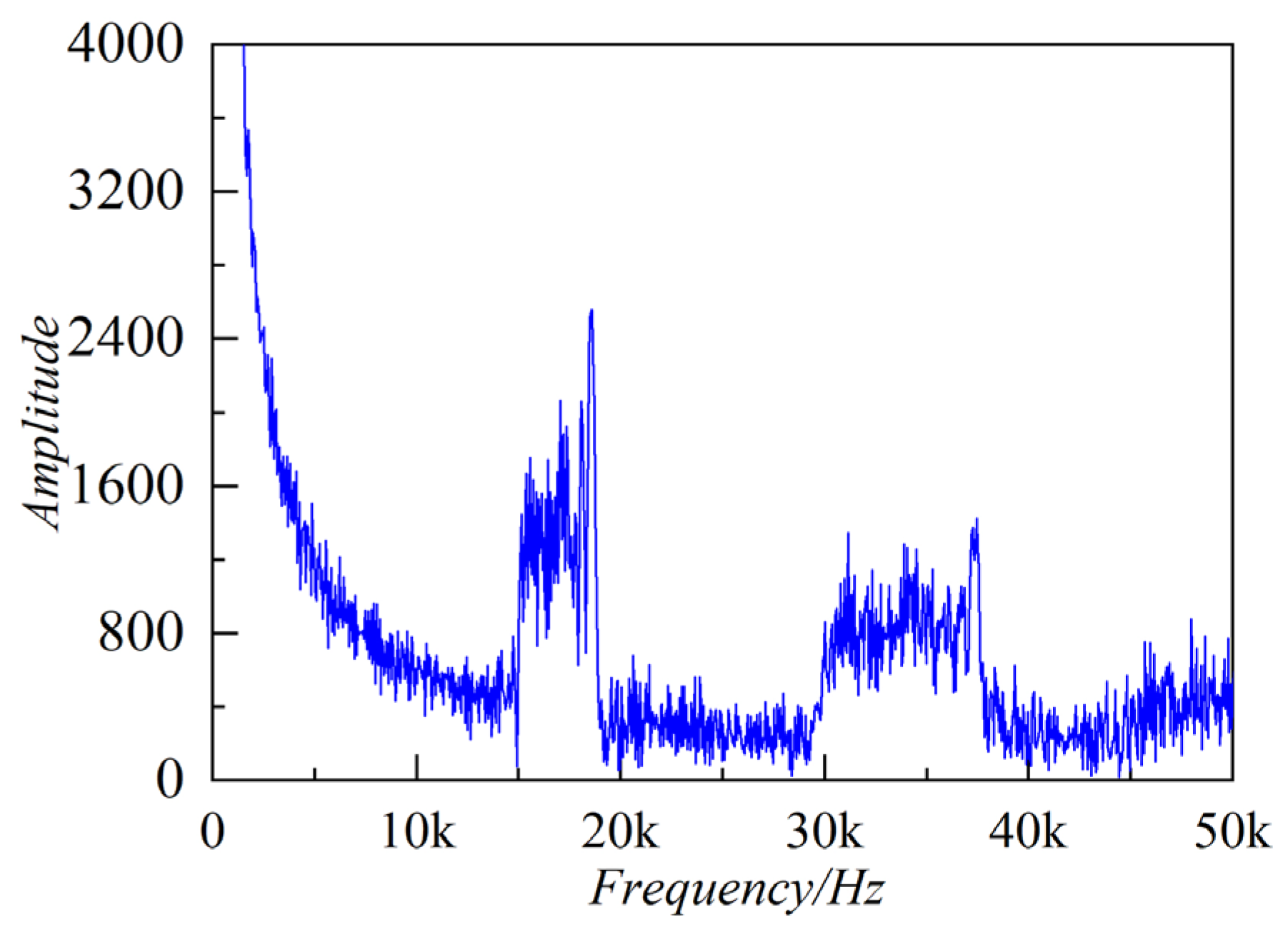
Figure 12 shows the pressure curve at the apex of the vehicle head as a function of time. In the exit tube stage, as the velocity of the vehicle is increasing, the apex pressure is also increasing. When the head of the vehicle travels through the air mass of the tube, the air mass of the surrounding flow field expands and slips, and there is a small fluctuation in the vertex pressure. When the head of the vehicle is in the wetted state, the pressure shows obvious oscillation phenomenon, and the amplitude of the oscillation gradually increases over time. In the underwater travel phase, the pressure also shows a decreasing trend because of the decreasing velocity of the vehicle. When the head of the vehicle is close to the free liquid surface, the amplitude of the pressure oscillation significantly decreases, and the pressure begins to rapidly fall to the atmospheric pressure value so that the head of the vehicle is rapidly unloaded, as shown in Figure 13. Since the time step used in the calculation process is 5 × 10⁻⁶ s, the frequency range calculated according to the sampling theorem is 0~100 kHz, and the amplitude is lower in the high-frequency range 50~100 kHz; accordingly, the amplitude curves are presented in the range 0~50 kHz. The characteristic frequencies of the vertex pressure pulsations are mainly concentrated in the ranges of 15 kHz to 20 kHz and 30 kHz to 38 kHz, with a peak around 18.6 kHz.

4.2. Evolution of the Structure of the Multiphase Flow and Load Characteristics

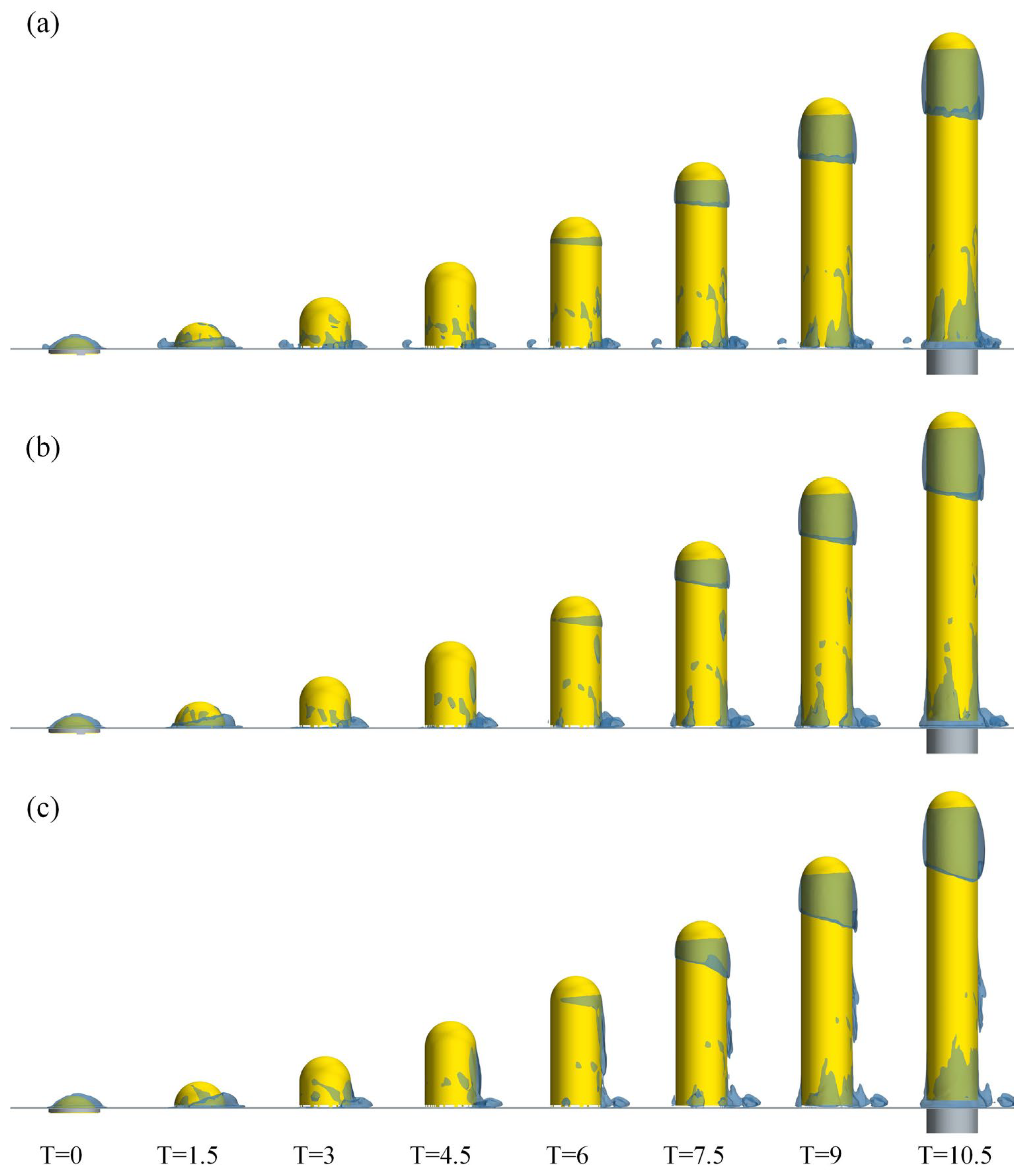
Changes in the transverse flow velocity can be simulated under different platform speed sizes during the vehicle underwater launching process. Figure 14a–c show the underwater launch condition with a bottom pressure of 0.33 MPa, vertical exit velocity of 30 m/s, and launch depth of 0.75 m; the underwater launch simulation was carried out under transverse flow strengths of 0.016, 0.033, and 0.05, of which σ = 0.235 , F r = 47.9 . Figure 14 shows the evolution of the cavity morphology of the vehicle at the exit tube stage under different lateral flow conditions, and the volume of the air mass on the backside is significantly larger than that on the face side (T = 3.0). Due to the influence of the low-pressure region on the back side, the air mass is also more likely to attach to the surface of the vehicle, and the volume of the attached air mass grows larger with the increase in transverse flow intensity (T = 6.0). Due to the increasing velocity of the vehicle, the pressure near the shoulder is lower than the saturated vapor pressure of water, resulting in the cavitation phenomenon observed in the shoulder (T = 7.5). Under the influence of transverse flow, the cavity distribution also shows asymmetric characteristics, the axial length of the cavity on the back side is significantly higher than that on the face side, and the degree of asymmetry increases with the increase in transverse flow intensity.
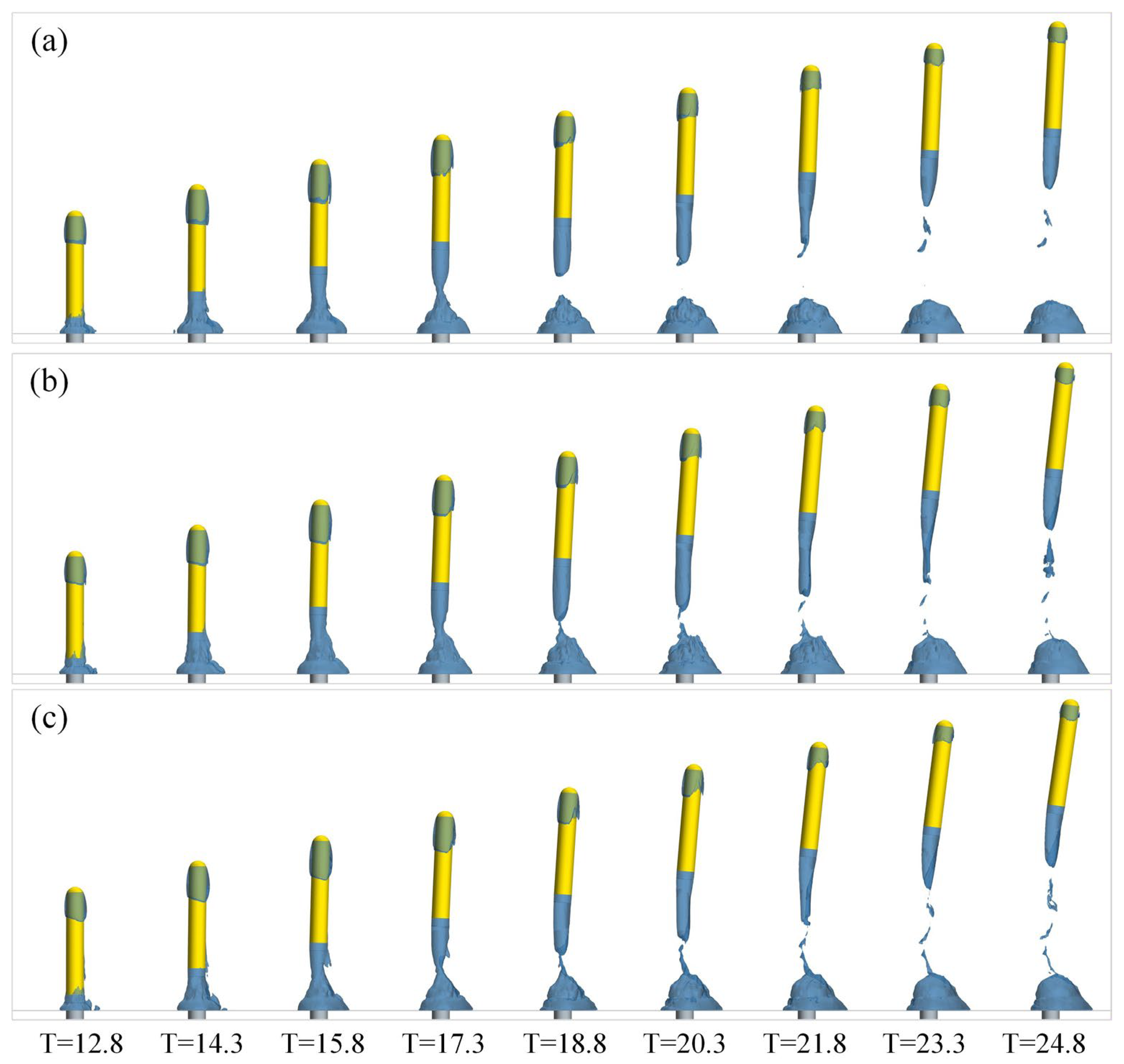
Figure 15 presents the morphological evolution of the lateral cavities in the underwater travel phase under different lateral flow conditions, and the cavities in the shoulder of the vehicle all show the developmental characteristics of first lengthening and then shortening. In the shortening process, the cavity on the backflow side is continuously shed and collapsed under the action of return jet flow. In the underwater travel stage, the attitude of the vehicle is deflected to the downstream direction of the transverse flow because of the transverse flow. With the increase in deflection amplitude, the return jet on the back side gradually moves to the face side, and it can be observed from Figure 15 that the position of the return jet on the back side has already moved to the face side at T = 18.8 and the length of the lateral cavity is successively shortened. At this point, the return jet moves toward the face side until the cavity on the face side is also sheared by the return jet flow, and the cavity length also decreases rapidly (T = 24.8). The development characteristics of the cavities under different lateral flow conditions are almost the same, but the higher the transverse flow conditions, the less stable the cavities on the back side, and they are more likely to be dislodged and collapsed.
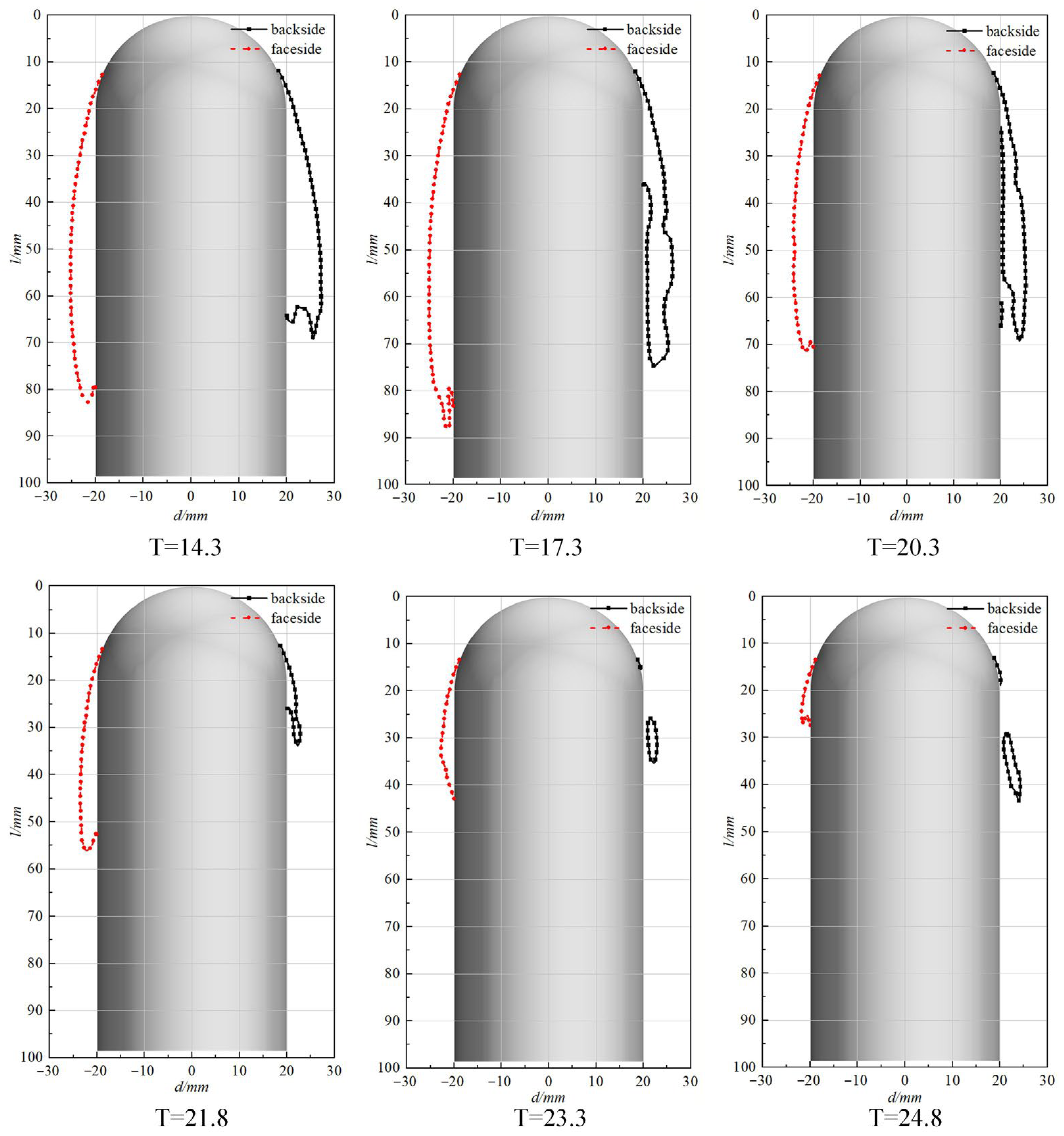
Figure 16 presents the contours of the shoulder cavities on the face side and back side for a transverse flow intensity U = 0.05, with an increase in the length of the cavity on the face side at the early stage. Subsequently, the length of the cavity on the face side gradually decreases. Overall, the return jet lengths at the end of the face-side cavities are all too short to shear the cavities. Therefore, the change in the length of the cavity on the face side is not controlled by the return jet but is caused by the decay in the vehicle velocity. At T = 17.3, the return jet on the back side is close to the anterior end of the cavity, and the end of the posterior cavity is decreasing due to the shearing by the return jet, resulting in a decrease in the length of the cavity on the back side as well. At T = 24.8, the shoulder cavity on the back side is almost completely sheared off, and then it can be observed that the sheared off cavity is gradually rolled and carried to the bottom, and the new shoulder cavity is also in the process of growing (T = 25.5). It can be seen that the strength of the return jet at the end of the cavity on the back side is higher, which causes the cavity to be sheared off and dislodged on a large scale; thus, the cavity on the back side is less stable.
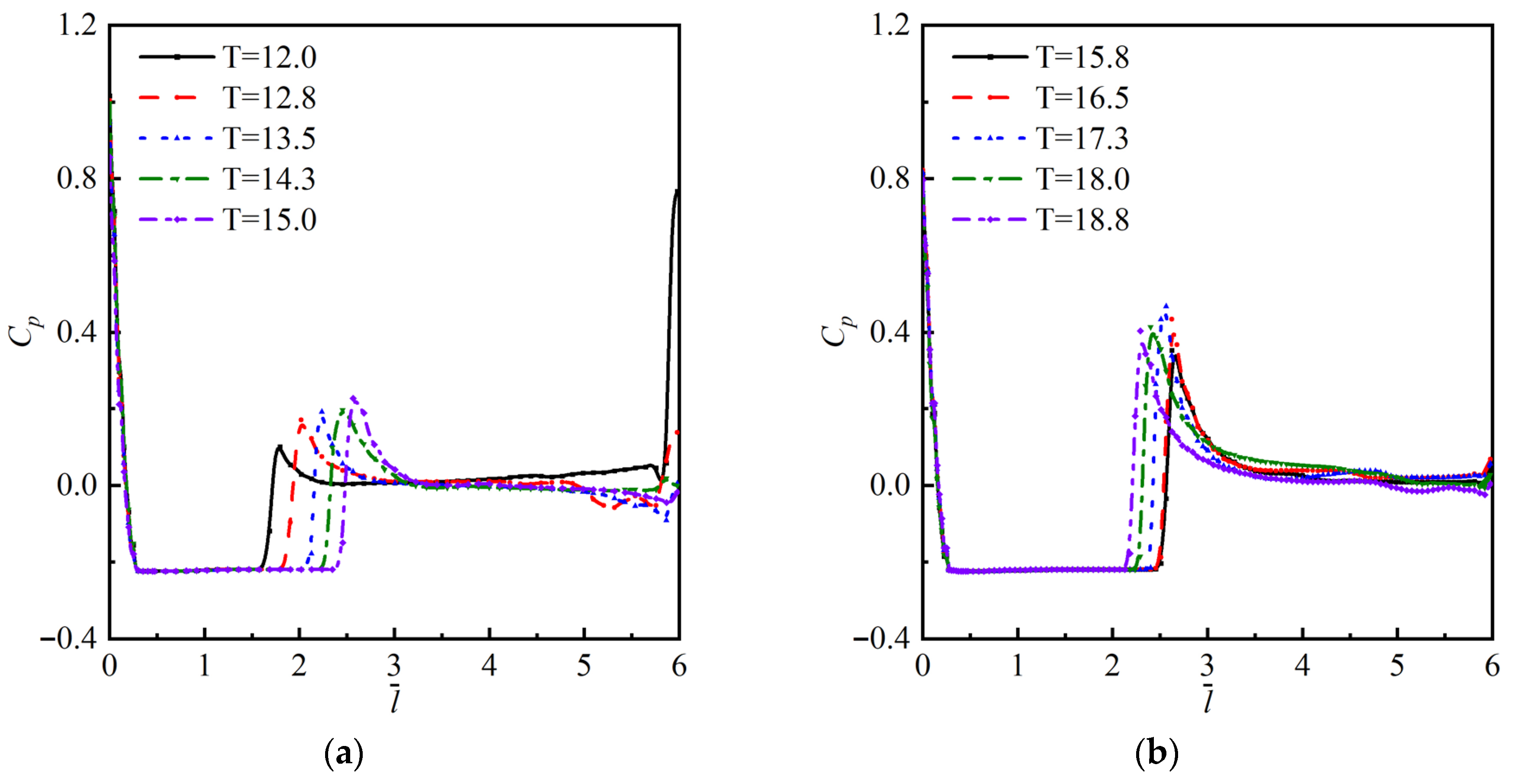
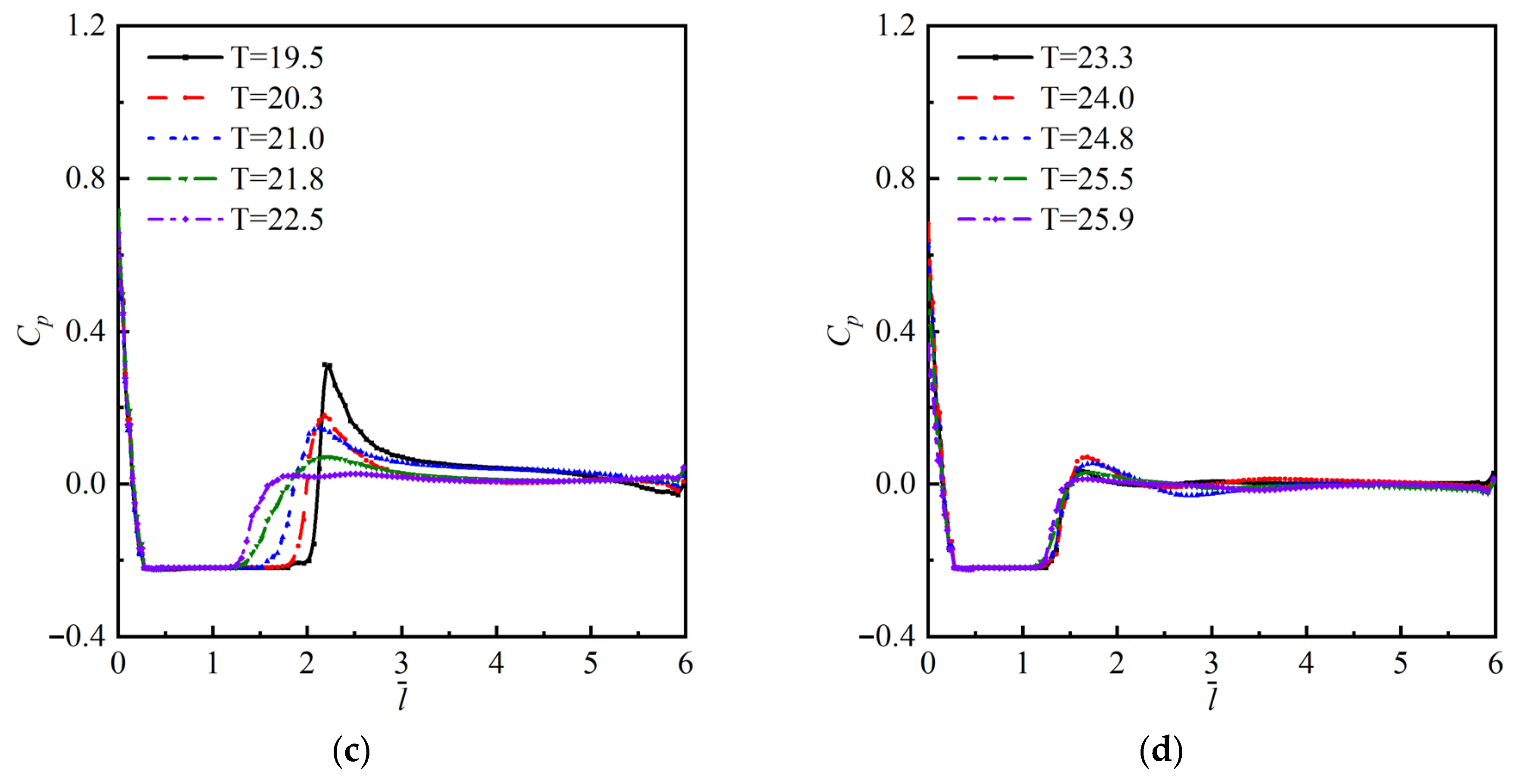
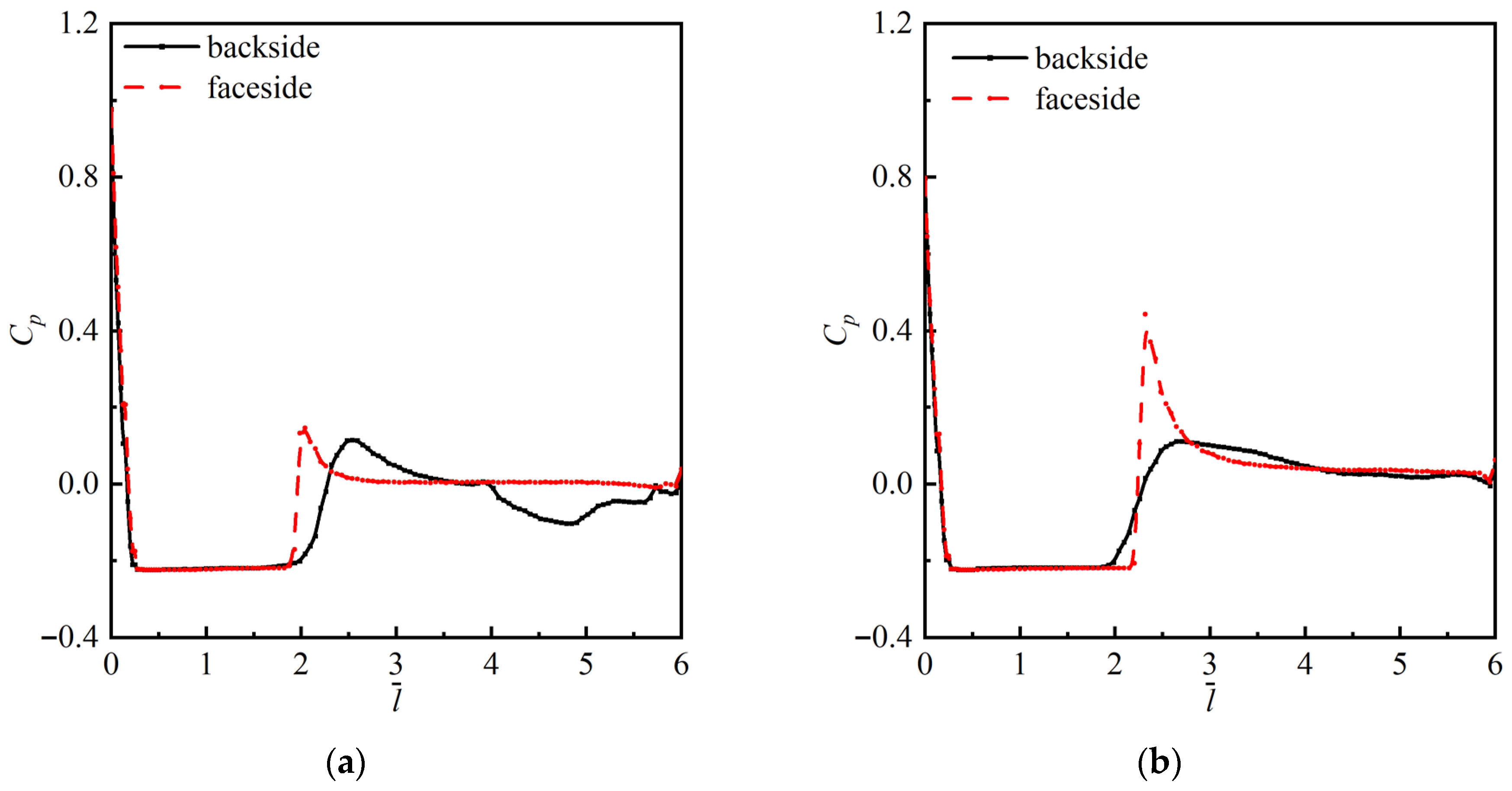
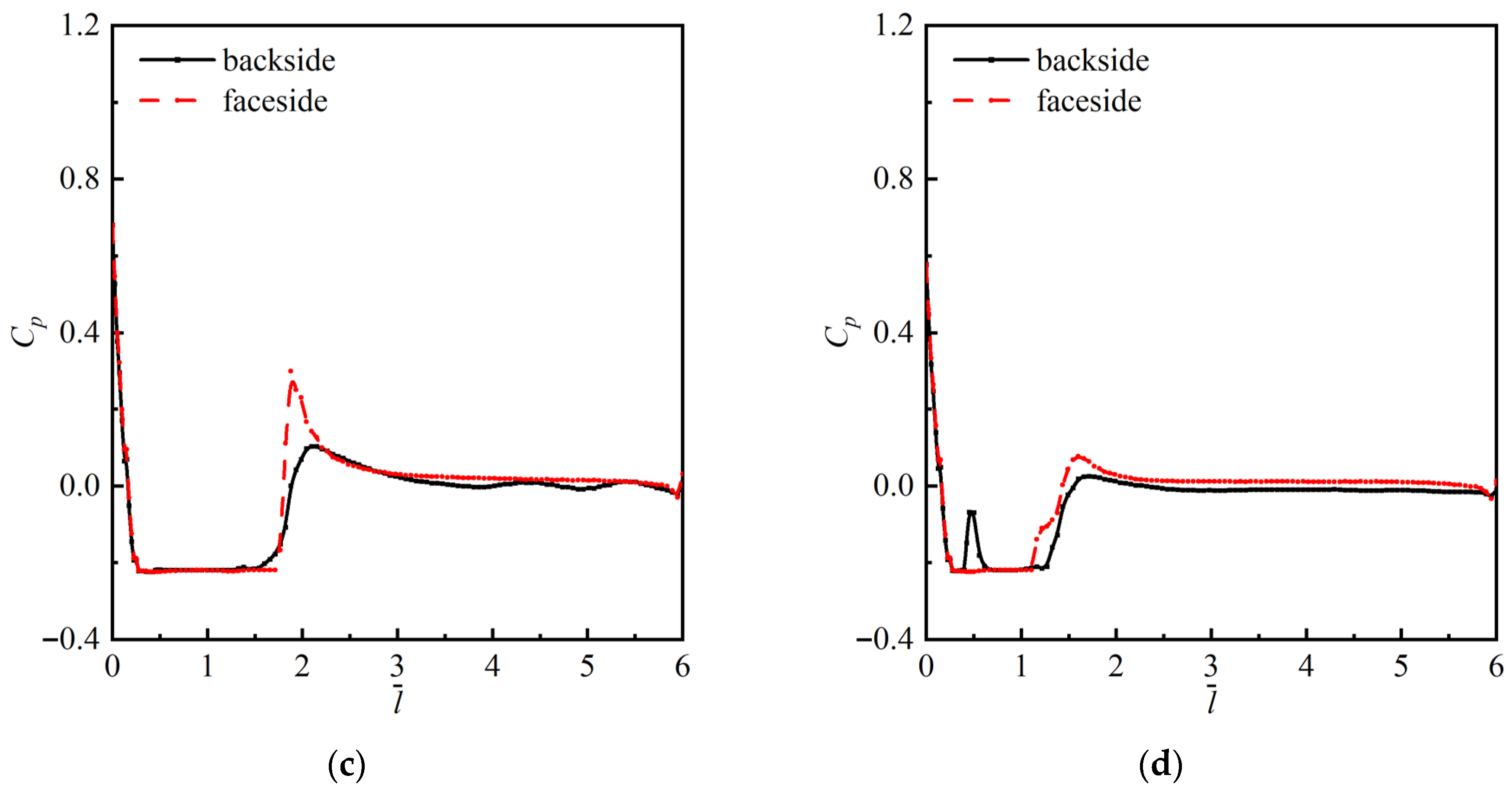
Figure 17 shows the pressure distribution curve on the face of the vehicle during the underwater travel stage at the transverse flow U = 0.05. Observing the pressure curve at the face side, it can be seen that at T = 12.0~15.0, the length of the low-pressure region at the shoulder is increasing, the cavity is also growing, and the peak in the return jet pressure increases, as shown in Figure 17a. At T = 15.8~18.8, the peak of the return jet pressure tends to be stabilized, but the length of the low-pressure region is decreasing, as shown in Figure 17b. At T = 19.5~22.5, the length of the low-pressure region is shortened further, and the peak in return jet pressure also begins to decrease, as shown in Figure 17c. At T = 23.3~25.9, the return jet pressure obviously decreases, and the back pressure gradient at the end of the cavity is also decreasing, as shown in Figure 17d. At T = 23.3~25.9, the back pressure decreases significantly, and the back pressure gradient at the end of the cavity is also decreasing.
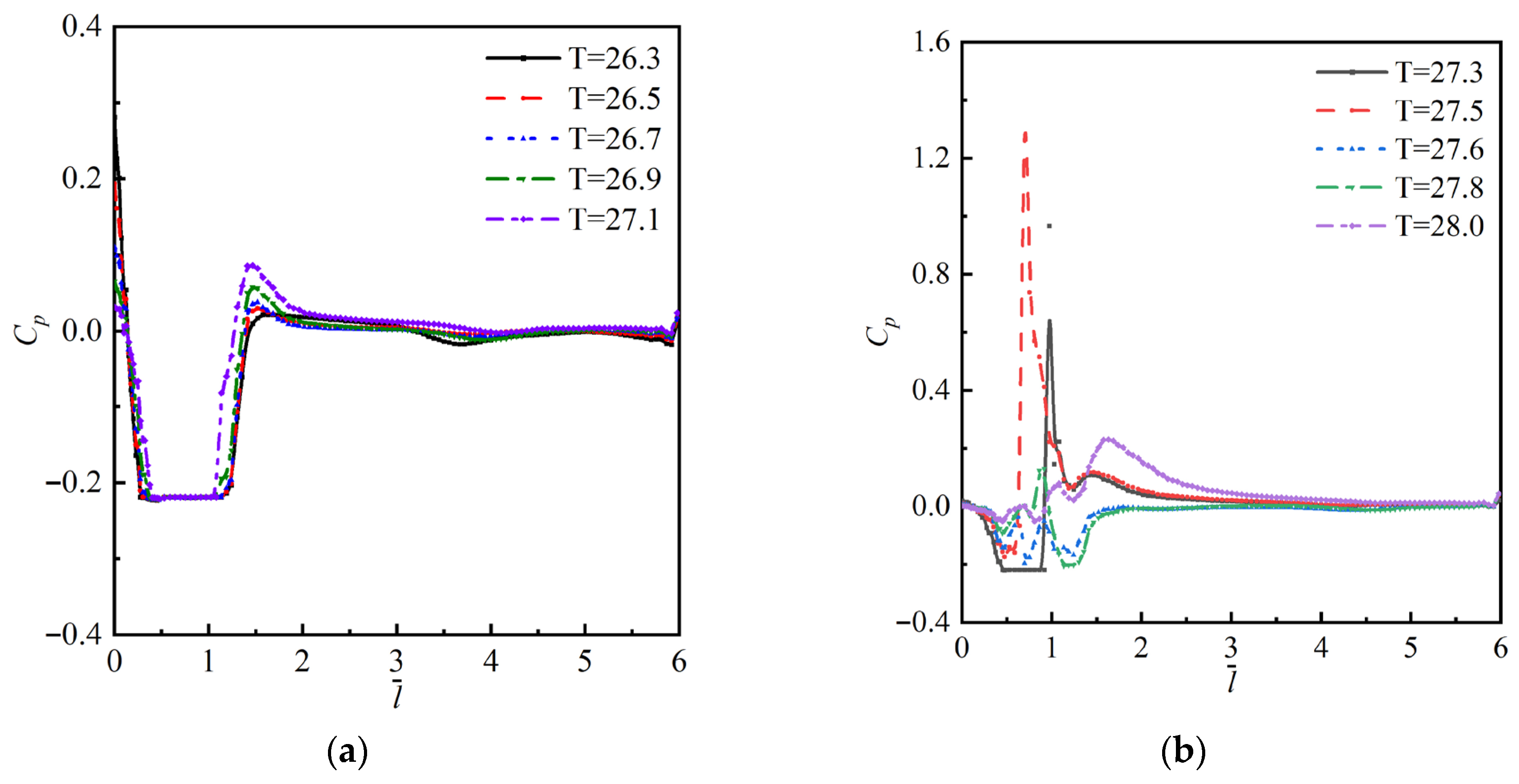
Figure 18a,b present the pressure distribution curve on the face during the exit water stage, where the length of the low-pressure zone decreases rapidly, the shoulder cavity collapses, and a high peak in collapse pressure occurs. To compare the difference in surface pressure distribution between the face side and back side, Figure 19a–d show a comparison of the pressure coefficient curves of the face sides and back sides at four typical moments, where the return jet pressure at the face side is more centralized and the pressure peaks are also higher, whereas the return jet pressure gradient at the back side is small and, in the case of cavity breakage and shedding, a localized pressure spike will occur inside the low-pressure region. The phenomenon of localized pressure spikes will occur.

4.3. Evolution of Motion Characteristics

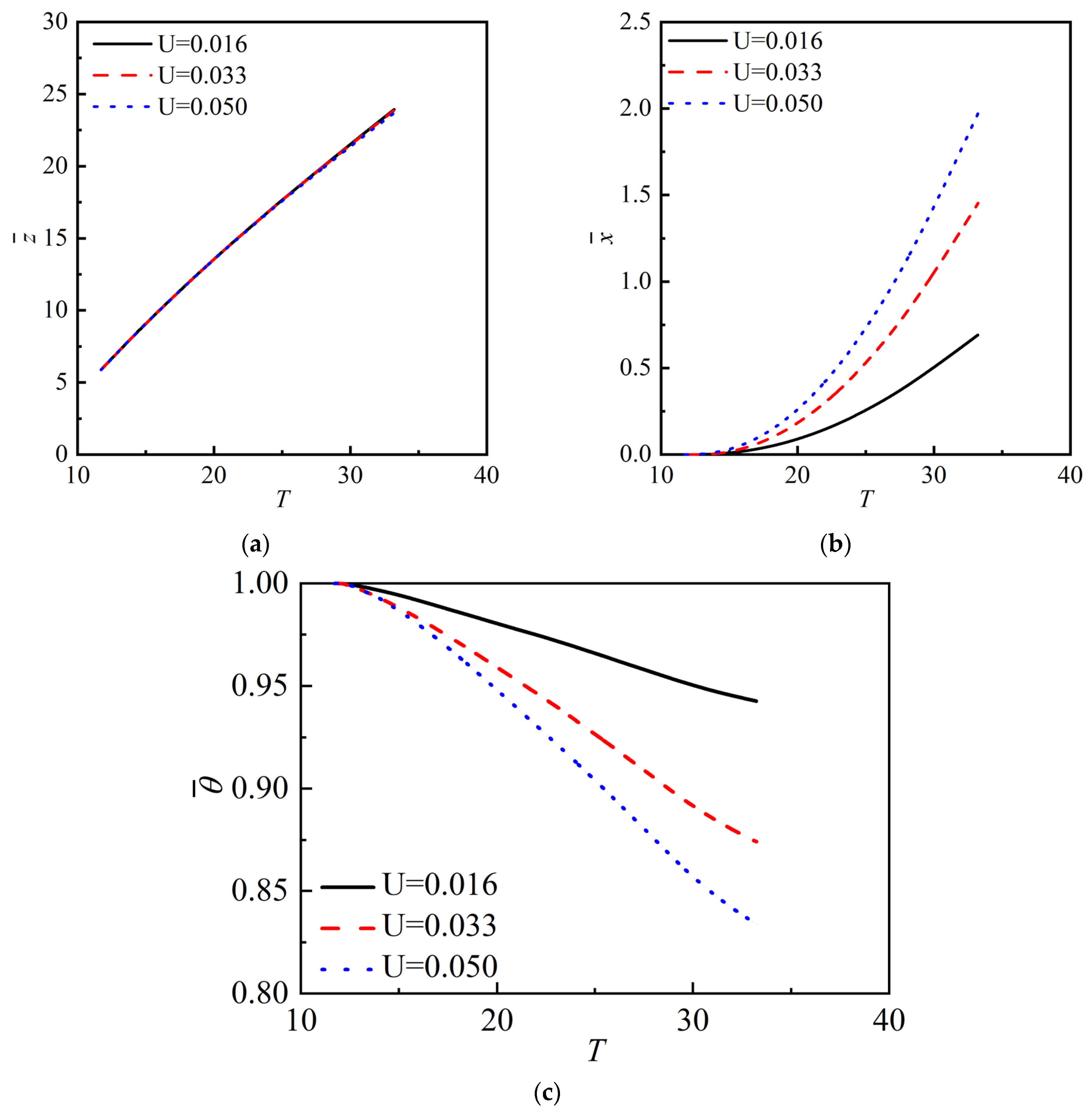
Figure 20 shows the variation curves of the dimensionless vertical displacement, dimensionless horizontal displacement, and dimensionless attitude angle of the vehicle under different lateral flow conditions. The difference in vertical displacement is relatively small, and the magnitude of the increase in vertical displacement slightly decreases with the increase in transverse flow strength, as shown in Figure 20a. As the strength of the transverse flow is stronger, the pressure difference force on both sides of the vehicle is larger. Horizontal displacement increases with the increase in transverse flow intensity, and the magnitude of attitude angle decrease also increases with the increase in transverse flow intensity, as shown in Figure 20b,c.
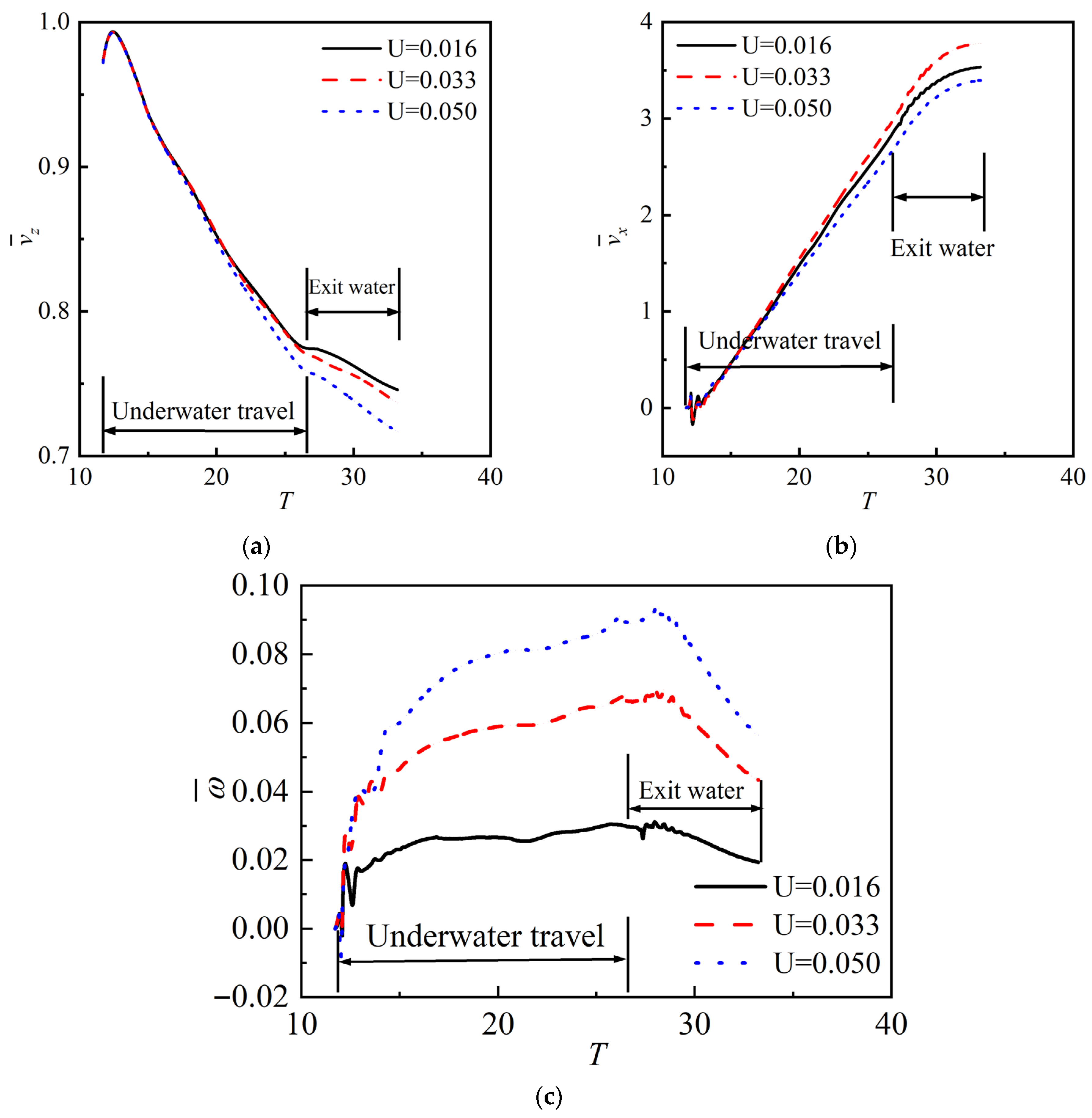
Figure 21 presents the variation curves of the dimensionless vertical velocity, dimensionless horizontal velocity, and dimensionless angular velocity of the vehicle under different lateral flow conditions. Due to the fact that the residual high-pressure gas inside the tube is still acting on the tail of the vehicle at the early stage of the travel stage in the water, the velocity of the vehicle increases slightly at the early stage, and then decreases under the action of resistance, and the head of the vehicle crosses the air–water interface due to the rapid decrease in the head load, which results in a rapid decrease in the resistance of the vehicle. When the head of the vehicle crosses the air–water interface, the head load decreases rapidly, resulting in a rapid decrease in the drag force on the vehicle, so its velocity decay also becomes slower, as shown in Figure 21a.
As shown in Figure 21b, the velocity in the horizontal direction continually increases in the underwater travel phase, and the increased velocity slowly decreases in the exit water stage. It can be observed that, in the exit-water stage, the velocity in the horizontal direction can reach as high as 3~4 times the transverse flow velocity; the main reason for this is that the angle of attack of the vehicle relative to the flow field causes the vehicle to be subjected to the continuous lateral force.
With the increase in the intensity of the transverse flow, the vertical direction of the vehicle velocity decay amplitude also increases: the kinetic energy of the vehicle, on the one hand, is transferred to the surrounding fluid medium; on the other hand, part of the kinetic energy in the vertical direction is transferred to the horizontal direction of the kinetic energy and rotational kinetic energy. As shown in Figure 21c, the rotational angular velocity of the vehicle rises continuously in the water travel stage and falls continuously in the exit-water stage, which shows that the asymmetric distribution of the pressure at the head and shoulder of the vehicle is the main reason for the deflection of the vehicle. As the intensity of the transverse flow increases, the rotational angular velocity of the vehicle also increases, resulting in a higher deflection angle. The asymmetric cavitation intensifies the uneven pressure distribution on the vehicle surface, reducing hydrodynamic stability and increasing the difficulty of trajectory control under strong transverse flow conditions.
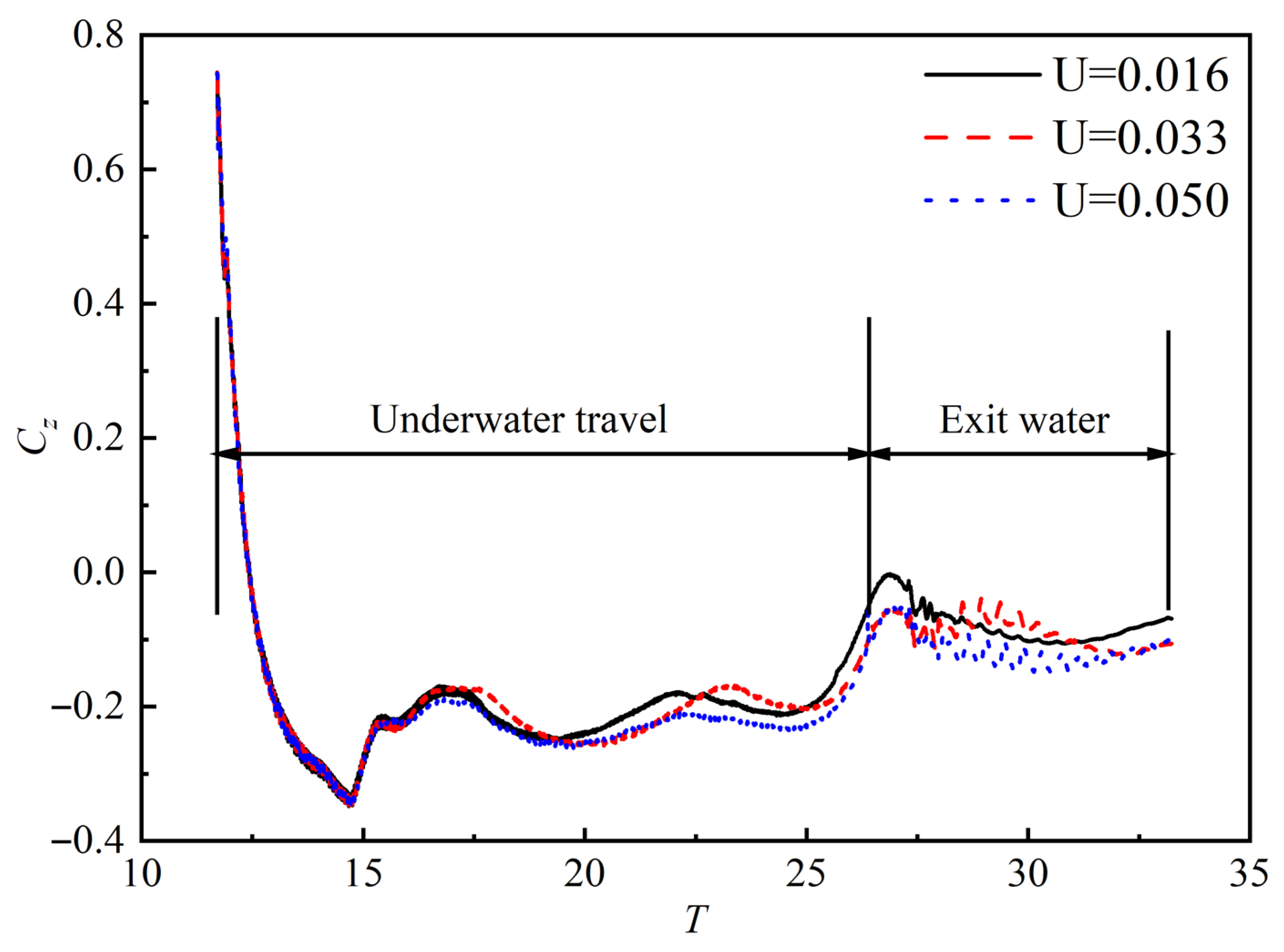
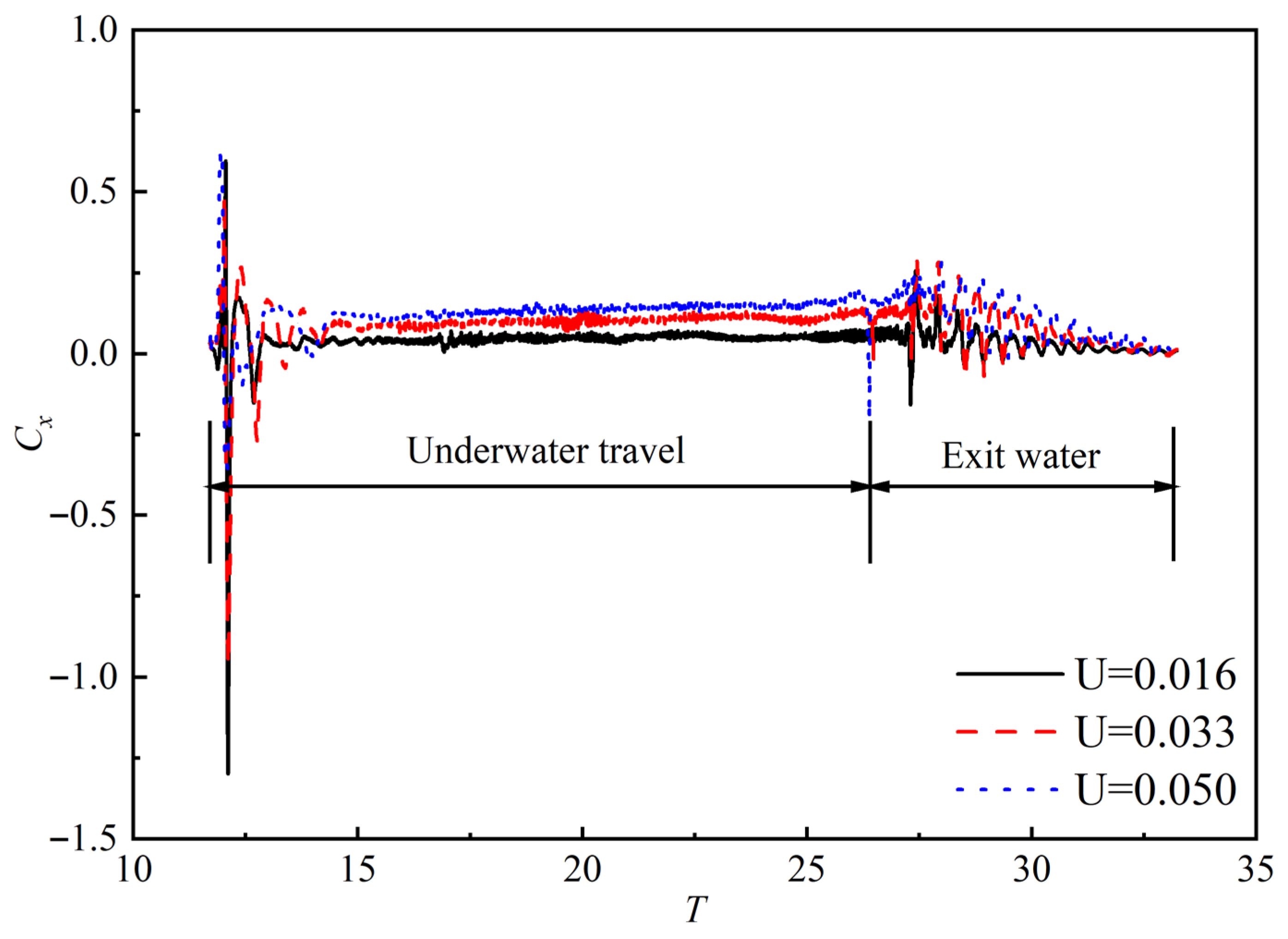
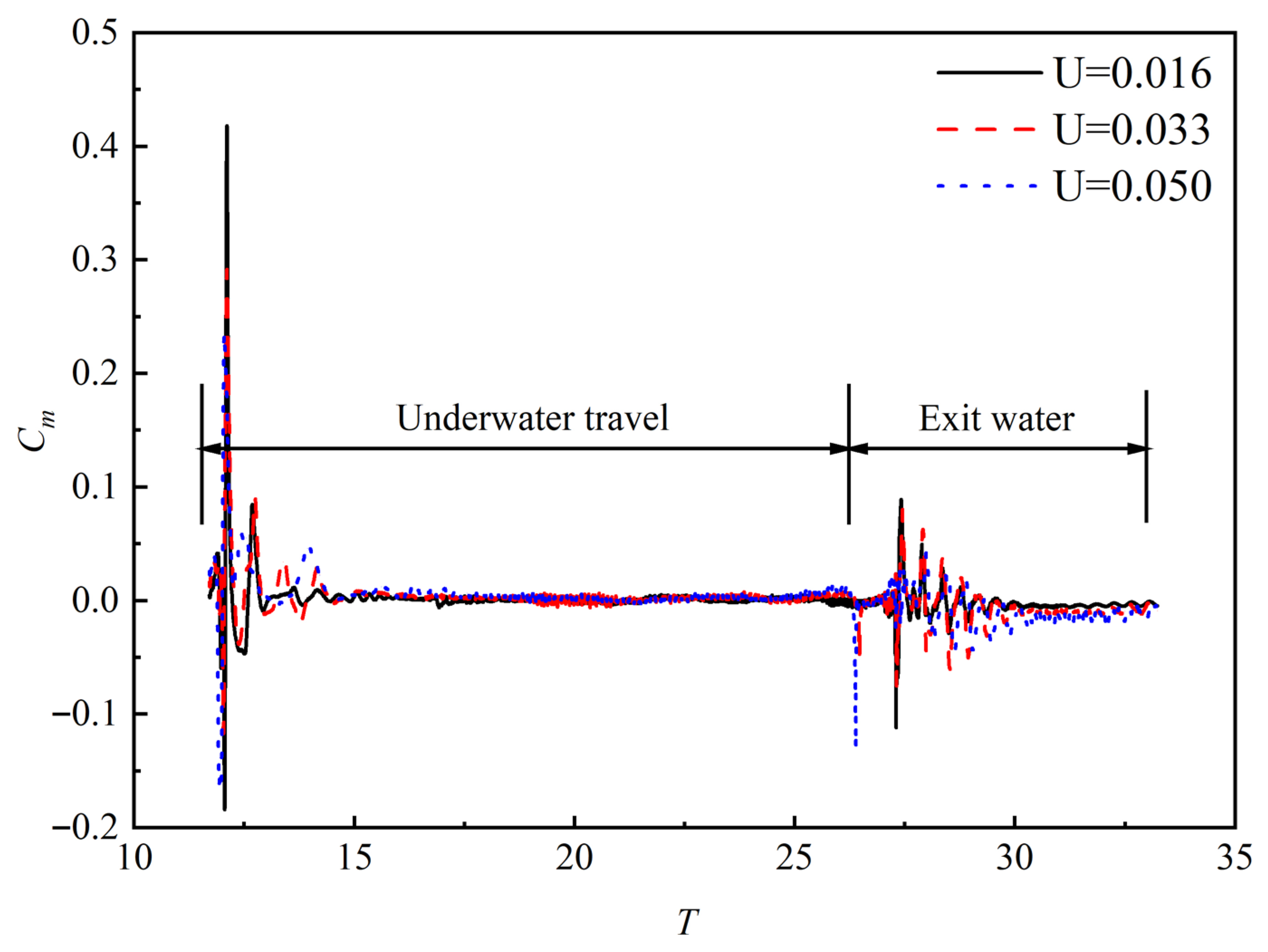
Figure 22, Figure 23 and Figure 24 show the axial coefficient, transverse force coefficient, and torque coefficient curves of the vehicle under different lateral flow conditions. At the underwater travel stage, the axial force coefficient of the vehicle also decreases rapidly due to the rapid decrease in the pressure of the high-pressure gas in the tail, and then fluctuates within a certain range. When the head of the vehicle is close to the water surface, the axial force coefficient rapidly approaches the value of 0 due to the rapid reduction in the head load, and then returns to a certain value under the action of gravity and the low-pressure region of the tail, as shown in Figure 22. The lateral force coefficient and torque coefficient of the vehicle show obvious oscillations, mainly due to the perturbation effect of the high-pressure gas at the mouth of the cylinder on the tail. Subsequently, the transverse force coefficient and moment coefficient remained basically unchanged. However, in the water exit stage, the transverse force coefficient and moment coefficient produced an oscillation phenomenon, and the amplitude of the oscillation gradually decreased with time. With the increase in transverse flow intensity, the transverse force coefficient of the vehicle was higher, but the difference in the moment coefficient was smaller, as shown in Figure 23 and Figure 24.

5. Conclusions

This paper adopted the k ω SST turbulence model, the VOF multiphase flow model, the Schnerr–Sauer cavitation model, and the overlapping mesh technique to establish a method of simulating an underwater vehicle launch that realizes the zero-gap launch between the vehicle and the launcher, thus preventing the phenomenon of high-pressure gas leakage at the tail. Comparing the experimental and simulated cavitations and motion, the effectiveness of the numerical method is validated. The main conclusions are as follows:
(1)
In the exit tube phase, the vehicle accelerates to 30 m/s, and the shoulder pressure drops below the saturated vapor pressure, initiating cavitation. The length and thickness of the cavity rise and a high-pressure return jet is formed, resulting in a return jet flow being directed into the cavity. A center-type vortex structure is formed at the end of the cavity and the position of the singularity of the vortex is aligned with the position of the front end of the return jet flow in the direction of the vehicle axis.
(2)
With the effect of transverse flow (U = 0.016–0.05), the cavity exhibits asymmetric characteristics. The axial length and radial thickness of the cavity on the back side are significantly higher than those on the face side, and the degree of asymmetry increases when U increases from 0.016 to 0.05. The stability of the cavity on the back side is lower than that on the face side, and it is more likely to be sheared off by the return jet flow and undergo large-scale detachment phenomenon. Cavity stability deteriorates with increasing transverse flow intensity.
(3)
With the effect of transverse flow, the trajectory and attitude of the vehicle are deflected to the back side after leaving the launcher, horizontal displacement increases from 0.7 mm (U = 0.016) to 2.1 mm (U = 0.05), and attitude angle reduces by 7.4%, with deflection amplitude increasing with transverse flow intensity. Sustained lateral forces result in an exit-water horizontal velocity 3–4 times the transverse flow velocity. Potential active flow control strategies (e.g., ventilated cavitation) or passive devices (e.g., surface microstructures) could be explored to mitigate backside cavity instability and large-scale detachment in future studies.

Author Contributions

Y.S.: Conceptualization, resources, validation, project administration, writing—review and editing, funding acquisition. J.R.: Methodology, software, investigation, data curation, formal analysis, writing—original draft, writing—review and editing. S.G.: Methodology, software, investigation, validation, visualization, writing—review and editing. G.Z.: Resources, project administration, supervision. G.P.: Resources, funding acquisition, project administration, supervision. All authors have read and agreed to the published version of the manuscript.

Funding

We are thankful to the National Natural Science Foundation of China (Grant No. 52171324; Grant No. U21B2055; Grant No. U2341285) for their financial support in our research work.

Institutional Review Board Statement

Not applicable.

Informed Consent Statement

Not applicable.

Data Availability Statement

The data that support the findings of this study are available within the article and are available from the corresponding author upon reasonable request.

Conflicts of Interest

The authors declare no conflicts of interest.

References

  1. Faltinsen, O.M. Hydrodynamics of marine and offshore structures. J. Hydrodyn. 2015, 26, 835–847. [Google Scholar]
  2. Gao, S.; Shi, Y.; Pan, G.; Quan, X.B. Research on the effect of asymmetric bubbles on the load characteristics of projectiles during an underwater salvo. Appl. Ocean Res. 2022, 124, 103212. [Google Scholar] [CrossRef]
  3. Du, T.Z.; Wang, Y.W.; Huang, C.G.; Liao, L.J. A numerical model for cloud cavitation based on bubble cluster. Theor. Appl. Mech. Lett. 2017, 7, 231–234. [Google Scholar] [CrossRef]
  4. Ji, B.; Wang, Z.Y.; Cheng, H.Y.; Bensow, R.E. Cavitation research with computational fluid dynamics: From Euler-Euler to Euler-Lagrange approach. J. Hydrodyn. 2024, 36, 1–23. [Google Scholar] [CrossRef]
  5. Liu, C.B.; Bu, W.Y.; Xu, D.; Lei, Y.L.; Li, X.S. Application of hybrid RANS/LES turbulence models in rotor-stator fluid machinery: A comparative study. Int. J. Numer. Methods Heat Fluid Flow 2017, 27, 2717–2743. [Google Scholar] [CrossRef]
  6. Sun, T.Z.; Xie, Q.M.; Huang, H.K.; Zhang, G.Y. Numerical investigation of ventilated cavity dynamics over a submerged body in the wake of a propeller. Ocean Eng. 2022, 257, 111580. [Google Scholar] [CrossRef]
  7. Kim, S.; Kinnas, S.A. A panel method for the hydrodynamic analysis of a cavitating propeller with sheet and developed tip vortex cavitation. Phys. Fluids 2023, 35, 127118. [Google Scholar] [CrossRef]
  8. Sun, T.Z.; Li, X.M.; Jiang, Q.; Zhang, D. Evaluation of effect of micro-vortex generator on dynamic characteristics of unsteady partial cavitating flow over hydrofoil. Ocean Eng. 2022, 257, 111601. [Google Scholar] [CrossRef]
  9. Wang, Z.Y.; Cheng, H.Y.; Luo, X.W.; Peng, X.X.; Ji, B. An improved Eulerian-Lagrangian method combined with ductile material model for cavitation erosion assessment. J. Fluids Eng. 2025, 147, 051502. [Google Scholar] [CrossRef]
  10. Zhu, W.C.; Li, Z.R.; Ding, R.Q. Effect of pitch ratio on the cavitation of controllable pitch propeller. Ocean Eng. 2024, 293, 116692. [Google Scholar] [CrossRef]
  11. Xu, C.; Wang, Y.W.; Huang, C.G.; Yu, C.; Huang, J. Cloud cavitating flow that surrounds a vertical hydrofoil near the free surface. J. Fluids Eng. 2017, 139, 101302. [Google Scholar] [CrossRef]
  12. Rayleigh, J.W. On the pressure developed in a liquid during the collapse of a spherical cavity. Philos. Mag. 1917, 34, 94–98. [Google Scholar] [CrossRef]
  13. Blake, J.R.; Robinson, P.B.; Shima, A.; Tomita, Y. Interaction of two cavitation bubbles with a rigid boundary. J. Fluid Mech. 1933, 255, 707–721. [Google Scholar] [CrossRef]
  14. Plesset, M.S. The Dynamics of Cavitation Bubbles. J. Appl. Mech. 1949, 16, 277–282. [Google Scholar] [CrossRef]
  15. Lauterborn, W.; Bolle, H. Experimental investigations of cavitation-bubble collapse in the neighborhood of a solid boundary. J. Fluid Mech. 1975, 72, 391–399. [Google Scholar] [CrossRef]
  16. Nair, V.V.; Bhattacharyya, S.K. Water entry and exit of axisymmetric bodies by CFD approach. J. Ocean Eng. Sci. 2018, 3, 156–174. [Google Scholar] [CrossRef]
  17. Wang, Z.Y.; Cheng, H.Y.; Ji, B.; Peng, X.X. Numerical investigation of inner structure and its formation mechanism of cloud cavitating flow. Int. J. Multiph. Flow 2023, 165, 104484. [Google Scholar] [CrossRef]
  18. Ma, G.H.; Chen, F.; Yu, J.Y.; Wang, K. Numerical investigation of trajectory and attitude robustness of an underwater vehicle considering the uncertainty of platform velocity and yaw angle. J. Fluids Eng. 2019, 141, 021106. [Google Scholar] [CrossRef]
  19. Wang, Z.Y.; Cheng, H.Y.; Bensow, R.E.; Peng, X.X.; Ji, B. Numerical assessment of cavitation erosion risk on the Delft twisted hydrofoil using a hybrid Eulerian-Lagrangian strategy. Int. J. Mech. Sci. 2023, 259, 108618. [Google Scholar] [CrossRef]
  20. Zhang, L.X.; Wen, Z.Q.; Shao, X.M. Investigation of bubble-bubble interaction effect during the collapse of multi-bubble system. Chin. J. Theor. Appl. Mech. 2013, 45, 861–867. [Google Scholar]
  21. Du, T.Z.; Wang, J.Z.; Wang, Y.W.; Huang, C.G. A study of the collapse speed of bubble clusters. Int. J. Multiph. Flow 2020, 129, 103322. [Google Scholar] [CrossRef]
  22. Zhang, A.M.; Li, S.M.; Xu, R.Z.; Pei, S.C.; Li, S.; Liu, Y.L. A theoretical model for compressible bubble dynamics considering phase transition and migration. J. Fluid Mech. 2024, 999, A58. [Google Scholar] [CrossRef]
  23. Passandideh-Fard, M.; Roohi, E. Transient simulations of cavitating flows using a modified volume-of-fluid (VOF) technique. Int. J. Comput. Fluid Dyn. 2008, 22, 97–114. [Google Scholar]
  24. Pendar, M.R.; Roohi, E. Investigation of cavitation around 3D hemispherical head-form body and conical cavitators using different turbulence and cavitation models. Ocean Eng. 2016, 112, 287–306. [Google Scholar] [CrossRef]
  25. Nguyen, V.T.; Phan, T.H.; Duy, T.N.; Park, W.G. Unsteady cavitation around submerged and water-exit vehicles under the effect of the free surface: A numerical study. Ocean Eng. 2022, 263, 112368. [Google Scholar] [CrossRef]
  26. Wang, Y.W.; Liao, L.J.; Du, T.Z.; Huang, C.G.; Liu, Y.B.; Fang, X.; Ling, N.G. A study on the collapse of cavitation bubbles surrounding the underwater-launched rotary model and its fluid-structure coupling effects. Ocean Eng. 2014, 84, 228–236. [Google Scholar]
  27. Wang, Y.W.; Huang, C.G.; Fang, X.; Wu, X.C.; Du, T.Z. On the internal collapse phenomenon at the closure of cavitation bubbles in a deceleration process of underwater vertical launching. Appl. Ocean Res. 2016, 56, 157–165. [Google Scholar] [CrossRef]
  28. Chen, Y.; Gong, Z.X.; Li, J.; Chen, X.; Lu, C.J. Numerical investigation on the regime of cavitation shedding and collapse during the water-exit of submerged vehicle. J. Fluids Eng. 2019, 142, 011403. [Google Scholar]
  29. Chen, Y.; Li, J.; Gong, Z.X.; Chen, X.; Lu, C.J. LES investigation on cavitating flow structures and loads of water-exiting submerged vehicles using a uniform filter of octree-based grids. Ocean Eng. 2021, 225, 108811. [Google Scholar] [CrossRef]
  30. Zhao, B.; Yao, X.L.; Ma, G.H.; Qu, Z.Y.; Fan, S.Q.; Zhao, Y.Y. The interaction characteristics of shoulder-tail cavities under different pressure ratios and hole ratios. Phys. Fluids 2025, 37, 023349. [Google Scholar] [CrossRef]
  31. Lu, J.X.; Wang, C.; Wei, Y.J.; Sun, T.Z.; Liu, F.; Xu, H. Experimental and theoretical investigation of the cavity dynamics of underwater launched rotary models. Ocean Eng. 2022, 254, 111291. [Google Scholar] [CrossRef]
  32. Shi, Y.; Gao, S.; Pan, G.; Quan, X.B. Simulation of the wake vortex and trajectory characteristics of successively launched multiple projectiles. Ocean Eng. 2022, 249, 110962. [Google Scholar] [CrossRef]
  33. Lu, J.X.; Wang, C.; Song, W.C.; Wei, Y.J.; Yu, D.L.; Li, Y.G. Experimental investigation on interference characteristics of projectiles launched successively underwater. Ocean Eng. 2022, 250, 110824. [Google Scholar] [CrossRef]
  34. Xu, H.; Wei, Y.J.; Wang, C.; Lu, J.X. On wake vortex encounter of axial-symmetric rotary models launched successively underwater. Ocean Eng. 2019, 189, 106382. [Google Scholar] [CrossRef]
  35. Gao, S.; Shi, Y.; Zhang, G.Y.; Pan, G.; Guo, Y.H. Analysis of the transient multiphase structure and motion characteristics of rotary models launched successively. Phys. Fluids 2025, 37, 015209. [Google Scholar] [CrossRef]
  36. Hao, L.; Kong, D.C.; Wu, Y.; Liu, T.T.; Wang, G.Y. Transition and gas leakage mechanisms of ventilated cavities around a conical axisymmetric body. Phys. Rev. Fluids 2022, 7, 123901. [Google Scholar] [CrossRef]
  37. Wang, Y.J.; Du, T.Z.; Huang, J.; Qiu, R.D.; Wang, Y.W.; Zhou, J.F. Experimental and numerical study on ventilated cavitation of high-speed vehicle. Phys. Fluids 2024, 36, 033317. [Google Scholar] [CrossRef]
  38. Yu, A.; Li, L.T.; Zhou, D.Q. Large eddy simulation of the cavity shedding characteristics of ventilated cavitation around the underwater vehicle. Ocean Eng. 2024, 301, 117546. [Google Scholar] [CrossRef]
  39. Shi, Z.Q.; Zou, Y.C.; You, C.X.; Xiang, Y.L.; Chen, M.; Lv, K.; Lv, P.Y.; Li, H.Y. Seakeeping investigations of a cross-domain vehicle with the capability of high-speed cruising in waves. Ocean Eng. 2024, 308, 118282. [Google Scholar] [CrossRef]
  40. Zhang, G.Y.; You, C.; Wei, H.P.; Sun, T.Z.; Yang, B.Y. Experimental study on the effects of brash ice on the water-exit dynamics of an underwater vehicle. Appl. Ocean Res. 2021, 117, 102948. [Google Scholar] [CrossRef]
  41. Liu, L.X.; Chen, Y.; Li, J. Investigation on cylinder water entry in regular wave field using large eddy simulation. Int. J. Multiph. Flow 2024, 173, 104759. [Google Scholar] [CrossRef]
  42. Tian, Y.; Shi, F.L.; Li, R.B.; Zhang, J.L.; Chang, X. Effects of wave conditions on the impact loads and stability of a high-speed projectile during oblique water entry. Phys. Fluids 2025, 37, 093612. [Google Scholar] [CrossRef]
Figure 1. Boundary conditions and mesh division. (a) Calculation domain division and boundary condition setting; (b) computational domain meshing.
Applsci 16 01152 g001
Figure 2. Schematic diagram of the experimental test.
Applsci 16 01152 g002
Figure 3. Comparison of cavities between experiment and simulation.
Applsci 16 01152 g003
Figure 4. Comparison of vertical displacement between experiment and simulation.
Applsci 16 01152 g004
Figure 5. Clouds of multiphase flow during vehicle exit from the tube: (a) cavity; (b) pressure.
Applsci 16 01152 g005
Figure 6. Velocity streamlines and velocity vectors during vehicle exit from the tube.
Applsci 16 01152 g006
Figure 7. Evolution of the cavity during the underwater travel phase of the vehicle.
Applsci 16 01152 g007
Figure 8. Variation in cavity size with time: (a) length; (b) thickness.
Applsci 16 01152 g008
Figure 9. Comparison of cavity profiles at different points of the underwater travel phase.
Applsci 16 01152 g009
Figure 10. Phase clouds at different points of the vehicle exit-water stage.
Applsci 16 01152 g010
Figure 11. Comparison of profiles of cavity collapse stages.
Applsci 16 01152 g011
Figure 12. Variation in pressure at the apex of the vehicle head with time.
Applsci 16 01152 g012
Figure 13. Curve of pressure frequency amplitude at the apex of the vehicle head.
Applsci 16 01152 g013
Figure 14. Evolution of the exit cavity under different lateral flows during the exit tube stage. (a) U = 0.016; (b) U = 0.033; (c) U = 0.05.
Applsci 16 01152 g014
Figure 15. Evolution of the exit cavity under different lateral flows during the underwater travel phase: (a) U = 0.016; (b) U = 0.033; (c) U = 0.05.
Applsci 16 01152 g015
Figure 16. Evolution of cavity profiles under different lateral flows.
Applsci 16 01152 g016
Figure 17. Pressure coefficients on the face side during the underwater travel phase. (a) T = 12.0~15.0; (b) T = 15.8~18.8; (c) T = 19.5~22.5; (d) T = 23.3~25.9.
Applsci 16 01152 g017aApplsci 16 01152 g017b
Figure 18. Pressure coefficients on the face side. (a) T = 26.3~27.1; (b) T = 27.3~28.0.
Applsci 16 01152 g018
Figure 19. Comparison of surface pressure coefficients on the face side and the back side during the underwater travel phase. (a) T = 13.5; (b) T = 17.3; (c) T = 21.0; (d) T = 23.3~24.8.
Applsci 16 01152 g019aApplsci 16 01152 g019b
Figure 20. Variation in vehicle displacement and attitude angle under different lateral flow conditions: (a) vertical displacement; (b) horizontal displacement; (c) attitude angle.
Applsci 16 01152 g020
Figure 21. Variation in the velocity and angular velocity of the vehicle under different lateral flow conditions: (a) vertical velocity; (b) horizontal velocity; (c) angular velocity.
Applsci 16 01152 g021
Figure 22. Evolution curve of axial force coefficients.
Applsci 16 01152 g022
Figure 23. Evolution curve of lateral force coefficient.
Applsci 16 01152 g023
Figure 24. Evolution curve of torque coefficient.
Applsci 16 01152 g024
Disclaimer/Publisher’s Note: The statements, opinions and data contained in all publications are solely those of the individual author(s) and contributor(s) and not of MDPI and/or the editor(s). MDPI and/or the editor(s) disclaim responsibility for any injury to people or property resulting from any ideas, methods, instructions or products referred to in the content.