Article

Fostering Amenity Criteria for the Implementation of Sustainable Urban Drainage Systems in Public Spaces: A Novel Decision Methodological Framework

by
Claudia Rocio Suarez Castillo
1,2,
Luis A. Sañudo-Fontaneda
2,3,*,
Jorge Roces-García
2,3 and
Juan P. Rodríguez
4
1
Environmental and Natural Science Research Group (GICAN), Environmental Engineering Faculty, Universidad Santo Tomás, Tunja 150003, Colombia
2
Civil, Environmental and Geomatics Engineering Research Group (CEGE), Polytechnic School of Mieres, University of Oviedo, Calle Gonzalo Gutiérrez Quirós s/n, 33600 Mieres, Spain
3
Department of Construction and Manufacturing Engineering, Polytechnic School of Engineering, University of Oviedo, Calle Pedro Puig Adam, 33203 Gijón, Spain
4
Department of Civil and Environmental Engineering, School of Engineering, University of the Andes, Mario Laserna Building, Bogotá 111711, Colombia
*
Author to whom correspondence should be addressed.
Appl. Sci. 2026, 16(2), 901; https://doi.org/10.3390/app16020901
Submission received: 26 November 2025 / Revised: 22 December 2025 / Accepted: 12 January 2026 / Published: 15 January 2026
(This article belongs to the Special Issue Resilient Cities in the Context of Climate Change)

Abstract

Sustainable Urban Drainage Systems (SUDSs) are essential for stormwater management in urban areas, with varying hydrological, social, ecological, and economic benefits. Nevertheless, choosing the SUDS most appropriate for public spaces poses a challenge when balancing details/specifications against community decisions, primarily social implications and perceptions. Building on the SUDS design pillar of the amenity, this study outlines a three-phase methodological framework for selecting SUDS based on social facilitation. The first phase introduces the application of the Partial Least Squares Structural Equation Modeling (PLS-SEM) and Classificatory Expectation–Maximization (CEM) techniques by modeling complex social interdependencies to find critical components related to urban planning. A Likert scale survey was also conducted with 440 urban dwellers in Tunja (Colombia), which identified three dimensions: Residential Satisfaction (RS), Resilience and Adaptation to Climate Change (RACC), and Community Participation (CP). In the second phase, the factors identified above were transformed into eight operational criteria, which were weighted using the Analytic Hierarchy Process (AHP) with the collaboration of 35 international experts in SUDS planning and implementation. In the third phase, these weighted criteria were used to evaluate and classify 13 types of SUDSs based on the experts’ assessments of their sub-criteria. The results deliver a clear message: cities must concentrate on solutions that will guarantee that water is managed to the best of their ability, not just safely, and that also enhance climate resilience, energy efficiency, and the ways in which public space is used. Among those options considered, infiltration ponds, green roofs, rain gardens, wetlands, and the like were the best-performing options, providing real and concrete uses in promoting a more resilient and sustainable urban water system. The methodology was also used in a real case in Tunja, Colombia. In its results, this approach proved not only pragmatic but also useful for all concerned, showing that the socio-cultural dimensions can be truly integrated into planning SUDSs and ensuring success.

1. Introduction

Cities face a wide range of uncertain challenges such as climate change, rapid urban expansion, social and institutional instabilities, and a growing demand for resources that are otherwise limited. Inadequate stormwater management represents one of the critical challenges for sustainable development and resilience in urban areas [1]. Poor stormwater drainage management directly affects the fulfillment of the Sustainable Development Goals (SDGs) in urban environments, specifically SDG 6 (Clean Water and Sanitation), by compromising the quality of both surface and groundwater sources lacking urban runoff pollution control and efficient treatment. SDG 11 (Sustainable Cities and Communities) is also affected by the increment in flooding risks and the deterioration of urban infrastructure. Finally, SDG 13 (Climate Action) complements the previous SDGs, as extreme weather events are intensifying in the era of climate change, further exposing deficiencies in existing drainage systems [2].
The implementation of Sustainable Urban Drainage Systems (SUDSs) has been the main response from the urban infrastructure side to tackle the aforementioned SDGs, particularly in the context of the 2016 New Urban Agenda (NUA), approved at the United Nations’ Conference on Housing and Sustainable Urban Development (Habitat III), and the water-sensitive urban design (WSUD) urban planning framework. This urban concept seeks to promote a development model that favors the preparation to face the effects of climate change and urban expansion, focusing on urban planning strategies that help improve the adaptability and resilience of urban areas [3].
Furthermore, previous research has considered it fundamental to improve the understanding of social attitudes toward the natural world and individuals’ relationships with it. The “Nature’s Contributions to People” (NCP) approach is an innovative research design paradigm developed by the Intergovernmental Science–Policy Platform on Biodiversity and Ecosystem Services (IPBES) [4], aiming to redefine the understanding of the role of nature in urban areas. The NCP perspective emphasizes that people’s perception and valuation of nature are influenced by social, cultural, and identity components, which are important for informed action in the urban environment [5]. Expanding on the NCP model, the urban planning sector must incorporate sustainable urban water management (SUWM) as a mediating mechanism between ecology, society, and the economy [6]. This vision allows SUWM to escape the classic pattern of focusing on hydraulic efficiency, which planners and designers often favor as a primary consideration, to include cultural and social dimensions. Then, cities must consider strategic, integrated, and participatory planning processes for joint design, in which all parties, from residents to policymakers, decide together, for this conceptual framework to become a reality [7].
This approach, based on the amenity SUDS design pillar, connects gray infrastructure (also related to conventional stormwater infrastructure) with nature-based solutions (NBSs). In this case, SUDS, lately translated into blue–green infrastructure (BGI), are essential for sustainable water management in public spaces. They provide tangible improvements and regulatory opportunities that enhance urban resilience, while delivering intangible benefits that align with the values highlighted in the NCP framework, reinforcing the role of nature in shaping resilient and inclusive urban environments [8]. The NCP approach, when combined with the amenity pillar of SUDS design, provides a proactive and promising planning model for the assessment and selection of SUDSs [9]. It broadens the classic approach to water management by considering not only technical and functional performance but also the social, cultural, and psychological benefits that SUDSs provide in urban environments. Thus, climate resilience and quality of life in cities can be improved [10]. In this vein, amenity is defined as the characteristics of built and natural environments that make urban space livable, functional, attractive, and comfortable for citizens [11]. Previous research has found a critical gap in the implementation of key social criteria in decision-making instruments. These criteria are constructed from latent variables, which are theoretical concepts deduced from data and measurable indicators [12]. This research includes latent variables such as Residential Satisfaction (RS), Community Participation (CP), and Resilience and Adaptation to Climate Change (RACC), which are strongly related to perceptions of amenities in urban settings. In doing so, the indicators act as conceptual intermediates and generalize complex social perceptions into equivalent constructs for SUDS implementation in urban contexts.
In this context, the present study introduces a novel decision-making framework for SUDS implementation in public spaces that explicitly integrates latent social constructs into the planning process. The methodological framework bridges technical and social dimensions in SUDS selection by quantifying intangible factors such as RS, RACC, and CP through Structural Equation Modeling (SEM) and incorporating these as criteria via an Analytic Hierarchy Process (AHP) with the participation of experts. This multi-method approach, combining social science insights with engineering decision tools, yields a robust and transferable framework (validated through empirical data and consensus-driven weighting) to guide SUDS decision-making beyond purely engineering considerations. Therefore, it advances the amenity design pillar, aligning SUDS choices with community well-being, climate resilience, and inclusive participatory planning, thereby enhancing the social benefits and public acceptance of urban drainage solutions. The goal is to achieve a robust and participatory evaluation instrument for SUDS implementation in urban public spaces. The methodological framework was tested in the city of Tunja, Colombia, resulting in an analysis of SUDS typologies based on both technical and socio-cultural performance in public spaces.

2. Materials and Methods

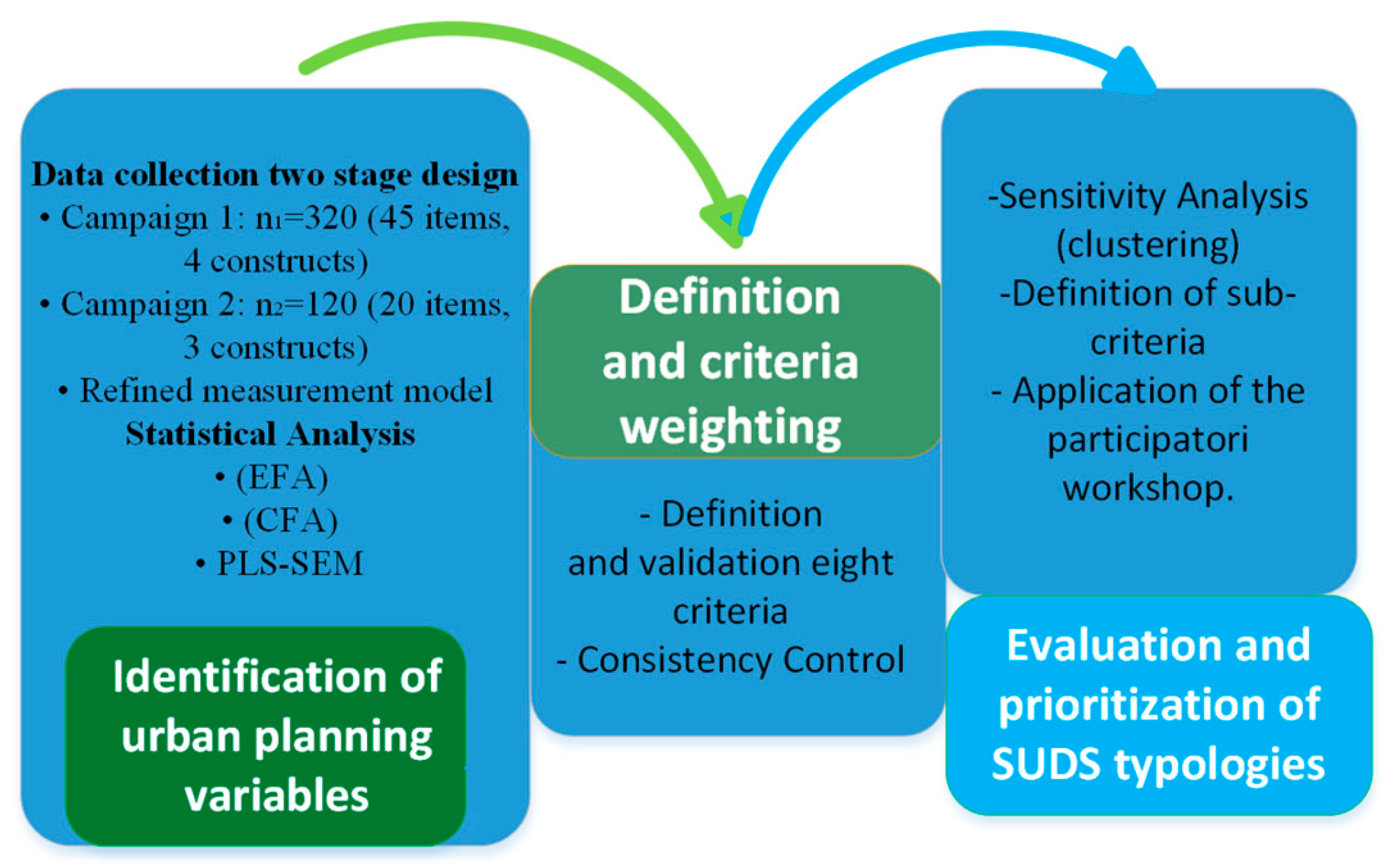
The methodology developed in this research, to tackle the gap identified in the literature, is based on a three-phase scheme ordered sequentially (see Figure 1): (1) the identification of urban planning variables using the Exploratory Factor Analysis (EFA), Confirmatory Factor Analysis (CFA), Partial Least Squares (PLS), and Structural Equation Model (SEM) methodologies (see Section 2.1 for more information); (2) the definition and weighting of criteria using AHP with consistency indices and cluster analysis (see Section 2.2); and (3) the evaluation of SUDS typologies for their implementation in public urban spaces by a panel of international experts (see Section 2.3).

2.1. Phase 1: Identification of Urban Planning Variables

2.1.1. Data Collection and Study Area

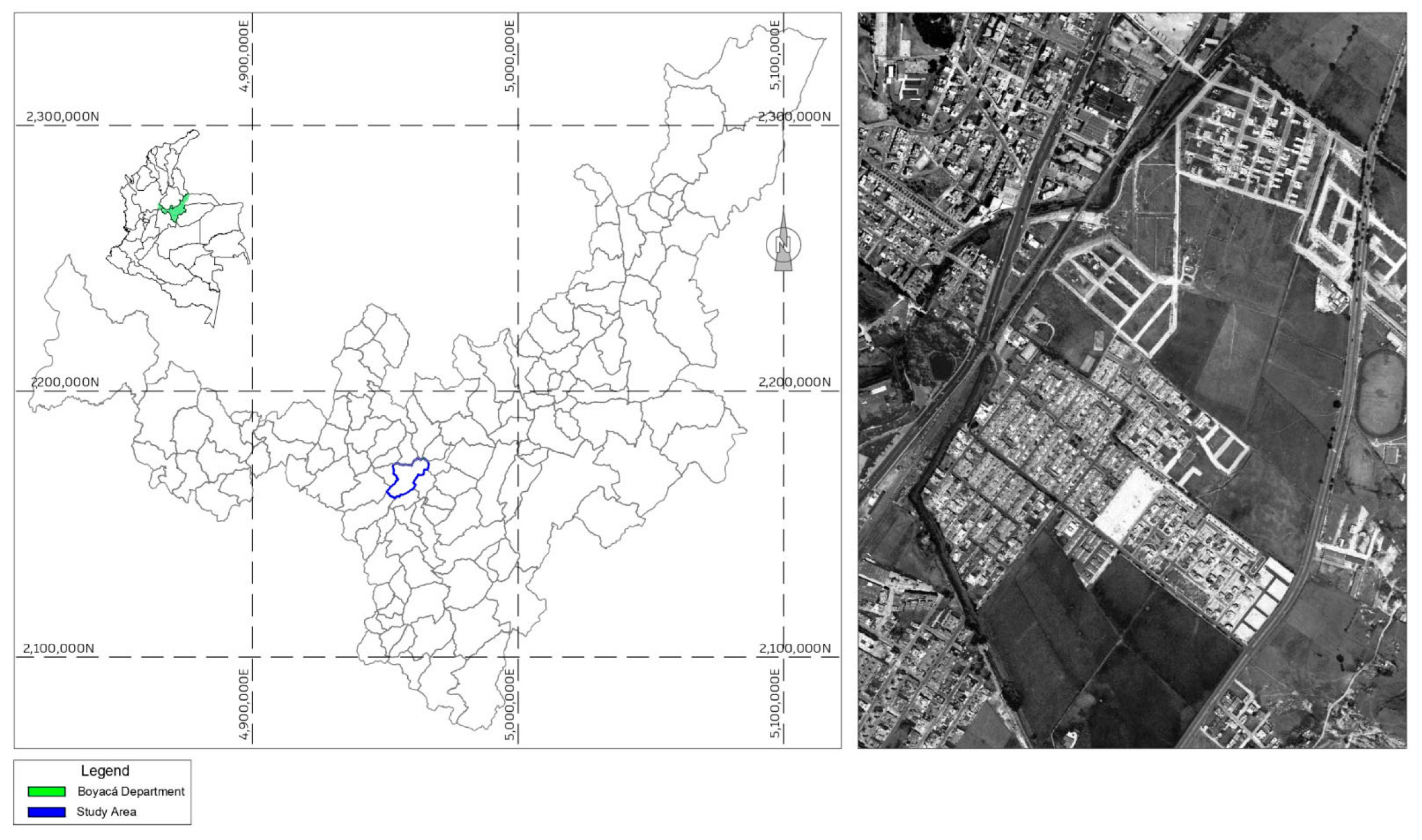
The case study location was selected in an expanding urban area of the city of Tunja (Boyacá), Colombia, where mixed land-use zones and new residential development reflect a city undergoing urban expansion. This area exhibits a heterogeneous residential structure, containing new housing precincts as well as informal settlement areas, which gives rise to various socio-spatial conditions and differing infrastructure requirements, presenting a good opportunity to test the methodology from this investigation. Sustained construction problems around drainage systems, pedestrian access, and the lack of well-located public areas suggest structural issues in urban design and environmental management. From a social perspective, the area presents a low level of interaction among residents and a lack of Community Participation at the level of occupation and maintenance of shared resources. Figure 2 shows both the location of Tunja in Colombia and within its region (Boyacá), as well as an orthophotomosaic of Tunja that was generated from aerial photogrammetry and aerotriangulation, with a spatial resolution of 0.15 m and an optimal scale of 1:2000, providing geometric accuracy for urban-scale spatial analysis.
Social data collection in this study was conducted through two survey campaigns. All data from these campaigns was processed under strict anonymization; therefore, no personal information was collected, ensuring compliance with ethical regulations. Stratified random sampling was employed in each campaign to determine the sample size, in accordance with the established procedure. With this aim, two criteria were considered, as follows.
Ten-times rule: This rule states that the number of minimum observations must be at least ten times the number of formative indicators associated with a construct or the number of paths which point toward one endogenous construct [13]. While this guideline is useful as a point of reference, several authors caution that it often underestimates the required sample size, especially in models with multiple constructs or small effect sizes. This form of underestimation can lead to a decrease in statistical power and a higher probability of missing significant effects or associations [14].
Inverse Square Root Method: Proposed by Kock and Hadaya (2018) [14], this method allows for calculating the minimum sample size required to achieve statistical power (1−β) ≥ 0.80 and a significance level of p < 0.05, based on the minimum expected path coefficient (|β|min). The general formula is as follows (see Equation (1)):
n > ( 2.486 ( | β | m i n ) 2
Assuming a minimum expected path coefficient of |β|min = 0.197, which corresponds to an effect size of f2 ≈ 0.04 (classified as a small effect according to Edeh et al. [15]), the minimum required sample size is approximately 160 observations (as computed from Equation (2)).
n > ( 2.486 0.197 ) 2 160
This value ensures adequate statistical power to detect minor effects within the structural model.
The justification of sample size in the research is as follows:
In the first campaign, 320 people were surveyed using a questionnaire with 45 questions designed to explore the theoretical constructs related to identity and sense of community (ISC), RS, RACC, and the appropriation of public space (APS).
A second campaign focused on refining and validating the results from the first campaign and which included a questionnaire shortened to 20 items was sent to 120 participants to verify the final variables of RS, RACC, and CP. Although the sample size in the second survey (n = 120) was slightly below the recommended theoretical threshold (n ≈ 146–160), it is considered adequate and methodologically justified for the following reasons:
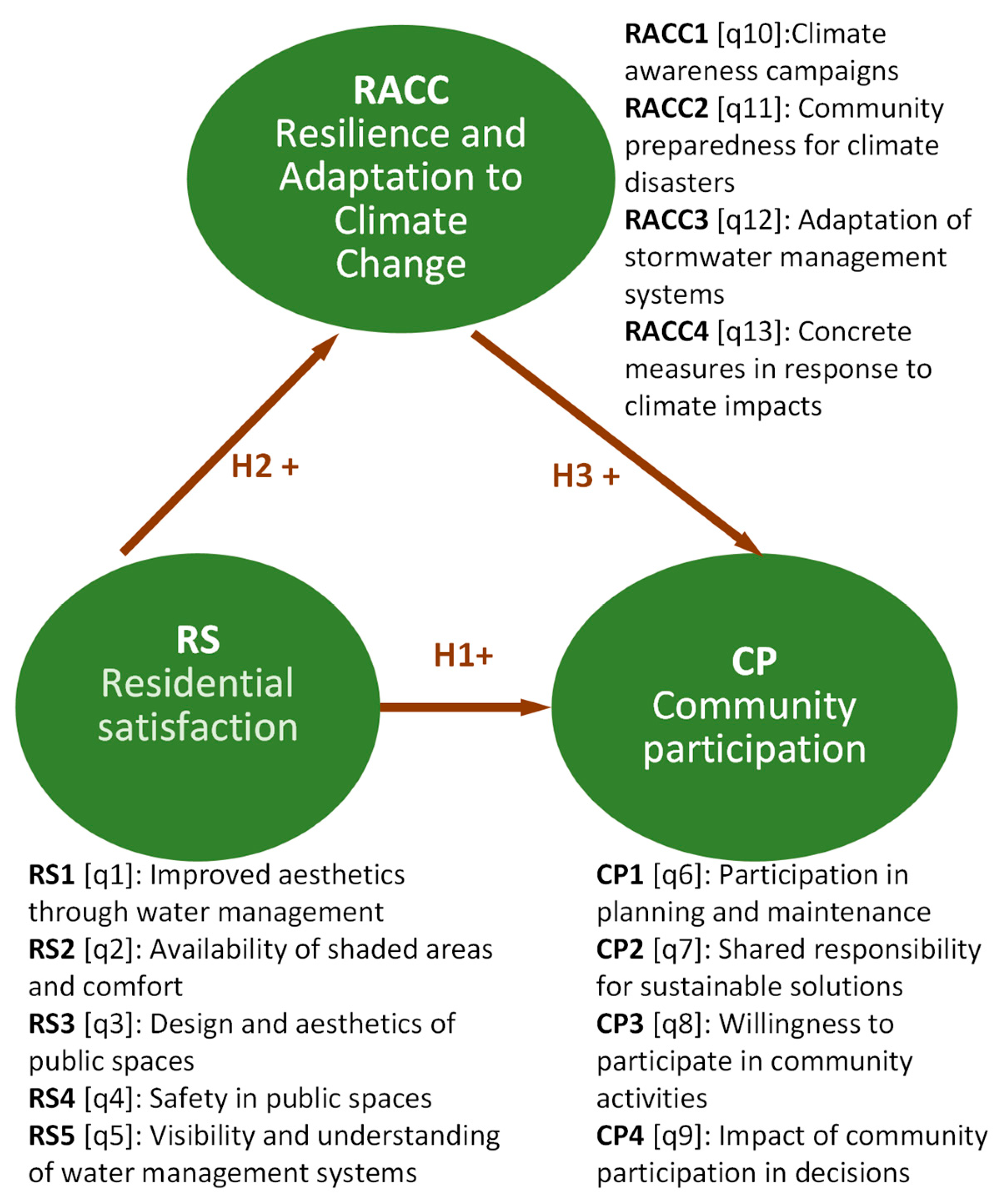
  • The model is simple, with only three endogenous constructs and three main trajectories, which supports the adequacy of the sample size (see Figure 3).
  • The trajectory coefficients observed during the exploratory phase (e.g., β = 0.205, 0.710, and 0.526) surpassed the minimum thresholds, indicating medium-to-high effect sizes, which builds confidence in the model’s predictive ability. Additionally, in models with such characteristics, post hoc power simulations show that a sample of 100–120 observations is sufficient to maintain a statistical power greater than 0.80 [14,16].
  • The PLS-SEM method does not require multivariate normality assumptions, and its main objective is to maximize the explained variance (R2) rather than to estimate parameters under covariance adjustment [17]. Therefore, the sample size obtained (n = 120) is considered consistent with PLS-SEM methodological standards and adequate for the predictive validation of the proposed model.
The post hoc power, observed coefficients, and statistical significance of the trajectories are presented in detail in the Section 3. All perceptions and questions asked in the Campaign 1 and Campaign 2 surveys were measured using a five-point Likert scale, ranging from 1, strongly disagree, to 5, strongly agree. This scale was chosen as an operational measurement tool, enabling the quantitative assessment of respondents’ perceptions and their inclusion in subsequent statistical analyses. The use of a five-category Likert scale strikes a balance between clarity for the respondent and methodological robustness, reducing excessive crowding at the midpoint in exploratory research contexts [18].

2.1.2. Exploratory Factor Analysis

In this initial phase of the study, an Exploratory Factor Analysis (EFA) was performed. This exploratory analysis was an important step in identifying the latent variables of RS, RACC, and CP as contributing factors. An analysis was conducted using the. IBM SPSS Statistics 26 (IBM Corp., Armonk, NY, USA). The Kaiser’s criterion (eigenvalues > 1) and varimax rotation were utilized in the study to provide an interpretable model of the extracted factors (see Figure 3).
Three factors were identified by the EFA that agreed with the theoretical concepts, allowing for the items to be revised, constructing a coherent conceptual model. This model emphasizes the importance of community perceptions, including trust in water management authorities and knowledge about water conservation, in contributing towards environmentally friendly water management in urban centers.
The analysis involved CFA, performed using AMOS, a package for Structural Equation Modeling. In this study, the model acceptability was reached when both the Comparative Fit Index (CFI) and the Tucker–Lewis Index (TLI) were at least 0.90, and the Root Mean Square Error of Approximation (RMSEA) was no greater than 0.08. Further analyses were conducted, which examined the factor loadings and retained only items with loadings above 0.70, thereby confirming the constructs’ convergent validity [17].

2.1.3. Structural Equation Modeling (SEM)

With the aforementioned constructs validated in previous stages of the methodology, the causal relationships among the latent variables were analyzed using Structural Equation Modeling (SEM), utilizing two complementary methods: Partial Least Squares SEM and Covariance-Based SEM [18].
Firstly, PLS-SEM was implemented in the SmartPLS 3.3 software (SmartPLS GmbH, Oststeinbek, Germany), a specialized tool for Variance-based SEM (VB-SEM), because this method is suitable for moderate sample sizes, predictive models, and when the assumptions of multivariate normality are not strictly met [15]. The main goals were to maximize the explained variance of the dependent variables and to evaluate the model’s predictive validity. The following research hypotheses were established:
H1: 
RS has a positive influence on CP;
H2: 
RS has a positive influence on RACC;
H3: 
RACC has a positive impact on CP.
The study evaluated the statistical significance of the structural paths using 5000 resamples to determine p-values and confidence intervals. Relationships with p < 0.05 were regarded as statistically significant [19]. Subsequently, the study used Covariance-Based Structural Equation Modeling (CB-SEM) in AMOS 24 to compare results from a confirmatory perspective. Unlike PLS-SEM, this approach focuses on estimating covariance matrices and is especially useful for confirming theories and evaluating overall model fit. Consequently, this research typically reports the most common goodness-of-fit indices: Chi-square (χ2), CFI, TLI, and RMSEA.

2.2. Phase 2: Definition and Criteria Weighting

The variables identified in phase 1 established operational criteria that helped assess and prioritize them in the decision-making process for SUDS selection. The AHP method was utilized to identify and assign weights to the eight criteria. With this aim, a structured questionnaire based on paired comparisons was distributed to 35 international participants with expertise in urban environmental planning and management related to SUDSs. Each surveyed person used Saaty’s nine-point scale [20], rating the criteria, allowing for the creation of a comparison matrix representing the participant’s opinion of how important each criterion was considered [21]. Then, the data was normalized, computing the eigenvectors to determine the relative weights of the criteria. To verify the consistency of the judgments, the Consistency Index (CI) and Consistency Ratio (CR) were used in this study, revising inconsistent matrices to enhance internal consistency by reducing differences in paired comparisons without altering expert weightings in any meaningful way.

2.3. Phase 3: Evaluation and Prioritization of SUDS Typologies

This phase incorporates a k-means non-hierarchical clustering analysis on the weighted criteria to assess variability in perceptions of the participants as a complement for the original updated matrices from the initial hierarchical structure. These inclusions help in potentially revealing different approaches to criterion appraisal and possibly identifying subgroups with similar weighting patterns. The optimal number of clusters was calculated by means of the elbow method and silhouette coefficients to achieve reliable segmentation. On the other hand, the average cluster weights were averaged based on the priority vectors of the paired comparison matrices used in the study. Geometric means were used in AHP to avoid an overly high level of hierarchy and to preserve the multiplicative logic of paired comparisons.
Finally, 13 different SUDS typologies were evaluated in this study through the criteria and weightings prepared in Phase 2. The criteria were subdivided into sub-criteria and measured by four-level ordinal scales (0 = no contribution, 3 = low, 5 = medium, 7 = high), while qualitative judgments were converted into quantifiable and consistent values. The reliability and quality of the findings were guaranteed through this procedure.
A workshop was held, dividing participants into 10 working groups of international experts from the SUDS community of practitioners and academics, to facilitate a participatory and comparative analysis in which all resulting data was strictly anonymized, and no personal data was collected. To that end, this study specifically focused on 13 SUDS types across the groups, with at least two or more teams for each type. Cross-assignment improved the review of each type and minimized individual bias, increasing validity. Comparisons of judgments could be made as a minimum number of evaluations per typology was reached, facilitating technical discussions among participants and grasping divergent viewpoints from a range of professional perspectives.
Then, the weighted average mean of chosen intensity for each criterion was computed, providing a correlation to rank the SUDS typologies by the significance of each category. A prioritization matrix was generated to evaluate the SUDS typologies in a comprehensive way using multi-criteria methodology.

3. Results

The results are presented following the three-phase scheme provided in the Section 2.

3.1. Phase 1 Results: Identification of Urban Planning Variables

Phase 1 related to the identification of urban planning variables, where the confirmatory model validation provides valid data to the proposed theoretical structure in the Section 2. The CFA assessment confirms the effectiveness of theoretical constructs, as described in the latent variables of RS, CP, and RACC (see Table 1).
As shown in Table 1, all factor loadings were significant and scored above the minimum conditions, which means that there is an adequate link between the observable indicators and their related constructs. The standardized factor loadings presented in Table 1 demonstrate that RACC indicators ranged from 0.74 to 0.85, CP indicators from 0.70 to 0.75, and RS indicators from 0.67 to 0.83. The model fit indices of the overall model fit criteria in CFI, TLI, and RMSEA as they are within the recommended ranges described in the methodology, underlining its internally consistent theoretical model [22]. These results evidence that the chosen constructs reflect the views on the importance of amenities and the link they may have to combat urban resilience to climate change. Additionally, Table 1 shows the internal consistency metrics (Cronbach’s α, rhoA, and composite reliability) were all at or above 0.70, and the average variance extracted (AVE) exceeded 0.50, confirming the convergent validity and robustness of the measurement model.
To assess the discriminant validity of the constructs, this study used two well-established methods: the Fornell–Larcker criterion and the Heterotrait–Monotrait (HTMT) ratio [16]. The Fornell–Larcker criterion, a common approach, is based on the idea that the square root of the average variance extracted for each construct should be greater than its correlation with other constructs, ensuring that each construct is conceptually distinct and measured separately [23]. However, recent research has highlighted certain limitations of this method in detecting violations of discriminant validity in Structural Equation Models [24]. In contrast, the HTMT provides a more reliable assessment by comparing the average correlation between constructs (heterotrait) with the average correlation within a construct (monotrait). HTMT values below 0.85 are generally regarded as evidence of discriminant validity, and this approach has been shown to have better sensitivity and specificity than the Fornell–Larcker criterion [19].
The results of this study, summarized in Table 2, corroborate that there was a clear conceptual separation between analytically measured constructs. All HTMT relationships were lower than the 0.85 threshold, which also suggests that the construct has validity [25]. This supports earlier work focusing on the utility of the HTMT in establishing discriminant validity in the absence of a strong Fornell–Larcker criterion [26].
Finally, combining and comparing both criteria improves the validity of constructs (as evaluated in this article) and demonstrates compliance with the contemporary best practices of structural research. Such consistency between methods is essential to ensure reliability and validity. Regarding the overall fit of the model, it achieved acceptable indices, with SRMR = 0.073, CFI = 0.921, TLI = 0.907, and RMSEA = 0.072; supporting the validity of the factorial structure. Additionally, the R2 values indicated the moderate-to-high explanatory power of the model, with the RACC construct showing the highest R2 (0.783) [22].
Finally, Table 3 presents the comparison of structural hypotheses using the SEM-PLS method, allowing for the evaluation of the relationships among the constructs in the proposed model. The results show that RS positively impacts CP (β = 0.205, p < 0.05), while RACC positively influences both RS (β = 0.710, p < 0.001) and CP (β = 0.526, p < 0.001). Figure 3 depicts these validated causal relationships, confirming the importance of the proposed model [27].
In summary, the results from Table 3 comply with the requirements detailed in the Section 2 to validate the sample size of the research. Therefore, the model reaches adequate statistical power, being sufficient to identify moderate-to-strong effects, thereby fulfilling the empirical robustness, reliability, and validity criteria expected in this type of structural modeling, as discussed in the Section 2. These results establish a strong basis for moving into the second phase of the study.

3.2. Phase 2 Results: Definition and Criteria Weighting

In this phase, the validated constructs were translated into decision criteria, weighted using the AHP methodology with the experts’ input. The three constructs outlined in Phase 1 (RS, RACC, and CP) were translated into operational criteria for objective assessment within the SUDS framework (see Table 4). This conversion of conceptual dimensions into measurable criteria ensured methodological traceability and connected theoretical levels with practical evaluation. Further information about the original constructs, criteria, and sub criterion can be found in the Supplementary Materials section of this manuscript.
The eight criteria listed in Table 4 were evaluated and weighted by 35 international experts using the Analytic Hierarchy Process (AHP). Detailed guidance to the participants was provided to complete the paired comparison of criteria, on a scale from 1 to 9, where 1 indicated equal importance, and 9 signified extreme importance. Instructions included explanations of partial importance levels (3: slight, 5: moderate, 7: strong) and visual examples to improve clarity and ensure consistent responses [28]. The initial overall matrix, containing 35 assessments, resulted in a CR of 0.136 (Table 5).
Results from Table 5 indicated initial inconsistency, and therefore required methodological adjustment. To resolve this, a filter was applied based on Jato-Espino et al. [29], retaining only the 15 individual matrices that met the CR consistency criterion of less than 0.10. The final consensus matrix, derived from the geometric mean of the 35 consistent assessments, demonstrates greater statistical robustness than that obtained by weighting the criteria of all experts (N = 35). The maximum eigenvalue λmax is 8.04, reaching almost perfect consistency (see Table 5 for further details). These results lead to a final CR of 0.0044, below the threshold (0.10). This outcome formally validates the experts’ assessments, establishing the basis for subsequently computing the weight vector (w). As a consequence, all expert opinions were considered for the final weighting and ranking of the eight proposed criteria. The CI values remain well below the accepted threshold of 0.10, confirming the reliability of the experts’ judgments. The random index (RI = 1.41), corresponding to the size of the matrix, was used to standardize the consistency assessment. Based on these results, the normalized priority vector was derived, resulting in the weightings and final ranking of the criteria presented in Table 6.
The results in Table 6 show that the criteria related to RESCLIM and RESIL together account for more than 40% of the total weight of criteria. Although conceptually linked, each criterion addresses a different design aspect: immediate system performance, long-term adaptability, and the provision of complementary urban functions. This weighting pattern may suggest a preference among experts for choosing SUDS typologies that combine technical efficiency with adaptability and complementarity to address future impacts related to climate change and urban development, as well as those that help reduce climate comfort needs in public spaces.

3.3. Phase 3 Results: Evaluation and Prioritization of SUDS Typologies

The final phase consists of the testing of the instrument. Thus, phase 3 shows the results of the different typologies of SUDSs that were systematically classified according to the criteria and weightings defined in the previous phase and categorized according to their significance. A rating scale was developed for each criterion using the Saaty scale: “Very High” with intensity 9, “High” with intensity 7, “Medium” with intensity 5, “Low” with intensity 3, and “Does Not Contribute” with intensity 0.
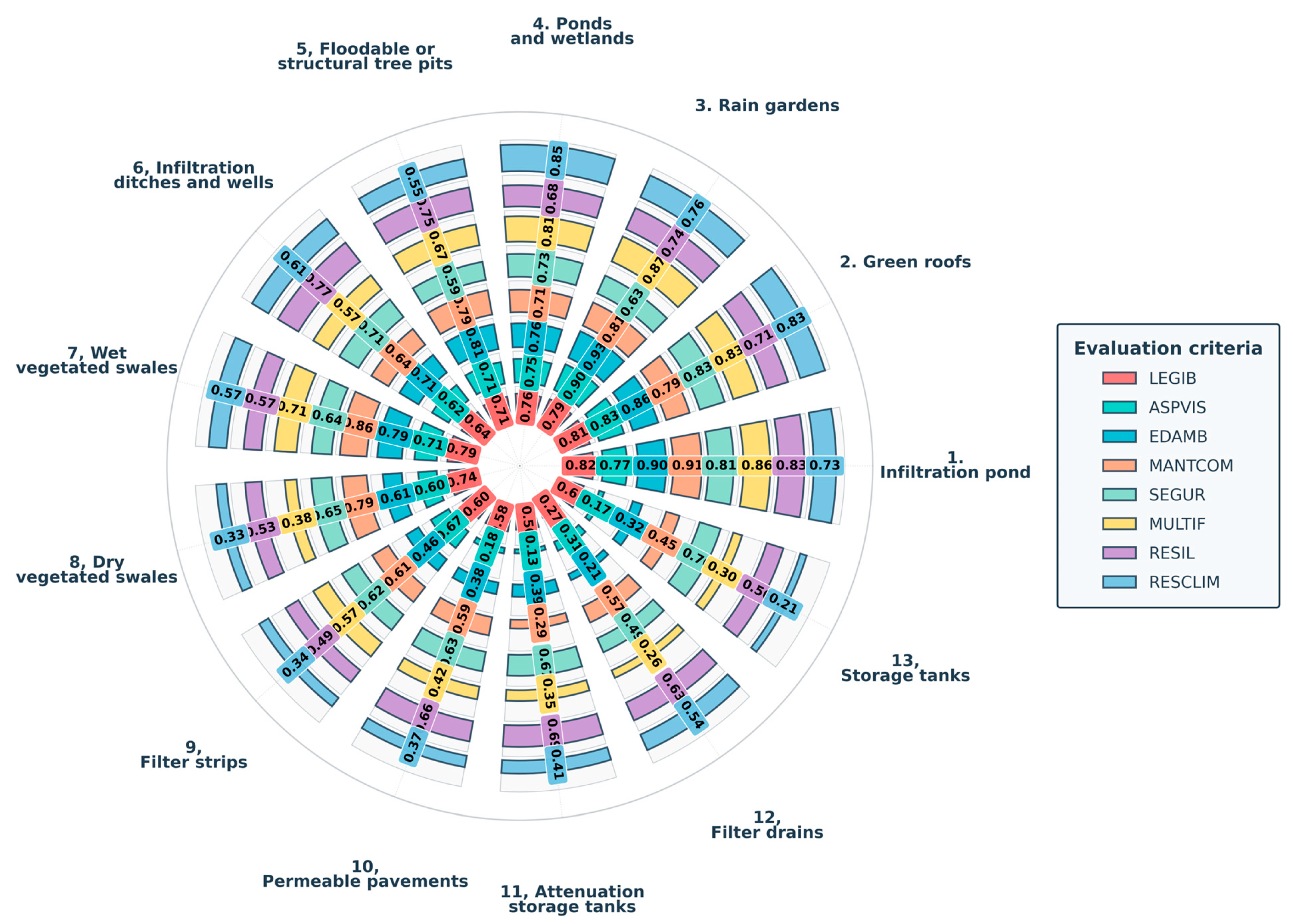
This rating scale is important for assessing the contribution level of each SUDS and was utilized by each expert. Finally, the importance of ranking for each SUDS was calculated by multiplying every criterion’s intensity value by the weight assigned to it. In this step, various SUDS typologies were categorized according to the criteria and weightings, then scored based by importance. Every expert’s perspective was critical to obtaining the final solution, and this ensured that the SUDS were placed at the top according to how relevant it was for the respective urban environment under study. A radar chart on various SUDS types is depicted in Figure 4, according to the assessment criteria used in the study. This not only provides a visual insight into the area but also acts as a pragmatic decision-making aid for both urban planning and environmental control. The concentric circles indicate elements: infiltration ponds, green roofs, rain gardens, vegetated swales, and permeable pavements, while the colored segments represent the eight evaluation categories: LEGIB, ASPVIS, EDAM, MANTCOM, SEGUR, MULTIF, RESIL, and RESCLIM. The numbers within each cell represent the normalized weight for each pair of criterion–typology, and an additional value means that this pair of SUDSs will perform better, or that it has a better fit for that specific criterion. This visualization illustrates the multidimensional performance of SUDSs and enables the comparison of performance (both good and bad) among existing types. For instance, infiltration ponds and rain gardens receive strong scores in most of the criteria (perhaps due to their multifunctionality and sustainability roles). Permeable pavements, as well as filter drains, appear to score in the lower end for both ecological and resilience purposes. The chart is, overall, helpful for understanding how each SUDS option relates to each element of sustainability and for identifying where urban implementation strategies could be improved.
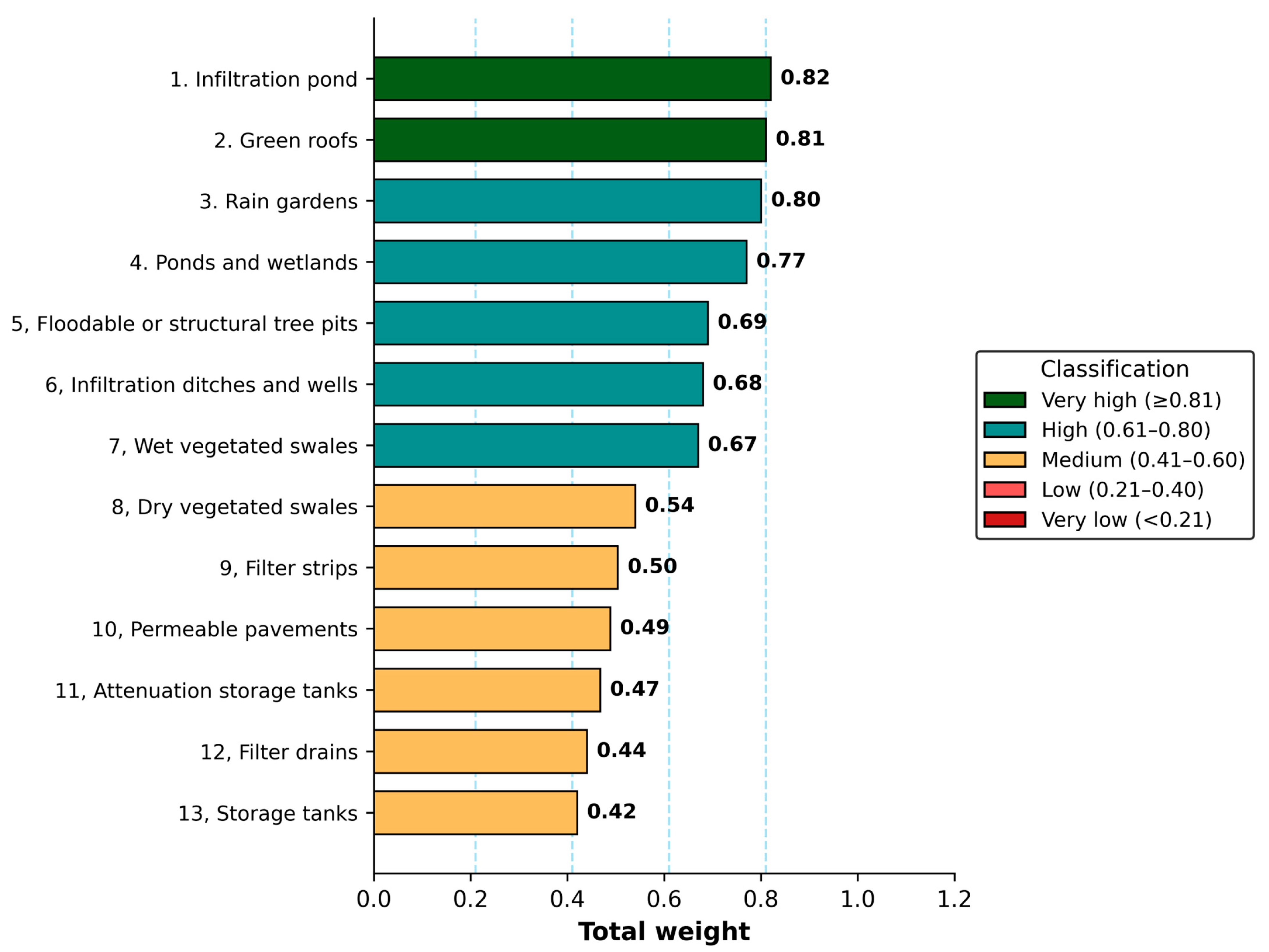
Moreover, the results of the weighting analysis for each SUDS typology are depicted in Figure 5. The models with the highest relative weights (infiltration ponds 0.82, green roofs 0.81, and rain gardens 0.80) have been defined as being very-high- and high-performing. Such systems have clear potential to be of high significance for enhancing infiltration, retention, and environmental quality, while contributing to the social and esthetic appearance of urban public spaces. Nonetheless, storage tanks (0.42), filter drains (0.44), and attenuation storage tanks (0.47) were ranked lowest, perhaps reflecting lower multifunctionality and relatively small contributions to social interactions. Therefore, the distribution of weights reveals a strong inclination from practitioners towards NBS options that combine engineering efficiency with ecological and social benefits. This is a characteristic identified in the gaps of the literature amongst the emerging perception that stormwater management systems transcend technical performance, potentially embracing multifunctional benefits, including the social amenity design pillar.
The analysis was supplemented by a non-hierarchical clustering method (k-means), applied to the criteria of weights with the aim of identifying common patterns in the experts’ judgements. The average silhouette values for all points provide an overall measure of cluster quality and help define the optimal number of clusters.
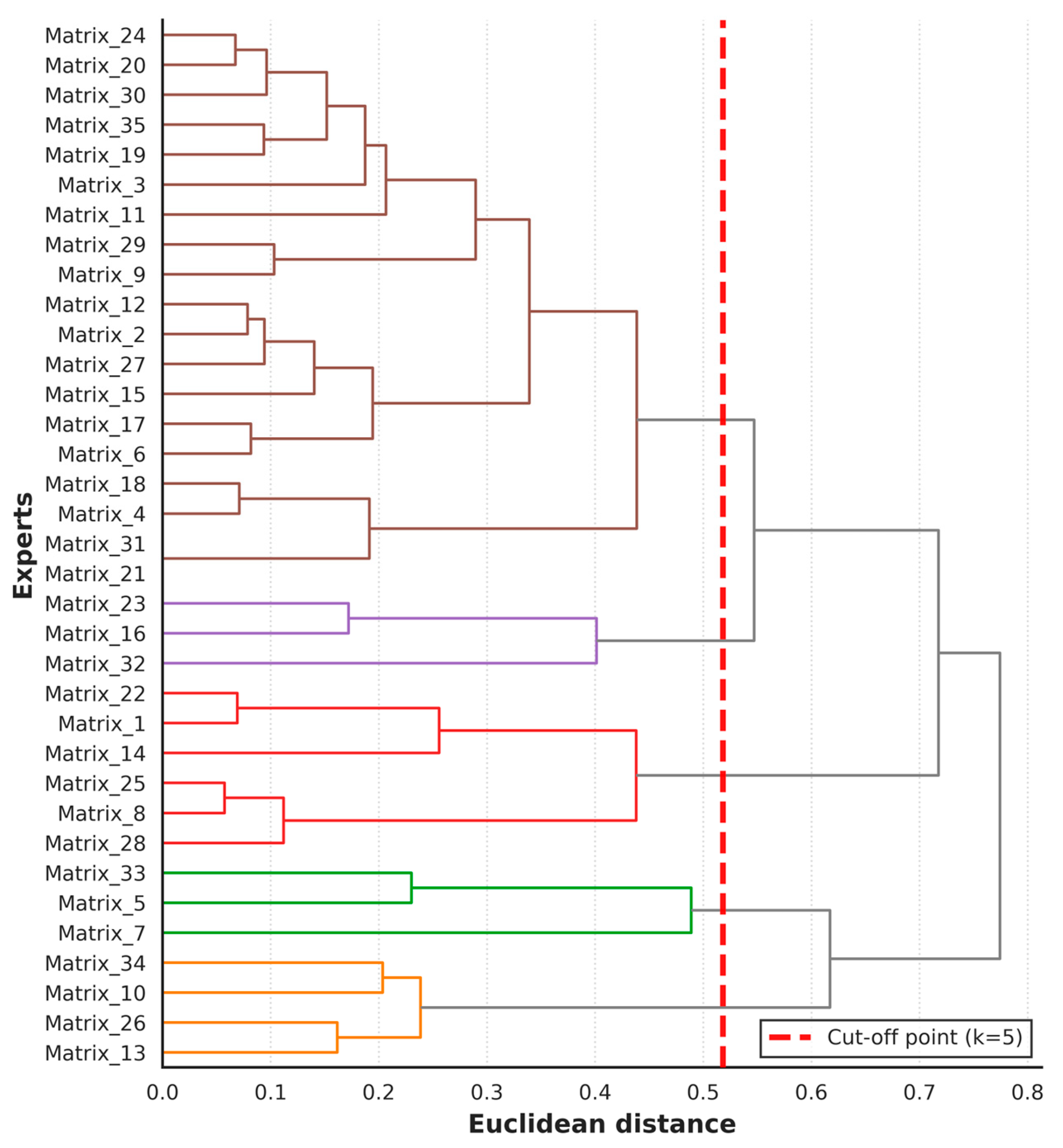
Figure 6 shows hierarchical clustering of 35 experts based on their preferences for evaluation criteria, using Ward’s linkage method with Euclidean distance. The red dashed vertical line indicates the cut-off point (Euclidean distance = 0.518) that defines five distinct clusters (k = 5). Branch colors indicate cluster membership: Cluster 1 (brown, n = 18), Cluster 2 (purple, n =4), Cluster 3 (red, n = 6), Cluster 4 (green, n = 4), and Cluster 5 (orange, n = 3). Gray branches beyond the cut-off line show hierarchical relationships among clusters. Each cluster represents a group of experts with similar priority patterns across evaluation criteria.
This unified structure of hierarchical and non-hierarchical strategies improved the interpretation of the dendrogram. It enabled clear segmentation of the data into well-defined groups, capturing both the hierarchical relationships between cases and direct similarities in the experts’ judgments. This reassures the reader of the thoroughness of the analysis.
The clustering analysis of priority vectors from the pairwise comparison matrices computed an average for every cluster with the geometric mean (Figure 6). This technique preserved the multiplicative logic of the AHP and the hierarchy of comparisons (see Table 7). The consistent and adjusted matrices showed similar hierarchical relations, allowing the algorithm to locate typical patterns and classify them by grouping them into the same clusters while preserving the overall integrity of the results. The stability of the experts’ assessments during the process meant that tweaking the matrices for improved consistency did not have an impact on the validity of the results.
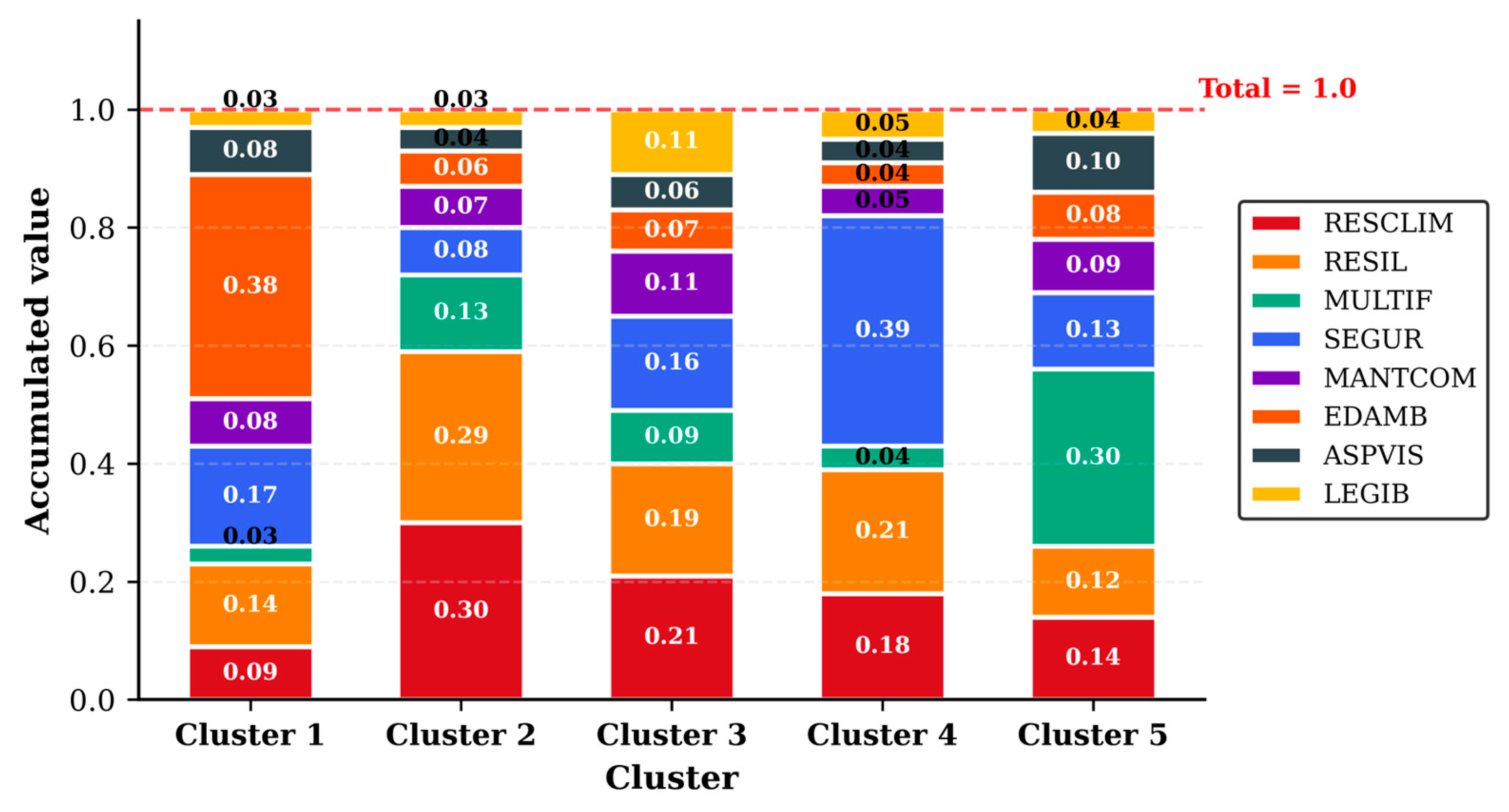
In addition, Figure 7 shows a bar chart of the distribution of the eight evaluation criteria’s importance across four clusters derived from an AHP-based clustering analysis. The color palette indicates each evaluation criterion, and each segment within a cluster is highlighted to represent its overall value or relative weight. At the top, a red dashed line indicates that the weights are normalized to 1.0 for each cluster.
The sensitivity analysis indicates that the final ranking of the alternatives remained remarkably stable, especially at the highest priority levels. Despite the marked heterogeneity of opinions among the five groups, for example, Group 1 strongly prioritizes (EDAMB: 0.38) and Group 4 focuses on (SEGUR: 0.39), the main hierarchical structure did not undergo critical alterations. Groups 2, 3, 4, and 5 assign priority to the main criteria RECLIM and RESIL, leading to the results in Table 8. The key findings of this analysis are as follows:
  • Infiltration pond maintained top performance across all simulated scenarios (Consensus and Clusters 1–5), with scores ranging from 0.80 to 0.84. This invariance demonstrates the high robustness of the AHP model in the face of the diverse perspectives.
  • Moderate sensitivity was observed between positions 2 and 3. Under the Cluster 1 (social–educational) and Cluster 4 (safety) approaches, rain gardens ranked second, displacing green roofs. This suggests that while both are leading solutions, their relative preference may vary depending on prevailing political or community objectives.
  • The model’s robustness is supported by consistency metrics, with the Global Consensus showing a CR of 0.004380. Even in the most “stressful” scenario (Cluster 1, with a CR of 0.104119), the core of the decision remained stable, thereby validating the legitimacy of the prioritization process.
  • The lowest-performing typologies, such as storage tanks (SUDS 13) and filter drains (SUDS 12), consistently ranked at the bottom across most scenarios, reinforcing the reliability of excluding these alternatives in the urban context analyzed.
This convergence of results across radically different weighting scenarios (Figure 7) allows us to conclude that the hierarchy obtained is not the result of a statistical average but rather a resilient technical solution that satisfies multiple urban sustainability criteria.


4. Discussions

4.1. Validation of Constructs and Relevance of Social Variables

The integration of SEM-AMOS, AHP, and participatory processes validates a hybrid methodological framework that operationalizes social constructs (RS, CP, RACC) used in urban planning, specifically in the implementation of SUDSs in public spaces, and aligns with the literature that advocates for multidimensional approaches to urban water management to reflect local realities [15,30]. This combination overcomes the limitations of isolated methods, converting abstract perceptions into quantifiable criteria that balance hydrological performance with environmental habitability [19].
The validation of the RS, CP, and RACC constructs using internal consistency, convergent validity, and discriminant validity confirms their statistical robustness in PLS-SEM, aligning with standards that require AVE > 0.50, CR > 0.70, and HTMT < 0.85 for reflective models in urban sustainability. This initial phase establishes the relevance of latent social variables before operationalizing the MCDM criteria, integrating environmental perceptions with technical dimensions to select SUDSs.
The proposed SEM model addresses the need to incorporate perceptual and social factors into urban planning, where Residential Satisfaction promotes community cohesion and climate adaptability. Studies confirm that RS, as measured by perceived well-being and environmental quality, drives CP, whereas RACC amplifies collective responses to extreme weather events, such as heavy rainfall, through risk awareness and community mobilization [20]. In addition, RS positively influences CP, with this effect further amplified by RACC, underscoring how urban governance depends on citizen perceptions and the adaptive capacity of green infrastructure. Community Participation through mapping and consultations strengthens climate resilience by incorporating the local knowledge of vulnerable groups [31].
The robustness of the proposed model underscores the need to incorporate variables that improve the urban landscape and diversify complementary uses into the analysis and selection of SUDS alternatives for implementation in public spaces. These variables promote community integration, support biodiversity and climate adaptability, and create relaxing, pleasant spaces with high esthetic and sensory value [23].
In this regard, aspects such as environmental comfort through the use of vegetation and sustainable materials, the safety of rainwater management infrastructure in water–land interactions, the prevention of contact with contaminated water through efficient treatment, and universal accessibility are decisive when designing a public space that requires runoff water management [32,33].
The results show that the success of SUDSs depends not only on their hydrological and hydraulic performance (engineering perspective) but also on complementary factors that strengthen social commitment and improve public spaces, thereby enhancing the quality of urban life [33]. In highly urbanized contexts, this approach promotes the development of more resilient and livable cities and broadens the scope of SUDSs for integration into environmental justice policies [21].

4.2. Operationalization and Weighting of Criteria

The legitimacy of the expert assessments rests on the track record and geographical diversity of the 35 selected participants. The panel offers an integrated global and local perspective (based on the case study used in this investigation), drawing on international standards and experience from cities with established drainage systems. This balanced composition ensures that the hierarchy of SUDS typologies (Table 8) is not only technically advanced but also applicable and contextualized to residents’ needs. Contrary to preliminary estimates, the final analysis of the AHP matrices revealed an exceptionally low Consistency Ratio (CR) of 0.00438 for the global consensus, indicating superior logical consistency in the assignment of weights. Even when segmenting the panel into clusters for sensitivity analysis, the groups remained highly consistent (Table 7), providing strong statistical support for the typology hierarchy.

4.3. Evaluation and Prioritization of SUDS Typologies

Classifying the SUDS typologies using weighted criteria in the third phase produced an important, context-specific order tailored to the urban context analyzed. By employing ordinal scales to convert qualitative evaluations into comparable data, the process’s objectivity was preserved, and a transparent prioritization matrix could then be developed.
The cluster analysis of the priority vectors revealed distinct decision-making patterns among the experts. This important finding underscores the broad range of opinions on implementing SUDSs, thereby increasing the efficiency of the prioritization process while reducing one-sidedness. It highlights the diversity of perspectives that contribute to the research, helping the audience feel respected.
The prevalence of rain gardens, infiltration ponds, and green roofs across all scenarios shows that technical prioritization is not unrelated to the need for esthetics, functionality, and climatic comfort, which experts value when weighting criteria. This alignment ensures that the implementation of SUDSs is not only hydraulically efficient but also socially legitimate, facilitating community adoption and appropriation and providing drainage systems with a complement to address future impacts associated with climate change and urban development.

4.4. Implications for Sustainable Urban Planning

The pooled findings of three phases indicate that SUDS planning cannot be limited solely to technical-hydraulic criteria but rather should integrate social, habitability, and climate resilience factors. The proposed model, in this regard, provides a methodological contribution that can be used in other urban settings to help improve the connection between green infrastructure, citizen participation, and climate change adaptation. This can serve urban planners and policymakers in providing more diverse and powerful applications of urban drainage solutions.

5. Conclusions

This study demonstrates that SUDS planning for public spaces can be strengthened when the amenity pillar is operationalized through a decision framework that explicitly integrates social perceptions with technical evaluation. By identifying and validating three latent social constructs, RS, RAC, and CP, and translating them into eight measurable criteria, the proposed approach provides a transparent pathway to move from community perceptions to actionable design and planning priorities. The combined use of SEM-based construct validation, AHP-based expert weighting, and participatory assessment enables a rigorous yet practical prioritization process that goes beyond engineering-only decision-making and supports multifunctionality, climate resilience, and socially legitimate interventions in public space contexts. On a secondary level, applying this framework to 13 SUDS typologies showed a clear preference for NBS/BGI solutions that had better alignment with climate resilience and amenity-related expectations. In particular, infiltration ponds, green roofs, and rain gardens consistently achieved the highest overall scores, while more “hidden” or single-purpose alternatives such as storage tanks and filter drains ranked the lowest. The stability of the ranking across expert clusters and sensitivity checks further supports the robustness of the proposed hierarchy, indicating that the prioritization is not merely an artifact of averaging but a resilient decision outcome under heterogeneous viewpoints. Overall, the framework offers a transferable methodological contribution for cities (especially those undergoing rapid urban expansion) to systematically incorporate social co-benefits, climate adaptation goals, and participatory logic into SUDS selection and implementation.

6. Limitations and Future Research

This research presents a number of constraints. One limitation is that it is inferred by the case study itself, so the extent to which the generalization of findings may be affected needs to be further evaluated in the future in other locations. Secondly, the weighting process in this case also relies on experts’ assessments, which introduces a certain level of bias and limits to the repetitiveness of the prioritized decision factors. The expertise of the panel does, however, help to enhance the relevance, coherence, and comprehensiveness of the criteria chosen. Future research could be conducted at practitioners’ groups internationally to further validate the instrument.
Moreover, future research should be developed along the lines of longitudinal methodologies in order to understand temporal effects on opinions and future dynamics of resilience. Finally, future investigations should be established along the following lines, based on the outcomes of this investigation:
  • Application of the methodology and instrument across various urban and social settings, involving a broader range of citizens alongside experts.
  • Expand the catalog of typologies to include hybrid solutions and perhaps combinations of gray and blue–green infrastructures, as they have become the synergistic approach preferred by designers and modelers internationally.

Supplementary Materials

The following supporting information can be downloaded at: https://www.mdpi.com/article/10.3390/app16020901/s1, Table S1: Original indicators, sections, and questions of the survey; Table S2: Original constructs, criteria, and sub criterion.

Author Contributions

Conceptualization, C.R.S.C., L.A.S.-F. and J.R.-G.; methodology, C.R.S.C., L.A.S.-F. and J.R.-G.; software, C.R.S.C.; validation, C.R.S.C.; formal analysis, C.R.S.C.; investigation, C.R.S.C.; resources, C.R.S.C., L.A.S.-F., J.R.-G. and J.P.R.; data curation, C.R.S.C.; writing—original draft preparation, C.R.S.C.; writing—review and editing, C.R.S.C., L.A.S.-F., J.R.-G. and J.P.R.; supervision, L.A.S.-F., J.R.-G. and J.P.R.; project administration, C.R.S.C., L.A.S.-F., J.R.-G. and J.P.R.; funding acquisition, C.R.S.C. All authors have read and agreed to the published version of the manuscript.

Funding

This research received no external funding.

Institutional Review Board Statement

Not applicable.

Informed Consent Statement

Not applicable.

Data Availability Statement

The data presented in this study are available on request from the corresponding author. All data originating from the surveys and workshops developed in this research were anonymized. Therefore, no responses were collected including any kind of information that could lead to personal identification.

Acknowledgments

The authors would like to thank the University of Santo Tomás, Tunja Campus, Colombia, for its support during the course of this research. We would also like to thank the students of the Environmental Engineering program for their collaboration in the data collection activities through surveys. Their participation was important in the completion of this study.

Conflicts of Interest

The authors declare no conflicts of interest.

References

  1. Beatley, T. BIOPHILIC FLOURISHING: The Role of Nature in Creating Healthy Cities. In Healthy Environments, Healing Spaces: Practices and Directions in Health, Planning, and Design; Beatley, T., Jones, C., Rainey, R., Eds.; University of Virginia Press: Charlottesville, VA, USA, 2018; ISBN 978-0-8139-4114-1. [Google Scholar]
  2. Sethi, M.; Puppim de Oliveira, J.A. Cities and Climate Co-Benefits. In Mainstreaming Climate Co-Benefits in Indian Cities: Post-Habitat III Innovations and Reforms; Springer: Singapore, 2018. [Google Scholar]
  3. Summary, E. Rescuing SDG 11 for a Resilient Urban Planet; United Nations Publications: New York, NY, USA, 2023; pp. 1–13. [Google Scholar] [CrossRef]
  4. Moreira, M.; Alves, J.; Frazão, L.; Gouveia, A.C.; Freitas, H. A Systematic Review of Nature’s Contributions to People: Impacts on Science, Policy, and Sustainability. Sustain. Sci. 2025, 20, 2297–2311. [Google Scholar] [CrossRef]
  5. Nantavisai, M.; Hashimoto, S.; Meraj, G. Unraveling Changes in Deltas: Exploring Drivers and Consequences through the Lens of the IPBES Conceptual Framework. Sci. Total Environ. 2024, 952, 175865. [Google Scholar] [CrossRef] [PubMed]
  6. Lafortezza, R.; Chen, J.; van den Bosch, C.K.; Randrup, T.B. Nature-Based Solutions for Resilient Landscapes and Cities. Environ. Res. 2018, 165, 431–441. [Google Scholar] [CrossRef] [PubMed]
  7. Gustafsson, K.M.; Lidskog, R. Expertise for Policy-Relevant Knowledge. IPBES’s Epistemic Infrastructure and Guidance to Make Environmental Assessments. J. Integr. Environ. Sci. 2023, 20, 2187844. [Google Scholar] [CrossRef]
  8. Mak, C.; Scholz, M.; James, P. Sustainable Drainage System Site Assessment Method Using Urban Ecosystem Services. Urban Ecosyst. 2017, 20, 293–307. [Google Scholar] [CrossRef]
  9. Pascual, U.; Balvanera, P.; Díaz, S.; Pataki, G.; Roth, E.; Stenseke, M.; Watson, R.T.; Başak Dessane, E.; Islar, M.; Kelemen, E.; et al. Valuing Nature’s Contributions to People: The IPBES Approach. Curr. Opin. Environ. Sustain. 2017, 26–27, 7–16. [Google Scholar] [CrossRef]
  10. Sañudo-Fontaneda, L.A.; Robina-Ramírez, R. Bringing Community Perceptions into Sustainable Urban Drainage Systems: The Experience of Extremadura, Spain. Land Use Policy 2019, 89, 104251. [Google Scholar] [CrossRef]
  11. McCarthy, L.J.; Russo, A. Exploring the Role of Nature-Based Typologies and Stewardship Schemes in Enhancing Urban Green Spaces: Citizen Perceptions of Landscape Design Scenarios and Ecosystem Services. J. Environ. Manag. 2023, 346, 118944. [Google Scholar] [CrossRef]
  12. Kankaraš, M.; Capecchi, S. Neither Agree nor Disagree: Use and Misuse of the Neutral Response Category in Likert-Type Scales. Metron 2025, 83, 111–140. [Google Scholar] [CrossRef]
  13. Muller, K. Statistical Power Analysis for the Behavioral Sciences, 2nd ed.; Lawrence Erlbaum Associates: Mahwah, NJ, USA, 1988; ISBN 0805802835. [Google Scholar]
  14. Kock, N.; Hadaya, P. Minimum Sample Size Estimation in PLS-SEM: The Inverse Square Root and Gamma-Exponential Methods. Inf. Syst. J. 2018, 28, 227–261. [Google Scholar] [CrossRef]
  15. Edeh, E.; Lo, W.-J.; Khojasteh, J. Review of Partial Least Squares Structural Equation Modeling (PLS-SEM) Using R: A Workbook. Struct. Equ. Model. 2023, 30, 165–167. [Google Scholar] [CrossRef]
  16. Hair, J.F.; Sarstedt, M.; Pieper, T.M.; Ringle, C.M. The Use of Partial Least Squares Structural Equation Modeling in Strategic Management Research: A Review of Past Practices and Recommendations for Future Applications. Long Range Plan. 2012, 45, 320–340. [Google Scholar] [CrossRef]
  17. Henseler, J.; Ringle, C.M.; Sarstedt, M. A New Criterion for Assessing Discriminant Validity in Variance-Based Structural Equation Modeling. J. Acad. Mark. Sci. 2015, 43, 115–135. [Google Scholar] [CrossRef]
  18. Adhikari, A.K.; Roy, T.B. Latent Factor Analysis and Measurement on Sustainable Urban Livability in Siliguri Municipal Corporation, West Bengal through EFA and CFA Model. Comput. Urban Sci. 2021, 1, 23. [Google Scholar] [CrossRef]
  19. Urbach, N.; Ahlemann, F. Structural Equation Modeling in Information Systems Research Using Partial Least Squares. J. Inf. Technol. Theory Appl. 2010, 11, 2. [Google Scholar]
  20. Tameh, S.N.; Gnecco, I.; Palla, A. Analytic Hierarchy Process in Selecting Bioretention Cells in Urban Residential Settlement: Analysing Hydrologic and Hydraulic Metrics for Sustainable Stormwater Management. J. Environ. Manag. 2024, 371, 123142. [Google Scholar] [CrossRef]
  21. Liu, Y.; Chen, M.; Wang, M.; Huang, J.; Thomas, F.; Rahimi, K.; Mamouei, M. An Interpretable Machine Learning Framework for Measuring Urban Perceptions from Panoramic Street View Images. iScience 2023, 26, 106132. [Google Scholar] [CrossRef]
  22. Henseler, J.; Dijkstra, T.K.; Sarstedt, M.; Ringle, C.M.; Diamantopoulos, A.; Straub, D.W.; Ketchen, D.J.; Hair, J.F.; Hult, G.T.M.; Calantone, R.J. Common Beliefs and Reality About PLS: Comments on Rönkkö and Evermann (2013). Organ. Res. Methods 2014, 17, 182–209. [Google Scholar] [CrossRef]
  23. Rasoolimanesh, S.M. Discriminant Validity Assessment in PLS-SEM: A Comprehensive Composite-Based Approach. Data Anal. Perspect. J. 2022, 3, 1–8. [Google Scholar]
  24. Rigdon, E.E. Choosing PLS Path Modeling as Analytical Method in European Management Research: A Realist Perspective. Eur. Manag. J. 2016, 34, 598–605. [Google Scholar] [CrossRef]
  25. Hair, J.F.; Hult, G.T.M.; Ringle, C.M.; Sarstedt, M. A Primer on Partial Least Squares Structural Equation Modeling (PLS-SEM); Sage: Thousand Oaks, CA, USA, 2017; ISBN 9781483377445. [Google Scholar]
  26. Azzopardi, E.; Nash, R.A. Critical Evaluation of Importance-Performance Analysis. Tour. Manag. 2013, 35, 222–233. [Google Scholar] [CrossRef]
  27. McClymont, K.; Fernandes Cunha, D.G.; Maidment, C.; Ashagre, B.; Vasconcelos, A.F.; Batalini de Macedo, M.; Nóbrega dos Santos, M.F.; Gomes Júnior, M.N.; Mendiondo, E.M.; Barbassa, A.P.; et al. Towards Urban Resilience through Sustainable Drainage Systems: A Multi-Objective Optimisation Problem. J. Environ. Manag. 2020, 275, 111173. [Google Scholar] [CrossRef]
  28. Maity, B.; Mallick, S.K.; Das, P.; Rudra, S. Comparative Analysis of Groundwater Potentiality Zone Using Fuzzy AHP, Frequency Ratio and Bayesian Weights of Evidence Methods. Appl. Water Sci. 2022, 12, 63. [Google Scholar] [CrossRef]
  29. Jato-Espino, D.; Castillo-Lopez, E.; Rodriguez-Hernandez, J.; Canteras-Jordana, J.C. A Review of Application of Multi-Criteria Decision Making Methods in Construction. Autom. Constr. 2014, 45, 151–162. [Google Scholar] [CrossRef]
  30. Magno, F.; Cassia, F.; Ringle, C.M. A Brief Review of Partial Least Squares Structural Equation Modeling (PLS-SEM) Use in Quality Management Studies. TQM J. 2024, 36, 1242–1251. [Google Scholar] [CrossRef]
  31. Rönkkö, M.; Cho, E. An Updated Guideline for Assessing Discriminant Validity. Organ. Res. Methods 2022, 25, 6–14. [Google Scholar] [CrossRef]
  32. Kimic, K.; Ostrysz, K. Assessment of Blue and Green Infrastructure Solutions in Shaping Urban Public Spaces-Spatial and Functional, Environmental, and Social Aspects. Sustainability 2021, 13, 11041. [Google Scholar] [CrossRef]
  33. Thodesen, B.; Time, B.; Kvande, T. Sustainable Urban Drainage Systems: Themes of Public Perception—A Case Study. Land 2022, 11, 589. [Google Scholar] [CrossRef]
Figure 1. Scheme of the three-phase methodological framework: (Phase 1) identification of urban planning; (Phase 2) definition and criteria weighting; and (Phase 3) evaluation and prioritization of SUDS typologies.
Applsci 16 00901 g001
Figure 2. Location of the study area in Tunja (Boyacá, Colombia) and the corresponding orthophotomosaic. The green-shaded area in the inset map represents the Department of Boyacá within Colombia; the blue outline indicates the specific study area within the municipality of Tunja.
Applsci 16 00901 g002
Figure 3. Proposed structural model to evaluate the interrelationships among residential satisfaction, community participation, and resilience and adaptation to climate change.
Applsci 16 00901 g003
Figure 4. Comparative performance of SUDS typologies based on multi-criteria evaluation.
Applsci 16 00901 g004
Figure 5. Total weighted scores of SUDS typologies. The colored bars represent the performance levels, and the vertical dashed lines indicate the threshold limits for the five categories: Very high (≥0.81), High (0.61–0.80), Medium (0.41–0.60), Low (0.21–0.40), and Very low (<0.21).
Applsci 16 00901 g005
Figure 6. Clustering dendrogram of evaluation criteria.
Applsci 16 00901 g006
Figure 7. Weight criteria for each cluster.
Applsci 16 00901 g007
Table 1. Reliability and validity indicators for measurement model constructs.
ConstructIndicatorLoadingsCronbach’s αrho_ACRAVE
RACCRACC10.850.870.850.850.65
RACC20.82
RACC30.81
RACC40.74
CPCP10.750.850.840.840.62
CP20.71
CP30.72
CP40.70
RSRS10.820.800.810.800.54
RS20.74
RS30.67
RS40.78
RS50.75
Note: All factor loadings are standardized and significant at p < 0.001. rho_A = Dijkstra–Henseler’s rho; CR = composite reliability. AVE = average variance extracted.
Table 2. Discriminant validity assessment using the Heterotrait–Monotrait (HTMT) ratio.
RACCCPRS
RACC
CP0.700.81
RS0.690.740.71
Note: Values represent HTMT ratios between constructs. Diagonal elements (—) represent within-construct comparisons and are not applicable.
Table 3. Comparison of the structural hypotheses of the model.
HypothesesPathβt-Valuep-ValueResult
H1RS → CP0.201.9270.027Supported *
H2RS → RACC0.7111.702<0.001Supported **
H3RACC → CP0.534.046<0.001Supported **
Note: The arrows (→) indicate the direction of the hypothesized relationships in the structural model. Path coefficients (β) are standardized; t-Values and p-Values are reported to indicate statistical significance * p < 0.05; ** p < 0.001.
Table 4. Criteria for the objective assessment of social, environmental, and functional performance within the SUDS framework.
CriteriaDefinitionAssociated Indicator *
MULTIFMaximizing multifunctionality: number, variety, and quality of additional uses of SUDSsRS1-RS2
ASPVISImprovement in the visual appearance of urban or natural landscapesRS3
SEGURProvision of safe surface water management systemsRS4
LEGIBMaximization of legibility and/or clarityRS5
MANTCOMMaintenance and community preservation of multifunctional SUDSCP1-CP2-CP3
EDAMBEncouraging citizen environmental learningCP4-RACC1
RESILSupporting the development of resilience and adaptability to future changeRACC2-RACC3
RESCLIMContribution of SUDS to climate resilience and energy efficiencyRACC4
Note: * The specific definitions and calculation methods for these indicators can be found in the Supplementary Materials.
Table 5. Consistency validation of the Analytic Hierarchy Process (AHP).
MetricInitial Expert Judgments (N = 35)Consistent Expert Judgments (N = 15)
Maximum Eigenvalue (λmax)8.048.05
Number of Criteria (n)88
Consistency Index (CI)0.00620.0077
Consistency Ratio (CR)0.00440.0055
Random Index (RI)1.411.41
Table 6. Final criteria weights and ranking obtained using the AHP method.
CriteriaWeight (w)Percentage (%)Ranking
RESCLIM0.2322.511
RESIL0.2221.772
SEGUR0.1515.003
MULTIF0.1211.904
MANTCOM0.1110.625
EDAMB0.087.856
ASPVIS0.066.367
LEGIB0.043.998
Total1.00100.00
Table 7. AHP consistency metrics by expert clusters.
ProfileN λmax CI CR RI
Global consensus358.0432320.0061760.0043801.4100
Cluster 139.0276550.1468080.1041191.4100
Cluster 2108.2440220.0348600.0247241.4100
Cluster 3128.1733770.0247680.0175661.4100
Cluster 448.2898400.0414060.0293661.4100
Cluster 568.3137400.0448200.0317871.4100
Note: N: Number of experts in the cluster; λmax: Principal eigenvalue; CI: Consistency Index; CR: Consistency Ratio; RI: Random Index (for n = 8 as per the 8 evaluation criteria mentioned).
Table 8. Performance scores of SUDS typologies based on expert consensus and evaluation criteria.
SUDS TypologyConsensus (N = 35)
Score
Cluster 1Cluster 2Cluster 3Cluster 4Cluster 5
1. Infiltration pond0.820.840.800.820.840.82
2. Green roofs0.810.820.800.810.810.81
3. Rain gardens0.800.830.780.780.830.80
4. Ponds and wetlands0.770.770.760.760.760.76
5. Floodable or structural tree pits0.690.700.670.680.730.70
6. Infiltration ditches and wells0.680.650.680.680.690.66
7. Wet vegetated swales0.670.700.650.670.690.71
8. Dry vegetated swales0.540.500.510.540.550.59
9. Filter strips0.500.540.480.510.480.53
10. Permeable pavements0.490.440.500.490.460.49
11. Attenuation storage tanks0.470.410.500.490.460.46
12. Filter drains0.440.360.470.440.400.38
13. Storage tanks0.420.370.420.430.380.44
Disclaimer/Publisher’s Note: The statements, opinions and data contained in all publications are solely those of the individual author(s) and contributor(s) and not of MDPI and/or the editor(s). MDPI and/or the editor(s) disclaim responsibility for any injury to people or property resulting from any ideas, methods, instructions or products referred to in the content.