Review

Surface-Modified Magnetic Nanoparticles for Photocatalytic Degradation of Antibiotics in Wastewater: A Review


1
Department of Chemistry and Texas Center for Superconductivity, University of Houston, Houston, TX 77204, USA
2
Department of Chemistry, Center of Excellence for Innovation in Chemistry (PERCH-CIC), and Center of Excellence in Materials Science and Technology, Faculty of Science, Chiang Mai University, Chiang Mai 50200, Thailand
*
Author to whom correspondence should be addressed.
Appl. Sci. 2026, 16(2), 844; https://doi.org/10.3390/app16020844
Submission received: 21 December 2025 / Revised: 8 January 2026 / Accepted: 12 January 2026 / Published: 14 January 2026
(This article belongs to the Special Issue Applications of Nanoparticles in the Environmental Sciences)

Abstract

Recent advancements in nanotechnology and materials science have enabled the development of magnetic photocatalysts with improved efficiency, stability, and reusability, offering a promising approach for wastewater treatment. The integration of magnetic nanoparticles (MNPs) into photocatalytic processes has gained significant attention as a sustainable method for addressing emerging pollutants—such as antibiotics and pharmaceutical compounds—which pose environmental and public health risks, including the proliferation of antibiotic resistance. Surface modification techniques, specifically applied to MNPs, are employed to enhance their photocatalytic performance by improving surface reactivity, reducing nanoparticle agglomeration, and increasing photocatalytic activity under both visible and ultraviolet (UV) light irradiation. These modifications also facilitate the selective adsorption and degradation of target contaminants. Importantly, the modified nanoparticles retain their magnetic properties, allowing for facile separation and reuse in multiple treatment cycles via external magnetic fields. This review provides a comprehensive overview of recent developments in surface-modified MNPs for wastewater treatment, with a focus on their physicochemical properties, surface modification strategies, and effectiveness in the removal of antibiotics from aqueous environments. Furthermore, the review discusses advantages over conventional treatment methods, current limitations, and future research directions, emphasizing the potential of this technology for sustainable and efficient water purification.

1. Introduction

Water treatment is an essential process to ensure the availability of clean and safe water for human consumption, industrial applications, and environmental sustainability. The increasing demand for clean water is driven by rapid industrialization, climate change, and urbanization, which collectively lead to heightened pressure on freshwater resources [1,2]. According to the United Nations (UN) World Water Development Report, industrial activities consume substantial volumes of water and significantly contribute to water pollution, with estimated water-related risks amounting to approximately $126 billion [3]. The UN emphasizes the strong interconnection between water resources and climate change, noting that extreme weather events exacerbate water scarcity and pollution [4].
Wastewater pollution poses a critical environmental and public health concern, as it can degrade ecosystems, compromise food safety, and pose direct and indirect risks to human health. Among the various pollutants of concern, a class of substances known as contaminants of emerging concern (CECs)—including pharmaceuticals and antibiotics—has become a significant environmental issue due to their widespread use and improper disposal [5,6]. These compounds, frequently detected in aquatic environments even at trace concentrations, are of particular concern because they exhibit cumulative toxicity and can promote the development of antimicrobial-resistant bacteria when persistently present [7]. Antibiotics, in particular, enter water bodies through multiple pathways, including effluent discharges from pharmaceutical manufacturing facilities, improper disposal of unused medications, and excretion from humans and livestock (Scheme 1) [8,9,10]. Given their persistence and biological activity, antibiotics and related pharmaceuticals constitute a critical area of investigation within environmental science and public health.
Increased antibiotic usage and production contribute directly to environmental contamination, as elevated consumption rates lead to higher concentrations of these compounds in aquatic systems. Global antibiotic consumption increased by 46% between 2000 and 2008, based on data from 76 countries [11]. According to NAVADHI Market Research Private Limited (an Indian private company), the global pharmaceutical market is projected to reach approximately $1.57 trillion, reflecting the scale of pharmaceutical manufacturing [12]. Antibiotic residues have been detected in diverse aquatic environments, including rivers, lakes, and wastewater treatment plants worldwide [13,14,15,16]. Wilkinson et al. reported the presence of 34 active pharmaceutical ingredients, including antibiotics, in rivers across all continents, with a detection frequency of 62% across sampled sites [17]. Bhagat et al. documented concentrations of six antibiotics in untreated wastewater ranging from 3.24 ng L−1 to 31,000 µg L−1, with the highest levels observed in India, followed by China and the United States [18].
Contaminated water adversely affects both aquatic and terrestrial organisms by disrupting habitats, altering reproductive cycles, and increasing mortality rates [19,20]. In agricultural settings, the use of contaminated water for irrigation introduces antibiotic residues into the food chain, thereby compromising food safety and consumer health [6]. The widespread production, distribution, and consumption of antibiotics contribute to the release of active pharmaceutical compounds into the environment, facilitating the development of antimicrobial resistance (AMR) [21,22]. Environmental antibiotic contamination creates conditions that favor the selection and proliferation of resistant microbial strains. The Centers for Disease Control and Prevention (CDC) classifies AMR as a “One Health” issue, emphasizing its interconnected impact on human, animal, and environmental systems [23]. AMR disseminates through water sources, soil, and broader ecosystems, driven not only by pharmaceutical manufacturing but also by improper disposal practices, agricultural runoff, and food production pathways. These factors collectively contribute to the persistence and spread of resistant microbial communities.
Antibiotics further impact aquatic environments because most compounds are not fully metabolized by humans or animals and are subsequently excreted into sewage systems, from which they can enter natural water bodies [9]. Once present, pharmaceuticals can exert toxic effects on aquatic organisms, disrupting physiological functions, reproductive processes, and behavior. Exposure to certain antibiotics also disturbs microbial communities within aquatic ecosystems, leading to alterations in nutrient cycling and degradation of water quality [10,24].
Continuous exposure of pathogens to subtherapeutic concentrations of antibiotics promotes the emergence of AMR, which poses substantial public health challenges [22]. In 2019, AMR was estimated to be directly responsible for 1.27 million deaths globally, according to The Lancet [25]. The World Health Organization (WHO) has identified AMR as one of the top ten global public health threats, noting its significance in both 2019 and 2021 assessments [26,27]. The presence of antibiotics in aquatic systems represents a multifaceted challenge that necessitates effective strategies for monitoring, regulation, and protection of the water quality to safeguard environmental and human health. The persistence of antibiotics and other CECs in aquatic systems, along with their contribution to ecological disruption and AMR development, underscores the urgent need for efficient and reliable removal technologies. Therefore, a variety of advanced water treatment approaches have been explored to mitigate these pollutants.
Conventional treatment technologies for removing pharmaceutical contaminants include membrane filtration, adsorption, precipitation, reverse osmosis, coagulation, and flocculation [28,29,30]. However, these approaches exhibit several limitations, including the requirement for tightly controlled operational conditions and incomplete mineralization of pharmaceutical compounds [31,32]. Furthermore, many wastewater treatment facilities are not adequately equipped to fully eliminate antibiotics, thereby exacerbating environmental contamination [33]. These technologies may also involve complex downstream processes, leading to extended treatment times and increased operational costs [34,35]. Collectively, these limitations highlight the need for more efficient, cost-effective, and sustainable strategies to address antibiotic contamination in aquatic environments.
The application of nanotechnology in wastewater treatment systems represents a promising approach to address the increasing complexity and diversity of contaminants in aquatic environments. Nanoparticles (NPs) offer considerable potential to enhance existing treatment technologies by improving the removal efficiency of various pollutants, thereby contributing to improved water quality [36,37]. Owing to their high specific surface-area-to-volume ratio, reactivity, and tunable selectivity, NPs can be engineered to target specific classes of contaminants, including heavy metals, microorganisms, and organic compounds [38]. Their incorporation not only enhances treatment performance but also supports the development of sustainable, energy-efficient, and cost-effective water purification platforms. Additionally, NPs can facilitate degradation processes by promoting the breakdown of hazardous substances into simpler and less harmful products [39].
Photocatalysis offers a versatile and environmentally compatible approach to water treatment, relying on the light-induced activation of photocatalysts to initiate redox reactions. The efficiency of photocatalytic processes is governed by several catalyst-specific factors, including band gap energy (Eg), surface area, and the recombination rate of photogenerated electron–hole pairs [40,41]. Despite its potential, photocatalysis faces several practical constraints such as limited light absorption efficiency, challenges associated with catalyst recovery and reuse, and scalability limitations for industrial implementation [33,42]. The integration of photocatalysts with magnetic nanoparticles (MNPs) has emerged as a promising strategy to address these limitations by enabling magnetic separation, enhancing degradation performance, and improving overall process sustainability.
Typically composed of iron oxide nanoparticles (IONPs), MNPs exhibit magnetic properties that allow for straightforward recovery after treatment, thereby minimizing secondary pollution [43]. In addition, surface-functionalized MNPs combine high specific surface area, magnetic separability, and tunable selectivity, making them particularly suitable for water purification applications [44,45]. These characteristics also promote catalyst reusability, contributing to more cost-effective wastewater treatment processes.
This review provides an overview of recent developments in photocatalysis using surface-modified MNPs for wastewater treatment. It highlights advances in catalyst design, elucidates mechanisms of pollutant degradation, and discusses strategies to enhance photocatalytic performance. In addition, it examines the physicochemical characteristics influencing the photocatalytic performance of MNPs, including their composition and surface functionalization. Understanding these parameters is essential for the rational design of NPs tailored to specific wastewater treatment applications. Challenges and limitations associated with this approach are also addressed.

2. Magnetic Nanoparticle-Assisted Photocatalysis

NPs have been widely recognized for their potential to enhance the removal of antibiotics in water treatment, particularly through advanced oxidation processes (AOPs). NPs exhibit strong effectiveness in treating water contaminated with persistent emerging contaminants and other difficult-to-degrade organic compounds that resist conventional treatment methods [46]. AOPs operate by generating hydroxyl (•OH) radicals, which oxidize a broad range of organic pollutants, including antibiotic residues, into less harmful products [47]. Common AOPs include ozonation, Fenton oxidation, sonolysis, photocatalysis, and ultraviolet (UV)/hydrogen peroxide (H2O2) photolysis [46]. Among these approaches, photocatalysis has demonstrated high efficacy in achieving complete mineralization of contaminants, particularly antibiotics [40]. Moreover, photocatalysis does not require external chemical additives, as it relies on light energy—either natural sunlight or low-energy UV irradiation—making it a sustainable and cost-effective water treatment strategy.
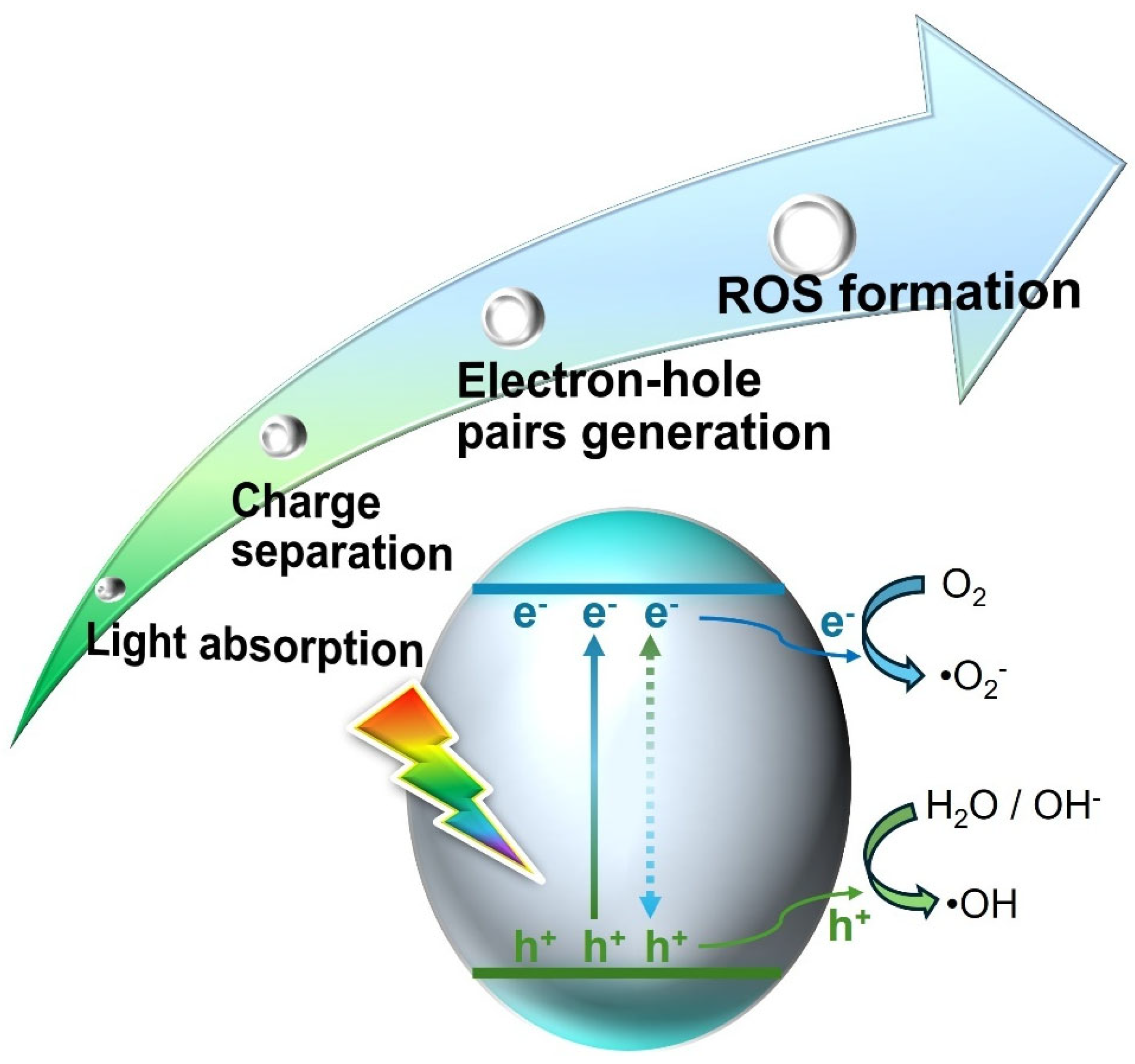
Photocatalysis typically employs semiconducting materials, such as metal oxides, that generate reactive oxygen species (ROS) upon light irradiation. When a semiconductor with a specific Eg absorbs photons with energy equal to or greater than its Eg, electrons are excited from the valence band (VB) to the conduction band (CB), generating electron–hole pairs. These charge carriers participate in surface redox reactions, leading to the formation of ROS—including •OH radicals and superoxide (•O2) anions—that degrade contaminants and ultimately mineralize them (Scheme 2) [48,49,50]. The Eg is a key parameter governing light absorption and photocatalytic activity [51]. Semiconductors with narrow band gaps (1.8–3.1 eV) are activated under visible light (400–700 nm), whereas those with wider band gaps (>3.1 eV) typically require UV irradiation (<400 nm) [42]. This tunable nature allows semiconducting photocatalysts to operate across a broad portion of the solar spectrum, supporting their application in diverse environmental remediation settings.
In addition to radical-mediated pathways involving •OH and •O2 species, recent studies suggest that non-radical ROS such as singlet oxygen (1O2) may also contribute to the photocatalytic degradation of antibiotics in certain systems [52,53]. 1O2 is an electronically excited form of molecular oxygen that has been reported in certain AOPs [54]. Compared to radical ROS, 1O2 exhibits greater resistance to scavenging by inorganic ions commonly present in real wastewater and higher selectivity toward electron-rich organic pollutants [52,55]. Although 1O2 generation has been suggested in selected photocatalytic systems, its contribution has been reported in only a limited number of antibiotic degradation studies involving surface-modified MNPs. Nonetheless, acknowledging this pathway provides a more complete mechanistic perspective on photocatalytic antibiotic degradation beyond conventional radical-driven processes.
Based on these principles, MNPs have been extensively explored for their potential to enhance photocatalytic processes. The incorporation of MNPs enables facile catalyst recovery via an external magnetic field, thereby improving reusability while reducing toxicity and operational costs [45,56]. Among MNPs, IONPs—including magnetite (Fe3O4), maghemite (γ-Fe2O3), and other spinel ferrites (XFe2O4, X = Zn, Cu, Mn, etc.)—are the most widely applied due to their biocompatibility, favorable physicochemical and magnetic properties, and ease of surface functionalization [57,58]. These materials can be incorporated into photocatalytic systems to enhance the degradation of antibiotic contaminants. Surface modification of MNPs can further improve photocatalytic performance by facilitating light absorption and promoting charge separation, making them particularly attractive for environmental remediation [43].
Despite their promising properties, bare MNPs exhibit certain limitations such as weak visible-light activity and rapid electron–hole recombination rate, both of which hinder photocatalytic efficiency [59]. To overcome these challenges, various surface modification strategies have been developed to tailor the optical and electronic properties of MNPs, thereby improving charge separation, light harvesting, and overall catalytic performance. Consequently, the development of surface-modified MNPs represents a crucial approach for enhancing the photocatalytic degradation of persistent pollutants, particularly antibiotics.

3. Surface-Modified Magnetic Nanoparticles: A Potential Candidate for Photocatalysis

MNPs have gained considerable attention in environmental remediation due to their unique physicochemical properties, low cost, natural abundance, and environmentally compatible synthesis routes. Their nanoscale dimensions and high surface-area-to-volume ratio provide abundant active sites for molecular interactions, boosting adsorption capacity and catalytic activity [60,61,62]. One of the major advantages of MNPs in water treatment is their ability to be rapidly and selectively separated from solution using an external magnet, eliminating the need for energy-intensive filtration or centrifugation and thereby reducing operational time and cost.
The magnetic behavior of IONPs is strongly influenced by their structure, crystallinity, morphology, particle size, and surface characteristics. Depending on these parameters, IONPs may exhibit either superparamagnetic or ferrimagnetic behavior [60,63]. At sufficiently small dimensions, IONPs display superparamagnetism, becoming magnetized only in the presence of an external magnetic field and losing magnetization upon its removal. This property prevents NP aggregation and is advantageous in applications requiring controlled magnetic responses [44,45,56]. In contrast, larger IONPs typically exhibit ferrimagnetism, retaining magnetization even without an applied magnetic field, a characteristic beneficial in processes requiring stable magnetic behavior [44,60]. Magnetic strength is commonly evaluated by saturation magnetization (MS), defined as the maximum magnetization achieved under an applied magnetic field [64]. Ferrimagnetic NPs generally exhibit higher MS values than superparamagnetic ones, reflecting their distinct functionalities in photocatalyst recovery [60].
Despite their promising attributes, bare MNPs present several limitations that restrict their performance. A primary challenge is their tendency to aggregate due to magnetic dipole–dipole interactions, which reduces their active surface area and limits the number of available active sites for contaminant interactions. In addition, IONPs are susceptible to oxidation or structural degradation when exposed to oxygen, moisture, or acidic conditions, leading to diminished magnetic strength and reduced catalytic efficiency [43,65]. These limitations underscore the need for strategies that improve MNP stability, reactivity, and durability in aqueous environments.
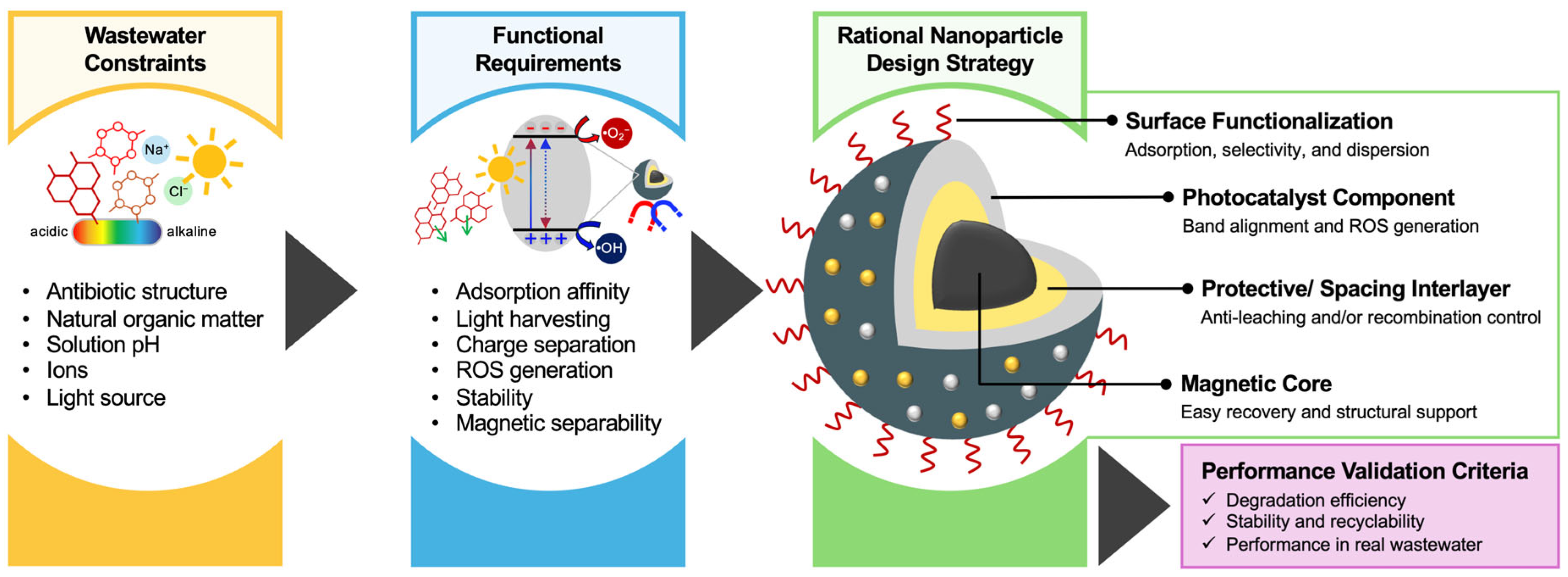
Surface modification represents an effective approach to overcome the limitations of bare MNPs. In surface-modified MNPs, the magnetic core—typically Fe3O4, γ-Fe2O3, or XFe2O4—is coated with functional layers such as metal oxides, carbon-based materials, silica shells, or polymer coatings. These surface layers significantly improve dispersion stability, selectivity, and catalytic activity while preserving the inherent physicochemical and magnetic properties of the core [44]. Such modifications also enhance key photocatalytic features, including light absorption range, charge separation efficiency, suppression of electron–hole recombination, and resistance to environmental degradation [66,67,68]. In addition, they mitigate aggregation, strengthen chemical durability, and enable repeated use without substantial loss of magnetic performance [43]. Based on these considerations, a general framework for the rational design of surface-modified MNPs for photocatalytic anti-biotic degradation is summarized in Scheme 3.
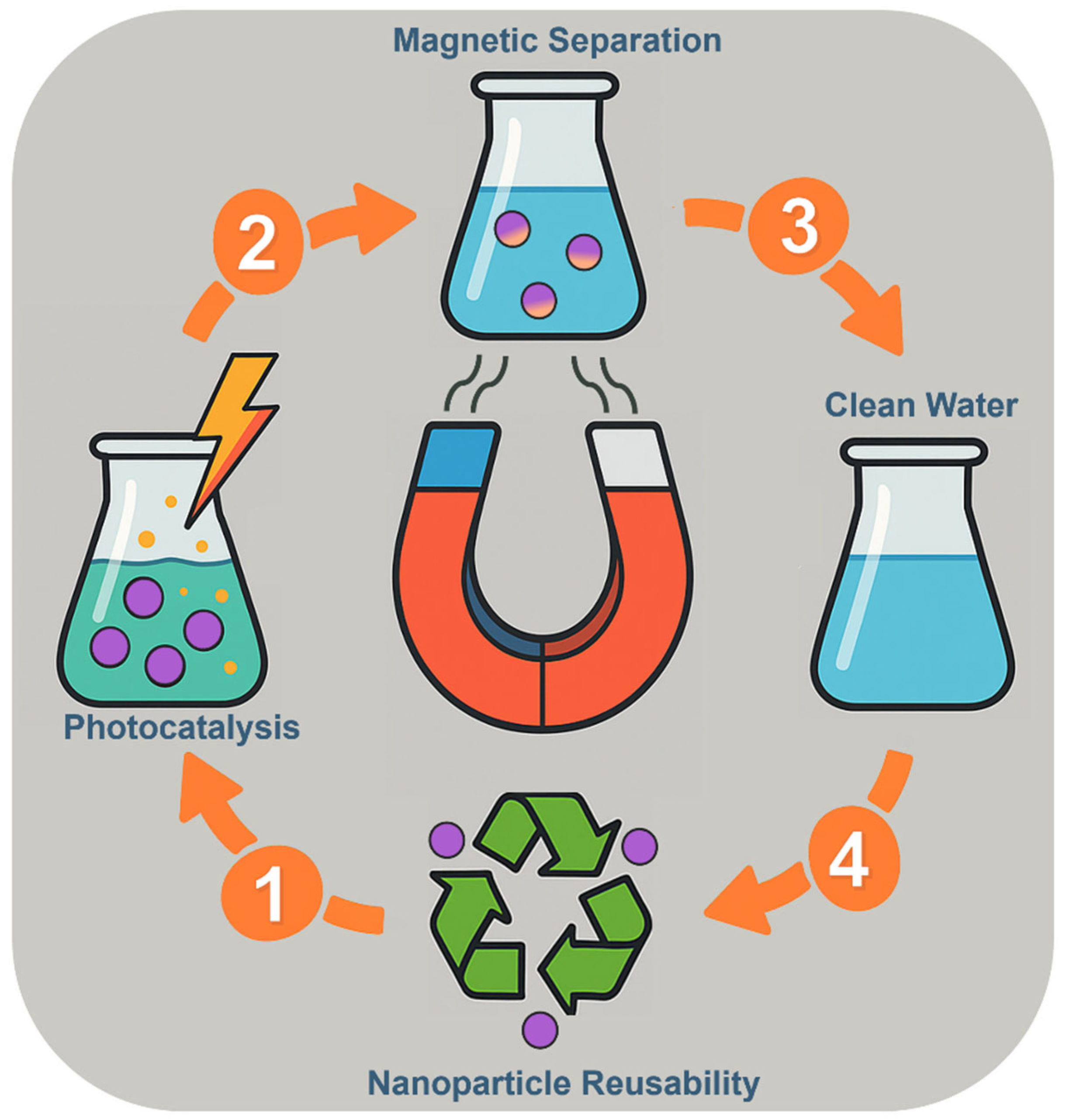
A typical application of surface-modified MNPs in wastewater treatment is illustrated in Scheme 4. The NPs are dispersed into contaminated water, where they adsorb and photocatalytically degrade pollutants through the generation of ROS under light irradiation. After treatment, the NPs are magnetically recovered, washed, and reused, enabling repeated operation with minimal material loss. This integrated adsorption–photodegradation–magnetic separation process offers an efficient, sustainable, and cost-effective approach for water purification.
Various photocatalytic materials have been incorporated as functional shells around MNP cores for water purification. Metal oxides such as titanium dioxide (TiO2), zinc oxide (ZnO), and tungsten trioxide (WO3) are commonly used due to their intrinsic photocatalytic activity. TiO2 and ZnO, with Eg of approximately 3.2 and 3.3 eV, respectively, generate electron–hole pairs under UV irradiation. Surface modification strategies, such as metal or non-metal doping and the integration of heterogeneous co-catalysts, extend their optical absorption into the visible range and create charge-trapping sites that suppress electron–hole recombination [48,69,70,71]. WO3, with a narrower Eg of 2.6–2.8 eV, can be activated by visible light, and its photocatalytic performance has been shown to depend on morphology control, doping, and coupling with co-catalysts [72,73]. Carbon-based materials, including graphene and its derivatives, also serve as effective surface modifiers due to their tunable electronic structures, high conductivity, and modifiable surface chemistry, which facilitate efficient charge transfer and separation [74].
Optimizing the optical and electronic properties of these systems—including band-gap engineering, heterojunction formation, and charge-carrier regulation—is essential for designing effective MNP-based photocatalysts. Approaches such as metal or non-metal doping, coupling with complementary semiconductors, and engineering surface defects improve light harvesting, suppress electron–hole recombination, and extend photocatalytic activity into the visible-light region (Scheme 5). Collectively, these strategies enhance the degradation efficiency of persistent contaminants under a broader light spectrum [75,76,77].
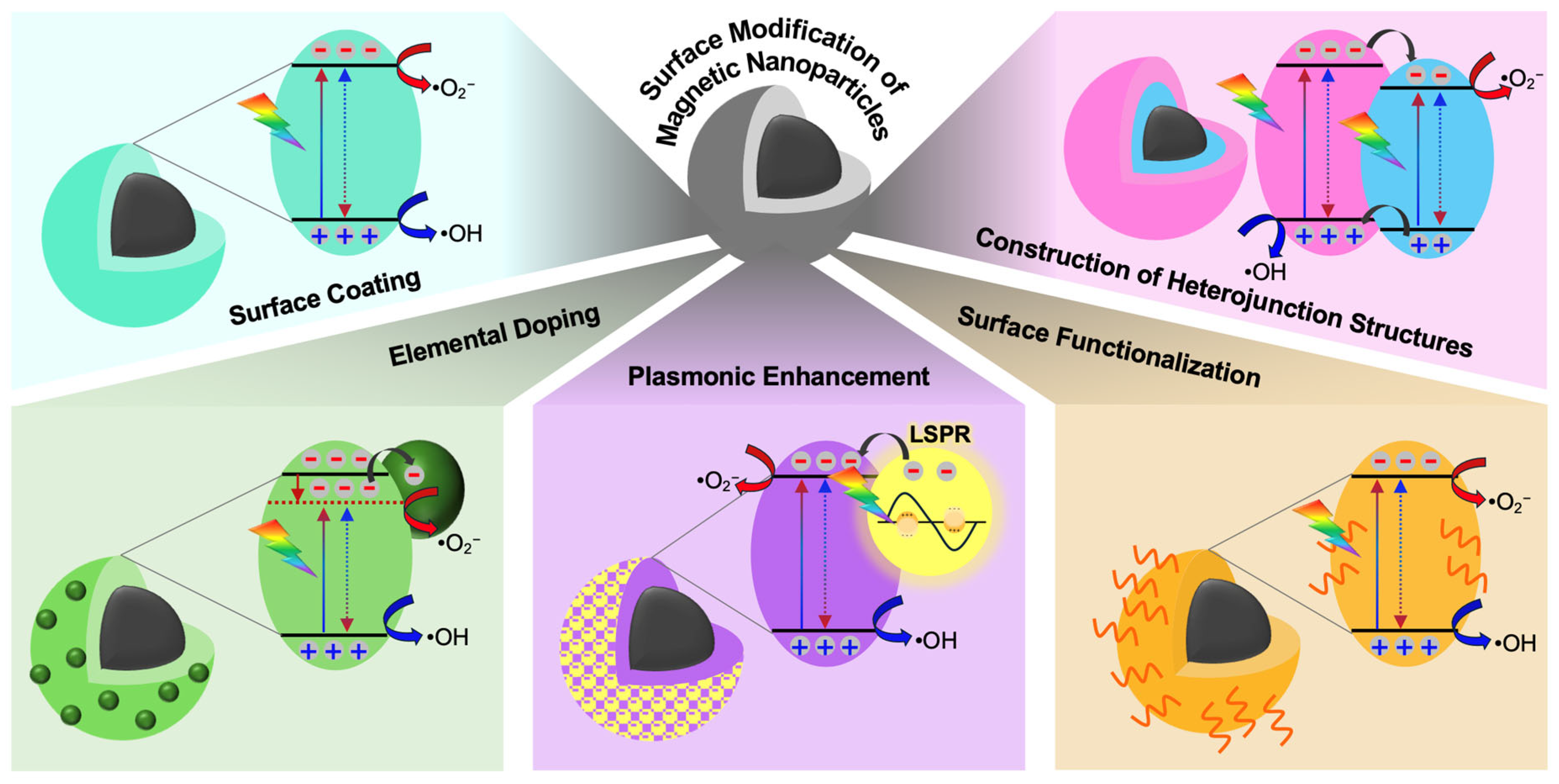
Given the limitations of bare MNPs, a variety of modification strategies have been developed to improve their stability, light absorption, and charge-carrier dynamics. These strategies include surface coating, elemental doping, plasmonic enhancement, surface functionalization, and the construction of heterojunction structures. Each approach offers distinct advantages in expanding visible-light absorption, promoting charge separation, and suppressing electron–hole recombination.
From an application-oriented standpoint, heterojunction structures and surface coating strategies offer substantial improvements in photocatalytic efficiency and have been widely investigated due to their ability to regulate charge-carrier dynamics through engineered band alignment, thereby reducing recombination losses and improving light-driven reaction efficiency [71,78]. Core–shell materials and semiconductor heterojunctions are therefore frequently reported to exhibit high activity under both UV and visible-light irradiation. Despite these advantages, their functional performance is strongly governed by interfacial quality, crystallographic compatibility, and shell thickness. In particular, structural imperfections at interfaces or excessive shell growth may impede electron transfer and, in magnetically recoverable systems, compromise separation efficiency [79,80,81]. Furthermore, the reliance on multistep synthesis procedures and precise control over morphology and crystallinity presents challenges for cost-effective and large-scale production [82].
Metal and non-metal doping provide an alternative route for tuning electronic properties and broadening optical absorption while maintaining a relatively simple synthesis procedure. Although controlled dopant levels can enhance photocatalytic performance, excessive incorporation tends to introduce deep trap states that facilitate charge recombination and accelerate material degradation under prolonged irradiation [42,83]. Noble-metal-based plasmonic modifications further enable visible-light activation via localized surface plasmon resonance (LSPR) effects; however, their practical deployment is constrained by economic considerations and stability issues, including metal aggregation and leaching [84,85]. Surface functionalization provides an effective means to enhance interfacial charge transport and reactant adsorption while maintaining relatively low processing energy requirements [86].
Overall, these modification strategies provide effective and versatile pathways for enhancing photocatalytic efficiency, stability, and light utilization. The following subsections discuss these modification techniques and their specific roles in enhancing the performance of MNP-based photocatalysts.

3.1. Surface Coating

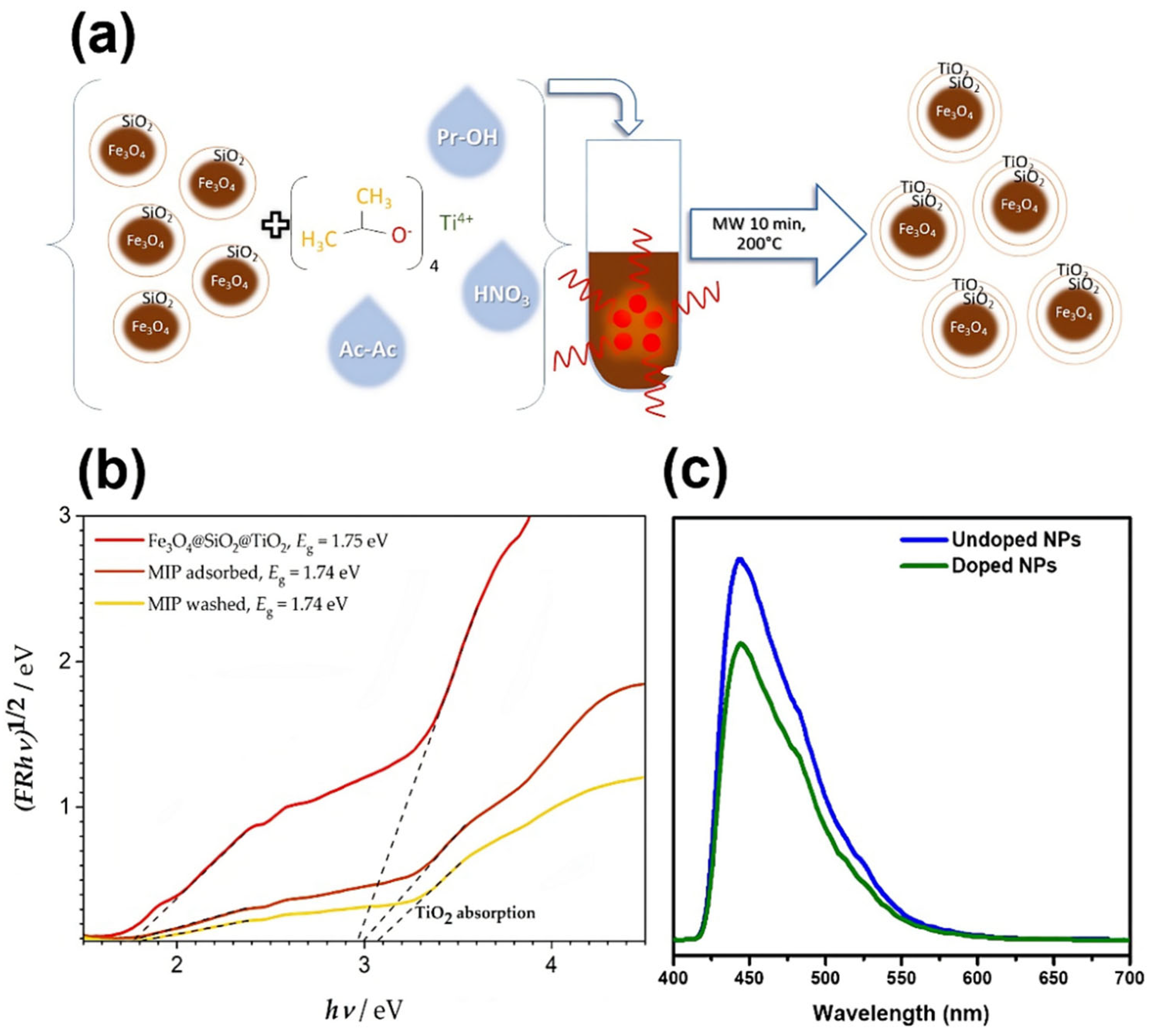
Surface coating, particularly with metal oxides, modifies the optical properties of magnetic photocatalysts by introducing photocatalytic activity and reducing the recombination rate of photogenerated charges [71]. This is often achieved through the design of core–shell structures in which a magnetic core is encapsulated by a shell composed of a photocatalytically active material (Figure 1a) [87]. Such configurations enable spatial separation of charge carriers and enhanced interfacial interactions, thereby improving overall photocatalytic efficiency. For example, a magnetic molecularly imprinted polymer (MIP)-based Fe3O4/SiO2/TiO2 system exhibited two distinct optical absorption edges at approximately 1.7 and 3.0 eV, attributed to the Fe3O4 core and the TiO2 shell, respectively. The visible-light activity (below ~3 eV) was linked to interfacial charge transfer between Fe3O4 and TiO2, which facilitated improved charge separation and consequently enhanced photocatalytic performance (Figure 1b) [88]. In another study, a core–shell ZnFe2O4/SiO2/TiO2 composite synthesized via the sol–gel method exhibited a slight increase in Eg from 3.13 eV to 3.25 eV due to the outer TiO2 coating [89]. These examples demonstrate that surface coatings may induce only minor changes in Eg while substantially improving photocatalytic efficiency by promoting effective charge separation between photogenerated electrons and holes. In addition, surface coatings can reduce defects and passivate active sites within the shell, while improving interfacial charge transfer between the core and the shell. These effects collectively suppress electron–hole recombination and sustain photocatalytic activity under prolonged operational conditions.

3.2. Elemental Doping

Doping, achieved by incorporating foreign metal or non-metal atoms into the photocatalyst lattice, introduces new energy levels and modifies the material’s band gap [91]. This modification enhances charge separation and extends light absorption into the visible region, addressing a common limitation of unmodified photocatalysts. For example, a TiO2@ZnFe2O4/Pd nanocomposite demonstrated improved photocatalytic activity for diclofenac (DCF) degradation. The enhancement was attributed to Pd doping, which reduced electron–hole recombination and prolonged charge-carrier lifetimes [92]. Similarly, embedding Fe3O4/SiO2 nanocomposites into a nitrogen-doped carbon xerogel–titania (N-CXTi) matrix improved photocatalytic performance. The N-CXTi matrix exhibited an Eg of 3.22 eV, lower than that of the commercial TiO2 P25 photocatalyst (Eg = 3.5 eV) [93]. As shown in Figure 1c, photoluminescence (PL) spectra of Nb-doped and undoped Fe3O4@SiO2@TiO2 NPs indicate that Nb doping significantly reduces PL intensity, reflecting effective suppression of electron–hole recombination [90]. By introducing dopants, trap energy levels are generated that prolong charge-carrier lifetimes, suppress recombination, and thereby improve photocatalytic activity under visible-light irradiation.

3.3. Plasmonic Enhancement

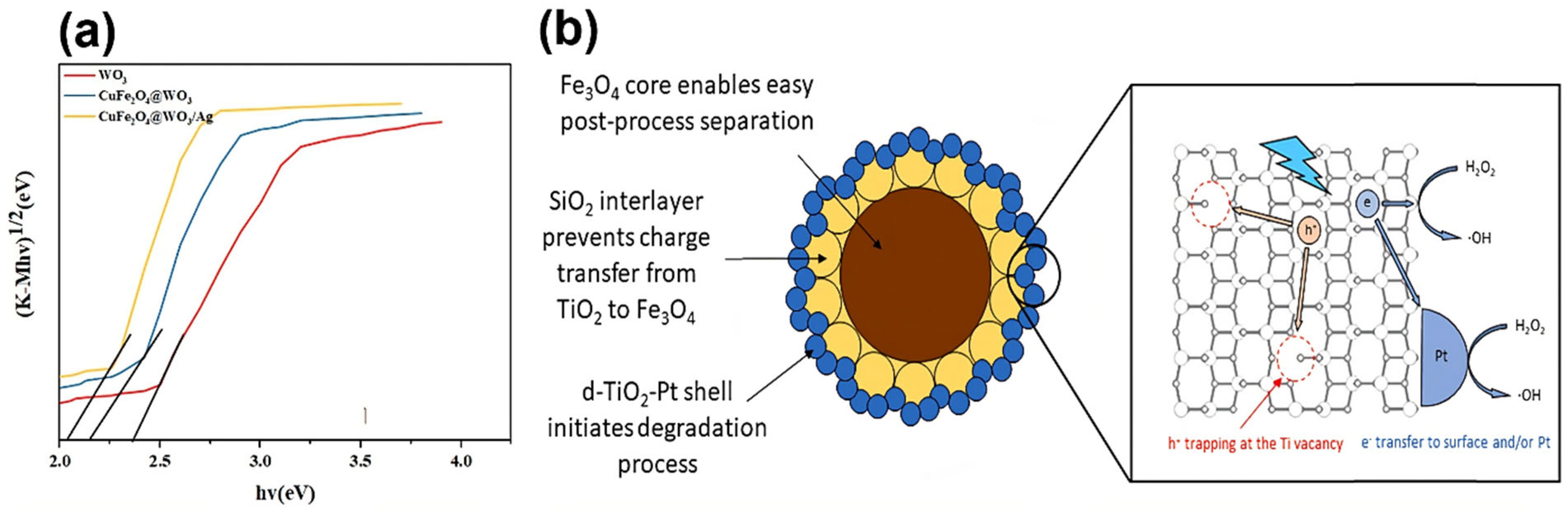
Plasmonic enhancement, particularly through noble metal NPs (gold, silver, and platinum), based on localized surface plasmon resonance (LSPR), significantly increases light absorption, especially within the visible range [84]. The superior performance of plasmonic nanocomposites is largely attributed to their tailored structural architecture, which promotes efficient charge-carrier separation and transfer. In one study, CuFe2O4@WO3/Ag NPs showed improved UV and partial visible-light absorption for the photodegradation of the drug pollutants Gemfibrozil and Tamoxifen when compared to CuFe2O4@WO3 NPs. This enhancement was accompanied by a reduction in Eg from 2.21 eV (CuFe2O4@WO3) to 2.13 eV (CuFe2O4@WO3/Ag), as shown in Figure 2a [94]. Similarly, in the plasmonic photocatalyst Ag/AgBr/ZnFe2O4, incorporation of metallic Ag NPs reduced the Eg to 1.7 eV, improving the degradation of carbamazepine (CBZ) [95].
The plasmonic resonance effect promotes the generation of hot electrons, which are subsequently transferred into the semiconductor conduction band. This process suppresses electron–hole recombination and thereby enhances photocatalytic activity under visible-light irradiation. As illustrated in Figure 2b, in a Fe3O4@SiO2/d-TiO2/Pt photocatalyst, the inclusion of a Pt cocatalyst facilitates the extraction of photogenerated electrons from the TiO2 shell, while the SiO2 interlayer inhibits hole migration toward the Fe3O4 core. This spatial separation prevents the formation of Ti–Fe secondary phases and promotes hole trapping at Ti4+ vacancies, resulting in more efficient charge-carrier dynamics under oxidative conditions [96].

3.4. Surface Functionalization

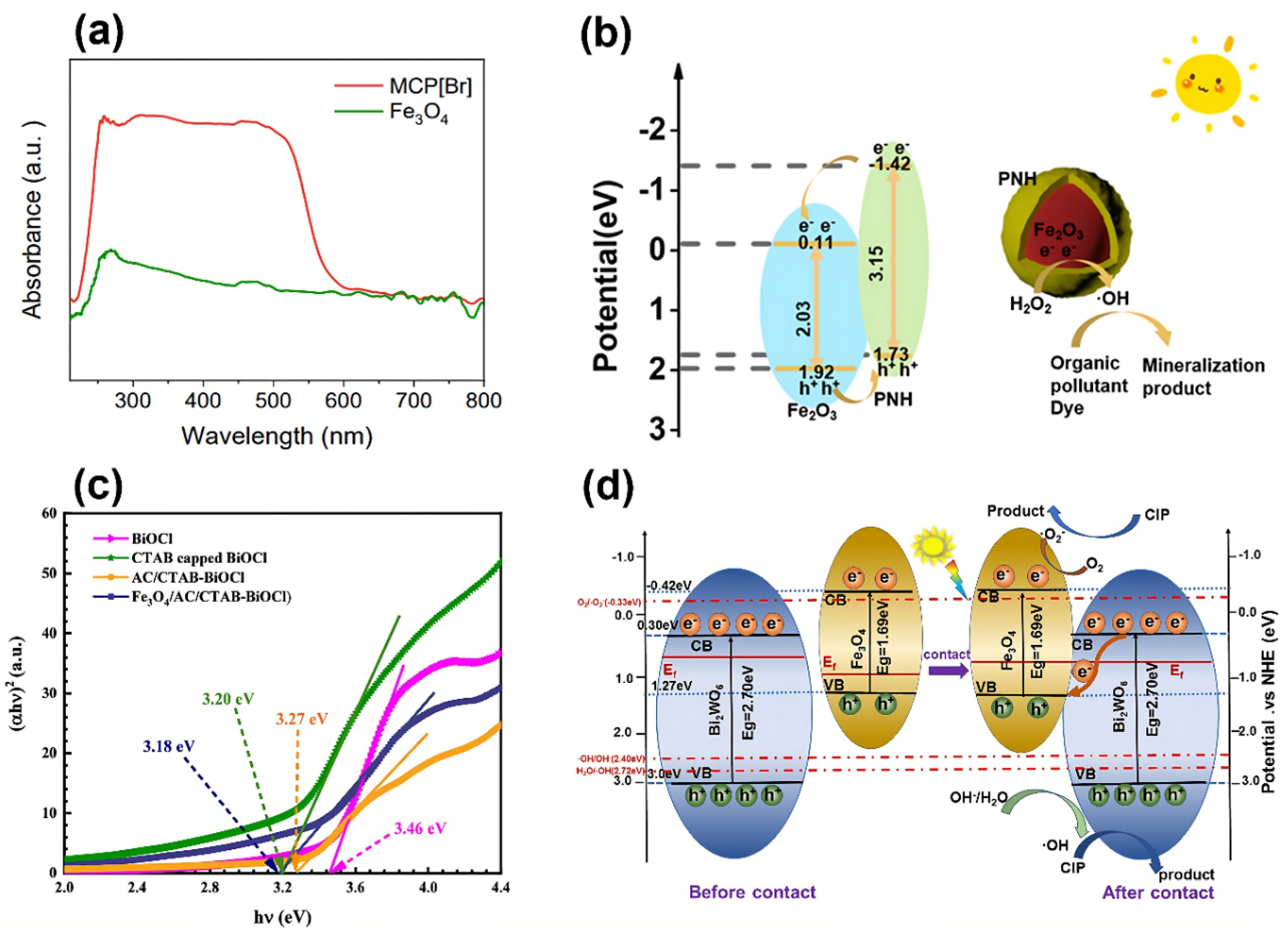
Functionalizing MNPs with polymers, complex molecules containing targeted binding sites, or other functional groups improves light absorption, reduces aggregation, and enhances pollutant interactions while preserving magnetic properties [43,97]. γ-Fe2O3@SrCO3 NPs functionalized with PW12O403− polyoxometalate (POM) anions demonstrated high efficiency in the photocatalytic degradation of ibuprofen (IBP) in aqueous solutions under solar irradiation. This performance is associated with a direct Eg of 1.8 eV, which allows absorption in the visible region [98]. Similarly, magnetic conjugated polymers incorporating hydrophilic anions (MCP[Br]) exhibit visible-light-responsive photocatalytic behavior, reflected in a reduced Eg of 2.0 eV. The UV–visible diffuse reflectance spectra (DRS) (Figure 3a) show the enhanced light absorption for MCP[Br] relative to Fe3O4 NPs, highlighting the contribution of the polymeric component to visible-light activity [99]. In a related approach, poly(1,4,8,11-cyclotetradecane [2,2-bipyridine]-5,5-dicarboxamine)-coated Fe2O3 (Fe2O3@PNH) NPs operate via a visible-light photo-Fenton mechanism in which the polymer promotes interfacial charge separation and facilitates Fe(III)/Fe(II) cycling to generate •OH radicals from H2O2. Figure 3b summarizes the band structure, with X-ray photoelectron spectroscopy (XPS) valence-band onsets of 1.87 eV (Fe2O3@PNH) and 2.03 eV (Fe2O3), yielding estimated CB positions of approximately 0.11 and 0.19 eV, respectively. Tauc-derived Eg values of 3.15 eV (PNH), 1.92 eV (Fe2O3), and 1.68 eV (Fe2O3@PNH) support a downhill electron-transfer pathway that accelerates H2O2 activation [100].
Overall, surface functionalization enhances surface reactivity and introduces specific binding sites, thereby improving charge-separation efficiency and suppressing electron–hole recombination. In addition, it increases nanoparticle selectivity toward target contaminants and elevates overall photocatalytic performance under visible-light irradiation.

3.5. Construction of Heterojunction Structures

An effective strategy to enhance photocatalytic efficiency is the construction of heterojunctions by integrating semiconductors with complementary band gaps and band alignments to facilitate charge separation. For example, magnetic γ-Fe2O3 ultrathin nanosheets paired with mesoporous black TiO2 hollow sphere form γ-Fe2O3/b-TiO2 heterojunctions capable of degrading tetracycline (TC) under visible light, with an optimized Eg of ~2.41 eV. Individually, black TiO2 and γ-Fe2O3 exhibit Eg of approximately 3.07 and 1.94 eV, respectively [103]. The nanosheet and hollow morphologies promote separation and transport of photogenerated charge carriers, thereby enhancing photocatalytic activity. Similarly, Fe3O4/activated carbon/cetyltrimethylammonium bromide–bismuth oxychloride (Fe3O4/AC/CTAB–BiOCl) exhibits an Eg of 3.18 eV, compared to 3.46 eV (BiOCl), 3.20 eV (CTAB–BiOCl), and 3.27 eV (AC/CTAB–BiOCl), as derived from Tauc plots (Figure 3c), consistent with improved visible-light absorption in the heterojunction [101].
In another study, γ-Fe2O3 and ZnO show band gaps of 2.05 and 3.20 eV, respectively, while a γ-Fe2O3@ZnO core–shell composite exhibits a 206 nm redshift in its absorption edge relative to ZnO, thereby improving its visible-light harvesting capability [104]. Furthermore, a 2D/2D Fe3O4/bismuth tungstate (Bi2WO6) heterostructure (Figure 3d) operates via a direct Z-scheme mechanism. The measured conducted-band potential of Fe3O4 (≈−0.42 eV) and valence-band potential of Bi2WO6 (≈+3.0 eV) enable the generation of O2 radicals by electrons retained on Fe3O4 and •OH radicals by holes on Bi2WO6 under visible light, preserving strong redox potentials while enhancing charge separation and overall photocatalytic performance [102]. Collectively, heterojunctions effectively suppress electron–hole recombination, thereby significantly increasing photocatalytic efficiency.

4. Applications of Surface-Modified Magnetic Nanoparticles for Antibiotic Degradation

4.1. Most Common Antibiotics and Their Photodegradation by Magnetic Nanoparticle-Based Catalysts
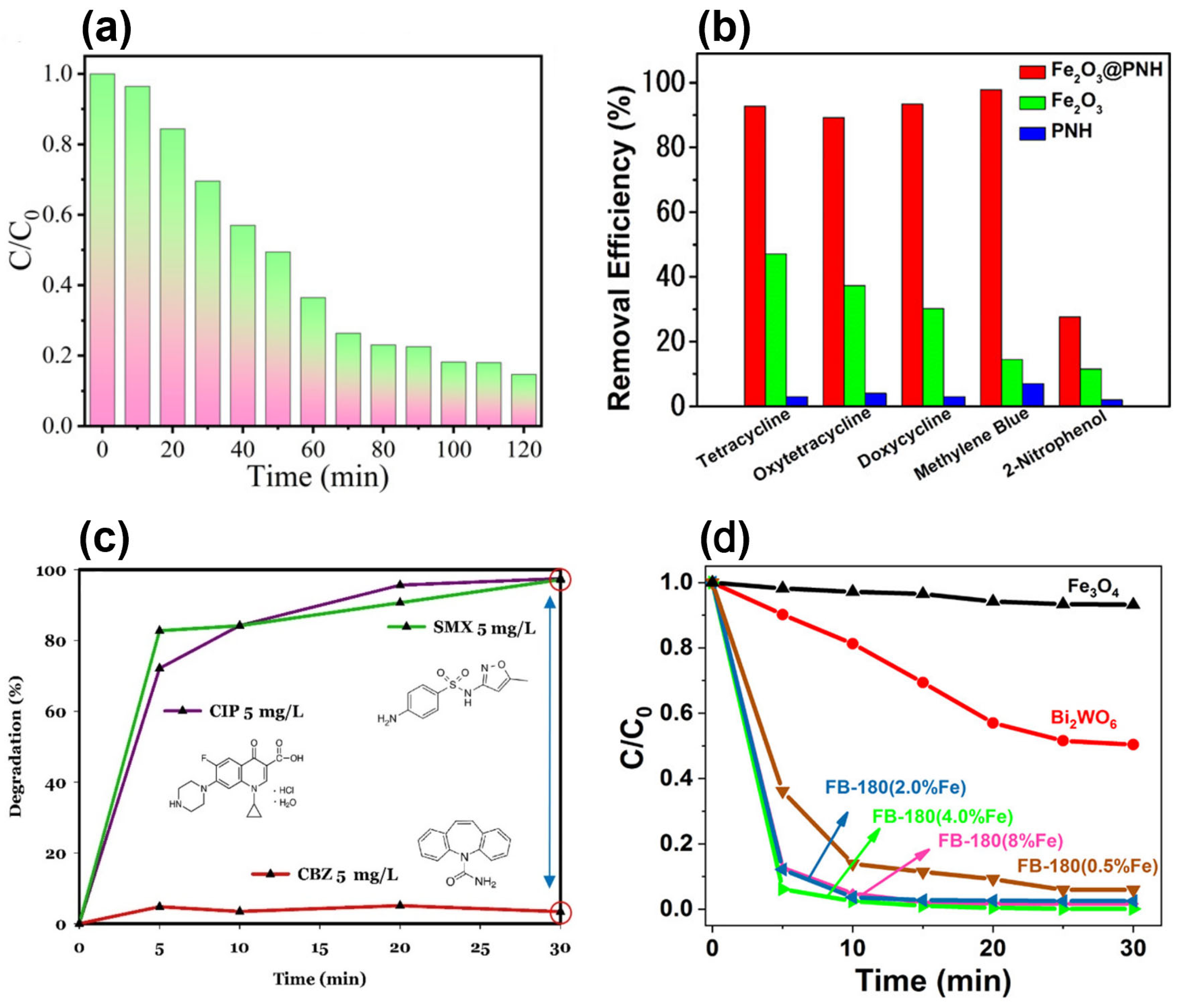
The presence of antibiotics and pharmaceuticals in wastewater constitutes a major environmental concern due to their persistence and potential adverse effects on ecosystems and human health. Table 1 summarizes numerous studies reporting the occurrence of commonly detected antibiotics in wastewater, including tetracycline (TC), sulfamethoxazole (SMX), ciprofloxacin (CIP), trimethoprim (TMP), metronidazole (MTZ), and norfloxacin (NOR) [10,13,14,18,105]. These compounds are also listed in the 23rd WHO Model List of Essential Medicines, highlighting their widespread use and global importance [106]. In addition to antibiotics, other pharmaceutical groups, such as analgesics, anti-inflammatory drugs, and antiepileptics, specifically acetaminophen (ACP), ibuprofen (IBP), carbamazepine (CBZ), and diclofenac (DCF), are frequently detected in wastewater [16,105,107,108,109].
Surface-modified MNPs are widely applied in the removal of pharmaceutical contaminants from wastewater, with their performance strongly dependent on the nature of their interactions with target compounds. Selectivity is a key factor governing this process, as removal efficiency depends on the specificity of interactions between the material surface and the contaminant. This selective behavior is controlled by the compatibility between surface chemistry and the physicochemical characteristics of the target molecules, including polarity, molecular structure, and functional groups [97,110]. Consequently, certain materials exhibit high removal efficiency toward specific pharmaceutical classes while showing limited effectiveness toward others. From a treatment perspective, selectivity primarily reflects preferential adsorption or transformation of target antibiotics rather than complete mineralization. Although selective interactions can result in high or complete degradation, the extent of mineralization depends on compound-specific degradation pathways. Several studies report that selective degradation may proceed through partial oxidation, leading to the formation of transformation by-products whose persistence depends on the material properties and operating conditions.
Tetracycline (TC). TC is a broad-spectrum antibiotic used to treat a wide range of bacterial infections, including respiratory infections, sexually transmitted diseases (STDs), acne, and ocular infections [106,111]. It inhibits bacterial protein synthesis and is also extensively used in veterinary medicine for livestock disease control [112]. Due to its persistence in aquatic environments, numerous photocatalytic systems have been developed for TC degradation [103,113]. Various photocatalysts have demonstrated effective TC removal in aqueous media. The visible-light-assisted MCP[Br] photocatalyst achieved 99% TC removal at an initial concentration of 10 mg L−1 within 2 h, while 20% removal in the dark was attributed to adsorption [99]. A TiO2/CoFe2O4 composite outperformed the individual components, achieving 75.3% TC degradation (10 mg L−1) under UV light and 50.4% under visible light within 180 min [114]. In addition, a microcapsulated phase-change material (MEPCM) with an n-docosane core and a SiO2/Fe3O4 composite shell coated with bismuth oxyiodide (BiOI) nanosheets (BiOI–MEPCM) exhibited 85.3% TC degradation under visible light after 120 min (Figure 4a), demonstrating its potential for solar-driven wastewater treatment [115]. Beyond removal efficiency, mechanistic insight has been reported for selected systems; for example, defect-engineered γ-Fe2O3/black TiO2 heterojunctions enabled identification of stepwise tetracycline degradation pathways involving successive bond cleavage, ring-opening reactions, and intermediate formation [103]. More comprehensive mineralization was demonstrated using a TiO2–ferroferric oxide–activated carbon composite (TFOC) showed rapid photocatalytic activity, achieving 96% degradation of TC (60 mg L−1) under UV light within 60 min through oxidation, demethylation, dehydroxylation, and subsequent mineralization to CO2 and H2O via active species such as h+, •OH, and O2 [116]. The multilayer core–shell MnFe2O4@Bi24O31Br10/Bi5O7I (M@B/B) structure achieved 95% TC degradation (50 mg L−1) within 100 min, outperforming MnFe2O4 NPs and MnFe2O4@Bi24O31Br10 (M@B) [117]. Furthermore, a Fe2O3@PNH catalyst exhibited enhanced visible-light-driven Fenton-like degradation of TC, achieving approximately 90% removal at an initial concentration of 50 mg L−1 within 120 min. This performance was 2–5 times higher than that of pristine Fe2O3, while PNH alone showed negligible activity (Figure 4b). Under identical conditions, complete degradation of methylene blue was observed, whereas TC derivatives such as oxytetracycline and doxycycline exhibited removal efficiencies of up to 90% [100]. These results emphasize the role of selectivity, whereby differences in molecular structure influence interactions with the catalyst surface and lead to variable degradation efficiencies.
Sulfamethoxazole (SMX). SMX is a widely used sulfonamide antibiotic in both human and veterinary medicine, primarily for the treatment of bacterial infections such as urinary tract infections (UTIs), respiratory infections, diarrhea, and prostatitis [21,106]. Despite its therapeutic importance, SMX is frequently detected in wastewater, surface waters, and wastewater treatment plant (WWTP) effluents [10,107,118]. Recent advances in photocatalytic technologies have demonstrated significant potential for SMX removal. For example, Fe3O4/ZnO nanocomposites achieved complete degradation of 100 μg L−1 SMX after 240 min of irradiation [21]. A magnetic carbon nanotube–TiO2 (MCNT–TiO2) composite achieved approximately 90% SMX removal (150 μg L−1) under solar irradiation within 30 min [119]. Beyond removal efficiency, mechanistic investigations reported in the literature indicate that SMX degradation typically proceeds via initial cleavage of the sulfonamide bond, followed by hydroxylation and ring-opening reactions, with multiple intermediate species identified depending on the photocatalyst and reaction conditions [118]. An illustrative example of selective pharmaceutical degradation was observed using a magnetic ZnO/γ-Fe2O3/bentonite nanocomposite. Under solar irradiation, the material achieved rapid degradation of SMX and CIP, with removal efficiencies of approximately 97% and 98%, respectively, within 30 min at 5 mg L−1. In contrast, CBZ exhibited strong resistance to degradation, with only 3% removal in a ternary mixture under the same conditions (Figure 4c) [120]. This pronounced difference highlights the selective nature of the photocatalytic process and is attributed to variations in molecular structure and chemical reactivity. Specifically, the chemical stability of CBZ and the absence of readily degradable functional groups reduce its susceptibility to photocatalytic attack compared with the more reactive structures of SMX and CIP.
Figure 4. (a) Photocatalytic degradation of tetracycline using BiOI–MEPCM as the photocatalyst under light irradiation. Reproduced with permission from ref. [115]. Copyright 2023, MDPI. (b) Photocatalytic degradation efficiencies of tetracycline, oxytetracycline, doxycycline, and methylene blue using Fe2O3@PNH, Fe2O3, and PNH under visible-light irradiation. Reproduced with permission from ref. [100]. Copyright 2020, ACS. (c) Photodegradation of ciprofloxacin (CIP; 5 mg L−1), sulfamethoxazole (SMX; 5 mg L−1), and carbamazepine (CBZ; 5 mg L−1) using a ZnO/γ-Fe2O3/bentonite nanocomposite. Reproduced with permission from ref. [120]. Copyright 2022, MDPI. (d) Photodegradation of ciprofloxacin by Fe3O4/Bi2WO6 photocatalysts with varying iron content, with individual Fe3O4 and Bi2WO6 components shown for comparison. Reproduced with permission from ref. [102]. Copyright 2021, ACS.
Applsci 16 00844 g004
Ciprofloxacin (CIP). CIP is one of the most widely prescribed fluoroquinolone antibiotics used to treat bacterial infections, including UTIs, respiratory infections, and gastrointestinal infections. It acts by inhibiting bacterial DNA replication [121] and is therefore effective against invasive bacterial diarrhea, enteric fever, and mild pyelonephritis or prostatitis [106]. CIP is frequently detected in wastewater due to its poor removal by conventional wastewater treatment processes [14,18]. Recent advances in photocatalysis have demonstrated significant potential for enhancing CIP removal from aquatic systems. Notably, Fe-modified Fe3O4/Bi2WO6 photocatalysts exhibit strong activity dependence on Fe loading, with maximal degradation efficiency (99.7%) observed at 4% Fe content. Figure 4d shows that, under identical conditions, pure Bi2WO6 and Fe3O4 achieved only 51.8% and 5.0% degradation, respectively, whereas Fe-modified photocatalysts containing 0.5%, 2%, and 8% Fe reached 93.5%, 97.4%, and 96.5% CIP degradation, respectively [102]. A metal–organic framework (MOF) layer supporting the growth of an MIP enables enhanced selective removal in aqueous systems. Performance evaluation in real wastewater spiked with CIP (5, 10, and 20 mg L−1) demonstrated that MOF-based Fe3O4@MIL-100(Fe)@MIP achieved over 95% removal of 10 mg L−1 CIP within 24 h under visible light [122]. Within 60 min of irradiation, the γ-Fe2O3@ZnO core–shell photocatalyst achieved 92.5% degradation of CIP at an initial concentration of 10 mg L−1, significantly outperforming pure γ-Fe2O3 (11.7%) and ZnO (52.4%). Mechanistic investigations for this system indicated that CIP degradation proceeded through hydroxyl radical–mediated oxidation and piperazine ring cleavage, accompanied by the formation of intermediate species [104]. In addition, the Fe3O4/SiO2/TiO2 composite exhibited high photocatalytic activity under UV light, achieving 95% degradation of 5 mg L−1 CIP within 90 min [123]. These findings demonstrate the effectiveness of such materials in minimizing CIP contamination in wastewater, therefore mitigating its environmental impact.
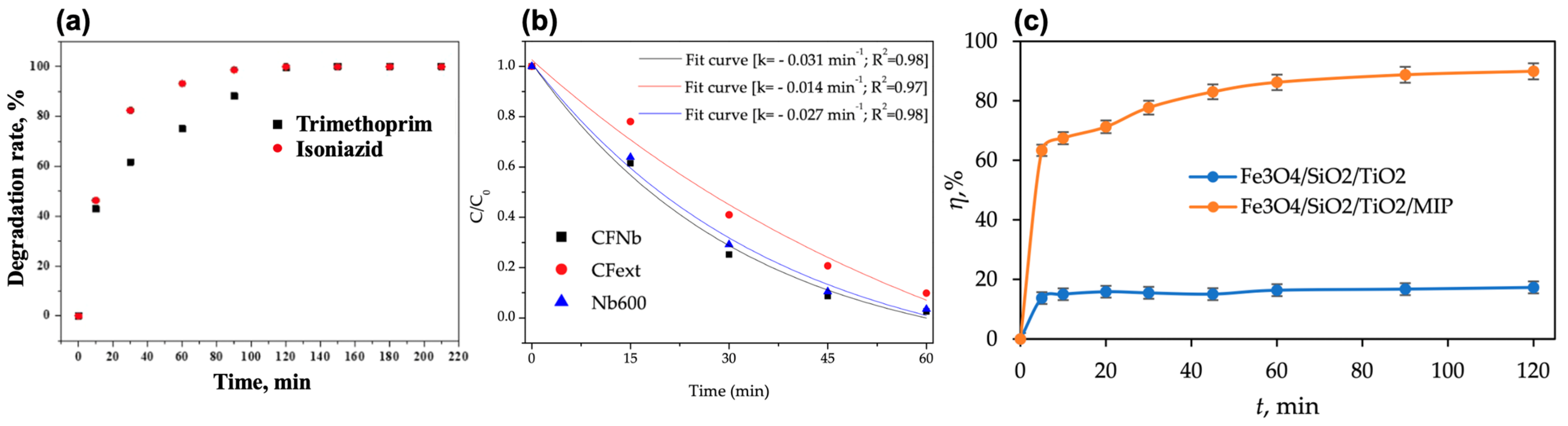
Trimethoprim (TMP). TMP is an antibiotic that inhibits a key bacterial enzyme involved in DNA synthesis [124]. It is frequently co-administered with SMX for the treatment of UTIs, bronchitis, and certain types of pneumonia [21,106]. Recent studies have demonstrated the feasibility of photocatalytic degradation of TMP in water treatment processes. For instance, a magnetic multifunctional photocatalyst, g-C3N4@TiO2@Fe3O4, achieved nearly complete degradation of TMP (200 mg L−1) within 120 min under UV irradiation (Figure 5a) [125]. Similarly, TiO2 NPs and carbon nanofiber-modified Fe3O4 (TiO2@Fe3O4@C-NFs) catalysts achieved a high degree of mineralization of TMP (5 mg L−1) within 125 min under UV irradiation [126]. In contrast, a Fe3O4/ZnO nanocomposite removed only 36% of TMP after 240 min of UV irradiation, although the same material completely eliminated SMX under identical conditions [21]. This observation highlights the selective nature of the photocatalytic activity of the Fe3O4/ZnO nanocomposite, which arises from differences in chemical reactivity and molecular structure among the target compounds.
Acetaminophen (ACP). Paracetamol (PA), also known as ACP, is one of the most widely used pharmaceuticals worldwide for pain relief, including headaches, muscle pain, joint pain, and dental pain, as well as for fever reduction [93]. Due to its extensive use and disposal, particularly from healthcare facilities, ACP is frequently detected in aquatic environments. Recent photocatalytic technologies show strong potential for mitigating this form of water contamination. For instance, a ZnO/Fe3O4–graphene oxide/MOF (ZnO/Fe3O4–GO/ZIF) nanocomposite achieved 99.1% degradation of ACP (10 mg L−1) under simulated solar irradiation within 45 min [127]. Likewise, a flower-like TiO2/Fe2O3 photocatalyst achieved complete mineralization of PA (50 mg L−1) within 90 min under UV light [128]. A Fe3O4/SiO2/N-CXTi system also exhibited excellent photocatalytic performance, achieving 99.2% ACP removal under UV irradiation within 180 min [93]. Furthermore, cobalt ferrite functionalized with niobium pentoxide (CoFe2O4@Nb2O5, CFNb) NPs achieved 97.5% degradation of PA (20 mg L−1) within 60 min, surpassing the performance of CoFe2O4 extract (CFext, 96.5%) and pure Nb2O5 (Nb600, 90.2%), as shown in Figure 5b [129]. These advanced photocatalysts represent highly effective approaches for reducing the ecological impact of ACP/PA in wastewater treatment systems.
Figure 5. (a) Degradation rates of trimethoprim and isoniazid using a g-C3N4@TiO2@Fe3O4 multifunctional nanohybrid material. Reproduced with permission from ref. [125]. Copyright 2022, ACS. (b) Comparison of the photocatalytic degradation efficiency of paracetamol using CoFe2O4@Nb2O5 (CFNb), CoFe2O4 extract (CFext), and pure Nb2O5 (Nb600). Reproduced with permission from ref. [129]. Copyright 2023, MDPI. (c) Comparison of the photocatalytic performance of Fe3O4/SiO2/TiO2/MIP and Fe3O4/SiO2/TiO2 nanocomposites for diclofenac degradation. Reproduced with permission from ref. [88]. Copyright 2025, MDPI.
Applsci 16 00844 g005
Ibuprofen (IBP). IBP is a nonsteroidal anti-inflammatory drug (NSAID) commonly administered for the relief of pain, inflammation, fever, arthritis, and headaches. Although conventional water treatment processes are generally effective in removing IBP, residual concentrations are still detected in aquatic environments, including rivers and lakes [108,130]. Recent studies have demonstrated efficient photocatalytic degradation of IBP in water systems. For example, POM–γ-Fe2O3/SrCO3 nanocomposite showed significant degradation of IBP at an initial concentration of 10 mg L−1 under solar irradiation within 2 h [98]. A visible-light-driven N-TiO2@SiO2@Fe3O4 photocatalyst achieved 94% degradation of IBP (2 mg L−1) within 5 h, while showing lower degradation efficiencies for benzophenone-3 and carbamazepine, highlighting its selective activity toward IBP [131]. However, Fe3O4/SiO2/TiO2 particles exhibited only 60% degradation of IBP (15 mg L−1) after 90 min under UV light [123]. In contrast, a mesoporous BiOBr/Fe3O4@SiO2 photocatalyst achieved nearly complete mineralization of IBP (2 mg L−1) after 6 h of visible-light irradiation [132]. These findings demonstrate that photocatalytic performance toward IBP is strongly dependent on catalyst composition and structure, and that magnetically separable systems can achieve both efficient degradation and, in selected cases, mineralization.
Carbamazepine (CBZ). CBZ is an anticonvulsant drug commonly prescribed for the treatment of epilepsy, bipolar disorder, and neuropathic pain. Its widespread occurrence in surface waters has drawn significant attention [10,96,109]. Numerous photocatalytic materials have been investigated to enhance CBZ removal from water. MCNT–TiO2 composites achieved 60% removal of CBZ (10 mg L−1) after 120 min under light irradiation [119]. Similarly, a Fe3O4@SiO2/d-TiO2/Pt photocatalyst achieved 96% CBZ degradation under UV light within 120 min, compared to 57% removal under visible light over the same period [96]. In contrast, an Ag/AgBr/ZnFe2O4 photocatalyst exhibited limited visible-light responsiveness, degrading only 22.7% of CBZ (10 mg L−1) within 240 min [95]. These results emphasize the necessity of optimizing photocatalytic systems to improve CBZ removal efficiency in water treatment applications.
Diclofenac (DCF). DCF is another widely used NSAID prescribed for the treatment of arthritis, inflammation, and musculoskeletal pain. Its extensive use and partial metabolic degradation in the human body have been associated with toxic effects on aquatic organisms [133,134]. Photocatalytic technologies have emerged as promising approaches [10,96,109] for DCF removal from water. TiO2@Zn Fe2O4/Pd nanocomposites achieved 84.8% degradation of DFC (10 mg L−1) under direct solar irradiation within 120 min, outperforming TiO2@ZnFe2O4 (73.3%) and ZnFe2O4 (49.9%) [92]. A Fe3O4/SiO2/TiO2/MIP photocatalyst exhibited enhanced selectivity and performance, removing approximately 80% of DCF (10 mg L−1) after 30 min of adsorption followed by 120 min of photocatalytic treatment under both UV and simulated solar light. As shown in Figure 5c, this material outperformed its non-imprinted counterpart (Fe3O4/SiO2/TiO2), confirming the effectiveness of molecular imprinting in improving photocatalytic efficiency [88]. Rose Bengal-functionalized Fe3O4@SiO2 NPs (Fe3O4@SiO2-RB) achieved complete DCF removal under visible light within 3 h [135]. In addition, a Fe3O4/Bi2S3/BiOBr (FeSBr) magnetic heterojunction photocatalyst demonstrated superior visible-light-driven DCF degradation, achieving 93.8% removal within 40 min with a rate constant of 0.0527 min−1, outperforming BiOBr, Bi2S3, and Bi2S3/BiOBr [134]. These systems demonstrate strong potential for mitigating DCF contamination in aquatic environments.
Overall, numerous studies have demonstrated the effective removal of antibiotics and pharmaceuticals from aquatic systems using various catalytic processes with high photocatalytic efficiency. In addition to the compounds discussed above, several other pharmaceuticals—including metronidazole (MNZ) [127,136], norfloxacin (NFX) [123,127], naproxen (NPX) [137], levofloxacin (LVX) [117,138], ketamine [139], ofloxacin (OFL) [101], penicillin (PCN) [140], erythromycin (ERY), roxithromycin (ROX) [21], tamoxifen (TAM), gemfibrozil (GEM) [94], triclosan (TCS) [117] and sulfamethazine (SMZ) [127]—have also been successfully treated using photocatalysis involving surface-modified MNPs.
Table 1. Overview of antibiotics targeted for water treatment using surface-modified magnetic photocatalysts.
AntibioticApplicationAntibiotic AmountMagnetic PhotocatalystDegradation EfficiencyTime
(min)
Ref.
Tetracycline (TC)Broad-spectrum antibiotic for bacterial infections10 mg L−1MCP[Br]99%120 [99]
10 mg L−1TiO2/CoFe2O475.3%180[114]
50 mg L−1BiOI–MEPCM 85.3% 120[115]
60 mg L−1TFOC96%60[116]
50 mg L−1M@B/B95%100[117]
50 mg L−1Fe2O3@PNH 90%120[100]
Sulfamethoxazole (SMX)Antibacterial for UTIs and respiratory infections5 mg L−1ZnO/γ-Fe2O3/Bentonite97%30[120]
100 μg L−1Fe3O4/ZnO100%240[21]
150 μg L−1MCNT–TiO290%30[119]
Ciprofloxacin (CIP)Fluoroquinolone for UTIs, gastrointestinal, and respiratory infections10 mg L−1Fe3O4/Bi2WO6 99.7%25[102]
5 mg L−1ZnO/γ-Fe2O3/bentonite93%30[120]
10 mg L−1γ-Fe2O3@ZnO92.5%60[104]
10 mg L−1Fe3O4@MIL-100(Fe)@MIP95%1440[122]
5 mg L−1Fe3O4/SiO2/TiO295%90[123]
Trimethoprim (TMP)Co-administered with SMX for UTIs, bronchitis, and pneumonia200 mg L−1g-C3N4@TiO2@Fe3O4100%120[125]
5 mg L−1TiO2@Fe3O4@C-NFs100%150[126]
100 mg L−1Fe3O4/ZnO36%240[21]
Acetaminophen (ACP)/Paracetamol (PA)Analgesic and antipyretic for mild to moderate pain and fever10 ppmZnO/Fe3O4–GO/ZIF99.1%45[127]
50 mg L−1TiO2/Fe2O3100%90[128]
25 mg L−1Fe3O4@SiO2/N-CXTi99.20%180[93]
20 mg L−1CoFe2O4@Nb2O597.5% 60[129]
Ibuprofen (IBP)NSAID for pain, inflammation, fever, arthritis, and headaches10 mg L−1POM–γ-Fe2O3/SrCO3Not reported120[98]
2 mg L−1N-TiO2@SiO2@Fe3O494%300[131]
15mg L−1Fe3O4@SiO2@TiO260%90 [123]
2 mg L−1BiOBr/Fe3O4@SiO2100%360[132]
Carbamazepine (CBZ)Anticonvulsant for epilepsy, neuropathic pain, and bipolar disorder10 mg L−1MCNT–TiO260%120 [119]
14 mg L−1Fe3O4@SiO2/d-TiO2/Pt96%120 [96]
10 mg L−1Ag/AgBr/ZnFe2O422.7%240 [95]
Diclofenac (DCF)NSAID for pain and inflammation, used for arthritis, migraines, and muscular pain10 mg L−1TiO2@ZnFe2O4/Pd84.8%120 [92]
10 mg L−1Fe3O4/SiO2/TiO2/MIP 80%120[88]
5 × 10⁵ MFe3O4@SiO2-RB100%180[135]
10 mg L−1Fe3O4/Bi2S3/BiOBr93.80%40 [134]

4.2. Recovery, Reusability, and Long-Term Performance of Magnetic Nanoparticles

The magnetic properties of NPs play a critical role in facilitating their recovery and enabling repeated reuse over multiple photocatalytic cycles, which is essential for the large-scale application of environmental remediation technologies. Magnetic responsiveness allows NPs to be separated directly from treated water using an external magnetic field, thereby overcoming the limitations of conventional, energy-intensive, and time-consuming separation techniques such as filtration and centrifugation. This rapid and efficient magnetic separation not only enhances operational efficiency but also reduces the generation of secondary waste associated with non-recyclable catalysts [141]. Most importantly, magnetic separation significantly contributes to the sustainability of photocatalytic treatment systems, as NPs can be readily recovered and reused with minimal loss of catalytic activity [142]. Such reusability is crucial for cost reduction, as it lowers both the frequency and quantity of photocatalyst required, thereby improving the long-term economic feasibility of nanotechnology-based water treatment.
Numerous studies have demonstrated that magnetic core NPs—such as Fe3O4, γ-Fe2O3, and XFe2O4—when coupled with metal oxides, exhibit high structural stability and consistent photocatalytic performance over multiple cycles. Their durability during repeated photocatalytic reactions and recovery processes makes them well-suited for water treatment applications. These NPs are typically washed and, in some cases, dried prior to reuse, ensuring sustained functionality across cycles. Their ability to maintain consistent activity over repeated use highlights their robust performance and sustainability for long-term operation in wastewater treatment systems [59,142]. A summary of recent advances in degradation efficiency and recyclability of surface-modified magnetic photocatalysts for antibiotic removal is presented in Table 2.
Fe3O4-Based Systems. Magnetite (Fe3O4) is the most widely used magnetic core due to its high saturation magnetization and excellent chemical stability. When integrated with metal oxides, Fe3O4 provides efficient magnetic recovery while enhancing photocatalytic durability through improved charge transfer and structural protection [143]. The mesoporous BiOBr/Fe3O4@SiO2 composite retained approximately 80% of its initial photocatalytic activity after five consecutive 60-min cycles and achieved nearly 99% magnetic separation efficiency within 5 min. Despite a reduced saturation magnetization (MS ≈ 40 emu g−1) compared with bare Fe3O4 (~65 emu g−1), the material remained suitable for rapid magnetic recovery [132]. A similar level of stability was observed for the Fe3O4/AC–CTAB–BiOCl photocatalyst, which maintained high OFL degradation efficiency over five cycles (Figure 6a). Fe3O4 and Fe3O4/AC–CTAB–BiOCl exhibited MS values of 91.7 and 2.2 emu g−1, respectively, and their narrow hysteresis loops confirmed superparamagnetic behavior and excellent recyclability [101]. The TiO2/SiO2/Fe3O4 composite also showed high reusability, with less than a 10% decrease in the apparent rate constant (kapp) over four cycles for ACP removal, compared with TiO2/Fe3O4. Adequate magnetic separation was maintained, with MS values of 38.9 emu g−1 for TiO2/SiO2/Fe3O4 and 45.0 emu g−1 for TiO2/Fe3O4, despite partial magnetization loss due to the SiO2 coating [144].
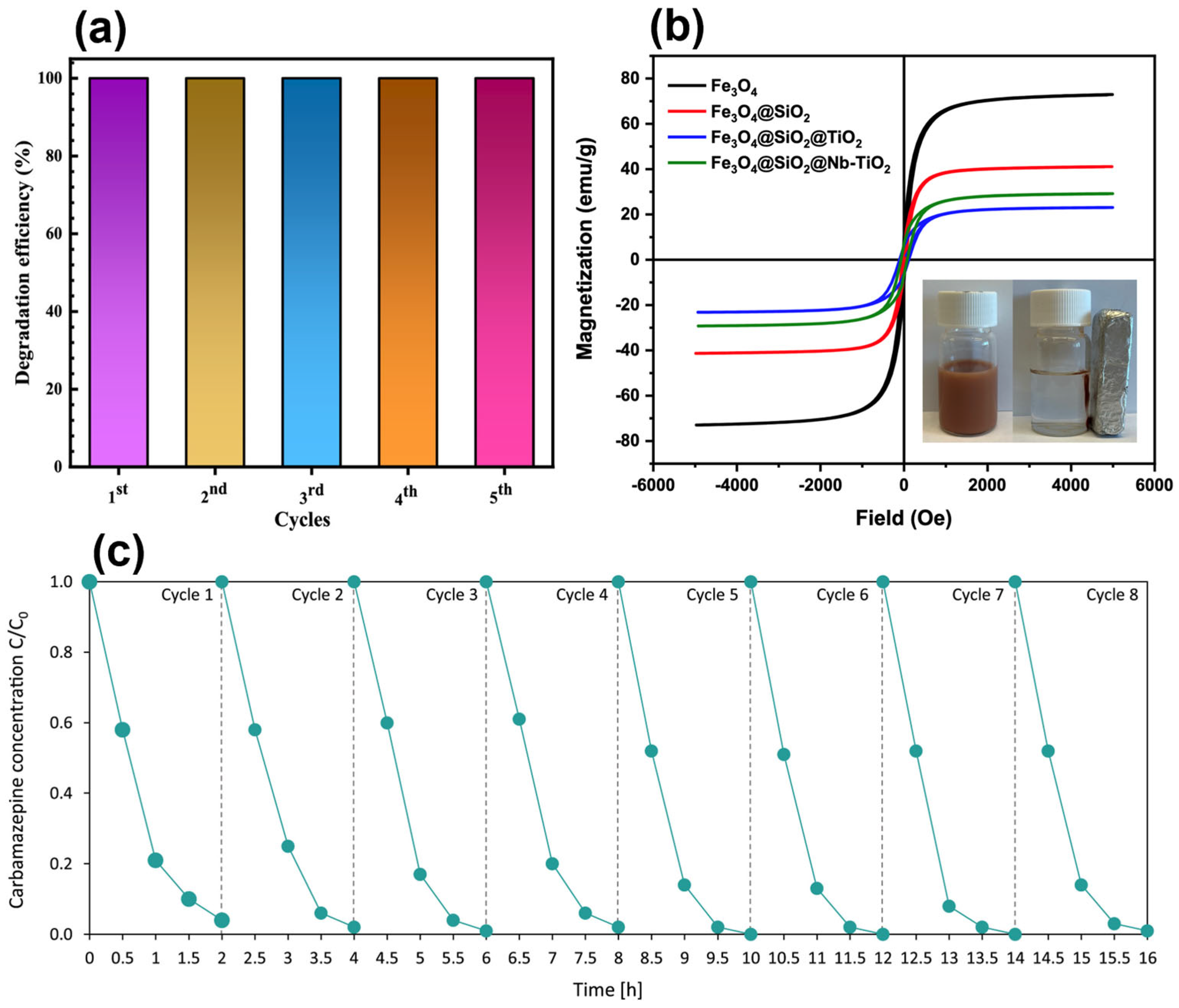
As shown in Figure 6b, Fe3O4@SiO2@Nb-TiO2 NPs retained a strong magnetic response while preserving ferrimagnetic behavior. The MS decreased from 73 emu g−1 for Fe3O4 to 41, 22, and 19 emu g−1 for Fe3O4@SiO2, Fe3O4@SiO2@TiO2, and Fe3O4@SiO2@Nb-TiO2, respectively, due to the presence of non-magnetic shells. Nevertheless, rapid magnetic separability was retained, and only a moderate decline in CIP degradation efficiency was observed, decreasing from 94% to 77% after five cycles [90].
The Fe3O4/SiO2/TiO2@reduced graphene oxide (rGO) nanocomposite also demonstrated good recyclability, with MNZ removal decreasing from 94.2% to 63.5% over four cycles. Although the MS value declined to 14.8 emu g−1 due to the TiO2 and rGO layers, rapid magnetic separation within 30 s was still achieved [136]. Similarly, the Fe3O4@SiO2/d-TiO2/Pt photocatalyst demonstrated comparable robustness, maintaining CBZ degradation efficiency over eight successive cycles without detectable performance loss, confirming its strong magnetic stability and structural integrity (Figure 6c) [96].
Among the reported systems, Fe3O4/ZnO demonstrated the highest durability, maintaining stable photocatalytic efficiency over eight cycles without the need for additional catalysts. Although its MS value was relatively low (4.3 emu g−1) due to minimal Fe3O4 loading, it remained sufficient to sustain superparamagnetic behavior and prolonged operational stability [21]. Comparatively, Fe3O4/ZnO and Fe3O4@SiO2/d-TiO2/Pt exhibited superior durability, whereas BiOBr/Fe3O4@SiO2 and Fe3O4/AC–CTAB–BiOCl provided the highest separation efficiency. TiO2/SiO2/Fe3O4 and Fe3O4@SiO2@Nb-TiO2 offered balanced recyclability and magnetic responsiveness, while Fe3O4/SiO2/TiO2@rGO, despite its lower magnetization, exhibited the fastest magnetic response. Collectively, these systems demonstrate the complementary advantages and trade-offs among Fe3O4-based photocatalysts in terms of durability, magnetization, and recyclability.
γ-Fe2O3-Based Systems. Hematite (γ-Fe2O3) exhibits high chemical stability and visible-light photoactivity, making it suitable for photocatalytic applications due to its favorable optical properties (Eg ≈ 2.2 eV). Although its saturation magnetization is lower than that of Fe3O4, coupling γ-Fe2O3 with metal oxides or conductive phases significantly enhances charge separation and recyclability [145]. For example, POM–γ-Fe2O3/SrCO3 nanohybrids efficiently degraded IBP over four cycles with minimal loss of activity, while their superparamagnetic behavior (MS = 11 emu g−1) enabled rapid magnetic separation [98]. The Fe2O3@PNH system also demonstrated high structural stability and reproducibility, retaining nearly 90% catalytic efficiency over five consecutive cycles with negligible performance loss (Figure 7a) [100]. Similarly, γ-Fe2O3@ZnO core–shell NPs maintained a CIP degradation efficiency of 90.3% over six cycles, with only a 2.8% decline attributed primarily to material loss. Despite a reduction in MS from 55.2 to 39.1 emu g−1, the composite preserved excellent ferromagnetic properties, with a remanent magnetization of 5.2 emu g−1 and a coercivity of 87.7 Oe [104]. The incorporation of nonmagnetic components such as ZnO and TiO2 further enhanced photocatalytic efficiency but introduced trade-offs in magnetic performance. This effect was evident in ZnO/Fe2O3–GO/ZIF composites, which achieved more than 95% SMZ degradation over ten cycles while reducing MS from 54.9 to 21.2 emu g−1 [127].
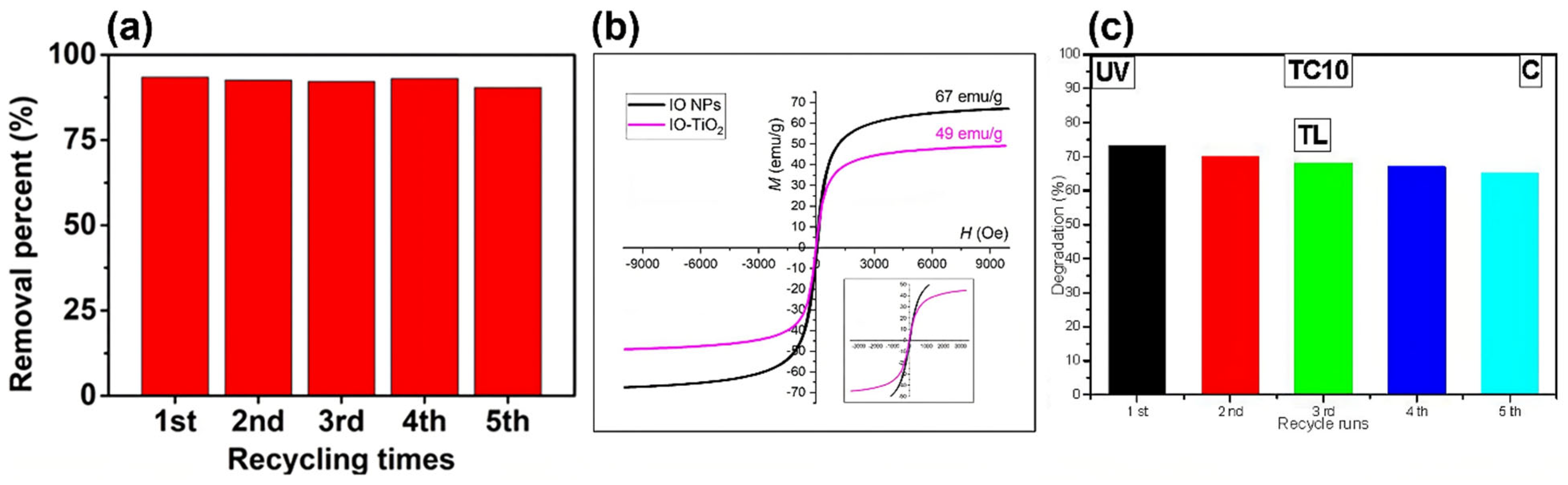
Similarly, flower-like TiO2/Fe2O3 core–shell NPs maintained high PA degradation efficiency over four cycles; however, the efficiency decreased to 58% in the fifth cycle, coinciding with a decline in MS from 44.1 to 20.8 emu g−1 [128]. Figure 7b shows a similar trend for branched polyethyleneimine (bPEI)-functionalized γ-Fe2O3–TiO2 nanocomposites, where both bare γ-Fe2O3 and γ-Fe2O3–TiO2 exhibited superparamagnetic behavior, with MS decreasing from 67 to 49 emu g−1 following TiO2 coating and bPEI coupling. Despite this reduction, the γ-Fe2O3–TiO2 nanocomposite maintained efficient magnetic recovery and stable CIP degradation for two cycles, followed by only a marginal decline after the fourth cycle [146]. Overall, these studies highlight the critical balance between maintaining high photocatalytic activity, preserving structural stability, and optimizing magnetic properties to ensure effective separation and long-term reusability in γ-Fe2O3-based photocatalyst systems.
XFe2O4-Based Systems. Spinel ferrites (XFe2O4) have shown significant potential in photocatalytic degradation processes due to their unique narrow band gaps (Eg ≈ 1.8–2.2 eV), which enable visible-light activity. These materials combine stable magnetic behavior with tunable electronic properties and, when integrated with semiconductor oxides, allow efficient catalyst separation and recovery using external magnetic fields [142]. For instance, the M@B/B composite exhibited strong magnetic separation capability with high material recovery rates (80–87%) and effective removal of LVX, TC, and TCS over five cycles. Although the saturation magnetization decreased due to the incorporation of nonmagnetic components, both the M@B/B and M@B composites retained sufficient magnetic responsiveness to ensure recyclable photocatalytic performance [117].
Similarly, the CuFe2O4@WO3/Ag system exhibited negligible catalytic loss, with TAM and GEM degradation decreasing only slightly from 83.15% to 72.64% and from 81.47% to 68.25%, respectively, over five cycles. During this process, MS value declined from 62.57 to 29.49 emu g−1 after coating [94]. The TiO2@ZnFe2O4/Pd and ZnFe2O4@TiO2/Cu composites also demonstrated strong recyclability over five cycles. For TiO2@ZnFe2O4/Pd, the MS of ZnFe2O4 decreased from 42.57 to 27.28 emu g−1 after TiO2 coating and subsequent Pd doping. Likewise, in the ZnFe2O4@TiO2/Cu composite, the MS decreased from 40.57 to 37.32 emu g−1 after TiO2 coating and further declined to 26.54 emu g−1 following Cu incorporation. Under these conditions, the degradation efficiencies of DCF and NPX decreased only slightly, from 86.1% to 71.38% and from 80.73% to 72.31%, respectively, indicating good structural stability and reusability [92,137]. The TiO2/CoFe2O4 composites also exhibited a pronounced reduction in MS compared with pristine CoFe2O4 (87.6 emu g−1), with the TiO2/CoFe2O4 (TC10) composite showing an MS of 8.4 emu g−1. Nevertheless, this reduction did not compromise magnetic separability, and the composite maintained effective recyclability, as evidenced by stable TC degradation under UV irradiation, which decreased only from approximately 75% in the first cycle to 65% after five cycles (Figure 7c) [114]. Lastly, the CoFe2O4@CuS catalyst retained good photocatalytic activity, showing only a 12.1% reduction in PCN degradation after five cycles, with its MS decreased slightly from 7.76 to 7.34 emu g−1 [140].
Overall, surface modification of MNPs inevitably leads to a reduction in saturation magnetization; however, these materials consistently exhibit outstanding photocatalytic activity and operational stability, making them well-suited for sustainable water treatment applications. Notably, photocatalytic efficiency generally decreases only marginally after multiple reuse cycles, indicating excellent structural robustness and recyclability. Although the incorporation of nonmagnetic components often enhances photocatalytic performance, optimization of the trade-off between magnetic separability and catalytic efficiency remains essential for ensuring long-term system sustainability. Collectively, the integration of optical activity and magnetic recoverability contributes to cost reduction and improved resource efficiency in water and wastewater treatment, thereby offering a potential pathway toward environmentally friendly and economically sustainable remediation technologies.
Table 2. Degradation and reusability performance of surface-modified magnetic photocatalysts for antibiotic removal from water.
MNP CorePhotocatalystContaminantTime
(min)
Removal Efficiency (%)Reusability CyclesMS
(emu g−1)
Ref.
Fe3O4BiOBr/Fe3O4@SiO2IBP60 80–605∼40[132]
Fe3O4/AC–CTAB–BiOCl OFL6010052.2 [101]
TiO2/SiO2/Fe3O4ACP300-438.9[144]
Fe3O4@SiO2@Nb-TiO2CIP 94–77522[90]
Fe3O4@SiO2@TiO2/rGOMNZ60 94–63414.8[136]
Fe3O4@SiO2/d-TiO2/Pt CBZ120968-[96]
Fe3O4/ZnOSMX
ROX
ERY
TMP
240 10084.3[21]
94
66
36
Fe2O3POM–γ-Fe2O3/SrCO3IBP120-411[98]
Fe2O3@PNHTC60905-[100]
γ-Fe2O3@ZnOCIP6092.565.2[104]
ZnO/Fe2O3–GO/ZIF SMZ6097.71021.2[127]
TiO2/Fe2O3PA180 98–57.5520.8[128]
γ-Fe2O3–TiO2CIP15070449[146]
XFe2O4MnFe2O4@Bi24O31Br10/BiO7ILVX100 93.2–70.2532.40[117]
TC95–71.7
TCS87.8–68.1
CuFe2O4@WO3/AgTAM
GEM
150 83.15–72.64
81.47–68.25
529.49[94]
TiO2@ZnFe2O4/PdDCF120 86.1–71.4527.28[92]
ZnFe2O4@TiO2/CuNPX120 80.7–72.3826.45[137]
TiO2/CoFe2O4 TC18075–6558.4[114]
CoFe2O4@CuSPCN120 70.7–58.657.76[140]

4.3. Influencing Factors in Photocatalytic Reactions

Photocatalytic reactions are governed by a range of physicochemical parameters that collectively influence reaction kinetics, charge-carrier dynamics, and overall catalytic efficiency. Key factors include the characteristics and intensity of the light source, catalyst morphology and particle size, surface area and porosity, and the presence of electron donors or acceptors. In addition, variables such as catalyst dosage, dispersibility in the reaction medium, and the physicochemical properties of the target pollutants can significantly affect degradation performance [67,78,147].
Among these factors, three critical variables—(1) the pH of the reaction medium, (2) the H2O2 concentration, and (3) the calcination temperature of the catalyst—play a decisive role in modulating photocatalytic efficiency. The pH of the solution influences the surface charge distribution of the catalyst and reactants, as well as the ionization state of pollutants [92]. The addition of H2O2 enhances the generation of ROS, which are essential for pollutant degradation; however, its concentration must be carefully optimized to avoid radical quenching [21]. The calcination temperature affects photocatalytic performance by altering crystallinity, phase composition, surface area, and defect density, all of which significantly influence overall process efficiency [123,148]. Consequently, optimization of these parameters is essential for achieving high photocatalytic activity, particularly for the degradation of antibiotic contaminants in aqueous systems.
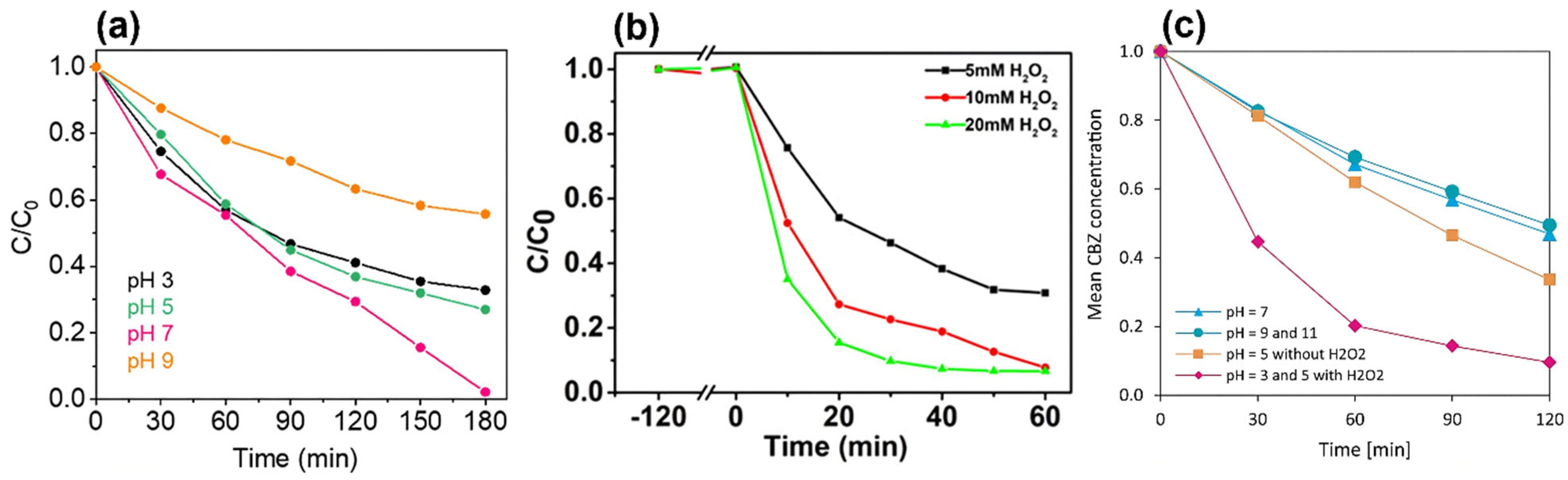
Effect of Reaction Solution pH. The pH of the reaction solution has a substantial impact on photocatalytic antibiotic degradation by modifying the surface charge of the catalyst, the ionization state of pollutants, and the generation of ROS. In addition, pollutant solubility and stability are influenced by pH, making it a critical parameter for effective photocatalysis in environmental remediation and water treatment. A comparative analysis of recent studies highlights the role of pH across different catalytic systems and antibiotic pollutants. For example, the photocatalytic degradation of DFC using a TiO2@ZnFe2O4/Pd nanocomposite exhibited maximum efficiency at pH 4, achieving 81.11% removal under 120 min of solar irradiation. This efficiency progressively declined with increasing pH, with degradation efficiencies of 73.48%, 65.98%, and 46.21% observed at pH 5, 7, and 9, respectively. The superior performance at pH 4 was attributed to the increased production of •OH radicals, which are highly effective in breaking down antibiotic contaminants. Additionally, at this pH, the catalyst surface carries a positive charge, facilitating electrostatic attraction with negatively charged DFC molecules [92]. In contrast, the photocatalytic degradation of CIP using MIL-100(Fe)-based MIPs was optimal at approximately neutral pH (~7), achieving over 95% removal efficiency. When the pH decreased below 5 or increased above 9, the CIP removal efficiency declined by 10–30%. At pH < 4, the catalyst surface is predominantly positively charged, while it becomes increasingly negative at higher pH. Under extreme conditions (pH < 3 or pH > 11), the system exhibited poor performance, suggesting that maintaining near-neutral conditions is crucial for effective CIP adsorption and degradation [122]. Figure 8a illustrates the effect of pH on the photocatalytic degradation of cefalexin using an α-Fe2O3/g-C3N4 nanocomposite, which showed maximum efficiency (97.8%) at pH 7. This value was significantly higher than those obtained at pH 3 (67.1%), pH 5 (72.9%), and pH 9 (44.2%) [149]. Similarly, the CoFe2O4@CuS nanocomposite exhibited a maximum removal efficiency of 75% for PC at pH 5, while only approximately 20% removal was observed at pH 3. Under extreme acidic conditions, H+ ions compete with •OH radicals, thereby reducing their availability for degradation [140]. These studies collectively demonstrate that pH is a critical determinant of antibiotic degradation efficiency in photocatalysis. Adjusting the pH in accordance with the physicochemical properties of both the pollutant and the catalyst is therefore essential for optimizing photocatalytic performance.
Effect of H2O2 Concentration. The addition of H2O2 plays a crucial role in the photocatalytic removal of antibiotics and other pollutants by acting as an electron acceptor, capturing conduction band electrons, and thus suppressing charge recombination. This promotes the formation of •OH radicals through both reduction and photolytic pathways. Dissolved O2 from air also contributes by generating O2 through electron capture. Therefore, both H2O2 and O2 promote ROS generation through complementary pathways [150]. In Fe2O3@PNH nanocomposites, an optimal H2O2 concentration of 10 mM under visible-light irradiation yielded the highest TC degradation efficiency (Figure 8b). Higher H2O2 concentrations reduced oxidation activity due to •OH scavenging and excessive Fe3+ formation [100]. For Fe3O4/ZnO nanocomposites under UV irradiation, the addition of 100 mg L−1 H2O2 led to the complete removal of SMX and near-complete degradation of TMP (94%), ERY (95%), and ROX (98%) within 4 h. In contrast, without H2O2, the degradation efficiencies were significantly lower, with removal rates of approximately 79% for SMX, 67% for TMP, 71% for ERY, and 85% for ROX. These results highlight the synergistic interaction between H2O2 and the photocatalyst in promoting oxidative degradation [21].
Similarly, the POM–γ-Fe2O3/SrCO3 catalyst achieved nearly complete mineralization of IBP under solar irradiation with 80 μL of H2O2. However, increasing the H2O2 dose to 160 μL led to competitive scavenging of OH• radicals by excess H2O2, thereby reducing degradation efficiency [98]. In contrast, the Ag/AgBr/ZnFe2O4 catalyst exhibited a negative response to H2O2 addition during CBZ degradation, with efficiency decreasing from 22.7% (without H2O2) to 18.3%. Alternatively, the use of potassium peroxodisulfate enhanced degradation to 28.4% via sulfate radical (SO4) generation, indicating that this catalyst more effectively activates persulfate than H2O2. Excess H2O2 likely hindered the degradation process due to unfavorable catalyst–oxidant interactions [95]. In another study, Figure 8c shows that the Fe3O4@SiO2/d-TiO2/Pt nanocomposite achieved 92% CBZ degradation in the presence of H2O2 under neutral pH. Under mildly acidic conditions (pH 5), the efficiency further increased to 96%, which was attributed to enhanced H2O2 activation and increased ROS production [96]. These findings underscore the importance of optimizing both H2O2 concentration and solution pH to maximize photocatalytic efficiency while minimizing the adverse effects of excessive oxidant dosage.
Effect of Calcination Temperature. The calcination temperature of photocatalysts plays an important role in determining their photocatalytic activity for water pollutant degradation by influencing crystallinity, phase composition, and surface area. These structural characteristics directly affect key parameters such as adsorption capacity, charge-carrier mobility, and the availability of active sites. For Fe3O4/SiO2/TiO2 composites, the sample calcined at 500 °C exhibited degradation efficiencies of 78% for CIP and 82% for NOR. In contrast, the sample calcined at 600 °C achieved significantly higher efficiencies of approximately 95% for both CIP and NOR under identical conditions. This improvement is attributed to the formation of highly crystalline anatase TiO2, which provides an optimal balance between crystallinity and surface area, thereby maximizing photocatalytic activity [123]. Similarly, calcination of N-TiO2@SiO2@Fe3O4 at 500 °C resulted in the optimal IBP degradation, achieving 90% efficiency compared with 88% at 400 °C. The superior performance at 500 °C was attributed to greater nitrogen incorporation, which enhances light absorption and improves charge separation. However, calcination temperatures above 500 °C induced excessive crystal growth and reduced surface area, ultimately leading to lower photocatalytic performance [131]. These findings underscore the importance of optimizing the calcination temperature with respect to catalyst composition, as achieving an appropriate balance between crystallinity and surface area is essential for maximizing photocatalytic activity.

5. Challenges and Future Perspectives

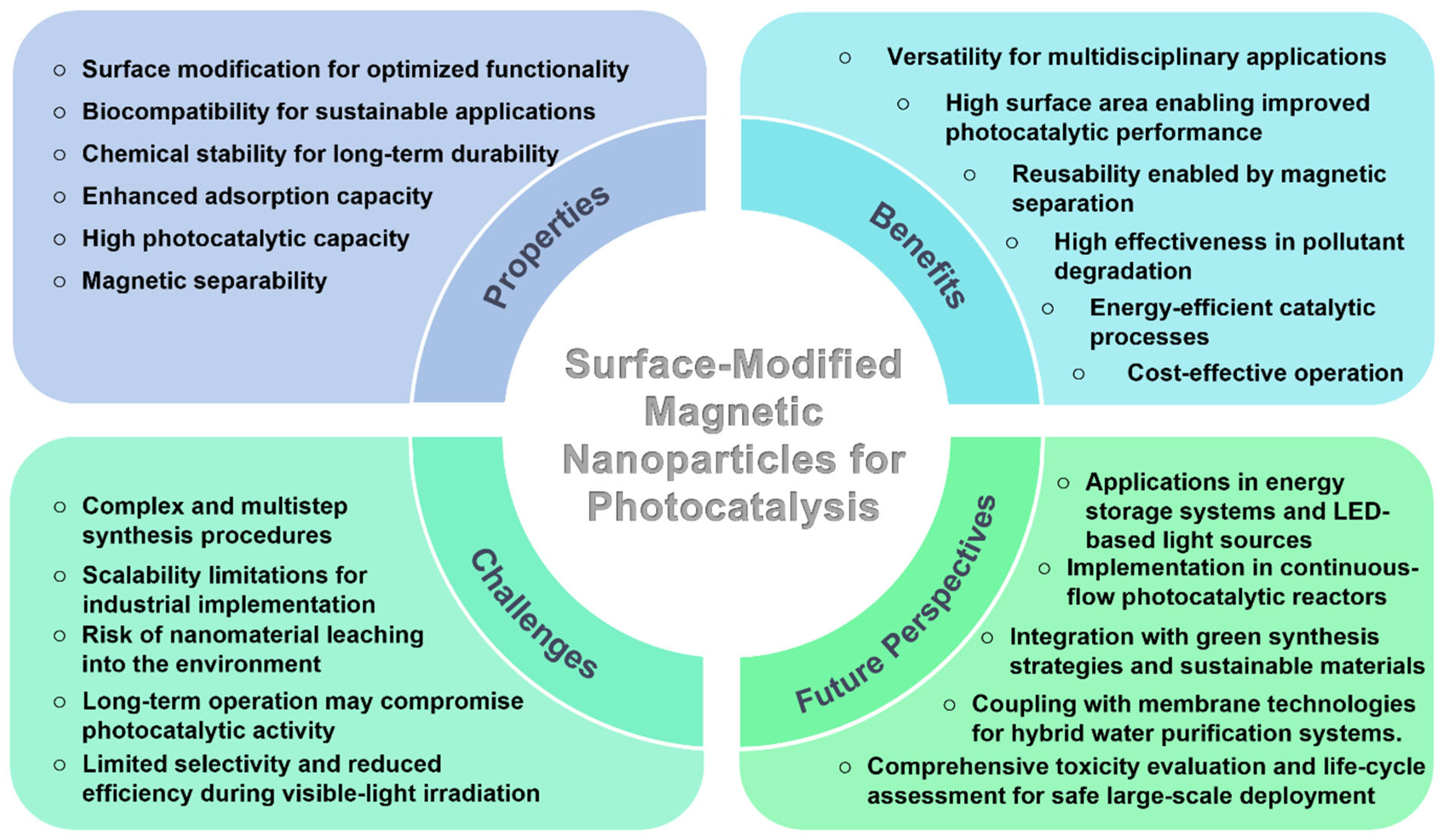
Despite the significant potential of metal-based NPs for addressing environmental and energy-related challenges through photodegradation processes, their practical application remains constrained by several technical, economic, and environmental limitations. Overcoming these barriers is essential for the efficient large-scale deployment of MNP-based technologies (Scheme 6).
One major challenge is the long-term stability of surface modifications, which directly governs the durability and photocatalytic performance of these NPs. External factors such as pH fluctuations, oxidative environments, and prolonged light exposure can degrade surface coatings, leading to NP aggregation, reduced effective surface area, and diminished catalytic efficiency. In addition, strong magnetic interactions among MNPs can further promote aggregation, thereby reducing dispersibility and complicating recovery during both synthesis and application. These effects increase operational costs and elevate the risk of secondary pollution. Addressing these limitations requires the development of robust surface-engineering strategies that effectively suppress aggregation while preserving or enhancing the photocatalytic functionality of surface-modified MNPs under practical operating conditions.
Additionally, the synthesis of surface-modified MNPs poses a further challenge, as it often requires multistep procedures that increase production costs and limit scalability for industrial implementation. Transitioning from laboratory-scale research to industrial deployment involves both economic and technical constraints, including the need to maintain uniform NP properties, ensure long-term performance stability, and control production costs during scale-up. Scalability is further complicated by the difficulty of preserving consistent NP characteristics during large-scale manufacturing [82]. Advances in material science—particularly surface modifications using hydrophilic polymers or MOFs—offer promising strategies to improve dispersibility, selectivity, and stability in complex aqueous systems [99,122]. However, achieving high selectivity toward specific contaminants in heterogeneous wastewater matrices remains a major challenge. This limitation can be addressed only through precise surface-engineering strategies that promote selective interactions with target molecules while minimizing nonspecific binding.
Environmental considerations represent another critical aspect. The potential toxicity of surface-modified MNPs, including risks associated with NP leaching into aquatic ecosystems, highlights the need for comprehensive lifecycle and toxicity assessments. Secondary pollutants generated during photocatalytic reactions must also be considered, as incomplete mineralization of contaminants can produce by-products that pose additional ecological risks [151]. Furthermore, many laboratory studies rely on synthetic water systems that differ markedly from real wastewater, emphasizing the need for more realistic testing conditions to establish practical applicability [152]. These challenges become even more pronounced in complex environmental matrices, where multiple contaminants compete for active sites and reactive species, thereby reducing the overall photocatalytic efficiency of surface-modified MNP systems. A thorough evaluation of environmental and health impacts is therefore essential to ensure the safe and sustainable deployment of these technologies on a large scale.
Beyond environmental risk considerations, the long-term structural stability of surface-modified MNPs under repeated photocatalytic operation remains insufficiently understood. While recyclability tests often indicate stable catalytic activity over several cycles, they do not necessarily capture gradual structural degradation or chemical transformations occurring at the nanoparticle surface [153]. Prolonged exposure to reactive oxygen species, fluctuating pH conditions, and continuous light irradiation can induce surface reconstruction, coating degradation, or lattice defects, which may ultimately affect photocatalytic efficiency and material integrity [82,154]. Such changes can also promote slow metal or dopant release, even in the absence of detectable activity loss, underscoring the need for systematic post-cycle characterization. Comprehensive evaluation using techniques such as X-ray diffraction (XRD), transmission electron microscopy (TEM), XPS, and inductively coupled plasma (ICP)-based analyses is therefore required to correlate performance stability with structural evolution under realistic operating conditions [142,155]. Addressing these durability-related challenges will be critical for translating laboratory-scale photocatalytic systems into long-term, environmentally compatible water treatment technologies.
Future research should focus on developing cost-effective and scalable synthesis strategies that preserve the physicochemical properties of surface-modified MNPs, including high surface area, crystallinity, and uniform particle size distribution. Incorporating these NPs into photocatalytic reactors—particularly continuous-flow systems—may help maintain stable performance during wastewater treatment. Such reactor designs must ensure uniform light distribution and efficient interaction between contaminants and the photocatalyst to overcome current technological limitations [156]. Expanding their application into energy storage and conversion systems may also reveal multifunctional behavior arising from the combined catalytic and magnetic properties of these materials. Green synthesis approaches—utilizing plant extracts, biomass, or other environmentally benign precursors—offer additional advantages by reducing energy consumption, minimizing the formation of toxic by-products, and lowering the environmental footprint of the NP fabrication process [157].
From a process-engineering perspective, the magnetic properties of surface-modified MNPs provide a practical advantage for large-scale and continuous wastewater treatment, as external magnetic fields can be employed for in situ catalyst retention, separation, and recycling within flow-through photoreactors. Such configurations can minimize catalyst loss, reduce downstream solid–liquid separation requirements, and support stable long-term operation under continuous hydraulic conditions [142,156,158]. Coupling magnetic photocatalysts with energy-efficient light sources and an optimized reactor, therefore, represents a realistic pathway toward pilot-scale implementation. Nevertheless, validation under real wastewater conditions and extended operational times remains essential to assess durability, fouling resistance, and overall process efficiency.
Optimization of operational conditions, including calcination temperature and solution pH, also provides pathways to enhance photocatalyst performance and degradation efficiency. Another important parameter is the choice of energy source; sustainable systems based on light-emitting diodes (LEDs) offer improved energy efficiency, environmentally benign operation, and extended service life, thereby reducing the overall energy footprint of photocatalytic processes [159]. Furthermore, integrating photocatalysis with complementary technologies such as membrane filtration, flocculation, precipitation, and adsorption presents opportunities for developing large-scale, multifunctional water purification systems [160]. To support sustainability goals, extensive toxicity evaluations and environmental impact assessments are required. Considering these future directions, advancements in synthesis, scale-up, and process integration will enable surface-modified MNPs to function as transformative materials for energy generation, environmental remediation, and water purification, contributing to the development of sustainable technological solutions.

6. Conclusions

This review summarizes the recent progress in the development of surface-modified MNPs as advanced photocatalysts for the mitigation of antibiotic pollution in wastewater. Through tailored surface engineering, the photocatalytic performance of MNPs has been substantially enhanced, with improvements in adsorption selectivity, structural stability, light-responsive behavior, and magnetic recoverability. These attributes enable the efficient degradation of a wide range of pharmaceutical contaminants under both UV and visible-light irradiation, while also allowing material reuse over multiple treatment cycles. The versatility of these nanomaterials, together with their adaptability to diverse environmental conditions and their potential integration into hybrid treatment systems, highlights their promise for scalable and sustainable water purification technologies.
Despite these advances, significant challenges related to large-scale implementation, economic feasibility, environmental safety, and long-term operational stability remain. Overcoming these barriers requires continued efforts in green synthesis strategies, advanced reactor design, and the development of multifunctional hybrid systems. Such efforts are critical to enable the successful translation of laboratory-scale research into industrial applications. Looking ahead, surface-modified MNPs hold potential not only for advancing wastewater treatment technologies but also for broader applications in environmental remediation and energy conversion, thereby contributing to the sustainable management of global water resources.

Author Contributions

Conceptualization, M.A.G. and T.R.L.; Methodology, M.A.G.; Resource, T.R.L.; Data Curation, M.A.G., S.H., D.B.T., Q.M.T., R.A. (Refia Atik), R.I., S.M., S.W., R.Y. and R.A. (Ruwanthi Amarasekara); Writing—Original Draft Preparation, M.A.G.; Writing—Review and Editing, M.A.G., S.H., D.B.T., Q.M.T., R.A. (Refia Atik), P.C. and T.R.L.; Visualization, M.A.G., S.H., D.B.T., Q.M.T., R.A. (Refia Atik), R.I., S.M., S.W., R.Y. and R.A. (Ruwanthi Amarasekara); Supervision, T.R.L.; Project Administration, P.C. and T.R.L.; Funding Acquisition, T.R.L. All authors have read and agreed to the published version of the manuscript.

Funding

This research was financially supported by the Air Force Office of Scientific Research (AFOSR FA9550-23-1-0581; 23RT0567) and the Robert A. Welch Foundation (Grant Nos. V-E-0001 and E-1320).

Data Availability Statement

No new data were created or analyzed in this study.

Acknowledgments

The authors would like to thank the financial support from the Air Force Office of Scientific Research (AFOSR FA9550-23-1-0581; 23RT0567) and the Robert A. Welch Foundation (Grant Nos. V-E-0001 and E-1320) for their support. The authors are also grateful to the editors and the reviewers for their efforts in improving the manuscript.

Conflicts of Interest

The authors declare no conflicts of interest.

References

  1. Cosgrove, W.J.; Loucks, D.P. Water Management: Current and Future Challenges and Research Directions. Water Resour. Res. 2015, 51, 4823–4839. [Google Scholar] [CrossRef]
  2. Strokal, M.; Bai, Z.; Franssen, W.; Hofstra, N.; Koelmans, A.A.; Ludwig, F.; Ma, L.; van Puijenbroek, P.; Spanier, J.E.; Vermeulen, L.C.; et al. Urbanization: An Increasing Source of Multiple Pollutants to Rivers in the 21st Century. npj Urban Sustain. 2021, 1, 24. [Google Scholar] [CrossRef]
  3. UN World Water Development Report 2024. UN-Water. Available online: https://www.unwater.org/publications/un-world-water-development-report-2024 (accessed on 28 August 2024).
  4. Water and Climate Change. UN-Water. Available online: https://www.unwater.org/water-facts/water-and-climate-change (accessed on 28 August 2024).
  5. United Nations Environment Programme. Food Security and Water Quality. Available online: https://www.unep.org/interactives/wwqa/technical-highlights/food-security-and-water-quality (accessed on 28 August 2024).
  6. Khalid, S.; Shahid, M.; Natasha; Bibi, I.; Sarwar, T.; Shah, A.H.; Niazi, N.K. A Review of Environmental Contamination and Health Risk Assessment of Wastewater Use for Crop Irrigation with a Focus on Low and High-Income Countries. Int. J. Environ. Res. Public. Health 2018, 15, 895. [Google Scholar] [PubMed]
  7. US Environmental Protection Agency. Contaminants of Emerging Concern including Pharmaceuticals and Personal Care Products. Available online: https://www.epa.gov/wqc/contaminants-emerging-concern-including-pharmaceuticals-and-personal-care-products (accessed on 29 August 2024).
  8. Okoye, C.O.; Nyaruaba, R.; Ita, R.E.; Okon, S.U.; Addey, C.I.; Ebido, C.C.; Opabunmi, A.O.; Okeke, E.S.; Chukwudozie, K.I. Antibiotic Resistance in the Aquatic Environment: Analytical Techniques and Interactive Impact of Emerging Contaminants. Environ. Toxicol. Pharmacol. 2022, 96, 103995. [Google Scholar] [CrossRef]
  9. Fernandes, J.P.; Almeida, C.M.R.; Salgado, M.A.; Carvalho, M.F.; Mucha, A.P. Pharmaceutical Compounds in Aquatic Environments—Occurrence, Fate and Bioremediation Prospective. Toxics 2021, 9, 257. [Google Scholar] [CrossRef]
  10. Li, W.C. Occurrence, Sources, and Fate of Pharmaceuticals in Aquatic Environment and Soil. Environ. Pollut. 2014, 187, 193–201. [Google Scholar] [CrossRef]
  11. Browne, A.J.; Chipeta, M.G.; Haines-Woodhouse, G.; Kumaran, E.P.A.; Hamadani, B.H.K.; Zaraa, S.; Henry, N.J.; Deshpande, A.; Reiner, R.C.; Day, N.P.J.; et al. Global Antibiotic Consumption and Usage in Humans, 2000–18: A Spatial Modelling Study. Lancet Planet. Health 2021, 5, e893–e904. [Google Scholar] [CrossRef]
  12. Global Pharmaceuticals Industry Analysis and Trends 2023. NAVADHI Market Research. Available online: https://www.navadhi.com/publications/global-pharmaceuticals-industry-analysis-and-trends-2023 (accessed on 29 August 2024).
  13. Wang, H.; Wang, N.; Wang, B.; Zhao, Q.; Fang, H.; Fu, C.; Tang, C.; Jiang, F.; Zhou, Y.; Chen, Y.; et al. Antibiotics in Drinking Water in Shanghai and Their Contribution to Antibiotic Exposure of School Children. Environ. Sci. Technol. 2016, 50, 2692–2699. [Google Scholar] [CrossRef]
  14. Kristiansson, E.; Fick, J.; Janzon, A.; Grabic, R.; Rutgersson, C.; Weijdegard, B.; Soderstrom, H.; Larsson, D.G.J. Pyrosequencing of Antibiotic-Contaminated River Sediments Reveals High Levels of Resistance and Gene Transfer Elements. PLoS ONE 2011, 6, e17038. [Google Scholar] [CrossRef]
  15. Radjenović, J.; Petrović, M.; Barceló, D. Fate and Distribution of Pharmaceuticals in Wastewater and Sewage Sludge of the Conventional Activated Sludge (CAS) and Advanced Membrane Bioreactor (MBR) Treatment. Water Res. 2009, 43, 831–841. [Google Scholar] [CrossRef]
  16. Kumar, M.; Ram, B.; Honda, R.; Poopipattana, C.; Canh, V.D.; Chaminda, T.; Furumai, H. Concurrence of Antibiotic Resistant Bacteria (ARB), Viruses, Pharmaceuticals and Personal Care Products (PPCPs) in Ambient Waters of Guwahati, India: Urban Vulnerability and Resilience Perspective. Sci. Total Environ. 2019, 693, 133640. [Google Scholar] [PubMed]
  17. Wilkinson, J.L.; Boxall, A.B.A.; Kolpin, D.W.; Leung, K.M.Y.; Lai, R.W.S.; Galbán-Malagón, C.; Adell, A.D.; Mondon, J.; Metian, M.; Marchant, R.A.; et al. Pharmaceutical Pollution of the World’s Rivers. Proc. Natl. Acad. Sci. USA 2022, 119, e2113947119. [Google Scholar] [CrossRef] [PubMed]
  18. Bhagat, C.; Kumar, M.; Tyagi, V.K.; Mohapatra, P.K. Proclivities for Prevalence and Treatment of Antibiotics in the Ambient Water: A Review. npj Clean. Water 2020, 3, 42. [Google Scholar]
  19. Münzel, T.; Hahad, O.; Daiber, A.; Landrigan, P.J. Soil and Water Pollution and Human Health: What Should Cardiologists Worry About? Cardiovasc. Res. 2022, 119, 440–449. [Google Scholar] [CrossRef]
  20. Bashir, I.; Lone, F.A.; Bhat, R.A.; Mir, S.A.; Dar, Z.A.; Dar, S.A. Concerns and Threats of Contamination on Aquatic Ecosystems. Bioremediat. Biotechnol. 2020, 1–26. [Google Scholar] [CrossRef]
  21. Fernández, L.; Gamallo, M.; González-Gómez, M.A.; Vázquez-Vázquez, C.; Rivas, J.; Pintado, M.; Moreira, M.T. Insight into Antibiotics Removal: Exploring the Photocatalytic Performance of a Fe3O4/ZnO Nanocomposite in a Novel Magnetic Sequential Batch Reactor. J. Environ. Manag. 2019, 237, 595–608. [Google Scholar] [CrossRef]
  22. US Environmental Protection Agency. The Impact of Pharmaceuticals Released to the Environment. Available online: https://www.epa.gov/household-medication-disposal/impact-pharmaceuticals-released-environment (accessed on 28 August 2024).
  23. Center for Disease Control. Antimicrobial Resistance in the Environment and the Food Supply: Causes and How It Spreads. Antimicrobial Resistance. Available online: https://www.cdc.gov/antimicrobial-resistance/causes/environmental-food.html (accessed on 29 August 2024).
  24. Kraemer, S.A.; Ramachandran, A.; Perron, G.G. Antibiotic Pollution in the Environment: From Microbial Ecology to Public Policy. Microorganisms 2019, 7, 180. [Google Scholar] [CrossRef]
  25. Murray, C.J.L.; Ikuta, K.S.; Sharara, F.; Swetschinski, L.; Aguilar, G.R.; Gray, A.; Han, C.; Bisignano, C.; Rao, P.; Wool, E.; et al. Global Burden of Bacterial Antimicrobial Resistance in 2019: A Systematic Analysis. Lancet 2022, 399, 629–655. [Google Scholar] [CrossRef]
  26. World Health Organization. Ten Health Issues WHO Will Tackle this Year 2019. Available online: https://www.who.int/news-room/spotlight/ten-threats-to-global-health-in-2019 (accessed on 29 August 2024).
  27. World Health Organization. 10 Global Health Issues to Track in 2021. Available online: https://www.who.int/news-room/spotlight/10-global-health-issues-to-track-in-2021 (accessed on 29 August 2024).
  28. Shad, M.F.; Juby, G.J.G.; Delagah, S.; Sharbatmaleki, M. Evaluating Occurrence of Contaminants of Emerging Concerns in MF/RO Treatment of Primary Effluent for Water Reuse—Pilot Study. J. Water Reuse Desalination 2019, 9, 350–371. [Google Scholar]
  29. Alazaiza, M.Y.D.; Albahnasawi, A.; Ali, G.A.M.; Bashir, M.J.K.; Nassani, D.E.; Al Maskari, T.; Amr, S.S.A.; Abujazar, M.S.S. Application of Natural Coagulants for Pharmaceutical Removal from Water and Wastewater: A Review. Water 2022, 14, 140. [Google Scholar] [CrossRef]
  30. Vinayagam, V.; Murugan, S.; Kumaresan, R.; Narayanan, M.; Sillanpää, M.; Viet N Vo, D.; Kushwaha, O.S.; Jenis, P.; Potdar, P.; Gadiya, S. Sustainable Adsorbents for the Removal of Pharmaceuticals from Wastewater: A Review. Chemosphere 2022, 300, 134597. [Google Scholar] [CrossRef]
  31. Singh, B.J.; Chakraborty, A.; Sehgal, R. A Systematic Review of Industrial Wastewater Management: Evaluating Challenges and Enablers. J. Environ. Manag. 2023, 348, 119230. [Google Scholar] [CrossRef] [PubMed]
  32. Crini, G.; Lichtfouse, E. Advantages and Disadvantages of Techniques Used for Wastewater Treatment. Environ. Chem. Lett. 2019, 17, 145–155. [Google Scholar]
  33. Pérez-Álvarez, D.T.; Brown, J.; Elgohary, E.A.; Mohamed, Y.M.A.; Nazer, H.A.E.; Davies, P.; Stafford, J. Challenges Surrounding Nanosheets and Their Application to Solar-Driven Photocatalytic Water Treatment. Mater. Adv. 2022, 3, 4103–4131. [Google Scholar] [CrossRef]
  34. Belete, B.; Desye, B.; Ambelu, A.; Yenew, C. Micropollutant Removal Efficiency of Advanced Wastewater Treatment Plants: A Systematic Review. Environ. Health Insights 2023, 17, 11786302231195158. [Google Scholar]
  35. Eggen, R.I.L.; Hollender, J.; Joss, A.; Schärer, M.; Stamm, C. Reducing the Discharge of Micropollutants in the Aquatic Environment: The Benefits of Upgrading Wastewater Treatment Plants. Environ. Sci. Technol. 2014, 48, 7683–7689. [Google Scholar] [CrossRef]
  36. Janani, R.; Gurunathan, B.; K, S.; Varjani, S.; Ngo, H.H.; Gnansounou, E. Advancements in Heavy Metals Removal from Effluents Employing Nano-Adsorbents: Way towards Cleaner Production. Environ. Res. 2022, 203, 111815. [Google Scholar] [CrossRef]
  37. Jain, K.; Patel, A.S.; Pardhi, V.P.; Flora, S.J.S. Nanotechnology in Wastewater Management: A New Paradigm Towards Wastewater Treatment. Molecules 2021, 26, 1797. [Google Scholar] [CrossRef]
  38. Das, S.; Chakraborty, J.; Chatterjee, S.; Kumar, H. Prospects of Biosynthesized Nanomaterials for the Remediation of Organic and Inorganic Environmental Contaminants. Environ. Sci. Nano 2018, 5, 2784–2808. [Google Scholar] [CrossRef]
  39. Qu, X.; Brame, J.; Li, Q.; Alvarez, P.J.J. Nanotechnology for a Safe and Sustainable Water Supply: Enabling Integrated Water Treatment and Reuse. Acc. Chem. Res. 2013, 46, 834–843. [Google Scholar]
  40. Ren, G.; Han, H.; Wang, Y.; Liu, S.; Zhao, J.; Meng, X.; Li, Z. Recent Advances of Photocatalytic Application in Water Treatment: A Review. Nanomaterials 2021, 11, 1804. [Google Scholar] [CrossRef]
  41. Al-Nuaim, M.A.; Alwasiti, A.A.; Shnain, Z.Y. The Photocatalytic Process in the Treatment of Polluted Water. Chem. Pap. 2023, 77, 677–701. [Google Scholar]
  42. Djurišić, A.B.; He, Y.; Ng, A.M.C. Visible-Light Photocatalysts: Prospects and Challenges. APL Mater. 2020, 8, 030903. [Google Scholar] [CrossRef]
  43. Zhu, N.; Ji, H.; Yu, P.; Niu, J.; Farooq, M.U.; Akram, M.W.; Udego, I.O.; Li, H.; Niu, X. Surface Modification of Magnetic Iron Oxide Nanoparticles. Nanomaterials 2018, 8, 810. [Google Scholar] [CrossRef]
  44. Issa, B.; Obaidat, I.M.; Albiss, B.A.; Haik, Y. Magnetic Nanoparticles: Surface Effects and Properties Related to Biomedicine Applications. Int. J. Mol. Sci. 2013, 14, 21266–21305. [Google Scholar] [CrossRef] [PubMed]
  45. Lim, J.; Yeap, S.P.; Che, H.X.; Low, S.C. Characterization of Magnetic Nanoparticle by Dynamic Light Scattering. Nanoscale Res. Lett. 2013, 8, 381. [Google Scholar] [CrossRef]
  46. O’Shea, K.E.; Dionysiou, D.D. Advanced Oxidation Processes for Water Treatment. J. Phys. Chem. Lett. 2012, 3, 2112–2113. [Google Scholar] [CrossRef]
  47. Muruganandham, M.; Suri, R.P.S.; Jafari, S.; Sillanpää, M.; Lee, G.-J.; Wu, J.J.; Swaminathan, M. Recent Developments in Homogeneous Advanced Oxidation Processes for Water and Wastewater Treatment. Int. J. Photoenergy 2014, 2014, 821674. [Google Scholar] [CrossRef]
  48. Zhang, F.; Wang, X.; Liu, H.; Liu, C.; Wan, Y.; Long, Y.; Cai, Z. Recent Advances and Applications of Semiconductor Photocatalytic Technology. Appl. Sci. 2019, 9, 2489. [Google Scholar] [CrossRef]
  49. Adeyemi, J.O.; Ajiboye, T.; Onwudiwe, D.C. Mineralization of Antibiotics in Wastewater Via Photocatalysis. Water Air Soil Pollut. 2021, 232, 219. [Google Scholar] [CrossRef]
  50. Kurt, A.; Mert, B.K.; Özengin, N.; Sivrioğlu, Ö.; Yonar, T. Treatment of Antibiotics in Wastewater Using Advanced Oxidation Processes (AOPs). In Physico-Chemical Wastewater Treatment and Resource Recovery; IntechOpen: London, UK, 2017. [Google Scholar]
  51. Makuła, P.; Pacia, M.; Macyk, W. How To Correctly Determine the Band Gap Energy of Modified Semiconductor Photocatalysts Based on UV–Vis Spectra. J. Phys. Chem. Lett. 2018, 9, 6814–6817. [Google Scholar] [CrossRef]
  52. Wei, S.; Zhang, J.; Zhang, L.; Wang, Y.; Sun, H.; Hua, X.; Guo, Z.; Dong, D. Efficient Generation of Singlet Oxygen for Photocatalytic Degradation of Antibiotics: Synergistic Effects of Fe Spin State Reduction and Energy Transfer. Appl. Catal. B Environ. Energy 2024, 358, 124406. [Google Scholar] [CrossRef]
  53. Meng, Z.; Liu, Q.; Yang, P.; Jiang, G.; Liu, X.; Zhang, Q.; Li, Y. Singlet-Oxygen-Driven CeO2 Quantum Dots/Hollow Spherical g-C3N4 S-Scheme Heterojunction Photocatalyst for the Degradation of Tetracycline. Langmuir 2025, 41, 28592–28605. [Google Scholar] [CrossRef]
  54. Wang, Y.; Lin, Y.; He, S.; Wu, S.; Yang, C. Singlet Oxygen: Properties, Generation, Detection, and Environmental Applications. J. Hazard. Mater. 2024, 461, 132538. [Google Scholar] [CrossRef] [PubMed]
  55. Jiang, J.; Niu, S.; Liu, S.; Zhang, H.; Liu, Y.; Sun, T.; Shi, D.; Zhao, B.; Yan, G.; Huo, M.; et al. Efficient Singlet Oxygen Nanogenerator with Low-Spin Iron for Selective Contaminant Decontamination. Chem. Eng. J. 2023, 476, 146683. [Google Scholar] [CrossRef]
  56. Gutierrez, A.M.; Dziubla, T.D.; Hilt, J.Z. Recent Advances on Iron Oxide Magnetic Nanoparticles as Sorbents of Organic Pollutants in Water and Wastewater Treatment. Rev. Environ. Health 2017, 32, 111. [Google Scholar] [CrossRef] [PubMed]
  57. Akbarzadeh, A.; Samiei, M.; Davaran, S. Magnetic Nanoparticles: Preparation, Physical Properties, and Applications in Biomedicine. Nanoscale Res. Lett. 2012, 7, 144. [Google Scholar] [CrossRef]
  58. Ali, A.; Zafar, H.; Zia, M.; ul Haq, I.; Phull, A.R.; Ali, J.S.; Hussain, A. Synthesis, Characterization, Applications, and Challenges of Iron Oxide Nanoparticles. Nanotechnol. Sci. Appl. 2016, 9, 49–67. [Google Scholar] [CrossRef]
  59. Singh, P.; Sharma, K.; Hasija, V.; Sharma, V.; Sharma, S.; Raizada, P.; Singh, M.; Saini, A.K.; Hosseini-Bandegharaei, A.; Thakur, V.K. Systematic Review on Applicability of Magnetic Iron Oxides–Integrated Photocatalysts for Degradation of Organic Pollutants in Water. Mater. Today Chem. 2019, 14, 100186. [Google Scholar] [CrossRef]
  60. Nguyen, M.D.; Tran, H.-V.; Xu, S.; Lee, T.R. Fe3O4 Nanoparticles: Structures, Synthesis, Magnetic Properties, Surface Functionalization, and Emerging Applications. Appl. Sci. 2021, 11, 11301. [Google Scholar] [CrossRef]
  61. Modabberasl, A.; Pirhoushyaran, T.; Esmaeili-Faraj, S.H. Synthesis of CoFe2O4 Magnetic Nanoparticles for Application in Photocatalytic Removal of Azithromycin from Wastewater. Sci. Rep. 2022, 12, 19171. [Google Scholar] [CrossRef]
  62. Olusegun, S.J.; Larrea, G.; Osial, M.; Jackowska, K.; Krysinski, P. Photocatalytic Degradation of Antibiotics by Superparamagnetic Iron Oxide Nanoparticles. Tetracycline Case. Catalysts 2021, 11, 1243. [Google Scholar] [CrossRef]
  63. Nguyen, M.D.; Hoijang, S.; Yarinia, R.; Ariza Gonzalez, M.; Mandal, S.; Tran, Q.M.; Chinwangso, P.; Lee, T.R. Magnetic Iron Oxide Nanoparticles: Advances in Synthesis, Mechanistic Understanding, and Magnetic Property Optimization for Improved Biomedical Performance. Nanomaterials 2025, 15, 1500. [Google Scholar] [CrossRef] [PubMed]
  64. Kolhatkar, A.G.; Jamison, A.C.; Litvinov, D.; Willson, R.C.; Lee, T.R. Tuning the Magnetic Properties of Nanoparticles. Int. J. Mol. Sci. 2013, 14, 15977–16009. [Google Scholar] [CrossRef] [PubMed]
  65. Malhotra, N.; Lee, J.-S.; Liman, R.A.D.; Ruallo, J.M.S.; Villaflores, O.B.; Ger, T.-R.; Hsiao, C.-D. Potential Toxicity of Iron Oxide Magnetic Nanoparticles: A Review. Molecules 2020, 25, 3159. [Google Scholar] [CrossRef] [PubMed]
  66. Park, H.; Park, Y.; Kim, W.; Choi, W. Surface Modification of TiO2 Photocatalyst for Environmental Applications. J. Photochem. Photobiol. C Photochem. Rev. 2013, 15, 1–20. [Google Scholar] [CrossRef]
  67. Kou, J.; Lu, C.; Wang, J.; Chen, Y.; Xu, Z.; Varma, R.S. Selectivity Enhancement in Heterogeneous Photocatalytic Transformations. Chem. Rev. 2017, 117, 1445–1514. [Google Scholar] [CrossRef]
  68. Wen, J.; Li, X.; Liu, W.; Fang, Y.; Xie, J.; Xu, Y. Photocatalysis Fundamentals and Surface Modification of TiO2 Nanomaterials. Chin. J. Catal. 2015, 36, 2049–2070. [Google Scholar] [CrossRef]
  69. Etacheri, V.; Di Valentin, C.; Schneider, J.; Bahnemann, D.; Pillai, S.C. Visible-Light Activation of TiO2 Photocatalysts: Advances in Theory and Experiments. J. Photochem. Photobiol. C Photochem. Rev. 2015, 25, 1–29. [Google Scholar] [CrossRef]
  70. Qi, K.; Yu, J. Chapter 8—Modification of ZnO-Based Photocatalysts for Enhanced Photocatalytic Activity. In Interface Science and Technology; Yu, J., Jaroniec, M., Jiang, C., Eds.; Surface Science of Photocatalysis; Elsevier: Amsterdam, The Netherlands, 2020; Volume 31, pp. 265–284. [Google Scholar]
  71. Raizada, P.; Soni, V.; Kumar, A.; Singh, P.; Parwaz Khan, A.A.; Asiri, A.M.; Thakur, V.K.; Nguyen, V.-H. Surface Defect Engineering of Metal Oxides Photocatalyst for Energy Application and Water Treatment. J. Mater. 2021, 7, 388–418. [Google Scholar] [CrossRef]
  72. Murillo-Sierra, J.C.; Hernández-Ramírez, A.; Hinojosa-Reyes, L.; Guzmán-Mar, J.L. A Review on the Development of Visible Light-Responsive WO3-Based Photocatalysts for Environmental Applications. Chem. Eng. J. Adv. 2021, 5, 100070. [Google Scholar] [CrossRef]
  73. Shandilya, P.; Sambyal, S.; Sharma, R.; Mandyal, P.; Fang, B. Properties, Optimized Morphologies, and Advanced Strategies for Photocatalytic Applications of WO3 Based Photocatalysts. J. Hazard. Mater. 2022, 428, 128218. [Google Scholar] [CrossRef] [PubMed]
  74. Ehtisham Khan, M. State-of-the-Art Developments in Carbon-Based Metal Nanocomposites as a Catalyst: Photocatalysis. Nanoscale Adv. 2021, 3, 1887–1900. [Google Scholar] [CrossRef] [PubMed]
  75. Wang, J.; Svoboda, L.; Němečková, Z.; Sgarzi, M.; Henych, J.; Licciardello, N.; Cuniberti, G. Enhanced Visible-Light Photodegradation of Fluoroquinolone-Based Antibiotics and E. Coli Growth Inhibition Using Ag–TiO2 Nanoparticles. RSC Adv. 2021, 11, 13980–13991. [Google Scholar] [CrossRef] [PubMed]
  76. Yu, X.; Zhang, J.; Zhang, J.; Niu, J.; Zhao, J.; Wei, Y.; Yao, B. Photocatalytic Degradation of Ciprofloxacin Using Zn-Doped Cu2O Particles: Analysis of Degradation Pathways and Intermediates. Chem. Eng. J. 2019, 374, 316–327. [Google Scholar] [CrossRef]
  77. Wu, S.; Hu, H.; Lin, Y.; Zhang, J.; Hu, Y.H. Visible Light Photocatalytic Degradation of Tetracycline over TiO2. Chem. Eng. J. 2020, 382, 122842. [Google Scholar] [CrossRef]
  78. Ibhadon, A.O.; Fitzpatrick, P. Heterogeneous Photocatalysis: Recent Advances and Applications. Catalysts 2013, 3, 189–218. [Google Scholar] [CrossRef]
  79. Low, J.; Yu, J.; Jaroniec, M.; Wageh, S.; Al-Ghamdi, A.A. Heterojunction Photocatalysts. Adv. Mater. 2017, 29, 1601694. [Google Scholar] [CrossRef]
  80. Zuo, C.; Tang, X.; Wang, H.; Su, Q.; Zuo, C.; Tang, X.; Wang, H.; Su, Q. A Review of the Effect of Defect Modulation on the Photocatalytic Reduction Performance of Carbon Dioxide. Molecules 2024, 29, 2308. [Google Scholar] [CrossRef]
  81. Shafiee, A.; Rabiee, N.; Ahmadi, S.; Baneshi, M.; Khatami, M.; Iravani, S.; Varma, R.S. Core–Shell Nanophotocatalysts: Review of Materials and Applications. ACS Appl. Nano Mater. 2022, 5, 55–86. [Google Scholar] [CrossRef]
  82. Schneider, J.; Matsuoka, M.; Takeuchi, M.; Zhang, J.; Horiuchi, Y.; Anpo, M.; Bahnemann, D.W. Understanding TiO2 Photocatalysis: Mechanisms and Materials. Chem. Rev. 2014, 114, 9919–9986. [Google Scholar] [CrossRef]
  83. Liu, G.; Wang, L.; Yang, H.G.; Cheng, H.-M.; Lu, G.Q. Titania-Based Photocatalysts—Crystal Growth, Doping and Heterostructuring. J. Mater. Chem. 2010, 20, 831–843. [Google Scholar] [CrossRef]
  84. Li, S.; Miao, P.; Zhang, Y.; Wu, J.; Zhang, B.; Du, Y.; Han, X.; Sun, J.; Xu, P. Recent Advances in Plasmonic Nanostructures for Enhanced Photocatalysis and Electrocatalysis. Adv. Mater. 2021, 33, 2000086. [Google Scholar] [CrossRef] [PubMed]
  85. Wang, T.; Wang, H.-J.; Lin, J.-S.; Yang, J.-L.; Zhang, F.-L.; Lin, X.-M.; Zhang, Y.-J.; Jin, S.; Li, J.-F. Plasmonic Photocatalysis: Mechanism, Applications and Perspectives. Chin. J. Struct. Chem. 2023, 42, 100066. [Google Scholar] [CrossRef]
  86. Liang, X.; Yu, S.; Meng, B.; Wang, X.; Yang, C.; Shi, C.; Ding, J.; Liang, X.; Yu, S.; Meng, B.; et al. Advanced TiO2-Based Photoelectrocatalysis: Material Modifications, Charge Dynamics, and Environmental–Energy Applications. Catalysts 2025, 15, 542. [Google Scholar] [CrossRef]
  87. Gabelica, I.; Ćurković, L.; Mandić, V.; Panžić, I.; Ljubas, D.; Zadro, K. Rapid Microwave-Assisted Synthesis of Fe3O4/SiO2/TiO2 Core-2-Layer-Shell Nanocomposite for Photocatalytic Degradation of Ciprofloxacin. Catalysts 2021, 11, 1136. [Google Scholar] [CrossRef]
  88. Gabelica, I.; Radovanović-Perić, F.; Matijašić, G.; Tolić Čop, K.; Ćurković, L.; Mutavdžić Pavlović, D. Synergistic Removal of Diclofenac via Adsorption and Photocatalysis Using a Molecularly Imprinted Core–Shell Photocatalyst. Materials 2025, 18, 2300. [Google Scholar] [CrossRef]
  89. Mrotek, E.; Dudziak, S.; Malinowska, I.; Pelczarski, D.; Ryżyńska, Z.; Zielińska-Jurek, A. Improved Degradation of Etodolac in the Presence of Core-Shell ZnFe2O3/SiO2/TiO2 Magnetic Photocatalyst. Sci. Total Environ. 2020, 724, 138167. [Google Scholar] [CrossRef]
  90. Ariza Gonzalez, M.; Nguyen, M.D.; Tran, Q.M.; Hoijang, S.; Chinwangso, P.; Robles Hernandez, F.C.; Rodrigues, D.F.; Lee, T.R. Magnetic Fe3O4 Nanocubes Coated with Silica and Nb-Doped TiO2 for Recyclable Photocatalytic Degradation of Ciprofloxacin. ACS Appl. Nano Mater. 2025, 8, 22540–22552. [Google Scholar] [CrossRef]
  91. Khlyustova, A.; Sirotkin, N.; Kusova, T.; Kraev, A.; Titov, V.; Agafonov, A. Doped TiO2: The Effect of Doping Elements on Photocatalytic Activity. Mater. Adv. 2020, 1, 1193–1201. [Google Scholar] [CrossRef]
  92. Ahmadpour, N.; Sayadi, M.H.; Sobhani, S.; Hajiani, M. Photocatalytic Degradation of Model Pharmaceutical Pollutant by Novel Magnetic TiO2@ZnFe2O4/Pd Nanocomposite with Enhanced Photocatalytic Activity and Stability under Solar Light Irradiation. J. Environ. Manag. 2020, 271, 110964. [Google Scholar] [CrossRef]
  93. do Carmo Batista, W.V.F.; da Cunha, R.; dos Santos, A.C.; dos Reis, P.M.; Furtado, C.A.; Silva, M.C.; de Fátima Gorgulho, H. Synthesis of a Reusable Magnetic Photocatalyst Based on Carbon Xerogel/TiO2 Composites and Its Application on Acetaminophen Degradation. Ceram. Int. 2022, 48, 34395–34404. [Google Scholar] [CrossRef]
  94. Sayadi, M.H.; Ahmadpour, N.; Homaeigohar, S. Photocatalytic and Antibacterial Properties of Ag-CuFe2O4@WO3 Magnetic Nanocomposite. Nanomaterials 2021, 11, 298. [Google Scholar] [CrossRef]
  95. Yentür, G.; Dükkancı, M. Fabrication of Magnetically Separable Plasmonic Composite Photocatalyst of Ag/AgBr/ZnFe2O4 for Visible Light Photocatalytic Oxidation of Carbamazepine. Appl. Surf. Sci. 2020, 510, 145374. [Google Scholar] [CrossRef]
  96. Dudziak, S.; Bielan, Z.; Kubica, P.; Zielińska-Jurek, A. Optimization of Carbamazepine Photodegradation on Defective TiO2-Based Magnetic Photocatalyst. J. Environ. Chem. Eng. 2021, 9, 105782. [Google Scholar] [CrossRef]
  97. Ali, A.; Shah, T.; Ullah, R.; Zhou, P.; Guo, M.; Ovais, M.; Tan, Z.; Rui, Y. Review on Recent Progress in Magnetic Nanoparticles: Synthesis, Characterization, and Diverse Applications. Front. Chem. 2021, 9, 629054. [Google Scholar] [CrossRef] [PubMed]
  98. Bastami, T.R.; Ahmadpour, A. Preparation of Magnetic Photocatalyst Nanohybrid Decorated by Polyoxometalate for the Degradation of a Pharmaceutical Pollutant under Solar Light. Environ. Sci. Pollut. Res. 2016, 23, 8849–8860. [Google Scholar] [CrossRef]
  99. Bayarkhuu, B.; Yang, C.; Wang, W.; Zhang, K.A.I.; Byun, J. Magnetic Conjugated Polymer Nanoparticles with Tunable Wettability for Versatile Photocatalysis under Visible Light. ACS Mater. Lett. 2020, 2, 557–562. [Google Scholar] [CrossRef]
  100. Zhang, T.; Liu, J.; Zhou, F.; Zhou, S.; Wu, J.; Chen, D.; Xu, Q.; Lu, J. Polymer-Coated Fe2O3 Nanoparticles for Photocatalytic Degradation of Organic Materials and Antibiotics in Water. ACS Appl. Nano Mater. 2020, 3, 9200–9208. [Google Scholar] [CrossRef]
  101. Piankaew, V.; Deemak, S.; Nonthing, S.; Panchakeaw, A.; Wannakan, K.; Nanan, S. Complete Detoxification of the Ofloxacin Antibiotic by Magnetically Separable Fe3O4/AC/BiOCl Photocatalysts. ACS Omega 2025, 10, 48858–48874. [Google Scholar] [CrossRef]
  102. Zhu, B.; Song, D.; Jia, T.; Sun, W.; Wang, D.; Wang, L.; Guo, J.; Jin, L.; Zhang, L.; Tao, H. Effective Visible Light-Driven Photocatalytic Degradation of Ciprofloxacin over Flower-like Fe3O4/Bi2WO6 Composites. ACS Omega 2021, 6, 1647–1656. [Google Scholar] [CrossRef]
  103. Ren, L.; Zhou, W.; Sun, B.; Li, H.; Qiao, P.; Xu, Y.; Wu, J.; Lin, K.; Fu, H. Defects-Engineering of Magnetic γ-Fe2O3 Ultrathin Nanosheets/Mesoporous Black TiO2 Hollow Sphere Heterojunctions for Efficient Charge Separation and the Solar-Driven Photocatalytic Mechanism of Tetracycline Degradation. Appl. Catal. B Environ. 2019, 240, 319–328. [Google Scholar] [CrossRef]
  104. Li, N.; Zhang, J.; Tian, Y.; Zhao, J.; Zhang, J.; Zuo, W. Precisely Controlled Fabrication of Magnetic 3D γ-Fe2O3@ZnO Core-Shell Photocatalyst with Enhanced Activity: Ciprofloxacin Degradation and Mechanism Insight. Chem. Eng. J. 2017, 308, 377–385. [Google Scholar] [CrossRef]
  105. Kong, L.; Kadokami, K.; Wang, S.; Duong, H.T.; Chau, H.T.C. Monitoring of 1300 Organic Micro-Pollutants in Surface Waters from Tianjin, North China. Chemosphere 2015, 122, 125–130. [Google Scholar] [CrossRef]
  106. WHO Model List of Essential Medicines—23rd List. 2023. Available online: https://www.who.int/publications/i/item/WHO-MHP-HPS-EML-2023.02 (accessed on 4 November 2024).
  107. Carballa, M.; Omil, F.; Lema, J.M.; Llompart, M.; García-Jares, C.; Rodríguez, I.; Gómez, M.; Ternes, T. Behavior of Pharmaceuticals, Cosmetics and Hormones in a Sewage Treatment Plant. Water Res. 2004, 38, 2918–2926. [Google Scholar] [CrossRef] [PubMed]
  108. Santos, J.L.; Aparicio, I.; Alonso, E. Occurrence and Risk Assessment of Pharmaceutically Active Compounds in Wastewater Treatment Plants. A Case Study: Seville City (Spain). Environ. Int. 2007, 33, 596–601. [Google Scholar] [CrossRef] [PubMed]
  109. Cunningham, V.L.; Perino, C.; D’Aco, V.J.; Hartmann, A.; Bechter, R. Human Health Risk Assessment of Carbamazepine in Surface Waters of North America and Europe. Regul. Toxicol. Pharmacol. 2010, 56, 343–351. [Google Scholar] [CrossRef] [PubMed]
  110. Allafchian, A.; Hosseini, S.S. Antibacterial Magnetic Nanoparticles for Therapeutics: A Review. IET Nanobiotechnol. 2019, 13, 786–799. [Google Scholar] [CrossRef]
  111. Chopra, I.; Roberts, M. Tetracycline Antibiotics: Mode of Action, Applications, Molecular Biology, and Epidemiology of Bacterial Resistance. Microbiol. Mol. Biol. Rev. 2001, 65, 232–260. [Google Scholar] [CrossRef]
  112. Daghrir, R.; Drogui, P. Tetracycline Antibiotics in the Environment: A Review. Environ. Chem. Lett. 2013, 11, 209–227. [Google Scholar] [CrossRef]
  113. Lu, L.; Liu, J.; Li, Z.; Liu, Z.; Guo, J.; Xiao, Y.; Yang, J. Occurrence and Distribution of Tetracycline Antibiotics and Resistance Genes in Longshore Sediments of the Three Gorges Reservoir, China. Front. Microbiol. 2018, 9, 1911. [Google Scholar] [CrossRef]
  114. Ibrahim, I.; Belessiotis, G.V.; Elseman, A.M.; Mohamed, M.M.; Ren, Y.; Salama, T.M.; Mohamed, M.B.I. Magnetic TiO2/CoFe2O4 Photocatalysts for Degradation of Organic Dyes and Pharmaceuticals without Oxidants. Nanomaterials 2022, 12, 3290. [Google Scholar] [CrossRef] [PubMed]
  115. Jing, J.; Liu, H.; Wang, X. Multifunctional BiOI/SiO2/Fe3O4@n-Docosane Phase-Change Microcapsules for Waste Heat Recovery and Wastewater Treatment. Materials 2023, 16, 1656. [Google Scholar] [CrossRef]
  116. Rezaei, S.S.; Kakavandi, B.; Noorisepehr, M.; Isari, A.A.; Zabih, S.; Bashardoust, P. Photocatalytic Oxidation of Tetracycline by Magnetic Carbon-Supported TiO2 Nanoparticles Catalyzed Peroxydisulfate: Performance, Synergy and Reaction Mechanism Studies. Sep. Purif. Technol. 2021, 258, 117936. [Google Scholar] [CrossRef]
  117. Liu, M.; Zhao, M.; Tan, C.; Ni, Y.; Fu, Q.; Li, H.; Li, C.; Wang, W.; Zhang, Z. Effect of Structural Optimization of Magnetic MnFe2O4@Bi24O31Br10/Bi5O7I with Core-Shell Structure on Its Enhanced Photocatalytic Activity to Remove Pharmaceuticals. Colloids Surf. A Physicochem. Eng. Asp. 2024, 681, 132763. [Google Scholar] [CrossRef]
  118. Musial, J.; Mlynarczyk, D.T.; Stanisz, B.J. Photocatalytic Degradation of Sulfamethoxazole Using TiO2-Based Materials—Perspectives for the Development of a Sustainable Water Treatment Technology. Sci. Total Environ. 2023, 856, 159122. [Google Scholar] [CrossRef]
  119. Awfa, D.; Ateia, M.; Fujii, M.; Yoshimura, C. Novel Magnetic Carbon Nanotube-TiO2 Composites for Solar Light Photocatalytic Degradation of Pharmaceuticals in the Presence of Natural Organic Matter. J. Water Process Eng. 2019, 31, 100836. [Google Scholar] [CrossRef]
  120. Kamali, M.; Xue, Y.; Khalaj, M.; Laats, B.; Teunckens, R.; Verbist, M.; Costa, M.E.V.; Capela, I.; Appels, L.; Dewil, R. ZnO/γ-Fe2O3/Bentonite: An Efficient Solar-Light Active Magnetic Photocatalyst for the Degradation of Pharmaceutical Active Compounds. Molecules 2022, 27, 3050. [Google Scholar] [CrossRef]
  121. Thai, T.; Salisbury, B.H.; Zito, P.M. Ciprofloxacin. In StatPearls; StatPearls Publishing: Treasure Island, FL, USA, 2024. [Google Scholar]
  122. Li, X.; Chen, X.; Lv, Z.; Wang, B. Ultrahigh Ciprofloxacin Accumulation and Visible-Light Photocatalytic Degradation: Contribution of Metal Organic Frameworks Carrier in Magnetic Surface Molecularly Imprinted Polymers. J. Colloid. Interface Sci. 2022, 616, 872–885. [Google Scholar] [CrossRef]
  123. Teixeira, S.; Mora, H.; Blasse, L.-M.; Martins, P.M.; Carabineiro, S.A.C.; Lanceros-Méndez, S.; Kühn, K.; Cuniberti, G. Photocatalytic Degradation of Recalcitrant Micropollutants by Reusable Fe3O4/SiO2/TiO2 Particles. J. Photochem. Photobiol. A Chem. 2017, 345, 27–35. [Google Scholar] [CrossRef]
  124. Gleckman, R.; Blagg, N.; Joubert, D.W. Trimethoprim: Mechanisms of Action, Antimicrobial Activity, Bacterial Resistance, Pharmacokinetics, Adverse Reactions, and Therapeutic Indications. Pharmacotherapy 1981, 1, 14–20. [Google Scholar] [CrossRef]
  125. Sarp, G.; Yilmaz, E. g-C3N4@TiO2@Fe3O4 Multifunctional Nanomaterial for Magnetic Solid-Phase Extraction and Photocatalytic Degradation-Based Removal of Trimethoprim and Isoniazid. ACS Omega 2022, 7, 23223–23233. [Google Scholar] [CrossRef] [PubMed]
  126. Yilmaz, E.; Salem, S.; Sarp, G.; Aydin, S.; Sahin, K.; Korkmaz, I.; Yuvali, D. TiO2 Nanoparticles and C-Nanofibers Modified Magnetic Fe3O4 Nanospheres (TiO2@Fe3O4@C–NF): A Multifunctional Hybrid Material for Magnetic Solid-Phase Extraction of Ibuprofen and Photocatalytic Degradation of Drug Molecules and Azo Dye. Talanta 2020, 213, 120813. [Google Scholar] [CrossRef] [PubMed]
  127. Chen, L.; Peng, J.; Fangqi, W.; Donghao, L.; Wenrong, M.; Jinmeng, Z.; Hu, W.; Li, N.; Pierre, D.; He, H. ZnO Nanorods/Fe3O4-Graphene Oxide/Metal-Organic Framework Nanocomposite: Recyclable and Robust Photocatalyst for Degradation of Pharmaceutical Pollutants. Environ. Sci. Pollut. Res. 2021, 28, 21799–21811. [Google Scholar] [CrossRef]
  128. Abdel-Wahab, A.-M.; Al-Shirbini, A.-S.; Mohamed, O.; Nasr, O. Photocatalytic Degradation of Paracetamol over Magnetic Flower-like TiO2/Fe2O3 Core-Shell Nanostructures. J. Photochem. Photobiol. A Chem. 2017, 347, 186–198. [Google Scholar] [CrossRef]
  129. Oliveira, J.R.P.; Ribas, L.S.; Napoli, J.S.; Abreu, E.; Diaz de Tuesta, J.L.; Gomes, H.T.; Tusset, A.M.; Lenzi, G.G. Green Magnetic Nanoparticles CoFe2O4@Nb5O2 Applied in Paracetamol Removal. Magnetochemistry 2023, 9, 200. [Google Scholar] [CrossRef]
  130. Buser, H.-R.; Poiger, T.; Müller, M.D. Occurrence and Environmental Behavior of the Chiral Pharmaceutical Drug Ibuprofen in Surface Waters and in Wastewater. Environ. Sci. Technol. 1999, 33, 2529–2535. [Google Scholar] [CrossRef]
  131. Kumar, A.; Khan, M.; Fang, L.; Lo, I.M.C. Visible-Light-Driven N-TiO2@SiO2@Fe3O4 Magnetic Nanophotocatalysts: Synthesis, Characterization, and Photocatalytic Degradation of PPCPs. J. Hazard. Mater. 2019, 370, 108–116. [Google Scholar] [CrossRef]
  132. Khan, M.; Fung, C.S.L.; Kumar, A.; Lo, I.M.C. Magnetically Separable BiOBr/Fe3O4@SiO2 for Visible-Light-Driven Photocatalytic Degradation of Ibuprofen: Mechanistic Investigation and Prototype Development. J. Hazard. Mater. 2019, 365, 733–743. [Google Scholar] [CrossRef]
  133. Sathishkumar, P.; Meena, R.A.A.; Palanisami, T.; Ashokkumar, V.; Palvannan, T.; Gu, F.L. Occurrence, Interactive Effects and Ecological Risk of Diclofenac in Environmental Compartments and Biota—A Review. Sci. Total Environ. 2020, 698, 134057. [Google Scholar] [CrossRef]
  134. Li, S.; Wang, Z.; Zhang, X.; Zhao, J.; Hu, Z.; Wang, Z.; Xie, X. Preparation of Magnetic Nanosphere/Nanorod/Nanosheet-like Fe3O4/Bi2S3/BiOBr with Enhanced (001) and (110) Facets to Photodegrade Diclofenac and Ibuprofen under Visible LED Light Irradiation. Chem. Eng. J. 2019, 378, 122169. [Google Scholar] [CrossRef]
  135. Flores, J.; Moya, P.; Bosca, F.; Marin, M.L. Photoreactivity of New Rose Bengal-SiO2 Heterogeneous Photocatalysts with and without a Magnetite Core for Drug Degradation and Disinfection. Catal. Today 2023, 413–415, 113994. [Google Scholar] [CrossRef]
  136. Kakavandi, B.; Dehghanifard, E.; Gholami, P.; Noorisepehr, M.; MirzaHedayat, B. Photocatalytic Activation of Peroxydisulfate by Magnetic Fe3O4@SiO2@TiO2/rGO Core–Shell towards Degradation and Mineralization of Metronidazole. Appl. Surf. Sci. 2021, 570, 151145. [Google Scholar] [CrossRef]
  137. Ahmadpour, N.; Sayadi, M.H.; Sobhani, S.; Hajiani, M. A Potential Natural Solar Light Active Photocatalyst Using Magnetic ZnFe2O4@TiO2/Cu Nanocomposite as a High Performance and Recyclable Platform for Degradation of Naproxen from Aqueous Solution. J. Clean. Prod. 2020, 268, 122023. [Google Scholar] [CrossRef]
  138. Kumar, A.; Rana, A.; Sharma, G.; Naushad, M.; Al-Muhtaseb, A.H.; Guo, C.; Iglesias-Juez, A.; Stadler, F.J. High-Performance Photocatalytic Hydrogen Production and Degradation of Levofloxacin by Wide Spectrum-Responsive Ag/Fe3O4 Bridged SrTiO3/g-C3N4 Plasmonic Nanojunctions: Joint Effect of Ag and Fe3O4. ACS Appl. Mater. Interfaces 2018, 10, 40474–40490. [Google Scholar] [CrossRef]
  139. Chen, Z.-Y.; Lai, W.W.-P.; Lin, H.H.-H.; Tan, J.X.; Wu, K.C.-W.; Lin, A.Y.-C. Photocatalytic Degradation of Ketamine Using a Reusable TiO2/SiO2@Fe3O4 Magnetic Photocatalyst under Simulated Solar Light. J. Environ. Chem. Eng. 2022, 10, 108637. [Google Scholar] [CrossRef]
  140. Kamranifar, M.; Allahresani, A.; Naghizadeh, A. Synthesis and Characterizations of a Novel CoFe2O4@CuS Magnetic Nanocomposite and Investigation of Its Efficiency for Photocatalytic Degradation of Penicillin G Antibiotic in Simulated Wastewater. J. Hazard. Mater. 2019, 366, 545–555. [Google Scholar] [CrossRef]
  141. Samarasinghe, L.V.; Muthukumaran, S.; Baskaran, K. Recent Advances in Visible Light-Activated Photocatalysts for Degradation of Dyes: A Comprehensive Review. Chemosphere 2024, 349, 140818. [Google Scholar] [CrossRef]
  142. Mamba, G.; Mishra, A. Advances in Magnetically Separable Photocatalysts: Smart, Recyclable Materials for Water Pollution Mitigation. Catalysts 2016, 6, 79. [Google Scholar] [CrossRef]
  143. Liu, M.; Ye, Y.; Ye, J.; Gao, T.; Wang, D.; Chen, G.; Song, Z. Recent Advances of Magnetite (Fe3O4)-Based Magnetic Materials in Catalytic Applications. Magnetochemistry 2023, 9, 110. [Google Scholar] [CrossRef]
  144. Álvarez, P.M.; Jaramillo, J.; López-Piñero, F.; Plucinski, P.K. Preparation and Characterization of Magnetic TiO2 Nanoparticles and Their Utilization for the Degradation of Emerging Pollutants in Water. Appl. Catal. B Environ. 2010, 100, 338–345. [Google Scholar] [CrossRef]
  145. Sivula, K.; Le Formal, F.; Grätzel, M. Solar Water Splitting: Progress Using Hematite (α-Fe2O3) Photoelectrodes. ChemSusChem 2011, 4, 432–449. [Google Scholar] [CrossRef] [PubMed]
  146. Radić, J.; Žerjav, G.; Jurko, L.; Bošković, P.; Fras Zemljič, L.; Vesel, A.; Mavrič, A.; Gudelj, M.; Plohl, O. First Utilization of Magnetically-Assisted Photocatalytic Iron Oxide-TiO2 Nanocomposites for the Degradation of the Problematic Antibiotic Ciprofloxacin in an Aqueous Environment. Magnetochemistry 2024, 10, 66. [Google Scholar] [CrossRef]
  147. Mohamadpour, F.; Mohammad Amani, A. Photocatalytic Systems: Reactions, Mechanism, and Applications. RSC Adv. 2024, 14, 20609–20645. [Google Scholar] [CrossRef] [PubMed]
  148. Kim, M.G.; Kang, J.M.; Lee, J.E.; Kim, K.S.; Kim, K.H.; Cho, M.; Lee, S.G. Effects of Calcination Temperature on the Phase Composition, Photocatalytic Degradation, and Virucidal Activities of TiO2 Nanoparticles. ACS Omega 2021, 6, 10668–10678. [Google Scholar] [CrossRef]
  149. Pham, V.V.; Truong, T.K.; Hai, L.V.; La, H.P.P.; Nguyen, H.T.; Lam, V.Q.; Tong, H.D.; Nguyen, T.Q.; Sabbah, A.; Chen, K.-H.; et al. S-Scheme α-Fe2O3/g-C3N4 Nanocomposites as Heterojunction Photocatalysts for Antibiotic Degradation. ACS Appl. Nano Mater. 2022, 5, 4506–4514. [Google Scholar] [CrossRef]
  150. Rahmati, R.; Nayebi, B.; Ayati, B. Investigating the Effect of Hydrogen Peroxide as an Electron Acceptor in Increasing the Capability of Slurry Photocatalytic Process in Dye Removal. Water Sci. Technol. 2021, 83, 2414–2423. [Google Scholar] [CrossRef]
  151. Aragaw, T.A.; Bogale, F.M.; Aragaw, B.A. Iron-Based Nanoparticles in Wastewater Treatment: A Review on Synthesis Methods, Applications, and Removal Mechanisms. J. Saudi Chem. Soc. 2021, 25, 101280. [Google Scholar] [CrossRef]
  152. Ruziwa, D.T.; Oluwalana, A.E.; Mupa, M.; Meili, L.; Selvasembian, R.; Nindi, M.M.; Sillanpaa, M.; Gwenzi, W.; Chaukura, N. Pharmaceuticals in Wastewater and Their Photocatalytic Degradation Using Nano-Enabled Photocatalysts. J. Water Process Eng. 2023, 54, 103880. [Google Scholar] [CrossRef]
  153. Yan, X.; Tang, Y.; Ma, C.; Liu, Y.; Xu, J. Deactivation and Regeneration of Photocatalysts: A Review. Desalination Water Treat. 2018, 124, 160–176. [Google Scholar] [CrossRef]
  154. Chen, K.; Dong, W.; Huang, Y.; Wang, F.; Zhou, J.L.; Li, W. Photocatalysis for Sustainable Energy and Environmental Protection in Construction: A Review on Surface Engineering and Emerging Synthesis. J. Environ. Chem. Eng. 2025, 13, 117529. [Google Scholar] [CrossRef]
  155. Pelaez, M.; Nolan, N.T.; Pillai, S.C.; Seery, M.K.; Falaras, P.; Kontos, A.G.; Dunlop, P.S.M.; Hamilton, J.W.J.; Byrne, J.A.; O’Shea, K.; et al. A Review on the Visible Light Active Titanium Dioxide Photocatalysts for Environmental Applications. Appl. Catal. B Environ. 2012, 125, 331–349. [Google Scholar] [CrossRef]
  156. Antonopoulou, M.; Kosma, C.; Albanis, T.; Konstantinou, I. An Overview of Homogeneous and Heterogeneous Photocatalysis Applications for the Removal of Pharmaceutical Compounds from Real or Synthetic Hospital Wastewaters under Lab or Pilot Scale. Sci. Total Environ. 2021, 765, 144163. [Google Scholar] [CrossRef]
  157. Osman, A.I.; Zhang, Y.; Farghali, M.; Rashwan, A.K.; Eltaweil, A.S.; Abd El-Monaem, E.M.; Mohamed, I.M.A.; Badr, M.M.; Ihara, I.; Rooney, D.W.; et al. Synthesis of Green Nanoparticles for Energy, Biomedical, Environmental, Agricultural, and Food Applications: A Review. Environ. Chem. Lett. 2024, 22, 841–887. [Google Scholar] [CrossRef]
  158. Malato, S.; Fernández-Ibáñez, P.; Maldonado, M.I.; Blanco, J.; Gernjak, W. Decontamination and Disinfection of Water by Solar Photocatalysis: Recent Overview and Trends. Catal. Today 2009, 147, 1–59. [Google Scholar] [CrossRef]
  159. Varma, K.S.; Tayade, R.J.; Shah, K.J.; Joshi, P.A.; Shukla, A.D.; Gandhi, V.G. Photocatalytic Degradation of Pharmaceutical and Pesticide Compounds (PPCs) Using Doped TiO2 Nanomaterials: A Review. Water-Energy Nexus 2020, 3, 46–61. [Google Scholar] [CrossRef]
  160. Velempini, T.; Prabakaran, E.; Pillay, K. Recent Developments in the Use of Metal Oxides for Photocatalytic Degradation of Pharmaceutical Pollutants in Water—A Review. Mater. Today Chem. 2021, 19, 100380. [Google Scholar] [CrossRef]
Scheme 1. Sources and pathways of antibiotic contamination in aquatic environments across rural and urban settings.
Applsci 16 00844 sch001
Scheme 2. Proposed photocatalytic process on semiconducting materials.
Applsci 16 00844 sch002
Scheme 3. Schematic representation of a general framework for the rational design of surface-modified magnetic nanoparticles for photocatalytic degradation of antibiotics in wastewater.
Applsci 16 00844 sch003
Scheme 4. Schematic representation of surface-modified magnetic nanoparticles used for water purification via photocatalysis.
Applsci 16 00844 sch004
Scheme 5. Schematic representation of mechanisms for surface-modified magnetic nanoparticles in photocatalysis.
Applsci 16 00844 sch005
Figure 1. (a) Fe3O4 nanoparticles synthesized via rapid microwave-assisted methods and subsequently coated with SiO2 and TiO2 to form a Fe3O4/SiO2/TiO2 core–shell nanocomposite. Reproduced with permission from ref. [87]. Copyright 2021, MDPI. (b) Tauc plot illustrating the optical band gap of the synthesized molecularly imprinted core–shell photocatalyst; red: bare Fe3O4@SiO2@TiO2; orange: MIP-adsorbed (with diclofenac retained in the polymer); yellow: MIP-washed (after template removal). The shifts in absorption edges indicate changes in optical properties due to molecular imprinting and template removal. Reproduced with permission from ref. [88]. Copyright 2025, MDPI. (c) Photoluminescence spectra for Nb-doped and undoped Fe3O4@SiO2@TiO2 nanoparticles. Reproduced with permission from ref. [90]. Copyright 2025, ACS.
Applsci 16 00844 g001
Figure 2. (a) Band gap energy curves of CuFe2O4@WO3/Ag nanoparticles compared with WO3 and CuFe2O4@WO3 nanoparticles. Reproduced with permission from ref. [94]. Copyright 2021, MDPI. (b) Schematic illustration of the photocatalyst architecture and the proposed charge transfer mechanism for the synthesized Fe3O4@SiO2/d-TiO2/Pt composite. Reproduced with permission from ref. [96]. Copyright 2021, Elsevier.
Applsci 16 00844 g002
Figure 3. (a) UV–visible diffuse reflectance spectra of Fe3O4 nanoparticles in comparison with MCP[Br]. Reproduced with permission from ref. [99]. Copyright 2020, ACS. (b) Schematic illustration of the proposed photocatalytic mechanism of Fe2O3@PNH under visible-light irradiation. Reproduced with permission from ref. [100]. Copyright 2020, ACS. (c) Tauc plot for determination of the band gap energy of Fe3O4/AC/CTAB–BiOCl photocatalyst. Reproduced with permission from ref. [101]. Copyright 2025, ACS. (d) Schematic illustration of the proposed photocatalytic mechanism associated with a direct Z-scheme heterojunction formed between Fe3O4 and Bi2WO6. Reproduced with permission from ref. [102]. Copyright 2021, ACS.
Applsci 16 00844 g003
Figure 6. (a) Reusability of Fe3O4/AC–CTAB–BiOCl for the photodegradation of ofloxacin. Reproduced with permission from ref. [101]. Copyright 2025, ACS. (b) Magnetic hysteresis loops of Fe3O4, Fe3O4@SiO2, Fe3O4@SiO2@TiO2, and Fe3O4@SiO2@Nb-TiO2 nanoparticles; inset: magnetic separation under an external field. Reproduced with permission from ref. [90]. Copyright 2025, ACS. (c) Reusability cycles of the Fe3O4@SiO2/d-TiO2/Pt nanocomposite during the photocatalytic degradation of carbamazepine. Reproduced with permission from ref. [96]. Copyright 2021, Elsevier.
Applsci 16 00844 g006
Figure 7. (a) Catalytic performance of recycled Fe2O3@PNH in tetracycline degradation. Reproduced with permission from ref. [100]. Copyright 2020, ACS. (b) Magnetic properties of bare γ-Fe2O3 nanoparticles (IONPs) and the γ-Fe2O3–TiO2 nanocomposite (IO–TiO2), with a magnified view shown in the inset. Reproduced with permission from ref. [146]. Copyright 2024, MDPI. (c) Reusability tests of TiO2/CoFe2O4 for tetracycline (TC) degradation under UV irradiation. Reproduced with permission from ref. [114]. Copyright 2022, MDPI.
Applsci 16 00844 g007
Figure 8. (a) Effect of initial pH on cefalexin degradation efficiency over α-Fe2O3/g-C3N4 nanocomposite. Reproduced with permission from ref. [149]. Copyright 2022, ACS. (b) Effect of H2O2 concentration on tetracycline degradation efficiency over Fe2O3@PNH under visible–light irradiation. Reproduced with permission from ref. [100]. Copyright 2020, ACS. (c) Carbamazepine (CBZ) degradation with Fe3O4@SiO2/d-TiO2/Pt photocatalyst under different pH and H2O2 conditions. Reproduced with permission from ref. [96]. Copyright 2021, Elsevier.
Applsci 16 00844 g008
Scheme 6. Overview of surface-modified magnetic nanoparticles for photocatalysis: key properties, functional benefits, technical challenges, and future perspectives.
Applsci 16 00844 sch006
Disclaimer/Publisher’s Note: The statements, opinions and data contained in all publications are solely those of the individual author(s) and contributor(s) and not of MDPI and/or the editor(s). MDPI and/or the editor(s) disclaim responsibility for any injury to people or property resulting from any ideas, methods, instructions or products referred to in the content.