Study on the Synergistic Mechanisms of Daytime and Nighttime Heatwaves in China Based on Complex Networks



Abstract
1. Introduction
2. Data and Methods
2.1. Data
2.2. Methods
2.2.1. Definition of Heatwaves
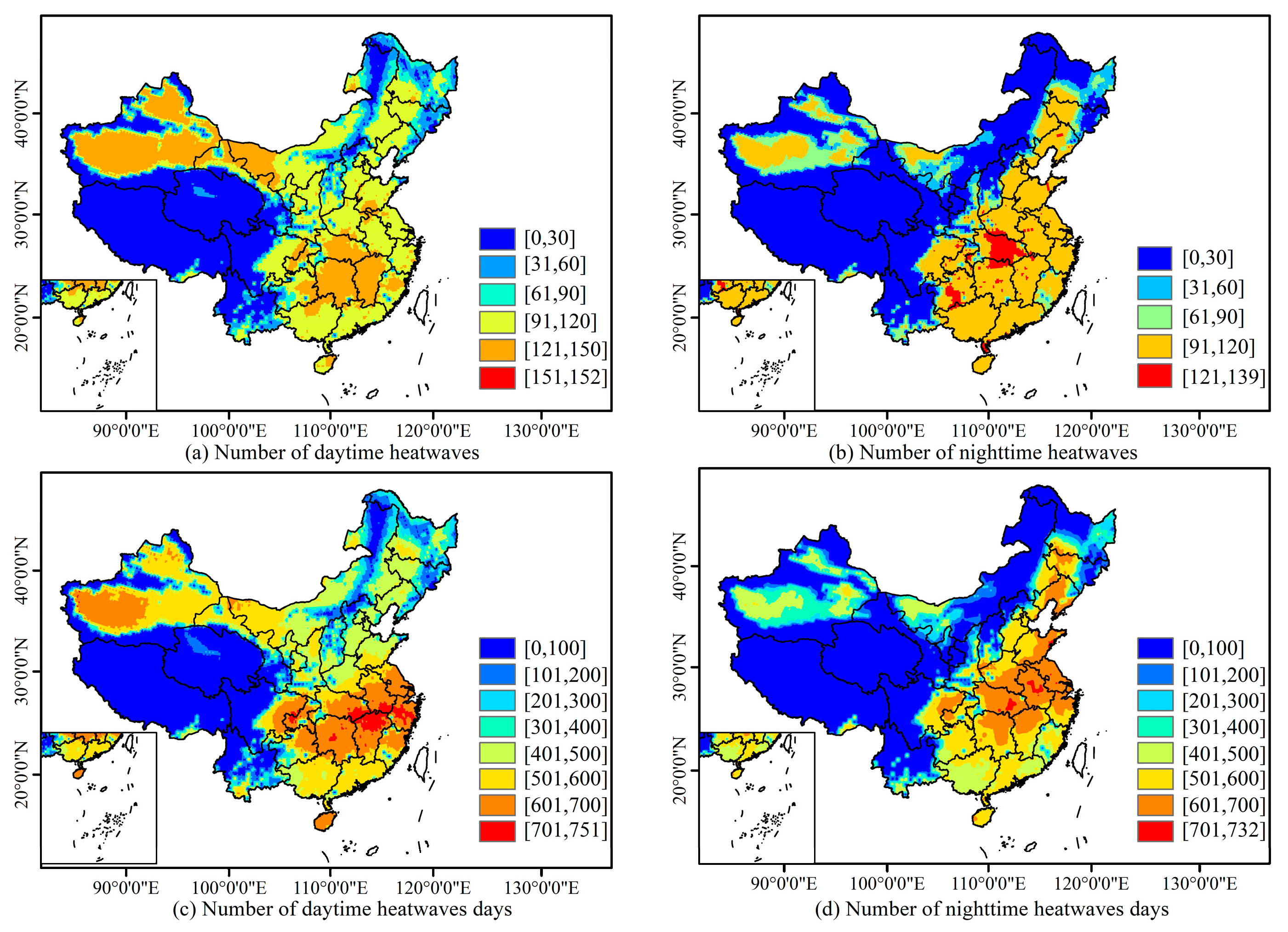
- Daytime Heatwave (DHW): A period of at least three consecutive days during which the daily maximum temperature exceeds both the 90th percentile of the daily maximum temperature for May–September over 62 years at a given grid point and 30 °C.
- Nighttime Heatwave (NHW): A period of at least three consecutive days during which the daily minimum temperature exceeds both the 90th percentile of the daily minimum temperature for May–September over 62 years at a given grid point and 20 °C [28].
2.2.2. Heatwave Analysis Indicators
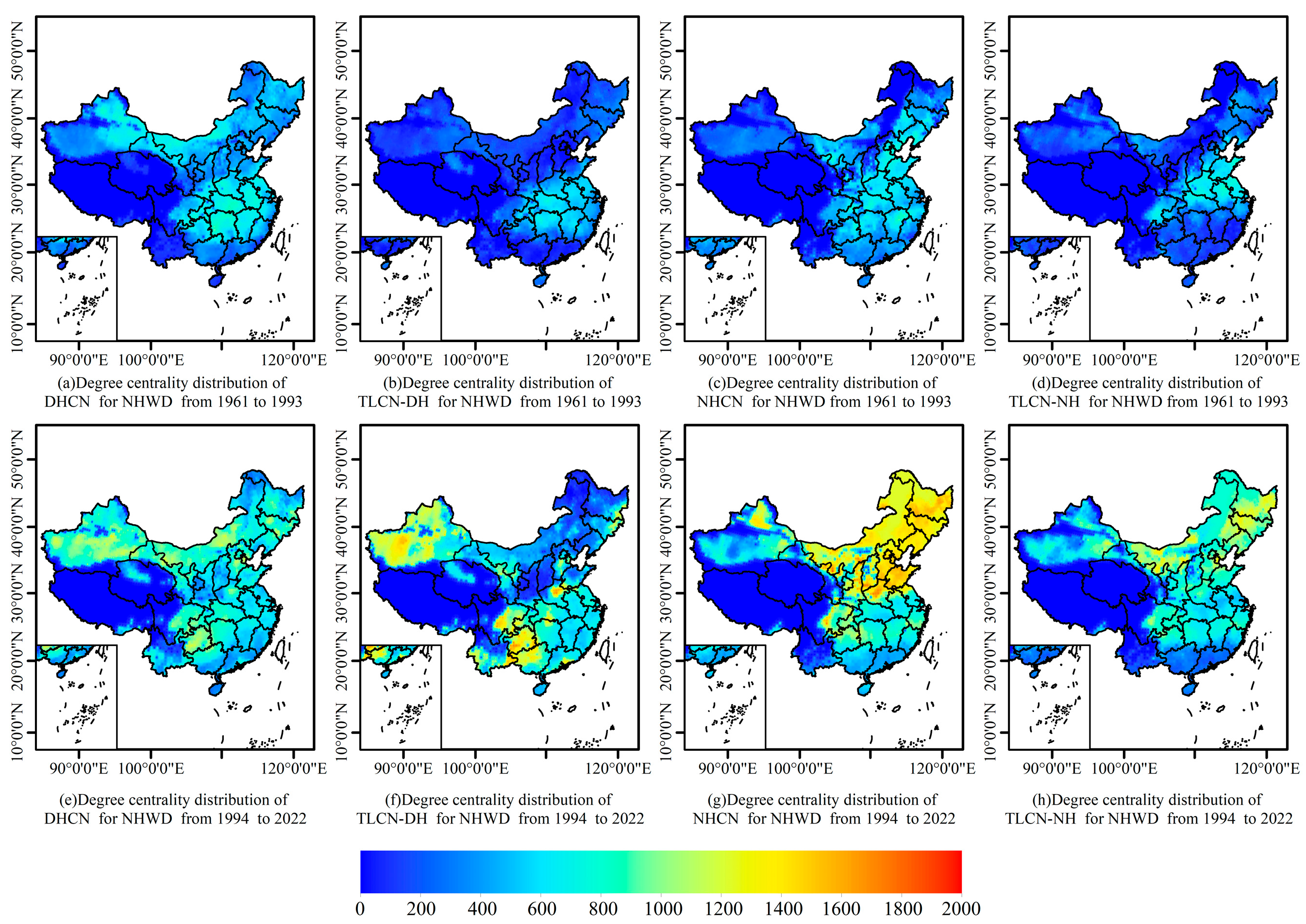
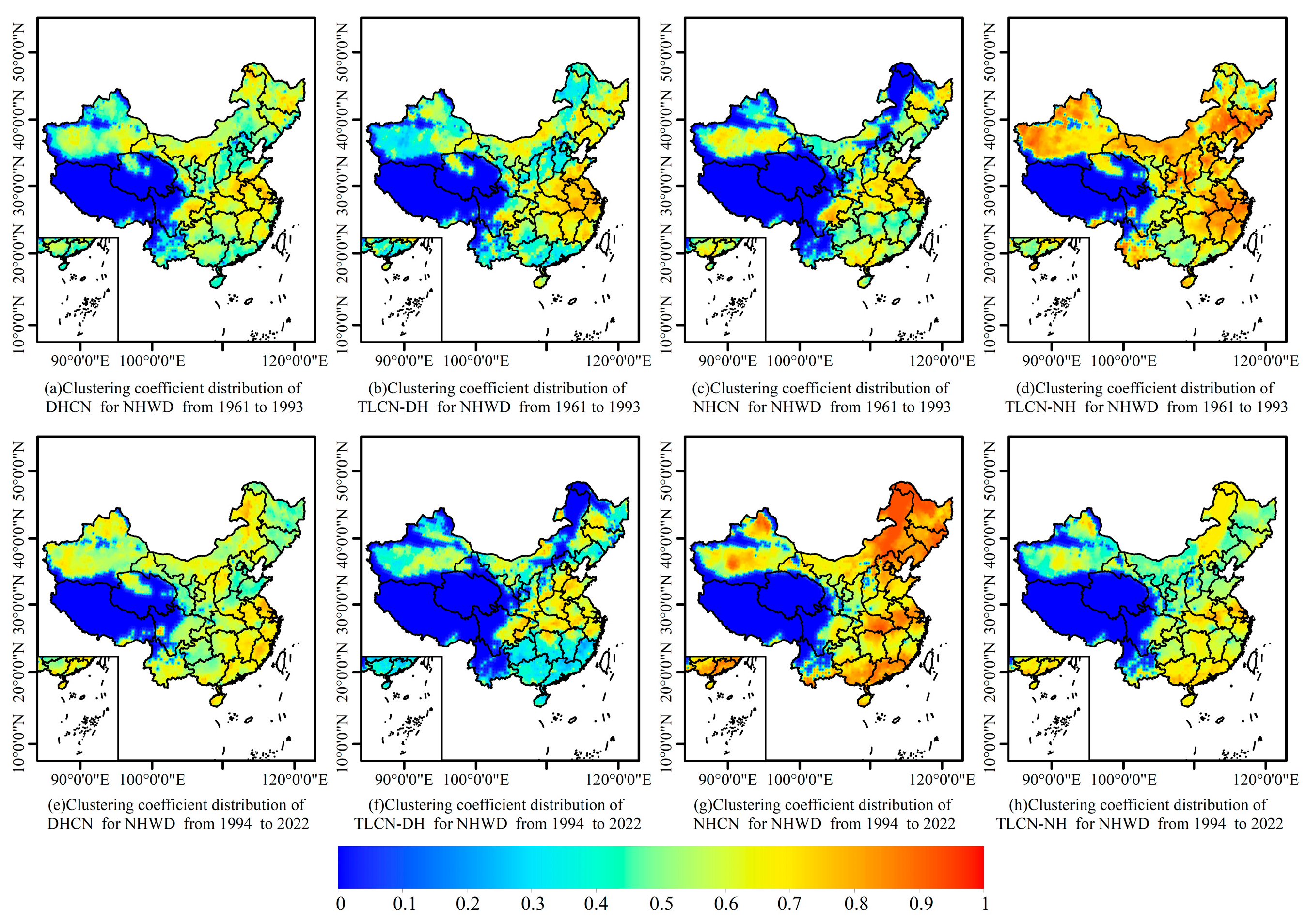
- Number of Heatwave Days (NHWD): The total number of days on which nighttime heatwaves occur during May–September each year.
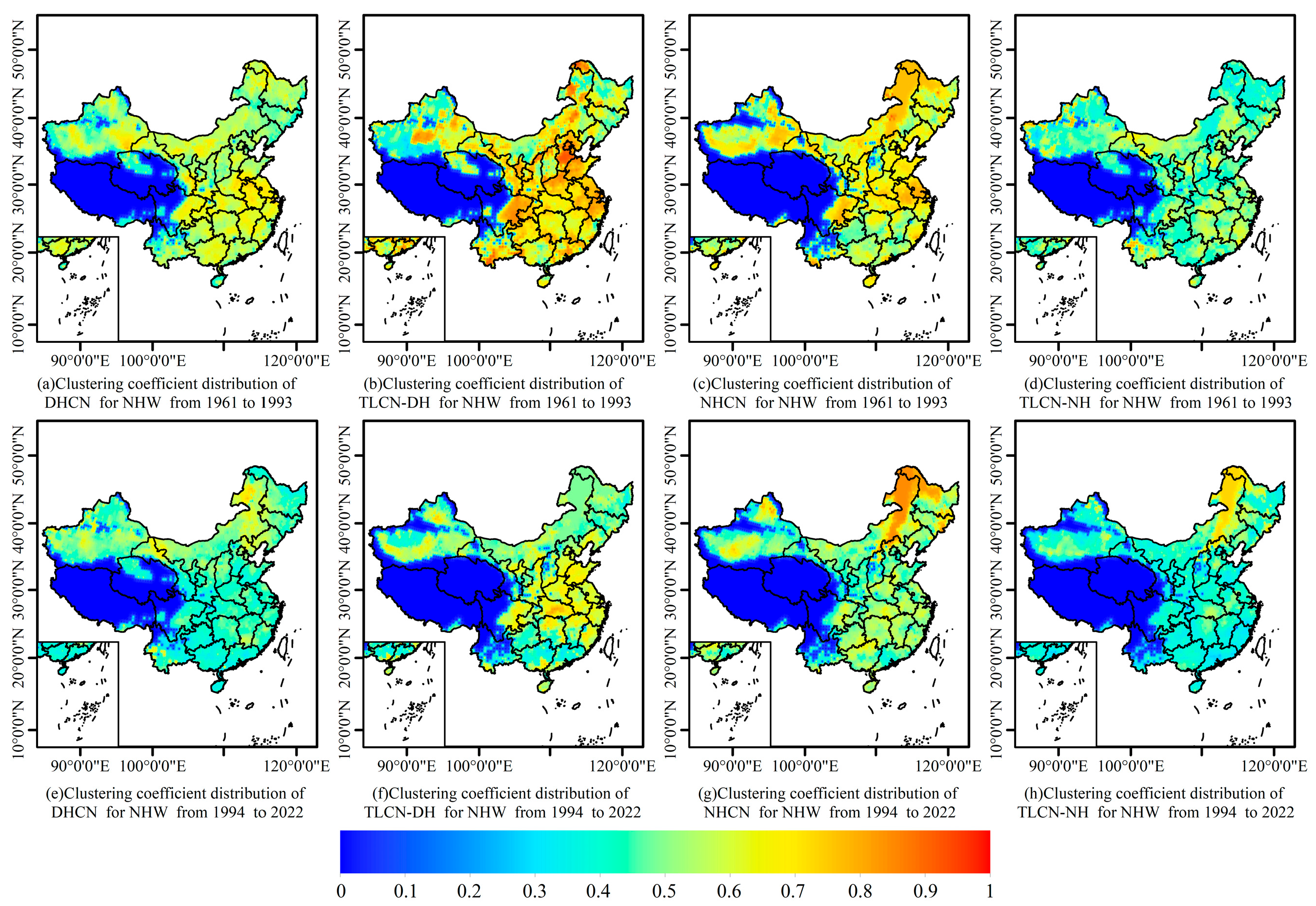
- Number of Heatwave Events (NHW): The total number of nighttime heatwave occurrences during May–September each year.
2.2.3. Complex Network
2.2.4. Detrending Procedure
2.2.5. Network Construction
- Identify the nodes of the heatwave network, which correspond to the valid grid points in the dataset.
- Compute the Pearson correlation coefficients between the 62-year time series of annual daytime heatwave occurrences across different regions, between the 62-year time series of annual nighttime heatwave occurrences, and between the 62-year annual time series of daytime and nighttime heatwave occurrences. The same procedure is repeated for the time series of heatwave days.
- Determine the effective edges of the network. If the p-value corresponding to the Pearson correlation coefficient between heatwave occurrences at two nodes is less than 0.05, an edge is considered to exist between the grid points; otherwise, no edge is established.
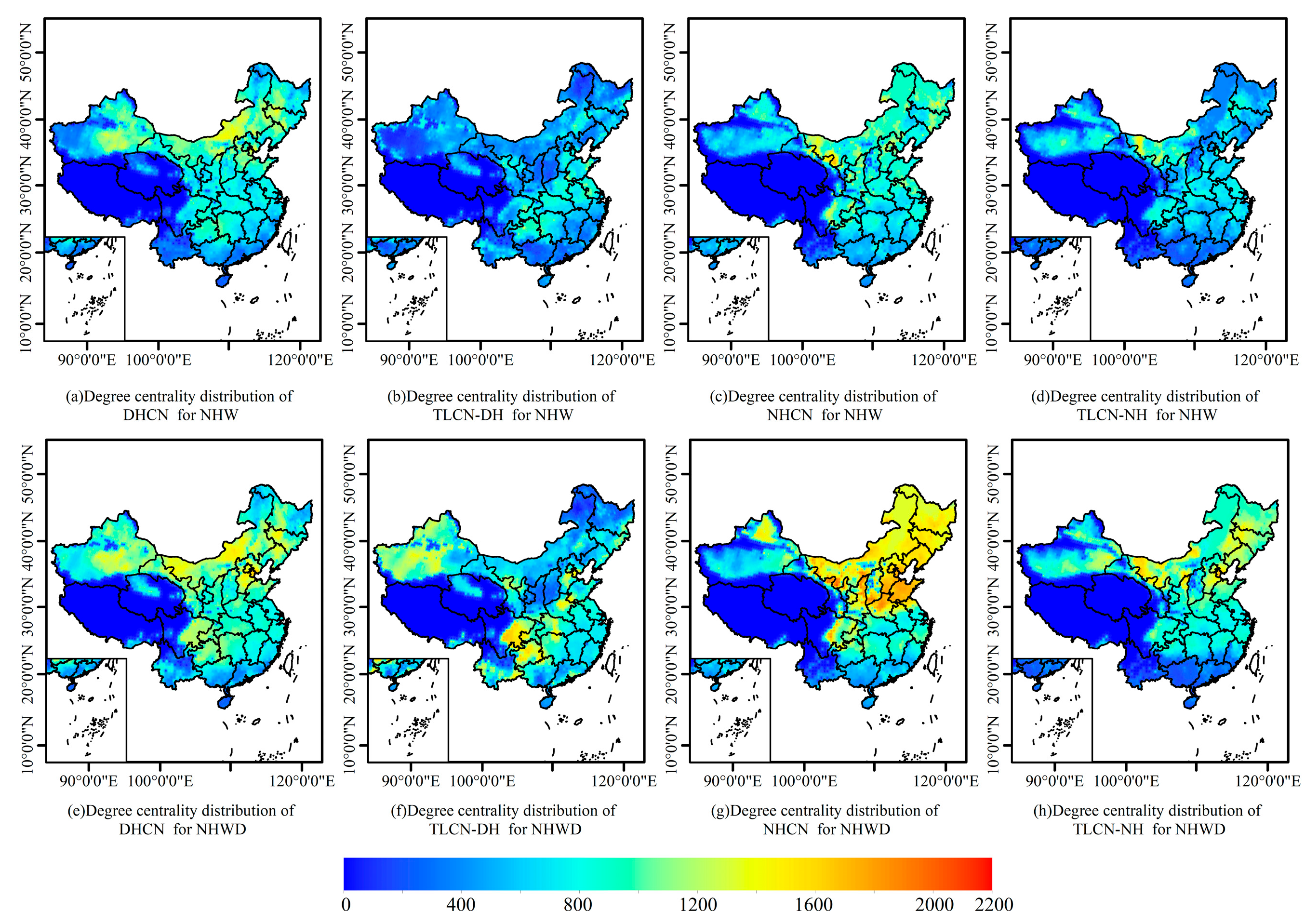
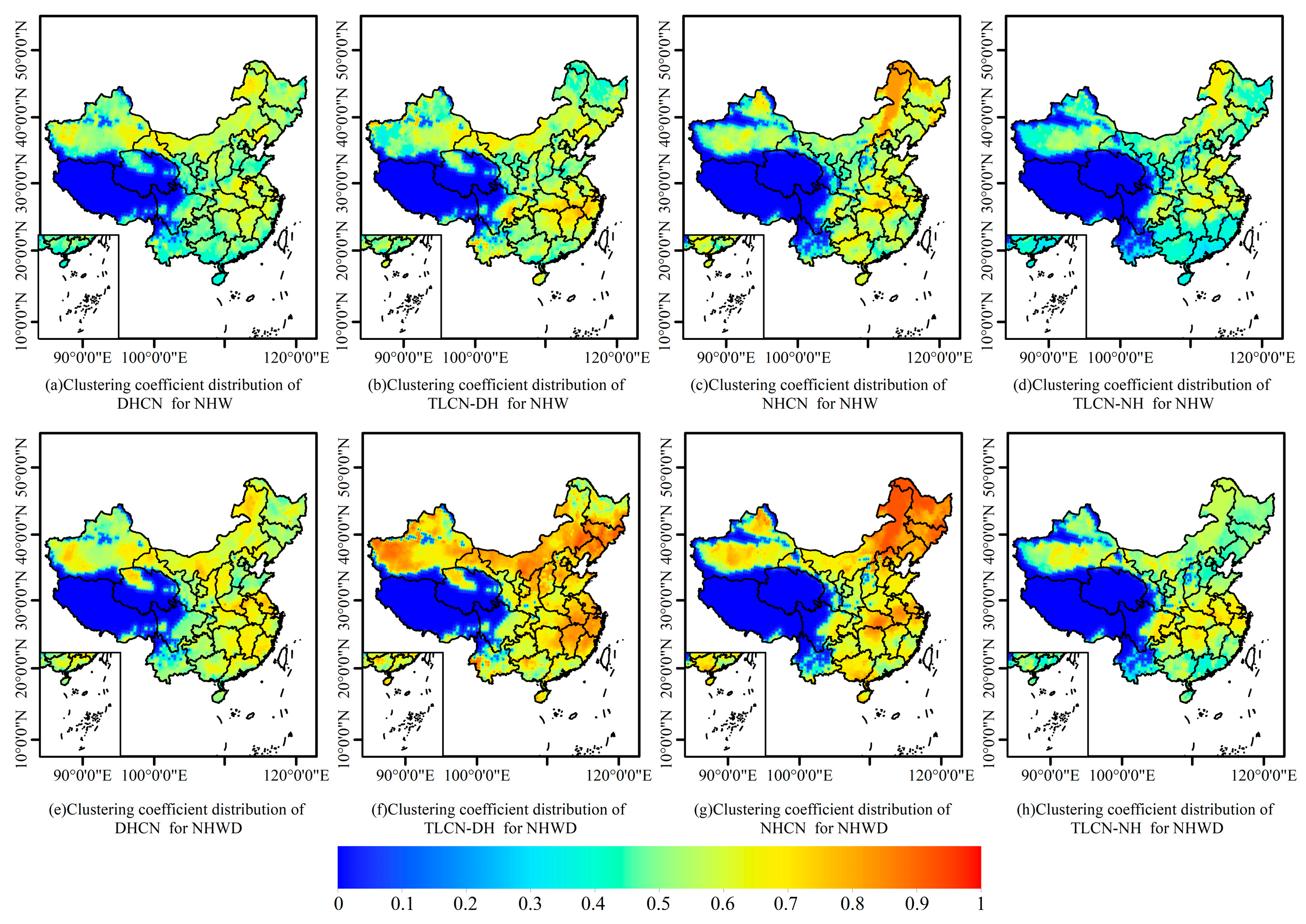
- Compute the network’s node centrality and clustering coefficient.
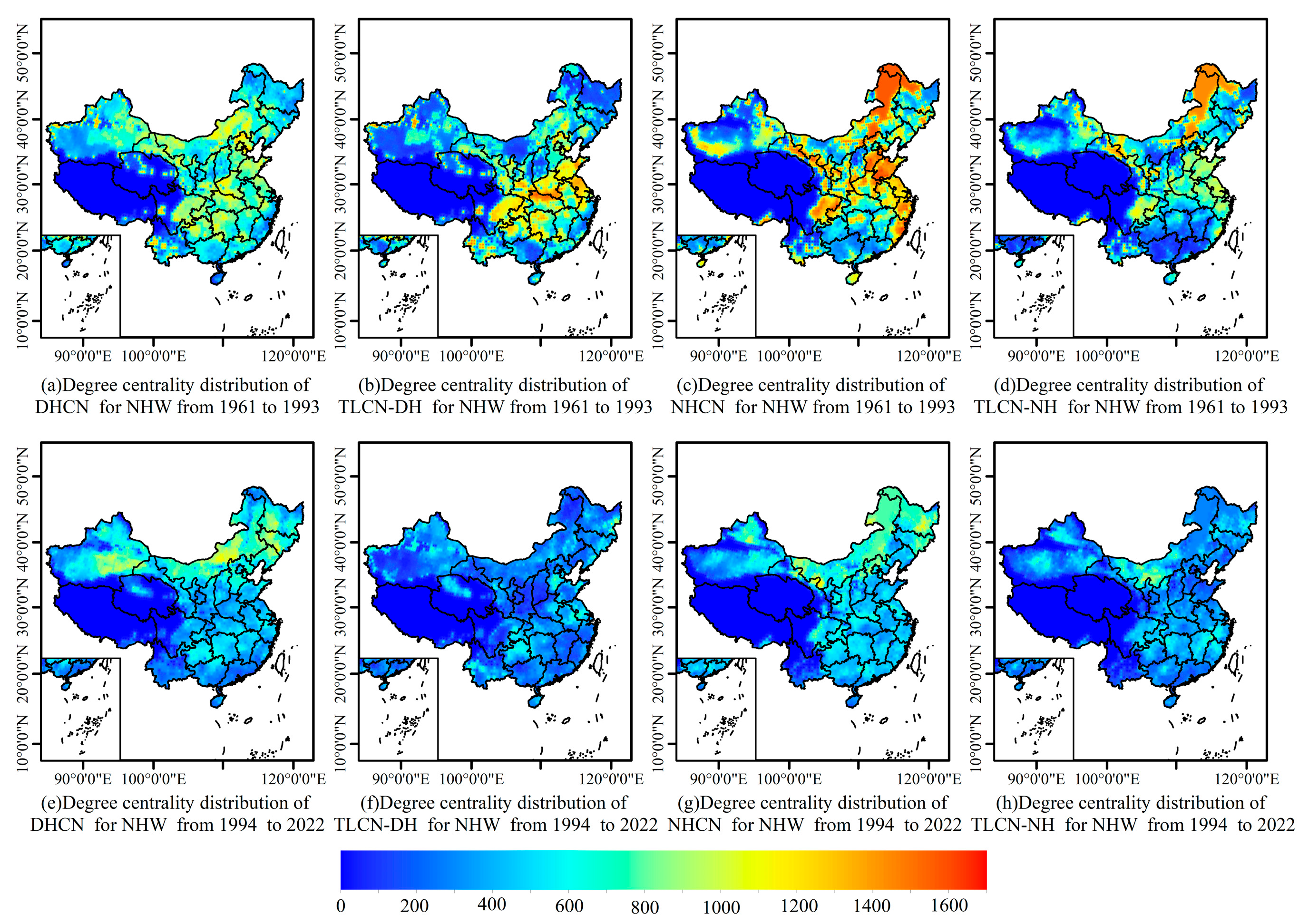
- Daytime Heatwave Complex Network (DHCN): Constructed based on the correlation coefficients of interannual daytime heatwave occurrences or heatwave days between different regions.
- Nighttime Heatwave Complex Network (NHCN): Constructed based on the correlation coefficients of interannual nighttime heatwave occurrences or heatwave days between different regions.
- Daytime Heatwave two-layer Connectivity (TLCN-DH): Represents the strength of interlayer connections between a node in the daytime heatwave network and nodes in the nighttime heatwave network. It quantifies whether the interannual variation in daytime heatwaves in a given region are coordinated with nighttime heatwave variations over a broader area.
- Nighttime Heatwave two-layer Connectivity (TLCN-NH): Represents the strength of interlayer connections between a node in the nighttime heatwave network and nodes in the daytime heatwave network. It quantifies whether the interannual variation in nighttime heatwaves in a given region are influenced by or coordinated with daytime heatwave variations over a broader area.
2.2.6. Statistical Analysis
3. Results
3.1. Spatial and Temporal Distribution Characteristics of Heatwaves in China from 1961 to 2022
3.2. Heatwave Network Analysis
3.3. Changes in Heatwave Networks Before and After 1993
4. Discussion
Author Contributions
Funding
Institutional Review Board Statement
Informed Consent Statement
Data Availability Statement
Conflicts of Interest
References
- Luo, M.; Lau, N.-C.; Liu, Z. Different Mechanisms for Daytime, Nighttime, and Compound Heatwaves in Southern China. Weather Clim. Extremes 2022, 36, 100449. [Google Scholar] [CrossRef]
- Wu, Z.; Lin, H.; Li, J.; Jiang, Z.; Ma, T. Heat Wave Frequency Variability over North America: Two Distinct Leading Modes. J. Geophys. Res. Atmos. 2012, 117, D02102. [Google Scholar] [CrossRef]
- Kjellstrom, T.; Briggs, D.; Freyberg, C.; Lemke, B.; Otto, M.; Hyatt, O. Heat, Human Performance, and Occupational Health: A Key Issue for the Assessment of Global Climate Change Impacts. Annu. Rev. Public Health 2016, 37, 97–112. [Google Scholar] [CrossRef]
- Tack, J.; Barkley, A.; Nalley, L.L. Effect of Warming Temperatures on US Wheat Yields. Proc. Natl. Acad. Sci. USA 2015, 112, 6931–6936. [Google Scholar] [CrossRef]
- Chen, H.; Yan, H.; Gong, K.; Yuan, X.-C. How Will Climate Change Affect the Peak Electricity Load? Evidence from China. J. Clean. Prod. 2021, 322, 129080. [Google Scholar] [CrossRef]
- Igun, E.; Xu, X.; Shi, Z.; Jia, G. Enhanced Nighttime Heatwaves over African Urban Clusters. Environ. Res. Lett. 2023, 18, 014001. [Google Scholar] [CrossRef]
- Chen, R.; Lu, R. Large-Scale Circulation Anomalies Associated with ‘Tropical Night’ Weather in Beijing, China. Int. J. Climatol. 2014, 34, 1980–1989. [Google Scholar] [CrossRef]
- He, C.; Kim, H.; Hashizume, M.; Lee, W.; Honda, Y.; Kim, S.E.; Kinney, P.L.; Schneider, A.; Zhang, Y.; Zhu, Y.; et al. The Effects of Night-Time Warming on Mortality Burden under Future Climate Change Scenarios: A Modelling Study. Lancet Planet. Health 2022, 6, e648–e657. [Google Scholar] [CrossRef]
- Liu, J.; Kim, H.; Hashizume, M.; Lee, W.; Honda, Y.; Kim, S.E.; He, C.; Kan, H.; Chen, R. Nonlinear Exposure–Response Associations of Daytime, Nighttime, and Day–Night Compound Heatwaves with Mortality amid Climate Change. Nat. Commun. 2025, 16, 635. [Google Scholar] [CrossRef]
- Chu, B.; Luo, J.; Wang, H. Spatiotemporal Trend of Nighttime Temperature Anomaly and Its Atmospheric Mechanism. Sci. China Earth Sci. 2025, 68, 1853–1862. [Google Scholar] [CrossRef]
- Jia, J.; Hu, Z. Spatiotemporal characteristics and trends of high-temperature heatwaves of different intensities in China. Adv. Earth Sci. 2017, 32, 546–559. (In Chinese) [Google Scholar] [CrossRef]
- Zhang, J.; Qian, C. Linear Trends in Occurrence of High Temperature and Heat Waves in China for the 1960–2018 Period: Method and Analysis Results. Clim. Environ. Res. 2020, 25, 225–239. [Google Scholar] [CrossRef]
- Nie, Y.; Han, Z.; Han, R.; Ding, T. Interannual variations of summer heatwave duration and associated circulation anomalies in China. Meteorology 2018, 44, 294–303. (In Chinese) [Google Scholar] [CrossRef]
- Shi, Z.; Xu, X.; Jia, G. Urbanization Magnified Nighttime Heatwaves in China. Geophys. Res. Lett. 2021, 48, e2021GL093603. [Google Scholar] [CrossRef]
- Zou, H.; Wu, S.; Shan, J.; Wang, S. Analysis of the Causes of Extreme High-Temperature Events in Central and Eastern China in the Summer of 2013. Acta Meteorol. Sin. 2015, 73, 481–495. (In Chinese) [Google Scholar] [CrossRef]
- Li, Y.; Xu, H.; Liu, D. Features of the Extremely Severe Drought in the East of Southwest China and Anomalies of Atmospheric Circulation in Summer 2006. Acta Meteorol. Sin. 2009, 1, 122–132. [Google Scholar] [CrossRef]
- Luo, M.; Lau, N.-C. Amplifying Effect of ENSO on Heat Waves in China. Clim. Dyn. 2019, 52, 3277–3289. [Google Scholar] [CrossRef]
- Shi, J.; Yao, Y.; Guo, R.; Luo, B.; Zhong, L. The Intensifying Relationship between Heatwaves in the Mid–Lower Reaches of the Yangtze River Valley and the Upstream Atmospheric Wave Train after the 2000s. Atmos. Res. 2025, 313, 107770. [Google Scholar] [CrossRef]
- Yan, H.; Li, Y.; Xing, Y.; Chen, X.; Guo, X.; Yin, Y.; Yu, W.; Huang, M.; Zhuang, J. Increasing Human-Perceived Temperature Exacerbated by Urbanization in China’s Major Cities: Spatiotemporal Trends and Associated Driving Factors. Sustain. Cities Soc. 2025, 118, 106034. [Google Scholar] [CrossRef]
- Kong, J.; Zhao, Y.; Carmeliet, J.; Lei, C. Urban Heat Island and Its Interaction with Heatwaves: A Review of Studies on Mesoscale. Sustainability 2021, 13, 10923. [Google Scholar] [CrossRef]
- Wu, S.; Luo, M.; Zhao, R.; Li, J.; Sun, P.; Liu, Z.; Sun, P.; Zhang, H. Local Mechanisms for Global Daytime, Nighttime, and Compound Heatwaves. npj Clim. Atmos. Sci. 2023, 6, 36. [Google Scholar] [CrossRef]
- Zeng, J.; Xue, D.; Huang, D. Comparison for the Characteristics and Mechanisms of Independent Daytime, Nighttime, and Compound Heatwaves over the Yangtze–Huaihe River Basin. J. Geophys. Res. Atmos. 2025, 130, e2024JD042683. [Google Scholar] [CrossRef]
- Xie, W.; Zhou, B.; Li, H. Emerging Interannual Variability of Compound Heat Waves over the Yangtze River Valley since 2000. J. Clim. 2025, 38, 597–609. [Google Scholar] [CrossRef]
- Cai, F.; Liu, C.; Gerten, D.; Yang, S.; Zhang, T.; Li, K.; Kurths, J. Sketching the Spatial Disparities in Heatwave Trends by Changing Atmospheric Teleconnections in the Northern Hemisphere. Nat. Commun. 2024, 15, 8012. [Google Scholar] [CrossRef]
- Robinson, P.J. On the Definition of a Heat Wave. J. Appl. Meteorol. 2001, 40, 762–775. [Google Scholar] [CrossRef]
- Wang, P.; Tang, J.; Sun, X.; Wang, S.; Wu, J.; Dong, X.; Fang, J. Heat Waves in China: Definitions, Leading Patterns, and Connections to Large-Scale Atmospheric Circulation and SSTs. J. Geophys. Res. Atmos. 2017, 122, 10679–10699. [Google Scholar] [CrossRef]
- You, Q.; Jiang, Z.; Kong, L.; Wu, Z.; Bao, Y.; Kang, S.; Pepin, N. A Comparison of Heat Wave Climatologies and Trends in China Based on Multiple Definitions. Clim. Dyn. 2017, 48, 3975–3989. [Google Scholar] [CrossRef]
- Laz, O.U.; Rahman, A.; Ouarda, T.B.M.J. Trend and Teleconnection Analysis of Temperature Extremes in New South Wales, Australia. Nat. Hazards 2025, 121, 4559–4584. [Google Scholar] [CrossRef]
- Dimitrova, A.; Ingole, V.; Basagaña, X.; Ranzani, O.; Milà, C.; Ballester, J.; Tonne, C. Association between ambient temperature and heat waves with mortality in South Asia: Systematic review and meta-analysis. Environ. Int. 2021, 146, 106170. [Google Scholar] [CrossRef]
- Pan, Y.; Li, Y.; Cai, M.R. Temperature Extremes and Mortality from Coronary Heart Disease and Cerebral Infarction among Chinese Elderly. Lancet 1995, 345, 353–355. [Google Scholar] [CrossRef] [PubMed]
- Wei, J.; Han, W.; Wang, W.; Zhang, L.; Rajagopalan, B. Intensification of Heatwaves in China in Recent Decades: Roles of Climate Modes. npj Clim. Atmos. Sci. 2023, 6, 98. [Google Scholar] [CrossRef]
- Shen, X.; Liu, B.; Li, G.; Wu, Z.; Jin, Y.; Yu, P.; Zhou, D.W. Spatiotemporal Change of Diurnal Temperature Range and Its Relationship with Sunshine Duration and Precipitation in China. J. Geophys. Res. Atmos. 2014, 119, 13163–13179. [Google Scholar] [CrossRef]
- Wang, Y.-J.; Qin, D.-H. Influence of climate change and human activity on water resources in arid region of Northwest China: An overview. Adv. Clim. Change Res. 2017, 8, 268–278. [Google Scholar] [CrossRef]
- Liu, J.; Li, M. Characteristics and Driving Mechanisms of Heatwaves in China During July and August. Atmosphere 2025, 16, 434. [Google Scholar] [CrossRef]
- Chen, W.; Guan, Z.; Yang, H.; Wang, L. The Anomalously Strong and Persistent Western Pacific Subtropical High in Summer 2022 in Association with the Extreme Heatwaves in the Middle and Lower Reaches of the Yangtze River. Acta Meteorol. Sin. 2025, 83, 33–45. [Google Scholar] [CrossRef]
- Zhang, D.; Huang, Y.; Zhou, B.; Wang, H.; Sun, B. Who Is the Major Player for the 2022 China Extreme Heat Wave? Western Pacific Subtropical High or South Asian High? Weather Clim. Extremes 2024, 43, 100640. [Google Scholar] [CrossRef]
- Li, M.; Yao, Y.; Luo, D.; Zhong, L. The Linkage of the Large-Scale Circulation Pattern to a Long-Lived Heatwave over Mideastern China in 2018. Atmosphere 2019, 10, 89. [Google Scholar] [CrossRef]
- Wu, J.; Zhu, Y.; Liu, Y.; Yin, H.; Yuan, F.; Wang, J. Spatiotemporal Variations of Heatwaves in China. Hydrology 2022, 42, 72–77. [Google Scholar] [CrossRef]
- Yang, Y.; Luo, F.; Xue, J.; Zong, L.; Tian, W.; Shi, T. Research Progress and Perspective on Synergy Between Urban Heat Waves and Canopy Urban Heat Island. Adv. Earth Sci. 2024, 39, 331–346. [Google Scholar] [CrossRef]
- Skinner, C.B.; Touma, D.; Barlow, M.; Singh, D.; King, T. The spatial extent of heat waves has changed over the past four decades. Commun. Earth Environ. 2025, 6, 662. [Google Scholar] [CrossRef]
- Barriopedro, D.; García-Herrera, R.; Ordóñez, C.; Miralles, D.G.; Salcedo-Sanz, S. Heat Waves: Physical Understanding and Scientific Challenges. Rev. Geophys. 2023, 61, e2022RG000780. [Google Scholar] [CrossRef]
- Luo, Y.; Yang, S.; Zhang, T.; Yu, Y.; Luo, M.; Xu, L. Distinctive Local and Large-Scale Processes Associated with Daytime, Nighttime and Compound Heatwaves in China. Weather Clim. Extremes 2025, 47, 100749. [Google Scholar] [CrossRef]
- Yang, Q.; Peng, H.; Li, Q. Study on Urban Heatwave Characteristics and Thermal Stress Scenarios Based on China’s Heatwave Hazard Zoning. Urban Clim. 2024, 55, 101957. [Google Scholar] [CrossRef]
- Jiang, J.L.; Liu, Y.M.; Mao, J.Y.; Wu, G.X. Extreme Heatwave over Eastern China in Summer 2022: The Role of Three Oceans and Local Soil Moisture Feedback. Environ. Res. Lett. 2023, 18, 044025. [Google Scholar] [CrossRef]
- Luo, M.; Wang, X.; Dong, N.; Zhang, W.; Li, J.; Wu, S.; Ning, G.; Dai, L.; Liu, Z. Two Different Propagation Patterns of Spatiotemporally Contiguous Heatwaves in China. npj Clim. Atmos. Sci. 2022, 5, 89. [Google Scholar] [CrossRef]
- Cao, J.; Zhou, W.; Wang, J.; Hu, X.; Yu, W.; Zheng, Z.; Wang, W. Significant Increase in Extreme Heat Events along an Urban–Rural Gradient. Landsc. Urban Plan. 2021, 215, 104210. [Google Scholar] [CrossRef]
- Gui, K.; Zhou, T. Soil Moisture Feedback Amplified the Earlier Onset of the Record-Breaking Three-Day Consecutive Heatwave in 2023 in North China. Earth’s Future 2025, 13, e2024EF005561. [Google Scholar] [CrossRef]


Disclaimer/Publisher’s Note: The statements, opinions and data contained in all publications are solely those of the individual author(s) and contributor(s) and not of MDPI and/or the editor(s). MDPI and/or the editor(s) disclaim responsibility for any injury to people or property resulting from any ideas, methods, instructions or products referred to in the content. |
© 2026 by the authors. Licensee MDPI, Basel, Switzerland. This article is an open access article distributed under the terms and conditions of the Creative Commons Attribution (CC BY) license.
Share and Cite
Qin, X.; Feng, A.; Gu, C.; Wang, Q. Study on the Synergistic Mechanisms of Daytime and Nighttime Heatwaves in China Based on Complex Networks. Appl. Sci. 2026, 16, 829. https://doi.org/10.3390/app16020829
Qin X, Feng A, Gu C, Wang Q. Study on the Synergistic Mechanisms of Daytime and Nighttime Heatwaves in China Based on Complex Networks. Applied Sciences. 2026; 16(2):829. https://doi.org/10.3390/app16020829
Chicago/Turabian StyleQin, Xiangrong, Aixia Feng, Changgui Gu, and Qiguang Wang. 2026. "Study on the Synergistic Mechanisms of Daytime and Nighttime Heatwaves in China Based on Complex Networks" Applied Sciences 16, no. 2: 829. https://doi.org/10.3390/app16020829
APA StyleQin, X., Feng, A., Gu, C., & Wang, Q. (2026). Study on the Synergistic Mechanisms of Daytime and Nighttime Heatwaves in China Based on Complex Networks. Applied Sciences, 16(2), 829. https://doi.org/10.3390/app16020829