Blockchain Forensics and Regulatory Technology for Crypto Tax Compliance: A State-of-the-Art Review and Emerging Directions in the South African Context


Abstract
1. Introduction
2. Research Methods
3. Literature Review
3.1. Background Details on the Global Perspective
3.2. Blockchain Forensics Tools and Techniques
3.3. Regulatory Technology and Automation for Compliance
3.4. Crypto Taxation Framework
3.5. Limitations of the Identified Research Gaps
- Reactive focus of Blockchain forensics. The current Blockchain forensics research remains predominantly reactive and AML-oriented. Its foundational studies focus on clustering, taint analysis, and illicit detection, but these methods have not been adapted for routine taxpayer self-reporting or integrated into automated compliance workflows.
- RegTech models lacking taxpayer-centric design. Although RegTech literature highlights opportunities for automation, smart contracts, and policy-as-code, most of these models target institutional reporting and financial market supervision rather than individual taxpayer compliance. The existing frameworks do not provide mechanisms to validate the integrity of self-reported crypto-asset data or reconcile disclosures with on-chain evidence, thereby limiting their applicability to crypto tax administration.
- Fragmented global tax classifications. The global crypto-tax literature suffers from inconsistent classifications, definitions, and cost basis rules across jurisdictions. As discussed in Section 3.1, various countries diverge significantly in defining digital assets, identifying taxable events, and selecting cost-basis methods. These inconsistencies complicate data standardisation, hinder taxpayer compliance, and weaken the interoperability of cross-border regulatory frameworks.
- Inadequate treatment of emerging activities. As outlined in Section 3.4, the current tax frameworks inadequately address emerging activities such as DeFi lending, liquidity pools, staking rewards, airdrops, hard forks, and NFT transactions. In South Africa and many other jurisdictions, guidance remains incomplete or ambiguous, creating structural uncertainty for taxpayers and complicating auditability, while the literature highlights these descriptive gaps, it rarely proposes technically grounded mechanisms to resolve them.
- Absence of verifiable audit mechanisms. The existing research does not provide mechanisms for the tax authority to independently validate the accuracy of crypto-asset declarations against underlying Blockchain evidence. The lack of tamper-resistant, verifiable audit anchors leaves tax systems reliant on voluntary disclosures, despite the availability of on-chain forensic data that could support automated verification.
- Underdeveloped privacy-preserving mechanisms. Privacy-preserving techniques remain limited. Although some studies address pseudonymity or cryptographic primitives such as hashing, selective disclosures, and zero-knowledge proofs, these approaches have not been operationalised to balance transparency with taxpayer privacy when public Blockchains are used as compliance infrastructures.
4. Proposed Conceptual Model
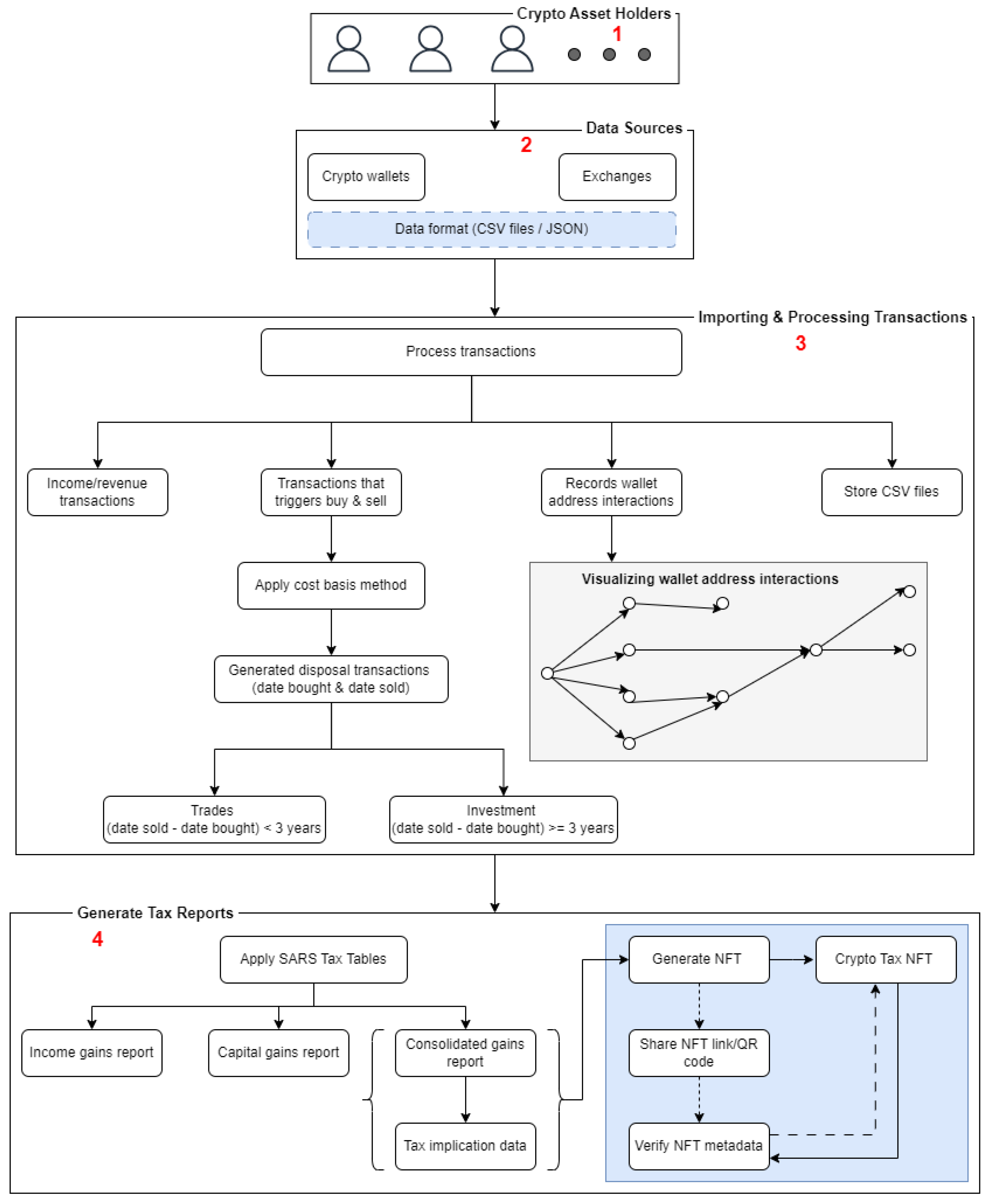
4.1. Previously Proposed Model
- CAHs: taxpayers who directly engage in crypto transactions and fulfil their tax obligations.
- Tax practitioners: third-party professionals responsible for filing tax obligations on behalf of CAHs.
- CASPs: businesses such as Binance, Kraken or Luno, which facilitate crypto transactions and custodial services.
- Crypto asset businesses (CABs): organisations that accept or hold crypto assets for operational purposes. For example, “Pick ’n Pay” retail store in South Africa enables customers to pay for goods using digital assets, e.g., Bitcoins [35].
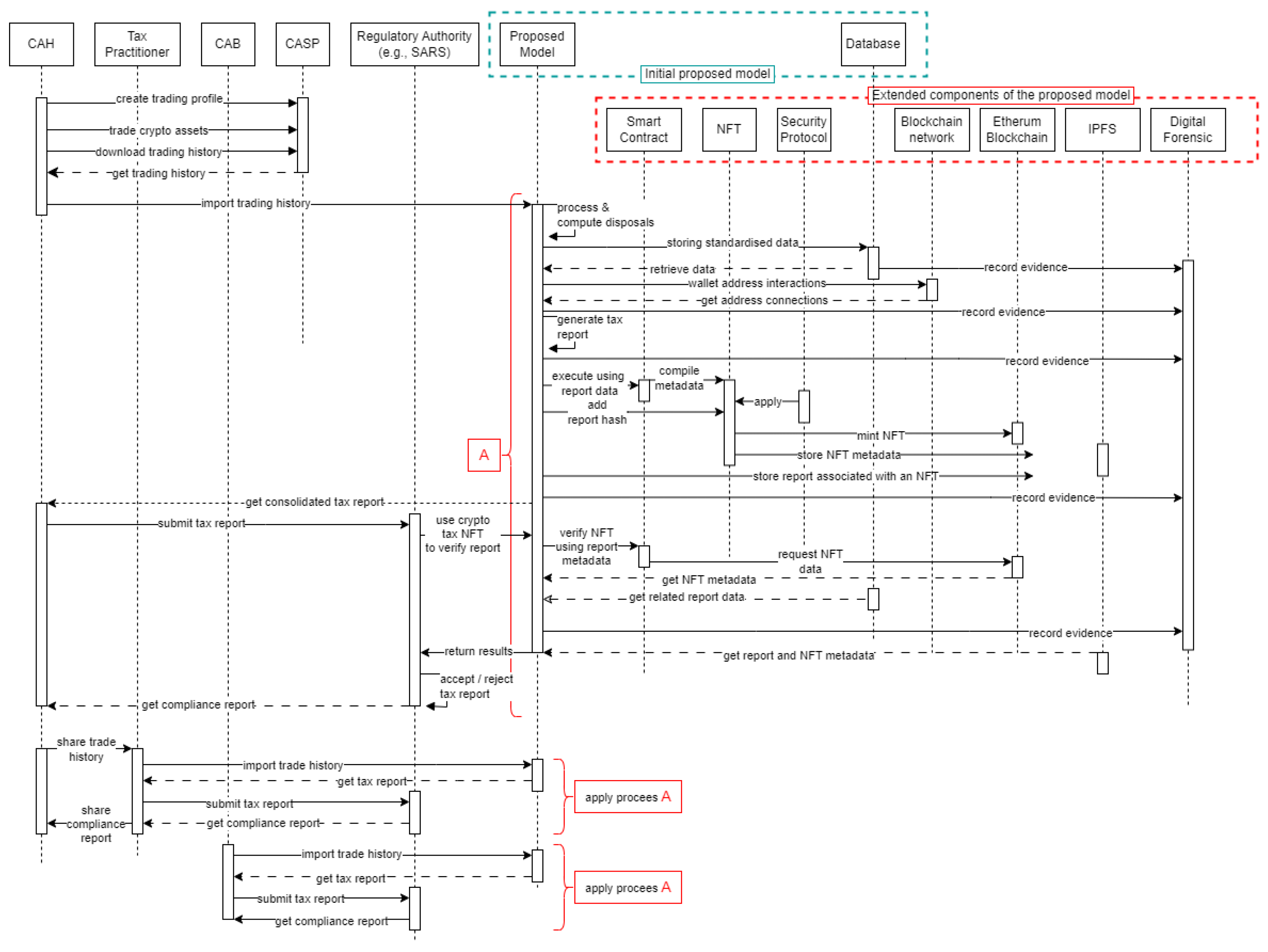
4.2. Extended Conceptual Model
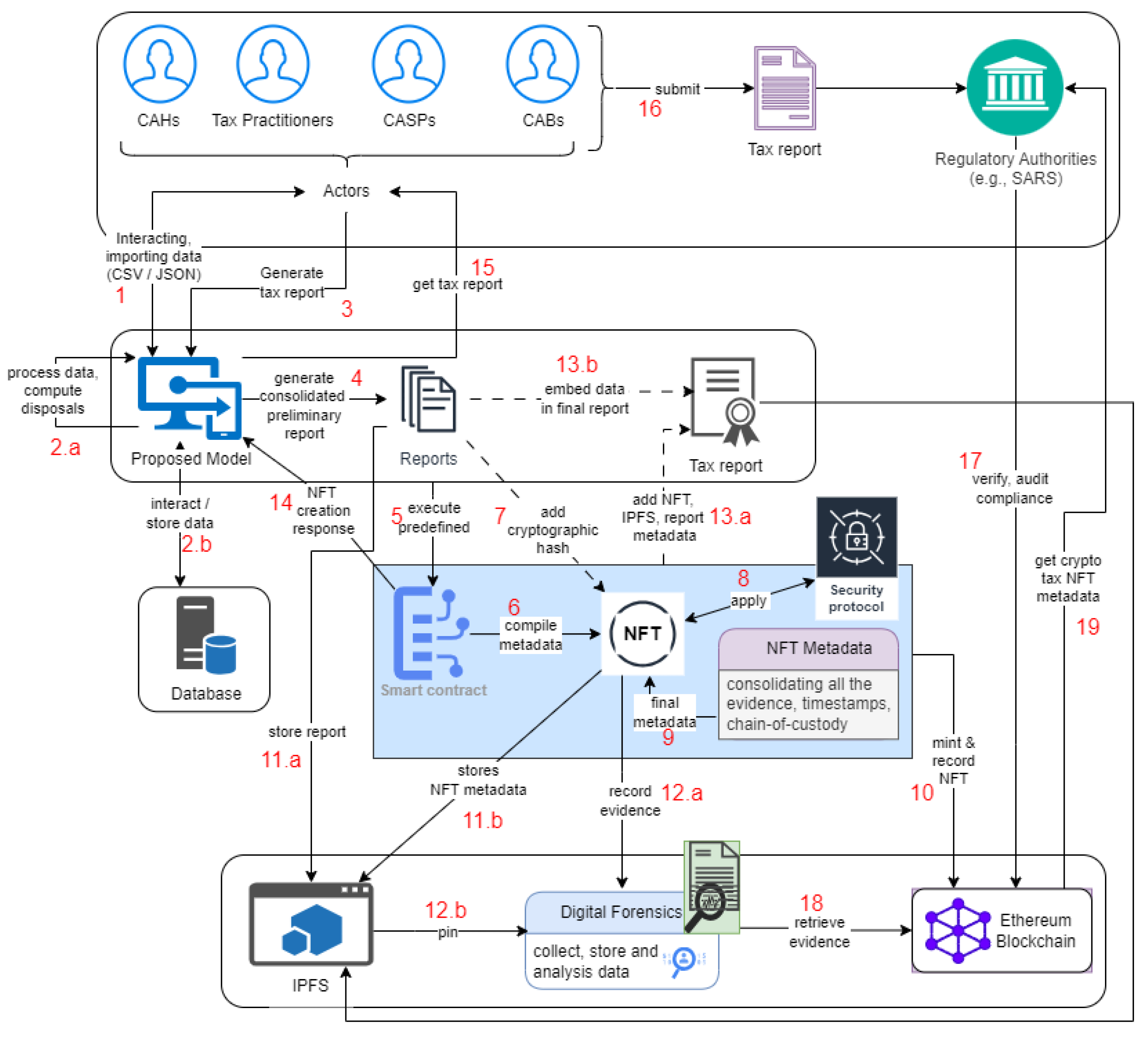
- Step 1: Depict relevant actors (e.g., CAHs, tax practitioners, CASPs, or CABs), initiate the interaction with the proposed model by importing historical transaction data from CASPs (e.g., crypto wallets or exchanges).
- Step 2: Upon successful data ingestion, the proposed model consolidates the imported data and initiates tax computation workflows (depicted by step 2 in Figure 2). Note that this process also seeks to standardise the imported data and compute disposal events using SARS-approved cost basis methods (i.e., FIFO). This allows the proposed mode to interact with the database by storing or retrieving processed data.
- Step 3: Once the imported data are processed successfully, the proposed model enables the actor to submit a request to generate a tax report associated with a particular fiscal period.
- Step 4: Depicts a process that generates a consolidated preliminary report, which enables the proposed model to identify taxable events that can be used to extract both income and capital gains tax metadata. Additionally, this process also involves recording of crypto wallet addresses used to either send or receive digital assets, as well as performing wallet clustering and address attribution based on the known risk indicators from publicly available sanctions lists and illicit activity reports, such as ransomware clusters, mixer pools, scam or fraud wallets. This results in visualising the crypto wallet address interactions to identify connections with flagged or sanctioned addresses, as shown in label 3 of Figure 1.
- Step 5: Present a process that uses the preliminary tax report inputs to execute a smart contract, which initiates the tokenisation process that results in a crypto tax NFT.
- Step 6: Depict a smart contract compiling essential metadata required for NFT creation, which includes a cryptographic hash of the tax report, a pseudonymised or hashed identifier for the taxpayer, the applicable tax year and system timestamp, as well as the unique internal system-generated reference ID for traceability.
- Step 7: The process that enables the proposed model to generate a cryptographic hash of the tax report to serve as a tamper-proof digital fingerprint. This cryptographic hash of the tax report is also appended to the NFT metadata.
- Step 8: Depicts a process that seeks to add additional security mechanisms, such as digital signatures, hash locks, or Merkle roots, that are applied to enhance the authenticity and data integrity of the report.
- Step 9: Represent a process that compiles a comprehensive metadata structure, incorporating timestamps, evidence trails, hash values, wallet address risk score, and chain-of-custody details for regulatory verification purposes. Note that all this metadata will be embedded as pseudonymised indicators to support regulatory review without exposing sensitive information.
- Step 10: Following metadata finalisation and security validation, the NFT is minted on a public Blockchain (e.g., Ethereum), ensuring immutability and global verifiability of the tax report. This study adopts the Ethereum Blockchain network, which supports the ERC-721 standards for its metadata.
- Step 11: The associated tax report and NFT metadata are stored off-chain using the InterPlanetary File System (IPFS), and a unique IPFS content identifier (CID) is generated, which provides a link between on-chain data stored in the Ethereum network, and off-chain data stored in the internal database and IPFS.
- Step 12: During the process of storing data to an IPFS, a dedicated forensic module is used to log digital forensic evidence. This forensic evidence includes a recording of the following information: smart contract version histories, cryptographic hashes, NFT minting proofs, and the IPFS CIDs, to ensure tamper detection and traceability for future audits. Note that all the critical data elements (e.g., NFT metadata, IPFS CID, and report hashes) are redundantly stored across multiple platforms, such as the Ethereum network (on-chain), IPFS (off-chain), and an internal database.
- Step 13: All the metadata and forensic evidence collected from various components are appended to the final tax report, creating a compliance-ready package. This final tax report package is then made available for authorised actors to download and submit it to the relevant authority.
- Step 14: Depicts a process that enables the smart contract to respond to the request made by the proposed model regarding the NFT creation.
- Step 15: The proposed model allows the actor to download the finalised tax report that consists of all the necessary metadata required for the regulatory authority to securely and independently verify the authenticity of the submitted report.
- Step 16: After the authorised actor has successfully downloaded the tax report, he then submits it to the relevant tax authority (e.g., SARS).
- Step 17: The regulatory authority initiates a process that seeks to verify or validate the tax report submitted by the taxpayer by cross-referencing the embedded NFT metadata with the submitted tax report, establishing a first layer of authenticity.
- Step 18: A comprehensive audit process is conducted by retrieving the original tax report from the IPFS, verifying the forensic logs, cross-checking timestamps, and confirming NFT minting proofs. These verification steps enable the regulatory authorities, e.g., SARS, to assess the tax report’s integrity and authenticity with high confidence.
- Step 19: Depicts a process whereby the regulatory authority, e.g., SARS, obtains the final corresponding results associated with the crypto tax NFT.
5. Analysis and Synthesis
5.1. Evaluation of the Existing Solutions vs. Proposed Model
- Global tax tools—these are consumer-oriented crypto tax calculators used by CAHs to generate the required tax report that can be submitted to the regulatory authorities during the process of filing tax obligations. Some of these notable solutions include CoinLedger, Recap, Kryptos, CryptoTaxCalculator, CoinPanda, and Koinly, as discussed in [11].
- Blockchain forensic solutions—these are enterprise solutions such as Chainalysis, CypherTrace, Elliptic, Maltego, TRM Labs, and Breadcrumbs, that perform clustering, tracing, attribution, and risk scoring aligned to AML or CFT expectations [28,29]. These tools are powerful for post-incident investigations but are not embedded in taxpayer filing workflows and generally do not compute tax outcomes for CAHs. Hence, these solutions employ sophisticated techniques primarily for investigative purposes, rather than the issues faced by taxpayer during the process of filing their crypto tax obligations.
- RegTech solutions—these solutions leverage policy-as-code or smart contracts to automate elements of regulatory reporting, while they show promise for rule execution and workflow automation, they often lack integrated forensic verification to reconcile declarations with on-chain reality and are seldom tailored to SARS forms, periods and evidentiary requirements.
5.2. Synthesis of Related Academic Contributions
6. Research Contribution
- Theoretical—it reconceptualises digital forensics concepts from being primarily an investigative AML tool into an active, proactive mechanism for routine crypto tax compliance. This theoretical shift broadens the scope of Blockchain forensics, embedding it within fiscal governance and taxpayer self-reporting.
- Practical—it proposes a robust, locally adapted proof-of-concept model tailored to South Africa’s context. It aligns fully with SARS’s cost basis methods while addressing emerging transaction types such as staking, DeFi, and NFT activities. This ensures both regulatory relevance and practical applicability for diverse taxpayer scenarios.
- Innovative—it introduces the use of NFTs as verifiable audit anchors. By embedding cryptographic metadata into NFTs, the model enhances trust, ensures tamper-proof integrity, and creates an immutable audit trail for self-reported tax data, strengthening transparency and accountability in tax governance.
- Linking digital forensics and tax compliance—by extending the application of Blockchain forensic methods to routine tax reporting and not just criminal investigations, it redefines the role of digital forensics in fiscal governance.
- Verification compliance through NFTs—adds a verifiable audit layer that enables regulatory bodies, e.g., SARS, to independently validate tax submissions, bridging trust gaps between taxpayers and regulators.
- Automation within local rules—unlike generic global calculators, the proposed model is designed to fully align with SARS-specific cost basis methods and distinguish between income and capital gains, ensuring contextual compliance. Note that this research also aimed at presenting the proof of concept to SARS, with the hope that it can be adopted and integrated into their e-filing platform.
- Scalable and cost-free—By prioritising a subscription-free, automated proof-of-concept, the model addresses the practical barriers that deter small-scale taxpayers or CAHs from fulfilling their crypto-related tax obligations, which enhances inclusivity and voluntary compliance.
7. Privacy Considerations and Adoption Barriers
7.1. Privacy Risks Associated with Public Blockchain Anchoring
- Pattern recognition and behavioural inference: even without explicit personal identifiers, observable metadata, such as transaction timings or recurring interactions with a verification smart contract, may allow adversaries to infer taxpayer behaviour. Over time, such interactions may form behavioural fingerprints that reveal filing habits or trading frequency.
- Cross-contextual linkage and re-identification: public Blockchain metadata (e.g., event logs, timestamps, or IPFS content identifiers) can be correlated with external datasets such as leaked exchange records, Blockchain analysis clusters, or network-level identifiers. This cross-dataset correlation increases the risk of re-identification, thereby undermining the intended pseudonymity of taxpayers.
- Longitudinal traceability: immutability of public ledgers ensures that all the interactions with smart contracts remain visible indefinitely. Over time, patterns emerging from NFT issuance, hash submissions, or smart contract interactions may enable inference attacks capable of deanonymising pseudonymised identifiers.
- a.
- The use of zero-knowledge proofs (ZKPs) to verify tax-report authenticity without exposing underlying data.
- b.
- Commit–reveal protocols to decouple the timing of tax computations from on-chain minting events.
- c.
- Periodically rotating pseudonymous identifiers to prevent long-term behavioural correlation.
- d.
- Utilisation of privacy-preserving layer-2 rollups, where metadata exposure is significantly reduced compared to base-layer public chains.
7.2. Adoption Barriers Across the Compliance Ecosystem
- Taxpayer adoption considerations: the majority of taxpayers lack the technical literacy necessary to interact with NFT-based audit trails, IPFS-linked metadata, or Blockchain-anchored attestations. Some of the concerns that might reduce voluntary adoption include privacy exposure, misunderstanding of cryptographic proofs, and unfamiliarity with Blockchain mechanisms. Furthermore, gas fees, even when they are relatively low, may pose a financial barrier for small-scale traders. Despite these challenges, the model offers clear incentives: automated disposal-event computation, simplified reporting processes, and reduced audit disputes, all of which may encourage adoption once adequate education and support structures are in place.
- Tax authority readiness and institutional constraints: For tax authorities such as SARS, adoption depends on alignment with institutional mandates, compatibility with existing audit workflows, and the legal recognition of cryptographic attestations. Integrating Blockchain-based verification tools may require procedural reforms, staff capacity building, and the establishment of standards for evaluating cryptographic artefacts. Additionally, regulatory uncertainty regarding the admissibility of NFTs or hash-anchored proofs in legal audits may impede institutional adoption.
- CASP integration challenges: Local CASPs may face additional compliance burdens associated with generating standardised datasets, maintaining risk-assessment metrics, or enabling API-based interactions with the proposed model. Foreign CASPs, particularly those outside South Africa’s regulatory perimeter, may be unwilling or unable to provide structured and standardised data, exacerbating the existing interoperability and data-harmonisation challenges.
8. Limitations and Shortcomings of the Study
- Privacy preservation mechanisms: Although hashing and pseudonymisation are employed, the model does not implement advanced privacy-preserving cryptographic techniques such as zero-knowledge proofs. Future work should incorporate such mechanisms to strengthen privacy guarantees.
- Cost and variability of NFT minting fees: The reliance on public Blockchain networks introduces variable gas fees, which may limit accessibility for low-income or small-scale taxpayers. Layer-2 Blockchain roll-ups and alternative networks remain unexplored.
- Environmental considerations: Despite Ethereum’s shift to proof-of-stake, Blockchain interactions still incur environmental and computational costs, warranting further investigation of sustainable alternatives.
- Long-term data availability: While IPFS provides decentralised storage, long-term persistence is not guaranteed unless data are continuously pinned, creating potential reliability concerns.
- Lack of standardisation: The absence of formal standards for NFT-based tax-report metadata limits the immediate interoperability of the model with existing regulatory frameworks.
9. Conclusions
- Phase 1: Importing, processing, and computing transactions. These are the development functions or components used to import data collected from various CASPs and the Blockchain network with an aim of standardising the data used by the proposed model. Once the transactions have been processed successfully, an implementation of a component that computes disposal events using SARS-approved cost basis methods (e.g., FIFO and SI) should be triggered automatically.
- Phase 2: Implement the reporting component that seeks to utilise the processed transactions and disposal events to generate a tax report that will be submitted to SARS as part of declaring digital or crypto assets.
- Phase 4: Smart contract development, forensic engine integration, NFT minting, and IPFS integration. it involves the creation of the NFT contract, metadata schema, and verification function, while the forensic element incorporates wallet address clustering, taint analysis, and risk scoring into the compliance workflow. An additional component will be an implementation of off-chain storage using IPFS, generation of IPFS CIDs, and linking these data to on-chain NFT metadata.
- Phase 5: Prototype testing and evaluation. involves a comprehensive assessment using synthetic scenarios and real CASPs transaction data to validate readiness for regulatory engagement.
Author Contributions
Funding
Institutional Review Board Statement
Informed Consent Statement
Data Availability Statement
Acknowledgments
Conflicts of Interest
Abbreviations
| SARS | South African Revenue Service |
| RegTech | Regulatory technology |
| NFTs | Non-fungible tokens |
| DeFi | Decentralised finance |
| ML | Money laundering |
| AML | Anti-money laundering |
| TF | Terrorist financing |
| CTF | Counter-terrorism financing |
| CAHs | Crypto asset holders |
| FATF | Financial Action Task Force |
| CASPs | Crypto asset service providers |
| CABs | Crypto asset businesses |
| CGT | Capital gains tax |
| FIFO | First-in-first-out |
| LIFO | Last-in-first-out |
| HIFO | Highest-in-first-out |
| WAC | Weighted average cost |
| SI | Specific identification |
| OECS | Organisation for Economic Co-operation and Development |
| USA | United States of America |
| IRS | Internal Revenue Service |
| UAE | United Arab Emirates |
| IPFS | Inter-Planetary File System |
| CID | Content identifier |
References
- Nakamoto, S. Bitcoin: A Peer-to-Peer Electronic Cash System. 2008. Available online: https://bitcoin.org/bitcoin.pdf (accessed on 15 March 2025).
- Catalini, C.; Gans, J. Some simple economics of the blockchain. Commun. Acm 2020, 63, 80–90. [Google Scholar] [CrossRef]
- Swan, M. Blockchain: Blueprint for a New Economy; O’Reilly Media, Inc.: Sebastopol, CA, USA, 2015. [Google Scholar]
- Foley, S.; Karlsen, J.; Putniņš, T. Sex, drugs, and bitcoin: How much illegal activity is financed through cryptocurrencies? Rev. Financ. Stud. 2019, 32, 1798–1853. [Google Scholar] [CrossRef]
- Taxing Virtual Currencies: An Overview of Tax Treatments and Emerging Tax Policy Issues. Available online: https://www.oecd.org/content/dam/oecd/en/topics/policy-issues/tax-policy/flyer-taxing-virtual-currencies-an-overview-of-tax-treatments-and-emerging-tax-policy-issues.pdf (accessed on 20 June 2025).
- 12-Month Review of the Revised FATF Standards on Virtual Assets and Virtual Asset Service Providers. Available online: https://www.fatf-gafi.org/en/publications/Fatfrecommendations/12-month-review-virtual-assets-vasps.html (accessed on 20 June 2025).
- Zetzsche, D.; Arner, D.; Buckley, R. Decentralized finance. J. Abbr. 2020, 6, 172–203. [Google Scholar] [CrossRef]
- Cryptocurrency Penetrates Key Markets in Sub-Saharan Africa as an Inflation Mitigation and Trading Vehicle. Available online: https://www.chainalysis.com/blog/africa-cryptocurrency-adoption/ (accessed on 26 June 2025).
- Vumazonke, N.; Parsons, S. An analysis of South Africa’s guidance on the income tax consequences of crypto assets. S. Afr. J. Econ. Manag. Sci. 2023, 26, 1. [Google Scholar] [CrossRef]
- Jurisdictions Under Increased Monitoring—13 June 2025. Available online: https://www.fatf-gafi.org/en/publications/High-risk-and-other-monitored-jurisdictions/increased-monitoring-june-2025.html (accessed on 25 July 2025).
- Ramazhamba, P.T.; Venter, H.S. Conceptual Model for Taxation and Regulatory Governance among South African Crypto Asset Holders. In Proceedings of the ISSA Conference, Gqeberha, South Africa, 2 December 2024. [Google Scholar]
- Exchange Control Circular No 2/2025 Statement on Exchange Control. Available online: https://www.resbank.co.za/content/dam/sarb/what-we-do/financial-surveillance/financial-surveillance-documents/2025/2-2025.pdf (accessed on 25 April 2025).
- Media Release: SARS Warns About Crypto Asset Compliance. Available online: https://www.sars.gov.za/latest-news/media-release-sars-warns-about-crypto-asset-compliance/ (accessed on 25 April 2025).
- Ramazhamba, P.T.; Venter, H.S. Using distributed ledger technology for digital forensic investigation purposes on tendering projects. Int. J. Inf. Technol. 2023, 15, 1255–1274. [Google Scholar] [CrossRef]
- Budak, T.; Yılmaz, G. Taxation of Virtual/Crypto Assets/Currencies. Sosyoekonomi 2022, 30, 37–54. [Google Scholar] [CrossRef]
- Crypto Taxes: Expert USA Guide 2025. Available online: https://koinly.io/guides/crypto-taxes/ (accessed on 25 April 2025).
- Lazea, G.; Balea-Stanciu, M.; Bunget, O.; Sumănaru, A.; Coraș, A. Cryptocurrency Taxation: A Bibliometric Analysis and Emerging Trends. Int. J. Financ. Stud. 2025, 13, 37. [Google Scholar] [CrossRef]
- Consultation Paper on Policy Proposals for Crypto Assets. Available online: https://www.ifwg.co.za/IFWG%20Documents/IFWG_CAR_WG-Position_Paper_on_Crypto_Assets.pdf#search=consultation%20paper%20on%20crypto%20assets (accessed on 14 March 2025).
- Crypto Assets & Tax. Available online: https://www.sars.gov.za/individuals/crypto-assets-tax/ (accessed on 25 April 2025).
- Huang, R.; Deng, H.; Chan, A. The legal nature of cryptocurrency as property: Accounting and taxation implications. Comput. Law Secur. Rev. 2023, 51, 105860. [Google Scholar] [CrossRef]
- WTS Global Financial Services Newsletter #2/2025 Is Now Available. Available online: https://wts.com/global/publishing-article/20240117-financial-services-newsletter-2-2024~publishing-article (accessed on 28 July 2025).
- Nigeria Crypto Tax Advice. Available online: https://taxnatives.com/jurisdiction/nigeria/crypto-tax-advice/ (accessed on 28 July 2025).
- Taxation on Cryptocurrency: Guide to Crypto Taxes in India 2025. Available online: https://cleartax.in/s/cryptocurrency-taxation-guide (accessed on 29 July 2025).
- Cryptocurrency Tax Guides. Available online: https://koinly.io/blog/tags/guides/ (accessed on 28 June 2025).
- Crypto Tax Guides. Available online: https://coinledger.io/guides (accessed on 28 June 2025).
- Tax Guides. Available online: https://kryptos.io/guides (accessed on 30 June 2025).
- Nikkel, B. Fintech forensics: Criminal investigation and digital evidence in financial technologies. Forensic Sci. Int. Digit. Investig. 2020, 33, 200908. [Google Scholar] [CrossRef]
- Meiklejohn, S.; Pomarole, M.; Jordan, G.; Levchenko, K.; McCoy, D.; Voelker, G.M.; Savage, S. A fistful of bitcoins: Characterizing payments among men with no names. In Proceedings of the 2013 Conference on Internet Measurement Conference, Barcelona, Spain, 23–25 October 2013. [Google Scholar]
- Spagnuolo, M.; Maggi, F.; Zanero, S. Bitiodine: Extracting intelligence from the bitcoin network. In Proceedings of the International Conference on Financial Cryptography and Data Security, Christ Church, Barbados, 3–7 March 2014. [Google Scholar]
- Balaskas, A.; Franqueira, V. Analytical tools for blockchain: Review, taxonomy and open challenges. In Proceedings of the International Conference on Cyber Security and Protection of Digital Services (Cyber Security), Scotland, UK, 11–12 June 2018. [Google Scholar]
- Arner, D.; Barberis, J.; Buckley, R. FinTech and RegTech in a Nutshell, and the Future in a Sandbox; CFA Institute Research Foundation: Charlottesville, VA, USA, 2017. [Google Scholar]
- Demirhan, H. Effective taxation system by blockchain technology. In Blockchain Economics and Financial Market Innovation: Financial Innovations in the Digital Age; Springer International Publishing: Cham, Switzerland, 2019. [Google Scholar]
- Massad, T. It’s time to strengthen the regulation of crypto-assets. In Economic Studies at Brookings; The John F. Kennedy School of Government, Harvard University: Washington, DC, USA, 2019. [Google Scholar]
- Bornman, M.; Soobramoney, J. Encouraging a Culture of Tax Compliance for South Africans Owning and Using Crypto Assets; College of Business & Economics, University of Johannesburg: Johannesburg, South Africa, 2022. [Google Scholar]
- The Top 10 Places to Spend Your Crypto in SA. Available online: https://www.moneyweb.co.za/in-depth/fivewest/the-top-10-places-to-spend-your-crypto-in-sa/ (accessed on 28 June 2025).
- Javarone, M.; Wright, C. From bitcoin to bitcoin cash: A network analysis. In Proceedings of the 1st Workshop on Cryptocurrencies and Blockchains for Distributed Systems, Munich, Germany, 15 June 2018; 2018. [Google Scholar]
- Conti, M.; Kumar, E.; Lal, C.; Ruj, S. A survey on security and privacy issues of bitcoin. IEEE Commun. Surv. Tutor. 2018, 20, 3416–3452. [Google Scholar] [CrossRef]
- Dowling, M. Is non-fungible token pricing driven by cryptocurrencies? Financ. Res. Lett. 2022, 44, 102097. [Google Scholar] [CrossRef]
- Cong, l.; He, Z.; Li, J. Decentralized mining in centralized pools. Rev. Financ. Stud. 2021, 34, 1191–1235. [Google Scholar] [CrossRef]
- Agarwal, U.; Rishiwal, V.; Tanwar, S.; Yadav, M. Blockchain and crypto forensics: Investigating crypto frauds. Int. J. Netw. Manag. 2024, 34, e2255. [Google Scholar] [CrossRef]



| Country | Tax Rates | Tax Base Type | Cost-Basis Method | Comments |
|---|---|---|---|---|
| USA | Income: up to 37%; CGT: up to 20% | Income & Capital gains | FIFO, SI, HIFO, LIFO | IRS treats crypto as property |
| United Kingdom | Income: up to 45%; CGT 18–24% | Income & Capital gains | Share pooling (Average) | HMRC classifies crypto as a digital asset |
| Australia | CGT: up to 45% | Capital gains | FIFO | ATO treats crypto as property |
| Germany | Individual income: up to 45%; CGT: 0% if held > 1 year | Income & Capital gains | FIFO | Viewed as private asset, individual income tax applies to assets held < 1 year |
| Japan | Income: up to 55% | Income | FIFO | Treated as miscellaneous income |
| South Korea | CGT: 22% | Capital gains | FIFO, SI | Applies above the threshold of 2.5 million KRW |
| India | 30% flat rate + 1% TDS | Capital gains | FIFO, WAC | No deduction except cost |
| South Africa | Income: 18–45%; & CGT up to 18% | Income &Capital gains | FIFO, SI, WAC | SARS assess case-by-case, unclear tax guide/rules |
| Brazil | CGT: 15–22.5% above BRL 35,000 per month | Capital gains | FIFO, WAC | Some exemptions apply |
| UAE | 0% tax on individuals | Not taxed | Not applicable | No crypto income tax |
| Singapore | CGT: 0% (individuals); business income applies | Income (case-based) | Not specified | No CGT, business income is taxed |
| France | CGT: flat 30% (12.8% CGT + 17.2% social charges) | Capital gains | FIFO | Declared annually, business activity may differ |
| Russia | Income: 13% (individuals); CGT: 20% (legal) | Income & Capital gains | FIFO | Mandatory reporting, strict crypto laws |
| Nigeria | CGT: 10% on disposal | Capital gains | Not clearly defined | Regulation still developing |
| Denmark | Income tax: up to 52% | Income | FIFO | Unclear distinction investor/trader |
| Belgium | 0% for private investors; up to 33% if speculating | Income or Capital gains | Not specified | Case-based speculation triggers income tax |
| Malta | No personal CGT; business income applies | Income (case-based) | Not specified | Base-by-case frequency test |
| Bulgaria | CGT: flat rate of 10% | Capital gains | Not clearly defined | Crypto is classified as a financial asset |
| Netherlands | Box 3: deemed return at 32% | Wealth tax | Not applicable | Based on notional yield on value held |
| Austria | CGT: flat rate of 27.5% | Capital gains | FIFO | Introduced March 2022 |
| Key Features | Global Tax Tools | Blockchain Forensic Tools | RegTech/AML Models | Extended Conceptual Model |
|---|---|---|---|---|
| Support cost-based methods, e.g., FIFO, SI, WAC | ✓Implemented | ✗Not applicable | ✓Conceptual only | ✓Fully aligned with SARS-specific FIFO/SI rules |
| Automated reporting and filling | ✓Self-service CSV & API imports | ✗Not designed for tax reporting | ✓Partial automation | ✓Automated generation of SARS-ready income & capital tax reports |
| Integrated Blockchain forensics analytics | ✗None | ✓Sophisticated clustering & tracing | ✓Limited to AML contexts | ✓Includes wallet interaction mapping to expose hidden flows |
| Verification mechanism (immutable proof or attestation) | ✗None | ✗None | ✗None | ✓NFTs anchoring tax report data & ensuring tamper-proof |
| Local adaptation South Africa (SARS forms/periods) | ✗Generic global models | ✗Global AML/CTF focus, not tax | ✗Limited, rarely supports South Africa | ✓Fully tailored to SARS and local needs |
| Cost to taxpayers | ✗Subscription fees can be prohibitive | ✗Enterprise pricing | ✗Mixed, often non-consumer | ✓Subscription-free, lowering barriers to voluntary compliance |
| Studies | Blockchain Forensics | Tax Automation | Smart Contracts | Local Context | NFTs | Limitations |
|---|---|---|---|---|---|---|
| [28,29] | ✓AML tracing | ✗ | ✗ | ✗ | ✗ | Pioneering forensics; no routine tax compliance |
| [30] | ✓Taxonomy & review | ✗ | ✗ | ✗ | ✗ | Lacks operationalisation for taxpayers |
| [36] | ✓Network analysis for illicit flows | ✗ | ✗ | ✗ | ✗ | Technically advanced; not compliance-oriented |
| [37] | ✓Privacy coin | ✗ | ✗ | ✗ | ✓Focused on ZCash | Monero tracing; not tax-focused |
| [7,31] | ✗ | ✓RegTech frameworks | ✗ | ✓Smart con-tracts | ✗ | Institutional compliance only; no forensic link |
| [33] | ✗ | ✓Automation proposals | ✓Smart-contract governance | ✗ | ✗ | Conceptual only; lacks localised implementation |
| [38] | ✗ | ✗ | ✗ | ✗ | ✓NFTs as data anchors | Conceptual; lacks a tax-specific model |
| [39] | ✓Hidden flow detection | ✗ | ✗ | ✗ | ✗ | Technical only; no user-facing tools |
| [40] | ✓Crypto fraud detection | ✗ | ✓Smart contract | ✗ | ✗ | Fraud detection framework & lacks a tax-related model |
| Proposed model | ✓Visualisation & ad-dress mapping | ✓Cost-based automation | ✓RegTech principles | ✓Localised to South African | ✓NFTs for audit | Still at the conceptual level, working on the implementation of PoC |
Disclaimer/Publisher’s Note: The statements, opinions and data contained in all publications are solely those of the individual author(s) and contributor(s) and not of MDPI and/or the editor(s). MDPI and/or the editor(s) disclaim responsibility for any injury to people or property resulting from any ideas, methods, instructions or products referred to in the content. |
© 2026 by the authors. Licensee MDPI, Basel, Switzerland. This article is an open access article distributed under the terms and conditions of the Creative Commons Attribution (CC BY) license.
Share and Cite
Ramazhamba, P.T.; Venter, H. Blockchain Forensics and Regulatory Technology for Crypto Tax Compliance: A State-of-the-Art Review and Emerging Directions in the South African Context. Appl. Sci. 2026, 16, 799. https://doi.org/10.3390/app16020799
Ramazhamba PT, Venter H. Blockchain Forensics and Regulatory Technology for Crypto Tax Compliance: A State-of-the-Art Review and Emerging Directions in the South African Context. Applied Sciences. 2026; 16(2):799. https://doi.org/10.3390/app16020799
Chicago/Turabian StyleRamazhamba, Pardon Takalani, and Hein Venter. 2026. "Blockchain Forensics and Regulatory Technology for Crypto Tax Compliance: A State-of-the-Art Review and Emerging Directions in the South African Context" Applied Sciences 16, no. 2: 799. https://doi.org/10.3390/app16020799
APA StyleRamazhamba, P. T., & Venter, H. (2026). Blockchain Forensics and Regulatory Technology for Crypto Tax Compliance: A State-of-the-Art Review and Emerging Directions in the South African Context. Applied Sciences, 16(2), 799. https://doi.org/10.3390/app16020799