
Article

Biological Feasibility of a Novel Island-Type Fishway Inspired by the Tesla Valve
1
College of Metrology Measurement and Instrument, China Jiliang University, Hangzhou 310018, China
2
Department of Mechanical Engineering, National University of Singapore, Singapore 117576, Singapore
3
College of Energy Engineering, Zhejiang University, Hangzhou 310027, China
*
Author to whom correspondence should be addressed.
Appl. Sci. 2026, 16(2), 744; https://doi.org/10.3390/app16020744 (registering DOI)
Submission received: 26 December 2025 / Revised: 7 January 2026 / Accepted: 8 January 2026 / Published: 11 January 2026

Featured Application

The design of a Tesla valve-inspired island-type fishway provides a high-efficiency solution for fish passage in fragmented river ecosystems. This work can be applied to the design and optimization of hydraulic structures for sustainable hydropower projects, specifically in tailoring the spatial distribution of hydraulic refugia to match the swimming endurance and behavioral traits of cyprinid species. Furthermore, the integrated 3D computer vision and CFD framework established in this study offers a robust methodology for evaluating the biological performance of other ecological engineering infrastructures.

Abstract

Inspired by the Tesla valve, the island-type fishway is a novel design whose biological performance remains unelucidated. This study integrated hydraulic experiments, CFD modeling, and 3D computer vision to investigate the passage performance and swimming behavior of juvenile silver carp (Hypophthalmichthys molitrix). The results confirmed high biological feasibility, with upstream success rates exceeding 70%. The island and arc-baffle configuration create a heterogeneous flow field with an S-shaped main flow and low-velocity zones; each island unit contributes 8.9% to total energy dissipation. Critically, fish utilize a multi-dimensional navigation strategy to avoid high-velocity cores: temporally adopting an intermittent “rest-burst” pattern for energetic recovery; horizontally following an “Ω”-shaped bypass trajectory; and vertically preferring the bottom boundary layer. Passage failure was primarily linked to suboptimal path selection near the high-velocity main flow. These findings demonstrate that fishway effectiveness depends less on bulk hydraulic parameters and more on the spatial connectivity of hydraulic refugia aligning with fish behavioral traits. This study provides a scientific basis for optimizing eco-friendly hydraulic structures.

1. Introduction

Global sustainability of freshwater fisheries is increasingly threatened by habitat fragmentation caused by riverine infrastructure—particularly dams and weirs—which disrupt essential migratory pathways for fish [1]. While such hydraulic structures support human production and livelihoods by regulating water resources, they exert profound impacts on aquatic ecosystems, notably interfering with key life-history processes of migratory fish (e.g., spawning, foraging, and overwintering) [2]. By blocking longitudinal connectivity between upstream and downstream habitats, these barriers pose significant challenges to the survival and reproduction of fish populations [3]. To mitigate these impacts, researchers and engineers have developed a range of fish passage facilities, including fish locks, fish lifts, and fishways, to restore migratory connectivity [4]. Among these facilities, fish locks rely on multi-compartment designs and water-level regulation systems to guide fish passage by adjusting flow and water levels. However, they suffer from high operational costs, substantial energy consumption, and limited adaptability to varying environmental conditions. Fish lifts, by contrast, function as “aquatic elevators” using mechanical devices (e.g., screw conveyors, lifting platforms) to transport fish upstream. This approach, though effective in some cases, may induce physical stress or injury to fish and is constrained by high energy use, limited applicability to large fish volumes, and poor suitability for diverse species. In comparison, fishways offer distinct advantages: they better simulate natural upstream migration conditions, have lower operational costs, and benefit from decades of design experience—making them the most widely adopted fish passage solution in practice [5].
The concept of fishways emerged in France in the 1660s, with the world’s first prototype constructed at Scotland’s Hollee Dam in the 1880s. Unfortunately, this early design failed due to inadequate experimental validation and structural optimization. For over a century thereafter, fishway development progressed slowly [6], until the global expansion of hydraulic and hydroelectric projects in the 20th century spurred renewed interest in refining fishway design as an integral component of eco-friendly water conservancy infrastructure. Modern fishways are generally categorized into three types: traditional technical fishways, nature-like fishways, and specialized novel designs [7]. Vertical slot and pool-weir fishways are representative of traditional technical designs. Vertical slot fishways feature simple internal structures and stable flow fields, where water passes through vertical slots, diffuses within chambers, and dissipates energy. This design accommodates moderate fluctuations in upstream and downstream water levels [8] and allows fish to ascend at different depths. However, flow velocities through the slots increase sharply, creating significant passage barriers for weaker-swimming species [9]. Pool-weir fishways consist of a series of slotted or unslotted weirs, where migratory fish use burst swimming to traverse or jump over weir openings. Energy dissipation is achieved via water cushioning within chambers and flow diffusion through baffles. Despite their strong energy dissipation capacity, pool-weir fishways poorly adapt to large water-level fluctuations, restrict full-section passage, and are only suitable for fish with strong swimming or jumping abilities [10]. Nature-like fishways are constructed using natural materials (e.g., gravel, wood, vegetation) to mimic the flow dynamics of natural rivers, diversifying flow patterns to support a wide range of aquatic organisms. However, they are limited to low-head rivers, require large land areas, and are prone to drying during low-flow periods [11].
To address the limitations of traditional designs, researchers have developed innovative fishway configurations [12], such as rock ramp fishways [13], T-shaped fishways [14], and island-type fishways [15]. The island-type fishway draws inspiration from the Tesla valve—a passive fluidic structure that exhibits directional flow resistance. While classical Tesla-valve-inspired designs primarily focus on unidirectional flow resistance and pressure reduction in microfluidics or industrial piping, their application in eco-hydraulics requires a fundamental structural shift. Delft University of Technology constructed an open-channel Tesla valve model and conducted physical experiments to explore its potential as a fishway, finding that it could generate flow patterns conducive to fish migration under specific conditions. Building on this work, Zeng et al. used computational fluid dynamics (CFD) to simulate the flow characteristics of Tesla valves, further confirming their feasibility for fish passage. They subsequently optimized the Tesla valve structure by incorporating island and arc-shaped baffle elements, leading to the development of the island-type fishway [16]. The novelty of island-type fishway lies in the spatial transformation from a closed internal conduit to an open-channel habitat, creating a non-linear, staggered flow field. Unlike traditional designs that aim to maximize energy loss, the design of island-type fishway aims to balance energy dissipation with the spatial connectivity of low-velocity refugia. The island-type fishway regulates flow energy through a unique mechanism: island structures split upstream flow into mainstream and energy-dissipating flow components. Under the influence of arc-shaped baffles, the energy-dissipating flow reverses direction to counteract the mainstream, and their mixing reduces the kinetic energy of incoming water—lowering the difficulty of upstream migration for fish [17]. Existing research on island-type fishways has focused primarily on hydraulic performance, using physical experiments and CFD simulations to investigate how structural parameters (e.g., island size, baffle curvature) affect flow dynamics (e.g., velocity distribution, energy dissipation rate).
However, a critical research gap remains: empirical studies on the swimming behavior and passage performance of fish in island-type fishways are severely lacking. As ecological corridors, the ultimate success of fishways depends not on hydraulic parameter optimization alone, but on their biological effectiveness, whether target fish species can navigate them successfully and efficiently. Traditional hydraulics-centric studies provide essential flow field data but fail to address key eco-hydraulic questions: What behavioral mechanisms drive fish navigation in the complex flow fields of island-type fishways? Without biological validation, hydraulically “optimal” designs may still fail to support functional fish passage.
This study aims to fill this gap by coupling ecological and engineering perspectives—integrating CFD modeling with computer vision and 3D trajectory tracking to quantify the swimming behavior, trajectories, and energy-use strategies of juvenile silver carp (Hypophthalmichthys molitrix), a representative migratory species. This coupled hydraulics-behavior approach enables a comprehensive biological evaluation of the island-type fishway. The specific objectives are to: reveal the behavioral mechanisms underlying fish navigation in the complex flow fields of island-type fishways; provide critical biological evidence to guide the structural optimization of island-type fishways; and advance a paradigm shift from hydraulics-centric to eco-hydraulic evaluations of fish passage facilities.

2. Materials and Methods

2.1. Experimental Subjects and Apparatus

Silver carp (Hypophthalmichthys molitrix) is one of the four major Chinese freshwater fish species, widely distributed in rivers, lakes, and reservoirs across the country [18]. During the spawning season, silver carp undertake upstream migration to designated spawning grounds, exhibiting clear migratory behavior. In this study, juvenile silver carp with an average total length of 143 ± 6.6 mm and an average mass of 40.3 ± 4.6 g were selected as the experimental fish species. Although juvenile silver carp represent a critical ‘bottleneck’ for fish passage due to their sensitive swimming capacity, the reliance on a single test species is a recognized limitation of this study’s immediate generality. A fishway design that meets the upstream passage needs of juveniles is typically effective for adults with stronger swimming capacities.
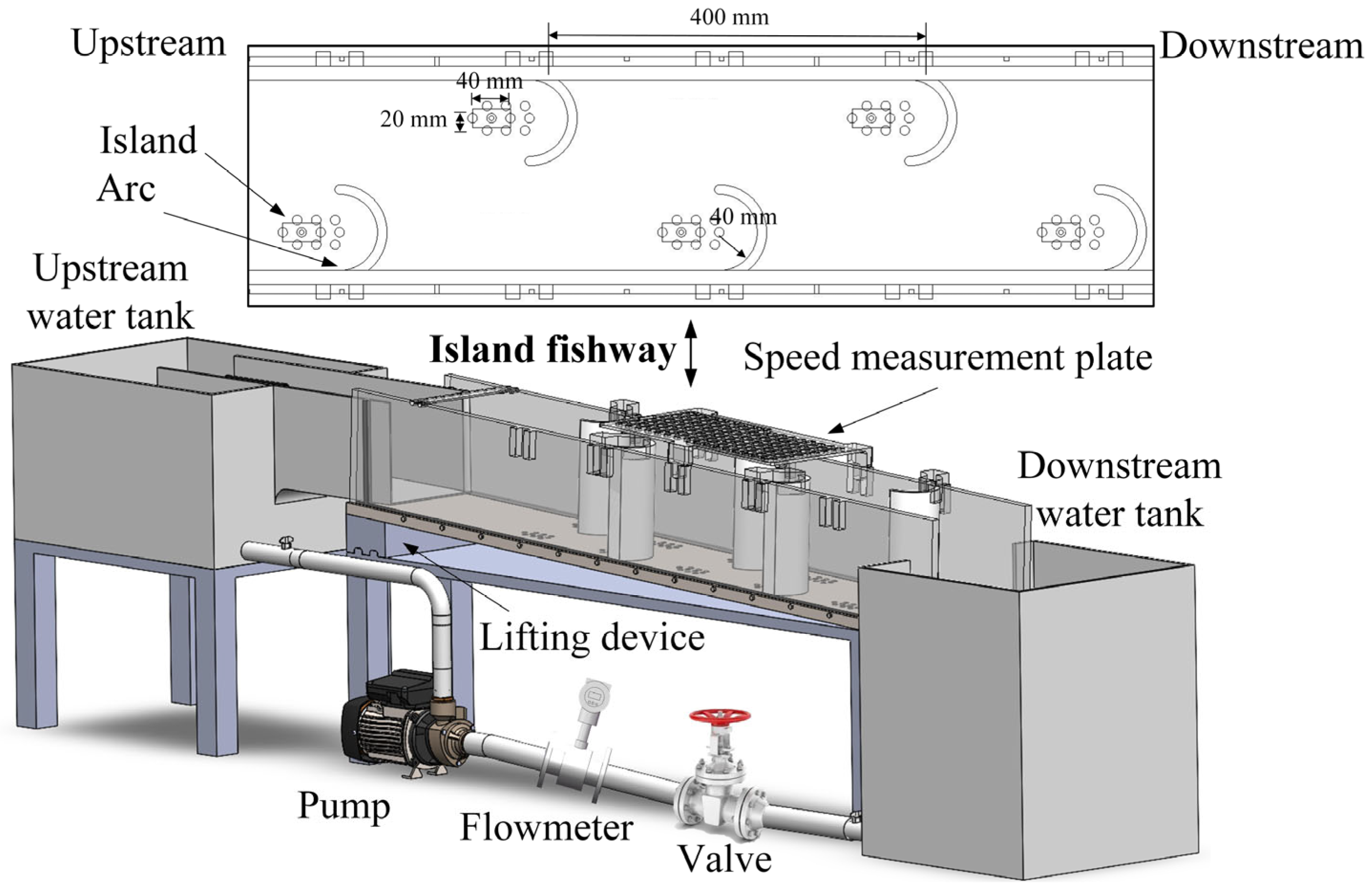
The experimental setup consisted of an island-type fishway, upstream and downstream water tanks, a velocity measurement plate, an electromagnetic flowmeter, a centrifugal pump, a valve, and other auxiliary components (Figure 1). The centrifugal pump served as the power source for the entire system; during experiments, water was pumped from the downstream tank to the upstream tank and then flowed through the island-type fishway back to the downstream tank under gravity. The valve was used to control the flow rate, while the electromagnetic flowmeter measured the discharge. A fish barrier net was installed in the downstream tank to prevent fish from being drawn into the pump. An elevation-adjusting device was employed to control the fishway slope, which was set to 2.27° for all experiments.
The experimental section of the island-type fishway had a total length of 1350 mm, width of 200 mm, and height of 200 mm, containing five island units that were designated as 1# to 5# respectively. Each unit comprised a rectangular island (20 mm width × 40 mm length) and an arc-shaped baffle (40 mm radius). The horizontal distance between adjacent island units on the same side was 400 mm, while the distance between adjacent units on opposite sides was 200 mm. Both sides of the fishway were constructed using transparent acrylic panels (200 mm apart) to enable visual observation of fish movement. A velocity measurement plate was installed inside the fishway; when paired with an open-channel current meter (OUKA LS300-A, Nanjing juncan Instrument Equipment Co., Ltd. Nanjing, China), it allowed for the measurement of flow velocities at different locations and depths within the fishway.

2.2. Experimental Methodology

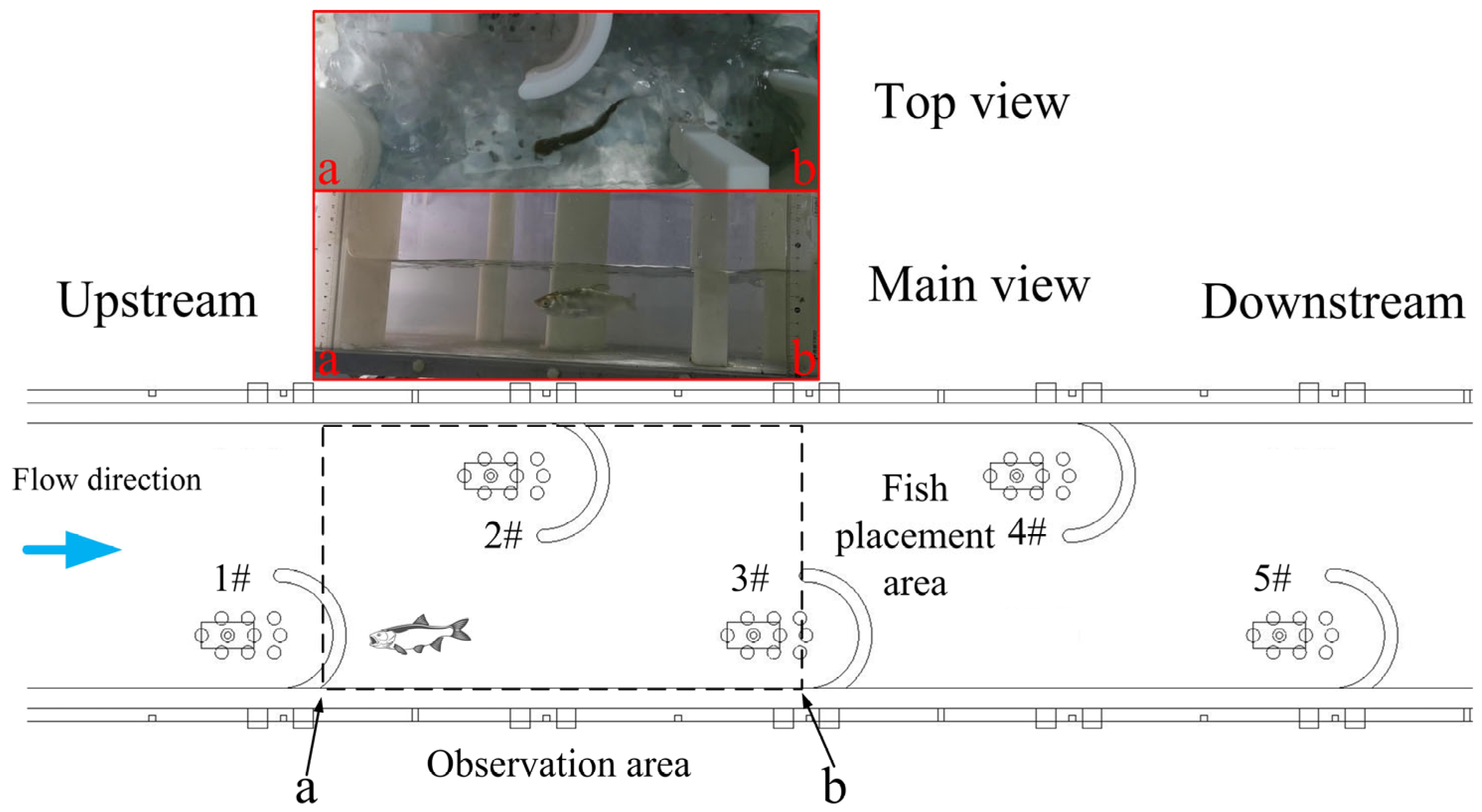
Prior to the experiments, juvenile silver carp were acclimated in an indoor holding tank equipped with an oxygen pump to maintain adequate dissolved oxygen levels. During acclimation, fish were fed once every 24 h; feeding was halted 48 h before the start of experiments to minimize fecal contamination and reduce digestive activity interference. At the beginning of each trial, the centrifugal pump was activated to establish continuous water circulation through the island-type fishway system. The flow rate (Q) was adjusted to three different operational conditions (Table 1) by regulating the valve opening. After the pump operated for 20 min, the flow within the fishway reached a steady state, meeting the experimental requirements. For each flow condition, 20 independent trials were conducted. In each trial, a single juvenile fish was released individually into the water between the 3# and 4# island units to ensure that all experimental fish had an initial “adaptation zone” before entering the designated observation area (Figure 2). The observation zone was defined as the section from the rear of the 1# island unit (point a) to the front of the 3# island unit (point b; dashed box in Figure 2). Observations of upstream ascent covered the period from when the fish entered the cross-section of point b to when it exited the cross-section of point a. The blocking ratio (ratio of fish cross-sectional area to flow cross-sectional area) was approximately 3%, so the influence of the fish body on the overall flow field was considered negligible.
Two cameras (Revealer X113M, HF Agile Device Co., Ltd. Hefei, China) were used to synchronously record the swimming behavior and passage time of juvenile silver carp in the observation zone: one captured footage from the fishway’s right-bank side (main view), and the other from an overhead perspective (top view). The video frame rate was set to 30 frames per second (fps). Rulers were attached to the outer walls at points a and b to measure water levels at these locations. A fish was considered to have successfully ascended through the observation zone if it passed point a within 120 s of release.

2.3. Swimming Trajectory Recognition and Velocity Calculation

Fish swimming patterns, trajectories, and velocities are key indicators for evaluating their behavioral responses to environmental stimuli. To accurately capture these movement characteristics, this study employed a target detection algorithm (YOLOv5) for identifying juvenile silver carp and tracking their motion trajectories inside the fishway [19]. During the dataset annotation phase, the recorded videos of juvenile silver carp swimming were first converted into individual image frames. A total of 600 images containing visible fish targets were manually annotated to construct the training dataset. In the training phase, the dataset was divided into training set and test set at an 8:2 ratio. Both sets included image data from two camera perspectives: top view and main view. To avoid data loss and overfitting, all images were derived from the same group of experimental fish. The model was trained using original image resolution (1980 × 1080 pixels) for a total of 1000 training epochs. After training, the best-performing epoch was selected for YOLOv5-based identification of fish in the experimental datasets [20]. To ensure the reproducibility of the behavioral metrics, the YOLOv5 model was evaluated using a held-out test set, achieving a mean Average Precision (mAP@0.5) of 0.962 and a precision-recall curve that stabilized within 300 epochs. The detection uncertainty, stemming from potential pixel-level center-point offsets, was suppressed by the high image resolution (1980 × 1080 pixels), where a 1-pixel shift corresponds to a physical displacement of only 0.2 mm.
The output coordinates generated by YOLOv5 are normalized, ranging between 0 and 1. Given that the video frame resolution was 1980 × 1080 pixels, the normalized coordinates were first converted into pixel coordinates. To transform pixel coordinates into real-world physical coordinates, calibration was performed using rulers placed in the main-view images and the known width of the fishway in the top-view images. It was determined that 1 mm corresponded to approximately 5 pixels. By converting the normalized coordinates into physical units and combining the spatial coordinates from both the main and top views, the three-dimensional trajectory of each fish within the island-type fishway was reconstructed. Given the camera frame rate of 30 frames per second (fps), the absolute velocity (the speed relative to the ground) of each fish was calculated based on its reconstructed three-dimensional trajectory. Suppose the position at time ti is ri = (xi, yi, zi), and the position at the next time ti+1 is ri+1 = (xi+1, yi+1, zi+1). Then the velocity vector vi is calculated by the following formula:
v i = r i + 1 r i t i + 1 t i
The magnitude of the absolute velocity is:
v i = v i ; x 2 + v i , y 2 + v i , z 2
During the 3D reconstruction, tracking accuracy was maintained by temporal smoothing of the (x, y, z) coordinates across the 30 fps video stream. The propagation of spatial uncertainty into velocity calculations was quantified using a standard error propagation analysis based on the frame rate and calibration scale. Given that the absolute velocity vi is derived from the Euclidean distance between consecutive frames, the maximum combined uncertainty for vi was estimated to be less than 1.5%.

2.4. Numerical Modeling and Validation

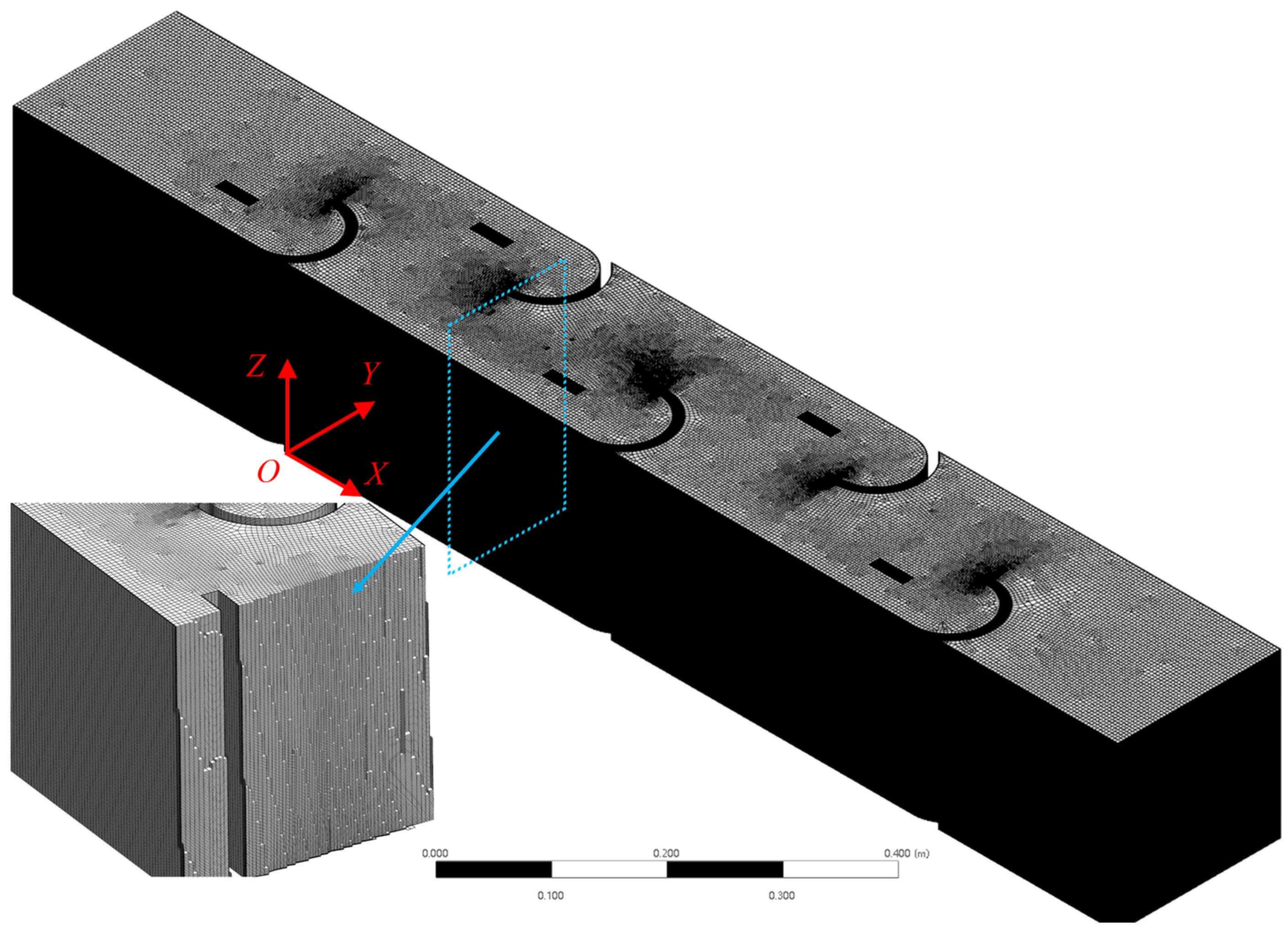
In this study, a numerical model was established based on the actual dimensions of the island-type fishway. The computational domain and local mesh configuration are illustrated in Figure 3. Following a grid independence study (1.17 million, 2.24 million, 4.19 million and 5.86 million), a total of 4.19 million elements were selected for the numerical simulations to ensure both accuracy and computational efficiency [21]. The RNG kε turbulence model was employed in the simulations. The boundary conditions were set based on the experimental data from Case 1. A pressure inlet boundary condition was applied, with specified water level and inflow velocity. A pressure outlet boundary condition was imposed at atmospheric pressure. The air–water interface at the top was also defined as a pressure inlet with a relative pressure of 0 Pa, allowing air to freely enter or exit the domain. Dimensionless wall distance y+ was between 50 and 90. Standard wall functions were used to represent the no-slip wall condition on solid boundaries. The SIMPLE algorithm was used to solve the pressure–velocity coupling in the steady-state simulations. Spatial discretization was performed using a second-order upwind scheme to enhance solution accuracy [22]. The origin of the coordinate system, denoted as point O, was defined at the rear section of 1# island unit, which coincides with point a (the starting point of the observation zone) shown in Figure 2. This setup ensures consistency between the numerical simulation and the experimental observations.
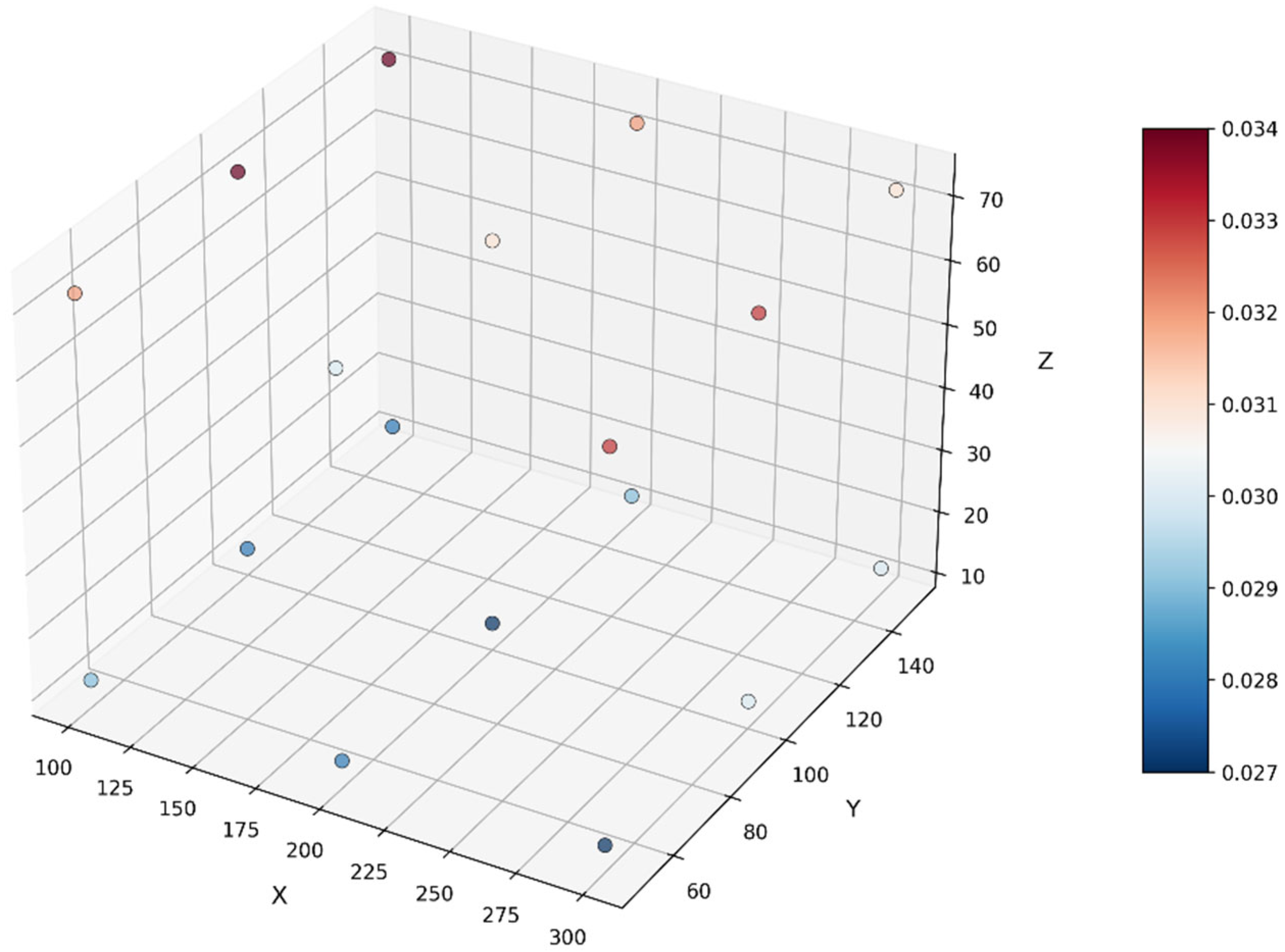
To assess the reliability of the numerical simulation, 18 velocity measurement points were selected within the observation zone (X = 100 mm, 200 mm, 300 mm; Y = 50 mm, 100 mm, 150 mm; Z = 12 mm, 72 mm). Simulated flow velocities at these points were compared with experimental measurements (Figure 4). The relative error between simulated and measured velocities ranged from 0.027 to 0.034, indicating high agreement and confirming that the numerical model meets the accuracy and feasibility requirements for simulating hydraulic conditions in the island-type fishway.

3. Results

3.1. Fish Passage Efficiency

Fish passage efficiency is a critical metric for evaluating the functional performance of fishways. In this study, the average upstream passage success rate of juvenile silver carp through the island-type fishway exceeded 70%. Under low-flow conditions (Case 1 and Case 2), the success rates were both 75% (n = 20 per case). Under the high-flow condition (Case 3), the success rate decreased to 65%. These results indicate that the hydraulic design of the island-type fishway effectively balances flow control, it provides sufficient current to stimulate upstream movement in juvenile fish. However, the increase in flow (especially when reaching the level of Case 3) does indeed significantly raise the difficulty for fish to pass through, thereby leading to a decrease in their biological passage efficiency.

3.2. The Hydraulic Environment: Refuges and Barriers

The primary function of a fishway is to facilitate successful upstream migration by fish. Therefore, energy dissipation performance is regarded as one of the most critical hydraulic evaluation criteria for fishway design. To illustrate the energy dissipation performance of the island-type fishway, this study calculated the total energy at three representative cross-sections located at X = 50 mm, 250 mm, and 450 mm, based on numerical simulation results. The total energy along the flow direction, from X = 50 mm (upstream) to X = 450 mm (downstream), gradually decreases. This decline directly corresponds to the energy dissipation capability of the fishway structure. On average, each island unit contributes approximately 8.9% of the total energy loss under the experimental flow conditions considered in this study. This result clearly demonstrates that the island-type fishway exhibits remarkable energy dissipation performance, with each structural unit playing an active role in reducing flow energy and creating favorable hydraulic conditions for fish passage.
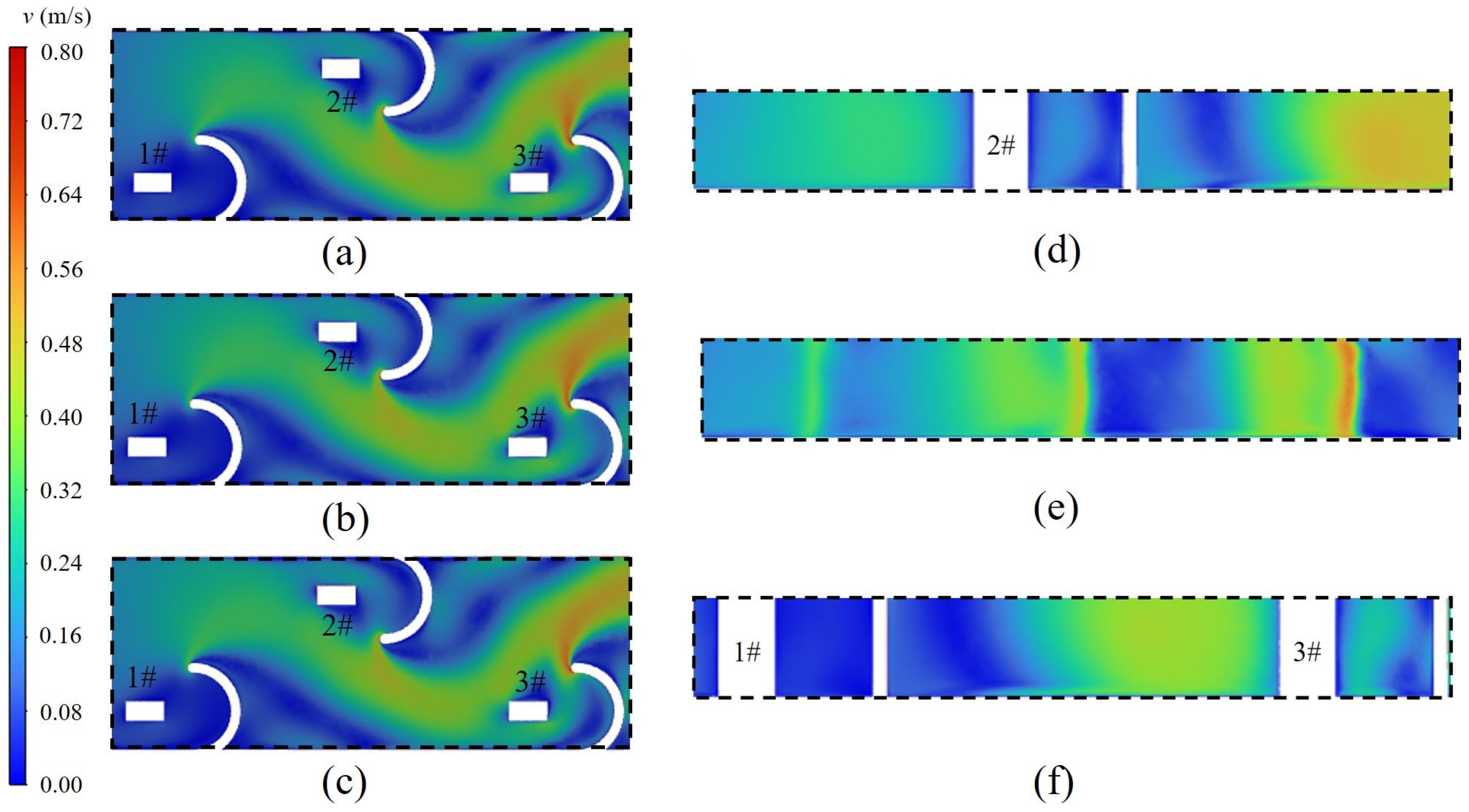
Considering the body length of the experimental fish, the regions in the island-type fishway with a velocity greater than 0.4 m/s are referred to as the main flow regions. The 0.4 m/s threshold for “high-velocity” zones was established based on the physiological swimming performance of juvenile silver carp with a mean total length of 143 mm. Research indicates that the critical swimming speed for cyprinids of this size typically ranges between 0.3 m/s and 0.5 m/s, or approximately 2.5–3.5 body lengths per second (BL/s). Flow velocities exceeding 0.4 m/s entering the burst swimming range (exceeding critical swimming speed) force the juveniles to shift from aerobic to anaerobic metabolism, which explains the observed “rest-burst” behavioral transition. Consequently, regions above this threshold act as functional “barrier zones” where fish cannot maintain prolonged upstream progress without intermittent recovery in refugia. Figure 5 presents the flow velocity distribution across different cross-sections within the observation area. It can be observed that the high-velocity main flow region exhibits an “S”-shaped pattern. The flow velocities upstream and downstream of the arc structure are relatively low, whereas the flow velocity near the apex of the arc structure, which is closer to the main flow region, is higher. The horizontal velocity distributions at various water depths show a high degree of similarity. In the lower water layer (Z = 20 mm), the proportion of low-velocity zones is slightly greater compared to the upper layers, although this difference is not significant. As illustrated in Figure 5e, which presents the velocity distribution along the central cross-sectional plane, the flow velocity displays an alternating “low–high–low” pattern in the streamwise direction. Within this distribution, the proportion of high-velocity zones is relatively small, and these zones appear as vertical lines in terms of shape. It can be observed that these high-velocity regions are located at the apexes of the arc structures, indicating that they are generated by the main flow being constricted by the arc structures. For fish, these high-velocity zones act like a barrier zone that hinders their upstream migration. The upstream movement of fish through the island-type fishway can thus be regarded as a process of continuously passing through barrier zones. Behind islands and arc structures, there are some low-velocity zones, acting as refuge zones, where fish can rest after crossing.

3.3. Fish Ascent Behavioral Strategy

Rest-burst pattern
The upstream movement of juvenile silver carp within the island-type fishway can be described as a “rest–burst” swimming pattern, involving repeated cycles of rest and active propulsion. As illustrated in Figure 6, after being released into the fishway, juvenile fish typically paused briefly behind the arc-shaped baffles, where tail-beat frequency was relatively low, indicating a resting phase. Subsequently, the fish initiated a rapid burst of tail beats against the flow direction, enabling them to swiftly traverse the high-velocity region. During this active swimming phase, most fish were observed to swim close to the opposite wall rather than along the arc structure. Upon completing this segment of the passage, the fish reached the sheltered zone behind the next upstream arc baffle, where they paused again before continuing their migration. This behavior suggests that the arc-shaped structures not only serve as physical guidance elements but also provide hydrodynamic refuges that allow fish to recover during the passage process. This cyclic behavior highlights the importance of spatially distributed shelter zones and moderate flow gradients in facilitating successful upstream passage for juvenile silver carp.
Among the individuals that failed to complete upstream passage, a common pattern was observed: the fish typically encountered difficulties during the “burst” phase of their “rest–burst” swimming behavior. Instead of successfully navigating through high-velocity regions, these fish were unable to maintain progress and were subsequently washed downstream by the current. One of the most notable characteristics of these failed attempts was that the fish often approached too closely to the arc-shaped baffles during the burst phase. This suboptimal path selection likely resulted in increased hydrodynamic resistance or flow separation effects near the baffle surfaces, which may have disrupted the fish’s ability to maintain effective propulsion against the flow. This observation highlights the critical role of path selection in determining upstream passage success within the island-type fishway. Fish that maintained a more centralized or wall-adjacent trajectory generally demonstrated better performance, whereas those that lingered too close to the arc structures were at greater risk of being swept downstream. These findings suggest that not only flow intensity but also spatial navigation strategies adopted by juvenile fish significantly influence their ability to navigate through complex hydraulic environments such as island-type fishways.
The “Ω”-shaped bypass trajectory
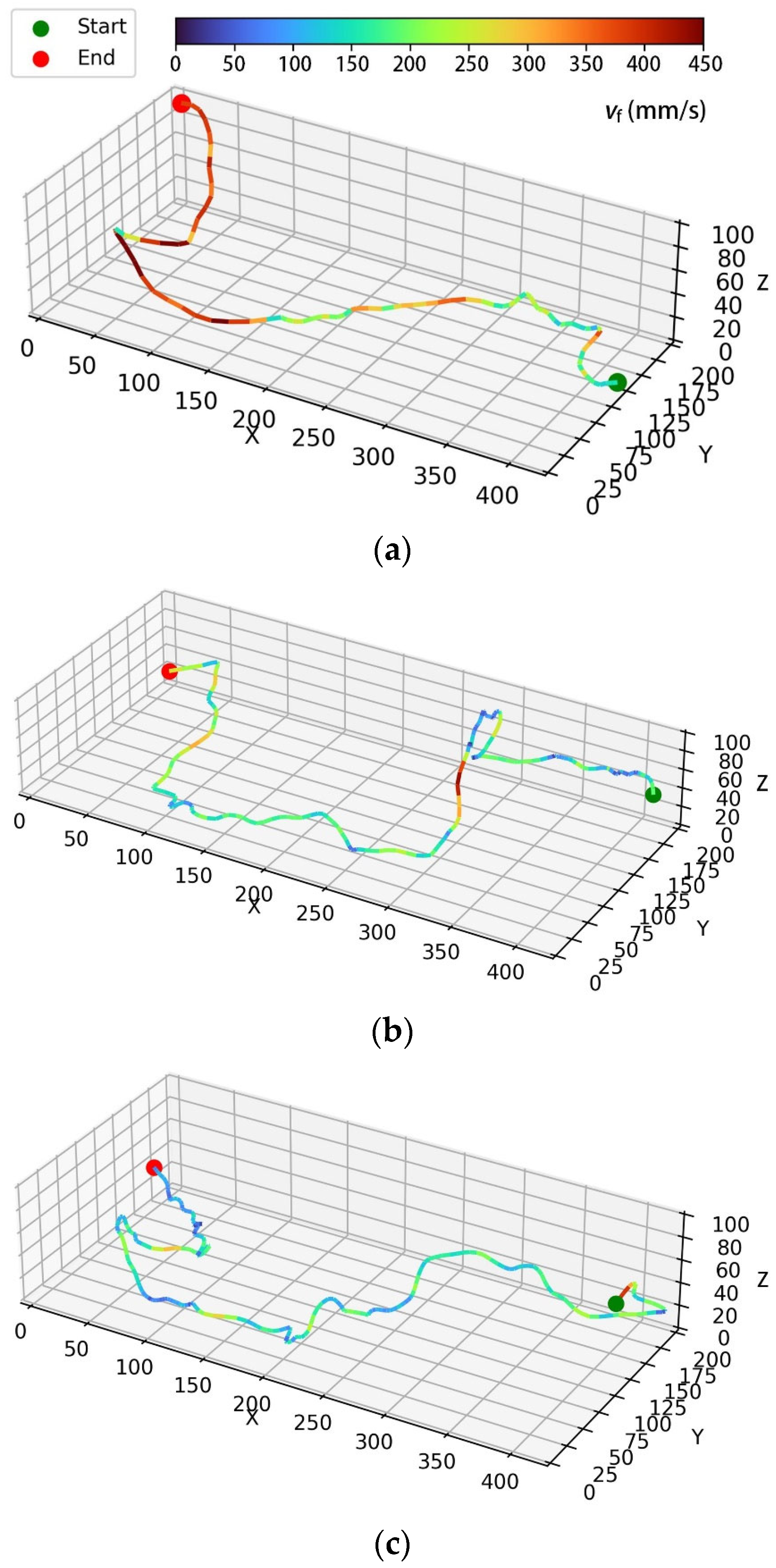
In this study, two synchronized cameras were used to capture both frontal and top-down views of juvenile silver carp swimming through the island-type fishway. The recorded video sequences were processed using an object detection and tracking algorithm based on YOLOv5, enabling accurate identification and trajectory extraction of fish within the complex hydraulic environment [23]. Following coordinate calibration and spatial synthesis, average three-dimensional swimming trajectories of juvenile silver carp were reconstructed for each test condition. As shown in Figure 7, the trajectory starts are marked with green dots, and the endpoints with red dots, while the color gradient along the trajectory lines indicates the moving speed, from low (cool colors) to high (warm colors). Due to the presence of the island units and arc-shaped baffles, the swimming paths of fish exhibited distinct spatial curvature, deviating significantly from straight-line movement. Moreover, notable variations in moving speed were observed across different regions of the fishway, as well as between flow conditions. Under the low-flow condition (Case 1), juvenile fish swam at relatively higher speeds, with smoother and more direct trajectories. The total path length from start to finish was relatively short, which is consistent with the shorter passage times reported in Table 2. In contrast, under the moderate (Case 2) and high-flow conditions (Case 3), moving speeds were generally lower, and trajectories became more tortuous, resulting in longer total distances traveled. This corresponds well with the increased passage times observed in Table 2 and suggests that higher flow intensities not only slowed down fish movement but also led to more frequent directional adjustments and exploratory behavior. These results further support the hypothesis that local hydraulic features, such as recirculation zones behind arc baffles and velocity gradients near wall boundaries, play a crucial role in shaping the spatial structure of fish trajectories within the island-type fishway.
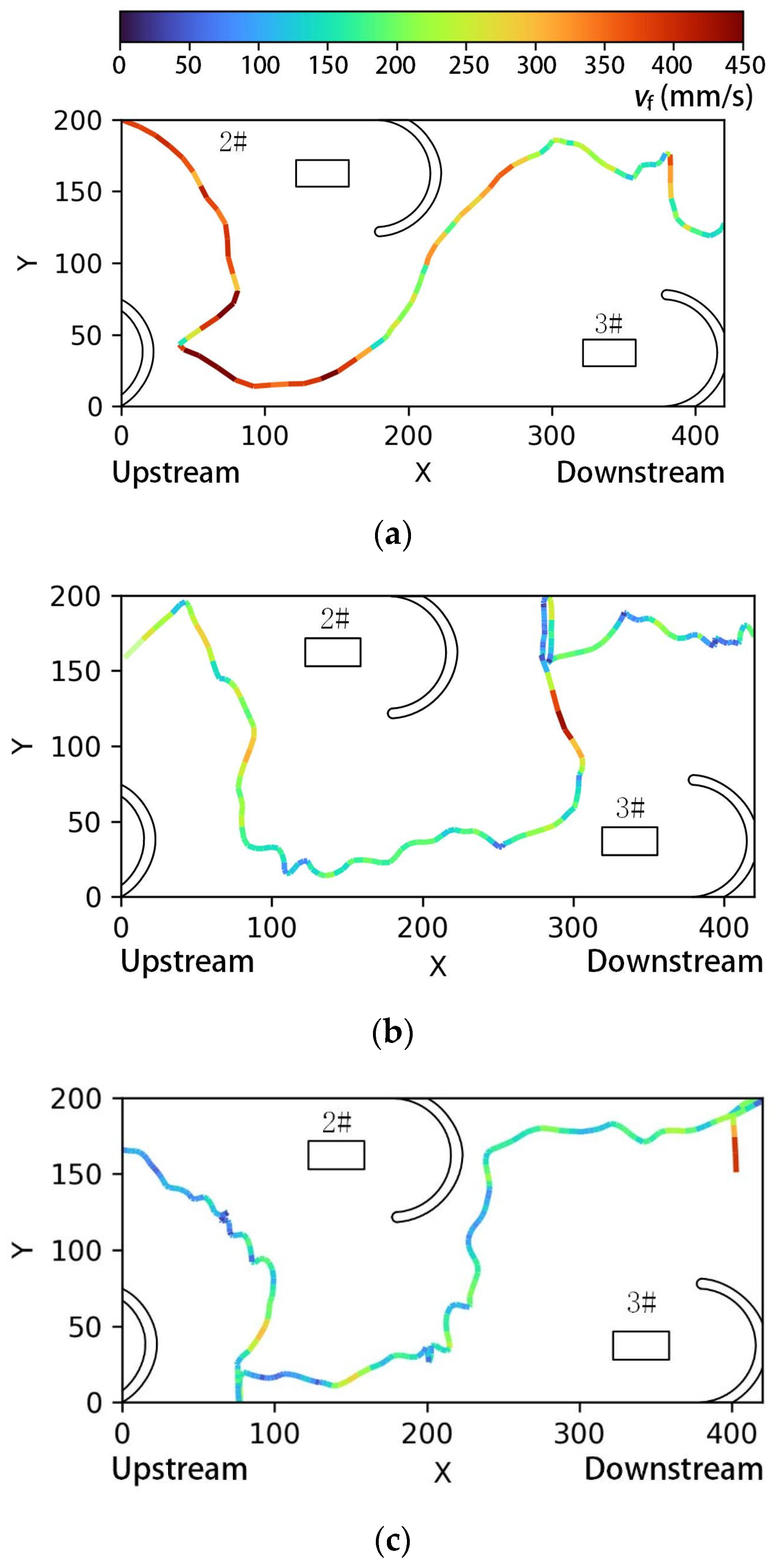
Figure 8 presents the top-view swimming trajectories (projected onto the XY plane) of juvenile silver carp during their passage through the observation zone under different flow conditions. As shown, the movement paths adopted by fish in all test cases exhibited a distinct “Ω”-shaped pattern, rather than adopting shorter “S”- or “V”-shaped routes. This observation indicates that fish do not necessarily select the shortest path when navigating through the island-type fishway. Instead, their path selection appears to be influenced by the physical characteristics of the aquatic environment, such as flow velocity distribution, recirculation zones, and wall effects. In all flow conditions, fish were observed to briefly rest behind the arc-shaped baffles before initiating an upstream burst phase. This behavior was particularly pronounced under the high-flow condition (Case 3), where fish spent more time in sheltered regions, likely due to the increased energy cost of active swimming against stronger currents. Following the resting phase, fish typically initiated a rapid movement toward the opposite wall, exhibiting a wall-following behavior during the burst phase. This tendency suggests that fish may exploit the relatively lower velocities and reduced turbulence near the side walls to conserve energy and maintain stability. Moreover, with increasing flow rate in the island-type fishway, the average distance between the fish and the wall during wall-following behavior decreased. This implies that fish actively adjusted their lateral position in response to changes in hydraulic conditions, possibly to remain within boundary layers where flow resistance was lower. These findings highlight the importance of incorporating hydrodynamic refuge zones and favorable wall-bounded flow structures in fishway design to enhance passage efficiency for juvenile fish species like silver carp.
Bottom-oriented swimming
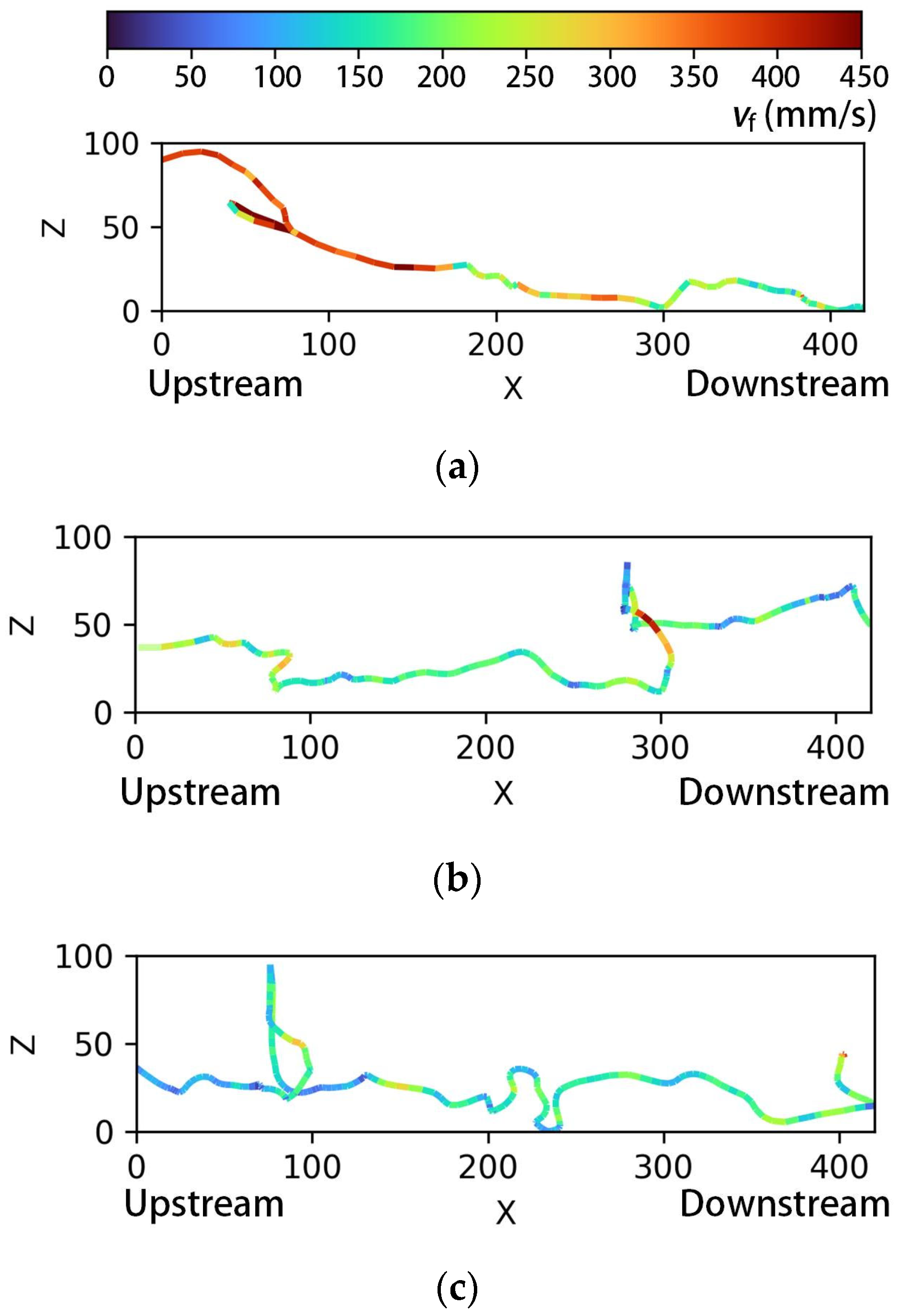
Figure 9 illustrates the frontal-view swimming trajectories (projected onto the XZ plane) of juvenile silver carp during their upstream passage through the island-type fishway under different flow conditions. The vertical swimming trajectories of fish reveal a depth preference significantly correlated with flow velocity. Under all working conditions, juvenile silver carp exhibit a tendency for bottom-oriented swimming. Notably, this behavior becomes particularly pronounced under high-flow conditions (Case 2 and Case 3). This selection of vertical position is not random but a direct response to the hydraulic environment within the fishway. As shown in the numerical simulations (Figure 5), although the vertical (Z-axis) flow field structure is generally consistent, the local flow velocity within the bottom boundary layer is objectively slightly lower than that in the upper and middle water columns due to bed friction effects. Therefore, when facing higher flow resistance (e.g., Case 3), fish actively intensify their near-bottom behavior, which can be interpreted as a key energy conservation strategy. By utilizing the water body with relatively lower flow velocity in the boundary layer, fish can effectively reduce the head-on resistance they need to overcome during swimming. This adaptive vertical behavior is consistent with their strategy of selecting “Ω”-shaped paths in the horizontal plane to avoid the main flow core, collectively demonstrating that fish actively search for and utilize any hydraulic refuge in the flow field to minimize energy consumption, thereby improving their overall success rate of upstream migration.
Table 2 summarizes the average passage time t, the average number of tail beats n, and the corresponding mean tail-beat frequency f (f = n/t) for successfully migrating juvenile silver carp under each test condition within the observation zone.
As shown in the table, with increasing flow rate in the island-type fishway, the upstream passage time of juvenile fish increased gradually, and non-linearly. In Case 1, the lowest flow condition, fish passed through the observation zone in only 3.40 ± 0.45 s. In contrast, under Case 3, the same segment required 9.15 ± 0.79 s, which is 2.7 times longer than in Case 1. Notably, the flow rate in Case 3 was only 25.61% higher than in Case 1, yet the increase in passage time was significantly greater. Similarly, the number of tail beats also increased non-linearly with flow rate, indicating that fish had to expend more energy to navigate through stronger currents. Interestingly, the mean tail-beat frequency was highest under the low-flow condition (Case 1) and decreased under moderate- and high-flow conditions (Case 2 and Case 3). This contradicts the commonly observed pattern where fish typically exhibit higher tail-beat frequencies under higher flow velocities to maintain upstream progress. This anomalous behavior can be attributed to differences in the “rest–burst” time allocation during the migration process across different flow conditions. Under Case 1, the rest-to-burst time ratio was approximately 1.26:1. Under Case 2, this ratio increased to 2.01:1.
Under Case 3, it further increased to 2.21:1. With increasing flow intensity, fish spent a larger proportion of time resting behind arc-shaped baffles and less time actively swimming through high-velocity zones. During rest phases, tail-beat frequency was significantly lower than during burst phases. Therefore, although fish swam faster and more forcefully when active under high-flow conditions, the overall average tail-beat frequency decreased due to the extended rest periods. This finding highlights the importance of considering behavioral dynamics, particularly the temporal structure of “rest–burst” patterns, when evaluating fish passage performance under varying hydraulic conditions.

3.4. The Failure Mechanism

The mechanism underlying fish upstream migration failure is closely related to the “burst” phase in the “rest-burst” behavioral pattern. A common failure mode observed in this study is that fish adopt suboptimal path selection during this phase. Unlike successful individuals (which take “Ω”-shaped detour paths), unsuccessful ones tend to swim too close to the vertices of the curved baffles during burst swimming. According to hydraulic analysis, these vertex regions are precisely the barrier zones where the main flow (“S”-shaped) is compressed by the structure, resulting in peak flow velocities. When fish attempt to directly traverse or approach too closely to this high-velocity core zone, the local flow velocity they encounter instantaneously is likely to be close to or even exceed the physiological limit of their burst swimming speed. The enormous hydrodynamic resistance caused by this high flow velocity impairs the swimming stability of fish, preventing them from maintaining effective propulsive force and ultimately leading to upstream migration failure and being washed back downstream by the current. Therefore, the spatial navigation strategy and path selection of fish near the vertices of the curved baffles are the key decisive factors determining whether they can successfully cross the high-velocity barrier zone and complete the upstream migration.

4. Discussion

The findings of this study reveal that upstream passage is not merely a test of a fish’s critical swimming speed against flow, but rather a complex behavioral process involving fine-scale perception, active path selection, and energy management. The island-type fishway, through its unique configuration, creates a heterogeneous hydraulic mosaic composed of high-velocity “barrier zones” and low-velocity “refuge zones.” The high passage success (>70%) of juvenile silver carp demonstrates their ability to navigate this environment, proving that the structural adaptations are biologically functional, a dimension often ignored in purely hydraulic-oriented Tesla valve studies. Compared to traditional technical fishways, the island-type design offers distinct biological advantages. In vertical slot fishways, although the flow is stable, the high-velocity jets often force fish into prolonged strenuous swimming, leading to lower success rates for weaker swimmers. In contrast, our results show that juvenile silver carp achieved a high success rate by utilizing a “rest-burst” strategy enabled by the interconnected hydraulic refugia. Furthermore, while pool-weir fishways often require fish to perform saltatory leaps or burst swimming through small orifices—which can be physically taxing or restrictive—the island-type configuration provides a continuous, multi-dimensional passage. The observed “Ω”-shaped bypass trajectory allows fish to actively avoid physiological limits at high-velocity cores, a behavioral flexibility that is less feasible in the constrained hydraulic corridors of conventional technical designs.
Our research deconstructs the fish’s ascent into a unified energy-navigation strategy, operating across temporal, horizontal, and vertical dimensions. Temporally, the fish adopted a “rest-burst” intermittent locomotion pattern, where fish conserve energy by resting in low-velocity zones (the “refuge zones” downstream of the arc baffles in this study) before executing a burst maneuver across high-velocity areas. Horizontally, the fish exhibited active path selection. The “S”-shaped main flow, confirmed by CFD modeling, features velocity peaks at the arc baffle apexes (up to 0.8 m/s), a velocity that likely exceeds the burst swimming limit of the juvenile fish. Consequently, the observed “Ω”-shaped trajectory is interpreted as an active avoidance strategy to bypass this “velocity wall” by utilizing the lower-velocity, wall-adjacent regions, rather than selecting the shortest “S”-shaped path. Vertically, the pronounced “bottom-oriented swimming” preference, especially under high-flow conditions, serves as another energy-saving mechanism, allowing the fish to exploit the reduced velocities within the bed boundary layer. While a fixed release point may introduce localized behavioral bias, the subsequent “Ω”-shaped trajectories and the “rest-burst” strategies observed within the observation zone were primarily driven by the heterogeneous flow field and the spatial distribution of hydraulic refugia. The fact that fish consistently bypassed high-velocity cores regardless of their exact entry point suggests that the observed navigation mechanisms are intrinsic responses to hydraulic stimuli rather than artifacts of the initial release condition.
The failure mechanism identified in this study reinforces the criticality of path selection. Failed individuals were commonly observed attempting to swim too close to the baffle apex during the “burst” phase, thus directly challenging their physiological limits and being repelled by the high-velocity core. Increased discharge (i.e., Case 3) exacerbates this challenge by increasing the velocity and spatial extent of the “barrier zone” while potentially reducing the effectiveness of the “refuge zone.” This explains why, under high flow, the passage time and total tail beats increased dramatically and non-linearly (Table 2). To cope with the more demanding “burst” phase, fish were forced to significantly increase their “rest” duration within the refugia, as evidenced by the rest-to-burst time ratio increasing to 2.21:1 in Case 3. Therefore, the observed decrease in average tail-beat frequency is not indicative of lower effort, but is rather a statistical artifact caused by the much longer resting periods skewing the overall average.
These results have significant implications for the eco-hydraulic design of fishways. They suggest that design criteria should evolve beyond simply meeting a mean velocity or minimum standard, and instead embrace a paradigm focused on “refuge quality and connectivity”. The effectiveness of the island-type fishway is largely attributable to its successful provision of periodic, high-quality hydraulic refugia. Future designs should focus on optimizing the size, location, and hydraulic accessibility of these refuges to match the behavioral demands and recovery patterns of target species.

5. Conclusions

This study evaluates the biological feasibility of a novel island-type fishway inspired by the Tesla valve through an integrated eco-hydraulic framework. By coupling hydraulic experiments, CFD simulations, and 3D computer vision tracking, the following transferable design principles and scientific insights are derived.
The effectiveness of the island-type fishway is primarily determined by the spatial connectivity of hydraulic refugia rather than bulk hydraulic parameters. The synergistic configuration of island units and arc-baffles successfully creates a hydraulic mosaic where high-velocity “S”-shaped main flows provide migration stimuli, while interconnected low-velocity zones allow for physiological recovery. Each island unit contributes approximately 8.9% to total energy dissipation, maintaining a stable passage environment.
Juvenile silver carp (Hypophthalmichthys molitrix) achieved a high success rate (65–75%) by employing a sophisticated navigation strategy. Temporally, fish adopt an intermittent “rest-burst” pattern; horizontally, they utilize “Ω”-shaped bypass trajectories to circumvent high-velocity cores at baffle apexes; vertically, they leverage the bottom boundary layer to minimize resistance. Failure to pass is typically linked to a breakdown in this strategy, specifically when fish approach high-velocity cores beyond their burst swimming limits.
For future fishway designs, the focus should shift from meeting average velocity standards to optimizing the accessibility and quality of refuge zones. The island-type configuration offers a robust template for balancing energy dissipation with biological passage needs, particularly for juvenile cyprinids in fragmented river ecosystems.
While providing a baseline for conservative design, this study is limited to juvenile silver carp. Future research must validate these findings for other migratory species with distinct swimming capacities. Furthermore, while steady-state RANS models effectively characterize mean flow topologies, future work using Large Eddy Simulation (LES) is required to elucidate how fish perceive and respond to instantaneous turbulent fluctuations via their lateral line systems.

Author Contributions

Conceptualization, M.X. and J.M.; methodology, M.D.; software, B.F.; validation, M.D. and B.F.; formal analysis, Z.T.; investigation, M.D.; resources, Z.T.; data curation, B.F. and Y.G.; writing—original draft preparation, M.D.; writing—review and editing, M.X.; visualization, Z.T.; supervision, M.X.; project administration, M.X.; funding acquisition, M.X. All authors have read and agreed to the published version of the manuscript.

Funding

This study was financially supported by the Program of ‘Xinmiao’ Talents in Zhejiang Province under Grant No. 2025R409B037 and the National Training Program of Innovation and Entrepreneurship for Undergraduates under Project No. 202410356044.

Institutional Review Board Statement

The animal study protocol was approved by the Ethics Committee of China Jiliang University (protocol code No. 8, 10 March 2025).

Data Availability Statement

The raw data supporting the conclusions of this article will be made available by the authors on request.

Conflicts of Interest

The authors declare no conflicts of interest.

References

  1. Ovidio, M.; Dierckx, A.; Benitez, J.P. Movement behaviour and fishway performance for endemic and exotic species in a large anthropized river. Limnologica 2023, 99, 126061. [Google Scholar] [CrossRef]
  2. Cooke, S.J.; Hinch, S.G. Improving the reliability of fishway attraction and passage efficiency estimates to inform fishway engineering, science, and practice. Ecol. Eng. 2013, 58, 123–132. [Google Scholar] [CrossRef]
  3. Lenice, S.; Dhiego, G.F.; Lucileine, A.; Oscar, A.S.; Silvia, H.S.; Suelen, F.R.P.; Patricia, S.S.; Sergio, M.; Maristela, C.M. Genetic diversity of the surubim-do-iguaçu, a giant catfish species threatened with extinction: Recommendations for species conservation. Diversity 2022, 14, 16. [Google Scholar] [CrossRef]
  4. Twardek, W.M.; Landsman, S.J.; Cooke, S.J. Collaboration between fish passage scientists and engineers: Insights from an international questionnaire. J. Environ. Manag. 2022, 323, 116268. [Google Scholar] [CrossRef]
  5. Bretón, F.; Baki, A.B.M.; Link, O.; Zhu, D.Z.; Rajaratnam, N. Flow in nature-like fishway and its relation to fish behaviour. Can. J. Civ. Eng. 2013, 40, 567–573. [Google Scholar] [CrossRef]
  6. Katopodis, C.; Williams, J.G. The development of fish passage research in a historical context. Ecol. Eng. 2012, 48, 8–18. [Google Scholar] [CrossRef]
  7. Bombač, M.; Četina, M.; Novak, G. Study on flow characteristics in vertical slot fishways regarding slot layout optimization. Ecol. Eng. 2017, 107, 126–136. [Google Scholar] [CrossRef]
  8. Mallen-Cooper, M.; Stuart, I.G. Optimising Denil fishways for passage of small and large fishes. Fish. Manag. Ecol. 2007, 14, 61–71. [Google Scholar] [CrossRef]
  9. Marriner, B.A.; Baki, A.B.M.; Zhu, D.Z.; Cooke, S.J.; Katopodis, C. The hydraulics of a vertical slot fishway: A case study on the multi-species Vianney-Legendre fishway in Quebec, Canada. Ecol. Eng. 2016, 90, 190–202. [Google Scholar] [CrossRef]
  10. Duguay, J.M.; Lacey, R.W.J.; Gaucher, J. A case study of a pool and weir fishway modeled with OpenFOAM and FLOW-3D. Ecol. Eng. 2017, 103, 31–42. [Google Scholar] [CrossRef]
  11. Dodd, J.R.; Cowx, I.G.; Bolland, J.D. Efficiency of a nature-like bypass channel for restoring longitudinal connectivity for a river-resident population of brown trout. J. Environ. Manag. 2017, 204, 318–326. [Google Scholar] [CrossRef]
  12. Magaju, D.; Montgomery, J.; Franklin, P.; Baker, C.; Friedrich, H. Machine learning based assessment of small-bodied fish tracking to evaluate spoiler baffle fish passage design. J. Environ. Manag. 2023, 325, 116507. [Google Scholar] [CrossRef]
  13. Franklin, A.E.; Haro, A.; Castro-Santos, T.; Noreika, J. Evaluation of Nature-Like and Technical Fishways for the Passage of Alewives at Two Coastal Streams in New England. Trans. Am. Fish. Soc. 2012, 141, 624–637. [Google Scholar] [CrossRef]
  14. Ghaderi, D.; Mollazadeh, M.; Mahdizadeh, H. Influence of T shape baffles arrangement on flow hydraulic characteristics in fishways. J. Hydra. Struct. 2022, 8, 35–51. [Google Scholar] [CrossRef]
  15. Zeng, G.; Xu, M.; Mou, J.; Wang, K.; Ren, Y. Research on the Hydraulic Characteristics of Island Fishways by Experimental and Numerical Methods. Water 2023, 15, 2592. [Google Scholar] [CrossRef]
  16. Zeng, G.; Xu, M.; Mou, J.; Hua, C.; Fan, C. Application of Tesla Valve’s Obstruction Characteristics to Reverse Fluid in Fish Migration. Water 2022, 15, 40. [Google Scholar] [CrossRef]
  17. Dong, M.; Zeng, G.; Xu, M.; Mou, J.; Gu, Y. Influence of Valvular Structures on the Flow Characteristics in an Island-Type Fishway. Water 2024, 16, 2336. [Google Scholar] [CrossRef]
  18. Shi, X.; Chen, Q.; Liu, D.; Huang, Y.; Lu, B. Juvenile silver carp Hypophthalmichthys molitrix swim faster in closed surface flow than open surface flow. Environ. Biol. Fishes 2014, 97, 1411–1416. [Google Scholar] [CrossRef]
  19. Li, R.; Xiao, K.; Lin, S.; Wu, Z. Enhancing aquatic ecosystem monitoring through fish jumping behavior analysis and YOLOV5: Applications in freshwater fish identification. J. Environ. Manag. 2025, 391, 126413. [Google Scholar] [CrossRef]
  20. Ren, S.; He, K.; Girshick, R.; Sun, J. Faster R-CNN: Towards Real-Time Object Detection with Region Proposal Networks. arXiv 2015, arXiv:1506.01497. [Google Scholar] [CrossRef]
  21. Zhang, J.; Li, J.Y.; Wang, T.; Qian, Z.S. Influence of nozzle structure on the flow field of the prestage of nozzle flapper servo valve. Int. J. Hydromechatron. 2023, 6, 59–75. [Google Scholar] [CrossRef]
  22. Xu, M.; Long, X.; Mou, J.; Ji, B.; Ren, Y. Impact of fish locomotion on the internal flow in a jet fish pump. Ocean Eng. 2019, 187, 106227. [Google Scholar] [CrossRef]
  23. Nygrd, T.A.; Jahren, J.H.; Stahl, S.A. Motion trajectory estimation of salmon using stereo vision. IFAC-PapersOnLine 2022, 55, 363–368. [Google Scholar] [CrossRef]
Figure 1. Schematic diagram of the experimental setup.
Applsci 16 00744 g001
Figure 2. Schematic diagram of fish swimming behavior observation.
Applsci 16 00744 g002
Figure 3. Computational domain and local mesh configuration.
Applsci 16 00744 g003
Figure 4. The relative error between the experimentally measured flow velocity results and the numerical calculated flow velocity results.
Applsci 16 00744 g004
Figure 5. Flow velocity distribution across different cross-sections within the observation area (a) Z = 60 mm (b) Z = 40 mm (c) Z = 20 mm (d) Y = 160 mm (e) Y = 100 mm (f) Y = 40 mm.
Applsci 16 00744 g005
Figure 6. Swimming behavior of juvenile silver carp in island-type fishways (Case 3). (a) t0 (b) t0 + 1.93 s (c) t0 + 3.10 s (d) t0 + 5.57 s.
Applsci 16 00744 g006
Figure 7. Three-dimensional swimming trajectories of juvenile silver carp within the observation zone. (a) Case 1; (b) Case 2; (c) Case 3.
Applsci 16 00744 g007
Figure 8. Top-view (XY Plane) swimming trajectories of juvenile silver carp. (a) Case 1; (b) Case 2; (c) Case 3.
Applsci 16 00744 g008
Figure 9. Frontal-view (XZ Plane) swimming trajectories of juvenile silver carp. (a) Case 1; (b) Case 2; (c) Case 3.
Applsci 16 00744 g009
Table 1. Test conditions.
Case123
Q (m3/h)5.746.357.21
Water level at point a (mm)109112116
Water level at point b (mm)125128132
Table 2. Mean ± standard deviation time and tail-beat frequency under different flow conditions.
Caset (s)nf (Hz)
13.40 ± 0.4516.25 ± 1.404.7
27.13 ± 0.7225.35 ± 1.613.5
39.15 ± 0.7932.40 ± 1.713.5
Disclaimer/Publisher’s Note: The statements, opinions and data contained in all publications are solely those of the individual author(s) and contributor(s) and not of MDPI and/or the editor(s). MDPI and/or the editor(s) disclaim responsibility for any injury to people or property resulting from any ideas, methods, instructions or products referred to in the content.