Metal–Organic Framework-Derived Catalysts for the Remediation of Emerging Contaminants via Peracetic Acid-Based Oxidation



Abstract
1. Introduction
2. Structural Features, Properties, and Synthesis of MOFs
3. Pristine MOFs in PAA Activation
4. MOF-Based Composites for Enhanced PAA Activation
5. MOF-Derived Catalysts for PAA Activation

| Catalyst | Catalyst Concentration | Initial Pollutant Concentration | PAA Dosage | Reusability | Reaction Time (min) | Removal Efficient (%) | Ref. |
|---|---|---|---|---|---|---|---|
| ZIF-67 | 0.05 g/L | [Sulfachloropyridazine] = 10 μM | 50 μM | - | 3 | 100 | [29] |
| ZIF-67 | 0.1 g/L | [Bisphenol A] = 0.1 mM | 5 mM | - | 30 | 93 | [50] |
| MIL-101(Fe)-NH2 | 200 mg/L | [Sulfamethoxazole] = 10 μM | 1000 μM | 4 | 30 | 97 | [51] |
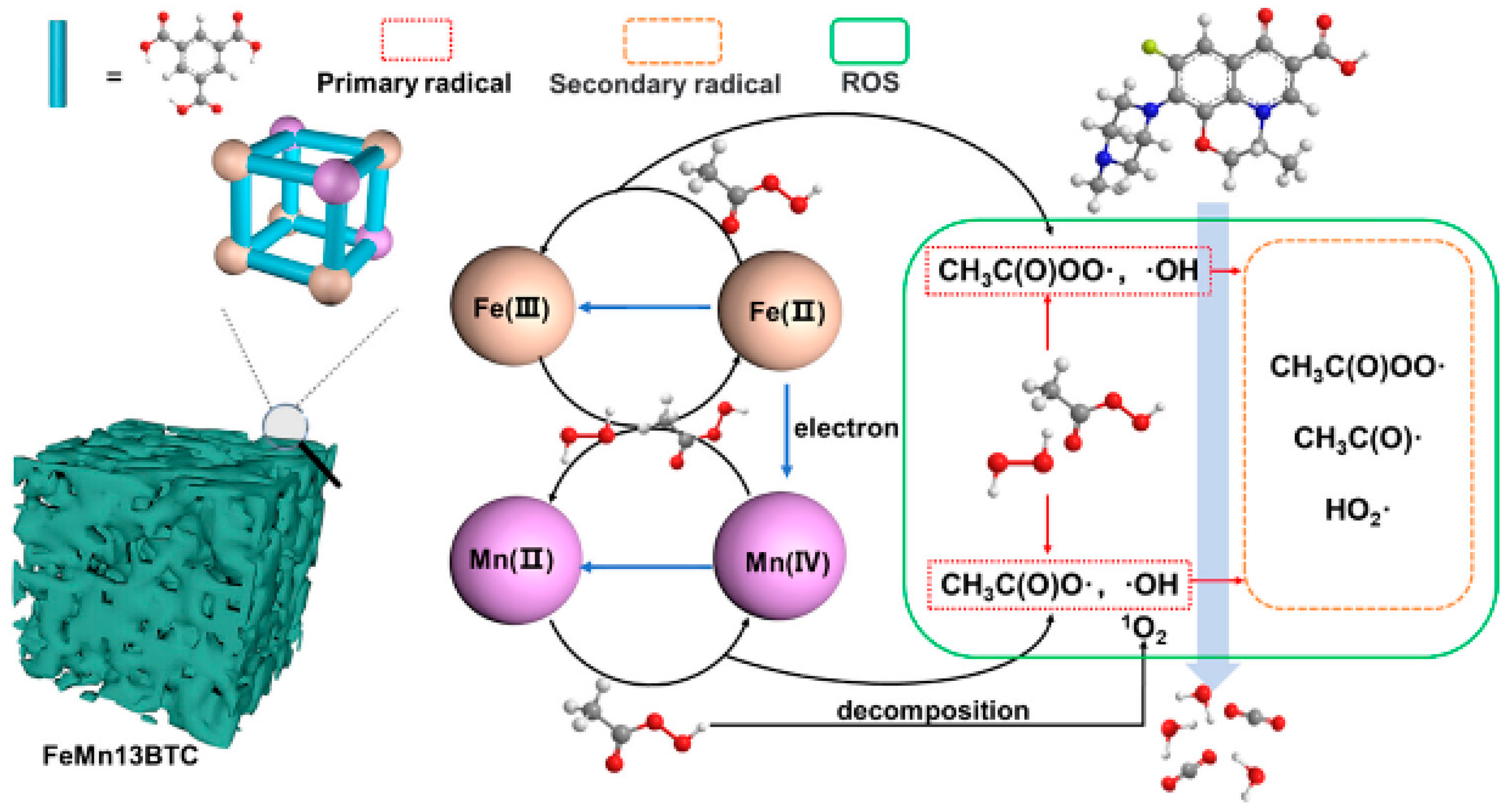
| FeMn13BTC | 0.1 g/L | [Ofloxacin] = 5 mg/L | 1.034 mM | 4 | 60 | 81.85 | [55] |
| MIL-100(Fe)Co | 0.05 g/L | [Sulfamethoxazole] = 5 μM | 50 μM | 3 | 30 | 84.6 | [56] |
| MOF-(Fe1,Co1) | 25 mg/L | [Bezafibrate] = 1 mg/L | 10 mg/L | 8 | 60 | 98.1 | [6] |
| Fe3O4@ZIFs | 0.01 g/L | [Sulfamethoxazole] = 10 μM | 0.1 mM | 4 | 30 | 99.3 | [57] |
| ZIF-67@KSB3 | 200 mg/L | [Acetaminophen] = 0.2 mM | 0.4 mM | 5 | 30 | 94.3 | [58] |
| CoFeC | 0.1 g/L | [Sulfamethoxazole] = 10 μM | 0.4 mM | 5 | 30 | 96.97 | [61] |
| CoFe/U-ZrO2 | 0.1 g/L | [Sulfamethoxazole] = 20 μM | 350 μM | 4 | 10 | 98.9 | [62] |
| Co4Cu6-MOF | 20 mg/L | [Sulfamethoxazole] = 10 μM | 200 μM | 4 | 5 | 92 | [63] |
| Fe2SiO4 | 0.06 g/L | [Tetracycline] = 40 μM | 0.15 mM | 6 | 10 | 100 | [68] |
| HC-FeCo@C350 | 0.1 g/L | [RhB] = 30 mg/L | 0.4 mM | 4 | 30 | 99.5 | [71] |
| CoFe2O4 | 0.5 g/L | [RhB] = 20 mg/L | 0.8 mM | 4 | 10 | 95 | [72] |
| Co(II) | 10 μM | [Carbamazepine] = 15 μM | 100 μM | - | 5–30 | 47.5–100 | [74] |
| Co3O4 | 0.1 g/L | [Orange G] = 0.05 mM | 1g/L | 4 | 90 | 100 | [75] |
| Fe-biochar | 0.3 g/L | [Acid orange] = 0.143 mM | 1.1 mM | 5 | 25 | 93.3 | [76] |
| BC-CoFe2O4 | 0.3 g/L | [Carbamazepine] = 1 mg/L | 0.8 mM | 3 | 20 | 100 | [77] |
| CuCo2O4 | 0.2 g/L | [BPA] = 20mg/L | 400 μM | 4 | 60 | 92.3 | [78] |
| Co-NC-700 | 0.05 g/L | [Norfloxacin] = 60 μM | 1.2 mM | 5 | 35 | 95 | [73] |
| Co-Fe-O | 0.1 g/L | [Sulfamethazine] = 20 μM | 0.4 mM | 4 | 25 | 100 | [79] |
6. Identification of Reactive Species in Catalytic PAA Activation Systems
6.1. Scavengers and Chemical Probes
| Scavenger/Chemical Probe | •OH | RO•, RO2 | 1O2 | O2•− | Ref. |
|---|---|---|---|---|---|
| Methanol (MeOH) | 9.7 × 10⁸ | [73,76] | |||
| Ethanol (EtOH) | (1.2–2.8) × 109 | [29] | |||
| Tertbutyl alcohol (TBA) | (3.8–7.6) × 108 | 3.04 × 10³ | [78,83] | ||
| 6.0 × 10⁸ | [73,80] | ||||
| 2,4-hexadienoic (2,4-HD) | 1.0 × 10¹⁰ | >5.0 × 10⁸ | [76,81] | ||
| Furfur alcohol (FFA) | 1.2 × 10⁸ | [80,82] | |||
| Superoxide dismutase (SOD) | 2.4 × 10⁹ | [84] | |||
| β-carotene | 9.2 × 10⁸ | [85] | |||
| L-histidine (L-His) | 3.2 × 10⁷ | [86] | |||
| Nitrobenzene (NB) | (3.2–4.7) × 109 | [87] | |||
| Para-chlorobenzoic acid (pCBA) | 5 × 10⁹ | [73,79] | |||
| Dimethyl sulfoxide (DMSO) | 7.0 × 10⁹ | [82] | |||
| Carbamazepine (CBZ) | 8.8 × 10⁹ | [15] | |||
| Sodium azide (NaN3) | 1.2 × 10⁸ | [88] | |||
| Naproxen (NAP) | 9.0 × 10⁹ | 9.0 × 10⁹ | [89] | ||
| Benzoic acid (BA) | 5.9 × 10⁹ | [90] |
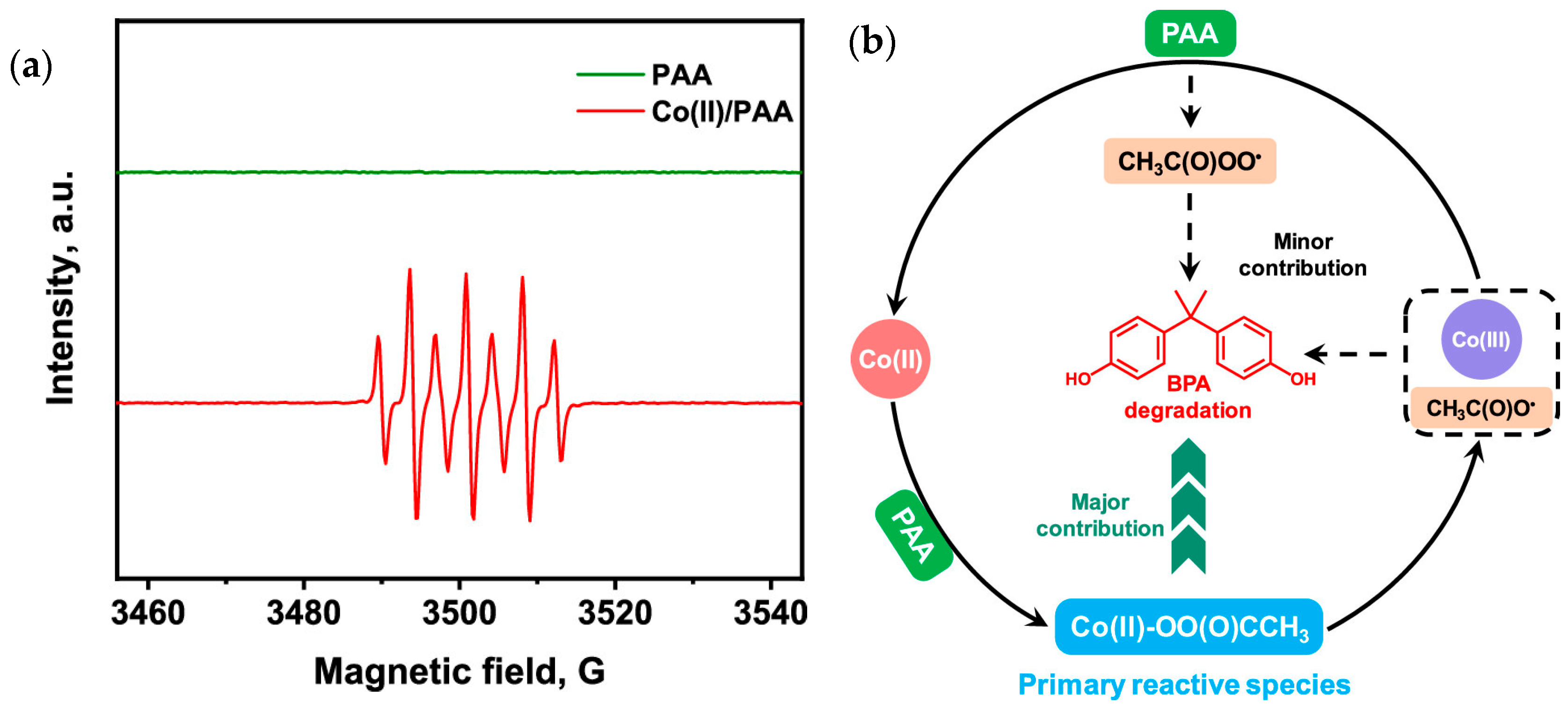
6.2. Electron Paramagnetic Resonance
7. Conclusions and Future Perspectives
- Owing to the inherent unpredictability of the reaction, radical and non-radical pathways often occur concurrently, each with distinct advantages: radicals provide higher mineralization efficiency, whereas non-radicals offer greater resistance to interference. The design of MOF-based catalysts should carefully balance and regulate the interplay between these pathways. In particular, the mechanisms underlying non-radical pathways remain poorly understood and warrant further comprehensive study.
- Attention to safety and scalability is crucial for MOFs. Environmental toxicity from metal centers, linkers, and synthesis solvents, along with complex and costly fabrication procedures, limit their industrial application. Developing green, cost-effective, and simplified synthesis strategies is therefore essential to enable practical deployment of MOF-based catalysts.
- Ensuring catalyst stability is critical, yet many MOFs exhibit poor water stability and are prone to decomposition under highly oxidative conditions, which restrict their practical application. Future research should therefore prioritize the development of robust strategies, including the design of inherently stable MOFs and surface-modified MOFs.
- The real-world performance of MOF-based catalysts should be rigorously evaluated. Laboratory studies often employ model pollutants at relatively high concentrations, whereas actual wastewater contains CECs at ng/L to μg/L levels, often as complex mixtures. Catalytic tests under realistic conditions are necessary to validate the efficiency and robustness of MOFs in practical wastewater treatment.
- Developing and applying parameter optimization strategies, including analytical approaches for three-dimensional and multidimensional factors, is essential for enhancing the performance of MOF-based catalysts in PAA activation.
- Efforts should focus on combining MOF-based catalysts for PAA activation with complementary technologies, including electrochemical systems and biological treatments, to enhance overall treatment efficiency.
Author Contributions
Funding
Institutional Review Board Statement
Informed Consent Statement
Data Availability Statement
Acknowledgments
Conflicts of Interest
References
- Bouzayani, B.; Elaoud, S.C.; Sanromán, M.Á. Current Progress in Advanced Oxidation Processes for the Removal of Contaminants of Emerging Concern Using Peracetic Acid as an Effective Oxidant. Catalysts 2025, 15, 469. [Google Scholar] [CrossRef]
- Correa-Sanchez, S.; Peñuela, G.A. Peracetic Acid-Based Advanced Oxidation Processes for the Degradation of Emerging Pollutants: A Critical Review. J. Water Process Eng. 2022, 49, 102986. [Google Scholar] [CrossRef]
- Li, X.; Liu, J.; Chu, Y.; Qian, M.; Yang, Z.; Zhang, W. Unusually Improved Peracetic Acid Activation for Ultrafast Organic Compound Removal through Redox-Inert Mg Incorporation into Active Co3O4. Appl. Catal. B Environ. Energy 2025, 361, 124601. [Google Scholar] [CrossRef]
- Sciscenko, I.; Vione, D.; Minella, M. Infancy of Peracetic Acid Activation by Iron, a New Fenton-Based Process: A Review. Heliyon 2024, 10, e27036. [Google Scholar] [CrossRef]
- Shariatmadari, S. Water Disinfection and Wastewater Treatment in Poultry Slaughterhouses Using Peracetic Acid (PAA): Its Effectiveness in Reducing Residual Microorganisms on Chicken Carcasses. Chem. Res. Technol. 2025, 2, 128–139. [Google Scholar]
- Fang, L.; Li, K.; Lv, Y.; Ye, M. Activation of Peracetic Acid by Bimetallic Metal-Organic Frameworks for Bezafibrate Degradation: Removal Efficiency, Mechanism and Influencing Factors. J. Water Process Eng. 2025, 69, 106862. [Google Scholar] [CrossRef]
- Gao, Y.; Liu, B.; Huang, X.; Ma, Y.; Wang, H. Insight into Three-Dimensional Electro-Fenton System with Fe0 Activated Peroxyacetic Acid for Sulfadiazine Degradation under Neutral Condition: Performance and Degradation Pathways. Chem. Eng. J. 2025, 505, 158968. [Google Scholar] [CrossRef]
- Yang, S.; He, Y.; Hua, Z.; Xie, Z.; He, C.-S.; Xiong, Z.; Du, Y.; Liu, Y.; Xing, G.; Fang, J.; et al. PH-Dependent Bisphenol A Transformation and Iodine Disinfection Byproduct Generation by Peracetic Acid: Kinetic and Mechanistic Explorations. Water Res. 2023, 246, 120695. [Google Scholar] [CrossRef]
- Yang, S.; Yu, S.; Dong, Y.; Liu, J.; Zhou, P.; Zhang, H.; Xiong, Z.; He, C.-S.; Lai, B. Whether Peracetic Acid-Based Oxidation Process Is an Alternative to the Traditional Fenton Process in Organic Pollutants Degradation and Actual Wastewater Treatment? J. Hazard. Mater. 2025, 490, 137752. [Google Scholar] [CrossRef]
- Xiao, J.; Li, Y.; Dong, H.; Pang, Z.; Zhao, M.; Huang, D.; Dong, J.; Li, L. Highly Efficient Activation of Peracetic Acid via Zero-Valent Iron-Copper Bimetallic Nanoparticles (NZVIC) for the Oxidation of Sulfamethazine in Aqueous Solution under Neutral Condition. Appl. Catal. B 2024, 340, 123183. [Google Scholar]
- Zhao, X.; Zhang, T.; Zhou, Y.; Liu, D. Preparation of Peracetic Acid from Hydrogen Peroxide: Part I: Kinetics for Peracetic Acid Synthesis and Hydrolysis. J. Mol. Catal. A Chem. 2007, 271, 246–252. [Google Scholar] [CrossRef]
- Luukkonen, T.; Pehkonen, S.O. Peracids in Water Treatment: A Critical Review. Crit. Rev. Environ. Sci. Technol. 2017, 47, 1–39. [Google Scholar] [CrossRef]
- Kitis, M. Disinfection of Wastewater with Peracetic Acid: A Review. Environ. Int. 2004, 30, 47–55. [Google Scholar] [CrossRef] [PubMed]
- Zhang, T.; Huang, C.-H. Simultaneous Quantification of Peracetic Acid and Hydrogen Peroxide in Different Water Matrices Using HPLC-UV. Chemosphere 2020, 257, 127229. [Google Scholar] [CrossRef]
- Wang, J.; Wan, Y.; Ding, J.; Wang, Z.; Ma, J.; Xie, P.; Wiesner, M.R. Thermal Activation of Peracetic Acid in Aquatic Solution: The Mechanism and Application to Degrade Sulfamethoxazole. Environ. Sci. Technol. 2020, 54, 14635–14645. [Google Scholar] [CrossRef]
- Yusuf, V.F.; Malek, N.I.; Kailasa, S.K. Review on Metal–Organic Framework Classification, Synthetic Approaches, and Influencing Factors: Applications in Energy, Drug Delivery, and Wastewater Treatment. ACS Omega 2022, 7, 44507–44531. [Google Scholar] [CrossRef] [PubMed]
- Yaghi, O.M.; Li, H. Hydrothermal Synthesis of a Metal-Organic Framework Containing Large Rectangular Channels. J. Am. Chem. Soc. 1995, 117, 10401–10402. [Google Scholar] [CrossRef]
- Mosupi, K.; Masukume, M.; Weng, G.; Musyoka, N.M.; Langmi, H.W. Recent Advances in Fe-Based Metal-Organic Frameworks: Structural Features, Synthetic Strategies and Applications. Coord. Chem. Rev. 2025, 529, 216467. [Google Scholar] [CrossRef]
- Alsehli, B.R. Toward Sustainable Environmental Cleanup: Metal–Organic Frameworks in Adsorption—A Review. Desalin. Water Treat. 2023, 316, 44–70. [Google Scholar] [CrossRef]
- Han, Z.; Yang, Y.; Rushlow, J.; Huo, J.; Liu, Z.; Hsu, Y.-C.; Yin, R.; Wang, M.; Liang, R.; Wang, K.-Y.; et al. Development of the Design and Synthesis of Metal–Organic Frameworks (MOFs)—From Large Scale Attempts, Functional Oriented Modifications, to Artificial Intelligence (AI) Predictions. Chem. Soc. Rev. 2025, 54, 367–395. [Google Scholar] [CrossRef]
- Sun, T.; Wang, Z.; Zeng, L.; Feng, G. Identifying MOFs for Electrochemical Energy Storage via Density Functional Theory and Machine Learning. NPJ Comput. Mater. 2025, 11, 90. [Google Scholar] [CrossRef]
- Ramesh, J.K.; Rostami, S.; Rajesh, J.; Princess, R.M.B.; Govindaraju, R.; Kim, J.; Adelung, R.; Rajkumar, P.; Abdollahifar, M. ZnMn2O4 Applications in Batteries and Supercapacitors: A Comprehensive Review. J. Mater. Chem. A Mater. 2025, 13, 14540–14579. [Google Scholar] [CrossRef]
- Sun, N.; Shah, S.S.A.; Lin, Z.; Zheng, Y.-Z.; Jiao, L.; Jiang, H.-L. MOF-Based Electrocatalysts: An Overview from the Perspective of Structural Design. Chem. Rev. 2025, 125, 2703–2792. [Google Scholar] [CrossRef] [PubMed]
- Zhang, Y.; VanNatta, P.E.; Ren, J.; Ma, S. Metal–Organic Frameworks Housing Active Molecules as Bioinspired Catalysts. CCS Chem. 2024, 6, 1380–1402. [Google Scholar] [CrossRef]
- Vasudhevan, P.; Manikandan, V.; Iqbal, N.; Ullah, S.; Ma, H.; Singh, S.; Varshney, D.; Pu, S. Metal-Organic Frameworks for Wastewater Remediation: Sustainable Synthesis, Properties, and Applications. Chem. Rec. 2025, 25, e202500076. [Google Scholar] [CrossRef]
- Ding, J.; Sun, Y.-G.; Ma, Y.-L. Highly Stable Mn-Doped Metal–Organic Framework Fenton-like Catalyst for the Removal of Wastewater Organic Pollutants at All Light Levels. ACS Omega 2021, 6, 2949–2955. [Google Scholar] [CrossRef]
- Férey, G.; Mellot-Draznieks, C.; Serre, C.; Millange, F.; Dutour, J.; Surblé, S.; Margiolaki, I. A Chromium Terephthalate-Based Solid with Unusually Large Pore Volumes and Surface Area. Science 2005, 309, 2040–2042. [Google Scholar] [CrossRef]
- Zeng, T.; Zhang, X.; Wang, S.; Niu, H.; Cai, Y. Spatial Confinement of a Co3O4 Catalyst in Hollow Metal–Organic Frameworks as a Nanoreactor for Improved Degradation of Organic Pollutants. Environ. Sci. Technol. 2015, 49, 2350–2357. [Google Scholar] [CrossRef] [PubMed]
- Duan, J.; Chen, L.; Ji, H.; Li, P.; Li, F.; Liu, W. Activation of Peracetic Acid by Metal-Organic Frameworks (ZIF-67) for Efficient Degradation of Sulfachloropyridazine. Chin. Chem. Lett. 2022, 33, 3172–3176. [Google Scholar] [CrossRef]
- Khan, M.S.; Shahid, M. Synthesis of Metal-Organic Frameworks (MOFs): Routes to Various MOF Topologies, Morphologies, and Composites. In Electrochemical Applications of Metal-Organic Frameworks; Elsevier: Amsterdam, The Netherlands, 2022; pp. 17–35. [Google Scholar]
- Kamal, S.; Khalid, M.; Khan, M.S.; Shahid, M.; Ahmad, M. A Zinc (II) MOF for Recognition of Nitroaromatic Explosive and Cr (III) Ion. J. Solid State Chem. 2022, 315, 123482. [Google Scholar] [CrossRef]
- Kamal, S.; Khalid, M.; Khan, M.S.; Shahid, M.; Ahmad, M. Amine-and Imine-Functionalized Mn-Based MOF as an Unusual Turn-on and Turn-off Sensor for D10 Heavy Metal Ions and an Efficient Adsorbent to Capture Iodine. Cryst. Growth Des. 2022, 22, 3277–3294. [Google Scholar] [CrossRef]
- Furukawa, H.; Cordova, K.E.; O’Keeffe, M.; Yaghi, O.M. The Chemistry and Applications of Metal-Organic Frameworks. Science 2013, 341, 1230444. [Google Scholar] [CrossRef]
- Rosi, N.L.; Kim, J.; Eddaoudi, M.; Chen, B.; O’Keeffe, M.; Yaghi, O.M. Rod Packings and Metal− Organic Frameworks Constructed from Rod-Shaped Secondary Building Units. J. Am. Chem. Soc. 2005, 127, 1504–1518. [Google Scholar] [CrossRef]
- Yaghi, O.M.; Li, G.; Li, H. Selective Binding and Removal of Guests in a Microporous Metal–Organic Framework. Nature 1995, 378, 703–706. [Google Scholar] [CrossRef]
- Li, H.; Eddaoudi, M.; O’Keeffe, M.; Yaghi, O.M. Design and Synthesis of an Exceptionally Stable and Highly Porous Metal-Organic Framework. Nature 1999, 402, 276–279. [Google Scholar] [CrossRef]
- Millange, F.; Walton, R.I. MIL-53 and Its Isoreticular Analogues: A Review of the Chemistry and Structure of a Prototypical Flexible Metal-organic Framework. Isr. J. Chem. 2018, 58, 1019–1035. [Google Scholar] [CrossRef]
- Tanaka, D.; Nakagawa, K.; Higuchi, M.; Horike, S.; Kubota, Y.; Kobayashi, T.C.; Takata, M.; Kitagawa, S. Kinetic Gate-Opening Process in a Flexible Porous Coordination Polymer. Angew. Chem. Int. Ed. 2008, 47, 3914–3918. [Google Scholar] [CrossRef] [PubMed]
- Park, K.S.; Ni, Z.; Côté, A.P.; Choi, J.Y.; Huang, R.; Uribe-Romo, F.J.; Chae, H.K.; O’Keeffe, M.; Yaghi, O.M. Exceptional Chemical and Thermal Stability of Zeolitic Imidazolate Frameworks. Proc. Natl. Acad. Sci. USA 2006, 103, 10186–10191. [Google Scholar] [CrossRef]
- Cavka, J.H.; Jakobsen, S.; Olsbye, U.; Guillou, N.; Lamberti, C.; Bordiga, S.; Lillerud, K.P. A New Zirconium Inorganic Building Brick Forming Metal Organic Frameworks with Exceptional Stability. J. Am. Chem. Soc. 2008, 130, 13850–13851. [Google Scholar] [CrossRef]
- ChemTube3D. Available online: https://www.chemtube3d.com/ (accessed on 13 December 2025).
- Rubio-Martinez, M.; Avci-Camur, C.; Thornton, A.W.; Imaz, I.; Maspoch, D.; Hill, M.R. New Synthetic Routes towards MOF Production at Scale. Chem. Soc. Rev. 2017, 46, 3453–3480. [Google Scholar] [CrossRef] [PubMed]
- Mahreni, M.; Ristianingsih, Y. A Review on Metal-Organic Framework (MOF): Synthesis and Solid Catalyst Applications. In Proceeding of LPPM UPN “Veteran” Yogyakarta Conference Series 2020–Engineering and Science Series; RSF Press: Washington, DC, USA, 2020; Volume 1, pp. 638–645. [Google Scholar]
- Rahaman, S.K.K.; Chatterjee, T.; Alam, S.M. Microwave-Assisted Synthesis of Metal–Organic Frameworks. In Synthesis of Metal-Organic Frameworks via Water-Based Routes; Elsevier: Amsterdam, The Netherlands, 2024; pp. 51–72. [Google Scholar]
- Ren, H.; Wei, T. Electrochemical Synthesis Methods of Metal-organic Frameworks and Their Environmental Analysis Applications: A Review. ChemElectroChem 2022, 9, e202200196. [Google Scholar] [CrossRef]
- Szczęśniak, B.; Borysiuk, S.; Choma, J.; Jaroniec, M. Mechanochemical Synthesis of Highly Porous Materials. Mater. Horiz. 2020, 7, 1457–1473. [Google Scholar] [CrossRef]
- Vaitsis, C.; Sourkouni, G.; Argirusis, C. Sonochemical Synthesis of MOFs. In Metal-Organic Frameworks for Biomedical Applications; Elsevier: Amsterdam, The Netherlands, 2020; pp. 223–244. [Google Scholar]
- Fdez-Sanromán, A.; Rosales, E.; Pazos, M.; Sanroman, A. Metal–Organic Frameworks as Powerful Heterogeneous Catalysts in Advanced Oxidation Processes for Wastewater Treatment. Appl. Sci. 2022, 12, 8240. [Google Scholar] [CrossRef]
- Yang, S.; Sun, S.; Xie, Z.; Dong, Y.; Zhou, P.; Zhang, J.; Xiong, Z.; He, C.-S.; Mu, Y.; Lai, B. Comprehensive Insight into the Common Organic Radicals in Advanced Oxidation Processes for Water Decontamination. Environ. Sci. Technol. 2024, 58, 19571–19583. [Google Scholar] [CrossRef]
- Tan, Z.; Wang, Z.; Song, Z.; Liu, X.; Tang, S.; Ren, N.; Ma, X.; Chen, Y. Mechanistic Insights into the Efficient Activation of Peracetic Acid by ZIF-67 for Bisphenol A Degradation. Surf. Interfaces 2024, 44, 103808. [Google Scholar] [CrossRef]
- Pan, R.; Li, Z.; Zhang, T.-Y.; Fu, Q.; Zheng, Z.-X.; Shi, J.; Lu, J.; Hu, C.-Y.; Tang, Y.-L.; El-Din, M.G.; et al. Amino-Functionalized MIL-101 (Fe)-NH2 as Efficient Peracetic Acid Activator for Selective Contaminant Degradation: Unraveling the Role of Electron-Donating Ligands in Fe (IV) Generation. J. Hazard. Mater. 2025, 491, 138028. [Google Scholar] [CrossRef]
- Yuan, K.; Song, T.; Wang, D.; Zou, Y.; Li, J.; Zhang, X.; Tang, Z.; Hu, W. Bimetal–Organic Frameworks for Functionality Optimization: MnFe-MOF-74 as a Stable and Efficient Catalyst for the Epoxidation of Alkenes with H2O2. Nanoscale 2018, 10, 1591–1597. [Google Scholar] [CrossRef]
- El-Yazeed, W.S.A.; Abou El-Reash, Y.G.; Elatwy, L.A.; Ahmed, A.I. Novel Bimetallic Ag-Fe MOF for Exceptional Cd and Cu Removal and 3,4-Dihydropyrimidinone Synthesis. J. Taiwan Inst. Chem. Eng. 2020, 114, 199–210. [Google Scholar] [CrossRef]
- Raza, N.; Kumar, T.; Singh, V.; Kim, K.-H. Recent Advances in Bimetallic Metal-Organic Framework as a Potential Candidate for Supercapacitor Electrode Material. Coord. Chem. Rev. 2021, 430, 213660. [Google Scholar] [CrossRef]
- Zheng, L.; Fu, J.; Hua, B.; Wu, Y.; Gu, Y.; Qin, N.; Li, F. Hierarchical Porous Bimetallic FeMn Metal–Organic Framework Gel for Efficient Activation of Peracetic Acid in Antibiotic Degradation. ACS Environ. Au 2023, 4, 56–68. [Google Scholar] [CrossRef]
- Zhou, G.; Liu, Y.; Zhou, R.; Zhang, L.; Fu, Y. Bimetallic Metal-Organic Framework as a High-Performance Peracetic Acid Activator for Sulfamethoxazole Degradation. Chemosphere 2024, 349, 140958. [Google Scholar] [CrossRef] [PubMed]
- Guo, Y.; Zhou, C.; Lv, X.; Du, S.; Sui, M. Sustainable Co (III)/Co (II) Cycles Triggered by Co-Zn Bimetallic MOF Encapsulating Fe Nanoparticles for High-Efficiency Peracetic Acid Activation to Degrade Sulfamethoxazole: Enhanced Performance and Synergistic Mechanism. Sep. Purif. Technol. 2025, 354, 128729. [Google Scholar] [CrossRef]
- Nguyen, T.-B.; Chen, C.-W.; Chen, W.-H.; Chen, L.; Hsieh, S.; Dong, C.-D. Kumquat Peel-Derived Biochar to Support Zeolitic Imidazole Framework-67 (ZIF-67) for Enhancing Peracetic Acid Activation to Remove Acetaminophen from Aqueous Solution. Environ. Pollut. 2024, 350, 123970. [Google Scholar] [CrossRef] [PubMed]
- Subudhi, S.; Swain, G.; Tripathy, S.P.; Parida, K. UiO-66-NH2 Metal–Organic Frameworks with Embedded MoS2 Nanoflakes for Visible-Light-Mediated H2 and O2 Evolution. Inorg. Chem. 2020, 59, 9824–9837. [Google Scholar] [CrossRef]
- Emam, H.E.; Ahmed, H.B.; Gomaa, E.; Helal, M.H.; Abdelhameed, R.M. Doping of Silver Vanadate and Silver Tungstate Nanoparticles for Enhancement the Photocatalytic Activity of MIL-125-NH2 in Dye Degradation. J. Photochem. Photobiol. A Chem. 2019, 383, 111986. [Google Scholar] [CrossRef]
- Wang, L.; Wei, J.; Huo, J.; Ji, W.; Zhang, X.; Li, Y.; Li, J.; Cui, N.; Yan, W.; Zhao, Y.; et al. Harnessing Electronically Core-Shell CoFe Alloy-Carbon from Prussian Blue Analogues for Efficient Pollutant Abatement via Peracetic Acid Activation: Dual Reactive Species Generation and Synergistic Mechanisms. Appl. Catal. B Environ. Energy 2025, 371, 125284. [Google Scholar] [CrossRef]
- Tang, Y.; Jiang, B.; Zhu, T.; Sun, Z. Novel CoFe-Supported UiO-66-Derived ZrO2 for Rapid Activation of Peracetic Acid for Sulfamethoxazole Degradation. Environ. Res. 2025, 274, 121329. [Google Scholar] [CrossRef]
- Liu, Z.; Wu, Y.; Wan, S.; Wang, B.; Ji, H.; Xiang, X. Preparation of Co/Cu-Based Bi-MOFs and the Degradation of Sulfamethoxazole by Activated Peracetic Acid. Water Sci. Technol. 2023, 87, 1202–1213. [Google Scholar] [CrossRef]
- Dang, S.; Zhu, Q.-L.; Xu, Q. Nanomaterials Derived from Metal–Organic Frameworks. Nat. Rev. Mater. 2017, 3, 17075. [Google Scholar] [CrossRef]
- Liu, Q.; Zhu, J.; Zhang, L.; Qiu, Y. Recent Advances in Energy Materials by Electrospinning. Renew. Sustain. Energy Rev. 2018, 81, 1825–1858. [Google Scholar] [CrossRef]
- Tang, J.; Salunkhe, R.R.; Liu, J.; Torad, N.L.; Imura, M.; Furukawa, S.; Yamauchi, Y. Thermal Conversion of Core–Shell Metal–Organic Frameworks: A New Method for Selectively Functionalized Nanoporous Hybrid Carbon. J. Am. Chem. Soc. 2015, 137, 1572–1580. [Google Scholar] [CrossRef] [PubMed]
- Liu, C.; Huang, X.; Wang, J.; Song, H.; Yang, Y.; Liu, Y.; Li, J.; Wang, L.; Yu, C. Hollow Mesoporous Carbon Nanocubes: Rigid-Interface-Induced Outward Contraction of Metal-Organic Frameworks. Adv. Funct. Mater. 2018, 28, 1705253. [Google Scholar] [CrossRef]
- Zhang, H.; Tang, Y.; Xia, S.; Zeng, H.; Shi, Z.; Deng, L. Efficient Degradation of Tetracycline via Peracetic Acid Activation Using Fe2SiO4: Performance and Mechanisms Study. J. Environ. Manag. 2025, 393, 127304. [Google Scholar] [CrossRef]
- Zhang, T.; Yu, H.; Han, Z.; Xu, S.; Dong, Z.; Zhou, K.; Zhang, S.; Cheng, Z. Remediation of Atrazine in Environment by Persulfate Activation via N/B Co-Doped Si-Rich Biochar: Performance, Mechanisms, Degradation Pathways and Phytotoxicity. Chem. Eng. J. 2023, 477, 147131. [Google Scholar] [CrossRef]
- Yang, M.; Zhang, Y.; Cao, T.; Wang, P. Screening for the Adsorption-Activated H2O2 and Peroxymonosulfate for High-Performance Heteroatom-Doped Graphene: Molecular Dynamics Simulation and DFT. J. Electroanal. Chem. 2024, 952, 117890. [Google Scholar] [CrossRef]
- Tan, S.; Zhang, L.; Cheng, Z.; Peng, Y.; Tang, J.; Zhu, H.; Qiu, F. Enhanced Remediation of Actual Dye Wastewater by Hydrogenated Bimetallic MOF Derivative with Active Peracetic Acid. npj Clean Water 2025, 8, 39. [Google Scholar] [CrossRef]
- Zhou, G.; Fu, Y.; Zhou, R.; Zhang, L.; Zhang, L.; Deng, J.; Liu, Y. Efficient Degradation of Organic Contaminants by Magnetic Cobalt Ferrite Combined with Peracetic Acid. Process Saf. Environ. Prot. 2022, 160, 376–384. [Google Scholar] [CrossRef]
- Lu, X.; Chen, Y.; Li, R.; Gao, J.; Pan, S. Insight into the Activation of Peracetic Acid by Cobalt-Nitrogen-Doped Porous Carbon for Efficient Norfloxacin Degradation: Performance and Mechanism. Sep. Purif. Technol. 2024, 338, 126572. [Google Scholar] [CrossRef]
- Kim, J.; Du, P.; Liu, W.; Luo, C.; Zhao, H.; Huang, C.-H. Cobalt/Peracetic Acid: Advanced Oxidation of Aromatic Organic Compounds by Acetylperoxyl Radicals. Environ. Sci. Technol. 2020, 54, 5268–5278. [Google Scholar] [CrossRef]
- Wu, W.; Tian, D.; Liu, T.; Chen, J.; Huang, T.; Zhou, X.; Zhang, Y. Degradation of Organic Compounds by Peracetic Acid Activated with Co3O4: A Novel Advanced Oxidation Process and Organic Radical Contribution. Chem. Eng. J. 2020, 394, 124938. [Google Scholar] [CrossRef]
- Shi, C.; Wang, Y.; Zhang, K.; Lichtfouse, E.; Li, C.; Zhang, Y. Fe-Biochar as a Safe and Efficient Catalyst to Activate Peracetic Acid for the Removal of the Acid Orange Dye from Water. Chemosphere 2022, 307, 135686. [Google Scholar] [CrossRef]
- Xue, Y.; Kamali, M.; Kakavandi, B.; Costa, M.E.V.; Thompson, I.P.; Huang, W.; Appels, L.; Dewil, R. Activation of Peracetic Acid by a Magnetic Biochar-Ferrospinel AFe2O4 (A = Cu, Co, or Mn) Nanocomposite for the Degradation of Carbamazepine—A Comparative and Mechanistic Study. Chem. Eng. J. 2024, 490, 151932. [Google Scholar] [CrossRef]
- Shen, P.; Hou, K.; Chen, F.; Pi, Z.; He, L.; Chen, S.; Li, X.; Yang, Q. Ultra-Rapid and Long-Lasting Activation of Peracetic Acid by Cu-Co Spinel Oxides for Eliminating Organic Contamination: Role of Radical and Non-Radical Catalytic Oxidation. Chem. Eng. J. 2023, 463, 142344. [Google Scholar] [CrossRef]
- Jiang, B.; Liu, Z.; Sun, Z. Co-Fe Bimetallic Oxides Derived from Prussian Blue Analogs to Activate Peracetic Acid for Eliminating Sulfamethazine: Contribution and Identification of Radical Species. J. Water Process Eng. 2024, 60, 105121. [Google Scholar] [CrossRef]
- Yan, T.; Ping, Q.; Zhang, A.; Wang, L.; Dou, Y.; Li, Y. Enhanced Removal of Oxytetracycline by UV-Driven Advanced Oxidation with Peracetic Acid: Insight into the Degradation Intermediates and N-Nitrosodimethylamine Formation Potential. Chemosphere 2021, 274, 129726. [Google Scholar] [CrossRef]
- Zhang, L.; Chen, J.; Zhang, Y.; Xu, Y.; Zheng, T.; Zhou, X. Highly Efficient Activation of Peracetic Acid by Nano-CuO for Carbamazepine Degradation in Wastewater: The Significant Role of H2O2 and Evidence of Acetylperoxy Radical Contribution. Water Res. 2022, 216, 118322. [Google Scholar] [CrossRef] [PubMed]
- Cheng, Y.; Wang, Z.; Wang, J.; Cao, L.; Chen, Z.; Chen, Y.; Liu, Z.; Xie, P.; Ma, J. New Insights into the Degradation of Micro-Pollutants in the Hydroxylamine Enhanced Fe (II)/Peracetic Acid Process: Contribution of Reactive Species and Effects of PH. J. Hazard. Mater. 2023, 441, 129885. [Google Scholar] [CrossRef]
- Li, S.; Yang, Y.; Zheng, H.; Zheng, Y.; He, C.-S.; Lai, B.; Ma, J.; Nan, J. Introduction of Oxygen Vacancy to Manganese Ferrite by Co Substitution for Enhanced Peracetic Acid Activation and 1O2 Dominated Tetracycline Hydrochloride Degradation under Microwave Irradiation. Water Res. 2022, 225, 119176. [Google Scholar] [CrossRef] [PubMed]
- Wu, L.; Li, Z.; Cheng, P.; She, Y.; Wang, W.; Tian, Y.; Ma, J.; Sun, Z. Efficient Activation of Peracetic Acid by Mixed Sludge Derived Biochar: Critical Role of Persistent Free Radicals. Water Res. 2022, 223, 119013. [Google Scholar] [CrossRef]
- Liu, B.; Guo, W.; Jia, W.; Wang, H.; Si, Q.; Zhao, Q.; Luo, H.; Jiang, J.; Ren, N. Novel Nonradical Oxidation of Sulfonamide Antibiotics with Co (II)-Doped g-C3N4-Activated Peracetic Acid: Role of High-Valent Cobalt–Oxo Species. Environ. Sci. Technol. 2021, 55, 12640–12651. [Google Scholar] [CrossRef] [PubMed]
- Zhang, Z.; Duan, Y.; Dai, C.; Li, S.; Chen, Y.; Tu, Y.; Leong, K.H.; Zhou, L. Oxidation of Sulfamethazine by Peracetic Acid Activated with Biochar: Reactive Oxygen Species Contribution and Toxicity Change. Environ. Pollut. 2022, 313, 120170. [Google Scholar] [CrossRef] [PubMed]
- Wang, J.; Wang, Z.; Cheng, Y.; Cao, L.; Xie, P.; Ma, J. Molybdenum Disulfide (MoS2) Promoted Sulfamethoxazole Degradation in the Fe (III)/Peracetic Acid Process. Sep. Purif. Technol. 2022, 281, 119854. [Google Scholar] [CrossRef]
- Zhang, L.; Chen, J.; Zhang, Y.; Yu, Z.; Ji, R.; Zhou, X. Activation of Peracetic Acid with Cobalt Anchored on 2D Sandwich-like MXenes (Co@ MXenes) for Organic Contaminant Degradation: High Efficiency and Contribution of Acetylperoxyl Radicals. Appl. Catal. B 2021, 297, 120475. [Google Scholar] [CrossRef]
- Yang, K.; Zhai, Z.; Liu, H.; Zhao, T.; Yuan, D.; Jiao, T.; Zhang, Q.; Tang, S. Peracetic Acid Activation by Natural Chalcopyrite for Metronidazole Degradation: Unveiling the Effects of Cu-Fe Bimetallic Sites and Sulfur Species. Sep. Purif. Technol. 2023, 305, 122500. [Google Scholar] [CrossRef]
- Xiao, J.; Dong, H.; Li, Y.; Li, L.; Chu, D.; Xiang, S.; Hou, X.; Dong, Q.; Xiao, S.; Jin, Z.; et al. Graphene Shell-Encapsulated Copper-Based Nanoparticles (G@ Cu-NPs) Effectively Activate Peracetic Acid for Elimination of Sulfamethazine in Water under Neutral Condition. J. Hazard. Mater. 2023, 441, 129895. [Google Scholar] [CrossRef]
- Chen, L.; Duan, J.; Du, P.; Sun, W.; Lai, B.; Liu, W. Accurate Identification of Radicals by In-Situ Electron Paramagnetic Resonance in Ultraviolet-Based Homogenous Advanced Oxidation Processes. Water Res. 2022, 221, 118747. [Google Scholar] [CrossRef]
- Zhao, Z.; Li, X.; Li, H.; Qian, J.; Pan, B. New Insights into the Activation of Peracetic Acid by Co (II): Role of Co (II)-Peracetic Acid Complex as the Dominant Intermediate Oxidant. ACS EST Eng. 2021, 1, 1432–1440. [Google Scholar] [CrossRef]




| Synthesis Methods | Strengths | Drawbacks |
|---|---|---|
| Diffusion method |
|
|
| Hydro (solvo) thermal method |
|
|
| Microwave method |
|
|
| Electrochemical method |
|
|
| Mechanochemical method |
|
|
| Sono-chemical method |
|
|
Disclaimer/Publisher’s Note: The statements, opinions and data contained in all publications are solely those of the individual author(s) and contributor(s) and not of MDPI and/or the editor(s). MDPI and/or the editor(s) disclaim responsibility for any injury to people or property resulting from any ideas, methods, instructions or products referred to in the content. |
© 2026 by the authors. Licensee MDPI, Basel, Switzerland. This article is an open access article distributed under the terms and conditions of the Creative Commons Attribution (CC BY) license.
Share and Cite
Bouzayani, B.; Rosales, E.; Sanromán, M.Á. Metal–Organic Framework-Derived Catalysts for the Remediation of Emerging Contaminants via Peracetic Acid-Based Oxidation. Appl. Sci. 2026, 16, 699. https://doi.org/10.3390/app16020699
Bouzayani B, Rosales E, Sanromán MÁ. Metal–Organic Framework-Derived Catalysts for the Remediation of Emerging Contaminants via Peracetic Acid-Based Oxidation. Applied Sciences. 2026; 16(2):699. https://doi.org/10.3390/app16020699
Chicago/Turabian StyleBouzayani, Bakhta, Emilio Rosales, and Maria Ángeles Sanromán. 2026. "Metal–Organic Framework-Derived Catalysts for the Remediation of Emerging Contaminants via Peracetic Acid-Based Oxidation" Applied Sciences 16, no. 2: 699. https://doi.org/10.3390/app16020699
APA StyleBouzayani, B., Rosales, E., & Sanromán, M. Á. (2026). Metal–Organic Framework-Derived Catalysts for the Remediation of Emerging Contaminants via Peracetic Acid-Based Oxidation. Applied Sciences, 16(2), 699. https://doi.org/10.3390/app16020699