Systematic Review

How Extended Reality Is Shaping Smart Cities: A Systematic Literature Review

Institute of Intelligent Industrial Technologies and Systems for Advanced Manufacturing (STIIMA), National Research Council of Italy, Via Amendola 122 D-O, 70126 Bari, Italy
*
Author to whom correspondence should be addressed.
Appl. Sci. 2026, 16(2), 679; https://doi.org/10.3390/app16020679
Submission received: 4 December 2025 / Revised: 30 December 2025 / Accepted: 31 December 2025 / Published: 8 January 2026
(This article belongs to the Special Issue Extended Reality (XR): Recent Advances and Emerging Trends)

Abstract

XR technologies enhance the sustainable development of urban areas by merging digital and physical worlds. In smart city contexts, XR has been applied in miscellaneous ways, from supporting urban planning and design through immersive visualization, to improving traffic and navigation services via real-time overlays, and to enhancing public safety and emergency response through simulation and situational support. However, the literature does not clearly categorize XR application domains in smart cities, interaction methods, and types of sensory feedback. This study presents an SLR reported in accordance with the PRISMA 2020 guidelines. We included 92 studies published between 2009 and 2024, proposing a classification of application domains, interaction modalities, and sensory feedback. We searched Scopus, Web of Science, and IEEE Xplore using predefined search terms and eligibility criteria. This review offers a comprehensive overview of nearly 20 years of XR research in smart cities, highlighting established practices and guiding future application development and research directions.

1. Introduction

The term smart city refers to the use of digital technologies and ICTs to enhance citizens’ quality of life, optimize urban services, and support sustainable development [1]. In this light, smart cities are technologically advanced environments that are also pivotal in promoting environmentally responsible, socially inclusive, and economically viable urban development. Smart cities integrate technologies and resources intelligently to create connected, livable, and sustainable urban environments [2]. The concept emerged over the past decade, highlighting the potential of ICTs to improve efficiency, competitiveness, and address challenges such as poverty, social exclusion, and environmental degradation [3].
Smart cities fall within the transdisciplinary field of urban informatics, which involves applying data and digital technologies in urban contexts at the intersection of people, place, and technology [4]. Experts in urban informatics collect and analyze data using a range of scientific, engineering, and computational methods, such as in situ, remote, or mobile sensing, image processing, natural language processing, statistical modeling, network analysis, machine learning, and GISs [5].
The term urban intelligence is often used interchangeably with smart city, but with a nuanced distinction: while smart city emphasizes technological applications, urban intelligence focuses on data-driven analysis and decision support. Kitchin [6] defines it as a city’s ability to monitor, manage, and regulate flows and processes—often in real-time—using large-scale data to model, predict, and simulate urban dynamics. Thus, smart cities are not merely sensor-rich environments; they are shaped by human interactions, social relationships, and a sense of place. From a sustainability perspective, urban intelligence provides a data-driven foundation for creating resilient, resource-efficient cities. It enables the continuous monitoring of environmental and socio-economic indicators, the early detection of risks, and the evaluation of alternative policy scenarios.
XR technologies have demonstrated significant potential in advancing smart city development by supporting strategic decision-making [7] and transforming how we plan, design, construct, and operate built environment assets [8]. XR serves as an umbrella term for immersive and spatial computing technologies, encompassing VR, AR, and MR. These technologies facilitate interactions between users and digital systems—whether through computers or wearable devices—within real, virtual, or blended environments, stimulating users’ senses [9]. XR applications hold immense potential in smart cities [10], particularly in enhancing training through realistic simulations, providing valuable feedback, enabling safe exploration of risky or expensive procedures, and promoting the understanding of complex concepts.
XR technology has gained significant attention in urban development due to its potential to merge the digital and physical worlds [11]. Numerous studies have explored XR’s role in enhancing urban planning, design, and management [12,13]. For instance, AR has been employed to visualize architectural designs within real-world settings, thereby improving stakeholder engagement and facilitating more informed decision-making processes [14]. Similarly, VR environments have been utilized to simulate urban spaces, allowing planners to test and optimize designs prior to actual implementation [15]. Furthermore, the integration of MR has shown promise in collaborative planning sessions, where multiple users can interact simultaneously with both physical models and digital overlays [16].
From a sustainable urban development perspective, XR applications can facilitate interaction between complex urban data and human decision-makers. In planning and design, for example, immersive simulations can be used to explore alternative layouts and assess environmental and social impacts before implementation, thus avoiding resource-intensive trial and error on site [7,8,12]. In maintenance, operation, and monitoring, AR overlays facilitate condition-based interventions on buildings and infrastructure, thereby improving energy efficiency and reducing material waste [7]. XR-enabled visualizations of real-time flows can help planners and drivers reduce congestion and emissions in mobility and traffic management, while XR-based training environments can improve safety in high-risk situations. Finally, participatory and citizen-facing XR applications facilitate communication of complex information and support more inclusive decision-making processes, thereby aligning smart city initiatives with broader sustainability objectives [10].
Despite growing interest, the literature on XR in smart cities remains fragmented. Most studies focus on specific applications, lacking an overarching framework. To date, no systematic classification exists regarding XR application domains, user interaction mechanisms, or the types of sensory feedback involved.
To address these gaps, we conducted an SLR to investigate the applications of XR in smart cities. This SLR is reported in accordance with the PRISMA 2020 guidelines to ensure transparency and reproducibility of the search and study selection process. Our goal is to provide a comprehensive classification to support researchers and developers in designing effective XR solutions for urban environments. Specifically, we address the following research questions:
  • RQ1. What are the key application domains of XR in smart cities?
  • RQ2. How do users interact with objects in these applications?
  • RQ3. What types of sensory feedback are provided?
The paper is structured as follows: Section 2 outlines the SLR methodology reported in accordance with the PRISMA 2020 guidelines. Section 3 presents the findings, including the classification of application domains, interaction types, and sensory feedback. Section 4 discusses the results, and Section 5 concludes the study.

2. Methods

This review followed an SLR methodology booth [17], conducted in two main phases in accordance with the PRISMA 2020 guidelines: paper selection and paper analysis.

2.1. Paper Selection

The paper selection process involved five key steps:
  • Planning the search strategy.
  • Defining the research questions.
  • Identifying keywords and search criteria.
  • Searching for relevant papers.
  • Defining and applying exclusion criteria.
In the search planning, we used three bibliographic databases: Scopus (www.scopus.com, accessed on 2 December 2024), IEEE Explore Digital Library (www.ieeexplore.ieee.org, accessed on 5 December 2024), and Web of Science (www.webofknowledge.com, accessed on 9 December 2024). The search was carried out in December 2024. To address our research questions, we identified three sets of keywords.
In this review, “smart city” is used as an overarching concept, while “urban intelligence” denotes data-driven monitoring, modeling, and decision support capabilities. Both terms were included in the search query to account for terminological variation across publications. However, they are not considered interchangeable in the synthesis. Throughout the paper, “smart city” is used as the primary framing, and “urban intelligence” is only used when a study explicitly adopts a data-centric perspective.
The first set pertains to the relevant XR technologies, including “Virtual Reality”, “Augmented Reality”, “Mixed Reality”—which combines VR and AR [18], and “Extended Reality”, a broader term encompassing all immersive reality formats [9].
The second set of keywords was designed to limit the search to the domains of urban intelligence and smart cities, which are the primary focus of this review.
The third set of keywords aimed to refine further the search to papers that referenced “perception,” “interaction,” “manipulation,” or “handling,” reflecting the interactive and perceptual dimensions of XR experiences that are the focus of our investigation. Thus, the search terms used were:
(“augmented reality” OR “virtual reality” OR “mixed reality” OR “extended reality”)
AND
(“urban intelligence” OR “smart city”)
AND
(“perception” OR “interaction” OR “manipulation” OR “handling”)
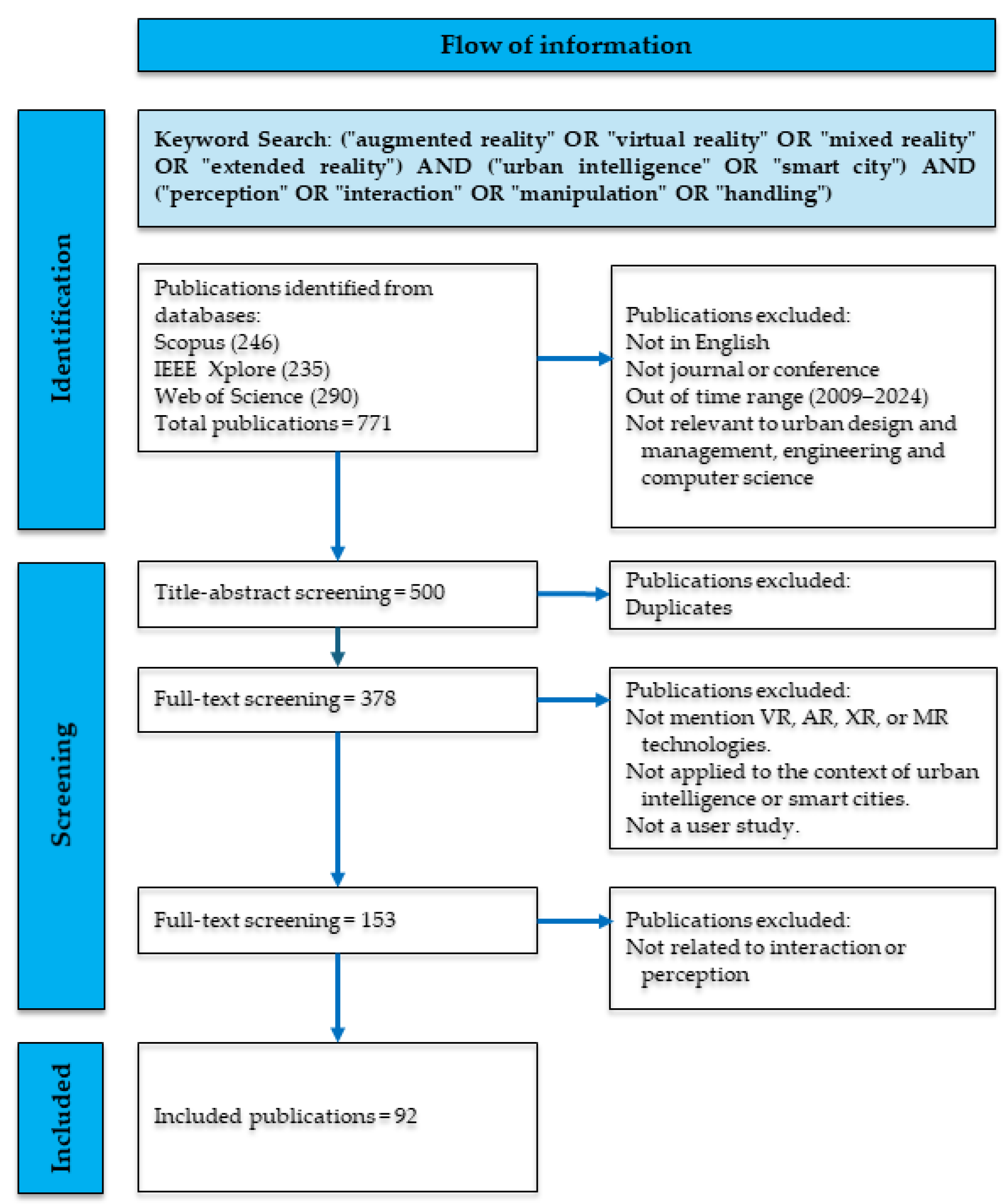
The search was performed within the title, abstract, and keywords fields for Scopus, and across all metadata fields for IEEE Xplore and Web of Science. This initial search using the defined keywords yielded a total of 771 papers (see Table 1).
To refine the search, we applied additional inclusion criteria, where applicable, to include only scientific papers that met the following conditions:
  • Written in the English language.
  • Published in journals or conference proceedings (i.e., conference papers and book chapters).
  • Published between 2009 and 2024.
  • Relevant to the fields of urban design and management, engineering, and computer science.
Although the concept of a “smart city” was introduced as early as 1998 and 2000 [19,20], the bulk of relevant literature begins around 2012 [21]. Similarly, the literature on urban intelligence dates to 2009 [22,23], which marked the starting point for our review period.
The study selection process is summarized in the PRISMA flow diagram (Figure 1). After applying these initial criteria, we reduced the total number of articles to 500. Since this process was conducted separately for each database, this total included duplicate. Once duplicates were removed, the number of unique articles was reduced to 378. At this stage, it is important to note that neither the titles nor the abstracts of the articles have been read.
No formal quality assessment or scoring procedure was applied to the selected studies. This choice is consistent with the aim of this work, which is to provide a systematic mapping and classification of XR applications in smart city contexts rather than to evaluate the effectiveness of individual solutions. To ensure baseline methodological relevance, eligibility was addressed through the inclusion and exclusion criteria (EC1 and EC2).
We then assessed the content of the remaining 378 articles by defining and applying two sets of exclusion criteria: EC1 and EC2. The exclusion criteria were applied sequentially and served different purposes in refining the dataset. EC1 was used as a first-level screening. This step significantly reduced the dataset by eliminating papers that were thematically adjacent but not directly aligned with the scope of this review. The first set (EC1) was applied after reading the title and abstract of each article. The criteria were as follows:
  • The article does not mention VR, AR, XR, or MR technologies.
  • The technologies discussed are not applied to the context of urban intelligence or smart cities.
  • The article presents a literature review rather than a user study.
  • The result of applying the EC1 was a list of 153 papers.
We excluded 112 articles because they did not refer to VR/AR/XR/MR technologies, 118 articles as the technologies were not applied to the urban intelligence or smart city context, and 4 articles because they presented literature reviews instead of user studies. Next, we conducted a full-text assessment of the remaining articles to apply the second exclusion criterion (EC2), excluding studies that, despite addressing VR, AR, XR, or MR technologies, did not consider interaction or perception in the context of the target environment.
After applying the EC2, we excluded 50 articles, leaving a final set of 92 articles that we formally reviewed. EC2 was applied through full-text screening and aimed to ensure conceptual relevance to the research questions. This second filtering step ensured that the final dataset was not only technologically relevant but also aligned with the focus on interaction modalities and sensory feedback. Disagreements, when applicable, were resolved through discussion among the authors. No automation tools were used in the data collection process.

2.2. Paper Analysis

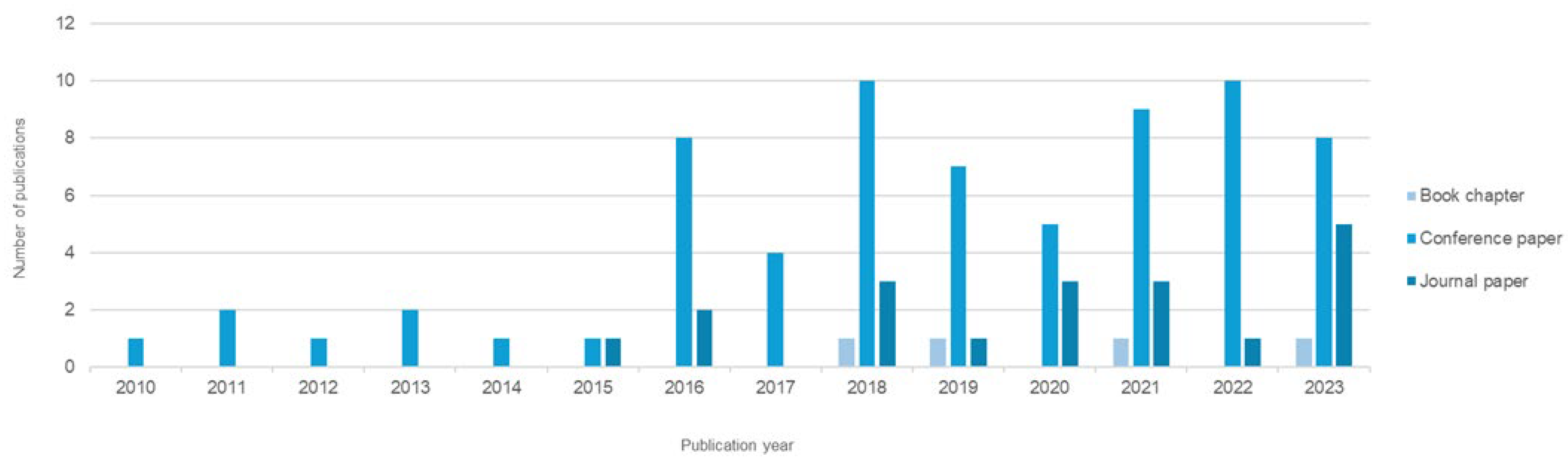
The final dataset included 92 publications, consisting of 19 journal articles, 69 conference papers, and 4 book chapters (see Figure 2). The dataset is dominated by conference papers (n = 69), and this aspect is considered in the Discussion when interpreting the maturity of the evidence base and the typical depth of validation reported in the included studies. Notably, over 75% of the papers were published between 2018 and October 2023, reflecting the growing adoption of XR technologies in smart city research. More than one-third of the developments appeared between 2021 and 2023, indicating an accelerated interest and development in the field.
We extracted bibliographic information, application domain, XR technology, interaction modality, input/output devices, tracking approach, and sensory feedback. A coding scheme was developed iteratively based on the research questions and refined during pilot coding.

3. Results

We now present the results from coding the 92 selected papers. These results are organized according to three key areas: (I) application domains, (II) technology adoption and interaction modalities (including output/input devices and tracking technologies), and (III) sensory feedback.

3.1. Application Domains

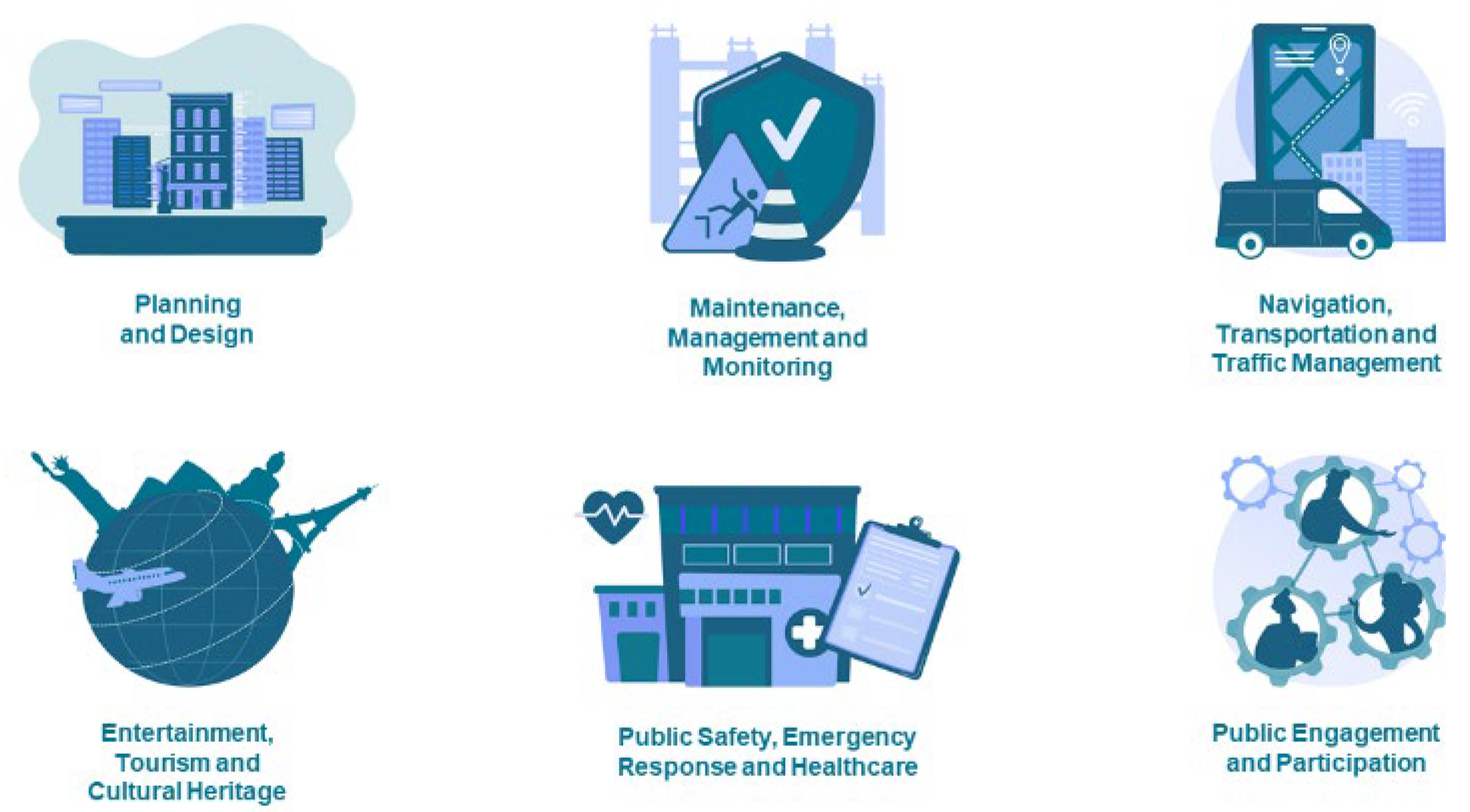
To address RQ1, we categorized the papers based on the smart city domains where XR technologies have been implemented. This analysis revealed six distinct domains (see Figure 3 and Table 2), each with unique applications and features.

3.1.1. Planning and Design

XR has proven to be a valuable tool in the domains of urban planning and design. For instance, this technology allows urban planners and architects to create immersive simulations of urban environments, enabling them to visualize and test different designs and layouts before implementation [24,25,26,27]. By providing realistic representations of urban spaces, XR enhances decision-making processes and optimizes spatial planning. AR is frequently used to overlay digital models onto physical sites, giving designers a clear and realistic preview of how future structures will integrate with existing environments [28]. Likewise, VR enables users to take virtual tours through urban areas, improving visualization and facilitating the refinement of architectural designs [29,30,31,32]. This immersive approach also facilitates the assessment of potential environmental and community impacts of new developments, providing a more comprehensive evaluation process. While planning and design primarily targets envisioning and evaluating future interventions, XR is also increasingly used once infrastructure is deployed, supporting day-to-day operation, monitoring, and maintenance tasks.

3.1.2. Maintenance, Management, and Monitoring

AR has emerged as a valuable tool in the maintenance, management, and monitoring of urban infrastructure. AR systems allow maintenance teams to visualize and manage infrastructure more efficiently [33]. For instance, AR can be used to monitor sea levels [34], water systems [35,36], and energy infrastructure [37], reducing the risk of accidental damage and improving the efficiency of repairs. Real-time data overlays provide critical information about infrastructure status [38], enabling workers to navigate repair processes with greater accuracy. Moreover, AR can provide real-time data on environmental conditions and urban services [39,40], such as traffic and parking systems [41], thereby supporting the effective monitoring and management of urban ecosystems. VR environments further contribute to remote monitoring and control of infrastructure, such as monitoring polluted gas concentrations [42] or managing street lighting systems [43]. These systems allow real-time data visualization, facilitating more efficient management processes [44]. Beyond infrastructure-centric use cases, XR applications extend to citizen-facing services, where real-time information and guidance become central—particularly in mobility, navigation, and traffic-related scenarios.
Table 2. XR Application Domains in Smart Cities.
XR Application DomainsUse Cases
Planning
and Design
(n = 9)
Cities [24,25,26,27,30]
Authoring tools [28]
Viewscape [31,32]
Underground commercial streets [29]
Maintenance, Management and Monitoring
(n = 25)
Gas pollution [42]
Geo-infographics [38]
Green and smart buildings [44]
Water Management Systems [35,36]
Pedestrian routes [45]
Energy management system [37]
Urban data [46,47,48,49,50,51]
Sea level [34]
Housing registry information [40]
Air b&b [52]
Business localization [53]
Smart parking system [41,54,55]
Urban objects [56]
Street lighting management [43]
Navigation, Transportation and Traffic Management
(n = 18)
Campus [39]
Cities [57,58,59,60,61]
Archaeological parks [62]
Cyclist / pedestrian behavior [63,64]
Inclusion: Visually Impaired [65], Mobility-Impaired [66], Deaf [67], Elderly [68]
Driving experience [69,70,71,72,73]
Entertainment, Tourism and Cultural Heritage
(n = 26)
Tourism system [74,75,76,77,78,79,80]
Digital Reconstruction of Historical Site [81]
Urban games [82,83,84,85,86,87]
Urban art [88,89]
Authoring tools [90]
Cultural experiences [91,92,93,94]
Public Safety, Emergency Response and Healthcare
(n = 8)
Site safety [33,95]
Traffic system: General [96], Emergency services [97,98]
Cityscape Protection [99]
Healthcare services: Cognitive assistance [100] Caregivers assistance [101]
Public Engagement and Participation
(n = 10)
Housing complex [102]
Participative practices [103,104]
Community interaction [105,106]
Civic participation [37,70,107,108]
Fab-living-lab [109]

3.1.3. Navigation, Transportation, and Traffic Management

Both AR and VR applications provide real-time navigation assistance, hazard detection, and traffic updates, improving safety and efficiency for drivers [69,70,71,72,73]. These technologies also deliver real-time traffic information to pedestrians, contributing to smoother urban mobility [63,64]. VR simulations are particularly useful in modeling traffic scenarios, enabling planners to analyze and optimize traffic flow and better manage congestion. Through simulated transportation conditions, AR supports the strategic planning of transportation networks, enhancing the adaptability and efficiency of urban transit systems. Additionally, AR integration has been valuable for providing navigation support to visually impaired individuals [65], mobility-impaired users [66], the deaf [67], and the elderly [68]. In addition to functional mobility support, XR also shapes how people experience the city, enabling richer place-based engagement through tourism, entertainment, and cultural heritage applications.

3.1.4. Entertainment, Tourism, and Cultural Heritage

Both VR and AR have significantly transformed the fields of entertainment, tourism, and cultural heritage [110]. AR enriches tourist experiences by overlaying interactive content on historical sites and landmarks, allowing visitors to access detailed historical information in real-time [81]. VR has expanded access to cultural heritage by enabling virtual tours of historical and cultural sites, making them accessible to a global audience and promoting both tourism and education [74,75,76,77,78]. Moreover, AR has been used to reconstruct historical events and environments, offering deeper and more immersive experiences that foster a better understanding of cultural heritage [91,93,94]. XR technologies, particularly AR, have also contributed to the development of urban games, creating immersive, interactive environments that blend physical and digital spaces. These games transform city landscapes into dynamic gaming experiences using handheld displays [82,83,84,85,86,87]. Moving from experiential and cultural use cases to higher-stakes contexts, XR is also adopted to enhance public safety and healthcare-related services, where training, situational awareness, and risk reduction are key drivers.

3.1.5. Public Safety, Emergency Response, and Healthcare

XR technologies play a significant role in enhancing emergency responder training by simulating various disaster scenarios. AR can provide real-time information and navigation support during emergencies, helping responders quickly and safely reach affected areas, thereby improving situational awareness and response efficiency [97,98]. This capability also enables the simulation of emergency scenarios, improving the knowledge and skills of personnel through practical, immersive training experiences. VR platforms for smart cities have been developed to enhance public safety by integrating XR, sensor networks, and communication systems [33,95]. Additionally, there is a growing integration of advanced technologies in healthcare, focusing on cognitive assistance [100] and caregiver support [101]. These innovations are revolutionizing patient care by streamlining processes, enhancing precision, and improving the overall quality of life for citizens. Finally, XR is not only used to support professionals and services, but also to involve citizens directly in urban decision-making, enabling participatory planning and public engagement.

3.1.6. Public Engagement and Participation

In urban planning, AR and MR technologies have proven effective in increasing public engagement by offering immersive visualizations of proposed projects [109]. These technologies allow residents to experience potential urban changes firsthand, enabling them to provide more informed and meaningful feedback on development initiatives. AR platforms have been used to visualize proposed plans, facilitating greater citizen participation in the planning process [102,107]. Some applications have even created virtual public forums, where community members can interact with urban planners and contribute to discussions on decision-making [103]. AR has also been employed in participatory planning workshops, allowing stakeholders to collaboratively explore and modify urban plans in real-time [104,105,106]. These technologies promote transparency and inclusivity in urban development, fostering more engaged and informed communities.

3.2. Technology Adoption and Interaction

The adoption of XR technologies in smart cities is closely linked to the development and integration of diverse interaction modalities that cater to the varying needs and preferences of users. As these technologies become more widespread, the success of XR applications hinges on how intuitively users can interact with virtual environments. The choice of input and output devices, as well as the tracking technologies employed, plays a critical role in shaping the user experience and determining the overall effectiveness of XR systems within smart city contexts. This section systematically analyzes the types of output and input devices, as well as the tracking technologies essential for facilitating effective interaction in XR environments.

3.2.1. Output Devices

Figure 4 presents the five main types of vision-based XR systems—Head-Mounted Displays (HMDs), hand-held displays (HHDs), monitors, projectors, and Cave Automatic Virtual Environments (CAVEs)—which are commonly featured in the current literature.
Since the advent of the current XR trend, HMDs have become the most prominent and widely recognized technology associated with XR experience. In the existing body of literature, approximately half of the studies focus on HMDs in some capacity (see Table 3). Devices such as the HTC Vive (n = 4), Microsoft HoloLens (n = 5), Oculus Rift/Quest (n = 7), and AR Glasses (n = 6) are frequently used.
However, VR does not always require an HMD. Any display technology capable of creating an immersive experience by sufficiently covering the user’s FOV can be employed. Accordingly, studies in the existing literature also explore the use of monitors (n = 5), projectors (n = 10), CAVE systems (n = 5), and other display setups (n = 20) as VR technologies. Additionally, AR is being increasingly integrated into smart city applications.
Most studies (n = 36) focus on developing smartphone-based AR solutions, while a smaller subset (n = 12) investigates tablet-based implementations. While smartphones offer widespread accessibility and portability, tablets may provide enhanced visualization due to their larger screen sizes. However, finding the right balance between user convenience and immersive experience remains critical when selecting AR platforms for smart city applications.

3.2.2. Input Devices and Tracking Technologies

To enable natural and effective interaction in XR environments, there is a significant need for precise and multimodal input devices that allow users to engage with various objects. These input devices range from standard pointing tools, such as a mouse, to more specialized VR controllers.
Current research categorizes movement-based input modalities into three main types: devices controlled primarily by hand, head/eye, or full-body motion (see Table 4).
A critical aspect of navigation and interaction in XR environments is the ability to track the user’s gaze and attention. In XR systems, both head movement and orientation (n = 9) and eye-tracking (n = 9) are essential modalities for human–computer interaction.
These technologies are used to interact with the virtual environment and assess where the user’s attention is directed. Head movement and orientation capture macro-level attention, tracking broader shifts in focus, while eye-tracking devices—either integrated into the HMD or mounted on a monitor—capture micro-level attention, focusing on specific virtual or urban objects. Additionally, voice control input (n = 2), enabled through sound-based devices, allows users to interact using vocal commands.
All reviewed studies primarily focused on single-user interactions, where individuals engage with XR systems independently, without collaboration or shared environments. Only two papers [25,106] addressed multi-user interactions in XR contexts. Cirulis [106] proposed an AR environment enabling multiple users to interact with shared virtual elements—such as 3D models and intelligent avatars—within large indoor or outdoor spaces, including smart city infrastructures.
In contrast, Davis et al. [25] developed a collaborative application within a CAVE system, allowing users to co-create 3D urban models and simulate large-scale cityscapes. This approach supports various domains, including intelligent transportation, smart city planning, and infrastructure development.

3.2.3. Sensory Feedback

Interactions between humans and XR environments rely on timely and consistent sensory feedback, incorporating stimuli from multiple senses, including the haptic sense. Multimodal interaction—which engages multiple sensory inputs such as vision, sound, and touch—enables users to interact with XR environments more naturally and effectively. The effectiveness of these sensory modalities in smart city applications, such as urban navigation, public service interaction, and entertainment, plays a critical role in influencing the adoption rate and overall impact of XR technologies.
Visual Feedback
In smart city applications, XR experiences are primarily driven by visual feedback, utilizing immersive technologies to provide interactive, real-time representations of urban environments. A critical factor in the effectiveness of these experiences is visual comfort [29], as prolonged exposure to virtual or augmented environments may lead to eye strain, discomfort, and reduced task performance. Key technical parameters—such as resolution, frame rate, FOV, and the alignment between virtual and real-world elements—substantially influence visual comfort.
Sun et al. [29] emphasize the importance of minimizing disruptive visual factors during the design of virtual environments and 3D models. Their study shows that in virtual commercial streets, high-gloss materials can enhance visual comfort. Similarly, Noland et al. [45], using eye-tracking, demonstrate that object arrangement, depth cues, and lighting significantly affect user perception, with optimized spatial features reducing visual fatigue.
The perception of urban form in 3D city models is shaped by how users interpret depth, shape, and distance within VR environments [27]. Vigier et al. [27] identify rendering features—such as stereoscopy, viewpoint, FOV, and overall realism—as key influences on spatial perception. Depth perception, in particular, depends on a combination of physiological and psychological cues [45]:
  • Physiological cues:
    Binocular: accommodation, vergence, stereopsis.
    Monocular: motion parallax.
  • Psychological cues (monocular):
    Retinal image size, linear/aerial perspective, shading.
3D models also enable users to alternate between egocentric (first-person) and allocentric (map-like) spatial perspectives, which substantially affect spatial cognition [116]. Notably, egocentric views often result in distance underestimation, known as distance compression [117]. While the exact mechanisms remain uncertain, contributing factors may include limited FOV, inadequate realism, or distortions from the virtual camera [118,119].
Vigier et al. [27] further argue that visual immersion and interface design play a pivotal role in how users interpret urban morphology. When urban indicators or datasets are integrated into 3D city models, the chosen viewing mode (e.g., first-person vs. bird’s-eye) can significantly alter the user’s understanding of urban form. They recommend either adapting visualizations based on the selected view or promoting multi-perspective exploration to enhance urban analysis.
Although visual feedback remains dominant, there is a growing interest in multi-sensory integration—notably auditory and haptic feedback—to increase immersion and enrich user interaction in XR-based smart city systems.
Auditory Feedback
The integration of sound, voice, and auditory cues in XR systems is playing an increasingly significant role in the development of smart cities. Auditory feedback enhances immersion, supports hands-free interaction, improves accessibility, and strengthens the connection between physical and virtual environments.
One emerging application involves motion-triggered audio in public spaces. For example, statues equipped with sensors and speakers can “speak” to passersby, offering historical or contextual information via AR overlays [82]. These systems create interactive, informative urban experiences by combining physical structures with digital storytelling.
Audio-based AR platforms are also transforming urban tourism. Applications like AudioNear use GPS-triggered audio tracks to deliver location-specific content as users approach landmarks [76]. Through mobile devices and headphones, users receive hands-free auditory guidance, merging physical exploration with digital narratives.
Beyond engagement, auditory feedback enhances accessibility. For instance, XR systems designed for driving instruction offer real-time audio cues tailored to individuals with hearing impairments [70,73]. In education, AR platforms combining visual and auditory channels support communication for deaf and hard-of-hearing users, promoting inclusive learning environments [71].
Auditory cues also improve navigation and situational awareness in urban spaces. In XR-based driving simulators, audio guides help users maintain speed or respond to road conditions, ensuring realism and reducing cognitive load. Similarly, auditory AR supports orientation in unfamiliar urban areas by delivering environmental information while maintaining spatial awareness [71].
In urban planning, VR sound simulations enable the testing and optimization of urban soundscapes. Using acoustic engineering principles, planners can model how sound interacts with various materials (e.g., glass, stone, vegetation) [7,65]. These simulations help improve acoustic comfort in public spaces, ensuring that sound contributes positively to urban quality of life.
Ultimately, XR platforms enable citizens to engage in auditory assessments of urban environments. Users can record ambient sounds (e.g., traffic noise) and provide contextual notes, generating valuable input for planners and decision-makers [26]. This participatory approach ensures that the acoustic dimension of smart cities evolves based on real-time, user-driven feedback.
Tactile Feedback
The integration of haptic and tactile feedback in XR is reshaping how users engage with digital and physical elements in smart city environments. These technologies bridge the virtual-physical divide by enabling users to perceive and interact with virtual objects, thereby expanding interaction beyond visual and auditory stimuli.
Recent innovations enable experiences involving force and motion perception, and experimental research even explores the future inclusion of taste and smell as sensory inputs [44]. Despite technological advances, current limitations in sensing still make tactile interaction largely dependent on the integration of computer graphics and VR. As sensor systems evolve, XR designers are increasingly able to embed virtual objects into real-world contexts, enabling users to interact with both tangible and intangible elements simultaneously [110].
In urban planning and design, haptic devices support the manipulation of 3D models, allowing users to rotate, inspect, and modify virtual structures [83]. This tactile interaction enhances spatial understanding and supports early-stage decision-making prior to physical construction. Force feedback interfaces provide users with simulated sensations of weight and texture, improving comprehension of complex architectural forms [51].
Beyond planning, tactile feedback is applied in public interfaces, particularly touchscreens. However, hygiene, especially in shared spaces, has prompted the development of contactless haptic technologies, which maintain the benefits of touch interaction without physical contact, improving both safety and user comfort [105].
Safety applications are another critical area for haptic integration. In XR-assisted driving scenarios, multisensory interfaces combining haptic and auditory cues help reduce cognitive load, enabling drivers to remain focused while receiving real-time data from urban infrastructure [99]. These systems enhance decision-making in complex traffic situations.
Haptic feedback also enriches AR-based urban interactions. Users can “touch” virtual buildings or infrastructure using devices that simulate force and surface properties [51], providing a realistic, immersive experience. This tactile immersion strengthens the connection between the digital cityscape and its physical counterpart, contributing to more intuitive and embodied interactions in smart city contexts.

4. Discussion

The proposed classification and findings from our SLR offer valuable insights to address the research questions and inform future XR application development in smart city contexts. To answer RQ1, we clustered the 92 reviewed studies into six application domains, based on shared themes and keywords:
  • Planning and Design;
  • Maintenance, Operation, and Monitoring;
  • Navigation, Transportation, and Traffic Management;
  • Entertainment, Tourism, and Cultural Heritage;
  • Public Safety, Emergency Response, and Healthcare;
  • Public Engagement and Participation.
Although research on XR in smart cities is still emerging, the diversity across these domains is notable. For example, in the Healthcare domain, only two studies were identified [101,102], revealing a significant gap [120] and highlighting the need for further investigation in this area. Despite this limited representation, smart city ecosystems offer several plausible pathways for XR-enabled healthcare services [121,122]. Potential applications include XR-assisted remote triage and guidance for community-based interventions, augmented support for caregivers and assisted living in smart regions, and immersive training and simulation platforms for emergency response coordination across urban infrastructures. In data-rich urban environments, XR may also function as an interface to urban intelligence capabilities by visualizing context-aware information—such as the availability of nearby services, environmental risk factors, or real-time incident data—to support decision-making by practitioners and citizens.
In Entertainment, Tourism, and Cultural Heritage, some studies explored virtual environments based on real-world scans [123]. Only one paper [31] employed LiDAR technology to reconstruct environments via 3D scanning, while the majority relied on fully computer-generated assets, indicating limited adoption of real-world point cloud data in current XR applications.
Understanding these application areas is essential for optimizing XR implementation in smart cities. Each domain poses unique challenges and opportunities, requiring tailored XR solutions. Identifying and targeting these domains can help cities deliver citizen-centric services, drive innovation, and promote sustainable urban development.
To address RQ2, concerning XR technologies and interaction types, we observed a nearly equal split between VR-based studies (n = 52) and AR-based studies (n = 48). Usage patterns varied by domain. In Entertainment, Tourism, and Navigation, most studies implemented AR via smartphones or tablets, offering intuitive, location-based guidance and real-time environmental overlays [124]. The portability and accessibility of these devices enhance usability and user satisfaction in mobile urban contexts [125].
In contrast, Planning, Design, and Maintenance applications often leveraged VR to support immersive visualization, modeling, and monitoring through HMDs or CAVE systems. These platforms enhance spatial understanding, support collaborative decision-making, and offer realistic representations of urban infrastructure [126]. Immersive environments improve both the accuracy of design assessments and the efficiency of planning processes [127].
To further enhance the analytical depth of this review, a comparative analysis of XR approaches across application domains is presented. While VR, AR, and MR are often discussed collectively under the XR umbrella, our findings highlight clear domain-dependent differences in their effectiveness, scalability, and contextual suitability.
VR-based solutions are predominantly adopted in Planning and Design and Maintenance domains, where immersive visualization and spatial understanding are critical. These applications benefit from high levels of realism and controlled environments; however, they are less scalable at city-wide levels due to hardware requirements and limited mobility.
Conversely, AR-based approaches are more prevalent in Navigation, Transportation, Tourism, and Public Engagement domains. Their effectiveness lies in the seamless integration of digital information within real-world contexts, enabling real-time, location-based interaction. AR systems—especially smartphone-based solutions—exhibit higher scalability and accessibility, making them particularly suitable for large, heterogeneous urban populations.
MR applications, although less represented, emerge as promising solutions in collaborative and participatory scenarios, such as public engagement and co-design processes. By enabling simultaneous interaction with physical and virtual elements, MR supports shared understanding and collaborative decision-making. However, current technological constraints and deployment costs limit widespread adoption.
Overall, the comparative analysis suggests that no single XR approach is universally optimal. Instead, the suitability of VR, AR, or MR depends strongly on task requirements, user mobility, interaction complexity, and infrastructural constraints within each smart city domain.
Regarding RQ3 on sensory feedback, consistent with prior research [128,129,130], we found that visual and auditory cues remain dominant in XR systems, while haptic feedback is used less frequently. In applications such as tourism and navigation, simultaneous perception of real and virtual audio supports situational awareness [70,76]. As smart city systems become increasingly interactive, auditory feedback will continue to play a crucial role in reinforcing environmental awareness and enhancing multisensory immersion. Currently, haptic feedback is limited, primarily appearing in basic touchscreen interfaces [65,67]. Vibrotactile cues and force-feedback technologies could provide enhanced spatial awareness, accessibility, and realism.
The reviewed literature is dominated by conference papers (n = 69 out of 92). While conference venues are often the primary venue for rapidly emerging XR technologies, this imbalance suggests that XR research in smart city contexts is still in a relatively early-to-intermediate maturity stage. In many cases, conference contributions emphasize feasibility demonstrations and prototype development rather than fully validated deployments. As a result, the evidence base frequently reflects short evaluation periods, small sample sizes, and limited ecological validity. Several studies report controlled or laboratory-based assessments, proof-of-concept user tests, or single-session experiments, which can constrain the generalizability of findings to real-world urban settings. Moreover, longitudinal validation is rare, making it difficult to assess sustained adoption, learning effects, habituation, or longer-term impacts on decision-making and urban service outcomes.
Beyond interaction design, XR supports urban intelligence functions (e.g., monitoring and decision support) through virtual simulations and real-time data visualization, contributing to sustainable urban development. For instance, in traffic management, XR can display live data to improve vehicle flow and reduce emissions. By enabling informed decisions and minimizing trial-and-error, XR contributes to enhanced energy efficiency and reduced waste in areas such as infrastructure design and construction.
As XR technologies evolve, their integration with IoT, AI, and other emerging systems will be crucial for scaling efficiency, sustainability, and citizen well-being. The continued development of multisensory interfaces, particularly haptic ones, will be crucial to delivering deeply immersive and accessible urban experiences. Overall, our findings highlight XR’s potential as a driver of innovation, inclusivity, and sustainability in future smart cities.

4.1. Implications for Sustainable Urban Development and Urban Intelligence

The six application domains identified in this review have direct implications for sustainable urban development. Firstly, XR-based planning and design environments allow for the virtual prototyping of buildings, infrastructure, and public spaces before physical implementation. These tools allow stakeholders to explore multiple scenarios, assess environmental and social impacts, and detect design flaws at an early stage. This reduces material waste, avoids costly rework, and supports more climate-resilient and resource-efficient interventions.
Secondly, XR applications for maintenance, operation, and monitoring contribute to the efficient management of existing assets. AR-guided inspection and repair procedures, as well as VR-based control rooms linked to sensor networks and digital twins, can optimize energy use, extend the lifetime of infrastructure, and improve the reliability of critical services such as water, energy, and mobility. These capabilities are closely aligned with the goals of sustainable urban development, which emphasize the adaptive reuse and optimization of existing urban systems rather than continuous expansion.
Thirdly, navigation, transportation, and public safety applications demonstrate how XR can facilitate safer, more environmentally friendly mobility systems. Real-time, context-aware XR interfaces can improve traffic flow, reduce congestion, and encourage eco-friendly driving behaviors. Meanwhile, inclusive navigation solutions for vulnerable groups, such as older adults and people with disabilities, can enhance the social sustainability of mobility services.
Fourthly, entertainment, tourism, and cultural heritage applications demonstrate that XR can promote sustainable access to urban experiences by supplementing or partially replacing physical travel and extending the reach of cultural assets to remote audiences. XR-based public engagement and participation tools can also increase transparency and trust in planning processes, helping to align urban development strategies with the needs of citizens and long-term sustainability goals.
Finally, our findings suggest that, across all domains, XR can operate as a human-centered interface to urban intelligence. By visually and multimodally coupling real-time data, predictive models, and simulation outputs with situated experiences in the city, XR reduces the cognitive barriers to exploiting complex urban data in practice. This may facilitate more informed decision-making by planners, operators, and citizens alike, supporting the development of adaptive, data-driven, and sustainable smart city ecosystems.

4.2. Future Research Directions

The findings of this systematic review highlight several research gaps that warrant further investigation and that are currently fragmented across application domains and technological approaches. First, the limited integration of haptic feedback in XR-based smart city applications represents a significant opportunity for advancing embodied and multisensory interaction. Future studies should explore scalable haptic and vibrotactile solutions, particularly for navigation, urban planning, and accessibility-focused applications, where non-visual cues could significantly enhance usability and inclusivity.
Second, healthcare-related XR applications in smart city contexts remain underrepresented in the reviewed literature. Existing contributions primarily focus on cognitive assistance or caregiver support, suggesting the need for broader investigations into urban healthcare services, public health monitoring, and community-based interventions supported by XR technologies.
Third, multi-user and collaborative XR systems remain rare, despite their clear relevance for participatory planning, public engagement, and collective decision-making. Future research should address technical and interactional challenges related to synchronization, shared awareness, and scalability in real-world urban environments.
Finally, many studies report short-term evaluations with small samples and limited ecological validity. Longitudinal, in situ, and large-scale evaluations are needed to assess sustained adoption, learning effects, and long-term impacts of XR systems on urban processes and citizen behavior. Addressing these directions would contribute to increasing the maturity, robustness, and practical relevance of XR research in smart city contexts.

5. Conclusions

Smart cities leverage the integration of ICTs to enhance urban services, reduce operational costs, and optimize resource use. Within this context, XR technologies have emerged as key enablers in achieving these goals. By offering innovative, immersive solutions across various domains, XR technologies significantly improve citizens’ quality of life. However, the literature lacks a comprehensive understanding of the primary application domains in smart cities, the technologies employed, the mechanisms by which interactions with urban objects occur, and the types of sensory feedback provided to users.
Findings from this SLR highlight the central role of XR in facilitating smarter urban environments and enabling new forms of interaction with urban systems, contributing to more sustainable and responsive urban ecosystems. The existing literature underscores XR’s transformative potential across several smart city domains, which continues to expand. This review categorizes these applications and highlights the sensory interactions and feedback involved, offering a comprehensive understanding of XR’s current and future role in urban design and development.
Looking ahead, the evolution of XR in smart city contexts is likely to be increasingly shaped by tighter integration with IoT and AI. IoT infrastructures can provide real-time, context-aware data streams to XR interfaces (e.g., environmental sensing, mobility status, infrastructure condition), enabling more responsive and adaptive user experiences. In parallel, AI can support intelligent content generation, predictive analytics, and personalized interaction, improving decision support and scalability across heterogeneous urban scenarios. These developments also raise important challenges—such as privacy, security, and reliability in high-stakes settings—which should be addressed through rigorous in situ and longitudinal evaluations.

Author Contributions

M.R. (Marina Ricci): Conceptualization, Data curation, Formal analysis, Investigation, Methodology, Resources, Software, Validation, Visualization, Writing—original draft. N.M.: Writing—review and editing; M.R. (Moh Rafik): Writing—review and editing; M.D.S.: Conceptualization, Funding acquisition, Project administration, Supervision, Writing—review and editing. All authors have read and agreed to the published version of the manuscript.

Funding

This work was supported by the CTEAMBA project “CASA DELLE TECNOLOGIE EMERGENTI DELL’AREA METROPOLITANA DI BARI—BARI OPEN INNOVATION HUB”—Asse I—Emerging Technologies Support Program (FSC 2014–2020)—CUP J99J19000300003. Funding Agency: Italian Ministry of Economic Development (MISE).

Institutional Review Board Statement

Not applicable.

Informed Consent Statement

Not applicable.

Data Availability Statement

Data will be made available upon reasonable request.

Conflicts of Interest

The authors declare that they have no conflicts of interest.

Abbreviations

The following abbreviations are used in this manuscript:
ARAugmented Reality
ECExclusion Criteria
FOVField-of-View
GISsGeographical Information Systems
ICTsInformation and Communication Technologies
MRMixed Reality
PRISMAPreferred Reporting Items for Systematic Reviews and Meta-Analysis
SLRSystematic Literature Review
VRVirtual Reality
XReXtended Reality

References

  1. Lazaroiu, G.C.; Roscia, M. Definition Methodology for the Smart Cities Model. Energy 2012, 47, 326–332. [Google Scholar] [CrossRef] [Scilit]
  2. Barrionuevo, J.M.; Berrone, P.; Ricart Costa, J.E. Smart Cities, Sustainable Progress: Opportunities for Urban Development. IESE Insight 2012, 14, 50–57. [Google Scholar] [CrossRef] [Scilit]
  3. Harrison, C.; Eckman, B.; Hamilton, R.; Hartswick, P.; Kalagnanam, J.; Paraszczak, J.; Williams, P. Foundations for Smarter Cities. IBM J. Res. Dev. 2010, 54, 1–16. [Google Scholar] [CrossRef] [Scilit]
  4. Foth, M.; Choi, J.H.J.; Satchell, C. Urban Informatics. In Proceedings of the ACM Conference on Computer Supported Cooperative Work, CSCW, Hangzhou, China, 19–23 March 2011; pp. 1–8. [Google Scholar] [CrossRef] [Scilit]
  5. Lai, Y.; Yeung, W.; Celi, L.A. Urban Intelligence for Pandemic Response: Viewpoint. JMIR Public Health Surveill 2020, 6, e18873. [Google Scholar] [CrossRef] [Scilit] [PubMed]
  6. Kitchin, R. The real-time city? Big data and smart urbanism. GeoJournal 2014, 79, 1–14. [Google Scholar] [CrossRef] [Scilit]
  7. Casini, M. Extended Reality for Smart Building Operation and Maintenance: A Review. Energies 2022, 15, 3785. [Google Scholar] [CrossRef] [Scilit]
  8. Soman, R.K.; Nikolić, D.; Sanchez, B.; Soman, R.K.; Nikolić, D.; Sanchez, B. Extended Reality as a Catalyst for Circular Economy Transition in the Built Environment. In A Circular Built Environment in the Digital Age; Springer: Cham, Switzerland, 2024; pp. 171–193. [Google Scholar] [CrossRef] [Scilit]
  9. Rauschnabel, P.A.; Felix, R.; Hinsch, C.; Shahab, H.; Alt, F. What Is XR? Towards a Framework for Augmented and Virtual Reality. Comput. Human. Behav. 2022, 133, 107289. [Google Scholar] [CrossRef] [Scilit]
  10. Yaqoob, I.; Salah, K.; Jayaraman, R.; Omar, M. Metaverse Applications in Smart Cities: Enabling Technologies, Opportunities, Challenges, and Future Directions. Internet Things 2023, 23, 100884. [Google Scholar] [CrossRef] [Scilit]
  11. Chen, X.; Gao, W.; Chu, Y.; Song, Y. Enhancing Interaction in Virtual-Real Architectural Environments: A Comparative Analysis of Generative AI-Driven Reality Approaches. Build. Environ. 2024, 266, 112113. [Google Scholar] [CrossRef] [Scilit]
  12. Jiang, L.; Masullo, M.; Maffei, L.; Meng, F.; Vorländer, M. How Do Shared-Street Design and Traffic Restriction Improve Urban Soundscape and Human Experience? —An Online Survey with Virtual Reality. Build. Environ. 2018, 143, 318–328. [Google Scholar] [CrossRef] [Scilit]
  13. Jeon, J.Y.; Jo, H.I. Three-Dimensional Virtual Reality-Based Subjective Evaluation of Road Traffic Noise Heard in Urban High-Rise Residential Buildings. Build. Environ. 2019, 148, 468–477. [Google Scholar] [CrossRef] [Scilit]
  14. Davila Delgado, J.M.; Oyedele, L.; Demian, P.; Beach, T. A Research Agenda for Augmented and Virtual Reality in Architecture, Engineering and Construction. Adv. Eng. Inform. 2020, 45, 101122. [Google Scholar] [CrossRef] [Scilit]
  15. Schrom-Feiertag, H.; Stubenschrott, M.; Regal, G.; Matyus, T.; Seer, S. An Interactive and Responsive Virtual Reality Environment for Participatory Urban Planning. In Proceedings of the 11th Annual Symposium on Simulation for Architecture and Urban Design, Online, 25–27 May 2020. [Google Scholar]
  16. Walker, M.; Phung, T.; Chakraborti, T.; Williams, T.; Szafir, D. Virtual, Augmented, and Mixed Reality for Human-Robot Interaction: A Survey and Virtual Design Element Taxonomy. ACM Trans. Hum. Robot. Interact. 2023, 12, 1–39. [Google Scholar] [CrossRef] [Scilit]
  17. Booth, A.; Sutton, A.; Papaioannou, D. Systematic Approaches to a Successful Literature Review; Sage: Newbury Park, CA, USA, 2016. [Google Scholar]
  18. Milgram, P.; Kishino, F. A Taxonomy of Mixed Reality Visual Displays. In Proceedings of the IEICE Transactions on Information and Systems, Tokyo, Japan, 25 January 1994; pp. 1321–1329. [Google Scholar]
  19. Hall, R.E.; Bowerman, B.; Braverman, J.; Taylor, J.; Todosow, H.; Von Wimmersperg, U. The Vision of a Smart City. In Proceedings of the 2nd International Life Extension Technology Workshop, Paris, France, 28 September 2000. [Google Scholar]
  20. Mahizhnan, A. Smart Cities: The Singapore Case. Cities 1999, 16, 13–18. [Google Scholar] [CrossRef] [Scilit]
  21. Gracias, J.S.; Parnell, G.S.; Specking, E.; Pohl, E.A.; Buchanan, R. Smart Cities—A Structured Literature Review. Smart Cities 2023, 6, 1719–1743. [Google Scholar] [CrossRef] [Scilit]
  22. Yovanof, G.S.; Hazapis, G.N. An Architectural Framework and Enabling Wireless Technologies for Digital Cities & Intelligent Urban Environments. Wirel. Pers. Commun. 2009, 49, 445–463. [Google Scholar] [CrossRef] [Scilit]
  23. Komninos, N. Intelligent Cities: Towards Interactive and Global Innovation Environments. Int. J. Innov. Reg. Dev. 2009, 1, 337–355. [Google Scholar] [CrossRef] [Scilit]
  24. Davis, C.; Collins, J.; Fraser, J.; Zhang, H.; Yao, S.; Lattanzio, E.; Balakrishnan, B.; Duan, Y.; Calyam, P.; Palaniappan, K. CAVE-VR and Unity Game Engine for Visualizing City Scale 3D Meshes. In Proceedings of the IEEE Consumer Communications and Networking Conference, CCNC, Las Vegas, NV, USA, 8–11 January 2022; pp. 733–734. [Google Scholar] [CrossRef] [Scilit]
  25. Davis, C.; Collins, J.; Fraser, J.; Zhang, H.; Yao, S.; Lattanzio, E.; Balakrishnan, B.; Duan, Y.; Calyam, P.; Palaniappan, K. 3D Modeling of Cities for Virtual Environments. In Proceedings of the 2021 IEEE International Conference on Big Data, Big Data 2021, Orlando, FL, USA, 15–18 December 2021; pp. 5587–5596. [Google Scholar] [CrossRef] [Scilit]
  26. Dembski, F.; Wössner, U.; Letzgus, M.; Ruddat, M.; Yamu, C. Urban Digital Twins for Smart Cities and Citizens: The Case Study of Herrenberg, Germany. Sustainability 2020, 12, 2307. [Google Scholar] [CrossRef] [Scilit]
  27. Vigier, T.; Ameil, M.; Tourre, V. Impact of Visual Immersion on Perception of Urban Morphology and Density in 3D City Models. In Proceedings of the 2017 23rd International Conference on Virtual Systems and Multimedia, VSMM 2017, Dublin, Ireland, 31 October—4 November 2017; IEEE: New York, NY, USA, 2018; pp. 1–7. [Google Scholar] [CrossRef] [Scilit]
  28. Vera, F.; Sánchez, J.A.; Cervantes, O. A Platform for Creating Augmented Reality Content by End Users. In Lecture Notes of the Institute for Computer Sciences, Social-Informatics and Telecommunications Engineering, LNICST; Springer International Publishing: Cham, Switzerland, 2017; Volume 179, pp. 167–171. [Google Scholar] [CrossRef] [Scilit]
  29. Sun, L.; Tan, W.; Ren, Y.; Ji, X.; Wang, Z.; Li, P. Research on Visual Comfort of Underground Commercial Streets’ Pavement in China on the Basis of Virtual Simulation. Intern. J. Pattern Recognit. Artif. Intell. 2020, 34, 2050005. [Google Scholar] [CrossRef] [Scilit]
  30. Boring, S.; Gehring, S.; Wiethoff, A.; Blöckner, M.; Schöning, J.; Butz, A. Multi-User Interaction on Media Facades through Live Video on Mobile Devices. In Proceedings of the Conference on Human Factors in Computing Systems, Vancouver, BC, Canada, 7–12 May 2011; pp. 2721–2724. [Google Scholar] [CrossRef] [Scilit]
  31. Tabrizian, P.; Petrasova, A.; Baran, P.K.; Vukomanovic, J.; Mitasova, H.; Meentemeyer, R.K. High Resolution Viewscape Modeling Evaluated Through Immersive Virtual Environments. ISPRS Int. J. Geo-Inf. 2020, 9, 445. [Google Scholar] [CrossRef] [Scilit]
  32. Wang, C. Intelligent System of Green Urban Garden Landscape Design Based on VR and Multi-Dimensional Image Mining. In Proceedings of the 2nd International Conference on Artificial Intelligence and Smart Energy, ICAIS 2022, Coimbatore, India, 23–25 February 2022; pp. 864–867. [Google Scholar] [CrossRef] [Scilit]
  33. Xu, J.; Moreu, F. A Review of Augmented Reality Applications in Civil Infrastructure During the 4th Industrial Revolution. Front. Built Environ. 2021, 7, 640732. [Google Scholar] [CrossRef] [Scilit]
  34. Sarri, F.; Ragia, L.; Panagiotopoulou, A.; Mania, K. Location-Aware Augmented-Reality for Predicting Sea Level Rise in Situ. In Proceedings of the 2022 International Conference on Interactive Media, Smart Systems and Emerging Technologies, IMET 2022, Limassol, Cyprus, 4–7 October 2022. [Google Scholar] [CrossRef] [Scilit]
  35. Sidiropoulos, V.; Sidiropoulos, A.; Bechtsis, D.; Stergiopoulos, F. AR-Enabled Interface for IoT Water Management Systems in Smart Cities. In Lecture Notes in Computer Science (Including Subseries Lecture Notes in Artificial Intelligence and Lecture Notes in Bioinformatics); Springer International Publishing: Cham, Switzerland, 2023; Volume 14037, pp. 147–155. [Google Scholar] [CrossRef] [Scilit]
  36. Predescu, A.; Mocanu, M. Increasing Collaboration and Participation Through Serious Gaming for Improving the Quality of Service in Urban Water Infrastructure. Lect. Notes Bus. Inf. Process. 2019, 373, 585–596. [Google Scholar] [CrossRef] [Scilit]
  37. Cho, K.; Jang, H.; Park, L.W.; Kim, S.; Park, S. Energy Management System Based on Augmented Reality for Human-Computer Interaction in a Smart City. In Proceedings of the 2019 IEEE International Conference on Consumer Electronics, ICCE 2019, Las Vegas, NV, USA, 11–13 January 2019. [Google Scholar] [CrossRef] [Scilit]
  38. Park, H. A Study on User Interface Design Based on Geo-Infographic and Augmented Reality Technology. Commun. Comput. Inf. Sci. 2021, 1498, 364–368. [Google Scholar] [CrossRef] [Scilit]
  39. Subakti, H.; Jiang, J.R. A Marker-Based Cyber-Physical Augmented-Reality Indoor Guidance System for Smart Campuses. In Proceedings of the 18th IEEE International Conference on High Performance Computing and Communications, 14th IEEE International Conference on Smart City and 2nd IEEE International Conference on Data Science and Systems, HPCC/SmartCity/DSS 2016, Sydney, Australia, 12–14 December 2016; IEEE: New York, NY, USA, 2017; pp. 1373–1379. [Google Scholar] [CrossRef] [Scilit]
  40. Mora-Alvarado, M.; Llerena-Izquierdo, J. Mobile Application of Registry Information for Urban Planning Context with Augmented Reality and QR Codes. Commun. Comput. Inf. Sci. 2022, 1532 CCIS, 30–43. [Google Scholar] [CrossRef] [Scilit]
  41. Al-Jabi, M.; Sammaneh, H. Toward Mobile AR-Based Interactive Smart Parking System. In Proceedings of the 20th International Conference on High Performance Computing and Communications, 16th International Conference on Smart City and 4th International Conference on Data Science and Systems, HPCC/SmartCity/DSS 2018, Exeter, UK, 28–30 June 2018; IEEE: New York, NY, USA, 2019; pp. 1243–1247. [Google Scholar] [CrossRef] [Scilit]
  42. He, Z.; You, L.; Liu, R.W.; Yang, F.; Ma, J.; Xiong, N. A Cloud-Based Real Time Polluted Gas Spread Simulation Approach on Virtual Reality Networking. IEEE Access 2019, 7, 22532–22540. [Google Scholar] [CrossRef] [Scilit]
  43. Del Campo, G.; Piovano, L.; Oostrom, F.P.L.; Saavedra, E.; Zissis, G.; Santamaria, A. Digital Twins for Street Lighting: Challenges for a Virtual Reality Solution Based on Internet-of-Things Devices and Photometry Rendering. In Proceedings of the 2023 IEEE Sustainable Smart Lighting World Conference and Expo, LS18 2023, Mumbai, India, 8–10 June 2023. [Google Scholar] [CrossRef] [Scilit]
  44. Xin, W.; Lu, W.Y.; Yi, Y. Application of Virtual Reality Technology in Data Collection and Visualization of Green and Smart Buildings. In Proceedings of the International Conference on Sustainable Computing and Data Communication Systems, ICSCDS 2022, Erode, India, 7–9 April 2022; pp. 633–636. [Google Scholar] [CrossRef] [Scilit]
  45. Fistola, R.; Zingariello, I. Beyond the Smart City. The Urban Digital Twin for the Augmented City: The Vox Hortus Project. Lect. Notes Civil. Eng. 2024, 467, 204–210. [Google Scholar] [CrossRef] [Scilit]
  46. Bartosh, A.; Gu, R. Immersive Representation of Urban Data. Simul. Ser. 2019, 51, 65–68. [Google Scholar]
  47. Lv, Z.; Li, X.; Zhang, B.; Wang, W.; Zhu, Y.; Hu, J.; Feng, S. Managing Big City Information Based on WebVRGIS. IEEE Access 2016, 4, 407–415. [Google Scholar] [CrossRef] [Scilit]
  48. Garnero, G.; Corrias, A.; Manigas, L.; Zedda, S.V. VGI, Augmented Reality and Smart Web Application: Projects of Development in the Territory of the Sardinia Region. In Lecture Notes in Computer Science (Including Subseries Lecture Notes in Artificial Intelligence and Lecture Notes in Bioinformatics); Springer: Berlin/Heidelberg, Germany, 2013; Volume 7974, pp. 77–92. [Google Scholar] [CrossRef] [Scilit]
  49. Ježek, B.; Šimeček, O.; Konvička, M.; Slabý, A. Visualization of Large Datasets in Virtual Reality Systems. In Lecture Notes in Computer Science (Including Subseries Lecture Notes in Artificial Intelligence and Lecture Notes in Bioinformatics); Springer: Cham, Switzerland, 2023; Volume 14218, pp. 52–68. [Google Scholar] [CrossRef] [Scilit]
  50. Lv, Z.; Yin, T.; Zhang, X.; Song, H.; Chen, G. Virtual Reality Smart City Based on WebVRGIS. IEEE Internet Things J. 2016, 3, 1015–1024. [Google Scholar] [CrossRef] [Scilit]
  51. Zhang, L.; Chen, S.; Dong, H.; El Saddik, A. Visualizing Toronto City Data with HoloLens: Using Augmented Reality for a City Model. IEEE Consum. Electron. Mag. 2018, 7, 73–80. [Google Scholar] [CrossRef] [Scilit]
  52. Chopra, S.; Addam, O. Towards an Ambient Smart City: Using Augmented Reality to Geospatially Filter the Right Airbnb via Artificial Intelligence. In Lecture Notes in Computer Science (Including Subseries Lecture Notes in Artificial Intelligence and Lecture Notes in Bioinformatics); Springer: Cham, Switzerland, 2021; Volume 12797, pp. 472–489. [Google Scholar] [CrossRef] [Scilit]
  53. Ferrer, L.; Garcia-Mancilla, J.; Gonzalez, V.M.; Bermudez, S.; Bleier, P.; Prieto, C. Using Augmented Reality in Urban Context: Georeferenced System for Business Localization Using Google Glass. In Proceedings of the 2015 IEEE 1st International Smart Cities Conference, ISC2 2015, Guadalajara, Mexico, 25–28 October 2015. [Google Scholar] [CrossRef] [Scilit]
  54. Skaggs-Schellenberg, R.; Wright, D.; Tayeb, S. A Secure Mixed Reality Framework for the Internet of Things. Lect. Notes Netw. Syst. 2022, 360, 387–396. [Google Scholar] [CrossRef] [Scilit]
  55. Wright, D.; Skaggs-Schellenberg, R.; Tayeb, S. Networked Mixed Reality Framework for the Internet of Things. In Proceedings of the IEMTRONICS 2020—International IOT, Electronics and Mechatronics Conference, Online, 9–12 September 2020. [Google Scholar] [CrossRef] [Scilit]
  56. Alessi, M.; Giangreco, E.; Pinnella, M.; Pino, S.; Storelli, D.; Mainetti, L.; Mighali, V.; Patrono, L. A Web Based Virtual Environment as a Connection Platform between People and IoT. In Proceedings of the 2016 International Multidisciplinary Conference on Computer and Energy Science, SpliTech 2016, Split, Croatia, 13–15 July 2016. [Google Scholar] [CrossRef] [Scilit]
  57. Shahbaz Badr, A.; De Amicis, R. An Empirical Evaluation of Enhanced Teleportation for Navigating Large Urban Immersive Virtual Environments. Front. Virtual Real. 2023, 3, 1075811. [Google Scholar] [CrossRef] [Scilit]
  58. Archangelskaya, A.; Gerasimov, I.; Al Sardar, M.; Abramova, A. City AR: Augmented Reality Navigation in the Smart Cities Infrastructure. In Proceedings of the ISC2 2022—8th IEEE International Smart Cities Conference, Paphos, Cyprus, 26–29 September 2022. [Google Scholar] [CrossRef] [Scilit]
  59. Kumar, D.; Iyer, S.; Raja, E.; Kumar, R.; Kafle, V.P. Enhancing User Experience in Pedestrian Navigation Based on Augmented Reality and Landmark Recognition. In Proceedings of the 2022 ITU Kaleidoscope—Extended Reality—How to Boost Quality of Experience and Interoperability, ITU K 2022, Accra, Ghana, 7–9 December 2022. [Google Scholar] [CrossRef] [Scilit]
  60. Cao, Y.; Zhang, Y.; Nakajima, T. Improving Information Acquisition in City Tours via Simplified Virtual Scenes with Location-Based POIs. In Lecture Notes in Computer Science (Including Subseries Lecture Notes in Artificial Intelligence and Lecture Notes in Bioinformatics); Springer: Cham, Switzerland, 2022; Volume 13326, pp. 37–52. [Google Scholar] [CrossRef] [Scilit]
  61. Zhang, C.; Xi, M.; Adcock, M. Improving Visual Search Tasks by Bending the Virtual City Twins: A Preliminary Study in Virtual Reality. In ACM International Conference Proceeding Series; ACM: New York, NY, USA, 2021; pp. 252–256. [Google Scholar] [CrossRef] [Scilit]
  62. Pierdicca, R.; Frontoni, E.; Zingaretti, P.; Malinverni, E.S.; Galli, A.; Marcheggiani, E.; Costa, C.S. Cyberarchaeology: Improved Way Findings for Archaeological Parks through Mobile Augmented Reality. In Lecture Notes in Computer Science (Including Subseries Lecture Notes in Artificial Intelligence and Lecture Notes in Bioinformatics); Springer International Publishing: Cham, Switzerland, 2016; Volume 9769, pp. 172–185. [Google Scholar] [CrossRef] [Scilit]
  63. Kathuria, S.; Rawat, P.; Singh, R.; Pandey, P.S.; Pachauri, R.K. Road Driven Automated Vehicles by Using Virtual Reality for Pedestrians and Cyclists. In Proceedings of the 2023 International Conference on Computational Intelligence, Communication Technology and Networking, CICTN 2023, Ghaziabad, India, 20–21 April 2023; pp. 77–81. [Google Scholar] [CrossRef] [Scilit]
  64. Costa, J.F.; Jacob, J.; Rubio, T.; Silva, D.; Cardoso, H.L.; Ferreira, S.; Rodrigues, R.; Oliveira, E.; Rossetti, R.J.F. Using Virtual Reality Environments to Predict Pedestrian Behaviour. In Proceedings of the 5th IEEE International Smart Cities Conference, ISC2 2019, Casablanca, Morocco, 14–17 October 2019; pp. 508–513. [Google Scholar] [CrossRef] [Scilit]
  65. Lo Valvo, A.; Croce, D.; Garlisi, D.; Giuliano, F.; Giarré, L.; Tinnirello, I. A Navigation and Augmented Reality System for Visually Impaired People. Sensors 2021, 21, 3061. [Google Scholar] [CrossRef] [Scilit] [PubMed]
  66. Prandi, C.; Delnevo, G.; Ceccarini, C. On Augmenting the Experience of People with Mobility Impairments While Exploring the City: A Case Study with Wearable Devices. In Proceedings of the CCNC 2018—2018 15th IEEE Annual Consumer Communications and Networking Conference, Las Vegas, NV, USA, 12–15 January 2018; pp. 1–5. [Google Scholar] [CrossRef] [Scilit]
  67. Lozano, C.; Maciel, R. Technological-Social Model. Based in Augmented Reality Platforms for the Inclusion of Deaf People in the University Classroom and the Cities. In Proceedings of the 8th Latin American Conference on Human-Computer Interaction, Antigua Guatemala, Guatemala, 8–10 November 2017. [Google Scholar]
  68. Wang, L.; Wu, T. Application of Augmented Reality Technology for Age-Friendly Travel. Lect. Notes Netw. Syst. 2022, 319, 454–461. [Google Scholar] [CrossRef] [Scilit]
  69. Liang, Y.; Zheng, P.; Xia, L. A Visual Reasoning-Based AR-HUD Service Design Approach for Better Driving Experience. Procedia CIRP 2023, 119, 296–301. [Google Scholar] [CrossRef] [Scilit]
  70. Charissis, V.; Falah, J.; Lagoo, R.; Alfalah, S.F.M.; Khan, S.; Wang, S.; Altarteer, S.; Larbi, K.B.; Drikakis, D. Employing Emerging Technologies to Develop and Evaluate In-Vehicle Intelligent Systems for Driver Support: Infotainment AR HUD Case Study. Appl. Sci. 2021, 11, 1397. [Google Scholar] [CrossRef] [Scilit]
  71. Ali, A.; Elnaggarz, A.; Reichardtz, D.; Abdennadher, S. Gamified Virtual Reality Driving Simulator for Asserting Driving Behaviors. In Proceedings of the 2016 1st International Conference on Game, Game Art, and Gamification, ICGGAG 2016, Jakarta, Indonesia, 19–20 December 2016; IEEE: New York, NY, USA, 2017. [Google Scholar] [CrossRef] [Scilit]
  72. Flohr, L.A.; Valiyaveettil, J.S.; Krüger, A.; Wallach, D.P. Prototyping Autonomous Vehicle Windshields with AR and Real-Time Object Detection Visualization: An On-Road Wizard-of-Oz Study. In Proceedings of the 2023 ACM Designing Interactive Systems Conference, Pittsburgh, PA, USA, 10–14 July 2023; Volume 23, pp. 2123–2137. [Google Scholar] [CrossRef] [Scilit]
  73. Salomia, A.; Ciupe, A.; Meza, S.; Orza, B.; Trifan, G. Assistive AR Technology for Hearing Impairments in Driving Lessons. In Proceedings of the 2018 IEEE International Conference on Automation, Quality and Testing, Robotics, AQTR 2018—THETA 21st Edition, Cluj-Napoca, Romania, 24–26 May 2018; pp. 1–6. [Google Scholar] [CrossRef] [Scilit]
  74. Liu, G. Design of Virtual Display System for Guangxi Minority Scenic Spots Based on Virtual Reality. In Proceedings of the 2019 International Conference on Intelligent Transportation, Big Data and Smart City, ICITBS 2019, Changsha, China, 12–13 January 2019; pp. 409–412. [Google Scholar] [CrossRef] [Scilit]
  75. Batista, F.A.G.; Rodrigues, N.; Gonçalves, A. InGuide—Interactive Guide. In Proceedings of the 8th Iberian Conference on Information Systems and Technologies (CISTI), Lisbon, Portugal, 19–22 June 2013; IEEE: New York, NY, USA, 2013. [Google Scholar]
  76. Boletsis, C.; Chasanidou, D. Smart Tourism in Cities: Exploring Urban Destinations with Audio Augmented Reality. In ACM International Conference Proceeding Series; ACM: New York, NY, USA, 2018; pp. 515–521. [Google Scholar] [CrossRef] [Scilit]
  77. Rahaman, H.; Biswas, A.B.; Nazimuddin, S.M.; Rahman, M.E.; Khan, M.R. Synchronous Location-Aware Media and Augmented Visualization for Real World Tourist (SMART): An Application for Khalifatabad Heritage Site, Bagerhat, Bangladesh. In Proceedings of the 2016 International Conference on Virtual Systems and Multimedia, VSMM 2016, Kuala Lumpur, Malaysia, 17–21 October 2016. [Google Scholar] [CrossRef] [Scilit]
  78. Pratikto, H.; Herdiani, A.; Kurniawan, N.C.; Maharani, D. Assisting Smart Tourism Through Virtual Reality Apps for Tourists Destination in Indonesia. In Proceedings of the 2023 8th International Conference on Electrical, Electronics and Information Engineering (ICEEIE), Malang City, Indonesia, 28–29 September 2023; pp. 1–6. [Google Scholar]
  79. Partarakis, N.; Margetis, G.; Zidianakis, E.; Sifakis, M.; Drossis, G.; Birliraki, C.; Chatziantoniou, A.; Neroutsou, V.; Paparoulis, S.; Toutountzis, T.; et al. Interactive City Information Point: Your Guide to Heraklion City. Commun. Comput. Inf. Sci. 2018, 852, 204–212. [Google Scholar] [CrossRef] [Scilit]
  80. Marsal, A.; Hamzah, M.L.; Anderjovi, S. Enhancing Tourism in Riau Province through Augmented Reality and Near Field Communication-Enabled Smart Posters. Ing. Des Syst. D’information 2023, 28, 1577–1585. [Google Scholar] [CrossRef] [Scilit]
  81. Kang, J.; Ryu, J.H. Augmented Reality Window: Digital Reconstruction of a Historical and Cultural Site for Smart Phones. In Proceedings of the 9th IEEE International Symposium on Mixed and Augmented Reality 2010: Arts, Media, and Humanities, ISMAR-AMH 2010, Seoul, Korea, 13–16 October 2010; pp. 67–68. [Google Scholar] [CrossRef] [Scilit]
  82. Turcsányi-Szabó, M.; Simon, P.; Abonyi-Tóth, A.; Ekker, N.; Ruttkay, Z. Augmenting Experiences A Bridge between Two Universities. In Proceedings of the 2011 IEEE International Symposium on Mixed and Augmented Reality—Arts, Media, and Humanities, ISMAR-AMH 2011, Basel, Switzerland, 26–29 October 2011; pp. 7–13. [Google Scholar] [CrossRef] [Scilit]
  83. Makosa, I.; Nuunyango, C.; Uchezuba, K.C. Build a Smart Sustainable Windhoek: An AR Game. In Proceedings of the Conference on Human Factors in Computing Systems, Hamburg, Germany, 23–28 April 2023. [Google Scholar] [CrossRef] [Scilit]
  84. Innocent, T. Play about Place: Placemaking in Location-Based Game Design. In ACM International Conference Proceeding Series; ACM: New York, NY, USA, 2018; Volume 7, pp. 137–143. [Google Scholar] [CrossRef] [Scilit]
  85. Pargman, D.; Ringenson, T.; Rivera, M.B.; Schmitz, L.; Krinaki, M.; Prekratic, N.; Lundkvist, B. Smart Magic City Run: Exploring the Implications of Public Augmented Reality Games. In Lecture Notes of the Institute for Computer Sciences, Social-Informatics and Telecommunications Engineering, LNICST; Springer International Publishing: Cham, Switzerland, 2018; Volume 215, pp. 151–158. [Google Scholar] [CrossRef] [Scilit]
  86. Nijholt, A. Virtual and Augmented Reality Animals in Smart and Playful Cities. In Proceedings of the 2020 Joint 9th International Conference on Informatics, Electronics and Vision and 2020 4th International Conference on Imaging, Vision and Pattern Recognition, ICIEV and icIVPR 2020, Kitakyushu, Japan, 26–29 August 2020. [Google Scholar] [CrossRef] [Scilit]
  87. Nam, Y.T.; Oh, J.H. Participatory Mixed Reality Space: Collective Memories. In Proceedings of the 2016 IEEE International Symposium on Mixed and Augmented Reality, ISMAR-Adjunct 2016, Merida, Mexico, 19–23 September 2016; IEEE: New York, NY, USA, 2017; pp. 353–354. [Google Scholar] [CrossRef] [Scilit]
  88. Sanaeipoor, S.; Emami, K.H. Smart [AR] Mini-Application: Engaging Citizens in Digital Placemaking Approach. In Proceedings of the 4th International Conference on Smart Cities, Internet of Things and Applications, SCIoT 2020, Mashhad, Iran, 19–20 September 2020; pp. 84–90. [Google Scholar] [CrossRef] [Scilit]
  89. Li, Z.; He, H.; Cheng, X. Rethink of Urban Arts: AR Technology with Participatory Experience of New Urban Arts. In Lecture Notes in Computer Science (Including Subseries Lecture Notes in Artificial Intelligence and Lecture Notes in Bioinformatics); Springer International Publishing: Cham, Switzerland, 2018; Volume 10920, pp. 503–514. [Google Scholar] [CrossRef] [Scilit]
  90. Barrena, N.; Navarro, A.; García, S.; Oyarzun, D. CoolTour: VR and AR Authoring Tool to Create Cultural Experiences. Smart Innov. Syst. Technol. 2016, 55, 483–489. [Google Scholar] [CrossRef] [Scilit]
  91. Panou, C.; Ragia, L.; Dimelli, D.; Mania, K. Outdoors Mobile Augmented Reality Application Visualizing 3D Reconstructed Historical Monuments. In Proceedings of the International Conference on Geographical Information Systems Theory, Applications and Management, Funchal, Portugal, 17–19 March 2018; pp. 59–67. [Google Scholar] [CrossRef] [Scilit]
  92. Michlowitz, R.A.; Kider, J.T.; Walters, L.C. MemoryScan: Smart Digital Transformation of Large-Scale Environments for Eliciting Location Specific Knowledge. In Proceedings of the 2022 IEEE International Symposium on Mixed and Augmented Reality Adjunct, ISMAR-Adjunct 2022, Singapore, 17–21 October 2022; pp. 207–211. [Google Scholar] [CrossRef] [Scilit]
  93. Panagiotidis, V.V.; Malaperdas, G.; Palamara, E.; Valantou, V.; Zacharias, N. Information Technology, Smart Devices and Augmented Reality Applications for Cultural Heritage Enhancement: The Kalamata 1821 Project. Commun. Comput. Inf. Sci. 2019, 961, 222–231. [Google Scholar] [CrossRef] [Scilit]
  94. Sauter, L.; Rossetto, L.; Schuldt, H. Exploring Cultural Heritage in Augmented Reality with Gofind! In Proceedings of the 2018 IEEE International Conference on Artificial Intelligence and Virtual Reality, AIVR 2018, Taichung, Taiwan, 10–12 December 2018; pp. 187–188. [Google Scholar] [CrossRef] [Scilit]
  95. Hu, J.; Wan, W.; Wang, R.; Yu, X. Virtual Reality Platform for Smart City Based on Sensor Network and OSG Engine. In Proceedings of the ICALIP 2012—2012 International Conference on Audio, Language and Image Processing, Shanghai, China, 16–18 July 2012; pp. 1167–1171. [Google Scholar] [CrossRef] [Scilit]
  96. Weißmann, M.; Edler, D.; Keil, J.; Dickmann, F. Creating an Interactive Urban Traffic System for the Simulation of Different Traffic Scenarios. Appl. Sci. 2023, 13, 6020. [Google Scholar] [CrossRef] [Scilit]
  97. Bram-Larbi, K.F.; Charissis, V.; Khan, S.; Lagoo, R.; Drikakis, D.; Harrison, D.K. AR Guidance System for Traffic Circumvention and Collision Avoidance: Emergency Services Case Study. In Proceedings of the Digest of Technical Papers—IEEE International Conference on Consumer Electronics, Las Vegas, NV, USA, 10–12 January 2021. [Google Scholar] [CrossRef] [Scilit]
  98. Bram-Larbi, K.F.; Charissis, V.; Khan, S.; Harrison, D.K.; Drikakis, D. Improving Emergency Vehicles’ Response Times with the Use of Augmented Reality and Artificial Intelligence. In Lecture Notes in Computer Science (Including Subseries Lecture Notes in Artificial Intelligence and Lecture Notes in Bioinformatics); Springer International Publishing: Cham, Switzerland, 2020; Volume 12429, pp. 24–39. [Google Scholar] [CrossRef] [Scilit]
  99. Zhang, L.M.; Zhang, R.X.; Jeng, T.S.; Zeng, Z.Y. Cityscape Protection Using VR and Eye Tracking Technology. J. Vis. Commun. Image Represent. 2019, 64, 102639. [Google Scholar] [CrossRef] [Scilit]
  100. Rausch, T.; Hummer, W.; Stippel, C.; Vasiljevic, S.; Elvezio, C.; Dustdar, S.; Krosl, K. Towards a Platform for Smart City-Scale Cognitive Assistance Applications. In Proceedings of the 2021 IEEE Conference on Virtual Reality and 3D User Interfaces Abstracts and Workshops, VRW 2021, Lisbon, Portugal, 27 March–1 April 2021; pp. 330–335. [Google Scholar] [CrossRef] [Scilit]
  101. Kim, J.C.; Saguna, S.; Ahlund, C.; Mitra, K. Augmented Reality-Assisted Healthcare System for Caregivers in Smart Regions. In Proceedings of the 2021 IEEE International Smart Cities Conference, ISC2 2021, Manchester, UK, 7–10 September 2021. [Google Scholar] [CrossRef] [Scilit]
  102. Kim, M.J.; Cho, M.E.; Chae, H.H. A Smart Community for Placemaking in Housing Complexes. J. Asian Archit. Build. Eng. 2014, 13, 539–546. [Google Scholar] [CrossRef] [Scilit]
  103. Hunter, M.G.; Soro, A.; Brown, R.A.; Harman, J.; Yigitcanlar, T. Augmenting Community Engagement in City 4.0: Considerations for Digital Agency in Urban Public Space. Sustainability 2022, 14, 9803. [Google Scholar] [CrossRef] [Scilit]
  104. Oksman, V.; Väätänen, A.; Ylikauppila, M. Co-Creation of Sustainable Smart Cities: Users, Participation and Service Design. In Proceedings of the 8th International Conference on Mobile Ubiquitous Computing, Systems, Services and Technologies, UBICOMM 2014, Rome, Italy, 24–28 August 2014; International Academy, Research, and Industry Association IARIA: Wilmington, DE, USA, 2014; pp. 189–195. [Google Scholar]
  105. Lin, C.M.; Lin, T.C.; Lin, Y.C.; Wang, C.M.; Dow, C.R. Community Interaction and Marketing Using 3D Coloring Augmented Reality in Zhongxing New Village. In Proceedings of the 2018 15th International Symposium on Pervasive Systems, Algorithms and Networks, I-SPAN 2018, Yichang, China, 16–18 October 2018; pp. 272–276. [Google Scholar] [CrossRef] [Scilit]
  106. Cirulis, A. Large Scale Augmented Reality for Collaborative Environments. In Lecture Notes in Computer Science (Including Subseries Lecture Notes in Artificial Intelligence and Lecture Notes in Bioinformatics); Springer International Publishing: Cham, Switzerland, 2020; Volume 12188, pp. 325–335. [Google Scholar] [CrossRef] [Scilit]
  107. Hunter, M.; Soro, A.; Brown, R. Enhancing Urban Conversation for Smarter Cities—Augmented Reality as an Enabler of Digital Civic Participation. Interact. Des. Archit. 2021, 48, 75–99. [Google Scholar] [CrossRef] [Scilit]
  108. Abosaleh, A.H.S.; Vlachokyriakos, V. Civic Fictions: Exploring the Socio-Technical Implications of Augmented Reality in Future Cities through Science Fiction Prototyping. In Proceedings of the 7th South-East Europe Design Automation, Computer Engineering, Computer Networks and Social Media Conference, SEEDA-CECNSM 2022, Ioannina, Greece, 23–25 September 2022. [Google Scholar] [CrossRef] [Scilit]
  109. Dupont, L.; Morel, L.; Pallot, M. Exploring the Appropriateness of Different Immersive Environments in the Context of an Innovation Process for Smart-Cities. In Proceedings of the 2016 International Conference on Engineering, Technology and Innovation/IEEE lnternational Technology Management Conference, ICE/ITMC 2016, Trondheim, Norway, 13–15 June 2016. [Google Scholar] [CrossRef] [Scilit]
  110. Kohli, V.; Tripathi, U.; Chamola, V.; Rout, B.K.; Kanhere, S.S. A Review on Virtual Reality and Augmented Reality Use-Cases of Brain Computer Interface Based Applications for Smart Cities. Microprocess. Microsyst. 2022, 88, 104392. [Google Scholar] [CrossRef] [Scilit]
  111. Vanden Broucke, S.; Deligiannis, N. Visualization of Real-Time Heterogeneous Smart City Data Using Virtual Reality. In Proceedings of the 5th IEEE International Smart Cities Conference, ISC2 2019, Casablanca, Morocco, 14–17 October 2019; pp. 685–690. [Google Scholar] [CrossRef] [Scilit]
  112. Wang, H.; Sun, G.; Gao, Y.; Li, X. Research on Escape Strategy Based on Intelligent Firefighting Internet of Things Virtual Simulation System. Lect. Notes Electr. Eng. 2021, 653, 102–110. [Google Scholar] [CrossRef] [Scilit]
  113. Park, W.; Kim, S.N. Pedestrian’s Perception of the Street Environment with Phase in Smart Mobility: Using an Immersive Virtual Reality and Electroencephalogram. In Proceedings of the 2023 IEEE Smart World Congress (SWC), Portsmouth, UK, 28–31 August 2023; IEEE: New York, NY, USA, 2023; pp. 1–4. [Google Scholar]
  114. Xu, W.; Ren, Y.L.; Guo, W.; He, J. Research on the Three-Dimensional Interactive Restoration of Ecological Environment Based on the New Grey Box Model MR Technology. In Proceedings of the 2017 2nd IEEE International Conference on Computational Intelligence and Applications, ICCIA 2017, Beijing, China, 8–11 September 2017; pp. 364–367. [Google Scholar] [CrossRef] [Scilit]
  115. Zhang, Z. Research on the Application of Virtual Reality Technology in Smart City Construction. In ACM International Conference Proceeding Series; ACM: New York, NY, USA, 2021. [Google Scholar] [CrossRef] [Scilit]
  116. Noland, R.B.; Weiner, M.D.; Gao, D.; Cook, M.P.; Nelessen, A. Eye-Tracking Technology, Visual Preference Surveys, and Urban Design: Preliminary Evidence of an Effective Methodology. J. Urban Int. Res. Placemaking Urban Sustain. 2017, 10, 98–110. [Google Scholar] [CrossRef] [Scilit]
  117. Mehrabi, M.; Peek, E.M.; Wuensche, B.; Lutteroth, C. Making 3D Work: A Classification of Visual Depth Cues, 3D Display Technologies and Their Applications. Australas. User Interface Conf. 2013, 139, 91–100. [Google Scholar]
  118. Klatzky, R.L. Allocentric and Egocentric Spatial Representations: Definitions, Distinctions, and Interconnections. In Lecture Notes in Computer Science; Springer: Berlin/Heidelberg, Germany, 1998; pp. 1–17. ISBN 978-3-540-69342-0. [Google Scholar]
  119. Witmer, B.G.; Kline, P.B. Judging Perceived and Traversed Distance in Virtual Environments. Presence Teleoperators Virtual Environ. 1998, 7, 144–167. [Google Scholar] [CrossRef] [Scilit]
  120. Willemsen, P.; Colton, M.B.; Creem-Regehr, S.H.; Thompson, W.B. The Effects of Head-Mounted Display Mechanical Properties and Field of View on Distance Judgments in Virtual Environments. ACM Trans. Appl. Percept. 2009, 6, 1–14. [Google Scholar] [CrossRef] [Scilit]
  121. Banton, P.; Thompson, P.; Quinlan, P.T. Effect of Geometric Field of View on Stereoscopic Spatial Judgments. Hum. Factors 2001, 43, 405–414. [Google Scholar] [CrossRef] [Scilit]
  122. VVyas, S.; Gupta, S.; Tyagi, A. Role of AR/VR/XR/MR in Meta-Health. In Meta-Health: Understanding Metaverse for Healthcare; Springer: Singapore, 2025; pp. 95–112. [Google Scholar] [CrossRef] [Scilit]
  123. Musamih, A.; Yaqoob, I.; Salah, K.; Jayaraman, R.; Al-Hammadi, Y.; Omar, M.; Ellahham, S. Metaverse in Healthcare Applications: Challenges and Future Directions. IEEE Consum. Electron. Mag. 2022, 12, 33–46. [Google Scholar] [CrossRef] [Scilit]
  124. Bin Ahmad, K.A.; Khujamatov, H.; Akhmedov, N.; Bajuri, M.Y.; Ahmad, M.N.; Ahmadian, A. Emerging Trends and Evolutions for Smart City Healthcare Systems. Sustain. Cities Soc. 2022, 80, 103695. [Google Scholar] [CrossRef] [Scilit]
  125. Poux, F.; Valembois, Q.; Mattes, C.; Kobbelt, L.; Billen, R. Initial User-Centered Design of a Virtual Reality Heritage System: Applications for Digital Tourism. Remote Sens. 2020, 12, 2583. [Google Scholar] [CrossRef] [Scilit]
  126. Azuma, R. Location-Based Mixed and Augmented Reality Storytelling. In Fundamentals of Wearable Computers and Augmented Reality, Second Edition; CRC Press: Boca Raton, FL, USA, 2015; pp. 259–276. [Google Scholar] [CrossRef] [Scilit]
  127. Schmalstieg, D.; Hollerer, T. Augmented Reality: Principles and Practice; Addison-Wesley Professional: Boston, MA, USA, 2016. [Google Scholar]
  128. Whyte, J.; Whyte, J. Virtual Reality and the Built Environment. In Virtual Reality and the Built Environment; Routledge: New York, NY, USA, 2007. [Google Scholar] [CrossRef] [Scilit]
  129. Getuli, V.; Capone, P.; Bruttini, A.; Isaac, S. BIM-Based Immersive Virtual Reality for Construction Workspace Planning: A Safety-Oriented Approach. Autom. Constr. 2020, 114, 103160. [Google Scholar] [CrossRef] [Scilit]
  130. Gibbs, J.K.; Gillies, M.; Pan, X. A Comparison of the Effects of Haptic and Visual Feedback on Presence in Virtual Reality. Int. J. Human Comput. Stud. 2022, 157, 102717. [Google Scholar] [CrossRef] [Scilit]
Figure 1. PRISMA flow diagram illustrating the identification and selection process leading to the final sample of 92 papers.
Applsci 16 00679 g001
Figure 2. Temporal distribution of selected papers, according to publication type.
Applsci 16 00679 g002
Figure 3. XR Application Domains in Smart Cities.
Applsci 16 00679 g003
Figure 4. HMD | HHD | Monitor | Projector | CAVE–XR system.
Applsci 16 00679 g004
Table 1. Outcome of the Searching Phase.
DatabaseSearch FieldsDocuments Returned
Before RefinementAfter Refinement
ScopusTitle-Abs-Key246168
IEEE XploreAll metadata235127
Web of ScienceAll fields290205
Total771500
Table 3. Output Devices in XR Smart Cities Integration.
TypeSource
Head-mounted display
(n = 42)
HTC Vive[27,42,46,57,64]
Oculus Rift [29,31,44,61,71,109,111];
Quest [61]
Microsoft HoloLens[24,25,34,51,100]
AR Glasses[27,45,104,107,112]
OthersSmartphone-based [56]; VR Box Virtual Reality Head Mounted Display [39]; Google Glass [53]; Not specified [43,45,47,49,50,52,60,63,67,74,92,95,96,99,112,113,114]
Hand-held display
(n = 48)
Smartphone[27,34,36,37,43,45,48,52,53,55,59,60,63,66,67,68,75,76,77,79,80,81,84,85,86,88,89,90,98,99,100,101,102,108,115]
Tablet[27,38,40,45,52,59,66,68,75,85,86,90]
CAVE
(n = 5)
[24,25,26,45,109]
Monitors
(n = 5)
[27,42,72,104,109]
Projectors
(n = 10)
[31,45,70,71,79,86,87,95,96,102]
Table 4. Input Devices and Tracking Technologies in XR Smart Cities Integration.
Type Source
Hand movement-based input
(n = 62)
VR controller [27,29,31,32,45,46,57,61,92,96,99,112]
Mouse and keyboard[27,42,109]
Hand/finger/arm movement tracking (e.g., leap motion and Kinect)[23,49,71,104,106,112,114]
Touchscreen[27,31,32,36,37,38,40,43,48,52,53,55,57,59,60,63,66,68,75,76,78,79,81,82,84,86,87,88,89,91,100,103,104,109,110,113,115]
OtherSteering wheel and pedals [71]
Eye/head movement—based input
(n = 18)
Head tracking[23,26,30,47,104,106,112,113,114]
Eye tracking[23,26,30,47,58,71,99,104,112]
General body
movement
(n = 14)
Camera, sensors or other tracking devicecompass, accelerometer, optical flow, filtering [65]; geo-location, RFID [28]; IoT [56]; vibration, optical sensor [68]; position tracking system, tactile sensor [44]; water-quality sensor [35]; standard body sensor [82]; particulate matter, temperature, and humidity [45]; LoRa, NB-IoT, and 6LoWPAN [43]; motion sensor and the FAAST [109]; proximity sensors [98]; EEG [113]; AV sensors [72]; temperature, humidity, smoke, harmful gas sensors [112]
Voice input
(n = 2)
Speaker/speechsound system [44]; speech-based input [72]
Disclaimer/Publisher’s Note: The statements, opinions and data contained in all publications are solely those of the individual author(s) and contributor(s) and not of MDPI and/or the editor(s). MDPI and/or the editor(s) disclaim responsibility for any injury to people or property resulting from any ideas, methods, instructions or products referred to in the content.