Next Article in Journal
Assessment Scheme for Scenario Allocation in Automated Driving Based on a Hybrid Genetic–Fuzzy Framework
Previous Article in Journal
Comparative Performance Analysis of Large Language Models for Structured Data Processing: An Evaluation Framework Applied to Bibliometric Analysis
Previous Article in Special Issue
From Waste to Resource: Valorization of Yellow Ginkgo Leaves as a Source of Pharmacologically Relevant Biflavonoids
error_outline You can access the new MDPI.com website here. Explore and share your feedback with us.
 
 
Article

Role of Solvent and Citric Acid-Mediated Solvent Acidification in Enhancing the Recovery of Phenolics, Flavonoids, and Anthocyanins from Apple Peels


1
CREA Research Centre for Food and Nutrition, Via Ardeatina 546, I-00178 Rome, Italy
2
Department for Innovation in Biological, Agro-Food and Forest Systems (DIBAF), University of Tuscia, Via C. de Lellis snc, I-01100 Viterbo, Italy
*
Author to whom correspondence should be addressed.
Appl. Sci. 2026, 16(2), 671; https://doi.org/10.3390/app16020671
Submission received: 29 November 2025 / Revised: 5 January 2026 / Accepted: 7 January 2026 / Published: 8 January 2026

Featured Application

The findings of this study highlight the potential of an ethanol-based extraction system acidified with citric acid as a sustainable and efficient strategy to enhance the recovery of phenolics, flavonoids, and anthocyanins from apple peels, a widely available agro-industrial by-product. The high-value extracts recovered through this approach may be tailored for diverse applications in the food, nutraceutical, and cosmetic industries.

Abstract

Apple peels are rich in phenolic acids, flavonoids, and anthocyanins, particularly in red-skinned varieties. However, they are commonly underutilized. Their re-evaluation as a source of natural antioxidants and functional ingredients represents an important opportunity to reduce waste and improve sustainability across the apple processing chain. The aim of this study is to evaluate the effect of solvent type (aqueous methanol vs. ethanol) and citric acid-mediated acidification (0.1 to 1.0 g/mL) on the extraction of total phenolics, flavonoids, and anthocyanins from dried Red Delicious apple peels using ultrasound-assisted extraction (50 °C, 10 min). Results indicate that moderate solvent acidification (0.5 g/mL) optimized the recovery of total phenolics and anthocyanins, whereas high acidity negatively affects flavonoid recovery, indicating compound-specific sensitivity to low pH. Ethanol proved superior for flavonoid and anthocyanin extraction, achieving comparable or higher yields than methanol under acidified conditions. At the individual compound level, HPLC analysis showed that only a subset of the phenolic compounds—especially cyanidin-3-O-glucoside—responded strongly to changes in sample conditions, while others, such as catechin and rutin, remained largely unaffected. These findings provide a practical and sustainable strategy for valorizing apple peel residues, highlighting citric acid as a safe, inexpensive acidifying agent and ethanol as a GRAS solvent suitable for scalable recovery of high-value antioxidants.

1. Introduction

Apple residues, primarily peels and pomace, constitute a major fraction of the solid waste generated during juice production, cider manufacturing, and fruit processing [1]. These by-products account for up to 30–40% of the total fruit mass and are often discarded or used for applications such as animal feed, compost, or energy generation [2]. However, apple peels and pomace are particularly rich in high-value bioactive compounds that are not fully exploited. Apple peels contain some of the highest concentrations of phenolic acids (e.g., chlorogenic acid), flavonoids (including quercetin glycosides and catechins), and anthocyanins—especially in red-skinned varieties—because these compounds accumulate in the outer tissues as part of the plant’s protective mechanisms against environmental stress [3].
Despite this chemical richness, the majority of apple residues remain underutilized due to logistical challenges associated with handling wet biomass, limited processing technologies at industrial scale, and a lack of standardized valorization pathways [4]. Their re-evaluation as a source of natural antioxidants and functional ingredients therefore represents an important opportunity to upgrade a widely available, inexpensive, and renewable resource while reducing waste and improving sustainability across the apple processing chain [5,6]. The recovery of bioactive compounds, particularly polyphenols, is of uttermost importance because these molecules possess well-documented antioxidant, anti-inflammatory, and antimicrobial properties relevant to food, nutraceutical, and pharmaceutical applications.
The efficiency of polyphenol extraction is influenced by multiple factors, including the physicochemical properties of the raw material, solvent composition, extraction time and temperature, and the presence and concentration of acidifying agents [7]. Acidified hydroalcoholic mixtures, typically composed of methanol or ethanol and water, are frequently used to enhance phenolic solubility and, in particular, to stabilize anthocyanins during extraction [8]. Methanol and ethanol remain the two most commonly employed solvents for these purposes, and their comparative performance continues to be an important topic of investigation [9,10,11,12]. Methanol, due to its higher polarity, often provides superior extraction efficiencies for certain phenolic classes, whereas ethanol represents a safer, food-grade, and more environmentally sustainable alternative [13]. Understanding how these solvents differ in their extraction behavior is therefore essential for developing optimized and sustainable valorization strategies for apple-derived residues.
In addition, solvent acidification plays a critical role in both the stability and recovery of phenolic compounds, although its effects are compound specific. Anthocyanins are highly pH-sensitive pigments that exist predominantly in the flavylium cation form under acidic conditions, which enhances their stability and preserves their characteristic red coloration [14]. In contrast, flavonoids—particularly flavonols and flavan-3-ols—are more susceptible to acid-catalyzed hydrolysis and degradation at low pH. Excessive acidity can promote cleavage of glycosidic bonds, structural rearrangements, or oxidative degradation, ultimately leading to reduced flavonoid recovery despite improved solubility [15]. These contrasting behaviors highlight the importance of carefully optimizing solvent acidity to maximize overall phenolic yield while minimizing degradation of acid-sensitive compounds.
Traditionally, strong mineral acids, such as hydrochloric or sulfuric acid, have been employed to acidify extraction solvents [15,16,17]. However, these reagents pose safety, corrosion, and environmental concerns, limiting their suitability for sustainable and food-related applications. Consequently, increasing attention has been directed toward the use of milder organic acids—such as citric, acetic, or lactic acids—as “greener” and safer alternatives [18]. Among these, citric acid is particularly attractive due to its natural occurrence, non-toxicity, biodegradability, low cost, and Generally Recognized as Safe (GRAS) status [19,20]. Beyond its role in adjusting solvent pH, citric acid may also influence extraction efficiency by enhancing the solubility of phenolic compounds and modifying solvent–solute interactions within the plant matrix [21].
Despite these advantages, studies evaluating the effect of citric acid-based acidification on the extraction of phenolics from dried plant matrices remain scarce. Most existing research has focused on fresh or freeze-dried materials, where cellular integrity and phenolic accessibility differ substantially from those of oven-dried samples [22,23,24]. Drying can induce structural changes in plant tissues and alter phenolic stability, potentially modifying the response of individual phenolic classes—particularly flavonoids—to solvent acidity. As a result, extraction conditions optimized for fresh or freeze-dried matrices may not be directly transferable to dried materials. Optimizing this parameter is crucial for maximizing the recovery of antioxidants while maintaining process sustainability and minimizing degradation of sensitive compounds.
Furthermore, only a limited number of studies have directly compared methanol and ethanol—each acidified to varying degrees with organic acids—when extracting phenolics from apple-derived matrices [25]. To the best of our knowledge, no previous study has made such comparisons (acidified ethanol vs. acidified methanol) to determine whether the greener profile of ethanol can match or outperform the extraction efficiency traditionally associated with methanol, particularly when solvent acidity is systematically controlled. No study has assessed how increasing citric acid concentration differentially affects total phenolics, flavonoids, and anthocyanins.
Therefore, the present study aims to evaluate the impact of solvent type and citric acid-mediated solvent acidification on the extraction of total phenolics, flavonoids, and anthocyanins from dried apple peels. Citric acid was selected for its food-grade status, affordability, and ability to effectively stabilize anthocyanins, providing a practical and safer alternative to stronger mineral acids (e.g., hydrochloric or phosphoric acid). By employing both aqueous methanol and ethanol as extraction solvents and systematically varying the concentration of citric acid within the optimal pH range for anthocyanin stability and extraction, this work seeks to elucidate the compound-specific effects of solvent acidity on extraction efficiency and phenolic stability, while assessing whether ethanol can represent a viable and greener alternative to methanol for the valorization of dried apple processing residues.

2. Materials and Methods

2.1. Preparation of Apple Peel Sample

A sample of apple peel was prepared as follows. Ten Red Delicious apples were purchased from a supermarket in Rome in September 2025. The Red Delicious variety was selected for the red skin of its apples, especially rich in phenolic compounds and anthocyanins. In addition, this variety accounts for 6% of total European apple production, ranking among the top ten varieties in Europe from 2017 to 2025, behind only Golden Delicious and Gala [26].
The peels from the ten apples were dried at 40 °C overnight [27], and milled using a water-cooled mill (Janke and Kunkel IKA Labortechnik, Staufen, Germany) to obtain a single representative dried apple peel matrix. This pooled sample was used for all extraction experiments to minimize biological variability and to specifically assess the effects of solvent type and degree of acidification on phenolic recovery.

2.2. Reagents and Standard Compounds

Aluminum chloride, Folin–Ciocalteu’s Reagent, ethanol, methanol, acetic acid, citric acid and acetonitrile were purchased from Carlo Erba Reagents (Milan, Italy).
Standards of (+)-catechin, chlorogenic acid, cyanidin-3-O-glucoside, (-)-epicatechin, gallic acid, naringenin-7-O-glucoside, phloridzin, procyanidin B1, procyanidin B2, protocatechuic acid, quercetin and rutin were purchased from Extrasynthèse (Geney, France) and Sigma-Aldrich (St. Louis, MO, USA).
HPLC grade solvents and water purified by a Milli-Q system (Millipore Corp., Billerica, MA, USA) were used in HPLC analysis.

2.3. Determination of Total Phenolic Compounds

Phenolic compounds were extracted following the procedure described hereafter. Samples were subjected to ultrasound-assisted extraction using solutions composed of 80% solvent (methanol or ethanol) and 20% water, acidified with citric acid at three concentrations: 0.1 g/mL (SS-0.1), 0.5 g/mL (SS-0.5), and 1.0 g/mL (SS-1). A non-acidified solvent: water solution (80:20 v/v) served as the control (SS-0). Extractions were performed using a sample-to-solvent ratio of 1:50 (w/v) at 50 °C for 10 min.
Subsequently, an aliquot of the extract was centrifuged using a mini centrifuge LLG uniCFUGE 5 (LLG Labware, Teltow, Germany), and total phenolic compounds were determined according to Melini et al. [28]. Briefly, a known aliquot of the extract was reacted with water-diluted Folin–Ciocalteu reagent (1:10, v/v), and the pH was adjusted with sodium carbonate (75 g/L). The test tubes were placed in a water bath at 50 °C for 10 min. After cooling, the absorbance was measured at 760 nm against a reagent blank. Results were expressed as mg of Gallic Acid Equivalents per 100 g of sample on a dry matter basis (mg GAE/100 g dm).

2.4. Determination of Total Flavonoid Content

The total flavonoid content (TFC) was assessed using a colorimetric method as reported in Melini et al. [27], with minor adjustments. In brief, an aliquot of the phenolic extract prepared as described above was neutralized and added with a 5% (w/v) sodium nitrite solution. After allowing the mixture to react for 5 min, a 10% (w/v) aluminum chloride solution was added. The reaction was then completed by adding 1 M sodium hydroxide and distilled water, followed by thorough mixing. Samples were kept in the dark at room temperature for 15 min before measuring absorbance at 510 nm against a reagent blank. Each extract was analyzed in triplicate (n = 3). Quantification was performed using a catechin calibration curve (23–348 µg mL−1), and TFC values were expressed as milligrams of catechin equivalents per 100 g of dry sample (mg CE/100 g dm).

2.5. Determination of Total Anthocyanin Content

An aliquot of the extract was placed in a cuvette for spectrophotometric analysis, and the absorbance was recorded at a wavelength of 520 nm. Quantification was performed using a calibration curve prepared with cyanidin-3-O-glucoside (C3G). Results were expressed as milligrams of cyanidin-3-O-glucoside equivalents per 100 g of dry matter (mg C3GE/100 g dm).

2.6. Determination of Phenolic Compounds by HPLC

Phenolic compounds were identified by RP-HPLC. A Varian ProStar HPLC system (Varian Inc., 2700 Mitchell Drive, Walnut Creek, CA, USA) equipped with a photodiode array (PDA) detector and fitted with an Inertsil® ODS-3 column (250 × 4.6 mm i.d., 5 μm; CPS Analitica, Milan, Italy) was used. The mobile phase consisted of (i) water containing 2.5% acetic acid (Solvent A) and (ii) acetonitrile (Solvent B). The gradient program started at 97% A and 3% B, and then increased as follows: 3–9% B from 0 to 5 min, 9–16% B from 5 to 16 min, 16–25% B from 16 to 33 min, and 25–100% B from 33 to 35 min. The solvent composition was held at 100% B for 8 min (35–43 min), followed by a return to 3% B. The total run time was 60 min, with a flow rate of 1.0 mL/min at 40 °C. Chromatograms were recorded at 280 and 320 nm. Phenolic compounds were identified by comparing the retention times and UV–VIS spectra of sample peaks with those of authentic standards analyzed under identical chromatographic conditions.
Results were reported as relative concentrations (semi-quantitative content) based on chromatographic peak areas normalized to sample mass (dry matter).

2.7. Statistical Analysis

Statistical analysis was performed with the software Minitab Pro 18 (Minitab Inc., State College, PA, USA). Microsoft® Excel® for Windows 365 (version 2103) was also used to process the experiment data. Differences were tested by ANOVA followed by Tukey’s test. Statistically significant differences were reported for p < 0.05.

3. Results

3.1. Effect of Extraction Solvent Acidification on Total Phenolic Compounds, Flavonoids, and Anthocyanins

A total of six aqueous solvent solutions acidified with citric acid were tested in this study, with pH values ranging from 2.32 to 2.99. When 0.1 g/mL citric acid was added to methanol (MeOH_SS-0.1), the pH was 2.83; at 0.5 g/mL citric acid (MeOH_SS-0.5), the pH decreased to 2.50; and at 1.0 g/mL citric acid (MeOH_SS-1.0), the pH reached 2.32. A non-acidified aqueous methanol solution served as the control (MeOH_SS-0, pH = 7.57). Similarly, when 0.1 g/mL citric acid was added to ethanol (EtOH_SS-0.1), the pH was 2.99; at 0.5 g/mL citric acid (EtOH_SS-0.5), it decreased to 2.53; and at 1.0 g/mL citric acid (EtOH_SS-1.0), the pH reached 2.32. The non-acidified solution served as the control (EtOH_SS-0, pH = 4.10).
The influence of solvent type and citric acid concentration on the recovery of total phenolic content (TPC), total flavonoid content (TFC), and total anthocyanin content (TAC) from dried apple peels can be evaluated based on the data reported in Table 1.
The total phenolic content of the extracts varied significantly across treatments (p < 0.05), with values ranging from 2072.60 to 2916.10 mg GAE/100 g dm (Table 1). Both solvent type and degree of solvent acidification influenced phenolic recovery. Overall, ethanolic extracts exhibited higher TPC values than their methanolic counterparts, as indicated by the different upper-case letters assigned across all samples, except at 0.5 g/mL citric acid, where no significant difference (p > 0.05) was observed between the two solvents.
In methanolic extracts, low to moderate acidification resulted in a marked increase in TPC, with MeOH_SS-0.5 yielding the highest value (2658.32 ± 90.02 mg GAE/100 g dm), followed by MeOH_SS-0.1 (2424.52 ± 122.25 mg GAE/100 g dm). These values were significantly higher than the non-acidified control (MeOH_SS-0), corresponding to 1.28- and 1.17-fold increases, respectively. This trend suggests that moderate acidification (0.5 g/mL) optimizes phenolic extraction, likely by enhancing phenolic solubility and promoting matrix disruption without inducing degradation [7,29,30]. Conversely, further acidification (1 g/mL) resulted in a decrease in TPC (2131.55 ± 99.97 mg GAE/100 g dm), indicating that excessive acidity may compromise extraction efficiency through phenolic instability or competing solvation effects. Excessive acidification may degrade certain phenolic constituents or reduce their stability, as observed in previous studies where high acid concentrations led to phenolic degradation or lower recovery [31]. These findings are in keeping with the study by Serea and colleagues [32] on red grape peel. They observed that TPC increases with low citric acid concentrations.
In ethanolic extracts, no significant differences were observed among the acidified treatments (EtOH_SS-0.1, EtOH_SS-0.5, and EtOH_SS-1). All acidified extracts exhibited significantly higher TPC than the non-acidified ethanol extract (EtOH_SS-0). The highest overall value was recorded for EtOH_SS-1 (2916.10 ± 69.30 mg GAE/100 g dm). This behaviour suggests that ethanol benefits from acidification, likely due to its lower polarity and reduced efficiency in solubilizing phenolic compounds under non-acidified conditions.
Total flavonoid content values ranged from 94.43 ± 0.44 mg CE/100 g dm (MeOH_SS-1) to 165.18 ± 3.99 mg CE/100 g dm (EtOH_SS-0.1; Table 1). In methanolic extracts, TFC did not vary significantly across acidification levels, although a slight decrease was observed at higher citric acid concentrations, indicating limited sensitivity of flavonoids to citric acid concentration in this solvent system.
In contrast, ethanolic extracts consistently yielded significantly (p < 0.05) higher TFC values than their methanolic counterparts, confirming ethanol as a more effective solvent for flavonoid recovery from dried apple peels. The highest TFC values were observed in non-acidified and mildly acidified ethanol extracts, whereas a significant decrease occurred at the highest citric acid concentration (1.0 g/mL). This decline suggests that excessive acidification negatively affects flavonoid stability, likely through degradation of acid-labile flavonoid structures [33]. Ethanol’s superior flavonoid extraction capacity likely reflects its intermediate polarity, which better matches the solubility of flavonols and flavan-3-ols compared to the higher polarity of methanol. The decline at high acidification in both solvents also emphasizes the need for optimized acid levels to balance flavonoid stability and extractability.
TAC varied markedly across solvents and acidification levels, ranging from 48.15 ± 3.06 to 412.40 ± 53.00 mg C3GE/100 g dm (Table 1), confirming the strong sensitivity of anthocyanins to extraction conditions. In both solvents, non-acidified extracts exhibited the lowest anthocyanin content (~48 mg C3GE/100 g dm), whereas moderate acidification (0.5 g/mL citric acid) resulted in a dramatic increase in anthocyanin recovery. This enhancement can be attributed to the stabilization of anthocyanins in the flavylium cation form under acidic conditions, which prevents hydration, degradation, and color loss [34,35]. At higher acidification (1.0 g/mL citric acid), TAC remained high in ethanol but decreased slightly in methanol, suggesting that excessive acid may induce partial hydrolytic degradation in some polar solvent systems [36]. Ethanol consistently extracted higher anthocyanin levels than methanol at comparable acidification levels, such as 0.5 g/mL and 1 g/mL citric acid, where TAC reached 397.20 ± 53.20 and 412.40 ± 53.00 mg C3GE/100 g dm, respectively. Although methanol also enhanced TAC with acidification, its maximum yield (341.90 ± 33.60 mg C3GE/100 g dm) was lower than the corresponding ethanolic extracts. This suggests that ethanol’s intermediate polarity better solubilizes anthocyanins from dried apple peels, likely due to improved interaction with both polar hydroxyl groups and hydrophobic aglycone structures. Unlike TPC, which generally increased over a broader acidification range, and TFC, which peaked at low to moderate acid levels, TAC exhibited a clear dependence on moderate to strong acidification, highlighting the unique acid-sensitive nature of anthocyanins.
Overall, these findings demonstrate that solvent acidification exerts compound-specific effects on phenolic extraction. Moderate acidification—particularly around 0.5 g/mL citric acid—optimizes the recovery of total phenolics and anthocyanins, while excessive acidification (1.0 g/mL) negatively impacts flavonoid recovery. This underscores the importance of solvent- and compound-specific optimization when developing efficient and sustainable extraction strategies.

3.2. Effect of Extraction Solvent Acidification on Phenolic Profile

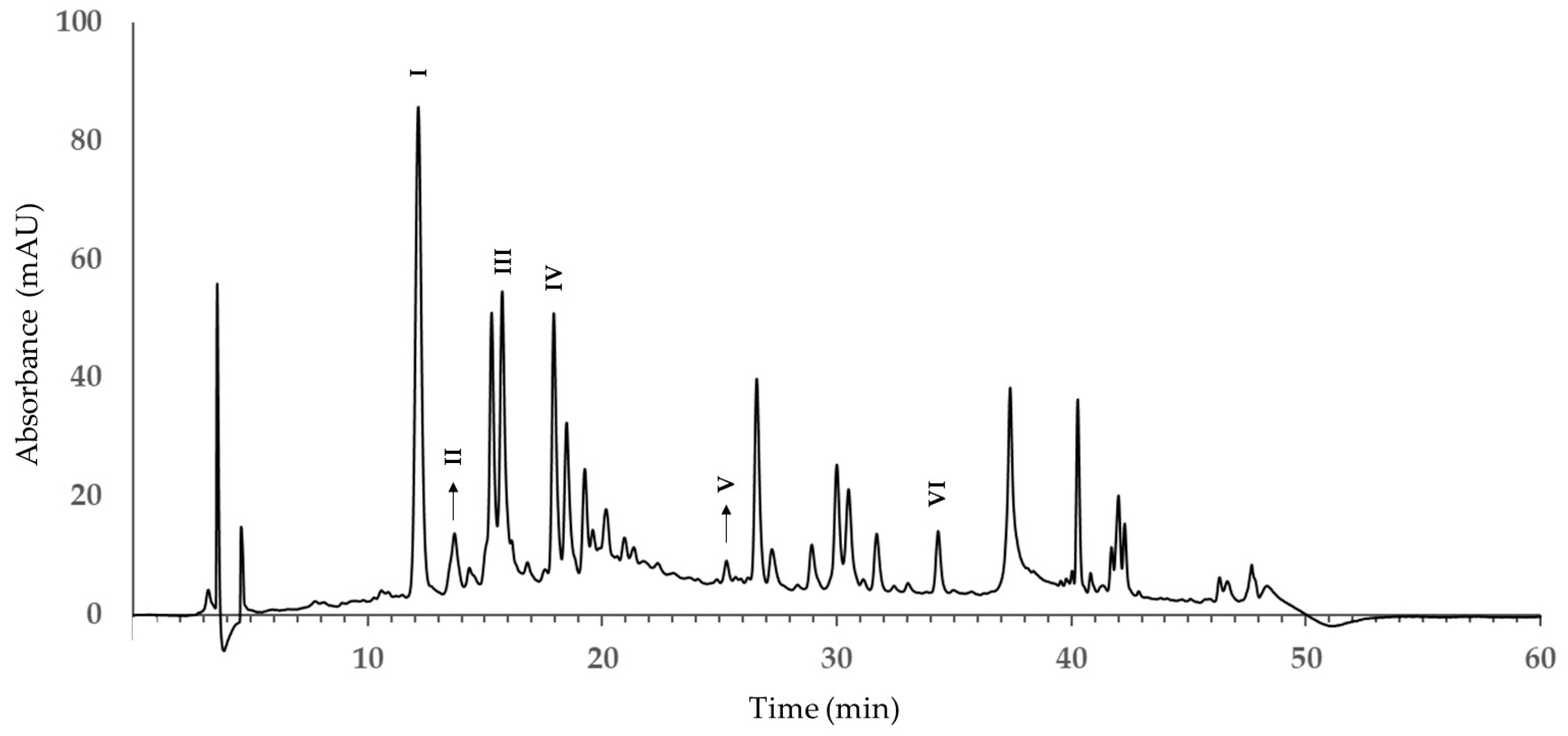
The phenolic profile of aqueous methanol and ethanol extracts obtained under dif-ferent acidic conditions was determined by RP-HPLC. Figure 1 shows the chromatogram of an acidified methanolic apple peel extract recorded at 280 nm. A total of six phenolic compounds were identified in the extracts: cyanidin-3-O-glucoside, catechin, chlorogenic acid, epicatechin, phloridzin and rutin. Gallic acid, caffeic acid, ferulic acid, p-coumaric acid, protocatechuic acid, procyanidin B1, procyanidin B2, naringenin-7-O-glucoside and quercetin were not present in the extracts.
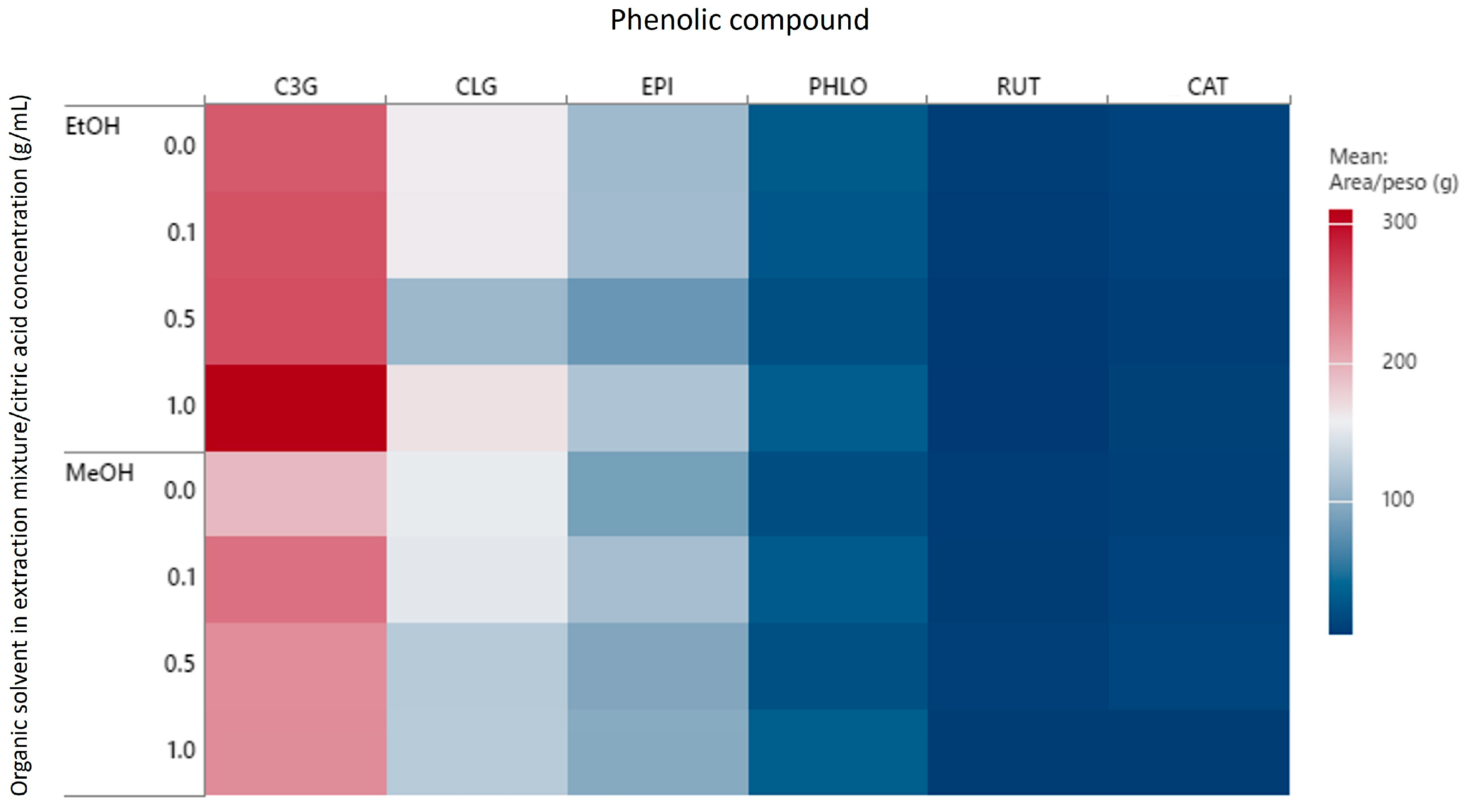
As to the identified phenolic compounds, the two organic solvents did not differ in selectivity for analytes; however, they differed in the recovery yield of some phenolic components. The heatmap in Figure 2 displays the relative concentrations (mean area per apple peel gram) of the six phenolic compounds (cyanidin-3-O-glucoside, chlorogenic acid, epicatechin, phloridzin, catechin and rutin) across the three acidity conditions of two different extraction mixtures (MeOH_SS-0.1, MeOH_SS-0.5, MeOH_SS-1, EtOH_SS-0.1, EtOH_SS-0.5, EtOH_SS-1) and the respective controls (MeOH_SS-0 and EtOH_SS-0). Warmer colors (toward red) indicate higher content, while cooler colors (toward dark blue) indicate lower abundance.
The following patterns emerged: cyanidin-3-O-glucoside was the most abundant phenolic detected, as shown by the deep red tones, and showed the strongest response to solvent acidification. The highest extraction yield was achieved when ethanol acidified with 1.0 g/mL citric acid was used (310.23 ± 2.14 area/g dm). Methanol extracted C3G fairly well, but the values were lower than those obtained with ethanol. In ethanol, C3G content increased linearly with increasing citric acid content, whereas in methanol the maximum recovery was observed at the lowest acid level (0.1 g/mL). This contrasting behavior might be explained by the different polarity of the two organic solvents and anthocyanin solvation. Cyanidin-3-O-glucoside exists in multiple structural forms depending on pH, with the flavylium cation being dominant and most stable under strongly acidic conditions. Ethanol, being less polar than methanol, provides weaker solvation and hydrogen bonding for anthocyanins; therefore, higher citric acid concentrations are required to (i) fully protonate and stabilize the flavylium cation; (ii) improve extraction from plant matrices by enhancing cell wall disruption, and (iii) counterbalance ethanol’s weaker hydrogen bonding. At 1.0 g/mL citric acid, the low pH strongly favors flavylium cation formation, while ethanol moderates acid aggressiveness, resulting in improved extraction and stability of C3G. In contrast, methanol’s higher polarity and stronger hydrogen-bonding capacity allow effective solvation and stabilization of anthocyanins even at mild acidification levels. At 0.1 g/mL citric acid, methanol provides optimal conditions for C3G extraction. At higher citric acid concentrations in methanol, the excess acidity and the high polarity increase hydrolysis of the glycosidic bond, accelerate nucleophilic attack on the flavylium ring and promote degradation and polymerization of anthocyanins. Definitely, ethanol requires higher citric acid concentration to sufficiently stabilize and solubilize cyanidin-3-O-glucoside, while methanol’s higher polarity and hydrogen-bonding capacity achieve optimal extraction at much lower acid levels, with excess acid in methanol promoting anthocyanin degradation rather than extraction. The promotion of anthocyanin accumulation by a moderate increase in citric acid content is in line with recent findings. A study on Ardisia compressa extracts showed that adding citric acid enhanced monomeric anthocyanin content and antioxidant activity compared to non-acidified samples [37].
Chlorogenic acid and epicatechin exhibited intermediate values. In aqueous methanol, the content of chlorogenic acid, also known as 5-O-caffeoylquinic acid (5-CQA), decreased with increasing acidification. The highest value was observed in the absence of acidification, while a significantly lower value (p < 0.05) was detected at 0.1 g/mL citric acid, followed by a further significant decrease at higher citric acid levels (SS-0.5 and SS-1). A study on the effect of ultrasound treatment on the stability of 5-CQA at different pH reported that 5-CQA degradation increased with the increasing pH [38]. However, the pH values examined in that study (4.69–9.22) were considerably higher than those tested in the present work. In ethanol, the opposite behaviour was observed: the highest content was found in extraction mixture containing 1.0 g/mL citric acid. The difference arises because EtOH favors extraction of neutral species, while MeOH favors extraction of polar/ionic species. Changing the acidity of extraction mixture alters the protonation state of CLG, which in turn changes its solubility in the two solvents in opposite directions. Hence, increasing the acidity more CLG molecules are protonated and their solubility in EtOH is enhanced. In contrast, their solubility in methanol decreases. Similarly to cyanidin-3-O-glucoside, in methanol, epicatechin responds positively to a slight increase in citric acid concentration (0.1 g/mL) but declines at higher levels. The highest content is observed when 0.1 g/mL citric acid is applied. In ethanol, the highest EPI values are detected at 0.5 g/mL citric acid concentration. This is explained by the solvent polarity: methanol is more polar than ethanol; thus, it solvates polar or partially ionized molecules well. Moderate acidity allows a balance between neutral and partially ionized forms, then there is a better solubility in MeOH. If the solvent is too acidic, epicatechin stays in neutral form and it has lower solubility in MeOH.
Phloridzin, rutin and catechin appear predominantly blue, indicating consistently low values and low extraction efficiency in all conditions. Phloridzin shows a significant (p < 0.05) modest increase in methanol acidified at 0.1 g/mL compared to the control. Notably, it increases by 50% from SS-0 to SS-0.1, followed by a slight dip at SS-0.5. The highest value was observed at 1.0 g/mL acidity (33.41 ± 0.93 area/g dm). This value was not statistically different from that observed in aqueous ethanol at the same acidity level.
Catechin and rutin exhibit uniformly low abundance across all conditions, suggesting limited variation among treatments for these compounds. In detail, in methanol catechin content increased from SS-0 to SS-0.5, reaching a maximum at SS-0.5 (13.4 ± 1.12 area/g dm), then dropped sharply when acidification with 1.0 g/mL citric acid was used. It might be supposed that mild solvent acidity promotes the hydrolysis of esterified catechins and this leads to a significant increase in the content of catechin [39]. Regarding rutin, a mild increase was observed with increasing citric acid addition up to 0.5 g/mL (8.19 area/g dm), while a significant decrease occurred at 1 g/mL. This trend might be explained by the formation of methyl derivative rutin degradation products under acidic environment [40]. In ethanol, catechin values in acidified mixtures were not significantly different from the control (p < 0.05), while rutin significantly decreased when the extraction mixture was acidified.
Overall, these findings highlight the compound-specific nature of acidification effects during polyphenol extraction: ethanol excelled in extracting C3G and CLG, while methanol performed similarly for EPI. Differences between solvents were less pronounced for phloridzin, rutin and catechin. As regards citric acid concentration, it acted as a major driver. Low citric acid levels (SS-0.1) consistently increase most phenolic compounds relative to SS-0. Intermediate acidity (SS-0.5) tends to reduce some compounds (chlorogenic acid, phloridzin) but increases others (catechin, rutin). High acidity (SS-1) produces mixed effects: some compounds remain elevated (cyanidin-3-O-glucoside, phloridzin), whereas others decline (catechin, rutin). In general, phenolic accumulation is greatest at low acidity levels, while high acidity shifts the balance among different phenolic subclasses.

4. Conclusions

This study demonstrates that moderate solvent acidification improves the extraction of total phenolics and anthocyanins, but high acidity negatively impacts flavonoid recovery suggesting a higher susceptibility of these compounds to acid-induced degradation or structural modification.
At the compound-specific level, citric acid differently influenced the abundance of the six identified phenolics. Cyanidin-3-O-glucoside and epicatechin showed a clear positive response to mild acidification, while chlorogenic acid declined as acidity increased. Catechin and rutin were maximized at intermediate acidification (0.5 g/mL), whereas phloridzin showed a significant (p < 0.05) modest increase in SS-0.5 and SS-1 compared to SS-0. These findings highlight that no single acidification level universally optimizes the extraction of all phenolic subclasses. Future optimization may explore combined pH control strategies with complementary extraction techniques to maximize both yield and compositional integrity of phenolic extracts.
From an industrial perspective, the results of this study provide clear guidance for the valorization of apple peel by-products. The identification of citric acid concentrations around 0.5% as optimal for maximizing total phenolic and flavonoid recovery, while avoiding excessive degradation of acid-sensitive compounds, offers a practical and easily implementable strategy for processors. Citric acid is inexpensive, food-grade, and widely available, and its use eliminates the need for strong mineral acids, thereby improving operator safety and environmental sustainability. Comparisons with other organic acids could be explored in future research.
Moreover, the effectiveness of ethanol under these optimized acidic conditions demonstrates that a GRAS solvent can achieve extraction efficiencies comparable to or exceeding those of methanol, facilitating direct translation to food, nutraceutical, and cosmetic applications. Combined with the short extraction time (10 min) and moderate temperature (50 °C) enabled by ultrasound-assisted extraction, these conditions are compatible with scalable, low-energy processes for the recovery of high-value antioxidants from dried apple peels.

Author Contributions

Conceptualization, V.M. and F.M.; methodology, V.M. and F.M.; formal analysis, V.M., F.M. and S.F.; investigation, V.M., F.M. and S.F.; data curation, V.M. and F.M.; writing—original draft preparation, V.M. and F.M.; writing—review and editing, V.M. and F.M.; visualization, V.M. and F.M.; supervision, V.M. All authors have read and agreed to the published version of the manuscript.

Funding

This research received no external funding.

Institutional Review Board Statement

Not applicable.

Informed Consent Statement

Not applicable.

Data Availability Statement

Data are available upon request to the corresponding author.

Conflicts of Interest

The authors declare no conflicts of interest.

Abbreviations

The following abbreviations are used in this manuscript:
5-CQA5-O-caffeoylquinic acid
C3Gcyanidin-3-O-glucoside
CEcatechin equivalents
GAEgallic acid equivalents
GRASgenerally recognized as safe
TACtotal anthocyanins
TFCtotal flavonoid content
TPCtotal phenolic compounds

References

  1. Bhushan, S.; Kalia, K.; Sharma, M.; Singh, B.; Ahuja, P.S. Processing of apple pomace for bioactive molecules. Crit. Rev. Biotechnol. 2008, 28, 285–296. [Google Scholar] [CrossRef] [PubMed]
  2. Thomas, F.; Abebe, G.; Emenike, C.; Martynenko, A. Sustainable utilization of apple pomace: Technological aspects and emerging applications. Food Res. Int. 2025, 220, 117149. [Google Scholar] [CrossRef] [PubMed]
  3. Asma, U.; Morozova, K.; Ferrentino, G.; Scampicchio, M. Apples and Apple By-Products: Antioxidant Properties and Food Applications. Antioxidants 2023, 12, 1456. [Google Scholar] [CrossRef]
  4. Sobczak, P.; Nadulski, R.; Kobus, Z.; Zawiślak, K. Technology for Apple Pomace Utilization within a Sustainable Development Policy Framework. Sustainability 2022, 14, 5470. [Google Scholar] [CrossRef]
  5. Kauser, S.; Murtaza, M.A.; Hussain, A.; Imran, M.; Kabir, K.; Najam, A.; An, Q.U.; Akram, S.; Fatima, H.; Batool, S.A.; et al. Apple pomace, a bioresource of functional and nutritional components with potential of utilization in different food formulations: A review. Food Chem. Adv. 2024, 4, 100598. [Google Scholar] [CrossRef]
  6. Pascoalino, L.A.; Barros, L.; Barreira, J.C.M.; Beatriz, M.; Reis, F.S. Closing the loop: Exploring apple pomace as a source of bioactive compounds in the framework of circular economy. Sustain. Food Technol. 2024, 3, 81–95. [Google Scholar] [CrossRef]
  7. Dai, J.; Mumper, R.J. Plant phenolics: Extraction, analysis and their antioxidant and anticancer properties. Molecules 2010, 15, 7313–7352. [Google Scholar] [CrossRef]
  8. Lapornik, B.; Prošek, M.; Wondra, A.G. Comparison of extracts prepared from plant by-products using different solvents and extraction time. J. Food Eng. 2005, 71, 214–222. [Google Scholar] [CrossRef]
  9. El Mannoubi, I. Impact of different solvents on extraction yield, phenolic composition, in vitro antioxidant and antibacterial activities of deseeded Opuntia stricta fruit. J. Umm Al-Qura Univ. Appl. Sci. 2023, 9, 176–184. [Google Scholar] [CrossRef]
  10. Melini, V.; Melini, F. Modelling and Optimization of Ultrasound-Assisted Extraction of Phenolic Compounds from Black Quinoa by Response Surface Methodology. Molecules 2021, 26, 3616. [Google Scholar] [CrossRef]
  11. Xiang, Z.; Liu, L.; Xu, Z.; Kong, Q.; Feng, S.; Chen, T.; Zhou, L.; Yang, H.; Xiao, Y.; Ding, C. Solvent Effects on the Phenolic Compounds and Antioxidant Activity Associated with Camellia polyodonta Flower Extracts. ACS Omega 2024, 9, 27192–27203. [Google Scholar] [CrossRef]
  12. Arya, O.P.; Bhatt, I.D.; Mohanty, K. Effect of different extraction solvents on bioactive phenolics and antioxidant potential of Illicium griffithii fruit. J. Appl. Res. Med. Aromat. Plants 2024, 40, 100547. [Google Scholar] [CrossRef]
  13. Mikucka, W.; Zielinska, M.; Bulkowska, K.; Witonska, I. Recovery of polyphenols from distillery stillage by microwave-assisted, ultrasound-assisted and conventional solid–liquid extraction. Sci. Rep. 2022, 12, 3232. [Google Scholar] [CrossRef]
  14. Castañeda-Ovando, A.; Pacheco-Hernández, M.d.L.; Páez-Hernández, M.E.; Rodríguez, J.A.; Galán-Vidal, C.A. Chemical studies of anthocyanins: A review. Food Chem. 2009, 113, 859–871. [Google Scholar] [CrossRef]
  15. Mante, O.D.; Thompson, S.J.; Mustpha, S.; Dayton, D.C. A Selective Extraction Method for Recovery of Monofunctional Methoxyphenols from Biomass Pyrolysis Liquids. Green Chem. Manuscr. 2019, 21, 2257–2265. [Google Scholar] [CrossRef]
  16. Amna, D.; Islam, M.R.; Farooq, A.; Munawar, I.; Zakariya, B.; Campus, F. Unveiling the Functional Implications and Complex Interplay Between Bound Phenolic Compounds and Phenolics in Food: A Comprehensive Review. Agrobiol. Rec. 2023, 13, 70–81. [Google Scholar] [CrossRef] [PubMed]
  17. Alara, O.R.; Abdurahman, N.H.; Ukaegbu, I. Extraction of phenolic compounds: A review. Curr. Res. Food Sci. 2021, 4, 200–214. [Google Scholar] [CrossRef] [PubMed]
  18. Palos-Hernández, A.; González-Paramás, A.M.; Santos-Buelga, C. Latest Advances in Green Extraction of Polyphenols from Plants, Foods and Food By-Products. Molecules 2025, 30, 55. [Google Scholar] [CrossRef]
  19. Lambros, M.; Tran, T.H.; Fei, Q.; Nicolaou, M. Citric Acid: A Multifunctional Pharmaceutical Excipient. Pharmaceutics 2022, 14, 972. [Google Scholar] [CrossRef]
  20. Książek, E. Citric Acid: Properties, Microbial Production, and Applications in Industries. Molecules 2024, 29, 22. [Google Scholar] [CrossRef]
  21. Lorenzo, F.; Frisina, M.; Bonacci, S.; Nardi, M.; Oliverio, M.; Procopio, A. Combining Carboxylic-Acid-Based Deep Eutectic Solvents and High Temperatures Enhances Phenolic Acid Extraction from Grape Pomace. Antioxidants 2025, 14, 643. [Google Scholar] [CrossRef]
  22. Costa, J.M.; Forster-Carneiro, T. Valorization of apple pomace by-products from the juice processing industry using pressurized liquid technology. J. Environ. Chem. Eng. 2023, 11, 110907. [Google Scholar] [CrossRef]
  23. Bredun, M.A.; Prestes, A.A.; Panceri, C.P.; Prudêncio, E.S.; Burin, V.M. Bioactive compounds recovery by freeze concentration process from winemaking by-product. Food Res. Int. 2023, 173, 113220. [Google Scholar] [CrossRef]
  24. Capaldi, G.; Aimone, C.; Calcio Gaudino, E.; Radošević, K.; Bagović, M.; Grillo, G.; Cravotto, G. The Green Extraction of Blueberry By-Products: An Evaluation of the Bioactive Potential of the Anthocyanin/Polyphenol Fraction. Int. J. Mol. Sci. 2024, 25, 11032. [Google Scholar] [CrossRef]
  25. Orozco-Flores, L.A.; Salas, E.; Rocha-Gutiérrez, B.; Peralta-Pérez, M.D.R.; González-Sánchez, G.; Ballinas-Casarrubias, L. Determination of Polyphenolic Profile of Apple Pomace (Malus domestica Golden Delicious Variety) by HPLC-MS. ACS Omega 2024, 9, 196–203. [Google Scholar] [CrossRef]
  26. European Commission—CIRCABC Apples. Available online: https://circabc.europa.eu/ui/group/a6df5bd5-efdf-40cc-a42d-8292eedd0201/library/f805b268-4637-4370-8ba8-66a199735cda/details?open=true (accessed on 19 December 2025).
  27. Melini, V.; Melini, F.; Salvati, A.; Luziatelli, F.; Ruzzi, M. Effect of Artichoke Outer Bract Powder Addition on the Nutritional Profile of Gluten-Free Rusks. Foods 2025, 14, 2395. [Google Scholar] [CrossRef] [PubMed]
  28. Melini, V.; Melini, F.; Comendador, F.J. Response Surface Methodology as an Experimental Strategy for Ultrasound-Assisted Extraction of Phenolic Compounds from Artichoke Heads. Antioxidants 2023, 12, 1360. [Google Scholar] [CrossRef] [PubMed]
  29. Shahidi, F.; Hossain, A. Importance of Insoluble-Bound Phenolics to the Antioxidant Potential Is Dictated by Source Material. Antioxidants 2023, 12, 203. [Google Scholar] [CrossRef]
  30. Mnich, E.; Bjarnholt, N.; Eudes, A.; Harholt, J.; Holland, C.; Jørgensen, B.; Larsen, F.H.; Liu, M.; Manat, R.; Meyer, A.S.; et al. Phenolic cross-links: Building and de-constructing the plant cell wall. Nat. Prod. Rep. 2020, 37, 919–961. [Google Scholar] [CrossRef]
  31. Martins, C.C.; Kahmann, A.; Anzanello, M.J.; Rodrigues, R.C.; Rodrigues, E.; Mercali, G.D. Acid hydrolysis conditions do affect the non-extractable phenolic compounds composition from grape peel and seed. Food Res. Int. 2023, 174, 113636. [Google Scholar] [CrossRef]
  32. Serea, D.; Constantin, O.E.; Horincar, G.; Stănciuc, N.; Aprodu, I.; Bahrim, G.E.; Râpeanu, G. Optimization of Extraction Parameters of Anthocyanin Compounds and Antioxidant Properties from Red Grape (Băbească neagră) Peels. Inventions 2023, 8, 59. [Google Scholar] [CrossRef]
  33. Chaves, J.O.; de Souza, M.C.; da Silva, L.C.; Lachos-Perez, D.; Torres-Mayanga, P.C.; Machado, A.P.d.F.; Forster-Carneiro, T.; Vázquez-Espinosa, M.; González-de-Peredo, A.V.; Barbero, G.F.; et al. Extraction of Flavonoids From Natural Sources Using Modern Techniques. Front. Chem. 2020, 8, 507887. [Google Scholar] [CrossRef]
  34. Levy, R.; Okun, Z.; Shpigelman, A. The influence of chemical structure and the presence of ascorbic acid on anthocyanins stability and spectral properties in purified model systems. Foods 2019, 8, 207. [Google Scholar] [CrossRef] [PubMed]
  35. Chen, Z.; Wang, J.; Lu, Y.; Wu, Q.; Liu, Y.; Liu, Y.; Kumar, S.; Zhu, G.; Zhu, Z. Pre-Treatment, Extraction Solvent, and Color Stability of Anthocyanins from Purple Sweetpotato. Foods 2024, 13, 833. [Google Scholar] [CrossRef] [PubMed]
  36. Li, Q.; Zhang, F.; Wang, Z.; Feng, Y.; Han, Y. Advances in the Preparation, Stability, Metabolism, and Physiological Roles of Anthocyanins: A Review. Foods 2023, 12, 3969. [Google Scholar] [CrossRef] [PubMed]
  37. Rodríguez-Aguilar, F.; Ortega-Regules, A.E.; Ramírez-Rodrigues, M.M. Influence of time-temperature in the antioxidant activity, anthocyanin and polyphenols profile, and color of Ardisia compressa K. extracts, with the addition of sucrose or citric acid. Food Chem. 2024, 440, 138181. [Google Scholar] [CrossRef]
  38. Wang, D.; Wang, J.; Sun, J.; Qiu, S.; Chu, B.; Fang, R.; Li, L.; Gong, J.; Zheng, F. Degradation kinetics and isomerization of 5-O-caffeoylquinic acid under ultrasound: Influence of epigallocatechin gallate and vitamin C. Food Chem. X 2021, 12, 100147. [Google Scholar] [CrossRef]
  39. Ebrahimi, P.; Bayram, I.; Lante, A.; Decker, E.A. Acid-hydrolyzed phenolic extract of parsley (Petroselinum crispum L.) leaves inhibits lipid oxidation in soybean oil-in-water emulsions. Food Res. Int. 2024, 187, 114452. [Google Scholar] [CrossRef]
  40. Dawidowicz, A.L.; Bernacik, K.; Typek, R. Rutin Transformation During Its Analysis Involving Extraction Process for Sample Preparation. Food Anal. Methods 2016, 9, 213–224. [Google Scholar] [CrossRef]
Figure 1. Representative chromatogram of an acidified methanolic apple peel extract at 280 nm. Peaks are identified as follows: I: cyanidin-3-O-glucoside, II: catechin, III: chlorogenic acid, IV: epicatechin, V: rutin, VI: phloridzin.
Applsci 16 00671 g001
Figure 2. Heatmap of phenolic compound semi-quantitative content in apple peel extracts. C3G: cyanindin-3-O-glucoside; CLG: chlorogenic acid; EPI: epicatechin; PHLO: phloridzin; RUT: rutin; CAT: catechin.
Applsci 16 00671 g002
Table 1. Content of total phenolic compounds, total flavonoid compounds and total anthocyanins in aqueous methanol and ethanol extracts.
Sample IDTPC
(mg GAE/100 g dm)
TFC
(mg CE/100 g dm)
TAC
(mg C3GE/100 g dm)
MeOH_SS-02072.60 ± 124.83 c,C110.92 ± 9.34 ab,CD48.17 ± 5.46 d,F
MeOH_SS-0.12424.52 ± 122.25 b,B118.59 ± 3.21 a,C167.04 ± 4.78 c,E
MeOH_SS-0.52658.32 ± 99.02 a,A112.73 ± 9.10 ab,CD341.90 ± 33.60 a,BC
MeOH_SS-12131.55 ± 99.97 c,C94.43 ± 0.44 b,D261.43 ± 24.01 b,D
EtOH_SS-02288.43 ± 113.63 β,BC157.13 ± 5.09 α,AB48.15 ± 3.06 γ,F
EtOH_SS-0.12878.28 ± 180.06 α,A165.18 ± 3.99 α,A319.18 ± 9.45 β,C
EtOH_SS-0.52745.25 ± 27.14 α,A159.09 ± 1.15 α,AB397.20 ± 53.20 αβ,AB
EtOH_SS-12916.10 ± 69.30 α,A140.99 ± 5.48 β,B412.40 ± 53.00 α,A
SS-0: Extracts obtained using non-acidified solvent solutions; SS-0.1: Extracts obtained using solvent solutions acidified with 0.1 g/mL citric acid; SS-0.5: Extracts obtained using solvent solutions acidified with 0.5 g/mL citric acid; SS-1: Extracts obtained using solvent solutions acidified with 1 g/mL citric acid. TPC: total phenolic content; TFC: total flavonoid content; TAC: total anthocyanin content. mg GAE/100 g dm: milligrams of Gallic Acid Equivalent per 100 g dry matter; mg CE/100 g dm: milligrams of catechin equivalents per 100 g of dry matter; mg C3G/100 g dm: milligrams of cyanidin-3-O-glucoside equivalents per 100 g of dry matter. Data are presented as mean ± standard deviation (n = 3) and expressed on a dry matter basis. Mean values within the same column followed by different lowercase letters (aqueous methanolic extracts) or lowercase Greek letters (aqueous ethanolic extracts) are significantly different (p < 0.05), as determined by one-way analysis of variance (ANOVA) followed by Tukey’s post hoc test. Uppercase letters indicate significant (p < 0.05) differences among all extracts, irrespective of solvent type.
Disclaimer/Publisher’s Note: The statements, opinions and data contained in all publications are solely those of the individual author(s) and contributor(s) and not of MDPI and/or the editor(s). MDPI and/or the editor(s) disclaim responsibility for any injury to people or property resulting from any ideas, methods, instructions or products referred to in the content.