Article

Effects of a Short-Term Low-Load Elastic Exercise Program on Sarcopenia in Older Adult Women

1
Division of Sport Science, Incheon National University, Incheon 22012, Republic of Korea
2
Department of Human Movement Science, Incheon National University, Incheon 22012, Republic of Korea
3
Functional Rehabilitation Biomechanics Laboratory, Incheon National University, Incheon 22012, Republic of Korea
4
Health Promotion Center, Incheon National University, Incheon 22012, Republic of Korea
5
Sport Science Institute, Incheon National University, Incheon 22012, Republic of Korea
*
Author to whom correspondence should be addressed.
Appl. Sci. 2026, 16(2), 599; https://doi.org/10.3390/app16020599
Submission received: 10 December 2025 / Revised: 5 January 2026 / Accepted: 5 January 2026 / Published: 7 January 2026
(This article belongs to the Special Issue New Sight in Sports Biomechanics and Sports Rehabilitation)

Abstract

Study Objective: This study aimed to examine the effects of a short-term (three times a week for a total of four weeks) low-load elastic exercise program on sarcopenia-related parameters and the contractile properties of the vastus lateralis in twenty older adult women. Methods: All participants underwent assessments for sarcopenia-related parameters, including body composition, strength, and functional performance. Tensiomyography was utilized to evaluate the contractile properties of the vastus lateralis. A paired samples t-test was employed to compare pre-and post-exercise intervention measurements. Results: Except for body weight, all parameters associated with sarcopenia showed a significant difference following low-load elastic exercise program (p < 0.05). Tensiomyography of the vastus lateralis indicated a considerable increase in contraction time after low-load elastic exercise program (p < 0.05); however, there were no significant differences in maximum radial displacement or velocity of contraction. Conclusions: Our findings suggest that a short-term low-load elastic exercise program may be associated with improvements in sarcopenia–related indicators, including muscle strength and muscle contraction characteristics, in older adults, while being time-efficient.

1. Introduction

The global increase in the older adults’ population is causing issues related to age-associated chronic diseases and motor disorders. To understand and resolve these problems, there is a continuous need to reduce the economic and psychological burdens on healthcare systems, patients, families, and society as a whole, and to improve the quality of life for the older adults [1]. Particularly, sarcopenia, which is mainly observed in the older adults and reported as the fundamental cause of most chronic diseases and motor dysfunction, is gaining attention as a major issue [2]. Sarcopenia is characterized by the gradual loss of skeletal muscle mass and muscle function (strength, muscle power) and decreased physical performance due to multidimensional causes. It has been officially recognized as a disease state in the International Classification of Diseases (ICD-10: M62.84) [3].
This sarcopenia accelerates rapidly with aging, leading to type II muscle fiber atrophy and loss of motor units, resulting in slower contraction response times and decreased muscle power, which increases the risk of falls and disabilities, leads to a loss of independence, negatively impacts the quality of life, and has been identified as a predictor of mortality [4,5]. Particularly in women, age-related declines in muscle mass and muscle function tend to accelerate during the early stages of aging, largely attributable to hormonal alterations such as menopause and the associated reduction in circulating estrogen levels [6]. Therefore, it is necessary for older adults women to maintain muscle power through fast contraction speeds to sustain muscle function and promote healthy aging [4]. Additionally, increasing muscle mass and muscle function is important because it can protect metabolic and neuromuscular functions, extend physical independence in the older adults, and thereby prevent and improve sarcopenia [7].
Exercise is widely recognized as an effective and cost-efficient strategy for the prevention and management of sarcopenia [8]. In particular, resistance exercise is considered an important approach for promoting healthy aging by improving muscle strength and physical function in older adults [9]. However, most resistance exercise programs have focused on slow contraction speeds, which may inadequately address the decline in muscle power characteristic of sarcopenia [10]. Elastic exercise has the potential to enhance muscle power through rapid force production and elastic energy storage and release [10,11,12]. Nevertheless, traditional elastic exercises such as plyometric training have limited feasibility in older adults due to safety concerns, restricting their application in sarcopenia-related research [4]. Therefore, it is necessary to investigate elastic exercise approaches that can be safely and feasibly performed by older adults at fast contraction speeds with light loads to improve functional movement in daily life [11].
Additionally, neuromuscular characteristics, which are responsible for the efficient communication between voluntary movements and muscle mass and function, are reported to be important factors in the pathogenesis of sarcopenia [13]. While methods for evaluating low muscle mass and muscle function in sarcopenia are widely used, there are technical limitations in accurately measuring neuromuscular characteristics and qualitative factors of muscles, preventing these from being mentioned as major mediating factors [14,15]. Recently, Tensiomyography (TMG) has been developed as a promising tool for the non-invasive evaluation of neuromuscular characteristics and muscle quality and has been utilized in several previous studies [14,16]. Therefore, this study aims to evaluate the effectiveness of a low-load elastic exercise program by comparing pre-and post-intervention measurements of sarcopenia-related variables, including body composition, muscle function, physical performance, and the qualitative and neuromuscular characteristics of the vastus lateralis, assessed using TMG, in twenty older women aged sixty-five and over who are at high risk for sarcopenia.
We hypothesized that a low-load elastic exercise program would significantly improve sarcopenia-related variables, including body composition, muscle function, physical performance, and the qualitative and neuromuscular characteristics of the vastus lateralis in older women at high risk for sarcopenia.

2. Materials and Methods

2.1. Participants

This pilot study was conducted on twenty older adult women aged sixty-five years and older, a population reported to require special attention due to the high prevalence of sarcopenia and their increased exposure to adverse health outcomes [17]. Participants were recruited through community-based advertisements and voluntary participation. Inclusion criteria were women aged sixty-five years or older who were able to walk independently. Additionally, to ensure safe and effective participation in the short-term low-load elastic exercise program, individuals with a history of lower extremity musculoskeletal disorders or neurological disorders within the past six months were excluded. This study was conducted after obtaining approval from the Institutional Review Board of Incheon National University (INU-IRB No. 7007971-202311-006). All participants received a detailed explanation of the study procedures and provided written informed consent prior to participating in the pre- and post-measurements and the exercise intervention program.

2.2. Low-Load Elastic Exercise Program

The primary characteristic of sarcopenia caused by aging is the decline in physical function due to the reduction in maximum muscle strength and muscle power [18]. In particular, muscle power decreases more rapidly than maximum muscle strength and is a biomechanical variable of clinical importance for daily activities and functional independence in the older adults; therefore, improving muscle power through exercises that generate force quickly is essential in designing exercise intervention programs [19]. Therefore, in this study, to improve muscle power and physical function in older adult individuals needing prevention and improvement of sarcopenia, an exercise intervention program was conducted three times a week for a total of four weeks. This program utilized an elastic step box, kettlebells, and elastic bands, focusing on the elastic and oscillatory movements that are based on the storage and release of elastic energy in muscle and fascial tissues. All exercises were performed at a tempo of 110–120 bpm (Table 1).
The exercise intervention was conducted in a group-based setting under the direct supervision of a trained exercise instructor. Due to the group-based nature of the program, subjective exercise intensity (e.g., rating of perceived exertion) was not individually recorded. Instead, session attendance was documented by the instructor, and participants’ exercise performance and proper execution of movements were continuously monitored throughout each session to ensure adherence and compliance with the intervention protocol.

2.3. Measurements

2.3.1. Sarcopenia-Related Parameters

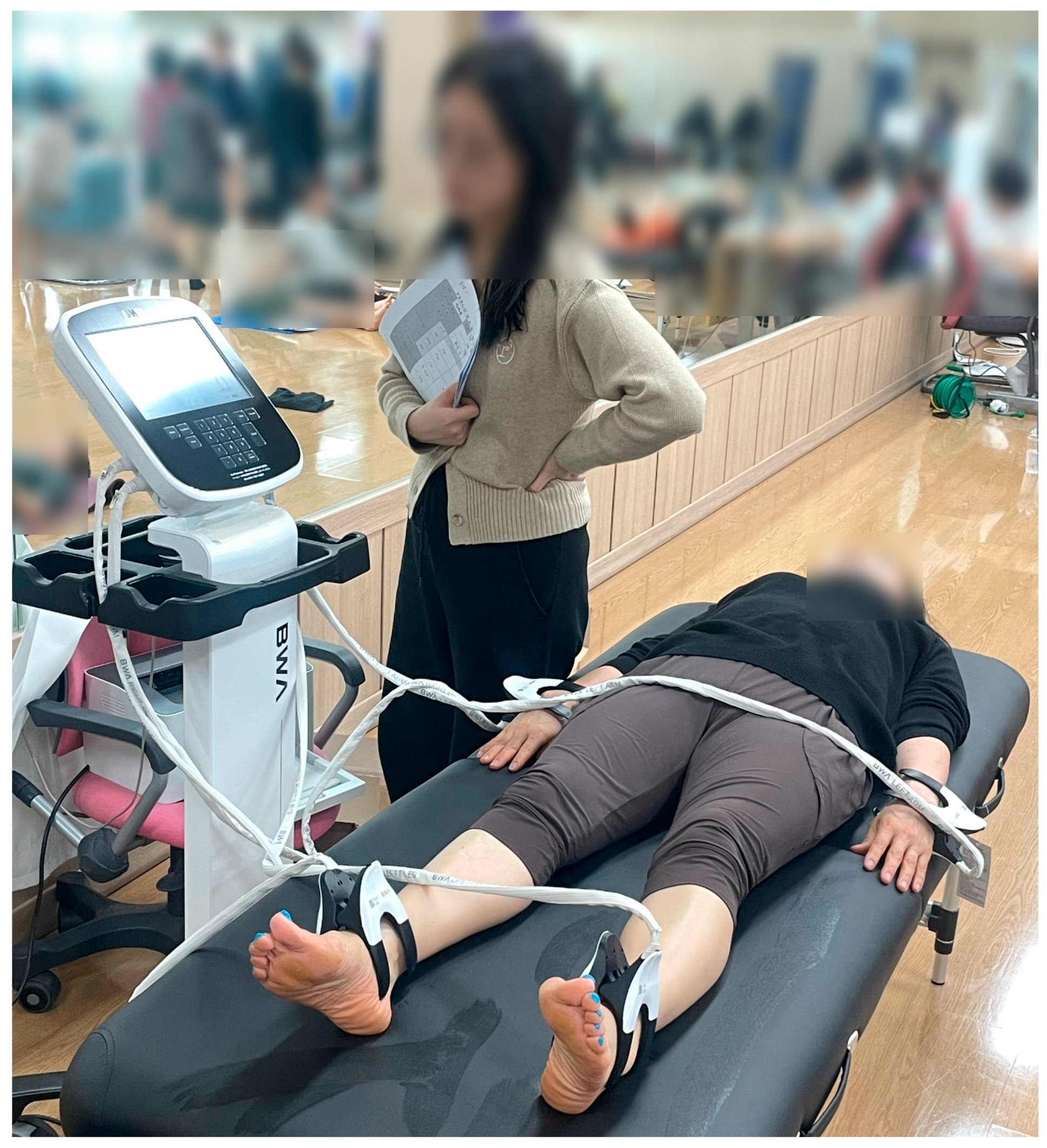
In this study, to evaluate muscle mass, one of the key variables related to sarcopenia, we used the body water analyzer (BWA, InBody Co., Ltd., Seoul, Republic of Korea), which has been recently developed for more accurate measurements and shows good agreement with dual-energy X-ray absorptiometry (DEXA) in body composition measurement [20]. This choice is based on the guidelines from the European Working Group on Sarcopenia in Older People (EWGSOP), which recognizes bioelectrical impedance analysis (BIA) as a suitable tool for evaluating muscle mass in general clinical settings [20]. The BWA is known to be suitable for analyzing body composition and diagnosing sarcopenia in the clinical environment of Korean adults [20]. As shown in Figure 1, all measurements were conducted following the measurement protocol. Participants rested in a supine position on a non-conductive platform for five minutes. Then, a total of eight electrodes were attached to the left and right wrists and ankles. The measurements obtained included the participant’s weight, muscle mass, body fat mass, and Skeletal Muscle Index (SMI).
To evaluate muscle strength, a key variable related to sarcopenia, we measured grip strength using a digital hand dynamometer (TK5401; Takei Scientific Instruments Co., Ltd., Niigata, Japan) and the strength of the trunk extensor muscles using a digital back muscle dynamometer (TKK 5402, Takei, Japan). All strength measurements were conducted by a single researcher, and the average value of two measurements was calculated. Additionally, to assess physical performance, we used the Short Physical Performance Battery (SPPB), which includes static balance tests (side-by-side, semi-tandem, and full tandem balance), a four-meter walk test, and the five-time sit-to-stand test. The individual component scores were used to calculate the overall SPPB score, referencing previous studies [21]. Additionally, a thirty-second chair sit-to-stand test and the Timed Up and Go (TUG) test were conducted. All physical performance tests were measured by a single researcher, and the results of one measurement were recorded.

2.3.2. Tensiomyography

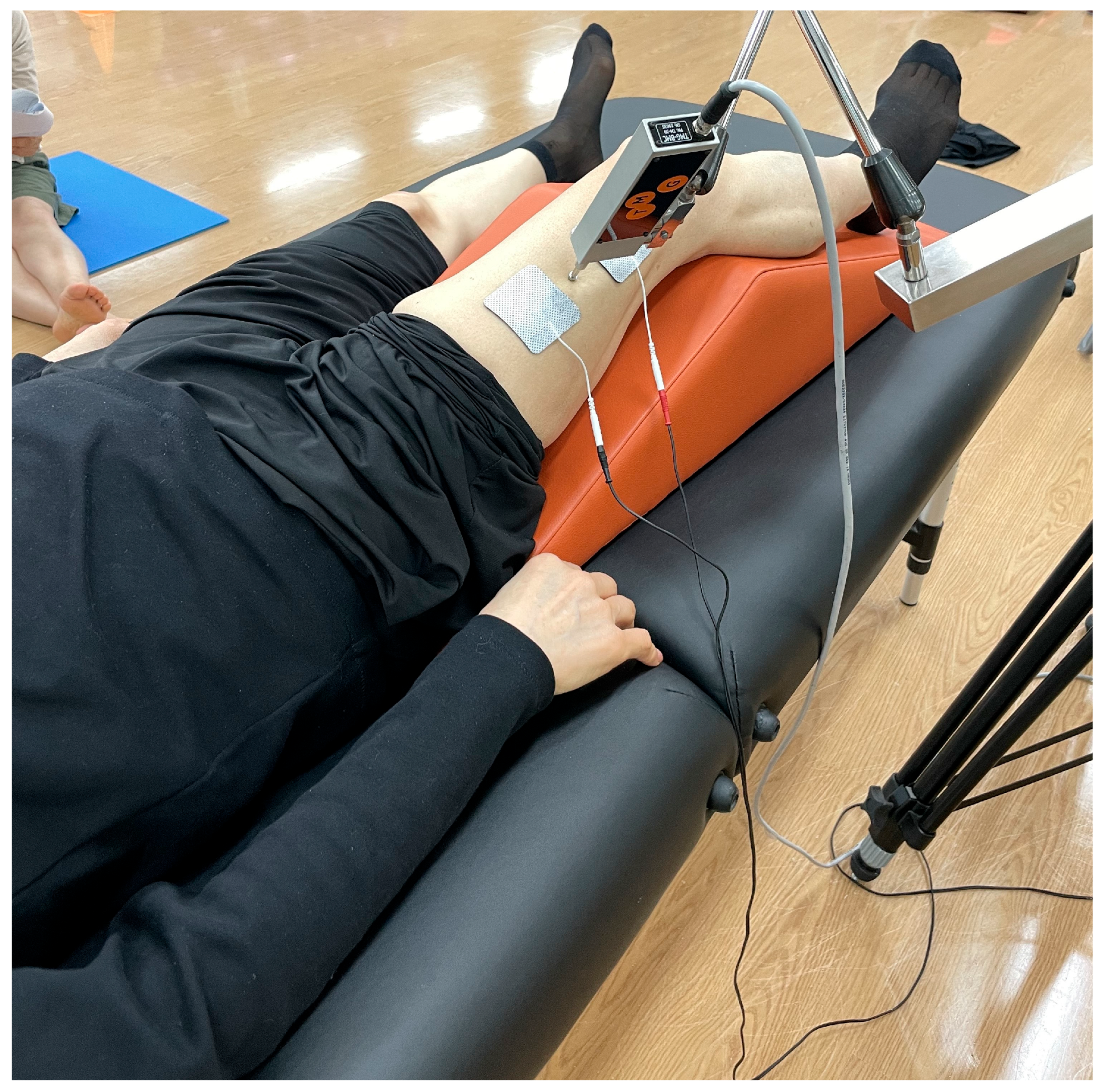
In this study, we used a Tensiomyography (TMG-100 System electrostimulator, TMG-BMC d.o.o., Ljubljana, Slovenia) to compare and analyze the qualitative and neuromuscular characteristics of the vastus lateralis of participants before and after participation in the short-term low-load elastic exercise program. TMG non-invasively evaluates the mechanical and neuromuscular properties of skeletal muscles by inducing involuntary contractions of the target muscle with a single electrical pulse of 0–100 mA for 1 ms, measuring various muscle contractile parameters through the radial spatial displacement and temporal variables of the muscle belly [14]. Participants were instructed to avoid caffeine intake, strenuous exercise, and myofascial release techniques 24–48 h prior to measurement, as these modifiable factors could affect TMG results [22]. As shown in Figure 2, measurements were conducted in the supine position. The anatomical location of the vastus lateralis was marked [23], and participants rested for five minutes to ensure the muscle was in a relaxed state before proceeding with the measurement. All measurements were conducted by a single researcher with over three years of experience in TMG measurements, who was blinded to the pre- and post-intervention conditions.
To compare and analyze the static contractile properties of the vastus lateralis after participation in the short-term low-load elastic exercise program, we calculated contraction time (Tc), which represents the time taken to contract from 10% to 90% of the maximum contraction displacement, and maximum radial displacement (Dm), which records the maximum contraction displacement of the measured muscle. Additionally, we calculated the velocity of contraction (Vc) using the following formula (1). Variables such as Tc (0.07–0.98), Dm (0.91–0.99), and Vc (Intraclass correlation coefficient, ICC score > 0.95) are the most clinically relevant among TMG measurement variables, with the highest measure-remeasure and intra-rater reliability indices (ICC) [24,25]. In this study, the results of all measurements for the vastus lateralis were calculated as the average values of the right and left sides for comparison and analysis.
V c   m m / m s = D m T c + T d

2.4. Statistical Analysis

All variables are presented as means with standard deviations (Mean ± SD). Statistical analyses were conducted using SPSS for Windows (version 28.0; IBM Corp., Armonk, NY, USA). Data normality was evaluated using the Shapiro–Wilk test, and all variables were confirmed to be normally distributed, thereby justifying the use of parametric statistical tests. To examine the effects of the short-term low-load elastic exercise program, within-group differences between pre- and post-intervention measurements were analyzed using a paired-samples t-test. Effect sizes were calculated using Cohen’s d. A p-value below 0.05 was considered indicative of statistical significance.

3. Results

3.1. Sarcopenia–Related Parameters

The comparative analysis of body composition pre and post-participation in the short-term low-load elastic exercise program showed significant differences in all body composition variables except for body weight (t19 = 1.917; p = 0.70). Significant differences were observed in muscle mass (t19 = −5.370; p < 0.001), fat mass (t19 = 5.783; p ≤ 0.001), and SMI (t19 = −3.572; p = 0.002) (Table 2).
The comparative analysis of muscle strength and physical performance pre and post-participation in the short-term low-load elastic exercise program showed significant differences in all physical performance variables. These included grip strength (t19 = −2.118; p = 0.048), back strength (t19 = −2.978; p = 0.008), SPPB (t19 = −2.854; p = 0.010), sit to stand 30 s (t19 = −13.653; p ≤ 0.001), and TUG (t19 = 7.181; p ≤ 0.001) (Table 3).

3.2. Result of Vastus Lateralis Contractile Properties

The comparative analysis of the vastus lateralis pre and post-participation in the short-term low-load elastic exercise program showed significant differences in Tc (t19 = 5.065; p ≤ 0.001). However, no significant differences were observed in Dm (t19 = 0.728; p = 0.476) or Vc (t19 = −1.391; p = 0.180) (Table 4).

4. Discussion

This study aimed to compare and analyze the effects of a four-week low-load elastic exercise program on sarcopenia-related variables and the qualitative and neuromuscular characteristics of the vastus lateralis in twenty older adult women aged sixty-five and over, who are at high risk of sarcopenia. The objective was to provide foundational data for the development of efficient exercise intervention programs to prevent and improve sarcopenia in the older adults.
After participating in the four-week low-load elastic exercise program, the analysis of body composition variables related to sarcopenia showed a significant increase in muscle mass and SMI and a significant decrease in fat mass. Among the sarcopenia-related variables, the measurement results of muscle function and physical performance indicated a significant increase in all physical performance measurements, including grip strength, back strength, SPPB, and the thirty-second sit-to-stand test and TUG test showed a significant decrease when comparing post-exercise to pre-exercise measurements. However, a ceiling effect may have limited the ability of the SPPB to detect further improvements following the intervention, given that post-intervention scores reached the maximum value. Low-load exercise not only increases exercise adherence by matching the preferred exercise intensity of the older adults but also has been reported to have an equivalent effect on improving muscle mass and strength in the older adults compared to high-load resistance exercise [26]. Resistance exercise is effective in increasing muscle mass and a decrease in body fat mass, as well as improving muscle function and physical performance in the older adults [27].
While most previous studies had exercise intervention periods of 8 to 24 weeks, conducted 1 to 3 times per week, this study showed similar effects with a four-week low-load elastic exercise program conducted three times per week. Low-load elastic exercise programs based on elastic and oscillatory movements, which involve the storage and release of elastic energy in muscle and fascial tissues, create a phenomenon known as the stretch-shortening cycle (SSC) [10,11]. Therefore, unlike the slow contraction speed resistance exercises applied in previous studies, the low-load elastic exercise program conducted at a fast contraction speed likely contributed to the improvement of muscle function in the older adults. The SSC involves a rapid eccentric contraction phase followed by an amortization phase and then a rapid concentric contraction, where the muscle-tendon unit and the elastic energy within the fascia combine to produce explosive force [12]. Short-term exercise utilizing SSC has been reported to induce adaptive changes in neuromuscular function, such as an increase in neural drive, which reflects the number of activated motor units and firing rates in alpha motor neurons controlling the muscles. With this increase in motor unit recruitment and firing rate leads to a faster and more efficient transmission of force to the skeleton, thereby enhancing muscle strength and power development [28,29]. Previous studies comparing the effects of fast and slow contraction speeds reported that exercises with fast contraction speeds were more effective in improving the stiffness of the muscle-tendon complex, muscle activation, and force generation in Type II muscle fibers and motor unit recruitment than those with slow contraction speeds, while also causing more muscle damage that ultimately led to a greater hypertrophic response [30,31]. Moreover, the mechanical stimuli from repetitive stretching in SSC exercises are effective in enhancing muscle mass by promoting the gene expression of signaling molecules involved in muscle protein synthesis in aging muscles, making this method particularly beneficial for the older adults and aiding in the prevention of sarcopenia; therefore, based on this evidence, the low-load elastic exercise program is considered an efficient intervention method for preventing sarcopenia in the older adults [19,32,33]. After participating in the four-week low-load elastic exercise program, the result of TMG measurement to evaluate the qualitative and neuromuscular characteristics of the vastus lateralis showed a significant decrease in Tc post-intervention compared to pre-intervention. This result is similar to previous studies that reported a decrease in Tc of lower limb muscles after eight weeks of plyometric exercise in older adult individuals aged sixty-five and over [5]. Tc, which represents the time taken to contract from 10% to 90% of the maximum contraction displacement, reflects the contraction response time and thus the speed of force generation [34]. Continuous exposure to SSC-based elastic exercises performed at low loads is known to induce neuromuscular adaptations, including enhanced motor unit recruitment and firing rates, which are associated with faster contractile responses; however, neural drive was not directly assessed in the present study, and such adaptations have been proposed as plausible mechanisms underlying reductions in Tc in previous research [35,36,37]. Therefore, the observed decrease in Tc following the low-load elastic exercise program can be reasonably interpreted as reflecting neuromuscular adaptations associated with SSC-based movements.
Dm, an indirect measure of passive muscle stiffness and muscle atrophy, and Vc, which reflects the muscle contraction speed associated with muscle fiber types, Dm, Vc indicate structural and functional changes in muscles [38,39]. In this study, no significant differences were observed between pre-and post-intervention measurements for Dm and Vc after participating in the four-week low-load elastic exercise program. Generally, aging is reported to induce structural and functional changes such as increased muscle atrophy, reduced muscle stiffness, and decreased muscle contraction speed due to the loss of Type II muscle fiber area [5,40]. According to previous studies, increased exposure to high-speed contraction exercises, such as plyometrics, has been shown to improve force generation speed and transmission functions through an increased proportion of Type II fibers, increased muscle stiffness, and changes in the viscoelastic properties of the muscle-tendon unit [41,42]. However, the lack of effect observed in the low-load elastic exercise program in this study may be due to the requirement of at least eight weeks of long-term training to induce structural and functional changes and adaptations in muscles altered by aging [43,44,45]. Therefore, it is believed that the low-load elastic exercise program duration in this study was insufficient to induce changes in Dm and Vc. Future research is needed to investigate the effects of long-term low-load elastic exercise program on Dm and Vc.
Several limitations should be acknowledged. The small sample size and absence of a control group may limit the generalizability of the findings. As this was a preliminary pilot study conducted to inform a future randomized controlled trial, a within-subject pre–post design was employed without a priori power calculation. Future randomized controlled studies with larger samples are warranted to confirm these findings.

5. Conclusions

This study aimed to compare and analyze the effects of a four-week low-load elastic exercise program on sarcopenia-related variables and the qualitative and neuromuscular characteristics of the vastus lateralis in older adult women aged sixty-five and over, who are at high risk of sarcopenia. The study results showed significant changes after participating in the four-week low-load elastic exercise program, including increased muscle mass, reduced body fat, and improved muscle function and physical performance. The qualitative and neuromuscular characteristics of the vastus lateralis showed a significant decrease in contraction response time through neuromuscular adaptive responses. Therefore, a short-term low-load elastic exercise program is considered an efficient intervention method for preventing sarcopenia in the older adults. From a practical perspective, this low-load elastic exercise program may be a feasible and accessible strategy for sarcopenia prevention in older adults, particularly in low-resource settings due to its low cost and ease of implementation.
Future studies should investigate the effects of long-term low-load elastic exercise on structural changes in the agonist’s muscles and conduct biomechanical analyses of various movement tasks to help reduce the risk of falls in the older adults.

Author Contributions

Conceptualization, K.J.; methodology, K.J. and H.L.; software, K.J., H.L. and C.K.; validation, K.J., H.L. and C.K.; formal analysis, H.L.; investigation, H.L. and C.K.; resources, K.J. and H.L.; data curation, K.J. and H.L.; writing—original draft preparation, K.J. and H.L.; writing—review and editing, K.J. and H.L.; visualization, K.J. and H.L.; supervision, H.L. and C.K.; project administration, K.J.; funding acquisition, K.J. All authors have read and agreed to the published version of the manuscript.

Funding

This research received no external funding.

Institutional Review Board Statement

This study was approved by the Institutional Review Board of the Incheon National University (INUIRB No. 7007971-202311-006).

Informed Consent Statement

Written informed consent was obtained from all participants.

Data Availability Statement

The raw data supporting the conclusions of this article will be made available by the authors on request.

Acknowledgments

This work was supported by Incheon National University Research Grant (2024-0114).

Conflicts of Interest

The authors declare no conflicts of interest.

References

  1. Dao, T.; Green, A.E.; Kim, Y.A.; Bae, S.J.; Ha, K.T.; Gariani, K.; Lee, M.R.; Menzies, K.J.; Ryu, D. Sarcopenia and muscle aging: A brief overview. Endocrinol. Metab. 2020, 35, 716–732. [Google Scholar] [CrossRef]
  2. Larsson, L.; Degens, H.; Li, M.; Salviati, L.; Lee, Y.I.; Thompson, W.; Kirkland, J.L.; Sandri, M. Sarcopenia: Aging-related loss of muscle mass and function. Physiol. Rev. 2019, 99, 427–511. [Google Scholar] [CrossRef]
  3. Falcon, L.J.; Harris-Love, M.O. Sarcopenia and the new ICD-10-CM code: Screening, staging, and diagnosis considerations. Fed. Pract. 2017, 34, 24. [Google Scholar]
  4. Franchi, M.V.; Monti, E.; Carter, A.; Quinlan, J.I.; Herrod, P.J.; Reeves, N.D.; Narici, M.V. Bouncing back! counteracting muscle aging with plyometric muscle loading. Front. Physiol. 2019, 10, 178. [Google Scholar] [CrossRef]
  5. Zubac, D.; Paravlić, A.; Koren, K.; Felicita, U.; Šimunič, B. Plyometric exercise improves jumping performance and skeletal muscle contractile properties in seniors. J. Musculoskelet. Neuronal Interact. 2019, 19, 38. [Google Scholar] [PubMed]
  6. Hwang, J.; Park, S. Sex differences of sarcopenia in an elderly Asian population: The prevalence and risk factors. Int. J. Environ. Res. Public Health 2022, 19, 11980. [Google Scholar] [CrossRef]
  7. Aragon, A.A.; Tipton, K.D.; Schoenfeld, B.J. Age-related muscle anabolic resistance: Inevitable or preventable? Nutr. Rev. 2023, 81, 441–454. [Google Scholar] [CrossRef] [PubMed]
  8. Su, M.; Shao, Y.; Fang, Q.; Li, Y.; Qiu, F.; Che, T.; Zhang, S. Mechanisms of exercise in improving sarcopenia. Compr. Physiol. 2025, 15, e70030. [Google Scholar] [CrossRef] [PubMed]
  9. Sampaio, R.A.C.; Sampaio, P.Y.S.; Uchida, M.C.; Arai, H. Management of dynapenia, sarcopenia, and frailty: The role of physical exercise. J. Aging Res. 2020, 2020, 8186769. [Google Scholar] [CrossRef]
  10. Wilk, M.; Zajac, A.; Tufano, J.J. The influence of movement tempo during resistance training on muscular strength and hypertrophy responses: A review. Sports Med. 2021, 51, 1629–1650. [Google Scholar] [CrossRef]
  11. Schleip, R.; Müller, D.G. Training principles for fascial connective tissues: Scientific foundation and suggested practical applications. J. Bodyw. Mov. Ther. 2013, 17, 103–115. [Google Scholar] [CrossRef]
  12. Bond, M.M.; Lloyd, R.; Braun, R.A.; Eldridge, J.A. Measurement of strength gains using a fascial system exercise program. Int. J. Exerc. Sci. 2019, 12, 825. [Google Scholar] [CrossRef]
  13. Moreira-Pais, A.; Ferreira, R.; Oliveira, P.A.; Duarte, J.A. A neuromuscular perspective of sarcopenia pathogenesis: Deciphering the signaling pathways involved. Geroscience 2022, 44, 1199–1213. [Google Scholar] [CrossRef] [PubMed]
  14. Pus, K.; Paravlic, A.H.; Šimunič, B. The use of tensiomyography in older adults: A systematic review. Front. Physiol. 2023, 14, 1213993. [Google Scholar] [CrossRef]
  15. Cruz-Jentoft, A.J.; Bahat, G.; Bauer, J.; Boirie, Y.; Bruyère, O.; Cederholm, T.; Cooper, C.; Landi, F.; Rolland, Y.; Sayer, A.A. Sarcopenia: Revised European consensus on definition and diagnosis. Age Ageing 2019, 48, 16–31. [Google Scholar] [CrossRef] [PubMed]
  16. Labata-Lezaun, N.; González-Rueda, V.; Llurda-Almuzara, L.; López-de-Celis, C.; Rodríguez-Sanz, J.; Cadellans-Arróniz, A.; Bosch, J.; Pérez-Bellmunt, A. Correlation between physical performance and tensiomyographic and myotonometric parameters in older adults. In Proceedings of the Healthcare, Sydney, Australia, 8 July 2023; p. 2169. [Google Scholar]
  17. Choo, Y.J.; Chang, M.C. Prevalence of sarcopenia among the elderly in Korea: A meta-analysis. J. Prev. Med. Public Health 2021, 54, 96. [Google Scholar] [CrossRef] [PubMed]
  18. Bahat, G.; Kilic, C.; Eris, S.; Karan, M. Power versus sarcopenia: Associations with functionality and physical performance measures. J. Nutr. Health Aging 2021, 25, 13–17. [Google Scholar] [CrossRef]
  19. Baker, B.A. Efficacy of age-specific high-intensity stretch-shortening contractions in reversing dynapenia, sarcopenia, and loss of skeletal muscle quality. J. Funct. Morphol. Kinesiol. 2018, 3, 36. [Google Scholar] [CrossRef]
  20. Yi, Y.; Baek, J.Y.; Lee, E.; Jung, H.-W.; Jang, I.-Y. A comparative study of high-frequency bioelectrical impedance analysis and dual-energy X-ray absorptiometry for estimating body composition. Life 2022, 12, 994. [Google Scholar] [CrossRef]
  21. Riskowski, J.; Hagedorn, T.; Dufour, A.; Hannan, M. Functional foot symmetry and its relation to lower extremity physical performance in older adults: The Framingham Foot Study. J. Biomech. 2012, 45, 1796–1802. [Google Scholar] [CrossRef]
  22. Lee, H.; Kim, C.; An, S.; Jeon, K. Effects of Core Stabilization Exercise Programs on Changes in Erector Spinae Contractile Properties and Isokinetic Muscle Function of Adult Females with a Sedentary Lifestyle. Appl. Sci. 2022, 12, 2501. [Google Scholar] [CrossRef]
  23. Perotto, A.O. Anatomical Guide for the Electromyographer: The Limbs and Trunk; Charles C Thomas Publisher: Springfield, IL, USA, 2011. [Google Scholar]
  24. Lohr, C.; Braumann, K.-M.; Reer, R.; Schroeder, J.; Schmidt, T. Reliability of tensiomyography and myotonometry in detecting mechanical and contractile characteristics of the lumbar erector spinae in healthy volunteers. Eur. J. Appl. Physiol. 2018, 118, 1349–1359. [Google Scholar] [CrossRef]
  25. Martín-Rodríguez, S.; Loturco, I.; Hunter, A.M.; Rodríguez-Ruiz, D.; Munguia-Izquierdo, D. Reliability and measurement error of tensiomyography to assess mechanical muscle function: A systematic review. J. Strength Cond. Res. 2017, 31, 3524–3536. [Google Scholar] [CrossRef]
  26. Csapo, R.; Alegre, L.M. Effects of resistance training with moderate vs heavy loads on muscle mass and strength in the elderly: A meta-analysis. Scand. J. Med. Sci. Sports 2016, 26, 995–1006. [Google Scholar] [CrossRef]
  27. Talar, K.; Hernández-Belmonte, A.; Vetrovsky, T.; Steffl, M.; Kałamacka, E.; Courel-Ibáñez, J. Benefits of resistance training in early and late stages of frailty and sarcopenia: A systematic review and meta-analysis of randomized controlled studies. J. Clin. Med. 2021, 10, 1630. [Google Scholar] [CrossRef] [PubMed]
  28. Markovic, G.; Mikulic, P. Neuro-musculoskeletal and performance adaptations to lower-extremity plyometric training. Sports Med. 2010, 40, 859–895. [Google Scholar] [CrossRef]
  29. Alix-Fages, C.; Del Vecchio, A.; Baz-Valle, E.; Santos-Concejero, J.; Balsalobre-Fernández, C. The role of the neural stimulus in regulating skeletal muscle hypertrophy. Eur. J. Appl. Physiol. 2022, 122, 1111–1128. [Google Scholar] [CrossRef] [PubMed]
  30. Augustsson, J.; Alt, T.; Andersson, H. Speed Matters in nordic hamstring exercise: Higher Peak knee flexor force during Fast Stretch-Shortening variant compared to standard Slow eccentric execution in elite athletes. Sports 2023, 11, 130. [Google Scholar] [CrossRef] [PubMed]
  31. Handford, M.J.; Bright, T.E.; Mundy, P.; Lake, J.; Theis, N.; Hughes, J.D. The need for eccentric speed: A narrative review of the effects of accelerated eccentric actions during resistance-based training. Sports Med. 2022, 52, 2061–2083. [Google Scholar] [CrossRef]
  32. Sumi, K.; Ashida, K.; Nakazato, K. Repeated stretch–shortening contraction of the triceps surae attenuates muscle atrophy and liver dysfunction in a rat model of inflammation. Exp. Physiol. 2020, 105, 1111–1123. [Google Scholar] [CrossRef]
  33. Wang, Y.; Ikeda, S.; Ikoma, K. Passive repetitive stretching is associated with greater muscle mass and cross-sectional area in the sarcopenic muscle. Sci. Rep. 2021, 11, 15302. [Google Scholar] [CrossRef]
  34. Loturco, I.; Pereira, L.A.; Kobal, R.; Kitamura, K.; Ramírez-Campillo, R.; Zanetti, V.; Abad, C.C.C.; Nakamura, F.Y. Muscle contraction velocity: A suitable approach to analyze the functional adaptations in elite soccer players. J. Sports Sci. Med. 2016, 15, 483. [Google Scholar]
  35. Ramirez-Campillo, R.; Gentil, P.; Negra, Y.; Grgic, J.; Girard, O. Effects of plyometric jump training on repeated sprint ability in athletes: A systematic review and meta-analysis. Sports Med. 2021, 51, 2165–2179. [Google Scholar] [CrossRef]
  36. Unhjem, R.; Tøien, T.; Kvellestad, A.C.G.; Øren, T.S.; Wang, E. External resistance is imperative for training-induced efferent neural drive enhancement in older adults. J. Gerontol. Ser. A 2021, 76, 224–232. [Google Scholar] [CrossRef] [PubMed]
  37. Dideriksen, J.L.; Del Vecchio, A.; Farina, D. Neural and muscular determinants of maximal rate of force development. J. Neurophysiol. 2020, 123, 149–157. [Google Scholar] [CrossRef] [PubMed]
  38. Šimunič, B.; Koren, K.; Rittweger, J.; Lazzer, S.; Reggiani, C.; Rejc, E.; Pišot, R.; Narici, M.; Degens, H. Tensiomyography detects early hallmarks of bed-rest-induced atrophy before changes in muscle architecture. J. Appl. Physiol. 2019, 126, 815–822. [Google Scholar] [CrossRef]
  39. Macgregor, L.J.; Hunter, A.M.; Orizio, C.; Fairweather, M.M.; Ditroilo, M. Assessment of skeletal muscle contractile properties by radial displacement: The case for tensiomyography. Sports Med. 2018, 48, 1607–1620. [Google Scholar] [CrossRef]
  40. Shur, N.; Creedon, L.; Skirrow, S.; Atherton, P.; MacDonald, I.; Lund, J.; Greenhaff, P. Age-related changes in muscle architecture and metabolism in humans: The likely contribution of physical inactivity to age-related functional decline. Ageing Res. Rev. 2021, 68, 101344. [Google Scholar] [CrossRef]
  41. Wilson, M.T.; Ryan, A.M.; Vallance, S.R.; Dias-Dougan, A.; Dugdale, J.H.; Hunter, A.M.; Hamilton, D.L.; Macgregor, L.J. Tensiomyography derived parameters reflect skeletal muscle architectural adaptations following 6-weeks of lower body resistance training. Front. Physiol. 2019, 10, 1493. [Google Scholar] [CrossRef]
  42. Zubac, D.; Šimunic, B. Skeletal muscle contraction time and tone decrease after 8 weeks of plyometric training. J. Strength Cond. Res. 2017, 31, 1610–1619. [Google Scholar] [CrossRef] [PubMed]
  43. Correa, C.S.; Cunha, G.; Marques, N.; Oliveira-Reischak, Ã.; Pinto, R. Effects of strength training, detraining and retraining in muscle strength, hypertrophy and functional tasks in older female adults. Clin. Physiol. Funct. Imaging 2016, 36, 306–310. [Google Scholar] [CrossRef] [PubMed]
  44. Reeves, N.D.; Narici, M.V.; Maganaris, C.N. Strength training alters the viscoelastic properties of tendons in elderly humans. Muscle Nerve Off. J. Am. Assoc. Electrodiagn. Med. 2003, 28, 74–81. [Google Scholar] [CrossRef] [PubMed]
  45. Quinlan, J.I.; Franchi, M.V.; Gharahdaghi, N.; Badiali, F.; Francis, S.; Hale, A.; Phillips, B.E.; Szewczyk, N.; Greenhaff, P.L.; Smith, K. Muscle and tendon adaptations to moderate load eccentric vs. concentric resistance exercise in young and older males. GeroScience 2021, 43, 1567–1584. [Google Scholar] [CrossRef] [PubMed]
Figure 1. Measurement of BWA.
Applsci 16 00599 g001
Figure 2. Measurement of TMG.
Applsci 16 00599 g002
Table 1. Low-load elastic exercise program.
Functional InterventionIntensityTime
Warm-upFoam rollingPain—free range10 min
MainActively loaded stretchingHip hinge & push
Ballistic quarter squat
Double bounce arms swing
Ballistic split squat arms swing
16~24 reps
/1 set
Total 2~4 sets
50 min
Lower body exercisesStep box—toe step
Step box—walking step
Step box—knee kick step
Step box—toe kick step
Step box—side step
4 kg Kettlebell bound squat
4 kg Kettlebell bound deadlift
Upper body exercisesYellow elastic band—side & front raise
Yellow elastic band—horizontal abduction
Yellow elastic band—shoulder press
Yellow elastic band—bent over row
Yellow elastic band—biceps curl
Yellow elastic band—overhead triceps extension
Cool-downClassic stretchingPain—free range10 min
Table 2. Body composition of participants.
VariablesPrePosttp
Participants
(n = 20)
Age (years)69.95 ± 3.58
Height (cm)157.08 ± 4.48
Body weight (kg)57.33 ± 6.7057.10 ± 6.531.9170.70
Muscle mass (kg)20.65 ± 2.7121.23 ± 2.91−5.370≤0.001 ***
Fat mass (kg)32.38 ± 3.8030.22 ± 4.045.783≤0.001 ***
SMI (kg/m2)6.16 ± 0.666.31 ± 0.70−3.5720.002 **
Note. Data are mean ± standard deviation, ** p < 0.01, *** p ≤ 0.001. Abbreviation. SMI; Skeletal muscle mass index.
Table 3. Result of physical performance.
VariablesPrePosttpCohen’s d
Grip strength (kg)21.48 ± 3.7522.80 ± 2.98−2.1180.048 *0.47
Back strength (kg)56.48 ± 12.2364.20 ± 12.93−2.9780.008 *0.67
SPPB (score)11.40 ± 0.9412.00 ± 0.00−2.8540.010 *0.64
Sit to stand for 30 s (reps)15.40 ± 2.5825.30 ± 3.20−13.653≤0.001 ***3.05
TUG (sec)8.61 ± 0.817.33 ± 0.487.181≤0.001 ***1.61
Note. Mean ± Standard Deviation, * p < 0.05, *** p ≤ 0.001. Abbreviation: SPPB: short physical performance battery, S: Second, TUG: time up and go test.
Table 4. Result of vastus lateralis contractile properties.
VariablesPrePosttpCohen’s d
Tc (ms)27.10 ± 2.5424.80 ± 2.005.065≤0.001 ***1.13
Dm (mm)6.32 ± 1.326.12 ± 1.660.7280.4760.16
Vc (mm/ms)0.12 ± 0.020.13 ± 0.03−1.3910.1800.31
Note. Mean ± Standard Deviation, *** p ≤ 0.001. Abbreviation: Tc, contraction time; Dm, maximum radial displacement; Vc: velocity of contraction.
Disclaimer/Publisher’s Note: The statements, opinions and data contained in all publications are solely those of the individual author(s) and contributor(s) and not of MDPI and/or the editor(s). MDPI and/or the editor(s) disclaim responsibility for any injury to people or property resulting from any ideas, methods, instructions or products referred to in the content.