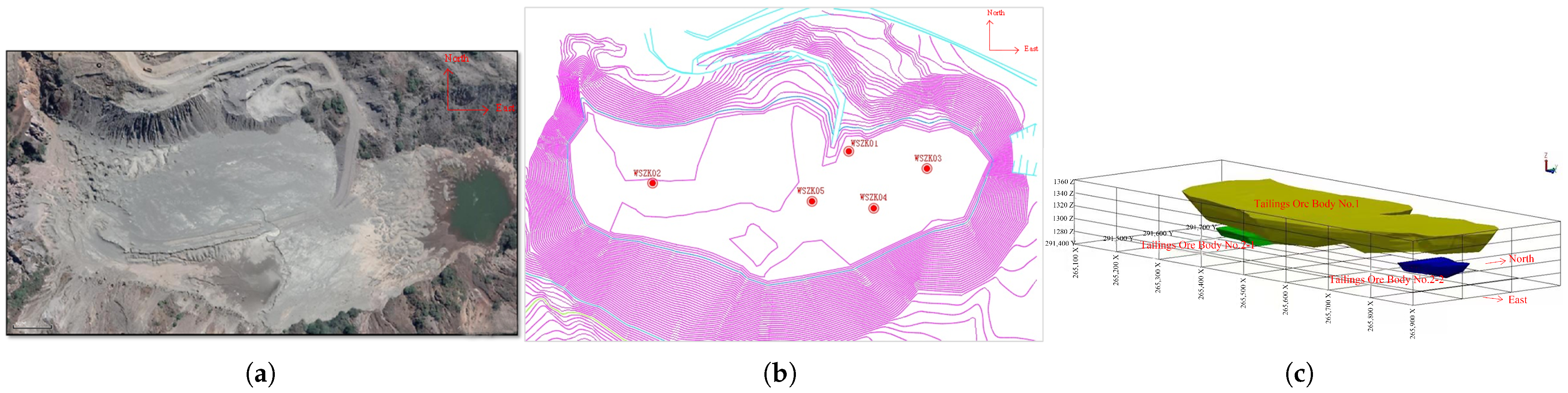
Figure 1.
Engineering drawings of the western orebody. (a) Satellite plan of the mining area. (b) Engineering plan of the mining area. (c) Spatial distribution of the western orebody.
Figure 1.
Engineering drawings of the western orebody. (a) Satellite plan of the mining area. (b) Engineering plan of the mining area. (c) Spatial distribution of the western orebody.
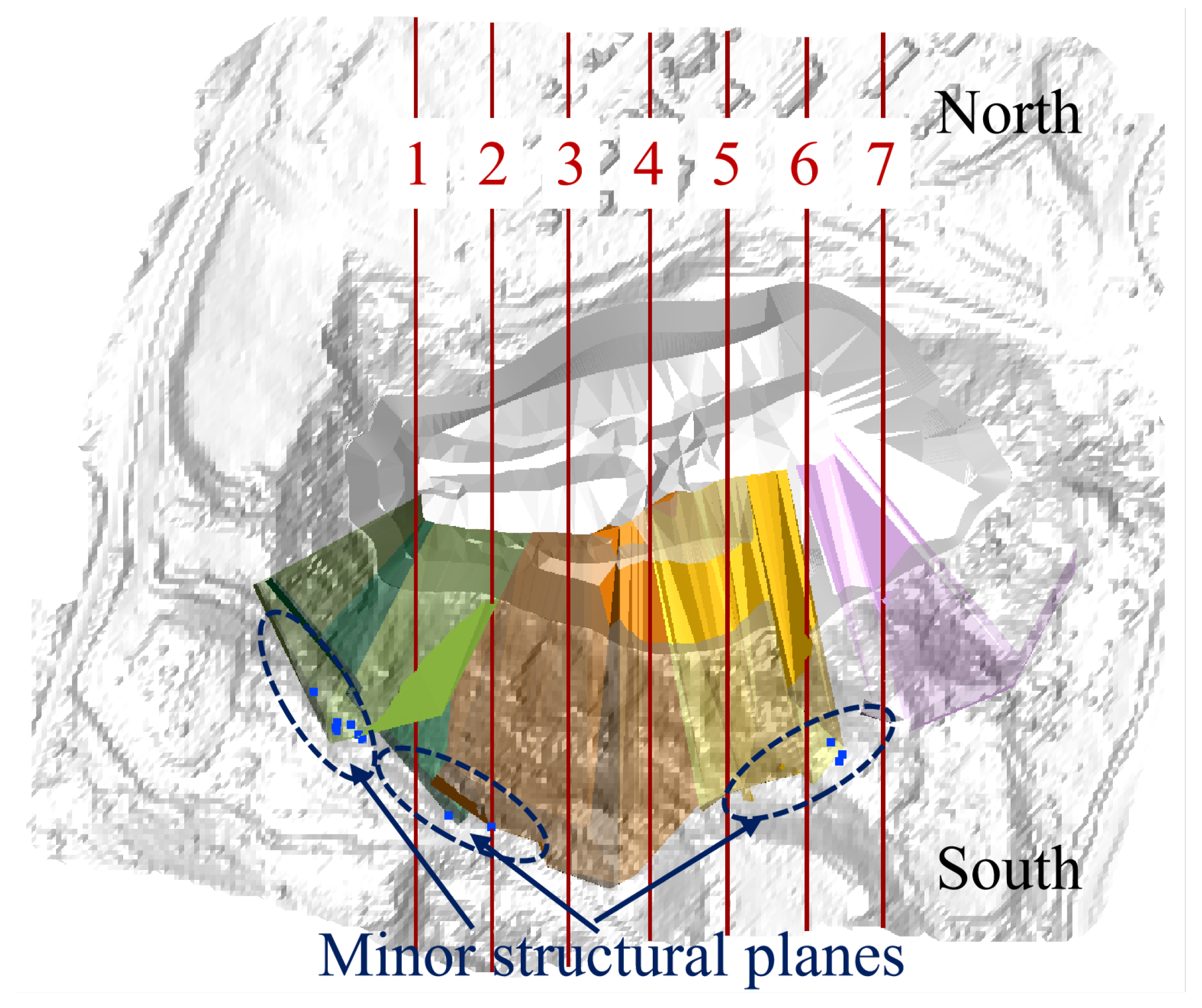
Figure 2.
Cross-sectional layout of the slope sliding surface model. Different colors correspond to the respective main fractures.
Figure 2.
Cross-sectional layout of the slope sliding surface model. Different colors correspond to the respective main fractures.
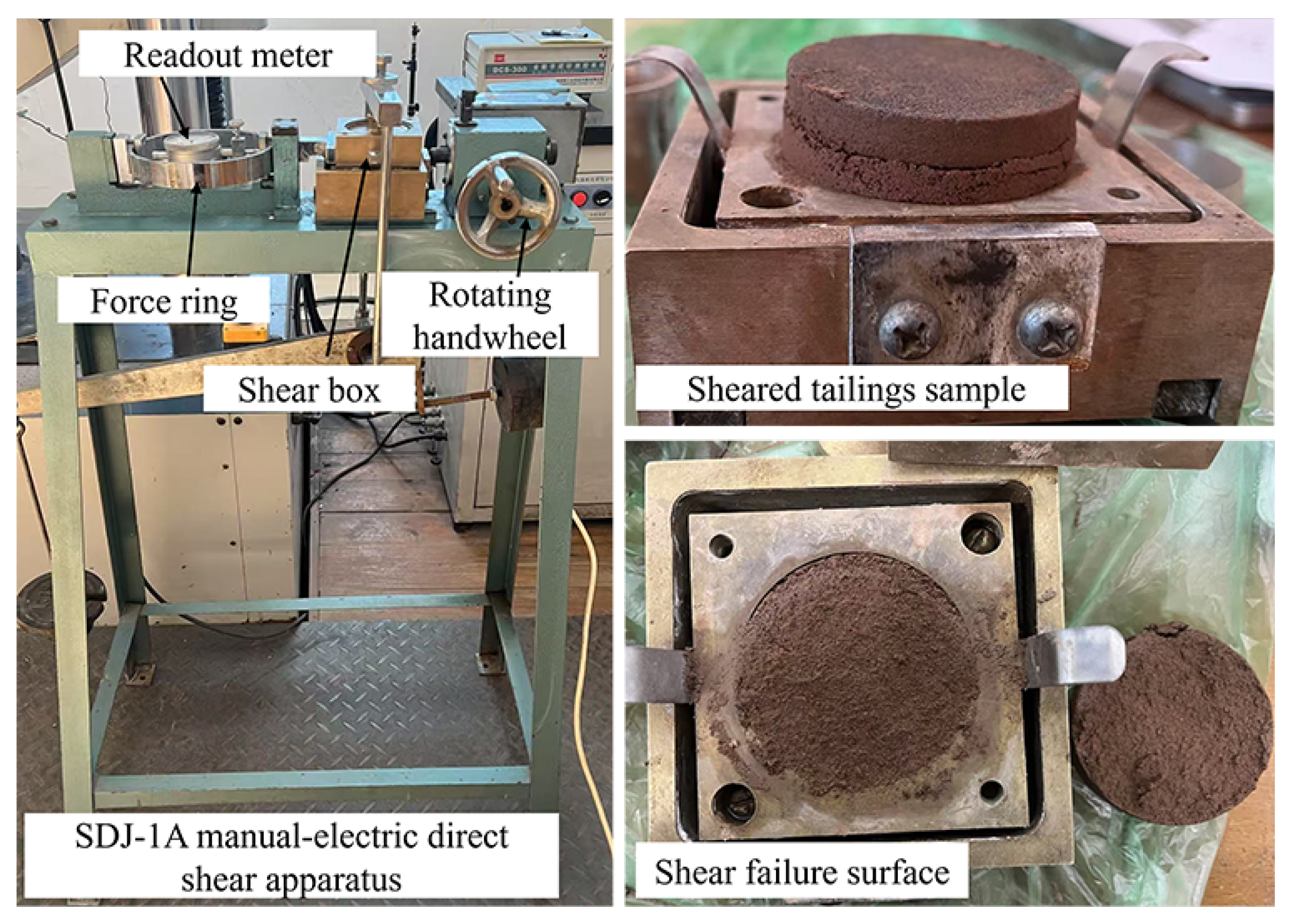
Figure 3.
Direct shear test of tailings.
Figure 3.
Direct shear test of tailings.
Figure 4.
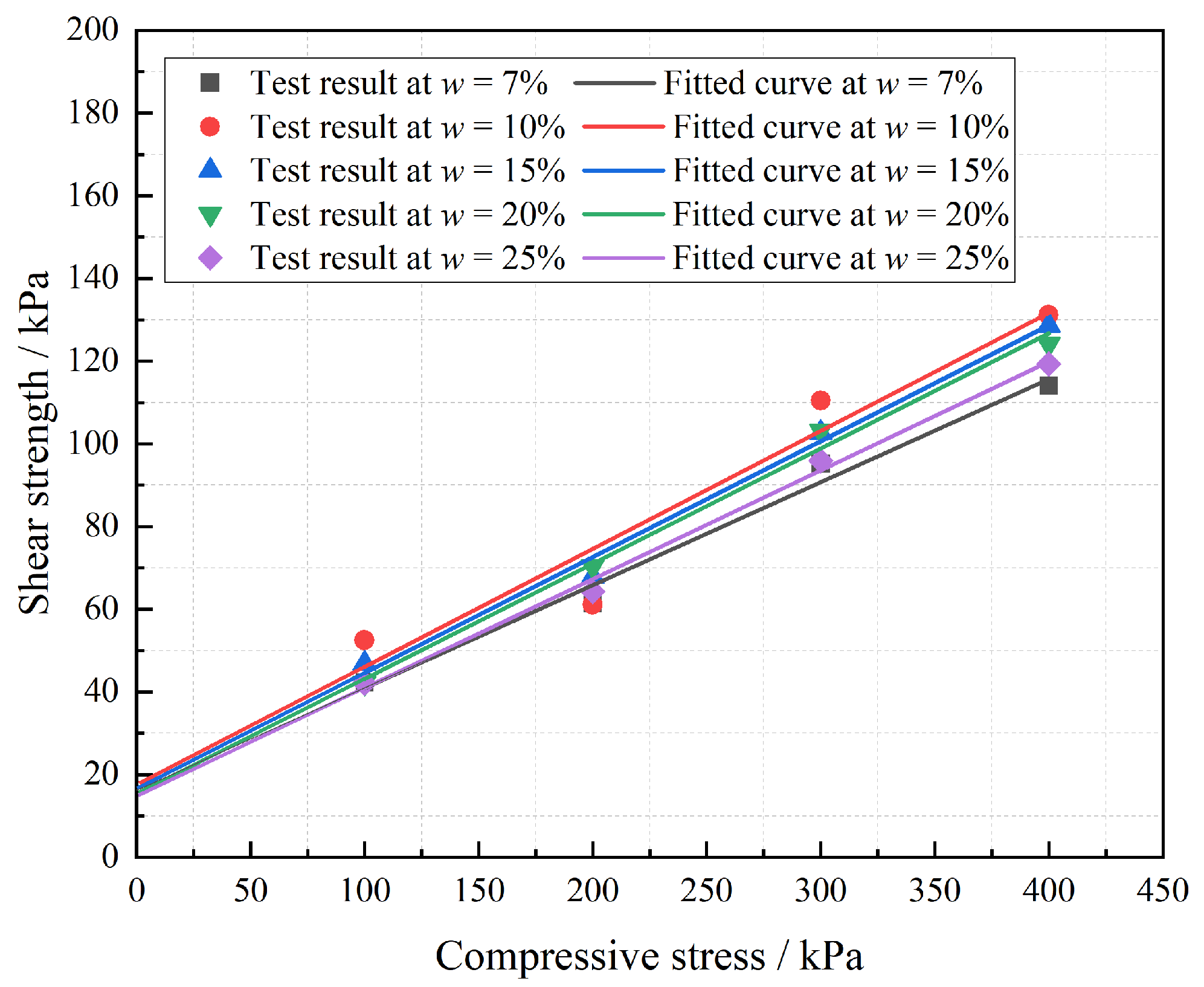
Fitted shear strength curves of tailings under different water contents.
Figure 4.
Fitted shear strength curves of tailings under different water contents.
Figure 5.
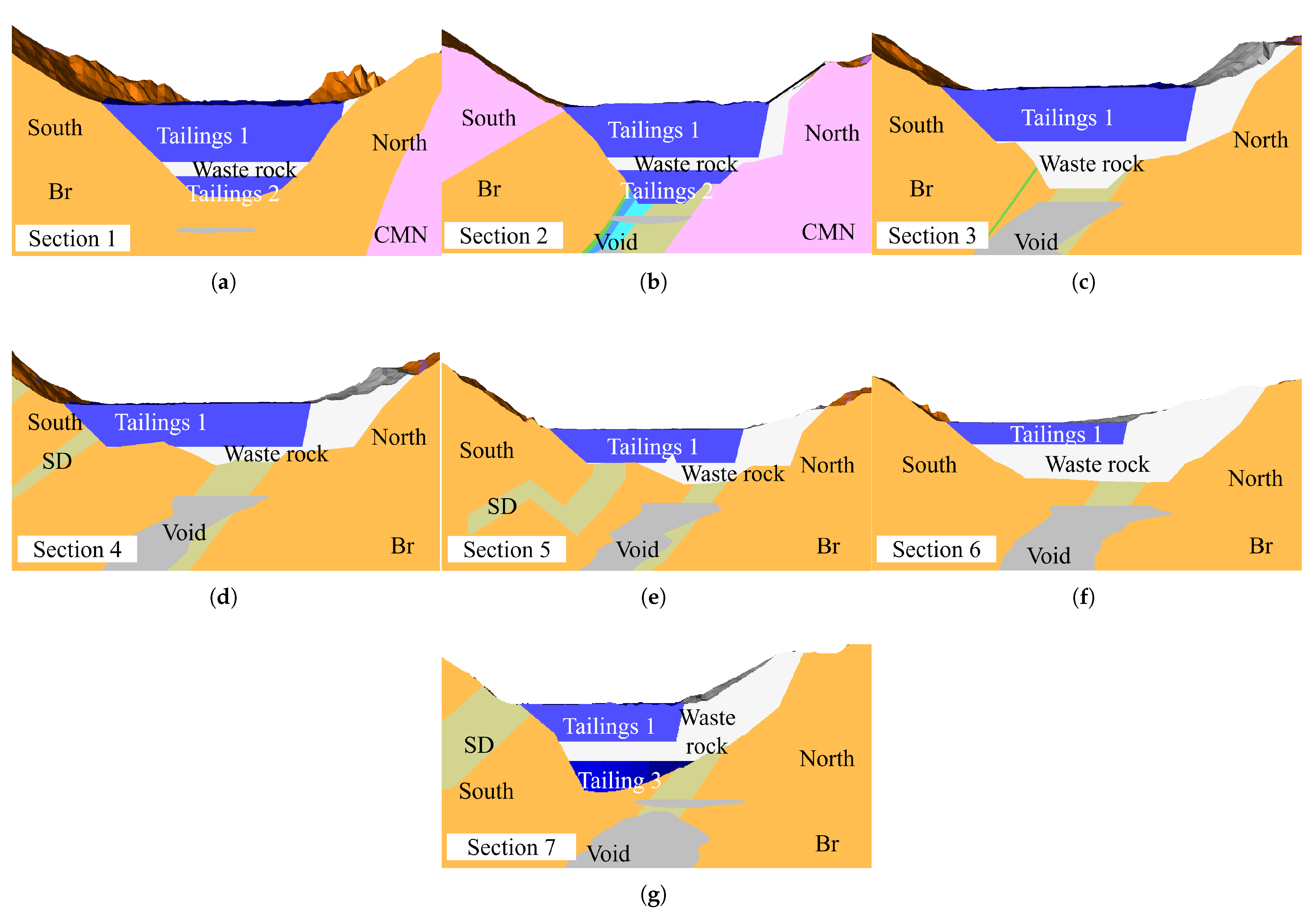
Distribution of tailings bodies and waste rock in each section. (a) Section 1. (b) Section 2. (c) Section 3. (d) Section 4. (e) Section 5. (f) Section 6. (g) Section 7. Br, CMN and SD are stratigraphic codes used to differentiate stratum of distinct geological periods.
Figure 5.
Distribution of tailings bodies and waste rock in each section. (a) Section 1. (b) Section 2. (c) Section 3. (d) Section 4. (e) Section 5. (f) Section 6. (g) Section 7. Br, CMN and SD are stratigraphic codes used to differentiate stratum of distinct geological periods.
Figure 6.
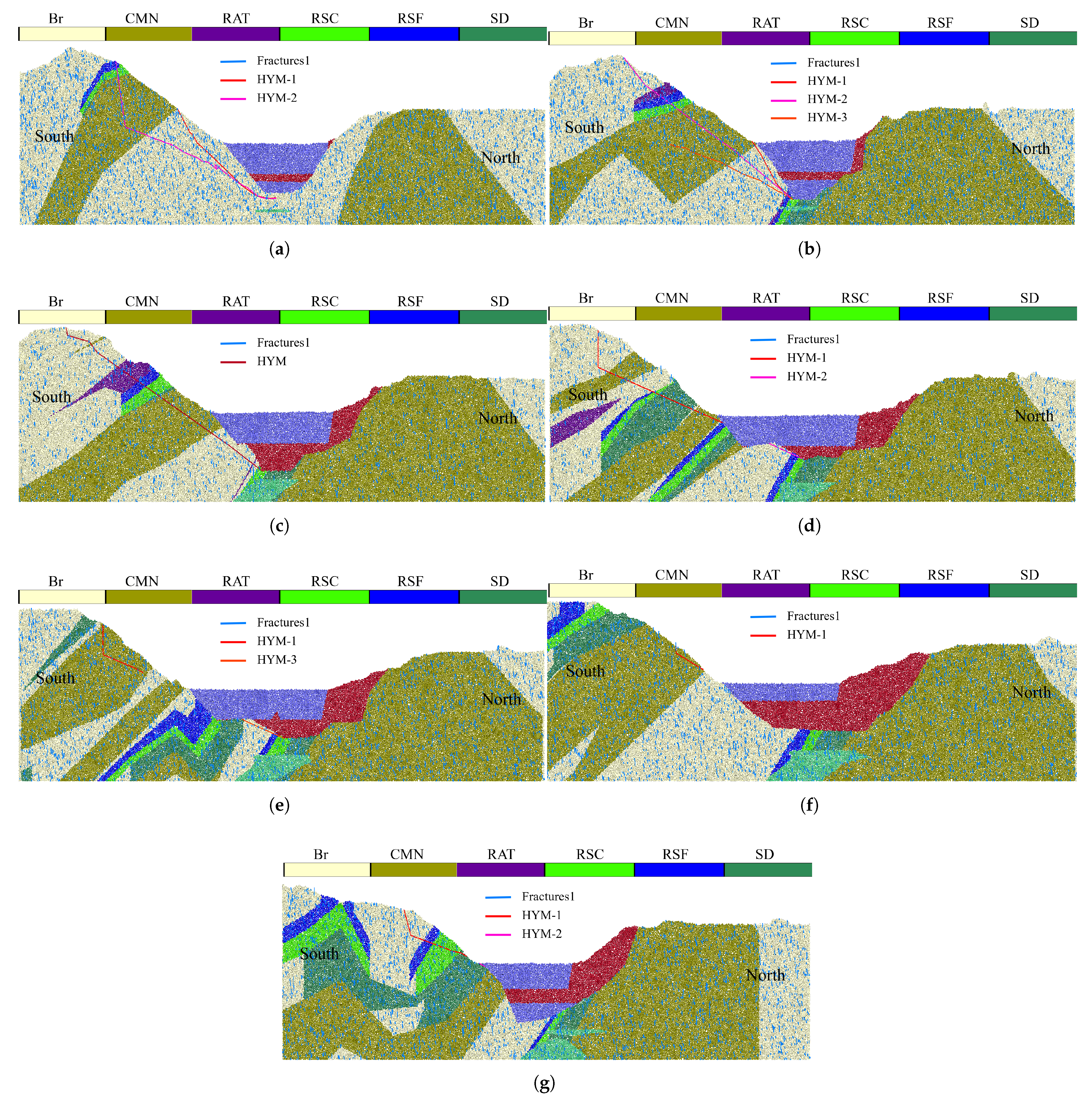
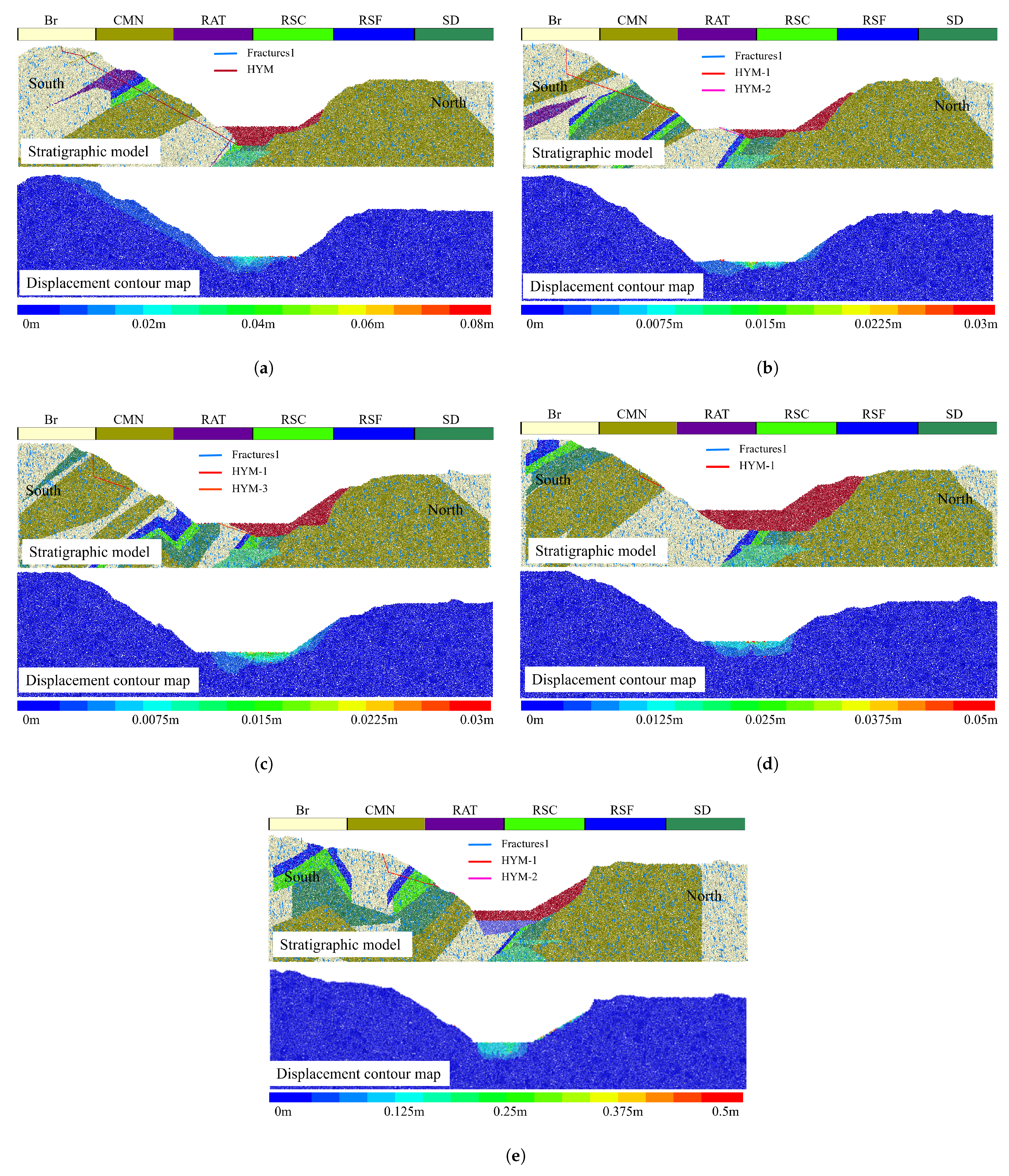
Tailings mining models constructed based on sections. (a) Section 1. (b) Section 2. (c) Section 3. (d) Section 4. (e) Section 5. (f) Section 6. (g) Section 7. Br, CMN, RAT, RSC, RSF and SD are stratigraphic codes used to differentiate stratum of distinct geological periods; Fractures1 represents minor fractures, while HYM-1, HYM-2 and HYM-3 represent major fractures.
Figure 6.
Tailings mining models constructed based on sections. (a) Section 1. (b) Section 2. (c) Section 3. (d) Section 4. (e) Section 5. (f) Section 6. (g) Section 7. Br, CMN, RAT, RSC, RSF and SD are stratigraphic codes used to differentiate stratum of distinct geological periods; Fractures1 represents minor fractures, while HYM-1, HYM-2 and HYM-3 represent major fractures.
Figure 7.
Uniaxial compression parameter calibration model.
Figure 7.
Uniaxial compression parameter calibration model.
Figure 8.
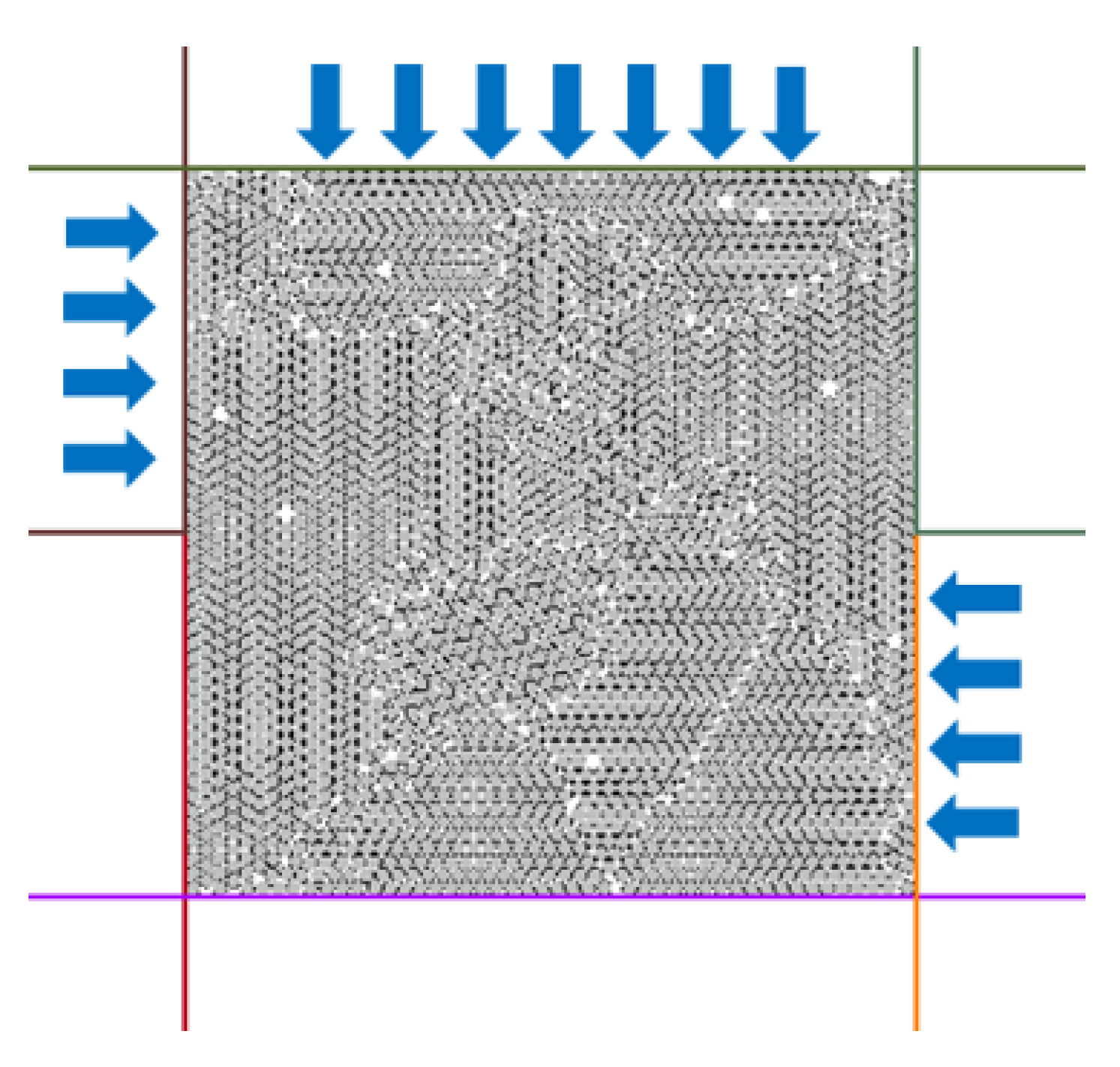
Shear strength parameter calibration model.
Figure 8.
Shear strength parameter calibration model.
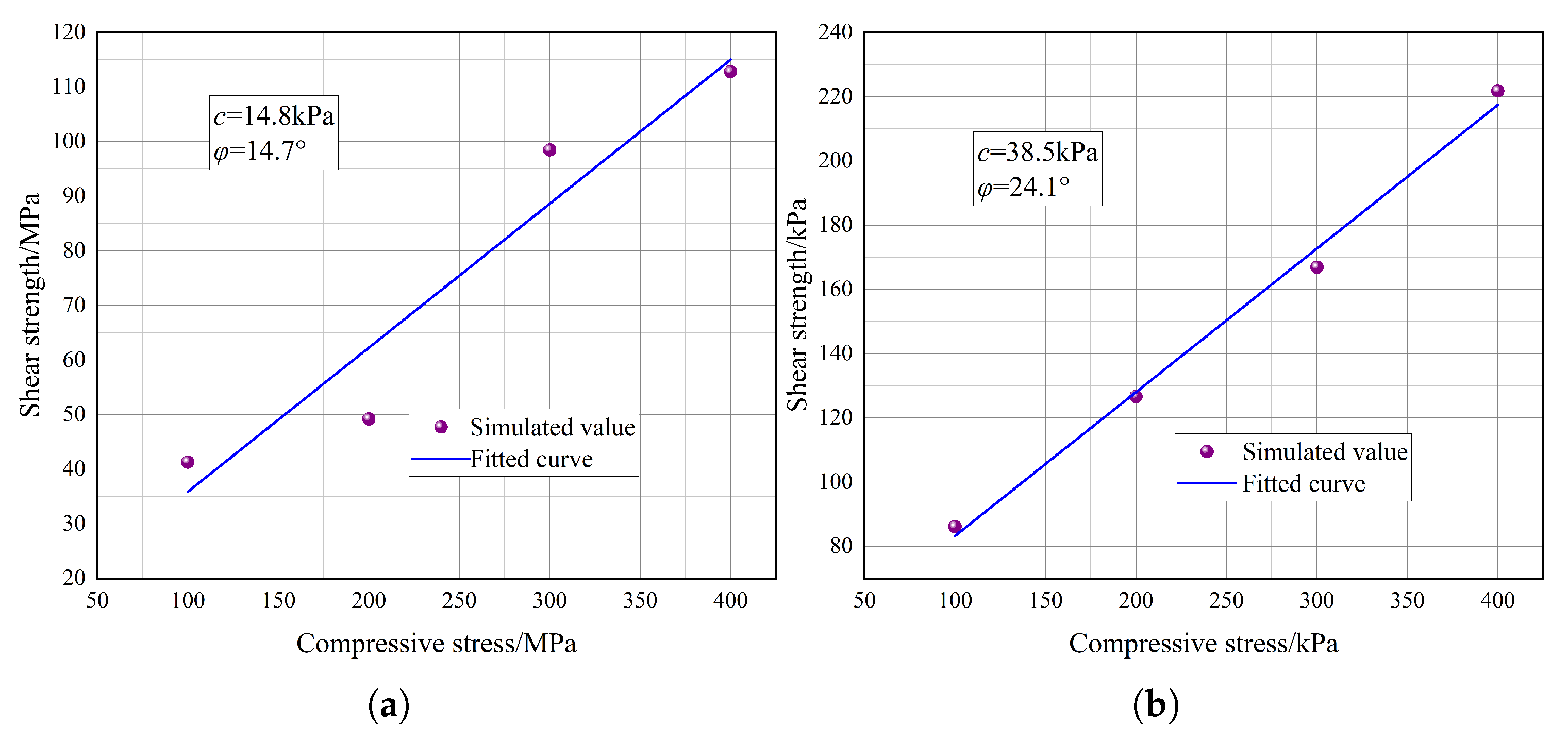
Figure 9.
Fitting curves of tailings and waste rock. (a) Tailings simulation fitting curve. (b) Waste rock simulation fitting curve.
Figure 9.
Fitting curves of tailings and waste rock. (a) Tailings simulation fitting curve. (b) Waste rock simulation fitting curve.
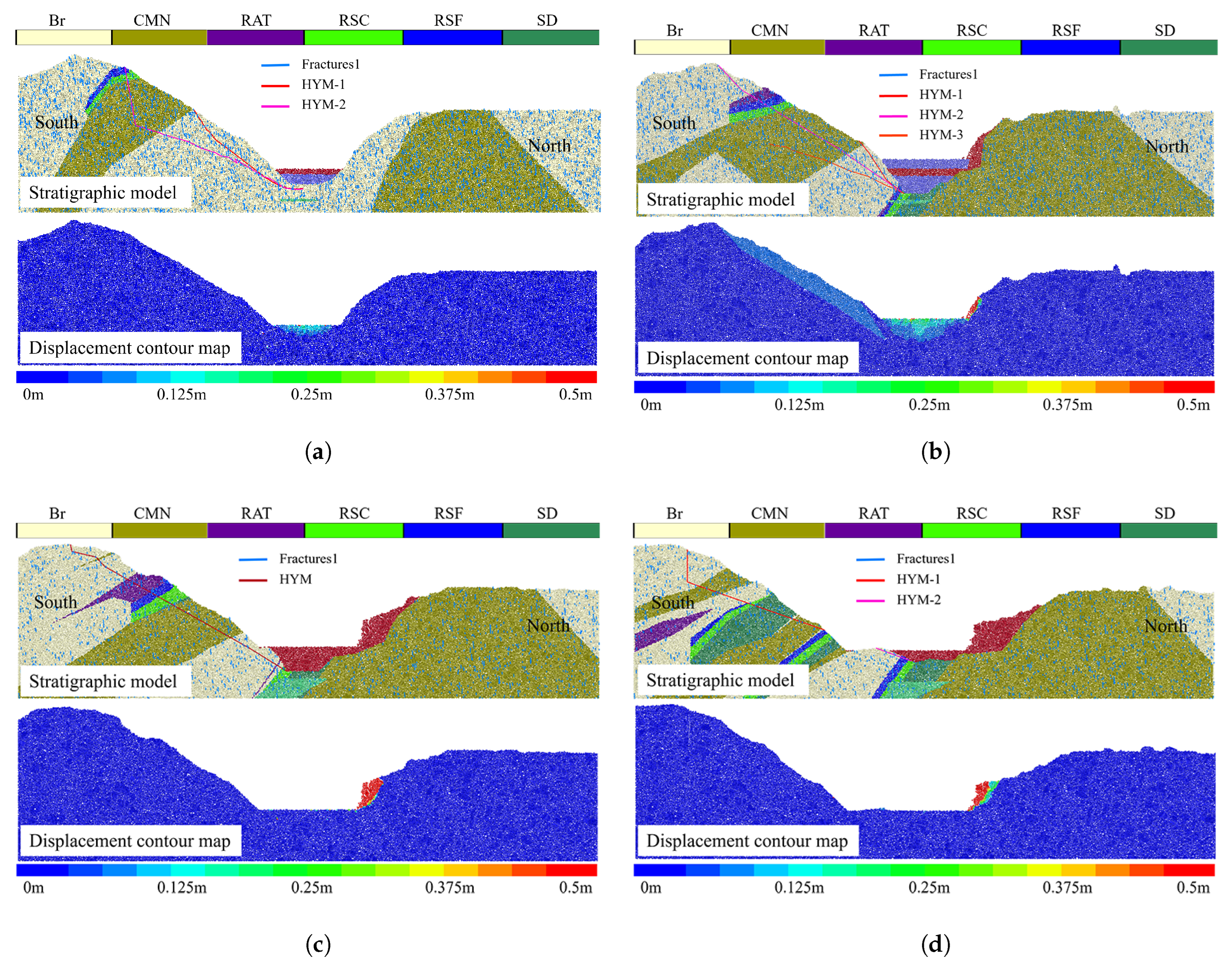
Figure 10.
Slope stability analysis of each section after completion of tailings mining. (a) Section 1. (b) Section 2. (c) Section 3. (d) Section 4. (e) Section 5. (f) Section 6. (g) Section 7. Br, CMN, RAT, RSC, RSF and SD are stratigraphic codes used to differentiate stratum of distinct geological periods; Fractures1 represents minor fractures, while HYM-1, HYM-2 and HYM-3 represent major fractures.
Figure 10.
Slope stability analysis of each section after completion of tailings mining. (a) Section 1. (b) Section 2. (c) Section 3. (d) Section 4. (e) Section 5. (f) Section 6. (g) Section 7. Br, CMN, RAT, RSC, RSF and SD are stratigraphic codes used to differentiate stratum of distinct geological periods; Fractures1 represents minor fractures, while HYM-1, HYM-2 and HYM-3 represent major fractures.
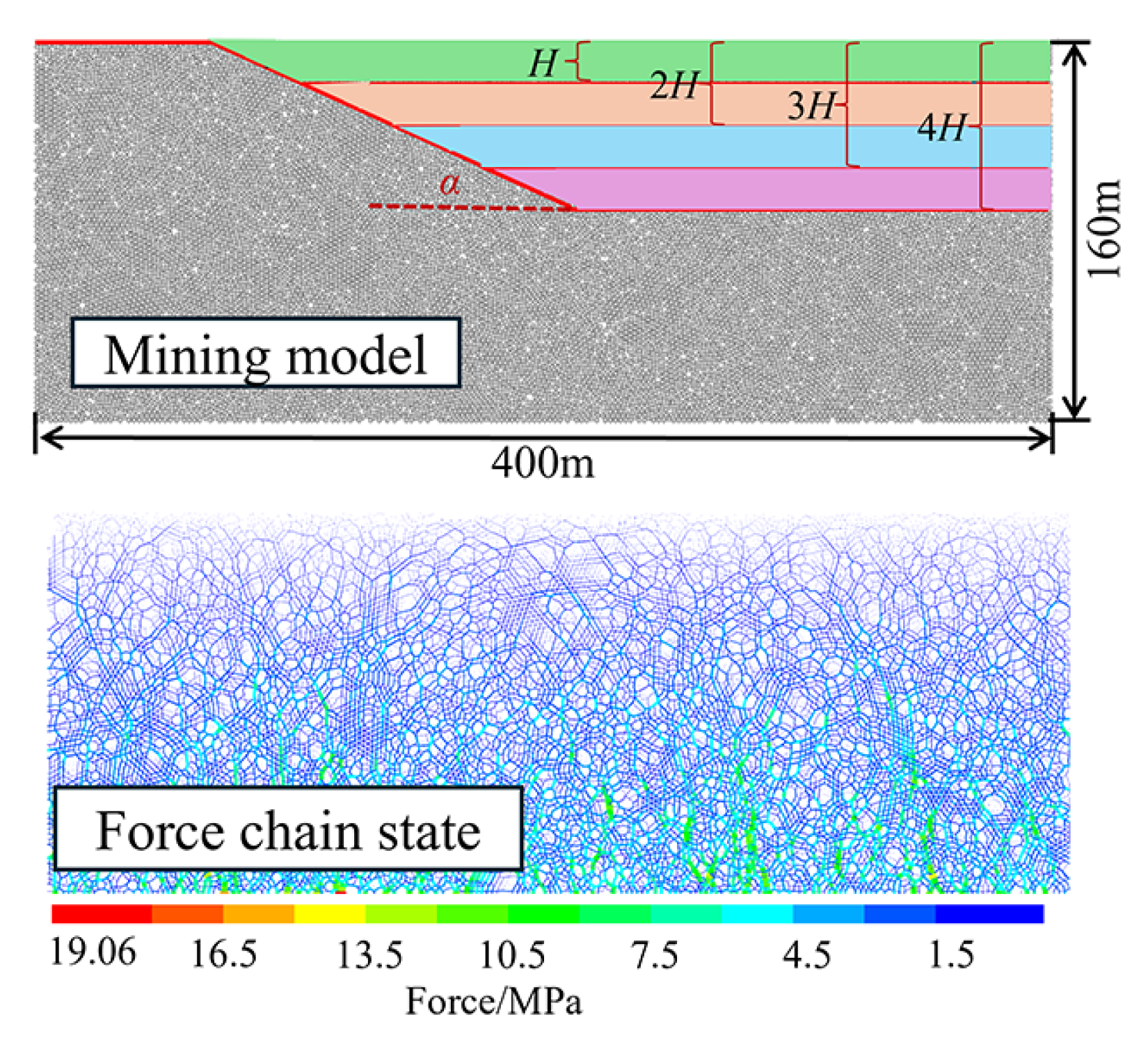
Figure 11.
Numerical model used for evaluating the critical slope angles of waste rock and tailings.
Figure 11.
Numerical model used for evaluating the critical slope angles of waste rock and tailings.
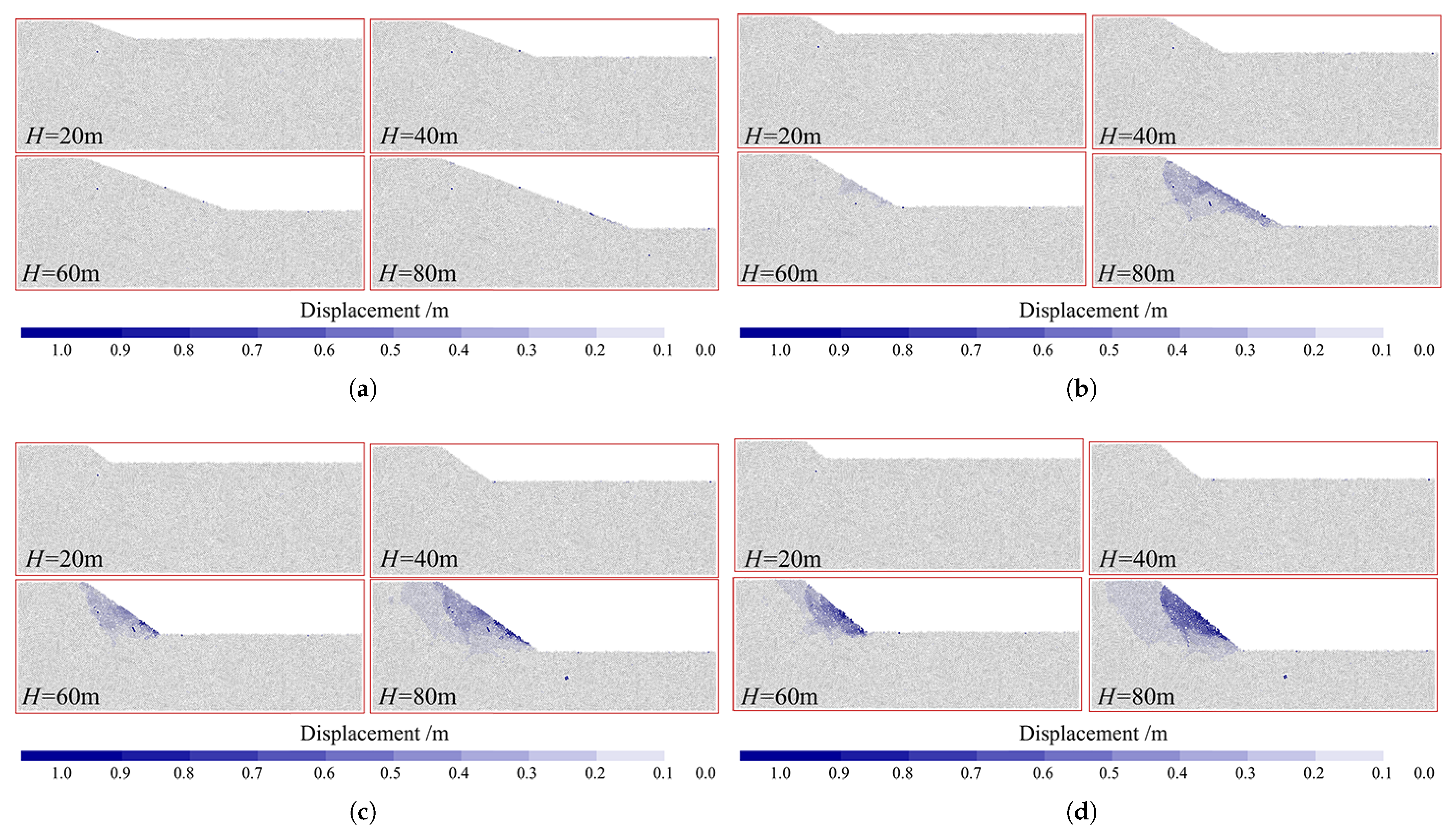
Figure 12.
Simulation results of waste rock slope deformation under varying slope angles and heights. (a) 20° slope angle. (b) 30° slope angle. (c) 35° slope angle. (d) 40° slope angle.
Figure 12.
Simulation results of waste rock slope deformation under varying slope angles and heights. (a) 20° slope angle. (b) 30° slope angle. (c) 35° slope angle. (d) 40° slope angle.
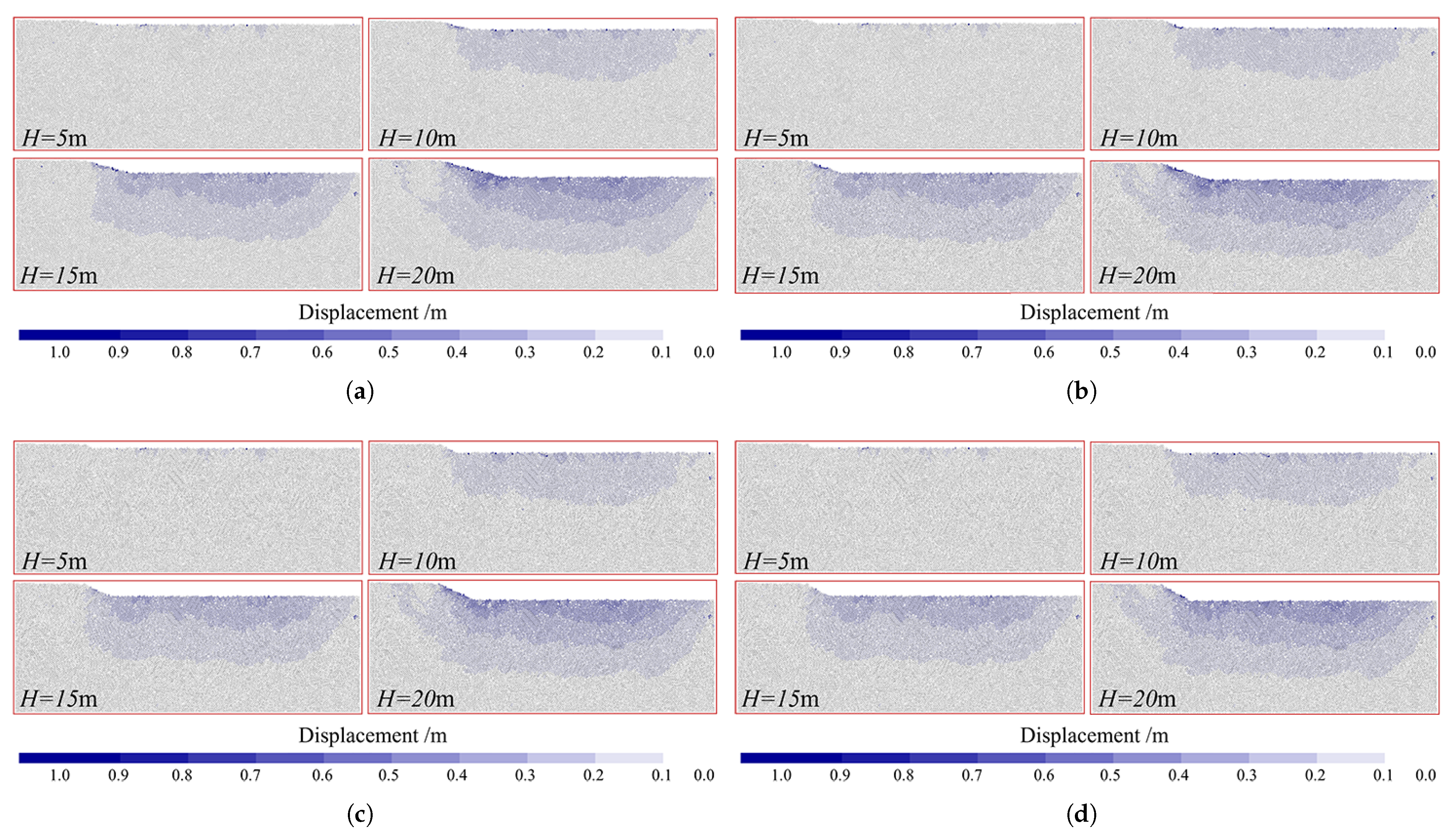
Figure 13.
Simulation results of tailings slope deformation under varying slope angles and heights. (a) 15° slope angle. (b) 20° slope angle. (c) 25° slope angle. (d) 30° slope angle.
Figure 13.
Simulation results of tailings slope deformation under varying slope angles and heights. (a) 15° slope angle. (b) 20° slope angle. (c) 25° slope angle. (d) 30° slope angle.
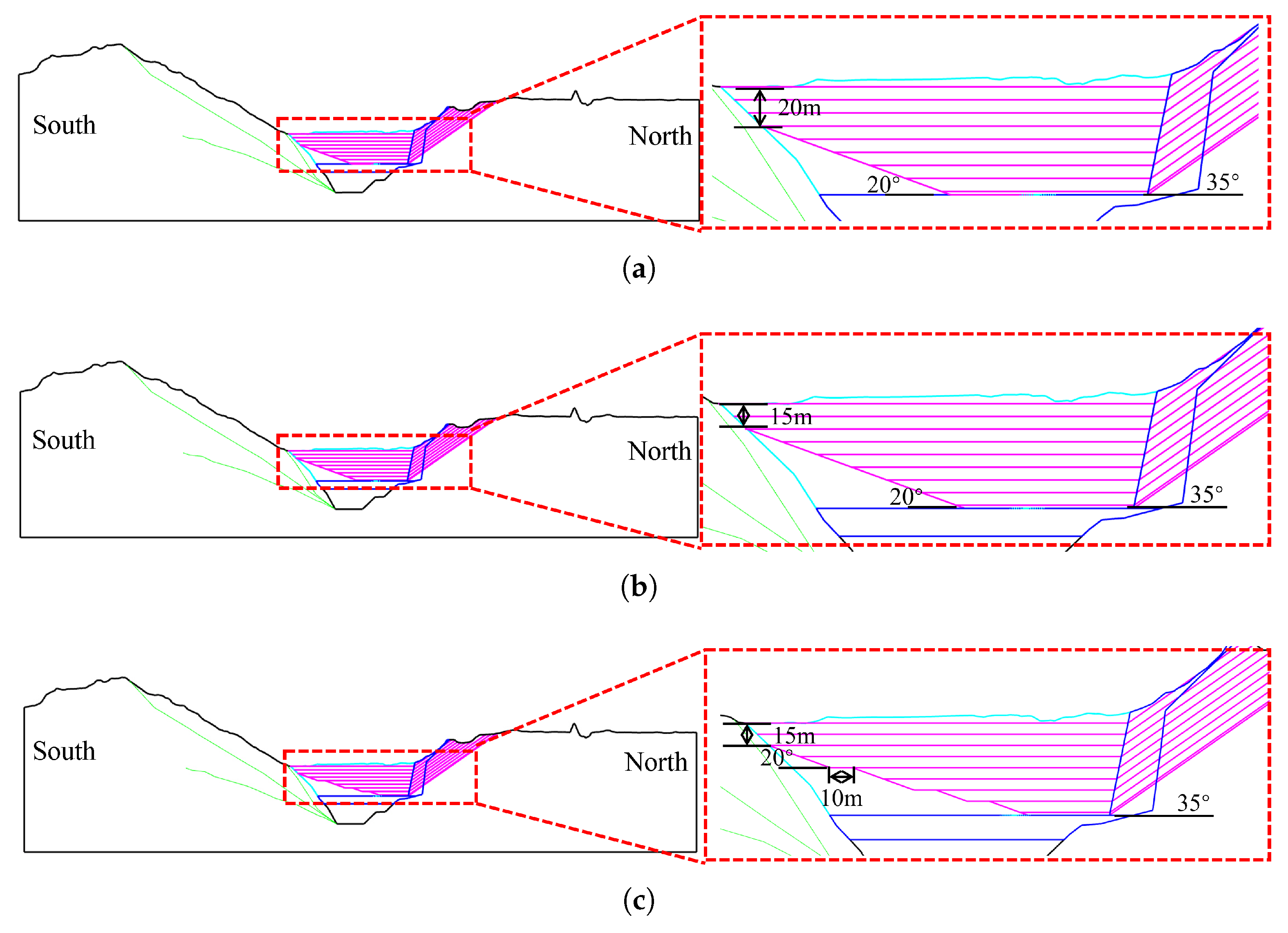
Figure 14.
Slope treatment schemes for Section 2. (a) Scheme 1. (b) Scheme 2. (c) Scheme 3. Green denotes the main fractures; cyan represents the outline of the tailings orebody prior to mining; blue indicates the outline of the waste rock orebody before excavation.
Figure 14.
Slope treatment schemes for Section 2. (a) Scheme 1. (b) Scheme 2. (c) Scheme 3. Green denotes the main fractures; cyan represents the outline of the tailings orebody prior to mining; blue indicates the outline of the waste rock orebody before excavation.
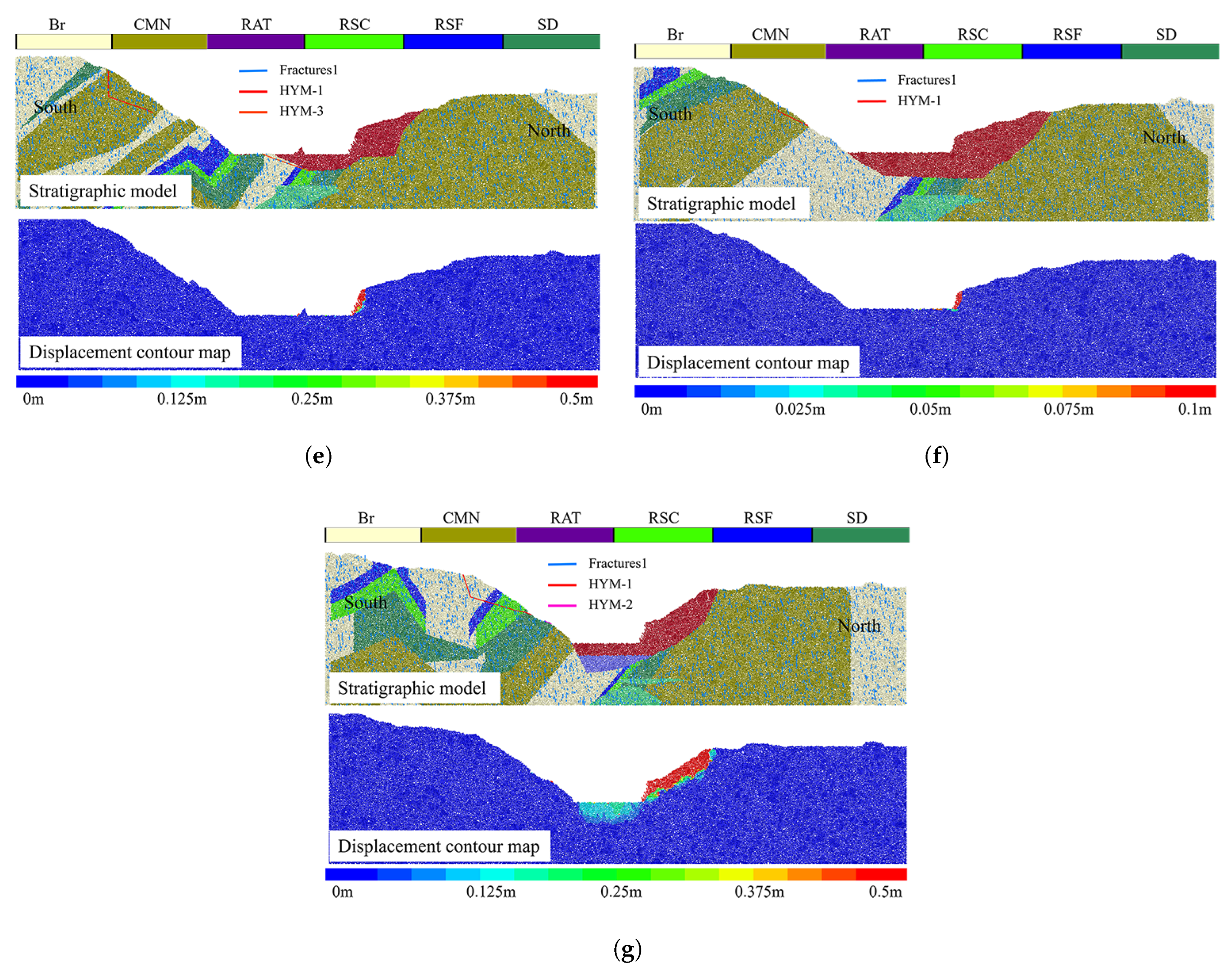
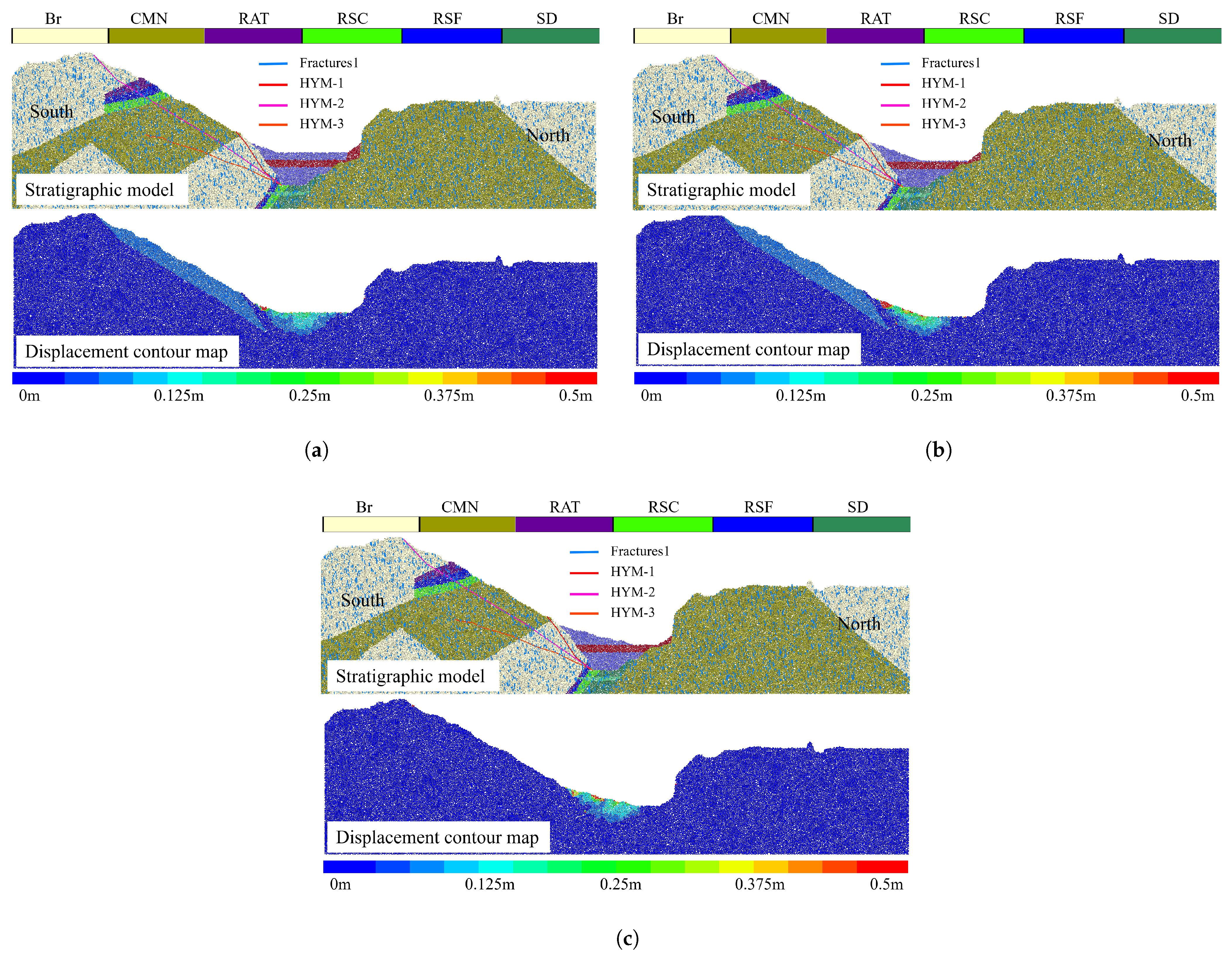
Figure 15.
Simulation results of the three disposal schemes for Section 2. (a) Scheme 1. (b) Scheme 2. (c) Scheme 3. Br, CMN, RAT, RSC, RSF and SD are stratigraphic codes used to differentiate stratum of distinct geological periods; Fractures1 represents minor fractures, while HYM-1, HYM-2 and HYM-3 represent major fractures.
Figure 15.
Simulation results of the three disposal schemes for Section 2. (a) Scheme 1. (b) Scheme 2. (c) Scheme 3. Br, CMN, RAT, RSC, RSF and SD are stratigraphic codes used to differentiate stratum of distinct geological periods; Fractures1 represents minor fractures, while HYM-1, HYM-2 and HYM-3 represent major fractures.
Figure 16.
Simulation results after slope treatment for Sections 3 to 7. (a) Section 3. (b) Section 4. (c) Section 5. (d) Section 6. (e) Section 7. Br, CMN, RAT, RSC, RSF and SD are stratigraphic codes used to differentiate stratum of distinct geological periods; Fractures1 represents minor fractures, while HYM-1, HYM-2 and HYM-3 represent major fractures.
Figure 16.
Simulation results after slope treatment for Sections 3 to 7. (a) Section 3. (b) Section 4. (c) Section 5. (d) Section 6. (e) Section 7. Br, CMN, RAT, RSC, RSF and SD are stratigraphic codes used to differentiate stratum of distinct geological periods; Fractures1 represents minor fractures, while HYM-1, HYM-2 and HYM-3 represent major fractures.
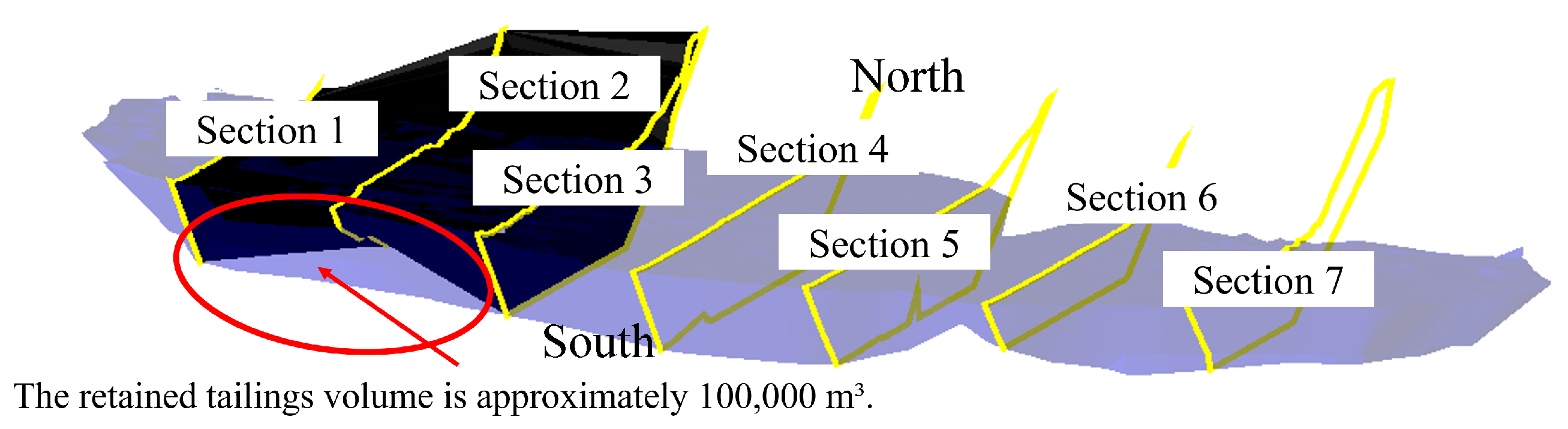
Figure 17.
Distribution of Tailings Reserved for Slope Buttressing.
Figure 17.
Distribution of Tailings Reserved for Slope Buttressing.
Table 1.
Field-measured orientations of sliding surfaces.
Table 1.
Field-measured orientations of sliding surfaces.
| Borehole ID | Dip Direction/° | Dip Angle/° | Remarks |
|---|
| XKT 6 | 64 | 82 | Major fracture |
| XKT 16 | 334 | 60 | Major fracture |
| XKT 17~18 | 4 | 83 | Major fracture |
| XKT 18~19 | 52 | 83 | Major fracture |
| XKT 21 | 35 | 57 | Major fracture |
| XKT 22 | 28 | 75 | Major fracture |
| XKT 23 | 70 | 34 | Major fracture |
| XKT 24 | 18 | 79 | Major fracture |
| XKT 25 | 16 | 52 | Major fracture |
| XKT 26 | 156 | 80 | Major fracture |
| XKT 27 | 324 | 85 | Major fracture |
| XKT 28 | 342 | 56 | Major fracture |
| XKT 29 | 346 | 49 | Major fracture |
| XKT 30 | 340 | 82 | Major fracture |
| XKT 34 | 312 | 53 | Major fracture |
| XKT 35 | 16 | 72 | Major fracture |
| XKT 36 | 345 | 78 | Major fracture |
| XKT 37 | 337 | 56 | Major fracture |
Table 2.
Attitude parameters of sliding surfaces in each section.
Table 2.
Attitude parameters of sliding surfaces in each section.
| Section Number | Number of Major Fractures | Fracture Dip Angle/° | Fracture Length/m |
|---|
| Section 1 | 2 | 80~86 | 0.5~7 |
| Section 2 | 3 | 80~86 | 0.5~7 |
| Section 3 | 1 | 84~96 | 3~8 |
| Section 4 | 2 | 84~96 | 3~8 |
| Section 5 | 1 | 72~116 | 1~10 |
| Section 6 | 1 | 72~116 | 1~10 |
| Section 7 | 2 | 72~116 | 1~10 |
Table 3.
Water content mixing scheme for tailings samples.
Table 3.
Water content mixing scheme for tailings samples.
| Scheme Number | Water Mass/g
| Dry Tailings Mass/g | Water Content /% |
|---|
| Section 1 | 35 | 500 | 7 |
| Section 2 | 50 | 500 | 10 |
| Section 3 | 75 | 500 | 15 |
| Section 4 | 100 | 500 | 20 |
| Section 5 | 125 | 500 | 25 |
Table 4.
Shear strength parameters of tailings at different water contents.
Table 4.
Shear strength parameters of tailings at different water contents.
| Test ID | Water Content/% | Compressive Stress/10−3 MPa | Dial Gauge Reading of the Proving Ring/mm | Shear Strength/10−3 MPa | Cohesion/10−3 MPa | Friction Angle/° |
|---|
| 1 | 7 | 100 | 22.39 | 42.32 | 15.95 | 14.0 |
| 200 | 32.49 | 61.41 |
| 300 | 50.39 | 95.23 |
| 400 | 60.37 | 114.09 |
| 2 | 10 | 100 | 27.78 | 52.51 | 17.45 | 15.9 |
| 200 | 32.34 | 61.12 |
| 300 | 58.46 | 110.48 |
| 400 | 69.41 | 131.19 |
| 3 | 15 | 100 | 24.80 | 46.88 | 16.5 | 15.7 |
| 200 | 35.90 | 67.86 |
| 300 | 54.35 | 102.73 |
| 400 | 68.08 | 128.68 |
| 4 | 20 | 100 | 22.30 | 42.14 | 15.2 | 15.6 |
| 200 | 37.21 | 70.32 |
| 300 | 54.61 | 103.21 |
| 400 | 65.68 | 124.14 |
| 5 | 25 | 100 | 22.26 | 42.08 | 14.6 | 15.8 |
| 200 | 34.03 | 64.32 |
| 300 | 50.75 | 95.91 |
| 400 | 63.13 | 119.31 |
Table 5.
Calibrated microscopic particle parameters.
Table 5.
Calibrated microscopic particle parameters.
| Stratum 1 | Cohesion/MPa | Tensile Strength to Cohesion Ratio | Bond Modulus/103 MPa | Linear Modulus/103 MPa | Bond Stiffness Ratio | Linear Stiffness Ratio | Friction Coefficient | Bond Friction Angle/° |
|---|
| Br | 55.3 | 2.4 | 31.3 | 29.2 | 2.0 | 2.2 | 0.38 | 42.1 |
| CMN | 87.3 | 2.6 | 27.2 | 28.4 | 2.2 | 2.2 | 0.42 | 41.5 |
| RAT | 57.2 | 1.8 | 17.8 | 18.7 | 2.0 | 2.0 | 0.39 | 40.2 |
| RSC | 97.3 | 2.4 | 43.1 | 48.2 | 2.1 | 2.0 | 0.41 | 41.8 |
| RSF | 62.8 | 1.9 | 9.0 | 10.8 | 2.2 | 2.1 | 0.38 | 42.3 |
| SD | 138.2 | 2.3 | 34.4 | 38.1 | 2.0 | 2.2 | 0.38 | 42.1 |
Table 6.
Comparison of simulation values and actual values errors.
Table 6.
Comparison of simulation values and actual values errors.
| Stratum 1 | Compressive Strength Test Value/MPa | Compressive Strength Simulation Value/MPa | Error/% | Elastic Modulus Test Value/103 MPa | Elastic Modulus Simulation Value/103 MPa | Error/% |
|---|
| Br | 80.5 | 82.47 | 2.45 | 51.9 | 52.5 | 1.2 |
| CMN | 124.17 | 123.0 | 0.9 | 47.85 | 47.9 | 0.1 |
| RAT | 75.3 | 75.7 | 0.5 | 32.2 | 31.6 | 1.8 |
| RSC | 135.3 | 135.8 | 0.4 | 79.3 | 77.4 | 2.4 |
| RSF | 82.0 | 81.9 | 0.1 | 17.1 | 16.9 | 1.1 |
| SD | 204.5 | 194.3 | 4.9 | 67.1 | 67.0 | 0.1 |
Table 7.
Mesoscopic parameters of tailings and waste rock.
Table 7.
Mesoscopic parameters of tailings and waste rock.
| Sample | Cohesion/MPa | Tensile Strength to Cohesion Ratio | Bond Modulus/103 MPa | Linear Modulus/103 MPa | Bond Stiffness Ratio | Linear Stiffness Ratio | Friction Coefficient | Bond Friction Angle/° |
|---|
| Tailings | 154.0 | 1.0 | 12.0 | 14.0 | 1.1 | 1.1 | 0.23 | 10.9 |
| Waste rock | 667.0 | 2.8 | 98.0 | 109.0 | 1.1 | 1.1 | 0.38 | 29.5 |
Table 8.
Design schemes for waste rock slope configurations.
Table 8.
Design schemes for waste rock slope configurations.
| Slope Height (H)/m | Slope Angle (α)/° |
|---|
| 20 | 20 | 30 | 35 | 40 |
| 40 | 20 | 30 | 35 | 40 |
| 60 | 20 | 30 | 35 | 40 |
| 80 | 20 | 30 | 35 | 40 |
Table 9.
Tailings slope design schemes.
Table 9.
Tailings slope design schemes.
| Slope Height (H)/m | Slope Angle (α)/° |
|---|
| 5 | 15 | 20 | 25 | 30 |
| 10 | 15 | 20 | 25 | 30 |
| 15 | 15 | 20 | 25 | 30 |
| 20 | 15 | 20 | 25 | 30 |