Article

Prediction of Fatigue Damage Evolution in 3D-Printed CFRP Based on Ultrasonic Testing and LSTM

School of Mechanical and Automotive Engineering, Shanghai University of Engineering Science, 333 Longteng Road, Songjiang District, Shanghai 201620, China
*
Author to whom correspondence should be addressed.
Appl. Sci. 2026, 16(2), 1139; https://doi.org/10.3390/app16021139
Submission received: 16 December 2025 / Revised: 6 January 2026 / Accepted: 12 January 2026 / Published: 22 January 2026

Abstract

To address the prediction of fatigue damage for 3D-printed Carbon Fiber Reinforced Polymer (CFRP), this study used 3D-printing technology to fabricate CFRP specimens. Through multi-stage fatigue testing, samples with varying porosity levels were obtained. Based on porosity test results and ultrasonic attenuation coefficient measurements of specimens under different fatigue cycle counts, a quantitative relationship model was established between the porosity and ultrasonic attenuation coefficient of 3D-printed CFRP. According to the porosity and fatigue-loading cycles obtained from tests, the Time-series Generative Adversarial Network (TimeGAN) algorithm was employed for data augmentation to meet the requirements for neural-network training. Subsequently, the Long Short-Term Memory (LSTM) neural network was utilized to predict the fatigue damage evolution of 3D-printed CFRP specimens. Research findings indicate that by integrating the established relationship between porosity and ultrasonic attenuation coefficient, non-destructive testing of material fatigue damage evolution based on ultrasonic attenuation coefficient can be achieved.

1. Introduction

Carbon Fiber Reinforced Polymers (CFRPs) demonstrate broad application prospects in multiple high-tech fields such as aerospace, automotive manufacturing, and medical devices due to their outstanding comprehensive properties. With the increasing application of CFRPs in critical load-bearing components, concerns over its long-term service reliability have grown significantly. Particularly under cyclic loading, the accumulation of fatigue damage caused by internal material defects often becomes the primary cause of structural failure. Among the various manufacturing defects in CFRPs, pores are the most common ones that significantly affect service performance. The presence of pores not only induces localized stress concentration and accelerates crack initiation but also alters crack propagation paths, significantly affecting the material’s fatigue properties. Therefore, accurately evaluating pore characteristics and establishing quantitative relationships between them and fatigue performance is of significant engineering importance for ensuring the safe service life of CFRP structures.
The pores in composite materials affect their mechanical properties, such as interlaminar shear strength [1], bending strength [2,3], and transverse elasticity [4], and significantly impact the fatigue performance of composites [5,6,7]. Traditional methods for evaluating the mechanical properties of composite materials primarily rely on destructive testing and macroscopic mechanical models, making it difficult to reveal the intrinsic relationship between pore defects and fatigue damage evolution. Ultrasonic testing technology offers an effective means for the quantitative characterization of internal defects in composite materials due to its high sensitivity, deep penetration capability, and non-destructive nature. When propagating through porous media, ultrasonic waves undergo phenomena such as diffraction, scattering, and waveform distortion. Variations in porosity cause changes in key ultrasonic parameters including the material’s attenuation coefficient [8], sound velocity [9], acoustic impedance [10], and nonlinear coefficient [11]. Therefore, ultrasonic characteristic parameters can be utilized to evaluate the porosity of composite materials and establish a correlation with their mechanical properties. Among various ultrasonic characteristic parameters, the ultrasonic attenuation coefficient is widely used in engineering due to its high sensitivity in detecting pore defects and operational simplicity.
Research has shown that there is a significant correlation between the ultrasonic attenuation coefficients and the porosity and mechanical properties of composite materials. De Almeida and Neto [12] first proposed a fracture criterion linking ultrasonic attenuation to the strength of composite laminates, discovering that porosity exceeding a critical threshold significantly reduces fatigue life. Jeong [13] established quantitative relationships between the attenuation slope and interlayer shear strength and pore content. Costa et al. [14] further correlated the ultrasonic attenuation coefficient with the interlaminar shear strength and compressive strength of laminates, confirming that strength remains unaffected below the critical porosity. Liu et al. [15] discovered through ultrasonic C-scan analysis that porosity correlates with the absorption coefficient, and mechanical properties decrease as porosity increases. Zhu et al. [16] investigated carbon/epoxy fiber fabric specimens and verified the negative correlation between porosity and tensile strength. Mehdikhani et al. [17] systematically reviewed the influence of pores on composite material properties and advances in ultrasonic attenuation models. These studies have laid an important foundation for fatigue life prediction based on ultrasonic parameters.
Current research has primarily focused on analyzing the correlation between pore defects and the mechanical properties of composite laminates, such as tensile modulus, shear modulus, longitudinal/transverse tensile strength, bending strength, and compressive strength. However, studies investigating the impact of pore defects on the fatigue damage evolution of 3D-printed carbon fiber composites remain relatively limited. Regarding fatigue performance, existing research has primarily investigated the influence of pores on composite fatigue behavior through experimental testing and numerical simulations based on representative volume elements [18]. However, these methods are often costly, time consuming, and labor intensive, and they face challenges in predicting the evolution of fatigue damage.
In recent years, artificial intelligence technology has provided new methods for predicting the fatigue life of composite materials. Yang et al. [19] validated the effectiveness of neural networks in predicting multiaxial fatigue life. Yan et al. [20] developed a U-net and LSTM framework for predicting crack propagation. Jian et al. [21] proposed a dual-layer bidirectional long short-term memory neural network model integrating transfer learning and attention mechanisms for fatigue life prediction of CFRP thin plates under random vibration loading. Demo et al. [22] developed a real-time fatigue life prediction method for composites based on resistance monitoring and established a relationship model between resistance signal and remaining fatigue life using LSTM neural network.
Due to the complex failure mechanisms of composite materials, predicting their fatigue damage evolution remains challenging. By integrating time-series data obtained through non-destructive testing methods such as ultrasonic testing and acoustic emission and utilizing deep-learning models like LSTM and Convolutional Neural Networks (CNN), it is possible to establish relationships between pore defects and fatigue cycles more efficiently. This method significantly enhances the reliability of predicting fatigue damage evolution in composite materials.
This study employs ultrasonic testing methods on 3D-printed CFRPs, utilizing multi-stage fatigue tests to obtain test specimens with varying porosity levels, analyze the pore morphology and distribution characteristics of specimens under different cycle numbers, and establish a relationship model between ultrasonic attenuation coefficient and porosity. Based on this, an LSTM neural network is employed to predict the fatigue damage evolution of 3D-printed CFRP.

2. Materials and Methods

2.1. Preparation of 3D-Printed Specimens

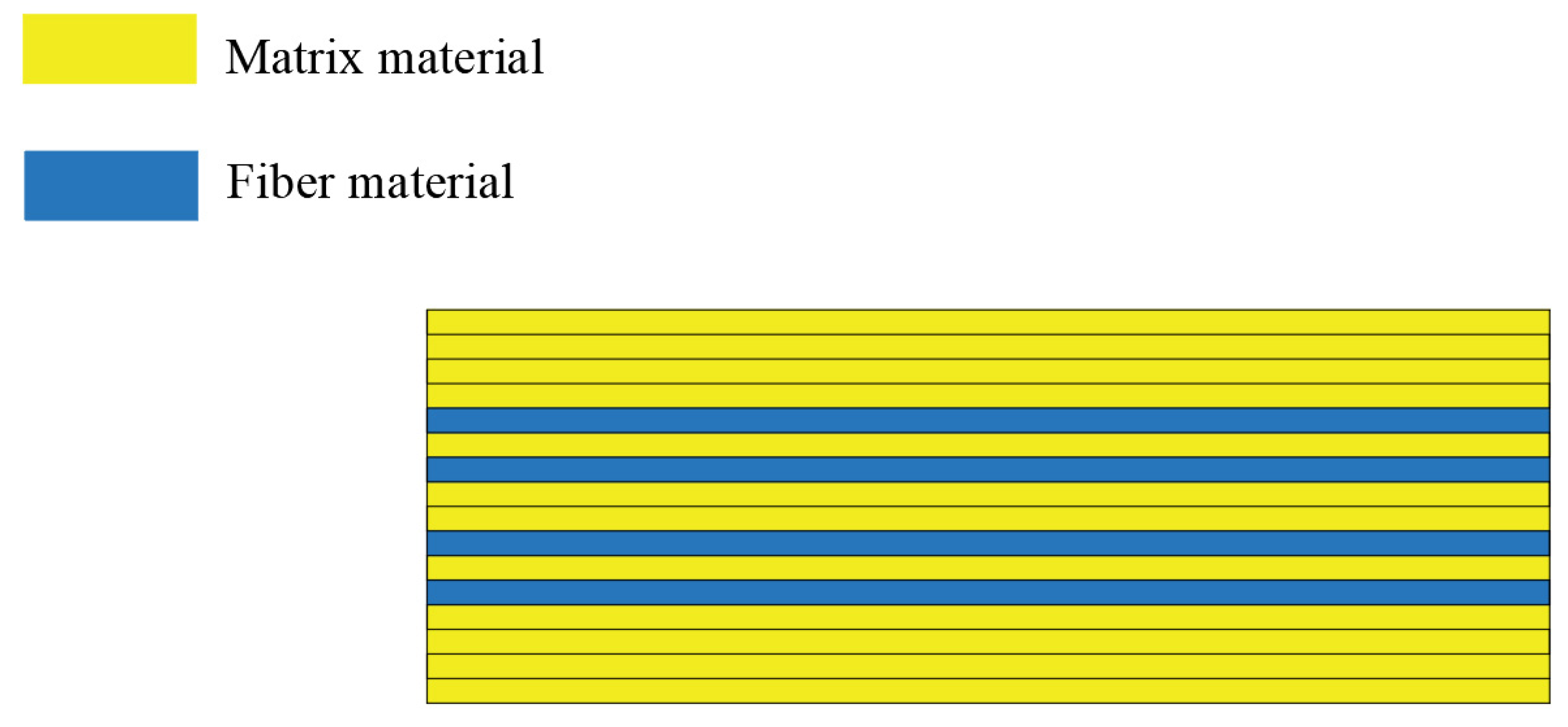
This study used the Mark Two 3D printer from Markforged Company (Watertown, MA, USA), to prepare specimens, and selected carbon fiber as the reinforcing material. The density of the carbon fiber was 1.4 g/cm3, the diameter of the fiber bundle was 0.35 mm, and the diameter of a single filament was about 7 μm. The matrix material was onyx, with a density of 1.2 g/cm3 and a printing filament diameter of 1.7 mm. The spatial distribution of the two materials is shown in Figure 1, and the thickness of each layer of the specimen was 0.125 mm.
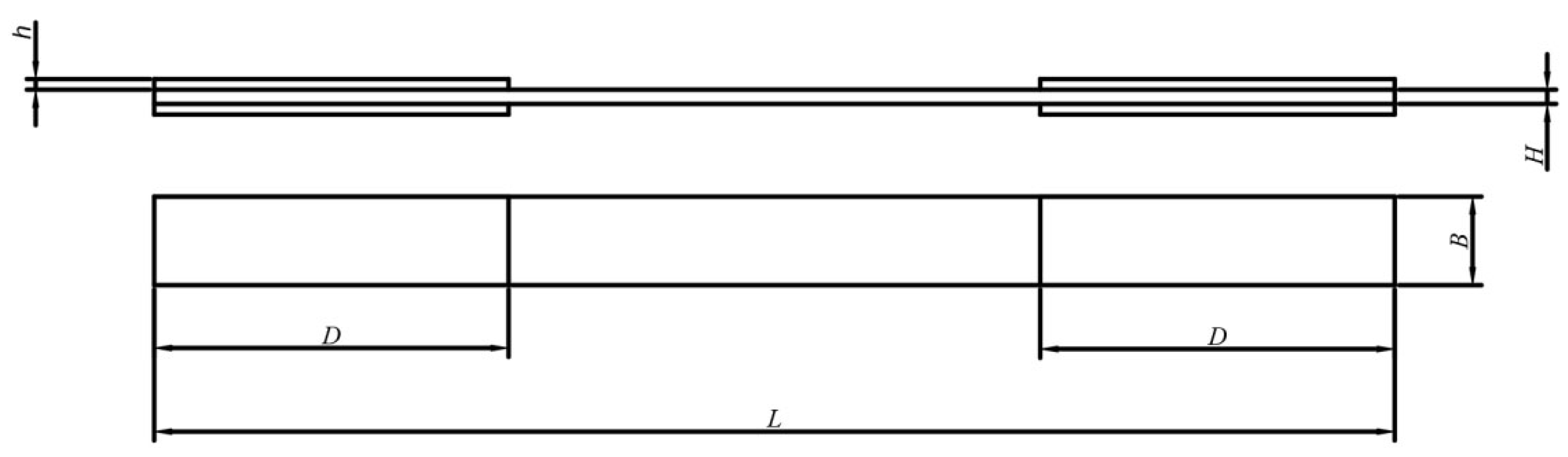
The specimen dimensions were designed in accordance with the Chinese National Standard GB/T35465.3-2017 [23] “Test method for fatigue properties of polymer matrix composite materials Part3: Tension–tension fatigue”. Figure 2 shows the schematic diagram of the specimen dimensions. The length L of the specimen is 175 mm, the thickness H is 2 mm, and the width B is 12.5 mm. The length D of the reinforcing plate is 50 mm, the thickness h is 1.5 mm, and the width is 12.5 mm.

2.2. Multi-Stage Fatigue Damage Test

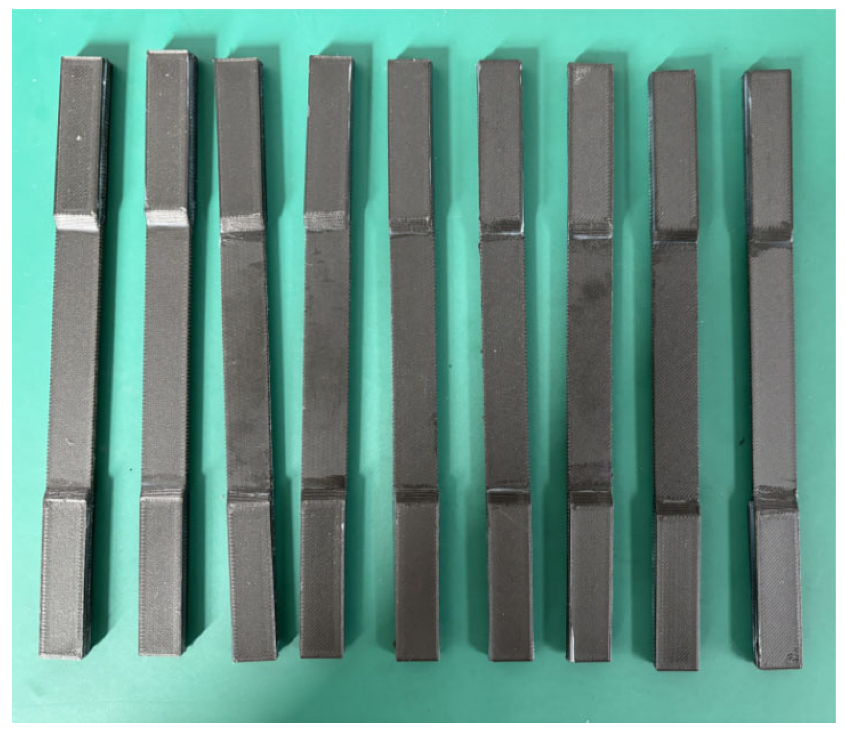
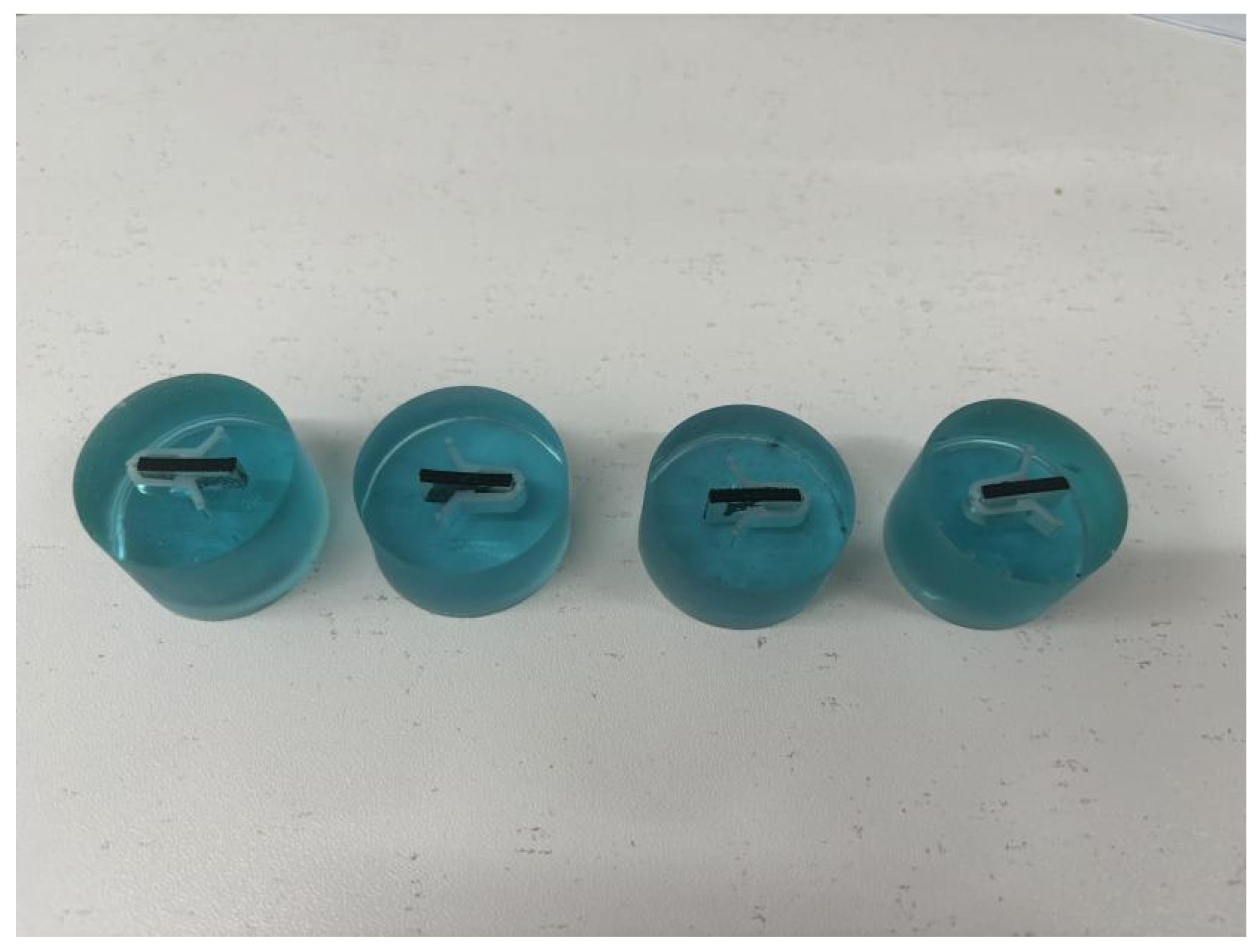
Conduct multi-stage fatigue testing on 3D-printed specimens to obtain samples with varying porosity levels. The fatigue test was conducted using the MTS Landmark electro-hydraulic servo-dynamic test system. The system achieves a maximum tensile stroke of 600 mm, with a loading frequency range of 0.01–1000 Hz. It delivers a maximum static tensile load of 200 kN and a maximum dynamic loading capacity of 100 kN. The test employed a sinusoidal wave with an operating frequency of 5 Hz, maximum and minimum loads of 5 kN and 0.5 kN, respectively, and a stress ratio of 0.1. To determine the fatigue life of the specimens, three specimens were first selected for fatigue testing under identical loading parameters until fracture occurred, with the number of fatigue cycles recorded being about 24,000. Based on the test results of fatigue life, a multi-stage fatigue test scheme was developed. The test set four fatigue cycle levels: 2000, 6000, 12,000, and 20,000 cycles. Four specimens were utilized for the tests at each cycle level. Figure 3 shows the test specimens.

2.3. Ultrasonic Testing

Ultrasonic testing was performed on specimens that completed the multi-stage fatigue tests. A region with uniform pore distribution was selected to calculate the ultrasonic attenuation coefficient of the specimens. The test employed an Olympus MX2 ultrasonic testing device from Olympus Corporation, Richmond Hill, ON, Canada, which supports a wide range of probe frequencies from 0.5 to 20 MHz and integrates functions such as defect localization, size measurement, data recording, and report generation.
The specimens were rapidly inspected by means of ultrasonic C-scanning. Regions with relatively uniform pore distribution were identified from the scans, and their ultrasonic attenuation amplitude was measured. The ultrasonic attenuation coefficient is calculated according to the ultrasonic waveform. Firstly, we adjusted the ultrasonic gain in decibels to make the amplitude of the first surface echo reach 80% of the reference amplitude, and recorded the amplitude of the first bottom echo at this time. The calculation formula of the ultrasonic attenuation coefficient [24] is shown in Equation (1).
α T = 20 lg ( H 1 H 2 ) 2 h
where H1 is the ultrasonic amplitude of the first surface echo, H2 is the ultrasonic amplitude of the first bottom echo, and h is the thickness of the specimen. Since the ultrasonic testing was conducted using the echo method, the ultrasonic travel distance equals twice the thickness of the test specimen.
To ensure the accuracy of test results and minimize the impact of measurement errors on experimental outcomes, the ultrasonic attenuation coefficient was measured five times on the same specimen, with the average value taken as the final result.

2.4. Determination of Porosity

Following ultrasonic testing, the porosity of 3D-printed specimens was measured using microphotography. The test employs the Keyence VHX-5000 series ultra-depth-of-field microscopic system from Keyence Corporation, Osaka, Japan. This device features a 1.95-megapixel CMOS image sensor, delivering ultra-high-resolution color imaging at 4800 × 3600 pixels while supporting dynamic video recording capabilities. The system achieves a maximum optical magnification of 5000 times with measurement accuracy reaching the sub-micron level.
The porosity of the specimen was determined according to GB/T 3365-2008 [25] “Carbon fiber reinforced plastics-determination of pore content and fiber volume content”. For specimens that have completed the multi-stage fatigue test, cutting and sampling were performed using an automatic high-speed precision cutting machine. The cut cross-section was embedded and fixed with epoxy resin, followed by grinding, polishing, and ultrasonic cleaning to prepare metallographic specimens, as shown in Figure 4. Micrographs of cross-sections were captured at 500 times magnification. To minimize measurement errors, metallographic images of five consecutive cross-sections were acquired at 1 mm intervals along the specimen’s axial direction. The porosity of each cross-section was calculated using ImageJ software (v1.8.0) combined with the machine learning plugin WekaSegmentation. The arithmetic mean of the porosities from these five cross-sections was ultimately taken as the specimen’s porosity.
This study combines ultrasonic C-scan and microphotography techniques to measure the porosity of 3D-printed specimens after varying fatigue cycles, analyze the influence of fatigue cycles on porosity, and establish a quantitative relationship model between porosity and ultrasonic attenuation coefficient.

2.5. Fatigue Damage Evolution Prediction

2.5.1. Data Augmentation Based on TimeGAN

The relationship between porosity and fatigue cycles is complex, influenced by multiple factors such as environment, material parameters, and testing process. Therefore, the method of directly fitting the relationship between the two using experimental data is not suitable for 3D-printed CFRPs. To address the issue of insufficient sample size in experiments, data augmentation is necessary to meet the requirements of model training. TimeGAN is commonly used to process time-series data and can construct a multi-level and multi-dimensional data augmentation framework, thereby effectively improving the quality and usability of small sample data.
Data pre-augmentation primarily involves data normalization processing, noise injection, and time-series deformation. Since the data for fatigue cycles and porosity are not on the same order of magnitude, normalization is first applied to preserve the characteristics of the original data as much as possible after augmentation. The normalized data is then used for subsequent augmentation operations. The noise-injection method enhances a model’s noise resistance by introducing random noise into the original data to simulate interference factors in real-world scenarios. Noise injection can simulate measurement errors and environmental interference during the test process. Time-series deformation, by performing scaling adjustments or local deformation on the time dimension of data, is suitable for the modeling of dynamic data with time-correlated characteristics. The primary purpose of time-series deformation is to ensure the diversity of generated “fake data”.

2.5.2. LSTM Methodology

LSTM is an improved Recurrent Neural Network (RNN) that effectively solves the gradient problem of traditional RNNs in long sequence training by introducing memory units and gating mechanisms. Its memory unit is responsible for storing and transmitting key information, while the input gate, forget gate, and output gate work together to selectively filter information for precise control of information flow. This structure enables LSTM to accurately capture long-term dependencies in temporal data, and performs excellently in temporal prediction tasks, becoming one of the core methods in the field of sequence modeling.
The computations for each module of the LSTM can be described by Equations (2)–(7).
f t = σ ( W f h t 1 , x t + b f )
i t = σ ( W i h t 1 , x t + b i )
C ˜ t = tanh ( W C h t 1 , x t + b C )
C t = f t C t 1 + i t C ˜ t
o t = σ ( W o h t 1 , x t + b o )
h t = o t tanh ( C t )
where f t is the output of the forget gate. W f , W i , and W o represent the weight matrices of the forget gate, input gate, and output gate, respectively. h t 1 and h t are the outputs of the cell unit from the previous time step. x t is the input to the cell unit at the current time step. b f , b i and b o represent the bias vectors for the forget gate, input gate, and output gate, respectively. C ˜ t is the candidate memory cell unit. C t 1 and C t represent the memory unit states at the previous and current time steps, respectively. i t is the output of the input gate. o t is the output of the output gate. σ is the sigmoid activation function.
This study adopts Root Mean Square Error (RMSE), Mean Absolute Error (MAE), and Mean Squared Error (MSE) as the evaluation metrics for model prediction performance. The calculation for RMSE, MAE, and MSE are presented in Equations (8)–(10).
E RMSE = 1 n i = 1 n ( y i y ^ i ) 2
E MAE = 1 n i = 1 n y i y ^ i
E MSE = 1 n i = 1 n ( y i y ^ i ) 2
where y i is the actual value, y ^ i is the predicted value, and n is the total number of observations.

3. Results and Discussions

3.1. Pore Morphology Characteristics

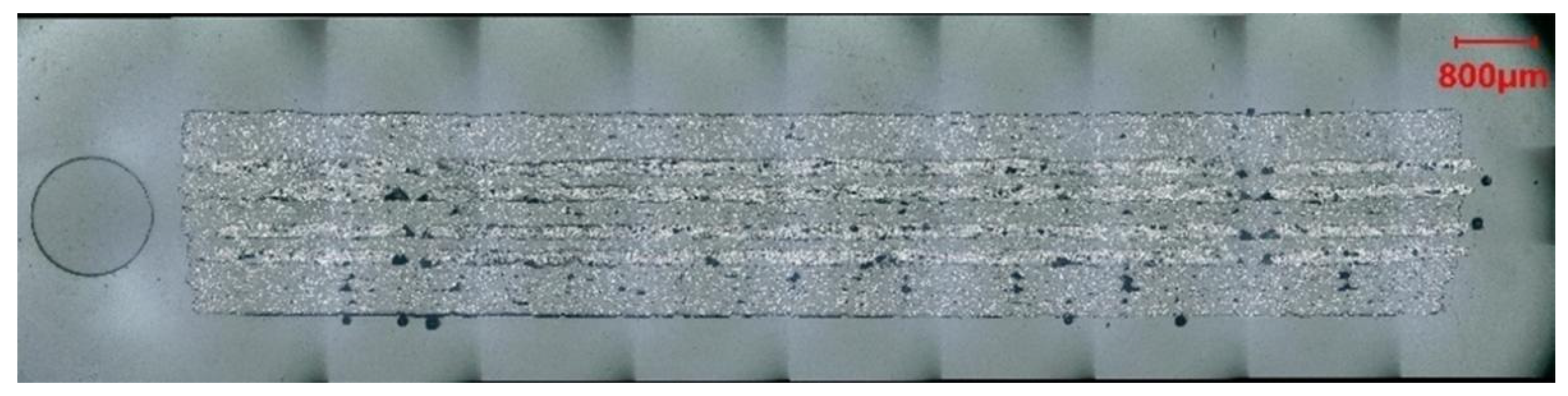
To capture all pores in the cross-section of the specimen, image stitching technology was used to combine all captured images into a complete 2D cross-sectional image, as shown in Figure 5.
We imported the synthesized images into ImageJ software to obtain results such as pore length, pore width, and porosity. Observation of the pore morphology in the specimen cross-section revealed that as the number of fatigue cycles increased, the number of pores in the specimen significantly increased, and the pore size noticeably enlarged. Small pores were primarily distributed within the matrix layer, while at the interface between the fiber layer and the matrix layer, pores predominantly exhibit elongated characteristics. For 3D-printed CFRPs, porosity primarily originated from the matrix material. Its formation mechanisms included the following: uneven resin curing, internal stress concentration within the material, and the escape of volatile substances such as air.
ImageJ image processing software was employed to quantitatively characterize the pore features in microscope photographs of the specimens. The statistical results are presented in Table 1. For each pore, the maximum distance along its major axis is defined as the pore length, while the maximum distance along its minor axis is defined as the pore width.
As shown in Table 1, the average pore length L and the average pore width W exhibit an increasing trend with the fatigue cycles. Both the maximum pore length Lmax and maximum pore width Wmax show an increasing trend, and the growth rate of the pore length is faster than that of the pore width. During the fatigue cycle range from 2000 to 20,000 cycles, the maximum pore length Lmax increased from 398.03 µm to 587.08 µm, while the average pore length L grew from 49.23 µm to 56.84 µm. The maximum pore width Wmax increased from 158.23 µm to 228.65 µm, while the average value W rose from 23.05 µm to 25.77 µm. The growth rate of pore length is greater than that of pore width, mainly because during the fatigue tensile process, the material bears a higher stress level along the length direction, which leads to more significant expansion of pores in this direction.
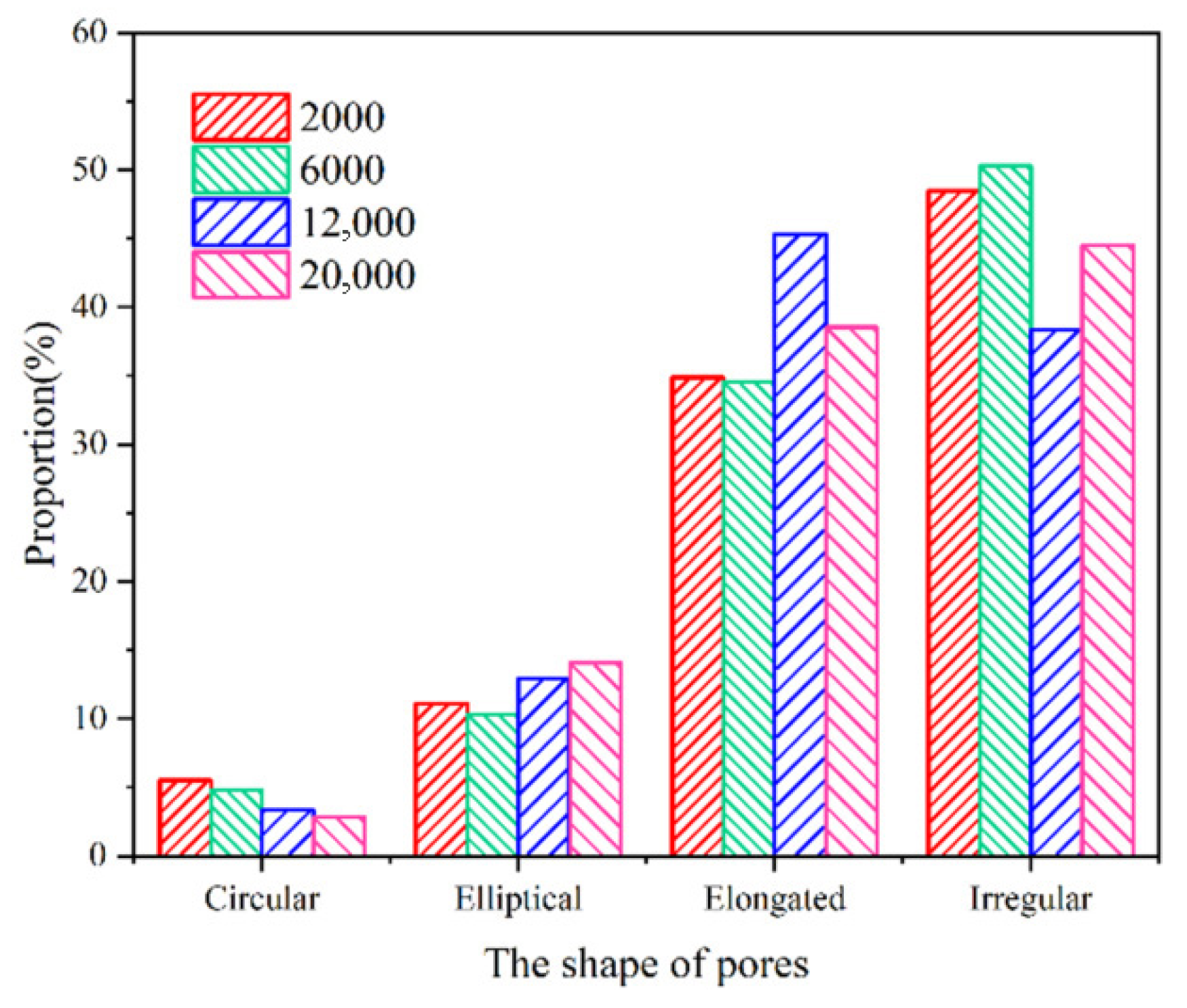
Define the aspect ratio of a pore as R, representing the ratio of its width to its length. Based on the R-value, pores are categorized as follows: circular (R ≥ 0.95), elliptical (0.95 > R ≥ 0.85), elongated (0.85 > R ≥ 0.65), or irregular (R < 0.65). The distribution of pore shapes in specimens under different fatigue cycles is shown in Figure 6.
As shown in Figure 6, at 2000, 6000, 12,000, and 20,000 fatigue cycles, the proportions of irregular and elongated pores were 83.37%, 84.66%, 83.70%, and 82.09%, respectively. This indicates that these pore shapes dominated throughout the process, accounting for over 80% of the total. In contrast, the combined proportion of circular and elliptical pores was less than 20%. Notably, the percentage of circular pores decreased with increasing cycles, declining from 5.51% at 2000 cycles to 2.84% at 20,000 cycles. This phenomenon can be attributed to two reasons. During the 3D-printing process, pores tend to form at the fiber–resin interface and extend along the fiber orientation, while micron-scale pores in resin-rich zones coalesce due to flow effects, forming initial irregular or elongated structures. During the fatigue stage, cyclic loading induces plastic deformation in some initially circular pores, reducing their aspect ratio and gradually transforming them into elliptical, elongated, or irregular shapes.
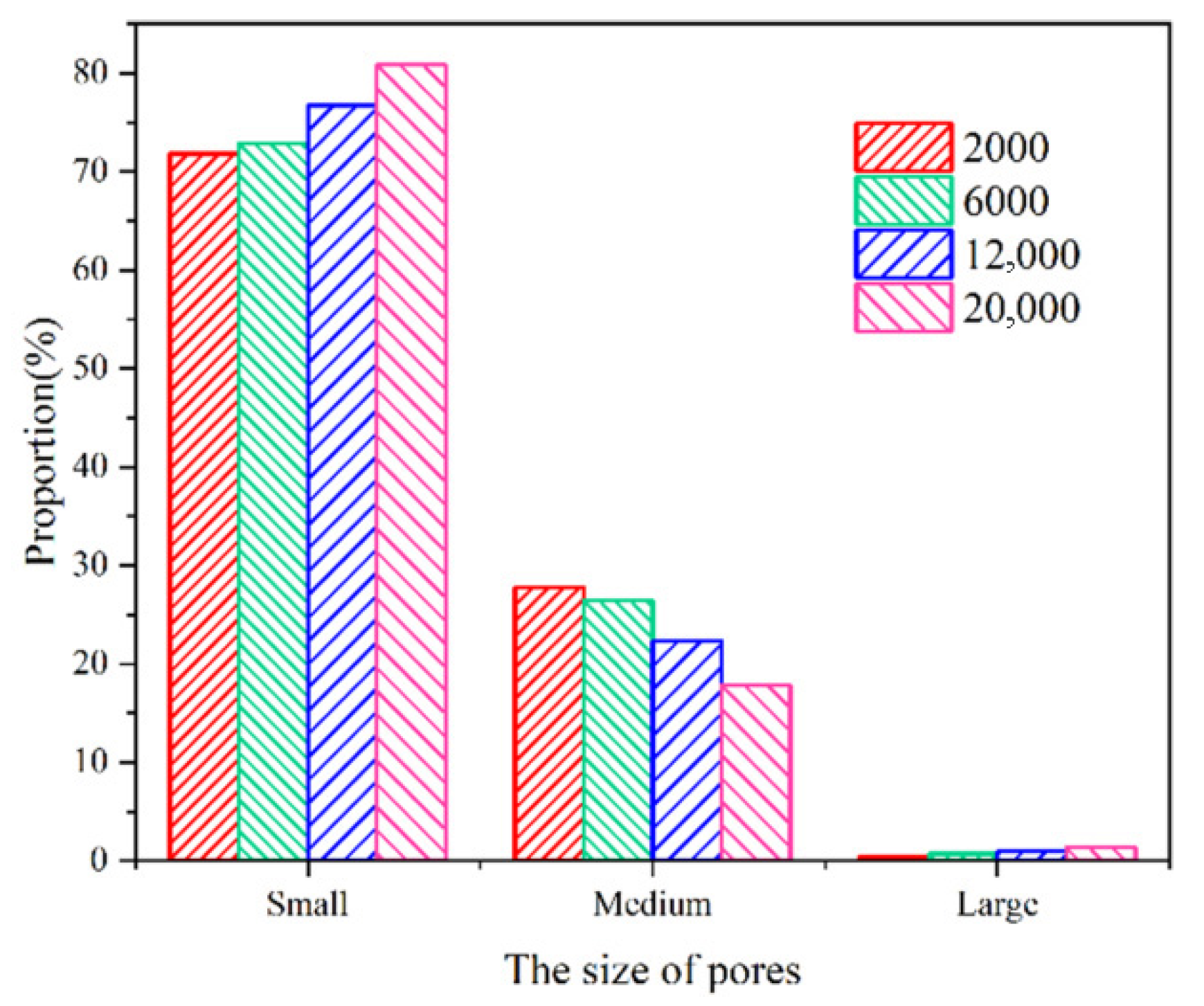
Figure 7 shows the histogram of pore-size distribution for specimens at different fatigue cycles. Pores were classified based on their cross-sectional area (S) calculated by ImageJ: small (S < 1 × 103 μm2), medium (1 × 103 μm2S ≤ 1 × 104 μm2), and large (S > 1 × 104 μm2). As shown in Figure 7, small-sized pores dominate in 3D-printed CFRPs, with a proportion greater than 70% at different cycle times. As the number of cycles increases, the proportion of small pores grows due to fatigue crack initiation, while the percentage of large pores also rises owing to stress-induced pore growth.

3.2. Ultrasonic Attenuation Coefficient and Porosity

Table 2 presents the test results for ultrasonic attenuation coefficients and porosity of specimens under different fatigue cycles. As can be seen from Table 2, the ultrasonic attenuation coefficient increases with the number of fatigue cycles. When ultrasonic waves encounter pores, a portion of the waves undergoes scattering, causing the ultrasonic energy to attenuate. The porosity of the specimens also exhibited an increasing trend with fatigue cycles. When the fatigue cycles increased from 2000 to 20,000, the average porosity rose from 9.95% to 12.21%, with an increase of 22.7%.

3.3. Ultrasonic Attenuation–Porosity Relationship Model

The ultrasonic attenuation coefficients of different specimens were determined through ultrasonic testing, while the corresponding porosity data were obtained via metallographic analysis. Based on the experimental data, a relationship model between the ultrasonic attenuation coefficient and porosity was established. Numerous scholars have conducted extensive research on the relationship between ultrasonic attenuation coefficients and porosity in composite materials, establishing various theoretical models. For example, the Stone theoretical model [26,27], the Martin theoretical model [28], and the Hale theoretical model [29]. These models typically assume pores to be regular spheres or disks, demonstrating good applicability under conditions of low porosity. However, as porosity increases, there is a relatively large deviation between the theoretical predictions and actual measurements. Under high porosity conditions, the influence of the geometric characteristics of pores (such as size and shape) on ultrasonic attenuation is significantly enhanced, which is the main reason for the decrease in the prediction accuracy of the theoretical models. Regression analysis based on experimental data reveals a quadratic relationship between the ultrasonic attenuation coefficient and porosity [30]. Zhou et al. [31,32] refined Martin’s theoretical model by comprehensively considering the effects of pore size, content, and ultrasonic frequency on attenuation. They also incorporated the attenuation contributions from resin and fibers within composite materials, establishing a quadratic relationship between the attenuation coefficient and porosity, as shown in Equation (11).
α T = C 0 + C 1 P V + C 2 P V 2
where αT is the ultrasonic attenuation coefficient, PV is the porosity, and C0, C1, and C2 are coefficients related to resin, fiber, and composite material defects, respectively.
C0, C1, and C2 can be theoretically calculated, but considering the diversity of 3D-printed carbon fiber composites, all parameters are calibrated using experimental data. Fitting the experimental data in Table 2 according to Equation (11), it can be obtained that C0 = 21.4098, C1 = −2.9811, and C2 = 0.1533. Then, the formula for calculating the porosity and ultrasonic attenuation coefficient is shown in Equation (12).
α T = 21.4098 2.9811 P V + 0.1533 P V 2

3.4. Fatigue Damage Evolution Prediction Based on LSTM

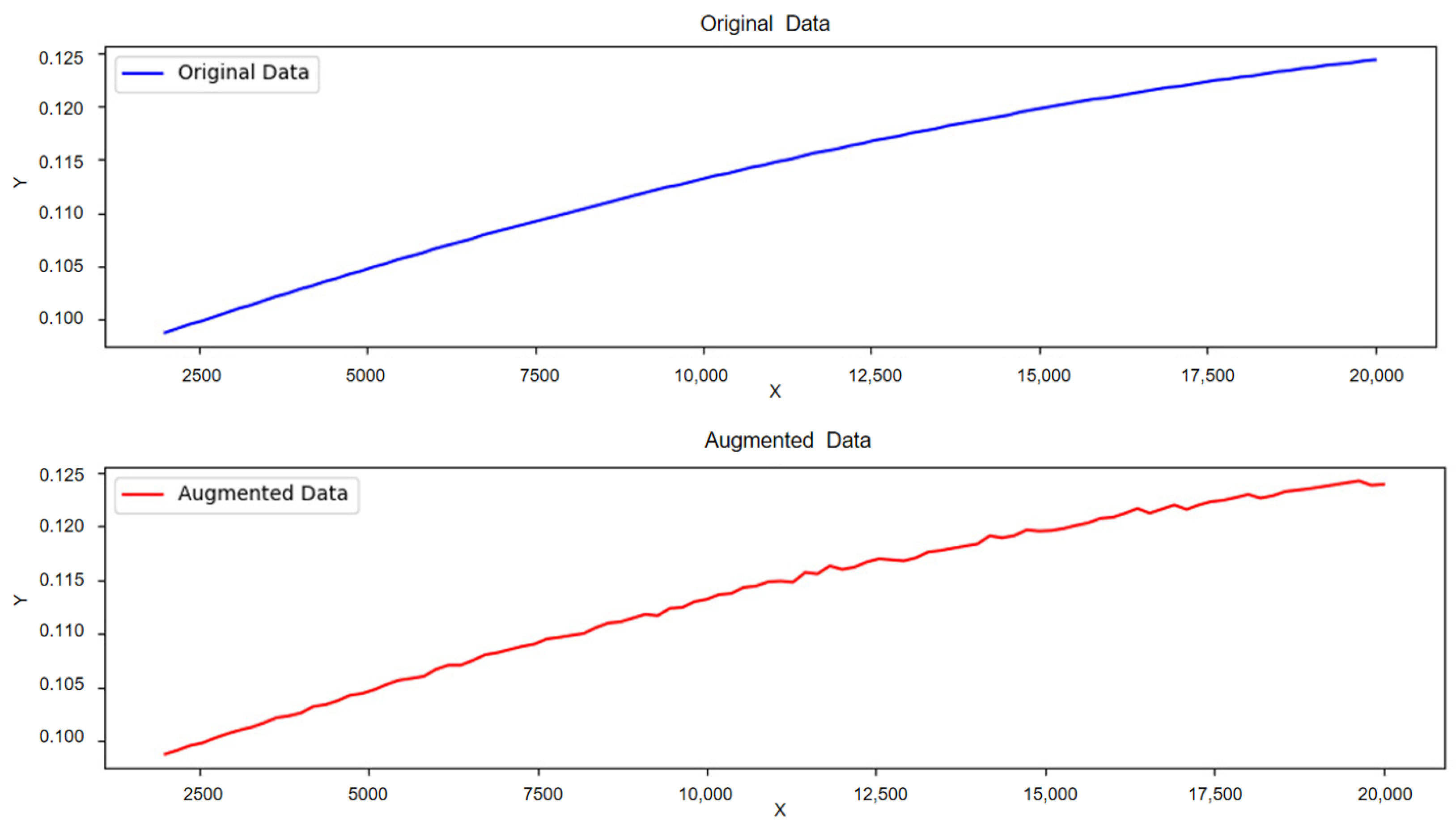
After data pre-augmentation, the 16 sets of porosity and fatigue cycles time-series data obtained from the experiments were expanded to 50 sets. The results of the data pre-augmentation are shown in Figure 8.
Taking these 50 sets of data as input, TimeGAN was used for data augmentation to meet the requirements of model training. There is a significant magnitude difference between fatigue cycles and porosity data, which can easily lead to weight imbalance during model training, causing the model to overemphasize features from the larger-magnitude dataset while neglecting those from the smaller-magnitude dataset. To address this, MinMaxScaler was applied to normalize the data. This method unifies the scale of all features, prevents features with larger values from dominating the training process, and thereby accelerates model convergence and improves prediction accuracy.
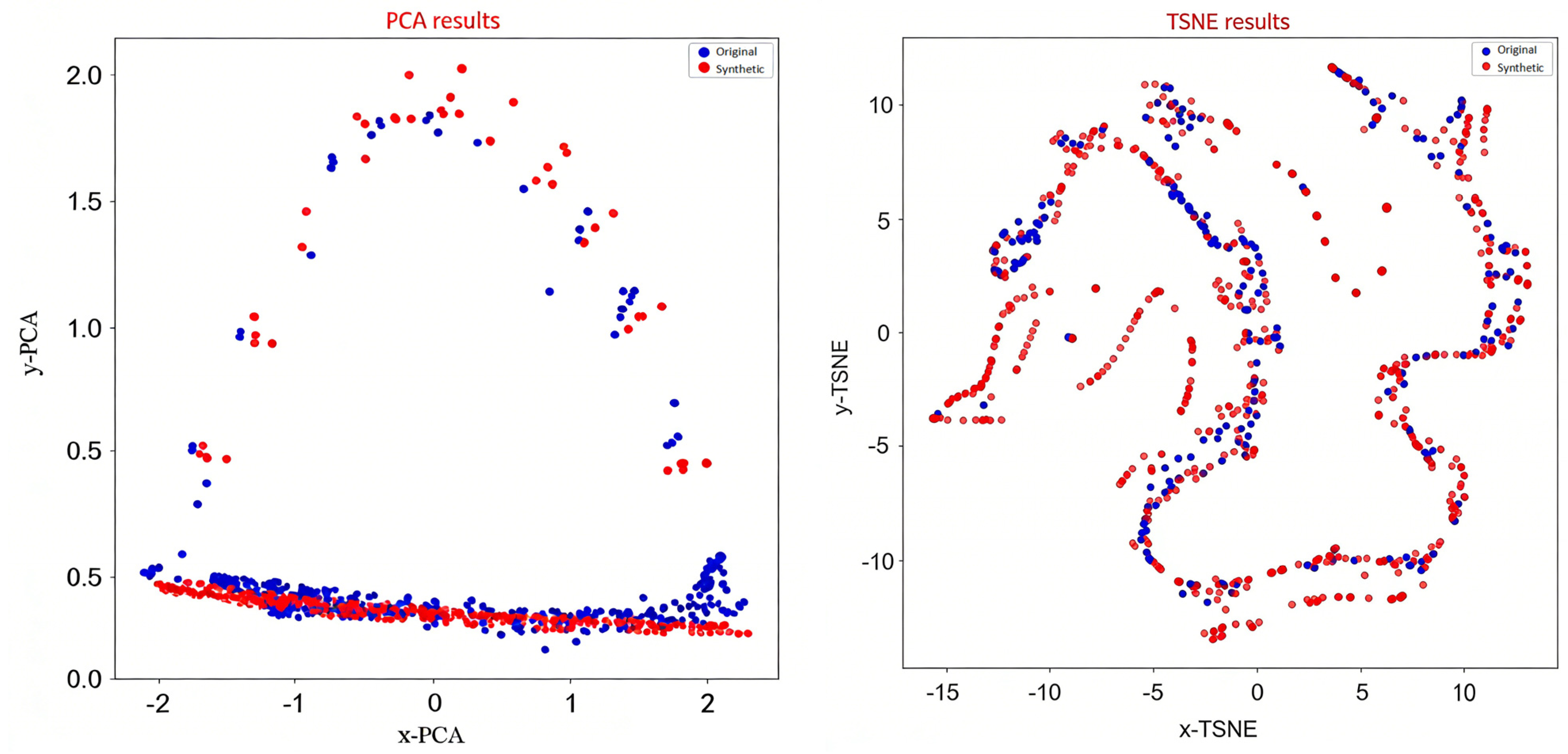
To effectively visualize the feature differences between augmented data and real data, TimeGAN commonly uses two dimensionality-reduction visualization techniques: Principal Component Analysis (PCA) and t-distributed Stochastic Neighborhood Embedding (t-SNE). Figure 9 shows the comparison of synthetic and real data after dimensionality reduction using PCA and t-SNE.
According to Figure 9, the generated data and the measured data are basically consistent in overall trend and distribution, with good boundary fitting and relatively uniform distribution of internal data points, indicating that the generated data can learn the main features of the original sequence. Although there are a small number of outliers, most of the data is concentrated within the feature groups, reflecting that the generated results have a certain degree of stability. At the same time, the generated data has a certain degree of coverage over the original data range. Therefore, the generated data can be added to the training set as enhanced samples to improve the model’s generalization ability in actual working conditions.
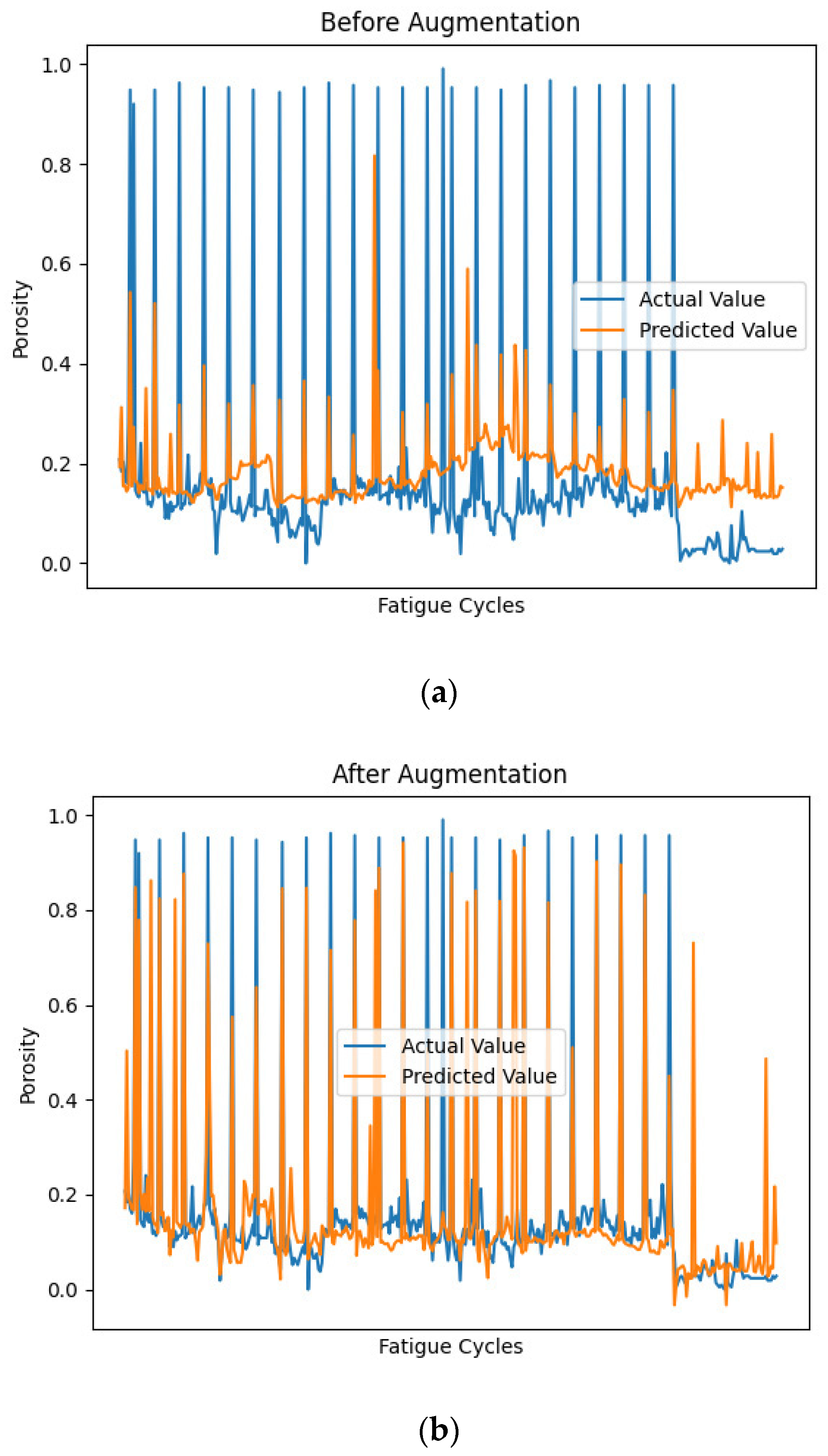
The final dataset generated by TimeGAN was divided into the following three parts: 80% for training, 10% for validation, and 10% for testing. Figure 10 shows the variation in porosity with fatigue cycles before and after data augmentation, where the blue curve and orange curve represent the experimental data and predicted data, respectively. As can be seen from Figure 10a, before data augmentation, the distribution pattern of the predicted data differs significantly from that of the original data, indicating that the model has not fully learned the distribution characteristics of the real data. As can be seen from Figure 10b, after data augmentation, the distribution pattern of the predicted data is closer to that of the original data compared with Figure 10a, which shows that the TimeGAN network can effectively achieve data augmentation.
Table 3 shows the fatigue cycles prediction results before and after data augmentation. As can be seen from Table 3, the predicted values of fatigue cycles are basically consistent with the actual values under different porosity conditions. After data augmentation, the RMSE, MAE, and MSE between the model predictions and the actual data were 0.138, 0.035, and 0.019, respectively, showing reductions of 26.2%, 72.6%, and 45.7% compared to the pre-augmentation values of 0.187, 0.128, and 0.035. RMSE reflects the stability of predictions, with lower values indicating better stability. MAE reflects the accuracy of prediction, and the smaller its value, the higher the accuracy. MSE measures the overall bias level of a prediction, and the smaller its value, the more accurate the prediction. The results indicate that combining TimeGAN with LSTM can effectively improve the accuracy of the Fatigue cycles prediction model.

4. Conclusions

This study investigates 3D-printed carbon fiber composites, establishing a relationship model between ultrasonic attenuation coefficient and porosity. LSTM networks are employed to predict the fatigue damage evolution of materials. The primary conclusions are as follows:
(1)
The variation laws of ultrasonic attenuation coefficient and porosity of 3D-printed CFRPs under different cycle times were obtained, and the evolution characteristics of pore morphology (including length, width, area, and aspect ratio) during the fatigue cycling process were analyzed.
(2)
Based on the test data of porosity and ultrasonic attenuation coefficient under different fatigue cycles, a quantitative relationship model between the two was established using the undetermined coefficient method.
(3)
A model of porosity and material fatigue cycles was established using LSTM neural network. By integrating this model with the previously determined porosity–ultrasonic attenuation coefficient relationship, fatigue life prediction of 3D-printed CFRPs can be achieved directly from ultrasonic attenuation coefficients.
The damage evolution prediction model constructed in this study serves as the foundation for further realization of fatigue life prediction. In practical applications, it is necessary to incorporate a failure criterion (e.g., critical porosity). The number of cycles corresponding to the point when the damage state predicted by the model reaches this criterion can be defined as the predicted fatigue life.

Author Contributions

Methodology, E.L. and S.X.; Validation, H.W.; Resources, H.W. and Y.Y.; Writing—original draft, E.L.; Writing—review & editing, S.X., Y.Y. and Y.L.; Supervision, H.C.; Project administration, H.C.; Funding acquisition, S.X. All authors have read and agreed to the published version of the manuscript.

Funding

This research was funded by Shanghai Education Development Foundation and Shanghai Municipal Education (grant number: 19SG51), and the APC was funded by Shanghai Municipal Education Commission (grant number: 2024AI011).

Institutional Review Board Statement

Not applicable.

Informed Consent Statement

Not applicable.

Data Availability Statement

The original contributions presented in this study are included in the article. Further inquiries can be directed to the corresponding author.

Acknowledgments

Thanks to the Reliability and Lightweight Design Lab, Shanghai University of Engineering Science, Shanghai, China, for the support with the testing work.

Conflicts of Interest

The authors declare no conflicts of interest.

References

  1. Costa, M.L.; de Almeida, S.F.M.; Rezende, M.C. The influence of porosity on the interlaminar shear strength of carbon/epoxy and carbon/bismaleimide fabric laminates. Compos. Sci. Technol. 2001, 61, 2101–2108. [Google Scholar]
  2. Chambers, A.R.; Earl, J.S.; Squires, C.A.; Suhot, M.A. The effect of voids on the flexural fatigue performance of unidirectional carbon fibre composites developed for wind turbine applications. Int. J. Fatigue 2006, 28, 1389–1398. [Google Scholar] [CrossRef]
  3. Zhang, A.Y.; Li, D.H.; Lu, H.B.; Zhang, D.X. Qualitative separation of the effect of voids on the bending fatigue performance of hygrothermal conditioned carbon/epoxy composites. Mater. Des. 2011, 32, 4803–4809. [Google Scholar] [CrossRef]
  4. Nikopour, H. A virtual frame work for predication of effect of voids on transverse elasticity of a unidirectionally reinforced composite. Comput. Mater. Sci. 2013, 79, 25–30. [Google Scholar] [CrossRef]
  5. Sisodia, S.; Gamstedt, E.K.; Edgren, F.; Varna, J. Effects of voids on quasi-static and tension fatigue behaviour of carbon-fibre composite laminates. J. Compos. Mater. 2015, 49, 2137–2148. [Google Scholar] [CrossRef]
  6. Maragoni, L.; Carraro, P.A.; Peron, M.; Quaresimin, M. Fatigue behaviour of glass/epoxy laminates in the presence of voids. Int. J. Fatigue 2017, 95, 18–28. [Google Scholar] [CrossRef]
  7. Liu, H.; Cui, H.; Wen, W.; Kang, H. Fatigue characterization of T300/924 polymer composites with voids under tension-tension and compression-compression cyclic loading. Fatigue Fract. Eng. Mater. Struct. 2018, 41, 597–610. [Google Scholar] [CrossRef]
  8. Lin, L.; Zhang, X.; Chen, J.; Mu, Y.F.; Li, X.M. A novel random void model and its application in predicting void content of composites based on ultrasonic attenuation coefficient. Appl. Phys. A Mater. Sci. Process. 2011, 103, 1153–1157. [Google Scholar]
  9. Ishii, Y.; Biwa, S.; Kuraishi, A. Influence of porosity on ultrasonic wave velocity, attenuation and interlaminar interface echoes in composite laminates: Finite element simulations and measurements. Compos. Struct. 2016, 152, 645–653. [Google Scholar] [CrossRef]
  10. Lin, L.; Luo, M.; Guo, G.P.; Li, X.M. Ultrasonic determination of carbon fiber composite porosity using acoustic impedance. Acta. Mater. Compos. Sin. 2009, 26, 105–110. [Google Scholar]
  11. Wang, P.F.; Wang, W.Q.; Zheng, S.L.; Chen, B.B.; Gao, Z.L. Fatigue damage evaluation of compressor blade based on nonlinear ultrasonic nondestructive testing. J. Mar. Sci. Eng. 2021, 9, 1358. [Google Scholar] [CrossRef]
  12. de Almeida, S.F.M.; Neto, Z.D.S.N. Effect of void content on the strength of composite laminates. Compos. Struct. 1994, 28, 139–148. [Google Scholar] [CrossRef]
  13. Jeong, H. Effects of Voids on the Mechanical Strength and Ultrasonic Attenuation of Laminated Composites. J. Compos. Mater. 1997, 31, 276–292. [Google Scholar] [CrossRef]
  14. Costa, M.L.; de Almeida, S.F.M.; Rezende, M.C. Critical Void Content for Polymer Composite Laminates. AIAA J. 2005, 43, 1336–1341. [Google Scholar] [CrossRef]
  15. Liu, L.; Zhang, B.M.; Wang, D.F.; Wu, Z.J. Effects of cure cycles on void content and mechanical properties of composite laminates. Compos. Struct. 2006, 73, 303–309. [Google Scholar] [CrossRef]
  16. Zhu, H.Y.; Wu, B.C.; Li, D.H.; Zhang, D.X.; Chen, Y.Y. Influence of Voids on the Tensile Performance of Carbon/epoxy Fabric Laminates. J. Mater. Sci. Technol. 2011, 27, 69–73. [Google Scholar] [CrossRef]
  17. Mehdikhani, M.; Gorbatikh, L.; Verpoest, I.; Lomov, S.V. Voids in fiber-reinforced polymer composites: A review on their formation, characteristics, and effects on mechanical performance. J. Compos. Mater. 2019, 53, 1579–1669. [Google Scholar] [CrossRef]
  18. Lee, H.; Cho, Y.; Park, H. Study on the Properties and Fatigue Characteristics of Glass Fiber Composites Due to Porosity. Appl. Sci. 2024, 14, 6234. [Google Scholar] [CrossRef]
  19. Yang, J.Y.; Kang, G.Z.; Liu, Y.J.; Kan, Q.H. A novel method of multiaxial fatigue life prediction based on deep learning. Int. J. Fatigue 2021, 151, 106356. [Google Scholar] [CrossRef]
  20. Yan, H.R.; Yu, H.J.; Zhu, S.; Yin, Y.D.; Guo, L.C. Machine learning based framework for rapid forecasting of the crack propagation. Eng. Fract. Mech. 2024, 307, 110278. [Google Scholar] [CrossRef]
  21. Jian, Y.A.; Hu, P.; Zhou, Q.H.; Zhang, N.; Cai, D.A.; Zhou, G.M.; Wang, X.W. A novel bidirectional LSTM network model for very high cycle random fatigue performance of CFRP composite thin plates. Int. J. Fatigue 2025, 190, 108627. [Google Scholar] [CrossRef]
  22. Demo, L.B.; Nieduzak, T.B.; Feng, M.Q.; Aitharaju, V.R. Fatigue life prediction of self-sensing hybrid FRP composites via electrical resistance monitoring and LSTM neural network. Compos. Struct. 2025, 367, 119238. [Google Scholar] [CrossRef]
  23. GB/T35465.3-2017; Test Method for Fatigue Properties of Polymer Matrix Composite Materials—Part 3: Tension-Tension Fatigue. Standards Press of China: Beijing, China, 2017.
  24. Lu, M.H.; Zhang, X.S.; Zheng, S.P.; Jiang, S.L. The comparative study of porosity characterization method of carbon fiber composite by ultrasound. Compos. Sci. Eng. 2018, 7, 42–48. (In Chinese) [Google Scholar]
  25. GB/T 3365-2008; Carbon Fiber Reinforced Plastics-Determination of Pore Content and Fiber Volume Content. Standards Press of China: Beijing, China, 2008.
  26. Stone, D.E.W.; Clarke, B. Ultrasonic attenuation as a measure of void content in carbon-fiber reinforced plastics. Non-Destr. Test. 1975, 8, 137–145. [Google Scholar] [CrossRef]
  27. Jones, B.R.; Stone, D.E.W. Towards an ultrasonic-attenuation technique to measure void content in carbon-fiber composites. Non-Destr. Test. 1976, 9, 71–79. [Google Scholar] [CrossRef]
  28. Martin, B.G. Ultrasonic attenuation due to voids in fiber-reinforced plastics. NDT Int. 1976, 9, 242–246. [Google Scholar] [CrossRef]
  29. Hale, J.M.; Ashton, J.N. Ultrasonic attenuation in voided fiber-reinforced plastics. NDT Int. 1988, 21, 321–326. [Google Scholar]
  30. Mouritz, A.P. Ultrasonic and interlaminar properties of highly porous composites. J. Compos. Mater. 2000, 34, 218–239. [Google Scholar] [CrossRef]
  31. Zhou, X.J.; You, H.W.; Cheng, Y.D. Ultrasonic attenuation model of void contained carbon-fiber reinforced plastics. Acta. Mater. Compos. Sin. 1997, 14, 99–106. (In Chinese) [Google Scholar]
  32. Zhou, X.J.; Mo, J.Q.; You, H.W. Ultrasonic attenuation testing method for NDE of void content based on theoretical model and experiment calibration. Acta. Mater. Compos. Sin. 1997, 14, 107–114. [Google Scholar]
Figure 1. Schematic diagram of 3D-printed specimen layup.
Applsci 16 01139 g001
Figure 2. Schematic diagram of the specimen dimensions.
Applsci 16 01139 g002
Figure 3. Specimens.
Applsci 16 01139 g003
Figure 4. Metallographic sample preparation.
Applsci 16 01139 g004
Figure 5. Pore morphology under microscope.
Applsci 16 01139 g005
Figure 6. Histogram of pore-shape distribution.
Applsci 16 01139 g006
Figure 7. Histogram of pore-size distribution.
Applsci 16 01139 g007
Figure 8. Data pre-augmentation.
Applsci 16 01139 g008
Figure 9. Comparison of synthetic and real data after dimensionality reduction using PCA and t-SNE.
Applsci 16 01139 g009
Figure 10. Variation in porosity with fatigue cycles before and after augmentation. (a) Before augmentation. (b) After augmentation.
Applsci 16 01139 g010
Table 1. Pore sizes of 3D-printed specimens.
Fatigue CyclesLmin (µm)Lmax (µm)L (µm)Wmin (µm)Wmax (µm)W (µm)
200014.83398.0349.237.835158.2323.05
600016.61400.7950.747.615162.8823.62
12,00015.18452.6152.227.58159.74524.01
20,00014.78587.0856.847.29228.6525.77
Table 2. Results of Ultrasonic Attenuation Coefficient and Porosity.
Specimen No.Fatigue CyclesUltrasonic Attenuation Coefficients (dB/mm)Standard DeviationAverage
Porosity (%)
Standard Deviation
1-120006.9000.0989.9080.236
1-260007.1050.13510.5720.544
1-312,0007.5200.06511.6630.943
1-420,0007.9650.31112.4281.131
2-120006.9250.0879.9800.958
2-260007.0700.11910.8991.219
2-312,0007.5350.18511.6720.841
2-420,0008.0500.33812.4140.846
3-120006.9350.1229.6290.693
3-260007.0000.19810.5500.444
3-312,0007.4650.13611.9440.389
3-420,0007.9650.31112.4360.525
4-120006.9000.1599.9580.744
4-260007.0950.12610.5500.798
4-312,0007.5700.11911.6730.309
4-420,0008.0500.14312.2180.918
Table 3. Fatigue cycles prediction results before and after augmentation.
Porosity9.87%10.49%11%11.60%12.28%
Actual fatigue cycles20005000800012,00018,000
Prediction values before augmentation21695132782112,19018,220
Prediction values after augmentation20385022803411,98318,045
Disclaimer/Publisher’s Note: The statements, opinions and data contained in all publications are solely those of the individual author(s) and contributor(s) and not of MDPI and/or the editor(s). MDPI and/or the editor(s) disclaim responsibility for any injury to people or property resulting from any ideas, methods, instructions or products referred to in the content.