Robust Localization of Flange Interface for LNG Tanker Loading and Unloading Under Variable Illumination a Fusion Approach of Monocular Vision and LiDAR

Abstract
1. Introduction
- An illumination-adaptive radar-camera fusion framework is proposed. The illumination intensity is evaluated via the gray mean value, and the parameters of edge detection and circle detection are dynamically adjusted to adapt to complex scenarios including uniform illumination, local strong light, and low light with water film.
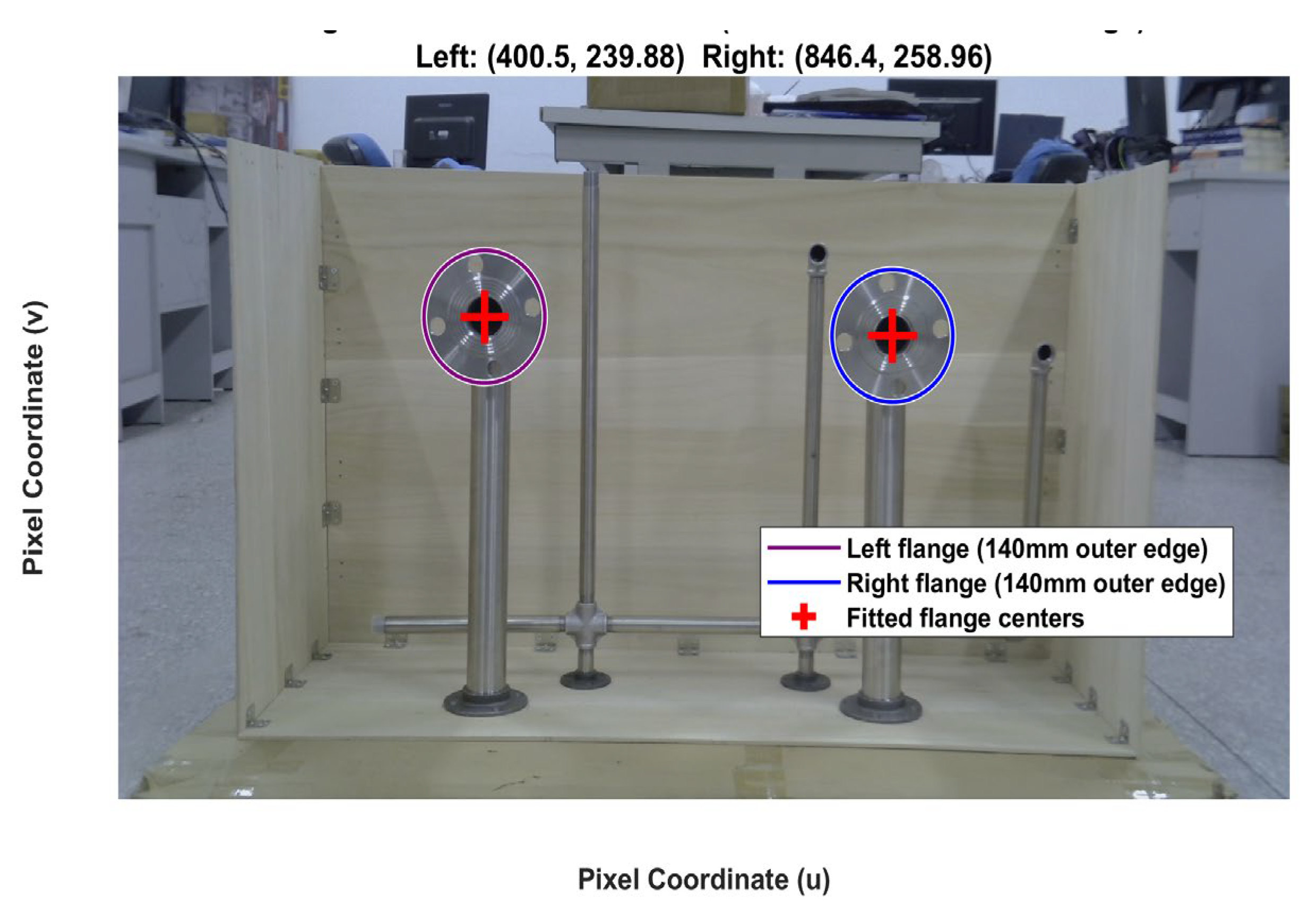
- A multi-constraint flange detection and fitting strategy is designed. Background interference is eliminated by combining the physical size constraints of flanges, the left and right flanges are distinguished using K-means clustering, and weighted fitting is adopted to enhance the core features of the outer edge circle, thereby improving the positioning stability.
- A fusion positioning process featuring Region of Interest (ROI) extraction-plane fitting-3D circle center solving is established. The ROI of LiDAR point cloud is extracted under the constraint of the 2D circle center obtained by vision, valid points are filtered via plane fitting, and the 3D circle center fitting of sparse point cloud is completed by integrating the physical radius constraints of flanges, which accurately compensates for the depth error of monocular vision.
2. Spatiotemporal Synchronization of LiDAR and Cameras
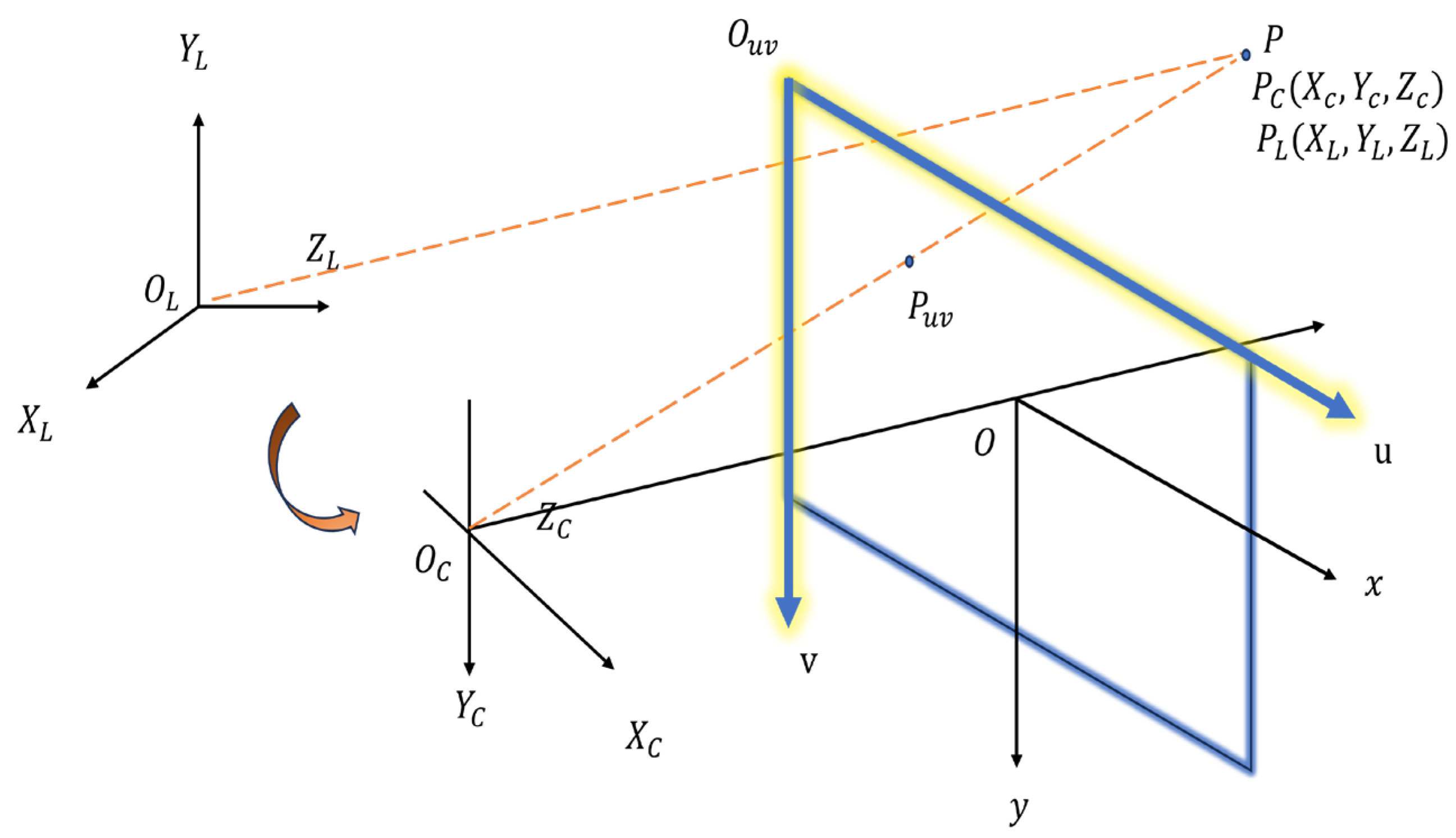
2.1. Spatial Synchronization
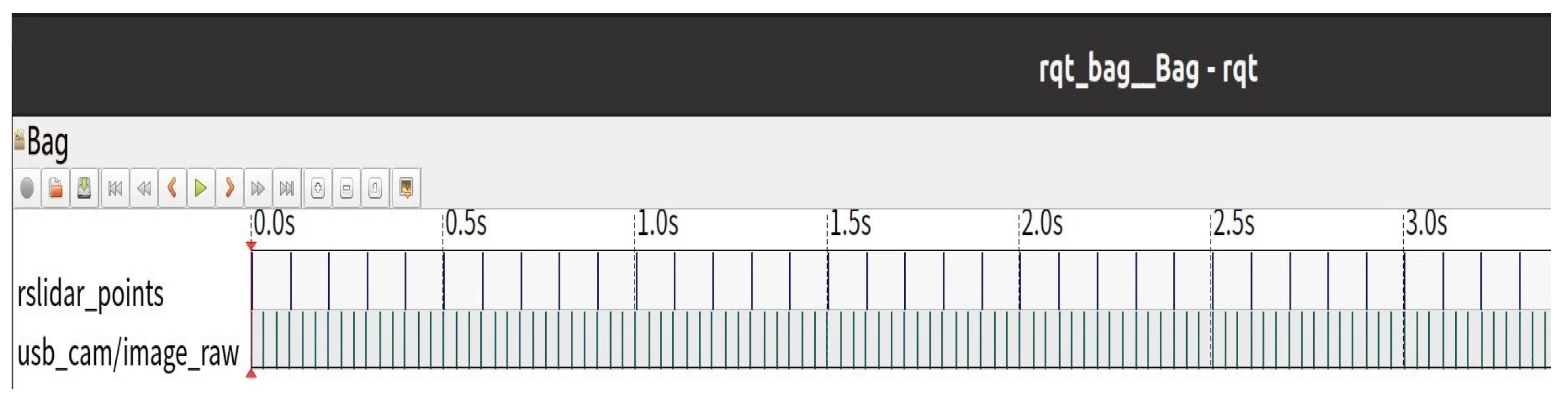
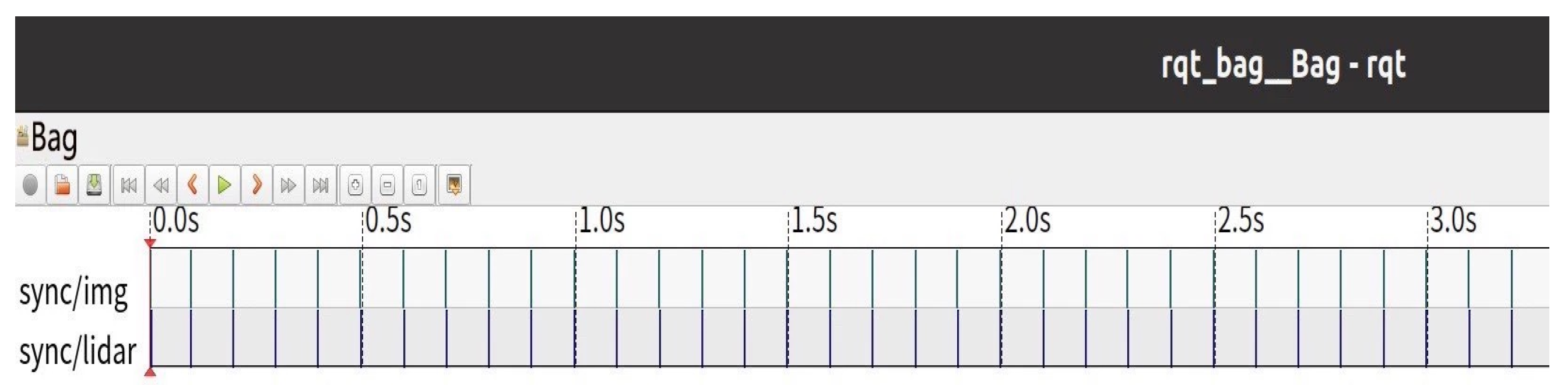
2.2. Time Synchronization
3. Research Methodology
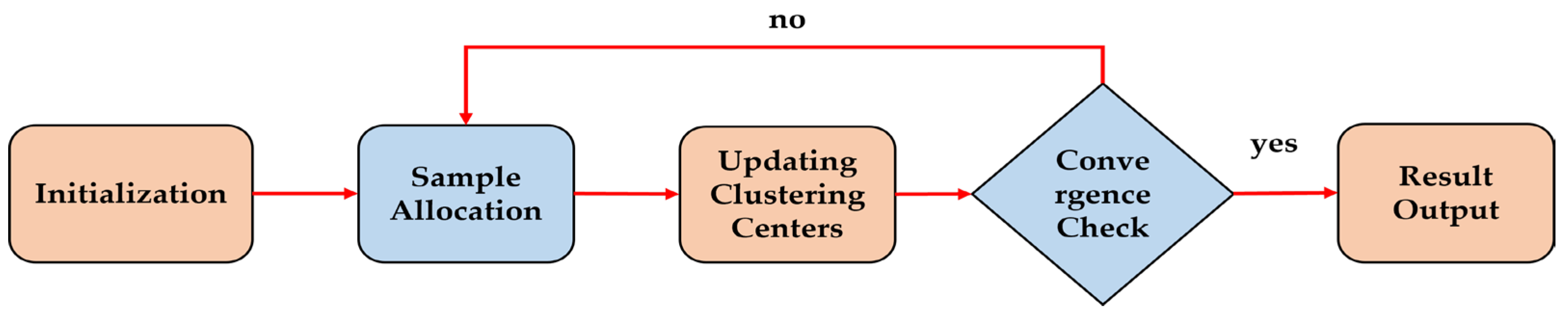
3.1. Basic Principles of Circle Detection
3.2. Rationale for Circle Detection Method Selection and Co-Design
- (1)
- Inherent Robustness to Illumination-Induced Edge Defects: The core challenge in this scenario is extreme illumination (intense glare, low light, water film), causing target edge blurring, fragmentation, or generation of false edges. Classical circle detection methods (e.g., the standard Hough transform) heavily rely on complete and continuous edges, leading to significant performance degradation when edges are broken [25]. In contrast, the gradient voting method operates on the principle that edge point gradient directions converge toward the circle center for voting, demonstrating stronger tolerance to edge discontinuities [24]. This aligns better with the interference patterns caused by illumination in our specific scenario.
- (2)
- Deep Synergy with the Multi-Stage, Strongly Constrained Optimization Pipeline: The core innovation of our localization framework lies not in a single detection module, but in a multi-stage optimization pipeline. The gradient voting method can output all possible candidate circles in the image (including the inner/outer flange circles and background interference circles). This provides an ideal input interface for the subsequent series of customized optimization steps:Physical Dimension Constraint Filtering: Quickly eliminates interferences that do not conform to the known flange dimensions from the candidate set.K-means Spatial Clustering: Utilizes the center coordinates of all candidate circles for clustering to reliably distinguish the left/right flange layout.Weighted Center Fitting: Comprehensively utilizes the more reliable outer edge circle and the auxiliary central hole circle to achieve robust center estimation.Employing an end-to-end deep learning approach would make it difficult to transparently and flexibly embed the above optimization logic based on strong physical priors due to its “black-box” nature. Conversely, methods like direct ellipse fitting cannot provide a rich set of candidates for screening and fusion.
- (3)
- Determinism and Debuggability in Engineering Deployment: Given the characteristics of this task—fixed target size and clear geometric rules—a geometric method with high interpretability offers greater engineering advantages over a data-driven deep learning solution. The former possesses the merits of relatively controllable computational load, high output determinism, and logical transparency, facilitating implementation, debugging, and integration with control algorithms in industrial embedded systems. Furthermore, its modular pipeline (edge detection → gradient calculation → voting) allows our proposed illumination-adaptive mechanism (Section 3.3.2)—which dynamically adjusts Canny detection parameters via grayscale evaluation—to be directly and efficiently integrated at the front end, forming a “perception-evaluation-adjustment” closed loop.
3.3. Optimization of Flange Interface Detection
3.3.1. Geometric Dimension Constraint
- Sensor Invariance: The experiment employs a fixed-focus camera (Logitech C270) with no optical zoom. Therefore, its intrinsic matrix remains constant during operation, providing the physical basis for scale stability.
- Constrained Working Range: As defined in Section 4.1, the system’s effective working distance is limited to 1.0–2.5 m. Within this short-to-medium range, the nonlinear scale variation caused by perspective projection is minimal, allowing mm2pixel to be treated as approximately linear.
- Algorithmic Tolerance Design: As shown in Equations (16) and (17), we introduced a ±20% tolerance band for radius detection. This tolerance band adequately accommodates potential deviations in pixel radius estimation arising from minor distance variations, residual camera calibration errors, and slight fluctuations in the mm2pixel coefficient itself. Consequently, the system is not sensitive to the precise value of mm2pixel.
- Robustness of Subsequent Processing: Even if some candidate circles are incorrectly included due to scale estimation deviation, the subsequent K-means spatial clustering (Section 3.3.3) and weighted center fitting (Section 3.4) steps can effectively suppress outliers, ensuring the stability of the final localization results.
3.3.2. Adaptive Illumination Adjustment
- Illumination Evaluation Index and Threshold Setting Basis
- Low illumination threshold (L < 0.3): In the scenarios of uniform low illumination and low illumination with water film, the overall grayscale of the image is relatively low, the contrast between the target and the background is weakened, and the default parameters of Canny are prone to edge breakage or missed detection, so it is necessary to reduce the threshold to retain weak edges.
- High illumination threshold (L > 0.7): In the scenario of local strong illumination, the specular reflection on the metal surface of the flange will introduce gradient noise and false edges, so it is necessary to increase the threshold and enhance filtering to suppress interference.
- Normal illumination (0.3 ≤ L ≤ 0.7): The illumination condition is ideal, the edge features are clear, and the use of compromised parameters can achieve stable detection.
- 2.
- Dynamic Parameter Adjustment Strategy and Its Performance Impact
- Low illumination (L < 0.3): 2 × 2 median filtering + Canny thresholds [0.1, 0.2] + circle detection sensitivity 0.92.
- High illumination (L > 0.7): 5 × 5 median filtering + Canny thresholds [0.25, 0.4] + circle detection sensitivity 0.8.
- Normal illumination (0.3 ≤ L ≤ 0.7): 3 × 3 median filtering + Canny thresholds [0.15, 0.3] + circle detection sensitivity 0.86.
3.3.3. K-Means Clustering Algorithm
3.4. Weighted Fitting of Flange Circle Centers
3.5. Fusion Positioning
3.5.1. Point Cloud Preprocessing
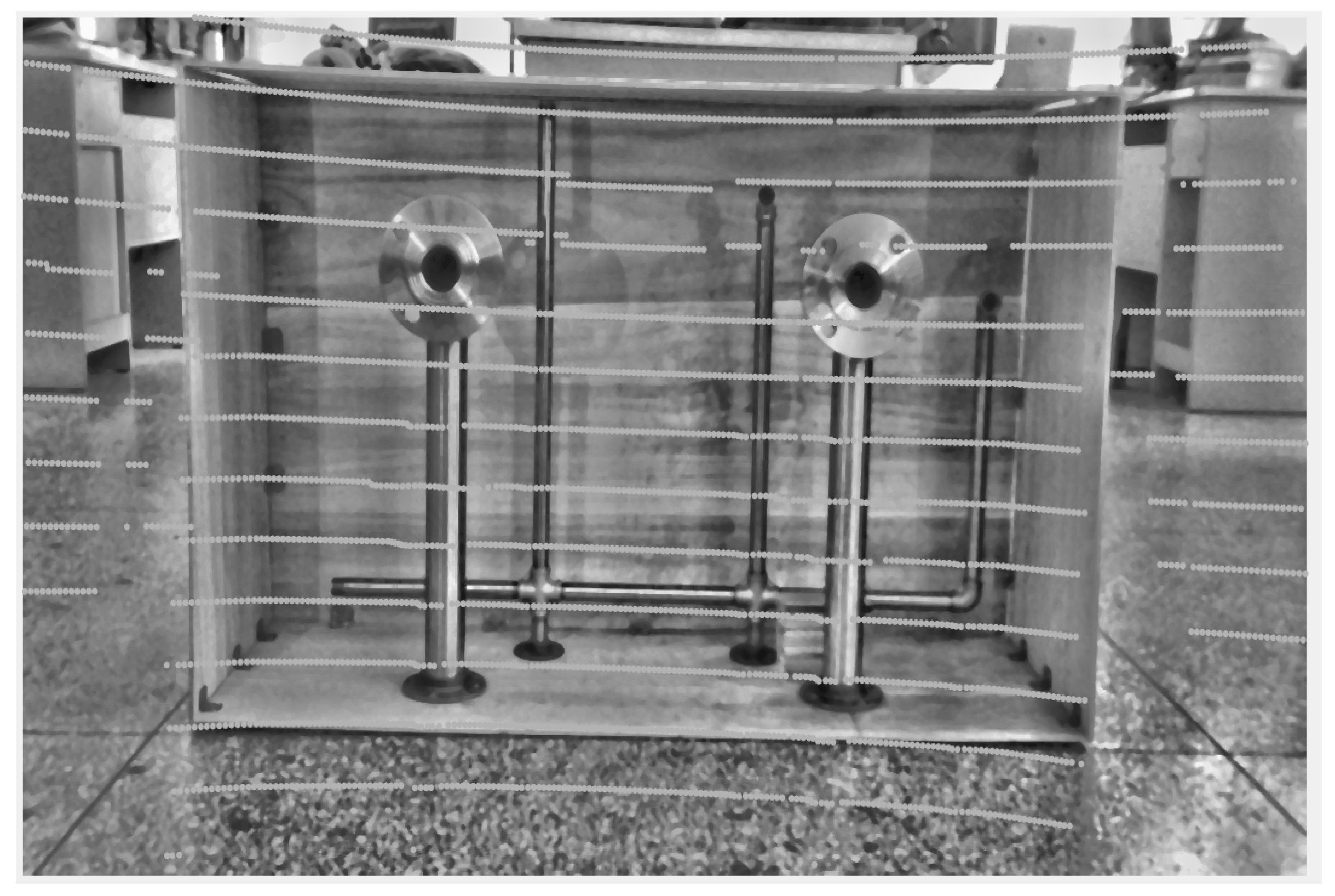
3.5.2. Point Cloud ROI Extraction
- Pixel Range Threshold (Rₚᵢₓₑₗ = 60): Based on the pixel coordinates (u0, v0) of the flange center obtained through visual detection, only LiDAR projected points (uₚ, vₚ) that satisfy the Euclidean distance constraint from this center are retained as ROI candidates. The distance calculation is shown in Equation (21):
- Depth Range Threshold (Z ∈ [1.0, 2.5] m): Combined with the effective working distance of the system defined in Section 4.1, point clouds with depths in the range of 1.0–2.5 m in the camera coordinate system are filtered. The lower limit of 1.0 m avoids near-field blind spot data of the LiDAR, and the upper limit of 2.5 m ensures a point cloud density, meeting the requirements for subsequent plane and circle fitting.
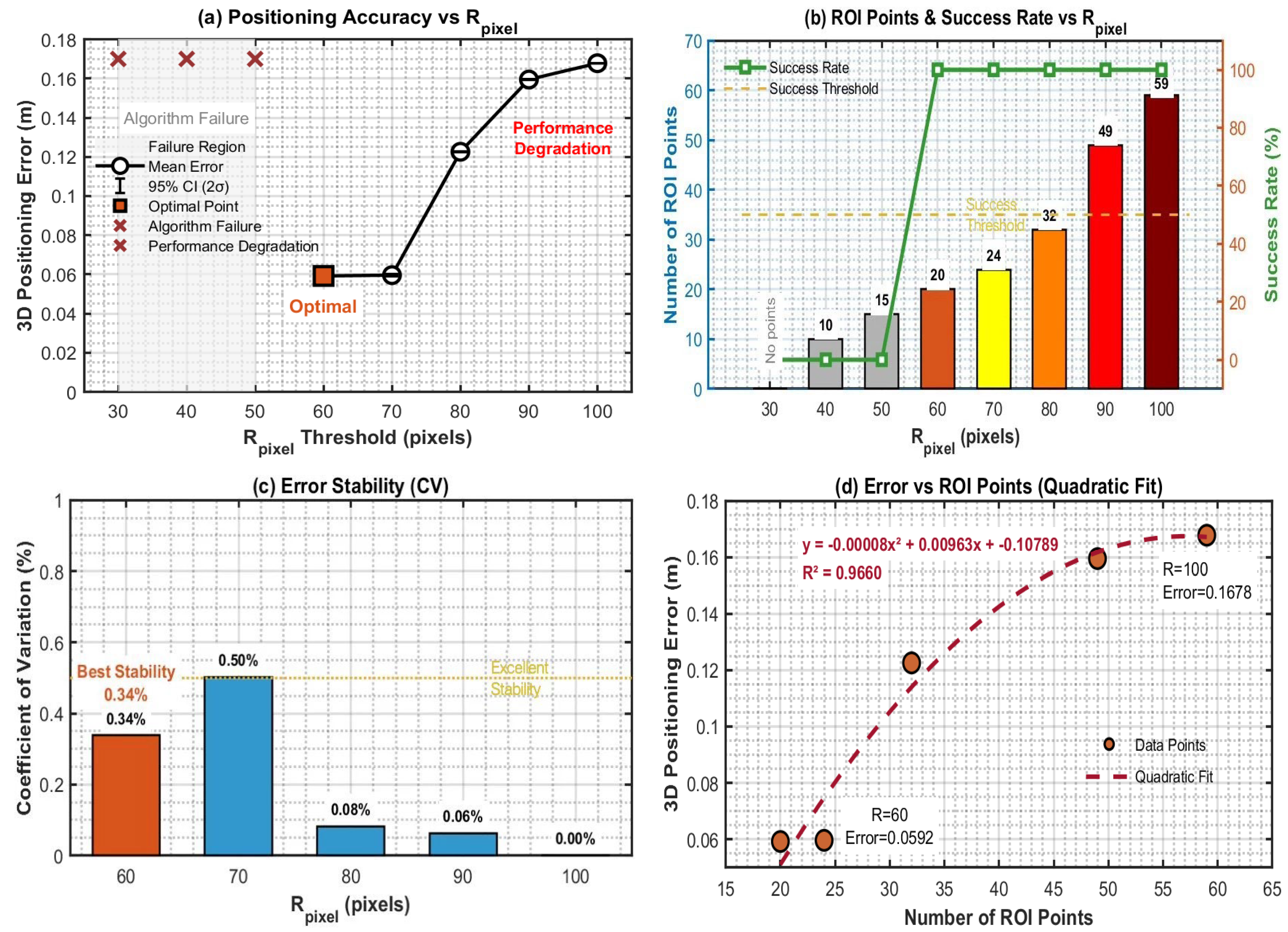
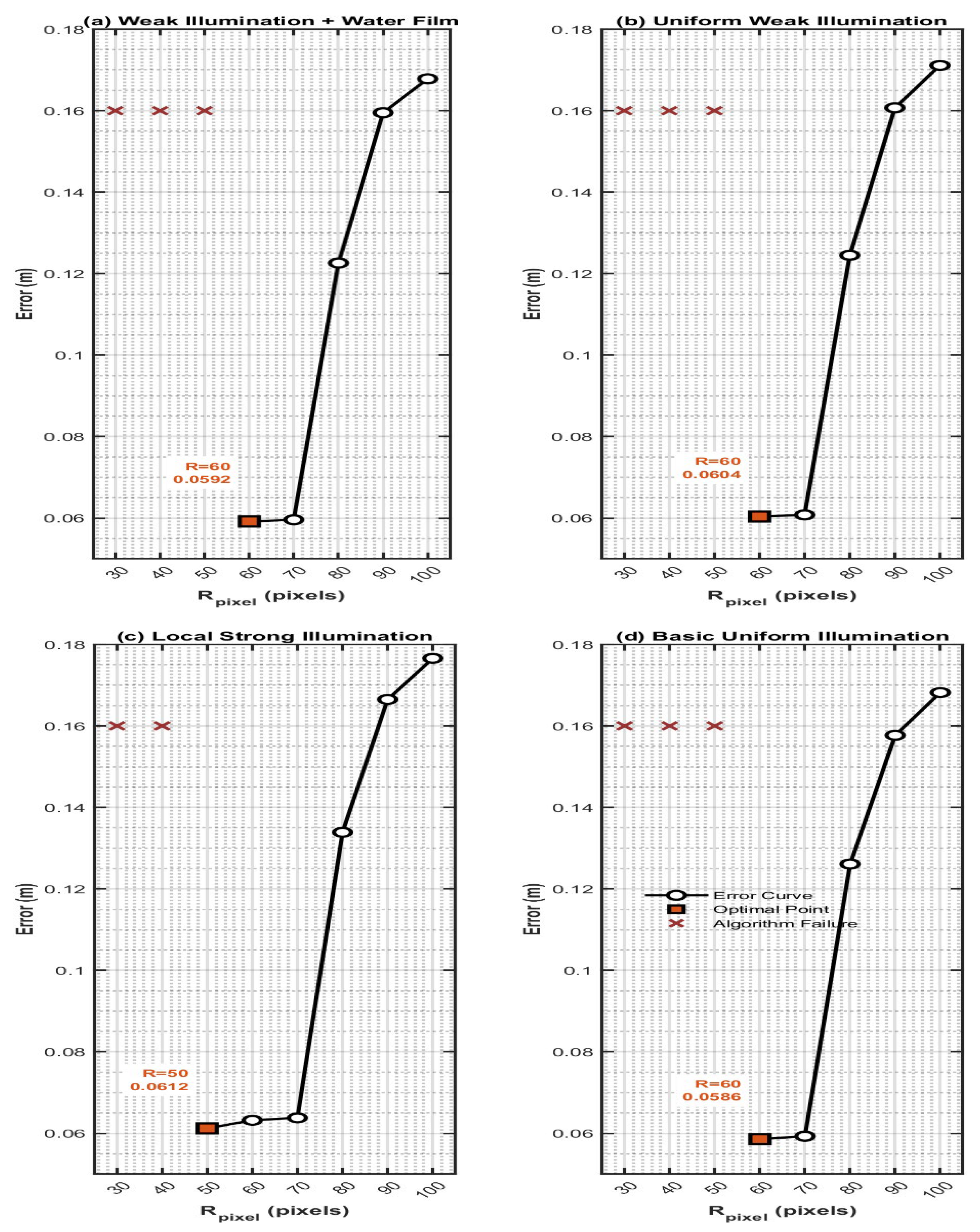
- Variable Setting: The pixel range threshold Rₚᵢₓₑₗ was set as the only variable, taking values of 30, 40, 50, 60, 70, 80, 90, and 100 pixels (with a step size of 10), while the depth range threshold was fixed at [1.0, 2.5] m.
- Evaluation Metrics: Positioning accuracy (3D error), ROI point cloud quantity, and algorithm success rate (number of valid plane fittings/total number of tests).
- Performance Defects of Rₚᵢₓₑₗ < 60: When Rₚᵢₓₑₗ = 30–40, the number of ROI points is ≤9.5, leading to complete failure of plane fitting due to insufficient valid points (success rate = 0%); when Rₚᵢₓₑₗ = 50, although the success rate reaches 100%, the number of ROI points is only 15, the positioning error (0.0604 m) is higher than that of Rₚᵢₓₑₗ = 60, and the error stability is poor (coefficient of variation = 0.50%), making it difficult to meet the fitting requirements under complex illumination.
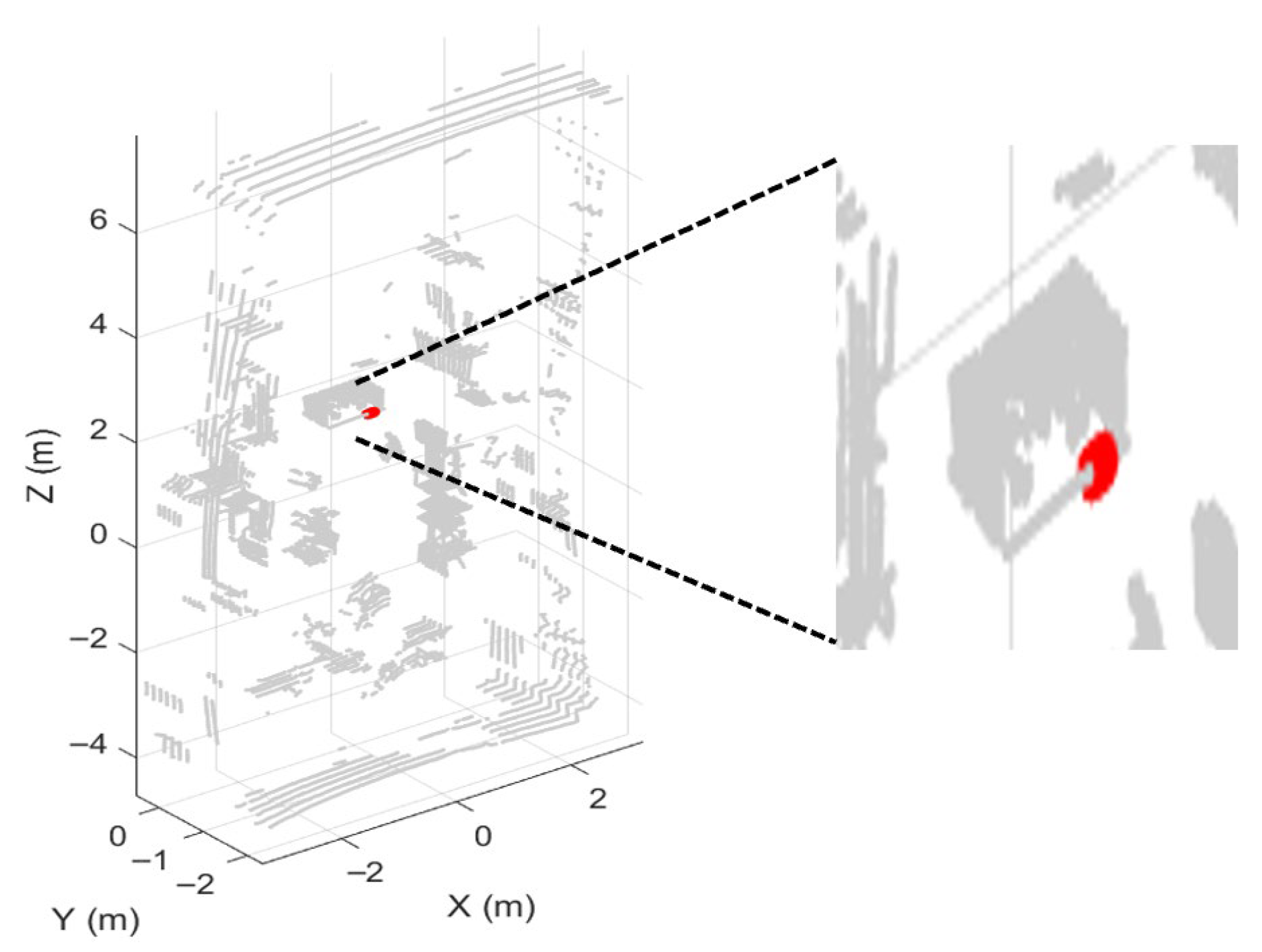
- Optimality Verification of Rₚᵢₓₑₗ = 60: Under this threshold, the number of ROI points stabilizes at 19.5, which not only meets the minimum number of points required for plane fitting but also does not introduce redundant background points; the positioning error reaches the minimum value (0.0592 m) with a coefficient of variation in only 0.34%, showing optimal stability. The ROI point clouds extracted under this threshold can accurately separate flange targets from background interference such as pipes and brackets, as shown in Figure 10, providing high-quality input for subsequent fitting.
- Performance Degradation of Rₚᵢₓₑₗ > 60: When Rₚᵢₓₑₗ ≥ 70, although the number of ROI points continues to increase, the expanded pixel range incorporates a large amount of background noise, leading to a significant rise in positioning error (reaching 0.1243 m at 80 pixels, 2.1 times that at 60 pixels). Moreover, the error continues to deteriorate as Rₚᵢₓₑₗ increases, failing to meet the accuracy requirements for industrial docking.
- Cross-Scenario Robustness: Rₚᵢₓₑₗ = 60 maintains optimal accuracy and stability in all illumination scenarios: the error is 0.0586 m under basic uniform illumination, 0.0632 m under local strong illumination, and 0.0592 m under weak illumination with water film, verifying the strong adaptability of this threshold to illumination changes.
3.5.3. Flange Plane Fitting
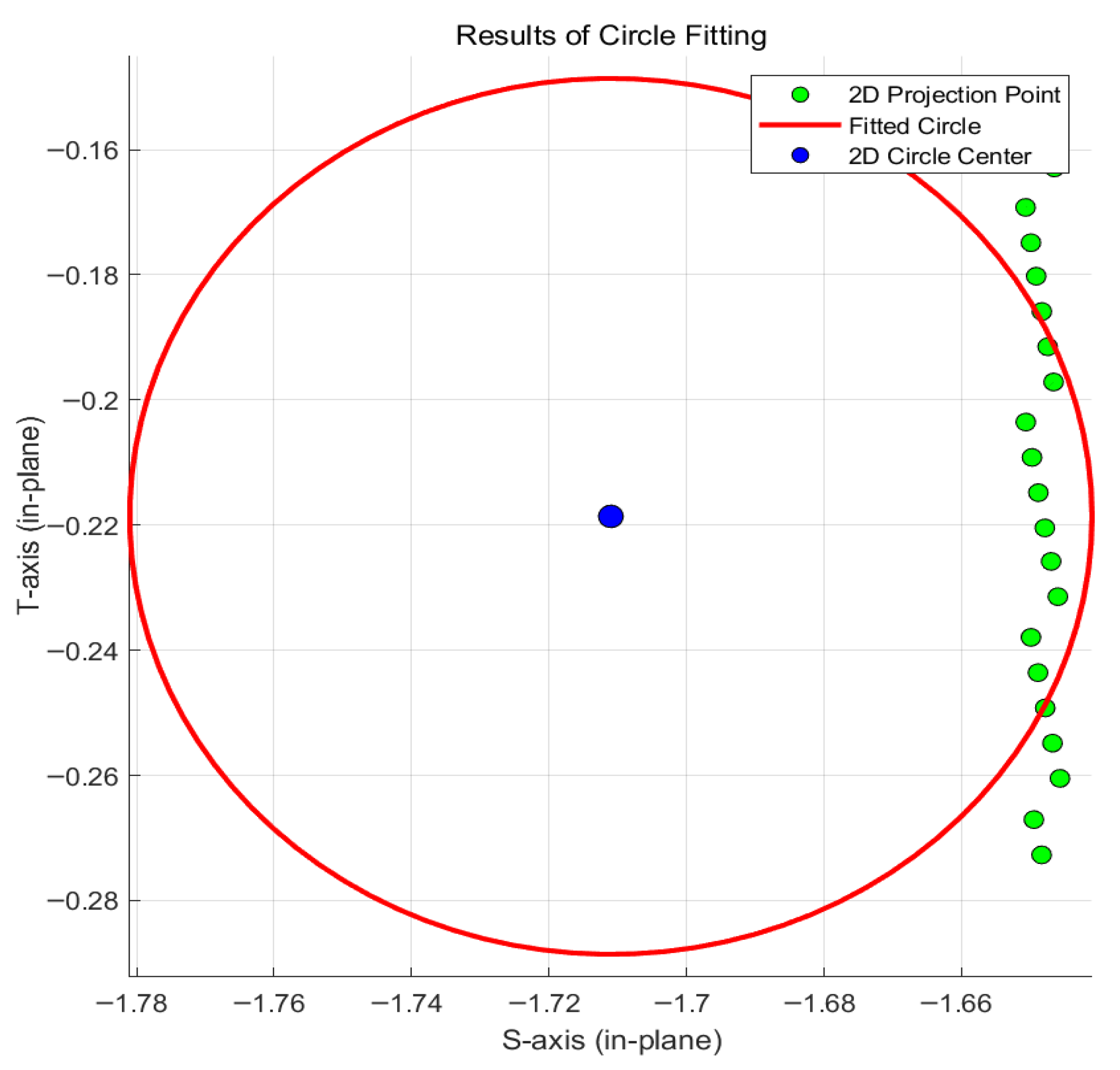
3.5.4. Circle Fitting and 3D Circle Center Calculation
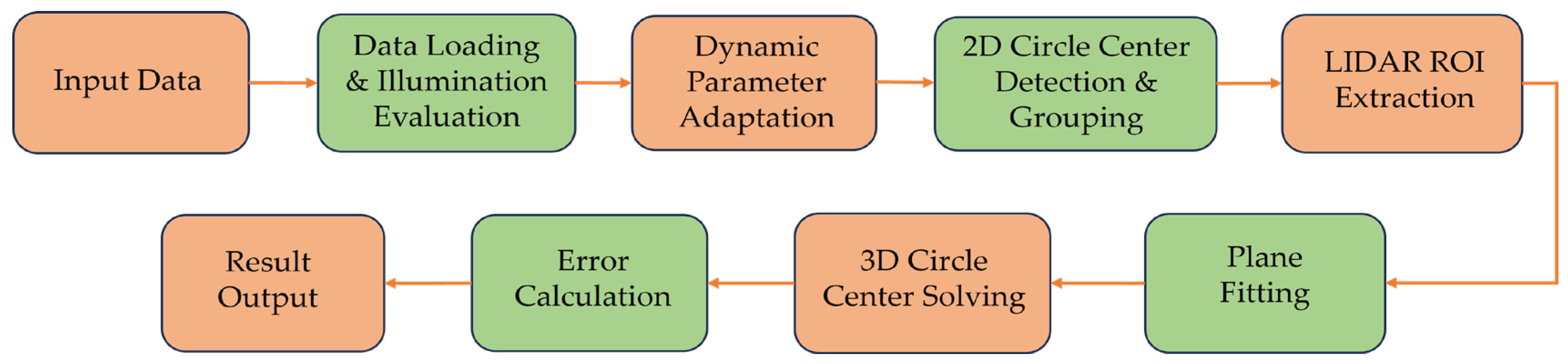
3.6. Overall Algorithm Flowchart and Pseudocode
| Algorithm 1. Robust 3D Localization of Flange Center via Monocular Vision and LiDAR Fusion |
| Input: I: RGB image from the monocular camera. P_L: Raw LiDAR point cloud (3 × N matrix) in the LiDAR coordinate system. K: Camera intrinsic matrix (3 × 3). T_C←L: Extrinsic transformation matrix from LiDAR to camera coordinates. D_outer, D_inner: Known physical diameters of the flange’s outer edge and central hole (in meters). P_true: Ground-truth 3D coordinate of the target (right) flange center for validation. preset_mm2pixel: Baseline millimeter-to-pixel conversion coefficient. Output: C_pixel_L, C_pixel_R: 2D pixel coordinates of the left and right flange centers. C_3d_est: Estimated 3D coordinate of the target (right) flange center. error_3d: Localization error (C_3d_est − P_true). 1: // --- Step 1: Data Loading & Illumination Assessment --- 2: I_gray ← RGB2GRAY(I) 3: L ← mean(I_gray) / 255 // Evaluate illumination level L ∈ [0, 1] 4: P_C ← TRANSFORM_POINT_CLOUD(P_L, T_C←L) // Transform LiDAR points to camera coord. 5: // --- Step 2: Illumination-Adaptive Parameter Calibration (Innovation 1) --- 6: params_edge, params_circle ← ADAPT_PARAMETERS(L) // Dynamically set Canny thresholds, filter size, etc. 7: mm2pixel ← preset_mm2pixel // Use the pre-calibrated baseline coefficient (stable under fixed setup) 8: R_pixel_outer ← (D_outer / 2) * mm2pixel 9: R_pixel_inner ← (D_inner / 2) * mm2pixel 10: radius_range ← [R_pixel_inner * 0.8, R_pixel_outer * 1.2] 11: // --- Step 3: Vision-Based 2D Flange Detection & Grouping (Innovation 2) --- 12: I_enh ← ENHANCE_IMAGE(I_gray, params_edge) // Median filtering & contrast stretching 13: edges ← CANNY_DETECT(I_enh, params_edge) 14: candidate_circles ← GRADIENT_VOTE_CIRCLE_DETECT(edges, radius_range, params_circle) 15: candidate_circles ← FILTER_BY_RADIUS(candidate_circles, R_pixel_outer, R_pixel_inner, tolerance = 0.2) 16: (circles_left, circles_right) ← KMEANS_CLUSTER_2D(candidate_circles.center) // Separate left/right flanges 17: C_pixel_R ← WEIGHTED_CENTER_FIT(circles_right, w_outer = 1.0, w_inner = 0.6) // Weighted fitting 18: C_pixel_L ← WEIGHTED_CENTER_FIT(circles_left, w_outer = 1.0, w_inner = 0.6) 19: // --- Step 4: LiDAR ROI Extraction & Plane Fitting --- 20: roi_indices ← [] 21: for each point p in P_C do 22: p_pixel ← PROJECT_TO_IMAGE(p, K) // Project 3D point to 2D pixel 23: if DIST(p_pixel, C_pixel_R) ≤ 60 and p.z ∈ [1.0, 2.5] then 24: roi_indices.append(index(p)) 25: end if 26: end for 27: P_roi ← P_C[roi_indices] // Extract ROI point cloud 28: [a, b, c, d], inlier_mask ← RANSAC_PLANE_FIT(P_roi, dist_thresh = 0.01) 29: P_inliers ← P_roi[inlier_mask] // Points belonging to the flange plane 30: // --- Step 5: 3D Circle Fitting on Plane (Innovation 3) --- 31: n ← [a, b, c] / norm([a, b, c]) // Unit normal vector of the plane 32: P0 ← [0, 0, −d/c] // A point on the plane (assuming c ≠ 0) 33: u ← CROSS(n, [1, 0, 0]); u ← u / norm(u) // Define in-plane x-axis 34: v ← CROSS(n, u) // Define in-plane y-axis 35: proj_2d ← [] 36: for each point q in P_inliers do 37: vec ← q − P0 38: s ← DOT(vec, u) 39: t ← DOT(vec, v) 40: proj_2d.append([s, t]) 41: end for 42: [s0, t0, r_fit] ← CIRCLE_FIT_WITH_CONSTRAINT(proj_2d, fixed_radius = D_outer / 2) 43: C_3d_est ← P0 + s0 * u + t0 * v // Back-project to 3D camera coordinates 44: C_3d_est.z ← CLAMP(C_3d_est.z, min(P_roi.z), max(P_roi.z)) // Stability enhancement 45: // --- Step 6: Error Calculation & Output --- 46: error_3d ← C_3d_est − P_true 47: return C_pixel_L, C_pixel_R, C_3d_est, error_3d |
4. Experiments and Results
4.1. Application Assumptions and Boundary Conditions
- Working Distance Range: The system is designed for short- to medium-range operation. The effective working distance is between 1.0 and 2.5 m from the sensor suite to the target flange. This range is chosen because it (a) covers the typical standoff distance for LNG tanker loading/unloading interfaces, and (b) ensures sufficient point cloud density from the 16-line LiDAR for stable plane and circle fitting. Performance may degrade significantly outside this range.
- Viewing Angle Constraint: The sensors are assumed to have a direct frontal or near-frontal view of the flange plane. The system’s performance, particularly the visual circle detection module, is optimized for this perspective and may degrade under extreme oblique angles (e.g., >45°) due to significant perspective distortion and ellipsoidal projection of the circular features.
- Target Object Specification: The method is tailored for standard circular flanges with known, fixed physical dimensions. In this study, a flange with an outer diameter of 140 mm and an inner hole diameter of 45 mm is used. The algorithm’s geometric constraint filtering and scale determination critically depend on this prior dimensional knowledge.
- Expected Performance Bounds: The system is engineered to achieve centimeter-level positioning accuracy suitable for automated guidance. The quantitative evaluation of accuracy under the tested illumination and distance conditions is presented later in this section.
- Limitations on Target Geometry Variation: The current implementation has a strong dependency on the prior knowledge of the target’s circular geometry and fixed dimensions. Significant deviations—such as encountering a flange of a different size, a non-circular interface, or a heavily occluded target that breaks the circular contour—are beyond the scope of the current algorithm and would require recalibration or structural modifications to the detection pipeline.
4.2. Experimental Setup and Implementation Details
- Horizontal offset (X-direction): Measure the linear distance between the flange center and the reference point in the left-right direction.
- Vertical offset (Y-direction): Measure the linear distance between the flange center and the reference point in the up-down direction.
- Depth offset (Z-direction): Along the direction of the camera lens pointing to the flange, directly measure the linear distance from the measurement position to the plane where the flange center is located.
4.3. Experimental Results and Analysis
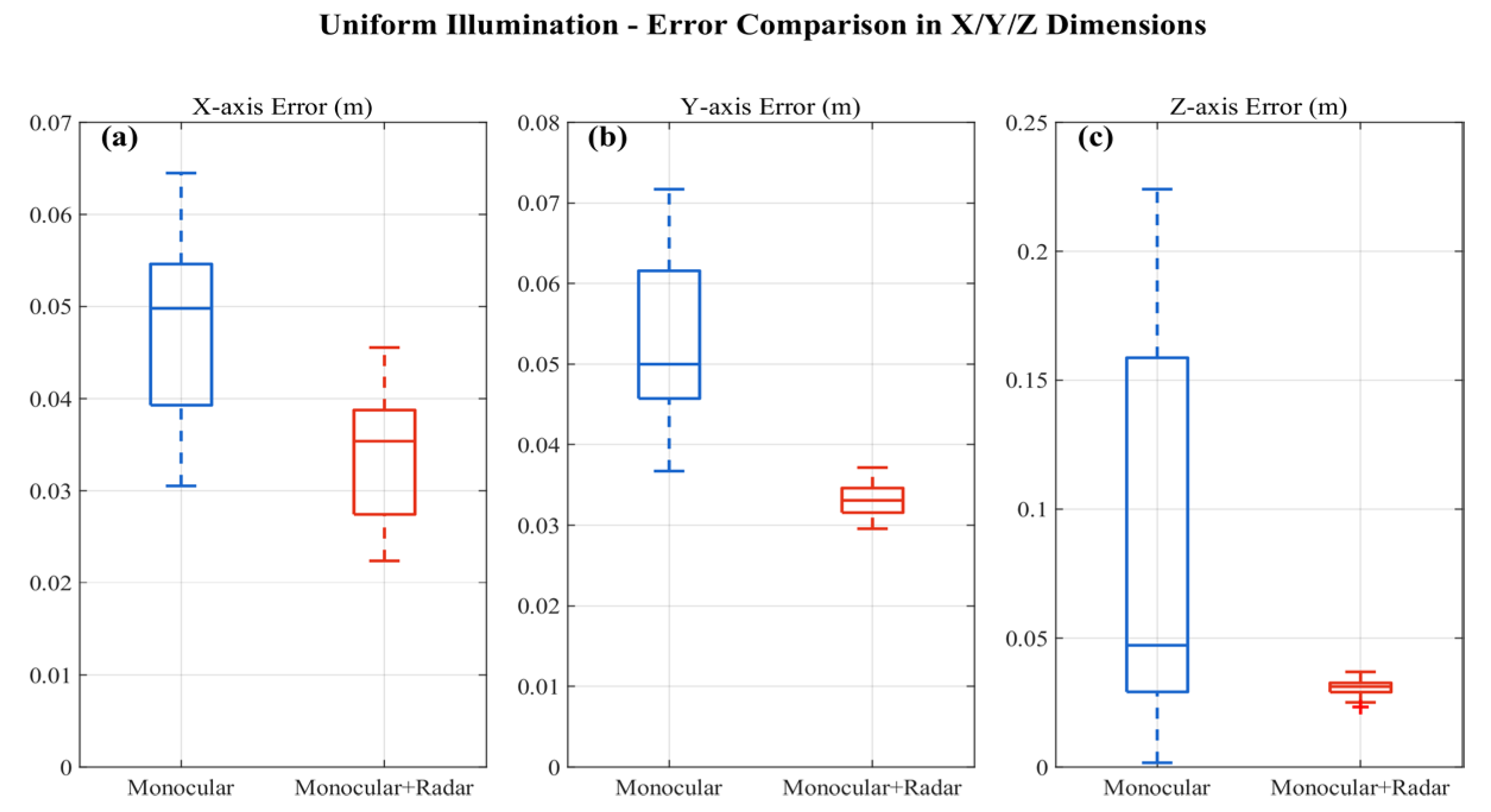
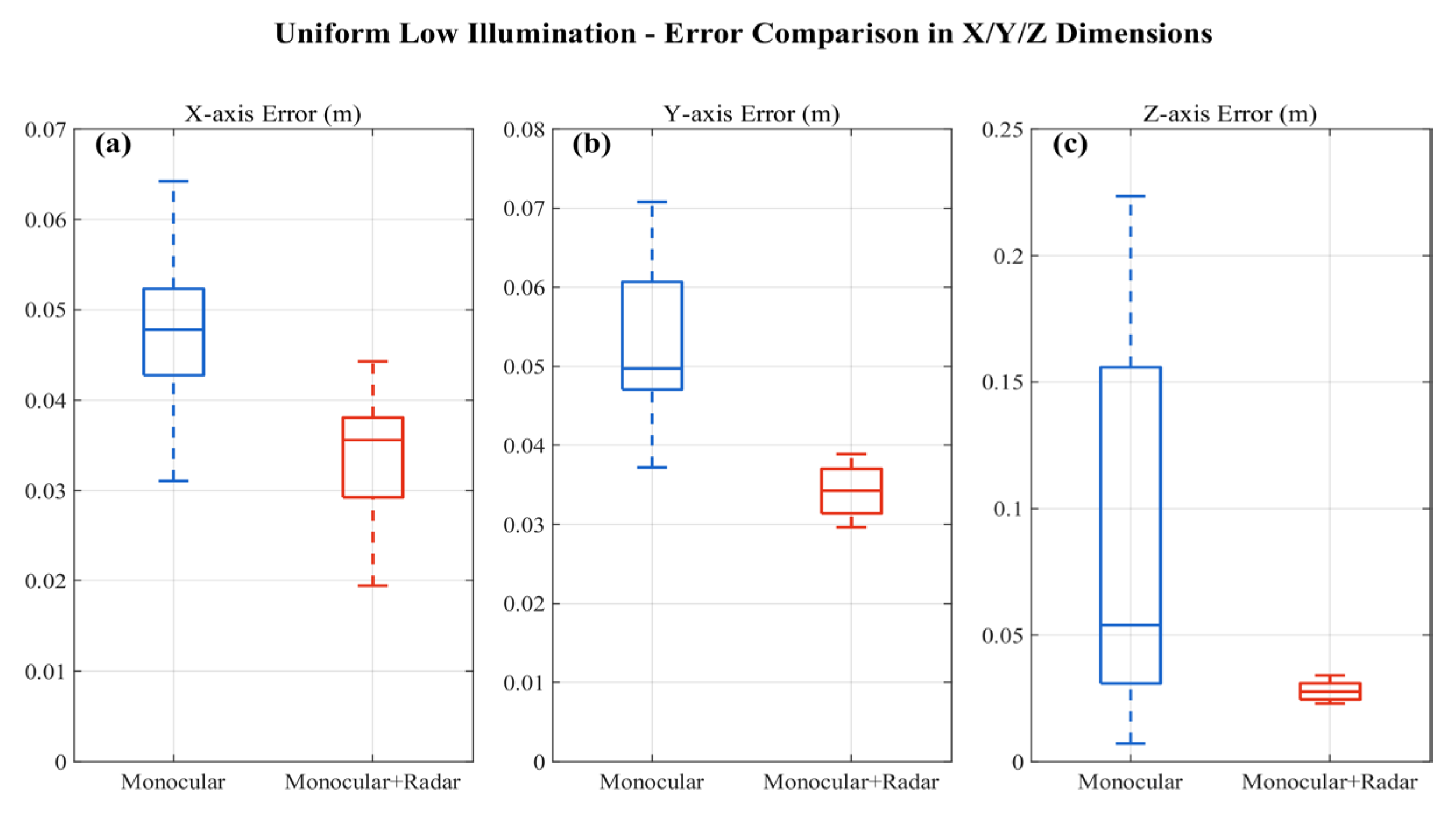
4.3.1. Localization Accuracy Analysis Under Variable Illumination
4.3.2. Robustness Analysis
- Operational Reliability
- 2.
- Output Stability
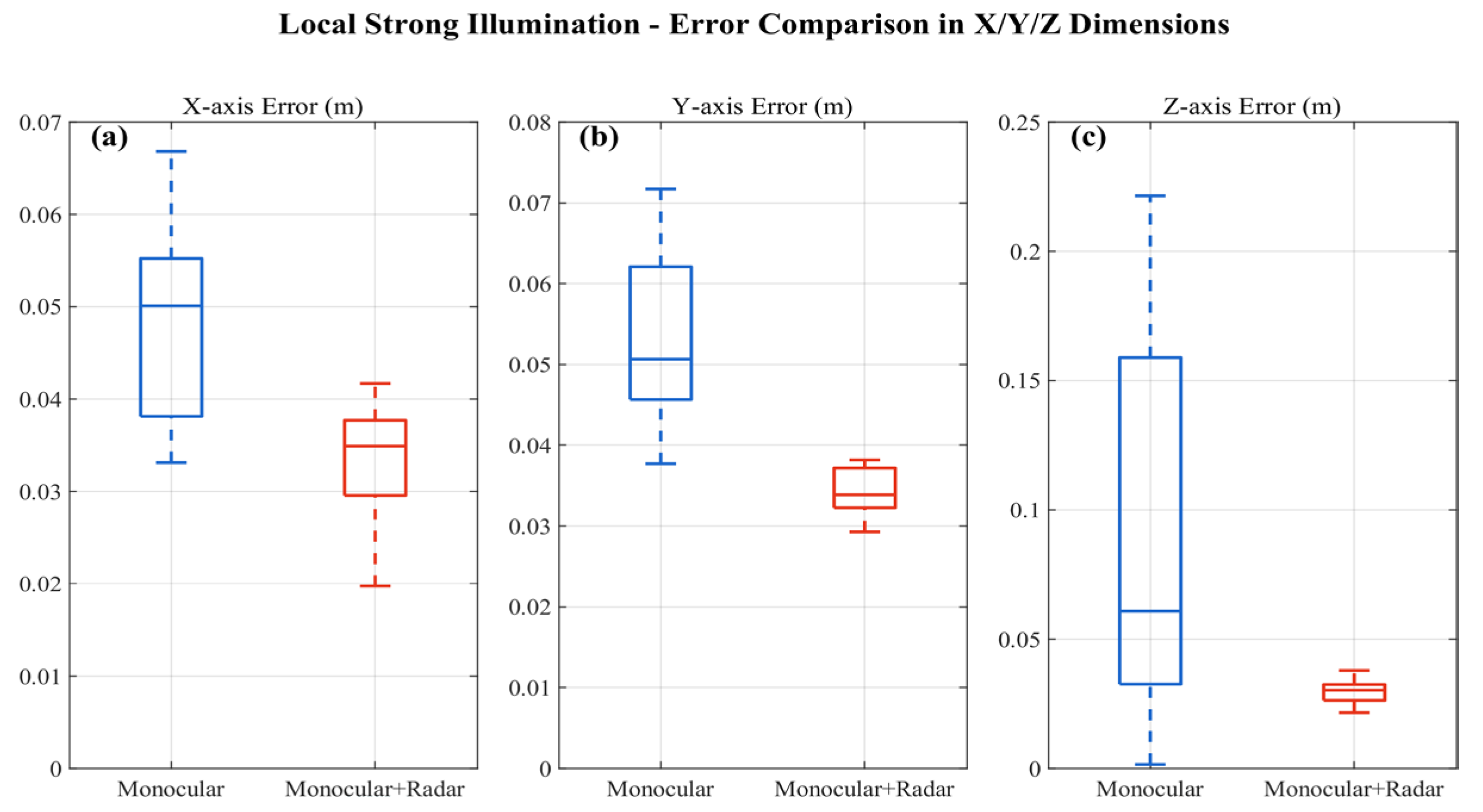
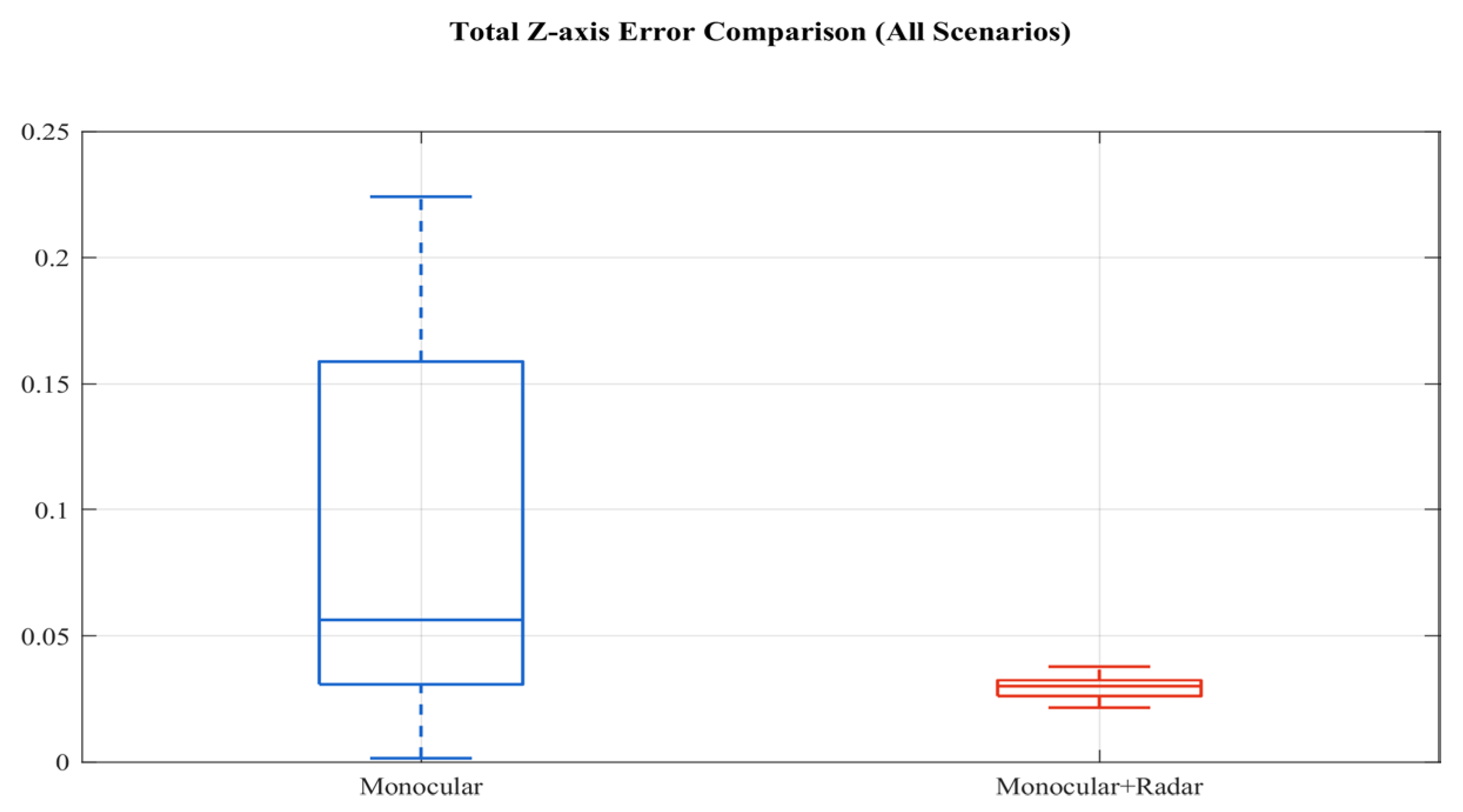
- Sensitivity to Reflections: The “local strong illumination” scenario is designed to simulate specular reflection interference from the metal flange surface. As shown in Figure 16, under this scenario, the Z-axis error box plot for the fusion method shows an interquartile range of only 0.0016 m with no outliers, whereas the error distribution for the monocular method is extremely dispersed (interquartile range = 0.0828 m) with obvious outliers. This indicates that the fusion method, through LiDAR point cloud ROI constraints and plane fitting, effectively suppresses false image edge interference introduced by reflections, exhibiting low sensitivity to reflections.
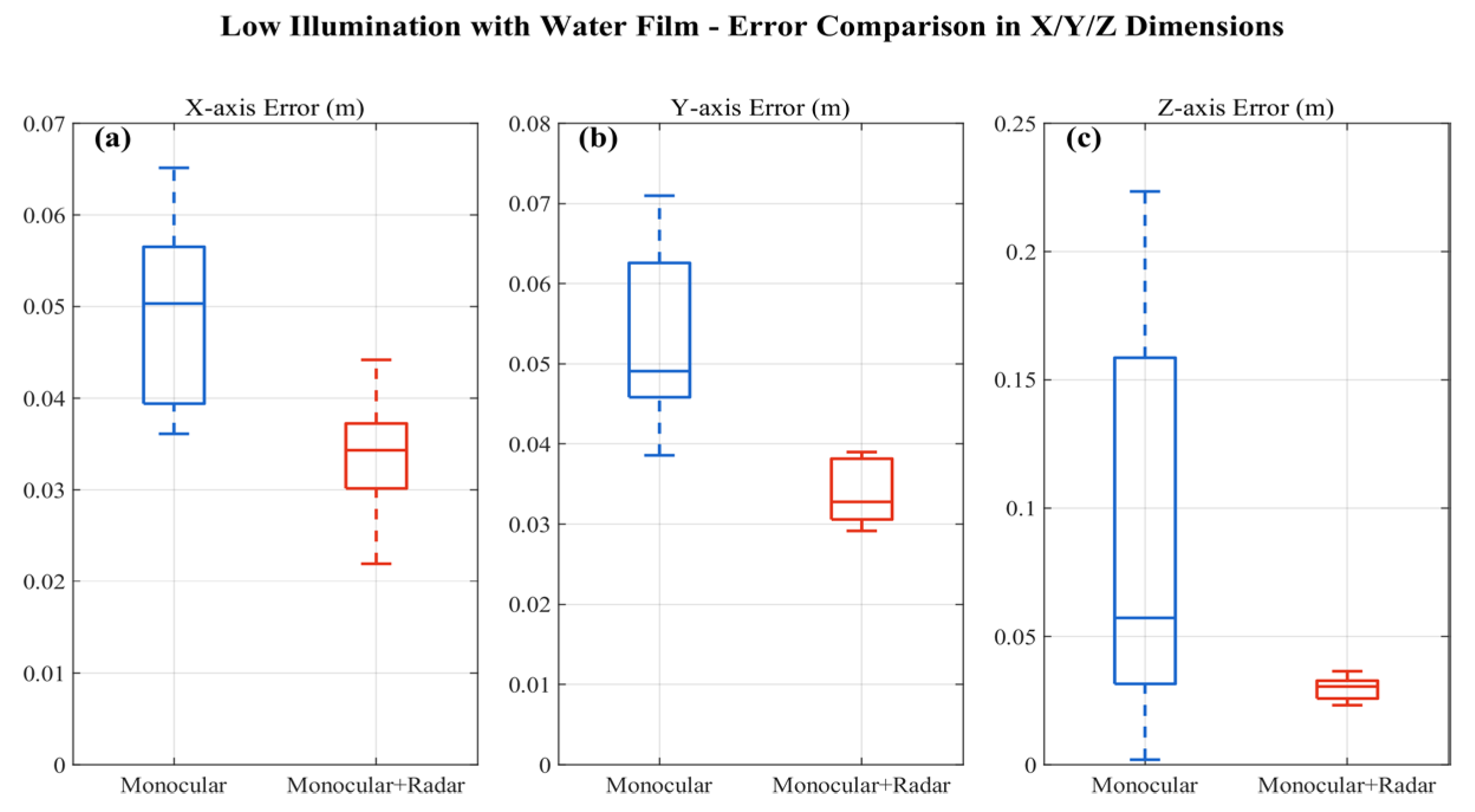
- Robustness to Image Noise: The “uniform low illumination” and “uniform low illumination with water film” scenarios introduce significant image noise (low contrast, blurred details). As shown in Table 2, under these two adverse conditions, the mean localization errors of the fusion method in the X, Y, and Z axes remain within the same order of magnitude (centimeter-level) as those under the ideal “uniform illumination” scenario, with no order-of-magnitude degradation. For instance, the Z-axis error, which is most sensitive to depth information, is 0.0278 m under “uniform illumination” and 0.0266 m under “uniform low illumination with water film”, demonstrating stable performance. This proves the strong robustness of our method against image quality degradation caused by uneven illumination and water film.
- Stability with Sparse Point Clouds (Data Sparsity): The system employs a 16-line LiDAR, which inherently produces sparse point clouds (considered as structural data sparsity). As described in Section 3.5.2, the average number of valid point clouds per flange after ROI extraction is only 19.5. Under this sparse condition, the fusion method maintains a 100% success rate for plane and circle center fitting, and the standard deviation of the Z-axis error across all scenarios is less than 0.0005 m, indicating highly stable fitting accuracy. This confirms the robustness of the adopted “plane fitting—2D projection—radius-constrained fitting” pipeline to sparse point clouds.
5. Discussion
5.1. Comparison with Reference [31]
- Methodology differences: While their approach is algorithm-centric (optimization-based control), ours is sensor-fusion-centric (LiDAR-vision fusion for geometric localization). They address control parameter tuning; we address perception and 3D localization under illumination variation.
- Robustness: Both studies emphasize robustness—theirs against controller convergence issues, ours against illumination extremes (glare, low light, water film).
- Evaluation: They use IAE (Integral Absolute Error) for tracking performance; we use MAE/RMSE in 3D Euclidean space for localization accuracy, complemented by scenario-specific robustness tests.
5.2. Comparison with Reference [32]
- Methodology differences: Their work is also control-oriented, using ITAE as the cost function for PID optimization. Our method, in contrast, is perception-oriented, fusing LiDAR and vision to achieve illumination-robust 3D localization without relying on control-loop tuning.
- Robustness: They test algorithm performance in tracking stability; we test sensor fusion performance under four extreme illumination scenarios, including water film interference—a common industrial challenge not addressed in their work.
- Evaluation protocols: They assess overshoot, settling time, and ITAE; we provide comprehensive 3D error statistics (MAE, RMSE) with confidence intervals and ablation studies on key parameters (e.g., Rₚᵢₓₑₗ).
5.3. Synthesis and Distinct Contributions of Our Work
- We propose an illumination-adaptive fusion framework that dynamically adjusts detection parameters based on grayscale evaluation, a feature absent in both compared works.
- We introduce multi-constraint flange detection (physical dimensions, K-means clustering, weighted fitting) tailored for fixed-size industrial targets, whereas the compared works focus on generic control optimization.
- Our evaluation includes real-world challenging scenarios (water film, glare) and a parameter sensitivity analysis, providing deeper insights into system robustness under operational variability.
5.4. Comparison with Recent Baseline Methods
- Comparison with the LiDAR-only baseline: The baseline method is a pure LiDAR incremental odometry approach, which demonstrates excellent performance in large-scale navigation and motion estimation, and is adaptable to different LiDAR types. However, it lacks the capability for fine-grained feature localization assisted by vision: first, it cannot achieve precise fitting for specific industrial targets such as flanges, resulting in relatively large localization errors; second, although LiDAR itself is unaffected by illumination, the method does not incorporate visual assistance for fine 2D positioning, making it difficult to meet the centimeter-level docking requirements in industrial scenarios. The method proposed in this paper combines high-resolution 2D feature detection from vision with depth compensation from LiDAR, achieving a balance between “large-scale stable positioning and small-scale precise docking”, which better aligns with the needs of industrial loading and unloading operations.
- Comparison with the Monocular-only baseline: The baseline method realizes 3D measurement in micro-baseline scenarios through single-camera rotation coupled with a neural network, achieving high accuracy (0.0864 mm absolute error) in static, small-range measurements. Nevertheless, it exhibits notable limitations: first, its performance depends on the training data distribution of the neural network, leading to weak generalization for untrained targets such as flanges; second, under low illumination or reflective conditions, the error in 2D feature point extraction increases significantly, causing degradation in 3D mapping accuracy. The proposed method in this study compensates for the depth ambiguity inherent in monocular vision by leveraging LiDAR’s depth measurement advantage. Furthermore, through a multi-constraint fitting strategy, it enhances stability and maintains concentrated error distribution even under challenging conditions such as weak light coupled with water film.
- Comparison with the Hybrid baseline: The baseline method achieves fused localization through the registration of LiDAR and a depth camera. While it meets the basic accuracy requirements for human–robot collaboration, it suffers from two major limitations: first, it does not account for the impact of illumination variations on depth camera data, rendering it unsuitable for extreme lighting conditions in LNG loading/unloading scenarios; second, it relies on high-density point clouds from a 64-line LiDAR, resulting in high hardware costs, and lacks a constraint mechanism designed for fixed-size industrial targets like flanges, leading to insufficient localization stability. In contrast, the proposed method employs a more cost-effective 16-line LiDAR fused with vision. By incorporating an illumination-adaptive framework and physical dimension constraints, it not only reduces hardware costs but also further lowers the 3D localization error to the centimeter level, with a 75.91% reduction in Z-axis depth error, better satisfying the precision requirements of industrial docking.
6. Conclusions
Supplementary Materials
Author Contributions
Funding
Institutional Review Board Statement
Informed Consent Statement
Data Availability Statement
Conflicts of Interest
References
- Liu, M.Q.; Wang, J.C.; Zhang, H.; Zhang, Y.M.; Zhu, J.Q.; Zhu, K. The Evolution and Development Trends of LNG Loading and Unloading Arms. Appl. Sci. 2025, 15, 4316. [Google Scholar] [CrossRef]
- Gao, Y.; Wang, B.; Hu, Y.D.; Gao, Y.J.; Hu, A.L. Development of China’s Natural Gas: Review 2023 and Outlook 2024. Nat. Gas Ind. 2024, 44, 166–177. [Google Scholar]
- Liu, Y.; Yang, L.; Jing, Y.X. Research and Analysis on the Technical Status of LNG Handling System. Petrochem. Chem. Equip. 2020, 23, 44–48. [Google Scholar]
- Zu, Y.; Liu, M.Q.; Song, L.M.; Wang, J.C.; Li, X.B. Research on Flange Recognition and Positioning Algorithm of LNG Tanker Based on Binocular Vision Algorithm. Mech. Eng. 2025, 5, 54–58. [Google Scholar]
- Dai, Z.X.; Yin, T.; Han, C.J.; Ma, K.D. Design and Sealing Performance Analysis of Low Temperature Fast Connection Device for Liquid Natural Gas Tanker. Lubr. Eng. 2025, 50, 172–178. [Google Scholar]
- Liu, K.; Song, X.W.; Hu, X.J.; Zhang, X.D.; Li, X. A Three-claw Quick Connection Device Suitable for LNG Tanker. Mech. Electr. Eng. Technol. 2022, 51, 127–130. [Google Scholar]
- Li, K.Q. Research on 3D Object Detection Method Based on Point Cloud and Image Data Fusion. Master’s Thesis, Yantai University, Yantai, China, 2025. [Google Scholar]
- Ahin, Y.S.; Park, Y.S.; Kim, A. Direct Visual SLAM Using Sparse Depth for Camera-LiDAR System. In Proceedings of the 2018 IEEE International Conference on Robotics and Automation (ICRA), Brisbane, Australia, 21–25 May 2018. [Google Scholar]
- Xu, Y.; Ou, Y.; Xu, T. SLAM of Robot based on the Fusion of Vision and LIDAR. In Proceedings of the 2018 IEEE International Conference on Cyborg and Bionic Systems (CBS), Shenzhen, China, 25–27 October 2018. [Google Scholar]
- Xiao, L.; Chen, H.; Li, Y.; Liu, Y. Visual laser-SLAM in large-scale indoor environments. In Proceedings of the 2016 IEEE International Conference on Robotics and Biomimetics (ROBIO), Qingdao, China, 3–7 December 2016. [Google Scholar]
- Seo, Y.; Chou, C.C. A Tight Coupling of Vision-Lidar Measurements for an Effective Odometry. In Proceedings of the 2019 IEEE Intelligent Vehicles Symposium (IV), Paris, France, 9–12 June 2019. [Google Scholar]
- Zhang, J.; Kaess, M.; Singh, S. Real-time depth enhanced Monocular Odometry. In Proceedings of the 2014 IEEE/RSJ International Conference on Intelligent Robots and Systems, Chicago, IL, USA, 14–18 September 2014. [Google Scholar]
- Lupton, T.; Sukkarieh, S. Visual-Inertial-Aided Navigation for High-Dynamic Motion in Built Environments Without Initial Conditions. IEEE Trans. Robot. 2012, 28, 61–76. [Google Scholar] [CrossRef]
- Oh, T.; Lee, D.; Kim, H.; Myung, H. Graph Structure-Based Simultaneous Localization and Mapping Using a Hybrid Method of 2D Laser Scan and Monocular Camera Image in Environments with Laser Scan Ambiguity. Sensors 2015, 15, 15830–15852. [Google Scholar] [CrossRef]
- Xiang, R.; Feng, W.W.; Song, S.L.; Zhang, H. Automated Docking System for LNG Loading Arm Based on Machine Vision and Multi-Sensor Fusion. Appl. Sci. 2025, 15, 2264. [Google Scholar] [CrossRef]
- Qian, Z.D. Elliptical Visual Marker Detection and Its Application in Visual Localization. Master’s Thesis, University of Chinese Academy of Sciences, Beijing, China, 2022. [Google Scholar]
- Lv, T.Z.; Zhang, Y.Z.; Lu, C.; Zhu, J.J.; Wu, S. Targetless Intrinsics and Extrinsic Calibration of Multiple Lidars and Cameras with IMU using Continuous-Time Estimation. arXiv 2025, arXiv:2501.02821. [Google Scholar] [CrossRef]
- Yao, R.H.; Wang, H.G.; Guo, Y.A.; Xie, Z.Z. Robust real-time moving object detection on water surface: A LiDAR feature matching approach for maritime reliability enhancement. Ocean Eng. 2026, 346, 123860. [Google Scholar] [CrossRef]
- Zhai, S.X.; Bai, Y.L.; Zhang, L.M.; Hu, Y.F.; Ren, S.N. Monocular Camera and LiDAR Point Cloud Fusion for Power Operating Tool Detection. Mach. Build. Autom. 2025, 54, 306–310+314. [Google Scholar]
- Liu, Y.; Li, T.F. Research of the Important of Zhang’s Camera Calibration Method. Opt. Tech. 2014, 6, 565–570. [Google Scholar]
- Cao, L.; Gu, X.Y.; Zhu, H.Y.; Yuan, B.X.; Yang, H.Y. Automatic Calibration for Roadside Millimeter Wave Radar-Camera Fusion in Complex Traffic Scenarios. Laser Optoelectron. Prog. 2025, 62, 101–111. [Google Scholar]
- Zhang, L. Research on Image Recognition and Filtering Algorithm of Salt and Pepper Noise. Master’s Thesis, Shenyang University of Technology, Shenyang, China, 2023. [Google Scholar]
- Li, Y.X. A new Edge Detection Method for Noisy Image Based on Discrete Fractional Wavelet Transform and Improved Canny Algorithm. Expert Syst. Appl. 2026, 298, 129668. [Google Scholar]
- Miao, S.J.; Li, X.; Zhao, D.J.; Sun, Y. Synchronous Parallel Circle Detection Method Based on Hough Gradient. Electron. Meas. Technol. 2025, 48, 156–165. [Google Scholar]
- Yun, O.; Deng, H.G.; Liu, Y.; Zhang, Z.Y.; Lan, X. An Anti-Noise Fast Circle Detection Method Using Five-Quadrant Segmentation. Sensors 2023, 23, 2732. [Google Scholar]
- Fan, Y.Y.; Tian, D.P.; Xu, Q.H.; Sun, J.; Xu, Q.; Shi, Z.Z. Particle Swarm Optimization Based on K-means Clustering and Adaptive Dual-Groups Strategy. Swarm Evol. Comput. 2016, 100, 102226. [Google Scholar] [CrossRef]
- Huang, S.W.; Guo, K.Y.; Song, X.Y.; Han, F.; Sun, S.J.; Song, H.S. Multi-target 3D Visual Grounding Method Based on Monocular Images. J. Comput. Appl. 2025, 1–11. [Google Scholar] [CrossRef]
- Zheng, T.X.; Jiang, M.Z.; Feng, M.C. Vision Based Target Recognition and Location for Picking Robot: A Review. Chin. J. Sci. Instrum. 2021, 42, 28–51. [Google Scholar]
- Hodson, T.O. Root-Mean-Square Error (RMSE) or Mean Absolute Error (MAE): When to Use Them or Not. Geosci. Model Dev. 2022, 15, 5481–5487. [Google Scholar] [CrossRef]
- Chang, Q.; Xu, X.; Zha, A.; Meng, J.E.; Sun, T.Q.; Li, Y. TinyStereo: A Tiny Coarse-to-Fine Framework for Vision-Based Depth Estimation on Embedded GPUs. IEEE Trans. Syst. Man Cybern. Syst. 2024, 54, 5196–5208. [Google Scholar] [CrossRef]
- Tahiri, M.; Kmich, M.; Bencherqui, A.; Sayyouri, M.; Khafaga, D.S.; Aldakheel, E.A. Modeling and PID tuning of a 3-DOF robotic manipulator using a novel Chaos-Artemisinin Optimizer. Expert Syst. Appl. 2026, 297, 129455. [Google Scholar] [CrossRef]
- Tahiri, H.; Mchichou, I.; Ouabdou, M.; Sayyour, M. Advanced Control Strategies for Mobile Robots Using Artificial Intelligence. In Proceedings of the 2025 7th Global Power, Energy and Communication Conference (GPECOM), Bochum, Germany, 11–13 June 2025. [Google Scholar]
- Fang, K.; Song, R.; Ho, W.H. Inc-DLOM: Incremental Direct LiDAR Odometry and Mapping. IEEE Access 2025, 13, 6527–6538. [Google Scholar] [CrossRef]
- Chen, Q.Y.; Sui, G.R. Study on 3D Measurement based on Single Camera and Neural Network. Opt. Tech. 2022, 48, 214–222. [Google Scholar]
- Wang, Z.K.; Li, P.C.; Zhang, Q.; Zhu, L.H.; Tian, W. A LiDAR-depth camera information fusion method for human robot collaboration environment. Inf. Fusion 2025, 114, 102717. [Google Scholar] [CrossRef]





| Grouping Type | Experimental Scenarios | Illumination Settings |
|---|---|---|
| Experimental Group 1 | Uniform Illumination | One 40 W fill light was placed at a distance of 1.5 m from the left and right sides at 45°, respectively. |
| Experimental Group 2 | Local Strong Illumination | A 40 W fill light was placed at 45° to the left at a distance of 1.5 m, and another 40 W fill light was placed at 45° to the right at a distance of 0.5 m. |
| Experimental Group 3 | Uniform Low Illumination | One 10 W fill light was placed at a distance of 1.5 m at 45° to the left and right, respectively. |
| Experimental Group 4 | Uniform Low Illumination with Water Film | One 10 W fill light was placed at a distance of 1.5 m at 45° to the left and right, respectively. |
| Experimental Scenarios | Localization Method | ΔX (Mean ± 95% CI) | ΔY (Mean ± 95%CI) | ΔZ (Mean ± 95%CI) |
|---|---|---|---|---|
| Uniform Illumination | Monocular Vision | 0.0371 ± (0.0354,0.0388) | 0.0679 ± (0.0664,0.0695) | 0.2192 ± (0.2179,0.2206) |
| Fusion Method | 0.0243 ± (0.0230,0.0256) | 0.0343 ± (0.0330,0.0356) | 0.0278 ± (0.0264,0.0293) | |
| Uniform Low Illumination | Monocular Vision | 0.0555 ± (0.0527,0.0582) | 0.0451 ± (0.0429,0.0473) | 0.0390 ± (0.0340,0.0439) |
| Fusion Method | 0.0355 ± (0.0340,0.0370) | 0.0334 ± (0.0322,0.0346) | 0.0305 ± (0.0291,0.0319) | |
| Local Strong Illumination | Monocular Vision | 0.0450 ± (0.0422,0.0478) | 0.0525 ± (0.0501,0.0548) | 0.0674 ± (0.0520,0.0827) |
| Fusion Method | 0.0360 ± (0.0348,0.0372) | 0.0336 ± (0.0322,0.0350) | 0.0327 ± (0.0313,0.0340) | |
| Uniform Low Illumination with Water Film | Monocular Vision | 0.0548 ± (0.0523,0.0573) | 0.0468 ± (0.0449,0.0487) | 0.0296 ± (0.0188,0.0403) |
| Fusion Method | 0.0385 ± (0.0365,0.0404) | 0.0345 ± (0.0330,0.0361) | 0.0266 ± (0.0249,0.0282) |
| Experimental Scenarios | Dimension | MAE Error Reduction Rate (%) | RMSE Error Reduction Rate (%) |
|---|---|---|---|
| Uniform Illumination | X Y Z | 35.12 41.83 88.69 | 17.48 43.05 88.70 |
| Local Strong Illumination | X Y Z | 65.79 11.03 79.45 | 65.79 11.03 79.45 |
| Uniform Low Illumination | X Y Z | 38.67 28.89 48.92 | 38.81 29.05 49.08 |
| Uniform Low Illumination with Water Film | X Y Z | 19.17 37.22 35.33 | 19.17 37.35 36.32 |
| Dimension | MAE Error Reduction Rate (%) | RMSE Error Reduction Rate (%) |
|---|---|---|
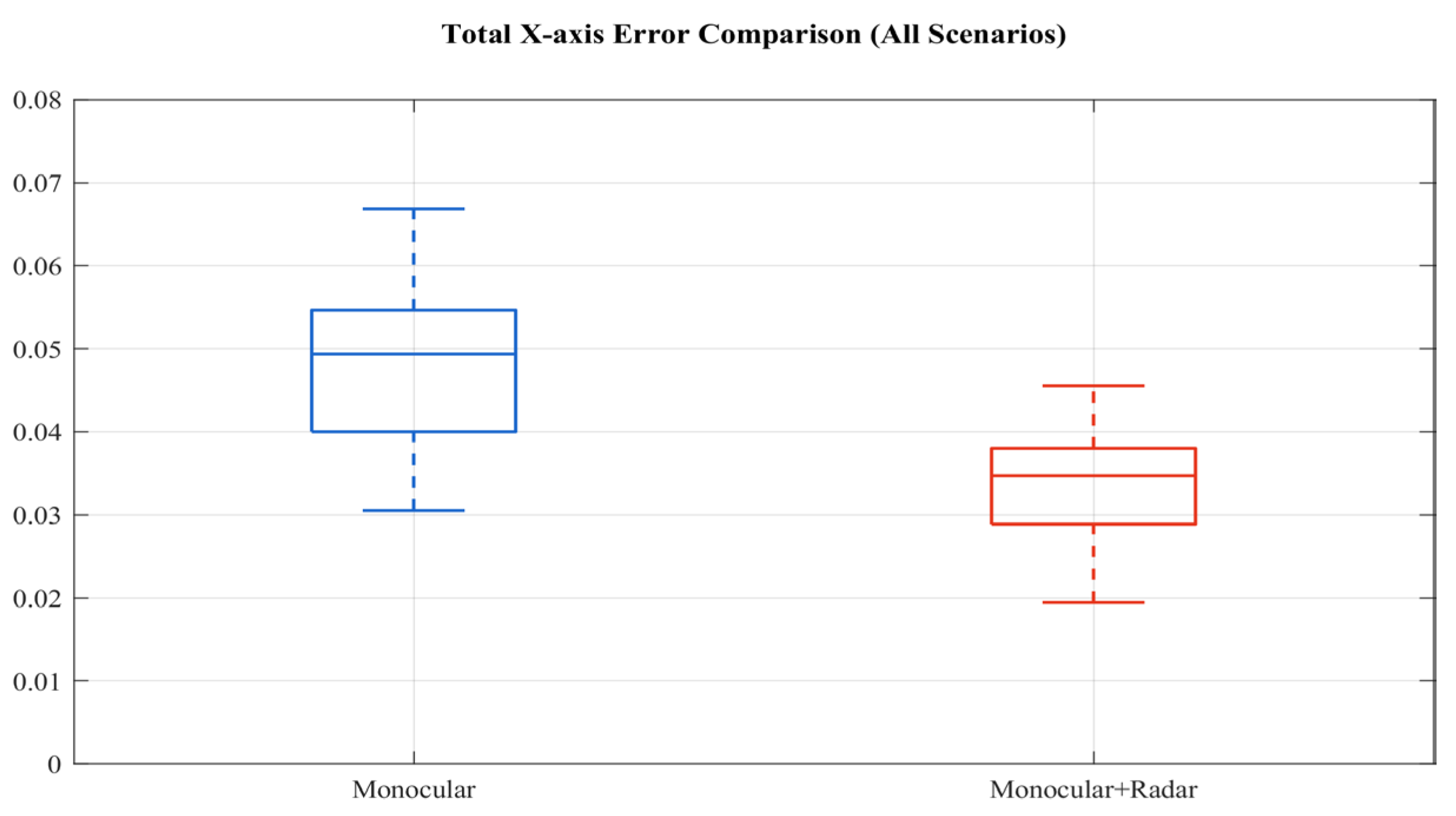
| X | 33.08 | 33.65 |
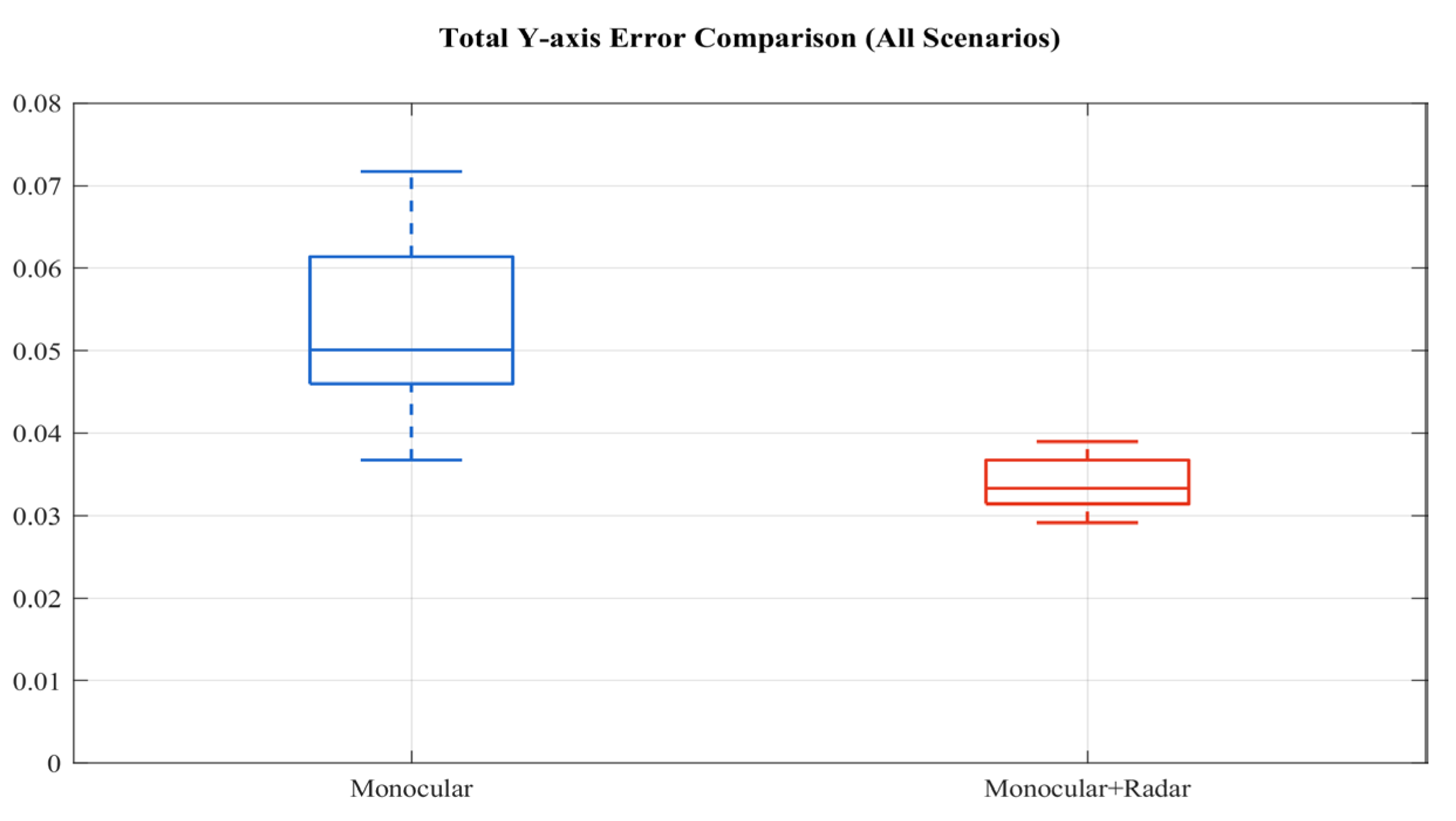
| Y | 30.57 | 32.71 |
| Z | 75.91 | 79.88 |
| 3D Overall | 61.69 | 64.79 |
| Module | Time Consumption (ms) | Proportion (%) | Theoretical Frame Rate (fps) |
|---|---|---|---|
| Visual Circle Detection | 278.2 | 95.96 | 3.6 |
| Point Cloud Fusion | 11.7 | 4.04 | 85.5 |
| Full System | 289.9 | 100 | 3.45 |
| Robustness Metric | Proposed Fusion Method | Monocular Vision (Baseline) |
|---|---|---|
| Failure Rate (All scenarios, n = 80) | 0% (100% task completion rate) | Detection failures observed, particularly under Local Strong Illumination |
| Reflection Sensitivity (Local Strong Illumination) | Z-axis error IQR: 0.0016 m; No outliers. | Z-axis error highly dispersed; IQR: 0.0828 m with obvious outliers. |
| Noise Stability (Low Illumination + Water Film) | All-axis errors remain at cm-level; Z-axis: 0.0266 m. | Error fluctuations intensified; performance degradation in some dimensions. |
| Data Sparsity Tolerance (Avg. 19.5 points per flange) | 100% fitting success rate; Z-axis std. < 0.0005 m. | No explicit fitting success rate reported; stability inadequate under sparse data. |
Disclaimer/Publisher’s Note: The statements, opinions and data contained in all publications are solely those of the individual author(s) and contributor(s) and not of MDPI and/or the editor(s). MDPI and/or the editor(s) disclaim responsibility for any injury to people or property resulting from any ideas, methods, instructions or products referred to in the content. |
© 2026 by the authors. Licensee MDPI, Basel, Switzerland. This article is an open access article distributed under the terms and conditions of the Creative Commons Attribution (CC BY) license.
Share and Cite
Liu, M.; Zhang, H.; Zhu, J.; Zhang, Y.; Zhu, K. Robust Localization of Flange Interface for LNG Tanker Loading and Unloading Under Variable Illumination a Fusion Approach of Monocular Vision and LiDAR. Appl. Sci. 2026, 16, 1128. https://doi.org/10.3390/app16021128
Liu M, Zhang H, Zhu J, Zhang Y, Zhu K. Robust Localization of Flange Interface for LNG Tanker Loading and Unloading Under Variable Illumination a Fusion Approach of Monocular Vision and LiDAR. Applied Sciences. 2026; 16(2):1128. https://doi.org/10.3390/app16021128
Chicago/Turabian StyleLiu, Mingqin, Han Zhang, Jingquan Zhu, Yuming Zhang, and Kun Zhu. 2026. "Robust Localization of Flange Interface for LNG Tanker Loading and Unloading Under Variable Illumination a Fusion Approach of Monocular Vision and LiDAR" Applied Sciences 16, no. 2: 1128. https://doi.org/10.3390/app16021128
APA StyleLiu, M., Zhang, H., Zhu, J., Zhang, Y., & Zhu, K. (2026). Robust Localization of Flange Interface for LNG Tanker Loading and Unloading Under Variable Illumination a Fusion Approach of Monocular Vision and LiDAR. Applied Sciences, 16(2), 1128. https://doi.org/10.3390/app16021128