Article

Atmospheric Aerial Optical Links: Assessing Channel Constraints for Stable Long-Range Communications—A Historical Perspective


Department of Electronic Engineering, University of Rome Tor Vergata, 00133 Rome, Italy
*
Author to whom correspondence should be addressed.
Appl. Sci. 2026, 16(2), 1054; https://doi.org/10.3390/app16021054
Submission received: 23 November 2025 / Revised: 13 January 2026 / Accepted: 16 January 2026 / Published: 20 January 2026
(This article belongs to the Special Issue Communication Networks: From Technology, Methods to Applications)

Abstract

New-generation communications aim for ubiquitous and pervasive communications with high data rates. Electromagnetic spectrum saturation and increasing data volumes can employ the use of free-space optical communication to ease capacity loads in modern networks. In this writing, we review the impact of the atmospheric channel on the optical signal dynamics for long-range data links between high-speed and maneuverability suborbital platforms in full atmosphere. This work presents the main propagation constraints, such as path loss, turbulence, and aero-optics, which are environment-dependent and geometry-dependent for this worst-case scenario. To carry out our study, we recall experimental results collected in the literature since the early times, showing system constraints and performance limits. This provides a historical timeline perspective. Theoretical models and channel management techniques that appeared through time are briefly summarized, and their impact on link budget and stability on reference link geometries is addressed through analytical simulation. In conclusion, this paper shows that an integrated approach to this kind of link is successful mainly with a convergence of mitigation techniques and tailored engineering, which cannot neglect the knowledge of the operating environment and strongly relies on accurate physics modeling, which remains an area of active open research.

1. Introduction

Today, existing free-space optical communication (FSO) systems are technologically mature, compact, and reliable enough to be used in satellite links [1], ground links, and underwater networks.
Links based on FSO have become relevant for these high-capacity links, with respect to radio frequency being license-free. Nevertheless, their advantage is the exploitation of the high bandwidths of the optical systems with limited interference from other systems in proximity and ensuring immunity to eavesdropping due to their focused beam width.
The pervasiveness and data rate of the network are achieved through the interaction of hybrid systems (acoustic/optical/RF carriers) in the same or in different environments to achieve maximum global coverage [2,3,4].
In mobility scenarios, seamless connectivity is achieved through the agility of the links between moving platforms (aerial, ground, satellites) and fixed infrastructures with terminals/transponders that could be power-limited [5]. This is the case for highly constrained networks such as UWSN [6,7,8]. In underwater optical propagation, the signal extinction is the main detrimental effect that reduces path lengths due to depth, turbidity, salinity, and thermal layers, which induce scintillation.
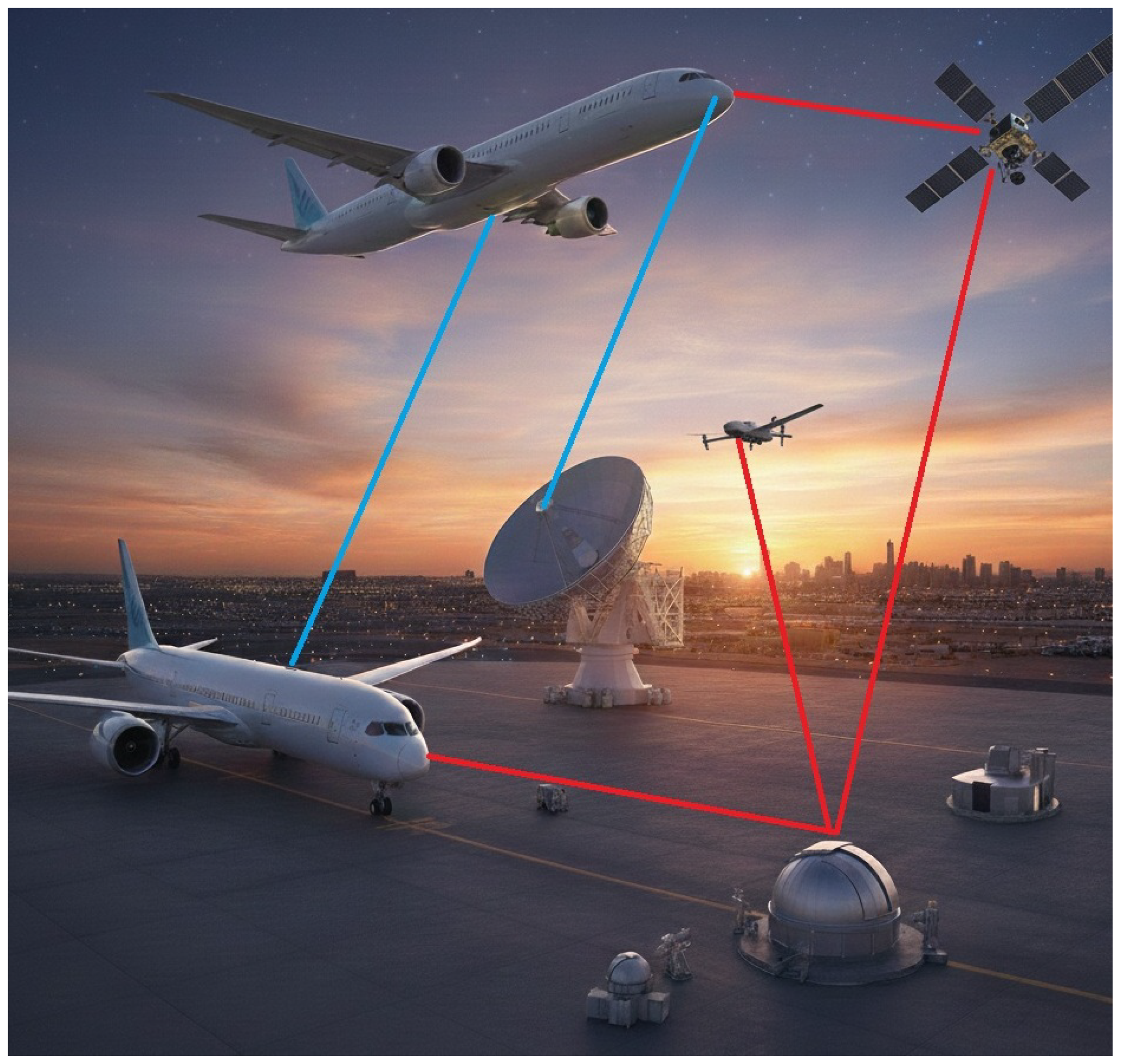
Atmospherics cope with the air density, turbulence, and weather conditions impacting path loss and link stability. In aerial [9,10] and satellite platforms with optical communication, FSO is valuable since it allows saving system power or reducing weight thanks to its systems’ limited SWAP-c; see Figure 1. In addition, local intra- or extra-platform links have been demonstrated in aerospace to support a prolonged mission duration [11,12,13]. An example is the space backbone that is implemented in the European EDRS project between high-throughput satellites with optical transponders for space to Earth or inter-satellite link [14,15,16]. Those different communication environments pose different trade-offs to FSO system developers, since propagation is affected accordingly.

2. Paper Organization and Methodology

This paper presents FSO technology in the context of an aerial link between platforms and terrestrial nodes in the ground network. A selection of experimental works is presented in Section 3, which introduces the link geometry of this study. Extended path lengths and mobility were our selection criteria for inferring as much data as possible on the channel scintillation. The purpose of this timeline is to recall past experiments that collected data sets, which allowed for an understanding of the atmospheric channel behavior and are still benchmarks for current research activity, as systems development advances.
The atmospheric channel and its dynamics are presented in Section 4, which shows what differentiates the link geometries and affects propagation. Section 5 shows the impact of atmospherics on engineering parameters and how they are involved in link modeling to evaluate an operational link through MATLAB simulation (v2025). This section also recalls system performance improvement techniques, showing that trade-offs are necessary. In the Section 6 we present our final conclusions.

3. Aerial Link Experimented

This section reviews some experimental analyses reported in the literature on horizontal/slant atmospheric links published over the years. Those studies investigated aerial propagation for different ranges and applications up to system maturity. Recent studies in the literature have focused on different kinds of lightweight platforms and drones, such as rotorcraft that are usually proposed or used in advanced network scenarios, e.g., data relay nodes for swarm or ad hoc networks [5], with weight and autonomy constraints.
We have left out HAPs covered in [17] due to relatively slow mobility and weak optical turbulence expected at their high operating altitudes. Sat-com vertical links are covered in the extensive literature, such as the recent [18,19].
Experimental work on laser transmissions dates back to the 1970s. Early studies on optical Sat-com date back to 1972 with Program 405B of the US Air Force that showed the feasibility of reaching 1 Gb/s in the geo-to-ground optical downlink. Its results indicated technical limitations due to vibrating mirrors and narrow beams, thus opening the path for subsequent research in this field. Although optical fibers experienced rapid adoption, free-space propagation was limited to terrestrial short ranges and has only recently been supported by the convergence of technical progress and more accurate atmospheric propagation models. Optical communications in the 30–395 THz band have become firmly established [20,21]. The main reason is that atmospheric light propagation has a strong dependence on physical variables that contribute with different weights depending on link characteristics, affecting its performance, such as the bit error rate (BER) and link availability.
Some early-stage projects tested systems in static configurations with ground-to-ground test beds or air-to-ground; these geometries are indicated with GG, AG, and AA for dynamic tests in Table 1. Other kinds of links considered for path length were used for the QKD distribution, since they share the same constraints as a classical communication link (indicated in the table with the Q letter).
In [22,23,24], an extended main aerial network framework based on hybrid RF/Optical systems was tested successfully. These DARPA and AFRL projects led to several static and dynamic tests partially summarized in Table 1. Those tests were carried out under strong daytime turbulence conditions and at a low elevation angle over 50 ÷ 200 km, closing the link with 10 Gb/s and a BER of 10 12 .
Ref. [25], being relatively short in range, investigated a technique to measure point scintillation along the slant path between a flying aircraft and the ground station, revealing and quantifying the aero-optical contamination around the aerial transceiver. The method reported is based on the DDTV technique.
A bidirectional link over 10 km and 17 km was tested on the ground with transceivers located at different altitude sites in [26] as an early-stage air-to-ground optical link targeting 50 to 200 km, validating its optical subsystems. Those tests showed sometimes error-free transmission at ∼10 Gb/s over six days of trials, employing high-dynamic-range OAGC to cope with atmospheric scintillation.
Preliminary work on a proposed system for air-to-air communication capable of 50 to 500 km at high altitude was reported in [27] in a slant bidirectional link. Negligible scintillation values were observed at shorter distances (7 to 15 km at 2100 m altitude). The orbiting aircraft around the ground receiver was equipped with an optical turret capable of a 100 μ rad beam divergence, while 2 mrad is the divergence of the beacon spot. In the proposed operative range of 100 km, diffraction results in a beam width of 200 m, which shows the need to precisely localize the platform and maintain alignment to ensure link stability.
Table 1. A selection of aerial long-range link demonstrations since early FSO systems development. The geometries considered in the table are slant (A2G) or horizontal. Air–air (A2A) or ground-to-ground (G2G) links with the (S) suffix denote early-stage ground tests; Q denotes a quantum communication link; “-” denotes unreported data.
ReferenceRange
[km]
P Tx
[dBm]
P Rx
[dBm]
λ
[nm]
Modulation
Format
Altitude
[km]
Geometry Session / s
Hours
Cn 2 ( 0 )
[ m 2 / 3 ]
[25]821-405/637-2.1G2G/A2GMorning 1 × 10 14
[26]10–1717−5.1/−6.41550-0.6/∼1G2GVarious 2 × 10 14 ÷ 5 × 10 13
[27]20–3021.5-852-∼11.6A2G--
[28]50--1550IM/DD OOK3A2GVarious-
[29]15/60--1550BB84 decoy-state QKD10A2G (Q)--
[30]36/6537−25/−201550IM/DD NRZ-OOK-G2G (S)/A2ADay 10 13
[31]11330/25−42/−451600/800IM/DD OOK-G2G (S)--
[32]14330-1553IM/DD OOK2.4G2G (S)Day/Night-
[33]144--850BB84 decoy-state QKD2.4G2G (Q)--
[34]14735−361550-3A2AVarious 2 × 10 17
[35]149--850-3G2GDay 4 × 10 17
[36]20014/35−20.5/−7.81550--G2G (S)/A2ADay 10 12 ÷ 15
[37]20/25020/30−24.5/−26.21542/1562QPSK5.3A2A (S)/A2GDay/Night-
DLR demonstrated in [28] a working airborne-to-ground link across 50 km for a platform flying at 0.7 Mach, reaching 1.25 Gb/s in UDP packet-streamed communication employing EDFA amplification. The modulation format chosen was OOK with IM/DD. The atmospheric attenuation in the test is reported in Table 2, while the scintillation losses were 1.8 and 3.3 dB at the same distance references. The scope was to test the performance of the tracking loop in the downlink scenario toward the ground station, developed for a maximum range of 79 km.
Ref. [29] presents an airborne-to-ground QKD link, showing that the aero-optical effect—which increases above 0.3 Mach—leads to increased beam spreading and wandering, resulting in a reduction of ∼ 70.7 % in the secure key rate. The optical beam is deflected by an angle of up to 1.4 mrad due to aerodynamic flow, giving a displacement of 80 m from the position of the ground station. The authors concluded that the azimuth angle between the front ends should be below 60 degrees. AO and pre-compensation techniques applied to the PAT system improved link performance.
Ref. [30] reports on the testing activities on the FALCON optical transceiver with a nominal rate of 2.5 Gb/s. The modulation format is NRZ-OOK IM/DD for a laser that transmits a signal generated by 2 7 PRBS. The receiver copes with scintillation levels with a multimode variable gain control with 40 dB dynamics before the APD photodetector based receiver. The tests were carried out ground-to-ground, then air-to-air, and air-to-ground. The tests showed acquisition capabilities of up to 65 km and potential ranges of up to 100 km in clear sky conditions.
In [31], the authors experimented with time–frequency transfer across an IM/DD-modulated bidirectional link. It operated with wavelength diversity on the ground atmospheric link proposed for space application. The telescope apertures were 40 cm in diameter and operated with a 6 μ rad to 12 μ rad near-field divergence. The path loss experienced was 60 dBm for each link that reported an equivalent angle of 100 μ rad of diffraction after propagation, increased by a factor of 10 over the estimate. A DLR CubeSat prototype was tested in [32] across a 143 km horizontal link between Tenerife and La Palma, demonstrating a worst-case scenario on Earth for optical communication due to optical turbulence at a 5-degree elevation angle. The same site was used for the quantum key distribution experiment reported in [33]. The tests were a preliminary activity for a satellite-to-ground QKD experiment, and the site was chosen for its high-altitude atmospheric transmission. The ground-to-ground bidirectional link over 144 km experienced 35 dB path loss using a launch aperture of 150 mm and a 1 m receiver aperture. Thus, it exceeded the 20 dB margin set as a goal for successful key transfer for the BB84 algorithm, as described in the experiment. Atmospheric losses of −10 dB and −14 dB are accounted for by spreading. In addition, it is shown that the effective beam spread at the end of the path varied between 4 and 20 m depending on the weather condition, while 1.5 m was estimated for the vacuum case.
In [34], an aerial link is simulated, and a 40 Gb/s DWDM communication is demonstrated between mountain peaks near Haleakala at the Maui Observatory over 147 km at ∼3000 m elevation and Mauna Loa, Hawaii. This experiment reports 25 dB of scintillation loss, 20 dB of beam-spreading loss due to turbulence, and 70 dB in total accounted for across the whole system/path. The transceivers used AO with a closed-loop high-bandwidth correction (>1 kHz) of approximately 30 Zernike aberrations that are effective near the telescopes. The altitude profile, with the front ends in proximity to the ground, has shown the feasibility of reaching a 100 km link in worse turbulence conditions.
In [36], the authors used a 10 cm aperture over a 200 km link, using AO to demonstrate its effectiveness in the RR on the transceiver front end. The geometry of the link is between the endpoints of fixed sites in Haleakala, Hawaii. A link budget is performed on environmental parameters and compared with measured performance, considering a modified turbulence profile that models the surrounding receiver area.
In [37], a bidirectional system developed for air-to-ground slant links proposed for UAVs is reported. The transceiver apertures were diffraction-limited, 7.5 cm, capable of 250 km range, and the system was able to reach 100 Gb/s at 10–20 km using AO. The flight segment was in a low-speed Cessna (30 m/s) to the 20 km distant ground station, allowing data characterization of vibration effects on the pointing and link margin.

4. Atmospheric Physics: Overview

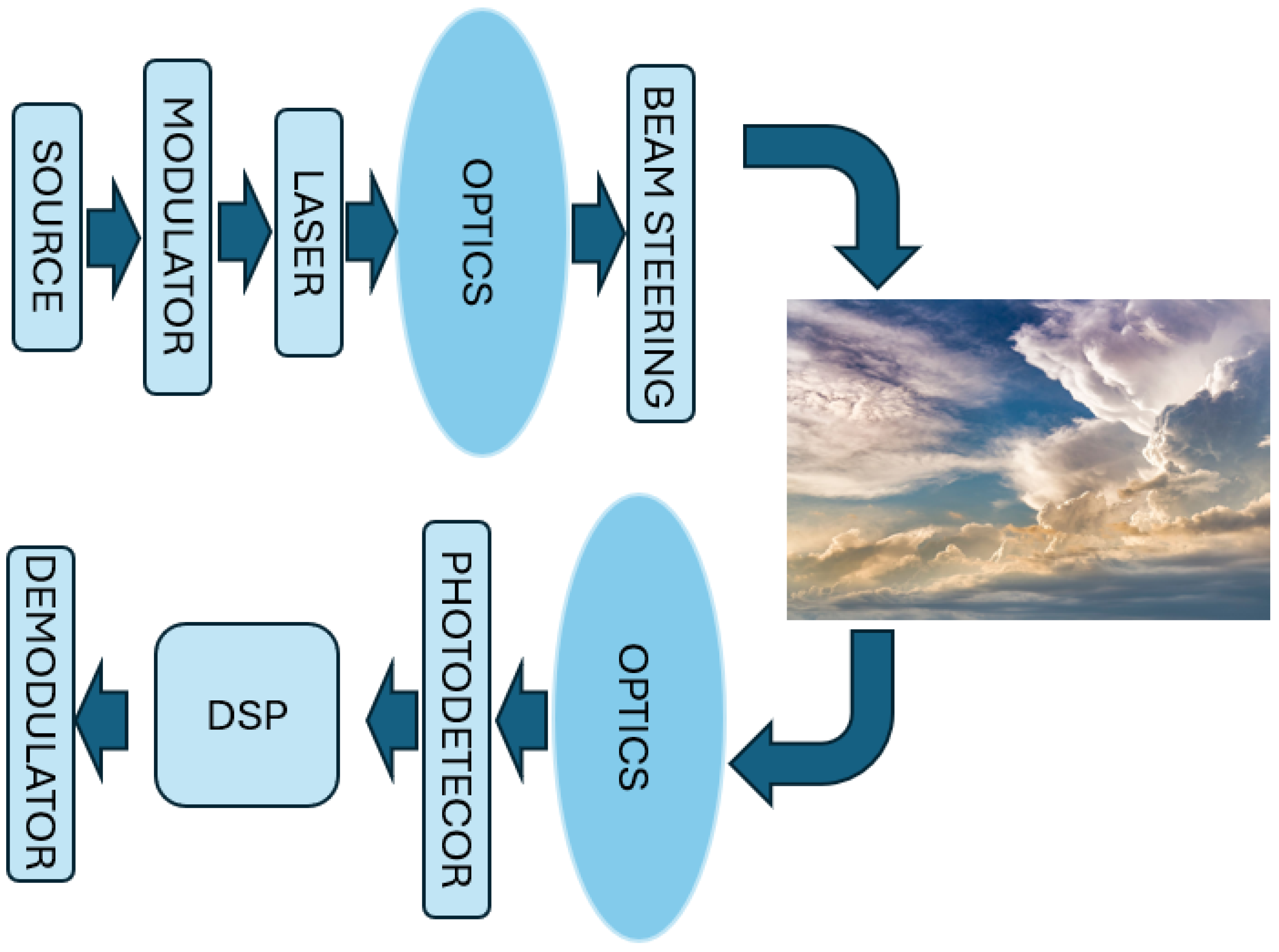
Modeling atmospheric dynamics is a branch of ongoing research, since the entire atmosphere, Earth, and ocean are an ensemble that constitutes a complex system with its agents interacting at different energy magnitudes [38,39,40]. The environmental dynamics have been explained by thermodynamics on a large scale, but they are still to be understood in detail. In this section, the atmospheric behavior for optical communications is introduced, presenting its main factors as independent; moreover, the FSO technology is presented from scratch [18,19,41,42]. A generic functional FSO system architecture is shown in Figure 2.

4.1. Theoretical Approach

In order to analyze propagation effects through space, it is possible to start from the range Equation (1) proposed by Friis [43,44,45] that is presented in this context as follows:
P R x γ T x γ R x P T x A T x A R x ( λ R ) 2 = γ T x γ R x P T x F S L
This model takes into account system elements such as the launch power, transceiver transmittance, and the front-end optical areas. In terms of irradiance at the receiver, equivalently, we have
I ( r ) = P T x π W 0 2 ( Θ 0 2 + Λ 0 2 ) e ( 2 r 2 / W 2 ( r ) )
where z R = π W 0 2 / λ = k 0 W 0 2 / 2 . This notation allows for a complete description of the optical beam with respect to the Friis range equation, exposing the optical beam intensity/power for transmitter systems with converging and diverging beams created by the transmitter lens, exploiting the propagation parameters listed in Table 3. Gaussian beams are generally considered a standard model in free-space optical propagation ( T E M 00 ) since they exhibit good propagation resilience (Section 4.6), and laser sources have their natural Gaussian beam profile [46].

4.2. Altitude Profile

The atmospheric profile is basically made up of two layers, the atmospheric boundary layer (ABL) from the ground up to 1–2 km of altitude and the free atmosphere, which extends to higher altitudes [41,47,48]. The lower part of the ABL is a site of strong thermal exchanges, where air masses are subject to convective instability because of their close proximity to the ground. This activity directly establishes an inhomogeneous velocity regime in the gaseous random medium, considered as a fluid. Thermal gradients in its refractive index modify the spatial distribution, which manifests itself as optical turbulence [46,49], providing the physical link in the definition below:
n ( R ) = 1 + 79 × 10 6 P ( R ) T ( R )
where P is the atmospheric pressure in millibars, T is the temperature in Kelvin, R is the space position with respect to a reference point, while the weak wavelength dependence is neglected.

4.3. Optical Turbulence

This phenomenon is the most detrimental cause of channel disruption, manifesting itself with a double effect. The first one acts as a random amplitude modulation on the optical signal, and the second one imposes beam wandering around its mean centroid, with the risk of severe fading and link disruption. Because of the complexity of the interactions and the large number involved in particle analysis, the whole approach is generally treated as stochastic. So, two main descriptors of turbulence are employed—the structure parameter C n 2 and the power spectrum ϕ ( k ) to assess variations in the spatial random refractive index [18,50]. Briefly, this physical process has been described by Kolmogorov in the energy cascade theory of turbulence [41]. It postulates that air masses of decreasing size are twirling and exchanging kinetic energy up to a minimum size, where the process is stopped, and energy is converted into heat. The energy cascade is bounded by an upper optical cell size L 0 (outer scale) down to a lower limit l 0 (inner scale); in between, there is the inertial sub-range that defines the model’s validity interval. The size of the inner scale has a strong influence on the scintillation process which is on the order of a few millimeters on the ground and reaches centimeters at high altitude. This is the common model used in practice for a first-order analysis, since it postulates that refractive index statistics are isotropic and homogeneous through space, which is not the case for an optical propagating beam along an extended path.
Fluctuation characteristics under the Kolmogorov assumptions follow the power-law spectrum reported below.
Φ n ( κ ) = 0.033 C n 2 κ 11 3 , L 0 1 < < κ < < l 0 1
The non-uniformity in space/volume became an important aspect of the non-classical atmospheric models since vertical and slant links cross several altitude layers with different physical composition and properties [51]. In addition, sea-level maritime links have shown non-Kolmogorov statistics, such as in the Cheng study [52], due to humidity and thermal gradients. This need for knowledge increased the forecasting of beam spreading and scintillation depth, with a direct impact on the link margin and fading probability. Refs. [53,54] introduced an intermediate α value between 3 and 4 for the power-law exponent to describe atmospheric statistics at troposphere and stratosphere altitudes, which were previously underestimated by the classical model. The non-Kolmogorov spectrum assumes a more relaxed, generalized definition with amplitude and spectral law,
Φ n ( κ , α ) = A ( α ) C ˜ κ α
derived from underlying positions. A direct comparison can be found in [55], where it is shown that the wrong assumption of the model could lead to an underestimation of the optimal beam size considering various launch configurations and α . Horizontal long links were strongly investigated when the 11/3 power-law exponent was very limited in performance prediction, since the turbulence contribution accumulates nonlinearly along the path, and aerial links, too, were considered under those constraints for accuracy. Refs. [56,57,58] have shown—through experimental activity and simulation—that the propagating beam experiences an asymmetric deformation along the horizontal and vertical planes, resulting in ellipticity in a relatively short range, which involves a suboptimal power distribution and additional effort to account for spot tracking in the receiver plane. Therefore, the Kolmogorov model became too limited for those kinds of systems. Those studies suggested the need to engineer the shape of the beam to enforce resilience to propagation over long paths, such as Bessel beams, as compared in Ref. [59], which showed self-healing properties when impacted by light obstructions with respect to conventional wavefront shapes; nevertheless, they are affected by beam wandering.

4.4. Link Geometry and Atmospheric Profiles

Assuming an isothermal atmosphere, the Earth’s pressure decreases with the p 0 e h / α law. This decreasing gaseous density defines the different nature of horizontal, slant, and vertical links, where the latter two are asymmetric given the different particle distribution for transceivers located at a significantly different altitude. Thus, the parameter C n 2 , depending on environmental parameters, atmospheric pressure P, temperature T, and the temperature structure constant C T 2 , is altitude dependent.
C n 2 = 79 × 10 6 P T C T 2
Other environmental parameters for C n 2 include transverse wind speed and the zenith angle between the transceiver endpoints. For laser propagation, empirical threshold values have been derived by experimental studies over the years and are used to distinguish between two extreme turbulence strength conditions reported in Table 4; intermediate values are considered as moderate conditions.
An accurate estimate of this parameter, which is related to the scintillation level, poses a constraint on evaluating link performance and operative margins, as the signal fluctuates between fading and surging. Several studies on these parameters set the target for a prediction, such as [60,61,62,63], or a direct measure, such as [25].
A general assumption for the experimental characterization of C n 2 is the flat Earth model, which is valid for vertical links and low zenith angles. Short-range horizontal links, being at constant altitude, allowed the derivation of the C n 2 and l 0 values by a physical path-averaged measure with scintillometers along the path [34].
Long-range, horizontal, or slant aerial/satellite links are better modeled by the round-Earth model proposed in [64], where the altitude is parameterized along the path and integrated properly, avoiding underestimating the length of the altitude-gradient path. At medium and high altitudes, the effects on turbulence could be meaningful even if the contribution of C n 2 is intrinsically weak, because it is path-integrated, as defined in the Rytov variance, in Relation (9). It has been observed that this value grows up to a limit where multiple scattering events weaken the front phase spatial coherence, starting to reduce the focusing effect of the propagating beam, and the fluctuation starts to decrease at levels above unity, reaching saturation; see Figure (4) in [18].
Vertical profile models are still an open topic in research, since soil types exchange heat with the atmosphere differently up to a limit altitude where a convergence has been observed. In addition, vertical models proposed for astronomy are not directly applicable in FSO communication, mainly because the channel is operated during the night for astronomy, while communication can have more relaxed requirements. The authors provide explicit differentiation in [65]. Several atmospheric models have been proposed, such as Hufnagel Valley (H-V 5/7), which is a common reference because of its long traceability and widespread use. This model involves the rms wind speed and the ground-level C n 2 ( 0 ) , which allows better modeling in different geographic locations than other atmospheric models [19]. The Hufnagel–Andrews–Phillips (HAP) model improved it with a better fit to data from experimental activities in the first hundreds of meters up to 1 km of altitude. Since thermal activity is bound to solar irradiance, an environmental parameter p parameter, equal to 4/3 for daylight and 2/3 for night, was introduced to correct this model based on observation time throughout the day. Ref. [66] reports that the experimental campaigns showed the need for this improvement.
The standard Hufnagel Valley (H-V 5/7) adopts a power-law exponent of p = 4/3 for the altitude dependence of C n 2 , as reported in [46]. This model uses the M parameter, which is of the order of unity, as a scaling factor to represent the strength of the average high-altitude background turbulence. This allows the model to still obtain a valid estimate when ground-level measurements are not available; see Fig. (18) in [19].
C n 2 ( h ) = M [ 0.00594 w 27 2 ( h + h s ) 10 5 10 e x p h + h s 1000 + 2.7 10 16 e x p h + h s 1500 ] + C n 2 ( h 0 ) h 0 h p , h > h 0
Here, h 0 is an altitude above ground, generally where the instruments are placed, h s is the ground altitude referenced at sea level, and h > h 0 is the target altitude. The term w is the high-altitude root mean squared wind speed (rms) given by the Bufton model (8); 21 m/s is taken as a common reference for ground level.
w = 1 15 × 10 3 5 × 10 3 20 × 10 3 w s h + w g + 30 e x p h 9400 4800 2 2
where w s is the beam slew rate associated with a satellite moving with respect to an observer on the ground [41].
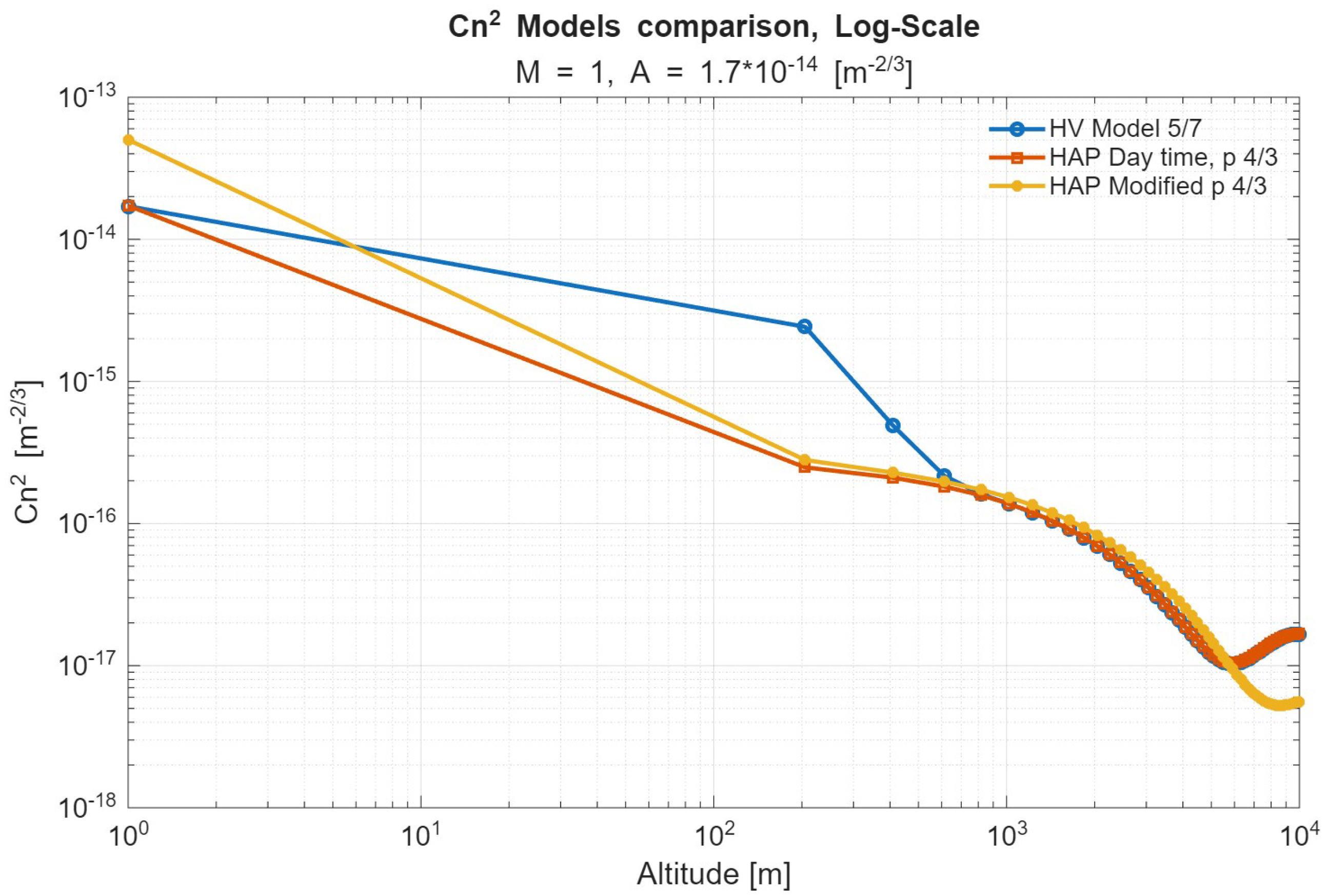
This model was recently improved in [67,68]. The authors observed a better average fit to the experimental data acquired in recent test campaigns. Improvements are achieved by adopting the turbulent intensity, which is the ratio of the wind speed variance to the average wind speed for this new parameterization. We show a comparison between the proposed models in Figure 3, where they exhibit different data-fitting capabilities at altitude ranges below 1000 m with respect to the standard H-V, while diverging at higher altitudes. In this analysis, the multiplier factor M in the HAP model is chosen as 1, as a reference; the altitude range is limited to 10 km; and the p factor is the midday coefficient (4/3). Ground turbulence levels are the canonical levels reported in the literature. Modified models other than atmospheric models were proposed for underwater, desert, or night-sky scenarios where H-V is used for satellite downlink scintillation.

4.5. Scintillation

Scintillation is the irradiance fluctuation induced by atmospheric channel instability. The scintillation index represents the cumulative optical turbulence effect along the path in which the traveling light amplitude is modified and gives direct evidence of this phenomenon. It is defined as the normalized variance of the light intensity and is related to the Rytov variance σ R 2 used to classify the fluctuation regime at the receiver. For a plane wave, this relationship is given in Equation (9):
σ R 2 σ I , p l 2 = 1.23 C n 2 k 7 6 L 11 6 , σ R 2 < 1
Here, the wavelength number is k = 2 π λ , and L is the path length. The common fluctuation regimes for this wave structure are summarized in Table 5. The scintillation magnitude for the focused Gaussian beam wave is assessed with respect to the set of conditions in Table 6 that extends the simple Rytov variance evaluation. If either condition is not satisfied, the fluctuation regime is a moderate to strong regime.
Frequently in aerial links, the planar wave structure is not appropriate for collimated beams (as discussed above), but it is a standard for far-range emitters like stars and satellites; therefore, for horizontal/slant links, the spherical wavefront structure is a common model, which assumes the Rytov variance:
β 0 2 σ I , s p h 2 = 0.5 C n 2 k 0 7 / 6 L 11 / 6 , β 0 2 < 1
Its development for a slant downlink assumes the form below that accounts for the altitude changes and the varying path length between a transmitter in a rarefied medium and a receiver in the lower atmosphere or near ground/sea level proximity. The angular parameter in (10) is the zenith angle.
σ R 2 = 2.23 k 7 / 6 s e c 11 / 6 ( ζ ) 0 H C n 2 ( h ) ( h h 0 ) 5 / 6 d h , H 20 [ k m ]
Apart from those two extreme wave-form structures, Gaussian beams are of interest. Phillips and Andrews proposed a model for long-range horizontal links (200 km) thatis valid for moderate to strong turbulence levels with a given aperture.
σ I 2 ( 0 , L ; D ) = e x p ( σ l n X 2 ( D ) + σ l n Y 2 ( D ) ) 1 , Ω > Λ
For brevity, the exponent terms in (12) are left to the referenced paper [69]. Scintillation must be described in terms of the probability density function (PDF) over the widest range of operating conditions possible to assess fading probabilities for an FSO link operating in turbulence. Detection theory relies on the distribution tails to declare a status [70]. Throughout the years, a large body of literature has been proposed on experimental studies in propagation. Sophisticated models have been discussed in [71], showing partial data fitting with on-field measurements; the most common in channel analysis are recalled in Table 7 below. Log-normal, valid for weak turbulence conditions, and strong moderate when the aperture is large. Gamma-Gamma [72] has shown validity for weak, moderate, and strong fluctuation regimes. The last one, valid for strong turbulence (saturation regime) and long-range links, is the negative exponential distribution [73].

4.6. Beam Shape and Aero-Optics Effects

For the evolution of the shape of the beam through the path, the optical parameters were presented in Section 4.1 for a vacuum channel. These parameters are needed to assess the proper light distribution on the receiver plane after the channel diffraction effect, inducing beam spreading.
An analysis of the propagating beam is given in the paper by Korotkova [74] where the energy confinement is investigated in the real atmosphere upon diffraction. The turbulence-induced spot wandering accounts for a short-term displacement from the receiver optical axis and its variance term:
W L T 2 = W S T 2 + r c 2
where W L T 2 is the long-term spot size that accounts for the turbulence effect, and r c 2 is the beam wander variance as provided by [41],
W L T = W 1 + 1.33 σ R 2 Λ 5 6
under the Kolmogorov power-law assumptions.
An additional detrimental effect of atmospheric turbulence is due to the aero-optical layer around the flying platform. Studies in this field date back to the 1970s and 1980s for high-energy laser [75,76], while interest is also shared with aerial imaging and ranging applications. This kind of disturbance has to be taken into account for fast-moving platforms, since it introduces distortion of the beam wavefront phase, giving rise to aberration, beam jitter, and additional scintillation. A threshold for the occurrence of this phenomenon has been observed at 0.3 Mach, where its contribution is expected to be geometry-dependent because of the discontinuous profile of the fuselage or its appendages. In particular, at the interface between the optical turret and the propagation medium, it is envisaged that the aerodynamic flow transitions from the laminar to the turbulent regime, violating the conditions of the Kolmogorov model [77].
In this context, the refractive index for compressible flows is given by
n = 1 + K G D ρ
where ρ is the density of the medium, and K G D is the Gladstone–Dale constant, expressed as
K G D = 2.33 × 10 4 1 + 7.52 × 10 3 λ 2
which shows the wavelength dependence [78].
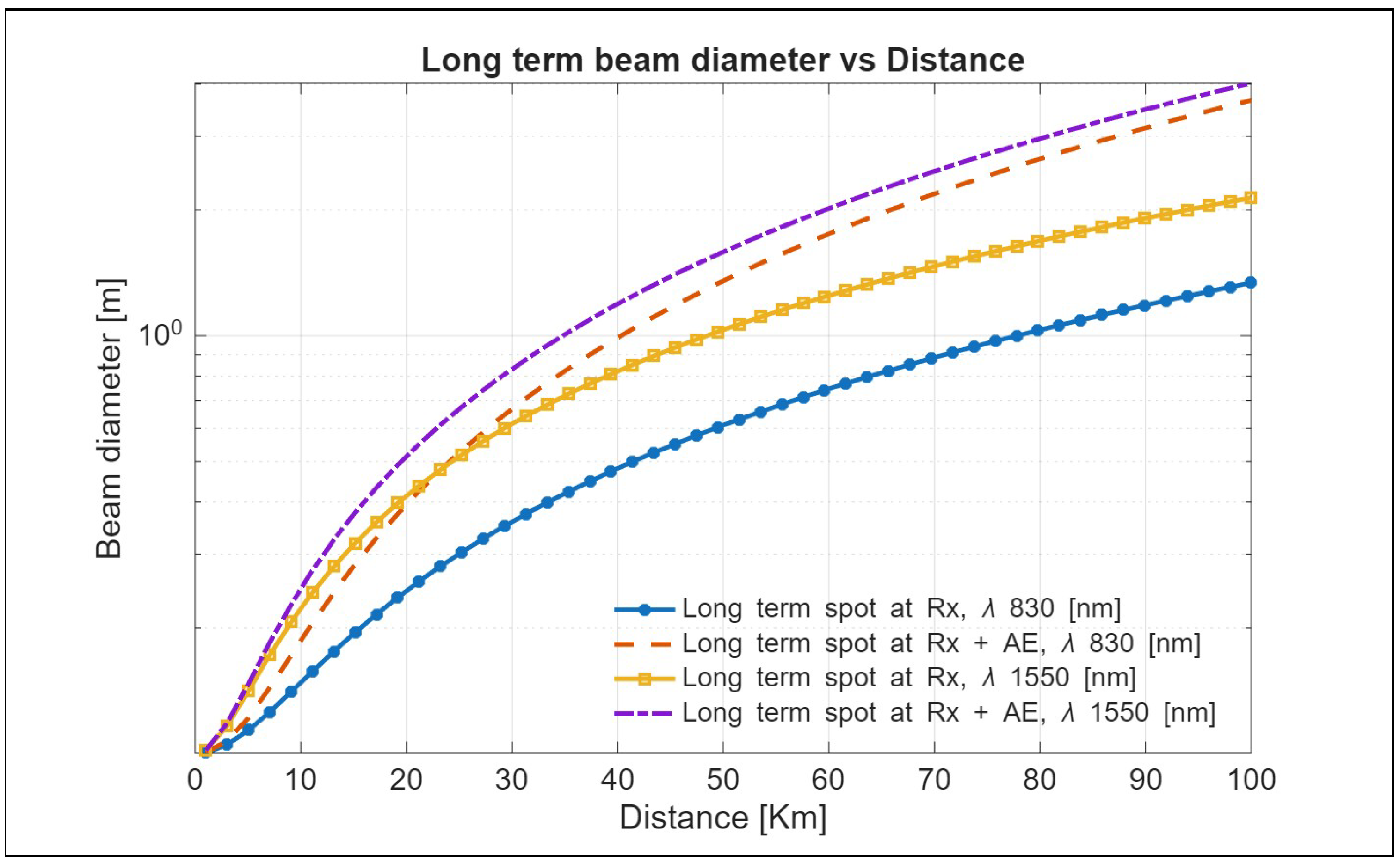
Although a direct measurement of the parameter C n 2 proved to be not an easy task, several approaches are discussed in the literature, and this field is still open [79,80,81]. A quantitative analysis is provided by the authors of [69] where the propagating wavefront phase model is modified utilizing the aero-optical effect across the turret interface. Based on this study, an effective scintillation value is determined by simulation ( σ p s = 2 10 16 ) and used for our analysis. In Figure 4, the atmosphere spreading effect on the beam diameter along a turbulent horizontal path is shown for two common wavelengths λ 830–1550 nm.
The extra beam spreading factor is taken into account in (17) below:
W L T = W 1 + 1.33 σ R 2 Λ 5 6 + 1.93 σ ^ p s 2 Λ 5 6
The contribution of aero-optics effects increases the link margin with an extra budget; the literature points to 4 to 10 dB. Ref. [82] shows that the use of AO is a valid mitigation, while experimental activity on QKD links reported ∼3.5 dB per photon [29,83].
Refs. [23,24] showed that an airborne-to-ground duplex PAT/AO system operating between slant range terminals experienced only a 1 dB loss for straight-on communications and a 4 dB loss at all other angles.

4.7. Atmospheric Path Loss and Sky Conditions in FSO

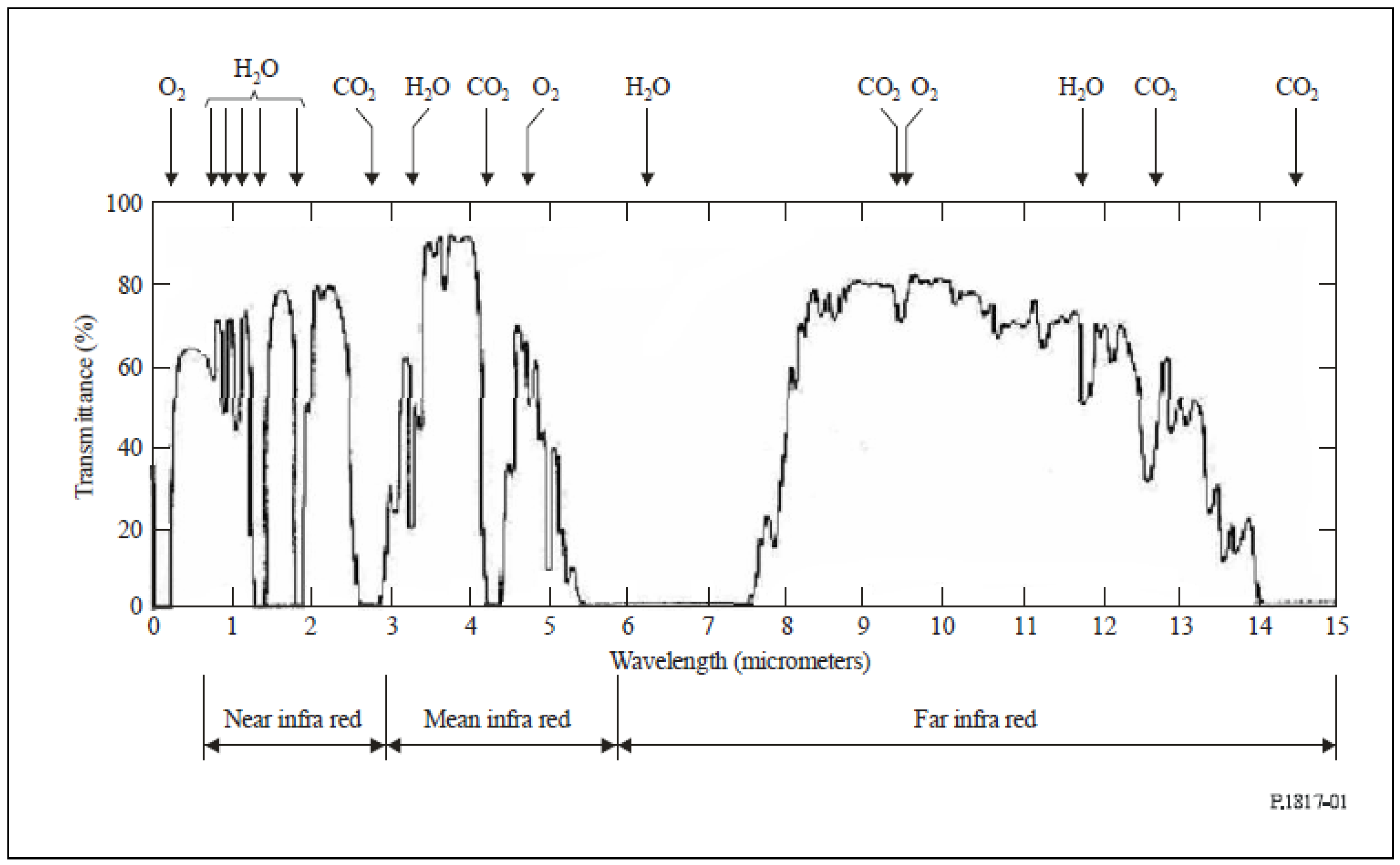
Traveling light that interacts with gas and suspended particles experiences signal extinction. Path loss is a consequence of the selective behavior of the atmospheric medium as reported in the ITU standard ITU-R/P.1817-1 [84], and absorption bands are shown in Figure 5. Experimental activities on platforms at different altitudes were reported in [85], while DLR reported a study based on the simulation of molecular absorption on slant/vertical profiles in [86]. Two major phenomena are responsible for this process—absorption and scattering (both wavelength-dependent). The physical law describing this process is given by the Beer–Lambert law (BLL), which introduces the concept of transmittance. In the Earth’s atmosphere, this becomes
L a t m ( λ ) = e p a t h c ( r , λ ) d r = e s e c ( ζ ) 0 c ( r , λ ) d r = [ L 0 ] s e c ζ
where L 0 is the vertical atmospheric transmittance, ζ is the zenith angle ( ζ = 90 for vertical), and r is the spatial coordinate.
τ = 0 c ( r , λ ) d r
The exponent term is the atmospheric optical thickness related to the physical variable c ( λ ) as the beam extinction coefficient;
c ( λ ) = α ( λ ) + β ( λ ) [ km 1 ]
accounting for absorption and scattering of both atmospheric particles and aerosols. The International Telecommunications Union (ITU) outlined a model utilizing (18) in [87] for Earth–space telecommunication systems. Optical thickness was quantified by simulation by Giggenbach et al. in Ref. [88] to estimate satellite downlink path loss using models developed in [86]. In the literature, an improvement in the BLL (20) has been proposed, introducing an additional parameter to account for optical turbulence in this process, valid for both the atmospheric and underwater environment [89]. A reference for environmental extinction coefficients is in [90], which was reported during past activities of experimental measurements. Considering the signal at low elevation in satellite slant downlinks, software models and simulators such as MODTRAN® (http://modtran.spectral.com/modtran_index (accessed before 31 March 2025)) are needed for an informed forecast of atmospheric transmittance utilizing suspended particulate and air composition data available from measurements.
Optical visibility or visual range is a practical criterion to account for path loss on horizontal links: it refers to the meteorological parameter Visibility [91] based on the concept of Contrast to estimate distances in fog conditions. It is determined by meteorologists looking horizontally to determine objects that can be seen at known distances; it is of interest in aviation. In other words, meteorological visibility is a way to estimate the horizontal atmospheric transmittance for visible wavelengths where Mie scattering dominates in the atmosphere of the Earth. It depends on the relative difference (or contrast) between the light intensity from an object and from the intervening atmosphere in a horizontal geometry. Horizontal visibility follows the Beer–Bouguer–Lambert law, i.e.,
C ( r ) = e c r = e τ
where C ( r ) is the normalized apparent contrast using the Weber definition, r is the horizontal distance from the object, and τ is the optical thickness (19). The lowest visually perceptible brightness contrast for meteorological purposes is called the threshold contrast, which is typically about 2 % for communications, and its extinction coefficient is given by the Koschmeider equation:
c v i s ( λ ) = 3.912 V v i s 0.55 [ μ m ] λ q
where c and V v i s denote the visibility-based, volume extinction coefficient and visibility, respectively. This model was elaborated by Kruse in Equation (23) below, providing the particle sized-relative coefficients
V ( km ) = 10 l o g 10 ( T T h ) β λ λ 550 δ
β λ = L o s s 4.343 L ( dB / km ) .
with λ in nm. This model is able to generalize at different wavelengths and for the parameter q, depending on the visibility range. The parameter δ provided by Kruse is related to the size distribution of the scattering particles, as shown in relationship (25) below. This parameter has been investigated in the Kim and Al-Naboulsi studies for its validity in short ranges; for related studies on fixed links, see Refs. [92,93,94,95].
δ = 1.6 , if V v i s > 50 km 1.3 , if 6 < V v i s < 50 km 0.585 V 1 / 3 , if V v i s < 6 km
Ref. [96] investigated this aerosol optical thickness (AOT) equation and other methods for use in radiative transfer modeling, suggesting that for short ranges (<10 km), quantitative prediction based on visibility should be considered only in the absence of other alternatives; several approaches were tested in the research.
Light with cloud and aerosol interaction is a complex phenomenon as described in [97], since scattering follows the wavelength-to-particulate ratio to distinguish Rayleigh, Mie, and non-selective scattering. This ratio determines the severity of the light deflection and its distribution. Its relevance for FSO communications has been studied for its diffusive behavior and its effects on signals such as high levels of attenuation and angular, temporal, and spatial spread [98,99]. The effects of clouds are directly related to their thickness and shape. A general approach to cope with this phenomenon is to use hybrid RF/optical systems, while, for vertical paths, it is the monitoring of the areas where a link should operate; in general, for satellite links, an optical ground station in diverse sites is employed [100].
An experimental model has been derived under controlled conditions for the prediction of fog and smoke loss coefficients by the authors of [101]. This study shows close agreement with the one proposed by Kim and Kruse, while another study investigated the wavelength performance of an FSO link through simulation in [102]. For long-range links, high-power lasers in adverse weather conditions were investigated by the authors of [103], confirming agreement with previously reported literature data.

5. Engineering Parameters/Systems for Aerial FSO

This section presents signal losses due to geometrical misalignment and summarizes the mitigation established for the turbulent channel. The influence of atmospherics on the signal level is shown by comparing the performances of long-range flying systems with respect to a fixed receiver in terms of BER reduction.

5.1. Geometrical Loss and Pointing Error

Geometrical losses are due to the natural diffraction that the beam experiences upon propagation, as introduced in Section 4.6, thus reducing by a fraction the mean irradiance level after propagation at the receiver front end, given by
I ( r , L ) W 0 2 W L T 2 e x p 2 r 2 W L T 2
The loss in dB is derived in the relationship below,
L g l = 10 l o g A t A r L p 2 λ 2 + 2 l o g 4 π
where terms A t , A r denote the aperture areas at the front ends, L P denotes the path length, and lambda denotes the wavelength.
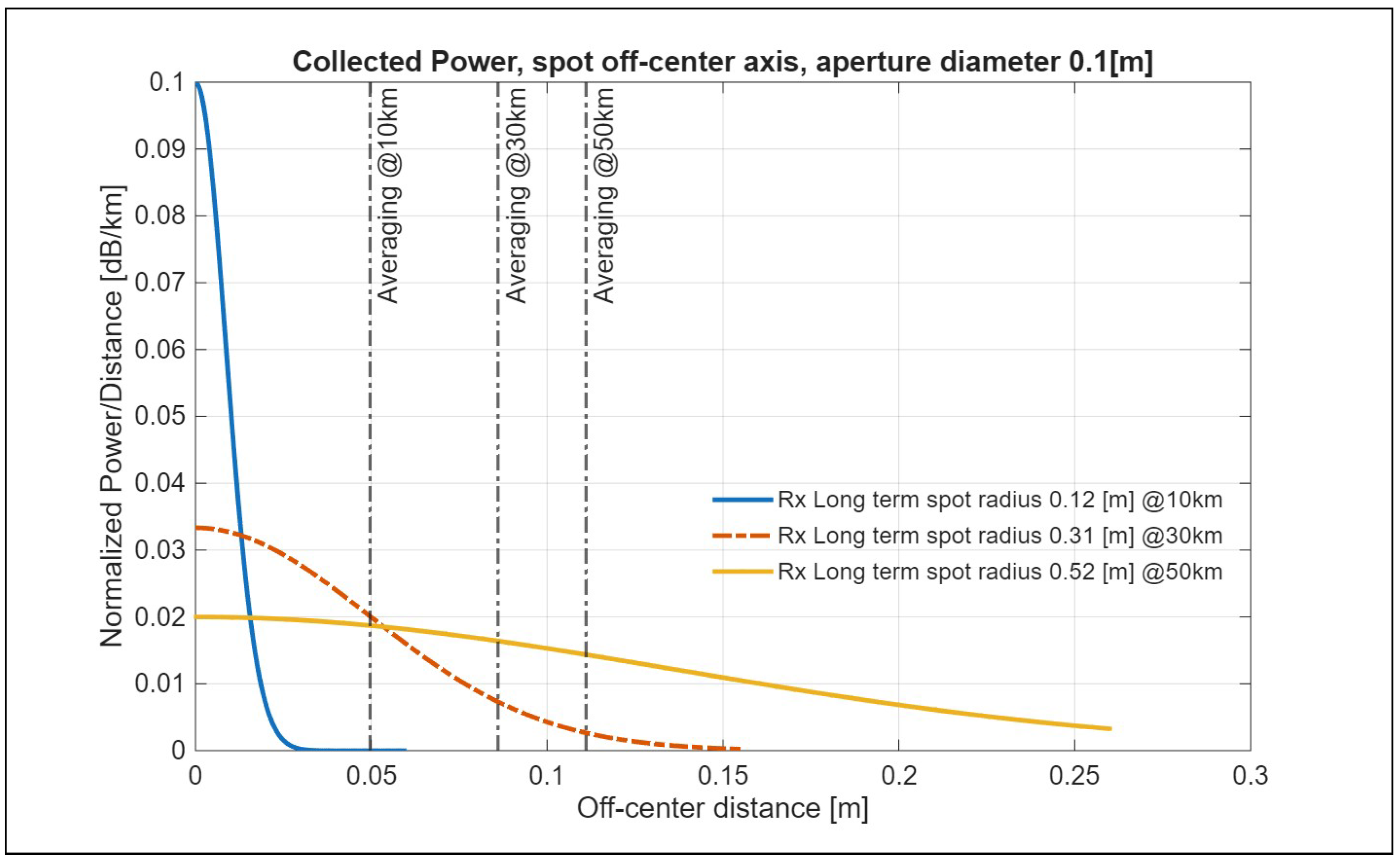
Figure 6 shows the collected power for an offset spot at a high altitude subject to atmospheric spreading and computed according to the data in Figure 4.
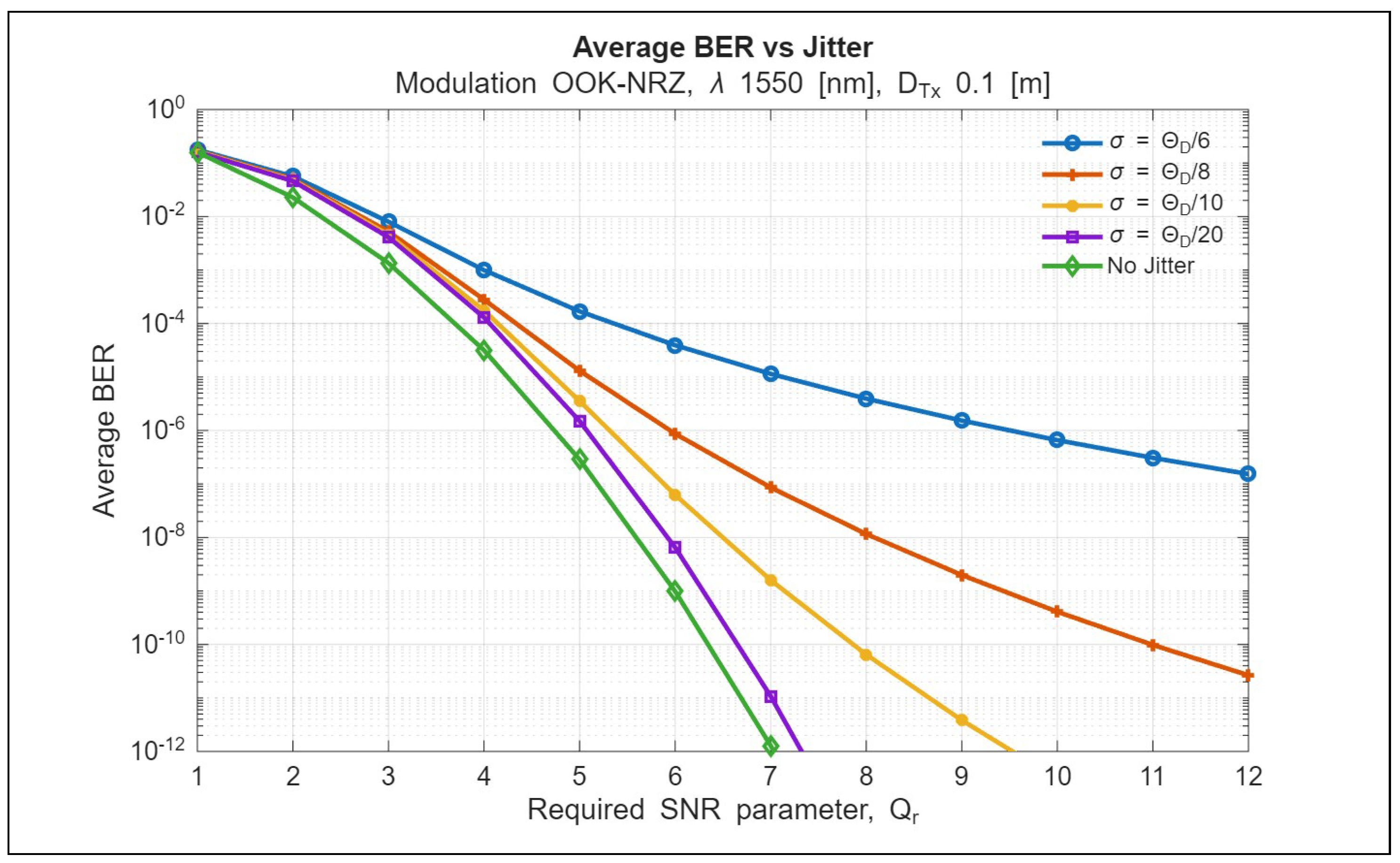
Another impingement of critical nature is the pointing error, since extremely focused beam widths and offset errors result in deep fading with a missing link. To ease the pointing process, the launch optics system could impose a spreading factor that may use an adaptive FOV [104,105]. Critical in the aerial mobility scenario are structural vibrations that introduce mechanical jitter in addition to platform motion. Figure 7 shows the effect of the BER of the pointing jitter, with respect to the SNR [106]. The platforms and nodes establish a cooperative procedure to achieve alignment through the pointing acquisition and tracking (PAT) phase and its tracking loop [107].
Figure 6. Normalized optical power under the off-center pointing error with respect to the path length. The aerial link operates at the infrared wavelength λ 1550 nm, receiver aperture 0.1 m at 10 km altitude, computed from [108]. It is shown that the large aperture condition is reached for a range between 30 and 40 km for this aperture size.
Applsci 16 01054 g006
Figure 7. Average BER vs. Q for the platform under pointing loss and jitter, λ 1550 nm, as seen in [106].
Applsci 16 01054 g007
The power loss caused by misalignment is given by the following relationship:
L p = e x p 8 θ J i t t e r 2 θ D i v 2
assuming a Gaussian ratio between jitter and spot divergence [108]. The authors developed a complete model for a hybrid RF/FSO system in [109] under turbulence and misalignment fading.

5.2. Turbulence Mitigation

Throughout the years, channel instabilities have been studied, and system improvements have been achieved through several techniques that increase SNR and BER.
  • Aperture averaging reduces the scintillation index and fading effects, which can be achieved by increasing the receiver optical aperture diameter beyond the correlation width of the irradiance fluctuation, given by the Fresnel relation [110], to have good heterodyne efficiency. This technique has been studied on horizontal and satellite downlinks [111]. Figure 6 shows the average threshold radius for a Gaussian spot considered at that distance from the launch optic.
  • Adaptive optics (AO) is used to correct the front phase distortion caused by turbulence. A common system acts on sensing and is based on a fast steering beam, a deformable mirror, and the Shack–Hartman wavefront sensor. They have proven useful in weak turbulence conditions and in a near-field short-range link within a practical range defined by the Rayleigh range and generally below 10 km in front of the transceiver lens. Their performances were investigated in Refs. [19,112,113,114,115]. Stotts and Andrews showed that the optimal Zernike order yields closer agreement between the Strehl ratios from theoretical and field measurements.
  • Optical automatic gain control (OAGC) was introduced by the industry during the 2000s after long-range tests reported for the ORCA/FOENEX projects in the first Section 3. Those systems needed to cope with large signal dynamics at the output of the AO system to avoid front-end saturation and maintain the power level within a 1 dB for the following stages of the communication receiver chain.
  • Wavelength and spatial diversity are alternative solutions when the line of sight is mainly affected or obstructed by atmospherics, e.g., clouds, fog, or rain. An experimental demonstration of an improvement of the Q factor (30) is in [116]. Additionally, in the aerial scenario, the platform can use multiple apertures on the transmitter or receiver side for diversity, and this technique has also been shown to allow path loss mitigation, increasing the SNR at the receiver. The use of N apertures reduces the scintillation index by a factor N .
  • Channel coding and interleaving have proved useful. Reed–Solomon forward error correction (FEC) code and layered coding schemes have been applied, and an analysis of turbulence coding is in [117]. Although turbulent channel coding is still under study, a format comparison is made in [118,119], where the performance is discussed under different channel conditions [120].
  • Power can be increased up to a limit point where the system’s thermal load is tolerable or channel propagation states change, leading to channel saturation or surges in physical phenomena, e.g., thermal blooming due to the ionization of the atmosphere by absorption of high-fluence laser light. Attention should be paid to the eye safety of the operator exposed to the optical beam.
  • Increasing the FOV involves a tradeoff, balancing it against the increase in background noise. Those solutions have to face the feasibility of the SWAP-C requirements for the systems under development.
  • Ref. [121] presented interesting work on programmable metasurfaces that has demonstrated beam steering and the feasibility of tailoring non-diffracting Bessel beams with reduced deformation in a long-range path with respect to Gaussian beams. This approach may offer enhanced robustness against turbulence-induced beam spreading in long-range aerial FSO links.
In this challenging scenario of aerial long-range FSO, and assuming a non-Kolmogorov atmosphere, AO, having limited bandwidth, is unable to follow faster light fluctuations. Meanwhile, employing only aperture averaging is unable to compensate for beam wandering, and FEC coding introduces latency if long error sequences are experienced. In synthesis, several works have shown that a high reliability link involves a synergistic approach between these different techniques.

5.3. Modulation Formats for FSO

This section discusses how format selection has been pragmatically restricted by experimental studies throughout the years to maximize channel resilience in flying links [45]. An optical signal can be modulated in amplitude, phase, and polarization. Two basic source modulation techniques have been defined in engineering practice because of physical limitations in laser systems: internal and external modulation, with the latter offering incremental performance (data rate) and system complexity due to the ancillary subsystems needed. This consideration points to a differentiation between fixed link technologies and flying transceivers due to environmental constraints. In the general approach, several complex schemes have been demonstrated in FSO [122]. As shown in previous chapters, this long-range and mobility link has to cope with serious levels of scintillation.
To facilitate the transceiver complexity in these demanding links, spectral efficiency is sacrificed in favor of channel resilience. Coherent modulation requires a local oscillator for phase extraction. Then, the pass-band format, intensity modulation with direct detection (IMDD), is generally adopted. On–off keying non-return-to-zero (OOK-NRZ) is the modulation scheme that has been under study since the early days of turbulent channels. Being an asynchronous modulation format, a superimposed channel coding is needed. A comparison of formats is made in [118,119], where performances are discussed under different channel conditions and complex configurations [120,123].

5.4. Photoelectric Section: Metrics

This subsection evaluates link quality performance with respect to path length and turbulence level. We consider BER and probability of fading as the main performance metrics for an aero link that is modulated with intensity modulation and on-off keying (OOK). Optical coupling losses in the receiver front end are assumed to be negligible and almost deterministic.

Metrics

The photodetection process in direct detection systems refers to the capability of the photodiode front end to recover the transmitter signal and the carried information, discriminating it from process noise.
The signal-to-noise ratio (SNR) is a common performance metric in communication, and it is defined in optical practice as the ratio between the photodetected current and the process noise (OSNR). In the electrical domain, its expression is the common power ratio:
S N R e = i S 2 σ N 2
In the optical domain, this term is developed in the literature as the Q factor, or the ratio of the net mean intensity of the two light/electric symbols to the sum of noise standard deviations associated with a binary modulation scheme.
Q = μ 1 μ 0 σ 1 + σ 0
This parameter accounts for internal electronic noise from the receiver and external sources, such as optical amplifiers or background noise due to the environment. They are not recalled here for brevity, as the external light is generally lower in magnitude than the system’s internal noise. Recent studies have investigated background noise for visible light positioning (VLP) in [124] and proposed a ratio-based technique to stabilize scintillation effects, with promising results. This study has shown that ambient optical noise can be quantitatively modeled and actively suppressed using ratio-based signal processing techniques, which may be extended to low-altitude aerial FSO receivers operating under strong background illumination and high-maneuverability conditions. Common front ends are based on photodiode technologies with a different impact; they are specialized according to the operative formulas recalled in Table 8.
The proper S N R channel correction is made at the end of the optical link, where the turbulence-free OSNR is accounted for by the effect of optical turbulent intensity noise and averaged, as defined in [41]. The denominator acts as a scaling factor in (31) since it is a sum composed of a term that represents the beam spread factor, as the inverse Strehl ratio. This accounts for the quality of the incoming irradiance at the receiving aperture plus its imposed fluctuation. The second term is the scintillation averaged by the aperture of the receiver transceiver D R in the photodetector [126].
S N R = S N R 0 P r 0 P r + σ I 2 ( D R ) S N R 0 2
Formally, the expression for the electrical domain is specialized in [18] and is reported below (32).
S N R e = P R e c 2 2 q B e P R e c + P b R λ + i D R λ 2 + 4 k B T 0 F r f B e G 2 R λ 2 R L + P R e c 2 σ I 2 ( D T x )
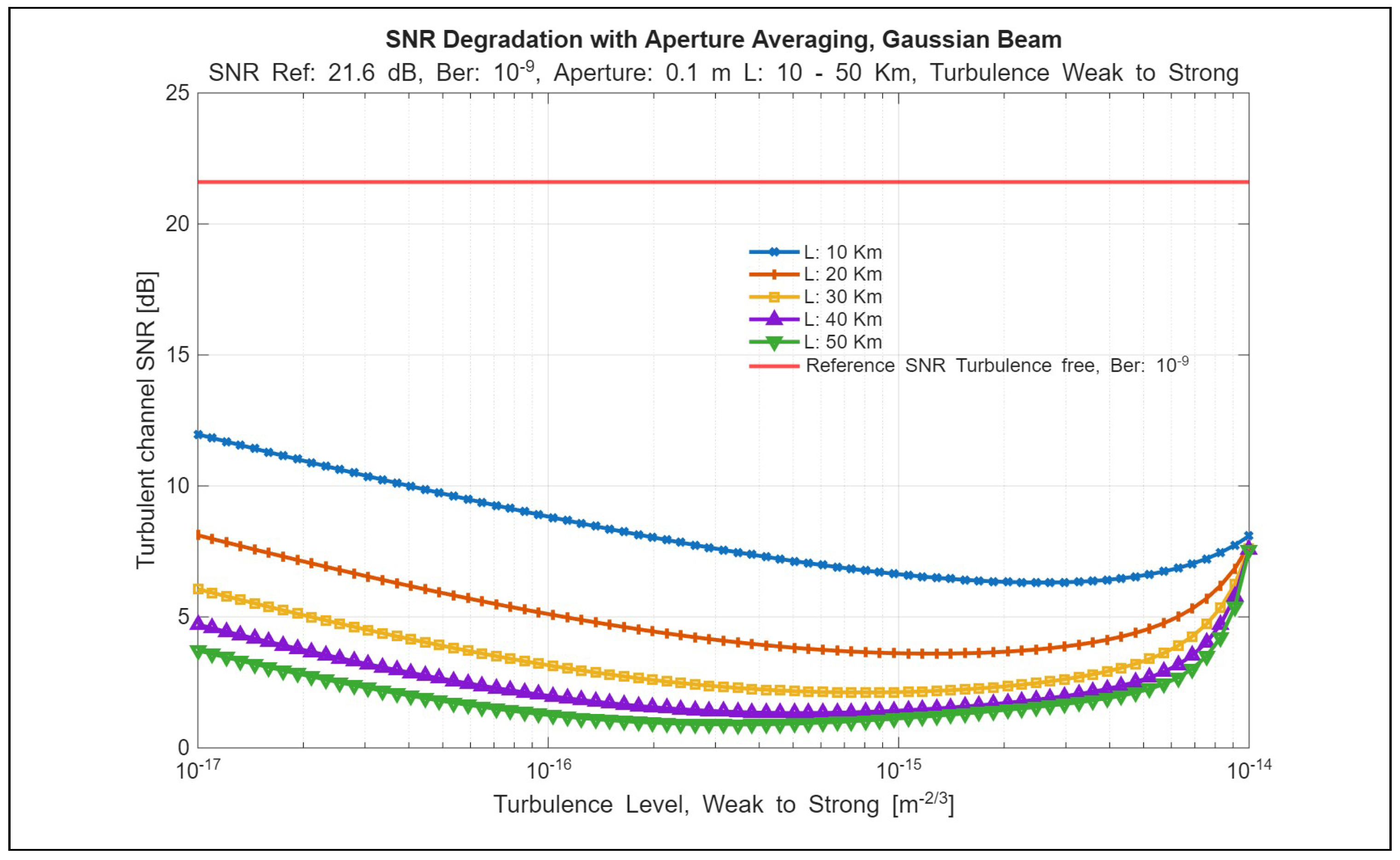
In Figure 8 the channel influence is shown on a Gaussian wave beam front propagating across a horizontal path exposed to increasing levels of turbulence. This figure gives evidence of the reduction in SNR for a reference level needed in a transmission of BER 10 9 , according to Table 9. The BER derivation is modulation dependent. The format that we consider as the reference is common in FSO, NRZ-OOK, and recalled here:
B E R N R Z - O O K = 1 2 e r f c S N R e 2 2
The SNR reference values were derived in [125] for the optical communication links in standard practice at BER of 10 9 and 10 6 , as reported in Table 9.
Concerning optical turbulence, the BER derivation has to be corrected by averaging with the scintillation probability density function that models the link.
B E R = 1 2 0 p I ( u ) e r f c S N R u 2 2 d u
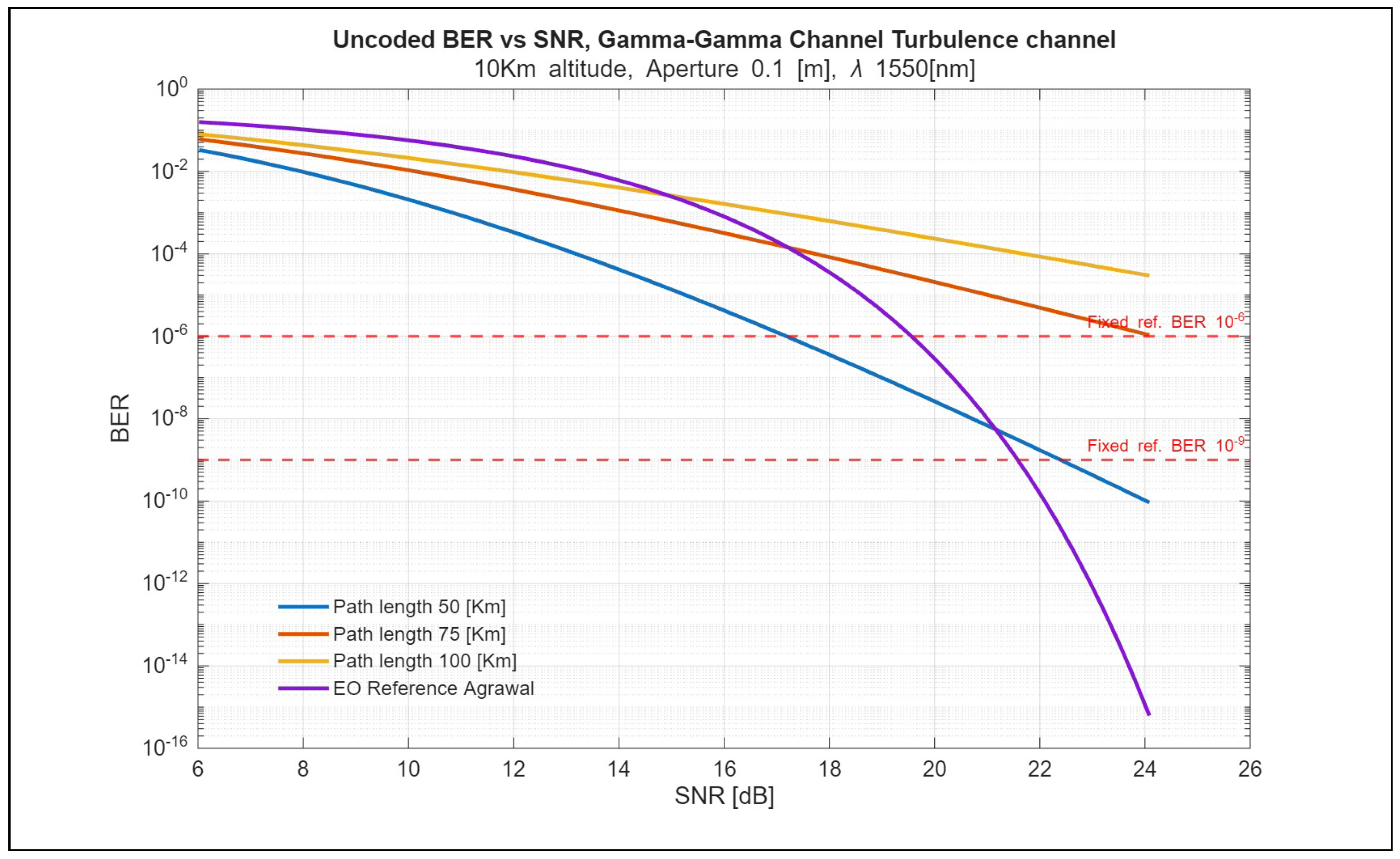
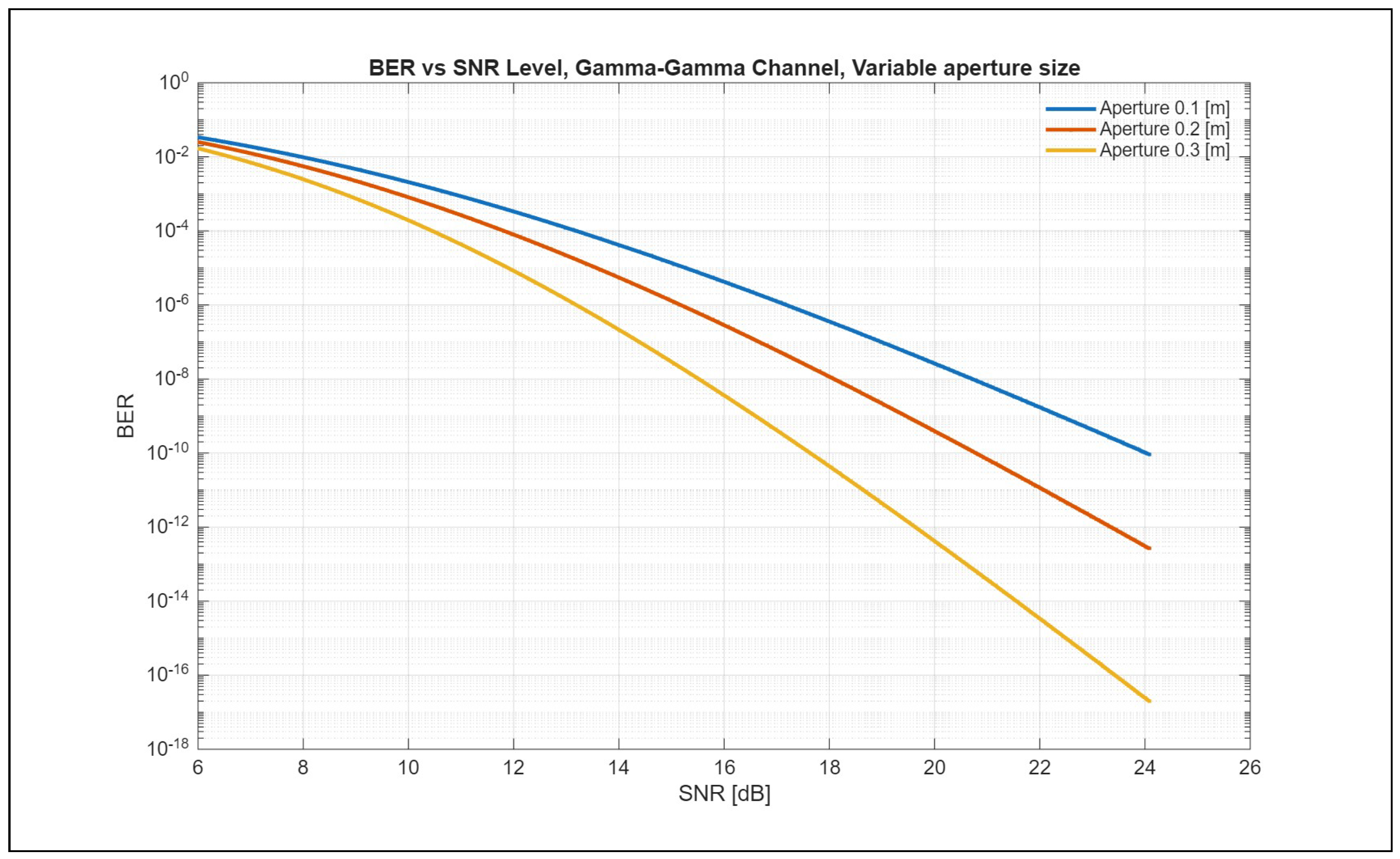
A comparison between the turbulence-free channel and the Gamma-Gamma scintillation model is shown in Figure 9 along increasing path lengths. This figure shows how the cumulative effect of scintillation reduces transmission performance. The aperture effect on the SNR across a path length of 50 km with Gamma-Gamma scintillation values is shown in Figure 10.
Probability of fading is another performance metric generally adopted in a free-space turbulent channel, since it describes the percentage of time that the signal is below a reference threshold I T . A complete derivation accounts for noise in the process, considering a threshold-to-noise ratio (TNR). A link resilience margin is diminished by the SNR signal weighted according to the relation reported below:
T N R = i T σ N
It should be noted that the turbulence dependency is modeled through the scintillation model in the following:
P r f a d e = 1 1 2 0 p I ( u ) e r f c T N R S N R u 2 d u
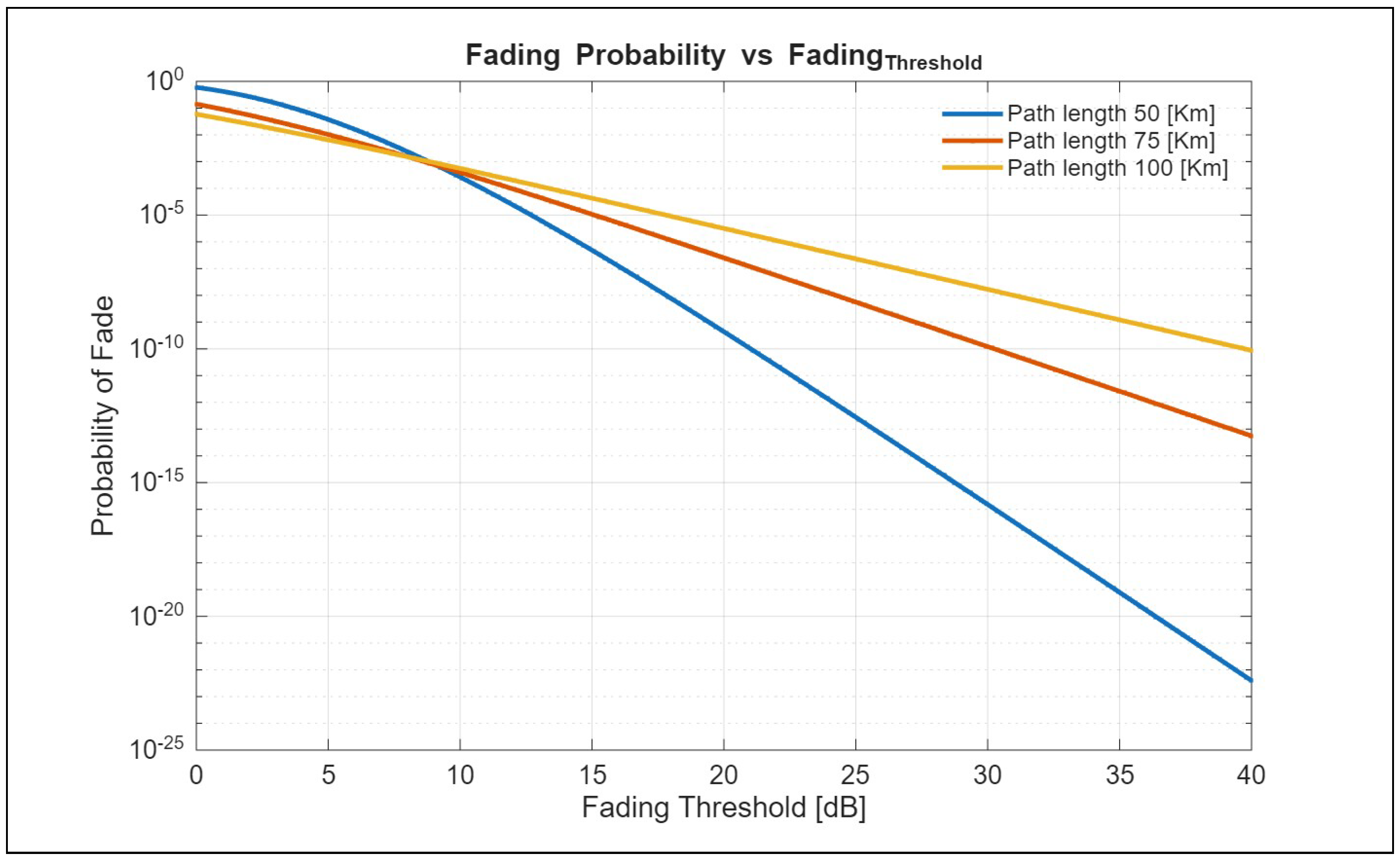
As derived in [41], another derivation has been specialized for DLR in [120] for static cases using a spherical wavefront. Figure 11 shows the fading probability for the turbulent Gamma-Gamma channel along increasing paths. A comparison between other channel profiles, such as log-normal and Gamma-Gamma models, was discussed in [127].

6. Conclusions

This paper presented a brief analysis of atmospheric aerial optical links and systems under different propagation conditions collected in the literature. Several physical variables that significantly affect and limit the performance of communication systems have been examined. Among the most relevant factors, scintillation and path loss have been recalled as key limiting phenomena. Channel mitigation techniques were presented in previous experiments that showed how a layered system/protocol/network structure copes with physical impairments. Those mitigations are incremental, depending on how severe the link conditions were during the tests. Through simulation, we evaluated the performance of the free-space optical communication system over comparable path lengths according to the theoretical models established and recalled, while considering one or more limiting physical effects. In particular, we assessed the bit error rate (BER) and the signal-to-noise ratio (SNR) using on-off keying intensity modulation with direct detection (OOK IMDD). In conclusion, we observed that FSO system development must take into account the working environment and follow an integrated approach. As a future perspective, similar studies will be conducted by adopting free-space optical coherent systems and angular modulation techniques, both binary and multilevel.

Author Contributions

Conceptualization, F.G. and S.B.; Methodology, F.G. and S.B.; Software, F.G.; Validation, F.G. and S.B.; Formal analysis, F.G. and S.B.; Investigation, F.G.; Resources, F.G.; Writing—original draft, F.G.; Writing—review & editing, F.G. and S.B.; Visualization, F.G.; Supervision, F.G. and S.B. All authors have read and agreed to the published version of the manuscript.

Funding

This research received no external funding.

Institutional Review Board Statement

Not applicable.

Informed Consent Statement

Not applicable.

Data Availability Statement

The original contributions presented in the study are included in the article, further inquiries can be directed to the corresponding author.

Acknowledgments

During the preparation of this manuscript/study, the author(s) used [Google Gemini AI, Flash 2.5] to generate the graphics of Figure 1. The authors have reviewed and edited the output and take full responsibility for the content of this publication.

Conflicts of Interest

The authors declare no conflicts of interest.

Abbreviations

The following abbreviations are used in this manuscript:
A2AAir-to-Air
A2GAir-to-Ground
ABLAtmospheric Boundary Layer
AFRLAir Force Research Labs
APDAvalanche Photo Diode
AOAdaptive Optics
AOTAerosol Optical Thickness
BERBit Error Rate
DARPADefense Advanced Research Projects Agency
DDTVDifference of Differential Tilt Variances
DWDMDense Wavelength Division Multiplexing
DLRDeutsches Zentrum für Luft- und Raumfahrt
EDFAErbium Doped Fiber Amplification
EDRSEuropean Data Relay Satellite System
EMElectromagnetic
FSLFraunhofer Spreading Loss
FSOFree-Space Optics
G2GGround-to-Ground
HAPsHigh-Altitude Platforms
HAPHufnagel–Andrews–Phillips
H-VHufnagel Valley
ICTInternet and Communication Technologies
IM/DDIntensity Modulation/Direct Detection
NRZNon-return to Zero
OAGCOptical Automatic Gain Controller
OOKOn–Off Keying
PATPointing Alignment and Tracking
PRBSPseudo-Random Bit Sequence
QKDQuantum Key Distribution
RFRadio Frequency
RRRayleigh range
SWAPSize, Weight, and Power
UDPUser Datagram Protocol
UWSNsUnderwater Wireless Sensor Networks
A T / R , x Transceiver optical area
β 0 Spherical wavefront
C n 2 Refractive Index Structure function
D T / R Aperture diameter
P T / R , x Transmitter or Received Power
σ R 2 Rytov variance
σ ^ p s 2 Effective Rytov variance
γ T / R , x Transceiver transmittance
ζ Zenith angle

References

  1. Rinaldi, L.; Camponeschi, F.; Bogoni, A. Space-Grade Analogue and Digital Photonics for Satellite Communications in Europe. J. Light. Technol. 2024, 42, 1004–1015. [Google Scholar]
  2. Ghassemlooy, Z.; Arnon, S.; Uysal, M.; Xu, Z.; Cheng, J. Emerging Optical Wireless Communications-Advances and Challenges. IEEE J. Sel. Areas Commun. 2015, 33, 1738–1749. [Google Scholar] [CrossRef]
  3. Nguyen, D.C.; Ding, M.; Pathirana, P.N.; Seneviratne, A.; Li, J.; Niyato, D.; Dobre, O.; Poor, H.V. 6G Internet of Things: A comprehensive survey. IEEE Internet Things J. 2021, 9, 359–383. [Google Scholar] [CrossRef]
  4. Hamza, A.S.; Deogun, J.S.; Alexander, D.R. Classification Framework for Free Space Optical Communication Links and Systems. IEEE Commun. Surv. Tutor. 2019, 21, 1346–1382. [Google Scholar] [CrossRef]
  5. Nzekwu, N.J.; Fernandes, M.A.; Fernandes, G.M.; Monteiro, P.P.; Guiomar, F.P. A Comprehensive Review of UAV-Assisted FSO Relay Systems. Photonics 2024, 11, 274. [Google Scholar] [CrossRef]
  6. Zeng, Z.; Fu, S.; Zhang, H.; Dong, Y.; Cheng, J. A survey of underwater optical wireless communications. IEEE Commun. Surv. Tutor. 2016, 19, 204–238. [Google Scholar]
  7. Kaushal, H.; Kaddoum, G. Underwater optical wireless communication. IEEE Access 2016, 4, 1518–1547. [Google Scholar] [CrossRef]
  8. Moriconi, C.; Cupertino, G.; Betti, S.; Tabacchiera, M. Hybrid acoustic/optic communications in underwater swarms. In Proceedings of the OCEANS 2015—Genova, Genova, Italy, 18–21 May 2015; pp. 1–9. [Google Scholar] [CrossRef]
  9. Elamassie, M.; Uysal, M. FSO-based Multi-Layer Airborne Backhaul Networks. IEEE Trans. Veh. Technol. 2024, 73, 15004–15019. [Google Scholar] [CrossRef]
  10. Henniger, H.; Giggenbach, D. Avionic Optical Links for High Data-Rate Communications. In Proceedings of the ICAS—25th Congress of the International Council of the Aeronautical Sciences, Hamburg, Germany, 3–8 September 2006. [Google Scholar]
  11. Cossu, G.; Gilli, L.; Vincenti, N.; Pifferi, E.; Schena, V.; Ciaramella, E. Demonstrating Intra-Spacecraft Optical Wireless Links. IEEE Access 2023, 11, 30920–30928. [Google Scholar] [CrossRef]
  12. Cossu, G.; Gilli, L.; Vincenti, N.; Ertunc, E.; Massa, M.; Dell’Orso, R.; Moggi, A.; Palla, F.; Ciaramella, E. High-Speed Optical Wireless System for Extreme Space Conditions. IEEE J. Radio Freq. Identif. 2024, 8, 601–608. [Google Scholar] [CrossRef]
  13. Cossu, G.; Ertunc, E.; Gilli, L.; Mestice, E.; Vincenti, N.; Bresciani, F.; Ciaramella, E. Optical Wireless Links for Extra-Spacecraft Communication. IEEE Aerosp. Electron. Syst. Mag. 2024, 39, 42–48. [Google Scholar] [CrossRef]
  14. Chan, V.W. Optical satellite network architecture [Invited Tutorial]. J. Opt. Commun. Netw. 2024, 16, A53–A67. [Google Scholar] [CrossRef]
  15. Kaushal, H.; Kaddoum, G. Optical communication in space: Challenges and mitigation techniques. IEEE Commun. Surv. Tutor. 2016, 19, 57–96. [Google Scholar] [CrossRef]
  16. Giordani, M.; Zorzi, M. Non-terrestrial networks in the 6G era: Challenges and opportunities. IEEE Netw. 2020, 35, 244–251. [Google Scholar] [CrossRef]
  17. Fidler, F.; Knapek, M.; Horwath, J.; Leeb, W.R. Optical Communications for High-Altitude Platforms. IEEE J. Sel. Top. Quantum Electron. 2010, 16, 1058–1070. [Google Scholar] [CrossRef]
  18. Stotts, L.B.; Andrews, L.C. Communication performance in the focusing and saturation regimes inherent to the turbulent channel: A tutorial. Opt. Eng. 2024, 63, 120801. [Google Scholar] [CrossRef]
  19. Stotts, L.B.; Andrews, L.C. Optical communications in turbulence: A tutorial. Opt. Eng. 2023, 63, 041207. [Google Scholar] [CrossRef]
  20. Karp, S.; Stotts, L.B. Fundamentals of Electro-Optic Systems Design: Communications, Lidar, and Imaging; Cambridge University Press: Cambridge, UK, 2012. [Google Scholar]
  21. Raj, A.A.B.; Krishnan, P.; Darusalam, U.; Kaddoum, G.; Ghassemlooy, Z.; Abadi, M.M.; Majumdar, A.K.; Ijaz, M. A review–unguided optical communications: Developments, technology evolution, and challenges. Electronics 2023, 12, 1922. [Google Scholar] [CrossRef]
  22. Stotts, L.B.; Andrews, L.C.; Cherry, P.C.; Foshee, J.J.; Kolodzy, P.J.; McIntire, W.K.; Northcott, M.; Phillips, R.L.; Pike, H.A.; Stadler, B.; et al. Hybrid Optical RF Airborne Communications. Proc. IEEE 2009, 97, 1109–1127. [Google Scholar] [CrossRef]
  23. Bagley, Z.C.; Hughes, D.H.; Juarez, J.C.; Young, D.W.; Kolodzy, P.J.; Martin, T.; Northcott, M.J.; Pike, H.A.; Plasson, N.D.; Stadler, B.K.; et al. Hybrid optical radio frequency airborne communications. Opt. Eng. 2012, 51, 055006. [Google Scholar] [CrossRef]
  24. Andrews, L.C.; Phillips, R.L.; Bagley, Z.; Plasson, N.; Stotts, L.B. Hybrid Optical/Radio Frequency (RF) Communications. In Advanced Free Space Optics (FSO): A Systems Approach; Springer: New York, NY, USA, 2015; pp. 295–342. [Google Scholar] [CrossRef]
  25. Diskin, Y.; Whiteley, M.; Grose, M.; Jackovitz, K.; Drye, R.; Hampshire, B.; Owens, M.; Smith, E.; Magee, E.; Kalensky, M.; et al. Aircraft to Ground Profiling: Turbulence Measurements and Optical System Performance Modeling. AIAA J. 2021, 59, 4610–4625. [Google Scholar] [CrossRef]
  26. Juarez, J.C.; Young, D.W.; Venkat, R.A.; Brown, D.M.; Brown, A.M.; Oberc, R.L.; Sluz, J.E.; Pike, H.A.; Stotts, L.B. Analysis of link performance for the FOENEX laser communications system. In Atmospheric Propagation IX, Proceedings of the SPIE Defense, Security, and Sensing, Baltimore, MD, USA, 23–27 April 2012; Thomas, L.M.W., Spillar, E.J., Eds.; International Society for Optics and Photonics, SPIE: Bellingham, WA, USA, 2012; Volume 8380, p. 838007. [Google Scholar] [CrossRef]
  27. Chan, V.J.; Arnold, R.L. Results of one GBPS aircraft-to-ground lasercom validation demonstration. In Free-Space Laser Communication Technologies IX, Proceedings of the Photonics West ’97, San Jose, CA, USA, 8–14 February 1997; Mecherle, G.S., Ed.; International Society for Optics and Photonics, SPIE: Bellingham, WA, USA, 1997; Volume 2990, pp. 52–59. [Google Scholar] [CrossRef]
  28. Moll, F.; Horwath, J.; Shrestha, A.; Brechtelsbauer, M.; Fuchs, C.; Martín Navajas, L.A.; Lozano Souto, A.M.; Díaz González, D. Demonstration of High-Rate Laser Communications From a Fast Airborne Platform. IEEE J. Sel. Areas Commun. 2015, 33, 1985–1995. [Google Scholar] [CrossRef]
  29. Yu, H.-C.; Tang, B.-Y.; Chen, H.; Xue, Y.; Tang, J.; Yu, W.-R.; Liu, B.; Shi, L. Airborne quantum key distribution with boundary layer effects. EPJ Quantum Technol. 2021, 8, 26. [Google Scholar] [CrossRef]
  30. Cunningham, J.; Foulke, D.; Goode, T.; Baber, D.; Gaughan, B.; Fletcher, M.; Young, D.W.; Juarez, J.C.; Sluz, J.E.; Riggins, J.L. Long range field testing of free space optical communications terminals on mobile platforms. In Proceedings of the MILCOM 2009—2009 IEEE Military Communications Conference, Boston, MA, USA, 18–21 October 2009; pp. 1–7. [Google Scholar] [CrossRef]
  31. Cheng, Y.X.; Yang, M.; Lu, Z.J.; Tang, W.S.; Guan, J.Y.; Shen, Q.; Yin, J.; Liao, S.K.; Peng, C.Z. Time transfer over 113 km free space laser communication channel. Opt. Express 2024, 32, 12645–12655. [Google Scholar] [CrossRef] [PubMed]
  32. Nonay, J.R.; Rüddenklau, R.; Sinn, A.; Jakobs, J.P.; Berlitz, J.; Rödiger, B.; Schitter, G. Horizontal free-space optical link with CubeISL over 143 Km. J. Opt. Commun. Netw. 2024, 16, 593–601. [Google Scholar] [CrossRef]
  33. Schmitt-Manderbach, T.; Weier, H.; Fürst, M.; Ursin, R.; Tiefenbacher, F.; Scheidl, T.; Perdigues, J.; Sodnik, Z.; Kurtsiefer, C.; Rarity, J.G.; et al. Experimental Demonstration of Free-Space Decoy-State Quantum Key Distribution over 144 km. Phys. Rev. Lett. 2007, 98, 010504. [Google Scholar] [CrossRef]
  34. Northcott, M.J.; McClaren, A.; Graves, J.E.; Phillips, J.; Driver, D.; Abelson, D.; Young, D.W.; Sluz, J.E.; Juarez, J.C.; Airola, M.B.; et al. Long distance laser communications demonstration. In Defense Transformation and Net-Centric Systems 2007, Proceedings of the Defense and Security Symposium, Orlando, FL, USA, 9–13 April 2007; Suresh, R., Ed.; International Society for Optics and Photonics, SPIE: Bellingham, WA, USA, 2007; Volume 6578, p. 65780S. [Google Scholar] [CrossRef]
  35. McCrae, J.E.; Bose-Pillai, S.R.; Fiorino, S.T.; Archibald, A.J.; Meoak, J.; Elmore, B.J.; Kesler, T.; Rice, C.A. Measurements of optical turbulence over 149-km path. Opt. Eng. 2020, 59, 081806. [Google Scholar] [CrossRef]
  36. Stotts, L.B.; Kolodzy, P.; Pike, A.; Graves, B.; Dougherty, D.; Douglass, J. Free-space optical communications link budget estimation. Appl. Opt. 2010, 49, 5333–5343. [Google Scholar] [CrossRef] [PubMed]
  37. Chen, C.; Grier, A.; Malfa, M.; Booen, E.; Harding, H.; Xia, C.; Hunwardsen, M.; Demers, J.; Kudinov, K.; Mak, G.; et al. Demonstration of a bidirectional coherent air-to-ground optical link. In Free-Space Laser Communication and Atmospheric Propagation XXX, Proceedings of the SPIE Lase, San Francisco, CA, USA, 27 January–1 February 2018; Hemmati, H., Boroson, D.M., Eds.; International Society for Optics and Photonics, SPIE: Bellingham, WA, USA, 2018; Volume 10524, p. 105240G. [Google Scholar] [CrossRef]
  38. Churnside, J.H.; Shaik, K.S. Atmospheric Propagation Issues Relevant to Optical Communications; National Technical Information Service: Alexandria, VA, USA, 1988. [Google Scholar]
  39. Fiedler, S.; Naik, V.; O’Connor, F.M.; Smith, C.J.; Griffiths, P.; Kramer, R.J.; Takemura, T.; Allen, R.J.; Im, U.; Kasoar, M.; et al. Interactions between atmospheric composition and climate change—Progress in understanding and future opportunities from AerChemMIP, PDRMIP, and RFMIP. Geosci. Model Dev. 2024, 17, 2387–2417. [Google Scholar] [CrossRef]
  40. Houghton, J.T. The Physics of Atmospheres; Cambridge University Press: Cambridge, UK, 2002. [Google Scholar]
  41. Larry, C.; Andrews, R.L.P. Laser Beam Propagation Through Random Media, 2nd ed.; SPIE Press: Bellingham, WA, USA, 2005. [Google Scholar]
  42. Fahey, T.; Islam, M.; Gardi, A.; Sabatini, R. Laser Beam Atmospheric Propagation Modelling for Aerospace LIDAR Applications. Atmosphere 2021, 12, 918. [Google Scholar] [CrossRef]
  43. Friis, H. A Note on a Simple Transmission Formula. Proc. IRE 1946, 34, 254–256. [Google Scholar] [CrossRef]
  44. Shaw, J.A. Radiometry and the Friis transmission equation. Am. J. Phys. 2013, 81, 33–37. [Google Scholar] [CrossRef]
  45. Henniger, H.; Wilfert, O. An Introduction to Free-space Optical Communications. Radioeng. J. 2010, 19, 203–212. [Google Scholar]
  46. Andrews, L.C. Field Guide to Atmospheric Optics; SPIE Press: Bellingham, WA, USA, 2019. [Google Scholar]
  47. Andrews, L.C.; Phillips, R.L.; Hopen, C.Y. Laser Beam Scintillation with Applications; SPIE Press: Bellingham, WA, USA, 2001; Volume 99. [Google Scholar]
  48. Timofeyev, Y.M.; Vasil’ev, A.V. Theoretical Fundamentals of Atmospheric Optics; Cambridge International Science Publishing: Cambridge, UK, 2008. [Google Scholar]
  49. Andrews, L.C.; Beason, M.K. Laser Beam Propagation in Random Media: New and Advanced Topics; SPIE Press: Bellingham, WA, USA, 2023. [Google Scholar]
  50. Majumdar, A.K. Laser-Based Satellite and Inter-satellite Communication Systems: Advanced Technologies and Performance Analysis. In Laser Communication with Constellation Satellites, UAVs, HAPs and Balloons: Fundamentals and Systems Analysis for Global Connectivity; Springer: Cham, Switzerland, 2022; pp. 199–229. [Google Scholar]
  51. Korotkova, O.; Toselli, I. Non-Classic Atmospheric Optical Turbulence: Review. Appl. Sci. 2021, 11, 8487. [Google Scholar] [CrossRef]
  52. Cheng, M.; Guo, L.; Zhang, Y. Scintillation and aperture averaging for Gaussian beams through non-Kolmogorov maritime atmospheric turbulence channels. Opt. Express 2015, 23, 32606–32621. [Google Scholar] [CrossRef] [PubMed]
  53. Toselli, I.; Andrews, L.C.; Phillips, R.L.; Ferrero, V. Free space optical system performance for laser beam propagation through non-Kolmogorov turbulence. In Free-Space Laser Communication Technologies XIX and Atmospheric Propagation of Electromagnetic Waves, Proceedings of the Lasers and Applications in Science and Engineering, San Jose, CA, USA, 20–25 January 2007; Mecherle, S., Korotkova, O., Eds.; International Society for Optics and Photonics, SPIE: Bellingham, WA, USA, 2007; Volume 6457, p. 64570T. [Google Scholar] [CrossRef]
  54. Toselli, I.; Andrews, L.C.; Phillips, R.L.; Ferrero, V. Free-space optical system performance for laser beam propagation through non-Kolmogorov turbulence. Opt. Eng. 2008, 47, 026003. [Google Scholar] [CrossRef]
  55. Abouelez, A.E.; Eldiwany, E.A. The analysis of the non-Kolmogorov turbulence effect on the performance of uplink coherent DPSK laser satellite communication system in the presence of tilt-corrected beam wander. Opt. Quantum Electron. 2024, 56, 1427. [Google Scholar] [CrossRef]
  56. Wang, F.; Korotkova, O. Random optical beam propagation in anisotropic turbulence along horizontal links. Opt. Express 2016, 24, 24422–24434. [Google Scholar] [CrossRef] [PubMed]
  57. Xiao, X.; Voelz, D.G.; Toselli, I.; Korotkova, O. Gaussian beam propagation in anisotropic turbulence along horizontal links: Theory, simulation, and laboratory implementation. Appl. Opt. 2016, 55, 4079–4084. [Google Scholar] [CrossRef]
  58. Toselli, I.; Korotkova, O. Spread and wander of a laser beam propagating through anisotropic turbulence. In Laser Communication and Propagation through the Atmosphere and Oceans IV, Proceedings of the SPIE Optical Engineering + Applications, San Diego, CA, USA, 9–13 August 2015; van Eijk, A.M.J., Davis, C.C., Hammel, S.M., Eds.; International Society for Optics and Photonics, SPIE: Bellingham, WA, USA, 2015; Volume 9614, p. 96140B. [Google Scholar] [CrossRef]
  59. Birch, P.; Ituen, I.; Young, R.; Chatwin, C. Long-distance Bessel beam propagation through Kolmogorov turbulence. J. Opt. Soc. Am. A 2015, 32, 2066–2073. [Google Scholar] [CrossRef]
  60. Quatresooz, F.; de Xivry, G.O.; Absil, O.; Vanhoenacker-Janvier, D.; Oestges, C. Challenges for optical turbulence characterization and prediction at optical communication sites. In Proceedings of the International Conference on Space Optics—ICSO 2022; Minoglou, K., Karafolas, N., Cugny, B., Eds.; International Society for Optics and Photonics, SPIE: Bellingham, WA, USA, 2023; Volume 12777, p. 127775O. [Google Scholar] [CrossRef]
  61. Li, L.; Ji, N.; Wu, Z.; Wu, J. Design and Experimental Demonstration of an Atmospheric Turbulence Simulation System for Free-Space Optical Communication. Photonics 2024, 11, 334. [Google Scholar] [CrossRef]
  62. Geisler, D.J.; Wong, K.S.Y.; Schulein, R.T.; Wang, J.P.; Bedrosian, P.S.; Hakimi, F.Q.; Schieler, C.M.; Spellmeyer, N.W.; Caplan, D.O.; Robinson, B.S.; et al. Atmospheric Emulation and Testing Methodology for Laboratory Verification of FSO Communications Transceivers. In Proceedings of the 2019 IEEE International Conference on Space Optical Systems and Applications (ICSOS), Portland, OR, USA, 14–16 October 2019; pp. 1–5. [Google Scholar] [CrossRef]
  63. Alameri, J.; Ameri, R.A.; Ahmadi, A.A.; Alteneiji, A.; Matras, G.; Bouchalkha, A.; Alhosni, S.; Kasmi, C.; Elayoubi, K.; Coronel, J. Atmospheric propagation emulator for free space optical applications: Design and performances. In Laser Communication and Propagation Through the Atmosphere and Oceans XII, Proceedings of the SPIE Optical Engineering + Applications, San Diego, CA, USA, 20–25 August 2023; Anguita, J.A., Bos, J.P., Wayne, D.T., Eds.; International Society for Optics and Photonics, SPIE: Bellingham, WA, USA, 2023; Volume 12691, p. 126910Q. [Google Scholar] [CrossRef]
  64. Sasiela, R.J. Electromagnetic Wave Propagation in Turbulence: Evaluation and Application of Mellin Transforms; Springer Science & Business Media: Berlin/Heidelberg, Germany, 2012; Volume 18. [Google Scholar]
  65. Quatresooz, F.; Oestges, C. Cn2 Modeling for Free-Space Optical Communications: A Review. IEEE Access 2025, 13, 21279–21305. [Google Scholar] [CrossRef]
  66. Walters, D.L.; Kunkel, K.E.; Hoidale, G.B. Diurnal And Seasonal Variations In The Atmospheric Structure Parameter (Cn2) That Affect The Atmospheric Modulation Transfer Function (MTF). In Atmospheric Transmission, Proceedings of the 1981 Technical Symposium East, Washington, DC, USA, 21–22 April 1981; Fan, R.W., Ed.; International Society for Optics and Photonics, SPIE: Bellingham, WA, USA, 1981; Volume 0277, pp. 6–9. [Google Scholar] [CrossRef]
  67. Mahmood, D.A.; Naif, S.S.; Al-Jiboori, M.H.; Al-Rbayee, T. Improving Hufnagel-Andrews-Phillips model for prediction Cn2 using empirical wind speed profiles. J. Atmos. Sol.-Terr. Phys. 2022, 240, 105952. [Google Scholar] [CrossRef]
  68. Stotts, L.B.; Andrews, L.C. Improving the Hufnagel-Andrews-Phillips refractive index structure parameter model using turbulent intensity. Opt. Express 2023, 31, 14265–14277. [Google Scholar] [CrossRef] [PubMed]
  69. Phillips, R.L.; Andrews, L.C. FSO communications: Atmospheric effects for an airborne backbone. In Atmospheric Propagation V, Proceedings of the SPIE Defense and Security Symposium, Orlando, FL, USA, 18–20 March 2008; Gilbreath, G.C., Wasiczko, L.M., Eds.; International Society for Optics and Photonics, SPIE: Bellingham, WA, USA, 2008; Volume 6951, p. 695102. [Google Scholar] [CrossRef]
  70. Beason, M.; Gladysz, S.; Andrews, L.C. Impact of probability density function model choice in intensity-modulation direct-detection free-space optical communication analyses. Opt. Eng. 2020, 59, 081809. [Google Scholar] [CrossRef]
  71. Beason, M.; Andrews, L.; Gladysz, S. Statistical comparison of probability models of intensity fluctuation. In Environmental Effects on Light Propagation and Adaptive Systems II, Proceedings of the SPIE Remote Sensing, Strasbourg, France, 9–12 September 2019; Stein, K.U., Gladysz, S., Eds.; International Society for Optics and Photonics, SPIE: Bellingham, WA, USA, 2019; Volume 11153, p. 111530D. [Google Scholar] [CrossRef]
  72. Al-Habash, M.A.; Andrews, L.C.; Phillips, R.L. Mathematical model for the irradiance probability density function of a laser beam propagating through turbulent media. Opt. Eng. 2001, 40, 1554–1562. [Google Scholar] [CrossRef]
  73. Ghassemlooy, Z.; Popoola, W.; Rajbhandari, S. Optical Wireless Communications: System and Channel Modelling with MATLAB®; CRC Press: Boca Raton, FL, USA, 2019. [Google Scholar]
  74. Korotkova, O.; Wolf, E. Beam criterion for atmospheric propagation. Opt. Lett. 2007, 32, 2137–2139. [Google Scholar] [CrossRef]
  75. Jumper, E.J.; Zenk, M.; Gordeyev, S.; Cavalieri, D.; Whiteley, M.R. The Airborne Aero-Optics Laboratory, AAOL. In Acquisition, Tracking, Pointing, and Laser Systems Technologies XXVI, Proceedings of the SPIE Defense, Security, and Sensing, Baltimore, MD, USA, 23–27 April 2012; Thompson, W.E., McManamon, P.F., Eds.; International Society for Optics and Photonics, SPIE: Bellingham, WA, USA, 2012; Volume 8395, p. 839507. [Google Scholar] [CrossRef]
  76. Lucca, N.D.; Gordeyev, S.; Jumper, E. The Airborne Aero-Optics Laboratory, recent data. In Acquisition, Tracking, Pointing, and Laser Systems Technologies XXVI, Proceedings of the SPIE Defense, Security, and Sensing, Baltimore, MD, USA, 23–27 April 2012; Thompson, W.E., McManamon, P.F., Eds.; International Society for Optics and Photonics, SPIE: Bellingham, WA, USA, 2012; Volume 8395, p. 839508. [Google Scholar] [CrossRef]
  77. Smith, E.W. Optical effects of aircraft boundary layer turbulence. Appl. Opt. 1987, 26, 529–532. [Google Scholar] [CrossRef]
  78. Gordeyev, S.; Jumper, E.; Whiteley, M. Fundamentals. In Aero-Optical Effects; John Wiley & Sons, Ltd.: Hoboken, NJ, USA, 2022; Chapter 2; pp. 7–30. [Google Scholar] [CrossRef]
  79. Kalensky, M.; Spencer, M.F.; Jumper, E.J.; Gordeyev, S. Estimation of atmospheric optical turbulence strength in realistic airborne environments. Appl. Opt. 2022, 61, 6268–6279. [Google Scholar] [CrossRef]
  80. Cicchiello, J.M.; Harris, S.; Prudden, C.A.; Neiswender, J.; Bope, D.W.; Harkrider, C.J.; Moore, T.G.; Stadler, B.; Stotts, L. Visualizing aero-optic interactions about a nose-mounted turret. In Atmospheric Propagation VII, Proceedings of the SPIE Defense, Security, and Sensing, Orlando, FL, USA, 5–9 April 2010; Thomas, L.M.W., Spillar, E.J., Eds.; International Society for Optics and Photonics, SPIE: Bellingham, WA, USA, 2010; Volume 7685, p. 76850C. [Google Scholar] [CrossRef]
  81. Normanshire, C.; Cava, S.L.; Miller, C.; Schwarz, W.; Mercado, F.; Carbajal, E.; Vega, D.; Lopes, J.M.; Kamel, M.; Viti, V.; et al. Simulation of the impact of propagation through optical fluids and turbulent flow on optical system performance. In Optical Design and Engineering IX, Proceedings of the SPIE Optical Systems Design, Strasbourg, France, 7–12 April 2024; Lépine, T., Babington, J., Gross, H., Eds.; International Society for Optics and Photonics, SPIE: Bellingham, WA, USA, 2024; Volume 13019, p. 130190P. [Google Scholar] [CrossRef]
  82. Stotts, L.B.; Stadler, B.; Hughes, D.; Kolodzy, P.; Pike, A.; Young, D.W.; Sluz, J.; Juarez, J.; Graves, B.; Dougherty, D.; et al. Optical communications in atmospheric turbulence. In Free-Space Laser Communications IX, Proceedings of the SPIE Optical Engineering + Applications, San Diego, CA, USA, 2–6 August 2009; Majumdar, A.K., Davis, C.C., Eds.; International Society for Optics and Photonics, SPIE: Bellingham, WA, USA, 2009; Volume 7464, p. 746403. [Google Scholar] [CrossRef]
  83. Deng, Z.; Yu, H.; Tang, J.; Li, J.; Cao, Y.; Hu, H.; Liu, Y.; Wu, D.; Wei, J.; Liu, B.; et al. Air-to-air quantum key distribution with boundary layer effects. Results Phys. 2023, 54, 107020. [Google Scholar] [CrossRef]
  84. ITU-R. Propagation Data Required for the Design of Terrestrial Free-Space Optical Links; Technical Report P.1817-1; ITU-R: Geneva, Switzerland, 2012. [Google Scholar]
  85. Giggenbach, D.; Henniger, H.; Horwath, J.; Perlot, N.; Birnbacher, U.; Chlestil, C.; Gebhart, M.; Leitgeb, E.; Muhammad, S.; Betti, S.; et al. Clear Sky Optics. In Influence of the Variability of the Propagation Channel on Mobile, Fixed Multimedia and Optical Satellite Communications; Shaker Verlag: Düren, Germany, 2008; pp. 3-1–3-96. [Google Scholar]
  86. Giggenbach, D.; Shrestha, A. Atmospheric absorption and scattering impact on optical satellite-ground links. Int. J. Satell. Commun. Netw. 2022, 40, 157–176. [Google Scholar] [CrossRef]
  87. International Telecommunication Union. Propagation Data and Prediction Methods Required for the Design of Earth-Space Telecommunication Systems; International Telecommunication Union: Geneva, Switzerland, 2023. [Google Scholar]
  88. Giggenbach, D.; Knopp, M.T.; Fuchs, C. Link budget calculation in optical LEO satellite downlinks with on/off-keying and large signal divergence: A simplified methodology. Int. J. Satell. Commun. Netw. 2023, 41, 460–476. [Google Scholar] [CrossRef]
  89. Ata, Y.; Korotkova, O. Integrating optical turbulence into Beer’s law. Laser Phys. Lett. 2022, 19, 046201. [Google Scholar] [CrossRef]
  90. Wolfe, W.L.; Zissis, G. The Infrared Handbook, Revised Edition; General Dynamics: Reston, VA, USA, 1985. [Google Scholar]
  91. Douglas, C.A. Visual Range: Concepts, Instrumental Determination, and Aviation Applications; U.S. Government Printing Office: Washington, DC, USA, 1977.
  92. Kim, I.I.; McArthur, B.; Korevaar, E.J. Comparison of laser beam propagation at 785 nm and 1550 nm in fog and haze for optical wireless communications. In Optical Wireless Communications III, Proceedings of the Information Technologies 2000, Boston, MA, USA, 5–8 November 2000; Korevaar, E.J., Ed.; International Society for Optics and Photonics, SPIE: Bellingham, WA, USA, 2001; Volume 4214, pp. 26–37. [Google Scholar] [CrossRef]
  93. Kruse, P.W.; McGlauchlin, L.D.; McQuistan, R.B. Elements of Infrared Technology: Generation, Transmission and Detection; Wiley: New York, NY, USA, 1962. [Google Scholar]
  94. Naboulsi, M.C.A.; Sizun, H.; de Fornel, F. Fog attenuation prediction for optical and infrared waves. Opt. Eng. 2004, 43, 319–329. [Google Scholar] [CrossRef]
  95. El-Wakeel, A.S.; Mohammed, N.A.; Aly, M.H. Free space optical communications system performance under atmospheric scattering and turbulence for 850 and 1550 nm operation. Appl. Opt. 2016, 55, 7276–7286. [Google Scholar] [CrossRef]
  96. Wilson, R.T.; Milton, E.J.; Nield, J.M. Are visibility-derived AOT estimates suitable for parameterizing satellite data atmospheric correction algorithms? Int. J. Remote Sens. 2015, 36, 1675–1688. [Google Scholar] [CrossRef]
  97. Cairo, F.; Di Liberto, L.; Dionisi, D.; Snels, M. Understanding Aerosol–Cloud Interactions through Lidar Techniques: A Review. Remote Sens. 2024, 16, 2788. [Google Scholar] [CrossRef]
  98. Ito, S.; Furutsu, K. Theory of light pulse propagation through thick clouds. J. Opt. Soc. Am. 1980, 70, 366–374. [Google Scholar] [CrossRef]
  99. Liu, C.H.; Yeh, K.C. Propagation of pulsed beam waves through turbulence, cloud, rain, or fog. J. Opt. Soc. Am. 1977, 67, 1261–1266. [Google Scholar] [CrossRef]
  100. Bertin, C.; Cros, S.; Saint-Antonin, L.; Schmutz, N. Prediction of optical communication link availability: Real-time observation of cloud patterns using a ground-based thermal infrared camera. In Optics in Atmospheric Propagation and Adaptive Systems XVIII, Proceedings of the SPIE Remote Sensing, Toulouse, France, 21–24 September 2015; SPIE: Bellingham, WA, USA, 2015; Volume 9641, pp. 66–73. [Google Scholar]
  101. Ijaz, M.; Ghassemlooy, Z.; Pesek, J.; Fiser, O.; Le Minh, H.; Bentley, E. Modeling of Fog and Smoke Attenuation in Free Space Optical Communications Link Under Controlled Laboratory Conditions. J. Light. Technol. 2013, 31, 1720–1726. [Google Scholar] [CrossRef]
  102. Kalashnikova, O.V.; Willebrand, H.A.; Mayhew, L.M. Wavelength and altitude dependence of laser beam propagation in dense fog. In Free-Space Laser Communication Technologies XIV, Proceedings of the High-Power Lasers and Applications, San Jose, CA, USA, 20–25 January 2002; Mecherle, G.S., Ed.; International Society for Optics and Photonics, SPIE: Bellingham, WA, USA, 2002; Volume 4635, pp. 278–287. [Google Scholar] [CrossRef]
  103. Peckhaus, A.; Becker, P.; Pargmann, C.; Hall, T.; Duschek, F. Extinction of high-power laser radiation under adverse weather conditions. Appl. Opt. 2023, 62, 7127–7138. [Google Scholar] [CrossRef]
  104. Mai, V.V.; Kim, H. Adaptive beam control techniques for airborne free-space optical communication systems. Appl. Opt. 2018, 57, 7462–7471. [Google Scholar] [CrossRef]
  105. Park, S.; Yeo, C.I.; Heo, Y.S.; Ryu, J.H.; Kang, H.S.; Kim, S.C.; Jang, J.H. Common path-based mobile free-space optical terminal with adaptive beamforming function for Gbps out-of-band full-duplex connectivity to UAVs. Opt. Commun. 2021, 494, 127041. [Google Scholar] [CrossRef]
  106. Hemmati, H. Near-Earth Laser Communications; CRC Press: Boca Raton, FL, USA, 2020. [Google Scholar]
  107. Kaymak, Y.; Rojas-Cessa, R.; Feng, J.; Ansari, N.; Zhou, M.; Zhang, T. A Survey on Acquisition, Tracking, and Pointing Mechanisms for Mobile Free-Space Optical Communications. IEEE Commun. Surv. Tutor. 2018, 20, 1104–1123. [Google Scholar] [CrossRef]
  108. Yang, F.; Cheng, J.; Tsiftsis, T.A. Free-Space Optical Communication with Nonzero Boresight Pointing Errors. IEEE Trans. Commun. 2014, 62, 713–725. [Google Scholar] [CrossRef]
  109. Touati, A.; Abdaoui, A.; Touati, F.; Uysal, M.; Bouallegue, A. On the Effects of Combined Atmospheric Fading and Misalignment on the Hybrid FSO/RF Transmission. J. Opt. Commun. Netw. 2016, 8, 715–725. [Google Scholar] [CrossRef]
  110. Vetelino, F.S.; Young, C.Y.; Andrews, L.C.; Recolons, J. Aperture averaging effects on the probability density of irradiance fluctuations in moderate-to-strong turbulence. Appl. Opt. 2007, 46 11, 2099–2108. [Google Scholar] [CrossRef]
  111. Cole, W.P.; Marciniak, M.A.; Haeri, M.B. Atmospheric-turbulence-effects correction factors for the laser range equation. Opt. Eng. 2008, 47, 126001. [Google Scholar] [CrossRef]
  112. Stotts, L.B.; Andrews, L.C. Probability density function models for adaptive optical systems operating in turbulence. Opt. Eng. 2024, 63, 088101. [Google Scholar] [CrossRef]
  113. Stotts, L.B.; Andrews, L.C. Adaptive optics model characterizing turbulence mitigation for free space optical communications link budgets. Opt. Express 2021, 29, 20307–20321. [Google Scholar] [CrossRef]
  114. Lukin, V.; Antoshkin, L.; Bolbasova, L.; Botygina, N.; Emaleev, O.; Kanev, F.Y.; Konyaev, P.; Kopylov, E.; Lavrinov, V.; Lavrinova, L.; et al. The history of the development and genesis of works on adaptive optics at the Institute of atmospheric optics. Atmos. Ocean. Opt. 2020, 33, 85–103. [Google Scholar]
  115. Bolbasova, L.A.; Lukin, V. Atmospheric research for adaptive optics. Atmos. Ocean. Opt. 2022, 35, 288–302. [Google Scholar] [CrossRef]
  116. Aldaihan, A.; Ijaz, M.; Ekpo, S.; Gibson, A.; Ghassemlooy, Z.; Rabie, K.; Adebisi, B. Experimental Results on the Mitigation of Turbulence in Free Space Optics using Spatial Diversity. In Proceedings of the 2020 12th International Symposium on Communication Systems, Networks and Digital Signal Processing (CSNDSP), Porto, Portugal, 20–22 July 2020; pp. 1–5. [Google Scholar] [CrossRef]
  117. Zhu, X.; Kahn, J.M. Communication techniques and coding for atmospheric turbulence channels. In Free-Space Laser Communications: Principles and Advances; Springer: New York, NY, USA, 2008; pp. 303–345. [Google Scholar] [CrossRef]
  118. Barua, B.; Majumder, S.P. Free Space Optical Communication with OOK and BPSK modulation under different turbulent condition. In Proceedings of the 2013 International Conference on Informatics, Electronics and Vision (ICIEV), Dhaka, Bangladesh, 17–18 May 2013; pp. 1–5. [Google Scholar] [CrossRef]
  119. Choyon, A.K.M.S.J.; Chowdhury, R. Performance Comparison of Free-Space Optical (FSO) Communication Link Under OOK, BPSK, DPSK, QPSK and 8-PSK Modulation Formats in the Presence of Strong Atmospheric Turbulence. J. Opt. Commun. 2023, 44, s763–s769. [Google Scholar] [CrossRef]
  120. Giggenbach, D.; Henniger, H. Fading-loss assessment in atmospheric free-space optical communication links with on-off keying. Opt. Eng. 2008, 47, 046001. [Google Scholar] [CrossRef]
  121. Feng, R.; Yu, Y.; Wu, L.; Wang, J.; Tan, Q.; Burokur, S.N. Full-space programmable metasurface for Bessel beam tailoring. Opt. Lett. 2025, 50, 5161–5164. [Google Scholar] [CrossRef] [PubMed]
  122. Popoola, W.; Ghassemlooy, Z.; Lee, C.; Boucouvalas, A. Scintillation effect on intensity modulated laser communication systems—A laboratory demonstration. Opt. Laser Technol. 2010, 42, 682–692. [Google Scholar] [CrossRef]
  123. Elsayed, E.E. Atmospheric turbulence mitigation of MIMO-RF/FSO DWDM communication systems using advanced diversity multiplexing with hybrid N-SM/OMI M-ary spatial pulse-position modulation schemes. Opt. Commun. 2024, 562, 130558. [Google Scholar] [CrossRef]
  124. Yang, X.; Zhuang, Y.; Shi, M.; Sun, X.; Cao, X.; Zhou, B. RatioVLP: Ambient Light Noise Evaluation and Suppression in the Visible Light Positioning System. IEEE Trans. Mob. Comput. 2024, 23, 5755–5769. [Google Scholar] [CrossRef]
  125. Agrawal, G.P. Fiber-Optic Communication Systems; Wiley: Hoboken, NJ, USA, 2021. [Google Scholar]
  126. Toselli, I. Focal plane analysis of optical power-related metrics for atmospheric turbulence-affected laser beams. Opt. Eng. 2024, 63, 041208. [Google Scholar] [CrossRef]
  127. Vetelino, F.S.; Young, C.; Andrews, L. Fade statistics and aperture averaging for Gaussian beam waves in moderate-to-strong turbulence. Appl. Opt. 2007, 46, 3780–3789. [Google Scholar] [CrossRef]
Figure 1. A general architecture of a hybrid RF/optical aerial link concept network.
Applsci 16 01054 g001
Figure 2. Airborne free-space optics generic transmission-chain schematic.
Applsci 16 01054 g002
Figure 3. A comparison of the presented C n 2 models, H-V, HAP, and modified HAP. Altitude range is 0 to 10 km, with M factor set to 1. Mean wind speed is 27 m/s, and the variance for the modified HAP is 9 m/s, with C n 2 ( h 0 ) = 5 × 10 15   m 2 / 3 . Modified plot as appeared in [24].
Applsci 16 01054 g003
Figure 4. This picture shows the long-term spot diameter for a transceiver on an aerial platform versus path length. Curves are for two cases, turbulent channel and the aero-optical effect superimposed, λ 830–1550 nm, aperture 0.1 m, altitude 10,000 m, adapted from [69].
Applsci 16 01054 g004
Figure 5. Atmospheric transmittance vs. wavelength, reference ITU-R/P.1817-1 [84].
Applsci 16 01054 g005
Figure 8. This plot shows the SNR reduction due to extreme channel turbulence over a Gaussian wave structure across multiple aerial horizontal path lengths, with SNR 21.6 dB for BER 10 9 as a reference, source λ 1550 nm.
Applsci 16 01054 g008
Figure 9. This plot shows the BER vs. SNR comparison for an optical receiver, turbulence-free, according to (33), and a turbulence-corrected SNR, as described by (34). Platform altitude: 10 km, variable link length, source λ 1550 nm.
Applsci 16 01054 g009
Figure 10. This figure shows BER vs. SNR for different Rx aperture diameters on a Gamma-Gamma turbulent channel. Platform altitude: 10,000 m, source λ 1550 nm, path length 50 km.
Applsci 16 01054 g010
Figure 11. This figure shows—for multiple path lengths—the link fading probability vs. fading threshold. Platform altitude: 10,000 m, Rx optics diameter: 0.1 m, wavelength: 1550 nm.
Applsci 16 01054 g011
Table 2. Environmental conditions for the DLR experimental tests campaign in [28].
DistanceVisibility [km]Path Loss [dB]
20233.8
20504.8
40237.4
40509.2
Table 3. Definitions of optical parameters.
ParameterExpressionReferenceNote
Gaussian beam profile U 0 ( r , 0 ) = A 0 e x p ( r 2 W 0 2 ) e x p ( i k r 2 2 F 0 ) [41]L = 0
Tx propagation parameters Θ 0 = 1 L F 0 , Λ 0 = 2 L k W 0 2 [41]-
Rx propagation parameters Θ = 1 + L F , Λ = 2 L k W 2 [41]-
Spot size radius W = W 0 2 ( Θ 0 2 + Λ 0 2 ) [41]-
Table 4. Reference turbulence levels.
WeakStrong
C n 2 10 16 or lower C n 2 10 13 or higher
Table 5. Plane wave reference turbulence levels.
WeakModerateStrongSaturation
σ R 2 < 1 σ R 2 1 σ R 2 > 1 σ R 2 > > 1
Table 6. Gaussian beam reference turbulence levels and constraints.
Weak σ R 2 < 1 σ R 2 Λ 5 / 6 < 1
Strong σ R 2 > 1 σ R 2 Λ 5 / 6 > 1
Table 7. This table recalls some of the most common turbulence scintillation models proposed in the literature.
ModelExpressionReference
Log-normal p I ( I ) = 1 I 2 π σ l n I 2 ( D R x ) e x p [ l n ( I ) + 1 2 ] σ l n I 2 ( D R x ) ] 2 2 σ l n I 2 ( D R x ) , I > 0 [73]
Gamma-Gamma p I ( I ) = 2 ( α β ) ( α + β ) 2 Γ ( α ) Γ ( β ) I ( α + β ) 2 1 K ( α β ) [ 2 ( α β I ) 1 2 ] , I > 0 , [72]
Negative exponential p ( I ) = I I e x p I t I , I > 0 [73]
Table 8. Electrical SNR turbulence-free relationships [125].
Diode TechnologyRelationReference
PIN S N R 0 = ( R P I n ) 2 ( 2 q ( R ( P I n + P B ) + I D ) Δ f + ( 4 K B T Δ f F ) R L [125]
APD S N R 0 = ( M R P I n ) 2 ( 2 q M 2 ( R ( P I n + P B ) + I D ) Δ f M x + ( 4 K B T Δ f F ) R L [125]
Table 9. SNR requirements for the referenced BER [125].
BER 10 6 10 9
SNR [dB] 19.57 21.6
Disclaimer/Publisher’s Note: The statements, opinions and data contained in all publications are solely those of the individual author(s) and contributor(s) and not of MDPI and/or the editor(s). MDPI and/or the editor(s) disclaim responsibility for any injury to people or property resulting from any ideas, methods, instructions or products referred to in the content.