Article

Two-Dimensional Layout Algorithm for Improving the Utilization Rate of Rectangular Parts

School of Mechanical Engineering, Ningxia University, Yinchuan 750021, China
*
Author to whom correspondence should be addressed.
Appl. Sci. 2026, 16(2), 1042; https://doi.org/10.3390/app16021042
Submission received: 7 December 2025 / Revised: 7 January 2026 / Accepted: 15 January 2026 / Published: 20 January 2026

Abstract

An algorithm named ASR-BL-SA is proposed to solve the impact of a rectangular-part nesting sequence on final material utilization. Based on the Bottom Left principle, a coefficient, k, is defined as the ratio of the shape factor to 0.785 plus the square root of the min–max-normalized area. Parts are sorted in descending order of k. To tackle the flexible adaptation of part width and height via 90° rotation for sheet size and irregular leftover space, the Bottom Left algorithm initially compares utilization of original and rotated placements, selecting the option with higher utilization at each step. Finally, simulated annealing is applied for optimization. Experiments show that in the small-batch test, the proposed algorithm improves utilization by 5.51%, 3.75%, 8.84%, 5.51%, and 3.75% compared to the three baselines; in the mass production test, the improvements are 1.74%, 7.98%, 2.6%, 1.74%, and 7.89% within an acceptable time; in general applicability Test 3, its utilization is basically higher than the five comparative algorithms, achieving certain improvements in utilization.

1. Introduction

Hüseyin Fırat et al. adopted heuristic algorithms such as non-fitting polygons and Bottom Left padding, as well as metaheuristic methods such as simulated annealing, to tackle the problem of minimizing the area of rectangular packaging [1]. Optimization algorithms serve as a core component of layout optimization [2]. Typically modeled as quadratic programming problems, layout optimization frequently employs heuristic or meta-heuristic methods such as simulated annealing, genetic algorithms, and ant colony optimization in manufacturing and chemical engineering [3]. The two-dimensional irregular layout problem, classified as a complex non-deterministic polynomial-complete problem, exhibits high computational complexity [4]. Computer-assisted layout has gradually become an academic focus [5].
In 2020, Huseyin Fırat et al. solved the rectangular packing problem with minimum area using heuristic algorithms such as non-fitting polygons and left-bottom filling, along with meta-heuristic methods like simulated annealing [6]. Claudio Arbib et al. proposed a sequential value correction heuristic [7]. Lijun Wei et al. proposed a new branch and price algorithm for the two-dimensional vector packing problem, which uses target segmentation with set lower limit to effectively accelerate generation by reducing the number of iterations. And they developed a branch-and-bound method with dynamic programming to solve the pricing problem efficiently [8]. Mateus Martin et al. studied the constrained two-dimensional Guillotine layout problem and proposed pseudo-polynomial and compact integer non-linear formulations [9]. In 2021, Cote Jean Francois et al. proposed using a combinatorial Bebders decomposition to solve the two-dimensional bin packaging problem, which requires a set of rectangular items to be packed into a minimum number of large rectangular boxes. The packaging of the items must be parallel to the box boundary, neither rotating nor overlapping [10]. Arai Hiroshi et al. have developed a method that transforms two-dimensional CSP (Cutting Stock Problem) for minimizing cuts into an Isibg model [11]. Grandcolas, Stephane et al. proposed a hybrid metaheuristic approach for the two-dimensional strip packing problem [12]. Zhang Hao et al. proposed an iterative doubling local search approach for solving two-dimensional irregular packing problems with finite rotation [13]. In 2022, Ji Jun et al. introduced the research background of the two-dimensional packing problem, classified the rectangular two-dimensional packing problem, analyzed the simulation scheme of classic test questions, and studied the three factors that affect the utilization rate of the board in their paper [14]. Luo Qiang et al. proposed the problem of packaging a set of rectangles into rectangular plates to maximize the total value of the packaged rectangles using a biased genetic algorithm hybridized with variable neighborhood search [15]. In 2023, Gao Mujun et al. developed a hybrid branch-and-price-and-cut algorithm to tackle the two-dimensional vector packing problem with time windows [16]. Cai Sifan et al. studied the two-dimensional irregular packing problem with specific rotations and proposed a heuristic algorithm that combines some parts into a block for packaging and uses the remaining space with reference lines to help select the next part to be packaged [17]. Petunin Alexander A et al. conducted a mathematical formalization of the problem under consideration and proposed a model example of designing 2D cutting for shaped parts, exploring the possibility of developing accurate or efficient approximation algorithms to solve practical INRP problems [18]. In 2024, Hao Zhang et al. proposed a Block-BAn enhanced heuristic search algorithm was developed to solve 2DSP problems with guillotine-cut constraints [19]. Yanru Chen et al. investigated a two-dimensional vector packing problem with conflicts and time windows, proposing an exact algorithm based on contextual bandit learning: a branch-and-price-and-cut algorithm [20]. In 2025, Ignacio Eguia and colleagues addressed part-to-job assignment in additive manufacturing and job scheduling for non-identical 3D printers [21]. Shaowen Yao et al. focused on the two-dimensional strip packaging problem with defects and studied the orthogonal packaging of rectangular items within fixed width and variable height strips containing defects, with the aim of reducing the height of all strips. They proposed a skyline based adaptive iterative search heuristic algorithm [22].
The arrangement sequence and angle of sample pieces during layout are closely related to their quantity, shape, and dimensions [23]. The current layout order is based on the area as a single feature to determine the initial priority [24]. Due to the lack of consideration for the geometric adaptability of part width, it is easy to cause material waste. In addition, there is also a way to first randomize the initial solution by adding the area number [25]. This method has strong randomness and often produces inferior initial solutions, which increases the iteration cost of the algorithm. In addition, the genetic algorithm mutation mechanism design has shortcomings and is prone to premature convergence, making it difficult to obtain the global optimal solution. But the order of component discharge is crucial for the utilization rate of component sampling. Therefore, this paper proposes a decision-making method based on the Bottom Left algorithm principle, which comprehensively considers the area and width of rectangular parts to arrange the order of part placement. The method uses a coefficient k to sort the parts in descending order and considers whether the rectangular parts need to be rotated. This method ensures that the parts are placed more appropriately and improves the utilization rate.

2. Problem Description and Problem Model

2.1. Problem Description

In a two-dimensional rectangular layout, the most commonly used Bottom Left algorithm often needs to consider the order of layout and whether the rectangular parts need to be rotated and arranged for optimization. Firstly, find a layout order, which is crucial for increasing material utilization. If the layout order is not found correctly, it will greatly increase the gap between the layout of various parts, leading to a decrease in material utilization. The order of rectangular layout mainly considers the area and shape factors. The main approach is to place the larger parts first and then the smaller ones, because the larger parts are placed first while the smaller parts can be placed in the smaller gaps of the sample, which can greatly increase emission efficiency. The shape factor mainly involves placing relatively wide rectangular parts with a shape close to a square, while relatively narrow rectangular parts can be rotated into narrow and long gaps to increase material utilization. However, the area and shape factors often need to be considered comprehensively. When only considering the area, rectangular parts with large area and narrow shape may be placed first, but they may be more suitable for later placement in the gap to increase utilization due to their narrow shape. Rectangular parts with medium area and close to square shape are often more suitable for placement first. Considering only the shape factor may result in rectangular parts with a width close to a square but a smaller area being arranged first. However, because the area is too small, it may be more suitable to place them in a small gap at the back. In this case, parts with a medium area, shape, and width may be more suitable for placement first. So these two variables often need to be taken into account. However, considering that if the combination is not good, it is often more likely to lead to low effectiveness, a key to the problem is how to appropriately consider both factors simultaneously.
Whether to rotate is also a key point in increasing utilization because rotation can flexibly adapt to the length and width dimensions of the board and the irregular remaining space generated during the layout process and play a role in arranging and sorting, greatly improving the overall utilization rate of the board and reducing waste.

2.2. Problem Model

The layout of two-dimensional rectangular parts involves placing rectangular components within a material, where the component ratio is defined as the ratio of components to material.
η = i ϵ I w i h i W H
In the formula, w i : part width, h i : part height, W: material width, and H: material height.
The core purpose of designing the algorithm of two-dimensional rectangular layout is to
η = max ( i ϵ I w i h i W H )
The core challenge lies in determining the optimal arrangement sequence for rectangular components using the Bottom Left algorithm’s layout principles to maximize utilization efficiency. Simply arranging components by area size from largest to smallest may result in placing larger but narrower components in front of narrow gaps, which are better suited for rear positions. Similarly, starting with components that are closest to square shapes based solely on width-to-area ratio could lead to positioning smaller, nearly square components in front of smaller rear gaps, despite their inherent suitability for such spaces.
However, all factors how to be considered comprehensively, which is the core issue. Moreover, the rotational arrangement of components is also a key factor for optimal utilization of this sequence.

3. Algorithm Design

3.1. Design of the Coefficient of the Preprocessing Layout Sequence

In the pretreatment, a parameter which considers both area and perimeter is designed:
k = S F 0.785 S n o r m
In the formula, S F : Shape factor and S n o r m : Min–max normalization for normalizing area values.
Firstly, the width of the rectangular part is considered. In this research, a shape factor in geometry is used:
S F = 4 π × A i P i
In the formula, A: the area of a geometric figure, P: perimeter, π: the mathematical constant (approximately 3.14159), and i: which part it is.
For a rectangle with a perimeter of P, an area of A, and a radius of r = L 2 π , for the same circumference, A c i r c l e = π r 2 = π L 2 4 π 2 , the ratio of the area of the rectangle to the area of the same circumference is
A A c i r c l e = A π L 2 4 π 2 = 4 π A L 2
When the circumference is fixed, the smaller the difference in length and width of the rectangle, the closer the shape is to a square and the larger the area. The area of the circle remains unchanged, so the ratio is larger. So the larger this ratio, the closer the shape of the rectangle is to a square. The core principle stems from geometric concepts of area and perimeter, along with normalization logic: A rectangles width-to-length ratio essentially measures its deviation from a square. This ratio fundamentally represents the area of a rectangle divided by the area of a circle with an equal perimeter. Since a circle has the largest area under identical perimeter conditions, this ratio quantifies a rectangle’s shape characteristics through relative area comparison. Importantly, this ratio eliminates dimensional influences from perimeter and area, retaining only the shape attributes. The closer a rectangular area approaches that of a square with equal perimeter, the higher its corresponding ratio becomes. Conversely, a narrower rectangle with a smaller area yields a lower ratio, thus providing a quantitative measure of its width-to-length proportion. The shape factor for a square equals π 4 , while that for a rectangle ranges from 0 to π 4 . Unlike the rectangles length-to-width ratio—which has no upper limit—the shape factor’s value is normalized to ensure it does not dominate the evaluation. This normalization process is simpler, requiring the shape factor to be maintained within the range (0, 1]. Due to the maximum shape factor value of a rectangle being π 4 , in order to control the range of values within (0, 1], the shape factor needs to be divided by π 4 . As π is generally taken as 3.14, dividing 3.14 by 4 equals approximately 0.785; the shape factor needs to be divided by 0.785. Since the maximum shape factor value is 0.785, it must be divided by 0.785.
When considering the area value, since the range of the rectangles area is (0, +∞), the minimum and maximum normalization formula for square roots is applied:
S n o r m = S i S m i n S m a x S m i n
In the formula, S n o r m : normalized values, S m i n : the smaller area of the components, and S m a x : the biggest area of the components; map values to the (0, 1] interval to eliminate scale differences across dimensions. However, to prevent large-scale extreme effects, apply a square root transformation to adjust the minimum and maximum normalization formulas non-linearly, reducing the impact of extreme large values.
Since both factors are equally important, their proportions are very similar. Thus, the two factors are multiplied by 50% each and added together:
k = 50 % × S F + 50 % × S n o r m
For sorting, the addition of two factors multiplied by 50% each is equal to the addition of two factors multiplied by 50%:
k = ( S F + S n o r m ) × 50 %
Therefore, multiplying by 50% can be omitted. Thus, the coefficient is simply the sum of two factors.

3.2. Principles for Selecting Part Rotation

For rectangular parts with varying width and height dimensions, rotation allows for flexible adaptation to the sheet metals dimensions and irregular remaining space. Therefore, rotation must be considered during placement. This paper adopts a method where each part is placed in its original size, then rotated 90 degrees to swap the width and height dimensions, and the material height is updated after each placement. The utilization rate is compared between these two scenarios:
η = A p h A m
In the formula, A p h : area of placed parts, A m : material area after height update. The original size utilization rate is η 1 , and the rotated size utilization rate is η 2 . If η 2 η 1 , the original size is used; if η 1 < η 2 , the rotated size is used.

3.3. Overall Algorithm

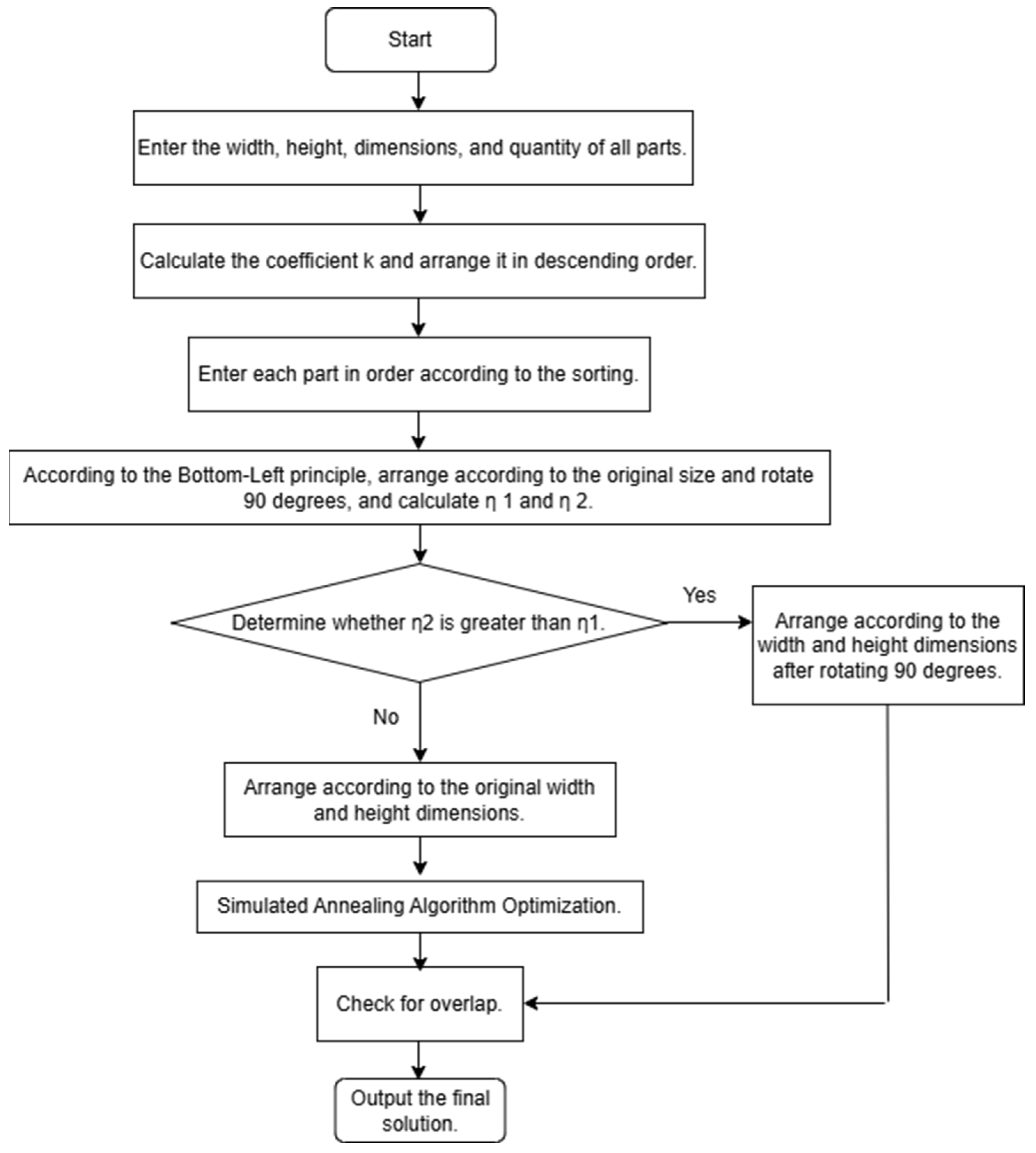
First, perform preprocessing by arranging the parts in descending order of the coefficient k value designed in this research. The material width and height values are fixed, while the height value is dynamic.
Then perform the initial placement in accordance with the Bottom Left principle, prioritizing the lowest available space at the far-left position. If this height is insufficient, move upward to the next lowest level and continue selecting the leftmost position. Next, evaluate whether the rectangular arrangement can be rotated. All component placements should be attempted in two steps per iteration. First, position each part at its original dimensions, update the height, and calculate the utilization rate η 1 . Then rotate the part 90 degrees, swap the height and width dimensions, update the height, and calculate the new utilization rate η 2 . Compare e1 and e2: if η 2 η 1 , maintain the original dimensions; if η 1 < η 2 , adopt the rotated dimensions.
After initial placement, iterative optimization was performed using simulated annealing algorithm. Neighbor solutions were generated by swapping the positions of parts, rotating them 90 degrees, randomly moving parts, and randomly rearranging a part using Bottom Lift algorithm. The amplitude of generating neighbor solutions decreases with decreasing temperature. If the utilization rate of the neighboring solution has improved, it is directly accepted. If the utilization rate of the neighboring solution has decreased, the algorithm determines whether to accept the differential solution through a random process: randomly generating a number between 0 and 1. If the number is less than the probability value calculated by the current temperature, the differential solution is accepted; otherwise, refuse and keep the current solution.
After iterative optimization, check all parts for overlap. If no overlap is found, output the result. Search for the optimal solution generated during the iterative optimization process and output the optimal solution generated during the iterative process.

3.4. Flowchart

A flowchart of this article is shown in Figure 1.

4. Experiments and Results

To verify the effectiveness of the method proposed in this article, the control variable method was strictly adopted. The ASR-BL-SA algorithm in this article designs material heights dynamically so that only the material width is determined. Compare five comparative algorithms, three heuristic algorithms, and the optimization of a combination of two heuristics and meta-heuristic simulated annealing algorithms. In the experiment, the coefficients of the simulated annealing algorithm were uniformly set to an initial temperature of 100 because this is an empirical initial value which can ensure a sufficiently high probability of accepting deteriorating solutions in the initial stage and assist in global exploration. The cooling coefficient is taken as 0.95 because 0.95 is a commonly used exponential cooling rate that can balance the depth of solution space search and the convergence speed of the algorithm. When the number of iterations per temperature is less than 50 for small batches, it is set to ten times the number of parts. When the number of parts is greater than or equal to 50 for large batches, due to the large number of parts multiplied by ten times the number of parts for high temperature iterations, it will be trapped in a large number of repeated neighborhood searches, resulting in wasted computing power and increased time. Therefore, the number of iterations per temperature is set to the number of parts. This links the chain length to the size of the problem, ensuring that the solution space is sufficiently perturbed according to complexity. The maximum number of iterations is set to 5000, as 5000 can prevent the algorithm from running infinitely due to slow convergence and facilitate an efficiency comparison. Due to the instability of iterative optimization in the simulated annealing algorithm, it is ran five times each time and the average value is taken for comparison. Comparing algorithm designs, sorting in order of area from large to small, combined with the Bottom Left algorithm, and comparing the utilization rate of each part by dividing it into their original size and rotation is selected as comparison algorithm 1. Using the shape factor SF to sort from large to small, combined with the Bottom Left algorithm, and comparing the utilization rate of each part based on its original size and rotation is selected as comparison algorithm 2. Arrange the coefficient k designed in this article in descending order and use the Bottom Left algorithm without rotation as the comparison algorithm 3. Sort by area in descending order, combined with the Bottom Left algorithm, and compare the utilization rate of each part by dividing them into their original size and rotation. Select and optimize the simulated annealing algorithm as the comparison algorithm 4. Sort by shape factor SF in descending order, combined with the Bottom Left algorithm, and compare the utilization rate of each part by dividing them into their original size and rotation. Select and optimize the simulated annealing algorithm as the comparison algorithm 5. Conduct algorithm experiments using Python 3.12. Finally, the p-significance probability value is tested to determine whether the difference in algorithm performance is statistically significant, rather than random fluctuations.

4.1. Experiment 1

The experiment of the algorithm is carried out. Experiment 1 uses the experimental data from the paper by [26]; the material width is 65 cm, the height is dynamic material, and the total number of parts is 30, which belongs to small batch; the size and quantity of parts are shown in Table 1.
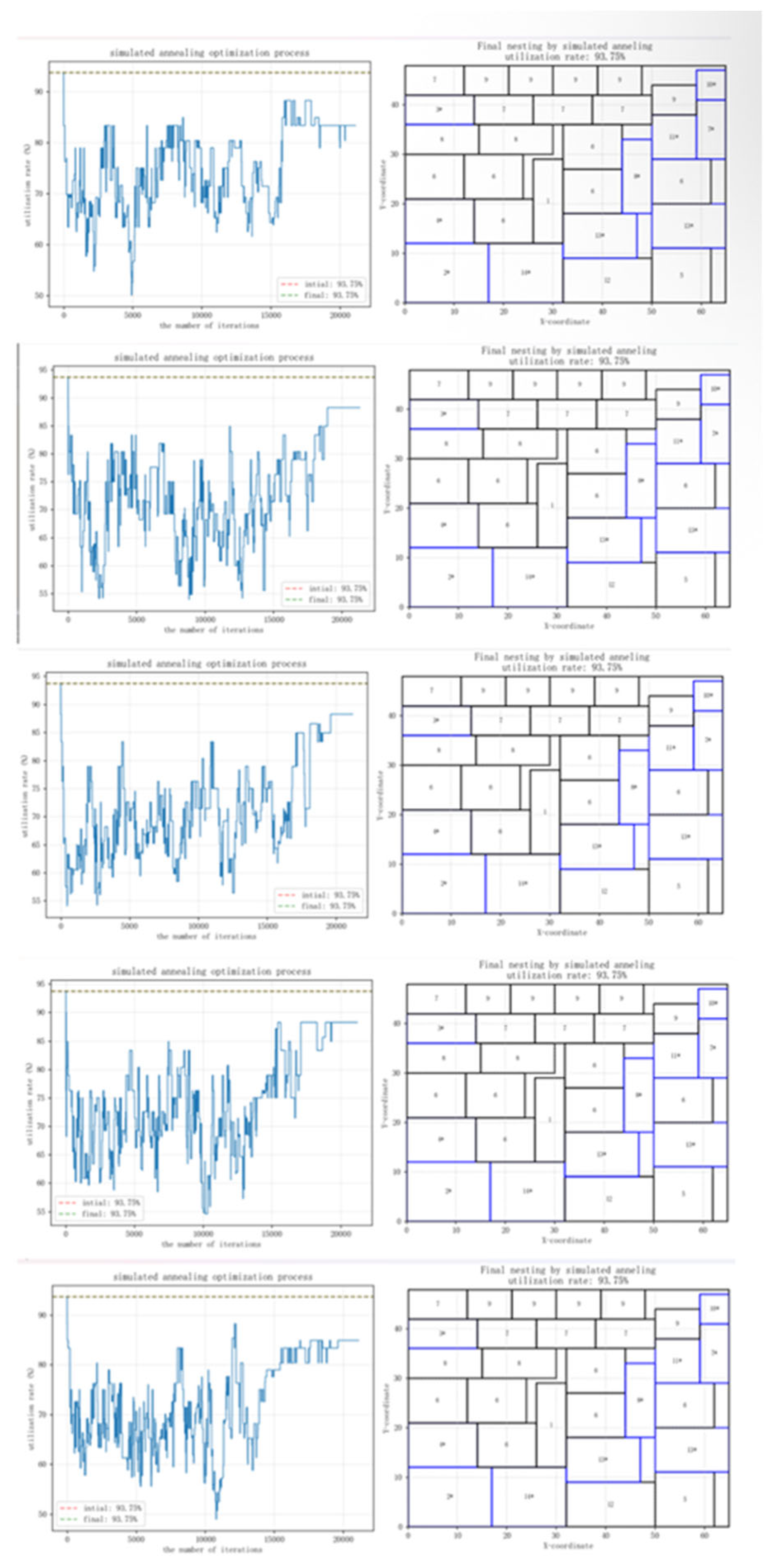
Experiments were conducted on these six algorithms, and the comparison results are shown in Table 2, mainly comparing the utilization rate and the minimum height required for materials. The layout of the ASR-BL-SA algorithm is shown in Figure 2.
By comparing the experimental results, the utilization rate of the ASR-BL-SA algorithm is 5.51% higher than that of the comparative algorithm 1. The utilization rate of the ASR-BL-SA algorithm is 3.75% higher than that of the comparative algorithm 2. The utilization rate of the ASR-BL-SA algorithm is 8.84% higher than that of the comparative algorithm 3. The utilization rate of the ASR-BL-SA algorithm is 5.51% higher than that of the comparison algorithm 4, and the utilization rate of the ASR-BL-SA algorithm is 3.75% higher than that of the comparison algorithm 5.

4.2. Experiment 2

The experiment to verify the algorithm is carried out. Experiment 2 still uses the experimental data in the paper by [26]; the material width is 2400 mm, the height is dynamic material, and the total number of parts is 120, which belongs to the large batch; the size and number of parts are shown in Table 3.
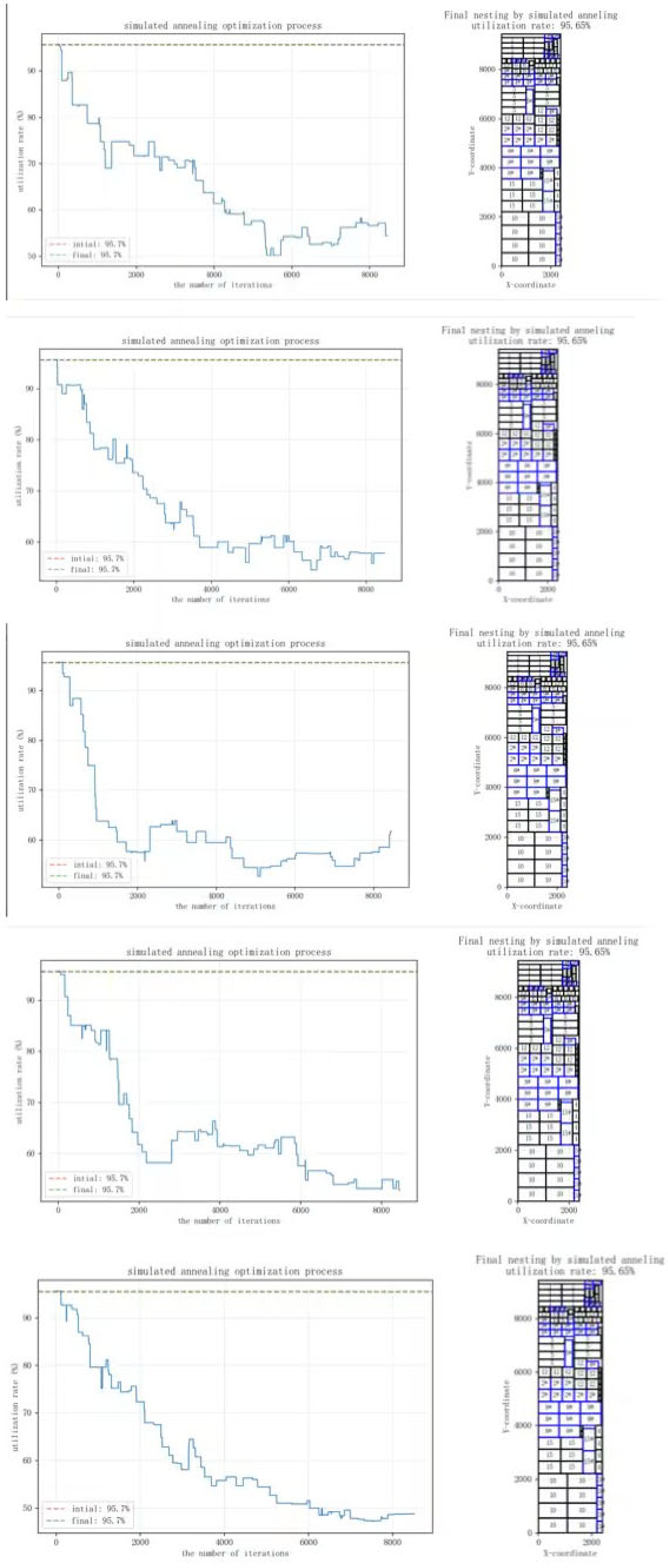
Experiments were conducted on these six algorithms, and the comparison results are shown in Table 4, mainly comparing the utilization rate and the minimum height required for materials. The five sample plots of the ASR-BL-SA algorithm are shown in Figure 3.
In the experimental results comparison, the utilization rate of the ASR-BL-SA algorithm is 1.74% higher than that of comparison algorithm 1, 7.98% higher than comparison algorithm 2, 2.6% higher than comparison algorithm 3, 1.74% higher than comparison algorithm 4, and 7.89% higher than comparison algorithm 5. The designed hybrid heuristic algorithm takes more time than the heuristic algorithm, but is basically equivalent in time to the metaheuristic algorithm. It is within the acceptable time range for the metaheuristic algorithm to sample large quantities of parts, and it achieves a significant improvement in material utilization, balancing resource optimization benefits and solution efficiency.

4.3. Experiment 3

In order to verify the universality of the experiment, in Experiment 3, the part sizes of ten datasets, including assort1. txt, assort2. txt, assort3. txt, assort4. txt, assort5. txt, assort6. txt, assort7. txt, cgcut1. txt, and cgcut2. txt, and cgcut3. txt for the two-dimensional rectangular packing problem in the ESICUP project, were used as the research objects. Because the material size must follow the classic experimental design principles of two-dimensional layout problems, the material width should be taken as 2–2.5 times the maximum part size, with a median value of 2.25 being the most representative and balanced choice. The width of the part can provide sufficient optimization space while maintaining effective constraints, thus accurately testing the layout compression ability of the algorithm. Thus, the width of the ten materials is set to 222.75, 222.75, 222.5211.5222.7521.5555.75, 18, 78.75, and 96.75. Experiments were conducted on these six algorithms, and the comparison results are shown in Table 5.
Using ten sets of experimental data, it can be concluded that the utilization rate of the ASR-BL-SA algorithm is generally higher than that of the five comparison algorithms, with only two groups, assort2.txt and assort3.txt, being lower than comparison algorithm 2 and cgcut1.txt being lower than comparison algorithm 4.

4.4. Statistical Significance Test

This article uses Python to detect the significant probability p-values of the 12 experimental groups mentioned above using Wilcoxon signed rank test. The Wilcoxon signed rank test is a nonparametric test method, suitable for paired samples, which does not require assuming that the data follows a normal distribution, especially suitable for small-sample or non-normal distribution paired data difference analyses. Its core principle and testing steps are as follows: first, calculate the difference between each pair of samples, remove samples with a difference of 0, and rank the absolute values of the remaining differences; subsequently, based on the sign of the original difference, the rank is divided into two categories: positive rank sum and negative rank sum; finally, the smaller rank sum is used as the test statistic and compared with the critical value at a specific level of significance. If the test statistic is less than the critical value, the null hypothesis of “no difference in paired samples” is rejected, and it is considered that there is a significant statistical difference between the two sets of data. The specific values are shown in Table 6.
The p-values of the ASR-BL-SA algorithm and each comparison algorithm are all less than 0.05, indicating significant differences between the ASR-BL-SA algorithm and the five comparison algorithms.

5. Conclusions

This article focuses on the crucial role of the layout order of rectangular parts in the utilization rate of the final layout results. Based on the layout principle of the Bottom Left algorithm, a shape factor is proposed by dividing the area and the shape factor of the rectangular parts by the coefficient k of the minimum maximum normalized area value under 0.785 plus the root, and sorting is carried out in descending order of k. Due to the different lengths of the width and height of rectangular parts, rotation can flexibly adapt to the width and height dimensions of the board and the irregular remaining space. In order to better improve the utilization rate of the layout, the algorithm combines the layout of each part to compare the utilization rate of the original size and rotated 90 degrees into the layout and then selects the layout strategy with the higher utilization rate. Through three sets of experiments and strict adherence to the control variable method, in Experiment 1 on small-batch parts, the utilization rate of the ASR BL SA algorithm increased by 5.51%, 3.75%, and 8.84% compared to the three comparative algorithms, respectively. In Experiment 2, on a large quantity of parts, the utilization rate of the ALR-BL-SA algorithm increased by 1.74%, 7.98%, 2.6%, 1.74%, and 7.89% compared to the five comparison algorithms, respectively, and the time was within an acceptable range, not much higher than that of the general metaheuristic algorithm in terms of computation time. In Experiment 3 of the universality test, the ASR BL-SA algorithm outperformed the five compared algorithms, achieving a certain improvement in material utilization efficiency.
Although the method in this research has been improved in terms of utilization, there are still some limitations, such as not being improved in terms of time, and the instability of simulated annealing algorithm optimization has not been improved. The future improvement direction of this algorithm will be based on stability and running time.

Author Contributions

Conceptualization, J.W.; methodology, J.W.; software, J.W.; validation, J.W.; formal analysis, J.W.; investigation, J.W.; resources, J.W.; data curation, J.W.; writing—original draft preparation, J.W.; writing—review and editing, J.W.; visualization, J.W.; supervision, Y.W. All authors have read and agreed to the published version of the manuscript.

Funding

This research received no external funding.

Institutional Review Board Statement

Not applicable.

Informed Consent Statement

Not applicable.

Data Availability Statement

The dimensions of the parts, the quantity of the parts, and the material size data used in this study were obtained from reference [24]. The data can be accessed through “China National Knowledge Infrastructure”. The relevant data supporting the results produced by this study are not yet publicly archived and are currently only stored on the author’s local computer.

Conflicts of Interest

The authors declare no conflicts of interest.

References

  1. Li, S.; Chen, S.; Zheng, Z. Intelligent Indoor Layout Design Based on Interactive Genetic and Differential Evolution Algorithms: Regular Papers. J. Adv. Comput. Intell. Intell. Inform. 2024, 28, 929–938. [Google Scholar] [CrossRef]
  2. Liang, Z.; Liu, H. Layout Optimization Algorithms for the Offshore Wind Farm with Different Densities Using a Full-Field Wake Model. Energies 2023, 16, 5916. [Google Scholar] [CrossRef]
  3. Munavalli, J.R.; Rao, S.V.; Srinivasan, A.; Van Merode, F. Dynamic Layout Design Optimization to Improve Patient Flow in Outpatient Clinics Using Genetic Algorithms. Algorithms 2022, 15, 85. [Google Scholar] [CrossRef]
  4. Liu, W.; You, Y. Two-dimensional Irregular Layout Based on Particle Swarm Optimization Algorithm. Mach. Build. Autom. 2024, 53, 165–168+186. [Google Scholar]
  5. Xue, F.; Li, Z.; Song, L.; Zu, L. Two-dimensional irregular nesting algorithm driven by density-guided iterative search. Comput. Integr. Manuf. Syst. 2025, 31, 3969–3978. [Google Scholar]
  6. Fırat, H.; Alpaslan, N. An effective approach to the two-dimensional rectangular packing problem in the manufacturing industry. Comput. Ind. Eng. 2020, 148, 106687. [Google Scholar] [CrossRef]
  7. Arbib, C.; Marinelli, F.; Pizzuti, A. Number of bins and maximum lateness minimization in two-dimensional bin packing. Eur. J. Oper. Res. 2020, 291, 101–113. [Google Scholar] [CrossRef]
  8. Wei, L.; Lai, M.; Lim, A.; Hu, Q. A branch-and-price algorithm for the two-dimensional vector packing problem. Eur. J. Oper. Res. 2020, 281, 25–35. [Google Scholar] [CrossRef]
  9. Martin, M.; Morabito, R.; Munari, P. A bottom-up packing approach for modeling the constrained two-dimensional guillotine placement problem. Comput. Oper. Res. 2020, 115, 104851. [Google Scholar] [CrossRef]
  10. JeanFrançois, C.; Mohamed, H.; Manuel, I. Combinatorial Benders Decomposition for the Two-Dimensional Bin Packing Problem. Inf. J. Comput. 2021, 33, 963–978. [Google Scholar] [CrossRef]
  11. Hiroshi, A.; Harumi, H. A Study of Ising Formulations for Minimizing Setup Cost in the Two-Dimensional Cutting Stock Problem. Algorithms 2021, 14, 182. [Google Scholar] [CrossRef]
  12. Grandcolas, S.; Pain-Barre, C. A hybrid metaheuristic for the two-dimensional strip packing problem. Ann. Oper. Res. 2021, 309, 79–102. [Google Scholar] [CrossRef]
  13. Zhang, H.; Liu, Q.; Wei, L.; Zeng, J.; Leng, J.; Yan, D. An iteratively doubling local search for the two-dimensional irregular bin packing problem with limited rotations. Comput. Oper. Res. 2022, 137, 105550. [Google Scholar] [CrossRef]
  14. Ji, J.; Cui, J.; Di Shi, M. Research on the Cutting of Rectangular Blanks to Solve the Two-Dimensional Problem. Key Eng. Mater. 2022, 905, 73–77. [Google Scholar] [CrossRef]
  15. Luo, Q.; Rao, Y.; Guo, X.; Du, B. A biased genetic algorithm hybridized with VNS for the two-dimensional knapsack packing problem with defects. Appl. Soft Comput. J. 2022, 118, 108479. [Google Scholar] [CrossRef]
  16. Gao, M.; Chen, Y.; Li, J.; Wahab, M. Hybrid branch-and-price-and-cut algorithm for the two-dimensional vector packing problem with time windows. Comput. Oper. Res. 2023, 157, 106267. [Google Scholar] [CrossRef]
  17. Cai, S.; Deng, J.; Lee, L.H.; Chew, E.P.; Li, H. Heuristics for the two-dimensional irregular bin packing problem with limited rotations. Comput. Oper. Res. 2023, 160, 106398. [Google Scholar] [CrossRef]
  18. Petunin, A.A.; Kotel, N.S.; Tavaeva, A.F. About one optimal solution example to the integrated 2d nesting and routing problem for cnc sheet cutting machines. Yugra State Univ. Bull. 2023, 19, 88–101. [Google Scholar] [CrossRef]
  19. Zhang, H.; Yao, S.; Zhang, S.; Leng, J.; Wei, L.; Liu, Q. A block-based heuristic search algorithm for the two-dimensional guillotine strip packing problem. Eng. Appl. Artif. Intell. 2024, 134, 108624. [Google Scholar] [CrossRef]
  20. Chen, Y.; Gao, M.; Zhang, Z.; Li, J.; Wahab, M.; Jiang, Y. Contextual bandits learning-based branch-and-price-and-cut algorithm for the two-dimensional vector packing problem with conflicts and time windows. Transp. Res. Part E 2025, 193, 103866. [Google Scholar] [CrossRef]
  21. Eguia, I.; Molina, J.C.; Racero, J.; Padillo, A. Framework for 2D nesting and scheduling in Additive Manufacturing with alternative orientations and multiple objectives. IFAC-PapersOnLine 2025, 59, 2256–2261. [Google Scholar] [CrossRef]
  22. Yao, S.; Zhang, H.; Wei, L.; Liu, Q. An exact approach for the two-dimensional strip packing problem with defects. Comput. Ind. Eng. 2025, 200, 110866. [Google Scholar] [CrossRef]
  23. Wu, X.; Li, L.; Cao, W.; Wu, M.; Dong, H.; Guo, F. Area degree and snake optimizer-based two-dimensional irregular nesting algorithm. Comput. Integr. Manuf. Syst. 1–18. [CrossRef]
  24. Feng, J.; Wang, Y. Rectangle Layout Optimization Based on Tetris Inspiration Method and Genetic Algorithm. Mach. Des. Manuf. 2023, 5, 26–30. [Google Scholar] [CrossRef]
  25. Feng, J.; Liu, Y. Rectangle Packing Optimization Based on Hierarchical Evolution Genetic Algorithm to Improve Plate Utilization. Mach. Des. Manuf. 2022, 11, 11–16. [Google Scholar] [CrossRef]
  26. Zhang, X.; Li, H.; Liang, M. Research on rectangular layout optimization based on improved sparrow search algorithm. J. Shandong Janzhu Univ. 2024, 39, 108–116. [Google Scholar]
Figure 1. Algorithm flowchart of this paper.
Applsci 16 01042 g001
Figure 2. Nesting Layout of ASR-BL-SA algorithm in Experiment 1.
Applsci 16 01042 g002
Figure 3. Nesting layout of ASR-BL-SA algorithm in Experiment 2.
Applsci 16 01042 g003
Table 1. Dimensions and quantities of rectangular parts for Experiment 1.
NumberLength/cmWidth/cmQuantity
16171
212171
36141
49141
512111
61296
71265
81563
9965
10661
11991
121891
139152
1412151
Table 2. Comparison of results of six algorithms in Experiment 1.
AlgorithmUtilization Rate/Average Utilization
ASR-BL-SA Algorithm93.75%
Comparison Algorithm 188.24%
Comparison Algorithm 290%
Comparison Algorithm 384.91%
Table 3. Dimensions and quantities of rectangular parts for Experiment 2.
NumberLength/cmWidth/cmQuantity
18752108
24504508
31653008
42654458
510002858
63352208
71052108
84457858
92304408
1011005558
112101958
124503908
134402008
141801808
158404508
Table 4. Results comparison of the six algorithms in Experiment 2.
AlgorithmAvailabilityRunning Time/Average Running Time (s)
Algorithm in this paper95.65%60.308
Comparison Algorithm 193.91%0.136608
Comparison Algorithm 287.67%0.137925
Comparison Algorithm 392.05%0.141111
Comparison Algorithm 493.91%55.096
Comparison Algorithm 587.67%55.472
Table 5. Comparison of results of six algorithms in Experiment 3.
ASR-BL-SA AlgorithmComparison Algorithm 1Comparison Algorithm 2Comparison Algorithm 3Comparison Algorithm 4Comparison Algorithm 5
assort1.txt80.79%73.61%73.84%79.20%78.392%78.61%
assort2.txt79.332%72.25%81.13%82.5%78.254%82.15%
assort3.txt80.676%67.42%81.25%81.25%79.424%81.798%
assort4.txt80.42%75.47%73.40%69.59%79.16%80.29%
assort5.txt81.536%77.70%75.13%76.83%80.942%79.538%
assort6.txt82.91%75.13%74.67%75.83%80.818%82.628%
assort7.txt79.936%78.31%77.72%75.43%79.88%78.324%
cgcut1.txt93.416%89.29%89.29%89.29%94.778%93.406%
cgcut2.txt88.97%86.19%75.56%77.67%86.19%81.98%
cgcut3.txt94.64%94.64%91.44%83.63%94.64%91.44%
Table 6. p-values of statistical significance tests.
Algorithm Comparison Groupsp-Values
ASR-BL-SA Algorithm and Comparison Algorithm 10.01
ASR-BL-SA Algorithm and Comparison Algorithm 20.0034
ASR-BL-SA Algorithm and Comparison Algorithm 30.0034
ASR-BL-SA Algorithm and Comparison Algorithm 40.0186
ASR-BL-SA Algorithm and Comparison Algorithm 50.0425
Disclaimer/Publisher’s Note: The statements, opinions and data contained in all publications are solely those of the individual author(s) and contributor(s) and not of MDPI and/or the editor(s). MDPI and/or the editor(s) disclaim responsibility for any injury to people or property resulting from any ideas, methods, instructions or products referred to in the content.