

Reclaimed Asphalt Pavement from BBTM Mixes as a Component in Soil–Cement: Preliminary Effects on Density, Moisture and Unconfined Compressive Strength

 ,
,  , and
, and 
Abstract
1. Introduction
2. Materials and Methods
2.1. Materials
2.1.1. Natural Aggregate (NA)
2.1.2. Reclaimed Asphalt Pavement (RAP)
2.1.3. Cement
2.2. Methods
3. Results
3.1. Determination of Maximum Dry Density and Optimal Moisture Content
3.1.1. Determination of Maximum Dry Density and Optimal Moisture Content for a Mixture Consisting Entirely of Natural Aggregate (NA)
3.1.2. Determination of Maximum Density and Optimal Moisture Content for a 75% Natural Aggregate (NA)–25% Reclaimed Asphalt Pavement (RAP) Mixture
3.1.3. Determination of Maximum Density and Optimal Moisture Content for a 50% Natural Aggregate (NA)–50% Reclaimed Asphalt Pavement (RAP) Mixture
3.1.4. Determination of Maximum Density and Optimal Moisture Content for a 25% Natural Aggregate (NA)–75% Reclaimed Asphalt Pavement (RAP) Mixture
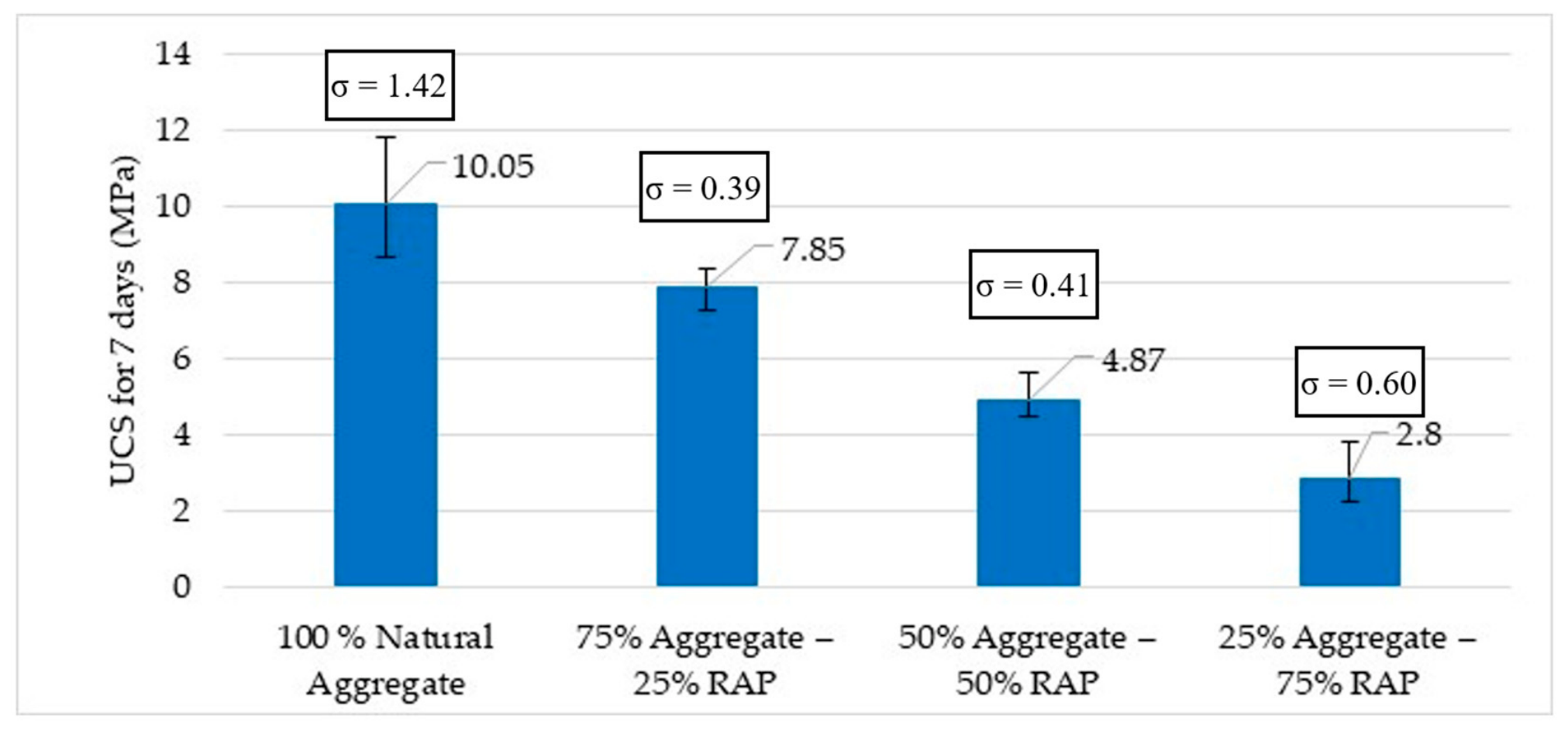
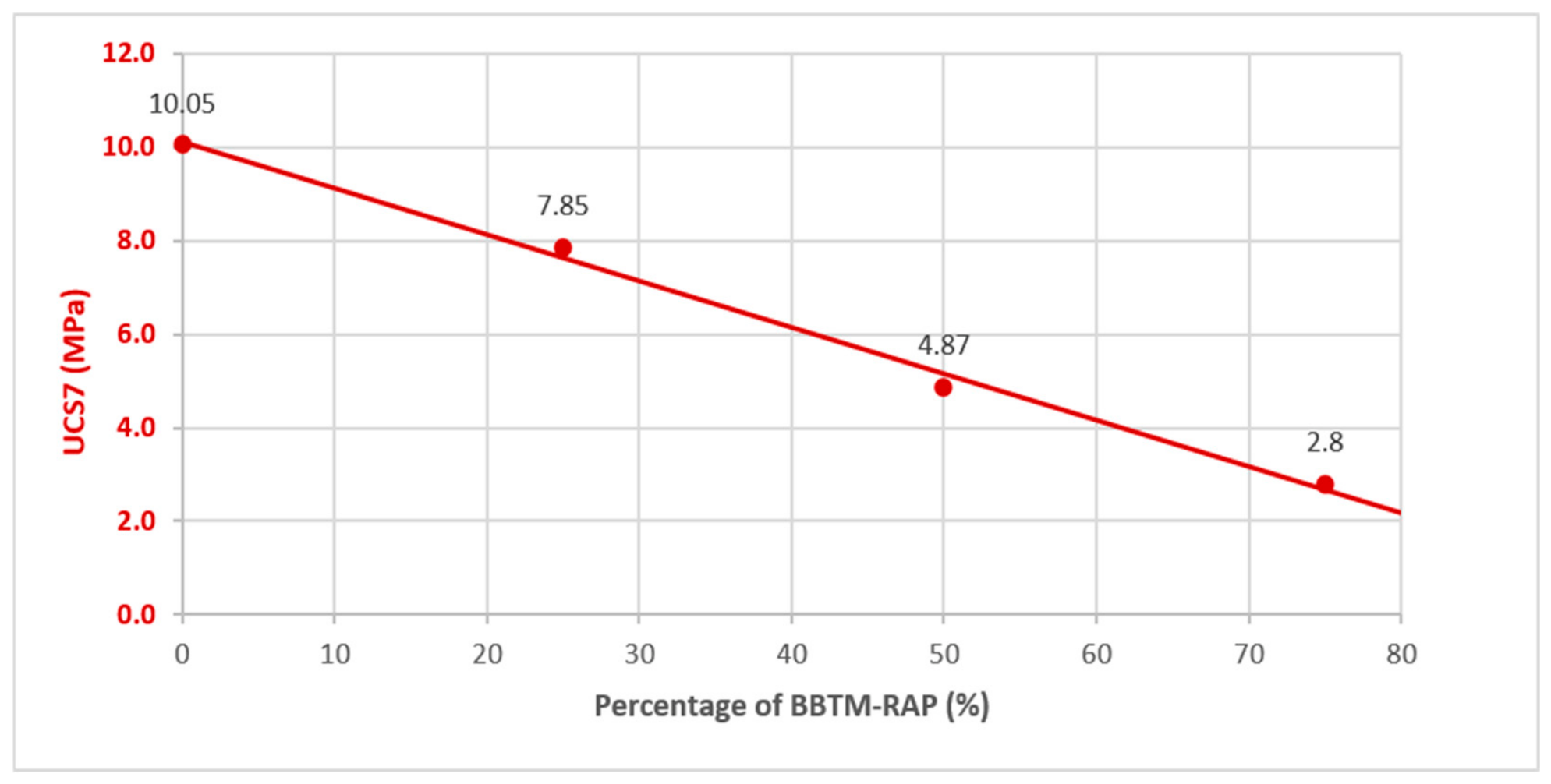
3.2. Evaluation of the Unconfined Compressive Strength of the Four Mixtures Under Investigation
4. Discussion
5. Conclusions
- Large amounts of BBTM-RAP can be incorporated and used to replace quarry aggregate in the production of soil–cement without its unconfined compressive strength falling below the minimum established by the regulations.
- The incorporation of this waste (RAP from a gap-graded asphalt mixture) provides economic value to the recycled material.
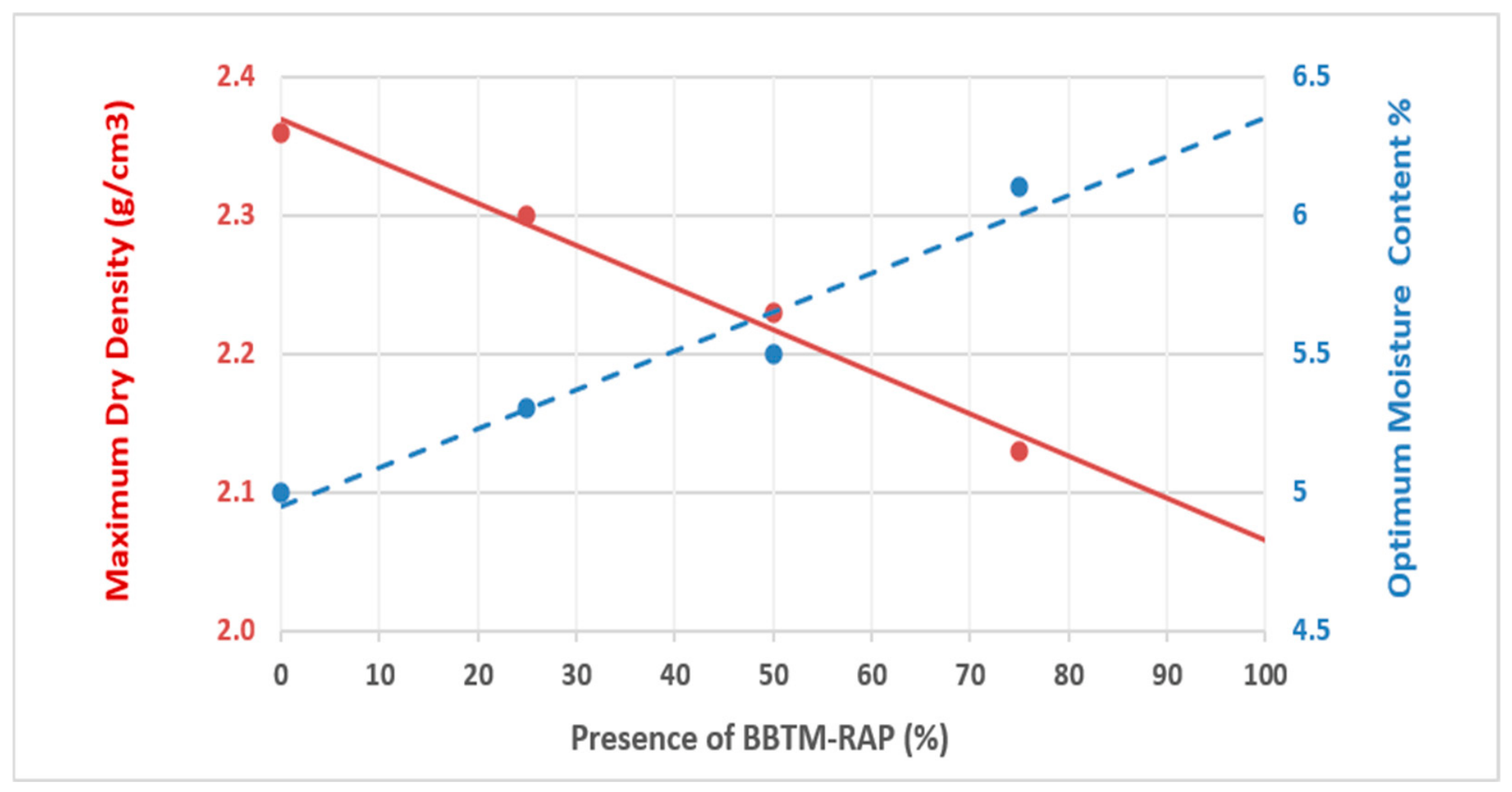
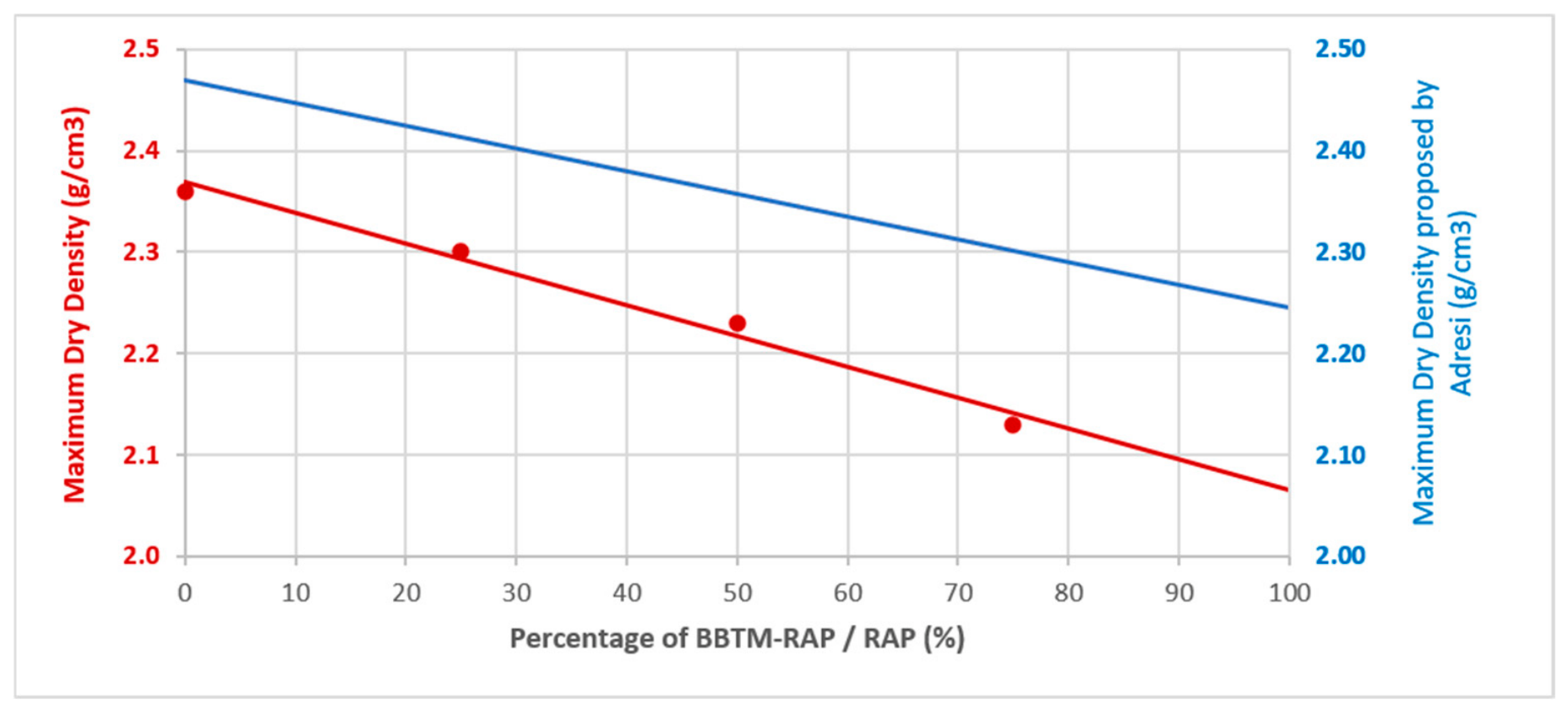
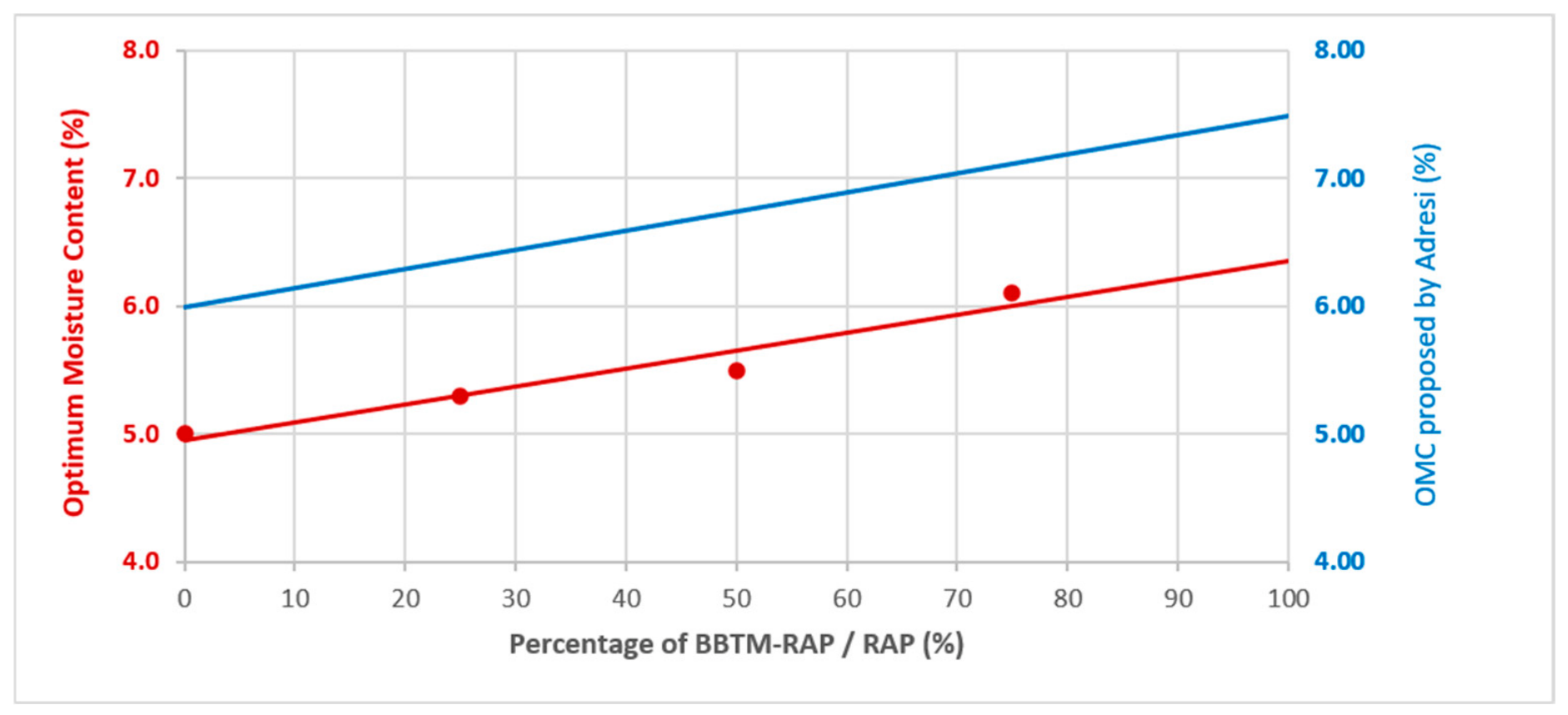
- As the proportion of BBTM-RAP in the mixture increased, a greater volume of water was required to achieve the optimal compaction density, whereas the maximum density value decreased linearly. Two equations have been proposed to calculate the values if other percentages of BBTM-RAP are added.
- The UCS for 7 days decreased linearly as the proportion of BBTM-RAP in the mixture increased. If other percentages of BBTM-RAP were added, an equation to calculate the UCS was provided.
- The findings indicate that incorporating large amounts of BBTM-RAP content is feasible.
- Consequently, these preliminary proposed solutions illustrate that the integration of BBTM-RAP into road infrastructure might be a viable strategy for advancing the circular economy. This approach facilitates the reuse of waste materials, reduces the consumption of virgin resources, and mitigates the overexploitation of quarries, thereby aligning with the objectives of sustainable development.
Author Contributions
Funding
Institutional Review Board Statement
Informed Consent Statement
Data Availability Statement
Conflicts of Interest
Abbreviations
| NA | Natural aggregate from quarry |
| BBTM | Gap-graded ultra-thin asphalt wearing course |
| RAP | Reclaimed asphalt pavement from milling used as aggregate |
| BBTM-RAP | RAP of a bituminous mixture with a discontinuous granulometry |
| MDD | Maximum dry density (g/cm3) |
| OMC | Optimum moisture content (%) |
| SC | Soil–cement |
| UCS | Unconfined compressive strength (MPa) |
| RH | Relative humidity |
References
- DDESMA. Statistic of the Construction and Demolition Waste in the Basque Country; Department of Economic Development, Sustainability and Environment, Basque Government: Vitoria-Gasteiz, Spain, 2024.
- Bocci, E.; Prosperi, E.; Bocci, M. Influence of the Hot-Mix Asphalt Production Temperature on the Effectiveness of the Reclaimed Asphalt Rejuvenation Process. Infrastructures 2022, 8, 8. [Google Scholar] [CrossRef] [Scilit]
- Li, Y.; Zhang, Y.; Zhang, S. A High Proportion Reuse of RAP in Plant-Mixed Cold Recycling Technology and Its Benefits Analysis. Coatings 2022, 12, 1283. [Google Scholar] [CrossRef] [Scilit]
- Llopis-Castelló, D.; Alonso-Troyano, C.; Álvarez-Troncoso, P.; Marzá-Beltrán, A.; García, A. Design of Sustainable Asphalt Mixtures for Bike Lanes Using RAP and Ceramic Waste as Substitutes for Natural Aggregates. Sustainability 2022, 14, 15777. [Google Scholar] [CrossRef] [Scilit]
- Milad, A.; Babalghaith, A.M.; Al-Sabaeei, A.M.; Dulaimi, A.; Ali, A.; Reddy, S.S.; Bilema, M.; Yusoff, N.I.M. A comparative review of hot and warm mix asphalt technologies from environmental and economic perspectives: Towards a sustainable asphalt pavement. Int. J. Environ. Res. Public Health 2022, 19, 14863. [Google Scholar] [CrossRef] [Scilit] [PubMed]
- Obaid, H.A.; Hashim, T.M.; Al-Abody, A.A.M.; Nasr, M.S.; Abbas, G.H.; Kadhim, A.M.; Sadique, M. Properties of modified warm-mix asphalt mixtures containing different percentages of reclaimed asphalt pavement. Energies 2022, 15, 7813. [Google Scholar] [CrossRef] [Scilit]
- Zhang, J.; Sesay, T.; You, Q.; Jing, H. Maximizing the application of RAP in asphalt concrete pavements and its long-term performance: A review. Polymers 2022, 14, 4736. [Google Scholar] [CrossRef] [Scilit] [PubMed]
- Ziari, H.; Hajiloo, M.; Ayar, P. Influence of recycling agents addition methods on asphalt mixtures properties containing reclaimed asphalt pavement (RAP). Sustainability 2022, 14, 16717. [Google Scholar] [CrossRef] [Scilit]
- Elnihum, A.; Lu, Q.; Alharthai, M.; Alamri, M.; Chen, C.; Elmagarhe, A. Evaluation of an Asphalt Mixture Containing a High Content of Reclaimed Asphalt Pavement (RAP) Materials with Epoxy Asphalt. Sustainability 2024, 16, 4988. [Google Scholar] [CrossRef] [Scilit]
- Bueche, N.; Probst, S.; Eskandarsefat, S. Warm-Mix Asphalt Containing Reclaimed Asphalt Pavement: A Case Study in Switzerland. Infrastructures 2024, 9, 79. [Google Scholar] [CrossRef] [Scilit]
- Tang, F.; Fan, J.; Ma, T.; Sun, Y. Study on the Performances of PAC-13 Asphalt Mixture Containing Reclaimed Porous Asphalt Pavement. Buildings 2025, 15, 1395. [Google Scholar] [CrossRef] [Scilit]
- Chakravarthi, S.; Shankar, S. Utilization of recycled aggregates in cement-treated bases: A state-of-the-art review. Innov. Infrastruct. Solut. 2021, 6, 191. [Google Scholar] [CrossRef] [Scilit]
- Edeh, J.E.; Ugama, T.; Okpe, S.A. The use of cement treated reclaimed asphalt pavement-quarry waste blends as highway material. Int. J. Pavement Eng. 2020, 21, 1191–1198. [Google Scholar] [CrossRef] [Scilit]
- Ghanizadeh, A.R.; Rahrovan, M.; Bafghi, K.B. The effect of cement and reclaimed asphalt pavement on the mechanical properties of stabilized base via full-depth reclamation. Constr. Build. Mater. 2018, 161, 165–174. [Google Scholar] [CrossRef] [Scilit]
- Melese, E.; Baaj, H.; Tighe, S.; Zupko, S.; Smith, T. Characterisation of full-depth reclaimed pavement materials treated with hydraulic road binders. Constr. Build. Mater. 2019, 226, 778–792. [Google Scholar] [CrossRef] [Scilit]
- Imtiaz, T.; Ahmed, A.; Hossain, M.S.; Faysal, M. Microstructure analysis and strength characterization of recycled base and sub-base materials using scanning electron microscope. Infrastructures 2020, 5, 70. [Google Scholar] [CrossRef] [Scilit]
- Melese, E.; Baaj, H.; Tighe, S. Fatigue behaviour of reclaimed pavement materials treated with cementitious binders. Constr. Build. Mater. 2020, 249, 118565. [Google Scholar] [CrossRef] [Scilit]
- Orosa, P.; Medina, L.; Fernández-Ruiz, J.; Pérez, I.; Pasandín, A. Numerical simulation of the stiffness evolution with curing of pavement sections rehabilitated using cold in-place recycling technology. Constr. Build. Mater. 2022, 335, 127487. [Google Scholar] [CrossRef] [Scilit]
- Guerrero-Bustamante, O.; Guillen, A.; Moreno-Navarro, F.; Rubio-Gámez, M.C.; Sol-Sánchez, M. Suitable Granular Road Base from Reclaimed Asphalt Pavement. Materials 2025, 18, 854. [Google Scholar] [CrossRef] [Scilit] [PubMed]
- Fedrigo, W.; Nunez, W.P.; Visser, A.T. A review of full-depth reclamation of pavements with Portland cement: Brazil and abroad. Constr. Build. Mater. 2020, 262, 120540. [Google Scholar] [CrossRef] [Scilit]
- MFOM. Orden FOM/3460/2003 por la que se Aprueba la Norma 6.1-IC Secciones de Firme; Ministerio de Fomento (MFOM): Madrid, Spain, 2003; Available online: https://www.boe.es/eli/es/o/2003/11/28/fom3460 (accessed on 8 May 2026).
- MFOM. Orden FOM/2523/2014, de 12 de Diciembre, por la que se Actualizan Determinados Artículos del Pliego de Prescripciones Técnicas Generales Para Obras de Carreteras y Puentes (PG-3), Relativos a Materiales Básicos, a Firmes y Pavimentos, y a Señalización, Balizamiento y Sistemas de Contención de Vehículos; Ministerio de Fomento: Madrid, Spain, 2015; Available online: https://www.boe.es/eli/es/o/2014/12/12/fom2523 (accessed on 8 May 2026).
- MTMAU. Orden OC 1/2023, Sobre Actualización de Espesores de las Capas y Tipos de M.B.C. y Semicaliente de la Norma 6.1 IC Secciones de Firme; Ministerio de Transportes, Movilidad y Agenda Urbana (MTMAU): Madrid, Spain, 2023; Available online: https://cdn.transportes.gob.es/portal-web-transportes/carreteras/normativa_tecnica/11_firmes_pavimientos/oc_2023-01_actualizacion_6_1ic.pdf (accessed on 8 May 2026).
- Castañeda López, M.A.; Fedrigo, W.; Kleinert, T.R.; Matuella, M.F.; Núñez, W.P.; Ceratti, J.A.P. Flexural fatigue evaluation of cement-treated mixtures of reclaimed asphalt pavement and crushed aggregates. Constr. Build. Mater. 2018, 158, 320–325. [Google Scholar] [CrossRef] [Scilit]
- Gonzalo-Orden, H.; Linares-Unamunzaga, A.; Pérez-Acebo, H.; Díaz-Minguela, J. Advances in the Study of the Behavior of Full-Depth Reclamation (FDR) with Cement. Appl. Sci. 2019, 9, 3055. [Google Scholar] [CrossRef] [Scilit]
- Arman, A.; Barclay, R.T.; Casias, T.J.; Crocker, D.A.; Adaska, W.S.; De Graffenreid, R.L.; Hess, J.R.; Kuhlman, R.H.; Mueller, P.E.; Roof, H.C.; et al. State-of-the-art report on soil-cement. ACI Mater. J. 1990, 87, 395–417. [Google Scholar] [CrossRef] [Scilit] [PubMed]
- Linares-Unamunzaga, A.; Gonzalo-Orden, H.; Minguela, J.; Pérez-Acebo, H. New Procedure for Compacting Prismatic Specimens of Cement-Treated Base Materials. Appl. Sci. 2018, 8, 970. [Google Scholar] [CrossRef] [Scilit]
- Yuan, D.; Nazarian, S.; Hoyos, L.R.; Puppala, A.J. Evaluation and Mix Design of Cement-Treated Base Materials with High Content of Reclaimed Asphalt Pavement. Transp. Res. Rec. 2010, 2212, 110–119. [Google Scholar] [CrossRef] [Scilit]
- Pratikso, P.; Purwanto, A.; Sudarno, S. Analysis influence of cement of the asphalt pavement demolition material on roads Semarang-Demak-Indonesia. J. Urban Environ. Eng. 2017, 11, 73–78. [Google Scholar] [CrossRef] [Scilit]
- Kasu, S.R.; Manupati, K.; Muppireddy, A.R. Investigations on design and durability characteristics of cement treated reclaimed asphalt for base and subbase layers. Constr. Build. Mater. 2020, 252, 119102. [Google Scholar] [CrossRef] [Scilit]
- Mohanty, M.; Mohapatra, S.S.; Nayak, S. Efficacy of C&D waste in base/subbase layers of pavement–current trends and future prospectives: A systematic review. Constr. Build. Mater. 2022, 340, 127726. [Google Scholar] [CrossRef] [Scilit]
- Arshad, M. Laboratory investigations on the mechanical properties of cement treated RAP-natural aggregate blends used in base/subbase layers of pavements. Constr. Build. Mater. 2020, 254, 119234. [Google Scholar] [CrossRef] [Scilit]
- Fedrigo, W.; Núñez, W.P.; Kleinert, T.R.; Matuella, M.F.; Ceratti, J.A.P. Strength, shrinkage, erodibility and capillary flow characteristics of cement-treated recycled pavement materials. Int. J. Pavement Res. Technol. 2017, 10, 393–402. [Google Scholar] [CrossRef] [Scilit]
- Goldoni, A.; Trevizan Pelissaro, D.; Silveira, E.; Prietto, P.; Dalla Rosa, F. Durability and mechanical long-term performance of reclaimed asphalt pavement stabilized by alkali-activation. Soils Rocks 2023, 46, e2023007422. [Google Scholar] [CrossRef] [Scilit]
- Euch Khay, S.E.; Euch Ben Said, S.E.; Loulizi, A.; Neji, J. Laboratory investigation of cement-treated reclaimed asphalt pavement material. J. Mater. Civ. Eng. 2015, 27, 04014192. [Google Scholar] [CrossRef] [Scilit]
- Adresi, M.; Khishdari, A.; Ahmadi, A.; Rooholamini, H. Influence of high content of reclaimed asphalt on the mechanical properties of cement-treated base under critical environmental conditions. Int. J. Pavement Eng. 2019, 20, 1098–1105. [Google Scholar] [CrossRef] [Scilit]
- Memon, N.A.; Jatoi, G.H.; Loprencipe, G.; Moretti, L.; Md. Yusoff, N.I. Performance of Sustainable Semi-Rigid Pavements: Optimizing High-Content Reclaimed Asphalt Pavement with Rejuvenators and Novel Grout Formulations. Materials 2025, 18, 4840. [Google Scholar] [CrossRef] [Scilit] [PubMed]
- MFOM. Orden FOM/510/2018, de 8 de Mayo, Por la Que se Modifica la Orden FOM/2523/2014, de 12 de Diciembre, por la que se Actualizan Determinados Artículos del Pliego de Prescripciones Técnicas Generales para Obras de Carreteras Y Puentes (PG-3), Relativos a Materiales Básicos, a Firmes y Pavimentos, y a Señalización, Balizamiento y Sistemas de Contención de Vehículos; Ministerio de Fomento (MFOM): Madrid, Spain, 2018; Available online: https://www.boe.es/eli/es/o/2018/05/08/fom510 (accessed on 8 May 2026).
- GV. ORDEN de 12 de Julio de 2022, del Consejero de Planificación Territorial, Vivienda y Transportes, por la que se Aprueba el Texto revisado y Ampliado de la Norma Para el Dimensionamiento de Firmes de la Red de Carreteras del País Vasco. Boletín Oficial del Pais Vasco (BOPV) nº 140 20-07-2022; Gobierno Vasco (GV): Vitoria-Gasteiz, Spain, 2022; Available online: https://www.euskadi.eus/web01-bopv/es/bopv2/datos/2022/07/2203283a.shtml (accessed on 8 May 2026).
- UNE-EN 933-8; Tests for Geometrical Properties of Aggregates—Part 8: Assessment of Fines—Sand Equivalent Test. Spanish Association for Standardization and Certification (AENOR): Madrid, Spain, 2015.
- UNE-EN ISO 17892-4; Geotechnical Investigation and Testing—Laboratory Testing of Soil—Part 4: Determination of Particle Size Distribution. Spanish Association for Standardization and Certification (AENOR): Madrid, Spain, 2019.
- UNE-EN ISO 17892-12; Geotechnical Investigation and Testing—Laboratory Testing of Soil—Part 12: Determination of Liquid and Plastic Limits. Spanish Association for Standardization and Certification (AENOR): Madrid, Spain, 2020.
- UNE 103201; Quantitative Analysis of Soluble Sulphate (in Water) Content of a Soil. Spanish Association for Standardization and Certification (AENOR): Madrid, Spain, 2019.
- UNE 103204; Organic Matter Content of a Soil by the Potassium Permanganate Methodoxidable de un Suelo por el Método del Permanganato Potásico. Spanish Association for Standardization and Certification (AENOR): Madrid, Spain, 2019.
- UNE-EN 1097-6; Tests for Mechanical and Physical Properties of Aggregates. Part 6: Determination of Particle Density and Water Absorption. Spanish Association for Standardization and Certification (AENOR): Madrid, Spain, 2025.
- EDP. Environmental Product Declaration: Cement CEM II/B-M (V-L) 42.5 R; International EDP System: Stockholm, Sweden, 2024; Available online: https://www.heidelbergmaterials.es/sites/default/files/2024-07/0015645_CEM%20II-B-M%2042.5%20R%20Arrigorriaga.pdf (accessed on 8 May 2026).
- UNE-EN ISO 14025; Enviromental Labels and Declarations. Type III Environmental Declarations. Principles and Procedures. Spanish Association for Standardization and Certification (AENOR): Madrid, Spain, 2010.
- UNE-EN 197-1; Part 1: Composition, Specifications and Conformity Criteria for Common Cements. Spanish Association for Standardization and Certification (AENOR): Madrid, Spain, 2011.
- UNE-EN 13286-2; Unbound and Hydraulically Bound Mixtures—Part 2: Test Methods for Laboratory Reference Density and Water Content—Proctor Compaction. Spanish Association for Standardization and Certification (AENOR): Madrid, Spain, 2011.
- UNE-EN 13286-41; Unbound and Hydraulically Bound Mixtures—Part 41: Test Method for the Determination of the Compressive Strength of Hydraulically Bound Mixtures. Spanish Association for Standardization and Certification (AENOR): Madrid, Spain, 2022.
- UNE-EN 12390-2; Testing Hardened Concrete. Part 2: Making and Curing Specimens for Strength Tests. Asociación Española de Normalización y Certificación (AENOR): Madrid, Spain, 2020.
- Wang, L.; Xue, Y.; Wang, X.; Zhu, L.; Cao, X.; Ge, R. Effect of aggregate gradation on pore structure evolution and mechanical performance of coal gangue-fly ash cemented backfill: Insights from NMR. Powder Technol. 2026, 482, 122775. [Google Scholar] [CrossRef] [Scilit]
- Lin, H.; Xu, Y.; Zhai, Y.; Wang, Q.; Zhu, D.; Wang, Q.; Huang, C.; Teng, T.; Xue, Y.; Cao, Z. Study on the Physicochemical Characteristics and Mechanism of Red Sandstone During High-Temperature and Cooling Processes. Processes 2026, 14, 2033. [Google Scholar] [CrossRef] [Scilit]



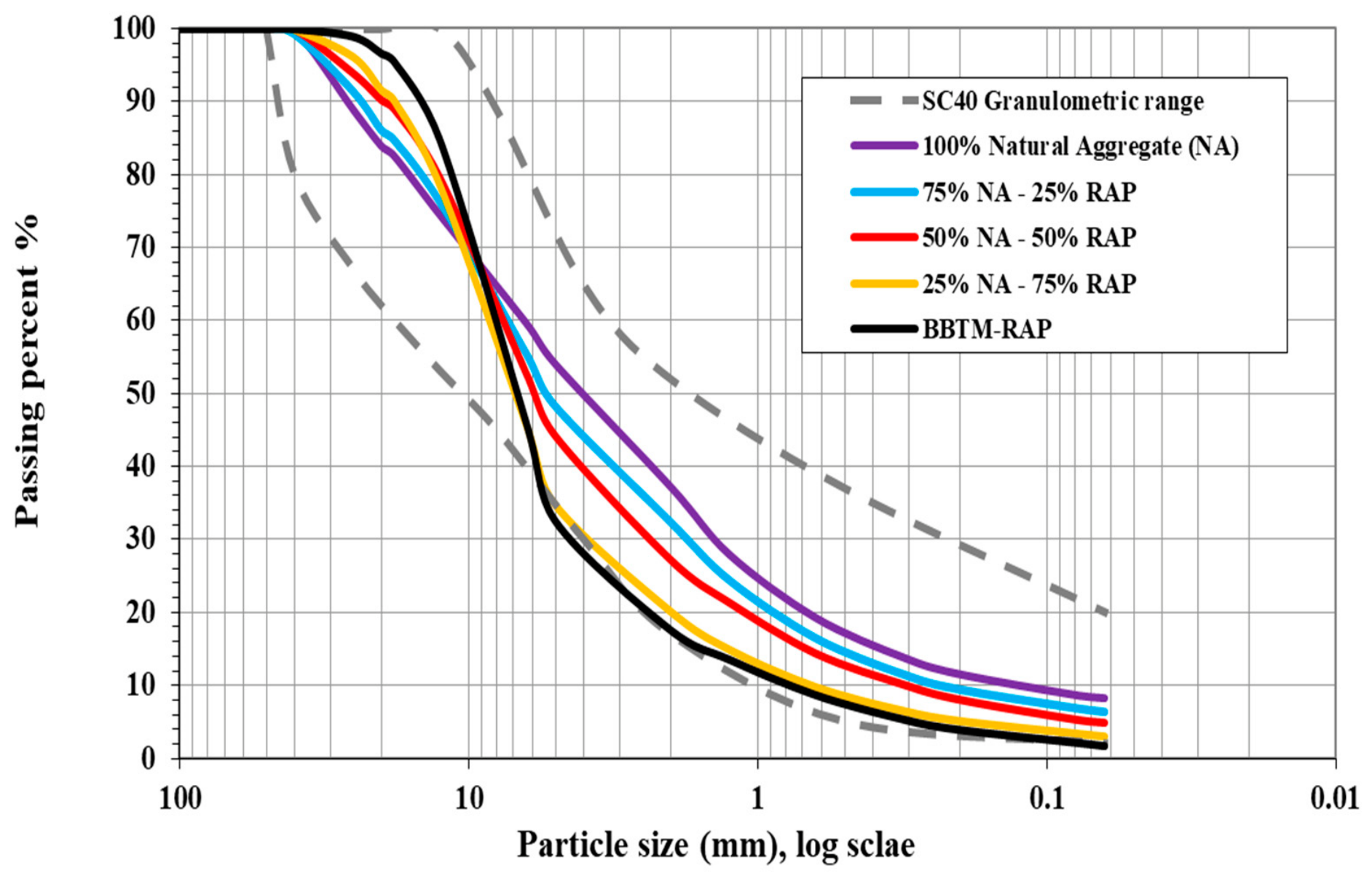
| Sieve Size (mm) | 100% NA | 75% NA–25% RAP | 50% NA–50% RAP | 25% NA–75% RAP | 100% RAP | SC-40 Upper Limit | SC-40 Lower Limit |
|---|---|---|---|---|---|---|---|
| Passing Percent % | |||||||
| 50 | 100 | 100 | 100 | 100 | 100 | 100 | 100 |
| 40 | 100 | 99 | 100 | 100 | 100 | 100 | 80 |
| 25 | 89 | 91 | 94 | 96 | 99 | 100 | 67 |
| 20 | 84 | 86 | 90 | 92 | 97 | 100 | 62 |
| 12.5 | 74 | 76 | 80 | 78 | 85 | 100 | 53 |
| 8 | 64 | 61 | 60 | 55 | 57 | 89 | 45 |
| 4 | 48 | 43 | 39 | 30 | 28 | 65 | 30 |
| 2 | 37 | 32 | 27 | 20 | 18 | 52 | 17 |
| 0.5 | 17 | 15 | 13 | 9 | 7 | 37 | 5 |
| 0.063 | 8 | 6 | 5 | 3 | 2 | 20 | 2 |
| Mixtures | Moisture Content (MC) % | Dry Density (DD (g/cm3) | Optimum Moisture Content (OMC) % | Maximum Dry Density (MDD) (g/cm3) |
|---|---|---|---|---|
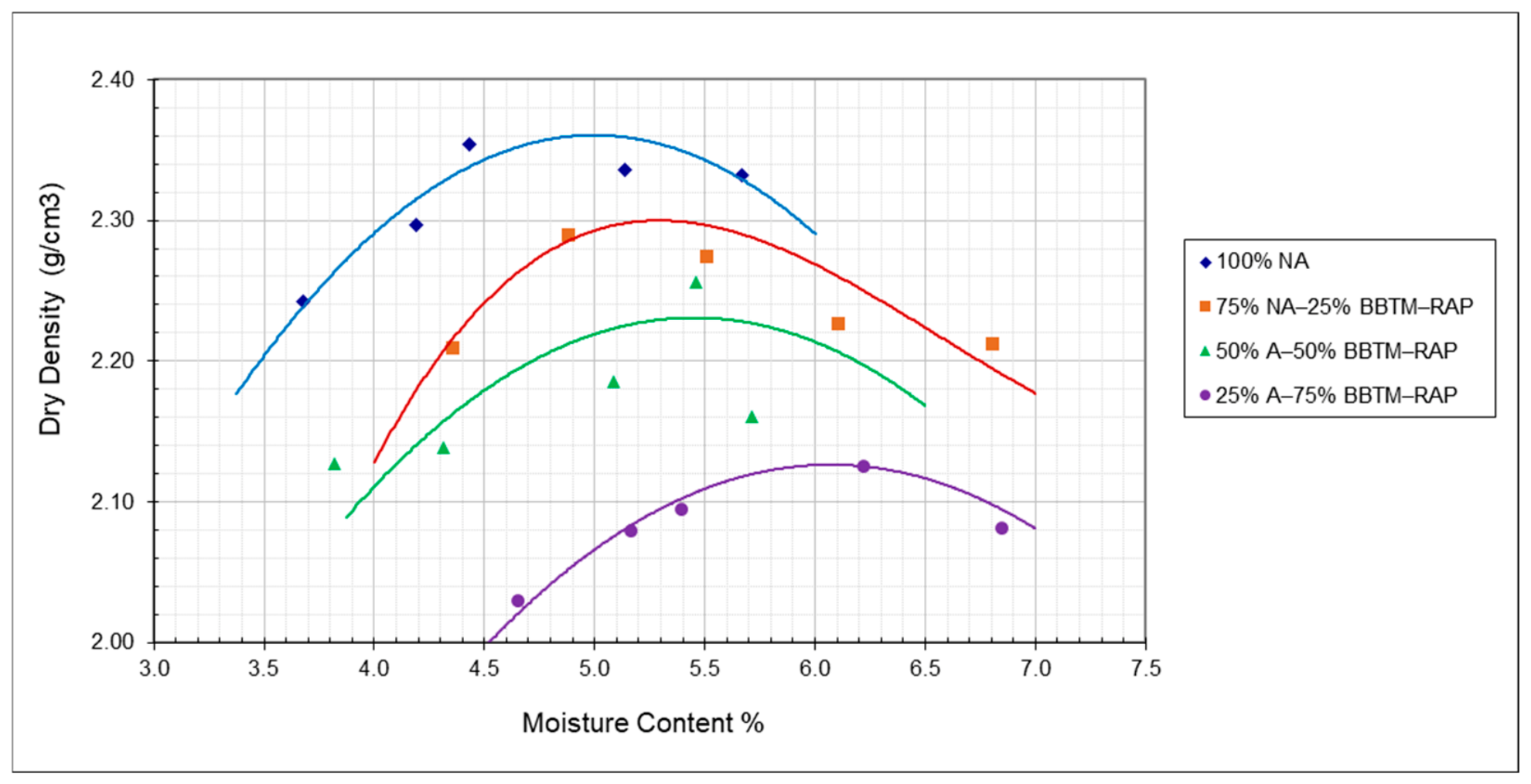
| 100% Natural Aggregate | 3.68 4.19 4.43 5.14 5.67 | 2.24 | 5.0 | 2.36 |
| 2.30 | ||||
| 2.35 | ||||
| 2.34 | ||||
| 2.33 | ||||
| 75% Natural Aggregate–25% RAP | 4.36 4.88 5.51 6.11 6.80 | 2.21 | 5.3 | 2.30 |
| 2.29 | ||||
| 2.27 | ||||
| 2.23 | ||||
| 2.21 | ||||
| 50% Natural Aggregate–50% RAP | 3.56 4.1 4.67 5.49 6.14 | 2.05 | 5.5 | 2.23 |
| 2.1 | ||||
| 2.22 | ||||
| 2.23 | ||||
| 2.21 | ||||
| 25% Natural Aggregate–75% RAP | 4.65 5.16 5.39 6.22 6.84 | 2.03 | 6.1 | 2.13 |
| 2.08 | ||||
| 2.09 | ||||
| 2.13 | ||||
| 2.08 |
| Mixtures | Dry Density (g/cm3) | UCS7 (MPa) | UCS7 (MPa) Mean | Standard Deviation |
|---|---|---|---|---|
| 100% Natural Aggregate | 2.36 | 8.90 | 10.05 | 1.42 |
| 8.98 | ||||
| 8.67 | ||||
| 10.31 | ||||
| 11.77 | ||||
| 11.69 | ||||
| 75% Natural Aggregate–25% RAP | 2.30 | 7.66 | 7.85 | 0.39 |
| 7.79 | ||||
| 7.27 | ||||
| 7.81 | ||||
| 8.36 | ||||
| 8.21 | ||||
| 50% Natural Aggregate–50% RAP | 2.23 | 5.60 | 4.87 | 0.41 |
| 4.84 | ||||
| 4.96 | ||||
| 4.90 | ||||
| 4.45 | ||||
| 4.50 | ||||
| 25% Natural Aggregate–75% RAP | 2.13 | 2.77 | 2.80 | 0.60 |
| 3.79 | ||||
| 3.23 | ||||
| 2.48 | ||||
| 2.24 | ||||
| 2.30 |
| Mixtures | Maximum Dry Density (g/cm3) | Optimum Moisture Content % | UCS7 (MPa) |
|---|---|---|---|
| 100% Natural Aggregate | 2.36 | 5.0 | 10.05 |
| 75% NA–25% RAP | 2.30 | 5.3 | 7.85 |
| 50% NA–50% RAP | 2.23 | 5.5 | 4.87 |
| 25% NA–75% RAP | 2.13 | 6.1 | 2.80 |
Disclaimer/Publisher’s Note: The statements, opinions and data contained in all publications are solely those of the individual author(s) and contributor(s) and not of MDPI and/or the editor(s). MDPI and/or the editor(s) disclaim responsibility for any injury to people or property resulting from any ideas, methods, instructions or products referred to in the content. |
© 2026 by the authors. Licensee MDPI, Basel, Switzerland. This article is an open access article distributed under the terms and conditions of the Creative Commons Attribution (CC BY) license.
Share and Cite
Linares-Unamunzaga, A.; Gonzalo-Orden, H.; Aragón-Torre, Á.; Pérez-Acebo, H. Reclaimed Asphalt Pavement from BBTM Mixes as a Component in Soil–Cement: Preliminary Effects on Density, Moisture and Unconfined Compressive Strength. Appl. Sci. 2026, 16, 9289. https://doi.org/10.3390/app16189289
Linares-Unamunzaga A, Gonzalo-Orden H, Aragón-Torre Á, Pérez-Acebo H. Reclaimed Asphalt Pavement from BBTM Mixes as a Component in Soil–Cement: Preliminary Effects on Density, Moisture and Unconfined Compressive Strength. Applied Sciences. 2026; 16(18):9289. https://doi.org/10.3390/app16189289
Chicago/Turabian StyleLinares-Unamunzaga, Alaitz, Hernán Gonzalo-Orden, Ángel Aragón-Torre, and Heriberto Pérez-Acebo. 2026. "Reclaimed Asphalt Pavement from BBTM Mixes as a Component in Soil–Cement: Preliminary Effects on Density, Moisture and Unconfined Compressive Strength" Applied Sciences 16, no. 18: 9289. https://doi.org/10.3390/app16189289
APA StyleLinares-Unamunzaga, A., Gonzalo-Orden, H., Aragón-Torre, Á., & Pérez-Acebo, H. (2026). Reclaimed Asphalt Pavement from BBTM Mixes as a Component in Soil–Cement: Preliminary Effects on Density, Moisture and Unconfined Compressive Strength. Applied Sciences, 16(18), 9289. https://doi.org/10.3390/app16189289