Topic Modeling of Occupational Accident Narratives in the Manufacturing Sector Using BERTopic: Sector-Specific Accident Pattern Analysis

Abstract
1. Introduction
Literature Review
2. Materials and Methods
2.1. Data
2.2. BERTopic
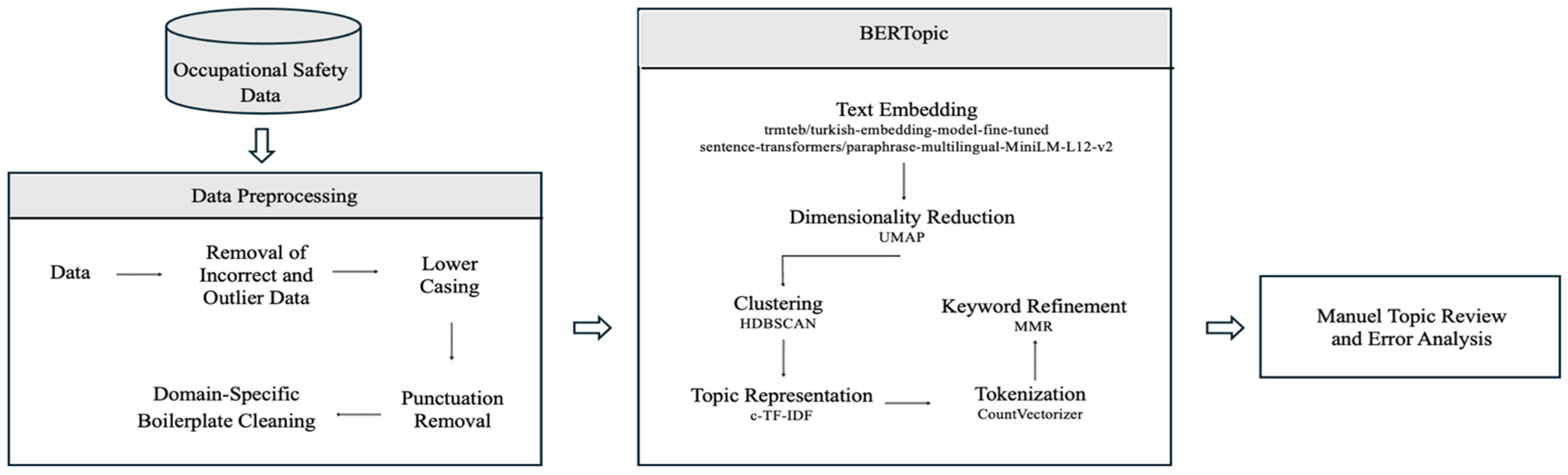
2.3. Research Framework
3. Results
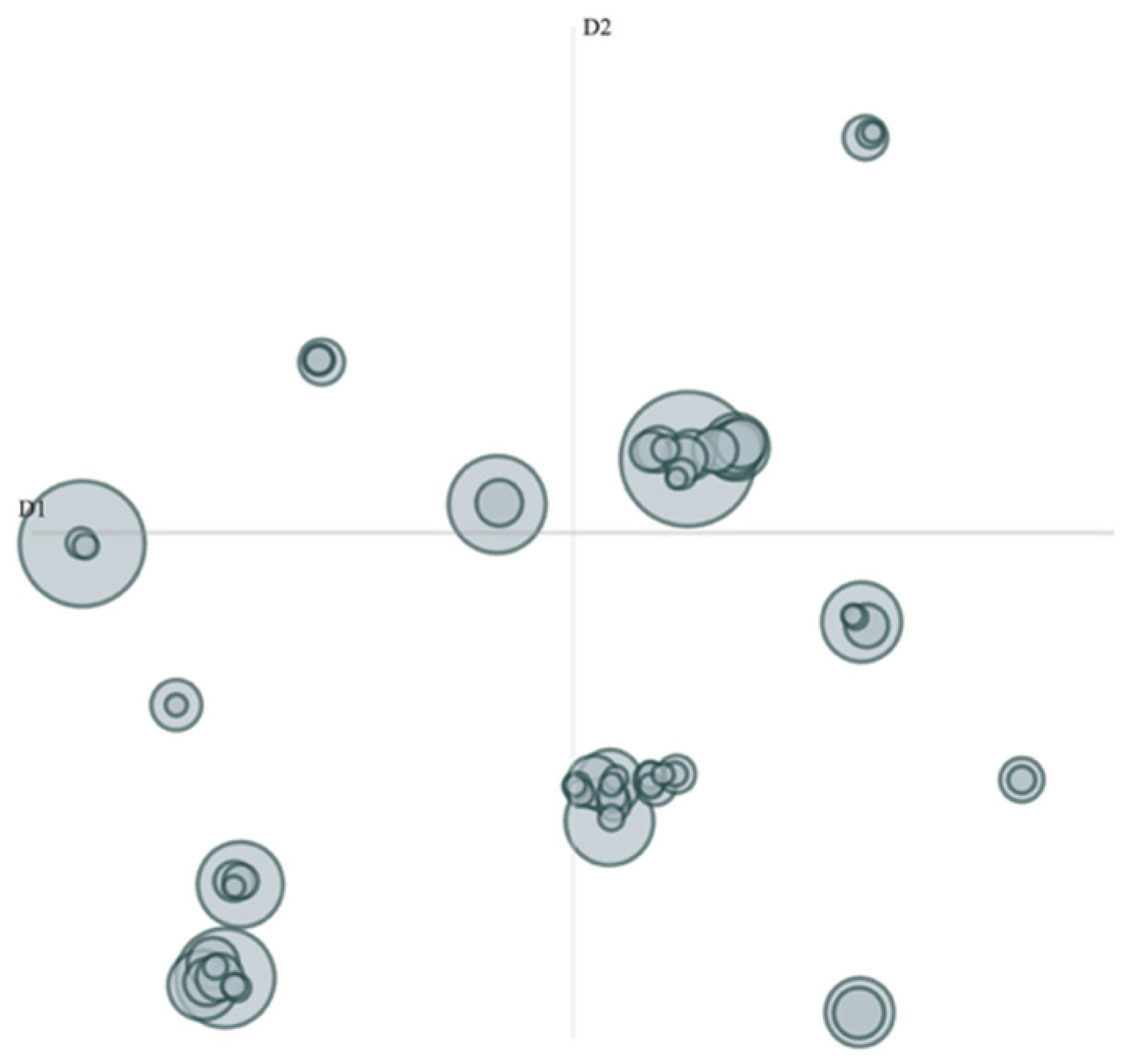
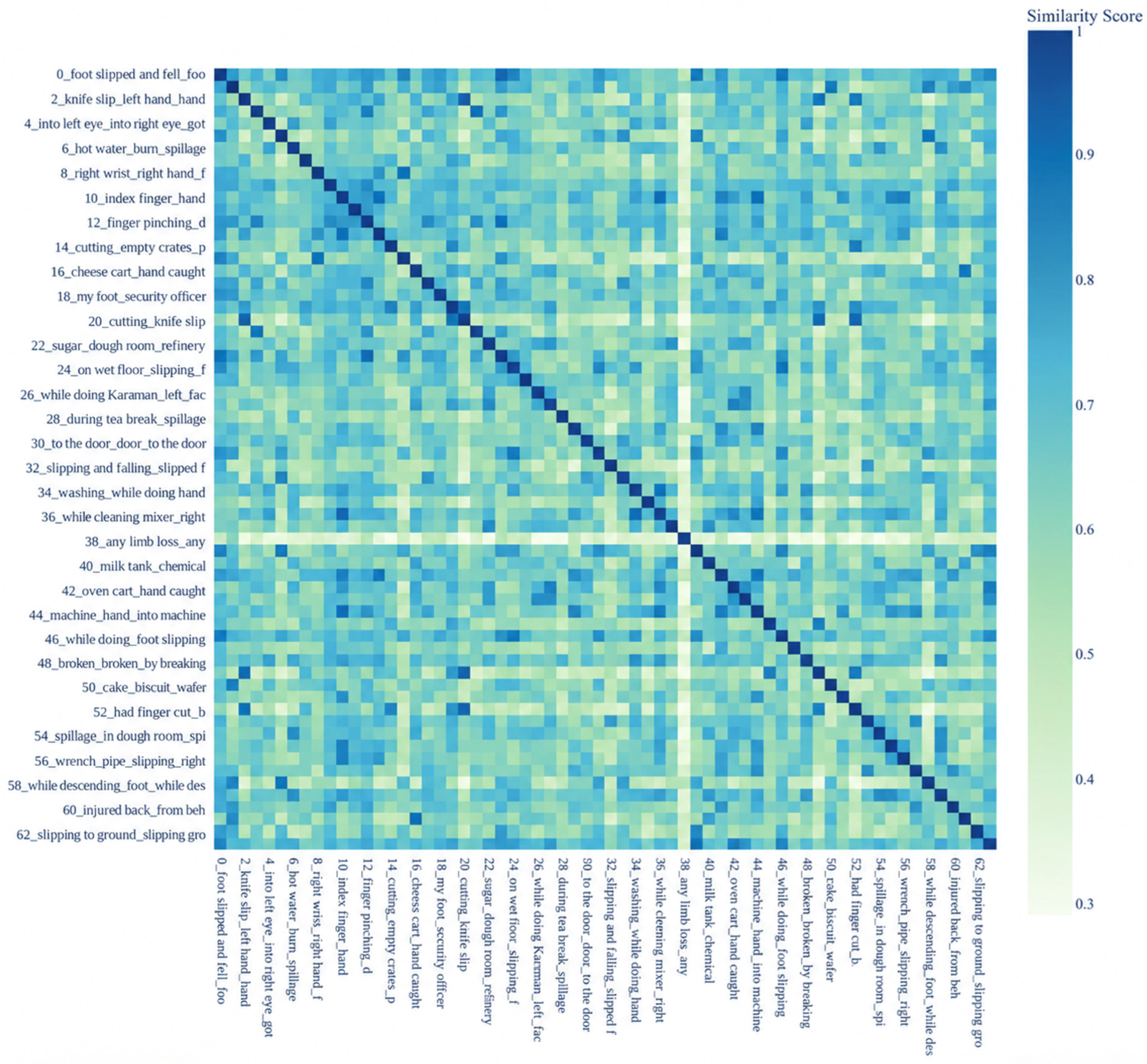
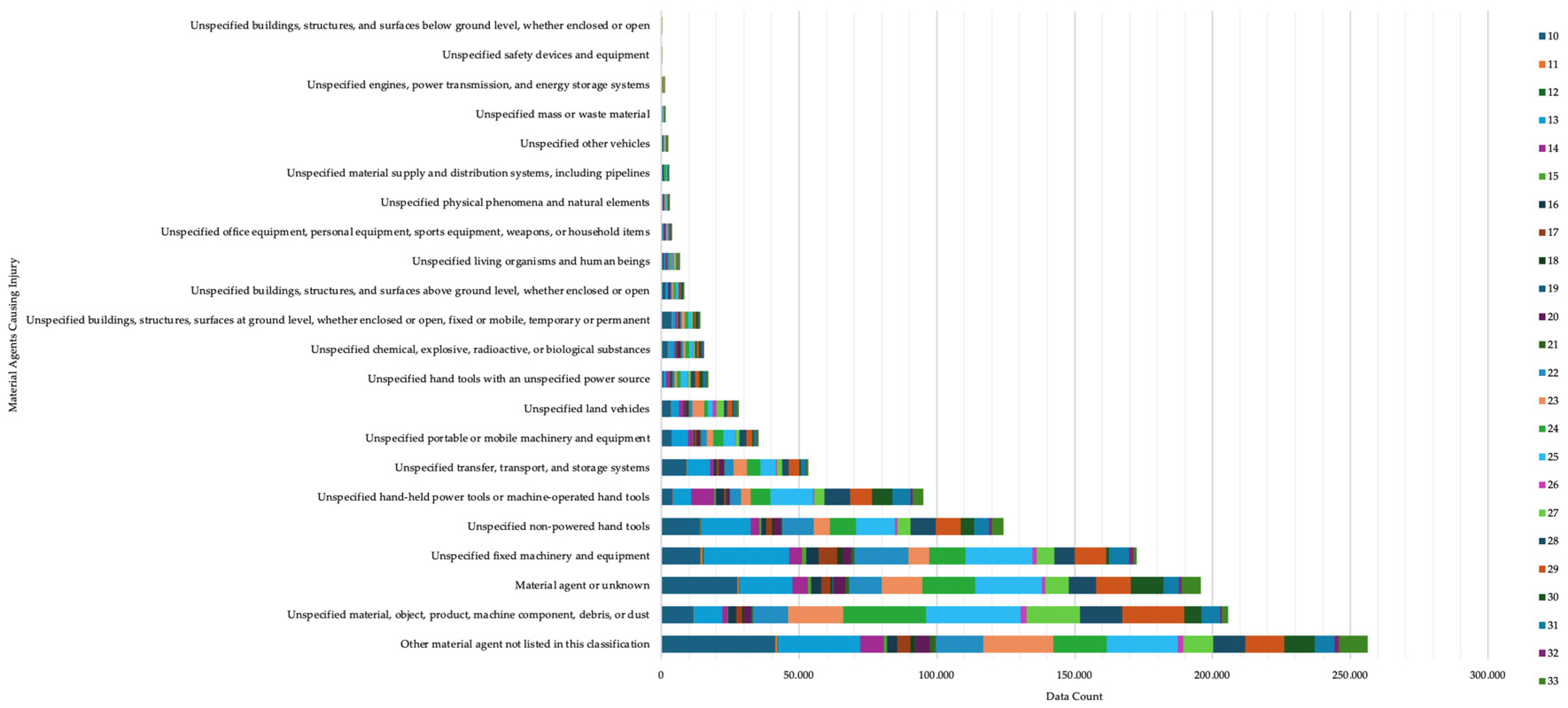
3.1. General Information on Accident Analysis in the Manufacturing Sector
3.2. Detailed Analysis of Economic Activities
3.2.1. Manufacture of Food Products
3.2.2. Manufacturing of Textiles
3.2.3. Manufacture of Chemicals and Chemical Products
3.2.4. Manufacture of Rubber and Plastic Products
3.2.5. Manufacture of Other Non-Metallic Mineral Products
3.2.6. Manufacture of Basic Metals
3.2.7. Manufacture of Machinery and Equipment Not Elsewhere Classified (n.e.c.)
3.3. Sectoral Pattern Analysis
4. Conclusions
5. Limitations
Author Contributions
Funding
Institutional Review Board Statement
Informed Consent Statement
Data Availability Statement
Acknowledgments
Conflicts of Interest
Appendix A

| Sector | Main Topic Classification | Sub-Topic Classification | Keywords |
|---|---|---|---|
| Sector 10 | Slip, Fall, and Collision-Related Errors | Slip- and Fall-Related | [“slipped and fell”, “his/her foot slipped”, “sprained his/her ankle”, “fell as a result of slipping”, “fall due to foot slipping”, “slipped and fell”, “foot slipping”, “while descending, his/her foot”, “right foot slipping”, “while descending, his/her foot”] |
| Collision-Related | [“on his/her head”, “of his/her head”, “hit his/her head”, “his/her head”, “fell onto his/her head”, “falling onto his/her head”, “hit his/her head”, “hitting the iron/metal”, “was injured”, “was slightly injured”] | ||
| Cutting Tool-Related Errors | Knife-Related | [“knife”, “slipping toward the left hand”, “cut his/her hand”, “cut on his/her finger”, “cut on hand/finger”, “cut his/her finger”, “cut his/her index finger”, “slipped from his/her hand toward the left”, “slipped from his/her hand”, “had his/her finger cut”] | |
| Machine-Related | [“cheese”, “to/into the cart”, “cut his/her hand”, “became trapped”, “trapped his/her hand”, “middle finger”, “getting caught”, “in the manufacturing section”, “cut”, “left-hand ring finger”] | ||
| Exposure-Related Errors | Chemical-Related | [“into the left eye”, “into the right eye”, “entry/splashing”, “of the eye”, “burning sensation”, “into the eye”, “right eye”, “bone”, “while cleaning”, “water”] | |
| Hot Liquid-Related | [“hot water”, “burning”, “spillage”, “splashing”, “of the hose”, “bursting”, “cooking”, “oven”, “chemical”, “refinery”] | ||
| Entrapment/Crushing-Related Errors | Entrapment-Related | [“of the index finger”, “trapped his/her hand”, “trapping his/her finger”, “entrapment of his/her finger”, “while working, right hand”, “hand finger”, “of the hand finger”, “his/her hand into the machine”, “of the index finger of the hand”, “while working on the machine”] | |
| Crushing-Related | [“empty crate”, “tipped over”, “empty crates”, “from the crates”, “fell in the production area”, “fell onto his/her head”, “tripped and fell”, “to the pallet truck”, “of the product”, “struck in the production area”] | ||
| Material Handling Vehicle-Related Errors | Forklift-Related | [“forklift”, “operator”, “in reverse”, “struck his/her foot”, “load”, “onto his/her left foot”, “did not see”, “of the vehicle”, “to the ankle”, “electric”] | |
| Electrical-Related Errors | Electrical-Related | [“electrical”, “malfunction”, “explosion”, “motor”, “due to the malfunction”, “to switch off”, “that it struck”, “to the button”, “assembly/installation”, “the machine”] | |
| Sector 11 | Cutting Tool-Related Errors | Box Cutter-Related | [“finger”, “to the machine”, “in the machine”, “finger”, “to his/her finger”, “the finger”, “the machine”, “to the machine”, “index finger”, “the machine”] |
| Utility Knife-Related | [“knife”, “utility knife”, “cut”, “to the knife”, “to cut”, “cut his/her finger”, “cut his/her hand”, “shrink”, “stitches”, “a cut occurred”] | ||
| Glass-Related | [“bottle”, “the bottle”, “bottling”, “bottles”, “of the bottles”, “water”, “breakage”, “glass fragment”, “filling worker”, “broken”] | ||
| Slip, Fall, and Collision-Related Errors | Slip and Fall-Related | [“slipping of the foot”, “fall”, “foot slipping”, “foot slipped”, “slipping and falling”, “foot slipping and falling”, “while descending”, “falling on the left”, “falling to the ground”, “foot slipping and falling”] | |
| Collision-Related | [“head”, “his/her head”, “to his/her head”, “hitting his/her head”, “of the belt”, “head”, “of the conveyor”, “by hitting”, “filling worker”, “to the machine”] | ||
| Material Handling Vehicle-Related Errors | Forklift-Related | [“forklift”, “of the forklift”, “maneuver”, “reversing”, “shipment”, “vehicle”, “over his/her foot”, “of the operator”, “loading”, “waste”] | |
| Pallet Truck-Related | [“water”, “spring water”, “slipping of the foot”, “while unloading”, “wet”, “from the vehicle”, “fall”, “losing balance”, “falling to the ground”, “of the floor”] | ||
| Exposure-Related Errors | Industrial Chemical-Related | [“chemical”, “to the eye”, “eye”, “to the left eye”, “protective”, “to the face”, “while cleaning”, “to the right eye”, “mechanical”, “came into the eye”] | |
| Hot Water and Steam-Related | [“hot”, “hot water”, “tea”, “burning”, “sugar”, “water”, “burn occurred”, “pressurized”, “was spilled”, “washing”] | ||
| Entrapment/Crushing-Related Errors | Pallet-Related | [“pallets”, “of the pallets”, “pallet making”, “to the pallet”, “pallet line”, “between pallets”, “in the palletizing machine”, “from the pallet”, “to the pallets”, “on the pallet”] | |
| Sector 12 | Exposure-Related Errors | Spraying/Fumigation-Related | [“tobacco”, “cigarette”, “tobacco carton”, “occurred”, “the incident occurred”, “the incident took place”, “tobacco cartons”, “filled with tobacco”, “tobacco box”, “the incident occurred involving tobacco”] |
| Entrapment/Crushing-Related Errors | Entrapment-Related | [“machine”, “his/her finger”, “finger”, “in the machine”, “to the machine”, “finger”, “of the machine”, “of the machine”, “in the machine”, “right index finger”] | |
| Material Handling Vehicle-Related Errors | Hand Cart-Related | [“hand cart”, “of the cart”, “of the hand cart”, “to the hand cart”, “the incident occurred”, “with the hand cart”, “cart with a box/carton”, “hand cart with a box/carton”, “to the ankle”, “falling incident”] | |
| Pallet Truck-Related | [“foot”, “left foot”, “electric”, “of his/her foot”, “ankle”, “left ankle”, “while pulling, his/her right foot”, “electric pallet truck”, “with the electric pallet truck”, “his/her foot between the pallet”] | ||
| Cutting Tool-Related Errors | Knife-Related | [“knife”, “his/her knife”, “cutting knife”, “of the knife”, “final cutting knife”, “utility knife”, “the knife”, “to the knife”, “of the knives”, “of the utility knife”] | |
| Sector 13 | Entrapment/Crushing-Related Errors | Material Fall-Related | [“onto the fabric”, “fabrics”, “of the roll”, “textile”, “in the stenter machine”, “from the machine”, “the machine”, “from the machine”, “in the machine”, “was trapped between”] |
| Crushing-Related | [“of the cart”, “while pulling the cart”, “the cart”, “to the cart”, “from the cart”, “over his/her foot”, “of the vehicle”, “left foot”, “due to carelessness while pulling”, “was trapped between”] | ||
| Entrapment-Related | [“index finger”, “his/her index finger”, “index finger of the hand”, “middle finger”, “of the index finger”, “while working on the machine”, “finger of the hand”, “to the middle finger”, “finger was trapped”, “middle finger of the hand”] | ||
| Cutting Tool-Related Errors | Knife-Related | [“cut his/her finger”, “cut his/her hand”, “cutting his/her finger”, “slipping onto the left hand”, “cut”, “his/her thumb”, “cleaning”, “cut on his/her finger”, “cutting his/her hand”, “palm of the hand”] | |
| Needle-Related | [“was injured”, “to the accident”, “while working on the machine”, “left-hand finger”, “to the finger of the hand”, “cutting his/her finger”, “to the thumb”, “to the middle finger”, “accident”, “hand finger”] | ||
| Hook-Related | [“cut his/her hand”, “while cleaning, left”, “palm of the hand”, “to clean”, “cut his/her finger”, “slipping onto the left hand”, “to cut”, “cleaning”, “the item being cleaned”, “while cleaning”] | ||
| Slip, Fall, and Collision-Related Errors | Collision-Related | [“recklessly and carelessly”, “while pulling”, “trapping his/her hand”, “trapping his/her finger”, “over his/her foot”, “of the cart”, “striking his/her foot”, “striking the iron part”, “of the roll”, “falling onto his/her foot”] | |
| Fall-Related | [“while descending, his/her foot”, “while descending”, “foot slipping”, “foot slipping and falling”, “foot slipped”, “slipping and falling”, “slipping to the ground”, “while descending downward”, “slipped and fell”, “slipping and falling”] | ||
| Exposure-Related Errors | Chemical-Related | [“to the left eye”, “to the right eye”, “caustic”, “of the eye”, “protective”, “oil”, “while cleaning”, “breaking and”, “was injured”, “automation”] | |
| Hot Water and Steam-Related | [“hot”, “burn”, “splashing”, “washing”, “bursting”, “in the dyehouse section”, “to the right arm”, “oil”, “caused”, “in the factory”] | ||
| Sector 14 | Cutting Tool-Related Errors | Needle-Related | [“textile”, “in the machine”, “in the machine”, “of the machine”, “machine”, “while working on the machine”, “while working on the machine”, “to the machine”, “to the left-hand finger”, “steel”] |
| Scissors-Related | [“needle punctured”, “to the middle finger”, “carelessness, left”, “left index finger”, “left index”, “ring finger”, “to the thumb”, “while performing, left”, “the finger”, “of the index finger”] | ||
| Machine-Related | [“cutting”, “in the machine”, “of the machine”, “in the machine”, “left index finger”, “of the index finger”, “finger of the hand”, “left-hand finger”, “thumb of the hand”, “the finger”] | ||
| Entrapment/Crushing-Related Errors | Entrapment-Related | [“in the machine”, “in the machine”, “the machine”, “while working on the machine”, “to the machine”, “while working on the machine”, “of the machine”, “of the machine”, “trapped his/her finger”, “left index finger”] | |
| Exposure-Related Errors | Foreign Body-Related | [“to the eye”, “broken”, “by breaking”, “in the machine”, “in the machine”, “its cover”, “cleaning”, “metal”, “of the machine”, “while working on the machine”] | |
| Hot Liquid and Steam-Related | [“hot”, “while ironing”, “printing”, “in the production area”, “to the face”, “electricity”, “in the cafeteria”, “part”, “of the leg”, “of the right arm”] | ||
| Electrical-Related Errors | Electrical-Related | [“electricity”, “while changing”, “the machine”, “while ironing”, “metal”, “struck”, “of the cover”, “in the machine”, “of the table”, “of the machine”] | |
| Sector 15 | Entrapment/Crushing-Related Errors | Entrapment-Related | [“of the finger”, “of the machine”, “in the machine”, “finger”, “to the machine”, “to his/her finger”, “the finger”, “index finger”, “the machine”, “while working on the machine”] |
| Cutting Tool-Related Errors | Knife-Related | [“the knife”, “a cut occurred”, “the leather”, “cutting”, “cutting his/her hand”, “cutting his/her finger”, “slipping onto the left”, “his/her thumb”, “cut his/her finger”, “of the finger”] | |
| Machine-Related | [“stitches”, “in the sewing machine”, “in the machine”, “of the machine”, “of the finger”, “needle into his/her finger”, “accidentally”, “while sewing”, “puncturing his/her finger”, “of the middle finger”] | ||
| Exposure-Related Errors | Chemical-Related | [“to the eye”, “chemical”, “to the left eye”, “eye”, “to the right eye”, “paint”, “to the face”, “splashing into the eye”, “the eye”, “in the eye”] | |
| Hot Water-Related | [“hot”, “burning”, “last pulling operation”, “burn occurred”, “burning”, “fingers”, “in the machine”, “oil”, “chemical”, “of the machine”] | ||
| Machine and Equipment-Related Errors | Sanding-Related | [“shoe sole”, “the shoe”, “manufacturing”, “shoe sole”, “capsule”, “of the finger”, “in the machine”, “shoe production”, “of the machine”, “machine”] | |
| Material Handling Vehicle-Related Errors | Forklift-Related | [“forklift”, “of the forklift”, “electric”, “right foot”, “ran over his/her foot”, “ran over”, “of the truck”, “over his/her foot”, “by trapping between”, “falling onto his/her foot”] | |
| Sector 16 | Slip, Fall, and Collision-Related Errors | Slip-Related | [“slipping of the foot”, “falling onto the foot”, “the foot”, “onto the left foot”, “on the foot”, “the ankle”, “in the ankle”, “foot slipping”, “while descending, the foot”, “tripping of the foot”] |
| Fall-Related | [“wood”, “motor”, “to the saw”, “to the machine”, “the item cut”, “to the machine”, “while working on the machine”, “in the machine”, “in the cutting machine”, “while performing the task”] | ||
| Collision-Related | [“carelessness while working”, “of the wooden piece”, “coming out of the machine”, “in the cutting machine”, “while cutting a piece”, “carelessness while working on the machine”, “cutting operation”, “while cutting”, “while cutting material”, “while working on the machine”] | ||
| Entrapment/Crushing-Related Errors | Entrapment-Related | [“to the machine”, “while working on the machine”, “in the machine”, “trapped his/her hand”, “while working on the machine”, “his/her finger into the machine”, “trapped his/her finger”, “his/her hand into the machine”, “his/her hand into the machine”, “the machine”] | |
| Cutting Tool-Related Errors | Knife/Saw-Related | [“knife”, “knife”, “haker”, “while working on the machine”, “cut his/her finger”, “of his/her right hand”, “index finger of the hand”, “index finger”, “thumb”, “occurrence of a cut”] | |
| Machine-Related | [“carpenter”, “manufacturing”, “in the workshop”, “to the saw”, “to his/her finger”, “to the machine”, “while cutting”, “right index finger”, “of the wood”, “making”] | ||
| Pneumatic Nail Gun-Related | [“gun”, “to his/her finger”, “nail into his/her finger”, “while nailing”, “to the thumb”, “while performing nailing”, “to the index finger”, “nail into the thumb”, “while assembling pallets with nails”, “accidentally”] | ||
| Exposure-Related Errors | Chemical-Related | [“to the eye”, “to the right eye”, “to the left eye”, “dust into the eye”, “in the eye”, “eye”, “striking the eye”, “the eye”, “the eye”, “to my eye”] | |
| Hot Water and Steam-Related | [“hot”, “burn”, “oil”, “steam”, “hydraulic”, “fuel”, “of the hose”, “pressure”, “on the face”, “bursting”] | ||
| Material Handling Vehicle-Related Errors | Forklift-Related | [“forklift”, “of the forklift”, “shipment”, “foot”, “right foot”, “on the foot”, “of the right foot”, “of the left foot”, “ankle”, “in the maintenance workshop”] | |
| Sector 17 | Entrapment/Crushing-Related Errors | Entrapment-Related | [“paper”, “jammed paper”, “papers”, “to the machine”, “paper machine”, “occurred, paper”, “breakage”, “ring”, “in the paper machine”, “waste”] |
| Cutting Tool-Related Errors | Machine-Related | [“knife”, “cut his/her finger”, “cutting”, “a cut occurred”, “his/her thumb”, “cut on his/her finger”, “cut his/her hand”, “index finger of the hand”, “thumb of the hand”, “to his/her finger”] | |
| Box Cutter-Related | [“to his/her finger”, “hand finger”, “the finger”, “slipping onto the left hand”, “right index finger”, “left-hand finger”, “to the index finger”, “left index”, “index finger”, “index finger”] | ||
| Exposure-Related Errors | Foreign Body-Related | [“to the right eye”, “chemical”, “eye”, “paint”, “to the eye”, “burning”, “to the face”, “protective”, “struck his/her eye”, “water”] | |
| Hot Water and Steam-Related | [“burn”, “hot”, “burn occurred”, “burning”, “bursting”, “malfunction”, “chemical”, “electricity”, “occurred, paper”, “from the machine”] | ||
| Material Handling Vehicle-Related Errors | Forklift-Related | [“forklift”, “of the forklift”, “reversing”, “shipment”, “maneuver”, “struck his/her foot”, “of the left foot”, “on the foot”, “to the right foot”, “of the injured worker”] | |
| Pallet Truck-Related | [“sprained his/her foot”, “slipping of the foot”, “foot slipped”, “foot was sprained”, “while doing, his/her foot”, “the ankle”, “fell onto his/her foot”, “slipped and fell”, “while attempting, his/her foot”, “of the left foot”] | ||
| Sector 18 | Entrapment/Crushing-Related Errors | Entrapment-Related | [“in the printing machine”, “ink”, “printing machine”, “jammed paper”, “in the printing machine”, “of the printing machine”, “of the machine”, “printing section”, “to the printing machine”, “to the printing machine”] |
| Cutting Tool-Related Errors | Utility Knife-Related | [“knife”, “knife”, “cutting”, “cut his/her finger”, “paper”, “plastic”, “occurrence of a cut”, “while cleaning”, “his/her thumb”, “of the machine”] | |
| Material Handling Vehicle-Related Errors | Pallet Truck-Related | [“of his/her foot”, “foot”, “to his/her foot”, “his/her foot”, “left foot”, “slipping of the foot”, “the foot”, “to the pallet truck”, “left foot”, “of the right foot”] | |
| Forklift-Related | [“forklift”, “of the forklift”, “foot”, “electric”, “right foot”, “stock area”, “employee”, “over his/her foot”, “maneuver”, “shipment”] | ||
| Exposure-Related Errors | Foreign Body-Related | [“to the eye”, “to the left eye”, “eye”, “glass fragment”, “burning”, “splashed into the eye”, “solvent”, “the eye”, “superficial”, “by breaking”] | |
| Sector 19 | Exposure-Related Errors | Flammable/Explosive Substance-Related | [“steam”, “yağ”, “yangın”, “buhar”, “pompa”, “sıcak su”, “hattın”, “yanık oluşmuştur”, “bacak”, “ıbc tanka”] |
| Corrosive Chemical Substance-Related (Caustic) | [“degree burn”, “burning”, “first-degree burn”, “occurrence of a burn”, “burns”, “burns occurred”, “inner wrist”, “degree burn occurred”, “fire”, “burn dressing”] | ||
| Corrosive Chemical Substance-Related (Sulfuric Acid) | [“eye”, “polymer”, “to the eye”, “eye and neck”, “front of the eye and neck”, “increase of sulfuric acid”, “sprinkler tests present”, “chemical into the eye while performing”, “into the eye while performing”, “increase in gas pressure”] | ||
| Slip, Fall, and Collision-Related Errors | Working at Height-Related | [“stairs”, “of the ladder/stairs”, “while descending the stairs”, “on the last step”, “stairs”, “while ascending”, “on the last step of the stairs”, “downward”, “slipped and fell”, “while descending, his/her foot”] | |
| Material Handling Vehicle-Related Errors | Forklift-Related | [“forklift”, “of the forklift”, “shipment”, “forklift”, “forklift operator”, “transportation”, “forklift operator”, “did not see”, “to operate, of the forklift”, “running over his/her foot”] | |
| Entrapment/Crushing-Related Errors | Machine and Equipment-Related | [“of the compressor”, “compressor”, “compressor”, “mechanical”, “was trapped between”, “piston”, “apparatus holding the part”, “pump spare rotor”, “pump spare”, “of the impeller, his/her finger”] | |
| Sector 20 | Entrapment/Crushing-Related Errors | Entrapment-Related | [“of the finger”, “finger”, “to his/her finger”, “in the machine”, “of the machine”, “index finger”, “his/her index finger”, “on his/her finger”, “right index finger”, “the finger”] |
| Exposure-Related Errors | Chemical-Related | [“to the eye”, “eye”, “to the right eye”, “to the left eye”, “splashed into the eye”, “to the face”, “chemical substance”, “paint”, “washing”, “came into the eye”] | |
| Hot Liquid-Related | [“hot water”, “pump”, “steam”, “tanker”, “burn occurred”, “tank”, “pump”, “of the line”, “of the pump”, “pressurized”] | ||
| Foreign Body-Related | [“metal”, “to the head”, “steel”, “between iron materials”, “metal part”, “to his/her finger”, “to the part”, “of the machine”, “index finger”, “on his/her finger”] | ||
| Slip, Fall, and Collision-Related Errors | Slip and Fall-Related | [“stairs”, “of the stairs/ladder”, “slipping of the foot”, “while descending, his/her foot”, “fall”, “while descending, his/her foot”, “slipping while descending”, “while descending”, “foot slipping”, “foot slipped”] | |
| Cutting Tool-Related Errors | Utility Knife-Related | [“knife”, “blade/knife”, “to the knife”, “to cut”, “cut his/her hand”, “finger”, “on his/her finger”, “slipping onto the left”, “his/her thumb”, “of the finger”] | |
| Material Handling Vehicle-Related Errors | Forklift-Related | [“forklift”, “of the forklift”, “maneuver”, “with the forklift”, “reversing”, “striking his/her foot”, “of the operator”, “shipment”, “forklift”, “of the left foot”] | |
| Pallet Truck-Related | [“his/her foot”, “electric pallet truck”, “with the pallet truck”, “his/her left foot”, “left foot”, “being trapped between”, “right foot”, “his/her right foot”, “ankle”, “of the left foot”] | ||
| Sector 21 | Exposure-Related Errors | Hot Liquid-Related | [“hot water”, “washing”, “chemical”, “burning”, “water”, “in the washing room”, “waste”, “gas”, “of the tank”, “pressure”] |
| Chemical-Related | [“to the eye”, “eye”, “to the left eye”, “to the right eye”, “the eye”, “chemical”, “splashing into the eye”, “splashed into the eye”, “experienced splashing”, “the eye”] | ||
| Slip, Fall, and Collision-Related Errors | Slip and Fall-Related | [“of his/her foot”, “slipping of the foot”, “on his/her foot”, “left foot”, “sprained his/her foot”, “fell to the ground”, “foot slipped”, “foot slipping”, “slipping of the foot to the ground”, “ankle”] | |
| [“wet”, “slipping of the foot”, “foot slipping”, “fell”, “to the sink”, “slipped and fell”, “foot slipped”, “fell to the ground”, “foot slipping and falling”, “slipped and fell”] | |||
| Entrapment/Crushing-Related Errors | Entrapment-Related | [“of the finger”, “in the machine”, “to his/her finger”, “finger”, “index finger”, “trapped his/her finger”, “index finger of the hand”, “the finger”, “his/her index finger”, “entrapment of the hand”] | |
| Material Handling Vehicle-Related Errors | Autoclave-Related | [“the cart”, “while pulling the cart”, “cart”, “of the cart”, “to the cart”, “trapped between”, “while pulling, left hand”, “trapped his/her finger”, “from the cart”, “his/her ring finger”] | |
| Pallet Truck-Related | [“electric pallet truck”, “his/her foot”, “foot”, “between the pallet truck”, “foot”, “entrapment of the foot”, “ankle”, “right ankle”, “the foot”, “battery-powered pallet truck”] | ||
| Cutting Tool-Related Errors | Glass-Related | [“optical”, “breakage”, “pipette”, “glass fragment”, “broken”, “broken”, “broken glass”, “glass shard”, “in the laboratory”, “cut on his/her finger”] | |
| Utility Knife-Related | [“knife”, “utility knife”, “of the finger”, “plastic”, “was injured”, “the item cut”, “in the machine”, “cut his/her finger”, “causing cutting”, “while working on the machine”] | ||
| Sector 22 | Cutting Tool-Related Errors | Utility Knife-Related | [“cut on his/her finger”, “of the thumb”, “carelessness, left”, “thumb of the hand”, “finger of the hand”, “his/her little finger”, “was slightly injured”, “was injured slightly”, “the finger”, “slipping from his/her hand, right”] |
| Machine-Related | [“the machine”, “was trapped between”, “while performing assembly”, “dropped”, “due to carelessness”, “while trying to remove”, “while making the adjustment”, “thumb of the hand”, “was trapped between”, “his/her little finger”] | ||
| Exposure-Related Errors | Foreign Body-Related | [“was performed”, “around 00:00”, “drill”, “while performing assembly”, “due to carelessness”, “2020”, “of the operator”, “slipping from his/her hand”, “slightly”, “worker”] | |
| Hot Surface/Material-Related | [“slightly”, “on the upper part”, “to production”, “the machine”, “his/her right arm”, “2020”, “worker”, “of the operator”, “while trying to remove”, “leg”] | ||
| Fire/Smoke and Asphyxiant Gas-Related | [“printing house”, “vehicle”, “around 00:00”, “materials”, “slightly”, “was performed”, “seeing”, “worker”, “slight injury caused by impact”, “wall”] | ||
| Slip, Fall, and Collision-Related Errors | Material-Related | [“was trapped between”, “of the right foot”, “middle finger of the hand”, “his/her little finger”, “was injured slightly”, “slipping onto the right hand”, “slipping from his/her hand, right”, “was slightly injured”, “right foot”, “finger of the hand”] | |
| Fall-Related | [“of the right foot”, “dropped”, “while performing assembly”, “cut on his/her finger”, “slipping onto the right hand”, “while trying to remove”, “his/her right arm”, “of the index finger”, “carelessness, left”, “middle finger of the hand”] | ||
| Material Handling Vehicle-Related Errors | Forklift-Related | [“of the right foot”, “of the operator”, “right foot”, “vehicle”, “leg”, “was trapped between”, “unloading”, “by collision”, “movement”, “his/her leg”] | |
| Sector 23 | Slip, Fall, and Collision-Related Errors | Concrete-Related | [“of the vehicle”, “truck”, “concrete pouring”, “construction”, “of the pump”, “of the concrete pump”, “of the truck”, “transmixer”, “of his/her foot”, “cart”] |
| Collision-Related | [“his/her head”, “to his/her head”, “hitting his/her head”, “on his/her head”, “hitting his/her head against iron”, “striking his/her head”, “struck his/her head”, “on the head”, “hitting his/her head while passing”, “falling onto his/her head”] | ||
| Material-Related | [“while feeding stone into the machine”, “while feeding, the stone”, “while feeding stone, the stone”, “stone from the machine”, “while taking stone from the machine”, “stone from the machine”, “falling onto his/her foot”, “stone breaking”, “stone onto his/her foot”, “while taking stone from the machine”] | ||
| Cutting Tool-Related Errors | Glass-Related | [“of the glass”, “of the glasses”, “glass handling”, “breakage of glass”, “breakage”, “occurred, glass”, “while carrying glass”, “while taking glass”, “glass fragment”, “occurred, glass”] | |
| Broken Tile-Related | [“finger”, “finger”, “of the finger”, “to his/her finger”, “right index finger”, “was injured”, “finger of the hand”, “the finger”, “while taking the tile”, “index finger”] | ||
| Utility Knife-Related | [“knife”, “utility knife”, “of the knife”, “the knife”, “of the utility knife”, “the knife”, “knife onto the left”, “to the knife”, “with a knife”, “slipping of the knife”] | ||
| Exposure-Related Errors | Hot Surface/Material-Related | [“coal”, “from the furnace”, “at the furnace exit”, “fire”, “rotary kiln”, “burn occurred”, “in the furnace”, “occurred, furnace”, “in the furnaces section”, “hot water”] | |
| Foreign Body-Related | [“to the eye”, “to the left eye”, “burr into the eye”, “in the eye”, “burr entry”, “burr entering the eye”, “dust into the eye”, “while performing, into the eye”, “burr entered the eye”, “the eye”] | ||
| Chemical-Related (Epoxy) | [“epoxy”, “to the eye”, “epoxy”, “splashing into the eye”, “in the epoxy section”, “chemical into the eye”, “in the epoxy line”, “splashed into the eye”, “splashing into the left eye”, “occurred, epoxy”] | ||
| Material Handling Vehicle-Related Errors | Forklift-Related | [“forklift”, “of the forklift”, “forklift operator”, “from the forklift”, “with the forklift”, “of the forklift operator”, “foot”, “while getting off the forklift”, “occurred, forklift”, “forklift down”] | |
| Entrapment/Crushing-Related Errors | Entrapment-Related | [“while taking stone”, “while feeding stone”, “stone into the machine”, “trapped between”, “stone into the machine”, “between stones”, “his/her hand while working”, “while feeding stone into the machine”, “stone from the machine”, “while taking stone from the machine”] | |
| Material-Related (Wrench) | [“slipping of the wrench”, “with the wrench”, “while tightening, the wrench”, “the wrench from his/her hand”, “pipe wrench”, “of the pipe wrench”, “the wrench in his/her hand”, “slipping of the wrench from his/her hand”, “while tightening, wrench”, “slipping of the wrench onto the right”] | ||
| Sector 24 | Entrapment/Crushing-Related Errors | Entrapment-Related | [“finger of the hand”, “to the finger of the hand”, “index finger of the hand”, “to the index finger of the hand”, “left-hand finger”, “finger was trapped”, “to the left-hand finger”, “to the thumb of the hand”, “entrapment of the finger”, “thumb of the hand”] |
| Exposure-Related Errors | Foreign Body-Related | [“entered”, “while grinding”, “splashed”, “redness”, “angle grinder”, “motor”, “according to the statement”, “according to his/her own statement”, “according to his/her own statement”, “according to the person”s own statement”] | |
| Hot Surface/Material-Related | [“burn”, “oxygen”, “cooling”, “right and left”, “aluminum”, “injection”, “on his/her foot”, “while cutting”, “of the hose”, “left palm”] | ||
| Molten Metal-Related | [“splashed”, “to the furnace”, “furnace”, “of the furnace”, “in the foundry”, “occurred, casting”, “charge”, “spilled”, “casting”, “in the production area”] | ||
| Material-Related | [“ear”, “neck”, “burn”, “while cutting”, “from the machine”, “oxygen”, “the back side”, “was injured by impact”, “flying off”, “occurrence of a cut”] | ||
| Slip, Fall, and Collision-Related Errors | Material-Related | [“onto the left foot”, “falling onto the foot”, “left foot”, “on the foot”, “to the left ankle”, “striking the foot”, “the foot”, “to the right ankle”, “of the ankle”, “in the ankle”] | |
| Collision-Related | [“rope”, “trauma”, “soft tissue”, “to the index finger”, “finger of the hand”, “falling onto the left hand”, “on the finger of the hand”, “while breaking”, “cut on his/her finger”, “to the little finger of the hand”] | ||
| Material Handling Vehicle-Related Errors | Pallet Truck-Related | [“foot slipping”, “motor”, “onto the left foot”, “sprained his/her foot”, “falling onto the foot”, “while descending, his/her foot”, “on the foot”, “fell onto his/her foot”, “of the ankle”, “foot slipped”] | |
| Cutting Tool-Related Errors | Sheet Metal-Related | [“sheet metal”, “cut his/her finger”, “material”, “occurrence of a cut”, “cutting his/her finger”, “was cut”, “stitches”, “while working on the machine”, “occurrence of an incision”, “his/her little finger”] | |
| Equipment-Related | [“while grinding”, “motor”, “angle grinder”, “occurrence of an incision”, “while cutting”, “cutting his/her finger”, “coming off, left”, “cut on his/her finger”, “occurrence of a cut”, “slipped from his/her hand”] | ||
| Glass-Related | [“was cut”, “waste”, “cut his/her finger”, “press”, “in the machine”, “by breaking”, “while making the adjustment”, “occurrence of a cut”, “broken”, “dropped”] | ||
| Sector 25 | Exposure-Related Errors | Foreign Body-Related | [“gözüne çapak”, “sol gözüne”, “sağ gözüne”, “çapak kaçması”, “taşlama yaparken”, “kaçtı”, “yabancı cisim”, “spiral”, “sol göze”, “sağ göze”] |
| Gas-Related | [“burn”, “injection”, “gas”, “cylinder”, “explosion”, “furnace”, “chemical”, “of the factory”, “oil”, “spilled”] | ||
| Entrapment/Crushing-Related Errors | Entrapment-Related | [“to the accident”, “in the production department”, “entrapment of the finger”, “with injury”, “striking his/her finger”, “in the machine”, “striking his/her hand”, “falling occurred”, “while working in the department”, “right ring finger”] | |
| Slip, Fall, and Collision-Related Errors | Material-Related | [“falling onto his/her foot”, “onto the right foot”, “of the left foot”, “on his/her foot”, “piece falling”, “falling of the foot”, “the foot”, “fell onto his/her foot”, “to the ankle”, “onto his/her foot”] | |
| Collision-Related | [“of the head”, “striking his/her head”, “struck his/her head”, “head”, “in the room”, “in the paint shop department”, “was injured by impact”, “trauma”, “trauma occurred”, “striking the material”] | ||
| Fall-Related | [“from height”, “building”, “construction”, “construction site”, “of the panel”, “m”, “to the line”, “while performing the task”, “concrete”, “breaking”] | ||
| Cutting Tool-Related Errors | Sheet Metal-Related | [“sheet metal”, “to the press machine”, “while working in the department”, “working in the department”, “in the press machine”, “while performing cutting”, “impact causing a cut”, “cut his/her finger”, “impact causing an incision”, “from the machine”] | |
| Metal Part-Related | [“metal part”, “of the metal part”, “the metal part”, “metal material”, “existing metal”, “of the part, left”, “between parts”, “causing a cut”, “right-hand finger”, “left-hand finger”] | ||
| Knife-Related | [“cut his/her finger”, “incision on his/her finger”, “cut his/her hand”, “cut his/her index finger”, “an incision occurred on his/her finger”, “cut his/her finger”, “incision on the index finger”, “to cut”, “cutting of the finger”, “while cutting material”] | ||
| Angle Grinder-Related | [“angle grinder”, “while grinding”, “motor”, “while performing cutting”, “burr entering the eye”, “the machine”, “while cutting material”, “the broken-off part”, “leg”, “cutting operation”] | ||
| Sector 26 | Entrapment/Crushing-Related Errors | Entrapment-Related | [“finger”, “finger”, “of the finger”, “in the machine”, “entrapment”, “of the machine”, “his/her index finger”, “index finger”, “to his/her finger”, “right index finger”] |
| Exposure-Related Errors | Foreign Body-Related | [“to the eye”, “burr into the eye”, “to the left eye”, “in the eye”, “imprudence/carelessness”, “entry”, “foreign object into the eye”, “foreign body into the eye”, “foreign body”, “of the glass”] | |
| Hot Surface/Material-Related | [“burn occurred”, “heat”, “imprudence/carelessness”, “carelessness”, “plastic”, “imprudence/carelessness, right”, “splashing”, “carelessness, right”, “explosion”, “while working”] | ||
| Chemical-Related | [“chemical”, “of the materials”, “burning”, “in the incident”, “cleaning”, “factory”, “process”, “in the workshop”, “in the production department”, “wrong”] | ||
| Slip, Fall, and Collision-Related Errors | Slip and Fall-Related | [“foot”, “of his/her foot”, “in the ankle”, “experienced through contact”, “external physical contact”, “physical contact occurred”, “falling, right”, “experienced with sprain”, “left foot”, “during the incident, his/her foot”] | |
| Collision-Related | [“experienced with an incision”, “impact to the right hand”, “incision occurring on the finger”, “finger of the hand”, “of the finger of the hand”, “on the right-hand finger”, “physical contact occurred”, “external physical contact”, “physical contact”, “experienced through contact”] | ||
| Material-Related | [“iron material”, “dropping onto his/her foot”, “material fall”, “superficial carelessness”, “superficial injury as a result of falling”, “superficial carelessness as a result”, “as a result of material fall”, “superficial strain due to carelessness”, “as a result of dropping material”, “due to superficial carelessness”] | ||
| Cutting Tool-Related Errors | Utility Knife-Related | [“knife”, “utility knife”, “of the knife”, “cut his/her hand”, “plastic”, “cut his/her finger”, “while cleaning”, “our employee”, “cutting”, “cut on his/her finger”] | |
| Sheet Metal-Related | [“digital factory”, “experienced, digital”, “experienced, digital factory”, “digital factory high-end”, “factory high-end”, “factory high”, “high-end metal”, “factory”, “experienced with an incision”, “factory metal”] | ||
| Material Handling Vehicle-Related Errors | Forklift-Related | [“forklift”, “of the forklift”, “named forklift”, “the injured worker”, “Still”, “operator”, “of the forklift operator”, “numbered Still brand”, “maneuver”, “no.”] | |
| Pallet Truck-Related | [“pallet truck”, “battery-powered”, “battery-powered pallet truck”, “physical contact”, “physical contact occurred”, “experienced through contact”, “numbered battery-powered”, “material cart”, “of the cart”, “experienced, shipment”] | ||
| Sector 27 | Exposure-Related Errors | Foreign Body-Related | [“to the left eye”, “to the right eye”, “entry”, “eye”, “striking the eye”, “struck the eye”, “burning”, “right eye”, “left eye”, “paint”] |
| Hot Surface/Material-Related | [“burning”, “gas”, “explosion”, “paint”, “oil”, “plastic injection”, “heater”, “cleaning”, “of the machine”, “aluminum”] | ||
| Entrapment/Crushing-Related Errors | Entrapment-Related | [“of the machine”, “right ring finger”, “ring finger”, “while working on the machine”, “his/her ring finger”, “index finger”, “the finger”, “while working on the machine”, “of the index finger”, “his/her index finger”] | |
| Cutting Tool-Related Errors | Utility Knife-Related | [“cut his/her finger”, “cutting”, “his/her thumb”, “slipping onto the left hand”, “thumb of the hand”, “cutting his/her finger”, “cut his/her hand”, “his/her index finger”, “a cut occurred”, “while cleaning”] | |
| Sheet Metal-Related | [“sheet metal”, “a cut occurred”, “with an incision occurring”, “of the sheet metal”, “minor cut”, “experienced with an incision”, “in the workplace infirmary”, “mechanical manufacturing”, “striking the left”, “cutting”] | ||
| Steel Rope-Related | [“steel”, “to the piece”, “in the workplace”, “ring”, “in the workshop”, “index finger of the hand”, “to the thumb”, “ring finger of the hand”, “right index finger”, “the item cut”] | ||
| Angle Grinder-Related | [“grinding”, “angle grinder”, “motor”, “a cut occurred”, “explosion”, “cutting”, “index finger”, “of the machine”, “control”, “left index”] | ||
| Saw-Related | [“aluminum”, “cutting”, “with a hammer”, “left index finger”, “index finger”, “box”, “existing metal”, “to the index finger”, “of the index finger”, “of the index finger of the hand”] | ||
| Screwdriver-Related | [“screwdriver”, “while tightening”, “in the workplace infirmary”, “slipping onto the left hand”, “into the palm of the hand”, “left index”, “slipped from his/her hand”, “injured”, “slipped, left”, “worker”] | ||
| Material Handling Vehicle-Related Errors | Forklift-Related | [“forklift”, “of the forklift”, “maneuver”, “physical contact occurred”, “external physical contact”, “physical contact”, “external physical”, “of the left foot”, “of the right foot”, “experienced with crushing”] | |
| Electrical-Related Errors | Electrical-Related | [“energy”, “test”, “cable”, “connection”, “quality”, “transformer”, “electrical”, “while connecting”, “fuse”, “faulty”] | |
| Sector 28 | Exposure-Related Errors | Foreign Body-Related | [“burr into the eye”, “burr entering the eye”, “to the left eye”, “burr entered the eye”, “while performing, into the eye”, “in the eye”, “burr into the eye while performing”, “burr into the right eye”, “burr into the eye while grinding”, “the eye”] |
| Hot Surface/Material-Related | [“burn occurred”, “fire”, “oxygen”, “burning”, “burns”, “burning”, “hot water”, “occurrence of a burn”, “burning”, “explosion”] | ||
| Chemical-Related | [“washing”, “cleaning”, “solvent”, “dishwashing”, “while washing”, “in the kitchen”, “cleaning agent”, “liquid”, “of the machine”, “of the bottle”] | ||
| Slip, Fall, and Collision-Related Errors | Material-Related | [“of his/her foot”, “to his/her foot”, “slipping of the foot”, “falling onto his/her foot”, “the ankle”, “the foot”, “sprained his/her foot”, “onto the right foot”, “on his/her foot”, “onto the left foot”] | |
| Entrapment/Crushing-Related Errors | Entrapment-Related | [“to his/her finger”, “trapping”, “of the finger”, “metal”, “of the material”, “accident”, “machine”, “falling occurred”, “carelessness”, “of the injured worker”] | |
| Crushing-Related | [“of the material”, “hammer to his/her hand”, “the material”, “striking his/her hand”, “to the material”, “material fall”, “falling onto the foot”, “struck his/her hand”, “falling onto his/her hand”, “material to his/her hand”] | ||
| Cutting Tool-Related Errors | Sheet Metal-Related | [“sheet metal”, “of the sheet metal”, “sheet metals”, “metal sheet”, “of the sheet metals”, “sheet metal material”, “cutting”, “iron sheet”, “sheet metal cutting”, “of the finger”] | |
| Angle Grinder-Related | [“angle grinder disc”, “of the angle grinder disc”, “angle grinder machine”, “angle grinding”, “while using the angle grinder”, “angle grinder”, “of the angle grinder”, “the angle grinder disc”, “of the angle grinder machine”, “while cutting with the angle grinder”] | ||
| Pneumatic Gun-Related | [“gun”, “air gun”, “of the gun”, “of the gun”, “pneumatic gun”, “with the gun”, “nail gun”, “with the air gun”, “the gun”, “the air gun”] | ||
| Material Handling Vehicle-Related Errors | Forklift-Related | [“forklift”, “of the forklift”, “with the forklift”, “forklift operator”, “forklift material”, “from the forklift”, “maneuver”, “manlift”, “left foot”, “wheel”] | |
| Transport Cart-Related | [“transport cart”, “to the transport cart”, “while pulling the cart”, “of the transport cart”, “between carts”, “of the vehicle”, “hand cart”, “while carrying”, “material handling”, “with the cart”] | ||
| Sector 29 | Slip, Fall, and Collision-Related Errors | Slip and Fall-Related | [“ankle”, “of the left foot”, “ankle”, “of the right foot”, “onto the left foot”, “to the ankle”, “right foot”, “fell onto his/her foot”, “falling onto the left”, “fell to the ground”] |
| Collision-Related | [“cutting his/her finger”, “entrapment of the hand”, “trapping his/her hand”, “while working on the machine”, “while performing, left hand”, “to the middle finger”, “to the right-hand finger”, “from his/her finger”, “of the little finger”, “while working, left hand”] | ||
| Exposure-Related Errors | Foreign Body-Related | [“to the right eye”, “splashing”, “angle grinder”, “went”, “bursting”, “oil”, “while performing the operation”, “while cleaning”, “while working on the bench”, “while performing cleaning”] | |
| Hot Surface/Material-Related | [“burn”, “oil”, “bursting”, “hydraulic”, “cold”, “on his/her fingers”, “in the palm of the hand”, “on the right arm”, “from the machine”, “of the product”] | ||
| Chemical-Related | [“splashing”, “performed in the infirmary”, “leakage”, “strained his/her back”, “dismantling operation”, “falling onto the left”, “while performing the operation”, “suspended”, “to the ankle”, “fell onto his/her foot”] | ||
| Material Handling Vehicle-Related Errors | Forklift-Related | [“of the right foot”, “of the left foot”, “right foot”, “ankle”, “onto the left foot”, “to the ankle”, “fell to the ground”, “ankle”, “causing injury”, “operator”s right”] | |
| Cutting Tool-Related Errors | Utility Knife-Related | [“cut his/her hand”, “cutting his/her finger”, “incision on his/her finger”, “of the thumb”, “slipping from his/her hand onto the left”, “from his/her finger”, “of the index finger of the hand”, “was cut”, “of the middle finger of the hand”, “to the left wrist”] | |
| Angle Grinder-Related | [“bursting”, “the machine”, “while performing, left hand”, “incision on his/her finger”, “cut his/her hand”, “left-hand finger”, “slipping from his/her hand onto the left”, “splashing”, “occurrence of an incision”, “of the index finger of the hand”] | ||
| Sheet Metal-Related | [“in the press machine”, “cutting his/her finger”, “was cut”, “cut his/her hand”, “in the palm of the hand”, “of the right foot”, “slipping from his/her hand onto the left”, “from his/her finger”, “middle finger of the hand”, “operator”s right”] | ||
| Machine-Related | [“while working on the machine”, “finger was trapped”, “while working on the machine”, “while working, right hand”, “of the index finger of the hand”, “while working, left hand”, “thumb of the hand”, “while performing, left hand”, “the finger of the hand”, “of the thumb”] | ||
| Sector 30 | Slip, Fall, and Collision-Related Errors | Slip and Fall-Related | [“ship”, “on the ship”, “ship”, “slipping of the foot”, “by falling”, “in the engine room”, “fall”, “left foot”, “losing balance”, “by losing balance”] |
| Collision-Related | [“motor”, “grinding wheel”, “angle grinder”, “motor”, “while grinding”, “machine”, “while performing grinding”, “grinding operation”, “of the machine”, “cut on his/her finger”] | ||
| Cutting Tool-Related Errors | Equipment-Related | [“of the finger”, “finger”, “the finger”, “on his/her finger”, “finger of the hand”, “to the index finger”, “index finger”, “to the thumb”, “his/her index finger”, “thumb”] | |
| Utility Knife-Related | [“his/her thumb”, “on his/her finger”, “cut his/her hand”, “slipping onto the left”, “plastic”, “of the finger”, “left-hand finger”, “finger of the hand”, “stitches”, “slipping from his/her hand”] | ||
| Sheet Metal-Related | [“sheet metal”, “steel”, “finger”, “of the finger”, “carelessness”, “while performing cutting”, “of the material”, “of the hand”, “while performing assembly”, “thumb”] | ||
| Exposure-Related Errors | Hot Surface/Material-Related | [“burn”, “hot”, “fire”, “burning”, “chemical”, “gas”, “explosion”, “splashing”, “welding operation”, “being performed”] | |
| Foreign Body-Related | [“burr into the eye”, “on the ship”, “burr entered”, “to the left eye”, “to the right eye”, “to my eye”, “burr entry”, “while performing grinding work”, “the eye”, “burr into the eye”] | ||
| Welding Arc-Related | [“the eye”, “eye”, “foreign body”, “in the production area”, “while the operation was being performed”, “to the right eye”, “left eye”, “to the left eye”, “right eye”, “burr entering the eye”] | ||
| Entrapment/Crushing-Related Errors | Entrapment-Related | [“pipe assembly”, “pump”, “tank”, “while performing assembly”, “hydraulic”, “in the engine room”, “being trapped between”, “was trapped between”, “finger of the hand”, “while performing the operation”] | |
| Sector 31 | Slip, Fall, and Collision-Related Errors | Material-Related | [“to his/her foot”, “slipping of the foot”, “the foot”, “of the right foot”, “of the left foot”, “tripping of the foot”, “onto the right foot”, “ankle”, “left big toe”, “fell to the ground”] |
| Collision-Related | [“to the saw”, “while cutting a piece”, “in the workshop”, “while performing cutting”, “machine”, “in the machine”, “slipping of the piece”, “processing”, “while working on the machine”, “while cutting material”] | ||
| Cutting Tool-Related Errors | Equipment-Related | [“cut his/her finger”, “slipping onto the left hand”, “his/her index finger”, “cut on his/her finger”, “the item cut”, “cutting his/her finger”, “his/her thumb”, “cleaning”, “while working on the machine”, “while cutting a piece”] | |
| Saw-Related | [“in the machine”, “while working on the machine”, “while working on the machine”, “machine”, “electricity”, “while cutting a piece”, “of the index finger”, “the machine”, “the machine”, “the machine”] | ||
| Drill-Related | [“from his/her finger”, “the wrist”, “injuring”, “middle finger”, “of the middle finger”, “carelessness, left hand”, “his/her middle finger”, “to the thumb of the hand”, “to the middle finger”, “of the middle finger of the hand”] | ||
| Exposure-Related Errors | Chemical-Related | [“to the eye”, “paint”, “grinding”, “protective”, “to the face”, “went”, “angle grinder”, “while cleaning”, “cleaning”, “to clean”] | |
| Hot Surface/Material-Related | [“hot”, “sawdust”, “outside”, “bursting”, “electricity”, “splashing”, “came out”, “of the factory”, “paint”, “vehicle”] | ||
| Material Handling Vehicle-Related Errors | Material Handling Vehicle-Related | [“to the cart”, “of the cart”, “of the vehicle”, “right foot”, “conveyor”, “his/her foot”, “right foot”, “of the right foot”, “to his/her foot”, “of the left foot”] | |
| Entrapment/Crushing-Related Errors | Entrapment-Related | [“momentary distraction”, “while working on the machine”, “to the saw”, “while working on the machine”, “his/her index finger”, “his/her index finger”, “of the fingers”, “cutting of the finger”, “of the index finger”, “while cutting”] | |
| Sector 32 | Entrapment/Crushing-Related Errors | Entrapment-Related | [“of the finger”, “to the machine”, “finger”, “in the machine”, “to his/her finger”, “to his/her foot”, “in the machine”, “on his/her finger”, “of the machine”, “the finger”] |
| Cutting Tool-Related Errors | Utility Knife-Related | [“knife”, “blade/knife”, “utility knife”, “of the product”, “of the knife”, “plastic”, “cut his/her hand”, “coming out of the machine”, “cutting”, “while removing burrs”] | |
| Machine-Related | [“the fabric”, “to my finger”, “was applied”, “stitches were applied”, “I went”, “on my finger”, “struck”, “stitches”, “I struck”, “while working on the machine”] | ||
| Exposure-Related Errors | Foreign Body-Related | [“to the eye”, “to the right eye”, “to the left eye”, “burr into the eye”, “in the eye”, “goggles”, “while working at the assembly station”, “adhesive”, “burr entry”, “metal”] | |
| Hot Liquid-Related | [“fire”, “chemical”, “hot water”, “plastic”, “burn occurred”, “explosion”, “while washing”, “electricity”, “waste”, “glass/cup”] | ||
| Chemical-Related | [“continued working”, “to the left eye”, “while performing assembly”, “felt well”, “continued working because he/she felt well”, “continued working because he/she felt well”, “while working at the station”, “while working at the assembly station”, “continued working after application”, “continued working after application”] | ||
| Slip, Fall, and Collision-Related Errors | Slip and Fall-Related | [“stairs”, “while descending the stairs”, “of the stairs/ladder”, “while descending, his/her foot”, “fall”, “slipping of the foot”, “while descending, his/her foot”, “by falling”, “foot slipping”, “while descending”] | |
| Sector 33 | Exposure-Related Errors | Foreign Body-Related | [“burr into the eye”, “burr entered”, “burr entering the eye”, “burr entered the eye”, “in the eye”, “to the left eye”, “while performing, into the eye”, “burr into the eye while performing”, “the eye”, “entered”] |
| Chemical-Related | [“paint”, “thinner”, “splashing”, “to the eye”, “of the gun”, “chemical”, “while cleaning”, “pump”, “accidentally”, “technician”] | ||
| Slip, Fall, and Collision-Related Errors | Material-Related | [“falling onto his/her foot”, “piece falling”, “steel”, “onto the left foot”, “falling onto the left”, “falling of the piece”, “onto the right foot”, “crack”, “piece, left”, “the item cut”] | |
| Slip and Fall-Related | [“stairs”, “of the stairs/ladder”, “while descending the stairs”, “from the stairs”, “while descending, his/her foot”, “slipping of the foot”, “slipping while descending”, “fell to the ground”, “while descending”, “while ascending, his/her foot”] | ||
| Cutting Tool-Related Errors | Grinding Wheel-Related | [“motor”, “grinding wheel”, “of the grinding wheel”, “with the grinding wheel”, “while grinding”, “the grinding wheel”, “of the motor”, “grinding wheel cutting”, “motor”, “loss of control”] | |
| Utility Knife-Related | [“plastic”, “cut his/her finger”, “to cut”, “a cut occurred”, “his/her index finger”, “thumb”, “cutting of his/her finger”, “cut his/her hand”, “stitches”, “cutting his/her finger”] | ||
| Angle Grinder-Related | [“angle grinder disc”, “machine”, “occurrence of a cut”, “bursting onto the left”, “of the machine”, “on his/her leg”, “cut on his/her finger”, “while grinding”, “while the machine was operating”, “while cutting a piece”] | ||
| Screwdriver-Related | [“screwdriver”, “of the screwdriver”, “while tightening”, “battery-powered”, “puncturing”, “bumper”, “injured”, “slipping onto the left hand”, “of the vehicle”, “causing injury”] |
References
- Ghahramani, A.; Amirbahmani, A. A Study of the Causes of Occupational Accidents in Manufacturing Companies. Arch. Trauma Res. 2021, 10, 64. [Google Scholar] [CrossRef] [Scilit]
- Akyüz, K.C.; Yildirim, İ.; Tugay, T.; Akyüz, İ. İmalat Sanayi İçerisinde Yer Alan Sektörlerin İş Kazası İstatistiklerinin Küme ve Ayırma Analizleri İle Değerlendirilmesi. Düzce Üniversitesi Orman Fakültesi Orman. Derg. 2016, 12, 18–29. [Google Scholar]
- Bondy, J.; Lipscomb, H.; Guarini, K.; Glazner, J.E. Methods for Using Narrative Text from Injury Reports to Identify Factors Contributing to Construction Injury. Am. J. Ind. Med. 2005, 48, 373–380. [Google Scholar] [CrossRef] [Scilit] [PubMed]
- Tixier, A.J.P.; Hallowell, M.R.; Rajagopalan, B.; Bowman, D. Automated Content Analysis for Construction Safety: A Natural Language Processing System to Extract Precursors and Outcomes from Unstructured Injury Reports. Autom. Constr. 2016, 62, 45–56. [Google Scholar] [CrossRef] [Scilit]
- Sarkar, S.; Pramanik, A.; Maiti, J.; Reniers, G. Predicting and Analyzing Injury Severity: A Machine Learning-Based Approach Using Class-Imbalanced Proactive and Reactive Data. Saf. Sci. 2020, 125, 104616. [Google Scholar] [CrossRef] [Scilit]
- Suh, Y. Sectoral Patterns of Accident Process for Occupational Safety Using Narrative Texts of OSHA Database. Saf. Sci. 2021, 142, 105363. [Google Scholar] [CrossRef] [Scilit]
- Ahadh, A.; Binish, G.V.; Srinivasan, R. Text Mining of Accident Reports Using Semi-Supervised Keyword Extraction and Topic Modeling. Process Saf. Environ. Prot. 2021, 155, 455–465. [Google Scholar] [CrossRef] [Scilit]
- Rose, R.L.; Puranik, T.G.; Mavris, D.N.; Rao, A.H. Application of Structural Topic Modeling to Aviation Safety Data. Reliab. Eng. Syst. Saf. 2022, 224, 108522. [Google Scholar] [CrossRef] [Scilit]
- Miyamoto, A.; Bendarkar, M.V.; Mavris, D.N. Natural Language Processing of Aviation Safety Reports to Identify Inefficient Operational Patterns. Aerospace 2022, 9, 450. [Google Scholar] [CrossRef] [Scilit]
- Bao, J.; Chen, Y.; Yin, J.; Chen, X.; Zhu, D. Exploring Topics and Trends in Chinese ATC Incident Reports Using a Domain-Knowledge Driven Topic Model. J. Air Transp. Manag. 2023, 108, 102374. [Google Scholar] [CrossRef] [Scilit]
- Xing, Y.; Wu, Y.; Zhang, S.; Wang, L.; Cui, H.; Jia, B.; Wang, H. Discovering Latent Themes in Aviation Safety Reports Using Text Mining and Network Analytics. Int. J. Transp. Sci. Technol. 2024, 16, 292–316. [Google Scholar] [CrossRef] [Scilit]
- Nanyonga, A.; Joiner, K.; Turhan, U.; Wild, G. Semantic Topic Modeling of Aviation Safety Reports: A Comparative Analysis Using BERTopic and PLSA. Aerospace 2025, 12, 551. [Google Scholar] [CrossRef] [Scilit]
- Cao, Y.; Qu, Z.; Wu, S.; Chen, Y.; Skitmore, M.; Ma, X.; Wang, J. Analyzing OSHA Construction Accident Reports Using BERTopic Topic Modeling for Thematic Insights. Buildings 2026, 16, 10. [Google Scholar] [CrossRef] [Scilit]
- Grisales, A.M.; Robledo, S.; Zuluaga, M. Topic Modeling: Perspectives From a Literature Review. IEEE Access 2023, 11, 4066–4078. [Google Scholar] [CrossRef] [Scilit]
- Mehmood, I.; Zahra, Z.; Iqbal, S.; Qahmash, A.; Hussain, I. A Systematic Review of Topic Modeling Techniques for Electronic Health Records. Healthcare 2026, 14, 282. [Google Scholar] [CrossRef] [Scilit] [PubMed]
- Grootendorst, M. BERTopic: Neural Topic Modeling with a Class-Based TF-IDF Procedure. arXiv 2022, arXiv:2203.05794. [Google Scholar]
- Nedungadi, P.; Veena, G.; Tang, K.Y.; Menon, R.R.K.; Raman, R. AI Techniques and Applications for Online Social Networks and Media: Insights from BERTopic Modeling. IEEE Access 2025, 13, 37389–37407. [Google Scholar] [CrossRef] [Scilit]
- Egger, R.; Yu, J. A Topic Modeling Comparison Between LDA, NMF, Top2Vec, and BERTopic to Demystify Twitter Posts. Front. Sociol. 2022, 7, 886498. [Google Scholar] [CrossRef] [Scilit] [PubMed]
- Baysan, M.S.; Gungor, T. TR-MTEB: A Comprehensive Benchmark and Embedding Model Suite for Turkish Sentence Representations. In Proceedings of the Findings of the Association for Computational Linguistics: EMNLP 2025; Association for Computational Linguistics: Stroudsburg, PA, USA, 2025; pp. 8867–8887. [Google Scholar]
- Campello, R.J.G.B.; Moulavi, D.; Zimek, A.; Sander, J. Hierarchical Density Estimates for Data Clustering, Visualization, and Outlier Detection. ACM Trans. Knowl. Discov. Data 2015, 10, 5. [Google Scholar] [CrossRef] [Scilit]
- Röder, M.; Both, A.; Hinneburg, A. Exploring the Space of Topic Coherence Measures. In Proceedings of the WSDM 2015—Proceedings of the 8th ACM International Conference on Web Search and Data Mining; Association for Computing Machinery: New York, NY, USA, 2015; pp. 399–408. [Google Scholar]
- Dieng, A.B.; Ruiz, F.J.R.; Blei, D.M. Topic Modeling in Embedding Spaces. Trans. Assoc. Comput. Linguist. 2020, 9, 439–453. [Google Scholar] [CrossRef] [Scilit]
- Greene, D.; O’callaghan, D.; Cunningham, P. How Many Topics? Stability Analysis for Topic Models. arXiv 2014, arXiv:1404.4606. [Google Scholar]
- Bianchi, F.; Terragni, S.; Hovy, D. Pre-Training Is a Hot Topic: Contextualized Document Embeddings Improve Topic Coherence. In Proceedings of the 59th Annual Meeting of the Association for Computational Linguistics and the 11th International Joint Conference on Natural Language Processing (Short Papers); Association for Computational Linguistics: Kerrville, TX, USA, 2021; pp. 759–766. [Google Scholar]
- Janssens, W.; Bogaert, M.; Van Den Poel, D. A Comparative Analysis of Topic Reduction Techniques for BERTopic. IEEE Access 2025, 13, 204087–204103. [Google Scholar] [CrossRef] [Scilit]



| Sector Code | Economic Activities | Data Count |
|---|---|---|
| 10 | Manufacture of Food Products | 186,461 |
| 11 | Manufacture of Beverages | 5109 |
| 12 | Manufacture of Tobacco Products | 1205 |
| 13 | Manufacture of Textiles | 180,292 |
| 14 | Manufacture of Wearing Apparel | 53,143 |
| 15 | Manufacture of Leather and Related Products | 8299 |
| 16 | Manufacture of Wood and of Products of Wood and Cork, Except Furniture; Manufacture of Articles of Straw and Plaiting Materials | 33,400 |
| 17 | Manufacture of Paper and Paper Products | 31,969 |
| 18 | Printing and Reproduction of Recorded Media | 8156 |
| 19 | Manufacture of Coke and Refined Petroleum Products | 1778 |
| 20 | Manufacture of Chemicals and Chemical Products | 35,391 |
| 21 | Manufacture of Basic Pharmaceutical Products and Pharmaceutical Preparations | 8932 |
| 22 | Manufacture of Rubber and Plastic Products | 116,212 |
| 23 | Manufacture of Other Non-Metallic Mineral Products | 126,894 |
| 24 | Manufacture of Basic Metals | 155,432 |
| 25 | Manufacture of Fabricated Metal Products (Except Machinery and Equipment) | 220,012 |
| 26 | Manufacture of Computer, Electronic and Optical Products | 14,638 |
| 27 | Manufacture of Electrical Equipment | 85,306 |
| 28 | Manufacture of Machinery and Equipment n.e.c. | 102,623 |
| 29 | Manufacture of Motor Vehicles, Trailers and Semi-Trailers | 123,554 |
| 30 | Manufacture of Other Transport Equipment | 63,922 |
| 31 | Manufacture of Furniture | 59,868 |
| 32 | Other Manufacturing | 11,401 |
| 33 | Repair and Installation of Machinery and Equipment | 47,856 |
| Model A (SBERT)/Model B (trMTEB) | Model C (O-SBERT) | |
|---|---|---|
| Batch Size | 128 | Dynamic: 64/128/256 |
| Vectorizer | ngram_range = (1,2), min_df = 1 | ngram_range = (1,3), min_df = dynamic: 1/2/5/10/20/30, max_df = 0.70, max_features = 50,000 |
| UMAP | n_neighbors = 15, n_components = 5, min_dist = 0.0, metric = cosine, random_state = 42,52,62,72,82 | n_neighbors = dynamic: 15/30/40/50/75/100, n_components = 5, min_dist = 0.0, metric = cosine, random_state = RANDOM_STATE, low_memory = True |
| HDBSCAN | min_cluster_size = 20, min_samples = 10, metric = Euclidean, cluster_selection_method = eom | min_cluster_size = dynamic: 12/30/50/100/200/300, min_samples = dynamic: 2/5/8/10/20/30, metric = Euclidean, cluster_selection_method = eom, prediction_data = True, core_dist_n_jobs = −1 |
| Representation Model | MMR, diversity = 0.3 | MMR, diversity = 0.3 |
| Small-Size Corpus | ||||||
| Sector 11 | Sector 18 | Sector 21 | ||||
| Metric | SBERT | trMTEB | SBERT | trMTEB | SBERT | trMTEB |
| Documents | 5109 | 5109 | 8156 | 8156 | 8932 | 8932 |
| Embedding Time (s) | 5.40 | 15.11 | 7.36 | 20.45 | 8.10 | 22.81 |
| Topic Number | 33.4 ± 2.3 | 3.6 ± 0.5 | 65.6 ± 5.2 | 48.6 ± 1.1 | 82.6 ± 4.6 | 66.8 ± 8.4 |
| Outliers (%) | 28.4 ± 2.4 | 0.8 ± 0.3 | 36.0 ± 3.6 | 37.5 ± 1.4 | 34.2 ± 1.2 | 38.1 ± 4.6 |
| Topic Diversity@10 | 0.857 ± 0.009 | 0.995 ± 0.011 | 0.813 ± 0.014 | 0.886 ± 0.003 | 0.839 ± 0.016 | 0.880 ± 0.018 |
| 0.452 ± 0.012 | 0.650 ± 0.059 | 0.420 ± 0.010 | 0.406 ± 0.009 | 0.468 ± 0.009 | 0.528 ± 0.015 | |
| −0.184 ± 0.009 | −0.037 ± 0.010 | −0.153 ± 0.010 | −0.107 ± 0.012 | −0.099 ± 0.012 | −0.033 ± 0.013 | |
| Largest Topic (%) | 18.6 ± 0.6 | 97.3 ± 0.2 | 15.5 ± 1.7 | 23.3 ± 0.5 | 6.6 ± 1.1 | 11.4 ± 4.5 |
| Normalized Entropy | 0.853 ± 0.008 | 0.114 ± 0.002 | 0.859 ± 0.036 | 0.820 ± 0.021 | 0.923 ± 0.011 | 0.900 ± 0.025 |
| ARI-CI | 0.938 ± 0.030 | 0.963 ± 0.017 | 0.832 ± 0.066 | 0.942 ± 0.030 | 0.898 ± 0.046 | 0.861 ± 0.077 |
| Common-inlier ratio (%) | 65.6 ± 1.5 | 99.0 ± 0.3 | 56.6 ± 2.0 | 56.8 ± 0.9 | 59.4 ± 1.1 | 54.5 ± 3.5 |
| Topic-word Stability | 0.627 ± 0.037 | 0.626 ± 0.161 | 0.505 ± 0.037 | 0.527 ± 0.027 | 0.557 ± 0.031 | 0.546 ± 0.066 |
| Medium-Size Corpus | ||||||
| Sector 16 | Sector 33 | Sector 31 | ||||
| Metric | SBERT | trMTEB | SBERT | trMTEB | SBERT | trMTEB |
| Documents | 33,400 | 33,400 | 47,856 | 47,856 | 59,868 | 59,868 |
| Embedding Time (s) | 27.37 | 76.77 | 37.17 | 108.50 | 43.80 | 128.25 |
| Topic Number | 141.0 ± 3.3 | 130.4 ± 3.6 | 224.8 ± 19.5 | 212.0 ± 7.6 | 247.4 ± 14.3 | 231.4 ± 7.7 |
| Outliers (%) | 37.1 ± 1.4 | 37.9 ± 1.0 | 40.1 ± 3.3 | 43.5 ± 1.7 | 38.0 ± 3.0 | 36.8 ± 1.0 |
| Topic Diversity@10 | 0.803 ± 0.002 | 0.900 ± 0.011 | 0.804 ± 0.006 | 0.828 ± 0.008 | 0.813 ± 0.010 | 0.815 ± 0.004 |
| 0.375 ± 0.012 | 0.386 ± 0.008 | 0.389 ± 0.004 | 0.424 ± 0.008 | 0.395 ± 0.006 | 0.443 ± 0.007 | |
| −0.098 ± 0.007 | −0.063 ± 0.006 | −0.068 ± 0.005 | −0.005 ± 0.003 | −0.061 ± 0.003 | −0.001 ± 0.006 | |
| Largest Topic (%) | 11.2 ± 0.4 | 20.4 ± 0.2 | 6.9 ± 2.8 | 7.8 ± 3.1 | 8.2 ± 0.2 | 6.7 ± 0.2 |
| Normalized Entropy | 0.817 ± 0.003 | 0.786 ± 0.005 | 0.870 ± 0.022 | 0.855 ± 0.020 | 0.803 ± 0.017 | 0.836 ± 0.011 |
| ARI-CI | 0.972 ± 0.007 | 0.971 ± 0.012 | 0.865 ± 0.073 | 0.878 ± 0.058 | 0.936 ± 0.016 | 0.924 ± 0.022 |
| Common-inlier ratio (%) | 57.5 ± 1.1 | 55.8 ± 0.6 | 52.2 ± 1.2 | 48.4 ± 0.7 | 55.1 ± 1.6 | 54.9 ± 0.9 |
| Topic-word Stability | 0.536 ± 0.025 | 0.515 ± 0.027 | 0.479 ± 0.041 | 0.519 ± 0.016 | 0.495 ± 0.021 | 0.564 ± 0.017 |
| Large-Size Corpus | ||||||
| Sector 29 | Sector 24 | Sector 13 | ||||
| Metric | SBERT | trMTEB | SBERT | trMTEB | SBERT | trMTEB |
| Documents | 123,554 | 123,554 | 155,432 | 155,432 | 180,292 | 180,292 |
| Embedding Time (s) | 95.34 | 291.03 | 115.06 | 342.78 | 138.07 | 410.22 |
| Topic Number | 484.2 ± 21.1 | 453.2 ± 9.7 | 670.4 ± 18.4 | 637.6 ± 24.4 | 747.6 ± 23.0 | 765.4 ± 10.8 |
| Outliers (%) | 45.3 ± 1.3 | 46.3 ± 1.3 | 45.1 ± 1.5 | 51.2 ± 1.5 | 42.9 ± 2.5 | 51.2 ± 0.8 |
| Topic Diversity@10 | 0.821 ± 0.009 | 0.837 ± 0.009 | 0.757 ± 0.003 | 0.793 ± 0.003 | 0.714 ± 0.007 | 0.733 ± 0.003 |
| 0.421 ± 0.008 | 0.432 ± 0.005 | 0.412 ± 0.003 | 0.405 ± 0.004 | 0.476 ± 0.005 | 0.476 ± 0.003 | |
| −0.026 ± 0.003 | 0.023 ± 0.004 | −0.037 ± 0.005 | 0.003 ± 0.006 | 0.013 ± 0.003 | 0.054 ± 0.004 | |
| Largest Topic (%) | 4.2 ± 2.0 | 5.7 ± 0.8 | 6.6 ± 0.2 | 6.4 ± 1.7 | 6.0 ± 0.5 | 3.3 ± 0.1 |
| Normalized Entropy | 0.844 ± 0.008 | 0.831 ± 0.005 | 0.845 ± 0.007 | 0.844 ± 0.015 | 0.815 ± 0.018 | 0.861 ± 0.005 |
| ARI-CI | 0.930 ± 0.020 | 0.911 ± 0.026 | 0.971 ± 0.008 | 0.919 ± 0.037 | 0.935 ± 0.023 | 0.961 ± 0.014 |
| Common-inlier ratio (%) | 47.0 ± 0.9 | 45.6 ± 0.9 | 48.1 ± 0.8 | 40.7 ± 1.0 | 49.1 ± 1.7 | 41.4 ± 0.8 |
| Topic-word Stability | 0.489 ± 0.020 | 0.522 ± 0.011 | 0.509 ± 0.014 | 0.482 ± 0.011 | 0.526 ± 0.015 | 0.555 ± 0.009 |
| Sector | Documents | Topics | Outlier Ratio (%) | Topic Diversity | Avg. Topic Size | Median Topic Size | Max. Topic Size | Top 5 Topic Ratio (%) |
|---|---|---|---|---|---|---|---|---|
| 10 | 186,452 | 64 | 34.94 | 0.5813 | 1895.52 | 1121.5 | 13,639 | 37.78 |
| 11 | 5109 | 18 | 28.07 | 0.85 | 204.17 | 107.5 | 805 | 66.59 |
| 12 | 1205 | 22 | 13.11 | 0.9273 | 47.59 | 24 | 267 | 64.47 |
| 13 | 180,292 | 63 | 34.44 | 0.5317 | 1876.08 | 828 | 10,719 | 32.02 |
| 14 | 53,143 | 40 | 30.73 | 0.4714 | 920.25 | 480.5 | 6164 | 45.97 |
| 15 | 8299 | 23 | 30.85 | 0.8217 | 249.52 | 163 | 1851 | 59.45 |
| 16 | 33,400 | 34 | 40.48 | 0.7882 | 584.74 | 412 | 2664 | 41.85 |
| 17 | 31,969 | 33 | 45.27 | 0.7697 | 530.21 | 325 | 2538 | 48.15 |
| 18 | 8156 | 25 | 35.8 | 0.844 | 209.44 | 114 | 946 | 53.3 |
| 19 | 1778 | 44 | 25.14 | 0.9523 | 30.25 | 22 | 187 | 34.26 |
| 20 | 20,273 | 48 | 42.72 | 0.7063 | 422.35 | 228.5 | 3487 | 43.27 |
| 21 | 8932 | 32 | 41.11 | 0.8125 | 164.38 | 110 | 482 | 37.74 |
| 22 | 116,212 | 43 | 40.3 | 0.1651 | 1613.4 | 799 | 8245 | 39.7 |
| 23 | 126,894 | 69 | 32.79 | 0.8652 | 1236.1 | 392 | 14,142 | 48.22 |
| 24 | 155,432 | 59 | 40.48 | 0.5339 | 1567.95 | 871 | 9771 | 38.14 |
| 25 | 220,012 | 65 | 35.37 | 0.6477 | 2187.54 | 1287 | 20,611 | 38 |
| 26 | 14,638 | 56 | 38.39 | 0.7607 | 161.04 | 106 | 1015 | 29.78 |
| 27 | 85,306 | 59 | 41.47 | 0.578 | 846.29 | 537 | 5141 | 32.42 |
| 28 | 102,623 | 67 | 38.18 | 0.8866 | 946.84 | 412 | 7086 | 37.77 |
| 29 | 123,554 | 47 | 39.8 | 0.3851 | 1582.57 | 1009 | 10,849 | 41.58 |
| 30 | 63,921 | 45 | 34.1 | 0.5467 | 936.09 | 399 | 6415 | 46.95 |
| 31 | 59,868 | 39 | 36.1 | 0.5846 | 980.87 | 653 | 5132 | 40 |
| 32 | 11,401 | 33 | 33.16 | 0.8333 | 230.91 | 110 | 2832 | 60.76 |
| 33 | 47,856 | 57 | 38.4 | 0.7702 | 517.21 | 347 | 3287 | 34.6 |
| Main Topic Classification | Sub-Topic Classification | Keywords | Representative Documents |
|---|---|---|---|
| Slip, Fall, and Collision-Related Errors | Slip- and Fall-Related | [“slipped and fell”, “his/her foot slipped”, “sprained his/her ankle”, “fell as a result of slipping”, “fall due to foot slipping”, “slipped and fell”, “foot slipping”, “while descending, his/her foot”, “right foot slipping”, “while descending, his/her foot”] | [“the employee slipped while descending the stairs and fell to the ground”, “the employee sprained the right ankle as a result of slipping while descending the stairs”, “as a result of spraining the ankle while descending the stairs”] |
| Collision-Related | [“on his/her head”, “of his/her head”, “hit his/her head”, “his/her head”, “fell onto his/her head”, “falling onto his/her head”, “hit his/her head”, “hitting the iron/metal”, “was injured”, “was slightly injured”] | [“the employee named XXX XXX hit his/her head on the conveyor belt while passing under the belt in the biscuit section, resulting in a cut and bleeding on the right side of the head”, “while passing under Line 5, the employee hit his/her head; a 1 cm laceration occurred on the head, and after the bleeding was controlled, the employee”, “while passing under the conveyor belt, the employee hit his/her head, resulting in an approximately 3–4 cm disruption of tissue integrity on the right side of the head”] | |
| Cutting Tool-Related Errors | Knife-Related | [“knife”, “slipping toward the left hand”, “cut his/her hand”, “cut on his/her finger”, “cut on hand/finger”, “cut his/her finger”, “cut his/her index finger”, “slipped from his/her hand toward the left”, “slipped from his/her hand”, “had his/her finger cut”] | [“cut his/her finger with the knife he/she was using”, “while working in the butcher section, the knife in his/her right hand slipped, causing a cut on the front part of the left arm”, “punctured his/her finger with a knife in the production area”] |
| Machine-Related | [“cheese”, “to/into the cart”, “cut his/her hand”, “became trapped”, “trapped his/her hand”, “middle finger”, “getting caught”, “in the manufacturing section”, “cut”, “left-hand ring finger”] | [“while closing cheese in the machine, the machine threw the tin, resulting in an open cut on the upper lip”, “while taking cheese from the cheese tin, the sharp edge of the tin cut the little finger of the hand, causing injury”, “sprained his/her wrist while cutting cheese in the cheese-cutting machine”] | |
| Exposure-Related Errors | Chemical-Related | [“into the left eye”, “into the right eye”, “entry/splashing”, “of the eye”, “burning sensation”, “into the eye”, “right eye”, “bone”, “while cleaning”, “water”] | [“chemical splashed into the employee’s right eye in the crate-washing room area”, “chemical entered the employee’s right eye while working in the crate-washing room”, “chemical entered the employee’s right eye while brushing during corridor cleaning”] |
| Hot Liquid-Related | [“hot water”, “burning”, “spillage”, “splashing”, “of the hose”, “bursting”, “cooking”, “oven”, “chemical”, “refinery”] | [“during the boiling of brine prepared for use in production, the tank discharge valve was left open, causing hot water to come into contact with the employee’s feet and face and resulting in burns”, “while taking water from the hot water boiler, the employee accidentally spilled water on both feet, resulting in burns to the feet”, “burn injury caused by hot water during work”] | |
| Entrapment/Crushing-Related Errors | Entrapment-Related | [“of the index finger”, “trapped his/her hand”, “trapping his/her finger”, “entrapment of his/her finger”, “while working, right hand”, “hand finger”, “of the hand finger”, “his/her hand into the machine”, “of the index finger of the hand”, “while working on the machine”] | [“while cutting dough in the dough-cutting machine, the employee attempted to remove dough stuck in the dough roller by hand without switching off the machine, resulting in the right hand being caught in the machine and two fingers being crushed”, “while working on the weighing machine, the employee’s right index finger became trapped, resulting in the amputation of the right index finger”, “in the wafer manufacturing workshop, the employee’s right index finger became trapped between the tray and the machine”] |
| Crushing-Related | [“empty crate”, “tipped over”, “empty crates”, “from the crates”, “fell in the production area”, “fell onto his/her head”, “tripped and fell”, “to the pallet truck”, “of the product”, “struck in the production area”] | [“while the employee was removing an intermediate crate, the full crates overturned onto him/her as a result of the crates slipping”, “while the employee was unloading full crates, crates from the empty-crate pallet fell onto his/her leg”, “while the employee was unloading full crates, crates from the empty-crate pallet fell onto his/her leg”] | |
| Material Handling Vehicle-Related Errors | Forklift-Related | [“forklift”, “operator”, “in reverse”, “struck his/her foot”, “load”, “onto his/her left foot”, “did not see”, “of the vehicle”, “to the ankle”, “electric”] | [“while adjusting the position of the forklift’s front lifting forks, the fork came loose and struck the employee’s leg”, “when the jack fell on the forklift, the employee became trapped between the wheel and the fender”, “injury occurred when palletized jars overturned onto the forklift during unloading with the forklift”] |
| Electrical-Related Errors | Electrical-Related | [“electrical”, “malfunction”, “explosion”, “motor”, “due to the malfunction”, “to switch off”, “that it struck”, “to the button”, “assembly/installation”, “the machine”] | [“the employee was exposed to electric current as a result of intervening in the machine without cutting off the electrical power”, “exposure to electric current while replacing a light bulb for illumination”, “the employee was exposed to electric current during work”] |
| Main Topic Classification | Sub-Topic Classification | Keywords | Representative Documents |
|---|---|---|---|
| Entrapment/Crushing-Related Errors | Material Fall-Related | [“onto the fabric”, “fabrics”, “of the roll”, “textile”, “in the stenter machine”, “from the machine”, “the machine”, “from the machine”, “in the machine”, “was trapped between”] | [“while cutting a roll of fabric in the knitting section, the roll fell onto the employee’s right foot”, “while arranging the fabric rolls from the floor onto the shelves, the employee dropped a roll onto him/her”, “while lifting a roll of fabric from the floor, the employee lost his/her balance and fell to the ground; subsequently, due to pain in the lower back, the employee was taken to the nearest”] |
| Crushing-Related | [“of the cart”, “while pulling the cart”, “the cart”, “to the cart”, “from the cart”, “over his/her foot”, “of the vehicle”, “left foot”, “due to carelessness while pulling”, “was trapped between”] | [“while pulling a yarn bobbin cart in the Open-End section, the cart wheel ran over the employee’s right toe, resulting in an occupational accident”, “while pulling the carpet cart, the end of the adjacent cart struck the employee’s left leg, resulting in a work-related injury”, “while loading material onto the machine, the cart moved, causing the employee’s finger to be crushed under the cart wheel”] | |
| Entrapment-Related | [“index finger”, “his/her index finger”, “index finger of the hand”, “middle finger”, “of the index finger”, “while working on the machine”, “finger of the hand”, “to the middle finger”, “finger was trapped”, “middle finger of the hand”] | [“while working on the brush-fitting machine, the employee’s right index finger became trapped”, “while attempting to correct a fault on Epoca Machine No. 22 in the curtain production section, the tip of the employee’s right index finger became trapped between the needle housing and the cord housing”, “while handling a yarn break on the yarn machine, the employee’s right index finger became trapped between the rollers”] | |
| Cutting Tool-Related Errors | Knife-Related | [“cut his/her finger”, “cut his/her hand”, “cutting his/her finger”, “slipping onto the left hand”, “cut”, “his/her thumb”, “cleaning”, “cut on his/her finger”, “cutting his/her hand”, “palm of the hand”] | [“while cutting fabric with a knife, the employee cut his/her left index finger”, “while cutting bread, the employee named XXX XXX, who works as an assistant cook at the workplace, cut his/her left index finger when the knife slipped; work was stopped immediately and the employee was transported to the hospital by a company vehicle”, “while attempting to cut yarn entangled around the extruder bobbin shaft with a utility knife, the employee accidentally slipped the knife and cut the fifth finger of the right hand”] |
| Needle-Related | [“was injured”, “to the accident”, “while working on the machine”, “left-hand finger”, “to the finger of the hand”, “cutting his/her finger”, “to the thumb”, “to the middle finger”, “accident”, “hand finger”] | [“while attempting to thread the take-up lever of the sewing machine, the employee accidentally pressed the pedal due to momentary inattention, causing the take-up lever to strike the left thumb and resulting in injury”, “while working on the sewing machine, the employee was injured when the needle punctured the left index finger due to momentary inattention”, “while working on the sewing machine, the employee was injured when the needle punctured the left index finger due to momentary inattention”] | |
| Hook-Related | [“cut his/her hand”, “while cleaning, left”, “palm of the hand”, “to clean”, “cut his/her finger”, “slipping onto the left hand”, “to cut”, “cleaning”, “the item being cleaned”, “while cleaning”] | [“while changing the tip of the hook used to clean yarn waste from the yarn machine, the employee named XXX XXX was injured when the sharp end of the hook struck the second finger of the right hand”, “while cleaning yarn waste, the hook slipped from the employee’s hand, resulting in a deep cut”, “while attempting to cut yarn wrapped around the bobbin, the employee lost control of the hook in his/her hand and struck his/her arm, resulting in injury”] | |
| Slip, Fall, and Collision-Related Errors | Collision-Related | [“recklessly and carelessly”, “while pulling”, “trapping his/her hand”, “trapping his/her finger”, “over his/her foot”, “of the cart”, “striking his/her foot”, “striking the iron part”, “of the roll”, “falling onto his/her foot”] | [“while working, the employee fell after colliding with a bobbin cart as a result of acting carelessly and without due caution”, “while the bobbin cart was being pulled, the employee was injured as a result of acting carelessly and without due caution”, “while loading fabric onto the machine, the employee struck his/her head as a result of acting carelessly and without due caution”] |
| Fall-Related | [“while descending, his/her foot”, “while descending”, “foot slipping”, “foot slipping and falling”, “foot slipped”, “slipping and falling”, “slipping to the ground”, “while descending downward”, “slipped and fell”, “slipping and falling”] | [“while standing on a three-step ladder to retrieve material, the employee fell, resulting in a fracture of the foot”, “after losing balance, the employee struck his/her hand forcefully against the stair railing, resulting in an injury to the right hand”, “the employee fell after the ladder placed on the floor slipped”] | |
| Exposure-Related Errors | Chemical-Related | [“to the left eye”, “to the right eye”, “caustic”, “of the eye”, “protective”, “oil”, “while cleaning”, “breaking and”, “was injured”, “automation”] | [“the peroxide tank was accidentally left open, causing peroxide to overflow and splash into the employee’s left eye”, “an occupational accident occurred when caustic chemical splashed into the employee’s left eye”, “while mixing reactive dye, the dye splashed into the employee’s left eye”] |
| Hot Water and Steam-Related | [“hot”, “burn”, “splashing”, “washing”, “bursting”, “in the dyehouse section”, “to the right arm”, “oil”, “caused”, “in the factory”] | [“while checking the hot water valve of the dyeing machine, hot water vapor came into contact with the employee’s right hand, resulting in a burn”, “while attempting to remove fabric from the operating machine, the employee’s body came into contact with a hot part of the machine, resulting in a minor burn”, “due to the employee’s inattention, hot water from the machine spilled onto the back of the left hand, resulting in a first-degree burn”] |
| Main Topic Classification | Sub-Topic Classification | Keywords | Representative Documents |
|---|---|---|---|
| Entrapment/Crushing-Related Errors | Entrapment-Related | [“of the finger”, “finger”, “to his/her finger”, “in the machine”, “of the machine”, “index finger”, “his/her index finger”, “on his/her finger”, “right index finger”, “the finger”] | [“while working on Machine No. TK 15, the root of the left index fingernail became trapped between the cover and the machine while closing the conveyor cover, resulting in tissue damage, bleeding, and restricted movement”, “while attempting to remove a label trapped between the two belts of the labeling machine, the employee’s left index finger became trapped”, “while cleaning the TLZ unit of the production machine, the machine started operating and trapped the employee’s left index finger”] |
| Exposure-Related Errors | Chemical-Related | [“to the eye”, “eye”, “to the right eye”, “to the left eye”, “splashed into the eye”, “to the face”, “chemical substance”, “paint”, “washing”, “came into the eye”] | [“the employee was injured when raw material splashed into both eyes during filling”, “chemical splashed into the employee’s eye in the production area”, “the accident occurred when the employee rubbed his/her eye with his/her hand, resulting in contamination of the eye”] |
| Hot Liquid-Related | [“hot water”, “pump”, “steam”, “tanker”, “burn occurred”, “tank”, “pump”, “of the line”, “of the pump”, “pressurized”] | [“while removing the hose from the hot water boiler, hot water splashed onto the employee’s arm due to wear on the boiler’s shut-off valve”, “hot water came out while the employee was opening the valve”, “while emptying the hot water trays, hot water splashed onto the employee’s abdominal area”] | |
| Foreign Body-Related | [“metal”, “to the head”, “steel”, “between iron materials”, “metal part”, “to his/her finger”, “to the part”, “of the machine”, “index finger”, “on his/her finger”] | [“while machining a metal part on the lathe, metal shavings cut the employee’s right index finger, resulting in an occupational accident”, “while coworkers were removing a metal part using a hammer and punch, a metal fragment struck the area below the employee’s right eye”, “while coworkers were removing a metal part using a hammer and punch, a metal fragment struck the area below the employee’s right eye”] | |
| Slip, Fall, and Collision-Related Errors | Slip and Fall-Related | [“stairs”, “of the stairs/ladder”, “slipping of the foot”, “while descending, his/her foot”, “fall”, “while descending, his/her foot”, “slipping while descending”, “while descending”, “foot slipping”, “foot slipped”] | [“the employee slipped and fell while descending the stairs due to inattention”, “the employee fell down the stairs after his/her foot slipped”, “while ascending the stairs, the employee’s foot slipped and he/she fell down the stairs”] |
| Cutting Tool-Related Errors | Utility Knife-Related | [“knife”, “blade/knife”, “to the knife”, “to cut”, “cut his/her hand”, “finger”, “on his/her finger”, “slipping onto the left”, “his/her thumb”, “of the finger”] | [“while cutting a belt with a utility knife, the knife slipped and cut the employee’s hand”, “the employee sustained an occupational accident after cutting his/her hand with a utility knife”, “the accident occurred when the utility knife accidentally slipped while opening a packaged raw material bag”] |
| Material Handling Vehicle-Related Errors | Forklift-Related | [“forklift”, “of the forklift”, “maneuver”, “with the forklift”, “reversing”, “striking his/her foot”, “of the operator”, “shipment”, “forklift”, “of the left foot”] | [“while the forklift was operating, the employee was talking with the forklift operator when the forklift moved and crushed the employee’s right foot”, “the forklift driver did not notice the employee in the area, and while reversing, the employee also failed to notice that the forklift was moving backward; as a result of both employees’ inattention, the forklift wheel ran over the employee’s right foot”, “while sweeping sand from the floor, the employee failed to notice the forklift fork and struck his/her head against it”] |
| Pallet Truck-Related | [“his/her foot”, “electric pallet truck”, “with the pallet truck”, “his/her left foot”, “left foot”, “being trapped between”, “right foot”, “his/her right foot”, “ankle”, “of the left foot”] | [“while pulling the electric pallet truck used daily, the employee inadvertently pulled it in the opposite direction and trapped his/her foot between the platform and the pallet truck”, “while pulling the electric pallet truck, the employee trapped his/her foot”, “while pulling raw material with the pallet truck, the operator’s foot became caught, preventing him/her from stopping the pallet truck, and the front steering wheel of the pallet truck trapped the employee’s foot”] |
| Main Topic Classification | Sub-Topic Classification | Keywords | Representative Documents |
|---|---|---|---|
| Cutting Tool-Related Errors | Utility Knife-Related | [“cut on his/her finger”, “of the thumb”, “carelessness, left”, “thumb of the hand”, “finger of the hand”, “his/her little finger”, “was slightly injured”, “was injured slightly”, “the finger”, “slipping from his/her hand, right”] | [“while cutting stretch film with a utility knife, the knife slipped, resulting in a cut on the employee’s left middle finger”, “while removing burrs from a plastic part, the utility knife slipped, resulting in a cut on the employee’s left index finger”, “while removing the product from the Bodinoz machine, the employee’s hand came into contact with the blade, resulting in a cut on the index finger”] |
| Machine-Related | [“the machine”, “was trapped between”, “while performing assembly”, “dropped”, “due to carelessness”, “while trying to remove”, “while making the adjustment”, “thumb of the hand”, “was trapped between”, “his/her little finger”] | [“the employee named XXX XXX sustained a cut on the hand after reaching his/her right hand into the jammed capron-producing machine without switching the machine off”, “while working in the production area, the employee accidentally activated the machine, resulting in the amputation of the fingertip”, “while the machine was operating, the employee violated safety procedures by attempting to remove the product trapped in the combs beneath the jaw without stopping the machine, resulting in the employee’s hand becoming trapped between the belts”] | |
| Exposure-Related Errors | Foreign Body-Related | [“was performed”, “around 00:00”, “drill”, “while performing assembly”, “due to carelessness”, “2020”, “of the operator”, “slipping from his/her hand”, “slightly”, “worker”] | [“while operating the crater machine, a burr entered the employee’s eye despite wearing safety glasses”, “while grinding during machine maintenance, a metal burr entered the employee’s right eye despite wearing safety glasses”, “while cutting the plastic-coated iron profile section, a burr entered the employee’s eye from the side despite wearing safety glasses”] |
| Hot Surface/Material-Related | [“slightly”, “on the upper part”, “to production”, “the machine”, “his/her right arm”, “2020”, “worker”, “of the operator”, “while trying to remove”, “leg”] | [“while removing material from the machine, the employee dropped it onto his/her arm, resulting in a minor burn”, “while removing a tray from the oven in the cafeteria, food spilled onto the employee’s right arm, resulting in a minor burn”, “while working on Injection Machine No. E 08, the employee manually intervened with a hot machine component that should not have been touched, resulting in minor burns to the palm and fingers of the left hand”] | |
| Fire/Smoke and Asphyxiant Gas-Related | [“printing house”, “vehicle”, “around 00:00”, “materials”, “slightly”, “was performed”, “seeing”, “worker”, “slight injury caused by impact”, “wall”] | [“while attempting to extinguish a fire caused by solvent in a metal drum igniting due to extremely hot weather in the waste area containing packaging waste and solvent-contaminated cloths, the employee was affected by smoke”, “during a fire in the printing section, the employee attempted to enter the area to help after believing that a coworker had fainted and become trapped; upon entering, the employee was unaware of the presence of colorless carbon dioxide gas and was exposed to the asphyxiating gas while attempting to intervene, resulting in poisoning and a risk of suffocation and loss of consciousness”, “while attempting to extinguish a fire caused by solvent in a metal drum igniting due to extremely hot weather in the waste area containing packaging waste and solvent-contaminated cloths, the employee was affected by smoke”] | |
| Slip, Fall, and Collision-Related Errors | Material-Related | [“was trapped between”, “of the right foot”, “middle finger of the hand”, “his/her little finger”, “was injured slightly”, “slipping onto the right hand”, “slipping from his/her hand, right”, “was slightly injured”, “right foot”, “finger of the hand”] | [“after placing the first rope over the head and while placing the second rope, the rope slipped from the employee’s hand; while attempting to retrieve it, the employee’s hand became trapped between the 10-finger mandrel and the autoclave cart tray, resulting in a first-degree burn, swelling, and pain”, “while pulling the mandrel on the floor in order to secure it, the tip of the employee’s right ring finger became trapped between the mandrel and the support, resulting in an abrasion, bruising, and pain”, “while opening the head of the Budinöz machine with a clamp for cleaning, the tip of the employee’s left ring finger became trapped between the clamp arm and the Budinöz head, resulting in bleeding and pain”] |
| Fall-Related | [“of the right foot”, “dropped”, “while performing assembly”, “cut on his/her finger”, “slipping onto the right hand”, “while trying to remove”, “his/her right arm”, “of the index finger”, “carelessness, left”, “middle finger of the hand”] | [“while the forklift operator was passing by the employee, the pallets on the forklift overturned and struck the employee’s right arm and chest”, “while walking from the dough stock area near the M3–M4 workstation to Hall 3 to collect a garbage bag, the employee entered the forklift and pedestrian route near the copper wire winding machine without noticing a forklift approaching with an empty rack; when the employee stepped onto the route, the forklift was unable to stop, and the small dough cord-fabric rack on the forklift slipped from the forks and struck the employee’s right shoulder”, “while collecting a pallet in front of the factory building, the employee lost balance and fell, causing the left foot to become trapped under the tire of a passing forklift”] | |
| Material Handling Vehicle-Related Errors | Forklift-Related | [“of the right foot”, “of the operator”, “right foot”, “vehicle”, “leg”, “was trapped between”, “unloading”, “by collision”, “movement”, “his/her leg”] | [“while the forklift operator was passing by the employee, the pallets on the forklift overturned and struck the employee’s right arm and chest”, “while walking from the dough stock area near the M3–M4 workstation to Hall 3 to collect a garbage bag, the employee entered the forklift and pedestrian route near the copper wire winding machine without noticing a forklift approaching with an empty rack; when the employee stepped onto the route, the forklift was unable to stop, and the small dough cord-fabric rack on the forklift slipped from the forks and struck the employee’s right shoulder”, “while collecting a pallet in front of the factory building, the employee lost balance and fell, causing the left foot to become trapped under the tire of a passing forklift”] |
| Main Topic Classification | Sub-Topic Classification | Keywords | Representative Documents |
|---|---|---|---|
| Slip, Fall, and Collision-Related Errors | Concrete-Related | [“of the vehicle”, “truck”, “concrete pouring”, “construction”, “of the pump”, “of the concrete pump”, “of the truck”, “transmixer”, “of his/her foot”, “cart”] | [“while discharging concrete from the concrete truck being operated, the employee’s hand became trapped in the concrete chute, resulting in injury”, “after completion of the concrete pouring for the new building, the employee was in a blind spot while the concrete pump was being retracted, causing the concrete pump to lightly strike the employee”, “while pouring concrete with the concrete pump, the employee slipped on the stairs near the pump hopper and fell”] |
| Collision-Related | [“his/her head”, “to his/her head”, “hitting his/her head”, “on his/her head”, “hitting his/her head against iron”, “striking his/her head”, “struck his/her head”, “on the head”, “hitting his/her head while passing”, “falling onto his/her head”] | [“the employee struck his/her head while cleaning the boiler”, “while turning his/her head to start the machine, the employee struck his/her head against the machine”, “while removing a stone from the vacuum unit, the employee bent over excessively and struck his/her head against the corner of the machine while standing back up”] | |
| Material-Related | [“while feeding stone into the machine”, “while feeding, the stone”, “while feeding stone, the stone”, “stone from the machine”, “while taking stone from the machine”, “stone from the machine”, “falling onto his/her foot”, “stone breaking”, “stone onto his/her foot”, “while taking stone from the machine”] | [“while feeding a stone into the splitting machine, the stone broke and fell onto the employee’s left foot”, “while feeding a stone into the polishing machine, a stone fell onto the employee’s right foot”, “while feeding a stone into the polishing machine, the stone fell onto the employee’s foot”] | |
| Cutting Tool-Related Errors | Glass-Related | [“of the glass”, “of the glasses”, “glass handling”, “breakage of glass”, “breakage”, “occurred, glass”, “while carrying glass”, “while taking glass”, “glass fragment”, “occurred, glass”] | [“while carrying glass, the glass broke in the employee’s hand, resulting in a cut on the finger”, “an occupational accident occurred when the glass cut both of the employee’s arms while being carried”, “an occupational accident occurred when the glass shattered during transportation”] |
| Broken Tile-Related | [“finger”, “finger”, “of the finger”, “to his/her finger”, “right index finger”, “was injured”, “finger of the hand”, “the finger”, “while taking the tile”, “index finger”] | [“while picking up a tile, the employee cut his/her left index finger”, “while picking up a broken tile coming from the laboratory, the employee cut his/her right index finger”, “while removing a broken tile from the conveyor belt, the employee cut his/her left index finger”] | |
| Utility Knife-Related | [“knife”, “utility knife”, “of the knife”, “the knife”, “of the utility knife”, “the knife”, “knife onto the left”, “to the knife”, “with a knife”, “slipping of the knife”] | [“while cutting foam placed in crates with a utility knife, the knife struck the employee’s leg, resulting in a cut”, “while cutting an empty acid bucket with a utility knife, the employee cut his/her right index finger”, “a minor cut caused by a utility knife”] | |
| Exposure-Related Errors | Hot Surface/Material-Related | [“coal”, “from the furnace”, “at the furnace exit”, “fire”, “rotary kiln”, “burn occurred”, “in the furnace”, “occurred, furnace”, “in the furnaces section”, “hot water”] | [“as a result of a furnace blowback from the flame-pipe inspection cover, the employee sustained first-degree burns to the neck and arms”, “while intervening in a buildup of ceramic material inside the furnace, hot ceramic came into contact with the inner side of the employee’s right arm, resulting in a burn”, “the employee sustained a burn after touching a hot part of the ceramic furnace pipe with his/her hand”] |
| Foreign Body-Related | [“to the eye”, “to the left eye”, “burr into the eye”, “in the eye”, “burr entry”, “burr entering the eye”, “dust into the eye”, “while performing, into the eye”, “burr entered the eye”, “the eye”] | [“while cleaning with a grinding machine, a burr entered the employee’s eye”, “a burr entered the employee’s left eye”, “the employee went to the hospital after a burr entered his/her eye”] | |
| Chemical-Related (Epoxy) | [“epoxy”, “to the eye”, “epoxy”, “splashing into the eye”, “in the epoxy section”, “chemical into the eye”, “in the epoxy line”, “splashed into the eye”, “splashing into the left eye”, “occurred, epoxy”] | [“while applying epoxy to the stone, epoxy splashed into the employee’s right eye due to inattention”, “while taking epoxy from the epoxy tap, epoxy splashed into the employee’s right eye due to inattention”, “while filling epoxy from the epoxy drum, the employee trapped his/her hand”] | |
| Material Handling Vehicle-Related Errors | Forklift-Related | [“forklift”, “of the forklift”, “forklift operator”, “from the forklift”, “with the forklift”, “of the forklift operator”, “foot”, “while getting off the forklift”, “occurred, forklift”, “forklift down”] | [“while reversing with the forklift, the forklift struck a stone and overturned”, “the employee was injured as a result of being struck by a forklift”, “while working, the employee was struck by a forklift”] |
| Entrapment/Crushing-Related Errors | Entrapment-Related | [“while taking stone”, “while feeding stone”, “stone into the machine”, “trapped between”, “stone into the machine”, “between stones”, “his/her hand while working”, “while feeding stone into the machine”, “stone from the machine”, “while taking stone from the machine”] | [“while attempting to feed a stone into the machine inside the factory, the employee trapped his/her hand between the stone and the machine”, “while attempting to feed a stone into the machine inside the factory, the employee trapped his/her hand between the stone and the machine”, “while attempting to feed a stone into the machine, the employee trapped his/her hand between the stone and the machine”] |
| Material-Related (Wrench) | [“slipping of the wrench”, “with the wrench”, “while tightening, the wrench”, “the wrench from his/her hand”, “pipe wrench”, “of the pipe wrench”, “the wrench in his/her hand”, “slipping of the wrench from his/her hand”, “while tightening, wrench”, “slipping of the wrench onto the right”] | [“while working beneath the press, the wrench slipped from the employee’s hand and struck his/her nose, resulting in injury”, “while tightening a nut with a wrench to adjust the machine, the wrench slipped and the employee injured his/her wrist”, “at Cement 4, the wrench slipped, causing the employee’s right hand to become trapped between the wrench and the component”] |
| Main Topic Classification | Sub-Topic Classification | Keywords | Representative Documents |
|---|---|---|---|
| Entrapment/Crushing-Related Errors | Entrapment-Related | [“finger of the hand”, “to the finger of the hand”, “index finger of the hand”, “to the index finger of the hand”, “left-hand finger”, “finger was trapped”, “to the left-hand finger”, “to the thumb of the hand”, “entrapment of the finger”, “thumb of the hand”] | [“while crating a cast component, the employee’s right index finger became trapped between two parts”, “while arranging materials, the employee’s left thumb became trapped between the block and the material”, “while marking the component, the employee’s left thumb became trapped against the part”] |
| Exposure-Related Errors | Foreign Body-Related | [“entered”, “while grinding”, “splashed”, “redness”, “angle grinder”, “motor”, “according to the statement”, “according to his/her own statement”, “according to his/her own statement”, “according to the person’s own statement”] | [“while working, a grinding burr entered the employee’s eye due to inattention”, “while blowing compressed air onto the component, a burr entered the employee’s right eye”, “while grinding a component, a foreign object entered the employee’s right eye”] |
| Hot Surface/Material-Related | [“burn”, “oxygen”, “cooling”, “right and left”, “aluminum”, “injection”, “on his/her foot”, “while cutting”, “of the hose”, “left palm”] | [“a burn occurred on the upper part of the employee’s right foot as a result of the machine leaking molten material from the mold”, “the employee sustained a burn on the back due to exposure to slag splashed as a result of the ladle overflowing”, “while the employee named XXX XXX was carrying a hot drum, it came into contact with the left arm of the employee named XXX XXX, resulting in a burn”] | |
| Molten Metal-Related | [“splashed”, “to the furnace”, “furnace”, “of the furnace”, “in the foundry”, “occurred, casting”, “charge”, “spilled”, “casting”, “in the production area”] | [“molten metal splashed from the casting furnace and struck the employee’s right ear”, “molten metal splashed onto the employee while pouring the casting”, “while pouring the casting, molten metal splashed onto the employee’s arm”] | |
| Material-Related | [“ear”, “neck”, “burn”, “while cutting”, “from the machine”, “oxygen”, “the back side”, “was injured by impact”, “flying off”, “occurrence of a cut”] | [“an occupational accident occurred when metal dust entered the employee’s ear while sandblasting”, “while the roll was passing through the blade, a folded burr struck the employee’s ear area”, “when the curtain iron fell to the ground, a piece struck the employee’s earlobe and head”] | |
| Slip, Fall, and Collision-Related Errors | Material-Related | [“onto the left foot”, “falling onto the foot”, “left foot”, “on the foot”, “to the left ankle”, “striking the foot”, “the foot”, “to the right ankle”, “of the ankle”, “in the ankle”] | [“the employee sprained his/her ankle while descending the stairs”, “the employee sprained the left ankle while descending the stairs”, “while descending the stairs, the employee’s left foot slipped, resulting in a sprained ankle”] |
| Collision-Related | [“rope”, “trauma”, “soft tissue”, “to the index finger”, “finger of the hand”, “falling onto the left hand”, “on the finger of the hand”, “while breaking”, “cut on his/her finger”, “to the little finger of the hand”] | [“when the crane was lifted with the steel rope attached to the crane hook, the rope came free from the hook and struck the employee’s left index finger”, “while working, the steel rope struck the employee’s hand”, “during production, the rope section attached to the steel cable separated and fell onto the employee’s feet”] | |
| Material Handling Vehicle-Related Errors | Pallet Truck-Related | [“foot slipping”, “motor”, “onto the left foot”, “sprained his/her foot”, “falling onto the foot”, “while descending, his/her foot”, “on the foot”, “fell onto his/her foot”, “of the ankle”, “foot slipped”] | [“while transporting products with an electric pallet truck, the employee failed to notice the pallets behind him/her, causing the right ankle to become trapped”, “while taking the electric pallet truck to the charging area, the pallet truck failed to stop, causing the employee’s left ankle to become trapped between the crate and the pallet truck”, “after leaving the pallet being transported with an electric pallet truck in the quality-control hall and reversing, the employee trapped his/her right foot between the electric pallet truck and a pallet lying on the floor behind it”] |
| Cutting Tool-Related Errors | Sheet Metal-Related | [“sheet metal”, “cut his/her finger”, “material”, “occurrence of a cut”, “cutting his/her finger”, “was cut”, “stitches”, “while working on the machine”, “occurrence of an incision”, “his/her little finger”] | [“due to the employee’s inattention, the sheet metal slipped and the employee’s hand became trapped between two sheets”, “while dismantling a casting mold at the workplace, the employee lost balance and a piece of sheet metal cut the right elbow area”, “while cutting a chrome sheet-metal plate, a burr on the plate cut the employee’s finger”] |
| Equipment-Related | [“while grinding”, “motor”, “angle grinder”, “occurrence of an incision”, “while cutting”, “cutting his/her finger”, “coming off, left”, “cut on his/her finger”, “occurrence of a cut”, “slipped from his/her hand”] | [“the employee stepped on the grinding machine after placing it under his/her foot, resulting in an approximately 2 cm cut”, “after losing control of the grinding machine, the grinding wheel came into contact with the employee’s leg, resulting in injury”, “while grinding runner material in the OPH area, the employee slipped and struck the grinding machine; the machine struck approximately 10 cm above the knee, resulting in an injury in that area”] | |
| Glass-Related | [“was cut”, “waste”, “cut his/her finger”, “press”, “in the machine”, “by breaking”, “while making the adjustment”, “occurrence of a cut”, “broken”, “dropped”] | [“the employee was injured when a glass window fell onto him/her while sitting”, “while placing glass into the machine for processing, the employee struck his/her hand against the edge of the glass, resulting in a cut”, “a 5-L glass Erlenmeyer flask was filled with water for washing; while the employee was gripping it firmly to lift it, the upper part broke and cut his/her hand”] |
| Main Topic Classification | Sub-Topic Classification | Keywords | Representative Documents |
|---|---|---|---|
| Exposure-Related Errors | Foreign Body-Related | [“burr into the eye”, “burr entering the eye”, “to the left eye”, “burr entered the eye”, “while performing, into the eye”, “in the eye”, “burr into the eye while performing”, “burr into the right eye”, “burr into the eye while grinding”, “the eye”] | [“a burr entered the employee’s eye”, “a burr entered the employee’s eye”, “a burr struck the employee’s eye”] |
| Hot Surface/Material-Related | [“burn occurred”, “fire”, “oxygen”, “burning”, “burns”, “burning”, “hot water”, “occurrence of a burn”, “burning”, “explosion”] | [“while taking hot water from the water dispenser, hot water spilled onto the employee’s hand, resulting in a burn”, “the employee struck his/her left arm against hot enamel, resulting in a burn”, “while holding a hot flange in the foundry workshop, the employee sustained a second-degree burn on the palm”] | |
| Chemical-Related | [“washing”, “cleaning”, “solvent”, “dishwashing”, “while washing”, “in the kitchen”, “cleaning agent”, “liquid”, “of the machine”, “of the bottle”] | [“while washing products at the workplace, chemical liquid entered the employee’s eye, resulting in injury”, “an occupational accident occurred when the employee trapped his/her hand in the washing machine”, “while pouring chemical into the washing machine, the chemical spilled onto the employee’s arm, resulting in injury”] | |
| Slip, Fall, and Collision-Related Errors | Material-Related | [“of his/her foot”, “to his/her foot”, “slipping of the foot”, “falling onto his/her foot”, “the ankle”, “the foot”, “sprained his/her foot”, “onto the right foot”, “on his/her foot”, “onto the left foot”] | [“a crate fell onto the employee’s left foot”, “the employee sprained the left ankle as a result of tripping”, “the employee sprained the right ankle as a result of tripping”] |
| Entrapment/Crushing-Related Errors | Entrapment-Related | [“to his/her finger”, “trapping”, “of the finger”, “metal”, “of the material”, “accident”, “machine”, “falling occurred”, “carelessness”, “of the injured worker”] | [“while positioning a metal sheet, the employee trapped his/her left index finger against the template, resulting in an occupational accident”, “the employee sustained an occupational accident when material fell onto his/her hand”, “the accident occurred when the employee struck the left thumb with a hammer while tack-welding the shaft”] |
| Crushing-Related | [“of the material”, “hammer to his/her hand”, “the material”, “striking his/her hand”, “to the material”, “material fall”, “falling onto the foot”, “struck his/her hand”, “falling onto his/her hand”, “material to his/her hand”] | [“the employee sustained tissue injury after striking his/her hand with a hammer”, “the injury occurred when the employee struck his/her hand with a hammer”, “the employee struck his/her hand with a hammer”] | |
| Cutting Tool-Related Errors | Sheet Metal-Related | [“sheet metal”, “of the sheet metal”, “sheet metals”, “metal sheet”, “of the sheet metals”, “sheet metal material”, “cutting”, “iron sheet”, “sheet metal cutting”, “of the finger”] | [“the employee cut his/her arm on sheet metal at the workplace”, “while removing the plastic covering from a sheet-metal component, the employee cut his/her hand on the sheet metal”, “a sheet-metal component fell onto the employee’s foot”] |
| Angle Grinder-Related | [“angle grinder disc”, “of the angle grinder disc”, “angle grinder machine”, “angle grinding”, “while using the angle grinder”, “angle grinder”, “of the angle grinder”, “the angle grinder disc”, “of the angle grinder machine”, “while cutting with the angle grinder”] | [“while grinding, the employee sustained a cut on the hand from the grinding wheel”, “while cleaning the surface of a metal sheet plate with an angle grinder, the grinding wheel slipped and injured the employee’s finger; the employee named XXX XXX had removed the protective equipment from the angle grinder and operated it without the guard, resulting in the occupational accident”, “while removing burrs with an angle grinder, the grinding wheel was ejected”] | |
| Pneumatic Gun-Related | [“gun”, “air gun”, “of the gun”, “of the gun”, “pneumatic gun”, “with the gun”, “nail gun”, “with the air gun”, “the gun”, “the air gun”] | [“a pneumatic fastening gun fell onto the employee’s right hand”, “while cleaning plastic debris from products with a pneumatic air gun, the hose of the gun was punctured; after applying adhesive to the damaged area, the employee pressed the trigger before the adhesive had dried, causing the adhesive to enter the right eye and resulting in a minor injury”, “while driving nails into crates with a pneumatic nail gun, the gun slipped from the employee’s hand, causing a nail to penetrate the left finger”] | |
| Material Handling Vehicle-Related Errors | Forklift-Related | [“forklift”, “of the forklift”, “with the forklift”, “forklift operator”, “forklift material”, “from the forklift”, “maneuver”, “manlift”, “left foot”, “wheel”] | [“the employee named XXX XXX approached the forklift and showed the location of the material; believing that the employee had moved away, the forklift operator turned the forklift to the left, causing the left wheel of the forklift to run over the employee’s foot and resulting in an occupational accident”, “a forklift struck the employee’s right foot”, “the employee was struck by a forklift”] |
| Transport Cart-Related | [“transport cart”, “to the transport cart”, “while pulling the cart”, “of the transport cart”, “between carts”, “of the vehicle”, “hand cart”, “while carrying”, “material handling”, “with the cart”] | [“while pushing a material transport cart at the workplace, the employee sprained his/her ankle and was injured after colliding with the cart”, “while transporting a glass cart with a pallet truck, the employee lost balance and attempted to hold the overturning transport cart; the cart fell onto the front part of the employee’s foot, resulting in injury”, “while pulling a transport cart, the employee’s finger became trapped between the cart being pulled and the adjacent transport cart”] |
| Main Topic Classification | Count |
|---|---|
| Exposure-Related Errors | 24 |
| Cutting Tool-Related Errors | 23 |
| Entrapment/Crushing-Related Errors | 21 |
| Material handling Vehicle-Related Errors | 18 |
| Slip, Fall, and Collision-Related Errors | 18 |
| Electrical-Related Errors | 3 |
| Machine and Equipment-Related Errors | 1 |
| Sub-Topic Classification | Count |
|---|---|
| Entrapment-Related | 19 |
| Knife/Blade-Related | 19 |
| Chemical Exposure-Related | 15 |
| Foreign Body-Related | 15 |
| Forklift-Related | 14 |
| Slip/Fall-Related | 13 |
| Machine/Equipment-Related | 12 |
| Collision/Impact-Related | 11 |
| Hot Liquid/Water/Steam-Related | 10 |
| Material Impact/Fall-Related | 9 |
| Hot Surface/Material-Related | 9 |
| Pallet Truck-Related | 8 |
| Sheet Metal-Related | 7 |
| Grinding/Abrasive Tool-Related | 6 |
| Glass-Related | 4 |
| Crushing-Related | 3 |
| Electrical-Related | 3 |
| Fire/Gas/Explosion-Related | 3 |
| Needle-Related | 2 |
| Pneumatic Gun/Nail Gun-Related | 2 |
| Saw-Related | 2 |
| Screwdriver-Related | 2 |
Disclaimer/Publisher’s Note: The statements, opinions and data contained in all publications are solely those of the individual author(s) and contributor(s) and not of MDPI and/or the editor(s). MDPI and/or the editor(s) disclaim responsibility for any injury to people or property resulting from any ideas, methods, instructions or products referred to in the content. |
© 2026 by the authors. Licensee MDPI, Basel, Switzerland. This article is an open access article distributed under the terms and conditions of the Creative Commons Attribution (CC BY) license.
Share and Cite
Aktaş, E.; Atmaca, H.E. Topic Modeling of Occupational Accident Narratives in the Manufacturing Sector Using BERTopic: Sector-Specific Accident Pattern Analysis. Appl. Sci. 2026, 16, 9170. https://doi.org/10.3390/app16189170
Aktaş E, Atmaca HE. Topic Modeling of Occupational Accident Narratives in the Manufacturing Sector Using BERTopic: Sector-Specific Accident Pattern Analysis. Applied Sciences. 2026; 16(18):9170. https://doi.org/10.3390/app16189170
Chicago/Turabian StyleAktaş, Esra, and Hatice Ediz Atmaca. 2026. "Topic Modeling of Occupational Accident Narratives in the Manufacturing Sector Using BERTopic: Sector-Specific Accident Pattern Analysis" Applied Sciences 16, no. 18: 9170. https://doi.org/10.3390/app16189170
APA StyleAktaş, E., & Atmaca, H. E. (2026). Topic Modeling of Occupational Accident Narratives in the Manufacturing Sector Using BERTopic: Sector-Specific Accident Pattern Analysis. Applied Sciences, 16(18), 9170. https://doi.org/10.3390/app16189170