Article

Accurate Structural Parameter Retrieval for One-Dimensional Nanogratings in Mueller-Matrix Spectroscopic Ellipsometry Using an Element-Adaptive Hybrid Surrogate Model


1
Department of Mechanical Engineering, Yonsei University, 50 Yonsei-ro, Seodaemun-gu, Seoul 03722, Republic of Korea
2
Center for Quantum Technology, Korea Institute of Science and Technology (KIST), 5 Hwarang-ro 14-gil, Seongbuk-gu, Seoul 02792, Republic of Korea
*
Authors to whom correspondence should be addressed.
Appl. Sci. 2026, 16(18), 8927; https://doi.org/10.3390/app16188927
Submission received: 3 August 2026 / Revised: 5 September 2026 / Accepted: 7 September 2026 / Published: 8 September 2026
(This article belongs to the Section Optics and Lasers)

Abstract

Mueller-matrix spectroscopic ellipsometry (MMSE) enables accurate characterization of nanostructures; however, structural-parameter retrieval remains challenging because of the high computational cost of rigorous coupled-wave analysis (RCWA), element-dependent prediction errors in the forward surrogate model, and instability caused by measurement noise. In this study, we propose an RCWA-based element-adaptive hybrid surrogate model that combines unified and element-wise surrogate models for accurate and rapid structural-parameter retrieval on one-dimensional nanogratings. The wavelength-dependent spectral variability of each Mueller-matrix (MM) element is quantified using the mean absolute spectral difference (MASD), and the unified or element-wise surrogate model with the lower validation mean squared error (MSE) is selected independently for each MM element to assemble the complete MM spectrum. In addition, penalized least-squares smoothing is applied to mitigate measurement noise, and a backward model provides initial structural-parameter estimates for subsequent forward-surrogate-based iterative optimization. Across the 1000 test samples, the hybrid surrogate model achieves an MSE of 5.28 × 10 8 with respect to the RCWA ground-truth MM spectra. Compared with unified surrogate model-based optimization, the proposed method reduces the average absolute retrieval error by 13.3% and improves the mean absolute error (MAE) difference from RCWA-based optimization by 41.5%. Structural-parameter retrieval was completed within 0.71 s, demonstrating that the proposed framework provides accurate and computationally efficient MMSE-based structural-parameter retrieval on one-dimensional nanogratings.

1. Introduction

In the semiconductor and display industries, the continuous miniaturization of devices and the increasing complexity of three-dimensional architectures have led to a growing demand for the high-precision metrology of nanoscale structural parameters, such as the period, height, and line width [1,2]. In particular, in next-generation semiconductor manufacturing, accurate and real-time measurement of critical dimensions at the nanometer scale is essential for yield improvement and process control [3]. Mueller-matrix spectroscopic ellipsometry (MMSE) is a powerful optical metrology technique that can precisely characterize the optical and structural properties of samples by measuring changes in the polarization state of light [4,5,6,7,8]. However, unlike characterization methods such as X-ray diffraction or Raman spectroscopy, in which identifiable peaks or signals directly correspond to specific material properties [9,10], the measured Mueller-matrix (MM) data in MMSE do not show a direct one-to-one correspondence with the optical or structural parameters [11,12]. Therefore, an additional procedure is required to convert the measured MM data into meaningful physical parameters. This task constitutes an inverse problem, which requires the construction of appropriate optical and structural models of the sample, followed by iterative fitting procedures to retrieve the target parameters [13,14,15].
To perform such model-based analysis, a variety of numerical methods have been employed, including finite-difference time-domain (FDTD) and finite element (FEM) methods [16,17]. For periodic structured samples, rigorous coupled-wave analysis (RCWA) is particularly widely used [18,19,20]. RCWA is advantageous in that it reformulates spatial-domain problems into modal-coupling problems within a single period through Fourier expansions, thereby avoiding the discretization of the entire computational domain [21,22]. As a result, it offers relatively fast computation compared with other full-wave methods. Nevertheless, MMSE analysis generally requires repeated RCWA calculations to achieve convergence [23]. Such iterative fitting substantially increases computational cost and processing time, highlighting the need for more efficient approaches [24]. Alternatively, although an initial lookup-table-based search can avoid iterative calculations, it requires substantial data storage and additional algorithmic strategies for efficient database construction and parameter matching [25]. Recent advancements in artificial intelligence (AI) and machine learning offer promising new pathways for streamlining complex numerical modeling and drastically reducing computational overhead [15,26,27,28,29,30,31,32,33,34,35,36,37,38].
Traditional iterative fitting remains the benchmark approach for achieving reliable accuracy in MMSE analysis [11,26]. To retain the accuracy of iterative fitting while reducing its computational cost, neural-network-based surrogate models have been widely employed to replace the computationally intensive RCWA forward calculations repeatedly performed during parameter retrieval [11,13,32,39]. A representative approach is the unified surrogate model, in which all Mueller-matrix (MM) elements are predicted jointly using a single neural network. By learning all MM elements simultaneously, the unified model can exploit inter-element correlations and improve the prediction accuracy of elements that share correlated spectral characteristics. However, individual MM elements exhibit substantially different spectral responses to structural parameters, such as period, height, top width, bottom width, and azimuthal angle. Consequently, a single unified model may not provide equally accurate predictions for all MM elements.
During unified training, MM elements exhibiting large or complex spectral variations can contribute more strongly to the overall loss and dominate the optimization process. In contrast, elements exhibiting relatively small variations in response to changes in structural parameters may receive insufficient attention during training. Moreover, integrated neural-network training has been reported to induce natural specialization of internal units toward particular outputs, resulting in uneven learning across different output elements [40,41]. This imbalance can reduce the prediction accuracy of MM elements with relatively smooth or low-amplitude spectral responses.
In this study, to mitigate this learning imbalance, we constructed element-wise surrogate models using modular one-dimensional convolutional neural networks (1D CNNs), with each network trained independently to predict a single MM element. Because each element is optimized using its own loss function, its learning process is not affected by MM elements with larger and more complex spectral variations. Element-wise learning is therefore particularly advantageous for MM elements that exhibit relatively small variations with changes in structural parameters, because it prevents their subtle spectral responses from being overshadowed by the dominant variations of other elements [2,39,42].
Nevertheless, element-wise training is not universally superior. In the present RCWA calculations, the 16 MM elements are derived from the same Jones matrix and are therefore physically correlated rather than completely independent. For some MM elements exhibiting large wavelength-dependent spectral variations and strong correlations with other elements, the unified model achieved higher prediction accuracy by effectively exploiting shared representations among correlated elements. Accordingly, we developed an element-adaptive hybrid surrogate model that selects the more accurate predictor for each MM element. The validation mean squared errors of the unified and element-wise surrogate models were compared independently for each element, and the model yielding the lower validation error was selected to assemble the complete MM spectrum. By combining the advantages of independent element-wise learning and correlation-based unified learning, the proposed strategy reduces the forward-prediction errors associated with a single surrogate-model architecture and enables more accurate structural-parameter retrieval.
To represent practical MMSE measurement conditions, noise levels were determined by considering the maximum expected contributions from measurement-system uncertainties, including light-source intensity fluctuations, mechanical instability of the motorized components, and environmental variations, and were subsequently applied to the RCWA-calculated MM spectra. Penalized least-squares smoothing, which is widely used in signal and noise processing, was then applied to mitigate the measurement noise contained in the MM spectra. The smoothed MM spectra were subsequently provided to a backward model, which generated informed initial structural-parameter estimates for forward-surrogate-based nonlinear optimization. This initialization reduces the initial mismatch between the measured MM spectra and those predicted by the forward surrogate model. Consequently, the proposed framework improves forward-surrogate prediction accuracy through the element-adaptive hybrid strategy while simultaneously mitigating measurement noise for better initial structural-parameter estimates, thereby improving the robustness, accuracy, and computational efficiency of structural-parameter retrieval.

2. Methodology

The overall pipeline consists of three stages: (i) RCWA-based MM dataset generation for 1D periodic nanostructures, (ii) development of forward surrogate models for constructing the element-adaptive hybrid surrogate model together with a backward model for better initial structural-parameter estimates, and (iii) construction of the element-adaptive hybrid surrogate model through mean absolute spectral difference (MASD) analysis and validation-MSE comparison of the forward surrogate models.

2.1. RCWA-Based Dataset Generation for One-Dimensional Periodic Nanostructures

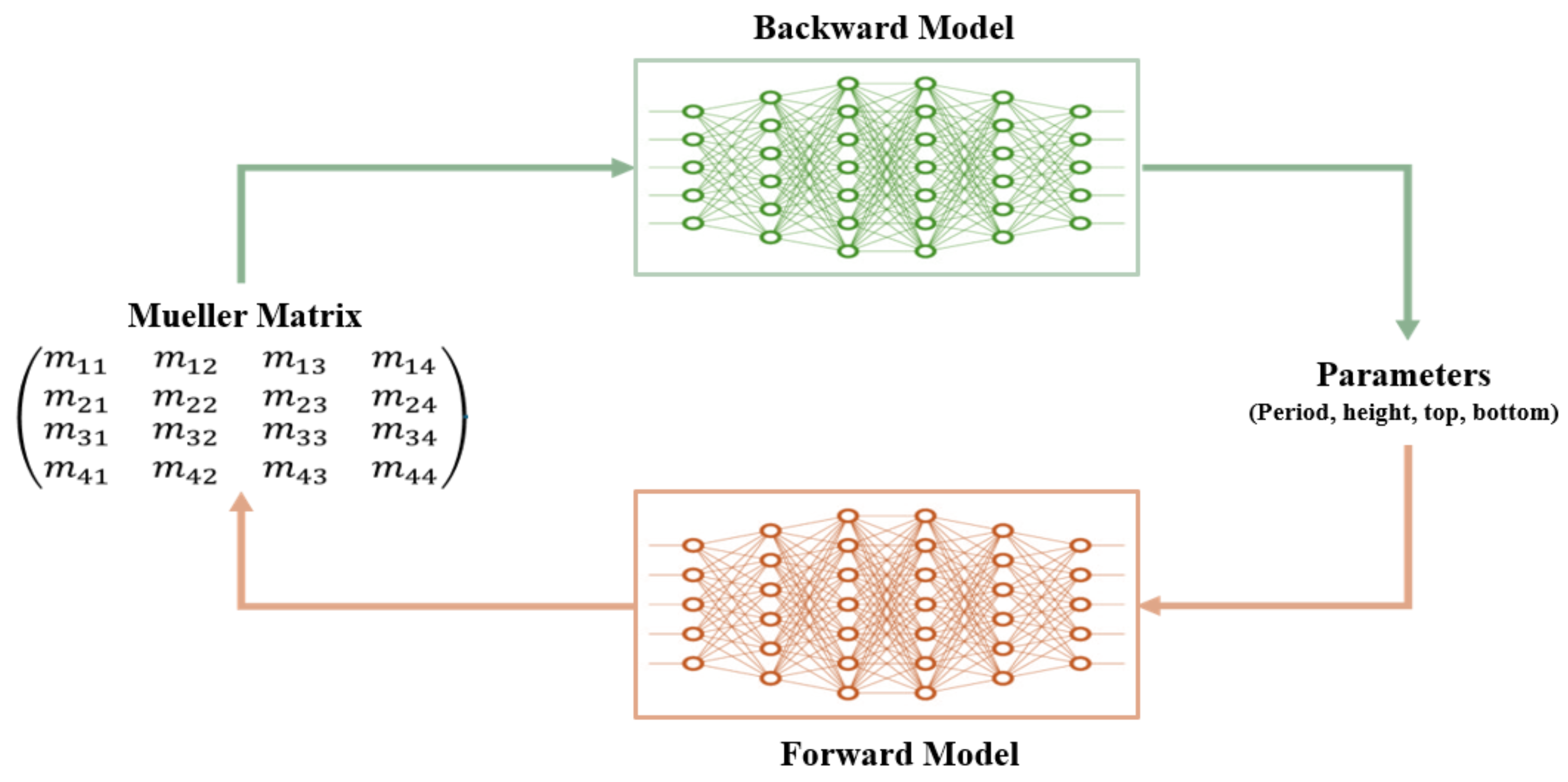
As shown in Figure 1, the nanostructure considered in this study is a periodic one-dimensional SiO2 grating formed on a Si substrate. The structure is parameterized by four geometric variables: period (p), height (h), top width (t), and bottom width (b). The design space was bounded within the ranges of p = 100 110 nm, h = 105 115 nm, t = 30 40 nm, and b = 40 50 nm. The structural-parameter combinations were generated using balanced stratified sampling, with the values within each stratum drawn by uniform random sampling. RCWA-based Mueller-matrix spectra were generated over the wavelength range of 281–900 nm at an incidence angle of 70° ( θ ) for two sample azimuth angles ( ϕ ), 0° and 45°. Subsequently, three independent datasets were constructed: (i) 10,000 samples for training the neural-network models, (ii) 1000 samples for validation and model selection, and (iii) 1000 samples for final testing. Each sample consists of a set of structural parameters and the corresponding Mueller-matrix spectra. The training dataset was used to train both the forward model, which learns the parameter-to-MM mapping, and the backward model, which learns the MM-to-parameter mapping, as illustrated in Figure 2.

2.2. Forward and Backward Modeling

Figure 2 schematically illustrates the forward and backward relationships between the structural parameters and the Mueller-matrix (MM) spectra. The forward model was trained to predict the 16-element MM spectra over 281–900 nm (620 wavelengths) at two azimuth angles, 0° and 45°, from four geometric parameters: period, height, top width, and bottom width. Accordingly, the forward model serves as an RCWA-based surrogate for the forward mapping from structural parameters to MM spectra. Conversely, the backward model was trained to estimate the four structural parameters directly from the corresponding MM spectra, thereby providing initial structural-parameter estimates for the subsequent forward surrogate-based iterative optimization and reducing the number of forward iterations required for convergence.
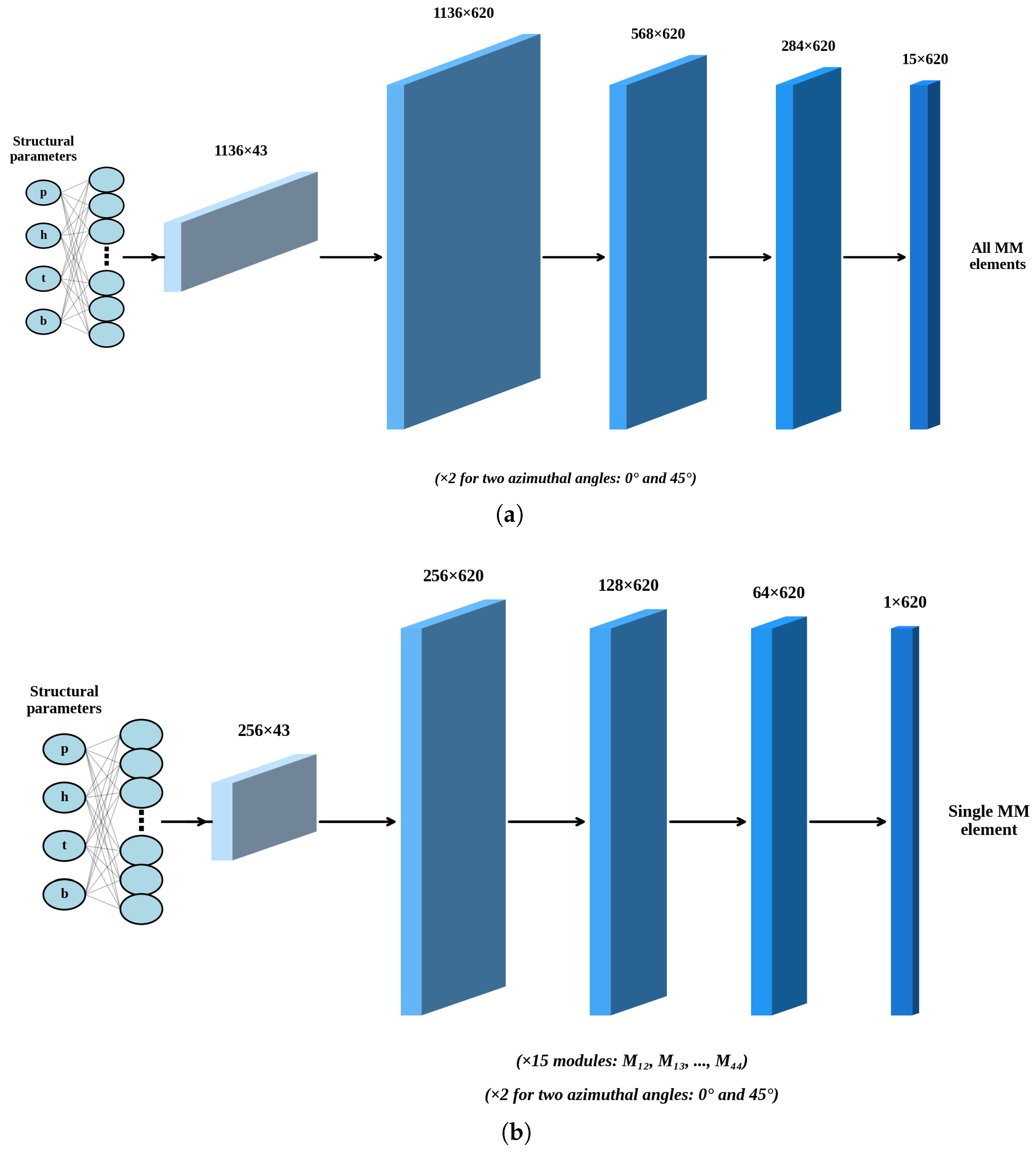
Figure 3 summarizes the architecture of the forward model for predicting Mueller-matrix (MM) spectra from structural parameters. The forward model operates as an RCWA surrogate network that approximates the forward mapping from structural parameters to MM spectra. Figure 3a shows the unified surrogate model. The four input parameters are mapped by a fully connected layer to a latent representation of size 1136 × 43 , reshaped into a sequence with 1136 channels and length 43, and upsampled to the 620-point wavelength grid. A series of 1D convolution blocks then extracts features while progressively reducing the channel dimension from 1136 568 284 . A final convolution layer with tanh activation outputs spectra of size 15 × 620 (excluding M 11 ). A separate unified surrogate model is trained for each azimuthal angle (0° and 45°). Their predictions are stacked into ( 2 , 15 , 620 ) , and the constant M 11 channel is prepended to obtain the final tensor of shape ( 2 , 620 , 16 ) . The unified surrogate model contains 5,358,542 trainable parameters.
Figure 3b illustrates the element-wise surrogate model. Each modular sub-network projects the four structural parameters through a fully connected layer to generate a latent vector of size 256 × 43 . The vector is reshaped into a sequence with 256 channels and length 43, and then upsampled to match the 620-point wavelength grid. Local spectral features are refined using two consecutive 1D convolution layers, each followed by batch normalization. A final convolution layer with tanh activation produces the predicted spectrum for a given MM element. For the two azimuthal angles (0° and 45°), 15 modules are used per angle (30 modules in total), and their outputs are stacked into a tensor of shape ( 2 , 15 , 620 ) . The constant M 11 channel (normalized to unity) is then prepended, and the axes are permuted to form the final output tensor of shape ( 2 , 620 , 16 ) . The element-wise surrogate model contains 5,354,800 trainable parameters.

2.3. Element-Adaptive Hybrid Surrogate Model for Iterative Fitting and Parameter Retrieval

In MMSE, each MM element represents a specific coupling relationship between the input and output components of the Stokes vector; consequently, spectral complexity can differ substantially from element to element. This element-dependent spectral variability originates from a common underlying physical response. For the nondepolarizing system considered in this study, the Jones reflection matrix
J r = r p p r p s r s p r s s
encodes the complex reflected electromagnetic response, where r p p and r s s are the co-polarized reflection coefficients, and r p s and r s p describe cross-polarization conversion between the p and s polarized components. The full Mueller matrix is then derived from this Jones reflection matrix through a Pauli-like basis transformation,
M i + 1 , j + 1 = 1 2 Tr σ i J r σ j J r , i , j { 0 , 1 , 2 , 3 } ,
where σ i denotes the identity and Pauli-like basis matrices associated with the four Stokes-vector components S 0 , S 1 , S 2 , and S 3 . These components represent the total intensity, the contrast between the p- and s-polarized linear components, the contrast between the +45° and −45° linear-polarization components, and the contrast between right- and left-circular polarization, respectively.
Notably, through the Pauli-like basis transformation, each Mueller-matrix element is obtained as a bilinear projection of the same underlying complex Jones coefficients. Consequently, the 16 Mueller-matrix elements are physically related and do not represent completely independent prediction targets. In particular, the transpose-related pairs M 12 / M 21 , M 13 / M 31 , M 14 / M 41 , M 23 / M 32 , M 24 / M 42 , and M 34 / M 43 represent complementary input–output Stokes couplings and involve overlapping combinations of the Jones coefficients. These element pairs can therefore exhibit related wavelength-dependent spectral responses. Although M 33 and M 44 do not form a transpose-related pair, both contain polarization-interference information derived from the same underlying Jones response and may also exhibit related spectral characteristics. These shared physical dependencies are particularly important from the perspective of surrogate-model learning because they can be exploited through the joint learning of multiple Mueller-matrix outputs.
Such element-dependent spectral variability can affect surrogate-model training and, in turn, the prediction accuracy of the surrogate model and the stability of inverse structural-parameter retrieval. Therefore, we introduce the mean absolute spectral difference (MASD) as an element-wise metric to quantify the wavelength-dependent spectral variability of each Mueller-matrix element. Specifically, the MASD for each Mueller-matrix element is defined as
MASD = 1 N 1 k = 1 N 1 M ( λ k + 1 ) M ( λ k ) ,
where M ( λ k ) denotes the value of a given Mueller-matrix element at wavelength λ k , and N is the number of sampled wavelengths. MASD measures the average magnitude of adjacent-wavelength differences; therefore, larger values indicate stronger wavelength-dependent variations, including oscillatory behavior or sharp spectral transitions. For Mueller-matrix elements that remain constant over the sampled wavelength range, such as terms fixed at 0 or 1, the MASD becomes 0 because no adjacent-wavelength variation is present.
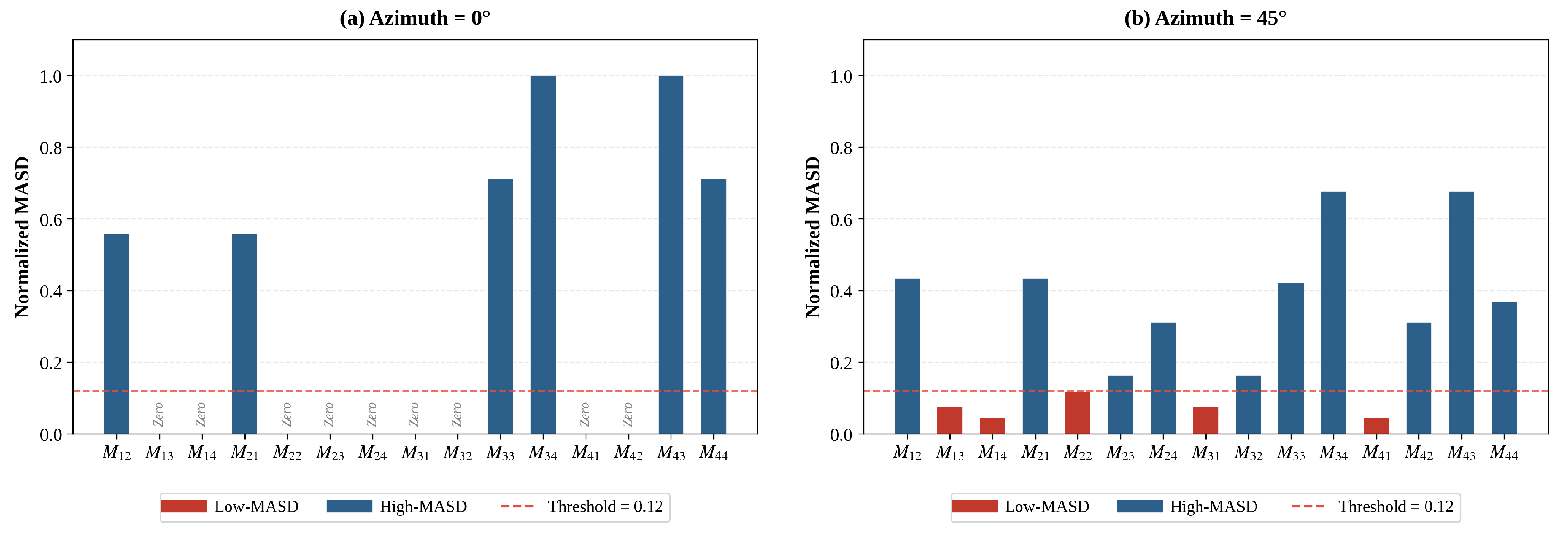
For Figure 4, the MASD of each Mueller-matrix element was calculated separately at azimuth angles of 0° and 45° for each RCWA-generated Mueller matrix. The resulting MASD values were then averaged over all 10,000 training samples for each Mueller-matrix element and each azimuth angle. In this study, the MASD value was used to quantify the wavelength-dependent spectral variability of each Mueller-matrix element. Through the MASD analysis, a common normalization scale was applied to all Mueller-matrix elements at both azimuth angles, taken as the largest mean raw MASD in the present dataset. Then, the normalized MASD values were used to establish the boundary between elements with relatively low and high spectral variability. Accordingly, the adopted MASD criterion was determined by comparing the validation MSEs of the unified and element-wise surrogate models for a few MM elements near this boundary, such as M 22 , M 31 , M 23 , and M 32 at an azimuth angle of 45°. Finally, a value of 0.12 was obtained from the specific range between the normalized MASD values of M 22 and M 23 , considering as the criterion for distinguishing the Low-MASD and High-MASD groups. Since the raw MASD distribution may depend on the sample structure, material system, and measurement configuration, this criterion is not a universal criterion for distinguishing MM elements with relatively low and high spectral variability, and therefore, the same procedure needs to be followed for different structure samples.
Figure 4a shows that, at an azimuth angle of 0°, the Low-MASD group consists of 9 elements: M 13 , M 14 , M 22 , M 23 , M 24 , M 31 , M 32 , M 41 , and M 42 , whereas the High-MASD group consists of 6 elements. At this azimuth angle, the structural symmetry of the one-dimensional grating suppresses several cross-polarization coupling terms, resulting in relatively smooth wavelength-dependent responses for a larger number of Mueller-matrix elements. In contrast, Figure 4b shows that, at an azimuth angle of 45°, the Low-MASD group consists of only 5 elements: M 13 , M 14 , M 22 , M 31 , and M 41 , whereas the High-MASD group consists of 10 elements. At 45°, mixing between orthogonal polarization components becomes more pronounced, producing stronger wavelength-dependent spectral variability across a broader set of Mueller-matrix elements.
From a surrogate-model learning perspective, these physical correlations and the resulting differences in element-wise spectral complexity provide a direct motivation for the element-adaptive hybrid strategy. Low-MASD elements exhibit relatively smooth wavelength-dependent responses. Therefore, independently trained element-wise models can focus exclusively on the subtle spectral variation of a single output without interference from the larger-amplitude or more complex variations of other elements.
By contrast, High-MASD elements exhibit stronger oscillatory behavior and sharper spectral transitions. Because these elements are correlated projections of the same underlying Jones response, a unified surrogate model can exploit shared latent representations across multiple physically correlated Mueller-matrix outputs through joint training, which cannot be achieved by independently trained element-wise models. This interpretation is consistent with findings in multi-task learning for multiple computer-vision tasks, showing that training all tasks together can degrade performance compared with selective task grouping [43].
To construct the element-adaptive hybrid surrogate model, the validation mean squared errors (MSEs) of the unified and element-wise surrogate models were independently compared for each Mueller-matrix element. For the ith Mueller-matrix element, the selected surrogate model is defined as
f i hybrid = f i unified , MSE i unified < MSE i element , f i element , MSE i element MSE i unified .
The complete Mueller-matrix spectrum is then assembled from the element-specific predictors selected on the validation dataset. In this manner, the proposed element-adaptive hybrid strategy combines the independent optimization capability of the element-wise surrogate model with the shared-representation learning capability of the unified surrogate model, thereby improving element-dependent forward-prediction accuracy.

3. Results and Discussion

3.1. MSE Comparison of Surrogate Models Under Measurement Noise

In practical MMSE measurements, the measured MM spectra might be disturbed by the noise arising from the instrument itself, such as light-source fluctuations, motor-rotation instability, and environmental variations [39,44]. Measurement noise can degrade the accuracy of surrogate-model-based parameter retrieval by perturbing the Mueller-matrix spectra used as the optimization target. Because these perturbations alter the residual term in the objective function minimized during iterative fitting, they can make the optimization process less stable and increase errors in the retrieved structural parameters.
To emulate these noise characteristics, we follow the approach adopted in prior MMSE simulation studies [44], in which non-ideal conditions arising from light-source fluctuations, motor-rotation instability, and environmental variations are modeled by adding random fluctuations directly to each Mueller-matrix element. For a SiO2 thin film on a Si substrate, element-wise absolute errors of Mueller-matrix spectra have been reported to range from a minimum of approximately 0.002 to a maximum of approximately 0.028 [44]. To provide a conservative and stringent robustness evaluation, the maximum noise level of 0.028 was adopted as the standard deviation. Each noise spectrum was drawn independently from a Gaussian distribution, ε N ( 0 , σ 2 ) with σ = 0.028 , for every wavelength, Mueller-matrix element, and azimuth angle to be added directly to the RCWA-calculated spectra. Then, this random noise was applied uniformly to all 15 Mueller-matrix elements, so that it is expected that the evaluation was performed with the maximum level related to the instrument-related noise. The absolute distribution of the added noise in this study is summarized in Table S1 of the Supplementary Materials.
To enable rapid parameter retrieval, the noise-mitigated Mueller-matrix spectra are fed into the backward model to obtain better initial structural-parameter estimates. Providing the noise-mitigated spectra rather than the raw noisy spectra as input to the backward model yields more stable initial structural-parameter estimates and reduces the number of iterations required for convergence in the subsequent iterative optimization. The initial structural-parameter estimates generated by the backward model are then used to initialize iterative optimization with the element-wise and unified surrogate models.
To reduce measurement noise entering the residual prior to backward-model-based initial structural-parameter estimation and subsequent forward-model-based iterative fitting, penalized least-squares smoothing was applied along the wavelength axis to each Mueller-matrix element spectrum [45,46]. Given an observed noisy spectrum y = ( y 1 , , y N ) , the smoothed spectrum z = ( z 1 , , z N ) is obtained by solving
min z i = 1 N ( y i z i ) 2 + λ i = 1 N 2 ( Δ 2 z i ) 2 ,
where Δ 2 z i = z i 2 z i + 1 + z i + 2 , N is the number of wavelength samples, and Δ 2 denotes the second-order difference operator. The parameter λ controls the trade-off between the data-fidelity term and the smoothness penalty; in our implementation, λ was set to 100. The optimization can be equivalently written in matrix form as
z = I + λ ( D 2 ) D 2 1 y ,
where I is the N × N identity matrix and D 2 is the ( N 2 ) × N matrix representation of the second-order difference operator. The smoothing was applied independently to each Mueller-matrix element to mitigate measurement noise and improve convergence stability in the subsequent backward model and forward model stages. A comparison of the RCWA-generated MM, the noise-added MM, and the noise-mitigated penalized least-squares-smoothed MM spectra is provided in Figure S1 of the Supplementary Materials.
In the subsequent refinement stage, the input structural parameters are iteratively updated so that the MSE between the MM predicted by the element-wise surrogate model (or unified surrogate model) and the noise-mitigated Mueller matrix is minimized. In this process, a genetic algorithm [47,48] is employed for global exploration, followed by the Levenberg–Marquardt algorithm [25,49] for rapid local convergence. The input structural parameters corresponding to the minimum MSE between each surrogate-predicted Mueller matrix and the noise-mitigated Mueller matrix are then determined as the final retrieved parameters.
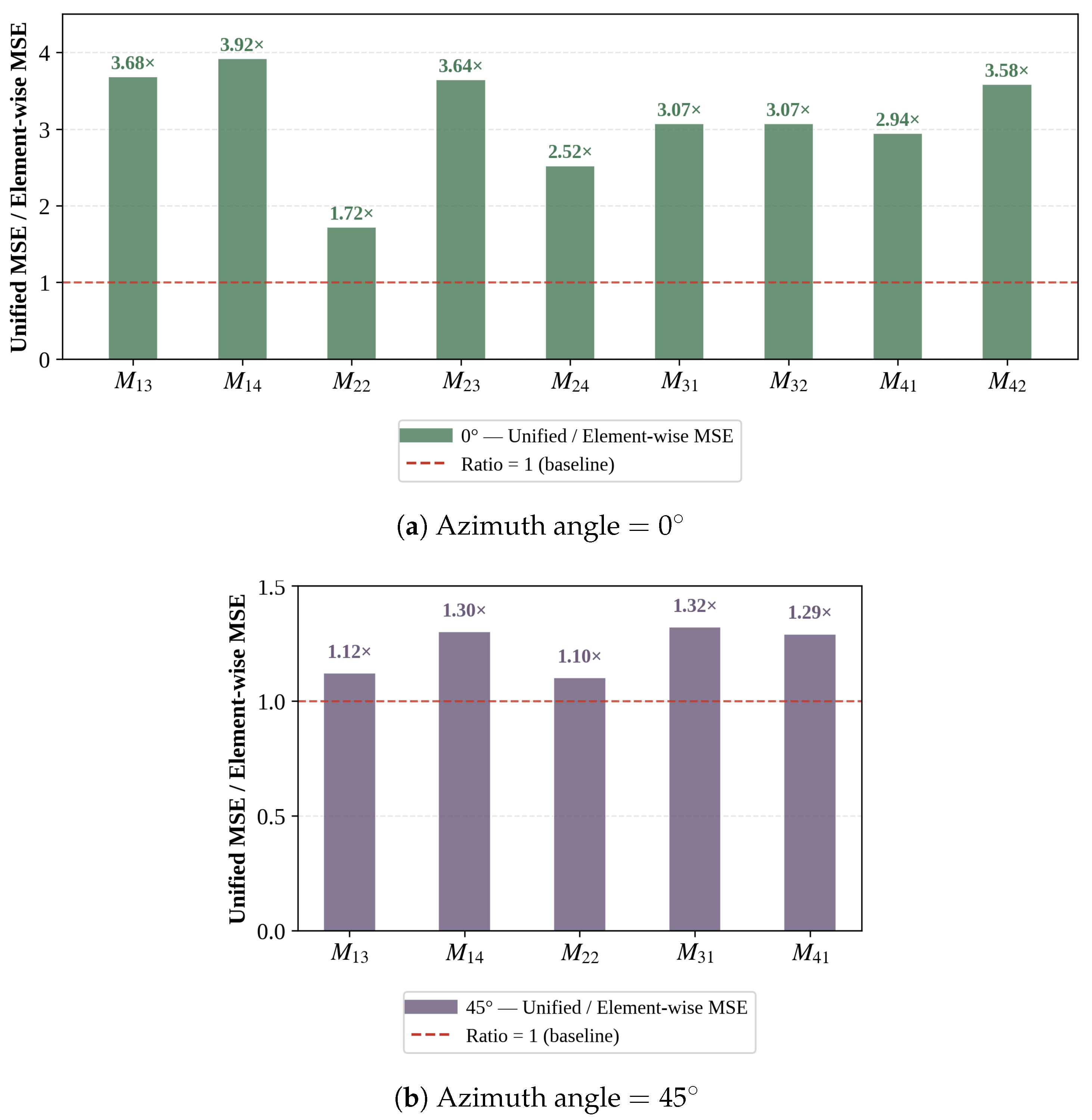
Figure 5 presents the MSE ratios obtained from parameter-retrieval optimization using the unified and element-wise surrogate models. For both methods, the noise-mitigated Mueller-matrix spectra were first fed into the backward model to obtain initial structural-parameter estimates. These estimates were then used as the initial structural parameters for iterative optimization with unified and element-wise surrogate models. After the parameter-retrieval optimization was completed, the MSE for each surrogate model was calculated between the Mueller-matrix spectrum predicted at the retrieved structural parameters and the corresponding RCWA ground-truth MM spectrum.
Figure 5a shows the ratio of MSE in the unified surrogate model to the element-wise surrogate model for the 9 Mueller-matrix elements classified as Low-MASD at an azimuth angle of 0°. All 9 elements exhibited MSE ratios greater than 1.0, with values ranging from 1.72 to 3.92. These results indicate that the element-wise surrogate model consistently achieved lower validation MSEs than the unified surrogate model for all Low-MASD elements at 0°. In particular, the largest ratio of 3.92 was observed for M 14 , while relatively large ratios of 3.68, 3.64, and 3.58 were obtained for M 13 , M 23 , and M 42 , respectively.
Figure 5b shows the ratio of MSE in the unified surrogate model to the element-wise surrogate model for the 5 Mueller-matrix elements classified as Low-MASD at an azimuth angle of 45°. All 5 elements also exhibited MSE ratios greater than 1.0, with values ranging from 1.10 to 1.32. Therefore, the element-wise surrogate model achieved lower validation MSEs than the unified surrogate model for all Low-MASD elements at 45°. However, compared with the results at 0° shown in Figure 5a, the improvement in prediction accuracy achieved through element-wise learning was smaller. At the azimuth angle of 45°, the wavelength-dependent spectral fluctuations were generally stronger than those at 0°, resulting in a reduced number of elements classified as Low-MASD. Nevertheless, the element-wise model still achieved lower MSEs and remained effective in improving prediction accuracy for the Low-MASD elements at 45°.

3.2. Structural-Parameter Retrieval

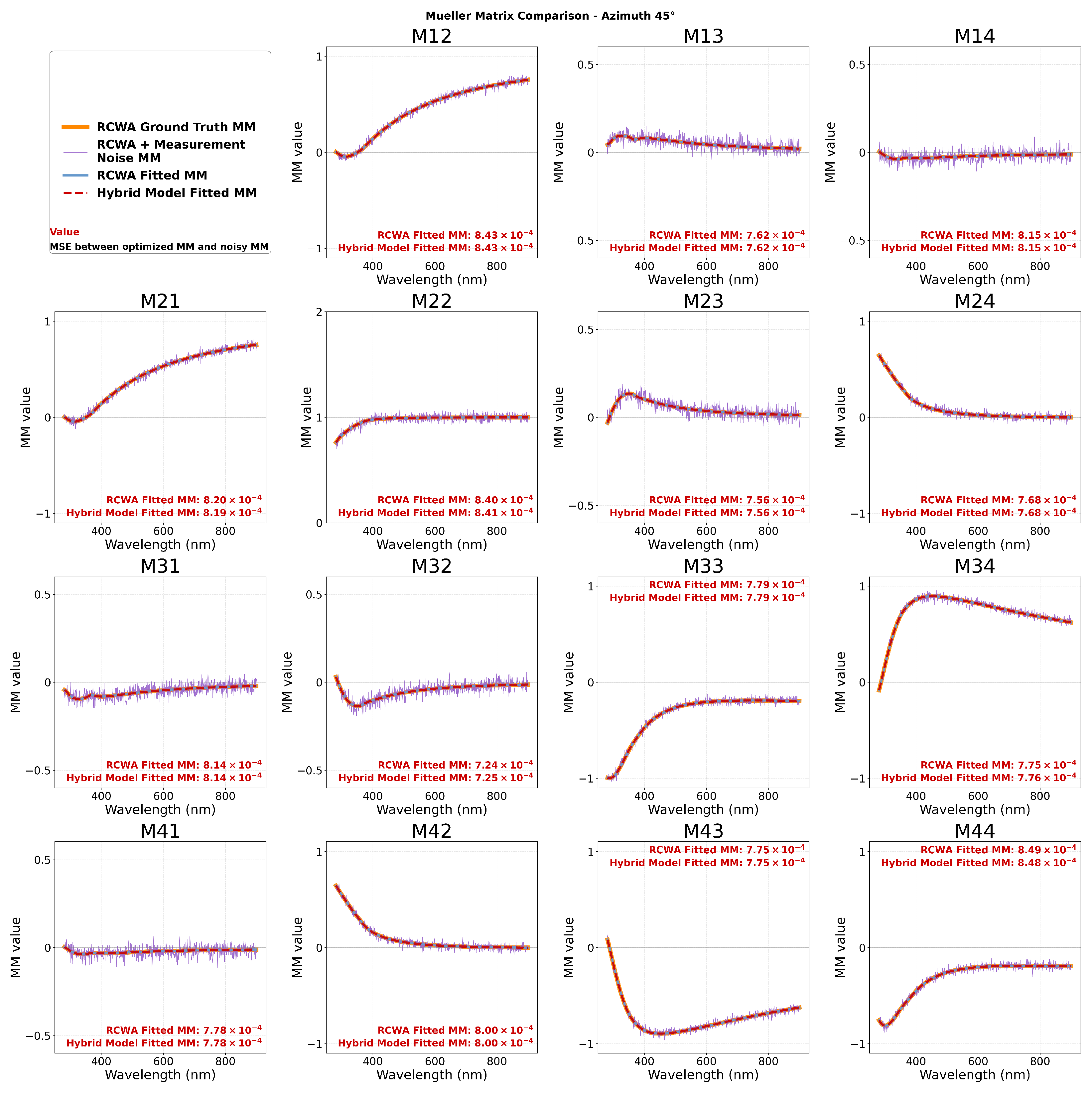
Figure 6 compares four different MM spectra: (1) the ground-truth MM spectrum calculated by RCWA; (2) the noise-added RCWA MM spectrum; (3) the MM spectrum obtained by RCWA-based fitting; and (4) the MM spectrum obtained by hybrid surrogate model-based fitting, all at an azimuth angle of 45°. Both RCWA-based fitting and hybrid surrogate model-based fitting retrieve the structural parameters through an iterative optimization process. The MM spectra obtained through the hybrid surrogate model-based optimization reproduce the target spectra with shapes and trends that are nearly indistinguishable from those obtained through RCWA-based optimization for all MM elements. In addition, the MSE difference for each MM element between the two methods remains below 0.01 × 10 4 for all elements, indicating that RCWA iterative optimization can be replaced by the hybrid surrogate model while realizing the same MM spectral fitting performance. Across the 1000 test samples, the MSE of the MM spectra fitted by the hybrid surrogate model relative to the RCWA ground-truth MM spectra was 5.28 × 10 8 , demonstrating the high spectral reproduction accuracy of the hybrid surrogate model.
Table 1 presents the average absolute errors of the four retrieved structural parameters—period, height, top width, and bottom width. The unified and hybrid surrogate model-based optimization results were evaluated using all 1000 test samples that were not used for training, whereas RCWA-based optimization was evaluated using a subset of 100 samples because of its substantially higher computational cost. This subset was selected from the same 1000-sample test dataset by simple random sampling without replacement. To assess the representativeness of the selected subset, a nonparametric percentile bootstrap analysis was performed for all four structural parameters [50]. Specifically, for each structural parameter, 10,000 bootstrap samples of size 100 were generated by sampling with replacement from the selected 100 samples. Then, it was confirmed that the mean values of the complete 1000-sample test dataset were located within the corresponding 95% bootstrap confidence intervals obtained from the selected 100-sample subset for all four structural parameters. More specific information is explained in Figure S2 of the Supplementary Materials.
As expected, the most accurate results were obtained by RCWA-based optimization, because RCWA directly employs the original physics-based forward solver rather than a surrogate approximation. Nevertheless, hybrid surrogate model-based optimization consistently yielded lower absolute errors than unified surrogate model-based optimization. Compared with unified surrogate model-based optimization, hybrid surrogate model-based optimization reduced the parameter-averaged MAE by 13.3%. In addition, the hybrid surrogate model improved the MAE difference to the RCWA-based optimization by 41.5% compared with the unified surrogate model. These results demonstrate that the hybrid surrogate model enables parameter retrieval closer to the accuracy of RCWA-based optimization by selecting the better surrogate model with the lower prediction error for each Mueller-matrix element.
To further characterize the retrieval-error distributions beyond the mean absolute error, the absolute retrieval errors over the complete 1000-sample test dataset were statistically analyzed. Table 2 summarizes the minimum, mean, standard deviation (SD), median, 90th percentile (P90), 95th percentile (P95), and maximum absolute retrieval errors of all four structural parameters for the unified and hybrid surrogate models. In addition, the bin-wise error analysis for the four structural parameters showed that the absolute structural retrieval errors can be reduced using the hybrid surrogate model, especially in the structural ranges out of nominal dimensions. More specific information is explained in Figure S3 of the Supplementary Materials.
All computations reported in this study were performed on the same workstation, equipped with dual Intel Xeon Platinum 8452Y processors (72 physical cores and 144 threads in total, 2.00 GHz base clock), 512 GB of system memory, and NVIDIA A40 GPUs (46 GB, driver 539.64, CUDA 12.2). RCWA-based optimization was performed using pySCATMECH (version 0.1.0) from the NIST SCATMECH library. Because pySCATMECH does not provide a GPU backend, the RCWA calculations were executed on the CPU hardware. The surrogate model was implemented in PyTorch (version 2.5.1) and calculated on a single NVIDIA A40 GPU hardware. For genetic algorithm and Levenberg–Marquardt optimization, the same CPU hardware was used for both optimization frameworks based on the RCWA calculation and the hybrid surrogate model.
Table 3 compares the computation time per iteration and the total computation time required for structural parameter retrieval when the input Mueller matrix contains measurement noise. RCWA-based optimization required 5472 s in total for the iterative fitting, hybrid surrogate model-based optimization process required only 0.71 s computation time for the iterative fitting. Hybrid surrogate model-based optimization required approximately 4.07 × 10 3 s per iteration, whereas RCWA-based optimization required approximately 32 s per iteration. Though unified surrogate model-based optimization was slightly faster, it produced a larger MSE than the hybrid surrogate model-based optimization. Consequently, the hybrid surrogate model-based parameter retrieval achieves both high accuracy and computational efficiency.

4. Conclusions

This study presented an element-adaptive hybrid surrogate model-based framework for structural-parameter retrieval on one-dimensional nanogratings using Mueller-matrix spectroscopic ellipsometry (MMSE), in which the computationally intensive RCWA forward calculation was replaced by neural surrogate models. The wavelength-dependent spectral variability of each Mueller-matrix element was quantified using MASD, while the unified or element-wise surrogate model was selected independently for each element according to its validation MSE. The validation results demonstrated that Low-MASD elements achieved lower prediction errors with the element-wise surrogate model. These elements were distributed unevenly between the two azimuth angles, with nine elements at 0° and five elements at 45°. At 0°, structural symmetry suppresses cross-polarization coupling and produces a larger number of relatively smooth spectral responses that benefit from independent element-wise learning. In contrast, enhanced polarization mixing at 45° increases the proportion of spectrally complex and physically correlated elements, for which unified learning can exploit shared representations among multiple Mueller-matrix outputs.
In addition, penalized least-squares smoothing mitigated noise in the Mueller-matrix spectra, and the backward model provided initial structural-parameter estimates, thereby reducing the number of iterations required for convergence in the subsequent hybrid surrogate model-based fitting. The resulting hybrid framework achieved Mueller-matrix fitting quality comparable to that of RCWA-based optimization while providing more accurate parameter retrieval than unified surrogate model-based optimization.
Quantitatively, the hybrid surrogate model-based optimization reduced the average absolute retrieval error by 13.3% compared with unified surrogate model-based optimization and improved the MAE difference to RCWA-based optimization by 41.5%. Across the 1000 test samples, the mean squared error between the MM spectra fitted by the hybrid surrogate model and the RCWA ground-truth MM spectra was 5.28 × 10 8 . Structural-parameter retrieval was completed in approximately 0.71 s under the worst-case noise conditions considered in this study.
The noise model considered in this study was related to only instrument-limited noise to emulate non-ideal measurement conditions. Further work is therefore required to account for additional errors originating from the specimen itself, such as surface roughness and fabrication deviations from the nominal profile of the grating structure, since they can induce extra noise on the optical response of the specimen to change the particular MM elements.
Future work will focus on validating the proposed framework using experimentally measured Mueller-matrix spectra and expanding it to the broader structural-parameter ranges, different materials, more measurement configurations, and complex two- and three-dimensional nanostructures. Further development of physics-consistent and less iteration-dependent inverse strategies may also enable faster and more generalizable MMSE-based in-line metrology.

Supplementary Materials

The following supporting information can be downloaded at https://www.mdpi.com/article/10.3390/app16188927/s1, Figure S1: Comparison of RCWA-generated, noise-added, and penalized least-squares-smoothed Mueller-matrix spectra at an azimuth angle of 45°; Figure S2: Comparison of the structural-parameter distributions and mean values of the complete 1000-sample test dataset and the selected 100-sample subset used for RCWA-based optimization: (a) period, (b) height, (c) top width, and (d) bottom width; Table S1: Absolute distribution of the added Gaussian random noise applied to all 15 normalized Mueller-matrix elements of the RCWA-generated spectra; Figure S3: Bin-wise analysis of structural retrieval errors for both the unified and hybrid surrogate models using the complete 1000-sample test dataset: (a) period, (b) height, (c) top width, and (d) bottom width. For each structural parameter, the test samples were analyzed in ten separate regions of equal 1-nm intervals, with an equal number of 100 samples in each interval. Circles denote the mean absolute retrieval error within each interval, and the error bars indicate the corresponding minimum-to-maximum error range.

Author Contributions

Conceptualization, S.K., K.K. and Y.-J.K.; methodology, S.K. and K.K.; software, S.K. and K.K.; validation, S.K. and K.K.; formal analysis, S.K. and K.K.; investigation, S.K. and K.K.; data curation, K.K., L.H., N.K. and H.L.; visualization, S.K., K.K., L.H., N.K. and H.L.; writing—original draft preparation, S.K.; writing—review and editing, K.K. and Y.-J.K.; supervision, Y.-J.K.; project administration, Y.-J.K.; funding acquisition, Y.-J.K. All authors have read and agreed to the published version of the manuscript.

Funding

This work was supported by the Ministry of Science and ICT, South Korea (RS-2022-CP000132), the National Research Foundation of Korea (2020R1H1A2015261), and the Commercialization Promotion Agency for R&D Outcomes (COMPA) (NTIS, 2710007979).

Institutional Review Board Statement

Not applicable.

Informed Consent Statement

Not applicable.

Data Availability Statement

Data underlying the results presented in this paper are not publicly available at this time but may be obtained from the authors upon reasonable request.

Conflicts of Interest

The authors declare no conflicts of interest.

Abbreviations

The following abbreviations are used in this manuscript:
MMSEMueller-matrix spectroscopic ellipsometry
RCWARigorous coupled-wave analysis
MMMueller matrix
MASDMean absolute spectral difference
MSEMean squared error
MAEMean absolute error
CNNConvolutional neural network
1DOne-dimensional
AIArtificial intelligence
FDTDFinite-difference time-domain
FEMFinite element method

References

  1. IEEE International Roadmap for Devices and Systems (IRDS). The International Roadmap for Devices and Systems (IRDS) 2022 Edition: Executive Summary; Technical Report; IEEE: Piscataway, NJ, USA, 2022. [Google Scholar]
  2. Oh, J.; Son, J.; Yoon, C.; Hwang, E.; Ahn, J.; Lee, J.; Lee, J.; Shin, J.; Lee, D.; Lim, S.; et al. Ultra-wide-field imaging Mueller matrix spectroscopic ellipsometry for semiconductor metrology. Nat. Commun. 2025, 16, 63511. [Google Scholar] [CrossRef] [Scilit] [PubMed]
  3. Politano, G.G.; Versace, C. Spectroscopic ellipsometry: Advancements, applications and future prospects in optical characterization. Spectrosc. J. 2023, 1, 163–181. [Google Scholar] [CrossRef] [Scilit]
  4. Hauge, P.S. Mueller matrix ellipsometry with imperfect compensators. J. Opt. Soc. Am. 1978, 68, 1519–1528. [Google Scholar] [CrossRef] [Scilit]
  5. Azzam, R.M.A. Mueller-matrix ellipsometry: A review. In Proceedings of the Polarization: Measurement, Analysis, and Remote Sensing, San Diego, CA, USA, 3 October 1997; SPIE: Bellingham, WA, USA, 1997; Volume 3121. [Google Scholar] [CrossRef] [Scilit]
  6. Furchner, A.; Kratz, C.; Ogieglo, W.; Pinnau, I.; Rappich, J.; Hinrichs, K. Ultrasensitive broadband infrared 4 × 4 Mueller-matrix ellipsometry for studies of depolarizing and anisotropic thin films. J. Vac. Sci. Technol. B Nanotechnol. Microelectron. 2020, 38, 014003. [Google Scholar] [CrossRef] [Scilit]
  7. Chen, X.; Gu, H.; Liu, J.; Chen, C.; Liu, S. Advanced Mueller matrix ellipsometry: Instrumentation and emerging applications. Sci. China Technol. Sci. 2022, 65, 2007–2030. [Google Scholar] [CrossRef] [Scilit]
  8. Otani, Y. Mueller Matrix Polarimeter for Nano-Structure Measurement. In Proceedings of the Conference on Lasers and Electro-Optics/Pacific Rim 2009, Shanghai, China, 30 August–3 September 2009; Optica Publishing Group: Washington, DC, USA, 2009; p. TuE2_2. [Google Scholar]
  9. Jian, Z.; Hejing, W. The physical meanings of 5 basic parameters for an X-ray diffraction peak and their application. Chin. J. Geochem. 2003, 22, 38–44. [Google Scholar] [CrossRef] [Scilit]
  10. Sadat, A.; Joye, I.J. Peak fitting applied to Fourier transform infrared and Raman spectroscopic analysis of proteins. Appl. Sci. 2020, 10, 5918. [Google Scholar] [CrossRef] [Scilit]
  11. Liu, S.; Chen, X.; Yang, T.; Guo, C.; Zhang, J.; Ma, J.; Chen, C.; Wang, C.; Zhang, C.; Liu, S. Machine learning aided solution to the inverse problem in optical scatterometry. Measurement 2022, 191, 110811. [Google Scholar] [CrossRef] [Scilit]
  12. Ka-Hyun, K. Spectroscopic Ellipsometry Measurement and Modeling of Hydrogenated Amorphous Silicon. J. Korean Sol. Energy Soc. 2019, 39, 11–19. [Google Scholar] [CrossRef] [Scilit]
  13. Xu, W.; Zhang, H.; Ji, L.; Li, Z. AI-Powered Next-Generation Technology for Semiconductor Optical Metrology: A Review. Micromachines 2025, 16, 838. [Google Scholar] [CrossRef] [Scilit] [PubMed]
  14. Losurdo, M.; Hingerl, K. (Eds.) Ellipsometry at the Nanoscale; Springer Series in Surface Sciences; Springer: Berlin/Heidelberg, Germany, 2013; Volume 52. [Google Scholar]
  15. Jung, J.; Kim, N.; Kim, K.; Park, J.; Cho, Y.J.; Chegal, W.; Kim, Y.J. Neural network-based analysis algorithm on Mueller matrix data of spectroscopic ellipsometry for the structure evaluation of nanogratings with various optical constants. Nanophotonics 2025, 14, 471–484. [Google Scholar] [CrossRef] [Scilit] [PubMed]
  16. Sullivan, D.M. Electromagnetic Simulation Using the FDTD Method; John Wiley & Sons: Hoboken, NJ, USA, 2013. [Google Scholar]
  17. Jagota, V.; Sethi, A.P.S.; Kumar, K. Finite element method: An overview. Walailak J. Sci. Technol. WJST 2013, 10, 1–8. [Google Scholar] [CrossRef] [Scilit]
  18. Moharam, M.G.; Grann, E.B.; Pommet, D.A.; Gaylord, T.K. Formulation for stable and efficient implementation of the rigorous coupled-wave analysis of binary gratings. J. Opt. Soc. Am. A 1995, 12, 1068–1076. [Google Scholar] [CrossRef] [Scilit]
  19. Lalanne, P.; Morris, G.M. Highly improved convergence of the coupled-wave method for TM polarization. J. Opt. Soc. Am. A 1996, 13, 779–784. [Google Scholar] [CrossRef] [Scilit]
  20. Panoiu, N.C.; Sha, W.E.I.; Lei, D.Y.; Li, G.C. Nonlinear optics in plasmonic nanostructures. J. Opt. 2018, 20, 083001. [Google Scholar] [CrossRef] [Scilit]
  21. Moharam, M.G.; Gaylord, T.K. Rigorous coupled-wave analysis of planar-grating diffraction. J. Opt. Soc. Am. 1981, 71, 811–818. [Google Scholar] [CrossRef] [Scilit]
  22. Li, L. Use of Fourier series in the analysis of discontinuous periodic structures. J. Opt. Soc. Am. A 1996, 13, 1870–1876. [Google Scholar] [CrossRef] [Scilit]
  23. Huang, H.T.; Terry, F.L., Jr. Spectroscopic ellipsometry and reflectometry from gratings (Scatterometry) for critical dimension measurement and in situ, real-time process monitoring. Thin Solid Films 2004, 455–456, 828–836. [Google Scholar] [CrossRef] [Scilit]
  24. Foldyna, M.; De Martino, A.; Garcia-Caurel, E.; Ossikovski, R.; Licitra, C.; Bertin, F.; Postava, K.; Drévillon, B. Critical dimension of biperiodic gratings determined by spectral ellipsometry and Mueller matrix polarimetry. Eur. Phys. J. Appl. Phys. 2008, 42, 351–359. [Google Scholar] [CrossRef] [Scilit]
  25. Guo, C.; Shi, Y.; Wu, H.; Xiang, Y.; Li, W.; Zhang, C.; Liu, S. A combination of library search and Levenberg-Marquardt algorithm in optical scatterometry. Thin Solid Films 2023, 767, 139670. [Google Scholar] [CrossRef] [Scilit]
  26. Liu, J.; Zhang, D.; Yu, D.; Ren, M.; Xu, J. Machine learning powered ellipsometry. Light Sci. Appl. 2021, 10, 55. [Google Scholar] [CrossRef] [Scilit] [PubMed]
  27. Kfoury, P.; Battie, Y.; Naciri, A.E.; Voue, M.; Chaoui, N. Rapid ellipsometric imaging characterization of nanocomposite films with an artificial neural network. Opt. Lett. 2024, 49, 574–577. [Google Scholar] [CrossRef] [Scilit] [PubMed]
  28. Robertson, K.W.; LaPierre, R.R.; Krich, J.J. Efficient wave optics modeling of nanowire solar cells using rigorous coupled-wave analysis. Opt. Express 2019, 27, A133–A147. [Google Scholar] [CrossRef] [Scilit] [PubMed]
  29. Jung, J.; Kim, K.; Choi, J.; Kim, N.; Chegal, W.; Cho, Y.J.; Kim, Y.J. Geometric analysis algorithm based on a neural network with localized simulation data for nano-grating structure using Mueller matrix spectroscopic ellipsometry. Opt. Express 2023, 31, 44364–44374. [Google Scholar] [CrossRef] [Scilit] [PubMed]
  30. Mattila, A.; Nysten, J.; Heikkinen, V.; Kilpi, J.; Korpelainen, V.; Hansen, P.E.; Karvinen, P.; Kuittinen, M.; Lassila, A. Artificial neural network assisted spectral scatterometry for grating quality control. Meas. Sci. Technol. 2024, 35, 085025. [Google Scholar] [CrossRef] [Scilit]
  31. Jiang, Z.; Gan, Z.; Liang, C.; Li, W.D. Generic characterization method for nano-gratings using deep-neural-network-assisted ellipsometry. Nanophotonics 2024, 13, 1181–1189. [Google Scholar] [CrossRef] [Scilit] [PubMed]
  32. Sun, Q.; Jin, X.; Ma, B.; Lei, Z.; Liu, X.; Peng, J.; Yang, L. Non-destructive measurement of temperature in the micro-area wafer using Mueller matrix spectroscopic ellipsometry. In Proceedings of the Eighth International Workshop on Advanced Patterning Solutions (IWAPS 2024), Jiaxing, China, 15–16 October 2024; SPIE: Bellingham, WA, USA, 2024; Volume 13423, p. 1342310. [Google Scholar] [CrossRef] [Scilit]
  33. Kallioniemi, I.; Saarinen, J.; Oja, E. Optical scatterometry of subwavelength diffraction gratings: Neural-network approach. Appl. Opt. 1998, 37, 5830–5835. [Google Scholar] [CrossRef] [Scilit] [PubMed]
  34. Sabbagh, R.; Stothert, A.; Djurdjanovic, D. Machine learning for rapid inference of critical dimensions in optical metrology of nanopatterned surfaces. CIRP J. Manuf. Sci. Technol. 2023, 47, 184–192. [Google Scholar] [CrossRef] [Scilit]
  35. Godi Tchéré, M.; Robert, S.; Fawzi, Z.S.; Bayard, B.; Jamon, D.; Gourgon, C. Experimental identification of a grating profile using neural network classifiers in optical scatterometry. Appl. Opt. 2021, 60, 7929–7936. [Google Scholar] [CrossRef] [Scilit] [PubMed]
  36. Zhu, P.; Zhang, D.; Niu, X.; Liu, J.; Ren, M.; Xu, J. A Lightweight Neural Network for Spectroscopic Ellipsometry Analysis. Adv. Opt. Mater. 2024, 12, 2301381. [Google Scholar] [CrossRef] [Scilit]
  37. Jung, J.; Hwang, L.; Kim, N.; Kim, K.; Kim, S.; Park, J.; Chegal, W.; Cho, Y.J.; Kim, Y.J. AI-based analysis algorithm incorporating nanoscale structural variations and measurement-angle misalignment in spectroscopic ellipsometry. Nanophotonics 2025, 14, 5621–5632. [Google Scholar] [CrossRef] [Scilit] [PubMed]
  38. So, S.; Badloe, T.; Noh, J.; Bravo-Abad, J.; Rho, J. Deep learning enabled inverse design in nanophotonics. Nanophotonics 2020, 9, 1041–1057. [Google Scholar] [CrossRef] [Scilit]
  39. Mudide, S.; Keller, N.; Andrew Antonelli, G.; Cruz, G.; Hart, J.; Bruccoleri, A.R.; Heilmann, R.K.; Schattenburg, M.L. Machine learning driven measurement of high-aspect-ratio nanostructures using Mueller matrix spectroscopic ellipsometry. J. Vac. Sci. Technol. B Nanotechnol. Microelectron. 2025, 43, 012801. [Google Scholar] [CrossRef] [Scilit]
  40. Csordás, R.; van Steenkiste, S.; Schmidhuber, J. Are neural nets modular? Inspecting functional modularity through differentiable weight masks. arXiv 2020, arXiv:2010.02066. [Google Scholar] [CrossRef] [Scilit]
  41. Jarvis, D.; Klein, R.; Rosman, B.; Saxe, A.M. On the specialization of neural modules. arXiv 2024, arXiv:2409.14981. [Google Scholar] [CrossRef] [Scilit]
  42. Gödecke, M.L.; Frenner, K.; Osten, W. Model-based characterisation of complex periodic nanostructures by white-light Mueller-matrix Fourier scatterometry. Light Adv. Manuf. 2021, 2, 18. [Google Scholar] [CrossRef] [Scilit]
  43. Fifty, C.; Amid, E.; Zhao, Z.; Yu, T.; Anil, R.; Finn, C. Efficiently Identifying Task Groupings for Multi-Task Learning. In NIPS’21: Proceedings of the 35th International Conference on Neural Information Processing Systems, 6–14 December 2021; Curran Associates Inc.: Red Hook, NY, USA, 2021; Volume 34, pp. 27503–27516. [Google Scholar]
  44. Qi, J.; Xue, P.; Zhang, R.; An, Y.; Wang, Z.; Li, M. Error correction for Mueller matrix ellipsometry based on a reference optical path. Appl. Opt. 2023, 62, 260–265. [Google Scholar] [CrossRef] [Scilit] [PubMed]
  45. Eilers, P.H.C. A perfect smoother. Anal. Chem. 2003, 75, 3631–3636. [Google Scholar] [CrossRef] [Scilit] [PubMed]
  46. Cobas, C. Applications of the Whittaker smoother in NMR spectroscopy. Magn. Reson. Chem. 2018, 56, 1140–1148. [Google Scholar] [CrossRef] [Scilit] [PubMed]
  47. Dorywalski, K.; Schmidt-Gründ, R.; Grundmann, M. Hybrid GA-gradient method for thin films ellipsometric data evaluation. J. Comput. Sci. 2020, 47, 101201. [Google Scholar] [CrossRef] [Scilit]
  48. Lee, C.; Rho, J. Benchmarking optimization methods enabling efficient designs for diverse nanophotonic applications. Adv. Opt. Mater. 2025, 13, 2500195. [Google Scholar] [CrossRef] [Scilit]
  49. Fu, L.; Wang, X.; Frenner, K.; Reichelt, S. Comparative analysis of grating reconstruction: Deep learning versus Levenberg-Marquardt methods. In Proceedings of the Modeling Aspects in Optical Metrology IX, Munich, Germany, 26–30 June 2023; SPIE: Bellingham, WA, USA, 2023; Volume 12619, p. 1261907. [Google Scholar] [CrossRef] [Scilit]
  50. Efron, B.; Tibshirani, R.J. An Introduction to the Bootstrap; Monographs on Statistics and Applied Probability; Chapman & Hall: New York, NY, USA, 1993; Volume 57. [Google Scholar]
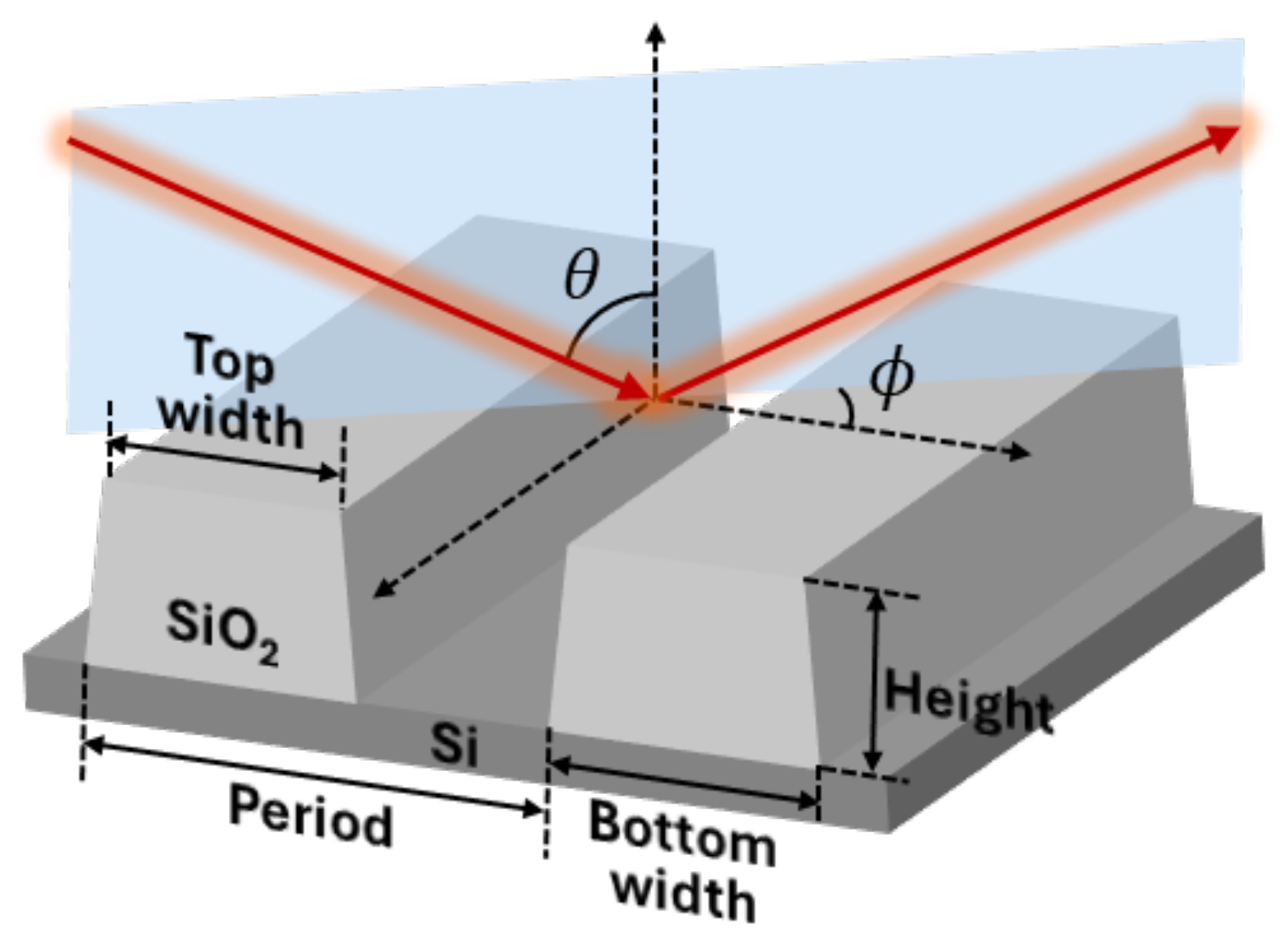
Figure 1. Schematic of the 1D grating specimen showing the definition of geometric parameters.
Applsci 16 08927 g001
Figure 2. Schematic diagram of the forward and inverse mappings (forward model/backward model) between structural parameters and Mueller-matrix spectra.
Applsci 16 08927 g002
Figure 3. Architectures of the RCWA-based forward surrogate models; (a) unified surrogate model and (b) element-wise surrogate model.
Applsci 16 08927 g003
Figure 4. Normalized mean MASD values of individual Mueller-matrix elements averaged over 10,000 training samples; for (a) azimuth angle of 0° and (b) azimuth angle of 45°. The same normalization scale was applied to both azimuth angles. The horizontal dashed line denotes the criterion ( MASD = 0.12 ) used for Low-/High-MASD classification.
Applsci 16 08927 g004
Figure 5. Comparison of the MSE ratio of the unified surrogate model MSE to the element-wise surrogate model, evaluated using 1000 validation samples not used for neural-network training for Low-MASD Mueller-matrix elements ( MASD < 0.12 ); at azimuth angles of (a) 0° and (b) 45°. The horizontal dashed line represents a ratio of 1.0.
Applsci 16 08927 g005
Figure 6. Comparison of the ground-truth Mueller matrix (MM) calculated by RCWA, the noise-added MM, the MM obtained by RCWA-based fitting, and the MM obtained by hybrid surrogate model-based fitting at an azimuth angle of 45°. The values shown in each element denote the MSEs of each MM spectrum relative to the noise-added MM spectrum.
Applsci 16 08927 g006
Table 1. Average absolute errors (nm) of the retrieved structural parameters.
MethodRCWA-Based
Optimization (nm)
Unified Surrogate Model-Based
Optimization (nm)
Hybrid Surrogate Model-Based
Optimization (nm)
Parameter
Period0.1280.1730.137
Height0.0440.0700.068
Top width0.0400.0870.080
Bottom width0.0900.1140.100
Table 2. Statistical comparison of absolute retrieval errors for the unified and hybrid surrogate models over the complete 1000-sample test dataset.
ParameterModelMin (nm)Mean (nm)SD (nm)Median (nm)P90 (nm)P95 (nm)Max (nm)
PeriodUnified0.0020.1730.1250.1320.3170.3800.523
Hybrid0.0010.1370.1100.1050.2630.3180.402
HeightUnified0.0040.0700.0490.0570.1260.1510.205
Hybrid0.0030.0680.0460.0530.1210.1440.201
Top widthUnified0.0010.0870.0710.0650.1680.2040.298
Hybrid0.0020.0800.0630.0620.1530.1850.275
Bottom widthUnified0.0030.1140.0790.0820.2040.2440.329
Hybrid0.0030.1000.0600.0780.1690.1990.291
Table 3. Comparison of time per iteration and total runtime for different parameter retrieval methods.
MethodRCWA-Based
Optimization (s)
Unified Surrogate Model-Based
Optimization (s)
Hybrid Surrogate Model-Based
Optimization (s)
Time
Time/iteration32 2.87 × 10 3 4.07 × 10 3
Total time54720.510.71
Disclaimer/Publisher’s Note: The statements, opinions and data contained in all publications are solely those of the individual author(s) and contributor(s) and not of MDPI and/or the editor(s). MDPI and/or the editor(s) disclaim responsibility for any injury to people or property resulting from any ideas, methods, instructions or products referred to in the content.