Enhancing Communication Security in Automotive Software: A Hybrid SecOC and MACsec Integration for SOME/IP over Ethernet

Featured Application
Abstract
1. Introduction
1.1. Communication Paradigms in Connected Systems
1.2. Evolution of Automotive Communication Networks
1.3. Service-Oriented Architecture and SOME/IP
- Remote Procedure Calls (RPCs) for request–response interactions;
- Event-based communication through publish–subscribe patterns;
- Service discovery for dynamic service availability detection.
1.4. Security Challenges in SOME/IP Communication
- Man-in-the-Middle (MitM) Attacks: Attackers intercept and manipulate communication between ECUs, enabling the injection of unauthorised commands into safety-critical systems [11].
- Replay Attacks: Captured legitimate messages are retransmitted to trigger unauthorised actions.
- Eavesdropping: Plaintext transmission enables passive monitoring of sensitive parameters, violating confidentiality.
1.5. Current Security Provisions in AUTOSAR
- (D)TLS Integration: Datagram Transport Layer Security (DTLS) and Transport Layer Security (TLS) secure unicast SOME/IP communication. These protocols use a cryptographic handshake to establish Secure Channels, verifying endpoint identity and encrypting data in transit [12].
- Secure Onboard Communication (SecOC): The SecOC module protects message authenticity and prevents replay attacks by appending Message Authentication Codes (MACs) and freshness values to the payload. Unlike (D)TLS, SecOC supports both unicast and multicast communication patterns [13].
1.6. Research Gap and Motivation
1.7. Contribution
- Hybrid Security Architecture: An integration of SecOC applied to the SOME/IP application PDU (above OSI Layer 4) with IEEE 802.1AE MACsec at the data link layer (Layer 2), providing end-to-end authenticity and integrity for SOME/IP traffic together with per-link confidentiality.
- Multicast Protection: A configuration that secures both unicast and multicast SOME/IP communication patterns, narrowing the multicast confidentiality coverage gap in the targeted AUTOSAR R22-11 security profiles to the residual case of a compromised intermediate switch, which is not addressed.
- Quantitative Performance Profile: A controlled measurement of end-to-end latency including tail behaviour (p50/p95/p99), a decomposition of the per-message SecOC cost into cryptographic and non-cryptographic components that identifies the user-space software path rather than the cipher as the dominant term, CPU and memory footprints, and a comparison against a DTLS unicast-fanout deployment baseline, across ten scenarios and two key-distribution modes.
- Deployment Guidelines: Practical guidelines, including a MACsec Key Agreement (MKA) deployment sketch and an explicit threat-model mapping that names the residual uncovered threats, for integrating this hybrid architecture into the AUTOSAR Adaptive Platform.
2. Related Work
2.1. PKI-Based Security Approaches
2.2. Authentication Server-Based Approaches
2.3. Alternative Security Mechanisms
2.4. Layer 2 Security Integration
2.5. IPSec and Encapsulating Security Payload (ESP)
2.6. Multi-Layer and Defence-in-Depth Approaches
2.7. Research Gap Analysis
3. Technical Background
3.1. Security Fundamentals in Automotive Systems
3.1.1. Cryptographic Primitives
3.1.2. Authentication Mechanisms
3.1.3. Attacker Model
- A1 (passive eavesdropper). A1 captures traffic on a single link. MACsec AES-GCM-128 encryption renders the payload confidential on that link, defeating A1.
- A2 (active on-path injector). A2 forges, replays, or modifies frames on a link that it controls. SecOC CMAC-AES256 authentication with a monotonic freshness counter detects forged and replayed PDUs end-to-end, and MACsec rejects frames with an invalid ICV at the link, so A2 cannot inject accepted messages.
- A3 (compromised switch). Because MACsec is hop-by-hop, a compromised switch observes plaintext after decryption and before re-encryption. MACsec therefore does not provide confidentiality against A3 in a multi-hop topology. SecOC still guarantees that any payload that the switch alters is rejected by the receiver: authenticity and integrity survive the hop, but multicast confidentiality holds end-to-end only in single-hop topologies. Closing the A3 confidentiality gap requires an end-to-end payload-encryption profile, which we identify as complementary future work (Section 7.4).
- A4 (compromised endpoint). An ECU holding valid SecOC and MACsec keys can produce authentic traffic by definition. This is not a hypothetical concern: an independent, non-peer-reviewed security-research blog report documents the practical extraction of production SecOC keys from a 2021 Toyota RAV4 [36], illustrating that A4 is a realistic threat once an ECU is physically compromised. Defending A4 requires key isolation in a hardware security module and application-level authorisation, which are orthogonal to the communication-security mechanisms evaluated here and are out-of-scope.
3.2. SOME/IP Protocol Architecture
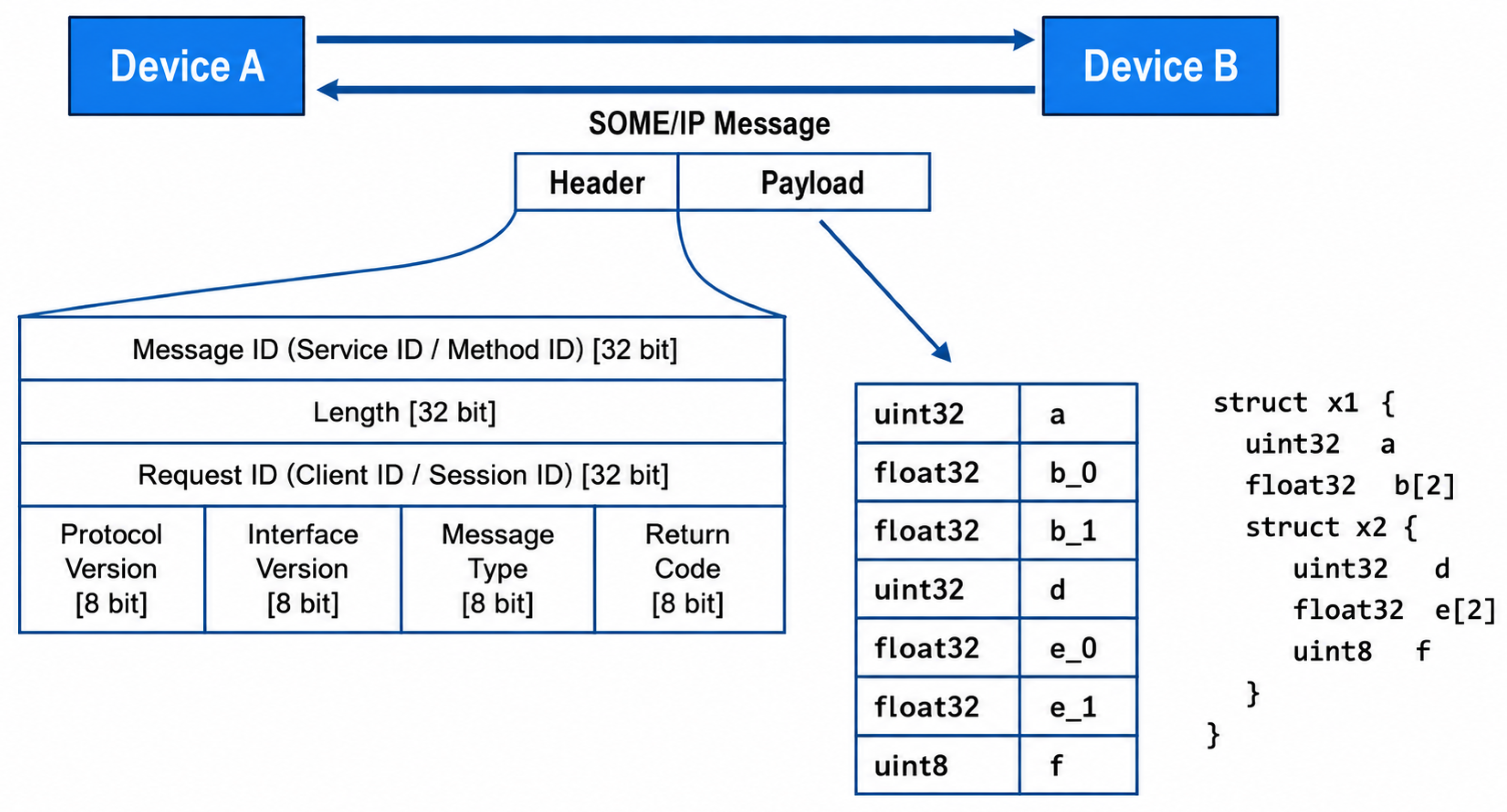
3.2.1. Message Structure
3.2.2. Security Deficiencies
3.3. Secure Onboard Communication (SecOC)
3.3.1. SecOC Limitations
- No Confidentiality: SecOC does not encrypt payloads; messages remain readable to eavesdroppers [13].
- Bandwidth Overhead: Authentication data consumes payload space, significant on bandwidth-constrained CAN networks.
- Key Management: Keys must be pre-provisioned; no onboard key-exchange protocol is specified. Weak provisioning or storage of these keys is not merely theoretical: a non-peer-reviewed but widely cited independent security-research blog report describes recovering deployed SecOC keys from a production vehicle [36], underscoring the need for HSM-backed key storage in any real deployment.
- Synchronisation Delays: Receivers may temporarily reject messages until freshness synchronisation completes after startup or sleep.
SecOC and Authenticated Encryption
3.4. MACsec (IEEE 802.1AE)
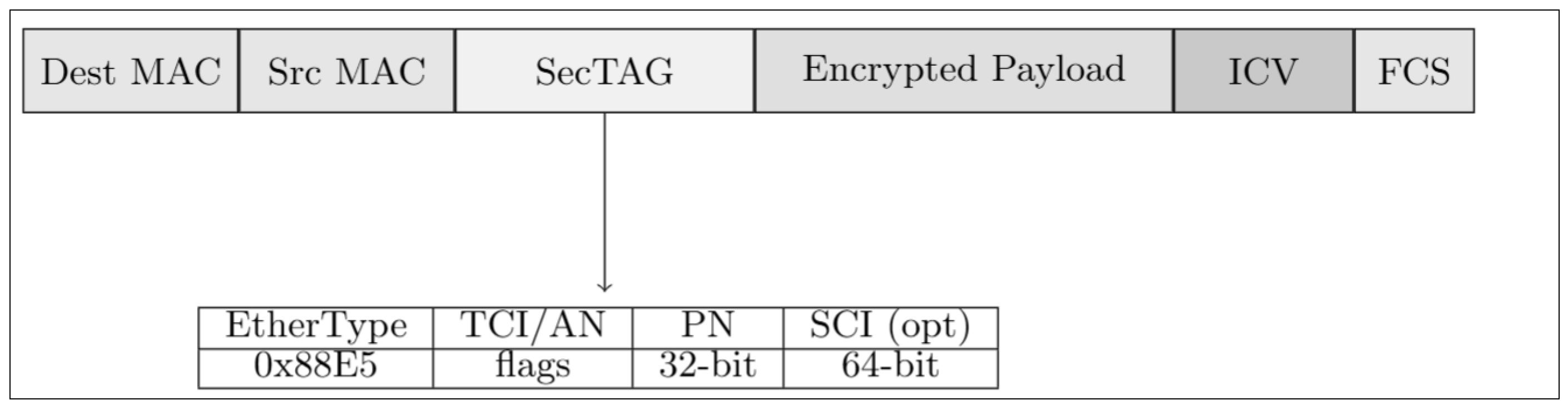
3.4.1. Cryptographic Mechanism
3.4.2. Security Properties
3.4.3. MACsec Limitations
3.5. Comparative Analysis: SecOC vs. MACsec
4. Proposed Hybrid Security Architecture
4.1. Addressing Individual Mechanism Limitations
4.1.1. Key Distribution Modes: PSK vs. RSA-2048
Mode B: RSA-2048 Key Exchange
Why RSA-2048?
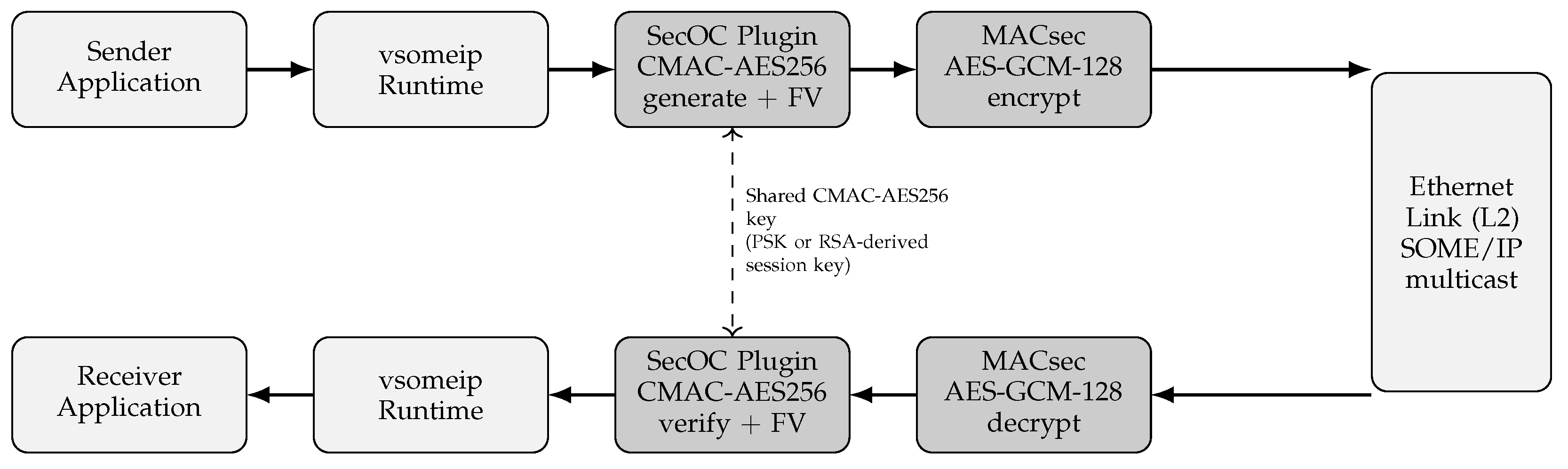
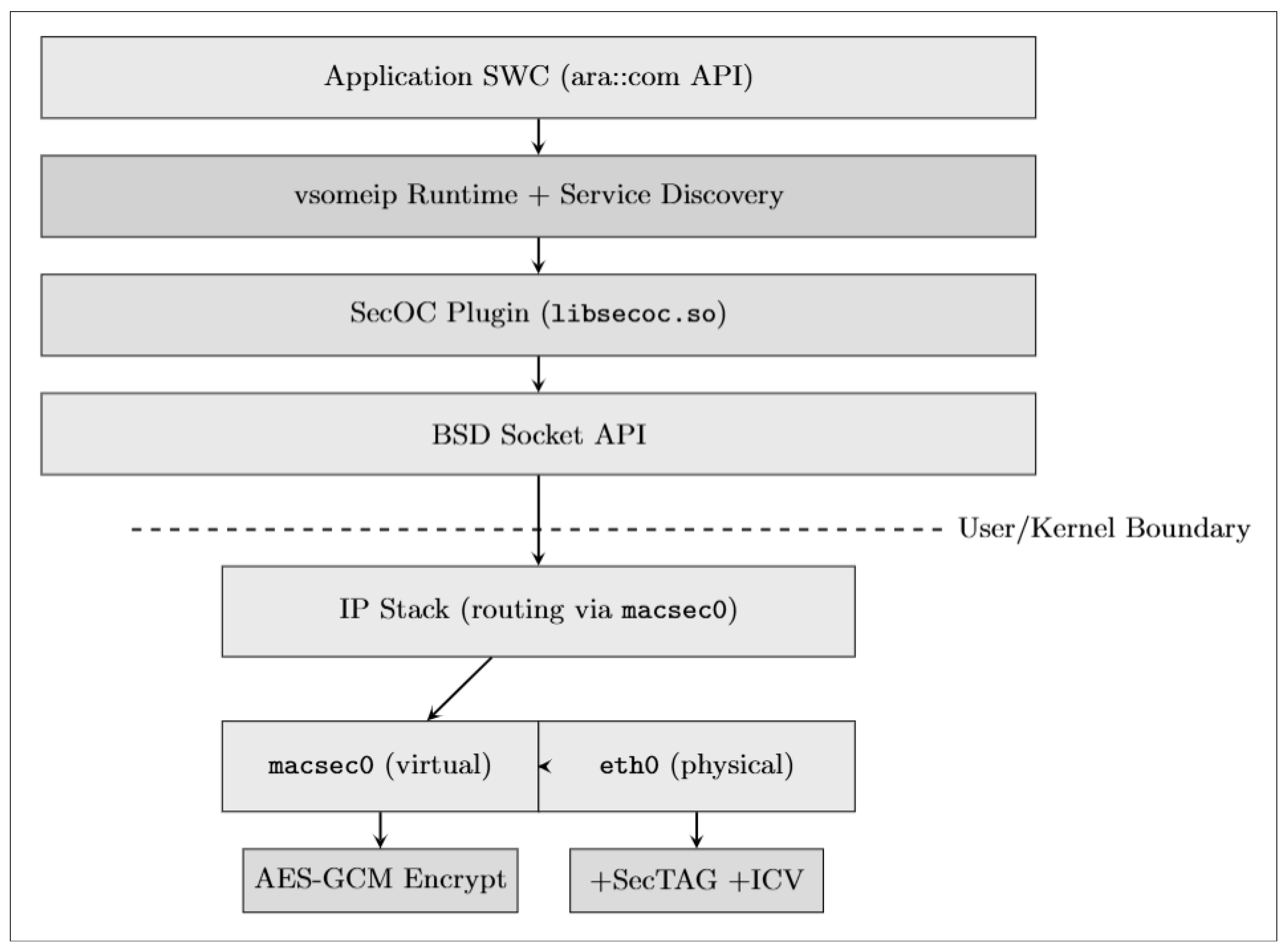
4.2. Architecture Overview
- SecOC (L4+, on the SOME/IP PDU): Provides end-to-end message authentication and replay protection through CMAC-AES256 Message Authentication Codes and freshness values. Supports two key distribution modes: pre-shared keys (PSKs) for minimal overhead, or RSA-2048 for dynamic session key establishment. Implemented as a vsomeip plugin operating in user space.
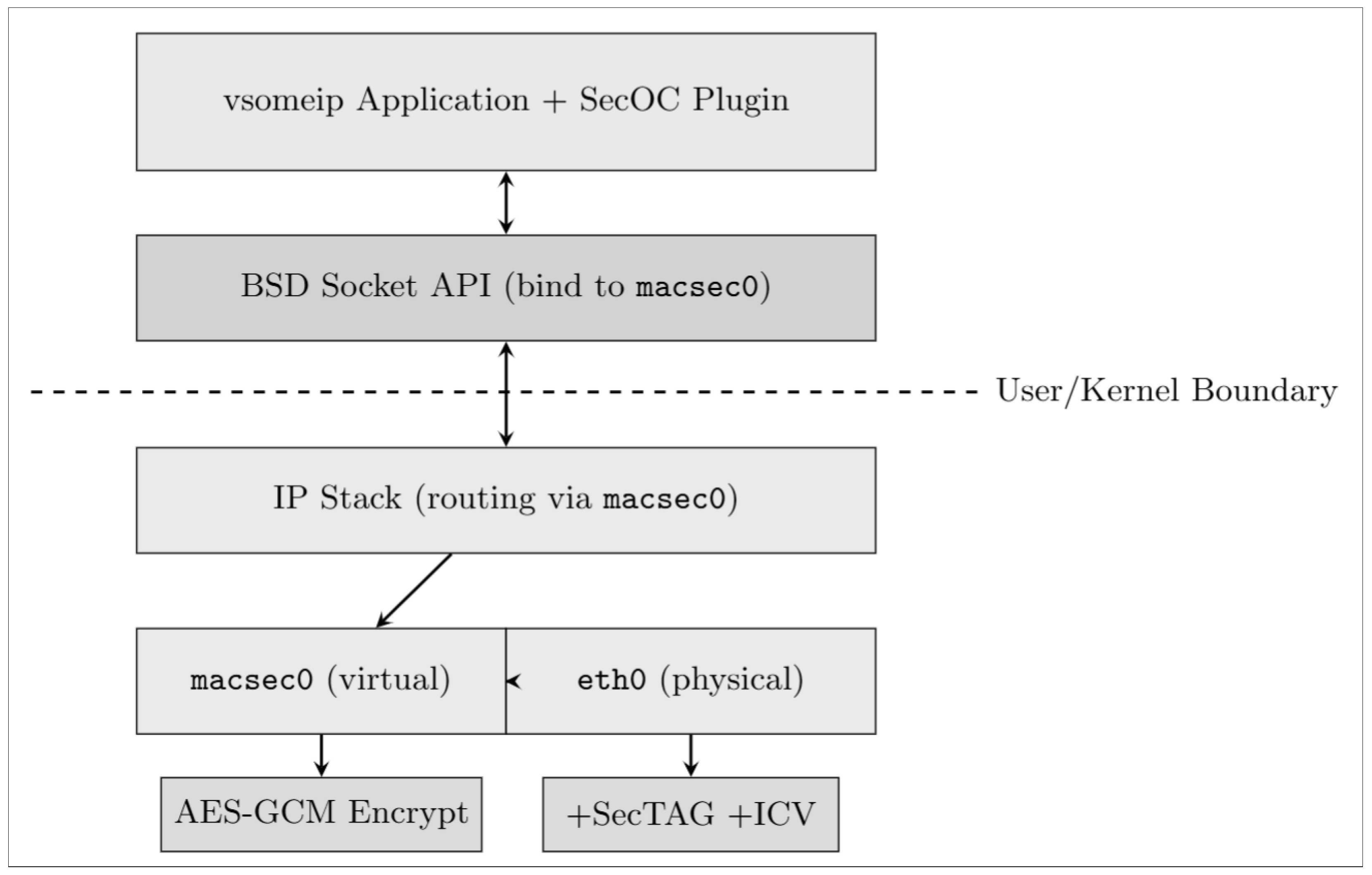
- MACsec (Layer 2): Provides hop-by-hop confidentiality and integrity protection through authenticated encryption (AES-GCM-128), implemented in the Linux kernel via the macsec driver.
Implementation Scope and AUTOSAR Compatibility
4.3. System Context and Components
- Platform: COVESA vsomeip running on Ubuntu 20.04 LTS (kernel 5.15), exercising AUTOSAR Adaptive Platform-compatible SOME/IP communication patterns;
- Middleware: COVESA (formerly GENIVI) vsomeip implementation;
- Security Extension: Custom SecOC shared library (libsecoc.so) integrated as a vsomeip plugin;
- Link Security: IEEE 802.1AE MACsec enabled through the Linux kernel macsec driver, configured statically with iproute2 (Section 4.7.2); MKA (IEEE 802.1X) is not run on this testbed and is discussed only as a production deployment model in Section 4.7.3;
- Network Interface: Physical Ethernet (eth0) with MACsec virtual interface (macsec0).
4.4. Layered Security View
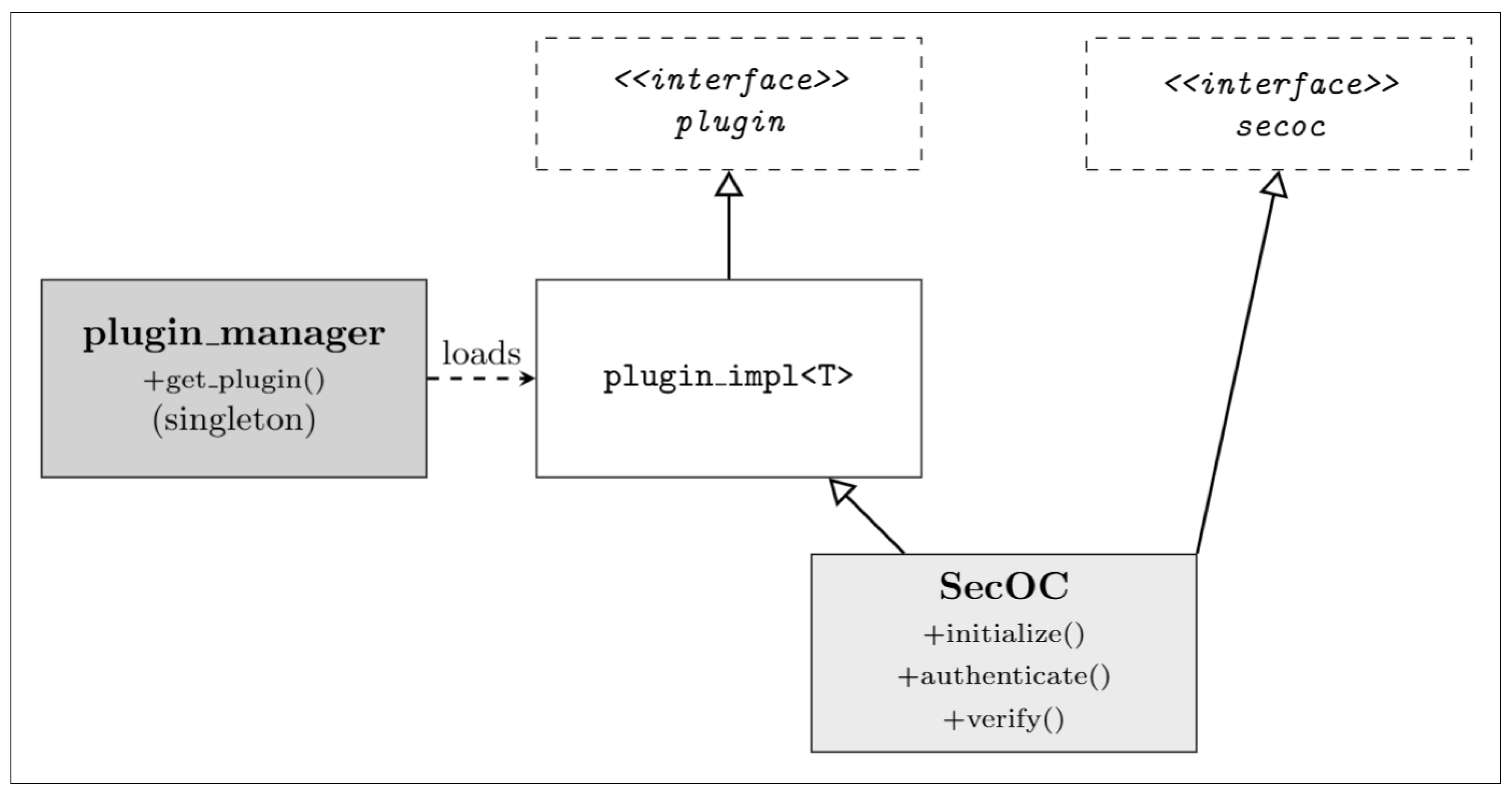
4.5. vsomeip Plugin Architecture
4.5.1. Plugin Infrastructure
4.5.2. SecOC Interface Definition
- initialize(): Configures cryptographic parameters, loads secret keys, and initialises freshness counters from persistent storage.
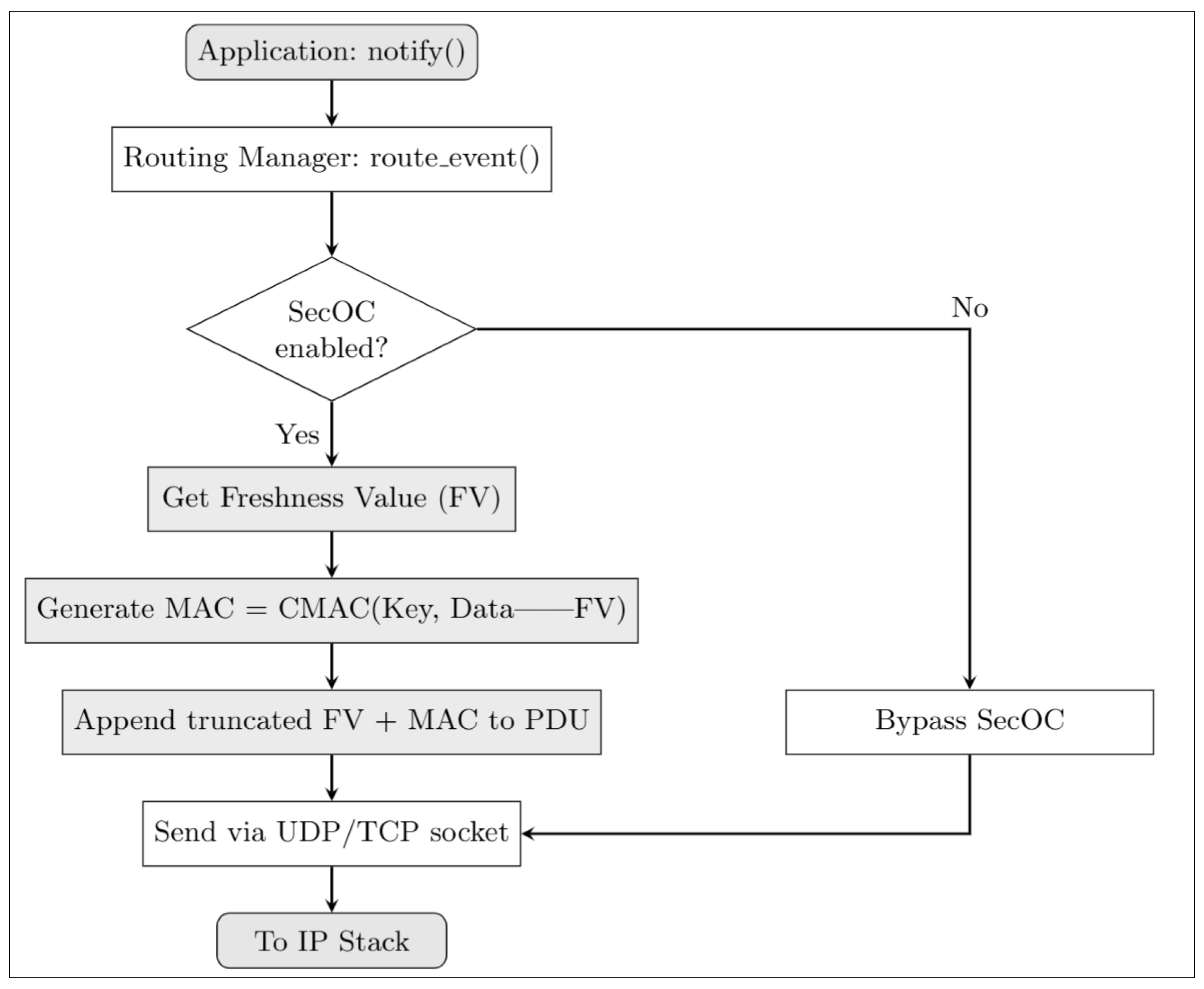
- authenticate(service_id, event_id, data, instance_id): Determines SecOC applicability for the given PDU identifier tuple, generates freshness value, computes MAC, and appends authentication data to the payload.
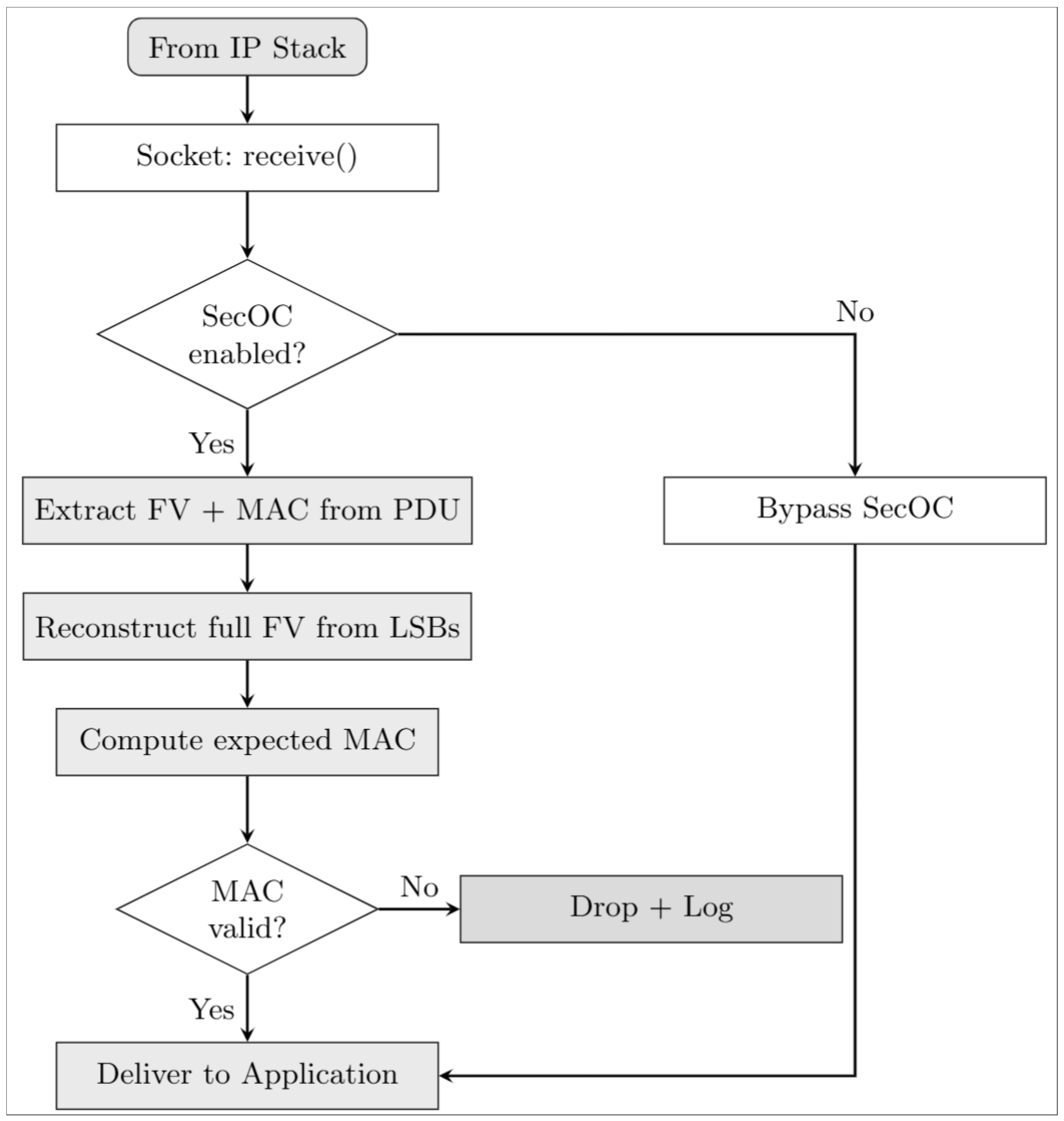
- verify(service_id, event_id, data, instance_id): Determines SecOC applicability, extracts authentication data, reconstructs freshness value, computes expected MAC, and validates against received authenticator.
4.5.3. Routing Manager Integration
- Routing Manager Host: A single instance per ECU responsible for service registration, routing decisions, and plugin management.
- Routing Manager Proxy: Client applications that communicate with the routing manager via local IPC (Unix domain sockets).
- Plugin manager queries for secoc.so in LD_LIBRARY_PATH;
- If found, the plugin is instantiated and initialize() is invoked;
- The SecOC instance is stored for use in transmit/receive paths.
4.6. SecOC Implementation Design
4.6.1. Transmission Flow
4.6.2. Reception Flow
4.6.3. Freshness Value Management
| Algorithm 1 Freshness Value Reconstruction |
|
Window Size, Loss, and Reordering
- Packet Loss: Losing up to consecutive PDUs is transparent—the next PDU still falls inside the window, is accepted, and the local counter jumps forward to it. Losing W or more consecutive PDUs takes the receiver out of the window; every subsequent PDU is then rejected until the Freshness Value Manager redistributes the full counter.
- Counter Wraparound: When the transmitted LSBs wrap, the naive candidate is no longer greater than the local counter, so the algorithm retries once with the most significant bits incremented. One wrap per reconstruction attempt is handled; a burst spanning more than one wrap is not, and falls back to Freshness Value Manager resynchronisation.
- Out-of-Order Delivery: Acceptance is strictly monotonic—a PDU whose reconstructed value is not greater than the local counter is rejected, because at the receiver a genuinely reordered PDU and a replayed one are indistinguishable. Reordering is therefore treated as loss. This is safe but not tolerant, and on the single-hop UDP path with one transaction in flight used here it does not arise. A multi-hop zonal path would need either a sliding bitmap of recently accepted counters or more frequent resynchronisation; we did not implement either.
Relation to Prior Work on Truncated-Counter Resynchronisation
4.6.4. AUTOSAR Security Profiles and MAC Configuration
- Standardised Security Profiles (TPS_MANI_03139): AUTOSAR specifies predefined profiles with fixed cryptographic algorithm and parameter combinations. All three predefined profiles use CMAC with AES-128 and differ in their freshness and MAC truncation lengths, not in key size: Profile 1 (24-bit MAC, 8-bit transmitted freshness value), Profile 2 (24-bit MAC, no freshness value at all), and Profile 3 (the JASPAR profile: 64-bit freshness value of which 4 bits are transmitted, 28-bit MAC).
- Non-Standardised Security Profiles (TPS_MANI_03140): AUTOSAR also permits vendor-defined security profiles utilising alternative cryptographic parameters or primitives, provided they comply with the SecOC protocol framework. This extensibility enables stronger parameter choices today and future migration to post-quantum or application-specific algorithms without architectural changes.
Profile Used in This Work
MAC Truncation Security Margin
4.7. MACsec Integration on Ubuntu
4.7.1. Kernel–User Space Relationship
- Virtual Interface Binding: The vsomeip application binds its sockets to the IP address assigned to the macsec0 virtual interface (configured through the unicast field of the vsomeip JSON) rather than to the physical eth0 address. The kernel routing table directs that subnet through macsec0, so all SOME/IP traffic is automatically processed by the MACsec driver without any application-level change.
- Transparent Encryption: The MACsec driver intercepts outbound frames from macsec0, applies AES-GCM encryption, prepends the SecTAG, appends the ICV, and forwards the secured frame to eth0.
- Transparent Decryption: Inbound frames on eth0 with EtherType 0x88E5 are processed by the MACsec driver, which verifies the ICV, decrypts the payload, and delivers the cleartext frame to macsec0.
4.7.2. MACsec Configuration
4.7.3. MKA Deployment Model for Multicast
Key Server Placement
CAK Provisioning
SAK Rekey Policy
Failure Modes
What This Sketch Does Not Yet Cover
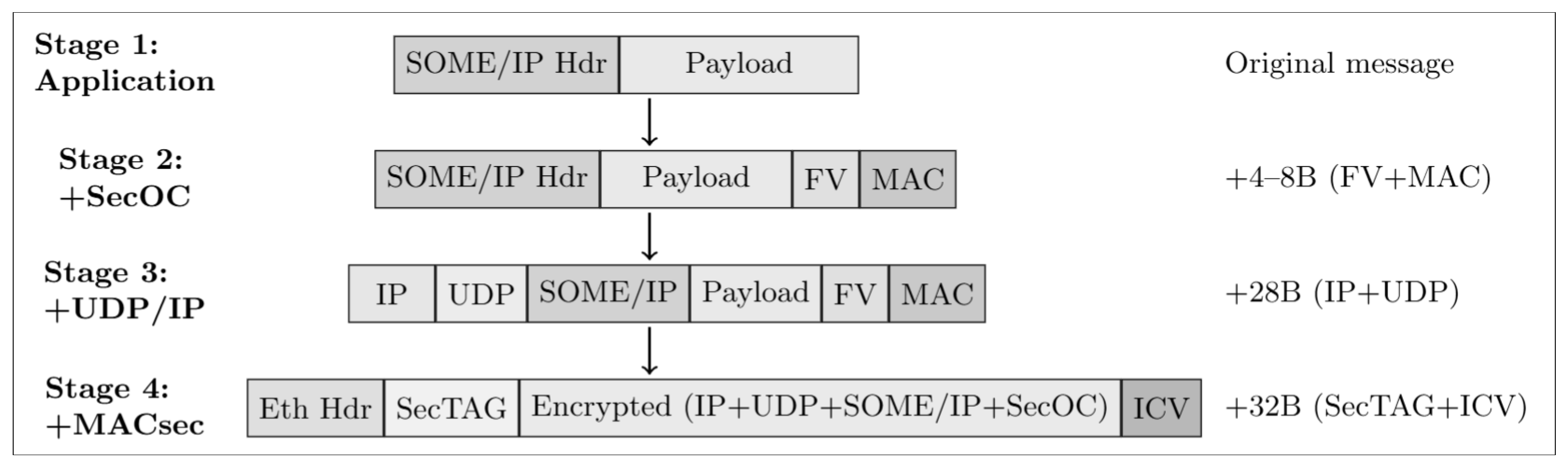
4.8. Data Plane Transformation
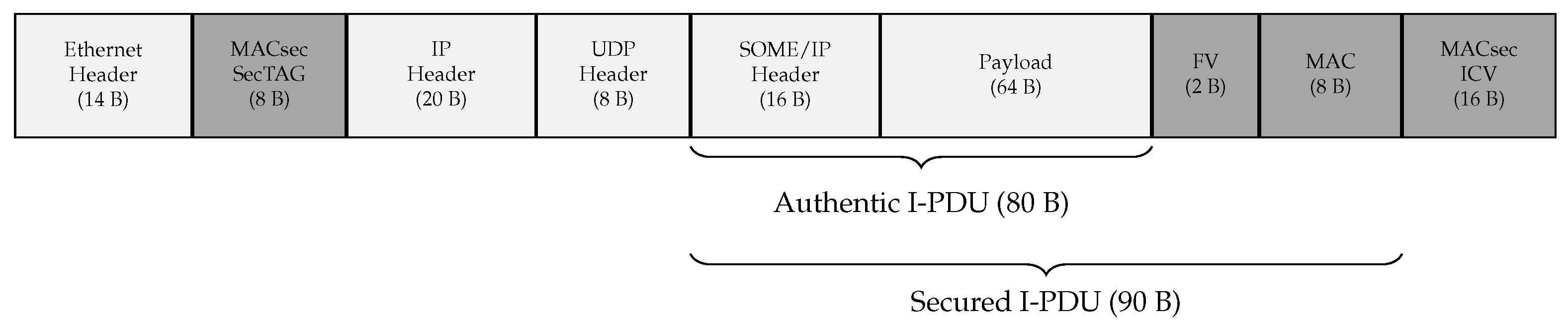
4.8.1. PDU Transformation Stages
4.8.2. Overhead Analysis
5. Experimental Setup
5.1. Evaluation Objectives
- What is the baseline performance of SOME/IP communication without security mechanisms on our testbed?
- What latency and resource overhead does SecOC with pre-shared keys (CMAC-AES256 only) introduce for unicast and multicast communication?
- What is the additional overhead when RSA-2048 key exchange is used for session key establishment, and how does a one-time session cost compare to per-message CMAC overhead?
- What is the additional performance impact when combining SecOC with IEEE 802.1AE MACsec in a distributed deployment?
- Is the proposed hybrid architecture viable for real-time automotive/IoT applications under each key distribution mode?
Scope of the Evaluation
5.2. Test Scenarios
- Scenario 1: Unsecured SOME/IP communication (Baseline);
- Scenario 2a: SOME/IP communication secured with SecOC using pre-shared keys (CMAC-AES256 only, no asymmetric operations);
- Scenario 2b: SOME/IP communication secured with SecOC using RSA-2048 key exchange (one-time session establishment followed by CMAC-AES256 per-message authentication);
- Scenario 3a: Full hybrid—MACsec at Layer 2 with SecOC-PSK at L4+—deployed across two virtual machines;
- Scenario 3b: Full hybrid—MACsec at Layer 2 with SecOC-RSA at L4+—deployed across two virtual machines.
5.3. Experimental Environment
5.3.1. Software Components
- vSomeIP Middleware (vsomeip v3.x): An open-source implementation of the AUTOSAR SOME/IP protocol maintained by COVESA [37], providing the core communication middleware for all test nodes.
- Service Discovery (SD): The SOME/IP-SD module enables dynamic service availability detection through OfferService (server-side advertisement) and FindService (client-side discovery) mechanisms.
- Configuration (CFG): Runtime configuration including service identifiers, instance identifiers, transport ports, and multicast group parameters for multicast experiments.
- SecOC Security Plugin: Provides message authenticity and integrity through CMAC-AES256 authentication and freshness value-based replay mitigation. The plugin supports two key distribution modes: (i) pre-shared keys (PSK), where symmetric keys are provisioned offline; and (ii) RSA-2048 key exchange, where session keys are established dynamically at runtime. The plugin is designed to be compliant with the AUTOSAR Protocol Requirements Specification for Secure Onboard Communication (R22-11) [38] and the AUTOSAR System Template (R22-11) [44], using the vendor-defined profile of Table 8. Enabled in Scenarios 2a, 2b, 3a, and 3b.
- MACsec (IEEE 802.1AE): Link-layer protection providing confidentiality, frame integrity, and data origin authenticity, configured using Linux iproute2 utilities. Enabled in Scenarios 3a and 3b.
5.3.2. Deployment Models
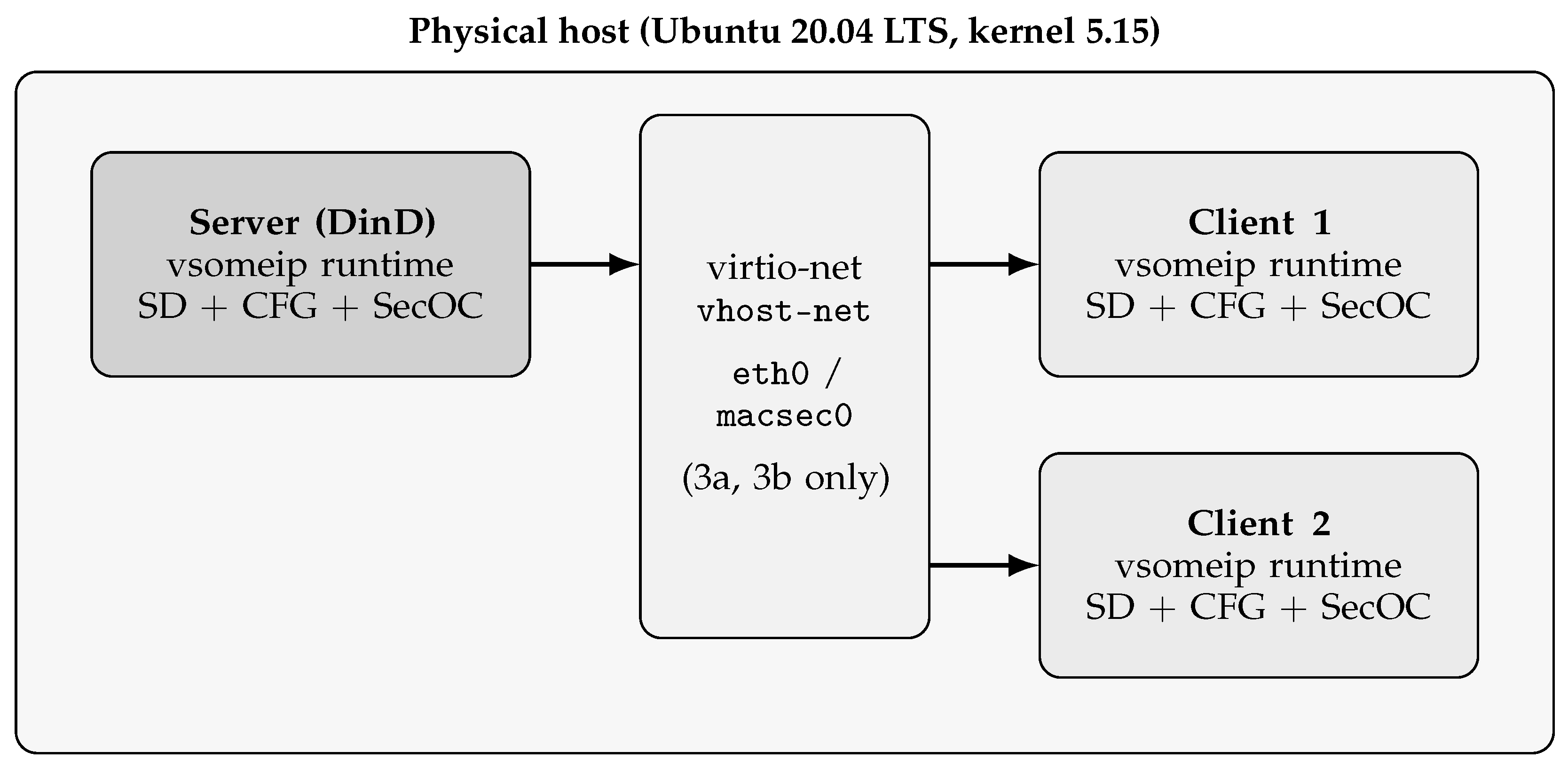
Uniform Two-VM Deployment (Scenarios 1 to 3b)
- VM1: Hosts the Server node, running in a Docker-in-Docker (DinD) container with its own network namespace and service-discovery daemon, mirroring a gateway ECU that hosts nested service containers.
- VM2: Hosts the Client node(s) in separate Docker containers (one for unicast, two for multicast), acting as consuming ECUs.
5.3.3. Hardware Specifications
- Operating System: Ubuntu 20.04 LTS (Linux kernel 5.15);
- Processor: 10 virtual CPU cores (matching Intel Core i7, 12th Gen), pinned 1:1 to dedicated physical cores with host isolcpus isolation to avoid scheduler interference during measurement;
- Memory: 32 GB DDR4 RAM;
- Network: Gigabit Ethernet (virtio-net, vhost-net backend);
- Reference Platform: FleetPC-12B Car-PC (Intel Core i7-1265U, up to 64 GB DDR4, dual GbE LAN, automotive-grade operating temperature −20 °C to +60 °C).
5.4. Configuration Artefacts
- vSomeIP Configuration: Unicast address bindings, SD multicast parameters, service/instance identifiers, and event-group multicast address/port specifications for multicast experiments.
- SecOC Configuration (Scenarios 2a to 3b): Two sub-configurations:
- PSK Mode (Scenarios 2a and 3a): Pre-shared CMAC-AES256 keys (256-bit), key identifiers, and freshness handling policy (64-bit full counter, 16-bit transmitted LSBs). No asymmetric operations.
- RSA Mode (Scenarios 2b and 3b): RSA-2048 key exchange for session key establishment, followed by CMAC-AES256 with 256-bit session keys and the same 64-bit full/16-bit transmitted freshness counter.
- MACsec Configuration (Scenarios 3a and 3b): MACsec interface creation (macsec0) and secure association/channel configuration on both VMs.
5.5. Scenario Specifications
5.6. Metrics and Measurement Methodology
5.6.1. Performance Metrics
- End-to-End Latency: Total time from initiating message transmission to complete processing at the receiver (ms).
- SecOC Path Processing Time: Wall-clock time spent inside the SecOC plugin per message exchange (ms). This is the whole software path, not the cipher: plugin dispatch, key lookup, freshness value handling, header assembly, CMAC-AES256 tag generation, and tag verification. The cryptographic operation is a sub-millisecond fraction of this quantity [32]; the metric therefore characterises this implementation’s integration cost rather than an intrinsic cost of SecOC. RSA key-exchange times are tracked separately.
- RSA Session Establishment Time: The one-time cost of RSA-2048 key exchange during session startup (ms).
- CPU Usage: CPU resources consumed during steady-state message exchange, expressed as a percentage of one logical core (100% denotes one fully occupied core; the VM has ten). Figures are the aggregate over the vsomeip routing manager and application processes on the measured node; publisher and receiver were not instrumented separately.
- Memory Usage: Resident memory footprint of the communication processes on the measured node (MiB).
5.6.2. Measurement Environment and Procedure
6. Results and Discussion
6.1. Performance Summary
6.2. Latency Distribution and Tail Behaviour
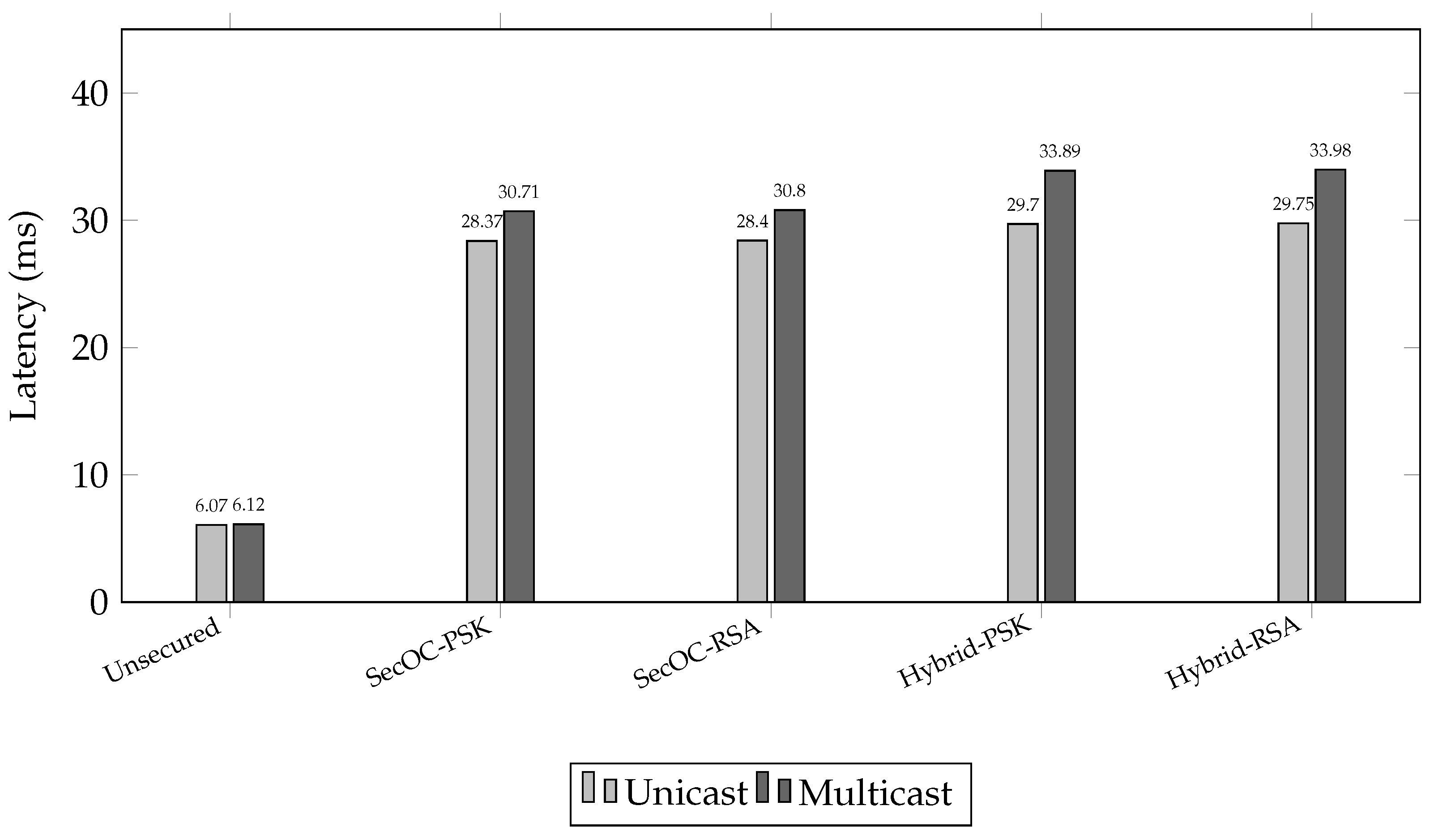
6.3. Latency Analysis
6.3.1. Baseline Performance
6.3.2. SecOC-PSK Overhead
- Unicast (2a-A): Latency increased from ms to ms, showing a 4.67-fold increase (+22.30 ms).
- Multicast (2a-B): Latency increased from ms to ms, showing a 5.02-fold increase (+24.59 ms).
The Dominant Term Is Software, Not Cryptography
6.3.3. SecOC-RSA Overhead
Session Establishment (One-Time Cost)
Steady-State Performance
- Unicast (2b-A): Steady-state latency of ms (±1.60 ms), which is ms above PSK.
- Multicast (2b-B): Steady-state latency of ms (±1.76 ms), which is ms above PSK.
6.3.4. MACsec Overhead
PSK Configuration (Scenario 3a)
- Unicast (3a-A): Latency of ms against ms for SecOC-PSK, a +1.33 ms (4.7%) increase.
- Multicast (3a-B): Latency of ms against ms for SecOC-PSK, a +3.18 ms (10.4%) increase.
RSA Configuration (Scenario 3b, Steady State)
- Unicast (3b-A): Steady-state latency of ms against ms for stable SecOC-RSA, a + ms (4.8%) increase.
- Multicast (3b-B): Steady-state latency of ms against ms for stable SecOC-RSA, a + ms (10.3%) increase.
Isolating the Inter-VM Transport Term
6.4. Resource Utilisation Analysis
6.4.1. CPU Usage
- Unsecured (Scenarios 1-A and 1-B): % CPU usage.
- SecOC-PSK (Scenarios 2a-A and 2a-B): % CPU usage.
- Hybrid-PSK (Scenarios 3a-A and 3a-B): % CPU usage.
- SecOC-RSA Steady-State (Scenarios 2b-A and 2b-B): % CPU usage.
- Hybrid-RSA Steady-State (Scenarios 3b-A and 3b-B): % CPU usage.
6.4.2. Memory Consumption
- Unsecured: 43 MiB.
- PSK-Secured: 52 MiB to 53 MiB (20.9% to 23.3% increase).
- RSA-Secured: 55 MiB to 56 MiB (27.9% to 30.2% increase).
6.5. Comparison with a DTLS Unicast-Fanout Baseline
6.5.1. Baseline Configuration
6.5.2. What This Comparison Does and Does Not Establish
6.6. Hardware Versus Software MACsec
6.7. Discussion
6.7.1. Security–Performance Trade-Offs
- Safety-Critical Applications: Hard real-time systems (such as steering or braking) require sub-10 ms response times; we adopt 10 ms as a representative upper bound for the message-level budget, noting that the tightest inner control loops target sub-1 ms and would be even more demanding. The software-based implementation ( ms to ms mean, up to ms at p99, total latency) is too slow for these tasks. The barrier is the user-space SecOC path rather than the cryptography, so the route to this class is optimising that path (Section 6.7.4), not adding a cryptographic accelerator; that section’s projection indicates that this class moves from clearly unreachable to within reach once the identified software residue is removed, which is a statement about this prototype rather than a ceiling on the architecture.
- ADAS and Infotainment: Soft real-time systems with an assumed 50 ms to 100 ms budget retain a positive margin against this overhead, but the margin is materially tighter at the tail than at the mean: against the 50 ms bound, the worst measured p99 ( ms) leaves approximately 9 ms of headroom, measured without background load or competing traffic (Section 6.2). This 9 ms figure is also bound to the current implementation: Section 6.7.4 projects roughly 16 ms of additional headroom once the fixable software residue is removed.
- Diagnostic and OTA Updates: Non-real-time tasks with budgets exceeding 100 ms run comfortably under any configuration, including the RSA startup handshake ( ms to ms).
6.7.2. PSK vs. RSA Key Distribution
- PSK: Zero session startup delay, but requires pre-provisioning keys offline for pairwise unicast (a single group key per event group for multicast).
- RSA-2048: A one-time session setup cost of ms to ms that grows as with multicast group size (Section 4.1.1), but reduces long-term key management to and integrates with public key infrastructures (PKIs).
6.7.3. MACsec Overhead Assessment
- Unicast: +1.33 ms (4.7% increase) over SecOC-PSK.
- Multicast: +3.18 ms (10.4% increase) over SecOC-PSK.
6.7.4. Cryptographic Algorithm Considerations
- Software-Path Optimisation (primary): Because the dominant term is non-cryptographic, the largest available gain is in the plugin implementation itself: reusing a preallocated cryptographic context instead of allocating one per call, removing synchronous logging from the hot path, batching Freshness Value Manager interaction rather than consulting it per message, and eliminating buffer copies between the routing manager and the plugin. These are implementation defects rather than protocol costs, and addressing them does not change the security properties.
- Hardware Security Modules (HSMs): An HSM protects key material and accelerates the cipher, and key isolation is independently desirable given the extraction risk discussed in Section 3.1.3. As a latency remedy, however, its ceiling here is small: offloading an operation that already costs under 1 ms cannot remove the ∼15 ms software residue, and an HSM invoked over an IPC or SPI boundary can add latency. We therefore no longer present HSM offloading as the route to sub-10 ms operation; software-path optimisation must come first, with HSM offloading complementary to it [49].
- ECDH-P256: Replaces RSA-2048 with a faster session key handshake and uses smaller keys (256-bit instead of 2048-bit) [34,43]. Published benchmarks place a P-256/Curve25519 key agreement on this CPU class in the single-digit-millisecond range, roughly 3 to 5× faster than RSA-2048 session setup [42,50]. This affects session establishment only, not the steady-state path.
What the Real-Time Verdict Is Actually Bound to
6.7.5. Scalability Implications
6.8. Feasibility Assessment
- Application Class Suitability: The hybrid setup fits ADASs, infotainment, and diagnostics, which we budget against an assumed soft real-time window of 50 ms to 100 ms (Section 6.7.1). The verdict should be read at the tail rather than the mean: mean latencies of ms to ms across the four hybrid configurations rise to ms to ms at the 99th percentile (Table 19), leaving roughly 9 ms of headroom against a 50 ms budget in the worst measured configuration (Hybrid-RSA multicast), rather than the ∼16 ms that the mean suggests. That is still positive headroom, but it is a materially tighter margin, and it was measured without background load or competing traffic. Hard real-time tasks (sub-10 ms target) are out of reach for this implementation and would require the SecOC software path to be optimised first: this entire verdict is a statement about the present prototype, and Section 6.7.4 projects that removing the identified software residue alone would move the worst-case mean and p99 down by roughly 12 ms, materially changing the sub-10 ms assessment as well.
- Key Management Choice: PSK is suitable when key pre-provisioning is already established. RSA-2048 is better for dynamic key management and PKI trust integration, as its initialisation cost ( ms to ms) is easily amortised over a complete drive cycle.
- Resource Budgets: Target ECUs must allocate 40% to 43% CPU and 52 to 56 MiB of memory for secured nodes. This represents a large improvement over the CPU of the initial per-message-RSA iteration, leaving adequate resources for other on-device services.
- Network Capacity: Automotive Ethernet bandwidth (100 Mbps or higher) easily handles the small packet overhead without risking congestion.
7. Conclusions
7.1. Summary of Contributions
- Layered Security Architecture: We developed and tested a combined SecOC and MACsec stack. Unlike PKI schemes such as Secure SOME/IP [16], which suffer from handshake latency overhead, or centralised servers like SESO-AS [17] that create single failure points, our design provides message authenticity and link-layer encryption locally at each node.
- Unicast and Multicast Security: This design secures both unicast and multicast patterns with end-to-end authenticity together with per-link confidentiality—a combined guarantee not possible under standard standalone AUTOSAR security profiles. By operating at complementary protocol layers, we resolve the broadcast limitations of Secure SOME/IP [16] and avoid the steady-state asymmetric-key computations that hinder other proposals.
- Precise Performance Profiles: We evaluated runtime impacts by testing ten distinct scenarios across 500 iterations. The measurements show that the symmetric SecOC software path adds ms to ms per message; RSA-2048 key exchange requires ms to ms at startup; and MACsec, isolated by re-running the SecOC-only scenarios on the same two-VM topology as the hybrid scenarios, adds ms to ms of path delay (Section 6.3.4).
- Implementation on Commodity Hardware: We built and validated a reference plugin for vSomeIP that works with standard Linux kernel MACsec routing. By building on the standardised IEEE 802.1AE mechanism and the AUTOSAR SecOC protocol framework (instantiated here with a vendor-defined parameter profile; Section 4.6.4), the architecture is designed to integrate with the AUTOSAR Adaptive Platform without adding complex third-party software stacks; full-production Adaptive Platform integration is left to future work.
7.2. Key Findings
- Baseline unsecured SOME/IP communication is fast and consistent, averaging ms (unicast) and ms (multicast) of transmission latency.
- Symmetric SecOC (using pre-shared keys) increases latency 4.67 to 5.02 times (+22.30 ms to +24.59 ms), with most of the delay caused by software plugin execution and freshness value validation rather than raw encryption.
- RSA-2048 handshakes incur a startup cost of ms to ms, after which steady-state per-message latency is identical to symmetric PSK mode.
- MACsec, now isolated on a two-VM topology shared with every other scenario, adds a highly consistent ms to ms of delay, providing a cost-effective way to secure per-link packet confidentiality.
- Confining RSA handshakes to session startup reduces CPU utilisation to between 40% and 43%, down from the of the initial per-message-RSA configuration (Section 5.6.2). This is consistent with the high asymmetric overhead reported for per-message schemes such as Secure SOME/IP [16] and SESO-RC [17], and it leaves adequate headroom for other ECU tasks on typical automotive hardware.
7.3. Applicability and Limitations
Threats to Validity
- Security Functions Are Analysed, Not Demonstrated: The mapping from attacker capabilities to defending layers (Section 3.1.3) is an analytical argument that inherits the guarantees of two standardised, unmodified mechanisms rather than of a construction that we introduce: SecOC’s Secured I-PDU layout, MAC input, and freshness state machine are unchanged from the protocol framework (Section 4.6.4), and MACsec is the unmodified Linux IEEE 802.1AE driver, so this study measures the overhead of composing two vendor-conformant implementations rather than re-evaluating either protocol’s cryptographic soundness. This paper does not include functional tests showing that our implementation rejects replayed, tampered, or stale-counter PDUs, nor does it include formal verification or penetration testing of the composed stack. We note, further, that every latency and CPU figure in Section 6 characterises the accept path only: a rejected PDU is discarded before delivery and contributes no sample to any distribution reported here, so the functional tests specified in future work would validate correctness without revising any reported measurement. We consider the inherited guarantees to be sound, but the implementation’s conformance to them is unverified here.
- A Single Workload Point: All latency scenarios use one payload size (64 bytes), one pacing regime (one transaction in flight, 50 ms interval, messages/s), at most two receivers in the main matrix, and no background traffic or competing services. Burst behaviour, larger payloads, higher rates, more parallel services, and loaded-network conditions are untested, and the payload-size analysis of Table 13 is analytical rather than measured. Claims of applicability should be read as applying to this operating point.
- Statistical Depth: The results come from a single run of 500 iterations per scenario, summarised by mean, standard deviation, and percentiles. Maximum latency, jitter distributions, and confidence intervals across independent repetitions were not retained, so no hard real-time worst-case argument is possible (Section 6.2).
- Virtualised, Single-Hop Testbed: No physical ECU, automotive Ethernet PHY, switch, hardware MACsec engine, or HSM was used; both virtual machines are co-resident on a single physical host (Section 5.3.3), and the path is single-hop. The multi-hop zonal topology that motivates the end-to-end authentication layer (Section 4.7.3) is therefore described but not measured, and the constant factors on production hardware will differ.
7.4. Future Work
- Functional and Adversarial Security Validation: Injecting replayed PDUs, tampered payloads, invalid MACs, and stale freshness values to confirm that the implementation discards them as specified, followed by formal analysis of the composed stack (for example, in ProVerif or Tamarin) and penetration testing against the A1–A3 capability levels. As discussed in threat to validity 1 above, this is the most valuable outstanding experiment relative to its cost: the testbed already exists, and because rejected PDUs are, by construction, excluded from every latency and CPU figure reported here, running these tests would demonstrate correctness without requiring any existing measurement to be revised.
- SecOC Software-Path Profiling and Optimisation: Profiling the plugin send and verify paths at function granularity to attribute the ∼15 ms non-cryptographic residue identified in Section 6.3.2, and then eliminating it (preallocated cryptographic contexts, hot-path logging removal, batched Freshness Value Manager interaction, zero-copy buffer handling), with the goal of bringing the per-message path under 1 ms and enabling sub-10 ms operation. Hardware key isolation in an HSM is complementary and is motivated by key protection rather than by latency.
- Lightweight Handshakes: Substituting RSA-2048 with ECDH-P256 for session-key exchange. Published microbenchmarks suggest that this could reduce the initial startup handshake delay to single-digit milliseconds, but that expectation assumes that the measured ms to ms session-establishment cost is dominated by the asymmetric operation itself. Unlike the per-message SecOC path (Section 6.3.2), we did not decompose session establishment into cryptographic and protocol/software components, so the size of the gain that this change would deliver is not yet established.
- Key Provisioning and PKI: Designing automated key-injection models for manufacturing lines and secure over-the-air key rotation protocols that connect with central key platforms.
- SOME/IP Payload Aggregation: Studying how SOME/IP-TP can aggregate small client messages into larger packets. This reduces the per-byte security math overhead because transport-layer signing is done less frequently.
- Bursty-Loss Freshness Resynchronisation: Adapting the faster truncated-counter resynchronisation profile of Rosenstatter et al. [45] (proposed for SecOC Profile 3 on CAN) to the vendor-defined-profile SOME/IP-over-Ethernet setting of Algorithm 1, and measuring resynchronisation latency under bursty message loss exceeding the window W.
- Workload and Topology Coverage: Extending the measurement campaign to multiple payload sizes and transmission rates, burst and background-load conditions, larger receiver groups and multiple parallel services, and to a multi-hop zonal topology with hardware MACsec, reporting worst-case latency and jitter alongside percentiles.
- Group-Keyed Comparators: Benchmarking against functionally matched group-keyed schemes—group DTLS, a shared-key AEAD over the multicast payload, and IPsec with GDOI group keying [25]—rather than only against the unicast-fanout deployment baseline of Section 6.5.
- Physically Separated Hosts and Automotive Hardware: Repeating the two-VM measurements on physically separate hosts connected by a real Ethernet segment, and on automotive-grade Ethernet PHYs with hardware MACsec offload, to remove the residual co-resident-VM limitation noted in threat to validity 2 and to obtain constant factors representative of production hardware rather than of vhost-net virtual switching.
7.5. Concluding Remarks
Author Contributions
Funding
Institutional Review Board Statement
Informed Consent Statement
Data Availability Statement
Acknowledgments
Conflicts of Interest
Abbreviations
| ADAS | Advanced Driver-Assistance Systems |
| AES | Advanced Encryption Standard |
| AUTOSAR | AUTomotive Open System ARchitecture |
| CA | Certificate Authority/Connectivity Association |
| CAK | Connectivity Association Key |
| CAN | Controller Area Network |
| CMAC | Cipher-based Message Authentication Code |
| DH | Diffie–Hellman |
| DTLS | Datagram Transport Layer Security |
| ECU | Electronic Control Unit |
| ESP | Encapsulating Security Payload |
| FVM | Freshness Value Manager |
| GCM | Galois/Counter Mode |
| HSM | Hardware Security Module |
| ICV | Integrity Check Value |
| IKE | Internet Key Exchange |
| IPSec | Internet Protocol Security |
| LIN | Local Interconnect Network |
| MAC | Message Authentication Code |
| MACsec | Media Access Control Security |
| MitM | Man-in-the-Middle |
| MKA | MACsec Key Agreement |
| OSI | Open Systems Interconnection |
| OTA | Over-the-Air |
| PDU | Protocol Data Unit |
| PKI | Public Key Infrastructure |
| PSK | Pre-Shared Key |
| RPC | Remote Procedure Call |
| RSA | Rivest–Shamir–Adleman |
| SA | Security Association |
| SAK | Secure Association Key |
| SC | Secure Channel |
| SCI | Secure Channel Identifier |
| SD | Service Discovery |
| SecOC | Secure Onboard Communication |
| SOA | Service-Oriented Architecture |
| SOME/IP | Scalable service-Oriented MiddlewarE over IP |
| TLS | Transport Layer Security |
| V2X | Vehicle-to-Everything |
Appendix A. Reproducibility Details
Appendix A.1. MACsec Configuration

| ip link add link eth0 macsec0 type macsec encrypt on |
| ip macsec add macsec0 tx sa 0 pn 1 on key 00 <KEY> |
| ip macsec add macsec0 rx address <PEER> port 1 |
| ip macsec add macsec0 rx address <PEER> port 1 sa 0 pn 1 on key 01 <KEY> |
| ip link set macsec0 up |
| ip addr add <IPV4>/24 dev macsec0 |
Appendix A.2. Middleware and Plugin Configuration
Appendix A.3. Measurement Harness and DTLS Baseline
Appendix A.4. Availability
References
- ISO 11898-1:2024; Road Vehicles—Controller Area Network (CAN). Technical Report ISO 11898-1:2024. International Organization for Standardization: Geneva, Switzerland, 2024.
- ISO 17458-1:2013; Road Vehicles—FlexRay Communications System. Technical Report ISO 17458. International Organization for Standardization: Geneva, Switzerland, 2013.
- Hank, P.; Müller, S.; Verber, O.; Ritter, H. Automotive Ethernet: In-Vehicle Networking and Smart Mobility. In Proceedings of the Design, Automation and Test in Europe Conference, Grenoble, France, 18–22 March 2013; pp. 1735–1739. [Google Scholar]
- Matheus, K.; Königseder, T. Automotive Ethernet, 3rd ed.; Cambridge University Press: Cambridge, UK, 2021. [Google Scholar]
- AUTOSAR. SOME/IP Protocol Specification; Technical Report AUTOSAR_PRS_SOMEIPProtocol, AUTOSAR Development Partnership; AUTOSAR: Munich, Germany, 2023; Release R22-11. [Google Scholar]
- AUTOSAR. Explanation of Adaptive Platform Design; Technical Report AUTOSAR_EXP_PlatformDesign, AUTOSAR Development Partnership; AUTOSAR: Munich, Germany, 2023; Release R22-11. [Google Scholar]
- Koscher, K.; Czeskis, A.; Roesner, F.; Patel, S.; Kohno, T.; Checkoway, S.; McCoy, D.; Kantor, B.; Anderson, D.; Shacham, H.; et al. Experimental Security Analysis of a Modern Automobile. In Proceedings of the 2010 IEEE Symposium on Security and Privacy; IEEE: Piscataway, NJ, USA, 2010; pp. 447–462. [Google Scholar]
- Miller, C.; Valasek, C. Remote Exploitation of an Unaltered Passenger Vehicle. In Proceedings of the Black Hat USA, Las Vegas, NV, USA, 1–6 August 2015; pp. 1–91. [Google Scholar]
- ISO/SAE 21434:2021; Road Vehicles—Cybersecurity Engineering. Technical Report ISO/SAE 21434:2021. International Organization for Standardization: Geneva, Switzerland; SAE International: Warrendale, PA, USA, 2021.
- SAE J3061_201601; Cybersecurity Guidebook for Cyber-Physical Vehicle Systems. Technical Report SAE J3061_201601. SAE International: Warrendale, PA, USA, 2016.
- Checkoway, S.; McCoy, D.; Kantor, B.; Anderson, D.; Shacham, H.; Savage, S.; Koscher, K.; Czeskis, A.; Roesner, F.; Kohno, T. Comprehensive Experimental Analyses of Automotive Attack Surfaces. In Proceedings of the USENIX Security Symposium, San Francisco, CA, USA, 8–12 August 2011; pp. 77–92. [Google Scholar]
- AUTOSAR. Specification of TLS Secure Communication Management; Technical Report AUTOSAR_SWS_TLS, AUTOSAR Development Partnership; AUTOSAR: Munich, Germany, 2023; Release R22-11. [Google Scholar]
- AUTOSAR. Specification of Secure Onboard Communication; Technical Report AUTOSAR_SWS_SecureOnboardCommunication, AUTOSAR Development Partnership; AUTOSAR: Munich, Germany, 2023; Release R22-11. [Google Scholar]
- Corbett, C.; Schlingmann, D. MACsec Deployment for Automotive Ethernet Security. SAE Int. J. Transp. Cybersecur. Priv. 2020, 3, 51–62. [Google Scholar]
- OPEN Alliance. Automotive MACsec/MKA Profile Specification, Version 1.0; Technical Report, OPEN Alliance TC17; OPEN Alliance: Beaverton, OR, USA, 2022. [Google Scholar]
- Iorio, M.; Risso, F.; Casetti, C.; Chiasserini, C.F. Securing SOME/IP for In-Vehicle Service Oriented Architectures. In Proceedings of the 2020 IEEE 91st Vehicular Technology Conference (VTC2020-Spring), Antwerp, Belgium, 25–28 May 2020; pp. 1–6. [Google Scholar]
- Zelle, D.; Lauser, T.; Kern, D.; Krauß, C. Analyzing and Securing SOME/IP Automotive Services with Formal and Practical Methods. In Proceedings of the 16th International Conference on Availability, Reliability and Security (ARES), Vienna, Austria, 17–20 August 2021; pp. 1–12. [Google Scholar]
- Lee, S.; Choi, W.; Kim, H. Secure SOME/IP Communication Using Authentication Tickets. In Proceedings of the 2020 IEEE International Conference on Consumer Electronics (ICCE), Las Vegas, NV, USA, 4–6 January 2020; pp. 1–4. [Google Scholar]
- Mueller, S.; Taschner, D. Automotive Service Discovery with DNSSEC and DANE. In Proceedings of the ACM Workshop on Automotive Cybersecurity, Richardson, TX, USA, 27 March 2019; pp. 5–10. [Google Scholar]
- Du, D.; Fang, X.; Zhang, J.; Li, T. Formal Security Analysis and Enhancement of SOME/IP Protocol. Comput. Secur. 2022, 118, 102735. [Google Scholar]
- Perrig, A.; Canetti, R.; Tygar, J.D.; Song, D. Efficient Authentication and Signing of Multicast Streams over Lossy Channels. In Proceedings of the IEEE Symposium on Security and Privacy, Oakland, CA, USA, 14–17 May 2000; pp. 56–73. [Google Scholar]
- RFC 4301; Security Architecture for the Internet Protocol. Internet Engineering Task Force (IETF): Fremont, CA, USA, 2005; Updated by RFC 6040, 7619.
- RFC 4303; IP Encapsulating Security Payload (ESP). Internet Engineering Task Force (IETF): Fremont, CA, USA, 2005.
- Shao, Z.; Iliev, A.; Luo, B. IPsec for Automotive Ethernet: Challenges and Perspectives. SAE Int. J. Transp. Cybersecur. Priv. 2020, 3, 69–80. [Google Scholar]
- RFC 6407; The Group Domain of Interpretation. Internet Engineering Task Force (IETF): Fremont, CA, USA, 2011.
- Studnia, I.; Nicomette, V.; Alata, E.; Deswarte, Y.; Kaaniche, M.; Laarouchi, Y. Survey on Security Threats and Protection Mechanisms in Embedded Automotive Networks. In Proceedings of the 43rd Annual IEEE/IFIP Conference on Dependable Systems and Networks Workshop (DSN-W); IEEE: Piscataway, NJ, USA, 2013; pp. 1–12. [Google Scholar]
- Henniger, O.; Apvrille, L.; Fuchs, A.; Roudier, Y.; Ruddle, A.; Weyl, B. Securing Vehicular On-Board IT Systems: The EVITA Project. In Proceedings of the VDI/VW Automotive Security Conference, Wolfsburg, Germany, 19–20 October 2009. [Google Scholar]
- Rathore, R.S.; Hewage, C.; Kaiwartya, O.; Lloret, J. In-Vehicle Communication Cyber Security: Challenges and Solutions. Sensors 2022, 22, 6679. [Google Scholar] [CrossRef] [Scilit]
- Du, J.; Tang, R.; Feng, T. Security Analysis and Improvement of Vehicle Ethernet SOME/IP Protocol. Sensors 2022, 22, 6792. [Google Scholar] [CrossRef] [Scilit]
- Bella, G.; Biondi, P.; Costantino, G.; Matteucci, I. CINNAMON: A Module for AUTOSAR Secure Onboard Communication. In Proceedings of the 2020 16th European Dependable Computing Conference (EDCC); IEEE: Piscataway, NJ, USA, 2020; pp. 103–110. [Google Scholar] [CrossRef] [Scilit]
- Iorio, M.; Reineri, M.; Risso, F.; Sisto, R.; Valenza, F. Securing SOME/IP for In-Vehicle Service Protection. IEEE Trans. Veh. Technol. 2020, 69, 13450–13466. [Google Scholar] [CrossRef] [Scilit]
- NIST. Recommendation for Block Cipher Modes of Operation: The CMAC Mode for Authentication; Technical Report SP 800-38B; National Institute of Standards and Technology: Gaithersburg, MD, USA, 2005. [Google Scholar]
- Stallings, W. Cryptography and Network Security: Principles and Practice, 7th ed.; Pearson: Boston, MA, USA, 2017. [Google Scholar]
- NIST. Recommendation for Pair-Wise Key-Establishment Using Integer Factorization Cryptography; Technical Report SP 800-56B Rev. 2; National Institute of Standards and Technology: Gaithersburg, MD, USA, 2019. [Google Scholar]
- Dolev, D.; Yao, A.C. On the Security of Public Key Protocols. IEEE Trans. Inf. Theory 1983, 29, 198–208. [Google Scholar] [CrossRef] [Scilit]
- Melching, W. Extracting Secure Onboard Communication (SecOC) Keys from a 2021 Toyota RAV4. I CAN Hack Blog, 2024. Non-Peer-Reviewed Independent Security-Research Blog Post. Available online: https://icanhack.nl/blog/secoc-key-extraction/ (accessed on 17 August 2026).
- COVESA. vSomeIP in 10 Minutes. COVESA GitHub Repository Wiki, 2024. Available online: https://github.com/COVESA/vsomeip/wiki/vsomeip-in-10-minutes (accessed on 8 July 2026).
- AUTOSAR. Protocol Requirements Specification of Secure Onboard Communication; Technical Report AUTOSAR_PRS_SecOcProtocol, AUTOSAR Development Partnership; AUTOSAR: Munich, Germany, 2022; Release R22-11; Available online: https://www.autosar.org/fileadmin/standards/R22-11/FO/AUTOSAR_PRS_SecOcProtocol.pdf (accessed on 17 August 2026).
- IEEE 802.1AE-2018; IEEE Standard for Local and Metropolitan Area Networks: Media Access Control (MAC) Security. Technical Report IEEE 802.1AE-2018. Institute of Electrical and Electronics Engineers: Piscataway, NJ, USA, 2018.
- Dworkin, M.J. Recommendation for Block Cipher Modes of Operation: Galois/Counter Mode (GCM) and GMAC; Technical Report SP 800-38D; National Institute of Standards and Technology: Gaithersburg, MD, USA, 2007. [Google Scholar]
- Mundhenk, P.; Steinhorst, S.; Lukasiewycz, M.; Fahmy, S.A.; Chakraborty, S. Security in Automotive Networks: Lightweight Authentication and Authorization. In Proceedings of the Design, Automation and Test in Europe Conference (DATE); IEEE: Piscataway, NJ, USA, 2017; pp. 1228–1233. [Google Scholar]
- Bernstein, D.J. Curve25519: New Diffie-Hellman Speed Records. In Proceedings of the Public Key Cryptography (PKC 2006); Springer: Berlin/Heidelberg, Germany, 2006; LNCS 3958; pp. 207–228. [Google Scholar]
- NIST. Recommendations for Discrete Logarithm-Based Cryptography: Elliptic Curve Domain Parameters; Technical Report SP 800-186; National Institute of Standards and Technology: Gaithersburg, MD, USA, 2023. [Google Scholar]
- AUTOSAR. System Template; Technical Report AUTOSAR_TPS_SystemTemplate, AUTOSAR Development Partnership; AUTOSAR: Munich, Germany, 2022; Release R22-11; Available online: https://www.autosar.org/fileadmin/standards/R22-11/CP/AUTOSAR_TPS_SystemTemplate.pdf (accessed on 17 August 2026).
- Rosenstatter, T.; Sandberg, C.; Olovsson, T. Extending AUTOSAR’s Counter-Based Solution for Freshness of Authenticated Messages in Vehicles. In Proceedings of the 2019 IEEE 24th Pacific Rim International Symposium on Dependable Computing (PRDC), Kyoto, Japan, 1–3 December 2019. [Google Scholar] [CrossRef] [Scilit]
- CarTFT.com. FleetPC-12B Car-PC. Product Datasheet, 2024. Available online: https://www.cartft.com/catalog/il/3602 (accessed on 17 August 2026).
- Rumez, M.; Grimm, D.; Kriesten, R.; Sax, E. An Overview of Automotive Service-Oriented Architectures and Implications for Security Countermeasures. IEEE Access 2020, 8, 221852–221870. [Google Scholar] [CrossRef] [Scilit]
- RFC 9147; The Datagram Transport Layer Security (DTLS) Protocol Version 1.3. Internet Engineering Task Force (IETF): Fremont, CA, USA, 2022.
- Wolf, M.; Gendrullis, T. Design, Implementation, and Evaluation of a Vehicular Hardware Security Module. In Proceedings of the 14th International Conference on Information Security and Cryptology (ICISC); Springer: Berlin/Heidelberg, Germany, 2011; pp. 302–318. [Google Scholar]
- Bernstein, D.J.; Lange, T. eBACS: ECRYPT Benchmarking of Cryptographic Systems. SUPERCOP Benchmarking Suite, 2024. Available online: https://bench.cr.yp.to (accessed on 17 August 2026).


| Mechanism | Unicast | Multicast | ||
|---|---|---|---|---|
| Auth. | Conf. | Auth. | Conf. | |
| (D)TLS | ✓ end-to-end | ✓ end-to-end | — | — |
| SecOC | ✓ end-to-end | — | ✓ end-to-end | — |
| MACsec | ✓ per link | ✓ per link | ✓ per link | ✓ per link |
| Proposed | ✓ end-to-end | ✓ per link | ✓ end-to-end | ✓ per link † |
| Approach | Security | Overhead | Scalab. | Multicast | Confid. |
|---|---|---|---|---|---|
| PKI-based [16] | High | High | Low | Limited | Yes |
| AS-based [18] | Med–High | Low–Med | High | Good | Yes |
| Pre-shared key | Medium | Low | Medium | Good | Partial |
| TESLA-based [21] | Med–High | Low | Good | Excellent | No |
| MACsec-based [14] | High | Very Low | Medium | Good | Yes |
| IPSec/ESP [22,23] | High | High | Low | Limited | Yes |
| SecOC [13] | Medium | Low ‡ | High | Excellent | No |
| Level | Capability | Representative Action | Countered by |
|---|---|---|---|
| A1 | Passive eavesdropper | Reads frames on a tapped link | MACsec (L2 encryption) |
| A2 | Active on-path injector | Forges/replays/modifies frames | SecOC + MACsec |
| A3 | Compromised switch | Reads/alters frames mid-path | SecOC (authenticity only) |
| A4 | Compromised endpoint ECU | Holds valid keys, abuses service | Out of scope (HSM/authz) |
| Aspect | SecOC | MACsec |
|---|---|---|
| OSI position | On SOME/IP PDU (above L4) | Layer 2 (Data Link) |
| Scope | End-to-end | Hop-by-hop |
| Confidentiality | No | Yes (optional) |
| Integrity | Yes (MAC) | Yes (ICV) |
| Replay Protection | Yes (freshness counter) | Yes (Packet Number) |
| Multicast Support | Native (group keys) | Native (shared SAK) |
| Network Types | CAN, Ethernet, FlexRay | Ethernet only |
| Overhead | 4–16 bytes per PDU | ∼24–32 bytes per frame |
| Implementation | Software (with HSM) | Hardware (PHY/switch) |
| Limitation | Affected Layer | Resolution | Scope |
|---|---|---|---|
| No Confidentiality | SecOC (L4+) | MACsec encryption (Layer 2) | Hop-by-hop |
| No App Authentication | MACsec (Layer 2) | SecOC MACs (L4+) | End-to-end |
| Bandwidth Overhead | SecOC (CAN/LIN) | Ethernet capacity (≥100 Mbps) | N/A |
| Hop-by-Hop Only | MACsec (Layer 2) | SecOC end-to-end authenticity (L4+) | End-to-end (authenticity only) |
| OSI Layer | Component | Domain | Security Function |
|---|---|---|---|
| Application (7) | Application SWC | User Space | Service logic |
| Session (5) | vsomeip Runtime | User Space | Service management |
| SOME/IP PDU (L4+) | SecOC Plugin | User Space | Authentication + freshness |
| Transport (4) | UDP/IP Stack | Kernel Space | Datagram transport |
| Network (3) | IP Stack | Kernel Space | Routing |
| Data Link (2) | MACsec Driver | Kernel Space | Encryption + ICV |
| Physical (1) | Ethernet PHY | Hardware | Transmission |
| Library | Loading | Function |
|---|---|---|
| Base Library | Static (linked) | Runtime code for application management |
| Configuration Library | Plugin (init) | JSON configuration parsing |
| E2E Library | Plugin (if enabled) | End-to-end protection |
| Service Discovery | Plugin (if enabled) | SD protocol implementation |
| SecOC Library | Plugin (if enabled) | Authentication/Verification |
| Profile | Algorithm | Key | Truncated MAC | Transmitted FV |
|---|---|---|---|---|
| Profile 1 (standardised) | CMAC | AES-128 | 24 bits | 8 bits |
| Profile 2 (standardised) | CMAC | AES-128 | 24 bits | none |
| Profile 3/JASPAR (standardised) | CMAC | AES-128 | 28 bits | 4 bits |
| This work (vendor-defined) | CMAC | AES-256 | 64 bits | 16 bits |
| Parameter | Value | Description |
|---|---|---|
| Algorithm | CMAC-AES256 | Cipher-based MAC per NIST SP 800-38B [32] |
| Key Length | 256 bits | Symmetric authentication key size |
| Full MAC Length | 128 bits | Untruncated authenticator output |
| Truncated MAC Length | 64 bits (8 B) | Transmitted authenticator (AuthInfoTxLength) |
| MAC Input | DataId ‖ AuthPdu ‖ FV | Concatenation of data identifier, Authentic I-PDU payload, and full freshness value |
| Parameter | Value | Description |
|---|---|---|
| freshnessValueLength | 64 bits | Full freshness counter width (Equation (1)) |
| freshnessValueTxLength | 16 bits (2 B) | Transmitted LSBs for bandwidth efficiency |
| useAsAuthenticationBuildAttempt | Enabled | Permits retry with incremented MSBs on verification failure |
| Synchronisation | FVM broadcast | Freshness Value Manager distributes full counters periodically |
| Parameter | Value | Description |
|---|---|---|
| Cipher Suite | GCM-AES-128 | Default authenticated encryption |
| ICV Length | 16 bytes | Integrity Check Value size |
| Replay Protection | Enabled | Packet Number validation |
| Replay Window | 32 frames | Tolerance for out-of-order delivery |
| Encryption | Enabled | Full payload confidentiality |
| SCI Inclusion | Disabled | SecTAG carries no Secure Channel Identifier (8 B SecTAG) |
| Component | Fixed (B) | Variable (B) | Typical (B) |
|---|---|---|---|
| SOME/IP Header | 16 | — | 16 |
| SecOC FV (truncated, 16-bit) | 2 | — | 2 |
| SecOC MAC (truncated, 64-bit) | 8 | — | 8 |
| UDP Header | 8 | — | 8 |
| IP Header (IPv4) | 20 | — | 20 |
| MACsec SecTAG | — | 8–16 | 8 |
| MACsec ICV | 16 | — | 16 |
| Ethernet Header | 14 | — | 14 |
| Security-specific overhead (SecOC + MACsec) | 34 bytes (42 with SCI) | ||
| Total header overhead | 92 bytes | ||
| Payload (B) | Frame (B) | Sec. Overhead (B) | Sec. Overhead (%) |
|---|---|---|---|
| 64 | 156 | 34 | 21.8 |
| 256 | 348 | 34 | 9.8 |
| 512 | 604 | 34 | 5.6 |
| 1024 | 1116 | 34 | 3.0 |
| 1400 | 1492 | 34 | 2.3 |
| Scenario | ID | Deployment | Comm. | Security | Key Dist. | Components |
|---|---|---|---|---|---|---|
| 1 | 1-A | Two VMs | Unicast | None | N/A | SD + CFG |
| 1 | 1-B | Two VMs | Multicast | None | N/A | SD + CFG |
| 2a | 2a-A | Two VMs | Unicast | SecOC | PSK | SD + CFG + SecOC |
| 2a | 2a-B | Two VMs | Multicast | SecOC | PSK | SD + CFG + SecOC |
| 2b | 2b-A | Two VMs | Unicast | SecOC | RSA-2048 | SD + CFG + SecOC |
| 2b | 2b-B | Two VMs | Multicast | SecOC | RSA-2048 | SD + CFG + SecOC |
| 3a | 3a-A | Two VMs | Unicast | MACsec + SecOC | PSK | MACsec + SD + CFG + SecOC |
| 3a | 3a-B | Two VMs | Multicast | MACsec + SecOC | PSK | MACsec + SD + CFG + SecOC |
| 3b | 3b-A | Two VMs | Unicast | MACsec + SecOC | RSA-2048 | MACsec + SD + CFG + SecOC |
| 3b | 3b-B | Two VMs | Multicast | MACsec + SecOC | RSA-2048 | MACsec + SD + CFG + SecOC |
| Parameter | Value |
|---|---|
| SOME/IP payload size | 64 bytes (fixed, all latency scenarios) |
| Message pacing | Closed-loop, 1 in flight, 50 ms interval |
| Measured iterations | 500 per scenario |
| Kernel | Linux 5.15 (Ubuntu 20.04 LTS) |
| NIC datapath | virtio-net with vhost-net backend |
| CPU/memory sampling | /proc polled at 100 Hz |
| MACsec engine | MACsec engine built into the kernel of Ubuntu 20.04 LTS |
| Scenario | SecOC Path (ms) | Latency (ms) | CPU (%) | Mem (MiB) |
|---|---|---|---|---|
| Unsecured Unicast (1-A) | N/A | |||
| Unsecured Multicast (1-B) | N/A | |||
| SecOC-PSK Unicast (2a-A) | ||||
| SecOC-PSK Multicast (2a-B) | ||||
| Hybrid-PSK Unicast (3a-A) | ||||
| Hybrid-PSK Multicast (3a-B) |
| Scenario | RSA Key Exchange (ms) |
|---|---|
| SecOC-RSA Unicast | |
| SecOC-RSA Multicast | |
| Hybrid-RSA Unicast | |
| Hybrid-RSA Multicast |
| Scenario | SecOC Path (ms) | Steady-State Latency (ms) | CPU (%) | Mem (MiB) |
|---|---|---|---|---|
| SecOC-RSA Uni. (2b-A) | ||||
| SecOC-RSA Multi. (2b-B) | ||||
| Hybrid-RSA Uni. (3b-A) | ||||
| Hybrid-RSA Multi. (3b-B) |
| Scenario | Mean (ms) | p50 (ms) | p95 (ms) | p99 (ms) |
|---|---|---|---|---|
| Unsecured Unicast (1-A) | 6.07 | 6.02 | 6.35 | 6.48 |
| Unsecured Multicast (1-B) | 6.12 | 6.07 | 6.34 | 6.47 |
| SecOC-PSK Unicast (2a-A) | 28.37 | 28.20 | 30.92 | 32.12 |
| SecOC-PSK Multicast (2a-B) | 30.71 | 30.52 | 33.54 | 34.84 |
| SecOC-RSA Unicast (2b-A) | 28.40 | 28.22 | 31.02 | 32.24 |
| SecOC-RSA Multicast (2b-B) | 30.80 | 30.61 | 33.67 | 35.02 |
| Hybrid-PSK Unicast (3a-A) | 29.70 | 29.52 | 33.19 | 34.79 |
| Hybrid-PSK Multicast (3a-B) | 33.89 | 33.66 | 38.58 | 40.73 |
| Hybrid-RSA Unicast (3b-A) | 29.75 | 29.56 | 33.34 | 34.98 |
| Hybrid-RSA Multicast (3b-B) | 33.98 | 33.74 | 38.78 | 40.99 |
| Scenario | Single-Host (ms) | Two-VM (ms) | Δ (ms) |
|---|---|---|---|
| Unsecured Unicast (1-A) | 5.80 | 6.07 | 0.27 |
| Unsecured Multicast (1-B) | 5.83 | 6.12 | 0.29 |
| SecOC-PSK Unicast (2a-A) | 28.11 | 28.37 | 0.26 |
| SecOC-PSK Multicast (2a-B) | 30.43 | 30.71 | 0.28 |
| SecOC-RSA Unicast (2b-A) | 28.15 | 28.40 | 0.25 |
| SecOC-RSA Multicast (2b-B) | 30.50 | 30.80 | 0.30 |
| Group N | Hybrid (This Work) | DTLS Fanout | ||
|---|---|---|---|---|
| Latency (ms) | Pub. ops | Latency (ms) | Pub. ops | |
| 2 | 33.9 | 1 | 34.6 | 2 |
| 4 | 34.1 | 1 | 62.3 | 4 |
| 8 | 34.6 | 1 | 118.9 | 8 |
| 16 | 35.4 | 1 | 234.8 | 16 |
Disclaimer/Publisher’s Note: The statements, opinions and data contained in all publications are solely those of the individual author(s) and contributor(s) and not of MDPI and/or the editor(s). MDPI and/or the editor(s) disclaim responsibility for any injury to people or property resulting from any ideas, methods, instructions or products referred to in the content. |
© 2026 by the authors. Licensee MDPI, Basel, Switzerland. This article is an open access article distributed under the terms and conditions of the Creative Commons Attribution (CC BY) license.
Share and Cite
Alm El-Din, O.M.A.; Hanafy, O.H.; Salem, A.E.F.; Abdullah, B. Enhancing Communication Security in Automotive Software: A Hybrid SecOC and MACsec Integration for SOME/IP over Ethernet. Appl. Sci. 2026, 16, 8609. https://doi.org/10.3390/app16178609
Alm El-Din OMA, Hanafy OH, Salem AEF, Abdullah B. Enhancing Communication Security in Automotive Software: A Hybrid SecOC and MACsec Integration for SOME/IP over Ethernet. Applied Sciences. 2026; 16(17):8609. https://doi.org/10.3390/app16178609
Chicago/Turabian StyleAlm El-Din, Omar Mohamed Ali, Omar Hesham Hanafy, Ashraf El Farghly Salem, and Bassem Abdullah. 2026. "Enhancing Communication Security in Automotive Software: A Hybrid SecOC and MACsec Integration for SOME/IP over Ethernet" Applied Sciences 16, no. 17: 8609. https://doi.org/10.3390/app16178609
APA StyleAlm El-Din, O. M. A., Hanafy, O. H., Salem, A. E. F., & Abdullah, B. (2026). Enhancing Communication Security in Automotive Software: A Hybrid SecOC and MACsec Integration for SOME/IP over Ethernet. Applied Sciences, 16(17), 8609. https://doi.org/10.3390/app16178609