Development and DSP Implementation of an Optimized Multi-Channel Active Control System for Vehicle Interior Engine Noise Using Local Secondary Path Equalization

 , and
, and
Abstract
1. Introduction
- A computationally efficient and fast-converging multi-channel narrowband ANC system is developed for vehicle interior engine noise by incorporating an LSP equalization method, with the objective of achieving an effective balance between computational efficiency, convergence performance, and noise attenuation.
- A comprehensive computational complexity analysis is conducted to quantitatively demonstrate the computational advantages of the proposed system over the conventional system and a representative cost-effective system.
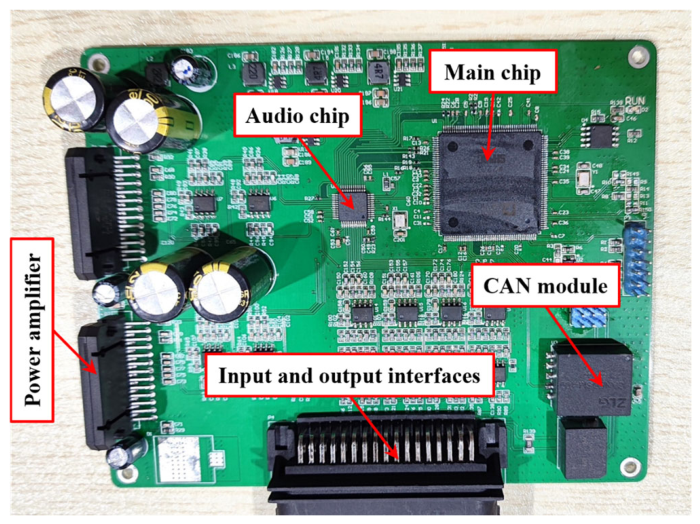
- The proposed system is systematically validated through numerical simulations and real-vehicle DSP experiments, demonstrating improved convergence speed and noise attenuation performance and confirming its potential for practical real-time applications.
2. The Proposed Multi-Channel ANC System
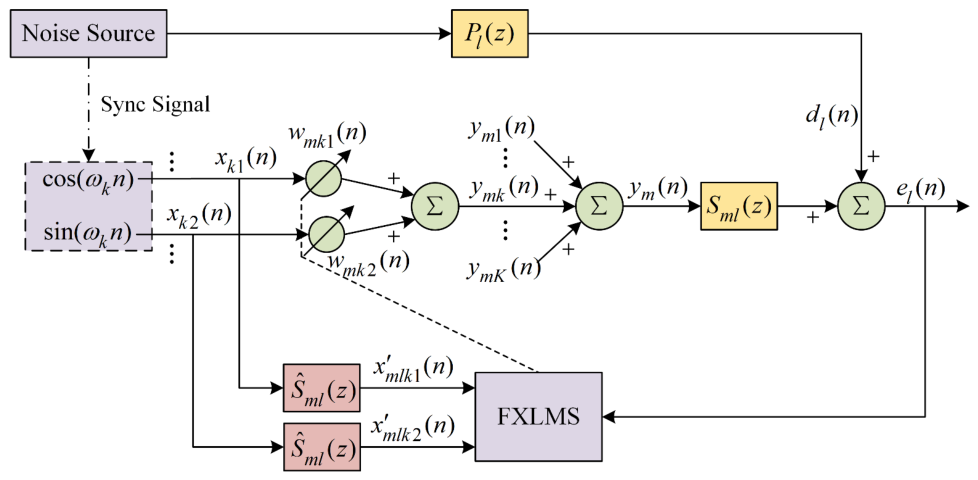
2.1. Multi-Channel Adaptive Notch Filtering
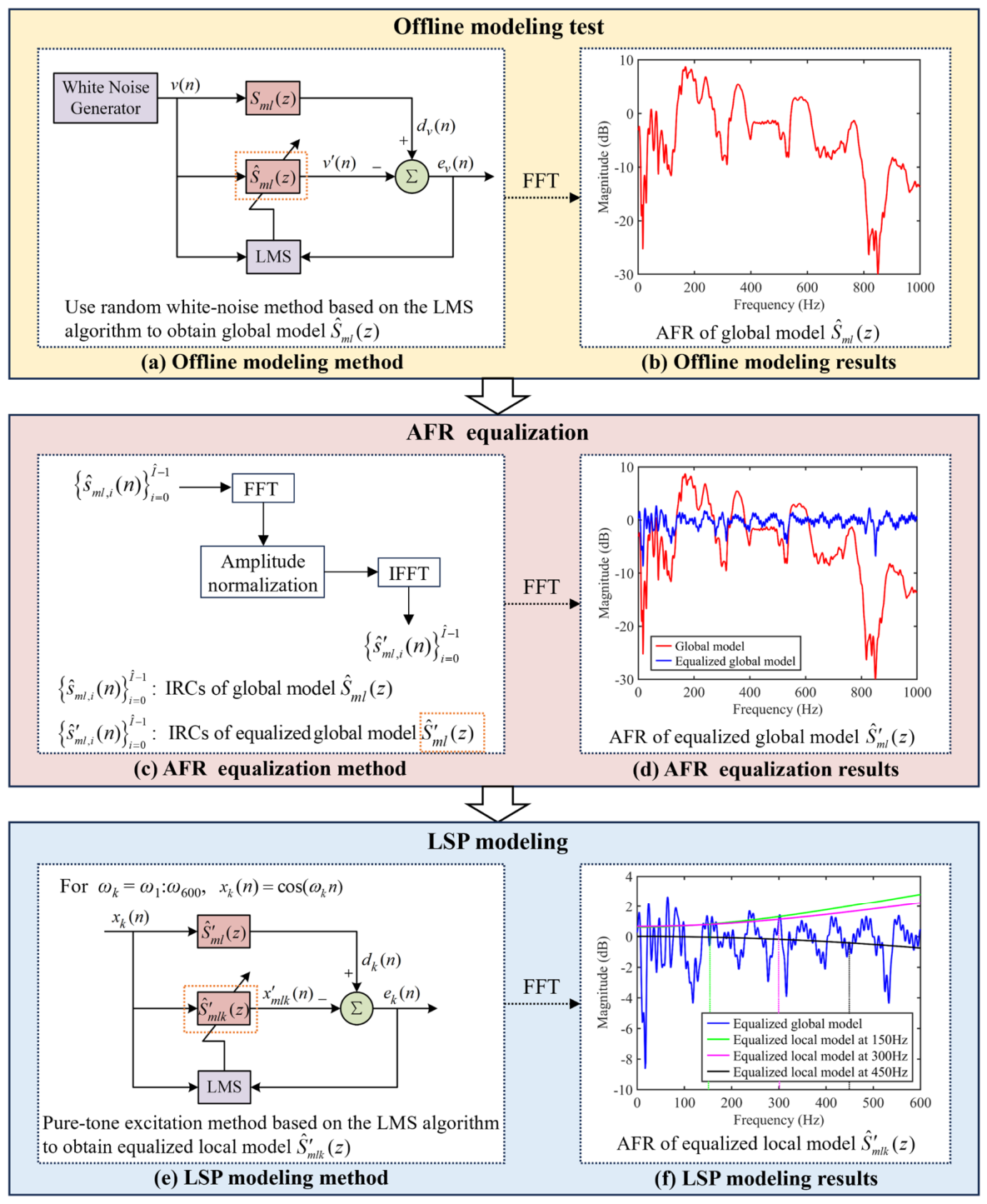
2.2. The LSP Equalization Method
| Algorithm 1. Implementation procedure of the proposed LSP equalization method |
| Input: white-noise excitation v(n), target frequencies {}, global model length , local model length , and LMS step sizes and . Output: Equalized LSP models . a. Offline modeling test: 1: Generate white-noise excitation v(n). 2: Apply v(n) to the secondary path and acquire the corresponding response dv(n) using the error microphone. 3: Initialize the global model . 4: for n = 1, …, N do 5: Calculate the global model output . 6: Calculate the modeling error . 7: Update the global model using the LMS algorithm: . 8: end for b. AFR equalization: 9: Calculate the frequency response of using FFT. 10: Normalize the amplitude spectrum in the frequency domain. 11: Obtain the equalized global model using IFFT. c. LSP modeling: 12: for k = 1, …, 600 do 13: Generate the pure-tone excitation . 14: Generate the desired response . 15: Initialize the local model . 16: for n = 1, …, N do 17: Calculate the local model output . 18: Calculate the error signal . 19: Update the local model using the LMS algorithm: . 20: end for 21: Store the equalized local model . 22: end for |
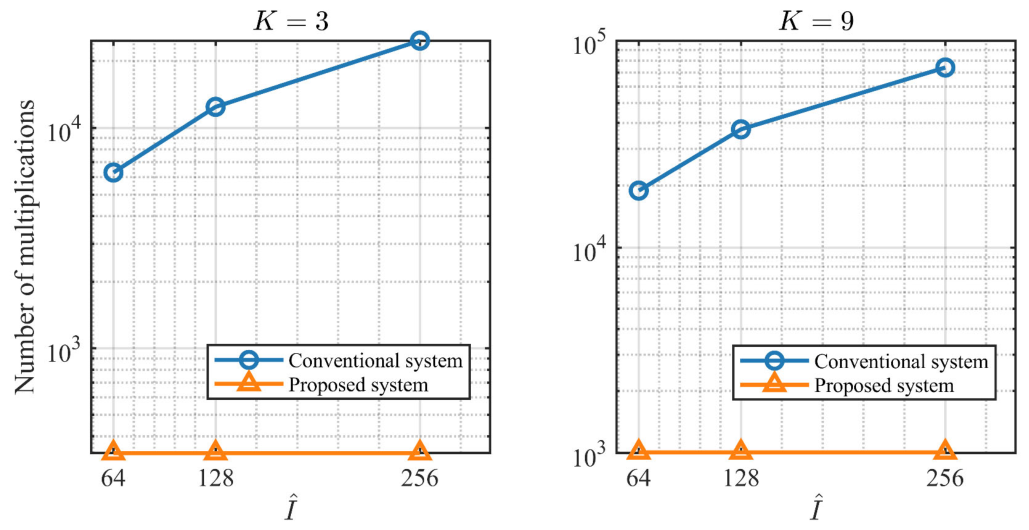
2.3. Computational Complexity Analysis
3. Numerical Simulations
3.1. Influence of Local Model Length on Modeling Accuracy
3.2. Influence of Frequency Resolution on Noise Control Performance
3.3. Active Control of Synthesized Multi-Tonal Noise Signal
3.4. Active Control of Real Interior Engine Noise Signal
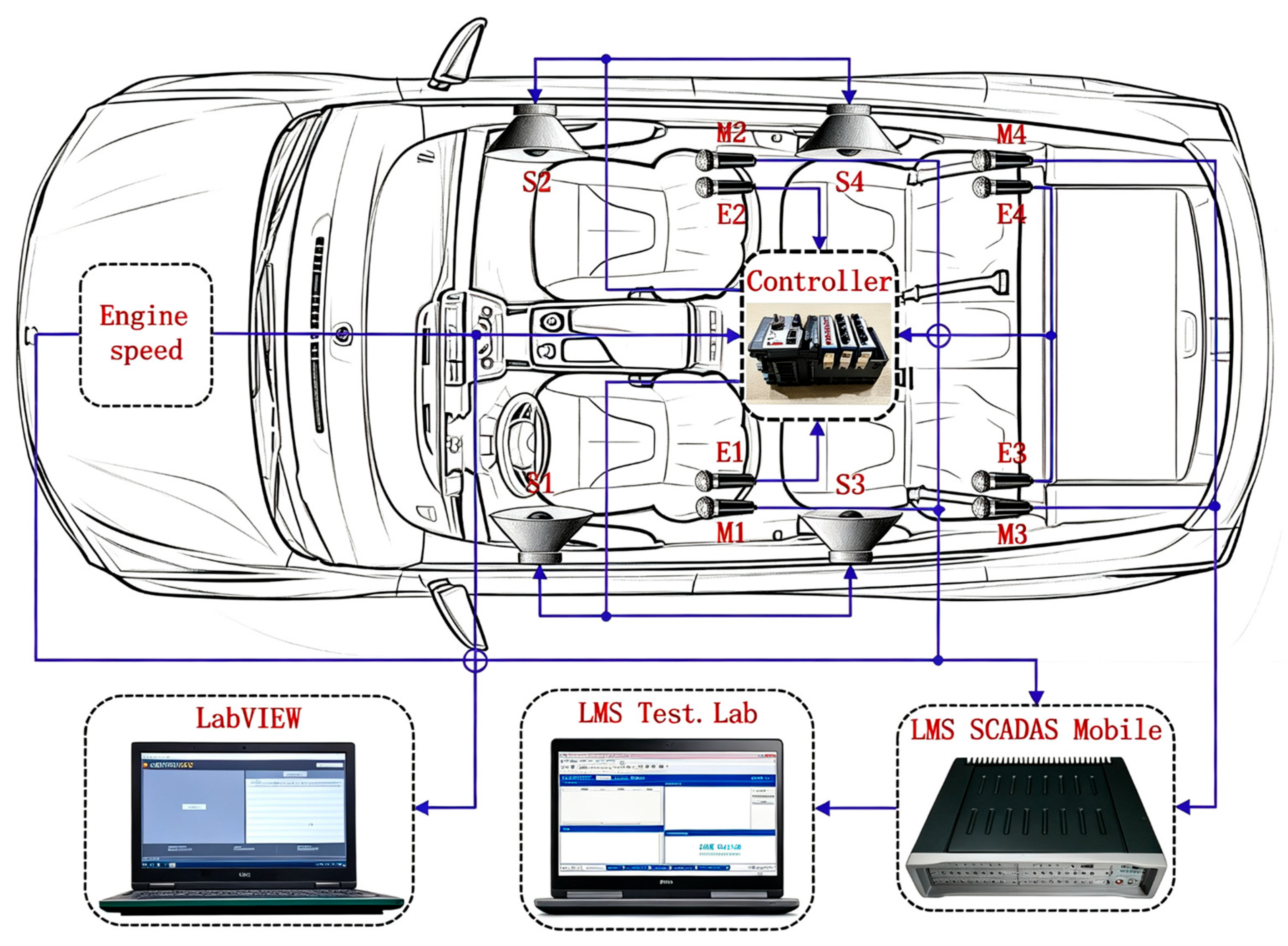
4. DSP Experiments in the Real Vehicle
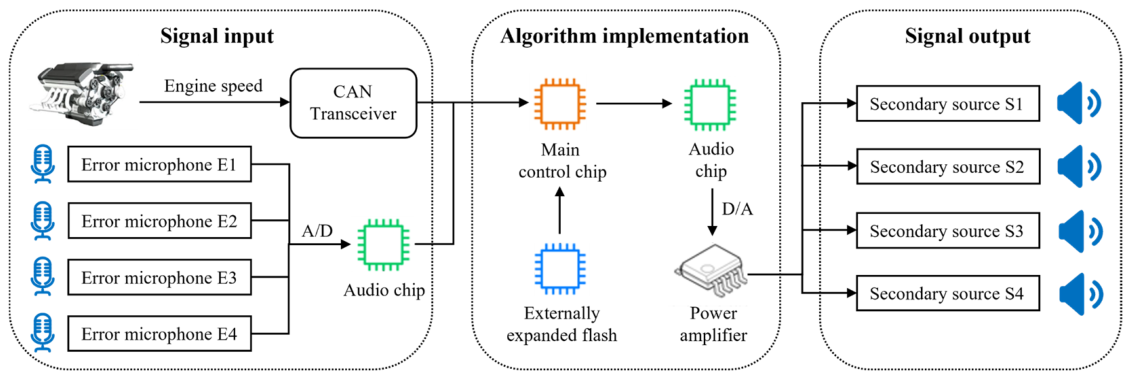
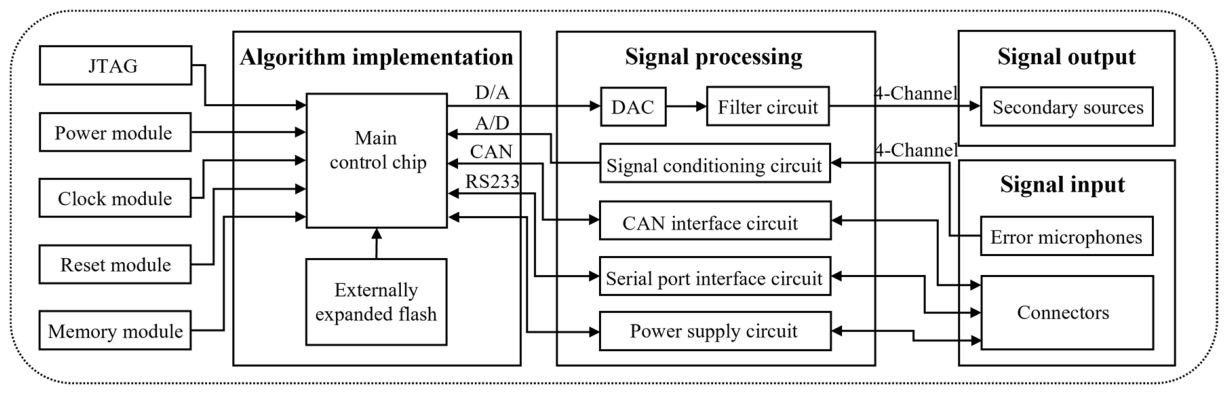
4.1. DSP Controller Design for the Multi-Channel ANC System
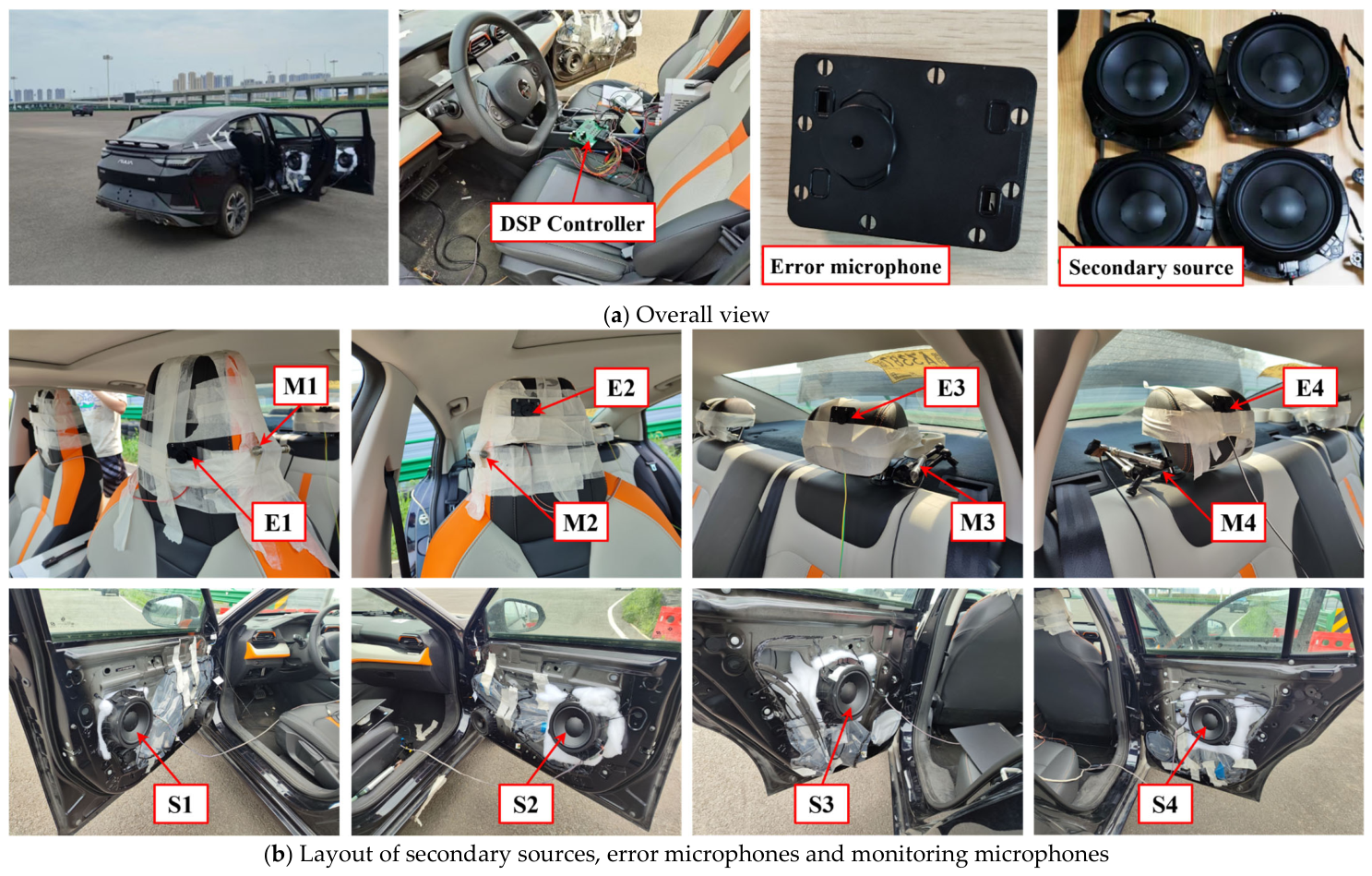
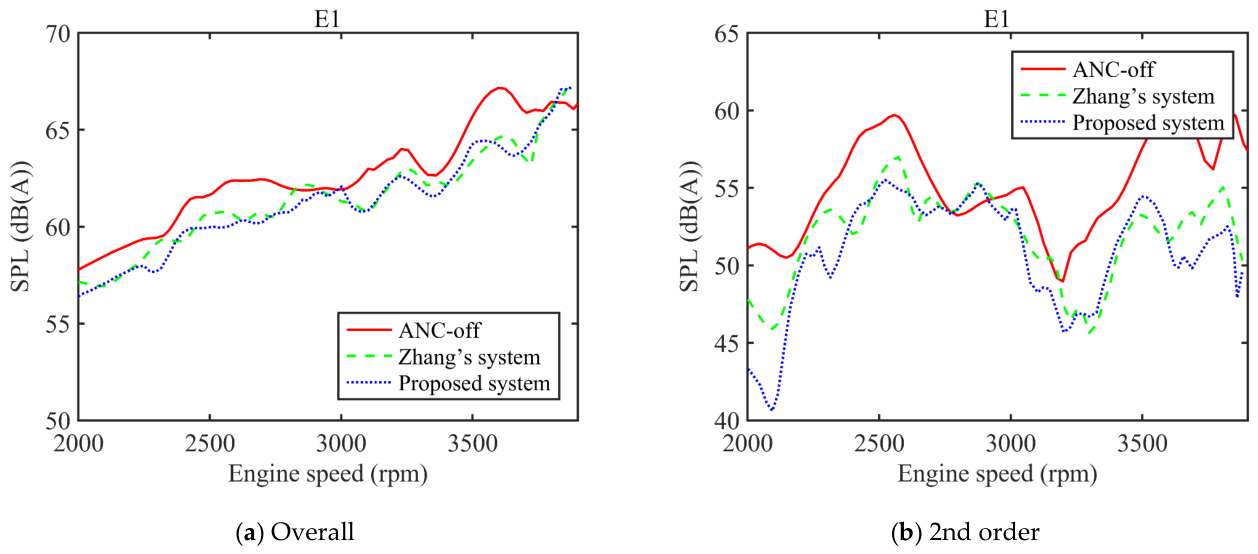
4.2. ANC Experiments and Results Analysis
5. Conclusions
- (1)
- An LSP equalization method is developed by integrating LSP estimation with eigenvalue equalization to generate low-order equalized LSP models with normalized amplitude-frequency responses. The proposed method improves the convergence performance of the multi-channel ANC system while reducing the computational burden.
- (2)
- The proposed system substantially reduces computational complexity. Under the typical conditions considered, the proposed system requires only 1.36% of the multiplication operations of the conventional multi-channel ANC system, demonstrating the effectiveness of the proposed LSP equalization method in reducing computational cost.
- (3)
- Numerical simulations demonstrate improved convergence speed and noise attenuation performance. Compared with the conventional and Zhang’s multi-channel ANC systems, the proposed system achieves faster convergence and superior noise attenuation for both synthesized multi-tonal noise and real interior engine noise.
- (4)
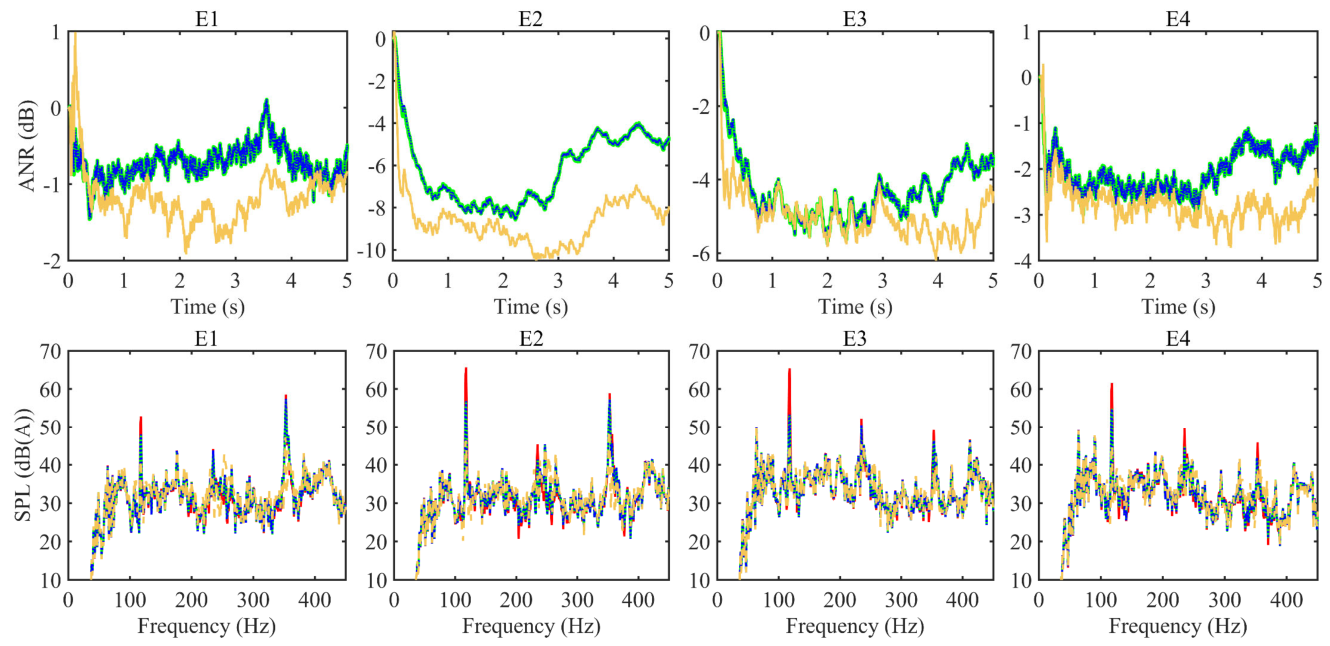
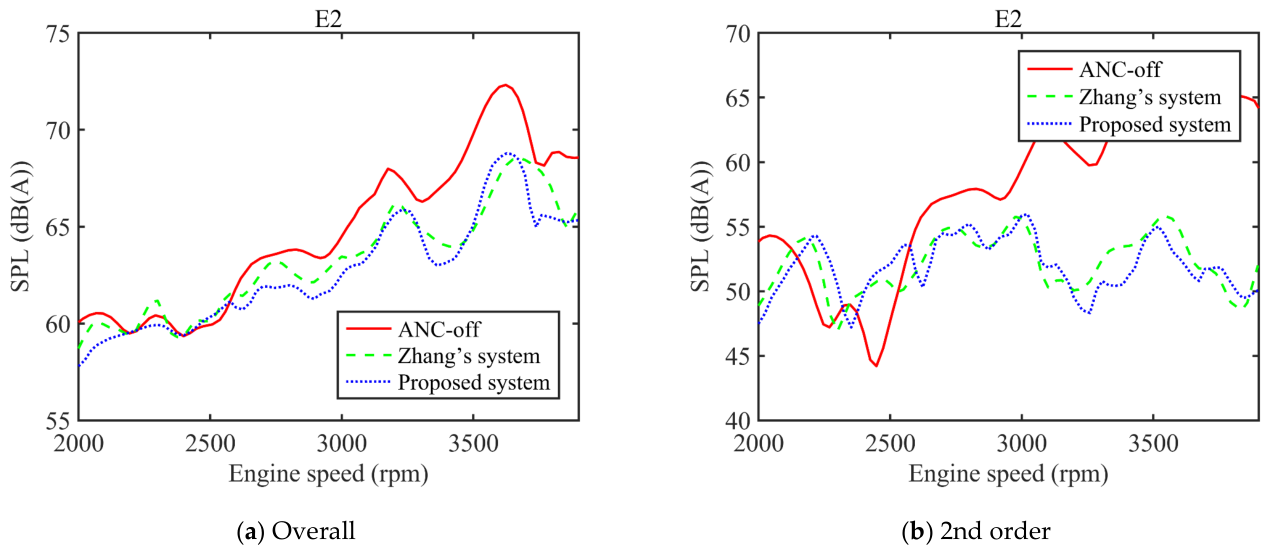
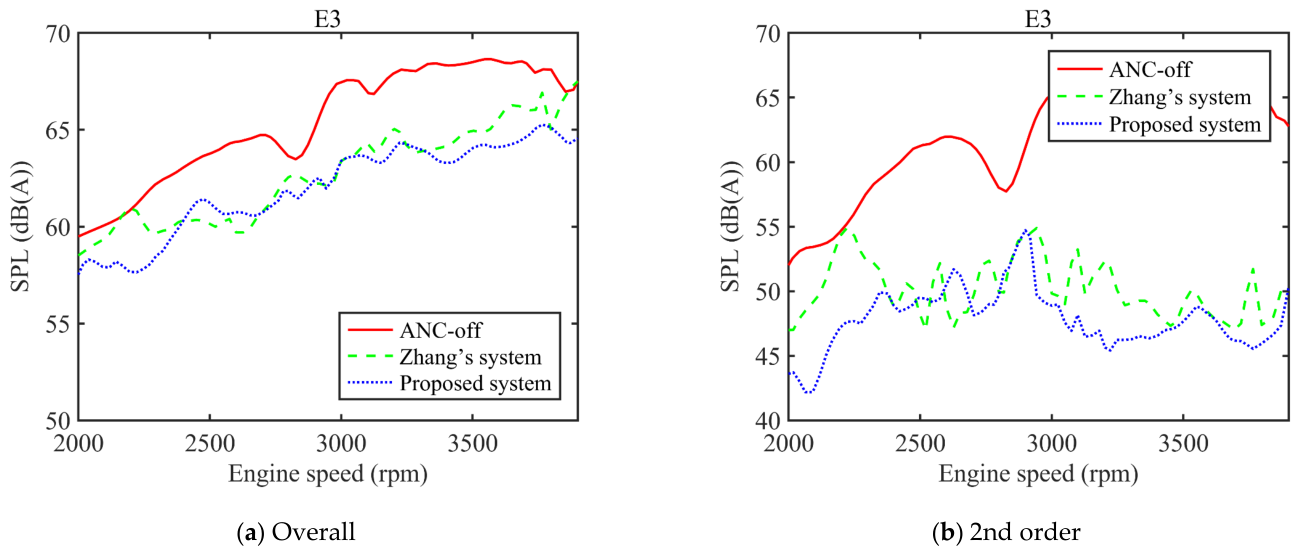
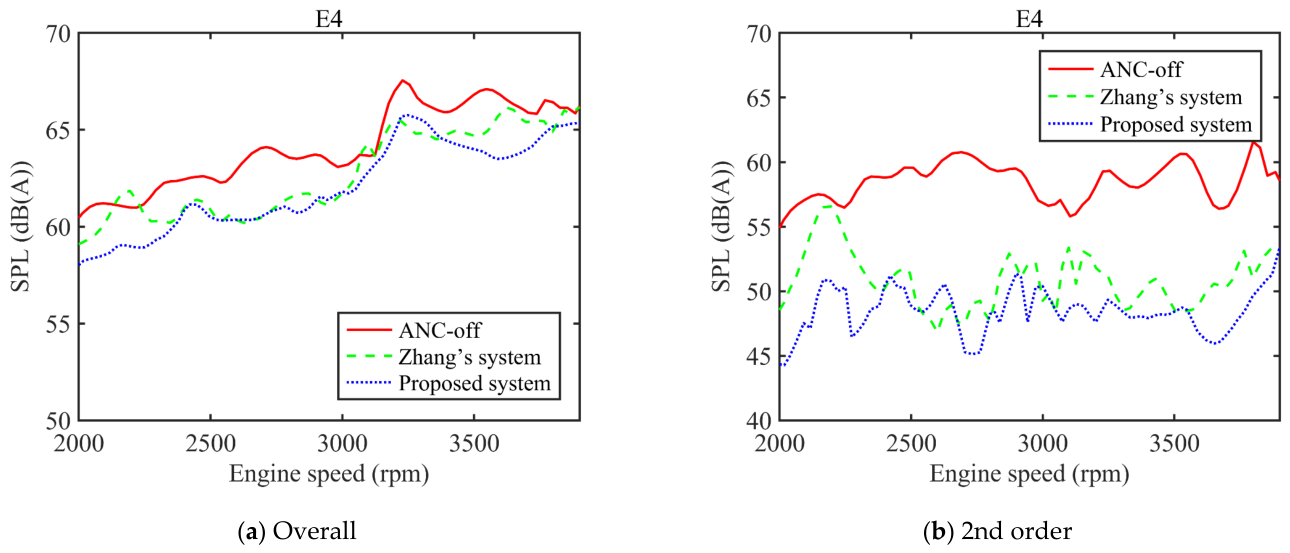
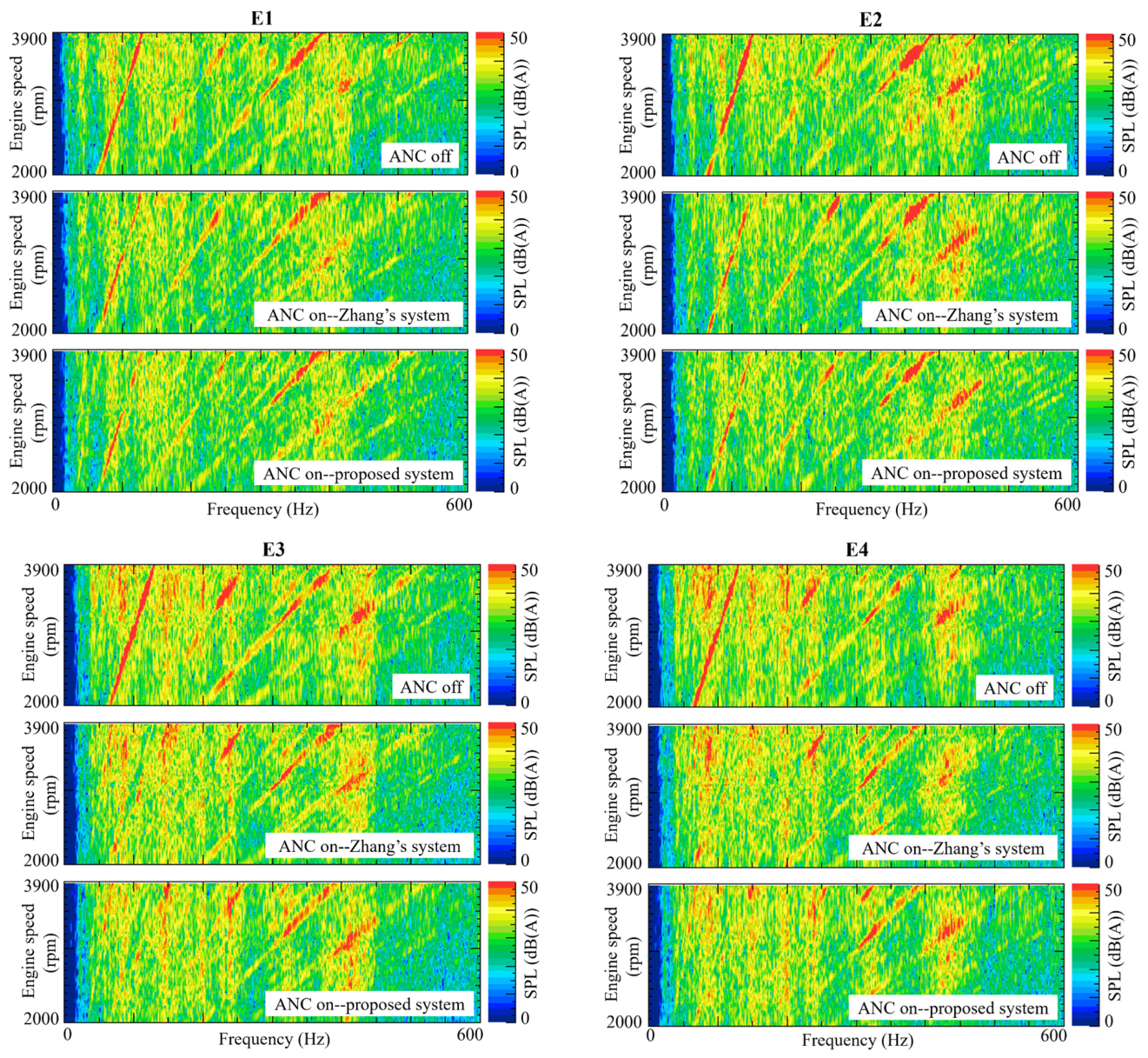
- Real-vehicle experiments validate the practical noise control capability of the proposed system. Under an accelerated operating condition from 2000 rpm to 3900 rpm, the average attenuation of the 2nd-order noise component at the four error microphones reaches 4.4 dB(A), 6.2 dB(A), 13.4 dB(A), and 10.0 dB(A). These results demonstrate effective tracking and attenuation of time-varying engine noise and the potential of the proposed system for practical vehicle cabin noise control.
Author Contributions
Funding
Institutional Review Board Statement
Informed Consent Statement
Data Availability Statement
Acknowledgments
Conflicts of Interest
Abbreviations
| ANC | Active noise control |
| LMS | Least mean square |
| FXLMS | Filtered-X least mean square |
| DSP | Digital signal processing |
| LSP | Local secondary path |
| AFR | Amplitude-frequency response |
| SPL | Sound pressure level |
| ANR | Averaged noise reduction |
| RPM | Revolutions per minute |
| IRC | Impulse response coefficient |
References
- Xu, Q.; Wang, S.; Tao, J.; Zou, H.; Qiu, X. Creating personal sound zones in car cabins with active noise control. Appl. Acoust. 2025, 235, 110670. [Google Scholar] [CrossRef] [Scilit]
- Wang, C.; Li, F.; Zhang, P.; Qiu, X.; Jiang, W.; Wu, S.; Mo, P. Applying Michelson-interferometer based optical fiber sensors for active control of road noise in a car. Appl. Acoust. 2025, 228, 110316. [Google Scholar] [CrossRef] [Scilit]
- Liu, X.; Zheng, X.; Jia, Z.; Li, R.; Wan, B.; Liu, C.; Qiu, Y. A study on multi-channel active sound profiling algorithm for hybrid control of broadband and narrowband noise inside vehicles. Measurement 2024, 237, 115200. [Google Scholar] [CrossRef] [Scilit]
- Cheer, J.; Elliott, S.J. Active noise control of a diesel generator in a luxury yacht. Appl. Acoust. 2016, 105, 209–214. [Google Scholar] [CrossRef] [Scilit]
- Sachau, D.; Jukkert, S.; Hövelmann, N. Development and experimental verification of a robust active noise control system for a diesel engine in submarines. J. Sound Vib. 2016, 375, 1–18. [Google Scholar] [CrossRef] [Scilit]
- Khamis, M.; Zhang, S.; Ibrahim, S. A Synchronized Filter-s Least Mean Square (SFsLMS) algorithm for multi-channel ANC in aviation noise suppression. Appl. Acoust. 2025, 231, 110552. [Google Scholar] [CrossRef] [Scilit]
- Mylonas, D.; Erspamer, A.; Yiakopoulos, C.; Antoniadis, I. A virtual sensing active noise control system based on a functional link neural network for an aircraft seat headrest. J. Vib. Eng. Technol. 2023, 12, 3857–3872. [Google Scholar] [CrossRef] [Scilit]
- Elliott, S.J.; Stothers, I.M.; Nelson, P.A. A multiple error LMS algorithm and its application to the active control of sound and vibration. IEEE Trans. Acoust. Speech Signal Process 1987, 35, 1423–1434. [Google Scholar] [CrossRef] [Scilit]
- Zhang, Q.; Lin, D.; Xiao, Y.; Zheng, Y.; Wang, S. Error reused filtered-X least mean square algorithm for active noise control. IEEE Trans. Audio Speech Lang. Process 2024, 32, 397–412. [Google Scholar] [CrossRef] [Scilit]
- Liu, J.; Wang, Z. A narrowband active noise control system with autoregressive model and linear cascaded adaptive notch filter. Signal Process 2022, 196, 108502. [Google Scholar] [CrossRef] [Scilit]
- Gong, C.; Wu, M.; Guo, J.; Cao, Y.; Zhang, Z.; Yang, J. Modified narrowband active noise control system with frequency mismatch tolerance. Appl. Acoust. 2022, 189, 108598. [Google Scholar] [CrossRef] [Scilit]
- Bai, T.; Kijimoto, S.; Ishikawa, S.; Koba, Y. A new feedforward hybrid active noise control system using an adaptive notch filter bank and its application to fan noise. Appl. Acoust. 2025, 231, 110492. [Google Scholar] [CrossRef] [Scilit]
- Delegà, R.; Bernasconi, G.; Piroddi, L. A novel cost-effective parallel narrowband ANC system with local secondary-path estimation. J. Sound Vib. 2017, 401, 311–325. [Google Scholar] [CrossRef] [Scilit]
- Siswanto, A.; Chang, C.Y. Frequency dependent convergence rate of FXLMS in narrowband active noise control systems. J. Sound Vib. 2025, 604, 118988. [Google Scholar] [CrossRef] [Scilit]
- Xie, R.; Shi, C.; Xiao, H.; Qin, H.; Li, H. A scalable hybrid analog-digital architecture for multi-channel feedforward active noise control. Mech. Syst. Signal Process 2024, 211, 111224. [Google Scholar] [CrossRef] [Scilit]
- Ferrari, C.L.; Cheer, J.; Mautone, M. Investigation of an engine order noise cancellation system in a super sports car. Acta Acust. 2023, 7, 1. [Google Scholar] [CrossRef] [Scilit]
- Simon, B.; Fabbiane, N.; Nemitz, T.; Bagheri, S.; Henningson, D.; Grundmann, S. In-flight active wave cancelation with delayed-x-LMS control algorithm in a laminar boundary layer. Exp. Fluids 2016, 57, 160. [Google Scholar] [CrossRef] [Scilit]
- Xiao, Y. A new efficient narrowband active noise control system and its performance analysis. IEEE Trans. Audio Speech Lang. Process 2011, 19, 1865–1874. [Google Scholar] [CrossRef] [Scilit]
- Zhu, W.; Luo, L.; Xie, A.; Sun, J. A novel FELMS-based narrowband active noise control system and its convergence analysis. Appl. Acoust. 2019, 156, 229–245. [Google Scholar] [CrossRef] [Scilit]
- Luo, L.; Bai, Z.; Zhu, W.; Sun, J. Improved functional link artificial neural network filters for nonlinear active noise control. Appl. Acoust. 2018, 135, 111–123. [Google Scholar] [CrossRef] [Scilit]
- Chang, C.; Kuo, S.M.; Huang, C. Secondary path modeling for narrowband active noise control systems. Appl. Acoust. 2018, 131, 154–164. [Google Scholar] [CrossRef] [Scilit]
- Jeon, H.; Chang, T.; Kuo, S.M. Analysis of Frequency Mismatch in Narrowband Active Noise Control. IEEE Trans. Audio Speech Lang. Process 2010, 18, 1632–1642. [Google Scholar] [CrossRef] [Scilit]
- Chen, W.; Lu, C.; Williams, H.; Liu, Z.; Sun, Y. Development and experimental verification of a new computationally efficient parallel narrowband active noise control system. Appl. Acoust. 2022, 187, 108510. [Google Scholar] [CrossRef] [Scilit]
- Lian, S.; Li, T.; Sun, S.; Wang, S.; Lu, J. A computational-efficient adaptive algorithm based on frequency point selection in multichannel active noise control systems. Mech. Syst. Signal Process 2025, 238, 113176. [Google Scholar] [CrossRef] [Scilit]
- Jia, J.; Chen, S.; Zhao, Y.; Qian, F. A modified active noise control algorithm for convex combined structures based on partial updating of weight matrices. Appl. Acoust. 2025, 228, 110333. [Google Scholar] [CrossRef] [Scilit]
- Zhang, S.; Zhang, L.; Meng, D.; Pi, X. Active control of vehicle interior engine noise using a multi-channel delayed adaptive notch algorithm based on FxLMS structure. Mech. Syst. Signal Process 2023, 186, 109831. [Google Scholar] [CrossRef] [Scilit]
- Kar, A. An intelligent momentum perturbed variable step-size adaptive algorithm for fast converging HNANC systems. Digit Signal Process 2024, 145, 104305. [Google Scholar] [CrossRef] [Scilit]
- Wu, Z.; Yang, J.; Yan, L.; Niu, A. Regularized autocorrelated errors variable step size FxLMS algorithm-based active noise control. IEEE Trans. Ind. Electron. 2025, 73, 4850–4861. [Google Scholar] [CrossRef] [Scilit]
- Nguyen, T.T.T.; Zhang, F.; Na, J.; Nguyen, L.T.; Li, G.; Ahmed, A.A.M. A variable step-size FxLMS algorithm for nonlinear feedforward active noise control. Sensors 2025, 25, 2569. [Google Scholar] [CrossRef] [Scilit]
- Pradhan, S.; Qiu, X.; Ji, J. On time-frequency domain flexible structure of delayless partitioned block adaptive filtering approach for active noise control. Circuits Syst. Signal Process 2023, 42, 7580–7595. [Google Scholar] [CrossRef] [Scilit]
- Li, X.; Lu, C.; Chen, W.; Zhu, Y.; Liu, Z.; Cheng, C.; Sun, M. A computationally efficient multichannel feedforward time-frequency-domain adjoint least mean square algorithm for active road noise control. Appl. Acoust. 2025, 241, 110441. [Google Scholar] [CrossRef] [Scilit]
- Li, X.; Lu, C.; Chen, W.; Liu, Z.; Cheng, C.; Wang, Y.; Du, S. Enhanced selective delayless subband algorithm independent of primary disturbance configuration for multi-channel active noise control system in vehicles. Mech. Syst. Signal Process 2024, 216, 111456. [Google Scholar] [CrossRef] [Scilit]
- Feng, P.; So, H.C. Meta-learning-based delayless subband adaptive filter using complex self-attention for active noise control. Neurocomputing 2025, 650, 130637. [Google Scholar] [CrossRef] [Scilit]
- Zhang, E.; Peng, Z.; Chen, Y.; Chen, Q.; Zhuo, J. An improved Takagi–Sugeon–Kang-based FxLMS algorithm and its active noise control in electric bus driving position. J. Vib. Control 2025, 31, 3831–3844. [Google Scholar] [CrossRef] [Scilit]
- Cheng, C.; Liu, Z.; Chen, W.; Li, X.; Liao, W.; Lu, C. A multi-channel active noise control system using deep learning-based method to estimate secondary path and normalized-clustered control strategy for vehicle interior engine noise. Appl. Acoust. 2025, 228, 110263. [Google Scholar] [CrossRef] [Scilit]
- Oh, J.Y.; Jung, H.W.; Lee, M.H.; Lee, K.H.; Kang, Y.J. Enhancing active noise control of road noise using deep neural network to update secondary path estimate in real time. Mech. Syst. Signal Process 2024, 208, 110940. [Google Scholar]
- Thomas, J.K.; Lovstedt, S.P.; Blotter, J.D.; Sommerfeldt, S.D. Eigenvalue equalization filtered-x algorithm for the multichannel active noise control of stationary and nonstationary signals. J. Acoust. Soc. Am. 2008, 123, 4238–4249. [Google Scholar] [CrossRef] [Scilit]
- Lee, S.W.; Lee, S.; Back, J.; Shin, T. A new method for active cancellation of engine order noise in a passenger car. Appl. Sci. 2018, 8, 1394. [Google Scholar] [CrossRef] [Scilit]
- Kim, S.; Altinsoy, M.E. Comprehensive active control of booming noise inside a vehicle caused by the engine and the driveline. IEEE Access 2022, 10, 49725–49737. [Google Scholar] [CrossRef] [Scilit]
- Chen, W.; Lu, C.H.; Liu, Z.E.; Williams, H.; Xie, L. A computationally efficient active sound quality control algorithm using local secondary-path estimation for vehicle interior noise. Mech. Syst. Signal Process 2022, 168, 108698. [Google Scholar] [CrossRef] [Scilit]
- Chen, W.; Xie, L.; Guo, J.; Liu, Z.E.; Li, X.; Lu, C.H. A computationally efficient feedforward time-frequency-domain hybrid active sound profiling algorithm for vehicle interior noise. Mech. Syst. Signal Process 2023, 194, 110279. [Google Scholar] [CrossRef] [Scilit]
- Guo, Y.; Chen, M.; Geng, Z.; Xue, L.; Xie, X. Improved filtered-s least mean square/fourth algorithm for nonlinear active noise control system. Appl. Acoust. 2025, 227, 110213. [Google Scholar] [CrossRef] [Scilit]





| System | Computational Procedure | Computational Expression | Multiplications |
|---|---|---|---|
| Conventional | Controller output | ||
| Reference filtering | |||
| Weight updating | |||
| Total | |||
| Zhang’s | Controller output | ||
| Reference filtering | Offline: , Online: | ||
| Weight updating | |||
| Total | |||
| Proposed | Controller output | ||
| Reference filtering | |||
| Weight updating | |||
| Total |
| 100 Hz | 200 Hz | 300 Hz | 400 Hz | ||||||
|---|---|---|---|---|---|---|---|---|---|
| Magnitude (dB) | Phase (Degree) | Magnitude (dB) | Phase (Degree) | Magnitude (dB) | Phase (Degree) | Magnitude (dB) | Phase (Degree) | ||
| Global model length | 256 | 0.41 | −293.74 | −0.86 | −582.97 | 0.95 | −835.58 | 1.31 | −1027.96 |
| Local model length | 2 | 0.39 | −293.15 | −0.84 | −582.84 | 0.96 | −835.79 | 1.30 | −1027.72 |
| 5 | 0.40 | −294.30 | −0.88 | −582.60 | 0.94 | −835.34 | 1.32 | −1027.99 | |
| 8 | 0.42 | −293.37 | −0.87 | −582.75 | 0.95 | −835.21 | 1.31 | −1027.90 | |
| Conventional System | Zhang’s System | Proposed System | |||||||
|---|---|---|---|---|---|---|---|---|---|
| 2nd Order | 4th Order | 6th Order | 2nd Order | 4th Order | 6th Order | 2nd Order | 4th Order | 6th Order | |
| E1 | 4.9 | 0.4 | 1.1 | 4.9 | 0.4 | 1.1 | 11.6 | 7.8 | 12.9 |
| E2 | 8.8 | 4.0 | 1.6 | 8.9 | 4.0 | 1.6 | 19.4 | 8.1 | 12.4 |
| E3 | 12.2 | 1.9 | 2.8 | 12.1 | 1.7 | 2.8 | 20.2 | 6.9 | 11.1 |
| E4 | 6.8 | 4.8 | 4.0 | 6.8 | 4.8 | 4.0 | 16.6 | 13.5 | 6.8 |
| Conventional System | Zhang’s System | Proposed System | |
|---|---|---|---|
| Model length | |||
| Iteration time | 0.35 ms | 0.03 ms | 0.03 ms |
| Zhang’s System | Proposed System | |||||||
|---|---|---|---|---|---|---|---|---|
| Overall | 2nd Order | 4th Order | 6th Order | Overall | 2nd Order | 4th Order | 6th Order | |
| E1 | 1.1 | 3.3 | −0.1 | 1.9 | 1.3 | 4.4 | 0.1 | 1.6 |
| E2 | 1.5 | 6.0 | −0.7 | 1.7 | 2.1 | 6.2 | 0.1 | 1.9 |
| E3 | 2.7 | 11.0 | 2.1 | 1.7 | 3.4 | 13.4 | 2.4 | 3.9 |
| E4 | 1.4 | 7.7 | 1.5 | −0.4 | 2.1 | 10.0 | 1.3 | 1.4 |
Disclaimer/Publisher’s Note: The statements, opinions and data contained in all publications are solely those of the individual author(s) and contributor(s) and not of MDPI and/or the editor(s). MDPI and/or the editor(s) disclaim responsibility for any injury to people or property resulting from any ideas, methods, instructions or products referred to in the content. |
© 2026 by the authors. Licensee MDPI, Basel, Switzerland. This article is an open access article distributed under the terms and conditions of the Creative Commons Attribution (CC BY) license.
Share and Cite
Liang, J.; Li, X.; Chen, W.; Wang, T.; He, S.; Liu, Z.; Lu, C. Development and DSP Implementation of an Optimized Multi-Channel Active Control System for Vehicle Interior Engine Noise Using Local Secondary Path Equalization. Appl. Sci. 2026, 16, 8436. https://doi.org/10.3390/app16178436
Liang J, Li X, Chen W, Wang T, He S, Liu Z, Lu C. Development and DSP Implementation of an Optimized Multi-Channel Active Control System for Vehicle Interior Engine Noise Using Local Secondary Path Equalization. Applied Sciences. 2026; 16(17):8436. https://doi.org/10.3390/app16178436
Chicago/Turabian StyleLiang, Jingqiang, Xiaolong Li, Wan Chen, Tao Wang, Shumo He, Zhien Liu, and Chihua Lu. 2026. "Development and DSP Implementation of an Optimized Multi-Channel Active Control System for Vehicle Interior Engine Noise Using Local Secondary Path Equalization" Applied Sciences 16, no. 17: 8436. https://doi.org/10.3390/app16178436
APA StyleLiang, J., Li, X., Chen, W., Wang, T., He, S., Liu, Z., & Lu, C. (2026). Development and DSP Implementation of an Optimized Multi-Channel Active Control System for Vehicle Interior Engine Noise Using Local Secondary Path Equalization. Applied Sciences, 16(17), 8436. https://doi.org/10.3390/app16178436