Article

Effects of Flag Carriage on Running Performance, Physiological Responses, and Repeated-Sprint Ability in Soccer Assistant Referees


1
School of Human Movement and Sport Sciences, The Levinsky-Wingate Academic College (Wingate Campus), Netanya 4290200, Israel
2
Department of Physical Education, The Research Center for Sports and Physical Activity, Tel Hai University of Kiryat Shmona in the Galilee, Kiryat Shmona 1220800, Israel
3
Department of Physical Education and Sports, Faculty of Education and Sport, University of the Basque Country, 01007 Vitoria-Gasteiz, Spain
*
Authors to whom correspondence should be addressed.
These authors contributed equally to this work.
Appl. Sci. 2026, 16(17), 8378; https://doi.org/10.3390/app16178378
Submission received: 14 May 2026 / Revised: 12 August 2026 / Accepted: 20 August 2026 / Published: 23 August 2026

Abstract

Referees and assistant referees play a central role in enforcing the Laws of the Game during matches. The main referee holds ultimate responsibility, while assistant referees monitor offside situations, signal fouls outside the referee’s line of sight, and assist with decisions on corner kicks, free kicks, and other restarts. Throughout the match, assistant referees use short flags to communicate standardized signals to the referee, making effective coordination essential for accurate match management. This study used a crossover design to examine the effect of flag use on repeated-sprint performance among 37 soccer assistant referees (19 Premier League and 18 National League) in Israel, assessed using a modified change-of-direction (CODA) protocol. The evaluated measures included total sprint time (TST), ideal time, percentage decrement in performance (PD), average heart rate, and subjective rating of perceived exertion (RPE). Statistical analysis revealed significant differences between conditions. Performance was better without the flag in both total sprint time (p < 0.05, d = 0.55) and ideal time (p < 0.05, d = 0.62). The percentage decrement was higher in the no-flag condition (p < 0.05). Higher heart rate (p < 0.05, d = 1.49) and higher RPE (p < 0.01) were also recorded. These findings suggest that flag carriage may constrain sprint performance during repeated change-of-direction tasks and should be considered in the physical testing and preparation of soccer assistant referees.

1. Introduction

Soccer is widely regarded as one of the most popular and influential sports worldwide. The game is characterized by continuous movement, frequent changes in speed and direction, repeated high-intensity actions, tactical variability, and rapid transitions between offensive and defensive phases [1,2,3]. Referees and assistant referees are required to maintain optimal positioning throughout the match, follow the rhythm of play, monitor multiple players and events simultaneously, and make accurate decisions under time pressure. These decisions may include foul recognition, penalty situations, disciplinary actions, offside judgments, and other critical match events [3]. Therefore, the role of the match official combines sustained physical effort with high cognitive load. From a physiological perspective, soccer referees are exposed to prolonged intermittent activity, including walking, jogging, running, sprinting, acceleration, deceleration, and repeated changes of direction [4]. These demands require aerobic fitness, repeated-sprint ability, speed endurance, and the capacity to recover between intense actions. Assistant referees face a different but equally specific movement profile, which includes repeated lateral movements, short accelerations, rapid changes in direction, and the need to maintain alignment with the second-last defender during attacking phases [5,6]. In addition, assistant referees usually perform these actions while carrying a flag, which is used as an essential communication tool during match play. As a result, both referees and assistant referees require sport-specific physical preparation that reflects the unique movement demands of their roles. Match officials must also process visual information quickly, divide attention across multiple sources, and make decisions within short time frames—demands that are intensified by match tempo, player behavior, crowd pressure, and fatigue [7]. Within this context, the assistant referee’s flag should be considered a task-specific factor that may influence movement execution during match-related running actions [8,9,10]. Although the flag is primarily used for standardized communication with the main referee, it is carried during positioning, rapid accelerations, and repeated-sprint efforts. Therefore, flag use may affect arm swing, upper-body coordination, balance, and running mechanics, particularly during high-intensity actions [7]. Despite its routine use in soccer officiating, the potential influence of flag use on repeated-sprint performance has received limited research attention. Specifically, the biomechanical and physiological effects of flag carriage during repeated change-of-direction sprints remain poorly understood; the hypothesized mechanisms include constrained arm swing, altered trunk rotation, and disrupted bilateral symmetry [11,12,13]. The present study differs from prior work by using a controlled crossover protocol with a modified CODA test and by directly comparing physiological and performance outcomes within the same participants, thereby supporting the development of more specific training programs, testing protocols, and professional preparation strategies for soccer assistant referees [7].

1.1. Physical Fitness Among Assistant Referees

In recent years, technological advancements in monitoring and performance analysis have contributed significantly to improved physical preparation among athletes across ball games, including soccer. Physical fitness is a key determinant of performance not only among players but also among referees [14]. There are substantial differences in aerobic capacity between soccer players and referees. Referees must maintain high aerobic fitness to cover the substantial total distances required during a match, in addition to performing repeated high-intensity efforts [11,15]. According to a literature review by Castagna et al. [16], conducted across multiple international and domestic leagues, main referees typically cover 9–13 km during a single match. Differences were identified between referees in top-tier international leagues and those in lower-level competitions. Scientific monitoring has demonstrated increased physical demands on referees over time, with similar trends observed among assistant referees. Historically, assistant referees were grouped and tested alongside referees, but research by Mallo et al. [15] suggests that assistant referees should be considered a distinct population due to the unique physical demands of their role. Key fitness components required for modern assistant referees include agility, explosive power, speed, and rapid changes of direction. Their movement is dictated by positioning in line with the second-last defender of the defending team. Thus, assistant referees must combine aerobic and anaerobic capacity. Change-of-direction ability, as assessed by the CODA test, has been shown to differentiate higher-level assistant referees from lower-level officials [7]. Studies by Krustrup et al. [6] and Mallo et al. [11] reported that assistant referees cover approximately 6–7 km per match, with 16–20% of this distance classified as high-intensity activity. Gómez-Carmona and Pino-Ortega [17] categorized assistant referees’ movement into five speed zones: standing (0–3.6 km/h), walking (3.6–7.2 km/h), jogging (7.2–13 km/h), cruising (13–18 km/h), and sprinting (>18 km/h). Assistant referees covered 6.0–6.5 km per match, with greater distances in the second half. Movement distribution was: standing 27%, walking 26.5%, jogging 25.9%, cruising 13.1%, and sprinting 7.5%. In contrast, Mallo et al. [15] found that assistant referees covered approximately 5.7 km, with more distance accumulated in the first half. Their activity profile was: standing 48.3%, walking 24.6%, jogging 16.6%, cruising 6.1%, and sprinting 4.4%. Two major factors influence the running volume and intensity of assistant referees: ball location (movement and distance of ball travel) and tournament quality. Moreover, unlike players and referees, assistant referees frequently use lateral running, which accounts for approximately 26% of total distance covered [9]. Match quality significantly affects physical demands: in top-tier competitions, assistants ran up to 2.5 times more compared to U-17 tournaments. These findings underscore the importance of repeated-sprint and maximal-tempo training for assistant referees [9].

1.2. Fitness Tests for Assistant Referees

Historically, the Cooper test was used to assess aerobic capacity among referees and assistant referees [7,18]. However, the increased pace of modern soccer and improved physical capacities of players have made it evident that referees require not only aerobic fitness but also rapid sprinting ability, frequent changes of direction, and rapid acceleration and deceleration [11,15]. The Cooper test—requiring continuous 12 min running—does not reflect the specific physical demands placed on soccer referees and is therefore not an appropriate measure of refereeing fitness [7]. Consequently, sport scientists emphasized the need for position-specific fitness assessments that evaluate abilities such as change of direction and repeated sprinting. Customized tests were developed, including change-of-direction assessments and repeated-sprint tests, which more accurately capture the intermittent, high-intensity demands of soccer officiating [19]. FIFA subsequently introduced a new interval-based fitness test to replace the Cooper test. The test consists of repeated high-intensity 150 m runs followed by 50 m active recovery walks. Each run must be completed within 30 s, with recovery limited to 40 s, across 10 laps of a standard 400 m track (4000 m total) [7]. These tests have undergone several revisions and adaptations. In Israel, fitness tests vary between top-tier referees (Premier League and National League) and those officiating in lower divisions. The following are the fitness tests currently used for National League and Premier League assistant referees:
  • The Current FIFA Test—divided into two parts:
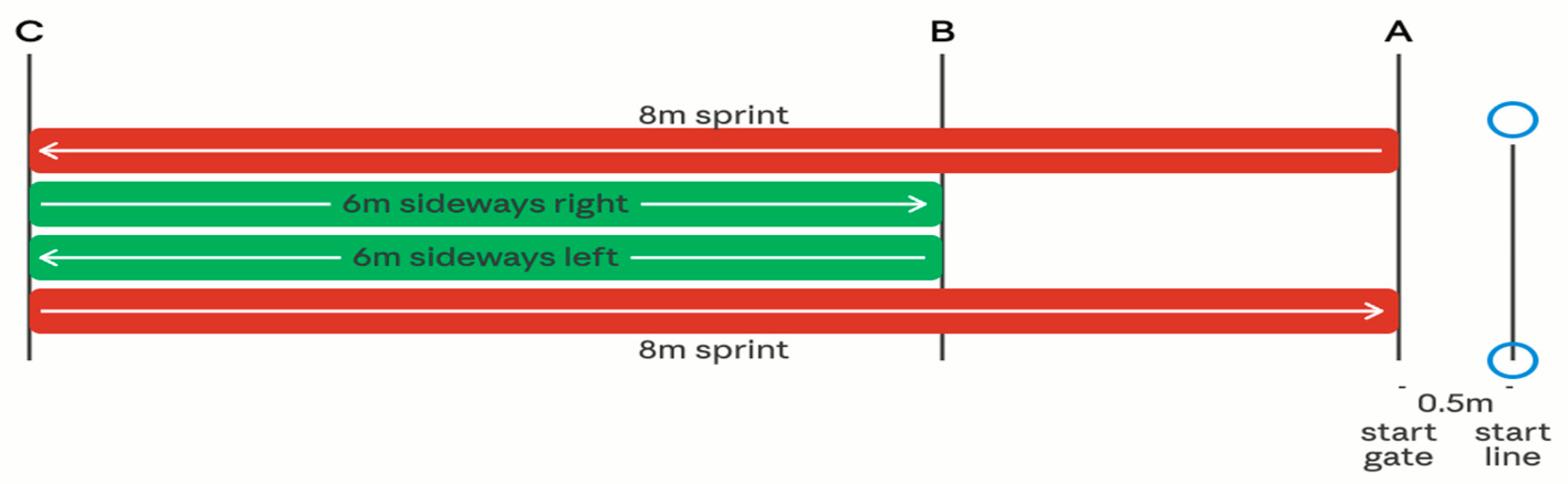
    Part A: Anaerobic Assessment (CODA Test)—includes a 10 m sprint, 8 m lateral shuttle (out and back), and another 10 m sprint, totaling approximately 10 s.
    Part B: Interval Test—4 km divided into 40 segments alternating between running (75 m in 30 s) and brisk walking (25 m in 40 s). One 400 m lap consists of four such segments, totaling ten laps. Examiners are stationed at the end of each fourth segment to ensure adherence to time requirements [7].
  • Penalty-Area Test—repeated 72 m intervals with equal run-rest time.
    The test has three stages:
    Stage A: One 15 s run followed by 15 s rest, repeated 12 times.
    Stage B: One 30 s out-and-back run followed by 30 s rest, repeated 5 times.
    Stage C: A longer 45 s segment followed by 45 s rest, repeated 3 times.
  • Yo-Yo Test (Assistant Referee Version)—an intense intermittent fitness test with recovery intervals. Assistant referees perform a modified version incorporating lateral running between stages. The structure includes a 20 m out-and-back run followed by a 12.5 m lateral shuttle. The required performance speed is 16.4 km/h [20].

1.3. Research Aim

The present study aimed to examine the effect of flag use on repeated-sprint performance among soccer assistant referees from the Israeli League Division 1 and Division 2. In addition, the study assessed differences in heart rate responses and ratings of perceived exertion (RPE) during running tasks performed with and without the flag. Although soccer officiating also involves substantial cognitive demands, the present study focused specifically on physical performance, physiological responses, and perceived exertion. By examining these outcomes, the study sought to determine whether flag use represents a task-specific factor that should be considered in the physical testing and preparation of soccer assistant referees.

2. Methodology

2.1. Participants

The study population consisted of 37 male assistant referees: 19 from the Premier League and 18 from the National League. The Premier League is Israel’s top professional soccer league, whereas the National League represents the second-highest competitive tier under the Israel Football Association. The mean physical characteristics of the assistant referees were as follows: age: 29 ± 3.4 years, height: 178 ± 6 cm, body mass: 68.22 ± 10.45 kg, body fat percentage: 14.67% ± 4.86%, and league seniority: 3.11 ± 1.45 years. Training routines for assistant referees include aerobic and anaerobic sessions performed 1–2 times per week. The referees undergo 5–6 fitness tests throughout the competitive season, including one pre-season assessment. In addition, they are evaluated by a sports nutritionist three times per year, including measurements of body mass, height, and body fat percentage. Inclusion criteria required active registration with the Israel Football Association at the Premier League or National League level and the absence of injury at the time of testing; participants were excluded if they had sustained a musculoskeletal injury within the six weeks prior to testing. All participants were right-handed and held the flag in their right hand, consistent with standard Israeli FA officiating protocol, and all were familiarized with the modified CODA protocol prior to the first testing session. This study is distinct from a preliminary study by our group that used a smaller sample from a different competitive tier, the standard CODA protocol, and performance–time outcomes only; the present sample, protocol, and outcome measures are independent and have not been previously published.

2.2. Procedure

The testing sessions for this study were conducted on four separate dates. Data collection for the Premier League assistant referees took place during their routine training session, and likewise for the National League assistants. To ensure homogeneity during data collection, all tests were performed at the National Teams Center in Shefayim, with a two-week interval between testing dates, at the same hour of the day, and under identical weather conditions (18–20 °C). Within each league group, participants were randomly assigned to condition order using a computer-generated allocation sequence (SPSS random number generator) and divided into two groups accordingly. Each group completed the testing protocol twice, with and without the flag, in a crossover manner. To control for potential order effects, condition order was counterbalanced such that approximately half of each group began with the flag condition and the other half without. All testing sessions were conducted on the same day of the training week (Tuesday) to minimize variation in weekly fatigue. Participants were instructed in writing to refrain from strenuous physical activity for 48 h prior to each testing session. No significant order or learning effects were anticipated given the two-week washout interval and the participants’ extensive familiarity with sprint-based fitness testing.
The first group completed the test without a flag and repeated it two weeks later with a flag. The second group performed the test with a flag on the first occasion and without a flag two weeks later. All tests were performed in standard training attire. The study applied an experimental manipulation to the CODA fitness test (Figure 1) typically administered once per season. The CODA test assesses agility and change-of-direction ability and consists of a 10 m sprint, followed by 8 m of lateral running (out and back), and concluding with another 10 m sprint [7]. This test reflects essential performance demands placed on assistant referees.

Modified CODA Test

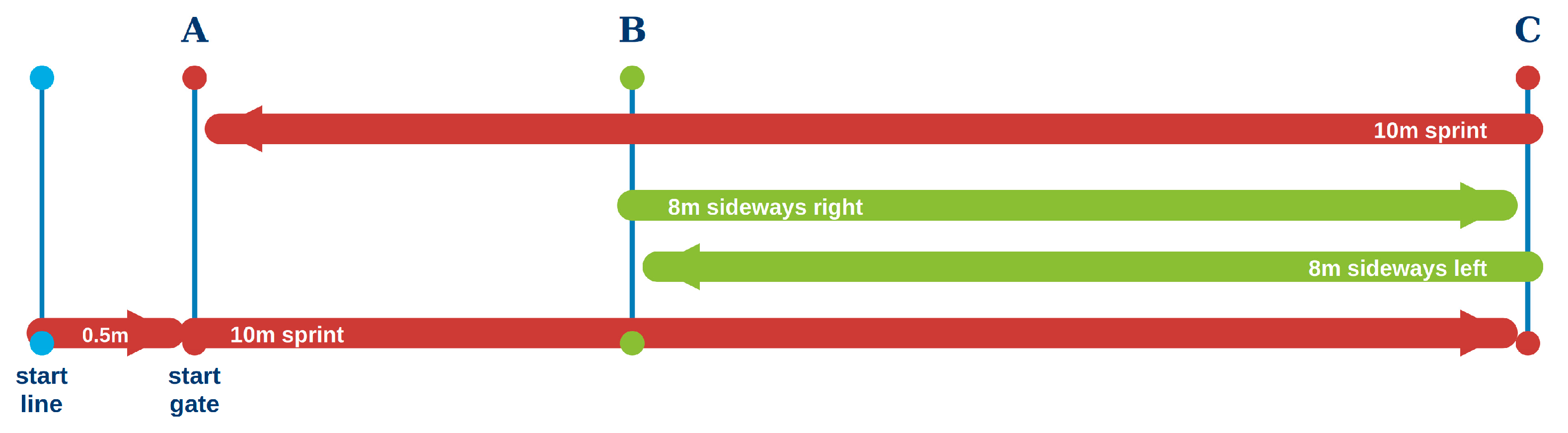
The original CODA test comprises a 10 m sprint, 8 m of lateral running (out and back), and another 10 m sprint. In the present study, the CODA protocol was modified (Figure 2) to include shorter segment distances. The new test consisted of:
  • An 8 m sprint from point A to point C;
  • A 6 m lateral run (out and back) in the opposite direction of the sprint;
  • A second 8 m sprint from point B back to point A.
This resulted in a total distance of 22 m per repetition, performed for 6 repetitions.
The distances were shortened relative to the standard FIFA CODA protocol (10 m sprint + 8 m lateral out-and-back + 10 m sprint = 28 m total) in order to allow six complete repetitions with one-minute recovery intervals within a single training session, while preserving the sprint–lateral–sprint structure of the original test and increasing the relative proportion of change-of-direction demands within a shorter total distance, more closely mirroring the burst-type accelerations characteristic of assistant referee positioning along the touchline. The modified protocol has not been independently validated in a separate publication, which is acknowledged as a limitation (see Study Limitations). As part of the familiarization session, participants completed practice trials under each condition, and intra-session test–retest reliability was assessed in a subset of 10 participants (ICC = 0.91, 95% CI: 0.83–0.96).
Additional procedural details:
  • A 1 min recovery period was provided between repetitions, continuing until all participants completed the 6 repetitions.
  • Participants self-initiated each repetition, with electronic timing gates positioned at the start and finish lines.
The flag used was a standard FIFA-approved assistant referee flag (fabric dimensions: 30 × 40 cm; handle length: 45 cm; total mass: approximately 120 g). All participants held the flag in their right hand, consistent with standard Israeli FA officiating protocol, and were instructed to hold it in a natural, relaxed position at their side (not raised) during running, as is typical during non-signaling phases of match play; arm position was not additionally constrained beyond this instruction in order to preserve ecological validity. Lateral movement direction was standardized so that all participants performed the lateral shuttle in the same direction relative to the flag hand across both conditions, and this direction was counterbalanced across participants.
Three outcome variables were derived from the repeated-sprint protocol. Total sprint time (TST) is defined as the sum of the six individual sprint repetition times, excluding the one-minute recovery intervals between repetitions, expressed in seconds. Ideal time is defined as the fastest individual repetition time multiplied by the number of repetitions (6), representing the theoretical best performance sustained across all sprints. Percentage decrement (PD) is calculated as PD (%) = [(TST/Ideal Time) − 1] × 100, where higher values indicate a greater performance decrement across repetitions. These terms—total sprint time (TST), ideal time, and percentage decrement (PD)—are used consistently throughout the manuscript in place of earlier, less precise labels such as total duration, fatigue percentage, and RST%.

2.3. Measuring Tools

Running times were measured using Microgate Witty-GATE® (Bolzano, Italy) infrared timing gates (sampling rate: 1/1000 s), positioned at the start and finish lines of each sprint segment and calibrated prior to each testing session according to the manufacturer’s protocol. Witty-GATE® systems utilize advanced sensor technology to detect motion onset with high temporal precision, ensuring reliable measurement of sprint times.
Heart rate was monitored continuously using Garmin (International Inc., Olathe, KS, USA) HRM-Pro chest strap monitors; mean heart rate was recorded over the final 30 s of each repetition and averaged across all six repetitions for analysis.
A measuring tape (Freemans, ISRAEL) was used for distance assessment.
Perceived exertion was assessed immediately after completion of the sixth repetition using the modified Borg 10 scale (0–10), which was explained and practiced by all participants during the familiarization session prior to the first testing session.

2.4. Statistical Analysis

Statistical analysis was conducted using SPSS 26 (IBM Inc. USA). Normality of all variables was assessed using the Shapiro–Wilk test (all p > 0.05). Paired-samples (dependent) t-tests were performed to compare outcomes with and without the flag, and 95% confidence intervals for the mean paired differences are reported alongside exact p-values where available. Cohen’s d effect size was calculated using the paired-sample formula (mean difference divided by the standard deviation of the difference) to examine the magnitude of the flag-condition effect for each variable, with d < 0.30 considered a small effect, 0.30–0.70 a moderate effect, and >0.70 a large effect. Because five outcome variables were tested, the analysis was treated as hypothesis-generating and exploratory rather than confirmatory, and no correction for multiple comparisons (e.g., Bonferroni) was applied, consistent with common practice in exploratory sport science research. As RPE is an ordinal variable, a Wilcoxon signed-rank test was conducted as a sensitivity analysis (Z = −4.71, p < 0.001), yielding results consistent with the paired t-test. Data are presented as mean ± SD. Significance was set at p ≤ 0.05.

3. Results

The results of the measured variables under flag carriage and non-flag conditions are presented in Table 1. Data are expressed as mean ± standard deviation for participants competing in the Premier League and National League (n = 37). The analyzed variables included total sprint time (TST), ideal time, percentage decrement (PD), heart rate (HR), and rating of perceived exertion (RPE). Between-condition differences were further quantified using effect size analysis (Cohen’s d) to provide a standardized measure of the magnitude of change.
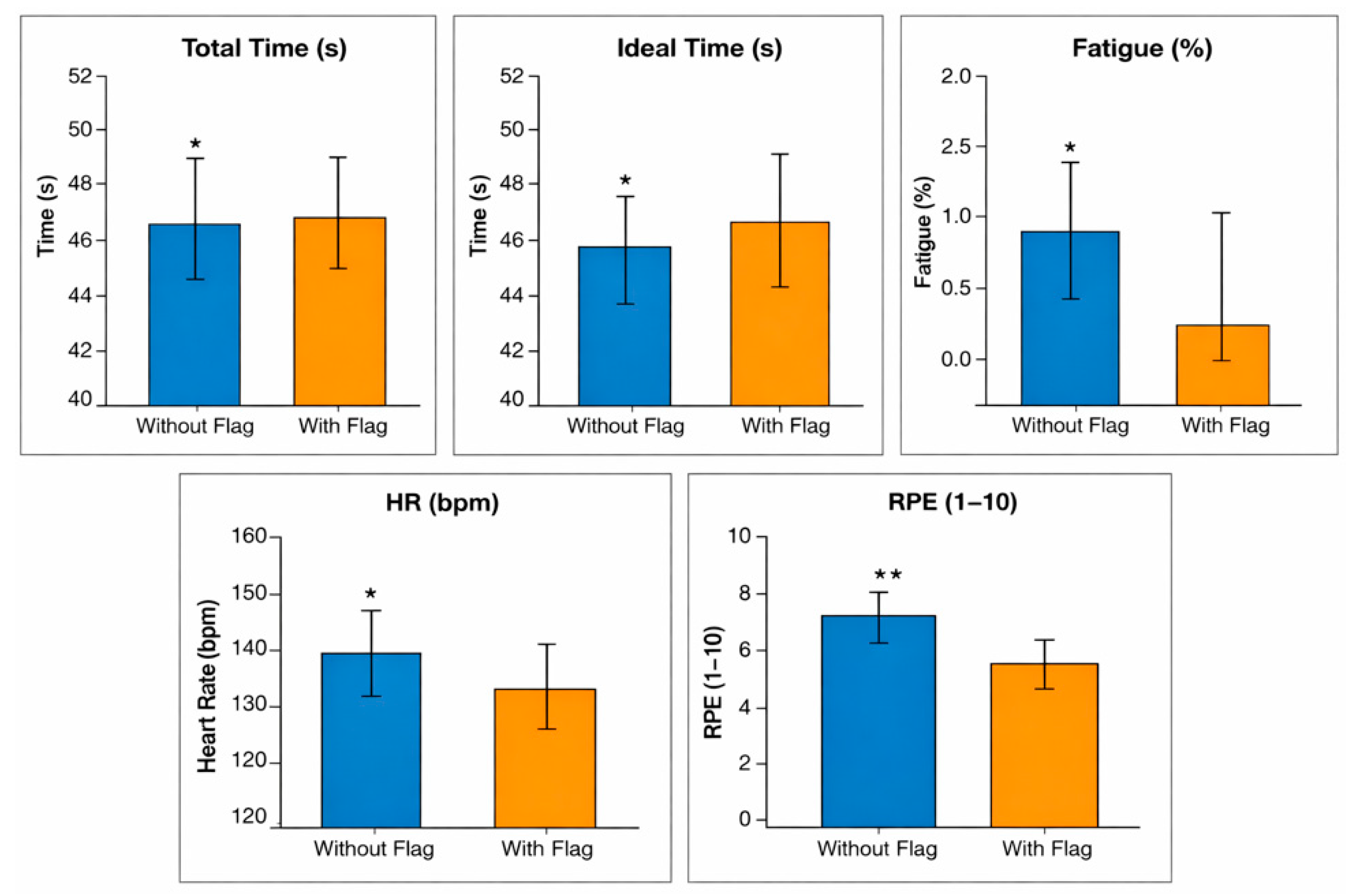
The results are summarized in Figure 3, which provides a graphical comparison of all variables. Total sprint time (TST) in the repeated-sprint test demonstrated a statistically significant difference between conditions (p < 0.05). Performance without flag carriage (M = 45.6 ± 2.36 s) was faster compared to the condition with flag carriage (M = 46.56 ± 2.53 s), with a moderate effect size (Cohen’s d = 0.55). Similarly, ideal time showed a significant difference between conditions (p < 0.05). The mean ideal time without flag carriage (M = 45.02 ± 2.41 s) was lower than with flag carriage (M = 46.04 ± 2.57 s), corresponding to a moderate effect size (Cohen’s d = 0.62). Percentage decrement (PD) during the repeated-sprint test also differed significantly between conditions (p < 0.05). Participants demonstrated a higher PD without flag carriage (M = 1.50 ± 0.76%) compared to with flag carriage (M = 0.42 ± 1.28%), with a small-to-moderate effect size (Cohen’s d = 0.42). Mean heart rate was significantly higher in the no-flag condition compared to the flag condition (p < 0.05). The average heart rate without flag carriage was M = 142.76 ± 5.86 bpm, whereas with flag carriage it was M = 136.30 ± 5.65 bpm, yielding a large effect size (Cohen’s d = 1.49). Perceived exertion (RPE) was also significantly higher in the no-flag condition (p < 0.01). Participants reported higher RPE values without flag carriage (M = 6.35 ± 0.63) compared to with flag carriage (M = 5.32 ± 0.82), corresponding to a moderate effect size (Cohen’s d = 0.60).

4. Discussion

This study investigated the effect of using flags on the performance of assistant referees in soccer, aiming to determine whether significant differences exist between performance with and without flags. The findings clearly indicate that assistant referees performed their tasks faster and more efficiently when not using flags, suggesting that the additional physical demands associated with carrying flags negatively affect performance. The mean values obtained—total time, ideal time, and performance decrement—indicate faster running times in the no-flag condition. These results are consistent with previous research showing that integrating soccer dribbling into sprint tests significantly reduces running speed. However, dribbling and flag carriage impose different mechanical and attentional constraints on the performer, and such comparisons should therefore be interpreted with caution. This effect was evident in both single maximal short sprints and repeated maximal short sprints. Combining sprinting with additional motor tasks (e.g., soccer dribbling) further reduced speed compared to performing a single motor task such as sprinting alone [21]. This supports the current findings from the running test with flags. Moreover, these results extend to tests involving change of direction, not only straight-line sprinting with flags. Significant differences were also found in mean heart rate and in subjective ratings of perceived exertion (RPE), with higher values observed in the no-flag condition compared to the flag condition. The higher HR and RPE values observed in the no-flag condition most likely reflect the greater absolute running intensity achieved when participants were unconstrained by flag carriage: running without the flag enabled faster sprint times, which in turn produced greater cardiovascular and perceptual effort. Conversely, the lower HR and RPE in the flag condition may reflect constrained or self-limited movement rather than a reduction in physiological strain per se. These findings should not be interpreted as evidence that flag carriage reduces physiological load but rather that the flag limits the maximal running intensity that can be achieved. The mechanisms underlying these performance differences remain unknown, as no biomechanical or metabolic measurements were obtained in the present study. Carrying the flag may constrain arm swing, an important contributor to propulsive torque during sprinting and rapid changes of direction. Because the flag was held in a single hand, it may also impose bilateral upper-limb asymmetry, potentially affecting trunk rotation and balance during the lateral-shuffle phases of the test. Additionally, altered lateral shuffle mechanics and disrupted change-of-direction control resulting from this asymmetric load may further contribute to the slower times observed with the flag. These hypotheses are physiologically plausible but cannot be confirmed from the present data and should be directly examined in future research using inertial measurement units or three-dimensional motion capture. Alternative, non-mechanical explanations should also be considered, including differences in pacing strategy between conditions, motivational asymmetry between the flag and no-flag trials, and residual order effects despite the two-week washout and counterbalanced design; these possibilities cannot be ruled out with the present data. The significantly higher percentage decrement (PD) observed in the no-flag condition, despite faster overall sprint times, also warrants careful interpretation: a higher PD indicates that performance declined more across repetitions relative to the best single-repetition effort, consistent with participants in the no-flag condition running closer to their maximal capacity from the outset and thereby accumulating greater fatigue across the six repetitions. In contrast, the lower PD in the flag condition may reflect self-regulated or constrained pacing rather than superior repeated-sprint tolerance; when movement is mechanically restricted, as may occur when one arm is engaged in holding the flag, participants may inherently adopt a more conservative effort level, resulting in more uniform, though slower, performance across repetitions. This interpretation is consistent with the lower HR and RPE observed in the flag condition, further supporting the notion that participants did not reach maximal exertional output when carrying the flag; a lower PD should therefore not be interpreted as a sign of superior physical conditioning in this context but rather as reflecting a ceiling imposed by the task constraint itself. As reported by Meckel et al. [21], physiological responses during repeated sprints differed significantly when dribbling was involved. Blood lactate levels, peak heart rate, and perceived exertion were all significantly lower when dribbling was included in sprint tests. This suggests that dribbling imposes additional cognitive and neuromuscular demands, potentially reducing metabolic energy cost—similar to the findings observed in running with flags. The findings of the present study indicate that the use of flags negatively impacts the performance of assistant referees during soccer matches. Faster running times without flags suggest that the additional physical load associated with carrying flags may reduce efficiency and effectiveness in officiating [7,15]. These results are further supported by Meckel et al. [21], who found that dribbling during gameplay can alter stride kinematics, including average velocity, horizontal and vertical forces, and stride frequency post-match. These changes indicate fatigue, which may impair repeated-sprint ability (RSA). Focusing on training and developing the required physical fitness can enhance the skills necessary for speed and officiating efficiency. Physical fatigue may affect not only physical performance but also cognitive abilities required for decision-making; however, cognitive outcomes were not assessed in the present study, and this remains a theoretical proposition to be examined in future research [6,22]. Improving training methodologies for assistant referees, in light of increasing athletic demands, and developing both aerobic and anaerobic fitness can help ensure that referees are equipped to handle high-intensity match situations [11,12,23]. Incorporating flag-specific training for assistant referees may help develop motor skills and meet the specific performance demands. This assumption is supported by Meckel et al. [21], whose findings suggest that coaches may consider extending dribbling training to improve individual ball-related skills. However, it is important to note that different physiological responses may occur at submaximal running speeds, indicating that training should be appropriately tailored. Integrating ball drills with specific RSA training may improve performance by optimizing the force–velocity profile and reducing fatigue during repeated sprints. A comparison of the referenced studies highlights sport-specific aspects: in soccer, the impact relates to both linear and slalom sprint performance as well as physiological responses such as heart rate and blood lactate, whereas in basketball, the emphasis is more on change of direction and repeated-sprint ability. In conclusion, the findings emphasize the importance of specific physical fitness requirements for assistant referees. These requirements include not only general physical capacity but also agility, reaction speed, repeated high-intensity running, and change-of-direction ability. In this context, the principle of specificity appears to be important, since physical preparation should reflect the actual movement demands of the sport and the specific role performed within it [8,10,24,25,26,27,28,29,30,31,32,33]. Therefore, targeted training may contribute to improved repeated-sprint performance and may help reduce fatigue during repeated running tasks [10,24,26,29,33]. This interpretation is supported by previous studies suggesting that training programs adapted to the specific demands of the sport and the role may improve performance in sport-specific contexts [10,21,24,25,34,35,36,37]. Accordingly, conditioning strategies for assistant referees should consider the unique physical demands of officiating, including repeated running actions performed while carrying a flag [7].

Study Limitations

A time gap between testing sessions of the Premier League and National League, resulting from pre-determined scheduling by the association, may have led to differences in the participants’ physical fitness levels between testing periods.
No biomechanical measurements were taken, which could have scientifically explained differences in running efficiency with the flag. Without three-dimensional motion capture or inertial measurement unit (IMU) data, it is not possible to confirm the proposed mechanisms relating to arm swing restriction, trunk rotation, or lateral shuffle kinematics. For example, biomechanical movement analysis could compare normal running versus running with a flag (which is likely more constrained) or examine the aerodynamic effects related to holding the flag.
No metabolic measures, such as oxygen uptake (VO2) or blood lactate, were obtained, which limits the ability to fully characterize the energetic cost of each condition. Heart rate and RPE, which were collected, are acknowledged as the physiological outcomes assessed in the present study.
The modified CODA protocol used in this study has not been independently validated in a separate publication; reliability was assessed only in a subset of participants (see Procedure).
Testing was conducted in a controlled environment using a standardized protocol, which may not fully replicate the variable intensity, contextual pressures, positional demands, and decision-making load encountered during actual competitive match play. Generalizability of the findings to match performance, therefore, requires caution and should be addressed in future research using ecological designs.
The absence of cognitive performance measures (e.g., decision accuracy, reaction time, attention) represents a further constraint on the generalizability of the findings to overall officiating performance.

5. Future Research Directions

Further research is needed to examine assistant referee performance across different ages, sexes, genders, and competitive levels, as these factors may influence the physical, perceptual, and decision-making demands of officiating. Future studies should also provide a deeper understanding of the cognitive requirements involved in assistant refereeing, including attention, reaction to dynamic match situations, and decision-making accuracy during running tasks performed with and without flag use. In this context, it may be important to determine whether carrying and using the flag affects not only physical performance but also the ability to process visual information and make accurate decisions under movement demands. In addition, further investigation is warranted to examine alternative signaling methods, such as smaller handheld flags or hand-based signals, and to determine whether these approaches can reduce physical constraints while preserving communication efficiency, decision accuracy, and the practical needs of officiating. Such research may support the development of more specific training methods and applied officiating strategies that are better aligned with the actual physical and cognitive demands placed on assistant referees.

6. Conclusions and Practical Recommendations

The present findings indicate that flag carriage constrains repeated-sprint performance and limits achievable exercise intensity during a modified change-of-direction sprint task. These results have practical implications for the design of fitness tests and conditioning programs specific to soccer assistant referees. Specifically, flag-specific training should be incorporated into preparation programs to develop the motor competencies required under match conditions. Whether alternative signaling methods might reduce physical constraints without compromising communication quality, decision-making accuracy, or officiating effectiveness remains an open and important question that should be addressed in future research; any practical recommendations regarding flag use in competitive matches should await such evidence. Tailored training programs combining work with and without the flag may help assistant referees develop the specific motor competencies required under match conditions. The effects of flag use are not limited to physiological factors: targeted mental preparation may also help assistant referees cope with pressure and maintain focus during matches, particularly in high-intensity competitive situations.

Author Contributions

Conceptualization, R.G. (Roni Gottlieb); methodology, all authors; investigation, A.S., R.G. (Roni Gottlieb) and J.C.G.; data collection, R.G. (Rafi Geva); formal analysis, R.G. (Roni Gottlieb) and J.C.G.; writing—original draft, A.S. and R.G. (Roni Gottlieb); writing—review and editing, all authors; supervision, Y.M., R.G. (Roni Gottlieb) and A.S. led the writing of the manuscript and contributed equally to its development. All authors have read and agreed to the published version of the manuscript.

Funding

This research received no external funding.

Institutional Review Board Statement

The study was conducted in accordance with the Declaration of Helsinki and approved by the Ethics Committee at the authors’ affiliated academic institution (Reference number: 443, 8 February 2024).

Informed Consent Statement

Informed consent was obtained from all subjects involved in the study.

Data Availability Statement

The data presented in this study are available on request from the corresponding author and the first author. The data are not publicly available due to ethical and privacy restrictions.

Acknowledgments

During the early stages of preparation of this manuscript, the authors used OpenAI ChatGPT based on GPT 5.2 for English language corrections and for support in improving the presentation of figures and their captions based on the authors’ original data. The scientific content, study design, data collection, analysis, interpretation, and conclusions are the authors’ own. The authors have reviewed and edited the output and take full responsibility for the content of this publication. The authors thank the study participants for their commitment and efforts and the coaches for their collaboration in this study.

Conflicts of Interest

The authors declare no conflicts of interest.

References

  1. Klatt, S.; Thönnißen, L.; Fischer, T.; Sandmann, A. Alternative training methods in soccer. Ger. J. Exerc. Sport Res. 2025, 56, 129–137. [Google Scholar] [CrossRef] [Scilit]
  2. Zouhal, H.; Abderrahman, A.B.; Dupont, G.; Truptin, P.; Le Bris, R.; Le Postec, E.; Sghaeir, Z.; Brughelli, M.; Granacher, U.; Bideau, B. Effects of Neuromuscular Training on Agility Performance in Elite Soccer Players. Front. Physiol. 2019, 10. [Google Scholar] [CrossRef] [Scilit] [PubMed]
  3. Casella, A.; Ventura, E.; Di Russo, F. The Influence of a Specific Cognitive-Motor Training Protocol on Planning Abilities and Visual Search in Young Soccer Players. Brain Sci. 2022, 12, 1624. [Google Scholar] [CrossRef] [Scilit] [PubMed]
  4. Trecroci, A.; Cavaggioni, L.; Rossi, A.; Moriondo, A.; Merati, G.; Nobari, H.; Ardigò, L.P.; Formenti, D. Effects of speed, agility and quickness training programme on cognitive and physical performance in preadolescent soccer players. PLoS ONE 2022, 17, e0277683. [Google Scholar] [CrossRef] [Scilit] [PubMed]
  5. Bouzas-Rico, S.; De Dios-Álvarez, V.; Suárez-Iglesias, D.; Ayán-Pérez, C. Field-based tests for assessing fitness in referees: A systematic review. Res. Sports Med. 2022, 30, 439–457. [Google Scholar] [CrossRef] [Scilit] [PubMed]
  6. Krustrup, P.; Helsen, W.; Randers, M.B.; Christensen, J.F.; MacDonald, C.; Rebelo, A.N.; Bangsbo, J. Activity profile and physical demands of football referees and assistant referees in international games. J. Sports Sci. 2009, 27, 1167–1176. [Google Scholar] [CrossRef] [Scilit] [PubMed]
  7. Gottlieb, R.; Aviv, E.; Shalom, A.; Calleja Gonzalez, J.; Meckel, Y. The flag effect on the physical performance of soccer assistant referees. Edelweiss Appl. Sci. Technol. 2024, 8, 1462–1471. [Google Scholar] [CrossRef] [Scilit]
  8. Ramírez Lucas, J.M.; Párraga Montilla, J.A.; Cabrera Linares, J.C.; Latorre Román, P.Á. Enhancing Physical and Cognitive Performance in Youth Football: The Role of Specific Dual-Task Training. J. Funct. Morphol. Kinesiol. 2025, 10, 404. [Google Scholar] [CrossRef] [Scilit] [PubMed]
  9. Dolański, B.; Szwarc, A.; Heinig, B.; Sitek, M. Physical activity profile of the referee and the assistant referee during official football matches. Balt. J. Health Phys. Act. 2017, 9, 97–105. [Google Scholar] [CrossRef] [Scilit]
  10. Baccouch, R.; Borji, R.; Ayed, H.; Sahli, S.; Zammit, Y.; Rebai, H. Effects of Specific Dual Task Training on Change of Direction Ability, Cognitive Flexibility, and Inhibition in Young Soccer Players. Percept. Mot. Ski. 2024, 131, 1720–1742. [Google Scholar] [CrossRef] [Scilit] [PubMed]
  11. Mallo, J.; Navarro, E.; Garcia Aranda, J.; Helsen, W. Physical Demands of Top-class Soccer Assistant Refereeing during High-standard Matches. Int. J. Sports Med. 2009, 30, 331–336. [Google Scholar] [CrossRef] [Scilit] [PubMed]
  12. Mallo, J.; Navarro, E.; García-Aranda, J.M.; Gilis, B.; Helsen, W. Analysis of the Kinematical Demands Imposed on Top-Class Assistant Referees During Competitive Soccer Matches. J. Strength Cond. Res. 2008, 22, 235–242. [Google Scholar] [CrossRef] [Scilit] [PubMed]
  13. Castillo, D.; Yanci, J.; Cámara, J.; Weston, M. The influence of soccer match play on physiological and physical performance measures in soccer referees and assistant referees. J. Sports Sci. 2016, 34, 557–563. [Google Scholar] [CrossRef] [Scilit] [PubMed]
  14. Mallo, J.; Navarro, E.; García-Aranda, J.-M.; Gilis, B.; Helsen, W. Activity profile of top-class association football referees in relation to performance in selected physical tests. J. Sports Sci. 2007, 25, 805–813. [Google Scholar] [CrossRef] [Scilit] [PubMed]
  15. Mallo, J.; Navarro, E.; Aranda, J.M.G.; Helsen, W.F. Activity profile of top-class association football referees in relation to fitness-test performance and match standard. J. Sports Sci. 2009, 27, 9–17. [Google Scholar] [CrossRef] [Scilit] [PubMed]
  16. Castagna, C.; Abt, G.; D’Ottavio, S. Physiological Aspects of Soccer Refereeing Performance and Training. Sports Med. 2007, 37, 625–646. [Google Scholar] [CrossRef] [Scilit] [PubMed]
  17. Gomez-Carmona, C.; Pino-Ortega, J. Kinematic and physiological analysis of the performance of the referee football and its relationship with decision making. J. Hum. Sport Exerc. 2016, 11, 397–414. [Google Scholar] [CrossRef] [Scilit]
  18. Cooper, K.H. A Means of Assessing Maximal Oxygen Intake. JAMA 1968, 203, 201–204. [Google Scholar] [CrossRef] [Scilit]
  19. Yanci, J.; Los Arcos, A.; Grande, I.; Casajus, J. Change of direction ability test differentiates higher level and lower level soccer referees. Biol. Sport 2016, 33, 173–177. [Google Scholar] [CrossRef] [Scilit] [PubMed]
  20. Bangsbo, J.; Iaia, F.M.; Krustrup, P. The Yo-Yo Intermittent Recovery Test. Sports Med. 2008, 38, 37–51. [Google Scholar] [CrossRef] [Scilit] [PubMed]
  21. Meckel, Y.; Geva, A.; Eliakim, A. The Influence of Dribbling on Repeated Sprints in Young Soccer Players. Int. J. Sports Sci. Coach. 2012, 7, 555–564. [Google Scholar] [CrossRef] [Scilit]
  22. Mohr, M.; Krustrup, P.; Bangsbo, J. Match performance of high-standard soccer players with special reference to development of fatigue. J. Sports Sci. 2003, 21, 519–528. [Google Scholar] [CrossRef] [Scilit] [PubMed]
  23. Mallo, J.; Mena, E.; Nevado, F.; Paredes, V. Physical Demands of Top-Class Soccer Friendly Matches in Relation to a Playing Position Using Global Positioning System Technology. J. Hum. Kinet. 2015, 47, 179–188. [Google Scholar] [CrossRef] [Scilit] [PubMed]
  24. Young, W.B.; McDowell, M.H.; Scarlett, B.J. Specificity of sprint and agility training methods. J. Strength Cond. Res. 2001, 15, 315–319. [Google Scholar] [CrossRef] [Scilit]
  25. Shalom, A.; Gottlieb, R.; Alcaraz, P.E.; Calleja-Gonzalez, J. A Narrative Review of the Dominant Physiological Energy Systems in Basketball and the Importance of Specificity and Uniqueness in Measuring Basketball Players. Appl. Sci. 2023, 13, 12849. [Google Scholar] [CrossRef] [Scilit]
  26. Habay, J.; Van Cutsem, J.; Verschueren, J.; De Bock, S.; Proost, M.; De Wachter, J.; Tassignon, B.; Meeusen, R.; Roelands, B. Mental Fatigue and Sport-Specific Psychomotor Performance: A Systematic Review. Sports Med. 2021, 51, 1527–1548. [Google Scholar] [CrossRef] [Scilit] [PubMed]
  27. Scanlan, A.T.; Dascombe, B.J.; Kidcaff, A.P.; Peucker, J.L.; Dalbo, V.J. Gender-Specific Activity Demands Experienced During Semiprofessional Basketball Game Play. Int. J. Sports Physiol. Perform. 2015, 10, 618–625. [Google Scholar] [CrossRef] [Scilit] [PubMed]
  28. Song, T.; Jilikeha, J.; Deng, Y. Physiological and Biochemical Adaptations to a Sport-Specific Sprint Interval Training in Male Basketball Athletes. J. Sports Sci. Med. 2023, 22, 605–613. [Google Scholar] [CrossRef] [Scilit] [PubMed]
  29. Wragg, C.B.; Maxwell, N.S.; Doust, J.H. Evaluation of the reliability and validity of a soccer-specific field test of repeated sprint ability. Eur. J. Appl. Physiol. 2000, 83, 77–83. [Google Scholar] [CrossRef] [Scilit] [PubMed]
  30. Ganji, S.; Sepehri Rahnama, H.; Németh, S.; Jantal, D.; Vadasz, K.; Prokai, J. The Effects of Motor–Cognitive Warm-Up Protocols on Sport-Specific Skills in 8-Year-Old Football Players. Sports 2025, 13, 416. [Google Scholar] [CrossRef] [Scilit] [PubMed]
  31. Battaglia, G.; Paoli, A.; Bellafiore, M.; Bianco, A.; Palma, A. Influence of a sport-specific training background on vertical jumping and throwing performance in young female basketball and volleyball players. J. Sports Med. Phys. Fit. 2014, 54, 581–587. [Google Scholar]
  32. Rodríguez-Rosell, D.; Mora-Custodio, R.; Franco-Márquez, F.; Yáñez-García, J.M.; González-Badillo, J.J. Traditional vs. Sport-Specific Vertical Jump Tests: Reliability, Validity, and Relationship With the Legs Strength and Sprint Performance in Adult and Teen Soccer and Basketball Players. J. Strength Cond. Res. 2017, 31, 196–206. [Google Scholar] [CrossRef] [Scilit] [PubMed]
  33. Lucia, S.; Bianco, V.; Di Russo, F. Specific effect of a cognitive-motor dual-task training on sport performance and brain processing associated with decision-making in semi-elite basketball players. Psychol. Sport Exerc. 2023, 64, 102302. [Google Scholar] [CrossRef] [Scilit] [PubMed]
  34. Memain, G.; Carling, C.; Bouvet, J.; Maille, P.; Tamalet, B.; Fourcade, P.; Yiou, E. Evaluation of the impact of a 3-week specific-sport rehabilitation program on neuromotor control during single-leg countermovement-jump tests in professional soccer players with lower-limb injuries. Front. Sports Act. Living 2024, 6, 1448401. [Google Scholar] [CrossRef] [Scilit] [PubMed]
  35. Delextrat, A.; Cohen, D. Physiological Testing of Basketball Players: Toward a Standard Evaluation of Anaerobic Fitness. J. Strength Cond. Res. 2008, 22, 1066–1072. [Google Scholar] [CrossRef] [Scilit] [PubMed]
  36. Lucia, S.; Digno, M.; Madinabeitia, I.; Di Russo, F. Testing a Multicomponent Training Designed to Improve Sprint, Agility and Decision-Making in Elite Basketball Players. Brain Sci. 2023, 13, 984. [Google Scholar] [CrossRef] [Scilit] [PubMed]
  37. Meckel, Y.; Machnai, O.; Eliakim, A. Relationship Among Repeated Sprint Tests, Aerobic Fitness, and Anaerobic Fitness in Elite Adolescent Soccer Players. J. Strength Cond. Res. 2009, 23, 163–169. [Google Scholar] [CrossRef] [Scilit] [PubMed]
Figure 1. Standard CODA test.
Applsci 16 08378 g001
Figure 2. Modified CODA test.
Applsci 16 08378 g002
Figure 3. Total sprint time (TST), ideal time, percentage decrement (PD), heart rate (HR), and rating of perceived exertion (RPE) with and without the flag. * p < 0.05; ** p < 0.01.
Applsci 16 08378 g003
Table 1. Descriptive measurements (mean ± SD; n = 37) for total sprint time (TST), ideal time, percentage decrement (PD), heart rate (HR), and rating of perceived exertion (RPE), with and without flag carriage.
VariableWithout FlagWith FlagCohen’s d
TST (s)45.69 ± 2.36 *46.56 ±2.530.55
Ideal Time (s)45.02 ± 2.41 *46.03 ± 2.570.62
PD (%)1.5 ± 0.76 *0.42 ± 1.280.42
HR (bpm)142.76 ± 5.86 *136.3 ± 5.651.49
RPE (1–10)6.35 ± 0.63 **5.32 ± 0.820.6
* Statistically significant difference (p < 0.05); ** Statistically significant difference (p < 0.01).
Disclaimer/Publisher’s Note: The statements, opinions and data contained in all publications are solely those of the individual author(s) and contributor(s) and not of MDPI and/or the editor(s). MDPI and/or the editor(s) disclaim responsibility for any injury to people or property resulting from any ideas, methods, instructions or products referred to in the content.