Review

Innovative Techniques for the Evaluation and Optimization of Sustainable Feeds in Poultry Nutrition: A Critical Integrative Review of Advanced Analytical Approaches, Omics, and Artificial Intelligence

by
Vittorio Lo Presti
Veterinary Sciences Department, University of Messina, Viale Palatucci, 98168 Messina, Italy
Appl. Sci. 2026, 16(17), 8373; https://doi.org/10.3390/app16178373
Submission received: 28 May 2026 / Revised: 7 August 2026 / Accepted: 21 August 2026 / Published: 23 August 2026

Featured Application

The integrated artificial intelligence (AI)–omics–analytical framework proposed in this review can guide the design of next-generation precision feeding systems capable of real-time feed evaluation and adaptive diet formulation, supporting more efficient and environmentally sustainable poultry production.

Abstract

Sustainable poultry nutrition is increasingly challenged by feed variability, environmental constraints, resource competition, and the growing demand for precision feeding strategies. Conventional feed evaluation systems based on proximate analysis, static nutrient tables, and empirical formulation are often insufficient to predict the biological and functional value of modern sustainable feed resources. This critical integrative review examines emerging approaches for evaluating and optimizing sustainable feeds in poultry nutrition through the integration of advanced analytical technologies, biological validation systems, omics sciences, and artificial intelligence (AI). This review was developed as a structured narrative review following a Preferred Reporting Items for Systematic Reviews and Meta-Analyses (PRISMA)-inspired workflow and organized around an integrated AI–omics–feed evaluation framework. Recent advances in spectroscopy-based analytical techniques, in vitro digestibility systems, microbiomics, metabolomics, nutrigenomics, machine learning, and predictive modeling are discussed in relation to feed characterization, nutrient utilization, host–microbiota interactions, and precision nutrition, with emphasis on the transition from static compositional assessment toward dynamic, system-oriented feed evaluation. Explainability, biological validation, and generalizability of AI-based models across heterogeneous production systems are highlighted as key challenges for practical implementation, alongside emerging frontiers in AI-driven nutritional decision-support. Integrating analytical, biological, molecular, and computational approaches may support adaptive precision nutrition systems capable of improving nutrient efficiency, reducing environmental emissions, and optimizing sustainable poultry production.

1. Introduction

The global poultry sector is facing increasing pressure to simultaneously improve production efficiency, reduce environmental impact, and ensure long-term feed sustainability. Poultry meat and eggs remain among the fastest-growing animal protein sources worldwide because of their relatively high feed conversion efficiency and economic accessibility. However, the intensification of poultry production has also increased the need to address the environmental and resource-use challenges associated with modern feeding systems. In parallel, climate-related variability, market volatility, and the expansion of the biofuel industry have further increased pressure on global feed supply chains [1]. Consequently, sustainable poultry nutrition is increasingly shifting toward the incorporation of alternative feed resources, circular bioeconomy strategies, and precision feeding approaches.
In recent years, sustainable feed resources have attracted increasing attention as potential partial substitutes for conventional feed ingredients, reflecting the growing interest in improving the sustainability and resilience of poultry production. These strategies aim to improve resource efficiency, reduce nutrient losses, and enhance the overall sustainability of poultry feeding systems [2]. At the same time, the growing diversity of sustainable feed resources has increased the complexity of feed evaluation, as alternative ingredients often differ substantially from conventional feedstuffs in their nutritional characteristics and biological behavior [3].
Poultry nutrition has traditionally relied on proximate analysis, wet chemistry procedures, nutrient composition tables, and static formulation systems. These conventional methodologies have long provided the foundation for routine feed evaluation in poultry nutrition [4]. Although these methodologies remain essential for routine feed characterization, they provide only limited information on nutrient digestibility and utilization. They also fail to capture the biological responses that ultimately determine animal performance [5]. Likewise, in vivo digestibility assays remain the biological reference method but are expensive, labor-intensive, time-consuming, and poorly suited for rapid feed quality assessment under commercial conditions.
As poultry diets have incorporated an increasingly diverse range of sustainable feed resources, the limitations of conventional evaluation approaches have become progressively more evident [3,4,5]. These limitations highlight the need for more integrated strategies capable of accurately assessing nutritional value under practical production conditions. Consequently, modern poultry nutrition requires feed evaluation strategies that integrate complementary sources of information rather than relying solely on compositional analysis. Advanced analytical technologies, biological validation systems, omics sciences, and data-driven approaches provide distinct yet interconnected perspectives for characterizing feed resources and predicting nutritional responses [1,4,6,7,8,9,10,11,12,13,14,15].
Despite the considerable progress achieved in each of these research areas, current evidence remains largely fragmented. Important connections between feed variability, advanced feed characterization, biological validation, predictive interpretation, and sustainability-oriented precision nutrition are still insufficiently addressed in the current literature. Consequently, comprehensive frameworks integrating these complementary disciplines for sustainable feed evaluation remain scarce.
Therefore, the aim of the present review is to critically examine innovative approaches for the evaluation and optimization of sustainable feeds in poultry nutrition through an integrated framework. Rather than considering advanced analytical technologies, biological assessment, omics sciences, and artificial intelligence (AI) as independent research domains, this review examines how these complementary approaches can be combined to improve the evaluation of sustainable feed resources and support more informed nutritional decision-making. By critically discussing their respective contributions, limitations, and practical applicability, this review proposes an integrated framework intended to support the development of sustainability-oriented precision poultry nutrition.
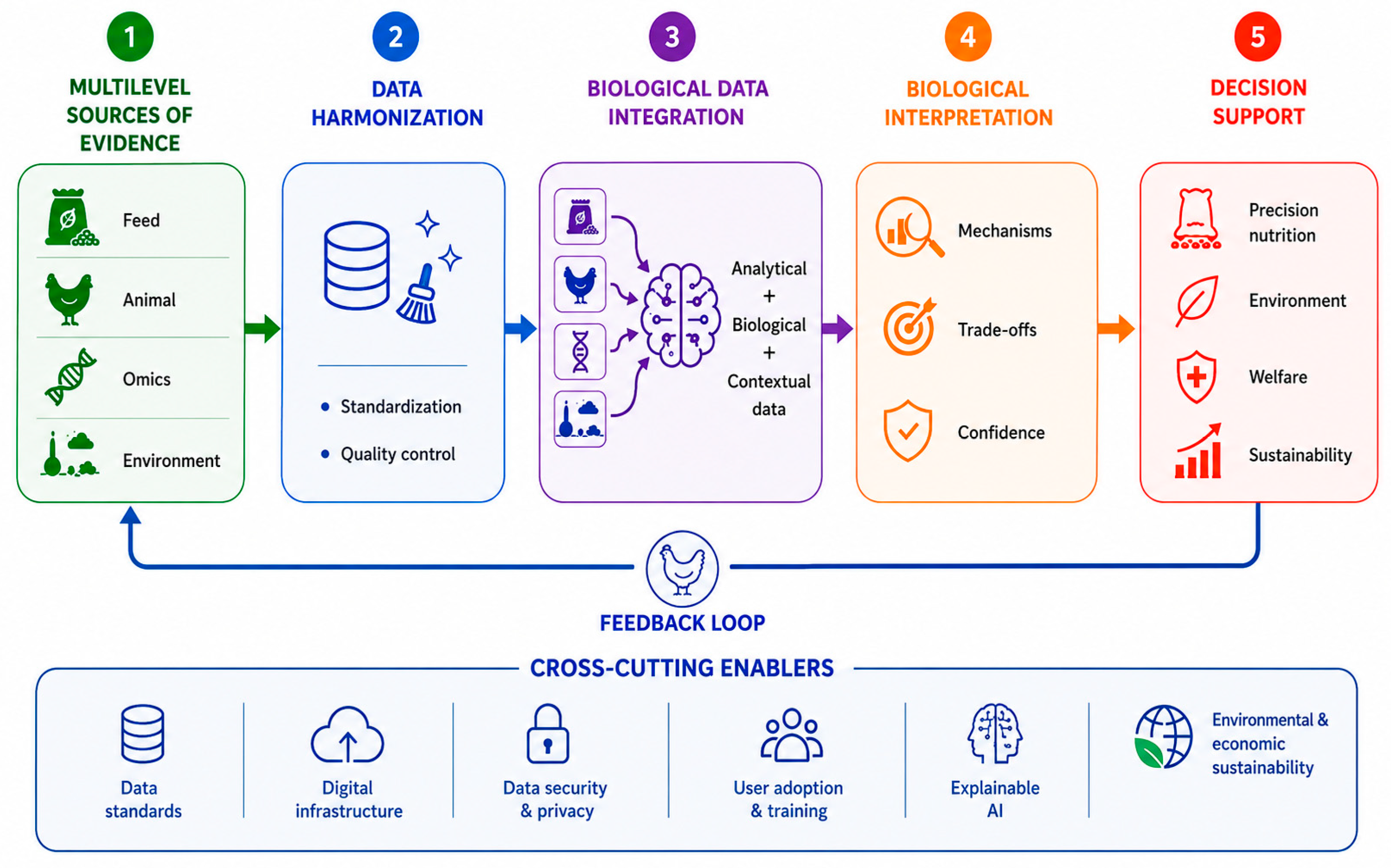
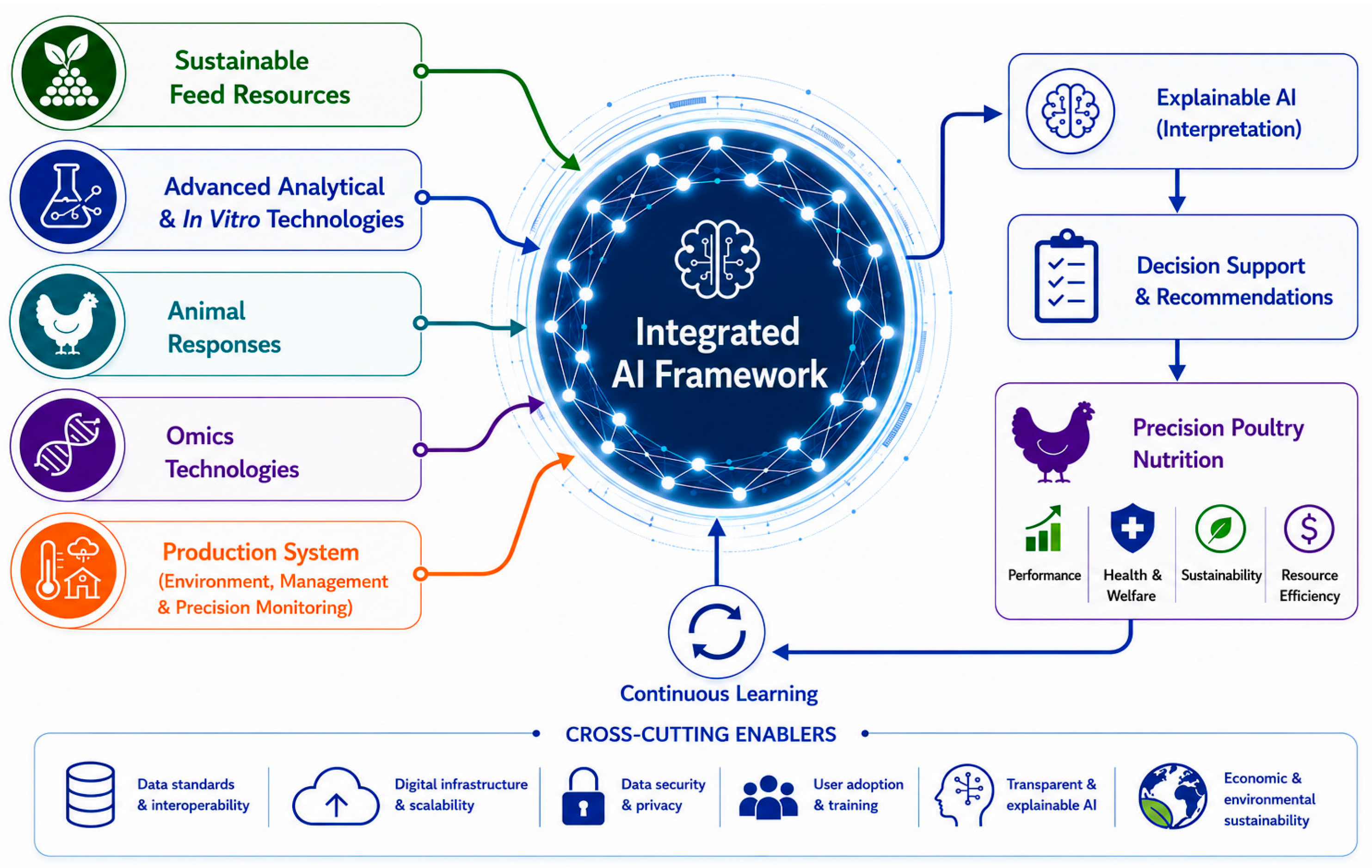
The conceptual framework underpinning this review is illustrated in Figure 1. It summarizes how information derived from sustainable feed resources, advanced analytical and in vitro technologies, animal responses, omics technologies, and production systems can be integrated within an AI-supported framework to facilitate explainable interpretation, evidence-based nutritional decision-making, and precision poultry nutrition. Rather than representing an established operational platform, the framework illustrates a conceptual model highlighting interoperability, transparency, scalability, and iterative learning as desirable components for the future development of integrated feed evaluation systems.

2. Methodological Approach

2.1. Review Design and Thematic Literature Search Strategy

This review was designed as a critical integrative review supported by a structured narrative synthesis and a PRISMA-inspired workflow. This methodological approach was selected because the available evidence spans heterogeneous experimental designs, analytical technologies, in vitro models, omics approaches, and AI applications that cannot be meaningfully synthesized using conventional meta-analytic methods [16,17,18].
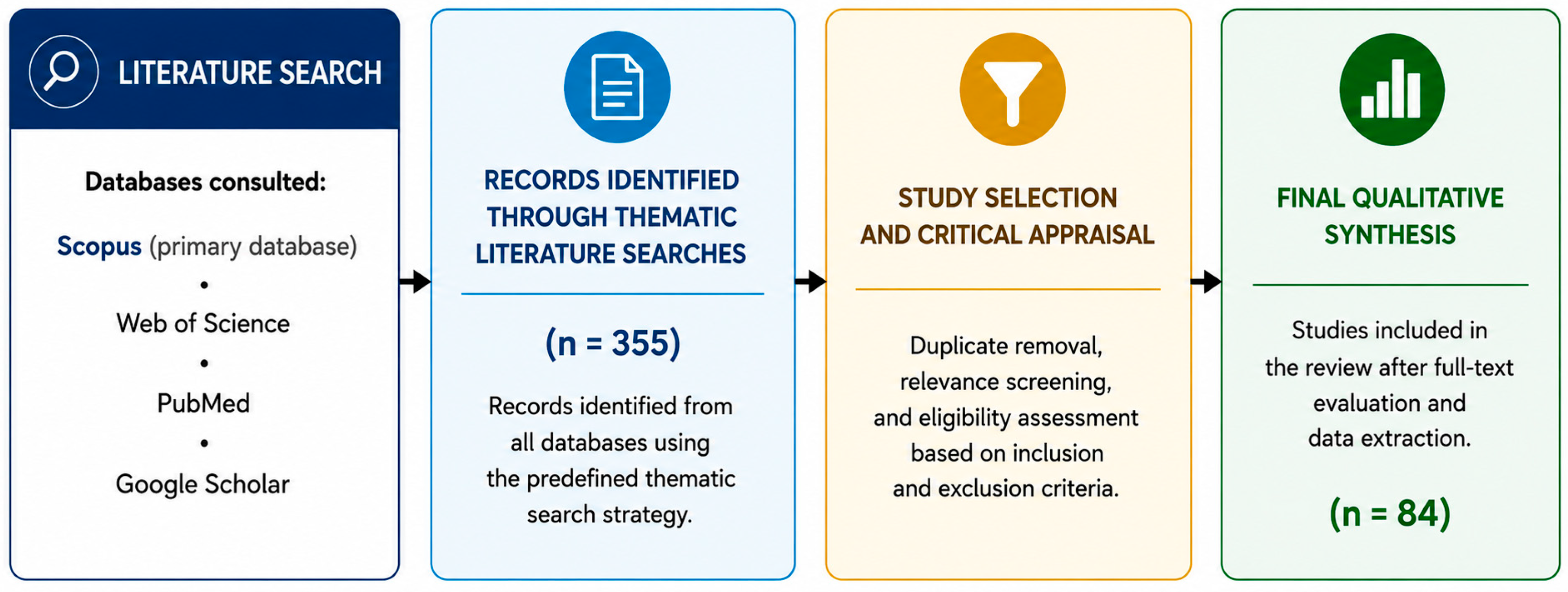
A total of 355 records were initially organized across the thematic literature folders. After duplicate removal, relevance screening, and eligibility assessment, 84 studies were retained for the final qualitative synthesis and included in the reference list.
Searches were conducted using Scopus, Web of Science, PubMed, and Google Scholar. The systematic literature search covered publications from January 2000 to March 2026, with the final database search performed in March 2026. Earlier publications were additionally included only when they represented seminal methodological or conceptual contributions essential for interpreting more recent developments. Scopus served as the primary source for literature identification, whereas Web of Science, PubMed, and Google Scholar were used to identify additional relevant studies and improve literature coverage.
Specific search strategies were developed for each thematic area to ensure broad coverage of the methodological approaches involved in sustainable poultry feed evaluation. The overall thematic organization of the literature retrieval process is summarized in Table 1.

2.2. Search Strategy and Eligibility

Eligible studies included peer-reviewed original research and review articles relevant to sustainable feed evaluation in Gallus gallus. Studies addressing advanced analytical methods, biological validation, omics technologies, AI, and related applications in poultry nutrition were considered for inclusion. Studies on non-avian species without direct relevance, pharmacological interventions, conference abstracts, unpublished theses, and papers based exclusively on conventional proximate analysis were excluded.
All stages of literature screening, eligibility assessment, data extraction, and critical appraisal were performed by the author. After duplicate removal, the records were screened by title and abstract and subsequently evaluated in full text. Additional references were identified through backward citation tracking of relevant publications.
No formal quality-scoring system was applied. The literature was evaluated according to study design, methodological soundness, reproducibility, biological relevance, and consistency with the objectives of this review.
The evidence was synthesized according to the principal scientific questions addressed throughout this review. The findings derived from analytical methods, biological models, omics technologies, and computational approaches were considered together when they contributed to the interpretation of the same scientific problem. The narrative synthesis follows the progression adopted throughout this manuscript, moving from sustainable feed resources and analytical characterization to biological validation, omics technologies, AI, and their application to precision poultry nutrition.
The literature identification, screening, eligibility assessment, and study selection process adopted in this review is summarized in Figure 2.

3. Sustainability Challenges and Alternative Feed Resources

3.1. Sustainability Challenges in Poultry Feeding Systems

The increasing adoption of sustainable feed resources reflects the broader effort to improve the environmental sustainability, resource-use efficiency, and resilience of poultry production systems [19]. This transition has introduced a level of biological and nutritional complexity rarely encountered in conventional poultry feeding systems. Unlike traditional corn–soybean-based diets, which rely on relatively standardized ingredients, sustainable feeding strategies may incorporate raw materials whose nutritional value is shaped by multiple interacting factors. As a result, feed evaluation has become progressively more challenging because ingredient composition alone no longer provides sufficient information to accurately predict nutritional performance under practical production conditions [1].
International organizations have emphasized the need to transform agrifood systems by improving resource-use efficiency, strengthening resilience, and reducing environmental impacts throughout the food production chain [20]. In this context, circular bioeconomy strategies have promoted the valorization of industrial and agricultural by-products as potential feed resources, provided that their nutritional adequacy, safety, and biological effectiveness are appropriately evaluated before practical implementation [21]. Achieving these objectives, however, requires accounting for the intrinsic heterogeneity of sustainable feed resources. Their nutritional characteristics are influenced by geographical origin, genotype, agronomic practices, industrial processing, microbial transformations, and storage conditions. Evidence from cereal-based feeding systems illustrates the practical implications of this variability. Studies on wheat have demonstrated that differences in physical and chemical grain characteristics can substantially influence energy availability for poultry, increasing the risk of over- or under-formulation when average nutritional values are applied [1]. Similarly, experimental comparisons among corn sources from different geographical origins have identified differences in feed intake, feed conversion ratio (FCR), and phosphorus digestibility despite only modest differences in proximate composition [22]. These findings indicate that ingredient provenance may influence nutritional responses beyond conventional compositional descriptors.
These observations indicate that the challenge is not simply the introduction of new feed ingredients, but the growing difficulty of accurately estimating their nutritional value under variable production conditions. As feed resources become increasingly heterogeneous, their biological value reflects the combined influence of intrinsic compositional characteristics and the environmental and technological factors acting throughout the production chain. Consequently, feed variability should be regarded as an inherent feature of modern poultry feeding systems rather than as a characteristic restricted to novel ingredients.
These factors do not represent isolated sources of variation. Instead, they interact to determine nutrient availability, digestibility, and overall feeding value. Consequently, nutritional evaluation becomes progressively less reliable when based exclusively on average compositional descriptors. Understanding sustainable feed resources therefore requires considering the context in which feed ingredients are produced, processed, stored, and utilized, rather than interpreting their nutritional value as a fixed property of chemical composition alone [1,22].
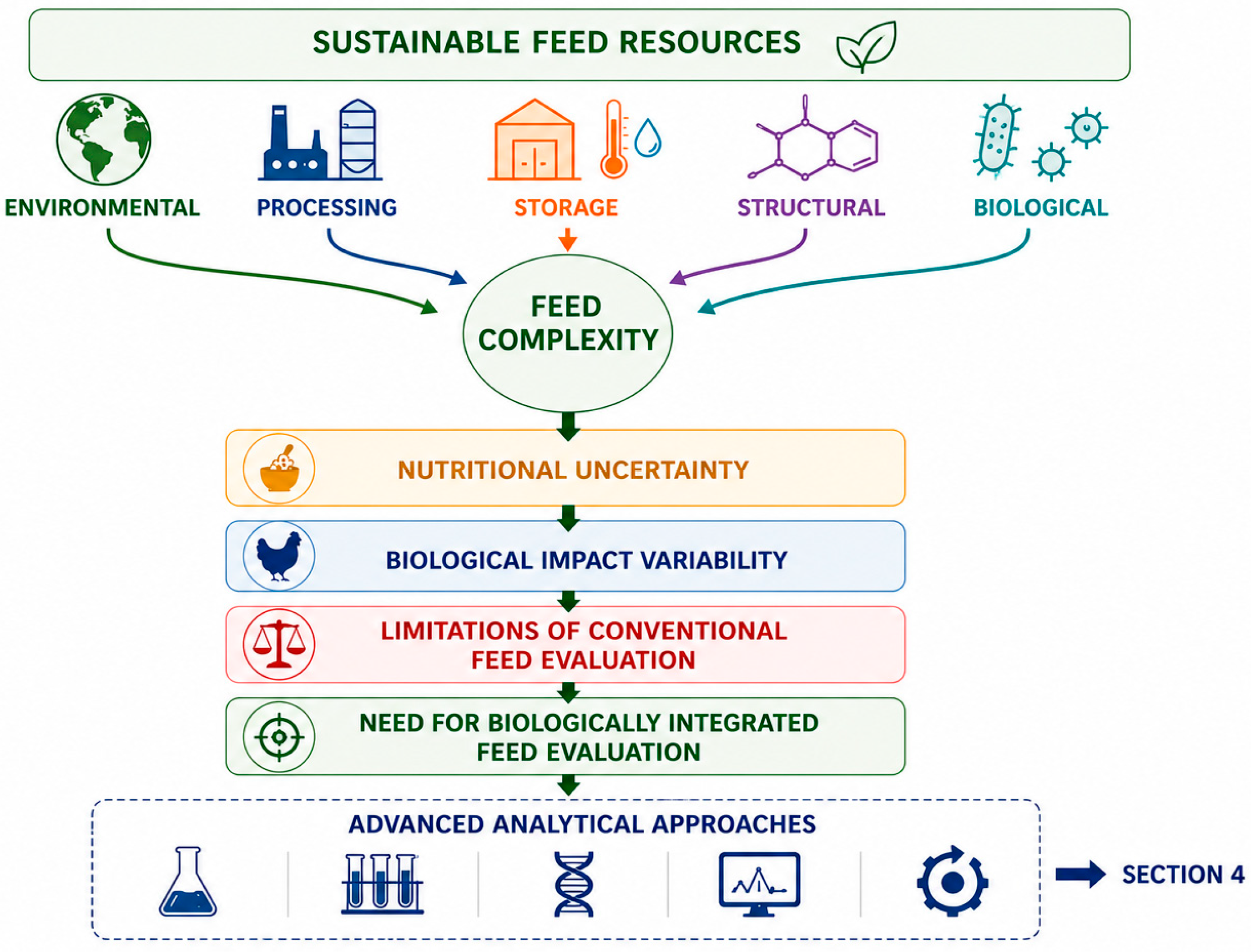
Figure 3 summarizes the principal sources of variability affecting sustainable feed resources and illustrates how environmental conditions, processing history, storage stability, and structural characteristics collectively contribute to feed complexity and nutritional uncertainty. This conceptual framework highlights why conventional feed evaluation alone is often insufficient and provides the rationale for biologically integrated approaches to nutritional assessment.

3.2. Biological Complexity of Sustainable Feed Resources

Grain legumes illustrate how the nutritional value of sustainable feed resources extends beyond their chemical composition. Field peas and faba beans have been extensively investigated as protein-rich alternatives to soybean meal in broiler diets, yet their feeding value consistently depends on factors such as nutrient digestibility, anti-nutritional compounds, and the physiological stage of the animal [23]. Similar conclusions emerged from the work of Kandel et al. [24], who reported that replacing soybean meal with field peas in wheat-based diets affected growth performance, carcass characteristics, and nutrient digestibility despite comparable formulation objectives. Processing further contributes to this complexity. Soares et al. [25] showed that crimping and ensiling modified phytate degradation and pre-cecal phosphorus digestibility in faba beans, demonstrating that technological interventions can substantially alter the biological value of the same raw material. Taken together, these studies indicate that grain legumes should not be considered nutritionally uniform protein ingredients, as their feeding value reflects the combined influence of genotype, processing, and digestive responses.
A different pattern emerges for fermented agro-industrial co-products, where variability is generated primarily by biological transformation rather than by the original substrate itself. Solid-state fermentation of olive cake, for example, has been shown to modify both the chemical composition and the functional characteristics of this agro-industrial residue [26]. These findings highlight the capacity of microbial activity to modify the compositional profile and potential feeding value of low-value by-products. At the same time, the nutritional characteristics of the final product depend on multiple interacting factors, including substrate composition, microbial ecology, moisture, fermentation time, and post-processing stability. Consequently, identical starting materials may yield products with markedly different nutritional properties. In this case, the fermentation process becomes an integral component of the nutritional value of the ingredient itself.
Protein ingredients recovered from animal by-products further illustrate the importance of technological standardization and quality control. Raw hide trimmings have been proposed as high-protein feed ingredients within circular bioeconomy systems, with particular attention to protein recovery, heavy-metal safety, and production costs [21]. Likewise, broiler feather hydrolysates have been developed through chemical hydrolysis to release amino acids and peptides from keratin-rich biomass while converting low-value residues into potentially valuable feed resources [27]. These examples show that the nutritional characteristics of recovered proteins depend largely on the effectiveness and reproducibility of the recovery process rather than on the original source material alone. As a result, technological processing becomes a major determinant of ingredient quality.
In parallel with technological innovation, environmental safety assessment has become an integral component of sustainable feed evaluation. The European Food Safety Authority (EFSA) guidelines emphasize that feed additive assessment should consider predicted environmental concentrations, persistence, bioaccumulation potential, ecotoxicological effects, and possible impacts on non-target terrestrial and aquatic compartments [28]. These recommendations indicate that the development of sustainable feed systems requires the integration of nutritional, safety, and environmental risk assessment.
Insect-derived feed resources introduce yet another source of complexity because nutritional variability may originate well before feed manufacture begins. Black soldier fly larvae have attracted considerable interest as sustainable protein sources for poultry nutrition, but the characteristics of the resulting biomass are closely associated with rearing substrate, environmental conditions, larval development, and management practices. Machine learning approaches have shown that these interacting variables influence biomass production efficiency and may contribute to improving production management [29]. Consequently, the nutritional characteristics of insect-derived ingredients are expected to depend on the entire production system rather than on the harvested biomass alone, although broader biological validation remains necessary before these relationships can be generalized.
The same principle also applies to ingredients traditionally regarded as nutritionally consistent. Comparisons among corn sources from different geographical origins revealed differences in feed intake, FCR, carcass weight, and phosphorus digestibility despite only modest differences in conventional chemical composition [22]. Likewise, studies comparing corn hybrids identified relationships between grain protein concentration, vitreousness, arabinose ratio, protein solubility index, and nutrient digestibility [3]. These findings indicate that structural grain characteristics may substantially influence feeding value. These observations show that biologically relevant variability is not restricted to novel feed resources but also affects conventional ingredients that are frequently considered nutritionally standardized. More importantly, they indicate that comparable compositional profiles do not necessarily translate into equivalent feeding value, emphasizing that analytical measurements acquire their full nutritional significance only when interpreted within their biological context.
Although the mechanisms responsible for variability differ among feed categories, a consistent pattern emerges from the available literature. Different categories of sustainable feed resources are characterized by distinct sources of biological variability. Grain legumes are mainly affected by genotype, anti-nutritional factors, and processing; fermented co-products by microbial transformation; recovered animal proteins by technological standardization and safety control; insect-derived ingredients by biomass production conditions; and cereal grains by intrinsic structural characteristics. Together, these studies indicate that the feeding value of sustainable feed resources reflects the interaction of biological and technological factors rather than any single compositional attribute. Within the literature considered in this review, however, the strength and maturity of the available evidence are not uniform across feed categories. Grain legumes and conventional cereal grains are supported by the most extensive in vivo evidence linking ingredient variability to nutrient digestibility and animal performance. In contrast, the evidence discussed here for fermented agro-industrial co-products and recovered animal proteins relies predominantly on compositional characterization and technological process evaluation, while the evidence available for insect-derived ingredients primarily addresses production-system variability and therefore still requires broader biological validation before nutritional functionality can be generalized. Consequently, the level of analytical complexity required for feed evaluation should be interpreted in light of the maturity of the available evidence. Feed categories characterized by greater biological and technological heterogeneity require proportionally stronger biological validation before reliable nutritional conclusions can be drawn. This emerging complexity also has an important methodological implication. As sustainable feed resources become increasingly heterogeneous, compositional characterization alone may no longer be sufficient to fully explain their nutritional behavior. Broader approaches to feed evaluation are therefore required.
Table 2 provides an overview of the major sources of compositional and biological variability affecting different categories of alternative feed ingredients used in poultry nutrition. The table also highlights the main nutritional uncertainties and analytical challenges associated with each feed category, emphasizing why conventional static feed evaluation systems are frequently insufficient for accurately predicting biological functionality and nutrient utilization.

3.3. Implications of Feed Variability for Nutritional Evaluation

Conventional feed evaluation systems remain the cornerstone of ingredient characterization and diet formulation in poultry nutrition. Proximate analysis, nutrient composition tables, and ME systems continue to provide the essential basis for comparing feed ingredients and supporting practical nutritional decisions. However, the increasing use of sustainable feed resources has expanded the objectives of feed evaluation beyond the accurate description of chemical composition. Modern feed evaluation is now expected to explain how analytical measurements relate to nutrient availability, physiological responses, and overall nutritional performance. Consequently, analytical data should be regarded as the starting point for the biological interpretation of nutritional value rather than as an end in themselves. The principal challenge is no longer the acquisition of analytical measurements but their correct interpretation within variable biological contexts.
The conceptual shift outlined above is particularly evident in the evaluation of ME. Although ME remains one of the principal criteria used for feed formulation, its nutritional significance depends on how accurately it reflects nutrient utilization by the animal. Comparisons among corn sources from different geographical origins showed that diets formulated to equivalent calculated AME corrected for nitrogen (AMEn) values nevertheless produced measurable differences in feed intake and FCR [22]. These findings indicate that similar analytical values do not necessarily correspond to equivalent biological responses. This observation is supported by studies showing that formulation strategies based on the predicted AME of individual corn sources influenced broiler performance despite relatively modest compositional differences among grains [30]. Furthermore, regional analyses have highlighted a wide variability in the nutritional content of corn, underscoring the limitations of average values [34]. Similar observations have been reported for wheat and triticale, where differences in grain characteristics affected ME and digestibility despite apparently comparable chemical composition [1,5]. ME should therefore be interpreted as a functional indicator whose nutritional significance depends on the biological context rather than as a fixed intrinsic property of the feed ingredient.
Protein evaluation presents a similar challenge. Crude protein concentration remains an essential descriptor of ingredient composition, but on its own it cannot fully explain nutritional value. Soybean meal from different geographical origins showed differences in amino acid composition, predicted digestible amino acid content, and ME despite being classified as the same feed ingredient [4]. The same principle also applies to cereal proteins, as standardized ileal digestibility of crude protein and several amino acids differed among corn sources of different geographical origins, indicating that crude protein concentration alone may not fully represent amino acid availability [31]. Variability is also evident in animal-derived protein ingredients, with fish meal and poultry by-product meal showing wide differences in ME values that may substantially influence formulation outcomes [33]. These observations reinforce the view that evaluating protein-rich feed ingredients requires integrating crude protein concentration with measures of digestibility and nutrient availability to accurately define their nutritional value.
The interpretation of nutritional value also extends beyond nutrient composition to include structural characteristics, technological processing, and safety-related factors. Mycotoxin occurrence, for example, may vary substantially according to ingredient origin and water activity, demonstrating that feed safety cannot be fully assessed through compositional characterization alone [35]. Likewise, technological processing may profoundly modify the nutritional properties of the same raw material. Extrusion has been shown to alter the physicochemical characteristics of cereal starch [7], while physical pretreatments of cassava chips influenced chemical composition and in vitro digestibility [36]. Similar effects have been reported for crimping and ensiling of faba beans, where processing modified phytate degradation and phosphorus digestibility [25]. Structural components further contribute to this complexity. The nutritional effects of non-starch polysaccharides (NSP) depend not only on their concentration but also on their interactions with digestive physiology and enzyme supplementation, leading to different biological responses under different feeding conditions [37,38]. Overall, feed functionality emerges from the interaction among ingredient structure, technological processing, and biological responses. These observations indicate that nutritional value cannot be inferred from compositional measurements in isolation.
Collectively, the available evidence indicates that the principal challenge facing modern feed evaluation is no longer the availability of analytical information, but its biological and nutritional interpretation. Wu et al. critically examined the limitations of ME bioassays and emphasized that values used in feed formulation require careful interpretation before practical application [39]. Likewise, Zaefarian et al. highlighted that poultry feed evaluation increasingly combines chemical analyses, nutrient tables, prediction equations, in vivo measurements, and in vitro techniques, recognizing that each approach contributes complementary information for understanding feed quality [40]. Beyond their biological implications, these limitations also have important economic consequences. Because feed represents the largest production cost in poultry systems, uncertainty in estimating energy availability, nutrient digestibility, or ingredient quality may directly influence formulation precision, feed efficiency, and production profitability [21,40]. Taken together, these considerations indicate that modern feed evaluation increasingly depends on integrating analytical measurements into a biologically meaningful framework. Such a framework is essential for supporting accurate nutritional decisions under increasingly variable production conditions.

4. Advanced Analytical Approaches and In Vitro Models

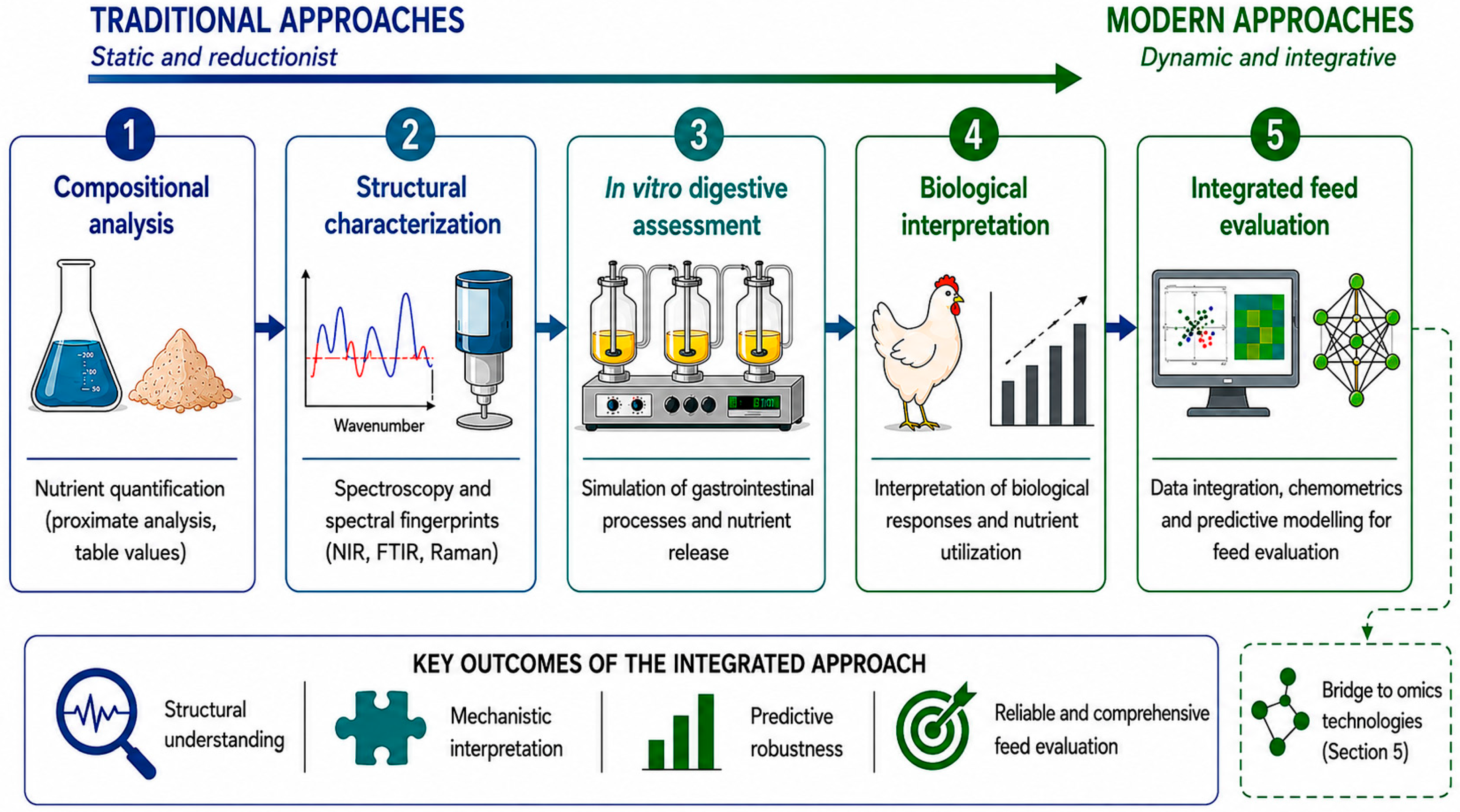
Advanced analytical approaches and in vitro models provide complementary methodologies for investigating feed quality beyond conventional nutrient characterization. By combining structural analyses with digestive assessment, these approaches expand the range of information available for evaluating sustainable feed resources.
Figure 4 summarizes this conceptual transition from conventional compositional evaluation toward integrated analytical and predictive feed assessment systems.

4.1. Advanced Spectroscopic and Rapid Analytical Technologies

Traditional feed characterization methods quantify major nutritional fractions such as crude protein, starch, ether extract, ash, and fiber. However, the increasing variability in sustainable feed resources requires complementary analytical approaches capable of characterizing structural and physicochemical properties beyond those captured through routine compositional analyses. Advanced spectroscopic technologies have therefore emerged as important tools for extending conventional feed assessment beyond nutrient quantification.
The growing demand for rapid and multidimensional feed characterization has accelerated the incorporation of spectroscopic technologies into poultry nutrition research. Near-infrared reflectance spectroscopy (NIRS) was among the first spectroscopic approaches to be widely applied to agricultural materials as a non-destructive tool for predicting feed composition and quality. Early studies demonstrated that mathematical preprocessing of spectral data, including derivative transformations, improved the robustness of protein prediction by minimizing spectral variation associated with particle size in ground wheat samples [41].
Building on these developments, NIR and MIR spectroscopic technologies enable the acquisition of both compositional and molecular information from biological and agricultural matrices and can be integrated with chemometric models for high-throughput prediction [42]. Their analytical value extends beyond the estimation of chemical composition by capturing spectral signatures associated with the structural organization of feed matrices. These spectral patterns arise from the vibrational and absorptive behavior of chemical bonds and provide indirect information on protein conformation, starch organization, lipid interactions, moisture distribution, and fiber structure [6,42]. Spectroscopic technologies complement conventional compositional analyses by providing structural information. This integrated approach enables a more comprehensive characterization of feed ingredients and facilitates the identification of structural characteristics that may influence digestibility, nutrient availability, and overall feed quality.
Recent studies illustrate the versatility of spectroscopic technologies across different applications in poultry nutrition, ranging from high-throughput feed characterization to the prediction of biologically relevant nutritional traits. Bresolin and Dórea described infrared spectrometry as an increasingly important high-throughput phenotyping technology capable of extending prediction from simple compositional traits to more complex biological and productive characteristics [42]. Similarly, Cruz-Conesa et al. demonstrated that visible–near-infrared spectroscopy (Vis-NIR) could accurately predict organic matter, protein, fat, gross energy, uric acid, and phosphorus in poultry excreta, supporting its application in digestibility studies [43]. At a finer structural level, Robertson et al. showed that attenuated total reflectance Fourier-transform infrared spectroscopy (ATR-FTIR) could discriminate molecular differences in protein, lipid, and carbohydrate structures among insect-derived feed ingredients and relate specific spectral features to chemical composition and in vitro digestibility [6].
Collectively, these technologies extend feed evaluation from conventional compositional quantification toward multidimensional characterization of feed structure and quality. Complementary computational approaches further enhance the nutritional interpretation of analytical data. They predict biologically relevant traits, such as true digestible amino acid and nitrogen-corrected true metabolizable energy contents, from laboratory measurements [44]. However, spectroscopic characterization alone cannot fully explain nutritional functionality. It therefore requires integration with complementary biological approaches, including in vitro digestive models, to support a comprehensive nutritional assessment.

4.2. Dynamic In Vitro Digestibility and Gastrointestinal Models

Structural characterization provides valuable information on feed matrices, but its nutritional relevance ultimately depends on how feed components behave during gastrointestinal digestion. In vitro digestibility models therefore represent a complementary stage of feed evaluation by linking analytical characterization with biologically relevant digestive processes.
In vivo bioassays remain the biological reference standard for evaluating nutrient utilization [39]. However, these methodologies are time-consuming, expensive, and relatively low-throughput when applied to large numbers of feed ingredients. Classical poultry feed evaluation systems were historically built around ME bioassays and digestibility methodologies conducted under controlled experimental conditions. Among these, the true metabolizable energy (TME) bioassay proposed by Sibbald represented an important methodological development [45]. It corrected apparent energy estimates for endogenous and metabolic energy losses. These logistical, methodological, and ethical constraints have stimulated growing interest in systems capable of simulating digestive processes under controlled experimental conditions.
Modern in vitro digestibility systems were developed to reproduce selected physicochemical and enzymatic processes occurring during gastrointestinal digestion. Depending on their methodological complexity, in vitro systems may involve one-, two-, or three-step digestion procedures, as well as more complex computer-controlled models designed to reproduce selected gastrointestinal events [40]. Simpler models generally use fixed incubation conditions and one or more sequential enzymatic hydrolysis steps. More advanced systems may incorporate controlled pH transitions, gastrointestinal secretions, transit times, peristaltic movements, and the continuous removal of digestion products to reproduce selected aspects of gastrointestinal physiology more realistically [40].
The primary value of these systems lies not in reproducing the entire biological complexity of the living gastrointestinal tract, but in providing controlled information on nutrient hydrolysis, substrate degradation, and ingredient-dependent digestive responses. Under this perspective, digestive functionality emerges from interactions among feed structure, enzymatic activity, and gastrointestinal conditions.
Experimental studies illustrate how in vitro digestibility systems can be applied to investigate different aspects of feed functionality, including ingredient processing, enzyme supplementation, and nutrient availability. Takaeh et al. reported that extrusion, microwave and gamma irradiation, and sodium hydroxide (NaOH) treatment altered the physicochemical properties of cassava chips and produced treatment-dependent changes in in vitro digestibility [7]. Kim et al. showed that the effects of NSP-degrading enzymes on digesta viscosity and nutrient utilization were strongly dependent on the cereal substrate, enzyme type, and gastrointestinal challenge. Enzyme supplementation reduced digesta viscosity and improved selected NSP digestibility responses in wheat-based diets, whereas one xylanase increased viscosity and aggravated performance losses in experimentally challenged birds fed maize-based diets [38]. Likewise, Wang et al. showed that graded phytase supplementation increased apparent ileal digestibility and total-tract retention of phosphorus in broilers fed phosphorus-deficient diets, while also improving calcium utilization and selected amino acid digestibility responses [46]. Walker et al. further demonstrated that a multi-enzyme complex containing phytase and several carbohydrase activities reduced digesta viscosity and increased dry matter digestibility and phosphorus retention. Calcium retention increased at the higher supplementation level, while AME values in the enzyme-supplemented groups exceeded those of the negative control [8]. Together, these studies demonstrate that nutrient availability is determined by complex interactions among feed structure, digestive conditions, and enzyme activity.
Despite their growing application, in vitro systems remain dependent on methodological standardization and appropriate biological validation. Zaefarian et al. emphasized that the predictive reliability of digestive simulation models improves substantially when in vitro observations are interpreted alongside corresponding in vivo datasets [40]. Consequently, in vitro gastrointestinal models should be regarded as complementary tools for mechanistic investigation, ingredient screening, and comparative digestibility assessment that contribute to the biological interpretation of feed functionality rather than replacing animal studies.
Table 3 summarizes the principal feed evaluation approaches currently used in poultry nutrition, highlighting their analytical focus, advantages, methodological limitations, and relevance for sustainable feed systems.

4.3. Chemometrics, Predictive Equations and Integrated Feed Evaluation

The increasing use of advanced spectroscopy, digestive simulation, compositional analysis, and performance measurements has generated increasingly complex feed-related datasets in poultry nutrition. In particular, highly collinear spectral datasets cannot generally be interpreted through isolated variables alone [42]. This limitation supports the use of chemometric and multivariate analytical approaches.
Chemometrics encompasses statistical and computational methodologies designed to extract relevant information from complex datasets. More broadly, complementary sensing technologies such as vibrational spectroscopy, electronic noses, and electronic tongues have been combined with multivariate analysis to generate multidimensional fingerprints of complex food matrices [48]. This analytical principle is directly applicable to the development of integrated feed evaluation strategies. Within feed evaluation systems, these approaches provide a methodological basis for combining spectral fingerprints with compositional, digestive, and physiological descriptors. This integration is particularly relevant in spectroscopy-assisted feed evaluation. Spectral datasets generated by NIRS, FTIR, Raman spectroscopy, and hyperspectral imaging contain numerous correlated variables that require multivariate analysis to relate spectral patterns to nutritionally relevant traits [42]. Consequently, the predictive value of spectroscopy derives less from isolated spectral signals than from the ability of chemometric methods to associate complex spectral patterns with biologically relevant nutritional traits.
Morales-Suárez et al. applied multivariate models and artificial neural networks to estimate essential amino acid requirements and predict egg production responses in second-cycle laying hens. The study accounted for interactions among lysine, methionine plus cysteine, threonine, and time. This approach illustrated the value of multivariate modelling over isolated nutrient-response analyses [14].
Prediction equations represent a long-established approach for linking analytical measurements with biologically relevant nutritional outcomes in practical poultry feed evaluation. Empirical equations have been used to estimate outcomes such as ME and digestible amino acid contents from selected chemical and nutritional descriptors [31,44,47]. However, equations calibrated on a limited range of conventional ingredients may not fully represent the structural heterogeneity of emerging sustainable feed resources. Structural characteristics, processing history, fiber organization, anti-nutritional factors, and enzyme responsiveness may substantially influence digestive behaviour without being fully represented by conventional compositional variables alone.
Representative studies illustrate how predictive equations have progressively evolved from conventional regression models toward more flexible computational approaches. Sadighi et al. developed regression equations to predict total and standardized ileal digestible amino acid contents of corn from crude protein, crude fiber, ash, and total amino acid concentrations [31]. Comparable approaches have also been applied to other cereal matrices. Sedghi et al. used total amino acid profiles to predict true digestible amino acid contents and nitrogen-corrected true metabolizable energy (TMEn) of sorghum grain, with artificial neural networks providing greater predictive accuracy than multiple linear regression [44]. In addition, Vis-NIR spectroscopy has been applied to poultry excreta to rapidly predict organic matter, protein, fat, gross energy, uric acid, and phosphorus concentrations, thereby supporting the analytical processing of samples generated in nutrient-utilization bioassays [43].
These observations indicate that the predictive performance of nutritional models increasingly depends on the integration of structural and biological information alongside conventional compositional descriptors. Recent mathematical nutrition models further support this transition toward multidimensional prediction. Oviedo-Rondón emphasized that poultry nutrition models increasingly need to integrate growth, production, nutrient requirements, genetics, age, and environmental or physiological conditions while relying on accurate estimates of dietary energy and nutrient supply [15]. Similarly, Guo et al. developed age-specific equations for predicting AME and net energy values of sorghum in broilers using stepwise multiple linear regression and a linear-regression algorithm implemented in Python. The models used chemical predictors including fiber fractions, tannins, phytic acid, dry matter, and crude protein [47].
The reliability of predictive systems depends not only on model architecture but also on the quality, representativeness, and biological relevance of the underlying datasets. Although representative studies have demonstrated the potential of predictive equations for estimating nutritionally relevant traits, many currently available models have been developed using relatively limited experimental populations, ingredient batches, or production conditions. Consequently, calibration quality, methodological consistency, ingredient diversity, and broader external validation remain fundamental determinants of predictive robustness and transferability across the structurally heterogeneous feed resources encountered in sustainable poultry nutrition [30,40,42]. Accordingly, biological validation should be regarded not only as a confirmatory step but also as an integral component of predictive model development, linking structural characterization, digestive assessment, and nutritional interpretation within unified feed evaluation systems.
The convergence of advanced spectroscopy, digestive simulation, chemometrics, and predictive modelling is progressively reshaping feed evaluation into an integrated analytical ecosystem. Rather than evaluating nutrients as isolated compositional entities, modern systems increasingly interpret feed functionality through interactions among molecular organization, digestive behaviour, physiological responsiveness, and nutritional performance [40,42]. Data fusion and multivariate integration approaches are central to this transition, enabling analytical, digestive, and biological datasets to be combined within unified predictive frameworks and improving the interpretation of complex nutritional interactions that cannot be adequately captured by isolated methodologies [14,31,42].
This analytical transition also establishes the conceptual bridge toward omics technologies and systems biology approaches discussed in the following section, where multidimensional molecular datasets further expand the capacity to characterize host–feed interactions within precision poultry nutrition frameworks [9,49].

5. Omics Technologies in Sustainable Poultry Nutrition

Omics technologies have emerged as valuable tools for investigating the multi-level biological responses associated with sustainable poultry nutrition, including microbial ecosystem adaptation, metabolic regulation, and host physiological responses [49,50]. These biological layers are closely interconnected, as microbial adaptation may influence metabolite production, metabolic signaling may affect host gene expression, and transcriptional responses may ultimately contribute to physiological adaptation and productive performance. Consequently, nutritional functionality increasingly emerges from the coordinated interaction of feed characteristics, digestive physiology, microbial ecology, metabolism, and host regulation rather than from isolated nutritional parameters.
The integration of microbiomics, metabolomics, nutrigenomics, and multi-omics approaches may therefore improve interpretation of sustainable feed systems and contribute to the development of more precise nutritional strategies in poultry production [9,51]. Nevertheless, interpretation of omics-derived data remains complex and may be influenced by methodological variability, environmental conditions, host physiology, and diet-dependent ecosystem interactions. Accordingly, this section examines how complementary omics technologies improve the biological interpretation of sustainable feed responses, providing the biological foundation for the predictive modeling approaches discussed in Section 6.
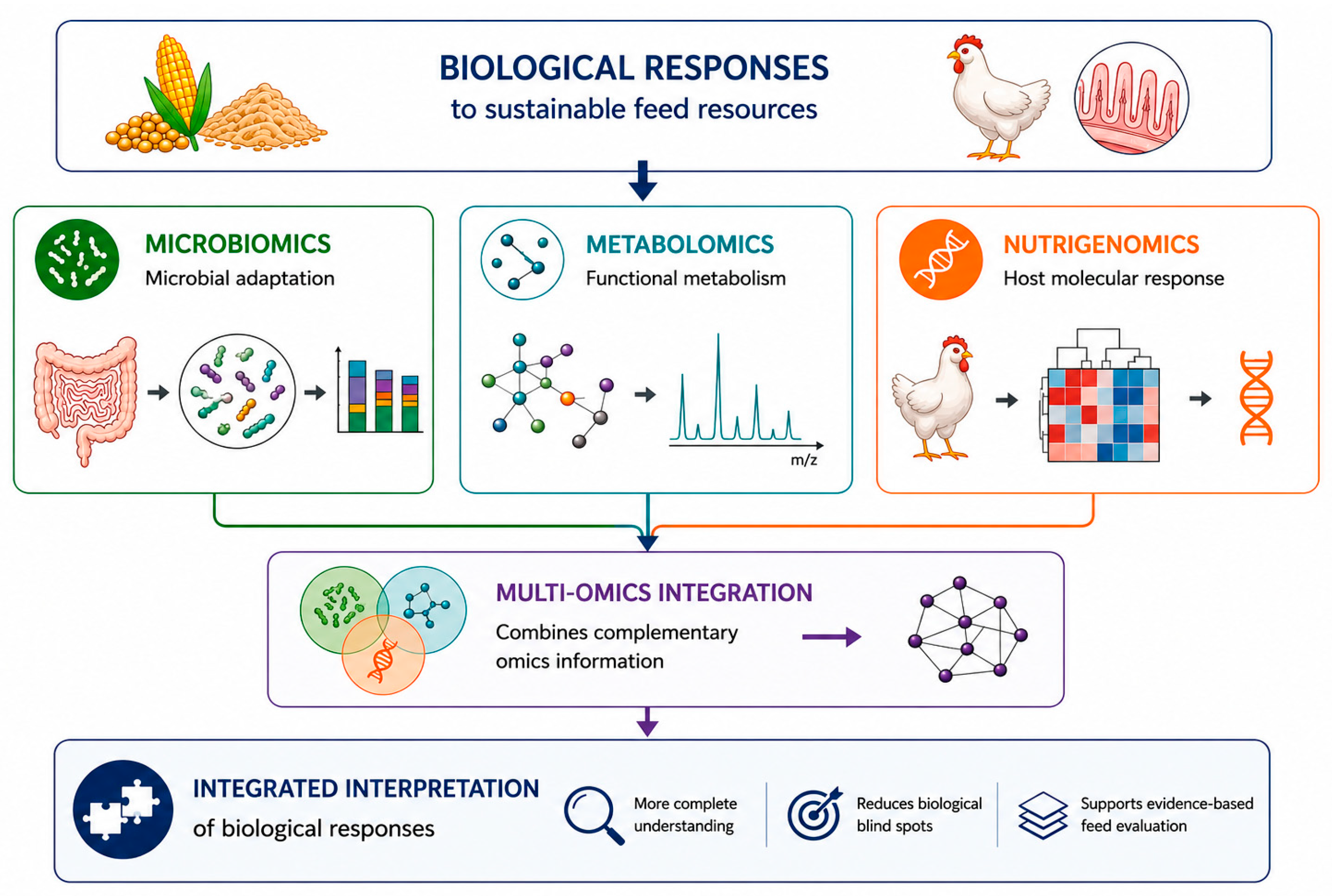
Figure 5 provides a conceptual framework for understanding how different omics technologies contribute complementary biological information across multiple levels of feed–host interactions. The figure illustrates the progressive integration of microbiomics, metabolomics, nutrigenomics, and multi-omics approaches within a unified biological framework, highlighting how these complementary datasets support system-level interpretation of nutritional responses to sustainable feed resources.

5.1. Microbiomics and Host–Microbiota Interactions

Microbiomics has emerged as a valuable approach for investigating how sustainable feed resources influence the intestinal ecosystem, reflecting the central role of the gastrointestinal microbiota in nutrient utilization, intestinal functionality, immune regulation, and metabolic homeostasis [50,52]. Sustainable feed ingredients often differ not only in their chemical composition but also in structural characteristics, including NSP, resistant proteins, fermentation-derived compounds, and fiber-associated components that can modulate microbial ecology and intestinal metabolic activity. Consequently, the nutritional effects of alternative feed resources depend not only on nutrient composition but also on their interactions with the gastrointestinal microbial environment.
Accumulating evidence demonstrates that structurally diverse feed ingredients elicit distinct microbial responses [9,37]. These findings highlight how feed matrix characteristics shape intestinal ecosystem adaptation. Fermented feed ingredients, insect-derived products, agro-industrial by-products, and fiber-rich substrates represent examples of feed matrices capable of reshaping microbial metabolism and ecological balance [38,53]. These microbial changes may subsequently influence digestive efficiency, metabolite production, and host physiological responses. Together, these findings support the view that sustainable feed ingredients function as biologically active matrices capable of promoting dynamic ecological and metabolic adaptation within the gastrointestinal tract.
Despite the considerable advances achieved through poultry microbiomics, translating microbiome-derived observations into robust nutritional interpretation remains challenging [50]. Recent methodological reviews by Oladokun et al. and Terrón-Camero et al. have emphasized that different microbiome profiling approaches capture distinct but complementary layers of biological information. Amplicon sequencing of the 16S rRNA gene primarily characterizes the taxonomic composition of microbial communities and provides information on microbial identity (“who is there”). In contrast, shotgun metagenomics extends this perspective by characterizing the collective genetic repertoire and functional potential of the microbiome (“what they can do”). Metatranscriptomics further complements these approaches by identifying genes that are actively expressed under specific dietary and physiological conditions, thereby providing a functional snapshot of microbial activity. Each methodology therefore interrogates a different level of biological organization, and comprehensive interpretation of host–microbiota interactions increasingly depends on integrating taxonomic, functional, and transcriptional information with complementary metabolomic, digestive, physiological, and productive evidence. Importantly, these analytical approaches are not directly interchangeable, as differences in sampling strategy, gastrointestinal sampling site, sequencing methodology, reference databases, and bioinformatic pipelines may substantially influence both taxonomic assignment and functional interpretation, thereby limiting direct comparability among independent studies. These methodological differences should therefore be considered when interpreting microbiome-derived evidence across different experimental settings.
Most available studies continue to identify associations between microbial composition and productive or physiological responses; however, direct causal mechanisms remain difficult to establish [49,50,52]. Likewise, microbiome responses vary according to host genetics, animal age, dietary composition, intestinal sampling site, and analytical methodology [51,52,53]. Collectively, these sources of biological and methodological variability substantially influence the reproducibility and transferability of microbiome-derived observations across production systems. Current evidence consistently demonstrates that dietary interventions modify the intestinal microbial ecosystem, yet the specific microbial taxa associated with feed efficiency or physiological adaptation frequently differ among independent studies because they are strongly influenced by host-related, environmental, and methodological factors. Consequently, although microbiome–phenotype associations are increasingly well documented, few microbiome-derived taxonomic signatures have yet demonstrated sufficient independent validation and reproducibility to be considered robust, broadly transferable indicators of feed functionality. Microbiome profiling should therefore currently be regarded primarily as a powerful tool for biological interpretation rather than as an independent predictor of nutritional responses [50,52]. Beyond these methodological considerations, an additional challenge is that taxonomic composition does not necessarily reflect biological function. As emphasized by Terrón-Camero et al. and Oladokun et al., similar taxonomic profiles may exhibit markedly different functional and metabolic outputs depending on gene expression, microbial interactions, and host physiology. Conversely, distinct microbial communities may converge toward comparable metabolic functions through functional redundancy. Therefore, taxonomic shifts become biologically meaningful only when interpreted together with their functional and metabolic consequences, rather than as isolated indicators of dietary responses. This distinction is particularly relevant because taxonomic information alone cannot determine whether predicted metabolic pathways are actively expressed under specific nutritional conditions. Consequently, microbiome profiles acquire meaningful nutritional value only when integrated with metabolite production, digestibility responses, intestinal functionality, physiological adaptation, and productive phenotypes [9].
Current evidence therefore suggests that the principal strength of poultry microbiomics lies not in identifying universal microbial biomarkers but in providing a biologically informative framework for interpreting host responses to dietary interventions. When integrated with complementary physiological and metabolic evidence, microbiome profiling can reveal adaptive processes that remain undetectable through conventional nutritional measurements alone. Conversely, interpreting microbial composition in isolation may lead to oversimplified biological conclusions because similar taxonomic changes do not necessarily correspond to equivalent functional outcomes across different production systems or experimental conditions.
Accordingly, microbiomics represents one component of a broader system-oriented framework in which biological interpretation increasingly depends on integrating microbial profiles with metabolic, physiological, and productive responses. Rather than functioning as a standalone predictor of nutritional value, microbiome analysis contributes to explaining the biological mechanisms through which sustainable feed resources influence nutrient utilization, intestinal functionality, and host adaptation. Understanding how microbial communities translate into functional metabolic responses therefore requires complementary metabolomic approaches capable of characterizing the biochemical consequences of microbial activity. These approaches, discussed in the following section, provide an essential link between microbial ecology and host physiology, allowing for a more comprehensive interpretation of the biological responses elicited by sustainable feeding strategies.

5.2. Metabolomics and Functional Biomarkers

While microbiomics characterizes the composition of intestinal microbial communities, metabolomics focuses on the metabolic responses arising from interactions among diet, microbial activity, digestive physiology, and host metabolism [49,54]. Metabolites represent the downstream products of biological regulation. Consequently, metabolomic profiling provides functional insight into physiological adaptation and reveals metabolic changes associated with nutrient utilization, energy metabolism, and host performance that cannot be inferred from compositional analyses alone [54]. For example, variations in short-chain fatty acids, amino acid metabolism, or lipid-related metabolites may reflect changes in microbial fermentation, nutrient utilization, and host metabolic adaptation under different feeding strategies [54,55,56,57].
The principal strength of metabolomics lies in its ability to capture the functional consequences of biological processes rather than individual molecular components. While microbiome composition and other compositional and molecular approaches provide valuable information on the potential for biological activity, metabolite profiles reflect the biochemical outcome of interactions among diet, digestive physiology, microbial metabolism, and host regulation. This perspective is particularly relevant in sustainable poultry nutrition, where nutritional adaptation results from coordinated responses involving multiple metabolic and regulatory pathways rather than isolated biological processes. Consistent with this view, recent physiological and molecular investigations have shown that feed efficiency and adaptive responses are associated with coordinated changes in energy metabolism, nutrient utilization, oxidative balance, and tissue-specific regulatory networks under different nutritional and environmental conditions [55,56,57]. Together, these findings establish metabolomics as a functional biological layer linking molecular regulation with physiological adaptation. This functional layer complements conventional phenotypic measurements and improves the biological interpretation of nutritional responses.
Despite these advantages, translating informative metabolic signatures into reliable tools for poultry nutrition remains challenging. Metabolic and microbiome-associated responses may vary according to dietary composition, intestinal compartment, host characteristics, and the specific biological matrix considered [49]. This variability limits the generalization of results obtained under individual experimental conditions. Moreover, even apparently promising biomarkers require validation across different nutritional and genetic contexts before they can be regarded as broadly transferable indicators of digestive or metabolic efficiency [58]. Accordingly, the field is progressively shifting from biomarker discovery toward the demonstration of biological robustness and translational reproducibility across diverse nutritional and production environments.
Because metabolomic profiles are strongly influenced by the biological matrix selected and the conditions under which samples are collected and preserved, careful methodological planning is essential to ensure biologically informed interpretation. As highlighted by Camero et al. [59], no single biological matrix can comprehensively characterize metabolic adaptation, since each matrix captures a distinct component of the biological response. Consequently, different biological matrices provide complementary information on nutrient utilization, microbial metabolism, digestive physiology, host metabolic regulation, and systemic adaptation, while sampling procedures directly influence metabolite stability and analytical reliability. Table 4 summarizes the principal biological matrices currently used in poultry metabolomics, together with the biological information they provide, representative analytical platforms, key sampling considerations, and the main limitations associated with their interpretation.
Meaningful interpretation of metabolomic profiles requires integration with complementary physiological, microbial, and nutritional information rather than evaluation of individual metabolites in isolation [62,63]. At present, most metabolomic signatures identified in poultry nutrition should therefore be regarded as context-dependent biological associations rather than validated biomarkers. Their translation into reliable tools for feed evaluation will require independent validation across diets, genotypes, biological matrices, and production environments.
Collectively, metabolomics is most informative when interpreted within integrated biological frameworks linking metabolic adaptation with digestive responses, microbial functionality, physiological regulation, and productive performance rather than through individual metabolites considered in isolation [49,54]. From this perspective, metabolomic profiling complements physiological, microbiological, and analytical evidence, thereby improving the physiological interpretation of nutritional adaptation. Its future application in precision poultry nutrition will depend on standardized methodologies, rigorous biological validation, and effective integration with complementary omics technologies and predictive modelling approaches.

5.3. Nutrigenomics and Host Physiological Responses

Nutrigenomics has emerged as an important approach for investigating how sustainable feed ingredients influence host physiological adaptation through changes in gene expression and associated metabolic responses [49,64]. Unlike conventional nutritional evaluation systems, which focus primarily on compositional characteristics and productive outputs, nutrigenomic approaches provide insight into the dynamic regulatory mechanisms underlying nutrient utilization, intestinal adaptation, immune function, and metabolic homeostasis.
Several studies have demonstrated that alternative feed ingredients and nutritionally complex feed matrices may modulate host adaptive responses associated with digestive function, epithelial integrity, and metabolic regulation [10,65]. These responses have been associated with transcriptional changes affecting pathways involved in nutrient and ion transport, immune regulation, oxidative balance, mitochondrial energy metabolism, and intestinal metabolic function [55,56]. Consequently, sustainable feed evaluation increasingly requires interpretation not only of nutrient composition and digestibility but also of the host’s adaptive physiological responses to nutritional variability.
However, the biological interpretation of gene expression patterns in poultry remains strongly dependent on the tissue, phenotype, and experimental context considered. Multi-tissue investigations have revealed marked tissue-specific differences in gene expression and pathway regulation, whereas targeted studies indicate that molecular responses may also depend on dietary treatment, health status, host genetics, age, and production environment [10,55,56,64,65]. This biological context dependence limits the interpretation of transcriptomic findings as universal indicators and emphasizes the need for validation across tissues, populations, and production conditions.
Another important limitation concerns the distinction between molecular regulation and biologically validated functional outcomes. Differential expression of genes or enrichment of signaling pathways may reveal candidate mechanisms of physiological adaptation, but these findings require functional validation before they can be interpreted as indicators of improved resilience or productive performance [66]. Consequently, many transcriptomic findings remain insufficiently validated for routine application in precision poultry nutrition, emphasizing the need for independent validation across diverse production conditions.
Collectively, nutrigenomics provides valuable mechanistic insight into how sustainable feed ingredients influence host adaptive physiology by linking dietary interventions with transcriptional regulation, metabolic adaptation, and physiological responses. However, transcriptomic information requires careful biological interpretation and independent validation. At the same time, it substantially expands conventional feed evaluation by revealing regulatory mechanisms that cannot be captured through compositional, digestive, or phenotypic assessments alone.
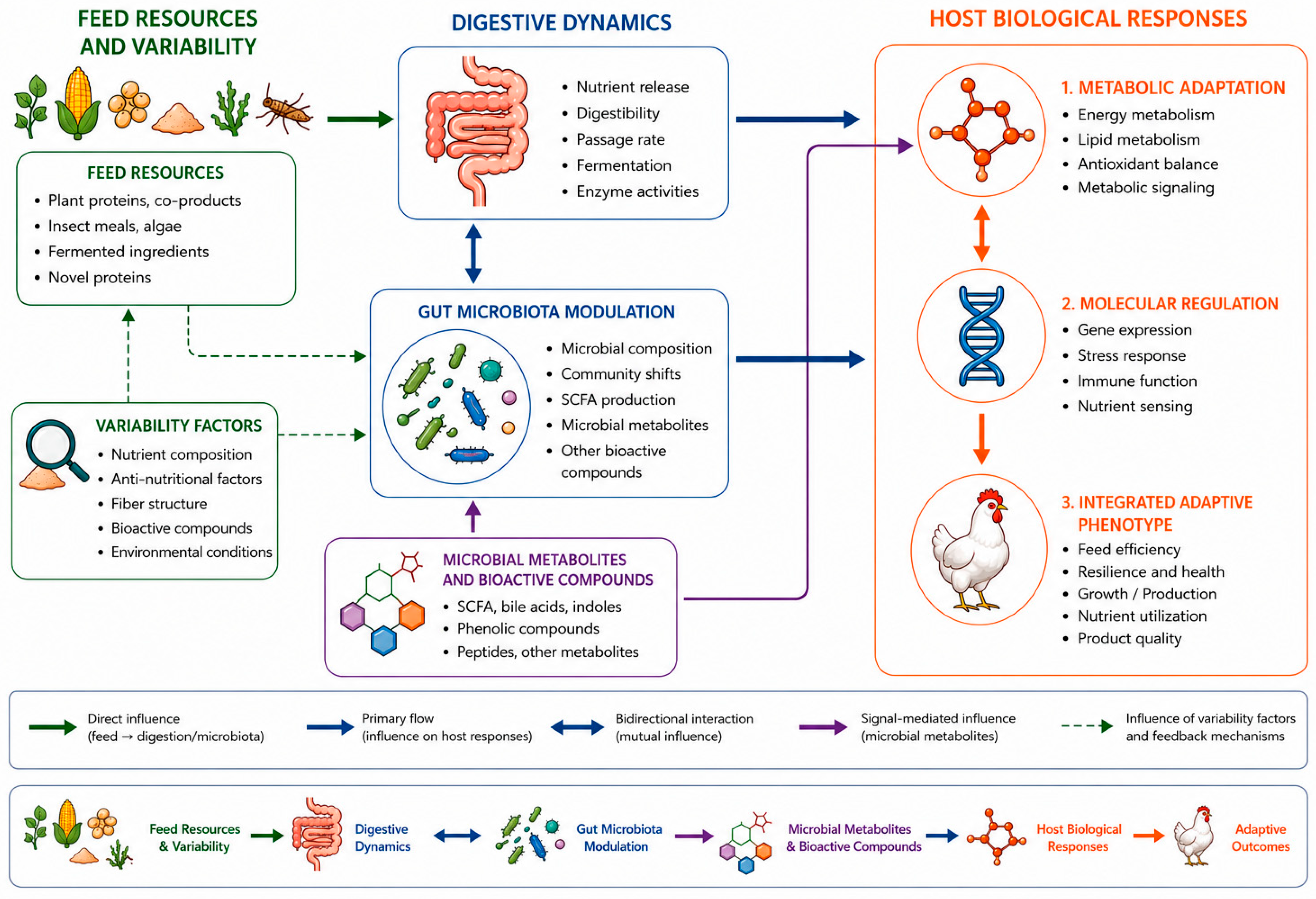
Because microbial composition, metabolic activity, and host gene regulation operate as interconnected components of the same biological system, understanding nutritional adaptation increasingly requires their integrated interpretation rather than separate analysis. Figure 6 summarizes these complementary biological layers and provides the conceptual framework for the multi-omics integration approaches discussed in the following section.

5.4. Multi-Omics Integration and System-Level Feed Interpretation

While microbiomic, metabolomic, and transcriptomic approaches provide distinct biological information, their evidentiary value depends strongly on how these analytical layers are combined. Studies in which multiple molecular and physiological measurements are acquired within the same experimental design show that dietary effects may extend from microbial community structure and fermentation to systemic metabolism and host regulation, even in the absence of measurable changes in productive performance [9,49,67]. Inglis et al. [9], for example, combined cecal microbiota profiling, fermentation measurements, and metabolomic analyses of intestinal contents and host tissues within the same feeding experiment. By contrast, other studies link microbiome-derived observations to targeted metabolic, physiological, or phenotypic measurements without constituting comprehensive multi-omics investigations [49]. Integrating microbial, metabolic, and phenotypic evidence can improve the interpretation of how sustainable feed ingredients influence host responses across multiple biological levels [9,49]. However, the strength of inference differs according to whether these data are generated from the same animals or assembled through complementary analyses.
Variability in feed composition may influence digestive dynamics, gut microbiota modulation, metabolic adaptation, and host regulatory responses. These changes ultimately contribute to integrated biological effects associated with nutrient utilization, physiological resilience, and system-level function. However, observing complementary responses across different studies is not equivalent to directly integrating multiple omics layers within the same experimental population. The former provides a broader narrative interpretation of biological processes, whereas the latter enables direct statistical evaluation of relationships among molecular layers, physiological responses, and phenotypic outcomes.
Although the biological rationale for multi-omics integration is increasingly recognized, translating interconnected molecular information into biologically meaningful nutritional interpretation remains a major challenge. As highlighted by Terrón-Camero et al. and Oladokun et al. [68], individual omics approaches capture complementary but distinct layers of biological information. Microbiomics describes taxonomic composition and, depending on the methodology used, functional potential or microbial activity; metabolomics characterizes downstream biochemical responses; and transcriptomics identifies host or microbial gene-expression patterns. Alterations in feed composition may initially influence microbial fermentation dynamics and community functionality, whereas downstream metabolic and host regulatory responses may emerge through interconnected biological processes [49,50]. Consequently, system-level interpretation requires more than the juxtaposition of findings from separate analytical approaches. Whenever possible, it should rely on the coordinated acquisition of multiple molecular layers from the same experimental units together with their integration with physiological and productive evidence.
Recent poultry studies illustrate several distinct levels of integration. Multi-tissue transcriptomic analyses can reveal coordinated regulatory responses across organs involved in nutrient utilization and feed efficiency, but they remain single-omics investigations because the same molecular layer is examined in different tissues [56,64]. Han et al. [56], for example, integrated transcriptomic profiles from seven tissues with productive and lipid-related phenotypes to identify cross-tissue regulatory networks associated with residual feed intake. Such studies provide system-level information on tissue coordination, although they should be distinguished from experimental designs that integrate different omics technologies.
A similar distinction applies to studies combining molecular data with environmental, physiological, or productive measurements. Li et al. [55] integrated transcriptomic analyses of ovarian and intestinal tissues with performance, biochemical indicators, environmental monitoring, and a Random Forest model based on environmental variables. This constitutes multilevel biological and environmental integration, but not multi-omics in the strict sense. By contrast, studies combining transcriptomics and metabolomics within the same experiment provide direct evidence of cross-omics relationships. Integrative transcriptomic and metabolomic analyses have revealed coordinated neuroendocrine, metabolic, and lipid-regulatory responses associated with physiological adaptation to environmental stress in broiler chickens [66]. These designs offer stronger evidence for cross-layer biological interpretation because molecular responses are measured under the same experimental conditions and can be related directly to shared phenotypic outcomes [66].
Despite the growing use of integrative approaches, comprehensive poultry studies simultaneously combining microbiomic, metabolomic, transcriptomic, physiological, and productive data remain uncommon. Much of the available literature instead represents partial integration, including single-omics analyses across multiple tissues, omics data combined with targeted biochemical or phenotypic measurements, or computational synthesis of independent datasets. These approaches remain valuable, but their evidentiary strength and translational implications are not equivalent to those of coordinated multi-omics experiments conducted in the same animals.
Important methodological and translational limitations also remain. Multi-layer biological datasets are characterized by high dimensionality, biological variability, limited sample sizes, and methodological heterogeneity, all of which may complicate reproducibility, cross-study integration, and biological interpretation [49,57]. Hosseinzadeh and Hasanpur [57], for example, showed that independent transcriptomic datasets addressing a comparable biological question produced limited agreement when analyzed separately, necessitating meta-analysis and subsequent computational validation. Although this study does not represent multi-omics integration, it demonstrates how heterogeneity can affect the reproducibility of molecular findings even within a single omics domain.
Integration of heterogeneous datasets also requires computational workflows capable of relating molecular patterns to physiological adaptation and phenotypic responses. Network-based analyses, co-expression models, enrichment methods, and machine learning approaches can identify coordinated molecular interactions. However, these outputs remain primarily associative and hypothesis-generating unless they are supported by independent biological validation. Computational integration therefore cannot substitute for mechanistic experimentation, particularly when datasets originate from different animals, tissues, time points, or experimental conditions [49,57,60,64]. Even in genuine multi-omics studies, apparent cross-layer associations may reflect shared responses to the same treatment rather than direct biological relationships. Reliable system-level interpretation consequently requires adequate experimental replication, harmonized sampling, independent validation, and phenotypic or physiological evidence capable of anchoring molecular patterns to functional outcomes.
Taken together, the strongest evidence for multi-omics interpretation in poultry nutrition currently derives from studies in which two or more molecular layers are measured within the same experimental design and related to validated physiological or productive responses [9,55]. However, the literature considered in this review also includes valuable examples of multi-tissue transcriptomics, computational integration of independent datasets, and combinations of omics data with environmental or phenotypic measurements. These approaches contribute complementary information but should not be treated as methodologically equivalent. Recognizing this distinction provides a more realistic assessment of the present maturity of system-level feed evaluation and prevents conceptual integration from being interpreted as already validated experimental multi-omics.
Broader implementation in precision poultry nutrition will depend on methodological standardization, synchronized sampling, adequate statistical power, cross-platform harmonization, rigorous biological validation, and computational approaches capable of translating multidimensional datasets into interpretable nutritional information. In the near term, experimentally coordinated integration of two omics layers with robust physiological and productive phenotyping appears more realistic than comprehensive integration of microbiomic, metabolomic, transcriptomic, environmental, and performance data. Progressively expanding these validated designs will provide a more reliable pathway toward evidence-based, system-oriented nutritional decision-making.

6. AI for Feed Evaluation and Decision Support

AI and predictive modeling provide the computational framework for integrating analytical measurements, biological responses, and animal performance into predictive models that support a more comprehensive evaluation of sustainable feed resources. These computational approaches identify complex and often non-linear relationships across multiple sources of evidence. As a result, they facilitate the interpretation of feed quality and its expected nutritional value beyond the capabilities of conventional analytical methods alone. Rather than replacing established analytical and biological approaches, AI complements them by transforming heterogeneous datasets into actionable nutritional knowledge. Accordingly, the following sections discuss how these computational strategies contribute to feed evaluation, prediction of animal responses, multi-level biological integration, and evidence-based nutritional decision support.

6.1. AI-Based Prediction of Feed Quality and Nutritional Value

AI and predictive modeling extend the value of analytical and biological feed characterization by integrating heterogeneous sources of evidence into predictive frameworks capable of supporting nutritional interpretation and decision making. Rather than generating new experimental information, AI-based models combine compositional measurements, spectroscopic signatures, digestibility-related information, and other complementary feed descriptors to estimate nutritionally relevant characteristics, including ME, amino acid availability, and digestibility-related parameters. In this way, feed evaluation shifts from descriptive characterization toward predictive nutritional inference [4,31,42,43,47].
The predictive performance of these approaches relies on their ability to identify complex relationships among multiple variables that cannot be readily captured through conventional statistical evaluation alone. AI-assisted models combine compositional profiles with spectroscopic signatures and complementary analytical descriptors to improve the estimation of nutritionally relevant parameters [42,47]. They also reduce the time required for feed evaluation and support the assessment of heterogeneous feed ingredients. These capabilities are particularly valuable when multiple nutritional characteristics must be inferred simultaneously from a single set of analytical measurements.
Recent studies demonstrate that integrated predictive models can simultaneously estimate multiple nutritional traits from complex analytical datasets [47]. This provides a more comprehensive evaluation of feed quality. However, predictive performance remains dependent on appropriate model development and validation. Collectively, these advances demonstrate that the principal contribution of AI-based predictive frameworks lies not simply in estimating individual nutritional parameters, but in translating diverse analytical information into biologically meaningful estimates of feed value that are more closely associated with nutrient utilization than isolated compositional traits.
Despite these advances, the practical value of AI-assisted feed evaluation depends on the biological consistency, interpretability, and generalizability of model outputs across diverse production systems. Models developed under controlled experimental conditions must demonstrate reliable performance when applied to heterogeneous commercial environments, where ingredient variability, management practices, and environmental conditions may substantially influence predictive reliability. Consequently, successful implementation of AI for feed evaluation requires accurate prediction, robust biological validation, and transparent decision-support frameworks capable of supporting evidence-based nutritional management. These requirements provide the foundation for extending predictive modeling beyond feed characterization toward the prediction of animal responses discussed in the following section.

6.2. AI-Based Prediction of Animal Performance and Physiological Responses

AI is increasingly being used to predict animal responses to nutritional strategies, extending predictive approaches beyond feed characterization. While the previous section focused on estimating the nutritional value of feed ingredients, recent applications have progressively shifted toward anticipating how birds respond to different nutritional interventions. By linking dietary information with productive and physiological outcomes, these approaches support more informed nutritional decision-making under increasingly variable production conditions.
Predicting animal responses is inherently more complex than characterizing feed ingredients because nutritional outcomes emerge from interactions among genetics, physiological status, management practices, and environmental conditions. Machine learning algorithms are therefore particularly well suited to capture the resulting non-linear relationships that are difficult to describe using conventional statistical approaches. Random Forest, Extreme Gradient Boosting (XGBoost), Artificial Neural Networks (ANNs), and ensemble learning methods have been successfully applied to estimate growth rate, feed conversion ratio (FCR), egg production, carcass characteristics, and other economically relevant traits from nutritional and management variables, frequently outperforming traditional linear regression models in predictive accuracy [69,70].
The predictive challenge lies in the fact that nutritional interventions generate interconnected responses across productive, physiological, microbial, and environmental domains, which rarely vary independently. Consequently, effective AI models must account for multiple biological endpoints simultaneously rather than treating individual production traits as isolated outcomes [71,72].
Recent studies have demonstrated that ANN-based response surface models can successfully predict broiler performance under diets differing in digestible protein and essential amino acid supply [73]. These models identify nutritional combinations that maximize body weight while avoiding unnecessary nutrient oversupply. Likewise, machine learning approaches have produced encouraging results in predicting broiler growth from integrated nutritional and environmental datasets [74]. Stacked ensemble methods have also improved the prediction of egg production by combining complementary algorithms [75]. Collectively, these findings indicate that AI provides considerable opportunities to improve the prediction of animal performance across diverse nutritional conditions and to support more evidence-based feeding strategies.
Nevertheless, translating these computational approaches into routine nutritional management remains challenging because biological responses vary substantially across commercial production systems. Differences in genetics, physiological status, management practices, environmental conditions, and feeding strategies can limit the generalizability of predictions beyond the populations on which algorithms were originally developed. Future progress will depend on the availability of biologically representative datasets encompassing the diversity of modern poultry production systems and on rigorous biological validation across different breeds, environments, and management conditions. These considerations provide the foundation for the integrated predictive frameworks discussed in the following section.

6.3. AI-Based Integration of Multilevel Biological Data

AI is increasingly being explored not only as a predictive technology but also as an integrative computational framework. Building upon the predictive models of feed quality and animal responses discussed in the previous sections, it has the potential to connect evidence generated across different levels of poultry nutrition research. This integration supports a more comprehensive interpretation of complex biological systems [75,76,77,78]. Advanced analytical techniques, in vitro models, omics technologies, and precision livestock farming have greatly expanded the information available for feed evaluation. The challenge is no longer limited to data acquisition itself but increasingly concerns the integration and interpretation of evidence generated at different analytical and biological levels. In this context, AI provides the computational tools needed to combine information that has traditionally been evaluated independently, supporting biologically informed interpretation and nutritional decision-making for sustainable feed resources [75,76,77,78].
Within the integrated framework proposed in this review, AI serves as the computational interface between the analytical characterization of feed ingredients (Section 4), the biological responses described by omics technologies (Section 5), and the predictive models of animal performance discussed in the previous section. Current applications demonstrate the ability of AI to integrate selected analytical, environmental, behavioural, physiological, and production-related data streams to improve prediction and decision-making. However, these demonstrated applications should be distinguished from the broader multilevel integration framework proposed in this review. Recent studies have combined heterogeneous information derived from analytical measurements, environmental monitoring, physiological indicators, behavioural observations, and production records to support specific monitoring and prediction tasks [78,79,80,81]. In precision poultry farming, sensor-derived information has been successfully integrated with environmental and productive variables to support continuous flock monitoring and management [79,80,81], whereas multimodal machine learning models combining physicochemical, textural, and electronic-nose measurements have demonstrated high classification performance together with improved model interpretability through explainable AI approaches [82]. Although comprehensive integration of omics-derived information remains limited in poultry nutrition, the same computational principles could ultimately be extended to incorporate microbiome, metabolomic, and transcriptomic profiles alongside analytical feed characterization. This integration would enable a more comprehensive interpretation of nutrient utilization, biological adaptation, and productive responses.
Figure 7 summarizes the conceptual workflow proposed in this review, illustrating how heterogeneous analytical and biological information could be progressively harmonized and integrated through AI-assisted computational frameworks to generate biologically informed, evidence-based recommendations for precision poultry nutrition.
Within the conceptual framework proposed in this review, the intended role of AI is not simply to increase the number of variables included in predictive models, but to relate complementary levels of biological information that collectively contribute to the animal response. Analytical measurements characterize feed composition and physicochemical properties, physiological indicators quantify the functional response of the animal, whereas microbiome and metabolomic profiles provide complementary information on biological adaptations to dietary interventions, and behavioural and productive records capture the resulting phenotypic expression. By integrating these complementary sources of evidence within such a framework, AI could facilitate the interpretation of relationships between analytical observations and the biological processes underlying animal performance under sustainable feeding strategies. Its potential contribution therefore extends beyond predictive performance by enabling a biologically informed interpretation of feed–animal interactions and supporting precision poultry nutrition [75,77,78,79].
Despite these advances, current AI applications remain primarily focused on integrating analytical, environmental, behavioural, and production-related information, whereas the incorporation of transcriptomic, metabolomic, and microbiome-derived data remains relatively limited and is largely confined to experimental research [76,78,81]. Accordingly, the framework illustrated in Figure 7 should be interpreted as a research-oriented conceptual architecture rather than as a representation of current routine practice in poultry nutrition. Expanding AI toward truly multilevel biological integration therefore represents one of the major priorities for future poultry nutrition research. Achieving this objective will require computational frameworks capable of integrating analytical, physiological, molecular, microbial, and productive information while maintaining biological interpretability. Progress toward this objective will likely occur incrementally, beginning with the integration of a limited number of complementary biological domains and progressively expanding toward comprehensive multilevel frameworks as methodological standardization, biological validation, and data interoperability continue to improve. Such developments will strengthen the ability of AI not only to support nutritional decision-making but also to reveal the biological mechanisms underlying animal responses [75,76,77,78,79,80,81,82]. They will also provide the conceptual foundation for the explainable AI approaches discussed in the following section.

6.4. Explainability, Validation, and Generalizability of AI Models

AI applications are evolving from predictive tools toward integrated decision-support systems. Consequently, their practical value increasingly depends on model interpretability, biological validity, and the ability to generalize across heterogeneous production environments rather than on predictive accuracy alone. Consequently, the successful translation of AI into routine poultry nutrition requires computational frameworks that are not only accurate but also biologically interpretable, externally validated, and robust across diverse production scenarios [76,78,81].
A major limitation of many advanced machine learning algorithms, particularly deep learning architectures, is their limited interpretability. While these models can capture complex nonlinear relationships that frequently outperform conventional statistical approaches, their internal decision-making processes often remain opaque, limiting user confidence and slowing their adoption in poultry nutrition. Explainable AI (XAI) addresses this limitation by identifying the variables that contribute most strongly to model predictions and by linking computational outputs to established physiological and metabolic mechanisms. Recent methodological advances have further strengthened the XAI framework through model-agnostic interpretation methods such as Local Interpretable Model-Agnostic Explanations (LIME) and Shapley Additive Explanations (SHAP). These methods facilitate the interpretation of model predictions by quantifying the contribution of individual input variables at both local and global levels. Complementary strategies, including surrogate modeling, uncertainty quantification, and visualization techniques, further improve the transparency and reliability of complex predictive systems. Although these methodological developments have been established across multiple scientific disciplines, they provide a valuable methodological framework for developing biologically interpretable, transparent, and trustworthy AI-assisted decision-support systems for sustainable poultry nutrition [55,59,78,83].
External validation is equally essential for translating AI from experimental research into practical nutritional applications. Predictive models developed under controlled experimental conditions frequently exhibit reduced performance when applied across different farms, production environments, feed resources, or genetic backgrounds. Recent reviews consistently emphasize that independent validation under diverse commercial conditions is a prerequisite for reliable AI-assisted nutritional decision-making [76,78,81]. In situations where substantial biological or environmental variability exists, local recalibration or domain adaptation may also be required to maintain predictive reliability [81].
Successful implementation of integrated AI frameworks further depends on harmonized analytical and biological data generated across different experimental platforms. Variability in analytical methodologies, sampling strategies, metadata annotation, and data formatting may compromise interoperability among datasets and limit the integration of complementary sources of biological information [76,81]. These challenges become particularly relevant when combining information derived from advanced analytical techniques, in vitro digestion systems, microbiome profiling, metabolomics, and production records. In these situations, variability may originate from both biological and technical sources. Consequently, standardized data acquisition protocols, harmonized metadata, and rigorous quality-control procedures are increasingly recognized as prerequisites for reproducible AI applications in poultry nutrition [76,81].
Beyond issues related to data harmonization, another important limitation is the still limited availability of large, diverse, and openly accessible datasets specifically developed for AI applications in poultry production. Although the number of public resources has increased in recent years, many available datasets remain small, task-specific, or derived from restricted experimental conditions, limiting their suitability for training broadly transferable models. This scarcity restricts independent benchmarking, reproducibility, and the cumulative validation of algorithms across research groups and production contexts. The development of multi-farm, multi-breed, and multi-environment open datasets would therefore provide a shared empirical foundation for model development, benchmarking, and independent validation across diverse poultry production systems [81,84].
These challenges are reflected in the evidence summarized in Table 5, which highlights representative AI applications together with their biological objectives, current validation status, and principal translational limitations.
Overall, current evidence indicates that the successful implementation of AI in poultry nutrition will depend less on increasingly sophisticated algorithms than on computational frameworks that are biologically interpretable, externally validated, and sufficiently robust to operate across diverse production environments. Establishing transparent, reproducible, and generalizable models will be essential for translating AI from experimental research into routine nutritional decision-making. Under these conditions, AI can evolve from a powerful analytical technology into a reliable decision-support system for sustainable poultry nutrition [9,49,76,78,81].

6.5. Emerging Frontiers in AI-Driven Nutritional Decision-Support Systems

As poultry production systems become increasingly complex, nutritional decision-support strategies must also become more adaptive. Nutrient utilization varies according to bird age, health status, environmental conditions, feed transitions, and management practices. Consequently, evaluation frameworks must accommodate this biological variability over time. Increasing attention is therefore being directed toward AI-assisted systems that incorporate continuous biological feedback, periodic model updating, and context-specific nutritional interpretation. These systems move beyond static prediction toward adaptive nutritional management [47,78].
One of the most promising developments is the emergence of closed-loop nutritional systems, in which analytical measurements, biological monitoring, predictive modelling, and nutritional interventions operate within continuous feedback cycles. Early applications in precision livestock farming have demonstrated the feasibility of integrating real-time monitoring with model-based nutritional control to optimize broiler growth and feed management [82]. Building on these advances, integrated AI-driven frameworks may support adaptive enzyme supplementation, precision feeding during environmental stress, and dynamic adjustment of nutrient supply according to continuously evolving physiological and productive responses [80,81]. Rather than replacing nutritional expertise, these systems are expected to strengthen evidence-based decision-making by continuously linking analytical observations with biological responses throughout the production cycle.
An additional challenge concerns the long-term reliability of adaptive AI systems as biological and environmental conditions continuously evolve. Real-time analytical measurements can be integrated with mechanistic knowledge and machine learning approaches to periodically update and recalibrate predictive models as new biological and production data become available [77]. By progressively incorporating evidence generated under commercial production conditions, these adaptive frameworks may improve the robustness, transferability, and practical applicability of nutritional recommendations across heterogeneous poultry production systems [76,78,81].

7. Conclusions

Sustainable poultry nutrition is undergoing a profound transition from conventional feed evaluation based primarily on ingredient composition toward integrated biological frameworks capable of capturing the complexity of nutrient utilization under modern production systems. Although conventional analytical approaches remain indispensable for determining the nutritional characteristics of feed ingredients, the evidence examined throughout this review demonstrates that they are no longer sufficient to fully explain the heterogeneous biological responses associated with sustainable feed resources. Feed evaluation can no longer rely on isolated measurements. Instead, it increasingly requires integrated frameworks capable of connecting analytical observations with the biological mechanisms governing nutrient utilization and animal responses.
A central conclusion emerging from the available evidence is that no single analytical or computational methodology can independently address the complexity of sustainable poultry nutrition. Instead, advanced analytical technologies, dynamic in vitro digestion models, omics approaches, and AI should be regarded as complementary components of an integrated evaluation strategy. Within this framework, analytical methods provide accurate feed characterization, biological approaches reveal the mechanisms underlying nutrient utilization, and AI enables the integration of heterogeneous information into biologically informed decision-support systems. The value of these technologies therefore lies not in their individual application but in their coordinated integration to support evidence-based nutritional management.
Despite the substantial progress achieved in recent years, important challenges remain before these integrated approaches can be routinely implemented under commercial conditions. Among the technologies reviewed, rapid spectroscopic methods supported by chemometric modelling and AI-assisted prediction currently appear closest to practical implementation because they already provide rapid, non-destructive feed characterization and have undergone substantial experimental validation. In contrast, comprehensive integration of analytical, microbiomic, metabolomic, transcriptomic, physiological, and production data into unified AI-assisted decision-support systems remains largely at the research stage.
Bridging this gap will require a progressive implementation strategy. The most immediate priority is the harmonization of analytical methods, sampling procedures, and metadata standards. Methodological variability currently limits the comparability of results even within individual analytical and omics platforms. Once harmonized datasets become available, the next essential step will be prospective biological validation across independent production systems to establish the robustness, reproducibility, and transferability of predictive models. Only after these methodological foundations have been established will interoperable data infrastructures, biologically interpretable AI models, and fully integrated multilevel decision-support systems become realistic targets for routine commercial implementation. Establishing this sequential validation pathway will be essential before integrated feed evaluation frameworks can be translated into practical poultry nutrition.
Finally, stronger collaboration between academia, industry, and technology developers will be essential to accelerate biological validation, promote data harmonization, and facilitate the translation of integrated feed evaluation strategies into practical applications for sustainable poultry nutrition.
The progressive implementation of integrated analytical, biological, and AI-driven decision-support systems may also establish a virtuous cycle of continuous improvement. As these technologies are increasingly adopted under commercial conditions, every new application has the potential to generate additional analytical, biological, and production data. These data can be used to refine predictive models, improve algorithm performance, strengthen biological interpretation, and progressively enhance nutritional recommendations. In this perspective, implementation should not be regarded simply as the final stage of technological development, but as an essential component of an adaptive learning process in which practical application continuously contributes to scientific advancement while supporting broader strategies to improve the sustainability, resilience, and resource efficiency of poultry production systems.
Ultimately, the future of sustainable poultry nutrition will depend not on the independent advancement of advanced analytical technologies, omics, or AI, but on their effective integration into biologically coherent, experimentally validated, and adaptive decision-support frameworks capable of continuously learning from new evidence while supporting robust, transparent, and scientifically grounded nutritional decisions under the complexity and variability in modern poultry production systems.

Funding

This research received no external funding.

Institutional Review Board Statement

Not applicable.

Informed Consent Statement

Not applicable.

Data Availability Statement

No new data were created or analysed in this study. Data sharing is not applicable.

Acknowledgments

During the preparation of this manuscript, the author used ChatGPT-5 Plus (OpenAI, San Francisco, CA, USA) for language editing, figure-support drafting, and bibliographic formatting assistance. The author reviewed and edited all AI-assisted outputs and takes full responsibility for the final content of this manuscript.

Conflicts of Interest

The author declares no conflicts of interest.

References

  1. Yegani, M.; Korver, D.R. Review: Prediction of Variation in Energetic Value of Wheat for Poultry. Can. J. Anim. Sci. 2012, 92, 261–273. [Google Scholar] [CrossRef] [Scilit]
  2. Nguyen, H.D.; Moss, A.F.; Yan, F.; Romero-Sanchez, H.; Dao, T.H. Effects of Feeding Methionine Hydroxyl Analogue Chelated Zinc, Copper, and Manganese on Growth Performance, Nutrient Digestibility, Mineral Excretion, and Welfare Conditions of Broiler Chickens: Part 2: Sustainability and Welfare Aspects. Animals 2025, 15, 419. [Google Scholar] [CrossRef] [Scilit] [PubMed]
  3. Melo-Durán, D.; Perez, J.F.; Gonzalez-Ortiz, G.; Villagomez-Estrada, S.; Bedford, M.R.; Graham, H.; Sola-Oriol, D. Growth Performance and Total Tract Digestibility in Broiler Chickens Fed Different Corn Hybrids. Poult. Sci. 2021, 100, 101218. [Google Scholar] [CrossRef] [Scilit] [PubMed]
  4. Tangendjaja, B. Nutrient Content of Soybean Meal from Different Origins Based on Near Infrared Reflectance Spectroscopy. Indones. J. Agric. Sci. 2020, 21, 39–47. [Google Scholar] [CrossRef] [Scilit]
  5. Yegani, M.; Swift, M.L.; Zijlstra, R.T.; Korver, D.R. Prediction of Energetic Value of Wheat and Triticale in Broiler Chicks: A Chick Bioassay and an in vitro Digestibility Technique. Anim. Feed Sci. Technol. 2013, 183, 40–50. [Google Scholar] [CrossRef] [Scilit]
  6. Robertson, K.; Ortuño, J.; Stratakos, A.; Stergiadis, S.; Theodoridou, K. Attenuated-Total-Reflection Fourier-Transformed Spectroscopy as a Rapid Tool to Reveal the Molecular Structure of Insect Powders as Ingredients for Animal Feeds. J. Insects Food Feed 2024, 10, 2143–2156. [Google Scholar] [CrossRef] [Scilit]
  7. Takaeh, S.; Poolthajit, S.; Hahor, W.; Nuntapong, N.; Ngampongsai, W.; Thongprajukaew, K. Physical Pretreatments of Cassava Chips Influenced Chemical Composition, Physicochemical Properties, and in vitro Digestibility in Animal Models. Animals 2024, 14, 908. [Google Scholar] [CrossRef] [Scilit] [PubMed]
  8. Walker, H.; Vartiainen, S.; Apajalahti, J.; Taylor-Pickard, J.; Nikodinoska, I.; Moran, C.A. The Effect of Including a Mixed-Enzyme Product in Broiler Diets on Performance, Metabolizable Energy, Phosphorus and Calcium Retention. Animals 2024, 14, 328. [Google Scholar] [CrossRef] [Scilit] [PubMed]
  9. Douglas Inglis, G.; Wright, B.D.; Sheppard, S.A.; Abbott, D.W.; Oryschak, M.A.; Montina, T. Expeller-Pressed Canola (Brassica napus) Meal Modulates the Structure and Function of the Cecal Microbiota, and Alters the Metabolome of the Pancreas, Liver, and Breast Muscle of Broiler Chickens. Animals 2021, 11, 577. [Google Scholar] [CrossRef] [Scilit] [PubMed]
  10. Philippi, H.; Sommerfeld, V.; Monteiro, A.; Rodehutscord, M.; Olukosi, O.A. Impact of Trace Mineral Source and Phytase Supplementation on Prececal Phytate Degradation and Mineral Digestibility, Bone Mineralization, and Tissue Gene Expression in Broiler Chickens. Biol. Trace Elem. Res. 2024, 202, 5235–5250. [Google Scholar] [CrossRef] [Scilit] [PubMed]
  11. Morota, G.; Ventura, R.V.; Silva, F.F.; Koyama, M.; Fernando, S.C. Big Data Analytics and Precision Animal Agriculture Symposium: Machine Learning and Data Mining Advance Predictive Big Data Analysis in Precision Animal Agriculture. J. Anim. Sci. 2018, 96, 1540–1550. [Google Scholar] [CrossRef] [Scilit] [PubMed]
  12. Mehri, M. Development of Artificial Neural Network Models Based on Experimental Data of Response Surface Methodology to Establish the Nutritional Requirements of Digestible Lysine, Methionine, and Threonine in Broiler Chicks. Poult. Sci. 2012, 91, 3280–3285. [Google Scholar] [CrossRef] [Scilit] [PubMed]
  13. Mehri, M. Optimization of Response Surface and Neural Network Models in Conjugation with Desirability Function for Estimation of Nutritional Needs of Methionine, Lysine, and Threonine in Broiler Chickens. Poult. Sci. 2014, 93, 1862–1867. [Google Scholar] [CrossRef] [Scilit] [PubMed]
  14. Morales-Suárez, W.; Ospina-Rojas, I.C.; Méndez-Arteaga, J.J.; do Nascimento Ferreira, A.H.; Váquiro-Herrera, H.A. Multivariate Modeling Strategies to Predict Nutritional Requirements of Essential Amino Acids in Semiheavy Second-Cycle Hens. Rev. Bras. Zootec. 2021, 50, e20200262. [Google Scholar] [CrossRef] [Scilit]
  15. Oviedo-Rondón, E.O. ASAS-NANP Symposium: Mathematical Modeling in Animal Nutrition: Overview of Poultry Nutrition Modeling. J. Anim. Sci. 2025, 103, skaf140. [Google Scholar] [CrossRef] [Scilit] [PubMed]
  16. Green, B.N.; Johnson, C.D.; Adams, A. Writing Narrative Literature Reviews for Peer-Reviewed Journals: Secrets of the Trade. J. Chiropr. Med. 2006, 5, 101–117. [Google Scholar] [CrossRef] [Scilit] [PubMed]
  17. Ferrari, R. Writing Narrative Style Literature Reviews. Med. Writ. 2015, 24, 230–235. [Google Scholar] [CrossRef] [Scilit]
  18. Baethge, C.; Franklin, J.; Mertens, S. SANRA—A scale for the quality assessment of narrative review articles. Res. Integr. Peer Rev. 2019, 4, 5. [Google Scholar] [CrossRef] [Scilit] [PubMed]
  19. Nassar, F.S. Strategic Role of Poultry Production Sciences in Shaping the Future of Global Food Security and Strengthen Sustainability. Poult. Sci. J. 2026, 105, 106617. [Google Scholar] [CrossRef] [Scilit] [PubMed]
  20. Food and Agriculture Organization of the United Nations (FAO). The State of Food and Agriculture 2023: Revealing the True Cost of Food to Transform Agrifood Systems; FAO: Rome, Italy, 2023. [Google Scholar] [CrossRef] [Scilit]
  21. Islam, M.T.; Uddin, M.E.; Karim, M.S.; Islam, A. Valorization of Raw Hide Trimmings as Alternative Protein Source for Poultry Feed: A Step towards Sustainable Waste Management and Circular Bioeconomy. J. Clean. Prod. 2026, 542, 147579. [Google Scholar] [CrossRef] [Scilit]
  22. Brizuela, M.J.; Vargas, J.I.; Dias, I.C.; Gulizia, J.P.; Guzmán, E.G.; Hernández, J.R.; Simões, C.T.; Pacheco, W.J. Influence of Local and Reimported United States and South American Corn Sources on Broiler Performance, Nutrient Digestibility, and Processing Yield. Animals 2025, 15, 1770. [Google Scholar] [CrossRef] [Scilit] [PubMed]
  23. Sadr, V.S.; Macelline, S.P.; Kim, E.; Toghyani, M.; Hamungalu, O.; Wester, T.J.; Barekatain, R.; Liu, S.Y. Potential of Field Peas and Faba Beans as Protein-Rich Alternatives for Partial or Full Replacement of Soybean Meal in Broiler Chicken Diets. Poult. Sci. 2026, 105, 106191. [Google Scholar] [CrossRef] [Scilit] [PubMed]
  24. Kandel, M.; Toghyani, M.; Macelline, S.P.; Selle, P.H.; Zadoks, R.N.; Liu, S.Y. The Impact of Soybean Meal and Field Peas Inclusion on Growth Performance, Carcass Traits and Nutrient Digestibilities in Broiler Chickens Offered Wheat-Based Diets. Anim. Nutr. 2025, 22, 113–126. [Google Scholar] [CrossRef] [Scilit] [PubMed]
  25. Soares, L.; Högel, H.; Keto, L.; Franco, M.; Rinne, M.; Rodehutscord, M.; Viana, G.S. Phytate Degradation and Pre-Cecal Phosphorus Digestibility of Raw vs. Crimped-Ensiled Faba Beans (Vicia faba L.) Fed to Broiler Chickens. Poult. Sci. 2026, 105, 106157. [Google Scholar] [CrossRef] [Scilit] [PubMed]
  26. Ataei, A.H.; Kırkpınar, F. The Effects of Solid State Fermentation on Nutrient Composition of Olive Cake with Aspergillus niger and Bacillus subtilis. J. Hell. Vet. Med. Soc. 2025, 76, 3. [Google Scholar] [CrossRef] [Scilit]
  27. Broering, V.E.; Campelo, P.M.S.; Michelotto, P.V., Jr.; Bianchini, L.F.; Rosa, E.A.R. Giving Broiler Feathers a Good Fate: Optimization of Chemical Hydrolysis for the Production of a Hydrolysate Rich in Free Amino Acids. ACS Omega 2025, 10, 24532–24540. [Google Scholar] [CrossRef] [Scilit] [PubMed]
  28. EFSA FEEDAP Panel (EFSA Panel on Additives and Products or Substances used in Animal Feed); Bampidis, V.; Bastos, M.L.; Christensen, H.; Dusemund, B.; Kouba, M.; Kos Durjava, M.; Lopez-Alonso, M.; López Puente, S.; Marcon, F.; et al. Guidance on the Assessment of the Safety of Feed Additives for the Environment. EFSA J. 2019, 17, e05648. [Google Scholar] [CrossRef] [Scilit] [PubMed]
  29. Muinde, J.; Tanga, C.M.; Olukuru, J.; Odhiambo, C.; Tonnang, H.E.Z.; Senagi, K. Application of Machine Learning Techniques to Discern Optimal Rearing Conditions for Improved Black Soldier Fly Farming. Insects 2023, 14, 479. [Google Scholar] [CrossRef] [Scilit] [PubMed]
  30. Latham, R.E.; Williams, M.P.; Flores, C.; Masey O’Neill, H.V.; York, T.W.; Lee, J.T. Impact of Variable Corn Nutrient Content, AME Prediction, and Xylanase Inclusion on Growth Performance. J. Appl. Poult. Res. 2016, 25, 338–351. [Google Scholar] [CrossRef] [Scilit]
  31. Sadighi Sheikhhasan, B.; Moravej, H.; Ghaziani, F.; Esteve-Garcia, E.; Kim, W.K. Relationship between Chemical Composition and Standardized Ileal Digestible Amino Acid Contents of Corn Grain in Broiler Chickens. Poult. Sci. 2020, 99, 4496–4504. [Google Scholar] [CrossRef] [Scilit] [PubMed]
  32. Abun, A.; Rusmana, D.; Widjastuti, T.; Haetami, K. PrebioticsBLS from Encapsulated Extract of Shrimp Waste Bioconversion on Feed Supplement Quality and Its Implication on Metabolizable Energy and Digestibility in Indonesian Local Chickens. J. Appl. Anim. Res. 2021, 49, 295–303. [Google Scholar] [CrossRef] [Scilit]
  33. Eshtejarani, A.A.; Moravej, H.; Ghaziani, F.; Rafieian Naeini, H.; Kim, W.K. Development of Prediction Equations for Apparent Metabolizable Energy Corrected for Nitrogen of Fish Meal and Poultry By-Product Meal in Broiler Chickens. J. Appl. Poult. Res. 2024, 33, 100485. [Google Scholar] [CrossRef] [Scilit]
  34. Hotea, I.; Plotuna, A.-M.; Alda, M.; Tîrziu, E. Nutritional Characterization and Regional Variability of Corn Grains for Monogastric Animal Feeding in Western Romania. Food Feed Res. 2026, 52, 193–204. [Google Scholar] [CrossRef] [Scilit]
  35. El Bouanani, N.; Bencharki, B.; Houmairi, H. Chemical Profile and Mycotoxin Analyses of Corn (Argentina, Brazil, and Ukraine), Soybean Meal (USA and Argentina), and Sunflower Meal (Ukraine) Used in Poultry Feed in Morocco. Analytica 2025, 6, 30. [Google Scholar] [CrossRef] [Scilit]
  36. Zhao, Y.; Dang, X.; Du, H.; Wang, D.; Zhang, J.; Liu, R.; Ge, Z.; Sun, Z.; Zhong, Q. Understanding the Impact of Extrusion Treatment on Cereals: Insights from Alterations in Starch Physicochemical Properties and in vitro Digestion Kinetics. Animals 2024, 14, 3144. [Google Scholar] [CrossRef] [Scilit] [PubMed]
  37. Nguyen, H.T.; Bedford, M.R.; Wu, S.-B.; Morgan, N.K. Dietary Soluble Non-Starch Polysaccharide Level Influences Performance, Nutrient Utilisation and Disappearance of Non-Starch Polysaccharides in Broiler Chickens. Animals 2022, 12, 547. [Google Scholar] [CrossRef] [Scilit] [PubMed]
  38. Kim, E.; Moss, A.F.; Morgan, N.K.; Gharib-Naseri, K.; Ader, P.; Choct, M. Non-Starch Polysaccharide-Degrading Enzymes May Improve Performance When Included in Wheat- but Not Maize-Based Diets Fed to Broiler Chickens under Subclinical Necrotic Enteritis Challenge. Anim. Nutr. 2022, 10, 54–67. [Google Scholar] [CrossRef] [Scilit] [PubMed]
  39. Wu, S.-B.; Choct, M.; Pesti, G. Historical Flaws in Bioassays Used to Generate Metabolizable Energy Values for Poultry Feed Formulation: A Critical Review. Poult. Sci. 2020, 99, 385–406. [Google Scholar] [CrossRef] [Scilit] [PubMed]
  40. Zaefarian, F.; Cowieson, A.J.; Pontoppidan, K.; Abdollahi, M.R.; Ravindran, V. Trends in Feed Evaluation for Poultry with Emphasis on in vitro Techniques. Anim. Nutr. 2021, 7, 268–281. [Google Scholar] [CrossRef] [Scilit] [PubMed]
  41. Norris, K.H.; Williams, P.C. Optimization of Mathematical Treatments of Raw Near-Infrared Signal in the Measurement of Protein in Hard Red Spring Wheat. I. Influence of Particle Size. Cereal Chem. 1984, 61, 158–165. [Google Scholar]
  42. Bresolin, T.; Dórea, J.R.R. Infrared Spectrometry as a High-Throughput Phenotyping Technology to Predict Complex Traits in Livestock Systems. Front. Genet. 2020, 11, 923. [Google Scholar] [CrossRef] [Scilit] [PubMed]
  43. Cruz-Conesa, A.; Ferré, J.; Pérez-Vendrell, A.M.; Callao, M.P.; Ruisánchez, I. Use of Visible-Near Infrared Spectroscopy to Predict Nutrient Composition of Poultry Excreta. Anim. Feed Sci. Technol. 2022, 283, 115169. [Google Scholar] [CrossRef] [Scilit]
  44. Sedghi, M.; Ebadi, M.R.; Golian, A.; Ahmadi, H. Prediction of Digestible Amino Acid and True Metabolizable Energy Contents of Sorghum Grain from Total Essential Amino Acids. J. Agric. Sci. 2013, 151, 693–700. [Google Scholar] [CrossRef] [Scilit]
  45. Sibbald, I.R. A Bioassay for True Metabolizable Energy in Feedingstuffs. Poult. Sci. 1976, 55, 303–308. [Google Scholar] [CrossRef] [Scilit] [PubMed]
  46. Wang, T.; Jendza, J.A.; Ader, P.; Adeola, O. Evaluation of a Novel Hybrid 6-Phytase Using an Updated Phosphorus Deficiency Model in Broiler Chickens. Can. J. Anim. Sci. 2021, 101, 263–273. [Google Scholar] [CrossRef] [Scilit]
  47. Guo, X.; Liu, X.; Cheng, Z.; Zhao, Z.; Ban, Z.; Guo, Y.; Yan, L.; Sui, N.; Nie, W. Establishment of Prediction Equations for Available Energy Values of Sorghum in Broilers Using Machine Learning and Stepwise Regression Methods. Poult. Sci. 2026, 105, 106928. [Google Scholar] [CrossRef] [Scilit] [PubMed]
  48. Smyth, H.; Cozzolino, D. Instrumental Methods (Spectroscopy, Electronic Nose, and Tongue) as Tools to Predict Taste and Aroma in Beverages: Advantages and Limitations. Chem. Rev. 2013, 113, 1429–1440. [Google Scholar] [CrossRef] [Scilit] [PubMed]
  49. Cao, Z.; Wang, L.; Zhang, Y.; Chang, G.; Chen, G. Hepatic Fatty Acid Profile and Gut Microbiome Responses of Ducks Induced by Dietary n-6/n-3 Polyunsaturated Fatty Acid Ratio. Poult. Sci. 2025, 104, 105873. [Google Scholar] [CrossRef] [Scilit] [PubMed]
  50. Stanley, D.; Hughes, R.J.; Geier, M.S.; Moore, R.J. Bacteria within the Gastrointestinal Tract Microbiota Correlated with Improved Growth and Feed Conversion: Challenges Presented for the Identification of Performance Enhancing Probiotic Bacteria. Front. Microbiol. 2016, 7, 187. [Google Scholar] [CrossRef] [Scilit] [PubMed]
  51. Ismail, H.; Ibrahim, D.; El Sayed, S.; Wahdan, A.; El-Tarabili, R.M.; El-Ghareeb, W.R.; Alhawas, B.A.; Alahmad, B.A.-H.Y.; Abdel-Raheem, S.M.; Abd El-Hamid, M.I. Prospective Application of Nanoencapsulated Bacillus amyloliquefaciens on Broiler Chickens’ Performance and Gut Health with Efficacy against Campylobacter jejuni Colonization. Animals 2023, 13, 775. [Google Scholar] [CrossRef] [Scilit] [PubMed]
  52. Díaz-Sánchez, S.; Perrotta, A.R.; Rockafellow, I.; Alm, E.J.; Okimoto, R.; Hawken, R.; Jones, K.L.; Johnson, T.J.; Nettleton, D.; Scanes, C.G.; et al. Using Fecal Microbiota as Biomarkers for Predictions of Performance in the Selective Breeding Process of Pedigree Broiler Breeders. PLoS ONE 2019, 14, e0216080. [Google Scholar] [CrossRef] [Scilit] [PubMed]
  53. Choi, S.; Kim, E.B. A Longitudinal Investigation of Gut Microbiota Dynamics in Laying Hens from Birth to Egg-Laying Stages. Anim. Biosci. 2025, 38, 1773–1783. [Google Scholar] [CrossRef] [Scilit] [PubMed]
  54. Su, Z.; Bai, X.; Wang, H.; Wang, S.; Chen, C.; Xiao, F.; Guo, H.; Gao, H.; Leng, L.; Li, H. Identification of Biomarkers Associated with Feed Efficiency by Metabolomics Profiling: Results from the Broiler Lines Divergent for High or Low Abdominal Fat Content. J. Anim. Sci. Biotechnol. 2022, 13, 122. [Google Scholar] [CrossRef] [Scilit] [PubMed]
  55. Li, Y.; Ma, R.; Qi, R.; Li, H.; Li, J.; Liu, W.; Wan, Y.; Li, S.; Sun, Z.; Xu, J.; et al. Novel Insight into the Feed Conversion Ratio in Laying Hens and Construction of Its Prediction Model. Poult. Sci. 2024, 103, 104013. [Google Scholar] [CrossRef] [Scilit] [PubMed]
  56. Han, Y.; Lan, F.; Cai, R.; Zhang, W.; Dai, D.; Jiang, X.; Zhang, J.; Yang, N.; Sun, C. Integrated Multi-Tissue Transcriptomics Reveals Cross-Tissue Regulatory Networks and Hub Genes Regulating Feed Efficiency in Aging Chicken. Poult. Sci. 2025, 104, 105711. [Google Scholar] [CrossRef] [Scilit] [PubMed]
  57. Hosseinzadeh, S.; Hasanpur, K. Gene Expression Networks and Functionally Enriched Pathways Involved in the Response of Domestic Chicken to Acute Heat Stress. Front. Genet. 2023, 14, 1102136. [Google Scholar] [CrossRef] [Scilit] [PubMed]
  58. Mignon-Grasteau, S.; Beauclercq, S.; Urvoix, S.; Le Bihan-Duval, E. Interest in the Serum Color as an Indirect Criterion of Selection of Digestive Efficiency in Chickens. Poult. Sci. 2020, 99, 702–707. [Google Scholar] [CrossRef] [Scilit] [PubMed]
  59. Terrón-Camero, L.C.; Gordillo-González, F.; Salas-Espejo, E.; Andrés-León, E. Comparison of Metagenomics and Metatranscriptomics Tools: A Guide to Making the Right Choice. Genes 2022, 13, 2280. [Google Scholar] [CrossRef] [Scilit] [PubMed]
  60. Li, Q.; Yuan, J.; Sun, Y.; Wang, Y.; Li, Y.; Ni, A.; Zong, Y.; Yang, H.; Li, X.; Huang, X.; et al. Multi-Omics Analysis Revealed That Oxidative Phosphorylation Contributed to the Heterosis for Feed Efficiency in Laying Chickens. Poult. Sci. 2026, 105, 106658. [Google Scholar] [CrossRef] [Scilit] [PubMed]
  61. Li, J.; Li, S.; Zhuansun, M.; Liu, X.; Jin, T.; Yang, K.; Ren, M.; Jin, E.; Li, X.; Jin, M.; et al. Integrated Transcriptomic and Metabolomic Analysis Reveals Key Regulatory Genes and Pathways Associated with Feed Conversion Efficiency in Tianchang Sanhuang Chicken. Poult. Sci. 2025, 104, 105912. [Google Scholar] [CrossRef] [Scilit] [PubMed]
  62. Evans, C.; Petry, A.; Johnson, T.; Kogut, M.H.; Walk, C.L.; York, T. A New Focus on Fiber. Poult. Sci. 2026, 105, 106863. [Google Scholar] [CrossRef] [Scilit] [PubMed]
  63. Parsons, B.W.; Rochell, S.J. Determination of Secretory IgA Secretion and Its Contribution to Total Endogenous Amino Acid Losses in Broiler Chickens Fed a Nitrogen-Free Diet or Diets Containing Either Casein or Purified Amino Acids. Poult. Sci. 2026, 105, 106333. [Google Scholar] [CrossRef] [Scilit] [PubMed]
  64. Zhang, W.; Lan, F.; Han, Y.; Cai, R.; Zhang, J.; Wu, G.; Li, G.; Yan, Y.; Yang, N.; Yin, H.; et al. Tissue-Resolved Molecular Landscape Reveals Hepatic Regulatory Networks and Metabolic Mediators Underlying Feed Efficiency in Chickens. J. Adv. Res. 2026. [Google Scholar] [CrossRef] [Scilit] [PubMed]
  65. Kumar, A.; Kheravii, S.K.; Li, L.; Wu, S.-B. Monoglyceride Blend Reduces Mortality, Improves Nutrient Digestibility, and Intestinal Health in Broilers Subjected to Clinical Necrotic Enteritis Challenge. Animals 2021, 11, 1432. [Google Scholar] [CrossRef] [Scilit] [PubMed]
  66. An, B.; Liu, P.; Yang, Z.; Ying, F.; Liu, D.; Wen, J.; Zhao, G. Integrative Transcriptomics and Metabolomics Reveal Neuroendocrine-Lipid Crosstalk and Adenosine Signaling in Broiler under Heat Stress. BMC Genom. 2025, 26, 699. [Google Scholar] [CrossRef] [Scilit] [PubMed]
  67. Hasin, Y.; Seldin, M.; Lusis, A. Multi-Omics Approaches to Disease. Genome Biol. 2017, 18, 83. [Google Scholar] [CrossRef] [Scilit] [PubMed]
  68. Oladokun, S.; Grenier, B.; Oakley, B.; Bortoluzzi, C.; Ramkumar, M. Gut Check: Exploring Tools, Techniques, and Future Directions in Microbiome Research. Poult. Sci. 2026, 105, 106713. [Google Scholar] [CrossRef] [Scilit] [PubMed]
  69. de Oliveira-Boreli, F.P.; Pereira, D.F.; Gonçalves, J.A.; da Silva, V.Z.; Nääs, I.A. Non-Destructive Assessment of Hens’ Eggs Quality Using Image Analysis and Machine Learning. Smart Agric. Technol. 2023, 4, 100161. [Google Scholar] [CrossRef] [Scilit]
  70. Liakos, K.G.; Busato, P.; Moshou, D.; Pearson, S.; Bochtis, D. Machine Learning in Agriculture: A Review. Sensors 2018, 18, 2674. [Google Scholar] [CrossRef] [Scilit] [PubMed]
  71. Männer, K.; Lester, H.; Henriquez-Rodriguez, E. Ferric Citrate Is a Safe and Digestible Source of Iron in Broilers and Piglets. PeerJ 2021, 9, e12636. [Google Scholar] [CrossRef] [Scilit] [PubMed]
  72. Nguyen, D.H.; Kim, I.H. Protected Organic Acids Improved Growth Performance, Nutrient Digestibility, and Decreased Gas Emission in Broilers. Animals 2020, 10, 416. [Google Scholar] [CrossRef] [Scilit] [PubMed]
  73. Ahmadi, H.; Golian, A. Response Surface and Neural Network Models for Performance of Broiler Chicks Fed Diets Varying in Digestible Protein and Critical Amino Acids from 11 to 17 Days of Age. Poult. Sci. 2011, 90, 2085–2096. [Google Scholar] [CrossRef] [Scilit] [PubMed]
  74. Brameld, J.M.; Parr, T. Improving Efficiency in Meat Production. Proc. Nutr. Soc. 2016, 75, 242–246. [Google Scholar] [CrossRef] [Scilit] [PubMed]
  75. Zhang, S.; Lai, C.; Zhao, J.; Wang, J. Big Data and AI-Powered Modeling: A Pathway to Sustainable Precision Animal Nutrition. Adv. Sci. 2025, 12, e07564. [Google Scholar] [CrossRef] [Scilit] [PubMed]
  76. Abdel-Wareth, A.A.A.; Ahmed, A.A. Advancing Poultry Nutrition: AI Innovations for Sustainable Nutrient Requirements of Poultry: A Review. Agriculture 2026, 16, 450. [Google Scholar] [CrossRef] [Scilit]
  77. Tedeschi, L.O.; Menendez, H.M. ASAS-NANP Symposium: Mathematical Modeling in Animal Nutrition: Training the Future Generation in Data and Predictive Analytics for Sustainable Development. A Summary of the 2023 Symposium. J. Anim. Sci. 2025, 103, skaf141. [Google Scholar] [CrossRef] [Scilit] [PubMed]
  78. Naeem, M.; Jia, Z.; Wang, J.; Poudel, S.; Manjankattil, S.; Adhikari, Y.; Bailey, M.; Bourassa, D. Advancements in Machine Learning Applications in Poultry Farming: A Literature Review. J. Appl. Poult. Res. 2025, 34, 100602. [Google Scholar] [CrossRef] [Scilit]
  79. Berckmans, D. Precision Livestock Farming Technologies for Welfare Management in Intensive Livestock Systems. Rev. Sci. Tech. Off. Int. Epiz. 2014, 33, 189–196. [Google Scholar] [CrossRef] [Scilit] [PubMed]
  80. Ruhnke, I.; Boshoff, J.; Cristiani, I.V.; Schneider, D.; Welch, M.; Sibanda, T.Z.; Kolakshyapati, M. Free-Range Laying Hens: Using Technology to Show the Dynamics and Impact of Hen Movement. Anim. Prod. Sci. 2020, 60, 977–984. [Google Scholar] [CrossRef] [Scilit]
  81. Paneru, B.; Dhungana, A.; Dahal, S.; Chai, L. Artificial Intelligence in Precision Poultry Farming: Opportunities, Challenges, and Future Features. Anim. Front. 2026, 16, 41–50. [Google Scholar] [CrossRef] [Scilit] [PubMed]
  82. Lu, H.; Ni, L.; Chen, X.; Zhu, X.; Yao, C.; An, L.; Liu, Y.; Kang, D. Interpretable Multi-Machine Learning Model for Grading Chicken Wooden Breast: Integrating Physicochemical Analysis and SHAP-Driven Feature Importance. LWT 2025, 210, 118799. [Google Scholar] [CrossRef] [Scilit]
  83. Wang, H.; Yang, L.; Leng, D.; Du, Y.; Ning, H. Accelerating the Discovery and Optimization of Metal-Organic Framework Materials via Machine Learning. Adv. Colloid Interface Sci. 2025, 346, 103671. [Google Scholar] [CrossRef] [Scilit] [PubMed]
  84. Ruchay, A.; Kolpakov, V.; Guo, H.; Pezzuolo, A. Open Datasets and AI/GenAI-Driven Computer Vision for Precision Livestock Farming: A Bidirectional Review. Comput. Electron. Agric. 2026, 250, 111917. [Google Scholar] [CrossRef] [Scilit]
Figure 1. Integrated conceptual framework proposed in this review for the evaluation and optimization of sustainable feed resources in poultry nutrition. Information derived from sustainable feed resources, advanced analytical and in vitro technologies, animal responses, omics technologies, and production systems can be integrated within an AI-supported framework to facilitate explainable interpretation, evidence-based nutritional decision-making, and precision poultry nutrition. The framework conceptually illustrates how iterative feedback from biological responses and production outcomes may support continuous refinement, while interoperability, digital infrastructure, transparency, and scalability are highlighted as desirable components for the future development of integrated AI-assisted feed evaluation systems.
Applsci 16 08373 g001
Figure 2. PRISMA-inspired workflow for literature identification, screening, refinement, and integrative synthesis.
Applsci 16 08373 g002
Figure 3. Conceptual illustration of the principal sources of variability affecting sustainable feed resources, showing how environmental conditions, processing history, storage stability, and structural characteristics collectively contribute to feed complexity and nutritional uncertainty.
Applsci 16 08373 g003
Figure 4. Evolution of feed evaluation approaches from conventional compositional analysis to integrated systems combining structural characterization, in vitro digestive assessment, biological interpretation, and predictive feed evaluation.
Applsci 16 08373 g004
Figure 5. Conceptual overview of the complementary biological roles of microbiomics, metabolomics, nutrigenomics, and multi-omics approaches in the evaluation of sustainable feed resources. Each omics layer provides distinct biological information on microbial adaptation, metabolic responses, and host molecular regulation. Their integration enables system-level interpretation of nutritional responses beyond the capabilities of individual omics technologies.
Applsci 16 08373 g005
Figure 6. Conceptual framework illustrating the coordinated biological responses to sustainable feed resources. Interactions among digestive dynamics, gut microbiota modulation, microbial metabolites, metabolic adaptation, and molecular regulation collectively contribute to the adaptive phenotype of poultry.
Applsci 16 08373 g006
Figure 7. Conceptual workflow illustrating the AI-driven integration of multilevel evidence for sustainable feed evaluation and precision poultry nutrition. Heterogeneous analytical, physiological, molecular, and environmental information is progressively harmonized, integrated, and interpreted to support explainable decision-making and operational nutritional strategies. Continuous feedback from biological responses enables iterative refinement of the framework, while interoperability, digital infrastructure, data security, user adoption, and sustainability represent essential cross-cutting enablers for robust AI-assisted nutritional systems.
Applsci 16 08373 g007
Table 1. Thematic literature search strategy adopted for literature retrieval.
Thematic AreaObjectiveRepresentative Search Concepts
Sustainable feed resourcesIdentify studies on alternative feed ingredients and sustainable feeding strategies.Alternative feed resources; insect meal; microalgae; single-cell protein; fermentation; circular bioeconomy; sustainable feed
Advanced analytical technologiesRetrieve studies on analytical methods for feed characterization and nutrient evaluation.NIR; MIR; hyperspectral imaging; chemometrics; feed evaluation; digestibility; ME
Biological validation (In vitro models)Identify studies validating analytical predictions through biological assays.In vitro digestion; digestibility; ME; amino acid digestibility; biological validation
Omics technologiesRetrieve studies investigating host–feed interactions using omics approaches.Metabolomics; transcriptomics; proteomics; microbiome; nutrigenomics; systems biology
AI and predictive modellingIdentify studies applying AI to poultry nutrition and feed evaluation.AI; machine learning; deep learning; artificial neural networks; predictive modelling; computer vision
Precision poultry nutritionRetrieve studies integrating predictive models into nutritional decision-making.Precision nutrition; nutrient optimization; feed formulation; decision support systems
Precision Livestock FarmingIdentify studies on digital technologies supporting poultry management and monitoring.Precision livestock farming; IoT; digital twin; smart farming; real-time monitoring
Note: The literature search was organized around the main scientific themes addressed in this review. The representative search concepts illustrate the principal keywords and thematic combinations used to retrieve the literature within each research area. Abbreviations: Spectroscopy; Near-Infrared (NIR); Mid-Infrared (MIR); hyperspectral imaging; chemometrics; feed evaluation; digestibility; metabolizable energy (ME); Internet of Things (IoT).
Table 2. Major sources of variability and analytical challenges associated with sustainable feed resources in poultry nutrition.
Feed Resource CategoryMain Source of VariabilityMain Nutritional UncertaintyMain Analytical or Biological ChallengeReferences
Corn and cereal grainsGeographical origin, hybrid/genotype, starch structure, storage conditionsAME, starch digestibility, phosphorus availability, feed efficiencyPredicting biologically available energy beyond average tabulated values[3,5,22,30]
Soybean meal and oilseed mealsOrigin, processing intensity, protein quality, fiber fractionDigestible amino acids, ME, protein availabilityRapid origin-sensitive characterization and amino acid prediction[4,31]
Grain legumesGenotype, processing, phytate and anti-nutritional factorsAmino acid digestibility, phosphorus availability, performance consistencyBiological validation of replacement strategies and phytate degradation[23,25]
Fermented/co-product resourcesSubstrate composition, microbial process, fermentation conditionsNutrient accessibility, functional metabolites, batch consistencyLinking compositional changes with digestibility and safety[26,32]
Circular animal-origin proteinsWaste source, hydrolysis process, safety profileProtein digestibility, amino acid availability, contaminant riskSafety assessment and processing reproducibility[21,27,33]
Insect-derived biomassRearing substrate, environmental conditions, larval stage, processingProtein quality, lipid stability, structural componentsStandardization of upstream production and feed functionality[29]
Abbreviation: Apparent Metabolizable Energy (AME).
Table 3. Principal analytical and biological approaches for poultry feed evaluation, including their applications, strengths, and methodological limitations.
Feed Evaluation ApproachPrimary Biological InsightVerified Analytical Approach(es)Sampling and Methodological ConsiderationsMain Methodological LimitationReferences
Conventional proximate analysis and nutrient tablesCrude nutrient composition (protein, starch, fat, fiber, ash)Baseline estimation of nutritional compositionFeed formulation and reference nutritional matricesLimited capacity to represent structural organization and nutrient accessibility[1,39]
NIRSSpectral fingerprints associated with molecular composition and physicochemical organizationRapid structural and compositional phenotypingPrediction of AME, amino acid digestibility, ingredient classification, and feed qualityStrong dependence on calibration datasets and model transferability[30,31,42]
FTIR and Raman spectroscopyMolecular vibrational signatures and structural informationCharacterization of protein conformation, starch organization, and matrix-associated interactionsStructural interpretation of ingredient functionality and processing effectsRequires advanced chemometric interpretation and standardized analytical protocols[6,42]
Hyperspectral imagingCombined spectral and spatial informationIdentification of localized structural heterogeneity and matrix organizationMultidimensional feed characterization and ingredient mappingHigh data complexity and computational requirements[40]
Static in vitro digestibility modelsSimplified enzymatic hydrolysis responsesPreliminary estimation of nutrient accessibility and substrate degradationRapid comparative ingredient screeningLimited simulation of gastrointestinal physiology and digestive dynamics[7,40]
Multi-stage and computer-controlled gastrointestinal modelsDigestive kinetics, pH-dependent hydrolysis, enzyme responsiveness, nutrient release patternsMechanistic interpretation of digestive functionality and gastrointestinal interactionsEvaluation of matrix-dependent digestibility and digestive behaviorPartial representation of in vivo physiological complexity[40]
In vivo digestibility and ME bioassaysPhysiological nutrient utilization and animal performance responsesBiological validation of nutritional functionalityCalibration and validation of predictive systemsHigh cost, low throughput, and experimental variability[5,39]
Chemometric and multivariate analytical systemsIntegrated spectral, compositional, digestive, and physiological datasetsIdentification of multidimensional nutritional relationshipsMultivariate prediction and system-level nutritional interpretationDependent on dataset quality, calibration robustness, and external validation[14,42]
Predictive equations and integrated nutritional modelsComputational estimation of AME, digestible amino acids, nutrient utilization, and performance outcomesPredictive integration of analytical and biological variablesPrecision-oriented nutritional modeling and adaptive feed formulationReduced robustness outside calibration conditions and heterogeneous datasets[15,31,47]
Abbreviation: Apparent Metabolizable Energy (AME).
Table 4. Representative biological matrices used in poultry metabolomics studies.
Biological MatrixBiological InformationRepresentative Analytical PlatformsSampling and Methodological ConsiderationsKey Limitations/Critical ConsiderationsReferences
Cecal digestaMicrobial fermentation activity, SCFA production, and microbiota-associated metabolic responses.Gas chromatography-based SCFA analysis; 1H-NMR metabolomics; untargeted LC–MS metabolomics.Collection at a standardized experimental endpoint, followed by prompt processing and frozen storage to minimize post-sampling metabolic changes.Primarily reflects luminal microbial metabolism and fermentation rather than systemic host metabolism; metabolite profiles may be influenced by diet, microbial composition, sampling site, and collection timing.[9,60]
Ileal digestaPre-cecal nutrient disappearance and site-specific digestive responses.Conventional digestibility measurements; complementary microbiota profiling.Sampling from a standardized ileal segment at a defined experimental endpoint, followed by prompt processing and frozen storage.Represents only the pre-cecal phase of digestion and may not fully reflect hindgut microbial fermentation or systemic metabolic responses.[25,31]
Plasma/SerumSystemic metabolic adaptation and candidate biomarkers associated with feed efficiency.UHPLC–MS/MS and LC–MS-based metabolomics.Sampling under standardized nutritional and experimental conditions, followed by prompt plasma or serum separation and frozen storage.Systemic metabolite profiles may be influenced by multiple physiological processes and do not directly identify tissue-specific metabolic changes.[54,61]
Liver tissueEnergy metabolism, lipid metabolism, nutrient partitioning, and hepatic metabolic adaptation.NMR- and LC–MS-based metabolomics.Standardized slaughter timing, immediate snap-freezing in liquid nitrogen, and storage at −80 °C.Hepatic metabolism is highly dynamic and may be influenced by nutritional and physiological conditions.[9,49]
Muscle tissueTissue-specific energy metabolism, amino acid metabolism, and metabolic efficiency.1H-NMR metabolomics.Standardized anatomical sampling, consistent slaughter timing, immediate freezing, and storage at −80 °C.Muscle metabolite profiles may reflect cumulative metabolic responses rather than early physiological adaptations.[9]
Abbreviations: 1H-NMR: Proton Nuclear Magnetic Resonance; SCFA: Short-Chain Fatty Acids; LC–MS: Liquid Chromatography–Mass Spectrometry; UHPLC–MS/MS: Ultra-High Performance Liquid Chromatography–Tandem Mass Spectrometry; NMR: Nuclear Magnetic Resonance.
Table 5. Representative AI-Supported Applications, Biological Targets, and Translational Limitations in Sustainable Poultry Nutrition.
AI ApplicationData InputBiological TargetMain LimitationsValidation Status
NIRS-based nutrient predictionSpectral datasetsNutrient composition and feed qualityCalibration dependency; ingredient variabilityModerate
Digestibility prediction modelsFeed composition and performance datasetsNutrient utilizationLimited transferability across production systemsExploratory–Moderate
Multi-omics integration systemsMicrobiomics, metabolomics, transcriptomicsAdaptive phenotypesHigh dimensionality; limited standardizationExploratory
Feed efficiency predictionPhysiological and microbial datasetsFeed efficiency and resilienceContext dependency; biological variabilityEmerging
Precision nutritional systemsIntegrated biological datasetsAdaptive feed evaluationLimited large-scale field validationEmerging
Disclaimer/Publisher’s Note: The statements, opinions and data contained in all publications are solely those of the individual author(s) and contributor(s) and not of MDPI and/or the editor(s). MDPI and/or the editor(s) disclaim responsibility for any injury to people or property resulting from any ideas, methods, instructions or products referred to in the content.