1. Introduction
The global energy structure is undergoing profound transformation alongside steady implementation of China’s dual-carbon strategy. As clean low-carbon fossil resources, unconventional hydrocarbons including shale, tight sandstone and coal rock are critical for stabilizing domestic energy supply and bridging new energy accommodation gaps [
1,
2]. China has abundant low-permeability tight reservoirs, where natural fractures with varied dips and spatial distributions are widely developed. These primary weak interfaces directly modify internal stress transfer paths, fracture initiation thresholds and fluid migration channels, and act as core geological factors governing stimulated reservoir volume, seepage enhancement and ultimate single-well recovery [
3,
4,
5]. Large-scale hydraulic fracturing is now widely used for domestic tight reservoir development, yet prominent engineering challenges persist: artificial fractures rarely fully connect with natural fractures, rock fatigue damage covers limited ranges, and reservoir permeability improvement is uneven and insufficient. These drawbacks severely constrain overall tight reservoir production efficiency. As carbon capture utilization and storage (CCUS) technology integrates with reservoir stimulation, novel fracturing technologies with low formation damage and large-scale permeability enhancement are urgently needed. Systematic studies on pulsed fracturing mechanisms and seepage evolution in fractured rock masses carry great engineering significance [
6,
7,
8].
Tight rock matrices are dense with extremely low primary pore connectivity, and most natural fractures stay closed under long-term in situ stress compaction. Lacking inherent seepage channels, formations barely achieve industrial production with natural productivity, so artificial fracturing loads are needed to induce damage, open fractures and build well-connected networks for fundamental permeability improvement [
9,
10]. Years of technical iteration have yielded multiple mainstream fracturing technologies, all with notable limitations in fractured rock masses. Conventional constant-pressure hydraulic fracturing features mature techniques and controllable costs, but steady loading fails to continuously accumulate fatigue damage or batch-activate scattered natural fractures. It usually forms only single primary fractures with limited secondary damage, leading to poor artificial–natural fracture connectivity and restricted permeability enhancement [
11,
12,
13]. Ultra-deep hole blasting fracturing has high instantaneous fracturing efficiency, but its energy concentrates in a small effective radius, creating crushed zones only near wellbores and barely activating distant natural fractures [
14,
15]. Supercritical CO
2 fracturing avoids water-sensitive damage and enables carbon sequestration, but produces narrow fracture apertures and weak fracture surface activation, leading to insufficient permeability growth. Nitrogen fracturing applies to water-scarce, water-sensitive formations and avoids water block damage, but its pressure energy attenuates rapidly, improving seepage only in narrow near-wellbore zones and barely activating deep natural fractures [
16,
17,
18]. Overall, traditional constant-pressure loading cannot synchronously activate multi-scale natural fractures, resulting in insufficient damage and poorly connected seepage networks that fail to meet refined permeability improvement requirements for fractured tight rocks. Pulsed fracturing thus becomes a preferred solution to break these bottlenecks.
Pulsed fracturing, originating in the mid-late 20th century, has evolved through decades of theoretical research, laboratory testing and field application into a mature research framework. Early scholars established alternating-load rock-breaking models based on fatigue and fracture mechanics, clarifying microcrack initiation and propagation laws under repeated cyclic pressure [
19]. In the 1990s, research focused on single-factor optimization of key parameters such as pulse amplitude and loading frequency, with laboratory core tests preliminarily quantifying their effects on rock-fracturing performance [
20]. Since 2010, integrated methods combining numerical simulation, true triaxial physical experiments and acoustic emission monitoring have been widely adopted, enabling accurate quantitative analysis of how in situ stress, rock homogeneity and fracture density govern fracturing results [
21,
22]. Over the past decade, pulsed fracturing field pilots have been conducted in multiple blocks, with supporting equipment and techniques such as downhole pulse generators and staged pulse injection continuously optimized [
23]. Unlike conventional constant-pressure fracturing, pulsed fracturing uses periodic alternating loads to superimpose cyclic stress within rock masses, efficiently accumulating fatigue damage and substantially reducing rock fracture initiation pressure [
24]. Alternating stress waves penetrate tight matrices to reach natural fracture interfaces, weakening fracture surface cementation and guiding artificial fractures to deflect, branch and interconnect along natural fracture strikes. This technology overcomes single primary fracture limitations, simultaneously activating multi-directional natural fractures to form interconnected multi-branch damage networks, and exhibits strong adaptability for permeability enhancement in heterogeneous, naturally fractured rock masses [
25,
26,
27].
Numerical simulation is a core tool for quantitatively characterizing full-process damage accumulation and dynamic permeability feedback during pulsed fracturing. Classical analytical models including KGD and PKN laid the mechanical foundation for hydraulic fracturing in the mid-20th century, establishing the viscosity–toughness dual control theory of fracture propagation. However, early two-dimensional models only solved independent stress fields, entirely neglecting rock damage evolution and dynamic permeability changes in pores and fractures, leading to notable deviations from actual fractured-formation conditions [
28]. The 1990s saw algorithm advances: quasi-3D models, extended finite element methods and discrete element methods were developed sequentially, enabling simulation of simple artificial fracture geometries. Most remain limited to single-physics calculations and cannot characterize two-way coupling between damage generation and seepage evolution with natural fractures [
29,
30]. Since the 21st century, damage–seepage dual-field coupling models have developed rapidly with greatly improved accuracy. With widespread high-performance parallel computing, multi-field coupling algorithms such as FV-FE, IGA and THMD have been continuously optimized to solve deformation, temperature, seepage and damage variables synchronously [
31,
32,
33]. Nevertheless, most existing multi-field models incorporate numerous physical processes such as heat conduction and elastic deformation, imposing extremely heavy computational loads. Most current studies focus on homogeneous intact rock without bedding or natural fractures, and simplified simulation systems retaining only damage–permeability two-way coupling for fractured rock masses remain scarce. Numerical models that exclude secondary physical fields (e.g., temperature, matrix deformation) and focus on damage–seepage dynamic interaction can drastically reduce computation time. Such models efficiently compare permeability enhancement across different fracture combinations and support mechanistic studies of pulsed fracturing in fractured rock masses.
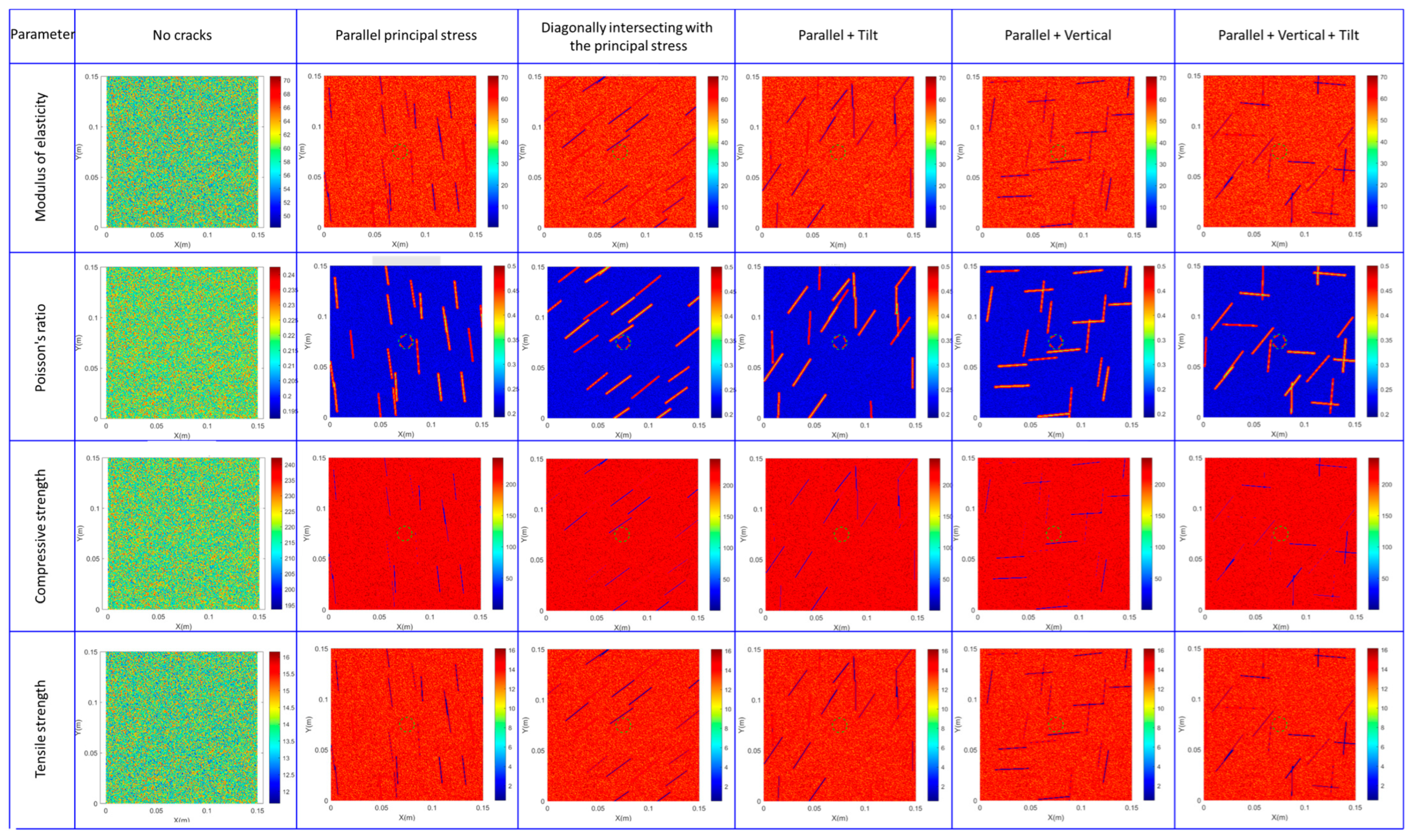
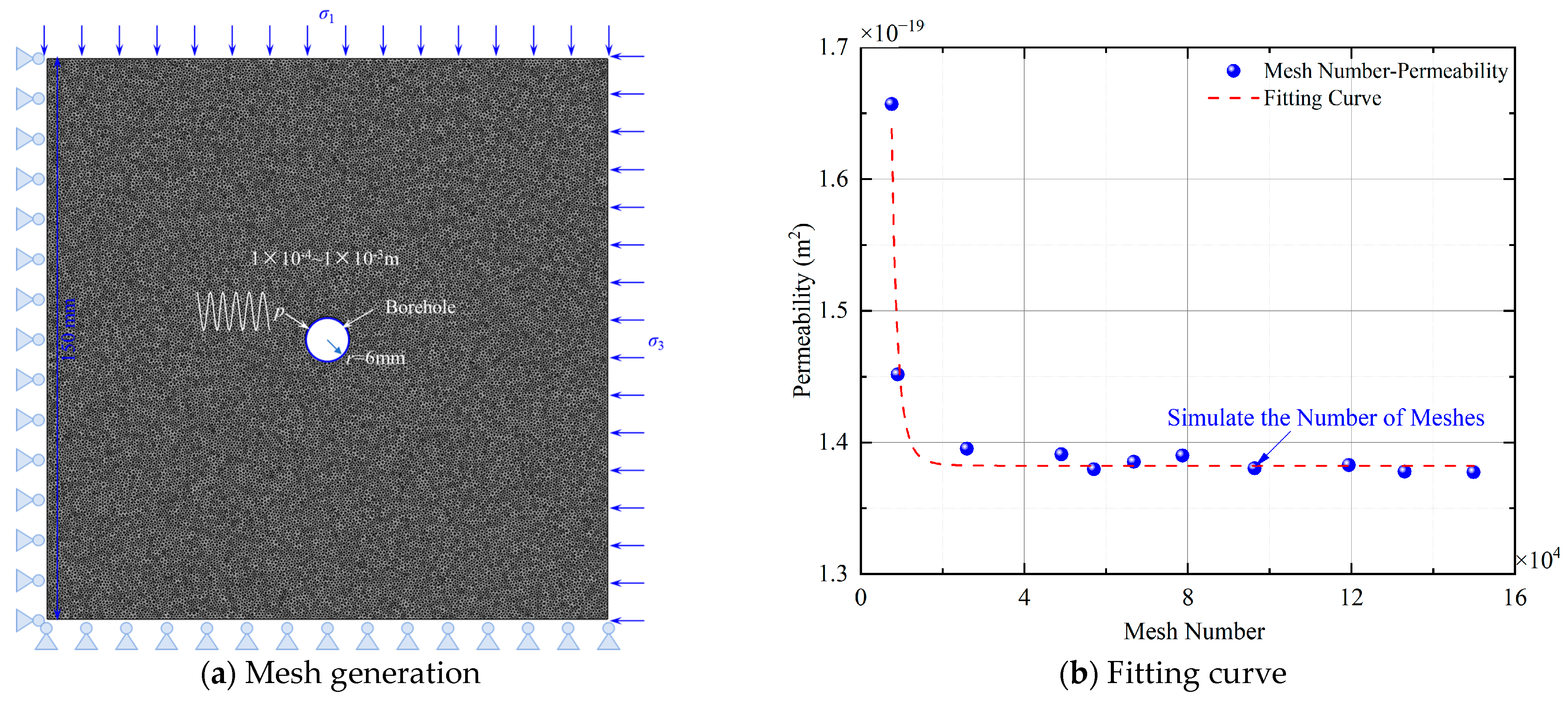
Abundant simulation and experimental results on pulsed fracturing have been accumulated, but notable gaps remain in current research. Most existing simulations focus on intact homogeneous rock, lacking systematic comparisons across parallel, inclined, orthogonal and mixed fracture scenarios. Most coupling models emphasize thermal-stress synergistic effects but neglect the core reciprocal feedback between damage evolution and abrupt permeability surges, failing to quantitatively characterize the stepped seepage capacity growth mechanism driven by sequential activation of variably oriented fractures. This work simplifies secondary physical fields (heat exchange, elastic deformation) and constructs a numerical model dedicated to dynamic damage–permeability coupling. Rock matrix mechanical heterogeneity is represented via the Weibull distribution, with five representative conditions designed for numerical tests. Systematic simulations reproduce the full process of damage accumulation, fracture propagation and permeability change under pulsed loading, and elaborate how natural fracture attitudes and spatial configurations modulate fracture network geometry, damage distribution and seepage enhancement performance. The hierarchical activation sequence of multi-attitude natural fractures and non-contact remote activation effects under cyclic pulsed loading are further clarified, and the strong spatiotemporal coupling law between fracture expansion and permeability mutation is summarized. This study provides theoretical support and engineering reference for productivity improvement and efficient development of unconventional reservoirs.
4. Fracture Propagation and Permeability Evolution of Intact Rock During Pulse Fracturing
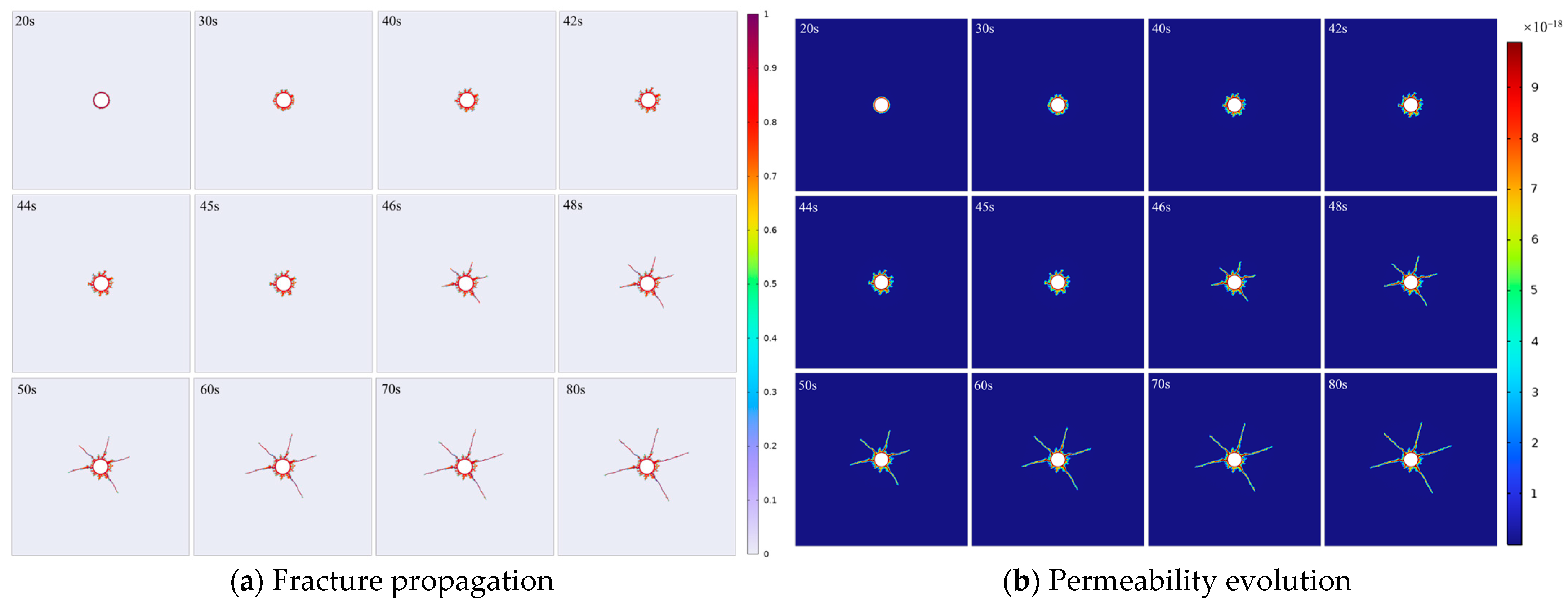
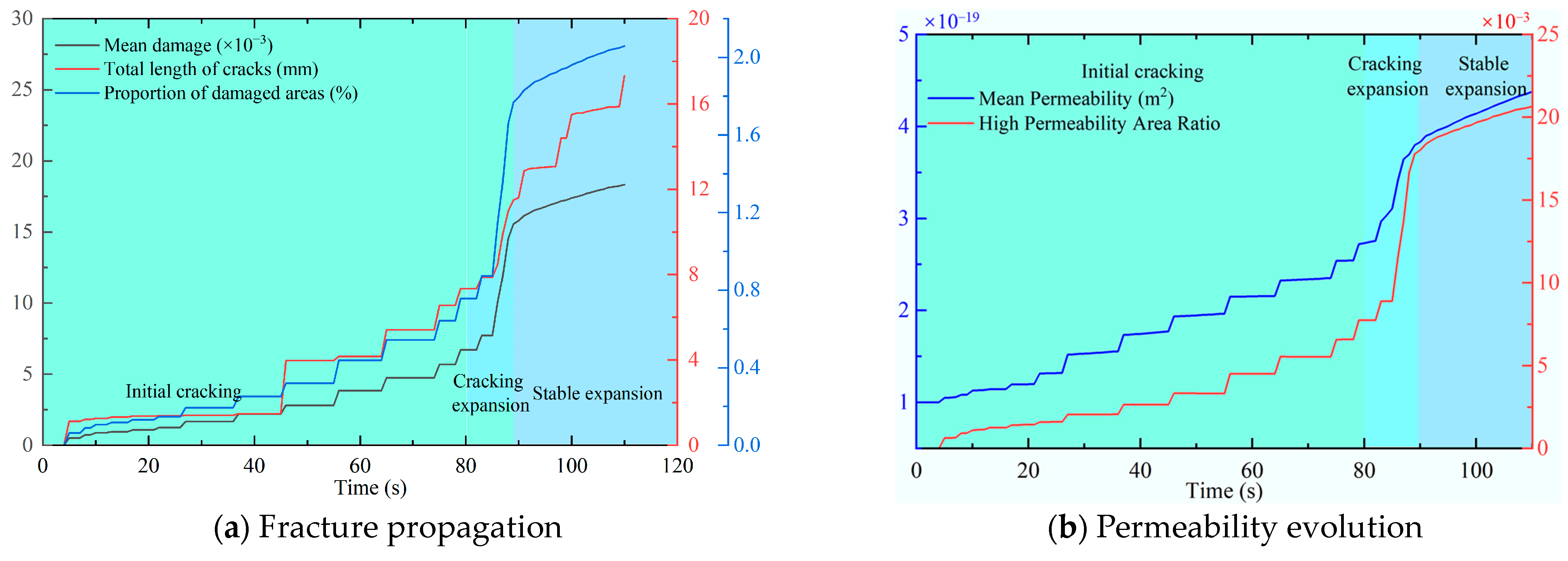
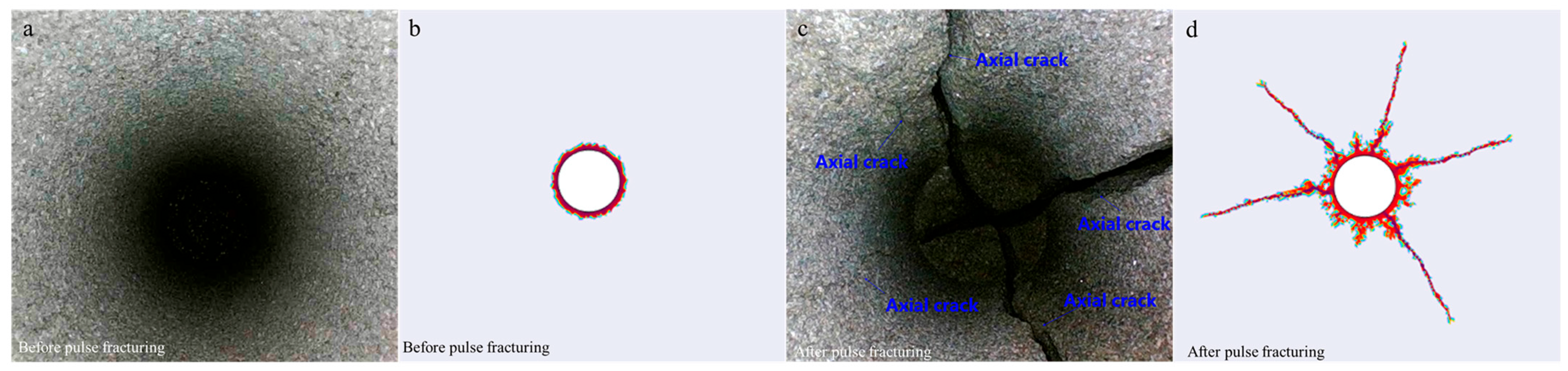
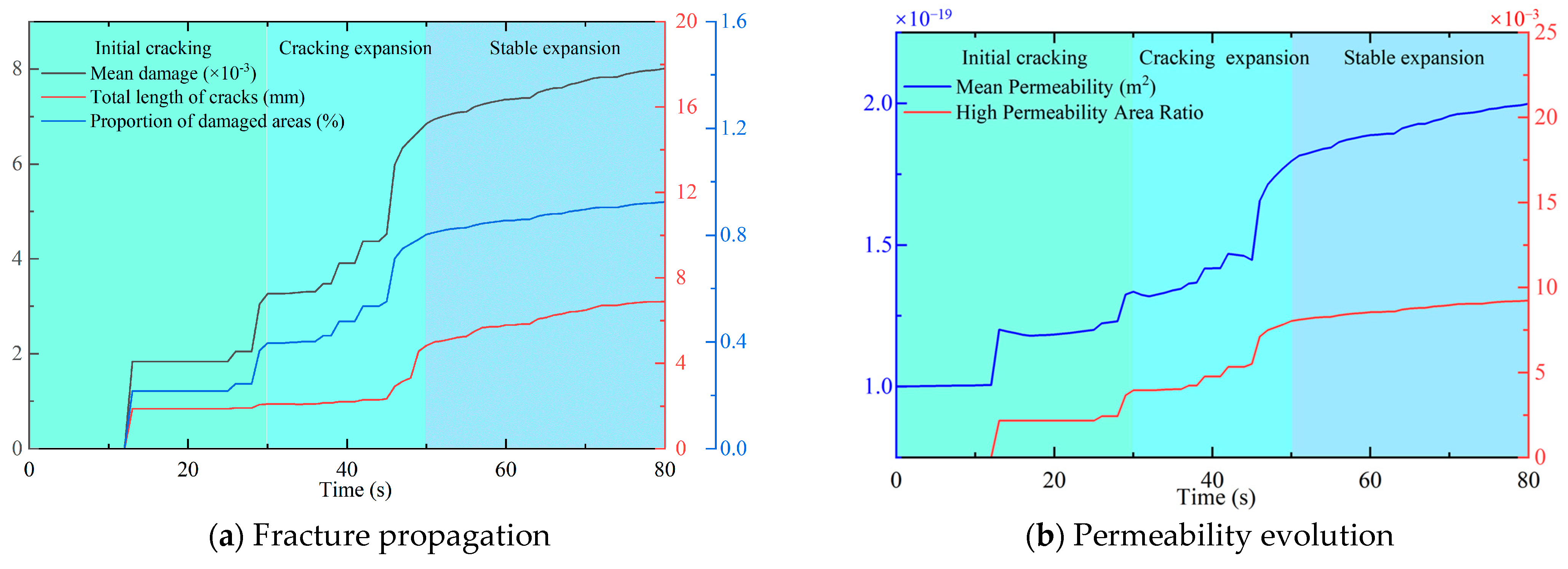
The final fracture propagation pattern and permeability distribution of intact rock under pulsed hydraulic fracturing are summarized in
Figure 4, while
Figure 5 presents their time-dependent evolution characteristics. The entire process comprises three consecutive stages: initial fracture initiation, fracture extension, and stable propagation, with permeability evolution highly synchronized with fracture development.
In the initial fracture initiation stage, pulsed pressure on the borehole wall gradually accumulates stress in surrounding rock. An annular high-damage zone first forms around the borehole, reflecting circumferential tensile failure of the borehole wall. Driven by the spatial randomness of rock elastic modulus and tensile strength, stress concentration distributes unevenly, with failure initiating preferentially at low-strength positions and forming serrated, irregular damage zone boundaries. Damage remains confined to the near-borehole region, dominated by microscale damage initiation and accumulation, with no macroscopic fractures penetrating into the rock matrix. Correspondingly, intact rock matrix permeability stays at an extremely low level, with primary pores as the main seepage channels. The annular damage zone triggers a slight permeability rise to form a surrounding high-permeability ring, but the increment is limited and generates no effective flow conductivity. Rock heterogeneity only induces minor random matrix permeability fluctuations, leaving overall seepage capacity poor.
During the fracture extension stage, with continued pulsed pressure loading, near-borehole damage reaches a critical threshold. Local microcracks coalesce, and multiple macroscopic main fractures break through the damage zone and propagate rapidly radially toward the far-borehole region, shifting the network from a diffused microdamage pattern to a main-fracture-dominated structure. Main fractures follow preferential paths with pre-existing microdamage and lower strength; spatial heterogeneity governs their number, initiation azimuth and trajectory, producing radially distributed paths with minor deflections. Sustained high stress concentration at fracture tips drives further extension, while abundant microdamage and branch fractures remain in the near-borehole zone to form a complex near-well fracture network. In parallel, the permeability field jumps by orders of magnitude with macroscopic main fracture breakthrough, forming continuous high-permeability strips along fracture paths as primary seepage channels with permeability orders of magnitude higher than the matrix. The reservoir flow regime shifts from matrix-dominated to fracture-dominated. High-permeability zones align with main fractures in the damage field, extending toward low-strength, fully damaged areas; permeability peaks at fracture centers and drops rapidly into the surrounding matrix. Near-borehole microcrack zone permeability rises synchronously and connects with main fracture high-permeability zones, building a near-borehole high-permeability network.
In the stable propagation stage, main fracture count and overall morphology remain largely stable, with no new macroscopic fractures generated. Network evolution is dominated by radial extension of existing main fractures with gradually decreasing propagation rates. The high-damage zone at fracture tips advances continuously, while near-well damage degree and scope show no notable changes. Pulsed pressure energy is mainly released through formed main fractures; far-borehole rock heterogeneity only induces minor trajectory fluctuations without altering the overall network pattern. Correspondingly, the overall permeability field pattern stabilizes with no new high-permeability strips generated. Evolution mainly manifests as radial extension of high-permeability zones along main fractures toward far-borehole regions, with tip high-permeability areas advancing synchronously and band width and peak permeability nearly unchanged. The final fracture network features a dense near-borehole distribution and a sparse peripheral distribution, with high near-borehole complexity and trunk-fracture-dominated far-borehole zones. Consistently, the final permeability field presents channelized characteristics: several trunk high-permeability bands extend radially from the borehole to carry primary flow transport, and a large-scale high-permeability block forms in the near-borehole zone via interwoven microcracks and main fractures, while the far-borehole matrix retains its original low-permeability state.
Overall, fracture network formation and permeability evolution in intact rock under pulsed hydraulic fracturing constitute a damage-driven nonlinear process governed by rock heterogeneity, with distinct threshold effects. The random spatial distribution of rock mechanical parameters drives complex initial microcracks and localized permeability enhancement. The stress-damage positive feedback mechanism selects preferential propagation paths, forming a coupled spatial pattern: complex near-borehole fracture networks paired with high-permeability blocks, and far-borehole trunk fractures paired with channelized high-permeability bands. Pulsed loading delays rapid main fracture breakthrough and extends the microcrack development period, effectively enhancing near-well fracture network complexity and expanding the improved seepage area near the borehole.
5. Propagation Law of Fracture Network and Permeability Evolution in Naturally Fractured Rock Under Pulse Fracturing
The pulsed hydraulic fracturing process of rock containing natural fractures is jointly controlled by natural weak planes and matrix heterogeneity. Both the fracture network and permeability field exhibit remarkable directional and stage-dependent characteristics, which differ distinctly from the uniform radial pattern of intact rock.
5.1. Parallel Natural Fractures
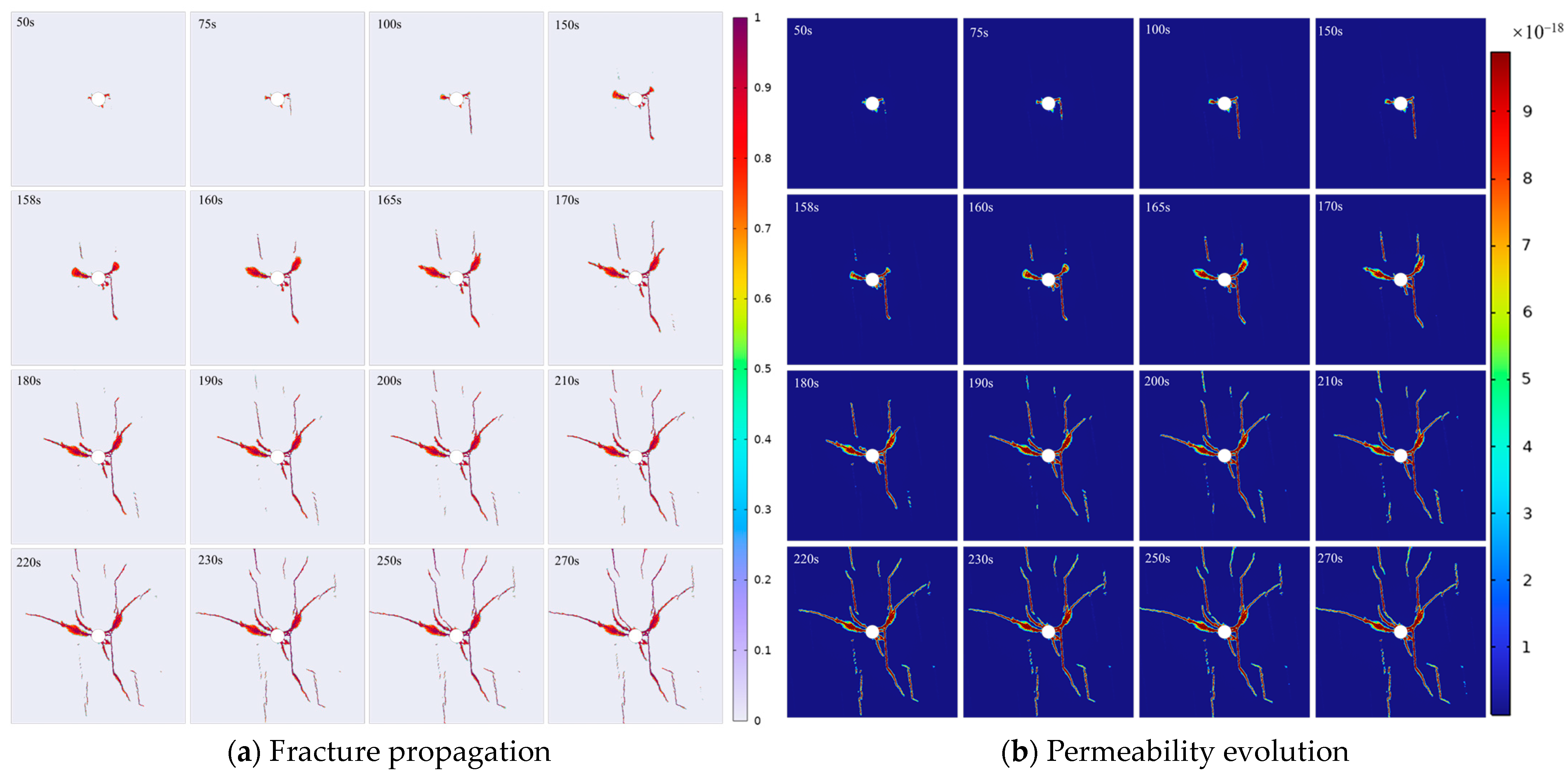
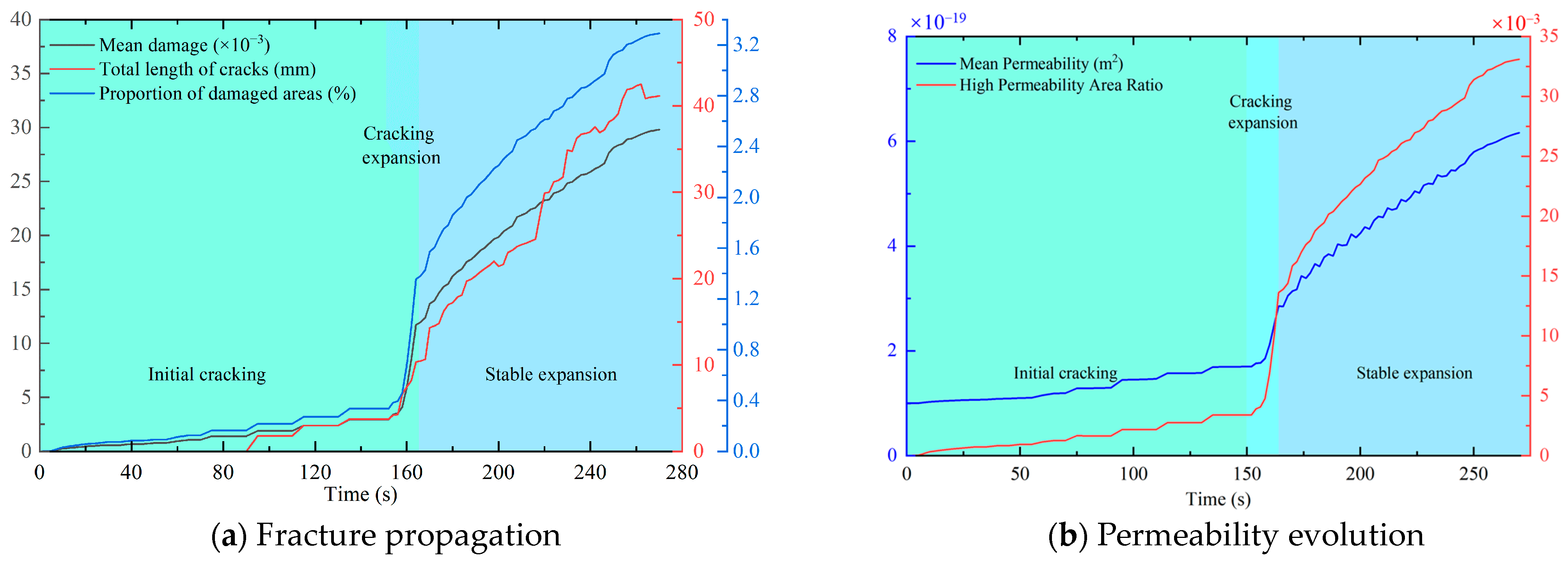
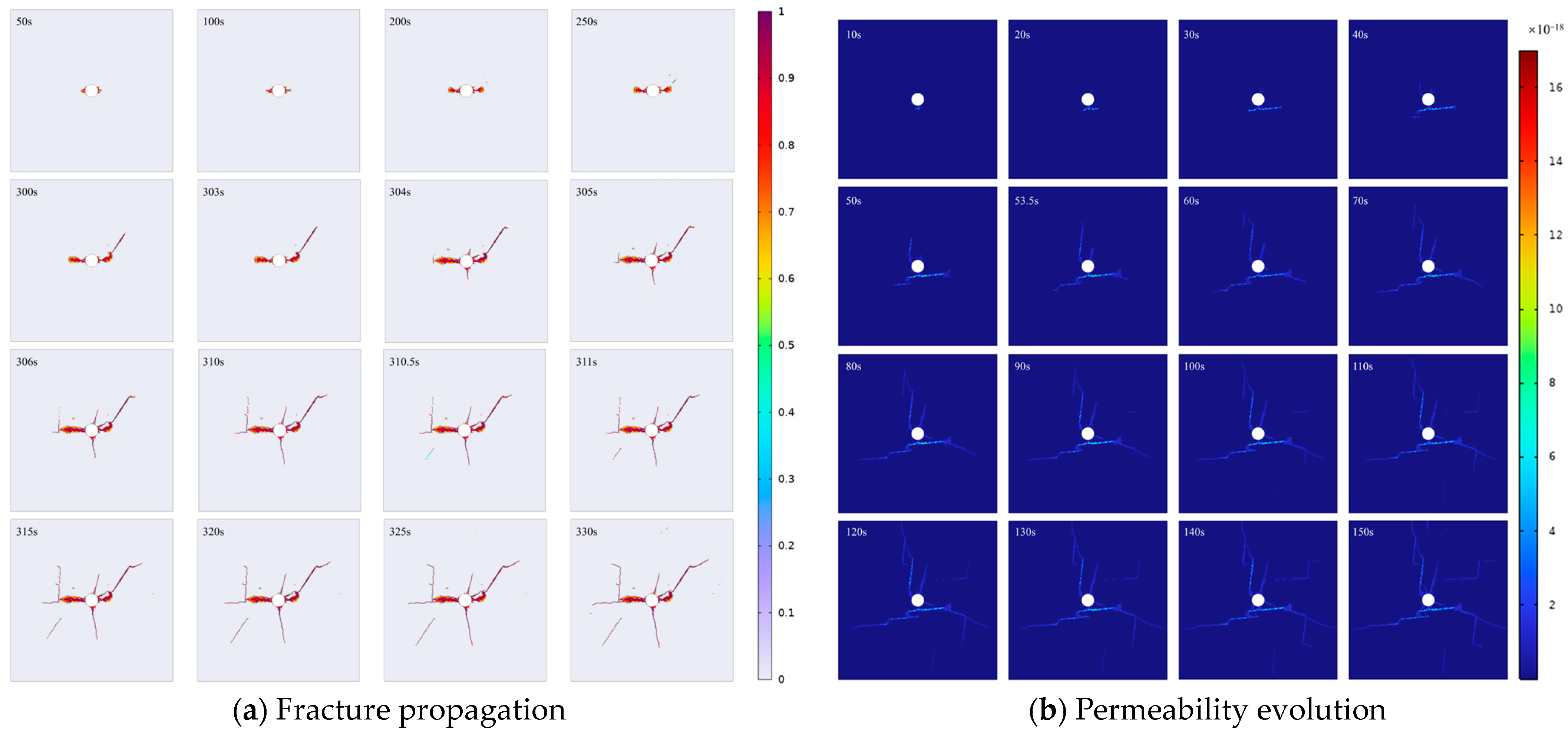
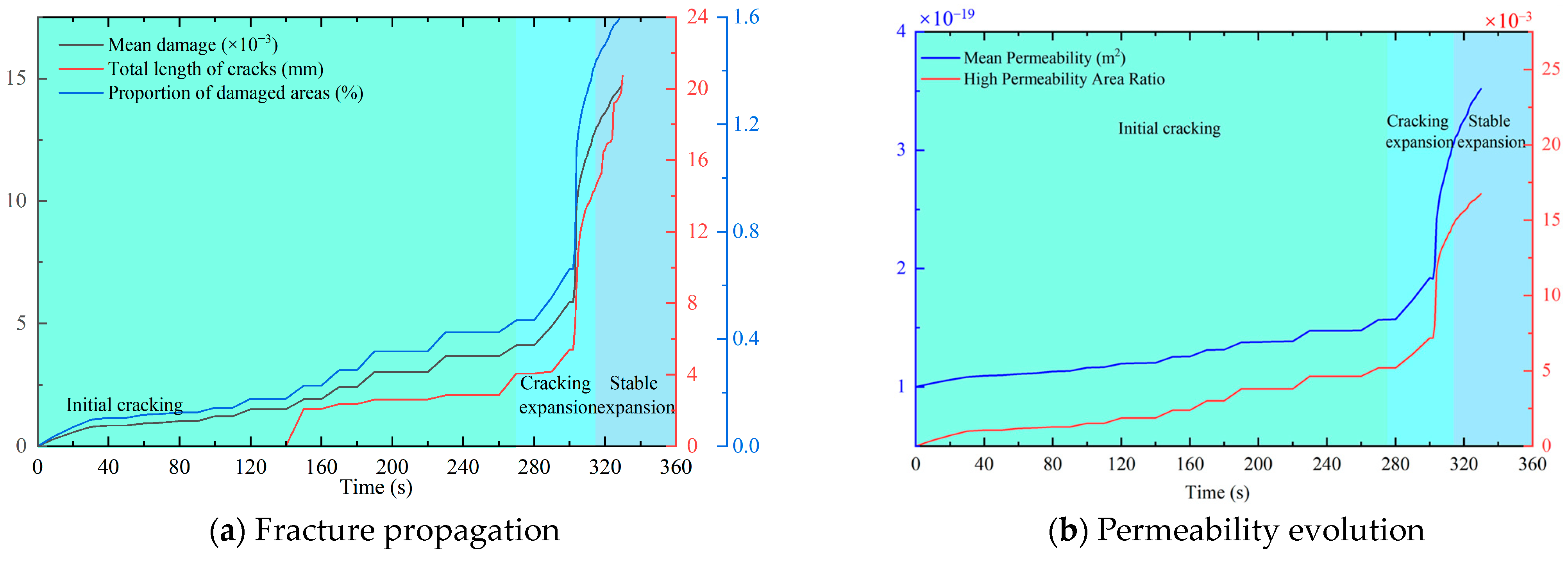
The final fracture propagation pattern and permeability distribution of rock with parallel natural fractures under pulsed hydraulic fracturing are summarized in
Figure 6, while
Figure 7 illustrates their time-dependent evolution characteristics. In the initial fracture initiation stage, pulsed pressure on the borehole wall transfers stress to surrounding natural fractures. The nearest fracture activates preferentially, with tension-shear damage accumulating on surfaces to form continuous damage zones along fracture paths. The far lower strength of fracture zones relative to intact matrix greatly reduces initial initiation pressure. Damage remains limited in scope with a low propagation rate; other parallel fractures stay unactivated due to insufficient borehole connectivity, with evolution dominated by gradual activation of a single preferential fracture. Correspondingly, seepage is dominated by the extremely low-permeability matrix. The opening of the single preferential fracture creates additional seepage channels with markedly elevated permeability, forming short high-permeability strips. Peak permeability exceeds the matrix by over an order of magnitude, but the overall improvement range is very limited, with unactivated fractures contributing no flow. Permeability enhancement occurs earlier than in intact rock, reflecting the leading effect of natural weak planes on seepage evolution.
During the fracture extension stage, continuous pulsed energy input drives successive activation and rapid propagation of multiple natural fractures, transforming the network from a single-fracture structure to a multi-main-fracture skeleton. Bilateral sub-horizontal fractures extend rapidly, while bottom inclined main fractures advance synchronously, jointly forming the core network skeleton. Driven by matrix heterogeneity, minor branch microcracks initiate at main fracture edges, raising near-borehole damage density and network complexity. Natural fractures provide continuous low-resistance paths that dominate the sharp propagation rate increase, and their spatial distribution directly governs main fracture quantity, orientation and the overall trend. In parallel, simultaneous activation and connection of multiple fractures rapidly form multi-branch high-permeability channels, greatly boosting overall seepage capacity. High-permeability zones of each main fracture expand synchronously with rapid propagation, with length and peak permeability rising to orders of magnitude above the matrix as core transport channels. Permeability in surrounding microdamage zones increases slightly, and contiguous high-permeability regions gradually form near the borehole. All zones interconnect in the near-borehole area to build a radial high-permeability network, with strike and distribution fully controlled by fracture occurrence and showing clear directional features.
In the stable propagation stage, no new macroscopic main fractures form, and network evolution shifts to directional extension of existing fractures along established paths, with the overall structure gradually stabilizing. Each fracture tip maintains a high-damage state to sustain propagation, and branch microcracks increase slightly without altering the overall network pattern. As fractures extend beyond the natural fracture range into the intact matrix, propagation resistance rises markedly, slowing the extension rate. The fracture network features strong directionality and asymmetry: sub-horizontal main fractures have the longest extension as the primary framework, followed by inclined main fractures, with upper fractures showing the weakest development. Matrix heterogeneity only induces minor local trajectory deflections. Correspondingly, the permeability field structure remains fundamentally unchanged, with evolution focused on the directional advance of high-permeability bands along fracture paths. Peak permeability and band width stay basically stable, and the near-borehole high-permeability range stops obvious expansion. Beyond the natural fracture scope, reduced apertures in intact rock cause a slight permeability drop at band ends and slower propagation. The final permeability field shares the same prominent directionality and asymmetry: sub-horizontal bands stretch the furthest with the largest seepage range as primary flow channels, while the far-borehole matrix retains its original low permeability with enhancement concentrated inside fracture channels.
Overall, fracture network evolution and permeability development in parallel fractured rock form a weak-plane-dominated, damage-driven nonlinear process, with sharp seepage growth highly synchronized with fracture breakthrough moments. Natural fractures fundamentally alter initiation positions and propagation paths, lower seepage channel formation thresholds, and govern the seepage field spatial distribution. Cyclic pulsed stress accelerates synchronous activation and coalescence of multiple fractures, indirectly promoting seepage capacity improvement. Ultimately, an asymmetric natural-fracture-supported fracture network framework with attached near-borehole microdamage zones forms, matching a flow structure where trunk fractures undertake primary conduction and near-borehole microdamage zones provide auxiliary seepage channels.
5.2. Inclined Natural Fractures
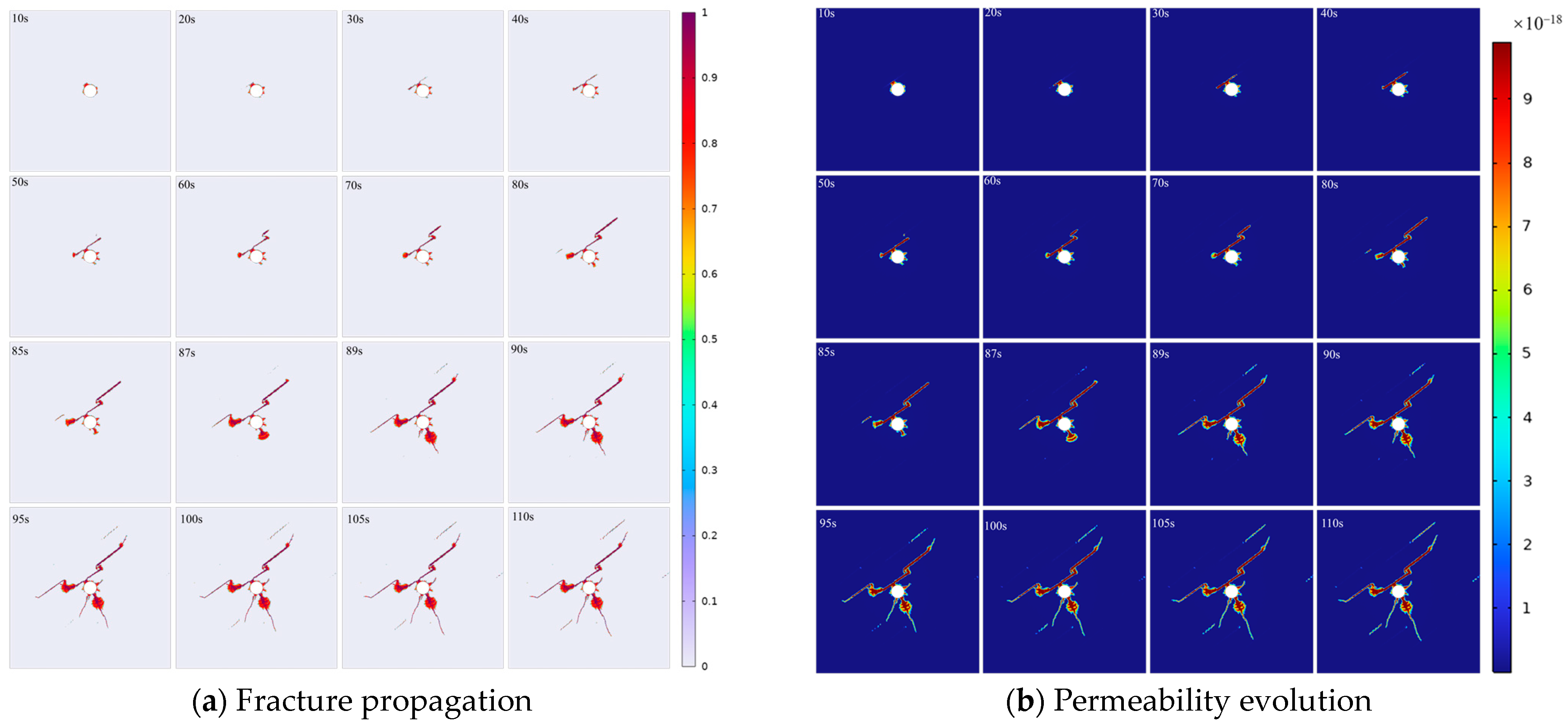
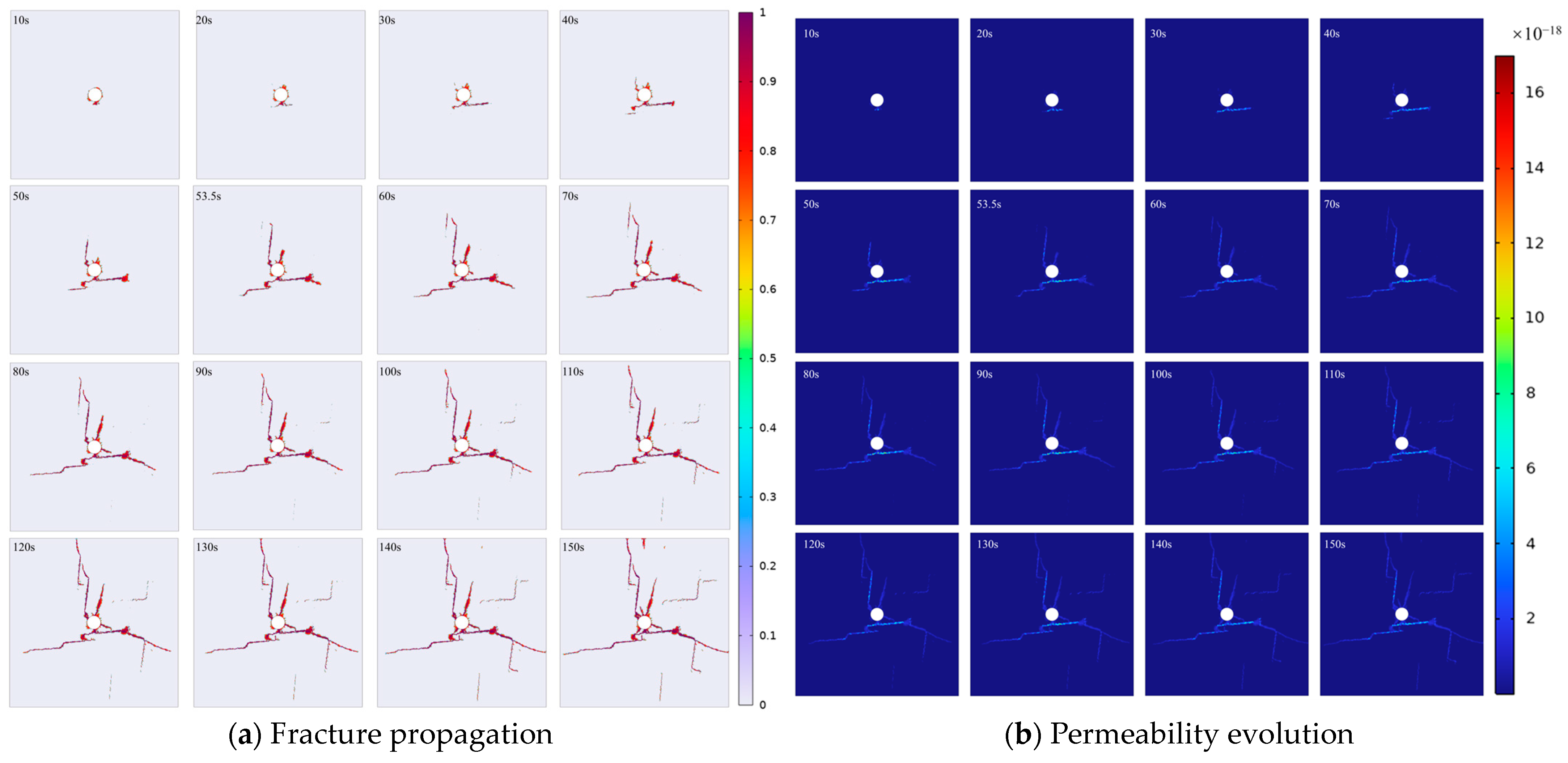
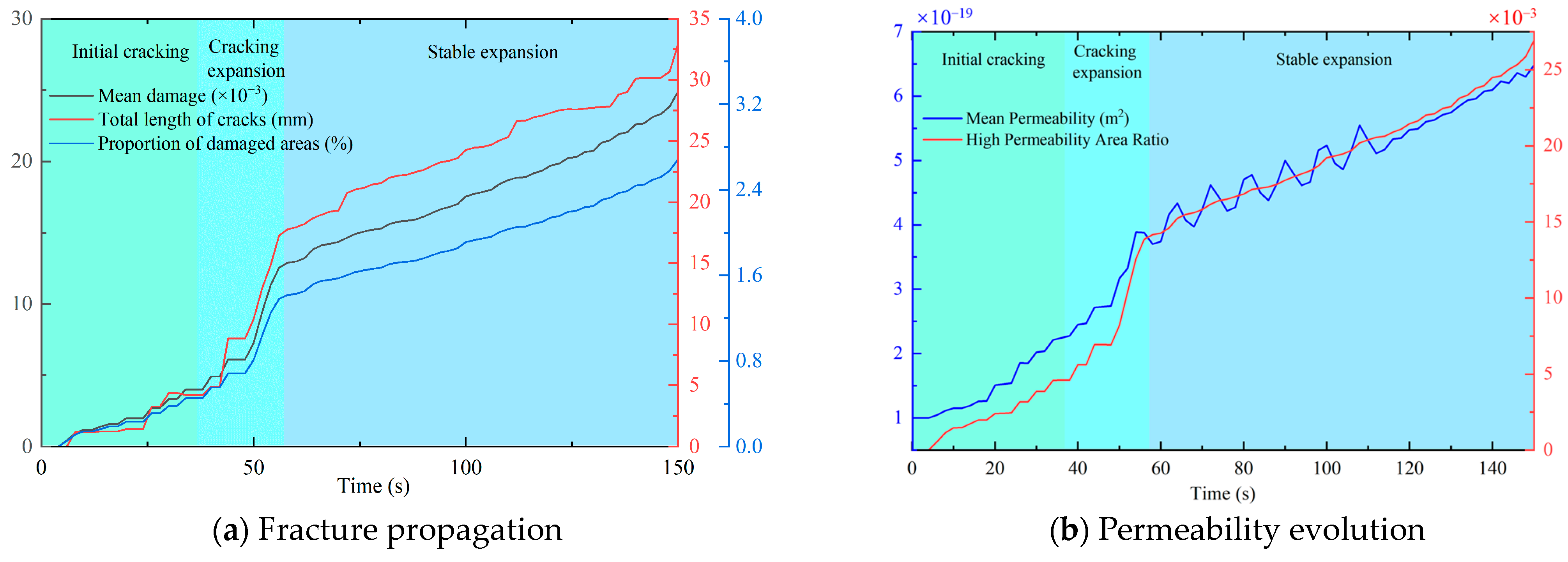
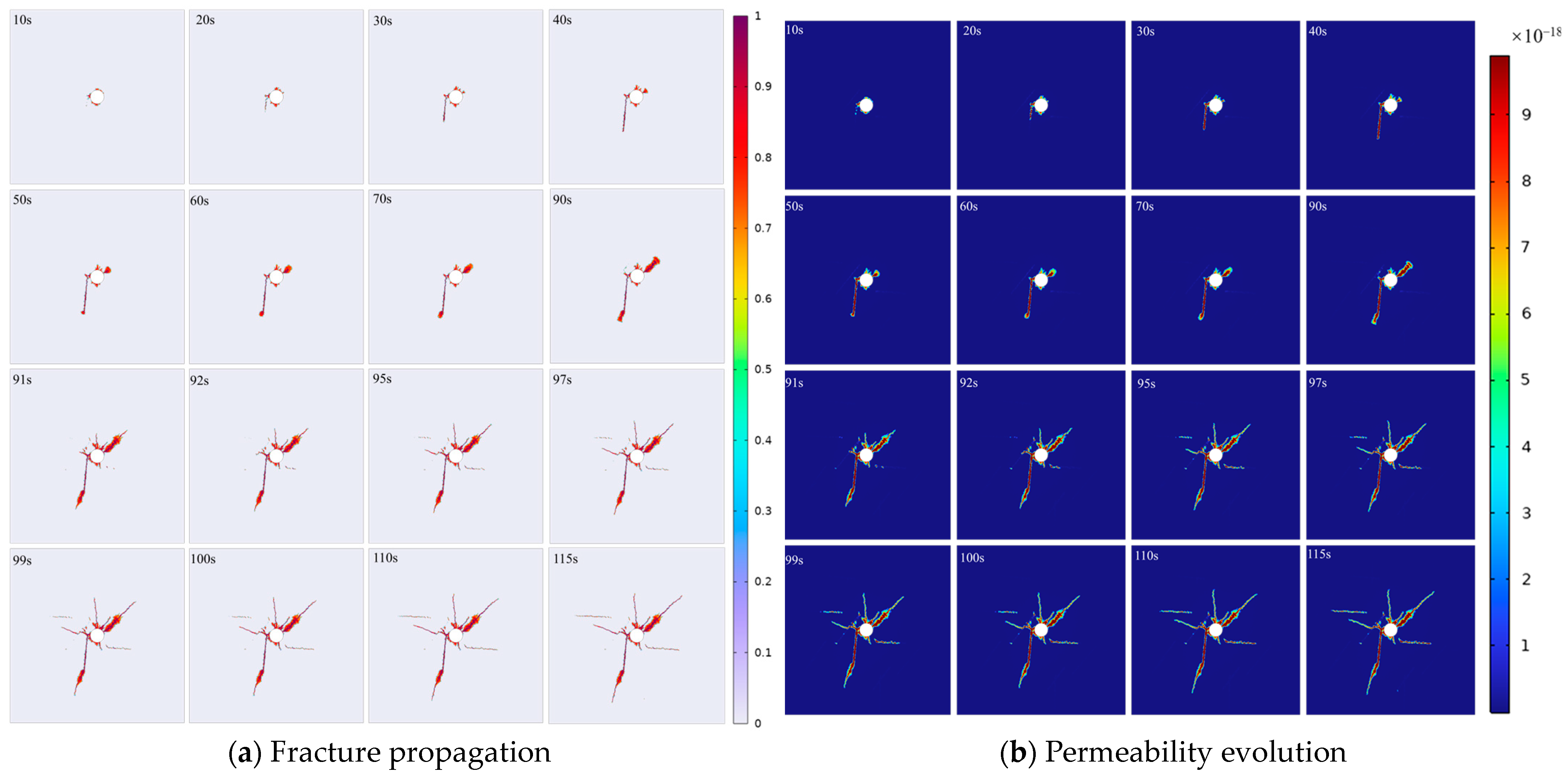
The final fracture propagation pattern and permeability distribution of rock with inclined natural fractures under pulsed hydraulic fracturing are summarized in
Figure 8, while
Figure 9 illustrates their time-dependent evolution characteristics. In the initial fracture initiation stage, pulsed pressure on the borehole wall induces only weak surrounding stress concentration, with all natural fractures in an initial response phase. As stress transfers outward, the nearest inclined fracture first reaches the failure threshold and activates, with tension-shear damage accumulating on surfaces to form short continuous inclined damage zones. The far lower strength of fracture zones relative to the intact matrix greatly reduces the initial initiation pressure. Damage remains confined to the near-borehole zone, with other inclined fractures unactivated due to insufficient stress transmission, with gradual initiation of a single preferential weak plane. Correspondingly, seepage is dominated by primary matrix pores with extremely low domain-wide permeability. The opening and slip of the single inclined fracture form effective seepage channels with markedly elevated permeability, generating short inclined high-permeability strips. Peak permeability exceeds the matrix by over an order of magnitude, but the overall improvement range is limited, with disconnected fractures contributing no flow. Permeability enhancement emerges earlier than in intact rock, reflecting the prior promoting effect of natural weak planes.
During the fracture extension stage, continuous pulsed energy input drives activated main fractures to advance rapidly along inclined weak planes, with more fractures successively reaching the initiation threshold. Driven by steady tip stress concentration, main fractures extend toward far-borehole regions at fixed angles with markedly increased length. Fractures at other positions activate sequentially, forming a coordinated multi-trunk propagation pattern. Near-borehole damage density rises continuously, with minor branch microcracks at main fracture edges increasing network complexity. Sequential activation of multiple fracture groups rapidly transforms the network from a single-fracture to a multi-main-fracture structure. In parallel, successive activation and interconnection of multiple inclined fractures rapidly form multi-branch high-permeability channels, delivering a qualitative leap in overall seepage capacity. The high-permeability zones of major fractures expand synchronously toward far-borehole regions, with length and peak permeability rising to orders of magnitude above the matrix as core transport channels. Secondary high-permeability strips form progressively, creating a multi-zone pattern. Contiguous high-permeability regions form near the borehole via intersecting fractures and microdamage, with all zones connecting locally to build a multi-directional inclined network. Zone strike and distribution are fully controlled by natural fracture occurrence, showing distinct directional features.
In the stable propagation stage, no new macroscopic main fractures form, and network evolution shifts to stable coordinated extension of existing fractures along inclined paths, with the overall structure gradually finalized. Fracture tips maintain high damage levels to sustain propagation, while near-borehole damage distribution and magnitude remain largely stable. Minor branch microcrack growth around main fractures does not alter the skeleton structure. As fractures extend beyond the natural fracture range, intact matrix resistance rises markedly, slowing extension rates. The network exhibits clear inclined orientation and asymmetry: preferential-direction main fractures have the longest extension and highest damage as the core, followed by secondary fractures. Matrix heterogeneity only triggers minor local trajectory deflections without changing the overall inclined-dominated pattern. Correspondingly, the permeability field structure remains fundamentally unchanged, with evolution focused on directional advance of high-permeability bands along fracture paths as the seepage pattern finalizes. Peak permeability and band width stay basically stable, and near-borehole high-permeability coverage stops notable expansion. Beyond natural fracture limits, reduced apertures in intact rock cause a slight permeability drop at band ends and slower extension. The final permeability field shares the same inclined orientation and spatial asymmetry: dominant bands stretch the farthest with the highest peak values as primary flow channels, while the far-borehole matrix retains original low permeability with improvement concentrated within fracture channels.
Overall, fracture network evolution and permeability development in inclined fractured rock form a weak-plane-dominated, damage-driven nonlinear process, with seepage capacity jumps highly aligned with fracture breakthrough moments. Inclined natural fractures fundamentally alter initiation positions and propagation directions, lower seepage channel thresholds, and govern the seepage field’s multi-directional distribution. Cyclic pulsed stress accelerates sequential fracture activation and coalescence, indirectly promoting stepped seepage improvement. Ultimately, an asymmetric network with inclined main fractures as the skeleton and attached near-borehole microdamage zones forms, matching a multi-branch seepage structure where trunk fractures undertake primary conduction and microdamage zones provide auxiliary paths.
5.3. Combined Parallel and Inclined Natural Fractures
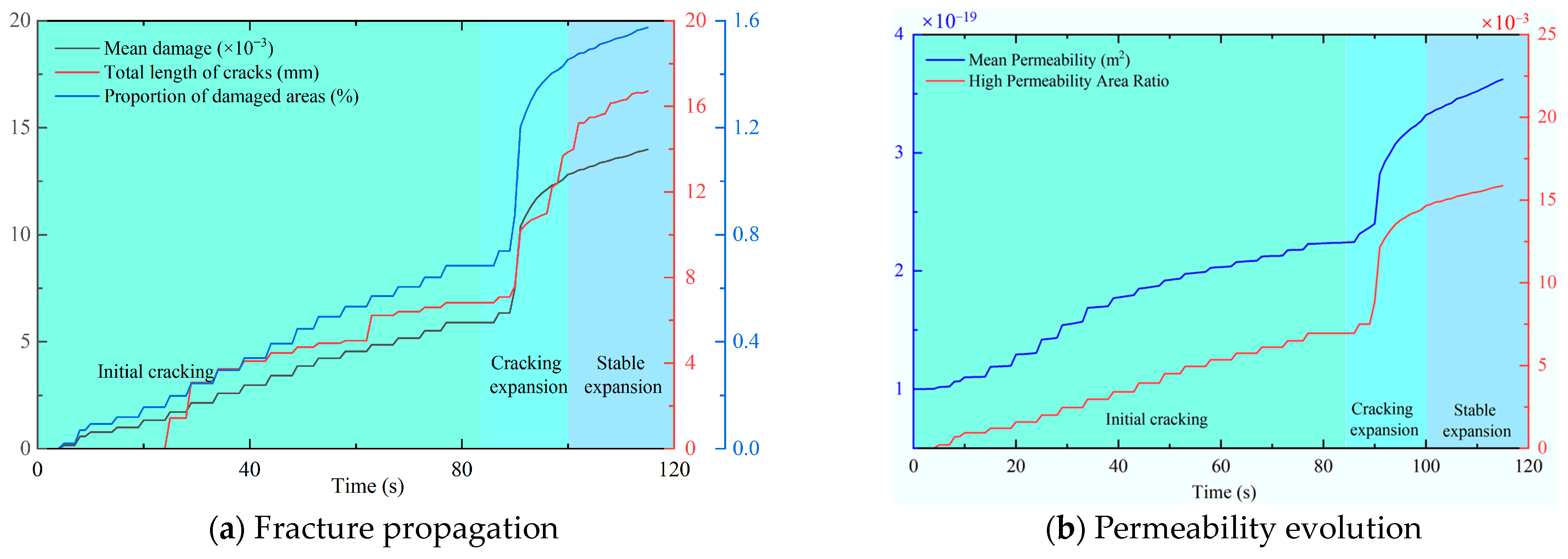
The final fracture propagation pattern and permeability distribution of rock with both parallel and inclined natural fractures under pulsed hydraulic fracturing are summarized in
Figure 10, while
Figure 11 illustrates their time-dependent evolution characteristics. In the initial fracture initiation stage, continuous fracturing fluid injection elevates borehole pore pressure through superposition of in situ stress and fluid pressure. Damage remains confined to a tiny near-borehole area, with all outer prefabricated fractures unactivated. The intact central rock core acts as a mechanical barrier, significantly raising the initiation pressure threshold; injected energy is mostly consumed by stress accumulation and microdamage within the core, keeping the rock in a pre-rupture energy accumulation phase without substantial fracture initiation. Correspondingly, the permeability field stays at the intrinsic low matrix level, with only a negligible increment near the borehole wall. The intact core also serves as a seepage barrier: poor primary pore connectivity in dense rock hinders deep fluid infiltration, and closed outer fractures provide no effective seepage space, maintaining extremely low overall seepage capacity.
During the fracture extension stage, fractures initiate once accumulated borehole stress exceeds the rock strength limit. Inclined fractures best aligned with the maximum principal stress and with the lowest energy threshold preferentially form main fractures and extend rapidly along the inclined direction. Secondary fractures at the lower and left borehole sides then initiate sequentially, causing a sharp rise in fracture count. The initiation follows two clear rules: by occurrence, gently inclined and sub-horizontal fractures with smaller angles to the maximum principal stress have lower rupture resistance and activate first; spatially, near-borehole zones with faster stress transfer and higher concentration reach initiation criteria earlier. In parallel, the permeability field jumps stepwise synchronously with main fracture initiation. Preferentially initiated main fractures form the first primary high-permeability channels with an order-of-magnitude increase, matching the position and propagation direction of main fractures in the damage field. As secondary fractures initiate successively, high-permeability strips extend synchronously with branching. Early-activated fractures form continuous seepage paths and constitute the primary seepage network skeleton. Earlier initiation corresponds to earlier permeability growth and higher peak values, and stress-aligned favorable fractures deliver better fluid conductivity and more significant enhancement.
In the stable propagation stage, the main fracture linear propagation rate drops markedly, and network evolution shifts to branch expansion and full-domain fracture activation. Previously unactivated steeply inclined and far-field sub-horizontal fractures successively reach the rupture threshold, initiate and extend outward, gradually forming multiple branch fracture groups. Abundant microcracks form under stress disturbance, ultimately developing a complex network with dominant main fractures, coordinated multi-branch propagation and asymmetric spatial distribution. Early-initiated main and near-borehole fractures act as stress transfer channels to progressively activate distant high-resistance fractures. Later-initiated fractures mostly join the main system as branches, increasing network density and swept area without altering the primary skeleton. Propagation follows a clear chronological rule: main fractures initiate before branch fractures, gently inclined before steep ones, and near-borehole before far-field fractures. Correspondingly, permeability evolution shifts from single-channel abrupt growth to network expansion. Peak permeability of primary channels remains largely stable, while high-permeability zone coverage keeps expanding. Late-initiated fractures become effective seepage branches, and channels of varied occurrences and positions gradually connect to form a multi-path 3D seepage network. Sub-horizontal fractures with good extendability form horizontal trunks dominating long-distance transport, while inclined fractures join as branches to improve vertical connectivity and swept volume. Overall permeability rises steadily with network complexity, no longer relying on single main fracture extension.
Overall, fracture network evolution and permeability development in mixed parallel-inclined fractured rock constitute a damage-driven nonlinear process jointly regulated by fracture occurrence and spatial distribution. Main fractures dominate permeability growth magnitude, while branch fractures expand the seepage swept area, and initiation sequence directly determines the timing and spatial distribution of enhancement. Pulsed loading gradually breaks initiation thresholds of fractures with different occurrences via cyclic stress accumulation, ultimately forming a complex coordinated main-branch fracture network and matching multi-path seepage system.
5.4. Orthogonal Combined Natural Fractures
The final fracture propagation pattern and permeability distribution of rock with orthogonal natural fractures under pulsed hydraulic fracturing are summarized in
Figure 12, while
Figure 13 illustrates their time-dependent evolution characteristics. In the initial fracture initiation stage, damage is restricted to a narrow near-borehole zone in early injection, and all outer prefabricated fractures stay unactivated with the rock in a stress accumulation state. With continuous superposition of pore pressure and in situ stress, sub-horizontal fractures initiate preferentially to form continuous macroscopic main fractures along the borehole horizontal direction. This priority stems from the match between fracture occurrence and in situ stress: sub-horizontal fractures strike roughly parallel to the maximum principal stress, yielding the lowest tensile rupture energy threshold and activating first, while vertical fractures perpendicular to the maximum principal stress have higher critical stress and remain temporarily inactive. Correspondingly, the permeability field stays uniformly low at matrix intrinsic permeability, with only negligible elevation near the borehole wall. After horizontal main fracture initiation, the permeability field jumps synchronously, forming continuous horizontal high-permeability strips with an order-of-magnitude increment as initial seepage trunks. The intact central rock core acts as a seepage barrier, restricting enhancement to local zones of initiated fractures.
During the fracture extension stage, as horizontal main fractures propagate, fluid pressure and stress concentration transfer outward along fractures, gradually raising vertical stress levels. Once the vertical fracture rupture threshold is reached, vertical fractures initiate formally, transforming the system from a single horizontal main fracture to a horizontal–vertical dual-trunk structure. Meanwhile, slight bending and local branches appear along horizontal fracture paths, more near-borehole secondary fractures activate, and the damage scope expands progressively. By the end of this stage, horizontal and vertical trunk fractures are basically finalized, jointly forming the network core skeleton with bilateral branches and a clear overall outline. The initiation follows a hierarchical rule: horizontal main fractures initiate before vertical ones, and near-borehole fractures before far-field ones, with vertical activation relying on stress transmission via horizontal main fractures. In parallel, vertical fracture initiation triggers the second prominent permeability jump, forming distinct vertical high-permeability strips and formal vertical seepage channels. The seepage system evolves accordingly into a cross-shaped dual-trunk framework. Vertical high-permeability zones expand with vertical fracture propagation, while horizontal zones extend synchronously and produce branches, rapidly expanding high-permeability coverage. More near-borehole secondary fractures activate to form seepage influence zones around trunk channels. By the end of this stage, the two primary high-permeability channels stabilize, and overall seepage capacity improves by an order of magnitude compared with the initial stage.
In the stable propagation stage, linear propagation rates of the two trunk fractures drop markedly, and network evolution shifts from trunk extension to branch expansion and densification. Horizontal branches extend toward the far field, with some deflecting and connecting upon encountering vertical fractures. Vertical main fractures expand continuously and generate secondary branches, and more far-field orthogonal fractures activate successively under stress disturbance. Horizontal and vertical fractures intersect and interconnect, gradually forming a typical orthogonal fracture network. Overall fracture length growth slows, while density and complexity increase steadily with an expanded swept area, dominated by mutual induction and stepwise activation of the two fracture groups. Correspondingly, permeability evolution shifts from abrupt trunk channel growth to network expansion and steady enhancement. Peak permeability of primary channels remains roughly constant, while high-permeability zones expand outward in all directions, with secondary branches forming corresponding high-permeability strips. Horizontal and vertical seepage channels intersect and connect, gradually building an orthogonal 3D seepage network. Successive far-field fracture activation drives high-permeability zones toward model boundaries. Seepage pathway count and network connectivity rise continuously, and overall permeability grows steadily with increasing complexity, driven by improved connectivity and expanded swept volume rather than single trunk linear extension.
Overall, fracture network evolution and permeability development in rock with orthogonal natural fractures form a weak-plane-dominated, damage-driven nonlinear process with distinct hierarchical activation features. The match between fracture occurrence and in situ stress determines the initiation sequence, and cyclic pulsed stress promotes stepwise activation of orthogonal fracture groups. Ultimately, a typical orthogonal fracture network with dual-trunk skeletons and multi-level branches forms, matching a cross-linked seepage system where trunk channels dominate permeability magnitude and branch networks expand the seepage swept volume.
5.5. Combined Parallel, Vertical and Inclined Natural Fractures
The final fracture propagation pattern and permeability distribution of rock with parallel, vertical and inclined mixed natural fractures under pulsed hydraulic fracturing are summarized in
Figure 14, while
Figure 15 illustrates their time-dependent evolution characteristics. In the initial fracture initiation stage, pulsed pressure induces only mild borehole surrounding stress concentration, with all natural fracture groups in an initial response state. As stress transfers through the matrix, vertical fractures nearest the borehole activate first, with tensile damage accumulating on fracture planes to form steadily extending vertical damage zones. Slightly distant inclined fractures respond gradually and accumulate damage at their near-well ends, while other fractures stay unactivated due to insufficient stress delivery. Damage propagates at a moderate rate, dominated by nearby dominant fracture extension and corresponding to gradual energy accumulation and preferential pathway screening. Correspondingly, seepage is dominated by intrinsic matrix pores with extremely low overall permeability. The opening of the nearest vertical fractures forms effective seepage channels, creating vertical high-permeability strips with prominent enhancement. Inclined fractures form embryonic high-permeability zones to mildly expand the seepage-affected area, while other regions retain matrix-level low permeability. This stage features initial seepage channel construction with limited increment and range, yet permeability improves earlier than in intact rock, reflecting the prior promoting effect of inherent weak planes.
During the fracture extension stage, continuous pulse energy accumulation expands the surrounding stress field to cover more fractures, and multiple sets of varied occurrences successively reach the initiation threshold. The network rapidly transforms from a “one primary + one secondary” pattern to a multi-fracture coordinated propagation system. Fractures in all directions extend intensively and simultaneously, driving sharp morphological change; inclined fractures grow fastest and evolve into secondary main fractures. Near-well damage density rises substantially, with multi-directional fractures interweaving around the borehole to preliminarily form the core of a complex network. In parallel, intensive activation and interconnection of multi-group fractures rapidly form multi-branch high-permeability channels, delivering a qualitative leap in overall seepage capacity. With synchronous multi-directional fracture breakthrough, high-permeability strips form and expand continuously, with steady growth in length and peak permeability. Inclined high-permeability zones grow fastest into secondary core flow-guiding channels. All zones interconnect in the near-well region, forming continuous high-permeability areas alongside microdamage development, greatly expanding the seepage range and building an intricate multi-directional network.
In the stable propagation stage, no new macroscopic main fractures form, and network evolution shifts to steady coordinated extension of existing multi-directional fractures along their occurrences, with the overall pattern gradually finalized. Fracture tips maintain high damage levels to sustain propagation, while near-well damage distribution and magnitude largely stabilize. Minor branch microcracks sprout along main fracture edges, slightly increasing local network complexity. As fractures extend beyond the natural fracture range, intact matrix resistance rises markedly, slowing the extension rate. The final network features multi-directional asymmetric traits: the vertically downward main fracture has the longest extension and highest damage as the core skeleton; inclined main fractures rank second as vital secondary channels; shorter secondary fractures supplement the complex near-well network. Matrix heterogeneity only induces slight local trajectory deflection without altering the overall multi-set fracture-dominated pattern. Consistently, the permeability field sees no fundamental structural change, with core evolution focused on coordinated advancement of multi-directional high-permeability zones along fracture paths. Peak permeability and band width remain largely stable, and near-well high-permeability coverage stops expanding notably. Beyond the natural fracture boundary, reduced apertures in intact rock cause slight permeability drops at zone tips and decelerated extension. The ultimate permeability field also features multi-directional asymmetric distribution, with the far-field matrix retaining original low permeability and enhancement concentrated within fracture channels.
Overall, fracture network evolution and permeability development in rock with three mixed natural fracture types form a damage-driven, multi-weak-plane-dominated nonlinear process, with seepage capacity jumps highly aligned with concentrated multi-fracture breakthrough moments. Mixed fractures lower seepage channel formation thresholds and enrich the spatial distribution dimension of the permeability field. Pulsed loading drives concentrated fracture activation via sustained energy accumulation and triggers an order-of-magnitude surge in flow capacity. The final network and seepage system feature higher complexity and wider spatial coverage than single-occurrence fracture specimens.
5.6. Regulation Laws of Fracture Propagation and Permeability Evolution Controlled by Natural Fracture Attitudes
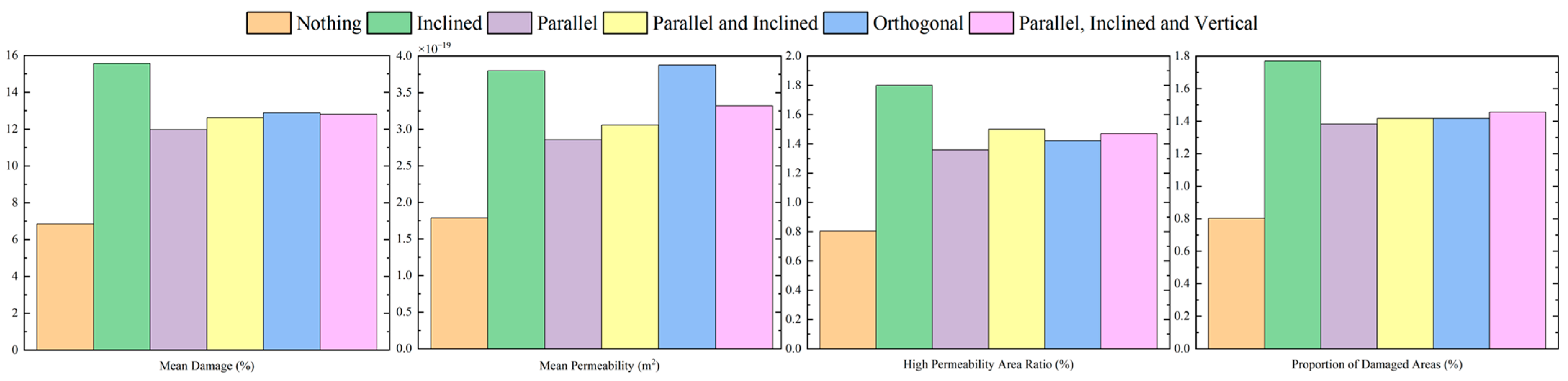
Regulation laws of fracture propagation and seepage evolution controlled by model parameters are fully displayed through horizontal variation trends of four statistical indices in
Figure 16. Mean damage, mean permeability, high permeability area ratio, and damaged area proportion of intact rock are markedly lower than all schemes with natural fractures. Index values of intact rock maintain roughly one half of the corresponding values measured from fractured rock groups. The maximum mean damage and damaged area proportion are generated under single inclined fracture conditions yet smaller permeability growth ranges are recorded compared with orthogonal fracture cases. The peak mean permeability is captured in orthogonal fracture models with superior seepage modification performance relative to other single-fracture schemes.
6. Propagation Mechanism of Fracture Network in Fractured Rock Under Pulse Fracturing
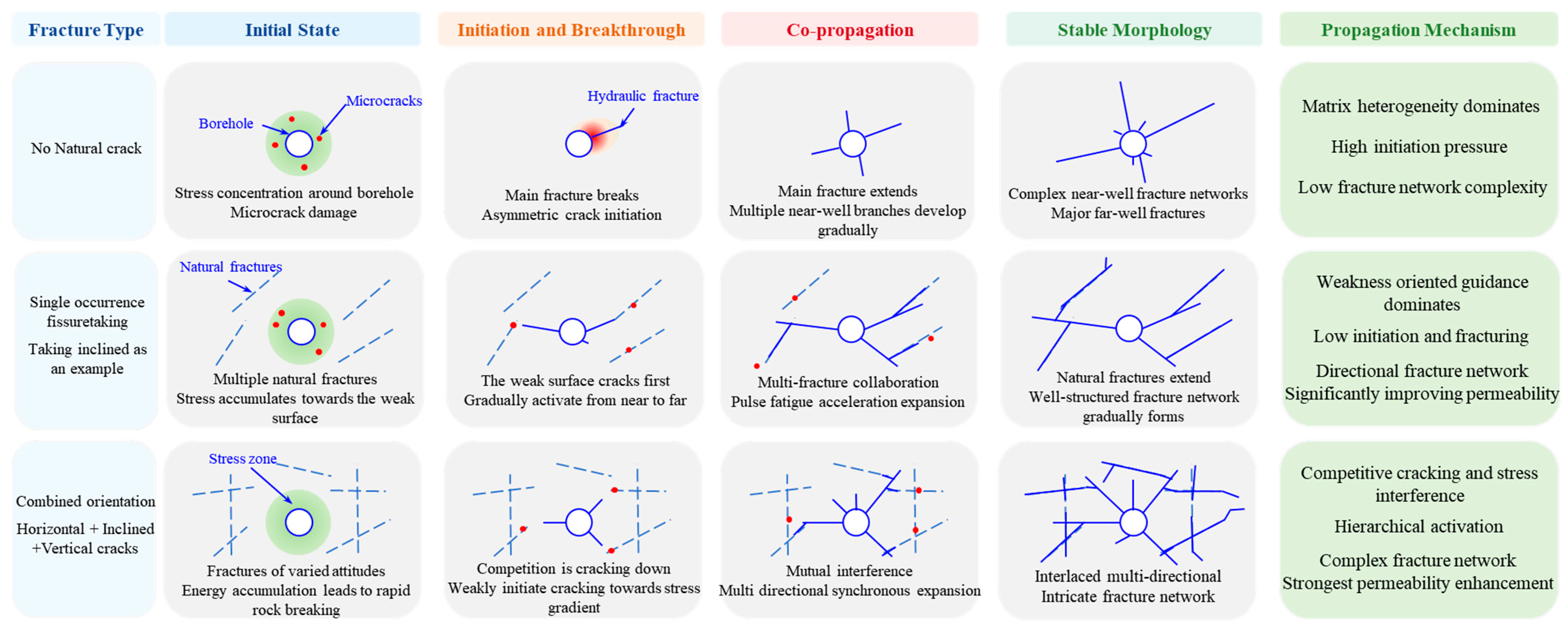
Fracture network propagation in fractured rock under pulsed hydraulic fracturing is a complex mechanical process synergistically governed by three factors: natural fracture weak-plane effect, pulse-induced cyclic fatigue damage, and rock matrix mechanical confinement. Fracture occurrence and spatial combination dominate network configuration and evolutionary paths, while fracture propagation and permeability evolution are strongly spatiotemporally coupled, following a three-stage law of initial incubation, dynamic breakthrough and stable finalization. The propagation mechanism is illustrated in
Figure 17.
For single-occurrence fractured rock masses, propagation is jointly controlled by weak-plane directional guidance and pulse-induced fatigue acceleration. For parallel fractured rocks, networks develop mainly horizontally: lower-strength fracture zones concentrate borehole stress and induce preferential fracturing along fracture planes, directly determining main fracture number and strike while greatly reducing initiation pressure and propagation resistance. Cyclic pulsed loading exerts repeated stress impacts at fracture tips, promoting shear slip and tensile opening, accelerating matrix microcrack initiation and coalescence, and enabling simultaneous multi-fracture activation to avoid oversimplified networks from excessive single fracture extension. Beyond natural fracture ranges, elevated matrix resistance sharply slows propagation, and matrix heterogeneity only causes minor local trajectory deflections without altering the overall directional pattern. Inclined fractured rocks follow the same intrinsic mechanism, with inclined weak planes governing oblique network morphology. Pulsed loading accelerates stress transfer to far-field fractures, triggering sequential initiation of inclined fractures at different positions to form a collaborative multi-fracture pattern, while adjacent fracture stress interference further modulates local paths.
For multi-occurrence combined fractured rocks, propagation features hierarchical activation and higher complexity. In parallel-inclined composite rocks, pulse pressure first breaks through the central intact rock core barrier, then propagates along pre-existing weak fractures; fracture occurrence and spatial position jointly determine the energy threshold and initiation sequence. Parallel-vertical orthogonal fractured rocks follow a hierarchical rule prioritizing low-angle, near-well and trunk fractures. Sub-horizontal fractures with optimal maximum principal stress matching and lowest tensile fracture energy initiate first to form the network skeleton, while higher-threshold vertical fractures activate later to fill the network. Far-field fractures rely on trunk stress transmission and show clear initiation lag. For three-type mixed fractured rocks, multi-directional weak planes provide multi-dimensional low-resistance paths. Near-borehole fractures initiate preferentially, while remote ones activate gradually with stress transfer. Once pulse energy reaches the critical threshold, multiple fracture groups break through synchronously, markedly improving network complexity. Multi-directional propagation induces stress superposition and shielding effects, which jointly constrain stable network morphology.
Fracture propagation and permeability evolution exhibit strong positive coupling, representing two synchronous perspectives of the same fracturing process. Fracture growth is the core carrier of permeability enhancement: rocks stay tight and low-permeability without macroscopic fractures, and permeability jumps immediately upon fracture initiation, with network complexity directly governing seepage connectivity. Their spatiotemporal evolutions are fully synchronized, with the three-stage fracture pattern corresponding one-to-one to permeability variation, and fracture initiation sequence directly determining improvement timing with no obvious hysteresis. Fracture occurrence controls both processes via the same mechanism: natural fractures act as both mechanical weak planes shaping fracture geometry and preferential seepage planes governing permeability growth, fully demonstrating the inherent unity of mechanical–seepage coupling.
In summary, fracture network evolution in intact rock is dominated by matrix heterogeneity, ultimately forming complex near-well networks and far-field trunk fractures. For fractured rocks, the evolutionary core is governed by directional activation of natural weak planes, while matrix heterogeneity only regulates local fracture characteristics. Pulsed loading accelerates weak plane activation via accumulated fatigue damage; natural fractures determine evolutionary directionality and hierarchy; and matrix properties constrain propagation rates and local trajectories. Their combined action drives the seepage transition from matrix-dominated low permeability to fracture-dominated high permeability, forming a coupled fracture–seepage structure adapted to rock mass fracture distribution. The above conclusions offer clear references for matching pulse amplitude and frequency to reservoirs with diverse natural fractures and support field parameter optimization for permeability enhancement.
7. Discussion
In this study, mechanisms governing pulsed fracture network propagation within fractured rock were adopted as the research basis, and preferential fracture orientations were not determined by a single factor. It was found that fracture propagation orientations are jointly controlled by in situ stress conditions, borehole-induced stress concentration, initial attitudes of natural fractures and stress interference among adjacent fractures. The dominant constraints on overall macroscopic fracture trends are imposed by the maximum principal in situ stress. Fracture initiation near borehole zones is preferentially triggered by high stress concentration formed around boreholes. Pre-existing natural fractures are preferentially activated once local stress meets fracture failure criteria. Stress perturbation fields are generated by initiated fractures. Fracture deflection and redirection are induced through mutual interference among neighboring fractures, and the preferential fracture orientations observed in this study are finally formed.
Remarkable adjustments are made to fracture initiation positions and propagation trajectories by rock mechanical heterogeneity under pulsed loading. Damage failure tends to occur preferentially inside units with low mechanical strength to trigger local fracture deflection and generate minor secondary microcracks. For rock masses with multiple groups of natural fractures, only slight local modifications of fracture geometry are induced by matrix heterogeneity, while overall propagation trends remain dominated by inherent weak planes. Independent Weibull distributions were adopted to assign mechanical parameters in current simulations. Systematic analysis of such coupled effects will be implemented in follow-up studies.
Obvious differences in the duration of stable fracture growth and evolution can be detected through comparative analysis of simulated cases. Initial fracture initiation positions and overall propagation trends are controlled by spatial attitudes of natural fractures. Local stress fields are continuously altered by stress interference between adjacent fractures. The two above physical factors constitute the primary sources of discrepancies in fracture evolution duration. Local damage thresholds are dynamically adjusted to extend or shorten the evolution stage before stable fracture network formation. Weak disturbances induced by local microcrack generation are produced via pore pressure diffusion and rock mechanical heterogeneity. Minor influences on global propagation laws are exerted by these two factors.
Numerical simulations are performed based on geometric dimensions of laboratory rock samples in the established model. Multiple remote fracture activation responses are observed within confined regions around the injection borehole. Certain mismatches can be found between the geometric scale of the constructed model and real reservoir strata. Field reservoirs tend to exhibit relatively sparse natural fracture distributions, broader pressure propagation coverage and intricate three-dimensional fracture connection configurations. Stress shadow interactions between widely spaced fractures may become less prominent under field geological conditions. The non-contact remote activation mechanism derived from this work is associated with short-distance stress transmission and densely arranged natural fractures. Complete reproduction of full-scale reservoir geological features cannot be easily realized by the current model setup. The simulation results provide theoretical guidance for the propagation of large-scale fracture networks in field fracturing operations.