Review

Freeze Desalination Technologies for Sustainable Water Treatment: Advances in Crystallization, Brine Management, Energy Integration, and Scale-Up


by
Beatriz Castillo-Téllez
1,
Margarita Castillo-Téllez
2,*,
Rosenberg J. Romero
3,*,
Gerardo Alberto Mejía-Pérez
1,†,
Rachid Marzoug
4 and
Alfredo Domínguez-Niño
5
1
Centro Universitario de Tonalá, Universidad de Guadalajara, Tonalá 45425, Jalisco, Mexico
2
Facultad de Ingeniería, Universidad Autónoma de Campeche, Campeche 24085, Campeche, Mexico
3
Centro de Investigación en Ingeniería y Ciencias Aplicadas, Universidad Autónoma del Estado de Morelos, Cuernavaca 62209, Morelos, Mexico
4
Centro Universitario del Norte, Universidad de Guadalajara, Colotlán 46200, Jalisco, Mexico
5
Instituto de Energías Renovables, Universidad Nacional Autónoma de México, Temixco 62580, Morelos, Mexico
*
Authors to whom correspondence should be addressed.
Current address: Centro Universitario de Tlaquepaque, Universidad de Guadalajara, San Pedro Tlaquepaque 45599, Jalisco, Mexico.
Appl. Sci. 2026, 16(15), 7801; https://doi.org/10.3390/app16157801
Submission received: 9 June 2026 / Revised: 21 July 2026 / Accepted: 28 July 2026 / Published: 5 August 2026

Abstract

Freeze desalination (FD) is being reconsidered as a low-temperature desalination route because it separates water through ice formation rather than evaporation or membrane pressure. This review examines FD from the perspective of sustainable water–energy systems, with emphasis on applications where conventional desalination may face technical or energy limitations. Unlike general reviews focused mainly on freezing principles, this work connects crystallization mechanisms, experimental performance, energy integration, and scale-up barriers. The literature analyzed, consisting primarily of studies published between 2015 and 2026, was grouped into four areas: modeling and simulation, experimental and pilot-scale validation, technological integration, and energy–economic assessment. Recent progress has been reported in eutectic freeze crystallization, vacuum-assisted ice–brine separation, ice morphology control, LNG cold recovery, solar-assisted FD, and hybrid systems that combine desalination with cooling or energy recovery. Reported performance varies widely. Reported SEC varies by more than an order of magnitude: values near 3 kWh/m3 occur mainly under favorable integration or external-cold assumptions, whereas conventionally refrigerated laboratory and pilot systems can require substantially more energy. This difference shows that FD performance depends strongly on crystallizer design, feedwater composition, separation strategy, and cold-energy recovery. FD should not be viewed as a direct replacement for RO, MED, or MSF. Its strongest potential is in hypersaline brine treatment, LNG terminals, cold regions, off-grid systems, island communities, and decentralized water production coupled with renewable or waste-cold sources.

1. Introduction

1.1. Global Water Scarcity and the Role of Desalination

Water scarcity has become a major pressure for many arid, coastal, island, and remote regions. UNESCO and FAO report that more than 2.2 billion people live under severe water stress, and global freshwater demand may exceed available supply by about 40% by 2030 [1,2,3,4]. This situation is linked to climate change, population growth, aquifer overexploitation, and increasing water demand from agriculture, cities, and industry [5].
Desalination is already an important option for increasing freshwater availability, with global production exceeding 100 million m3/day. However, its future development depends not only on producing more water, but on reducing energy consumption, integrating renewable or low-carbon energy sources, and improving brine management [3,6,7]. These needs have opened space for alternative and hybrid desalination routes, including freeze desalination (FD), especially in cases where conventional systems face technical, economic, or energy limitations [8].

1.2. Comparative Overview of Desalination Technologies

Conventional desalination technologies have evolved from energy-intensive thermal processes, such as multi-stage flash distillation (MSF) and multi-effect distillation (MED), toward the widespread adoption of reverse osmosis (RO). RO currently dominates seawater desalination because of its relatively low specific energy consumption, modularity, commercial maturity, and continued advances in membrane materials, process optimization, and renewable-energy integration [9,10,11]. However, its performance remains affected by membrane fouling, biofouling, scaling, pretreatment requirements, brine discharge, and dependence on a stable electricity supply [12,13,14,15,16]. Thermal technologies, particularly MED and MSF, remain useful for high-salinity waters, large-scale plants, and cogeneration schemes, but their high thermal demand, corrosion and scaling issues, higher CAPEX/OPEX, and infrastructure requirements limit their broader sustainability [17,18,19,20,21,22,23,24].
Emerging desalination technologies, including forward osmosis (FO), membrane distillation (MD), capacitive deionization (CDI), and hybrid renewable-driven systems, have been investigated to address some of these limitations [23,24,25,26,27,28]. FO offers low-pressure operation and potential for hybrid water reuse, but is still limited by draw-solution regeneration and relatively low water flux [24]. MD can achieve high salt rejection and operate with low-grade or waste heat, although membrane wetting, heat losses, scaling, and limited field validation remain major barriers [25,28]. CDI and related configurations, such as MCDI and FCDI, are attractive for brackish water because of their modularity and low energy demand, but their application to seawater remains constrained by electrode degradation, scaling, and reduced efficiency at high salinity [27]. In this context, freeze desalination (FD) is not proposed as a universal replacement for RO, MED, or MSF, but as a complementary low-temperature pathway with potential advantages in hypersaline brines, decentralized systems, renewable-energy coupling, waste-cold recovery, and circular brine management [29,30,31,32,33,34]. Table 1 summarizes the main advantages and limitations of representative desalination technologies and helps position FD within the broader desalination landscape.
These limitations of emerging technologies reinforce the search for alternative low-temperature processes. The following section focuses on freeze desalination (FD), which has recently gained attention as a distinct research pathway.

FD—Low-Temperature Emerging Pathway

Freeze desalination (FD) separates water through ice formation and is therefore being investigated as a low-temperature alternative that may reduce high-temperature corrosion, scaling, and chemical use [29,35]. Recent studies have examined vacuum-assisted brine extraction, ice-purification strategies, eutectic freeze crystallization, and solar-assisted freeze–thaw cycles [30,31,32,34]. Nevertheless, FD remains largely at laboratory and pilot scales; the central question is whether these advances can support stable, energy-efficient, and continuous operation under realistic conditions.

1.3. Recent Advances and Remaining Barriers

Recent work on process intensification has shown measurable improvements in FD performance. Ghonim et al. [33], for example, reported gain output ratios (GOR) of up to 3.07 in a continuous pilot-scale FD unit using vacuum-assisted brine extraction, thereby avoiding the need for additional ice washing or crushing. In another study, optimized sweating models were used to describe impurity migration within the ice layer, supported by three-dimensional heat-transfer simulations; under these conditions, desalination efficiencies above 83% were reported [36].
Eutectic freeze crystallization (EFC) complements FD, shifting the focus from desalination to brine treatment and salt recovery. For example, some thermodynamic studies have reported ice recoveries of up to 93% with EFC, along with almost zero brine discharge, even in multicomponent reverse osmosis discharges [37].
In parallel, configurations powered by renewable energy have also been tested. A solar-powered freeze desalination unit based on an NH3–LiNO3 working pair produced freshwater and cooling simultaneously, with energy consumption below 3 kWh/m3 and ice production of up to 8 kg/day [34]. Although the obtained water was suitable for irrigation and livestock use rather than direct potable use, the study illustrates how FD could be coupled with low-grade or renewable energy streams. Similar logic has been proposed for the use of waste-cold sources, including LNG regasification and cryogenic energy storage, opening the possibility of more circular energy–water systems [38,39,40].
Taken together, these studies show technical progress, but not commercial readiness. Reliable ice–brine separation, crystallization control, continuous operation, system optimization, and economic competitiveness at scale remain to be demonstrated [41].
Available evidence shows that FD is a promising but still developing desalination method. The main potential benefits include a lower theoretical phase-change duty than evaporation, reduced high-temperature corrosion and scaling, and compatibility with renewable or waste-cold sources. These characteristics make FD particularly relevant for arid, remote, and decentralized environments. However, its current performance has been validated primarily in laboratory and pilot systems. The next step is not simply to demonstrate that FD works, but to prove that it can operate continuously, efficiently purify ice, and be economically competitive at scale.

1.4. Objective and Scope of This Review

This review examines the current development of freeze desalination (FD), with particular attention to its role in sustainable water–energy systems. The literature is discussed from four perspectives: modeling and simulation, experimental and pilot-scale studies, technological integration, and energy–economic performance.
The review focuses on FD not only as a desalination process but also as a potential option in specific cases where conventional technologies may face technical or energy limitations. These cases include hypersaline brines, decentralized water production, cold regions, LNG terminals, off-grid systems, and applications that can use renewable energy or waste-cold sources. Particular attention is given to ice purification, ice–brine separation, crystallizer design, salt migration, and hybrid systems that combine freshwater production with cooling or energy recovery.
Several recent reviews have provided valuable summaries of FD principles, process configurations, experimental developments, numerical modeling, hybrid systems, LNG cold-energy integration, and environmental opportunities [41,42,43,44,45,46]. Collectively, these studies establish the technological background of FD, but their primary objectives address different parts of the evidence chain. Results from mechanistic models, batch experiments, pilot units, and integrated energy systems are still commonly discussed using different feedwaters, performance metrics, operating durations, and system boundaries. The need for the present review, therefore, arises not from an absence of recent reviews but from the need to determine whether findings obtained at one scale remain valid when translated into process-design and deployment decisions.
The novelty of this review lies in its cross-scale, decision-oriented synthesis of freeze desalination. Rather than cataloging individual configurations or reporting isolated performance values, it connects interfacial salt-rejection mechanisms and crystallizer design with ice–brine separation, measured energy demand, brine valorization, system integration, techno-economic performance, technology readiness, and scale-up risk. It also critically examines why reported specific energy consumption, water-recovery, and product-quality values vary across studies and uses this evidence to define the conditions under which FD is technically credible—not as a universal substitute for RO, MED, or MSF, but as a complementary option for hypersaline brines, LNG cold recovery, cold climates, and renewable or off-grid systems. By linking laboratory-scale mechanisms to pilot evidence and deployment constraints, the review provides an integrated framework for evaluating application-specific feasibility and defining a research roadmap. Table 2 shows how this cross-scale analytical framework extends the scope of representative previous reviews.

2. Fundamentals of Freeze Desalination

2.1. Thermodynamic Basis and Phase-Change Advantage

Freeze desalination (FD) is based on the liquid–solid phase transition of water. During freezing, water molecules arrange into an ice crystal structure, while most salts and dissolved impurities are rejected from the growing ice phase. This allows desalination to occur at low temperatures and, at the same time, reduces some of the scaling and corrosion problems commonly associated with conventional thermal processes. From an energy perspective, the main advantage of FD is related to the lower latent heat required for freezing. The latent heat of fusion of water is approximately 334.7 kJ/kg, whereas the latent heat of vaporization is about 2256 kJ/kg. In principle, this means that FD requires much less phase-change energy than evaporation-based desalination, which explains why it is often considered a promising low-energy alternative for freshwater production [47,48]. This value is used as the reference phase-change energy throughout this review and is not restated in subsequent sections.

2.2. Configurations of Freeze Desalination

Figure 1 provides a schematic overview of the FD process. The principal engineering difficulty is not ice formation itself, but the continuous recovery of low-salinity ice without excessive brine entrapment, water loss, or auxiliary energy demand.
In direct freezing, the refrigerant is placed in direct contact with the saline water. This allows rapid ice formation and high heat-transfer rates, but it also introduces important risks, including refrigerant leakage, possible cross-contamination, and greater difficulty in controlling the process. In indirect freezing, the refrigerant and saline feed are separated by a heat exchanger. This reduces contamination risks and can help limit corrosion and fouling, although heat transfer is generally less efficient than in direct-contact systems [49,50].
Eutectic freeze crystallization (EFC) follows a different principle. It operates near the eutectic point, where water and salts can crystallize at the same time. This makes it especially interesting for hypersaline brines, because it can produce freshwater while also recovering crystalline salts. For this reason, EFC is often discussed as a possible route for brine treatment and near-zero-liquid-discharge operation [23,51].
Hydrate-based freezing is a less mature FD technique, but it has attracted interest for specific applications. Gas hydrates capture water molecules in a crystalline structure, leaving the salts in the remaining liquid. However, its practical use is still limited due to hydrate stability, separation difficulties, and the need for suitable operating conditions [52].
Vacuum freezing follows another strategy. By reducing pressure, water can freeze at higher temperatures, which may lower the process’s energy demand. Recent pilot-scale systems using vacuum-assisted brine extraction have reported better ice–brine separation and a reduced need for post-treatment steps [41,52].
The melting or thawing stage is also important in all FD configurations. Even when ice formation is well controlled, part of the brine can remain trapped within the ice matrix, affecting the quality of the recovered water. For this reason, purification steps such as gravity drainage, vacuum-assisted melting, or centrifugation are often required to improve desalination efficiency and salt rejection [41,52].
These configurations make clear that FD is not only a specific technology but a group of related processes with different engineering design choices. Some configurations improve heat-transfer efficiency, while others reduce contamination risk or improve brine management. However, the main challenge they share is producing low-salt ice and efficiently removing residual brine during thawing. The next subsection examines the mechanisms that control this salt rejection process.

2.3. Mechanisms of Salt Rejection

Salt rejection in desalination begins during ice formation. As the ice network grows, water molecules are incorporated into the solid phase, while most of the dissolved salts migrate into the surrounding liquid. The efficiency of this process depends largely on the freezing rate, the degree of subcooling, and the composition of the feed water. When freezing is too rapid, brine can become trapped within the ice structure, reducing the quality of the recovered water. Conversely, slower, more controlled freezing, combined with purification steps such as sweating or centrifugation, can improve ice purity and has resulted in desalination efficiencies exceeding 80% in published studies [36,53]. Feedwater composition also plays an important role. Different ions do not behave in the same way during freezing, and divalent ions are more likely to become trapped within brine channels or ice inclusions. This affects brine channel morphology and can reduce salt rejection efficiency, especially when real seawater or complex brines are used instead of simple NaCl solutions [54].
Modeling tools have helped explain these mechanisms in more detail. Computational fluid dynamics, molecular dynamics, and neural network models have been used to study impurity migration, ion behavior at the ice–brine interface, and process performance under different operating conditions [55,56]. However, many of these approaches still require stronger experimental validation before they can be used with confidence for design or scale-up. Experimental studies also show that supercooling and nucleation pathways influence the size, distribution, and persistence of brine inclusions within the ice [57,58,59]. For this reason, controlling crystal growth and improving thawing or purification strategies remain central issues for practical FD systems.

2.4. Energy and Exergy Considerations in FD

The lower phase-change duty described above represents only a theoretical advantage. Actual SEC is also determined by refrigeration efficiency, feed precooling, pumping, ice–brine separation, purification, melting, and cold recovery. Consequently, the low values reported for some integrated configurations cannot be generalized without examining their energy source and system boundary [60,61,62].
The gain output ratio (GOR) is conventionally defined for thermal desalination as the mass of distillate produced per unit mass of heating steam. Because FD does not use heating steam as its primary energy input, the GOR values reported for FD depend on the definition and system boundary adopted in each study. They should therefore not be compared directly with the GOR of MED or MSF. In this review, GOR is reported only when the original study defines its energy basis; otherwise, SEC is used as the principal energy indicator.
Energy balances alone, however, do not fully explain where performance is lost. Exergy analysis is useful because it identifies irreversibilities in the crystallizer, refrigeration cycle, and ice–brine separation stages. Attia et al. [63] reported SEC values between 8.2 and 14.8 kWh/m3 for a two-stage vapor-compression FD unit, with exergy efficiencies reaching 38.4% depending on the refrigerant used. These results show that thermodynamic performance depends not only on the freezing principle itself, but also on the crystallizer design, refrigerant selection, and separation strategy.
Integrating refrigeration with renewable energy or waste cold sources is another way to reduce its energy footprint. Castillo-Téllez et al. [34] reported on a solar-powered refrigeration system with a specific energy consumption (SEC) of less than 3 kWh/m3, while Lan et al. [64] analyzed LNG cold energy recovery systems capable of producing fresh water, electricity, and refrigeration. These hybrid configurations suggest that refrigeration could be more competitive in specific contexts where low-temperature resources, solar energy, or industrial cold streams are available.
Therefore, the advantages and applications in specific contexts make FD a promising technology, but its commercial implementation will depend on improvements in crystallizer efficiency, ice–brine separation, process control, and pilot-scale validation under real operating conditions.
The principal FD routes involve different technological trade-offs and cannot be ranked using a single performance criterion. Table 3 compares their main advantages, limitations, current evidence, and most plausible application contexts.
The comparison shows that no FD route is intrinsically superior. Direct-contact systems favor heat transfer but introduce refrigerant-management concerns; indirect systems improve isolation but face wall resistance and ice adhesion; EFC adds salt-recovery potential but requires more complex phase and solids control; and vacuum-assisted systems can improve ice purity at the expense of additional equipment and energy demand. Selection should therefore be based on feedwater composition, recovery, product quality, productivity, separation requirements, and full-system energy consumption.
The same caution applies to the energy data reported for FD. Specific energy consumption (SEC) values vary widely depending on many factors. Some optimized prototypes, particularly those assisted by renewable energy or residual cold sources, have reported SEC values below 3 kWh/m3 and freshwater recovery above 80%. However, these values are not yet representative of most FD systems. Many laboratory and pilot studies still report much higher energy demands, sometimes in the range of 10–70 kWh/m3. This wide variation shows that FD performance is highly sensitive to crystallizer design, ice–brine separation efficiency, and the level of energy integration achieved in the system. Therefore, the lowest SEC values should be treated as best-case results obtained under favorable operating conditions, not as average performance for the technology at its current stage of development.
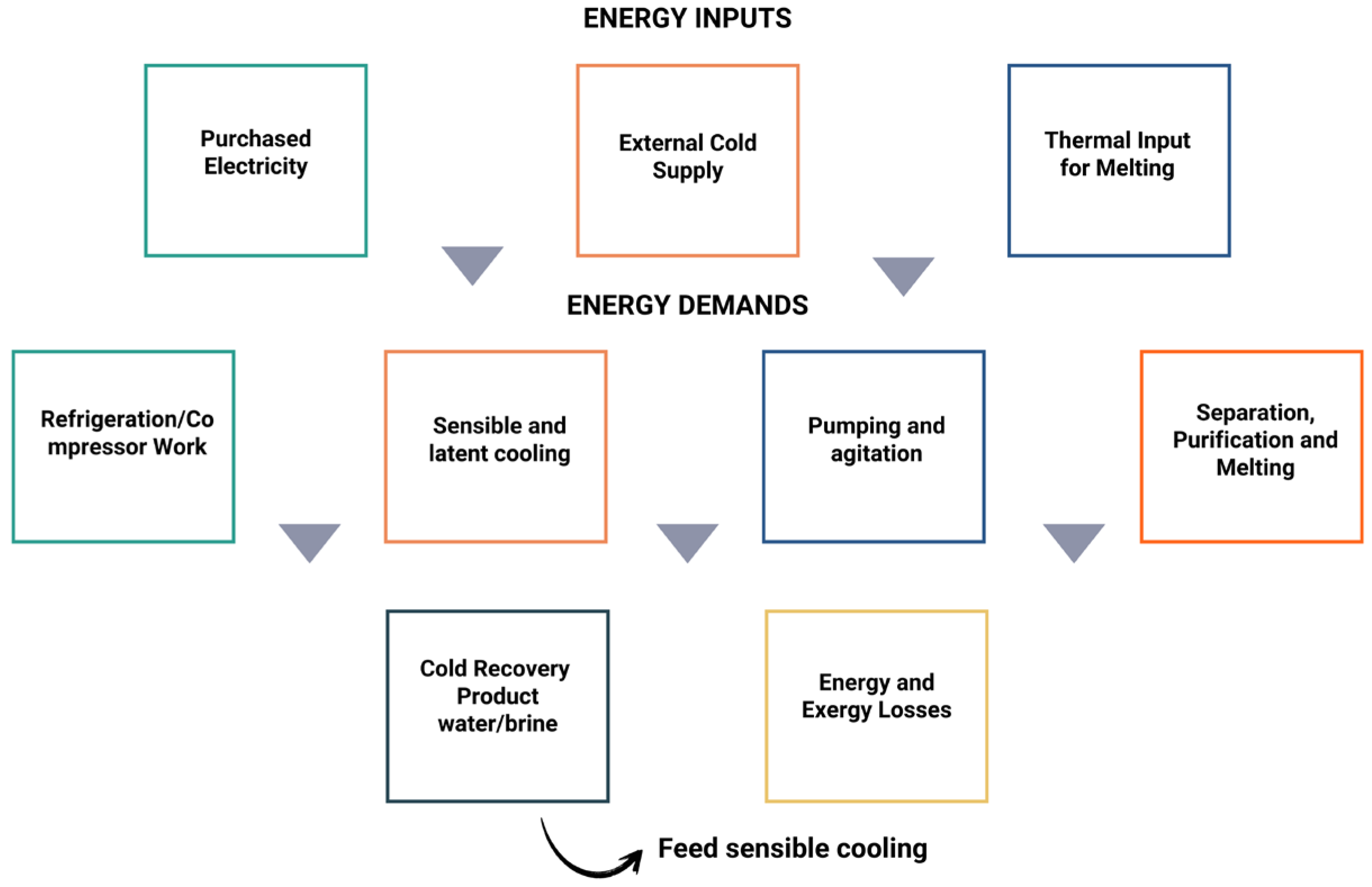
Figure 2 distinguishes the energy carriers and auxiliary demands that determine full-system FD performance. Purchased electricity, externally supplied cold, and thermal energy for melting should be reported separately, while cold recovery should be credited only when it is physically recovered within the defined system boundary. These contributions may be combined only after conversion to a common primary-energy or exergy basis.

3. Thematic Framework and Literature Selection Methodology

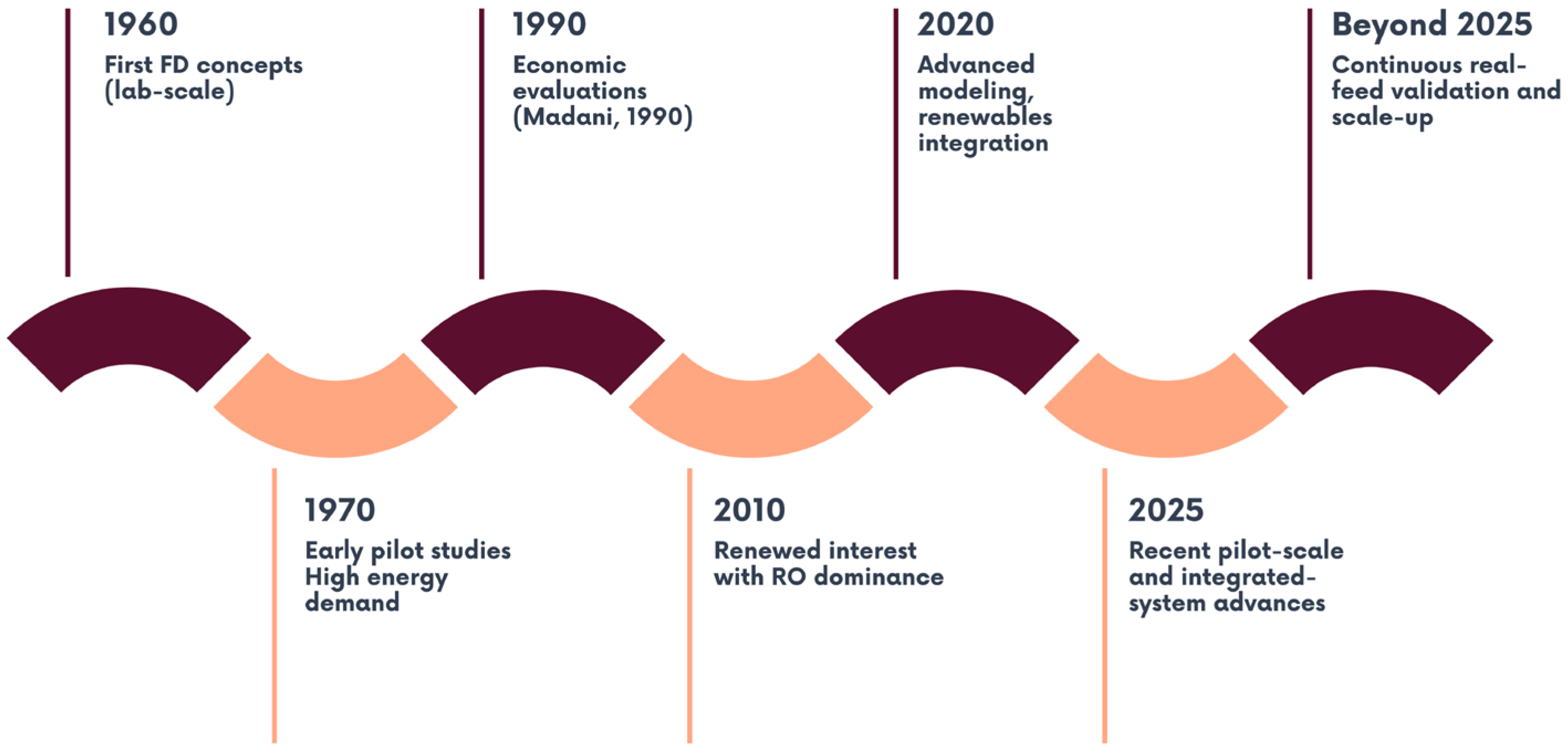
The literature reviewed in this study was collected from major scientific databases and publisher platforms, including Elsevier, Springer, MDPI, and Wiley. Search terms such as “freeze desalination,” “eutectic crystallization,” “ice crystallization,” and related expressions were used to identify studies directly connected with FD. The review focused primarily on studies published between 2015 and 2026, while earlier foundational contributions were included when relevant, particularly those that address experimental work, theoretical modeling, technological integration, and system-level performance. Earlier foundational studies, including El-Nashar (1984), Rich et al. (2010), and Mandri et al. (2011), were also included when they provided useful historical or conceptual context for understanding the field’s development [67,68,69].
The selected literature was then organized into four thematic domains: modeling and simulations, experimental validation, technological integration, and energy–economic performance. This organization helps compare recent advances without treating FD as a single, uniform technology. It also makes it easier to identify the main technical barriers that still limit its transition from laboratory- and pilot-scale studies to more reliable, scalable applications.
Within the broader desalination landscape, FD represents a low-temperature option with potential compatibility with renewable energy and waste-cold sources, but it remains less technologically mature than RO, MED, and MSF. Table 3 and Tables S1–S3 in the Supplementary Material provide the quantitative, study-level detail needed to move from this qualitative positioning to a more granular comparison.

4. Theoretical Modeling and Simulations

Modeling and numerical simulation are useful in FD because many key processes occur within or near the growing ice layer, where direct observation is not always feasible. These tools help describe phase change, heat and mass transfer, salt migration, ice morphology, and system performance under different operating conditions. The field has moved from basic thermodynamic and energy-balance models to more detailed CFD, multiphysics, optimization, and data-driven approaches. The following subsections review these advances across four areas: thermodynamic and energy-balance modeling, CFD and multiphysics simulations, ice-morphology prediction, and parametric optimization.

4.1. Thermodynamic and Energy Balance Models

Thermodynamic and energy-balance models are useful in FD because they provide initial estimates of energy demand, ice production, and desalination efficiency. These models usually start from conservation laws and phase-equilibrium principles, thereby simplifying the freezing process into equations that can be used for conceptual design and comparison between systems. Although they cannot capture all the details of ice growth and brine entrapment, they help identify the main energy requirements and the operating conditions that may improve system performance.
Recent studies have used these models in hybrid configurations, including LNG cold recovery and shipboard desalination systems. In these cases, the optimization of heat loads, pre-cooling stages, and temperature profiles has been shown to improve freshwater yield and reduce energy demand [38,70]. Exergy-based analyses have also been used to compare FD with conventional desalination technologies such as RO and MSF. Some studies report thermal efficiencies of up to 44% under optimized conditions, which suggests that FD can be competitive when the system is properly integrated [63].
Other models have combined heat-transfer analysis with solute redistribution equations to predict ice thickness, thermal gradients, and the salinity of the melted ice during progressive freeze concentration. These approaches have shown good agreement with experimental data and are useful for understanding how freezing conditions affect product-water quality [71,72]. Analytical models have also been extended to include latent heat effects, hybrid evaporation–freezing cycles, and LNG cold-energy integration. For example, some studies have reported pathways to reduce specific energy consumption (SEC) below 70 kWh/m3 while maintaining acceptable desalination efficiency [73,74]. In the case of ship-based FD systems, thermodynamic modeling has been used to evaluate pre-cooling strategies and the use of exhaust heat to stabilize crystallization conditions, which reinforces the importance of thermal integration in practical designs [70].
For consistency, electrical specific energy consumption is defined as:
S E C = ( W e l , n e t ) V f w
where W e l , n e t is the net electrical energy consumed by refrigeration, pumping, ice–brine separation, control, and auxiliary equipment within the stated system boundary, and V f w is the net volume of product water collected after purification. When cooling is supplied externally, for example, through LNG cold recovery, ambient freezing, or radiative cooling, the corresponding cold duty should be reported separately rather than added directly to electrical consumption or treated as zero. Combined comparisons require conversion of electrical, thermal, and cooling inputs to a common primary-energy or exergy basis.
Eutectic freeze crystallization (EFC) is another important area where thermodynamic modeling has been widely applied. In this process, water and salts crystallize simultaneously, which makes EFC especially relevant for brine treatment and salt recovery. Modeling studies have reported recovery rates above 90% for complex brines, although these results depend strongly on accurate temperature control near the eutectic points [37]. Simplified one-dimensional models that couple heat conduction and salt diffusion have also reproduced key freezing behaviors and predicted low-salinity ice formation during the early stages of the process [34]. Even with these advances, thermodynamic models still have important limitations. Many assume ideal mixing, equilibrium crystallization, or simplified heat-transfer conditions, which may not fully represent real FD systems. For this reason, they are most useful when combined with CFD, microscale simulations, and experimental validation. This is particularly important for LNG-integrated or progressive freezing systems, where the movement of the freezing front, heat transfer dynamics, and salt rejection are closely linked [73].
Thermodynamic and energy-balance models have therefore moved beyond simple feasibility calculations. They now help guide the design of hybrid and energy-integrated FD systems, but their predictive value still depends on how well they are supported by experimental data and by more detailed simulations of non-equilibrium ice formation and brine rejection.

4.2. CFD Simulations and Multiphysics Modeling

Computational fluid dynamics (CFD) and multiphysics simulations are useful for studying FD because they can describe several coupled phenomena simultaneously, including fluid flow, heat transfer, phase change, and solute transport. These processes are difficult to represent with simple thermodynamic models, especially when the objective is to understand ice morphology, brine entrapment, or instabilities at the freezing front. For this reason, CFD-based approaches have become increasingly important for analyzing water quality and energy performance in FD systems.
For the incompressible flow conditions commonly assumed in FD crystallizers, the continuity equation can be written as:
u = 0
where u is the velocity vector of the liquid phase [75,76].
Heat transfer coupled with phase change can be represented through an enthalpy-based energy balance:
ρ c p ( T t + u T ) = ( k T ) + ρ L f f s t
where ρ is density, c p is specific heat, T is temperature, k is thermal conductivity, L f is latent heat of fusion, and f s is the solid fraction [56].
Recent studies have used phase-field and lattice Boltzmann models to describe dendritic ice growth and to examine how salinity, surface wettability, and supercooling affect salt rejection [76]. Other CFD studies, supported by laboratory data, have shown that ice morphology is highly sensitive to the degree of supercooling and to the composition of the feedwater. These models usually provide more detailed predictions than simplified analytical approaches, particularly when the geometry or the freezing conditions are complex.
At the microscale, coupled CFD–phase-field simulations have helped explain how suspended ice crystals can promote clogging inside microchannels. This behavior has also been observed in cryogenic visualization experiments, which gives more confidence in the physical interpretation of the models [75]. Earlier CFD studies using ice-maker systems also showed reasonable agreement between numerical predictions and experimental data, supporting the use of CFD as a design and scale-up tool for indirect FD configurations [77].
CFD has also been applied to crystallizers beyond laboratory scale. For example, it has been used to evaluate hybrid systems that combine FD with absorption refrigeration cycles, where heat transfer, cooling demand, and desalination performance are closely linked [78]. In these cases, simulation is useful not only for describing the freezing process but also for testing design alternatives before moving to more expensive experimental stages.
Even so, CFD and multiphysics models still face practical limitations, such as the requirement of high computational effort, reliable thermophysical properties, and careful validation with experimental data. In addition, real systems involve variable brine chemistry, fouling, ice adhesion, and operational fluctuations that are not always easy to reproduce numerically. For FD, the real value of these models will depend on how well they can be connected with pilot-scale data and used to guide crystallizer design, process control, and energy integration.

4.3. Ice Formation Prediction and Morphological Modeling

Ice morphology is one of the key aspects in freeze desalination because it affects salt rejection, ice purity, and energy performance. When ice forms in a controlled manner, salts tend to remain in the liquid phase; when growth is too fast or unstable, brine can become trapped within the ice structure. For this reason, several studies have focused on predicting ice formation and understanding how operating conditions influence the final quality of the recovered water.
Thermophysical and morphological models show that latent heat removal, boundary layer behavior, cooling rate, and post-freeze treatments (such as sweating) influence impurity removal [36]. According to other studies, geometry also matters. Narrow channels with moderate feed temperatures can improve desalination efficiency, while excessive heat flux can increase convective mixing and promote brine trapping through diffusion and convection interactions [53]. The composition of the feed solution is also relevant. For example, sulfate-rich solutions can form narrower brine channels and exhibit lower salt rejection, although centrifugal separation has been reported to partially restore desalination efficiencies exceeding 96% [54].
Under simplified one-dimensional Stefan-type assumptions, the ice layer thickness may be approximated as:
ε ( t ) = 2 λ α t
where ε ( t ) is the ice thickness, α is thermal diffusivity, t is time, and λ is a parameter determined by the Stefan condition [78].
More recent approaches have expanded beyond deterministic models. Artificial neural networks (ANN), for example, have been used to predict FD performance with errors below 1.3%, offering fast substitute models when experimental data are limited [55]. Droplet-scale and nanoscale studies have also helped clarify the mechanisms involved in salt rejection. CFD analyses of microdroplets have shown that natural convection and droplet size affect impurity distribution during freezing [59,79]. At the molecular scale, simulations suggest that chloride ions may be incorporated into ice more easily than sodium ions, and that the degree of supercooling plays an important role in rejection efficiency [57,80].
Other mathematical models help connect these mechanisms across scales. Validated studies have shown that brine droplets freeze at various temperatures and salinity levels [56] while others have explored the influence of supercooling and nucleation agents on droplet solidification [58]. At the process scale, suspension crystallization models applied to scraped-surface heat exchangers have been used to link crystal population dynamics with the performance of hybrid FD–RO systems [81]. These contributions show that ice quality depends not only on temperature but also on crystal growth, solute transport, feed composition, and the method of cooling.
Salt redistribution in the liquid phase can be described by the transient convection-diffusion equation:
C t + u C = ( D C )
where C is solute concentration and D is the effective diffusion coefficient [82].

4.4. Optimization of Operating Parameters

Parametric studies are useful in FD because they show how operating conditions affect ice production, salt rejection, and energy demand. Instead of analyzing the process as a set system, these studies vary parameters such as coolant flow rate, crystallization time, freezing temperature, feed salinity, and brine concentration. This allows identifying operating ranges where the process performs better, while also showing the trade-offs involved. In FD, for example, increasing the freezing rate may increase ice production but also promote brine entrapment and reduce ice purity.
Early work by [74] showed that coupling freezing with humidity-driven evaporation could reduce specific energy consumption below 70 kWh/m3. This result pointed to the potential of hybrid cycles that use medium-temperature waste heat. Following a similar integration approach, ref. [77] analyzed LNG-assisted FD systems using transient heat- and mass-transfer models. Their results showed that higher refrigerant flow rates can increase ice production, but may also reduce ice purity because faster freezing tends to trap more brine. This illustrates one of the main design tensions in FD: improving productivity without sacrificing water quality.
More recent studies have focused on hybrid and multi-stage configurations [83]. In a developed FD system integrated with absorption refrigeration and reverse osmosis, the results showed that managing the system and combining different technologies can make it more efficient and help achieve zero liquid waste. In another study, ref. [72] proposed an analytical model that predicts ice salinity as a function of brine concentration and freezing rate. Their parametric sensitivity studies, validated through freeze–thaw experiments, identified operating conditions that minimize impurity entrapment without sacrificing productivity.
Experimental and numerical studies have also contributed to this area. Ref. [84] examined heat and mass transfer in FD processes using a combined modeling and experimental approach. In parallel, computational optimization methods are becoming more common. For example, ref. [80] applied evolutionary algorithms to indirect FD to optimize ice yield, energy efficiency, and cost at the same time. Meanwhile, ref. [46] reviewed key parameters in indirect FD and noted that interactions among temperature, salinity, and coolant flow are often nonlinear. This is why AI-supported optimization can be useful, although it still needs to be backed by experimental data.
The models summarized in Table S1 of the Supplementary Material represent different levels of analysis and should therefore be evaluated according to the specific questions they are intended to address. Thermodynamic and energy-balance models estimate ice production, water recovery, and system energy demand, and allow comparisons of FD integrated with LNG cold recovery, refrigeration cycles, or eutectic freeze crystallization [85,86,87]. CFD and coupled multiphysics models are more suitable for resolving local temperature and salinity fields, ice-front evolution, and composition-dependent salt rejection [77,80,88]. These model families are complementary: the first supports system screening, whereas the second helps explain local heat- and mass-transfer phenomena.
Our comparison indicates that additional model detail does not necessarily provide broader predictive validity. System-level analyses often rely on equilibrium conditions, lumped mixing, fixed heat-transfer coefficients, and simplified electrolyte properties. These assumptions omit phenomena that directly affect water quality, including transient nucleation, wall ice formation, dendritic growth, and brine-pocket formation. Higher-resolution models include some of these effects, but most have been tested only for particular geometries, synthetic saline solutions, short experiments, and narrow operating ranges. Agreement with laboratory data supports a model within its validation domain; it does not establish pilot-scale productivity, long-term stability, or full-system energy performance.
FC provides a clear example of this limitation. Equilibrium models can define theoretical ice and salt recovery, whereas actual purity and separability also depend on supercooling, residence time, agitation, and crystal morphology [37,89,90]. In our view, phase equilibrium alone is not an adequate design criterion. EFC models also need to represent crystallization kinetics and hydrodynamics and be evaluated using ice and salt purity, recovery, separation efficiency, and total energy consumption.
Data-driven predictions require a similar distinction between fit and transferability [55], reported ANN prediction errors below 1.3% within the dataset and operating conditions examined. This is a useful result for that particular case, but it does not establish predictive performance for other crystallizers, feed compositions, or scales. In our assessment, cross-scale validation remains the main unresolved modeling problem. Models are currently most reliable for mechanism analysis, sensitivity testing, and preliminary design; claims about scalability, economic feasibility, or energy superiority require independent validation with real multicomponent feedwaters and long-duration continuous pilot data.
Additional modeling and simulation studies, including thermodynamic, heat-transfer, and solute-redistribution approaches, are summarized in Table S1 of the Supplementary Material [69,91,92].

5. Experimental Research

Experimental research on FD spans mechanistic laboratory studies, integrated prototypes, and a limited number of pilot-scale demonstrations. This section examines the available evidence across experimental scale, ice-formation and purification mechanisms, cross-study performance, ice–brine separation, continuous operation, and feedwater and product-water quality. Because the reported studies differ in feed composition, water recovery, number of stages, separation methods, and energy boundaries, their results are critically interpreted rather than compared solely through salt-rejection values.

5.1. Laboratory, Prototype, and Pilot-Scale Studies

Experimental FD evidence ranges from controlled laboratory studies to integrated prototypes and pilot-scale systems. These levels provide different types of validation and should not be treated as equivalent. Early laboratory investigations of static and dynamic crystallization clarified phase behavior and showed that post-freezing purification is often required to improve water quality [67,68]. Laboratory experiments are useful for identifying mechanisms and optimizing operating variables, whereas prototypes examine whether several process stages can operate together. Pilot systems provide stronger evidence of operational feasibility, although only for the feedwaters, operating periods, and conditions evaluated.
Desalination efficiency can be estimated from the reduction in salinity between the initial feed and the melted ice:
η d ( % ) = ( 1 C m C 0 ) × 100
where C 0 is the initial feed salinity and C m is the salinity of the melted ice [33].
Several designs illustrate the progression between these levels of evidence. Sahu et al. (2020) [93] introduced a U-shaped continuous-freeze crystallizer that integrates precooling, freezing, and brine drainage within a single unit. This prototype demonstrated the feasibility of reducing downtime and improving the consistency of ice production. At pilot scale, Ref. [33] developed a continuous system with vacuum-assisted brine extraction. The unit reduced a 10,000 mg/L NaCl feed to approximately 393 mg/L without washing; however, its vacuum-assisted multistage design adds complexity, and salinity alone does not demonstrate potability or long-term reliability.
Several experimental systems have incorporated assisted ice–brine separation. Centrifugation can remove residual brine more effectively than gravity drainage but increases equipment and energy requirements, whereas ultrasound can disrupt the interfacial boundary layer and improve salt rejection and ice uniformity [62]. Ref. [40] demonstrated an LNG-assisted prototype that used cold energy from LNG regasification, while ref. [94] evaluated passive radiative cooling and achieved approximately 95% desalination after two cycles. Ref. [95] showed that ambient subzero air can also be used to freeze brackish water in cold regions. These configurations confirm the technical versatility of FD, but their results cannot be compared directly because they use different energy sources, feedwaters, operating scales, and system boundaries.
Ref. [71] developed a laboratory-scale vertical progressive freeze-concentration system with liquid recirculation and an integrated precooler. The configuration reduced energy use by 30% relative to the conventional vertical-freezing baseline and produced low-salinity water from brackish feedwater. However, improvement relative to a laboratory baseline does not by itself demonstrate comparable performance at pilot or industrial scale.
Across the experimental literature, product-water salinity below 1000 mg/L—and, in some optimized cases, below 500 mg/L—has been reported [8,29]. These values demonstrate effective salt removal but should not be interpreted as sufficient evidence of potability because complete chemical and microbiological quality was not consistently assessed. Performance also depends strongly on the separation method, cold source, water recovery, and system complexity [8,33]. Overall, laboratory and prototype studies demonstrate mechanisms and process integration, whereas the available pilot evidence remains insufficient to establish long-term reliability or industrial scalability.

5.2. Ice Formation and Purification Mechanisms

Laboratory studies show that ice purity is governed by the combined effects of freezing rate, interfacial salt diffusion, crystal morphology, feed salinity, and post-freezing treatment. Droplet-scale and one-sided freezing experiments indicate that slower ice-front propagation generally reduces brine entrapment and allows more effective solute transport away from the interface [96,97].
Post-freezing purification can further reduce residual salinity. Controlled sweating and limited washing remove salt-rich liquid from the ice surface, but may also cause product-water losses and require additional handling and energy [67,98]. Progressive freeze–thaw processing achieved more than 99% salt removal after four stages, although the additional cycles increase processing time and energy demand [99].
Ice-growth control provides another route for limiting impurity entrapment. Low subcooling can produce larger and purer crystals but extends the freezing period, while surfactants have been examined to reduce brine-pocket formation [100,101]. These results reveal a recurring trade-off: conditions that improve ice purity may reduce productivity or introduce additional energy, materials, and process-control requirements. Laboratory findings therefore identify useful mechanisms but do not establish a universally optimal operating condition.

5.3. Feedwater Composition and Product-Water Quality

Many FD studies use NaCl solutions, but real waters contain mixed ions, suspended solids, organic matter, and biological components. This is important because ions do not behave in the same way during freezing. Ref. [102] showed that monovalent ions such as Na+ and Cl are more easily excluded than divalent ions such as Ca2+ and Mg2+, which may become trapped in the ice or form micro-crystals. Their experiments with Xinjiang brine achieved 70–80% salt removal in a single cycle, but also showed that hardness requires special attention. Similarly, ref. [103] observed that NaCl was largely rejected during freezing of Red Sea water, while algae and suspended solids could remain in the frozen matrix. These results point to the need for pretreatment when using real seawater or complex brines.
Feedwater composition is not a secondary experimental detail: differences in salinity and water matrix affect salt rejection and reported SEC [42,46,104]. In our assessment, synthetic NaCl solutions are useful for isolating process mechanisms, but they cannot be treated as evidence of equivalent performance with seawater or industrial brines. We therefore distinguish these feed types in our comparison. Low product TDS is also treated as a partial water-quality indicator rather than sufficient evidence of potability or overall process performance. Future studies should report feed and product composition beyond bulk salinity and validate promising configurations with real feedwaters while measuring net water recovery, productivity, and total SEC.

5.4. Hybrid and Novel Approaches

Lab-scale studies have also explored hybrid concepts that combine FD with energy recovery or alternative freezing geometries. Ref. [64] analyzed an LNG cold recovery system coupled with an organic Rankine cycle, exhibiting efficiency increases when freshwater and power generation were combined. Ref. [105] developed a cryo-powered concept in which saline droplets freeze while falling through cold air, producing low-salinity ice pellets without scraping or rinsing. This method might be useful in cold areas or where liquid waste is not allowed. However, it needs more testing on a larger scale.
Faster freezing can raise ice production but can also increase brine entrapment. Agitation and ultrasound may improve interfacial transport, although their effects depend on the operating regime and may involve additional energy use and changes in crystal growth [42,90]. In our assessment, these results do not support the existence of a universally optimal operating condition. A condition should be considered favorable only when product purity, net water recovery, productivity, and total energy consumption are evaluated together; improving one indicator is not enough to claim better overall performance.

5.5. Cross-Study Comparison of Experimental Performance

Experimental studies confirm that FD can treat seawater, brackish water, and concentrated brines, particularly when freezing is combined with assisted separation or multistage treatment [99,105]. However, differences in feed composition, water recovery, number of cycles, separation method, and energy accounting prevent direct comparison of the reported salt-rejection values [40,94]. Table 4 presents representative results together with the principal conditions required for their interpretation, while Table S2 of the Supplementary Material provides a broader comparison of experimental and pilot-scale studies.
Experimental FD studies differ substantially in feed composition and salinity, net water recovery, number of freezing cycles, separation method, post-treatment, and energy boundaries [42,46]. Table 4 shows why reported salt rejection cannot be used alone to rank FD configurations. Ghonim et al. reduced a 10,000 mg/L feed to approximately 393 mg/L using continuous vacuum-assisted separation; Huang et al. reached 1.88 g/L after two passive-freezing stages at 50% recovery; and Najim and Krishnan achieved more than 99% salt removal after four freeze–thaw stages [33]. These results confirm the desalination capability of FD but do not represent equivalent overall performance: higher purity may require additional stages, longer processing times, water losses, assisted separation, or access to an external cold source. This review therefore treats salt rejection as only one dimension of performance rather than evidence that a system also achieves high recovery, useful productivity, and low full-system SEC. Meaningful comparison requires product salinity, net water recovery, productivity, number of stages, wash-water losses, and total SEC. When these data are unavailable, the reported result should be interpreted as configuration-specific rather than as evidence of technological superiority.

5.6. Ice-Brine Separation and Process Simplification

Producing low-salinity ice does not resolve the downstream separation problem. Sweating, washing, and centrifugation can improve purity but may increase water loss, energy demand, processing time, or equipment complexity. Vacuum-assisted drainage and spray freezing may reduce washing or scraping requirements, although continuous large-scale evidence remains limited [33,105].
None of the available methods are universally superior. Vacuum extraction and centrifugation add equipment and control requirements [62,64,106,107,108]; sweating prolongs treatment and may reduce product yield [36,68]; and ultrasound has not demonstrated a consistent energy or scale-up advantage [109,110]. These methods should therefore be considered separation-intensification strategies: none has yet combined high purity, low energy demand, minimal auxiliary water use, operational simplicity, and continuous operation at scale [42,51,110,111].

5.7. Continuous Operation, Scale-Up, and Reliability

Available reviews indicate that FD evidence remains concentrated at laboratory and pilot scales [42,48,77,90]. Continuous EFC studies demonstrate that operation beyond batch mode is technically possible [112], while CFD and phase-change models can support the design of larger systems [56,77]. These forms of evidence are not interchangeable: laboratory purity provides proof of separation, pilot operation demonstrates performance only over the duration and under the conditions tested, and simulated scale-up does not establish operational reliability. The available evidence supports technical feasibility, but not sustained industrial performance.
TRL should be assessed from the duration, continuity, and representativeness of demonstrated operation rather than from nominal equipment size or predicted capacity. Long-duration continuous trials with real feedwaters are still required to quantify ice adhesion, clogging, unstable nucleation, cleaning and maintenance requirements, and the progressive loss of heat-transfer performance. Real-time monitoring of freezing fronts may help identify these changes [113], but it cannot replace extended reliability testing. Future demonstrations should report uptime, net water recovery, productivity, SEC drift, product-quality stability, heat-transfer-coefficient decay, cleaning intervals, and component failures. Until such data are available, extrapolation from laboratory or short pilot results to commercial performance remains premature.
A broader comparison of experimental and pilot-scale evidence, including freezing methods, separation strategies, water-quality outcomes, and technical limitations, is provided in Table S2 of the Supplementary Material [8,114,115,116,117].

6. Technological Integration

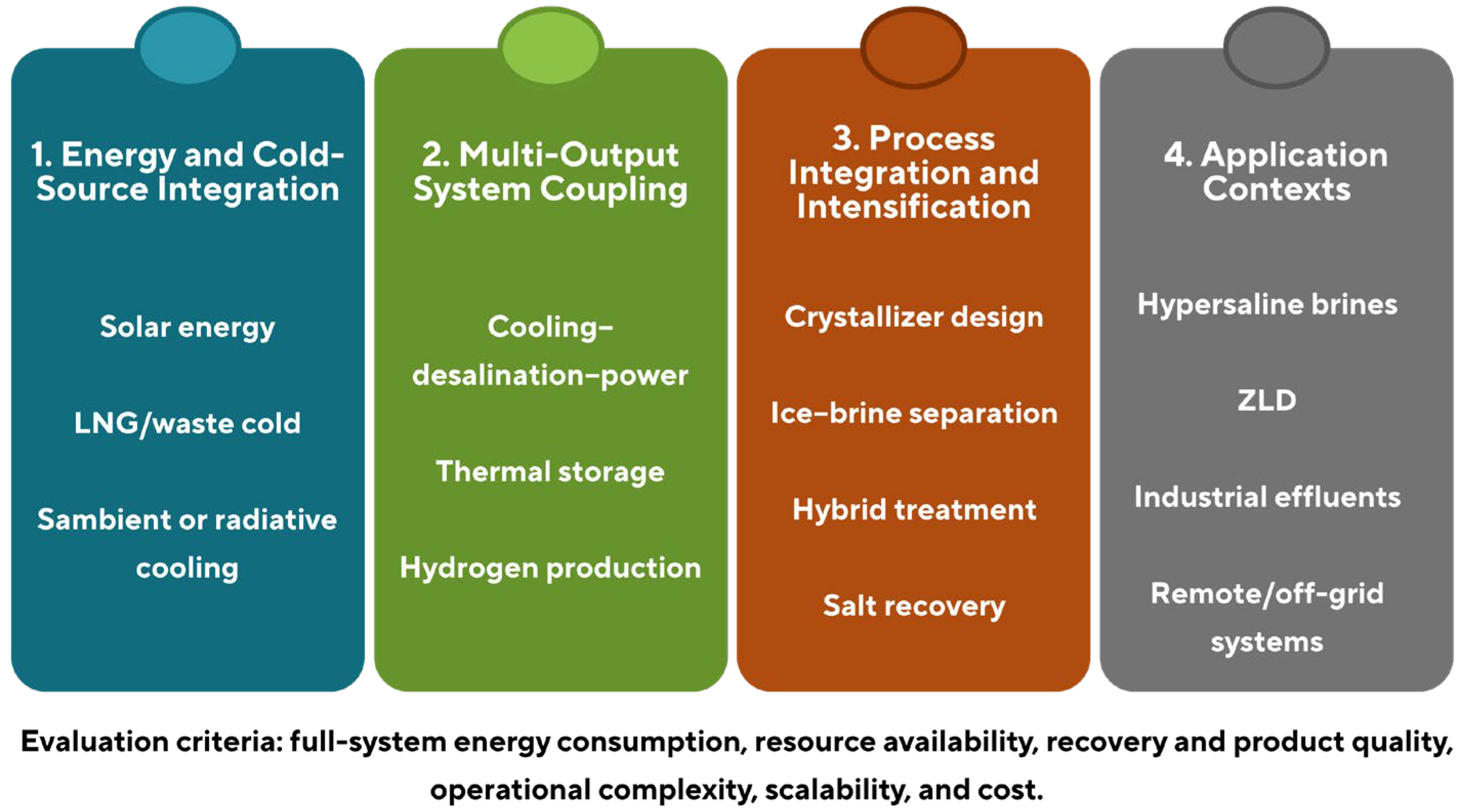
Technological integration can improve FD performance, but its value depends on the resources required and the evaluation boundaries adopted. Figure 3 organizes the integration strategies examined in this section and identifies the criteria used to assess them, including full-system energy consumption, resource availability, recovery and product quality, operational complexity, scalability, and cost.

6.1. Solar-Powered FD Systems

Solar-assisted FD systems have been studied as low-emission alternatives for remote, arid, or off-grid regions. Their main advantage is that they can use available solar energy to support cooling, rather than relying solely on conventional electricity-driven refrigeration. Ref. [34] developed a solar-powered freeze–melting desalination system based on thermochemical sorbent–refrigerant pairs. The system was designed to produce both freshwater and cooling, and it was evaluated under real climatic conditions in Mexico. One relevant result was that freshwater production could continue even during periods of low solar radiation, mainly because of the system’s thermal buffering capacity.
For solar-assisted FD systems, the solar fraction can be estimated as:
S F = Q s o l a r Q s o l a r + Q a u x
where Q s o l a r is the useful solar energy supplied to the system and Q a u x is the auxiliary energy demand [34].
Similarly, Sezer and Bayhan (2025) [118] proposed an integrated FD and electrolysis system powered by solar energy. This design included energy recovery and thermal storage circuits, enabling high energy autonomy. In addition to desalinating seawater, the system also produced hydrogen, making it relevant for sustainable agriculture and decentralized energy supply in desert environments.
These studies demonstrate that solar-assisted FD is more attractive when considering the technology not only as a desalination unit, but as part of a broader energy system. Even so, some practical challenges remain. The process must maintain efficient freezing during cloudy periods or at night, and the system needs sufficient thermal stability to operate under varying outdoor conditions.

6.2. Integrated Cooling, Desalination, and Energy Systems

FD can also be integrated into larger energy-recovery systems, especially when a cold stream, waste heat source, or cooling demand is already available. This is important because the freezing stage can become energy intensive when it depends only on mechanical refrigeration. By coupling FD with processes such as power generation, cooling production, thermal storage, or waste-heat recovery, part of this energy demand can be reduced and used more efficiently.
A representative case is an indirect LNG-regasification-coupled FD system. At an LNG receiving terminal, the cold released as LNG is warmed and vaporized is transferred to a closed secondary-refrigerant circuit, keeping LNG and natural gas physically isolated from the saline water. Incoming seawater is first passed through a melting–precooling heat exchanger, where it supplies heat to melt previously separated ice and is itself precooled. The secondary refrigerant, cooled or condensed in the LNG-side heat exchanger, then removes the remaining sensible heat and part of the latent heat in a flake-ice maker or other indirect crystallizer. Only a controlled fraction of the feed is frozen, while the rejected salts concentrate in the mother brine. The ice–brine mixture is harvested and separated by drainage, filtration, pressing, or centrifugation; washing or sweating may be required to remove adhering brine. The purified ice is melted to obtain freshwater, and coupling the melting duty to feed precooling recovers cooling capacity that would otherwise be lost. The warmed secondary refrigerant returns to the LNG-side heat exchanger, completing the circuit [38,40].
The available evidence illustrates this pathway but does not yet demonstrate full terminal-scale operation. Ref. [40] built a 150 L h−1 prototype using R410A as the secondary refrigerant and a flake-ice maker, but the experiments used liquid nitrogen as a surrogate cold source rather than LNG regasification. Moreover, one-pass salt removal was approximately 50%, which was insufficient for potable-water production. Chang et al. (2016) [39] showed that lower product-water TDS can be achieved by controlling coolant temperature, freezing duration, agitation, and washing, but washing reduces net water recovery and introduces additional process requirements. These findings reveal a central trade-off: increasing the temperature driving force can raise ice productivity but may also accelerate crystal growth and promote brine entrapment. The cryogenic temperature of LNG must therefore be thermally matched or cascaded to the near-freezing requirements of FD rather than treated as an unlimited advantage [39,40,73].
The viability of LNG–FD is therefore site-specific. The FD unit generally needs to be located at or near the regasification terminal because long insulated transfer lines increase thermal losses and capital cost. LNG send-out, available cold duty, saline-feed flow, and water demand must be compatible in both capacity and operating schedule; otherwise, thermal storage, backup refrigeration, or flexible FD operation is required. Temperature levels and minimum approach differences in the heat exchangers must support controlled crystallization without excessive supercooling, ice adhesion, or brine entrapment. Complete accounting must distinguish baseline terminal energy from the additional integration loads and include secondary-loop circulation, any incremental LNG-side pumping and pressure losses, seawater and brine pumping, heat exchangers, ice generation and harvesting, ice–brine separation, washing or sweating, melting and internal cold recovery, storage, controls, and auxiliary refrigeration. Cold already allocated to power generation, air separation, or another terminal service cannot be counted again. LNG cold should therefore be reported explicitly as a cooling-duty or exergy input, rather than treated as a zero-energy supply, and the integrated configuration should be compared with both baseline regasification and stand-alone FD [38,61,119]).
Gao et al. (2023) [120] proposed a combined cooling, power, and desalination cycle using ship diesel exhaust heat. Their multi-objective optimization showed improvements in freshwater production and thermal efficiency, suggesting that this type of configuration could support onboard water generation in maritime applications.
Lan et al. (2024) [119] explored another integration route by combining FD with ice thermal storage. In this case, the storage unit works as a cold buffer, helping the system maintain desalination operation under variable cooling loads or fluctuating demand.
These alternative configurations broaden the available integration routes, but they require the same load-matching and complete-system-boundary assessment described above.

6.3. Crystallizer Designs

Crystallizer design is a key factor in FD because it directly affects heat transfer, ice formation, salt rejection, and ice removal. A good design should promote controlled crystal growth while reducing ice fouling, brine entrapment, and operational problems during harvesting. For this reason, recent studies have focused not only on improving the freezing surface but also on more effectively controlling the ice–liquid interface.
Scraped-surface crystallizers have received particular attention because they limit ice accumulation on cooled surfaces and maintain heat transfer. Erlbeck et al. (2020) showed that scraper geometry and operating conditions affect ice removal and separation performance [121]. Soni et al. (2025) [122] developed a scraped-surface falling-film crystallizer with in situ scraping and filtration to improve ice harvesting. Ref. [109] combined a slurry-pressing piston with vacuum-assisted brine extraction, improving product-water quality without washing or crushing the ice.
Assisted or non-contact methods have also been examined. Ultrasound may promote ice nucleation and detachment, whereas microwave assistance can accelerate freezing and reduce energy input [52,123]. These approaches seek to improve crystallization control without relying exclusively on mechanical scraping.
Additional strategies, including directional freezing [124], centrifugal-assisted phase separation [108], and gravity-induced freezing [125] are pushing the boundaries of crystallization control, offering more predictable ice morphology and facilitating continuous operation.

6.4. Applied and Industrial-Oriented Systems

The use of FD in applied and industry-oriented systems remains limited, but recent prototypes show where the technology may have practical value. Most examples are not yet full industrial deployments; rather, they are advanced experimental systems designed for specific applications such as cooling, brine treatment, compact desalination, or resource recovery.
Yedmel et al. (2024) [126] developed a heat exchanger coupled with ice slurry generation for simultaneous cooling and desalination. The system was tested under different salinity conditions and showed potential for building integrated cooling, especially in coastal cities where freshwater demand and cooling loads are high.
Other compact FD systems have focused on improving separation while reducing mechanical complexity. Designs based on brine extraction during melting and slurry ice pressing aim to reduce moving parts, lower energy use, and improve desalination throughput [106,124]. These approaches are useful because they address one of the main practical barriers in FD: obtaining cleaner ice without adding too many post-treatment steps.
Najim and Krishnan (2022) [71] proposed a progressive freeze-concentration system in which the salt rejection is controlled through several freezing stages. Their results showed that the salinity could be reduced below 800 mg/L, suggesting that progressive freezing can be adapted in the direction of scalable desalination designs. Mohammed et al. (2017) [127] also tested a stagnant film crystallizer with indirect sweating. This configuration reduced maintenance needs and supported a more modular system design.
FD has also been explored for more specific sectors, including maritime, agricultural, and mining-related applications. More and Mahlangu (2024) evaluated FD for valuable mineral recovery from wastewater [51], while anti-icing polymer membranes have been proposed as hybrid interfaces that could support conventional FD crystallization [128]. These examples suggest that FD may be useful not only for freshwater production but also for brine valorization and specialized wastewater treatment.
Salt recovery alone does not establish circularity. In EFC, feed chemistry, co-crystallization, and entrained mother liquor affect salt selectivity and product purity [37,129,130]. Recovered solids create value only when they meet reuse specifications and have a viable market [131,132,133] while ZLD systems may still generate mixed or hazardous residues requiring treatment or disposal. Although EFC can consume less energy than thermal crystallization, its full-system energy demand remains configuration-dependent [37,66]. Circularity should therefore be assessed from saleable salt yield, off-spec residues, market destination, avoided disposal, and total energy demand rather than from recovery percentage alone.
A comprehensive sustainability assessment of FD would also require comparative life cycle assessment (LCA) against RO, MED and MSF, accounting for the source of electricity (grid mix versus renewables at each country) the global warming potential of refrigerants used in the compression cycle, and the end-of-life pathway for rejected brine or recovered salts. To our knowledge, the reviewed literature does not yet include a study that performs this comparison on a consistent functional unit basis for FD. The authors therefore identify this as an explicit knowledge gap rather than assume that FD’s lower phase change energy demand translates directly into a lower carbon footprint or environmental impact.
Solar- and radiative-cooling configurations are likewise site- and climate-dependent. Across all integration routes, a low electrical SEC should not be presented as a universal advantage when external cold, storage, auxiliary equipment, and additional process complexity are excluded. Future assessments should define transparent system boundaries and compare each integrated configuration with a stand-alone FD baseline. Integration is justified only when the recovered resource and local demand compensate for the additional equipment, control requirements, and capital cost.

7. Economic and Energy Efficiency Evaluations

Studies relevant to the energy and economic performance of FD cover conventional refrigeration cycles, directional and passive freezing, hybrid LNG- and solar-assisted systems, and multigeneration configurations [63,134,135,136,137]. Taken together, these studies show that performance is determined not by the freezing principle alone, but by the cold source, heat and cold recovery, crystallizer and ice–brine separation design, scale, and allocation of energy and cost among multiple outputs.
Accordingly, this section evaluates FD from four complementary perspectives: energy and exergy analysis; comparison with RO, MED, and MSF; economic feasibility; and efficiency and performance metrics. Reported SEC and water-production costs are interpreted as scenario-specific unless feed salinity, water recovery, product quality, plant scale, auxiliary loads, external cold inputs, CAPEX and OPEX assumptions, and system boundaries are comparable. The purpose is therefore not to rank technologies using isolated values, but to identify the operating and integration conditions under which FD may offer a credible energy or economic advantage.
Reported energy and economic performance data for laboratory prototypes, modeling studies, pilot demonstrations, and integrated FD systems are compiled in Table S3 of the Supplementary Material [138,139,140,141,142,143,144,145,146].

7.1. Energy and Exergy Analyses

Energy and exergy analyses are useful tools to evaluate the thermodynamic performance of freeze desalination (FD), especially when the process is integrated into larger energy–water systems. Energy analysis helps quantify how much energy is required to operate the system, while exergy analysis goes one step further and evaluates the quality of that energy. In this sense, exergy enables identification of where the main irreversibilities occur and where the process can still be improved.
The exergy efficiency of an FD process can be expressed as the relationship between the minimum theoretical work required for separation and the actual energy consumed by the system:
η e x ( % ) = W m i n W a c t u a l × 100
where W m i n is the minimum reversible work of separation, and W actual is the real energy consumed by the desalination process [60]. This indicator is important because a system may have acceptable energy consumption, but still present high exergy losses if the cooling, crystallization, or ice–brine separation stages are not well designed.
Several studies have used this approach to evaluate FD in integrated systems. For example, ref. [147] performed a theoretical analysis of an ocean thermal energy-driven multigeneration system coupled with FD. Their results showed that the integration with absorption power cycles can improve exergy efficiency and reduce entropy generation. This is relevant because it shows the potential of low-grade thermal sources for future FD applications.
Similarly, ref. [148] proposed a thermodynamic model of an energy-efficient FD cycle integrated with absorption chilling and humidification. Their results indicated that redistributing cold energy among the different subsystems can reduce specific energy consumption and improve the overall thermal performance. In the same direction, ref. [80] analyzed FD coupled with vapor compression and absorption refrigeration cycles. They confirmed that the latent heat demand of FD can match well with multipurpose cooling systems, which helps reduce exergy losses when the system is properly integrated.
In addition to system-level studies, process-oriented research has also provided useful information about energy use during freezing and purification. For instance, ref. [149] showed that stirring-induced crystallization can intensify solute rejection and improve heat transfer during freezing. This can reduce the energy required to produce ice. Likewise, ref. [150] analyzed ascending meltwater purification and showed that the way thermal gradients are controlled at the ice–brine interface can make a clear difference in purification efficiency. Better control at this stage helps remove salts more effectively and avoids part of the energy waste that may occur during melting. In a related study, ref. [151] showed that the direction and structure of ice crystal growth, together with salt migration, affect both impurity rejection and energy transfer. In practical terms, this means that ice morphology is not just a microscopic detail. It is one of the factors that can determine whether the process works efficiently.
The lower latent heat of fusion is a thermodynamic advantage, but it is not evidence of a lower process SEC. A complete energy balance must include feed precooling, refrigeration losses, pumping, crystallization, ice–brine separation, washing or sweating, melting, and cold recovery [42,44]. Consequently, energy-efficiency claims based only on the freezing duty, or on analyses that assign no energetic cost to externally supplied cold, are insufficient to establish an overall advantage. Electrical consumption, thermal or cooling duty, and recovered energy should be reported separately and compared on a consistent primary-energy or exergy basis.

7.2. Comparisons with MSF, RO, MED

Reverse osmosis (RO), multi-stage flash distillation (MSF), and multi-effect distillation (MED) are still the main desalination technologies used worldwide. Each one has well-known advantages, but also important operational limitations. RO typically reports a specific energy consumption of 2–5 kWh/m3, but its performance is affected by membrane fouling, scale buildup, pretreatment requirements, and maintenance costs. Thermal processes such as MSF and MED are more robust for high-salinity water but require much higher thermal energy input, typically 10–25 kWh/m3. Compared with these processes, freeze desalination (FD) is attractive because it uses the lower latent heat of fusion instead of vaporization. However, this advantage becomes really relevant only when the system is properly designed and, preferably, when it can use renewable energy, waste cold, or low-temperature energy sources.
Several comparative studies have analyzed FD against conventional desalination technologies. Ref. [60] compared the energy and exergy performance of multiple-effect distillation and freeze desalination systems, reporting that FD can achieve higher exergy efficiency and lower entropy generation under optimized conditions. In a broader evaluation of seawater desalination technologies, ref. [152] also identified FD as an emerging option that may outperform MSF and MED in energy terms, especially when integrated with renewable energy sources.
From an economic and technical perspective, ref. [61] analyzed seawater desalination driven by LNG cold energy. Their results showed that FD-based systems can operate with much lower specific energy consumption than MSF and MED, and may approach RO performance when an external cold source is available. This point is important because FD does not necessarily compete with RO under all conditions; its strongest advantage appears in specific contexts where cold energy is already present and can be recovered. In the same line, ref. [153] compared natural gas-driven desalination processes and confirmed that FD cycles are highly compatible with cryogenic energy recovery, which offers energy savings that conventional thermal methods cannot easily reproduce.
Hybrid FD systems have also been compared with traditional desalination routes. Ref. [154] examined the HybridICE approach and reported that hybrid FD could provide higher freshwater recovery and lower energy demand than thermal desalination processes. Similarly, ref. [155] compared the energy consumption of different desalination technologies and noted that FD performs better when it is coupled with cooling or refrigeration subsystems. These results support the idea that FD should not be evaluated only as a stand-alone process, but also as part of integrated systems where cold recovery, refrigeration, or cogeneration can improve the overall balance. Earlier studies also help place FD in perspective. Ref. [156] presented thermo-economic comparisons of desalination technologies and described FD as a less explored but promising alternative when low-temperature energy is available. Ref. [157] reviewed several desalination techniques and recognized FD as a niche process with potential energy advantages over MSF and MED. In one of the earlier economic comparisons across different plant scales, ref. [158] also suggested that FD could become competitive under favorable operating and energy-supply conditions, even when thermal methods were still dominant.
Despite these favorable results, the SEC values reported for FD, RO, MED, and MSF cannot be used directly to rank these technologies because they are not calculated on a consistent energy basis. RO values generally represent electrical consumption, whereas MED and MSF involve both thermal and electrical inputs; moreover, some of the lowest values reported for FD assume access to LNG cold energy, ambient freezing, or radiative cooling [42,44]. A meaningful comparison requires comparable feed salinity, water recovery, product quality, plant scale, and system boundaries, together with explicit accounting for external cold or heat. The available evidence positions FD as a potentially competitive option for site-specific applications with usable cold energy or challenging high-salinity feeds, but does not establish its universal superiority over RO, MED, or MSF.
Table 5 compiles representative energy consumption and water cost values reported for these technologies. The ranges are drawn from the studies cited in the table but reflect different feed conditions, plant scales, system boundaries, and forms of energy input. They should therefore be interpreted as indicative values rather than as a direct ranking of technological performance.
At present, the comparison supports a context-dependent role for FD rather than a general replacement for established desalination technologies. Its competitiveness remains conditional on efficient ice–brine separation, continuous operation, scale-up, and access to suitable energy or cold-recovery resources.
The energy-consumption and water-production-cost ranges in Table 5 should not be interpreted as a direct ranking. Most RO values represent electrical consumption at commercial scale, whereas MED and MSF involve both thermal and electrical inputs. In contrast, the lowest reported FD values generally correspond to modeled or optimized integrated cases that rely on externally available cold or favorable operating assumptions. Consequently, the apparent proximity of FD to RO, or its lower reported values relative to MED and MSF, does not establish equivalent full-system efficiency, cost, or technological maturity. Meaningful comparisons require consistent feed salinity, water recovery, product quality, plant scale, capacity factor, energy basis, and system boundaries.

7.3. Techno-Economic Feasibility, Maintenance, and Technology Readiness

Lower SEC and water-cost estimates have been reported for some recent integrated FD configurations compared with early prototypes. However, this difference cannot be attributed solely to technological progress, as the studies use different operating conditions, energy sources, scales, and system boundaries. These values indicate scenario-specific potential rather than demonstrated parity with RO or superiority over MED and MSF.
The economic feasibility of freeze desalination (FD) remains a key barrier to its transition from laboratory and pilot studies to large-scale applications. Energy efficiency is important, but it is not enough by itself. In practical terms, the viability of any desalination process is usually judged by the cost of produced water, expressed in USD/m3, and by the balance between capital expenditure (CAPEX) and operating expenditure (OPEX).
Early economic assessments were not especially favorable for FD. Older desalination cost comparisons showed that less mature processes were difficult to justify economically when compared with established technologies, especially when energy recovery, continuous operation, and reliable separation systems were not yet well developed [158]. For this reason, early FD configurations were generally viewed as technically interesting but economically uncertain. This interpretation is reasonable for that stage of development, since most early FD prototypes still lacked efficient crystallizer designs, continuous operation, and integration with waste or renewable energy sources.
More recent studies present a different picture, although still under specific operating conditions. Ref. [61] showed that coupling FD with LNG cold energy recovery can reduce water production costs to below 0.6 USD/m3, bringing the process closer to RO competitiveness. This is an important result because it shows that FD becomes more attractive when cooling demand is not supplied solely by conventional electricity but by an already available cold source. In the same direction, ref. [156] highlighted that FD may reduce operating costs through lower scaling, corrosion, and chemical dependency when compared with MSF and MED.
Other studies have focused on improving the economic performance of FD through process integration and intensification. Ref. [147] showed that incorporating FD into an ocean thermal energy-driven multigeneration system can improve economic feasibility because the energy input is shared among several useful products, such as cooling, electricity, and freshwater. Ref. [60] also reported that exergy optimization can reduce irreversibilities in FD systems, thereby lowering energy demand and, consequently, lifecycle costs. At the process level, ref. [149] showed that stirring-induced crystallization can reduce solute entrapment and improve heat transfer, thereby reducing the need for additional separation steps. Likewise, ref. [150] demonstrated that ascending meltwater purification can simplify post-treatment and reduce energy requirements during the melting and purification stages.
A broader comparison of desalination technologies was presented by [152], who identified FD as an emerging option with potential economic advantages over MSF and MED when renewable or waste cold sources are available. However, FD still lacks the same commercial maturity as RO. Its competitiveness depends strongly on local conditions, especially the availability of low-cost cold energy, the required water quality, feedwater salinity, plant scale, and the possibility of integrating desalination with refrigeration, cooling, or energy recovery systems.
The same caution applies to water-cost estimates. Values obtained for LNG-assisted or multigeneration systems depend on whether external cold is treated as a free resource and on how capital and operating costs are distributed among freshwater, cooling, power, and other products. We therefore regard the lowest reported costs as scenario-specific estimates rather than evidence of general commercial competitiveness. Future techno-economic assessments should report crystallizer, refrigeration, separation, storage, and control CAPEX; all auxiliary OPEX; capacity factor; project lifetime; discount rate; energy prices; and uncertainty ranges.
Techno-economic feasibility cannot be inferred from specific energy consumption or a nominal water-production cost alone. Most FD cost estimates are based on process simulations, short-duration experiments, pilot systems, or site-specific integrations rather than full-scale plants with verified availability and replacement histories. For example, Ong and Chen [61] evaluated a steady-state LNG-assisted process in which pumping was treated as the principal operating cost. Their result demonstrates the potential of a co-located LNG–FD configuration, but it is not equivalent to a validated commercial levelized cost of water because long-term maintenance, downtime, replacement schedules, site-integration costs, and financing risk were not established. Similar caution is required for multigeneration studies, in which energy and cost are allocated among several products.
The difference in the available economic evidence is substantial. Commercial data compiled by the World Bank (2019) [160], expressed in 2016 USD, report capital costs of 0.8–2.2 million USD per MLD and O&M costs of 0.25–0.74 USD/m3 for Mediterranean SWRO; 1.2–2.3 million USD per MLD and 0.11–0.25 USD/m3 for MED–TVC; and 1.7–3.1 million USD per MLD and 0.22–0.30 USD/m3 for MSF. No equivalent full-scale cost database is available for FD. Its principal capital requirements include the refrigeration or cold-transfer system, crystallizer and heat-transfer area, ice harvesting and ice–brine separation equipment, purification and melting units, internal cold-recovery heat exchangers, pumps, insulated storage, instrumentation, and controls. Vacuum-assisted, multistage, and LNG-coupled configurations add vacuum systems, secondary-refrigerant circuits, interconnection infrastructure, thermal storage, or backup refrigeration.
The potential OPEX advantage of FD is equally conditional. Relevant costs include electricity or externally supplied cooling, circulation and agitation, vacuum generation or centrifugation, ice washing or sweating, melting, cleaning, refrigerant management, labor, consumables, pretreatment or post-treatment, and residual-brine or recovered-salt management. Although low-temperature operation may reduce some high-temperature corrosion and scaling mechanisms, it introduces different maintenance requirements, including ice adhesion and blockage, heat-transfer degradation, scraper and centrifuge wear, refrigerant-loop servicing, defrosting, and cleaning. The relevant comparison is therefore total annual maintenance, downtime, and availability rather than the elimination of one specific fouling or corrosion mechanism.
Technology readiness must also be assigned to a defined FD configuration rather than to FD as a whole. Commercially mature compressors, heat exchangers, pumps, and centrifuges do not by themselves establish the readiness of an integrated, continuously operated FD train. Most reviewed evidence remains at laboratory, prototype, or pilot scale, with relatively few continuous trials and limited long-duration operation using real feedwaters. Because the studies do not apply a consistent formal TRL methodology, readiness is reported qualitatively in this review. A defensible readiness assessment should consider continuous ice harvesting, stable water quality and recovery, complete energy accounting, plant availability, maintenance frequency, and repeatability over extended operating periods.
Long-term competitiveness is therefore application-specific. RO remains the principal economic benchmark for conventional seawater and brackish-water desalination, while MED and MSF retain advantages in large thermal or cogeneration facilities with established infrastructure. FD may be more economically credible for hypersaline concentrates, EFC- or ZLD-oriented treatment, sites with recoverable LNG or industrial cold, and applications in which avoided brine-disposal costs or marketable salts provide additional value. These benefits cannot be assumed: external cold must be assigned an opportunity cost, shared costs must be allocated transparently, and salt revenue must reflect verified purity, market demand, transport, and residual-disposal requirements. Comparative assessments should use consistent assumptions for feed salinity, water recovery, product quality, plant capacity, capacity factor, project life, discount rate, energy prices, maintenance, residual management, monetary year, and uncertainty. Until long-duration demonstration data become available, FD costs should be regarded as scenario-specific projections rather than evidence of general competitiveness with RO, MED, or MSF.

7.4. Efficiency Metrics and Performance Indicators

The evaluation of desalination technologies requires more than reporting energy consumption or water cost separately. For a fair comparison, it is necessary to use performance indicators that describe the process from different angles. In FD, the most commonly used indicators include specific energy consumption (SEC), exergy efficiency, gain output ratio (GOR), and water production cost. These metrics help compare FD with established desalination technologies such as RO, MSF, and MED.
The levelized cost of water can be calculated as:
L C O W = C R F C A P E X + O P E X V a n n u a l
where C R F is the capital recovery factor, C A P E X is the capital expenditure, O P E X is the annual operating expenditure, and V a n n u a l is the annual freshwater production [61].
Exergy efficiency provides a complementary measure of how effectively the available energy is used. Some modeled or optimized FD configurations report exergy efficiencies of approximately 35–45%; however, these values depend strongly on the selected system boundary, treatment of external cold, reference environment, and inclusion of auxiliary equipment. They should therefore not be interpreted as validated commercial performance. GOR comparisons require similar caution because this indicator was developed primarily for thermal desalination systems and may not represent refrigeration-driven or externally cooled FD configurations on an equivalent basis. Although some FD studies report lower GOR values than MED or MSF, direct comparisons are meaningful only when the indicator is defined and calculated consistently.
The ranges in Table 6 should not be interpreted as a direct ranking. Most RO values represent electrical consumption at commercial scale, MED and MSF involve both thermal and electrical inputs, and the lowest FD values often rely on externally available cold or favorable integration assumptions. Consequently, the apparent proximity of FD to RO, or its lower reported values relative to MED and MSF, does not establish equivalent full-system efficiency, cost, or technological maturity. A meaningful comparison requires consistent feed salinity, water recovery, product quality, plant scale, energy basis, and system boundaries.

7.5. Environmental Sustainability and Resource Circularity

The sustainability of FD cannot be assessed solely from its energy consumption or its compatibility with renewable energy and waste-cold sources. A complete evaluation should also consider the carbon footprint of the electricity or cooling supply, refrigerant production and leakage, equipment manufacture, auxiliary operations, maintenance, and residual-stream management. Although life-cycle evidence remains limited, Fernández-Torres et al. [161] reported a comparative life-cycle assessment of eutectic freeze crystallization and evaporative crystallization for saline wastewater treatment. However, harmonized life-cycle comparisons between FD and established desalination technologies such as RO, MED, and MSF are still required under equivalent feedwater, recovery, product-quality, plant-scale, and system-boundary assumptions.
Brine management is another important consideration because conventional FD reduces the volume of the residual stream but does not eliminate its salt load. Environmental performance therefore depends on brine composition, final concentration, disposal route, and receiving conditions. Eutectic freeze crystallization and hybrid systems may support circular-economy strategies by recovering water, salts, minerals, or chemicals; nevertheless, resource recovery should be considered beneficial only when product purity, additional processing requirements, market demand, and management of the remaining mother liquor are included. Consequently, the sustainability of FD is configuration- and site-dependent and should be evaluated by combining energy analysis, techno-economic assessment, life-cycle assessment, and complete mass balances.

8. Conclusions and Outlook

Freeze desalination has regained interest because it offers a different route for separating water from salts: instead of evaporating water or forcing it through a membrane, it uses ice formation and the natural rejection of solutes during crystallization. This gives FD a clear thermodynamic appeal, especially when low-temperature energy, waste cold, or renewable-driven cooling can be used. However, the main lesson from the reviewed literature is that this advantage is not automatic. The real performance of FD depends on how well the system controls ice growth, brine entrapment, ice–brine separation, and cold-energy recovery. Figure 4 synthesizes this development pathway by linking the advances that have established the technical feasibility of FD with its current bottlenecks and the requirements for future deployment.
The evidence reviewed in this work shows that FD can produce low-salinity water under laboratory and pilot-scale conditions. Some recent systems have reached promising values of salt rejection, water recovery, and specific energy consumption, mainly when vacuum-assisted separation, controlled melting, eutectic crystallization, LNG cold recovery, solar cooling, or hybrid configurations are included. These results confirm that FD is no longer only a theoretical alternative. It has become a technically relevant process for specific desalination and water treatment scenarios.
Even so, FD is still far from broad commercial application. Ice–brine separation remains the most critical bottleneck because it affects both water quality and energy demand. Crystallizer design, continuous operation, automation, fouling or ice adhesion, and long-term stability also need more work. Many studies are still based on NaCl solutions or short-term tests, while real seawater, industrial brines, mining effluents, and wastewater streams have more complex compositions. This is important because ion behavior, suspended solids, organic matter, and biological components can change the freezing process and the quality of the recovered water.
The limitations summarized in Table 7 indicate that FD should not be positioned as a general substitute for RO, which remains more mature and widely implemented for seawater and brackish-water desalination. Its strongest opportunities lie in hypersaline brine treatment, applications with recoverable cold energy, and EFC-based or ZLD-oriented systems where water production can be combined with selective salt recovery. These opportunities remain conditional on long-term operating stability, complete energy and cost accounting, and evidence that recovered salts meet reuse specifications and have a viable market. FD is therefore best understood as a complementary, context-specific treatment platform rather than as a universally superior desalination technology.
Beyond experimental validation, the authors expect the transition from pilot demonstrations to industrially relevant systems to be accelerated by three complementary developments: (i) AI-assisted process optimization and digital control, building on the ANN and CFD approaches discussed above, applied not only to design but to real-time control of freezing rate, brine extraction, and cold-energy recovery; (ii) advanced, modular crystallizer designs that reduce ice adhesion and fouling while remaining compatible with decentralized deployment; and (iii) hybrid configurations that couple FD with renewable generation, thermal storage, and waste-cold recovery under transparent, comparable energy accounting. Long-duration pilot demonstrations that combine these three elements remain the most direct route to establishing FD’s industrial viability.
Future work should move beyond proof-of-concept tests and focus on integrated systems operated with real feedwaters, realistic water production rates, and well-defined energy and cost limits. This will help identify the cases where FD can offer a practical advantage, and the cases where conventional desalination technologies are still more suitable.

Supplementary Materials

The following supporting information can be downloaded at: https://www.mdpi.com/article/10.3390/app16157801/s1, Table S1, Modeling and simulation approaches applied to freeze desalination, classified by method and system focus [69,91,92]; Table S2, Experimental and pilot studies of freeze desalination (2010–2025), covering methods, energy sources, water quality outcomes, and key strengths and limitations [8,114,115,116,117]; Table S3, Reported energy and economic performance of freeze desalination systems (2017–2025), spanning laboratory prototypes, modeling studies, pilot demonstrations, and reviews [138,139,140,141,142,143,144,145,146].

Funding

This research was funded by the Secretaría de Ciencia, Humanidades, Tecnología e Innovación (SECIHTI) through the Program F003, under the 2025 Ciencia Básica y de Frontera call, CBF-2025-G-309.

Institutional Review Board Statement

Not applicable.

Informed Consent Statement

Not applicable.

Data Availability Statement

No new data were created or analyzed in this study. Data sharing is not applicable to this article.

Acknowledgments

During the preparation of this manuscript, the authors used Grammarly (v1.2.282.1933) for language editing purposes, including grammar, spelling, punctuation, and readability improvements. The authors have reviewed and edited the output and take full responsibility for the content of this publication.

Conflicts of Interest

The authors declare no conflicts of interest.

References

  1. UNESCO. The United Nations World Water Development Report 2024. In Water for Prosperity and Peace—Statistics; UNESCO: Paris, France, 2024. [Google Scholar]
  2. FAO. Water Scarcity. Land & Water. Available online: https://www.fao.org/land-water/water/water-scarcity/en/?utm_source=chatgpt.com (accessed on 18 September 2025).
  3. O’Connell, M.G.; Rajendran, N.; Elimelech, M.; Gilron, J.; Dunn, J.B. Analysis of Energy, Water, Land and Cost Implications of Zero and Minimal Liquid Discharge Desalination Technologies. Nat. Water 2024, 2, 1116–1127. [Google Scholar] [CrossRef] [Scilit]
  4. Zhao, Y.; Yuan, H.; Zhang, Z.; Gao, Q. Performance Analysis and Multi-Objective Optimization of the Offshore Renewable Energy Powered Integrated Energy Supply System. Energy Convers. Manag. 2024, 304, 118232. [Google Scholar] [CrossRef] [Scilit]
  5. Bhattarai, K.; Yousef, M. Water Scarcity and Climate Change in MENA: Challenges, Innovations, and Geopolitical Impacts. In The Middle East: Past, Present, and Future; Bhattarai, K., Yousef, M., Eds.; Springer Nature: Cham, Switzerland, 2025; pp. 105–136. [Google Scholar]
  6. Hussein, A.K.; Rashid, F.L.; Abed, A.M.; Sultan, H.S.; Togun, H.; Attia, M.E.H.; Manokar, A.M.; Hamida, M.B.B.; Ali, B.; Younis, O.; et al. Review of Recent Designs, Performance, and Configurations for the Pyramid Solar Still. Int. J. Energy Water Resour. 2024, 9, 1145–1176. [Google Scholar] [CrossRef] [Scilit]
  7. Gulcan, H.; Gezmis-Yavuz, E.; Koseoglu-Imer, D.Y. A Review of Circular Brine Management for Supporting Sustainable Desalination in Agricultural Irrigation. J. Environ. Chem. Eng. 2025, 13, 116326. [Google Scholar] [CrossRef] [Scilit]
  8. Abuzerr, S.; Mahvi, A.H.; Abuhabib, A.; Darwish, M. Assessment of the Innovative Freezing-Melting Technology for Desalination of the Mediterranean Seawater in the Gaza Strip, Palestine. Desalin. Water Treat. 2022, 267, 153–160. [Google Scholar] [CrossRef] [Scilit]
  9. Ahmed, M.A.; Mahmoud, S.A.; Mohamed, A.A. Nanomaterials-Modified Reverse Osmosis Membranes: A Comprehensive Review. RSC Adv. 2024, 14, 18879–18906. [Google Scholar] [CrossRef] [Scilit] [PubMed]
  10. Nour-Mohammad, M.; Fakhroleslam, M. Sustainable Reverse Osmosis Desalination Systems: Comprehensive Superstructure Modeling and Multi-Objective Optimization. Ind. Eng. Chem. Res. 2025, 64, 6580–6595. [Google Scholar] [CrossRef] [Scilit]
  11. Politano, A.; Al-Juboori, R.A.; Alnajdi, S.; Alsaati, A.; Athanassiou, A.; Bar-Sadan, M.; Beni, A.N.; Campi, D.; Cupolillo, A.; D’Olimpio, G.; et al. 2024 Roadmap on Membrane Desalination Technology at the Water-Energy Nexus. J. Phys. Energy 2024, 6, 021502. [Google Scholar] [CrossRef] [Scilit]
  12. Goi, Y.K.; Li, M.; Liang, Y.Y. A Comprehensive Review on Forward Osmosis Mass Transfer and Fouling: Mathematical Modeling, Mechanism, Prediction and Optimization. J. Water Process Eng. 2025, 72, 107677. [Google Scholar] [CrossRef] [Scilit]
  13. Ogunbiyi, O.; Saththasivam, J.; Al-Masri, D.; Manawi, Y.; Lawler, J.; Zhang, X.; Liu, Z. Sustainable Brine Management from the Perspectives of Water, Energy and Mineral Recovery: A Comprehensive Review. Desalination 2021, 513, 115055. [Google Scholar] [CrossRef] [Scilit]
  14. Shouman, L.A.; Afify, R.M.; Fadel, D.A.; Esawy, M.H. Fouling Effect on Reverse Osmosis (RO) Membranes Performance in Desalination Plant. Desalin. Water Treat. 2024, 319, 100502. [Google Scholar] [CrossRef] [Scilit]
  15. Ahmed, M.A.; Mahmoud, S.A.; Amin, S.; Mohamed, A.A. The Persistent Challenge of Biofouling in Reverse Osmosis Desalination: A Review of Characterization, Control, and Future Directions. Water Air Soil Pollut. 2025, 236, 599. [Google Scholar] [CrossRef] [Scilit]
  16. Cruz-Balladares, V.; Vera-Villalobos, H.; Riquelme, C.; Silva Aciares, F. Current Trends and Biotechnological Innovations in Biofouling Control of RO Membranes in Desalination Systems. Membranes 2025, 15, 270. [Google Scholar] [CrossRef] [Scilit] [PubMed]
  17. Dehkordi, B.H.; Saberi, F.; Ataei, A.; Salehfar, H.; Bina, F.A. Optimum Model of a Solar Desalination System Based on Multi-Effect Distillation (Solar-MED). Am. J. Energy Res. 2025, 13, 26–64. [Google Scholar] [CrossRef] [Scilit]
  18. Rajesh, S.; Chiranjeevi, C.; Shaik, S.; Vigneshwaran, P.; Hussain, F.; Saleel, C.A.; Afzal, A. Techno-Economic Analysis of a Hybrid Thermal Desalination System Integrated with a PVT Collector. Case Stud. Therm. Eng. 2025, 71, 106155. [Google Scholar] [CrossRef] [Scilit]
  19. Fergani, Z.; Triki, Z.; Menasri, R.; Tahraoui, H.; Zamouche, M.; Kebir, M.; Zhang, J.; Amrane, A. Optimizing Sustainability: Exergoenvironmental Analysis of a Multi-Effect Distillation with Thermal Vapor Compression System for Seawater Desalination. Front. Heat Mass Transf. 2024, 22, 455–473. [Google Scholar] [CrossRef] [Scilit]
  20. Alaka, S.A. A Comprehensive Assessment of Conventional and Emerging Desalination Methods for Treating Marine Water Supplies. J. Eng. Res. Rep. 2025, 27, 88–110. [Google Scholar] [CrossRef] [Scilit]
  21. Al bkoor Alrawashdeh, K.; Al-Samrraie, L.; Al Bsoul, A.; Khasawneh, A.; Ammary, B.; Gul, E. Parametric Optimization of Multi-Stage Flashing Desalination System Using Genetic Algorithm for Efficient Energy Utilization. ChemEngineering 2024, 8, 83. [Google Scholar] [CrossRef] [Scilit]
  22. El-Ashmawy, W.M.; El-Maghlany, W.M.; Elhelw, M. Thermo-Economic Analysis of Potential Desalination Processes Utilized by No Greenhouse Gas Emissions Power Plant. Alex. Eng. J. 2024, 109, 191–200. [Google Scholar] [CrossRef] [Scilit]
  23. Elewa, M.M. Emerging and Conventional Water Desalination Technologies Powered by Renewable Energy and Energy Storage Systems toward Zero Liquid Discharge. Separations 2024, 11, 291. [Google Scholar] [CrossRef] [Scilit]
  24. Orfi, J.; Sherif, R.; AlFaleh, M. Conventional and Emerging Desalination Technologies: Review and Comparative Study from a Sustainability Perspective. Water 2025, 17, 279. [Google Scholar] [CrossRef] [Scilit]
  25. Subramani, A.; Jacangelo, J.G. Emerging Desalination Technologies for Water Treatment: A Critical Review. Water Res. 2015, 75, 164–187. [Google Scholar] [CrossRef] [Scilit] [PubMed]
  26. Akbarzadeh, R.; Ernst, M.; Meißner, R.; Fiedler, B. Capacitive Deionisation for Water Desalination Review: Experimental and Simulation. Sci. Technol. Adv. Mater. 2025, 26, 2546286. [Google Scholar] [CrossRef] [Scilit] [PubMed]
  27. Hao, Z.; Sun, X.; Chen, J.; Zhou, X.; Zhang, Y. Recent Progress and Challenges in Faradic Capacitive Desalination: From Mechanism to Performance. Small 2023, 19, 2300253. [Google Scholar] [CrossRef] [Scilit] [PubMed]
  28. Ahmed, F.E.; Lalia, B.S.; Hashaikeh, R.; Hilal, N. Alternative Heating Techniques in Membrane Distillation: A Review. Desalination 2020, 496, 114713. [Google Scholar] [CrossRef] [Scilit]
  29. Mei, R.; Zhao, T.; Zhang, Y.; Lin, H.; Zhao, C.; Lin, L.; Zou, Y.; Liu, Y. Boron Removal in Seawater Desalination by Progressive Freezing-Melting. Environ. Sci. Pollut. Res. 2024, 31, 14123–14134. [Google Scholar] [CrossRef] [Scilit] [PubMed]
  30. Elhefny, A. Thermochemical Modeling, Technoeconomic Optimization, and Control of Freeze Desalination Process. Ph.D. Thesis, University of Oklahoma, Norman, OK, USA, 2024. [Google Scholar]
  31. More, K.S.; Maree, J.P. Achieving Zero Waste and CO2 Reduction in Saline Water Treatment—Sustainable Salt and Ice Recovery Using Pipe Freeze Crystallization. Minerals 2025, 15, 51. [Google Scholar] [CrossRef] [Scilit]
  32. Vinet, L.; Zhedanov, A. The Feasibility of Desalination Technologies to Reduce Water Scarcity in Europe. Master’s Thesis, Lappeenranta–Lahti University of Technology LUT, Lappeenranta, Finland, 2025. [Google Scholar]
  33. Ghonim, A.T.; Faiad, H.A.; Rashad, M.I.; Ahmed, S.; Farahat, M.A. Assessment of a Pilot Continuous Freezing Desalination System with Vacuum-Assisted Brine Extraction. Desalination 2025, 594, 118305. [Google Scholar] [CrossRef] [Scilit]
  34. Castillo-Téllez, B.; Castillo Téllez, M.; Romero, R.J. Solar-Powered Freeze-Melting Desalination Model for Water and Simultaneous Cooling Applications. Water 2025, 17, 107. [Google Scholar] [CrossRef] [Scilit]
  35. Zhang, H. Freeze Desalination: Experimental Investigation and High-Fidelity Modeling. Doctoral Dissertation, Khalifa University, Abu Dhabi, United Arab Emirates, 2024. [Google Scholar]
  36. Jia, S.; Tang, X.; Tang, W.; Wang, J.; Gong, J. Performance and Modeling of Freezing Crystallization in Desalination: Heat Transfer and Impurities Flow. Desalination 2024, 587, 117965. [Google Scholar] [CrossRef] [Scilit]
  37. Nemmour, A.; Zhang, H.; El Kadi, K.; Janajreh, I. Thermodynamic Modeling of Eutectic Freezing for Enhanced Seawater Desalination and Reverse Osmosis Brine Treatment. J. Water Process Eng. 2024, 68, 106483. [Google Scholar] [CrossRef] [Scilit]
  38. Jadhav, S.; Pavitran, S.; Gosavi, S. An Energy Efficient Integration of Vapour Compression Refrigeration with LNG-Regasification for Freeze Desalination Applications. Int. J. Refrig. 2023, 152, 36–42. [Google Scholar] [CrossRef] [Scilit]
  39. Chang, J.; Zuo, J.; Lu, K.-J.; Chung, T.-S. Freeze Desalination of Seawater Using LNG Cold Energy. Water Res. 2016, 102, 282–293. [Google Scholar] [CrossRef] [Scilit] [PubMed]
  40. Lin, W.; Huang, M.; Gu, A. A Seawater Freeze Desalination Prototype System Utilizing LNG Cold Energy. Int. J. Hydrogen Energy 2017, 42, 18691–18698. [Google Scholar] [CrossRef] [Scilit]
  41. Zhao, S.; Zhu, R.; Song, J.; Yuan, H. An Overview of Sustainable Desalination with Freezing Crystallization: Current Development, Future Challenges, and Prospects. Sustainability 2024, 16, 10138. [Google Scholar] [CrossRef] [Scilit]
  42. Janajreh, I.; Zhang, H.; El Kadi, K.; Ghaffour, N. Freeze Desalination: Current Research Development and Future Prospects. Water Res. 2023, 229, 119389. [Google Scholar] [CrossRef] [Scilit] [PubMed]
  43. Kalista, B.; Shin, H.; Cho, J.; Jang, A. Current Development and Future Prospect Review of Freeze Desalination. Desalination 2018, 447, 167–181. [Google Scholar] [CrossRef] [Scilit]
  44. Macias-Bu, L.; Guerra-Valle, M.; Petzold, G.; Orellana-Palma, P. Technical and Environmental Opportunities for Freeze Desalination. Sep. Purif. Rev. 2023, 52, 326–335. [Google Scholar] [CrossRef] [Scilit]
  45. Najim, A. A Review of Advances in Freeze Desalination and Future Prospects. Npj Clean Water 2022, 5, 15. [Google Scholar] [CrossRef] [Scilit]
  46. Xie, X.; Chen, Y.; Dai, L.; Xu, L. A Review of Indirect Freezing Desalination: Key Parameters, Experimental Research, and Numerical Modeling. Desalin. Water Treat. 2025, 322, 101070. [Google Scholar] [CrossRef] [Scilit]
  47. Jayakody, H.; Al-Dadah, R.; Mahmoud, S. Numerical Investigation of Indirect Freeze Desalination Using an Ice Maker Machine. Energy Convers. Manag. 2018, 168, 407–420. [Google Scholar] [CrossRef] [Scilit]
  48. Williams, P.M.; Ahmed, M.; Connolly, B.S.; Oatley-Radcliffe, D.L. Technology for Freeze Concentration in the Desalination Industry. Desalination 2015, 356, 314–327. [Google Scholar] [CrossRef] [Scilit]
  49. Randall, D.G.; Nathoo, J. A Succinct Review of the Treatment of Reverse Osmosis Brines Using Freeze Crystallization. J. Water Process Eng. 2015, 8, 186–194. [Google Scholar] [CrossRef] [Scilit]
  50. Abdelmoaty, H.M.; Mahgoub, A.U.; Abdeldayem, A.W. Performance Analysis of Salt Reduction Levels in Indirect Freeze Desalination System with and without Magnetic Field Exposure. Desalination 2021, 508, 115021. [Google Scholar] [CrossRef] [Scilit]
  51. More, K.S.; Mahlangu, M. Indirect Freeze Crystallization—An Emerging Technology for Valuable Resource Recovery from Wastewater. Minerals 2024, 14, 427. [Google Scholar] [CrossRef] [Scilit]
  52. Gao, P.; Yan, F.; Cong, J.; Li, Z.; Yan, H.; Teng, J. Theoretical and Experimental Study of a New Freezing Desalination System Assisted by Ultrasound. Desalination 2022, 533, 115772. [Google Scholar] [CrossRef] [Scilit]
  53. Zhang, J.; Yuan, J.; Yuan, H. Numerical and Experimental Investigation of Phase Change Characteristics and Desalination Effect of Seawater Freezing Desalination in Narrow Channels. Desalination 2022, 544, 116145. [Google Scholar] [CrossRef] [Scilit]
  54. Liu, X.; Lan, W.; Ye, K.; Han, W.; Zhang, J.; Mohtaram, S.; Chen, L. Numerical Simulation and Experimental Analysis of Ice Crystal Growth and Freezing-Centrifugal Desalination for Seawater with Different Compositions. Sep. Purif. Technol. 2022, 298, 121656. [Google Scholar] [CrossRef] [Scilit]
  55. dos Santos, C.F.; Silva, F.V. Application of Artificial Neural Networks in Predicting the Operational Behavior of an Indirect Freezing Desalination System; Elsevier Masson SAS: Amsterdam, The Netherlands, 2024; Volume 53. [Google Scholar]
  56. Savvopoulos, S.; Zhang, H.; El Kadi, K.; Hatzikirou, H.; Janajreh, I. Mathematical Modeling Validation of Experimental Brine Droplet Freeze Desalination with Phase Change under Natural Free Convection. Appl. Therm. Eng. 2024, 248, 123185. [Google Scholar] [CrossRef] [Scilit]
  57. Kadi, K.E.; Zhang, H.; Murad, S.; Janajreh, I. Molecular Modeling of Ice Crystallization and Salt Rejection Mechanisms in Freeze Desalination. Sep. Purif. Technol. 2025, 364, 132334. [Google Scholar] [CrossRef] [Scilit]
  58. Zhang, H.; Savvopoulos, S.; Hatzikirou, H.; Janajreh, I. Experimental and Mathematically Validated Studies of Pure Water Droplet Freezing under Natural Free Convection. Desalination 2023, 555, 116512. [Google Scholar] [CrossRef] [Scilit]
  59. Zhao, C.; Lin, Y.; Wu, X.; Zhang, X.; Chu, F. Nanoscale Insights on the Freezing Front Propagation and Ion Behaviors during Seawater Freezing. Appl. Surf. Sci. 2023, 641, 158499. [Google Scholar] [CrossRef] [Scilit]
  60. Hendijanifard, M.; HajAli, A.; Farhadi, S. Comparing Energy and Exergy of Multiple Effect Freeze Desalination to MEE MSF RO. Npj Clean Water 2024, 7, 95. [Google Scholar] [CrossRef] [Scilit]
  61. Ong, C.W.; Chen, C.L. Technical and Economic Evaluation of Seawater Freezing Desalination Using Liquefied Natural Gas. Energy 2019, 181, 429–439. [Google Scholar] [CrossRef] [Scilit]
  62. Yi, S.; Gao, Q.; Song, J.; Wang, H.; Yuan, H. Experimental Study on Seawater Freeze Desalination Based on Ultrasonic Vibration. Desalination 2025, 596, 118336. [Google Scholar] [CrossRef] [Scilit]
  63. Abd Elrahman, M.A.; Abdo, S.; Hussein, E.; Altohamy, A.A.; Attia, A.A.A. Exergy and Parametric Analysis of Freeze Desalination with Reversed Vapor Compression Cycle. Therm. Sci. Eng. Prog. 2020, 19, 100583. [Google Scholar] [CrossRef] [Scilit]
  64. Lan, W.; Liu, X.; Ye, K.; Xie, M.; Chen, L. Comprehensive Thermodynamic and Economic Analysis of an LNG Cold Energy Recovery System Using Organic Rankine Cycle and Freezing-Centrifugal Desalination for Power and Water Cogeneration. J. Clean. Prod. 2024, 461, 142677. [Google Scholar] [CrossRef] [Scilit]
  65. Kaviani, R.; Shabgard, H. An Experimental Study on a Novel Direct Contact Freeze-Desalination Unit. In Proceedings of the Proceedings of the Thermal and Fluids Engineering Summer Conference, College Park, MD, USA, 26–29 March 2023; Volume 2023, pp. 981–991. [Google Scholar]
  66. Nemmour, A.; El Kadi, K.; Islam, M.; Janajreh, I. Evaluation of Eutectic Freeze Crystallization (EFC) Performance of Reverse Osmosis Brine. In ASME International Mechanical Engineering Congress and Exposition; American Society of Mechanical Engineers: New York, NY, USA, 2024; Volume 9. [Google Scholar]
  67. Mandri, Y.; Rich, A.; Mangin, D.; Abderafi, S.; Bebon, C.; Semlali, N.; Klein, J.-P.; Bounahmidi, T.; Bouhaouss, A. Parametric Study of the Sweating Step in the Seawater Desalination Process by Indirect Freezing. Desalination 2011, 269, 142–147. [Google Scholar] [CrossRef] [Scilit]
  68. Rich, A.; Mandri, Y.; Bendaoud, N.; Mangin, D.; Abderafi, S.; Bebon, C.; Semlali, N.; Klein, J.P.; Bounahmidi, T.; Bouhaouss, A.; et al. Freezing Desalination of Sea Water in a Static Layer Crystallizer. Desalin. Water Treat. 2010, 13, 120–127. [Google Scholar] [CrossRef] [Scilit]
  69. El-Nashar, A.M. Solar Desalination Using the Vacuum Freezing Ejector Absorption (VFEA) Process. Desalination 1984, 49, 293–319. [Google Scholar] [CrossRef] [Scilit]
  70. Ni, N.; Yuan, H.; Zhang, Z.; Bai, Y.; Zhu, M. Theoretical Research on Ship Desulfurization Wastewater Freezing Desalination System Driven by Waste Heat. Desalination 2023, 549, 116363. [Google Scholar] [CrossRef] [Scilit]
  71. Najim, A.; Krishnan, S. Experimental and Theoretical Investigation of a Novel System for Progressive Freeze-Concentration Based Desalination Process. Chem. Eng. Process. Process Intensif. 2022, 173, 108821. [Google Scholar] [CrossRef] [Scilit]
  72. Dong, X.; Huang, W.; Rong, X.; Wang, H.; Gao, Y.; Li, Z.; Song, Z.; Yang, Y.; Liu, K. A Model of Freeze Desalination for Predicting Salt Concentration in Ice Using the Laws of Conservation of Matter & Mass. Case Stud. Therm. Eng. 2024, 63, 105359. [Google Scholar] [CrossRef] [Scilit]
  73. Salakhi, M.; Eghtesad, A.; Afshin, H. Heat and Mass Transfer Analysis and Optimization of Freeze Desalination Utilizing Cold Energy of LNG Leaving a Power Generation Cycle. Desalination 2022, 527, 115595. [Google Scholar] [CrossRef] [Scilit]
  74. Gao, P.; Guo, Z.; Zhang, D.; Zhou, X.; Zhou, G. Performance Analysis of Evaporation-Freezing Desalination System by Humidity Differences. Desalination 2014, 347, 215–223. [Google Scholar] [CrossRef] [Scilit]
  75. Zhang, J.; Yuan, J.; Yuan, H. Multi-Physical Field Cross-Scale Simulation of Brine Freezing Process in Microchannel Fluid Flow Considering Suspended Ice Crystals. Int. J. Multiph. Flow 2025, 189, 105254. [Google Scholar] [CrossRef] [Scilit]
  76. Liu, X.; Yuan, H.; Zhao, Y.; Zhang, J.; Wang, H. Study of Seawater Droplet Impacting and Freezing Coupling Processes with Combined Phase-Field and Multi-Relaxation-Time Lattice Boltzmann Method. Desalination 2025, 604, 118688. [Google Scholar] [CrossRef] [Scilit]
  77. Jayakody, H.; Al-Dadah, R.; Mahmoud, S. Computational Fluid Dynamics Investigation on Indirect Contact Freeze Desalination. Desalination 2017, 420, 21–33. [Google Scholar] [CrossRef] [Scilit]
  78. Yuan, H.; Sun, P.; Zhang, J.; Sun, K.; Mei, N.; Zhou, P. Theoretical and Experimental Investigation of an Absorption Refrigeration and Pre-Desalination System for Marine Engine Exhaust Gas Heat Recovery. Appl. Therm. Eng. 2019, 150, 224–236. [Google Scholar] [CrossRef] [Scilit]
  79. Savvopoulos, S.; El Kadi, K.; Zhang, H.; Janajreh, I. Droplet Freeze Desalination High Fidelity Modeling for Sustainable Water Purification and Diverse Applications. Desalination 2024, 586, 117858. [Google Scholar] [CrossRef] [Scilit]
  80. Eghtesad, A.; Salakhi, M.; Afshin, H.; Hannani, S.K. Numerical Investigation and Optimization of Indirect Freeze Desalination. Desalination 2024, 481, 114378. [Google Scholar] [CrossRef] [Scilit]
  81. Baayyad, I.; Semlali Aouragh Hassani, N. Ice Suspension Crystallization Pretreatment for a New Hybrid Seawater Desalination Process: Modeling, Simulation, and Parametric Sensitivity Study. Desalin. Water Treat. 2017, 95, 34–44. [Google Scholar] [CrossRef] [Scilit]
  82. Castillo-Téllez, B.; Romero, R.J.; Allaf, K.; Pilatowsky-Figueroa, I. Saline Diffusion Modeling for Sodium Chloride Aqueous Solutions: Freezing for Desalination Purposes. Separations 2022, 9, 272. [Google Scholar] [CrossRef] [Scilit]
  83. Elhefny, A.; Shabgard, H.; Cai, J. Optimum Freeze Desalination Configuration for Maximum Theoretical Energy Efficiency. In Proceedings of the Thermal and Fluids Engineering Summer Conference, College Park, MD, USA, 26–29 March 2023; pp. 1759–1768. [Google Scholar] [CrossRef] [Scilit]
  84. Zhang, H.; Janajreh, I.; Hassan Ali, M.I.; Askar, K. Freezing Desalination: Heat and Mass Validated Modeling and Experimental Parametric Analyses. Case Stud. Therm. Eng. 2021, 26, 101189. [Google Scholar] [CrossRef] [Scilit]
  85. Sahu, P.; Khakhar, R.; Joshi, B.B.; Masani, H. Process Intensification of Multistage Freeze Desalination for High-Salinity Brines Utilizing LNG Cryogenic Energy: Advancing the Water-Energy Nexus. Chem. Eng. Process. Process Intensif. 2026, 220, 110677. [Google Scholar] [CrossRef] [Scilit]
  86. Lim, J.; Park, J.; Park, K.; Kim, J. Design of Hybrid Desalination Process Using Waste Heat and Cold Energy from LNG Power Plant Increasing Energy and Economic Potential. J. Clean. Prod. 2024, 452, 141998. [Google Scholar] [CrossRef] [Scilit]
  87. Ebrahimnejad, M.; Bid-hendi, G.N.; Mehrpooya, M. Exergoeconomic and Exergoenvironmental Analyses for a Hydrate-Based Desalination Process Utilizing Liquefied Natural Gas Cold Energy. Arab. J. Sci. Eng. 2026, 51, 14765–14791. [Google Scholar] [CrossRef] [Scilit]
  88. Song, J.; Zhang, D.; Yuan, H.; Zhang, J.; Zhou, P.; Li, Y.; Wang, K.; Mei, N. Sea Water Frozen Crystalisation Impacted by Flow and Heterogeneous Nucleation: PFM-LBM Coupled Modeling, Simulation and Experiments. Desalination 2022, 524, 115484. [Google Scholar] [CrossRef] [Scilit]
  89. Ma, Y.; Svärd, M.; Xiao, X.; Ashoka Sahadevan, S.; Gardner, J.; Olsson, R.T.; Forsberg, K. Eutectic Freeze Crystallization for Recovery of NiSO4 and CoSO4 Hydrates from Sulfate Solutions. Sep. Purif. Technol. 2022, 286, 120308. [Google Scholar] [CrossRef] [Scilit]
  90. Ting, W.H.T.; Tan, I.A.W.; Salleh, S.F.; Abdul Wahab, N.; Atan, M.F.; Abdul Raman, A.A.; Kong, S.L.; Lam, L.S. Sustainable Saline Wastewater Treatment Using Eutectic Freeze Crystallization: Recent Advances, Challenges and Future Prospects. J. Environ. Chem. Eng. 2024, 12, 112919. [Google Scholar] [CrossRef] [Scilit]
  91. Najim, A. Modelling of Heat Transfer for Progressive Freeze Desalination Utilizing the Vertical Freezing Apparatus. Int. J. Therm. Sci. 2023, 192, 108427. [Google Scholar] [CrossRef] [Scilit]
  92. Zhang, Z.; Joy, M.; Vanapalli, S. Experimental and Theoretical Analysis of Solute Redistribution during a Progressive Freeze Concentration Process. Int. Commun. Heat Mass Transf. 2024, 152, 107288. [Google Scholar] [CrossRef] [Scilit]
  93. Sahu, P.; Krishnaswamy, S.; Pande, N.K. Process Intensification Using a Novel Continuous U-Shaped Crystallizer for Freeze Desalination. Chem. Eng. Process. Process Intensif. 2020, 153, 107970. [Google Scholar] [CrossRef] [Scilit]
  94. Huang, X.; Mandal, J.; Xu, J.; Raman, A.P. Passive Freezing Desalination Driven by Radiative Cooling. Joule 2022, 6, 2762–2775. [Google Scholar] [CrossRef] [Scilit]
  95. Alkhalidi, A.; Kiwan, S.; Al-Hayajneh, A. Experimental Investigation of Water Desalination Using Freezing Technology. Case Stud. Therm. Eng. 2021, 28, 101685. [Google Scholar] [CrossRef] [Scilit]
  96. Barma, M.C.; Peng, Z.; Moghtaderi, B.; Doroodchi, E. Freeze Desalination of Drops of Saline Solutions. Desalination 2021, 517, 115265. [Google Scholar] [CrossRef] [Scilit]
  97. Castillo-Téllez, B.; Pilatowsky-Figueroa, I.; Allaf, K.; Marzoug, R.; Castillo-Téllez, M.; Pilatowsky Figueroa, I.; Castillo Téllez, M.; Marzoug, R.; Allaf, K.; Marzoug, R.; et al. Experimental Analysis of Saline Diffusion during Saltwater Freezing for Desalination Purposes. Water Environ. J. 2020, 34, 929–936. [Google Scholar] [CrossRef] [Scilit]
  98. Yang, H.; Sun, Z.; Zhan, Z.; Zhang, H.; Yao, Y. Effects of Watering Parameters in a Combined Seawater Desalination Process. Desalination 2018, 425, 77–85. [Google Scholar] [CrossRef] [Scilit]
  99. Najim, A.; Krishnan, S. Experimental Study on Progressive Freeze-Concentration Based Desalination Employing a Rectangular Channel Crystallizer. Environ. Sci. 2023, 9, 850–860. [Google Scholar] [CrossRef] [Scilit]
  100. Chen, J.; Wu, J.; Xu, J.; Yuan, Q.; Deng, B.; Chen, C.; Li, Z. Experiments and Insights of Desalination by a Freezing/Thawing Method at Low Subcooling. Chin. J. Chem. Eng. 2020, 28, 3011–3017. [Google Scholar] [CrossRef] [Scilit]
  101. Yang, Y.; Wang, H.; Huang, W.; Gao, Y.; Li, Z.; Wang, X. Ion Migration during Freeze-Thaw Process: A Cryo-Desalination Experiment of Saltwater from Southern Xinjiang, China. Desalination 2022, 544, 116118. [Google Scholar] [CrossRef] [Scilit]
  102. Yang, H.; Shi, R.; Zheng, Y.; Tian, C.; Jiang, Y.; Zhang, H.; Wang, R.; Dong, B. Study on Freezing Separation Process through Observing Microstructure of NaCl Solution Ice. Sep. Purif. Technol. 2025, 355, 129674. [Google Scholar] [CrossRef] [Scilit]
  103. Badawy, S.M. Laboratory Freezing Desalination of Seawater. Desalin. Water Treat. 2016, 57, 11040–11047. [Google Scholar] [CrossRef] [Scilit]
  104. May, P.M.; Rowland, D. Thermodynamic Modeling of Aqueous Electrolyte Systems: Current Status. J. Chem. Eng. Data 2017, 62, 2481–2495. [Google Scholar] [CrossRef] [Scilit]
  105. Zhang, H.; El Kadi, K.; Hassan Ali, M.I.; Janajreh, I. Cryo-Powered Desalination: Experimental Investigations on Brine Droplets Freezing in a Natural Convection Environment. Desalination 2023, 567, 116974. [Google Scholar] [CrossRef] [Scilit]
  106. Rashad, M.I.; Faiad, H.A.; Ghonim, A.T.; Ahmed, S.; Farahat, M.A. Single-Stage Freezing Desalination Study with Slurry Pressing Piston and Enhanced Vacuum for Brine Extraction. Desalination 2023, 566, 116947. [Google Scholar] [CrossRef] [Scilit]
  107. Lan, W.; Liu, X.; Xie, M.; Ye, K.; Chen, L. Theoretical and Experimental Analysis of Sea Ice Centrifugal Desalination and Supercooled Water Production for Slurry Ice. Sep. Purif. Technol. 2025, 352, 128272. [Google Scholar] [CrossRef] [Scilit]
  108. Wei, J.; Chen, P.; Pan, Y.; Fang, Z.; Fu, T.; Zhang, J.; Meng, G.; Zhu, J.; Zhang, L. Centrifugation Forced Ice-Concentrate Separation to Enhance Suspension Freezing Desalination Performance. Desalination 2023, 566, 116919. [Google Scholar] [CrossRef] [Scilit]
  109. Rashad, M.I.; Farahat, M.A.; Faiad, H.A.; Ahmed, S. An Experimental Investigation on a Crushing and Washing-Free Freezing Desalination System Based on Brine Extraction during Melting. Appl. Therm. Eng. 2023, 230, 120731. [Google Scholar] [CrossRef] [Scilit]
  110. Savvopoulos, S.; AL-Aghbari, A.; El Kadi, K.; Dutykh, D.; Janajreh, I. Advancing Freeze Desalination through Ultrasound-Enhanced Modelling: Case Studies and Insights for Commercial Applications. Case Stud. Therm. Eng. 2025, 73, 106518. [Google Scholar] [CrossRef] [Scilit]
  111. Vasyliv, O.; Kovalenko, O.; Vasyliv, B. Comparative Analysis of Desalination Technologies: Energy, Environmental Impact, and Freeze Desalination Potential for Zero Liquid Discharge Systems. Desalin. Water Treat. 2026, 326, 101814. [Google Scholar] [CrossRef] [Scilit]
  112. Chivavava, J.; Rodriguez-Pascual, M.; Lewis, A.E. Effect of Operating Conditions on Ice Characteristics in Continuous Eutectic Freeze Crystallization. Chem. Eng. Technol. 2014, 37, 1314–1320. [Google Scholar] [CrossRef] [Scilit]
  113. Cong, X.; Chen, S.; He, Y.; Fu, Y.; Zang, H.; Li, H.; Xu, H. Towards Spatiotemporal-Resolved Spectroscopic Measurement of Freezing Desalination Using Femtosecond Laser Filaments. Desalination 2024, 576, 117346. [Google Scholar] [CrossRef] [Scilit]
  114. Yuan, H.; Sun, K.; Wang, K.; Zhang, J.; Zhang, Z.; Zhang, L.; Li, S.; Li, Y. Ice Crystal Growth in the Freezing Desalination Process of Binary Water-NaCl System. Desalination 2020, 496, 114737. [Google Scholar] [CrossRef] [Scilit]
  115. Wang, K.; Zhang, D.; Mei, N.; Zhang, J.; Li, Y.; Si, H.; Yuan, H. Inhibition Effect of Adsorption on Brine Pockets Formation during Seawater Freeze Desalination. Desalination 2022, 526, 115507. [Google Scholar] [CrossRef] [Scilit]
  116. Rich, A.; Mandri, Y.; Mangin, D.; Rivoire, A.; Abderafi, S.; Bebon, C.; Semlali, N.; Klein, J.P.; Bounahmidi, T.; Bouhaouss, A.; et al. Sea Water Desalination by Dynamic Layer Melt Crystallization: Parametric Study of the Freezing and Sweating Steps. J. Cryst. Growth 2012, 342, 110–116. [Google Scholar] [CrossRef] [Scilit]
  117. Saeed-Ahsan, M. Functionality of A Novel Pilot-Scale Freeze Crystallizer in Wastewater Purification. Bachelor’s Thesis, Lahti University of Technology, Lappeenranta, Finland, 2019. [Google Scholar]
  118. Sezer, N.; Bayhan, S. Integrated Solar-Powered Freeze Desalination and Water Electrolysis System with Energy Recovery and Storage for Sustainable Agriculture in Desert Environments. Desalination 2025, 595, 118321. [Google Scholar] [CrossRef] [Scilit]
  119. Lan, W.; Liu, X.; Xie, M.; Ye, K.; Chen, L. Experimental Analysis of Freezing Desalination Using Gravity and Centrifugal Methods with Economic Evaluation of Coupled Freezing Desalination and Ice Storage System. Energy Convers. Manag. 2024, 315, 118743. [Google Scholar] [CrossRef] [Scilit]
  120. Gao, Q.; Zhao, S.; Zhang, Z.; Zhang, J.; Zhao, Y.; Sun, Y.; Li, D.; Yuan, H. Performance Analysis and Multi-Objective Optimization of a Cooling-Power-Desalination Combined Cycle for Shipboard Diesel Exhaust Heat Recovery. Sustainability 2023, 15, 16942. [Google Scholar] [CrossRef] [Scilit]
  121. Erlbeck, L.; Wössner, D.; Kunz, T.; Methner, F.J.; Rädle, M. Comparison of Two Different Designs of a Scraped Surface Crystallizer for Desalination Effect and Hydraulic and Thermodynamic Numbers. Processes 2020, 8, 971. [Google Scholar] [CrossRef] [Scilit]
  122. Soni, M.; Raha, A.; Rao, A.S.; Adak, A.K. Experimental & Modeling Studies on Novel Scraped Surface Falling Film Crystallizer for Freeze Desalination. Desalin. Water Treat. 2025, 321, 100927. [Google Scholar] [CrossRef] [Scilit]
  123. Yang, H.; Fu, M.; Zhan, Z.; Wang, R.; Jiang, Y. Study on Combined Freezing-Based Desalination Processes with Microwave Treatment. Desalination 2020, 475, 114201. [Google Scholar] [CrossRef] [Scilit]
  124. Naim, M.M.; Elewa, M.M.; Moneer, A.A.; El-Shafei, A.A. Desalination by Directional Freezing: An Experimental Investigation. Desalin. Water Treat. 2017, 73, 185–197. [Google Scholar] [CrossRef] [Scilit]
  125. Yang, Y.; Wang, H.; Huang, W.; Tan, Z.; Zheng, Q.; Song, Z.; Li, Z.; Dong, X. A Gravity-Induced Desalination Technology Effectively Improving the Freshwater Production Efficiency of Freeze Desalination. J. Clean. Prod. 2024, 449, 141586. [Google Scholar] [CrossRef] [Scilit]
  126. Yedmel, M.A.; Hoang, H.M.; Hunlede, R.; Fournaison, L.; Delahaye, A. Experimental Study of the Performance of a Heat Exchanger for a New Desalination-Cooling Technique Using Ice Slurry: A Proof of Concept. Appl. Therm. Eng. 2024, 250, 123479. [Google Scholar] [CrossRef] [Scilit]
  127. Mohammed, R.N.; Abu-Alhail, S.; Hamdan, A.N.A. Modelling and Experimental Design of a Stagnant Film Crystalliser for Freezing Desalination Treatment of Seawater Using Sweating Steps and Non-Direct Freezing. Desalin. Water Treat. 2017, 97, 109–116. [Google Scholar] [CrossRef] [Scilit]
  128. Kujawa, J.; Al-Gharabli, S.; Korczeniewski, E.; Bryk, P.; Olewnik-Kruszkowska, E.; Kujawski, W.; Terzyk, A.P. Toward Effective Fluorinated Terpolymer-Based Materials for Desalination with Superior Mechanical, Chemical and Anti-Icing Features. Desalination 2024, 573, 117227. [Google Scholar] [CrossRef] [Scilit]
  129. Ting, W.H.T.; Tan, I.A.W.; Salleh, S.F.; Wahab, N.A.; Atan, M.F.; Raman, A.A.A.; Ting, W.K.; Kong, S.L.; Lam, L.S. Sustainable Recovery of Ammonium Sulfate from Saline Wastewater Using Eutectic Freeze Crystallization: Crystallization Kinetics and Thermodynamics. Process Saf. Environ. Prot. 2026, 215, 109160. [Google Scholar] [CrossRef] [Scilit]
  130. Remita, F.; Zatout, M.; Hacini, M.; Ghodbane, A.; Remita, A.; Gao, P.; Li, Y.; Zhang, X. Major Ionic Evolution of Na–Mg–Cl Brines in Solar Saltworks and Their Processing Optimization: A Case Study from Chott Melrhir Salt Lake, Algeria. Geol. J. 2025, 60, 1825–1839. [Google Scholar] [CrossRef] [Scilit]
  131. Panagopoulos, A.; Giannika, V. Techno-Economic Analysis (TEA) of Zero Liquid Discharge (ZLD) Systems for Treatment and Utilization of Brine via Resource Recovery. Chem. Eng. Process. Process Intensif. 2024, 200, 109773. [Google Scholar] [CrossRef] [Scilit]
  132. Panagopoulos, A.; Giannika, V. A Comprehensive Assessment of the Economic and Technical Viability of a Zero Liquid Discharge (ZLD) Hybrid Desalination System for Water and Salt Recovery. J. Environ. Manag. 2024, 359, 121057. [Google Scholar] [CrossRef] [Scilit] [PubMed]
  133. Cheng, H.; He, Y.; Zhao, J.; Cheng, W.; Cheng, F. Pilot Test and Cost-Based Feasibility Study of Solar-Assisted Evaporation for Direct Preparation of High-Purity Magnesium Sulfate Hydrates from Metastable Na+,Mg2+//Cl,SO42−-H2O Salt-Water System. Hydrometallurgy 2019, 189, 105140. [Google Scholar] [CrossRef] [Scilit]
  134. Chang, J.; Zuo, J.; Lu, K.J.; Chung, T.S. Membrane Development and Energy Analysis of Freeze Desalination-Vacuum Membrane Distillation Hybrid Systems Powered by LNG Regasification and Solar Energy. Desalination 2019, 449, 16–25. [Google Scholar] [CrossRef] [Scilit]
  135. El Kadi, K.; Adeyemi, I.; Janajreh, I. Application of Directional Freezing for Seawater Desalination: Parametric Analysis Using Experimental and Computational Methods. Desalination 2021, 520, 115339. [Google Scholar] [CrossRef] [Scilit]
  136. Kiwan, S.; Alali, A.; Al-Safadi, M. A Novel Water Freezing Desalination Plant Integrated into a Combined Gas Power Cycle Plant. Energy 2023, 263, 125983. [Google Scholar] [CrossRef] [Scilit]
  137. Liu, Y.; Ming, T.; Wu, Y.; de Richter, R.; Fang, Y.; Zhou, N. Desalination of Seawater by Spray Freezing in a Natural Draft Tower. Desalination 2020, 496, 114700. [Google Scholar] [CrossRef] [Scilit]
  138. Ebrahimi, A.; Ziabasharhagh, M. Optimal Design and Integration of a Cryogenic Air Separation Unit (ASU) with Liquefied Natural Gas (LNG) as Heat Sink, Thermodynamic and Economic Analyses. Energy 2017, 126, 868–885. [Google Scholar] [CrossRef] [Scilit]
  139. Yang, H.; Zhan, Z.; Yao, Y.; Sun, Z. Influence of Gravity-Induced Brine Drainage on Seawater Ice Desalination. Desalination 2017, 407, 33–40. [Google Scholar] [CrossRef] [Scilit]
  140. Yao, S.; Hang, J.; Feng, G.; Xu, J.; Gu, C. Simulation and Optimization of Energy Utilization System of 25000 Tons of LNG Powered Chemical Tanker. Huagong Xuebao/CIESC J. 2018, 69, 330–340. [Google Scholar] [CrossRef]
  141. Zambrano, A.; Ruiz, Y.; Hernández, E.; Raventós, M.; Moreno, F.L. Freeze Desalination by the Integration of Falling Film and Block Freeze-Concentration Techniques. Desalination 2018, 436, 56–62. [Google Scholar] [CrossRef] [Scilit]
  142. Ong, C.-W.; Chen, C.-L. Techno-Economic Analysis of Seawater Freezing Desalination Using Liquefied Natural Gas. Chem. Eng. Trans. 2018, 70, 373–378. [Google Scholar] [CrossRef] [Scilit]
  143. Altohamy, A.A.; Sharafeldin, M.A.; Abdelrahman, M.A.; Attia, A.A.A.; Elsemary, I.M.M. An Experimental Study of a Newly Designed Freezing Desalination Unit Equipped with Reversed Vapor Compression Cycle. Case Stud. Therm. Eng. 2021, 28, 101610. [Google Scholar] [CrossRef] [Scilit]
  144. Jadhav, S.; Pavithran, S.; Gosavi, S. Parametric Exergy Analysis of a Two-Stage Vapour Compression Cycle for Freeze Desalination Comparing Eco-Friendly Refrigerants. Int. J. Exergy 2022, 39, 61–80. [Google Scholar] [CrossRef] [Scilit]
  145. Lan, W.; Liu, X.; Ye, K.; Chen, L. Freezing Desalination with Thermal Energy Storage System Based on LNG Cold Energy. Kung Cheng Je Wu Li Hsueh Pao/J. Eng. Thermophys. 2024, 45, 3239–3242. [Google Scholar]
  146. Kwan, T.H.; Zhang, D.; Chen, Z.; Liao, Z.; Zhang, Z.; Huang, J. Performance Analysis of Coupling Vapor Compression Cycle to Freeze and Humidification-Dehumidification Based High-Performance Desalination. Energy 2024, 313, 133697. [Google Scholar] [CrossRef] [Scilit]
  147. Yi, S.; Yuan, H.; Zhou, P.; Peng, W.; Zhang, Z. Theoretical Analysis and Optimization of Ocean Thermal Energy Driven Multigeneration System Utilizing Multistage Freezing Desalination for Integrated Power and Desalination. Desalination 2025, 613, 119036. [Google Scholar] [CrossRef] [Scilit]
  148. Kwan, T.H.; Chen, Z.; Zhang, D.; Liao, Z.; Si, C.; Tang, S. Thermodynamic Analysis of an Energy-Efficient Thermal-Desalination Based on Coupling Absorption Chiller, Freeze and Humidification-Dehumidification. Desalination 2025, 602, 118625. [Google Scholar] [CrossRef] [Scilit]
  149. Zhang, H.; Kadi, K.E.; Janajreh, I. Enhancing Freeze Desalination via Stirring-Induced Modulation of Thermal and Solute Transport at the Ice-Liquid Interface. Sep. Purif. Technol. 2025, 376, 134059. [Google Scholar] [CrossRef] [Scilit]
  150. Xu, Y.; Yuan, H.; Song, J.; Zhang, J. Interfacial Freezing and Melting Ascent of Sea Ice across Seawater-Silicone Oil Boundaries: An Experimental Study on Enhanced Desalination. Desalination 2025, 613, 119104. [Google Scholar] [CrossRef] [Scilit]
  151. Liu, X.; Yuan, H.; Zhao, Y.; Zhang, J.; Song, J.; Gong, M. Unveiling the Dynamics of Ice Crystal Growth and Evolution in Solidifying Seawater. Desalination 2025, 614, 119207. [Google Scholar] [CrossRef] [Scilit]
  152. Ait-Oujallal, I.; Mabrouki, J.; Abrouki, Y.; Moufti, A. Evaluation of Seawater Desalination Technologies for Treatment: Energy and Economic Study. In Studies in Computational Intelligence; Springer Science and Business Media: Berlin/Heidelberg, Germany, 2024; Volume 1165, pp. 223–239. [Google Scholar]
  153. Lin, W.; Huang, M.; Gu, A. Process Comparison of Seawater Desalination with LNG Cold Energy Utilization. Huagong Xuebao/CIESC J. 2015, 66, 318–324. [Google Scholar] [CrossRef]
  154. Adeniyi, A.; Mbaya, R.K.K.; Popoola, A.P.I.; Maree, J.P.; Zvinowanda, C.M. Performance Comparison of Hydraulic and Gravitation HybridICE Filters in Freeze Desalination of Mine Waters. Water SA 2015, 41, 273–278. [Google Scholar] [CrossRef] [Scilit]
  155. Li, N.; Wang, B.; Shi, W.; Li, X. Comparison of Energy Consumption of Different Technologies for Brine Solution Regeneration; Society of Air-Conditioning and Refrigerating Engineers of Korea, SAREK: Seoul, Republic of Korea, 2014. [Google Scholar]
  156. Sharaf Eldean, M.A. Thermo-Economic Comparisons of Different Types of Solar Desalination Processes. J. Sol. Energy Eng. 2012, 134, 031001. [Google Scholar] [CrossRef] [Scilit]
  157. Kim, D.H. A Review of Desalting Process Techniques and Economic Analysis of the Recovery of Salts from Retentates. Desalination 2011, 270, 1–8. [Google Scholar] [CrossRef] [Scilit]
  158. Madani, A.A. Economics of Desalination for Three Plant Sizes. Desalination 1990, 78, 187–200. [Google Scholar] [CrossRef] [Scilit]
  159. Bajolle, J.-E.; Rice, P.A.; Barduhn, A.J. Vacuum Stripping of Butane from Water in a Packed Column. Desalination 1971, 9, 351–366. [Google Scholar] [CrossRef] [Scilit]
  160. World Bank. The Role of Desalination in an Increasingly Water-Scarce World; World Bank: Singapore, 2019. [Google Scholar]
  161. Fernández-Torres, M.J.J.; Randall, D.G.G.; Melamu, R.; von Blottnitz, H. A Comparative Life Cycle Assessment of Eutectic Freeze Crystallisation and Evaporative Crystallisation for the Treatment of Saline Wastewater. Desalination 2012, 306, 17–23. [Google Scholar] [CrossRef] [Scilit]
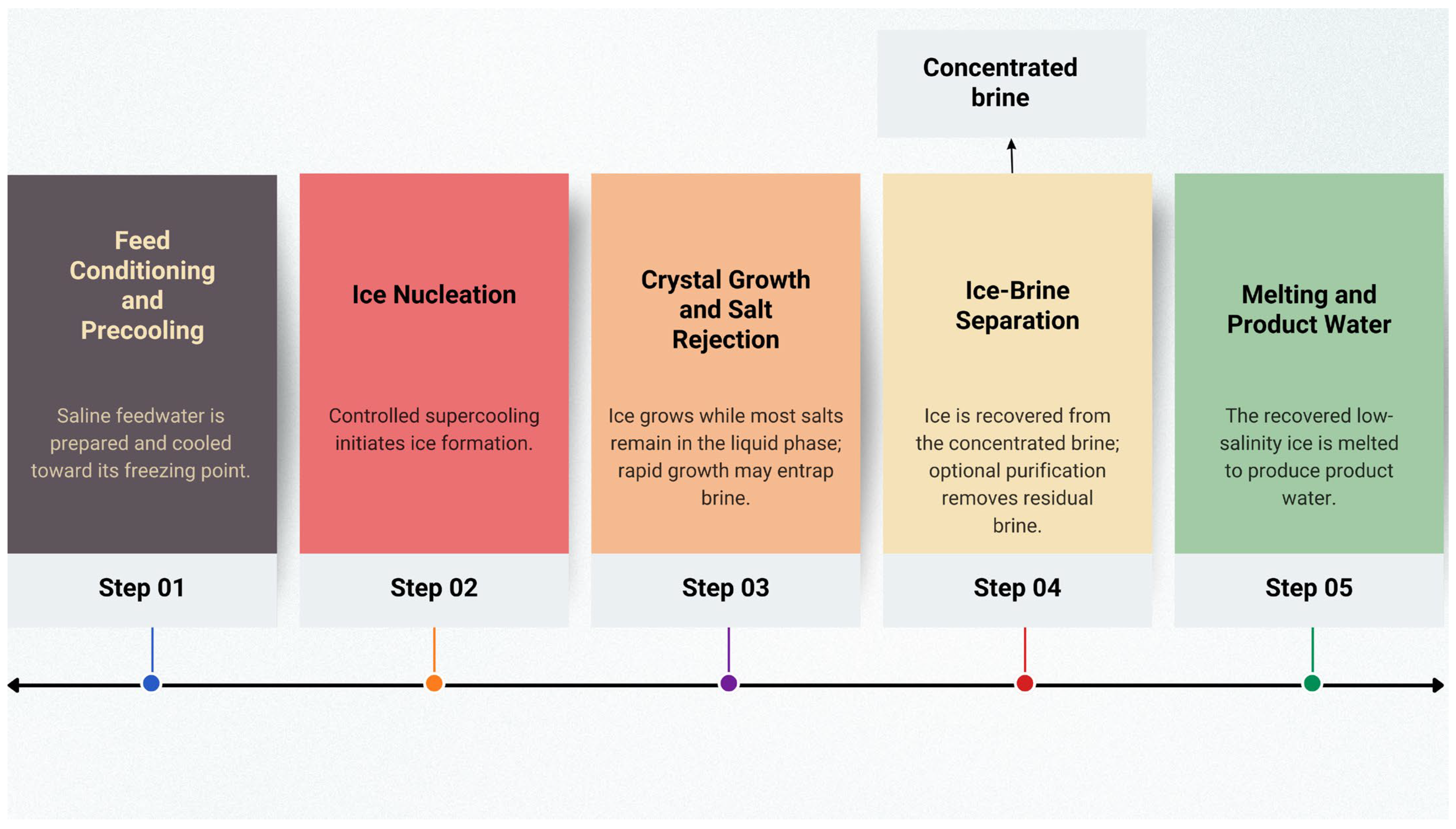
Figure 1. Simplified process sequence for freeze desalination, including salt rejection and ice–brine separation.
Applsci 16 07801 g001
Figure 2. Energy-accounting boundary for freeze desalination, distinguishing electricity, external cold, thermal input, cold recovery, and system losses.
Applsci 16 07801 g002
Figure 3. Analytical framework used to assess technological integration and application contexts in freeze desalination.
Applsci 16 07801 g003
Figure 4. Roadmap of freeze desalination development: past advances, current status, and requirements for future deployment. The 1990 economic-evaluation milestone is based on Madani (1990) [158].
Applsci 16 07801 g004
Table 1. Comparative overview of conventional and emerging desalination technologies.
TechnologyAdvantagesDisadvantagesKey References
Forward Osmosis (FO)Low fouling tendency- Operates at low pressures- Potential for wastewater reuse and hybridization.Energy-intensive draw solution regeneration- Lower water flux compared to RO[24]
Membrane Distillation (MD)Nearly 100% salt rejection - Can use low-grade or waste heat - Simple modular design.Membrane wetting and scaling- High thermal energy demand- Limited large-scale validation[28]
Capacitive Deionization (CDI/MCDI/FCDI)Low energy demand for brackish water- Modular and scalable- Minimal chemical useLimited for high-salinity seawater- Electrode degradation- Scaling issues[27]
Hybrid & Renewable-drivenIntegration with solar, geothermal, waste heat- Potential for zero liquid discharge (ZLD)- Improved sustainabilityHigh CAPEX- Integration complexity- Low technology readiness level (TRL)[23]
Table 2. Comparison of the scope, analytical focus, and contributions of previous freeze desalination reviews and the present study.
Representative ReviewPrincipal EmphasisHow the Present Review Extends This Scope
Kalista et al. (2018) [43]FD principles, direct and indirect configurations, applications, and hybrid systemsIncorporates recent modeling, pilot, energy, economic, circularity, and scale-up evidence.
Najim (2022) [45]Stand-alone and hybrid FD, including LNG integration, energy consumption, and water-production costApplies common system-boundary and performance criteria and examines operational reliability.
Janajreh et al. (2023) [42]FD configurations, experimental developments, high-fidelity modeling, and future prospectsConnects model and experimental validity with pilot operation, total SEC, economics, and TRL.
Macias-Bu et al. (2023) [44]Technical and environmental opportunities and impacts associated with brine dischargeExtends the analysis to real feedwaters, salt marketability, residual waste, and full-system energy demand.
Zhao et al. (2024) [41]Recent experimental and simulation developments and ice-crystallization mechanismsCritically compares validation limits, performance metrics, conflicting findings, and transferability across scales.
Xie et al. (2025) [46]Operating parameters, experiments, and numerical modeling for indirect FDBroadens the assessment to multiple FD routes, technological integration, economics, circularity, and deployment conditions.
Table 3. Qualitative comparison of the principal freeze desalination routes and their technological trade-offs.
FD RoutePrincipal AdvantageMain LimitationCurrent EvidenceMost Suitable ContextReference
Direct-contact FDHigh heat-transfer rates and rapid ice formationRefrigerant recovery, contamination risk, and difficult process controlMainly laboratory and pilot studiesSystems where rapid heat transfer justifies strict refrigerant management[65]
Indirect-contact FDAvoids direct contact between refrigerant and feedwaterThermal resistance, wall ice formation, adhesion, and scraping requirementsLaboratory and pilot validationControlled and modular crystallizer configurations[46]
Eutectic freeze crystallizationEnables simultaneous water and salt recoveryComplex phase control, co-crystallization, product purity, and solid separationLaboratory and limited continuous operationHypersaline brines, salt recovery, and ZLD applications[66]
Vacuum-assisted FDCan improve brine removal and reduce washing requirementsAdditional vacuum equipment, energy demand, CAPEX, and operational controlLimited pilot-scale evidenceProcess intensification where ice purity is a priority[33]
Table 4. Representative experimental FD studies and conditions limiting direct performance comparison.
ReferenceConfigurationScaleFeed SalinityProduct OutcomeSEC (kWh/m3)Stages
Ghonim et al., 2025 [33]. Continuous, vacuum-assisted brine extractionPilot10,000–40,000 ppm393–1225 ppm TDS; 28% recoveryNot fully reportedMulti-stage
Huang et al., 2022 [94].Passive radiative coolingOutdoor/lab37.3 g/L1.88 g/L after 2 cycles; 50% recoveryNot reported (passive radiative cooling; full-system energy balance unavailable)2
Najim & Krishnan, 2023 [99].Progressive freeze-concentrationLabBrackish>99% salt removalNot fully reported4
Najim & Krishnan, 2022 [71].Progressive, vertical, with pre-coolerLabBrackish<800 mg/L; 30% energy reduction vs. conventional vertical freezingReduced vs. baseline1 (continuous)
Castillo-Téllez et al., 2025 [34]. Solar-powered, NH3–LiNO3 sorbent pairPilotNot specifiedIrrigation/livestock quality; 8 kg ice/day<31
Lin et al., 2017 [40].LNG cold-energy prototypePrototypeSeawaterNot fully reportedReduced (industrial cold reuse)1
Abd Elrahman et al., 2020 [63].Two-stage vapor-compressionLabNot specifiedExergy efficiency up to 38.4%8.2–14.82
Table 5. Comparison of specific energy consumption (SEC) and water production costs among major desalination technologies.
TechnologySpecific Energy Consumption (kWh/m3)Typical Cost ($/m3)NotesKey References
Freeze Desalination (FD, modern optimized)3–60.5–0.8Enhanced via integration with LNG cold energy, renewables, or hybrid cycles[60,61,147]
Freeze Desalination (early studies)8–12>1.0Early prototypes were less efficient; scaling issues[158,159]
Reverse Osmosis (RO)2–50.4–0.6Pressure-driven, limited by fouling and pre-treatment[152,157]
Multi-Effect Distillation (MED)10–150.8–1.2Moderate thermal energy demand, still widely applied[153,156]
Multi-Stage Flash (MSF)15–251.0–1.5Highest energy demand among major technologies[60,157]
Table 6. Comparative techno-economic maturity, cost evidence, maintenance requirements, and long-term competitive position of FD and established desalination technologies.
TechnologyTechnology Readiness and Evidence BaseCAPEX Evidence and Principal DriversO&M and MaintenanceLong-Term Competitive Position
FDConfiguration-dependent; mainly laboratory to pilot scale; no long-duration commercial reference fleetNo standardized commercial benchmark; refrigeration or cold-transfer loop, crystallizer, ice harvesting and separation, purification, melting, cold recovery, storage, and controlsNo validated long-term benchmark; cooling or electricity, pumping, agitation, washing, defrosting, ice adhesion, mechanical wear, refrigerant servicing, and residual managementPotentially favorable for hypersaline brines, recoverable cold, and EFC/ZLD; not yet a general competitor to RO
SWROFull-scale commercial operation; mature supply chain and operating records0.8–2.2 million USD/MLD for Mediterranean plants; 1.2–1.8 for Arabian Gulf plants0.25–0.74 and 0.36–1.01 USD/m3, respectively; electricity, pretreatment, membrane replacement, cleaning, and fouling controlCurrent benchmark for conventional seawater desalination
MED–TVCFull-scale commercial operation1.2–2.3 million USD/MLD; effects, heat exchangers, condensers, and corrosion-resistant materials0.11–0.25 USD/m3; thermal energy, pumping, scaling, corrosion control, and cleaningCompetitive where low-cost heat or cogeneration is available
MSFFull-scale commercial operation1.7–3.1 million USD/MLD; flash stages, brine heaters, heat-recovery equipment, and corrosion-resistant materials0.22–0.30 USD/m3; thermal energy, pumping, scaling, corrosion control, and cleaningProven for large thermal and cogeneration facilities, but capital- and energy-intensive
Note: Commercial CAPEX and O&M ranges are reported in 2016 USD from World Bank (2019) [160] and are not current price forecasts. Technology readiness is reported qualitatively because the reviewed FD studies do not apply a consistent formal TRL methodology. The maturity of individual components should not be interpreted as the readiness of the integrated FD system.
Table 7. Knowledge gaps and research directions in freeze desalination.
Knowledge GapsResearch Directions
High energy demand in ice and brine separationDevelop energy-efficient separation techniques (e.g., advanced crystallization, novel separation methods)
High CAPEX of crystallization unitsOptimize design and materials to reduce CAPEX (modular units, low-cost materials)
Limited pilot and demonstration-scale dataScale-up demonstration projects under real operating conditions
Uncertainty in large-scale economic feasibilityConduct full techno-economic and lifecycle assessments.
Low Technology Readiness Level (TRL) compared to RO/MEDIncrease TRL through long-term continuous pilot testing with real feedwaters, assessing reliability, maintenance, heat-transfer degradation, and total energy use.
Circularity of recovered salts remains unverifiedAssess salt purity, marketability, residual waste, and full-system energy use
Absence of comparative life cycle assessment (LCA) and carbon—footprint studies for FD vs. RO/MED/MSFConduct comparative LCA on a consistent functional unit basis, covering electricity source, refrigerant GWP, and brine/salt end of life pathways
Disclaimer/Publisher’s Note: The statements, opinions and data contained in all publications are solely those of the individual author(s) and contributor(s) and not of MDPI and/or the editor(s). MDPI and/or the editor(s) disclaim responsibility for any injury to people or property resulting from any ideas, methods, instructions or products referred to in the content.