1. Introduction
Federated learning (FL) is a collaborative learning paradigm in which multiple clients train a shared model without centralizing their raw data [
1,
2,
3]. It is particularly suitable for distributed data mining scenarios such as industrial monitoring, anomaly detection, predictive maintenance, medical screening, and cross-institutional analytics, where data ownership, privacy, compliance, and communication constraints prevent conventional centralized training. In such scenarios, data are naturally distributed across heterogeneous clients, and the clients may differ in sample size, class ratio, feature distribution, noise level, device availability, and network condition.
A large body of FL research has focused on optimization under non-independent and identically distributed (non-IID) data. FedAvg reduces communication rounds by combining local training with server-side averaging [
1]. FedProx mitigates local objective drift by adding a proximal term [
4]. SCAFFOLD uses control variates to correct client drift [
5]. FedNova normalizes heterogeneous local update steps [
6], and adaptive federated optimization methods improve server-side update dynamics [
7]. These methods are important for training stability, but they usually regard client participation as an external protocol, such as full participation, uniform random sampling, or a fixed participation ratio. Communication cost is then reported as an outcome rather than modeled as an explicit decision constraint during training.
This treatment is insufficient in communication-constrained deployment. Full participation requires every client to transmit model updates in every round, even when some clients provide limited incremental benefit or communicate over expensive links. Random sampling reduces the number of participating clients, but it does not exploit information already observed during training, such as historical utility, update stability, participation freshness, and client-specific communication cost. For distributed data mining tasks, a more appropriate server behavior is to select clients that are expected to provide useful and stable updates within the available communication budget, while avoiding repeated concentration on a small set of low-cost clients.
This paper studies budget-aware client selection for communication-constrained federated data mining. The goal is not to maximize a single task metric in isolation, but to improve the trade-off between task quality and communication cost. In this setting, deployment value depends on how much effective model improvement can be obtained per unit of communication. Therefore, communication-normalized utility, measured by performance-per-MB, becomes a central evaluation dimension together with task metrics such as AUC and PR-AUC.
Similar resource-awareness requirements also arise beyond conventional mobile and edge FL deployments. In heterogeneous distributed communication systems, such as low-Earth-orbit satellite networks, link quality, coverage, mobility, and power limitations make dynamic resource allocation important for maintaining service efficiency [
8]. Although this paper focuses on federated data mining rather than satellite networking, these systems illustrate a broader deployment pattern: distributed participants may have unequal communication links and limited transmission opportunities, so the learning server should treat communication as a first-class scheduling constraint.
We propose FedBudget, a lightweight server-side scheduling method compatible with standard federated training. Its core function is to decide which clients participate in each round. For each client, the server maintains lightweight historical states and computes a score based on five factors: historical utility, update stability, freshness, communication cost, and a coverage-aware penalty. Clients are selected greedily under a per-round communication budget. Unobserved clients can be explored within the same budget, avoiding an expensive all-client warm-up phase. The selected updates are aggregated by the usual sample-size-weighted selected-client FedAvg rule.
The main contributions of this paper are summarized as follows.
We propose a communication-budget-constrained federated data mining setting and explicitly model client participation as a trade-off between task performance and communication cost.
We design the FedBudget client scheduling method, which combines historical utility, stability, freshness, communication cost, and a coverage-aware penalty for budgeted client selection.
We keep selected-client FedAvg aggregation unchanged, making the scheduling effect directly attributable and easy to combine with existing FL optimizers.
We adopt an ablation-first experimental protocol to verify the necessity of the complete scheduling mechanism and compare it with multiple strong FL optimization baselines and simple scheduling baselines.
Real server experiments show that FedBudget improves communication efficiency and performance-per-MB while maintaining competitive task performance.
2. Related Work
2.1. Federated Learning Under Heterogeneous Data
FL trains models across distributed clients while keeping raw data local. Beyond the seminal FedAvg algorithm [
1], later studies, system designs, benchmarks, and open-source platforms have investigated optimization, privacy, heterogeneity, scalability, and reproducible FL implementation [
2,
3,
9,
10,
11,
12,
13,
14]. Under non-IID data, local updates can drift away from the global update trend and destabilize aggregation [
15,
16,
17]. FedProx adds a proximal regularization term to local objectives [
4]. SCAFFOLD introduces control variates to correct client drift [
5]. FedNova addresses objective inconsistency caused by heterogeneous local steps [
6]. Adaptive federated optimization methods modify server-side optimization dynamics [
7]. These methods primarily improve optimization stability. In contrast, FedBudget focuses on client participation under communication budgets and can be viewed as complementary to these optimizers.
2.2. Communication-Efficient Federated Learning
Communication efficiency is a core FL challenge. Existing studies reduce communication cost by decreasing communication rounds, compressing gradients, quantizing updates, sparsifying transmissions, or designing periodic averaging mechanisms [
18,
19,
20,
21,
22]. These methods usually change the content or representation of transmitted updates. FedBudget follows a complementary route: it does not compress or alter model updates, but optimizes which clients communicate in each round. This makes the method easy to combine with compression or quantization techniques in future work.
2.3. Client Selection and Resource-Aware Scheduling
Client selection is a direct way to reduce communication burden. FedCS selects feasible clients under heterogeneous resource constraints in mobile edge environments [
23]. Oort uses guided participant selection to improve large-scale FL efficiency [
24]. TiFL stratifies clients according to system performance [
25]. Clustered sampling improves representativeness and reduces sampling variance [
26]. Power-of-choice strategies analyze how client selection affects convergence [
27]. These studies show that participation strategy affects both system cost and learning quality. Different from generic multi-objective scheduling, FedBudget treats communication cost as a resource denominator and combines historical utility, stability, freshness, and coverage as a budgeted participation score for distributed data mining tasks.
2.4. Distributed Data Mining and Anomaly-Oriented Tasks
Anomaly detection and distributed data mining appear widely in industrial maintenance, medical screening, cybersecurity, and sensor monitoring. Such tasks often involve class imbalance, rare positive samples, and heterogeneous distributions [
28,
29,
30,
31]. Standard accuracy is often insufficient, so AUC, PR-AUC, F1, and balanced accuracy are commonly reported. In the FL setting, these task challenges are coupled with data decentralization and communication limits. This paper does not restrict FedBudget to one specific data modality; instead, it uses AI4I, Mammography, and Shuttle as distributed data mining benchmarks to evaluate budget-aware scheduling.
2.5. Positioning of This Paper
FedBudget is positioned as a server-side participation scheduler rather than a compression, local-objective, or aggregation redesign method. Compared with cost-only scheduling, it considers historical learning utility and stability in addition to communication cost. Compared with fixed rotation, it updates client priority adaptively from training history. The proposed score is therefore intended to approximate a benefit-cost participation decision under a round budget, rather than to replace federated optimizers or to maximize a single predictive metric in isolation. Its core contribution is a low-overhead and interpretable budget-aware scheduling mechanism for communication-constrained federated data mining.
3. Materials and Methods
3.1. Problem Definition
Consider an FL system with
K clients. Client
i owns local data
, and the server holds the global model parameter
at communication round
t. In each round, the server selects a client subset
under a communication budget
:
where
denotes the communication cost of selecting client
i in round
t. Selected clients conduct local training and return model updates. The objective is to improve the trade-off between task performance and communication cost, rather than to optimize task performance alone.
More specifically, the considered decision problem is a repeated budgeted client-selection problem. At each round, the server aims to choose a feasible subset that maximizes an expected task-quality improvement surrogate under the communication budget:
The true future improvement is unavailable before a client is selected and its update is returned. Therefore, FedBudget constructs
from server-observable historical signals, including utility, stability, freshness, communication cost, and coverage history. This formulation makes the scheduling objective explicit while preserving the standard FL training objective on the selected clients.
3.2. FedBudget Framework
FedBudget modifies server-side client selection and preserves the standard local training and aggregation pipeline.
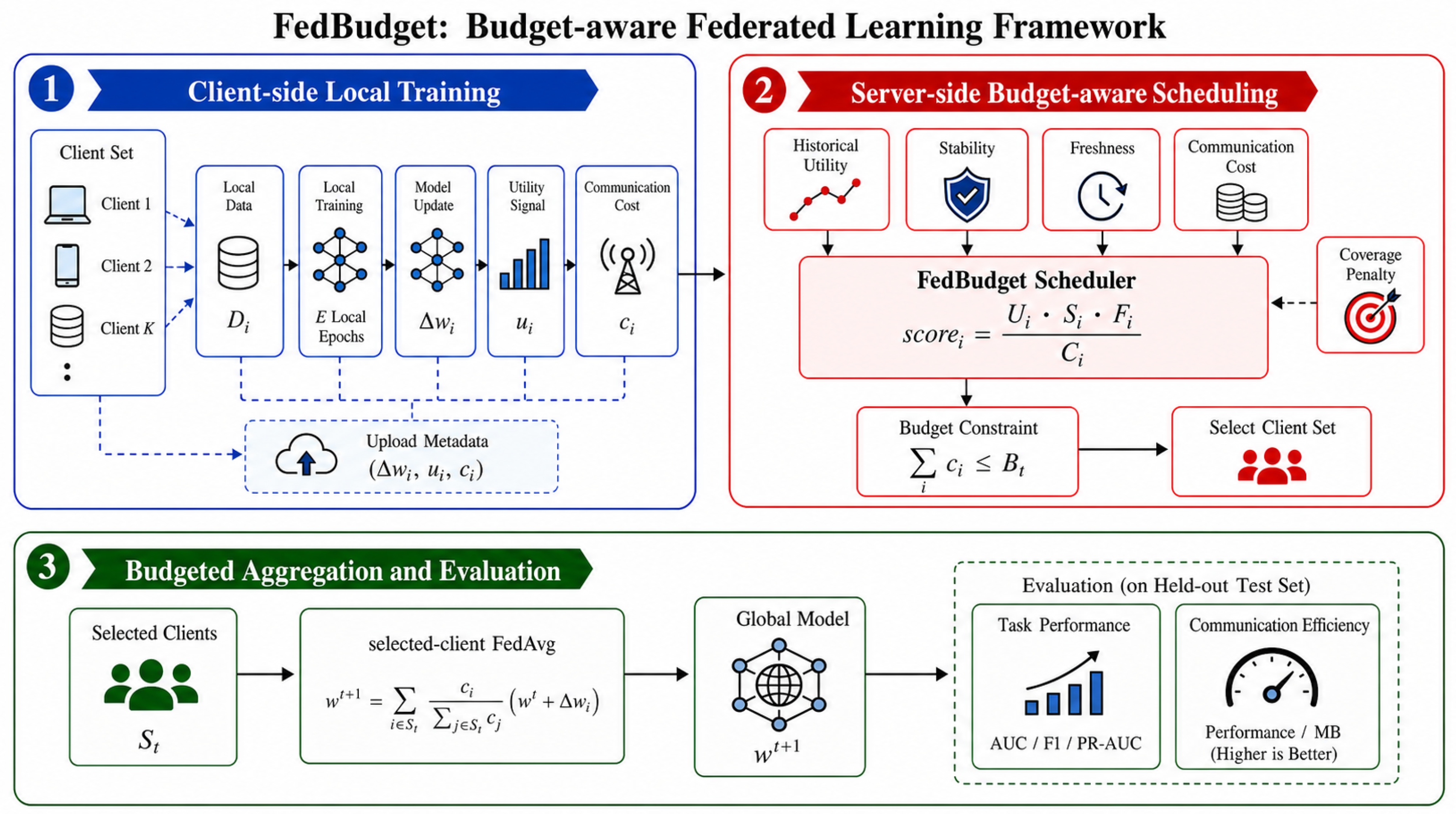
Figure 1 shows the overall architecture. The method uses client-side local training and validation feedback to update server-side scheduling states. The budget-aware scheduler then selects clients under the communication constraint, after which selected-client FedAvg produces the next global model.
If
denotes the local sample size and
denotes the locally updated model from client
i, the server aggregates selected clients by
The scheduling process includes four steps: budgeted exploration for clients without history, factor computation for clients with history, greedy selection under the communication budget, and client-state update after receiving local feedback.
3.3. Historical Utility
After local training, each selected client produces lightweight validation feedback. Let
and
denote validation losses before and after local training, and let
and
denote task metrics before and after local training. The immediate utility signal is
The server maintains an exponential moving average:
To avoid excessive suppression of clients with small raw utility, FedBudget converts utility into a bounded multiplicative factor:
where
is the set of positive utilities and
is a small constant.
3.4. Stability, Freshness, and Communication Cost
Clients with highly volatile recent utility may provide unstable updates. FedBudget maintains a sliding window of recent utilities and denotes its standard deviation by
. The stability factor is
To avoid long-term exclusion, the freshness factor uses the number of rounds since the last selection, denoted by
:
The communication cost is measured in megabytes and modeled as
where
represents client-specific communication conditions.
The constants used in these factors are chosen as conservative scale controls rather than dataset-specific tuning terms. The utility scaling prevents unusually large utility estimates from dominating the score, the stability coefficient controls the attenuation of volatile updates, the freshness cap limits the maximum priority boost from delayed participation, and the small
only prevents division by zero when communication cost or normalization statistics are close to zero. The default values keep the utility, stability, freshness, and cost terms on comparable numerical scales; their empirical influence is examined in the sensitivity analysis in
Section 4.7.
3.5. Coverage-Aware Penalty and Budgeted Exploration
Selecting clients only by utility and cost can over-concentrate training on a small group of low-cost clients.
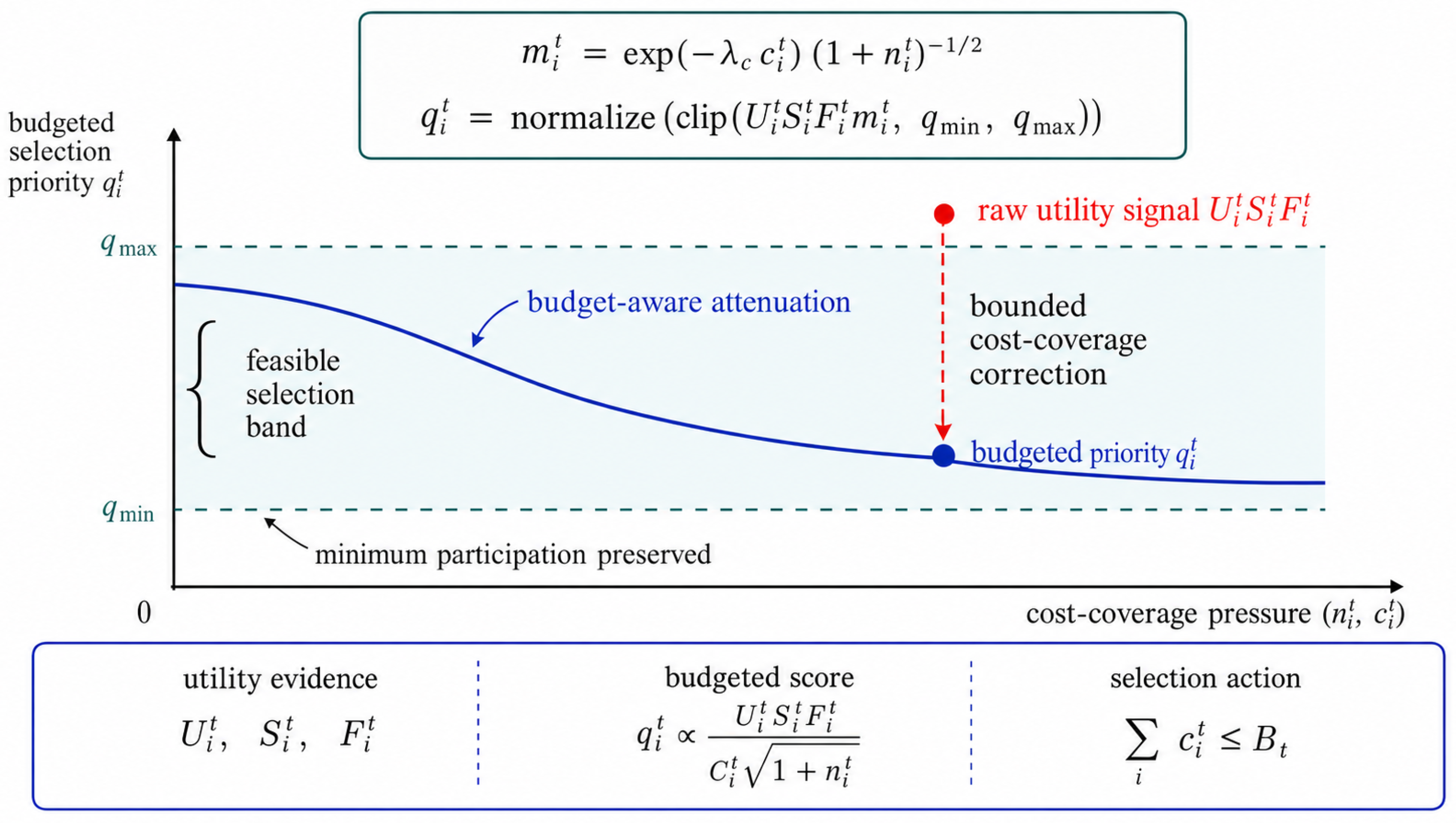
Figure 2 visualizes the resulting cost–coverage correction mechanism. Raw utility evidence is attenuated by cost and coverage pressure, bounded within a feasible selection band, and converted into a budgeted priority score.
FedBudget first defines the base score
Let
be the historical number of selections for client
i. The coverage-aware score is
For clients without historical information, FedBudget uses budgeted exploration within the same communication constraint instead of performing an all-client warm-up phase.
The score in Equations (5)–(10) is designed as a lightweight benefit–cost surrogate for budgeted participation. The numerator combines three factors related to useful participation: historical utility estimates the observed learning contribution, stability suppresses highly volatile recent updates, and freshness reduces long-term exclusion of clients that have not participated recently. The denominator models communication cost, so that clients with similar expected utility but lower communication burden receive higher priority. The coverage term further penalizes repeated concentration on frequently selected clients. This formulation differs from a generic weighted-sum multi-objective score because cost is treated as a resource denominator and coverage is applied as a participation-history correction. The ablation and scheduling-baseline experiments in
Section 4 are used to empirically verify the role of these components.
3.6. Analytical Rationale, Selection Algorithm, and Complexity
At communication round
t, FedBudget can be interpreted as solving a budgeted surrogate selection problem. Let
denote the surrogate participation value. The idealized one-round selection objective is
This problem has a knapsack-like form. FedBudget uses
as a benefit–cost priority and greedily adds clients until the round budget is reached. This analytical view explains why the proposed score is aligned with a budgeted participation objective: it ranks clients by surrogate contribution per unit communication while preserving the standard local objective and selected-client aggregation. Therefore, FedBudget is compatible with standard selected-client federated training pipelines. The computational overhead mainly comes from scoring and sorting. For
K clients, direct sorting costs
, and historical state storage costs
, where
h is the sliding-window size. The method only maintains lightweight scheduling states on the server and uses the standard model-update interface.
The greedy procedure provides an efficient online approximation to the one-round combinatorial problem. This choice is appropriate for the present setting because the surrogate values are updated from noisy historical feedback after every communication round, and the scheduler must make repeated low-latency decisions. Ranking by contribution per unit cost preserves the desired monotonic behavior: a client with larger estimated contribution and lower communication cost receives higher priority, while the coverage term moderates repeated selection of the same clients.
4. Experiments and Results
4.1. Experimental Setting, Baseline Groups, and Statistical Protocol
Experiments are conducted on AI4I [
32,
33], Mammography and Shuttle [
34], SMD, and SWaT. AI4I is a predictive-maintenance benchmark, Mammography and Shuttle are anomaly-oriented data mining benchmarks, SMD provides a sensor-oriented anomaly setting for larger-scale validation, and SWaT represents a processed industrial-anomaly benchmark.
Table 1 summarizes the basic dataset characteristics. The AI4I–Mammography–Shuttle main comparison in
Table 2 uses 10 simulated clients, three random seeds, five communication budgets, and 20 communication rounds. To strengthen statistical robustness, the same-budget paired analysis in
Table 3 is expanded to five random seeds on Mammography and Shuttle. The expanded SMD and SWaT protocols are described in
Section 4.4.
The compared methods are divided into two groups. The first group contains federated optimization baselines, including FedAvg, FedProx, FedNova, SCAFFOLD, and FedOpt, which are included to compare with representative FL training strategies under the same evaluation protocol. The second group contains scheduling baselines, including budgeted random FedAvg, FedCS-Cost, and RoundRobin, which are used to isolate the client-participation decision. FedCS-Cost selects clients mainly by communication cost, whereas RoundRobin rotates clients under the budget.
Reported results are computed from completed server-side simulation runs. Mean values are reported together with standard deviations when repeated runs are available. For paired comparisons, runs are matched by dataset, budget, and random seed. We use Wilcoxon signed-rank tests for paired differences and bootstrap 95% confidence intervals for mean paired differences. The statistical analysis focuses on communication cost and performance-per-MB, because these metrics directly reflect the communication-budgeted scheduling objective. AUC and PR-AUC are retained as primary task-quality metrics.
The performance metrics are defined as follows. Accuracy is the fraction of correctly classified test samples. Balanced accuracy is the average of sensitivity and specificity, which reduces the influence of class imbalance. F1 is the harmonic mean of precision and recall. AUC is the area under the receiver operating characteristic curve and measures threshold-independent ranking quality. PR-AUC is the area under the precision–recall curve and is informative for rare positive classes. Communication MB is the total transmitted model-update volume in megabytes after applying client-specific communication multipliers. performance-per-MB is computed as AUC divided by total communication MB and is used as the main communication-normalized efficiency indicator.
4.2. Main Comparison with Representative FL Baselines
Table 2 reports the average results over AI4I, Mammography, and Shuttle across budgets and seeds. This main table compares FedBudget with representative FL optimization baselines and the budgeted random-selection baseline under the same evaluation protocol. FedBudget obtains the highest mean performance-per-MB and the lowest mean communication cost in this comparison, while AUC and PR-AUC remain close to those of the optimization-oriented methods. Overall, FedBudget supports the intended trade-off: improving communication-normalized efficiency while retaining competitive predictive quality. Cost-priority and fixed-rotation scheduling policies are analyzed separately in
Section 4.6.
4.3. Same-Budget Paired Statistical Analysis
To strengthen the statistical robustness of the same-budget paired analysis,
Table 3 uses an expanded five-seed protocol (seeds 0–4) on Mammography and Shuttle, while the other supplementary experiments follow their stated protocols. The table reports paired differences between FedBudget and budgeted optimization baselines. Positive performance-per-MB differences indicate higher communication-normalized performance, and AUC differences provide a task-quality reference under the same paired protocol. Across all five paired baselines, the performance-per-MB improvement is statistically significant, while the AUC differences remain small in magnitude, supporting the communication-efficiency claim under a larger random-seed protocol.
4.4. Expanded Dataset and Scale Validation
This subsection consolidates the expanded validation beyond the initial three-dataset, 10-client setting. SMD is included in the larger-scale simulations to evaluate behavior under a sensor-oriented anomaly dataset when the number of simulated clients increases, while SWaT is used as an industrial-anomaly benchmark with a separate task-quality and communication-efficiency comparison. The SMD scale experiments include a 10-client reference setting and 20/50-client extensions, and SWaT uses 10 clients, three seeds, budgets 0.4 and 0.6, and 20 communication rounds. These extensions increase the simulation setting along both dataset coverage and client-population size while keeping the same server-side scheduling rule. As shown in
Table 4, Mammography, Shuttle, and SMD are reported with 10-client reference rows and 20/50-client scale rows. FedBudget keeps positive mean performance-per-MB differences in all listed scale settings, and the communication reduction remains observable when the number of simulated clients increases.
FedCS-Cost and RoundRobin are included as simple client-selection policies. FedCS-Cost represents a cost-priority scheduler that selects inexpensive clients, whereas RoundRobin represents a fixed rotation policy under the budget.
Table 5 reports paired differences of FedBudget minus these scheduling baselines on AI4I, Mammography, and SWaT. Compared with FedCS-Cost, FedBudget improves AUC and PR-AUC and preserves or improves F1, showing that pure cost-priority selection can lose task-quality information. Compared with RoundRobin, FedBudget consistently improves performance-per-MB and reduces communication cost, showing the benefit of score-based budgeted scheduling over fixed rotation. These results indicate that the proposed scheduler is most useful when client selection must balance task-quality evidence and communication cost, rather than only minimizing the cost of the selected clients.
4.5. Convergence Behavior
Round-level metrics are recorded for convergence analysis.
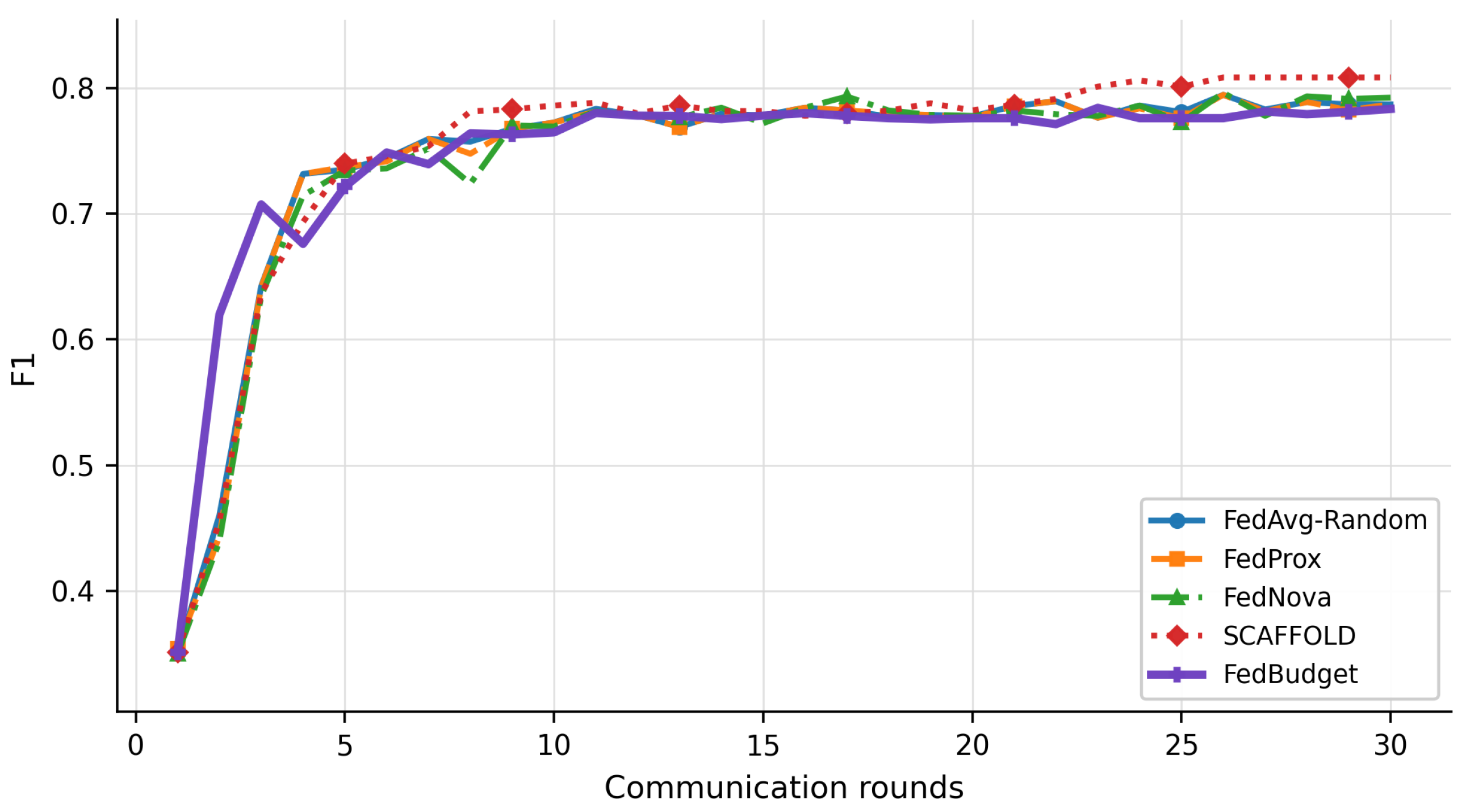
Figure 3 reports the F1 trajectory across communication rounds on SWaT,
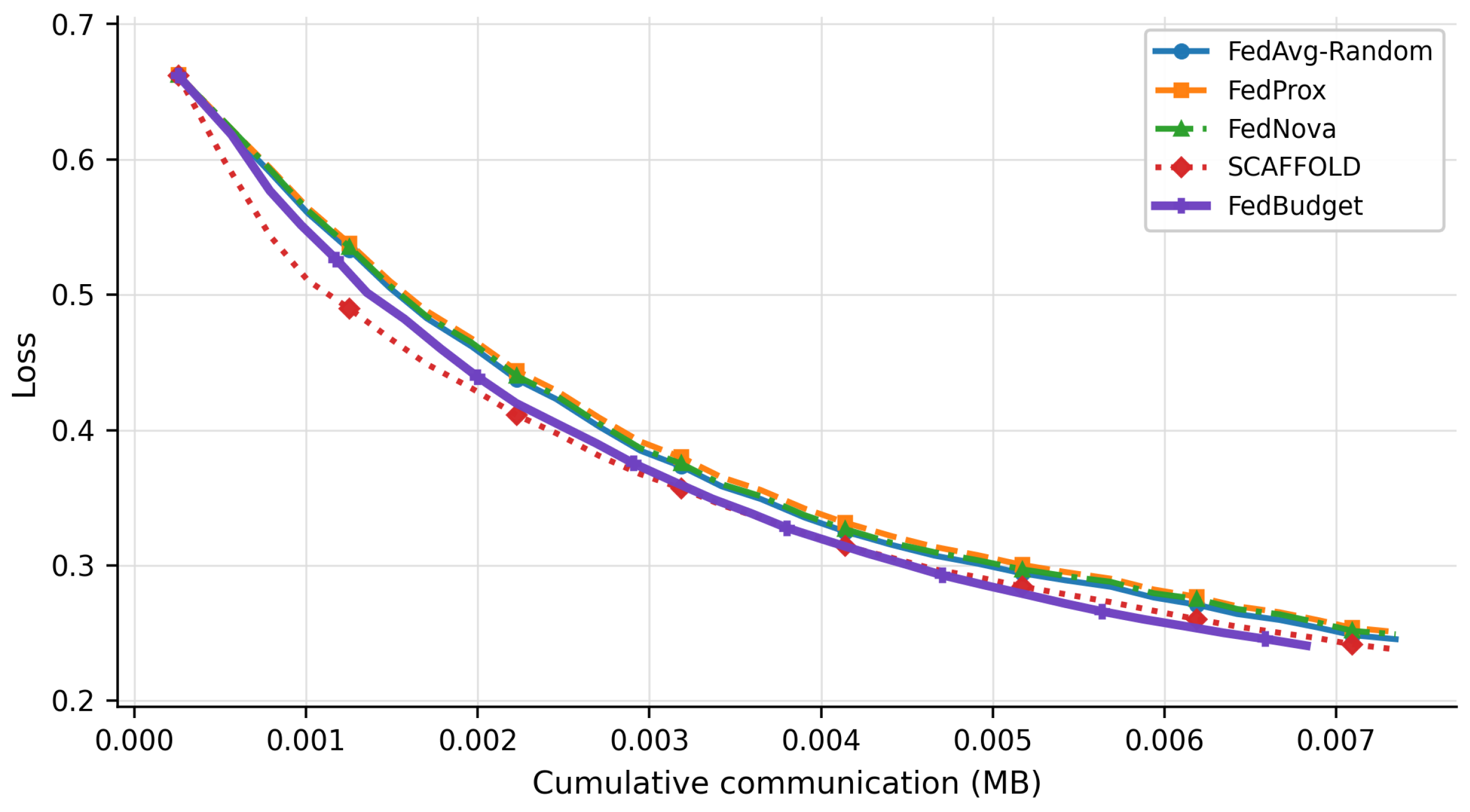
Figure 4 reports loss as a function of cumulative communication on Mammography, and
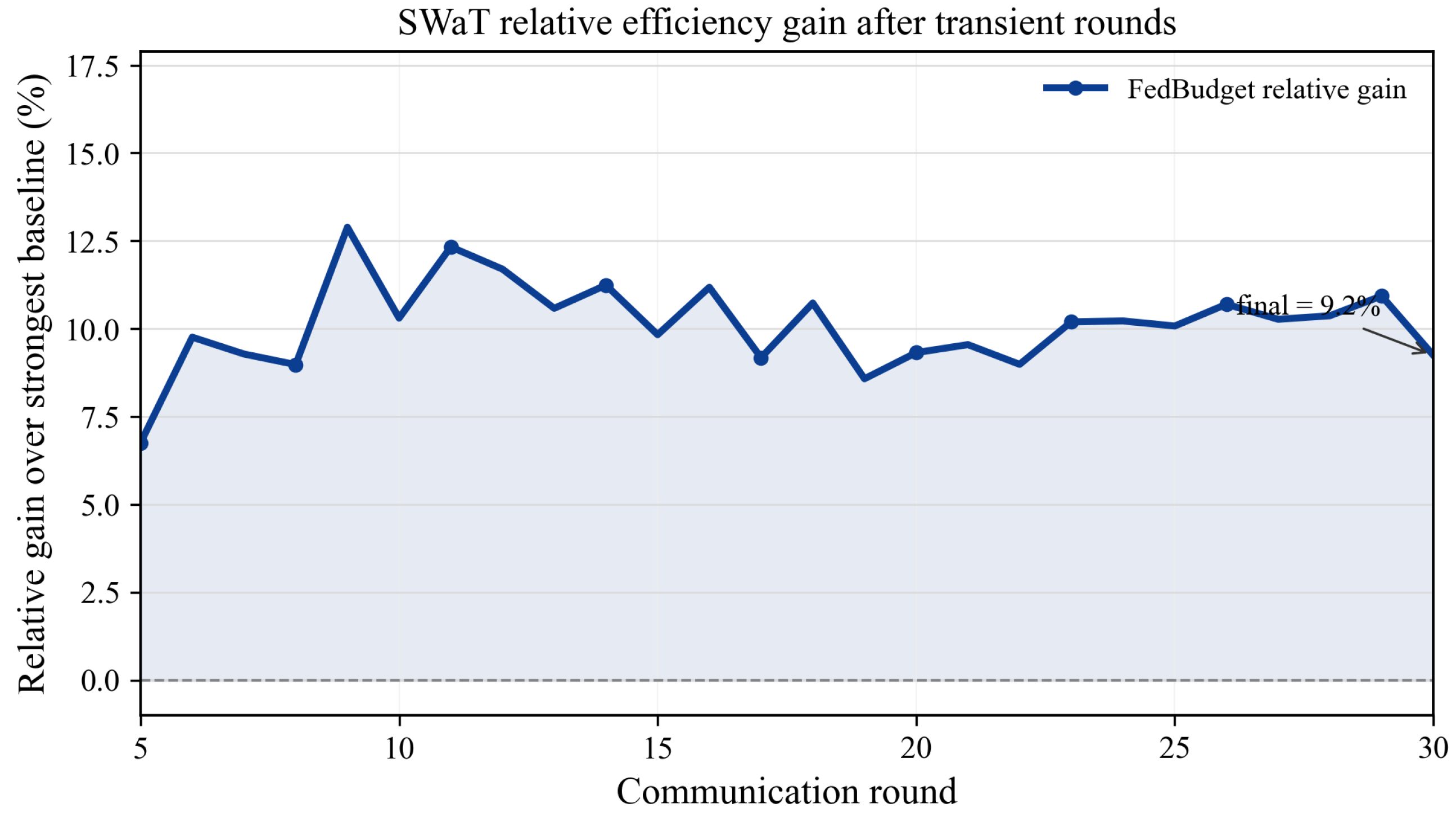
Figure 5 reports the relative communication-normalized AUC gain over the strongest non-FedBudget baseline after the initial transient rounds on SWaT. These three views are complementary: the F1 curve provides a conventional round-wise convergence view, the loss curve examines whether FedBudget maintains stable optimization behavior under reduced communication, and the relative gain curve directly evaluates the budgeted scheduling objective. Overall, FedBudget converges rapidly to a competitive F1 level, reaches a competitive loss trajectory with lower cumulative communication, and shows a clear advantage in communication-normalized convergence behavior.
4.6. Performance-per-MB Analysis
The performance-per-MB metric is defined as task performance divided by total communication cost. It is therefore an efficiency indicator rather than a standalone task-quality metric, and it should be examined together with AUC, PR-AUC, and F1. In
Table 2, FedBudget achieves the best communication-efficiency values among the optimization baselines.
Table 5 further shows the role of simple scheduling policies. FedCS-Cost can substantially reduce communication, while FedBudget provides higher task-quality metrics than this cost-priority policy. RoundRobin maintains rotation fairness, and FedBudget obtains higher communication-normalized efficiency with lower communication cost. FedBudget is therefore positioned as a balanced scheduler rather than a pure cost-minimization rule.
From an application perspective, the metric is useful for deployments where each round has an explicit bandwidth or energy budget. In predictive maintenance, medical screening, or industrial monitoring, the server may prefer a client subset that contributes reliable learning signals while keeping communication consumption predictable. The paired results therefore should be read as a communication-efficiency analysis: FedBudget is designed to allocate limited communication to clients with stronger expected contribution per unit cost, and the task metrics verify that this allocation does not rely on sacrificing predictive quality.
4.7. Sensitivity Analysis
To examine sensitivity to empirical coefficients, we conduct one-at-a-time sensitivity analysis around the default setting. The tested grid varies utility, stability, and freshness weights. The default setting is retained as the primary configuration, and
Table 6 reports the average results of the default setting and six one-factor perturbations across the sensitivity runs. The values show that moderate coefficient changes preserve comparable AUC, PR-AUC, F1, communication cost, and communication-normalized performance.
4.8. Ablation Study
Table 7 reports the component ablation results. The complete method achieves the highest mean AUC among the ablation variants. Some simplified variants reduce communication more strongly and may therefore obtain high performance-per-MB, while their lower AUC indicates that utility, freshness, and coverage-related balancing contribute to the task-quality side of the trade-off. This supports the use of a combined scheduling score instead of a single-factor policy.
4.9. Implementation and Reproducibility Details
The federated simulations use a NumPyClient-style Flower implementation with a logistic prediction model initialized from zero weights. Each client performs local gradient updates with class-imbalance weighting, learning rate 0.05, weight decay
, three base local epochs, and deterministic client–epoch jitter of two epochs in the reported experiments. The FedProx coefficient is 0.5, and the FedOpt server learning rate and momentum are 0.7 and 0.5, respectively. Client data are partitioned by a non-IID label-sorted/random-mix rule with strength 0.6 unless otherwise specified. Communication cost is measured in megabytes from model-update size multiplied by a client-specific communication multiplier. Reported rows are generated by server-side federated simulations under the same evaluation protocol. Scikit-learn and SciPy are used for data preprocessing, metric computation, and statistical analysis [
35,
36].
5. Discussion
The experimental results suggest three practical implications. First, communication-aware participation modeling can be separated from the local optimizer and aggregation rule. Because FedBudget preserves the selected-client FedAvg aggregation interface, it can be used as a server-side scheduling layer for existing FL pipelines. This is valuable for distributed data mining systems in which model updates are allowed but client communication must be budgeted by bandwidth, energy, or operational cost.
Second, the comparison with FedCS-Cost and RoundRobin shows why client selection should not be reduced to a single scheduling factor. Cost-priority selection can save communication but may underrepresent clients with higher learning utility, whereas fixed rotation provides simple coverage but does not use training feedback. The proposed score combines utility, stability, freshness, cost, and coverage so that the selected set reflects both learning evidence and system cost. The ablation results further indicate that removing these factors changes the balance between task quality and communication-normalized efficiency.
Third, the method is particularly relevant to anomaly-oriented and sensor-oriented distributed data mining. In such tasks, positive events are rare, client distributions can differ substantially, and communication infrastructure may be uneven. The AI4I, Mammography, Shuttle, SMD, and SWaT experiments cover predictive-maintenance, anomaly-oriented, and sensor-based settings, showing that the same scheduling principle can be applied across several data-mining scenarios. The expanded 20-client and 50-client experiments further indicate that the communication-efficiency pattern remains visible as the simulated client pool grows.
Several future research directions follow from these observations. The scheduler can be evaluated with deeper neural architectures and streaming clients, where communication and participation availability vary over time. It can also be combined with compression, quantization, secure aggregation, or privacy-preserving accounting, because these techniques reduce or protect the transmitted update while FedBudget decides which clients should communicate. Finally, a tighter theoretical analysis of coverage-aware benefit–cost scheduling under non-IID data would further clarify the relation between client-selection dynamics and convergence behavior.
6. Conclusions
This paper proposed FedBudget, a budget-aware federated learning scheduling method for communication-constrained distributed data mining. FedBudget selects clients according to historical utility, stability, freshness, communication cost, and a coverage-aware penalty, while keeping selected-client FedAvg aggregation unchanged. This design makes the method a lightweight server-side participation scheduler that can be integrated into standard FL workflows without modifying the local training objective or the aggregation interface.
Across representative FL baselines, FedBudget achieves the highest mean performance-per-MB and the lowest mean communication cost, and paired statistical tests show significant communication-efficiency gains over budget-matched baselines. The expanded SMD and SWaT validation, sensitivity analysis, ablation study, and convergence analysis further support the effectiveness of the proposed scheduling formulation. The 20-client and 50-client simulations show that the communication-normalized advantage remains observable when the number of simulated participants increases, while the SWaT experiment provides an additional sensor-oriented industrial-anomaly setting.
Overall, the results show that explicit budget-aware participation modeling can improve communication-normalized efficiency while maintaining competitive task performance. This makes FedBudget suitable for distributed data mining scenarios where client communication is limited but task quality cannot be ignored, such as predictive maintenance, medical screening, and industrial sensor monitoring. Future work will extend the method to additional real-world deployments, dynamic communication budgets, deeper model architectures, and theoretical analysis of coverage-aware scheduling under non-IID clients.
Author Contributions
Conceptualization, J.S.; methodology, J.S. and A.L.; software, J.S.; validation, J.S. and A.L.; formal analysis, J.S.; investigation, J.S.; resources, K.L. and Z.Z.; data curation, J.S.; writing—original draft preparation, J.S.; writing—review and editing, A.L., K.L. and Z.Z.; visualization, J.S.; supervision, K.L. and Z.Z.; project administration, K.L. and Z.Z.; funding acquisition, Z.Z. All authors have read and agreed to the published version of the manuscript.
Funding
This work was supported by the Science Foundation of Hebei Normal University of Science and Technology (Grant No. 2025YB043) and the Hebei Innovation Center for Smart Perception and Applied Technology of Agricultural Data (Grant No. ADIC2025Y006).
Institutional Review Board Statement
Not applicable.
Informed Consent Statement
Not applicable.
Data Availability Statement
The public benchmark datasets used in this study are available from the UCI Machine Learning Repository and the ODDS Library. The minimal dataset supporting the reported experimental results is provided as
Supplementary Material in CSV format. It includes the main expanded-baseline results, ablation results, statistical summaries, dataset protocol metadata, simple scheduling baseline results, public dataset sources, a data dictionary, a manifest file, and SHA-256 checksums. Further inquiries can be directed to the corresponding author.
Conflicts of Interest
The authors declare no conflicts of interest.
References
- McMahan, B.; Moore, E.; Ramage, D.; Hampson, S.; y Arcas, B.A. Communication-efficient learning of deep networks from decentralized data. In Artificial Intelligence and Statistics; PMLR: Lodon, UK, 2017. [Google Scholar]
- Kairouz, P.; McMahan, H.B.; Avent, B.; Bellet, A.; Bennis, M.; Bhagoji, A.N.; Bonawitz, K.; Charles, Z.; Cormode, G.; Cummings, R.; et al. Advances and open problems in federated learning. Found. Trends Mach. Learn. 2021, 14, 1–210. [Google Scholar] [CrossRef]
- Yang, Q.; Liu, Y.; Chen, T.; Tong, Y. Federated machine learning: Concept and applications. ACM Trans. Intell. Syst. Technol. (TIST) 2019, 10, 1–19. [Google Scholar] [CrossRef]
- Li, T.; Sahu, A.K.; Zaheer, M.; Sanjabi, M.; Talwalkar, A.; Smith, V. Federated optimization in heterogeneous networks. In Proceedings of the Third Conference on Machine Learning and Systems, Austin, TX, USA, 2–4 March 2020. [Google Scholar]
- Karimireddy, S.P.; Kale, S.; Mohri, M.; Reddi, S.J.; Stich, S.; Suresh, A.T. SCAFFOLD: Stochastic controlled averaging for federated learning. In Proceedings of the 37th International Conference on Machine Learning, Virtual, 13–18 July 2020; PMLR: London, UK, 2020; Volume 119, pp. 5132–5143. [Google Scholar]
- Wang, J.; Liu, Q.; Liang, H.; Joshi, G.; Poor, H.V. Tackling the objective inconsistency problem in heterogeneous federated optimization. Adv. Neural Inf. Process. Syst. 2020, 33, 7611–7623. [Google Scholar]
- Reddi, S.; Charles, Z.; Zaheer, M.; Garrett, Z.; Rush, K.; Konečný, J.; Kumar, S.; McMahan, H.B. Adaptive federated optimization. In Proceedings of the 9th International Conference on Learning Representations, Virtual Event, 3–7 May 2021. [Google Scholar]
- Ivanov, A.; Stoliarenko, M.; Kruglik, S.; Novichkov, S.; Savinov, A. Dynamic resource allocation in LEO satellite. In Proceedings of the 2019 15th International Wireless Communications and Mobile Computing Conference (IWCMC), Tangier, Morocco, 24–28 June 2019; pp. 930–935. [Google Scholar] [CrossRef]
- Li, T.; Sahu, A.K.; Talwalkar, A.; Smith, V. Federated learning: Challenges, methods, and future directions. IEEE Signal Process. Mag. 2020, 37, 50–60. [Google Scholar] [CrossRef]
- Bonawitz, K.; Eichner, H.; Grieskamp, W.; Huba, D.; Ingerman, A.; Ivanov, V.; Kiddon, C.; Konečný, J.; Mazzocchi, S.; McMahan, B.; et al. Towards federated learning at scale: System design. Proc. Mach. Learn. Syst. 2019, 1, 374–388. [Google Scholar]
- Bonawitz, K.; Ivanov, V.; Kreuter, B.; Marcedone, A.; McMahan, H.B.; Patel, S.; Ramage, D.; Segal, A.; Seth, K. Practical secure aggregation for privacy-preserving machine learning. In Proceedings of the 2017 ACM SIGSAC Conference on Computer and Communications Security, Dallas, TX, USA, 30 October–3 November 2017. [Google Scholar]
- Caldas, S.; Duddu, S.M.K.; Wu, P.; Li, T.; Konečný, J.; McMahan, H.B.; Smith, V.; Talwalkar, A. LEAF: A benchmark for federated settings. arXiv 2018, arXiv:1812.01097. [Google Scholar]
- He, C.; Li, S.; So, J.; Zeng, X.; Zhang, M.; Wang, H.; Wang, X.; Vepakomma, P.; Singh, A.; Qiu, H.; et al. FedML: A research library and benchmark for federated machine learning. arXiv 2020, arXiv:2007.13518. [Google Scholar]
- Beutel, D.J.; Topal, T.; Mathur, A.; Qiu, X.; Fernandez-Marques, J.; Gao, Y.; Sani, L.; Li, K.H.; Parcollet, T.; de Gusmão, P.P.B.; et al. Flower: A friendly federated learning research framework. arXiv 2020, arXiv:2007.14390. [Google Scholar]
- Hsieh, K.; Phanishayee, A.; Mutlu, O.; Gibbons, P. The non-IID data quagmire of decentralized machine learning. In Proceedings of the 37th International Conference on Machine Learning, Online, 12–18 July 2020; PMLR: London, UK, 2020; Volume 119, pp. 4387–4398. [Google Scholar]
- Zhao, Y.; Li, M.; Lai, L.; Suda, N.; Civin, D.; Chandra, V. Federated learning with non-IID data. arXiv 2018, arXiv:1806.00582. [Google Scholar]
- Zhu, H.; Xu, J.; Liu, S.; Jin, Y. Federated learning on non-IID data: A survey. Neurocomputing 2021, 465, 371–390. [Google Scholar] [CrossRef]
- Konecny, J.; McMahan, H.B.; Yu, F.X.; Richtarik, P.; Suresh, A.T.; Bacon, D. Federated learning: Strategies for improving communication efficiency. arXiv 2016, arXiv:1610.05492. [Google Scholar]
- Konecny, J.; McMahan, H.B.; Ramage, D.; Richtarik, P. Federated optimization: Distributed machine learning for on-device intelligence. arXiv 2016, arXiv:1610.02527. [Google Scholar]
- Lin, Y.; Han, S.; Mao, H.; Wang, Y.; Dally, W.J. Deep gradient compression: Reducing the communication bandwidth for distributed training. In Proceedings of the International Conference on Learning Representations, Vancouver, BC, Canada, 30 April–3 May 2018. [Google Scholar]
- Reisizadeh, A.; Mokhtari, A.; Hassani, H.; Jadbabaie, A.; Pedarsani, R. FedPAQ: A communication-efficient federated learning method with periodic averaging and quantization. In Proceedings of the Twenty Third International Conference on Artificial Intelligence and Statistics, Online, 26–28 August 2020; PMLR: London, UK, 2020; Volume 108, pp. 2021–2031. [Google Scholar]
- Sattler, F.; Wiedemann, S.; Muller, K.R.; Samek, W. Robust and communication-efficient federated learning from non-IID data. IEEE Trans. Neural Netw. Learn. Syst. 2020, 31, 3400–3413. [Google Scholar] [CrossRef] [PubMed]
- Nishio, T.; Yonetani, R. Client selection for federated learning with heterogeneous resources in mobile edge. In Proceedings of the ICC 2019-2019 IEEE International Conference on Communications (ICC), Shanghai, China, 20–24 May 2019. [Google Scholar]
- Lai, F.; Zhu, X.; Madhyastha, H.V.; Chowdhury, M. Oort: Efficient federated learning via guided participant selection. In Proceedings of the 15th USENIX Symposium on Operating Systems Design and Implementation OSDI, Virtual Event, 14–16 July 2021. [Google Scholar]
- Chai, Z.; Ali, A.; Zawad, S.; Truex, S.; Anwar, A.; Baracaldo, N.; Zhou, Y.; Ludwig, H.; Yan, F. TiFL: A tier-based federated learning system. In Proceedings of the 29th International Symposium on High-Performance Parallel and Distributed Computing, Stockholm, Sweden, 23–26 June 2020. [Google Scholar]
- Fraboni, Y.; Vidal, R.; Kameni, L.; Lorenzi, M. Clustered sampling: Low-variance and improved representativity for clients selection in federated learning. In Proceedings of the 38th International Conference on Machine Learning, Virtual, 18–24 July 2021; PMLR: London, UK, 2021; Volume 139, pp. 3407–3416. [Google Scholar]
- Cho, Y.J.; Wang, J.; Joshi, G. Client selection in federated learning: Convergence analysis and power-of-choice selection strategies. In Proceedings of the 25th International Conference on Artificial Intelligence and Statistics, Virtual, 28–30 March 2022. [Google Scholar]
- Chandola, V.; Banerjee, A.; Kumar, V. Anomaly detection: A survey. ACM Comput. Surv. 2009, 41, 1–58. [Google Scholar] [CrossRef]
- Ruff, L.; Vandermeulen, R.; Goernitz, N.; Deecke, L.; Siddiqui, S.A.; Binder, A.; Müller, E.; Kloft, M. Deep one-class classification. In Proceedings of the International Conference on Machine Learning, Stockholm, Sweden, 10–15 July 2018; PMLR: London, UK, 2018; Volume 80, pp. 4393–4402. [Google Scholar]
- Zhao, Y.; Nasrullah, Z.; Li, Z. PyOD: A Python toolbox for scalable outlier detection. J. Mach. Learn. Res. 2019, 20, 1–7. [Google Scholar] [CrossRef]
- Pang, G.; Shen, C.; Cao, L.; van den Hengel, A. Deep learning for anomaly detection: A review. ACM Comput. Surv. 2021, 54, 1–38. [Google Scholar] [CrossRef]
- Matzka, S. AI4I 2020 predictive maintenance dataset. In UCI Machine Learning Repository; University of California, Irvine: Irvine, CA, USA, 2020. [Google Scholar]
- Dua, D.; Graff, C. UCI Machine Learning Repository; University of California, Irvine: Irvine, CA, USA, 2019. [Google Scholar]
- Rayana, S. ODDS Library; Stony Brook University: New York, NY, USA, 2016. [Google Scholar]
- Pedregosa, F.; Varoquaux, G.; Gramfort, A.; Michel, V.; Thirion, B.; Grisel, O.; Blondel, M.; Prettenhofer, P.; Weiss, R.; Dubourg, V.; et al. Scikit-learn: Machine learning in Python. J. Mach. Learn. Res. 2011, 12, 2825–2830. [Google Scholar]
- Virtanen, P.; Gommers, R.; Oliphant, T.E.; Haberland, M.; Reddy, T.; Cournapeau, D.; Burovski, E.; Peterson, P.; Weckesser, W.; Bright, J.; et al. SciPy 1.0: Fundamental algorithms for scientific computing in Python. Nat. Methods 2020, 17, 261–272. [Google Scholar] [CrossRef] [PubMed]
Figure 1.
Overall framework of FedBudget. Clients perform local training and return model updates together with lightweight metadata, while the server constructs budget-aware scheduling scores from historical utility, stability, freshness, communication cost, and coverage information. Selected clients are aggregated by sample-size-weighted selected-client FedAvg.
Figure 1.
Overall framework of FedBudget. Clients perform local training and return model updates together with lightweight metadata, while the server constructs budget-aware scheduling scores from historical utility, stability, freshness, communication cost, and coverage information. Selected clients are aggregated by sample-size-weighted selected-client FedAvg.
Figure 2.
Mechanism of budget-aware client prioritization. Historical utility evidence is modulated by cost and coverage pressure, clipped into a feasible selection band, and used to form the budgeted client priority under the communication constraint.
Figure 2.
Mechanism of budget-aware client prioritization. Historical utility evidence is modulated by cost and coverage pressure, clipped into a feasible selection band, and used to form the budgeted client priority under the communication constraint.
Figure 3.
F1 convergence on SWaT across communication rounds. Higher values indicate better classification performance at the corresponding training round.
Figure 3.
F1 convergence on SWaT across communication rounds. Higher values indicate better classification performance at the corresponding training round.
Figure 4.
Loss convergence on Mammography with respect to cumulative communication. Lower values indicate better optimization behavior under the consumed communication budget.
Figure 4.
Loss convergence on Mammography with respect to cumulative communication. Lower values indicate better optimization behavior under the consumed communication budget.
Figure 5.
Relative communication-normalized AUC gain on SWaT after the initial transient rounds. The y-axis reports the percentage gain of FedBudget over the strongest non-FedBudget baseline at each round.
Figure 5.
Relative communication-normalized AUC gain on SWaT after the initial transient rounds. The y-axis reports the percentage gain of FedBudget over the strongest non-FedBudget baseline at each round.
Table 1.
Dataset characteristics used in the experiments.
Table 1.
Dataset characteristics used in the experiments.
| Dataset | Samples | Features | Positive Rate |
|---|
| AI4I | 5000 | 9 | 0.0500 |
| Mammography | 5000 | 6 | 0.0500 |
| Shuttle | 5000 | 9 | 0.0714 |
| SMD | 5000 | 380 | 0.0500 |
| SWaT | 5000 | 510 | 0.0500 |
Table 2.
Main comparison with representative FL baselines, reported as mean ± standard deviation. Upward arrows indicate that larger values are better, whereas the downward arrow indicates that smaller values are better. Bold values denote the best result in each column.
Table 2.
Main comparison with representative FL baselines, reported as mean ± standard deviation. Upward arrows indicate that larger values are better, whereas the downward arrow indicates that smaller values are better. Bold values denote the best result in each column.
| Method | Perf./MB ↑ | Comm. MB ↓ | AUC ↑ | PR-AUC ↑ | F1 ↑ |
|---|
| FedAvg | | | | | |
| FedAvg-Random | | | | | |
| FedProx | | | | | |
| FedNova | | | | | |
| SCAFFOLD | | | | | |
| FedOpt | | | | | |
| FedBudget | | | | | |
Table 3.
Five-seed paired differences on Mammography and Shuttle between FedBudget and strong budgeted baselines with 95% confidence intervals and Wilcoxon p-values. The upward arrow indicates that a larger positive Perf./MB value favors FedBudget.
Table 3.
Five-seed paired differences on Mammography and Shuttle between FedBudget and strong budgeted baselines with 95% confidence intervals and Wilcoxon p-values. The upward arrow indicates that a larger positive Perf./MB value favors FedBudget.
| Baseline | Perf./MB↑ (95% CI) | AUC (95% CI) | Perf./MB p-Value |
|---|
| FedAvg-Random | [, ] | [, ] | <0.001 |
| FedProx | [, ] | [, ] | <0.001 |
| FedNova | [, ] | [, ] | <0.001 |
| FedOpt | [, ] | [, ] | <0.001 |
| SCAFFOLD | [, ] | [, ] | <0.001 |
Table 4.
Dataset-wise scale validation from the 10-client reference protocol to 20 and 50 simulated clients.
Table 4.
Dataset-wise scale validation from the 10-client reference protocol to 20 and 50 simulated clients.
| Dataset | Clients | Perf./MB | Comm. MB | AUC | Mean Perf./MB | Mean Comm. MB | Mean AUC |
|---|
| Mammography | 10 | 236.170 | 0.0042 | 0.9267 | +42.301 | −0.0019 | −0.0007 |
| Shuttle | 10 | 176.504 | 0.0059 | 0.9879 | +31.532 | −0.0028 | +0.0000 |
| SMD | 10 | 2.650 | 0.3700 | 0.9801 | +0.178 | −0.0299 | −0.0081 |
| Mammography | 20 | 96.723 | 0.0094 | 0.9102 | +6.874 | −0.0008 | +0.0003 |
| Shuttle | 20 | 73.782 | 0.0135 | 0.9914 | +5.073 | −0.0012 | +0.0000 |
| SMD | 20 | 1.872 | 0.5206 | 0.9722 | +0.111 | −0.0368 | +0.0029 |
| Mammography | 50 | 39.511 | 0.0232 | 0.9170 | +3.273 | −0.0024 | −0.0001 |
| Shuttle | 50 | 29.906 | 0.0332 | 0.9919 | +2.514 | −0.0035 | −0.0001 |
| SMD | 50 | 0.754 | 1.2996 | 0.9793 | +0.049 | −0.1003 | +0.0056 |
Table 5.
Paired differences between FedBudget and simple client-selection policies. Positive task-metric and performance-per-MB differences favor FedBudget; negative communication differences indicate lower communication cost. Upward arrows indicate that larger values are favorable, whereas the downward arrow indicates that smaller communication differences are favorable.
Table 5.
Paired differences between FedBudget and simple client-selection policies. Positive task-metric and performance-per-MB differences favor FedBudget; negative communication differences indicate lower communication cost. Upward arrows indicate that larger values are favorable, whereas the downward arrow indicates that smaller communication differences are favorable.
| Dataset | Baseline Policy | AUC↑ | PR-AUC↑ | F1↑ | Perf./MB↑ | Comm. MB↓ |
|---|
| AI4I | FedCS-Cost | | | | | |
| AI4I | RoundRobin | | | | | |
| Mammography | FedCS-Cost | | | | | |
| Mammography | RoundRobin | | | | | |
| SWaT | FedCS-Cost | | | | | |
| SWaT | RoundRobin | | | | | |
Table 6.
Sensitivity analysis of scheduling coefficients around the default setting. Upward arrows indicate that larger values are better, whereas the downward arrow indicates that smaller values are better.
Table 6.
Sensitivity analysis of scheduling coefficients around the default setting. Upward arrows indicate that larger values are better, whereas the downward arrow indicates that smaller values are better.
| Setting | Perf./MB ↑ | Comm. MB ↓ | AUC ↑ | PR-AUC ↑ | F1 ↑ |
|---|
| Default | 156.378 | 0.00586 | 0.8854 | 0.4997 | 0.4138 |
| Utility weight | 160.585 | 0.00570 | 0.8839 | 0.5006 | 0.4146 |
| Utility weight | 154.663 | 0.00593 | 0.8857 | 0.4974 | 0.4125 |
| Stability weight | 156.034 | 0.00587 | 0.8852 | 0.4996 | 0.4138 |
| Stability weight | 156.160 | 0.00586 | 0.8854 | 0.4988 | 0.4138 |
| Freshness weight | 157.320 | 0.00581 | 0.8845 | 0.4964 | 0.4151 |
| Freshness weight | 155.052 | 0.00591 | 0.8850 | 0.4986 | 0.4194 |
Table 7.
Ablation results of FedBudget components, reported as mean ± standard deviation. Upward arrows indicate that larger values are better, whereas the downward arrow indicates that smaller values are better. Bold values denote the best result in each column.
Table 7.
Ablation results of FedBudget components, reported as mean ± standard deviation. Upward arrows indicate that larger values are better, whereas the downward arrow indicates that smaller values are better. Bold values denote the best result in each column.
| Variant | AUC ↑ | Comm. MB ↓ | Perf./MB ↑ |
|---|
| Full | | | |
| No utility | | | |
| No stability | | | |
| No freshness | | | |
| Utility only | | | |
| Disclaimer/Publisher’s Note: The statements, opinions and data contained in all publications are solely those of the individual author(s) and contributor(s) and not of MDPI and/or the editor(s). MDPI and/or the editor(s) disclaim responsibility for any injury to people or property resulting from any ideas, methods, instructions or products referred to in the content. |