1. Introduction
The reliability of computer vision systems is fundamentally dependent on image quality. In real-world deployments, adverse atmospheric conditions such as rain, haze, and snow significantly degrade visual quality and undermine the performance of downstream tasks, including object detection, lane recognition, and semantic segmentation [
1,
2]. Among these, snow degradation is particularly challenging, owing to its heterogeneous and dynamic nature. Unlike rain streaks or uniform haze, snow particles manifest as sharp dots; translucent blobs; motion-blurred streaks; or large, opaque regions that vary in scale, shape, opacity, and spatial distribution [
3]. The consequences are significant across critical applications: autonomous driving systems rely on cameras for real-time obstacle avoidance, and snow degradation can trigger detection failures that endanger passengers [
4,
5], while surveillance and remote sensing platforms must maintain reliable operation year-round under seasonal conditions [
6].
Single-image desnowing—recovering a clean image from a single snow-degraded observation—constitutes a fundamentally ill-posed inverse problem, since multiple clean images may plausibly correspond to the same degraded input. The model must simultaneously localize snow particles, estimate their transparency, and reconstruct occluded content without any additional temporal or multi-view information.
Early approaches to this problem relied on handcrafted priors and statistical models. Non-local mean filtering [
7] exploits patch self-similarity for noise suppression but struggles with non-uniform snow distributions. Sparse representation methods [
8] employ dictionary-based decompositions to separate snow from background content, while wavelet-based techniques [
9] leverage multi-resolution frequency analysis to isolate snow artifacts. Although interpretable, these methods require strong assumptions about snow appearance and generally lack robustness in real-world conditions.
The emergence of deep convolutional neural networks (CNNs) enabled data-driven mappings from degraded to clean images. DesnowNet [
3] introduced a physically motivated two-stage decomposition separating snow-mask estimation from clean image reconstruction, achieving substantial improvements over prior methods. JSTASR [
10] extended this by jointly modeling snow size and transparency via modified partial convolutions, whereas HDCW-Net [
11] leverages hierarchical dual-tree complex wavelet representations with a contradiction channel loss to capture multi-scale snow structure. DDMSNet [
12] further extended CNN-based desnowing by incorporating semantic and depth priors within a deep, dense multi-scale network to handle large-scale snow occlusions. SMGARN [
13] proposed a snow-mask-guided adaptive residual network that leverages estimated snow masks to modulate feature representations, achieving improved restoration quality through explicit mask-guided adaptation. Despite strong performance, CNN-based methods are fundamentally constrained by spatially local receptive fields. When snow particles are distributed across large spatial extents within an image, purely convolutional architectures fail to model the global context required for coherent restoration.
The advent of vision Transformers offered a natural solution to this limitation. By computing pairwise self-attention across all spatial positions, Transformer architectures capture long-range dependencies that CNNs inherently cannot. TransWeather [
14] unifies multi-weather restoration using a single Transformer framework with learnable weather-type embeddings. Uformer [
15] adopts a hierarchical encoder–decoder with local-window self-attention for efficient high-resolution processing. Snow-specific models such as SnowFormer [
16] and CPLFormer [
17] have achieved state-of-the-art (SOTA) PSNR and SSIM performance on the Snow100K benchmark. RSFormer [
18] proposes an efficient Transformer architecture jointly addressing rain-by-snow weather removal through a dual-branch design combining global context modeling with local texture recovery, demonstrating strong performance across multiple adverse weather benchmarks. More recently, BAT-Net [
19] introduced bidirectional attention for joint desnowing and mask prediction, further demonstrating the effectiveness of attention mechanisms for snow-specific restoration. Beyond weather restoration, attention-based fusion mechanisms have also demonstrated effectiveness in remote sensing tasks such as road-connectivity enhancement [
20], further confirming the broad applicability of multi-modal attention frameworks across computer vision domains.
However, these architectures incur substantial computational cost, making them unsuitable for real-time or resource-constrained deployment. Moreover, pure Transformer models largely discard the physically motivated decompositions that have proven effective in CNN-based desnowing, treating the problem as generic image-to-image translation.
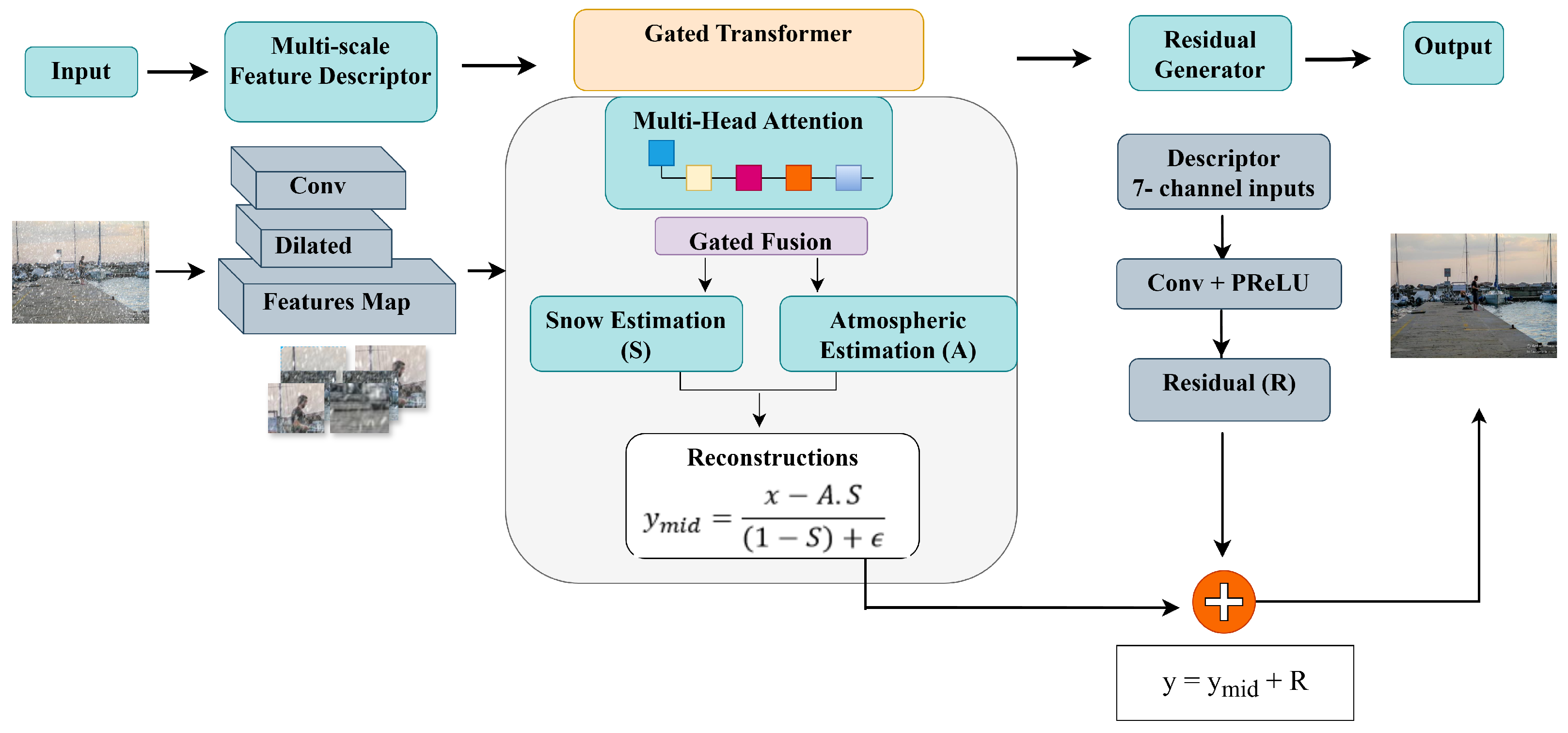
CNNs and Transformers are, in fact, complementary: CNNs excel at extracting fine-grained local textures efficiently, while Transformers model global contextual dependencies across the entire image. Integrating both within a physically grounded, lightweight framework offers a compelling path toward accurate and efficient desnowing. This paper proposes GLA-DesnowNet, a hybrid CNN–Transformer architecture that combines multi-scale convolutional feature extraction with a lightweight Gated Transformer module embedded within a physically motivated two-stage pipeline. A novel adaptive three-channel snow-mask generation strategy provides automatic pixel-level supervision without manual annotation.
The method effectively handles snow particles ranging from fine-grained specks (∼1–5 pixels) up to semi-transparent regions covering approximately 20–30% of the image area. For opaque occlusions covering more than 50%, performance may degrade as recovery exceeds the physical model’s capacity.
The key contributions of this work are outlined as follows:
A lightweight hybrid CNN–Transformer desnowing framework that integrates multi-scale dilated pyramid convolutions with global self-attention via a Gated Transformer module, achieving strong restoration quality at dramatically reduced computational cost;
A novel, adaptive three-channel snow-mask generation strategy that automatically produces pixel-level snow supervision from paired clean and degraded images, eliminating the need for manual mask annotation;
A compound training loss combining L1 pixel-wise reconstruction with a multi-scale max-pooling pyramid loss, enabling consistent restoration across both fine and coarse snow structures;
Extensive experimental evaluation on two large-scale benchmarks (Snow100K and CSD), demonstrating that GLA-DesnowNet achieves competitive restoration quality against state-of-the-art methods while requiring significantly fewer parameters and training epochs. Consistent performance across both datasets further confirms its strong generalization capability.
The remainder of this paper is organized as follows.
Section 2 describes the proposed GLA-DesnowNet architecture and training methodology.
Section 3 presents the experimental setup, results, and comparisons on both the Snow100K and CSD benchmarks.
Section 4 discusses findings and limitations, and
Section 5 concludes the paper.
3. Experimental Results
3.1. Dataset and Preprocessing
All experiments are conducted on the Snow100K dataset [
3], a large-scale synthetic benchmark containing diverse paired snowy and clean images with varying snow-particle sizes, densities, and transparencies. Following the experimental protocol adopted in this work, the dataset is partitioned into 10,000 training pairs (7000 large-snow and 3000 small-snow samples), 2000 validation pairs, and 4000 test images (2000 large-snow and 2000 small-snow samples).
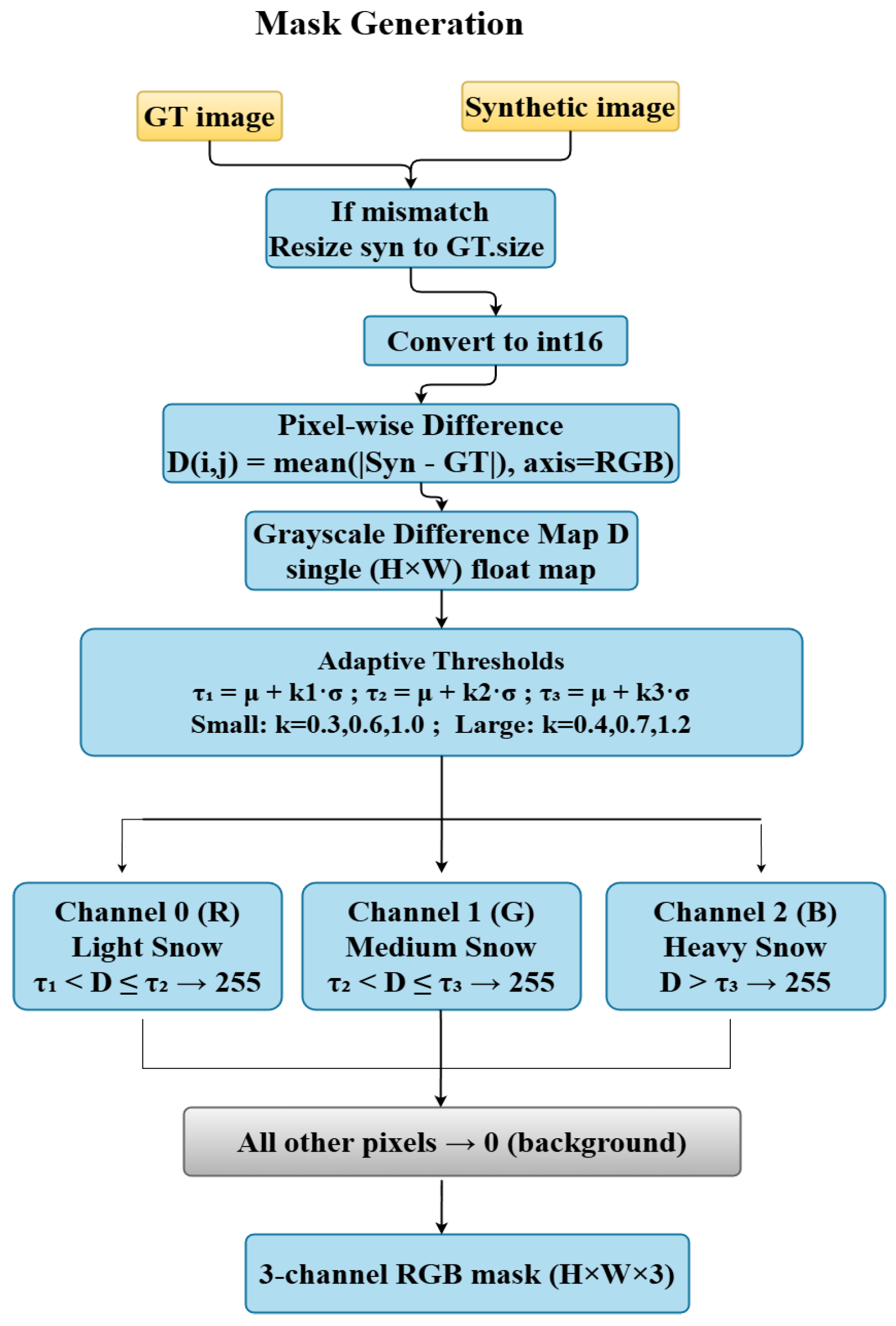
Since Snow100K does not provide ground-truth snow-mask annotations, an adaptive three-channel mask-generation strategy is introduced to generate pixel-level supervision automatically, as described in
Section 3.2.
To further evaluate the generalization capability of the proposed model, experiments are also conducted on the Comprehensive Snow Dataset (CSD) [
11]. CSD contains paired snowy and clean images, together with ground-truth snow masks covering diverse outdoor scenes and snow conditions. The dataset is divided into 7800 training pairs, 800 validation pairs, and 2000 test images. Unlike Snow100K, CSD provides ground-truth masks directly; therefore, the adaptive mask-generation procedure is not required during training.
3.2. Adaptive Mask Generation for Snow100K
For each paired snowy image (
x) and clean ground-truth image (
), a grayscale difference map (
D) is computed by averaging the pixel-wise absolute RGB differences:
Adaptive thresholds are then calculated as
where
and
denote the mean and standard deviation of the difference map, respectively, and
correspond to the three snow-intensity levels.
Based on these thresholds, pixels are assigned to three mutually exclusive channels representing light, medium, and heavy snow regions. The threshold coefficients
are empirically set to
for the small-snow subset and
for the large-snow subset, reflecting the greater brightness variation associated with denser snow particles. The overall workflow of the proposed adaptive mask-generation strategy is illustrated in
Figure 2. Starting from paired snowy and clean images, the method computes a pixel-wise difference map, derives adaptive statistical thresholds, and generates three mutually exclusive snow-intensity channels corresponding to light, medium, and heavy snow regions.
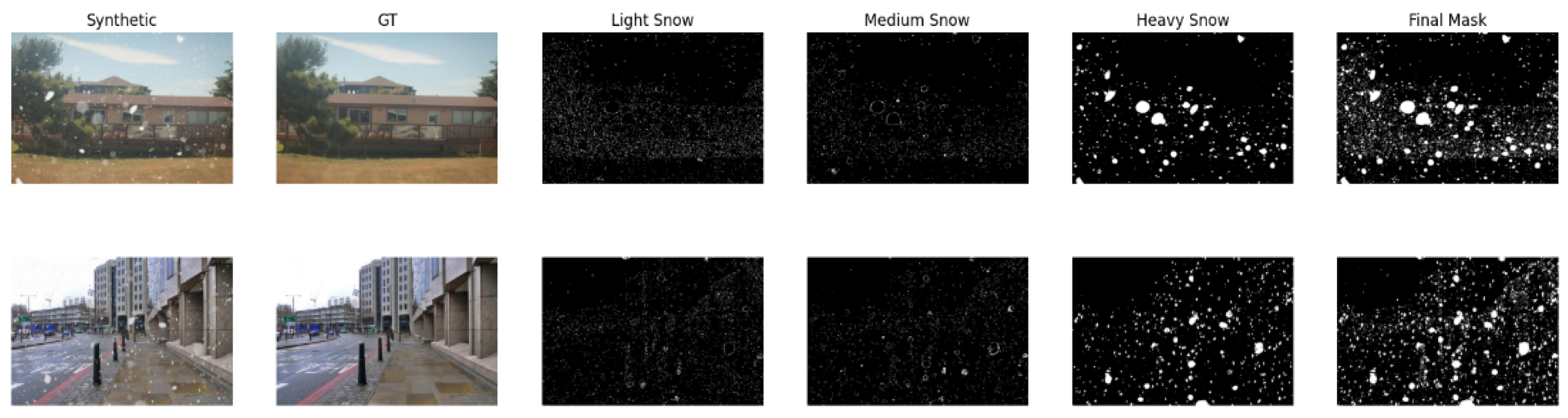
The resulting three-channel masks provide pixel-level supervision for snow-mask learning without requiring manual annotation. Representative examples of the generated masks are shown in
Figure 3, illustrating the separation of light-, medium-, and heavy-snow components prior to their combination into the final supervision mask.
Since thresholds () are derived from per-image statistics rather than fixed absolute values, the strategy adapts automatically to image content. Because the threshold ordering () depends only on the relative spacing of , and , moderate proportional variation in these coefficients preserves the separation between light, medium, and heavy snow regions. A perturbation analysis ( on all coefficients) confirmed 79–81% mask-level agreement for the snow channels with the original configuration (measured via IoU), supporting the robustness of the adaptive mask-generation strategy to coefficient choice.
The strategy can be extended to other atmospheric degradations such as rain or haze, where brightness differences produce characteristic difference maps amenable to adaptive threshold segmentation with appropriate coefficient adjustment.
3.3. Training Setup and Implementation Details
The proposed model is trained for 160 epochs using the Adam optimizer [
26] with an initial learning rate of
and a batch size of 4. Random
image crops are extracted as training patches, serving as a form of spatial data augmentation. Automatic Mixed Precision (AMP) training is employed to reduce memory consumption and accelerate training, while gradient clipping with a maximum norm of 1.0 is applied to ensure stable optimization.
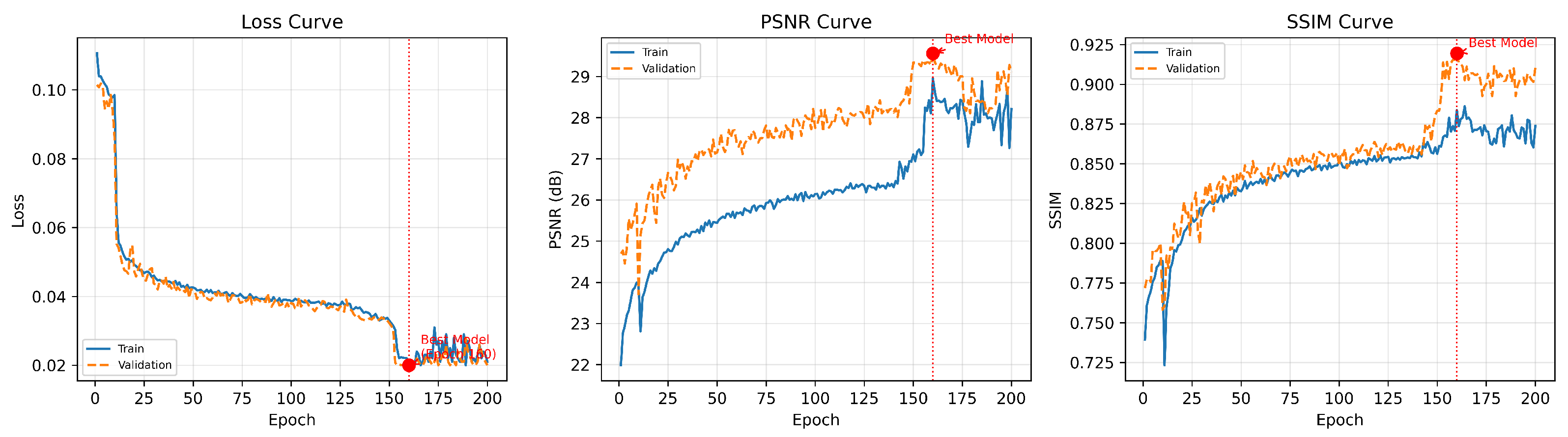
All experiments are implemented in PyTorch (version 2.10.0) and conducted on an NVIDIA Tesla T4 GPU using the Kaggle platform. The training and validation curves are shown in
Figure 4. As illustrated in the figure, the proposed model exhibits stable convergence throughout the 160 training epochs. The validation PSNR and SSIM remain consistently close to—and occasionally exceed—the corresponding training metrics, indicating effective generalization and the absence of significant overfitting. The
patch size balances training efficiency and spatial diversity. As illustrated in
Figure 4, beyond epoch 160, the validation PSNR and SSIM exhibit fluctuations without consistent improvement, confirming that 160 epochs represents the optimal stopping point for this configuration.
Inference time was measured on an NVIDIA Tesla T4 GPU at resolution, averaged over 50 runs with 10-image warm-up, yielding 14.66 ms per image. At resolution, the model requires only 4.44 GFLOPs, which is 4.5× fewer than Uformer (19.92 G), 1.3× fewer than TransWeather (5.64 G), and 37× fewer than RSFormer (163 G), confirming computational efficiency for lightweight deployment.
3.4. Evaluation Metrics
Image restoration performance is evaluated using two widely adopted full-reference metrics: the Peak Signal-to-Noise Ratio (PSNR) and Structural Similarity Index Measure (SSIM). Higher PSNR values indicate improved reconstruction fidelity, while SSIM values range from 0 to 1, with higher values representing greater structural similarity relative to the ground-truth image.
Computational efficiency is assessed using the total number of trainable parameters (#Params) and the number of floating-point operations (GFLOPs) required during inference. These metrics facilitate a comprehensive evaluation of the trade-off between restoration performance and computational complexity.
To further assess perceptual image quality, three no-reference image-quality assessment metrics are employed: the Naturalness Image Quality Evaluator (NIQE), Neural Image Assessment (NIMA), and Integrated Local NIQE (IL-NIQE). Lower NIQE and IL-NIQE scores indicate better perceptual quality, whereas higher NIMA scores correspond to more visually appealing images. Unlike PSNR and SSIM, these no-reference metrics do not require ground-truth images and therefore provide complementary insight into the perceptual naturalness and visual quality of the restored results.
3.5. Quantitative Results
Table 1 presents a quantitative comparison between the proposed GLA-DesnowNet and several state-of-the-art (SOTA) desnowing methods on the Snow100K benchmark. Although Transformer-based approaches such as Uformer [
15] and TransWeather [
14] achieve higher PSNR values, they require substantially greater computational resources.
In contrast, the proposed model achieves a 29.30 dB PSNR and 0.93 SSIM using only 0.53 M parameters and 4.44 GFLOPs while requiring only 160 training epochs. Compared with DesnowNet [
3], the proposed framework improves the PSNR by 2.13 dB while reducing the parameter count from 15.6 M to 0.53 M. Furthermore, the model requires significantly fewer parameters than Uformer [
15] (9.03 M) and TransWeather [
14] (21.90 M), demonstrating an effective balance between restoration quality and computational complexity suitable for lightweight deployment scenarios.
Among the compared methods, HDCW-Net [
11], TransWeather [
14], and Uformer [
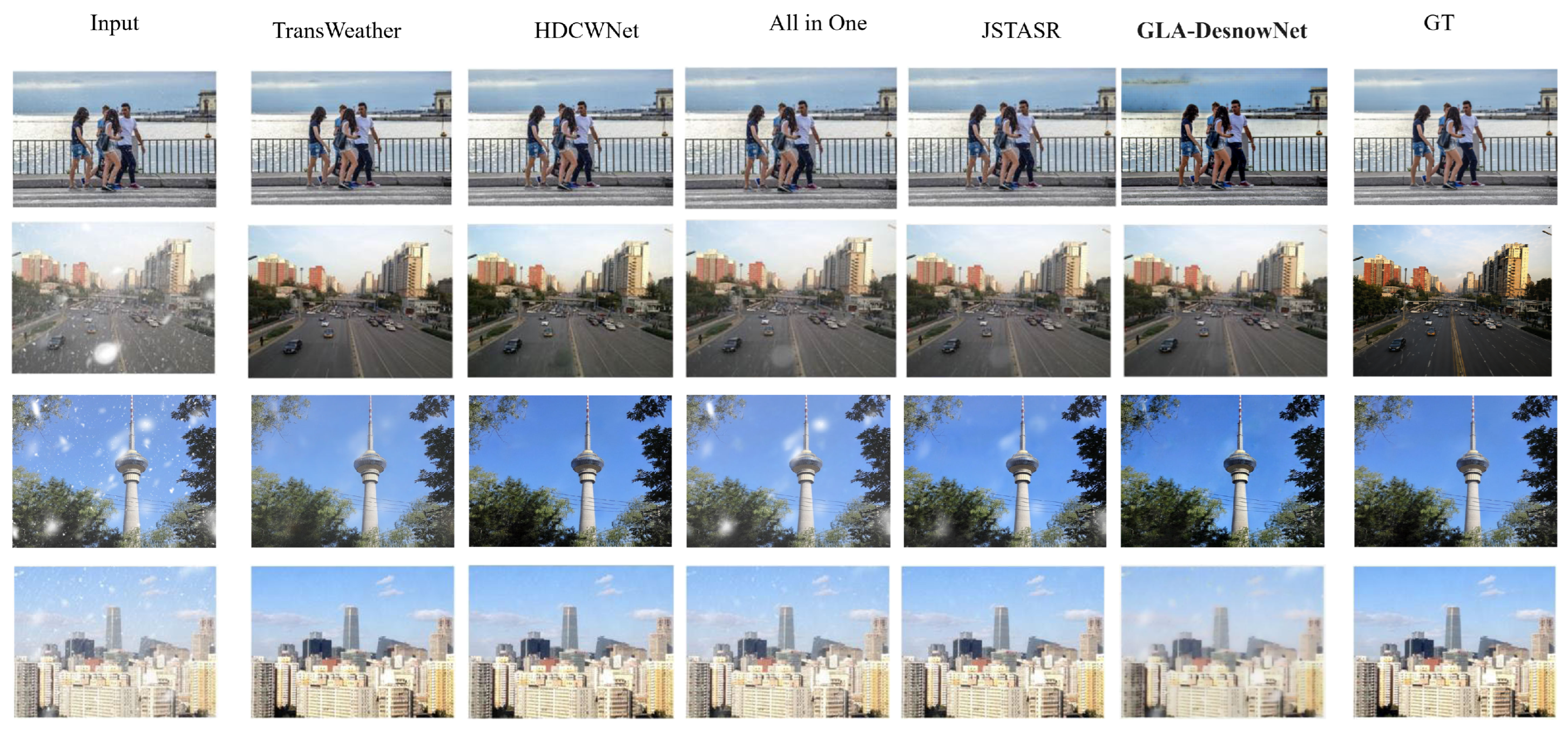
15] achieve higher PSNR values, ranging from 31.54 dB to 33.81 dB. However, these methods require substantially larger architectures, ranging from 6.99 M to 21.90 M parameters, and computational costs of up to 19.92 GFLOPs per inference. In comparison, GLA-DesnowNet maintains competitive restoration performance while using only 0.53 M parameters and 4.44 GFLOPs, highlighting its suitability for real-time and resource-constrained applications. Visual comparisons with representative SOTA methods are provided in
Figure 5.
Table 2 presents a perceptual quality comparison using three no-reference image-quality metrics. The proposed GLA-DesnowNet achieves the best performance across all three metrics, attaining a NIQE score of 3.047, a NIMA score of 4.929, and an IL-NIQE score of 19.62 on the Snow100K test set. These results indicate that the restored images produced by GLA-DesnowNet are not only more natural-looking, as reflected by the lowest NIQE and IL-NIQE scores, but also perceptually more pleasing, with the highest NIMA scores.
Notably, the proposed model outperforms Transformer-based methods such as Uformer [
15] and RSFormer [
18] across all three perceptual dimensions. This demonstrates that the proposed hybrid CNN–Transformer architecture produces visually appealing restorations that align well with human perceptual preferences despite its extremely compact architecture.
3.6. Ablation Study
The ablation results presented in
Table 3 demonstrate the contribution of each architectural component. The CNN-only baseline (M1) achieves a 25.67 dB PSNR and 0.87 SSIM, indicating that local convolutional representations alone are insufficient for the modeling of globally distributed snow structures. Incorporating the proposed Gated Transformer module (M2) improves performance to a 28.43 dB PSNR and 0.91 SSIM, confirming the importance of long-range contextual modeling.
Finally, adding the Residual Generation (RG) module further refines image details and increases performance to a 29.30 dB PSNR and 0.93 SSIM, validating the complementary effect of residual refinement. These results confirm that each component contributes positively to the overall restoration performance.
3.7. Evaluation on the CSD Dataset
Table 4 reports the results on the 2000-image CSD test set. The proposed model achieves a 27.79 dB PSNR and 0.90 SSIM, representing a 13.53 dB improvement over the degraded input (14.26 dB PSNR and 0.708 SSIM). The Translucency Recovery (TR) module alone achieves a 26.31 dB PSNR and 0.86 SSIM, while the Residual Generation (RG) module contributes an additional 1.48 dB improvement, demonstrating its effectiveness in refining image details.
Furthermore, validation performance reaches a 29.75 dB PSNR and 0.92 SSIM, indicating stable convergence and strong generalization capability. These results confirm that the proposed architecture performs consistently across datasets with different snow characteristics.
Comparing the two benchmarks, Snow100K yields a 29.30 dB PSNR, whereas CSD achieves a 27.79 dB PSNR. This performance gap is expected because CSD contains more diverse and challenging snow degradation patterns. Importantly, the same model architecture achieves competitive desnowing performance on both datasets within only 160 training epochs and without any architectural modification, highlighting the robustness and generalization capability of the proposed hybrid CNN–Transformer framework.
3.8. Qualitative Results
Visual comparisons on Snow100K test samples demonstrate that GLA-DesnowNet consistently removes snow artifacts of varying densities while preserving background structure and color fidelity, as shown in
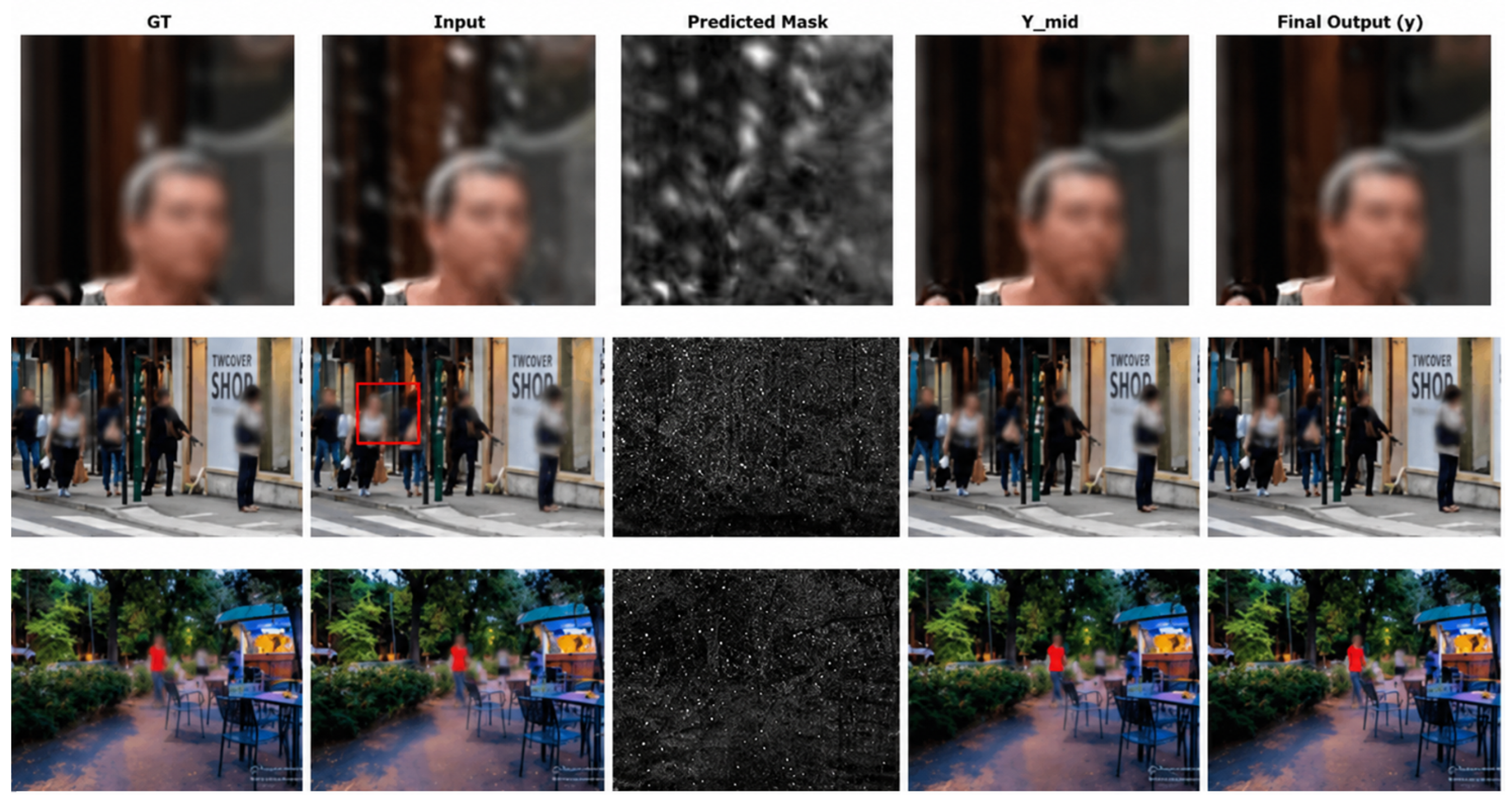
Figure 6. The TR module accurately localizes snow-affected regions through the estimated snow mask, while the RG module effectively restores fine-grained texture details in the final output.
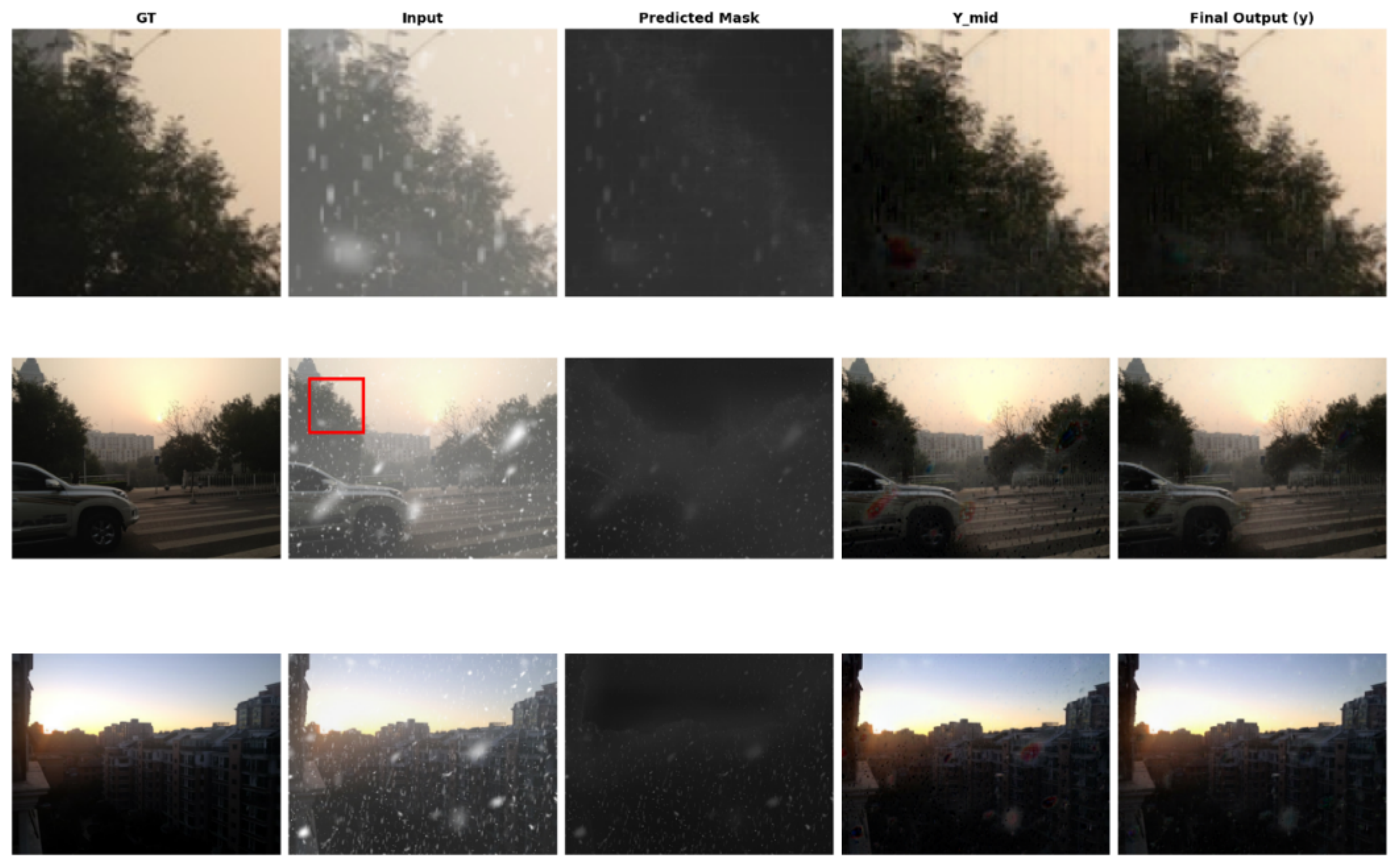
Patch-level comparisons further confirm the ability of the proposed method to recover local image structures in regions containing complex snow patterns without introducing noticeable blurring or color distortions. Representative qualitative results on the CSD dataset are presented in
Figure 7, where the proposed model similarly demonstrates effective snow removal and texture preservation under more challenging degradation conditions.
4. Discussion
The experimental results demonstrate that the proposed GLA-DesnowNet achieves a strong efficiency–accuracy trade-off. While recent Transformer-based methods attain higher benchmark PSNR scores, they often rely on substantially larger architectures and longer training schedules [
14,
15,
16,
17,
19,
27,
28]. In contrast, the proposed framework achieves competitive restoration quality with only 0.53 M parameters and 4.44 GFLOPs, requiring only 160 training epochs. This lightweight design makes the model particularly suitable for real-time and resource-constrained applications, including edge devices and embedded vision systems.
Relative to pure Transformer approaches such as Uformer [
15] and TransWeather [
14], GLA-DesnowNet achieves a lower PSNR on Snow100K but requires orders-of-magnitude fewer parameters and floating-point operations. This efficiency–accuracy trade-off is particularly relevant for edge devices and real-time applications where computational resources are constrained. The lightweight Gated Transformer module contributes to this efficiency by applying global attention with a learned gate that selectively amplifies informative features rather than computing full-resolution quadratic attention maps.
The ablation study confirms that each component makes a distinct and complementary contribution: the CNN backbone provides local structure, the Gated Transformer captures global context, and the RG module refines residual details. The adaptive three-channel mask-generation strategy provides effective pixel-level supervision without manual annotation, facilitating supervised training on the paired Snow100K data. Across both Snow100K and CSD, the model achieves consistent desnowing performance within 160 epochs without architectural modification, confirming that the hybrid CNN–Transformer design generalizes well beyond the benchmark on which it was developed.
Several limitations warrant acknowledgment. Both Snow100K and CSD are synthetic benchmarks; therefore, generalization to real-world snow conditions remains to be validated. The patch training strategy limits exposure to global image context during optimization. Additionally, the architecture does not explicitly model temporal consistency, restricting its applicability to video desnowing. The adopted physical model assumes linear snow formation; real-world deviations such as motion blur and surface accumulation may reduce accuracy. Consistent performance across both Snow100K and CSD suggests generalization beyond a single degradation assumption.
State-of-the-art perceptual scores (NIQE = 3.047, NIMA = 4.929, and IL-NIQE = 19.62) suggest strong perceptual naturalness that may generalize to real images. Future work will address real-world validation through domain adaptation and fine-tuning on small real-world datasets. Three scenarios exist where heavier models outperform the proposed architecture: (1) extremely dense snow covering more than 50% of the image, (2) fine texture recovery under heavy occlusion, and (3) complex chromatic correction beyond the linear model. These trade-offs are justified by the 36× efficiency gain over Uformer (4.44 vs. 19.92 GFLOPs).
5. Conclusions
This research presented GLA-DesnowNet, a lightweight hybrid CNN–Transformer architecture for single-image snow removal. By integrating a Gated Transformer module into a physically motivated two-stage pipeline comprising a Translucency Recovery (TR) module for snow-mask and atmospheric-veiling estimation and a Residual Generation (RG) module for texture refinement, the proposed network achieves competitive restoration quality at dramatically reduced computational cost.
The adaptive three-channel mask-generation strategy provides effective pixel-level supervision from paired data without requiring manual annotation. Experimental results on Snow100K and CSD demonstrate that the proposed framework achieves consistent and competitive desnowing performance while maintaining extremely low computational complexity. The model attains a 29.30 dB PSNR and 0.93 SSIM on Snow100K and a 27.79 dB PSNR and 0.90 SSIM on CSD using only 0.53 M parameters and 4.44 GFLOPs, highlighting its suitability for efficient real-world deployment.
Several limitations warrant acknowledgment: (1) both benchmarks are synthetic, and real-world generalization remains unvalidated; (2) the patch training limits global image context; (3) the architecture lacks temporal modeling for video desnowing; and (4) the physical model assumes linear snow formation, which may not hold under all real-world conditions.
Future work will focus on four directions:
Incorporating real-world snow images and domain-adaptation techniques to improve robustness under natural weather conditions;
Extending the framework to video desnowing through temporal attention mechanisms or recurrent architectures;
Investigating linear-attention and window-based attention strategies to further reduce inference cost while preserving restoration quality;
Developing a unified multi-weather restoration framework capable of jointly handling snow, rain, and haze degradation within a single architecture.